
Article

Seismic Response Analysis of Multi-Span SFT with Flexible Constraints

1
Zhejiang Communications Construction Group Co., Ltd., Hangzhou 310051, China
2
Center for Balance Architecture, Zhejiang University, Hangzhou 310058, China
3
College of Civil Engineering and Architecture, Zhejiang University, Hangzhou 310058, China
*
Author to whom correspondence should be addressed.
Infrastructures 2026, 11(1), 7; https://doi.org/10.3390/infrastructures11010007

Submission received: 10 November 2025 / Revised: 11 December 2025 / Accepted: 18 December 2025 / Published: 23 December 2025

Abstract

The boundary of a submerged floating tunnel (SFT) is flexible, and ignoring the influence of boundary and pipeline connections may reduce its structural performance. Therefore, this study uses rotating springs and linear springs to simulate the flexible boundary. Joints are simplified as shear springs and bending springs. A multi-span SFT model on discrete elastic supports is established, and its seismic response is evaluated using the transfer matrix method and the modal superposition method. The proposed method is validated by comparing it with finite element results, and the vertical mechanical response of the SFT when the cable relaxes or fractures under earthquake action is analyzed. The results indicate a significant deviation between the seismic response of flexible constraints and those modeled as simple hinged or fixed connections, and the lower boundary constraint stiffness is beneficial to the seismic response of the SFT. Introducing flexible joints can effectively reduce the internal force response of the structure, and a bending stiffness ratio of 0.01 to 0.03 for the joints is considered reasonable. In contrast, variations in the shear stiffness of the joints have a relatively small impact on the seismic response.

1. Introduction

The submerged floating tunnel (SFT) is a new type of underwater transportation structure that maintains balance through its own gravity, the buoyancy of tubes, and the tension of cables. It has significant advantages compared to an immersed tunnel and an underwater tunnel when crossing long, deep water bodies. The straits where SFT is built are usually located in seismic belts; the SFT will be threatened by earthquake action during the operation period. The probability of an earthquake occurring is relatively low, but once it occurs, it will have a serious impact on the safety of structures and personnel. Studying the seismic response and analysis of the SFT not only has theoretical significance and academic value but also provides a theoretical basis for the seismic design and application of such structures.
Theoretical analysis is one of the main methods for studying the seismic response of the SFT, which mainly involves establishing mathematical models through rational simplification of the structure and solving them. Su et al. [1] presented the vibration equation of the SFT tether under the combined action of earthquake and parametric excitation. The Galerkin method and the fourth-order Runge–Kutta method were used to solve it. Wu et al. [2] and Wang et al. [3] used the Morison equation to represent the hydrodynamic force and established the motion equation of the cable under earthquake action based on Euler beam theory. In order to obtain the seismic response of a single pipe section, Dong et al. [4] simplified the pipe section supported with two dampings and springs at each end as a superposition of an elastic beam and a rigid beam. In order to study the dynamic response of the SFT tube under seismic effect, Dong et al. [5] took the SFT as an elastic support beam and investigated the influence of P wave, tube length, and stiffness of cable. Xie et al. [6] also simplified the SFT as an elastic support beam and proposed a mathematical model for analyzing the seismic response characteristics of the SFT–Canyon water system, which can consider the transmission effect of canyon water to the horizontal seismic wave input. Akbarzadeh et al. [7] studied the vibration characteristics of the SFT under non-uniform seismic excitation using both finite element and analytical solutions. Chen et al. [8] investigated the dynamic response of the SFT subjected to the coupled action of earthquake and waves using a seawater–seabed-tunnel coupling model. Xiong et al. [9] derived the nonlinear dynamic differential equation of the SFT under earthquake action by considering the wave-structure dynamic coupling interaction and obtained its numerical solution based on the Newmark-β integration algorithm. Huang et al. [10] considered the coupling relationship between horizontal displacement and torsion angle of SFT pipes caused by the constraint effect of cables and proposed a frequency-domain theoretical method for analyzing the steady-state dynamic response of the SFT pipes under wave action.
In the above theoretical studies, the boundary at both ends of the SFT is simplified as hinged or fixed connections, and the tunnel is considered as a beam with equal section and stiffness. However, the actual boundary of the SFT is flexible [11], it will be subjected to bending constraints and undergo displacement and turning angle. In addition, there is a stiffness difference between the joint and the pipe segment [12,13]. Ignoring the influence of actual boundaries and pipe connections may result in significant errors [14,15,16].
On the basis of existing research, this study focuses on multi-span elastically supported SFT with flexible boundaries at two ends and establishes its vibration equation under vertical seismic action. The modal of the SFT was solved by the transfer matrix method [17], then the vibration equation was semi-numerically solved using the mode superposition method and compared with the finite element method (FEM). Based on the finite element model, the changes in seismic response of the SFT during anchor failure (relaxation and breakage) were also analyzed. Moreover, the influence of boundary conditions and joint stiffness on the seismic response of the SFT was investigated.

2. Mathematical Model

2.1. Simplified Model of SFT

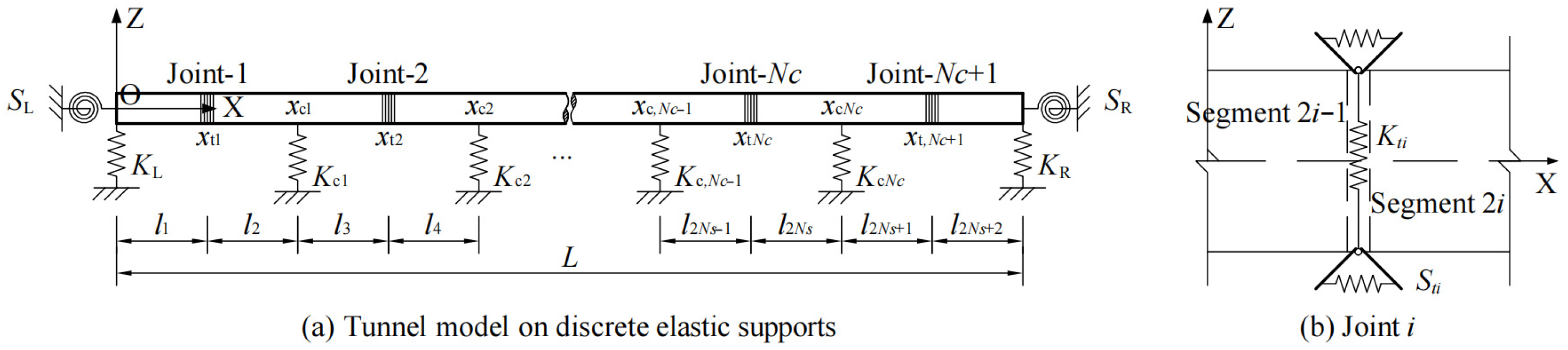
Kanie et al. [18] and Sato et al. [19] both consider the anchoring system as discrete elastic supports based on the theory of small deformation linear elasticity. Figure 1a shows the analytical model of a multi-span beam on elastic supports under a flexible boundary. The analytical model includes Nc elastic supports, and the coordinate of the ith support is xci. Between two adjacent supports, there is a pipe joint, resulting in a total of Nc + 1 joints; the coordinate of the ith joint is xti. The tube is divided into 2(Nc + 1) sections by elastic supports and joints, the length of the jth section is lj, and the total length of the tube is L. If the SFT does not meet the form of Figure 1a, virtual joints and virtual supports can be set in the model. The stiffness of the virtual joints is infinite, and the stiffness of the virtual supports is zero.
In order to study the dynamic response of the SFT under earthquake events, four hypotheses are given. Firstly, the multi-span tube is regarded as an Euler–Bernoulli continuous beam [20] with equal cross-section, where the axial deformation is not considered; Secondly, the stiffness of the boundary and pipe joint is linear elasticity, which can be simulated as springs, and each spring is independent of the other. Ignore the geometric dimensions of pipe joints and only consider their mechanical properties; Thirdly, if it is a tether-type SFT, the relaxation of the parameter vibration of the anchor cable is not considered [21]. Fourthly, the simulated environment is still water, ignoring the effects of seabed motion, waves, and ocean currents on the flow field of seawater. Seawater is an ideal fluid that is non-viscous and non-rotating.
For tether-type SFT, the vertical support stiffness calculation [22] formula is shown in Equation (1).
K c = 2 E c A c cos 2 α c l c
where Ec, Ac, lc, and αc are the elastic modulus, cross-sectional area, length, and the inclination angle of the cable.
The displacement, rotation angle, and bending moment (BM) of two adjacent pipe sections remain consistent at the elastic support, and the shear force (SF) will undergo a sudden change. The compatibility conditions at the ith support are denoted as Equation (2).
z x c i , t = z ( x c i + , t ) z x c i , t x = z x c i + , t x E I 2 z x c i , t x 2 = E I 2 z x c i + , t x 2 E I 3 z x c i , t x 3 K c i z x c i , t = E I 3 z x c i + , t x 3
where EI is flexural rigidity; x c i and x c i + denote the left and right sides of the elastic support, respectively.
Yang et al. [23,24] simulated the connection effect between adjacent segments using shear springs and bending springs based on the characteristics of flexible joints, as shown in Figure 1b. The compatibility conditions at the ith joint are shown in Equation (3).
z x t i , t E I K t i 3 z x t i , t x 3 = z x t i + , t z x t i , t x + E I S t i 2 z x t i , t x 2 = z x t i + , t x E I 2 z x t i , t x 2 = E I 2 z x t i + , t x 2 E I 3 z x t i , t x 3 = E I 3 z x t i + , t x 3
where Kti and Sti are the shear stiffness and bending stiffness of the ith joint; x t i and x t i + denote the left and right sides of the joint, respectively.
The boundary conditions at the two sides of SFT are simulated as linear springs and rotational springs. As shown in Figure 1a, KL and KR are the stiffness of linear springs, and SL and SR are the stiffness of rotational springs. By adjusting the values of three kinds of springs from 0 to ∞, the simulation of various boundary conditions can be realized. When the values of stiffness are KL = KR = ∞ and SL = SR = 0, the boundary condition degenerates into simply support. When the values of stiffness are KL = KR = ∞ and SL = SR = ∞, the boundary condition degenerates into fixed support. The boundary constraint equation is denoted as Equation (4).
E I 2 z ( 0 , t ) / x 2 = S L z ( 0 , t ) / x E I 2 z ( L , t ) / x 2 = S R z ( L , t ) / x E I 3 z ( 0 , t ) / x 3 = K L z ( 0 , t ) E I 3 z ( L , t ) / x 3 = K R z ( L , t )

2.2. Vibration Equation and Solution

The earthquake excitation FQ in the time domain can be expressed as
F Q ( x , t ) = m 0 a g
The hydrodynamic force, FD, can be expressed by Morison’s equation [25], as follows:
F D ( x , t ) = 1 2 C D ρ w D ( v g + z ( x , t ) t ) v g + z ( x , t ) t C M 1 π 4 ρ w D 2 a g + 2 z ( x , t ) t 2
where ag and vg are the acceleration and velocity of the input ground motion; m0 and D are the mass per unit length of tube and the outer diameter of tube; ρw is the fluid density; CD and CM are the drag coefficient and the inertia coefficient, respectively. In this paper, CD is taken as 1.0 and CM is taken as 2.0.
According to the Hamilton’s principle, the vibration equation of the SFT under earthquake action is denoted as Equation (7).
m 0 2 z ( x , t ) t 2 + c z ( x , t ) t + E I 4 z ( x , t ) x 4 = F Q ( x , t ) + F D ( x , t )
where c is the viscous damping coefficient.
This paper uses the mode superposition method for an approximate solution. The displacement of the tube can be represented as a series form of the product of the vibration mode and the generalized coordinates:
z ( x , t ) = n = 1 ϕ n ( x ) q n ( t ) = n = 1 j = 1 N ϕ n j ( x ) s j ( x ) q n ( t )
where ϕn(x) and qn(t) are the nth modal function and generalized coordinates of the displacement of the tube, respectively; N is the number of pipe segments; ϕnj(x) and sj(x) are the modal function of the jth section of the tube [23,24].
Substitute Equation (8) into the vibration Equation (7), and use the Galerkin method to obtain the generalized coordinate ordinary differential equation:
q ¨ n ( t ) + c m q ˙ n ( t ) + E I θ n 4 m q n ( t ) + f D = a g 0 L ϕ n ( x ) d x 0 L ϕ n ( x ) 2 d x
where fD is related to fluid damping, its expression is shown in Equation (10):
f D = C D ρ w D 0 L k = 1 ϕ k ( x ) q ˙ k ( t ) + v g k = 1 ϕ k ( x ) q ˙ k ( t ) + v g ϕ n ( x ) d x 2 m 0 L ϕ n ( x ) 2 d x
The fourth-order Runge–Kutta method is used to numerically solve Equation (9); the dynamic response of the SFT can be obtained by superimposing the product of the calculated generalized coordinates and modal functions. The above calculation process is completed using MATLAB R2024a programming. Among them, the modes of SFT are obtained by the transfer matrix method. The transfer matrix method is an analysis method based on component segmentation recursion, which does not require the establishment of a large stiffness matrix for the overall structure but only solves it by transferring the state vectors of adjacent pipe segments (including joints). For SFTs, which are composed of multiple pipe sections, joints, and discrete supports, the transfer matrix method can significantly reduce the number of unknowns and avoid the time-consuming assembly and solution of large-scale matrices in finite element methods. Especially when iterative calculations are required for full transient analysis, the efficiency advantage is more significant, and it is more in line with the structural characteristics of SFTs compared to finite element methods.

3. Numerical Examples

No physical SFT has been constructed to date; the numerical calculation parameters refer to some conceptual design study cases [26,27,28], and the specific parameters are listed in Table 1.
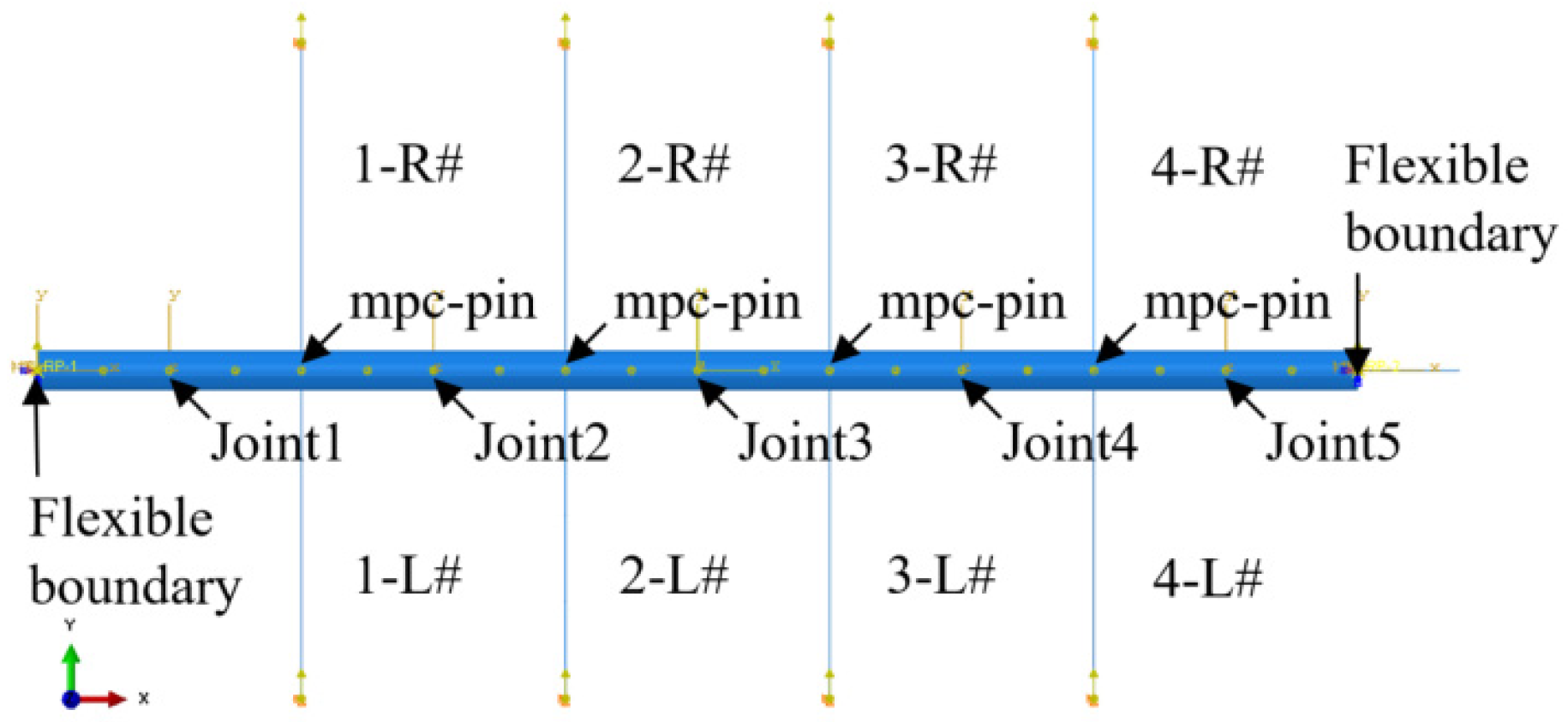
The SFT is tethered, with a total length of 500 m and a bottom distance of 200 m from the seabed. Four pairs of cables are evenly arranged with a spacing of 100 m. The joints are arranged in the middle of each span. Referring to immersed tube tunnels [29,30], the bending stiffness is about 1/50 of the unit bending stiffness of the tube, and the shear stiffness is about 1/20 of the unit shear stiffness of the tube. The body of SFT is a slender structure, simulated using a three-dimensional beam element B31. The cable is modeled without bending stiffness, and the truss element T3D2 is used for simulation. The cable material is set to be incompressible to consider cable relaxation. When simulating cable breakage, the corresponding cable is removed as a whole through the *MODEL CHANGE function. The mpc–pin connection is used between the cable and the body, and linear simulation is used for the pipe section joint. As only five directions of spring constraints are considered in the joint, no springs are set in the x-axis direction, and additional coupling constraints in the x-axis direction are required between the bodies. The boundary between the cable and the body also needs to be subjected to seismic loads, so displacement constraints are used at the boundary. The flexible boundaries on both sides of the body are also simulated using sleeve springs, with one end connected to the end of the body and the other end connected to a reference point. The displacement in all six directions of the reference point is set to zero, while the displacement in the x, y, and z directions of the anchor point is set to zero. During dynamic analysis, the degrees of freedom in the z-direction are released, and seismic acceleration is applied. Then, an FEM is established in software ABAQUS 6.14, as shown in Figure 2.
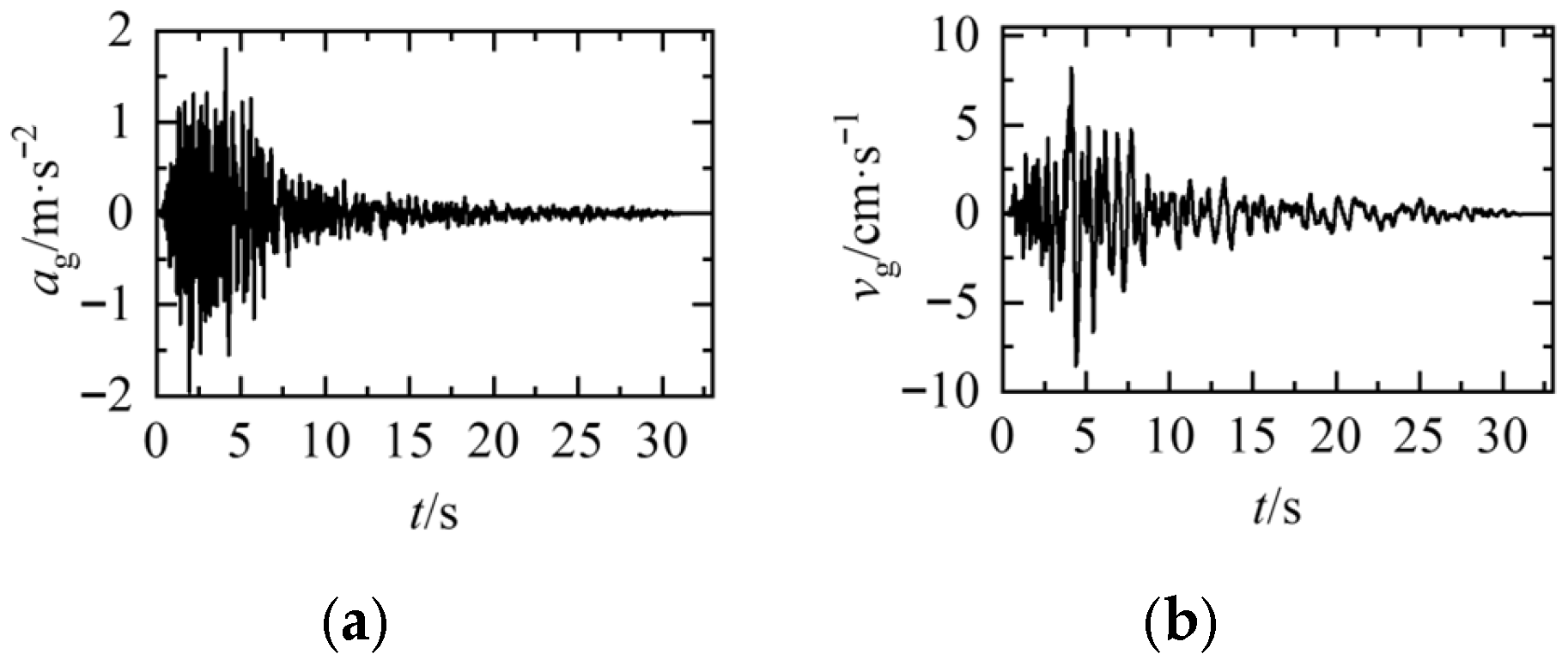
Referring to the Chinese “Specifications for Seismic Design of Highway Bridges” (JTG/T-2231-01-2020), we selected “Whittier Narrows-01” earthquake records from the peer ground motion database for case analysis. The peak ground acceleration was adjusted to 0.2 g, and the acceleration time–history curve and velocity time–history curve of the earthquake are shown in Figure 3.
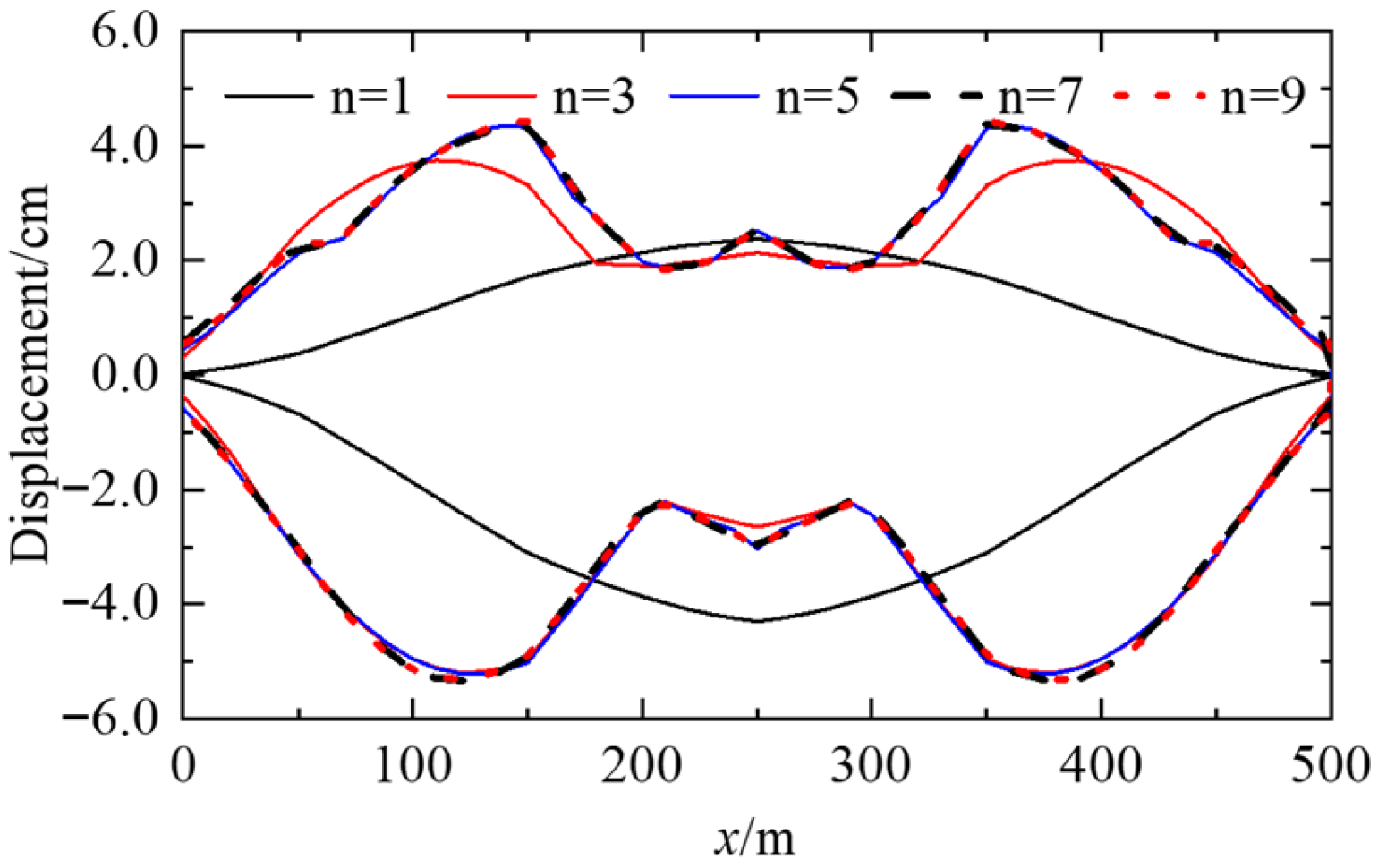
In order to verify the convergence of the modal superposition method (MSM), Figure 4 shows the displacement envelope of the tunnel after different orders of superposition. The displacement obtained by superimposing the first 5 orders through the first 9 orders is basically consistent, indicating that the calculation results have converged. To balance calculation accuracy and efficiency, the first 7 modes are taken for subsequent calculations.
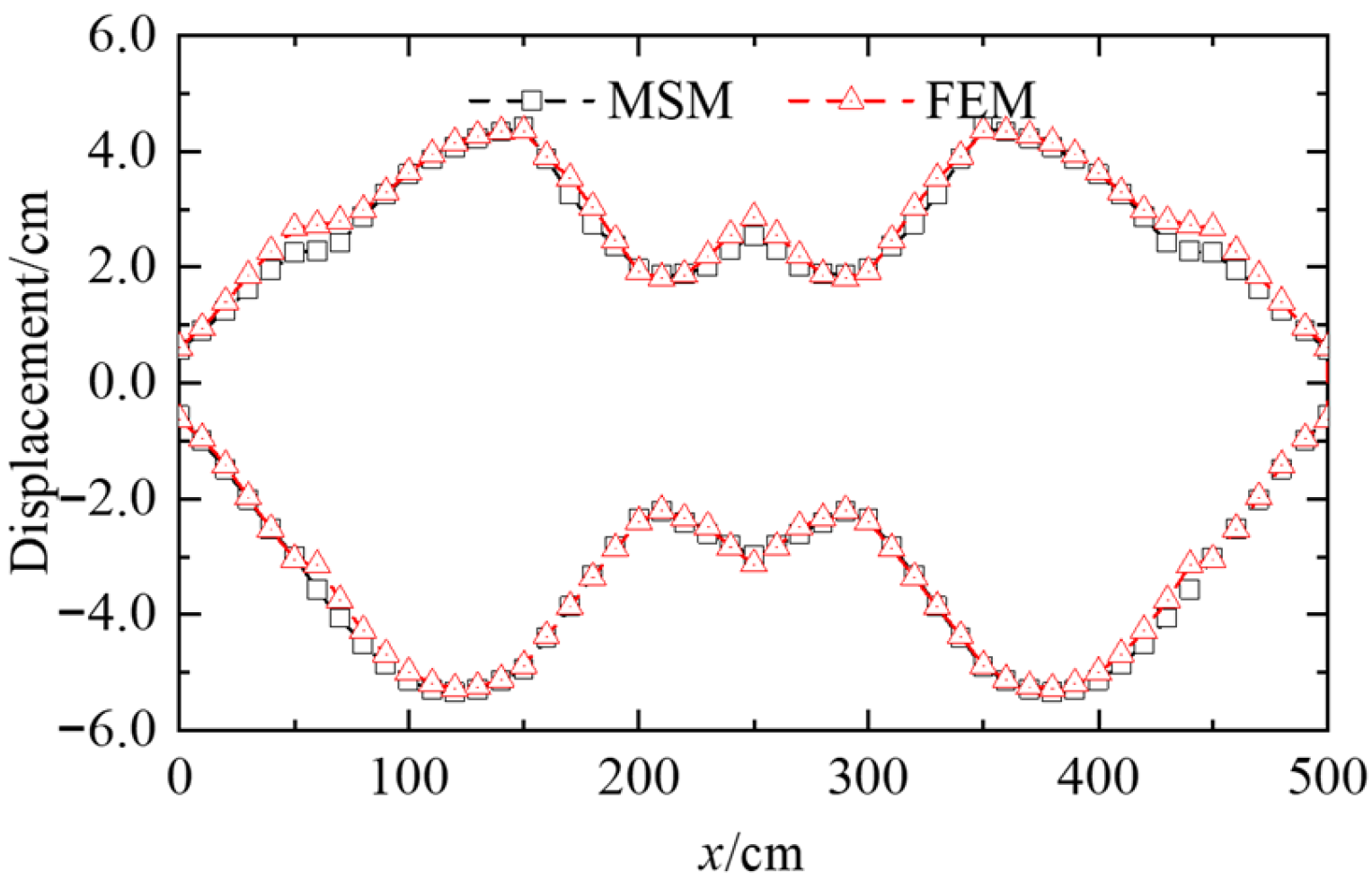
Table 2 lists the first 10 natural frequencies of MSM and FEM. The frequencies obtained by the two methods match well at low orders, with a first-order frequency deviation of only 0.24%. As the order increases, the natural frequency deviation gradually increases, and the 10th-order frequency is 9.91%. Figure 5 shows the analysis results of MSM and FEM; the displacement envelope plots obtained by the two methods are in good agreement. The maximum displacements of MSM and FEM are −5.35 cm and −5.29 cm, with a difference of 1.13%, which proves the accuracy of the theoretical calculation methods and program writing.
In addition, cables are the main load-bearing components of SFT, used to balance the remaining buoyancy of the body. Although there is already a high degree of redundancy in the design, cables may still fail in some extreme cases [31,32,33]. Therefore, this study also analyzed the changes in seismic response of the SFT when cables relax and break based on the finite element model in Figure 2. The data source was “Chi-Chi, Taiwan-04” seismic waves, and the peak acceleration was adjusted to 0.4 g.
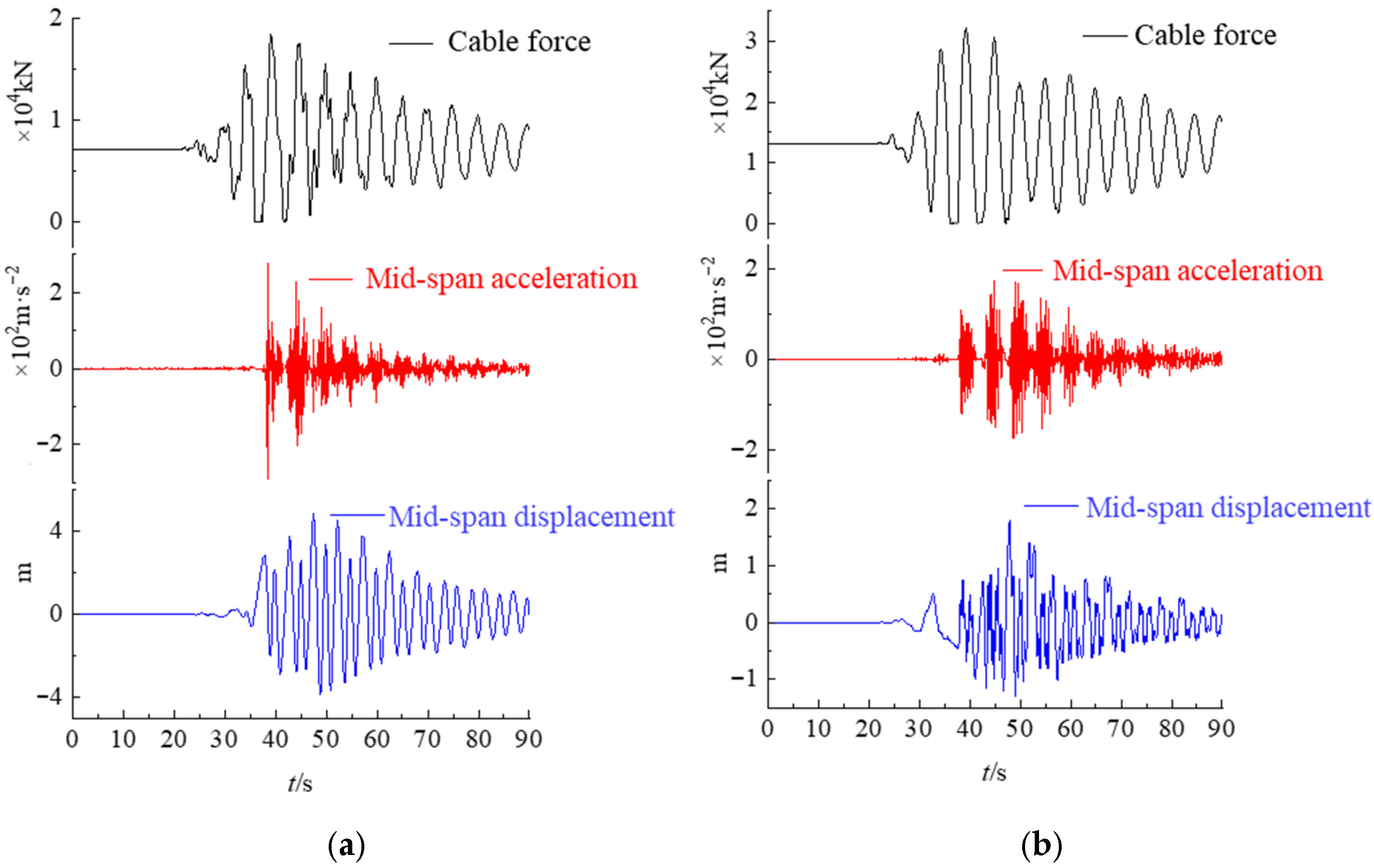
Cable relaxation. Figure 6a,b shows the time–history curves of tension, acceleration, and displacement responses of 1 L# and 2 L# cables, respectively. The tension of 1 L# cable is zero between 35.97 s and 37.20 s and from 41.58 s to 42.03 s, and the tension of 2 L# cable is zero between 36.06 s and 37.65 s and from 41.52 s to 42.18 s. At this time, due to the excessive displacement of the body, the elongation ∆l of the cable is less than or equal to 0, and the cable relaxes. Comparing the cable force and acceleration time history of the cable, when the cable transitions from relaxation to tension, the impact effect causes a sudden increase in the acceleration, with a maximum acceleration of over 20 g. The maximum cable forces of the 1 L# and 2 L# cables are 1.85 × 10⁴ kN and 3.21 × 10⁴ kN, respectively, with corresponding maximum stresses of 588.9 MPa and 1021.8 MPa. The 2 L# cable is approaching its ultimate stress, and there is a risk of cable breakage. Excluding the initial tension of the cable, the maximum dynamic tension of 1 L# and 2 L# cables is 1.13 × 10⁴ kN and 1.90 × 10⁴ kN, respectively. The dynamic tension of 1 L# is greater than that of 2 L#, but the maximum displacement of 1 L# is 4.85 m, which is greater than that of 2 L# at 1.80 m. This indicates that the excitation of the body on the anchor cable after relaxation failure is no longer the dominant factor in the displacement response of the cable.
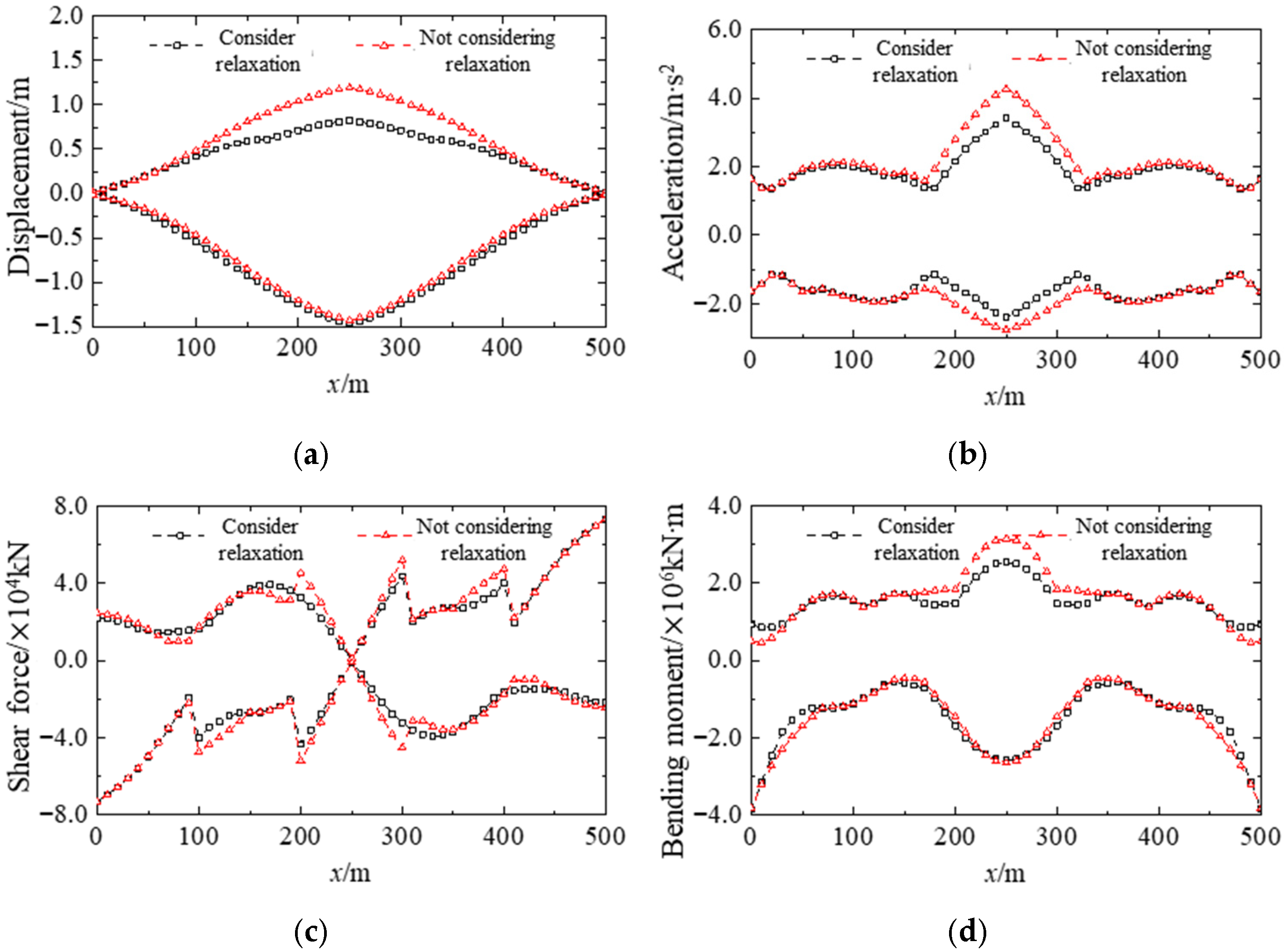
In order to investigate the effect of cable relaxation failure on the response of the SFT, a working condition was also set without considering cable relaxation, that is, ignoring the influence of cable force changes on the stiffness of cable support and being able to withstand axial pressure, with the force form consistent with the discrete elastic support beam model. Figure 7 shows the vertical response envelope diagrams of the body under two operating conditions. From Figure 7a,b, it can be seen that the maximum downward displacement of the body considering cable relaxation is −1.46 m, slightly larger than −1.43 m without considering relaxation, and the maximum upward displacement is 0.82 m, lower than 1.19 m without considering relaxation, with a difference of 45.12% between the two. The maximum acceleration without considering relaxation is 4.27 m/s2, which is greater than the 3.43 m/s2 considering relaxation, with a difference of 24.49% between the two. This is because when the cable is relaxed, it cannot provide support, increasing downward displacement. At the same time, after losing the support of the cable, the overall stiffness of the SFT decreases, and the natural frequency decreases. During this period, the absorbed energy decreases, and the upward displacement and acceleration response of the body are lower than when relaxation is not considered.
In addition, the discrete elastic support beam model still provides upward support force to the body when the cable relaxes and fails. Therefore, the shear envelope diagram in Figure 7c shows that the SF mutation is greater in working conditions without considering relaxation at 100 m, 200 m, 300 m, and 400 m, where the cable is present. At the same time, it also has a certain impact on the BM response of the body, as shown in Figure 7d, where the positive BM in the mid-span region without considering relaxation is significantly higher than that of the cable relaxation. Therefore, when analyzing the strong earthquake response of the SFT, it is necessary to verify whether the cables are relaxed. If the cable relaxation is not considered, it may lead to significant deviation.
Cable breakage. Under the influence of factors such as seawater corrosion and fatigue loads, the bearing capacity of the cable may decrease, and it may fracture and fail. Assuming that 1860 steel strand is used as the cable, the strength of the local cable decreases by 20%; that is, the ultimate tension of a single cable is 3.17 × 10⁴ kN. When the tension of the cable reaches its limit, the *MODEL CHANGE function in ABAQUS is used to remove the cable and simulate cable breakage.
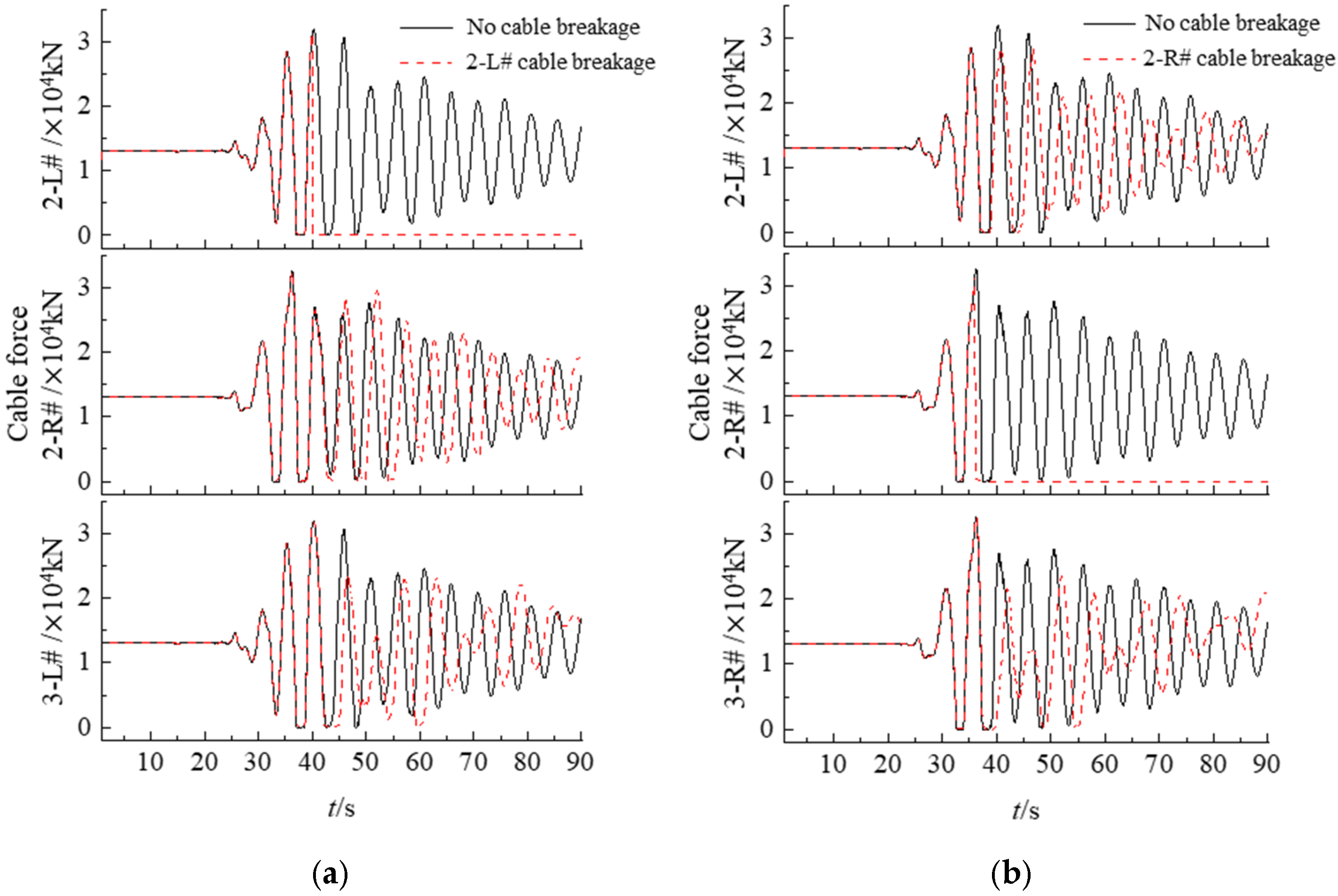
Figure 8 shows the time–history curves of the remaining typical cable force after the 2 L# and 2-R# cables break. The typical cables refer to the cables on the opposite and adjacent sides of the broken cable. The cable on the opposite side of 2 L# is 2-R#, the adjacent side is 3 L#, and the adjacent side of 2-R# is 3-R#. As can be seen from the figure, if the bearing capacity of a 2 L# cable decreases by 20%, the time for cable breakage is 35.07 s. If the bearing capacity of the 2-R# cable decreases by 20%, the time for cable breakage is 39.06 s, both occurring during the time period of seismic energy concentration. Compared with the time history of cable force without cable breakage, there is little change in the adjacent and opposite anchor cable forces in the short period of time after cable breakage, and no significant impact effect is observed. This is because the impact force caused by cable breakage is much smaller than the seismic force. After experiencing a period of cable breakage, the vibration characteristics of the SFT change, and the cable force time history changes significantly compared to when there is no cable breakage. At the same time, the buoyancy of the body on the broken cable will be borne by the remaining cables, and the overall cable force time history tends to shift upward.
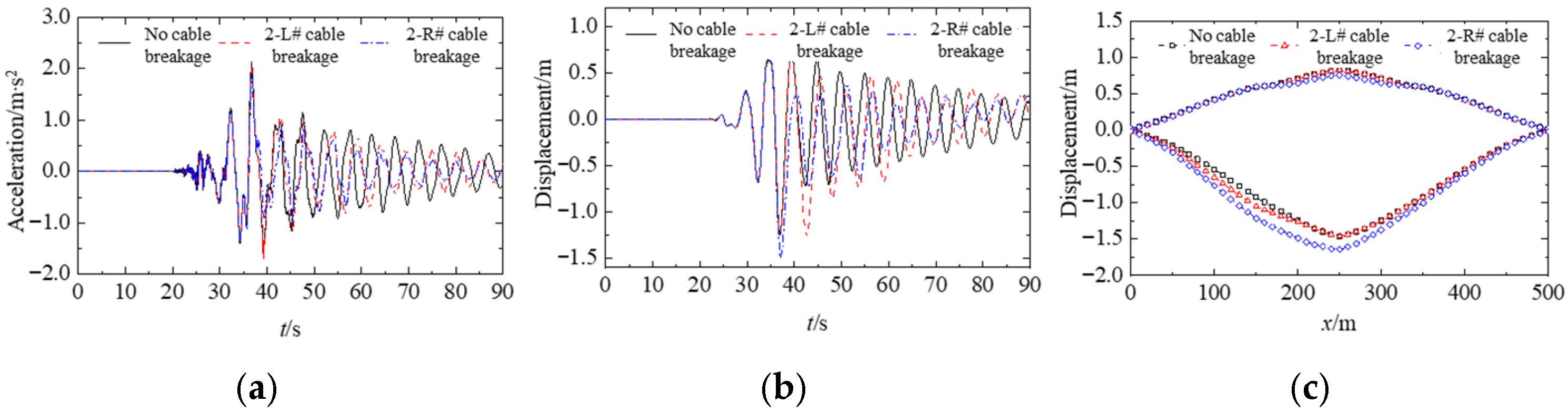
Figure 9a shows the envelope diagram of the vertical acceleration of the body at the broken cable location (200 m). The maximum vertical acceleration of the body without cable breakage is 3.43 m/s2, and the maximum vertical acceleration of 2 L# and 2-R# with cable breakage is 3.43 m/s2 and 3.27 m/s2, respectively. The relative changes during cable breakage do not exceed 7%, which once again indicates that the impact of cable breakage is much smaller than that of seismic action. After a period of time following cable breakage, there is a significant difference in structural response between the conditions where cable breakage occurs and those where cable breakage does not occur. This is mainly due to changes in the vibration characteristics of the SFT after cable breakage.
Figure 9b shows the displacement time history under three working conditions: continuous cable at 200 m, 2 L# broken cable, and 2-R# broken cable. Due to the different locations and times of cable failure, there are differences in the structural form and state of the SFT after failure, and the response of the body is also significantly different. The vertical downward displacement of the 2 L# cable in the initial stage of the body significantly increased after 39.06 s of failure, and over time, the vertical displacement curve shifted upward. In the initial stage after the failure of the 2-R# cable at 35.07 s, the vertical downward displacement increased from 1.25 m to 1.49 m, and the vertical displacement curve shifted upward. Figure 9c further provides the vertical displacement envelope diagram of the body, and the broken cable not only affects the failure point but also has a significant impact on other areas of the SFT. After the failure of the 2 L# cable, the downward displacement between 100 m and 200 m has increased. After the failure of the 2-R# cable, the vertical downward displacement of the body significantly increased, while the vertical upward displacement in the mid-span area slightly decreased. The failure of cables at different positions has varying degrees of impact on the seismic response of the SFT, and seismic effects have a high degree of randomness. Therefore, sufficient redundancy must be provided in the design of cables for SFTs to ensure that they do not break or fail during earthquakes.

4. Influence Factor Study

4.1. Effect of the Boundary Condition

In order to analyze the influence of boundary conditions on the seismic response of the SFT, the influence of joints is temporarily not considered, and the dimensional numbers of rotational spring stiffness ratio RS and linear spring stiffness ratio RK are expressed as follows:
R S = S L E I = S R E I R K = K L K c i = K Z K c i
Substituting the parameters in Table 1 into Equation (11), the RS and RK of the flexible support are 0.026 and 77, respectively. When the boundary is hinge support, RK = ∞, RS = 0; when the boundary is fixed support, RK = ∞, RS = ∞.
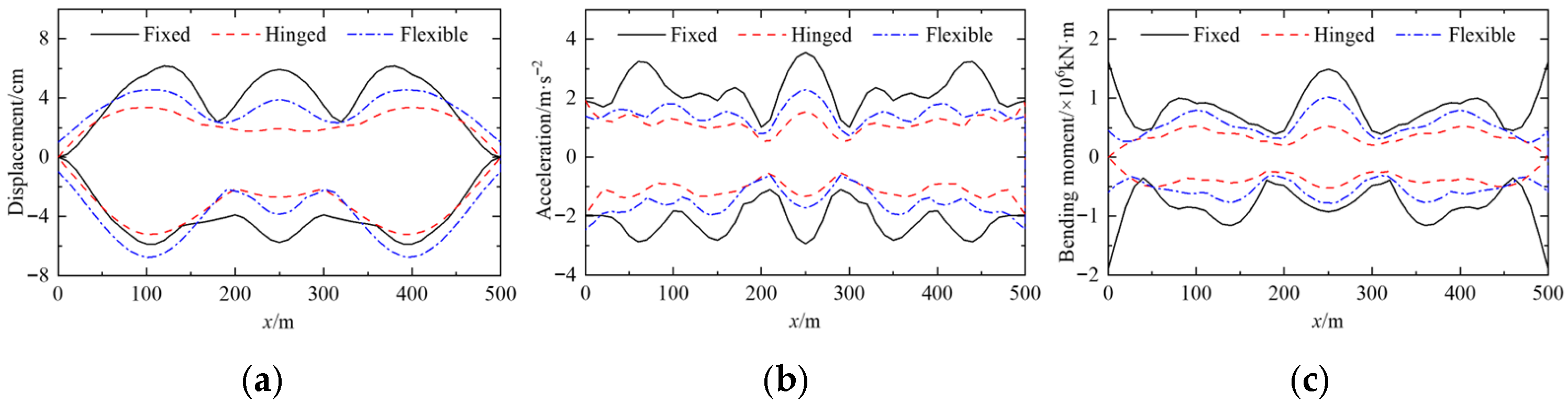
As shown in Figure 10, when the boundary is fixed, the acceleration and BM response of the SFT are the highest. The maximum acceleration occurs at the mid-span, which is 3.55 m/s2; The maximum BM occurs at the end of SFT, about 1.89 × 10⁶ kN∙m. When the boundary is hinged, the acceleration and BM response of the SFT are the smallest. the maximum acceleration occurs at the end of SFT, which is 1.96 m/s2; the maximum BM is 0.52 × 10⁶ kN∙m, located at the mid-span. The response under flexible support is between the fixed and hinged supports, approximately, and there is a 1.02 cm displacement at the boundary. The maximum acceleration is 2.46 m/s2, which differs from that of fixed and hinged supports by 44.3% and 20.3%, respectively. The maximum BM is 1.02 × 10⁶ kN∙m, with a difference of 85.3% and 49.0%, respectively. Therefore, treating the actual flexible boundary as fixed or hinged will result in significant deviations.
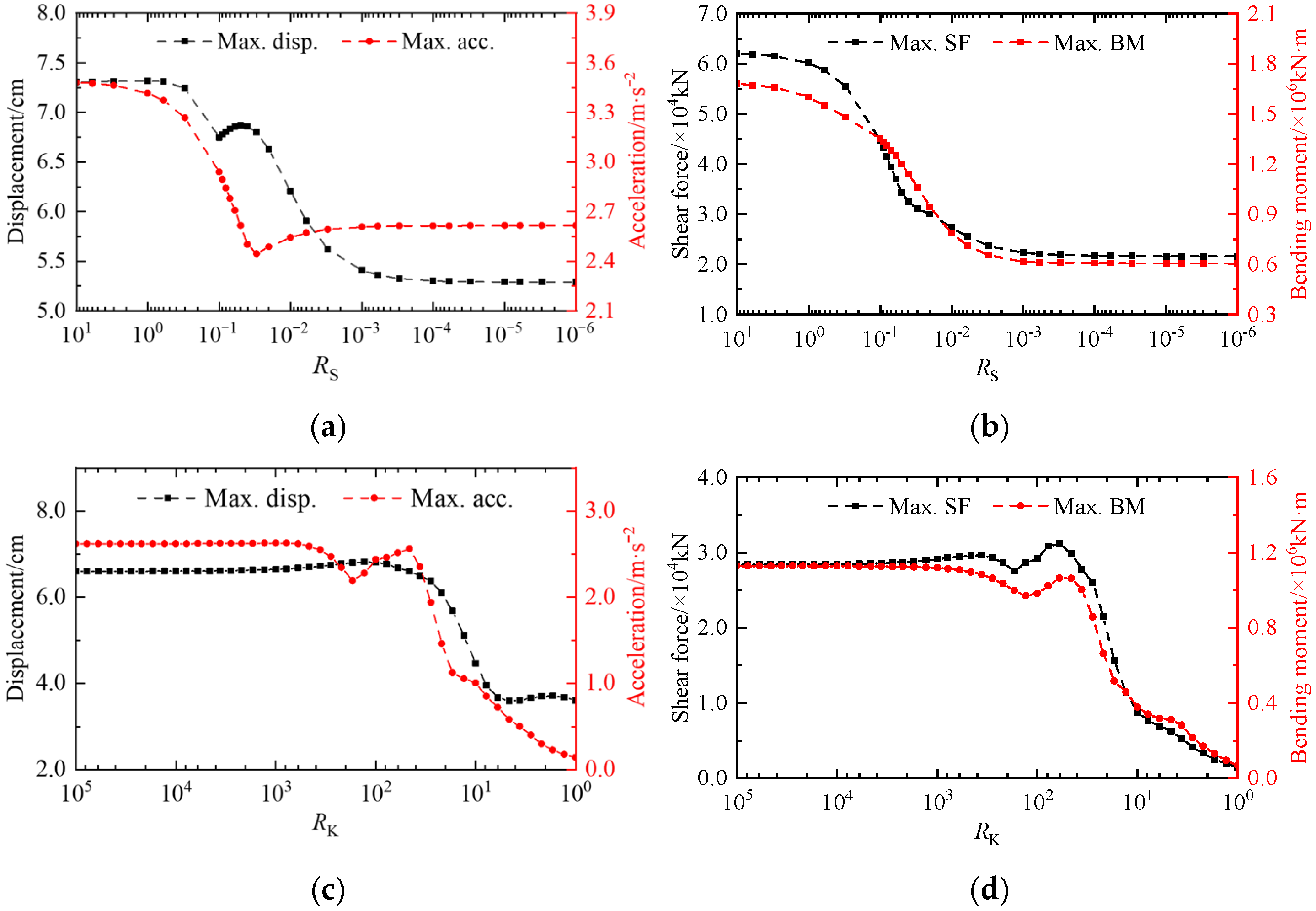
Figure 11a,b shows the variation curves of maximum displacement and acceleration, maximum SF, and BM with respect to RS. Reducing the rotational spring stiffness of boundary constraints is beneficial for the seismic response of the SFT. The acceleration decreases with the decrease in RS and reaches its minimum when RS = 0.03, then shows a slight rebound. The remaining responses show an overall downward trend as RS decreases, but when RS is below 0.005, the rate of decrease gradually slows down. From the perspective of seismic loads, a value of RS between 0.005 and 0.05 is suitable.
Figure 11c,d shows the maximum response as a function of RK. It can be seen that the impact on the seismic response of the structure is relatively small when RK > 100, and the structural response remains at a large value. The structural response decreases with the decrease in RK when it is less than 100 and reaches its minimum when RK = 1. At this time, the displacement, acceleration, SF, and BM are 3.61 cm, 0.14 m/s2, 1.39 × 10³ kN, and 6.78 × 10⁴ kN·m, respectively, which are 53.0%, 5.7%, 4.7%, and 6.9% of those at RK = 100. This demonstrates that reducing the stiffness of the linear spring can reduce the seismic response of the SFT, but it will also lead to an increase in displacement on both sides. It is necessary to comprehensively consider the overall response of the SFT and other loads to select the stiffness of the linear springs.

4.2. Effect of Joint Stiffness

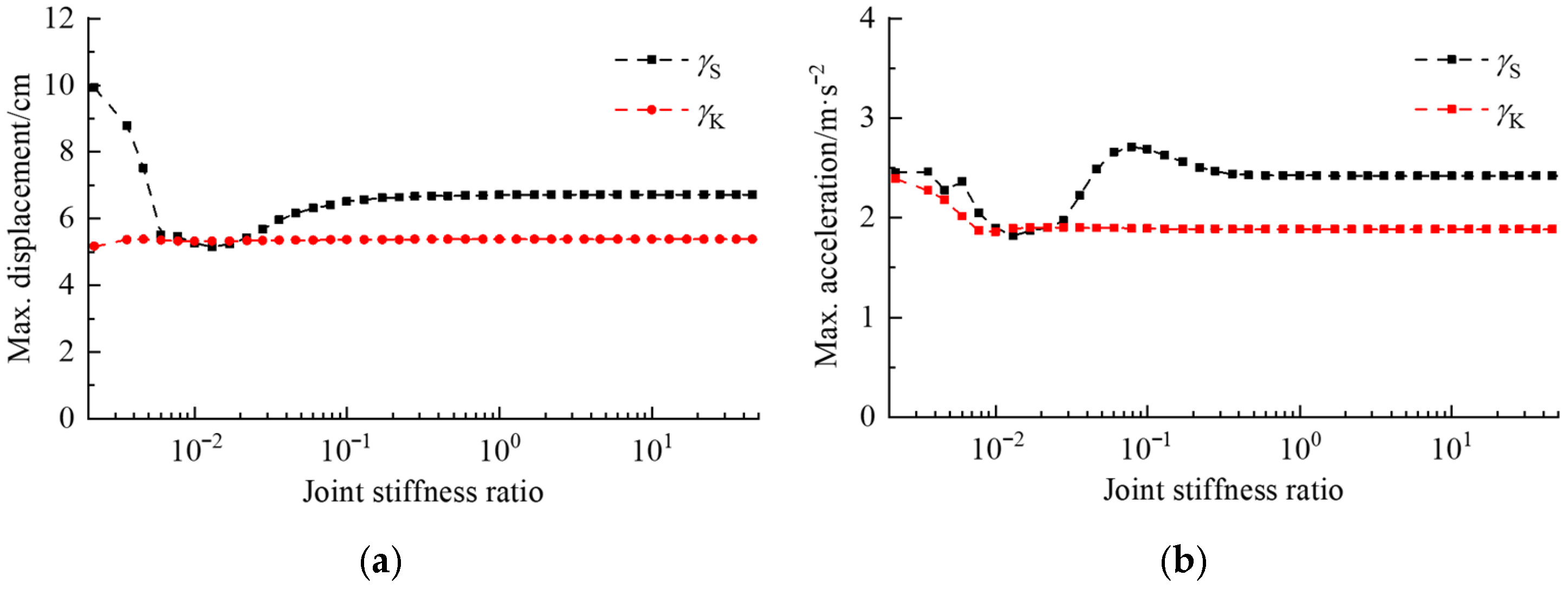
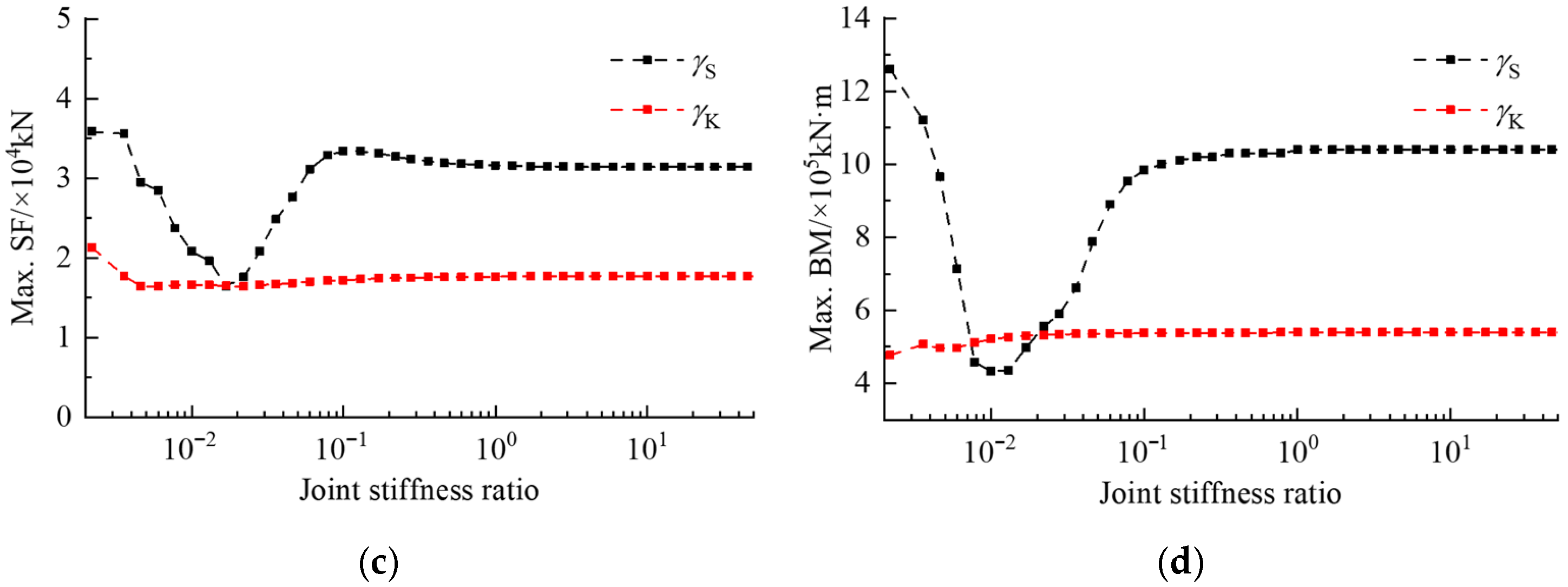
In order to analyze the influence of Joint stiffness on the seismic response of the SFT, define the dimensional numbers of shear stiffness ratio γS and bending stiffness ratio γK, expressed as follows:
γ S = S t i E I γ K = K t i G A
where GA is the shear stiffness per unit length of the tube.
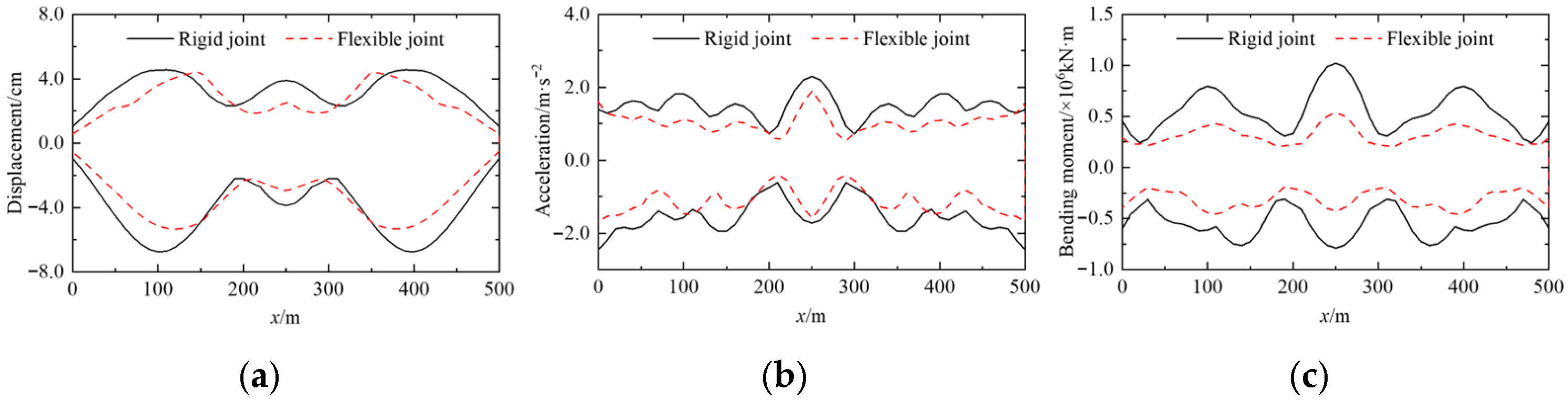
Substituting the parameters in Table 1 into Equation (12), the γS and γK of the flexible joint are 0.02 and 0.05, respectively. For rigid joints, γS = γK = ∞. Figure 12 shows the response envelope diagrams for rigid and flexible joints, respectively. There are significant differences in the response of the SFT under different types of joints, which proves the necessity of considering joints in seismic analysis. Setting flexible joints can effectively reduce the internal force response of the structure. The maximum BM is 1.02 × 10⁶ kN·m while the joints are rigid, and when the joint is flexible, the maximum BM is 0.54 × 10⁶ kN∙m, which is reduced by about 47.1%. Therefore, when calculating the seismic response of the SFT, not considering the influence of flexible joints will lead to conservative results.
Figure 13 shows the maximum response as a function of joint stiffness ratio. As shown in the figure, the maximum response of the structure decreases first and then increases with the increase in γS, reaching its minimum value around 0.02. Taking all factors into consideration, it is reasonable for the γS of the joint to be between 0.01 and 0.03. The change in γK has a relatively small impact on the seismic response of the structure. As γK increases, the maximum displacement and BM gradually increase, while the maximum acceleration and SF gradually decrease. When γK > 0.01, the structural response is almost unaffected by γK. To avoid displacement differences on both sides of the joint, the shear stiffness of the joint can be appropriately specified. The flexible joints of SFT sections are mainly composed of OMEGA waterstop, GINA waterstop, prestressed steel bars, and shear keys. Through the collaborative design concept of “flexible structure dominates deformation” and “rigid structure precise shape control”, the control of the bending stiffness ratio of 0.01 to 0.03 is achieved. Among them, OMEGA waterstop and GINA waterstop form a double-layer waterproof system while providing deformation space for the joint to stretch and the corner. Multiple longitudinal prestressed bars evenly arranged along the circumference of the pipe are pre-tensioned in conjunction with OMEGA waterstop to limit excessive joint angles. The use of elastic shear keys exerts a restraining effect when the joint undergoes shear or torsional deformation while reducing the constraint on the bending deformation of the pipe body through structural design and avoiding the overall stiffness increase caused by shear and torsional design.

5. Conclusions

This study establishes a multi-span SFT model with flexible boundaries and an approximate calculation method based on the transfer matrix method and modal superposition method, which can provide seismic response solutions for such SFTs. The results are in good agreement with the finite element calculation results.
Cables, as key components of SFT, may experience relaxation or breakage under specific seismic conditions. When the cable is relaxed, tension failure causes significant changes in the vibration characteristics and vertical response of the SFT. The displacement deviation of the body can reach 45.12% with and without considering cable relaxation, and the acceleration deviation can reach 24.49%. It is necessary to verify whether the cable relaxes during seismic analysis. Although the impact of cable failure on SFT is significantly smaller than that of strong earthquakes, the changes in structural stress and natural vibration characteristics after cable breakage have a significant impact on SFT safety, and the degree of influence of cable failure on tunnel response varies at different locations. In the calculation example, the displacement of the pipe increased by 70.15% after the failure of the 2-L# cable. Therefore, the design should ensure that the cable has sufficient bearing capacity to prevent cable breakage during strong earthquakes.
The seismic response of the SFT with flexible boundaries is between that of fixed boundaries and hinged boundaries. The seismic response of the SFT decreases with a decrease in boundary constraint stiffness, and the range of RS between 0.005 and 0.05 is suitable.
Setting flexible joints can effectively reduce the internal force response of the structure, and it is reasonable for the bending stiffness ratio of the joint to be between 0.01 and 0.03. The change in shear stiffness of the joints has a relatively small impact on the seismic response of the structure.

Author Contributions

Conceptualization, Y.S. and J.C.; methodology, J.C., M.M. and X.C.; software, D.W.; validation, J.C., M.M. and X.C.; formal analysis, X.C. and Y.Z.; investigation, Y.S. and Y.Z.; resources, Y.S.; writing—original draft preparation, J.C. and M.M.; writing—review and editing, D.W. and X.C.; visualization, M.M. and X.C.; supervision, Y.S.; funding acquisition, J.C., D.W. and Y.Z. All authors have read and agreed to the published version of the manuscript.

Funding

This research was funded by the “ZJU-ZCCC Institute of Collaborative Innovation, grant number ZDJG2021009”.

Data Availability Statement

The data presented in this study are available on request from the corresponding author due to project funding limitations.

Conflicts of Interest

Authors Jiang Chen, Dan Wang and Yin Zheng have received research grants from Zhejiang Communications Construction Group Co., Ltd. (ZJU-ZCCC).

Abbreviations

The following abbreviations are used in this manuscript:
SFTSubmerged Floating Tunnel
FEMFinite Element Method
BMBending Moment
SFShear Force
MSMModal Superposition Method

References

  1. Su, Z.B.; Sun, S.N. Seismic response of submerged floating tunnel tether. China Ocean Eng. 2013, 27, 43–50. [Google Scholar] [CrossRef]
  2. Wu, Z.W.; Ni, P.P.; Mei, G.X. Vibration response of cable for submerged floating tunnel under simultaneous hydrodynamic force and earthquake excitations. Adv. Struct. Eng. 2018, 21, 1761–1773. [Google Scholar] [CrossRef]
  3. Wang, P.G.; Shen, Y.M.; Qu, Y.; Zhao, M. The dynamic response and parameter influence analysis of Submerged Floating Tunnel under seismic action. Ocean Eng. 2025, 337, 121877. [Google Scholar] [CrossRef]
  4. Dong, M.S.; Li, M.; Lin, Z.; Tang, F.; Jiang, S.P. Dynamic response of the submerged floating tunnel under random seismic excitation. Appl. Math. Mech.-Engl. Ed. 2014, 35, 1320–1329. [Google Scholar] [CrossRef]
  5. Dong, M.S.; Li, M. The dynamic responses of the of the submerged floating tunnel under seismic effect. In Proceedings of the 2nd International Symposium on Submerged Floating Tunnels and Underwater Tunnel Structures, Chongqing, China, 16–18 December 2016. [Google Scholar] [CrossRef]
  6. Xie, J.M.; Chen, J.Y. Dynamic response analysis of submerged floating tunnel-canyon water system under earthquakes. Appl. Math. Model. 2021, 94, 757–779. [Google Scholar] [CrossRef]
  7. Akbarzadeh, N.; Tariverdilo, S.; Emamyari, A. Vibration of submerged floating tunnels under asynchronous support excitation. Structures 2021, 30, 329–337. [Google Scholar] [CrossRef]
  8. Chen, W.Y.; Luo, Z.Q.; Xu, L.Y.; Zheng, Y.W.; Su, L.; Huang, R. Dynamic response and liquefaction mitigation of immersed tunnels under seismic loads: A coupled seawater-seabed-tunnel analysis. Soil Dyn. Earthq. Eng. 2025, 199, 109733. [Google Scholar] [CrossRef]
  9. Xiong, M.; Chen, Z.Y.; Huang, Y. Nonlinear stochastic seismic dynamic response analysis of submerged floating tunnel subjected to non-stationary ground motion. Int. J. Non-Linear Mech. 2023, 148, 104270. [Google Scholar] [CrossRef]
  10. Huang, B.; Luo, W.L.; Chen, Y.; Zhou, J.T.; Ding, H.; Li, K.; Cheng, L.; Zhong, D. Coupled dynamic analysis for wave action on a tension leg-type submerged floating tunnel in the frequency domain. Ocean Eng. 2024, 296, 116934. [Google Scholar] [CrossRef]
  11. Xie, J.M.; Li, J.; Chen, J.Y.; Xu, Q. Seismic response analysis of submerged floating tunnel considering non-uniform excitation and flexible-support boundary effect. Ocean Eng. 2023, 286, 115468. [Google Scholar] [CrossRef]
  12. You, J.Y.; Zhao, Y.L.; Zhang, B. The effect of in-pipe fluid states and types on axial stiffness characteristics of fiber-reinforced flexible pipes. J. Mar. Sci. Eng. 2025, 13, 1069. [Google Scholar] [CrossRef]
  13. Chen, Y.L.; Li, J.F.; Ni, P.P.; Lu, Z.W. Simplified analytical solution of bell-spigot jointed ductile iron pipelines crossing normal faults. Soil Dyn. Earthq. Eng. 2024, 187, 108955. [Google Scholar] [CrossRef]
  14. Chang, X.; Sun, J.Q.; Guo, L.Q. Mechanical performances of concrete-filled steel pipe composite segments in complex geological conditions. Buildings 2024, 14, 2961. [Google Scholar] [CrossRef]
  15. Huang, D.W.; Jiang, H.; Xu, C.J.; Li, X.; Zhan, T. Analytical algorithm of longitudinal bending stiffness of shield tunnel considering longitudinal residual jacking force. Tunn. Undergr. Space Technol. 2023, 137, 105146. [Google Scholar] [CrossRef]
  16. Zhao, Q.L.; Liu, W.; Cai, F.H.; Chen, Y.D.; Yu, W.W. Dynamics of fluid-conveying piping system containing a short threaded joint. J. Braz. Soc. Mech. Sci. Eng. 2023, 45, 636. [Google Scholar] [CrossRef]
  17. Yuan, L.; Ling, M.X.; Lai, J.H.; Li, H.; Zhang, X.M. Graphic transfer matrix method for kinetostatic and dynamic analyses of compliant mechanisms. J. Mech. Robot. 2024, 16, 021009. [Google Scholar] [CrossRef]
  18. Kanie, S.; Mikami, T.; Kakuta, T. Dynamic characteristics of submerged floating tunnels due to wave force. Doboku Gakkai Ronbunshu 1997, 556, 159–168. [Google Scholar] [CrossRef] [PubMed]
  19. Sato, M.; Kanie, S.; Mikami, T. Structural modeling of beams on elastic foundations with elasticity couplings. Mech. Res. Commun. 2007, 34, 451–459. [Google Scholar] [CrossRef]
  20. Qin, T.; Kong, D.Q.; Song, Y.; Pan, L.K.; Zhang, C. Effect of stochastic guideway irregularity on dynamic performance of maglev train. Infrastructures 2025, 10, 285. [Google Scholar] [CrossRef]
  21. Xu, W.H.; Ma, Y.X.; Liu, G.J.; Li, M.L.; Li, A.; Jia, M.L.; He, Z.Q.; Du, Z.F. A review of research on tether-type submerged floating tunnels. Appl. Ocean Res. 2023, 134, 103525. [Google Scholar] [CrossRef]
  22. Gao, C.Q.; Xiang, Y.Q.; Yang, Y.S.; Lin, H. Transfer matrix method for analyzing dynamic response of multi-span elastically supported SFT under moving load. Appl. Math. Model. 2022, 112, 238–261. [Google Scholar] [CrossRef]
  23. Yang, Y.S.; Xiang, Y.Q.; Gao, C.Q. Vehicle-SFT-current coupling vibration of multi-span submerged floating tunnel, part I: Mode superposition and Galerkin hybrid method. Ocean Eng. 2022, 247, 110746. [Google Scholar] [CrossRef]
  24. Yang, Y.S.; Xiang, Y.Q.; Gao, C.Q. Vehicle-SFT-current coupling vibration of multi-span submerged floating tunnel, Part II: Comparative analysis of finite difference method and parametric study. Ocean Eng. 2022, 249, 110951. [Google Scholar] [CrossRef]
  25. Morison, J.R.; Obrien, M.P.; Johnson, J.W.; Schaaf, S.A. The force exerted by surface waves on piles. Trans. AIME 1950, 189, 149–154. [Google Scholar] [CrossRef]
  26. Chao, C.F. Dynamic Response Analysis and Experimental of Submerged Floating Tunnel Based on Fluid-Structure Interaction. Ph.D. Thesis, Zhejiang University, Hangzhou, China, 2013. [Google Scholar]
  27. Yang, Y.S. Study on Vehicle-SFT-Fluid Coupling Spatial Vibration of Submerged Floating Tunnel. Ph.D. Thesis, Zhejiang University, Hangzhou, China, 2023. [Google Scholar]
  28. Ding, H.; Huang, B.; Cheng, L.; Li, K.; Ren, Q.Y. Hydrodynamic experiment of submerged floating tunnel under regular wave and current actions during construction period. Mar. Struct. 2024, 93, 103508. [Google Scholar] [CrossRef]
  29. Wang, J.; Dong, Z.C.; Yang, R.L.; Hou, J.F.; Kuang, C.P. Comparative study of water exchange capacity evaluation methods for semi-enclosed water based on the outfitting zone of immersed tube tunnels. AIP Adv. 2024, 14, 065119. [Google Scholar] [CrossRef]
  30. Li, J.; Cao, P.; Jiang, S.P.; Zhang, D.D. Fire Resistance test and numerical simulation on the tube structure of steel-concrete-steel immersed tube tunnel. Buildings 2023, 13, 33. [Google Scholar] [CrossRef]
  31. Clemente, P. Effects of differential displacements between the ground anchors in suspension bridges. Infrastructures 2024, 9, 211. [Google Scholar] [CrossRef]
  32. Soto, N.; Cid, C.; Baldomir, A.; Hernández, S. Fail-safe optimum cable system under cable breakage in cable-stayed bridges. Application to the Queensferry Crossing Bridge. Eng. Struct. 2023, 279, 115557. [Google Scholar] [CrossRef]
  33. Alves, R.; Lousada, S.; Gómez, J.M.N.; Cabezas, J. Maintenance challenges in maritime environments and the impact on urban mobility: Machico stayed bridge. Infrastructures 2024, 9, 180. [Google Scholar] [CrossRef]
Figure 1. The simplified model of the SFT.
Infrastructures 11 00007 g001
Figure 2. FEM of SFT.
Infrastructures 11 00007 g002
Figure 3. Time history of seismic acceleration and velocity, including (a) acceleration and (b) velocity.
Infrastructures 11 00007 g003
Figure 4. Displacements of the tunnel after mode superposition.
Infrastructures 11 00007 g004
Figure 5. Comparison of MSM and FEM calculation results.
Infrastructures 11 00007 g005
Figure 6. Response of anchor cable during relaxation, including (a) cable 1 L# and (b) cable 2 L#.
Infrastructures 11 00007 g006
Figure 7. Envelope diagram of the Influence of cable relaxation on the vertical response of the tunnel, including (a) displacement, (b) acceleration, (c) SF, and (d) BM.
Infrastructures 11 00007 g007
Figure 8. Time–history curve of residual anchor cable force after cable breakage, including (a) 2 L# cable breakage and (b) 2-R# cable breakage.
Infrastructures 11 00007 g008
Figure 9. Acceleration and displacement response of the SFT after cable breakage, including (a) acceleration, (b) displacement, and (c) displacement envelope diagram.
Infrastructures 11 00007 g009
Figure 10. Comparison of response under different boundaries, including (a) displacement, (b) acceleration, and (c) BM.
Infrastructures 11 00007 g010
Figure 11. Influence of boundary stiffness on structural response, including (a) RS on displacement and acceleration, (b) RS on SF and BM, (c) RK on displacement and acceleration, and (d) RK on SF and BM.
Infrastructures 11 00007 g011
Figure 12. Comparison of response under different joints, including (a) displacement, (b) acceleration, and (c) BM.
Infrastructures 11 00007 g012
Figure 13. Influence of joint stiffness on structural response, including (a) displacement, (b) acceleration, (c) SF, and (d) BM.
Infrastructures 11 00007 g013aInfrastructures 11 00007 g013b
Table 1. Basic parameters of the SFT.
ComponentItemSymbolValueUnit
TubeFull lengthL500m
Outer diameterD15m
Inter diameterd13m
Mass per unit lengthm01.5 × 105kg/m
Elastic modulusE3.45 × 104MPa
Damping ratioξ0.05
CableLengthlc235m
Cross-section areaAc3.14 × 10−2m2
Elastic modulusEc1.95 × 105MPa
Inclined angleαc60°
BoundaryStiffness of a linear springKL, KR3 × 109N/m
Stiffness of rotational
spring
SL, SR1 × 1012N·m
JointShear stiffnessKti3.03 × 1010N/m
Bending stiffnessSti7.47 × 1011N·m
Table 2. Comparison of natural vibration frequency.
Mode OrderMSM/HzFEM/HzRelative Error/%
1st0.203490.203000.24
2nd0.345520.341061.31
3rd0.616440.602582.30
4th0.991700.957893.53
5th1.252641.206303.84
6th2.072511.943606.63
7th2.655082.468007.58
8th3.284503.027408.49
9th3.936713.621608.70
10th4.686584.264009.91
Disclaimer/Publisher’s Note: The statements, opinions and data contained in all publications are solely those of the individual author(s) and contributor(s) and not of MDPI and/or the editor(s). MDPI and/or the editor(s) disclaim responsibility for any injury to people or property resulting from any ideas, methods, instructions or products referred to in the content.