Article

A Systematic Framework for Assessing the Temporally Variable Protective Capacity of Nature-Based Solutions Against Natural Hazards

by
Erik Kuschel
1,*,†,
Michael Obriejetan
2,*,†,
Tamara Kuzmanić
3,
Matjaž Mikoš
3,
Lukas Seifert
4,
Slaven Conevski
5,
Maria Wirth
6,
Eriona Canga
6,
Sérgio Fernandes
7,
Johannes Hübl
1 and
Rosemarie Stangl
2,*
1
Department of Landscape, Water and Infrastructure, Institute of Mountain Risk Engineering, BOKU University, Peter-Jordan-Straße 82, 1190 Vienna, Austria
2
Department of Landscape, Water and Infrastructure, Institute of Soil Bioengineering and Landscape Construction, BOKU University, Peter-Jordan-Straße 82, 1190 Vienna, Austria
3
UNESCO Chair on Water-Related Disaster Risk Reduction & Faculty of Civil and Geodetic Engineering, University of Ljubljana, Jamova Cesta 2, 1000 Ljubljana, Slovenia
4
Department of Biology, Norwegian University of Science and Technology (NTNU), 7491 Trondheim, Norway
5
Department of Civil and Environmental Engineering, Norwegian University of Science and Technology (NTNU), 7491 Trondheim, Norway
6
Alchemia-Nova Research & Innovation Gemeinnützige GmbH, Climate Lab, Spittelauer Lände 45, 1090 Wien, Austria
7
ISISE, Department of Civil Engineering, University of Minho, 4800-058 Guimarães, Portugal
*
Authors to whom correspondence should be addressed.
These authors contributed equally to this work.
Infrastructures 2025, 10(12), 318; https://doi.org/10.3390/infrastructures10120318
Submission received: 8 October 2025 / Revised: 7 November 2025 / Accepted: 18 November 2025 / Published: 22 November 2025
(This article belongs to the Special Issue Nature-Based Solutions and Resilience of Infrastructure Systems)

Abstract

Natural hazards pose an increasing threat to infrastructures, lives, and livelihoods in alpine regions due to climate change and the growing demand for settlement space. While grey protective structures are commonly deployed to provide immediate safety, their sustainability, and thus protective function, is limited by cost-intensive maintenance. Nature-based solutions (NbS) can alleviate these shortcomings by offering cost-effective, adaptive protection that strengthens over time, making their deployment a key factor in building resilience to climate-induced hazards. This paper introduces a systematic methodology for the strategic deployment of NbS to enhance climate resilience. It integrates a three-level hazard classification system with an expert-led assessment rating 74 NbS against 29 hazards. A subsequent Principal Component Analysis (PCA) synthesises these into six functional groupings based on their shared mitigation characteristics. The core of this framework introduces two key innovations: a novel Mitigation Score and a Hazard Mitigation Profile. Together, they evaluate NbS effectiveness dynamically through the different phases of natural hazards, surpassing traditional static ratings by evaluating NbS performance across the hazard management cycle—from predisposition to post-event recovery. Significant variation in mitigation scoring was observed for individual hazard classes and types. Erosion processes (e.g., sheet, rill, and gully erosion) achieved the highest mitigation scores (1.90), as they can be addressed by many highly effective NbS (21–33 types). Conversely, flood-related hazards, such as fluvial and pluvial floods, showed moderate scores (1.64–1.66) with a balanced mix of mitigative and supportive NbS, while options for mitigating impact floods and coastal floods were far more limited (1.00–1.42). The resulting methodology provides a crucial, practical link between specific climate-related threats and viable, nature-based responses, serving as a robust framework to guide the decisions of planners, engineers, and policymakers. By enabling a more strategic and temporally aware deployment of NbS, our findings inform the development of adaptive management strategies to ensure their long-term effectiveness.

1. Introduction

Europe’s critical infrastructure faces increasing vulnerability to climate-induced hazards, with projected damages set to rise substantially in coming [1,2,3]. In alpine regions, these threats are particularly acute due to steep and rugged terrain, soil instability, and rapid climate shifts. Conventional ‘grey’ protective measures are often insufficient, as they are costly during construction and maintenance, and lack adaptability in the face of evolving risks.
In response, Nature-based Solutions (NbS) have emerged as a promising and recognised strategy for enhancing climate resilience [4] . These approaches are not new. Traditional NbS have been an integral part of natural hazard management used along with grey infrastructure since the 19th century in the European Alps [5,6,7]. These traditional methods include extensive afforestation projects for natural hazard protection of alpine valleys [8,9] and the long-standing practices of Soil and Water Bioengineering (SWB) [10,11]. SWB is a discipline including practices that use plant-based structural designs for stabilising slopes and riverbanks [10,11] by re-establishing protective vegetation layers (e.g., brushwood and light multi-layered mixed forests) that provide structural support and erosion control [12]. SWB techniques have been applied and adopted in contexts ranging from higher alpine elevations to coastal zones to restore damaged slope sites, rivers and lakesides, and shore sites [13,14,15]. Historically, SWB has provided the support of, and the potential for, a transition from static grey protective infrastructure to more adaptive protection and management, aligning with the core principles of NbS [16,17]. SWB applications and NbS objectives share many overlapping scopes, such as rewilding, ecosystem restoration, and biodiversity protection [18]. While NbS have recently gained broad attention, definitions have been diverse due to interest-driven modifications [19,20,21] not encompassing the entirety of the above-mentioned well-established fields. This paper adopts an ecosystem-based NbS framework established by the IUCN, which emphasises the restoration of ecosystems and their protective services [4].
Despite this recognition, a critical research gap remains in effectively linking specific natural hazards to viable, cost-effective NbS, as quantitative data on the general feasibility of these interventions against the wide range of alpine hazards are exceedingly rare. This data scarcity is exacerbated by database, language, and classification issues, which obscure the comparability of natural hazards at a regional spatial scale [22], as well as by the non-linearity of alpine natural hazards, where process sizes and impacts can vary over several orders of magnitude [23]). Thus, establishing standardised nature-based interventions within alpine environments is often not feasible.
Established NbS frameworks and catalogues are often too broad or complex for non-scientific stakeholders and practitioners to include in their work (e.g., [24,25,26,27,28]). Furthermore, these publications also tend to focus primarily on the co-benefits of nature-based interventions referring to ecosystem services or social impacts within urban environments. In general, they focus on rural and urban implementation cases, in many instances to flood and water management [27,29], agriculture and food production [30,31], or wildfire management [32,33]. However, despite the numerous co-benefits of NbS, such as mitigating urban heat, biodiversity conservation, and carbon sequestration [34,35,36,37,38,39,40], the quantification of the benefits of NbSs within the broader range of natural hazard management remains sparse.
Systematic frameworks for analysing NbS and natural hazard interactions, particularly beyond urban environments, are lacking. While numerous NbS assessment frameworks exist, they often pursue different assessment goals, and their specific mitigation capacities against defined natural hazard types have remained poorly quantified. For instance, many valuable frameworks use participatory System Dynamics Modelling to simulate long-term (e.g., 50-year) socio-economic system behaviour [41] and evaluate a multiplicity of co-benefits (e.g., community well-being and nature conservation), with the primary goal of enhancing social and institutional acceptance [42]. Other approaches employ Multi-Criteria Decision Analysis to rank pre-defined, static scenarios (e.g., NbS vs. grey solutions) based on stakeholder-weighted Key Performance Indicators (KPIs) [43] or utilise Life Cycle Assessment and Cost–Benefit Analysis to audit the ‘cradle-to-grave’ sustainability of an intervention [42]. A critical gap remains, however, in the assessment of dynamic physical processes during a hazard event. This can only be addressed by linking specific physical hazardous processes to viable cost-effective nature-based interventions.
A plethora of hazard classification systems is available, some of which may be comprehensive in listing a wide range of hazards that affect humans, e.g., the UNDRR Hazard Information Profiles [44], climate-induced hazards [2], or different scientific classification systems focusing on specific types of natural hazards, such as landslides or avalanches [23,45,46,47]. However, none of them provide a suitable frame to attribute specific NbS to natural hazards and elaborate the application potential to reduce risks, and most existing systems exhibit shortcomings in several aspects. Though often comprehensive [44], these classifications encompass hazards that are beyond the capabilities of NbS, such as anthropogenic (e.g., technological and societal), chemical (e.g., forever chemicals and microplastics), biological (e.g., viruses and diseases), or extraterrestrial (e.g., meteoroid impacts and space weather) hazards. Limited in some segments regarding alpine regions, erosion-related processes are only clustered in the UNDRR report, and snow hazards are barely explored. At the same time, it is highly specific in wind-related phenomena. Other natural hazards within the UNDRR correctly incorporate the Varnes landslide classification [23] which encompasses all relevant parameters for a full scientific assessment of landslide phenomena (i.e., a variety of mass movements). However, in practice, the extent and size of landslides (e.g., volume and depth) are considered the primary reasoning as to whether or not NbSs provide a reduction in risk through mitigative effects.
Therefore, this study aims to systematically investigate the utility of NbS for reducing risks in alpine regions, and thus to increase the acceptance of NbS in natural hazard management. The introduced framework rigorously evaluates the protective capacity of NbS against the critical criteria of hazard predisposition, trigger, and mobilisation criteria for ongoing hazard events and post-event resilience. To achieve this, the study is guided by three primary research questions: (1) How can the diverse range of NbSs be systematically classified based on their functional mitigation profiles against specific alpine hazards? (2) How can the protective capacity of NbS be assessed beyond static ratings to account for their temporal effectiveness across their service life? (3) What are the primary applications, limitations, and strategic trends for deploying NbS in an alpine context? Answering these questions yields a practical, evidence-based guide for practitioners on the temporally variable capabilities and constraints of different NbS protection and mitigation measures.
Building on foundational work within the Horizon Europe project NATURE-DEMO (Grant No. 101157448), this paper introduces a framework to address natural hazard and NbS interactions for alpine regions. Thus, this paper follows the geographical definition established by the Alpine Space programme [48]. To establish clear links between complex, and sometimes cascading, natural hazards and sustainable mitigation solutions, a comprehensive assessment framework was created. Quantifying the mitigation potential of NbS is highly variable, depending on the different natural hazards that could occur during an infrastructure’s lifecycle. Therefore, a necessary component of this framework was the development of a novel hazard classification system that blends economic considerations with state-of-the-art scientific typologies, simplified for practitioners.
This paper introduces a novel event-based temporal analysis that evaluates NbS effectiveness, not over decades of system behaviour, but dynamically across the discrete phases of a natural hazard, from predisposition and triggering to the ongoing process and post-event recovery. The concept presented in this study is therefore specifically tied to its role in the hazard management cycle, from prevention and mitigation to enhancing the post-event resilience of critical infrastructure. This distinct temporal analysis provides a crucial, practitioner-oriented assessment of protective capacity that is absent from the current literature.

2. Methodology

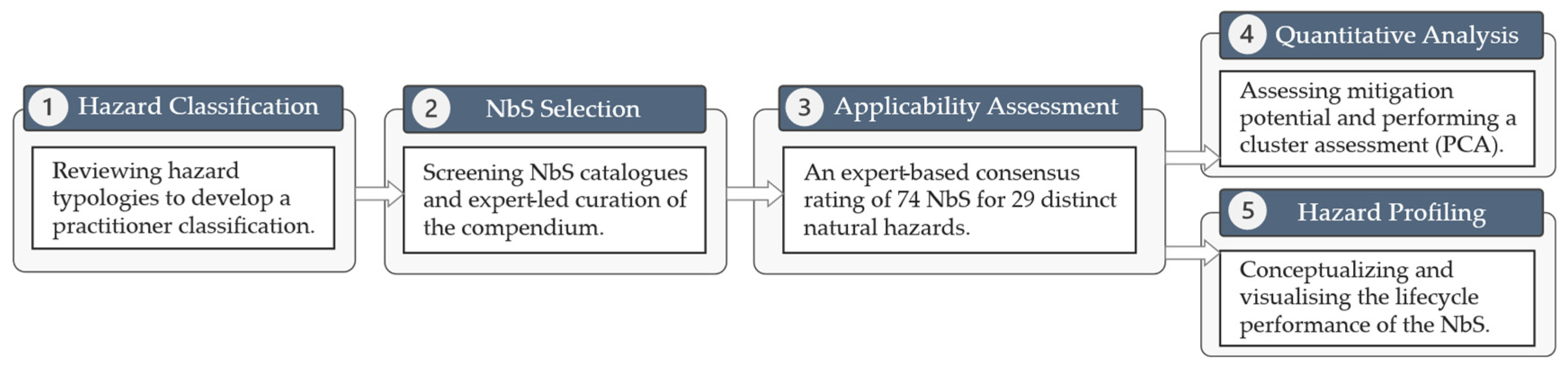
A multi-step, mixed-methods approach was developed to systematically link NbS to specific natural hazards and their performance over time. The process includes five interconnected stages: (1) a practitioner-oriented hazard classification system, (2) curation of a relevant NbS set, (3) a qualitative applicability assessment, (4) quantitative analysis via mitigation scoring and functional clustering, and (5) temporal hazard profile development. The workflow is shown in Figure 1.

2.1. Hazard Classification

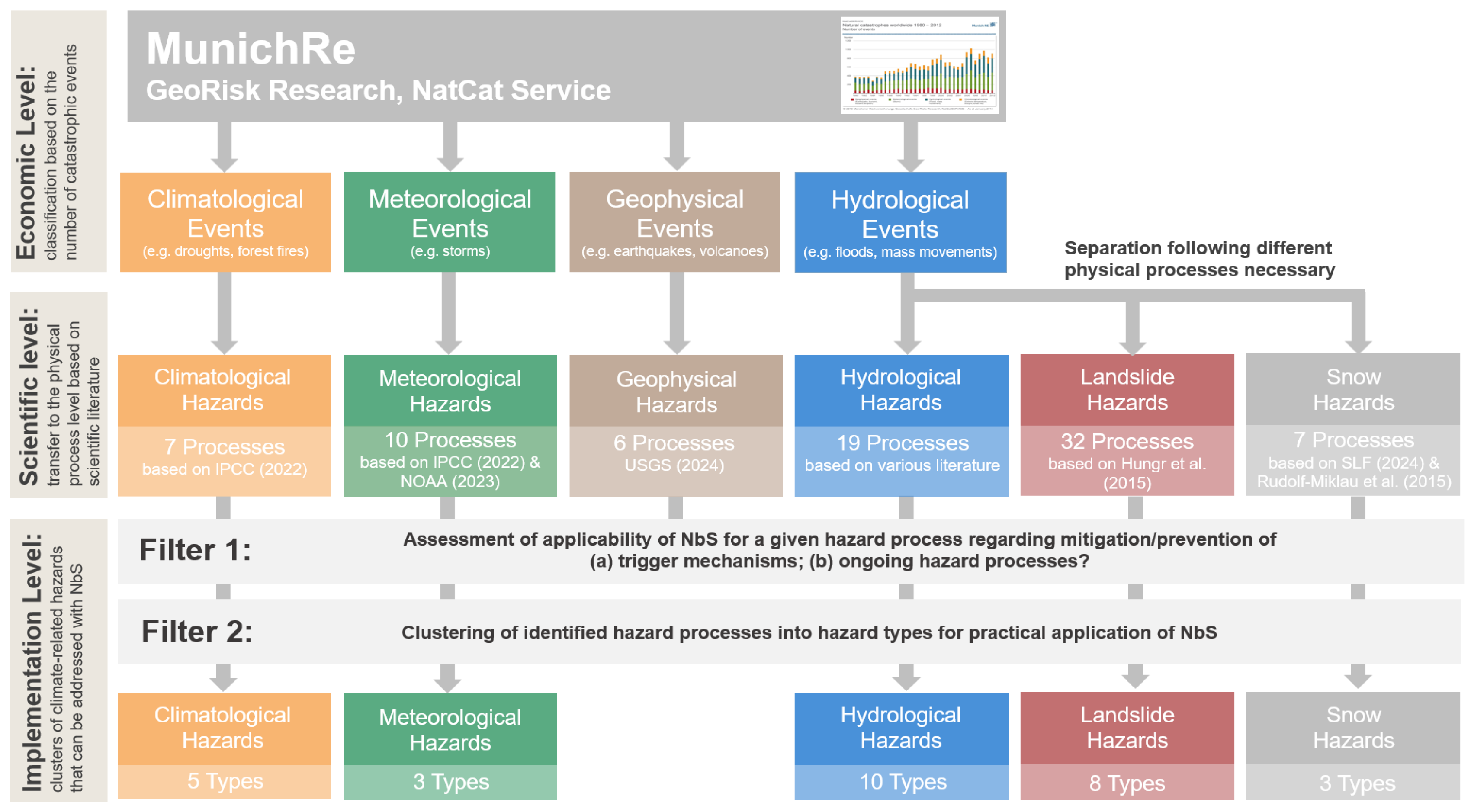
The development of a comprehensive hazard classification catalogue is an essential prerequisite for the strategic implementation of NbS within the field of natural hazard management. A practical classification system was elaborated by reviewing economic and scientific assessments, structuring them into a clear three-level hierarchy. The rationale of the hazard classification is founded on a structured approach of three operational levels, economic (Level 1), scientific (Level 2), and implementational (Level 3), to ensure the resulting system aligns with contemporary scientific literature and to guarantee practical applicability for NbS interventions.
Level 1 uses an economic classification of catastrophic events for global risk relevance [49,50]. Level 2 refines this by identifying general hazard processes through established specific classifications, for example, landslides and avalanches [23,47,51,52,53,54,55]. To ensure that the final list (Level 3) is relevant for NbS application, a two-step filtering process was applied. First, only those hazard processes that could plausibly be influenced by NbS was retained, either by mitigating their triggers or affecting the ongoing process. This step intentionally excluded hazards such as earthquakes and volcanic eruptions, as the NbS assessed in this framework have no meaningful direct effect on mitigating the underlying geophysical triggers or processes of these events. Second, the remaining processes were clustered into hazard types relevant for practitioners. For example, landslides were grouped by physical depth (e.g., <2 m and 2–10 m), a distinction that serves as a practical proxy for NbS applicability (e.g., effective root depth). This focus on physical hazard types, rather than their probability, magnitude, or intensity, is the core of our assessment. The resulting classification was then used for the further assessment process.

2.2. NbS Selection

Within the Horizon Europe project NATURE-DEMO, NbS were selected through a screening of international catalogues highlighting climate resilience strategies [28,56,57]. The screening criteria prioritised solutions with the following: (a) documented application in alpine or similar high-altitude environments, (b) evidence of mitigating one or more of the identified hazard classes, and (c) established application in engineering or landscape management. This initial long list was then consolidated and validated via expert consultations involving ecologists, geologists, engineers, and policymakers. The resulting focused list, detailed in the Appendix A, offers a comprehensive set of solutions suitable for the Alpine Space and is specifically aligned with the hazards defined in our classification system.

2.3. Applicability Assessment

The NbS–hazard assessment provides a qualitative rating of the effectiveness of each NbS against each hazard type. The core of the assessment is a discrete three-level scoring system: mitigative (2) for a primary and highly effective measure; supportive (1) for a complementary or secondary measure; and not applicable (0) where the NbS is not applicable (Table 1). The scoring was conducted through an expert elicitation process involving partners from the NATURE-DEMO consortium, with expertise spanning alpine hazard management, soil and water bioengineering, forestry, geology, hydrology, hydraulic engineering, and biology. Discrepancies were resolved through a moderated discussion to reach a final consensus score for each NbS–hazard pair.

2.4. Functional Clustering of NbS Using PCA and K-Means Analysis

The identification of functional groupings of NbS based on their mitigation potential was achieved through a multi-step statistical analysis of the 74 NbS × 29 hazards applicability assessment. First, the data were standardised using the z-score method to ensure that each hazard contributed equally to the analysis, preventing biases from differing rating scales. Subsequently, Principal Component Analysis (PCA) was performed to reduce the dataset’s high dimensionality [57,58] and to identify inherent groupings of NbS for approaching mitigation profiles. The number of principal components retained for analysis was chosen to ensure that the primary patterns required for effective clustering were captured.
Following dimensionality reduction, K-means clustering was applied to the standardised data in the reduced principal component space. For this analysis, K-means clustering was selected due to its effectiveness in partitioning the data into distinct, non-overlapping groups, which aligns with the primary objective of creating clear and interpretable functional categories for the NbS.
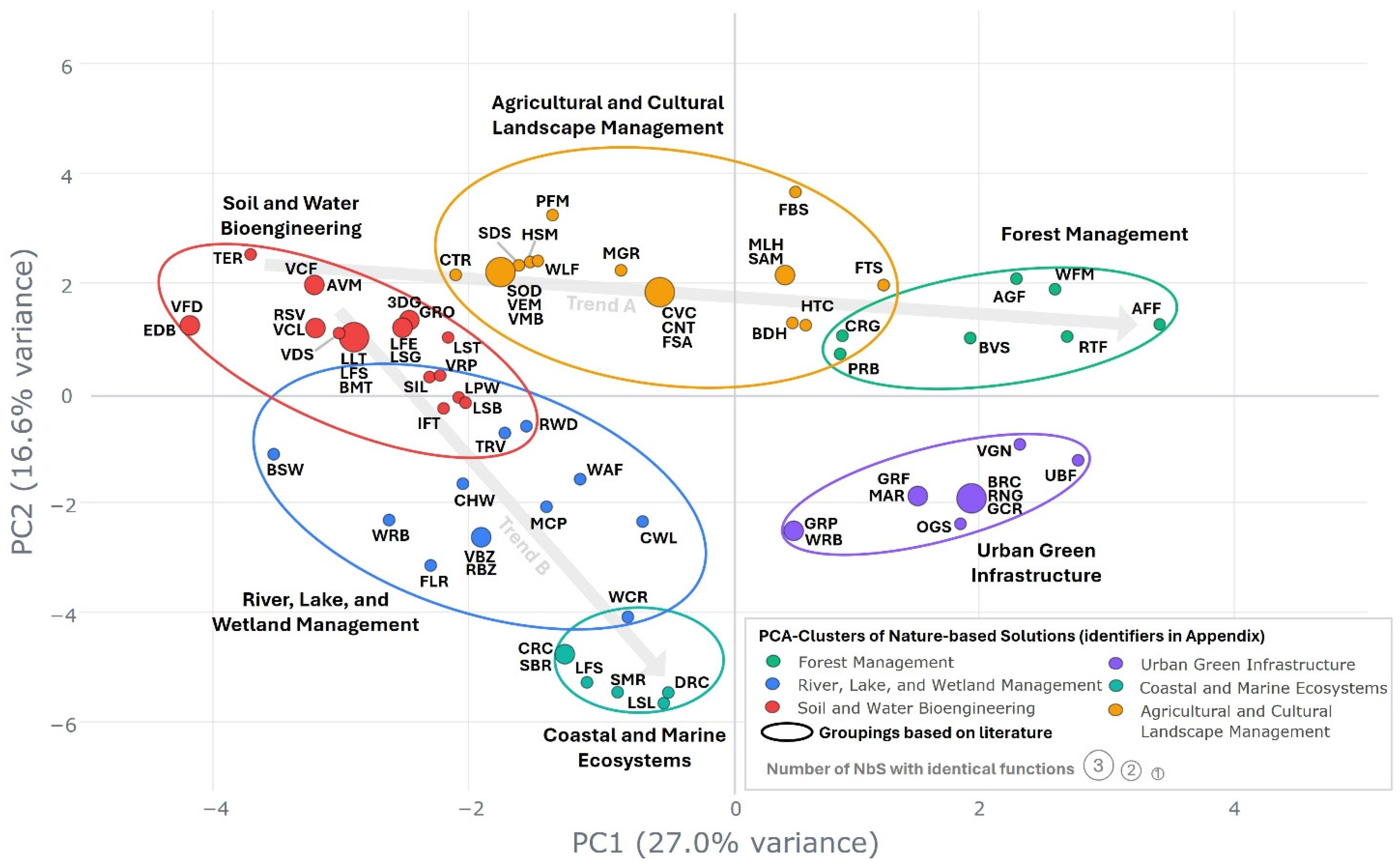
The selection of clusters was based on a combination of quantitative analysis and qualitative assessment. The Elbow Method [59] and the Silhouette method [60] were applied across a range of cluster counts (from k = 1 to k = 10), which indicated a suitable number of clusters between 5 and 7. While the Elbow Method suggested k = 5, the Silhouette Score improvement at k = 6 suggests that the slight increase in model complexity is justified by a significantly more meaningful clustering structure. From within this range, k = 6 was ultimately chosen, as it allows for the identification of a smaller, more specialised group of NbS that would otherwise be lumped into a larger cluster, and produced the most distinct and thematically coherent groups suitable for further discussion. Finally, the clusters were visualised in a scatter plot. The axes are defined by the first two principal components (PC1 and PC2), which together explain 43.6% of the total variance. While more components would be needed to capture the dataset’s full complexity, these two were selected as they represent the two largest dimensions of variation, thus providing the most informative two-dimensional visualisation of the groupings.

2.5. Mitigation Scoring

The mitigation potential of NbS for specific hazards was quantified through a new Mitigation Score. This score is calculated as a weighted average, where the effectiveness ratings (Ei: 2 for mitigative and 1 for supportive) serve as their own weights, as shown in Formula (1). This use of Ei2 in the numerator is a strategic decision to give disproportionately greater significance to highly effective solutions (score of 2) over merely supportive ones (score of 1), thereby rewarding the quality of solutions over their quantity. The resulting Mitigation Score effectively identifies hazards with powerful solutions (“hotspots”) and those with limited or less effective options (“gaps”).
M i t i g a t i o n   S c o r e = i = 1 n   ( E i × E i ) i = 1 n E i

2.6. Hazard Profiling

A hazard profiling methodology with respect to temporal patterns was developed to comprehensively evaluate the dynamic effectiveness of NbS regarding individual natural hazards. Based on the previous evaluation steps, this approach evaluates how the general protective utility of NbS through time may change in relation to a hazard process. Therefore, generalised time steps of hazard events were defined to account for the undisturbed pre-event conditions, hazard initiation, unfolding hazard processes, and the post-event situation. These time steps correspond to the four distinct functional phases, as NbS may affect hazard processes: (a) reduced predisposition, (b) prevention or mitigation of hazard initiation or triggers, (c) mitigation of an ongoing process, and (d) changes in post-event resilience.
The six-level scale assessment (Table 2) was derived using a two-phase mixed-method process. Phase 1 comprised a structured literature review of traditional SWB (e.g., [10,11,61]), NbS literature (e.g., [3,24,25,26,27,28,29,32,33,44]), conventional and modern natural hazard literature (e.g., [5,6,7,9,47,62,63,64,65]), and state-of-the-art technical standards [66,67]. This review focused on extracting qualitative and quantitative evidence of NbS performance related to the four temporal phases (predisposition, trigger, ongoing process, and post-event).
Phase 2 was a formal expert elicitation. The findings and any conflicts from the literature review were synthesised into a preliminary scoring matrix. This matrix was then presented to the expert panel for deliberation, refinement, and consensus-building, involving project partners from the NATURE-DEMO consortium. This process was deliberately designed to facilitate in-depth discussion until a single, unified consensus score was reached for each physical process rather than to aggregate statistically divergent expert opinions.
Given the pronounced scarcity of both qualitative and quantitative data concerning the interactions between nature-based solutions and alpine natural hazards, a consensus development methodology was deliberately adopted. This approach was selected over methods that statistically aggregate opinions, as the primary research objective was to synthesise interdisciplinary knowledge into a coherent conceptual framework, not to average pre-existing, divergent beliefs [68].
The process required experts to debate evidence, challenge assumptions, and share unique knowledge to reach a consensus score for each NbS–hazard pair. To manage persistent uncertainty and prioritise safety, a procedural rule was instated: in instances where divergence could not be fully resolved through deliberation, the consensus score systematically defaulted to the more conservative (i.e., lower scoring) option. Consequently, the unified score represents a robust group judgment that has processed inter-expert uncertainty, albeit with a deliberate ‘fail-safe’ orientation [69]. This phase-specific evaluation allows for a strategic and dynamic understanding of the critical intervention that NbS may provide within natural hazard management. Specifically, it highlights both the temporal limitations governing NbS deployment and the crucial timeframe when NbS can provide their maximum value.

3. Results

3.1. Hazard Classification System

The hazard classification process culminated in a streamlined, three-level system (i.e., economic, scientific, and implementation levels) designed for practical application (Figure 2). Broad economic hazard categories were refined using a scientific, process-based analysis to identify the specific natural hazards most relevant to NbS interventions (Table 3). The classification system was founded on an economic assessment, which utilised the established classification of catastrophic events from major global reinsurance groups, such as the GeoRisk Research of the MunichRe Group [50,51], to ensure the catalogue’s global relevance and its integration into widely used risk management frameworks. However, MunichRe’s focus is primarily on catastrophic events with significant financial impacts on a regional, national, or global scale, whereas individual physical processes or hazard types are not considered. Thus, this assessment only groups events into broad economic categories.
This foundation was subsequently refined through a scientific assessment to incorporate detailed physical processes, particularly those relevant to specific geographical contexts (e.g., alpine regions) that may have lesser global financial impact but significant local relevance, such as landslides and avalanches. An extensive scientific literature review was performed to document these underlying physical processes, incorporating established frameworks like the kinematic classification of mass movements [23,47,53,54,55]. Whereas the resulting hazard clusters differ from other classification systems such as the UNDDR [44], we ensured that all relevant hazard processes were included in the catalogue.
The classification system was finally streamlined for practical application through a focus on a practical implementation level, incorporating a two-step filtering process. The first step, Filter 1 (NbS Plausibility), retained only those hazard processes that could plausibly be influenced by NbS, either by mitigating their triggers or affecting the ongoing process, thereby intentionally excluding hazards where NbS have no meaningful effect (e.g., cyclones, earthquakes, volcanic eruptions, sea-level changes, and bergsturz). The remaining processes were then subjected to Filter 2 (Clustering), where similar physical processes were clustered into broader hazard types that are easily identifiable in the field for practitioners. For example, complex landslide processes were grouped based on the protection strategy required, such as landslides > 10 m depth, which is a more actionable distinction for engineers and planners than subtle kinematic differences. This comprehensive three-level methodology provided a robust framework for classifying and assessing diverse hazards based on the most relevant physical processes for NbS application, ensuring a balance between scientific robustness and practical usability.
The final system categorises 29 distinct hazard types into five overarching classes: Climatological-, Meteorological-, Hydrological-, Landslide-, and Snow-related Hazards (Figure 2 and Table 3). This allowed for the generation of a transparent and adaptable technical framework to strategically guide practitioners and stakeholders in the selection and application of NbS within their respective operational contexts. The final structure provides a clear and logical foundation for the subsequent applicability assessment, linking specific physical threats to potential nature-based responses.

3.2. NbS Set

The selection of NbS was carried out within the Horizon Europe NATURE-DEMO-project following a two-step process to ensure relevance and applicability. The resulting selection comprises a comprehensive set of 74 NbS with the potential to mitigate the specific hazard types defined in our classification system. This curated list was developed through a rigorous screening of international catalogues and refined through expert consultations to ensure relevance for protecting critical infrastructure in European alpine regions. The selected solutions are intentionally broad, spanning well-established soil and water bioengineering techniques, large-scale forestry and land management practices, and innovative urban green infrastructure designs. This diversity ensures the framework can assess a wide spectrum of interventions, from localised slope stabilisation to watershed-level flood management. The full list of the 74 NbS is detailed in Table A1 in Appendix A.

3.3. Applicability Assessment

A comprehensive applicability assessment of NbS was conducted, which scored the 74 identified NbS against 29 distinct natural hazard types. This applicability assessment is quintessential to not only ascertain if natural hazards can be affected by NbS, but also to determine which specific NbS are suitable, and whether they can provide full mitigation, serve a protective function, or act as a supportive feature along conventional protection infrastructure. The protective capabilities of NbS are highly specific and dependent on the type of solution and the nature of the hazard. For example, the use of riparian buffer strips is effective for mitigating localised riverine flood risk and improving water quality, but it offers no protection against hazards like landslides. This applicability assessment serves as the foundational dataset for the detailed analysis of functional clusters and mitigation scorings. The full assessment matrix is depicted in Appendix A Table A3.

3.4. NbS Functional Clusters

The PCA and subsequent K-means clustering successfully grouped the 74 NbS into six distinct functional clusters based on their shared hazard mitigation profiles (Figure 3). The first two principal components (PC1 and PC2) explain a combined 43.6% of the total variance (27.0% and 16.6%, respectively), effectively capturing the primary patterns within the dataset. It is stressed that, while this analysis groups solutions based on their primary hazard mitigation function, each cluster inherently provides a unique suite of co-benefits. Synergies such as biodiversity conservation, carbon sequestration, and improved water quality are key advantages of NbS, even though these co-benefits were not the variables used to drive the functional clustering itself.
The spatial arrangement in Figure 3 visually confirms the grouping of NbS into functional clusters based on their shared applications. For instance, solutions within the Soil and Water Bioengineering cluster are grouped closely together, indicating that they address a similar set of hazards. In contrast, specialised clusters like Urban Green Infrastructure and Coastal and Marine Ecosystems occupy distinct regions of the plot, highlighting their very different applicability profiles. To further define these groups, Table 4 provides a detailed summary, assigning a descriptive name to each cluster and outlining its primary purpose and the number of solutions it contains.
The visualisation of the functional clusters derived from the PCA analysis provides significant strategic guidance for the deployment of NbS in regional planning, revealing two primary operational trends related to the scale and environment of intervention.
Trend A (Scale of Intervention) represents a clear progression from highly localised, punctual interventions to extensive, landscape-level management, with this differentiation observed primarily along the axis defined by the first principal component (PC1). This continuum illustrates how NbS can be applied across different degrees of spatial coverage and magnitude of engineering effort. On one end, the trend encompasses micro-scale, site-specific solutions like terracing (TER) or vegetated cribwalls (VCF and VCL), which focus on slope stabilisation at a single location. The progression moves through intermediate-scale, field-wise land management techniques, such as agricultural practices, culminating in comprehensive, large-scale ecosystem management approaches. These include afforestation and reforestation (AFF), which are implemented across entire watersheds or large forest tracts to achieve regional resilience through broad ecological and hydrological regulation.
Trend B (Environmental Continuum) illustrates a shift in the primary application environment, moving from high-altitude and torrential headwater systems to lowland and coastal zones. This environmental segmentation is predominantly visualised along the PC2 axis. Solutions essential for localised slope stabilisation in steep terrain and high-energy torrential systems, such as vegetated cribwalls (VCF and VCL), are situated at one end of this continuum. The trend then transitions through techniques widely adopted in intermediate river management contexts, such as the use of sills (SIL), groynes (GRO), and channel widening (CHW). Finally, it extends to specialised solutions tailored for lowland and marine environments, including Wetland Conservation and Restoration (WCR) and the cluster representing Coastal and Marine Ecosystems. These latter solutions are specifically engineered to mitigate hazards unique to the littoral zone, such as coastal erosion and storm surge.

3.5. Mitigation Score

The Mitigation Score analysis reveals clear distinctions in the potential for NbS to address different hazard classes (Table 5). Snow Hazards (1.69 ± 0.11), Hydrological Hazards (1.60 ± 0.28), and Landslide Hazards (1.58 ± 0.24) achieved the highest scores, indicating a strong potential for NbS-driven mitigation. In contrast, Climatological Hazards (1.42 ± 0.26) and Meteorological Hazards (1.41 ± 0.29) scored lowest, suggesting more limited applicability or overall effectiveness of the assessed NbS for these classes. The standard deviations highlight the variability in NbS effectiveness for the different hazards within each class.
A detailed analysis of individual hazard types, exemplified by the Hydrological Hazards class (Table 6), shows significant internal variation. Erosion processes like sheet, rill, gully, and coastal erosion achieved the highest mitigation scores (1.83–1.90), as they can be addressed by many highly effective NbS (21–33 types). Conversely, flood-related hazards scored lower. Fluvial and pluvial floods showed moderate scores (1.64–1.66), with a balanced mix of mitigative and supportive NbS, while options for mitigating coastal floods, debris floods, and tsunamis were far more limited (1.00–1.42). These results underscore that, while the selected NbS are highly effective for erosion control, complementary strategies are often needed for complex flood-related hazards.

3.6. Hazard Profiles

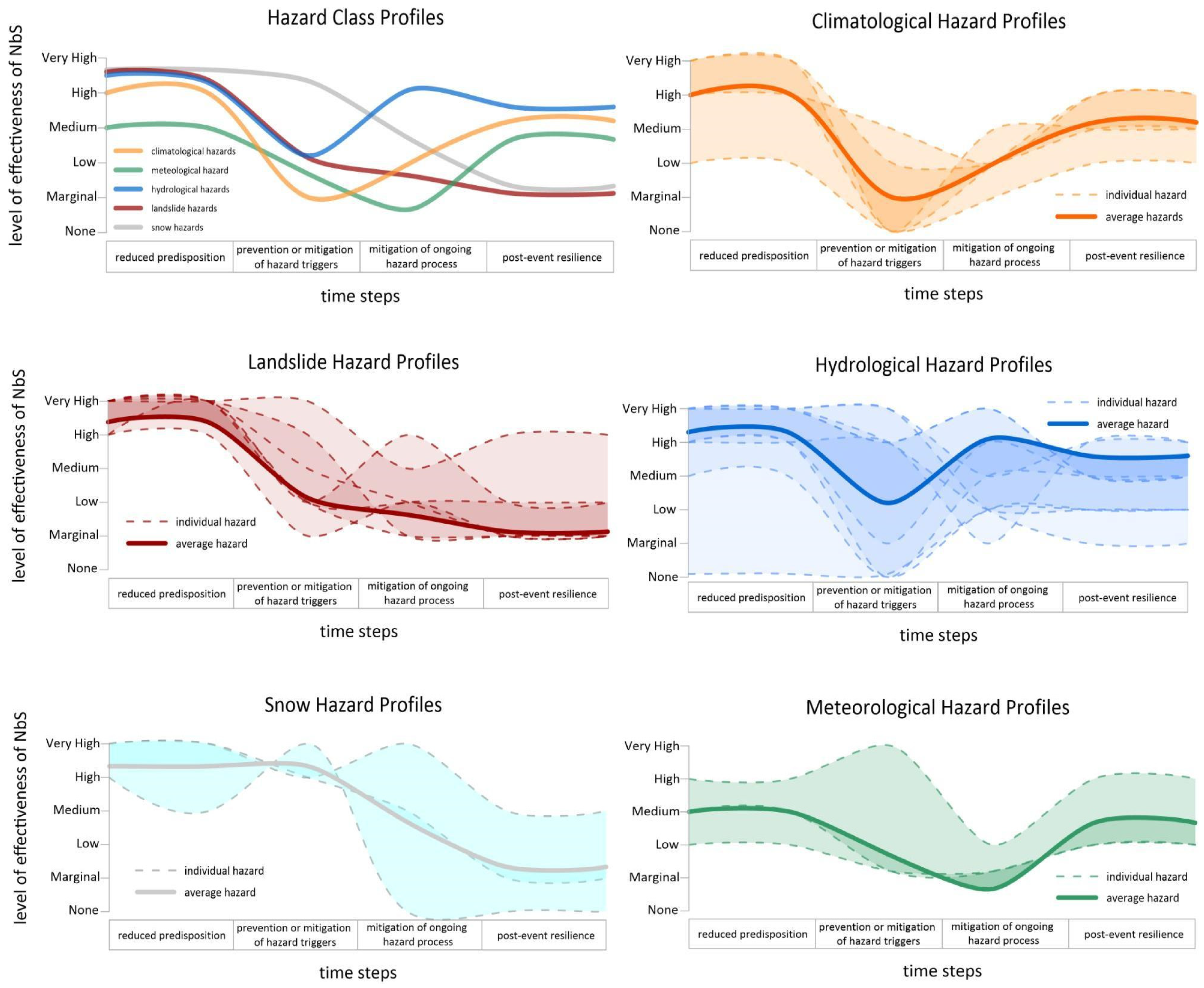
The hazard profile analysis shows that the utility of an NbS intervention is fundamentally dependent on the phase of the hazard event. An in-depth analysis of the exemplary profiles illustrates distinct patterns for each individual natural hazard (dashed lines) and the hazard class average (solid lines) (Figure 4). The collective protective utility of NbS against individual natural hazards changes across four distinct functional phases of a natural hazard: reduced predisposition, prevention or mitigation of hazard triggers, mitigation of an ongoing process, and post-event resilience.
The result for Hydrological Hazards exhibits a pronounced U-shaped curve, indicating broad utility across its temporal evolution. The NbS effectiveness is rated as ‘very high’ in the initial reduced predisposition phase, where large-scale measures (e.g., afforestation, floodplain restoration, wetland conservation) fundamentally alter a region’s water storage capacity and infiltration rates. However, NbS cannot prevent the underlying triggering factors for most hydrological hazards, such as heavy rainfall, as seen by the overall dip in effectiveness. Nonetheless, NbS show a high potential for the mitigation during most Hydrological Hazard events and support ecosystem recovery after inundation (i.e., flooding event), offering substantial long-term value.
Landslide Hazards, in stark contrast, display a profile of steep and continuous decline. The effectiveness rating is high to very high across the individual Landslide Hazards in reducing predisposition factors. This trend is driven by solutions that may provide slope stabilisation through mechanical or root reinforcement, reduction in slope angle, reduction in soil water content, or increase in surface roughness (important for rockfall risk reduction). However, effectiveness diminishes sharply and becomes marginal once the hazard has occurred.
Similarly, Snow Hazards display high effectiveness in the reduced predisposition phase and a strong potential for prevention or mitigation of hazard triggers (e.g., through forest management affecting snow distribution and stability), before falling sharply during the active mitigation of an ongoing process (e.g., avalanches).
Climatological Hazards and Meteorological Hazards are characterised by a complex multi-peak pattern. They show high effectiveness during the reduced predisposition phase (e.g., afforestation conservation agriculture enhancing soil water retention) and often display a secondary peak during the mitigation of an ongoing process phase (e.g., urban forests actively cooling ambient air during a heatwave).

4. Discussion

4.1. Hazard Classification

A bespoke hazard classification system was a foundational step in this study, as existing frameworks proved unsuitable for systematically linking NbS to their hazard mitigation potential.
The proposed foundation ensures the adapted system can be integrated more easily into the widely used catalogues and frameworks of insurance groups and national risk management agencies. The crucial step that sets our approach apart from other classifications is that two filters were applied. Filter 1 excluded any hazard where the NbS had no plausible impact (e.g., earthquakes volcanic eruptions). The second filter clustered the remaining processes into intuitive, actionable hazard types for practitioners. For example, instead of focusing on complex kinematics, landslides were grouped by depth (<2 m, 2–10 m, and >10 m). This distinction, which directly informs whether a root-based NbS can be effective, serves as a practical proxy for NbS applicability. This focus on physical hazard types, rather than on their probability, magnitude, or intensity, is core within the applied assessment. While other frameworks provide valuable catalogues of NbS in general, such as [24,28]), our approach connects existing NbS classifications to a new hazard-centric foundation. It is this linkage that enables the primary novel contribution of this study: a systematic, three-layer assessment (functional, qualitative, and temporal) that moves beyond simple classification to analyse protective capacity of NbS.

4.2. Applicability Assessment

A central finding of the applicability assessment is that NbS cannot be treated as off-the-shelf products with universal efficacy, especially considering site-specific magnitude and frequency variations. Their performance is profoundly contingent on the geographical, technological, ecological, and societal context in which they are deployed, as well as on their integration to mitigate or protect against specific natural hazards or a combination of them. Effective implementation requires moving beyond a simple “what” to a nuanced “how, where, and when.” This also requires that NbS are evaluated continuously and adapted to specific contexts to ensure long-term resilience and effectiveness.

4.3. Functional Clustering and Mitigation Scoring

The initial phase of strategic planning is often challenged by the sheer complexity and number of available NbS. To provide clarity, our framework offers a two-step screening process using complementary tools: the Functional Clusters and the Mitigation Score. First, the Functional Clusters provide a qualitative, mechanism-based framework that simplifies the initial selection process. By grouping solutions into intuitive categories based on their primary application, such as slope stabilisation or water management, it allows planners to quickly narrow the field to relevant options.
Building on this qualitative grouping, the Mitigation Score adds a crucial quantitative layer, ranking the viable options within each cluster. This scoring allows practitioners to rapidly identify “hotspots” (i.e., hazards where a wealth of effective NbS options exist) and critical “gaps” where nature-based approaches are limited. Recognising these gaps early on is vital, as it signals a need for innovative or hybrid grey–green infrastructure. This aligns with the growing call for strategic investment in a diverse portfolio of infrastructure, where nature-based solutions are integrated alongside conventional engineering to enhance overall coastal and inland resilience [70]. While powerful, this initial assessment remains static, providing a snapshot of potential effectiveness that does not capture performance over time. The inherent limitation of a static view is directly addressed by the framework’s subsequent dynamic analysis, which is crucial for planning in an era of evolving climate risks.
The objective, data-driven grouping was found to be robust, showing strong internal cohesion within clusters and aligning well with established NbS typologies (Figure 3 and Figure 4). More importantly, the analysis captured the real-world complexity of NbS, where overlaps between clusters (e.g., between forest and agricultural management) reflect the inherent multi-functionality of these solutions. This convergence validates the PCA-based approach and confirms that these functional groupings are a meaningful and practical simplification for planners.

4.4. Hazard Profiles and the Temporal Dimension of NbS Effectiveness

The Hazard Profile analysis marks a significant shift from a static view to a dynamic, service life-based understanding of NbS effectiveness. The Hazard Profiles (Figure 4) reveal that the protective capacity of NbS is not constant but follows distinct temporal patterns specific to each hazard class. This dynamic perspective is crucial, especially as changing disturbance regimes are expected to increase the vulnerability of mountain forests [71,72], and thus other alpine environments. The variations in the results underscore the necessity of a phase-specific assessment, as the strategic deployment of an NbS is fundamentally linked to its timing within a hazard’s phases.
The phase-specific approach has direct strategic implications. For example, the U-shaped profile for Hydrological Hazards highlights their broad utility in both long-term prevention and post-event recovery. In stark contrast, the sharply declining profile for Landslide Hazards demonstrates that their value is concentrated almost exclusively in proactive, preventative applications, as their mitigating capacity becomes marginal once a slide is in motion. This is also illustrated by empirical evidence from post-fire environments, where the protective function of forests against shallow landslides collapses rapidly. Vergani et al. [73] quantified this decline, showing that root reinforcement—a key stabilising mechanism—was reduced by a factor of 3.6 within just four years after a fire incident. Their work further revealed that the initial natural regeneration was functionally insignificant in compensating for this loss, rendering the slope highly vulnerable. The value of the NbS in this context becomes marginal once the hazard has been triggered and causes physical harm to the NbS with respect to the performing plant components.
Conversely, even when an NbS regenerates, the timeline to return to full protective capacity can be exceptionally long, creating a prolonged window of high risk. The study by May et al. [74] on the recovery of protection forests against rockfall found that it may take between 50 and 200 years to regain the maximum possible protective effect after a severe disturbance. This creates a critical “protection gap” where the recovery of the new stand is slower than the decay of protective legacies (e.g., deadwood) from the previous stand. While biological legacies can be crucial, their effect is finite. For example, large-scale experiments have shown that deadwood from windthrow can provide significant rockfall protection, but this function diminishes as the wood decays [75]. Furthermore, their findings show that recovery is not simply a linear return to a previous state; the total protective factor can decrease again after reaching a peak as the forest stand ages naturally. This service life dependency is well-documented, with protective capacity against rockfall shown to vary significantly along a forest’s maturity gradient, often peaking in mature stands before declining in later successional stages [76]. Therefore, the distinction between the temporal phases of a hazard is not just academic but has direct consequences for investment and policy. A phase-specific understanding is essential for developing more robust climate adaptation strategies and for ensuring the efficient allocation of resources to solutions that will be effective when they are needed most. The dynamic understanding, however, is essential for moving beyond static assessments and designing more robust, time-aware climate adaptation strategies.
While the scoring system applied is inherently a qualitative assessment, it is anchored in empirical evidence and practical knowledge derived from an intensive literature review, and further validated by an expert panel. The calibration of the scaling method has proven sufficient to describe general trends. For example, in assessing the mitigation of ongoing heatwaves, an NbS documented to produce an ambient air temperature reduction of over 3 °C, such as a large urban forest, would justify a high score (4 or 5). In contrast, an NbS with a more localised or modest cooling effect, like certain green roof applications that cool ambient air by less than 1 °C, would warrant a lower score (2 or 3). This evidence-based calibration, which considers the systemic integration and context of both the NbS and the natural hazard, ensures that the scores reflect real-world performance. However, the deliberative consensus methodology used to derive these scores (as described in Section 2.6) carries specific implications. The process intentionally defaulted to the most conservative (lower) score in cases of unresolved expert divergence. This decision has the primary advantage of integrating the precautionary principle into the framework. In a high-consequence domain like alpine hazard management, where the cost of overestimating an NbS’s effectiveness is potentially catastrophic, this “safe-side” approach represents a justifiable and robust response to data scarcity.
Conversely, this methodological choice introduces a systematic conservative bias into the hazard profiles. The resulting scores may, in some cases, underestimate the true protective capacity of certain NbS, particularly innovative solutions that lack unanimous, high-confidence backing from the expert group. The final profiles may therefore represent a “lowest common denominator” of expert confidence rather than the central tendency of expert opinion. This trade-off—prioritising safety and robustness over potential optimism—is a critical consideration when interpreting the framework’s outputs, especially when evaluating the potential exclusion of newer or less-documented NbS interventions.

4.5. A Dynamic Concept for NbS Efficacy

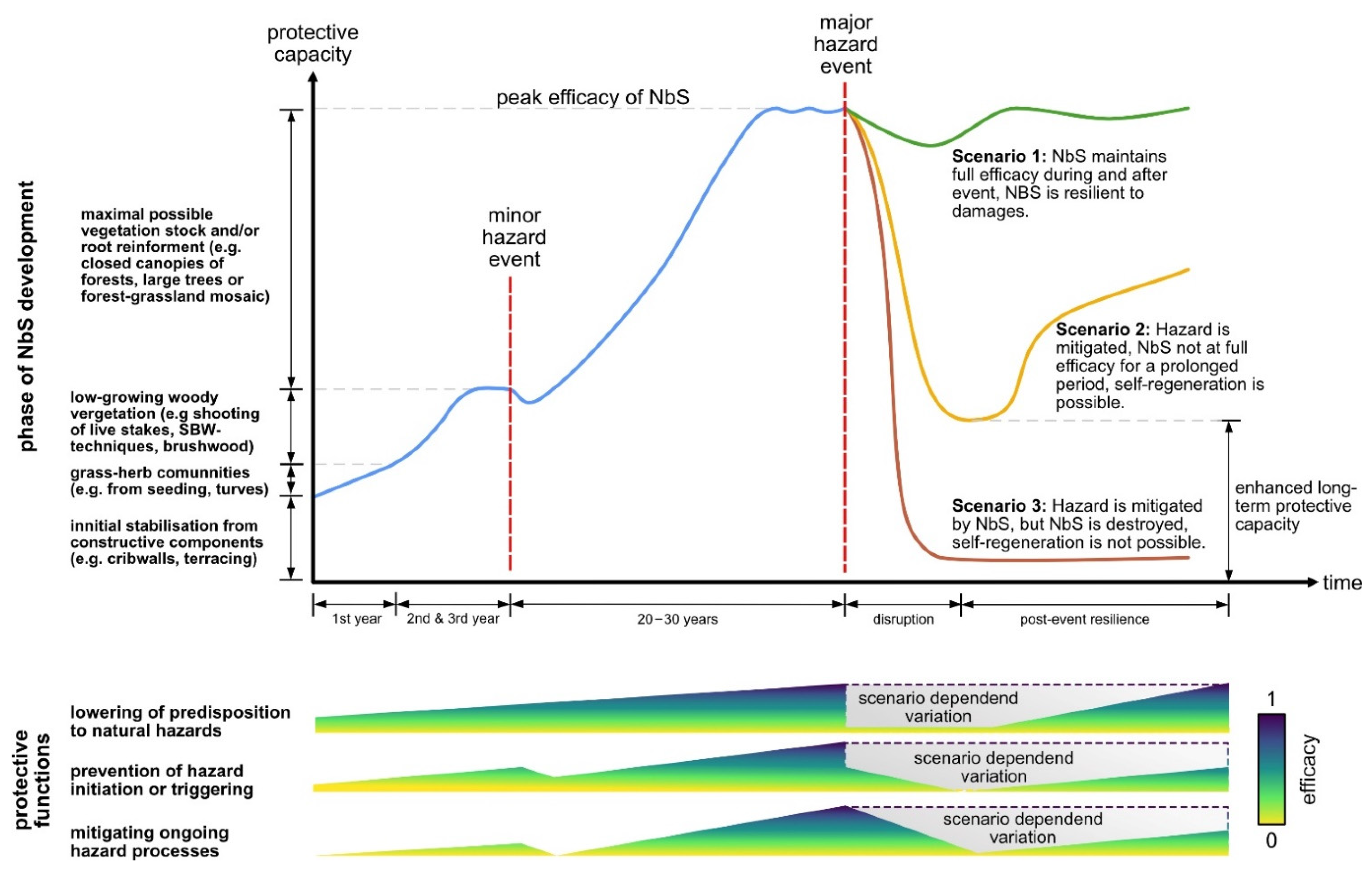
Shifting from a static evaluation to a dynamic, service-life-based understanding of their performance is an imperative factor for strategic deployment. The conceptual model presented in Figure 5 illustrates a generalised service-life of an NbS and its potential responses to a design event.
Unlike conventional grey infrastructure, which typically has its maximum strength immediately after construction, the efficacy of most NbS is intrinsically linked to the growth and maturation of their living components. The initial implementation of an NbS may provide a mitigation effect, albeit limited. Examples include the initial structure of a vegetated cribwall or the immediate cooling effect of young vegetation within urban environments to affect ambient temperature.
However, major hazard events may impede the NbS functionality, depending on the magnitude and the resilience of the system. This is inherently dependent on the anticipated design event and the type of natural hazard. The post-event situation can be classified into three primary types that describe the system’s response and potential for recovery:
Scenario 1: The NbS maintains full or almost full efficacy during and after a hazard event, while the protective functions stay almost entirely intact. Consequently, the NbS demonstrates high resilience and maintains its long-term protective capacity. Any minor damage is quickly restored through self-repairing processes, showcasing a key advantage regarding maintenance over conventional grey protection infrastructure.
Scenario 2: The NbS can mitigate the hazard but the system’s integrity is compromised, leading to a period of reduced efficacy and increased vulnerability. This highlights a critical period of vulnerability where protective functions are significantly reduced and management interventions may be required to guide recovery. This is partially governed by the decay of key biological components. Basically, self-regeneration is possible, which potentially takes a prolonged period for the NbS to return to its peak efficacy and/or may require management interventions to guide recovery.
Scenario 3: This represents a catastrophic failure where the scale of the hazard fundamentally overwhelms the NbS, leading to its complete or near-complete destruction. This outcome is starkly illustrated by the case study in Vergani et al. [73], where a severe fire effectively eliminated the root reinforcement provided by the mature forest. This outcome underscores that every NbS has a boundary condition or a physical limit to its effectiveness. Such failure occurs when the hazard process operates at a scale that the NbS cannot physically influence. The NbS is rendered non-functional post-event and self-regeneration is not possible. With its protective function lost, the site is left severely degraded, requiring a complete and often costly reconstruction effort.
Acknowledging these distinct resilience archetypes is therefore fundamental to the strategic deployment of NbS, enabling practitioners to move beyond a simplistic pass/fail assessment, and highlights the critical importance of correctly matching the type of NbS interventions to the scale and type of the potential hazard.
The integration of functional, quantitative, and temporal layers thus moves the assessment beyond simple NbS selection towards the design of more robust and resilience strategies that are adaptive over time. For example, a static Mitigation Score might rate a forest highly suitable for landslide protection. However, without understanding the post-fire collapse in efficacy documented by Vergani et al. [73] and the century-long recovery timeline described by May et al. [74], planners might operate with a false sense of security regarding long-term resilience. Given that disturbance regimes in alpine regions are intensifying [71], incorporating this temporal understanding is paramount for reliable risk reduction [72] .

4.6. Concept Limitations and Existing Research Gaps

To further bridge the gap between strategic guidance and practical application, future work must focus on empirical validation and scaling. This validation should proceed through in-depth case studies, comparative analyses with historical events, and sensitivity testing of the scoring system. However, this requires extensive meta-studies of cohesive datasets of applied NbS in alpine regions, which currently does not exist for many hazard processes nor for single NbS types, given that monitoring meteorological and climatological hazards is facilitated by the widespread availability of standardised data from established weather networks. However, this is not the case for gravitational mass movements or erosional processes, which require specialised in situ and/or remote sensing data to capture hazard events. Concurrently, the framework can be enhanced by incorporating additional site-specific dimensions and parameters derived from such meta-studies, observed natural hazards data (e.g., hazard intensity, magnitude, or probability), local environmental conditions, and socio-economic factors. Integrating these validation pathways and scaling variables would enhance the concept’s reliability, allowing for more nuanced scoring and profiling tailored to concrete planning scenarios. Furthermore, elaboration of NbS-specific profiles and stages of development considering technical or engineering functions, as exemplified in some local studies [77], could exhibit additional details and more nuanced understanding of efficacy and characteristics over time.
The core concept developed in this paper should not be viewed as isolated steps but as interconnected analytical layers. This conceptual foundation for strategic NbS planning contributes to a more holistic assessment and decision-making process by acknowledging time dependencies of NbS. However, moving from this strategic assessment to a fully operational and implementable framework requires bridging the gap between this conceptual model and the complex, site-specific realities of engineering, governance, and the often limited financial capabilities of alpine communities. The primary challenges in operationalising this framework in an alpine setting are not conceptual but practical, and often highly individualistic depending on the boundary conditions of the site.
Furthermore, NbS lack the codified engineering standards (e.g., EUROCODE) that govern grey infrastructure and that define performance against hazard- and country-specific design events (e.g., a 100-year flood or avalanche impact forces). This leaves significant gaps in safety assessment, leading to legal liability. The reliability of NbS is often perceived as lower, with performance seen as variable and harder to quantify than conventional structures [78]. This ambiguity makes it difficult to define whether NbS can function as a sole mitigation infrastructure or only support other solutions. Critical research gaps also exist in certifying hybrid (grey–green) systems [73], ultimately fuelling low social acceptance, as stakeholders often perceive classical grey solutions as inherently safer. Another operational barrier in alpine regions is severe land limitation. Densely populated valleys face intense, competing land-use pressures. This scarcity is compounded by fragmented private land ownership, making consensus for collective protection schemes a profound governance challenge [29]. Consequently, while NbS may have lower long-term costs, they often require significant upfront investment to acquire expensive, privately-owned land [78].

4.7. Approaching an Integrated Framework for Strategic NbS Planning

The presented conceptual model becomes an applicable strategy when these operational barriers are systematically addressed through subsequent, site-specific assessments of engineering feasibility, financial viability, and socio-political acceptance. One pathway is the extended RAMSHEEP framework [79,80], which serves as a multi-criteria assessment tool for stakeholders to move beyond a purely technical evaluation of protective infrastructures against natural hazards. It directly addresses the regulatory and reliability gaps by using Key Performance Indicators (KPIs) for ‘Safety’, ‘Reliability’, and ‘Maintainability’, allowing for a direct comparison of either pure NbS or grey and hybrid solutions against defined design events. Furthermore, it explicitly integrates the socio-economic and institutional barriers through its ‘Economy (EC)’ and ‘Health and Politics (HP)’ criteria, providing a formal mechanism to assess stakeholder demands, financial limitations, land ownership conflicts, and social acceptance (Fernandes et al., under review [80]). The extended RAMSHEEP framework represents the crucial next step, translating the conceptual challenges identified here into a quantitative, traceable, and defensible decision-making process for the planners and stakeholders ultimately responsible for public safety. The extended RAMSHEEP framework was already applied for the Lattenbach case study in Tyrol, Austria (Fernandes et al., under review), and is currently being assessed within the NATURE-DEMO Project on five other case studies located within Europe [79].

5. Conclusions

This paper presents a systematic, multi-layered framework for assessing the protective capacity of NbS against specific climate-related threats. Based on a novel hazard classification system, the framework combines three analytical layers: qualitative Functional Clusters, a quantitative Mitigation Score, and dynamic Hazard Profiles to assess effectiveness over time. The synthesis of these functional, quantitative, and temporal components is intended to move planning from simple solution selection toward the design of more robust and temporally aware resilience strategies.
The value of this hazard-centred approach lies in its application to climate resilience planning. While the focus is on protecting critical infrastructure in alpine regions, its principles are applicable to other vulnerable landscapes. The framework’s tangible outputs, such as the Mitigation Scores and Functional Clusters, provide a structured link between specific threats and viable nature-based responses. This allows planners to distinguish between where an NbS has a primary mitigative role versus a supportive one. Importantly, it also identifies gaps where NbS are likely insufficient, guiding more targeted and realistic interventions. The findings from this framework can inform the development of digital decision-support tools for practitioners. The results also highlight the continued need for monitoring and adaptive management to ensure and better understand the long-term effectiveness of NbS interventions. This is particularly relevant for the unique and evolving hazard landscapes found in alpine regions and beyond.

Author Contributions

Conceptualisation, R.S., E.K., M.O. and J.H.; methodology, E.K., M.O., R.S. and J.H.; validation, J.H. and R.S.; formal analysis, E.K. and M.O.; investigation, E.K., M.O., J.H. and R.S.; resources, E.K., M.O., E.C. and M.W.; data curation, E.K., M.O., J.H., R.S., L.S., T.K., M.M., E.C. and M.W.; writing—original draft preparation, E.K., M.O. and R.S.; writing—review and editing, E.K., M.O., R.S., L.S., T.K., S.F., M.M., E.C. and S.C. visualisation, E.K. and M.O. All authors have read and agreed to the published version of the manuscript.

Funding

NATURE-DEMO (“Nature-Based Solutions for Demonstrating Climate-Resilient Critical Infrastructure”; https://www.nature-demo.eu/) is an innovation action funded under the European Union’s Horizon Europe Programme, Grant Agreement No. 101157448. The project is co-funded by the Swiss State Secretariat for Education, Research and Innovation (SERI), grant No. 24.00279; Innovate UK, part of UK Research and Innovation (UKRI), grant No. 10116701; and the industrial partners within the project.

Data Availability Statement

The original contributions presented in this study are included in the article. Further inquiries can be directed to the corresponding authors.

Conflicts of Interest

Authors Maria Wirth and Eriona Canga were employed by the non-profit limited liability company “alchemia nova research & innovation gemeinnuetzige GmbH”. Slaven Conevski was employed by the company “Multiconsult”. The remaining authors declare that the research was conducted in the absence of any commercial or financial relationships that could be construed as a potential conflict of interest.

Appendix A

Table A1. NbS types considered in this work.
NameCodeNameCode
3D steel grids (vegetated)3DGManaged aquifer recharge MAR
Afforestation and reforestationAFFMeadow and grassland restorationMGR
AgroforestryAGFMeandering channel planformMCP
Avalanche moundsAVMMulchingMLH
Biodiverse hedgerowsBDHOpen green spacesOGS
Bio-retention cellsBRCPrescribed burningPRB
BioswalesBSWProtection forest managementPFM
Brush mattressBMTRain gardensRNG
Buffer vegetation strips and coppice managementBVSReinforced soil and earth packs (vegetated)RSV
Channel wideningCHWRetention forestRTF
Conservation tillageCNTRiparian buffer zonesRBZ
Constructed wetlandsCWLRoot wadRWD
Contour trenchingCTRSalt marsh restorationSMR
Controlled grazingCRGSand dune stabilisationSDS
Coral reef conservation and restorationCRCSeagrass bed restorationSBR
Cover croppingCVCSillsSIL
Dune restoration and coastal vegetationDRCSod (turves)SOD
Earth dams and barriers (vegetated)EDBSoil amendmentsSAM
Firebreaks and firestripsFBSTerracing (slope shaping, reduction of slope inclination)TER
Fire-resistant tree species and plantsFTSTree revetment (tree spurs)TRV
Fire-smart agricultureFSAUrban forestsUBF
Floodplain restorationFLRVegetated biodegradable erosion control mats and blanketsVMB
Green corridors and tree rowsGCRVegetated biodegradable erosion control meshesVEM
Green paversGRPVegetated buffer zonesVBZ
Green roofsGRFVegetated cribwall (fascine-based design)VCF
Groynes (vegetated)GROVegetated cribwall (layer-based design)VCL
HorticultureHTCVegetated drainage systemsVDS
Hydro and mulch seedingHMSVegetated flood protection dams, dikes and leveesVFD
Infiltration trenchesIFTVegetated log/stone barriers and live/rock check damsLSB
Litoral/intertidal forests and shrublandsLFSVegetated riprapVRP
Live fascinesLFSVertical greeneryVGN
Live fencing (for slope engineering)LFEWater retention basins and ponds (storage ponds)WRBs
Live layered techniquesLLTWater retention, harvesting and cisternsWRHs
Live palisades and live weirsLPWWattle fence (for water engineering)WAF
Live slope grids or contour logsLSGWetland conservation and restorationWCR
Live stakingLSTWildfire-forest managementWFM
Living shorelinesLSLWooden log fencesWLF
Table A2. Natural hazards considered in this work.
NameCodeNameCode
Extreme high temperaturesEHTGully erosionGUE
Extreme cold temperaturesECTCoastal and shoreline erosionCSE
DroughtDRTDebris flood (Vol. Sediment Conc. 20–40%)DFH
WildfireWFRDebris flood (Vol. Sediment Conc. >40%)DFM
DesertificationDSFSmall rockfall (diameter < 25 cm)RFS
Storms and strong windsSSWLarge rockfall (diameter > 25–100 cm)RFL
HailHALLandslides < 2 m depthLS1
Aeolian erosion AEOLandslides 2–10 m depthLS2
Pluvial flood, heavy rainfall and surface runoffPFRLandslides > 10 m depthsLS3
Fluvial floodFVFMud or earth flowLS4
Coastal flood COFSoil slope deformation and soil creepSDS
Impact floods and tsunamiIFTSnow avalanchesAVA
Fluvial sediment transportFSTSnow driftSDR
Stream bank and bed erosion SBESnow creep and slideSCS
Sheet erosion and rill erosionSRE
Table A3. Applicability assessment chart. The rows list natural hazard types and the columns list NbS. Refer to Table A1 and Table A2 for coding information.
EHTECTDRTWFRDSFSSWHALAEOPFRFVFCOFIFTFSTSBESREGUECSEDFHDFMRFSRFLLS1LS2LS3LS4SDSAVASDRSCS
3DG00012002111122222122221112112
AFF00000002201100220222221010222
AGF00000000000011111122221022222
AVM00000002000022222111221022000
BDH00012002000122222222221022000
BRC21222122220112222222121122222
BSW11222122220112222222121122222
BMT11102122220112220221010011111
BVS00020000000000000000000000000
CHW00121102110110000200000000111
CNT00020000000000000000000000000
CWL00020000000000000000000000000
CTR00020000000000000000000000000
CRG10101101120022000110000000111
CRC10101100020022000000000000000
CVC10101000020022000000000000000
DRC00111000020022000200000000000
EDB00101000020022000100000000000
FBS00000000020022000100000000000
FTS00000000222022001220000000000
FSA10121000220011000000000000000
FLR10211000221011000000000000000
GCR10111000221011000000000000000
GRP11001100001100002000000000000
GRF00001000002100001000000000000
GRO00001000001100001000000000000
HTC00000000000000001000000000000
HMS00000000001000001000000000000
IFT10000000111010000000000000000
LFS11001100002100002000000000000
LFS11102212220011210110010011011
LFE11202102110011200110010011011
LLT00202000110020200100000000000
LPW00202000110000000100000000000
LSG11102102110021201110010011020
LST11102102110011111110010011020
LSL11102102220011110110010011011
MAR11102102220022212110010011022
MGR00022001110000100000000000000
MCP00020000000000000000000000000
MLH00112000220000200000000000000
OGS00102001110000200000000000000
PRB00102001110000200000000000000
PFM00102001110000200000000000000
RNG00102001110000200000000000000
RSV00002012111012222102021011000
RTF00202012111012222112021011000
RBZ00202012111012222112021011000
RWD00201012110000200100000000000
SMR00101012222012222122121011010
SDS00000212111012222122121011022
SBR00101012111000220122121011000
SIL00000012111000110122121022000
SOD00101112110010112121121022122
SAM00101011220000220120022222000
TER00000011222012212100000000000
TRV00000011110012222100000000000
UBF00000012220012222122120011000
VMB00000011110012220100000000000
VEM00000112220022002120000000122
VBZ00101012220012222110000000000
VCF00101012220012222110000000000
VCL00000112220012222110000000000
VDS00000011220022020120000000100
VFD00000111110022220112100000022
LSB20101000220000000100000000000
VRP20101000210000000000000000000
VGN21101010210000000000000000000
WRB21101000110000000000000000000
WRH21101000220011000111010011000
WAF10101000110000000100000000000
WCR10101000110000000000000000000
WFM00101000210011100100000000000
WLF10100000120011000000000000000

References

  1. Forzieri, G.; Bianchi, A.; Silva, F.B.E.; Marin Herrera, M.A.; Leblois, A.; Lavalle, C.; Aerts, J.C.J.H.; Feyen, L. Escalating impacts of climate extremes on critical infrastructures in Europe. Glob. Environ. Change 2018, 48, 97–107. [Google Scholar] [CrossRef]
  2. IPCC. Climate Change 2022: Impacts, Adaptation, and Vulnerability. In Contribution of Working Group II to the Sixth Assessment Report of the Intergovernmental Panel on Climate Change; Pörtner, H.-O., Roberts, D.C., Tignor, M., Poloczanska, E.S., Mintenbeck, K., Alegría, A., Craig, M., Langsdorf, S., Löschke, S., Möller, V., et al., Eds.; Cambridge University Press: Cambridge, UK; New York, NY, USA, 2022; p. 3056. [Google Scholar] [CrossRef]
  3. EEA European Environment Agency. European Climate Risk Assessment. In The European Climate Risk Assessment (EUCRA); EEA European Environment Agency: Copenhagen, Denmark, 2024. [Google Scholar] [CrossRef]
  4. Cohen-Shacham, E.; Walters, G.; Janzen, C.; Maginnis, S. (Eds.) Nature-Based Solutions to Address Global Societal Challenges; IUCN: Gland, Switzerland, 2016. [Google Scholar] [CrossRef]
  5. Demontzey, P. Etude Sur Les Travaux de Reboisement et de Gazonnement Des Montagnes; Imprimerie Nationale: Paris, France, 1878; Volume 1. [Google Scholar]
  6. von Seckendorff-Gudent, A. Verbauung der Wildbäche, Aufforstung und Berasung der Gebirgsgründe: Aus Anlass der Reise Seiner Excellenz des Herrn KK Ackerbauministers Grafen Julius von Falkenhayn Nach Südfrankreich, Tirol und Kärnten; Wilhelm Frick: Weinstadt, Germany, 1884. [Google Scholar]
  7. Wang, F. Grundriss der Wildbachverbauung; S. Hirzel: Leipzig, Germany, 1901. [Google Scholar]
  8. Demontzey, P. Studien Über Die Arbeiten der Wiederbewaldung und Berasung der Gebirge; von Seckendorff-Gudent, A., Translators, C., Eds.; Gerold’s Sohn: Vienna, Austria, 1880. [Google Scholar]
  9. von Seckendorff-Gudent, A. Ueber Wildbach- und Lawinenverbauung, Aufforstung von Gebirgshängen und Dammböschungen oder Inwieweit Vermag der Forstmann Auf Die Sicherheit und Rentabilität des Bahnbetriebes Einzuwirken? Vortrag, Geh. im Club Österr. Eisenbahn-Beamten am 14. Dec. 1880; Faesy & Frick: New York, NY, USA, 1881. [Google Scholar]
  10. Schiechtl, H. Bioengineering for Land Reclamation and Conservation; University of Alberta Press: Edmonton, AB, Canada, 1980. [Google Scholar]
  11. Gray, D.H.; Sotir, R.B. Biotechnical and Soil Bioengineering Slope Stabilization: A Practical Guide for Erosion Control; John Wiley & Sons: New York, NY, USA, 1996. [Google Scholar]
  12. Bischetti, G.B.; De Cesare, G.; Mickovski, S.B.; Rauch, H.P.; Schwarz, M.; Stangl, R. Design and temporal issues in Soil Bioengineering structures for the stabilisation of shallow soil movements. Ecol. Eng. 2021, 169, 106309. [Google Scholar] [CrossRef]
  13. Rey, F.; Bifulco, C.; Bischetti, G.; Bourrier, F.; De Cesare, G.; Florineth, F.; Graf, F.; Marden, M.; Mickovski, S.; Phillips, C.; et al. Soil and water bioengineering: Practice and research needs for reconciling natural hazard control and ecological restoration. Sci. Total. Environ. 2019, 648, 1210–1218. [Google Scholar] [CrossRef] [PubMed]
  14. European Federation for Soil and Water Bioengineering (EFIB). European Guidelines for Soil and Water Bioengineering (Version 2); European Federation for Soil and Water Bioengineering (EFIB): San Sebastián, Spain, 2022; Available online: https://efib.org (accessed on 15 April 2025).
  15. Zeh, H. Ingenieurbiologie Handbuch Bautypen, Genie Biologique, Manuel de Construction, Ingegneria Naturalistica, Quaderno Delle Opere Tipo, Soil Bioengineering, Construction Type Manual, Ingenieria Biolögica, Manual Teenico; vdf Hochschulverlag: Zürich, Switzerland, 2007. [Google Scholar]
  16. Moreau, C.; Cottet, M.; Rivière-Honegger, A.; François, A.; Evette, A. Nature-based solutions (NbS): A management paradigm shift in practitioners’ perspectives on riverbank soil bioengineering. J. Environ. Manag. 2022, 308, 114638. [Google Scholar] [CrossRef] [PubMed]
  17. Maes, J.; Jacobs, S. Nature-Based Solutions for Europe’s Sustainable Development. Conserv. Lett. 2015, 10, 121–124. [Google Scholar] [CrossRef]
  18. Preti, F.; Capobianco, V.; Sangalli, P. Soil and Water Bioengineering (SWB) is and has always been a nature-based solution (NBS): A reasoned comparison of terms and definitions. Ecol. Eng. 2022, 181, 106687. [Google Scholar] [CrossRef]
  19. Nesshöver, C.; Assmuth, T.; Irvine, K.N.; Rusch, G.M.; Waylen, K.A.; Delbaere, B.; Haase, D.; Jones-Walters, L.; Keune, H.; Kovacs, E.; et al. Science of the Total Environment The science, policy and practice of nature-based solutions: An interdisciplinary perspective. Sci. Total. Environ. 2017, 579, 1215–1227. [Google Scholar] [CrossRef]
  20. Sowińska-Świerkosz, B.; García, J. What are Nature-based solutions (NBS)? Setting core ideas for concept clarification. Nat.-Based Solut. 2022, 2, 100009. [Google Scholar] [CrossRef]
  21. Dremel, M.; Goličnik Marušić, B.; Zelnik, I. Defining Natural Habitat Types as Nature-Based Solutions in Urban Planning. Sustainability 2023, 15, 13708. [Google Scholar] [CrossRef]
  22. Wood, J.L.; Harrison, S.; Reinhardt, L.; Taylor, F.E. Landslide databases for climate change detection and attribution. Geomorphology 2020, 355, 107061. [Google Scholar] [CrossRef]
  23. Hungr, O.; Leroueil, S.; Picarelli, L. The Varnes classification of landslide types, an update. Landslides 2014, 11, 167–194. [Google Scholar] [CrossRef]
  24. Somarakis, G.; Stagakis, S.; Chrysoulakis, N. (Eds.) ThinkNature Nature-Based Solutions Handbook. In ThinkNature project Funded by the EU Horizon 2020 Research and Innovation Programme Under Grant Agreement No. 730338; European Union: Brussels, Belgium, 2019. [Google Scholar] [CrossRef]
  25. Gómez Martín, E.; Máñez Costa, M.; Schwerdtner Máñez, K. An operationalized classification of Nature Based Solutions for water-related hazards: From theory to practice. Ecol. Econ. 2020, 167, 106460. [Google Scholar] [CrossRef]
  26. Castellar, J.A.C.; Popartan, L.A.; Pueyo-Ros, J.; Atanasova, N.; Langergraber, G.; Säumel, I.; Corominas, L.; Comas, J.; Acuña, V. Nature-based solutions in the urban context: Terminology, classification and scoring for urban challenges and ecosystem services. Sci. Total Environ. 2021, 779, 146237. [Google Scholar] [CrossRef] [PubMed]
  27. Langergraber, G.; Castellar, J.A.C.; Pucher, B.; Baganz, G.F.M.; Milosevic, D.; Andreucci, M.B.; Kearney, K.; Pineda-Martos, R.; Atanasova, N. A framework for addressing circularity challenges in cities with nature-based solutions. Water 2021, 13, 2355. [Google Scholar] [CrossRef]
  28. World Bank. A Catalogue of Nature-Based Solutions for Urban Resilience; World Bank Group: Washington, DC, USA, 2021. [Google Scholar]
  29. Thaler, T.; Hudson, P.; Viavattene, C.; Green, C. Natural flood management: Opportunities to implement nature-based solutions on privately owned land. Wiley Interdiscip. Rev. Water 2023, 10, e1637. [Google Scholar] [CrossRef]
  30. Miralles-Wilhelm, F. Nature-based solutions in agricultural landscapes for reducing tradeoffs between food production, climate change, and conservation objectives. Front. Water 2023, 5, 1247322. [Google Scholar] [CrossRef]
  31. Nassary, E.K. Exploring the role of nature-based solutions and emerging technologies in advancing circular and sustainable agriculture: An opinionated review for environmental resilience. Clean. Circ. Bioeconomy 2025, 10, 100142. [Google Scholar] [CrossRef]
  32. Wittenberg, L.; Shtober-Zisu, N. Restoring fire-affected soils: The potential of nature-based solutions. Curr. Opin. Environ. Sci. Health 2023, 36, 100520. [Google Scholar] [CrossRef]
  33. Baker, W.L.; Hanson, C.T.; DellaSala, D.A. Harnessing Natural Disturbances: A Nature-Based Solution for Restoring and Adapting Dry Forests in the Western USA to Climate Change. Fire 2023, 6, 428. [Google Scholar] [CrossRef]
  34. Raymond, C.M.; Frantzeskaki, N.; Kabisch, N.; Berry, P.; Breil, M.; Nita, M.R.; Geneletti, D.; Calfapietra, C. A framework for assessing and implementing the co-benefits of nature-based solutions in urban areas. Environ. Sci. Policy 2017, 77, 15–24. [Google Scholar] [CrossRef]
  35. Seddon, N.; Turner, B.; Berry, P.; Chausson, A.; Girardin, C.A.J. Grounding nature-based climate solutions in sound biodiversity science. Nat. Clim. Change 2019, 9, 84–87. [Google Scholar] [CrossRef]
  36. Obriejetan, M.; Krexner, T. Urban Climate Remote sensing-based evapotranspiration modeling for urban green spaces: A case study in Vienna. Urban Clim. 2024, 58, 102192. [Google Scholar] [CrossRef]
  37. Vicarelli, M.; Sudmeier-Rieux, K.; Alsadadi, A.; Shrestha, A.; Schütze, S.; Kang, M.M.; Leue, M.; Wasielewski, D.; Mysiak, J. On the cost-effectiveness of Nature-based Solutions for reducing disaster risk. Sci. Total. Environ. 2024, 947, 174524. [Google Scholar] [CrossRef]
  38. Panduro, T.E.; Nainggolan, D.; Zandersen, M. Cost-effectiveness analysis of urban nature-based solutions: A stepwise ranking approach. Nat.-Based Solut. 2024, 6, 100186. [Google Scholar] [CrossRef]
  39. Krexner, T.; Obriejetan, M.; Bauer, A.; Kral, I. Landscape and Urban Planning Comparative environmental life cycle assessment of urban green spaces and design elements—A case study in Vienna. Landsc. Urban Plan. 2025, 259, 105363. [Google Scholar] [CrossRef]
  40. Li, M.; Remme, R.P.; van Bodegom, P.M.; van Oudenhoven, A.P.E. How do nature-based solutions contribute to biodiversity in cities? Ecol. Indic. 2025, 175, 113523. [Google Scholar] [CrossRef]
  41. Pagano, A.; Pluchinotta, I.; Pengal, P.; Cokan, B.; Giordano, R. Engaging stakeholders in the assessment of NBS effectiveness in flood risk reduction: A participatory System Dynamics Model for benefits and co-benefits evaluation. Sci. Total. Environ. 2019, 690, 543–555. [Google Scholar] [CrossRef]
  42. Chairat, S.; Gheewala, S.H. The conceptual quantitative assessment framework for Nature-based Solutions (NbS). Nat.-Based Solut. 2024, 6, 100152. [Google Scholar] [CrossRef]
  43. Caroppi, G.; Pugliese, F.; Gerundo, C.; De Paola, F.; Stanganelli, M.; Urciuoli, G.; Nadim, F.; Oen, A.; Andrés, P.; Giugni, M. A comprehensive framework tool for performance assessment of NBS for hydro- meteorological risk management. J. Environ. Plan. Manag. 2024, 67, 1231–1257. [Google Scholar] [CrossRef]
  44. United Nations Office for Disaster Risk Reduction (UNDRR); International Science Council (ISC) UNDRR-ISC Hazard Information Profiles—2025 Update. United Nations Office for Disaster Risk Reduction. Int. Sci. Counc. 2025. [Google Scholar] [CrossRef]
  45. De Quervain, P. Avalanche Atlas. Classification Internationale Illustrée Des Avalanches, Commission Internationale Pour la Neige et la Glace de L’Association Internationale Des Sciences Hydrologiques; UNESCO: Paris, France, 1981. [Google Scholar]
  46. Cruden, D.M.; Varnes, D.J. Landslide types and processes. In Landslides: Investigation and Mitigation, Transportation Research Board; Special Report No. 247, 36–75; Special Report—National Research Council, Transportation Research Board; Turner, A.K., Shuster, R.L., Eds.; US National Research Council: Washington, DC, USA, 1992; pp. 36–75. [Google Scholar]
  47. Rudolf- Hübl, J.; Suda, J.; Nagl, G. Design of torrential barriers: An Austrian perspective. In Check Dam Construction for Sustainable Watershed Management and Planning; Wiley: Hoboken, NJ, USA, 2022; pp. 233–244. [Google Scholar]
  48. Rudolf-Miklau, F.; Sauermoser, S.; Mears, A. (Eds.) The Technical Avalanche Protection Handbook; John Wiley & Sons: Hoboken, NJ, USA, 2015. [Google Scholar]
  49. Interreg Alpine Space Programme 2021–2027. 2025. Available online: https://www.alpine-space.eu/about-us/download-centre/ (accessed on 27 September 2025).
  50. Hoeppe, P. Trends in weather related disasters—Consequences for insurers and society. Weather. Clim. Extrem. 2016, 11, 70–79. [Google Scholar] [CrossRef]
  51. Munich Reinsurance Company. Natural Catastrophes Worldwide. 2013. Available online: https://www.munichre.com/content/dam/munichre/contentlounge/website-pieces/documents/delete-natcat/302-08121_en.pdf/_jcr_content/renditions/original./302-08121_en.pdf (accessed on 17 November 2025).
  52. McClung, D.; Schaerer, P.A. The Avalanche Handbook; The Mountaineers Books: Seattle, WA, USA, 2006. [Google Scholar]
  53. National Oceanic and Atmospheric Administration (NOAA). National Weather Service Glossary. 2024. Available online: https://forecast.weather.gov/glossary.php?letter=h (accessed on 2 April 2025).
  54. U.S. Geological Survey (USGS). Glossary of Terms. 2024. Available online: https://www.usgs.gov/scientific-collections/glossary-terms (accessed on 2 April 2025).
  55. Institute for Snow and Avalanche Research (SLF). 2024. Avalanche types. Available online: https://www.slf.ch/en/avalanches/avalanche-science-and-prevention/avalanche-types/ (accessed on 17 November 2025).
  56. Castellar, J.; Masi, F.; Seintos, T.; Gamze, A.S.; Kisser, J.; Isabel, C.; Masotti, V.; Ledda, L.; Rizzo, A.; Bilgiç, E. Cardimed—Landscape Report of NBS—Catalogue of NBS Solutions for Demo Sites, Discussing Their Applicability for Climate Resilience. 2024. Available online: https://amu.hal.science/hal-04826730 (accessed on 17 November 2025).
  57. Urban GreenUP. Nature Based Solutions Catalogue. 2018. Available online: https://www.urbangreenup.eu/resources/deliverables/deliverables-overview/d1-1---nbs-catalogue.kl (accessed on 17 November 2025).
  58. Hotelling, H. Analysis of a complex of statistical variables into principal components. J. Educ. Psychol. 1933, 24, 417–441. [Google Scholar] [CrossRef]
  59. Jolliffe, I.T.; Cadima, J. Principal component analysis: A review and recent developments. Philos. Trans. R. Soc. A Math. Phys. Eng. Sci. 2016, 374, 20150202. [Google Scholar] [CrossRef]
  60. Thorndike, R.L. Who belongs in the family? Psychometrika 1953, 18, 267–276. [Google Scholar] [CrossRef]
  61. Rousseeuw, P.J. Silhouettes: A graphical aid to the interpretation and validation of cluster analysis. J. Comput. Appl. Math. 1987, 20, 53–65. [Google Scholar] [CrossRef]
  62. Florineth, F. Pflanzen Statt Beton: Handbuch zur Ingenieurbiologie und Vegetationstechnik; Patzer: Brandenburg, Germany, 2004. [Google Scholar]
  63. Länger, E. Der Forsttechnische Dienst für Wildbach- und Lawinenverbauung in Österreich und Seine Tätigkeit Seit der Gründung im Jahre 1884. Doctoral Thesis, University of Natural Resources and Life Sciences (BOKU): Vienna, Australia, 2003. [Google Scholar]
  64. Bergmeister, K.; Suda, J.; Hübl, J.; Rudolf-Miklau, F. Schutzbauwerke Gegen Wildbachgefahren: Grundlagen, Entwurf und Bemessung, Beispiele; John Wiley & Sons: Hoboken, NJ, USA, 2009. [Google Scholar]
  65. Suda, J.; Rudolf-Miklau, F. (Eds.) Bauen und Naturgefahren: Handbuch für konstruktiven Gebäudeschutz; Springer Science & Business Media: Berlin/Heidelberg, Germany, 2011. [Google Scholar]
  66. ONR 24800: 2009 02 15; Protection Works for Torrent Control—Terms and Their Definitions as Well as Classification. Austrian Standards International: Vienna, Austria, 2009.
  67. ÖNORM B 4800:2025; Schutzbauwerke der Wildbachverbauung—Protecton Works for Torrent Control. Austrian Standards International: Vienna, Austria, 2025.
  68. Fink, A.; Kosecoff, J.; Chassin, M.; Brook, R.H. Consensus methods: Characteristics and guidelines for use. Am. J. Public Health 1984, 74, 979–983. [Google Scholar] [CrossRef] [PubMed]
  69. Martin, T.G.; Burgman, M.A.; Fidler, F.; Kuhnert, P.M.; Low-Choy, S.; Mcbride, M.; Mengersen, K. Eliciting Expert Knowledge in Conservation Science. Conserv. Biol. 2012, 26, 29–38. [Google Scholar] [CrossRef] [PubMed]
  70. Sutton-Grier, A.E.; Gittman, R.K.; Arkema, K.K.; Bennett, R.O.; Benoit, J.; Blitch, S.; Burks-Copes, K.A.; Colden, A.; Dausman, A.; DeAngelis, B.M.; et al. Investing in natural and nature-based infrastructure: Building better along our coasts. Sustainability 2018, 10, 523. [Google Scholar] [CrossRef]
  71. Bebi, P.; Seidl, R.; Motta, R.; Fuhr, M.; Firm, D.; Krumm, F.; Conedera, M.; Ginzler, C.; Wohlgemuth, T.; Kulakowski, D. Changes of forest cover and disturbance regimes in the mountain forests of the Alps. For. Ecol. Manag. 2017, 388, 43–56. [Google Scholar] [CrossRef]
  72. Stritih, A.; Bebi, P.; Rossi, C.; Grêt-Regamey, A. Addressing disturbance risk to mountain forest ecosystem services. J. Environ. Manag. 2021, 296, 113188. [Google Scholar] [CrossRef]
  73. Vergani, C.; Werlen, M.; Conedera, M.; Cohen, D.; Schwarz, M. Investigation of root reinforcement decay after a forest fire in a Scots pine (Pinus sylvestris) protection forest. For. Ecol. Manag. 2017, 400, 339–352. [Google Scholar] [CrossRef]
  74. May, D.; Moos, C.; Dorren, L.; Noyer, E.; Temperli, C.; Schwarz, M. Quantifying the long-term recovery of the protective effect of forests against rockfall after stand-replacing disturbances. Front. For. Glob. Change 2023, 6, 1197682. [Google Scholar] [CrossRef]
  75. Ringenbach, A.; Stihl, E.; Bühler, Y.; Bebi, P.; Bartelt, P.; Rigling, A.; Christen, M.; Lu, G.; Stoffel, A.; Kistler, M.; et al. Full-scale experiments to examine the role of deadwood in rockfall dynamics in forests. Nat. Hazards Earth Syst. Sci. 2022, 22, 2433–2443. [Google Scholar] [CrossRef]
  76. Fuhr, M.; Bourrier, F.; Cordonnier, T. Protection against rockfall along a maturity gradient in mountain forests. For. Ecol. Manag. 2015, 354, 224–231. [Google Scholar] [CrossRef]
  77. Stangl, R. Hedge brush layers and live crib walls—Stand development and benefits. In Eco-and Ground Bio-Engineering: The Use of Vegetation to Improve Slope Stability; Developments in Plant and Soil Sciences; Stokes, A., Spanos, I., Norris, J.E., Cammeraat, E., Eds.; Springer: Dordrecht, The Netherland, 2007; Volume 103. [Google Scholar] [CrossRef]
  78. Scolobig, A.; Brusarosco, A.; Padoan, P. The role of social acceptance in the implementation of nature-based solutions for flood risk reduction in Alpine catchments. Nat. Hazards 2017, 88, 133–156. [Google Scholar] [CrossRef]
  79. Strauss, A.; Fernandes, S.; Ionescu, F.D.; Hübl, J.; Stangl, R.; Kuschel, E.; Obriejetan, M.; Castañer, L.M.; Wirth, M.; Canga, E.; et al. Nature-based solutions for demonstrating climate-resilient critical infrastructure. Deliverable 1.2—Methodology for NbS Integration Into Digital Tools, NATURE-DEMO Project, Grant No. 101157448. Tech. Rep. 2025. [Google Scholar]
  80. Fernandes, S.; Strauss, A.; Kuschel, E.; Obriejetan, M.; Stangl, R.; Hübl, J.; Ionescu, F.D.; Bigaj-van Vliet, A.; Matos, J. Resilience-Oriented Extension of the RAMSHEEP Framework to Address Natural Hazards through Nature-Based Solutions: Insights from an Alpine Infrastructure Study. Infrastructures 2025. under review. [Google Scholar]
Figure 1. Five-step process for linking NbS to natural hazard mitigation.
Infrastructures 10 00318 g001
Figure 2. Hazard classification system developed for the deployment of nature-based solutions within natural hazard management, integrating economic, scientific, and implementation levels. The economic level establishes broad hazard categories based on global reinsurance frameworks [50,51]. The scientific level refines these categories by incorporating detailed physical processes relevant to specific contexts, such as landslides and avalanches, through extensive literature reviews and established frameworks [2,23,44,47,53,54,55,62,63,64,65]. The implementation level applies a two-step filtering process: Filter 1 excludes hazards where NbS have no meaningful impact, while Filter 2 clusters similar processes into intuitive hazard types for practical use.
Infrastructures 10 00318 g002
Figure 3. Functional clustering of 74 NbS using PCA. The plot shows six distinct clusters based on their shared hazard mitigation profiles, with the point size corresponding to the number of NbS with identical functions. Two primary trends are highlighted: Trend A, showing a progression from localised to landscape-scale interventions (Scale of Intervention), and Trend B, representing a continuum from alpine to coastal environments (Environmental Continuum). See Table A1 in Appendix A for full NbS names corresponding to the identifiers.
Infrastructures 10 00318 g003
Figure 4. Hazard profiles illustrating the temporal variability in effectiveness of NbS. Solid lines show the mean effectiveness across a hazard class, while the shaded area indicates the derivation from the average hazard profile (solid line) by individual hazards (dashed lines).
Infrastructures 10 00318 g004
Figure 5. Conceptual model of the protective capacity of nature-based solutions against natural hazards through time. Whereas an initial mitigation effect may occur directly after implementation, the full capacity is only reached often after several years or decades due to the living components. Depending on the scale and the type of the natural hazards, the performance of NbS may be affected differently, thus affecting the protective and self-repairing capacity against similar events.
Infrastructures 10 00318 g005
Table 1. Scoring criteria for the qualitative assessment of NbS mitigation potential against hazards.
ScoreRatingDefinition and Criteria
2mitigativeNbS is a primary, highly effective measure that can function independently or as a core component of a protective system.
1supportiveNbS contributes to mitigation but primarily functions as a secondary or complementary measure to other protective structures.
0not applicableNbS has no observable effect on the hazard’s processes or is not physically relevant to its mitigation.
Table 2. Scoring criteria for the qualitative assessment to evaluate the dynamic and time-dependent effectiveness of nature-based solutions regarding individual natural hazards.
ScoreRatingDefinition and Criteria
5Very HighA critical, effective and reliable mechanism. The NbS can be considered a best-practice, state-of-the-art solution for this specific function, with overwhelming quantitative evidence demonstrating its performance.
4HighA very strong, reliable, and well-documented effect across a range of conditions. The NbS is considered a primary and highly effective tool for mitigating the hazard at this stage.
3ModerateA clear, reliable, and significant effect under typical conditions. The NbS is a substantial contributor to hazard mitigation and can be considered a valid component of a risk reduction strategy.
2LowA demonstrable but limited effect. The NbS is supportive of other measures but is generally insufficient on its own to provide meaningful protection.
1MarginalA plausible but extremely minor, indirect, or highly unreliable effect. The contribution to hazard mitigation is negligible and would not be a primary justification for implementation.
0Not ApplicableThe NbS has no plausible physical or ecological mechanism to influence the hazard at this phase. Its application is irrelevant to the problem.
Table 3. Hazard classification and attributed hazard types.
Hazard ClassHazard TypesHazard Count
Climatological HazardsDesertification, drought, extreme high temperatures (heatwave), wildfire (forest fire or bush fire), extreme cold temperatures (cold wave)5
Hydrological HazardsFluvial flood, pluvial flood, heavy rainfall and surface runoff, sheet erosion and rill erosion, stream bank and bed erosion, fluvial sediment transport, debris flood (volumetric sediment concentration 20–40%), gully erosion, coastal and shoreline erosion (includes freshwater environments), coastal flood (e.g., storm surge), impact floods and tsunamis10
Landslide HazardsDebris flow (volumetric sediment concentration > 40%), landslides < 2 m depth, small rockfall (diameter < 25 cm), mud or earth flow, soil slope deformation and soil creep, large rockfall (diameter > 25–100 cm), landslides 2–10 m depth, landslides > 10 m depths8
Meteorological HazardsAeolian erosion, hail, storms and strong winds3
Snow HazardsSnow drift, snow creep and slide, snow avalanches3
Table 4. Functional clusters of NbSs derived from PCA. The clusters group solutions by their primary hazard mitigation function, which often creates synergies with other co-benefits (e.g., biodiversity).
ClusterNameDescriptionNbS Count
1Forest ManagementPractices for managing forests and adjacent agricultural systems to build general environmental resilience.7
2Soil and Water BioengineeringTechniques using living plants, often with inert materials, to stabilise slopes, soil, and control localised water or snow movement.21
3Agricultural and Cultural Landscape ManagementSolutions focused on improving soil cover through vegetative, agricultural, and localised forestry practices to prevent soil degradation and erosion.18
4River, Lake, and Wetland ManagementSolutions for managing water flow, restoring floodplains, and mitigating flood risk in riverine and basin environments.12
5Coastal and Marine EcosystemsHighly specialised NbSs for protecting coastal areas from erosion, storm surges, and other marine-specific hazards.6
6Urban Green InfrastructureNbS is implemented in urban settings to manage stormwater, reduce heat island effects, and improve environmental quality.10
Table 5. Mitigation Scores by hazard class.
Climatological HazardsMeteorological HazardsHydrological HazardsLandslide HazardsSnow Hazards
1.42 ± 0.261.41 ± 0.291.60 ± 0.281.58 ± 0.241.69 ± 0.11
Table 6. NbS effectiveness breakdown for Hydrological Hazard types ranked by their overall Mitigation Score; columns show the number of NbS rated as mitigative (score 2), supportive (score 1), or not applicable (score 0) for each type.
Hydrological HazardsMitigation ScoreNbS “Mitigative”NbS Count “Supportive”NbS Count “Not Applicable”
Sheet erosion and rill erosion1.9033734
Gully erosion1.8522844
Coastal and shoreline erosion1.8421845
Stream bank and bed erosion1.83291233
Fluvial flood1.66293015
Pluvial flood, heavy rainfall, and surface runoff1.64262919
Fluvial sediment transport1.52162929
Coastal flood1.4251455
Debris flood1.3083828
Impact floods and tsunamis1.0001163
Disclaimer/Publisher’s Note: The statements, opinions and data contained in all publications are solely those of the individual author(s) and contributor(s) and not of MDPI and/or the editor(s). MDPI and/or the editor(s) disclaim responsibility for any injury to people or property resulting from any ideas, methods, instructions or products referred to in the content.