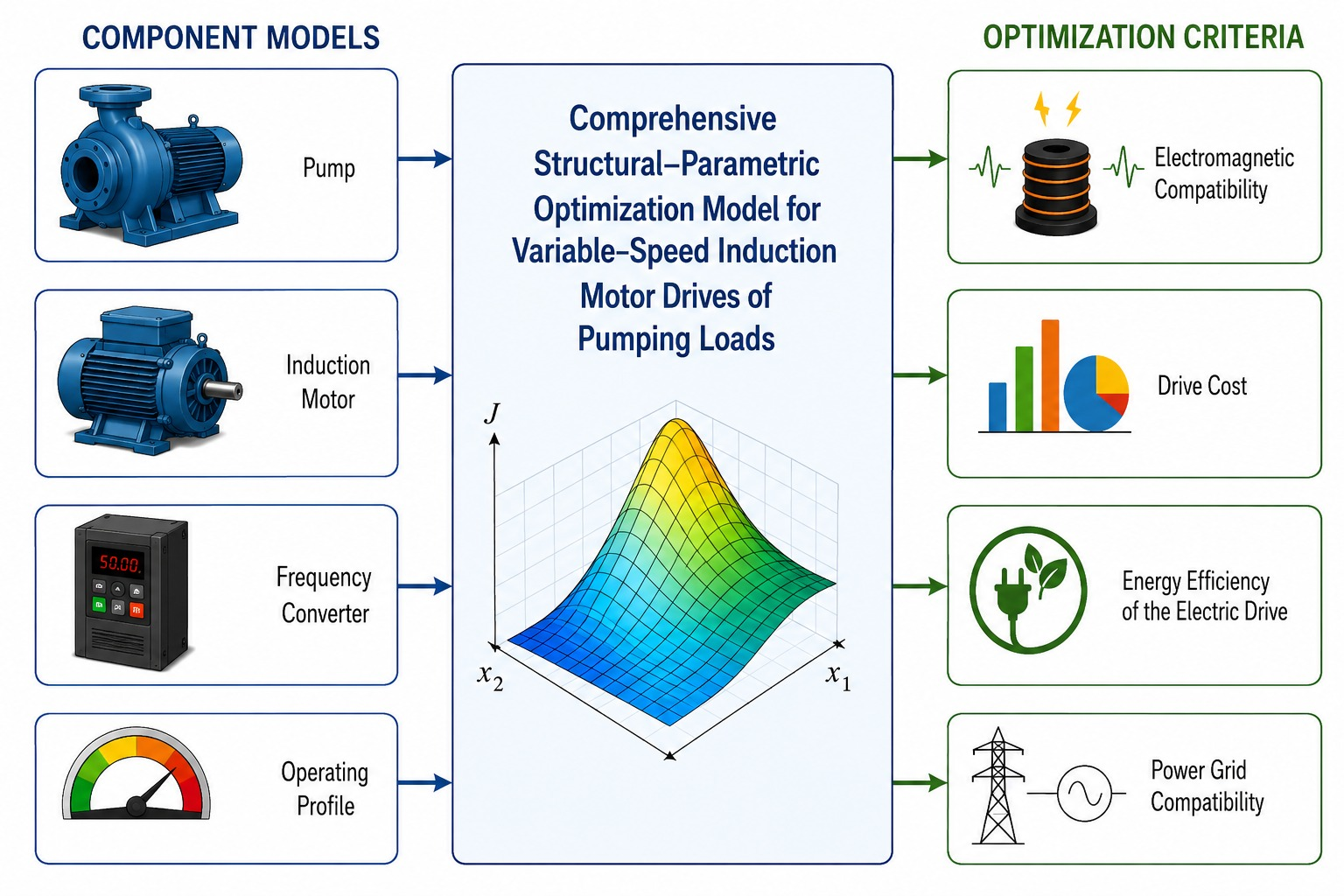


Optimization Design of Variable Speed Induction Motors for Pumping Loads

 , , ,
, , ,  , and
, and
Abstract
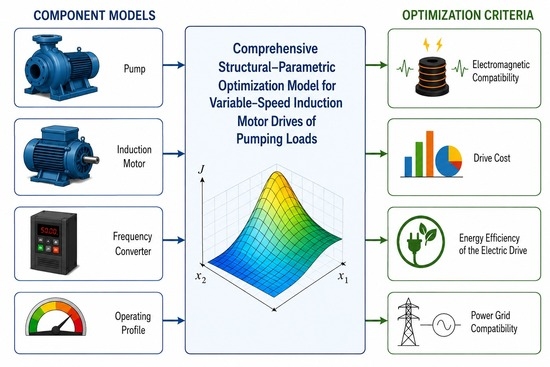
1. Introduction
- –
- The ability to select the optimal ratio of non-standard voltage and frequency values for the designed motor, consistent with the nominal values of the converter, which allows for increased power within the same dimensions or reduced weight and dimensions for the same power;
- –
- The elimination of start-up performance requirements, which allows the use of an appropriate rotor slot shape that ensures minimum active resistance of the rotor winding.
2. Description of the Load Characteristics of the Pumping Unit
3. Simulation of a Frequency-Controlled Electric Drive Using the DIMASDrive Program
4. Optimized Design in the DIMASDrive Environment Based on the Motor Efficiency Criterion
5. Modeling in the MATLAB/Simulink Environment
6. Calculation of the Range Criterion for Drive Costs
7. Conclusions
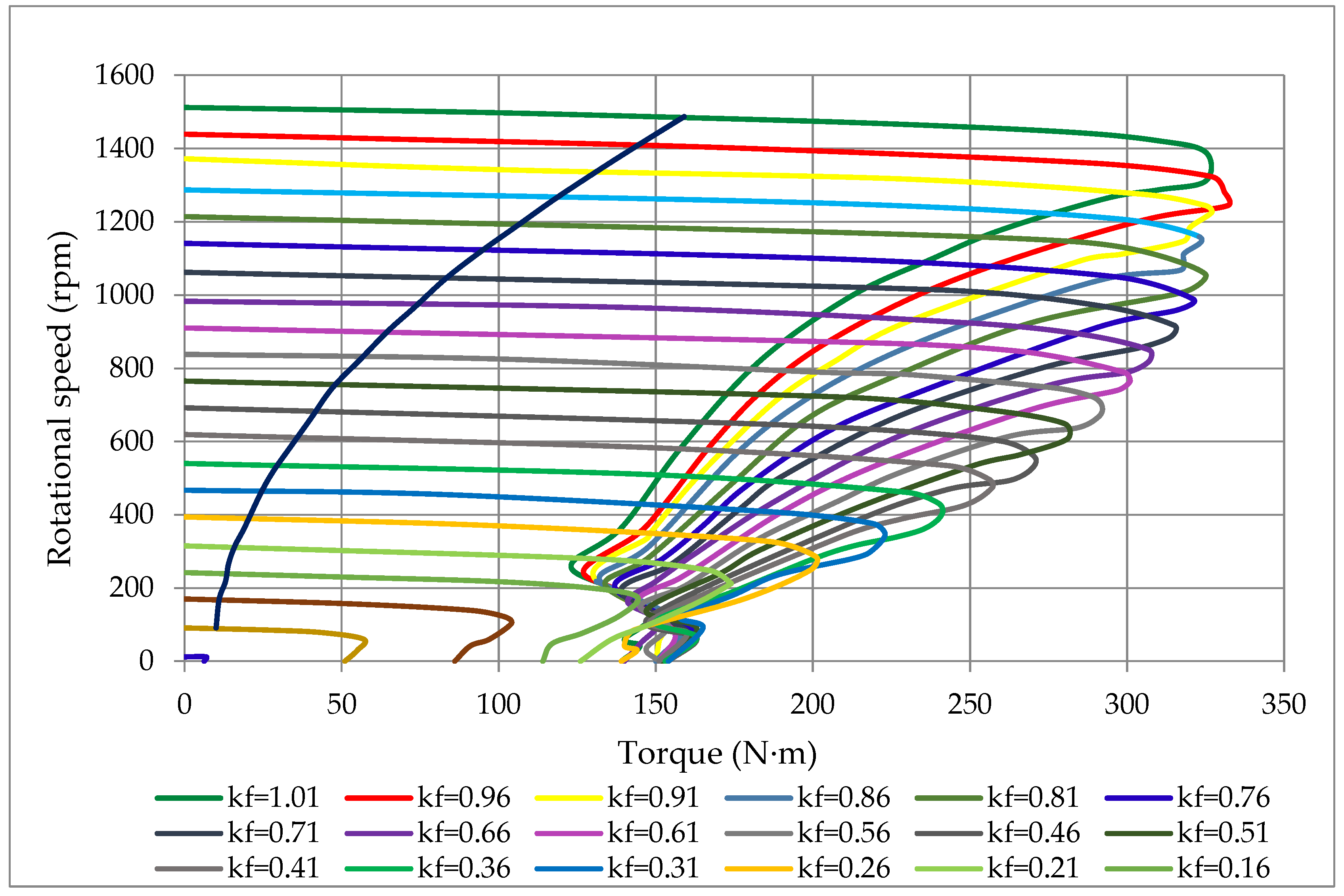
- For modeling and subsequent optimization of the FCAED, it is necessary to represent the load mechanism (pump unit) as a function n(M).
- In the structural and parametric optimization used in these studies, performed using the DIMASDrive program, an increase in the engine’s range efficiency is observed. The average range efficiency of the serial motor is 83.3%, and the average range efficiency of the 2nd modification motor is 88.7%. A similar ratio applies to range efficiency taking into account the tachogram, 79.2% versus 87%.
- It is proposed to use the motor efficiency values obtained with the DIMASDrive program, since MATLAB/Simulink does not account for core (iron) losses, mechanical losses, and additional losses in the motor, which leads to an overestimation of the motor’s efficiency.
- It has been confirmed that, within the considered control range, the input phase shift coefficients of the drives are nearly identical and close to unity for the considered cases of frequency—controlled asynchronous electric drives. The power factors and THDi are also virtually identical.
- The criterion for the costs incurred must take into account the need to compensate not only for reactive power, but also for distortion power. For the first time, it has been proposed that the calculation of the bandwidth criterion should take into account the costs of compensating for the distortion power that determines the drive’s electromagnetic compatibility.
- The medium-range innovative criterion for the drive’s reduced costs is reduced by 3.6% when an optimized motor (2nd modification) is used instead of a standard motor.
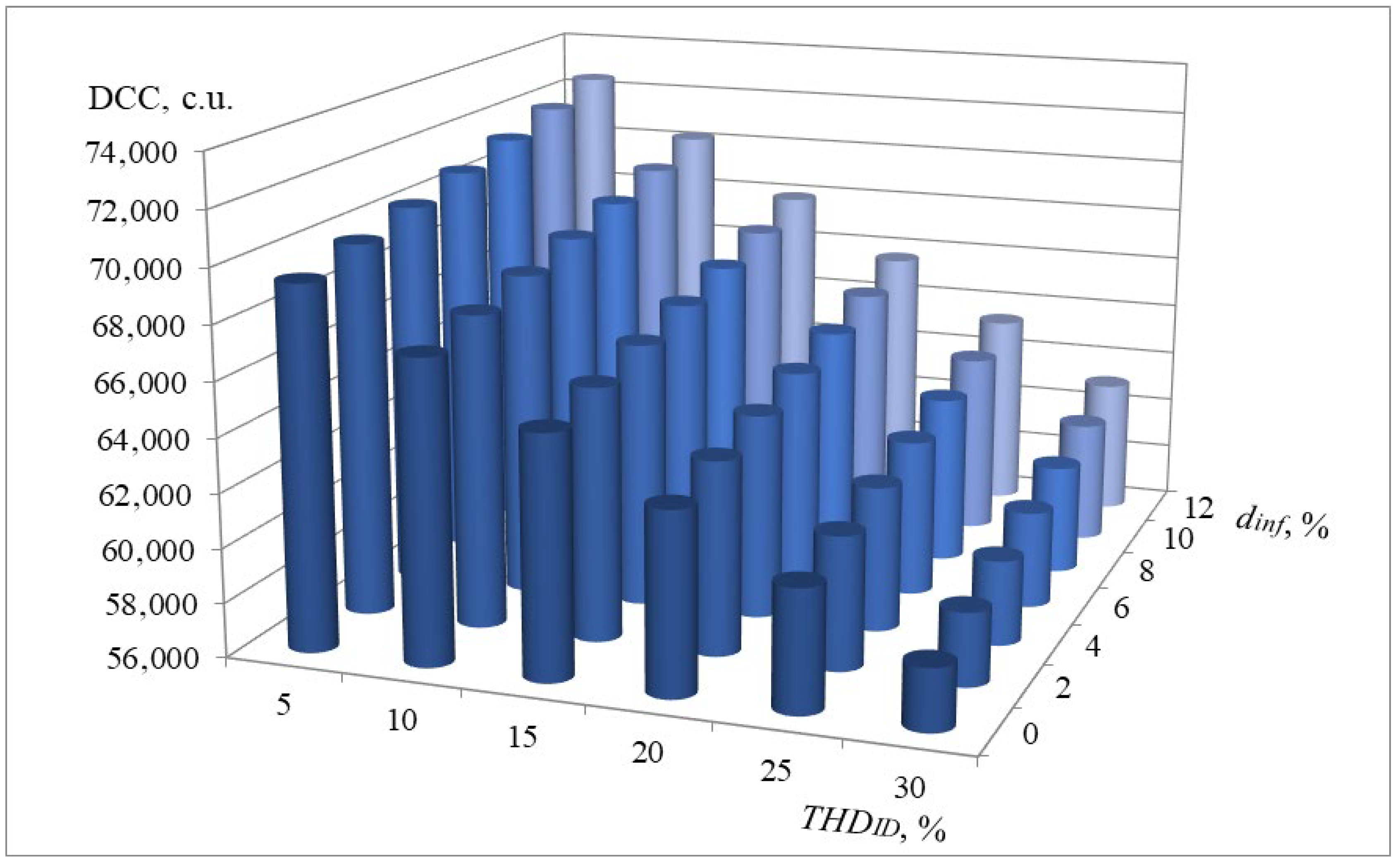
- With the given values of the cost of installing 1 kVAr distortion power compensation devices (10 c.u. is assumed in the calculations) and the permissible total harmonic distortion factor (20% is assumed in the calculations), a significant portion of the reduced cost criterion is accounted for by the costs of distortion compensation.
- The values of the reduced cost criterion depend on the operating load mode. In the examples considered, the DCC values differ when the control range is taken into account and when the drive operating tachogram is taken into account.
- The value of the drive’s DCC criterion is influenced by a number of factors, including the inflation coefficient and the permissible value of .
- The criterion of reduced costs, which allows the quality of various drive options to be fully assessed using a cost indicator, can be used both in research on existing drives and in the optimized design and multi-faceted modeling of controlled asynchronous electric drives.
Author Contributions
Funding
Data Availability Statement
Conflicts of Interest
Nomenclature
| IM | induction motor |
| power factor | |
| total harmonic distortion of current | |
| total harmonic distortion of voltage | |
| total harmonic distortion coefficients of currents | |
| mid-range efficiency criterion | |
| mid-range power factor criterion | |
| mid-range shift coefficient criterion | |
| range criterion of efficiency taking into account the tachogram | |
| range criterion of power factor taking into account the tachogram | |
| range criterion of the phase shift factor taking into account the tachogram | |
| mid-range active power consumption | |
| range active power consumption taking into account the tachogram | |
| mid-range discounted costs | |
| range discounted costs taking into account the tachogram | |
| cost of reactive power compensation of the first kind | |
| cost of reactive power compensation of the second kind | |
| cost of active losses | |
| K | capital expenditures |
| drive cost | |
| annual operating costs | |
| annual inflation coefficient | |
| average inflation coefficient |
References
- Leznov, B.S. Variable Frequency Electric Drive of Pumping Units; Mashinostroenie: Moscow, Russia, 2013; 176p, Available online: https://www.studmed.ru/leznov-b-s-chastotno-reguliruemyy-elektroprivod-nasosnyh-ustanovok_617cba0cfe0.html (accessed on 12 May 2026).
- Elovik, V.L.; Voitov, I.V.; Sedlukho, Y.P. Calculation and Analysis of Operating Modes of Centrifugal Pumps with Variable Frequency Electric Drive; BGTU: Minsk, Belarus, 2022; 110p, Available online: https://www.twirpx.com/file/4489937/ (accessed on 12 May 2026).
- Lazarev, G.B. Variable-frequency electric drive of pumping and ventilation units. Silov. Elektron. №3 2007, 41–48. (In Russian). Available online: https://power-e.ru/electrodrives/chastotno-reguliruemyj-elektroprivod-nasosnyh-i-ventilyatornyh-ustanovok/ (accessed on 12 May 2026).
- Ionel, M.; Stan, M.-F.; Ivanovici, T.D.; Enescu, D.; Virjghe, E.O.; Ionel, O.-M. Strategies for Increasing energy efficiency in electrical drives. In Advances in Computational Intelligence, Man-Machine Systems and Cybernetics; WSEAS Press: Bucharest, Romania, 2010; Available online: https://www.researchgate.net/publication/228697212_Strategies_for_increasing_energy_efficiency_in_electrical_drives (accessed on 12 May 2026).
- Jahmeerbacus, M.I. Flow rate regulation of a variable speed driven pumping system using fuzzy logic. In Proceedings of the International Conference on Electric Power and Energy Conversion Systems (EPECS), Sharjah, United Arab Emirates, 24–26 November 2015. [Google Scholar] [CrossRef] [Scilit]
- Bordeasu, D.; Prostean, O.; Filip, I.; Vasar, C. Adaptive control strategy for a pumping system using a variable frequency drive. Machines 2023, 11, 688. [Google Scholar] [CrossRef] [Scilit]
- Arun Shankar, V.K.; Umashankar, S.; Paramasivam, S.; Sanjeevikumar, P.; Dileep Sailesh, K.N. Experimental investigation of VFD-fed scalar control of induction motor for pumping application. In Lecture Notes in Electrical Engineering; Springer: Singapore, 2018; Volume 435, pp. 287–295. [Google Scholar] [CrossRef] [Scilit]
- Muravleva, O.O.; Vehter, E.V.; Zharikova, T.V. Evaluation of the Influence of Energy Characteristics of an Induction Motor on the Energy Saving of a Pumping Unit. Available online: http://earchive.tpu.ru/handle/11683/575 (accessed on 12 May 2026).
- Ahmed, A.A.; Moharam, B.A.; Rashad, E.E. Efficiency improvement of water-pumping systems based on field-oriented speed control of IM drive. In Proceedings of the Nineteenth International Middle East Power Systems Conference (MEPCON), Cairo, Egypt, 19–21 December 2017; pp. 881–887. [Google Scholar] [CrossRef] [Scilit]
- Cookson, T.J.; Lang, N.G.; Thornton, E.J. Adjustable speed drives applied to large AC induction motor and pump systems. IEEE Trans. Ind. Appl. 2000, 36, 164–171. [Google Scholar]
- Shestakov, I.V.; Safin, N.R. Evaluation of the necessity of induction motor modification and control aspects when operating with frequency converters. Energy Saf. Energy Sav. 2019, 2, 44–48. [Google Scholar] [CrossRef] [Scilit]
- Zakharov, A.V. Scientific Foundations of Energy Calculation and Design of AC Electrical Machines for Mechatronic Systems. Ph.D. Thesis, Vladimir State University, Vladimir, Russia, 2017. Available online: https://www.dissercat.com/content/nauchnye-osnovy-energeticheskogo-rascheta-i-proektirovaniya-elektricheskikh-mashin-peremenno?utm_source (accessed on 12 May 2026).
- Sarac, V. Design optimization of induction motor for efficiency and reliability improvement. In Lecture Notes in Networks and Systems; Springer: Singapore, 2021; Volume 369, pp. 35–49. [Google Scholar] [CrossRef] [Scilit]
- Apaydin, H.; Oyman Serteller, N.F.; Oğuz, Y. Induction motor geometric parameter optimization using a metaheuristic optimization method for high-efficiency motor design. Energies 2025, 18, 733. [Google Scholar] [CrossRef] [Scilit]
- Petrushyn, V.; Plotkin, J.; Horoshko, V.; Yenoktaiev, R.; Yakimets, A. Comparison of the discounted costs of controlled asynchronous electric drives with matrix and with DC-link frequency converters. Int. J. Power Electron. Drive Syst. 2025, 16, 2307–2320. [Google Scholar] [CrossRef] [Scilit]
- Gupta, A.; Machavaram, R.; Kshatriya, T.; Ranjan, S. Multi-objective design optimization of a three phase squirrel cade induction motor for electric propulsion system using genetic algorithm. In Proceedings of the 2020 IEEE First International Conference on Smart Technologies for Power, Energy and Control (STPEC), Nagpur, India, 25–26 September 2020. [Google Scholar] [CrossRef] [Scilit]
- Antonelli, S.L.; Donolo, P.D.; Pezzani, C.M.; Quispe, E.C.; De Angelo, C.H. Identification of Induction motor parameters using genetic algorithms. In Proceedings of the 2023 IEEE Workshop on Power Electronics and Power Quality Applications (PEPQA), Cali, Colombia, 5–6 October 2023; pp. 1–7. [Google Scholar] [CrossRef] [Scilit]
- de Almeida, A.T.; Ferreira, F.J.T.E.; Both, D. Technical and economical considerations in the application of variable-speed drives with electric motor systems. IEEE Trans. Ind. Appl. 2005, 41, 188–199. [Google Scholar] [CrossRef]
- Bordeasu, D.; Dragan, F.; Filip, I.; Szeidert, I.; Tirian, G.O. Estimation of centrifugal pump efficiency at variable Frequency for Irrigation Systems. Sustainability 2024, 16, 4134. [Google Scholar] [CrossRef] [Scilit]
- Petrushin, V.; Vodichev, V.; Yenoktaiev, R.; Plotkin, J. Design criteria and range limits in the development of controlled induction motors. Int. J. Electr. Eng. Inform. 2019, 11, 451–462. [Google Scholar] [CrossRef] [Scilit]
- German-Galkin, V.; Sakharov, V.; Tarnapowicz, D. Energy characteristics of asynchronous electric drive DC-link frequency converters. Manag. Syst. Prod. Eng. 2019, 27, 51–54. [Google Scholar] [CrossRef] [Scilit]
- Saghafinia, A.; Ping, H.W.; Uddin, M.N.; Amindoust, A. Teaching of simulation an adjustable speed drive of induction motor using MATLAB in advanced electrical machine laboratory. Procedia Soc. Behav. Sci. 2013, 102, 96–104. [Google Scholar] [CrossRef] [Scilit]
- Oladipo, F.; Temitayo, O.; Eziafa, O. Analysis of the effect of electric and magnetic loadings on the design parameters of an induction motor and Its Performance using MATLAB/Simulink. Int. J. Eng. Res. Appl. 2015, 5, 38–43. [Google Scholar]
- Le Roux, P.F.; Ngwenyama, M.K. Static and dynamic simulation of an induction motor using MATLAB/Simulink. Energies 2022, 15, 3564. [Google Scholar] [CrossRef] [Scilit]
- Salih, H.R.; Abdulrazzaq, A.A.; Guzun, A.A. Dynamic Modeling of Pump Drive System Utilizing Simulink/MATLAB Program. Int. Res. J. Eng. Technol. 2016, 3, 21–24. [Google Scholar]
- Mencou, S.; Yakhlef, M.B.; Tazi, E.B. Advanced Control of Induction Motors (2019–2025): A Comprehensive review of strategies, algorithms and sensorless techniques. Adv. Electr. Eng. Electron. Energy 2025, 14, 101098. [Google Scholar] [CrossRef] [Scilit]
- Gevorkov, L.; Domínguez-García, J.L.; Rassõlkin, A.; Vaimann, T. Comparative Simulation Study of Pump System Efficiency Driven by Induction and Synchronous Reluctance Motors. Energies 2022, 15, 4068. [Google Scholar] [CrossRef] [Scilit]
- Petrushyn, V.; Horoshko, V.; Plotkin, J.; Almuratova, N.; Toigozhinova, Z. Power balance and power factors of distorted electrical systems and variable speed asynchronous electric drives. Electronics 2021, 10, 1676. [Google Scholar] [CrossRef] [Scilit]
- Klimash, S.; Klimash, V.; Vlasayevsky, S. Specialized modules for calculation of energy coefficients of electrical engineering devices in Matlab. Electrotech. Syst. Complexes 2017, 3, 11–16. [Google Scholar] [CrossRef] [Scilit]
- Firago, B.I.; Palyavchik, L.B. The theory of electric drive. In Techno Perspective; Vysheysha Shkola: Minsk, Belarus, 2007; Available online: https://obuchalka.org/20241006165725/teoriya-elektroprivoda-firago-b-i-pavlyachik-l-b-2007.html (accessed on 12 May 2026).
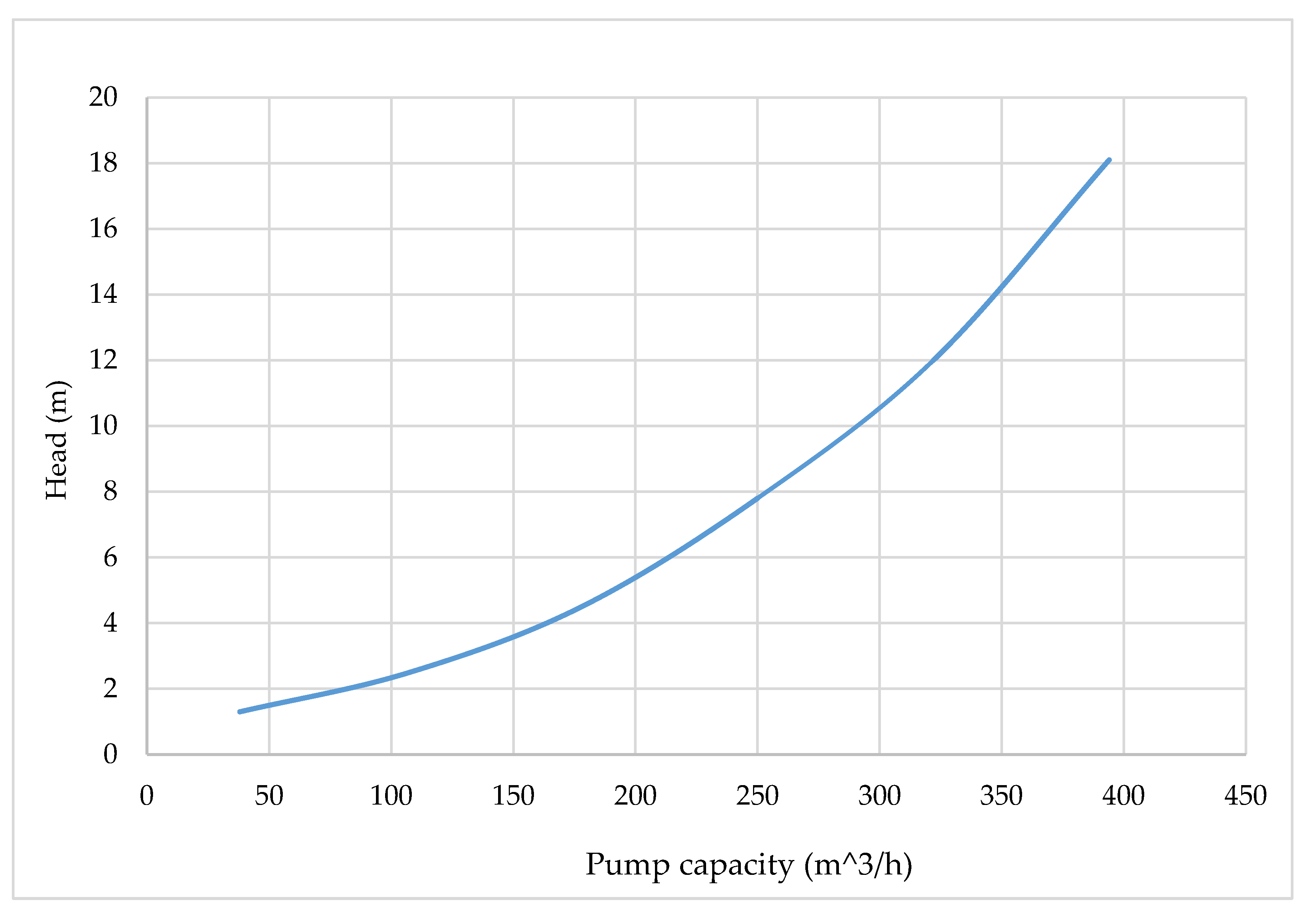


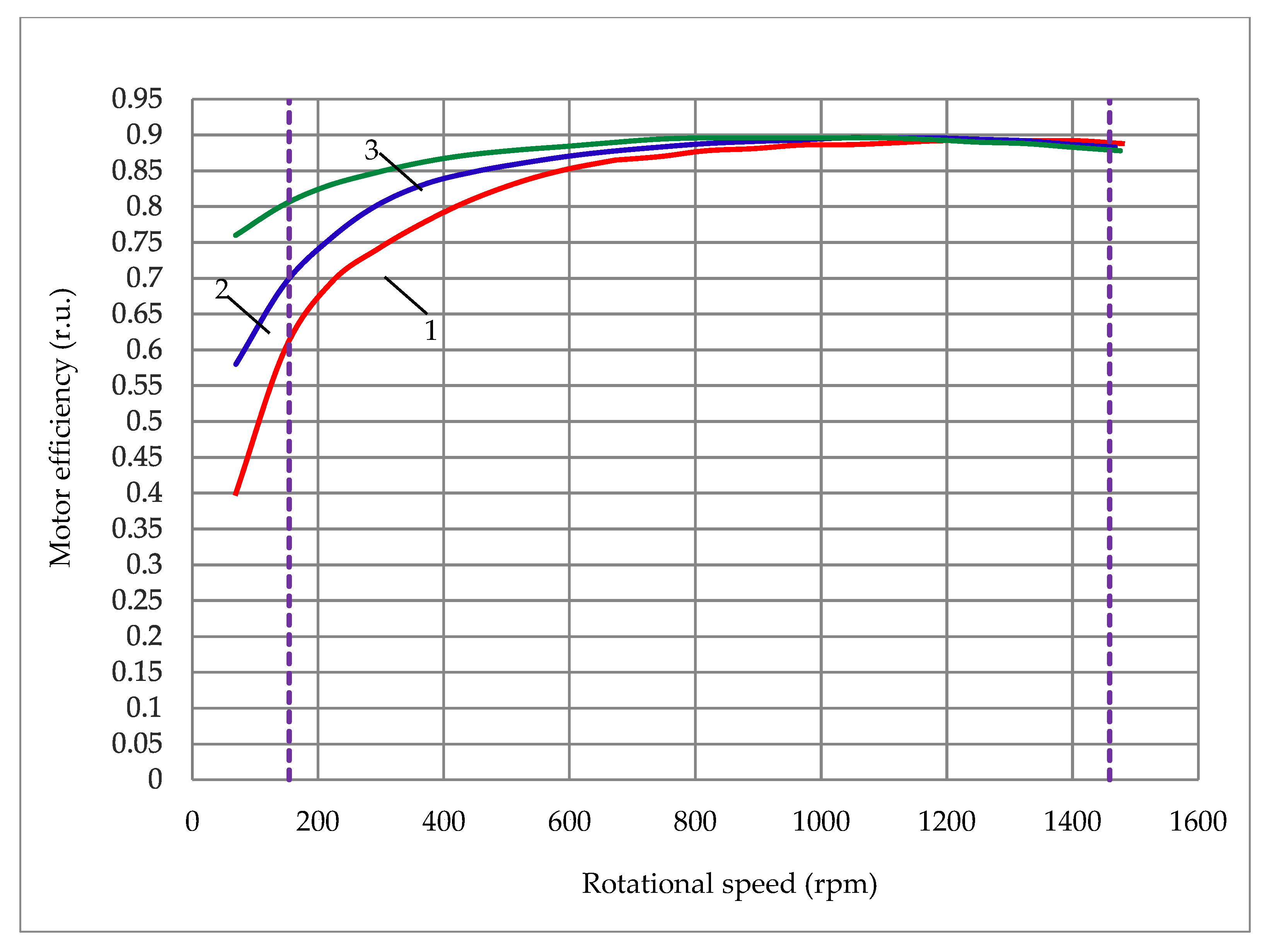


| n, rpm | Q, m3/s | Q, m3/h | H, m | , kW | M, N·m | |
|---|---|---|---|---|---|---|
| 148 | 0.011 | 39.43 | 1.35 | 0.803 | 0.175 | 11.5 |
| 397 | 0.0299 | 107.64 | 2.54 | 0.811 | 0.914 | 22 |
| 662 | 0.0499 | 179.64 | 4.65 | 0.824 | 2.772 | 40 |
| 927 | 0.069 | 250.00 | 8.0 | 0.833 | 6.524 | 67 |
| 1192 | 0.0898 | 323.28 | 11.9 | 0.846 | 12.476 | 100 |
| 1440 | 0.11 | 393.00 | 18.1 | 0.852 | 22.922 | 150 |
| Variable Parameters | w1 | qeff, mm2 | mm | L, mm | H1, mm | GP, mm | ZR - | A2, mm | D1, mm | D2, mm |
|---|---|---|---|---|---|---|---|---|---|---|
| Serial IM | 92 | 3.68 | 1.33 | 145 | 25 | 11 | 38 | 33.75 | 8.9 | 3.2 |
| 2nd modification | 90 | 5.07 | 1.535 | 203.7 | 28.3 | 12 | 38 | 26.3 | 8.9 | 3.8 |
| Serial motor 4A180S4 | |
| 1st modification | |
| 2nd modification |
| Serial motor 4A180S4 | |
| 1st modification | |
| 2nd modification |
| Parameters Motor | , Om | Om | , Om | Om | Om |
|---|---|---|---|---|---|
| Serial 4A180S4 | 0.18 | 0.08 | 0.42 | 0.56 | 16.8 |
| 2nd modification | 0.156 | 0.117 | 0.67 | 0.117 | 33.3 |
| f, Hz | U, V | I, A | P, kW | n, rpm | cosφ | THDI | χ | |
|---|---|---|---|---|---|---|---|---|
| 5 | 218.3 | 0.84 | 0.28 | 148 | 0.998 | 1.67 | 0.513 | 0.858 |
| 10 | 218.3 | 1.76 | 0.60 | 296 | 0.999 | 1.62 | 0.523 | 0.950 |
| 15 | 218.3 | 3.49 | 1.22 | 445 | 0.996 | 1.57 | 0.535 | 0.963 |
| 20 | 218.3 | 6.18 | 2.24 | 593 | 0.997 | 1.49 | 0.554 | 0.985 |
| 25 | 218.3 | 10.2 | 3.83 | 740 | 0.995 | 1.41 | 0.574 | 0.994 |
| 30 | 218.3 | 15.85 | 6.18 | 886 | 0.992 | 1.33 | 0.595 | 0.992 |
| 35 | 218.3 | 22.91 | 9.27 | 1032 | 0.989 | 1.25 | 0.618 | 0.998 |
| 40 | 218.3 | 30.19 | 12.61 | 1151 | 0.986 | 1.18 | 0.637 | 9.928 |
| 45 | 218.3 | 42.87 | 18.79 | 1322 | 0.982 | 1.08 | 0.668 | 0.992 |
| 50 | 218.3 | 55.61 | 25.21 | 1464 | 0.979 | 1.00 | 0.692 | 0.986 |
| f, Hz | U, V | I, A | P, kW | n, rpm | cosφ | THDI | χ | |
|---|---|---|---|---|---|---|---|---|
| 5 | 218.3 | 0.66 | 0.22 | 145 | 0.999 | 1.67 | 0.512 | 0.932 |
| 10 | 218.3 | 1.59 | 0.54 | 295 | 0.999 | 1.63 | 0.521 | 0.959 |
| 15 | 218.3 | 3.28 | 1.15 | 444 | 0.997 | 1.57 | 0.534 | 0.974 |
| 20 | 218.3 | 6.08 | 2.05 | 591 | 0.997 | 1.49 | 0.554 | 0.972 |
| 25 | 218.3 | 9.99 | 3.75 | 737 | 0.995 | 1.42 | 0.573 | 0.99 |
| 30 | 218.3 | 15.54 | 6.05 | 882 | 0.993 | 1.33 | 0.594 | 0.995 |
| 35 | 218.3 | 22.47 | 9.07 | 1024 | 0.989 | 1.25 | 0.616 | 0.996 |
| 40 | 218.3 | 29.58 | 12.32 | 1141 | 0.987 | 1.18 | 0.636 | 0.992 |
| 45 | 218.3 | 41.99 | 18.29 | 1308 | 0.983 | 1.08 | 0.665 | 0.991 |
| 50 | 218.3 | 54.21 | 24.46 | 1444 | 0.979 | 1.01 | 0.689 | 0.988 |
| Options | Mid-Range | For the Tachogram | Mid-Range Adjusted for Inflation | For the Tachogram Adjusted for Inflation |
|---|---|---|---|---|
| Indicators | ||||
| η | 0.809 | 0.756 | 0.809 | 0.756 |
| CED, c.u. | 6000 | 6000 | 6000 | 6000 |
| cosφ | 0.992 | 0.992 | 0.992 | 0.992 |
| P1, kW | 8.02 | 8.28 | 8.02 | 8.28 |
| χ | 0.591 | 0.582 | 0.591 | 0.582 |
| Crpc2, c.u. | 46,475 | 49,325 | 46,475 | 49,325 |
| CL, c.u. | 5558 | 7054 | 5558 | 7054 |
| K, c.u. | 52,475 | 55,325 | 52,475 | 55,325 |
| Y, c.u. | 12,589 | 14,468 | 13,634 | 15,668 |
| DCC, c.u. | 65,064 | 69,793 | 66,109 | 70,993 |
| Options | Mid-Range | For the Tachogram | Mid-Range Adjusted for Inflation | For the Tachogram Adjusted for Inflation |
|---|---|---|---|---|
| Indicators | ||||
| η | 0.868 | 0.842 | 0.868 | 0.842 |
| CED, c.u. | 6200 | 6200 | 6200 | 6200 |
| cosφ | 0.992 | 0.992 | 0.992 | 0.992 |
| P1, kW | 7.81 | 8.26 | 7.81 | 8.26 |
| χ | 0.589 | 0.579 | 0.589 | 0.579 |
| Crpc2, c.u. | 45,537 | 49,659 | 45,537 | 49,659 |
| CL, c.u. | 4029 | 4906 | 4029 | 4906 |
| K, c.u. | 51,737 | 55,859 | 51,737 | 55,859 |
| Y, c.u. | 10,962 | 12,391 | 11,871 | 13,419 |
| DCC, c.u. | 62,700 | 68,250 | 63,609 | 69,279 |
Disclaimer/Publisher’s Note: The statements, opinions and data contained in all publications are solely those of the individual author(s) and contributor(s) and not of MDPI and/or the editor(s). MDPI and/or the editor(s) disclaim responsibility for any injury to people or property resulting from any ideas, methods, instructions or products referred to in the content. |
© 2026 by the authors. Licensee MDPI, Basel, Switzerland. This article is an open access article distributed under the terms and conditions of the Creative Commons Attribution (CC BY) license.
Share and Cite
Zharkymbekova, M.; Petrushyn, V.; Gali, K.; Almuratova, N.; Plotkin, J.; Yenoktaiev, R. Optimization Design of Variable Speed Induction Motors for Pumping Loads. Designs 2026, 10, 56. https://doi.org/10.3390/designs10030056
Zharkymbekova M, Petrushyn V, Gali K, Almuratova N, Plotkin J, Yenoktaiev R. Optimization Design of Variable Speed Induction Motors for Pumping Loads. Designs. 2026; 10(3):56. https://doi.org/10.3390/designs10030056
Chicago/Turabian StyleZharkymbekova, Makpal, Viktor Petrushyn, Kakimzhan Gali, Nurgul Almuratova, Juriy Plotkin, and Rostyslav Yenoktaiev. 2026. "Optimization Design of Variable Speed Induction Motors for Pumping Loads" Designs 10, no. 3: 56. https://doi.org/10.3390/designs10030056
APA StyleZharkymbekova, M., Petrushyn, V., Gali, K., Almuratova, N., Plotkin, J., & Yenoktaiev, R. (2026). Optimization Design of Variable Speed Induction Motors for Pumping Loads. Designs, 10(3), 56. https://doi.org/10.3390/designs10030056