Lightweight, Lateral and Sagittal Plane Symmetrical Biped Robot Design


Abstract
1. Introduction
- (1)
- Motor torque ratings and the structural design are considered for the study of static locomotion only.
- (2)
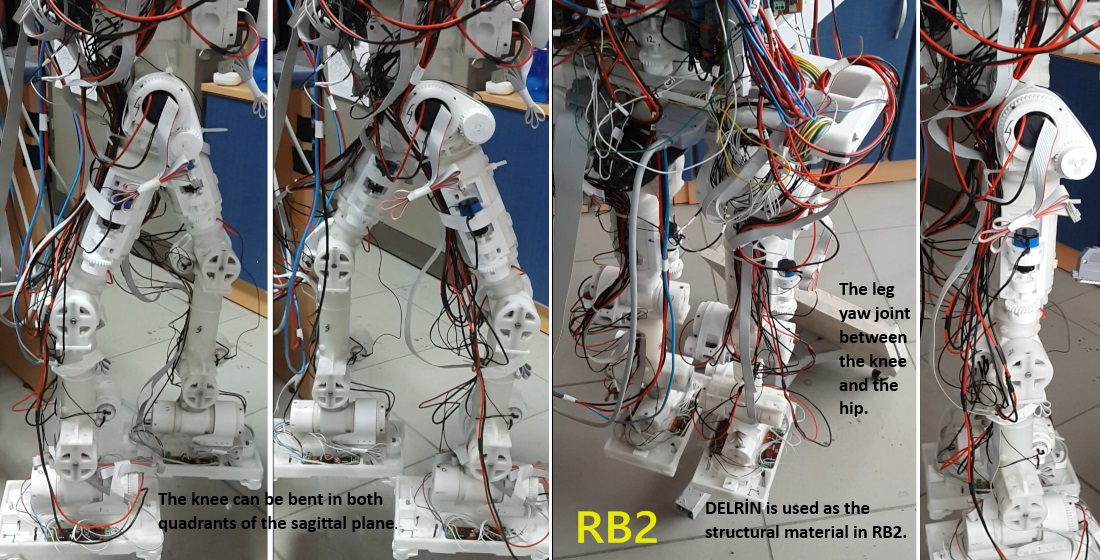
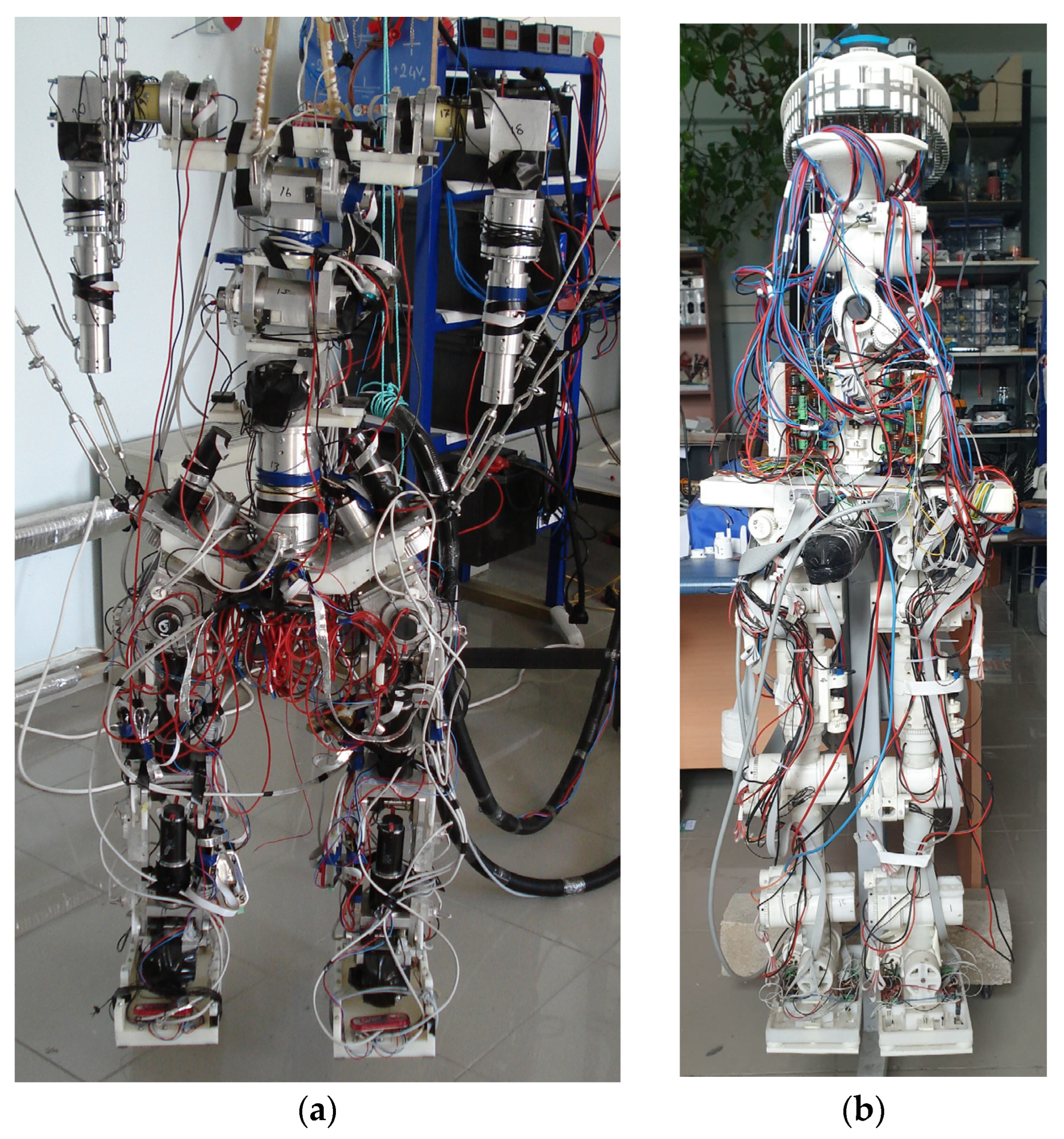
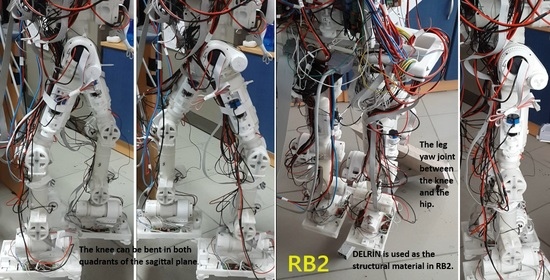
- Static and dynamic locomotions complement each other. For instance, for us humans, when crawling in a narrow cave or in a disaster area, such as after an earthquake, we do not move quickly. But we make slow but precise whole-body motions to navigate in those tight and unstructured areas. In Appendix A, the two equations give an induced moment equation that only supports the ankle’s roll joint. Similar equations can easily be derived for other joints using these two equations. Even for a single joint, the equations are lengthy. For dynamical equations, additional variables further complicate the equations. As mentioned, for a robot to locomote inside the tight cave or collapsed building, the whole body of the robot must make precise movements in order not to collide with surrounding obstacles. Since we think about every move in those environments, robots must calculate each body move in real time. Kinematic equations can be used to calculate the necessary balance trajectories in all the joint ranges without the relatively lengthy evaluation as in those of dynamic equations. Since dynamic and static motion complement each other, as in humans and robots, static locomotion is considered in this study as a first step towards any type of motion. Therefore, a lightweight, low-power, and relatively low-budget robot is designed. In this article, only the design principles are introduced. The comprehensive mathematical modelling for trajectory generation and the design and implementation of the stabilising control system on the robot will be addressed in future scientific papers. The purpose of this paper is to explore the benefits and drawbacks of using non-metallic parts in the structural components of the robot. The contributions of this paper are as follows. (1) Exploring design features of structural parts for modular and interchangeable parts for links and joints. (2) Testing the feasibility of CNC-machined Delrin material parts for load carrying and 3D-printed ABS parts for sensor mounting. (3) Utilising the same power motor and ratio gearbox throughout the biped robot for static locomotion. (4) Design features that cocoon the motors for unwanted impacts and lower the mass and inertia properties of the links. This paper is organised as follows: Section 2 gives details of the leg and trunk design procedure. Section 3 deals with RB2’s electronics, sensors, and computer architecture. Section 4 presents the analysis and simulation, and Section 5 concludes the paper.
2. Mechanical Design of Legs and Trunk
2.1. The Choice of Material
2.2. The Number of Degrees of Freedom and the Order of Joints
2.3. Actuators of the Robot
2.4. Mathematical Modelling
3. Details of Robot Joints
3.1. The Foot
3.2. The Leg and the Trunk Design
3.3. Electronics and Sensors
3.4. Dimensions and Weight
4. Analysis and Simulation
5. Conclusions and Further Work
Funding
Data Availability Statement
Acknowledgments
Conflicts of Interest
Appendix A
Appendix A.1
Appendix A.2
References
- Parmiggiani, A.; Maggiali, M.; Natale, L.; Nori, F.; Schmitz, A.; Tsagarakis, N.; Victor, J.S.; Becchi, F.; Sandini, G.; Metta, G. The design of the iCub humanoid robot. Int. J. Humanoid Robot. 2012, 9, 1250027. [Google Scholar] [CrossRef] [Scilit]
- Takanishi, A. Historical Perspective of Humanoid Robot Research in Asia. In Humanoid Robotics: A Reference; Goswami, A., Vadakkepat, P., Eds.; Springer: Dordrecht, The Netherlands, 2019. [Google Scholar] [CrossRef] [Scilit]
- Schaal, S. Historical Perspective of Humanoid Robot Research in the Americas. In Humanoid Robotics: A Reference; Goswami, A., Vadakkepat, P., Eds.; Springer: Dordrecht, The Netherlands, 2018. [Google Scholar] [CrossRef] [Scilit]
- Hirose, M.; Ogawa, K. Honda humanoid robots development. Philos. Trans. R. Soc. A Math. Phys. Eng. Sci. 2007, 365, 11–19. [Google Scholar] [CrossRef] [Scilit] [PubMed]
- LimX Dynamics. Oli—Full-Size General-Purpose Humanoid Robot. Available online: https://www.limxdynamics.com/en/products/oli (accessed on 28 March 2026).
- ENGINEAI. Available online: https://en.engineai.com.cn/ (accessed on 28 March 2026).
- PENG Motors. XPENG Shares Achievements in Physical AI Emergence: Unveils XPENG VLA 2.0, Robotaxi, Next-Gen IRON, and Flying Car. XPENG Official Newsroom. 5 November 2025. Available online: https://www.xpeng.com/news/019a56f54fe99a2a0a8d8a0282e402b7 (accessed on 28 March 2026).
- Phybot Technology Co., Ltd. PHYBOT M1. Available online: https://www.phybot.tech/phybot-m1 (accessed on 28 March 2026).
- Figure AI. Introducing Figure 03. 9 October 2025. Available online: https://www.figure.ai/news/introducing-figure-03 (accessed on 28 March 2026).
- Boston Dynamics. Atlas Humanoid Robot. Available online: https://bostondynamics.com/atlas/ (accessed on 28 March 2026).
- Agile Robots SE. We Are Agile Robots: Driving Industries Forward. Available online: https://www.agile-robots.com/en/ (accessed on 28 March 2026).
- Unitree Robotics. Unitree H2 Destiny Awakening. Available online: https://www.unitree.com/H2 (accessed on 28 March 2026).
- DEEP Robotics. DR02—A New-Generation Industrial-Level Humanoid Robot. Available online: https://www.deeprobotics.cn/en/index/dr02.html (accessed on 28 March 2026).
- Sheng, Q.; Zhou, Z.; Li, J.; Mi, X.; Xiang, P.; Chen, Z.; Xu, H.; Jia, S.; Wu, X.; Cui, Y.; et al. A comprehensive review of humanoid robots. SmartBot 2025, 1, e12008. [Google Scholar] [CrossRef] [Scilit]
- Dario, P.; Guglielmelli, E.; Laschi, C. Humanoids and Personal Robots: Design and Experiments. J. Robot. Syst. 2001, 18, 673–690. [Google Scholar] [CrossRef] [Scilit]
- Hirai, K.; Hirose, M.; Haikawa, Y.; Takenaka, T. The Development of Honda Humanoid Robot. In Proceedings of the 1998 IEEE International Conference on Robotics and Automation, Leuven, Belgium, 20 May 1998. [Google Scholar]
- Kaneko, K.; Kajita, S.; Yokoi, K.; Hugel, V.; Blazevic, P.; Coiffet, P. Design of LRP Humanoid Robot and Its Control Method. In Proceedings of the 10th IEEE International Workshop on Robot and Human Interactive Communication (ROMAN 2001), Bordeaux and Paris, France, 18–21 September 2001. [Google Scholar]
- Nishiwaki, K.; Kuffner, J.; Kagami, S.; Inaba, M.; Inoue, H. The Experimental Humanoid Robot H7: A Research Platform for Autonomous Behaviour. Philos. Trans. R. Soc. A Math. Phys. Eng. Sci. 2007, 365, 79–107. [Google Scholar] [CrossRef] [Scilit] [PubMed]
- Kojima, K.; Karasawa, T.; Kozuki, T.; Kuroiwa, E.; Yukizaki, S.; Iwaishi, S.; Ishikawa, T.; Koyama, R.; Noda, S.; Sugai, F.; et al. Development of Life-Sized High-Power Humanoid Robot JAXON for Real-World Use. In Proceedings of the 2015 IEEE-RAS 15th International Conference on Humanoid Robots (Humanoids), Seoul, Republic of Korea, 3–5 November 2015. [Google Scholar]
- Hyon, S.H.; Suewaka, D.; Torii, Y.; Oku, N. Design and Experimental Evaluation of a Fast Torque-Controlled Hydraulic Humanoid Robot. IEEE/ASME Trans. Mechatron. 2017, 22, 623–634. [Google Scholar] [CrossRef] [Scilit]
- Kazuhito, K.; Kanehiro, F.; Morisawa, M.; Akachi, K.; Miyamori, G.; Hayashi, A.; Kanehira, N. Humanoid Robot HRP-4—Humanoid Robotics Platform with Lightweight and Slim Body. In Proceedings of the 2011 IEEE/RSJ International Conference on Intelligent Robots and Systems, San Francisco, CA, USA, 25–30 September 2011. [Google Scholar]
- Kaneko, K.; Kaminaga, H.; Sakaguchi, T.; Kajita, S.; Morisawa, M.; Kumagai, I.; Kanehiro, F. Humanoid Robot HRP-5P: An Electrically Actuated Humanoid Robot with High-Power and Wide-Range Joints. IEEE Robot. Autom. Lett. 2019, 4, 1431–1438. [Google Scholar] [CrossRef] [Scilit]
- Buschmann, T.; Lohmeier, S.; Ulbrich, H. Humanoid robot lola: Design and walking control. J. Physiol. 2009, 103, 141–148. [Google Scholar] [CrossRef] [Scilit] [PubMed]
- Eßer, J.; Kumar, S.; Peters, H.; Bargsten, V.; de Gea Fernandez, J.; Mastalli, C.; Stasse, O.; Kirchner, F. Design, Analysis and Control of the Series-Parallel Hybrid RH5 Humanoid Robot. In Proceedings of the 2020 IEEE-RAS 20th International Conference on Humanoid Robots (Humanoids), Virtual, 19–21 July 2021. [Google Scholar]
- Humanoid Robot Adam. Available online: https://www.pndbotics.com/humanoid (accessed on 28 March 2026).
- Kanehira, N.; Kawasaki, T.U.; Ohta, S.; Ismumi, T.; Kawada, T.; Kanehiro, F.; Kajita, S.; Kaneko, K. Design and experiments of advanced leg module (HRP-2L) for humanoid robot (HRP-2) development. In Proceedings of the IEEE/RSJ International Conference on Intelligent Robots and Systems, Lausanne, Switzerland, 30 September–4 October 2002. [Google Scholar]
- Lim, H.O.; Takanishi, A. Biped Walking Robots Created at Waseda University: WL and WABIAN Family. Philos. Trans. R. Soc. A Math. Phys. Eng. Sci. 2007, 365, 49–64. [Google Scholar] [CrossRef] [Scilit] [PubMed]
- Steve, D.; Caldwell, D.G. Biologically Inspired Damage Tolerance in Braided Pneumatic Muscle Actuators. J. Intell. Mater. Syst. Struct. 2012, 23, 313–325. [Google Scholar]
- Li, X.; Yu, H.; Feng, H.; Zhang, S.; Fu, Y. Design and Control for WLR-3P: A Hydraulic Wheel-Legged Robot. Cyborg Bionics Syst. 2023, 4, 25. [Google Scholar] [CrossRef] [Scilit] [PubMed]
- Radford, N.A.; Strawser, P.; Hambuchen, K.; Mehling, J.S.; Verdeyen, W.K.; Donnan, A.S.; Holley, J.; Sanchez, J.; Nguyen, V.; Bridgwater, L.; et al. Valkyrie: NASA’s First Bipedal Humanoid Robot. J. Field Robot. 2015, 32, 397–419. [Google Scholar] [CrossRef] [Scilit]
- Xia, Z.; Liu, L.; Xiong, J.; Yi, Q.; Chen, K. Design Aspects and Development of Humanoid Robot THBIP-2. Robotica 2008, 26, 109–116. [Google Scholar] [CrossRef] [Scilit]
- Vukobratovic, M.; Potkonjak, V.; Tzafestas, S. Human and Humanoid Dynamics. J. Intell. Robot. Syst. 2004, 41, 65–84. [Google Scholar] [CrossRef] [Scilit]
- Ulbrich, H.; Buschmann, T.; Lohmeier, S. Development of the Humanoid Robot LOLA. Appl. Mech. Mater. 2006, 5–6, 529–540. [Google Scholar] [CrossRef]
- Akdas, D.; Medrano-Cerda, G.A. Design of a Stabilizing Controller for a Ten-Degree-of-Freedom Bipedal Robot Using Linear Quadratic Regulator Theory. Proc. Inst. Mech. Eng. Part C J. Mech. Eng. Sci. 2001, 215, 27–43. [Google Scholar] [CrossRef] [Scilit]
- Akdas, D. An Effective Mechanical Design and Realization of a Humanoid Robot BUrobot. Acta Polytech. Hung. 2014, 11, 115–134. [Google Scholar] [CrossRef] [Scilit]
- Shinsuke, S.; Konno, A.; Uchiyama, M. Design and Evaluation of a Gravity Compensation Mechanism for a Humanoid Robot. In Proceedings of the 2007 IEEE/RSJ International Conference on Intelligent Robots and Systems, San Diego, CA, USA, 29 October–2 November 2007. [Google Scholar]
- Shabana, A.A. Dynamics of Multibody Systems; Cambridge University Press: Cambridge, UK, 2020; ISBN 978-1108485647. [Google Scholar]
- Yamamoto, K. Human-Like Toe Joint Mechanism. In Humanoid Robotics: A Reference; Springer: Dordrecht, The Netherlands, 2019; pp. 435–456. [Google Scholar]
- Gouaillier, D.; Hugel, V.; Blazevic, P.; Kilner, C.; Monceaux, J.; Lafourcade, P.; Marnier, B.; Serre, J.; Maisonnier, B. Mechatronic design of NAO humanoid. In Proceedings of the 2009 IEEE International Conference on Robotics and Automation, Kobe, Japan, 12–17 May 2009. [Google Scholar]
- SOLIDWORKS. Available online: https://www.solidworks.com/ (accessed on 28 March 2026).
- Liang, C.; Ceccarelli, M. Design and Simulation of a Waist–Trunk System for a Humanoid Robot. Mech. Mach. Theory 2012, 53, 50–65. [Google Scholar] [CrossRef] [Scilit]
- Hern, C.; Soto, R.; Rodriguez, E. Design and Dynamic Modeling of Humanoid Biped Robot E-Robot. In Proceedings of the 2011 IEEE Electronics, Robotics and Automotive Mechanics Conference, Cuernavaca, Mexico, 15–18 November 2011. [Google Scholar]
- Engineai T800. Available online: https://en.engineai.com.cn/product-t800.html (accessed on 28 March 2026).
- Hamill, J.; Knutzen, K.M. Biomechanical Basis of Human Movement, 4th ed.; Lippincott Williams & Wilkins: Philadelphia, PA, USA, 2006; pp. 402–410. [Google Scholar]
- Mu, Y.; Wang, S.; Guo, A.; Qu, P.; Han, W.; Yan, Q.; Liu, H.; Liu, C. Design and Gait Simulation Study of Wheel-Legged Conversion Device Used in Hexapod Bionic Robot. Processes 2025, 13, 3364. [Google Scholar] [CrossRef] [Scilit]







| Robot | Leg DoF | Leg Joint Order | Trunk DoF | Trunk Joint Order |
|---|---|---|---|---|
| LRP 1999–2001 [17] | 6 | A_RP, K_P, H_PRY | 0 | 0 |
| H6 & H7 1999–2001 [18] | 6 | A_RP, K_P, H_PRY | 0 | 0 |
| ASIMO 2000–2018 [6] | 6 | A_RP, K_P, H_PRY | 0 | 0 |
| JAXON 2014–2015 [19] | 6 | A_RP, K_P, H_PRY | 3 | R, P, Y |
| TaeMu 2014–2016 [20] | 6 | A_RP, K_P, H_PRY | 3 | Y, R, P |
| HRP-4 2009–2010 [21] HRP-5P 2018 [22] | 6 | A_RP, K_P, H_PRY | 3 | P, R, Y |
| LOLA 2009 [23] | 6 + 1 toe | 2D_A_RP, K_P, H_PRY | 2 | Y, R |
| RH5 2020–2024 [24] | 6 | 2D_A_RP, K_P, H_PRY | 3 | 2D_T_RP, Y |
| ATLAS 2024 [10] | 6 | 2D_A_RP, K_P, H_YRP | 3 | Y, 2D_T_RP |
| Agile ONE 2025 [11] | 6 | 2D_A_RP, K_P, H_YRP | 3 | Y, 2D_T_RP |
| IRON 2025 [7] | 6 | 2D_A_RP, K_P, H_RPY | 3 | Y, 2D_T_RP |
| Oli 2025 [5] | 6 | 2D_A_RP, K_P, H_YRP | 3 | Y, 2D_T_RP |
| Figure 03 2025 [9] | 6 | 2D_A_RP, K_P, H_YRP | 3 | Y, 2D_T_RP |
| Tesla Optimus 2025 [14] | 6 | 2D_A_RP, K_P, H_PYR | 2 | R, Y |
| Adam 2025 [25] | 6 | 2D_A_RP, K_P, H_YRP | 3 | R, P, Y |
| Trunk | Pitch | −55 to 55 degrees |
| Roll | −60 to 60 degrees | |
| Yaw | −360 to 360 degrees | |
| Hip | Roll | −3 to 113 degrees |
| Pitch | −69 to 72 degrees | |
| Yaw | −360 to 360 degrees | |
| Knee | Pitch | −140 to 132 degrees |
| Ankle | Pitch | −69 to 72 degrees |
| Roll | −52 to 61 degrees |
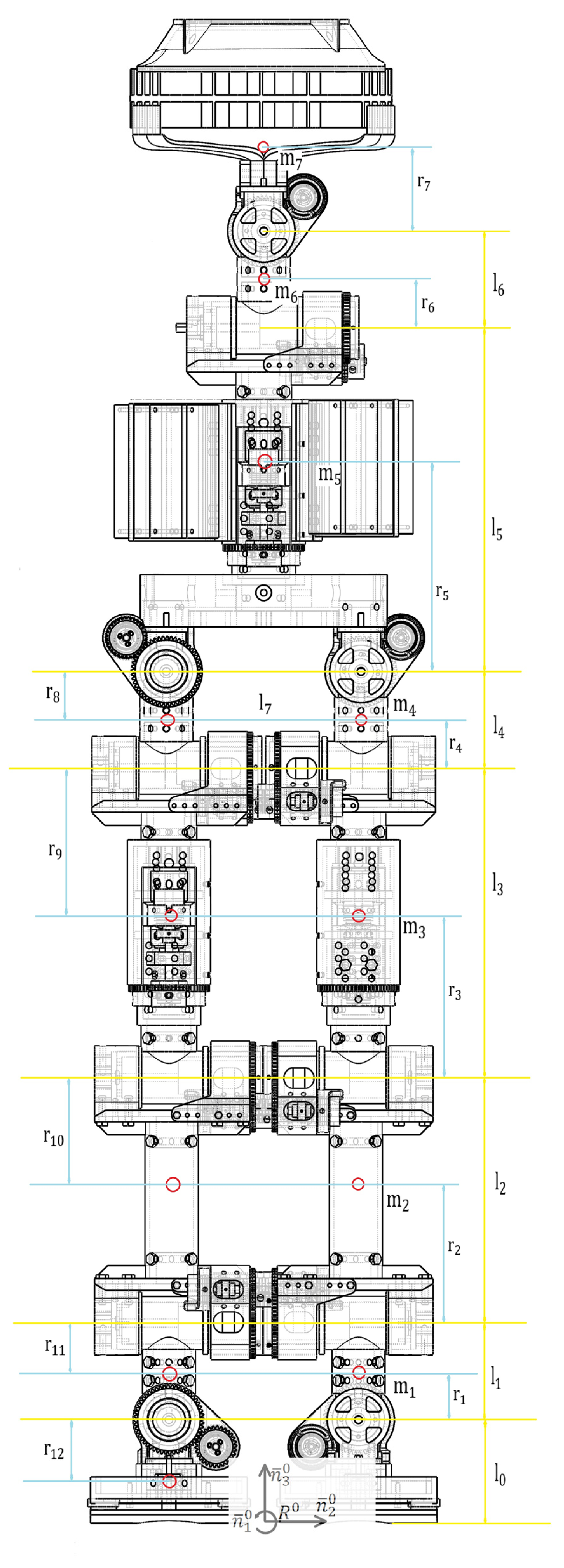
| Ground to ankle roll joint, | 78.65 mm |
| Ankle roll joint to ankle pitch joint, | 74 mm |
| Ankle pitch joint to knee pitch joint, | 188 mm |
| Knee pitch joint to hip pitch joint, | 237 mm |
| Hip pitch joint to hip roll joint, | 74 mm |
| Distances between the vertical axes of two legs, | 149 mm |
| Hip roll joint to trunk roll joint, | 263 mm |
| Trunk roll joint to trunk pitch joint, | 74 mm |
| Hip pitch joint to ground, | 577.65 mm |
| Centre of mass in vertical | 563.17 mm |
Disclaimer/Publisher’s Note: The statements, opinions and data contained in all publications are solely those of the individual author(s) and contributor(s) and not of MDPI and/or the editor(s). MDPI and/or the editor(s) disclaim responsibility for any injury to people or property resulting from any ideas, methods, instructions or products referred to in the content. |
© 2026 by the author. Licensee MDPI, Basel, Switzerland. This article is an open access article distributed under the terms and conditions of the Creative Commons Attribution (CC BY) license.
Share and Cite
Akdaş, D. Lightweight, Lateral and Sagittal Plane Symmetrical Biped Robot Design. Designs 2026, 10, 49. https://doi.org/10.3390/designs10030049
Akdaş D. Lightweight, Lateral and Sagittal Plane Symmetrical Biped Robot Design. Designs. 2026; 10(3):49. https://doi.org/10.3390/designs10030049
Chicago/Turabian StyleAkdaş, Davut. 2026. "Lightweight, Lateral and Sagittal Plane Symmetrical Biped Robot Design" Designs 10, no. 3: 49. https://doi.org/10.3390/designs10030049
APA StyleAkdaş, D. (2026). Lightweight, Lateral and Sagittal Plane Symmetrical Biped Robot Design. Designs, 10(3), 49. https://doi.org/10.3390/designs10030049