1. Introduction
Design objects are carriers of cultural meaning, formal logic, and historical intention, extending beyond their functional role to embody the design language of their time. As digital fabrication technologies become increasingly embedded in contemporary design practice, they offer new possibilities for reinterpreting and communicating historical interior design styles through tangible artifacts. In this context, desktop 3D printing can be understood not merely as a production tool, but as a design medium through which stylistic vocabularies are translated, transformed, and re-expressed under material and geometric constraints. Furniture, decorative elements, and domestic objects are not merely functional assets; they are material embodiments of the artistic, social, and technological values of their era.
In this context, the present study addresses the following research question: to what extent can desktop-scale fused deposition modeling (FDM) preserve the stylistic recognizability and formal identity of culturally significant interior design objects when these are translated into printable form under fabrication constraints? More specifically, the study examines how distinct design languages—Art Deco, Bauhaus, and Mid-century Modern—interact with the geometric and material limitations inherent to layer-based fabrication. By fabricating scaled representations of representative furniture pieces from each movement, the work investigates how stylistic identity is maintained through digital reconstruction and physical realization, positioning additive manufacturing as a medium of design interpretation rather than mere replication.
1.1. Background on 3D Printing in Cultural Heritage and Interior Design
Over the past decade, three-dimensional (3D) digitization and additive manufacturing have been progressively adopted as standard tools for the documentation, preservation and dissemination of cultural heritage objects [
1]. High-resolution acquisition methods (laser scanning, structured light and photogrammetry) have been combined with digital modeling and a variety of printing technologies to produce accurate physical facsimiles for conservation assessment, restoration planning and public engagement. The value of an integrated digital-to-physical workflow has been emphasized both as a means to create durable digital archives and as a rapid, cost-effective route to produce replicas that support hands-on access and educational outreach in museum contexts [
2]. Comprehensive reviews and case studies have therefore framed 3D printing not merely as a prototyping technique but as an expanding component of heritage practice, able to contribute to documentation, mitigation of risk, and accessibility initiatives [
3,
4,
5].
The use of 3D-printed replicas within museum exhibits and public programming has been systematically evaluated with respect to tactile accessibility, visitor perception, and curatorial practice [
6]. Empirical assessments have shown that touchable replicas can improve visitor engagement and accessibility for visually impaired audiences while also raising important questions concerning fidelity, materiality and ethical display practices [
7]. In parallel, methodological work has been conducted to quantify geometric and metric fidelity across acquisition and fabrication pipelines, highlighting that accuracy losses are most commonly introduced during survey and data-processing stages and that appropriate validation protocols are required if replicas are to be used for scientific or restorative purposes [
8]. These findings have informed recommendations for workflow validation, user-centred exhibit design, and the selection of printing technologies according to the intended use of the replica (didactic, tactile, or restorative) [
9,
10,
11,
12].
Despite the breadth of research on archaeological artefacts, sculptures and architectural fragments, comparatively little attention has been devoted to interior design object typologies—furniture and decorative elements—as cultural artifacts that embody stylistic, social and material histories. Whereas the majority of published workflows and evaluations have been oriented toward singular artefacts or monument-scale projects, the specific challenges associated with reproducing furniture and interior elements (complex assemblies, multi-material finishes, stylistic ornamentation and scale-dependent detailing) have been less explicitly analysed. This drawback is evident in practical theses and applied case studies, where reproduction exercises are often reported but not systematically framed as comparative investigations across distinct design movements. Consequently, the potential of desktop-scale additive manufacturing to preserve, teach and disseminate interior design heritage remains undercharacterized—a gap that the present case study seeks to address by explicitly comparing Art Deco, Bauhaus and Mid-Century Modern exemplars.
To strengthen cultural interpretation rather than viewing the reproduced objects merely as formal replicas, this study adopts an understanding of interior design artifacts as culturally embedded carriers of meaning. Interior design styles are not only aesthetic classifications but historically grounded expressions of social ideals, material cultures, and technological imaginaries. Art Deco, for instance, has been interpreted as a celebration of industrial modernity, luxury material expression, and geometric symbolism, reflecting interwar aspirations of progress and cultural refinement [
13]. Bauhaus design, by contrast, embodies a rationalist ethos emphasizing functional clarity, structural honesty, and democratized design principles, explicitly connecting material form to social and pedagogical reform agendas [
14,
15]. Mid-century Modernism has been widely discussed as a movement that humanized modernist principles by integrating organic geometry, material warmth, and domestic comfort, representing post-war optimism, technological confidence, and evolving cultural perceptions of everyday living environments [
16,
17].
Positioning the 3D-printed replicas within this theoretical landscape highlights that their value does not lie solely in geometric correctness, but in their capacity to sustain recognizability of the underlying design ideology. The present study therefore treats 3D printing as a medium of cultural translation: a process through which stylistic vocabularies are reinterpreted across radically different material and technological contexts while maintaining legible cultural identity. By aligning fabrication outcomes with historically informed design discourse, the evaluation of stylistic fidelity becomes not merely a technical exercise but a contribution to how digital manufacturing can support the interpretation, teaching, and dissemination of interior design heritage.
Beyond cultural-heritage replication workflows, the present study also relates to design-oriented evaluation traditions concerned with formal perception, aesthetic coherence, and structured expert interpretation. In design research, qualitative and expert-based assessment frameworks are commonly used when the object of analysis involves stylistic legibility, morphological intent, or perceptual coherence rather than only dimensional accuracy. The SPI proposed here is positioned within this broader methodological landscape as a comparative interpretive framework rather than a purely metrological index. Such an approach aligns with established and contemporary design research methodologies that employ structured evaluation of form, perception, and stylistic coherence, as well as theoretical work positioning digital fabrication as a mediating design process [
18,
19,
20]
1.2. Study Focus and Research Objectives
This study investigates the capability of desktop fused deposition modeling (FDM) 3D printing to replicate interior design objects originating from distinct historical art movements characterized by strong stylistic identities. While additive manufacturing has been validated as a tool for mechanical prototyping and artifact documentation, its effectiveness as a medium for stylistic translation—that is, the conveyance of visual language, proportion, ornamentation and material suggestion—remains insufficiently examined. To address this gap, representative furniture and decorative objects were selected from three prominent twentieth-century design movements: Art Deco, with its emphasis on geometric opulence and symmetrical luxury; Bauhaus, defined by its utilitarian minimalism and functional clarity; and Mid-century Modern, characterized by organic contours and material warmth. These styles were chosen not only for their historical influence, but for the deliberate contrast they offer in terms of geometric complexity, decorative density and surface articulation.
The research seeks to determine whether low-cost, layer-based fabrication is capable of preserving the visual identity and perceived cultural value of these designs when reproduced at reduced scale. Rather than focusing exclusively on dimensional accuracy or manufacturing efficiency, the study adopts an evaluative lens centered on stylistic fidelity, examining how layer resolution, material selection and simplified structural interpretation affect the recognizability and expressive integrity of each printed object. The study builds on the research question introduced in the preceding section by examining stylistic preservation under controlled fabrication conditions. By structuring the analysis around this question, the work aims to contribute both to the technical understanding of fabrication constraints and to the broader discourse on how digital manufacturing can serve as a tool for cultural preservation, education and reinterpretation.
The selection of Art Deco, Bauhaus, and Mid-century Modern was motivated by their representation of three clearly differentiated geometric and stylistic paradigms that impose distinct fabrication demands on FDM printing. Art Deco is characterized by ornamental richness, stepped volumetry, and decorative curvature, which test the printer’s ability to preserve layered detail and manage support-intensive geometries. Bauhaus design emphasizes rational structure, tubular elements, and exposed frameworks, providing a contrasting scenario focused on dimensional stability, thin-walled features, and structural accuracy. Mid-century Modern, by contrast, prioritizes continuous organic curvature and unified sculptural silhouettes, making it an ideal test case for evaluating surface continuity, curvature fidelity, and the visual impact of layer stratification. By deliberately contrasting these three stylistically divergent movements under identical fabrication conditions, the study establishes a controlled comparative framework for assessing how different design languages interact with the inherent capabilities and limitations of desktop FDM technology.
1.3. Novel Contributions and Scientific Relevance
The primary contribution of this work lies in establishing a style-based comparative framework for evaluating the suitability of desktop FDM 3D printing in the reproduction of historically significant interior design objects. Unlike previous studies that focus predominantly on technical replication accuracy or singular heritage artifacts [
21,
22,
23], this research deliberately contrasts three divergent stylistic vocabularies—opulent geometric ornamentation, strict functional minimalism and organic sculptural modernism—to assess how additive manufacturing interprets and translates aesthetic intent. By subjecting each style to an identical modeling and fabrication process, the study enables a controlled comparison of how design characteristics influence printability, recognizability and surface expression, offering insight into which stylistic features are inherently compatible with layer-based construction and which demand compensatory design adaptations.
Beyond comparative analysis, the work provides a replicable workflow blueprint that can be utilized by educators, designers and heritage practitioners seeking to integrate 3D printing into cultural preservation, display development or curriculum design. The structured methodology—from object selection and digital preparation through fabrication, evaluation and visual presentation—demonstrates a low-cost and scalable approach to transforming historical design research into tangible prototypes. As such, the outputs of this work extend beyond mere replicas; they function as pedagogical tools, exhibition assets and design prompts, supporting both the safeguarding of cultural aesthetics and the exploration of new modes of reinterpretation. In this way, the study not only evaluates technological performance but positions additive manufacturing as a medium of cultural continuity and design literacy.
The limited number of representative objects per stylistic category was deliberately selected to enable controlled comparison of contrasting formal vocabularies under identical fabrication constraints, rather than statistical generalization.
The contribution of this study is threefold. First, it introduces the Style Preservation Index (SPI) as a structured design-evaluation instrument for discussing stylistic legibility in fabricated artifacts. Second, it establishes a controlled comparative framework across three historically distinct interior design movements fabricated under identical desktop FDM conditions. Third, it interprets additive manufacturing not as a neutral replication tool, but as a medium of design translation through which historical formal vocabularies are selectively preserved, adapted, and re-expressed under fabrication constraints.
2. Materials and Methods
The methodological framework of this study was designed to ensure a systematic and reproducible approach to the digital and physical reconstruction of interior design objects across three stylistically distinct art movements. The process encompassed the stages of object selection, digital model preparation, additive fabrication, and evaluation of stylistic fidelity. Emphasis was placed on maintaining consistency in scale, fabrication parameters, and data handling so that stylistic variables, rather than procedural differences, would constitute the primary source of variation among the resulting artifacts. The workflow aimed to capture not only the technical feasibility of reproducing complex geometries using desktop fused deposition modeling (FDM), but also the interpretive process by which the aesthetic identity of each design style is translated through digital fabrication.
2.1. Selection of Interior Design Objects
The selection of representative objects was conducted through an initial screening of a broader pool of candidate designs identified from archival sources, design catalogues, and documented exemplars associated with each movement. From this pool, objects were selected based on three criteria: (i) stylistic clarity, ensuring that defining features of each design language were clearly expressed; (ii) historical representativeness, prioritizing widely recognized or documented typologies; and (iii) manufacturability within the constraints of desktop FDM fabrication [
24,
25]. Alternative candidates were considered but excluded where excessive geometric complexity, insufficient documentation, or ambiguous stylistic attribution limited their suitability for controlled comparative analysis. Given the exploratory and design-oriented nature of the study, the final selection of three objects per movement was intended to enable in-depth qualitative comparison rather than statistical generalization.
To ensure fidelity and reproducibility, digital models were prepared either through 3D modeling based on archival and photographic references or through adaptation of verified open-source geometries available on design databases and museum repositories. Each model was evaluated for watertightness, structural continuity, and proportional accuracy before being standardized to a common scale suitable for FDM printing [
26,
27]. Metadata such as the original designer, approximate production year, and stylistic affiliation were systematically recorded to preserve the cultural and historical context of the reproduced artifacts. The resulting dataset—summarized in
Table 1—constitutes the empirical foundation of the case study, enabling a comparative investigation of how different stylistic principles respond to identical fabrication conditions. The selected ensemble of objects, all physically realized and documented, represents a concise yet comprehensive cross-section of twentieth-century interior design evolution rendered through contemporary digital manufacturing.
All digital models utilized in this study were derived from verified and publicly accessible design references to ensure methodological transparency and reproducibility. Each object was digitally reconstructed or adapted by the authors using archival photographic documentation and open-access 3D repositories containing historically accurate representations of original works. The Art Deco models were prepared from image-based references obtained through authenticated design archives, whereas the Bauhaus and Mid-century Modern pieces were generated from openly distributed 3D resources, including Sketchfab [New York, USA], GrabCAD [Waltham, MA, USA], and museum collection databases that authorize non-commercial academic use. All geometries were examined, repaired, and standardized to yield watertight STL files appropriate for fabrication. No proprietary or restricted-license digital data were employed, and every reconstruction constitutes an author-validated interpretation of documented design references. This procedure ensured full traceability of the digital assets and compliance with ethical and intellectual-property standards applicable to cultural and design research.
2.2. Digital Model Preparation
Digital models were prepared through a combination of manual 3D modeling from photographic and archival references and digital reconstruction techniques, with photogrammetric inputs applied when adequate photographic coverage was available. When reliable museum or publication imagery existed, reference geometries were traced and parametrically modeled to reproduce accurate proportions and define structural details [
28,
29]. Digital reconstruction was performed using the standard Blender CAD v.4.4.3 [Amsterdam, The Netherlands] modeling tool, depending on the geometric complexity and reference availability of each object. For models reconstructed from photographic sources, dimensional consistency was established through proportional scaling based on known reference dimensions from documented furniture specifications where available. Mesh density and surface resolution were adjusted to balance geometric fidelity with printability, avoiding excessive polygon counts that could compromise slicing stability. In cases where open-source or repository geometries were used, they were adapted and corrected to ensure watertight STL meshes suitable for slicing. Each model underwent systematic inspection and repair for non-manifold edges, inverted normals, and mesh discontinuities prior to printing. Complex geometries were divided into manufacturable sub-components to accommodate build-volume limitations and to minimize support material. Documentation of support placement, model orientation, and segmentation was recorded using slicing-software previews to maintain consistency across fabrication runs.
Each reconstructed model was cross-checked against multiple photographic perspectives and verified proportionally using known reference dimensions from design catalogues and museum documentation to ensure geometric accuracy prior to fabrication.
Scaling and fidelity adjustments were guided by an explicit balance between proportional accuracy and additive manufacturability. Models were uniformly reduced to a desktop-printable scale that preserved key stylistic elements—such as overall silhouette, dominant profiles, and characteristic ornamental motifs—while secondary fine details below the printer’s effective resolution were simplified or merged. Where curvature continuity or slender tubular elements risked structural failure, wall thicknesses were reinforced and minor fillets introduced to maintain stability during printing. Post-scaling verification ensured that assembly interfaces and relative dimensions remained coherent after dimensional reduction. The influence of scale on surface finish, support generation, and post-processing requirements was also evaluated, highlighting the inherent trade-offs between stylistic fidelity and fabrication reliability within low-cost fused-deposition modeling workflows.
2.3. Applied Mathematical and Computational Foundations of Digital Reconstruction and Fabrication
Although the workflow described above is implemented through widely available modelling and slicing software, it is underpinned by a set of applied mathematical principles that govern how historical interior design objects are translated into manufacturable digital geometry. In practice, the digital reconstruction stage is not a direct “copying” operation but a process of geometric abstraction under constraints, where stylistic fidelity must be preserved while ensuring structural continuity, watertightness, and print feasibility. This is particularly relevant in the present study, as the three design movements exhibit different geometric “signatures” (e.g., dense ornamentation in Art Deco, tubular rationalism in Bauhaus, and smooth continuous surfaces in Mid-century Modernism), which respond differently to mesh discretization, scaling, and toolpath generation.
From a computational modelling standpoint, the preparation of each object can be interpreted as a constrained optimisation problem: one seeks a printable geometry that remains close to the intended design form while satisfying fabrication limits (minimum feature size, overhang tolerance, wall thickness, part segmentation, and assembly interfaces). A generic formulation, expressed as Equation (1), of this trade-off can be expressed as:
where
denotes the reference digital model (derived from archival imagery, reconstruction, or verified open-source geometry), and
is the final geometry used for slicing and fabrication. The term
represents deviation from the reference form (e.g., loss of characteristic silhouettes, proportion shifts, or curvature distortion),
captures the impact of downscaling on the preservation of stylistic features (particularly details approaching the printer’s effective resolution), and
expresses manufacturability constraints associated with FDM (e.g., minimum wall thickness, support requirements, segmentation feasibility, and robustness of slender elements). The weights
,
,
reflect the relative priority assigned to fidelity versus feasibility, which in this study is implicitly governed by the goal of preserving style recognizability at reduced scale while maintaining structural integrity and reproducible fabrication. This formulation follows common constrained optimization approaches used in geometry processing and manufacturability-aware design (e.g., [
30,
31]). It should be noted that this formulation is intended as a conceptual design model describing the trade-offs between geometric fidelity, scaling, and fabrication constraints, rather than as a computational optimization algorithm implemented within the workflow.
This modelling perspective clarifies why scaling is not a purely geometric operation. Uniform size reduction preserves global proportions, yet it may cause fine ornamental elements or thin tubular structures to become non-printable or fragile. Consequently, local geometric adaptations (e.g., reinforcement of thin features, smoothing of sub-resolution details, introduction of fillets, or subdivision into subcomponents) can be understood as constraint-satisfaction steps that reduce while attempting to keep and within acceptable bounds. Such adjustments are consistent with the study’s emphasis on maintaining stylistic legibility (dominant profile, characteristic motifs, and formal language) rather than micro-detail replication at the material-texture level, which is inherently limited by single-material desktop FDM. Finally, this applied mathematical framing also aligns with the evaluation approach adopted later in the study. The four criteria (visual fidelity, structural integrity, style reproducibility, and cost/time efficiency) can be viewed as practical proxies for the competing objectives captured in the formulation above: fidelity-related criteria reflect the preservation of geometric and stylistic intent, whereas integrity and efficiency reflect feasibility and resource constraints. By making these computational foundations explicit, the methodology is positioned not only as a fabrication workflow but also as a reproducible modelling process for controlled stylistic translation across distinct historical design movements. Building on this computationally informed model preparation, the following subsection describes the 3D printing equipment and fabrication parameters adopted to physically realize the optimized digital geometries.
2.4. 3D Printing Equipment and Settings
All objects were fabricated using fused deposition modeling (FDM) on a desktop single-extrusion Creality [Shenzhen, China] CR20 Pro printer operating with polylactic acid (PLA) filament. The selection of PLA was determined by its dimensional stability, ease of processing, and low post-processing demand, properties that make it suitable for detailed prototyping and educational demonstration of design artifacts. The printer was equipped with a 0.4 mm brass nozzle, and deposition was carried out at a nozzle temperature of 205 °C and a build-plate temperature of 60 °C. Printing speeds ranged between 40 and 60 mm/s, depending on model complexity and layer height requirements. A layer height of 0.15–0.20 mm was applied for most objects to ensure adequate resolution while maintaining reasonable fabrication times. The slicing process was conducted using Ultimaker Cura 5.8.1 [Geldermalsen, The Netherlands], which provided toolpath optimization, support generation, and build-time estimation. All components were printed in PLA filament of 1.75 mm diameter, with infill densities between 15% and 30%, depending on geometric thickness and anticipated load during handling.
Part orientation and support configuration were optimized to minimize warping and ensure surface fidelity in stylistically sensitive regions such as curved chair frames and ornamental contours. For geometries containing undercuts or cantilevered elements, grid or tree-type supports were selectively applied, followed by manual removal and light sanding after printing. Adhesion to the build plate was enhanced through the use of brim borders and controlled cooling fans, preventing detachment during long print runs. Each object was printed individually to ensure stable thermal conditions and to allow for parameter adjustments between styles and typologies. The overall workflow—from slicing to physical production—was standardized so that any observed variations in print quality or stylistic accuracy could be attributed primarily to differences in geometry rather than to inconsistent machine parameters. These fabrication parameters—particularly orientation, support strategy, and infill configuration—were selected with explicit consideration of their impact on surface quality and geometric legibility, as these factors directly influence the stylistic evaluation performed through the SPI framework. Representative fabrication parameters are summarized in
Table 2.
Although the Creality CR-20 employed in this study is not among the most recent high-speed desktop printers, its selection was intentional. The objective of this work was not to evaluate cutting-edge hardware capabilities but to assess stylistic reproducibility under realistic and broadly accessible fabrication conditions. Older-generation desktop FDM systems remain widely used in educational environments, small design studios, and cultural heritage institutions, where cost efficiency, ease of use, and reliability are prioritized over maximum speed. Moreover, the key technological constraints explored in this study—layer-based construction, resolution-dependent detail loss, and single-material fabrication—are inherent characteristics of FDM technology rather than platform-specific limitations. Therefore, the findings remain generalizable across a wide spectrum of contemporary desktop printers. Future work may extend this comparison to newer high-speed or multi-material systems to further explore how technological advancements influence stylistic fidelity in cultural design replication.
The exclusive use of FDM technology in this study was a deliberate methodological decision. Although resin-based SLA/LCD/DLP systems can achieve higher surface resolution and are often better suited for small-scale reproduction, FDM remains the most widely accessible and economically feasible 3D printing technology within educational institutions, design studios, maker spaces, and cultural heritage environments. Its robustness, low operating cost, and straightforward handling make it a preferred platform in many real-world implementation scenarios. For this reason, the study focuses on evaluating whether meaningful stylistic fidelity can be achieved under the inherent constraints of desktop FDM, rather than benchmarking across technologies. Nonetheless, the comparative investigation of alternative resin-based methods represents a valuable direction for future research.
Accordingly, the study is explicitly framed as a controlled, single-platform investigation intended to isolate style–geometry–fabrication interactions, rather than as a benchmarking study across machines or technologies.
2.5. Post-Processing and Assembly
Given that the objective of this study is to evaluate stylistic recognizability and design-language translation rather than purely dimensional accuracy, the analysis in the following sections adopts a structured interpretive approach supported by relevant literature on additive manufacturing constraints and design perception. Upon completion of the printing phase, all fabricated components underwent a systematic post-processing procedure to enhance visual quality and ensure structural coherence. Initial operations included the removal of support material using precision cutters and fine files, followed by mechanical smoothing of local surface irregularities along support interfaces [
32]. Surfaces exhibiting visible layer patterns or minor stringing were lightly sanded with fine-grit abrasives to improve uniformity and to restore the intended curvature continuity of ornamental and tubular elements. In selected pieces—particularly those featuring compound surfaces such as the Bibendum Armchair and the Tulip Chair—surface refinishing was conducted using sequential sanding and low-temperature re-ironing, a method that consolidated outer filament layers without altering the geometry. Care was taken to avoid excessive abrasion that could distort stylistic detail or compromise dimensional accuracy.
Following surface preparation, individual parts were assembled using adhesive bonding and press-fit joints where appropriate [
33]. Bonding was achieved with cyanoacrylate-based adhesives applied sparingly along joining surfaces to prevent visible residue and discoloration. Multi-component assemblies, such as chairs and tables with separate legs, frames, and seats, were aligned using printed registration guides to preserve proportional relationships established during digital modeling. For improved visual coherence and stylistic realism, selected models were painted or finished with surface coatings simulating metallic or wooden textures typical of their respective design movements. These finishes were applied using matte and semi-gloss acrylic paints, chosen to evoke the chromatic tones historically associated with each style—chrome and black for Bauhaus, warm neutrals for Mid-century Modern, and polished metallic accents for Art Deco. Each final assembly was allowed to cure under controlled ambient conditions and subsequently evaluated for mechanical integrity and aesthetic fidelity. The completed prototypes were then documented photographically from multiple angles to provide consistent visual records for subsequent stylistic comparison and analysis.
2.6. Evaluation Criteria
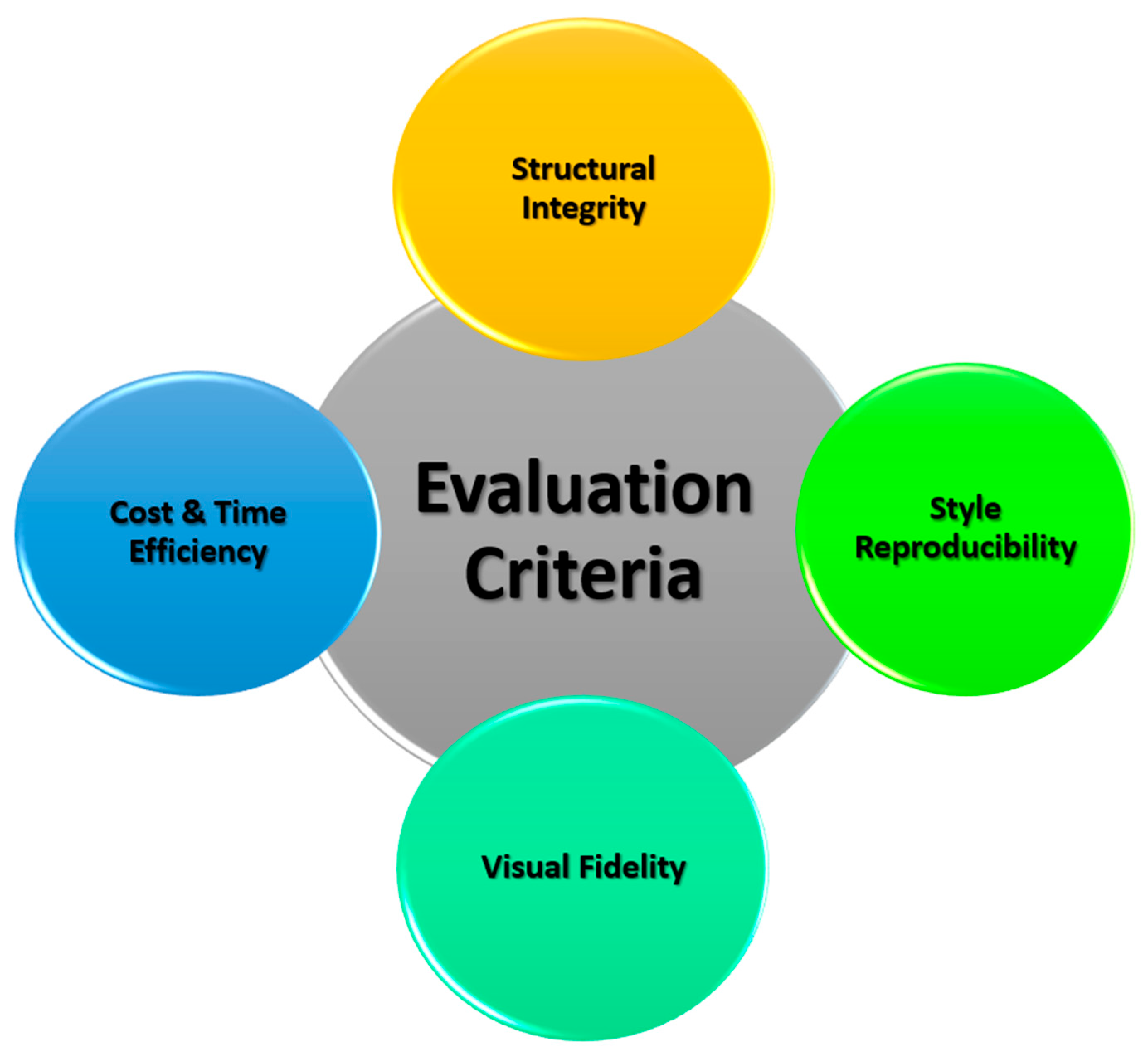
The assessment of the fabricated models was structured around four primary criteria to ensure a comprehensive evaluation of the replication outcomes: visual fidelity, structural integrity, style reproducibility, and cost and time efficiency. Visual fidelity was examined by comparing the printed objects to their respective digital models and reference images, with emphasis placed on the preservation of proportions, characteristic silhouettes, and dominant geometrical features [
34]. Particular attention was given to the visibility of curved surfaces, tubular structures, and ornamental contours, as these elements serve as key identifiers of the Art Deco, Bauhaus, and Mid-century Modern design languages. Surface quality was also reviewed, considering the presence of layer lines, support-structure traces, and smoothing effectiveness following post-processing.
Structural integrity was evaluated through the stability and robustness of the printed components during handling, assembly, and display [
35]. Criteria included the ability of slender or cantilevered parts to withstand light mechanical stress, the strength of bonding at assembly joints, and the overall rigidity of the final composite structures. This was of particular relevance in objects composed of multiple printed parts, where dimensional tolerances and bonding surfaces directly influenced the final strength.
Style reproducibility focused on the extent to which each printed object maintained the recognizable aesthetic attributes of its respective art movement [
36]. This criterion incorporated the coherence of form, proportion, and visual expression, ensuring that the viewer could clearly associate each model with its original stylistic category. Subtle aspects such as the representation of chrome-like finishes in Bauhaus pieces or the organic fluidity characteristic of Mid-century Modern designs were considered within this framework.
Cost and time efficiency were assessed by documenting printing durations and material consumption for each model, allowing for a comparative approximation of resource demands across styles [
37]. Print time, filament usage, and the need for support materials were recorded to determine the relative practicality of producing different typologies on desktop equipment. This parameter also took into account the extent of post-processing required to achieve display-ready results, as increased finishing time or material usage may offset the benefits of rapid production. Together, these criteria provided a balanced framework for analyzing the feasibility of using low-cost FDM technology for the cultural and stylistic replication of interior design objects.
Figure 1 depicts the aforementioned criteria.
Thus, the methodological framework adopted for the digital reconstruction and additive fabrication of representative interior design objects across three historically significant art movements was presented. A structured selection process ensured that the chosen pieces reflected the defining aesthetic principles of Art Deco, Bauhaus, and Mid-century Modernism, while remaining suitable for reproduction through desktop fused deposition modeling. The preparation of digital models, printing parameters, and post-processing procedures were standardized to minimize variability and to allow for equitable comparison of stylistic outcomes. Evaluation criteria were defined to assess both the technical and aesthetic performance of the fabricated prototypes, providing a basis for analyzing visual fidelity, structural robustness, stylistic recognizability, and resource efficiency. The methodology established in this chapter underpins the analysis presented in the following section, where the results of the fabrication process are examined and discussed.
2.7. Quantitative Style Preservation Index (SPI)
To support structured comparison of stylistic outcomes across different interior design movements, this study adopts a design-oriented evaluation framework in the form of a Style Preservation Index (SPI). The SPI is conceived not as a metrological or performance-based metric, but as a design research instrument that formalizes expert interpretation of stylistic attributes that are inherently qualitative in nature. Its purpose is to make stylistic assessment explicit, communicable, and repeatable within a controlled comparative design study [
38].
The SPI evaluation was conducted by a small group of evaluators with background knowledge in design and digital fabrication. Evaluations were performed independently using a structured scoring scheme based on a five-point Likert scale, where each level corresponded to qualitative descriptors of stylistic preservation (e.g., low to high recognizability). While formal inter-rater reliability metrics were not computed due to the exploratory nature of the study, the use of predefined evaluation criteria ensured consistency across assessments. The SPI is therefore intended as a structured interpretive framework supporting comparative design analysis, rather than a statistically validated measurement instrument.
Rather than focusing on dimensional metrology or surface roughness alone, the SPI captures style-related attributes that are central to the recognizability and cultural legibility of interior design artifacts. Four evaluation dimensions were defined based on design theory, fabrication constraints, and visual perception principles:
Silhouette Preservation (SP)—the degree to which the global outline and dominant profile of the printed object correspond to the reference design, considering proportions and overall form continuity.
Geometric Feature Retention (GFR)—the extent to which characteristic geometric elements (e.g., stepped profiles, tubular frames, continuous shells) are maintained after scaling and fabrication.
Ornamental and Detail Legibility (ODL)—the clarity with which stylistic decorative features or formal accents remain visually distinguishable at reduced scale.
Structural–Stylistic Coherence (SSC)—the balance between structural integrity and stylistic expression, assessing whether necessary geometric reinforcements or simplifications compromise stylistic intent.
The SPI is grounded in established practices within design research and heritage interpretation, where expert judgment is routinely employed to evaluate form, proportion, and stylistic coherence. Each SPI dimension reflects a specific aspect of design legibility—such as silhouette continuity, characteristic geometric expression, ornamental clarity, and structural–stylistic coherence—allowing complex stylistic qualities to be discussed in a structured and transparent manner without reducing them to purely geometric deviation measures.
For each object, the individual criterion scores were averaged to produce a single SPI value:
This formulation enables direct comparison between objects and across stylistic categories fabricated under identical printing conditions. Importantly, the SPI does not aim to replace qualitative interpretation, but rather to make stylistic assessment explicit, comparable, and repeatable, thereby strengthening the analytical rigor of the study. The resulting SPI values are reported and discussed in the Results section to highlight style-dependent differences in manufacturability and visual preservation.
It is acknowledged that the proposed evaluation framework, including the Style Preservation Index (SPI), is grounded in expert-based visual and stylistic assessment rather than purely instrumental metrology. This choice is intentional and aligned with established practices in design research and cultural heritage studies, where stylistic recognizability, formal coherence, and aesthetic legibility cannot be fully captured through geometric deviation metrics alone. The SPI is therefore not intended as an absolute or universal measure of quality, but as a comparative indicator enabling controlled cross-style analysis under identical fabrication conditions. In this way, the SPI functions as a methodological scaffold for comparative design interpretation, enabling systematic discussion of how different design languages interact with fabrication constraints, rather than as a quantitative indicator of manufacturing quality.
3. Design Outcomes
This chapter presents the outcomes of the digital fabrication process and examines the extent to which the selected interior design objects retained their stylistic, structural, and aesthetic qualities following reproduction through desktop fused deposition modeling. The results are discussed with respect to the evaluation criteria defined previously, allowing for a comparative interpretation of visual fidelity, structural performance, stylistic recognizability, and resource efficiency across the three design movements. The results are interpreted within a comparative and design-oriented evaluation framework, where stylistic recognizability and formal coherence are assessed alongside fabrication feasibility, rather than through purely metrological performance metrics. The chapter integrates visual evidence of the printed models to support the analysis of observed strengths and limitations in the translation of cultural design features into additively manufactured form.
3.1. Visual Fidelity Outcomes
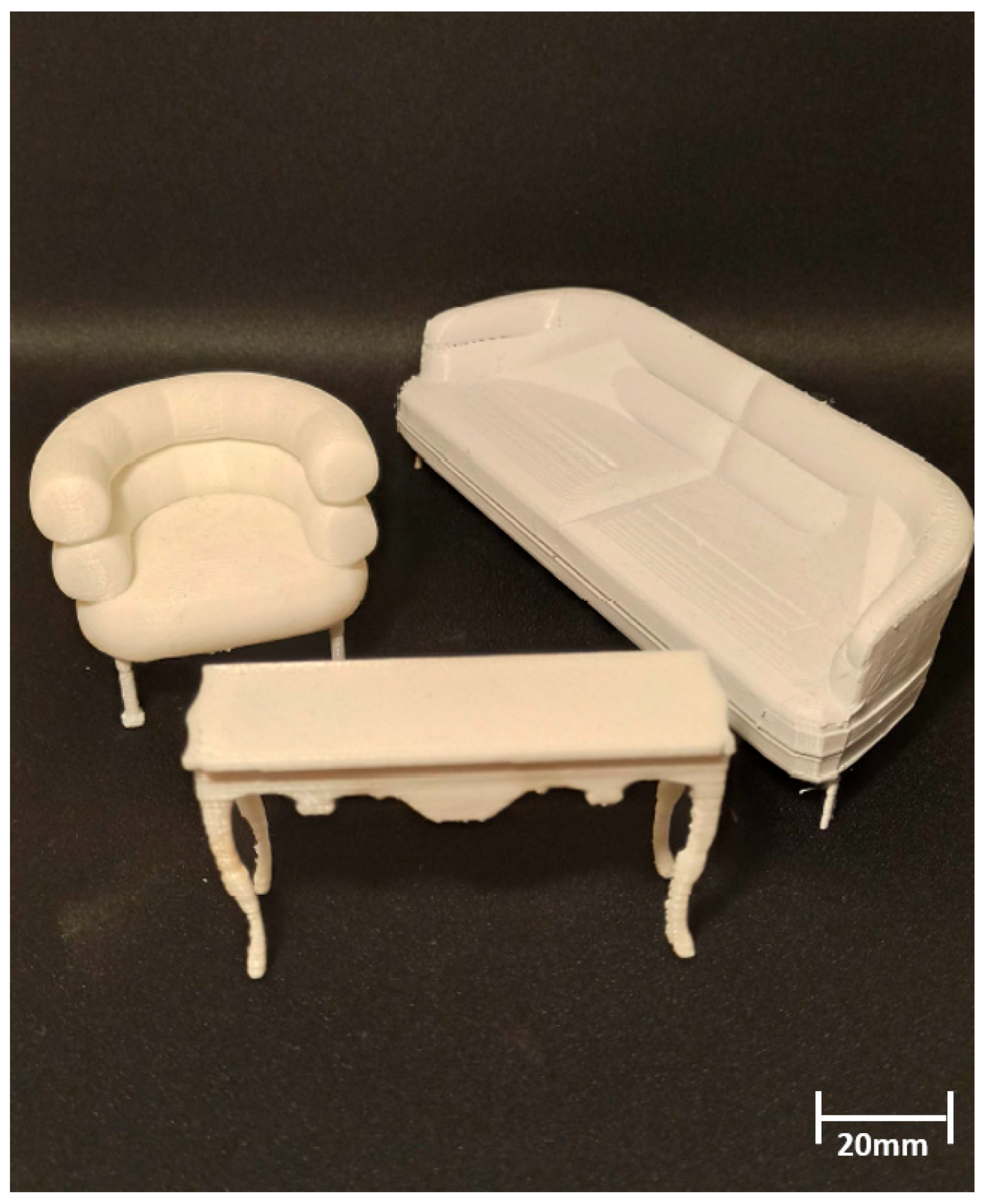
Visual fidelity was assessed by examining the degree to which the printed models reflected the key geometric and aesthetic characteristics of their original design references. Across all three stylistic categories, the printed prototypes demonstrated a clear retention of dominant silhouettes, proportionate relationships, and defining stylistic cues. In the case of the Art Deco models, the characteristic volumetric balance and ornamental curvature were preserved, allowing for immediate visual recognition of the style. The stepped contouring of the decorative table and the rounded tubular forms of the armchair remained perceptible after printing, although fine detailing, such as subtle bevels and surface texturing typical of the period, appeared less pronounced due to layer-based fabrication constraints. The ensemble of printed Art Deco pieces is presented in
Figure 2.
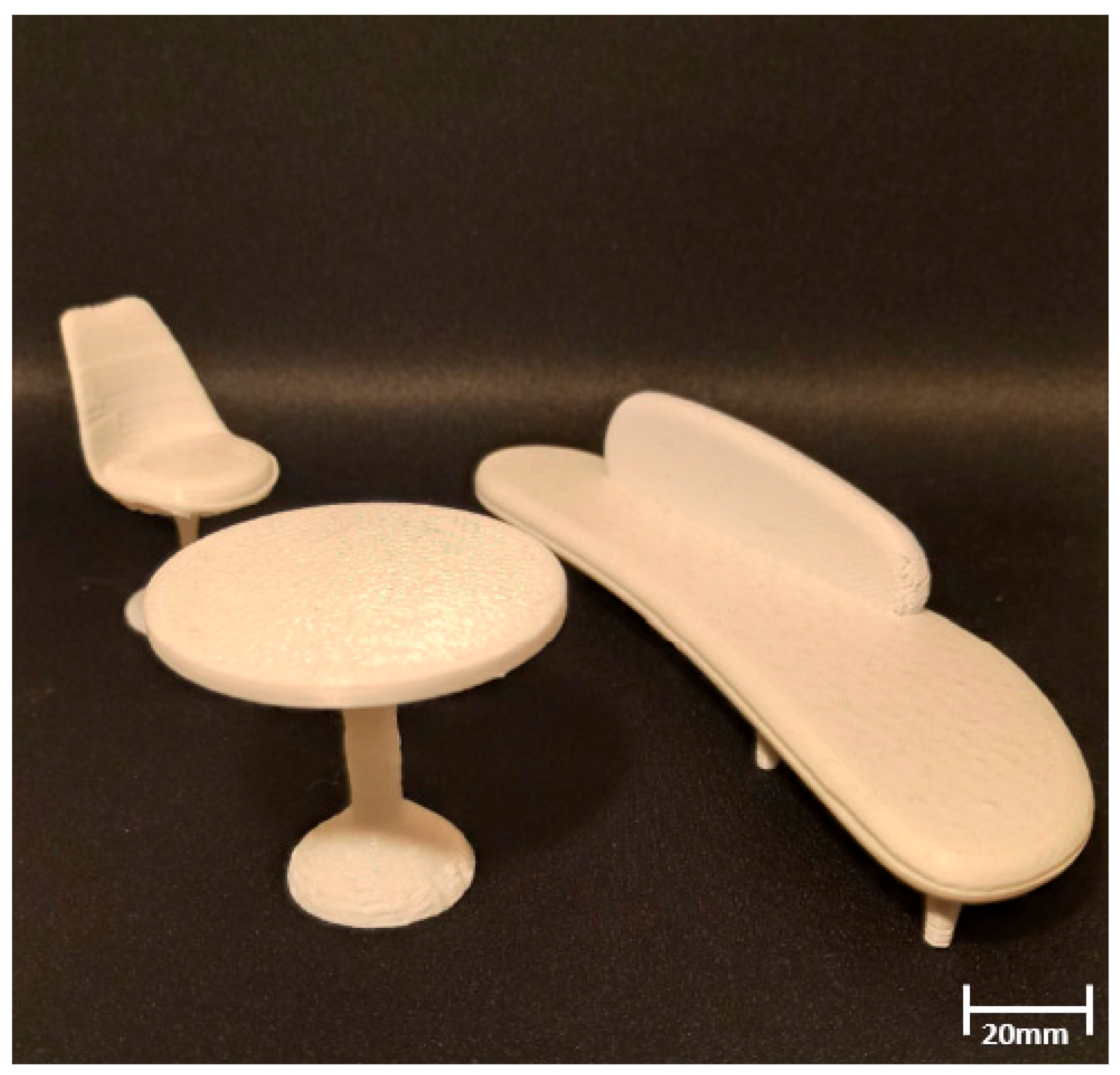
The Mid-century Modern models exhibited particularly strong fidelity in terms of form continuity and minimalist expression. The smooth, uninterrupted surfaces of the Tulip Chair and Pedestal Table were reproduced with satisfactory curvature flow, maintaining the organic and sculptural language associated with this movement. Layer line visibility was more apparent on large, sweeping surfaces; however, this did not compromise stylistic legibility. The Noguchi-inspired piece retained its asymmetrical composition and biomorphic silhouette, demonstrating the capacity of FDM to convey modernist organicism at reduced scale. The printed Mid-century Modern set is shown in
Figure 3.
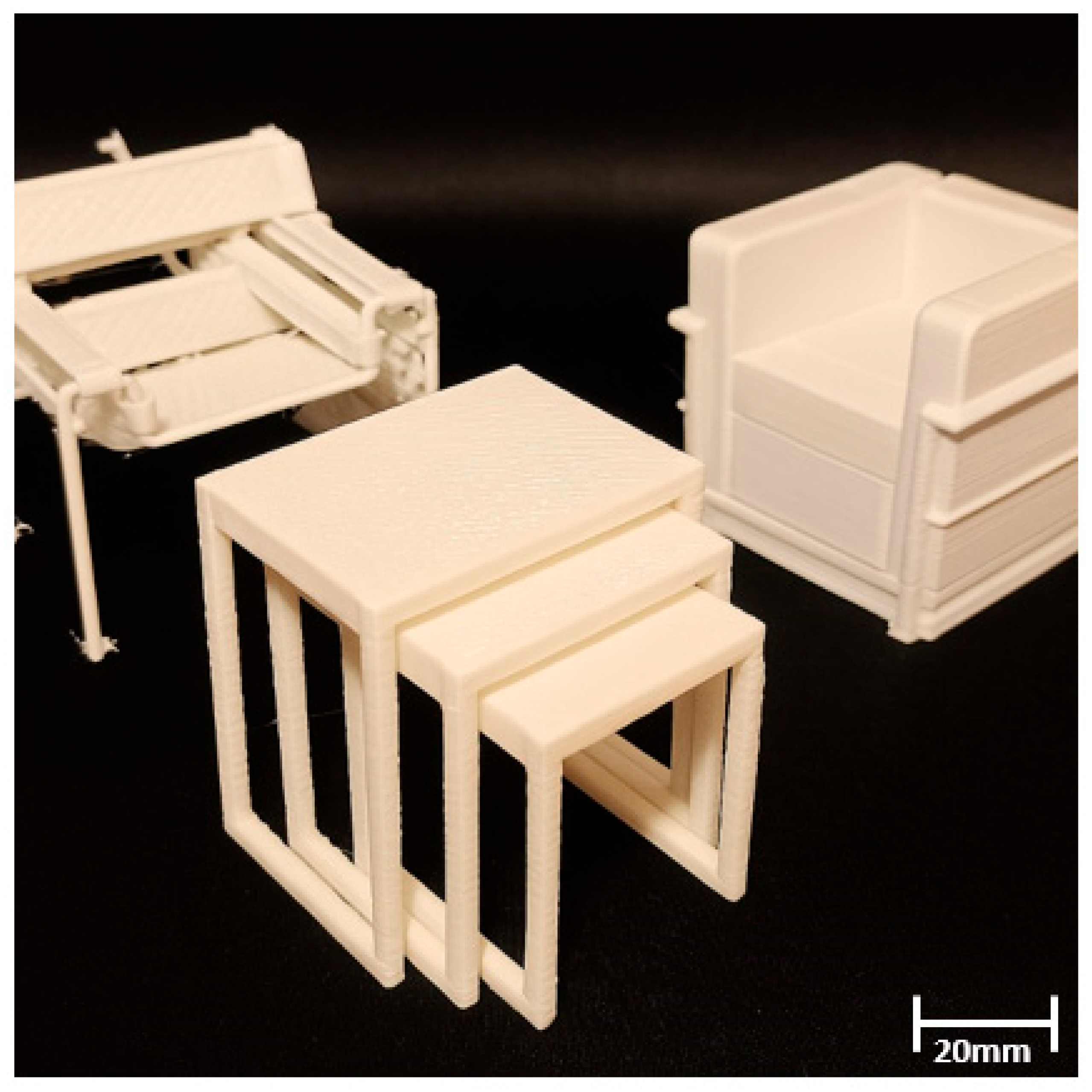
The Bauhaus reproductions demonstrated high clarity in geometric structure and functional minimalism. The planar surfaces, orthogonal frames, and tubular geometries characteristic of Bauhaus design were faithfully translated into printed form. The Wassily Chair and LC2 Armchair [
39] retained their essential profiles, although some circular sections displayed slight faceting due to polygonal approximation during digital preparation. The folding tables maintained structural simplicity and modular expression, aligning with the utilitarian Bauhaus ethos. The printed Bauhaus set is shown in
Figure 4.
Taken collectively, the visual evaluation confirmed that desktop FDM printing was capable of maintaining the recognizable stylistic identity of each movement. The most noticeable visual limitations were associated with the resolution of small ornamental elements, the reproduction of fine curvature transitions, and visible layer stratification on large or gently curved surfaces. Nonetheless, these effects did not significantly detract from overall stylistic recognition, suggesting that FDM is suitable for producing culturally meaningful miniature replicas when visual fidelity is assessed at the level of dominant form and proportion rather than micro-detail replication.
To complement the qualitative evaluation, basic manufacturing metrics were recorded for all fabricated objects, including printed scale, maximum dimension, printing time, and material consumption. These parameters provide a quantitative context for comparing the practical feasibility of reproducing stylistically distinct interior design objects under identical FDM conditions, without implying metrological accuracy or dimensional certification.
3.2. Structural Integrity
Structural integrity was evaluated based on the stability, robustness, and handling resistance of the printed models during and after assembly. The majority of components exhibited satisfactory mechanical performance when printed with infill densities between 15% and 30%, providing sufficient internal support while maintaining lightweight construction. Load-bearing areas such as chair legs, table pedestals, and interconnected frames retained their structural integrity when subjected to light manual pressure, indicating that the selected print settings were appropriate for small-scale prototypes. However, elements featuring slender tubular geometries, such as the armrests of the Wassily Chair and the stacked cylindrical cushions of the Bibendum Armchair, demonstrated increased susceptibility to deformation when printed at reduced scale. This behavior was attributed to limitations imposed by nozzle diameter and wall thickness, which required reinforcement through either increased shell count or minor geometric adjustment during model preparation.
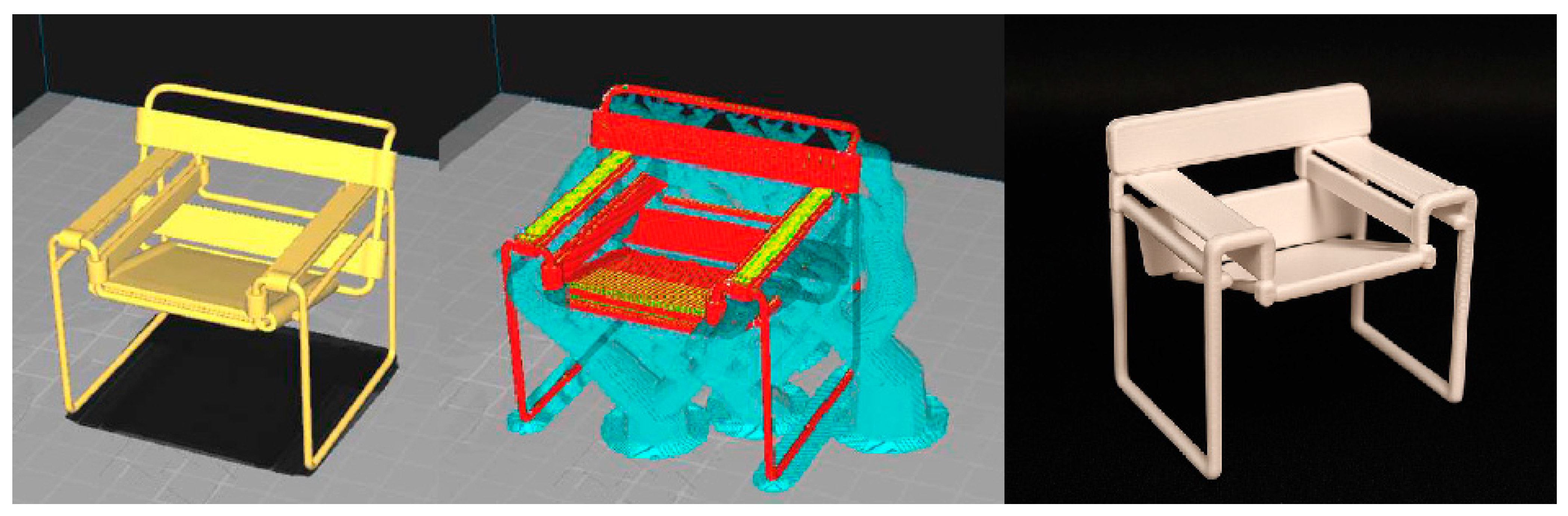
Assembly strength was influenced by the precision of interlocking joints and the effectiveness of adhesive bonding applied during post-processing. Components that relied on direct bonding at small contact surfaces were more vulnerable to detachment when handled, particularly in cases where smooth, curved surfaces limited bonding interface area. Conversely, flat or right-angled joining surfaces, commonly found in Bauhaus-inspired pieces, facilitated stronger assembly connections due to increased adhesive contact and geometric compatibility. The use of cyanoacrylate-based adhesives contributed to adequate bonding performance; however, certain joints required additional curing time or localized reinforcement to prevent micro-fractures. Overall, the assembled models maintained sufficient rigidity for display, educational handling, and comparative evaluation. Representative examples of printed components with visible supports and assembly sequences are presented in
Figure 5.
3.3. Style Reproducibility
Every style reproducibility was evaluated by examining the degree to which each set of printed models conveyed the distinct formal and aesthetic identity of its respective art movement. The comparative analysis considered both the recognizability of characteristic design elements and the overall coherence of the style when translated into additively manufactured form. Despite the inherent limitations of fused deposition modeling—particularly with respect to layer resolution and the reproduction of subtle surface finishes—the printed ensembles successfully preserved the essential features defining each movement.
In the Art Deco series, stylistic reproducibility was evidenced through the strong retention of symmetrical composition, stepped profiles, and ornamental curvature. The interplay of rounded volumes and vertical elements in the Bibendum Armchair and Decorative Table conveyed the geometric luxury and sculptural balance typical of the 1920s aesthetic [
40]. The simplified material rendering of PLA did not hinder stylistic recognition, as the overall volumetric articulation and proportion remained consistent with the visual codes of the movement.
The Bauhaus models demonstrated a similarly high degree of stylistic fidelity. Their planar geometries, rectilinear compositions, and rational structural logic clearly reflected the functionalist ethos of Bauhaus design. The Wassily Chair and LC2 Armchair effectively embodied the movement’s preference for exposed frameworks and structural honesty [
41]. The absence of chromed metallic finishes did not detract from the formal authenticity of the printed prototypes, as the spatial clarity and modularity of the designs were successfully conveyed.
Finally, the Mid-century Modern pieces displayed the most effective translation of organic form into printed geometry. The Tulip Chair, Pedestal Table, and Noguchi-inspired piece preserved the flowing contours and minimal joint articulation emblematic of post-war modernism [
42]. Smooth surface transitions and unified silhouettes were captured with high fidelity, demonstrating that FDM technology can adequately represent continuous curvilinear forms at reduced scale. Taken together, the printed collections (
Figure 2,
Figure 3,
Figure 4 and
Figure 5) confirmed that stylistic reproducibility was maintained across all movements at the level of form, proportion, and spatial composition. Minor losses in surface texture or ornamental detail did not obscure stylistic intent, suggesting that additive manufacturing—when paired with careful digital preparation—constitutes a valid medium for the representation and pedagogical study of design styles within cultural and historical contexts.
3.4. Quantitative Assessment of Style Preservation Using the SPI
The quantitative Style Preservation Index (SPI) was applied to the fabricated models in order to provide a comparative numerical assessment of stylistic fidelity across the three design movements under identical fabrication conditions. The resulting SPI values, summarized in
Table 3, highlight clear style-dependent differences in how effectively the defining characteristics of each movement are preserved through desktop FDM fabrication. It should be noted that SPI scores were initially computed at the individual object level, with the reported values corresponding to the average across the three representative objects within each stylistic category. Given the limited number of objects per group, the results are interpreted comparatively rather than statistically.
Bauhaus-derived objects achieved the highest overall SPI score (4.75), reflecting their strong compatibility with layer-based manufacturing. The high silhouette preservation and geometric feature retention observed in these models can be attributed to the movement’s emphasis on planar surfaces, tubular structures, and functional clarity, which translate effectively into discretized toolpaths with minimal need for geometric simplification. Structural–stylistic coherence was also consistently high, as the necessary reinforcements introduced for printability did not conflict with the visual language of the original designs.
Mid-century Modern objects exhibited a high but slightly lower SPI score (4.00). The dominant silhouettes and continuous curvilinear forms characteristic of this movement were successfully preserved, resulting in excellent silhouette retention. However, the reproduction of smooth surface transitions and organic curvature was partially affected by visible layer stratification and limited surface resolution, leading to moderate reductions in geometric feature retention and ornamental legibility. Despite these constraints, the overall stylistic identity of the printed models remained clearly recognizable.
Art Deco objects produced the lowest SPI score (3.00), primarily due to reduced ornamental and detail legibility. While global form and proportion were largely maintained, the dense decorative features, stepped profiles, and fine surface articulations typical of Art Deco design were more susceptible to loss during scaling and fabrication. In several cases, geometric simplification and local reinforcement were required to ensure printability, which affected the clarity of ornamental elements without fully compromising silhouette recognition. These results indicate that styles relying heavily on fine decorative detail are inherently more sensitive to the resolution and material constraints of desktop FDM.
From a geometric standpoint, these differences can be associated with variations in formal complexity across the examined design movements. Bauhaus objects, characterized by reduced feature density and more uniform geometric structures, exhibit higher compatibility with layer-based fabrication. In contrast, Art Deco designs, with increased ornamental density and localized curvature variations, introduce geometric features that are more susceptible to resolution loss and support-related artifacts. Mid-century Modern objects present intermediate behavior, combining continuous curvature with moderate feature complexity. Although no explicit geometric metrics were computed, these observations are consistent with known relationships between feature density, curvature variation, and additive manufacturing constraints.
Overall, the SPI results quantitatively confirm that stylistic compatibility with FDM fabrication is strongly design-dependent. While all three movements remained visually identifiable, their degree of preservation varied systematically according to geometric complexity, ornament density, and structural logic. The SPI therefore provides a useful analytical tool for comparing stylistic translation across design typologies and for informing future applications of additive manufacturing in cultural replication and design education.
3.5. Cost and Time Efficiency
The efficiency of the fabrication process was assessed through comparative documentation of printing duration, material consumption, and post-processing requirements across the three stylistic categories. Print time was primarily influenced by the geometric complexity and overall volume of each model. The Art Deco objects, characterized by layered ornamentation and compound curvature, required the longest fabrication durations, often exceeding 10 to 12 h per object at a 0.15–0.20 mm layer height. Material usage averaged between 60 and 80 g of PLA per piece, depending on infill density and support requirements. The extensive use of supports, particularly beneath overhanging decorative features, contributed to increased printing time and filament waste. Despite this, dimensional accuracy and form preservation remained satisfactory, confirming that slower printing parameters yielded more consistent results for geometrically intricate designs. This trend can also be qualitatively linked to differences in geometric density and feature distribution, which influence toolpath complexity and overall fabrication time.
The Bauhaus and Mid-century Modern models demonstrated considerably higher fabrication efficiency. Their reduced ornamental detail and cleaner geometries shortened printing time to approximately 6–8 h per object, with material use typically remaining below 50 g. The Bauhaus pieces benefited from simple planar construction and minimal support needs, while the continuous, organic profiles of the Mid-century Modern designs printed reliably with minimal warping. Post-processing demands followed a similar trend: the smoother surfaces of the modernist models required less sanding and reworking compared with the angular and detailed features of the Art Deco set. Across all cases, total production cost remained low due to the affordability of PLA filament and the absence of specialized finishing materials. Overall, the results indicated that desktop FDM printing provides an economically and temporally viable workflow for stylistically differentiated miniature reproductions, making it suitable for research, educational, and exhibition contexts where cost efficiency and stylistic representation are prioritized over fine material fidelity. Minor surface artifacts and layer-induced irregularities visible in the printed models are inherent to desktop FDM fabrication and are therefore interpreted as part of the technological constraints under evaluation, rather than as fabrication defects.
While additional quantitative metrics such as geometric deviation, surface roughness, or dimensional accuracy could provide further insight into fabrication performance, the present study deliberately adopts a design-oriented evaluation framework focusing on stylistic legibility and formal identity. As such, the SPI is intended to support structured comparative interpretation rather than statistical generalization.
4. Discussion
The results presented in the preceding chapter confirmed that desktop fused deposition modeling can effectively reproduce stylistically significant interior design objects across diverse historical movements. This chapter interprets those outcomes in relation to aesthetic fidelity, fabrication constraints, and the translation of artisanal design principles into parametric, digitally manufacturable form. The discussion aims to situate the findings within the broader context of heritage documentation, design education, and contemporary cultural production. Emphasis is placed on the balance between artistic integrity and technological feasibility, highlighting both the advantages and limitations of the adopted approach. Finally, implications for future applications and potential methodological extensions are outlined to support continued integration of additive manufacturing within cultural and design research frameworks.
4.1. Interpretation of Findings
The comparative evaluation of printed models demonstrated that aesthetic fidelity is largely determined by the interaction between geometric complexity and the physical constraints of fused deposition modeling. The results confirmed that stylistic identity—particularly at the level of form and proportion—can be successfully preserved even under the material and resolution limitations of low-cost desktop equipment. The distinctive silhouettes of Art Deco, Bauhaus, and Mid-century Modern objects were clearly recognizable, validating the assumption that the essential character of design movements can be conveyed through simplified geometrical abstraction. However, the analysis also revealed that micro-level aesthetic features, such as fine curvature transitions and subtle ornamentation, were only partially captured due to the anisotropic deposition of material layers and the minimum feature size imposed by the 0.4 mm nozzle. Consequently, while macro-aesthetic legibility was retained, textural and tactile fidelity remained limited.
These observations illustrate the broader trade-off between aesthetic fidelity and technological limitation inherent in digital reproduction workflows. The process requires a careful negotiation between maintaining stylistic authenticity and adapting form to fabrication realities. In this case, additive manufacturing acted as both a translation and an interpretation mechanism: the act of reconstructing historic forms through 3D printing inherently produced a contemporary re-articulation of their design language. The investigation further underscored the importance of parametric thinking in bridging artisanal design principles with digital fabrication. Lessons learned from this process suggest that the success of stylistic translation depends less on the printer’s resolution itself than on the designer’s ability to abstract, simplify, and encode the formal logic of the original artifact within a digital environment. In this sense, parametric manufacturability becomes not merely a technical constraint but a creative framework for preserving design intent through controlled digital transformation.
The SPI results indicate that stylistic compatibility with desktop FDM fabrication is inherently design-dependent rather than technology-dependent. While all three historical movements examined in this study remain visually recognizable after additive manufacturing, their degree of stylistic preservation varies systematically according to geometric logic, ornament density, and structural articulation. Bauhaus designs demonstrate the highest compatibility with FDM due to their planar geometry, exposed structural rationality, and limited reliance on fine decorative features, which align naturally with layer-based fabrication. Mid-century Modern objects exhibit slightly reduced but still high compatibility, as continuous curvilinear surfaces are largely preserved despite visible layer stratification. In contrast, Art Deco objects show lower SPI values, reflecting the sensitivity of dense ornamentation and fine detailing to scaling and nozzle-resolution constraints. These findings suggest that the effectiveness of additive manufacturing in cultural replication is governed less by general printer capability and more by the interaction between stylistic intent and manufacturability constraints. By making this relationship explicit, the SPI framework provides a structured means of anticipating stylistic losses and guiding design adaptation when using low-cost FDM systems for heritage representation and design education.
4.2. Applicability for Heritage Conservation, Interior Design Education, and Commercial Replica Production
The outcomes of this study highlight the broad applicability of additive manufacturing as both a research and dissemination tool within the fields of cultural heritage, interior design education, and design-driven commercial production. In the context of heritage conservation, the digital-to-physical workflow employed here provides a reliable methodology for producing accurate, scaled replicas of historically significant objects without exposing fragile originals to risk. These replicas can serve as interpretive exhibits, tactile surrogates for visitors with visual impairments, or reference models for restoration planning. The capacity to reproduce stylistically complex forms—such as that characteristic of Art Deco ornamentation or Bauhaus structural minimalism—demonstrates that even low-cost fused deposition modeling can contribute meaningfully to the documentation and communication of design heritage. The portability and repeatability of the process make it especially suited to small museums and educational institutions with limited budgets or limited access to high-end fabrication facilities.
Within the domain of interior design education, the 3D printing process functions as a pedagogical bridge between historical theory and practical experimentation. Students and researchers can physically engage with canonical design principles by fabricating scaled interpretations of iconic works, thereby developing a tactile understanding of proportion, balance, and structural reasoning. This hands-on engagement reinforces the study of design history through material experience, transforming abstract stylistic analysis into an interactive learning process. Moreover, the workflow outlined in this study can be incorporated into curricula focused on digital design, sustainable manufacturing, and heritage visualization, providing a tangible means to connect contemporary computational tools with the craftsmanship traditions of the past.
From a commercial perspective, the same methodology can be extended to small-scale production of replicas, collectible models, and stylized reinterpretations for interior applications. As additive manufacturing technologies continue to improve in speed, precision, and material variety, opportunities emerge for design studios and heritage brands to reproduce limited-edition objects with verified stylistic authenticity. These applications may support revenue generation for cultural institutions while simultaneously expanding public access to design heritage through accessible, material reproductions. In each of these domains, the digital fabrication of historically inspired interiors underscores the dual capacity of 3D printing to preserve cultural memory and to stimulate contemporary innovation in design practice.
4.3. Limitations
Although the present investigation demonstrated the feasibility of reproducing stylistically significant interior design objects using low-cost fused deposition modeling, several limitations must be acknowledged in relation to both the employed technology and the adopted methodological framework. The exclusive use of desktop FDM systems imposed constraints on achievable resolution, surface finish, and material realism. The 0.4 mm nozzle and layer-by-layer deposition process introduced visible stratification, particularly on gently curved or inclined surfaces, which reduced the perceptual smoothness of certain models. While these artifacts did not obscure the overall stylistic identity of the objects, they limited the accurate reproduction of subtle textural and ornamental details—elements that are critical to the tactile and visual experience of historical furniture. Moreover, the use of single-material PLA restricted the representation of materials traditionally associated with each movement, such as polished metals, glass inserts, and exotic woods. The absence of multi-material or color-varied printing meant that stylistic interpretation relied solely on geometry rather than on authentic material expression.
Another limitation relates to surface finishing and scale fidelity. Due to the small scale of the models, minor inaccuracies in dimension or curvature were visually amplified, while the absence of extensive surface treatment—such as resin coating or vapor smoothing—prevented the full realization of polished or reflective finishes typical of certain stylistic categories. Additionally, mechanical limitations inherent to desktop printers, such as build-volume restrictions and thermal warping, constrained the maximum achievable size of continuous parts, necessitating segmentation and subsequent assembly. Although this process preserved overall proportions, joint lines occasionally remained visible despite post-processing. Finally, the qualitative evaluation employed here, focused on visual and structural assessment, did not incorporate quantitative metrology or user-based perceptual testing. Future studies incorporating these dimensions would further clarify the relationship between stylistic fidelity, fabrication technology, and perceptual authenticity in digital reproduction workflows.
Table 4 depicts the Style Preservation Index (SPI) values for the three design movements, while a structured review of the limitations encountered during the fabrication process is presented in
Table 5. The table consolidates the principal technological, material, and methodological constraints identified throughout the project, together with their corresponding effects on print quality, aesthetic outcome, and interpretive accuracy. These limitations represent common challenges in the use of desktop fused deposition modeling for the reproduction of design objects and provide a framework for identifying potential improvements in future research.
The evaluation presented in this study was intentionally qualitative, prioritizing stylistic and perceptual analysis over numerical accuracy. Future investigations will incorporate quantitative dimensional assessment and perceptual surveys to measure geometric deviation, surface quality, and user recognition of stylistic fidelity. This combined approach will enable a more comprehensive validation of additive manufacturing as a tool for culturally and aesthetically informed design replication.
4.4. Future Work
The findings of this study provide a foundation for future research on the integration of additive manufacturing within the documentation and reinterpretation of cultural design heritage. Several directions for advancement have been identified. First, the reproduction of interior design objects could be extended to larger-scale or functional replicas, thereby exploring the transition from purely demonstrative models to pieces suitable for exhibition or practical use. Such an approach would allow the evaluation of ergonomics, material behavior, and user interaction at full scale, offering a more comprehensive understanding of how additive manufacturing can support restoration, reconstruction, and recontextualization projects within heritage environments. The adoption of large-format 3D printing or modular assembly techniques could facilitate this scale expansion without compromising detail or structural stability.
Another promising avenue involves the integration of digital metadata and documentation links directly into the printed artifacts. Embedding QR codes or NFC tags could provide instant access to contextual information such as the object’s historical background, original designer, and stylistic classification. This would enhance the educational and curatorial potential of the replicas, transforming them into interactive information carriers within museum or academic settings. Future investigations could also employ multi-material or color-enabled additive systems to improve material realism, along with surface finishing techniques—such as resin coating, electroplating, or composite lamination—to achieve greater textural fidelity.
Finally, further research should incorporate quantitative metrology and perceptual evaluation to objectively measure geometric accuracy and to assess audience perception of authenticity. By combining engineering-level analysis with human-centered studies, a more holistic understanding of the relationship between digital fabrication, stylistic interpretation, and cultural meaning can be achieved. Collectively, these directions point toward a more integrated methodology in which additive manufacturing serves not only as a reproduction technique but also as a tool for interpretation, education, and cultural engagement.
These proposed directions collectively describe a progressive evolution from demonstrative replicas toward functionally and materially enriched interpretations, supported by scalable fabrication, refined finishing, and embedded digital documentation. By combining quantitative accuracy assessment with perceptual evaluation, future research can more precisely correlate fabrication parameters with perceived authenticity and educational value.
From a broader design perspective, the findings of this study can be interpreted in relation to Design-for-Additive-Manufacturing (DfAM) principles. Rather than treating fabrication constraints as limitations, the results suggest that different design languages exhibit varying degrees of intrinsic compatibility with layer-based construction, depending on their geometric logic, feature density, and curvature behavior. This implies that the translation of historical design artifacts into printable form may benefit from selective adaptation strategies, where stylistically critical features are preserved while secondary elements are simplified or reinterpreted to align with fabrication constraints. In this context, parametric design approaches offer significant potential, enabling controlled manipulation of geometric features—such as thickness, curvature continuity, and ornamental density—while maintaining stylistic identity. Such strategies support a shift from direct replication toward informed design translation, allowing historical design languages to be systematically re-engaged within contemporary digital fabrication workflows.
5. Conclusions
The present study demonstrated that desktop fused deposition modeling (FDM) can serve as an effective tool for the reproduction and analysis of stylistically distinct interior design objects belonging to major twentieth-century art movements. Through the systematic digital modeling, fabrication, and evaluation of representative pieces from Art Deco, Bauhaus, and Mid-century Modernism, the research established a practical workflow for transforming historical design principles into tangible, small-scale prototypes. The approach provided an opportunity to explore how additive manufacturing can preserve stylistic integrity while accommodating the inherent technological limitations of low-cost 3D printing systems.
The results confirmed that form and proportion—the primary conveyors of design identity—were successfully retained across all printed objects. Despite constraints in surface smoothness and fine detail reproduction, the printed models exhibited clear stylistic recognizability, validating the hypothesis that cultural and aesthetic attributes can be effectively communicated through simplified geometric abstraction. Moreover, the comparative analysis revealed that stylistic reproducibility depends not solely on printer resolution but on the designer’s ability to translate artisanal intent into parametric, manufacturable geometry. In this respect, the study underscored the creative and interpretive dimension of digital fabrication, positioning it as a medium that bridges historical craftsmanship and contemporary computational design.
From a broader perspective, the study demonstrates the applicability of additive manufacturing to heritage documentation, design education, and limited-series replica production. The proposed digital-to-physical workflow offers a reproducible model for museums, universities, and design institutions seeking to engage audiences through material interpretation of design history.
Beyond the specific case studies presented, the introduction of the Style Preservation Index (SPI) constitutes a central contribution of this work, providing a transferable and systematically applicable framework for evaluating stylistic fidelity in additively manufactured cultural and design replicas fabricated under constrained desktop FDM conditions.
These findings also highlight broader implications for design practice and education. In studio-based learning environments, the proposed workflow enables students to engage with historical design languages through hands-on fabrication, fostering a deeper understanding of form, proportion, and stylistic intent. In museum and heritage contexts, the use of 3D-printed replicas supports tactile interaction and inclusive access, particularly for audiences with visual impairments. Furthermore, the results suggest that future developments in higher-resolution fabrication technologies—such as SLA, multi-material systems, and hybrid processes—may further enhance the preservation of fine stylistic detail, enabling more nuanced and materially expressive forms of design translation.