2.1.1. Materials and Methods—Study 1
For Study 1, the protocol (IRB protocol #2023H0212) and the associated consent forms were approved by the Ohio State University Biomedical Sciences Institutional Review Board. Subjects signed an informed consent form prior to participation in the study. Subjects were recruited using the Study Search website administered through The Ohio State University Center for Clinical and Translational Science, as well as through an e-mailed study advertisement to The Ohio State University College of Optometry staff, faculty, and students.
Fifteen subjects participated in this study (5 females), mean age 24.6 years old (range 22–27). In order to be eligible for the study, subjects were required to be 18 to 40 years of age, to have 20/20 best corrected monocular visual acuity in both eyes, to demonstrate no strabismus/heterotropia upon cover test in primary gaze as well as left and right gaze, and to have stereoacuity of at least 60 s of arc on a Randot stereo acuity test. For two subjects, the presence of strabismus was only assessed in primary gaze. Subjects were required to have played baseball or softball at the high school level or above within the last 10 years.
Subjects were given a short questionnaire to fill out assessing their level of experience in baseball and softball. The three questions in the questionnaire were as follows:
Which sport (baseball or softball) did you (or do you) play?
Were you primarily a pitcher, a batter, or both and/or did this role change over your playing years (that is, did your primary position change at the highest levels versus the lower levels at which you played)?
What is the highest level at which you played (or play) this sport?
Based on the survey responses, all subjects were either primarily batters or both a pitcher and a batter. Excluding recreational play in college, the highest level at which 9 subjects played was high school. The other 6 subjects reported that they played at the collegiate level.
Tennis balls were pitched to subjects using a pneumatic pitching machine (Flamethrower, Accelerated Baseball Technologies, Crystal Lake, IL, USA) [
17,
23]. The balls were fed into the pitching machine one at a time by one of the investigators. The balls exited the pitching machine through an attached PVC pipe held in place by a tripod. The pitching machine and the speed adjustment on the PVC pipe was situated behind a dark hanging shroud such that subjects could not see the investigator adjust the pitching speed between pitches.
Two speed settings were used for this study. Every tenth pitch was thrown at the second, slower speed to allow for some variation in pitch trajectory. The speed of the pitch could be modulated by covering or exposing holes on the PVC pipe from which the balls were thrown using a sliding sleeve around the tube. For the two pitch speed settings, the time required to traverse distances from the pitching machine of 10 feet (3.05 m), 20 feet (6.10 m), 30 feet (9.14 m), and 40 feet (12.19 m) were assessed 10 times using two timing windows as described previously [
17]. These values were then converted to (mean) velocities at that distance. The results are shown in
Table 1 below.
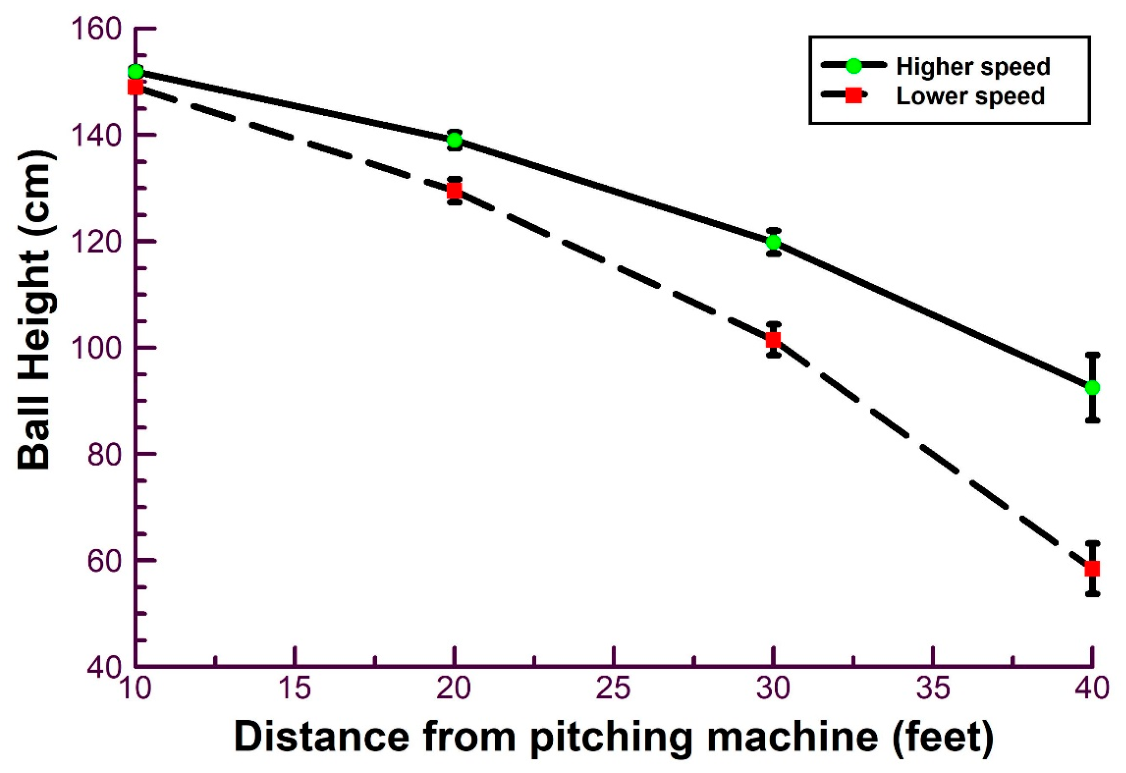
The height of the ball upon arrival at each of the four distances at which the ball speed was assessed was also measured 10 times as described previously [
17,
23]. The results of these measurements are shown in
Figure 1.
The subject’s gaze was tracked using a monocular Pupil Core Eye Tracker (Pupil Labs GmbH, Berlin, Germany). The system recorded the location of the right eye (120 Hz) along with the scene (30 Hz) viewed by the subject. The system produced a video from the scene camera with a circular marker showing the location of gaze (eye-in-head rotation + head rotation) in the scene. It was possible to obtain numerical data representing the eye-in-head rotation, although the analyses described in this paper were based on the videos from the scene camera.
To calibrate the eye tracker, five fixation points were used. The calibration procedure utilized the “Natural Feature” calibration choreography included with the eye tracking software (Pupil Capture). Fixation targets were placed on two thin vertical posts and two concrete support columns. The two posts were placed in the path of the ball at 20 feet (6.10 m) and at 30 feet (9.14 m) from the end of the pitching machine tube. The fixation markers on these two posts were placed at the average expected height of the ball during the ball’s approach, as assessed from the height measurements described above. The fixation markers on the two support columns were about 9.3 deg to the left of the ball’s path (column 10 feet (3.05 m) from the end of the pitching machine tube) and 13.6 deg to the right of the ball’s path (column about 30 feet (9.14 m) from the end of the pitching machine tube). The fifth calibration target was the end of the pipe from which the ball was ejected from the pitching machine.
During the calibration, the subject stood at a distance of 40 feet (12.19 m) from the pitching machine. They were instructed to keep their head as still as possible, and to move only their eyes to fixate each of the calibration points. Immediately following the calibration, the subject was directed to look through all the calibration points once more while the investigator ensured accurate gaze tracking, in that the gaze location matched within about 1.25 deg (half the diameter of the circular eye location indicator) for each of the original fixation targets. To verify the calibration, the investigator viewed the video feed from the eye tracking scene camera and the gaze position indicator overlaid on this scene. If the calibration was deemed inadequate, meaning that gaze was more than 1.25 deg from any fixation target, it was performed again. Subjects were then allowed to move their heads as normal during the trials. Just prior to the experimental trials, the subject was instructed to look at the opening of the PVC pipe from which the ball exited the pitching machine as a final check on the calibration. Since the location of the eyes when the pitches were first released from the pitching machine did not vary significantly throughout the experimental trials, the calibration was thought to be stable throughout each trial.
A “plate” was placed on the ground 40 feet (12.19 m) away from the pitching machine. The subject was instructed to stand either to the left or right of this plate according to their hand dominance. A net was placed approximately 8 feet (2.44 m) away from the subject to stop the ball prior to it reaching the subject. In stopping the balls with the net, subjects were presumably required to extrapolate the ball’s trajectory over the distance from the net to the plate to estimate the ball’s passing height had the ball arrived at the plate.
Before the pitches for data collection were thrown, the net was placed 2 feet (0.61 m) in front of the subject, and one pitch at each of the two speeds used in the experiment was thrown to familiarize the subject with the general speed and height range of the pitches. After the net was once again placed 8 feet (2.44 m) in front of the plate, two randomized conditions were performed. Eye-in-head movements and gaze location relative to the scene were recorded throughout these trials with the Pupil Labs eye tracker. In one condition (the uncoupled condition hereafter referred to as the “predictive” condition), thirty pitches were thrown, and the subject was asked to observe the ball and estimate the height of the ball had the ball passed by them. A two-meter ruler (referred to as the “meter stick”) was placed beside the plate opposite the subject to quantify the height assessments. The subject reported their passing height estimate to the experimenter who recorded these responses in an Excel spreadsheet.
In the other condition, hereafter referred to as the “swing” condition, the subject was given a youth-sized wooden bat and asked to swing the bat at thirty pitches as if they were going to hit the ball. This was considered the coupled condition. Subjects were instructed to make a partial swing rather than a full swing because of space restrictions in the laboratory.
For each of the fifteen subjects, 20 pitches were analyzed for each of the two conditions, such that 600 pitches in total were analyzed. The experimenters watched the video from each pitch frame-by-frame at 30 Hz in the Pupil Player software provided by Pupil Labs, and documented the presence of rapid gaze shifts, which were evident as multiple gaze locations captured during the 33 ms (30 Hz) exposure duration of each camera frame. Slower gaze movements would often demonstrate just one gaze location in a frame or two closely spaced gaze locations. The analyses described here refer to rapid gaze shifts rather than pursuit eye movements or saccadic eye movements because the eye location from the scene camera was derived from the combination of eye-in-head and head rotations (i.e., the eye location indicator showed the gaze location rather than just the eye-in-head rotation). A determination was also made regarding whether rapid gaze shifts were directed toward the plate when passing height estimates were made or were in the direction of bat–ball contact when the baseball bat was swung. All statistical tests for Study 1 and Study 2 were completed in SPSS v.31 (IBM Corporation, New York, NY, USA) and Minitab v. 22 (Minitab LLC, State College, PA, USA).
2.1.2. Results—Study 1
For Study 1, the first 20 pitches of each condition were analyzed for 13 subjects. For the other 2 subjects, 20 pitches were analyzed, but not all of the pitches were in the first 20. For one subject, this was because the first 10 pitches occurred with the meter stick on top of the plate and the meter stick was subsequently moved to the opposite batter’s box in order to increase the amount of the meter stick viewed by the eye tracker scene camera. For the other subject, the batter did not swing the bat at two of the first 20 pitches, so those videos for the 2 pitches for which no swing occurred were excluded and the videos associated with the 21st and 22nd pitches were added to the analysis.
One author (M.C.) initially performed the analyses. The second investigator (N.F.) repeated the analyses. The differences in the number of rapid gaze shifts for the predictive and swing conditions for each subject were calculated from each author’s analysis, and then an intraclass correlation coefficient (ICC) for these difference values was used to assess the inter-rater reliability of the procedure to recognize rapid gaze shifts. The ICC for the two investigators was 0.909 (95% confidence interval: 0.736–0.969) demonstrating good inter-rater reliability.
Because of the relatively low recording rate of the scene camera, it is possible that smaller gaze shifts, less than about 5 deg, could have been missed or mischaracterized as following movements rather than rapid gaze shifts. For example, a saccade of 2 deg is expected to require about 30 ms or less and could therefore be missed entirely or its trajectory may only be partially captured [
27]. As mentioned, the circular eye location indicator was set at about 2.5 deg of visual angle relative to the visual scene at 40 feet in the Pupil Core video viewing software (Pupil Player, Pupil Labs GmbH, Berlin, Germany), providing a tool to assess the amplitude of rapid gaze shifts. The 2.5 deg setting for the location indicator was intended to partially account for the limitations imposed by the sampling rate of the scene camera, as apparent rapid gaze shifts less than 2.5 deg could not be reliably classified as rapid gaze shifts.
Periods of continuous or near continuous (i.e., the tracking may have consisted of both smooth periods of tracking along with rapid gaze shifts to the ball) tracking were common prior to the time the ball struck the net, although for some subjects there were conditions where continuous or near continuous was typically absent. For 2 subjects, poor continuous or poor near continuous tracking occurred in both the predictive condition and the swing condition. For 3 subjects, poor continuous or poor near continuous tracking occurred only in the swing condition. Rapid gaze shifts occurred in 53.0% of the trials in the predictive condition (mean and standard deviation = 10.6 ± 7.11, median = 11), and 39.7% (mean and standard deviation = 7.93 ± 6.69, median = 10) in the swing condition. The difference in the number of rapid gaze shifts between the two conditions was significant (Wilcoxon signed rank test: median difference = 2.5, 95% confidence interval: (0, 5.5), p = 0.039). Among the 15 subjects, 3 subjects made more rapid gaze shifts in the swing condition than in the predictive condition, 10 subjects made more rapid gaze shifts in the predictive condition than in the swing condition, and 2 subjects made equal numbers of rapid gaze shifts in the two conditions (including one subject who made no rapid gaze shifts in either condition).
The rapid gaze shifts of most interest in this study were those that could be considered predictive gaze shifts. Two categories of predictive gaze shifts were documented. One of these categories included those pitches where gaze was shifted past the ball towards the plate prior to the time the ball struck the net. To be included in this category, the ball had to lag behind the gaze location following the gaze shift by at least 1.25 deg (half the diameter of the gaze position indicator in the scene) and the landing location of the gaze shift had to be on the side of the net opposite the observer (that is, on the pitching machine side of the net). All of the pitches in which a rapid gaze shift was originally found were examined. In the predictive condition, there were only 12 examples of these predictive gaze shifts. In the swing condition, there were only 7 examples of these gaze shifts. Because the number of predictive gaze shifts in both conditions was very low, no further analyses of these data was completed.
The second category of predictive gaze shifts was most directly related to the study hypotheses. To be placed in this category, rapid gaze shifts must have started prior to or at the same time (i.e., in the same video frame) that the ball struck the net. The predictive gaze shift then had to continue past the net in the direction of the meter stick in the predictive condition or had to continue past the net in the direction of expected bat–ball contact in the swing condition. Rapid gaze shifts that were preceded by a gaze fixation at or near the net were not included in this category of predictive gaze shifts for the following reasons.
When gaze fixation remained at the net, the period of fixation was sometimes very short (about 2 video frames), although these fixations typically occurred over about 5–10 video frames (167–333 ms). Following these fixations, in the predictive condition the gaze was shifted rapidly in the direction of or to the meter stick at the plate. Some of these fixation periods on the net exceeded the time required for the ball to traverse the last 10 feet (3.05 m) of the pitch trajectory (about 110 ms). Because those rapid gaze shifts that occurred after these periods of fixation would not in some cases have preceded the arrival of the ball at the meter stick, these gaze shifts were not characterized as predictive gaze shifts.
All of the pitches for which a rapid gaze shift was originally found were initially examined. In the predictive condition, rapid gaze shifts occurred prior to or in the same video frame during which the ball struck the net, and then continued past the net in the direction of the meter stick for 25.0% of the pitches in which a rapid gaze shift occurred. For the other pitches in which a rapid gaze shift occurred (75.0%), the gaze lingered on the net at least briefly prior to shifting toward the meter stick. Two subjects demonstrated far more of these gaze shifts (11 gaze shifts) than the other subjects. In the swing condition, rapid gaze shifts occurred prior to or in the same video frame during which the ball struck the net, and then continued beyond the net toward the observer for 41.8% of the pitches in which a rapid gaze shift was originally found to occur. Once again, two subjects showed more of these gaze shifts (12 gaze shifts) than the other subjects. One of the subjects who executed the largest number of these gaze shifts in the predictive condition also executed the largest number of gaze shifts in the swing condition. Overall, there were 40 of these predictive gaze shifts in the predictive condition (mean = 2.67 ± 3.87, median = 0) and 49 in the swing condition (mean = 3.27 ± 4.43, median = 1). The number of these gaze shifts did not vary between the predictive and swing conditions (Wilcoxon signed rank test: median difference = −0.5, 95% confidence interval: (−2, 1), p = 0.388).
In a final analysis, the influence of baseball experience level on the difference in the total number of pitches with a rapid gaze shift for the predictive and swing conditions was evaluated. A two-way repeated measures analysis of variance was used. The experience level (college or high school) was included as a between-subject variable, and the condition (predictive or swing) was included as a within-subject variable. While the effect of condition was significant (F = 5.041, p = 0.043, ηp2 = 0.279), the interaction term between experience level and condition was not significant (F = 0.116, p = 0.739, ηp2 = 0.009), suggesting that experience level did not affect the relative number of rapid gaze shifts for the two conditions. The effect of experience level on the relative number of predictive gaze shifts beyond the net for the two conditions (predictive and swing) was also examined, once again using a two-way repeated measures analysis of variance. The condition factor (predictive or swing) was not significant (F = 0.188, p = 0.671, ηp2 = 0.014) nor was the interaction term between experience level and condition (F = 0.030, p = 0.865, ηp2 = 0.002).
2.1.3. Discussion—Study 1
In this study, the swing condition was considered the coupled task, as this requires both an interpretation of the ball’s trajectory and a motor movement associated with swinging the bat. The predictive condition in which the subject estimated the ball’s passing height was the uncoupled task. There were subtle differences in the nature of the gaze movements between the 2 conditions. Specifically, the mean (and median) number of rapid gaze shifts was larger in the predictive condition compared to the swing condition. This difference did not, however, result from differences in the number of predictive gaze shifts. Instead, the most parsimonious explanation for the overall difference in the number of rapid gaze shifts between the predictive and swing conditions is that there were more rapid gaze shifts in the predictive condition prior to the time at which the ball arrived in the net.
One potential explanation for these differences is that foveal tracking may have been prioritized to a greater extent in the coupled swing task, perhaps because accurate retinal and extraretinal information is important for interceptive tasks [
24]. On the other hand, in the uncoupled passing height judgment task, subjects may have prioritized the height information at the time the ball was stopped by the net to the same or to a greater extent than trajectory information obtained by minimizing rapid gaze shifts in tracking the ball. In that case, these rapid gaze shifts may have ensured fixation on the ball at the time the ball struck the net. As described in the literature, predictive fixations following a predictive gaze shift may serve to improve interceptive responses [
21,
22]. While those fixations on the ball at the net were generally not preceded by predictive gaze shifts, they might still be considered “predictive” fixations, in that the location of the ball at the net might facilitate predictions of ball location beyond the net in the direction of the meter stick or in the direction of bat–ball contact [
21,
22]. The idea that continuous tracking is prioritized more in the swing condition than in the predictive condition may be contradicted by the fact that there were 5 subjects who demonstrated poor tracking in the swing condition, compared to only 2 such subjects in the predictive condition. To fully assess those gaze tracking behaviors that account for differences in the number of rapid gaze shifts for the predictive and swing conditions, future studies in which gaze tracking and gaze tracking errors are assessed throughout the pitch trajectory will be required [
28,
29].
The lack of rapid gaze shifts in the direction of the plate in the predictive condition was unexpected, as was the finding that rapid gaze shifts in the direction of expected bat–ball contact in the swing condition were as common as the rapid gaze shifts in the direction of the plate in the predictive condition. It was thought that these predictive gaze shifts would occur more commonly in the uncoupled predictive condition. This hypothesis was based on the notion that in the predictive condition, subjects must compare the extrapolated location of the ball at the plate to the meter stick placed adjacent to the plate. To make this comparison efficiently, subjects would need to maintain trajectory information, gained from viewing and perhaps tracking the ball early in the trajectory, in working memory [
25,
26]. Trajectory information might be most effectively maintained in working memory by making a (rapid) predictive gaze shift toward the plate, which minimizes the time that trajectory information would need to be held in working memory. On the other hand, because continuous ocular tracking is known to contribute to interceptive tasks and because motor planning related to the bat swing must occur early in the pitch trajectory, continuous tracking was expected in the swing condition [
2,
24].