

Task-Dependent Reorganization of Ankle–Knee Mechanical Coordination Revealed by Moment–Moment Phase Space Analysis




Abstract
1. Introduction
2. Materials and Methods
2.1. Participants and Dataset
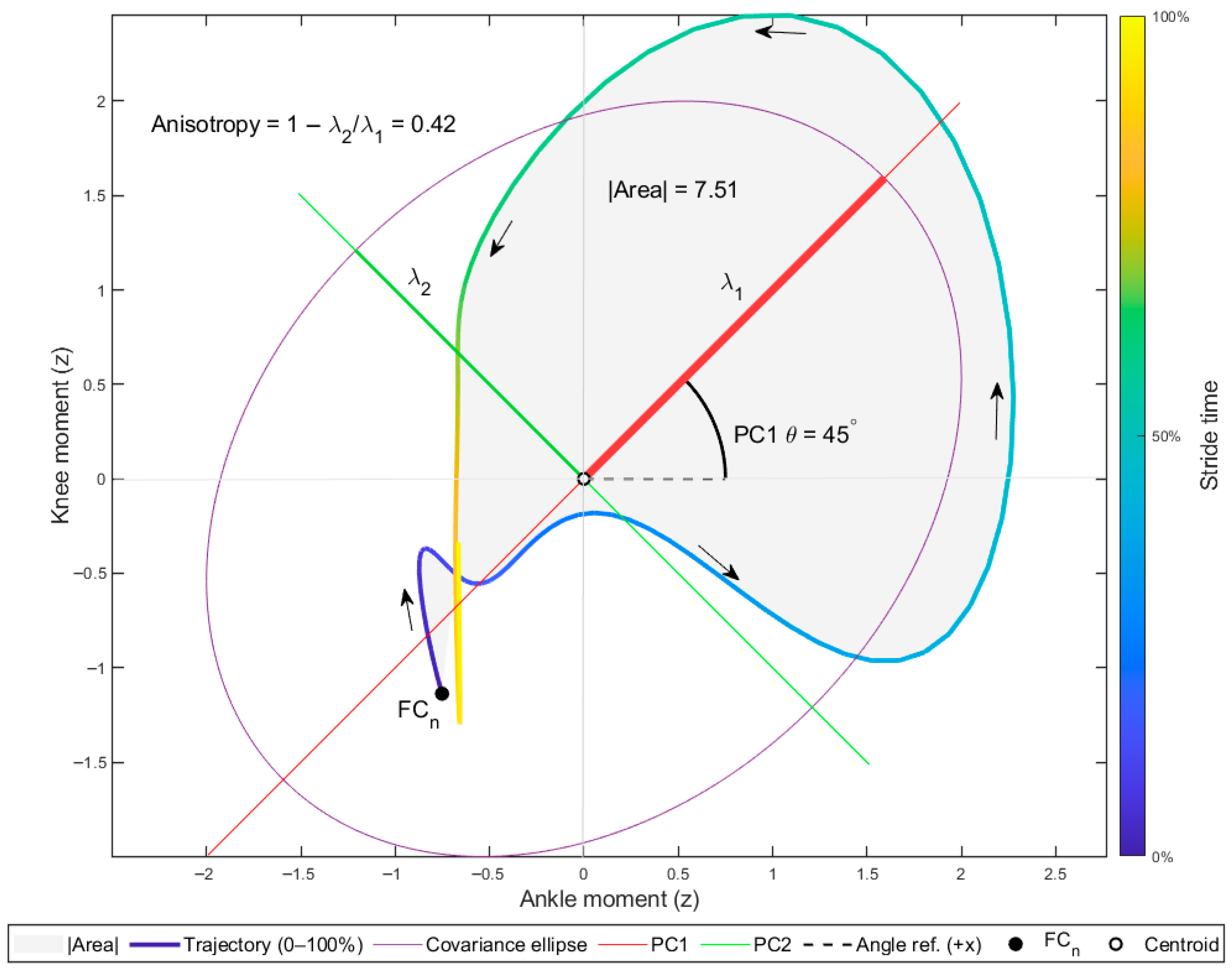
2.2. Construction of Ankle–Knee Moment–Moment Phase Space
2.3. Quantification of Coordination Topology
2.3.1. Loop Magnitude (|Area|)
2.3.2. Principal Axis Orientation
2.3.3. Shape Anisotropy
2.4. Aggregation
2.5. Statistical Analysis
3. Results
3.1. Sample and Task Distribution
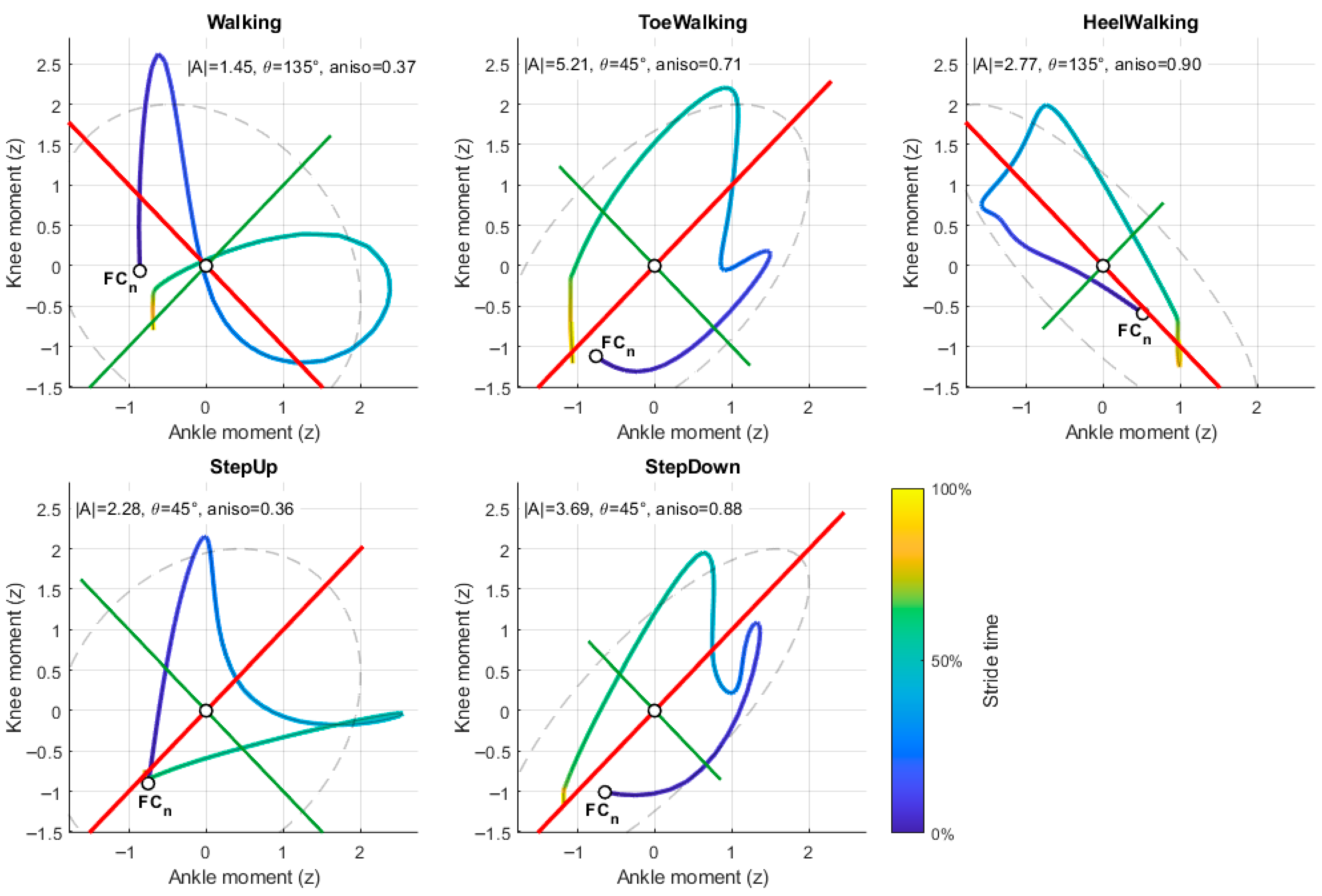
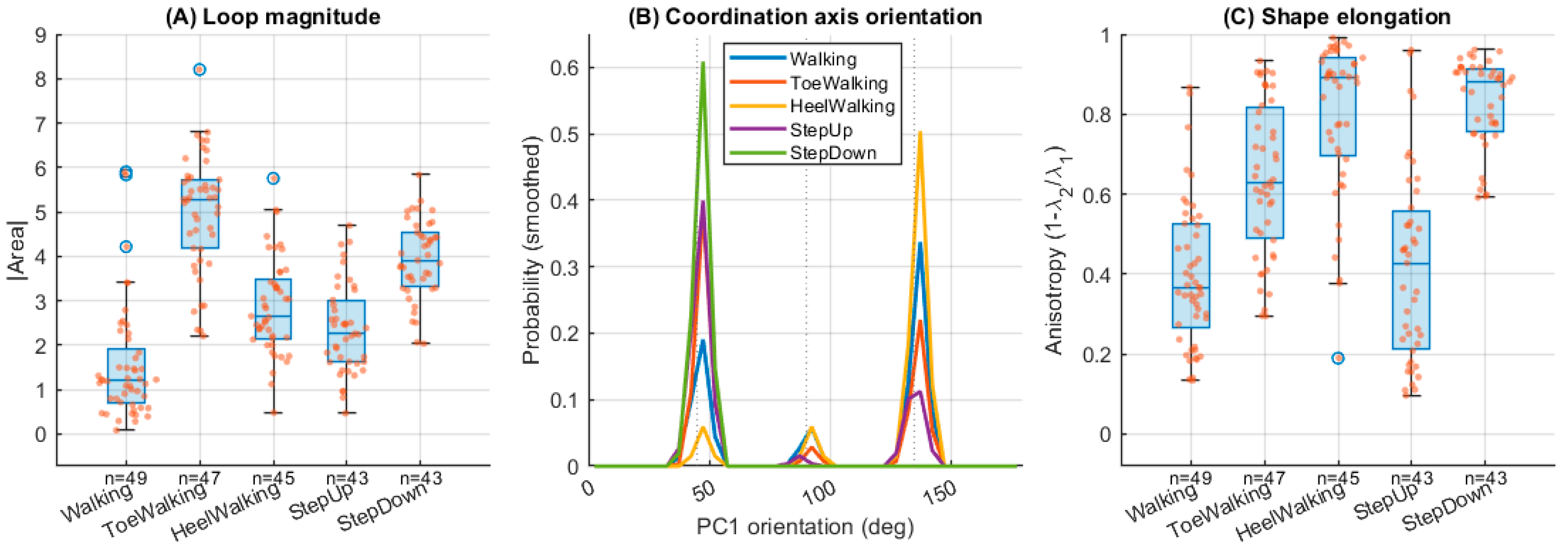
3.2. Loop Magnitude (|Area|)
3.3. Principal Axis Orientation (Relative to Walking)
3.4. Shape Anisotropy
3.5. Summary of Task Effects
4. Discussion
4.1. Task-Dependent Reorganization of Coordination Topology
4.2. Coordination as a Geometric Object Rather than a Waveform Property
4.3. Mechanical Demands Shape Coordination Geometry
4.4. From Joint-Level Descriptions to Coordination-Level Representations
4.5. Implications for Assistive Technologies and Adaptive Control
4.6. Limitations
5. Conclusions
Author Contributions
Funding
Institutional Review Board Statement
Informed Consent Statement
Data Availability Statement
Conflicts of Interest
Abbreviations
| Abbreviation | Definition |
| PCA | Principal Component Analysis |
| PC1 | First Principal Component |
| PC2 | Second Principal Component |
| GRF | Ground Reaction Force |
| CI | Confidence Interval |
| SE | Standard Error |
| IQR | Interquartile Range |
| FCn | Normalized Foot Contact |
Appendix A. Validation of Moment–Moment Loop Geometry
Appendix A.1. Loop Area
Appendix A.2. Loop Perimeter
Appendix A.3. Principal Component Orientation and Anisotropy
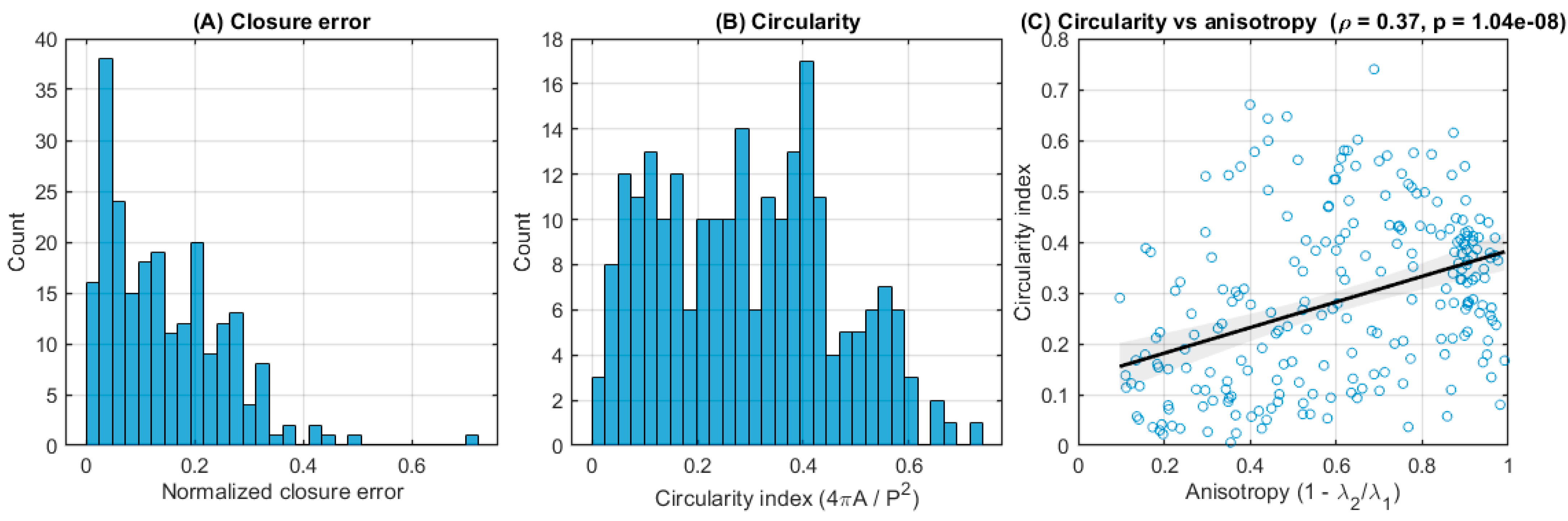
Appendix A.4. Circularity Index
Appendix A.5. Loop Closure Error
Appendix A.6. Loop Validity Metrics

References
- Kuo, A.D.; Donelan, J.M.; Ruina, A. Energetic consequences of walking like an inverted pendulum: Step-to-step transitions. Exerc. Sport Sci. Rev. 2005, 33, 88–97. [Google Scholar] [CrossRef]
- Winter, D.A. Biomechanics and Motor Control of Human Movement, 4th ed.; Wiley: Hoboken, NJ, USA, 2009. [Google Scholar]
- McFadyen, B.J.; Winter, D.A. An integrated biomechanical analysis of normal stair ascent and descent. J. Biomech. 1988, 21, 733–744. [Google Scholar] [CrossRef]
- Nadeau, S.; McFadyen, B.J.; Malouin, F. Frontal and sagittal plane analyses of the stair climbing task in healthy adults aged over 40 years. Clin. Biomech. 2003, 18, 950–959. [Google Scholar] [CrossRef]
- Riener, R.; Rabuffetti, M.; Frigo, C. Stair ascent and descent at different inclinations. Gait Posture 2002, 15, 32–44. [Google Scholar] [CrossRef]
- Farris, D.J.; Sawicki, G.S. The mechanics and energetics of human walking and running: A joint level perspective. J. R. Soc. Interface 2012, 9, 110–118. [Google Scholar] [CrossRef]
- Zelik, K.E.; Adamczyk, P.G. A unified perspective on ankle push-off in human walking. J. Exp. Biol. 2016, 219, 3676–3683. [Google Scholar] [CrossRef] [PubMed]
- Bernstein, N.A. The Coordination and Regulation of Movements; Pergamon Press: Oxford, UK, 1967. [Google Scholar]
- Latash, M.L. The bliss (not the problem) of motor abundance (not redundancy). Exp. Brain Res. 2012, 217, 1–5. [Google Scholar] [CrossRef]
- Scholz, J.P.; Schöner, G. The uncontrolled manifold concept: Identifying control variables for a functional task. Exp. Brain Res. 1999, 126, 289–306. [Google Scholar] [CrossRef]
- Hershler, C.; Milner, M. Angle–angle diagrams in the assessment of locomotion. Am. J. Phys. Med. 1980, 59, 109–125. [Google Scholar] [PubMed]
- Goswami, A. A new gait parameterization technique by means of cyclogram moments: Application to human slope walking. Gait Posture 1998, 8, 15–36. [Google Scholar] [CrossRef] [PubMed]
- Sparrow, W.A.; Donovan, E.; van Emmerik, R.; Barry, E.B. Using relative motion plots to measure changes in intra-limb and inter-limb coordination. J. Mot. Behav. 1987, 19, 115–129. [Google Scholar] [CrossRef]
- Daffertshofer, A.; Lamoth, C.J.C.; Meijer, O.G.; Beek, P.J. PCA in studying coordination and variability: A tutorial. Clin. Biomech. 2004, 19, 415–428. [Google Scholar] [CrossRef] [PubMed]
- Stergiou, N.; Decker, L.M. Human movement variability, nonlinear dynamics, and pathology: Is there a connection? Hum. Mov. Sci. 2011, 30, 869–888. [Google Scholar] [CrossRef] [PubMed]
- Prilutsky, B.I. Coordination of two- and one-joint muscles: Functional consequences and implications for motor control. Mot. Control 2000, 4, 1–44. [Google Scholar] [CrossRef] [PubMed]
- Lencioni, T.; Carpinella, I.; Rabuffetti, M.; Marzegan, A.; Ferrarin, M. Human kinematic, kinetic and EMG data during different walking and stair ascending and descending tasks. Sci. Data 2019, 6, 309. [Google Scholar] [CrossRef]
- Kelso, J.A.S. Dynamic Patterns: The Self-Organization of Brain and Behavior; MIT Press: Cambridge, MA, USA, 1995. [Google Scholar]
- Neptune, R.R.; Zajac, F.E.; Kautz, S.A. Muscle force redistributes segmental power for body progression during walking. Gait Posture 2004, 19, 194–205. [Google Scholar] [CrossRef]
- Sparrow, W.A. Energetics of Human Activity; Human Kinetics: Champaign, IL, USA, 2000. [Google Scholar]
- Enoka, R.M. Neuromechanics of Human Movement, 4th ed.; Human Kinetics: Champaign, IL, USA, 2008. [Google Scholar]
- Sternad, D. It’s not (only) the mean that matters: Variability, noise and exploration in skill learning. Curr. Opin. Behav. Sci. 2018, 20, 183–195. [Google Scholar] [CrossRef]
- Cusumano, J.P.; Dingwell, J.B. Movement variability near goal-equivalent manifolds: Fluctuations, control, and model-based analysis. Hum. Mov. Sci. 2013, 32, 899–923. [Google Scholar] [CrossRef]
- Dingwell, J.B.; Cusumano, J.P. Nonlinear time series analysis of normal and pathological human walking. Chaos 2000, 10, 848–863. [Google Scholar] [CrossRef]
- Latash, M.L.; Scholz, J.P.; Schöner, G. Motor control strategies revealed in the structure of motor variability. Exerc. Sport Sci. Rev. 2002, 30, 26–31. [Google Scholar] [CrossRef]
- Müller, H.; Sternad, D. Decomposition of variability in the execution of goal-oriented tasks. J. Exp. Psychol. Hum. Percept. Perform. 2004, 30, 212–233. [Google Scholar] [CrossRef]
- Singh, R.E.; Iqbal, K.; White, G.; Hutchinson, T.E. A systematic review on muscle synergies: From building blocks of motor behavior to a neurorehabilitation tool. Appl. Bionics Biomech. 2018, 2018, 3615368. [Google Scholar] [CrossRef]
- Zelik, K.E.; Kuo, A.D. Mechanical work as an indirect measure of subjective costs influencing human movement. PLoS ONE 2012, 7, e31143. [Google Scholar]
- Liew, B.X.; Rugamer, D.; Duffy, K.; Taylor, M.; Jackson, J. The mechanical energetics of walking across the adult lifespan. PLoS ONE 2021, 16, e0259817. [Google Scholar]
- Newell, K.M. Constraints on the development of coordination. In Motor Development in Children: Aspects of Coordination and Control; Wade, M.G., Whiting, H.T.A., Eds.; Martinus Nijhoff: Dordrecht, The Netherlands, 1986; pp. 341–360. [Google Scholar]
- Ting, L.H.; Chvatal, S.A.; Safavynia, S.A.; McKay, J.L. Neuromechanical principles underlying movement modularity and their implications for rehabilitation. Neuron 2015, 86, 38–54. [Google Scholar] [CrossRef] [PubMed]
- Borzelli, D.; De Marchis, C.; Quercia, A.; De Pasquale, P.; Casile, A.; Quartarone, A.; Calabrò, R.S.; D’avella, A. Muscle synergy analysis as a tool for assessing the effectiveness of gait rehabilitation therapies: A methodological review. Bioengineering 2024, 11, 793. [Google Scholar] [CrossRef]
- Ivanenko, Y.P.; Cappellini, G.; Dominici, N.; Poppele, R.E.; Lacquaniti, F. Modular control of limb movements during human locomotion. J. Neurosci. 2007, 27, 11149–11161. [Google Scholar] [CrossRef] [PubMed]
- Zhang, J.; Fiers, P.; Witte, K.A.; Jackson, R.W.; Poggensee, K.L.; Atkeson, C.G.; Collins, S.H. Human-in-the-loop optimization of exoskeleton assistance during walking. Science 2017, 356, 1280–1284. [Google Scholar]
- Ding, Y.; Kim, M.; Kuindersma, S.; Walsh, C.J. Human-in-the-loop optimization of hip assistance with a soft exosuit during walking. Sci. Robot. 2018, 3, eaar5438. [Google Scholar] [PubMed]
- Zhang, Q.; Zanotto, D.; Sharifi, M.; Kim, M.; Li, Z. Closing the loop between wearable robots and machine learning: A new paradigm for assistance personalization control. In Discovering the Frontiers of Human-Robot Interaction; Springer: Cham, Switzerland, 2024; pp. 65–101. [Google Scholar]
- Clark, D.J.; Ting, L.H.; Zajac, F.E.; Neptune, R.R.; Kautz, S.A. Merging of healthy motor modules predicts reduced locomotor performance and muscle coordination complexity post-stroke. J. Neurophysiol. 2010, 103, 844–857. [Google Scholar] [CrossRef]
- Roemmich, R.T.; Nocera, J.R.; Vallabhajosula, S.; Amano, S.; Naugle, K.M.; Stegemöller, E.L.; Hass, C.J. Spatiotemporal variability during gait initiation in Parkinson’s disease. Gait Posture 2012, 36, 340–343. [Google Scholar] [CrossRef] [PubMed]
- Hubley-Kozey, C.L.; Deluzio, K.J.; Landry, S.C.; McNutt, J.S.; Stanish, W.D. Neuromuscular alterations during walking in persons with moderate knee osteoarthritis. J. Electromyogr. Kinesiol. 2006, 16, 365–378. [Google Scholar] [CrossRef] [PubMed]
- Mannini, A.; Sabatini, A.M. Machine learning methods for classifying human physical activity from on-body accelerometers. Sensors 2010, 10, 1154–1175. [Google Scholar] [CrossRef] [PubMed]



| Task | N Subjects | N Strides | Median Speed (m/s) | Q1 (m/s) | Q3 (m/s) | IQR (m/s) |
|---|---|---|---|---|---|---|
| Walking | 49 | 331 | 1.261 | 1.133 | 1.306 | 0.173 |
| ToeWalking | 47 | 278 | 1.054 | 0.901 | 1.159 | 0.257 |
| HeelWalking | 45 | 178 | 0.713 | 0.625 | 0.836 | 0.211 |
| StepUp | 43 | 169 | 0.49 | 0.464 | 0.535 | 0.072 |
| StepDown | 43 | 146 | 0.494 | 0.455 | 0.561 | 0.105 |
| Outcome | F | Num DF | Den DF | p |
|---|---|---|---|---|
| Loop magnitude|Area| | 73.78278 | 4 | 222 | 1.11 × 10−39 |
| PC1 angle | 36.40173 | 4 | 222 | 2.19 × 10⁻²³ |
| Anisotropy | 54.87074 | 4 | 222 | 4.07 × 10⁻³² |
| ΔPC1 orientation (relative to walking) | 2.829259 | 4 | 218 | 0.025643 |
| Loop Magnitude (|Area|) | ||||||
| Contrast | Estimate | SE | t | DF | p (Holm) | 95% CI |
| Walking vs. ToeWalking | 3.446 | 0.22 | 15.66 | 222 | 3.91 × 10−37 | [3.01, 3.88] |
| Walking vs. HeelWalking | 1.355 | 0.223 | 6.08 | 222 | 1.02 × 10⁻⁸ | [0.92, 1.79] |
| Walking vs. StepUp | 0.814 | 0.226 | 3.61 | 222 | 3.82 × 10⁻⁴ | [0.37, 1.26] |
| Walking vs. StepDown | 2.406 | 0.226 | 10.67 | 222 | 3.09 × 10⁻²¹ | [1.96, 2.85] |
| Anisotropy | ||||||
| Contrast | Estimate | SE | t | DF | p (Holm) | 95% CI |
| Walking vs. ToeWalking | 0.245 | 0.038 | 6.46 | 222 | 1.31 × 10⁻⁹ | [0.17, 0.32] |
| Walking vs. HeelWalking | 0.402 | 0.038 | 10.49 | 222 | 1.08 × 10⁻²⁰ | [0.33, 0.48] |
| Walking vs. StepUp | 0.023 | 0.039 | 0.59 | 222 | 0.556 | [−0.05, 0.10] |
| Walking vs. StepDown | 0.436 | 0.039 | 11.24 | 222 | 6.95 × 10⁻²³ | [0.36, 0.51] |
| ΔPC1 orientation (relative to walking) | ||||||
| Contrast | Estimate (deg) | SE | t | DF | p (Holm) | 95% CI |
| Walking vs. ToeWalking | −15.01 | 9.11 | −1.65 | 218 | 0.303 | [−32.96, 2.95] |
| Walking vs. HeelWalking | −7.31 | 9.23 | −0.79 | 218 | 0.768 | [−25.50, 10.88] |
| Walking vs. StepUp | −8.17 | 9.36 | −0.87 | 218 | 0.768 | [−26.61, 10.28] |
| Walking vs. StepDown | −29.84 | 9.36 | −3.19 | 218 | 0.0066 | [−48.28, −11.39] |
Disclaimer/Publisher’s Note: The statements, opinions and data contained in all publications are solely those of the individual author(s) and contributor(s) and not of MDPI and/or the editor(s). MDPI and/or the editor(s) disclaim responsibility for any injury to people or property resulting from any ideas, methods, instructions or products referred to in the content. |
© 2026 by the authors. Licensee MDPI, Basel, Switzerland. This article is an open access article distributed under the terms and conditions of the Creative Commons Attribution (CC BY) license.
Share and Cite
Garofolini, A.; Sparrow, W.A.; Begg, R. Task-Dependent Reorganization of Ankle–Knee Mechanical Coordination Revealed by Moment–Moment Phase Space Analysis. J. Funct. Morphol. Kinesiol. 2026, 11, 201. https://doi.org/10.3390/jfmk11020201
Garofolini A, Sparrow WA, Begg R. Task-Dependent Reorganization of Ankle–Knee Mechanical Coordination Revealed by Moment–Moment Phase Space Analysis. Journal of Functional Morphology and Kinesiology. 2026; 11(2):201. https://doi.org/10.3390/jfmk11020201
Chicago/Turabian StyleGarofolini, Alessandro, William Anthony Sparrow, and Rezaul Begg. 2026. "Task-Dependent Reorganization of Ankle–Knee Mechanical Coordination Revealed by Moment–Moment Phase Space Analysis" Journal of Functional Morphology and Kinesiology 11, no. 2: 201. https://doi.org/10.3390/jfmk11020201
APA StyleGarofolini, A., Sparrow, W. A., & Begg, R. (2026). Task-Dependent Reorganization of Ankle–Knee Mechanical Coordination Revealed by Moment–Moment Phase Space Analysis. Journal of Functional Morphology and Kinesiology, 11(2), 201. https://doi.org/10.3390/jfmk11020201