
Clinical, Psychological, and Social Determinants of Brace Compliance in Adolescent Idiopathic Scoliosis: A Systematic Review and Meta-Analysis

 ,
,  ,
,  , , and
Abstract
1. Introduction
2. Materials and Methods
2.1. Study Design
2.2. Search Strategy
2.3. Eligibility Criteria and Outcomes of Interest
2.4. Study Selection
2.5. Data Extraction
2.6. Quality Assessment
2.7. Definition and Standardization of Adherence
2.8. Statistical Analysis
3. Results
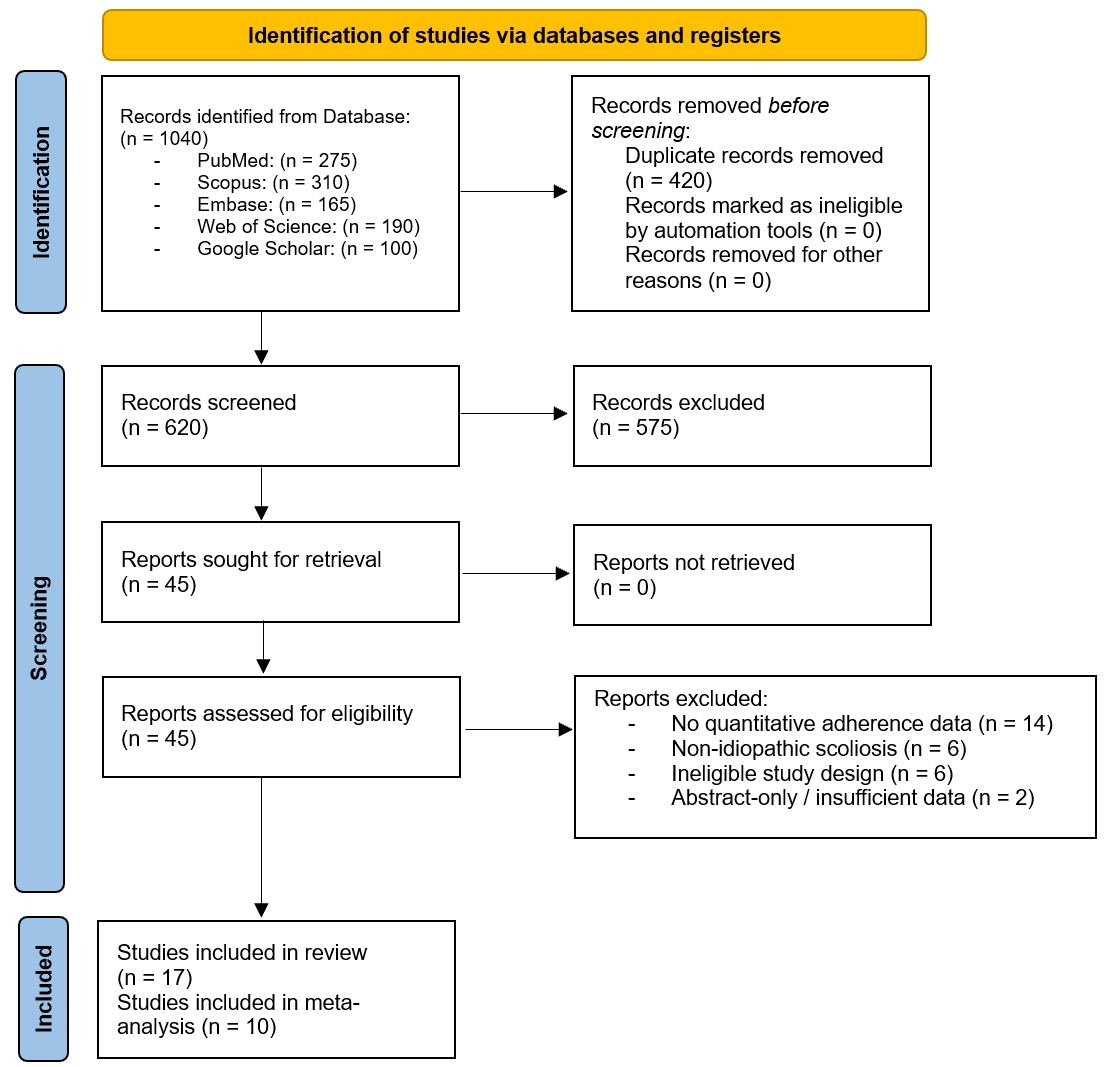
3.1. Study Selection
3.2. Study Characteristics
3.3. Determinants of Brace Compliance
3.3.1. Positive Factors
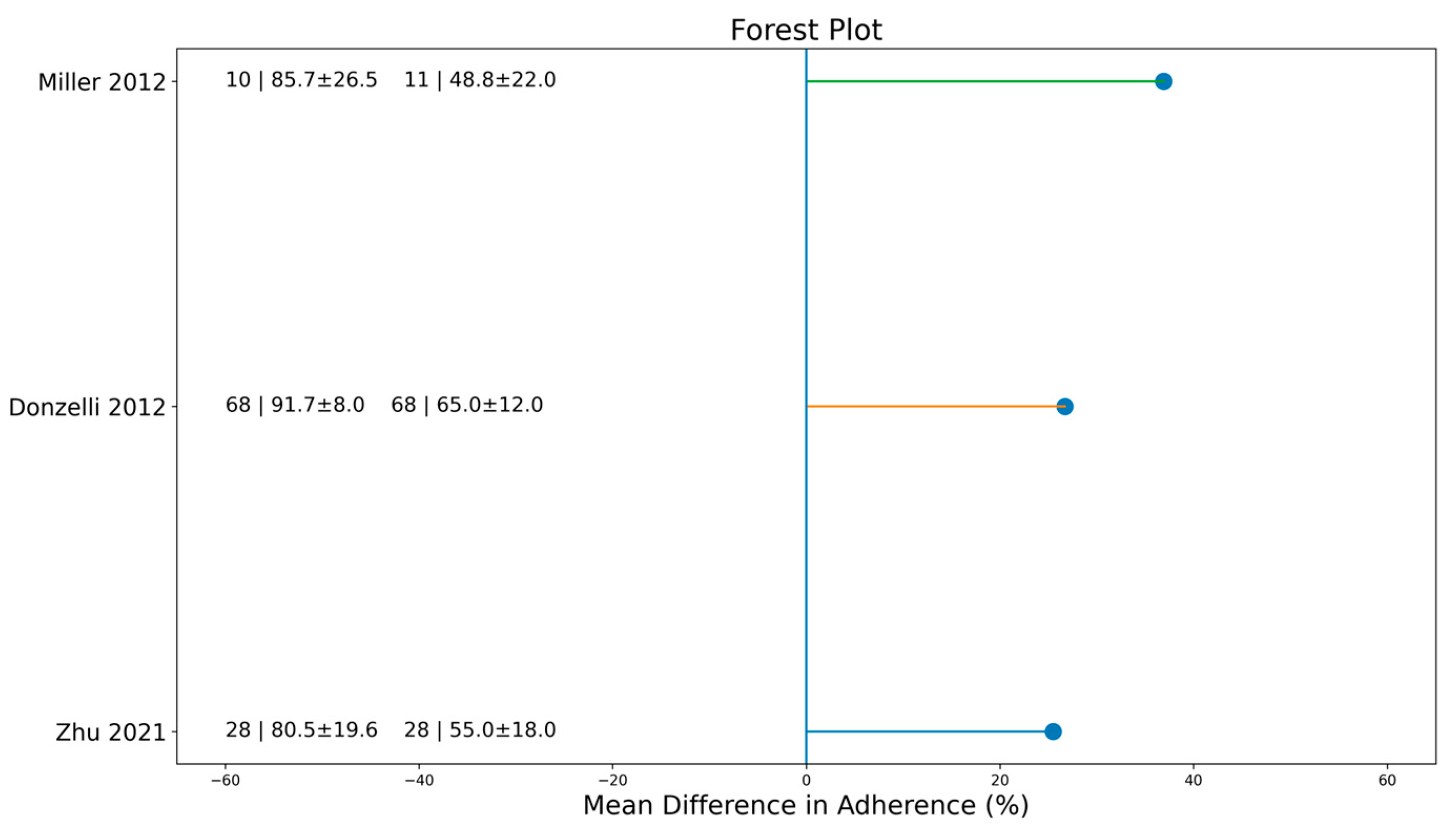
- Use of sensors
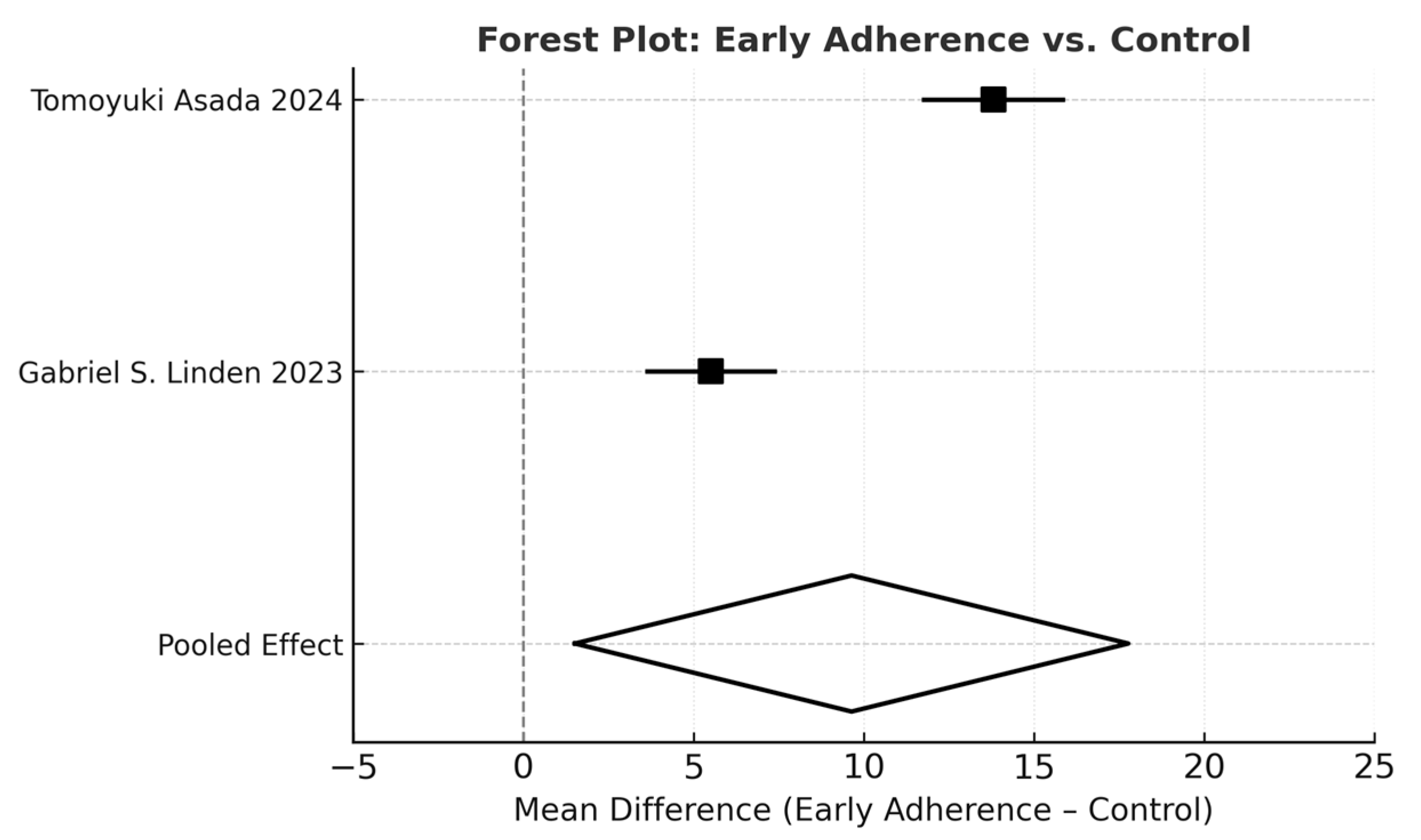
- Early adherence
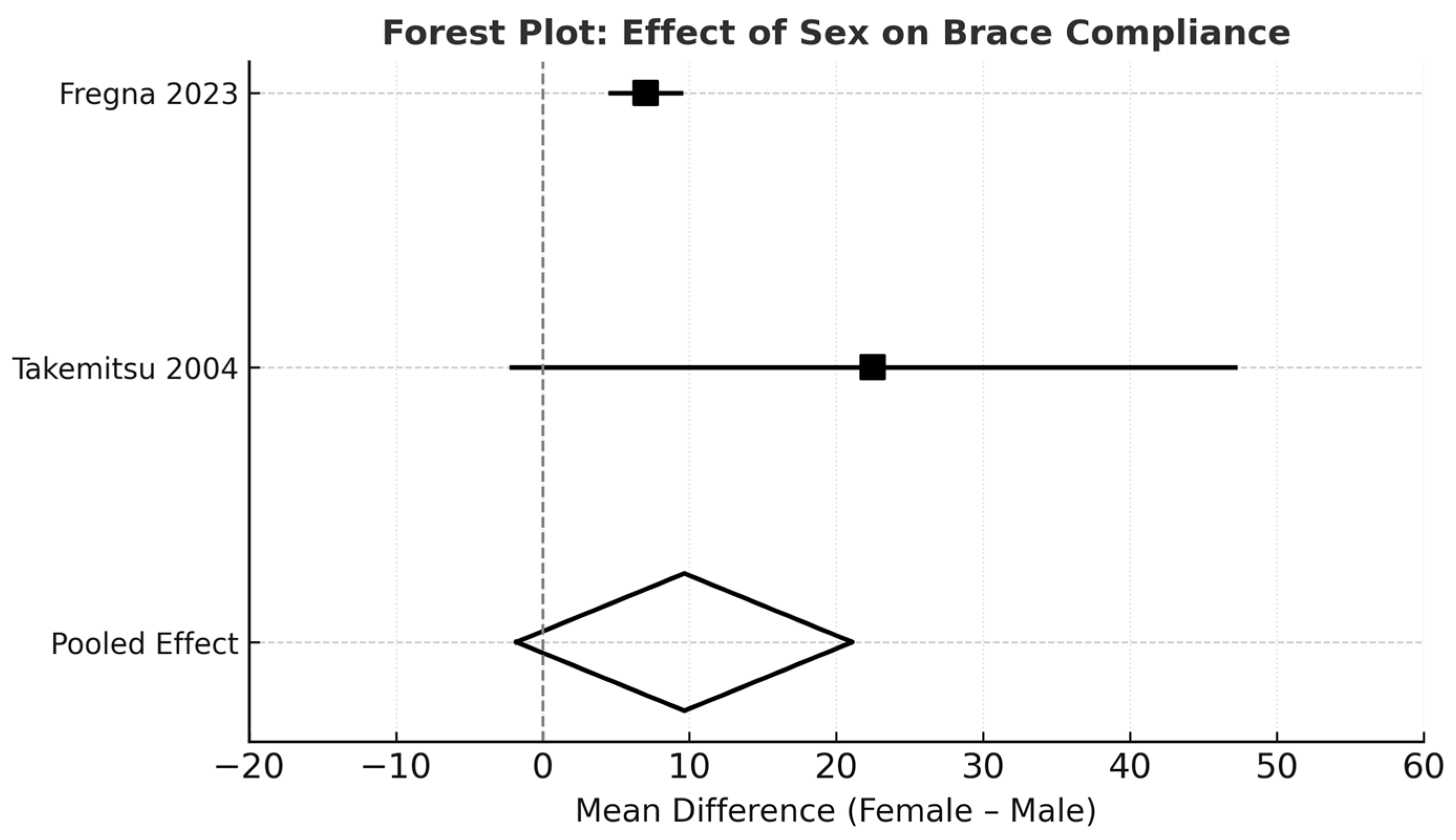
- Sex
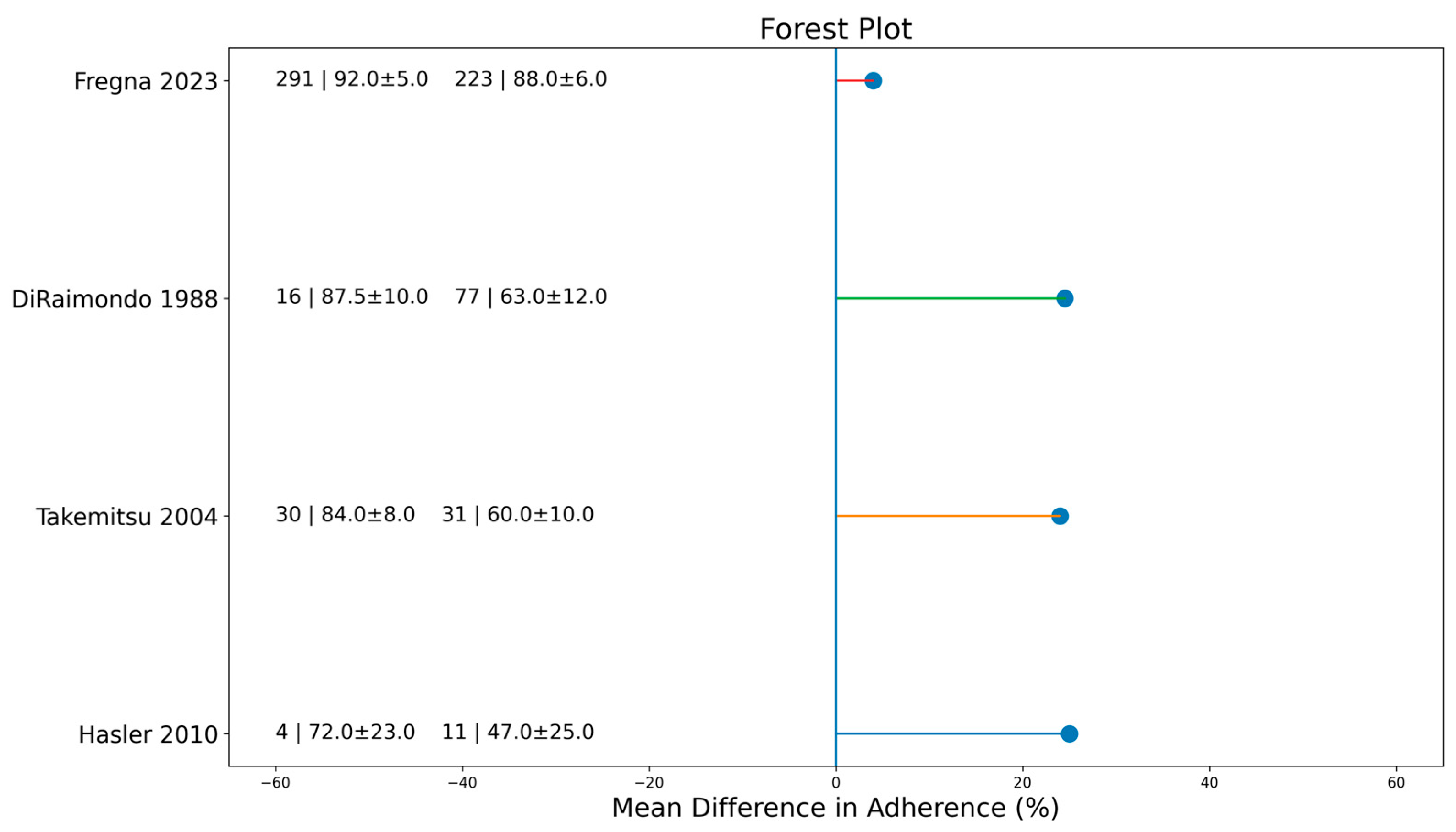
- Age
- Counseling
- Mindfulness-based intervention (MBrace)
- BMI and psychosocial support
3.3.2. Negative Factors
- Trunk appearance, body image, and older age
- Stress and quality of life
- Overweight and obesity
3.3.3. Neutral Factors
3.4. Meta-Analysis
4. Discussion
4.1. Objective Monitoring Systems
4.2. Early Adherence and the Initial Adaptation Phase
4.3. Age and Sex Differences
4.4. Psychological Determinants: Body Image, Stress, and Quality of Life
4.5. Social and Family Environment
4.6. Brace Design, Fit, Comfort, and BMI
4.7. Alignment with International Clinical Guidelines
4.8. Digital Tools, Artificial Intelligence, and Future Technologies
4.9. Clinical Implications
- early optimization of brace fit and comfort;
- structured early adaptation protocols;
- routine psychological assessment and counseling;
- active parental participation;
- integration of objective monitoring systems.
4.10. Strengths and Limitations
5. Conclusions
Supplementary Materials
Author Contributions
Funding
Institutional Review Board Statement
Informed Consent Statement
Data Availability Statement
Conflicts of Interest
Abbreviations
| AIS | Adolescent Idiopathic Scoliosis |
| BMI | Body Mass Index |
| CI | Confidence Interval |
| I2 | Inconsistency Index |
| MBrace | Mindfulness-Based Brace Intervention |
| NOS | Newcastle–Ottawa Scale |
| OR | Odds Ratio |
| PRISMA | Preferred Reporting Items for Systematic Reviews and Meta-Analyses |
| SD | Standard Deviation |
| SRS | Scoliosis Research Society |
| SOSORT | Society on Scoliosis Orthopaedic and Rehabilitation Treatment |
References
- Suh, S.-W.; Modi, H.N.; Yang, J.-H.; Hong, J.-Y. Idiopathic scoliosis in Korean schoolchildren: A prospective screening study of over 1 million children. Eur. Spine J. 2011, 20, 1087–1094. [Google Scholar] [CrossRef]
- Daruwalla, J.; Balasubramaniam, P.; Chay, S.; Rajan, U.; Lee, H. Idiopathic scoliosis. Prevalence and ethnic distribution in Singapore schoolchildren. J. Bone Jt. Surgery. Br. Vol. 1985, 67-B, 182–184. [Google Scholar] [CrossRef]
- Cheng, J.C.; Castelein, R.M.; Chu, W.C.; Danielsson, A.J.; Dobbs, M.B.; Grivas, T.B.; Gurnett, C.A.; Luk, K.D.; Moreau, A.; Newton, P.O.; et al. Adolescent idiopathic scoliosis. Nat. Rev. Dis. Prim. 2015, 1, 15030, Correction in Nat. Rev. Dis. Prim. 2015, 1, 15068. https://doi.org/10.1038/nrdp.2015.68. [Google Scholar] [CrossRef]
- Weinstein, S.L.; Dolan, L.A.; Wright, J.G.; Dobbs, M.B. Effects of Bracing in Adolescents with Idiopathic Scoliosis. N. Engl. J. Med. 2013, 369, 1512–1521. [Google Scholar] [CrossRef]
- Roye, B.D.; Simhon, M.E.; Matsumoto, H.; Bakarania, P.; Berdishevsky, H.; Dolan, L.A.; Grimes, K.; Grivas, T.B.; Hresko, M.T.; Karol, L.A.; et al. Establishing consensus on the best practice guidelines for the use of bracing in adolescent idiopathic scoliosis. Spine Deform. 2020, 8, 597–604. [Google Scholar] [CrossRef]
- Takemitsu, M.; Bowen, J.R.; Rahman, T.; Glutting, J.J.; Scott, C.B. Compliance Monitoring of Brace Treatment for Patients with Idiopathic Scoliosis. Spine 2004, 29, 2070–2074. [Google Scholar] [CrossRef] [PubMed]
- Miller, D.J.; Franzone, J.M.; Matsumoto, H.; Gomez, J.A.; Avendaño, J.; Hyman, J.E.; Roye, D.P., Jr.; Vitale, M.G. Electronic Monitoring Improves Brace-Wearing Compliance in Patients with Adolescent Idiopathic Scoliosis: A Randomized Clinical Trial. Spine 2012, 37, 717–721. [Google Scholar] [CrossRef] [PubMed]
- Donzelli, S.; Zaina, F.; Negrini, S. In defense of adolescents: They really do use braces for the hours prescribed, if good help is provided. Results from a prospective everyday clinic cohort using thermobrace. Scoliosis 2012, 7, 12. [Google Scholar] [CrossRef]
- Linden, G.S.B.; Emans, J.B.; Karlin, L.I.; O’neill, N.P.B.; Williams, K.A.; Hresko, M.T. Early Adherence to Prescribed Brace Wear for Adolescent Idiopathic Scoliosis Is Associated With Future Brace Wear. Spine 2023, 48, 8–14. [Google Scholar] [CrossRef] [PubMed]
- Zhu, C.; Wu, Q.; Xiao, B.; Wang, J.; Luo, C.; Yu, Q.; Liu, L.; Song, Y. A compliance real-time monitoring system for the management of the brace usage in adolescent idiopathic scoliosis patients: A pilot study. BMC Musculoskelet. Disord. 2021, 22, 152. [Google Scholar] [CrossRef]
- Misterska, E.; Glowacki, M.; Adamczyk, K.; Glowacki, J.; Harasymczuk, J. A longitudinal study of alexithymia in relation to physical activity in adolescent females with scoliosis subjected to cheneau brace treatment: Preliminary report. Spine 2014, 39, E1026–E1034. [Google Scholar] [CrossRef] [PubMed]
- Misterska, E.; Glowacki, J.; Kołban, M. Does rigid spinal orthosis carry more psychosocial implications than the flexible brace in AIS patients? A cross-sectional study. J. Back Musculoskelet. Rehabil. 2019, 32, 101–109. [Google Scholar] [CrossRef] [PubMed]
- Karol, L.A.; Virostek, D.; Felton, K.; Jo, C.; Butler, L. The Effect of the Risser Stage on Bracing Outcome in Adolescent Idiopathic Scoliosis. J. Bone Jt. Surg. 2016, 98, 1253–1259. [Google Scholar] [CrossRef]
- Gornitzky, A.L.; England, P.B.; Kiani, S.N.; Yellin, J.L.; Flynn, J.M. Why Don’t Adolescents Wear Their Brace? A Prospective Study Investigating Psychosocial Characteristics That Predict Scoliosis Brace Wear. J. Pediatr. Orthop. 2023, 43, 51–60. [Google Scholar] [CrossRef]
- DiRaimondo, C.V.; Green, N.E. Brace-wear compliance in patients with adolescent idiopathic scoliosis. J. Pediatr. Orthop. 1988, 8, 143–146. [Google Scholar] [CrossRef]
- Hasler, C.C.; Wietlisbach, S.; Büchler, P. Objective compliance of adolescent girls with idiopathic scoliosis in a dynamic SpineCor brace. J. Child. Orthop. 2010, 4, 211–218. [Google Scholar] [CrossRef]
- Fregna, G.; Rossi Raccagni, S.; Negrini, A.; Zaina, F.; Negrini, S. Personal and Clinical Determinants of Brace-Wearing Time in Adolescents with Idiopathic Scoliosis. Sensors 2023, 24, 116. [Google Scholar] [CrossRef]
- Asada, T.; Kotani, T.; Sakuma, T.; Iijima, Y.; Sakashita, K.; Ogata, Y.; Akazawa, T.; Minami, S.; Ohtori, S.; Koda, M.; et al. Factors Influencing Optimal Bracing Compliance in Adolescent Idiopathic Scoliosis: A Single-center Prospective Cohort Study. Spine 2024, 49, 1708–1715. [Google Scholar] [CrossRef]
- Li, X.; Lau, E.N.S.; Chan, S.K.C.; Lam, T.P.; Cheng, J.C.Y.; Lee, E.K.P.; Wong, S.Y.S.; Yip, B.H.K. Effects of Mindfulness-Based Intervention to Improve Bracing Compliance in Adolescent Idiopathic Scoliosis Patients: A Randomized Controlled Trial. Mindfulness 2023, 14, 322–334. [Google Scholar] [CrossRef]
- Asada, T.; Kotani, T.; Sakuma, T.; Iijima, Y.; Nakayama, K.; Inage, K.; Shiga, Y.; Akazawa, T.; Minami, S.; Ohtori, S.; et al. Impact of Brace-Related Stress on Brace Compliance in Adolescent Idiopathic Scoliosis: A Single-Center Comparative Study Using Objective Compliance Measurement and Brace-Related Stress. Spine Surg. Relat. Res. 2023, 7, 377–384. [Google Scholar] [CrossRef] [PubMed]
- Schwieger, T.; Campo, S.; Weinstein, S.L.; Dolan, L.A.; Ashida, S.; Steuber, K.R. Body Image and Quality of Life and Brace Wear Adherence in Females with Adolescent Idiopathic Scoliosis. J. Pediatr. Orthop. 2017, 37, e519–e523. [Google Scholar] [CrossRef]
- Negrini, S.; Donzelli, S.; Aulisa, A.G.; Czaprowski, D.; Schreiber, S.; De Mauroy, J.C.; Diers, H.; Grivas, T.B.; Knott, P.; Kotwicki, T.; et al. 2016 SOSORT guidelines: Orthopaedic and rehabilitation treatment of idiopathic scoliosis during growth. Scoliosis Spinal Disord. 2018, 13, 3. [Google Scholar] [CrossRef]
- Bettany-Saltikov, J.; Parent, E.; Romano, M.; Villagrasa, M.; Negrini, S. Physiotherapeutic scoliosis-specific exercises for adolescents with idiopathic scoliosis. Eur. J. Phys. Rehabil. Med. 2014, 50, 111–121. [Google Scholar]
- Katz, D.E.; Herring, J.A.; Browne, R.H.; Kelly, D.M.; Birch, J.G. Brace Wear Control of Curve Progression in Adolescent Idiopathic Scoliosis. J. Bone Jt. Surg. 2010, 92, 1343–1352. [Google Scholar] [CrossRef]
- Lou, E.; Raso, J.; Hill, D.; Durdle, N.; Mahood, J.; Moreau, M. Brace monitoring system for the treatment of scoliosis. Stud. Health Technol. Inform. 2002, 88, 218–221. [Google Scholar]
- Schiller, J.R.; Thakur, N.A.; Eberson, C.P. Brace Management in Adolescent Idiopathic Scoliosis. Clin. Orthop. Relat. Res. 2010, 468, 670–678. [Google Scholar] [CrossRef] [PubMed]
- Alyafei, A.; Easton-Carr, R. The Health Belief Model of Behavior Change. In StatPearls; StatPearls Publishing: Treasure Island, FL, USA, 2025. [Google Scholar]
- Patrick, H.; Williams, G.C. Self-determination theory: Its application to health behavior and complementarity with motivational interviewing. Int. J. Behav. Nutr. Phys. Act. 2012, 9, 18. [Google Scholar] [CrossRef] [PubMed]
- Korbel, K.; Kozinoga, M.; Stoliński, Ł.; Kotwicki, T. Scoliosis Research Society (SRS) Criteria and Society of Scoliosis Orthopaedic and Rehabilitation Treatment (SOSORT) 2008 Guidelines in Non-Operative Treatment of Idiopathic Scoliosis. Pol. Orthop. Traumatol. 2014, 79, 118–122. [Google Scholar] [PubMed]
- Kaspiris, A.; Spyrou, I.; Panagopoulos, F.; Marougklianis, V.; Pelantis, P.; Vavourakis, M.; Sakellariou, E.; Lianou, I.; Ntourantonis, D.; Repantis, T.; et al. Surgical Strategies and Challenges in Scheuermann’s Kyphosis: A Comprehensive Review. J. Clin. Med. 2025, 14, 4276. [Google Scholar] [CrossRef]
- Reichel, D.; Schanz, J. Developmental psychological aspects of scoliosis treatment. Pediatr. Rehabil. 2003, 6, 221–225. [Google Scholar] [CrossRef]
- Negrini, A.; Donzelli, S.; Lusini, M.; Minnella, S.; Zaina, F.; Negrini, S. A cognitive behavioral approach allows improving brace wearing compliance: An observational controlled retrospective study with thermobrace. Scoliosis 2014, 9, O79. [Google Scholar] [CrossRef][Green Version]
- Modi, A.C.; Pai, A.L.; Hommel, K.A.; Hood, K.K.; Cortina, S.; Hilliard, M.E.; Guilfoyle, S.M.; Gray, W.N.; Drotar, D. Pediatric Self-management: A Framework for Research, Practice, and Policy. Pediatrics 2012, 129, e473–e485. [Google Scholar] [CrossRef]
- MacLean, W.E.; Green, N.E.; Pierre, C.B.; Ray, D.C. Stress and coping with scoliosis: Psychological effects on adolescents and their families. J. Pediatr. Orthop. 1989, 9, 257–261. [Google Scholar] [CrossRef]
- Clin, J.; Aubin, C.; Parent, S.; Labelle, H. Biomechanical modeling of brace treatment of scoliosis: Effects of gravitational loads. Med. Biol. Eng. Comput. 2011, 49, 743–753. [Google Scholar] [CrossRef]
- Rahman, T.; Borkhuu, B.; Littleton, A.G.; Sample, W.; Moran, E.; Campbell, S.; Rogers, K.; Bowen, J.R. Electronic monitoring of scoliosis brace wear compliance. J. Child. Orthop. 2010, 4, 343–347. [Google Scholar] [CrossRef]
- Mazarakis, N.K.; Koutsarnakis, C.; Komaitis, S.; Drosos, E.; Demetriades, A.K. Reflections on the future of telemedicine and virtual spinal clinics in the post COVID-19 era. Brain Spine 2022, 2, 100930. [Google Scholar] [CrossRef] [PubMed]
- Page, M.J.; McKenzie, J.E.; Bossuyt, P.M.; Boutron, I.; Hoffmann, T.C.; Mulrow, C.D.; Shamseer, L.; Tetzlaff, J.M.; Akl, E.A.; Brennan, S.E.; et al. The PRISMA 2020 statement: An updated guideline for reporting systematic reviews. BMJ 2021, 372, n71. [Google Scholar] [CrossRef] [PubMed]



| Author (Year) | Total Patients | Mean Age | Age Range | Cobb Angle Range | Risser Stage | Male | Female | Follow-Up (Months) | Brace Prescription (h/day) |
|---|---|---|---|---|---|---|---|---|---|
| Asada et al. [18] | 122 | 12.6 | 10–15 | 20–40 | – | 8 | 114 | 6 | 20 |
| Zhu et al. [10] | 28 | 12.4 | 10–15 | 25–40 | 0–2 | 5 | 21 | 6 | 23 |
| Chan et al. [12] | 42 | 12.6 | 11–15 | 25–40 | 0–2 | 0 | 42 | – | – |
| DiRaimondo et al. [15] | 76 | 13.3 | 8–15 | 25–40 | 0–2 | 0 | – | – | 23 |
| Linden et al. [9] | 60 | 12.5 | 10–14.8 | – | – | 10 | 50 | – | 18 |
| Karol et al. [13] | 171 | 12.3 | 10–16 | 25–40 | 0–2 | 6 | 165 | – | – |
| Li et al. [19] | 83 | 13.5 | 10–15 | 15–30 | – | 21 | 62 | 8 | 18 |
| Miller et al. [7] | 21 | 12.4 | 8–15 | 20–50 | 0–2 | 5 | 16 | 5 | 18 |
| Asada et al. [20] | 41 | 12.4 | 10–15 | 25–45 | 0–4 | 3 | 38 | 22 | 20 |
| Donzelli et al. [8] | 68 | 14.5 | 12–16 | 35–53 | – | 15 | 53 | 5 | 23 |
| Schwieger et al. [21] | 167 | 11.7 | – | 20–40 | – | 0 | 167 | – | 18 |
| Fregna et al. [17] | 514 | 13.8 | 12–15 | 25–45 | 0–4 | 90 | 424 | – | 22 |
| Karol et al. [13] | 175 | 12.3 | 10–14 | 25–45 | 0–2 | 16 | 159 | – | 19.5 |
| Rivett et al. [11] | 31 | 14.5 | 13–16 | 25–40 | – | 0 | 31 | – | 23 |
| Hasler et al. [16] | 15 | 13.1 | 11–15 | 20–43 | 0–3 | 0 | 15 | – | 23 |
| Takemitsu et al. [6] | 61 | 12.0 | 6–16 | 20–45 | 0–2 | 7 | 54 | 17 | 23 |
| Gornitzky et al. [14] | 41 | 12.5 | 11–14 | 26–36 | – | 4 | 37 | – | 18 |
| Total | 1716 | 12.8 | 8–16 | 15–53 | 0–4 | 190 | 1448 | 9 | 20.0 |
| Author (Year) | Determinant Type | Factor | Mean Compliance (%) | SD | Sample Size |
|---|---|---|---|---|---|
| Linden (2023) [9] | Positive | Female sex | – | – | – |
| Li (2023) [19] | Positive | MBrace system | – | – | – |
| Gornitzky (2023) [14] | Positive | Religious family | 98 | – | 6 |
| Linden (2023) [9] | Positive | Early adherence | 93.9 | 9.7 | 32 |
| Asada (2024) [20] | Positive | Early adherence | 92.2 | 1.5 | 72 |
| Fregna (2023) [17] | Positive | Early age | 92 | 5 | 291 |
| Donzelli (2012) [8] | Positive | Sensors | 91.7 | – | 68 |
| Fregna (2023) [17] | Positive | Female sex | 91 | 15.5 | 424 |
| DiRaimondo (1988) [15] | Positive | Early age | 87.5 | 10 | 16 |
| Miller (2012) [7] | Positive | Sensors | 85.7 | 26.5 | 10 |
| Takemitsu (2004) [6] | Positive | Early age | 84 | 8 | – |
| Karol (2016) [13] | Positive | Low BMI | 80 | 5 | 21 |
| Zhu (2021) [10] | Positive | Sensors | 80.5 | 19.6 | 28 |
| Takemitsu (2004) [6] | Positive | Female sex | 77.2 | – | 54 |
| Karol (2016) [13] | Positive | Counseling | 76.67 | 8.9 | 93 |
| Hasler (2010) [16] | Positive | Early age | 72 | 23 | 4 |
| Chan (2014) [12] | Negative | TAPS (poor appearance perception) | – | – | – |
| Fregna (2023) [17] | Negative | Older age (>14 years) | 88 | – | 223 |
| Asada (2023) [20] | Negative | Moderate stress | 65.2 | 7.1 | 14 |
| DiRaimondo (1988) [15] | Negative | Older age | 63 | – | 77 |
| Rivett (2009) [11] | Negative | Low quality of life | 62 | 7.6 | 11 |
| Karol (2019) [13] | Negative | Overweight/obesity | 60.5 | 5.8 | 30 |
| Pooled Mean–Positive Factors | 89.6 | – | – | ||
| Pooled Mean–Negative Factors | 67.7 | – | – |
Disclaimer/Publisher’s Note: The statements, opinions and data contained in all publications are solely those of the individual author(s) and contributor(s) and not of MDPI and/or the editor(s). MDPI and/or the editor(s) disclaim responsibility for any injury to people or property resulting from any ideas, methods, instructions or products referred to in the content. |
© 2026 by the authors. Licensee MDPI, Basel, Switzerland. This article is an open access article distributed under the terms and conditions of the Creative Commons Attribution (CC BY) license.
Share and Cite
Sapienza, M.; Vaccalluzzo, M.S.; Perricone, E.; Giannone, C.; Caldaci, A.; Musumeci, G.; Vescio, A.; Testa, G.; Pavone, V. Clinical, Psychological, and Social Determinants of Brace Compliance in Adolescent Idiopathic Scoliosis: A Systematic Review and Meta-Analysis. J. Funct. Morphol. Kinesiol. 2026, 11, 68. https://doi.org/10.3390/jfmk11010068
Sapienza M, Vaccalluzzo MS, Perricone E, Giannone C, Caldaci A, Musumeci G, Vescio A, Testa G, Pavone V. Clinical, Psychological, and Social Determinants of Brace Compliance in Adolescent Idiopathic Scoliosis: A Systematic Review and Meta-Analysis. Journal of Functional Morphology and Kinesiology. 2026; 11(1):68. https://doi.org/10.3390/jfmk11010068
Chicago/Turabian StyleSapienza, Marco, Marco Simone Vaccalluzzo, Emanuele Perricone, Carmelo Giannone, Alessia Caldaci, Giuseppe Musumeci, Andrea Vescio, Gianluca Testa, and Vito Pavone. 2026. "Clinical, Psychological, and Social Determinants of Brace Compliance in Adolescent Idiopathic Scoliosis: A Systematic Review and Meta-Analysis" Journal of Functional Morphology and Kinesiology 11, no. 1: 68. https://doi.org/10.3390/jfmk11010068
APA StyleSapienza, M., Vaccalluzzo, M. S., Perricone, E., Giannone, C., Caldaci, A., Musumeci, G., Vescio, A., Testa, G., & Pavone, V. (2026). Clinical, Psychological, and Social Determinants of Brace Compliance in Adolescent Idiopathic Scoliosis: A Systematic Review and Meta-Analysis. Journal of Functional Morphology and Kinesiology, 11(1), 68. https://doi.org/10.3390/jfmk11010068