2.5.1. Frame Equivariance
All three filter operations commute with a constant rotation of the reference frame. Represent such a rotation by left—translation with a fixed unit quaternion ; note that is a linear map of and, since , an orthogonal one. Relabeling the world frame by sends the reference vectors while leaving all body-frame quantities unchanged.
Each operation then carries the factor
through unchanged. The rotational term of (7) is a right-translation, which commutes with
by associativity, and the dissipation coefficient
is norm-invariant, so the prediction flow maps
to
. The QUEST estimate transforms as
, while the Fisher matrix
and hence
in (24) depend only on body-frame measurements and are unchanged. The sign selection (19) is invariant because
preserves inner products, and the additive update (18) commutes with
because
is linear. Composing these over a predict–update cycle, and initializing at
, gives
so the filter is left-invariant in the sense of invariant-observer theory [
24]: relabeling the world frame maps filter trajectories to filter trajectories. The same argument applies to a fixed change in body frame (right-translation, under which
undergoes a similarity that leaves its eigenvalues unchanged). Both properties are verified numerically to machine precision in the published simulation code.
2.5.3. Convergence of the Concentration
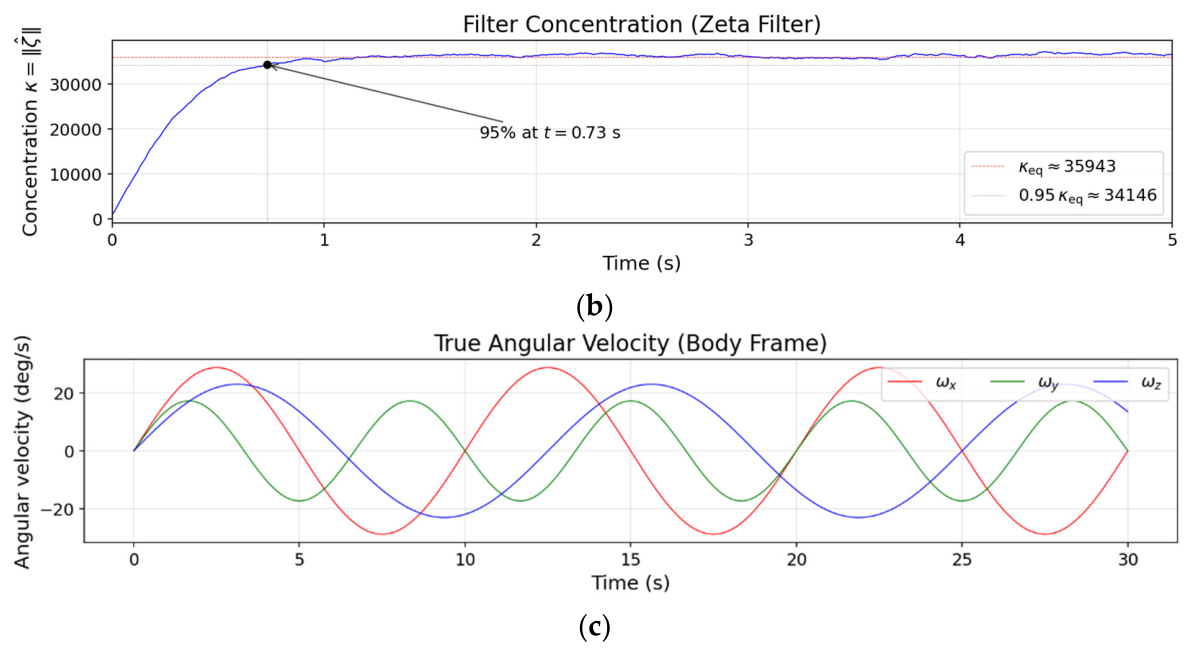
The prediction dynamics drive , while measurement updates increase . The combined predict–update cycle is shown below to confine the concentration to an attracting band around a unique equilibrium.
Let measurements arrive at intervals
with measurement concentration bounded as
, and denote the prediction (rational-decay) map by
. Because the antipodal selection of
Section 2.4 guarantees
, the post-update norm is sandwiched for any attitude disagreement:
where the upper bound is attained for aligned fusion and the lower bound for orthogonal fusion. Both bounding maps are monotone increasing in
with a unique attracting fixed point (
and
respectively; existence and uniqueness follow from the intermediate value theorem exactly as for the aligned map
: the net change
satisfies
). By monotone comparison, the concentration enters the invariant band
and remains there, regardless of the attitude error along the way. Moreover, the rational decay imposes a trajectory-independent ceiling,
for every
, so after a single cycle
uniformly in the initial condition—a consequence of the Riccati (quadratic) form of the dissipation. For small Δt the band collapses to the equilibrium concentration
2.5.4. Convergence of the Attitude Error
The preceding result concerns only the scalar concentration. The quantity of practical interest is the attitude error, and the structure of the filter permits a global statement about it. The analysis follows the standard pattern of attitude-observer stability proofs—a Lyapunov function of the attitude error with a per-step contraction bound [
9,
25]—adapted to the discrete additive update and inherits its trajectory independence from the frame equivariance established above [
24].
Define the quaternion-space misalignment
between the true attitude
and the estimate direction by
evaluated for the antipodal representative of
chosen in
Section 2.4; this makes
, so
, with the corresponding
error
covering the full range
.
Prediction is error-neutral. With an exact gyroscope, the true quaternion and the estimate share the same rotational drive,
and
with
. Right-translation by the pure quaternion
is an infinitesimally orthogonal map of
[
26], so with
and
the rotational terms cancel and both quantities obey
,
. Hence
: the misalignment
is exactly constant during prediction, and only
decays. The same property underlies the multiplicative EKF, whose body-frame attitude error is likewise unchanged by exact-gyro propagation [
21]. With gyroscope error
the two flows no longer share
and the misalignment drifts at most as
; at
, where the unsigned angle is not differentiable, the upper Dini derivative is used, and the comparison lemma still applies [
25].
The update contracts the error. Decompose the prior along the true attitude and its orthogonal complement (Gram–Schmidt):
, where
is the unit vector along the component of
orthogonal to
, so
. In the noise-free case (measurement noise is treated at the end of this section), the sign-selected measurement is
, the update acts entirely in the plane spanned by
and
, and elementary trigonometry in that plane gives the exact recursion
which satisfies the two bounds
the first for all
(it reduces to
), the second unconditionally—even the worst case
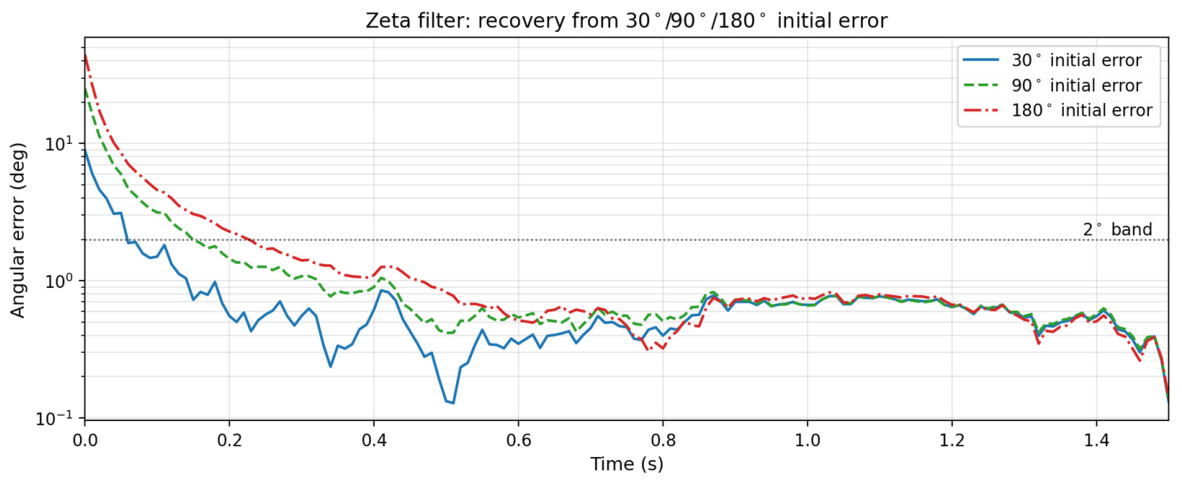
, a 180° attitude error, exits the cut locus in a single update.
Global convergence. Assume (i) uniform observability [
27]: the reference vectors stay bounded away from collinearity,
, so that by (24)
; and (ii) a bounded update interval. The uniform lower bound
is precisely where the concentration band of
Section 2.5.3 enters: (29) caps the prior concentration at
after the first cycle, while uniform observability floors the measurement at
, so
independently of the trajectory. Composing the two bounds in (33), the Lyapunov function
, where
counts predict–update cycles, satisfies
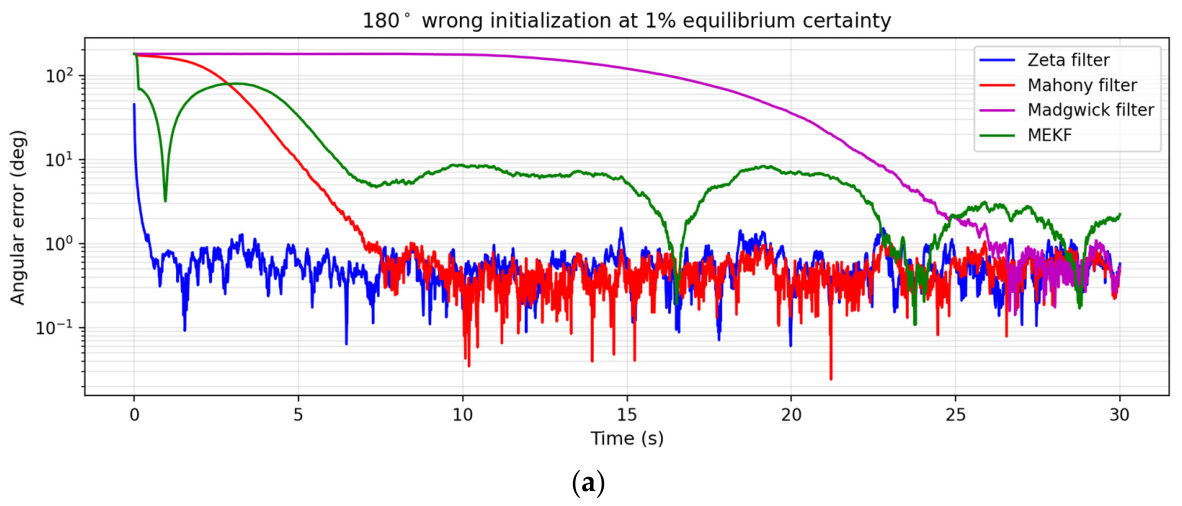
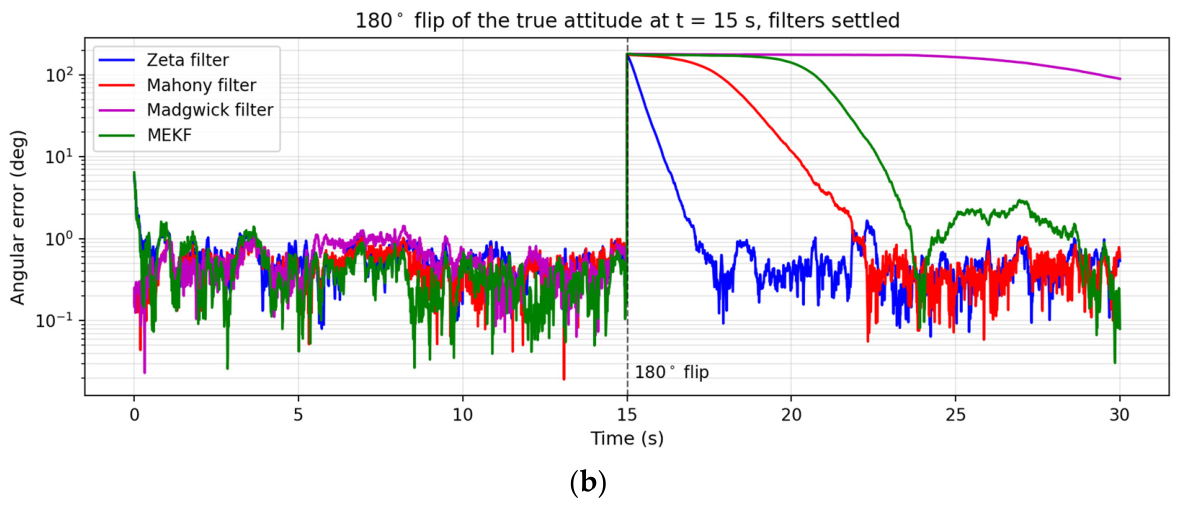
for every initial attitude, including the antipodal one: the attitude error converges globally and exponentially—geometrically in the cycle index
—with a per-cycle contraction factor
that is uniform over trajectories. Because prediction leaves
unchanged and each update contracts it by the factor
, the geometric decay in the cycle index corresponds to a continuous-time rate
: between measurement epochs of spacing
the error envelope decays as
, which is the exponential rate. For the baseline configuration of
Section 3 (
in order of magnitude),
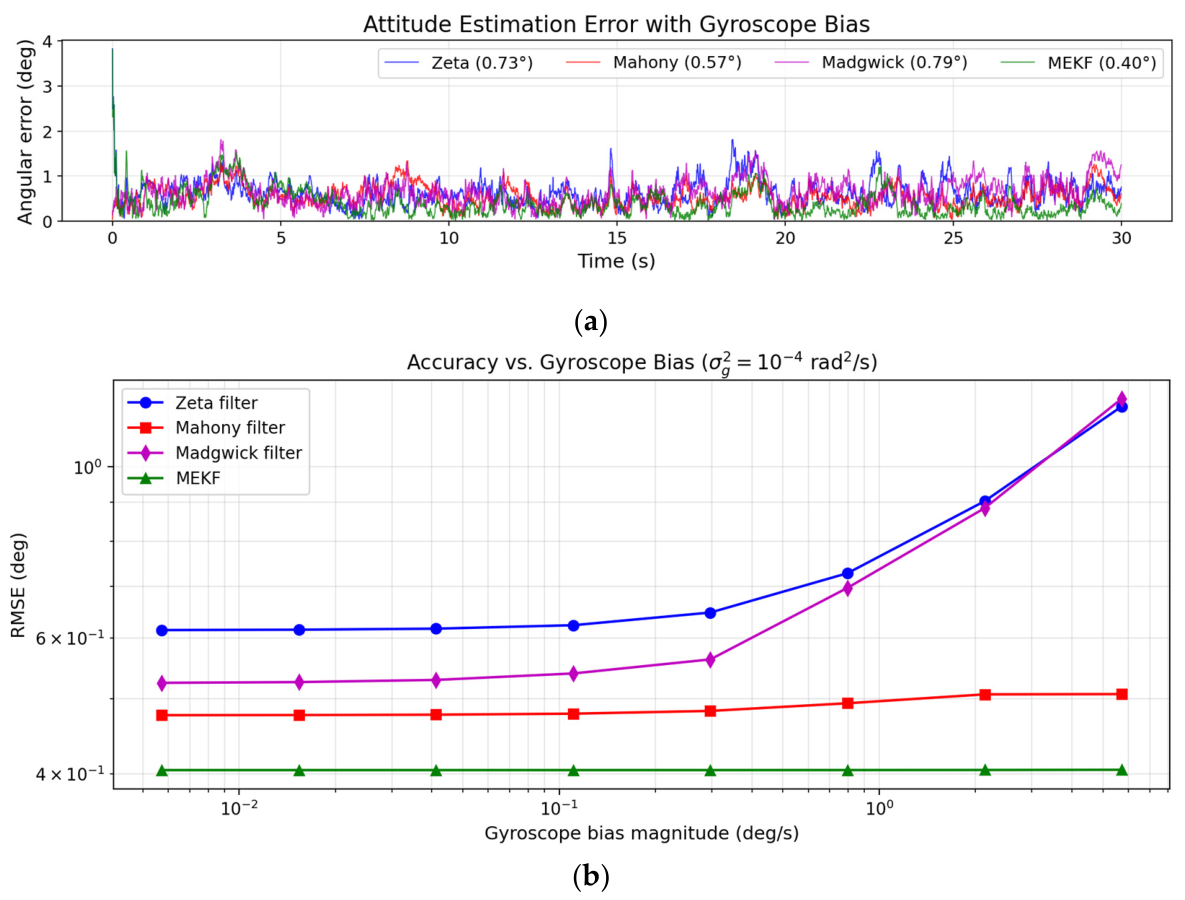
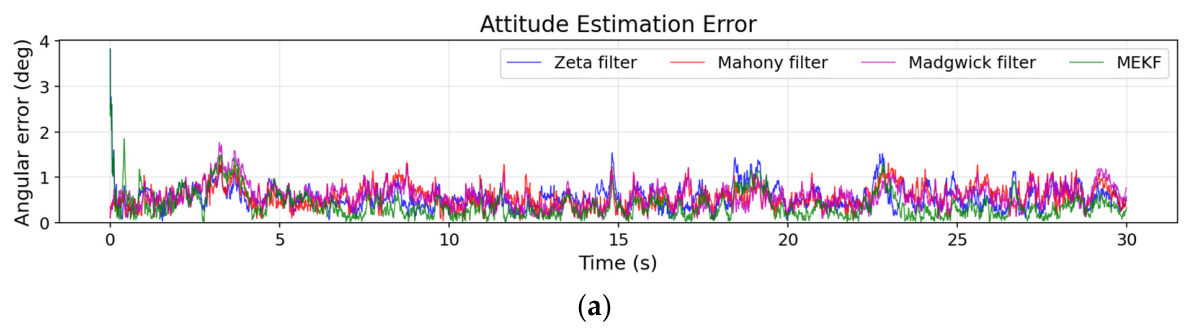
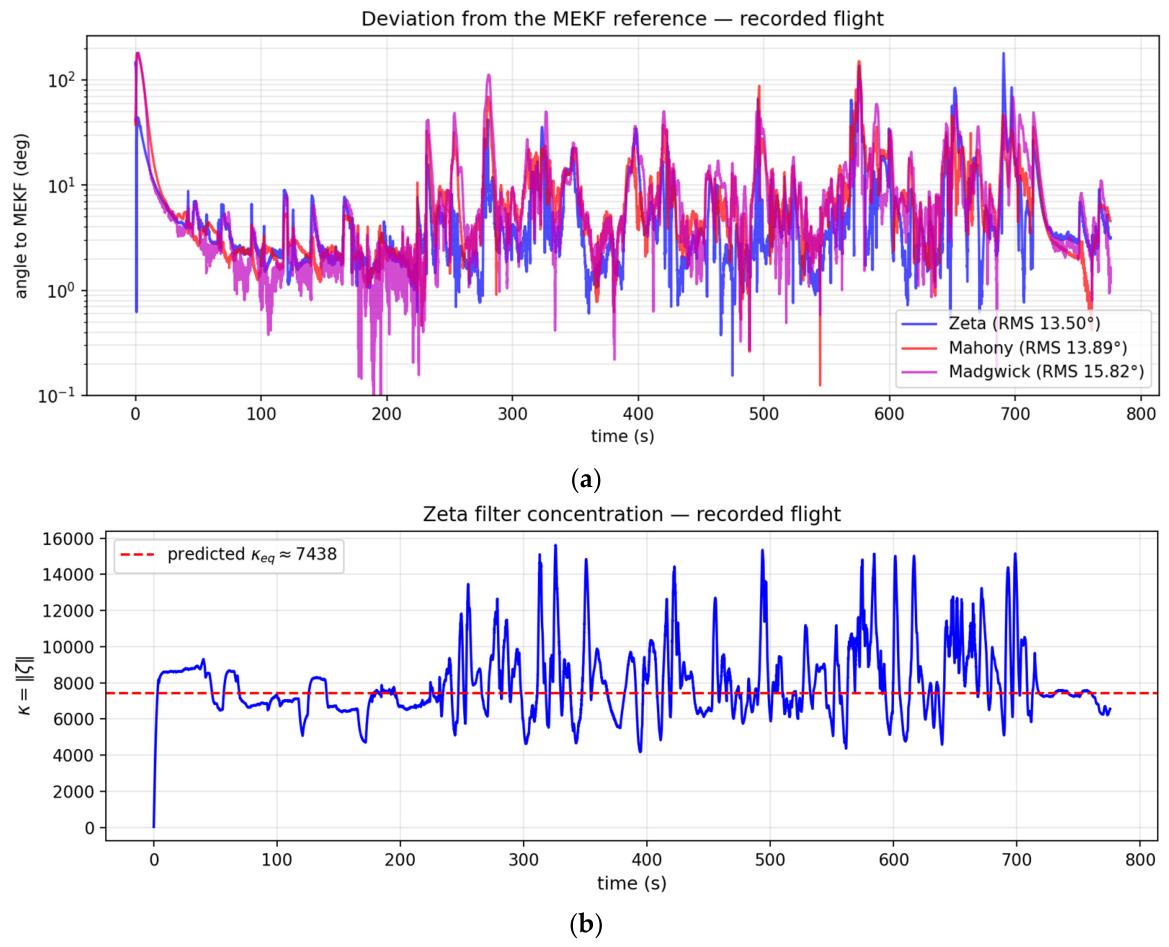
, giving an error time constant of a fraction of a second at 100 Hz—consistent with the convergence transients observed (
Section 3.1.3).
Relation to the topological obstruction. By the theorem of Bhat and Bernstein [
28], no continuous time-invariant flow on a compact manifold such as
admits a globally asymptotically stable equilibrium; smooth complementary filters, whose estimate evolves on the rotation manifold itself, are accordingly at best almost-globally stable, with an unstable antipodal equilibrium. The Zeta filter evades this obstruction structurally rather than contradicting it: its state evolves in the ambient space
, which is contractible—continuously deformable to a point—so the topological hypothesis of the theorem is not met. The attitude is only the projection
, undefined at
; recovery from the antipode is achieved not by passing through the origin—the sign selection (19) keeps each update chord in a half-space whose closest approach to
is bounded away from zero—but by a discrete straight-line move of the state whose normalized direction swings through a large
angle in a single step (below), a globally stable motion in ℝ
4 that no continuous flow on the sphere could reproduce.
In addition, the measurement update is a discrete map acting along straight lines in the ambient
rather than along arcs on the sphere: the state is free to change its radius, so its projected attitude can traverse an arbitrarily large angle in a single step. The antipodal sign selection, introduced in
Section 2.4 for statistical consistency, contributes here in one specific way: it guarantees that every update adds concentration, which upgrades global convergence to the monotone, uniform-rate contraction of (33). The estimate’s residual discontinuity is confined to the measure-zero cut locus
, where the two sign choices produce posteriors of identical error magnitude (
; the error map itself is continuous there), and is never encountered in normal tracking (
Section 2.4).
Noise. Let
denote the quaternion-space angle between the sign-aligned observation direction and the true attitude. The update then obeys the perturbed recursion
which stays finite at
and is monotone increasing in
, so it may be compared term by term with its own orbit. Its unique fixed point is
: at
numerator and denominator share the factor
and the map returns
. Since it contracts toward this point at the same factor
as the noise-free map, the misalignment decreases monotonically from any initial error-including
-to a neighborhood of
. For a measurement stream with
this yields the input-to-state bound
The steady-state attitude error is at most the measurement offset itself, with no threshold on
required for convergence.
Gyroscope error enters separately through prediction, adding at most of drift per cycle. Balanced against the update contraction this raises the floor by , so the combined steady-state error is bounded by .