Article

Distinct Profiles of Sexual Rejection Behaviors Among Young Adults: A Person-Centered Analysis of Sociodemographic, Psychological, and Relationship Correlates


by
Germano Vera Cruz
*,
Clarice Da Rosa
,
Alexia Lécrivain
and
Eleonor Gilles-Noguès
Department of Psychology, University of Picardie Jules Verne, UR 7273 CRP-CPO, Bâtiment C, Chemin du Thil, 80025 Amiens, France
*
Author to whom correspondence should be addressed.
Sexes 2026, 7(3), 48; https://doi.org/10.3390/sexes7030048
Submission received: 16 July 2026 / Revised: 22 August 2026 / Accepted: 31 August 2026 / Published: 3 September 2026
(This article belongs to the Section Sexual Behavior and Attitudes)

Abstract

Background: Sexual rejection is central to sexual communication and consent, yet little is known about whether individuals display distinct patterns of rejection behaviors. This study identified profiles of sexual rejection behaviors and their predictors using a person-centered approach. Methods: A cross-sectional online survey was conducted among 649 French young adults (18–25 years). Participants completed measures of sexual rejection behaviors, attachment, sexual communal strength, sexual self-esteem, sexual and relationship satisfaction, and sociodemographic characteristics. K-means cluster analysis identified sexual rejection profiles, and binomial logistic regression examined predictors of profile membership. Results: Two profiles emerged. The first (61.8%) was characterized by frequent assertive and reassuring rejection behaviors and infrequent hostile and deflecting strategies, reflecting an adaptive rejection style. The second (38.2%) showed moderate levels across all behaviors, suggesting an indecisive rejection style. Compared with the adaptive profile, membership in the indecisive profile was associated with higher attachment avoidance. Greater sexual communal strength, sexual self-esteem, relationship satisfaction, religious engagement, male gender, and homosexual orientation predicted membership in the adaptive profile. Conclusions: Sexual rejection behaviors form distinct profiles associated with psychological, relational, and sociodemographic factors. Interventions promoting attachment security, sexual self-esteem, and communication skills may foster more assertive and reassuring sexual rejection and strengthen sexual consent communication.

1. Introduction

Sexual rejection in intimate relationship context is a fundamental aspect of sexual communication. The ability to decline a partner’s sexual advances allows individuals to establish personal boundaries, exercise sexual autonomy, and prevent unwanted sexual experiences while maintaining relationship functioning [1,2,3]. Rather than representing a single behavior, sexual rejection encompasses a range of communication strategies that vary considerably in their interpersonal tone and relational consequences. Individuals may reject sexual advances in assertive and reassuring ways that preserve intimacy and respect their partner’s feelings, or they may employ more hostile, avoidant, or deflecting strategies that risk undermining relationship quality [1,3].
To date, the most comprehensive body of research on sexual rejection has been conducted by Kim and colleagues [1,2,3] in North America. In their initial study, Kim et al. [1] developed and validated the Sexual Rejection Scale (SRS) and demonstrated that rejecting a partner kindly—through behaviors such as expressing affection, providing reassurance, or suggesting future intimacy—was associated with greater sexual and relationship satisfaction than engaging in unwanted or reluctant sex, which was linked to poorer individual and relational well-being. Subsequently, Kim et al. [2] developed the Responses to Sexual Rejection Scale (RSRS), identifying several ways individuals respond after being rejected for sex, including understanding, self-blame, hostility, and emotional withdrawal. These responses were systematically associated with attachment insecurity, self-esteem, relationship quality, and psychological adjustment, supporting the construct validity of the measure. Building on these findings, Kim et al. [3] identified distinct sexual rejection behaviors, differentiating positive strategies (e.g., affection, reassurance, and alternative expressions of intimacy) from negative strategies (e.g., criticism, avoidance, and coldness). Positive rejection behaviors were consistently associated with greater sexual and relationship satisfaction for both partners, whereas negative rejection behaviors predicted poorer relationship functioning. Collectively, these studies demonstrate that sexual rejection is not inherently detrimental to romantic relationships; rather, its consequences depend largely on how rejection is communicated and experienced.
More recently, Gilles-Noguès and Vera Cruz [4] extended this literature to a French sample of young adults. Their findings indicated that reassuring and assertive rejection strategies were the most frequently reported behaviors and were positively associated with sexual frequency, sexual satisfaction, and relationship satisfaction. Conversely, hostile and deflecting rejection strategies were negatively associated with these indicators of relational and sexual well-being. Together, these findings suggest that sexual rejection behaviors are meaningfully associated with relationship outcomes across different cultural contexts.
Despite these advances, research on sexual rejection remains in its infancy, particularly when compared with the extensive literature on external and internal sexual consent communication behaviors [5,6,7,8]. Over the past two decades, research on sexual consent per se has considerably advanced our understanding of how individuals communicate willingness to engage in sexual activity. In contrast, considerably less attention has been devoted to understanding how individuals communicate unwillingness to engage in sexual activity, despite sexual rejection representing an equally important component of consensual sexual interactions. Consequently, relatively little is known about the individual differences underlying sexual rejection behaviors.
One important limitation of the existing literature is that sexual rejection strategies have almost exclusively been examined as independent behavioral dimensions. However, these behaviors are unlikely to occur in isolation. Rather, individuals may combine different rejection strategies, giving rise to distinct behavioral profiles. Examining such profiles may provide a more ecologically valid representation of sexual rejection by capturing the complexity of individuals’ communication styles. To date, however, no study has investigated whether individuals can be meaningfully classified into distinct subgroups according to their patterns of sexual rejection behaviors.
A person-centered approach [9], such as cluster analysis, provides an appropriate framework for addressing this gap. Unlike variable-centered approaches, which examine relationships among variables at the population level, person-centered methods identify relatively homogeneous subgroups of individuals who exhibit similar configurations of behaviors or characteristics [10,11]. Such approaches have become increasingly common in sexuality research because they capture heterogeneity in sexual attitudes, behaviors, and relationship processes that may be obscured by traditional analyses [12,13]. Applying this framework to sexual rejection may therefore reveal distinct behavioral profiles that have remained undetected using conventional analytical approaches.
Beyond identifying these profiles, it is equally important to understand the factors associated with profile membership. Sexual communication is embedded within broader sociodemographic, psychological, and relational contexts that likely shape how individuals reject a partner’s sexual advances. Previous research has shown that sociodemographic characteristics, including gender, sexual orientation, and religiosity, influence sexual attitudes and patterns of sexual communication [14,15]. Likewise, psychological characteristics such as attachment orientation, sexual self-esteem, and sexual communal strength influence interpersonal sexual behavior and responsiveness to partners’ needs [16,17]. Relationship characteristics—including sexual satisfaction, relationship satisfaction, and sexual activity frequency—have also been consistently associated with sexual communication processes [18,19]. Nevertheless, whether these factors differentiate individuals belonging to distinct sexual rejection profiles remains unknown. Identifying such correlates would contribute to a more comprehensive understanding of sexual rejection and may help identify individuals who are more likely to adopt adaptive or maladaptive rejection strategies.

The Present Study Objectives and Research Questions

To address these gaps, the present study aimed to (a) identify distinct clusters of individuals based on their self-reported sexual rejection behaviors, and (b) examine the extent to which sociodemographic characteristics, sexo-psychological variables, and sexo-intimate relationship factors predict membership in these clusters. Using a data from a sample of French young adults, we applied a k-means cluster analysis to identify behavioral profiles of sexual rejection and subsequently used binomial logistic regression to examine predictors of cluster membership.
The study was guided by the following research questions (RQs):
(a)
RQ1: Can participants be classified into distinct clusters based on their self-reported sexual rejection behaviors?
(b)
RQ2: To what extent do socio-demographic characteristics (gender, sexual orientation, relationship status, and religious engagement), individual sexo-psychological factors (attachment styles in intimate relationships, strength of sexual communion, and sexual self-esteem), and sexual and relationship variables (number of sexual partners and sexual relationships during the previous 30 days, sexual satisfaction over the previous 12 months, and relationship satisfaction over the previous 12 months) predict membership in these clusters?
Based on prior literature on sexual communication and relational psychology, we expected that distinct profiles of sexual rejection behaviors would emerge. Furthermore, we hypothesized that psychological and relational variables—particularly attachment styles, sexual self-esteem, and relational satisfaction—would significantly differentiate individuals across identified clusters.

2. Methods

The present study used secondary data derived from a survey designed to broadly examine sexual consent behaviors among French young adults.

2.1. Participants

Overall, 649 participants aged 18 to 25 years participated in the study. The sample gender distribution was as following: female (73.34%); male (22.80%); non-binary (3.24%); other gender identities (0.61%). The sample full sociodemographic characteristics are presented in Table S1, in the Supplementary Material.

2.2. Ethics and Procedures

The study was conducted in accordance with the ethical principles of the Declaration of Helsinki and its subsequent amendments [20] and the study protocol was approved by the University of Picardie Jules Verne Non-Interventional Clinical Research Ethics Committee (Approval No. 2023-25/1 January 2023).
Prior to participation, all participants received an information describing the study’s objectives, procedures, and their rights, including the right to withdraw at any time without penalty. Informed consent was obtained from all participants prior to data collection. All responses were collected anonymously.
Data were collected using an online questionnaire administered via the software LimeSurvey (Version 7.0.12) [21] and distributed through social media platforms (LinkedIn, Facebook, and Instagram) as well as QR codes displayed across multiple university campuses in northern France.

2.3. Measures

2.3.1. Sociodemographic Variables

These include age, gender, sexual orientation, relationship status, educational level, monthly income, and religious involvement. Religious involvement (degree of religiosity) was measured using a single item: “To what extent do you consider yourself a religious person?” Responses were rated on a 10-point scale ranging from 1 (not religious at all) to 10 (very religious).

2.3.2. Sexo-Psychological Measures

Attachment styles in intimate relationships were assessed using the Experience in Close Relationship Scale (ECR-RS [16]), which is a self-report questionnaire designed to assess attachment patterns in a variety of close relationships. It comprises two dimensions: intimate relationship avoidant attachment (six items) and intimate relationship anxious attachment (three items). All items are rated on a 7-point Likert scale ranging from 1 (strongly disagree) to 7 (strongly agree). In the present study, the scale demonstrated excellent internal consistency (Cronbach alpha [α] of 0.89 and 0.88, respectively).
Motivation to meet partner’s sexual needs was assessed using the Six-item Sexual Communal Strength Scale (SCS [17]) which was designed to measure a person’s motivation to meet their partner’s sexual needs, their willingness to incur personal costs to meet their partner’s sexual needs, and how happy they feel when meeting their partner’s sexual needs. It comprises one dimension and six items rated on a 5-point Likert scale ranging from 1 (not at all) to 5 (extremely).
Acceptance of sexual aggression myths was assessed using the short version of the Acceptance of Modern Myths about Sexual Aggression Scale (AMMSA [22,23]). The scale comprises 11 items rated on a 7-point Likert scale ranging from 1 (strongly disagree) to 7 (strongly agree). An overall score was computed for each participant, with higher scores indicating greater acceptance of sexual aggression myths. In the present study, the scale demonstrated excellent internal consistency (α = 0.91).
Sexual self-esteem was measured using an adaptation of the Single-Item Self-Esteem Scale (SISE [24,25]): “I have high sexual self-esteem”. The item was rated on 4-point scale ranging from 1 (not true for me) 4 (to very true for me).

2.3.3. Sexo-Intimate Relationship Measures

The following variables were assessed: number of sexual partners during the previous 30 days; number of sexual intercourse events during the previous 30 days; satisfaction with sexual intercourse during the previous 12 months; and satisfaction with intimate partner relationships during the previous 12 months. Each variable was measured using a single-item measure. The last two measures used a 10-point scale ranging from 1 (not satisfied at all) to 10 (very satisfied).

2.3.4. Sexual Rejection

Sexual rejection behaviors were assessed using the French version of the Sexual Rejection Scale (SRS-FV [1,4]). The instrument comprises 18 items distributed across four dimensions, each reflecting a distinct sexual rejection behavioral strategy: reassuring rejection behavior (three items), hostile rejection behavior (five items), assertive rejection behavior (five items), and deflecting rejection behavior (five items). Items are rated on a 5-point Likert scale ranging from 1 (never) to 5 (very frequently). In the present study, the scale demonstrated acceptable/good internal consistency (α = 0.75, 0.72, 0.88, and 0.78, respectively).

2.4. Data Analytics

First, descriptive statistics (means [M], standard deviations [SD], and frequencies) were computed for all study variables. Mean scores were then calculated for each dimension of the multi-items scales.
To address RQ1, a k-means cluster analysis [26] was conducted using the four sexual rejection behavioral strategies with no missing values. This analysis was conducted in three phases. First, to assess the suitability of the data for cluster analysis, the Hopkins statistic was calculated. The resulting value was H = 0.73, indicating a strong clustering tendency and supporting the appropriateness of applying cluster analysis to the data [27,28]. Hopkins values range from 0 to 1, with values around 0.50 indicating a random spatial distribution, values below 0.50 suggesting a tendency toward a regular or uniform distribution, and values above 0.50 indicating increasing evidence of clustering. Values exceeding 0.70 are generally considered indicative of a strong clustering tendency, whereas values above 0.90 indicate a very strong clustering structure. Thus, the observed value of H = 0.73 provides evidence that the data contain a meaningful underlying clustering structure suitable for subsequent cluster analysis. This finding suggests that the observed cluster structure is unlikely to be an artefact of scale properties. Second, Gap statistics [26] (see the representation in Figure S1 in Supplementary Material) was used to determine the optimal number of clusters. Third, the inspection of cluster centroids (see Tables S2 and S3 in the Supplementary Material) together with mean comparisons (t-test analysis) of the two clusters and across the included different sexual rejection behaviors was carried to confirm the relevance of the chosen cluster solution. Finally, cluster stability was assessed through 1000 resampling iterations, with clustering repeated on datasets resampled from the original sample. Stability was evaluated by comparing cluster assignments and cluster centers across iterations. The two-cluster solution showed high consistency, with the overall structure and profile characteristics remaining stable across resamples, supporting the robustness of the identified clusters.
To address RQ2, a binomial logistic regression model was estimated, including participants’ sociodemographic characteristics, sexo-psychological scores, and sexo-intimate relationship factors as predictors, with cluster membership as the outcome variable. The model was specified to predict membership in cluster-2 (a subgroup characterized by indecisive sexual rejection strategy), using cluster-1 (a subgroup characterized by positive sexual rejection strategy) as the reference category. A post hoc power analysis was conducted using “G*Power” (version 3.1.9.7) to assess the adequacy of the sample size for the binomial logistic regression model, based on the fact that the analysis included 649 participants and 13 predictor variables. Based on the observed model fit (McFadden’s R2 = 0.174), the likelihood-ratio test statistic was approximately χ2(13) = 131.24. At an alpha level of 0.05, the resulting statistical power was greater than 0.99, indicating that the sample size provided more than adequate power to detect the overall contribution of the predictors to the outcome. This analysis pertains to the overall model and should not be interpreted as indicating equivalent power for detecting the effects of each individual predictor.
All data analyses were performed using R (version 4.6.0 [29]) in RStudio (version 2026.04.0 + 526), with the “psych” [30], “snowCluster” (version 2.4.6) [31], and “factoextra” (version 2.2.0) [32] packages.

3. Results

Table S1, in the Supplementary Material, presents the descriptive results of the participants across all measures administered.

3.1. Distinct Clusters of Participants (Subgroups) According to Their Sexual Rejection Behaviors (RQ1)

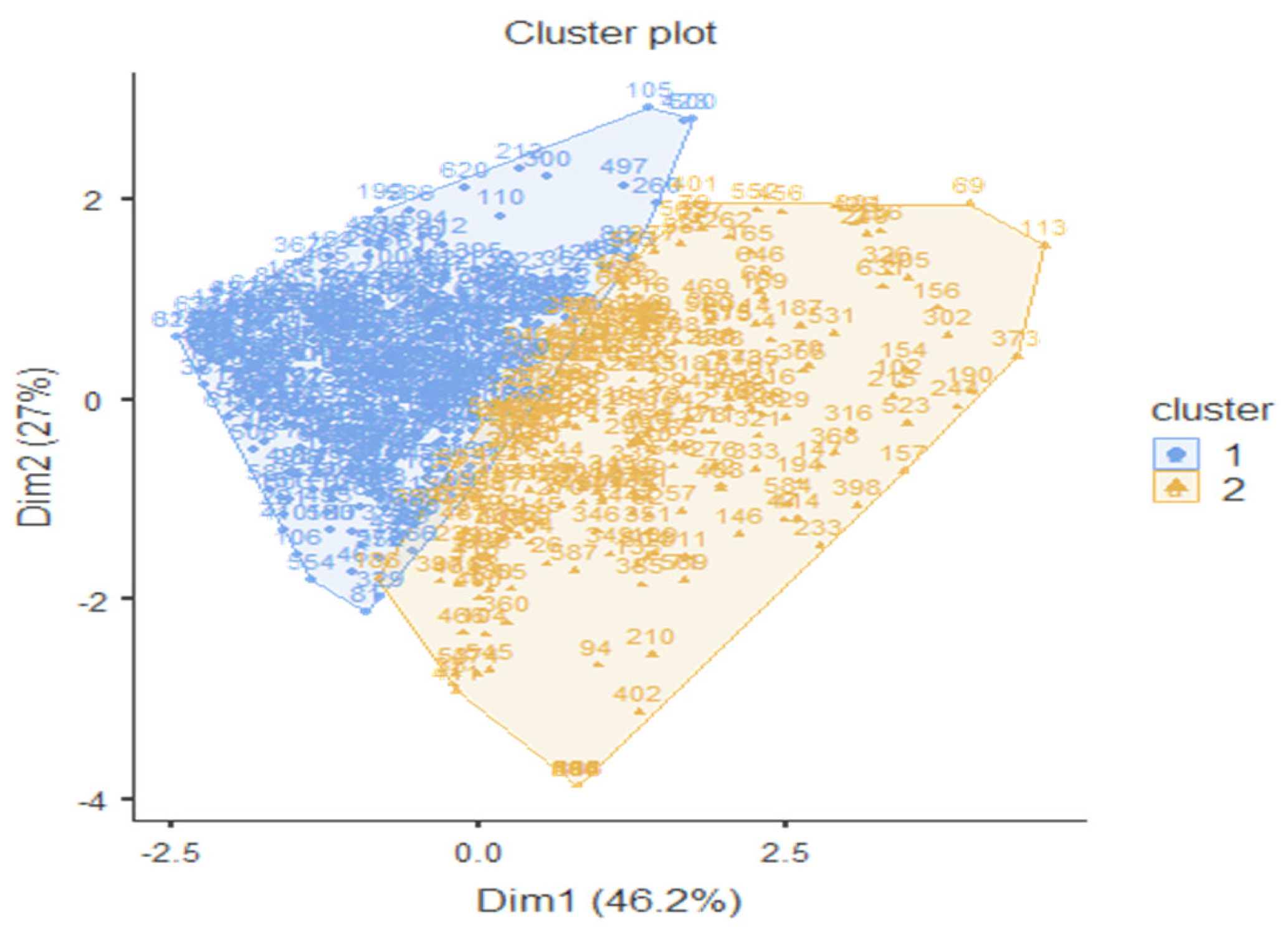
The cluster analysis identified two clearly distinct clusters. Figure 1, displays the visual mapping of the participants into the two clusters.
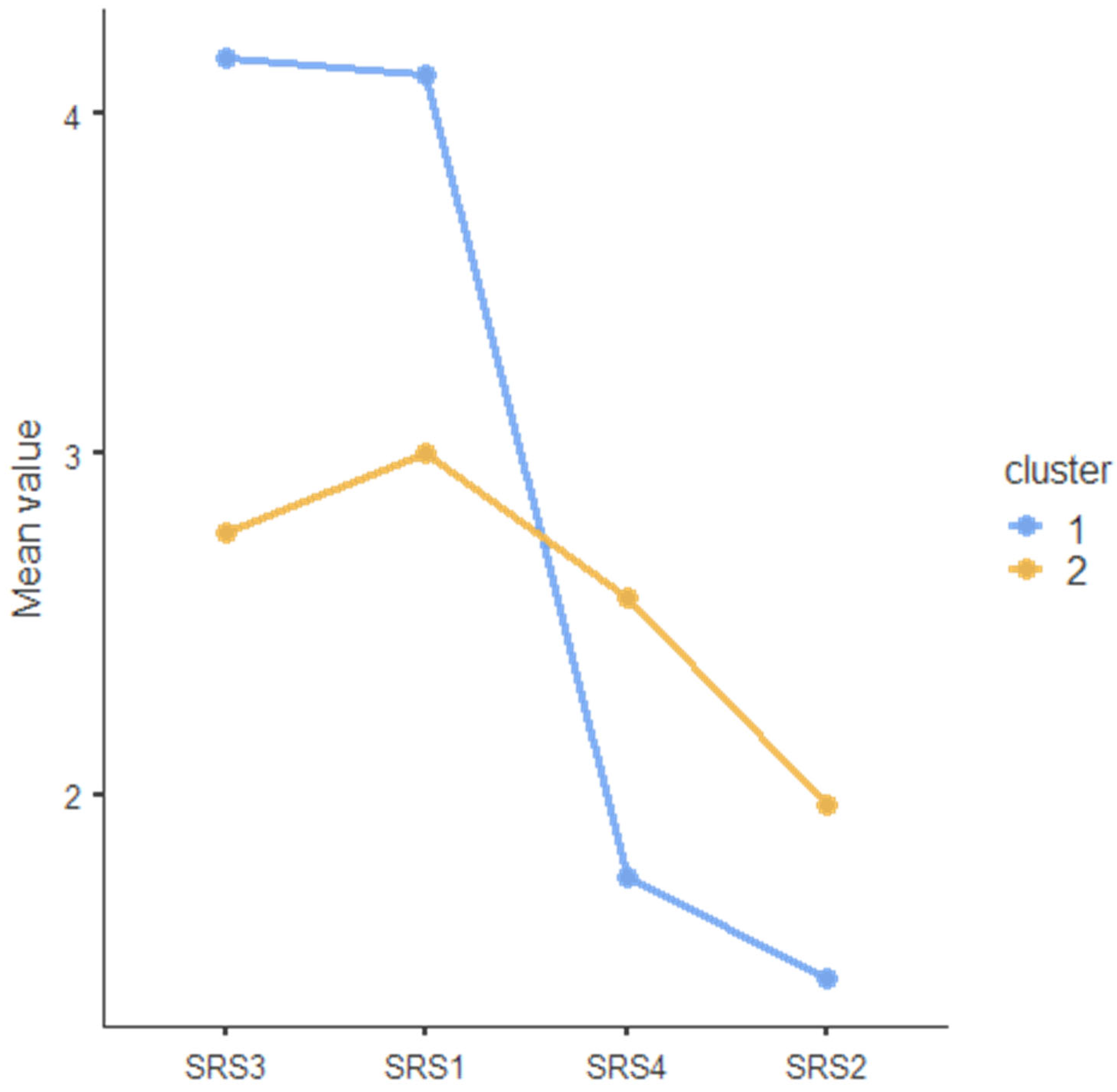
Figure 2 presents mean scores across the sexual rejection dimensions for each cluster; Cluster-1 (n = 401, 61.8%) was characterized by relatively high scores on assertive and reassuring sexual rejection behaviors and lower scores on deflecting and hostile sexual rejection behaviors. This pattern reflects a predominant use of positive sexual rejection strategies; accordingly, this cluster was labeled “positive rejection strategy”. In contrast, cluster-2 (n = 248, 38.2%) was characterized by relatively moderate scores across all sexual rejection behavior dimensions. This profile reflects a less differentiated pattern of sexual rejection strategies; accordingly, this cluster was labeled “indecisive/ambivalent sexual rejection strategy”.
Table S2 in the Supplementary Material presents the cluster centroids. Table S3, also in Supplementary Material, reports the descriptive statistics (means and standard deviations) for sexual rejection behaviors across clusters, along with the results of independent-samples t-tests comparing mean differences between the two clusters. Figure S1 in the Supplementary Material provide a graphical representation of the optimal number of clusters and the selected two-cluster solution, respectively.

3.2. Variables Predicting Cluster Belonging (RQ2)

Table 1 presents the results of the binomial logistic regression models examining the associations between predictors and cluster membership. Information on model assumptions and fit indices is provided in the Supplementary Material (Tables S4 and S5).
Odds ratios (ORs) correspond to the exponentiated regression coefficients (β) and represent the change in odds of belonging to the target cluster (cluster-2) relative to the reference cluster (cluster-1). For example, an OR of 2 indicates that the odds of belonging to cluster-2 are 2 times higher than those of belonging to cluster-1. An OR of 1.67 indicates an 67% increase in the odds of cluster-2 membership, whereas an OR of 0.70 indicates a 30% decrease in odds of belonging in cluster-2 and consequent increase in odds of cluster-1 membership.
As shown in Table 1, gender was a significant predictor of cluster membership. Compared with male participants, female participants had higher odds of belonging to cluster-2 (adopting the indecisive/ambivalent sexual rejection strategy) (OR = 1.73, p = 0.035). Accordingly, male participants were more likely to belong to cluster-1 (adopting the positive sexual rejection strategy). Higher attachment avoidance in intimate relationships was strongly associated with higher odds of belonging to cluster-2 (OR = 1.50, p < 0.001), suggesting lower probability of membership in cluster-1.
In contrast, compared with heterosexual participants, homosexual participants had lower odds of belonging to cluster-2 (OR = 0.12, p = 0.005), indicating a higher likelihood of membership in cluster-1. Higher levels of religious engagement were associated with lower odds of belonging to cluster-2 (OR = 0.90, p = 0.037), indicating a greater probability of membership in cluster-1. Higher motivation to meet a partner’s sexual needs were associated with lower odds of belonging to cluster-2 (OR = 0.62, p = 0.028), indicating a higher likelihood of membership in cluster-1. Higher levels of sexual self-esteem were associated with lower odds of belonging to cluster-2 (OR = 0.84, p = 0.038), indicating a greater probability of membership in cluster-1. Greater romantic relationship satisfaction over the previous 12 months (OR = 0.85, p = 0.006) was associated with lower odds of belonging to cluster-2 (OR = 0.85, p = 0.006), indicating a higher likelihood of membership in cluster-1.

4. Discussion

The present study sought to advance the literature on sexual rejection by adopting a person-centered approach to the study of sexual rejection behaviors. Specifically, the study aimed to (a) identify distinct clusters of individuals based on their self-reported sexual rejection behaviors (RQ1) and (b) examine whether sociodemographic characteristics, sexo-psychological variables, and sexual and relationship factors predicted membership in these clusters (RQ2). Using a sample of French young adults, the findings revealed two distinct profiles of sexual rejection behaviors and demonstrated that several individual and relational characteristics differentiated membership in these profiles. Overall, these findings extend previous variable-centered research by showing that individuals tend to adopt coherent patterns of sexual rejection behaviors rather than relying on isolated communication strategies.

4.1. Distinct Profiles of Sexual Rejection Behaviors (RQ1)

Consistent with our hypothesis and with person-centered theories of behavioral heterogeneity [9,10], the cluster analysis identified two clearly differentiated profiles. This finding supports the premise that sexual rejection behaviors are not necessarily expressed independently but may form relatively distinct behavioral configurations within individuals. Person-oriented approaches are specifically designed to identify such patterns by treating the individual, rather than the isolated variable, as the primary unit of analysis [9,10]. From this perspective, the present findings extend previous variable-centered research by showing that qualitatively different combinations of rejection strategies can characterize meaningful subgroups of individuals.
The largest subgroup (approximately 62% of participants) was characterized by relatively frequent use of assertive and reassuring rejection strategies together with relatively infrequent use of hostile and deflecting behaviors. This configuration can be interpreted as a comparatively adaptive pattern of sexual communication, characterized by the ability to communicate a sexual boundary while simultaneously maintaining interpersonal consideration. Importantly, however, this pattern should not be understood simply as a greater tendency to reject sexual advances. Rather, it likely reflects how rejection is communicated. Indeed, reassuring rejection allows individuals to decline sexual activity while simultaneously communicating affection, attraction, or continued relational commitment, whereas assertive rejection involves communicating one’s unwillingness directly [1,2,3]. In contrast, hostile and deflecting strategies may communicate rejection in ways that are more likely to generate interpersonal uncertainty, hurt, or relational tension. This interpretation is consistent with the foundational work of Kim et al. [3], who identified reassuring, hostile, assertive, and deflecting behaviors as distinct ways of responding to a partner’s sexual advances. Across their studies, reassuring rejection was consistently associated with greater relationship and sexual satisfaction, whereas hostile rejection was associated with poorer relational outcomes. Perceived partner responsiveness was an important mechanism underlying these associations, suggesting that the interpersonal consequences of sexual rejection depend partly on whether the rejected partner experiences the response as reflecting care, understanding, and responsiveness. More recent evidence provides further support for this interpretation. In a study of men with hypoactive sexual desire disorder, reassuring and assertive rejection were associated with greater sexual satisfaction and perceived partner responsiveness, whereas hostile and deflecting behaviors were associated with poorer sexual and relationship outcomes [33]. These findings suggest that communicating a sexual boundary does not inherently threaten intimacy; rather, the manner in which the boundary is communicated may determine whether rejection is experienced as a routine negotiation of differing sexual needs or as an interpersonal threat. Recent research on mindfulness further supports the importance of this distinction. Du et al. [34], using cross-sectional, experimental, and longitudinal methods, found that greater trait mindfulness was associated with fewer hostile and deflecting and more assertive rejection strategies. Moreover, lower use of hostile and deflecting strategies helped account for associations between mindfulness and both sexual and relationship satisfaction. Although these findings do not establish that assertive or reassuring rejection is universally adaptive, they suggest that effective sexual refusal may involve emotional regulation and the capacity to maintain awareness of both one’s own boundaries and the interpersonal consequences of communicating them. Thus, the profile identified in the present study may reflect a broader relational capacity to combine boundary protection with interpersonal responsiveness.
Conversely, approximately 38% of participants belonged to a second cluster characterized by moderate scores across all four rejection strategies. Rather than displaying a clearly adaptive or maladaptive behavioral pattern, these individuals appeared to use multiple rejection strategies without a pronounced preference for any particular approach, resulting in what we termed an “indecisive/ambivalent” sexual rejection strategy. To our knowledge, this specific configuration has not previously been identified in the sexual rejection literature and therefore represents an important contribution of the present study. Nevertheless, the label should be interpreted as descriptive rather than diagnostic. Moderate endorsement across several strategies does not necessarily imply psychological indecision, uncertainty, or poor communication competence [35]. It may instead indicate greater behavioral flexibility, situational variability, or the absence of a dominant rejection strategy. One possible interpretation is that these individuals experience greater uncertainty regarding how to communicate unwanted sexual advances. Sexual rejection is inherently interpersonal: individuals must simultaneously manage their own sexual boundaries and anticipate how their partner may interpret and respond to rejection [35]. Consequently, the same person may use direct, reassuring, deflecting, or more confrontational strategies depending on the context, perceived partner responsiveness, relationship dynamics, emotional state, or perceived consequences of saying no. This interpretation is consistent with broader person-oriented perspectives, which emphasize that behavioral patterns emerge from the interaction between individuals and their contexts rather than from isolated characteristics [9,10]. It is therefore possible that the second cluster represents a more context-dependent pattern of sexual communication rather than a uniformly maladaptive style. The possibility of contextual variability is particularly relevant because sexual consent and refusal are multidimensional communicative processes. Research has demonstrated that individuals communicate consent and refusal through explicit and implicit verbal and nonverbal cues, and that these cues may be interpreted differently by sexual partners [36,37]. Hickman and Muehlenhard [36], for example, showed that individuals use multiple forms of communication to convey sexual consent and that people may attach different meanings to similar behaviors. More recent dyadic research conceptualizes consent as an iterative interpersonal process in which partners continuously communicate and interpret willingness throughout sexual encounters [5]. Within this framework, rejection should similarly be understood not as a single isolated behavioral act but as part of an ongoing negotiation of sexual boundaries.
From a sexual consent perspective, the second profile is particularly important. Indeed, contemporary conceptualizations distinguish between internal consent—feelings of willingness, comfort, safety, and readiness—and external consent communication, through which individuals communicate these internal states to their partners [37,38,39]. Refusal represents the corresponding communication of unwillingness or a desire not to engage in a particular sexual activity. Although refusal can be communicated verbally or nonverbally, explicit communication may reduce uncertainty regarding a person’s sexual boundaries. Research has nevertheless shown that people frequently rely on implicit or nonverbal cues when communicating and interpreting sexual consent and refusal [35,36,38,39]. Consequently, individuals who do not consistently use clear or readily interpretable rejection strategies may face greater potential for misunderstanding, particularly in situations in which partners rely heavily on implicit communication.
Importantly, this does not mean that individuals in the ambivalent profile are necessarily at greater risk of sexual victimization. Such a conclusion would require longitudinal or dyadic evidence that was not available in the present study. Rather, the findings suggest that variability in rejection strategies may represent a potentially relevant target for future research. In particular, longitudinal studies could examine whether individuals who frequently alternate between assertive, reassuring, deflecting, and hostile strategies experience different levels of consent-related uncertainty or unwanted sexual experiences over time. Dyadic research would be especially informative because the meaning and consequences of a rejection strategy may depend not only on what the initiator communicates but also on how the partner perceives and responds to that communication.
The findings also have implications for sexual health and prevention. Effective interventions should not focus exclusively on teaching individuals to say “no.” Instead, they may benefit from developing a broader repertoire of sexual communication skills, including expressing boundaries clearly, communicating preferences, negotiating alternative forms of intimacy, and maintaining interpersonal connection when sexual desires differ. Recent research on sexual consent emphasizes the importance of developing skills and self-efficacy for communicating both willingness and refusal [38,39]. Such interventions could also challenge traditional sexual scripts in which one partner is expected to initiate and the other to resist or accommodate unwanted advances. These scripts may make explicit refusal more difficult and may encourage reliance on indirect forms of communication [40]. Promoting mutual responsibility for sexual communication may therefore be particularly important.
More broadly, the present findings demonstrate the added value of person-centered analytical approaches in sexuality research. Previous studies have generally examined reassuring, hostile, assertive, and deflecting rejection strategies as separate dimensions [1,2,3]. Although this variable-centered approach has provided important information about the correlates and consequences of individual strategies, it cannot fully capture how these behaviors co-occur within individuals. The present cluster analysis complements this literature by demonstrating that sexual rejection strategies may combine into qualitatively different patterns. The identification of a large assertive/reassuring profile suggests that constructive boundary communication may represent a relatively common configuration, whereas the second profile highlights a substantial subgroup whose rejection behaviors are less clearly differentiated.
This person-centered perspective may also have practical value. Average associations between individual rejection strategies and relationship outcomes can obscure meaningful heterogeneity if the same behavior has different implications depending on the broader behavioral configuration in which it occurs. For example, assertiveness may function differently when accompanied by reassurance than when accompanied by hostility. Similarly, deflecting behavior may have different interpersonal implications depending on whether it occurs alongside reassuring communication or more hostile responses. A person-centered framework is therefore particularly appropriate for studying sexual rejection because it preserves the possibility that the meaning and consequences of a given behavior depend on its configuration with other behaviors. This is consistent with the broader person-oriented framework, which conceptualizes individuals as organized wholes rather than as collections of independent variables [9,10].
Overall, the two profiles identified in the present study suggest that sexual rejection is best understood as a multidimensional interpersonal process rather than as a unitary behavior. The assertive/reassuring profile appears to reflect a comparatively constructive configuration in which individuals combine boundary protection with interpersonal responsiveness, whereas the indecisive/ambivalent profile identifies a substantial subgroup characterized by less differentiated use of rejection strategies. Future research should determine whether these configurations are stable across situations and relationships, whether they vary according to relationship quality and sexual context, and whether they predict subsequent sexual and relationship outcomes. Longitudinal and dyadic designs, in particular, would help establish whether the profiles represent relatively stable interpersonal styles or context-sensitive patterns of sexual communication.

4.2. Predictors of Sexual Rejection Profiles (RQ2)

Several significant predictors emerged, suggesting that sexual rejection behaviors are embedded within broader psychological, relational, and sociocultural contexts.
Attachment avoidance was the strongest predictor of belonging to the unclear or indecisive rejection profile. Individuals reporting greater avoidant attachment were substantially more likely to belong to this cluster, consistent with extensive attachment theory literature indicating that avoidantly attached individuals experience discomfort with emotional intimacy, suppress interpersonal needs, and often employ distancing communication strategies [16,41]. Because sexual rejection inherently involves negotiating both intimacy and personal boundaries, avoidantly attached individuals may experience greater difficulty communicating rejection in a consistent and emotionally responsive manner. These findings therefore extend previous research linking attachment insecurity to sexual communication difficulties [2] by demonstrating that attachment avoidance also influences broader patterns of sexual rejection behavior.
Motivation to meet a partner’s sexual needs (sexual communal strength) also differentiated the clusters. Individuals reporting greater motivation to respond to their partner’s sexual needs were more likely to belong to the assertive and reassuring cluster. This finding aligns closely with communal relationship theory, which proposes that healthy intimate relationships involve balancing responsiveness toward one’s partner with one’s own personal needs [17]. Importantly, greater communal motivation did not appear to reduce individuals’ willingness to refuse unwanted sexual activity. Rather, it was associated with communicating rejection more constructively. This distinction reinforces previous evidence that caring for one’s partner and maintaining personal sexual autonomy are complementary rather than competing interpersonal goals.
Similarly, participants reporting higher sexual self-esteem were more likely to belong to the assertive and reassuring profile. Sexual self-esteem reflects confidence in one’s sexual self-concept and comfort expressing sexual needs and preferences. Previous research has consistently linked greater sexual self-esteem with more assertive sexual communication, healthier sexual decision-making, and greater relationship satisfaction [42]. The present findings suggest that this confidence also facilitates clearer communication of sexual refusal, thereby contributing to healthier consent practices.
Relationship satisfaction emerged as another significant predictor. Individuals who reported greater satisfaction with their romantic relationships were more likely to belong to the positive sexual rejection cluster (assertive and reassuring cluster), corroborating previous findings that constructive sexual communication contributes to positive relationship functioning [3,18,19]. However, the cross-sectional design prevents determining causal direction. Adaptive rejection strategies may foster relationship satisfaction by reducing conflict and promoting mutual understanding, while satisfying relationships may provide a secure interpersonal environment in which partners feel comfortable communicating sexual boundaries openly. Longitudinal research will be needed to clarify these reciprocal processes.
Several sociodemographic variables also predicted cluster membership. Male participants were more likely than female participants to belong to the assertive and reassuring cluster. Although previous research has demonstrated gender differences in sexual communication [15], findings regarding sexual rejection remain limited and sometimes inconsistent. One possible explanation is that women often experience greater social pressure to prioritize relational harmony and avoid hurting their partner’s feelings, potentially leading to less consistent rejection strategies. Alternatively, gender differences may reflect broader sexual double standards and societal expectations regarding sexual availability and emotional labor within intimate relationships. Because the present sample included substantially more women than men, these findings should nevertheless be interpreted cautiously until replicated in more gender-balanced samples.
Interestingly, homosexual participants were also more likely to belong to the assertive and reassuring cluster. Although relatively little research has examined sexual rejection among sexual minority populations, previous studies suggest that sexual minority individuals often report greater openness in sexual communication and more explicit negotiation of sexual boundaries [43]. The greater emphasis on communication observed within many same-sex relationships may therefore facilitate more adaptive sexual rejection behaviors. Future research should investigate the mechanisms underlying this association.
Finally, higher religious engagement was associated with a greater likelihood of belonging to the assertive and reassuring profile. Although this finding may appear unexpected given the mixed evidence linking religiosity to sexual communication, it may reflect the multidimensional nature of religious involvement. Religious engagement can be associated with self-regulation and behavioral restraint, which may facilitate more deliberate and constructive responses during intimate interactions. For example, religiosity has been linked to greater self-control, suggesting a potential pathway through which religious involvement may support regulated interpersonal behavior [44]. At the same time, evidence indicates that religiousness can shape the relationship between sexual communication and relationship outcomes, rather than uniformly promoting or inhibiting sexual communication [45]. Thus, greater religious engagement may potentially provide interpersonal resources—such as self-regulation, commitment, or relationship-oriented norms—that facilitate assertive and respectful rejection strategies, while particular religious norms may simultaneously constrain open discussions of sexuality. Because religiosity encompasses diverse beliefs, practices, and forms of involvement, these mechanisms should be interpreted cautiously. Future research should examine whether specific dimensions of religiosity, rather than religious engagement per se, differentially predict sexual consent and communication across cultural and religious contexts.
Collectively, these findings indicate that adaptive sexual rejection is associated with relationship quality, secure attachment, greater sexual confidence, stronger communal motivation, and certain sociodemographic characteristics. Although, given the cross-sectional design, these associations should not be interpreted as evidence of temporal or causal relationships, they suggest that interventions aimed at improving sexual communication should extend beyond teaching behavioral skills alone. Programs promoting healthy sexual consent could incorporate components targeting attachment security, sexual self-esteem, emotional regulation, and relationship communication skills. Such interventions may enhance individuals’ capacity to communicate sexual refusal clearly while maintaining relational intimacy and mutual respect.

4.3. Limitations

Several limitations should be acknowledged. First, the cross-sectional design precludes causal inference regarding the relationships between predictor variables and sexual rejection profiles. Longitudinal studies are needed to determine whether psychological characteristics shape rejection strategies or whether repeated communication experiences influence psychological functioning over time.
Second, all measures relied on self-report questionnaires and were therefore susceptible to recall bias and social desirability effects. Given the sensitive nature of sexual communication, participants may have overreported socially desirable rejection behaviors such as reassurance and assertiveness while underreporting hostile behaviors.
Third, the sample consisted exclusively of French young adults recruited primarily through universities and social media, limiting the generalizability of the findings to older adults, non-student populations, or individuals from different cultural backgrounds. Cross-cultural replication will be particularly important because norms governing sexual communication vary considerably across societies.
Finally, several constructs—including sexual self-esteem, relationship satisfaction, and sexual satisfaction—were assessed using single-item measures. Although practical in survey research, multi-item validated instruments would provide greater psychometric precision.

4.4. Recommendations for Future Research

Future studies should adopt longitudinal designs to examine the stability of sexual rejection profiles and investigate transitions between profiles across relationship development. Dyadic studies including both partners would also provide valuable insight into how one partner’s rejection profile influences the other’s emotional responses, sexual satisfaction, and relationship functioning.
Future research should further examine contextual influences on sexual rejection, including relationship duration, sexual motives [46], communication during specific sexual encounters, and cultural norms regarding sexuality and consent. Expanding this work to more diverse age groups, cultural contexts, and gender identities will also be important for establishing the generalizability of the identified profiles.
Finally, intervention research should evaluate whether communication training programs designed to strengthen sexual assertiveness, sexual self-esteem, and constructive conflict management can promote transitions from unclear or inconsistent rejection strategies toward more adaptive assertive and reassuring communication patterns.

5. Conclusions

The present study provides the first person-centered examination of sexual rejection behaviors among young adults. The findings demonstrate that individuals can be meaningfully classified into two distinct sexual rejection profiles characterized by adaptive assertive and reassuring communication or by relatively unclear and indecisive rejection strategies. Furthermore, attachment avoidance, sexual communal strength, sexual self-esteem, relationship satisfaction, gender, sexual orientation, and religious engagement significantly differentiated these profiles. Together, these findings extend existing theories of sexual communication by demonstrating that sexual rejection reflects coherent interpersonal styles rather than isolated behaviors. From both clinical and educational perspectives, promoting assertive, reassuring, and consistent communication of sexual refusal may strengthen sexual autonomy while simultaneously fostering healthier and more satisfying intimate relationships.

Supplementary Materials

The following supporting information can be downloaded at https://www.mdpi.com/article/10.3390/sexes7030048/s1, Table S1: Descriptive statistics of all the study variables; Table S2: The clusters centroids; Table S3: Mean comparison between the two clusters: descriptive and inferential statistics; Figure S1: Optimal number of clusters; cluster graphic; Table S4: Assumptions: Collinearity Statistics; Table S5: Model fit and accuracy statistics.

Author Contributions

Conceptualization, G.V.C. and E.G.-N.; methodology, G.V.C.; validation, G.V.C. and E.G.-N.; formal analysis, G.V.C. and C.D.R.; investigation, G.V.C. and E.G.-N.; data curation, C.D.R. and A.L.; writing—original draft preparation, G.V.C., C.D.R., and A.L.; writing—review and editing, G.V.C. and C.D.R.; visualization, G.V.C.; supervision, G.V.C. All authors have read and agreed to the published version of the manuscript.

Funding

This research received no external funding.

Institutional Review Board Statement

The study was conducted in accordance with the Declaration of Helsinki, and approved by the University of Picardie Jules Verne Non-Interventional Clinical Research Ethics Committee (Approval No: 2023-25/1 January 2023).

Informed Consent Statement

Informed consent was obtained from all subjects involved in the study.

Data Availability Statement

The data used in this study are available from the Open Science Framework repository: https://osf.io/y3wxt/overview.

Acknowledgments

We would like to express our gratitude to all students who helped on data collection.

Conflicts of Interest

The authors declare no conflicts of interest.

Abbreviations

The following abbreviations are used in this manuscript:
RQResearch questions
WHOWorld Health Organization
ECR-RSExperience in Close Relationship Scale
SCSSix-Item Sexual Communal Strength Scale
AMMSAShort Version of the Acceptance of Modern Myths about Sexual Aggression
SISESingle-Item Self-Esteem Scale
SRSSexual Rejection Scale
OROdds ratio

References

  1. Kim, J.; Muise, A.; Impett, E.A. The relationship implications of rejecting a partner for sex kindly versus having sex reluctantly. J. Soc. Pers. 2018, 35, 485–508. [Google Scholar] [CrossRef] [Scilit]
  2. Kim, J.J.; Muise, A.; Sakaluk, J.K.; Impett, E.A. Development and validation of the responses to sexual rejection scale. Pers. Individ. Differ. 2019, 144, 88–93. [Google Scholar] [CrossRef] [Scilit]
  3. Kim, J.J.; Muise, A.; Sakaluk, J.K.; Rosen, N.O.; Impett, E.A. When tonight is not the night: Sexual rejection behaviors and satisfaction in romantic relationships. Pers. Soc. Psychol. Bull. 2020, 46, 1476–1490. [Google Scholar] [CrossRef] [Scilit]
  4. Gilles-Noguès, E.; Vera Cruz, G. Psychometric validation of the French Version of the Sexual Rejection Scale and its associations with intimate relationship and sociodemographic variables. SSNR 2026. [Google Scholar] [CrossRef] [Scilit]
  5. Beres, M.A. ‘Spontaneous’ sexual consent: An analysis of sexual consent literature. Fem. Psychol. 2007, 17, 93–108. [Google Scholar] [CrossRef] [Scilit]
  6. Anyadike-Danes, N.; Reynolds, M.; Armour, C.; Lagdon, S. Defining and measuring sexual consent within the context of university students’ unwanted and nonconsensual sexual experiences: A systematic literature review. Trauma Violence Abus. 2024, 25, 231–245. [Google Scholar] [CrossRef] [Scilit]
  7. Willis, M.; Smith, R. Sexual consent across diverse behaviors and contexts: Gender differences and nonconsensual sexual experiences. J. Interpers. Violence 2022, 37, N18908–N18934. [Google Scholar] [CrossRef] [Scilit]
  8. O’Connor, C.; Begun, S. Understanding sexual consent among adolescents: A 30-Year scoping review. Sexes 2025, 6, 41. [Google Scholar] [CrossRef] [Scilit]
  9. Bergman, L.R.; Magnusson, D. A Person-oriented approach in research on developmental psychopathology. Dev. Psychopathol. 1997, 9, 291–319. [Google Scholar] [CrossRef] [Scilit]
  10. Howard, M.C.; Hoffman, M.E. Variable-centered, person-centered, and person-specific approaches: Where theory meets the method. Organ. Res. Methods 2018, 21, 846–876. [Google Scholar] [CrossRef] [Scilit]
  11. Woo, S.E.; Hofmans, J.; Wille, B.; Tay, L. Person-Centered Modeling: Techniques for Studying Associations Between People Rather than Variables. Annu. Rev. Organ. Psychol. 2024, 11, 453–480. [Google Scholar] [CrossRef] [Scilit]
  12. Tierney, D.; Spengler, E.S.; Schuch, E.; Grzanka, P.R. Sexual Orientation Beliefs and Identity Development: A Person-Centered Analysis among Sexual Minorities. J. Sex Res. 2021, 58, 625–637. [Google Scholar] [CrossRef] [Scilit]
  13. Alcalá-Hinojosa, C.; Sánchez-Fuentes, M.d. Self-Esteem and Body Image as Predictors of Sexual Satisfaction: A Systematic Review. Sex. Cult. 2026, 1–21. [Google Scholar] [CrossRef] [Scilit]
  14. Penke, L.; Asendorpf, J.B. Beyond global sociosexual orientations: Domain-specificity in sexual behavior. J. Personal. Soc. Psychol. 2008, 95, 1113–1135. [Google Scholar] [CrossRef] [Scilit]
  15. Petersen, J.L.; Hyde, J.S. A meta-analytic review of gender differences in sexuality, 1993–2007. Psychol. Bull. 2010, 36, 21–38. [Google Scholar] [CrossRef] [Scilit]
  16. Fraley, R.C.; Heffernan, M.E.; Vicary, A.M.; Brumbaugh, C.C. The Experiences in Close Relationships–Relationship Structures questionnaire: A method for assessing attachment orientations across relationships. Psychol. Assess. 2011, 23, 615–625. [Google Scholar] [CrossRef] [Scilit]
  17. Muise, A.; Impett, E.A.; Kogan, A.; Desmarais, S. Keeping the spark alive: Being motivated to meet a partner’s sexual needs sustains sexual desire in long-term romantic relationships. Soc. Psychol. Pers. Sci. 2013, 4, 267–273. [Google Scholar] [CrossRef] [Scilit]
  18. Byers, E.S. Relationship satisfaction and sexual satisfaction: A Longitudinal study of individuals in long-term relationships. J. Sex Res. 2005, 42, 113–118. [Google Scholar] [CrossRef] [Scilit]
  19. Sprecher, S. Sexual satisfaction in premarital relationships: Associations with satisfaction, love, commitment, and stability. J. Sex Res. 2002, 39, 190–196. [Google Scholar] [CrossRef] [Scilit]
  20. World Medical Association (WMA). WMA Declaration of Helsinki—Ethical Principles for Medical Research Involving Human Participants; WMA: Ferney-Voltaire, France, 2024; Available online: https://www.wma.net/policies-post/wma-declaration-of-helsinki/ (accessed on 8 June 2026).
  21. LimeSurvey Team. LimeSurvey GmbH. LimeSurvey: An Open Source Survey Tool; LimeSurvey GmbH: Hamburg, Germany, 2026; Available online: https://www.limesurvey.org (accessed on 8 June 2026).
  22. Gerger, H.; Kley, H.; Bohner, G.; Siebler, F. The acceptance of modern myths about sexual aggression scale: Development and validation in German and English. Aggress. Behav. 2007, 33, 422–440. [Google Scholar] [CrossRef] [Scilit]
  23. Helmke, S.; Kobusch, P.-R.; Rees, J.; Meyer, T.; Bohner, G. Beliefs about the Strauss-Kahn case in France and Germany: Political orientation and sexual aggression myths as local versus global predictors. Int. J. Confl. Violence 2014, 8, 171–186. [Google Scholar] [CrossRef]
  24. Ben Brahim, F.; Vera Cruz, G.; Courtois, R.; Yasser, K. Sexual violence among people using cyberporn. Sex. Cult. 2026, 1–29. [Google Scholar] [CrossRef] [Scilit]
  25. Robins, R.W.; Hendin, H.M.; Trzesniewski, K.H. Measuring global self-esteem: Construct validation of a single-item measure and the Rosenberg Self-Esteem Scale. Personal. Soc. Psychol. Bull. 2001, 27, 151–161. [Google Scholar] [CrossRef] [Scilit]
  26. Everitt, B.S.; Landau, S.; Leese, M. Cluster Analysis, 5th ed.; Edward Arnold: London, UK, 2011. [Google Scholar]
  27. Drab, K.; Daszykowski, M. Clustering in analytical chemistry. J. AOAC Int. 2014, 97, 29–38. [Google Scholar] [CrossRef] [Scilit]
  28. Lawson, R.G.; Jurs, P.C. New index for clustering tendency and its application to chemical problems. J. Chem. Inf. Model. 1990, 30, 36–41. [Google Scholar] [CrossRef] [Scilit]
  29. R Core Team. R: A Language and Environment for Statistical Computing; R Foundation for Statistical Computing: Vienna, Austria, 2026; Available online: https://www.R-project.org/ (accessed on 28 June 2026).
  30. Revelle, W. psych: Procedures for Psychological, Psychometric, and Personality Research, R Package Version 2.4.6; Northwestern University: Evanston, IL, USA, 2024. Available online: https://CRAN.R-project.org/package=psych (accessed on 12 June 2026).
  31. Seol, H. snowCluster: Multivariate Analysis, Version 7.3.5. 2024. Available online: https://github.com/hyunsooseol/snowCluster (accessed on 15 June 2026).
  32. Kassambara, A.; Mundt, F. factoextra: Extract and Visualize the Results of Multivariate Data Analyses, R Package, Version 2.2.0. 2020. Available online: https://CRAN.R-project.org/package=factoextra (accessed on 15 June 2026).
  33. Jang, G.E.; Corsini-Munt, S.; Shimizu, J.P.K.; Belu, C.F.; Wang, G.A.; Rosen, N.O. Sexual rejection behaviors used by men with hypoactive sexual desire disorder: Associations with couples’ sexual and relationship outcomes. J. Sex Marital Ther. 2025, 51, 845–862. [Google Scholar] [CrossRef] [Scilit]
  34. Du, J.; Dobson, K.; Impett, E.A.; Stanton, S.C.E. Turning down, tuning in: How mindfulness shapes sexual rejection, relationship satisfaction, and sexual satisfaction. J. Sex Res. 2025, 1–17. [Google Scholar] [CrossRef] [Scilit]
  35. Guerrero, L.K.; Andersen, P.A.; Afifi, W.A. Close Encounters: Communication in Relationships, 2nd ed.; Sage: Thousand Oaks, CA, USA, 2007. [Google Scholar]
  36. Hickman, S.E.; Muehlenhard, C.L. “By the semi-mystical appearance of a condom”: How young women and men communicate sexual consent in heterosexual situations. J. Sex Res. 1999, 36, 258–272. [Google Scholar] [CrossRef] [Scilit]
  37. Murray, K.N.; Jozkowski, K.N. Sexual consent in committed relationships: A Dyadic study. J. Sex Marital Ther. 2021, 47, 669–686. [Google Scholar] [CrossRef] [Scilit]
  38. Muehlenhard, C.L.; Humphreys, T.P.; Jozkowski, K.N.; Peterson, Z.D. The complexities of sexual consent among college students: A conceptual and empirical review. J. Sex Res. 2016, 53, 457–487. [Google Scholar] [CrossRef] [Scilit]
  39. Brady, S.S.; Saliares, E.; Kodet, A.J.; Rothberg, V.; Hicks, M.S.; Hager-Garman, E.; Porta, C.M. Communication about sexual consent and refusal: A learning tool and qualitative study of adolescents’ comments on a sexual health Website. Am. J. Sex. Educ. 2022, 17, 19–56. [Google Scholar] [CrossRef] [Scilit]
  40. Jozkowski, K.N.; Marcantonio, T.L.; Rhoads, K.E.; Canan, S.; Hunt, M.E.; Willis, M. A content analysis of sexual consent and refusal communication in mainstream films. J. Sex Res. 2019, 56, 754–765. [Google Scholar] [CrossRef] [Scilit]
  41. Mikulincer, M.; Shaver, P.R. Attachment in Adulthood: Structure, Dynamics, and Change, 2nd ed.; Guilford Press: New York, NY, USA, 2016. [Google Scholar]
  42. Snell, W.E.; Fisher, T.D.; Walters, A.S. The multidimensional sexuality questionnaire. Ann. Sex Res. 1993, 6, 27–55. [Google Scholar] [CrossRef] [Scilit]
  43. Peplau, L.A.; Fingerhut, A.W. The close relationships of lesbians and gay men. Annu. Rev. Psychol. 2007, 58, 405–424. [Google Scholar] [CrossRef] [Scilit]
  44. Vazsonyi, A.T.; Jenkins, D.D. Religiosity, self-control, and virginity status in college students from the “Bible Belt”: A research note. J. Sci. Study Relig. 2010, 49, 561–568. [Google Scholar] [CrossRef] [Scilit]
  45. Lazar, A. The moderating effect of religiousness and spirituality on the relation between dyadic sexual and non-sexual communication with sexual and marital satisfaction among married Jewish women. Arch. Psychol. Relig. 2016, 38, 353–377. [Google Scholar] [CrossRef] [Scilit]
  46. Vera Cruz, G. Sexual intercourse amongst Mozambican adults: Reversal theory based inventory of motives. Sex. Cult. 2018, 23, 425–443. [Google Scholar] [CrossRef] [Scilit]
Figure 1. Graphic mapping the participants into the two clusters.
Sexes 07 00048 g001
Figure 2. Graphic of means across clusters. On the vertical axis, the mean score values for the four variables (1–5 points scale) included in the cluster analysis. On the horizontal axis, the four variables included in the cluster analysis: SRS3 = assertive sexual rejection behavior; SRS1 = reassuring sexual rejection behavior; SRS4 = deflecting sexual rejection behavior; SRS2 = hostile sexual rejection behavior. Cluster-1 = subgroup of participants adopting assertive and reassuring sexual rejection strategy—they have clear/decisive sexual rejection strategy (very high scores on assertive and reassuring sexual rejection behaviors; very low scores on deflection and on hostile sexual rejection behavior). Cluster-2 = subgroup of participants with unclear/indecisive sexual rejection strategy (moderate scores on assertive, reassuring and deflecting sexual rejection behaviors; relatively low score on hostile sexual rejection behavior). These participants may use different sexual rejection strategy as function of the situation/circumstances.
Sexes 07 00048 g002
Table 1. Relationships between the predictor variables and the clusters: binomial logistic regression results.
Predictor VariableEstimate (β)SEZpOROR 95%CI
LowerUpper
Sexual/sociodemographic variables
Gender
   Female (coded 2)-Male (coded 1)0.540.262.100.035 *1.731.032.88
Sexual orientation
   Homosexual (coded 2)-Heterosexual (coded 1)−2.090.75−2.790.005 *0.120.020.53
   Bisexual (coded 3)-Heterosexual (coded 0)0.110.240.460.6441.120.681.83
   Other (coded 4)-Heterosexual (coded 0)−0.360.41−0.870.3800.690.311.56
Intimate relationship status (level of relationship commitment)0.160.091.780.0741.170.981.41
Religious engagement−0.090.04−2.080.037 *0.900.830.99
Sexual/psychological measures
ECR-RS intimate relationship avoidant attachment−0.410.084.84<0.001 **1.501.271.78
ECR-RS intimate relationship anxious attachment0.050.051.020.3071.060.941.18
SCS motivation to meet partner’s sexual needs0.470.21−2.190.028 *0.620.410.95
AMMSA acceptance of sexual aggression myths0.000.100.020.9811.000.811.23
SISE sexual self-esteem−0.170.08−2.070.038 *0.840.710.99
Sexual/intimate relationship measures
Number of sexual partners (previous 30 days)0.050.051.140.2521.050.951.16
Sexual intercourse frequency (previous 30 days)−0.010.01−1.030.3000.980.951.01
Sexual satisfaction (previous 12 months)−0.060.05−1.100.2700.930.831.05
Romantic relationship satisfaction (previous 12 months)−0.150.05−2.720.006 *0.850.760.95
Estimates represent the log odds of “Clusters = 2” (target group) vs. “Clusters = 1” (reference group). * Significant at p < 0.05; ** significant at p < 0.001. β = beta coefficient; Z = z-values; p = p-values (significance at <0.05); OR = odd ratio; CI = interval of confidence. ECR-RS = Experience in Close Relationship Scale; SCS = Six-item Sexual Communal Strength Scale; AMMSA = Short Version of the Acceptance of Modern Myths about Sexual Aggression; SISE = Single-Item Self-Esteem Scale. In the first column, the variables categories are highlighted in bold.
Disclaimer/Publisher’s Note: The statements, opinions and data contained in all publications are solely those of the individual author(s) and contributor(s) and not of MDPI and/or the editor(s). MDPI and/or the editor(s) disclaim responsibility for any injury to people or property resulting from any ideas, methods, instructions or products referred to in the content.