
DFT-Guided Molecular Engineering of Donor–Bridge–Acceptor Semiconductors for Organic Photovoltaics Solar Cells

Abstract
1. Introduction
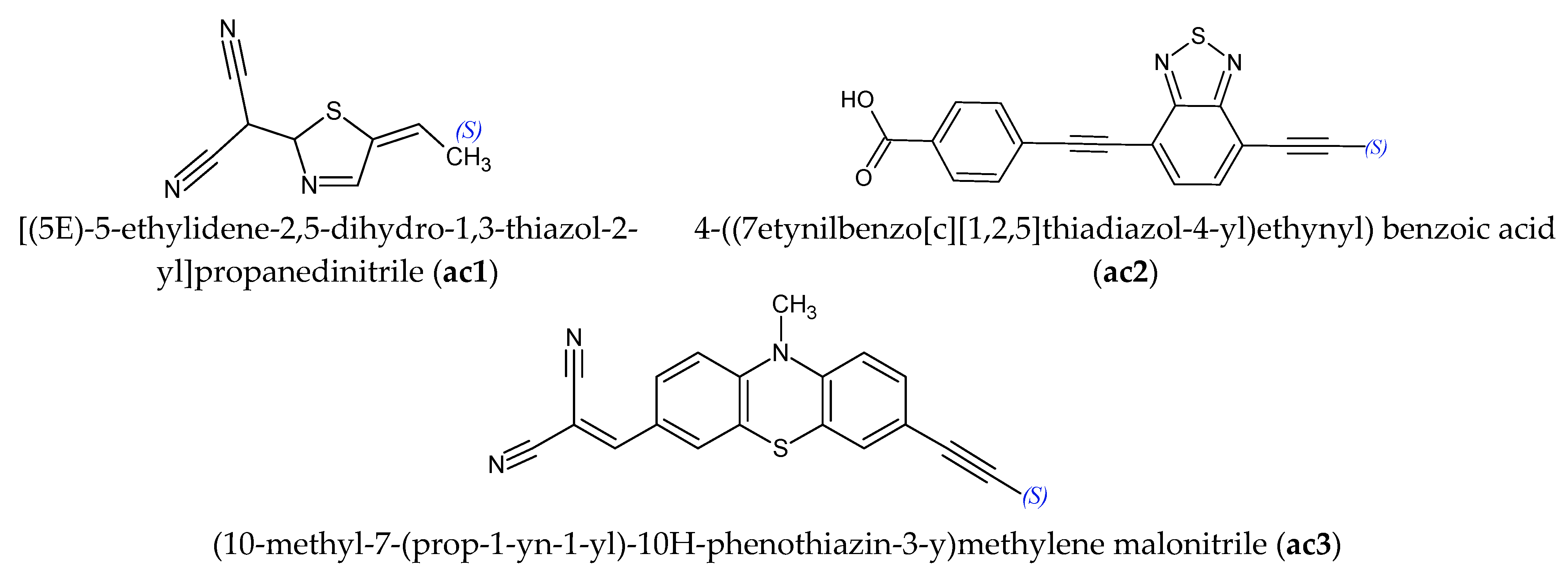
2. Computational Methods and Moieties Used in This Study
3. Results and Discussion
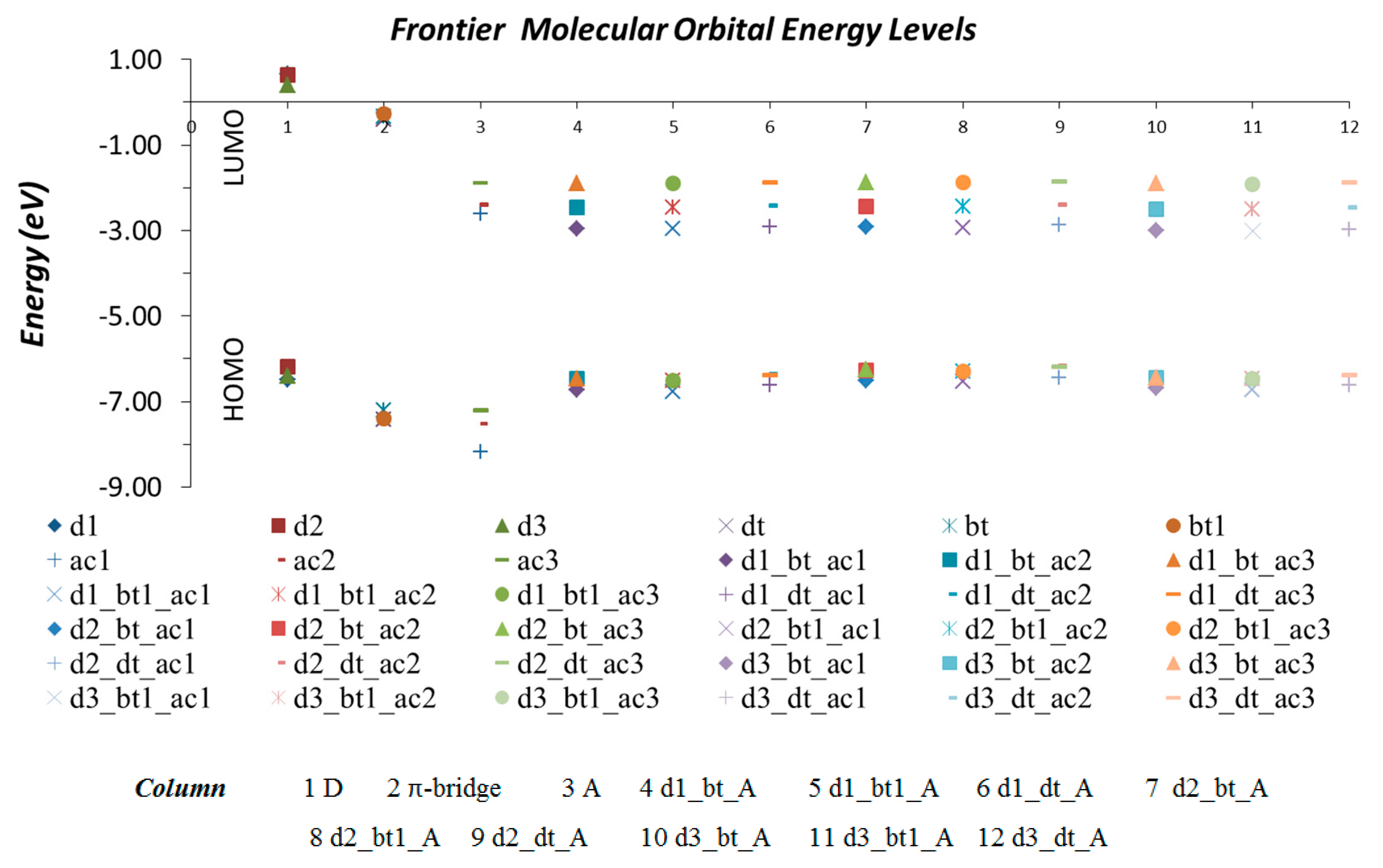
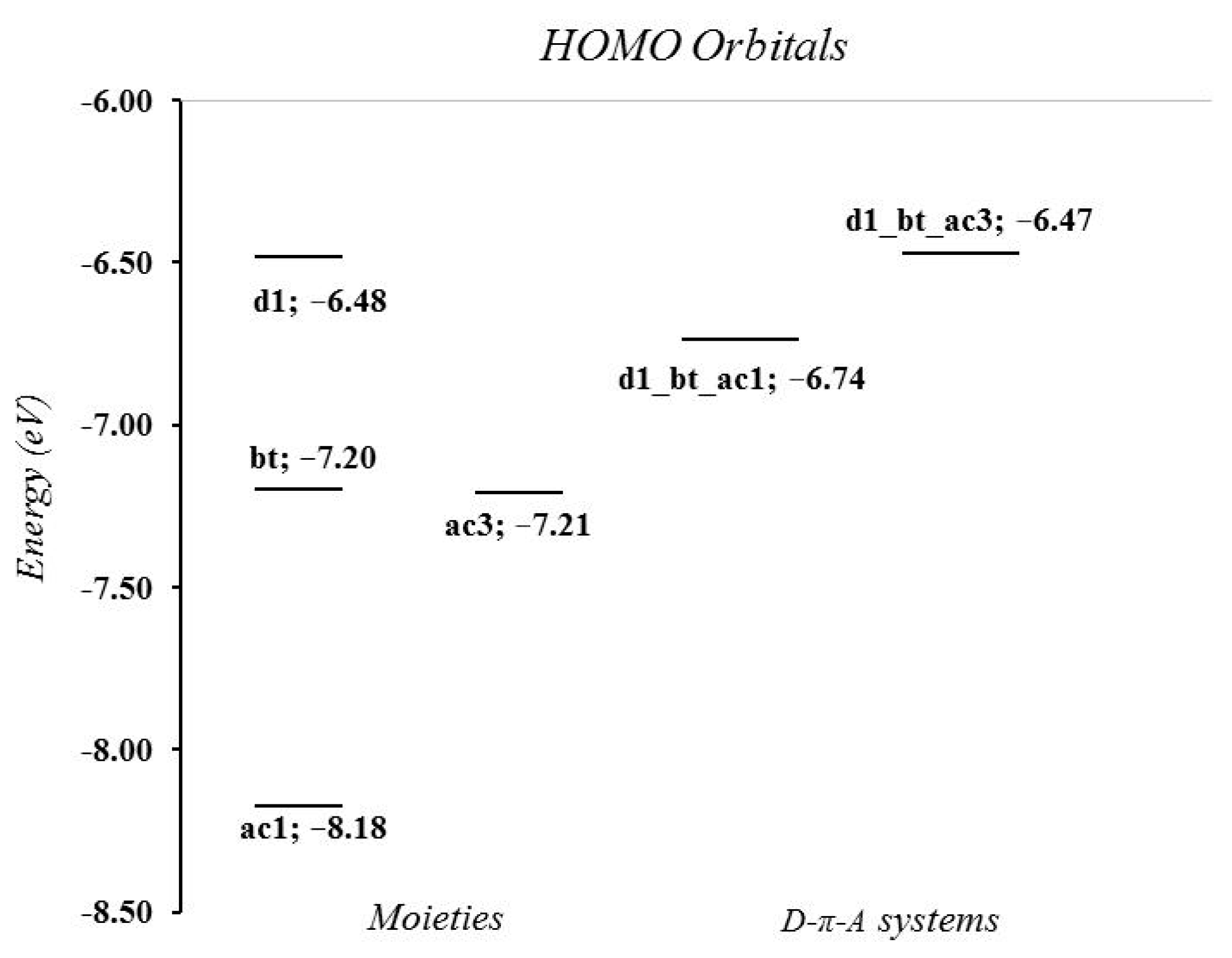
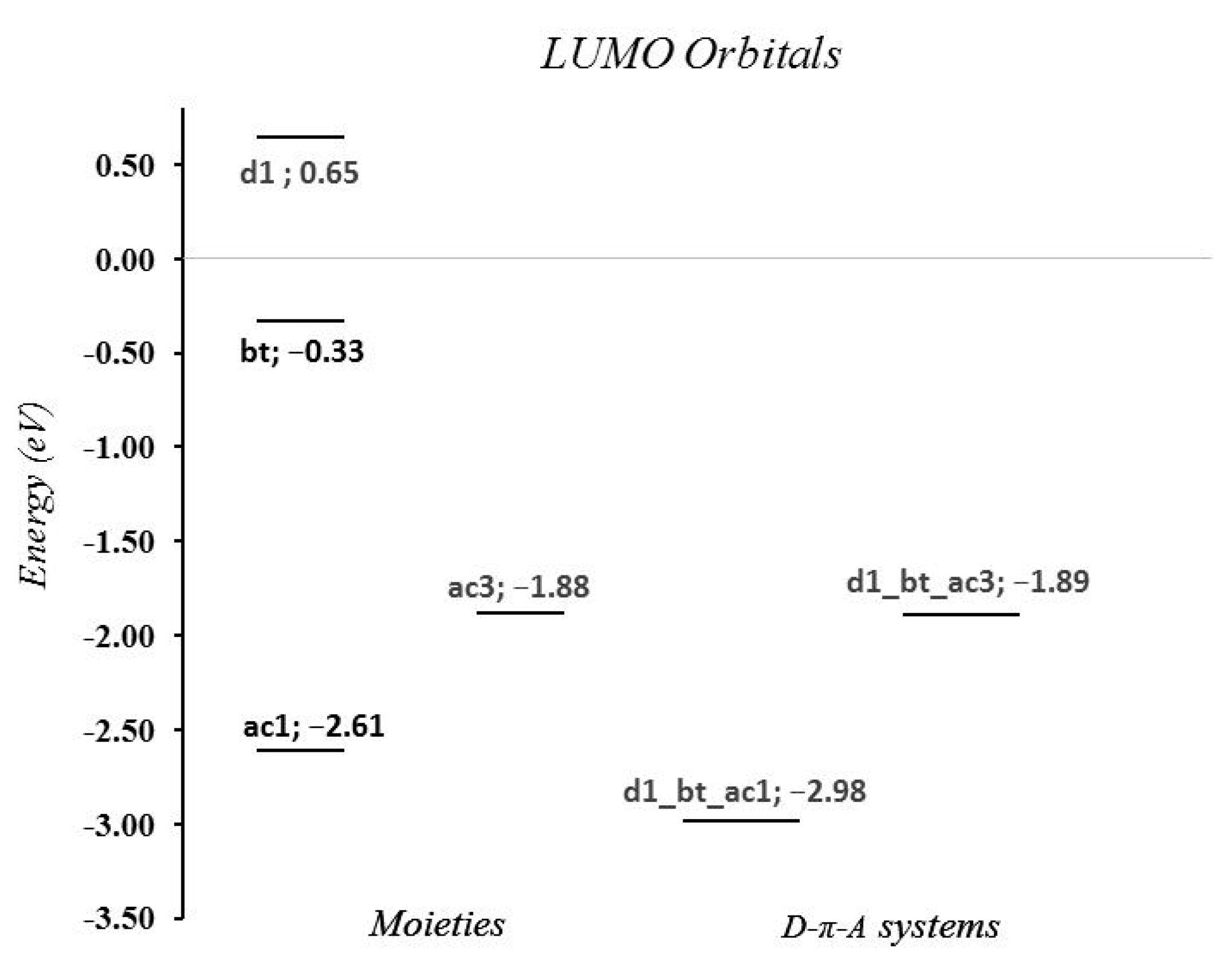
3.1. Analysis of the Frontier Molecular Orbitals (MOs) and Electronic Properties
3.2. Structure–Property Relationship: Photovoltaic Descriptors
4. Conclusions
Supplementary Materials
Author Contributions
Funding
Data Availability Statement
Conflicts of Interest
Abbreviations
| HOMO | Highest Occupied Molecular Orbital |
| LUMO | Lowest Unoccupied Molecular Orbital |
References
- Beard, M.C.; Luther, J.M.; Semonin, O.E.; Nozik, A.J. Multiple Exciton Generation in Semiconductor Quantum Dots. Acc. Chem. Res. 2013, 46, 1252–1260. [Google Scholar] [PubMed]
- Dennler, G.; Scharber, M.C.; Brabec, C.J. Polymer–Fullerene Bulk-Heterojunction Solar Cells. Adv. Mater. 2009, 21, 1323–1338. [Google Scholar] [CrossRef] [Scilit]
- Kim, J.Y.; Lee, K.; Coates, N.E.; Moses, D.; Nguyen, T.Q.; Dante, M.; Heeger, A.J. Efficient Tandem Polymer Solar Cells Fabricated by All-Solution Processing. Science 2007, 317, 222–225. [Google Scholar] [CrossRef] [Scilit] [PubMed]
- Sariciftci, N.S.; Smilowitz, L.; Heeger, A.J.; Wudl, F. Photoinduced Electron Transfer from a Conducting Polymer to Buckminsterfullerene. Science 1992, 258, 1474–1476. [Google Scholar] [CrossRef] [Scilit] [PubMed]
- Cheng, P.; Yang, Y. Narrowing the Band Gap: The Key to High-Performance Organic Photovoltaics. Acc. Chem. Res. 2020, 53, 1218–1228. [Google Scholar] [CrossRef] [Scilit] [PubMed]
- Wang, Y.; Zheng, Z.; Li, T.; Robertson, N.; Xiang, H.; Wu, W.; Hua, J.; Zhu, W.-H.; Tian, H. D-A-π-A Motif Quinoxaline-Based Sensitizers with High Molar Extinction Coefficient for Quasi-Solid-State Dye-Sensitized Solar Cells. ACS Appl. Mater. Interfaces 2016, 8, 31016–31024. [Google Scholar] [CrossRef] [Scilit] [PubMed]
- Liu, J.; Jabbari, H.; Kadhim, M.M.; Ansari, M.J.; Ebadi, A.G. Design Organic Material with Acceptor–π–Donor Configuration for High Performance Solar Cells. Comput. Theor. Chem. 2022, 1212, 113729. [Google Scholar] [CrossRef] [Scilit]
- Wei, M.; Perepichka, D.F. Benzodithiophene-Based Polymer Donors for Organic Photovoltaics. J. Mater. Chem. A 2025, 13, 12785–12807. [Google Scholar] [CrossRef] [Scilit]
- Madrid-Úsuga, D.; Suárez, O.J.; Portacio, A. Impact of Molecular π-Bridge Modifications on Triphenylamine-Based Donor Materials for Organic Photovoltaic Solar Cells. Condens. Matter 2025, 10, 52. [Google Scholar] [CrossRef] [Scilit]
- Babu, N.S. DFT and TD-DFT Studies of New Triphenylamine-Based (D–A–D) Donor Materials for High-Efficiency Organic Solar Cells. Mater. Adv. 2022, 3, 3526–3535. [Google Scholar] [CrossRef] [Scilit]
- Delgado-Montiel, T.; Soto-Rojo, R.; Baldenebro-López, J.; Glossman-Mitnik, D. Theoretical Study of the Effect of Different π-Bridges Including an Azomethine Group in Triphenylamine-Based Dye for Dye-Sensitized Solar Cells. Molecules 2019, 24, 3897. [Google Scholar] [CrossRef] [Scilit] [PubMed]
- Wang, Q.; Xiong, L.; Shi, J.; Wu, Z.; Zhang, K.; Zhang, T. Theoretical Study of the Effect of the Terminal Groups of Triphenylamine Donors on the Photophysical Properties of D–A–π–A Dye Sensitizers. J. Fluoresc. 2025, 35, 13769–13781. [Google Scholar] [CrossRef] [Scilit] [PubMed]
- Zaier, R.; Ayachi, S. Designing Well-Organized Donor–Bridge–Acceptor Conjugated Systems for Bulk Heterojunction Organic Solar Cells: DFT-Based Modeling. In Solar Cells–Theory, Materials and Recent Advances; IntechOpen: London, UK, 2021. [Google Scholar]
- Zhou, B.; Dai, T.; Zhou, J.; Chen, Y.; Geng, Y.; Lei, P.; Zheng, G.; Zeng, Q.; Zhou, E. Conjugated D–π–A Photovoltaic Polymers Containing Thieno[3,2-b]thiophene π-Bridge. Mater. Chem. Front. 2024, 8, 1563–1590. [Google Scholar] [CrossRef] [Scilit]
- Valkeneers, K.; Vandewal, K.; Maes, W. Benzothiadiazole-Based Push-Pull Copolymers–Balancing Synthetic Complexity against Organic Solar Cell Efficiency. Org. Electron. 2022, 111, 106667. [Google Scholar] [CrossRef] [Scilit]
- Lee, C.; Yang, W.; Parr, R.G. Development of the Colle–Salvetti Correlation-Energy Formula into a Functional of the Electron Density. Phys. Rev. B 1988, 37, 785–789. [Google Scholar] [CrossRef] [Scilit] [PubMed]
- Krishnan, R.; Binkley, J.S.; Seeger, R.; Pople, J.A. Self-Consistent Molecular Orbital Methods. A Basis Set for Correlated Wave Functions. J. Chem. Phys. 1980, 72, 650–654. [Google Scholar] [CrossRef] [Scilit]
- Runge, E.; Gross, E.K.U. Density-Functional Theory for Time-Dependent Systems. Phys. Rev. Lett. 1984, 52, 997–1000. [Google Scholar] [CrossRef] [Scilit]
- Frisch, M.J.; Trucks, G.W.; Schlegel, H.B.; Scuseria, G.E.; Robb, M.A.; Cheeseman, J.R.; Scalmani, M.; Barone, V.; Mennucii, B.; Petersoon, G.A.; et al. Gaussian 09; Gaussian, Inc.: Wallingford, CT, USA, 2009. [Google Scholar]
- Goerigk, L.; Grimme, S. A Thorough Benchmark of Density Functional Methods for General Main Group Thermochemistry, Kinetics, and Noncovalent Interactions. Phys. Chem. Chem. Phys. 2011, 13, 6670–6688. [Google Scholar] [CrossRef] [Scilit] [PubMed]
- Alparone, A. Second Harmonic Generation, Electrooptical Pockels Effect, and Static First-Order Hyperpolarizabilities of 2,2′-Bithiophene Conformers: An HF, MP2, and DFT Theoretical Investigation. Adv. Phys. Chem. 2013, 2013, 394697. [Google Scholar] [CrossRef] [Scilit]
- Cohen, A.J.; Mori-Sánchez, P.; Yang, W. Challenges for Density Functional Theory. Chem. Rev. 2012, 112, 289–320. [Google Scholar] [CrossRef] [Scilit]
- Jacquemin, D.; Perpète, E.A.; Ciofini, I.; Adamo, C. Assessment of Functionals for TD-DFT Calculations of Absorption and Fluorescence Energies. J. Chem. Theory Comput. 2010, 6, 1532–1537. [Google Scholar] [CrossRef] [Scilit] [PubMed]
- Peach, M.J.G.; Benfield, P.; Helgaker, T.; Tozer, D.J. Excitation Energies in DFT: An Evaluation and Analysis of the Performance of CAM-B3LYP. J. Chem. Phys. 2008, 128, 044118. [Google Scholar] [CrossRef] [Scilit] [PubMed]
- Grimme, S.; Parac, M. Substantial Errors from Conventional DFT/TD-DFT for Excited States of Large π-Systems. ChemPhysChem 2003, 4, 292–295. [Google Scholar] [CrossRef] [Scilit] [PubMed]
- Blanchard, P.; Malacrida, C.; Cabanetos, C.; Roncali, J.; Ludwigs, S. Triphenylamine and Some of Its Derivatives as Versatile Building Blocks for Organic Electronic Applications. Polym. Int. 2019, 68, 589–606. [Google Scholar]
- Ueda, M.; Nagayama, R.; Nagaoka, M.; Suzuki, N.; Kodama, S.; Maeda, T.; Kato, S.-i.; Yagi, S. Synthesis and Electronic Properties of Novel Donor–π–Acceptor-Type Functional Dyes with a Carbonyl-Bridged Bithiophene π-Spacer. Molecules 2025, 30, 3084. [Google Scholar] [CrossRef] [Scilit] [PubMed]
- Abbas, F.; Ali, U.; Ahmad, H.M.R.; Tallat, A.; Shehzad, A.; Zeb, Z.; Hussain, I.; Saeed, A. Body Centered Non-Fullerene Acceptors Substitution on Triangular Shaped Sub-Phthalocyanines Based A–D–A Organic Solar Cells: A Step toward New Strategies for Better Performances. Opt. Quantum Electron. 2022, 54, 21. [Google Scholar] [CrossRef] [Scilit]
- Krishna, N.V.; Krishna, J.V.S.; Singh, S.P.; Giribabu, L.; Han, L.; Bedja, I.; Gupta, R.K.; Islam, A. Donor–π–Acceptor Based Stable Porphyrin Sensitizers for Dye-Sensitized Solar Cells: Effect of π-Conjugated Spacers. J. Phys. Chem. C 2017, 121, 6464–6477. [Google Scholar] [CrossRef] [Scilit]
- Al-Zahrani, F.A.; Arshad, M.N.; Asiri, A.M.; Mahmood, T.; Gilani, M.A.; El-Shishtawy, R.M. Synthesis and Structural Properties of 2-((10-Alkyl-10H-Phenothiazin-3-yl)Methylene)malononitrile Derivatives: A Combined Experimental and Theoretical Insight. Chem. Cent. J. 2016, 10, 13. [Google Scholar] [CrossRef] [Scilit] [PubMed]
- Jacquemin, D.; Wathelet, V.; Perpète, E.A.; Adamo, C. Extensive TD-DFT Benchmark: Singlet Excited States of Organic Molecules. Chem. Rev. 2012, 112, 542–585. [Google Scholar]
- Dreuw, A.; Head-Gordon, M. Failure of Time-Dependent Density Functional Theory for Long-Range Charge-Transfer Excited States. J. Am. Chem. Soc. 2004, 126, 4007–4016. [Google Scholar] [CrossRef] [Scilit] [PubMed]
- Lin, H.; Yang, M.; Ru, X.; Wang, G.; Yin, S.; Peng, F.; Hong, C.; Qu, M.; Lu, G.; Fang, L.; et al. Silicon Heterojunction Solar Cells with up to 26.81% Efficiency Achieved by Electrically Optimized Nanocrystalline-Silicon Hole Contact Layers. Nat. Energy 2023, 8, 789–799. [Google Scholar] [CrossRef] [Scilit]
- Park, N.-G.; Snaith, H.J.; Miyasaka, T. Key Advances in Perovskite Solar Cells. Nat. Rev. Clean Technol. 2026, 2, 6–7. [Google Scholar] [CrossRef] [Scilit]
- Yuan, J.; Zhang, Y.; Zhou, L.; Zhang, G.; Yip, H.-L.; Lau, T.-K.; Lu, X.; Zhu, C.; Peng, H.; Johnson, P.A.; et al. Single-Junction Organic Solar Cell with Over 15% Efficiency Using Fused-Ring Acceptor with Electron-Deficent Core. Joule 2019, 3, 1140–1151. [Google Scholar] [CrossRef] [Scilit]
- Hoppe, H.; Sariciftci, N.S. Morphology of Polymer/Fullerene Bulk Heterojunction Solar Cells. J. Mater. Chem. 2006, 16, 45–61. [Google Scholar] [CrossRef] [Scilit]
- Sahu, H.; Rao, W.; Troisi, A.; Ma, H. Toward Predicting Efficiency of Organic Solar Cells via Machine Learning and Improved Descriptors. Adv. Energy Mater. 2018, 8, 1801032. [Google Scholar] [CrossRef] [Scilit]
- Lampande, R.; Pizano, A.; Gui, M.; Cawthorn, R.; Rand, B.P.; Giebink, N.C. Dispersive Charge Transfer State Electroluminescence in Organic Solar Cells. Adv. Energy Mater. 2023, 13, 2300394. [Google Scholar] [CrossRef] [Scilit]
- Hosseini, S.M.; Wilken, S.; Sun, B.; Hang, F.; Jeong, S.Y.; Woo, H.Y.; Coropceanu, V.; Shoaee, S. Relationship between Energetic Disorder and Reduced Recombination of Free Carriers in Organic Solar Cells. Adv. Energy Mater. 2023, 13, 2203576. [Google Scholar] [CrossRef] [Scilit]
- Alharbi, F.H.; Rashkeev, S.N.; El-Mellouhi, F.; Luthi, H.P.; Tabet, N.; Kais, S. An Efficient Descriptor Model for Designing Materials for Solar Cells. NPJ Comput. Mater. 2015, 1, 15003. [Google Scholar] [CrossRef] [Scilit]
- Rau, U. Reciprocity Relation between Photovoltaic Quantum Efficiency and Electroluminescent Emission of Solar Cells. Phys. Rev. B 2007, 76, 085303. [Google Scholar] [CrossRef] [Scilit]
- Vandewal, K.; Tvingstedt, K.; Gadisa, A.; Inganäs, O.; Manca, J.V. On the Origin of the Open-Circuit Voltage of Polymer–Fullerene Solar Cells. Nat. Mater. 2009, 8, 904–909. [Google Scholar] [CrossRef] [Scilit] [PubMed]
- Benduhn, J.; Tvingstedt, K.; Piersimoni, F.; Ullbrich, S.; Rau, U.; Vandewal, K. Intrinsic Non-Radiative Voltage Losses in Fullerene-Based Organic Solar Cells. Nat. Energy 2017, 2, 17053. [Google Scholar] [CrossRef] [Scilit]
- Shang, Y.; Li, Q.; Meng, L.; Wang, D.; Shuai, Z. Computational Characterization of Organic Photovoltaic Devices. Theor. Chem. Acc. 2011, 129, 291–301. [Google Scholar] [CrossRef] [Scilit]
- ASTM G173-03(2020); Standard Tables for Reference Solar Spectral Irradiances: AM1.5 Direct Normal and AM1.5 Global on 37° Tilted Surface, Derived from SMARTS v. 2.9.2. ASTM International: West Conshohocken, PA, USA, 2020.
- Preat, J.; Michaux, C.; Jacquemin, D.; Perpète, E.A. Toward an Efficient Screening of Organic Dyes for Dye-Sensitized Solar Cells. J. Phys. Chem. C 2009, 113, 16821–16833. [Google Scholar] [CrossRef] [Scilit]
- Obi-Egbedi, N.O.; Ojo, N.D. Synthesis, Light Harvesting Efficiency, Photophysical and Nonlinear Optical Properties of 3-(5-(4-Hydroxybenzylideneamino)naphthalen-1-yliminomethyl)phenol: Spectroscopic and Quantum Chemical Approach. Res. Chem. Intermed. 2021, 47, 5249–5266. [Google Scholar] [CrossRef] [Scilit]
- Ali, A.Y.; Holmes, N.P.; Cooling, N.; Holdsworth, J.; Belcher, W.; Dastoor, P.; Zhou, X. Optimization of Bulk Heterojunction Organic Photovoltaics. Coatings 2023, 13, 1293. [Google Scholar] [CrossRef] [Scilit]
- Ghosh, T.; Panicker, J.S.; Nair, V.C. Self-Assembled Organic Materials for Photovoltaic Application. Polymers 2017, 9, 112. [Google Scholar] [CrossRef] [Scilit] [PubMed]
- Junda, M.M.; Podraza, N.J. Optical Properties of Soda-Lime Float Glass from 3 mm to 148 nm by Spectroscopic Ellipsometry. Surf. Sci. Spectra 2018, 25, 016001. [Google Scholar] [CrossRef] [Scilit]
- Weast, R.C. Handbook of Chemistry and Physics, 58th ed.; CRC Press: Boca Raton, FL, USA, 1979; p. 515. [Google Scholar]
- Shen, Y.; Scudiero, L.; Gupta, M.C. Temperature Dependence of HOMO–LUMO Levels and Open-Circuit Voltage for P3HT:PCBM Organic Solar Cells. Mater. Res. Soc. Symp. Proc. 2012, 1360, 51–59. [Google Scholar] [CrossRef] [Scilit]
- Ozerm, M.E. Comparing Molecular and Electronic Properties of Perylene Tetracarboxylic Diimides Decorated at 1,6- and 1,7-Bay-Positions Using DFT/TDDFT Method. Mater. Today Commun. 2021, 27, 102446. [Google Scholar] [CrossRef] [Scilit]





| D–π–A | ΔEH–L | νmax | λmax | f |
|---|---|---|---|---|
| eV | eV | nm | - | |
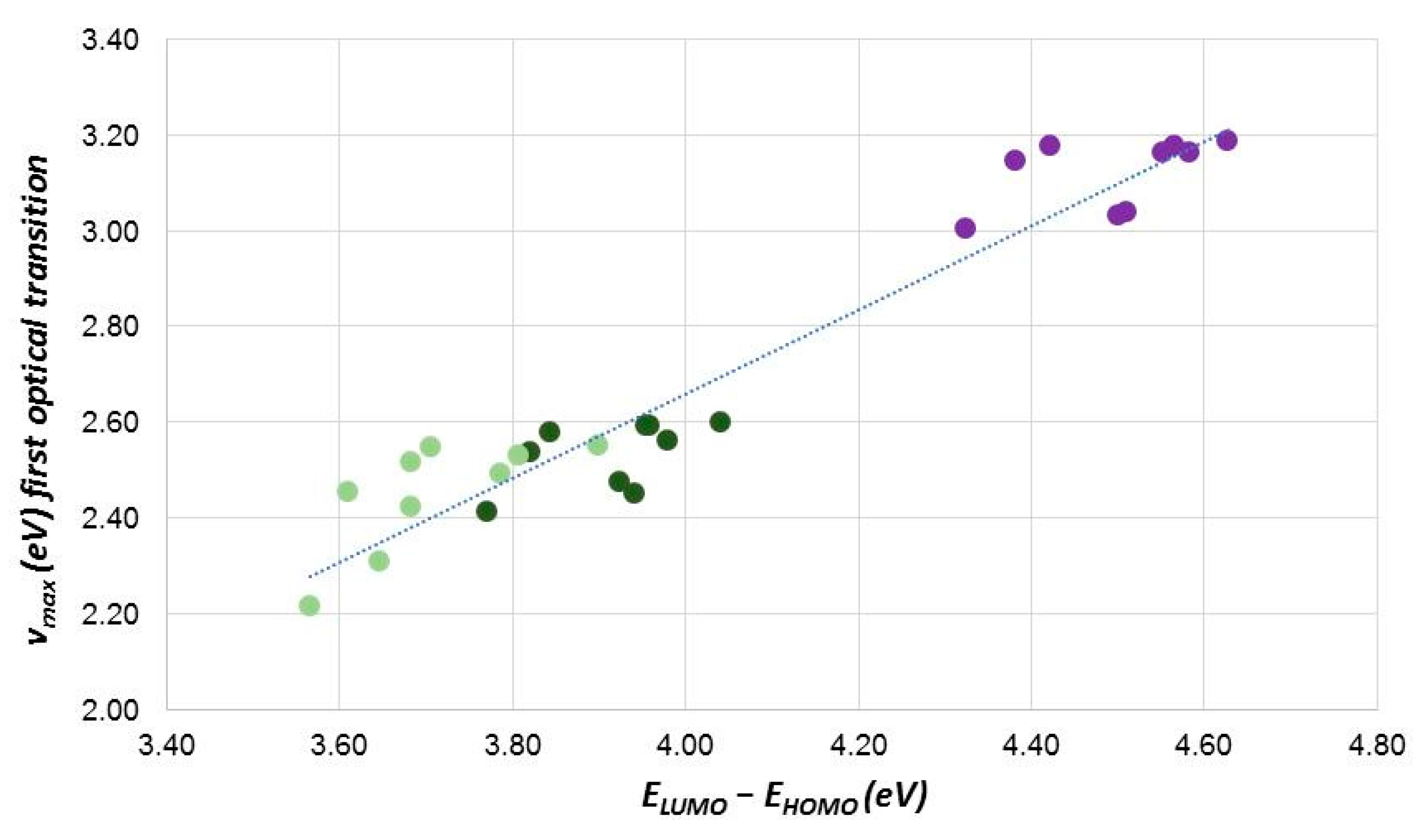
| d1_bt_ac1 | 3.79 | 2.49 | 498.09 | 2.1369 |
| d1_bt1_ac1 | 3.81 | 2.53 | 490.45 | 1.5780 |
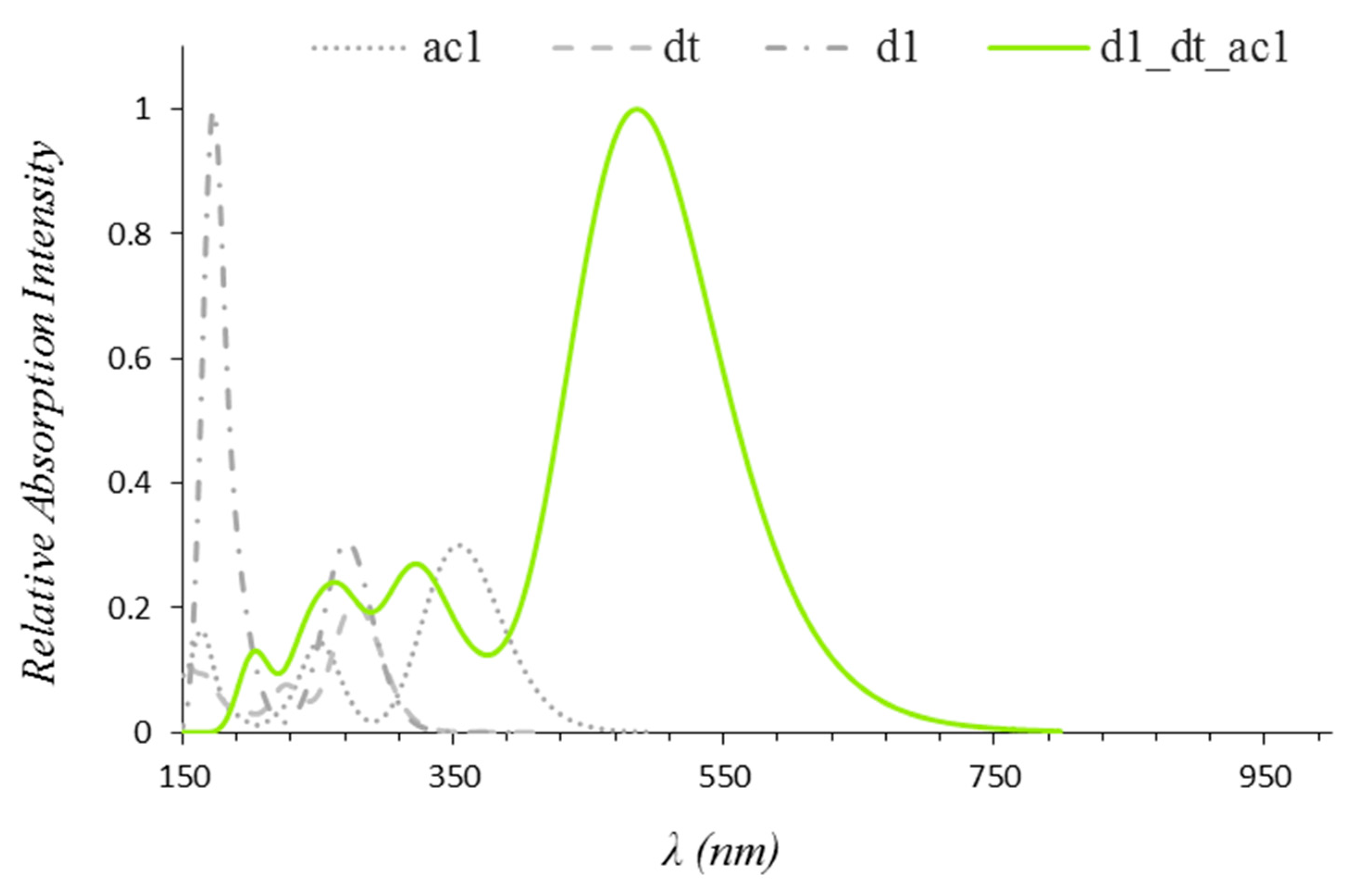
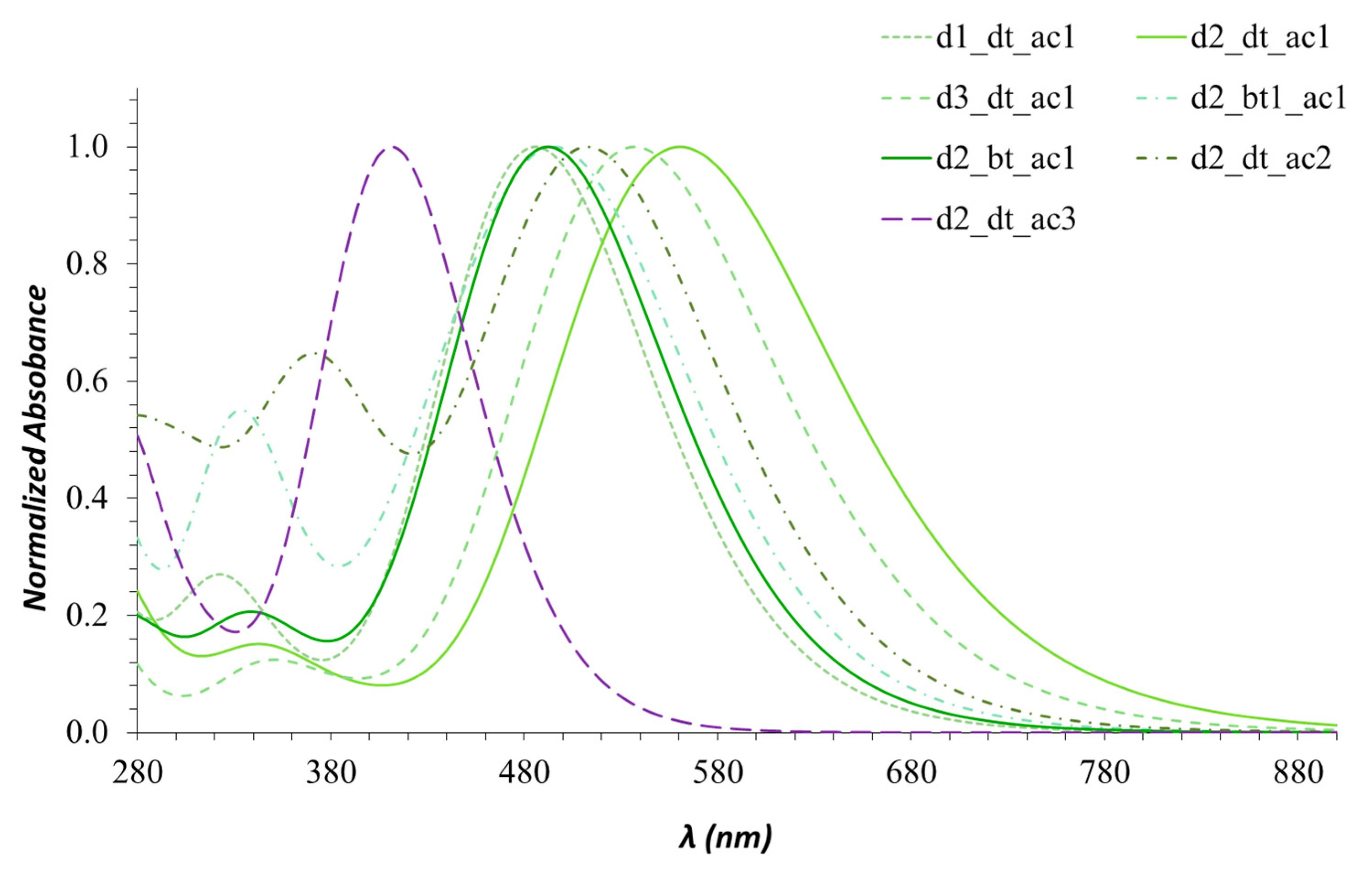
| d1_dt_ac1 | 3.90 | 2.55 | 486.15 | 1.8600 |
| d2_bt_ac1 | 3.68 | 2.42 | 511.80 | 2.0902 |
| d2_bt1_ac1 | 3.61 | 2.45 | 505.72 | 1.3929 |
| d2_dt_ac1 | 3.57 | 2.21 | 560.60 | 2.0936 |
| d3_bt_ac1 | 3.68 | 2.51 | 493.42 | 2.0651 |
| d3_bt1_ac1 | 3.71 | 2.55 | 486.79 | 1.5385 |
| d3_dt_ac1 | 3.65 | 2.31 | 537.45 | 2.0311 |
| d1 | 7.13 | 4.56 | 272.23 | 0.2769 |
| d2 | 6.81 | 4.52 | 274.10 | 0.3178 |
| d3 | 6.82 | 4.09 | 303.41 | 0.1153 |
| dt | 7.02 | 4.46 | 277.88 | 0.3867 |
| bt | 6.87 | 4.43 | 279.86 | 0.1925 |
| bt1 | 7.14 | 4.74 | 261.66 | 0.3619 |
| ac1 | 5.57 | 3.50 | 354.35 | 0.5592 |
| ac2 | 5.13 | 4.26 | 291.17 | 0.6483 |
| ac3 | 5.33 | 3.31 | 374.79 | 0.5778 |
| D–π–A 5 | ΔEHOMO | ΔELUMO | Voc | FF |
|---|---|---|---|---|
| eV | V | - | ||
| d1_bt1_ac1 | −0.67 | 0.74 | 2.07 | 0.871 |
| d1_bt_ac1 | −0.64 | 0.75 | 2.04 | 0.869 |
| d1_dt_ac1 | −0.57 | 0.93 | 1.97 | 0.864 |
| d3_dt_ac1 | −0.53 | 0.72 | 1.93 | 0.862 |
| d2_bt1_ac1 | −0.44 | 0.77 | 1.84 | 0.857 |
| d2_bt_ac1 | −0.42 | 0.78 | 1.82 | 0.855 |
| d2_dt_ac1 | −0.34 | 0.83 | 1.74 | 0.849 |
| d2_bt1_ac3 | −0.19 | 1.25 | 1.59 | 0.838 |
| d2_dt_ac2 | −0.08 | 1.30 | 1.48 | 0.827 |
| D–π–A 1 | Jsc | η |
|---|---|---|
| mA/cm2 | - | |
| d2_dt_ac1 | 13.08 | 26.28% |
| d3_dt_ac1 | 11.46 | 25.88% |
| d1_bt_ac1 | 9.18 | 22.09% |
| d1_bt1_ac1 | 7.63 | 18.71% |
| d2_bt_ac1 | 8.83 | 18.68% |
| d1_dt_ac1 | 7.78 | 17.96% |
| d2_bt1_ac1 | 8.34 | 17.88% |
| d3_bt1_ac1 | 7.46 | 17.75% |
| d3_bt_ac1 | 7.46 | 17.52% |
| d1_dt_ac2 | 8.94 | 17.11% |
| d3_dt_ac2 | 8.67 | 16.74% |
| d2_dt_ac2 | 9.58 | 15.88% |
Disclaimer/Publisher’s Note: The statements, opinions and data contained in all publications are solely those of the individual author(s) and contributor(s) and not of MDPI and/or the editor(s). MDPI and/or the editor(s) disclaim responsibility for any injury to people or property resulting from any ideas, methods, instructions or products referred to in the content. |
© 2026 by the authors. Licensee MDPI, Basel, Switzerland. This article is an open access article distributed under the terms and conditions of the Creative Commons Attribution (CC BY) license.
Share and Cite
Ottonelli, M.; Alloisio, M. DFT-Guided Molecular Engineering of Donor–Bridge–Acceptor Semiconductors for Organic Photovoltaics Solar Cells. Condens. Matter 2026, 11, 29. https://doi.org/10.3390/condmat11030029
Ottonelli M, Alloisio M. DFT-Guided Molecular Engineering of Donor–Bridge–Acceptor Semiconductors for Organic Photovoltaics Solar Cells. Condensed Matter. 2026; 11(3):29. https://doi.org/10.3390/condmat11030029
Chicago/Turabian StyleOttonelli, Massimo, and Marina Alloisio. 2026. "DFT-Guided Molecular Engineering of Donor–Bridge–Acceptor Semiconductors for Organic Photovoltaics Solar Cells" Condensed Matter 11, no. 3: 29. https://doi.org/10.3390/condmat11030029
APA StyleOttonelli, M., & Alloisio, M. (2026). DFT-Guided Molecular Engineering of Donor–Bridge–Acceptor Semiconductors for Organic Photovoltaics Solar Cells. Condensed Matter, 11(3), 29. https://doi.org/10.3390/condmat11030029