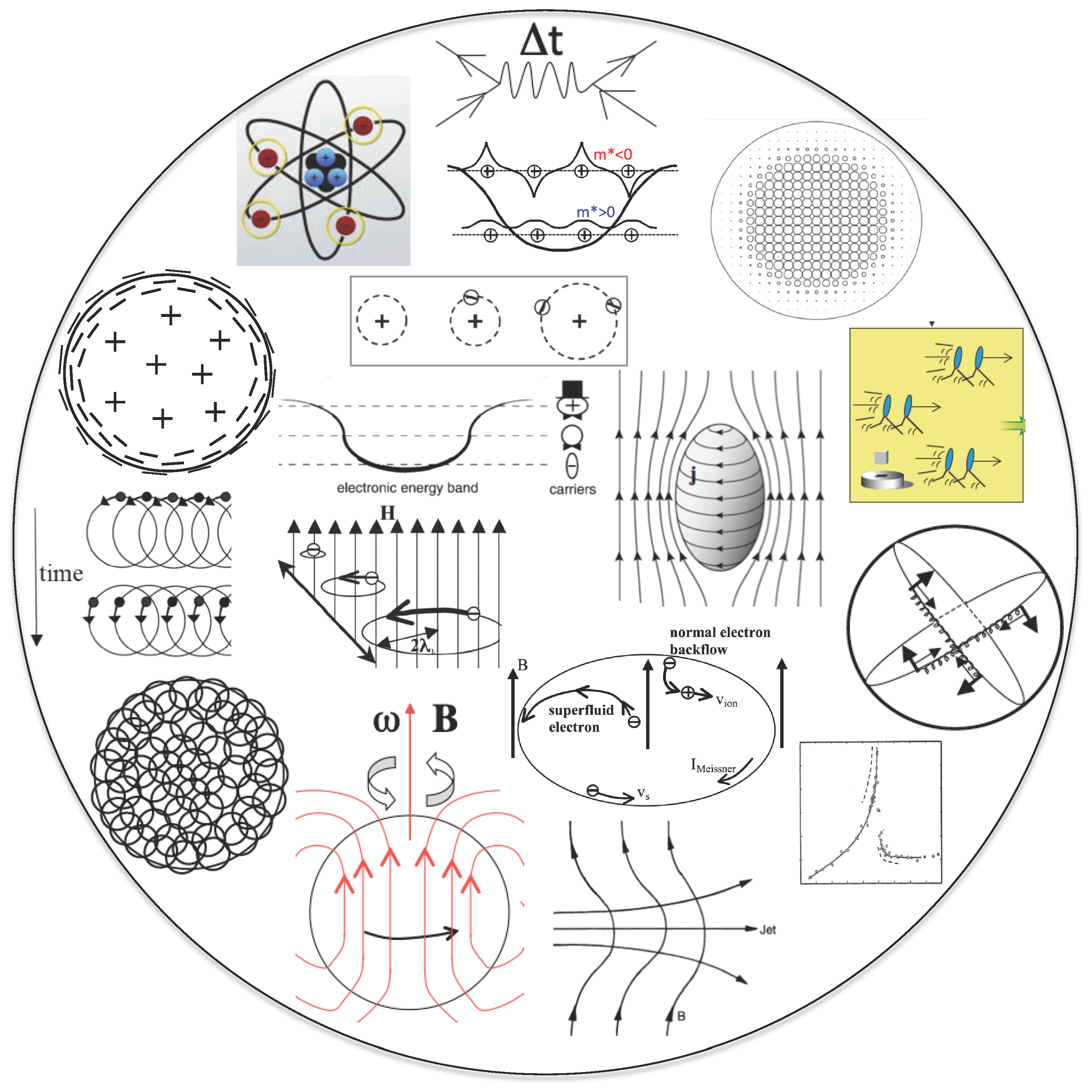
Article

Delayed Conceptual Unification in the Theory of Hole Superconductivity


Department of Physics, University of California, San Diego, La Jolla, CA 92093-0319, USA
Condens. Matter 2026, 11(3), 28; https://doi.org/10.3390/condmat11030028
Submission received: 17 April 2026 / Revised: 6 July 2026 / Accepted: 17 July 2026 / Published: 20 July 2026

Abstract

The theory of hole superconductivity has developed over more than three decades through a sequence of steps addressing distinct physical problems. This paper identifies and documents a recurring structural pattern in that development: ideas introduced to solve one problem were only later recognized as being required by independent physical constraints. By tracing a series of such delayed conceptual unifications, spanning pairing mechanism, charge expulsion, electrodynamics, spin structure, rotation, relativity, thermodynamics and momentum conservation, we highlight that the framework evolves by constraint tightening rather than by ad hoc embellishment. While this does not establish the correctness of the theory, it provides evidence that it is responding to real physical requirements uncovered progressively, in contrast to theories that accommodate discrepancies or new constraints primarily through auxiliary assumptions and ultimately fail.

1. Introduction

The theory of hole superconductivity [1,2], developed over more than three decades, is exposed in 156 publications to date [3]. Because its development spans many papers addressing different aspects at different times, its coherence as a unified framework is not immediately apparent. This is not because it lacks internal logic, but because its key structural elements did not appear all at once. Instead, they emerged gradually, in response to distinct physical questions. This paper collects and organizes a specific pattern that recurs throughout the development of the theory: ideas introduced for one reason later turned out to be required by independent, deeper physical constraints.
We identify sixteen distinct instances of this pattern within the theory itself, including pairing, kinetic energy, effective mass, charge expulsion, electrodynamics, spin structure, rotation, phase coherence, electric-field screening, and momentum transfer. In addition, we discuss five additional instances related to ideas introduced much earlier in the history of superconductivity. The goal of this paper is not to argue directly for the correctness of the theory of hole superconductivity, nor to adjudicate experimental controversies—some of the latter have been recently discussed by Wittlin [4]. Rather, the purpose is methodological: to make explicit a repeated pattern of delayed conceptual unification and to contrast it with the alternative mode of theory development in which discrepancies and new constraints are addressed primarily through auxiliary assumptions and ad hoc extensions. By focusing on how the theory evolves under constraints, often years after its initial proposals, this paper aims to argue that the framework merits serious consideration as a coherent and physically responsive theoretical program.

2. Broad Overview of Development of the Theory

The theory started with the observation [5] that the periodic table of elements exhibits a striking left–right asymmetry: elements on the left side of the periodic table are metallic and on the right side are semimetallic or insulating. Elements from the first column have one electron in the outer shell, elements from the seventh column have one hole in the outer shell. It was argued that this reflects a fundamental asymmetry between electrons and holes, in particular, that electrons move easily while holes have difficulty propagating. Conventional band theory of solids does not reflect such asymmetry between electrons and holes, so it was argued that it originates in physics that is absent from conventional band theory, namely, electron–electron interactions. A qualitative rationale was given explaining the difficulty of holes in propagating, namely that holes ‘disrupt’ their ‘background’, namely the other electrons in the same shell when they propagate, while electrons do not because there is no background to them other than the lower filled shells that are rigid [5]. From the very beginning, it was hypothesized that this physics plays a role in a l l superconductors [5].
From this qualitative observation, the theory was made quantitative by the introduction of model Hamiltonians with electronic and auxiliary boson degrees of freedom, reflecting the fundamental physics of electron–hole asymmetry, generically called “dynamic Hubbard models”, which were studied by a variety of analytic and numerical techniques over several years. The Hamiltonians were shown to predict pairing and superconductivity when the carriers were hole-like, driven by the lowering of kinetic energy, as well as negative charge expulsion from the interior to the surface of the body. In parallel, a macroscopic London-like electrodynamic theory was developed, that predicts an electric field in the interior of superconductors in their ground state, and spin currents near the surface.
Finally, it was argued that the theory of hole superconductivity explains the Meissner effect, and that the conventional theory of superconductivity cannot explain the Meissner effect because it lacks essential physical elements to do so, in particular electron–hole asymmetry [6].
In the following, we survey key elements of the theory and their interrelationships.

3. Sixteen Instances of Delayed Conceptual Unification

The papers referred to in this section are identified in parentheses with numbers, e.g., (1.) and listed in chronological order in Appendix A instead of as references, in order to show their time evolution and not unduly increase the citation count for this author.
1. Hole pairing mechanism: anions first, band physics later
Condensedmatter 11 00028 i001
1.1 Initial proposal: local-shell physics and electron–phonon-like mechanism (1988)
In the very first paper, “Hole superconductivity” (1.), we introduced the idea that a hole moving in an almost filled anionic shell necessarily induces rearrangement of the other electrons in that shell. This was argued to make it difficult for the hole to propagate and to produce an effective attraction between holes through excitations of the outer shell, just like the electron–phonon mechanism or proposed exciton mechanisms [7,8,9] would, but originating in purely local electronic degrees of freedom. To describe this physics, a spin Hamiltonian was proposed (Equations (6) and (9) of (1.)), namely
H a n i o n = V ( n + n ) σ x + ω ( c o s   θ σ x + s i n   θ σ z ) + U 0 n n
coupled to the band electrons, intended to capture the internal excitation of a negatively charged anion as the hole moves. The relevant parameter range for this Hamiltonian to describe the interaction of a hole with the anion background was discussed in paper (3.). At this initial stage, an electron–hole s y m m e t r i c Holstein-like model would have served the same purpose; fortunately, it was not used.
Several crucial features of this interaction were not yet recognized:
  • That the proposed spin Hamiltonian broke electron–hole symmetry;
  • That the resulting effective interaction is repulsive for electrons and attractive for holes;
  • That the attraction between holes arises already in first-order perturbation theory, rather than only in second order as in electron–phonon or exciton-type mechanisms.
In the first paper (1.), and the subsequent papers (2.), (3.), (4.) shortly thereafter, the presence of an attractive interaction between holes was established numerically by exact diagonalization of small clusters, as was the fact that the effective mass of the carriers is largest in the parameter regime where the effective interaction is most attractive (3.), reflecting the difficulty for holes to propagate. The result was clear, but its deeper analytic structure and physical content were not yet transparent. The focus was on anions with several electrons in the outer shell. The fact that the essential role of electron–hole asymmetry was not recognized at this stage is illustrated by the fact that in paper (4.) it was argued that an ‘effective Hamiltonian’ to describe this physics was an electron–hole symmetric attractive Hubbard model.
1.2 Later unification: analytic structure, Δ t term, and electron–hole asymmetry
Shortly thereafter, the effective low-energy Hamiltonian for band electrons was derived analytically from the electron-spin Hamiltonian in paper (5.), yielding, in hole representation,
H e f f = t p < i j > σ ( c i σ c j σ + h . c . ) + U p i n i n i Δ t < i j > σ ( c i σ c j σ + h . c . ) ( n i , σ + n j , σ )
with the relations between the parameters in Equation (2) and Equation (1) given in paper (5.), revealing the appearance of a correlated hopping ( Δ t ) term. This step clarified several essential points (see also papers (6.), (7.), (8.)):
  • Δ t is the only term in a generalized Hubbard model with purely two-center interactions that breaks electron–hole symmetry (7., 8.).
  • Its sign, as obtained from the derivation of this term from the electron-spin Hamiltonian Equation (1), is such that the resulting interaction between electrons is attractive near the top of the band and repulsive near the bottom.
  • Δ t increasingly reduces the hopping amplitude, i.e., increases the effective mass, as the Fermi level approaches the top of the band, which is also where the interaction becomes most attractive.
  • A BCS treatment of the Δ t Hamiltonian (5.), (6.), (7.) predicts pairing and superconductivity for holes, but not for electrons.
Thus, what had first appeared as a numerical result based on local-shell physics of anions (1.), (2.), (3.), (4.) was subsequently revealed to be a structural consequence of electron–hole asymmetry encoded microscopically in the Hamiltonian for any electronic energy band.
1.3 Significance
The very first qualitative intuition behind hole superconductivity, that holes in anions have difficulty propagating and attract each other, was later shown to contain, in latent form, a unique symmetry-breaking structure that analytically enforces heaviness and pairing of carriers when the Fermi level is close to the top of a band (hole carriers) and excludes it when the band is less full. The delayed recognition of this structure transformed an initially heuristic idea into a sharply constrained microscopic mechanism.
2. Charge asymmetry: microscopic emphasis first, macroscopic relevance later
Condensedmatter 11 00028 i002
2.1 Initial emphasis: electron–hole asymmetry as microscopic key (1991)
From very early on after the initial stage, it was proposed that electron–hole asymmetry is central to superconductivity. This was articulated, for example, in the 1991 paper titled “Electron-hole asymmetry: the key to superconductivity”, (10.). At this stage, electron–hole asymmetry was understood primarily as a microscopic and materials-level property:
  • Real solids are not particle-hole symmetric.
  • The electron–ion interaction and band structure distinguish electrons from holes.
  • Pairing mechanisms and transport properties depend sensitively on this asymmetry. The emphasis was on how asymmetry affects pairing tendencies and normal-state transport properties.
2.2 Later unification: macroscopic relevance of carrier charge sign (2003)
In 2003, we reconsidered electron–hole asymmetry from a fundamentally different angle in the paper “Electron-hole asymmetry and superconductivity” (23.). There, we noted a striking empirical fact: superconductors, unlike normal metals, exhibit macroscopic phenomena that unambiguously reveal the sign of the charge carriers.
Specifically:
  • The gyromagnetic effect [10].
  • The London moment [11].
  • Both show a universal sign that indicates that the elementary superconducting carriers have negative charge.
This stands in sharp contrast with normal metals, which can exhibit either positive or negative Hall coefficients, and therefore show no universal macroscopic awareness of the sign of the charge carriers.
The realization was that superconductivity does not merely depend on electron–hole asymmetry microscopically, but exhibits a macroscopic electrodynamic sensitivity to the sign of charge that normal metals lack.
2.3 Significance: Electron–hole asymmetry was initially introduced as a microscopic ingredient relevant to pairing and transport. The emphasis on electron–hole asymmetry from the outset in the development of the theory of hole superconductivity based on microscopic arguments was retroactively validated, more than a decade later, by the realization that superconductors display a qualitative macroscopic awareness of the sign of the charge carriers as evidenced by the gyromagnetic effect and the London moment, establishing that electron–hole asymmetry is a defining property of the superconducting state.
3. Charge expulsion: phenomenological proposal first, microscopic justification later
Condensedmatter 11 00028 i003
3.1 Initial situation (1989–2001)
In the early development of the theory starting in 1989, the focus was on microscopic Hamiltonians. Then, in 2001, we proposed (paper 20.), based on general principles of electron–hole asymmetry and motivated by the structure of the gap function resulting from a BCS treatment of the model Hamiltonian Equation (2), that superconductors expel electrons from the interior to the surface. In particular, this was motivated by the observation that the dependence of the gap function Δ k = Δ ( ϵ k ) on band energy ϵ k leads to quasiparticle energy
E k = ( ϵ k μ ) 2 + Δ k 2 = a 2 ( ϵ k μ ν ) 2 + Δ 0 2
that implies a chemical potential shift from μ to μ = μ + ν > μ in hole representation.
Thus, two different elements existed but were not yet intimately connected:
  • A microscopic Hamiltonian (first introduced in 1989) featuring correlated hopping (the Δ t term), designed to capture the pairing of holes and electron–hole asymmetry.
  • The phenomenological proposal (2001) that superconductors expel negative charge from their interior toward the surface.
Importantly:
  • The 2001 charge-expulsion proposal was not d e r i v e d from the microscopic Hamiltonian.
  • It was instead made plausible by electron–hole asymmetry and chemical-potential imbalance.
  • There was no demonstration that the Δ t Hamiltonian itself predicts macroscopic charge expulsion.
  • Then, for over a decade, the microscopic pairing model and the macroscopic charge-expulsion phenomenon coexisted without a formal derivational link.
3.2 Later unification: derivation from microscopic Hamiltonian (2013)
In 2013, we studied dynamic Hubbard models, which provide a more explicit microscopic realization of the correlated-hopping ( Δ t ) physics. In paper (42.), “Charge expulsion, charge inhomogeneity, and phase separation in dynamic Hubbard models” (2013), it was shown that:
  • The microscopic Hamiltonian itself predicts negative charge expulsion from the interior toward the surface.
  • The system lowers its energy by redistributing charge spatially.
  • Charge inhomogeneity and surface charge accumulation emerge naturally from the microscopic model, without phenomenological assumptions.
3.3 Significance:
Charge expulsion was first introduced (2001) as a macroscopic ground-state tendency without a microscopic derivation. More than a decade later (2013), the original microscopic Hamiltonian (1989) was shown to predict this behavior, providing a deep unification between the pairing mechanism and the electrodynamic charge redistribution.
4. Kinetic-energy lowering: pairing first, band physics later, real space quantum mechanics last
Condensedmatter 11 00028 i004
4.1 Early formulation (1992)
We argued that pairing and superconductivity are driven by kinetic-energy lowering, in contrast to the BCS picture of potential-energy lowering. This was initially formulated around 1992 (papers (11,) (12.), (13.), (14.)) in terms of:
  • Δ t term in the Hamiltonian;
  • Energetics of the superconducting state;
  • London penetration depth smaller than predicted by normal state effective mass;
  • Optical sum rule violation.
  • Specifically, the lowering of kinetic energy upon entering the superconducting state was deduced from the fact that the expectation value of the kinetic energy part of the Hamiltonian Equation (1) yields (paper (13.))
    < T δ > = ( t p + n Δ t ) i , σ < c i + δ , σ c i σ + h . c . > 2 Δ t i , σ [ < c i σ c i , σ > < c i , σ c i + δ , σ > + h . c . ]
    which clearly shows that the kinetic energy decreases when the anomalous expectation values < c c > and < c c > develop below T c . Experimental evidence for this physics in cuprates was found several years after we proposed this [12,13,14].
In this theoretical argument, there was no explicit reference to the nature of single-particle states in a band nor to real-space quantum mechanics.
4.2 Intermediate stage: kinetic-energy lowering and band physics (2000)
In paper (17.), “Hole superconductivity from kinetic energy gain”, we pointed out that when the Fermi level is close to the top of a band, the kinetic energy of carriers is high because the wavefunction oscillates over a short length scale, and conversely that kinetic energy is low for states near the bottom of the band. This makes it natural to expect that if superconductivity is tied to kinetic energy lowering, it should be tied to carriers that initially have high kinetic energy, hence to bands that are close to full. This also foreshadowed later arguments that superconductivity is associated with wavelength expansion.
4.3 Later unification: kinetic-energy lowering implies wavefunction expansion (2005–2006), which in turn implies charge expulsion (2001)
Several years later, we made explicit a basic quantum-mechanical principle: in quantum mechanics, lowering of kinetic energy is associated with expansion of the wavefunction in real space. This basic fact is embodied in Heisenberg’s uncertainty principle. In 2006, it was stated explicitly in the abstract of paper (31.), “The fundamental role of charge asymmetry in superconductivity”, pointing out that it implies that the negative charge associated with the expanding wavefunction would move outward when a system becomes superconducting. This provided a first-principles quantum-mechanical grounding involving energetics for charge expulsion, which had been proposed earlier in 2001 on phenomenological grounds.
4.4 Significance:
Charge expulsion, proposed in 2001, is retrospectively justified in 2006 by a quantum-mechanical fundamental principle, the relation between the spatial extent of the wave function and kinetic energy, whose energetic aspect had been present (kinetic-energy lowering) since 1992 but not previously applied in real space. It should also be pointed out that there are many other theoretical proposals of kinetic-energy-driven superconductivity [15,16,17,18,19], none of which makes the fundamental connections between quantum kinetic energy lowering, wave function expansion in real space, and charge expulsion.
5. Orbital expansion: atomic physics first, macroscopic charge expulsion later
Condensedmatter 11 00028 i005
5.1 Initial proposal: dynamic Hubbard physics at the atomic scale
From early on, right after focusing on the physics of anions with many electrons in the outer shell, we focused on the physics of orbital expansion when a second electron occupies a non-degenerate atomic orbital already occupied by the first electron (paper (4.), 1988, (9.), 1991, (15.), 1993, (16.), 1994). This was later formalized further and given a name, “Dynamic Hubbard model”, in papers (21.) and (22.), 2001. In paper (21.), we discussed a Holstein-like local Hamiltonian
H i = ω 0 a i a i + g ω 0 ( a i + a i ) n i n i
to describe the expansion of the orbital upon double occupancy by an auxiliary boson degree of freedom and related the parameters ω 0 and g to atomic properties. In particular, the all-important overlap matrix element between expanded and non-expanded orbitals is given by S = e g 2 and can be found in terms of the effective ionic charge Z within the Hartree or Eckhart approximate description of the anion state, showing that S becomes smaller (g becomes larger) for negatively charged anions (21.). The same physics results from a variety of electron–hole asymmetric spin Hamiltonians, as proposed originally in paper (1.) and later papers, as well as from a two-orbital purely electronic model proposed in 1990 in paper (9.), all of which were discussed in a unified way in paper (22.) in 2002. These Hamiltonians give rise to the low energy effective Hamiltonian with correlated hopping given by Equation (1), but contain the additional important physics of high energy degrees of freedom, relevant in particular to the optical sum rule.
The dynamic Hubbard model describes universal atomic physics absent from the conventional Hubbard model: when two electrons occupy the same atomic orbital, the orbital necessarily expands. This expansion reflects the internal electronic relaxation of an atom or ion under double occupancy.
This microscopic orbital expansion has two immediate and inseparable consequences:
1. Kinetic-energy lowering: in quantum mechanics, an expanded orbital has lower kinetic energy than a more confined one.
2. Outward charge motion: orbital expansion necessarily displaces the negative charge outward from the ionic center.
Thus, at the level of a single atom, pairing of two electrons is intrinsically linked to both kinetic-energy lowering and negative charge expulsion.
5.2 Later unification: amplification from atomic to macroscopic scale
It is remarkable that when this same atomic physics is encoded in a lattice Hamiltonian and reduced to its low-energy form, the resulting correlated-hopping ( Δ t ) Hamiltonian exhibits analogous behavior at the scale of the entire superconducting system.
As shown in 2013 (papers (42.), (43.)), the Δ t Hamiltonian predicts:
  • A tendency toward macroscopic charge inhomogeneity.
  • Negative charge expelled from the bulk toward the surface.
  • Lowering of kinetic energy associated with charge expulsion.
Furthermore, and independently, the alternative London electrodynamics proposed within the theory of hole superconductivity in 2003 in papers (27.), (28.) predicts that the superconducting state develops excess negative charge near the surface and excess positive charge in the interior.
The striking feature is that the same qualitative physics appears at two vastly different scales:
  • Microscopic: orbital expansion under double occupancy of an atom;
  • Macroscopic: charge redistribution over the entire volume of the sample, with excess negative charge within a London penetration depth of the surface, in a superconductor.
5.3 Significance:
A piece of elementary atomic physics, orbital expansion under double occupancy, first identified in 1988, reappears, magnified, at the scale of the entire superconducting body, more than a decade later. The same two effects, kinetic-energy lowering and negative charge expulsion, characterize both the microscopic pairing process and the macroscopic electrodynamic state. This scale amplification provides a rare and powerful form of internal consistency: the physics of a single atom is echoed in the collective behavior of the superconducting condensate, something that is not seen in any other theory of superconductivity.
It is also significant that the m a g n i t u d e of the effect depends on the effective charge of the ion both microscopically and macroscopically. For example, the orbital expansion at the atomic level is larger for the two-electron ion H than for the neutral atom H e 0 . This in turn implies that the magnitude of Δ t , which is proportional to the overlap of expanded and unexpanded atomic wavefunctions, is larger for H than for H e 0 , which in turn translates into larger charge expulsion at the macroscopic level (papers (42.), (43.)).
Finally, it is intuitively obvious that if there is more net negative charge in the ion ( H vs. H e 0 ), the system at the macroscopic level will want to expel more negative charge, and it is intuitively obvious that a system where the conduction band is almost full (hole carriers) because the band has many electrons will want to expel more negative charge. This ties together the microscopic orbital expansion, macroscopic charge expulsion and the physics of electronic energy bands in a natural and consistent way.
6. Charge expulsion: electrostatics first, Meissner dynamics later
Condensedmatter 11 00028 i006
6.1 Initial proposal (2001)
As discussed earlier, we proposed in 2001 (paper (20.)) that the superconducting state has a tendency toward charge inhomogeneity, with negative charge expelled from the bulk toward the surface.
6.2 Later unification (2003)
Two years later, we considered the Meissner effect as a dynamical problem in paper (25.), “The Lorentz force and superconductivity”, focusing on:
  • Real forces acting on real charges;
  • Mechanical causality in current generation.
We then observed that:
  • Outward (radial) charge motion in a magnetic field experiences a Lorentz force;
  • This force naturally deflects carriers azimuthally;
  • It generates a current in the same direction as the Meissner screening current.
  • Charge expulsion, introduced for electrostatic reasons in 2001, unexpectedly provided an electromechanical explanation of magnetic field expulsion in 2003.
Another cross-link is notable here: charge expulsion is linked to kinetic energy lowering, as discussed in point 4 above, and to the Meissner effect, as discussed here. In papers (37.) of 2009, “Electromotive Forces and the Meissner Effect Puzzle” and (38.) of 2011, “Kinetic energy driven superconductivity, the origin of the Meissner effect, and the reductionist frontier” these intimate connections are made very explicit.
6.3 Significance:
Charge expulsion was not introduced in the theory of hole superconductivity to explain the Meissner effect, the most fundamental property of superconductors, yet later turned out to do so naturally. When, from the outset in 1989 (e.g., paper (7.)), we proposed that hole superconductivity was a universal mechanism for all superconductors rather than just ‘unconventional’ ones, we did not anticipate that it would have a direct bearing on the universal fact that all superconductors expel magnetic fields.
7. Flux motion and Alfven’s theorem: topological connectivity enters late
Condensedmatter 11 00028 i007
7.1 Early stages (2001–2003)
Neither the charge–expulsion papers nor the early Meissner-mechanism papers of 2001–2003 invoke magnetic-flux connectivity nor magnetohydrodynamics. The discussion remained at the level of forces, currents, and electrodynamics, without addressing how magnetic flux can move in a perfectly conducting medium.
7.2 Later unification. (2008, 2016, 2020)
Only 5 years later, in 2008, did we first realize and point out in paper (36.) that magnetic flux expulsion in superconductors is related to the magnetohydrodynamics of classical plasmas. And later, when we reframed the Meissner effect as a reversible, dissipationless process in papers (46.), (47.), (48.) of 2016, a deeper question arose:
How does magnetic flux leave a region of a perfectly conducting medium without resistance and without entropy production?
  • At that stage, we invoked Alfven’s theorem, a cornerstone of ideal magnetohydrodynamics, which states that in a perfectly conducting fluid, magnetic field lines are frozen into the motion of the charge carriers. The crucial implication is a topological connectivity constraint:
  • Magnetic field lines cannot change their connectivity within the material;
  • Magnetic flux cannot slip through a perfectly conducting medium;
  • Expelling magnetic flux from a region requires bulk charge motion that carries the magnetic field lines with it.
  • This constraint is topological in the classical sense: it does not depend on forces, energies, or material parameters, but only on whether magnetic field lines remain continuous and attached to a moving charge. Later, in 2020, we addressed this point in greater detail in paper (54.), “How Alfven’s theorem explains the Meissner effect”.
7.3 Significance:
Magnetic flux expulsion was initially discussed in terms of forces and screening currents. Only later did the frozen-in flux constraint implied by Alfven’s theorem make it clear that the Meissner effect necessarily involves outward charge motion.
8. Spin currents and mesoscopic orbits: qualitative idea first, quantitative necessity later
Condensedmatter 11 00028 i008
8.1 Initial proposal: spin currents from the giant-atom picture (2003)
In 2003, we introduced a ‘giant atom’ description of superconductors in papers (24.) and (26.), and associated with it the idea that persistent spin currents exist near the surface of superconductors even in the absence of applied magnetic fields. The motivation at this stage was qualitative and structural:
  • The giant-atom picture implies excess negative charge near the surface and excess positive charge in the interior, hence an outward-pointing electric field.
  • Spin–orbit coupling in the presence of an internal electric field then leads naturally to opposite azimuthal motion for opposite spin projections.
  • The resulting spin current stabilizes the surface electronic excess, preventing electrons near the surface from “falling” inward toward the positively charged interior.
  • At this stage:
  • The existence of spin currents followed naturally from the combination of charge expulsion and spin–orbit interaction.
  • Their magnitude was not fixed.
  • No specific orbital radius or length scale was identified.
  • Spin currents were thus introduced as a natural qualitative consequence of the giant-atom framework, not as a quantitatively constrained prediction.
Somewhat later, in paper (29.) in 2005, we showed that spin currents in the ground state are favored for microscopic Hamiltonians where superconductivity arises from the electron–hole symmetry breaking term Δ t introduced much earlier, and are disfavored for electron–hole symmetric Hamiltonians such as the attractive Hubbard model.
8.2 Later unification: 2 λ L orbits and the Spin Meissner effect (2008)
In 2008, we revisited the dynamical generation of the Meissner current in paper (33.), first proposed in 2003 (paper (25.)), focusing on how electrons acquire the correct azimuthal velocity through the Lorentz force during radial outflow. In this analysis, we found that:
  • For the Lorentz force on radially moving electrons to generate exactly the Meissner screening current, the electronic orbits must expand to a radius 2 λ L , twice the London penetration depth.
  • This fixes the azimuthal velocity uniquely in terms of fundamental constants.
  • Furthermore, the interaction of the intrinsic magnetic moment of the electron with the uniform positive charge density due to the ions causes electrons with opposite spin to acquire equal and opposite azimuthal velocities for electrons in the expanding orbits, even in the absence of a magnetic field, thereby producing the spin current that had been postulated qualitatively in 2003 and in connection with the Δ t Hamiltonian in 2005. The acquired azimuthal velocity was found to be
    v 0 σ = 4 m e λ L σ
    which we called the ‘Spin Meissner Effect’. Crucially, this work:
    • Provided a quantitative prediction for the spin-current velocity;
    • Tied it to a specific mesoscopic length scale ( 2 λ L );
    • Showed that the spin current is not optional but a necessary consequence of the same orbit expansion required to explain the Meissner effect.
    • And remarkably, the resulting Equation (6) implies that
    • The orbital angular momentum acquired by electrons in this process is precisely / 2 .
    • The magnetic field that needs to be applied to bring one of the components of the spin current velocity to a stop is the BCS lower critical field H c 1 to within a numerical factor of order unity, implying that the spin current is necessary for the existence of the superconducting state.
8.3 Significance:
Spin currents were introduced first as a qualitative structural feature of the giant-atom picture in 2003. Years later, independent dynamical constraints (Lorentz-force generation of the Meissner current) forced the introduction of 2 λ L orbits, which in turn uniquely determined the existence and magnitude of the spin current, with remarkable properties. The earlier hypothesis thus re-emerged as a quantitative necessity.
It is also worth noting another remarkable fact associated with 2 λ L orbits, which we noticed a few months after these orbits were introduced, in paper (35). Namely, that in a cylinder of radius R and height h, the total angular momentum L e of electrons in the bulk residing in overlapping orbits of radius 2 λ L orbiting with speed v m is precisely the same as the angular momentum of electrons moving with the same speed within a surface layer of thickness λ L from the surface:
L e = [ m e v m ( 2 λ L ) ] n s [ π R 2 ] = [ m e v m R ] n s [ 2 π R λ L ]
which implies that the Meissner effect can be equivalently understood as arising from electrons circulating only within a London penetration depth of the surface, as generally understood, or alternatively as originating in all electrons in the bulk circulating in their 2 λ L orbits with the same speed, as surmised in the theory of hole superconductivity.
9. Spin currents and charge expulsion: qualitative coexistence first, quantitative relation later
Condensedmatter 11 00028 i009
9.1 Initial situation (2003)
By 2003, two key ingredients had been introduced within the giant-atom framework:
  • Negative charge expulsion from the interior toward the surface.
  • Spin currents near the surface of superconductors, arising from spin–orbit coupling in the internal electric field.
  • At that stage, these two features coexisted within the theory, but there was no quantitative relation between them:
  • The magnitude of the spin current was not fixed.
  • The amount of expelled charge was not fixed.
  • No principle connected the two quantitatively.
  • They were consistent elements of the same physical picture, but not yet linked by a constraint.
9.2 Later unification: relativistic covariance (2008)
When the Spin Meissner effect was introduced in early 2008 in paper (33.), the magnitude of the spin current was quantitatively determined, but was not related to the magnitude of the expelled negative charge. Shortly thereafter, in paper (34.), “Electrodynamics of spin currents in superconductors”, we addressed the electrodynamics of spin currents in a fully covariant framework. This led to a new and highly nontrivial result:
  • The existence of a spin current necessarily implies a specific charge density redistribution.
  • The expelled charge density is not arbitrary, but is fixed in terms of the spin-current velocity.
  • The relation follows from the requirement that charge and current transform consistently under Lorentz transformations.
  • The relation turned out to be unexpectedly simple, which is an argument for its validity: the excess negative charge density near the surface, ρ , is a small fraction of the total superfluid charge density e n s , namely the ratio of the spin current velocity Equation (6) and the speed of light:
    ρ = e n s v 0 σ c .
As a consequence:
  • The amount of expelled negative charge becomes quantitatively determined. It is directly tied to the spin current velocity predicted earlier from the 2 λ L orbit expansion.
  • In addition, and unexpectedly, it was found in (34.) that the electrostatic energy cost associated with the negative charge expelled is the same as the magnetostatic energy cost associated with expelling a magnetic field equal to the critical magnetic field from the interior of the superconductor.
  • In addition, and unexpectedly, it was found that the kinetic energy of carriers due to charge and spin currents is identical to the respective energy densities of magnetic and electric fields near the surface. The former one is also true in BCS theory, the latter one of course not.
9.3 Significance:
Spin currents and charge expulsion were originally introduced as independent qualitative features of the giant-atom picture. Only later did relativistic covariance force a precise quantitative relationship between them, transforming two loosely connected hypotheses into a tightly constrained electrodynamic structure. The remarkable relations discovered in paper (34.) point to a deeper underlying structure that remains to be uncovered.
10. Phase coherence: orbital expansion first, geometric rigidity later
Condensedmatter 11 00028 i010
10.1 Initial situation: 2 λ L orbits without explicit phase-coherence interpretation (2008)
In paper (33.), “Spin Meissner effect in superconductors and the origin of the Meissner effect” (2008), we introduced the idea that electrons in the superconducting state expand their orbits to a radius of 2 λ L . The motivation at that stage was purely dynamical: orbit expansion to radius 2 λ L is required for electrons to acquire precisely the Meissner azimuthal velocity through the Lorentz force during flux expulsion. This fixes the radius of expansion uniquely in terms of fundamental constants.
10.2 Later unification: orbital overlap and synchronization (2008)
Only a few months later, in paper (34.) “Electrodynamics of spin currents in superconductors” (2008), we noted that the same 2 λ L orbit structure provides a natural, intuitive explanation for macroscopic phase coherence in superconductors. Because electrons traverse orbits of mesoscopic radius 2 λ L (several hundreds of interelectronic spacing):
  • The orbit of any given electron necessarily overlaps with the orbits of many others;
  • To avoid collisions, their angular positions, naturally interpreted as their “phase”, must remain synchronized over time;
  • Changing one orbit necessarily affects the synchronization of all overlapping orbits.
  • This provides a concrete, real-space picture for:
  • The persistence of a global phase relationship;
  • The rigidity of the superconducting state against local perturbations.
10.3 Significance:
Phase coherence, which in BCS theory is postulated abstractly through a macroscopic wavefunction whose phase coherence extends to all electrons, including those deep in the Fermi sea, acquires here a tangible mechanical and geometrical interpretation. The delayed recognition that the 2 λ L orbit structure explains phase rigidity strengthens the internal coherence of the framework. Furthermore, the p r o c e s s by which phase coherence is established in the normal-superconductor transition becomes understandable through the process of expanding orbits that first are non-overlapping and then overlap, in contrast to BCS theory that leaves the process of establishment of phase coherence completely unspecified.
11. Electric-field screening: London length from orbit structure
Condensedmatter 11 00028 i011
11.1 Early situation: anomalous electric-field screening (2003–2004)
In papers (27.) and (28.) in 2003 and 2004 on the electrodynamics of superconductors, we proposed alternative London equations that predict that superconductors screen electric fields over the London penetration depth λ L , rather than over the much shorter Thomas–Fermi screening length predicted by conventional BCS theory. The fundamental equation determining the electrostatic potential in the interior of superconductors was found to be
2 [ ϕ ( r ) ϕ 0 ( r ) ] = 1 λ L 2 [ ϕ ( r ) ϕ 0 ( r ) ]
with ϕ 0 ( r ) the electric potential due to a uniform positive charge density ρ 0 , related to ρ (Equation (8)) by charge neutrality. From it, it follows that an applied electric field E ( r ) will satisfy the equation
2 E ( r ) = 1 λ L 2 E ( r )
in the interior of the superconductor, i.e., will be screened over a distance λ L , the same as the magnetic screening length.
At that stage (papers (27.), (28.)):
  • The modified electric-field screening was proposed as a phenomenological property of the superfluid demanded by relativistic covariance and the necessity to accommodate the charge expulsion physics predicted in 2001 (paper (20.)).
  • No intuitive microscopic picture was given for why the screening length should be λ L rather than the Thomas–Fermi length or any other length.
11.2 Later unification: orbit size as screening scale (2008)
The introduction of 2 λ L orbits in 2008, motivated by the Meissner effect, provided a natural explanation for this electrodynamic behavior. If superfluid electrons occupy mesoscopic orbits of radius 2 λ L :
  • Their charge distribution is inherently nonlocal on the scale of λ L .
  • Local rearrangements of charge on much shorter Thomas–Fermi length scales are no longer possible within the superfluid.
  • Electric fields can therefore only be screened over distances comparable to the orbital extent.
11.3 Significance:
A puzzling electrodynamic property of superconductors introduced in 2003, electric-field screening over λ L rather than the Thomas–Fermi length, finds an intuitive explanation once the real-space orbit structure of the superfluid is discovered in 2008. This connection, recognized only after the introduction of 2 λ L orbits, further illustrates the pattern of delayed conceptual unification.
It should also be noted that the electrodynamic equations proposed in papers (27.) and (28.) predicting electric screening length λ L are, except for an integration constant, the same as those proposed in the original London papers in 1935 [20,21], which were later discarded by them. Thus, 2 λ L orbits, introduced in 2008, provided delayed conceptual unification for a proposal made by the London brothers more than 70 years earlier.
12. Rotating superconductors: qualitative picture first, dynamical and inertial understanding later
Condensedmatter 11 00028 i012
12.1 Initial observation: rotating superconductors and charge asymmetry (2002–2003)
The physics of rotating superconductors (so-called “London moment”) entered the framework in the context of electron–hole asymmetry. It was first mentioned in paper (23.), “Electron-hole asymmetry and superconductivity”, submitted on 31 December 2002, where the rotating superconductor was discussed as a macroscopic manifestation of charge carrier asymmetry.
At that stage, however:
  • The rotating superconductor was not connected to charge expulsion.
  • There was no dynamical mechanism explaining how the magnetic field of a rotating superconductor is generated during the superconducting transition.
  • No link was made to changes in the moment of inertia of the electronic system.
Shortly thereafter, in paper (24.) “Superconductors as giant atoms predicted by the theory of hole superconductivity”, submitted on 30 January 2003, a crucial qualitative insight was added:
  • When a rotating metal becomes superconducting, the expulsion of negative charge toward the surface implies that electronic mass is displaced outward.
  • Charge near the surface therefore slows down relative to the rotating body, due to the Coriolis force on outgoing mass.
  • This relative slowdown naturally explains the appearance of the London magnetic field in the interior.
  • The submission dates are important here: because of journal delays, paper (24.) with the deeper physical insight appeared in print before the earlier-submitted one (23.).
12.2 Later unification: inertia, charge expulsion, and quantitative relations (2013–2019)
For several years, the rotating-superconductor picture remained qualitative and phenomenological, though it was repeatedly emphasized as strong evidence for charge asymmetry and charge expulsion. A first hint of a quantitative understanding appeared in 2013, in Equation (33) of paper (43.), “Dynamic Hubbard model: kinetic energy driven charge expulsion, charge inhomogeneity, hole superconductivity and Meissner effect”, where the change in electronic dynamics associated with rotation was connected to microscopic parameters.
This was developed much further quantitatively in a sequence of later papers:
  • “The London moment: what a rotating superconductor reveals about superconductivity” (2014) (44.).
  • “Moment of inertia of superconductors” (2019) (52.).
  • “Defying Inertia: How Rotating Superconductors Generate Magnetic Fields” (2019) (53.).
In these works, the magnetic field of rotating superconductors is reinterpreted as a direct probe of charge expulsion and mass redistribution:
  • To slow down relative to the lattice, the electronic system must increase its moment of inertia.
  • This requires radial expulsion of electronic mass.
  • Exactly as a spinning ice skater slows down by extending their arms.
Since electrons carry both charge and mass, this provides what we characterize as a smoking-gun signature of negative charge expulsion in the superconducting state.
12.3 Significance:
The rotating-superconductor problem evolved from a qualitative manifestation of electron– hole asymmetry in 2003 onto a powerful dynamical and inertial argument for charge expulsion only much later, when it became clear that the London moment directly reveals expulsion of electronic mass and hence charge, providing one of the most concrete macroscopic signatures of the underlying physics.
13. Kinetic energy driven quantum fluids: superconductors first, superfluid helium later
Condensedmatter 11 00028 i013
13.1 Initial situation: kinetic-energy lowering confined to superconductivity (1992–2006)
As discussed in point 4, from the early 1990s onward, we emphasized that superconductivity is driven by kinetic-energy lowering, in contrast to the BCS picture in which superconductivity is driven by potential-energy lowering. This idea was first developed within the context of electronic systems, motivated by the optical sum rule, effective mass reduction, the Δ t Hamiltonian and the behavior of charge carriers in nearly filled bands. Later, by the mid-2000s, we made explicit the fundamental quantum-mechanical principle that lowering kinetic energy in quantum mechanics is associated with expansion of the wavefunction, leading to the recognition that kinetic energy driven superconductivity necessarily implies outward motion of negative charge, providing a first-principles justification for charge expulsion in superconductors.
13.2 Later unification: superfluid helium as a kinetic energy driven quantum fluid (2011–2013)
Only much later did we recognize that the same physical mechanism underlies superfluidity in H 4 e . In paper (39.), “Kinetic energy driven superconductivity and superfluidity” (2011), and more fully in paper (41.), “Kinetic energy driven superfluidity and superconductivity and the origin of the Meissner effect” (2013), we unified superconductors and superfluid helium within a single conceptual framework.
In these papers, we argued that superfluid H 4 e is clearly kinetic-energy driven, and presented multiple lines of evidence supporting this view. Most strikingly, H 4 e exhibits negative thermal expansion below its superfluid transition temperature: the liquid expands as it becomes superfluid. This expansion implies that the atomic wavefunctions spread out in space, lowering their quantum kinetic energy. Other clear evidence for this physics pointed out in paper (41.) is the lambda-shape of specific heat versus temperature and isopycnals curves (pressure versus temperature at constant density).
This behavior is directly analogous to the wavefunction expansion proposed earlier for superconductors:
  • In superconductors, electronic wavefunctions expand upon entering the superconducting state, leading to kinetic-energy lowering and outward charge motion.
  • In superfluid H 4 e , atomic wavefunctions expand upon entering the superfluid state, leading to kinetic-energy lowering and negative thermal expansion below the superfluid transition temperature.
  • Thus, a phenomenon first identified in superconductors, kinetic-energy lowering through wavefunction expansion, reappears in an entirely different quantum system, governed by different microscopic interactions, but displaying the same essential physics.
13.3 Significance:
Superconductivity and superfluidity in H 4 e are usually treated as fundamentally distinct phenomena: one involving charged fermions and electrodynamics, the other involving neutral bosons and hydrodynamics. It is, of course, generally understood that they have fundamental physics in common, namely macroscopic phase coherence. The delayed recognition that both are driven by kinetic-energy lowering associated with wavefunction expansion reveals an even deeper unity between these two macroscopic quantum phases, that goes well beyond what is generally understood: in the conventional understanding, superconductivity is driven by potential energy lowering and an associated kinetic energy increase.
Thus, what began as a theory-specific claim about superconductors was later recognized as a general organizing principle for quantum condensed matter. This unification was not assumed from the outset, nor was it required to fit superconducting data. This delayed conceptual unification strengthens the framework by showing that its central mechanism is not tailored to superconductors alone, but captures a more universal aspect of quantum matter: the tendency of wavefunctions to expand and lower kinetic energy when a coherent macroscopic quantum state forms.
14. Relativity and the speed of light: absent in BCS, intrinsic in hole superconductivity
Condensedmatter 11 00028 i014
14.1 Initial situation: nonrelativistic superconductivity
In conventional BCS theory, relativity plays no role in determining the properties of a superconductor in the absence of applied electromagnetic fields. The theory is formulated entirely within a nonrelativistic framework:
  • The pairing mechanism depends on an effective interaction near the Fermi surface.
  • The superconducting gap, condensation energy, and coherence length are determined by nonrelativistic band parameters.
  • The speed of light c enters only when electromagnetic fields are externally applied.
  • In particular, within BCS theory, if the speed of light was hypothetically changed, the intrinsic properties of a given superconductor in zero applied magnetic field would remain unchanged.
Relativity was also absent from the initial formulation of hole superconductivity in terms of the Δ t model Hamiltonian, that we studied using a BCS formalism in the early development of the theory in the 1990’s.
14.2 Later unification: superconductors intrinsically know the speed of light
Starting in 2003, the theory of hole superconductivity revealed that superconductors are intrinsically sensitive to relativistic physics, even in the absence of externally applied magnetic fields. This sensitivity becomes apparent through several independent phenomena:
1. London penetration depth as an intrinsic scale
The London penetration depth λ L depends explicitly on the speed of light c. Within the electrodynamics proposed by us in 2003–2004, λ L does not merely characterize magnetic-field screening but also determines the electric-field screening length of superconductors and their ground state charge distribution in zero applied magnetic field. Thus, the spatial structure of the superconducting ground state depends explicitly on c, demonstrating that relativistic electrodynamics enters the superconducting state at a fundamental level.
2. London moment of rotating superconductors
The magnetic field generated by a rotating superconductor, and the resulting London moment, depend explicitly on the ratio 2 m e c / e , and hence on the speed of light. This effect occurs in the absence of any applied magnetic field, yet directly reveals a relativistic coupling between mechanical rotation and electromagnetic response. The London moment thus provides direct empirical evidence that superconductors ‘know’ the value of c in the absence of applied fields.
3. Spin–orbit interaction and spin currents
Spin–orbit coupling is an inherently relativistic effect. Within the theory of hole superconductivity, spin–orbit interaction plays a central role: it stabilizes spin currents near the surface, it couples charge expulsion to spin dynamics, and it enters essentially in the electrodynamics of the superconducting state, as discussed in papers (33.), (34.) in 2008. The existence of spin currents in the absence of applied fields underscores that relativistic physics is not optional or secondary, but structurally embedded in the superconducting state.
14.3 Significance:
Superconductors exhibit equilibrium properties that depend explicitly on the speed of light, even in the absence of applied magnetic fields. This stands in sharp contrast with BCS theory, where relativity plays no role unless external electromagnetic fields are introduced.
The delayed recognition that relativistic electrodynamics, through λ L , the London moment, and spin–orbit-driven spin currents is intrinsic to superconductivity, reveals another instance of conceptual unification forced by independent physical constraints. What initially appeared to be a nonrelativistic many-body phenomenon is later seen to be inseparably linked to relativistic physics. This strengthens the conclusion that a complete theory of superconductivity must incorporate relativistic electrodynamics at a fundamental level, rather than treating it as an external or auxiliary ingredient for particular superconductors, as is generally assumed.
15. Undressing as a unifying principle: a retrospective synthesis across scales
Condensedmatter 11 00028 i015
This point differs in character from most of the others discussed in this paper. Rather than linking two specific ideas introduced at different times, it synthesizes a long conceptual arc that unfolds over more than fifteen years, connecting transport anomalies, quasiparticle structure, electron–ion coupling and real-space orbit expansion. Only in retrospect does it become clear that these developments form a single, coherent narrative centered on the concept of u n d r e s s i n g .
15.1 Early stage: dressed holes and anomalous transport (1992)
From the earliest development of the theory of hole superconductivity, we emphasized that holes near the top of an electronic band are heavily ‘dressed’ by their environment. A hole moving through an almost full band causes substantial rearrangement of surrounding electrons, resulting in a large effective mass in the normal state.
Within the correlated-hopping ( Δ t ) framework, this dressing has a precise mathematical expression: when the band filling approaches two electrons per site, the effective hopping amplitude of carriers near the Fermi level is reduced, leading to a large effective mass. Doping with holes reduces this dressing, and pairing of holes reduces it also, because pairs hop more easily than single holes.
This insight was made clearer in the 1992 paper (12.) “London penetration depth in hole superconductivity”, where we found that the London penetration depth should be shorter than what would be expected based on the normal-state effective mass. This implied that carriers in the superconducting state behave as if they are lighter than in the normal state.
The phenomenology was made more explicit in the same year in paper (14.), “Superconductors that change color when they become superconducting”, where it was argued that partial undressing of carriers upon pairing would lead to a transfer of optical spectral weight from high to low frequencies, producing observable changes in optical properties. At this stage, undressing was understood primarily as a transport phenomenon, affecting hopping amplitudes and optical conductivity, which depend on two-particle correlation functions.
15.2 Intermediate stage: undressing of the quasiparticle (2000)
Nearly a decade later, we understood that this picture was incomplete. Undressing does not merely renormalize hopping amplitudes or transport coefficients; it fundamentally alters the one-particle Green’s function. In the 2000 papers (18.) and (19.), “Superconductivity from undressing” and “Superconductivity from undressing. II. Single-particle Green’s function and photoemission in cuprates”, we showed that when carriers pair, their quasiparticle weight increases: the coherent part of the single-particle spectral function grows at the expense of incoherent background. In other words, the quasiparticle itself becomes more electron-like.
This represented a major conceptual unification: superconductivity is an undressing transition of the quasiparticle itself. What had first been identified through optical sum rules and transport anomalies was now understood as a fundamental change in the nature of the charge carriers.
15.3 Further stage: undressing from the electron–ion interaction (2003–2005)
A further layer of unification emerged when we recognized that quasiparticles near the top of a band are dressed not only by electron–electron interactions, but also separately by the electron–ion interaction.
In (23.), “Electron-hole asymmetry and superconductivity” (2003), it was first pointed out that when the Fermi level lies near the top of a band, carriers are strongly influenced by the electron–ion potential, leading to anomalous properties such as positive Hall coefficients in the normal state. This implied an additional, previously unrecognized source of dressing.
This idea was developed further in (24.), “Superconductors as giant atoms predicted by the theory of hole superconductivity” (2003), where we argued that in the superconducting state, carriers undress from both electron–electron and electron–ion interactions, behaving increasingly like free particles. A striking piece of evidence was that the bare electron mass rather than the effective mass, appears in the expression for the magnetic field of a rotating superconductor.
The undressing from the electron–ion interaction was analyzed further two years later in (30.), “Why holes are not like electrons. II. The role of the electron–ion interaction” (2005). There, we also emphasized that dressing can be quantified by momentum transfer to the lattice when an external force attempts to change electronic momentum. This observation, while not yet linked to superconducting dynamics at the time, became crucial 10 years later for understanding momentum conservation and reversibility in the Meissner effect, as we will discuss in the last instance of this list.
That same 2005 paper also introduced a key real-space insight: in the superconducting state, the electronic wavelength expands from the interatomic scale to a much larger scale, so that carriers no longer ‘see’ the rapidly varying electron–ion potential. This provided a physical explanation for undressing from the electron–ion interaction, though the precise length scale was only later identified.
15.4 Final stage: identification of the expansion scale as 2 λ L (2008)
Only in 2008, with the introduction of 2 λ L orbits in the context of the Spin Meissner effect, did it become clear what this “much larger distance” actually is. The expansion of electronic motion to mesoscopic orbits of radius 2 λ L provides a concrete, quantitative mechanism by which carriers cease to be sensitive to the microscopic electron–ion potential.
Thus, an idea that began as a qualitative notion of heavy holes, dressed by the electron–electron interaction, undressing in the transition to superconductivity, evolved over more than fifteen years into a tightly connected structure involving:
  • Effective mass reduction;
  • Optical spectral-weight transfer;
  • Quasiparticle coherence;
  • Undressing from electron–electron interactions;
  • Undressing from electron–ion interactions;
  • Real-space wavelength and orbit expansion.
15.5 Significance:
The concept of undressing underwent a sequence of delayed conceptual unifications. What began as a qualitative transport idea related to electron–electron interactions (1988), later linked to optical properties (1992) [12,13,14], evolved into a statement about quasiparticle coherence (2000) [22], then into a recognition of electron–ion decoupling (2005), and finally into a real-space picture involving wavelength expansion (2008). None of these connections was assumed from the outset. Each emerged only later, when independent physical questions were confronted.
This makes undressing one of the central structural pillars of the theory of hole superconductivity. It illustrates particularly clearly how the framework evolves not by accumulation of loosely related ideas, but by progressive deepening, expansion and integration under constraint.
16. Holes as necessary carriers: pairing at the beginning, Meissner dynamics in the end
Condensedmatter 11 00028 i016
16.1 Initial proposal: holes required for pairing (1989)
From the very beginning of the theory, we proposed that holes, not electrons, are the essential carriers for superconductivity. This initial claim was grounded in microscopic pairing considerations:
  • Electron–hole asymmetry in real solids, evident in the periodic table.
  • Distortion of electronic background favoring pairing of holes.
  • Coulomb matrix element Δ t favoring pairing of holes.
  • Numerical evidence from small-cluster diagonalization showing attraction between holes.
  • At that stage, the statement that holes are necessary was strictly a pairing statement. It did not involve electrodynamics, momentum conservation or thermodynamic reversibility. It was a claim about which carriers can form Cooper pairs. The sign of the effective mass of carriers at the Fermi energy played no role.
16.2 Intermediate stage: recognition of angular momentum puzzle and failed attempts to resolve it (2007, 2008)
In 2007 (paper (32.)), we realized that the Meissner effect raises a puzzle regarding momentum conservation: the body needs to acquire angular momentum opposite to the electronic angular momentum to satisfy momentum conservation, yet the Faraday electric field that exists during the transition transmits angular momentum to the body in the same direction as the electronic angular momentum. The solution to this puzzle proposed in paper (32.), namely that the electromagnetic field momentum solves this puzzle, turned out not to be correct.
A year later in 2008, we realized that and proposed instead two other ways to solve the angular momentum puzzle in paper (35.). One, that the spin–orbit interaction plays a role in the angular momentum transfer, turned out to also be incorrect [23]. The second way, that backflowing electrons resulting from the charge imbalance created by outflowing electrons would transmit their azimuthal momentum acquired through the Lorentz force to the body, was correct except for one important detail: we argued that the mechanism involved in transferring the azimuthal momentum to the body was scattering in the presence of disorder.
16.3 Later unification: thermodynamic reversibility and how holes solve the angular momentum puzzle (2016)
Eight years later, we revisited the dynamics of superconducting transitions, focusing on the facts that:
  • The Meissner effect and its reverse are thermodynamically reversible.
  • No entropy is produced in these transitions in an ideal situation.
  • Therefore, momentum transfer between carriers and the lattice cannot involve scattering.
  • This led to the realization (papers (47.), (48.), (51.)) that, in fact, backflowing electrons that are imparted azimuthal angular momentum through the Lorentz force transfer it to the body without a n y scattering processes if and only if they have negative effective mass. If so, they exchange momentum r e v e r s i b l y with the lattice.
This argument is completely independent of the original pairing mechanism, yet it leads to the same indispensability: Fermi level near the top of the band, hole carriers and negative curvature of the energy-momentum relation for carriers at the Fermi energy.
It is also interesting to note that we had already noted the relation between hole carriers and negative effective mass much earlier, without realizing its deep significance. In paper (10.) of 1991, “Electron-hole asymmetry: the key to superconductivity” we wrote that “Given any superconductor, the theory discussed here suggests that if its ionic mass is increased to infinity without altering other properties, the superconducting T c would remain finite, while if instead its Fermi surface is altered to eliminate all regions of negative curvature T c would go to zero”. Negative curvature of the Fermi surface implies, of course, negative effective mass. In paper (30.) of 2005, we remarked (table I of paper (30.)) that important differences between electrons near the bottom and near the top of the band are that the former is “Detached from lattice” and “Moves in direction of force” while the latter “Transfers momentum to lattice” and “Moves opposite to force”, implicitly realizing the role of the sign of the effective mass. But it was not until 2016 that we realized the deep significance of these facts.
Note also that in several papers since 2008 ((35.), (40.), (43.), (45.), (46.)) we had erroneously argued that the momentum transfer to the body as a whole in the Meissner effect occurs through scattering processes of backflowing electrons, which violates the reversibility of the Meissner process. This had to be corrected later with errata ((49.), (50.)).
16.4 Significance: This final unification closes the logical circle spanning nearly three decades: a carrier asymmetry first introduced on microscopic pairing grounds in 1989, namely that only hole carriers can pair to give rise to superconductivity, reappears, 27 years later, as a fundamental requirement imposed by momentum conservation and thermodynamic reversibility in superconducting dynamics, indispensable to explain the most fundamental property of superconductors, the Meissner effect. The fact that we failed to recognize this deep connection between pairing interaction and the sign of the effective mass of carriers at the Fermi energy for 27 years, with the evidence dangling in front of our eyes, as illustrated by the papers of 1991 and 2005 mentioned above, speaks for itself, is in our view compelling evidence that it reflects physical reality and not theorist’s imagination.
  • In conclusion: across these sixteen instances, the same structure appears:
  • An idea is introduced to address a specific problem.
  • It stands on its own for years.
  • A different physical constraint is later confronted.
  • The earlier idea turns out to be required by this new constraint.
  • Each unification emerged only when a new physical question was addressed; none were anticipated at the outset.

4. Five Instances of Delayed Conceptual Unification with Earlier External Constraints

The sixteen instances discussed in the previous section involved i n t e r n a l delayed unifications: ideas introduced within the theory of hole superconductivity that were later shown—often years or decades later—to be required by independent physical constraints that the theory itself uncovered.
In this section, we highlight a different but closely related pattern: there exist a number of external empirical or conceptual constraints, introduced long before the theory of hole superconductivity, that had no explanation within BCS or any other framework, but which later emerge naturally and necessarily from the internal structure of the theory of hole superconductivity.
These earlier clues include:
  • Systematic trends in Hall coefficients.
  • The Meissner–Schubert correlation between superconductivity and anomalously small volume per electron.
  • The association between superconductivity and lattice instabilities.
  • Early large orbit and spontaneous currents conjectures aimed at explaining perfect diamagnetism.
  • Giant atom description of superconductors.
For decades, these constraints stood as isolated empirical facts, phenomenological rules of thumb, or intuitive guesses—none incorporated into the BCS paradigm. Here we show how each of them, is absorbed, explained, and required by the conceptual structure of hole superconductivity.
17. Hall coefficient clues: an overlooked empirical regularity unified only later
Condensedmatter 11 00028 i017
  • Left panel: metals that have negative Hall coefficient in all directions at low temperatures according to Table II of Ref. [24].
17.1 Early situation: empirical patterns, no theoretical explanation
Long before BCS, experimentalists and theorists repeatedly noted an empirical trend: superconductivity in elements and compounds appears to be correlated with positive or/and small values of the Hall coefficient R H .
In 1932, Kikoin and Lasarew first pointed out a correlation between small values of the Hall coefficient and superconductivity [25]. In 1934, Papapetrou [26] pointed out on empirical grounds that superconductivity is associated with positive values of the Hall coefficient or very small values, and that this implies that there should be at least one band that is close to full, hence where carriers are holes. In their 1935 review article, Smith and Wilhelm [27] discussed the empirical correlation between positive or small values of the Hall coefficient and superconductivity, and pointed out that it implies that there are carriers with negative effective mass, implying that “in these metals the energy–momentum curves depart radically from the simple form for nearly free electrons”.
In the language of ‘hole superconductivity’, Smith and Wilhelm realized, 70 years before we (independently) did in paper (30.) of 2005, that normal state carriers in superconductors are “strongly dressed by the electron–ion interaction”.
Born and Cheng in 1948 [28,29,30], apparently unaware of these earlier works, wrote: “we have found an empirical rule that indicates a correlation between superconductivity and lattice structure; namely, that those metals are superconductive for which the Fermi surface, supposed to be a sphere, lies in very close proximity to one set of the corners formed by the boundary planes of a Brillouin zone”, implying hole carriers. These and other early works led Feynman to state in his 1956 review article [31], right before BCS, that “it has been noticed that the Hall effect is very small when the material has a tendency to be superconductive. The Hall effect is very small when the positive and negative carriers cancel...it would mean that if Fröhlich and Bardeen could solve their model exactly, they still would not find superconductivity, since it would still involve only negative carriers”.
BCS, when it arrived in 1957, provided no explanation for this empirical correlation. The BCS mechanism:
  • Works equally for electrons or holes;
  • Predicts pairing in both electron-like and hole-like bands;
  • Provides no reason why the sign nor magnitude of the Hall coefficient should matter at all.
After BCS, the empirical correlation between hole carriers and superconductivity continued to be noted, particularly by I. M. Chapnik in 1962 [32], 1979 [33], 1983 [24] and 1984 [34]. Materials evidence for the importance of hole carriers for superconductivity continued to accumulate, in particular, the ‘conventional’ high temperature superconducting A15 materials, with critical temperatures around 20K, all showing positive Hall coefficient [35]. However, there was no general awareness that the nature of charge carriers (whether electron or hole) plays any role in superconductivity until 1987, when hole carriers in high T c cuprates burst onto the scene and became centerfold [36]. Many years later, strong experimental evidence was found that even electron-doped cuprates [37] are hole superconductors [38,39,40].
Thus, an empirical rule existed—“superconductors tend to be hole-like”—but it had no theoretical foundation.
17.2 Later recognition: electron–hole asymmetry as the key organizing principle (1988–1991)
At the birth of the theory of hole superconductivity, we realized that the Hall coefficient pattern was not accidental (paper (1.)). Soon thereafter, we had established that (papers (5.), (6.), (7.), (8.) of 1989):
  • Carriers near the top of the band (holes) naturally generate attractive interactions through correlated hopping;
  • Carriers near the bottom of the band (electrons) generate repulsive interactions;
  • Therefore, hole carriers are indispensable for superconductivity.
  • Thus, the Hall coefficient sign becomes a proxy for the microscopic pairing channel. What had been an empirical trend now acquired a microscopic foundation.
In this regard, it is worth mentioning that we had the initial idea that holes are necessary for superconductivity without any awareness of correlations between the Hall coefficient and superconductivity in conventional materials [2]. A subsequent finding that there was no such correlation, or that there was a correlation favoring electrons over holes, would have invalidated the theory at the outset. Instead, the finding that there is such a correlation strongly favoring holes over electrons [41], and that it had been noted repeatedly earlier, gave strong support to the initial hypothesis.
17.3 Later unification: Hall sign linked to the fundamental physics of the superconducting state (2000–2016)
The connection strengthened over the following two decades:
1. 2000 (paper (17.), “Hole superconductivity from kinetic energy gain”): Kinetic energy lowering requires normal state carriers with high kinetic energy, hence close to the top of the band.
2. 2001 (paper (20.), “Consequences of charge imbalance in superconductors within the theory of hole superconductivity”: when the band is close to full, there are too many electrons, so they get expelled.
3. 2003 (paper (23.), “Electron-hole asymmetry and superconductivity”: Normal metals do not know the sign of the charge carriers (Hall coefficient can be ±), but superconductors do, as demonstrated by the London moment and the gyromagnetic effect.
4. 2005 (paper (30.), “Why holes are not like electrons. II. The role of the electron-ion interaction”: undressing from the electron–ion interaction requires highly dressed carriers in the normal state, hence, hole carriers, as was intuited by Smith and Wilhelm 70 years earlier [27].
5. 2016 (Momentum-transfer papers (47.), (48.), (51.)): the ultimate constraint emerged: only holes ( m * < 0 ) can transfer momentum to the lattice reversibly, a requirement of the thermodynamic reversibility of the Meissner effect.
This provided a dynamical explanation for why only materials with hole-like carriers can become superconducting. The Hall coefficient sign, long regarded as an incidental transport property, is revealed as a macroscopic reflection of the fundamental requirement that normal state carriers in superconductors must have negative effective mass to enable reversible momentum transfer during flux expulsion.
In this sense, the Hall coefficient becomes not merely a transport measurement but a diagnostic of compatibility with the Meissner mechanism itself.
17.4 Significance:
This has some analogy with a famous example in molecular biology: Chargaff’s empirical rules on the proportion of the different bases in DNA strands, formulated in 1950, were immediately seen as inevitable when the Watson and Crick’s base pairing model was introduced in 1953.
In our case:
  • An empirical pattern was noticed decades before any theoretical framework existed (1932 and thereafter).
  • It was ignored by the dominant theory (BCS), which had no place for it.
  • Material evidence for it continued to accumulate (A15’s, hole-doped cuprates, electron-doped cuprates, M g B 2 ).
  • Only within the theory of hole superconductivity did it acquire a natural explanation, linked first to pairing (1989–1991), then to kinetic energy (2000), then to electrodynamics (2003), then to undressing (2005), finally to momentum conservation and reversibility (2016).
  • What began as an observational curiosity—positive or near-zero Hall coefficients in superconductors—ultimately became an indispensable condition emerging from the internal logic of the theory.
18. The Meissner–Schubert rule: anomalously small volume per electron finds a physical explanation
Condensedmatter 11 00028 i018
           Left panel: Figure 2 from Ref. [42] (1944).
18.1 Early situation (1930–1950): superconductors have smaller volume per electron
In the early empirical literature on superconductivity [42,43,44,45], particularly in the work of Meissner and Schubert [42], it was noted that many elemental superconductors share a puzzling characteristic: the volume per valence electron is smaller in superconducting elements than in similar elements that do not superconduct.
Meissner and Schubert treated this as an empirical rule, and it was widely discussed in the older literature on superconducting materials. But it had no theoretical explanation:
  • BCS theory does not relate crystal volume, valence-electron density, or orbital compression to superconductivity.
  • No microscopic mechanism linked “tight electronic packing” with pairing nor the Meissner effect.
  • By the time BCS became dominant, the Meissner–Schubert rule was forgotten, dismissed as a materials-chemistry curiosity.
18.2 Later unification: small volume per electron implies compressed wavefunctions → incentive for expansion (1990s–2000s)
Within the theory of hole superconductivity, the Meissner–Schubert rule is not a curiosity, but a natural consequence of the band-structural environment required for superconductivity.
If the Fermi level lies near the top of a band, then:
  • There are many electrons in the band;
  • These electrons experience strong confinement from the periodic electron–ion potential;
  • Their real-space wavefunctions are compressed, with short wavelengths and high quantum kinetic energy;
  • The electronic density is high;
  • The system has an energetic incentive to reduce confinement by expanding the electronic wavefunctions.
  • Thus, a small volume per electron in the normal state corresponds exactly to the condition under which wavefunction expansion in the superconducting state produces a large kinetic-energy gain. If the volume per electron was already large, as in alkali metals, the electronic wavefunctions would already be relatively unconfined, and the system would have little to gain energetically by expanding them further; hence, no incentive to become superconducting.
18.3 Significance:
An empirical rule noted decades before BCS, with no explanation within BCS, finds a natural and necessary place in the hole superconductivity framework. The Meissner–Schubert rule is no longer a mysterious empirical correlation. It becomes:
  • A direct diagnostic of the kind of electronic environment in which a kinetic-energy-lowering transition is possible,
  • A necessary precondition for the superconducting state as envisioned in the theory of hole superconductivity.
19. Lattice instabilities: an empirical rule fits naturally in the theory
Condensedmatter 11 00028 i019
     Left panel: Figure 3 from Ref. [46] with permission from Elsevier
19.1 Early situation: empirical association between superconductivity and lattice softness (1950s–1980s)
Long before the development of the theory of hole superconductivity, experimentalists realized that superconductivity often appears in materials that sit near lattice instabilities, signaled by phonons becoming ‘soft’ [46,47,48,49]. In particular, Matthias [47] emphasized that the highest transition temperatures occurred in materials in metastable phases of intrinsically unstable crystallographic phases. Within BCS theory, this is rationalized by assuming that strong electron–phonon interactions will cause both high T c superconductivity and a tendency for the lattice to become unstable.
19.2 Later unification: holes in antibonding states as the microscopic origin of lattice softness (1989–1991)
Within the theory of hole superconductivity, the recognition that superconductivity requires carriers near the top of the band, where electrons occupy antibonding states, provides a natural explanation for lattice softness:
  • Electrons in bonding states stabilize the lattice;
  • Electrons in antibonding states destabilize it—they “antibind.”
Thus, when the Fermi level lies near the top of a band:
  • A large fraction of occupied electronic states are antibonding;
  • The electronic contribution to the lattice restoring forces is weakened;
  • The lattice is driven closer to mechanical instability;
  • Phonon modes naturally soften.
  • In this light, the same electronic structure that makes hole pairing favorable also makes the lattice soft.
19.3 Significance:
An empirical observation predating the theory by decades, that superconductivity competes with lattice stability, finds a natural and compelling explanation within the theory of hole superconductivity: electrons that make the crystal lattice unstable because they ‘anti-bind’ the ions are the same electrons that are r e q u i r e d by the antibonding nature of their states, in order to both pair and to transfer momentum between electrons and the body reversibly, as required for the Meissner effect.
Thus, a long-standing empirical observation gains both a microscopic mechanism and a place within the broader, coherent architecture of the theory.
20. Early ideas on large orbits and spontaneous currents: qualitative intuitions become precise dynamical requirements
Condensedmatter 11 00028 i020
           Left panel: Figure 1 from Ref. [50] (1935).
20.1 Early situation (1930–1940s): large orbits and spontaneous currents without dynamics
In the early decades of superconductivity research—before the microscopic theory of BCS—several investigators proposed that superconductivity should involve electrons moving in very large orbits, and/or that there should be spontaneous current domains in the ground state [27,28,29,30,50,51,52,53,54,55,56].
Frenkel (1933) [52], Smith and Wilhelm (1935) and Meissner and Heidenreich (1936) [27,50,51] argued that perfect diamagnetism would arise if the electronic motion was spread over very large orbits. Frenkel’s proposal was made even before the discovery of the Meissner effect. Slater (1937) [54] proposed that electrons in a superconductor circulate in giant atomic orbits of radius 137 atomic diameters, providing a quantitative semiclassical picture of perfect diamagnetic response.
Additionally, Landau (1933) [53], Heisenberg (1947, 1948) [55,56] and Born and Cheng (1948, 1949) [28,29,30] proposed that there should be spontaneous current domains in the ground state of superconductors, by analogy with spontaneous magnetization domains in the ground state of ferromagnets. These proposals and the large-orbit proposals are clearly related, although not necessarily one implies the other.
These early proposals captured important intuitions: (1) To produce perfect diamagnetism, electrons must move in loops much larger than atomic orbitals. (2) It is easier to generate currents (Meissner effect) by orienting pre-existing current domains than by generating them from scratch. (3) An additional intuition, implicit in the spontaneous current theories, is that there is zero point motion at a larger than microscopic scale in the ground state of superconductors. This was articulated in the preface of London’s 1950 book [57], where he stated “According to quantum theory the most stable state of any system is not a state of s t a t i c equilibrium in the configuration of lowest potential energy. It is rather a kind of kinetic equilibrium for the so-called zero point motion”. However London did not elaborate further on this concept neither in the book nor in his papers.
These authors however:
  • Did not address the dynamics of the Meissner effect, i.e., how magnetic fields get expelled;
  • Did not link large orbits to phase coherence, spin structure, charge expulsion, momentum transfer, nor kinetic energy lowering.
  • The “large orbit” idea remained a qualitative picture without a theoretical structure. Furthermore, the spontaneous charge currents ideas were shown to be incompatible with physical principles [58,59] (a so-called “Bloch’s theorem”). Both were completely forgotten after the advent of BCS theory.
20.2 Later unification: orbit expansion to precisely 2 λ L forced by Meissner dynamics, and resulting spin current (2008)
In the theory of hole superconductivity, the “large orbits” and “spontaneous currents” intuitions are recovered—but in a far more rigorous, quantitative, and dynamically constrained form. In the 2008 paper “Spin Meissner effect in superconductors and the origin of the Meissner effect”, we showed that:
  • Electrons must move radially outward during the superconducting transition (charge expulsion).
  • As they move outward in the presence of a magnetic field, the Lorentz force imparts azimuthal momentum
  • To acquire exactly the Meissner current velocity, electrons must expand into orbits of precisely radius 2 λ L .
  • In the absence of a magnetic field, electrons in expanding orbits acquire azimuthal velocity due to the spin–orbit interaction, in opposite direction for opposite spins, of magnitude v 0 σ = / ( 4 m e λ L ).
  • Electrons reside in mesoscopic 2 λ L orbits in the ground state of superconductors.
  • A spin current flows near the surface in the ground state of superconductors.
Thus, we transformed qualitative historical speculations, “electrons reside in large orbits”, and “currents exist in the ground state of superconductors”, into precise quantitative statements: in a superconductor, electrons occupy orbits of radius exactly 2 λ L , because only orbits of that size give the correct Meissner current through the Lorentz-force mechanism during flux expulsion. The large orbits are necessarily highly overlapping, synchronizing electronic motion giving rise to macroscopic phase coherence. The aggregate of large orbits of radius 2 λ L carry exactly the same angular momentum as the Meissner current circulating within λ L of the surface. The ground state has macroscopic zero point motion with currents flowing, as had been envisioned in the early work, albeit spin currents rather than charge currents, so that “Bloch’s theorem” [58,59] is not violated.
20.3 Significance:
The early authors had the right intuitions but no detailed picture nor mechanism. Hole superconductivity supplies:
  • The microscopic mechanism (orbit expansion driven by kinetic-energy lowering);
  • The dynamical requirement (Lorentz-force acquisition of the Meissner current);
  • The correct length scale ( 2 λ L );
  • The quantitative value of the spin current velocity v 0 σ ;
  • The integration into the electrodynamic, spin, and charge structure of the state.
  • Thus, vague ideas from the 1930s and 1940s, absent from BCS theory, reappeared as precise, dynamical, unavoidable consequences of the modern theory. It should also be noted that (a) these features of the hole theory were not motivated by the early ideas but emerged naturally in the theory, and (b) the proponents of these early ideas nearly a century ago were v e r y accomplished scientists.
It again illustrates the overarching pattern: ideas that once floated as isolated, plausible intuitions become tightly constrained, quantitatively required elements of the unified physical structure.
21. The “giant atom” analogy: an early intuition sharpened and augmented only much later
Condensedmatter 11 00028 i021
21.1 Early situation (1935–1953): superconductors as macroscopic diamagnetic atoms
In the early years following the discovery of the Meissner effect, several leading physicists proposed that superconductors should be understood as giant diamagnetic atoms:
  • F. London and H. London (1935) [20] referred to the superconductor as “ein grosses diamagnetisches Atom”.
  • F. London (1937) [60] described the superconductor as a “diamagnetic atom”.
  • F. London (1937) [61] stated that the defining electromagnetic properties of superconductors “characterize the electromagnetic behavior of the superconductor as being the same as that of a single big diamagnetic atom”.
  • J. C. Slater (1937) [54] discusses superconductors as “being similar to large atoms”.
  • V. L. Ginzburg (1953) [62] discusses the “Analogie zwischen einem Supraleiter und einem makroskopischen diamagnetischen Atom”.
  • In this early literature, the “giant atom” picture served as an intuitive metaphor for perfect diamagnetism of the superconducting state. However:
  • The analogy was never made precise;
  • No microscopic structure was assigned to the “giant atom”;
  • Crucially, no one envisioned a non-homogeneous charge distribution analogous to that of a real atom.
In microscopic atoms, the electronic negative cloud resides preferentially outside the positive nucleus, reflecting the very different masses of electrons and nuclei. None of the early “giant atom” proposals suggested that a superconductor might similarly exhibit radial charge inhomogeneity, with excess negative charge near the outer region.
With the advent of BCS theory, the giant-atom analogy disappeared entirely from the literature. BCS theory does not talk about large atomic-like orbits and predicts a homogeneous charge distribution in the superconducting ground state, leaving no place for an atomic analogy.
21.2 Later unification: the giant atom becomes literal through charge expulsion (2001–2003)
Only much later, and entirely independently of the early literature, did the theory of hole superconductivity recover—and complete—the giant-atom picture.
In the 2001 paper proposing charge expulsion in the superconducting state (paper (20.)), we argued that negative charge is expelled from the interior of a superconductor toward its surface. This immediately implies:
  • A radially inhomogeneous charge distribution;
  • Excess negative charge near the surface;
  • A positively charged interior.
  • In subsequent papers (2003, 2008), this picture was developed further, leading to the explicit description of superconductors as giant atoms, now in a literal and quantitative rather than metaphorical sense:
  • The superconducting condensate plays the role of the electronic cloud;
  • The positively charged background plays the role of the nucleus;
  • The mass asymmetry between electrons and ions naturally leads to outward redistribution of negative charge;
  • The excess negative charge density near the surface is ρ = e n s v 0 σ / c , with n s the superfluid density.
  • Additionally, just like in the microscopic atom, the negative charge distribution is expected to extend further out than the positive charge, leading to spill-out of negative charge beyond the surface of the body, as illustrated on the right panel of the figure above.
Unlike the early qualitative analogies, this “giant atom” picture was not introduced to explain diamagnetism alone. It is tied directly to:
  • Electron–hole asymmetry and chemical potential shift;
  • Electric-field screening over the London length;
  • Kinetic-energy lowering driving wavefunction expansion;
  • The Lorentz-force mechanism for Meissner current generation;
  • Spin currents and spin–orbit coupling;
  • Rotational phenomena such as the London moment.
While there is certainly a relation between the idea of large orbits, discussed in the previous point, and that of the ‘giant atom’, they are certainly not the same. This is illustrated by the fact that F. London, a proponent of the “giant atom” analogy, never invoked large-orbit concepts in his work. As well as by the fact that in the development of the theory of hole superconductivity, the ‘giant atom’ concept was introduced in 2001–2003 (papers (20.). (24.), (25.)), and mesoscopic orbits only in 2008, paper (33.).
21.3 Significance:
A vivid analogy proposed in the 1930s–1950s was abandoned because it lacked microscopic content and had no realization in BCS theory. Decades later, the theory of hole superconductivity independently arrived at a framework in which the superconductor is a giant atom in a much truer sense—one with a non-homogeneous charge distribution, with negative charge extending outward from the positive charge, an essential property of real atoms dictated by the fundamental charge asymmetry of matter.
In hindsight, this augmented ‘giant atom’ description is compelling on very general grounds. A superconductor is a macroscopic quantum system, macroscopically phase coherent. The entire wavefunction of the superfluid electrons is described by a single quantum wavefunction ψ ( r ) , just like the single electron in the hydrogen atom. Both in the superconductor and in the hydrogen atom, | ψ ( r ) | 2 gives the density of electronic charge. The laws of quantum mechanics dictate that the wave function of the system should minimize the sum of its potential and kinetic energies in its ground state. There is no reason to expect that the state of uniform charge distribution of a quantum system, | ψ ( r ) | 2 = c o n s t , that minimizes potential energy only, should also be the state that minimizes total energy. If it is not, the state that minimizes total energy of the macroscopic quantum system will necessarily be charge inhomogeneous on a macroscopic scale. It is only natural to expect that the qualitative features of charge inhomogeneity will mirror that of the atom.
What early authors intuited qualitatively is recovered, sharpened and augmented, embedded within a coherent theoretical structure. The giant-atom concept thus joins the Hall coefficient, volume-per-electron, lattice instability, and large-orbits-spontaneous-currents clues as another example of an external idea that finds its natural home only after the internal constraints of the theory are fully developed.
  • Synthesis
These five external instances display the same unifying pattern as the internally generated ones—yet they are in some sense even more striking.
Each originated:
  • Outside the theory;
  • Decades before its development;
  • Often by several authors independently, largely without connection with each other;
  • They have no theoretical grounding within BCS;
  • Yet each later finds a natural and necessary place within the framework of hole superconductivity.

5. Why This Matters

The patterns reviewed in Section 3 and Section 4 argue against the framework being ad hoc or overfitted. If it were, one would expect:
  • That the connections would have been made immediately;
  • That the theory would have been maximally generalized from the outset;
  • That the later work would primarily add flexibility rather than impose new constraints.
An illustrative contrast is BCS theory. As anomalous observations accumulated, such as negative or zero isotope effects [63,64,65,66], absence of superconductivity in Pd, Sc and Y [67], unexpectedly low T c of Li [68,69,70], non-vanishing Knight shift at low temperatures [71,72], absence of phonon structure in Nb tunneling [73], superconductors with T c ’s so high that explanations based on the electron–phonon mechanism are ruled out [74], etc., the explanations required introducing embellishments [63,67,68,69,70,71,72,73,75]: strong Coulomb pseudopotential corrections or/and anharmonicity for isotope effect, spin-fluctuations suppressing pairing in Pd, Sc, Y and Li, spin–orbit scattering producing non-zero Knight shifts, non-ideal tunnel barrier for Nb but not for Pb, etc. When those failed to explain those or other anomalies, the residual strategy was to classify materials that do not fit BCS predictions, either because their T c is too high or for other reasons, as “unconventional superconductors” [75].
By contrast, the historical development of the theory of hole superconductivity shows the opposite behavior: its evolution is driven by constraint tightening. Ideas introduced for one purpose later become required by independent considerations, reducing rather than increasing the theory’s freedom. This does not prove the theory correct, but it strongly suggests that it is responding to real physical constraints rather than being adjusted to fit outcomes.
This pattern is not unique to the theory of hole superconductivity. Several major developments in the history of physics exhibit the same structure. Maxwell introduced the displacement current to preserve charge conservation; only later did he recognize that this term necessarily implies the existence of electromagnetic waves. Dirac wrote his relativistic equation to reconcile quantum mechanics with special relativity; only later did the equation’s internal structure force the existence of antimatter. In both cases, ideas proposed to satisfy one requirement later satisfied deeper, independent constraints—the same pattern identified here.
While it is difficult to quantify these observations probabilistically, it is clear that twenty-one distinct instances of delayed conceptual unification identified in this paper are not easily dismissed as coincidence. Each case represents a juncture at which the framework could have failed: an idea introduced for one purpose might have been incompatible with later constraints from electrodynamics, relativity, or thermodynamics. Instead, in every case documented here, the result is the opposite: the earlier idea is required by the new constraint. Even if the instances are not strictly independent in a statistical sense, the cumulative effect is analogous to a sequence of potential falsifications that consistently tighten, rather than loosen, the theory. Had there been only two or three such unifications, they might reasonably be regarded as anecdotal. The fact that we identify twenty-one separate cases, spanning microscopic pairing, charge redistribution, electrodynamics, band structure, spin structure, rotation, Meissner dynamics, phase coherence, effective mass, relativistic effects, etc., makes the hypothesis of mere coincidence increasingly hard to sustain. In that sense, each additional instance is comparable to an extra “experiment” the theory had to pass internally. A handful of such successes would already be noteworthy; the fact that we find nearly two dozen makes it implausible to attribute the pattern to chance. This pattern of development is typically associated with theories that are discovering the structure of the natural world rather than theories that are inventing flexible mechanisms to accommodate it.

6. Global Coherence and Conceptual Rigidity

Beyond the individual instances of delayed conceptual unification, a broader structural feature emerges when the framework is viewed as a whole. Each of the sixteen internal cases discussed involves a local unification: an idea introduced into the theory for one purpose later turns out to be required by an independent physical constraint. But these unifications do not stand alone pairwise. They interlock. They reinforce one another. And together, they produce a network of constraints far tighter than any one of them could impose in isolation. Figure 1 shows the key elements of the theory depicted earlier, now all in the same diagram, all tightly coupled directly or indirectly.
Microscopic ingredients—correlated hopping, electron–hole asymmetry, negative effective mass, kinetic-energy lowering, orbital expansion—connect naturally to mesoscopic structures such as 2 λ L orbits, spin currents and charge expulsion. These, in turn, are inseparable from macroscopic electrodynamics: the Meissner effect, the London moment, electric-field screening, momentum conservation, phase rigidity, and thermodynamic reversibility. The same physical tendencies reappear at every scale of description, and the constraints that arise in one domain propagate into others.
Macroscopic phase coherence is the defining property of the superconducting state, and it manifests experimentally as rigidity: resistance to local distortions of phase, current, or field. In an analogous sense, the theoretical structure that emerges from the historical development of the theory of hole superconductivity exhibits a comparable coherence and conceptual rigidity. Once certain structural elements are in place, later developments are not free to vary independently. As new physical constraints are confronted, they repeatedly force these elements into mutual alignment. The framework cannot be adjusted piecemeal, because modifying one sector would generally disrupt consistency with independent requirements arising elsewhere. Rather than a menu of interchangeable hypotheses, the theory behaves as a coupled structure, in which changes propagate across levels of description.
This global coherence can be traced back to a single constituent element of the natural world: the fundamental charge asymmetry of matter. Because of it, in condensed matter, electrons are mobile while protons are fixed in the lattice. Their mass disparity makes electronic motion highly asymmetric under particle—hole transformation and gives the electronic system a built-in tendency to distinguish between electrons and holes. Just like protons and electrons, positive holes are heavy and negative electrons are light. The correlated-hopping term, the sign of the Hall coefficient, the sign and magnitude of the effective mass, the tendency of holes to undress, the tendency of electrons to move outward, all originate in this basic fact. In this sense, the global coherence of the theory is not accidental: its elements can be viewed as the microscopic, mesoscopic and macroscopic unfolding of a single sub-atomic kernel: the mass disparity and resulting charge asymmetry of the constituents of matter, electrons and protons.

7. Falsifiability

Because of its very nature, the theory of hole superconductivity is eminently falsifiable.
To begin with, the theory applies to a l l superconducting materials—or to none—because it it based on the fundamental charge asymmetry of matter, which is common to all materials. There cannot be some materials governed by it and other materials where superconductivity originates from other physics, e.g., the electron–phonon interaction. A single superconducting material demonstrably not being governed by the principles of hole superconductivity would prove hole superconductivity wrong for all materials.
More specifically, if any superconducting material is found for which either one of the following occurs:
  • There are no charge carriers with negative effective mass in the normal state;
  • There is no radial charge flow in the transition to superconductivity;
  • The momentum transfer between electrons and the body as a whole in the Meissner effect or its reverse is not mediated by the electromagnetic field (51.);
  • The transition is driven by potential energy lowering rather than kinetic energy lowering;
  • The ground state of the system has macroscopically homogeneous charge density;
  • There is no macroscopic electric field pointing outward in the ground state of a pure material;
  • There are no spin currents near the surface in the ground state of a pure material.
  • This would prove the entire theory wrong, in one fell swoop.
Contrast this with BCS theory. To begin with, materials not conforming to BCS theory are not considered to falsify BCS theory, but rather are classified as “unconventional superconductors”. Materials considered to be BCS superconductors that exhibit properties not consistent with standard BCS are explained by embellishments of the theory, ad-hoc for each material and each property.
Is there a n y measurement or material that BCS theory advocates would agree in advance would falsify the theory? We are not aware of any.

8. Other Considerations

In this section, we discuss a few other points that we hope may help dispel doubts that readers may have on the plausibility of the theory.
1. It is empirically seen that high T c superconductivity is associated with low-dimensionality, namely two-dimensional or quasi-two-dimensional structures. How is that related to hole superconductivity? The Hamiltonian Equation (2) predicts highest T c for 3-dimensional structures for given parameters. However, the magnitude of the pairing interaction Δ t is largest for negatively charged anions in close proximity. It is impossible to pack negatively charged anions in a close-packed three-dimensional structure, that would not be stable. But it can be done in a two-dimensional structure, with positive counterions between the planes to stabilize the structure, as in the cuprates, M g B 2 , F e S e , etc, where the theory predicts that pairing occurs for hole carriers in O , B and S e anions respectively.
2. An isotope effect is often seen in superconductors and attributed to the dependence of the electron–phonon pairing interaction on the ionic mass. In the theory of hole superconductivity the electron–phonon interaction plays no direct role in pairing. However, the pairing interaction Δ t depends exponentially on the distance between anions. That distance is modulated by zero point ionic vibrations, which will be larger for smaller ionic mass, which would generically give rise to a larger mean-squared average value of Δ t and hence a positive isotope effect, as observed experimentally. We have shown that the expected quantitative value of this effect is not incompatible with what is seen experimentally [76], which often is n o t the BCS value 0.5 .
3. Are there clear experiments that can prove the theory of hole superconductivity right? The most essential property of superconductors according to the theory is that they expel negative charge in the transition to superconductivity, which is essential to explain the Meissner effect. This could be tested by measuring transient radial voltages during the transition when a magnetic field is expelled. Furthermore, the theory predicts that in the ground state the superfluid charge distribution is not homogeneous giving rise to a radial electric field in the interior. We have discussed in Ref. [77] how this could be tested experimentally. The theory also predicts that external electrostatic fields should be screened over the London penetration depth rather than the much shorter Thomas Fermi length, as discussed in item 11. of Sect. 3. We have discussed in Ref. [78] how this could be tested experimentally. The theory also predicts that the mean inner potential should increase in the superconducting state. We have discussed how this could be detected using electron holography [79] in Refs. [80,81]. None of these experimental observations would be compatible with the conventional theory.
4. What does the theory of hole superconductivity say about the Josephson effect? First, that it should happen. We have also presented theoretical arguments showing that a standard Josephson effect should not occur between superconductors where in one the pairs are electrons and in the other one are holes [82], hence the experimental fact that Josephson coupling occurs between any two superconductors indicates that they all have the same type of superfluid charge carriers, either holes or electrons, contrary to the conventional understanding.

9. Summary and Outlook

The analysis presented in this paper has identified sixteen instances in which ideas internal to the theory of hole superconductivity—introduced originally to solve specific, isolated problems—were later shown to be required by independent physical constraints. In addition, we have identified five instances of external empirical or conceptual constraints—long predating the theory and originating from independent lines of inquiry—that later emerged independently, sharpened, and augmented, as natural consequences of the theoretical structure developed within the theory of hole superconductivity.
Together, the twenty-one independent convergences reveal a striking pattern:
  • Internal earlier ideas are repeatedly forced into deeper unity by constraints the theory did not initially anticipate;
  • External earlier clues, largely disconnected from one another, later find a coherent explanation only within this framework.
The relationship between the internal and external cases is structurally important. The internal unifications show that the theory is self-constraining: once certain elements are introduced, later developments cannot be arbitrarily adjusted. The external unifications show that the theory is externally constrained: empirical regularities and abandoned intuitions are not merely accommodated, but become necessary given the internal logic of the framework. These external clues were formulated independently of one another, and long before the theory of hole superconductivity existed. They anchor the internally coherent and rigid theoretical structure to the external world, thus providing an additional, independent consistency check that is difficult to attribute to chance.
Needless to say, the theory of hole superconductivity is far from complete. If it is fundamentally correct, the endpoint must eventually be a fully specified many-body wavefunction grounded in relativistic (Dirac) physics, together with a microscopic Hamiltonian (or Lagrangian) that quantitatively reproduces all static and dynamic aspects of superconductivity discussed in this paper. Such a formulation does not yet exist. What can be assessed at the present stage is not the final form of the theory, but the coherence and constraint-structure of its current development.
Can a theory be compelling before definitive experimental proof? History shows that the answer can be yes. Special relativity was widely regarded as compelling long before its most direct experimental tests were available, because it unified principles, removed contradictions, and left no viable alternatives. Similarly, the Copernican–Keplerian description of planetary motion was already extraordinarily persuasive—even before telescopes—because of its coherence, simplicity, and explanatory power.
The present situation is not identical to those historical milestones, but it shares an important structural feature with successful fundamental theories: independent physical constraints repeatedly converge on the same underlying elements. Quantum mechanics, electrodynamics, relativity, and thermodynamics—each considered separately—push the framework toward the same conclusions: orbit expansion, charge expulsion, kinetic-energy lowering, hole carriers, negative effective mass, intrinsic spin currents, and relativistic physics. This convergence was not engineered, and it was not anticipated. It emerged gradually over decades as new, logically independent questions were confronted.
In summary and conclusion: We argue that the pattern documented throughout this paper—ideas introduced for one purpose later turning out to be required by independent physical constraints—is characteristic of theories that describe the natural world rather than theories engineered to match specific data. The coherence, rigidity, and cross-scale unification that have emerged over decades is not compatible with a picture of ad hoc model-building, and strongly suggest that the theory describes reality. We hope that this will encourage experimentalists, theorists and funding agencies to devote efforts, expertise and resources to help determine whether the theory will ultimately stand or fall. Its structure ensures that the answer will be decisive, not incremental. If it stands, it will decisively impact the understanding of superconductivity in nature and its practical applications for the benefit of society.

Funding

This research received no external funding.

Data Availability Statement

No new data were created in this study.

Acknowledgments

The author is grateful to Frank Marsiglio for collaboration in key parts of the work reviewed here. During the preparation of this work, the author used OpenAI’s ChatGPT (GPT-5.1) in order to help articulate the recurring pattern of delayed conceptual unification, assist in drafting and refining the text, and improving the clarity, coherence, and completeness of the manuscript. During as well as after using this tool, the author reviewed and edited the content as needed and takes full responsibility for the content of the article.

Conflicts of Interest

The author declares no conflicts of interest.

Appendix A. Chronological Guide to Key Papers

The following list gives a chronological sequence of the papers that were referred to in Section 3, ordered by date of submission. Each entry is listed by title, with year of submission in front. Authorship is by JEH except where indicated.
1. 
1988: Hole superconductivity, Phys. Lett. A 134, 451 (1989). https://doi.org/10.1016/0375-9601(89)90370-8.
2. 
1988: Finite systems studies and the mechanism of high T c , in Kamimura, H., Oshiyama, A. (eds) Mechanisms of High Temperature Superconductivity. Springer Series in Materials Science, vol 11., Springer, Berlin, 1989, p. 34 https://doi.org/10.1007/978-3-642-74407-5_4.
3. 
1988: Effective interactions in an oxygen hole metal, with S. Tang, Phys. Rev. B40, 2179 (1989) https://doi.org/10.1103/PhysRevB.40.2179.
4. 
1988: Hole superconductivity in oxides, with S. Tang, Sol. St. Comm. 69, 987 (1989) https://doi.org/10.1016/0038-1098(89)90009-4.
5. 
1988: Superconductivity in an oxygen hole metal, with F. Marsiglio, Phys. Rev. B41, 2049 (1990) https://doi.org/10.1103/PhysRevB.41.2049.
6. 
1989: Superconducting state in an oxygen hole metal, with F. Marsiglio, Phys. Rev. B39, 11515 (1989) https://doi.org/10.1103/PhysRevB.39.11515.
7. 
1989: Bond-charge repulsion and hole superconductivity, Physica C 158, 326 (1989) https://doi.org/10.1016/0921-4534(89)90225-6.
8. 
1989: Coulomb attraction between Bloch electrons, Phys. Lett. A 138, 83 (1989) https://doi.org/10.1016/0375-9601(89)90809-8.
9. 
1991: Pairing of holes in a tight binding model with repulsive Coulomb interactions, Phys. Rev. B43, 11400 (1991) https://doi.org/10.1103/PhysRevB.43.11400.
10. 
1991: Electron-hole asymmetry: the key to superconductivity, in “High-Temperature Superconductivity”, ed. by J. Ashkenazi et al., Plenum Press, New York, 1991, p. 295 https://doi.org/10.1007/978-1-4615-3338-2_33.
11. 
1991: Effect of local potential variations in the model of hole superconductivity, Physica C 194, 119 (1992) https://doi.org/10.1016/0921-4534(92)90679-7.
12. 
1992: London penetration depth in hole superconductivity, with F. Marsiglio, Phys. Rev. B45, 4807 (1992) https://doi.org/10.1103/PhysRevB.45.4807.
13. 
1992: Apparent violation of the conductivity sum rule in certain superconductors, Physica C 199, 305 (1992) https://doi.org/10.1016/0921-4534(92)90415-9.
14. 
1992: Superconductors that change color when they become superconducting (1992), Physica C 201, 347 (1992) https://doi.org/10.1016/0921-4534(92)90483-S.
15. 
1993: Electron and hole hopping amplitudes in a diatomic molecule, Phys. Rev. B48, 3327 (1993) https://doi.org/10.1103/PhysRevB.48.3327.
16. 
1994: Inapplicability of the Hubbard model for the description of real strongly correlated electrons, Physica B 199&200, 366 (1994) https://doi.org/10.1016/0921-4526(94)91840-6.
17. 
2000: Hole superconductivity from kinetic energy gain, Physica C 341–348, 213 (2000) https://doi.org/10.1016/S0921-4534(00)00452-4.
18. 
2000: Superconductivity from Undressing, Phys. Rev. B62, 14487 (2000) https://doi.org/10.1103/PhysRevB.62.14487.
19. 
2000: Superconductivity from Undressing. II. Single particle Green’s function and photoemission in cuprates, Phys. Rev. B62, 14498 (2000) https://doi.org/10.1103/PhysRevB.62.14498.
20. 
2000: Consequences of charge imbalance in superconductors within the theory of hole superconductivity, Phys. Lett. A281, 44 (2001) https://doi.org/10.1016/S0375-9601(01)00101-3.
21. 
2001: Dynamic Hubbard model, Phys. Rev. Lett. 87, 206402 (2001) https://doi.org/10.1103/PhysRevLett.87.206402.
22. 
2002: Why holes are not like electrons: A microscopic analysis of the differences between holes and electrons in condensed matter, Phys. Rev. B65, 184502 (2002) https://doi.org/10.1103/PhysRevB.65.184502.
23. 
2002: Electron-hole asymmetry and superconductivity, Phys. Rev. B68, 012510 (2003) https://doi.org/10.1103/PhysRevB.68.012510.
24. 
2003: Superconductors as giant atoms predicted by the theory of hole superconductivity, Phys. Lett. A309, 457 (2003) https://doi.org/10.1016/S0375-9601(03)00204-4.
25. 
2003: The Lorentz force and superconductivity, Phys. Lett. A315, 474 (2003) https://doi.org/10.1016/S0375-9601(03)01107-1.
26. 
2003: Superconductors as giant atoms: qualitative aspects, AIP Conf. Proc. 695, 21 (2003) https://pubs.aip.org/aip/acp/article-abstract/695/1/21/583039/Superconductors-as-giant-atoms-Qualitative-aspects?redirectedFrom=fulltext, accessed on 16 July 2026.
27. 
2003: Charge expulsion and electric field in superconductors, Phys. Rev. B68, 184502 (2003) https://doi.org/10.1103/PhysRevB.68.184502.
28. 
2003: Electrodynamics of superconductors, Phys. Rev. B69, 214515 (2004) https://doi.org/10.1103/PhysRevB.69.214515.
29. 
2005: Spin currents in superconductors, Phys. Rev. B71, 184521 (2005) https://doi.org/10.1103/PhysRevB.71.184521.
30. 
2005: Why holes are not like electrons. II. The role of the electron-ion interaction, Phys. Rev. B71, 104522 (2005) https://doi.org/10.1103/PhysRevB.71.104522.
31. 
2005: The fundamental role of charge asymmetry in superconductivity, J. Phys. Chem. Solids 67, 21 (2006) https://doi.org/10.1016/j.jpcs.2005.10.011.
32. 
2007: Do superconductors violate Lenz’s law? Body rotation under field cooling and theoretical implications, Phys. Lett. A 366, 615 (2007) https://doi.org/10.1016/j.physleta.2007.03.017.
33. 
2008: Spin Meissner effect in superconductors and the origin of the Meissner effect, Europhys. Lett. 81, 67003 (2008) https://doi.org/10.1209/0295-5075/81/67003.
34. 
2008: Electrodynamics of spin currents in superconductors, Ann. Phys. (Berlin) 17, 380 (2008) https://doi.org/10.1002/andp.20085200604.
35. 
2008: The missing angular momentum of superconductors, J. Phys. Condens. Matter 20, 235233 (2008) https://doi.org/10.1088/0953-8984/20/23/235233.
36. 
2008: Charge expulsion, Spin Meissner effect, and charge inhomogeneity in superconductors, J. Supercond. Nov. Magn. 22, 131 (2009) https://doi.org/10.1007/s10948-008-0381-5.
37. 
2009: Electromotive Forces and the Meissner Effect Puzzle, J. Supercond. Nov. Magn. 23, 309 (2010) https://doi.org/10.1007/s10948-009-0531-4.
38. 
2011: Kinetic energy driven superconductivity, the origin of the Meissner effect, and the reductionist frontier, Int. J. Mod. Phys. B 25, 1173 (2011) https://doi.org/10.1142/S0217979211058766.
39. 
2011: Kinetic energy driven superconductivity and superfluidity, Mod. Phys. Lett. B 25, 2219 (2011) https://doi.org/10.1142/S0217984911027613.
40. 
2011: The origin of the Meissner effect in new and old superconductors, Physica Scripta 85, 035704 (2012) https://doi.org/10.1088/0031-8949/85/03/035704.
41. 
2013: Kinetic energy driven superfluidity and superconductivity and the origin of the Meissner effect, Physica C 493, 18 (2013) https://doi.org/10.1016/j.physc.2013.03.010.
42. 
2013: Charge expulsion, charge inhomogeneity, and phase separation in dynamic Hubbard models, Phys. Rev. B 87, 184506 (2013) https://doi.org/10.1103/PhysRevB.87.184506.
43. 
2013: Dynamic Hubbard model: kinetic energy driven charge expulsion, charge inhomogeneity, hole superconductivity and Meissner effect, Physica Scripta 88, 035704 (2013) https://doi.org/10.1088/0031-8949/88/03/035704.
44. 
2013: The London moment: what a rotating superconductor reveals about superconductivity (2014), Physica Scripta 89, 015806 (2014) https://doi.org/10.1088/0031-8949/89/01/015806.
45. 
2015: Dynamics of the normal–superconductor phase transition and the puzzle of the Meissner effect, Annals of Physics 362, 1 (2015) https://doi.org/10.1016/j.aop.2015.07.023.
46. 
2015: On the dynamics of the Meissner effect, Physica Scripta 91, 035801 (2016) https://doi.org/10.1088/0031-8949/91/3/035801.
47. 
2016: The disappearing momentum of the supercurrent in the superconductor to normal phase transformation, Europhys. Lett. 114, 57001 (2016) https://iopscience.iop.org/article/10.1209/0295-5075/114/57001, accessed on 16 July 2026.
48. 
2016: On the reversibility of the Meissner effect and the angular momentum puzzle, Annals of Physics 373, 230 (2016) https://doi.org/10.1016/j.aop.2016.07.002.
49. 
2016: Corrigendum: On the dynamics of the Meissner effect, Physica Scripta 91, 099501 (2016) https://doi.org/10.1088/0031-8949/91/9/099501.
50. 
2016: Erratum to Dynamics of the normal-superconductor phase transition and the puzzle of the Meissner effect [Ann. Physics 362, 1 (2015)], Annals of Physics 376, 505 (2017) https://doi.org/10.1016/j.aop.2016.12.015.
51. 
2017: Momentum of superconducting electrons and the explanation of the Meissner effect, Phys. Rev. B95, 014503 (2017) https://doi.org/10.1103/PhysRevB.95.014503.
52. 
2019: Moment of inertia of superconductors, Phys. Lett. A383, 83 (2019) https://doi.org/10.1016/j.physleta.2018.09.031.
53. 
2019: Defying Inertia: How Rotating Superconductors Generate Magnetic Fields, Annalen der Physik (Berlin) 531, 1900212 (2019) https://doi.org/10.1002/andp.201900212.
54. 
2020: How Alfven’s theorem explains the Meissner effect, Mod. Phys. Lett. B 34, 2050300 (2020) https://doi.org/10.1142/S0217984920503005.

References and Notes

  1. For a recent review, see Hirsch, J.E. “Hole Superconductivity”, OSF Preprints 1695. Available online: https://osf.io/preprints/osf/kpxuf(2024) (accessed on 16 July 2026).  Pavarini, E.; Koch, E. (Eds.) Correlations and Phase Transitions Modeling and Simulation, Vol. 14; Verlag des Forschungszentrum Jülich: Jülich, Germany, 2024; Available online: https://www.cond-mat.de/events/correl24/manuscripts/ (accessed on 16 July 2026).
  2. Hirsch, J.E. Superconductivity Begins with H; World Scientific: Singapore, 2020. [Google Scholar] [CrossRef]
  3. See list of papers: Available online: https://jorge.physics.ucsd.edu/hole.html (accessed on 16 July 2026).
  4. Wittlin, A. Old Questions and New Results—Recent Advances in Superconductivity. Acta Phys. Pol. 2025, 147, 370. [Google Scholar] [CrossRef]
  5. Hirsch, J.E. Hole superconductivity. Phys. Lett. A 1989, 134, 451. [Google Scholar] [CrossRef]
  6. Hirsch, J.E. The Meissner effect in superconductors: Emergence versus reductionism. J. Phys. Cond. Matt. 2026, 38, 073001. [Google Scholar] [CrossRef] [PubMed]
  7. Little, W.A. Possibility of Synthesizing an Organic Superconductor. Phys. Rev. 1964, 134, A1416. [Google Scholar] [CrossRef]
  8. Ginzburg, V.L. On surface superconductivity. Phys. Lett. 1964, 13, 101. [Google Scholar] [CrossRef]
  9. Allender, D.; Bray, I.; Bardeen, J. Model for an exciton mechanism of superconductivity. Phys. Rev. B 1973, 7, 1020. [Google Scholar] [CrossRef]
  10. Kikoin, I.K.; Gubar, S.W. Gyromagnetic effects in superconductors. J. Phys. USSR 1940, 3, 333. [Google Scholar]
  11. Verheijen, A.A.; van Ruitenbeek, J.M.; de Bruyn Ouboter, R.; de Jongh, L.J. Measurement of the London moment in two high-temperature superconductors. Nature 1990, 345, 418–419. [Google Scholar] [CrossRef]
  12. Molegraaf, H.J.A.; Presura, C.; van der Marel, D.; Kes, P.H.; Li, M. Superconductivity-Induced Transfer of In-Plane Spectral Weight in Bi2Sr2CaCu2O8+δ. Science 2002, 295, 2239–2241. [Google Scholar] [CrossRef] [PubMed]
  13. Santander-Syro, A.F.; Lobo, R.P.S.M.; Bontemps, N.; Konstantinovic, Z.; Li, Z.Z.; Raffy, H. Pairing in cuprates from high-energy electronic states. Europhys. Lett. 2003, 62, 568. [Google Scholar] [CrossRef]
  14. Hirsch, J.E. The True Colors of Cuprates. Science 2002, 295, 2226. [Google Scholar] [CrossRef] [PubMed]
  15. Emery, V.J.; Kivelson, S.A. Charge inhomogeneity and high temperature superconductivity. J. Phys. Chem. Solids 2000, 61, 467. [Google Scholar] [CrossRef]
  16. Wrobel, P.; Eder, R.; Micnas, R. Kinetic energy driven superconductivity and the pseudogap phase in weakly doped antiferromagnets. J. Phys. Condens. Matter 2003, 15, 2755. [Google Scholar] [CrossRef]
  17. Eckl, T.; Hanke, W.; Arrigoni, E. Phase-fluctuation-induced reduction of the kinetic energy at the superconducting transition. Phys. Rev. B 2003, 68, 014505. [Google Scholar] [CrossRef][Green Version]
  18. Kyung, B.; Georges, A.; Tremblay, A.-M.S. Potential-energy-driven (BCS) to kinetic-energy-driven (BEC) pairing in the two-dimensional attractive Hubbard model: Cellular dynamical mean-field theory. Phys. Rev. B 2006, 74, 024501. [Google Scholar] [CrossRef][Green Version]
  19. Haule, K.; Kotliar, G. Optical conductivity and kinetic energy of the superconducting state: A cluster dynamical mean field study. Europhys. Lett. 2007, 77, 27007. [Google Scholar] [CrossRef][Green Version]
  20. London, F.; London, H. Supraleitung und diamagnetismus. Physica 1935, 2, 341. [Google Scholar] [CrossRef]
  21. London, F.; London, H. The electromagnetic equations of the supraconductor. Proc. Roy. Soc. A 1935, 149, 71–88. [Google Scholar] [CrossRef]
  22. Ding, H. Coherent Quasiparticle Weight and Its Connection to High- Tc Superconductivity from Angle-Resolved Photoemission. Phys. Rev. Lett. 2001, 87, 227001. [Google Scholar] [CrossRef] [PubMed]
  23. Hirsch, J.E. Corrigendum: The missing angular momentum of superconductors (2008 J. Phys. Condens. Matter 20 235233). J. Phys. Condens. Matter 2026, 38, 139501. [Google Scholar] [CrossRef] [PubMed]
  24. Chapnik, I.M. On the possible relation between the absence of superconductivity in Au and Pd-Ag alloys and the negative sign of the Hall coefficient. J. Phys. F Met. Phys. 1983, 13, 975. [Google Scholar] [CrossRef]
  25. Kikoin, K.; Lasarew, B. Hall Effect and Superconductivity. Nature 1932, 129, 57–58. [Google Scholar] [CrossRef]
  26. Papapetrou, A. Bemerkungen zur Supraleitung. Z. Phys. 1934, 92, 513–522. [Google Scholar] [CrossRef]
  27. Smith, H.G.; Wilhelm, J.O. Superconductivity. Rev. Mod. Phys. 1935, 7, 237. [Google Scholar] [CrossRef]
  28. Born, M.; Cheng, K.C. Theory of Superconductivity. Nature 1948, 161, 968–969. [Google Scholar] [CrossRef][Green Version]
  29. Born, M.; Cheng, K. Theory of Superconductivity. Nature 1948, 161, 1017–1018. [Google Scholar] [CrossRef]
  30. Cheng, K. Theory of Superconductivity. Nature 1949, 163, 247. [Google Scholar] [CrossRef]
  31. Feynman, R.P. Superfluidity and Superconductivity. Rev. Mod. Phys. 1957, 29, 205. [Google Scholar] [CrossRef]
  32. Chapnik, I.M. On the empirical correlation between the superconducting critical temperature and the Hall coefficient. Sov. Phys. Dokl. 1962, 6, 988. [Google Scholar]
  33. Chapnik, I.M. On the empirical correlation between the superconducting Tc and the Hall coefficient. Phys. Lett. A 1979, 72, 255–256. [Google Scholar] [CrossRef]
  34. Chapnik, I.M. Superconductivity and the electronic structure. Phys. Stat. Sol. (b) 1984, 123, K183–K187. [Google Scholar] [CrossRef]
  35. Cornelius, C.A.; Kosach, M.A.; Smith, T.F.; Finlayson, T.R. Hall coefficients for A15 compounds: Nb-Sn and V-Si. Solid State Commun. 1978, 28, 793. [Google Scholar] [CrossRef]
  36. Shafer, M.W.; Penney, T.; Olson, B.L. The Variation of Tc with Hole Concentration in La2−xSrxCuO4−δ Superconductors and Comparison with YBa2Cu3O7−δ. In Novel Superconductivity; Wolf, S.A., Kresin, V.Z., Eds.; Springer: Boston, MA, USA, 1987. [Google Scholar] [CrossRef]
  37. Tokura, Y.; Takagi, H.; Uchida, S. A superconducting copper oxide compound with electrons as the charge carriers. Nature 1989, 377, 345. [Google Scholar] [CrossRef]
  38. Dagan, Y.; Greene, R.L. Hole superconductivity in the electron-doped superconductor Pr2−xCexCuO4. Phys. Rev. B 2007, 76, 024506. [Google Scholar] [CrossRef]
  39. Li, Y.; Tabis, W.; Tang, Y.; Yu, G.; Jaroszynski, J.; Barisic, N.; Greven, M. Hole-pocket-driven superconductivity and its universal features in the electron-doped cuprates. Sci. Adv. 2019, 5, eaap7349. [Google Scholar] [CrossRef] [PubMed]
  40. While experimental evidence from transport and photoemission experiments shows that there are both electron and hole carriers at the Fermi energy, Dagan et al. 2007 and Li et al. 2019 clearly show that the materials become superconducting in the regime where hole carriers dominate the transport.
  41. Hirsch, J.E. Correlations between normal-state properties and superconductivity. Phys. Rev. B 1997, 55, 9007. [Google Scholar] [CrossRef]
  42. Meissner, W.; Schubert, G. Zur Abgrenzung der supraleitenden reinen Metalle gegenüber den anderen Elementen. 1944. Available online: https://publikationen.badw.de/de/003395609 (accessed on 16 July 2026).
  43. Clusius, K. Die Supraleitfähigkeit. Z. Elektrochem. 1932, 38, 312. [Google Scholar] [CrossRef]
  44. Welker, H. Über den Zusammenhang zwischen der Supraleitung und der gemischten Leitung. Ann. Phys. 1949, 440, 1–13. [Google Scholar] [CrossRef]
  45. Justi, E. Elektrische Supraleitfähigkeit. Naturwissenschaften 1946, 33, 292. [Google Scholar] [CrossRef]
  46. Kang, H.J.; Lee, Y.S.; Lynn, J.W.; Shiryaev, S.V.; Barilo, S.N. Soft phonons and structural phase transition in superconducting Ba0.59K0.41BiO3. Phys. C 2011, 471, 303–307. [Google Scholar] [CrossRef]
  47. Matthias, B.T. Criteria for superconducting transition temperatures. Physica 1973, 69, 54. [Google Scholar] [CrossRef]
  48. Allen, P.B.; Cohen, M.L. Superconductivity and phonon softening. Phys. Rev. Lett. 1972, 29, 1593. [Google Scholar] [CrossRef]
  49. Testardi, L.R. Structural instability and superconductivity in A-15 compounds. Rev. Mod. Phys. 1975, 47, 637. [Google Scholar] [CrossRef]
  50. Smith, H.G. Superconductivity in the Light of Accepted Principles; Univ. Toronto Studies, Low Temp, Series; The University Press: Cambridge, UK, 1935. [Google Scholar]
  51. Meissner, W.; Heidenreich, F. Über die Änderung der Stromverteilung und der magnetischen Induktion beim Eintritt der Supraleitfähigkeit. Phys. Z. 1936, XXXVII, 449. [Google Scholar]
  52. Frenkel, J. On a Possible Explanation of Superconductivity. Phys. Rev. 1933, 43, 907. [Google Scholar] [CrossRef]
  53. Landau, L.D. Zur Theorie der Supraleitfähigkeit. Phys. Z. Sowjetunion 1933, 4, 43. [Google Scholar]
  54. Slater, J.C. The Nature of the Superconducting State. II. Phys. Rev. 1937, 52, 214. [Google Scholar] [CrossRef]
  55. Heisenberg, W. Zur Theorie der Supraleitung. In Original Scientific Papers/Wissenschaftliche Originalarbeiten. Gesammelte Werke/Collected Works, vol A/3; Springer: Berlin/Heidelberg, Germany, 1993; pp. 28–44. [Google Scholar] [CrossRef]
  56. Heisenberg, W. Das elektrodynamische verhalten der Supraleiter. In Original Scientific Papers/Wissenschaftliche Originalarbeiten. Gesammelte Werke/Collected Works, vol A/3; Springer: Berlin/Heidelberg, Germany, 1993; pp. 54–64. [Google Scholar] [CrossRef]
  57. London, F. Superfluids; Dover: New York, NY, USA, 1961; Volume I. [Google Scholar]
  58. Bloch, F. Appendix to L. Brillouin. J. Phys. Rad. 1933, 4, 334. [Google Scholar]
  59. Bohm, D. Note on a Theorem of Bloch Concerning Possible Causes of Superconductivity. Phys. Rev. 1949, 75, 502. [Google Scholar] [CrossRef]
  60. London, F. A New Conception of Supraconductivity. Nature 1937, 140, 793–796. [Google Scholar] [CrossRef]
  61. London, F. On the Nature of the Superconducting State. Phys. Rev. 1937, 51, 678. [Google Scholar] [CrossRef]
  62. Ginsburg, V. Der gegenwärtige Stand der Theorie der Supraleitung. Fortschritte Phys. 1953, 1, 101. [Google Scholar] [CrossRef]
  63. Yussouff, M.; Rao, B.K.; Jena, P. Reverse isotope effect on the superconductivity of PdH, PdD, and PdT. Solid State Commun. 1995, 94, 549. [Google Scholar] [CrossRef]
  64. Fowler, R.D.; Lindsay, J.D.G.; White, R.W.; Hill, H.H.; Matthias, B.T. Positive Isotope Effect on the Superconducting Transition Temperature of α-Uranium. Phys. Rev. Lett. 1967, 19, 892. [Google Scholar] [CrossRef]
  65. Schaeffer, A.M.; Temple, S.R.; Bishop, J.K.; Deemyad, S. High-pressure superconducting phase diagram of 6Li: Isotope effects in dense lithium. Proc. Natl. Acad. Sci. USA 2014, 60, 112. [Google Scholar] [CrossRef] [PubMed]
  66. Finnemore, D.K.; Mapother, D.E. Absence of an Isotope Effect in Superconducting Ruthenium. Phys. Rev. Lett. 1961, 6, 275. [Google Scholar] [CrossRef]
  67. Gladstone, G.; Jensen, M.A.; Schrieffer, J.R. Superconductivity in the transition metals: Theory and experiment. In Superconductivity; Parks, R.D., Ed.; Dekker: New York, NY, USA, 1969; Volume II, pp. 665–816. [Google Scholar]
  68. Liu, A.Y.; Cohen, M.L. Electron-phonon coupling in bcc and 9R lithium. Phys. Rev. B 1991, 44, 9678. [Google Scholar] [CrossRef] [PubMed]
  69. Jarlborg, T. Electronic and magnetic structures in BCC and HCP Li under pressure. Phys. Scr. 1988, 37, 795. [Google Scholar] [CrossRef]
  70. Racioppi, S.; Saffarian-Deemyad, I.; Holle, W.; Belli, F.; Smith, J.S.; Kenney-Benson, C.; Ferry, R.; Zurek, E.; Deemyad, S. Lithium’s low-temperature phase transitions: Insights into quantum lattice dynamics and superconductivity. Phys. Rev. B 2025, 111, 054111. [Google Scholar] [CrossRef]
  71. Androes, G.M.; Knight, W.D. Nuclear Magnetic Resonance in Superconducting Tin. Phys. Rev. 1961, 121, 779. [Google Scholar] [CrossRef]
  72. Appel, J. Spin-Orbit Coupling and the Knight Shift in Nontransition-Metal Superconductors. Phys. Rev. 1965, 139, A1536. [Google Scholar] [CrossRef]
  73. Bostock, J.; Macvicar, L.A. Comment on the state-of-the-art of tunneling into superconducting niobium. Phys. Lett. A 1979, 71, 373. [Google Scholar] [CrossRef]
  74. Chu, C.W.; Deng, L.Z.; Lv, B. Hole-doped cuprate high temperature superconductors. Phys. C 2015, 514, 290–313. [Google Scholar] [CrossRef]
  75. Stewart, G.R. Unconventional superconductivity. Adv. Phys. 2017, 66, 75. [Google Scholar] [CrossRef]
  76. Hirsch, J.E. Hole superconductivity in MgB2: A high Tc cuprate without Cu. Phys. Lett. A 2001, 282, 392–398. [Google Scholar] [CrossRef]
  77. Hirsch, J.E. Can a superconductor charge a battery? Phys. C 2026, 640, 1354823. [Google Scholar] [CrossRef]
  78. Hirsch, J.E. Experimental consequences of predicted charge rigidity of superconductors. Phys. C 2012, 478, 42–48. [Google Scholar] [CrossRef]
  79. Spence, J.C.H. On the accurate measurement of structure-factor amplitudes and phases by electron diffraction. Acta Cryst. 1993, A49, 231–260. [Google Scholar] [CrossRef]
  80. Hirsch, J.E. Prediction of unexpected behavior of the mean inner potential of superconductors. Phys. C 2013, 490, 1–4. [Google Scholar] [CrossRef][Green Version]
  81. Hirsch, J.E. Superconductivity, diamagnetism, and the mean inner potential of solids. Ann. Phys. 2014, 526, 63. [Google Scholar] [CrossRef]
  82. Hirsch, J.E. Absence of Josephson coupling between certain superconductors. Europhys. Lett. 2015, 109, 67005. [Google Scholar] [CrossRef][Green Version]
Figure 1. Schematic pictorial depiction of the principal elements of the theory of hole superconductivity.
Condensedmatter 11 00028 g001
Disclaimer/Publisher’s Note: The statements, opinions and data contained in all publications are solely those of the individual author(s) and contributor(s) and not of MDPI and/or the editor(s). MDPI and/or the editor(s) disclaim responsibility for any injury to people or property resulting from any ideas, methods, instructions or products referred to in the content.