
Article

Phonon Softening Due to the Coupling with Charge Density Fluctuations in High-Temperature Superconducting Cuprates

1
Dipartimento di Fisica, Politecnico di Milano, Piazza Leonardo da Vinci 32, I-20133 Milano, Italy
2
Institut für Physik, BTU Cottbus-Senftenberg, 03013 Cottbus, Germany
3
Dipartimento di Fisica, Universita di Roma Sapienza, Piazzale Aldo Moro 5, I-00185 Roma, Italy
*
Author to whom correspondence should be addressed.
Condens. Matter 2026, 11(3), 30; https://doi.org/10.3390/condmat11030030
Submission received: 23 June 2026 / Revised: 17 July 2026 / Accepted: 30 July 2026 / Published: 5 August 2026
(This article belongs to the Special Issue Superstripes Physics, 4th Edition)

Abstract

Bond-stretching phonons in hole-doped cuprates exhibit pronounced anomalies in momentum regions where charge correlations are observed, indicating a strong coupling between lattice dynamics and the charge sector. Motivated by this phenomenology, we develop a minimal theoretical framework to clarify how the bond-stretching phonon is renormalized by the proximity to charge-order instabilities and why short-ranged dynamical charge density fluctuations (CDFs) can provide a dominant contribution even in the presence of nearly static charge density wave (CDW) correlations. Starting from a correlated Fermi-liquid description with Coulomb-frustrated charge ordering and electron–phonon coupling, we formulate a two-mode random-phase-approximation treatment in which a low-energy phonon channel involved in the charge-order instability is coupled, through the electronic polarization, to the higher-energy bond-stretching branch. The resulting off-diagonal phonon self-energy transfers the low-energy charge softening to the bond-stretching phonon. We then introduce an average self-energy description to account for the coexistence of CDW and CDF components. The model shows that, although a nearly static CDW component produces a stronger local softening, a broader CDF component can dominate the effective phonon self-energy because of its larger reciprocal-space volume. The analysis identifies two key parameters controlling the bond-stretching anomaly: the characteristic energy of charge correlations and the effective electron–phonon coupling.

1. Introduction

The microscopic origin of high-temperature superconductivity in cuprates remains a central problem in condensed matter physics. The phase diagram of cuprates emerges from a Mott insulating state and hosts antiferromagnetism, pseudogap behavior, strange-metal transport, charge order, and superconductivity within a narrow range of carrier densities [1,2,3]. This complexity has motivated theories based on strong electronic correlations, spin fluctuations, and quantum criticality; see, e.g., [4,5,6,7,8,9]. At the same time, several experiments have shown that the lattice degree of freedom cannot be neglected: angle-resolved photoemission spectroscopy revealed pronounced kinks and isotope-sensitive anomalies in the single-particle electronic spectrum [10,11], inelastic neutron scattering (INS) and resonant inelastic X-ray scattering (RIXS) found strong anomalies in oxygen bond-stretching (BS) branches [12,13,14,15,16,17,18,19].
The central question is therefore not whether electron–phonon coupling (EPC) exists in cuprates, but how it is embedded in a strongly correlated electronic background and whether it plays an active role, e.g., in the physics of unconventional superconductivity. A useful perspective is provided by charge instabilities. Since the early proposal that strong correlations, long-range Coulomb repulsion, and EPC can generate incommensurate charge ordering near a quantum critical point [20,21,22,23], charge order has evolved from a material-specific feature into an ubiquitous property of cuprates [24,25,26,27,28]. It is well accepted that charge correlations in cuprates can be distinguished between relatively static charge-density waves (CDWs), which appear in RIXS experiments as narrow quasi-elastic peaks in momentum space at low temperature and compete with superconductivity, and broad, short-ranged, dynamical charge-density fluctuations (CDFs), which persist to high temperature and cover a much wider portion of reciprocal space [29,30,31,32]. The relationship between CDWs and CDFs should therefore not be reduced to a simple high-temperature precursor and low-temperature ordered phase. They may share a common microscopic tendency toward charge ordering, but they display different responses to temperature, strain, disorder, and superconductivity [19,33]. In particular, CDFs have been proposed as a source of anomalous metallic behavior [34] and as a marker of the quantum criticality possibly associated with the highest superconducting critical temperature in the phase diagram of cuprates [32].
The same (CDF/CDW) charge mode appears to be intimately connected to lattice anomalies. The longitudinal Cu–O bond-stretching (BS) mode softens near the in-plane wave vector q c 0.3 r.l.u., close to the characteristic charge-order wave vector in several cuprates [12,13,14,35,36]. In a conventional Peierls scenario, the softening of a phonon at the ordering wave vector is interpreted as the precursor of a static lattice distortion [37]. In cuprates, however, the softening is partial, remains visible over a broad momentum range, and is observed even in regimes in which static CDWs are weak, suppressed, or absent [16,17,18,19]. These features suggest that the relevant collective modes are not only the low-temperature CDWs, but also the CDFs. Recent systematic RIXS measurements on YBa 2 Cu 3 O 7 δ (YBCO) provide important constraints for such a description [18]. The BS phonon softening persists over a broad temperature range, including temperatures above the onset of CDWs, and evolves smoothly when the momentum transfer is rotated from the ( H , 0 ) direction toward the zone diagonal [ ( H , H ) direction]. As a function of doping, both the magnitude of the softening and the RIXS spectral intensity of the BS phonon are maximized near the hole doping p 0.19 . This is a doping regime where the charge response is dominated by CDFs, with no sizable nearly static CDW contribution, and where several superconducting properties reach their largest values [18,32,38,39,40]. Since the RIXS intensity of a phonon peak is sensitive to the corresponding EPC matrix element [41,42,43,44,45,46], the strong BS phonon signal observed in YBCO indicates that this mode is efficiently coupled to the electronic degrees of freedom probed at the Cu L 3 edge. Other phonon branches, such as the buckling mode, may also couple to charge-order dynamics; however, their weaker RIXS visibility [32] makes the BS branch the natural starting point for identifying the dominant mechanism behind the observed phonon anomaly. This does not imply that the connection between phonons and charge order is limited to the BS branch. Sizable anomalies have been reported for the buckling mode in YBCO, which shows a pronounced anomaly close to the CDW vector and a strong Fano-like Raman response [47], as well as for several low-energy phonons in YBCO and other cuprates, which soften or broaden near the charge-order wave vector [48,49,50,51,52,53]. These effects have recently been interpreted in terms of symmetry-allowed coupling between phonons and CDW-related collective excitations [54]. Thus, the model discussed in this work may be more general than the specific BS case and can be extended to additional phonon branches in a straightforward manner. Altogether, these observations suggest that the BS phonon anomaly should be understood as the result of a strong coupling between this phonon mode and a low-energy charge-fluctuation spectrum. This motivates the development of a theoretical framework focused on the BS branch, in which CDF and EPC cooperate in producing the observed phonon renormalization, while providing a mechanism that may be generalized to other phonon modes, with possible implications for the role of lattice degrees of freedom in high-temperature superconductivity.
This paper is organized as follows: In Section 2 we present the microscopic model underlying our investigations and give the main formal ingredients in order to calculate the phonon renormalization. Section 3 is devoted to the specific application of the formalism to evaluate the self-energy of the BS phonon propagator, while in Section 4 we introduce an average self-energy description to account for the simultaneous influence of CDW and CDF components on the BS phonon. Examples for the renormalized BS phonon dispersion are then presented in Section 5 and we conclude our discussion in Section 6.

2. Effective Model

2.1. Electronic Mode and Residual Interaction

The theory can be formulated by mapping the electron dynamics onto an effective low-energy hamiltonian [20,21,22,23,55]. In this description, the main effect of the strong local Hubbard repulsion is assumed to be already included in a renormalized quasiparticle picture, where the remaining interaction between quasiparticles contains a residual repulsion U ( q ) that is largest at large wave vectors. Together with a long-range Coulomb interaction V c ( q ) , which frustrates the phase separation instability induced by an attractive interaction λ from, e.g., low-energy phonons, the total interaction
V q = V c ( q ) + U ( q ) λ ,
has a minimum at finite and in general incommensurate values q = q c . In a random phase approximation (RPA) the induced CDW instability at q c is then independent of the nesting instability, i.e., the wave vector at which the bare charge correlations Π 0 ( q , ω = 0 ) are enhanced.
Convenient two-dimensional lattice-periodic forms used for numerical calculations are
V c ( q ) = α s x 2 + s y 2 ,
U ( q ) = β 1 γ s x 2 s x 2 + s y 2 s x 2 + s y 2 ,
where s x , y sin 1 2 q x , y , q x and q y are the x and y components of q , α and β are dimensional parameters, and γ is a dimensionless parameter. Equation (2a) reproduces the two-dimensional Coulomb behavior V c ( q ) 1 / | q | at small momentum. Equation (2b) parameterizes the residual short-range interaction and allows for a weak in-plane anisotropy through γ . This anisotropy is useful phenomenologically because BS phonon anomalies are most pronounced along the Cu–O bond directions, although the CDF response itself is considerably broader than the static CDW peak.
For the fermion quasiparticle dispersion, we consider
ϵ k = 2 t cos k x + cos k y 4 t cos k x cos k y μ ,
where t and t are the nearest- and next-nearest-neighbor hopping amplitudes, k x and k y are the x and y components of the lattice momentum k , and the chemical potential μ fixes the hole concentration p.
The bare electronic polarization is described by the Lindhard function
Π 0 ( q , ω ) = 1 N k , σ f ( ϵ k + q ) f ( ϵ k ) ω + ϵ k + q ϵ k + i Γ ,
where N is the number of k points in the first Brillouin zone, f ( z ) [ e z / ( k B T ) + 1 ] 1 is the Fermi function at temperature T, and Γ is a small imaginary part. In the numerical calculations we take the limit T 0 ; therefore, the value of the Boltzmann constant is immaterial, and we adopt units such that k B = 1 .
The dressed electronic polarization within the RPA is described by the function
Π e e ( q , ω ) = Π 0 ( q , ω ) 1 V q Π 0 ( q , ω ) = 1 Π 0 1 ( q , ω ) V q .
In Section 5 we present results for a fixed hole doping p = 0.12 . At T = 0 the chemical potential coincides with the Fermi energy, which is set to E F / t = 0.95 in order to obtain this doping level. We set = 1 and normalize all energies to the nearest-neighbor hopping t = 350 meV ; the next-nearest-neighbor hopping is fixed at t / t = 0.3 . The effective interaction in Equation (2) is implemented with α / t = 0.25 , β / t = 0.5 , and γ = 0.05 . The Lindhard function is evaluated along the ( q x , 0 ) direction, where the bond-stretching anomaly is most pronounced. The high-energy phonon is fixed at Ω 2 / t = 0.20 and represents the BS branch at Ω BS 70 meV, while the low-energy channel is assigned to both Ω 1 CDW / t = 0.05 and Ω 1 CDF / t = 0.09 (please, refer to Section 3.2 for a discussion on the characterization of CDW and CDF in terms of different phonon frequencies). The BS renormalization can be studied as a function of the coupling constants g 1 and g 2 , comparing the two regimes g 1 > g 2 and g 1 < g 2 .

2.2. Two-Phonon Hamiltonian

To connect the charge instability to the experimentally observed BS branch, we introduce two optical phonons coupled to the charge density. The Hamiltonian is
H = k , σ ϵ k c k σ c k σ + 1 2 q V q ρ q ρ q + g 1 N q b q , 1 + b q , 1 ρ q + g 2 N q b q , 2 + b q , 2 ρ q + q Ω 1 b q , 1 b q , 1 + q Ω 2 b q , 2 b q , 2 .
Here, c k σ ( ) annihilates (creates) a fermion quasiparticle with lattice momentum k and spin projection σ =   , ; b q , s ( ) annihilates (creates) a phonon with lattice momentum q in the branch s = 1 , 2 ; ρ q = k , σ c k + q , σ c k σ ; Ω 1 is the characteristic energy of the low-energy mode that participates directly in the charge instability; and Ω 2 > Ω 1 is associated with the BS phonon. The two couplings g 1 and g 2 are treated as effective parameters. In a more microscopic theory they would depend on momentum, orbital characteristics, and doping. The present approximation intentionally keeps them constant in order to isolate the mechanism by which low-energy charge dynamics renormalize the higher-energy BS branch.
The bare phonon propagators are
D s ( 0 ) ( ω ) = 2 Ω s ω 2 Ω s 2 , s = 1 , 2 .
The coupled charge-phonon susceptibility matrix χ obeys the RPA equation
χ = χ 0 + χ 0 W χ ,
with
χ 0 ( q , ω ) = Π 0 ( q , ω ) 0 0 0 D 1 ( 0 ) ( ω ) 0 0 0 D 2 ( 0 ) ( ω ) , W ( q ) = V q g 1 g 2 g 1 0 0 g 2 0 0 .
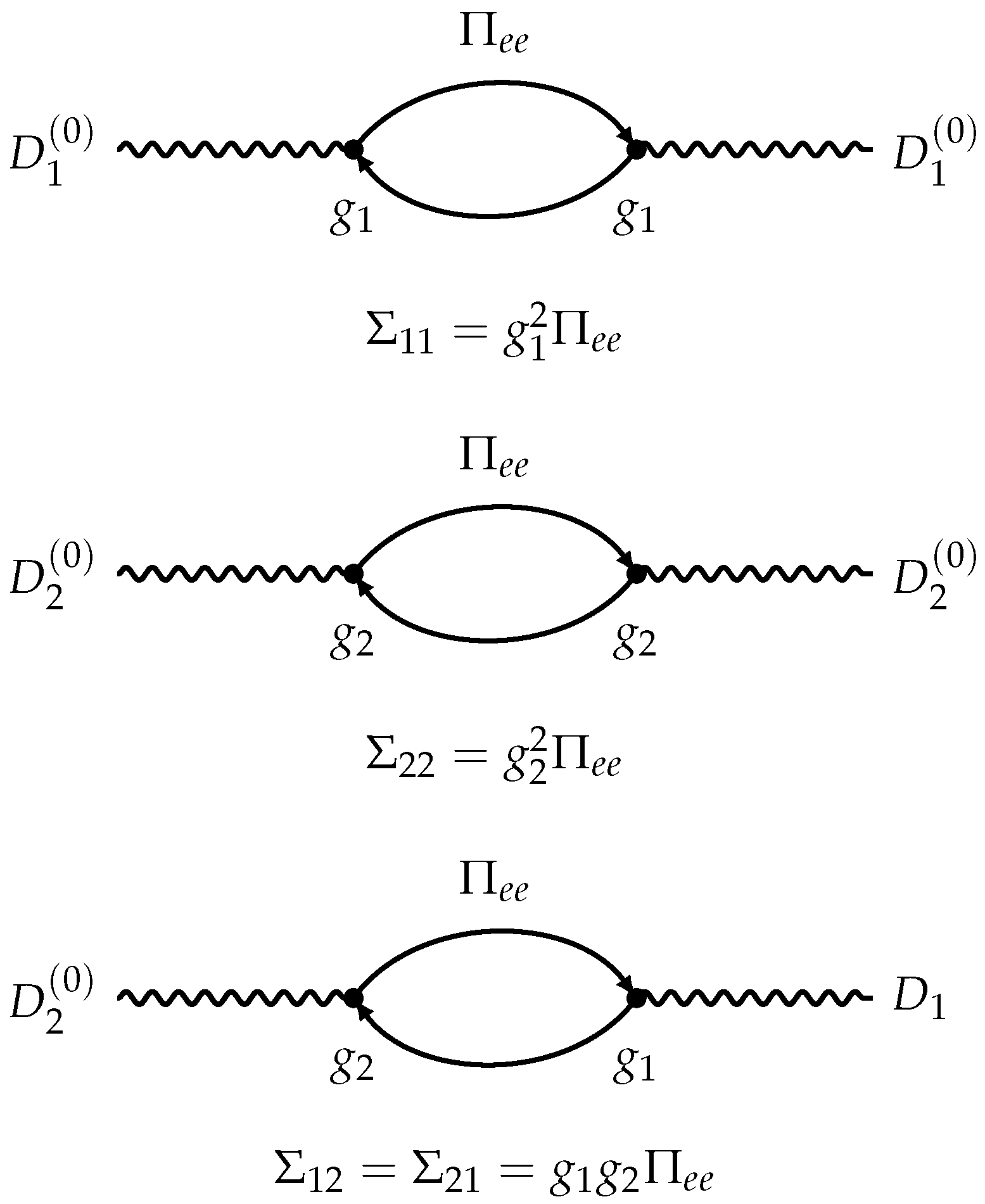
This reduction is justified by the fact that, in our approach, there is no direct phonon–phonon coupling. The lattice modes communicate through their coupling to the electronic degrees of freedom: a phonon in a given branch can excite a virtual particle–hole pair, which then annihilates into a phonon of the same or of a different branch (see Figure 1). To leading order in the electron–phonon vertices, and within an RPA treatment, this response is fully encoded in the dressed electronic polarization function Π e e ( q , ω ) . The two phonons couple to the same charge-density channel with effective vertices g 1 and g 2 , which are understood as the values of the corresponding electron–phonon matrix elements in the momentum region relevant to the charge instability (see Figure 1). Possible microscopic momentum dependencies of the vertices are therefore absorbed into these effective couplings. This approximation does not aim at deriving the full microscopic electron–phonon interaction, but rather at retaining the minimal structure required to describe how a low-energy charge response can renormalize two phonon branches and mix them through the same electronic polarization bubble.
Equivalently, one can integrate out the electron density fluctuations and work directly with a phonon self-energy matrix
Σ ( q , ω ) = Σ 11 Σ 12 Σ 21 Σ 22 = Π e e ( q , ω ) g 1 2 g 1 g 2 g 1 g 2 g 2 2 .
This form makes explicit that the two phonons are not independent once they are coupled to the same electronic charge channel. The diagonal terms soften each phonon separately, whereas the off-diagonal terms mix the low-energy instability mode with the BS branch.

3. Bond-Stretching Phonon Renormalization

3.1. Low-Energy Phonon Channel Involved in Charge-Order Phenomena

The dressed propagator of the low-energy phonon channel involved in the charge-order instability is [20,21,22,23]
D 1 ( q , ω ) = D 1 ( 0 ) ( ω ) 1 g 1 2 Π e e ( q , ω ) D 1 ( 0 ) ( ω ) .
Here, D 1 denotes the low-energy mode dressed by its direct coupling to the electronic charge response. In the full two-mode problem, the off-diagonal self-energies also generate a feedback of the BS branch. This would produce an additional mixed term in D 1 that is purposely neglected in the present approach. The role of the low-energy mode is to host the incipient charge-order instability that affects the higher-energy BS phonon.
The corresponding renormalized energy is determined approximately by
ω 1 2 ( q ) = Ω 1 2 + 2 Ω 1 g 1 2 Re Π e e ( q , ω = Ω 1 ) .
A useful working picture is that CDFs and CDWs exist in spatially separated domains. The former represent incomplete or aborted CDWs: they are close enough to a charge instability to affect both transport and lattice dynamics, but not sufficiently coherent to establish long-range correlation, possibly because of a locally stronger disorder. In this regime, the characteristic energy of the CDF, rather than the existence of a resolution-limited quasi-elastic peak, becomes the relevant scale for the phonon renormalization.
When the charge susceptibility is large and negative in the relevant convention, Equation (12) drives the low-energy mode toward zero frequency. The limit ω 1 0 corresponds to a static CDW instability. A finite but small ω 1 corresponds instead to a dynamical CDF close to criticality.

3.2. Bond-Stretching Phonon and Mixed Self-Energy

The BS phonon is renormalized by both a direct self-energy and an off-diagonal contribution mediated by the low-energy channel. Projecting the two-mode Dyson equation onto the BS mode gives
D 2 ( q , ω ) = D 2 ( 0 ) ( ω ) 1 Σ ˜ 2 ( q , ω ) D 2 ( 0 ) ( ω ) ,
where
Σ ˜ 2 ( q , ω ) = Σ 22 ( q , ω ) + Σ 21 ( q , ω ) D 1 ( q , ω ) Σ 12 ( q , ω ) .
Using Equation (10), this can be written as
Σ ˜ 2 ( q , ω ) = g 2 2 Π e e ( q , ω ) + g 1 2 g 2 2 Π e e ( q , ω ) 2 D 1 ( q , ω ) ,
or, equivalently,
Σ ˜ 2 ( q , ω ) = g 2 2 Π e e ( q , ω ) 1 + g 1 2 Π e e ( q , ω ) D 1 ( q , ω ) .
The first term in Equation (15) is the direct renormalization of the BS phonon by the electronic polarization. The second term is an off-diagonal self-energy contribution generated by the fact that the two phonon modes couple to the same electronic density response. This gives the mixed term Σ 21 D 1 Σ 12 , which describes the dynamical hybridization of the BS branch with the low-energy phonon channel involved in the charge-order instability. Its magnitude scales as g 1 2 g 2 2 , making the BS anomaly highly sensitive to the effective EPC.
The BS phonon energy satisfies
ω 2 2 ( q ) = Ω 2 2 + 2 Ω 2 Re Σ ˜ 2 ( q , ω = Ω 2 ) .
Therefore, the softening of the BS mode requires
Re Σ ˜ 2 ( q , Ω 2 ) < 0 .
If all other parameters are fixed, a lower-energy and more coherent charge mode produces a larger local softening. This is why a nearly static CDW may be expected to generate a strong phonon anomaly at its ordering vector. However, if CDWs and CDFs coexist, as experimentally found by RIXS experiments on cuprates [29], the effect on the measured phonon branch must also depend on the spectral weight in momentum space occupied by the corresponding charge response. This fact motivates the average self-energy description introduced below, in Section 4. In our modeling, we describe CDFs as missed CDWs. There may be various reasons why CDFs remain dynamical and do not display any tendency for charge ordering. For the sake of simplicity and definiteness, in our forthcoming calculations, we characterize CDWs by a (locally) smaller value of Ω 1 as compared to CDFs, thereby implementing the experimentally observed fact that CDWs are closer to becoming static, for fixed values of all the other parameters, due to processes that are not explicitly considered in our model.

3.3. Role of the Effective EPC Parameters

The effective couplings g 1 and g 2 are central parameters of the model. They represent the electron–phonon vertices projected onto the two phonon modes retained in the effective theory. The coupling g 1 connects the electronic charge susceptibility to the low-energy phonon mode involved in the charge-order instability [20,21,22,23], while g 2 connects the same charge response to the BS phonon. In a microscopic description, both vertices would depend on momentum, orbital characteristics, screening, doping, and phonon eigenvectors. Here, they are treated as effective constants, in order to isolate how the incipient charge-order instability can renormalize the higher-energy BS branch.
The sign and magnitude of the renormalization constrain the allowed values of the couplings. With the convention used here, the BS phonon softens when Re Σ ˜ 2 ( q , ω Ω 2 ) < 0 . In the momentum region where the charge susceptibility contributes to the anomaly, Re Π e e is negative. For frequencies close to the bare BS energy, the real part of the low-energy propagator is positive, Re D 1 ( q , Ω 2 ) > 0 . Neglecting subleading imaginary-part contributions, the factor in square brackets in Equation (16) must therefore remain positive in order to preserve the softening contribution,
1 < g 1 2 Re Π e e ( q , Ω 2 ) Re D 1 ( q , Ω 2 ) < 0 .
This condition illustrates why the numerical value of g 1 is not a secondary detail. For fixed Π e e , increasing g 1 pushes the low-energy mode closer to the charge-order instability, but it also enhances the mixed correction in the BS phonon self-energy. If g 1 is too small, the low-energy propagator remains weakly renormalized and the indirect contribution to the BS anomaly is negligible. If g 1 is too large, the system is driven too close to a complete static instability, and the effective description does not describe a regime dominated by CDFs that are broad in momentum space.
Equation (19) also clarifies the different roles of CDW and CDF components. A CDW mode, being closer to the limit Ω 1 0 , gives a smaller value of Re D 1 ( Ω 2 ) when the propagator is evaluated at the high-energy phonon frequency. It therefore more easily satisfies Equation (19) and can produce a strong local softening. CDFs have a finite characteristic energy, closer to the BS phonon energy Ω 2 , and can therefore give a larger value of Re D 1 ( Ω 2 ) . For the same g 1 , this makes the CDF contribution locally less singular. However, if the coupling is such that even the CDF propagator satisfies the softening condition, the corresponding CDW component would produce an even stronger local anomaly. This observation motivates the introduction of relative CDW/CDF weights in the phonon self-energy.
The second coupling, g 2 , controls how efficiently the low-energy charge-order dynamics affects the BS phonon. Even when D 1 is strongly renormalized, the high-energy branch shows only a small anomaly if g 2 is weak. Conversely, a sizable g 2 allows the BS phonon to act as a sensitive high-energy probe of the low-energy charge mode. The BS softening therefore depends on three ingredients: the enhancement of the charge susceptibility, the proximity of the low-energy phonon mode to the charge-order instability, and the effective EPC vertices that connect this mode to the BS branch.
Varying the ratio between the two couplings, for instance through g 2 2 / g 1 2 , separates the role of the charge-instability scale from the role of the EPC matrix elements. A broad CDF contribution is not sufficient by itself to generate a sizable BS anomaly unless the mixed phonon–charge channel is appreciable. Conversely, a sizable EPC can make a finite-energy CDF component relevant for the high-energy phonon self-energy, especially when this component carries a large reciprocal-space volume (see Figure 2 and Figure 3 in Section 4). This provides a theoretical basis for connecting the phonon anomaly to the strength of the effective EPC.

4. Average Self-Energy Description of CDW–CDF Coexistence

4.1. Average Self-Energy

The average self-energy construction is applied at fixed hole doping, chosen close to p 0.12 . This doping lies in the underdoped region where CDW and CDF components coexist, making it a suitable regime in which to test a two-component description of charge order. In this work, CDW and CDF are treated as two local realizations of the same underlying charge-order tendency. The CDW component is taken to be more coherent and closer to a static instability, whereas the CDF component remains dynamical and broader in momentum space.
This description should be understood as a phenomenological average over CDW-like and CDF-like regions. We do not attempt to describe the microscopic origin of such regions, nor their possible spatial correlations. The weights assigned to the two components are instead guided by the relative spectral weights observed experimentally. In this sense, the average self-energy provides the simplest approximation to describe the BS phonon when both charge components are present, while neglecting correlations and multiple scattering between domains.
For the BS phonon, the averaged self-energy is written as
Σ ˜ 2 , av = x Σ ˜ 2 CDW + ( 1 x ) Σ ˜ 2 CDF ,
where x is the effective CDW weight and 1 x is the CDF weight. The two components are defined by
Σ ˜ 2 a ( q , ω ) = Σ 22 ( q , ω ) + Σ 21 ( q , ω ) D 1 a ( q , ω ) Σ 12 ( q , ω ) , a { CDW , CDF } .
Equivalently,
Σ ˜ 2 , av = Σ 22 + Σ 21 x D 1 CDW + ( 1 x ) D 1 CDF Σ 12 .
Within this framework, D 1 CDW and D 1 CDF represent two limits of the same charge-order tendency. The CDW propagator is closer to a zero-energy pole and is narrower in reciprocal space, while the CDF propagator remains dynamical but occupies a wider momentum region.
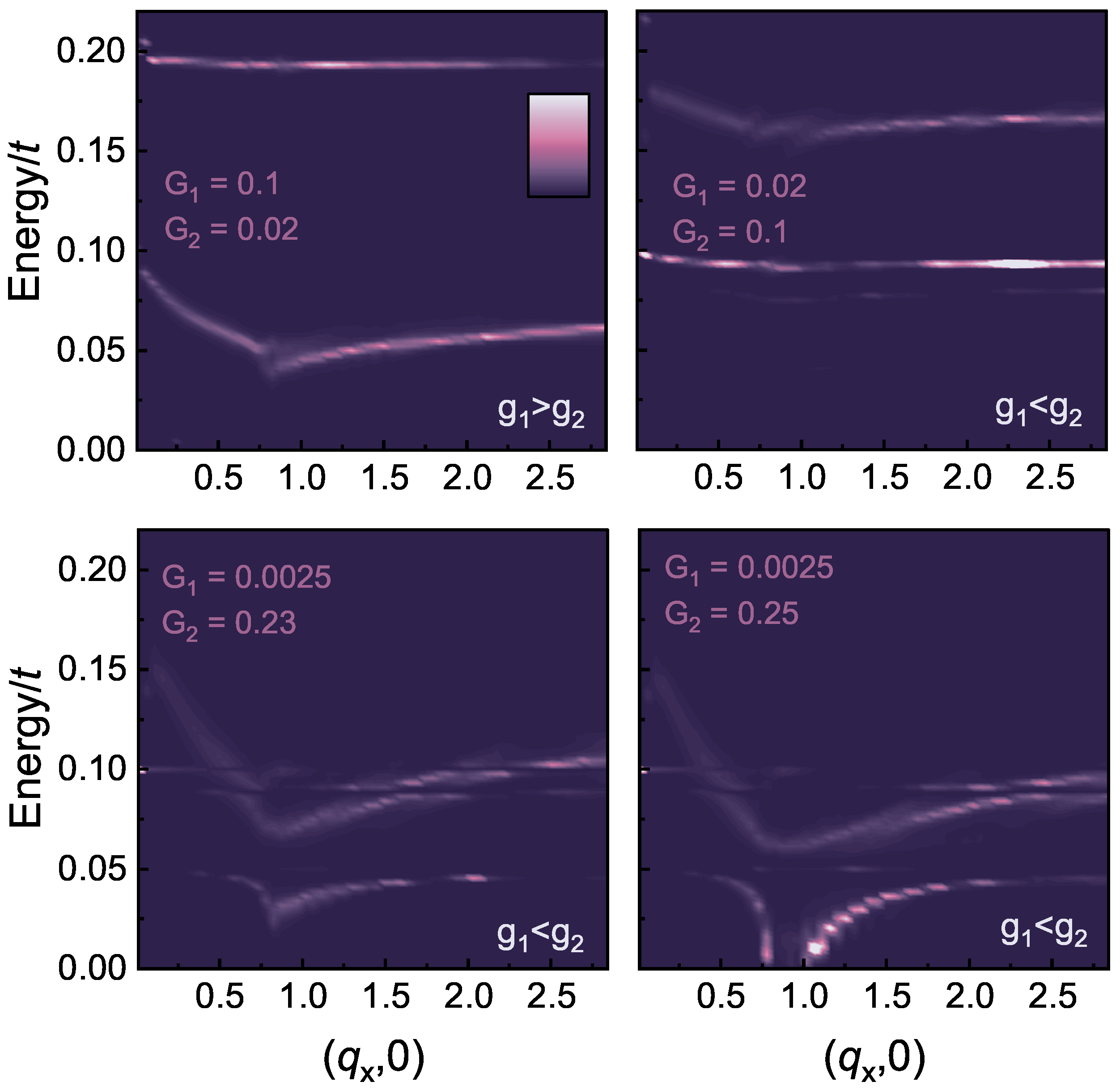
Figure 2. Representative two-phonon RPA spectral intensity maps along the ( q x , 0 ) direction. The spectra show the low-energy phonon channel associated with the charge-order instability and the higher-energy bond-stretching (BS) phonon. The two branches are coupled through the electronic polarization, so the softening of the low-energy mode can affect the BS branch through the mixed self-energy contribution. The effective CDW/CDF weight is fixed to x = 0.9 , corresponding to the condition in which 90 % of the contribution is associated with the CDW propagator. Here, G 1 g 1 2 and G 2 g 2 2 . For G 1 > G 2 , the low-energy branch is strongly renormalized near the model charge-order wave vector, while the BS branch remains nearly unchanged. When the hierarchy is inverted, G 1 < G 2 , spectral weight and softening are transferred more efficiently to the high-energy branch through the mixed self-energy channel. Increasing G 2 at fixed small G 1 further enhances the coupling between the two branches and drives the low-energy channel toward an instability. The comparison shows that a soft charge-order channel alone is not sufficient to produce a sizable BS anomaly: the effective coupling of the BS phonon to the electronic density response is essential.
Condensedmatter 11 00030 g002

4.2. Spectral Volume and Interpretation of the Effective Weights

A CDW component can produce a larger local softening because it is closer to criticality. However, a CDF component can make the dominant contribution to the effective phonon self-energy if its broader momentum distribution compensates for its weaker local singularity.
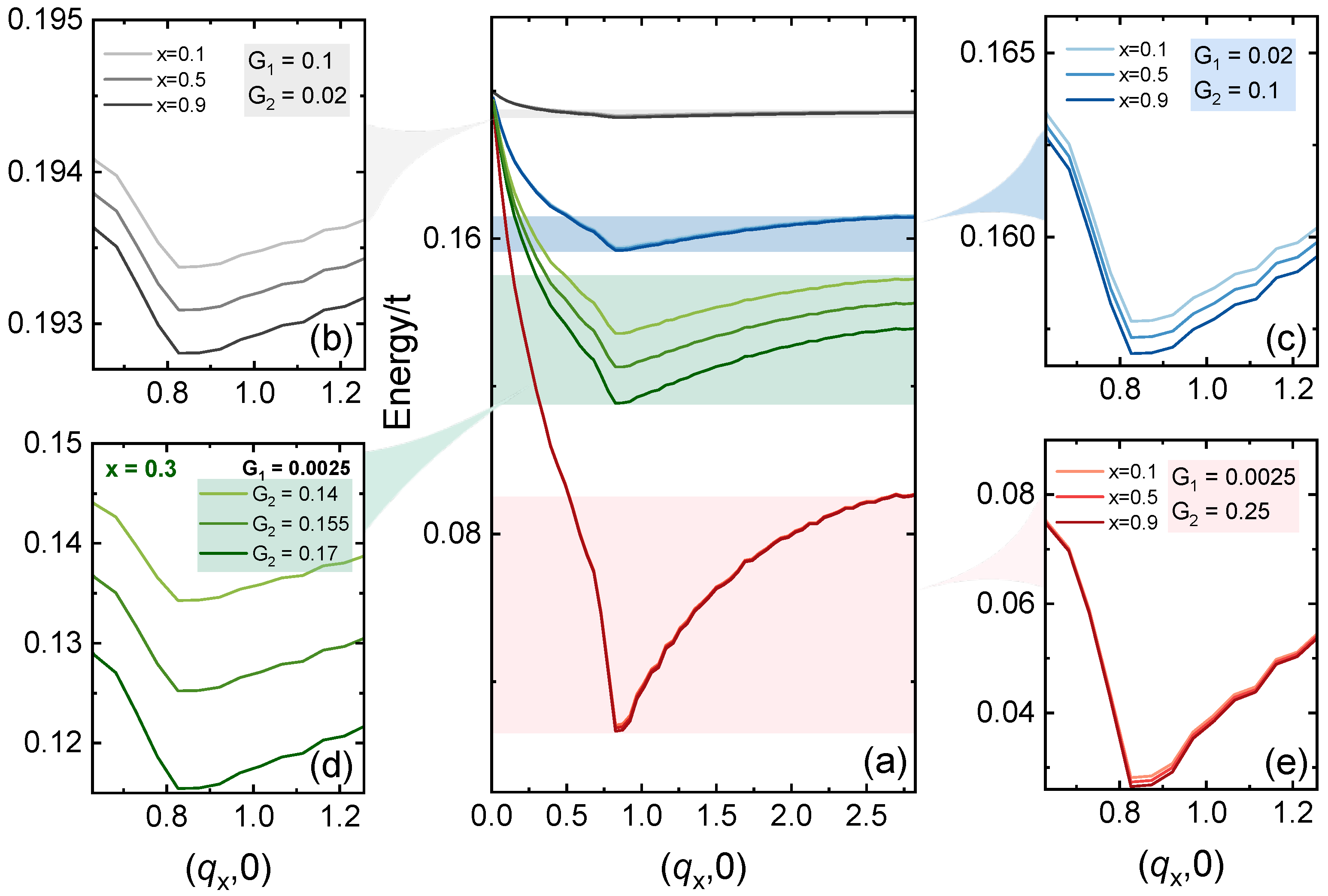
Figure 3. Renormalized bond-stretching phonon dispersion for different effective CDW/CDF weights and electron–phonon coupling regimes. Panel (a) summarizes the evolution of the phonon energy along the ( q x , 0 ) direction for representative choices of the coupling constants. The colored shaded regions identify the energy windows magnified in the surrounding panels. Panels (b,c) show the dependence on the CDW-like weight x for two moderate coupling hierarchies: g 1 > g 2 , with G 1 g 1 2 = 0.1 and G 2 g 2 2 = 0.02 , and g 1 < g 2 , with G 1 = 0.02 and G 2 = 0.1 . In both cases, varying x changes the depth of the minimum only weakly, while the inversion of the coupling hierarchy produces a much larger softening of the bond-stretching branch. Panels (d,e) show the effect of increasing G 2 at fixed small G 1 = 0.0025 . For moderate values of G 2 , the phonon anomaly is progressively enhanced, while for very large G 2 the mode is driven close to an instability. The comparison shows that the bond-stretching anomaly is controlled primarily by the effective coupling of the high-energy phonon to the electronic density response, whereas the CDW/CDF weight x provides a secondary modulation of the softening amplitude.
Condensedmatter 11 00030 g003
This point can be implemented phenomenologically through the reciprocal-space volume of the quasi-elastic charge response. Following the analysis of Ref. [29], an experimental estimate of the volume associated with each charge component is
V α A α Γ α 2 , α = CDF , CDW ,
where A α is the peak amplitude and Γ α is its momentum width. The corresponding effective weights can be written as
w CDF = V CDF V CDF + V CDW , w CDW = V CDW V CDF + V CDW ,
For fixed CDW/CDF weights, the magnitude of the BS renormalization is controlled by the mixed self-energy channel, whose strength scales as g 1 2 g 2 2 . For fixed couplings, increasing the CDF weight enhances the contribution of the broad dynamical component. The average self-energy description therefore identifies three ingredients that control the phonon anomaly: the proximity of the low-energy channel to a charge-order instability, the reciprocal-space volume of the charge response, and the effective EPC vertices that connect the charge mode to the lattice.
The average in Equation (20) neglects correlations between CDW and CDF domains, as well as multiple scattering between them. It should therefore be regarded as the simplest phenomenological way to include the simultaneous presence of the two charge components in the BS phonon self-energy. The calculation addresses whether a broad CDF component, once weighted by its available phase space and coupled to the BS branch through a finite EPC, can generate a sizable high-energy phonon renormalization. The answer depends sensitively on both the CDF/CDW weights and the values of g 1 and g 2 , which is why the model treats the EPC as an active parameter rather than as a passive background interaction.

5. Results, Limitations, and Outlook

The model developed here addresses a general theoretical question raised by several experimental observations in cuprates: how the BS phonon couples to charge-order instabilities, and why the short-ranged fluctuating component of the charge response may play a decisive role in the observed phonon anomaly. In this perspective, the relevant issue is not only the proximity to a static charge-order transition, but also how dynamical charge correlations with finite correlation length enter the phonon self-energy and renormalize the BS branch.
The first result of the model is the identification of the mixed self-energy channel as the key mechanism transferring the low-energy charge instability to the high-energy BS phonon. The representative diagrams in Figure 1 illustrate the three elementary self-energy insertions generated by the electronic polarization bubble: the diagonal channels Σ 11 and Σ 22 , and the off-diagonal channel Σ 12 = Σ 21 . Thus, the anomaly of the high-energy phonon is not controlled only by its direct coupling to the electronic polarization, but also by its dynamical hybridization with the low-energy phonon channel involved in charge ordering.
The second result concerns the role of the effective EPC parameters. The spectral maps shown in Figure 2 compare representative two-phonon RPA spectra for different coupling hierarchies. When g 1 > g 2 , the low-energy branch is strongly affected by the charge-order instability, while the BS branch remains only weakly renormalized. When g 2 becomes larger than g 1 , the high-energy branch acquires a much stronger anomaly, demonstrating that a soft charge sector alone is not sufficient to produce a sizable BS softening. A strong coupling of the BS mode to the same electronic density response is also required.
The dispersion calculations in Figure 3 make this point more explicit. Varying the effective CDW/CDF weight x changes the depth of the phonon minimum, but the effect is modest compared with the change produced by modifying the ratio between g 1 and g 2 . In particular, the comparison between moderate and large values of g 2 2 / g 1 2 shows that the BS anomaly is strongly amplified when the high-energy branch is efficiently coupled to the low-energy mode, directly connected to the charge instability.
Several approximations are involved. First, the two phonons are treated as effective dispersionless modes. Real BS branches have a nontrivial bare dispersion, anisotropic eigenvectors, and possible hybridization with other oxygen modes. Future quantitative calculations should include realistic phonon dispersions and eigenvectors, either from lattice-dynamical models or from first-principle calculations.
Moreover, the couplings g 1 and g 2 are taken as constants. This approximation is useful for exposing the mechanism, but it neglects the momentum, orbital, and screening dependence of the EPC matrix elements. Since the mixed contribution to the BS self-energy scales as g 1 2 g 2 2 , this is a relevant limitation for any quantitative comparison. Nonlocal and dynamically screened EPC approaches provide a natural route for going beyond the present parametrization [56,57,58,59].
A further quantitative limitation concerns the position of the critical wave vector. Experimentally, in YBCO the relevant charge-order momentum is close to q c ( 0.3 , 0 ) r.l.u., whereas in the present simplified calculation the minimum of the BS softening occurs at a different momentum, approximately q c ( 0.13 , 0 ) r.l.u. The value quoted in r.l.u. is obtained from the dimensionless momentum used in the numerical code through q rlu = q code / ( 2 π ) ; thus, the maximum at q code 0.8 corresponds to q rlu 0.8 / ( 2 π ) 0.13 . This mismatch prevents a direct quantitative comparison on an absolute momentum scale. It likely reflects the simplified electronic dispersion, the approximate effective interaction, and the neglect of momentum-dependent electron–phonon vertices.
Within the present RPA treatment, the characteristic momentum is determined by the combined momentum dependence of the effective interaction V q and of the Lindhard polarization bubble Π 0 ( q , ω ) . The simplified tight-binding dispersion, the phenomenological form of V q , and the use of momentum-independent EPC vertices all contribute to shifting the maximum of the calculated susceptibility away from the experimental value. This is the main reason why the present model should be regarded as qualitative rather than quantitative: it is intended to identify the mechanism by which low-energy charge dynamics renormalize the BS phonon, rather than to reproduce the absolute value of the ordering wave vector or to fit the experimental dispersion. The same limitations also affect the treatment of temperature. In the numerical implementation we use a zero-temperature Lindhard function, which allows us to isolate the dependence of the BS renormalization on the CDW/CDF weight and on the effective couplings g 1 and g 2 . A first finite-temperature extension could be obtained by replacing the zero-temperature Lindhard function with its finite-temperature counterpart. However, a quantitative description of the temperature dependence would require going beyond the present fixed-parameter RPA implementation, including thermal fluctuations [23], higher-order corrections, and the temperature evolution of the characteristic energy, damping, and spectral weight of the charge modes. More realistic electronic dispersions, momentum-dependent phonon frequencies, and momentum-dependent EPC matrix elements will therefore be needed to describe both the absolute value of q c and the phonon anomaly over an extended temperature range.
Another effect not included here is superconductivity. In the present model, the electronic polarization is evaluated in the normal state, so possible changes of the phonon self-energy below T c are not described. In the superconducting state, the opening of the gap and the momentum dependence of the order parameter can modify both the phonon energy and linewidth. Beyond the experimental observations discussed above, which highlight the relevance of EPC for unconventional superconductivity, several theoretical works have addressed how the onset of superconductivity can affect phonon energies and lineshapes [60,61,62,63]. Including these effects in the present framework would require replacing the normal-state polarization bubble by its superconducting counterpart and studying its interplay with the CDW/CDF charge channel. This extension is beyond the scope of the present work, but it would be important for a quantitative description of the temperature dependence across T c .
Despite these limitations, the present model identifies a robust mechanism. The BS phonon receives a direct self-energy from the electronic polarization and an indirect contribution mediated by the low-energy charge-order channel. A CDW component is locally more singular, but a CDF component can dominate the effective self-energy if it carries a larger reciprocal-space volume. The magnitude of the resulting anomaly is then governed by the effective EPC vertices. This provides a theoretical basis for treating dynamical charge fluctuations and EPC as intertwined ingredients in the lattice response of cuprates. Future work should therefore aim at fitting phonon energy shifts and phonon spectral weights within the same framework, using the latter as an additional constraint on the effective EPC matrix elements.

6. Conclusions

We have developed a minimal theoretical framework for the renormalization of BS phonons in cuprate superconductors by low-energy charge-order dynamics. The model combines a charge susceptibility enhanced near an instability, two phonon modes coupled to the same electronic density response, and an average self-energy description of CDW and CDF components. As illustrated diagrammatically in Figure 1, the central ingredient is the off-diagonal self-energy channel, which mixes the high-energy BS branch with the low-energy phonon channel involved in charge ordering. The spectral maps in Figure 2 show that the softening of the low-energy channel produces a sizable BS anomaly only when the BS phonon is sufficiently coupled to the electronic density response. The dispersions in Figure 3 further show that changing the EPC hierarchy has a stronger effect on the anomaly than changing the CDW/CDF weight alone.
The analysis highlights the two important ingredients. The first is local criticality: a nearly static CDW lies closer to a complete soft-mode instability and can therefore generate a strong local renormalization. The second is spectral volume: a finite-energy CDF is less singular, but can occupy a much broader region of reciprocal space. When the latter contribution is weighted by its available phase space, it can dominate the effective phonon self-energy even without becoming a static ordered state.
The model also highlights the importance of the effective EPC parameters. The mixed contribution to the BS self-energy scales as g 1 2 g 2 2 , so the phonon anomaly depends not only on the presence of charge fluctuations, but also on how efficiently those fluctuations couple to the relevant lattice modes. This mechanism is consistent with the broader experimental landscape established by INS, IXS, and RIXS studies of cuprate phonons and charge order, and it motivates future work in which realistic phonon dispersions, momentum-dependent EPC, and self-consistent charge-fluctuation propagators are treated on the same footing.

Author Contributions

G.S. and S.C. conceived the research, guided the calculations, and interpreted the results. M.F. performed the calculations, interpreted the results, and wrote the first draft of the manuscript, which was then completed with contributions from all authors. All authors have read and agreed to the published version of the manuscript.

Funding

S.C. acknowledges financial support from by the Ateneo Research Projects of the University of Rome Sapienza: ‘Models and theories from anomalous diffusion to strange-metal behavior’ (n. RM12218162CF9D05), ‘Non-conventional aspects for transport phenomena and non-equilibrium statistical mechanics’ (n. RM123188E830D258), ‘Elementary excitations at the origin of glassy or hexatic behavior in low dimensional system, at and out of equilibrium’ (n. RM124190C54BE48D), and ‘Interplay of phonons and charge collective excitations in cuprate high-Tc superconductors’ (n. RP125199B9FDBFE4). G.S. acknowledges financial support from the Deutsche Forschungsgemeinschaft.

Data Availability Statement

No new data were created or analyzed in this study. Data sharing is not applicable to this article.

Acknowledgments

The authors acknowledge fruitful discussions with R. Arpaia, C. Di Castro, G. Ghiringhelli, and M. Grilli.

Conflicts of Interest

The authors declare no conflicts of interest.

Abbreviations

The following abbreviations are used in this manuscript:
BSbond-stretching
CDFcharge-density fluctuation
CDWcharge-density wave
EPCelectron–phonon coupling
INSinelastic neutron scattering
RIXSresonant inelastic X-ray scattering
RPArandom phase approximation
YBCO YBa 2 Cu 3 O 7 δ

References

  1. Dagotto, E. Correlated Electrons in High-Temperature Superconductors. Rev. Mod. Phys. 1994, 66, 763–840. [Google Scholar] [CrossRef]
  2. Keimer, B.; Kivelson, S.A.; Norman, M.R.; Uchida, S.; Zaanen, J. From quantum matter to high-temperature superconductivity in copper oxides. Nature 2015, 518, 179–186. [Google Scholar] [CrossRef] [PubMed]
  3. Fradkin, E.; Kivelson, S.A.; Tranquada, J.M. Colloquium: Theory of intertwined orders in high temperature superconductors. Rev. Mod. Phys. 2015, 87, 457–482. [Google Scholar] [CrossRef]
  4. Anderson, P.W. The resonating valence bond state in La2CuO4 and superconductivity. Science 1987, 235, 1196–1198. [Google Scholar] [CrossRef] [PubMed]
  5. Abanov, A.; Chubukov, A.V.; Schmalian, J. Quantum-critical theory of the spin-fermion model and its application to cuprates: Normal state analysis. Adv. Phys. 2003, 52, 119–218. [Google Scholar] [CrossRef]
  6. Norman, M.R.; Pines, D.; Kallin, C. The pseudogap: Friend or foe of high Tc? Adv. Phys. 2005, 54, 715–733. [Google Scholar] [CrossRef]
  7. Varma, C.M. Pseudogap phase and the quantum-critical point in copper-oxide metals. Phys. Rev. Lett. 1999, 83, 3538–3541. [Google Scholar] [CrossRef]
  8. Kloss, T.; Montiel, X.; de Carvalho, V.S.; Freire, H.; Pépin, C. Charge orders, magnetism and pairings in the cuprate superconductors. Rep. Prog. Phys. 2016, 79, 084507. [Google Scholar] [CrossRef] [PubMed]
  9. Singh, N. Leading theories of the cuprate superconductivity: A critique. Phys. C Supercond. Its Appl. 2021, 580, 1353782. [Google Scholar] [CrossRef]
  10. Lanzara, A.; Bogdanov, P.V.; Zhou, X.J.; Kellar, S.A.; Feng, D.L.; Lu, E.D.; Yoshida, T.; Eisaki, H.; Fujimori, A.; Kishio, K.; et al. Evidence for ubiquitous strong electron–phonon coupling in high-temperature superconductors. Nature 2001, 412, 510–514. [Google Scholar] [CrossRef] [PubMed]
  11. Gweon, G.-H.; Sasagawa, T.; Zhou, S.Y.; Graf, J.; Takagi, H.; Lee, D.-H.; Lanzara, A. An unusual isotope effect in a high-transition-temperature superconductor. Nature 2004, 430, 187–190. [Google Scholar] [CrossRef] [PubMed]
  12. Pintschovius, L.; Reichardt, W.; Klaeser, M.; Wolf, T.; von Loehneysen, H. Pronounced in-plane anisotropy of phonon anomalies in YBa2Cu3O6.6. Phys. Rev. Lett. 2002, 89, 037001. [Google Scholar] [CrossRef] [PubMed]
  13. Pintschovius, L. Electron–phonon coupling effects explored by inelastic neutron scattering. Phys. Status Solidi B 2005, 242, 30–50. [Google Scholar] [CrossRef]
  14. Reznik, D.; Pintschovius, L.; Ito, M.; Iikubo, S.; Sato, M.; Goka, H.; Fujita, M.; Yamada, K.; Gu, G.D.; Tranquada, J.M. Electron–phonon coupling reflecting dynamic charge inhomogeneity in copper oxide superconductors. Nature 2006, 440, 1170–1173. [Google Scholar] [CrossRef] [PubMed]
  15. Reznik, D. Giant electron–phonon anomaly in doped La2CuO4 and other cuprates. Adv. Condens. Matter Phys. 2010, 523549. [Google Scholar] [CrossRef]
  16. Lee, W.-S.; Zhou, K.-J.; Hepting, M.; Li, J.; Nag, A.; Walters, A.C.; Garcia-Fernandez, M.; Robarts, H.C.; Hashimoto, M.; Lu, H.; et al. Spectroscopic fingerprint of charge order melting driven by quantum fluctuations in a cuprate. Nat. Phys. 2021, 17, 53–57. [Google Scholar] [CrossRef]
  17. Scott, K.; Kisiel, E.; Boyle, T.J.; Basak, R.; Jargot, G.; Das, S.; Agrestini, S.; Garcia-Fernandez, M.; Choi, J.; Pelliciari, J.; et al. Low-energy quasi-circular electron correlations with charge order wavelength in Bi2Sr2CaCu2O8+δ. Sci. Adv. 2023, 9, eadg3710. [Google Scholar] [CrossRef] [PubMed]
  18. Fedele, M.; Merzoni, G.; Moretti Sala, M.; Rosa, F.; Brookes, N.B.; Lombardi, F.; Caprara, S.; Ghiringhelli, G.; Arpaia, R. Charge density fluctuations uncover the relevance of electron–phonon coupling in cuprate superconductors. arXiv 2026, arXiv:2602.18112. [Google Scholar] [CrossRef]
  19. Martinelli, L.; Bialo, I.; Hong, X.; Oppliger, J.; Lin, C.; Schaller, T.; Kuespert, J.; Fischer, M.H.; Kurosawa, T.; Momono, N.; et al. Decoupling of static and dynamic charge correlations revealed by uniaxial strain in a cuprate superconductor. Phys. Rev. B 2025, 112, L041124. [Google Scholar] [CrossRef]
  20. Castellani, C.; Di Castro, C.; Grilli, M. Singular quasiparticle scattering in the proximity of charge instabilities. Phys. Rev. Lett. 1995, 75, 4650–4653. [Google Scholar] [CrossRef] [PubMed]
  21. Becca, F.; Tarquini, M.; Grilli, M.; Di Castro, C. Charge-density waves and superconductivity as an alternative to phase separation in the infinite-U Hubbard–Holstein model. Phys. Rev. B 1996, 54, 12443–12457. [Google Scholar] [CrossRef] [PubMed]
  22. Perali, A.; Castellani, C.; Di Castro, C.; Grilli, M. d-wave superconductivity near charge instabilities. Phys. Rev. B 1996, 54, 16216–16225. [Google Scholar] [CrossRef] [PubMed]
  23. Andergassen, S.; Caprara, S.; Di Castro, C.; Grilli, M. Anomalous isotopic effect near the charge-ordering quantum criticality. Phys. Rev. Lett. 2001, 87, 056401. [Google Scholar] [CrossRef] [PubMed]
  24. Ghiringhelli, G.; Le Tacon, M.; Minola, M.; Blanco-Canosa, S.; Mazzoli, C.; Brookes, N.B.; De Luca, G.M.; Frano, A.; Hawthorn, D.G.; He, F.; et al. Long-range incommensurate charge fluctuations in (Y,Nd)Ba2Cu3O6+x. Science 2012, 337, 821–825. [Google Scholar] [CrossRef] [PubMed]
  25. Chang, J.; Blackburn, E.; Holmes, A.T.; Christensen, N.B.; Larsen, J.; Mesot, J.; Liang, R.; Bonn, D.A.; Hardy, W.N.; Watenphul, A.; et al. Direct observation of competition between superconductivity and charge density wave order in YBa2Cu3O6.67. Nat. Phys. 2012, 8, 871–876. [Google Scholar] [CrossRef]
  26. Comin, R.; Frano, A.; Yee, M.M.; Yoshida, Y.; Eisaki, H.; Schierle, E.; Weschke, E.; Sutarto, R.; He, F.; Soumyanarayanan, A.; et al. Charge order driven by Fermi-arc instability in Bi2Sr2−xLaxCuO6+δ. Science 2014, 343, 390–392. [Google Scholar] [CrossRef] [PubMed]
  27. Wu, T.; Mayaffre, H.; Kraemer, S.; Horvatic, M.; Berthier, C.; Hardy, W.N.; Liang, R.; Bonn, D.A.; Julien, M.-H. Incipient charge order observed by NMR in the normal state of YBa2Cu3Oy. Nat. Commun. 2015, 6, 6438. [Google Scholar] [CrossRef] [PubMed]
  28. Hayden, S.M.; Tranquada, J.M. Charge correlations in cuprate superconductors. Annu. Rev. Condens. Matter Phys. 2024, 15, 215–235. [Google Scholar] [CrossRef]
  29. Arpaia, R.; Caprara, S.; Fumagalli, R.; De Vecchi, G.; Peng, Y.Y.; Andersson, E.; Betto, D.; De Luca, G.M.; Brookes, N.B.; Lombardi, F.; et al. Dynamical charge density fluctuations pervading the phase diagram of a Cu-based high-Tc superconductor. Science 2019, 365, 906–910. [Google Scholar] [CrossRef] [PubMed]
  30. Yu, B.; Tabis, W.; Bialo, I.; Yakhou, F.; Brookes, N.B.; Anderson, Z.; Tang, Y.; Yu, G.; Greven, M. Unusual dynamic charge correlations in simple-tetragonal HgBa2CuO4+δ. Phys. Rev. X 2020, 10, 021059. [Google Scholar] [CrossRef]
  31. Arpaia, R.; Ghiringhelli, G. Charge order at high temperature in cuprate superconductors. J. Phys. Soc. Jpn. 2021, 90, 111005. [Google Scholar] [CrossRef]
  32. Arpaia, R.; Martinelli, L.; Moretti Sala, M.; Caprara, S.; Nag, A.; Brookes, N.B.; Camisa, P.; Li, Q.; Gao, Q.; Zhou, X.; et al. Signature of quantum criticality in cuprates by charge density fluctuations. Nat. Commun. 2023, 14, 7198. [Google Scholar] [CrossRef] [PubMed]
  33. Wahlberg, E.; Arpaia, R.; Seibold, G.; Rossi, M.; Fumagalli, R.; Trabaldo, E.; Brookes, N.B.; Braicovich, L.; Caprara, S.; Gran, U.; et al. Restored strange metal phase through suppression of charge density waves in underdoped YBa2Cu3O7−δ. Science 2021, 373, 1506–1510. [Google Scholar] [CrossRef] [PubMed]
  34. Seibold, G.; Arpaia, R.; Peng, Y.Y.; Fumagalli, R.; Braicovich, L.; Di Castro, C.; Grilli, M.; Ghiringhelli, G.; Caprara, S. Strange metal behaviour from charge density fluctuations in cuprates. Commun. Phys. 2021, 4, 7. [Google Scholar] [CrossRef]
  35. Lin, J.Q.; Miao, H.; Mazzone, D.G.; Gu, G.D.; Nag, A.; Walters, A.C.; Garcia-Fernandez, M.; Barbour, A.; Pelliciari, J.; Jarrige, I.; et al. Strongly correlated charge density wave in La2−xSrxCuO4 evidenced by doping-dependent phonon anomaly. Phys. Rev. Lett. 2020, 124, 207005. [Google Scholar] [CrossRef] [PubMed]
  36. Huang, H.Y.; Singh, A.; Mou, C.Y.; Johnston, S.; Kemper, A.F.; van den Brink, J.; Chen, P.J.; Lee, T.K.; Okamoto, J.; Chu, Y.Y.; et al. Quantum fluctuations of charge order induce phonon softening in a superconducting cuprate. Phys. Rev. X 2021, 11, 041038. [Google Scholar] [CrossRef]
  37. Peierls, R.E. Quantum Theory of Solids; Oxford University Press: London, UK, 1955; p. 108. [Google Scholar]
  38. Bernhard, C.; Tallon, J.L.; Blasius, T.; Golnik, A.; Niedermayer, C. Anomalous peak in the superconducting condensate density of cuprate high-Tc superconductors at a unique doping state. Phys. Rev. Lett. 2001, 86, 1614–1617. [Google Scholar] [CrossRef] [PubMed]
  39. Tallon, J.L.; Loram, J.W.; Cooper, J.R.; Panagopoulos, C.; Bernhard, C. Superfluid density in cuprate high-Tc superconductors: A new paradigm. Phys. Rev. B 2003, 68, 180501. [Google Scholar] [CrossRef]
  40. Grissonnanche, G.; Cyr-Choiniere, O.; Laliberte, F.; Rene de Cotret, S.; Juneau-Fecteau, A.; Dufour-Beausejour, S.; Delage, M.-E.; LeBoeuf, D.; Chang, J.; Ramshaw, B.J.; et al. Direct measurement of the upper critical field in cuprate superconductors. Nat. Commun. 2014, 5, 3280. [Google Scholar] [CrossRef] [PubMed]
  41. Ament, L.J.P.; van Veenendaal, M.; Devereaux, T.P.; Hill, J.P.; van den Brink, J. Resonant inelastic X-ray scattering studies of elementary excitations. Rev. Mod. Phys. 2011, 83, 705–767. [Google Scholar] [CrossRef]
  42. Devereaux, T.P.; Shvaika, A.M.; Wu, K.; Wohlfeld, K.; Jia, C.J.; Wang, Y.; Moritz, B.; Chaix, L.; Lee, W.-S.; Shen, Z.-X.; et al. Directly characterizing the relative strength and momentum dependence of electron–phonon coupling using resonant inelastic X-ray scattering. Phys. Rev. X 2016, 6, 041019. [Google Scholar] [CrossRef]
  43. Braicovich, L.; Rossi, M.; Fumagalli, R.; Peng, Y.Y.; Wang, Y.; Arpaia, R.; Betto, D.; De Luca, G.M.; Di Castro, D.; Kummer, K.; et al. Determining the electron–phonon coupling in superconducting cuprates by resonant inelastic X-ray scattering: Methods and results on Nd1+xBa2−xCu3O7−δ. Phys. Rev. Res. 2020, 2, 023231. [Google Scholar] [CrossRef]
  44. Zinouyeva, M.; Heid, R.; Merzoni, G.; Arpaia, R.; Andreev, N.; Biagi, M.; Brookes, N.B.; Di Castro, D.; Kalaboukhov, A.; Kummer, K.; et al. The influence of phonon symmetry and electronic structure on the electron-phonon coupling momentum dependence in cuprates. npj Quantum Mater. 2026, 11, 30. [Google Scholar] [CrossRef]
  45. Chaix, L.; Ghiringhelli, G.; Peng, Y.Y.; Hashimoto, M.; Moritz, B.; Kummer, K.; Brookes, N.B.; He, Y.; Chen, S.D.; Ishida, S.; et al. Dispersive charge density wave excitations in Bi2Sr2CaCu2O8+δ. Nat. Phys. 2017, 13, 952–956. [Google Scholar] [CrossRef]
  46. Rossi, M.; Arpaia, R.; Fumagalli, R.; Moretti Sala, M.; Betto, D.; Kummer, K.; De Luca, G.M.; van den Brink, J.; Salluzzo, M.; Brookes, N.B.; et al. Experimental determination of momentum-resolved electron–phonon coupling. Phys. Rev. Lett. 2019, 123, 027001. [Google Scholar] [CrossRef] [PubMed]
  47. Raichle, M.; Reznik, D.; Lamago, D.; Heid, R.; Li, Y.; Bakr, M.; Ulrich, C.; Hinkov, V.; Hradil, K.; Lin, C.T.; et al. Highly anisotropic anomaly in the dispersion of the copper-oxygen bond-bending phonon in superconducting YBa2Cu3O7 from inelastic neutron scattering. Phys. Rev. Lett. 2011, 107, 177004. [Google Scholar] [CrossRef] [PubMed]
  48. Blackburn, E.; Chang, J.; Said, A.H.; Leu, B.M.; Liang, R.; Bonn, D.A.; Hardy, W.N.; Forgan, E.M.; Hayden, S.M. Inelastic X-ray study of phonon broadening and charge-density wave formation in ortho-II-ordered YBa2Cu3O6.54. Phys. Rev. B 2013, 88, 054506. [Google Scholar] [CrossRef]
  49. Le Tacon, M.; Bosak, A.; Souliou, S.M.; Dellea, G.; Loew, T.; Heid, R.; Bohnen, K.-P.; Ghiringhelli, G.; Krisch, M.; Keimer, B. Inelastic X-ray scattering in YBa2Cu3O6.6 reveals giant phonon anomalies and elastic central peak due to charge-density-wave formation. Nat. Phys. 2014, 10, 52–58. [Google Scholar] [CrossRef]
  50. Souliou, S.M.; Gretarsson, H.; Garbarino, G.; Bosak, A.; Porras, J.; Loew, T.; Keimer, B.; Le Tacon, M. Rapid suppression of the charge density wave in YBa2Cu3O6.6 under hydrostatic pressure. Phys. Rev. B 2018, 97, 020503(R). [Google Scholar] [CrossRef]
  51. He, Y.; Wu, S.; Song, Y.; Lee, W.-S.; Said, A.H.; Alatas, A.; Bosak, A.; Girard, A.; Souliou, S.M.; Ruiz, A.; et al. Persistent low-energy phonon broadening near the charge-order q vector in the bilayer cuprate Bi2Sr2CaCu2O8+δ. Phys. Rev. B 2018, 98, 035102. [Google Scholar] [CrossRef]
  52. Miao, H.; Ishikawa, D.; Heid, R.; Le Tacon, M.; Fabbris, G.; Meyers, D.; Gu, G.D.; Baron, A.Q.R.; Dean, M.P.M. Incommensurate phonon anomaly and the nature of charge density waves in cuprates. Phys. Rev. X 2018, 8, 011008. [Google Scholar] [CrossRef]
  53. Souliou, S.M.; Sen, K.; Heid, R.; Nakata, S.; Wang, L.; Kim, H.-H.; Uchiyama, H.; Merz, M.; Minola, M.; Keimer, B.; et al. In-plane isotropy of the low-energy phonon anomalies in YBa2Cu3O6+x. J. Phys. Soc. Jpn. 2021, 90, 111006. [Google Scholar] [CrossRef]
  54. Souliou, S.M.; Ishikawa, D.; Heid, R.; Bessas, D.; Kim, H.-H.; Betto, D.; Nakata, S.; Merz, M.; Minola, M.; Keimer, B.; et al. Hybridization of lattice and charge order excitations in a superconducting cuprate. Commun. Phys. 2025, 8, 362. [Google Scholar] [CrossRef]
  55. Seibold, G.; Becca, F.; Bucci, F.; Castellani, C.; Di Castro, C.; Grilli, M. Spectral properties of incommensurate charge-density wave systems. Eur. Phys. J. B 2000, 13, 87. [Google Scholar] [CrossRef]
  56. Falter, C.; Hoffmann, G.A. Nonlocal electron–phonon coupling of ionic charge-fluctuation type and phonon anomalies in high-temperature superconductors. Phys. Rev. B 2001, 64, 054516. [Google Scholar] [CrossRef]
  57. Falter, C.; Bauer, T.; Schnetgoeke, F. Modeling the electronic state of the high-Tc superconductor LaCuO: Phonon dynamics and charge response. Phys. Rev. B 2006, 73, 224502. [Google Scholar] [CrossRef]
  58. Bauer, T.; Falter, C. Impact of dynamical screening on the phonon dynamics of metallic La2CuO4. Phys. Rev. B 2009, 80, 094525. [Google Scholar] [CrossRef]
  59. Bauer, T.; Falter, C. Dynamic charge inhomogeneity in cuprate superconductors. J. Phys. Condens. Matter 2010, 22, 142201. [Google Scholar] [CrossRef] [PubMed]
  60. Zeyher, R.; Zwicknagl, G. Superconductivity-induced phonon self-energy effects in high-Tc superconductors. Z. Phys. B Condens. Matter 1990, 78, 175–185. [Google Scholar] [CrossRef]
  61. Bill, A.; Hizhnyakov, V.; Sigmund, E. Phonon renormalization and symmetry of the superconducting order parameter. Phys. Rev. B 1995, 52, 7637–7646. [Google Scholar] [CrossRef] [PubMed]
  62. Devereaux, T.P.; Virosztek, A.; Zawadowski, A. Neutron scattering and the B1g phonon in the cuprates. Phys. Rev. B 1999, 59, 14618–14623. [Google Scholar] [CrossRef]
  63. Kee, H.-Y.; Varma, C.M. Phonon anomalies induced by superconductivity. Phys. Rev. Lett. 1997, 79, 4250–4253. [Google Scholar] [CrossRef]
Figure 1. Representative diagrams of the Dyson series for the two-mode phonon model. Only the elementary self-energy insertions are shown: the diagonal channels Σ 11 and Σ 22 renormalize the low-energy and BS phonons, respectively, while the off-diagonal channel Σ 12 = Σ 21 mixes the two modes through the electronic polarization bubble Π e e .
Condensedmatter 11 00030 g001
Disclaimer/Publisher’s Note: The statements, opinions and data contained in all publications are solely those of the individual author(s) and contributor(s) and not of MDPI and/or the editor(s). MDPI and/or the editor(s) disclaim responsibility for any injury to people or property resulting from any ideas, methods, instructions or products referred to in the content.