
Article

Evaluation of Marine By-Products in Fishmeal-Free Diets for Juvenile Largemouth Bass (Micropterus salmoides): Insights into Growth, Feed Utilization, Liver Health, and Intestinal Microbiota

1
National Engineering Research Center for Marine Aquaculture, Marine Science and Technology College, Zhejiang Ocean University, Zhoushan 316022, China
2
Zhejiang Marine Ecology and Environment Monitoring Center, Zhoushan 316022, China
3
Department of Animal and Aquaculture Science, Faculty of Bioscience, Norwegian University of Life Science, NO-1432 Ås, Norway
4
Zhejiang Marine Fisheries Research Institute, Zhoushan 316021, China
*
Author to whom correspondence should be addressed.
Fishes 2026, 11(7), 377; https://doi.org/10.3390/fishes11070377 (registering DOI)

Submission received: 4 June 2026 / Revised: 22 June 2026 / Accepted: 23 June 2026 / Published: 24 June 2026
(This article belongs to the Section Nutrition and Feeding)

Abstract

The replacement of fishmeal (FM) in aquafeeds for carnivorous fish remains challenging due to reduced palatability and adverse effects on liver health and intestinal microbiota. Marine by-products-based additives containing fish protein hydrolysates and seaweed polysaccharides have shown potential to overcome these limitations. This study evaluated the effects of graded supplementation of Haiweisu (HWS), a multi-marine by-product formulated with squid viscera hydrolysate, small-molecule components from fish protein hydrolysate, seaweed polysaccharides, and seaweed residue as a carrier, in a FM-free diet for juvenile largemouth bass. Four isonitrogenous and isolipidic diets were prepared: a FM-free control diet (CON) and three diets supplemented with 10, 20, or 30 g/kg HWS (designated S10, S20, and S30, respectively). Each diet was fed to triplicate groups of fish (29.26 ± 2.61 g) for 56 days. Results showed that HWS supplementation linearly increased final body weight, weight gain rate, and feed intake, while significantly reducing the feed conversion ratio (p < 0.05). All HWS-supplemented groups exhibited markedly lower hepatic lipid accumulation and plasma total cholesterol levels compared with the CON group, accompanied by alleviated hepatocellular steatosis and inflammatory infiltration as revealed by Oil Red O and H&E staining. Moreover, HWS significantly enhanced intestinal microbiota alpha diversity (Ace, Chao, Sobs, and Shannon indices), decreased the relative abundance of the dominant genus Mesomycoplasma, and enriched potentially beneficial genera including Methylobacterium, Delftia, and Sphingomonas (p < 0.05). In conclusion, dietary HWS supplementation effectively improved growth performance, alleviated hepatic steatosis and inflammation, and beneficially reshaped the intestinal microbiota in juvenile largemouth bass fed a FM-free diet. These findings support HWS as a promising functional additive for sustainable FM-free aquafeeds in carnivorous fish species.
Key Contribution: This study evaluated Haiweisu, a marine by-product-based additive, in a fishmeal-free diet for juvenile largemouth bass. Haiweisu improved growth performance by enhancing palatability and protein deposition, alleviating hepatic steatosis and inflammation, and reshaping the intestinal microbiota by increasing diversity and enriching beneficial genera. These findings support the use of marine by-product additives in sustainable fishmeal-free aquafeeds for carnivorous fish.

1. Introduction

The global aquaculture industry has experienced remarkable growth over the past several decades, playing a major role in global food production and nutritional security [1,2]. With this expansion comes an increasing demand for high-quality aquafeeds. Fishmeal (FM) has traditionally been regarded as the indispensable protein ingredient owing to its favorable amino acid profile, high palatability, excellent digestibility, and the presence of essential fatty acids, vitamins, and minerals [3,4]. Nevertheless, the sustainability of relying heavily on FM has been questioned because of limited wild forage fish resources, continuous price increases driven by competing demands from other livestock sectors, and mounting environmental concerns [5,6,7]. If aquaculture continues to depend so strongly on a finite and costly marine protein source, its long-term viability may be compromised.
In light of these challenges, a wide range of alternative protein sources have been tested in attempts to partly or fully replace FM in aquafeeds without negative effects on fish growth, health, or product quality. These alternatives include plant proteins such as soybean meal, rapeseed meal, and corn gluten meal; animal byproducts like poultry by-product meal, feather meal, and blood meal; insect meals, particularly from black soldier fly larvae; single-cell proteins from bacteria, yeasts, and microalgae; and various processing discards from fishery and agricultural operations [8,9,10,11,12,13,14]. Although significant progress has been made, achieving complete removal of FM from diets for carnivorous fish remains a difficult task. A key obstacle is the reduced palatability and, consequently, lower feed intake often observed with FM-free or low-FM formulations, because alternative proteins typically lack the natural feeding stimulants that fish detect through gustation and olfaction [15,16]. High-level or complete removal of FM has been shown to adversely affect liver health and induce disturbances in the intestinal microbiota [17,18]. Consequently, feed attractants and palatability enhancers have gained attention as functional additives that can restore feed consumption, improve nutrient utilization, and support growth when incorporated into FM-reduced diets.
Fish protein hydrolysates (FPHs) have drawn considerable research interest as functional feed components in aquaculture because they are rich in small peptides and free amino acids that act as potent feeding stimulants [19,20]. Beyond their attractiveness to fish, FPHs have been reported to enhance growth performance, improve feed conversion, support intestinal health, and modulate immune and antioxidant responses in various farmed species [21]. In parallel, bioactive compounds derived from seaweeds, especially polysaccharides such as alginates, fucoidans, laminarans, and carrageenans, have shown multiple beneficial effects when added to aquafeeds; these effects include immunostimulation, protection against oxidative stress, modulation of gut microbial communities, and improvements in growth [22,23,24]. Unlike conventional single-source attractants, the hybrid seaweed–hydrolysate product (HWS) tested here is designed to combine palatability-enhancing peptides with immunostimulatory polysaccharides, which is expected to provide synergistic benefits superior to existing hydrolysate products in fishmeal-free diets. However, although evidence is accumulating for the individual benefits of FPHs and seaweed polysaccharides in aquaculture, little information is available regarding their combined use as a commercial multi-marine by-product feed additive in FM-free diets for carnivorous fish.
Largemouth bass (Micropterus salmoides) is an economically valuable freshwater carnivore widely farmed in China and other countries. This species is appreciated for its fast growth, high market price, and excellent flesh quality [25]. As a carnivorous fish with a high dietary protein requirement (typically 40–50% crude protein), largemouth bass is particularly sensitive to reductions in dietary FM levels [26]. Therefore, we hypothesized that the inclusion of marine by-products in a fishmeal-free diet would improve the feed palatability and growth performance of largemouth bass, while also exerting positive effects on liver health and intestinal microbiota. Consequently, the present study was designed to evaluate the effects of supplementing an FM-free diet for juvenile largemouth bass with a commercial multi-marine by-product named “Haiweisu” (HWS). HWS is a proprietary blend containing fish protein hydrolysate (derived from marine processing discards) and bioactive polysaccharides extracted from seaweeds, intended to improve feed palatability while also providing functional health benefits. In the present study, graded levels of HWS were added to an FM-free diet, and the subsequent effects on growth performance and feed utilization of largemouth bass were evaluated. Liver health status was assessed through a combination of histological examination and measurement of hepatic function biomarkers. Meanwhile, high-throughput sequencing was employed to characterize changes in the intestinal microbiota composition, thereby revealing potential alterations in both the structure and functional capacity of the microbial community. The findings of this work are expected to provide scientific support for the use of marine by-product-based feed additives as effective components of sustainable FM-free aquafeeds for carnivorous species.

2. Materials and Methods

2.1. Animal Ethics Statement

Prior ethical approval for all experiments was granted by the Committee on Animal Experiment Ethics of Zhejiang Ocean University, and the entire study was conducted in accordance with the national Guiding Principles for Care and Use of Laboratory Animals in China.

2.2. Experimental Diets

For this study, four isonitrogenous and isolipidic experimental diets were formulated. The chemical composition of the diets is shown in Table 1. Conventional feedstuffs were used to formulate a control diet (CON). HWS was added to the other three experimental diets at graded inclusion levels of 10, 20, and 30 g/kg (coded as S10, S20, and S30, respectively). The analyzed proximate composition of the HWS material is shown in Table 2. The experimental diets were produced in two stages, namely extrusion and spraying. Extrusion was conducted at the Buhler (Changzhou, China) Machinery Co., Ltd., while vacuum oil spraying was conducted at the feed laboratory of Zhejiang Ocean University. In summary, all ingredients were ground and sieved through a 0.18 mm screen and then thoroughly mixed with the premix (single-shaft paddle mixer, AHML-1000, Buhler). A scale twin-screw extruder (BCCG-62, Buhler) was used to extrude the mixed ingredients. The extruded pellets were then quickly air-dried to a moisture level of 7–9% and later sprayed and coated with oil using a ZJB-100 vacuum coater (Zhucheng Jiabang Machinery Technology Co., Ltd., Zhucheng, China). The feeds were then sieved, and any broken pellets were removed and stored at −20 °C for subsequent experiments.

2.3. Fish and Feeding Trial

Experimental fishes were obtained from a local commercial hatchery (Benao Agricultural Co., Ltd., Huzhou, China) and acclimatized to the experimental conditions for two weeks before the experiment, during which they were fed commercial feed. Following acclimation, 600 healthy, uniform-sized fish (29.26 ± 2.61 g) were randomly assigned to 12 indoor cylindrical fiberglass tanks (1000 L), with 50 fish per tank. Three replicate tanks were assigned randomly to each experimental diet. For eight weeks, the fish were hand-fed to apparent satiation three times a day (8:00, 14:00, and 20:00). After a 30-minute feeding session, the remaining pellets were collected and counted in accordance with the procedure described by Zhang et al. [27]. A continuous water flow system with aeration for 24 h, and a 12 D:12 L photoperiod were used throughout the study. Daily water quality parameters were monitored to ensure that they were within acceptable ranges for the species. According to daily measurements, the water temperature ranged from 26.0 to 29.5 °C, the pH ranged from 7.0 to 7.5, dissolved oxygen was >6.0 mg/L, and total ammonia nitrogen and nitrite levels were <0.1 mg/L.

2.4. Sample Collection and Analysis

All fish were fasted for 24 h at the end of the 8-week feeding trial and anesthetized using MS-222 (Hangzhou Dongbao, Hangzhou, China). To assess growth performance, the total number of fish in each tank was counted, and each fish was weighed individually. Six fish from each tank were taken and preserved at −20 °C for whole-body composition analysis. Samples of the liver, blood, and viscera were collected from 10 more fish from each tank. Blood samples were collected from the caudal vein of anesthetized fish using non-anticoagulant vacuum tubes and stored at 4 °C for the whole night. The plasma was then extracted by centrifuging the blood at 4 °C for ten minutes at 4000 rpm. The resultant supernatant was carefully collected, designated as serum, and kept at −80 °C for biochemical analysis. Liver, carcass, and viscera samples were dissected and weighed for hepatosomatic index (HSI) and viscerasomatic index (VSI) analysis. The liver and intestine samples for lipid and microbial community analysis, respectively, were snap-frozen in liquid nitrogen and then stored at −80 °C for further analysis, while sections for histological analysis were preserved in 4% paraformaldehyde (Solarbio Biotech Co., Ltd., Beijing, China).

2.5. Biochemical and Histological Analysis

The determination of moisture, crude protein, crude lipid, and ash in the experimental diets, HWS, and whole-body samples was carried out using standard techniques [28]. The methods used for histological analysis were based on the previous study of Cai et al. [29]. Briefly, plasma biochemical parameters, including aspartate aminotransferase (AST), alanine aminotransferase (ALT), total cholesterol (TC), triglyceride (TG), and total protein (TP) were determined using a commercial enzymatic assay kit (Nanjing Jiancheng Bioengineering Institute, Nanjing, China) and a microplate reader. For histopathological observation, paraformaldehyde-fixed liver sections were dehydrated, subjected to paraffin embedding, sectioning, and H&E staining, all performed by Servicebio Company (Wuhan, China). Hepatocyte steatosis and inflammatory cell infiltration severity were used to measure the degree of liver damage. Oil Red O (ORO) was used to stain frozen liver sections for hepatic lipid analysis, and hematoxylin was used as a counterstain. Image J Launcher software (version 1.8.0) was used to quantify the ORO-positive (red-stained) area. The chloroform-methanol extraction method was also used to determine the total lipid content of the liver. Hepatic histological evaluation was performed blindly on H&E-stained liver sections. For each fish, three non-contiguous sections were examined under light microscopy at 400× magnification, and five randomly selected fields per section were assessed. A semi-quantitative scoring system (scale: 0–5) was applied to evaluate three histological parameters: inflammatory cell infiltration, hepatocyte swelling, and hepatocellular steatosis. The detailed scoring criteria for each parameter were as follows: 0 = none; 1 = minimal (<10% of the area affected); 2 = mild (10–30%); 3 = moderate (31–60%); 4 = severe (61–80%); 5 = very severe (>80%). The individual scores for the three parameters were summed to obtain a total liver injury score for each sample, and all scoring procedures were conducted in a blinded manner without knowledge of the experimental groups.

2.6. Intestinal Microbial Analysis

The determination of intestinal microbiota was based on the previous study by [30]. Briefly, a commercial DNA extraction kit (manufacturer’s protocol) was used to extract the total genomic DNA from the intestinal samples. Specific primers were used to amplify the V3-V4 hypervariable region of the bacterial 16S rRNA gene. An Illumina NovaSeq platform was used for sequencing. The raw sequence reads were demultiplexed, filtered, and analyzed using FASTP and FLASH software (version 1.2.11). A 97% similarity threshold was used to group operational taxonomic units (OTUs) together. Alpha diversity tests (Ace, Chao, Sobs, and Shannon) and beta diversity tests analysis were evaluated based on Bray–Curtis distances using QIIME software (version 1.9.1). Taxonomic composition and varying quantities of bacterial communities at the phylum and genus levels were also examined.

2.7. Statistical Analysis

The data were presented as mean ± standard error (SE). SPSS 20.0 software was used for statistical analysis. The effects of dietary treatments were assessed using one-way analysis of variance (ANOVA), which was followed by Duncan’s multiple comparison test. Student’s t-test was used to compare the significant differences in alpha diversity indices between the CON and S30 groups for intestinal microbiota data. For all analyses, differences were considered statistically significant at p < 0.05.

3. Results

3.1. Growth Performance and Feed Utilization

Growth performance and feed utilization parameters of juvenile largemouth bass fed the experimental diets are shown in Table 3. Final body weight (FBW), weight gain rate (WGR), feed intake (FI), and feed conversion ratio (FCR) were all significantly affected by dietary supplementation of HWS. Specifically, fish fed the control diet showed the lowest FBW and WGR, whereas the S30 group (the highest inclusion level) achieved the highest FBW and WGR. A progressive increase in FBW and WGR was observed with increasing levels of HWS, with the S20 and S30 groups exhibiting significantly higher values than the CON group (p < 0.05). Similarly, FI followed the same trend: the CON group consumed the least feed, while the S30 group consumed the most, and all HWS-supplemented groups showed significantly higher FI than the control group (p < 0.05). In contrast, FCR was significantly improved in all HWS-treated groups compared with the CON group, with no significant differences among the S10, S20, and S30 groups. No statistically significant differences were detected among treatments for HSI, VSI, or condition factor (CF), although a slight numerical decrease in CF was noted in the S30 group.

3.2. Whole-Body Chemical Composition

The whole-body proximate composition of juvenile largemouth bass fed the experimental diets is shown in Table 4. There was no statistically significant difference in moisture content among groups. Fish fed the S30 diet exhibited the highest crude protein level, which was significantly higher than that of other groups (p < 0.05). Regarding crude lipid, a decreasing trend was observed with increasing dietary HWS inclusion. The CON group had the highest lipid content, while the S30 group showed the lowest. The S20 and S30 groups both had significantly lower crude lipid levels than the CON group (p < 0.05), and the S10 group was not significantly different from the CON group. Fish fed the S30 diet exhibited the highest ash level, which was significantly higher than that of other groups (p < 0.05).

3.3. Biochemical Indices in Plasma

Plasma biochemical parameters of juvenile largemouth bass fed the experimental diets are summarized in Table 5. AST levels varied significantly among treatments (p < 0.05). The CON group exhibited the highest AST value, whereas the S10 and S20 groups showed markedly lower levels. The S30 group was intermediate and did not differ significantly from either the CON or the S10 and S20 groups. For ALT, no statistically significant differences were detected across any of the dietary groups, although values ranged from 20.00 to 28.50 U/L. TC was significantly affected by dietary HWS supplementation. The CON group had the highest TC concentration, while all HWS-supplemented groups showed significantly lower TC levels compared with the control group (p < 0.05). No significant differences in TG and TP were observed among all groups.

3.4. Liver Lipid Analysis

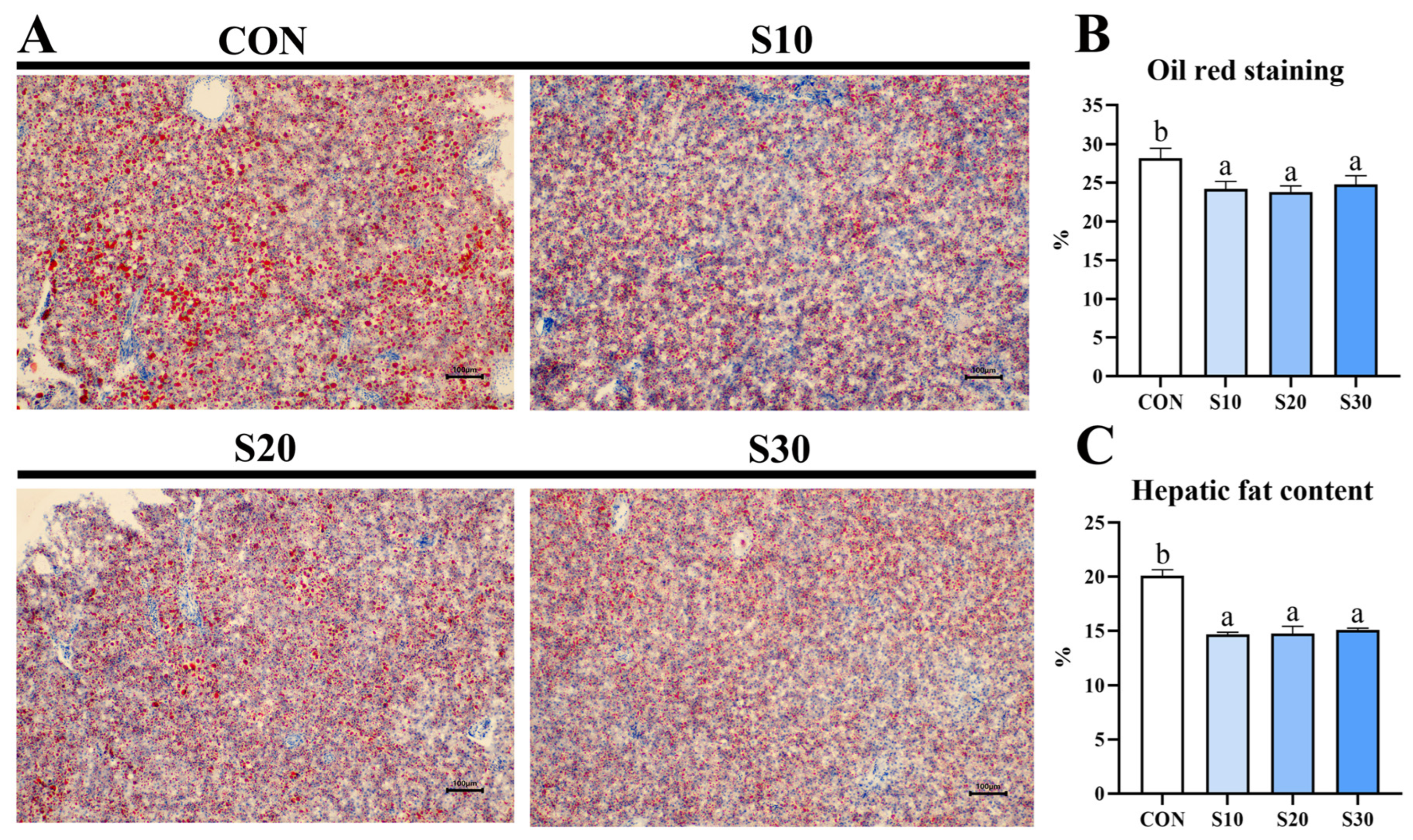
The effects of dietary HWS supplementation on hepatic lipid accumulation in juvenile largemouth bass are illustrated in Figure 1. Oil red O staining visually revealed that the CON group exhibited extensive, red-stained lipid droplets in the liver, whereas the S10, S20, and S30 groups showed progressively reduced red coloration, indicating a lower degree of lipid deposition (Figure 1A). The quantitative analysis of oil red O staining confirmed this observation: the CON group had the highest relative lipid content, while all HWS-supplemented groups displayed significantly lower values, with the S20 and S30 groups showing the most pronounced reductions (Figure 1B). Hepatic fat content measured biochemically followed a similar pattern. Fish fed the CON diet had the highest liver fat percentage, whereas those receiving HWS-containing diets exhibited significant decreases (Figure 1C). Statistical analysis showed that the S20 and S30 groups were significantly lower than the CON group, and the S10 group also showed a significant reduction compared with the control (p < 0.05). No significant differences were observed between the S20 and S30 groups.

3.5. H&E Staining Analysis

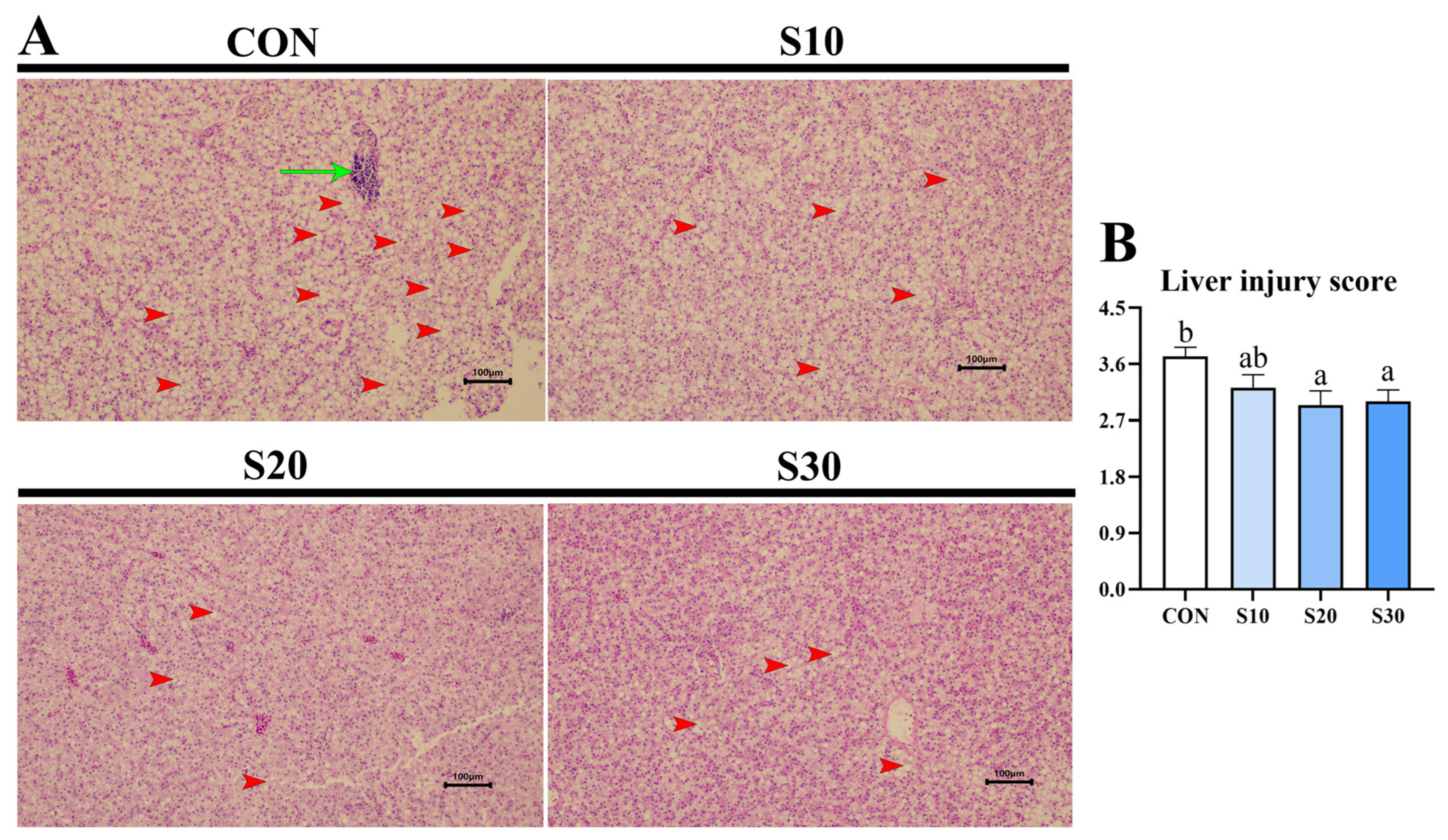
The histopathological alterations in the liver of juvenile largemouth bass fed the different experimental diets are shown in Figure 2. H&E staining revealed notable differences in hepatic morphology among treatment groups (Figure 2A). In the CON group, extensive hepatocellular steatosis (indicated by red arrows) was observed, characterized by numerous vacuoles of varying sizes within hepatocytes. In addition, inflammatory cell infiltration (green arrows) was evident in the liver sections of the CON group. With increasing dietary HWS supplementation, both the severity of steatosis and the degree of inflammatory infiltration gradually diminished. The livers of fish in the S20 and S30 groups appeared more intact, with fewer lipid vacuoles and reduced inflammatory cell infiltration. The liver injury score quantitatively confirmed these observations (Figure 2B). The CON group exhibited the highest injury score, whereas all HWS-supplemented groups had significantly lower scores (p < 0.05). A dose-dependent reduction was evident, with the S20 and S30 groups showing the most pronounced decreases. No significant difference was found between the S20 and S30 groups.

3.6. Intestinal Microbiota Analysis

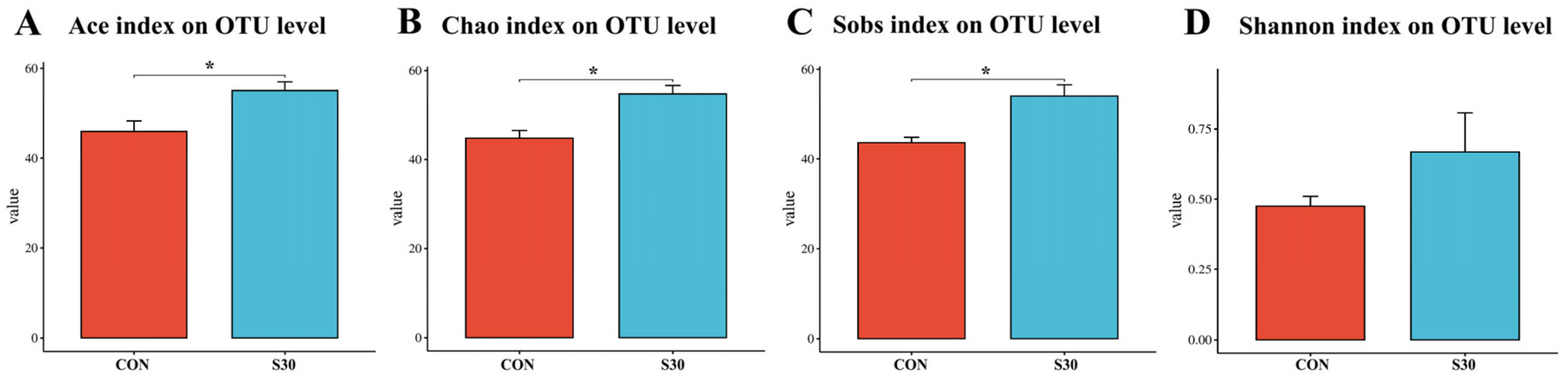
Given that the S30 group consistently showed the most pronounced improvements in growth performance among all HWS-supplemented treatments, it was selected alongside the CON for intestinal microbiota analysis. Alpha diversity indices of the intestinal microbiota in largemouth bass fed the control (CON) and the highest HWS-supplemented (S30) diets are presented in Figure 3, based on the OTU level. For the Ace index, the S30 group exhibited a significantly higher value compared with the CON group, with a statistical difference (p < 0.05) (Figure 3A). The Chao index followed a similar trend, with the S30 group showing a greater value than the CON group, also with a significant difference (p < 0.05) (Figure 3B). The Sobs index, representing the observed number of OTUs, was also higher in the S30 group, with a significant difference (p < 0.05) (Figure 3C). The Shannon index, which accounts for both richness and evenness, was elevated in the S30 group relative to the CON group, but there was no significant difference between the two groups (Figure 3D).
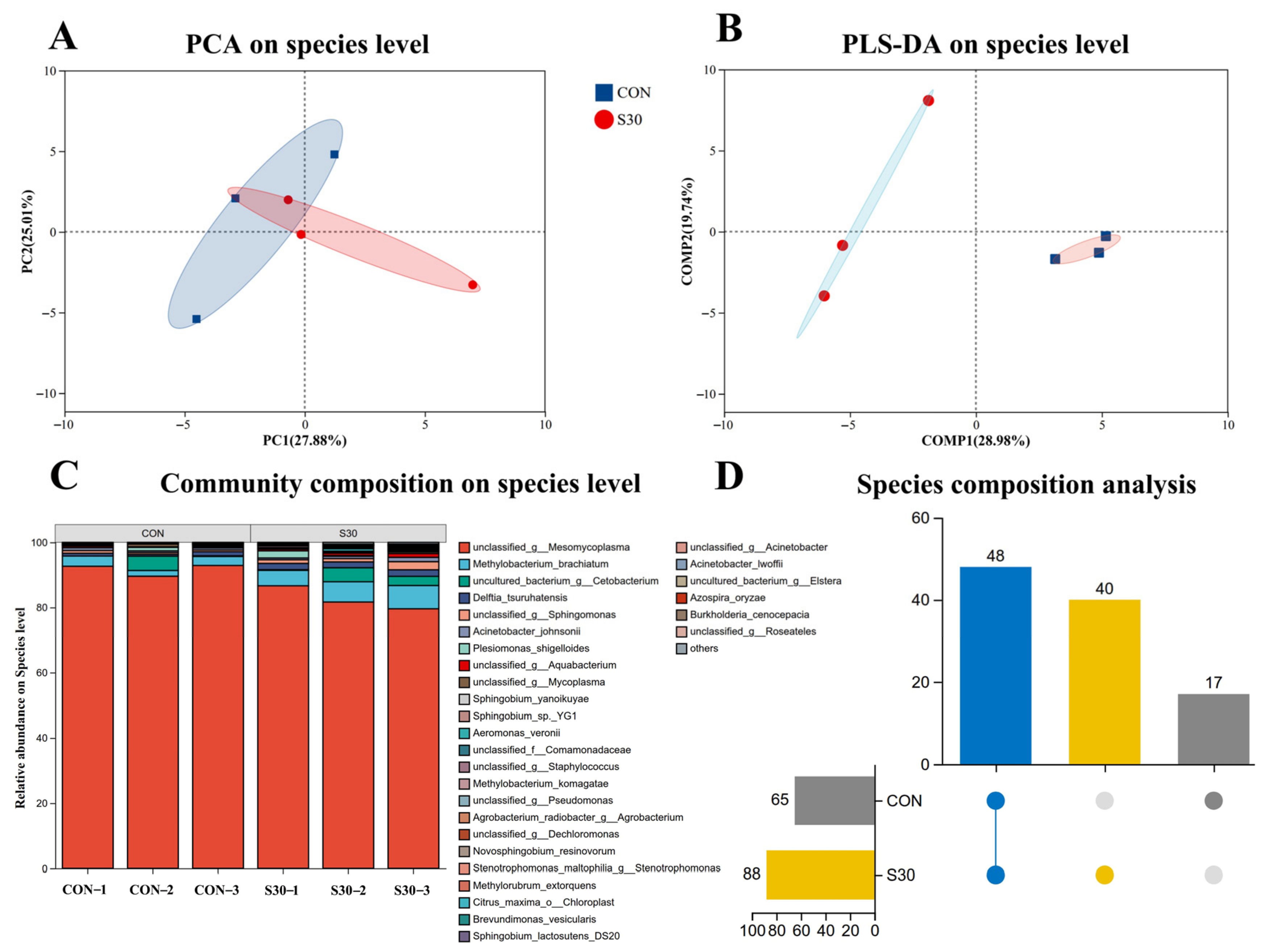
The effects of dietary HWS supplementation on the overall structure and composition of the intestinal microbiota in largemouth bass (CON vs. S30) are presented in Figure 4. Principal component analysis (PCA) at the species level revealed a clear separation between the two dietary groups, indicating that the microbial community structure was markedly altered by the addition of HWS (Figure 4A). Partial least squares discriminant analysis (PLS-DA) further reinforced this distinction, showing tight clustering of samples within each group and clear separation between the CON and S30 groups, suggesting that the HWS-supplemented diet induced a shift in the intestinal microbial profile (Figure 4B). The composition of the intestinal microbiota at the species level is displayed in Figure 4C. Across all samples, the most dominant taxon was unclassified-g-Mesomycoplasma, which accounted for a substantial proportion of the intestinal microbiota in both groups. However, its relative abundance was lower in the S30 group compared with the CON group. Conversely, several other taxa showed increased abundance in the S30 group. Specifically, Methylobacterium-Brachialum, Delfia-Tsuruhatensis, and unclassified-g-Sphingomonas were all notably higher in the S30 treatment than in the control group. In terms of species richness and diversity, a total of 48 bacterial species were shared between the two groups. The S30 group possessed 40 unique species that were not detected in the CON group, whereas the CON group harbored 17 unique species that were absent in the S30 group (Figure 4D).
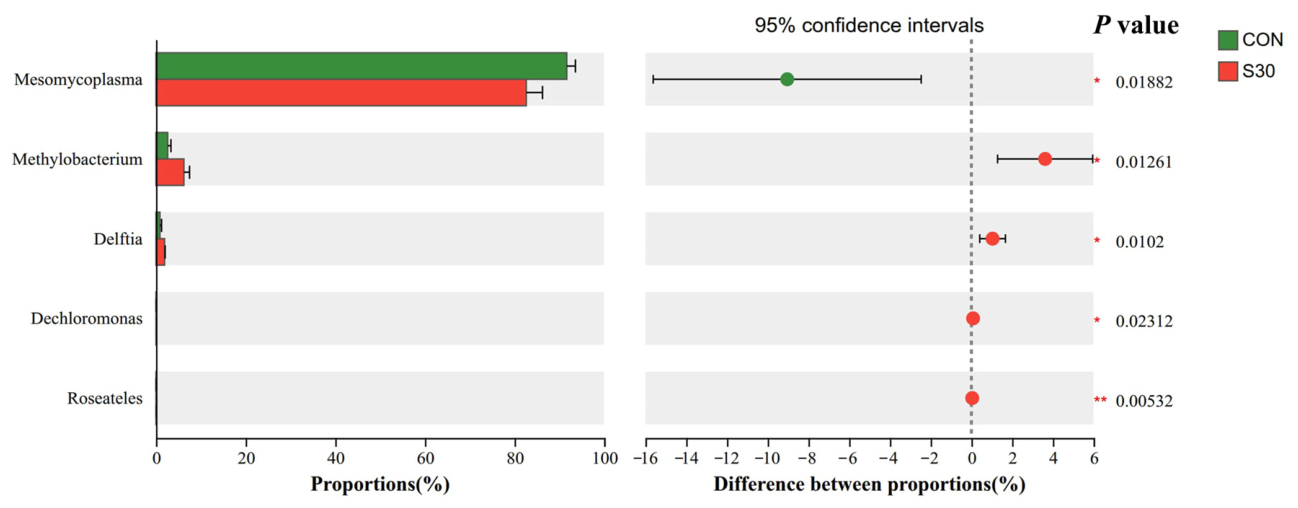
Figure 5 presents a comparison of significantly different bacterial genera between the CON and S30 groups. At the genus level, several taxa exhibited statistically significant changes in relative abundance following dietary HWS supplementation. Consistent with the species-level observations described above, the genus Mesomycoplasma was significantly lower in the S30 group compared with the CON group (p < 0.05). In contrast, the abundances of Methylobacterium, Delftia, Dechloromonas, and Roseateles in the intestinal microbiota of largemouth bass fed the HWS-supplemented diet (S30) were significantly higher than those in the control group (p < 0.05).

4. Discussion

The finite supply and rising cost of FM have created an urgent need for sustainable alternatives in aquafeeds [31]. Marine by-product-based additives such as HWS, which combines squid viscera hydrolysate, fish protein hydrolysate-derived small molecules, and seaweed polysaccharides, offer a promising solution. In the present study, dietary supplementation with HWS in an FM-free diet for juvenile largemouth bass not only improved growth performance by enhancing feed intake and protein deposition but also alleviated hepatic steatosis and inflammation. Moreover, HWS beneficially reshaped the intestinal microbiota by increasing alpha diversity and enriching potentially beneficial genera. These findings support HWS as a functional additive for sustainable FM-free aquafeeds.

4.1. Effects of Marine By-Products on Growth Performance and Feed Intake of Juvenile Largemouth Bass

Growth rate serves as a core biological indicator reflecting feed quality and holds significant evaluative importance in aquaculture production [32]. HWS is a proprietary multi-marine by-product-based product formulated with squid viscera, small-molecule peptides derived from fish protein hydrolysate after membrane separation, seaweed-derived polysaccharides, and seaweed residue as a carrier. In the present study, dietary supplementation with HWS, a multi-marine by-product-based feed attractant, significantly improved the growth performance of juvenile largemouth bass fed an FM-free diet. A well-documented obstacle in formulating FM-free diets for carnivorous fish is the reduced feed intake caused by the absence of natural feeding stimulants present in FM. Such stimulants include free amino acids (e.g., taurine, glycine, alanine), nucleotides, and certain small peptides [33,34]. In this study, all HWS-supplemented groups exhibited significantly higher feed intake than the control group, and feed intake increased progressively with higher HWS inclusion levels, while the feed conversion ratio was markedly reduced. These results clearly demonstrate that HWS can effectively overcome the palatability deficit commonly associated with FM-free diets. From the perspective of product composition, the fish protein hydrolysate and squid viscera hydrolysate in HWS provide abundant small peptides and free amino acids, which have been demonstrated to effectively stimulate feeding behavior in fish, thereby promoting growth [35,36,37]. Bioactive peptides derived from the hydrolysates may further promote feed intake by modulating the secretion of gastrointestinal hormones, thereby indirectly influencing appetite centers [38,39]. In addition, bioactive peptides released from fish protein hydrolysate exert direct growth-promoting effects. These peptides can activate amino acid-sensing receptors in the intestine, thereby facilitating protein synthesis [40,41]. Indeed, a number of studies have shown that dietary inclusion of fish protein hydrolysates or other marine protein-based products promotes the growth of farmed species [42,43]. Supplementing low-FM diets with squid or tuna hydrolysates has been demonstrated to increase both feed intake and growth rate in various fish species [44,45]. We tentatively postulate that the growth benefit of HWS in the fishmeal-free diet involves both an orexigenic effect via palatability substances and an anabolic effect via bioactive ingredients, but these proposed routes are speculative and warrant further confirmation.

4.2. Effects of Marine By-Products on Hepatic Lipid Accumulation and Liver Health of Juvenile Largemouth Bass

The liver plays a central role in lipid metabolism, and excessive lipid storage (hepatic steatosis) represents a common metabolic disorder in farmed fish, particularly when they are fed unbalanced diets or high-energy, low-fishmeal formulations [46,47,48]. In the present study, the experimental fish fed an FM-free diet exhibited marked hepatic steatosis and inflammatory cell infiltration, whereas the HWS-supplemented groups showed a dose-dependent alleviation of these abnormalities. This improvement can be attributed to several mechanisms linked to the product’s composition. The small peptides and free amino acids derived from the fish protein hydrolysate component may act as signaling molecules that regulate genes involved in lipid metabolism [49,50,51]. Meanwhile, seaweed polysaccharides such as alginates and fucoidans are known to exert hypolipidemic effects by inhibiting lipid deposition and promoting lipolysis [52,53], a notion supported by the significantly lower plasma total cholesterol observed in all HWS-treated groups. Notably, fish protein hydrolysates also possess antioxidant properties that can alleviate oxidative stress accompanying steatosis, thereby preserving hepatocyte integrity [54]. Furthermore, bioactive components in squid viscera hydrolysate, including taurine, have been reported to enhance lipid metabolism and exert anti-inflammatory effects, which may further strengthen the hepatoprotective action of HWS [55].
All groups receiving HWS achieved extremely low feed conversion ratios, which were markedly better than those of the control group. This indicates that improved feed efficiency indirectly reduces the metabolic load on the liver, thereby preventing excessive lipid deposition. Unlike previous studies on FM-free diets for largemouth bass that reported disturbed bile acid metabolism and hepatocyte apoptosis [56], the present study demonstrates that HWS effectively mitigates hepatic steatosis and inflammation induced by an FM-free diet. HWS uses seaweed residue as a carrier, which may still contain residual bioactive polysaccharides that contribute synergistic effects. Indeed, previous work has shown that kelp residue can improve blood biochemical parameters and liver metabolic function in farmed fish [57,58]. Collectively, HWS protects liver health in largemouth bass through multiple pathways, including modulation of lipid metabolism, antioxidant defense, and optimization of feed utilization. These findings have important practical implications for promoting FM-free diets in carnivorous fish and provide scientific support for the development of marine by-product-based additives that combine palatability enhancement with hepatoprotective functions.

4.3. Effects of Marine By-Products on Intestinal Microbiota of Juvenile Largemouth Bass

Alpha diversity of the intestinal microbiota is widely recognized as an important ecological indicator reflecting the health status of the host gut [59]. In general, a higher level of diversity implies a more complex and stable community structure, which confers greater resilience against external disturbances such as pathogen invasion or shifts in dietary composition [60]. In the present study, the Ace, Chao, and Sobs indices in the S30 group were all significantly elevated compared with those in the control group, indicating that long-term HWS supplementation effectively enhanced both the species richness and evenness of the intestinal microbiota. This change is of positive physiological relevance for largemouth bass, as a diverse and stable microbial environment contributes to maintaining intestinal barrier function, modulating immune responses, and optimizing nutrient absorption [61,62]. Studies on cultured animals, including tilapia (Oreochromis niloticus), sea bass (Lates calcarifer), and Pacific whiteleg shrimp (Litopenaeus vannamei), have demonstrated that seaweed-derived bioactive substances are able to increase gut microbial diversity [63,64,65].
Among the bacterial genera detected, Mesomycoplasma was the overwhelmingly dominant taxon in both dietary treatments. However, its relative abundance was significantly lower in the S30 group compared with the control group. This observation warrants further consideration. Although Mesomycoplasma is commonly found in the intestinal tract of healthy fish, certain mycoplasma species have been associated with chronic inflammation, immune dysregulation, and respiratory or reproductive tract diseases in other hosts [66,67]. Specific mycoplasma strains are known to induce persistent inflammatory responses and compromise host defenses in largemouth bass [68]. While the precise pathological role of this genus in fish remains incompletely understood, an excessively high abundance of Mesomycoplasma may signal a state of microbial imbalance. Accordingly, the reduction in Mesomycoplasma abundance induced by HWS supplementation likely reflects a shift in the intestinal microbiota from a “single-dominant” state towards a more balanced and healthier community structure. Furthermore, species uniqueness analysis revealed that the S30 group harbored 40 unique bacterial species not detected in the control group, whereas the control group contained only 17 exclusive species. This finding strongly suggests that HWS exerts a prebiotic-like effect. The seaweed-derived polysaccharides in HWS, such as alginates and fucoidans, are potential prebiotics. They resist digestion by the host but can serve as fermentable substrates for intestinal bacteria, leading to the production of short-chain fatty acids (e.g., butyrate and propionate), which are important signaling molecules for maintaining intestinal epithelial health and modulating local immunity [69,70,71]. Meanwhile, nitrogen-containing compounds provided by the fish protein hydrolysate, including small peptides and free amino acids, may supply nitrogen sources for certain protein-assimilating bacteria, thereby altering the metabolic network of the microbiota [72,73]. Taken together, the overall remodeling of the intestinal microbiota encompasses increased diversity, reduction in potentially pathogenic bacteria, enrichment of beneficial taxa, and the emergence of unique species. This remodeling likely contributes, through modulation of host metabolism, immune function, and nutrient absorption efficiency, to the improvements in growth performance and liver health observed in the present study.

5. Conclusions

In conclusion, dietary supplementation with HWS, a multi-marine by-product-based feed additive, effectively improved the growth performance of juvenile largemouth bass fed an FM-free diet. The enhanced growth was mainly attributed to the increase in feed intake achieved by improving the palatability of the fishmeal-free diet. Moreover, HWS alleviated hepatic steatosis and inflammation, as evidenced by reduced lipid accumulation, lower plasma total cholesterol, and improved liver histology, which were linked to the combined actions of fish protein hydrolysates and seaweed polysaccharides. Additionally, HWS modulated the intestinal microbiota composition, as indicated by a significant increase in alpha diversity, a reduction in the relative abundance of Mesomycoplasma, and an enrichment of several genera (e.g., Methylobacterium, Delftia, and Sphingomonas) that have been previously associated with potential beneficial functions in fish. These findings demonstrate that HWS is a promising functional additive for sustainable FM-free aquafeeds in carnivorous fish species, providing simultaneous benefits in palatability, liver health, and gut microbial balance.

Author Contributions

Investigation, W.C., Z.D. and B.S.; Validation, W.C. and J.C.; Methodology, W.C. and Z.D.; Formal analysis, H.Y., S.J. and B.S.; Visualization, W.C.; Data curation, J.C. and Y.J.; Wright-original draft, W.C.; Writing—review and editing, J.C. and Y.Z.; Conceptualization, B.S. and L.H.; Project administration, L.H.; Supervision, L.H.; Resources, L.H. All authors have read and agreed to the published version of the manuscript.

Funding

This study was supported by Zhejiang ‘San-Nong Jiu-Fang’ Agri-Tech Cooperation Initiative (Grant No: 2025SNJF091).

Institutional Review Board Statement

Prior ethical approval for all experiments was granted by the Committee on Animal Experiment Ethics of Zhejiang Ocean University, and the entire study was conducted in line with the national Guiding Principles for Care and Use of Laboratory Animals in China. (approval code: 2026102).

Informed Consent Statement

Not applicable.

Data Availability Statement

The original contributions presented in the study are included in the article, and further inquiries can be directed to the corresponding author.

Conflicts of Interest

The authors declare no conflicts of interest.

References

  1. Hong, J.; Bledsoe, J.W.; Overturf, K.E.; Hardy, R.W.; Small, B.C. Balancing dietary plant-based lipids and cholesterol to increase fillet omega-3 deposition in rainbow trout (Oncorhynchus mykiss) fed a diet without animal ingredients. Aquaculture 2024, 578, 740029. [Google Scholar] [CrossRef]
  2. Takakuwa, F.; Murashita, K.; Noguchi, Y.; Inui, T.; Watanabe, K.; Sugiyama, S.; Yamada, S.; Biswas, A.; Tanaka, H. Effects of long-term feeding of fishmeal-free diet on growth parameters, bile acid status, and bile acid-related gene expression of yearling red sea bream Pagrus major (Temminck & Schlegel, 1843). Aquaculture 2023, 570, 739444. [Google Scholar] [CrossRef]
  3. Liu, Y.; Chang, H.; Lv, W.; Ma, S.; Qiu, G.; Lu, S.; Han, S.; Wang, C.; Han, D.; Zhang, Y.; et al. Physiological response of rainbow trout (Oncorhynchus mykiss) to graded levels of novel Chlorella sorokiniana meal as a single fishmeal alternative or combined with black soldier fly larval meal. Aquaculture 2022, 561, 738715. [Google Scholar] [CrossRef]
  4. Xie, M.; Zhou, W.; Xie, Y.; Li, Y.; Zhang, Z.; Yang, Y.; Olsen, R.E.; Ran, C.; Zhou, Z. Effects of Cetobacterium somerae fermentation product on gut and liver health of common carp (Cyprinus carpio) fed diet supplemented with ultra-micro ground mixed plant proteins. Aquaculture 2021, 543, 736943. [Google Scholar] [CrossRef]
  5. Fang, H.; Sissener, N.H.; Prabhu Philip, A.J.; Rosenlund, G.; Stubhaug, I.; Sæle, Ø. Interaction between dietary saturated fatty acids and cholesterol on mineral and fatty acid availability and postprandial lipids absorption kinetics in Atlantic salmon (Salmo salar). Aquaculture 2025, 600, 742250. [Google Scholar] [CrossRef]
  6. Lin, Z.; Yoshikawa, S.; Hamasaki, M.; Koyama, T.; Kikuchi, K.; Hosoya, S. Effects of low fishmeal diets on growth performance, blood chemical composition, parasite resistance, and gene expression in the tiger pufferfish, Takifugu rubripes. Aquaculture 2022, 560, 738484. [Google Scholar] [CrossRef]
  7. Xie, K.; Liu, X.; Shi, Y.; Cai, M.; Dai, J.; Zhang, J.; Hu, Y. Effects of cholesterol supplementation in high soybean meal diet on growth, lipid metabolism, and intestinal health of juvenile rice field eel Monopterus albus. Aquac. Nutr. 2025, 1, 2233612. [Google Scholar] [CrossRef] [PubMed]
  8. Ayiku, S.; Shen, J.; Tan, B.; Dong, X.; Liu, H. Effects of dietary yeast culture on shrimp growth, immune response, intestinal health and disease resistance against Vibrio harveyi. Fish Shellfish Immunol. 2020, 102, 286–295. [Google Scholar] [CrossRef] [PubMed]
  9. Jahan, H.; Tumpa, I.J.; Qasem, W.A.; Moniruzzaman, M.; Pervin, M.A.; Akter, R.; Omri, A.; Min, T.; Hossain, Z. Evaluation of the partial replacement of dietary fish meal with fermented or untreated soybean meal in juvenile silver barb, Barbonymus gonionotus. Front. Nutr. 2021, 8, 733402. [Google Scholar] [CrossRef] [PubMed]
  10. Jiang, X.; Yao, W.; Yang, H.; Tan, S.; Leng, X.; Li, X. Dietary effects of Clostridium autoethanogenum protein substituting fish meal on growth, intestinal histology and immunity of Pacific white shrimp (Litopenaeus vannamei) based on transcriptome analysis. Fish Shellfish Immunol. 2021, 119, 635–644. [Google Scholar] [CrossRef] [PubMed]
  11. Maulu, S.; Liang, H.; Ge, X.; Yu, H.; Huang, D.; Ke, J.; Ren, M.; Mi, H. Effect of dietary Clostridium autoethanogenum protein on growth, body composition, plasma parameters and hepatic genes expression related to growth and AMPK/TOR/PI3K signaling pathway of the genetically improved farmed tilapia (GIFT: Oreochromis niloticus) juveniles. Anim. Feed Sci. Technol. 2021, 276, 114914. [Google Scholar] [CrossRef]
  12. Prabu, D.L.; Vijayagopal, P.; Ebeneezar, S.; Kalidas, C.; Rameshkumar, P.; Varghese, E.; Muniswaran, B.R. Enzymological, histological, and serum biomarker responses of snubnose pompano on complete replacement of fishmeal using cottonseed meal supplemented with lysine and methionine in the diet. Fish Physiol. Biochem. 2022, 48, 785–804. [Google Scholar] [CrossRef] [PubMed]
  13. Xie, S.; Liu, Y.; Zeng, S.; Niu, J.; Tian, L. Partial replacement of fish-meal by soy protein concentrate and soybean meal based protein blend for juvenile Pacific white shrimp, Litopenaeus vannamei. Aquaculture 2016, 464, 296–302. [Google Scholar] [CrossRef]
  14. Yang, X.; He, Y.; Chi, S.; Tan, B.; Lin, S.; Dong, X.; Yang, Q.; Liu, H.; Zhang, S. Supplementation with Saccharomyces cerevisiae hydrolysate in a complex plant protein, low-fishmeal diet improves intestinal morphology, immune function and Vibrio harveyi disease resistance in Epinephelus coioides. Aquaculture 2020, 529, 735655. [Google Scholar] [CrossRef]
  15. Yao, J.; Gu, D.; Kong, C.; Ju, M.; Hua, X. Effect of soybean antigenic protein on feed palatability of fishmeal replaced diets for obscure puffer (Takifugu fasciatus) and the alternation of diet preference by domestication. Aquac. Rep. 2020, 17, 100332. [Google Scholar] [CrossRef]
  16. Walsh, S.; Davis, R.; Weldon, A.; Reis, J.; Stites, W.; Rhodes, M.; Ibarra-Castro, L.; Bruce, T.; Davis, D.A. Effects of fishmeal replacement, attractants, and taurine removal on juvenile and sub-adult Red Snapper (Lutjanus campechanus). Aquaculture 2021, 544, 737054. [Google Scholar] [CrossRef]
  17. Yue, S.; Xiao, H.; Huang, Y.; Liu, Q.; Li, Q.; Zhang, B.; Peng, M.; Yang, C.; Zeng, D.; Chen, T.; et al. Impact of substituting fishmeal with varying levels of fermented sweet potato residue on gut microbiota and liver metabolism in Litopenaeus vannamei. Aquac. Rep. 2025, 45, 103156. [Google Scholar] [CrossRef]
  18. Zhang, Z.; Xi, L.; Liu, H.; Jin, J.; Yang, Y.; Zhu, X.; Han, D.; Xie, S. High replacement of fishmeal by Chlorella meal affects intestinal microbiota and the potential metabolic function in largemouth bass (Micropterus salmoides). Front. Microbiol. 2022, 13, 1016662. [Google Scholar] [CrossRef] [PubMed]
  19. Wei, Y.; Liu, J.; Wang, L.; Duan, M.; Ma, Q.; Xu, H.; Liang, M. Influence of fish protein hydrolysate on intestinal health and microbial communities in turbot Scophthalmus maximus. Aquaculture 2023, 576, 739827. [Google Scholar] [CrossRef]
  20. Yang, G.; Yu, R.; Geng, S.; Xiong, L.; Yan, Q.; Kumar, V.; Wen, C.; Peng, M. Apple polyphenols modulates the antioxidant defense response and attenuates inflammatory response concurrent with hepatoprotective effect on grass carp (Ctenopharyngodon idellus) fed low fish meal diet. Aquaculture 2021, 534, 736284. [Google Scholar] [CrossRef]
  21. Siddik, M.A.B.; Howieson, J.; Fotedar, R.; Partridge, G.J. Enzymatic fish protein hydrolysates in finfish aquaculture: A review. Rev. Aquac. 2021, 13, 406–430. [Google Scholar] [CrossRef]
  22. He, L.; Xiao, S.; Wang, X.; Qin, J.; Chen, L.; Li, E. Dietary salidroside and astragalus polysaccharides enhance the growth performance and hypoxia tolerance of juvenile Chinese mitten crabs (Eriocheir sinensis). Aquaculture 2026, 612, 743216. [Google Scholar] [CrossRef]
  23. Mariot, L.V.; Bolívar, N.; Coelho, J.D.R.; Goncalves, P.; Colombo, S.M.; do Nascimento, F.V.; Schleder, D.D.; Hayashi, L. Diets supplemented with carrageenan increase the resistance of the Pacific white shrimp to WSSV without changing its growth performance parameters. Aquaculture 2021, 545, 737172. [Google Scholar] [CrossRef]
  24. Yu, Z.; Zhao, S.; Peng, H.; Hong, Y.; Zhou, M.; Lin, L.; Tan, X. Alginate oligosaccharide supplementation enhances antioxidant capacity, immunity, gut health, and resistance to Aeromonas hydrophila in juvenile largemouth bass. Aquaculture 2026, 613, 743395. [Google Scholar] [CrossRef]
  25. Gong, Y.; Yang, F.; Hu, J.; Liu, C.; Liu, H.; Han, D.; Jin, J.; Yang, Y.; Zhu, X.; Yi, J.; et al. Effects of dietary yeast hydrolysate on the growth, antioxidant response, immune response and disease resistance of largemouth bass (Micropterus salmoides). Fish Shellfish Immunol. 2019, 94, 548–557. [Google Scholar] [CrossRef] [PubMed]
  26. Xu, X.; Yang, H.; Zhang, C.; Bian, Y.; Yao, W.; Xu, Z.; Wang, Y.; Li, X.; Leng, X. Effects of replacing fishmeal with cottonseed protein concentrate on growth performance, flesh quality and gossypol deposition of largemouth bass (Micropterus salmoides). Aquaculture 2022, 548, 737551. [Google Scholar] [CrossRef]
  27. Zhang, Y.; Zhang, Y.; Ke, T.; Shi, B.; Huang, L.; Dong, Z.; Guo, M.; Mugeni, C.S.; Zhu, A.; Wang, L.; et al. Hydrolysates of whole forage-fish and Pacific krill are useful to reduce fish meal in practical diets for largemouth bass (Micropterus salmoides), and dietary fish hydrolysate suppresses expressions of intestinal oligopeptide transporter and taurine transporter genes. Aquac. Rep. 2022, 25, 101203. [Google Scholar] [CrossRef]
  28. AOAC. Official Methods of Analysis of AOAC International, 18th ed.; Association of Official Analytical Chemists: Arlington, VA, USA, 2006. [Google Scholar]
  29. Cai, W.; Wang, M.; Feng, T.; Jin, Y.; Dong, Z.; Shi, B.; Zhang, Y.; Huang, L. The effects of cholesterol supplementation in full-plant protein diets derived from different lipid sources on liver and intestinal health, bile acid metabolism in largemouth bass (Micropterus salmoides). Aquac. Rep. 2026, 46, 103340. [Google Scholar] [CrossRef]
  30. Zhang, Y.; Wu, B.; Cai, L.; Kang, J.; Dong, Z.; Zhang, B.; Wang, B.; Gong, Y.; Xu, Z.; Zhang, D.; et al. Comparative analysis of oxidized fish oil and coenzyme Q10 on the intestinal microecology of largemouth bass Micropterus salmoides at different growth stages. Aquac. Rep. 2023, 30, 101608. [Google Scholar] [CrossRef]
  31. Rosle, S.; Mohd Rahim, M.S.; Agustono, A.; Hassin, N.H. Alternative feeds for sustainable aquaculture: A comprehensive structured review. J. Sci. Technol. Innov. Policy 2024, 10, 1–11. [Google Scholar] [CrossRef]
  32. Coleman, S.W.; Moore, J.E. Feed quality and animal performance. Field Crop. Res. 2003, 84, 17–29. [Google Scholar] [CrossRef]
  33. Ma, Z.; Hassan, M.M.; Allais, L.; He, T.; Leterme, S.; Ellis, A.V.; McGraw, B.; Qin, J.G. Replacement of fishmeal with commercial soybean meal and EnzoMeal in juvenile barramundi Lates calcarifer. Aquac. Res. 2018, 49, 3258–3269. [Google Scholar] [CrossRef]
  34. Tola, S.; Sommit, N.; Seel-audom, M.; Khamtavee, P.; Waiho, K.; Boonmee, T.; Yuangsoi, B.; Munpholsri, N. Effects of dietary tuna hydrolysate supplementation on feed intake, growth performance, feed utilization and health status of Asian sea bass (Lates calcarifer) fed a low fish meal soybean meal-based diet. Aquac. Res. 2022, 53, 3898–3912. [Google Scholar] [CrossRef]
  35. Hong, X.; Sun, Y.; Liu, J.; Yu, F.; Yang, Y.; Liu, C. Effects of alanine supplementation on the growth, biochemical composition and appetite of ivory shell (Babylonia areolata). Aquac. Int. 2025, 33, 325. [Google Scholar] [CrossRef]
  36. Li, D.; Ren, W.; Sun, P.; He, Z.; An, F.; Gao, L.; Zhang, X.; Li, M. Taurine-dominated feeding attractant mixture induces efficient foraging in Neptunea cumingii. Biology 2025, 14, 1627. [Google Scholar] [CrossRef] [PubMed]
  37. Li, X.; Fang, T.; Wang, J.; Wang, Z.; Guan, D.; Sun, H.; Yun, X.; Zhou, J. The efficiency of adding amino acid mixtures to a diet free of fishmeal and soybean meal as an attractant in yellow river carp (Cyprinus carpio var.). Aquac. Rep. 2022, 24, 101189. [Google Scholar] [CrossRef]
  38. Kaneko, K. Appetite regulation by plant-derived bioactive peptides for promoting health. Peptides 2021, 144, 170608. [Google Scholar] [CrossRef] [PubMed]
  39. Yu, X.; Xin, Y.; Cui, L.; Jia, J.; Yuan, X.; Fu, S.; Zhang, J.; Sun, C.; Miao, X.; Li, W. Effects of neuropeptide Y as a feed additive on stimulating the growth of tilapia (Oreochromis niloticus) fed low fish meal diets. Peptides 2021, 138, 170505. [Google Scholar] [CrossRef] [PubMed]
  40. Calo, J. First evidence for the presence of amino acid sensing mechanisms in the fish gastrointestinal tract. Sci. Rep. 2021, 11, 4399. [Google Scholar] [CrossRef] [PubMed]
  41. Müller, M.; Ryoo, M.C.K.; Roura, E. Gut sensing of dietary amino acids, peptides and proteins, and feed-intake regulation in pigs. Anim. Prod. Sci. 2021, 62, 1147–1159. [Google Scholar] [CrossRef]
  42. Fan, Z.; Wu, D.; Li, C.; Zhou, M.; Wang, L.; Zhang, H.; Li, J.; Rong, X.; Miao, L.; Zhao, D.; et al. Application of fish protein hydrolysates in common carp (Cyprinus carpio) diets for fish meal sparing: Evidence from growth, intestinal health and microflora composition. Aquac. Rep. 2024, 36, 102160. [Google Scholar] [CrossRef]
  43. Nguyen, H.T.; Chu, Y.T.; Kuo, I.P.; Liao, Z.H.; Lin, Y.R.; Liao, C.P.; Ramadhana, A.W.; Nan, F.H.; Hu, Y.F. Optimizing fishmeal replacement with tilapia hydrolysate protein: Effects on growth, metabolism, and gene expression in white shrimp. Aquac. Rep. 2025, 44, 103080. [Google Scholar] [CrossRef]
  44. Costa, M.; Costas, B.; Machado, M.; Teixeira, C.; Fernández-Boo, S.; Sá, T.; Batista, S.; Marques, A.; Miranda, F.; Valente, L.M.P. Anchovy and giant squid hydrolysates can enhance growth and the immune response of European seabass (Dicentrarchus labrax) fed plant-protein-based diets. Aquaculture 2020, 523, 735182. [Google Scholar] [CrossRef]
  45. Li, R.; Cho, S.H. Substitution impact of tuna by-product meal for fish meal in the diets of rockfish (Sebastes schlegeli) on growth and feed availability. Animals 2023, 13, 3586. [Google Scholar] [CrossRef] [PubMed]
  46. Aragão, C.; Gonçalves, A.T.; Costas, B.; Azeredo, R.; Xavier, M.J.; Engrola, S. Alternative proteins for fish diets: Implications beyond growth. Animals 2022, 12, 1211. [Google Scholar] [CrossRef] [PubMed]
  47. Zhang, H.; Ren, G.; Qiao, A. Editorial: Hepatic glucose and lipid metabolism. Front. Physiol. 2022, 13, 1009566. [Google Scholar] [CrossRef] [PubMed]
  48. Zhou, W.H.; Limbu, S.M.; Li, R.X.; Luo, Y.; Ren, J.; Qiao, F.; Zhang, M.L.; Du, Z.Y. Dietary sodium acetate improves high-fat diet utilization through promoting differential nutrients metabolism between liver and muscle in Nile tilapia (Oreochromis niloticus). Aquaculture 2023, 565, 739142. [Google Scholar] [CrossRef]
  49. Hu, Y.; Cai, M.; Zhong, H.; Chu, W.; Hu, Y. A study on how methionine restriction decreases the body’s hepatic and lipid deposition in rice field eel (Monopterus albus). Int. J. Mol. Sci. 2021, 22, 13379. [Google Scholar] [CrossRef] [PubMed]
  50. Wu, D.; Wang, L.; Fan, Z.; Li, J.; Tang, S.; Zhao, C.; Zhang, H.; Zheng, X. Comprehensive assessment of detoxification mechanisms of hydrolysis fish peptides in largemouth bass (Micropterus salmoides) under copper exposure: Tracing from bioaccumulation, oxidative stress, lipid deposition to metabolomics. Ecotoxicol. Environ. Saf. 2023, 264, 115418. [Google Scholar] [CrossRef] [PubMed]
  51. Zhao, W.; Shen, Y.; Wang, X.; Bao, Y.; Monroig, Ó.; Zhu, T.; Xie, S.; Sun, P.; Tocher, D.R.; Zhou, Q.; et al. Leucine Alleviates Endoplasmic Reticulum–Stress Mediated Lipotoxic Injury Induced by High-Fat Diet Via Sar1b/Sestrin2/Ampkα1 Pathways in Acanthopagrus Schlegelii. J. Nutr. 2026, 156, 101258. [Google Scholar] [CrossRef] [PubMed]
  52. Güroy, D.; Mantoğlu, S.; Şahin, İ.; Uyan, U.; Kenanoğlu, O.N.; Genc, E.; Kabil, E.; Kaya, D.; Erdem, O.; Karadal, O.; et al. Effects of seaweed extract (Ulva sp. And Solieria chordalis) supplementation in high-lipid diets on the growth performance, digestive enzyme activity, and lipid metabolism in rainbow trout (Oncorhynchus mykiss). J. Appl. Phycol. 2026, 38, 807–825. [Google Scholar] [CrossRef]
  53. Luo, P.; He, L.; Liu, Z.; Yang, Q.; Zhou, N.; Qin, J.; Huang, L.; Sun, S. Dietary fucoidan polysaccharide improved growth performance, antimicrobial immune response and gut health of juvenile Macrobrachium rosenbergii through microbiota-gut-brain axis. Aquaculture 2026, 620, 743922. [Google Scholar] [CrossRef]
  54. Nemati, M.; Shahosseini, S.R.; Ariaii, P. Review of fish protein hydrolysates: Production methods, antioxidant and antimicrobial activity and nanoencapsulation. Food Sci. Biotechnol. 2024, 33, 1789–1803. [Google Scholar] [CrossRef] [PubMed]
  55. Ribeiro, R.A.; Bonfleur, M.L.; Batista, T.M.; Borck, P.C.; Carneiro, E.M. Regulation of glucose and lipid metabolism by the pancreatic and extra-pancreatic actions of taurine. Amino Acids 2018, 50, 1511–1524. [Google Scholar] [CrossRef] [PubMed]
  56. Chen, L.; Qi, Y.; Shi, M.; Qu, K.; Liu, Y.; Tan, B.; Xie, S. A mixed animal and plant protein source replacing fishmeal affects bile acid metabolism and apoptosis in largemouth bass (Micropterus salmoides). J. Anim. Sci. 2024, 102, skae249. [Google Scholar] [CrossRef] [PubMed]
  57. Kong, Q.; Yang, Z.; Su, Q.; Yang, J.; Xiao, G.; Liu, D.; Tang, H. Effects of kelp meal (Laminaria japonica) on the growth, nutrition, and intestinal health of the largemouth bass (Micropterus salmoides). Aquac. Rep. 2024, 39, 102525. [Google Scholar] [CrossRef]
  58. Zuo, Z.; Wang, S.; Ye, B.; Wang, Q.; Wang, D.; Wu, Q.; Xu, G.; Zou, J.; Xie, S.; Wang, G. Dietary kelp meal (Thallus laminariae) improves the immunity of hybrid snakeheads under ammonia stress. Aquac. Rep. 2023, 31, 101684. [Google Scholar] [CrossRef]
  59. Rosenberg, E. Diversity of bacteria within the human gut and its contribution to the functional unity of holobionts. npj Biofilms Microbiomes 2024, 10, 134. [Google Scholar] [CrossRef] [PubMed]
  60. Dell, J.E.; Salcido, D.M.; Lumpkin, W.; Richards, L.A.; Pokswinski, S.M.; Loudermilk, E.L.; O’Brien, J.J.; Dyer, L.A. Interaction diversity maintains resiliency in a frequently disturbed ecosystem. Front. Ecol. Evol. 2019, 7, 145. [Google Scholar] [CrossRef]
  61. Li, S.; Qian, Q.; Yang, H.; Wu, Z.; Xie, Y.; Yin, Y.; Cui, Y.; Li, X. Fucoidan alleviated dextran sulfate sodium–induced ulcerative colitis with improved intestinal barrier, reshaped gut microbiota composition, and promoted autophagy in male C57BL/6 mice. Nutr. Res. 2024, 122, 1–18. [Google Scholar] [CrossRef] [PubMed]
  62. Ren, P.; Liu, M.; Wei, B.; Tang, Q.; Wang, Y.; Xue, C. Fucoidan exerts antitumor effects by regulating gut microbiota and tryptophan metabolism. Int. J. Biol. Macromol. 2025, 300, 140334. [Google Scholar] [CrossRef] [PubMed]
  63. Abbas, E.M.; Al-Souti, A.S.; Sharawy, Z.Z.; El-Haroun, E.; Ashour, M. Impact of dietary administration of seaweed polysaccharide on growth, microbial abundance, and growth and immune-related genes expression of the pacific whiteleg shrimp (Litopenaeus vannamei). Life 2023, 13, 344. [Google Scholar] [CrossRef] [PubMed]
  64. Ashouri, G.; Mahboobi Soofiani, N.; Hoseinifar, S.H.; Jalali, S.A.H.; Morshedi, V.; Valinassab, T.; Bagheri, D.; Van Doan, H.; Torfi Mozanzadeh, M.; Carnevali, O. Influence of dietary sodium alginate and Pediococcus acidilactici on liver antioxidant status, intestinal lysozyme gene expression, histomorphology, microbiota, and digestive enzymes activity, in Asian sea bass (Lates calcarifer) juveniles. Aquaculture 2020, 518, 734638. [Google Scholar] [CrossRef]
  65. Fan, C.H.; Wang, W.K.; Xu, Z.Y.; Tsai, S.H.; Chien, C.C.; Kuo, C.H.; Chen, B.; Wang, K.T.; Chang, C.H.; Wu, T.M.; et al. Seaweed-derived biochar as a sustainable feed supplement enhances tilapia growth associated with gut microbiota modulation. Aquaculture 2025, 609, 742846. [Google Scholar] [CrossRef]
  66. Chen, W.; Chang, K.; Chen, J.; Zhao, X.; Gao, S. Dietary sodium butyrate supplementation attenuates intestinal inflammatory response and improves gut microbiota composition in largemouth bass (Micropterus salmoides) fed with a high soybean meal diet. Fish Physiol. Biochem. 2021, 47, 1805–1819. [Google Scholar] [CrossRef] [PubMed]
  67. You, C.; Chen, B.; Wang, M.; Wang, S.; Zhang, M.; Sun, Z.; Juventus, A.J.; Ma, H.; Li, Y. Effects of dietary lipid sources on the intestinal microbiome and health of golden pompano (Trachinotus ovatus). Fish Shellfish Immunol. 2019, 89, 187–197. [Google Scholar] [CrossRef] [PubMed]
  68. Chen, W.; Gao, S.; Chang, K.; Zhao, X.; Niu, B. Dietary sodium butyrate supplementation improves fish growth, intestinal microbiota composition, and liver health in largemouth bass (Micropterus salmoides) fed high-fat diets. Aquaculture 2023, 564, 739040. [Google Scholar] [CrossRef]
  69. Ding, Q.; Hao, Q.; Jin, Y.; Zhang, Q.; Xie, Y.; Yang, Y.; Olsen, R.E.; Ringø, E.; Ran, C.; Zhang, Z.; et al. The effects of sodium propionate on intestinal barrier function of genetically improved farmed tilapia in a high-lipid formulation. Aquaculture 2024, 579, 740187. [Google Scholar] [CrossRef]
  70. Qi, H.; Cheng, K.; Dong, L.; Guo, Z.; Luo, Y.; Tian, J.; Peng, D.; Wen, H.; Liu, M.; Yang, R.; et al. Effects of sodium butyrate on meat quality improvement and intestinal injury induced by high-level fava beans in Nile tilapia (Oreochromis niloticus). Aquaculture 2025, 607, 742692. [Google Scholar] [CrossRef]
  71. Yamamoto, F.Y.; Older, C.E.; Hume, M.E.; Hoffmann, A.R.; Gatlin, D.M. Effects of butyrate, propionate, and their combination in vitro, and the impacts of their supplementation in high-plant-protein diets to the production performance, innate immune responses, and intestinal microbiota of red drum (Sciaenops ocellatus). Aquaculture 2021, 545, 737225. [Google Scholar] [CrossRef]
  72. Cardoso, M.H.; Meneguetti, B.T.; Oliveira-Júnior, N.G.; Macedo, M.L.R.; Franco, O.L. Antimicrobial peptide production in response to gut microbiota imbalance. Peptides 2022, 157, 170865. [Google Scholar] [CrossRef] [PubMed]
  73. Talwar, C.; Nagar, S.; Negi, R.K. Comparative analyses of gut microbiota reveal ammonia detoxification and nitrogen assimilation in Cyprinus carpio var. Specularis. Folia Microbiol. 2024, 69, 1029–1041. [Google Scholar] [CrossRef] [PubMed]
Figure 1. Effects of different experimental diets on hepatic fat content in largemouth bass. (A) Oil red staining of liver. Lipids appear red and nuclei appear blue after oil red O staining. (B) The quantitative graph of oil red staining. (C) hepatic fat content of largemouth bass. The results are expressed as means ± SEM (n = 6). For every variable, bars with different letter assignments denote pairwise significant differences (p < 0.05).
Fishes 11 00377 g001
Figure 2. Effects of different experimental diets on hepatic histopathological structures of largemouth bass. (A) H&E staining of liver. (B) Liver injury score. The red arrows showed hepatocellular steatosis. The green arrows showed inflammatory cell infiltration. The results are expressed as means ± SEM (n = 6). For every variable, bars with different letter assignments denote pairwise significant differences (p < 0.05).
Fishes 11 00377 g002
Figure 3. Bar charts of alpha diversity indices based on OTU level between CON vs. S30 groups. (A) Ace index. (B) Chao index. (C) Sobs index. (D) Shannon index. For each index, “*” indicated that p < 0.05 between groups (n = 3).
Fishes 11 00377 g003
Figure 4. Intestinal microbiota diversity analysis of largemouth bass fed different experimental diets (CON and S30 treatments). (A) Principal component analysis (PCA) of the intestinal microbiota in largemouth bass (species level). (B) Partial least squares discriminant analysis (PLS-DA) of the intestinal microbiota in largemouth bass (species level). (C) Composition of the intestinal microbiota analysis (species level). (D) Species composition analysis of the intestinal microbiota in largemouth bass.
Fishes 11 00377 g004
Figure 5. Comparison of differences at the genus level between the CON and S30 treatments. * and ** The evels of significant difference were set at p < 0.05 (*); p < 0.01 (**).
Fishes 11 00377 g005
Table 1. Chemical compositions of experimental diets (dry matter basis).
Ingredients, g/kgCONS10S20S30
Soy protein concentrate220.0220.0220.0220.0
Soybean meal163.0163.0163.0163.0
Wheat flour105.0105.0105.0105.0
Cassava starch30.030.030.030.0
Gluten flour300.0300.0300.0300.0
Rapeseed meal30.020.010.00.0
Corn gluten meal30.030.030.030.0
HWS0.010.020.030.0
Marine fish oil31.031.031.031.0
Soybean oil47.047.047.047.0
Soybean phospholipid oil10.010.010.010.0
Calcium dihydrogen phosphate10.010.010.010.0
Vitamin and Mineral premix 15.05.05.05.0
L-Lysine10.010.010.010.0
L-Methionine1.01.01.01.0
Choline chloride 4.04.04.04.0
Vitamin E1.01.01.01.0
L-Ascorbate-2-Monophosphate2.02.02.02.0
Mold Inhibitor1.01.01.01.0
Antioxidants0.50.50.50.5
Y2O30.10.10.10.1
Chemical Composition, g/kg
Dry Matter921.1916.8937.4937.6
Crude Protein547.9551.7549.8544.6
Total Lipid99.6105.0100.698.6
Ash44.946.949.054.5
Gross Energy, MJ/kg22.422.221.821.5
1 Compositions of vitamin and mineral premix were described in detail by Zhang et al. [27].
Table 2. The contents of nutrients in HWS.
Chemical Composition%
Dry Matter93.37
Crude protein42.66
Total lipid5.36
Table 3. Growth performance and feed utilization of largemouth bass fed with different diets.
CONS10S20S30
IBW 1, g29.26 ± 0.0229.23 ± 0.0129.25 ± 0.0429.24 ± 0.01
FBW 2, g77.86 ± 1.86 a90.22 ± 2.23 b97.07 ± 2.85 bc99.93 ± 1.38 c
WGR 3, %166.13 ± 6.20 a208.66 ± 7.75 b231.91 ± 10.11 bc241.73 ± 4.76 c
FI 4, g52.62 ± 1.78 a62.85 ± 1.86 b68.35 ± 2.62 bc71.66 ± 2.16 c
FCR 51.08 ± 0.01 b1.03 ± 0.01 a1.01 ± 0.01 a1.01 ± 0.01 a
HIS 6, %1.22 ± 0.021.20 ± 0.041.26 ± 0.021.26 ± 0.03
VSI 7, %8.44 ± 0.068.21 ± 0.238.27 ± 0.128.27 ± 0.04
CF 8, g/cm32.46 ± 0.022.37 ± 0.012.37 ± 0.12.32 ± 0.02
Data are presented as the Means ± SE (n = 3). Values within the same row with different letters are significantly different (p < 0.05). 1 IBW, initial body weight (g). 2 FBW, final body weight (g). 3 WGR, weight gain rate (%) = 100 × (final mean weight − initial mean weight)/initial mean weight. 4 FI, feeding intake (g) = total feed intake per tank/number of fish in tank. 5 FCR, feed conversion ratio = feed intake/(final mean body weight − initial mean body weight). 6 HSI, hepatopancreas index (%) = 100 × liver weight/body weight. 7 VSI, viscera-somatic index (%) = 100 × visceral mass weight/body weight. 8 CF, condition factor (g/cm3) = 100 × body weight/body length3.
Table 4. Proximate composition in whole-body of largemouth bass fed with different diets.
CONS10S20S30
Moisture, %69.68 ± 0.1169.59 ± 0.0669.99 ± 0.0869.64 ± 0.22
Crude protein, %17.42 ± 0.09 a17.53 ± 0.05 a17.43 ± 0.15 a17.87 ± 0.05 b
Crude lipid, %10.28 ± 0.10 b10.16 ± 0.09 b9.98 ± 0.04 a9.98 ± 0.03 a
Ash, %2.64 ± 0.02 a2.63 ± 0.02 a2.70 ± 0.04 a2.83 ± 0.01 b
Data are presented as the Means ± SE (n = 3). Values within the same row with different letters are significantly different (p < 0.05).
Table 5. Plasma biochemicals249511 of largemouth bass fed with different diets.
CONS10S20S30
AST, U/L246.50 ± 14.15 b178.00 ± 20.21 a166.50 ± 22.81 a195.00 ± 13.28 ab
ALT, U/L28.50 ± 2.0222.00 ± 4.0420.00 ± 2.8925.33 ± 2.85
TC, mmol/L6.08 ± 0.22 b4.89 ± 0.19 a5.04 ± 0.13 a5.00 ± 0.07 a
TG, mmol/L8.42 ± 0.676.58 ± 1.168.55 ± 0.216.64 ± 0.09
TP, mmol/L30.30 ± 0.5328.40 ± 1.7528.80 ± 0.8628.90 ± 0.67
Data are presented as the Means ± SE (n = 3). Values within the same row with different letters are significantly different (p < 0.05). AST, aspartate aminotransferase; ALT, alanine aminotransferase; TC, total cholesterol; TG, triglyceride; TP, total protein.
Disclaimer/Publisher’s Note: The statements, opinions and data contained in all publications are solely those of the individual author(s) and contributor(s) and not of MDPI and/or the editor(s). MDPI and/or the editor(s) disclaim responsibility for any injury to people or property resulting from any ideas, methods, instructions or products referred to in the content.