Article

Exploratory Analysis of Fish Mortality in the Shatt al-Basrah Canal (Iraq, 2021): Environmental Drivers and Implications for Brackish Ecosystem Health


by
Murtada Naser
1,2,*,
Amaal Yasser
1,2,
Francisco Godinho
3 and
Patricio R. De los Ríos-Escalante
4,5
1
School of Environment and Science, Griffith University, 170 Kessels Road, Nathan, QLD 4111, Australia
2
Division of BioInvasions, Global Change and Macroecology, Department of Botany and Biodiversity Research, University of Vienna, Rennweg 14, 1030 Vienna, Austria
3
AQUALOGUS—Engenharia e Ambiente, Lda., Rua do Mar da China, No. 1 Escritório 2.4, Parque das Nações, 1990-137 Lisbon, Portugal
4
Departamento de Ciencias Biológicas y Químicas, Facultad de Recursos Naturales, Universidad Católica de Temuco 4810399, Chile
5
Núcleo de Estudios Ambientales, Facultad de Recursos Naturales, Universidad Católica de Temuco 4810399, Chile
*
Author to whom correspondence should be addressed.
Fishes 2026, 11(6), 335; https://doi.org/10.3390/fishes11060335
Submission received: 28 April 2026 / Revised: 25 May 2026 / Accepted: 1 June 2026 / Published: 2 June 2026
(This article belongs to the Section Environment and Climate Change)

Abstract

The Shatt al-Basrah Canal, a brackish artificial waterway in southern Iraq, experienced a fish mortality event in August 2021, raising serious environmental and socioeconomic concerns. This study documents field observations, photographic evidence, and in situ water-quality measurements collected during the event to characterize environmental conditions associated with the mortality and situate them within the context of long-term ecosystem degradation in the region. The event coincided with critically low dissolved oxygen concentrations (1–2.5 mg L−1), elevated summer water temperatures (31.2–31.6 °C), high total ammonia nitrogen levels (1.88–2.2 mg L−1), and brackish salinity (17.4–23 ppt), reflecting strong anthropogenic influence and limited hydrological flushing. These stressors occurred in areas receiving untreated wastewater inputs and affected both native and non-native fish species tolerant of estuarine conditions. Comparison with documented fish-kill events from Kuwait Bay and other parts of the northern Arabian Gulf indicates similar environmental settings characterized by hypoxia, organic enrichment, and summer thermal stress. The 2021 mortality event suggests how acute ecological deterioration may arise in chronically degraded brackish systems and underscores the need for continuous water-quality monitoring, improved wastewater treatment, and proactive management to reduce the risk of recurrent fish kills in Iraq’s vulnerable aquatic ecosystems.
Key Contribution: This study provides one of the first detailed scientific documentations of a notable fish mortality event in the Shatt al-Basrah Canal, southern Iraq, suggesting that severe hypoxia, elevated temperature, ammonia enrichment, and chronic wastewater pollution were likely contributing stressors in a hydrologically constrained brackish ecosystem. The findings highlight how cumulative anthropogenic pressures and reduced flushing can trigger acute ecological collapse in vulnerable artificial waterways of the northern Arabian Gulf region.

1. Introduction

Fish mortality events are widely regarded as indicators of degraded ecosystem health and are often associated with interacting acute and chronic environmental stressors that may not be detected by routine monitoring programs [1,2]. The number of mass fish die-offs is growing globally, as human activities increasingly put stress on aquatic systems through various means, including water pollution, excess nutrients, low oxygen, harmful algal blooms, increasing temperatures, and pathogens [3,4,5].
Fish kills are a growing environmental issue within the Arabian Gulf and its connected river systems. Most of these deaths take place in shallow and eutrophic areas, with poor flushing and interacting environmental stressors, including elevated temperature, hypoxia, organic contaminants such as untreated sewage, agricultural runoff, and industrial effluents, as well as considerable changes in salinity [6,7,8,9,10]. In such systems, combined heat stress and oxygen depletion may intensify physiological stress in euryhaline fishes inhabiting shallow artificial and estuarine waterways. Many widely reported fish kills have occurred in Kuwait Bay and other shoreline locations within the Gulf region, often associated with harmful algal blooms, hypoxia, and untreated sewage discharges [11].
The Shatt al-Basrah Canal is an integral component of the regional hydrological system located in southern Mesopotamia, linking the Hammar Marshes with Khor Al-Zubair, a tidal embayment of the northwestern Arabian Gulf. Originally constructed for flood control and drainage purposes, the Shatt al-Basrah Canal is an artificial waterway that now functions as a multipurpose hydrological system; the canal is defined as an artificial stream. It plays an effective role in transmitting excess water at maximum discharge stages and currently consists of natural inflows and human-made contributions [12,13].
Over the years, the Canal has become a multipurpose system providing navigation between the Shatt al-Arab River and the cities of Zubair and Al-Faw. It is also an important source of irrigation and navigation for the surrounding areas of southern Iraq. Now the Shatt al-Basrah Canal is used for agricultural drainage as well as navigation, although it is also a dumping site for untreated urban sewage, especially from the city of Basrah [12].
From approximately 2000 to 2020, the environmental condition of the Shatt al-Basrah Canal has progressively deteriorated. Salinity intrusion associated with sea-level rise, together with untreated sewage discharges and agricultural runoff, has substantially increased nutrient concentrations, organic matter loads, and dissolved solids in the canal water [14,15,16,17]. Chronic exposure to these stressors has been associated with histopathological and genotoxic effects in resident fish species, revealing long-term biological stress in polluted aquatic environments of southern Iraq [18,19]. The degradation of these aquatic ecosystems has led to intermittent ecological crises, including the death of large numbers of sensitive aquatic species [20,21], but detailed scientific documentation of specific die-off events remains scarce for this ecologically and socio-economically important system. Given the complex environmental conditions in the Shatt al-Basrah Canal, the present study did not aim to identify a single definitive cause of mortality. Instead, the investigation focused on evaluating whether multiple interacting environmental stressors, including hypoxia, elevated temperature, ammonia enrichment, salinity, and wastewater influence, were associated with the 2021 fish mortality event. The study therefore adopts an exploratory environmental assessment approach based on field observations and event-time water-quality measurements.
Here, we present an extensive analysis of a large fish kill that occurred in the Shatt al-Basrah Canal in Southern Iraq during 2021. Environmental conditions surrounding the event were characterized, and potential causes of mortality were determined through field surveys in conjunction with photographic documentation and in situ water-quality measurements. The discussion places this case within the context of larger regional environmental factors that induce fish die-offs. The findings highlight the urgent need for routine water-quality monitoring and a pollution control program, as well as ecosystem-based management practices. Such measures are crucial not merely to prevent further fish kills from happening, but to combat the persistent loss of aquatic biodiversity in Iraq’s already threatened freshwater and brackish ecosystems.

2. Materials and Methods

2.1. Study Area

The Shatt al-Basrah Canal is an artificial water channel located in the southern Iraq region (Basra Governorate) that connects with the Euphrates River system through the Hammar Marshes to Khor al-Zubair. The original purpose of this canal was to manage floods; however, today, it provides many other benefits, including irrigation, navigation and drainage. Unfortunately, the Shatt al-Basrah Canal also receives large quantities of untreated wastewater from urban and industrial sources. Because of strong tidal influence, low freshwater inflows, and limited flushing/turnover, the Shatt al-Basrah Canal has become a semi-stagnant system, often with brackish water with high loads of organic material that can cause pollution, especially during the hot summer months when evaporation rates increase. The locations of the study site and sample sites are illustrated in Figure 1. The mortality event was investigated as an opportunistic field-based environmental assessment conducted during the peak of the fish kill between 3 and 7 August 2021. Because the event occurred unexpectedly, sampling was limited to rapid-response field observations and physicochemical measurements collected during the mortality episode.

2.2. Field Observations and Water Quality Measurements

Field assessments were carried out during a major fish kill that occurred in early August 2021 under peak summer conditions. Visual inspections and photographic documentation were conducted along affected sections of the canal to record: (i) the approximate spatial extent of the mortality event, (ii) the fish species affected, (iii) fish size classes, and (iv) visible indicators of physiological stress or decomposition. Observations also included documentation of wastewater discharge points, water colour, odour, and abnormal fish behaviour, including surface gasping.
Physicochemical water-quality parameters were measured at six sites (S1–S6) distributed along affected sections of the canal during field visits conducted throughout the mortality episode. Sampling sites were selected to represent areas influenced by untreated wastewater discharge, stagnant hydrological conditions, and visible fish mortality accumulation. Parameters included dissolved oxygen (DO), water temperature, pH, salinity, electrical conductivity (EC), and total dissolved solids (TDS), primarily representing dissolved salts and major ions such as sodium (Na+), chloride (Cl), sulfate (SO42−), calcium (Ca2+), and magnesium (Mg2+) commonly reported from the canal in previous hydrochemical studies [15,16], were measured using a Horiba U-10 water quality checker-multi-parameter probe (Horiba Ltd., Japan). Water samples for total ammonia nitrogen (TAN) analysis were collected in clean polyethylene containers and analysed shortly after collection using the salicylate colorimetric method. In this procedure, ammonia in the water sample reacts with salicylate and hypochlorite reagents under alkaline conditions to form a blue-green coloured complex, and absorbance was measured spectrophotometrically following standard analytical protocols. Because ammonia toxicity depends on the proportion of un-ionized ammonia (NH3), the NH3 fraction was estimated from measured pH, temperature, salinity, and TAN values. The percentage of un-ionized ammonia was calculated using the temperature- and salinity-dependent ammonia dissociation relationship, and NH3-N concentration was estimated as:
NH3-N = TAN × fraction NH3
Measurements represented rapid-response event-based observations collected during the mortality episode rather than a continuous monitoring program. At each site, measurements were obtained directly from surface water conditions during field assessment periods. Field measurements were conducted during daytime rapid-response surveys under peak summer conditions, primarily between late morning and early afternoon. Measured values were compared with published environmental thresholds and physiological tolerance ranges reported for estuarine and euryhaline fishes in previous studies.
No toxicological analyses, pathogen screening, histopathology, harmful algal bloom identification, or continuous pre- and post-event monitoring were conducted. Therefore, the study should be interpreted as an exploratory assessment of environmental conditions associated with the mortality event rather than a definitive causal investigation.

3. Results

3.1. The 2021 Fish Mortality Event

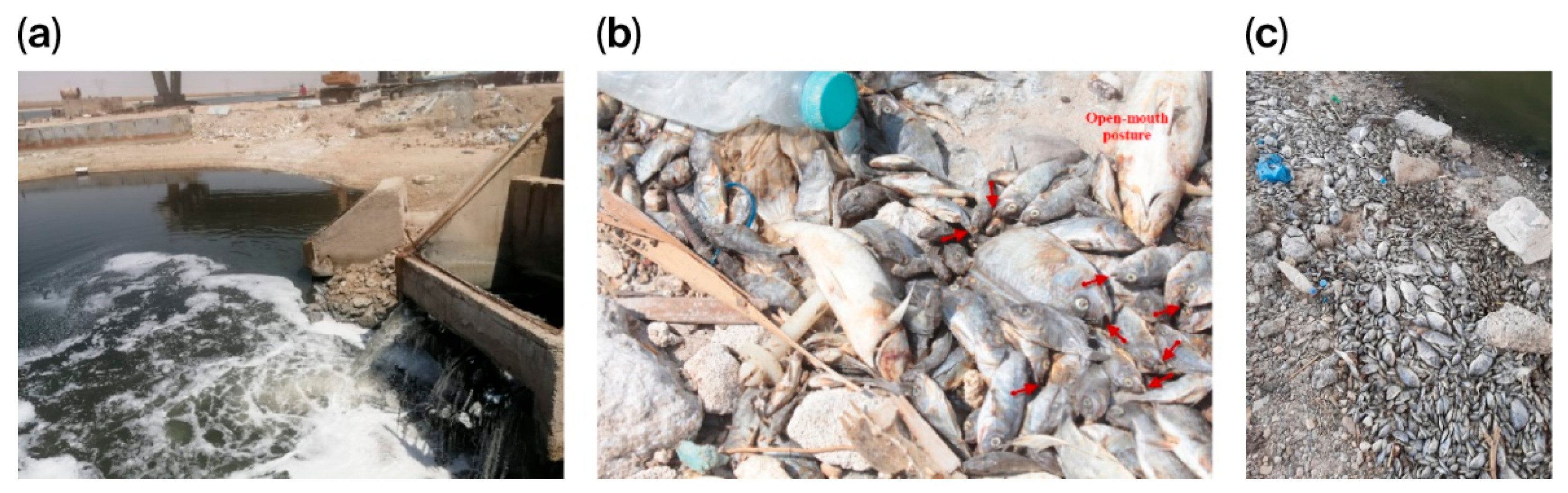
A fish mortality event was observed in August 2021 in the Shatt al-Basrah Canal (Figure 2). Local fishermen and residents first reported this occurrence on 3 August, which continued for several days following the initial report. Dead fish were observed floating at the water surface and accumulated along the canal margins over an approximate shoreline stretch of about 100 m. The affected assemblage included both native and non-native species. The native species most frequently observed among the dead fish were Acanthopagrus arabicus and Liza abu, whereas the non-native species recorded was Tilapia zillii. Although no formal abundance estimates were conducted, Acanthopagrus arabicus and Liza abu appeared to represent the majority of observed carcasses during field surveys, whereas Tilapia zillii was observed less frequently. Observed individuals ranged from approximately 10 to 30 cm total length (TL) and included both juvenile and subadult size classes. Systematic carcass counts, biomass estimates, and species-proportion assessments were not conducted during the rapid-response field survey; therefore, the scale and composition of mortality are interpreted qualitatively based on field observations and photographic documentation. Because systematic carcass counts or population-level mortality estimates were not conducted during the event, the scale of mortality should be interpreted qualitatively based on field observations and photographic documentation.

3.2. Field Observations During the Mortality Event

Throughout the event’s duration, dead fish were observed both floating on the water surface and accumulating along the canal banks during visual surveys conducted at several locations. During the summer low-flow period, untreated wastewater was discharged into the canal at multiple sites. The water was dark and had an odour indicative of a high sewage level, according to residents. Shortly before the peak mortality, fish were observed congregating near the surface and exhibiting surface gasping behavior in stagnant sections of the canal. Photographic documentation collected during field observations showed numerous dead fish accumulated along the canal banks, with several individuals displaying open mouths consistent with terminal respiratory distress. Some larger fish also showed mild abdominal swelling associated with early post-mortem decomposition. No detailed pathological examination of gill tissues was conducted during the rapid-response field survey; however, several affected fish displayed persistent open-mouth posture and surface gasping behavior prior to mortality, observations broadly consistent with severe respiratory stress under hypoxic conditions.

3.3. Water Quality Conditions During the Mortality Event

The physicochemical parameters of water quality were measured at six sites (S1–S6) during the fish mortality event (see Table 1). The concentration of dissolved oxygen (DO) ranged from 0.8 to 2.5 mg L−1, with the lowest concentrations occurring at the sites nearest to the wastewater discharge. Water temperature ranged from 31.2 to 31.6 °C at the sampled sites, whereas pH values varied narrowly between 7.2 and 7.7. Salinity ranged from 17.1 to 23.0 ppt, and electrical conductivity ranged from 22,380 to 22,500 µS cm−1, indicating brackish to saline conditions. Total dissolved solids (TDS) ranged from approximately 13,890 to 14,020 mg L−1. Total ammonia nitrogen (TAN) concentrations ranged from 1.88 to 2.20 mg L−1 across sampling sites. Estimated un-ionized ammonia fractions ranged from 1.55% to 4.02%, corresponding to NH3-N concentrations of approximately 0.031–0.076 mg L−1.
Spatial variation in some of the water-quality parameters was evident, particularly for DO, which was lower at sites nearer the wastewater outflow. Notwithstanding, oxygen levels were extremely low at all sampled sites.

4. Discussion

4.1. Environmental Context of the 2021 Fish Mortality Event

The fish mortality event in the Shatt al-Basrah Canal in August 2021 occurred in a semi-stagnant, hydrologically constrained artificial waterway subjected to chronic anthropogenic pressures. Long-term studies have documented elevated salinity, organic pollution, nutrient enrichment, and limited water exchange in the canal, conditions that increase vulnerability to environmental deterioration during hot and dry summer periods [15,16,22]. Reduced freshwater inflow, tidal influence from the Arabian Gulf, and limited hydrological flushing promote stagnation, accumulation of organic matter, and reduced dilution capacity within the canal system. Under elevated summer temperatures, these conditions may accelerate microbial decomposition and oxygen consumption while simultaneously reducing oxygen solubility in the water column. Continuous discharge of untreated municipal and agricultural wastewater further increases nutrient and organic loads, favoring eutrophic conditions and additional oxygen depletion [15,16,21]. The interpretation of the measurements obtained during the event therefore suggests that weak hydrodynamics, elevated temperature, wastewater influence, and reduced flushing likely interacted to intensify water-quality deterioration during the mortality episode. Similar environmental stressors have been reported in other waterways of the Basrah region, including the Shatt al-Arab River and associated drainage channels, which are already experiencing high levels of environmental stress [23].
Eutrophication and organic enrichment leading to oxygen depletion have been identified in the environmental literature as key processes that may contribute to fish mortality events in poorly flushed aquatic systems [21]. In the present study, the highest concentrations of dead fish were observed near sections of the canal receiving untreated wastewater and urban discharges, suggesting that localised organic loading and nutrient enrichment may have intensified oxygen depletion during the event [15,16]. The affected assemblage included both native and non-native or marine-associated. Mortality across taxa with differing salinity tolerances and physiological strategies suggests a system-wide ecological disturbance rather than a stressor affecting only the most sensitive species.
Because the study was based on field observations and event-time physicochemical measurements, the results should not be interpreted as definitive proof of a single cause of mortality. Toxic contaminants, pathogens, histopathological effects, and harmful algal blooms were not directly assessed. Therefore, hypoxia, elevated temperature, ammonia enrichment, and wastewater influence are interpreted as probable contributing stressors rather than confirmed exclusive causes.

4.2. Dissolved Oxygen Depletion as a Proximate Stressor in Fish Kills

Severely depleted dissolved oxygen (DO) levels are recognized as an important stressor associated with fish mortality in warm, eutrophic, and poorly flushed aquatic environments. During the August 2021 event, DO concentrations in the Shatt al-Basrah Canal ranged between approximately 1 and 2.5 mg L−1, levels below or near critical hypoxia thresholds reported for many estuarine and euryhaline fishes [24,25,26,27,28,29,30]. Experimental and field studies indicate that physiological stress and mortality may occur in fishes such as tilapia and mullet under prolonged exposure to dissolved oxygen concentrations below approximately 2–3 mg L−1, particularly under elevated summer temperatures [25,27,30,31,32]. Such low oxygen conditions can develop rapidly in shallow, poorly flushed systems receiving high organic and nutrient loads.
Hypoxia impairs aerobic respiration and may lead to physiological stress and mortality under prolonged exposure or critically low oxygen concentrations [24,25,26]. Experimental studies indicate that many juvenile fishes experience mortality under severe hypoxic conditions, with sublethal effects reported even at moderate oxygen depletion [27,28,29,30]. In the Shatt al-Basrah Canal, hypoxia likely developed under conditions of elevated organic loading, wastewater influence, limited water exchange, and high summer temperature. Such conditions are common in shallow urban canals and estuarine systems experiencing eutrophication and reduced flushing [24,25,26].
In eutrophic and poorly flushed systems, diel fluctuations in dissolved oxygen may further intensify hypoxic conditions. Nighttime respiration by phytoplankton, algae, microorganisms, and decomposing organic matter can substantially reduce dissolved oxygen concentrations during pre-dawn periods, when oxygen levels are often lowest in eutrophic waterways. Although diel monitoring was not conducted during the present study, such processes may have contributed to oxygen depletion during the mortality event.

4.3. Role of Elevated Temperature and Seasonal Stress

Elevated summer temperatures likely intensified environmental stress during the mortality event. Warmer water holds less dissolved oxygen while simultaneously increasing fish metabolic oxygen demand, creating a mismatch between oxygen availability and physiological demand in shallow aquatic systems [30,31,32]. High summer temperatures may also accelerate microbial decomposition of organic matter and increase biochemical oxygen demand, further contributing to oxygen depletion in poorly flushed waterways receiving untreated wastewater inputs [21,30].
Experimental and field studies indicate that elevated temperatures reduce hypoxia tolerance and increase mortality risk under low dissolved oxygen conditions [30,31,32,33,34,35]. Combined exposure to heat and hypoxia may also increase physiological stress and impair normal metabolic function in fishes [30,36,37,38,39,40]. In the Shatt al-Basrah Canal, seasonally elevated summer temperatures likely acted together with hypoxia to intensify environmental stress during the mortality episode.
Although the affected species include relatively tolerant euryhaline fishes such as Tilapia zillii and Liza abu, prolonged exposure to elevated summer temperatures approaching 31.6 °C, together with severe hypoxia, may exceed physiological tolerance limits and reduce aerobic performance, particularly in shallow and poorly flushed environments.

4.4. Ammonia Enrichment and Physiological Stress in Fish

Total ammonia nitrogen (TAN) concentrations measured during the mortality event indicated elevated ammonia levels in the Shatt al-Basrah Canal. Ammonia is a common aquatic pollutant that can contribute to physiological stress in fishes, particularly under warm and hypoxic conditions [41,42,43,44,45,46,47,48,49]. The toxicity of ammonia generally increases with elevated temperature and pH due to a higher proportion of un-ionized ammonia (NH3), which readily diffuses across gill membranes [41,42].
Exposure to elevated ammonia concentrations may impair respiratory and metabolic function and increase stress in aquatic organisms [41,42,43,44,45]. Low dissolved oxygen conditions may further reduce ammonia excretion efficiency and intensify physiological disturbance [26,42,46]. In brackish environments, fish must also expend additional metabolic energy to maintain osmotic and ionic balance under fluctuating salinity conditions. Under hypoxic conditions, reduced aerobic capacity may limit the energy available for osmoregulation and active ion transport, thereby impairing ammonia excretion across the gill epithelium and increasing physiological stress. Consequently, the combined effects of salinity stress, hypoxia, elevated temperature, and ammonia enrichment may intensify metabolic disturbance in fishes inhabiting degraded estuarine and artificial canal systems. In the Shatt al-Basrah Canal, elevated TAN concentrations together with hypoxia, high summer temperatures, salinity, and wastewater likely acted as interacting stressors during the mortality event [42,43,44,45,46,47,48,49].

4.5. Baseline Degradation Prior to 2021

The Shatt al-Basrah Canal has experienced long-term environmental degradation associated with salinization, wastewater discharge, nutrient enrichment, and reduced freshwater inflow [15,16,21,22,23,50]. Previous studies reported elevated concentrations of total dissolved solids (TDS), major ions, electrical conductivity (EC), and hardness, with water-quality conditions frequently classified as poor or heavily polluted [15,16]. Long-term salinization has been linked to reduced freshwater discharge, tidal intrusion from the Arabian Gulf, and contaminated inputs from the Main Drain and other tributaries [22,23,50].
Recent trophic assessments also documented eutrophic to hypertrophic conditions associated with elevated nutrient concentrations and organic enrichment from untreated municipal, industrial, and agricultural effluents [21]. Although sediment studies reported low to moderate heavy metal contamination [17,51], available evidence suggests these contaminants more likely represent chronic environmental stressors rather than the primary acute driver of the 2021 mortality event.

4.6. Comparison with Regional Fish Mortality Events

Environmental conditions observed during the Shatt al-Basrah Canal mortality event resemble those reported from Kuwait Bay and other northern Arabian Gulf systems, where fish mortality events have been associated with hypoxia, organic enrichment, wastewater discharge, high summer temperatures, and restricted flushing [6,7,9,10,11,52,53,54,55]. In these systems, limited water circulation and elevated nutrient and organic inputs promote oxygen depletion and environmental deterioration during warm summer periods [6,7,9,11,52,53].
The Shatt al-Basrah Canal shares several hydrological and environmental characteristics with these vulnerable coastal and estuarine systems, including reduced water exchange, elevated nutrient loading, organic enrichment, and extreme summer temperatures [11,52,53,54,55,56]. Although harmful algal blooms were not assessed in the present study, wastewater-driven eutrophication and limited flushing likely increased susceptibility to phytoplankton blooms and excessive algal growth during warm summer conditions. Subsequent decomposition of algal biomass may further increase oxygen consumption and contribute to hypoxic conditions associated with fish mortality events [6,9,10,11,52,56,57]. Regional studies further suggest that long-term warming and increasing environmental stress may amplify the frequency and severity of such events in already degraded aquatic systems [54,56,57,58].

4.7. Ecological and Management Implications

Fish mortality events in degraded aquatic systems may negatively affect aquatic biodiversity, fisheries resources, and ecosystem stability if recurrent over time [59,60,61,62,63,64,65,66,67,68,69]. In shallow and poorly flushed waterways such as the Shatt al-Basrah Canal, decomposition of dead fish and continued organic enrichment may further reduce water quality and intensify hypoxic conditions [55,63,66,67].
The 2021 mortality event highlights the importance of continuous water-quality monitoring, rapid-response environmental assessment, improved wastewater management, and early-warning systems targeting oxygen depletion and eutrophic conditions [67,68,69,70,71,72,73]. Such measures may help reduce the risk of future mortality events in vulnerable aquatic systems of southern Iraq.

4.8. Synthesis

The Shatt al-Basrah Canal 2021 fish mortality event demonstrates the way acute stressors may culminate and exacerbate an already stressed ecosystem, leading to an ecological crisis. This phenomenon is reminiscent of other observed mass fish deaths in rivers and canals associated with a synergistic stress regime consisting of hypoxia, hyperthermia and high ammonia concentrations closely related to the species mortality in different places [28,64,74,75,76]. Several case studies found that low dissolved oxygen levels (typically below ~2 mgL−1) and high ammonium (NH4+) concentrations are significant drivers of mass fish deaths in warm, low-flow systems, which limit reaeration and dilution potential [28,64,74,75,77].
In the Shatt al-Basrah system, long-term information suggests eutrophication driven by organic pollution and increasing salinity as indicators of a water body under chronic stress and hypertrophy. There is a high biochemical oxygen demand (BOD), nutrient, and organic loads with reduced flushing compared to the standard conditions that can push water quality towards critical levels [20,21,23,76,78]. Studies with a regional approach regarding the Shatt al Arab system show continuous degradation of water quality, especially in dry periods when fresh water inputs reduce and tidal or saline intrusion rises [23,78,79]. Accordingly, climate projections about Iraqi river systems suggest that such compound events are expected to intensify in the coming decades, driven by increased temperatures, decreased flows and worsened dissolved oxygen conditions [78,80].
Viewed against this backdrop, the 2021 event is best interpreted not as an isolated anomaly, but as a predictable outcome of cumulative anthropogenic pressure acting on a vulnerable, artificial brackish system. The convergence of multiple stressors under reduced hydrological flushing mirrors global “ecological disaster” cases, where human-modified rivers and canals display low resilience and high susceptibility to collapse under extreme conditions [28,74,77,81].
This study represents an exploratory environmental assessment conducted during an unexpected fish mortality event in the Shatt al-Basrah Canal. The investigation was based on rapid-response field observations and physicochemical measurements collected during the mortality episode and did not include toxicological analyses, pathogen screening, histopathology, harmful algal bloom identification, continuous temporal monitoring, or quantitative mortality estimation. Consequently, the environmental conditions identified in this study should be interpreted as probable contributing stressors associated with the mortality event rather than definitive singular causes. Despite these limitations, the study provides valuable baseline documentation of an understudied environmental disturbance in a vulnerable brackish ecosystem of southern Iraq.

5. Conclusions

The 2021 fish mortality event in the Shatt al-Basrah Canal illustrates the vulnerability of degraded brackish ecosystems to compound environmental stressors under extreme summer conditions. Critically low dissolved oxygen concentrations, elevated temperatures, increased ammonia levels, and persistent organic pollution were associated with the mortality event and likely acted as interacting stressors contributing to fish mortality. Long-term deterioration of water quality, combined with limited hydrological flushing and untreated wastewater inputs, has reduced the ecological resilience of the canal and increased the likelihood of recurrent mortality events. Similarities with fish kills reported from other northern Arabian Gulf systems suggest that eutrophication, hypoxia, and thermal stress represent regional-scale threats to aquatic biodiversity and ecosystem functioning. Short-term mitigation measures during extreme summer conditions may include temporary aeration in stagnant canal sections, strategic flow augmentation to improve water exchange and dilution capacity, rapid-response environmental monitoring, and temporary reduction in untreated wastewater discharge during critical hypoxic periods. Such measures could help reduce the severity of future mortality events while longer-term wastewater management and restoration strategies are implemented. Continuous water-quality monitoring, improved wastewater management, and integrated ecosystem-based restoration strategies are urgently needed to mitigate future ecological crises in southern Iraq’s aquatic environments.

Author Contributions

Conceptualization, M.N.; methodology, M.N. and A.Y.; writing—original draft preparation, M.N., F.G. and A.Y.; Writing—review and editing, M.N., F.G., A.Y. and P.R.D.l.R.-E. All authors have read and agreed to the published version of the manuscript.

Funding

This research received no external funding.

Institutional Review Board Statement

Not applicable. The study only involved water quality monitoring and did not involve animal experiments.

Informed Consent Statement

Not applicable.

Data Availability Statement

The original contributions presented in this study are included in the article. Further inquiries can be directed to the corresponding author.

Conflicts of Interest

Author Francisco Godinho was employed by the AQUALOGUS—Engenharia e Ambiente, Lda. The remaining authors declare that the research was conducted in the absence of any commercial or financial relationships that could be construed as a potential conflict of interest.

References

  1. Phelps, N.B.D.; Bueno, I.; Poo-Muñoz, D.A.; Knowles, S.J.; Massarani, S.; Rettkowski, R.; Shen, L.; Rantala, H.; Phelps, P.L.F.; Escobar, L.E. Retrospective and predictive investigation of fish kill events. J. Aquat. Anim. Health 2019, 31, 61–70. [Google Scholar] [CrossRef] [PubMed]
  2. Carere, M.; Lacchetti, I.; Di Domenico, K.; Cristiano, W.; Mancini, L.; De Felip, E.; Ingelido, A.M.; Massei, R.; Tancioni, L. Fish-kills in the urban stretch of the Tiber River after a flash-storm: Investigative monitoring with effect-based methods, targeted chemical analyses, and fish assemblage examinations. Water Air Soil Pollut. 2023, 234, 159. [Google Scholar] [CrossRef]
  3. McInnes, A.S.; Quigg, A. Near-annual fish kills in small embayments: Casual vs. causal factors. J. Coast. Res. 2010, 26, 957–966. [Google Scholar] [CrossRef]
  4. Ellis, T.; Berrill, I.; Lines, J.; Turnbull, J.F.; Knowles, T.G. Mortality and fish welfare. Fish Physiol. Biochem. 2012, 38, 189–199. [Google Scholar] [CrossRef]
  5. Alofs, K.M.; Wehrly, K.E. Fish mass mortality events in northern temperate lakes are happening later in the year than in the past. Ecosphere 2025, 16, e70182. [Google Scholar] [CrossRef]
  6. Glibert, P.M.; Landsberg, J.H.; Evans, J.J.; Al-Sarawi, M.A.; Faraj, M.; Al-Jarallah, M.A.; Haywood, A.; Ibrahem, S.; Klesius, P.; Powell, C.; et al. A fish kill of massive proportion in Kuwait Bay, Arabian Gulf, 2001: The roles of bacterial disease, harmful algae, and eutrophication. Harmful Algae 2002, 1, 215–231. [Google Scholar] [CrossRef]
  7. Bacon, J.; Haverson, D.; Devlin, M.; Phillips, R. Modelling potential drivers of fish kill events in Sulaibikhat Bay, Kuwait. In Proceedings of the XXIV TELEMAC-MASCARET User Conference, Graz, Austria, 17–20 October 2017; Volume 17, pp. 163–168. [Google Scholar]
  8. Rajan, A.; Al Raisi, A.; Thankamony, R.; Perumal, P.; Al Hosani, S. Eutrophication sources, impacts and management: A case study from Abu Dhabi. Aquat. Ecosyst. Health Manag. 2020, 23, 175–186. [Google Scholar] [CrossRef]
  9. Albanai, J.A.; Karam, Q.; Ali, M.; Annabi-Trabelsi, N. Physicochemical factors affecting chlorophyll-a concentrations in the north-western Arabian Gulf and Kuwait’s territorial waters. Arab. J. Geosci. 2022, 15, 1671. [Google Scholar] [CrossRef]
  10. Madhusoodhanan, R.; Al-Yamani, F.; Al-Said, T.; Saburova, M.; Al-Kandari, M.; Yamamoto, T.; Ahmed, A.; Fernandes, L.; Sarkar, A.; Habeebullah, S.; et al. Environmental triggers and ecological implications of a harmful algal bloom in the northern Arabian/Persian Gulf: Insights into the driving forces and consequences. Sci. Total Environ. 2025, 960, 178254. [Google Scholar] [CrossRef]
  11. Al-Yamani, F.; Polikarpov, I.; Saburova, M. Marine life mortalities and harmful algal blooms in the northern Arabian Gulf. Aquat. Ecosyst. Health Manag. 2020, 23, 196–209. [Google Scholar] [CrossRef]
  12. Naser, M.D.; White, K.N.; Ali, M.H. Grandidierella macronyx Barnard, 1935 (Amphipoda, Aoridae): A new record from Shatt Al-Basrah, Basrah, Iraq. Crustaceana 2010, 83, 1401–1407. [Google Scholar] [CrossRef]
  13. Yasser, A.G.; Naser, M.D.; Abdul-Sahib, I.M.; Son, M.O.; Oliver, P.G. First record of the invasive nonnative Asian date mussel Arcuatula senhousia (Benson 1842) (Mollusca: Bivalvia: Mytilidae) from Shatt Al-Basrah Canal, Basrah, Iraq. BioInvasions Rec. 2023, 12, 265–271. [Google Scholar] [CrossRef]
  14. Aziz, N.M.; Sabbar, A.A. Physiochemical properties of Basrah oil refinery discharges and its potential effects on Shatt Al-Basrah Canal. Marsh Bull. 2013, 8, 39–57. [Google Scholar]
  15. Gatea, M.; Dakhil, A.; Dawood, A. Evaluation of water quality parameters for Shatt Al-Basrah Canal in Basrah authorities. Sci. J. Univ. Zakho 2018, 6, 177–181. [Google Scholar]
  16. Hassan, A.; Dawood, A.; Al-Mansori, N. Assessment of water quality of Shatt Al-Basrah Canal using water pollution index. Int. J. Eng. Technol. 2018, 7, 757–762. [Google Scholar] [CrossRef]
  17. Al-Janabi, Z.; Zaki, S.; AlHassany, J.; Al-Obaidy, A.; Awad, E.; Maktoof, A. Geochemical evaluation of heavy metals (Cd, Cr, Fe, and Mn) in sediment of Shatt Al-Basrah, Iraq. Eng. Technol. J. 2019, 37, 237–241. [Google Scholar] [CrossRef]
  18. Yasser, A.G.; Naser, M. Acute toxicity and histopathological effects of malathion on shrimp Macrobrachium nipponense (De Haan, 1849) (Caridea: Palaemonidae). J. Biol. Stud. 2023, 5, 774–779. [Google Scholar] [CrossRef]
  19. Yasser, A.; Al-Kaaby, I.; Shabeeb, A.; Naser, M.; Auda, N.; Ajeel, S.; Yesser, A.; Al-Hello, A.-Z.; Lebepe, J. Histopathology and micronuclei induction as pollution biomarkers in common carp Cyprinus carpio from southern Iraq. J. Biol. Stud. 2024, 7, 11–30. [Google Scholar] [CrossRef]
  20. Mahmood, A.; Al-Shawi, I.; Al-Sayab, H.; Jasib, S.; Abdulnabi, Z.; Muhsen, N.; Alewi, Y. The impacts of ecosystem hypertrophication and climate changes on thrive of the jellyfish in Shatt Al-Basrah Canal. Ilmu Kelaut. 2019, 24, 113–120. [Google Scholar] [CrossRef]
  21. Galo, A.; Resen, A. Evaluation of the water quality of the Shatt al-Basra Canal using the (TSI) trophic status index. Egypt. J. Aquat. Biol. Fish. 2024, 28, 1119–1135. [Google Scholar] [CrossRef]
  22. Al Aesawi, Q.; Abdullah, S.; Al-Jabbari, M. Assessment of hydraulic changes due to construction of a barrage in the Shatt Al-Basrah Canal using one dimension model (Mike 11). Mesopotamian J. Mar. Sci. 2013, 28, 61–68. [Google Scholar] [CrossRef]
  23. Moyel, M.S.; Akbar, M.M.; Hussain, N.H. Evaluation of spatio-temporal changes in water quality in the middle section of Shatt Al-Arab River, southern Iraq. J. Ecol. Eng. 2023, 24, 297–311. [Google Scholar] [CrossRef]
  24. Pollock, M.S.; Clarke, L.M.; Dubé, M.G. The effects of hypoxia on fishes: From ecological relevance to physiological effects. Environ. Rev. 2007, 15, 1–14. [Google Scholar] [CrossRef]
  25. Abdel-Tawwab, M.; Monier, M.; Hoseinifar, S.H.; Faggio, C. Fish response to hypoxia stress: Growth, physiological, and immunological biomarkers. Fish Physiol. Biochem. 2019, 45, 997–1013. [Google Scholar] [CrossRef] [PubMed]
  26. Wang, Z.; Pu, D.; Zheng, J.; Li, P.; Lü, H.; Wei, X.; Li, M.; Li, D.; Gao, L. Hypoxia-induced physiological responses in fish: From organism to tissue to molecular levels. Ecotoxicol. Environ. Saf. 2023, 267, 115609. [Google Scholar] [CrossRef]
  27. Shimps, E.L.; Rice, J.A.; Osborne, J.A. Hypoxia tolerance in two juvenile estuary-dependent fishes. J. Exp. Mar. Biol. Ecol. 2005, 325, 146–162. [Google Scholar] [CrossRef]
  28. Agostinho, A.; Alves, D.; Gomes, L.; Dias, R.; Petrere, M.; Pelicice, F. Fish die-off in river and reservoir: A review on anoxia and gas supersaturation. Neotrop. Ichthyol. 2021, 19. [Google Scholar] [CrossRef]
  29. Hrycik, A.R.; Almeida, L.; Höök, T.O. Sub-lethal effects on fish provide insight into a biologically relevant threshold of hypoxia. Oikos 2017, 126, 307–317. [Google Scholar] [CrossRef]
  30. Roman, M.R.; Brandt, S.B.; Houde, E.D.; Pierson, J.J. Interactive effects of hypoxia and temperature on coastal pelagic zooplankton and fish. Front. Mar. Sci. 2019, 6, 139. [Google Scholar] [CrossRef]
  31. Alfonso, S.; Gesto, M.; Sadoul, B. Temperature increase and its effects on fish stress physiology in the context of global warming. J. Fish Biol. 2020, 98, 1496–1508. [Google Scholar] [CrossRef]
  32. Zhou, Y.; Zhang, Y.; Wei, S.; Li, W.; Li, W.; Wu, Z.; Jiang, S.; Lu, Y.; Xu, Q.; Chen, L. Reduced hypoxia tolerance and altered gill morphology at elevated temperatures may limit the survival of tilapia (GIFT, Oreochromis niloticus) under global warming. Fishes 2022, 7, 216. [Google Scholar] [CrossRef]
  33. McPhee, D.; Watson, J.R.; Harding, D.; Prior, A.; Fawcett, J.; Franklin, C.E.; Cramp, R.L. Body size dictates physiological and behavioural responses to hypoxia and elevated water temperatures in Murray cod (Maccullochella peelii). Conserv. Physiol. 2023, 11, coac087. [Google Scholar] [CrossRef]
  34. Montgomery, D.W.; Simpson, S.D.; Davison, W.; Goodrich, H.R.; Engelhard, G.H.; Birchenough, S.N.R.; Wilson, R.W. Temperature and O2, but not CO2, interact to affect aerobic performance of European sea bass (Dicentrarchus labrax). bioRxiv 2021. [Google Scholar] [CrossRef]
  35. Fortin-Hamel, L.; Chapman, L.J. Interactive effects of sedimentary turbidity and elevated water temperature on the Pugnose Shiner (Miniellus anogenus), a threatened freshwater fish. Conserv. Physiol. 2024, 12, coae053. [Google Scholar] [CrossRef] [PubMed]
  36. Islam, S.; Akhter, F.; Jahan, I.; Rashid, H.; Shahjahan, M. Alterations of oxygen consumption and gills morphology of Nile tilapia acclimatized to extreme warm ambient temperature. Aquac. Rep. 2022, 23, 101089. [Google Scholar] [CrossRef]
  37. Kuchenmüller, L.L.; Hoots, E.C.; Clark, T.D. Hyperoxia disproportionally benefits the aerobic performance of large fish at elevated temperature. J. Exp. Biol. 2024, 227, jeb247xxx. [Google Scholar] [CrossRef]
  38. Hvas, M.; Morin, A.; Johansen, I.B.; Vågseth, T. Acute stress-induced mortality in big Atlantic salmon at high temperatures is associated with insufficient oxygen uptake capacity. J. Therm. Biol. 2025, 132, 104231. [Google Scholar] [CrossRef]
  39. Wang, J.; Li, L.; Zhao, S.; Wang, M.; Li, B.; Guo, H.; Han, D.; Zhu, X.; Zhang, L. Combined effects of prolonged temperature and hypoxia stress on growth, metabolism and physiological status of yellow catfish (Pelteobagrus fulvidraco). Aquac. Rep. 2025, 43, 102884. [Google Scholar] [CrossRef]
  40. Dinken, C.; Keretz, K.; Schramm, H.; Petrie-Hanson, L.; Schilling, M.; Allen, P. The effects of water temperature and simulated angling on the physiological stress response of largemouth bass. Trans. Am. Fish. Soc. 2022, 151, 487–506. [Google Scholar] [CrossRef]
  41. Xu, Z.; Cao, J.; Qin, X.; Qiu, W.; Mei, J.; Xie, J. Toxic effects on bioaccumulation, hematological parameters, oxidative stress, immune responses and tissue structure in fish exposed to ammonia nitrogen: A review. Animals 2021, 11, 3304. [Google Scholar] [CrossRef]
  42. Parvathy, A.; Das, B.; Jifiriya, M.; Varghese, T.; Pillai, D.; Kumar, V. Ammonia induced toxico-physiological responses in fish and management interventions. Rev. Aquac. 2022, 15, 452–479. [Google Scholar] [CrossRef]
  43. Zou, Y.; Chen, W.; Xia, B.; Xiang, Y.; Shen, Z.; Han, Y.; Xue, S. Ammonia toxicity in the bighead carp (Aristichthys nobilis): Hematology, antioxidation, immunity, inflammation and stress. Toxics 2023, 11, 243. [Google Scholar] [CrossRef]
  44. Guo, M.; Xu, Z.; Zhang, H.; Mei, J.; Xie, J. The effects of acute exposure to ammonia on oxidative stress, hematological parameters, flesh quality, and gill morphological changes of the large yellow croaker (Larimichthys crocea). Animals 2023, 13, 2534. [Google Scholar] [CrossRef] [PubMed]
  45. Liu, M.; Guo, H.; Liu, B.; Zhu, K.; Guo, L.; Liu, B.; Zhang, N.; Yang, J.; Jiang, S.; Zhang, D. Gill oxidative damage caused by acute ammonia stress was reduced through the HIF-1α/NF-κB signaling pathway in golden pompano (Trachinotus ovatus). Ecotoxicol. Environ. Saf. 2021, 222, 112504. [Google Scholar] [CrossRef] [PubMed]
  46. Shun, C.; Jiang, W.; Liu, S.; Zheng, J.; Chi, M.; Xiao-Ying, H.; Miao, P.; Fei, L. Effect of dissolved oxygen and ammonia nitrogen on Culter alburnus: Physiology, biochemistry, and molecular analyses. Heliyon 2024, 10, e27921. [Google Scholar] [CrossRef] [PubMed]
  47. Yan, X.; Chen, Y.; Dong, X.; Tan, B.; Liu, H.; Zhang, S.; Chi, S.; Yang, Q.; Liu, H.; Yang, Y. Ammonia toxicity induces oxidative stress, inflammatory response and apoptosis in hybrid grouper (♀ Epinephelus fuscoguttatus × ♂ E. lanceolatu). Front. Mar. Sci. 2021, 8, 667432. [Google Scholar] [CrossRef]
  48. Esam, F.; Khalafalla, M.; Gewaily, M.; Abdo, S.; Hassan, A.; Dawood, M. Acute ammonia exposure combined with heat stress impaired the histological features of gills and liver tissues and the expression responses of immune and antioxidative related genes in Nile tilapia. Ecotoxicol. Environ. Saf. 2022, 231, 113187. [Google Scholar] [CrossRef]
  49. Motamedi-Tehrani, J.; Peyghan, R.; Shahriari, A.; Razijalali, M.; Ebrahimi, E. The influence of ammonia-N and salinity levels on oxidative stress markers, hepatic enzymes, and acid phosphatase activity in Nile tilapia (Oreochromis niloticus). Sci. Rep. 2025, 15, 559. [Google Scholar] [CrossRef]
  50. Asd, W.; Ghalib, H.; Alzubaydi, J. Hydrochemical study of the southern sector of the Al-Massab Al-Aam Canal water, southern Iraq. Iraqi J. Sci. 2022, 63, 3447–3459. [Google Scholar] [CrossRef]
  51. Salah, M.; Al-Hassany, J.; Al-Jiboori, M. An impact assessment of Al-Rumaila combined cycle power plant on the water quality in Basrah City, Iraq: A study on the influence of heavy metals. Iraqi Geol. J. 2025, 58. [Google Scholar] [CrossRef]
  52. Devlin, M.; Breckels, M.; Graves, C.; Barry, J.; Capuzzo, E.; Huerta, F.; Ajmi, F.; Al-Hussain, M.; LeQuesne, W.; Lyons, B. Seasonal and temporal drivers influencing phytoplankton community in Kuwait marine waters: Documenting a changing landscape in the Gulf. Front. Mar. Sci. 2019, 6, 141. [Google Scholar] [CrossRef]
  53. Alosairi, Y.; Alsulaiman, N. Hydro-environmental processes governing the formation of hypoxic parcels in an inverse estuarine water body: Model validation and discussion. Mar. Pollut. Bull. 2019, 144, 92–104. [Google Scholar] [CrossRef]
  54. Alosairi, Y.; Alsulaiman, N.; Rashed, A.; Al-Houti, D. World record extreme sea surface temperatures in the northwestern Arabian/Persian Gulf verified by in situ measurements. Mar. Pollut. Bull. 2020, 161, 111766. [Google Scholar] [CrossRef]
  55. Alosairi, Y.; Al-Ragum, A.; Al-Houti, D. Environmental mechanisms associated with fish kill in a semi-enclosed water body: An integrated numerical modeling approach. Ecotoxicol. Environ. Saf. 2021, 217, 112238. [Google Scholar] [CrossRef]
  56. Harrison, P.J.; Piontkovski, S.A.; Al-Hashmi, K.A. Understanding how physical-biological coupling influences harmful algal blooms, low oxygen and fish kills in the Sea of Oman and the western Arabian Sea. Mar. Pollut. Bull. 2017, 114, 25–34. [Google Scholar] [CrossRef]
  57. Richlen, M.L.; Morton, S.L.; Jamali, E.A.; Rajan, A.; Anderson, D.M. The catastrophic 2008–2009 red tide in the Arabian Gulf region, with observations on the identification and phylogeny of the fish-killing dinoflagellate Cochlodinium polykrikoides. Harmful Algae 2010, 9, 163–172. [Google Scholar] [CrossRef]
  58. Hosseini, H.; Saadaoui, I.; Moheimani, N.R.; Saidi, M.; Jamali, F.; Jabri, H.; Hamadou, R. Marine health of the Arabian Gulf: Drivers of pollution and assessment approaches focusing on desalination activities. Mar. Pollut. Bull. 2021, 164, 112085. [Google Scholar] [CrossRef]
  59. Fey, S.B.; Gibert, J.P.; Siepielski, A.M. The consequences of mass mortality events for the structure and dynamics of biological communities. Oikos 2019, 128, 1679–1690. [Google Scholar] [CrossRef]
  60. Olsen, E.M.; Hansen, C.; Nilsen, I.; Perryman, H.A.; Vikebø, F.B. Ecological effects and ecosystem shifts caused by mass mortality events on early life stages of fish. Front. Mar. Sci. 2019, 6, 669. [Google Scholar] [CrossRef]
  61. McGinness, H.; Paton, A.; Gawne, B.; King, A.; Kopf, R.K.; Mac Nally, R.; McInerney, P. Effects of fish kills on fish consumers and other water-dependent fauna: Exploring the potential effect of mass mortality of carp in Australia. Mar. Freshw. Res. 2020, 71, 156–169. [Google Scholar] [CrossRef]
  62. Langangen, Ø.; Ohlberger, J.; Stige, L.C.; Durant, J.M.; Ravagnan, E.; Stenseth, N.C.; Hjermann, D.Ø. Cascading effects of mass mortality events in Arctic marine communities. Glob. Change Biol. 2017, 23, 283–292. [Google Scholar] [CrossRef]
  63. Öktener, A.; Bănăduc, D. Ecological interdependence of pollution, fish parasites, and fish in freshwater ecosystems of Turkey. Water 2023, 15, 1385. [Google Scholar] [CrossRef]
  64. Baladia, Y.; Ben-Haddad, M.; Laadel, N.; Oualid, J. Catastrophic fish mass mortality events in Moroccan freshwater ecosystems: Alarming trends and impacts on biodiversity. Environ. Monit. Assess. 2025, 197, 290. [Google Scholar] [CrossRef]
  65. Carlot, J.; Galobart, C.; Gómez-Gras, D.; Santamaría, J.; Golo, R.; Sini, M.; Cebrian, E.; Gerovasileiou, V.; Ponti, M.; Turicchia, E.; et al. Vulnerability of benthic trait diversity across the Mediterranean Sea following mass mortality events. Nat. Commun. 2025, 16, 1–11. [Google Scholar] [CrossRef]
  66. Lamberti, G.A.; Levesque, N.; Brueseke, M.; Chaloner, D.; Benbow, M. Editorial: Animal mass mortalities in aquatic ecosystems: How common and influential? Front. Ecol. Evol. 2020, 8, 602225. [Google Scholar] [CrossRef]
  67. Diego-McGlone, M.; Yñiguez, A.; Benico, G.; Lum, W.; Hii, K.; Leong, S.; Leaw, C.; Iwataki, M.; Lim, P. Fish kills related to harmful algal bloom events in Southeast Asia. Sustainability 2024, 16, 10521. [Google Scholar] [CrossRef]
  68. Buttay, L.; Ohlberger, J.; Langangen, Ø. Management strategies can buffer the effect of mass mortality in early life stages of fish. J. Appl. Ecol. 2023, 60, 2056–2065. [Google Scholar] [CrossRef]
  69. Scavia, D.; Ludsin, S.A.; Michalak, A.M.; Obenour, D.R.; Han, M.; Johnson, L.T.; Wang, Y.; Zhao, G.; Zhou, Y. Water quality–fisheries tradeoffs in a changing climate underscore the need for adaptive ecosystem-based management. Proc. Natl. Acad. Sci. USA 2024, 121, e2322595121. [Google Scholar] [CrossRef]
  70. Watts, R.J.; Kopf, R.K.; McCasker, N.G.; Howitt, J.A.; Conallin, J.; Wooden, I.J.; Baumgartner, L.J. Adaptive management of environmental flows: Using irrigation infrastructure to deliver environmental benefits during a large hypoxic blackwater event in the southern Murray–Darling Basin, Australia. Environ. Manag. 2018, 61, 469–480. [Google Scholar] [CrossRef]
  71. Koehn, J.D. Key steps to improve the assessment, evaluation and management of fish kills: Lessons from the Murray–Darling River system, Australia. Mar. Freshw. Res. 2021, 73, 269–281. [Google Scholar] [CrossRef]
  72. Manoj, M.; Kumar, V.; Arif, M.; Bulai, E.; Bulai, P.; Geman, O. State of the art techniques for water quality monitoring systems for fish ponds using IoT and underwater sensors: A review. Sensors 2022, 22, 2088. [Google Scholar] [CrossRef]
  73. Pratama, E. Integration of IoT sensors in early warning systems for mass fish deaths in fish farms. J. Artif. Intell. Eng. Appl. 2025, 4, 1046. [Google Scholar]
  74. Sługocki, Ł.; Czerniawski, R. Water quality of the Odra (Oder) River before and during the ecological disaster in 2022: A warning to water management. Sustainability 2023, 15, 8594. [Google Scholar] [CrossRef]
  75. Ting, C.; Chen, Y. Forecasting fish mortality from water and air quality data using deep learning models. J. Environ. Qual. 2024, 53, 482–491. [Google Scholar] [CrossRef]
  76. Kahami, A.; Abdullah, A.; Al-Shawi, I. A comparative study on water quality assessment of Shatt Al-Arab Estuary and Al-Ashar Canal, Basrah, Iraq. Iraqi J. Aquac. 2023, 20, 167–192. [Google Scholar] [CrossRef]
  77. Siwek, H.; Podlasińska, J. Threats to the lower section of the river after fish mortality in the ecological environment of the Oder River. Water 2023, 15, 4050. [Google Scholar] [CrossRef]
  78. Kashani, I.; Panhwar, S.; Kachi, K. Climate change and its effects on the marine food web with a concentration on the pelagic fishery in the northern Arabian Sea. Oceanologia 2025, 67, 67111. [Google Scholar] [CrossRef]
  79. Abdullah, A.; Masih, I.; Van Der Zaag, P.; Karim, U.; Popescu, I.; Suhail, Q. Shatt al Arab River system under escalating pressure: A preliminary exploration of the issues and options for mitigation. Int. J. River Basin Manag. 2015, 13, 215–227. [Google Scholar] [CrossRef]
  80. Dinar, H.; Al-Qaisi, A.; Jasim, H. Novel fuzzy optimization model of future climate change impacts on water resources of Al-Hilla River, Babylon, Iraq. Int. J. Environ. Sci. 2025, 11. [Google Scholar] [CrossRef]
  81. Starck, S.; Wolter, C. Resilience approach for assessing fish recovery after compound climate change effects on algal blooms. Sustainability 2024, 16, 5932. [Google Scholar] [CrossRef]
Figure 1. Geographic location of the study area and sampling design in the Shatt al-Basrah Canal, southern Iraq. (a) National map of Iraq highlighting the location of the Shatt al-Basrah Canal. (b) Satellite imagery showing the positions of sampling sites (S1–S6) along the canal. (c) Close-up view of the Shatt al-Basrah Canal dam and adjacent water control structures.
Fishes 11 00335 g001
Figure 2. Field photographs documenting the August 2021 fish mortality event in the Shatt al-Basrah Canal, southern Iraq. (a) Untreated sewage discharge entering the canal under low-flow summer conditions. (b) Close-up view of dead fish accumulated along the canal margin, representing multiple species and size classes; red arrows indicate individuals displaying open-mouth posture, a feature consistent with terminal respiratory distress under severe hypoxic conditions. (c) Extensive shoreline accumulation of dead fish, illustrating the spatial extent and severity of the mortality event. Photographs were taken during the peak of the mortality episode in early August 2021.
Fishes 11 00335 g002
Table 1. Site-specific physicochemical water-quality measurements recorded during the August 2021 fish mortality event in the Shatt al-Basrah Canal, southern Iraq. DO = dissolved oxygen; EC = electrical conductivity; Temp. = water temperature; TDS = total dissolved solids.
SiteSalinity PptEC (µS cm−1)pHTDS (mg L−1)DO (mg L−1)Temp. (°C)Ammonia (mg L−1)NH3 Fraction %NH3-N mg/L
117.1522,5007.2714,000131.2221.550.031
217.622,3807.514,0101.431.32.12.610.055
317.422,4007.614,0201.131.52.23.310.073
421.822,3807.714,0002.431.221.94.020.076
522.722,4007.613,9902.531.61.893.300.062
62322,3907.513,8902.531.61.882.640.050
Disclaimer/Publisher’s Note: The statements, opinions and data contained in all publications are solely those of the individual author(s) and contributor(s) and not of MDPI and/or the editor(s). MDPI and/or the editor(s) disclaim responsibility for any injury to people or property resulting from any ideas, methods, instructions or products referred to in the content.