1. Introduction
As a rapidly growing food production sector [
1], the aquaculture industry is not only an important source of high-quality human food [
2], but also a vital pillar for ensuring global food security and promoting rural economic development [
3,
4,
5]. With global population growth and the upgrading of consumption structures, competition in the international aquatic product market is becoming increasingly fierce. As a major aquaculture country in the world [
6], although China has long held a leading position in production scale, it is currently facing unprecedented external environmental shocks [
7]. By the end of 2025, the European Union introduced the expansion act of the Carbon Border Adjustment Mechanism (CBAM), accelerating the transition of global trade rules towards green and low-carbon standards. This directly drives up the export compliance costs across the entire life cycle of aquatic products [
8]. Meanwhile, influenced by geopolitical games, the global seafood supply chain is undergoing regional restructuring, significantly weakening the traditional market advantages that solely rely on low factor costs [
9]. This complex international trade environment makes the growth model dependent on low-end production capacity and scale expansion unsustainable. How to find a balance between resource protection and industrial development to enhance the international competitiveness of the aquaculture industry has become a core topic in current industrial economic research.
The Diamond Model proposed by Michael Porter provides a classic framework for analyzing industrial competitive advantage. This theory points out that the comprehensive competitiveness of an industry is a dynamic system composed of four core elements, factor conditions; demand conditions; related and supporting industries; and firm strategy, structure, and rivalry, as well as two auxiliary variables: government and chance [
10]. The existing literature mostly evaluates industrial competitiveness from these five dimensions. Reviewing the existing literature, research mainly focuses on the following three dimensions:
First is the driving effect of resource endowment and technological level. Early research on aquaculture competitiveness mainly focused on natural resource endowments and the input scale of basic production factors [
11]. However, with the consumption of resources by the global aquaculture industry [
12], the extensive growth model relying solely on expanding aquaculture areas and increasing resource consumption is no longer sustainable. In recent years, the academic community has gradually realized that technological level is an important driving force for industrial transformation. A large body of literature has begun to explore the role of digital science and technology in improving the production efficiency of aquaculture [
13,
14]. In particular, the rapid evolution of smart and digital aquaculture systems has made modern aquaculture systems based on artificial intelligence (AI) a current research frontier [
15]. Recent studies confirm that AI-driven precision feeding technologies, through machine vision and behavior recognition algorithms, significantly reduce feed coefficients while effectively curbing bottom ecological pollution [
16]; meanwhile, IoT-based smart water quality management systems enable the real-time perception and dynamic regulation of multi-dimensional environmental indicators such as dissolved oxygen and pH, greatly increasing biological survival rates and the maximum output per unit water volume [
17]. The deep integration of information technology and modern fisheries is considered the key to reshaping regional competitive advantages [
18]. Addressing these research gaps, this paper defines resource endowment and technological level as exogenous variables driving industrial development. Natural resources constitute the physical foundation for industrial development, while modern technological level is an important driving force for upgrading the industrial chain. Both jointly promote the development of the industry and market, thereby influencing industrial competitiveness.
Second is the optimization of related industries by technology. The competitiveness of modern aquaculture relies on the comprehensive strength of the entire supply chain. Asche et al. explicitly proposed that productivity growth in the supply chain is another important source of aquaculture competitiveness [
19]. Building fishery clusters and improving supporting industries have been proven to effectively enhance the risk resilience and overall competitiveness of regional industries [
20]. However, these studies rarely deeply analyze the driving forces behind the formation of these related industries, lacking an exploration of the driving role of technological innovation. This paper treats related industries as a bridge connecting production factors and competitiveness, clarifying the pathways through which resources and technology indirectly enhance overall competitiveness by driving upstream and downstream industries. In China’s current aquaculture industry, natural resources remain the foundational condition for the agglomeration of related industries, while the technological level has practically become a key element driving the upgrading of supporting industries such as cold chain logistics, aquatic processing, and smart equipment.
Third is the importance of policy governance. The policy system and macroeconomic governance quality are key external environments affecting the development of the aquaculture industry [
21]. The complexity of regulatory frameworks and compliance costs directly constrain the operational efficiency and innovation willingness of micro-enterprises [
22]. Reasonable industrial policies can effectively promote technology transfer and productivity improvement [
23], but the existing literature has insufficient exploration of policy effects. This study incorporates policy support as an important external environmental factor into the system, empirically tests the pulling effect of these policies on expanding the aquaculture market scale, and attempts to evaluate how the government’s current practical support in fund allocation and technology promotion effectively helps the aquaculture industry expand its market scale and indirectly enhance overall competitiveness.
Based on this, this study attempts to build a comprehensive structural equation model based on the extended Diamond Model, taking resources, technology, and policies as driving factors, and related industries and market scale as transmission pathways. The research contributions of this study are mainly reflected in three points: First, it expands the theoretical analysis framework of aquaculture competitiveness. This paper empirically tests the specific paths through which factors like resources, technology, and policies drive industrial development, verifying the synergistic mechanism driven by resource endowment and technological level, and clarifying the overall pathway of transforming basic elements into competitiveness. Second, it explores the role of technology in empowering industrial upgrading. It establishes that technological level is the key element to breaking through traditional resource and environmental constraints and realizing industrial upgrading. Technological input must rely on the agglomeration and upgrading of related industries, such as processing and logistics, to effectively expand market scale and enhance overall comprehensive competitiveness. Third, it updates the data boundaries and timeliness of empirical research. This study uses data from the “China Fishery Statistical Yearbook” from 2014 to 2025, covering 30 provinces nationwide, promptly updating the temporal and spatial scope of aquaculture competitiveness research, and providing the latest evidence for analyzing industry competitiveness under the current background of digital and technological transformation.
2. Research Hypotheses
The aquaculture industry is highly dependent on natural resources [
24,
25]. According to Porter’s Diamond Model, abundant factor conditions, superior water areas, suitable climates, and rich aquatic resources constitute the comparative advantages of industrial development. Superior resource endowments can not only directly reduce aquaculture costs and increase aquatic product output, thereby expanding market supply and scale, but also attract upstream supporting industries such as seed breeding and feed processing to agglomerate around the production areas, forming an industrial cluster effect [
26]. Therefore, the following hypotheses are proposed:
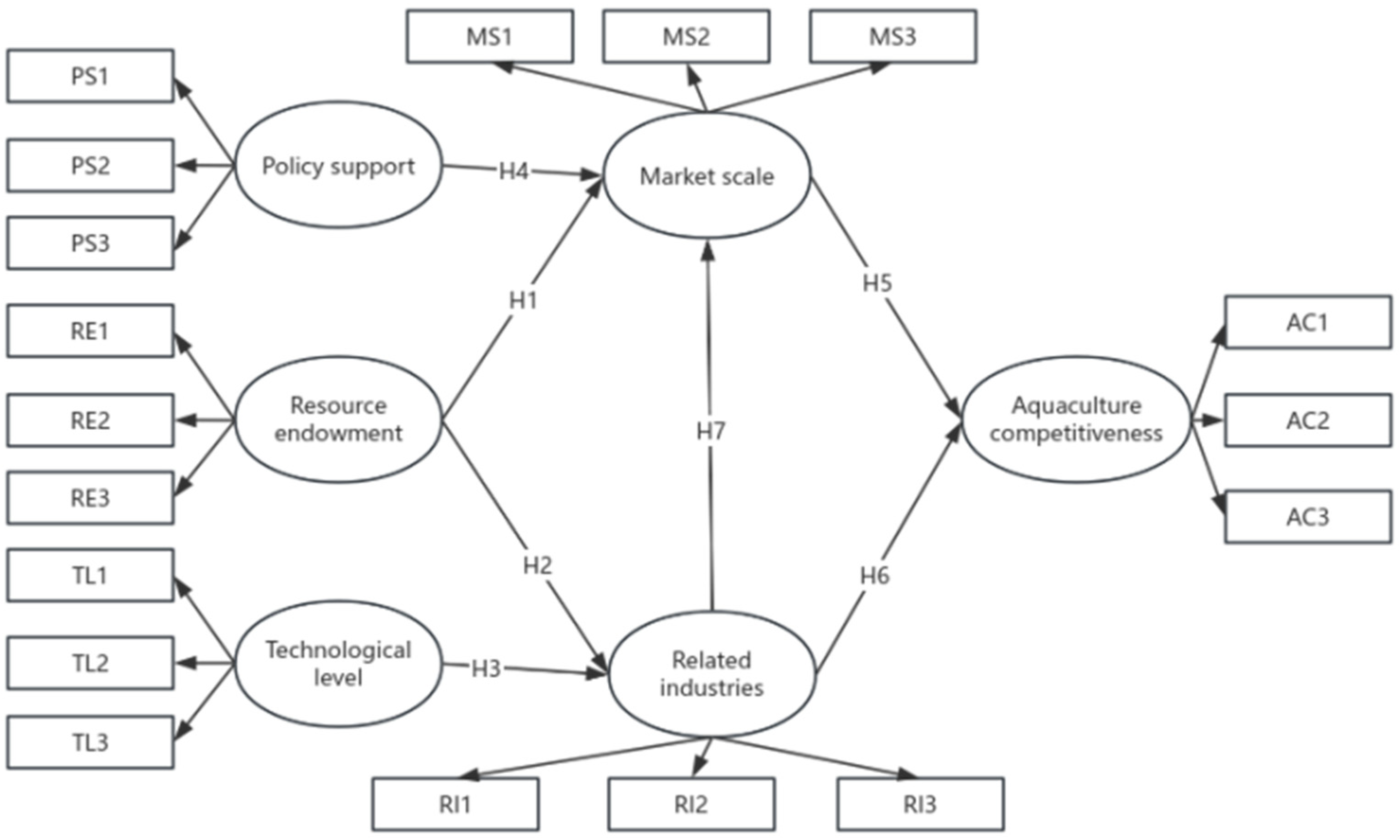
H1: There is a positive correlation between resource endowment (RE) and market scale (MS).
H2: There is a positive correlation between resource endowment (RE) and related industries (RI).
In the modern aquaculture industrial chain, advancements in core farming and scientific research technologies often generate spillover effects, thereby driving the upgrading of upstream and downstream supporting industries [
27]. First, addressing the perishable physical characteristics of aquatic products, the application of novel phase-change cold storage materials and IoT predictive logistics in the cold chain [
28] has extended the sales time of aquatic products, driving the demand for and scale expansion of supporting facilities such as ice-making, cold storage, and professional logistics. Second, the accelerated popularization of automation equipment, such as flexible robots and machine vision, in aquatic processing lines [
29] has effectively overcome the efficiency bottlenecks of traditional manual processing. This provides conditions for transforming aquatic products into high-value-added deep-processed prepared dishes, increases the profit margin of the processing stage, attracts more aquatic processing enterprises to agglomerate, and promotes the overall improvement of regional processing capacity. Finally, new equipment such as deep-sea smart farming vessels and wind–fishery integration platforms have promoted the upgrading of traditional fishing vessels with autonomous navigation and environmental regulation capabilities, extending farming space to the open sea [
30], effectively alleviating the capacity pressure on coastal environments. Therefore, technological level is an important support for driving related supporting industries, such as cold chain and processing, towards maturity.
H3: There is a positive correlation between technological level (TL) and related industries (RI).
Government power is an external force that can have a profound impact on the five key elements of the Diamond Model. The government affects demand through macroeconomic policies [
31]. Consumption subsidies, export tax rebates, aquatic product brand building and promotion, and strict food safety regulatory standards introduced by the government can not only enhance consumer purchase confidence but also reduce market information asymmetry, thereby effectively expanding the overall demand of domestic and foreign markets. The policy and institutional environments are widely recognized as key external conditions affecting the development of the aquaculture industry. When analyzing the US aquaculture industry, Engle and Stone profoundly pointed out that cumbersome regulatory frameworks and high compliance costs significantly restrict the exertion of industrial competitiveness [
32], which proves that reasonable policy support is crucial to stimulating industrial vitality.
H4: There is a positive correlation between policy support (PS) and market scale (MS).
The scale of target market demand for products is the fundamental driving force for industrial upgrading and establishing competitive advantages. In the aquaculture industry, with consumption upgrading, the market demand for high-quality, diversified, safe, and hygienic aquatic products continues to expand. This market demand generates a pulling effect, prompting aquaculture entities to expand production scale, optimize aquaculture structure, and improve output efficiency, ultimately transforming into the comprehensive competitiveness of the aquaculture industry in scale, cost, and quality [
33].
The development of related supporting industries can break through the spatial limitations of aquatic product sales. In the absence of supporting industries, primary aquatic products often face the risks of low prices and losses brought about by concentrated market launches. Conversely, perfect related industries, equipped with sufficient ice-making and cold storage capacity and deep processing enterprise clusters, expand the circulation and storage/transportation scale of aquatic products [
34]. The processing and circulation capacity of supporting industries is the key to determining the market scale of aquatic products. In addition, cold chain storage extends the shelf life of products, significantly reduces post-harvest losses, and guarantees basic profits [
35]. Deep processing, such as ready-to-eat aquatic products and prepared dishes, transforms primary agricultural products into high-value-added terminal commodities, broadening the profit margin of the industry. The more perfect the supporting industries, the stronger the comprehensive competitiveness and risk resilience of aquaculture.
H5: There is a positive correlation between market scale (MS) and aquaculture competitiveness (AC).
H6: There is a positive correlation between related industries (RI) and aquaculture competitiveness (AC).
H7: There is a positive correlation between related industries (RI) and market scale (MS).
In a complex industrial ecosystem, elements may interact with each other. First, resource endowment can not only directly drive the expansion of market scale but also indirectly expand market scale by promoting the development of related industries and leveraging a more perfect industrial chain [
36]. Abundant natural resources provide raw material guarantees for the agglomeration of supporting industries, while the large-scale and professional development of supporting industries effectively broadens the consumption channels for aquatic products. Therefore, related industries play a key bridging role between resource elements and the market. Second, related industries can further enhance the overall competitive advantage of the industry by expanding the market scale. The perfection of related supporting industries not only significantly improves the added value and circulation efficiency of aquatic products but also effectively expands domestic and international market shares. Meanwhile, the expansion of market demand further reduces the unit cost across the entire industrial chain, ultimately translating into the core competitiveness of the industry. Therefore, market scale forms a transmission pathway between supporting industries and ultimate competitiveness. Therefore, the following hypotheses are proposed:
H8a: Related industries (RI) partially mediate the relationship between resource endowment (RE) and market scale (MS).
H8b: Market scale (MS) partially mediates the relationship between related industries (RI) and aquaculture competitiveness(AC).
The concept model with relevant hypotheses is shown in
Figure 1.
3. Materials and Methods
3.1. Sample Selection and Data Sources
This study selects 30 provinces (autonomous regions and municipalities) in mainland China as the research subjects. Given that the Tibet Autonomous Region has significant missing statistical data and its aquaculture production accounts for a very small proportion of the national total, it was excluded to ensure the balance of the panel data and the validity of the empirical results.
The original data for the variables were sourced from the China Fishery Statistical Yearbook from 2014 to 2025, which records the actual statistical data from 2013 to 2024. Before constructing the model, a mean replacement method was employed to fill a small number of missing values in the panel data. Except for AC1 and AC2, all original data underwent Ln(x + 1) transformation. This was done to eliminate dimensional differences, as variables such as output value, area, and number of personnel vary greatly in absolute magnitude. Logarithmic transformation can eliminate the dimensional impact between different indicators and weaken the interference of extreme values, thereby improving the validity and robustness of model parameter estimation. The core latent variables and their observed variable settings for this study are shown in
Table 1.
Resource Endowment (RE): Measured by aquaculture area (RE1), the number of aquaculture fishing vessels (RE2), and the number of aquaculture employees (RE3) to reflect the scale of production factors.
Technological Level (TL): Measured by the yield of factory farming models (TL1), technical information coverage (TL2), and key demonstration technologies (TL3) to evaluate the technological innovation capability of the industry.
Policy Support (PS): Reflected by technology promotion funds (PS1), the number of fishermen trained in technology (PS2), and the number of aquatic technology promotion websites (PS3), representing the government’s support in public services and technology popularization.
Market Scale (MS): Composed of the output value of aquatic processing products (MS1), the output value of aquatic product circulation (MS2), and the output value of fishery feed (MS3) to comprehensively reflect the market realization and support space in the downstream of the industrial chain.
Related Industries (RI): Measured by the number of aquatic processing enterprises (RI1), cold storage capacity (RI2), and ice-making capacity (RI3) to assess the development maturity of supporting industrial facilities.
Aquaculture Competitiveness (AC): Evaluated through three dimensions—benefit (AC1), efficiency (AC2), and export (AC3)—to reflect the final output quality and international market competitiveness of the industry.
3.2. Model Specification
Given that this study involves multiple latent variables and their complex interaction paths, and includes mediation effect tests, the study uses partial least squares structural equation modeling (PLS-SEM) for empirical analysis. Compared with Covariance-Based Structural Equation Modeling (CB-SEM), PLS-SEM does not mandate data to follow a strict multivariate normal distribution, and it has stronger predictive ability and statistical power when dealing with complex models and exploratory theoretical frameworks. The software used is SmartPLS 4.0, with the Bootstrap resampling set to 5000 subsamples and two-tailed tests. This study treats the dataset as pooled cross-sectional data. To effectively control for the influence of unobserved variables fluctuating over time and to eliminate the autocorrelation of panel data, year dummy variables are introduced into the model estimation to control for time fixed effects, thereby ensuring the statistical validity and rigor of the path coefficients.
The structural equation model in this study consists of two parts: the measurement model (outer model) and the structural model (inner model):
The measurement model defines the relationship between observed variables and latent variables. The indicators in this study are all reflective indicators, and their mathematical expressions are:
where
is the exogenous observed variable vector;
is the endogenous observed variable vector;
is the exogenous latent variable vector (resource endowment, technological level, and policy support);
is the endogenous latent variable vector (related industries, market scale, and competitiveness);
and
represent the factor loading matrices of exogenous and endogenous observed variables on their corresponding latent variables, respectively; and
and
are the corresponding measurement error terms.
- 2.
Structural Model
The structural model defines the causal path relationships between latent variables and is used to test the research hypotheses. Its mathematical expression is:
where
and
represent the endogenous and exogenous latent variable vectors, respectively;
is the path coefficient matrix between endogenous latent variables;
is the path coefficient matrix of exogenous latent variables on endogenous latent variables; and
is the residual vector of the structural model, representing the variance unexplained by the model.
4. Results
4.1. Measurement Model Testing: Reliability and Validity Assessment
Before conducting the path analysis of the structural equation model, the internal consistency reliability, convergent validity, and discriminant validity of the measurement model were first evaluated to ensure the stability and validity of the measurement tools for each latent variable.
First, the internal consistency reliability test. As shown in
Table 2, the standardized factor loadings of all latent variables range from 0.763 to 0.940, all of which are higher than 0.70. Cronbach’s alpha coefficients are distributed between 0.767 and 0.920; the composite reliability ranges from 0.770 to 0.926, while the composite reliability falls within the interval of 0.863 to 0.949. All reliability indicators exceed 0.70, indicating that the observed indicators selected for this study have high internal consistency and reliability in measuring the competitiveness of the aquaculture industry and its driving factors.
Second, the convergent validity test. The Average Variance Extracted for all latent variables ranges from 0.678 to 0.862, all exceeding 0.50. This indicates that each latent variable can explain more than 60% of the variance in its corresponding observed variables, and the measurement model possesses excellent convergent validity.
Third, the discriminant validity test. Discriminant validity aims to ensure that each latent variable in the model is empirically independent of the others. This study primarily adopts the Fornell–Larcker criterion for testing. As shown in
Table 3, the square root of the Average Variance Extracted for each latent variable is greater than the correlation coefficients between that latent variable and all other latent variables. This indicates that a sufficient degree of differentiation is maintained between the various latent variables in the model. Although these elements show high correlation within industrial clusters, they remain independently valid in terms of statistical measurement and theoretical definition [
37].
4.2. Structural Model Testing
After confirming that the quality of the measurement model met the required standards, the Bootstrapping resampling method was employed to test the path coefficients and their statistical significance within the structural model. The results indicate that all seven direct effect hypotheses proposed in this study were supported as shown in
Table 4.
Resource endowment exerts a significant positive impact on both market scale (H1, β = 0.275) and related industries (H2, β = 0.488); technological level significantly promotes the development of related industries (H3, β = 0.321); policy support demonstrates a significant positive effect on expanding the market scale (H4, β = 0.094); in the mid-to-downstream of the industrial chain, related industries significantly drive the growth of market scale (H7, β = 0.608); and both market scale (H5, β = 0.401) and related industries (H6, β = 0.325) exert significant positive impacts on the final aquaculture competitiveness.
To evaluate the practical impact of these paths, this study calculated the effect size (f
2). According to the criteria set by Cohen (2013), f
2 values greater than 0.02, 0.15, and 0.35 represent small, medium, and large effects, respectively [
38]. The results show that the path of related industries transforming into market scale (f
2 = 0.852) exceeds 0.35, demonstrating a strong effect; the path of resource endowment driving related industries (f
2 = 0.222) reached the medium effect standard, while the paths of resource endowment to market scale (f
2 = 0.112), technological level to related industries (f
2 = 0.096), market scale to competitiveness (f
2 = 0.084), related industries to competitiveness (f
2 = 0.055), and policy support to market scale (f
2 = 0.021) all met the threshold for small effects.
Regarding the multicollinearity test, the Variance Inflation Factor (VIF) values for all predictor variables in the model range from 2.109 to 3.886. All values are below 5.0, indicating that there are no serious multicollinearity issues among the latent variables defined in this study, ensuring that the path estimation results of the structural model possess statistical reliability [
39]. In terms of overall model fit, the standardized root mean square residual (SRMR) value of this study is 0.096. Hair et al. (2019) suggest that in partial least squares structural equation modeling (PLS-SEM), an SRMR value less than 0.10 indicates an acceptable overall model fit [
39].
Furthermore, this study utilized R
2 and Q
2 to assess the explanatory power and predictive relevance of the structural model. As shown in
Table 5, the R
2 values for market scale, related industries, and competitiveness reached 0.802, 0.582, and 0.506, respectively, indicating that the exogenous latent variables exhibit moderate-to-high explanatory power for these three endogenous variables. Meanwhile, the blindfolding test results show that the Q
2 values of all endogenous latent variables are greater than 0, indicating that the model possesses good out-of-sample predictive relevance.
4.3. Mediation Effect Testing
To further reveal the complex transmission mechanisms among industrial elements, this study analyzed the indirect transmission roles of related industries and market scale based on the modern mediation effect judgment criteria proposed by Zhao et al. (2010) [
40].
The results show that related industries play a significant mediating role in the resource endowment → market scale path. As shown in
Table 6 and
Table 7, the direct effect and indirect effect of this path are both significant and in the same direction, indicating that related industries play a complementary partial mediating role with a Variance Accounted For (VAF) of 51.92%. Therefore, hypothesis H8a is supported. This means that 51.92% of the promoting effect of resource endowment on the expansion of market scale is achieved through the indirect pathway of driving the development of related industries. This quantitative result indicates that the direct contribution of mere resources to market expansion is limited; instead, it must rely on the agglomeration of supporting industries for in-depth transformation.
Similarly, market scale also plays a significant mediating role in the related industries → competitiveness path. Its direct effect and indirect effect are both significant, confirming that market scale plays a complementary partial mediating role in this transmission mechanism, with a VAF value of 42.88%. Thus, hypothesis H8b is supported. Regarding the enhancing effect of related supporting industries on ultimate aquaculture competitiveness, 42.88% of the contribution is transmitted through the expansion of market scale. This reveals the key role of the scale effect on the demand side in the transformation process from the construction of supporting industries to core competitiveness.
4.4. Robustness Checks
To ensure the reliability of the aforementioned empirical findings, this study conducted robustness tests from the following five perspectives: variable substitution, endogeneity treatment, sample screening, structural change, and estimation method. The results are summarized in
Table 8:
First, variable substitution test (Model I): To eliminate potential biases arising from indicator measurement, this study re-estimated the model by replacing the multiple observed indicators of the latent variable “technological level” with a single indicator—factory farming yield.
Second, endogeneity treatment and lagging test (Model II): Considering the potential reverse causality between upstream and downstream sectors of the industrial chain, this study re-calculated the model by lagging all exogenous latent variables by two periods and endogenous mediating latent variables by one period. The main paths remained significant, effectively mitigating endogeneity concerns.
Third, test by excluding extreme samples (Model III): To exclude the interference of extreme values from non-main production areas on the overall fit, this study conducted a subsample regression by excluding western non-main production provinces with low proportions of aquaculture output (Qinghai, Ningxia, Gansu, and Xinjiang). The results indicate that the research findings are not driven by specific extreme samples, demonstrating good generalizability.
Fourth, topological structure change test (Model IV): To reduce the endogeneity bias caused by omitted paths, this study altered the network topology by adding a direct path from technological level to competitiveness to the original model. The results show that the newly added path did not reach statistical significance, while the original paths remained significant.
Fifth, change in estimation method (Model V): Given the limitations of traditional partial least squares (PLS) in handling unobserved heterogeneity in panel data, this study introduced the Feasible Generalized Least Squares (FGLS) method for single-equation re-evaluation. FGLS effectively controls for groupwise heteroscedasticity and first-order autocorrelation within groups in panel data. The results indicate that the transmission paths of the model remain valid.
In summary, the path specifications of this study exhibit a certain degree of robustness.
6. Conclusions and Recommendations
6.1. Conclusions
Based on the theoretical framework of the Diamond Model, using panel data from 30 provinces in China from the “China Fishery Statistical Yearbook” from 2014 to 2025, this study empirically tested the multi-dimensional driving mechanisms of aquaculture competitiveness through a partial least squares structural equation model. Three main conclusions are drawn: First, it expands the transmission structure of elements in the Diamond Model. Technological level and resource endowment are prerequisites for industrial development, but their efficacy depends on the mediating roles of related industries and market scale. Porter’s classic theory views natural resources and related supporting industries as two parallel dimensions building comparative advantages. The empirical results of this study deepen this structure. Today, in a period of deep digital transformation, natural resource endowment remains an important foundational element for industrial development, but it cannot be directly converted into ultimate international competitiveness. The study confirms that related and supporting industries have evolved into indispensable transmission mediators in the entire industrial chain. Traditional natural resource advantages and modern technological innovation inputs must drive the agglomeration and upgrading of supporting industries, such as peripheral aquatic processing and smart cold chain logistics, to complete deep value transformation and enhance overall industrial efficiency. Second, related industries and market scale constitute the driving force for enhancing aquaculture competitiveness. The direct promoting effect of related industries on competitiveness is relatively significant, which indicates that modern aquaculture competition needs to rely on the entire industry chain covering processing, circulation, and storage. The more complete the supporting system, the higher the overall risk resistance ability and profitability level of the industry. Third, policy support plays a key external guiding role in stimulating market demand. Not only can government support significantly expand the market scale, but the market will reversely pull the continuous technological upgrading of related industries. This virtuous feedback mechanism helps the aquaculture industry realize long-term competitive advantage enhancement.
6.2. Recommendations
Based on the above empirical conclusions, to further enhance the comprehensive competitiveness of China’s aquaculture industry, this paper proposes the following targeted recommendations:
First, strengthen market-demand-oriented agricultural science and technology innovation mechanisms. Technological level is the most important engine for breaking through traditional resource constraints and driving industry chain upgrading [
45]. Agricultural scientific research and technology promotion must be closely combined with the actual demand of the current consumer end for high-quality protein and diversified aquatic product forms. Governments at all levels and industry associations should guide funds to shift from traditional subsidies for scale expansion and production increase to R&D investment in cutting-edge technologies [
46]. At the same time, an enterprise-oriented technology transformation platform should be established to ensure that scientific and technological achievements can quickly land in related supporting industries, effectively translating them into core competitive advantages in international and domestic markets.
Secondly, optimize the allocation of industrial resources and focus on supporting the development of related industries. Local governments and enterprises should break through the traditional thinking of relying on production increases and extend the scope of capital and policy support to the downstream of the industry chain. Emphasis should be placed on increasing investment in AI-optimized smart cold chain networks, full-life-cycle traceability systems for aquatic products based on blockchain technology, and flexible automated deep processing lines. By deploying frontier digital infrastructure, weak links in the industrial chain can be effectively improved, maximizing the added value and cross-regional circulation efficiency of aquatic products [
47].
Thirdly, transform policy regulation methods and strengthen consumption guidance and public service supply. The dimension of policy support should tilt from direct production link subsidies to market expansion, the construction of fishery public information platforms, and practitioner skills training. By reducing the overall transaction costs of the industry and cultivating emerging consumption formats such as recreational fisheries, the leverage effect of macroeconomic policies on expanding the market scale can be fully utilized, thereby promoting the transformation and upgrading of the entire industrial ecosystem [
48].
6.3. Limitations
Although this study expanded on the theoretical framework and empirical methods, there are still the following limitations: First, the limitations of macro data. This study used provincial macro panel data and cannot analyze the impact of aquaculture enterprises or farmers. Future research could combine micro-survey questionnaires and enterprise data to explore the heterogeneous performance of different business entities. Second, the absence of green competitiveness measurement indicators. Constrained by the availability of macro statistical data, the measurement system constructed in this study failed to fully cover ecological dimension indicators. Against the backdrop of the country comprehensively advancing its ambitious “Dual Carbon” goals, future research should incorporate key environmental indicators—such as nitrogen and phosphorus pollution emissions and marine blue carbon sequestration capacity—into the analytical framework, thereby expanding the traditional concept of economic competitiveness into a green comprehensive competitiveness that includes environmental sustainability. Third, the neglect of spatial spillover effects. The existing structural equation does not fully measure inter-provincial factor mobility and technology spillovers. In the future, spatial econometric models can be introduced to further analyze the cross-regional spatial interactive impacts of related industries.