
Article

The Effect of Strong Anthropogenic Impact on the Ichthyofauna: A Case Study of the Varna–Beloslav Lake Complex (Eastern Bulgaria)


by
Tihomir Roussinov Stefanov
*,
Pencho Georgiev Pandakov
,
Dimitar Zhelyazkov Dimitrov
,
Violeta Ivanova Evtimova
and
Nikolay Minchev Todorov
National Museum of Natural History, Bulgarian Academy of Sciences, 1 Tsar Osvoboditel Blvd., 1000 Sofia, Bulgaria
*
Author to whom correspondence should be addressed.
Fishes 2026, 11(4), 206; https://doi.org/10.3390/fishes11040206
Submission received: 12 February 2026 / Revised: 19 March 2026 / Accepted: 26 March 2026 / Published: 29 March 2026
(This article belongs to the Section Environment and Climate Change)

Abstract

The Varna–Beloslav Lake Complex has been subjected to intense anthropogenic pressure over the past century. The excavation of a navigation channel connecting the two lakes with the Black Sea, together with the intensive industrial development in the surrounding area, has led to irreversible alterations in the species composition of the ichthyofauna. This study aimed to document and analyze these changes based on data collected during a four-year survey using a range of ichthyological methods. A total of 28 fish species were recorded, representing approximately one-third of the species historically reported for the complex. Hydromorphological degradation, combined with salinization, heavy ship traffic and pollution, has been identified as the main cause of the observed decline in fish diversity within the system.
Key Contribution: This four-year field survey provides the first comprehensive assessment of the contemporary ichthyofauna of the Varna–Beloslav Lake Complex after more than six decades, documenting a marked decline in freshwater species and the dominance of marine and euryhaline taxa driven by long-term anthropogenic pressure.

1. Introduction

Lake Varna is the largest and deepest liman along the Bulgarian Black Sea coast, covering approximately 19 km2, with a maximum depth of 19 m and a volume of about 165–166 million m3 [1]. The lake occupies a former fluvial valley, inundated during the late Pleistocene sea-level rise [2]. Its deepest layers contain thick alluvial deposits rich in hydrogen sulfide mud [1].
Until 1909, Lake Varna was a closed freshwater liman with an outlet to the sea through a small river. The excavation of a 5 m-deep navigable canal that year led to seawater intrusion and the onset of gradual salinization [1,3]. The lake lies within the ancient valley of a large river, an ancestor of the modern Provadiyska River and receives freshwater primarily from the inter-lake canal connecting it to Lake Beloslav, into which the Devnya and Provadiyska rivers discharge.
A second canal was opened in 1923, linking the two lakes, and in 1976, a major 12 m-deep shipping channel, between Lake Varna and Black Sea was dredged. This greatly enhanced navigability and strengthened the hydrological connection between the lakes and the sea, further increasing salinity and industrial influence [1,3].
The mean salinity of surface waters in this period is about 11.4‰, increasing to 14.8‰ near the bottom, with values increasing recently. The mean annual water temperature is roughly 14 °C, ranging from 27 °C in summer to −0.6 °C in winter. Water transparency varies from less than 1 m to more than 5 m, depending on phytoplankton development and suspended sediment input from the inflowing rivers [1,3,4,5,6].
The hydrochemical regime is marked by a distinct pattern of dissolved gases: during summer, oxygen is depleted below 10 m, replaced by hydrogen sulfide, creating a permanently anoxic layer [1].
Ecologically, Lake Varna is a mixomesohaline, eutrophic basin with biota dominated by marine and brackish species.
Lake Beloslav, located immediately west of Lake Varna, is a smaller liman covering approximately 10 km2, with depths up to 14 m and salinity around 10‰ [1]. The two lakes are hydrologically connected, and both receive inflows from the Devnya and Provadiyska rivers.
Before 1923, when the connecting canal was excavated, Lake Beloslav was entirely freshwater. The canal’s construction caused a drop in water level and progressive salinization, a process accelerated later by industrial expansion and the operation of a nearby soda factory [1].
The temperature regime of Beloslav Lake shows a minimum in January and a maximum in July, with an annual amplitude of about 30 °C. Oxygen concentrations vary widely, reaching maxima in late summer and early autumn during intense phytoplankton photosynthesis. Compared to Lake Varna, Lake Beloslav sustains a higher proportion of freshwater organisms, due to the continuous freshwater inflow, which has acted as a refugium for freshwater fauna following the system’s hydrological transformation [3].
As part of the Varna–Beloslav Lake Complex, the Yatata wetland (a protected area also known as Strashimirovsko Swamp) lies to the north of the canal connecting both lakes. Unlike most Bulgarian wetlands, Yatata is an artificial freshwater wetland formed unintentionally in the late 20th century from treated wastewater discharges from the Beloslav municipal treatment plant into low-lying terrain near the Varna–Beloslav canal. The dyke along the south bank of the canal serves as a dam in the formation of the Yatata wetland. The continuous inflow of nutrient-rich water promoted the establishment of aquatic and semi-aquatic communities. Consequently, Yatata can be regarded as a secondary wetland of anthropogenic origin, where ecological succession has transformed a human-induced hydrological disturbance into a biologically valuable ecosystem with high ornithological importance. Its territory supports 208 bird species, 89 of which are of European conservation concern [7]. Nowadays, Yatata is designated as a protected area and as both an Important Bird Area (IBA) and a Special Protection Area (SPA), forming part of the Natura 2000 network.
The earliest data on the ichthyofauna of the Varna and Beloslav Lakes were reported by [8], during the period shortly after the salinization of Varna Lake and prior to the excavation of the connecting channel between the two lakes. The author recorded a total of 38 species, predominantly of marine origin, in Varna Lake, and 25 species in Beloslav Lake.
Subsequently, Netchaeff (1933) [9] documented the occurrence of Chelon ramada together with three other mugilid species in Beloslav Lake. In a later study, Netchaeff (1934) [10] provided data on fisheries in Beloslav Lake, noting that prior to 1923, the lake was important to local communities, with total annual freshwater fish catches ranging between 100 and 150 tons. After this period, populations of freshwater species began to decline, and several taxa eventually became locally extinct.
Zvetkov (1955) [11] investigated the feeding ecology of fish in Beloslav Lake, reporting 15 species. Data on the species composition of both lakes were later summarized in the comprehensive monograph on Bulgarian lakes by [3].
Alexandrova (1965) [12] conducted an in-depth survey of the ichthyoplankton of Varna Lake over a relatively long period (1956–1964), identifying a total of 40 fish species, the majority of which are temporary inhabitants of the lake. During the same period, Gheorghiev (1966) [13] investigated gobiid fishes in Bulgaria and reported the presence of 11 goby species in both Varna and Beloslav lakes.
The most extensive ichthyological survey in the region was conducted by [1], who recorded a total of 54 species in Varna Lake—including marine species that temporarily penetrate the lake and 31 species in Beloslav Lake, where numerous freshwater taxa were still present.
Further research on the Mugilidae was carried out by [14,15], while [16] provided data on fish productivity in both lakes. For more than six decades thereafter, no contemporary studies on the ichthyofauna of Varna and Beloslav Lakes were published. Only two recent investigations have mentioned fish species from the area: Georgieva et al. (2015) [17] examined organochlorine contaminants in three species, and [6] assessed the effects of anthropogenic pressure on the lakes, reporting a total of 10 species identified during the mass fish mortality event in 2020.
Scarce information on the ichthyofauna of Varna and Beloslav Lakes is also available in several review studies [18,19,20,21,22,23], which include general data on the fishes of the Black Sea and the coastal lakes.
The aim of this study was to provide updated information on the ichthyofauna of both lakes and to document and analyze the changes in species composition resulting from massive habitat degradation caused by hydrological alterations, industrial development, and anthropogenic pollution.

2. Materials and Methods

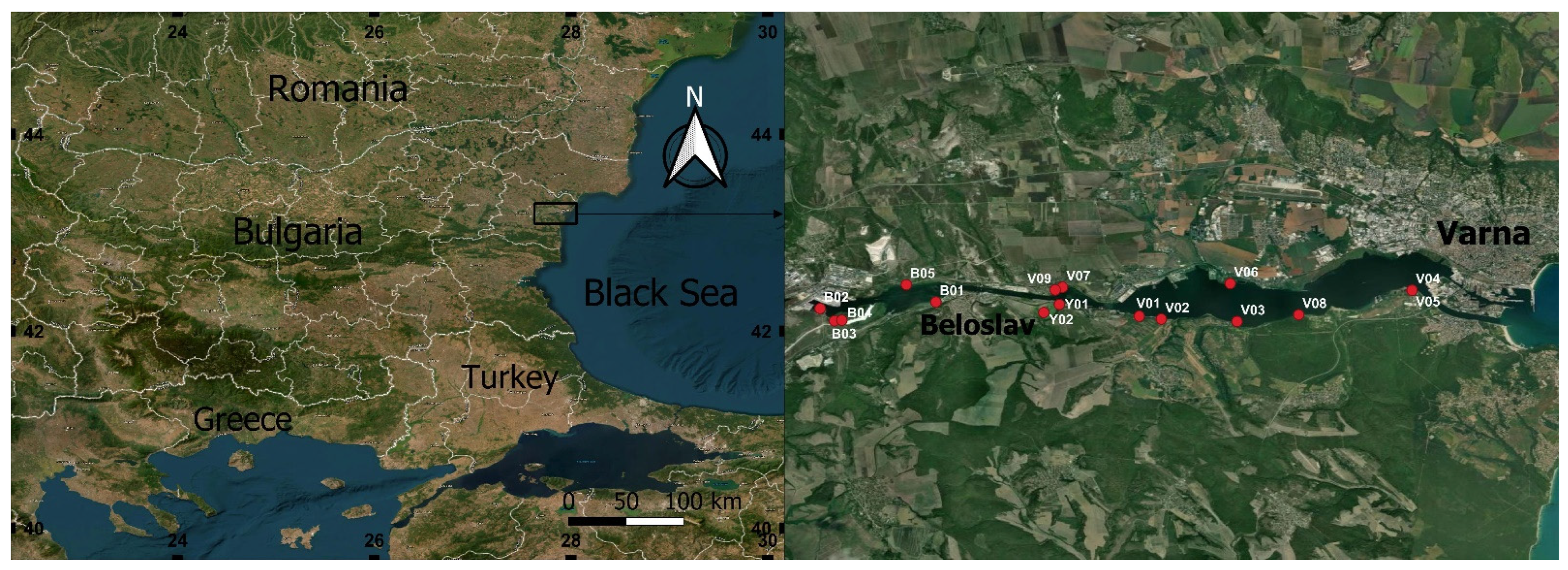
The field study was conducted during the period 2021–2024, with biannual fish sampling. A total of 16 sampling sites were surveyed: nine along Varna Lake, five along Beloslav Lake, and two within the Yatata Protected Area (Table 1; Figure 1).
Fish specimens were collected using a beach seine net (7 m in length, 5 mm mesh size), NORDIC-type gill nets (30 m in length, 1.5 m in height, European Standard consists of 12 different mesh size panels), and fish traps (3 m in length, 4 mm mesh size). Sampling was conducted twice per year, mainly during the months of June and October. The beach seine net was used for catching in the littoral area, covering approximately 200 m2. Gillnets and fish traps were set for 12 h overnight exposure. Most individuals were identified, counted, and measured in the field and subsequently released back into the water. A small number of specimens were preserved in formalin for further examination under laboratory conditions according to the national legislation.
The average abundance (Na) of each species at each locality was calculated according to the following formula:
Na = 100 × (n/(∑c))
where n is the total number of specimens caught at a given locality, and ∑c represents the sum of all sampling efforts.
The frequency of occurrence (%Fi) was expressed as the percentage of localities where the species was recorded, according to the formula:
%Fi = 100 × (li/l)
where li is the number of localities where the species was found, and l is the total number of all sampled localities.
All calculations and tabulations were performed using Microsoft Excel (Office 2019).
A review of records from local anglers and fishermen yielded information about the catch of occasional species recently found in the Varna–Beloslav Lake system.
The taxonomic classification of fish species follows [24,25,26].
At the in situ sampling sites, the following physicochemical parameters were measured: pH, temperature (°C), dissolved oxygen (mg/L), oxygen saturation (%) and salinity (‰). Measurements were performed with a pre-calibrated portable multiparameter meter (WTW, Germany; Multi 3620 SET G) in accordance with the manufacturer’s instructions. Measurements were conducted twice annually—in June and October—during midday hours.

3. Results

Five surface-water physicochemical parameters were measured at six sites in Varna Lake, three in Beloslav Lake, and an additional site within the Yatata Protected Area (Table 2). In Varna Lake, dissolved oxygen (DO) ranged from 9.05 to 19.51 mg/L (mean = 16.09 mg/L) in early summer and decreased to 7.32–12.62 mg/L (mean = 8.59 mg/L) in autumn. Beloslav Lake exhibited a comparable, though less pronounced, seasonal pattern (Table 2). The autumnal decline in DO is plausibly related to elevated hydrogen sulfide concentrations that accumulate during the warm summer months, combined with seasonal stratification and increased oxygen demand, as previously reported [1,3]. Oxygen saturation followed a similar seasonal trend in both lakes (Table 2).
Within the Yatata Protected Area, DO concentrations and saturation levels remained consistently high, likely reflecting the presence of dense submerged macrophytes and intensive daytime photosynthesis.
pH values were slightly higher in early summer than in autumn and were generally higher in Varna Lake than in Beloslav Lake, with the highest values recorded at Yatata. Salinity was comparable between the two lakes and showed modest seasonal variation, tending to increase in autumn when persistent easterly winds promote seawater intrusion into the lake system (Table 2).
A total of 28 fish species were recorded during our study across all localities (Table 3). Additionally, seven other species were identified through a review of anglers’ records. Most of these represented temporary inhabitants of Varna Lake of marine origin, including Alosa immaculata, Pomatomus saltatrix, Spicara maena, S. smaris, Scomber scombrus and Trachinus draco. A single adult specimen of Oncorhynchus mykiss was also recorded, most likely originating from aquaculture facilities in the Krasnodar region near Sochi, Russia, where storm-driven waves and strong winds in late January 2022 damaged infrastructure and released approximately 20 to 300 tons of rainbow trout into the Black Sea.
The most widespread species, according to our study were Atherina boyeri, Chelon auratus, C. saliens, Syngnathus abaster, Neogobius melanostomus, and Platichthys flesus (%Fi = 87.5), all occurring in every locality except the freshwater Yatata. These were followed by Pomatoschistus marmoratus (%Fi = 81.3), Mugil cephalus, and Knipowitschia cf. caucasica (%Fi = 62.5).
The most abundant species overall was N. melanostomus (Na = 93.78), followed by Ch. auratus (Na = 47.74), C. saliens (Na = 21.67), A. boyeri (Na = 12.50), and Pom. marmoratus (Na = 11.10). Several species were represented by single individuals during sampling, including Anguilla anguilla, Hippocampus guttulatus, Pungitius platygaster, Merlangius merlangus, Callionymus risso, and Gobius ophiocephalus.
The ichthyofauna of Varna Lake was the richest, with 23 recorded species, followed by Beloslav Lake with 16. In the Yatata Protected Area, only five species were found, all restricted to freshwater habitats. The only species common to all three systems was the euryhaline alien Gambusia holbrooki. On the other hand, the species H. guttulatus, M. merlangus, Trachurus mediterraneus, C. risso, Salaria pavo, Aphia minuta, and Proterorhinus marmoratus were recorded by us only in Varna Lake.
Being a small, secondary wetland of anthropogenic origin, Yatata supports a relatively poor fish fauna, dominated by non-native species. In addition to G. holbrooki, Carassius gibelio and Lepomis gibbosus are also present. The population of common carp (Cyprinus carpio) is artificially maintained, whereas Carassius carassius is the only species of conservation importance, representing a remnant of the region’s former freshwater lake system. Other fish of conservation concern occurring in Varna and Beloslav Lakes include A. anguilla and G. ophiocephalus, both listed in the Bulgarian Red Data Book.
Most of the recorded species are of marine origin, having colonized the lake system following the construction of the canal connecting it with the Black Sea. Only a few species, such as C. carassius, P. platygaster, and probably Gasterosteus aculeatus, can be regarded as remnants of the original ichthyofauna that existed before the major hydrological modifications.

4. Discussion

The hydrochemical parameters obtained in this study differ substantially from those reported for Varna Lake in the 1960s. The mean annual salinity has increased to 14.8‰, compared to historical measurements of 11.4‰ in surface waters [1,3]. This long-term rise in salinity likely reflects progressive marine influence following hydrotechnical modifications and canal deepening, which have enhanced water exchange with the Black Sea. During autumn, salinity increases further due to persistent easterly winds that promote seawater intrusion, with the highest values observed in the easternmost part of Varna Lake (localities V05 and V06), exceeding 16.5‰ (Table 2). Even higher values, up to 19‰, were reported by [6] during the June–September 2020 period, supporting the trend of continued salinization in the system.
The salinity of Beloslav Lake has increased markedly compared with levels recorded in the 1960s. Prior to the commissioning of the soda factory, the mean annual salinity during 1948–1954 was 0.62‰, rising to 3.86‰ in 1955–1966 following the start of industrial operations [1,3]. Our measurements indicate a current mean salinity of 14.7‰, with higher values observed during the autumn months. Similarly, Bekova et al. (2022) [6] reported elevated salinity in Beloslav Lake, ranging between 15.2‰ and 17.1‰ during the June–September 2020 period.
The dissolved oxygen (DO) values recorded in our study are also higher than those reported in the past. In Varna Lake, we measured an average of 13.80 mg/L during the summer months, decreasing to 8.33 mg/L in early autumn. Nevertheless, this autumn value remains above the historical mean annual concentration of 8.04 mg/L [1,3,4]. A similar pattern was observed in Beloslav Lake, where the mean annual value in the 1960s was 6.91 mg/L, whereas our measurements averaged 11.86 mg/L in summer and declined to 5.67 mg/L in early autumn.
This seasonal decrease in DO concentration toward the end of summer is most likely associated with increased hydrogen sulfide accumulation in the bottom layers, which has historically caused fish kills following the mixing of stratified waters during strong wind events [1,3]. A major fish mortality event was recorded in May 2020, resulting from a rupture in a pipeline lying on the bottom of Varna Lake that carried untreated domestic wastewater to the municipal treatment plant. The incident led to severe organic pollution and a sharp decline in oxygen concentration, reaching as low as 0.04–1.29 mg/L [6].
The pH values have also shown a slight increase over the years. In the past, the mean surface-water pH of Varna Lake varied between 7.8 and 8.8 [1,3], whereas our measurements ranged from 8.0 to 9.2. Similarly, in Beloslav Lake the historical mean pH was around 7.8, while our data indicate an average of 8.4.
Overall, these changes in hydrochemical parameters reflect substantial alterations in the ecological conditions of both lakes. They are primarily the result of strong anthropogenic pressure associated with hydromorphological modifications, intensified water exchange with the sea, and persistent industrial and domestic pollution.
There are four main sources of information on the fish fauna of the Varna–Beloslav lake system, corresponding to three distinct stages in the ichthyological research of the area. The earliest and most comprehensive study was conducted by [8], who examined the fish assemblages of the large wetland complex that then existed around the two lakes and at the mouths of the Devnenska and Provadiyska rivers. His work was carried out a few years after the connection of Varna Lake with the Black Sea and shortly before the excavation of the canal linking the two lakes. At that time, Beloslav Lake was entirely freshwater, and its natural ichthyofauna remained largely preserved.
A few years later, ref. [10] provided information about fisheries in Beloslav Lake, including a general account of the fish species inhabiting it. Aleksandrova (1961) [27] studied the migration of mugilids along the Bulgarian Black Sea coast, including Varna and Beloslav Lakes. The synthesis by [3] included a list of fish species from the two lakes, but this compilation relied entirely on earlier sources and did not contain original field data. However, neither of these works can be regarded as detailed ichthyological investigations.
The second stage of research is represented by the studies of [1,12], who described the ichthyoplankton and the state of the ichthyofauna following major hydrological modifications, including the construction and deepening of navigation canals and the drainage of extensive wetlands in the western part of the complex. Before the second research stage, ref. [11] conducted a study focused on the diet of several fish species from the lakes, but this work cannot be considered a comprehensive ichthyological investigation. Subsequently, ref. [16] presented data on the fish productivity of both lakes, listing the most frequently caught species.
The present study reflects the contemporary condition of fish populations many decades after the major environmental transformations, during a period of pronounced anthropogenic pressure associated with the rapid expansion of the city of Varna, population growth, regular dredging of both canals, intensive maritime traffic, and severe industrial and domestic pollution. During this period, ref. [6] provided additional data by identifying 10 fish species among the specimens recorded during the mass fish mortality event in 2020. Two of these species—Gobius paganellus and Babka gymnotrachelus—had not previously been detected in the lake system. The latter species, predominantly a freshwater inhabitant, was found together with Neogobius fluviatilis among the numerous dead fish along the shores of Varna Lake.
When comparing contemporary data with historical records, it should be noted that differences in sampling methods, sampling intensity, and taxonomic resolution among earlier studies may influence the detectability of certain species. Historical surveys relied on a variety of fishing techniques and often included data from commercial catches, which may differ from the standardized sampling applied in the present study. Therefore, some discrepancies in species lists could partly reflect methodological differences. Nevertheless, the large-scale trends observed here, particularly the disappearance of most freshwater species and the dominance of marine and euryhaline taxa are consistent with the well-documented hydromorphological modifications, increasing salinity, and strong anthropogenic pressure affecting the Varna–Beloslav lake system over the past century.
A total of 87 fish species belonging to 42 families were recorded during the three stages of ichthyological research in the Varna–Beloslav lake system (Table 4). Varna Lake possesses the richest ichthyofauna. Drenski (1922) [8] documented 38 species, while [1] reported 54 species despite the disappearance of most freshwater forms following the major hydromorphological modifications. Typical freshwater species such as Abramis brama, Alburnus mandrensis (originally described as Chalcalburnus chalcoides mandrensis), and Esox lucius completely vanished, being replaced by numerous marine species including Atherina hepsetus, Syngnathus typhle, H. guttulatus, Diplodus annularis, Spicara smaris, Symphodus ocellatus, Aidablennius sphynx, Parablennius sanguinolentus, etc. (Table 4). Alexandrova (1965) [12], in her study of the ichthyoplankton of the lake, recorded a total of 40 species, of which only two were freshwater—C. carpio and S. lucioperca. The author also reported numerous newly recorded species of marine origin in the lake, including Gaidropsarus mediterraneus, Callionymus pussilus (listed as C. festivus), C. risso (listed as C. belenus), T. draco, Uranoscopus scaber, Scorpaena porcus, Arnoglossus kessleri and Pegusa nasuta.
The study by [1] appears particularly comprehensive, as it included several freshwater species not previously reported by [8], such as Rhodeus amarus, Gobio cf. gobio, C. carpio, and Cobitis elongatoides (listed as C. taenia). However, during the present study, all freshwater species had already disappeared, and only marine species were recorded. The decline in fish diversity is evident in Varna Lake, where our study recorded 23 species (35 including other recent records across the complex), representing a significant reduction compared to historical records. Alongside the extinction of freshwater fishes, several marine species have also disappeared (Table 4). Although we recorded a few species not reported in earlier studies, such as M. merlangus, O. mykiss, S. maena and Salaria pavo, the overall diversity has declined markedly due to intense anthropogenic pressure. Only a few species, including A. anguilla, E. encrasicolus, A. boyeri, G. aculeatus, S. abaster, Trachurus mediterraneus, Platichthys flesus, several mugilids, and some gobies (Table 4), have persisted through all three periods. These are predominantly marine species whose populations are continuously replenished from the Black Sea.
During 1961–1965, the most important fishery species in Varna Lake were N. melanostomus (annual catch 90.2 t), followed by A. boyeri (14.2 t), M. cephalus (3.5 t), and S. sprattus (2.9 t) [16]. Interestingly, at that time, the annual catch of Cyprinus carpio was still relatively high (1.9 t). Today, the most abundant species are similar—N. melanostomus, A. boyeri, and mugilids—but S. sprattus has become rare, and C. carpio has completely disappeared from Varna Lake. Although quantitative data on recent biomass are lacking, the overall abundance appears much lower, with strong fluctuations linked to recurrent mass fish mortality events [6].
Changes in the ichthyofauna of Beloslav Lake are even more pronounced, as the system remained almost entirely natural during the first period. Drenski (1922) [8] reported 26 mostly freshwater species, along with a few mugilids that entered the lake through the river connecting it with Varna Lake. At that time, the annual fish catch reached approximately 150 tons, dominated by A. brama, C. carpio, and Sander lucioperca [10]. Following the construction of the connecting canal in 1923, most freshwater species began to disappear, and the lake gradually lost its significance as a fishery resource. Despite a dramatic reduction in the size of Beloslav Lake and an increase in salinity caused by seawater intrusion from Varna Lake, several freshwater species like C. carpio, Scardinius erythrophthalmus, Rutilus rutilus, Rhodeus amarus, and S. lucioperca still persisted in the 1950s [11].
Between 1961 and 1965, the most commercially important species in Beloslav Lake were M. cephalus (annual catch 24.9 t), C. carpio (19.4 t), A. boyeri (6.0 t), A. mandrensis (2.3 t), and S. lucioperca (0.7 t) [16]. Manolov-Gueorguiev (1967) [1] reported 31 fish species, still with a considerable freshwater component (Table 4). His comprehensive study added several new records, including Leucaspius delineatus, C. elongatoides, and Knipowitschia spp. During this period, the first marine species, such as Mullus barbatus and P. flesus, also invaded the lake. In the present study, a further decline in diversity was observed, with most freshwater species now extinct except those surviving in the Yatata Protected Area. Nevertheless, several new marine species not recorded previously—E. encrasicolus, S. typhle, Gobius niger, Zosterisessor ophiocephalus, and Pom. Marmoratus—were found, reflecting the increased salinity of the lake.
Currently, fish abundance in Beloslav Lake is very low and dominated by marine species such as gobies and mugilids. Environmental conditions, particularly in the western part of the lake, have deteriorated due to severe industrial pollution and intensified marine traffic.
In addition to these environmental changes, several invasive species have appeared, further threatening the native ichthyofauna. G. holbrooki was likely intentionally introduced into Beloslav Lake around 1927 as a biological control agent against mosquitoes [1] and now occurs in both lakes, being extremely abundant in Yatata. Carassius gibelio invaded Beloslav Lake after 1945 [28,29,30] and is currently restricted to the freshwater habitats of Yatata, where it coexists with another alien species, Lepomis gibbosus.

5. Conclusions

The ichthyofauna of the Varna–Beloslav Lake system has undergone profound and irreversible transformations over the past century. The connection with the Black Sea and subsequent hydromorphological and industrial alterations have led to the disappearance of most native freshwater species and their replacement by marine and euryhaline forms. Fish diversity and biomass have declined sharply, reflecting deteriorating environmental conditions and recurrent episodes of pollution and hypoxia. Today, the lakes support impoverished fish communities dominated by a few tolerant marine species. These findings underscore the urgent need for effective management measures aimed at reducing pollution, restoring freshwater habitats, and conserving the remaining biodiversity of this heavily impacted coastal ecosystem. Immediate upgrades to regional wastewater infrastructure are essential to meet modern environmental standards and comply with the EU Water Framework Directive. At the same time, ecological restoration in the lake’s less industrialized areas should strengthen trophic networks and natural self-purification, improving habitat quality and supporting regional biodiversity.

Author Contributions

Conceptualization, T.R.S.; Methodology, T.R.S. and P.G.P.; Formal Analysis, T.R.S.; Investigation, T.R.S., P.G.P., D.Z.D., V.I.E. and N.M.T.; Writing—Original Draft Preparation, T.R.S.; Writing—Review and Editing, all authors. All authors have read and agreed to the published version of the manuscript.

Funding

This study was funded by the Project LIFE for Lake Varna—LIFE19 NAT/BG/000839. “Demonstration of a pilot green infrastructure as a win-win solution for biodiversity and the development of Varna Lake”.

Institutional Review Board Statement

Fish sampling in our study was conducted in compliance with Directive 2010/63/EU and the Bulgarian Animal Protection Act. The study involved standard fisheries monitoring methods (beach seine, NORDIC gill nets, traps) without experimental manipulation. Most specimens were identified, measured, and released alive; a limited number were preserved for taxonomic verification in accordance with national legislation. Sampling was performed under permits issued by the Executive Agency for Fisheries and Aquaculture (IARA), as follows: Permit for Fishing for Scientific Research Purposes No. 7/14.03.2025 from the Ministry of Agriculture and Food, Republic of Bulgaria, issued to: Tihomir R. Stefanov and valid until: 31 December 2025. Permit for Fishing for Scientific Research Purposes No. 8/14.03.2025 from the Ministry of Agriculture and Food, Republic of Bulgaria, issued to: Pencho G. Pandakov and valid until: 31 December 2025. Permit for Fishing for Scientific Research Purposes No. 9/14.03.2025 from the Ministry of Agriculture and Food, Republic of Bulgaria, issued to: Dimitar Dimitrov and valid until: 31 December 2025. Permit for Fishing for Scientific Research Purposes No. 10/14.03.2025 from the Ministry of Agriculture and Food, Republic of Bulgaria, issued to: Violeta I. Evtimova and valid until: 31 December 2025. According to national regulations, separate Institutional Animal Ethics Committee approval was not required for this type of monitoring study.

Informed Consent Statement

Not applicable.

Data Availability Statement

The original contributions presented in this study are included in the article. Further inquiries can be directed to the corresponding author.

Acknowledgments

We acknowledge the support and coordination of the Bulgarian Society for the Protection of Birds. We also thank Svetoslav Spassov and Nikolay Petkov for their help during the organization of the field survey.

Conflicts of Interest

The authors declare that they have no known conflicts of interest or personal relationships that could have appeared to influence the work reported in this paper.

References

  1. Manolov-Gueorguiev, J. Composition d’espece de l’Ichthyofaune des lacs Bulgares de la Mer Noire. Proc. Res. Inst. Fish. Oceanogr. 1967, 8, 211–227. (In Bulgarian) [Google Scholar]
  2. Filipova-Marinova, M.; Christova, R.; Božilova, E. Palaeoecological conditions in the Bulgarian Black Sea zone during the Quaternary. Comptes Rendus L’academie Bulg. Sci. 2002, 55, 66–68. [Google Scholar]
  3. Ivanov, K.; Sotirov, A.; Rozhdestvenski, A.; Vodenicharov, D. Lakes in Bulgaria. Proc. Inst. Hydrol. Meteorol. 1964, 16, 242. (In Bulgarian) [Google Scholar]
  4. Rojdestvensky, A. Changes du régime hydrologique et hydrochimique des lacs importants du point de vue de pêche industrielle du littoral Bulgare de la Mer Noire. Proc. Res. Inst. Fish. Oceanogr. 1967, 8, 93–129. (In Bulgarian) [Google Scholar]
  5. Dineva, S. The system of the Beloslav and the Varna Lakes: An evolving water environment. Bulg. J. Agric. Sci. 2015, 21, 111–115. [Google Scholar]
  6. Bekova, R.; Prodanov, B.; Lambev, T. Influence of the anthropogenic pressure on Varna and Beloslav lakes and their ichthyofauna. In Proceedings of the 22nd International Multidisciplinary Scientific GeoConference SGEM 2022, Section Ecology & Environmental Protection, Albena, Bulgaria, 4–10 July 2022; Volume 22, pp. 249–256. [Google Scholar] [CrossRef]
  7. Georgiev, D.; Iankov, P.; Nikolov, S.; Yatata, I.I. Important Bird Areas in Bulgaria and Natura 2000, Bulgarian Society for the Protection of Birds; Conservation Series Book; Kostadinova, I., Gramatikov, M., Eds.; Bulgarian Society for the Protection of Birds: Sofia, Bulgaria, 2007; Volume 11, pp. 275–277. [Google Scholar]
  8. Drenski, P. Fish and fisheries in Varna-Gebedzhe-Karaach-Sultanlarski marshes. Inf. Agric. 1922, 3, 15–37. (In Bulgarian) [Google Scholar]
  9. Netchaeff, A. Preliminary report on the mugilid survey. Bull. Exp. Ichthyol. Stn. Sozopol 1932, 1933, 5–24. (In Bulgarian) [Google Scholar]
  10. Netchaeff, A. Gebedge Lake as a fishing and crayfishing catching place. Bull. Exp. Ichthyol. Stn. Sozopol 1934, 1934, 6–21. (In Bulgarian) [Google Scholar]
  11. Zvetkov, L. Untersuchungen uber das futter der fische im Beloslavsko-see. Bull. L’institut Zool. L’academie Sci. Bulg. 1955, 4–5, 329–352. (In Bulgarian) [Google Scholar]
  12. Alexandrova, K. The ichthyoplankton of Varna Lake during the summer months of 1956–1964. Proc. Res. Inst. Fish. Oceanogr. 1965, 6, 111–119. (In Bulgarian) [Google Scholar]
  13. Gheorghiev, J. Composition d’espece et caracteristique des gobiides (Pisces) en Bulgarie. Proc. Res. Inst. Fish. Oceanogr. 1966, 7, 159–227. (In Bulgarian) [Google Scholar]
  14. Aleksandrova, K. Mullets in the lakes along the Bulgarian Black Sea coast. Proc. Res. Inst. Fish. Oceanogr. 1967, 8, 263–293. (In Bulgarian) [Google Scholar]
  15. Alexandrova, K. The catch of mullets along the Bulgarian coast of the Black Sea and its effect on the stocks. Proc. Inst. Oceanogr. Fish. 1973, 12, 133–143. (In Bulgarian) [Google Scholar]
  16. Ivanov, L.; Ivanova, G. Fish productivity in the largest Bulgarian lakes along the Black Sea coast and the efficiency of fishing in them. Proc. Res. Inst. Fish. Oceanogr. 1967, 8, 295–323. (In Bulgarian) [Google Scholar]
  17. Georgieva, S.; Stancheva, M.; Makedonski, L. Organochlorine contaminants (PCBs, DDTs, HCB & HBDE) in fish from the Lake Varna and Lake Beloslav, Bulgaria. Ovidius Univ. Ann. Chem. 2015, 26, 1–6. [Google Scholar] [CrossRef]
  18. Drenski, P. Contribution à l’etude des poisons de la Mer Noire, récoltés sur les cȏtes bulgares. J. Bulg. Acad. Sci. 1923, 25, 59–112. (In Bulgarian) [Google Scholar]
  19. Drensky, P. Synopsis and distribution of fishes in Bulgaria. Annu. L’université Sofia Fac. Sci. 1948, 44, 11–71. (In Bulgarian) [Google Scholar]
  20. Guéorguiev, G.; Alexandrova, K.; Nikoloff, D. Observations sur la reprodution des poissons de long du littoral Bulgare de la Mer Noire. Bull. L’institut Zool. 1960, 9, 255–292. (In Bulgarian) [Google Scholar]
  21. Stoyanov, S.; Gueorguiev, G.; Ivanov, L.; Hristov, D.; Kolarov, P.; Alexandrova, K.; Karapetkova, M. The Fishes of Black Sea; State Publ.: Varna, Bulgaria, 1963; 246p. (In Bulgarian) [Google Scholar]
  22. Prodanov, K.; Dencheva, K.; Ivanov, L. Fish of the Bulgarian Coastal Waters. In Bulgarian Biological Diversity: Conservation Status and Needs Assessment; Maine, C., Ed.; Biodiversity Support Program (BSP): Washington, DC, USA, 1998; Volume I & II, pp. 375–393. [Google Scholar]
  23. Vassilev, M.; Apostolou, A.; Velkov, B.; Dobrev, D.; Zarev, V. Atlas of the Gobies (Gobiidae) in Bulgaria; Institute of Biodiversity and Ecosystem Research, Bulgarian Academy of Sciences: Sofia, Bulgaria, 2012; 112p. [Google Scholar]
  24. Kottelat, M.; Freyhof, J. Handbook of European Freshwater Fishes; Kottelat: Cornol, Switzerland; Freyhof: Berlin, Germany, 2007; 646p. [Google Scholar]
  25. Nelson, J.; Grande, T.; Wilson, M. Fishes of the World, 5th ed.; John Wiley & Sons: Hoboken, NJ, USA, 2016; 707p. [Google Scholar]
  26. Froese, R.; Pauly, D. (Eds.) FishBase. World Wide Web Electronic Publication. 2021, Version (06/2021). Available online: www.fishbase.org (accessed on 31 January 2026).
  27. Aleksandrova, K. Distribution et migrations des muges (Mugilidae, Pisces) devant le litoral Bulgare de la Mer Noir. Bull. L’Institut Cent. Rech. Sci. Sur La Piscic. La Peche 1961, 1, 117–131. (In Bulgarian) [Google Scholar]
  28. Stoyanov, S. What species is Carassius from Gebedzhe Lake? Fish. Rev. 1946, 15, 15–16. (In Bulgarian) [Google Scholar]
  29. Stoyanov, S. The Gebedzhe Lake. Nat. Knowl. 1948, 8. (In Bulgarian) [Google Scholar]
  30. Drenski, P. Fishes of Bulgaria. In Fauna Bulgaria; BAS: Sofia, Bulgaria, 1951; Volume 2, 270p. (In Bulgarian) [Google Scholar]
Figure 1. Map of the study area with sampling localities. Source: Esri World Imagery (© Esri, Maxar, Earthstar Geographics, and contributors). Map created in QGIS (ver. 3.44.8).
Fishes 11 00206 g001
Table 1. Sampling sites and methods of catch.
CodeLakeLatitudeLongitudeMethods
V01Varna Lake43.1854727.77142Sceine net
V02Varna Lake43.1843927.77983Sceine net
V03Varna Lake43.1834627.80870Sceine net
V04Varna Lake43.1954327.87542Sceine net
V05Varna Lake43.1953327.87542Sceine net
V06Varna Lake43.1979227.80612Sceine net
V07Varna Lake43.1965327.74216Sceine net
V08Varna Lake43.1860427.83221Sceine net
V09Varna Lake43.1955127.73937NORDIC; fish traps
B01Beloslav Lake43.1909027.69386Sceine net
B02Beloslav Lake43.1884227.64971Sceine net
B03Beloslav Lake43.1836927.65519Sceine net
B04Beloslav Lake43.1839427.65800Sceine net
B05Beloslav Lake43.1974927.68259Sceine net
Y01Yatata Protected area43.1900127.74096Sceine net
Y02Yatata Protected area43.1868827.73501Sceine net
Table 2. Data for basic physicochemical parameters of the water (Codes of the different sampling sites are presented in Table 1. Abbreviations used: VL—Varna Lake; BL—Beloslav Lake; Yat.—Yatata).
CodeTemp. [°C]O2 [mg/L]O2 [%]pHSalinity [‰]
JuneOctoberJuneOctoberJuneOctoberJuneOctoberJuneOctober
V0126.120.617.347.37198.382.59.028.2915.114.9
V0325.520.919.518.64200.076.89.238.2713.214.6
V0424.318.716.396.45195.169.09.038.4414.614.3
V0524.420.816.419.16196.1101.69.048.4714.516.6
V0625.322.517.8412.62200.0144.99.088.6614.516.5
V0826.920.99.057.32113.083.58.698.3914.614.6
VL aver.25.420.716.098.59183.893.19.028.4214.415.3
B0123.519.912.833.88152.942.88.788.0114.314.5
B0224.021.413.776.23162.870.58.618.3514.416.1
B0524.621.08.996.59108.075.18.488.2714.414.3
BL aver.24.020.811.865.57141.262.88.628.2114.415.0
Yat. aver.26.523.115.3417.20191.7195.19.699.790.70.6
Table 3. Average abundance of each species at each locality, including the mean (Na) and frequency of occurrence (%Fi) for each species.
Species\CodeV01V02V03V04V05V06V07V08V09B01B02B03B04B05Y01Y02%FiNa
Anguilla anguilla000000000.1400000006.30.01
Engraulis encrasicolus0008.30000000.20000012.50.53
Carassius carassius0000000000000021.83.012.51.55
Carassius gibelio0000000000000001.36.30.08
Cyprinus carpio0000000000000004.56.30.28
Atherina boyeri2.343.023.014.71.81.823.23.067.312.30.51.30.84.80087.512.50
Chelon auratus8.719.598.8237.2153.534.854.096.32.47.89.23.211.227.20087.547.74
Chelon saliens27.877.26.850.813.743.024.810.75.414.829.213.028.01.50087.521.67
Mugil cephalus0040.70010.71.51.30.34.52.22.08.770062.54.92
Gambusia holbrooki000.2001.700.302.3000023.213.237.52.55
Gasterosteus aculeatus000.20.200.500.50000.30.500037.50.14
Pungitius platygaster00000000000.2000006.30.01
Hippocampus guttulatus000000000.100000006.30.01
Merlangius merlangus000000000.100000006.30.01
Syngnathus abaster17.712.25.81.72.21.05.70.51.00.813.010.34.014.80087.55.67
Syngnathus typhle000.200.20.70.300.100.20.30.50.30056.30.18
Lepomis gibbosus000000000000000.723.312.51.50
Trachurus mediterraneus000000003.600000006.30.22
Callionymus risso000.200000000000006.30.01
Salaria pavo0.21.00.30.70.300.800.7000000043.80.25
Aphia minuta0.70000.80000000000012.50.09
Gobius niger000.200.70.22.00116.00.80.31.80.200056.37.64
Knipowitschia cf. caucasica0.70.305.5003.70.702.00.80.72.20.30062.51.05
Neogobius melanostomus4.06.52.72.75.811.27.82.51380.110.717.026.315.57.70087.593.78
Proterorhinus marmoratus00.31.52.51.80.80.30.80.3000000050.00.53
Pomatoschistus marmoratus8.317.51.718.822.38.71.35.3029.26.34.010.343.80081.311.10
Gobius ophiocephalus000000000.10000.300012.50.03
Platichthys flesus2.72.20.70.33.70.81.30.21.30.712.53.71.70.20087.51.99
Table 4. Present and historical data on the fish species composition in Varna and Beloslav Lakes (marked with *). Data from the Yatata Protected Area are included in the Beloslav Lake list (marked with **).
Families and SpeciesVarna Lake Beloslav Lake
Stage I (1920–1964)Stage II (1965–2019)Stage III (2020–2025)Stage I (1920–1964)Stage II (1965–2019)Stage III (2020–2025)
Acipenseridae
Acipenser gueldenstaedtii *
Acipenser stellatus**
Anguillidae
Anguilla anguilla*****
Alosidae
Alosa immaculata*** *
Alosa tanaica**
Ehiravidae
Clupeonella cultriventris** **
Clupeidae
Sprattus sprattus**
Engraulidae
Engraulis encrasicolus*** *
Acheilognathidae
Rhodeus amarus * *
Gobionidae
Gobio cf. gobio * **
Leuciscidae
Abramis brama* *
Alburnus mandrensis* **
Blicca bjoerkna *
Leucaspius delineatus *
Rutilus rutilus *
Scardinius erythrophthalmus** **
Squalius cephalus **
Vimba vimba *
Cyprinidae
Carassius carassius ****
Carassius gibelio * ***
Cyprinus carpio * ****
Tincidae
Tinca tinca **
Cobitidae
Cobitis elongatoides * *
Siluridae
Silurus glanis *
Esocidae
Esox lucius* *
Gadidae
Gaidropsarus mediterraneus *
Merlangius merlangus *
Salmonidae
Oncorhynchus mykiss *
Mugilidae
Chelon auratus******
Chelon saliens******
Mugil cephalus******
Atherinidae
Atherina boyeri******
Atherina hepsetus *
Poeciliidae
Gambusia holbrooki * **/**
Belonidae
Belone belone**
Gasterosteidae
Gasterosteus aculeatus******
Pungitius platygaster** ***
Syngnathidae
Hippocampus guttulatus **
Nerophis ophidion**
Syngnathus abaster******
Syngnathus typhle ** *
Centrarchidae
Lepomis gibbosus **
Percidae
Perca fluviatilis* *
Sander lucioperca** **
Pomatomidae
Pomatomus saltatrix***
Carangidae
Trachurus mediterraneus***
Sparidae
Diplodus annularis *
Spicara maena *
Spicara smaris **
Mullidae
Mullus barbatus** *
Labridae
Symphodus cinereus**
Symphodus ocellatus *
Symphodus tinca*
Blennidae
Aidablennius sphynx *
Coryphoblennius gallerita*
Parablennius sanguinolentus *
Parablennius tentacularis**
Parablennius zvonimiri *
Salaria pavo *
Callionymidae
Callionymus pussilus *
Callionymus risso **
Ophidiidae
Ophidion rochei *
Ammodytidae
Gymnammodytes cicerellus *
Scombridae
Sarda sarda *
Scomber scombrus***
Trachinidae
Trachinus draco **
Uranoscopidae
Uranoscopus scaber *
Scorpaenidae
Scorpaena porcus
Gobiidae
Aphia minuta **
Babka gymnotrachelus *
Gobius niger ** *
Gobius ophiocephalus*** *
Gobius paganellus *
Knipowitschia cf. caucasica ** **
Knipowitschia longicaudata *
Mesogobius batrachocephalus **
Neogobius fluviatilis* ***
Neogobius melanostomus******
Ponticola cephalargoides *
Ponticola eurycephalus *
Pomatoschistus marmoratus*** *
Pomatoschistus minutus *
Proterorhinus marmoratus*****
Scophthalmidae
Scophthalmus maeoticus**
Bothidae
Arnoglossus kessleri *
Soleidae
Pegusa nasuta***
Pleuronectidae
Platichthys flesus*** **
Disclaimer/Publisher’s Note: The statements, opinions and data contained in all publications are solely those of the individual author(s) and contributor(s) and not of MDPI and/or the editor(s). MDPI and/or the editor(s) disclaim responsibility for any injury to people or property resulting from any ideas, methods, instructions or products referred to in the content.