
Communication

From Rapid Growth to Sustainable Development: A Case Study of Rainbow Trout Aquaculture for Local Food System in the Vologda Region (Northwest Russia)

1
Research Laboratory of Applied Biotechnology, Cherepovets State University, 5 Lunacharsky Pr., 162602 Cherepovets, Russia
2
Research Laboratory of Nutritional Systems Biotechnology, Plekhanov Russian University of Economics, 36 Stremyanny Per., 117997 Moscow, Russia
3
Laboratory of Research and Development in Engineering Sciences, Abdelmalek Essaadi University, Avenue Khenifra, Tetouan 93000, Morocco
4
Laboratory of Applied Organic Chemistry, Sidi Mohamed Ben Abdellah University, Fez 30000, Morocco
5
Sustainable AgriFoodtech Innovation and Research (SAFIR), 62000 Arras, France
6
Department of Biotechnology, Aquaculture, Soil Science and Land Management, Astrakhan Tatishchev State University, 20a Tatishchev st., 414056 Astrakhan, Russia
7
Business School, Cherepovets State University, 5 Lunacharsky Pr., 162602 Cherepovets, Russia
*
Author to whom correspondence should be addressed.
Fishes 2026, 11(4), 207; https://doi.org/10.3390/fishes11040207
Submission received: 31 January 2026 / Revised: 16 March 2026 / Accepted: 27 March 2026 / Published: 31 March 2026

Abstract

Rainbow trout (Oncorhynchus mykiss) farming represents a significant opportunity for developing sustainable regional aquaculture and food systems. This study assesses its potential using the Vologda Region in Northwest Russia as a case study. The methodology involved analyzing the compatibility of the species’ ecological requirements with local hydrochemical conditions and evaluating production dynamics from 2016 to 2024 through trend analysis. The results confirm that key water bodies in the region provide suitable conditions for industrial-scale cage farming. Production exhibited exponential growth, increasing from 10 to 994 tonnes over the eight-year period, transitioning from a rapid expansion phase (2016–2020) to a phase of stable, sustainable growth (2021–2024) with annual increases of 100–150 tonnes. A SWOT analysis identified major strengths, including abundant water resources and government support, alongside critical challenges such as technological lag, dependence on imported inputs, and skilled labor shortages. The findings underscore the substantial potential of trout aquaculture to serve as a pillar of a localized food system in the region. Realizing this potential over the long term will require targeted investments in modern technology, value-added processing, and workforce development to mitigate existing constraints.
Key Contribution: This study proposes an assessment framework for the resilience and sustainability of inland aquaculture within local food systems facing multiple stressors. The analysis demonstrates that aligning production growth with environmental carrying capacity and regional socio-economic drivers, primarily through targeted policy, technological innovation, and value-chain integration, is a prerequisite for transforming short-term expansion into a stable, sustainable industry capable of enhancing food security and supporting rural development.

1. Introduction

Aquaculture plays an increasingly vital role in ensuring food security and promoting the sustainable development of regions worldwide [1,2]. Within this sector, the concept of regional food systems aims to establish more localized production cycles, reduce logistical costs, and improve the accessibility of high-quality fish products for local populations [2,3].
Modern aquaculture is increasingly aligned with the principles of regional food systems. This approach focuses on creating integrated cycles of production and consumption within a specific region, thereby shortening supply chains and enhancing local sustainability [4,5,6]. It is built on several key pillars. The foremost is the localization of production—siting aquaculture facilities close to consumer markets to drastically reduce transportation costs and the associated carbon footprint [7]. Secondly, the utilization of local resources, including feed, fry, equipment, and labor, stimulates a positive multiplier effect within the regional economy [8]. A third critical element is the establishment of short supply chains through direct sales via local markets, retail stores, agricultural fairs, mobile vendors, and supplies to restaurants and institutional catering services [9].
The development of local food systems in aquaculture offers significant advantages at the regional level [3]. Economically, it generates new employment opportunities in rural areas, reduces dependence on imported products, and stimulates the growth of ancillary industries such as processing, logistics, and tourism [10]. Environmentally, the benefits include a reduction in CO2 emissions due to shorter transportation routes and the preservation of natural ecosystems through controlled, contained cultivation methods. Socially, this model improves access to fresh, safe fish for local communities, supports small and medium-sized aquaculture enterprises, and enhances regional food security. This integrated approach is gaining particular relevance in the face of contemporary global challenges, including climate change and the urgent need to transition toward more resource-efficient food production and consumption models [11].
According to the Food and Agriculture Organization of the United Nations (FAO), aquatic foods remain among the most traded and in-demand food commodities globally. To date, aquaculture produces more than industrial fishing [1]. This sector represents a crucial solution for meeting the growing global demand for fish while minimizing pressure on wild aquatic ecosystems. Moreover, it holds significant potential for enhancing food security and generating livelihoods for millions of people employed worldwide [12]. Consequently, aquaculture is recognized as a priority and rapidly developing segment of the broader fisheries sector, a status reflected in strategic development documents such as the Russian Federation long-term strategy for its agro-industrial and fishery complexes through 2030 [13].
Globally, aquaculture production is dominated by species from several key taxonomic groups [1]. Among these, salmonids are of particular economic and strategic importance. In Russia, this group represents one of the most promising for aquaculture development, with the rainbow trout (Oncorhynchus mykiss) being a primary cultivated species [13].
Rainbow trout farming represents a promising and economically significant sector within aquaculture, both globally and in many regions of Russia [14,15,16,17]. This species is particularly suitable for cultivation in northern regions due to its physiological adaptation to cold-water environments (optimal temperature range from +14 to +18 °C) and its requirement for high dissolved oxygen levels (>7 mg/L), both of which are characteristic of the deep, well-oxygenated lakes and rivers in the area. A pertinent case study for its development within regional food systems is the Vologda Region in Northwest Russia [18]. This region possesses a unique combination of favorable factors, primarily its natural conditions. These include over 4000 lakes and a temperate climate, which provide inherent advantages for cultivating rainbow trout in both cage and recirculating aquaculture systems (RAS). These natural advantages are complemented by strong socio-economic drivers: high local demand for fish products, existing processing infrastructure, and a strategic need to diversify rural economies. Moreover, a supportive institutional environment, encompassing regional agricultural development programs that prioritize aquaculture and a well-established scientific-industrial infrastructure, creates conducive conditions for realizing this potential [18].
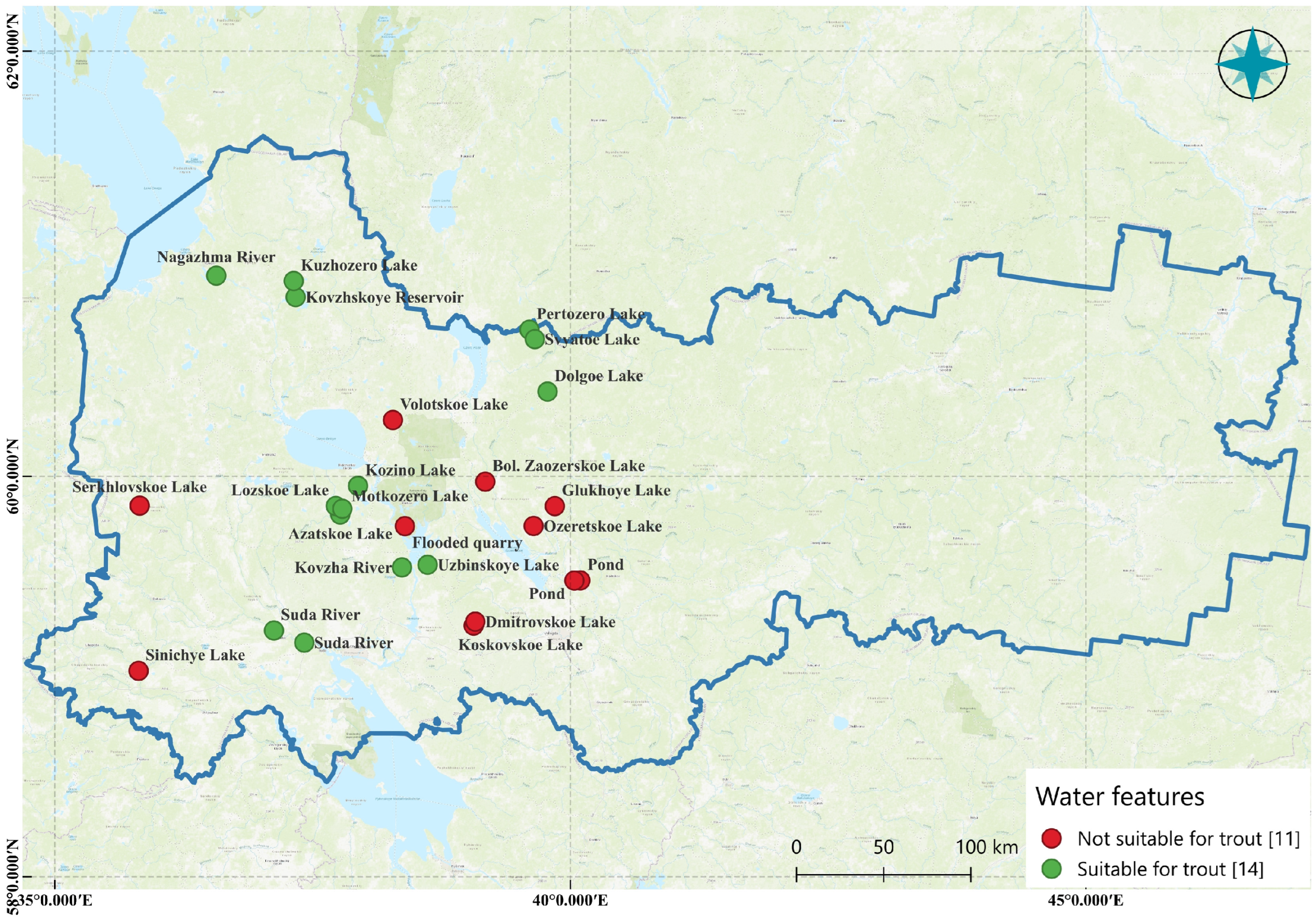
Despite these favorable conditions, the Vologda Region remains underdeveloped in terms of commercial trout farming relative to its potential, presenting a notable gap between resource endowment and industrial output. Surveys of 25 water bodies conducted by the Vologda Branch of Federal State Budgetary Scientific Institution “Russian Federal Research Institute of Fisheries and Oceanography” (Vologda Branch of FSBSI “VNIRO”) identified 14 lakes and rivers as suitable for industrial cage aquaculture, with a total estimated carrying capacity of 3300 tonnes per year for rainbow trout. This contrasts sharply with the current production level of 994 tonnes, underscoring the significant untapped potential for sectoral growth [18]. This context underscores the need for a systematic assessment of the opportunities and challenges involved.
The aim of this study was to assess the potential of rainbow trout (Oncorhynchus mykiss) farming as a strategic component for the development of a sustainable regional food system, using a case study of the Vologda Region (Northwest Russia) based on official statistical data, trend analysis, and a SWOT analysis.

2. Materials and Methods

2.1. Study Area

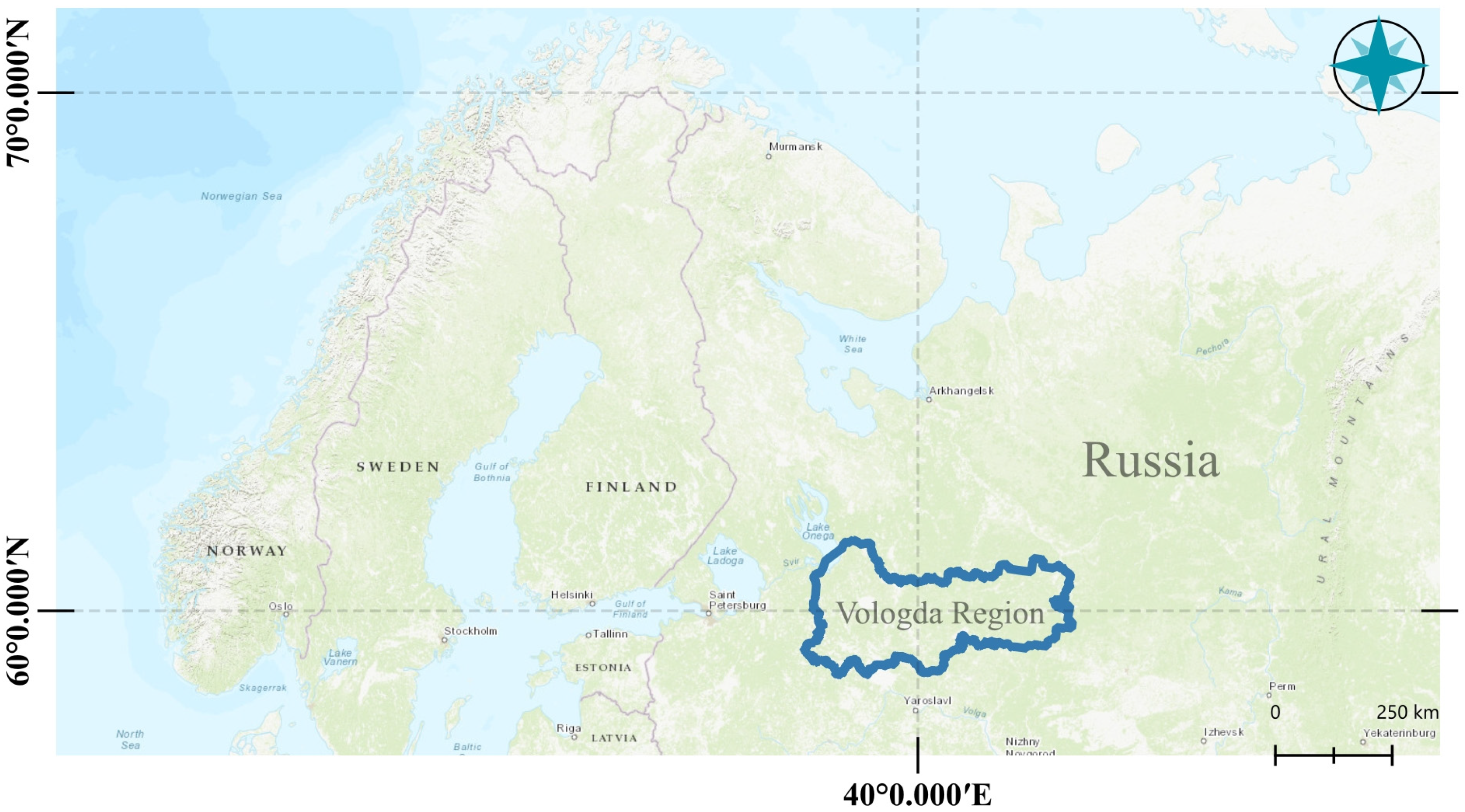
The Vologda Region, located in northwest Russia, covers a vast area of 144.5 thousand km2 (Figure 1).
Its topography is predominantly flat, featuring numerous rivers (such as the Sukhona, Yug, and Sheksna) and lakes (including Kubenskoye and Beloye). The climate is temperate continental, characterized by cold winters and warm summers. The region holds significant agricultural potential, integrating traditional practices with modern agri-food approaches.
For this analysis, hydrological and hydrochemical parameters of the aquatic environment (temperature, dissolved oxygen, pH, phosphate, ammonia, nitrite, nitrate levels) were collected from various water bodies within the Vologda Region (Figure 2).
These data were obtained from comprehensive scientific surveys conducted by the Vologda Branch of FSBSI “VNIRO”. Field expeditions were carried out during the most critical periods for the survival of potential aquaculture species: at the end of the ice-covered period (late winter–early spring) and in mid-summer (June–July). Water samples were collected from subsurface layers (0.5–1.0 m depth) at multiple stations within each water body. A minimum of three replicate samples were taken per station to ensure representativeness. Samples were collected in sterile 1 L polyethylene bottles, transported to the laboratory under cooled conditions (4 °C), and analyzed within 24 h of collection. Water temperature was measured in situ at each sampling station using a portable digital thermometer. The sensor was calibrated prior to each measurement. Dissolved oxygen concentration was measured in situ using an electrochemical (amperometric) probe equipped with a gas-permeable membrane. The pH value was measured in situ using a portable pH meter equipped with a combined glass electrode. The pH meter was calibrated using standard buffer solutions prior to measurements. The electrode was rinsed with distilled water between measurements, and readings were recorded after stabilization. The concentration of phosphates (soluble reactive phosphorus) was determined spectrophotometrically using the ammonium molybdate and ascorbic acid method. The method is based on the formation of a phosphomolybdenum blue complex, with absorbance measured at 690–720 nm. Ammonium was determined photometrically. The method is based on the reaction of ammonium ions with potassium tetraiodomercurate (II) in alkaline medium, forming a yellow-brown colloidal compound. The absorbance was measured at 425 nm. The concentration of ammonium was calculated from a calibration curve prepared with standard ammonium chloride solutions. Nitrite was determined photometrically using sulfanilic acid and 1-naphthylamine. The method is based on the diazotization reaction, where nitrite ions react with sulfanilic acid in acidic medium, followed by coupling with 1-naphthylamine to form a red azo dye. The absorbance was measured at 520 nm. Nitrate was determined spectrophotometrically using the sodium salicylate method. This method is based on the reaction of nitrate with sodium salicylate in the presence of sulfuric acid, forming a yellow-colored complex (sodium nitrosalicylate). Absorbance was measured at a wavelength of 410 nm. The full methodology and the complete dataset for each water body are presented in the original publication by Borisov et al. [18].

2.2. Characterization of Aquaculture Enterprises

The analysis of rainbow trout (Oncorhynchus mykiss) farming in the Vologda Region was based on a comprehensive characterization of the enterprises engaged in commercial aquaculture. This characterization provides the contextual framework for interpreting the production dynamics and strategic analysis presented in this study, using a multi-source data collection approach for enterprise characterization consistent with recent assessments of trout farming systems [19].
Data were collected from three primary sources: (i) the official registry of fish farming sites maintained by the regional Department of Agriculture and Food Resources [20]; (ii) comprehensive scientific surveys of regional aquaculture development [18]; and (iii) enterprise records submitted to regional authorities as part of state support programs, which include maximum allowable production volumes per fish farming site. This multi-source data collection approach ensures the reliability and completeness of the enterprise-level information.
For each enterprise, the following variables were recorded: legal status and name, location (municipal district and specific water body), type of production system (cage culture in open water or recirculating aquaculture system, RAS), maximum allowable production volume (tonnes per year), allocated water area (hectares), year of establishment, and operational status. Where applicable, specialization in juvenile production (stocking material) was noted, as this plays a key role in the regional supply chain (Table 1).
The collected data were subsequently used to: (i) analyze the dynamics of total regional production from 2016 to 2024; (ii) identify the structure and capacity of different production segments; and (iii) inform the SWOT analysis of regional aquaculture potential. No multivariate statistical techniques (e.g., cluster analysis) were applied to the enterprise data, as the primary aim was to provide a descriptive foundation for the trend and strategic assessments.

2.3. Data Collection

Data on global and Russian rainbow trout production for the period 2011–2020 were obtained from official sources: the European Market Observatory for Fisheries and Aquaculture Products (EUMOFA) report “Large Trout in the EU” [21] and the FAO publication “The State of World Fisheries and Aquaculture 2022: Towards Blue Transformation” [1]. Regional production data for the Vologda Region covering 2016–2024 were sourced from the public records of the regional Department of Agriculture [20]. These records include annual reports on commercial aquaculture output submitted by fish farming enterprises.

2.4. Trend Analysis

To assess the production dynamics of rainbow trout in the Vologda Region over the nine-year period from 2016 to 2024, a trend analysis was performed.
The compound annual growth rate (CAGR) was calculated using the following formula:
C A G R ( % ) = E V B V 1 n 1
where EV is the ending production volume (2024, 994 tonnes), BV is the beginning production volume (2016, 10 tonnes), and n is the number of years (8 years).
The year 2016 was selected as the starting point because it marks the inception of commercial rainbow trout farming in the Vologda Region, with the first officially recorded production [20]. The year 2024 represents the most recent year for which complete and validated production data were available at the time of analysis. Thus, the eight-year period from 2016 to 2024 captures the full development trajectory of the regional trout farming industry from its initial establishment through rapid expansion to the current phase of sustainable growth providing a consistent and complete dataset for trend assessment.
Furthermore, trends were analyzed using the chain growth rate (CGR) and the chain growth rate change (CGRC). The CGR was calculated as:
C G R = y i y i 1 × 100 % ,
where y i is the production in the current year and y i 1 is the production in the previous year.
The CGRC, which quantifies the change in the growth rate in percentage points, was derived as:
CGRC = CGR − 100%,

2.5. SWOT Analysis

The prospects for trout farming within a sustainable regional food system were assessed using a strategic SWOT (Strengths, Weaknesses, Opportunities, Threats) analysis.
The SWOT matrix was populated based on a systematic synthesis of multiple information sources: (i) peer-reviewed scientific literature on regional aquaculture development [18,22,23]; (ii) official statistical reports and public statements from the Vologda Region Department of Agriculture and regional government [20]; (iii) enterprise-level data; and (iv) the authors’ expertise, developed through the analysis of the aforementioned sources and the broader regional context [18]. No formal interviews or questionnaires were conducted specifically for this analysis; rather, the SWOT framework was used to structure and synthesize the qualitative and quantitative evidence gathered from the aforementioned sources.
This framework was applied to evaluate internal regional factors (advantages and limitations) and external factors (enabling conditions and risks) influencing rainbow trout aquaculture development. The analysis considered the potential of rainbow trout as a model species, highlighting its prospective economic benefits (e.g., job creation, import substitution), environmental advantages (e.g., low-carbon localized production), and social impacts (e.g., improved food security and rural development).

3. Results

3.1. Hydrochemical and Hydrological Parameters of Waterbodies in the Region

A study of 25 water bodies in the Vologda Region identified 14 lakes and rivers suitable for industrial-scale rainbow trout (Oncorhynchus mykiss) cage farming: Uz-bezhskoye, Kuzhozero and Svyatoye lakes, the Suda River (in the Kaduysky and Cherepovetsky districts), floodplains of the Kovzha and Nagazhma rivers, lakes Mot-kozero, Kozhino, Azatskoye, Lozskoe, Pertozero, Dolgoye and the Kovzhskoye Reservoir. These sites exhibit optimal hydrochemical parameters for trout culture: phosphate (0.03–0.2 mg/L), ammonium (0.05–0.47 mg/L), nitrate (0.1–1.81 mg/L), and nitrite (0.01–0.04 mg/L) concentrations. They also possess suitable physical characteristics, with depths ranging from 2.7 to 8.1 m and surface areas from 11 to 6524 hectares. All sites demonstrated neutral to slightly alkaline pH levels (6.8–8.2), which is ideal for trout, along with favorable water hardness values, indicating a beneficial mineral composition for aquaculture.
The summer temperature regime of the region’s water bodies, ranging from 14 to 18 °C, meets the optimal requirements for trout farming. In deeper water bodies, such as Kovzha Reservoir (8.1 m depth) and Dolgoye Lake (6.4 m), summer warming of the surface layers remains moderate, typically not exceeding 20–21 °C. This stable thermal regime minimizes the risk of thermal stress for fish. In contrast, shallower lakes like Pertozero (2.7 m) and Uzbinskoye (3.1 m) can experience peak temperatures of 22–23 °C during July and August.
Dissolved oxygen levels in all studied water bodies were within the range of 7–11 mg/L, fully satisfying the requirements for trout farming. The most stable oxygen conditions were observed in flowing river sections and deep lakes, where concentrations remained at or above 6.5–7 mg/L even during the winter ice cover period (December–April). However, in shallow lakes with dense aquatic vegetation, such as Svyatoye Lake, oxygen concentrations decreased to 5–5.5 mg/L in February–March. Under these circumstances, supplemental aeration near cage installations is required to maintain optimal conditions for fish [22].

3.2. Dynamics of Rainbow Trout Production

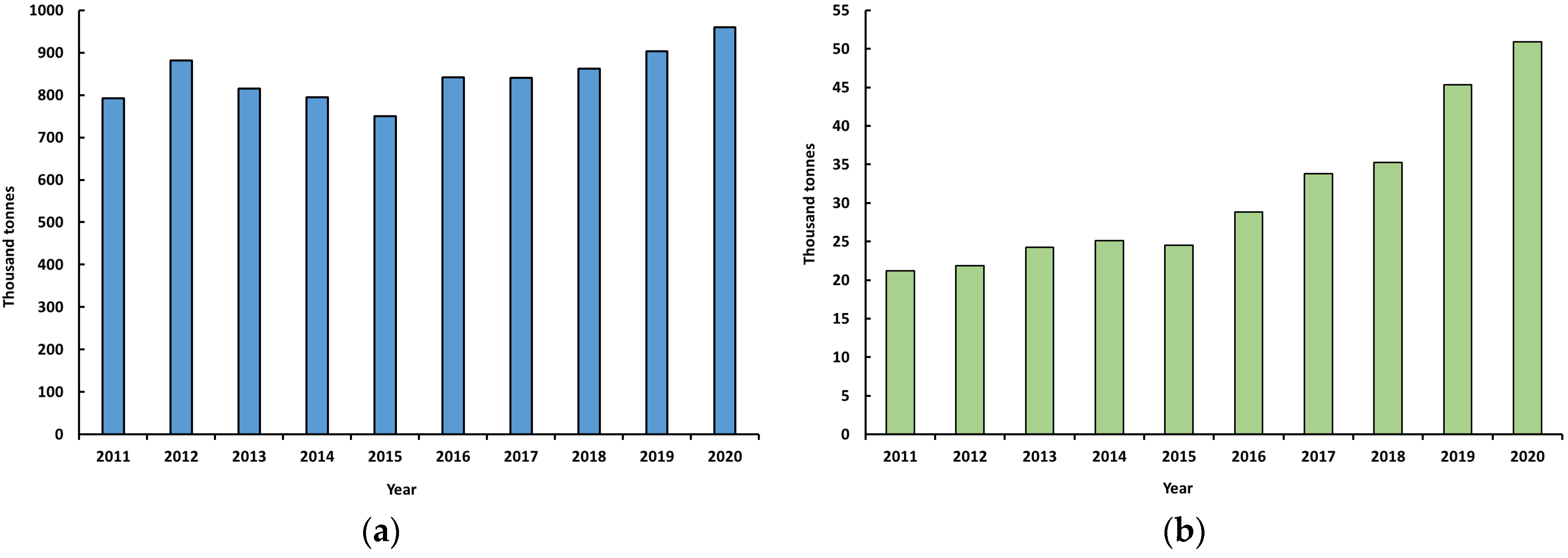
Global production has shown an overall increasing trend in recent years (Figure 3a), exceeding 900 thousand tonnes (live weight) by 2020. However, the period from 2011 to 2020 was characterized by unstable dynamics, with production fluctuating between 750.6 thousand tonnes in 2015 and a peak of 959.7 thousand tonnes in 2020. Despite periodic declines, including a 15% decrease from 2012 to 2015, the overall decadal trend was positive, with a 21% increase in production volume. The most substantial growth phases occurred in 2011–2012, 2016–2018, and 2019–2020, whereas sharp declines were recorded in 2012–2013 and 2014–2015.
In Russia, trout production has also demonstrated steady growth, reflecting the dynamic development of the domestic industry (Figure 3b). Production volume stood at 21.1 thousand tonnes in 2011 and increased more than 2.4-fold to 50.9 thousand tonnes by 2020. The most pronounced expansion occurred between 2016 and 2020, with an increase of nearly 22 thousand tonnes, underscoring a period of active industry development. Although a minor decline was observed in 2015 (24.536 thousand tonnes compared to 25.12 thousand tonnes in 2014), the overall trajectory remained positive. Peak annual growth was achieved in 2019–2020, with yearly increments surpassing 5 thousand tonnes.
In 2023, aquaculture production in the Russian Federation reached 402 thousand tonnes, exceeding the previous year’s output by 18.6 thousand tonnes (an increase of 4.8%). The Northwestern and Southern Federal Districts ranked highest in commercial aquaculture output, yielding 139.1 and 86.7 thousand tonnes, respectively. The Northwestern Federal District, including the Vologda Region, derives over 98% of its total aquaculture production from Atlantic salmon (Salmo salar) and trout [20].
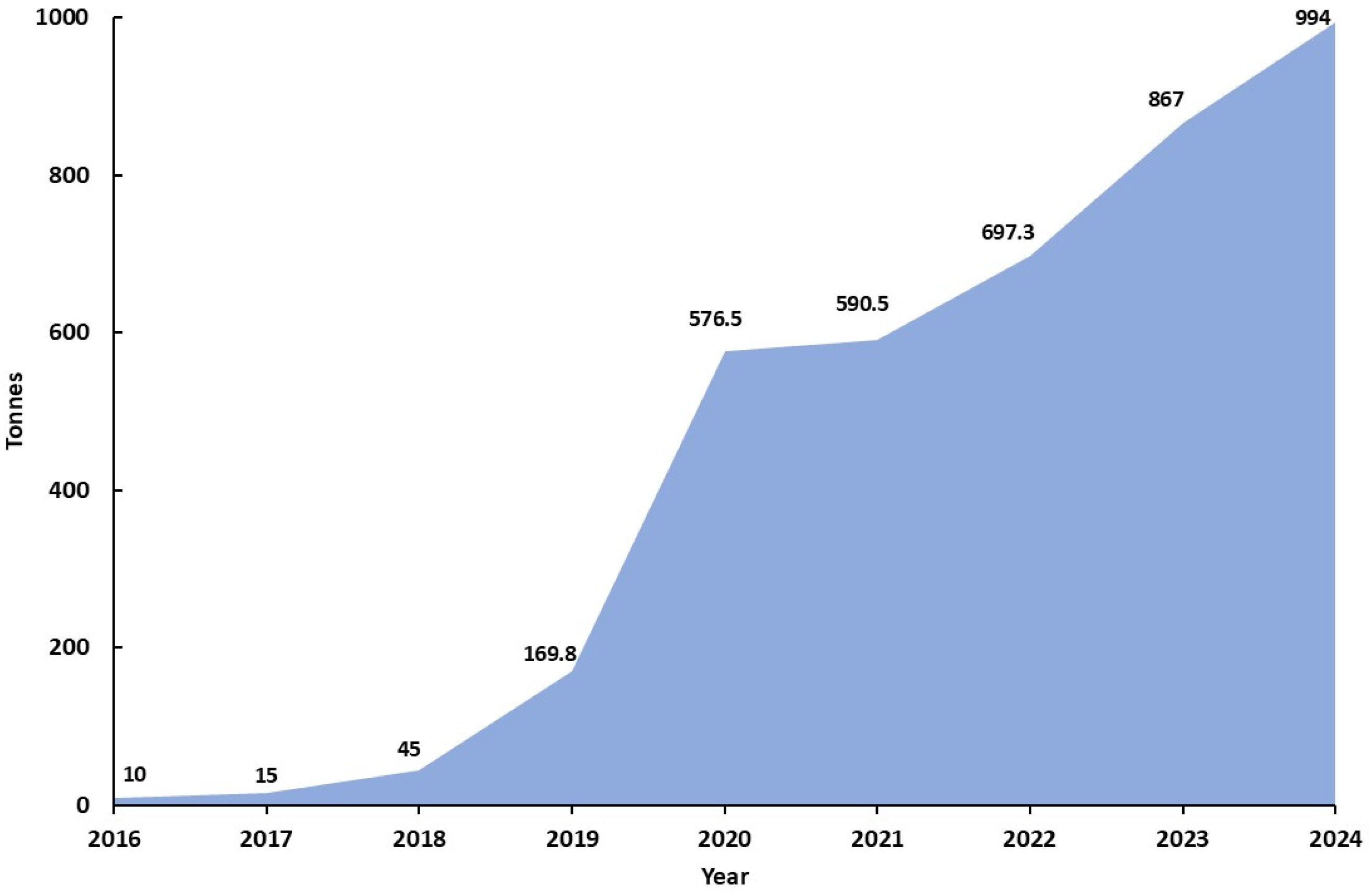
Commercial rainbow trout farming was initiated in 2016. Since then, production has surged from 10 to 994 tonnes per year, demonstrating a strong and consistent positive growth trend (Figure 4). The number of active trout-farming enterprises in the Vologda Region increased from one or two in 2016 to 16 by 2022 [18]. However, production growth was predominantly driven by two major producers: Aquaculture and Pure Lake. According to Borisov et al. [18], in 2022 these two enterprises together produced 585 tonnes of rainbow trout, accounting for 84% of the regional trout output (697 tonnes) for that year. This indicates that while new farms entered the sector, the overall increase in production was primarily achieved through scaling up by the leading farms. The dominant role of these two producers has continued through 2024, as reflected in their current allowable capacities (750 and 400 tonnes per year, respectively), which together exceed the total regional production of 994 tonnes, suggesting that they operate below maximum capacity while other farms contribute the remainder.
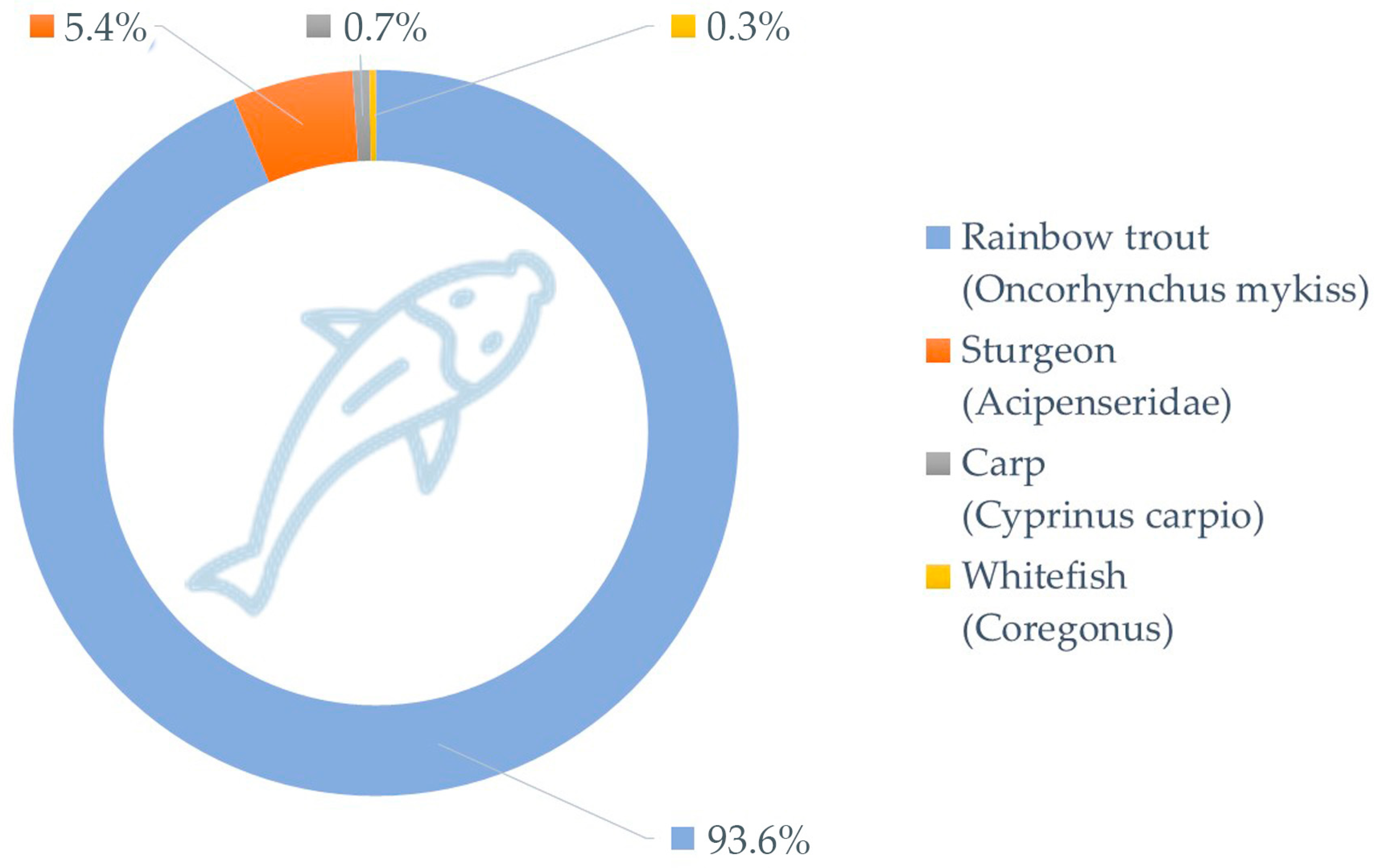
In 2024, rainbow trout accounted for 994 tonnes (93.6%) of the total aquaculture production of 1062 tonnes, followed by sturgeon (57 tonnes, 5.4%), carp (8 tonnes, 0.7%), and whitefish (3 tonnes, 0.3%) (Figure 5).
The compound annual growth rate (CAGR) of rainbow trout production in the Vologda Region for the period 2016–2024 was 77.7%. Starting from an initial output of 10 tonnes in 2016 and reaching 994 tonnes in 2024, production grew at an average annual rate of 77.7%, representing near-exponential growth with an approximate 100-fold increase over eight years.
Table 2 presents a chain analysis of the production dynamics from 2016 to 2024, detailing absolute growth (in tonnes), chain growth rates (%), and changes in chain growth rates (%). Beginning at 10 tonnes in 2016, production exhibited variable annual growth. The period 2016–2018 was characterized by rapid expansion. From 2016 to 2017, an absolute increase of +5 tonnes—corresponding to a growth rate of 150% (a +50% change)—signaled the industry’s active development. Subsequently, in 2017–2018, growth accelerated sharply, with an absolute increase of +30 tonnes and a growth rate of 300% (a +200% change), reflecting a threefold surge in annual output.
The most dramatic annual expansion occurred between 2018 and 2019, with an absolute growth of +124.8 tonnes. The chain growth rate peaked at 377.3% (a +277.3% change), resulting in an almost fourfold increase from 45 to 169.8 tonnes.
The largest single-year absolute increase in production took place in 2020 (+406.7 tonnes). In contrast, the most significant slowdown was observed in 2021, which recorded the lowest growth rate for the entire period (+14 tonnes, or +2.4%). Conversely, 2023 saw the highest absolute increase during the subsequent stabilization phase (+169.7 tonnes, +24.3%). Overall, from 2022 to 2024, rainbow trout production entered a phase of stabilization, with annual increments ranging from 106.8 to 169.7 tonnes.

3.3. SWOT Analysis of Regional Aquaculture Potential

The SWOT analysis identified key internal and external factors influencing the development potential of trout farming in the Vologda Region (Table 3).
Strengths: The primary strengths are threefold. First, the region possesses abundant fishery resources, including over 4000 lakes and artificial reservoirs with a total area of 6.52 thousand km2 and river networks spanning 66 554 km. Second, the industry benefits from substantial regional government support. This includes the implementation of the state program “Development of the Agro-Industrial and Fishery Complexes” since 2021 and initiatives like “Invest in Vologda,” which facilitates investment in related sectors such as feed production. Furthermore, aquaculture producers are eligible for financial mechanisms such as partial reimbursement of operational costs (e.g., for feed and stocking material) from the regional budget [18]. Third, the region’s strategic geographical location enables efficient logistics for supplying products to major metropolitan markets like Moscow and Saint Petersburg.
Weaknesses: Several key weaknesses constrain the sector’s development. First, many existing fish farms continue to rely on outdated, extensive farming methods, which limits productivity and profitability [24]. Second, the adoption of modern technologies—including automated feeding and sorting systems, as well as recirculating aquaculture systems (RAS)—remains low. This is primarily due to high capital investment requirements and a significant shortage of qualified personnel to operate and maintain such technologies [25]. Third, this skilled labor deficit is further exacerbated by a lack of specialized vocational and academic training programs tailored to modern aquaculture. Current educational offerings in the region primarily focus on adjacent fields like general agriculture and biology, which do not fully address the specific technical and managerial needs of a competitive aquaculture industry. Fourth, the lack of modern local processing facilities coupled with underdeveloped logistics infrastructure diminishes the value and market competitiveness of regional products. The majority of fish are currently supplied fresh or frozen, with minimal value-added processing [14].
Opportunities: Significant opportunities exist for sectoral growth and diversification. First, the considerable potential for aquaculture expansion is bolstered by federal and regional policy frameworks, such as Russia’s Aquaculture Development Strategy until 2030, which provides subsidies and other financial incentives [13]. Second, the strategic adoption of modern technologies, particularly Recirculating Aquaculture Systems (RAS), represent an opportunity for year-round, climate-resilient cultivation of high-value species like salmonids and sturgeon. Third, the region’s clean water resources and low industrial pollution profile offer a competitive advantage in both domestic and international markets. This is especially relevant for accessing premium export markets in the EU and Asia, where demand for sustainably produced aquaculture products is rising [5,12]. Fourth, developing local value-added processing (for products such as smoked fish, filets, or fish oil supplements) would enhance profitability and reduce reliance on commodity markets. Finally, the integration of aquaculture with tourism presents a promising avenue for diversified income, potentially through recreational fishing, farm tours, and other forms of agritourism [26].
Threats: The development of aquaculture in the Vologda Region faces several risks. Climate change impacts, such as rising water temperatures and unpredictable ice cover, can disrupt local production cycles [27]. Disease outbreaks, particularly in intensive aquaculture systems, pose a significant threat to fish stocks, as has been observed in other northern regions [28]. Additionally, regulatory barriers and inconsistent enforcement of environmental standards may deter investors, while market competition from imported aquaculture products and cheaper wild-caught counterparts exerts pressure on local producers [29]. Illegal fishing (poaching) was identified as a threat, as it depletes natural fish resources and creates unfair competition [30]. Finally, consumer perceptions within the regional and national market, including skepticism about the quality of farmed fish, may constrain domestic demand [31].

4. Discussion

The selection of rainbow trout as the primary aquaculture species is justified by its high adaptability, rapid growth, and disease resistance, as supported by previous studies [15,16]. The optimal ranges of dissolved oxygen (7–11 mg/L) and summer water temperatures (14–18 °C) in the Vologda Region’s water bodies provide a favorable environment for its cultivation, although seasonal warming above 22 °C in shallower lakes necessitates careful monitoring. Growth rates observed under these conditions are comparable to those achieved in other northern aquaculture zones [32,33]. Consistently low nitrite concentrations (<0.04 mg/L) minimize the risk of toxicity, while adequate water depths, notably in Kovzhskoye Reservoir (8.1 m), help ensure environmental stability within cage systems. In shallow lakes with dense aquatic vegetation, such as Svyatoye Lake, where oxygen concentrations decline under ice cover, the installation of aeration systems is particularly important to prevent hypoxic conditions [22]. The successful implementation of cage farming in the region requires ongoing management of nutrient loads (phosphates, ammonium) and the optimization of feeding practices to align with the relatively limited annual growth period of approximately 179 days.
The data obtained in this study confirm the suitability of the Vologda Region’s water bodies for rainbow trout cage farming, based on key hydrological and hydrochemical parameters. These optimal conditions include a favorable temperature regime, adequate dissolved oxygen levels, consistently low nitrite concentrations, and stable pH. However, seasonal fluctuations, such as summer warming in shallow lakes to 22–23 °C and reduced oxygen under winter ice cover—necessitate adaptive management strategies. These could include depth-adjustable cages, supplemental aeration systems, cage shading, and reduced feeding rates during periods of peak temperatures. The consistently low nitrite levels (0.01–0.04 mg/L) minimize the risks of methemoglobinemia and osmoregulatory disruptions, which are particularly critical for juvenile fish. Concurrently, the proximity of some water bodies to agricultural lands (e.g., Kozhino and Motkozero lakes) underscores the need for vigilant phosphate monitoring to prevent eutrophication [18]. The economic viability of cage farming projects could be further enhanced by leveraging natural food sources (zooplankton) in lakes with rich biota and by strategic site selection near existing transport hubs, such as the Suda River and Kovzhskoye Reservoir. Considering these factors, along with the projected extension of the growing season due to climate change, trout farming in the region appears highly promising. However, this potential is contingent upon the implementation of sustainable practices, including the use of eco-friendly feeds and the establishment of effective sanitary protection zones [34].
The Vologda Region holds considerable promise for further aquaculture development. This potential is reinforced by state support through federal programs such as the Aquaculture Development Strategy until 2030, which facilitates access to subsidies and preferential loans [13]. The adoption of modern technologies, notably Recirculating Aquaculture Systems (RAS), presents a pathway to cultivate high-value species like salmonids and sturgeons year-round, independent of external climatic constraints [4,25]. Furthermore, the region’s export potential could be amplified by the growing demand for eco-certified products in markets such as the EU and Asia [12]. Developing local value-added processing, including smoking or the production of dietary supplements, offers another avenue to enhance profitability and market differentiation. Additional synergistic opportunities exist in integrating aquaculture operations with tourism, for example, through eco-friendly fishing tours or farm-to-table gastronomic experiences [10,26].
To contextualize the development trajectory of the Vologda Region, it is instructive to compare it with other northern regions characterized by similar climatic and hydrological conditions. Finland, which shares a comparable latitudinal position and extensive lake systems, produced approximately 15,800 tonnes of rainbow trout in 2024, accounting for 95% of the country’s total aquaculture production [35]. The neighboring Republic of Karelia has been consistently recognized as Russia’s leading region for freshwater cage aquaculture of rainbow trout, with production reaching 33,500 tonnes in 2024 [36]. While the Vologda Region’s current output of 994 tonnes is substantially lower than both Finland’s mature industry and Karelia’s established production, its compound annual growth rate of 77.7% (2016–2024) far exceeds these more developed regions, indicating a phase of accelerated development. This comparison underscores the significant untapped potential of the Vologda Region and highlights the relevance of best practices from more established northern trout producers.
From 2011 to 2020, global rainbow trout production showed an overall growth trend, increasing from approximately 790 thousand tonnes to 950 thousand tonnes [12]. However, this growth was uneven and marked by significant fluctuations. These variations were likely influenced by multiple factors, including economic crises, shifts in demand, disease outbreaks, and climatic conditions. Notably, production saw a sharp increase in 2020. This rise was unexpected given the context of the COVID-19 pandemic and may reflect the sector’s adaptability as well as heightened consumer demand for fish products at that time. In contrast, the decline observed between 2013 and 2015 could be attributed to a combination of disease outbreaks in farms, stricter environmental regulations, and volatility in feed prices [1,37,38].
Russian rainbow trout production during the same period (2011–2020) increased 2.4-fold, although it represented only about 5% of global output. The accelerated growth observed after 2016 likely resulted from a combination of increased government support, the adoption of modern technologies, and the expansion of aquaculture enterprises. A minor decline of approximately 0.6 thousand tonnes in 2015 may have been driven by external economic factors, such as trade sanctions or demand volatility. However, production rebounded by 2016 and maintained a consistent upward trajectory thereafter. The significant surge in annual production volumes during 2019–2020, with increases of 5–6 thousand tonnes per year, suggests the industry attained a new level of maturity. This maturation was potentially fueled by growing domestic consumption, emerging export opportunities, and sustained investments in the aquaculture sector [13].
Geographically, rainbow trout production in Russia is characterized by pronounced regional concentration. Official data from Rosrybolovstvo indicate that approximately 60% of national production is concentrated within the Northwestern Federal District, primarily in the Republic of Karelia and Murmansk Region [39]. This concentration is largely attributed to those regions’ abundant clean, cold-water resources, which are optimal for salmonid cultivation. However, the Vologda Region, also located within the Northwestern District, demonstrates substantial and rapidly growing production potential, as evidenced by the dynamics presented in this study.
The production trajectory within the Vologda Region itself is remarkable. Starting from a base of only 10 tonnes in 2016, output surged to 994 tonnes by 2024, representing a nearly 100-fold increase. This exponential growth rate positions the Vologda Region as one of the most dynamically developing and promising areas for aquaculture expansion in Northwest Russia [18].
The most substantial increase in production occurred between 2018 and 2020, when annual output rose from 45 to 576.5 tonnes. This rapid expansion can likely be attributed to several concurrent factors: the commissioning of new, modern fish farms, the adoption of more intensive farming technologies, and increased investment in the sector. The growth in 2019 was particularly significant, as production nearly quadrupled within a single year.
In the subsequent period from 2021 to 2024, growth rates moderated but remained consistently positive, with annual production increments averaging 100–150 tonnes. This pattern indicates a transition of the regional industry into a phase of more stable and mature development. By 2024, production approached the 1000-tonne threshold, highlighting the substantial potential of the sector. This expansion can be attributed to a combination of key factors. First, the Vologda Region benefits from favorable natural conditions for trout farming, including water bodies with suitable temperature regimes [18]. Second, government support, manifested through subsidies and targeted development programs, has been a critical enabling factor [20]. Third, local producers have increasingly adopted modern technologies, leading to significant gains in production efficiency.
When assessing the annual dynamics, the growth rate of rainbow trout production in the Vologda Region ranged from 114.6% to 339.5%, with annual increments varying between 2.4% and 277.3%. The highest growth rates were concentrated in the period from 2016 to 2020, followed by a phase of stabilization. Beginning in 2019, trout farming in the region effectively transitioned to an industrial scale of production, achieving record absolute growth figures. This shift was marked by production volumes consistently surpassing the hundred-tonne threshold, signaling the conclusion of its initial experimental phase.
The most substantial single-year growth occurred in 2019 (+124.8 tonnes, +277.3%), followed by a notable slowdown. A marginal increase from 576.5 tonnes in 2020 to 590.5 tonnes in 2021 (+14 tonnes, +2.4%) likely reflects the impact of the COVID-19 pandemic, a trend consistent with global aquaculture. As noted by Love et al. (2021) [40], pandemic-related disruptions in feed and equipment supplies strained supply chains. In Russia, this challenge was exacerbated by a reliance on imported feed components. Concurrently, overall fish consumption declined during this period [41], a drop partially linked to the closure of restaurants, which are key consumers of trout. This specific impact on the foodservice sector has been highlighted in studies focusing on the pandemic’s economic effects [42,43].
However, growth resumed in 2022 with an increase of 18%, indicating that the previous setbacks were temporary. From 2022 to 2024, production entered a phase of stabilization, with annual growth rates averaging between 15% and 25%. This consistent increase, corresponding to an average annual increment of approximately 100 tonnes, stems from several reinforcing factors. This sustained growth trajectory mirrors broader global trends in commercial aquaculture, which are driven by rising demand for fish products [12]. Furthermore, the demonstrated growth pattern of rainbow trout production in the Vologda Region aligns with the classic S-curve model of industry development, where a phase of sustainable, steady growth follows an initial period of rapid expansion [44].
The development of rainbow trout (Oncorhynchus mykiss) aquaculture in Vologda Region holds significant potential due to a range of key factors. The region boasts abundant water resources with hydrochemical parameters favorable for trout farming, as evidenced by studies conducted by Borisov et al. [18].
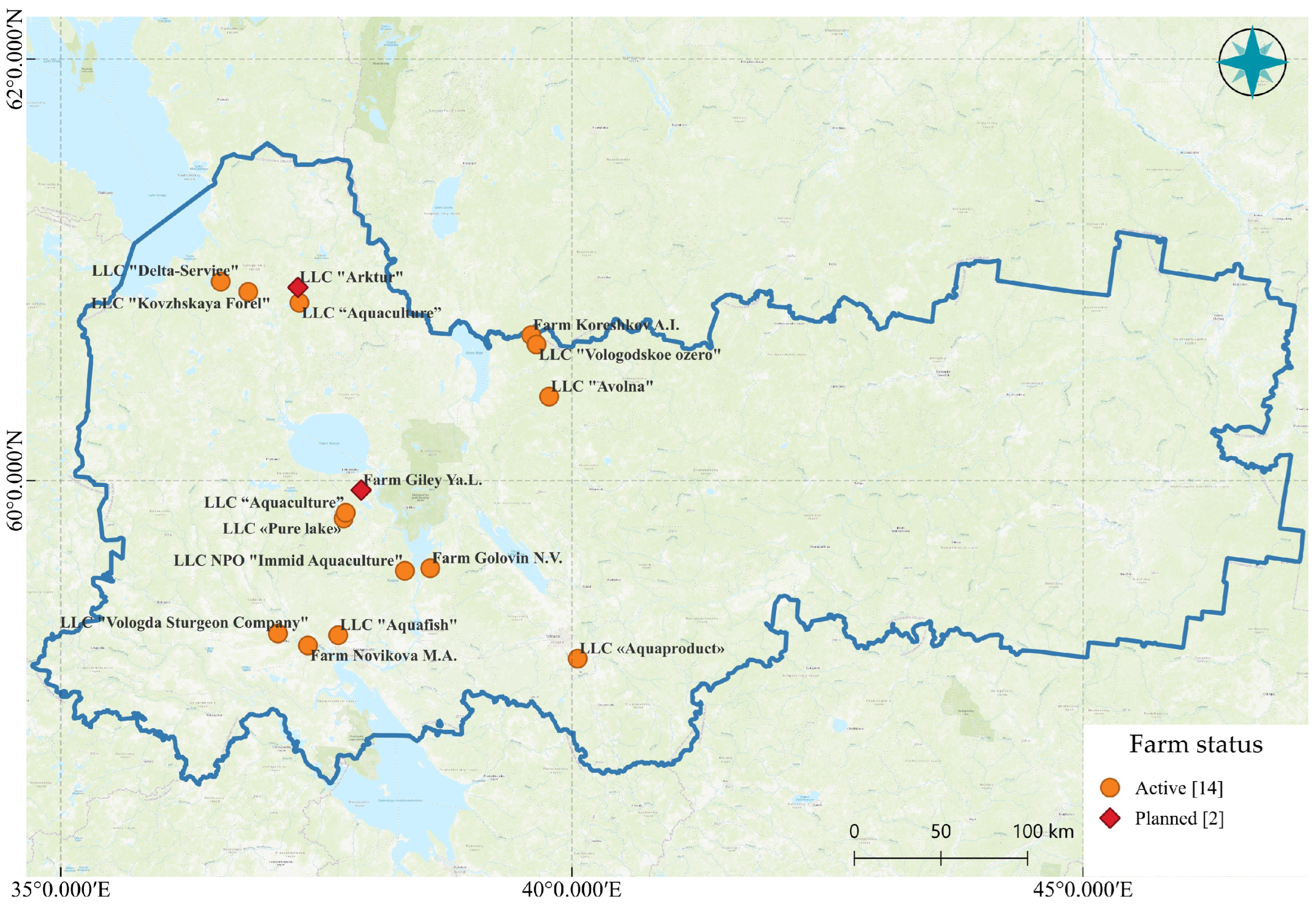
As outlined in the results, the initiation of commercial rainbow trout farming in 2016 coincided with the region’s strategic efforts to support aquaculture development. This synchronization suggests a direct link between policy implementation and industry emergence. Fourteen specific water bodies have been identified as suitable for trout culture based on their hydrochemical profiles, including Uzbinskoye Lake, Kuzhozero Lake, Svyatoye Lake, sections of the Suda River (in Kaduysky and Cherepovetsky districts), the floodplains of the Kovzha and Nagazhma rivers, and several lakes such as Motkozero, Kozhino, Azatskoye, Lozskoe, Pertozero, Dolgoye, and Kovzhskoye Reservoir [18]. Currently, cage-based trout farming is operational and managed by eight organizations across aquaculture sites in the Belozersky, Vozhegodsky, Vytegorsky, Kaduysky, and Kirillovsky districts, as illustrated in Figure 6.
Supported by regional initiatives, the number of enterprises engaged in trout farming reached 16 by 2022. The largest producers at that time were the companies Aquaculture and Pure Lake. Furthermore, 2022 saw the establishment of Aquafish in the Cherepovetsky District, an enterprise specializing in juvenile rainbow trout production. Since 2023, the sector’s capacity has been significantly enhanced by the commissioning of the large-scale Aquaproduct complex, which utilizes recirculating aquaculture systems (RAS) for salmonid farming [18].
At its facilities, the company Aquaculture operates a hatchery with an annual production capacity exceeding 900 tonnes. In 2023, this enterprise produced 359 tonnes of marketable fish. The farm Pure Lake held an inventory of approximately 450 tonnes of trout across more than 30 cages in 2024. Aquafish has the potential to produce up to 3 million juvenile trout specimens annually. The Aquaproduct complex features a substantial system volume of 64,000 m3 [18].
Despite this progress and its significant resource potential, the development of trout farming in the Vologda Region faces several critical constraints. A high dependence on imported feed, with an estimated 70% of feed mixtures sourced from abroad, substantially increases production costs and exposes the sector to logistical and geopolitical risks [20]. Insufficient infrastructure, including a lack of modern hatcheries, processing facilities, and water treatment systems, limits production scalability [45]. The region’s climatic conditions, characterized by prolonged winters and significant temperature fluctuations, often necessitate the use of energy-intensive recirculating aquaculture systems (RAS), which raises operational expenses. Additionally, a shortage of personnel with specialized skills in modern aquaculture practices hampers the adoption of innovations. Weak logistics networks also complicate the distribution of products to markets beyond the immediate region [22].
The development of trout farming in the region presents significant opportunities to strengthen regional food security and stimulate the local economy. Domestic demand for premium fish products is growing; for instance, salmonid consumption in Russia increased by 18% between 2020 and 2023 according to Rosstat. Aquaculture-based agritourism could generate additional revenue streams through activities such as paid fishing, guided farm tours, and gastronomic events [10]. Government support programs, including subsidies aligned with national projects like International Cooperation and Export, provide avenues for farm modernization and facilitate market access [20]. Technological advances, including progress in local feed production (e.g., plant-based protein feeds) and the adoption of RAS, can help reduce import dependency. Additionally, establishing integrated clusters with value-added processing facilities (e.g., for smoking and canning) can enhance product profitability. Developing a strong regional brand, akin to the established Vologda Butter, for Vologda Trout could significantly strengthen its competitive position in the food market [46].
Despite favorable baseline conditions, the development of trout farming in the region faces several significant and persistent risks. Climate change is increasing the frequency of extreme weather events. Summer droughts and severe winter frosts can disrupt the water temperature regimes that are critical for trout cultivation [47]. Epizootic risks remain a major threat, as outbreaks of diseases such as bacterial cold-water disease or infectious pancreatic necrosis can lead to substantial fish mortality [28]. Competition from imported products persists, potentially facilitated by trade re-routing through third countries despite existing sanctions. Concurrently, environmental regulations are becoming more stringent. New wastewater treatment requirements for aquaculture facilities, for example, may necessitate substantial capital investments in purification infrastructure. Furthermore, workforce shortages are intensifying due to the outmigration of skilled labor to larger cities, limiting access to qualified professionals. Finally, ongoing price volatility for key inputs like feed and energy continues to undermine production profitability and long-term planning.
While the SWOT framework provides a structured overview of internal and external factors, it is inherently qualitative and reflects the synthesis of available evidence and expert judgment. As such, the identified factors should be considered as indicative rather than exhaustive, and their relative importance may evolve with changing market and environmental conditions.
The findings carry several implications for decision-makers. At the policy level, the identified gap between current production (994 tonnes) and estimated carrying capacity (3300 tonnes) suggests that targeted investments in infrastructure and technology adoption could unlock significant growth without exceeding environmental limits. At the farm level, the dominance of two major producers indicates that knowledge transfer and capacity-building initiatives should prioritize scaling up successful practices among smaller enterprises. Furthermore, the SWOT analysis highlights that addressing the skilled labor shortage and reducing feed import dependency are critical leverage points for enhancing sectoral resilience.

5. Conclusions

In the Russian context, aquaculture is vital for national food security and the sustainable use of aquatic resources. The country’s vast territory harbors substantial capacity for its development. The Northwestern Federal District, in particular, offers highly suitable conditions for rainbow trout cultivation. The Vologda Region, located within this district, exemplifies this potential through its remarkable production growth. The production of rainbow trout in the Vologda Region has increased substantially, approaching 1000 tonnes by the end of 2024. This growth has been facilitated by targeted regional support and the entry of new enterprises. An analysis of production dynamics reveals an impressive near-hundredfold increase over eight years, from 10 tonnes in 2016 to 994 tonnes in 2024. This expansion progressed through three distinct phases: (1) an establishment period (2016–2018) with moderate growth from 10 to 45 tonnes; (2) a rapid acceleration phase (2019–2020) featuring a more than twelvefold increase to 576.5 tonnes; and (3) the current stable growth stage (2021–2024), characterized by steady annual growth averaging approximately 100 tonnes, culminating in the 2024 output.
These findings provide a basis for policy interventions aimed at stimulating investment in modern technologies, workforce development, and value-added processing, while also offering farm-level insights for improving operational efficiency.

Author Contributions

Conceptualization, M.K. and D.V.; methodology, M.K. and D.V.; software, M.K. and D.Z.; validation, I.N. and M.K.; formal analysis, M.B., O.N. and D.Z.; investigation, D.V. and M.K.; resources, I.N., O.N. and D.Z.; data curation, M.K., M.B. and I.N.; writing—original draft preparation, M.K. and M.B.; writing—review and editing, I.N., H.Z. and D.V.; visualization, M.K., D.V. and M.B.; supervision, I.N., H.Z. and D.V.; project administration, I.N., M.K. and D.V.; funding acquisition, I.N. and D.V. All authors have read and agreed to the published version of the manuscript.

Funding

This research was funded by Russian Science Foundation, grant number 23-76-10038, https://rscf.ru/en/project/23-76-10038/ (accessed on 20 January 2026).

Institutional Review Board Statement

Not applicable.

Data Availability Statement

The original contributions presented in this study are included in the article. Further inquiries can be directed to the corresponding author.

Acknowledgments

The cartographic materials in this study (Figure 1, Figure 2 and Figure 6) were prepared using QGIS 4.0.0-Norrköping software with the Esri World Topographic Map as the basemap layer. The basemap is provided by Esri and its contributors under the following terms: Sources: Esri, DeLorme, HERE, TomTom, Intermap, increment P Corp., GEBCO, USGS, FAO, NPS, NRCAN, GeoBase, IGN, Kadaster NL, Ordnance Survey, Esri Japan, METI, Esri China (Hong Kong), swisstopo, MapmyIndia, and the GIS User Community. The map service was accessed via the URL: https://server.arcgisonline.com/arcgis/rest/services/World_Topo_Map/MapServer (accessed on 27 February 2026) (tile service used in QGIS). We acknowledge Esri for providing this basemap service for academic use.

Conflicts of Interest

The authors have no relevant financial or non-financial interests to disclose.

Abbreviations

The following abbreviations are used in this manuscript:
FSBSI “VNIRO”Federal State Budgetary Scientific Institution “Russian Federal Research Institute of Fisheries and Oceanography”
LLCLimited Liability Company
RASRecirculating aquaculture systems
CAGRCompound annual growth rate
CGRChain growth rate
CGRCChain growth rate change
SWOTStrengths, Weaknesses, Opportunities, Threats

References

  1. FAO. The State of World Fisheries and Aquaculture 2024—Blue Transformation in Action; FAO: Rome, Italy, 2024. [Google Scholar] [CrossRef]
  2. Asche, F.; Garlock, T.M.; Anderson, J.L.; Bush, S.R.; Smith, M.D.; Anderson, C.M.; Chu, J.; Garrett, K.A.; Lem, A.; Lorenzen, K.; et al. Three Pillars of Sustainability in Fisheries. Proc. Natl. Acad. Sci. USA 2018, 115, 11221–11225. [Google Scholar] [CrossRef]
  3. Troell, M.; Naylor, R.L.; Metian, M.; Beveridge, M.; Tyedmers, P.H.; Folke, C.; Arrow, K.J.; Barrett, S.; Crépin, A.-S.; Ehrlich, P.R.; et al. Does Aquaculture Add Resilience to the Global Food System? Proc. Natl. Acad. Sci. USA 2014, 111, 13257–13263. [Google Scholar] [CrossRef]
  4. Kamali, S.; Ward, V.C.A.; Ricardez-Sandoval, L. Closed-Loop Operation of a Simulated Recirculating Aquaculture System with an Integrated Application of Nonlinear Model Predictive Control and Moving Horizon Estimation. Comput. Electron. Agric. 2023, 209, 107820. [Google Scholar] [CrossRef]
  5. Bostock, J.; McAndrew, B.; Richards, R.; Jauncey, K.; Telfer, T.; Lorenzen, K.; Little, D.; Ross, L.; Handisyde, N.; Gatward, I.; et al. Aquaculture: Global Status and Trends. Phil. Trans. R. Soc. B 2010, 365, 2897–2912. [Google Scholar] [CrossRef] [PubMed]
  6. Edwards, P. Aquaculture Environment Interactions: Past, Present and Likely Future Trends. Aquaculture 2015, 447, 2–14. [Google Scholar] [CrossRef]
  7. Ziegler, F.; Winther, U.; Hognes, E.S.; Emanuelsson, A.; Sund, V.; Ellingsen, H. The Carbon Footprint of Norwegian Seafood Products on the Global Seafood Market. J. Ind. Ecol. 2013, 17, 103–116. [Google Scholar] [CrossRef]
  8. Clark, T.P.; Longo, S.B. Global Labor Value Chains, Commodification, and the Socioecological Structure of Severe Exploitation. A Case Study of the Thai Seafood Sector. J. Peasant. Stud. 2022, 49, 652–676. [Google Scholar] [CrossRef]
  9. Filipski, M.; Belton, B. Give a Man a Fishpond: Modeling the Impacts of Aquaculture in the Rural Economy. World Dev. 2018, 110, 205–223. [Google Scholar] [CrossRef]
  10. Mohammadi, Z.; Bhati, A.S.; Jerry, D. A Pre-Science Style Model of Aquaculture Tourism Businesses. Tour. Plan. Dev. 2024, 21, 245–253. [Google Scholar] [CrossRef]
  11. Gephart, J.A.; Golden, C.D.; Asche, F.; Belton, B.; Brugere, C.; Froehlich, H.E.; Fry, J.P.; Halpern, B.S.; Hicks, C.C.; Jones, R.C.; et al. Scenarios for Global Aquaculture and Its Role in Human Nutrition. Rev. Fish. Sci. Aquac. 2021, 29, 122–138. [Google Scholar] [CrossRef]
  12. FAO. The State of World Fisheries and Aquaculture 2022. Towards Blue Transformation; FAO: Rome, Italy, 2022. [Google Scholar] [CrossRef]
  13. Marinchenko, T.E. Aquaculture in The World and Russia: State and Prospects. IOP Conf. Ser. Earth Environ. Sci. 2021, 715, 012052. [Google Scholar] [CrossRef]
  14. Adeli, A.; Baghaei, F. Production and Supply of Rainbow Trout in Iran and the World. World J. Fish Mar. Sci. 2013, 5, 335–341. [Google Scholar]
  15. Čanak, S.; Savić, N.; Pavličević, J.; Ljiljanić, N.; Radišić, R. Analysis of Production and Economics of Rainbow Trout Farming on Two Cage Farms in Serbia and Bosnia and Herzegovina. Ekon. Poljopr. 2022, 69, 665–680. [Google Scholar] [CrossRef]
  16. D’Agaro, E.; Gibertoni, P.; Esposito, S. Recent Trends and Economic Aspects in the Rainbow Trout (Oncorhynchus mykiss) Sector. Appl. Sci. 2022, 12, 8773. [Google Scholar] [CrossRef]
  17. Singh, A.K. Charting Ways to Invigorate Rainbow Trout Production in India. J. FisheriesSciences.Com 2016, 10, 25–32. [Google Scholar]
  18. Borisov, M.Y.; Konovalov, A.F.; Dumnich, N.V.; Stepanov, M.V.; Chechulinskaya, A.A. Current State and Development of Aquaculture in Vologda Oblast. Ecosyst. Transform. 2023, 6, 64–78. [Google Scholar] [CrossRef]
  19. Zabarburú, R.C.M.; Millones, C.; Guadalupe, G.A.; Idrogo-Vásquez, G.; Chu-Koo, F.W.; Fernández-Jeri, A.B.; Gill, E.; Chavez, S.G.; García, L. Integrating Assessment of Characterization, Sustainability and Efficiency for the Production of Rainbow Trout (Oncorhynchus mykiss): A Case Study in the Amazonas Region of Peru. Agriculture 2023, 13, 390. [Google Scholar] [CrossRef]
  20. Department of Agriculture and Food Resources of the Vologda Region. Public Annual Report on the Performance of the Department of Agriculture and Food Resources of the Vologda Region 2024; Department of Agriculture and Food Resources of the Vologda Region: Vologda, Russia, 2025. Available online: https://agro.gov35.ru/dokumenty/2024/%D0%9F%D1%83%D0%B1%D0%BB%D0%B8%D1%87%D0%BD%D1%8B%D0%B9%20%D0%BE%D1%82%D1%87%D0%B5%D1%82%20%D0%B7%D0%B0%202023%20%D0%B3%D0%BE%D0%B4%20%D0%94%D0%A1%D0%A5%D0%B8%D0%9F%D0%A0%20%D0%92%D0%9E.pdf (accessed on 27 February 2026). (In Russian)
  21. European Commission; Directorate General for Maritime Affairs and Fisheries; EUMOFA. Large Trout in the EU: Price Structure in the Supply Chain: Focus on Spain and Italy: Case Study; LU: Lynchburg, VA, USA, 2023. [Google Scholar]
  22. Lapenkov, A.; Guzeva, A.; Zaripova, K.; Slukovskii, Z. The Seasonal Dynamics of Geochemical Characteristics of Sediments in the Impact Zone of the Fish Farm (Lake Ladoga, Russia). Aquac. Fish. 2023, 8, 654–660. [Google Scholar] [CrossRef]
  23. Cornejo, P.; Guerrero, N.M.; Montes, R.M.; Quiñones, R.A.; Sepúlveda, H.H. Hydrodynamic Effect of Biofouling in Fish Cage Aquaculture Netting. Aquaculture 2020, 526, 735367. [Google Scholar] [CrossRef]
  24. Kumar, G.; Engle, C.; Tucker, C. Factors Driving Aquaculture Technology Adoption. J. World Aquac. Soc. 2018, 49, 447–476. [Google Scholar] [CrossRef]
  25. Ren, Q.; Wang, X.; Li, W.; Wei, Y.; An, D. Research of Dissolved Oxygen Prediction in Recirculating Aquaculture Systems Based on Deep Belief Network. Aquac. Eng. 2020, 90, 102085. [Google Scholar] [CrossRef]
  26. Leow, B.T.; Tan, H.K. Technology-Driven Sustainable Aquaculture for Eco-Tourism. In WCFS2019; Wang, C.M., Lim, S.H., Tay, Z.Y., Eds.; Lecture Notes in Civil Engineering; Springer: Singapore, 2020; Volume 41, pp. 209–218. [Google Scholar]
  27. Collins, C.; Bresnan, E.; Brown, L.; Falconer, L.; Guilder, J.; Jones, L.; Kennerley, A.; Malham, S.; Murray, A.; Stanley, M. Impacts of Climate Change on Aquaculture. MCCIP Sci. Rev. 2020, 2020, 39. [Google Scholar] [CrossRef]
  28. Johansen, L.-H.; Jensen, I.; Mikkelsen, H.; Bjørn, P.-A.; Jansen, P.A.; Bergh, Ø. Disease Interaction and Pathogens Exchange between Wild and Farmed Fish Populations with Special Reference to Norway. Aquaculture 2011, 315, 167–186. [Google Scholar] [CrossRef]
  29. Lembo, G.; Mente, E. Organic Aquaculture Impacts and Future Developments: Impacts and Future Developments; Springer International Publishing: Cham, Switzerland, 2019. [Google Scholar] [CrossRef]
  30. Fang, F.; Stone, P.; Tambe, M. When Security Games Go Green: Designing Defender Strategies to Prevent Poaching and Illegal Fishing. In Proceedings of the 24th International Joint Conference on Artificial Intelligence (IJCAI 2015), Buenos Aires, Argentina, 25–31 July 2015; AAAI Press/IJCAI: Palo Alto, CA, USA, 2015; pp. 2589–2595. Available online: https://www.ijcai.org/Proceedings/15/Papers/367.pdf (accessed on 27 February 2026).
  31. Rickertsen, K.; Alfnes, F.; Combris, P.; Enderli, G.; Issanchou, S.; Shogren, J.F. French Consumers’ Attitudes and Preferences toward Wild and Farmed Fish. Mar. Resour. Econ. 2017, 32, 59–81. [Google Scholar] [CrossRef]
  32. Martens, M.T.; Wall, A.J.; Pyle, G.G.; Wasylenko, B.A.; Dew, W.A.; Devlin, R.H.; Blanchfield, P.J. Growth and Feeding Efficiency of Wild and Aquaculture Genotypes of Rainbow Trout (Oncorhynchus mykiss) Common to Lake Huron, Canada. J. Great Lakes Res. 2014, 40, 377–384. [Google Scholar] [CrossRef]
  33. Janampa-Sarmiento, P.C.; Takata, R.; Freitas, T.M.D.; Freire, L.D.S.; Pereira, M.M.D.B.; Lugert, V.; Heluy, G.M.; Pereira, M.M. Modeling the Weight Gain of Freshwater-Reared Rainbow Trout ( Oncorhynchus mykiss ) during the Grow-out Phase. Rev. Bras. De Zootec. 2020, 49, e20190028. [Google Scholar] [CrossRef]
  34. Toledo-Solís, F.J.; Hilerio-Ruíz, A.G.; Martínez, F.P.; Barrios, A.; Aznar, M.J.; Larrán, A.M.; Fernández, I.; Moyano, F.J. Selection and Improvement of Alternative Raw Materials for Rainbow Trout (Oncorhynchus mykiss) Aquafeeds through a Multiparametric Screening Tool. Anim. Feed Sci. Technol. 2022, 288, 115284. [Google Scholar] [CrossRef]
  35. Official Statistics of Finland (OSF). Aquaculture 2024 [Web Publication]. Available online: https://www.luke.fi/en/statistics/aquaculture/aquaculture-2024 (accessed on 27 February 2026).
  36. Ministry of Agriculture of the Russian Federation. Karelia Maintains Leading Position in Aquaculture Production. Available online: https://archive.fo/1gNLH (accessed on 27 February 2026). (In Russian)
  37. Minahal, Q.; Munir, S.; Komal, W.; Fatima, S.; Liaqat, R.; Shehzadi, I. Global Impact of COVID-19 on Aquaculture and Fisheries: A Review. Int. J. Fish. Aquat. Stud. 2020, 8, 42–48. [Google Scholar]
  38. Mangano, M.C.; Berlino, M.; Corbari, L.; Milisenda, G.; Lucchese, M.; Terzo, S.; Bosch-Belmar, M.; Azaza, M.S.; Babarro, J.M.F.; Bakiu, R.; et al. The Aquaculture Supply Chain in the Time of COVID-19 Pandemic: Vulnerability, Resilience, Solutions and Priorities at the Global Scale. Environ. Sci. Policy 2022, 127, 98–110. [Google Scholar] [CrossRef]
  39. Arctic and North; Northern (Arctic) Federal University Named After M.V. Lomonosov: Arkhangelsk, Russia, 2025; Volume 58.
  40. Love, D.C.; Allison, E.H.; Asche, F.; Belton, B.; Cottrell, R.S.; Froehlich, H.E.; Gephart, J.A.; Hicks, C.C.; Little, D.C.; Nussbaumer, E.M.; et al. Emerging COVID-19 Impacts, Responses, and Lessons for Building Resilience in the Seafood System. Glob. Food Secur. 2021, 28, 100494. [Google Scholar] [CrossRef]
  41. FAO. The State of World Fisheries and Aquaculture 2020. Sustainability in Action; FAO: Rome, Italy, 2020. [Google Scholar] [CrossRef]
  42. Lialina, A.V.; Morachevskaya, K.A. Economic Access to Food and COVID-19: New Challenges for the Russian Exclave. Reg. Res. Russ. 2022, 12, 335–349. [Google Scholar] [CrossRef]
  43. Hayes, D.J.; Schulz, L.L.; Hart, C.E.; Jacobs, K.L. A Descriptive Analysis of the COVID-19 Impacts on U.S. Pork, Turkey, and Egg Markets. Agribusiness 2021, 37, 122–141. [Google Scholar] [CrossRef]
  44. Anderson, J.L.; Asche, F.; Garlock, T. Economics of Aquaculture Policy and Regulation. Annu. Rev. Resour. Econ. 2019, 11, 101–123. [Google Scholar] [CrossRef]
  45. Astashova, A.; Khomutova, E. Problems and Prospects of Aquaculture Development in the Russian Federation. In XV International Scientific Conference “INTERAGROMASH 2022”; Beskopylny, A., Shamtsyan, M., Artiukh, V., Eds.; Lecture Notes in Networks and Systems; Springer International Publishing: Cham, Switzerland, 2023; Volume 575, pp. 518–525. [Google Scholar]
  46. Ababkova, A.A.; Matveeva, N.O.; Novokshanova, A.L.; Kuzin, A.A. Instrumental Research Methods in Sustainable Food Production as the Guarantor of the Vologda Butter Brand. IOP Conf. Ser. Earth Environ. Sci. 2022, 1112, 012078. [Google Scholar] [CrossRef]
  47. Barange, M.; Bahri, T.; Beveridge, M.C.M.; Cochrane, K.L.; Funge-Smith, S.; Poulain, F. (Eds.) Impacts of Climate Change on Fisheries and Aquaculture: Synthesis of Current Knowledge, Adaptation and Mitigation Options; FAO: Rome, Italy, 2018. [Google Scholar]
Figure 1. The study area: Vologda Region, Russia. Basemap: Esri World Topographic Map (sources as in Acknowledgments).
Fishes 11 00207 g001
Figure 2. Location of the investigated water bodies in Vologda Region. Basemap: Esri World Topographic Map (sources as in Acknowledgments).
Fishes 11 00207 g002
Figure 3. Dynamics of rainbow trout production in the world (a) and in the Russian Federation (b).
Fishes 11 00207 g003
Figure 4. Dynamics of rainbow trout production in the Vologda Region from 2016 to 2024.
Fishes 11 00207 g004
Figure 5. Species composition of aquaculture production in the Vologda Region (2024).
Fishes 11 00207 g005
Figure 6. Schematic map of aquaculture sites in the Vologda Region. Basemap: Esri World Topographic Map (sources as in Acknowledgments).
Fishes 11 00207 g006
Table 1. Summary table of trout farming enterprises in the Vologda Region (2024).
Enterprise NameProduction SystemAllocated Water Area (ha)Max. Allowable Capacity (t/Year)StatusSpecialization
LLC “Vologda Sturgeon Company”Cage15900Active
LLC “Aquaculture”Cage6524650Active
Cage250100Active
LLC “Pure lake”Cage1823400Active
Farm Novikova M.A.Cage93400Active
LLC NPO “Immid Aquaculture”Cage115200Active
LLC “Delta-Service”Cage273200Active
LLC “Arktur”Cage722200Planned
Farm Koreshkov A.I.Cage11950Active
LLC “Vologodskoe ozero”Cage5230Active
LLC “Avolna”Cage7725Active
Farm Giley Ya.L.Cage509Planned
Farm Golovin N.V.Cage115Active
LLC “Aquafish”RAS--ActiveJuvenile production
LLC “Aquaproduct”RAS--ActiveJuvenile production
LLC “Kovzhskaya Forel”Pond--Active
Table 2. Summary data with absolute increase and growth rates during the period of rainbow trout production in the Vologda Region (2016–2024).
YearProduction (Tons)Absolute Grow (Tons)Chain Growth Rates (%)Changes in Chain Growth Rates (%)
201610---
201715515050
20184530300200
2019169.8124.8377.3277.3
2020576.5406.7339.5239.5
2021590.514102.42.4
2022697.3106.8118.118.1
2023867169.7124.324.3
2024994127114.614.6
Table 3. Thematic SWOT analysis of regional trout farming potential.
StrengthsWeaknessesOpportunitiesThreats
EnvironmentalAbundant water resources (>4000 lakes/rivers) suitable for cage farming.
Favorable conditions confirmed in 14 water bodies.
Climatic constraints: winter ice, summer peaks (22–23 °C) require aeration and adaptive management.Eco-certification potential and sustainable practices.
Longer growing season due to climate change.
Extreme weather events disrupting temperature regimes.
Disease outbreaks (e.g., bacterial cold-water disease).
EconomicStrategic location near Moscow and Saint Petersburg markets.70% dependence on imported feed.
Weak logistics for distribution.
Growing domestic demand (+18% for salmonids).
Agritourism and value-added processing (smoking, canning).
Regional branding (“Vologda Trout”).
Competition from imports.
Price volatility for feed and energy.
InstitutionalGovernment subsidies, preferential loans, and investment programs.Outdated farming methods.
Insufficient hatcheries, processing, and water treatment.
Skilled labor shortage.
State support for modernization and export.
RAS adoption and local feed production.
Stricter environmental regulations raising costs.
Labor outmigration to cities.
Disclaimer/Publisher’s Note: The statements, opinions and data contained in all publications are solely those of the individual author(s) and contributor(s) and not of MDPI and/or the editor(s). MDPI and/or the editor(s) disclaim responsibility for any injury to people or property resulting from any ideas, methods, instructions or products referred to in the content.