
Communication

DNA Barcoding Analysis of Meretrix Clams (Bivalvia: Veneridae) Around Hainan Island, China

1
School of Marine Biology and Fisheries, Hainan University, Haikou 570228, China
2
Sanya Nanfan Research Institute, Hainan University, Sanya 572025, China
3
Department of Biological Sciences, Auburn University, Auburn, AL 36849, USA
4
Sanya Oceanographic Institution, Ocean University of China, Sanya 572000, China
*
Authors to whom correspondence should be addressed.
Fishes 2026, 11(4), 195; https://doi.org/10.3390/fishes11040195
Submission received: 26 January 2026 / Revised: 18 March 2026 / Accepted: 21 March 2026 / Published: 25 March 2026
(This article belongs to the Special Issue Molecular Phylogeny and Taxonomy of Aquatic Animals)

Abstract

This study aimed to assess the species diversity and genetic structure of Meretrix clams around Hainan Island using mitochondrial cytochrome c oxidase subunit I (COI) DNA barcoding. The genus Meretrix is a common and economically important group of bivalves in the intertidal zones of Hainan Island, widely distributed in estuarine and nearshore sandy habitats and playing a significant role in local fisheries and aquaculture. In recent years, studies on Meretrix in Hainan have mainly focused on morphological identification and species records from limited coastal areas; however, due to the high phenotypic plasticity of shell morphology and the relatively subtle differences among species, traditional morphology-based identification remains challenging. Meanwhile, molecular systematic investigations of Meretrix in Hainan are still limited, particularly systematic studies using DNA barcoding to assess species diversity and geographic distribution patterns. A total of 141 individuals were collected from ten intertidal sites. Four species were identified—M. lyrata, M. lamarckii, M. meretrix and M. petechialis—with interspecific genetic distances (17.6–22.7%) far exceeding intraspecific variation (0.3–0.9%). Phylogenetic analysis based on COI sequences clearly distinguished four Meretrix species from the waters around Hainan Island, with each species forming a well-supported monophyletic clade, supporting their status as independent evolutionary lineages. In addition, two markedly divergent genetic lineages were detected within M. petechialis, suggesting that this species may possess a relatively complex population structure, one of which is typically found in northern Chinese waters, suggesting possible human-mediated introduction. Species richness was higher on the eastern coast, potentially influenced by regional hydrodynamic conditions. This study provides baseline DNA barcode data for Meretrix species in Hainan and supports the need for integrative management of this economically important resource.
Key Contribution: This study provides new DNA barcoding data for assessment of hard clams (genus Meretrix) around Hainan Island, China. By analyzing COI sequences from 141 individuals across 10 sites, we confirm the presence of four commercially important species (M. lyrata, M. lamarckii, M. meretrix, and M. petechialis) but also reveal a sympatric distribution of two genetically divergent lineages within M. petechialis. The presence of a lineage typically reported from northern Chinese waters may suggest possible human-mediated translocation, although natural dispersal cannot be excluded. Furthermore, we document a clear east–west gradient in species dynamics. Our findings establish an essential molecular baseline for species identification, resolve local taxonomic ambiguities, and provide baseline molecular data that may assist future management and conservation efforts of this valuable bivalve resource in Hainan Island.

1. Introduction

The genus Meretrix Lamarck, 1799 (family Veneridae, Mollusca: Bivalvia), commonly known as Asian hard clams, is primarily distributed in the Indo-West Pacific from East Africa to Southeast Asia [1,2]. These burrowing bivalves inhabit estuarine and coastal sandy substrates and are economically important edible bivalves. Given their commercial value, precise taxonomic studies are essential for sustainable utilization.
Traditional taxonomy of Meretrix relies mainly on shell morphology, particularly shape, color, and pallial sinus form [3,4]. However, species discrimination is challenging due to high phenotypic plasticity—e.g., shell shape varies with substrate type and wave exposure—and limited interspecific differences in external traits. This has led to historical synonymy and homonymy, such as long-standing confusion between the M. petechialis and M. lusoria complexes [3,5]. Molecular markers, particularly DNA barcoding of the mitochondrial cytochrome c oxidase subunit I (COI) gene, have become a powerful complementary tool for species identification in bivalves [6]. Nevertheless, single-locus barcoding has limitations, including potential mitochondrial introgression, incomplete lineage sorting, and reduced resolution for recent divergences [7].
Taxonomic studies of Meretrix in China began in the early 20th century [8]. Subsequent morphological and molecular work clarified several issues: confirmed the distinct status of M. meretrix and M. petechialis and traditionally recognized five species along the Chinese coast (M. meretrix, M. petechialis, M. lusoria, M. lamarckii, and M. lyrata). However, recent integrative taxonomy has revealed additional complexity. Notably, Kong et al. [5] detected substantial COI divergence between Chinese and Japanese M. lusoria, suggesting cryptic speciation. More recently, Hsiao and Chuang [9] described M. taiwanica as a new species from Taiwan and southern China, previously misidentified as M. lusoria. Our study examines whether the divergent lineages detected within M. petechialis correspond to recently proposed taxa such as M. taiwanica.
Hainan Island (approximately 33,900 km2), located in the northwestern South China Sea (18°10′ N–20°10′ N, 108°37′ E–111°03′ E), features a complex coastline with diverse intertidal habitats suitable for Meretrix [10]. Despite studies on other mollusks in the region (e.g., oysters: [11]; mangrove-associated bivalves: [12]), no comprehensive COI barcoding survey has covered all coasts of Hainan Island, leaving intra-island biogeographic patterns (east–west and north–south gradients) unexplored. This study therefore aims to (1) document Meretrix diversity around Hainan Island using integrated morphological and COI barcoding analyses, (2) clarify species identities and lineages (including potential links to M. taiwanica), and (3) provide baseline data for sustainable management.

2. Materials and Methods

2.1. Sample Collection

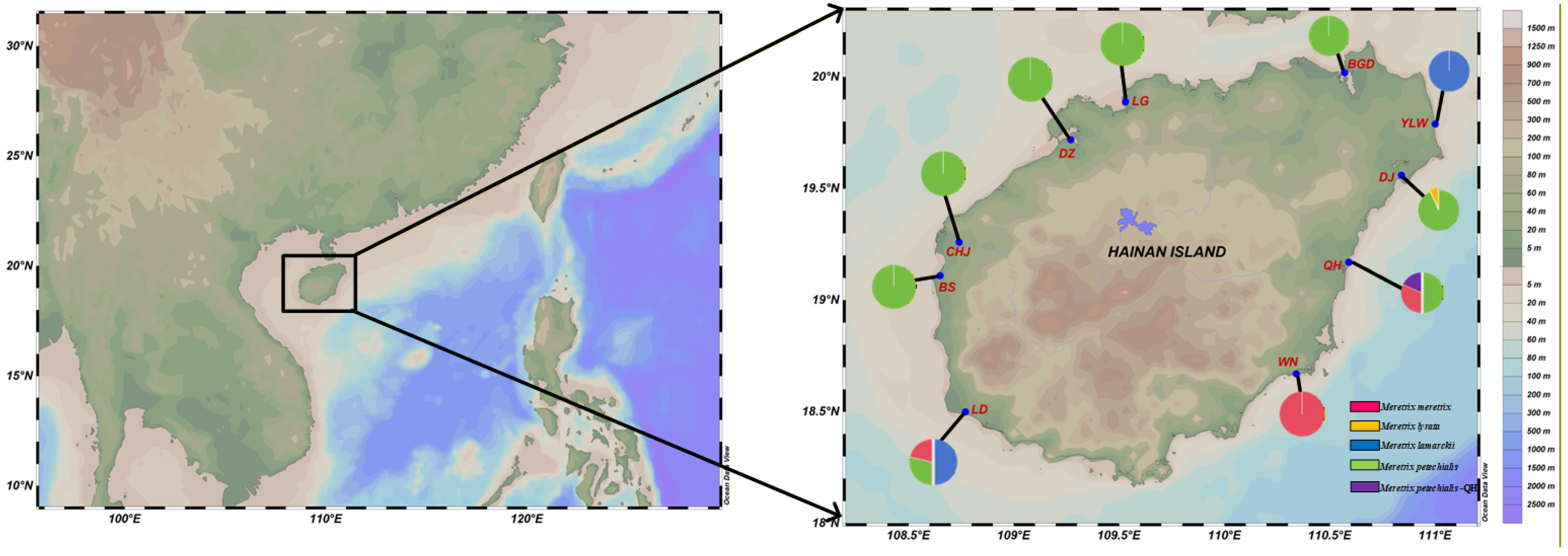
A total of 141 Meretrix individuals were collected from 10 intertidal sampling sites around Hainan Island, China, between January 2024 and September 2025, during multiple field surveys conducted sequentially across sampling locations. Sites were selected to cover biogeographic gradients: northern/southern (latitudinal) and eastern/western (hydrodynamic differences) coasts (Figure 1). Collection involved hand-digging in sandy/muddy intertidal zones during low tide; 10–20 individuals per site (detailed in Table S1). No temporal replication was performed as this was a multiple single-period biodiversity survey. Samples were immediately preserved in 95% ethanol and stored at –20 °C to maintain DNA integrity. Voucher specimens were deposited in the Marine Biology Museum, Hainan University (accession nos. HBM-Mer-001 to HBM-Mer-141).

2.2. Morphological Identification

Specimens were initially identified based on shell morphology following [3,13], as well as taxonomic references on marine mollusks from Chinese coastal waters: diagnostic characters included shell shape (ovate vs. triangular), pallial sinus form (depth and direction), escutcheon width, color patterns, and ventral margin curvature. Identifications were performed by the first author (H.C.), with verification by co-authors (Z.G., Y.Y.). High intraspecific plasticity was noted (e.g., color variation due to substrate).

2.3. DNA Extraction, PCR Amplification, and Sequencing

Genomic DNA was extracted from adductor muscle using a CTAB-based protocol. Quality was assessed via NanoDrop (A260/280 ratios 1.8–2.0). The mitochondrial COI gene was amplified using universal primers LCO1490 (5′-GGTCAACAAATCATAAAGATATTGG-3′) and HCO2198 (5′-TAAACTTCTGGGTGTCCAAAAAATCA-3′) [14]. PCR reactions (25 μL) contained 12.5 μL 2× Taq PCR Master Mix (Tsingke Biotech), 1–2 μL DNA template (~10–50 ng), 0.4 μM each primer. Cycling: 94 °C 5 min; 35 cycles of 94 °C 30 s, 50 °C 45 s, 72 °C 1 min; final 72 °C 10 min. Negative (no-template) and positive controls were included. Products (~658 bp) were purified and bidirectionally sequenced (Tsingke Biotech, Beijing, China). Sequences were assembled in SeqMan v. 14.1; ambiguous bases were trimmed or resolved manually.

2.4. Sequence Analysis

Sequences were aligned using MAFFT [15], with poorly aligned regions removed in Gblocks [16]. Pairwise genetic distances were calculated under Kimura 2-parameter (K2P) model (standard for COI barcoding; [6]). Preliminary taxonomic assignment was carried out via NCBI BLAST (https://blast.ncbi.nlm.nih.gov/Blast.cgi, accessed on 26 January 2026); final identification was conducted based on phylogeny and morphology. Phylogenetic analyses were conducted based on mitochondrial COI sequences of approximately 658 bp obtained in this study. All sequences were aligned using MAFFT and subsequently trimmed to equal length prior to phylogenetic reconstruction. After sequence alignment and trimming, maximum likelihood (ML) trees were reconstructed using IQtree v. 1.6.12 [17], and Bayesian inference (BI) was performed in MrBayes v. 3.2.6 [18]. The best-fit nucleotide substitution model was selected using ModelFinder [19]. Node support was evaluated using 10,000 ultrafast bootstrap replicates. BI analyses employed the best-fit model or the closest available model implemented in MrBayes. Two independent MCMC runs were performed, each with four chains (one cold and three heated), for 10,000,000 generations, sampling every 1000 generations. The first 25% of samples were discarded as burn-in. Convergence was assessed using the average standard deviation of split frequencies (<0.01) and effective sample size (ESS > 200) in Tracer v1.6. A majority-rule consensus tree was generated, and node support was indicated by ML bootstrap values and BI posterior probabilities, respectively. The resulting phylogenetic trees were visualized using FigTree v. 1.4.4.

3. Results

3.1. Morphological Observations

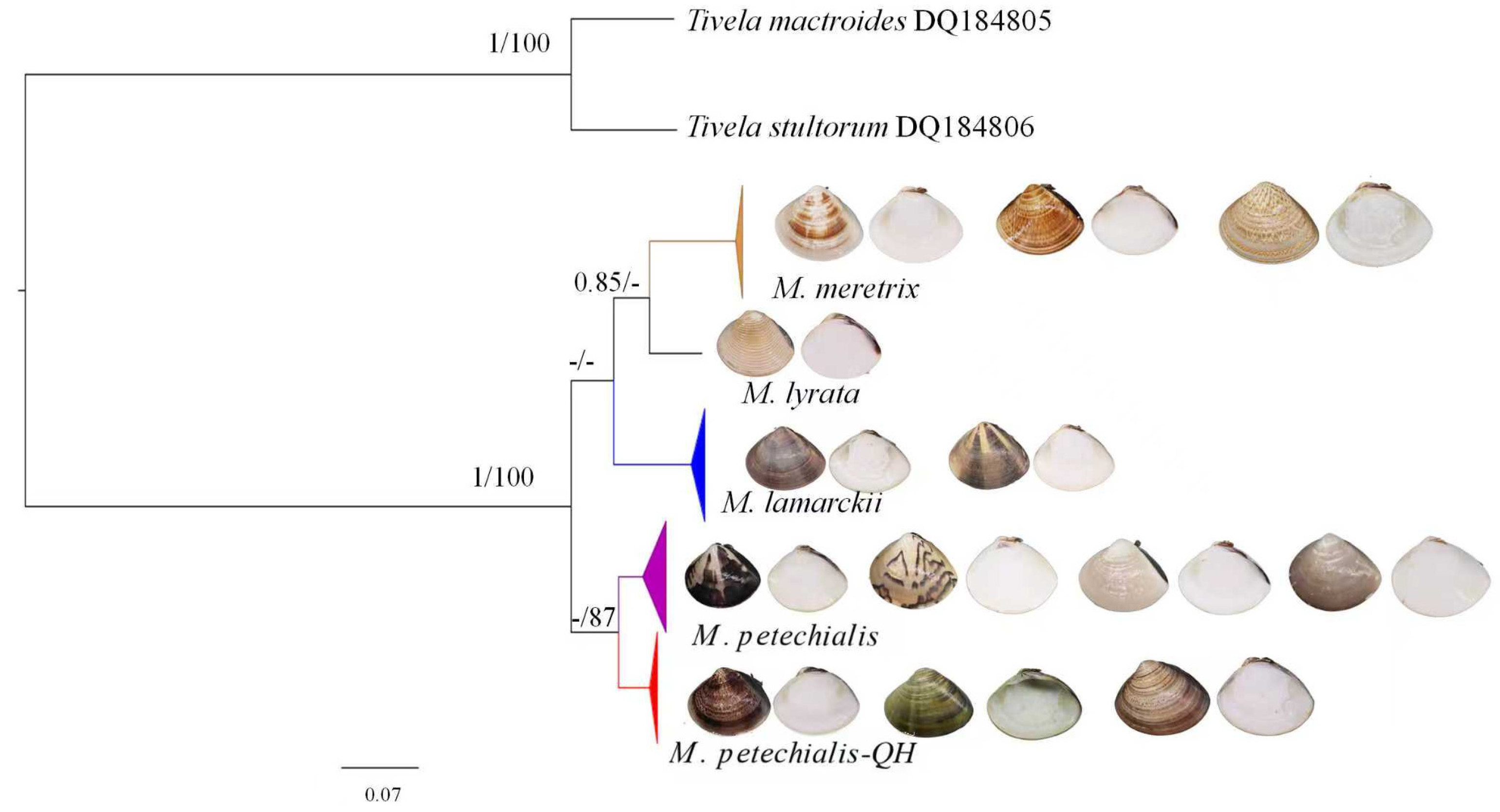
Different Meretrix species show noticeable differences in shell coloration, patterning, and surface ornamentation, although substantial intraspecific variation is also present (Figure 2). The shell of M. meretrix is generally ovate to subcircular in outline. Shell coloration is typically pale yellow to light brown, with some individuals exhibiting relatively uniform coloration. The shell surface displays fine and regularly spaced concentric growth lines. In some specimens, light to dark brown radial bands or arcuate color markings can be observed, although the overall pattern is usually subtle and color variation is relatively limited. The shell of M. lyrata is usually elongate-ovate to slightly elliptical. Shell coloration is generally light yellow to pale brown. Distinct concentric growth lines are present and appear fine and regular across the shell surface. Compared with other species, radial color bands are less pronounced, and the shell coloration tends to be relatively uniform, with only slight variations occasionally occurring near the umbo or in localized areas of the shell surface. The shell of M. lamarckii typically exhibits a triangular to subtriangular outline with a relatively elevated umbo. Shell coloration ranges from grayish brown to dark brown. The shell surface shows well-defined concentric growth lines, which in some individuals form prominent surface textures. This species commonly displays distinct dark radial bands extending from the umbo toward the ventral margin, producing a marked contrast with the background shell color and giving the shell a more conspicuous patterned appearance. The shell coloration of M. petechialis is highly variable, generally characterized by light brown, grayish brown, or dark brown backgrounds. The shell surface frequently bears irregular dark blotches or band-like markings, and some individuals exhibit wavy or reticulated dark patterns. Concentric growth lines are also present but may appear less visually distinct due to the complex shell coloration. Overall, this lineage shows high diversity in shell color and patterning. The shell morphology of M. petechialis-QH is generally similar to that of M. petechialis in other locations, but it often exhibits greenish, yellow-green, or pale greenish-brown shell coloration. The shell surface shows relatively regular concentric growth lines accompanied by distinct radial bands or arcuate markings. In some individuals, the shell displays a green background combined with lighter or darker concentric patterns, producing a characteristic color pattern.
Specimens exhibited diagnostic shell traits consistent with four species: M. lyrata (elongate-ovate shell, deep pallial sinus), M. lamarckii (triangular outline, narrow escutcheon), M. meretrix (rounded ventral margin, uniform color), and M. petechialis (variable color patterns, curved pallial sinus). Phenotypic plasticity (e.g., shell erosion/color variation) was observed within species.

3.2. Sequence Characteristics and Diversity

A total of 141 COI sequences (~658 bp) were obtained and deposited in GenBank (accession numbers provided in Supplementary Table S1). After sequence alignment and trimming, pairwise genetic distances were calculated using the Kimura two-parameter (K2P) model. The results revealed clear genetic differentiation among the Meretrix taxa (Table 1). Intraspecific genetic distances ranged from 0.3% to 0.9%. Specifically, the intraspecific divergence was 0.3% in M. meretrix, 0.4% in M. lamarckii, 0.9% in M. petechialis, and 0.4% in M. petechialis-QH. Within M. petechialis, the genetic distance between M. petechialis and M. petechialis-QH reached 7.3%, which was markedly higher than the intraspecific variation observed in the other Meretrix species. In contrast, interspecific genetic distances were substantially higher, ranging from 17.6% to 22.7%. Overall, interspecific genetic distances were significantly greater than intraspecific distances, indicating clear genetic differentiation among the examined Meretrix taxa.

3.3. Phylogenetic Analyses

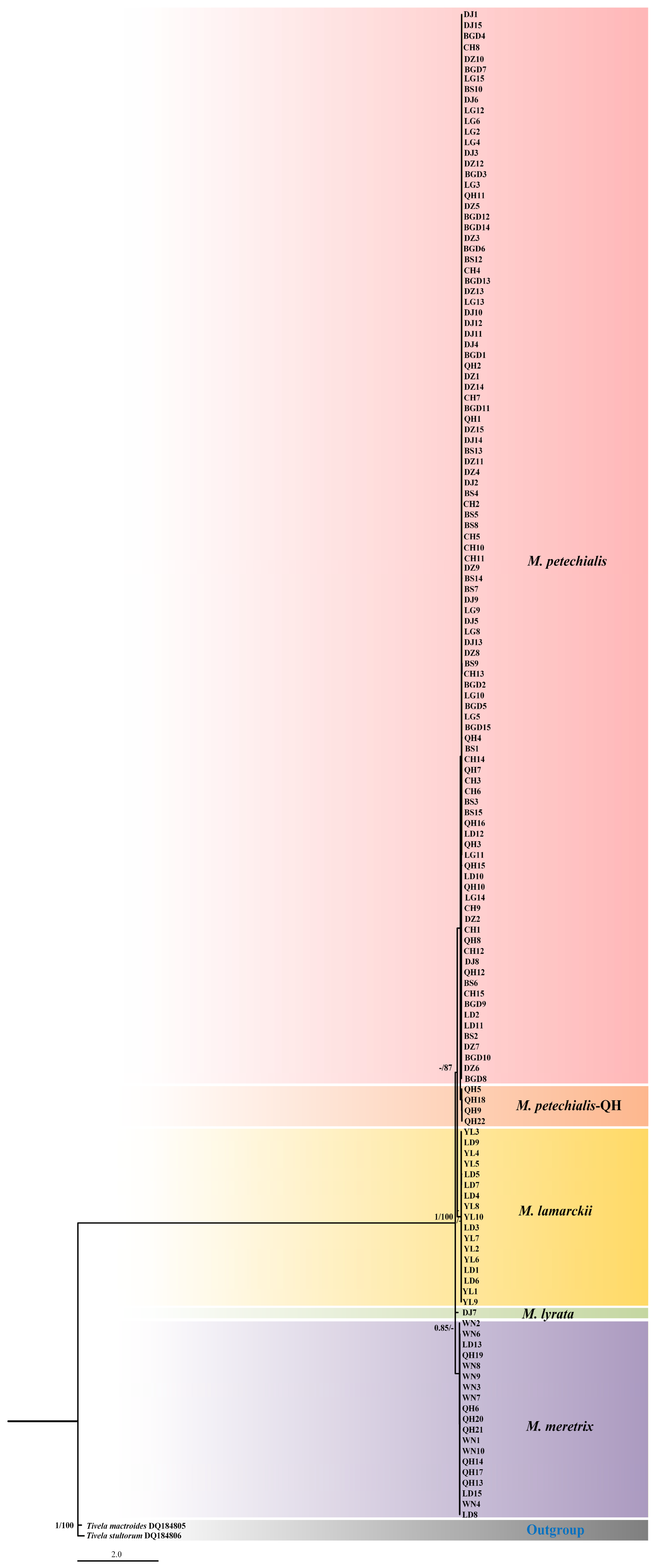
Phylogenetic trees reconstructed using ML and BI based on COI haplotype sequences produced consistent topologies. The ML tree is presented in Figure 3. Using Tivela mactroides (DQ184805) and Tivela stultorum (DQ184806) as outgroups, all Meretrix samples formed a well-supported monophyletic clade that was clearly separated from the outgroup taxa. Within the Meretrix clade, samples collected from Hainan Island were resolved into four distinct species-level lineages: M. petechialis, M. lamarckii, M. lyrata, and M. meretrix. Each species formed an independent and stable clade without evidence of mixed clustering, indicating clear genetic differentiation among the four taxa.
The phylogenetic relationships among the four species showed that M. meretrix formed a relatively distinct lineage, whereas the remaining three species grouped together. Within this cluster, M. lyrata was recovered as the sister lineage to the clade comprising (M. lamarckii + M. petechialis). The node supporting the grouping of M. lyrata with (M. lamarckii + M. petechialis) received strong support (BI/ML = 1/100). In addition, M. lamarckii and M. petechialis formed a sister relationship, with a maximum likelihood bootstrap support value of 87, indicating a relatively close phylogenetic relationship between the two species. Notably, the samples identified as M. petechialis were further divided into two genetically divergent lineages. The first lineage, designated as M. petechialis, comprised the majority of samples and was distributed across multiple sampling sites, including Beigangdao (BGD), Dongjiao (DJ), Qionghai (QH), Ledong (LD), Basuo (BS), Danzhou (DZ), Lingao (LG), and Changhuajiang (CHJ). The second lineage, labeled as M. petechialis-QH, consisted of only a small number of individuals and was primarily collected from Qionghai (QH). Both lineages were detected at the same sampling site in Qionghai (QH), indicating a sympatric distribution in the eastern coastal waters of Hainan Island. This pattern suggests the presence of two clearly divergent genetic lineages within M. petechialis, implying that this species may possess a relatively complex population structure.

3.4. Geographic Distribution

A total of ten sampling sites were established along the coast of Hainan Island, including Beigangdao (BGD), Yueliangwan (YLW), Dongjiao (DJ), Qionghai (QH), Wanning (WN), Ledong (LD), Basuo (BS), Changhuajiang (CHJ), Danzhou (DZ), and Lingao (LG) (Figure 1). In total, 141 specimens were collected. Statistical identification results showed that the distribution of Meretrix species varied markedly among sampling sites. Among the four species identified, M. petechialis exhibited the widest distribution, being recorded at most sampling sites along the northern and western coasts of Hainan Island, including LG (13 individuals), DZ (15), CHJ (15), BS (14), BGD (15), DJ (14), and QH (15) and LD (4). In contrast, M. meretrix was mainly concentrated in the southeastern coastal waters of Hainan Island, particularly at Wanning (WN, 9), Qionghai (QH, 7), and Ledong (LD, 3), and was the dominant species at Wanning (WN), accounting for the highest proportion of individuals at this site. Meretrix lamarckii was primarily detected at Ledong (LD, 7) and Yueliangwan (YLW, 10), whereas M. lyrata was mainly distributed near Dongjiao (DJ) on the eastern coast of Hainan Island.
Figure 3. Phylogenetic tree of unique COI haplotypes from Meretrix spp. reconstructed using maximum likelihood (ML) and Bayesian inference (BI). Two species of the genus Tivela: Tivela mactroides (DQ184805) and Tivela stultorum (DQ184806) belonging to the subfamily Meretricinae of the family Veneridae, the same family as Meretrix, were used as outgroups. The ML topology is shown, and the BI topology was congruent. Branches colored by species/lineage (legend). Node labels indicate ML bootstrap (>50%) and BI posterior probabilities (>0.70). Scale bar = 0.02 substitutions/site. Phenotypes refer to shell categories in Methods. Different colors just indicate different lineages, and they are used to better identify.
Fishes 11 00195 g003
From a geographic perspective, the four Meretrix species exhibited a distinct spatial distribution pattern among sampling sites. The eastern coast of Hainan Island (DJ and QH) generally showed higher species richness. In particular, three Meretrix species (M. meretrix, 7; M. petechialis-QH, 4 and M. petechialis, 11) were recorded at Qionghai (QH). Similarly, three species (M. meretrix, 3; M. petechialis, 4 and M. lamarckii, 7) co-occurred at Ledong (LD). In contrast, sampling sites along the western coast (e.g., LG, DZ, CHJ, BS, and BGD) were typically dominated by a single species, primarily M. petechialis. A similar pattern of single-species dominance was also observed at the eastern sites of Yueliangwan (YLW) and Wanning (WN).

4. Discussion

Traditional taxonomy of the genus Meretrix has primarily relied on shell morphological characters, such as shell outline, shell coloration, and the shape of the pallial sinus. However, shell morphology is often influenced by habitat conditions, including substrate type, hydrodynamic regime, and individual growth stage. As a result, external morphological differences among species are sometimes subtle and may even overlap [20,21]. In contrast, considerable morphological variation may occur within the same species. Based on morphological observations (Figure 2), individuals of M. petechialis-QH exhibit a relatively distinct greenish or dark shell coloration with more uniform shell patterns, whereas M. petechialis typically displays brownish or light-colored mottled patterns. Moreover, the widely distributed M. petechialis shows greater diversity in shell color and pattern types, suggesting that shell morphology in this species exhibits strong environmental plasticity. Consequently, species identification based solely on shell morphology may involve a certain degree of uncertainty in some cases. In the present study, COI DNA barcode analysis revealed that genetic distances among species were markedly higher than intraspecific variation, forming a clear “barcode gap” [22,23], which further supports the genetic independence of the four Meretrix species identified in this study. These results are consistent with previous DNA barcoding studies on bivalves [24,25], indicating that the COI gene is highly suitable for species identification and diversity assessments in bivalves and can effectively complement traditional morphology-based taxonomy where morphological identification is difficult.
The genetic distance analysis showed that the K2P genetic distances among Meretrix species ranged from 17.6% to 22.7%, whereas intraspecific distances were only 0.3–0.9%. This marked difference indicates that stable genetic differentiation has already been established among the species. In many bivalve studies, interspecific COI genetic distances are typically much higher than intraspecific variation and are therefore widely used to identify potential cryptic species or population divergence [26,27]. The genetic distance ranges observed in this study are clearly higher than typical intraspecific variation, further supporting the taxonomic validity of the four Meretrix species identified in the study area. Notably, two clearly divergent genetic lineages were detected within M. petechialis, corresponding to the western lineage (M. petechialis) and the eastern lineage (M. petechialis-QH). The genetic distance between these two lineages reached 7.3%, which is substantially higher than the intraspecific variation observed in the other Meretrix species. This result suggests that a certain degree of genetic structuring may exist within this species in the study area. Previous studies have indicated that COI genetic distances exceeding 2–5% are often considered indicative of potential cryptic divergence [28]. However, the results based on a single mitochondrial locus should be interpreted with caution, because mitochondrial DNA reflects only maternal inheritance and its divergence patterns may be influenced by factors such as historical dispersal, genetic introgression, or incomplete lineage sorting [29,30]. Therefore, although significant genetic differentiation was detected within M. petechialis in this study, whether this divergence represents potential cryptic species requires further validation using additional nuclear markers and morphological evidence.
Several mechanisms may explain the formation of the two lineages detected in M. petechialis. One possible explanation is human-mediated introduction. Previous studies have shown that the dispersal of some marine bivalve populations is closely associated with human activities. For example, the transfer of aquaculture seed stocks, the introduction of fishery resources, and transportation via ship ballast water can all facilitate the spread of populations across different geographic regions [31,32]. In the present study, the lineage M. petechialis-QH is typically distributed along the northern coastal waters of China, yet individuals belonging to this lineage were also detected around Hainan Island. This pattern may suggest that the lineage was introduced into the study area through anthropogenic activities. However, there is currently no direct evidence supporting this hypothesis, and alternative explanations such as natural dispersal or historical overlap in distribution cannot be ruled out. Future studies incorporating broader geographic sampling and multilocus genetic analyses will be necessary to further test these hypotheses.
From a geographic perspective, this study found that species richness of the genus Meretrix along the eastern coast of Hainan Island was significantly higher than that along the western coast. This spatial pattern may be related to the marine environmental conditions and hydrodynamic regimes of the South China Sea region [33,34,35]. The eastern waters of Hainan Island face the open South China Sea and are strongly influenced by monsoon-driven currents and complex ocean circulation systems, resulting in relatively frequent seawater exchange. Such conditions facilitate the dispersal of planktonic larvae and gene flow among different populations. In contrast, the western coast is relatively more enclosed and is more strongly affected by nearshore bays and sedimentary environments, where hydrodynamic conditions are comparatively weaker. These conditions may limit larval dispersal to some extent [36,37]. Consequently, the eastern coastal waters are more likely to support multi-species assemblages, whereas the western coastal areas may be dominated by a few locally abundant species. In addition, differences in ecological adaptability among species may also influence their distribution patterns. For example, some Meretrix species may be better adapted to high-energy open coastal environments, while others may prefer relatively stable nearshore shallow-water habitats with more stable sediment conditions [38,39]. Such ecological differences may further shape the spatial distribution patterns of Meretrix species along the coast of Hainan Island. Therefore, future studies should integrate environmental factors, such as substrate type, salinity, intertidal elevation, and ocean current regimes to further explore the relationship between the distribution of Meretrix species and environmental conditions.

5. Conclusions

This study provides new COI barcoding data on Meretrix diversity across Hainan Island, complementing previous biodiversity surveys of marine taxa in the region. A total of 141 samples were collected. Four species were identified (M. lyrata, M. lamarckii, M. meretrix, and M. petechialis), with two genetically divergent lineages in M. petechialis. Intraspecific divergences were generally low, except up to 7.3% between M. petechialis lineages. The presence of the northern lineage in Hainan may suggest human-mediated translocation (e.g., via aquaculture), consistent with patterns in other bivalves, but direct evidence is absent and natural dispersal or historical overlap cannot be ruled out. Higher species richness on the eastern coast may be associated with complex coastal currents facilitating larval dispersal, while western conditions are more uniform. These findings provide baseline molecular data for species identification and may support future sustainable management and conservation efforts in Hainan, including monitoring the occurrence of divergent genetic lineages.

Supplementary Materials

The following supporting information can be downloaded at: https://www.mdpi.com/article/10.3390/fishes11040195/s1, Table S1: Sample number, locality, and GenBank numbers of the studied Meretrix specimens. Site codes correspond to geographic locations listed in Figure 1. The M. petechialis-S indicates the south lineage while M. petechialis-N indicates the north lineage of the species.

Author Contributions

Conceptualization, Y.Y. and Z.G.; methodology, H.C., M.L., Y.S., M.S. and Y.Y.; software, M.L.; formal analysis, H.C., M.L. and Y.Y.; investigation, H.C., M.L. and Y.Y.; resources, H.C., M.L. and Y.Y.; writing—original draft preparation, H.C. and Y.Y.; writing—review and editing, H.C. and Y.Y.; visualization, Y.Y.; supervision, Z.G. and Y.Y.; project administration, Y.Y.; funding acquisition, Y.Y. All authors have read and agreed to the published version of the manuscript.

Funding

This study was funded by the Hainan Provincial Natural Science Foundation of China (322RC675) and the Starting Research Fund from the Hainan University (KYQD(ZR)-21004).

Institutional Review Board Statement

Not applicable. As a lower invertebrate, the hard clam (Meretrix spp.) falls outside the scope of standard animal welfare regulations, as it is not considered to possess the capacity for sentience or pain perception.

Data Availability Statement

All COI fragments generated in this study have been submitted to the GenBank Database, and the accession numbers are listed in Supplementary Table S1.

Conflicts of Interest

The authors declare no conflicts of interest.

References

  1. WoRMS. Meretrix. 2026. Available online: https://www.marinespecies.org/aphia.php?p=taxdetails&id=204011 (accessed on 26 January 2026).
  2. Morton, B.; Leung, S.F.; Leung, K.F. The biology and functional morphology of Meretrix cf. meretrix (Bivalvia: Veneridae: Meretricinae) at Tong Fuk Miu Wan, Shui Hau, Lantau Island, Hong Kong. Reg. Stud. Mar. Sci. 2021, 45, 101842. [Google Scholar] [CrossRef]
  3. Zhang, S.P.; Wang, H.X.; Xu, F.S. Taxonomic study on Meretrix (Bivalvia, Veneridae) from China seas. Acta Zootax. Sin. 2012, 37, 473–479. [Google Scholar]
  4. Wang, X.X.; Kong, L.F.; Martin, C.; Li, Q.; Matsukuma, A. A new species of Meretrix from the Arabian sea (Mollusca: Bivalvia). J. Conchol. 2020, 43, 655–663. [Google Scholar]
  5. Kong, L.F.; Wang, X.X.; Matsukuma, A.; Li, Q. A review of taxonomy of Genus Meretrix along the coast of China. J. Ocean Univ. China 2017, 47, 30–35. [Google Scholar]
  6. Hebert, P.D.N.; Cywinska, A.; Ball, S.L.; deWaard, J.R. Biological identifications through DNA barcodes. Proc. R. Soc. B Biol. Sci. 2003, 270, 313–321. [Google Scholar] [CrossRef]
  7. Wang, X.X.; Kong, L.F.; Chen, J.; Matsukuma, A.; Li, Q. Phylogeography of bivalve Meretrix petechialis in the Northwestern Pacific indicated by mitochondrial and nuclear DNA data. PLoS ONE 2017, 12, e0183221. [Google Scholar] [CrossRef]
  8. Jones, K.H.; Preston, H.B. List of Mollusca collected during the commission of HMS “Waterwitch” in the China Seas, 1900–1903, with descriptions of new species. J. Molluscan Stud. 1904, 6, 138–151. [Google Scholar] [CrossRef][Green Version]
  9. Hsiao, S.T.; Chuang, S.C. Description of Meretrix taiwanica sp. nov. from Taiwan and southern China (Bivalvia: Veneridae). Malacologia 2023, 66, 1–15. [Google Scholar]
  10. Zhang, J.; Wang, D.R.; Jennerjahn, T.; Dsikowitzky, L. Land-sea interactions at the east coast of Hainan Island, South China Sea: A synthesis. Cont. Shelf Res. 2013, 57, 132–142. [Google Scholar] [CrossRef]
  11. Xie, D.; Li, F.; Liu, M.; Fan, L.; Guo, X.; Wang, A.; Liu, C.; Gu, Z.; Yang, Y. New mitochondrial genomes of Saccostrea (Mollusca, Ostreidae) specimens from Hainan Island. ZooKeys 2026, 1270, 19–31. [Google Scholar] [CrossRef] [PubMed]
  12. Zhang, L.; Zhang, Y.; Ma, W.; Zhang, H.; Deng, Y.; Wang, M.; Wang, W. Conservation implications of mismatched diversity between mangrove plants and benthic mollusks. J. Environ. Manag. 2025, 384, 125505. [Google Scholar] [CrossRef]
  13. Hsiao, S.-T.; Chuang, S.-C. Meretrix taiwanica (Bivalvia: Veneridae), a previously misidentified new species in Taiwan. Molluscan Res. 2023, 43, 12–21. [Google Scholar] [CrossRef]
  14. Folmer, O.; Black, M.; Hoeh, W.; Lutz, R.; Vrijenhoek, R. DNA primers for amplification of mitochondrial cytochrome c oxidase subunit I from diverse metazoan invertebrates. Mol. Mar. Biol. Biotechnol. 1994, 3, 294–299. [Google Scholar]
  15. Katoh, K.; Standley, D.M. MAFFT multiple sequence alignment software version 7: Improvements in performance and usability. Mol. Biol. Evol. 2013, 30, 772–780. [Google Scholar] [CrossRef]
  16. Castresana, J. Selection of conserved blocks from multiple alignments for their use in phylogenetic analysis. Mol. Biol. Evol. 2000, 17, 540–552. [Google Scholar] [CrossRef]
  17. Nguyen, L.T.; Schmidt, H.A.; Haeseler, A.V.; Minh, B.Q. IQ-TREE: A fast and effective stochastic algorithm for estimating maximum-likelihood phylogenies. Mol. Biol. Evol. 2015, 32, 268–274. [Google Scholar] [CrossRef]
  18. Ronquist, F.; Teslenko, M.; Van Der Mark, P.; Ayres, D.L.; Darling, A.; Höhna, S.; Larget, B.; Liu, L.; Suchard, M.A.; Huelsenbeck, J.P. MrBayes 3.2: Efficient Bayesian phylogenetic inference and model choice across a large model space. Syst. Biol. 2012, 61, 539–542. [Google Scholar] [CrossRef] [PubMed]
  19. Kalyaanamoorthy, S.; Minh, B.Q.; Wong, T.K.; Von Haeseler, A.; Jermiin, L.S. ModelFinder: Fast model selection for accurate phylogenetic estimates. Nat. Methods 2017, 14, 587–589. [Google Scholar] [CrossRef] [PubMed]
  20. Proćków, M.; Proćków, J.; Błażej, P.; Mackiewicz, P. The influence of habitat preferences on shell morphology in ecophenotypes of Trochulus hispidus complex. Sci. Total Environ. 2018, 630, 1036–1043. [Google Scholar] [CrossRef]
  21. Seed, R. Factors influencing shell shape in the mussel Mytilus edulis. J. Mar. Biol. Assoc. U. K. 1968, 48, 561–584. [Google Scholar] [CrossRef]
  22. Layton, K.K.S.; Martel, A.L.; Hebert, P.D.N. Patterns of DNA barcode variation in Canadian marine molluscs. PLoS ONE 2014, 9, e95003. [Google Scholar] [CrossRef] [PubMed]
  23. Ismailaj, M.; Zangaro, F.; Specchia, V.; Sangiorgio, F.; Marcucci, F.; Kiçaj, H.; Basset, A.; Pinna, M. Biodiversity Patterns and DNA Barcode Gap Analysis of COI in Coastal Lagoons of Albania. Biology 2024, 13, 951. [Google Scholar] [CrossRef]
  24. Feng, Y.; Li, Q.; Kong, L.; Zheng, X. DNA barcoding and phylogenetic analysis of Pectinidae (Mollusca: Bivalvia) based on mitochondrial COI and 16S rRNA genes. Mol. Biol. Rep. 2011, 38, 291–299. [Google Scholar] [CrossRef] [PubMed]
  25. Liu, J.; Li, Q.; Kong, L.; Yu, H.; Zheng, X. Identifying the true oysters (Bivalvia: Ostreidae) with mitochondrial phylogeny and distance-based DNA barcoding. Mol. Ecol. Resour. 2011, 11, 820–830. [Google Scholar] [CrossRef]
  26. Terranova, M.S.; Brutto, S.L.; Arculeo, M.; Mitton, J.B. A mitochondrial phylogeography of Brachidontes variabilis (Bivalvia: Mytilidae) reveals three cryptic species. J. Zool. Syst. Evol. Res. 2007, 45, 289–298. [Google Scholar] [CrossRef]
  27. Ni, L.; Li, Q.; Kong, L.; Huang, S.; Li, L. DNA barcoding and phylogeny in the family Mactridae (Bivalvia: Heterodonta): Evidence for cryptic species. Biochem. Syst. Ecol. 2012, 44, 164–172. [Google Scholar] [CrossRef]
  28. Ma, Z.; Ren, J.; Zhang, R. Identifying the genetic distance threshold for Entiminae (Coleoptera: Curculionidae) species delimitation via COI barcodes. Insects 2022, 13, 261. [Google Scholar] [CrossRef]
  29. Seixas, F.A.; Boursot, P.; Melo-Ferreira, J. The genomic impact of historical hybridization with massive mitochondrial DNA introgression. Genome Biol. 2018, 19, 91. [Google Scholar] [CrossRef]
  30. Choleva, L.; Musilova, Z.; Kohoutova-Sediva, A.; Paces, J.; Rab, P.; Janko, K. Distinguishing between incomplete lineage sorting and genomic introgressions: Complete fixation of allospecific mitochondrial DNA in a sexually reproducing fish (Cobitis; Teleostei), despite clonal reproduction of hybrids. PLoS ONE 2014, 9, e80641. [Google Scholar] [CrossRef][Green Version]
  31. Minchin, D. Aquaculture and transport in a changing environment: Overlap and links in the spread of alien biota. Mar. Pollut. Bull. 2007, 55, 302–313. [Google Scholar] [CrossRef] [PubMed]
  32. Carlton, J.T. Dispersal of living organisms into aquatic ecosystems as mediated by aquaculture and fisheries activities. Dispers. Living Org. Aquat. Ecosyst. 1992, 13–45. [Google Scholar]
  33. Wu, M.L.; Wang, Y.S.; Wang, Y.T.; Sun, F.L.; Sun, C.C.; Jiang, Z.Y.; Cheng, H. Influence of environmental changes on phytoplankton pattern in Daya Bay, South China Sea. Rev. Biol. Mar. Oceanogr. 2014, 49, 323–337. [Google Scholar]
  34. Li, J.; Wang, Y.P.; Gao, S. In situ hydrodynamic observations on three reef flats in the Nansha Islands, South China Sea. Front. Mar. Sci. 2024, 11, 1375301. [Google Scholar] [CrossRef]
  35. Liu, S.; Yang, Y.; Tang, D.; Yan, H.; Ning, G. Association between the biophysical environment in coastal south China sea and large-scale synoptic circulation patterns: The role of the Northwest Pacific subtropical high and typhoons. Remote Sens. 2021, 13, 3250. [Google Scholar] [CrossRef]
  36. Scheltema, R.S. Larval dispersal as a means of genetic exchange between geographically separated populations of shallow-water benthic marine gastropods. Biol. Bull. 1971, 140, 284–322. [Google Scholar] [CrossRef]
  37. Weersing, K.; Toonen, R.J. Population genetics, larval dispersal, and connectivity in marine systems. Mar. Ecol. Prog. Ser. 2009, 393, 1–12. [Google Scholar] [CrossRef]
  38. Shi, B.; Pratolongo, P.D.; Du, Y.; Li, J.; Yang, S.L.; Wu, J.; Xu, K.; Wang, Y.P. Influence of macrobenthos (Meretrix meretrix Linnaeus) on erosion-accretion processes in intertidal flats: A case study from a cultivation zone. J. Geophys. Res. Biogeosci. 2020, 125, e2019JG005345. [Google Scholar] [CrossRef]
  39. Bao, J.; Zhu, Y.; Liu, L.; Han, S.; Wang, F.; Hu, H.; Zhang, X.; Li, L.; Jiang, M. Geographic Variation in Morphology and Physiology of Meretrix meretrix (Linnaeus, 1758) Along the Chinese Coast. Animals 2025, 16, 65. [Google Scholar] [CrossRef] [PubMed]
Figure 1. Distribution of Meretrix species around Hainan Island. BGD: Beigangdao, YLW: Yueliangwan, DJ: Dongjiao, QH: Qionghai, WN: Wanning, LD: Ledong, BS: Basuo, CHJ: Changhuajiang, DZ: Danzhou, LG: Lingao.
Fishes 11 00195 g001
Figure 2. Morphological photographs of Meretrix species. Different colors indicate different species.
Fishes 11 00195 g002
Table 1. K2P genetic distances (intraspecific and interspecific).
12345
1M. meretrix0.3%
2M. lyrata17.6%
3M. lamarckii22.7%18.3%0.4%
4M. petechialis21.2%18.4%19.1%0.9%
5M. petechialis-QH22.4%17.6%19.5%7.3%0.4%
Disclaimer/Publisher’s Note: The statements, opinions and data contained in all publications are solely those of the individual author(s) and contributor(s) and not of MDPI and/or the editor(s). MDPI and/or the editor(s) disclaim responsibility for any injury to people or property resulting from any ideas, methods, instructions or products referred to in the content.