Article

Impact of Fin Erosion on Biomarker Responses in Salmo trutta: Implications for the Reliability of Biological Effects Monitoring in Aquatic Environments


by
Milda Stankevičiūtė
1,*,
Agnė Bučaitė
1,
Janina Pažusienė
1,
Živilė Jurgelėnė
1 and
Justas Dainys
2
1
Laboratory of Ecotoxicology, State Scientific Research Institute Nature Research Centre, Akademijos Str. 2, 08412 Vilnius, Lithuania
2
Laboratory of Fish Ecology, State Scientific Research Institute Nature Research Centre, Akademijos Str. 2, 08412 Vilnius, Lithuania
*
Author to whom correspondence should be addressed.
Fishes 2026, 11(3), 181; https://doi.org/10.3390/fishes11030181
Submission received: 12 February 2026 / Revised: 8 March 2026 / Accepted: 17 March 2026 / Published: 19 March 2026
(This article belongs to the Section Environment and Climate Change)

Abstract

Fin erosion is a common condition in aquaculture-reared salmonids used in river restocking programs and may influence multiple biomarkers applied in aquatic biomonitoring. The health status of Salmo trutta from a river with good ecological status was evaluated by analysing biometric traits, glucose concentration, haematological indices, erythrocyte morphometry, and erythrocytic nuclear abnormalities in relation to fin condition. Fish with eroded fins were larger and exhibited pelvic and dorsal fin erosion, suggesting a hatchery origin, but showed lower haemoglobin concentration, packed cell volume, and glucose levels, together with altered erythrocyte morphology and increased frequencies of cytotoxic nuclear abnormalities. In contrast, leukocyte profiles and overall erythropoietic activity did not differ between fin condition groups. These findings indicate that fin erosion can alter baseline biomarker responses independently of environmental contamination, highlighting the importance of considering fin integrity when interpreting biomonitoring data and evaluating the suitability of fish for restocking programs.
Key Contribution: Fin condition affects multiple biomarker profiles in fish from a river with good environmental status. Fish with eroded fins showed decreased haematological parameters and increased frequencies of cytotoxic nuclear abnormalities compared to fish with intact fins.

1. Introduction

Global declines in fish populations are evident in both freshwater and marine ecosystems [1,2,3]. These reductions are primarily attributed to anthropogenic activities, although multiple contributing factors are involved [4,5]. To counteract these adverse effects, the stocking of water bodies with hatchery-reared fish has become a widely applied strategy for replenishing depleted wild populations and enhancing recreational fisheries [6]. Salmo trutta plays an important role both ecologically and economically in the Atlantic region, which has led to widespread use of hatchery-reared fish for stocking programs aimed at supporting and restoring wild populations [7].
However, the occurrence of fin erosion in artificially bred and hatchery-reared fish has emerged as a complex issue that is receiving increasing scientific attention [8]. Fin deformities can arise from various stressors, including abrasive surfaces, aggressive interactions, nutritional imbalances, stocking density, water quality (physico-chemical parameters), and bacterial infections. During aggressive interactions, dorsal fins are most frequently targeted, while pectoral fin erosion predominantly results from contact with tank walls. Anal and pelvic fins are less prone to aggressive damage but are susceptible to abrasion from contact with the tank bottom [9,10]. The major concerns associated with fin erosion and related deformities involve both aesthetic considerations and the post-release survival and performance of hatchery-reared fish in natural environments [8]. Eroded or significantly damaged fins compromise swimming performance, they can reduce the ability of fish to survive and adapt in the wild. For instance, dorsal fin and opercular deformities observed at frequencies of 2.30% and 2.16%, respectively, in Asian seabass hatcheries, were found to significantly reduce body weight, demonstrating that such abnormalities compromise both appearance and growth performance [11].
Previous studies [11,12] have demonstrated that morphological deformities, including fin erosion, are correlated with reduced growth and survival rates in fish. Under artificial rearing conditions, the incidence of fin erosion is substantially higher than in natural populations, although some studies have also documented fin erosion in wild fish inhabiting heavily polluted or degraded environments [13]. As fin erosion impairs normal functionality in native habitats, affected fish may experience reduced foraging efficiency, malnutrition, diminished resistance to environmental stressors, and impaired escape responses. Consequently, such individuals may exhibit distinct baseline biomarker responses compared to fish with normal (uneroded) fins, and may respond differently under polluted conditions, potentially biasing outcomes in biomonitoring studies. Biomarkers at multiple levels of biological organization are widely applied to establish linkages between exposure to environmental stressors, contaminant burdens, and adverse biological effects [14]. Haematological analyses are commonly employed to evaluate fish health and welfare in aquaculture and research contexts, given their high sensitivity to factors such as nutrition, water quality, stress, and pathogens [15]. Additionally, the micronucleus assay and assessments of other nuclear abnormalities in fish erythrocytes are widely recognized as in situ biomarkers for evaluating aquatic pollution and quantifying cytogenetic damage [16].
Salmo trutta is an important aquaculture species for food production, ecological restoration through restocking, and genetic studies aiming to improve growth, disease resistance, and environmental adaptability. Furthermore, S. trutta is a widely used species for biomonitoring aquatic ecosystems due to its wide distribution, high mobility, adaptability to varying salinity, and sensitivity to changes in the chemical quality of its habitat [17,18]. However, the increasing presence of artificially stocked fish exhibiting fin deformities may substantially influence ecotoxicological monitoring outcomes, potentially yielding results that do not accurately reflect natural environmental conditions. Considering the importance of reliable biomonitoring for both environmental assessment and fisheries management, it is essential to determine whether such individuals can be appropriately included in monitoring programs. Therefore, the aim of this study was to compare biomarker responses between fish exhibiting fin erosion and those with normal fins in their natural habitat, in order to evaluate the suitability of affected individuals for inclusion in ecotoxicological biomonitoring studies. According to personal communication with the Fisheries Service under the Ministry of Agriculture of the Republic of Lithuania, salmonids stocked in Lithuanian rivers predominantly exhibit fin erosion, particularly when fish are released at later developmental stages (larger size) to reduce predation risk after stocking. Because fin erosion may also occur naturally in degraded or heavily polluted environments [13], potentially confounding its interpretation, a river with good ecological status was selected for this study. It should also be noted that independent verification of the origin of individual fish (wild vs. hatchery-reared) was not available. Therefore, assumptions regarding hatchery origin were based on external fin condition, biometric traits (e.g., body length and mass at age), age structure, and known stocking occasions.

2. Materials and Methods

2.1. Study Area

Fish sampling was conducted in the Žalesa River (Figure 1). The river is 18.8 km long with a catchment area of 97.1 km2 and represents a right-bank tributary of the Neris River, originating from the northern side of Lake Žalesas. In 1902, a dam was constructed c. 5.6 km upstream from its mouth, and in 1914 the associated water mill was converted into a hydropower plant, which has been operational except for the period 1975–2012 [19]. The dam has no installed fish ladder and forms a pond with a surface area of 1.1 ha. The mean discharge of the Žalesa River is 0.66 m/s [19]. Approximately 7.6 km downstream of the lake outflow, the river channel was regulated (meliorated), whereas the remaining section retains natural hydromorphology [20]. The fish assemblage of the Žalesa River is characteristic of cold-water streams, with salmonids dominating the community. Previous studies recorded a total of 12 fish species in the river: Atlantic salmon (Salmo salar), brown/sea trout (Salmo trutta), grayling (Thymallus thymallus), northern pike (Esox lucius), roach (Rutilus rutilus), chub (Leuciscus cephalus), common dace (Leuciscus leuciscus), gudgeon (Gobio gobio), asp (Aspius aspius), stone loach (Barbatula barbatula), European perch (Perca fluviatilis), and bullhead (Cottus gobio) [21]. Since 2012, the Žalesa River has been annually stocked with 2000–4000 hatchery-reared S. trutta juveniles by the Fisheries Service under the Ministry of Agriculture of the Republic of Lithuania, while no other fish species have been introduced.
Ecological status of the river based on fish community structure and abundance (Lithuanian fish index, LŽI), as well as monitoring of chemical water parameters (DO, O2, nitrogen and phosphorus compounds, Pb) is considered as good and did not change during recent time [22]. Latest monitoring data for chemical water analysis performed by [22]: O2 = 10.91 mg/L; BOD7 = 1.78 mg/L O2; NH4-N = 0.037 mg/L; NO3-N = 0.319 mg/L; Ntot = 0.51 mg/L; PO4-P = 0.048 mg/L; Pb = 0.081 mg/L.

2.2. Sampling

Fish were sampled by a two-person wading team using a backpack electrofishing unit operating with pulsed current. Immediately after capture, fin condition of each fish was visually inspected and classified as either normal or eroded. In total, 74 S. trutta individuals were collected from the Žalesa River, comprising 37 fish with normal fins and 37 fish exhibiting fin erosion. Blood samples were obtained immediately after capture from the caudal vein, as described below. Following blood collection, fish were euthanized in accordance with accepted ethical guidelines. Euthanized specimens were placed on ice and transported to the laboratory for further examination.
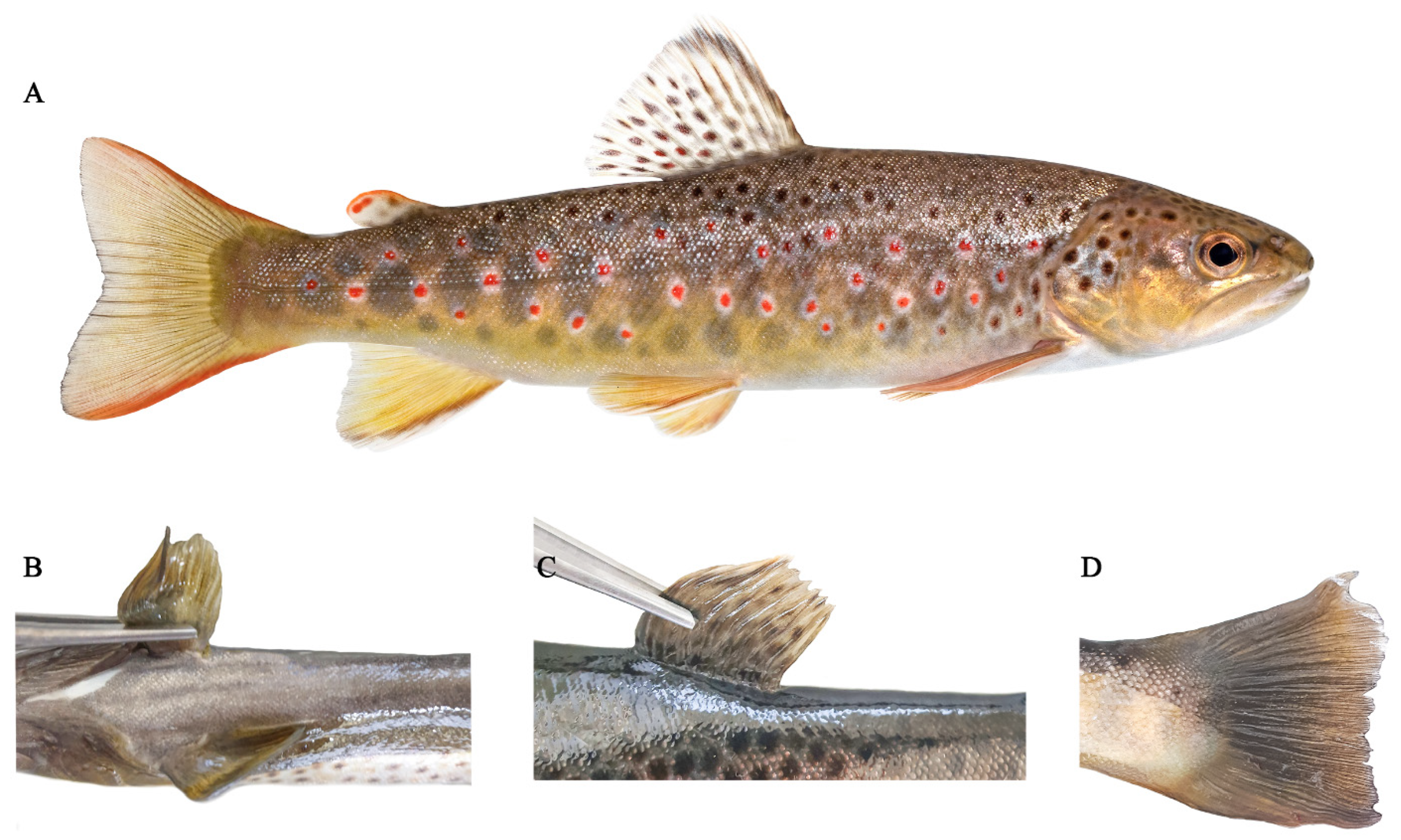
In the laboratory, total length (TL), fork length (FL), and standard length (SL) were measured to the nearest mm, and body weight (Q, ±0.01 g) was recorded. Sex was determined by visual inspection of the gonads. Fish age was determined from scales by counting annual rings. All fish were visually inspected for external diseases or injuries. Fin lesions were assessed using the quantitative photographic key and qualitative descriptions of fin damage proposed by [23] (Figure 2). The adipose fin was excluded from the assessment.
Fulton’s condition factor (CF), representing the overall condition of the fish, was calculated according to [24] as:
CF   =   100 ×   Q / TL 3
All animal procedures complied with Directive 2010/63/EU and relevant national legislation. Fish sampling was conducted on public land under an annual permit issued by the Environmental Protection Agency under the Ministry of Environment of the Republic of Lithuania (Permit No. 026), covering all sampling locations and methods used.

2.3. Blood Collection and General Haematology

Blood was collected from the caudal vein of S. trutta using sterile syringes (1 mL, 25 G needle, 3.8% sodium citrate). General haematological parameters were assessed according to standard procedures [25]. Packed cell volume (PCV) was determined using the microhematocrit centrifugation method [26]. Whole blood was collected into heparinised capillary tubes and centrifuged for 5 min at 10,000 rpm in a microhematocrit centrifuge (HAEMATOKRIT 210, Hettich, Tuttlingen, Germany). PCV was expressed as the percentage ratio of packed erythrocytes to total blood volume (PCV, %).

2.4. Blood Biochemistry

Blood glucose concentration was measured using an automatic glucose analyser (EKSAN-Gm, Analita, Vilnius, Lithuania). The calibration solution (10 mM glucose) and phosphate buffer (0.01 M, pH 7.3) were provided by the manufacturer and used according to the manufacturer’s instructions. Haemoglobin concentration was determined using the cyanmethemoglobin method using Drabkin’s reagent. A standard calibration curve was prepared using human haemoglobin (Sigma-Aldrich, St. Louis, MO, USA, CAS No. 9008-02-0). Drabkin’s solution was prepared according to the manufacturer’s instructions, with the addition of Brij L23 (Sigma-Aldrich, St. Louis, MO, USA) (0.5 mL of 30% solution per litre). Drabkin’s solution was added to standards and blood samples and incubated at room temperature for 15 min. Absorbance was measured spectrophotometrically (UV-1280, Shimadzu Corporation, Kyoto, Japan) at 540 nm, and the total haemoglobin concentration in blood samples was determined from the standard curve.

2.5. Blood Smear Preparation and Cellular Count

Blood smears were prepared immediately after sampling, air-dried, and stained with Giemsa. Differential leukocyte counts were performed by examining 500 cells per smear in homogeneous areas under a Nikon Eclipse 50i (Nikon Corporation, Tokyo, Japan) microscope using a 100× oil-immersion objective lens [27]. Results were expressed as percentages. The frequency of immature erythrocytes (IE, ‰) relative to the total erythrocyte count was calculated according to Equation (2). Immature erythrocytes were identified based on their smaller size, spherical shape, oval to round nucleus, and lightly purple-stained cytoplasm compared with mature erythrocytes [28].
IE ( ) = IE / ( IE + ME ) × 1000
where IE is immature erythrocytes and ME is mature erythrocytes.

2.6. Erythrocytic Nuclear Abnormalities

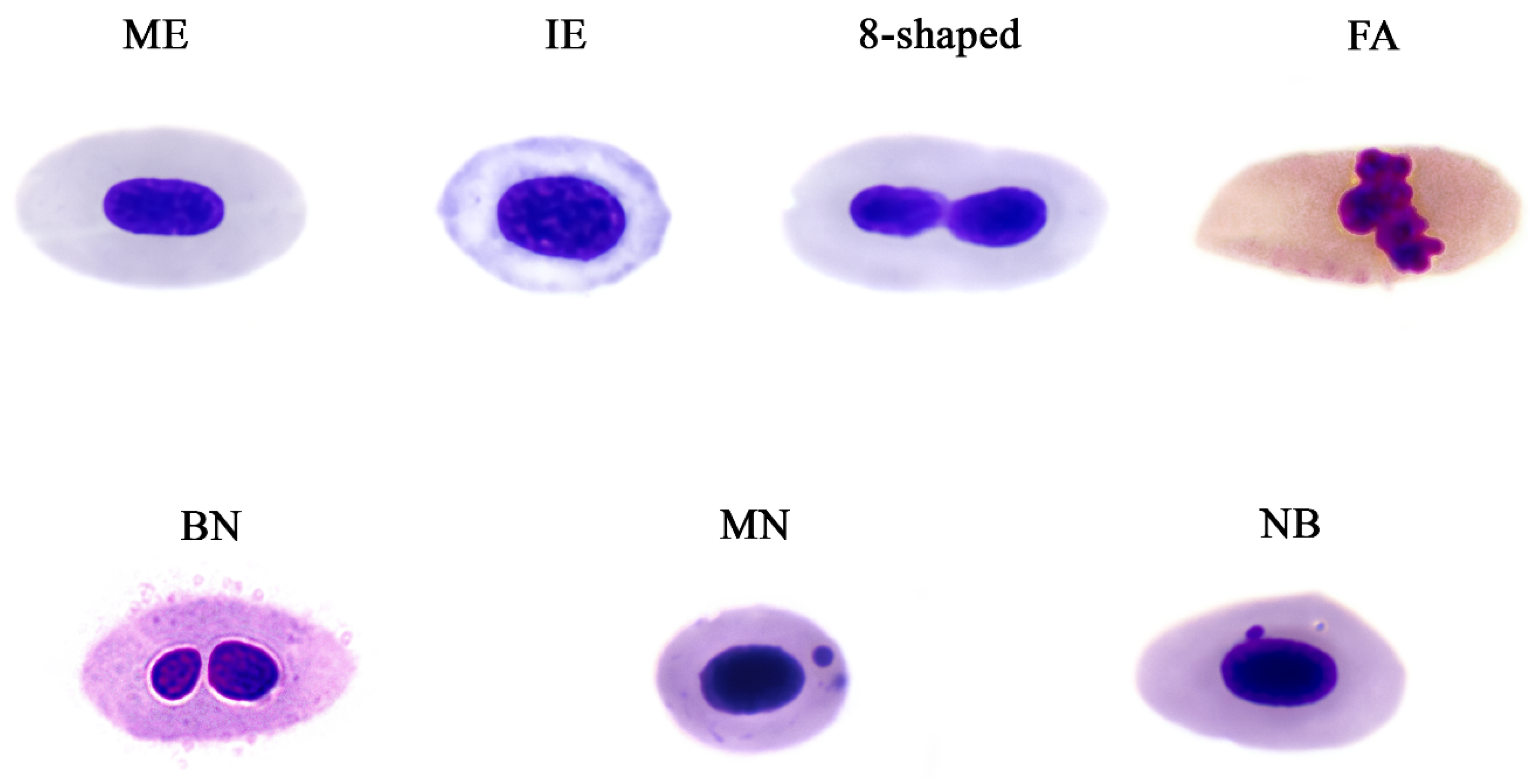
Erythrocytic nuclear abnormalities (ENAs) in peripheral blood smears were evaluated following the criteria described by [16]. Frequencies (‰) of bi-nucleated (BN), 8-shaped nuclei, and fragmented-apoptotic (FA) erythrocytes were used as indicators of cytotoxicity, whereas micronuclei (MN) and nuclear buds (NBs) were used to assess genotoxicity (Figure 3). For ENAs analyses, blood smears were fixed in methanol for 10 min and stained with 10% Giemsa in phosphate buffer (pH 6.8) for 60 min. Slides were examined under a light microscope (Olympus BX51, Olympus, Tokyo, Japan) using a 100× oil-immersion objective lens, and images were captured using an Olympus DP72 digital camera (Olympus, Tokyo, Japan).

2.7. Erythrocyte Morphometry

Erythrocyte morphometry was analysed using ImageJ software (Version 1.54d, [29]) according to the procedure described by de Oliveira et al. (2020) [30] with minor modifications. For each fish, one Giemsa-stained blood smear was analysed. Five randomly selected microscopic fields per slide were photographed using a 40× objective lens, and 20 erythrocytes were measured per image. Measurements were restricted to intact, non-overlapping erythrocytes. For 74 fish, a total of 370 photomicrographs were analysed, comprising 7400 erythrocytes (100 erythrocytes per individual; 3700 cells per group). Analysed morphometric variables included erythrocyte and nuclear area (μm2) and perimeter (μm); nuclear to cell area ratio (nucleus area/cell area), and erythrocyte shape descriptors (circularity, roundness, solidity and aspect ratio), calculated according to Equations (3)–(6).
Circularity = 4 π × Area Perimeter 2
Roundness = 4 × Area π × ( Major   axis ) 2
Solidity = Area Convex   area
Aspect   ratio = Fere t minimum   length Fere t s   maximum   length

2.8. Data Analysis

Data normality and variance homogeneity were assessed using the Shapiro–Wilk and Levene tests, respectively. Parametric data were analysed using the t-test, while non-parametric data were analysed using the Mann–Whitney test. Statistical significance was set at p < 0.05. All statistical analyses and graphical presentations were performed using GraphPad Software, LLC (version 10.6.0, San Diego, CA, USA). Data are expressed as mean ± standard deviation (SD).
Correlation analysis was carried out in R (R Core Team, 2025 [31], version 4.4.2.) and Rstudio (Posit team, 2025 [32], version 2025.9.0.387). Pearson correlation coefficient was calculated using Hmisc package (version 5.2-5, [33]) and visualized using corrplot package (version 0.95, [34]). Correlations with significance level above 0.05 were considered insignificant.

3. Results

3.1. Morphometric Characteristic

In fish exhibiting fin erosion, the pectoral fins were the most severely affected, followed by the dorsal and caudal fins, while the pelvic and anal fins were uneroded in all fish. Fish with normal fins showed no signs of fin erosion (score = 0). Among fish with eroded fins, anal and pelvic fins scored 0 (uneroded); caudal fin ranged from 1 (approx. 43%) to 2 (approx. 57%); dorsal fin from 2 (57%) to 3 (43%); and pectoral fins from 4 (38%) to 5 (62%) categories of damage (Supplementary Table S5, according to Reference [23]. In cases where the right and left pectoral fins exhibited different degrees of erosion, the damage was scored based on the more severely affected fin. In the eroded fin group, 94.6% of fish were 2 years old (2+) and 5.4% were 3 years old (3+), with a sex ratio of 21.6% males and 78.4% females. In the normal (uneroded) fin group, 27% were 2+ and 73% were 3+, with 43.3% males and 56.7% females.
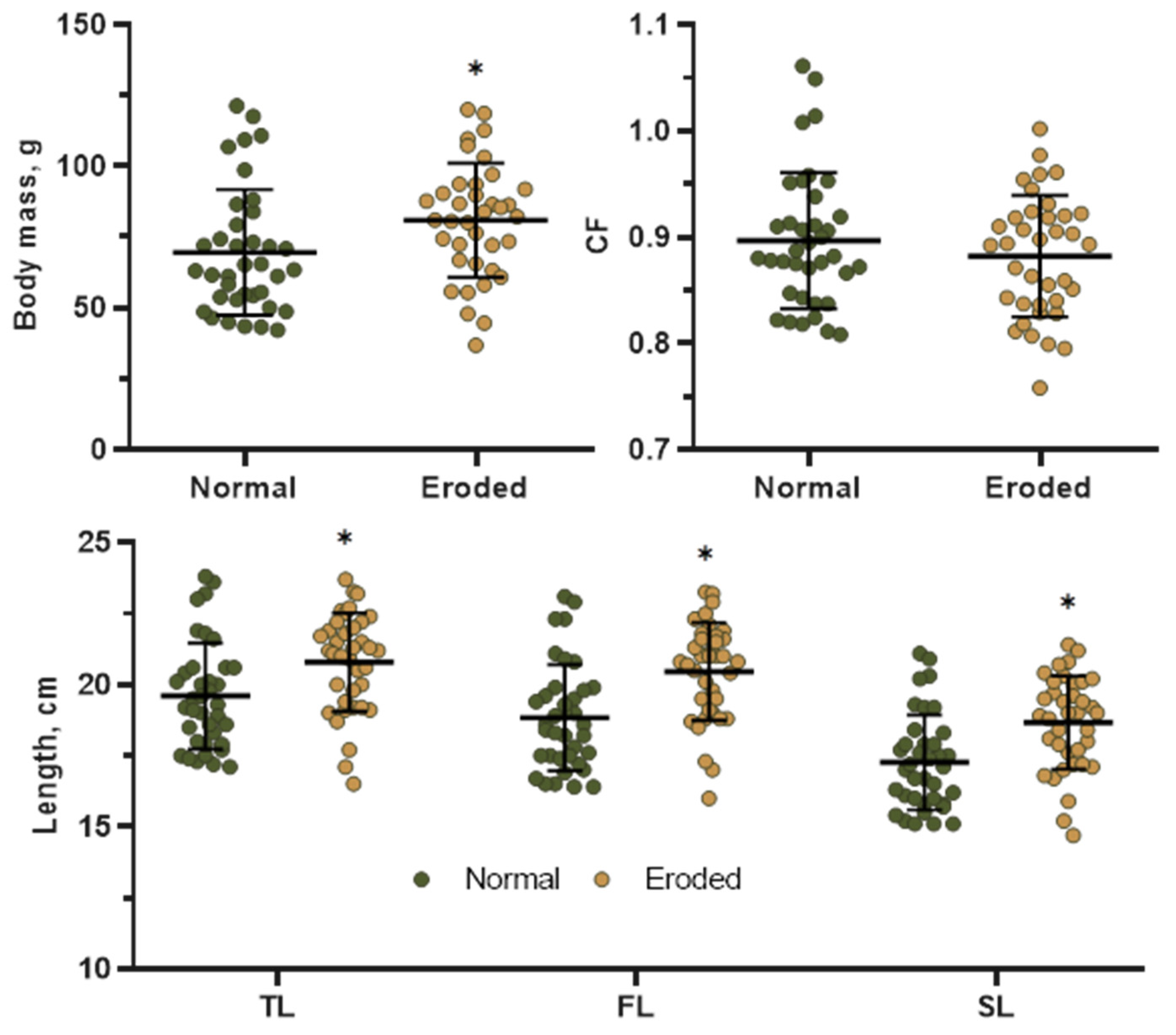
Differences in morphometric characteristics were observed between S. trutta with different fin conditions (Figure 4). Fish with eroded fins had a mean weight of 80.9 ± 10.5 g, which was 16.2% higher than that of fish with normal fins (69.6 ± 12.3 g); this difference was statistically significant (t(72) = 3.21, p = 0.002). A similar pattern was observed for fish length, with eroded-fin fish having higher total length (TL: 20.79 ± 1.73 cm, 6.1% higher vs. 19.60 ± 1.87 cm), fork length (FL), and standard length (SL) compared to normal-fin fish; these differences were significant (TL: t(72) = 2.83, p = 0.006; FL: t(72) = 3.88, p = 0.0002; SL: t(72) = 3.63, p = 0.0005). In contrast, the mean condition factor was slightly higher in normal-fin fish (0.90 ± 0.06) compared to eroded-fin fish (0.88 ± 0.06), corresponding to a 2.2% difference; however, this difference was not statistically significant (t(72) = 1.04, p = 0.30).
Differences in morphometric characteristics (length, body mass and condition factor) of Salmo trutta in relation to sex are presented in Supplementary Table S1. In individuals with uneroded (normal) fins, significant (all p ≤ 0.04) sexual dimorphism was observed for all measured traits, with males consistently larger than females. In contrast, no significant differences between sexes were detected in the eroded fin group. Comparisons within the same sex across the two fin condition groups revealed significant differences (all p < 0.001) among females for all parameters except CF, whereas males showed no significant variation in morphometric characteristics between normal and eroded fins (Supplementary Table S1).

3.2. Haematological Parameters

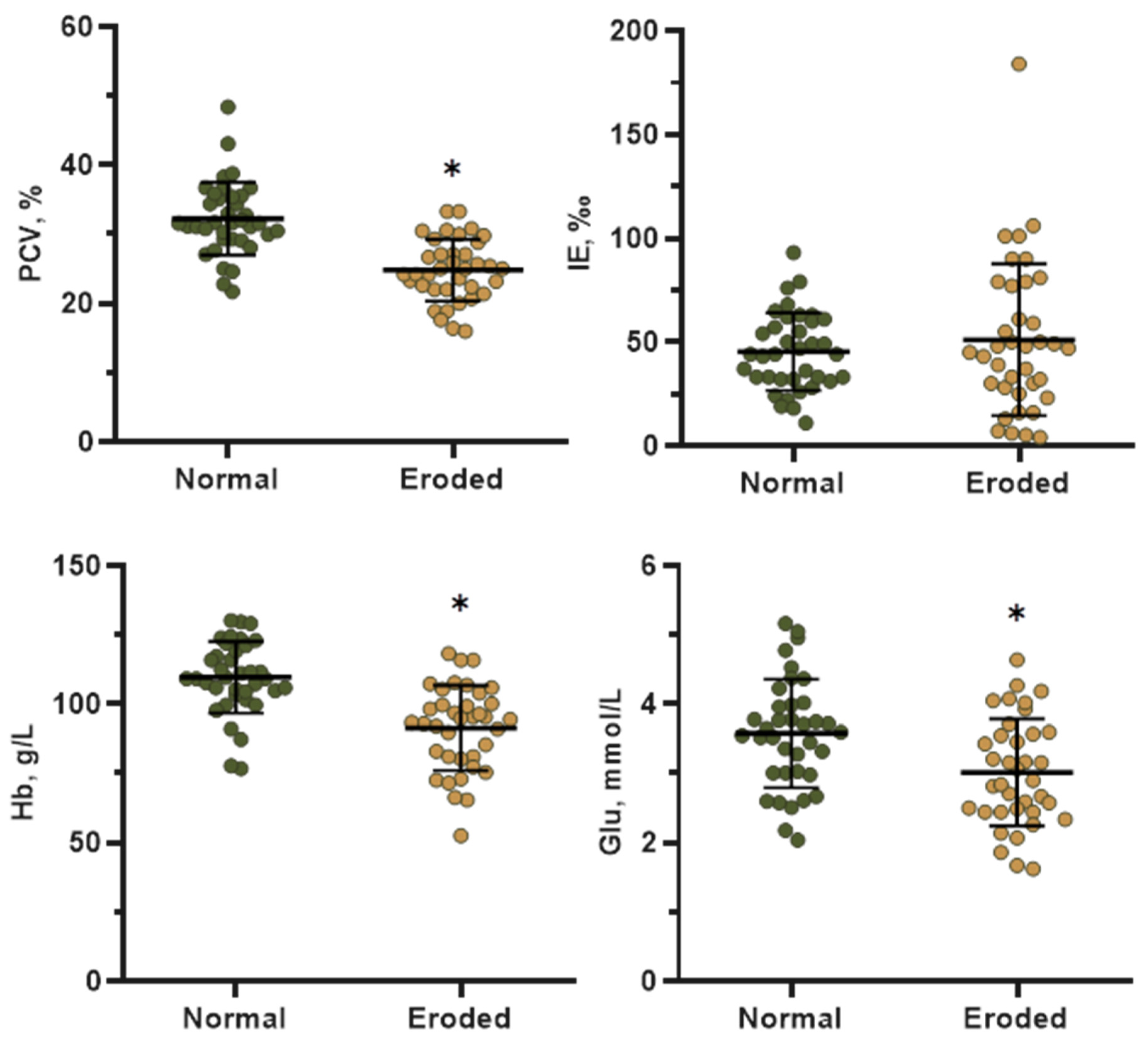
Differences in haematological parameters were observed between S. trutta with different fin conditions, including packed cell volume (PCV), haemoglobin concentration (Hb), and glucose levels (Figure 5). Fish with normal fin condition had higher PCV (32.26 ± 5.25, 23.1% higher), Hb (109.7 ± 12.93, 16.6% higher), and glucose levels (3.58 ± 0.78, 15.6% higher) compared to eroded-fin fish (PCV: 24.81 ± 4.45; Hb: 91.44 ± 15.29; glucose: 3.02 ± 0.77). Conversely, the proportion of immature erythrocytes was higher in eroded-fin fish (51 ± 36.63) than in normal-fin fish (45.24 ± 18.70), representing a 12.7% increase. Statistical analyses indicated that differences in PCV (t(72) = 6.59, p < 0.0001), Hb (t(72) = 5.54, p < 0.0001), and glucose (t(72) = 3.1, p = 0.003) were statistically significant, while the difference in immature erythrocytes was not significant (p > 0.05).
Differences in haematological parameters of Salmo trutta in relation to sex are presented in Supplementary Table S2. In individuals with normal fins, significant (both p < 0.02) sexual dimorphism was observed for Hb and PCV, with males showing higher values than females. No significant differences between sexes were detected in the eroded fin group. Comparisons within the same sex across the two fin condition groups revealed significant (all p < 0.02) differences in PCV and Hb for both sexes, and in glucose for females (Supplementary Table S2).
Differential leukocyte counts did not differ significantly between S. trutta with different fin conditions (Table 1 and Table S3). However, erythrocyte morphometry differed in the eroded fin group compared to fish with normal fins, with variations observed in red blood cell (RBC) cellular and nuclear parameters. Erythrocyte cellular circularity and solidity, as well as nuclear circularity and solidity, were higher in normal-fin fish compared to eroded-fin fish, with increases of 5.8% (t(72) = 3.67, p = 0.0005), 1.05% (t(72) = 3.41, p = 0.001), 2.6% (t(72) = 3.18, p = 0.002), and 1.06% (t(72) = 4.11, p = 0.0001), respectively. In contrast, RBC cellular perimeter was significantly higher in eroded-fin fish, increasing by 4.6% (t(72) = 2.85, p = 0.006).
Erythrocyte morphometric characteristics of Salmo trutta in relation to sex are presented in Supplementary Table S3. Certain erythrocyte parameters differed significantly between males and females. Comparisons within the same sex between the two fin condition groups revealed significant differences (all p ≤ 0.02) in erythrocyte and erythrocytes nucleus morphometric parameters, showing the same trend in biomarker responses as observed in Table 1 (combined sexes), with additional significant differences in erythrocyte aspect ratio, roundness, and erythrocyte nucleus area/cell area ratio in males (Supplementary Table S3).

3.3. Erythrocytic Nuclear Abnormalities

The frequency of erythrocytic nuclear abnormalities differed between S. trutta with normal and eroded fins (Table 2). Fish with normal fins exhibited higher mean levels of the genotoxicity biomarkers micronuclei (MN) and nuclear buds (NB), although these differences were not statistically significant (p = 0.06 and p = 0.33, respectively). In contrast, fish with eroded fins showed increased frequencies of the cytotoxicity biomarkers 8-shaped and fragmented/apoptotic (FA) nuclei. The frequency of 8-shaped nuclei erythrocytes was significantly higher in individuals with eroded fins (p < 0.0001), representing a 293% increase compared to fish with normal fins.
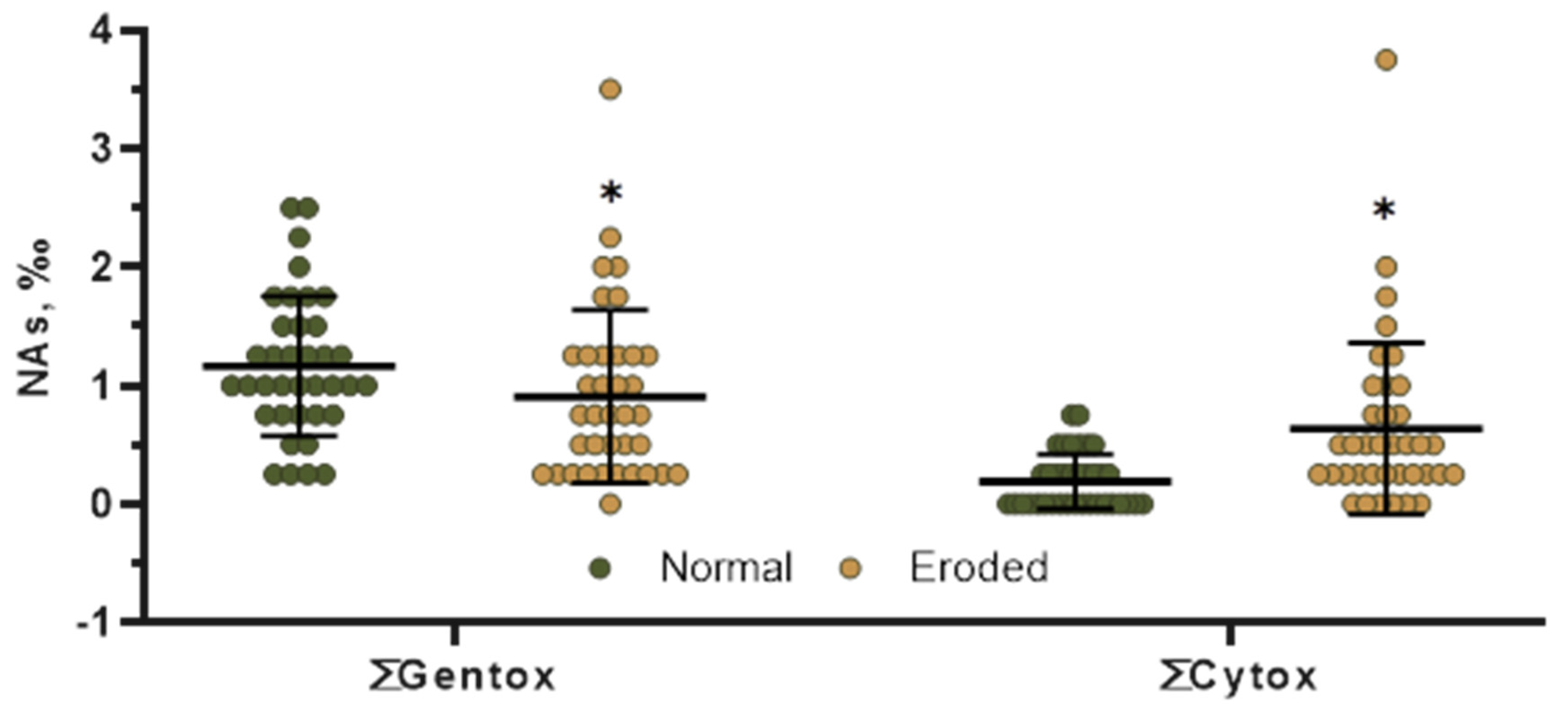
Total genotoxicity and cytotoxicity in S. trutta varied with fin condition (Figure 6). Fish with normal fins showed higher total genotoxicity, whereas fish with eroded fins had higher total cytotoxicity, representing a 22% decrease in genotoxicity and a 236% increase in cytotoxicity. Both differences were statistically significant (genotoxicity: p = 0.032; cytotoxicity: p = 0.0001).
The frequency of erythrocytic nuclear abnormalities in Salmo trutta in relation to sex and fin condition is presented in Supplementary Table S4. Significant differences (p = 0.01) between males and females were observed only for NBs in the normal fin fish group. Within the same sex, comparisons between fin condition groups revealed significant differences in males for micronuclei (p = 0.04) and total genotoxicity (p = 0.02), and in females for 8-shaped nuclei (p = 0.003) and total cytotoxicity (p = 0.001).
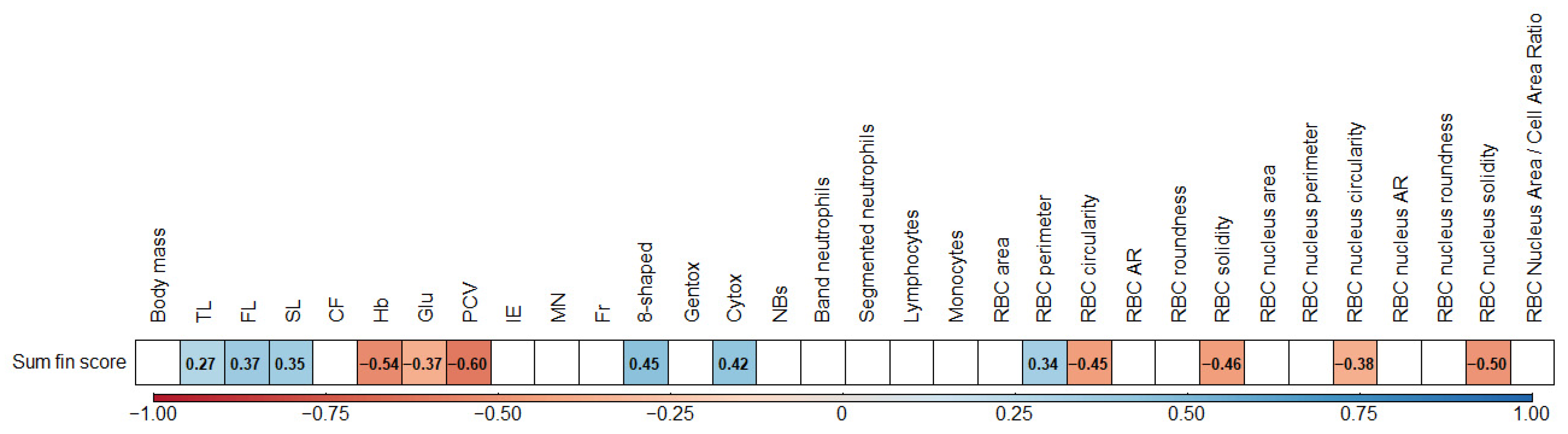
Correlation patterns between fin erosion severity and biomarker responses in Salmo trutta are presented in Figure 7 and Figure S1. Fin erosion severity was calculated as the cumulative sum of categorical scores assigned to the pelvic, dorsal, and caudal fins (Figure 7). Correlations for each fin type are provided in Supplementary Figure S1, as similar patterns were observed across all fins. Fin erosion severity exhibited significant positive correlations with morphometric parameters, including total length (TL; p = 0.019), fork length (FL; p = 0.001), and standard length (SL; p = 0.002).
Among cellular biomarkers, significant positive associations were observed with erythrocytic nuclear abnormalities, specifically the frequency of 8-shaped nuclei (p = 0.0001), and with total cytotoxicity (Cytox; p = 0.0002). A significant positive correlation was also detected with the erythrocyte morphometric parameter RBC perimeter (p = 0.003). In contrast, fin erosion severity was negatively correlated with RBC circularity, RBC solidity, nucleus circularity, and nucleus solidity (all p ≤ 0.001).
Significant negative correlations were also observed between fin erosion severity and hematological parameters, including hemoglobin concentration (Hb; p < 0.0001), glucose level (p = 0.001), and packed cell volume (PCV; p < 0.0001).

4. Discussion

Although fin erosion can occur in wild populations, its prevalence and severity are markedly higher in aquaculture settings, making it a useful indicator of hatchery origin. This issue is recognised as an important welfare and health concern [35]. In aquaculture, it can reduce the visual quality of fish and may affect their survival after release into natural habitats. Fisheries service personnel responsible for hatchery rearing and stocking confirmed via personal communication that stocked trout typically exhibit eroded fins, with nearly all fish showing some degree of fin erosion at the time of release, particularly among the larger individuals used for restocking. In this study, we examined the relationship between fin deformities and haematological parameters and erythrocytic nuclear abnormalities in Salmo trutta from a river with good ecological status, to evaluate how such deformities might influence biomarker variability and the reliability of biological monitoring. Fish in the eroded fin group were mainly younger (2+) but on average larger and heavier than those with normal fins. The pectoral fins were the most severely eroded, followed by the dorsal and caudal fins, whereas the pelvic and anal fins remained normal. This pattern of fin erosion, together with the greater body length and mass observed in these individuals, is consistent with characteristics commonly reported for aquaculture-reared salmonids. However, the origin of individual fish (wild vs. hatchery-reared) could not be verified independently in this study. Therefore, fin condition was considered only an indicative characteristic suggesting a possible aquaculture origin of fish with eroded fins and was interpreted together with other information, such as biometric traits, age structure, and known stocking occasions in current river. Morphometric differences between S. trutta with eroded and normal fins were statistically confirmed, indicating a clear link between fin condition and growth history. Fish with eroded fins were significantly larger in weight and length, although their condition factor did not differ significantly from normal-fin fish. This pattern aligns with what is commonly observed in aquaculture-reared fish, which tend to grow faster and reach greater sizes than wild conspecifics at the same age [36]. Even after introduction into natural environments, these fish may initially retain a size advantage despite potential limitations in swimming performance or behaviour associated with fin damage; however, aquaculture-reared fish frequently lose this initial size and weight advantage over time following release [37]. The similar condition factor suggests that, although larger, these individuals do not necessarily have better overall body condition, possibly reflecting stress or physiological adjustments to natural conditions.
Lower glucose levels in fish with eroded fins may reflect changes in energy balance associated with tissue damage. Fin erosion can affect swimming performance and prey capture, potentially leading to reduced or less efficient feeding. Previous studies have shown that different groups of trout, such as stocked and wild individuals, can consume different types of prey [38], and that hatchery-reared fish often differ from wild fish in behaviour, growth, and feeding patterns [39]. In addition, studies in other species have shown that severe fin deformities can impair the use of pectoral fins for maintaining position in the water column, leading to earlier onset of fatigue and increased energy expenditure [40]. Taken together, these findings suggest that both reduced energy intake and increased energetic demands associated with fin damage could contribute to the lower glucose levels observed, highlighting the potential physiological consequences of fin deformities for fish health and energy metabolism.
In addition to glucose, several haematological parameters differed between fish with normal and eroded fins. Packed cell volume (PCV) and haemoglobin (Hb) concentrations were higher in fish with normal fins, whereas individuals with fin erosion generally exhibited lower values. Baseline values reported for cultured Salmo trutta (m. fario) under normal conditions include a haematocrit of approximately 35% and haemoglobin concentrations around 99 g L−1 [41], with slightly higher but non-significant values reported for males compared with females. In the present study, fish with eroded fins showed haemoglobin concentrations within a comparable range (91.4 g/L) but a substantially lower haematocrit (PCV 25%), and no significant differences between males and females were observed in this group. In contrast, fish with normal fins exhibited significantly higher haemoglobin levels (109.7 g/L) and haematocrit values (PCV 32%), with clear sex-specific differences: males had higher Hb and PCV than females. Higher haematocrit and haemoglobin concentrations are associated with improved oxygen-carrying capacity and aerobic performance, which may support sustained swimming and feeding activity [42,43,44].
Differential leukocyte counts did not differ significantly between fin condition groups, suggesting no marked differences in immune cell profiles. Overall, immature erythrocyte frequencies also did not differ significantly between groups, indicating comparable erythropoietic activity. However, a small number of individuals with fin erosion displayed markedly elevated frequencies of immature erythrocytes (>100‰, maximum 184‰), most of which were accompanied by low Hb and PCV values. No such extreme values were observed in fish with normal fins. It is known that mature erythrocytes in fish, compared with immature cells, contain higher concentrations of haemoglobin, the primary protein responsible for oxygen transport in the blood [45]. In fish haematology, immature erythrocytes normally occur at low frequencies, and elevated proportions have been linked to impaired oxygen availability and stress-related physiological disturbance [41].
Erythrocyte morphometry differed between fish with normal and eroded fins, suggesting that fin condition was associated with changes in red blood cell structure. Fish with normal fins showed higher erythrocyte and nuclear circularity and solidity, whereas fish with eroded fins had cells with a larger perimeter. Such changes may reflect altered erythropoiesis or physiological stress, as erythrocyte shape and nuclear morphology are known to be sensitive to metabolic disturbances, oxygen demands, and environmental stressors [26,30]. In addition, the morphology and composition of fish erythrocytes can be influenced by life-history traits, swimming activity, and metabolic rate, with larger or less circular cells potentially reducing oxygen transport efficiency [46,47,48]. While information on cytometric indices in fish remains limited, particularly in wild populations, the alterations in erythrocyte morphology observed in fish with fin erosion may reflect compromised cellular integrity, with potential implications for aerobic capacity and overall physiological performance. Cell size is a fundamental biological trait that affects cellular function, physiological adaptation, and evolutionary processes [49]. The ErythroCite database demonstrates that teleosts, including salmonids, exhibit considerable natural variation in erythrocyte size, highlighting the need for further global exploration of erythrocyte diversity and function in fish [49].
Erythrocytic nuclear abnormalities differed in the frequencies of genotoxic and cytotoxic biomarkers between fish groups. The predominance of cytotoxic nuclear alterations in fish with eroded fins aligns with the broader pattern of physiological responses observed in these individuals. Altered erythrocyte morphometry, together with lower haemoglobin and PCV and occasional increases in immature erythrocytes, suggests that fin damage is associated with stress-related disruption of cellular homeostasis and oxygen transport. Similarly, reduced glucose levels indicate changes in energy balance, likely reflecting the combined effects of increased energetic demands and impaired swimming or feeding performance. These observations support the interpretation that cytotoxic nuclear changes primarily reflect secondary physiological stress rather than direct cytogenetic damage, particularly in a river classified as having good environmental status, highlighting how fin condition may affect erythrocyte integrity and overall cellular function in fish. Nuclear abnormalities are also known to be influenced by nutritional status and energy balance in fish [16]. Elevated cytotoxicity biomarkers may additionally reflect previous environmental conditions in aquaculture settings, such as water and feed quality, including exposure to mycotoxins in aquafeeds [50], as well as current nutritional conditions in the natural environment.
To further explore the patterns underlying the observed physiological and cytological differences, correlation analysis was performed between fin erosion severity and biomarker responses. The observed correlations between biomarker responses and fin erosion indicate that increasing fin erosion severity in Salmo trutta is associated with larger body size (length), higher frequencies of erythrocyte nuclear abnormalities, elevated cytotoxic responses, and significant alterations in erythrocyte morphometric parameters. These results suggest that fin erosion may serve as a sensitive indicator of underlying physiological stress, leading to disruptions in haematological homeostasis and metabolic function. Overall, the correlation patterns further support the conclusion that fin erosion reflects systemic physiological disturbances, which may compromise the fitness and resilience of affected individuals.
Overall, these findings indicate that fin condition is associated with distinct profiles of multiple biomarkers, including erythrocytic nuclear abnormalities, haematological indices, glucose levels, and erythrocyte morphology. Such differences likely reflect the physiological consequences of tissue damage and altered cellular homeostasis, rather than direct exposure to environmental stressors or pollutants, highlighting that the physical condition of fins can influence biomarker responses in fish. Fin condition was used as an indicative marker of hatchery origin, supported by biometric traits, age, and known stocking occasions, but it cannot fully account for all potential stressors experienced during aquaculture rearing (e.g., diet, crowding, handling during stocking). Therefore, the observed biomarker responses likely reflect a combination of tissue damage and broader hatchery-related physiological stress, rather than being solely attributable to fin erosion. Further studies should investigate the health of fish exhibiting fin erosion prior to their release into natural environments to better understand the effects of aquaculture-related stressors on post-release performance and biomarker responses. This is particularly important for biological monitoring studies, as the impact of fin damage on baseline biomarker levels should be considered when interpreting results.

5. Conclusions

Sampling of juvenile S. trutta in the river Žalesa, which has good environmental status, was conducted during routine monitoring; this river is also part of restocking programs, which may contribute to the presence of individuals with eroded fins. The findings of this study highlight that fin integrity and the physiological consequences of fin damage can influence baseline biomarker profiles independently of environmental stressors (e.g., pollution). These findings have important implications for biological monitoring, as variation in fin condition may affect multiple biomarker responses and should be considered when interpreting indicators of fish health or linking responses to environmental stressors. Furthermore, assessing physiological and cellular biomarkers before releasing fish in restocking programs can help ensure that individuals are healthy and capable of surviving and integrating successfully into natural populations, thereby enhancing both conservation outcomes and the reliability of biomonitoring assessments.

Supplementary Materials

The following supporting information can be downloaded at: https://www.mdpi.com/article/10.3390/fishes11030181/s1, Table S1. Morphometric characteristics of fish with normal and eroded fins in relation to sex; Table S2. Haematological parameters of fish with normal and eroded fins in relation to sex; Table S3. Summary of differential leucocyte counts and red blood cell morphometry (cellular and nuclear parameters) in Salmo trutta with different fin conditions in relation to sex; Table S4. Frequency of genotoxicity and cytotoxicity parameters in peripheral blood erythrocytes of Salmo trutta with different fin conditions in relation to sex; Table S5. Scores of pectoral, dorsal, and caudal fin damage in the eroded-fin fish group; Figure S1. Correlation analyses between fin erosion severity and biomarker responses in Salmo trutta. Only statistically significant correlations (p < 0.05) are indicated by colour, where blue represents positive correlations and red represents negative correlations. The intensity of the colour reflects the strength of the correlation.

Author Contributions

Conceptualization, M.S. and J.D.; methodology, M.S., J.D., Ž.J., J.P. and A.B.; formal analysis, M.S., J.D., Ž.J., J.P. and A.B.; investigation, M.S., J.D., Ž.J., J.P. and A.B.; resources, M.S.; data curation, M.S.; writing—original draft preparation, M.S., J.D., Ž.J., J.P. and A.B.; writing—review and editing, M.S., J.D., Ž.J., J.P. and A.B.; visualization, M.S., J.D. and A.B.; supervision, M.S.; project administration, M.S.; funding acquisition, M.S. All authors have read and agreed to the published version of the manuscript.

Funding

This study was carried out as part of the EU BIODIVERSA+ and Research Council of Lithuania (LMTLT, project number: S-BIODIVERSA-23-1) funded project “New approaches in determining the impacts of chemical pollution to protect the biodiversity of the Baltic Sea” (Detect2Protect).

Institutional Review Board Statement

All sampling and surveys were conducted in accordance with the Lithuanian law. Permits for fish sampling were issued by the Environmental Protection Agency under the Ministry of Environment of the Republic of Lithuania. The animal study protocol was approved by the Animal Welfare Committee of the State Scientific Research Institute Nature Research (Reference No.: GGT-11; Approval date: 18 February 2026).

Data Availability Statement

The raw data of this study are not publicly available but can be obtained from the corresponding author upon reasonable request.

Acknowledgments

The authors thank Justas Dainys (Waterlife, https://waterlife.lt/) (accessed on 8 February 2026) for providing the photograph of Salmo trutta used in this publication.

Conflicts of Interest

The authors declare no conflicts of interest.

References

  1. Deinet, S.; Scott-Gatty, K.; Rotton, H.; Twardek, W.M.; Marconi, V.; McRae, L.; Baumgartner, L.J.; Brink, K.; Claussen, J.E.; Cooke, S.J.; et al. The Living Planet Index (LPI) for Migratory Freshwater Fish: Technical Report; World Fish Migration Foundation: Groningen, The Netherlands, 2024. [Google Scholar]
  2. FAO. In Brief to The State of World Fisheries and Aquaculture 2024; FAO: Rome, Italy, 2024. [Google Scholar] [CrossRef]
  3. Tickner, D.; Opperman, J.J.; Abell, R.; Acreman, M.; Arthington, A.H.; Bunn, S.E.; Cooke, S.J.; Dalton, J.; Darwall, W.; Edwards, G.; et al. Bending the Curve of Global Freshwater Biodiversity Loss: An Emergency Recovery Plan. Bioscience 2020, 70, 330–342. [Google Scholar] [CrossRef]
  4. Gordon, T.A.C.; Harding, H.R.; Clever, F.K.; Davidson, I.K.; Davison, W.; Montgomery, D.W.; Weatherhead, R.C.; Windsor, F.M.; Armstrong, J.D.; Bardonnet, A.; et al. Fishes in a changing world: Learning from the past to promote sustainability of fish populations. J. Fish Biol. 2018, 92, 804–827. [Google Scholar] [CrossRef]
  5. Jaureguiberry, P.; Titeux, N.; Wiemers, M.; Bowler, D.E.; Coscieme, L.; Golden, A.S.; Guerra, C.A.; Jacob, U.; Takahashi, Y.; Settele, J.; et al. The direct drivers of recent global anthropogenic biodiversity loss. Sci. Adv. 2022, 8, eabm9982. [Google Scholar] [CrossRef]
  6. Barrow, J.S.; Yen, J.D.L.; Koehn, J.D.; Morrongiello, J.R. Increasing early life growth of hatchery-reared freshwater fish can improve stocking outcomes. Mar. Freshw. Res. 2021, 72, 526–533. [Google Scholar] [CrossRef]
  7. Lejk, A.M.; Hliwa, P. Reproductive parameters of wild and hatchery-reared sea trout (Salmo trutta m. trutta L.) females from the Łeba River (southern Baltic Sea). J. Fish Biol. 2026; Online ahead of print. [Google Scholar] [CrossRef]
  8. Latremouille, D.N. Fin Erosion in Aquaculture and Natural Environments. Rev. Fish. Sci. 2003, 11, 315–335. [Google Scholar] [CrossRef]
  9. Abbott, J.C.; Dill, L.M. Patterns of Aggressive Attack in Juvenile Steelhead Trout (Salmo gairdneri). Can. J. Fish. Aquat. Sci. 1985, 42, 1702–1706. [Google Scholar] [CrossRef]
  10. Pelis, R.M.; McCormick, S.D. Fin development in stream- and hatchery-reared Atlantic salmon. Aquaculture 2003, 220, 525–536. [Google Scholar] [CrossRef]
  11. Yue, G.H.; Wen, Y.F.; Sun, F.; Wang, L.; Yang, Z.; Pang, H.Y. Occurrence of dorsal fin and opercular deformities and their effects on body weight in Asian seabass. Aquaculture 2022, 561, 738694. [Google Scholar] [CrossRef]
  12. Petersson, E.; Karlsson, L.; Ragnarsson, B.; Bryntesson, M.; Berglund, A.; Stridsman, S.; Jonsson, S. Fin erosion and injuries in relation to adult recapture rates in cultured smolts of Atlantic salmon and brown trout. Can. J. Fish. Aquat. Sci. 2013, 70, 915–921. [Google Scholar] [CrossRef]
  13. Wlklund, T.; Bylund, G. Fin abnormalities of pikeperch in coastal areas off the Finnish south coast. J. Fish Biol. 1996, 48, 652–657. [Google Scholar] [CrossRef]
  14. Kroon, F.; Streten, C.; Harries, S. A protocol for identifying suitable biomarkers to assess fish health: A systematic review. PLoS ONE 2017, 12, e0174762. [Google Scholar] [CrossRef]
  15. Witeska, M.; Kondera, E.; Ługowska, K.; Bojarski, B. Hematological methods in fish—Not only for beginners. Aquaculture 2022, 547, 737498. [Google Scholar] [CrossRef]
  16. Stankevičiūtė, M.; Gomes, T.; González, J.A.C. Nuclear abnormalities in mussel haemocytes and fish erythrocytes. In ICES Techniques in Marine Environmental Science (TIMES); The International Council for the Exploration of the Sea (ICES): Copenhagen, Denmark, 2022. [Google Scholar] [CrossRef]
  17. Merola, C.; Bisegna, A.; Angelozzi, G.; Conte, A.; Abete, M.C.; Stella, C.; Pederiva, S.; Faggio, C.; Riganelli, N.; Perugini, M. Study of Heavy Metals Pollution and Vitellogenin Levels in Brown Trout (Salmo trutta trutta) Wild Fish Populations. Appl. Sci. 2021, 11, 4965. [Google Scholar] [CrossRef]
  18. Orso, G.; Imperatore, R.; Coccia, E.; Rinaldi, G.; Cicchella, D.; Paolucci, M. A Deep Survey of Fish Health for the Recognition of Useful Biomarkers to Monitor Water Pollution. Environments 2023, 10, 219. [Google Scholar] [CrossRef]
  19. Lithuanian Hydropower Association. Small-Scale Hydropower; Trys žvaigždutės; River Publishers: Vilnius, Lithuania, 2017; 108p. [Google Scholar]
  20. Barvidienė, O. Research and Evaluation of Overgrowth of Regulated Streams with Woody Vegetation. Doctoral Dissertation, Vilnius Gediminas Technical University, Vilnius, Lithuania, 2009; 149p. Available online: https://etalpykla.vilniustech.lt/handle/123456789/108276 (accessed on 6 January 2026).
  21. Stakėnas, S.; Rakauskas, V. Monitoring the Effectiveness of the Skirgiškės Fish Pass Installed by the Environmental Protection Agency in 2014–2016 on the Žalesa River, in the Basin of the Small Tributaries of the Neris River; Final Report; Nature Research Centre: Vilnius, Lithuania, 2022; p. 40. [Google Scholar]
  22. EPA. Ecological Status of Rivers and Lakes. 2024. Available online: https://old.gamta.lt/cms/index?rubricId=f47cc0ee-8e4f-4377-931b-173c4c1be194 (accessed on 6 January 2026).
  23. Hoyle, I.; Oidtmann, B.; Ellis, T.; Turnbull, J.; North, B.; Nikolaidis, J.; Knowles, T.G. A validated macroscopic key to assess fin damage in farmed rainbow trout (Oncorhynchus mykiss). Aquaculture 2007, 270, 142–148. [Google Scholar] [CrossRef]
  24. Ricker, W.E. Computation and Interpretation of Biological Statistics of Fish Populations; Bulletin of the Fisheries Research Board of Canada: Ottawa, ON, Canada, 1975. [Google Scholar]
  25. Svobodova, Z.; Pravda, D.; Palackova, J. Unified Methods of Haematological Examination of Fish; Research Institute of Fish Culture and Hydrobiology: Vodňany, Czech Republic, 1991. [Google Scholar]
  26. Witeska, M.; Kondera, E.; Lugowska, K. The effects of ichthyophthiriasis on some haematological parameters in common carp. Turk. J. Vet. Anim. Sci. 2010, 34, 267–271. [Google Scholar] [CrossRef]
  27. Natt, M.P.; Herrick, C.A. A New Blood Diluent for Counting the Erythrocytes and Leucocytes of the Chicken. Poult. Sci. 1952, 31, 735–738. [Google Scholar] [CrossRef]
  28. Witeska, M.; Kondera, E.; Bojarski, B. Hematological and Hematopoietic Analysis in Fish Toxicology—A Review. Animals 2023, 13, 2625. [Google Scholar] [CrossRef] [PubMed]
  29. Schneider, C.A.; Rasband, W.S.; Eliceiri, K.W. NIH Image to ImageJ: 25 years of image analysis. Nat. Methods 2012, 9, 671–675. [Google Scholar] [CrossRef]
  30. de Oliveira, J.S.P.; Vieira, L.G.; Carvalho, W.F.; de Souza, M.B.; de Lima Rodrigues, A.S.; Simões, K.; de Melo De Silva, D.; dos Santos Mendonça, J.; Hirano, L.Q.L.; Santos, A.L.Q.; et al. Mutagenic, genotoxic and morphotoxic potential of different pesticides in the erythrocytes of Podocnemis expansa neonates. Sci. Total Environ. 2020, 737, 140304. [Google Scholar] [CrossRef]
  31. R Core Team. R: A Language and Environment for Statistical Computing, Version 4.4.2. [Computer software]. R Foundation for Statistical Computing: Vienna, Austria, 2025. Available online: https://www.R-project.org/ (accessed on 5 February 2026).
  32. Posit Team. RStudio: Integrated Development Environment for R, Version 2025.9.0.387. [Computer software]. Posit PBC: Boston, MA, USA, 2025. Available online: http://www.rstudio.com/ (accessed on 5 February 2026).
  33. Harrell, F.E., Jr.; Beck, C.; Dupont, C. Hmisc: Harrell Miscellaneous, Version 5.2-5. [Computer Software]. CRAN: Singapore, 2026. Available online: https://cran.r-project.org/web/packages/Hmisc/index.html (accessed on 5 February 2026).
  34. Wei, T.; Simko, V.; Levy, M.; Xie, Y.; Jin, Y.; Zemla, J.; Freidank, M.; Cai, J.; Protivinsky, T. Corrplot: Visualization of a Correlation Matrix, Version 0.95. [Computer Software]. CRAN: Singapore, 2024. Available online: https://cran.r-project.org/web/packages/corrplot/index.html (accessed on 3 March 2026).
  35. Ellis, T.; Hoyle, I.; Oidtmann, B.; Turnbull, J.F.; Jacklin, T.E.; Knowles, T.G. Further development of the “Fin Index” method for quantifying fin erosion in rainbow trout. Aquaculture 2009, 289, 283–288. [Google Scholar] [CrossRef]
  36. Lorenzen, K.; Beveridge, M.C.M.; Mangel, M. Cultured fish: Integrative biology and management of domestication and interactions with wild fish. Biol. Rev. 2012, 87, 639–660. [Google Scholar] [CrossRef]
  37. Weiss, S.; Schmutz, S. Performance of Hatchery-Reared Brown Trout and Their Effects on Wild Fish in Two Small Austrian Streams. Trans. Am. Fish. Soc. 1999, 128, 302–316. [Google Scholar] [CrossRef]
  38. Teixeira, A.; Cortes, R.M.V. Diet of stocked and wild trout, Salmo trutta: Is there competition for resources? Folia Zool. 2006, 55, 61–73. [Google Scholar]
  39. Einum, S.; Fleming, I. Implications of stocking: Ecological interactions between wild and released Salmonids. Nord. J. Freshw. Res. 2001, 75, 56–70. [Google Scholar]
  40. Deslauriers, D.; Johnston, R.; Chipps, S.R. Effect of Morphological Fin-Curl on the Swimming Performance and Station-Holding Ability of Juvenile Shovelnose Sturgeon. J. Fish Wildl. Manag. 2016, 7, 198–204. [Google Scholar] [CrossRef]
  41. Sheikh, Z.A.; Ahmed, I.; Jan, K.; Nabi, N.; Fazio, F. Haematological profile, blood cell characteristic and serum biochemical composition of cultured brown trout, Salmo trutta fario with respect to sex. Heliyon 2022, 8, e10247. [Google Scholar] [CrossRef] [PubMed]
  42. Ahmed, I.; Reshi, Q.M.; Fazio, F. The influence of the endogenous and exogenous factors on hematological parameters in different fish species: A review. Aquac. Int. 2020, 28, 869–899. [Google Scholar] [CrossRef]
  43. Berry, M.; Zena, L.A.; Roques, J.A.C.; Sandblom, E.; Thorstad, E.B.; Höjesjö, J. Local variation in stress response of juvenile anadromous brown trout, Salmo trutta. Ecol. Evol. 2024, 14, e11526. [Google Scholar] [CrossRef]
  44. Yap, K.N.; Tsai, O.H.-I.; Williams, T.D. Haematological traits co-vary with migratory status, altitude and energy expenditure: A phylogenetic, comparative analysis. Sci. Rep. 2019, 9, 6351. [Google Scholar] [CrossRef]
  45. Soldatov, A.A. Peculiarities of Organization and Functioning of the Fish Red Blood System. J. Evol. Biochem. Physiol. 2005, 41, 272–281. [Google Scholar] [CrossRef]
  46. Lay, P.A.; Baldwin, J. What determines the size of teleost erythrocytes? Correlations with oxygen transport and nuclear volume. Fish Physiol. Biochem. 1999, 20, 31–35. [Google Scholar] [CrossRef]
  47. Martins, B.O.; Franco-Belussi, L.; Siqueira, M.S.; Fernandes, C.E.; Provete, D.B. The evolution of red blood cell shape in fishes. J. Evol. Biol. 2021, 34, 537–548. [Google Scholar] [CrossRef] [PubMed]
  48. Witeska, M. Erythrocytes in teleost fishes: A review. Zool. Ecol. 2013, 23, 275–281. [Google Scholar] [CrossRef]
  49. Leiva, F.P.; Molina-Venegas, R.; Alter, K.; Freire, C.A.; Hendriks, A.J.; Hermaniuk, A.; Serre-Fredj, L.; Shokri, M.; Mark, F.C. ErythroCite: A database on red blood cell size of fishes. Sci. Data 2026, 13, 307. [Google Scholar] [CrossRef]
  50. Bernal-Algaba, E.; Pulgarín-Alfaro, M.; Fernández-Cruz, M.L. Cytotoxicity of Mycotoxins Frequently Present in Aquafeeds to the Fish Cell Line RTGill-W1. Toxins 2021, 13, 581. [Google Scholar] [CrossRef]
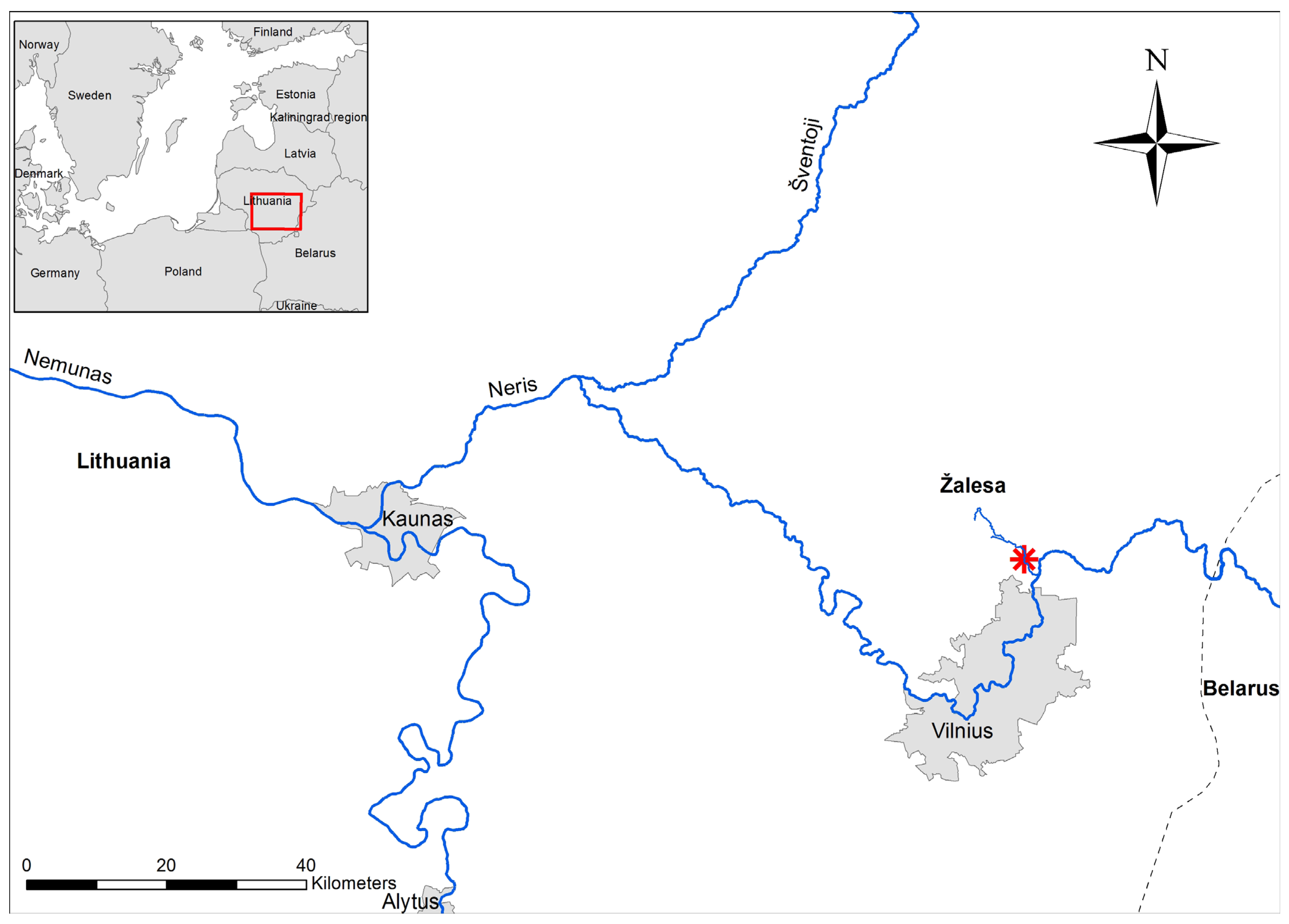
Figure 1. Fish sampling sites in Žalesa river. Red asterisk denotes the sampling sites.
Fishes 11 00181 g001
Figure 2. Fin condition in Salmo trutta: (A) uneroded fins; fin erosion of the (B) pectoral, (C) dorsal, and (D) caudal fins.
Fishes 11 00181 g002
Figure 3. Microphotographs of mature erythrocyte (ME), immature erythrocyte (IE) and erythrocytic nuclear abnormalities: 8-shaped nuclei cell (8-shaped), fragmented-apoptotic (FA) cell, bi-nucleated (BN) cell, micronuclei (MN) and nuclear bud (NB) in peripheral blood of fish.
Fishes 11 00181 g003
Figure 4. Total body mass (g), condition factor (CF), total length (TL, cm), fork length (FL, cm), and standard length (SL, cm) of Salmo trutta with different fin conditions. Lines indicate the mean, error bars represent standard deviation (SD), and individual points represent each fish. Asterisks (*) indicate significant differences (p < 0.05).
Fishes 11 00181 g004
Figure 5. Packed cell volume (PCV, %), immature erythrocyte (IE, ‰) frequencies, haemoglobin level (Hb, g/L) and glucose concentration (Glu, mmol/L) in peripheral blood of Salmo trutta with different fin conditions. Lines indicate the mean, error bars represent standard deviation (SD), and individual points represent each fish. Asterisks (*) indicate significant differences (p < 0.05).
Fishes 11 00181 g005
Figure 6. Total genotoxicity (Gentox, ‰) and total cytotoxicity (Cytox, ‰) in peripheral blood of S. trutta with different fin conditions. Lines indicate the mean, error bars represent standard deviation (SD), and individual points represent each fish. Asterisks (*) indicate significant differences (p < 0.05).
Fishes 11 00181 g006
Figure 7. Correlation analyses between fin erosion severity and biomarker responses in Salmo trutta. Fin erosion severity (Sum fin score) was calculated as the sum of categorical scores assigned to the pelvic, dorsal, and caudal fins. Only statistically significant correlations (p < 0.05) are indicated by colour, where blue represents positive correlations and red represents negative correlations. The intensity of the colour reflects the strength of the correlation.
Fishes 11 00181 g007
Table 1. Summary of differential leucocyte counts and red blood cell morphometry (cellular and nuclear parameters) in Salmo trutta with different fin conditions.
Differential Leucocyte Count
Fin ConditionLymphocytes, %Monocytes, %Band Neutrophils, %Segmented Neutrophils, %
Normal86.64 ± 3.640.02 ± 0.082.92 ± 1.0510.41 ± 2.77
Eroded85.61 ± 5.580.01 ± 0.053.32 ± 1.3711.06 ± 4.71
Erythrocyte Morphometric Parameters
Area (µm2)Perimeter (µm)CircularityAspect RatioRoundnessSolidity
Normal482.7 ± 35.4794.25 ± 6.580.69 ± 0.051.68 ± 0.070.60 ± 0.020.95 ± 0.01
Eroded494.0 ± 40.1298.58 ± 6.52 *0.65 ± 0.05 *1.69 ± 0.10.60 ± 0.030.94 ± 0.01 *
Erythrocyte Nucleus Morphometric Parameters
Area (µm2)Perimeter (µm)CircularityAspect RatioRoundnessSolidity
Normal93.81 ± 6.5939.15 ± 1.580.77 ± 0.021.74 ± 0.060.58 ± 0.020.94 ± 0.01
Eroded93.4 ± 8.0639.6 ± 2.150.75 ± 0.03 *1.70 ± 0.110.60 ± 0.040.93 ± 0.01 *
Erythrocyte Nucleus Area/Cell Area Ratio
Ratio
Normal0.20 ± 0.02
Eroded0.19 ± 0.02
(*) Asterisks denote significant differences (p < 0.05).
Table 2. Frequency of genotoxicity and cytotoxicity parameters in peripheral blood erythrocytes of Salmo trutta with different fin conditions.
Erythrocytic Nuclear Abnormalities
Fin ConditionMN, ‰NBs, ‰8-Shaped, ‰FA, ‰
Normal0.97 ± 0.530.20 ± 0.210.14 ± 0.170.04 ± 0.09
Eroded0.75 ± 0.630.16 ± 0.220.55 ± 0.63 *0.07 ± 0.14
(*) Asterisks denote significant differences (p < 0.05).
Disclaimer/Publisher’s Note: The statements, opinions and data contained in all publications are solely those of the individual author(s) and contributor(s) and not of MDPI and/or the editor(s). MDPI and/or the editor(s) disclaim responsibility for any injury to people or property resulting from any ideas, methods, instructions or products referred to in the content.