
Article

Functional Feed Additives Promote Recovery from Runting and Stunting Syndrome in Apostichopus japonicus: Links Between Growth Traits, Digestive Function, and the Gut Microbiome
School of Marine Science and Technology, Harbin Institute of Technology at Weihai, Weihai 264209, China
*
Author to whom correspondence should be addressed.
Fishes 2026, 11(3), 173; https://doi.org/10.3390/fishes11030173
Submission received: 3 February 2026 / Revised: 7 March 2026 / Accepted: 9 March 2026 / Published: 16 March 2026
(This article belongs to the Section Nutrition and Feeding)

Abstract

Runting and stunting syndrome (RSS) has been reported worldwide in commercial aquaculture and is frequently observed in juvenile-rearing ponds of Apostichopus japonicus. The objective of this study was to use commercially cultured A. japonicus naturally affected by RSS under high-density culture conditions as the study subjects. Different nutritional additive treatments, including marine mud, effective microorganisms (EM; photosynthetic bacteria, lactic acid bacteria, yeasts, and actinomycetes), yeast, kelp powder, and fermented kelp powder, were applied, and growth performance during recovery, the activities of intestinal digestive enzymes (protease, alginate lyase and cellulase), and heterotrophic bacterial counts were systematically evaluated. The results showed that the recovery rate of RSS in A. japonicus decreased in the following order: the EM group (90.91 ± 1.15%), the fermented kelp group (90.91 ± 4.96%), the yeast group (81.82 ± 5.99%), the kelp group (72.73 ± 1.35%), the marine mud group (63.64 ± 1.41%), and the control group (54.55 ± 1.47%). Moreover, increased intestinal digestive enzyme activities, elevated heterotrophic bacterial counts, and a reduced relative abundance of Vibrio were identified as key factors associated with RSS recovery in A. japonicus, with the EM and fermented kelp groups showing the most pronounced effects. High-throughput sequencing further revealed that nutritional additive treatments differed in their effects on the intestinal microbial community structure of RSS-affected A. japonicus. At the phylum level, Bacillota (26.45–48.08%), Actinomycetota (13.96–44.99%), and Pseudomonadota (9.15–56.46%) were the dominant phyla in the intestine of A. japonicus. At the genus level, a lower relative abundance of Vibrio was associated with improved recovery, and groups with lower Vibrio levels generally exhibited better recovery outcomes; notably, the EM group showed the lowest relative abundance of Vibrio (1.37%). Overall, these community shifts may contribute to recovery by supporting potential energy supply, immune regulation, and functional restoration. Therefore, these findings provide new insights into the treatment of RSS in A. japonicus through the development of beneficial microbes and the targeted suppression of potential pathogens.
Key Contribution: This study evaluated dietary supplementation with different nutritional additive treatments, including marine mud, effective microorganisms (EM; photosynthetic bacteria, lactic acid bacteria, yeasts, and actinomycetes), yeast, kelp powder, and fermented kelp powder, for the recovery of Apostichopus japonicus with runting and stunting syndrome (RSS). The underlying effects were primarily associated with enhanced intestinal function (increased digestive enzyme activities and heterotrophic bacterial counts) and gut microbiota restructuring driven by a reduced relative abundance of Vibrio. Collectively, these changes synergistically promoted recovery and growth, providing a green and low-risk dietary intervention strategy for disease management in aquaculture.

1. Introduction

The rapid expansion of global aquaculture has increasingly degraded farming environments, while market demand for the high-value sea cucumber Apostichopus japonicus continues to increase [1]. However, because A. japonicus remains expensive and supply is limited, meeting this growing demand has become increasingly challenging, underscoring the urgent need for an efficient, cost-effective, and practical culture model [2]. With the increasing adoption of large-scale sea cucumber farming, runting and stunting syndrome in Apostichopus japonicus (RSS) has been frequently observed during nursery production, substantially reducing product value and causing considerable financial losses to farmers. RSS in A. japonicus is characterized by a wrinkled body surface, darkened body walls, short and thick papillae, retarded growth, and reduced locomotion and feeding capacity [3,4]. This condition is widespread in hatchery production; in particular, excessive stocking density can result in insufficient feed intake and inadequate nutrient supply in juveniles, ultimately impairing normal growth and development [5]. In addition, factors such as germplasm quality, intraspecific competition, environmental stress, and nutritional imbalance have also been considered important contributors to the development of RSS in A. japonicus [4,6,7,8].
In research on A. japonicus aquaculture, systematic investigations of RSS in A. japonicus remain insufficient, and a clearly defined recovery strategy has not yet been established. By contrast, analogous growth-retardation conditions in other economically important farmed animals have received greater attention, including runting and stunting syndrome in chickens and growth restriction in piglets [9,10]. Previous studies indicate that runting and stunting syndrome in chickens is closely associated with infection by specific pathogens, particularly chicken astrovirus (CAstV), which can cause cystic lesions in the intestinal tract of chicks and lead to diarrhea and growth inhibition [11]. Likewise, piglets suffering from prolonged illness—especially chronic wasting conditions such as gastrointestinal and respiratory diseases and endo- and ectoparasitic infections—are prone to developing stunting when timely treatment is not provided [12]. These growth-retardation conditions are commonly accompanied by reduced body weight, impaired intestinal function, and decreased feed conversion efficiency, and recovery strategies have largely focused on nutritional regulation and restoration of intestinal function. Therefore, mitigating similar problems requires enhancing the resilience of RSS in A. japonicus, particularly by improving intestinal digestive capacity to strengthen overall immune competence and reduce disease risk; this approach should be prioritized for prevention and control.
Compared with pharmacological interventions aimed at improving immune function in A. japonicus, supplementing feed with functional ingredients is more cost-effective and environmentally friendly and poses a lower risk of secondary adverse effects; accordingly, it has become a mainstream strategy in international aquaculture. Previous studies indicate that sea cucumber feeds are generally high in protein and that these proteins are often derived from plant sources (e.g., non-genetically modified soybean meal). However, the widespread use of low-quality plant proteins in feeds is often accompanied by multiple anti-nutritional factors (ANFs), including phytate, tannins, gossypol, saponins, protease inhibitors, lectins, trypsin inhibitors, and non-starch polysaccharides [13]. These ANFs can markedly reduce feed quality, suppress intestinal function, and, by binding to nutrients such as proteins and minerals, decrease nutrient digestibility and bioavailability. To address this issue, strategies such as microbial fermentation [14], supplementation with exogenous microbial preparations [15], and amino acid addition [16] are commonly adopted to eliminate or reduce ANFs and improve feed quality. Consequently, high-quality diets can enhance feeding performance and nutrient bioavailability in A. japonicus, thus improving nutrient absorption efficiency.
It has been reported that the primary purpose of adding nutritional additives to feeds is to improve digestive efficiency [17]. These additives may facilitate protein utilization by promoting the hydrolysis of dietary proteins into smaller peptides and free amino acids, thereby improving nutrient release and absorption efficiency [18,19]. Other studies have suggested that these additives support the sequential digestion of feed proteins, in which endopeptidases hydrolyze internal peptide bonds and exopeptidases, together with brush-border peptidases, further degrade the resulting peptides into short peptides and free amino acids for absorption [20]. In diets for A. japonicus, marine mud, microbial (probiotic) preparations, and macroalgae are commonly used as feed additives. As an inorganic substrate, marine mud can regulate intestinal transit and fecal excretion of digesta and provide a dilution and buffering effect on nutrient load, which facilitates efficient nutrient utilization [21]. As a composite microbial preparation, effective microorganisms (EM) contain photosynthetic bacteria, lactic acid bacteria, and yeasts, and can promote the health of cultured animals through multiple pathways, including modulation of the intestinal microbiota, enhancement of digestive enzyme activity, and improvement of culture-water quality [22]. As probiotics, yeasts can modulate the intestinal microbiota and upregulate the expression of immune-related genes [23]. In addition, kelp, as a feed additive for A. japonicus, not only provides algal substrates and mineral nutrients consistent with its feeding ecology but also, after microbial fermentation, shows improved nutrient availability and enhanced functional components (e.g., brown algal oligosaccharides), which may facilitating feeding and nutrient absorption [24].
Based on the functional characteristics of the tested additives, different nutritional additives were expected to exert different recovery-promoting effects on RSS in A. japonicus. In this study, a high-density culture environment was simulated, and normal A. japonicus were induced to develop RSS in A. japonicus by manipulating the water-exchange rate and volume; to minimize individual variation, developmentally impaired individuals exhibiting RSS in A. japonicus were selected as the study subjects (see Section 2.1). A basal diet was supplemented with graded levels of marine mud, effective microorganisms (EM), yeast, kelp powder, and fermented kelp powder as nutritional additives to evaluate changes in growth performance, gut microbiota dynamics, digestive enzyme activities, and related physiological parameters in RSS in A. japonicus. Furthermore, high-throughput sequencing was applied to characterize the successional patterns of the gut microbial community at the phylum and genus levels, providing a theoretical basis and technical approaches for the recovery of RSS in A. japonicus.

2. Materials and Methods

2.1. Experimental Animals

Juvenile Apostichopus japonicus used in this experiment were provided by Wuleidao Aquaculture Co., Ltd. (Weihai, China). Healthy juveniles were collected from a sea-cage–cultured population, with an initial body mass of 15.00 ± 3.00 g (mean ± SD). Under laboratory conditions, RSS in A. japonicus was induced by rearing stress involving a high stocking density (5.50 kg m−3) and a low water-exchange regime (10% fresh seawater exchanged daily) for 35 d. The 35-d induction duration was set to induce a stable RSS phenotype under these rearing-stress conditions, providing a consistent baseline for the subsequent recovery trial, while minimizing potential confounding effects associated with an overly prolonged induction period. After induction, juveniles displaying typical RSS characteristics, including a wrinkled and darkened body surface, shortened and thickened papillae, and reduced locomotion and feeding activity, were classified as RSS-affected and used as the study subjects for the dietary recovery experiment (see Section 2.3). Their body mass at the start of the recovery trial (Day 0) was 23.00 ± 3.00 g (mean ± SD).

2.2. Feeding Diet

The basal diet and marine mud used in the experiment were purchased from Weihai Jinpai Biotechnology Co., Ltd. (Weihai, China). The basal diet contained 17.83% crude protein, 5.08% total carbohydrates, and 0.086% free amino acids. The EM preparation and yeast were cultured in the laboratory and stored at 4 °C. The EM preparation contained photosynthetic bacteria, lactic acid bacteria, yeasts, and actinomycetes; viable counts reached 1.20 × 10⁹ CFU mL−1 (EM) and 1.00 × 10⁸ CFU mL−1 (yeast), respectively, indicating high viability. Kelp powder was provided by Rongcheng Kaipu Bioengineering Co., Ltd. (Rongcheng, China). For fermented kelp powder preparation, a seed culture was obtained by scale-up cultivation of the alginate lyase–high-producing strain HSJ-04 preserved in our laboratory; the seed culture was inoculated at 10% (v/w) into a kelp powder–based solid-state fermentation medium for pre-fermentation, followed by solid-state fermentation at 28 °C for 4 d to obtain fermented kelp powder. All nutritional additives and the basal diet were then mixed at 28 °C according to the designated proportions for 8 h before being fed to Apostichopus japonicus.

2.3. Experimental Design and Feeding Strategy

The experiment was conducted in glass culture tanks (97 cm × 77 cm × 55 cm; length × width × height). RSS-affected A. japonicus juveniles, induced from healthy juveniles under high stocking density and a low water-exchange regime, were randomly allocated to the dietary supplementation groups and the control group, with three biological replicates per group. Throughout the experiment, the stocking density was maintained at approximately 5.50 kg m−3 in all tanks. The dietary supplementation schemes for each group are summarized in Table 1.
All supplementation levels expressed as multiples (×) were calculated relative to the basal diet; marine mud was added on a weight-to-weight basis (w/w), whereas EM preparation and yeast were applied on a weight-to-volume basis (w/v). In the control group (CON), only the basal diet and marine mud were provided; the basal diet was supplied at 1% of total biomass, and marine mud was added at 6× the basal diet. In the marine mud group (MM), marine mud was added at 10× the basal diet. In the EM group (EM) and yeast group (Y), EM preparation and yeast were applied at 2× (w/v) relative to the basal diet, respectively. In the kelp group (K) and fermented kelp group (FK), kelp powder or fermented kelp powder replaced 50% of the basal diet (dry weight basis). During the later stage of the experiment, the feeding ration was adjusted according to feeding activity to minimize uneaten feed. The experiment lasted 35 d, and feeding was performed once daily. During the experiment, 30% of fresh seawater was exchanged daily in each tank. In addition to the daily exchange, a 100% water replacement was performed every 7 d. Seawater temperature was maintained at 14.00 ± 1.00 °C, continuous aeration was provided, and dissolved oxygen was maintained above 5.00 mg L−1. These conditions were maintained to ensure normal growth of A. japonicus.

2.4. Analysis Methods

2.4.1. Histological Observation and H&E Staining

During the experiment, the external morphology of Apostichopus japonicus (body coloration, degree of wrinkling, body wall condition, spines, and body shape) was recorded using a digital camera. In addition, representative healthy (non-induced) individuals, RSS-affected individuals at day 0, and individuals that recovered to an apparently normal phenotype at day 35 were photographed, and intestines tissues were collected for hematoxylin and eosin (H&E) staining using hematoxylin solution (BA4097, Baso Diagnostic Inc., Zhuhai, China) and eosin Y alcoholic solution (71014460, Sinopharm Chemical Reagent Co., Ltd., Shanghai, China). Intestinal tissues were fixed in 4% paraformaldehyde fix solution (E672002, BBI Life Sciences, Shanghai, China), dehydrated through a graded ethanol series, and cleared in xylene (A530011, Sangon Biotech, Shanghai, China) (5 min per wash, twice). After clearing, samples were embedded in paraffin at 56–58 °C. Paraffin blocks were sectioned at 7 μm using a microtome (Leica Microsystems, Wetzlar, Germany). Sections were mounted on glass slides and dried in an oven. The sections were then stained with H&E following standard procedures. Images were captured using a light microscope (ECLIPSE Ci-L, Nikon Corporation, Tokyo, Japan) to compare intestinal cross-sectional structures among groups.

2.4.2. Measurement of Growth Performance

During the experiment, the external morphology of Apostichopus japonicus was examined every 7 d, and the number of individuals exhibiting RSS in A. japonicus was recorded to calculate the formation rate of RSS. All individuals in each group were collected and weighed to calculate the specific growth rate (SGR). At each sampling time, three RSS-affected individuals were randomly selected from each group and dissected; body weight, body wall weight, and intestine weight were measured to calculate body wall yield (BWY) and the intestine-to-body wall ratio (IBR). The recovery rate (RRi), body wall yield (BWY), intestine-to-body wall ratio (IBR), and specific growth rate (SGR) were calculated using the following equations:
R R i ( % ) = 100 × N r e c , i N 0 ,
where Nrec,i is the number of individuals that had recovered to a normal phenotype by the i-th 7-d observation, and N0 is the initial number of individuals (defined in this study).
B W Y ( % ) = 100 × B W W ,
where BW is body wall weight (g) and W is body weight (g) [25].
I B R ( % ) = 100 × I W B W ,
where IW is intestine weight (g) and BW is body wall weight (g) [26].
S G R ( % d 1 ) = 100 × ( ln W t     ln W 0 ) t ,
where W0 is the initial mean body weight (g), Wt is the mean body weight at day t (g), and t is the culture duration (d) [27].

2.4.3. Measurement of Digestive Enzyme Activity in the Gut

At each sampling time point (days 0, 7, 14, 21, 28, and 35), three individuals were randomly selected from each replicate tank (n = 3 tanks per treatment) for intestinal tissue sampling. The tissues were homogenized on ice in phosphate-buffered saline (PBS, pH 7.0), which served as a near-neutral extraction buffer to preserve enzyme stability and minimize pH-induced denaturation, and the homogenates were then extracted at 4 °C for 12 h. The extracts were centrifuged at 4000× g for 20 min at 4 °C, and the resulting supernatants (crude enzyme extracts) were collected and stored at 4 °C for analysis within 12 h. Digestive enzyme activities were measured using a 721 spectrophotometer (Shanghai Jinghua Instrument Co., Ltd., Shanghai, China), and all assays were performed in triplicate. Protease activity was determined using the Folin–phenol reagent method [28] with 0.5% casein as the substrate at pH 7.2 and 40 °C for 30 min. After color development with the Folin–phenol reagent (A500467, Sangon Biotech, Shanghai, China), absorbance was measured at 680 nm, and tyrosine equivalents were calculated from a tyrosine standard curve. One unit (U) of protease activity was defined as the amount of enzyme that released 1 μg tyrosine per min under the assay conditions, and the activity was expressed as U g−1 intestinal tissue. Cellulase and alginate lyase activities were determined using the 3,5-dinitrosalicylic acid (DNS) (A500420, Sangon Biotech, Shanghai, China) method [29] with 0.5% carboxymethyl cellulose sodium (CMC-Na) and 0.5% sodium alginate as the respective substrates at pH 7.2 and 40 °C for 40 min. The hydrolysis products were quantified as reducing sugars by measuring absorbance at 550 nm after DNS color development, and glucose equivalents were calculated from a glucose standard curve. One unit (U) of cellulase or alginate lyase activity was defined as the amount of enzyme in the crude extract prepared from 1 g of intestinal tissue that generated reducing sugars equivalent to 1 μg glucose per min under the assay conditions. Enzyme activities were expressed as U g−1 intestinal tissue. Enzyme activities were calculated from tyrosine or glucose standard curves after blank correction according to the following equation:
D i g e s t i v e   e n z y m e   a c t i v i t y   ( U   g 1   i n t e s t i n a l   t i s s u e ) = P × n × V t V e × t × m
where P is the amount of product released in the reaction system (μg), n is the dilution factor of the crude enzyme extract, Vt is the total volume of the crude enzyme extract (mL), Ve is the volume of crude enzyme extract used in the assay (mL), t is the reaction time (min), and m is the mass of intestinal tissue used for enzyme extraction (g).

2.4.4. Measurement of Gut Microbial Count

At each sampling time point (days 0, 7, 14, 21, 28, and 35), three individuals were randomly selected from each replicate tank (n = 3 tanks per treatment) for intestinal content samples. At each sampling time, 1.00 g of intestinal contents from each group was suspended in sterile seawater and serially diluted 10-fold. Appropriate dilutions were spread-plated onto marine 2216E agar (HB0132, Qingdao Hope Bio-Technology Co., Ltd., Qingdao, China) and thiosulfate–citrate–bile salts–sucrose (TCBS) agar (Beijing Land Bridge Technology Co., Ltd., Beijing, China), with three replicate plates prepared per dilution. Plates were incubated inverted at 28 °C for 48 h (2216E) or 24 h (TCBS). After incubation, plates containing 30–300 colonies were counted to estimate viable heterotrophic bacterial counts (2216E) and presumptive Vibrio counts (TCBS), and results were expressed as CFU g−1 [30]. The proportion of Vibrio (%) was calculated as the ratio of presumptive Vibrio counts to heterotrophic bacterial counts.

2.4.5. Measurement of Water Quality

During the culture period, 100% of the seawater in each tank was replaced every 7 d; therefore, daily water-quality monitoring within each 7-d replacement cycle was performed. Surface-layer seawater samples were collected at the same time each day, and NO2-N, NH4+-N, and chemical oxygen demand (COD) were measured according to standard methods [31].

2.4.6. Measurement of Intestinal Microbial Diversity

At the end of the 35 d culture period, intestinal content samples were collected from each group. In each group, intestinal contents from three randomly selected individuals were pooled to generate one composite sample (one per group) for high-throughput sequencing. All samples were immediately stored at −80 °C until analysis. DNA was extracted and purified using a commercial DNA extraction kit (MO BIO Laboratories, Inc., Carlsbad, CA, USA) according to the manufacturer’s protocol. The V3–V4 hypervariable region of the 16S rRNA gene was amplified by PCR using the universal primers 338F (5′-ACTCCTACGGGAGGCAGCAG-3′) and 806R (5′-GGACTACHVGGGTWTCTAAT-3′), and amplicons were sequenced on an Illumina NextSeq 2000 platform (Illumina, San Diego, CA, USA) (paired-end, 2 × 300 bp). Sequences were clustered into operational taxonomic units (OTUs) at a 97% similarity threshold, and taxonomic assignment was performed against the SILVA database. Community profiling and visualization were conducted using the Majorbio Cloud platform (Majorbio Bio-Pharm Technology Co., Ltd., Shanghai, China).

2.5. Data Analysis

Data were analyzed using SPSS Statistics 26.0 (IBM Corp., Armonk, NY, USA). Normality and homogeneity of variance were tested using the Shapiro-Wilk test and Levene’s test, respectively. One-way analysis of variance (ANOVA) was performed, followed by Duncan’s multiple range test for post hoc comparisons among treatment groups. Differences were considered significant at p < 0.05, and all values were expressed as mean ± SD.

3. Results

3.1. Comparison of External Morphology and Intestinal Cross-Sections Between Normal Apostichopus japonicus and RSS in Apostichopus japonicus

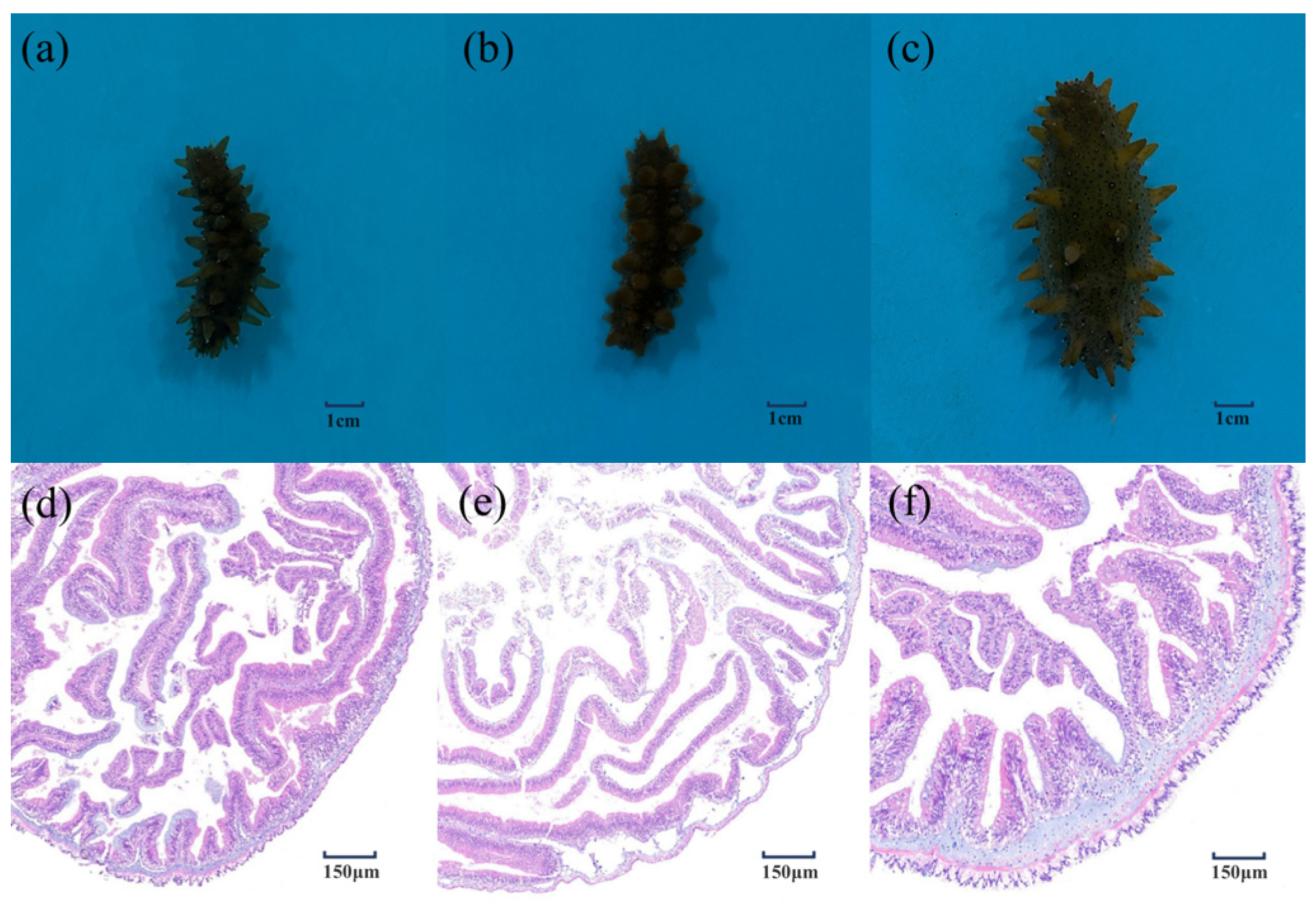
To compare the status before and after recovery and to provide a healthy baseline reference, external morphology and intestinal structure were analyzed in healthy, non-induced A. japonicus, RSS in A. japonicus (CON, 0 d), and recovered A. japonicus (EM, 35 d), as shown in Figure 1. The healthy, non-induced individuals showed a relatively smooth body surface with inconspicuous wrinkling, a relatively plump body wall condition, and slender spines with a relatively uniform distribution (Figure 1a). RSS in A. japonicus exhibited a smaller body size, pronounced body-surface wrinkling, a hardened, darkened body wall, and relatively thick, short spines (Figure 1b). In contrast, the recovered A. japonicus showed a relatively plump and soft body wall, a yellowish-brown body color, and slender spines with a relatively uniform distribution (Figure 1c). In terms of intestinal tissue structure, the healthy, non-induced individuals (Figure 1d) exhibited relatively extended intestinal mucosal folds with clear branching structures and relatively distinct tissue stratification. RSS in A. japonicus (Figure 1e) displayed tightly coiled mucosal folds with reduced branching and extension and less distinct tissue stratification, suggesting insufficient mucosal development and a potential reduction in effective absorptive surface area. By comparison, the recovered A. japonicus (Figure 1f) exhibited more extended mucosal folds, clearer branching, and more distinct tissue stratification, indicating an intestinal morphology and structure closer to the healthy baseline. Collectively, these results indicated that RSS in A. japonicus exhibited pronounced developmental deficiencies in external morphology and intestinal structure, whereas 35 d of EM treatment was associated with recovery of external morphology and improved intestinal structural development.

3.2. Effects of Different Nutritional Additive Treatments on the Recovery Rate of RSS in Apostichopus japonicus

To clarify recovery from RSS in A. japonicus, recovery criteria were defined based on external morphology and behavior, and recovery rates under different nutritional additive treatments were calculated (Table 2). Individuals showing body-surface wrinkling, darkened body walls, thick and short spines, retarded growth, and reduced locomotion and feeding were identified as RSS in A. japonicus; individuals with a soft, yellowish-brown body wall, slender spines, rapid growth, and normal locomotion and feeding were identified as normal A. japonicus. With increasing culture time, the recovery rates in all groups showed a stage-wise increasing trend. During the early culture period (days 7–21), differences among treatments gradually became evident. EM consistently showed the highest recovery rate, reaching 20.00 ± 1.10% on day 7 and further increasing to 46.15 ± 1.81% on day 21, which was significantly higher than that in CON (15.38 ± 5.78%) and the other nutritional additive treatments (p < 0.05). The FK also performed well at an early stage (days 0–7), and its recovery rate on day 14 was at the same significance level as that of EM (28.57 ± 2.85%); it further increased to 38.46 ± 5.18% on day 21, ranking second only to EM (p < 0.05). During the late culture period (days 28–35), the recovery rates increased markedly across treatments, and EM and FK groups remained at the highest levels. Notably, on day 35, the recovery rates of EM and FK groups further increased to 90.91 ± 1.15% and 90.91 ± 4.96%, respectively, and remained significantly higher than those of MM (63.64 ± 1.41%), K (72.73 ± 1.35%), Y (81.82 ± 5.99%), and CON (54.55 ± 1.47%) (p < 0.05). Overall, EM preparation and fermented kelp powder more effectively promoted RSS recovery and maintained the optimal recovery level during the late culture period.

3.3. Effects of Different Nutritional Additive Treatments on the Specific Growth Rate of RSS in Apostichopus japonicus

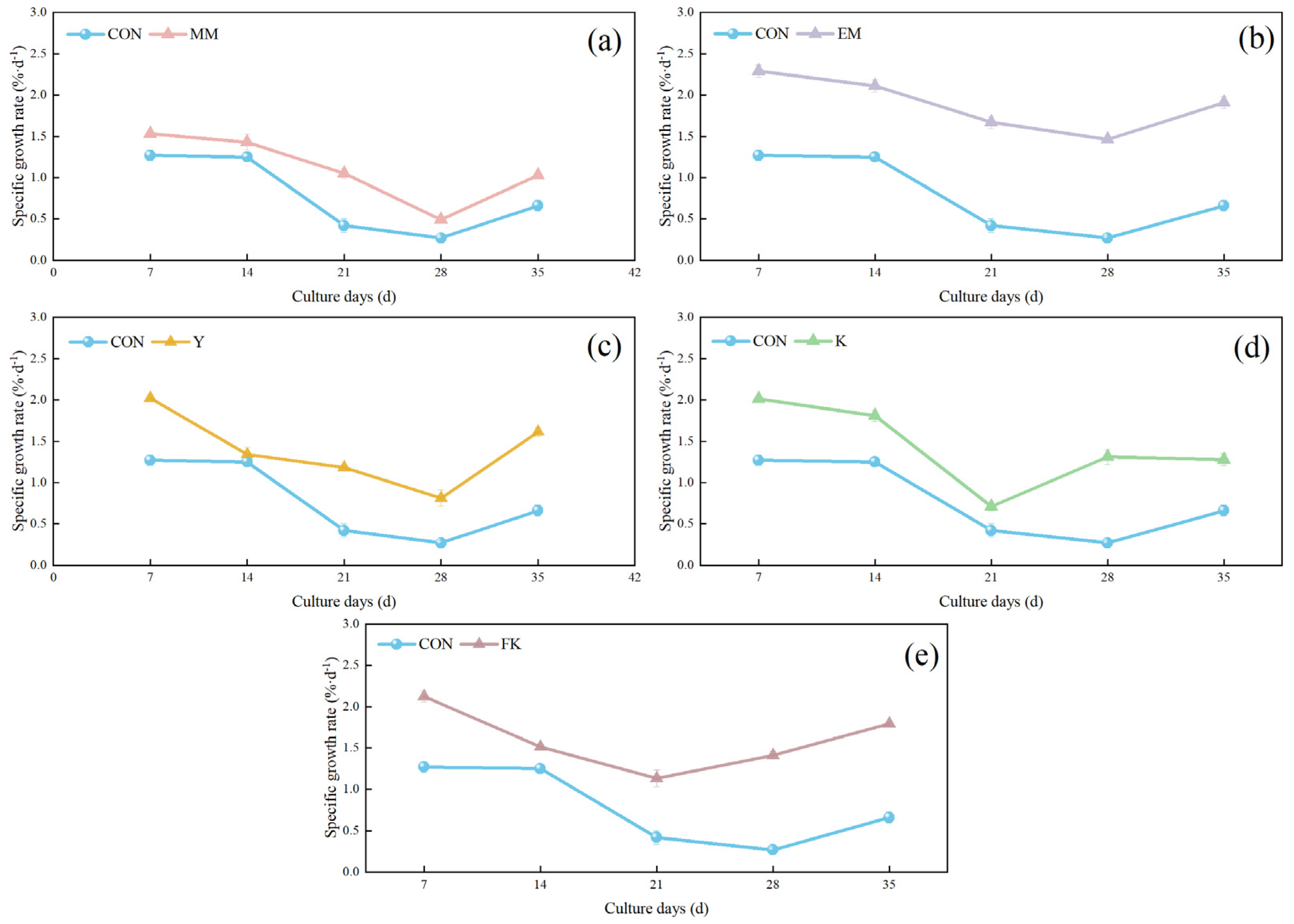
Specific growth rate (SGR) was an important indicator of the growth rate of Apostichopus japonicus and reflected the growth status of RSS in A. japonicus during recovery, as shown in Figure 2. To clarify the effects of different nutritional additive treatments on growth recovery, the SGR of all animals in each treatment was monitored for 35 d. During the early stage of the experiment, SGR in all treatments decreased and then increased, declining from 1.27 ± 0.063% d−1–2.29 ± 0.074% d−1 to 0.27 ± 0.031% d−1–1.46 ± 0.023% d−1 and subsequently increasing to 0.66 ± 0.068% d−1–1.91 ± 0.071% d−1. Among the treatments, K and FK exhibited an earlier increase in SGR on day 21 (Figure 2d,e). Similar to CON, MM, EM, and Y exhibited an increase in SGR on day 28 (Figure 2a–c). Although SGR increased earlier in K and FK, during the late stage of the experiment (days 28–35) SGR was highest in EM, reaching 1.91 ± 0.071% d−1 on day 35 (Figure 2b), followed by FK (1.79 ± 0.020% d−1, Figure 2e) and Y (1.61 ± 0.052% d−1, Figure 2c). K and MM reached 1.28 ± 0.073% d−1 and 1.03 ± 0.018% d−1, respectively (Figure 2a,d), both higher than CON (0.66 ± 0.068% d−1). Overall, the effects of different nutritional additive treatments on SGR ranked as follows: EM, FK, Y, K, MM, and CON.

3.4. Effects of Different Nutritional Additive Treatments on the Body Wall Yield of RSS in Apostichopus japonicus

Body wall yield (BWY) reflects stress status and body water content in A. japonicus, and decreases in BWY were often associated with stress recovery (Table 3). BWY in RSS in A. japonicus was generally high in all treatments and decreased over time. During the recovery process, the body wall gradually changed from a stress-induced wrinkled state to a normal extended state, and the internal water content gradually increased; therefore, BWY gradually decreased. BWY in CON remained relatively high, decreasing from 72.53 ± 0.43% at 0 d to 59.62 ± 0.91% at 35 d. In the nutritional additive treatments, BWY decreased mainly during days 0–28. On day 28, BWY was lowest in EM (51.99 ± 0.82%), followed by FK (52.89 ± 0.39%), Y (53.15 ± 0.37%), and K (53.36 ± 0.32%), all within the reported range for normal A. japonicus. From days 28–35, BWY in EM, Y, K, and FK increased slightly, whereas BWY in MM and CON continued to decrease. Considering RR (Table 2) together with BWY (Table 3), on day 28 RR in EM, Y, K, and FK exceeded 65%, and normal individuals accounted for more than half of the population; the slight BWY increase at 35 d was consistent with improved growth status during recovery.

3.5. Effects of Different Nutritional Additive Treatments on the Intestine-to-Body Wall Ratio of RSS in Apostichopus japonicus

The intestine-to-body wall ratio (IBR) is used to evaluate intestinal fullness in A. japonicus and reflects digestive function and nutritional status (Table 4). Over the experimental period, IBR in all treatments increased steadily, suggesting gradual resumption of feeding and increased intestinal fullness during recovery. At 35 d, IBR increased to 16.24 ± 0.24% in EM, which was significantly higher than that in the other treatments (p < 0.05), indicating more pronounced improvements in intestinal recovery. IBR in FK increased to 15.57 ± 0.13%, ranking second to EM and also indicating a favorable recovery response. In CON, IBR increased from 10.34% to 13.74%; Y and K showed intermediate increases, with values significantly higher than those in CON/MM but lower than those in EM/FK at 35 d. Overall, EM preparation significantly increased the IBR of A. japonicus, improved the feeding capacity and intestinal function of RSS in A. japonicus, and promoted their recovery process.

3.6. Effects of Different Nutritional Additive Treatments on Intestinal Digestive Enzyme Activities

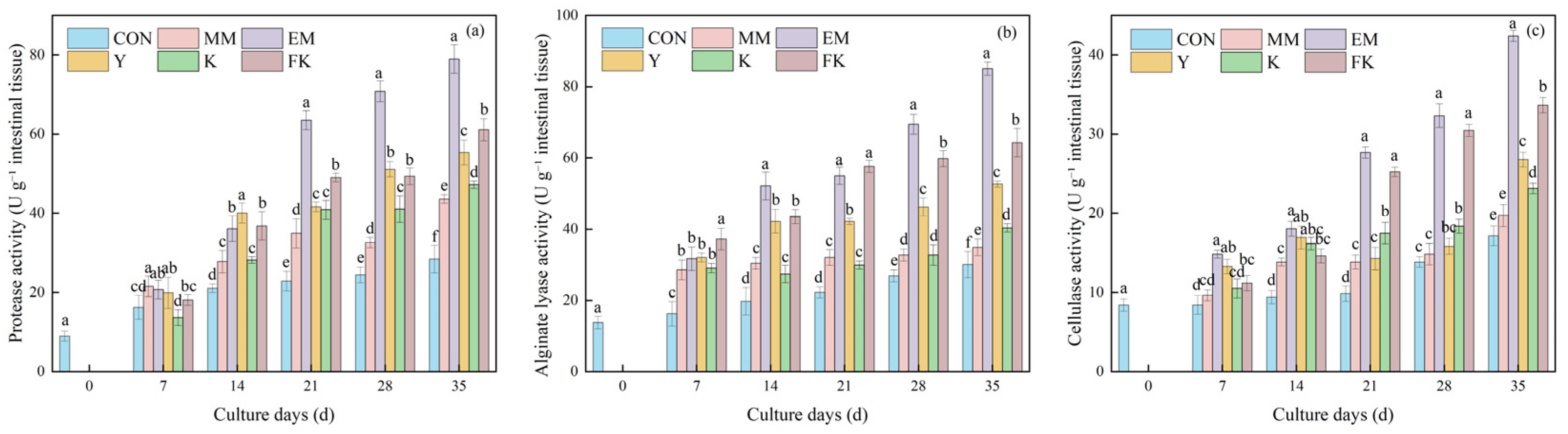
Intestinal digestive enzyme activities are key indicators of digestive function and nutrient metabolism in A. japonicus (Figure 3). To evaluate the effects of nutritional additive treatments on digestive enzyme activities in RSS in A. japonicus, protease, alginate lyase, and cellulase activities increased across treatments, although the magnitude of change differed among treatments. EM showed the most pronounced increases in all three enzymes. At 35 d, protease, alginate lyase, and cellulase activities in EM were 177.47%, 182.87%, and 147.09% higher, respectively, than those in CON. FK ranked second, with corresponding increases of 114.73%, 113.81%, and 96.13% relative to CON. Enzyme activities in Y and K were also higher than those in CON, but the increases were modest. Overall, EM preparation significantly enhanced the intestinal enzyme activity indices of RSS in A. japonicus, indicating that intestinal digestive function and the capacity for nutrient digestion and absorption were effectively improved, supporting physiological recovery of RSS in A. japonicus.

3.7. Effects of Different Nutritional Additive Treatments on Heterotrophic Bacterial Abundance and the Proportion of Vibrio in the Intestine

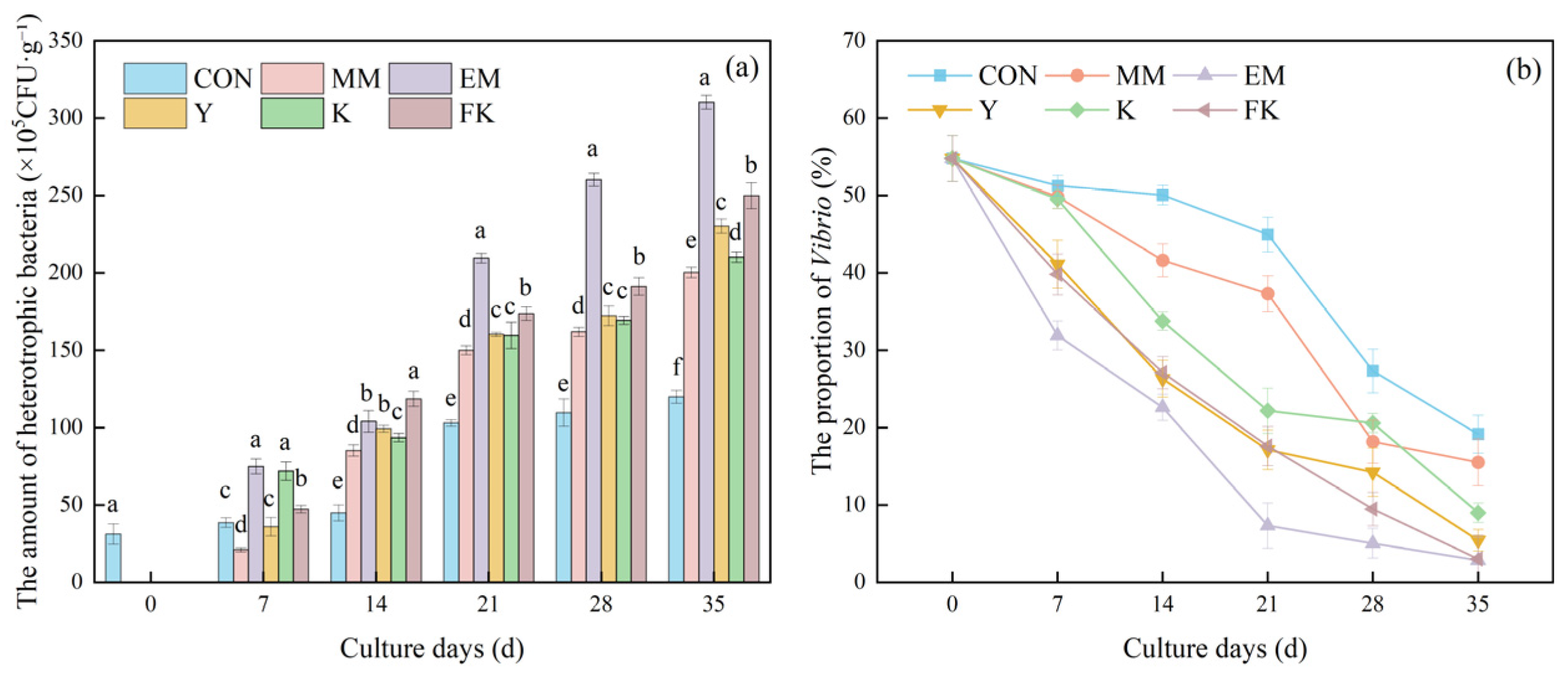
The abundance of heterotrophic bacteria and the proportion of Vibrio in the intestine of RSS in A. japonicus are indicators of intestinal microbial status and can be influenced by water quality and diet composition (Figure 4). Over time, viable heterotrophic bacterial counts in the intestine increased continuously across nutritional additive treatments (Figure 4a), suggesting progressive re-establishment of the intestinal microbial community during recovery. At 35 d, heterotrophic bacterial counts in EM reached 3.10 ± 0.04 × 10⁷ CFU g−1, which was significantly higher than that in CON (2.50 ± 0.08 × 10⁷ CFU g−1). Meanwhile, the proportion of Vibrio within the heterotrophic bacterial community decreased over time (Figure 4b). At 35 d, the proportion of Vibrio decreased to 2.84 ± 0.99% in EM and remained low in FK (3.03 ± 1.87%), both of which were markedly lower than that in CON (19.17 ± 2.44%). Collectively, during RSS recovery, beneficial intestinal microorganisms gained a competitive advantage, effectively suppressing the potentially pathogenic Vibrio. In addition, the reduction in Vibrio proportion to below 5% indicates that the intestinal micro-ecosystem tended to become stable and shifted toward a healthier state, providing a favorable microbial basis for subsequent growth and further supporting, from a microbiological perspective, that RSS in Apostichopus japonicus were recovering toward a normal physiological state.

3.8. Effects of Different Nutritional Additive Treatments on Water Quality in the Culture System

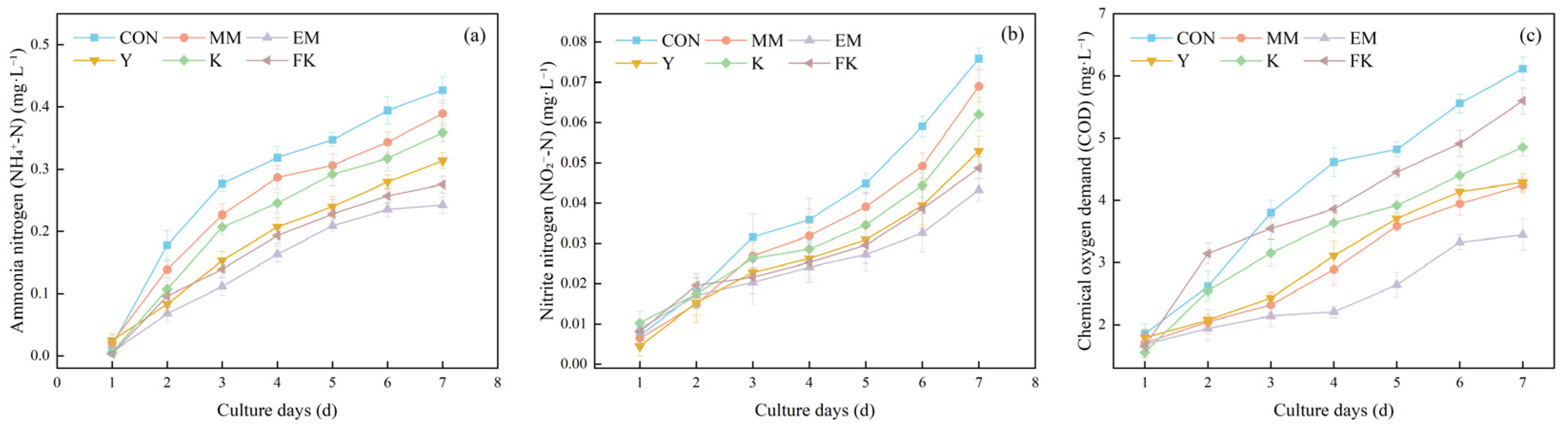
Water-quality parameters are key determinants of the culture environment for A. japonicus. Concentrations of ammonium nitrogen (NH4+-N), nitrite nitrogen (NO2-N), and chemical oxygen demand (COD) are shown in Figure 5. As shown in Figure 5a,b, NH4+-N and NO2-N exhibited similar temporal patterns across nutritional additive treatments, remained low overall, and did not differ significantly among treatments. Both nitrogen species peaked on day 7 at 0.42 ± 0.021 and 0.07 ± 0.003 mg L−1, respectively, remaining below the safety limits specified in the Sea Water Quality Standard (GB 3097-1997) [32] (0.50 and 0.10 mg L−1, respectively). Figure 5c shows that COD increased gradually over time. After 7 d, COD in CON reached 6.11 ± 0.19 mg L−1 and was significantly higher than that in the other treatments. COD increased most slowly in EM, whereas a more rapid increase was observed in the other treatments after day 3. Notably, COD in FK showed a more pronounced increase because the fermentation products were readily soluble in water, resulting in a higher organic load. By comparison, EM exhibited a relatively strong capacity for organic matter degradation. Overall, EM supplementation maintained NH4+-N and NO2-N below the safety limits and slowed the increase in COD, improving water quality, alleviating environmental stress, and creating more suitable environmental conditions for the physiological recovery of RSS in A. japonicus.

3.9. Intestinal Microbial Diversity Under Different Nutritional Additive Treatments

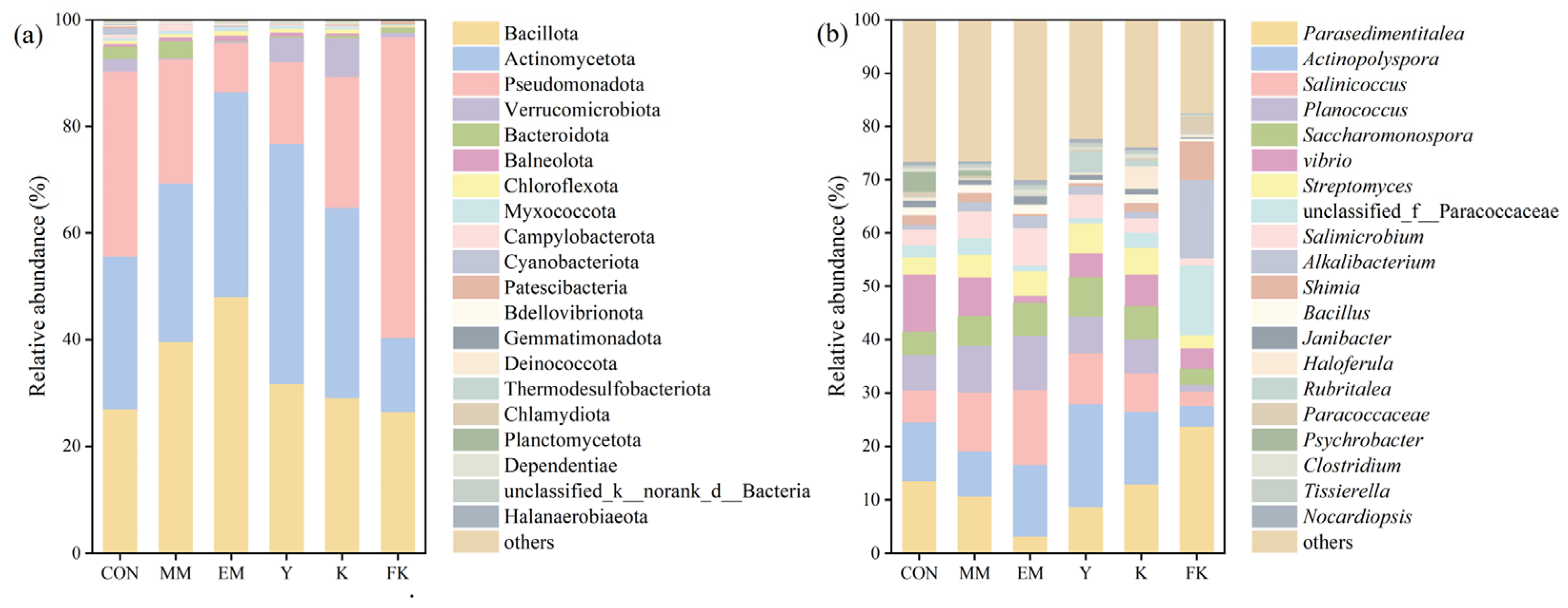
To further investigate the effects of different nutritional additives in the diet on RSS recovery, high-throughput sequencing was performed on intestinal content samples, and the intestinal microbial community structure and composition are shown in Figure 6. At the phylum level, the dominant phyla in the intestinal contents of A. japonicus across nutritional additive treatments were Bacillota, Actinomycetota, and Pseudomonadota. Notably, Bacillota in EM and Pseudomonadota in FK were absolutely dominant, with relative abundances of 48.08% and 56.46%, respectively (Figure 6a). At the genus level, the microbial taxa in the intestinal contents of A. japonicus predominantly included Parasedimentitalea, Actinopolyspora, Salinicoccus, Planococcus, Saccharomonospora, Vibrio, and Streptomyces (Figure 6b). Vibrio was detected in CON, MM, EM, Y, K, and FK, with relative abundances of 10.77%, 7.32%, 1.37%, 4.53%, 5.96%, and 3.95%, respectively. Compared with the CON and MM, the relative abundance of Vibrio was reduced to varying degrees in the other treatments. Therefore, the composition of the intestinal microbial community in this study differed among treatments due to dietary supplementation with different nutritional additives.

4. Discussion

RSS represents a growth-stagnation phenotype during the normal development of Apostichopus japonicus. In the present study, RSS in A. japonicus was successfully induced at an early stage under high stocking density (5.50 kg m−3) and low water exchange (10% d−1). To avoid potential bias arising from relative comparisons based solely on “before vs. after recovery”, healthy, non-induced A. japonicus were simultaneously included as a healthy baseline reference for comparison of changes in external morphology and intestinal structure during RSS and its recovery process. Compared with the healthy, non-induced individuals, RSS in A. japonicus exhibited body-surface wrinkling, darkened body wall coloration, and thick, short spines. In addition, the intestinal mucosal structure was simplified, and the extension of mucosal folds was reduced, indicating a decreased surface area available for digestion and absorption, reduced nutrient absorption and utilization capacity, and weakened intestinal barrier function; consequently, reduced feeding contributed to slow growth. These characteristics are consistent with previous reports showing that environmental stress can reduce feeding, impair intestinal function, and gradually enlarge growth differences in A. japonicus, and that changes in external conditions can markedly alter intestinal structure and, in turn, affect health and growth [33]. In the present study, the external morphology and intestinal structure of recovered individuals were overall closer to the healthy, non-induced baseline, suggesting a shift from a “growth-restricted state” toward normal development. The degree of recovery from RSS in A. japonicus was mainly determined based on body wall color, body wall softness/hardness, and spine thickness and length. In addition, body wall yield (BWY) can also serve as a quantitative indicator, defined as the proportion of body wall weight to total body weight in A. japonicus. At day 0, BWY in RSS in A. japonicus was 72.53 ± 0.43%, whereas BWY in normal A. japonicus typically does not exceed 60–67% [34]. This may be related to the wrinkled state of RSS in A. japonicus and their relatively low intestinal weight, thus increasing the proportion of body wall weight relative to total body weight. Overall, RSS is not merely a difference in body color or morphology, but more likely a growth-limited state resulting from the combined effects of prolonged environmental stress and insufficient nutrition.
Feed is a key regulatory factor in A. japonicus aquaculture systems and can markedly affect performance indices, including specific growth rate (SGR), body wall yield (BWY), and the intestine-to-body wall ratio (IBR) during growth. During the 35 d recovery phase in this study, the recovery rates of RSS in A. japonicus across all nutritional additive treatments increased, and EM and fermented kelp (FK) exhibited the best recovery performance, with recovery rates significantly higher than those in the other treatments. The overall recovery effect in EM was the most pronounced, accompanied by increased SGR, decreased BWY, and the largest increase in IBR. Compared with the basal diet, fermented diets contain higher levels of polypeptides, amino acids, and reducing sugars, which improves feed availability and increases nutrient supply, ultimately enhancing the growth performance of A. japonicus [14]. The recovery-promoting effect of EM-supplemented diets may arise from the regulatory role of the composite probiotic system in the intestine, which reshapes the intestinal microbial community and promotes the restoration of digestion-related functions, leading to improved efficiency of nutrient digestion and absorption and faster restoration of physiological status in RSS in A. japonicus [15]. This result is consistent with previous studies on EM as a composite probiotic supplement, showing that dietary EM supplementation in aquaculture feeds can promote growth and improve immune-related responses and feeding regulation [35].
Improvements in intestinal digestive enzyme activities are important features of the recovery process in A. japonicus. The intestine of A. japonicus is the primary site for digestion and absorption of nutrients and contains abundant digestive enzymes and microbial communities. Previous studies have shown that microbial fermentation of kelp powder can increase the proportion of available small-molecule nutrients in feed and improve palatability, facilitating utilization by A. japonicus with impaired digestive function, and can significantly enhance intestinal digestive enzyme activities and promote the recovery of digestive and absorptive functions [14]. Consistent with this, Cui et al. [18] reported that fermentation treatment of diets increased the contents of available nutritional components such as free amino acids and certain fatty acids, and that after feeding, cellulase activity in the intestine of A. japonicus was significantly increased and growth performance was improved. The effect of fermentation is more consistent with substrate pre-digestion, in which microbial metabolism and enzymatic hydrolysis partially convert refractory components in feed into substrates that can be rapidly utilized by RSS in A. japonicus; thus, after feeding, endogenous digestive enzyme secretion is more readily induced, leading to increased enzyme activity. In contrast, many strains in EM possess enzyme-producing capabilities and can directly assist digestion in RSS in A. japonicus by secreting exogenous hydrolytic enzymes. Among them, Bacillus spp. have strong extracellular enzyme production and metabolic capacities, and can promote increases in host digestive enzyme activities and improve nutrient utilization efficiency [36]. In addition, Ma et al. [15] further demonstrated that combined supplementation with yeast and Bacillus could regulate the intestinal microenvironment of A. japonicus; through probiotic colonization in the intestine, digestive enzyme activities were enhanced and multiple digestion-assisting factors were produced, potentially compensating for insufficient endogenous digestive capacity in A. japonicus.
Ammonium nitrogen (NH4+-N), nitrite nitrogen (NO2-N), and chemical oxygen demand (COD) are key water-quality indicators in A. japonicus aquaculture, and maintaining good water quality can prevent toxic stress caused by NH4+-N and NO2-N in culture systems, which would otherwise suppress growth and reduce adaptability during the recovery period of RSS in A. japonicus. Beneficial microorganisms in EM can promote the decomposition and transformation of residual feed and excreta in the culture water, reducing harmful metabolites such as NH4+-N and NO2-N and improving water quality [37], consistent with the results of this study. Because RSS in A. japonicus is in a physiologically impaired state and is particularly sensitive to harmful substances in the water, improved water quality can help alleviate feeding inhibition and metabolic disorders, helping restore intestinal homeostasis and environmental adaptability. In contrast, FK exhibited higher COD in the culture water because fermentation products were more readily soluble; however, its recovery effect was not markedly weakened. This may be related to the ability of fermented diets to improve substrate availability and promote feeding as well as digestion and absorption, partially offsetting the adverse effects associated with the increased organic load in the culture water.
An increased abundance of heterotrophic bacteria and a decreased proportion of Vibrio are also important manifestations during the recovery process of A. japonicus. As a composite probiotic preparation, EM can directly supplement functional microbial communities in the intestine of A. japonicus and restrict the colonization and proliferation of potentially pathogenic bacteria such as Vibrio through mechanisms including competitive exclusion and inhibition by metabolic products [36]. In addition, the fermented kelp powder used in this study was prepared by fermentation with the probiotic strain HSJ-04 preserved in our laboratory, and the metabolites produced during fermentation, together with potential accompanying functional microbes, may collectively regulate the intestinal environment, helping to reduce the abundance of Vibrio and promote reconstruction of microecological homeostasis. Previous studies have shown that probiotics can increase the abundance of beneficial intestinal microbes and expand their dominance, inhibiting pathogen proliferation through competition for nutrients and space [38]. Meanwhile, Pinoargote et al. [39] found that probiotic supplementation reduced intestinal Vibrio abundance in aquatic animals and increased lysozyme activity as well as the activities of various phosphatases. Combined with the results of this study, EM showed consistent trends of increased heterotrophic bacterial abundance, decreased Vibrio proportion, and restored digestive enzyme activities, indicating that EM may promote a more stable intestinal micro-ecosystem and enhance intestinal digestion and absorption functions, thereby alleviating limited nutrient acquisition in RSS in A. japonicus and accelerating the recovery process.
To further verify the regulatory effects of different nutritional additive treatments on the intestinal microbiota of A. japonicus, 16S rRNA gene high-throughput sequencing was performed to analyze the intestinal microbiota of A. japonicus after 35 d of recovery. The results showed that the microbial composition in each treatment underwent significant changes during the recovery process. The succession of the intestinal microbial community in A. japonicus is mainly driven by interactions between the host and microbes as well as microbe–microbe interactions and is also influenced by external environmental factors (i.e., different nutritional additive treatments) [40]. At the phylum level, Pseudomonadota is widely distributed in marine environments and is also a dominant taxon in various marine fish and is associated with organic matter degradation and nitrogen fixation processes [41]. Taxa within Bacillota exhibit strong extracellular enzyme production and metabolic capacities, which can promote substrate decomposition in feed and enhance host digestive enzyme activities, thus promoting energy metabolism and growth and development; meanwhile, they can inhibit the proliferation of pathogens such as Vibrio through competitive exclusion and maintain intestinal mucosal barrier function and immune homeostasis [42]. Zhao et al. [43] reported that Bacillus subtilis T13 isolated from the intestine of A. japonicus increased the SGR of juveniles, enhanced immune indicators, and improved resistance to infection with Vibrio alginolyticus. Therefore, an increased relative abundance of Bacillota in the intestine of A. japonicus is often considered an important indicator of intestinal microecological recovery from dysbiosis toward a more stable state. Actinomycetota in the intestine is often involved in the degradation of substrates such as complex polysaccharides and in nutrient transformation and shows a strong capacity for the utilization of refractory organic matter such as chitin [44]. Moreover, certain actinomycete taxa within this phylum can contribute to intestinal microecological stability by suppressing potential pathogens and allowing beneficial microbes to participate in maintaining the intestinal micro-ecosystem [45]. At the genus level, Vibrio was directly detected in all dietary groups. Previous studies have generally suggested that Vibrio is a pathogenic genus in the intestine of A. japonicus, and its abnormal proliferation usually indicates intestinal barrier damage, aggravated dysbiosis, and the occurrence of inflammatory infection [46,47,48]. Yu et al. [46] investigated the intestinal regeneration process after evisceration in A. japonicus using high-throughput sequencing and found that the relative abundance of Vibrio in the intestine increased to 30.54 ± 13.38% after evisceration. In addition, that study further confirmed that the rapid enrichment of Vibrio induced physiological stress in the intestine of A. japonicus. Parasedimentitalea, Actinopolyspora, Salinicoccus, Planococcus, and Saccharomonospora are mainly marine halophilic taxa and have the potential to secrete extracellular enzymes and synthesize secondary metabolites; therefore, they can participate in the degradation of organic matter in feed and, through resource competition or metabolic antagonism, limit the proliferation of pathogens such as Vibrio to some extent, thereby contributing to the maintenance and recovery of intestinal microecological homeostasis in A. japonicus [49,50,51]. In this study, CON showed the slowest recovery of RSS in A. japonicus and the highest relative abundance of Vibrio, whereas EM showed the lowest relative abundance of Vibrio. It can be inferred that EM could effectively inhibit Vibrio proliferation during RSS recovery, alleviate adverse intestinal effects, and promote improvement in the growth status of A. japonicus individuals.

5. Conclusions

Different nutritional additive treatments markedly promoted the recovery of RSS in A. japonicus under high-density culture conditions, with EM and FK showing the highest recovery rates (approximately 90.9%). The recovery process was closely associated with enhanced intestinal digestive enzyme activities, increased heterotrophic bacterial abundance, and reduced Vibrio abundance, with EM exhibiting the lowest relative abundance of potentially pathogenic Vibrio (1.37%). Based on the preliminary estimate under laboratory preparation conditions, the cost of EM was generally lower than that of FK, and with industrial-scale propagation and process optimization, its application cost still has room for further reduction. Overall, dietary interventions based on gut microbiome modulation provide a practical and feasible approach for preventing and controlling RSS in large-scale aquaculture by restoring intestinal function and suppressing pathogenic bacteria.

Author Contributions

Data curation, Writing—Original draft preparation, Methodology and Formal analysis, X.H.; Funding acquisition, Supervision and Writing—Reviewing and Editing, G.W.; Methodology, Investigation, C.W. and A.W. All authors have read and agreed to the published version of the manuscript.

Funding

This study was funded by the Discipline Construction Guide Foundation in Harbin Institute of Technology at Weihai (No. WH20150204 and No. WH20160205), and the Research Innovation Foundation in Harbin Institute of Technology at Weihai (No. 2019KYCXJJYB15).

Institutional Review Board Statement

In our study, we utilized the sea cucumber (Apostichopus japonicus) as the experimental material. According to the regulations of our institution and relevant laws and regulations, formal approval from an ethics committee or institutional review board is not required for experiments involving this type of non-vertebrate animal.

Data Availability Statement

The original contributions presented in this study are included in the article. Further inquiries can be directed to the corresponding author.

Conflicts of Interest

The authors declare no conflict of interest.

References

  1. Martinez-Porchas, M.; Martinez-Cordova, L.R. World aquaculture: Environmental impacts and troubleshooting alternatives. Sci. World J. 2012, 2012, 389623–389631. [Google Scholar] [CrossRef] [PubMed]
  2. Purcell, S.W.; Shea, S.K.H.; Gray, B.C.T. Decadal changes in value of dried sea cucumbers (bêche-de-mer) in Hong Kong markets. Mar. Policy 2025, 171, 106450–106459. [Google Scholar] [CrossRef]
  3. Dong, S.L.; Liang, M.; Gao, Q.F.; Wang, F.; Dong, Y.W.; Tian, X.L. Intra-specific effects of sea cucumber (Apostichopus japonicus) with reference to stocking density and body size. Aquac. Res. 2010, 41, 1170–1178. [Google Scholar] [CrossRef]
  4. Yang, X.; Wang, P.; Giao, Y. Study on the Culture Technique in the Middle Stage and the Growing Character of Apostichopus japonicus. Shandong Fish. 2005, 10, 1–5. Available online: https://qikan.cqvip.com/Qikan/Article/Detail?id=20442303 (accessed on 8 November 2025). (In Chinese)
  5. Liu, G.; Yang, H.; Liu, S. Effects of rearing temperature and density on growth, survival and development of sea cucumber larvae, Apostichopus japonicus (Selenka). Chin. J. Oceanol. Limnol. 2010, 28, 842–848. [Google Scholar] [CrossRef]
  6. Cui, L.; Xie, Y.; Luo, K.; Wang, M.; Liu, L.; Li, C.; Tian, X. Physiological and intestinal microbiota responses of sea cucumber Apostichopus japonicus to various stress and signatures of intestinal microbiota dysbiosis. Front. Microbiol. 2024, 15, 1528275. [Google Scholar] [CrossRef]
  7. Han, Q.; Keesing, J.K.; Liu, D. A Review of Sea Cucumber Aquaculture, Ranching, and Stock Enhancement in China. Rev. Fish. Sci. Aquac. 2016, 24, 326–341. [Google Scholar] [CrossRef]
  8. Li, X.; Gao, Q.; Tian, Y.; Mei, Y.; Xu, Y.; Cao, Y.; Dong, S.; Zhou, Y.; Sun, Y.; Ju, W. Persistence of Digestive Enzyme Activities of Sea Cucumber (Apostichopus japonicus): Evidence From Diet Switch After Evisceration. Front. Mar. Sci. 2022, 9, 843612. [Google Scholar] [CrossRef]
  9. de Oliveira, L.B.; Stanton, J.B.; Zhang, J.; Brown, C.; Butt, S.L.; Dimitrov, K.; Afonso, C.L.; Volkening, J.D.; Lara, L.J.C.; de Oliveira, C.S.F.; et al. Runting and Stunting Syndrome in Broiler Chickens: Histopathology and Association With a Novel Picornavirus. Vet. Pathol. 2021, 58, 123–135. [Google Scholar] [CrossRef]
  10. Salgado-López, P.; Llauradó-Calero, E.; García-Vilana, S.; Sánchez-Molina, D.; Brun, A.; Font-i-Furnols, M.; Gasa, J.; Solà-Oriol, D. Evaluation of organ and skeletal physiological characteristics for improved classification of growth-restricted newborn piglets. Sci. Rep. 2025, 15, 34328–34339. [Google Scholar] [CrossRef]
  11. Kang, K.I.; Linnemann, E.; Icard, A.H.; Durairaj, V.; Mundt, E.; Sellers, H.S. Chicken astrovirus as an aetiological agent of runting-stunting syndrome in broiler chickens. J. Gen. Virol. 2018, 99, 512–524. [Google Scholar] [CrossRef]
  12. Cornelison, A.S.; Karriker, L.A.; Williams, N.H.; Haberl, B.J.; Stalder, K.J.; Schulz, L.L.; Patience, J.F. Impact of health challenges on pig growth performance, carcass characteristics, and net returns under commercial conditions. Transl. Anim. Sci. 2018, 2, 50–61. [Google Scholar] [CrossRef] [PubMed]
  13. Suprayogi, W.P.S.; Ratriyanto, A.; Akhirini, N.; Hadi, R.F.; Setyono, W.; Irawan, A. Changes in nutritional and antinutritional aspects of soybean meals by mechanical and solid-state fermentation treatments with Bacillus subtilis and Aspergillus oryzae. Bioresour. Technol. Rep. 2022, 17, 100925–1009233. [Google Scholar] [CrossRef]
  14. Wang, J.-H.; Guo, H.; Zhang, T.-R.; Wang, H.; Liu, B.-N.; Xiao, S. Growth performance and digestion improvement of juvenile sea cucumber Apostichopus japonicus fed by solid-state fermentation diet. Aquac. Nutr. 2017, 23, 1312–1318. [Google Scholar] [CrossRef]
  15. Ma, Y.X.; Li, L.Y.; Bao, P.Y.; Li, M.; Chen, W.; Chang, Y.Q. Effects of combined dietary administration of Rhodotorula sp. H26 and Bacillus sp. BC26 on growth, immunity and intestinal microbiota in juvenile sea cucumber, Apostichopus japonicus. Aquac. Res. 2018, 49, 3792–3803. [Google Scholar] [CrossRef]
  16. Guo, T.-Y.; Zhao, W.; He, J.-Y.; Liao, S.-Y.; Xie, J.-J.; Xie, S.-W.; Masagounder, K.; Liu, Y.-J.; Tian, L.-X.; Niu, J. Dietary dl-methionyl-dl-methionine supplementation increased growth performance, antioxidant ability, the content of essential amino acids and improved the diversity of intestinal microbiota in Nile tilapia (Oreochromis niloticus). Br. J. Nutr. 2020, 123, 72–83. [Google Scholar] [CrossRef]
  17. Onomu, A.J.; Okuthe, G.E. The Role of Functional Feed Additives in Enhancing Aquaculture Sustainability. Fishes 2024, 9, 167. [Google Scholar] [CrossRef]
  18. Cui, J.; Tan, X.; Xu, Z.; Sun, X.; Wang, L.; Zhan, H.; Liu, Y.; Li, Y.; Liu, B. Evaluation of growth, immune characteristics and gut microbiota of juvenile sea cucumber Apostichopus japonicus fed with fermented feed from Corynebacterium glutamicum. Aquac. Int. 2024, 32, 6827–6843. [Google Scholar] [CrossRef]
  19. López-Otín, C.; Bond, J.S. Proteases: Multifunctional enzymes in life and disease. J. Biol. Chem. 2008, 283, 30433–30437. [Google Scholar] [CrossRef]
  20. Fu, Z.; Akula, S.; Thorpe, M.; Hellman, L. Marked difference in efficiency of the digestive enzymes pepsin, trypsin, chymotrypsin, and pancreatic elastase to cleave tightly folded proteins. Biol. Chem. 2021, 402, 861–867. [Google Scholar] [CrossRef]
  21. Shi, C.; Dong, S.; Wang, F.; Gao, Q.; Tian, X. Effects of the sizes of mud or sand particles in feed on growth and energy budgets of young sea cucumber (Apostichopus japonicus). Aquaculture 2015, 440, 6–11. [Google Scholar] [CrossRef]
  22. Rahayu, S.; Amoah, K.; Huang, Y.; Cai, J.; Wang, B.; Shija, V.M.; Jin, X.; Anokyewaa, M.A.; Jiang, M. Probiotics application in aquaculture: Its potential effects, current status in China and future prospects. Front. Mar. Sci. 2024, 11, 1455905. [Google Scholar] [CrossRef]
  23. Siddik, M.A.B.; Foysal, M.J.; Fotedar, R.; Francis, D.S.; Gupta, S.K. Probiotic yeast Saccharomyces cerevisiae coupled with Lactobacillus casei modulates physiological performance and promotes gut microbiota in juvenile barramundi, Lates calcarifer. Aquaculture 2022, 546, 737346–737357. [Google Scholar] [CrossRef]
  24. Sumana, S.L.; Sidibe, G.; Elshafey, A.E.; Habinshuti, D.; Mattia, A.; Massaquoi, J.; Tarawallie, S.; Abdullateef, M.M.; Shuaibu, A.; Mabey, P.T. Seaweed as a functional feed additive in aquaculture: Efficacy, safety, and fish species-specific optimization. Algal Res. 2026, 94, 104525–104542. [Google Scholar] [CrossRef]
  25. Xu, R.; Wang, Z.; Liu, H.; Li, R.; Wang, X.; Yang, H.; Ding, J.; Chang, Y.; Zuo, R. Effect of Dietary Proline on the Growth Performance, Collagen Deposition, and Texture Quality of Sea Cucumbers’ Body Wall (Apostichopus japonicus). Fishes 2025, 10, 482. [Google Scholar] [CrossRef]
  26. Jiang, A.; Ji, H.; Liu, H.; Zhu, H.; Ai, G.; Guo, X. Culture of benthic diatom Nitzschia sp. with macroalgae carriers and its application as feed of juveniles Stichopus japonicus. Helgol. Mar. Res. 2020, 74, 11–22. [Google Scholar] [CrossRef]
  27. Hopkins, K.D. Reporting Fish Growth: A Review of the Basics. J. World Aquac. Soc. 1992, 23, 173–179. [Google Scholar] [CrossRef]
  28. Lowry, O.H.; Rosebrough, N.J.; Farr, A.L.; Randall, R.J. Protein measurement with the Folin phenol reagent. J. Biol. Chem. 1951, 193, 265–275. [Google Scholar] [CrossRef]
  29. Miller, G.L. Use of dinitrosalicylic acid reagent for determination of reducing sugar. Anal. Chem. 1959, 31, 426–428. [Google Scholar] [CrossRef]
  30. Jett, B.D.; Hatter, K.L.; Huycke, M.M.; Gilmore, M.S. Simplified agar plate method for quantifying viable bacteria. BioTechniques 1997, 23, 648–650. [Google Scholar] [CrossRef]
  31. Grasshoff, K.; Kremling, K.; Ehrhardt, M. Methods of Seawater Analysis, 3rd ed.; Wiley-VCH: Weinheim, Germany, 1999. [Google Scholar] [CrossRef]
  32. GB 3097-1997; Sea Water Quality Standard. Ministry of Ecology and Environment of the People’s Republic of China: Beijing, China, 1997.
  33. Zhang, H.; Wang, Q.; Liu, S.; Huo, D.; Zhao, J.; Zhang, L.; Zhao, Y.; Sun, L.; Yang, H. Genomic and metagenomic insights into the microbial community in the regenerating intestine of the sea cucumber Apostichopus japonicus. Front. Microbiol. 2019, 10, 1165. [Google Scholar] [CrossRef] [PubMed]
  34. Ren, Y.; Wang, F.; Yu, D.; Cui, G.; Chen, J. A comparative study on growth, protein turnover and energy budget of green and white color morphs of sea cucumber Apostichopus japonicus (Selenka). Aquac. Environ. Interact. 2017, 9, 405–414. [Google Scholar] [CrossRef]
  35. Xu, W.; Mawolo, P.Y.; Gao, J.; Chu, L.; Wang, Y.; Nie, Z.; Song, L.; Shao, N.; Gao, J.; Xu, P.; et al. Effects of supplemental effective microorganisms in feed on the growth, immunity, and appetite regulation in juvenile GIFT tilapia. Aquac. Rep. 2021, 19, 100577–100584. [Google Scholar] [CrossRef]
  36. Mingmongkolchai, S.; Panbangred, W. Bacillus probiotics: An alternative to antibiotics for livestock production. J. Appl. Microbiol. 2018, 124, 1334–1346. [Google Scholar] [CrossRef] [PubMed]
  37. Zhang, Z.; Wu, Y.; Zhang, Y.; Cao, Y.; Chen, S.; Tian, Z.; Li, Q.; Sun, X.; Chen, A. Effects of adding EM bacteria and mechanical aeration on water quality, growth and antioxidant status of Meretrix meretrix and Exopalaemon carinicauda farmed in the clam–shrimp polyculture system. Aquac. Res. 2022, 53, 1823–1832. [Google Scholar] [CrossRef]
  38. Ma, Y.-X.; Li, L.-Y.; Li, M.; Chen, W.; Bao, P.-Y.; Yu, Z.-C.; Chang, Y.-Q. Effects of dietary probiotic yeast on growth parameters in juvenile sea cucumber, Apostichopus japonicus. Aquaculture 2019, 499, 203–211. [Google Scholar] [CrossRef]
  39. Pinoargote, G.; Flores, G.; Cooper, K.; Ravishankar, S. Effects on survival and bacterial community composition of the aquaculture water and gastrointestinal tract of shrimp (Litopenaeus vannamei) exposed to probiotic treatments after an induced infection of acute hepatopancreatic necrosis disease. Aquac. Res. 2018, 49, 3270–3288. [Google Scholar] [CrossRef]
  40. Stephens, W.Z.; Burns, A.R.; Stagaman, K.; Wong, S.; Rawls, J.F.; Guillemin, K.; Bohannan, B.J.M. The composition of the zebrafish intestinal microbial community varies across development. ISME J. 2016, 10, 644–654. [Google Scholar] [CrossRef]
  41. Kim, P.S.; Shin, N.-R.; Lee, J.-B.; Kim, M.-S.; Whon, T.W.; Hyun, D.-W.; Yun, J.-H.; Jung, M.-J.; Kim, J.Y.; Bae, J.-W. Host habitat is the major determinant of the gut microbiome of fish. Microbiome 2021, 9, 166–181. [Google Scholar] [CrossRef]
  42. El-Saadony, M.T.; Alagawany, M.; Patra, A.K.; Kar, I.; Tiwari, R.; Dawood, M.A.O.; Dhama, K.; Abdel-Latif, H.M.R. The functionality of probiotics in aquaculture: An overview. Fish Shellfish Immunol. 2021, 117, 36–52. [Google Scholar] [CrossRef]
  43. Zhao, Y.; Zhang, W.; Xu, W.; Mai, K.; Zhang, Y.; Liufu, Z. Effects of potential probiotic Bacillus subtilis T13 on growth, immunity and disease resistance against Vibrio splendidus infection in juvenile sea cucumber Apostichopus japonicus. Fish Shellfish Immunol. 2012, 32, 750–755. [Google Scholar] [CrossRef] [PubMed]
  44. Gavzy, S.J.; Kensiski, A.; Lee, Z.L.; Mongodin, E.F.; Ma, B.; Bromberg, J.S. Bifidobacterium mechanisms of immune modulation and tolerance. Gut Microbes 2023, 15, 2291164–2291186. [Google Scholar] [CrossRef] [PubMed]
  45. James, G.; Prasannan Geetha, P.; Thavarool Puthiyedathu, S.; Vattringal Jayadradhan, R.K. Applications of Actinobacteria in aquaculture: Prospects and challenges. 3 Biotech 2023, 13, 42–53. [Google Scholar] [CrossRef] [PubMed]
  46. Yu, Z.; Xue, Z.; Liu, C.; Zhang, A.; Fu, Q.; Yang, K.; Zhang, F.; Ran, L. Distinct microbiota assembly mechanisms revealed in different reconstruction stages during gut regeneration in the sea cucumber Apostichopus japonicus. MicrobiologyOpen 2021, 10, 1250–1264. [Google Scholar] [CrossRef]
  47. Zhang, Z.; Liu, Y.; Wang, Z.; Wang, Z.; Zhou, J.; Han, J.; Lu, C.; Li, Y.; Ming, T.; Su, X. Investigating of the microbial communities in a red circle disease of sea cucumber based on metagenomic sequencing. Aquac. Rep. 2023, 28, 101445–101454. [Google Scholar] [CrossRef]
  48. Song, M.; Zhang, S.; Xiao, K.; Zhang, X.; Li, C. Intestinal microbiota protects Vibrio splendidus induced intestinal epithelium damage by inhibiting apoptosis and promoting proliferation in Apostichopus japonicus. Aquaculture 2024, 588, 740924–740932. [Google Scholar] [CrossRef]
  49. Zhang, H.; Fang, J.; Zhang, H.; Cao, J. Complete genome sequence of a psychrotolerant and piezotolerant bacterium Parasedimentitalea marina W43(T), isolated from deep sea water of the New Britain trench. Mar. Genom. 2022, 61, 100915–100917. [Google Scholar] [CrossRef]
  50. Ali, A.M.; Abdel-Rahman, T.M.A.; Farahat, M.G. Bioprospecting of Culturable Halophilic Bacteria Isolated from Mediterranean Solar Saltern for Extracellular Halotolerant Enzymes. Microbiol. Biotechnol. Lett. 2024, 52, 76–87. [Google Scholar] [CrossRef]
  51. Ramírez-Durán, N.; de la Haba, R.R.; Vera-Gargallo, B.; Sánchez-Porro, C.; Alonso-Carmona, S.; Sandoval-Trujillo, H.; Ventosa, A. Taxogenomic and comparative genomic analysis of the genus Saccharomonospora focused on the identification of biosynthetic clusters PKS and NRPS. Front. Microbiol. 2021, 12, 603791. [Google Scholar] [CrossRef]
Figure 1. External morphology and intestinal histological characteristics of healthy (non-induced) Apostichopus japonicus, RSS in Apostichopus japonicus, and recovered individuals. (a) Healthy, non-induced individual; (b) RSS-affected individual in CON at 0 d; (c) recovered individual in EM at 35 d. (d) Intestinal cross-section of a healthy, non-induced individual (H&E-stained section); (e) intestinal cross-section of an RSS-affected individual in CON at 0 d (H&E-stained section); (f) intestinal cross-section of a recovered individual in EM at 35 d (H&E-stained section). Scale bars: (ac) 1 cm; (df) 150 μm.
Fishes 11 00173 g001
Figure 2. Changes in specific growth rate (SGR) of RSS in Apostichopus japonicus under different nutritional additive treatments. (a) CON vs. MM; (b) CON vs. EM; (c) CON vs. Y; (d) CON vs. K; (e) CON vs. FK. (n = 3).
Fishes 11 00173 g002
Figure 3. Changes in intestinal digestive enzyme activities (U g−1 intestinal tissue) of RSS in Apostichopus japonicus under different nutritional additive treatments. (a) Protease; (b) Alginate lyase; (c) Cellulase. (n = 3). Different superscript letters within the same row indicate significant differences among treatments at the same sampling day (one-way ANOVA followed by Duncan’s multiple range test, p < 0.05).
Fishes 11 00173 g003
Figure 4. Changes in heterotrophic bacterial abundance and the proportion of Vibrio in RSS in Apostichopus japonicus under different nutritional additive treatments. (a) Total heterotrophic bacterial loads; (b) The proportion of Vibrio. (n = 3). Different superscript letters within the same row indicate significant differences among treatments at the same sampling day (one-way ANOVA followed by Duncan’s multiple range test, p < 0.05).
Fishes 11 00173 g004
Figure 5. Changes in water-quality parameters of the culture water under different nutritional additive treatments. (a) Ammonia nitrogen (NH4+-N); (b) Nitrite nitrogen (NO2-N); (c) Chemical oxygen demand (COD). (n = 3).
Fishes 11 00173 g005
Figure 6. Intestinal microbial community structure and composition of RSS in Apostichopus japonicus under different nutritional additive treatments. (a) Phylum level; (b) Genus level. (n = 3).
Fishes 11 00173 g006
Table 1. Feeding ratios for different dietary supplementation groups.
GroupBase FeedMarine MudEM PreparationYeastKelp PowderFermented Kelp Powder
Control group (CON)100%
Marine mud group (MM)100%10×
EM group (EM)100%
Yeast group (Y)100%
Kelp group (K)50%50%
Fermented kelp group (FK)50%50%
Note: “–” indicates that the corresponding additive was not included. Multiples (×) indicate supplementation levels relative to the basal diet; marine mud was calculated on a w/w basis, whereas EM preparation and yeast were applied on a w/v basis. Abbreviations: CON, control group; MM, marine mud group; EM, effective microorganisms group; Y, yeast group; K, kelp group; FK, fermented kelp group.
Table 2. Changes in recovery rate (RR, %) of RSS in Apostichopus japonicus under different nutritional additive treatments. Values are mean ± SD (n = 3).
Culture Days (d)CONMMEMYKFK
76.67 ± 5.02 c13.33 ± 5.77 b20.00 ± 1.10 a13.33 ± 2.35 b13.33 ± 1.72 b13.33 ± 2.38 b
147.14 ± 2.06 c14.29 ± 4.75 b28.57 ± 5.76 a14.29 ± 1.36 b14.29 ± 1.62 b28.57 ± 2.85 a
2115.38 ± 5.78 e23.07 ± 4.79 d46.15 ± 1.81 a30.77 ± 1.50 c23.08 ± 1.78 d38.46 ± 5.18 b
2833.33 ± 2.17 d41.67 ± 4.77 c75.00 ± 1.59 a66.67 ± 2.50 b66.67 ± 3.42 b75.00 ± 2.15 a
3554.55 ± 1.47 e63.64 ± 1.41 d90.91 ± 1.15 a81.82 ± 5.99 b72.73 ± 1.35 c90.91 ± 4.96 a
Note: Different superscript letters within the same row indicate significant differences among treatments at the same sampling day (one-way ANOVA followed by Duncan’s multiple range test, p < 0.05).
Table 3. Changes in body wall yield (BWY, %) of RSS in Apostichopus japonicus under different nutritional additive treatments. Values are mean ± SD (n = 3).
Culture Days (d)CONMMEMYKFK
072.53 ± 0.43 a72.53 ± 0.43 a72.53 ± 0.43 a72.53 ± 0.43 a72.53 ± 0.43 a72.53 ± 0.43 a
767.73 ± 0.37 a67.28 ± 0.44 a67.24 ± 0.27 a68.45 ± 0.66 a67.75 ± 0.11 a67.97 ± 0.67 a
1466.82 ± 0.85 ab65.99 ± 0.54 b62.50 ± 0.57 d67.49 ± 0.32 a67.32 ± 0.33 ab64.03 ± 0.10 c
2165.48 ± 0.41 a63.21 ± 0.47 b57.39 ± 0.22 d60.42 ± 0.95 c55.11 ± 0.36 e58.50 ± 0.96 d
2863.25 ± 0.68 a61.54 ± 0.58 b51.99 ± 0.82 c53.15 ± 0.37 c53.36 ± 0.32 c52.89 ± 0.39 c
3559.62 ± 0.91 a59.54 ± 0.45 a56.92 ± 0.23 b53.55 ± 0.51 c53.42 ± 0.95 c54.54 ± 0.38 c
Note: Different superscript letters within the same row indicate significant differences among treatments at the same sampling day (one-way ANOVA followed by Duncan’s multiple range test, p < 0.05).
Table 4. Changes in intestine-to-body wall ratio (IBR, %) of RSS in Apostichopus japonicus under different nutritional additive treatments. Values are mean ± SD (n = 3).
Culture Days (d)CONMMEMYKFK
010.34 ± 0.15 a10.34 ± 0.15 a10.34 ± 0.15 a10.34 ± 0.15 a10.34 ± 0.15 a10.34 ± 0.15 a
710.55 ± 0.34 c10.61 ± 0.37 c11.37 ± 0.39 a11.08 ± 0.34 abc10.67 ± 0.28 bc11.25 ± 0.17 ab
1411.81 ± 0.37 c12.03 ± 0.37 bc13.12 ± 0.32 a12.36 ± 0.17 bc12.07 ± 0.15 bc12.50 ± 0.17 b
2112.26 ± 0.24 d12.55 ± 0.15 cd13.78 ± 0.37 a12.83 ± 0.23 bc12.17 ± 0.35 d13.26 ± 0.24 b
2812.77 ± 0.22 b13.12 ± 0.23 b14.14 ± 0.21a13.12 ± 0.38 b12.75 ± 0.39 b13.67 ± 0.21 a
3513.74 ± 0.28 d14.15 ± 0.32 d16.24 ± 0.24 a14.92 ± 0.28 c14.67 ± 0.19 c15.57 ± 0.13 b
Note: Different superscript letters within the same row indicate significant differences among treatments at the same sampling day (one-way ANOVA followed by Duncan’s multiple range test, p < 0.05).
Disclaimer/Publisher’s Note: The statements, opinions and data contained in all publications are solely those of the individual author(s) and contributor(s) and not of MDPI and/or the editor(s). MDPI and/or the editor(s) disclaim responsibility for any injury to people or property resulting from any ideas, methods, instructions or products referred to in the content.