
Article

Effects of Microbial Biomass and Mineral Premixes on Growth Performance and Nutrient Utilisation in Penaeus monodon Fed Low Fishmeal Diets

1
Commonwealth Scientific and Industrial Research Organisation (CSIRO) Agriculture and Food, Bribie Island Research Centre, 144 North Street, Woorim, QLD 4507, Australia
2
Ridley Aqua Feeds, 31 Robart Court, Narangba, QLD 4504, Australia
3
Commonwealth Scientific and Industrial Research Organisation (CSIRO) Agriculture and Food, Queensland Bioscience Precinct, 306 Carmody Road, St. Lucia, QLD 4067, Australia
*
Author to whom correspondence should be addressed.
Fishes 2026, 11(3), 141; https://doi.org/10.3390/fishes11030141
Submission received: 8 January 2026 / Revised: 16 February 2026 / Accepted: 19 February 2026 / Published: 26 February 2026
(This article belongs to the Special Issue Sustainable Aquaculture of Crustaceans)

Abstract

The growth performance of Penaeus monodon is often reduced when fishmeal is extensively replaced with terrestrial ingredients. This study evaluated the efficacy of a marine microbial biomass, NovaqPro™ (NQ), and inorganic mineral premixes in improving the performance of low fishmeal diets. Diets containing soybean meal, soy protein concentrate, and bloodmeal were formulated with fishmeal limited to 6%. Treatments included 10% NQ, an experimental inorganic mineral premix, a commercial mineral premix, and their combinations added to the low fishmeal control. A high fishmeal diet was also assessed as a benchmark of performance. NQ supplementation significantly improved shrimp growth, increasing weight gain by 78.7% compared with the low fishmeal control (2.77 vs. 1.55 g shrimp−1) and numerically improved by 25.3% compared with the high fishmeal diet (2.21 g shrimp−1). Similar responses were observed for FCR where NQ diets (1.47–1.68), as well as the high fishmeal diet (1.59), were superior to that of the control diet (2.02). Growth improvements were associated with increased feed intake and higher retention of protein and gross energy. In contrast, mineral premix supplementation did not improve growth, and weight gain was numerically reduced relative to the low fishmeal control. The NQ diet showed higher apparent digestibility of calcium, phosphorus, and magnesium compared with the high fishmeal diet. These results demonstrate that NQ is an effective mitigation strategy to reduce growth limitations associated with low fishmeal diets in P. monodon, without the need for additional inorganic mineral supplementation.
Key Contribution: This study demonstrates that a marine microbial biomass effectively mitigates growth limitations in Penaeus monodon fed low fishmeal diets by improving growth, feed intake and nutrient retention. Importantly, the results show that additional inorganic mineral supplementation is unnecessary when the marine microbial biomass was included, providing a practical strategy to reduce reliance on finite fishery and inorganic mineral resources in shrimp feeds.

1. Introduction

The global aquaculture industry has a long-term goal of reducing its reliance on fishmeal. Reducing fishmeal inclusion in aquafeed formulations is driven by economic and environmental pressures, as well as compliance with certification standards such as Best Aquaculture Practices (BAP) and Aquaculture Stewardship Council (ASC) that encourage reduced reliance on fishery resources. Aquaculture species which require larger portions of fishmeal are expected to grow at a slower pace owing to the increasing price and decreasing availability of fishmeal [1]. The gap between supply and demand for fishmeal means that the current inclusions rates employed in feed formulations cannot be maintained. Other nutritional strategies need to be adopted for the sustainable and economical use of fishmeal.
In penaeid aquaculture, fishmeal content in feed has reduced significantly over the last decades [2,3]. In the 1990s, the FIFO (fish-in fish-out) ratio was around 3.5 for shrimp [2,4]. In contrast, the FIFO ratio accepted by certification standards is now 1.3 and 1.8 for Penaeus vannamei and Penaeus monodon respectively [5]. However, whilst the amount of fishmeal required to successfully rear shrimp in aquaculture has been reduced due to new formulation strategies, it has been difficult to eliminate its requirement in feeds for some shrimp species, including P. monodon. Instead, the P. monodon industry is dependent on incorporating the ingredient, even if at a reduced level.
P. monodon appears to have a higher requirement for fishmeal than other penaeid species [6], possibly due to a more carnivorous trophic level for this species. Reducing fishmeal levels too far in this species can restrict shrimp growth. For example, Richard et al. (2011) [7] fed diets containing 24% (control), 16% and 8% fishmeal to pond grown P. monodon and observed a 20% and 24% respective reduction in harvest weight. In another study on P. monodon, diets with reduced fishmeal (15%, 18% and 21%) resulted in decreased growth compared to a control containing 30% fishmeal, which the addition of coated lysine and methionine could not rectify [8]. Meanwhile, Rajaram et al. [9] showed that the supply of a coated crystalline amino acid premix (lysine, methionine, arginine, isoleucine and leucine) could negate the reduced growth observed with a 50% replacement of fishmeal with plant protein meals. Although there has been a focus on amino acids, the nutritive causes of reduced growth in P. monodon associated with decreasing fishmeal are likely to extend beyond amino acids requirements. As such, it can be difficult to ensure that low fishmeal diets are meeting all the nutrient requirements, beyond amino acids, that a higher fishmeal inclusion would otherwise supply.
Mineral imbalances may be another reason for the decline in growth observed when feeding reduced fishmeal diets in P. monodon. Fishmeal is an excellent source of available minerals and the ingredients that are used to substitute may cause deficiencies. Meals such as terrestrial animal meals and plant-based protein meals are markedly different in mineral composition to fishmeal. Ash and phosphorus, the most commonly reported parameters, are substantially higher in fishmeal (14% and 2.2%, respectively) compared to plant protein meals (canola, lupin, soybean meal) which range from 3 to 8% ash and 0.4 to 2.4% phosphorus [10]. Animal protein meals such as poultry by-product meal and meat and bone meal can have higher phosphorus (2.01 and 2.64%, respectively) compared to fishmeal (1.78%) [11], but can be lower in other essential minerals like manganese and selenium [12]. The minerals in fishmeal are also more bioavailable, particularly in regard to phosphorous, selenium and zinc for fish [13] and phosphorus for shrimp [11]. For phosphorus, the apparent digestibility in P. vannamei was lowest for soybean meal (69%), intermediate for animal meals (meat and bone meal: 76%, poultry meal: 76% and blood meal: 73%) and highest for fishmeal (82%) [11]. Furthermore, the presence of antinutritional factors in plant-based meals, such as phytate, can further reduce the bioavailability of minerals and other dietary nutrients [14]. Together, these differences provide evidence that mineral deficiencies may be one factor leading to the decrease in growth observed in P. monodon fed low fishmeal diets.
Commercial mineral premixes provide a source of minerals in shrimp diets. However, premixes are predominately designed to meet trace mineral requirements and some minerals are not included due to limited availability and cost. Furthermore, cheap inorganic forms of each mineral are usually used, which can vary in bioavailability. Formulations of commercial mineral premixes are disadvantaged by the lack of investigations on mineral requirements in shrimp and often shrimp mineral premixes are a ‘best guess’ based on the essentiality of minerals demonstrated in other species. Commercial shrimp premixes often include chromium, copper, iron, iodine, selenium, manganese and zinc, despite there being no established requirements for chromium and iodine in shrimp [15]. The lack of shrimp mineral knowledge does not reflect the degree of importance of minerals where a wide range of minerals are necessary for shrimp function but are currently being overlooked in the literature. Nevertheless, minerals delivered through premixes are inherently limited and cannot provide the same diversity of minerals as is found in raw ingredients like fishmeal.
The inclusion of a marine microbial biomass in diets has been shown to result in the increased growth, feed intake and protein retention efficiency of shrimp [16,17,18,19,20]. The commercial microbial biomass NovaqProTM (NQ) is a highly diverse and rich source of minerals containing ~20% ash but, unlike fishmeal, it has a relatively low protein content (<40%) and would not be a practical protein replacement. Supplementation of NQ in diets for P. monodon can offset and even surpass the performance reductions associated with fishmeal replacement [19]. The contributions of calcium, phosphorus and magnesium from NQ addition have been shown to be positively correlated with weight gain and feed intake [16]. It is therefore hypothesised that the content and bioavailability of minerals in NQ may contribute to improved growth performance in P. monodon fed low fishmeal diets. Minerals supplied within NQ may offer a more complete and digestible source than inorganic mineral premixes, thereby reducing the need for additional mineral supplementation.
In this study, we assessed the need for supplemental mineral sources in low fishmeal diets in the form of an experimental inorganic mineral premix, a commercial inorganic mineral premix and the mineral-rich raw ingredient, NQ. We assessed the requirement of the experimental and commercial mineral premix in NQ-supplemented diets to compare the bioavailability of minerals between inorganic and raw ingredient sources. By assessing these mineral sources in tandem, it was also of interest to identify synergistic effects in which NQ could be beneficial beyond a mineral supply, as suggested previously [16]. We compared all diets against a commercially relevant high fishmeal diet which was used as a benchmark to assess shrimp growth, feed intake, feed conversion efficiency, survival, shrimp body composition, nutrient retention efficiency and apparent nutrient digestibility.

2. Methods

2.1. Dietary Treatments

Diets with a low fishmeal inclusion of 6% were assessed in this experiment to determine the importance of supplemental minerals for growth and nutrient utilisation in P. monodon. The basal control diet did not contain additional minerals to understand the importance of supplementary minerals in practical low fishmeal diets. Treatment diets were compared against a commercially relevant diet containing a high fishmeal inclusion of 30% (i.e., comparable energy but with higher crude protein and lower ash and total lipid content). Thus, seven dietary treatments were produced, outlined in Table 1, to assess the effect of supplementary minerals supplied as inorganic premixes (experimental or commercial formulation) or as a microbial biomass ingredient, NQ. The effect of each inorganic premix was also assessed in NQ-supplemented diets. The experimental inorganic premix contained macro-minerals, Ca as calcium phosphate and Mg as magnesium oxide, and trace minerals, Mn as manganese sulphate, Se as sodium selenite and Zn as zinc sulphate, which were selected due to their positive effect on P. monodon growth in a previous study in our laboratory [21]. Mineral inclusion levels were based on reported requirements for shrimp in National Research Council [6] where the premix supplied 0.7% Ca, 0.35% Mg, 60 mg kg−1 Mn, 0.4 mg kg−1 Se and 15 mg kg−1 Zn. A commercially available inorganic trace mineral premix containing copper (Cu), iron (Fe), Mn, Zn, iodine (I) and Se was donated by Ridley Aquafeeds Ltd., Australia, and assessed at a recommended inclusion level of 2%. Diatomaceous earth was used as a dietary filler in mineral-added treatments to maintain similar nutrient density to the control diet.
Ingredients were weighed and blended in a mixer (Hobartfood, Silverwater, NSW, Australia). This mixture was further pulverised in a centrifugal mill (Retsch, Gladesville, NSW, Australia) before a final mixing to ensure homogeneity and individual particle sizes < 500 um. Water was added to make up approximately 30% w/w during mixing to form a dough which was subsequently screw-pressed (Dolly, La Monferrina, Castell’Alfero, Italy) through a 2 mm die and cut to pellet length of about 6 mm. Pellets were then steamed for 3 min to activate the gluten for binding purposes and oven dried at 65 °C for 24 h.

2.2. Experimental Design

The animal trial was conducted in 2018, prior to the requirement for formal animal ethics approval for the use of decapod crustaceans by the CSIRO Queensland Animal Ethics Committee, Brisbane, QLD, Australia.
A total of two-hundred and eighty (280) juvenile shrimp within a mean weight of 0.73 ± 0.09 (SD) g were selected and distributed among 28 tanks (100 L) in a clear seawater flow-through system. Dietary treatments were randomly allocated across four replicated tanks with a total of twenty-eight tanks (ten shrimp per tank). Shrimp were then offered one of the seven dietary treatments for a total of 40 days using automatic feeders delivering four feeds (02:00, 06:00, 16:00 and 20:00 h) and one manual feed (12:00 h) per day. Uneaten feed was monitored, and the ration of each diet was adjusted equally, using a range of set scoop sizes, to ensure shrimp were fed to satiation. All uneaten feed was syphoned from each tank, daily, and pooled into a collection tray which was dried (105 °C for 12 h) and weighed to determine feed intake. To minimise potential confounding effects associated with measurement order and time of day, the sequence of tank measurements was rotated daily throughout the experiment. Treatment identifiers were not displayed on tanks to reduce the risk of observer bias during daily husbandry and data collection.
A water stability factor, calculated from the 4 h leaching assessment in seawater and shown in Table 2, was used to adjust the amount of uneaten feed recovered and a corrected feed intake was calculated on a DM basis using the following formulae:
D i e t   w a t e r   s t a b i l i t y %   D M   a f t e r   4   h = 100 × F e e d   r e c o v e r e d g   D M F e e d   o f f e r e d g   D M
F e e d   i n t a k e   ( m g   s h r i m p 1 d a y 1 ) = F e e d i n × D M F e e d o u t D i e t   w a t e r   s t a b i l i t y × 100 N u m b e r s h r i m p
Wet weight of all shrimp was measured on Day 1 and 40 to determine average weight gain of individual shrimp per tank (g shrimp−1) using
W e i g h t   g a i n   g   s h r i m p 1 = a v e r a g e   t a n k   p r a w n   w e i g h t D a y   40 a v e r a g e   t a n k   p r a w n   w e i g h t D a y   1
Feed conversion ratios (FCRs) were calculated using
F C R = T o t a l   f e e d   i n t a k e   p e r   t a n k   T o t a l   b i o m a s s   g a i n  
The experimental system was maintained with ~700 mL min−1 flow per tank and water temperature at 30 ± 0.17 (SD) °C for the duration of the experiment. Each tank was aerated and dissolved oxygen averaged 5.8 ± 0.12 mg L−1. Water salinity was recorded daily and averaged (38.7 ± 0.01 g L−1) across the trial period.
On Day 40, three shrimp from each tank were collected for whole body analysis including ash, crude protein (N), total lipid, gross energy (GE), and mineral composition. Two 20 mL samples of seawater were taken from the rearing tanks for analysis of minerals.

2.3. Nutrient Retention Efficiency (%)

Nutrient retention efficiency (%) for ash, protein, gross energy, lipid and minerals (Ca, P, Mg, Mn, Se and Zn) was calculated on a dry matter basis as
Nutrient   retention   efficiency   ( % ) = 100 × Final   shrimp   nutrient   content Initial   shrimp   nutrient   content Total   shrimp   nutrient   intake   per   tank

2.4. Apparent Digestibility (AD)

After Day 40, the remaining shrimp were left in their original tanks and used to determine AD of the high fishmeal diet, the control diet and diets containing the experimental premix, commercial premix and NQ. The AD of these diets was determined to evaluate the effect of mineral source type as inorganics (experimental or commercial formulation) or raw ingredients (NQ or fishmeal) on nutrient, energy and mineral digestibility. The AD of NQ-supplemented diets containing mineral premixes were not determined. Faeces were collected for two weeks from each tank where each day, shrimp were fed two rations, 4 h apart, and allowed 1 h to consume the ration before all uneaten feed was removed through syphoning. After a further 1 h, faeces were collected onto a 200 µm screen and rinsed with fresh water. Faeces from each tank were pooled into a 50 mL falcon tube and kept frozen at −20 °C. Faeces were not collected from any tanks with animals that had moulted that day. AD for crude protein, total lipid, gross energy and minerals was calculated as follows:
A D   c o e f f i c i e n t   = 1 Y t t r i u m d i e t Y t t r i u m f a e c e s   × N u t r i e n t f a e c e s N u t r i e n t d i e t  

2.5. Chemical Analysis

Dry matter of ingredients, feeds, whole shrimp and faeces was determined by gravimetric analysis following oven drying at 105 °C for 16 h. Ash content was determined based on the mass change after combustion in a muffle furnace at 550 °C for 6 h. The lipid portion of the samples was extracted using a modified Folch et al. [22] method using 2:1 chloroform:methanol and gravimetrically determined. Measurement of total nitrogen content was undertaken using a CHNS/O organic elemental analyser (Thermo Fisher Scientific, Waltham, MA, USA) and used to calculate sample crude protein content based on N × 6.25. Carbohydrate was calculated by difference. Gross energy was determined by isoperibolic bomb calorimetry in a Parr 6200 oxygen bomb calorimeter with an 1108CL bomb for ingredients and diets and an 1109A semi-micro bomb for faeces (Par Instrument Company, Moline, IL, USA). Benzoic acid was used as a reference. Mineral composition, including yttrium, was determined for ingredients, diets, whole shrimp and faeces by inductively coupled plasma mass spectrometry (ICPMS) using an Elan DRCII ICMPS (Perkin Elmer, Macquarie Park, NSW, Australia). Before ICPMS analysis the samples were solubilised using microwave-assisted acid digestion (Milestone Ethos One, Boston, MA, USA) following a modified EPA 3051A method. Faeces were analysed for minerals Ca, P, Mg, Cu, Mn, Se, Zn and yttrium as the indigestible marker to calculate apparent nutrient digestibility.

2.6. Statistical Analysis

Sample size selection was guided by statistical power analysis using the online sample size calculator Statulatorbeta© [23], informed by prior juvenile growth trials incorporating NQ into control diets. Based on these data, four replicate tanks per treatment were considered adequate to detect meaningful differences in growth performance, assuming an initial coefficient of variation of <25% (8–12 prawns per tank), an expected standard deviation of 1 g, and a minimum detectable difference in final weight of 2 g between treatments.
Data were tested for assumptions of normality of residuals and homogeneity of variances using the Shapiro–Wilk and Levene tests, respectively. Treatment effects on culture performance, body composition, nutrient retention, and apparent digestibility were evaluated by one-way ANOVA using four replicate tanks per treatment as the experimental units. Post hoc comparisons were performed using Tukey–Kramer tests where appropriate. No data points were excluded from the analysis, and statistical significance was determined at p < 0.05. Statistical analyses were conducted using NCSS 11 Statistical Software (NCSS, LLC, USA).

3. Results

3.1. Mineral Composition of Ingredients

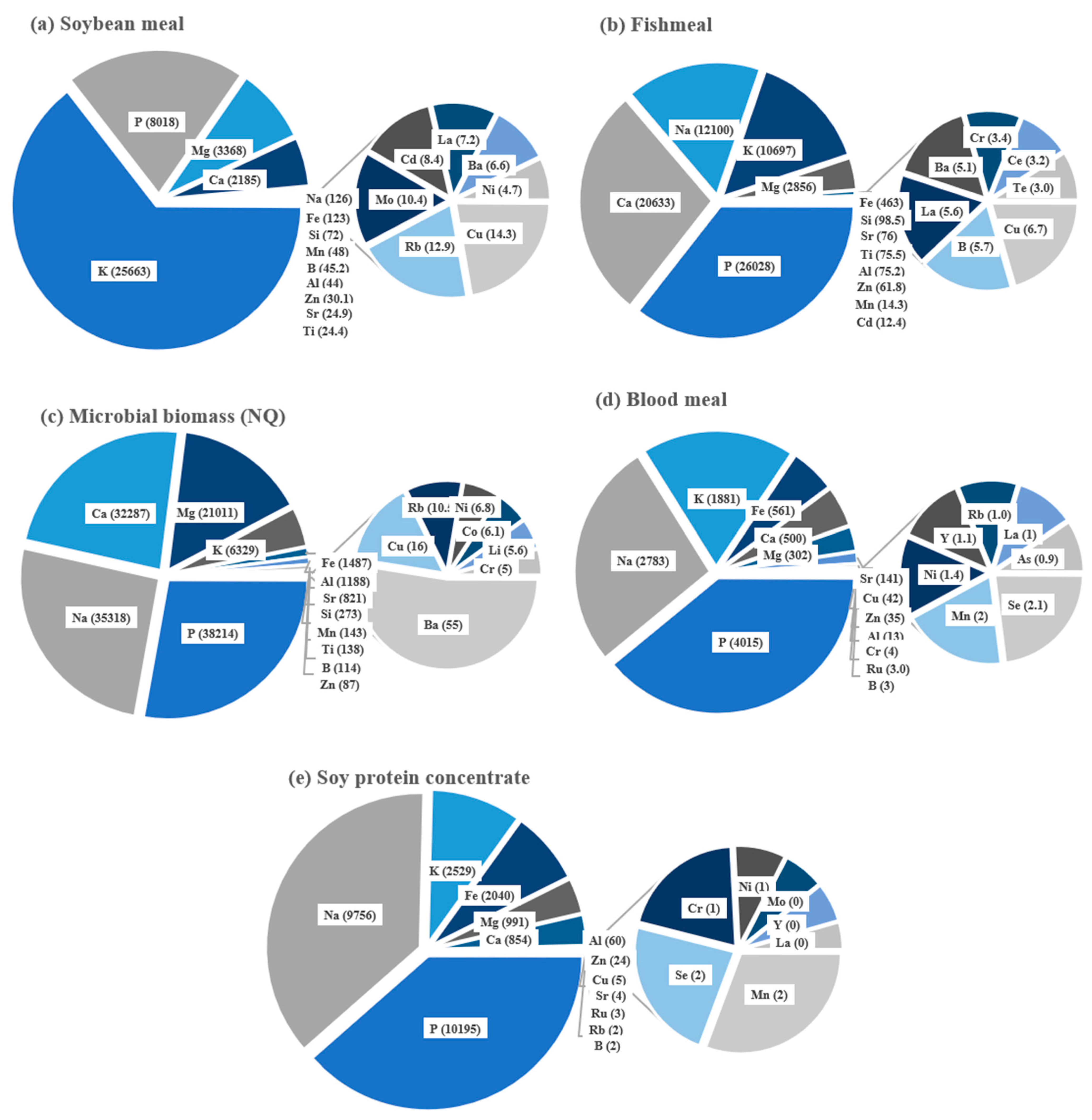
The mineral composition of soybean meal, fishmeal, microbial biomass (NQ), bloodmeal and soy protein concentrate used in diets for the current study were analysed and the values of the twenty most abundant minerals for each ingredient are shown in Figure 1. Although a similar diversity of minerals was detected in soybean meal (n = 51), fishmeal (n = 51) and NQ (n = 65), fishmeal and NQ have a similar and more balanced quantity of macro- and trace minerals as evident from the more even segments of the pie charts. Fewer minerals were detected in soy protein concentrate (n = 41) and bloodmeal (n = 41). Compared to the other ingredients, soy protein concentrate and bloodmeal are low mineral sources containing only 6% and 2% ash, respectively. Of the essential minerals, fishmeal and NQ contained higher levels of macro-minerals (calcium and phosphorus) and trace minerals (iron, selenium and zinc) and NQ contained more magnesium, manganese and copper, compared to soybean meal.

3.2. Nutrient Composition of Diets and Seawater

The nutrient compositions of diets and seawater are shown in Table 2. The addition of the experimental or commercial premix increased the diet concentration for each respective mineral. The addition of NQ increased levels of Ca, P, Mg and Mn but not Cu, Se or Zn compared to the control diet. The commercially relevant, high fishmeal diet contained 4–5% higher protein than the other treatment diets, whilst ash (4–6%) and total lipid (1.5–3%) contents were lower than the experimental diets. Calculated dietary Lys and Met contents met or exceeded the requirements for P. monodon (2.1% and 0.7%, respectively) [6], with Lys ranging from 2.4 to 2.7% and Met at 0.7–1.1% across diets. Regarding minerals, the high fishmeal diet also had the highest levels of P but was deficient in Cu and potentially Mg and Mn. Seawater of salinity 38.7 ppt was a source of all the macro- and trace minerals considered in this study.

3.3. Shrimp Growth and Body Composition

Weight gain, intake, FCR and survival were all influenced by diet treatment as shown in Table 3. The growth of shrimp was highest in diets supplemented with NQ where weight gain increased by 60, 78% and 80% (2.48, 2.77 and 2.79 g vs. 1.55 g; p < 0.001) respectively, compared to the control. On average, NQ diets achieved a weight gain of 369% of their initial body weight. The addition of mineral premixes, without NQ, did not improve growth compared to the control diet. NQ diets performed similarly to the high fishmeal diet (2.21 g or 306% initial body weight) with numerically higher growth. Similar responses were observed for FCR where NQ diets, as well as the high fishmeal diet, were superior to that of the control diet (p < 0.001). NQ supplementation increased feed intake compared to the control and the high fishmeal diet (p < 0.001). The growth performances of diets containing both NQ and inorganic mineral sources were similar to the NQ diet, and so no additive effect of NQ and inorganic mineral supplementation was observed. Shrimp survival at Day 40 was poor for the high fishmeal diet (65%) while the other treatments maintained a high survival rate over 80%. Mortalities observed for the high fishmeal diet occurred evenly across all four tank replicates during the latter half of the trial. This treatment effect was associated with higher incidences of cannibalism during moulting events.

3.4. Nutrient Body Composition and Retention

The effects of treatment diets on shrimp body nutrients and energy composition are shown in Table 4. Whole carcass protein content was greater for the high fishmeal diet and the NQ + commercial premix diet compared to the control fed shrimps by 12.6% and 9.3%, respectively (p < 0.001). Shrimp fed the NQ + experimental premix diet obtained the highest lipid body content of 7.4% but this was not significantly different from the control diet (6.4%). There was no difference observed for ash and gross energy content. Dietary treatments had varying effects on mineral composition for Ca, P and Zn (all p-values < 0.01). The addition of mineral premixes and NQ produced shrimp with a higher Ca content, averaging 2.4%, which was numerically higher than the control (2%) and significantly higher than the high fishmeal diet (1.6%; p < 0.001). Conversely, the high fishmeal diet had the highest P content, 0.59%, compared to all other diets which averaged 0.49% p < 0.001). Zn composition did not increase with the supplementation of NQ, compared to the control, but did increase with the supplementation of the experimental or commercial mineral premix and in the high fishmeal diet. The experimental premix contributed 15 mg kg−1 of Zn as Zn sulphate and the commercial premix contributed 18 mg kg−1 Zn. Shrimps fed the high fishmeal diet contained 5.3% more Zn than the control fed shrimps (46 vs. 30 mg/kg) while those fed the NQ diet were comparable with the control ones (31.4 vs. 30 mg/kg).
Dietary treatments had a significant effect on all nutrient retention parameters as shown in Table 5. All NQ-supplemented diets had improved protein retention, averaging 24.7%, compared to the control (19.9%) and the high fishmeal diet (19.2%) (p < 0.001). NQ diets also had a higher gross energy retention compared to the high fishmeal diet (NQ diets averaging 17.8 vs. 12.9%). The high fishmeal diet obtained the highest retention of ash and lipid, but only ash retention was significantly better than the control (23.2 vs. 13.4%), likely due to the low ash content of the positive control diet (Table 1).
The addition of mineral premixes and NQ had a variable effect on the retention of minerals. Mg, Mn, Se and Zn provided by the inorganic mineral premixes resulted in a consistent reduction in body retention of these minerals. NQ improved the retention of P, an increase of 29%, but this improvement was absent when mineral premixes were added in tandem. Interestingly, Ca and P were poorly retained in the high fishmeal diet whereby Ca retention reduced by 63.2% (39.3 vs. 106.7%) and P retention reduced by 25.0% (9.3 vs. 12.4%) compared to the control.

3.5. Apparent Digestibility

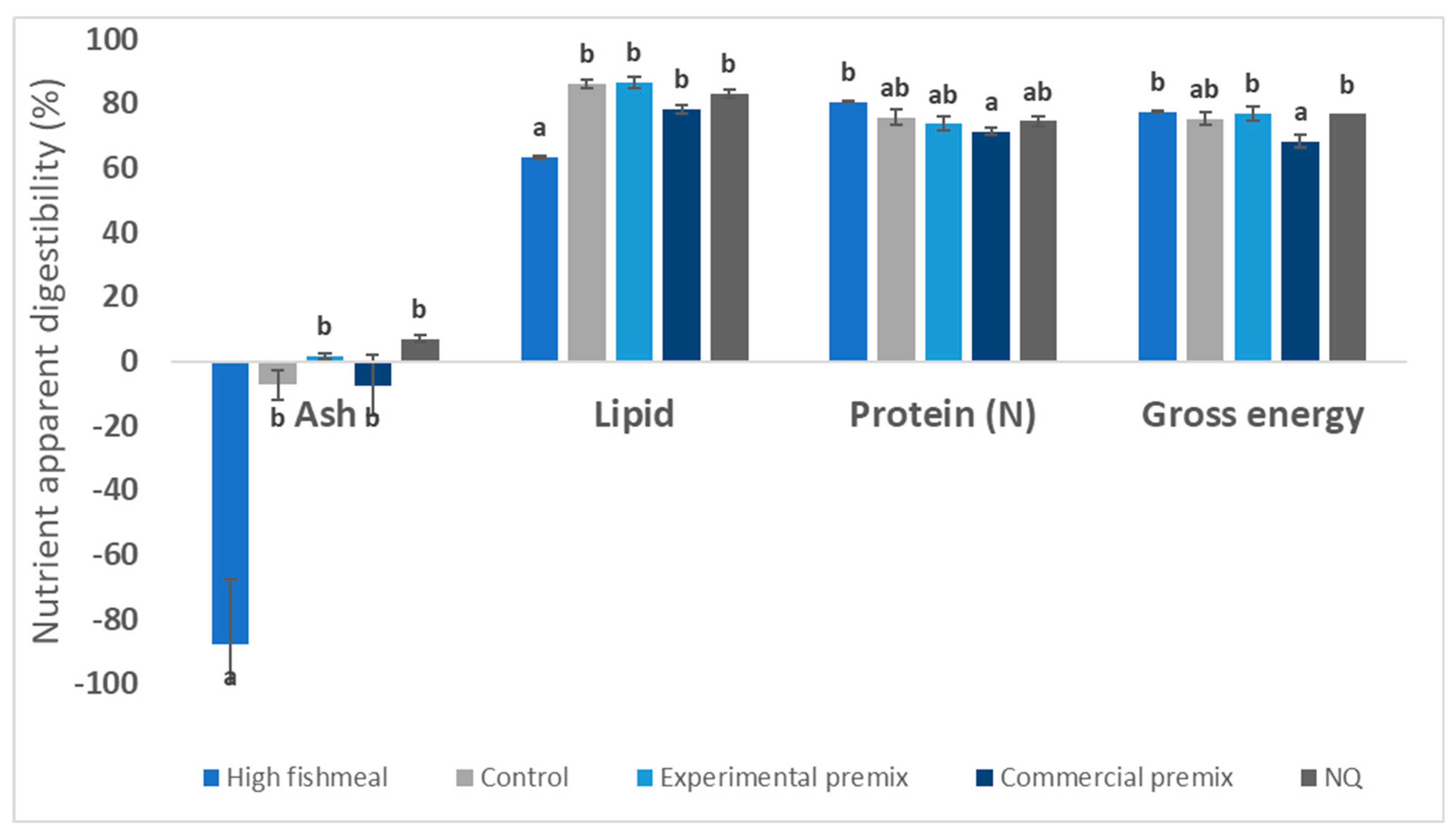
The effects of five dietary treatments on apparent nutrient and GE digestibility of shrimp are shown in Figure 2. The apparent digestibility of ash was low for all diets but significantly negative for the high fishmeal diet (−87.6%; p < 0.001). Lipid apparent digestibility was also lowest for the high fishmeal diet (63.2%) compared to the other diets which ranged between 78.2 and 86.6% (p < 0.001). The apparent digestibility of protein and gross energy were satisfactory with the lowest values obtained by the commercial premix diet, 71.3 and 68.4% respectively, and these were significantly lower than the high fishmeal diet which obtained the highest values of 80.5% and 77.5%, respectively.
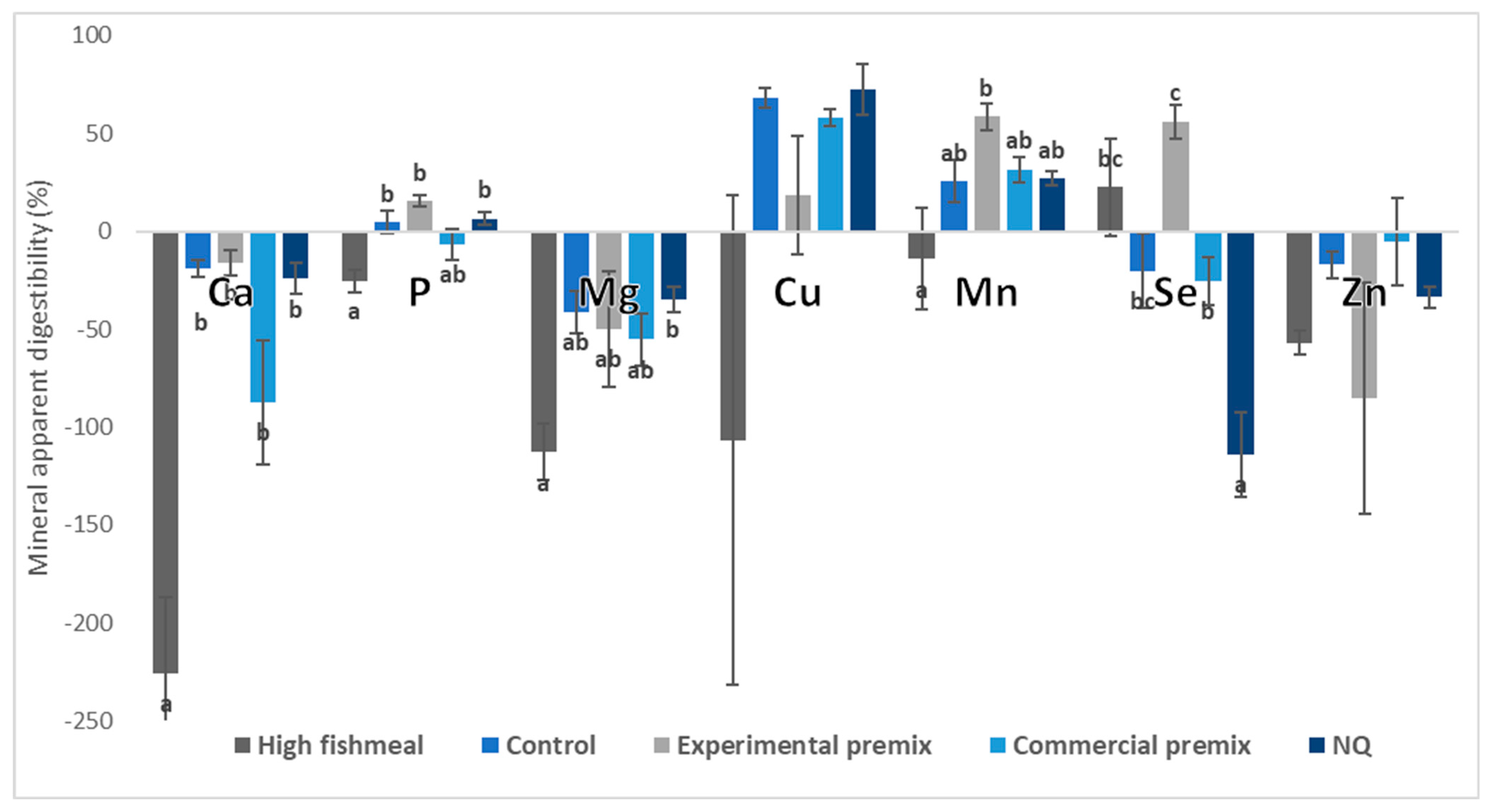
The apparent digestibility of the minerals Ca, P, Mg, Cu, Mn, Se and Zn was determined for five dietary treatments as shown in Figure 3. Negative digestibility values were obtained for Ca, Mg, Se and Zn for most diets as a result of the faeces samples containing more of these minerals as a proportion to the dietary marker yttrium, compared to the diets. These minerals were abundant in seawater and it is likely that the faeces samples absorbed minerals when excreted from the shrimp and rinsing under fresh water was not sufficient in removing all the seawater minerals. As such, a caveat regarding the reported mineral apparent digestibility is that the values may not represent the actual digestibility of dietary minerals. The negative coefficients likely reflect methodological constraints associated with faecal collection in high-salinity systems. However, these values can be assessed in this study to extrapolate the dietary effect on mineral digestion and should be interpreted comparatively between dietary treatments rather than as absolute measures of true digestibility.
The high fishmeal diet obtained the poorest mineral digestibility of Ca, P, Mg, Cu and Mn while the four low fishmeal diets tended to perform similarly for these minerals. This trend was also reflected by the apparent digestibility of ash (Figure 2). Compared to the high fishmeal diet, the NQ diet obtained significantly higher digestibility for the three macro-minerals Ca, P and Mg but obtained significantly lower Se digestibility. The digestibility of Cu and Zn was variable, and no dietary effect was observed.

4. Discussion

The low fishmeal diet elicited slow growth in P. monodon (0.73 to 2.3 g in 40 days; gaining 0.28 g week−1). This growth rate aligns closely with previous reports in juvenile P. monodon fed low fishmeal diets (≤10%), where growth rates of approximately 0.3 g week−1 were observed [24,25]. In the present study, supplementation of inorganic mineral premixes to low fishmeal diets did not ameliorate this growth impairment, indicating that mineral deficiency alone was unlikely to be the primary limiting factor.
Species-specific differences in tolerance to fishmeal replacement likely explain this response where in contrast to P. monodon, P. vannamei can tolerate substantially higher levels of fishmeal replacement, including complete replacement under pond-based conditions [26]. For P. monodon, however, previous studies indicate that fishmeal replacement from 352 to 460 g kg−1 diet with plant proteins significantly reduces growth and nutrient accretion, largely due to the reduced apparent digestibility and metabolic utilisation [7]. Notably, in the present study, the protein and gross energy digestibility of the low fishmeal diet were comparable to the high fishmeal benchmark, and protein and energy retention were not reduced. This suggests that poor growth was not driven by impaired macronutrient digestion or retention.
The inferior growth of the low fishmeal control, despite adequate digestibility and retention, suggests that other physiological constraints may have limited performance. Low fishmeal diets have previously been shown to compromise gut integrity and hepatopancreatic health in P. monodon [27], particularly when combined with low dietary lipid levels. Xie, Wei, Liu, Tian and Niu [27] observed that the combination of a low fishmeal (15%) and fish oil (1%) diet resulted in shrimp with inflamed and damaged hepatopancreas, shortened intestinal microvilli length and higher mortality during acute salinity stress tests. The addition of higher fish oil levels (3%) rectified some of these impairments and resulted in enhanced shrimp condition and final weight. The control diet in this study contained only 6% fishmeal and 2% fish oil, conditions comparable to those shown to induce poor digestive tract integrity and shrimp robustness.
Although gut morphology was not assessed in the present study, the elevated FCR observed in the control diet indicates the reduced efficiency of nutrient utilisation, potentially reflecting compromised digestive function, inefficient tissue accretion, or broader nutritional imbalances. These effects likely operate concurrently and are consistent with the reduced robustness reported for P. monodon fed highly plant-based diets.
Despite the control diet falling below published mineral requirements for Mg, Mn, Cu, Se, and Zn, supplementation with inorganic mineral premixes did not improve shrimp growth. In fact, the inorganic mineral premix tended to reduce weight gain (12%; 1.36 vs. 1.55 g) and feed intake (6%; 0.8 vs. 0.9 g/shrimp/day) compared to the control diet, while nutrient digestibility and retention were not affected. This pattern suggests that the growth effect was primarily intake-driven rather than due to impaired nutrient utilisation. We propose that the inclusion of inorganic minerals, particularly calcium phosphate, in the experimental premix may have negatively altered pellets’ physical characteristics and feeding stimulation. Furthermore, the lack of response to mineral premixes was likely attributable to the high-salinity (38.7 g L−1) flow-through system used in this study, which provided an abundant aqueous source of macro- and trace minerals. Shrimp are known to absorb soluble minerals directly from seawater, including Ca, Mg, Se, and Zn [15], potentially masking dietary deficiencies.
In contrast, studies conducted under low-salinity or recirculating conditions, where aqueous mineral availability is constrained, have demonstrated the clear benefits of dietary mineral supplementation [28,29]. Huang, Wang, Zhang and Song [29] showed that P. vannamei reared in lower salinity (20.0 g L−1) were negatively affected by 60% soybean substitution in a 12% fishmeal diet, resulting in a 19.5% reduction in weight gain and negatively affecting the serum osmotic pressure, gill ATPase activity and tissue mineralization of Ca and P. The addition of inorganic macro-minerals (Ca, Na, Mg) and trace minerals (Fe, Cu, Mn, Zn) negated these effects of reduced fishmeal levels and improved weight gain by up to 11.7% beyond the fishmeal control diet. When shrimp were reared in a recirculating system (salinity maintained at 30 g L−1), the addition of 200 mg kg−1 Zn in a purified diet containing 1.5% phytate produced a 10.6% increase in weight gain and increased hepatopancreatic Zn concentrations compared to no Zn addition [28]. Under the conditions of the present study, mineral deficiencies were unlikely to manifest sufficiently to constrain growth.
In contrast to mineral premixes, supplementation with 10% microbial biomass (NQ) resulted in a substantial improvement in shrimp performance. Weight gain increased by an average of 55% relative to low fishmeal diets and exceeded the high fishmeal benchmark by approximately 25%. These findings are consistent with previous reports demonstrating that NQ can offset the negative effects of fishmeal replacement in P. monodon, including complete fishmeal substitution [18].
Across studies, NQ has consistently enhanced growth performance across a wide range of dietary protein levels (36–54%) and ingredient compositions [17,18,30,31]. The present study extends this evidence by demonstrating that NQ remains effective in low fishmeal, high soybean meal formulations, reinforcing its robustness as a functional feed ingredient rather than a simple protein replacer. Previous studies have shown that NQ also exerts immunostimulatory effects in shrimp, activating immune-related pathways and enhancing disease resistance [32,33,34].
From a physiological perspective, the primary driver of improved growth was increased feed intake, which was elevated by an average of 34% across NQ-containing diets. This was accompanied by improved feed conversion and nutrient retention. Previous studies have demonstrated that NQ prolongs feeding activity and accelerates gut emptying and amino acid absorption [30], supporting the interpretation that NQ acts as a feeding stimulant and digestive modulator.
From a metabolic standpoint, enhanced nutrient retention efficiency indicates improved partitioning of absorbed nutrients into the biomass. The increase in ash retention observed in the present study suggests that mineral deposition may have supported the accelerated growth response, although the digestibility of most nutrients was not markedly altered. These findings suggest that NQ improves the efficiency with which consumed nutrients are utilised for growth rather than simply increasing digestibility.
From a nutritional perspective, NQ provides a complex matrix of protein, minerals, and bioactive compounds. While the present study does not demonstrate that minerals are the primary driver of the growth response, NQ may contribute to meeting mineral requirements under low fishmeal conditions, particularly when feed intake is elevated. In this context, minerals may function permissively, ensuring that accelerated growth is not constrained by micronutrient limitations.
Beyond the nutritional effects, the previous literature indicates that NQ exhibits immunostimulatory properties and activates immune-related pathways in shrimp [32,33,34]. Although immune parameters were not assessed in the present study, these functional properties may contribute indirectly to improved growth performance by enhancing physiological resilience.
Collectively, the mitigation effect of NQ in low fishmeal diets appears to arise primarily from the physiological stimulation of feed intake and improved metabolic utilisation of nutrients, with potential supportive contributions from its mineral content and bioactive components. Further mechanistic studies, such as measurement of mineral transporter expression, metabolic profiling and immune markers, are required to directly disentangle these interacting pathways.

5. Conclusions

Low fishmeal formulations with NQ did not require supplementary minerals which can offer a cost-saving effect. Furthermore, NQ addition improved feed consumption, feed conversion efficiency, survival and growth responses that were equivalent or higher to a high fishmeal diet. The usefulness of NQ was shown to extend beyond that of a source of minerals. Although other bioactive molecules were not the focus of this study, the building literature reveals that the functionality of NQ for shrimp is multifaceted where it is a bioavailable source of minerals, feed intake stimulator, nutrient retention enhancer, source of secondary metabolites, and immune stimulant and can spare dietary protein. These are important findings for the development of sustainable diets for P. monodon.

Author Contributions

Conceptualization, H.H.T., M.R.P.B., A.N.R. and C.J.S.; Methodology, H.H.T., M.R.P.B. and N.A.B.; Formal analysis, H.H.T., B.M.H. and N.A.B.; Investigation, H.H.T., A.N.R. and C.J.S.; Resources, C.J.S.; Data curation, N.A.B.; Writing—original draft, H.H.T., M.R.P.B., B.M.H., N.A.B., A.N.R. and C.J.S.; Writing—review and editing, H.H.T., M.R.P.B., B.M.H., A.N.R. and C.J.S.; Visualisation, H.H.T.; Supervision, M.R.P.B., A.N.R. and C.J.S.; Funding acquisition, C.J.S. All authors have read and agreed to the published version of the manuscript.

Funding

The authors declare financial support and ingredients were provided by Ridley AgriProducts Pty Ltd.

Institutional Review Board Statement

Ethical review and approval were waived for this study on the basis that, at the time that the trial was conducted (2018), penaeid shrimp (decapod crustaceans) were not classified as animals requiring ethics approval under the CSIRO Queensland Animal Ethics Committee framework. Consequently, formal animal ethics approval was not required for research involving Penaeus monodon at that time. The study was conducted in accordance with standard industry and institutional best-practice husbandry and welfare procedures applicable at the time of experimentation.

Data Availability Statement

The data presented in this study are available on request from the corresponding author.

Acknowledgments

We thank David Blyth for the preparation of the experimental feed and Natalie Stoddart for the maintenance of the experiment and sampling.

Conflicts of Interest

The authors declare that the study received funding from Ridley AgriProducts Pty Ltd. The funder had the following involvement with the study: Ridley AgriProducts Pty Ltd. funded this study and supplied the NovaqPro raw material used in the study. However, the funders had no input into the study methodology, analysis, interpretation of data, writing the article or the decision to submit it for publication in this journal. Matthew Briggs reports a relationship with Commonwealth Scientific and Industrial Research Organisation that includes funding grants. The other authors were a part of the Commonwealth Scientific and Industrial Research Organisation project which was financially supported by Ridley AgriProducts Pty Ltd.

References

  1. FAO. The State of World Fisheries and Aquaculture 2022: Towards Blue Transformation; FAO: Rome, Italy, 2022. [Google Scholar]
  2. Tacon, A.G.J.; Metian, M. Global overview on the use of fish meal and fish oil in industrially compounded aquafeeds: Trends and future prospects. Aquaculture 2008, 285, 146–158. [Google Scholar] [CrossRef]
  3. Majluf, P.; Matthews, K.; Pauly, D.; Skerritt, D.J.; Palomares, M.L.D. A review of the global use of fishmeal and fish oil and the Fish In: Fish out Metric. Sci. Adv. 2024, 10, eadn5650. [Google Scholar] [PubMed]
  4. Kok, B.; Malcorps, W.; Tlusty, M.F.; Eltholth, M.M.; Auchterlonie, N.A.; Little, D.C.; Harmsen, R.; Newton, R.W.; Davies, S.J. Fish as feed: Using economic allocation to quantify the Fish In: Fish Out ratio of major fed aquaculture species. Aquaculture 2020, 528, 735474. [Google Scholar] [CrossRef]
  5. Aquaculture Stewardship Council. ASC Shrimp Standard Version 1.2. 2022. Available online: https://www.asc-aqua.org/wp-content/uploads/2022/04/ASC-Shrimp-Standard_v1.2.pdf (accessed on 25 July 2024).
  6. National Research Council. Nutrient Requirements of Fish and Shrimp; National Academies Press: Washington, DC, USA, 2011. [Google Scholar]
  7. Richard, L.; Surget, A.; Rigolet, V.; Kaushik, S.J.; Geurden, I. Availability of essential amino acids, nutrient utilisation and growth in juvenile black tiger shrimp, Penaeus monodon, following fishmeal replacement by plant protein. Aquaculture 2011, 322–323, 109–116. [Google Scholar] [CrossRef]
  8. Jiarun, Z.; Heizhao, L.I.N.; Zhong, H.; Jin, N.I.U.; Falin, Z.; Xu, C.; Yun, W.; Dongmei, X.I.A. Effects of plant proteins supplemented with amino acids on growth and non-specific immunity of Penaeus monodon. South China Fish. Sci. 2013, 9, 44–50. [Google Scholar] [CrossRef]
  9. Rajaram, V.; Jannathulla, R.; Ambasankar, K.; Dayal, J.S. Supplementation of coated and uncoated crystalline amino acid mix in formulating a low-fishmeal diet for Penaeus monodon (Fabricius, 1798): Effect on growth, digestibility, body composition, haemolymph indices and nitrogen metabolism. Aquac. Nutr. 2021, 27, 2154–2168. [Google Scholar] [CrossRef]
  10. Glencross, B.D.; Booth, M.; Allan, G.L. A feed is only as good as its ingredients—A review of ingredient evaluation strategies for aquaculture feeds. Aquac. Nutr. 2007, 13, 17–34. [Google Scholar] [CrossRef]
  11. Yang, Q.; Zhou, X.; Zhou, Q.; Tan, B.; Chi, S.; Dong, X. Apparent digestibility of selected feed ingredients for white shrimp Litopenaeus vannamei, Boone. Aquac. Res. 2009, 41, 78–86. [Google Scholar] [CrossRef]
  12. IAFFD (International Aquaculture Feed Formulation Database). Available online: https://www.iaffd.com/ (accessed on 30 June 2025).
  13. Prabhu, P.A.J. Minerals in Fish: Does the Source Matter? Ph.D Thesis, Wageningen University and Research, Wageningen, The Netherlands, 2015. [Google Scholar]
  14. Qiu, X.; Davis, D.A. Effects of dietary phytase supplementation on growth performance and apparent digestibility coefficients of Pacific White Shrimp Litopenaeus vannamei. Aquac. Nutr. 2017, 23, 942–951. [Google Scholar] [CrossRef]
  15. Truong, H.H.; Hines, B.M.; Emerenciano, M.G.; Blyth, D.; Berry, S.; Noble, T.H.; Bourne, N.A.; Wade, N.; Rombenso, A.N.; Simon, C.J. Mineral nutrition in penaeid shrimp. Rev. Aquac. 2022, 15, 1355–1373. [Google Scholar] [CrossRef]
  16. Simon, C.; Rombenso, A.; Truong, H.; Atkinson, N.; Smullen, R.; Briggs, M. Feeding and growth stimulation of Penaeus vannamei juveniles: Dose-response to the microbial biomass NovaqPro™ in practical diets. Aquaculture 2023, 579, 740176. [Google Scholar] [CrossRef]
  17. Simon, C.J.; Truong, H.H.; Noble, T.H.; Osborne, S.A.; Wynne, J.W.; Wade, N.M. Microbial biomass, marine invertebrate meals and feed restriction influence the biological and gut microbiota response of shrimp Penaeus monodon. Aquaculture 2020, 520, 734679. [Google Scholar] [CrossRef]
  18. Glencross, B.; Arnold, S.; Irvin, S. Bioactive factors in microbial biomass have the capacity to offset reductions in the level of protein in the diet of black tiger shrimp, Penaeus monodon. Aquaculture 2015, 446, 74–79. [Google Scholar] [CrossRef]
  19. Glencross, B.; Blyth, D.; Irvin, S.; Bourne, N.; Campet, M.; Boisot, P.; Wade, N.M. An evaluation of the complete replacement of both fishmeal and fish oil in diets for juvenile Asian seabass, Lates calcarifer. Aquaculture 2016, 451, 298–309. [Google Scholar] [CrossRef]
  20. Rombenso, A.N.; Duong, M.H.; Hines, B.M.; Mã, T.; Simon, C.J. The marine microbial biomass, Novacq™, a useful feed additive for postlarvae and juvenile Litopenaeus vannamei. Aquaculture 2021, 530, 735959. [Google Scholar] [CrossRef]
  21. Truong, H.H.; Moss, A.F.; Bourne, N.A.; Simon, C.J. Determining the importance of macro and trace dietary minerals on growth and nutrient retention in juvenile Penaeus monodon. Animals 2020, 10, 2086. [Google Scholar] [CrossRef]
  22. Folch, J.; Lees, M.; Stanley, G. A simple method for total lipid extraction and purification. J. Biol. Chem. 1957, 226, 497–509. [Google Scholar] [CrossRef]
  23. Dhand, N.; Khatkar, M. Statulator: An Online Statistical Calculator. Sample Size Calculator for Estimating a Single Proportion. 2014. Available online: http://statulator.com/SampleSize/ss1P.html (accessed on 10 February 2026).
  24. Paripatananont, T.; Boonyaratpalin, M.; Pengseng, P.; Chotipuntu, P. Substitution of soy protein concentrate for fishmeal in diets of tiger shrimp Penaeus monodon. Aquac. Res. 2001, 32, 369–374. [Google Scholar] [CrossRef]
  25. Luo, L.; Wang, J.; Pan, Q.; Xue, M.; Wang, Y.; Wu, X.; Li, P. Apparent digestibility coefficient of poultry by-product meal (PBM) in diets of Penaeus monodon (Fabricius) and Litopenaeus vannamei (Boone), and replacement of fishmeal with PBM in diets of P. monodon. Aquac. Res. 2012, 43, 1223–1231. [Google Scholar] [CrossRef]
  26. Amaya, E.A.; Davis, D.A.; Rouse, D.B. Replacement of fish meal in practical diets for the Pacific white shrimp (Litopenaeus vannamei) reared under pond conditions. Aquaculture 2007, 262, 393–401. [Google Scholar] [CrossRef]
  27. Xie, S.; Wei, D.; Liu, Y.; Tian, L.; Niu, J. Dietary fish oil levels modulated lipid metabolism, immune response, intestinal health and salinity stress resistance of juvenile Penaeus monodon fed a low fish-meal diet. Anim. Feed. Sci. Technol. 2022, 289, 115321. [Google Scholar] [CrossRef]
  28. Davis, D.A.; Lawrence, A.L.; Gatlin, D.M. Evaluation of the Dietary Zinc Requirement of Penaeus vannamei and Effects of Phytic Acid on Zinc and Phosphorus Bioavailability. J. World Aquac. Soc. 1993, 24, 40–47. [Google Scholar] [CrossRef]
  29. Huang, F.; Wang, L.; Zhang, C.-x.; Song, K. Replacement of fishmeal with soybean meal and mineral supplements in diets of Litopenaeus vannamei reared in low-salinity water. Aquaculture 2017, 473, 172–180. [Google Scholar] [CrossRef]
  30. Truong, H.H.; Hines, B.M.; Rombenso, A.N.; Simon, C.J. Feed intake, gastro-intestinal transit and haemolymph free amino acids in the shrimp Penaeus monodon are influenced by marine meal supplementation. Aquaculture 2021, 533, 736171. [Google Scholar] [CrossRef]
  31. Arnold, S.; Smullen, R.; Briggs, M.; West, M.; Glencross, B. The combined effect of feed frequency and ration size of diets with and without microbial biomass on the growth and feed conversion of juvenile Penaeus monodon. Aquac. Nutr. 2015, 22, 1340–1347. [Google Scholar] [CrossRef]
  32. Mendoza-Porras, O.; Broadbent, J.A.; Beale, D.J.; Escobar-Correas, S.M.; Osborne, S.A.; Simon, C.J.; Wade, N.M. Post-prandial response in hepatopancreas and haemolymph of Penaeus monodon fed different diets. Omics insights into glycoconjugate metabolism, energy utilisation, chitin biosynthesis, immune function, and autophagy. Comp. Biochem. Physiol. Part D Genom. Proteom. 2023, 46, 101073. [Google Scholar] [CrossRef] [PubMed]
  33. Noble, T.H.; Rao, M.; Briggs, M.; Shinn, A.P.; Simon, C.; Wynne, J.W. Novacq™ improves survival of Penaeus vannamei when challenged with pathogenic Vibrio parahaemolyticus causing acute hepatopancreatic necrosis disease. Aquaculture 2021, 545, 737235. [Google Scholar] [CrossRef]
  34. Noble, T.H.; Samsing, F.; Wade, N.; Osborne, S.; Addepalli, R.; Wynne, J.W. Stimulation of shrimp (Penaeus monodon) hemocytes by lipopolysaccharide-like molecules derived from Novacq™. Anim. Feed. Sci. Technol. 2023, 299, 115626. [Google Scholar] [CrossRef]
Figure 1. Profile of the twenty most abundant minerals analysed in ingredients: (a) soybean meal (Kewpie, QLD, Australia), (b) fishmeal (Jack Mackerel; Ridley Animal Nutrition Ltd Pty, Narangba, QLD, Australia), (c) microbial biomass, NQ (Ridley Animal Nutrition Ltd Pty, Narangba, QLD, Australia), (d) bloodmeal (spray-dried bovine blood meal) and (e) soy protein concentrate (Selecta, CJ Bio, Brisbane, QLD, Australia). Values are in mg/kg DM.
Fishes 11 00141 g001
Figure 2. Effect of selected diets on apparent digestibility of protein, lipid and gross energy in shrimp. a, b = Columns with differing superscripts were significantly different as determined by a 1-way ANOVA and Tukey’s HSD Test. p-values were < 0.05.
Fishes 11 00141 g002
Figure 3. Effect of selected diets on apparent digestibility of minerals (calcium, Ca; phosphorus, P; magnesium, Mg; copper, Cu; manganese, Mn; selenium, Se; and zinc, Zn) in shrimp. a, b, c = Columns with differing superscripts were significantly different as determined by a 1-way ANOVA and Tukey’s HSD Test. p-values were < 0.05.
Fishes 11 00141 g003
Table 1. Description and composition of the dietary treatments.
Diet Number1234567
DescriptionHigh Fishmeal (Benchmark)Low Fishmeal ControlExperimental PremixCommercial PremixNQNQ + Experimental Premix NQ + Commercial Premix
Ingredients (%)
Fishmeal 230666666
Soybean meal23343434333333
Blood meal 101010888
Soy protein concentrate5555444
Microbial biomass (NQ) 101010
Wheat flour31.3322.822.822.818.818.818.8
Diatomaceous earth (filler) 86.48664.484
Basal ingredients 1a,b10.714.1714.1714.1714.1714.1714.17
Commercial mineral premix 3 2 2
Experimental inorganic premix 4
Calcium phosphate (38% Ca) 1.05 1.05
Magnesium oxide (60% Mg) 0.38 0.38
Manganese sulphate (32% Mn) 0.019 0.019
Sodium selenite (45% Se) 0.0001 0.0001
Zinc sulphate (22.7% Zn) 0.007 0.007
1a Basal ingredients constituting 10.7% of diet (%): wheat gluten (8), fish oil (1), Stay-C (0.1), vitamin premix (0.3; including vitamin A, 2.5 MIU; vitamin D3, 1.25 MIU; vitamin E, 100 g; vitamin K3, 10 g; vitamin B1, 25 g; vitamin B2, 20 g; vitamin B3, 100 g; vitamin B5, 100 g; vitamin B6, 30 g; vitamin B9, 5 g; vitamin B12, 0.05 g; biotin, 1 g), soy lecithin (1), cholesterol (0.3), astaxanthin (0.05), Banox E (0.02), yttrium as indigestible marker (0.1). 1b Basal ingredients constituting 14.17% of diet (%): wheat gluten (10), fish oil (2), methionine (0.3), Stay-C (0.1), vitamin premix (0.3; including vitamin A, 2.5 MIU; vitamin D3, 1.25 MIU; vitamin E, 100 g; vitamin K3, 10 g; vitamin B1, 25 g; vitamin B2, 20 g; vitamin B3, 100 g; vitamin B5, 100 g; vitamin B6, 30 g; vitamin B9, 5 g; vitamin B12, 0.05 g; biotin, 1 g), soy lecithin (1), cholesterol (0.3), astaxanthin (0.05), Banox E (0.02), yttrium as indigestible marker (0.1). 2 Jack Mackerel fishmeal (Ridley, Narangba, QLD, Australia). 3 Mineral premix (g kg−1): copper (7.2), iron (1.8), manganese (1.8), zinc (9), iodine (0.13), selenium (0.06); Ridley Animal Nutrition Ltd., Narangba, QLD, Australia. 4 Sigma-Aldrich, Macquarie Park, NSW, Australia. NQ = microbial biomass NovaqProTM, Narangba, QLD, Australia.
Table 2. Analysed nutrient content of the dietary treatments and mineral concentrations of seawater used as part of the growth trial.
High Fishmeal (Benchmark)ControlExperimental PremixCommercial PremixNQNQ + ExperimentalNQ + CommercialSeawater Sample
Analysed (% DM)
DM94.391.691.498.393.692.897.9
Ash 6.912.012.711.711.911.911.1
Total lipid 5.98.78.57.59.19.68.4
Crude protein50.545.044.244.146.045.846.3
Carbohydrate 36.734.334.736.733.032.733.4
Gross energy (MJ kg−1)20.919.619.619.119.719.619.4
Water stability after 5 h immersion (%)80.991.598.292.695.893.593.0
Mineral (mg kg−1)
Ca4821286047724400442044704950510 mg L−1
Cu714.814.112513101423 µg L−1
P8414495069205030580072906130389 µg L−1
Mg1480146033901540182032001820363 mg L−1
Mn2027258338810718 µg L−1
Se10.40.310.2591.561.351 µg L−1
Zn46302816231.441.81739 µg L−1
Calculated (% DM)
Lysine2.62.72.72.52.52.52.4
Methionine1.10.70.70.70.70.70.7
NQ = microbial biomass NovaqProTM.
Table 3. Effect of diets on growth parameters of shrimp after 40 days. Values are means ± SE.
DietWeight Gain
(g/Shrimp)
Weight Gain
(% Initial)
Intake (g/Shrimp/Day)FCRSurvival (%)
High fishmeal2.21 ± 0.29 bc306 ± 39.59 bc0.08 ± 0.01 a1.59 ± 0.13 a65 ± 5 a
Control1.55 ± 0.03 ab212 ± 3.58 ab0.09 ± 0 a2.02 ± 0.05 b97.5 ± 2.5 b
Experimental premix1.36 ± 0.04 a188 ± 7.41 a0.08 ± 0 a2.15 ± 0.05 b90 ± 5.77 ab
Commercial premix1.5 ± 0.18 ab207 ± 23.31 ab0.09 ± 0.01 a2.06 ± 0.09 b82.5 ± 10.31 ab
NQ2.77 ± 0.12 c384 ± 16.96 c0.12 ± 0 b1.56 ± 0.05 a95 ± 2.89 b
NQ + experimental2.48 ± 0.1 c342 ± 13.33 c0.12 ± 0.01 b1.68 ± 0.02 a87.5 ± 6.29 ab
NQ + commercial2.79 ± 0.23 c384 ± 32.44 c0.12 ± 0.01 b1.47 ± 0.04 a85 ± 6.45 ab
p-value<0.001<0.001<0.001<0.0010.026
NQ = microbial biomass NovaqProTM. a, b, c = Values with differing superscripts across columns were significantly different as determined by a 1-way ANOVA and Tukey’s HSD Test. p-values were < 0.05.
Table 4. Effect of diet on body composition of ash, lipid, protein, gross energy and minerals: calcium (Ca), phosphorus (P), magnesium (Mg), manganese (Mn), selenium (Se) and zinc (Zn) in shrimp.
DietBody Composition (%)
AshLipidProteinGross Energy (MJ/kg)CaPMgMn (mg/kg)Se (mg/kg)Zn (mg/kg)
High fishmeal12.1 ± 0.76.6 ± 0.4 bc65.2 ± 0.7 c19.5 ± 0.31.6 ± 0.1 a0.59 ± 0.02 b0.26 ± 0.011.5 ± 0.21.2 ± 0.447 ± 1.6 b
Control10.8 ± 0.86.4 ± 0.5 abc57.9 ± 0.9 a18.4 ± 0.92 ± 0.2 ab0.47 ± 0.02 a0.29 ± 0.021.3 ± 01.4 ± 0.232.5 ± 1.1 a
Experimental premix11.4 ± 0.46 ± 0.3 abc59.8 ± 0.8 ab18.3 ± 0.52.5 ± 0.2 b0.47 ± 0 a0.33 ± 0.021.8 ± 0.11.7 ± 0.133.2 ± 2.8 ab
Commercial premix11.6 ± 0.54.5 ± 0.5 a60.4 ± 0.8 abc17.4 ± 0.42.4 ± 0.1 b0.48 ± 0.02 a0.3 ± 0.011.4 ± 0.11.6 ± 0.336 ± 1.1 ab
NQ12.1 ± 0.35.9 ± 0.3 abc58.5 ± 0.9 ab17.5 ± 0.22.4 ± 0 b0.51 ± 0.01 a0.3 ± 0.011.7 ± 0.11.4 ± 0.131.1 ± 1.3 a
NQ + experimental11.8 ± 0.37.4 ± 0.5 c60.4 ± 1.7 abc19.3 ± 0.82.4 ± 0.1 b0.48 ± 0.02 a0.3 ± 0.011.4 ± 0.11.6 ± 0.336 ± 1.1 ab
NQ + commercial12 ± 0.55.3 ± 0.4 ab63.3 ± 1.2 bc17.6 ± 0.32.3 ± 0.1 b0.51 ± 0.01 a0.32 ± 0.012 ± 0.41.5 ± 0.340.7 ± 6.7 ab
SEM0.5390.4371.1050.5320.1390.0150.0140.180.252.937
p-value0.650.004<0.0010.053<0.001<0.0010.0520.1180.4940.007
NQ = microbial biomass NovaqProTM. a, b, c = Values with differing superscripts across columns were significantly different as determined by a 1-way ANOVA and Tukey’s HSD Test. p-values were < 0.05.
Table 5. Effect of diet on retention of ash, lipid, protein, gross energy and minerals: calcium (Ca), phosphorus (P), magnesium (Mg), manganese (Mn), selenium (Se) and zinc (Zn) in shrimp.
Nutrient Retention (%)
Ash LipidProteinGross EnergyCaPMgMnSeZn
High fishmeal23.2 ± 2.8 c15.5 ± 2.2 b19.2 ± 1.1 a12.9 ± 1 a39.3 ± 3.4 a9.3 ± 0.4 ab22.3 ± 1.2 ab1.1 ± 0.1 b13.7 ± 6.8 a16.5 ± 0.6 bc
Control13.4 ± 1.8 ab12.2 ± 1.2 ab19.9 ± 0.9 a15.5 ± 1.1 ab106.7 ± 18.1 b12.4 ± 1.2 cd29.4 ± 3.4 bc0.7 ± 0.1 b63.5 ± 13.4 b18.5 ± 1 c
Experimental premix12.8 ± 0.6 a10.8 ± 0.6 ab19.9 ± 0.2 a14.6 ± 0.7 a83.5 ± 9.1 b7.3 ± 0.3 a17.6 ± 1.2 a0.3 ± 0 a12.4 ± 1.3 a13.2 ± 2.1 b
Commercial premix13.1 ± 0.8 ab7 ± 1.6 a18.4 ± 1.1 a12.6 ± 0.8 a79.3 ± 9.5 ab11.3 ± 0.8 bc27.5 ± 1.9 bc0.2 ± 0 a25.8 ± 7.6 a3.6 ± 0.2 a
NQ19.6 ± 1 bc12.6 ± 0.8 ab24.4 ± 0.5 b17.3 ± 0.4 b106.7 ± 6.7 b16 ± 0.3 e35.2 ± 2.7 c0.7 ± 0.1 b78.6 ± 7.5 b20.2 ± 0.8 c
NQ + experimental18 ± 0.7 abc15.1 ± 1.3 b24.1 ± 0.6 b18.7 ± 0.9 b97.6 ± 1.5 b11.7 ± 0.3 bc16.9 ± 0.6 a0.4 ± 0 a17.1 ± 2 a14 ± 0.6 b
NQ + commercial20.2 ± 0.9 c11.5 ± 1.3 ab25.5 ± 0.9 b17.4 ± 0.6 b94.8 ± 7.3 b15.1 ± 0.5 de34.4 ± 1.6 c0.4 ± 0.1 a24.2 ± 5.6 a5 ± 0.9 a
SEM1.4391.3910.8260.8229.3480.6241.9960.0687.3240.903
p-value<0.0010.006<0.001<0.001<0.001<0.001<0.001<0.001<0.001<0.001
NQ = microbial biomass NovaqProTM. a, b, c, d, e = Values with differing superscripts across columns were significantly different as determined by a 1-way ANOVA and Tukey’s HSD Test. p-values were < 0.05.
Disclaimer/Publisher’s Note: The statements, opinions and data contained in all publications are solely those of the individual author(s) and contributor(s) and not of MDPI and/or the editor(s). MDPI and/or the editor(s) disclaim responsibility for any injury to people or property resulting from any ideas, methods, instructions or products referred to in the content.