Article

Life Cycle Assessment and Life Cycle Costing of a Greenhouse Culture Model for Litopenaeus vannamei


1
College of Fisheries, Ocean University of China, Qingdao 266003, China
2
State Key Laboratory of Mariculture Biobreeding and Sustainable Goods, Yellow Sea Fisheries Research Institute, Chinese Academy of Fishery Sciences, Qingdao 266071, China
3
Laboratory for Marine Fisheries Science and Food Production Processes, Qingdao Marine Science and Technology Center, Qingdao 266237, China
*
Author to whom correspondence should be addressed.
Fishes 2026, 11(3), 131; https://doi.org/10.3390/fishes11030131
Submission received: 25 November 2025 / Revised: 23 January 2026 / Accepted: 29 January 2026 / Published: 25 February 2026
(This article belongs to the Section Aquatic Invertebrates)

Abstract

Greenhouse aquaculture is an increasingly advanced practice in shrimp farming. This study employs Life Cycle Costing (LCC) and Life Cycle Assessment (LCA) to systematically evaluate the economic and environmental performance of greenhouse shrimp farming. Research data were collected from field surveys and enterprise production records to analyze the construction and farming processes of the aquaculture facilities. LCC analysis revealed that the life cycle cost was 3.56 USD kg−1 shrimp. The construction cost of the greenhouse was 4.58 USD m−2, with steel pipes and film materials being the dominant cost components. The total farming cost per cultivation cycle reached USD 3510.76 per greenhouse, of which feed (30.54%) and land rent (15.86%) were the primary expenses. This model achieved a net profit of USD 5.31 per m2 per cycle and a cost-profit ratio of 60.47%, values which are significantly higher than those reported for the Indoor Super-Intensive Culture (ISIC) model. LCA results demonstrated that the environmental impact per kilogram of shrimp produced via greenhouse aquaculture was characterized by a global warming potential (GWP) of 3.279 kg CO2 eq, an acidification potential (AP) of 0.369 kg SO2 eq, and a eutrophication potential (EP) of 0.212 kg PO4 equation Furthermore, the abiotic depletion potential (ADP) and human toxicity potential (HTP) were relatively low, at 0.002 kg Sb eq and 0.093 kg 1,4-DCB eq per kilogram of shrimp, respectively. The construction phase had the highest greenhouse gas emissions (GWP 1940.00 kg CO2 eq), mainly due to the consumption of steel (steel pipes accounting for 71.6% of CO2 emissions) and polymer materials. During the farming phase, the primary emissions per kilogram of shrimp produced were GWP (3.23 kg CO2 eq), AP (0.27 kg SO2 eq), and EP (0.212 kg PO4 eq). The findings indicate that this greenhouse model possesses considerable advantages in balancing economic output and risk management, rendering it suitable for promotion in appropriate regions. Further reductions in cost and environmental impact can be achieved by optimizing building material selection, implementing precision feeding strategies, and improving the energy utilization structure. These measures will enhance the economic and environmental benefits of greenhouse shrimp farming and promote the green development of the entire aquaculture industry.
Key Contribution: This study constructs a Life Cycle Cost (LCC) and integrates Life Cycle Assessment (LCA) methods to systematically analyze the cost structure and environmental footprint. The aim is to provide a basis for cost control and emission reduction management in the industry; support the formulation of green aquaculture policies; and promote the realization of cost reduction; emission reduction; and sustainable development goals in the aquaculture sector.

1. Introduction

The shrimp culture industry in China has a long history and has transitioned from traditional practices to modernized, intensive production. Continuous innovation in farming techniques and models has fostered diversified development trends [1,2]. The evolution of the aquaculture industry from early traditional pond farming to more advanced systems encompasses enhanced ponds, greenhouse farming, high-density industrialized aquaculture, and Integrated Multi-Trophic Aquaculture (IMTA), enabling progressive achievements in scale, efficiency, and sustainability [3,4]. The large-scale production of Litopenaeus vannamei is economically significant, generating substantial revenues for the fishery sector in China [5]. In recent years, the industry has faced dual pressures from market price fluctuations and global supply–demand imbalances, leading to a widespread decline in profitability. Many farmers have seen sustained income reductions, with some incurring severe losses of up to 25% of production costs [6].
Meanwhile, the culture technology for Litopenaeus vannamei is diversifying, with different models demonstrating distinct characteristics and potential in China [3,7]. The Indoor Super-Intensive Culture model (ISIC) is widely applied due to its high density and controllable environment; however, its substantial water exchange and waste discharge contribute to ecological issues and frequent disease outbreaks [8,9]. To enhance sustainability, recirculating aquaculture systems and biofloc technology have been adopted, mitigating environmental impacts through resource recycling [10,11,12]. Nevertheless, the high costs and market volatility associated with industrialized farming constrain its widespread adoption [13]. In contrast, traditional monoculture pond models (PMC) and Pond Integrated Multi-Trophic Aquaculture (PIMTA) offer lower costs and reduced risks but are more susceptible to environmental and seasonal fluctuations, resulting in limited profitability [6,7,14]. The greenhouse farming model is a simple yet highly productive intensive system. It relies on microbial processes for water purification, offering advantages such as low water consumption, minimal wastewater discharge, and high biosecurity, which has led to its widespread acceptance among farmers. However, challenges remain, including insufficient nutrient-degrading microorganisms and nitrogen accumulation due to suboptimal feeding management, necessitating further fundamental research to support technical optimization [15,16]. Additionally, increasing demands for green and healthy aquaculture development, coupled with high water treatment costs, have led to a gradual phasing out of this model in some contexts [17].
To address the aforementioned challenges of enhancing risk resilience, improving profit stability, and promoting cost-effective and sustainable shrimp farming, the industry is implementing multifaceted optimizations of existing culture models. Among these, the greenhouse farming model has revitalized its development potential through recent technological upgrades and is increasingly considered a viable option for promotion [18]. The continuous maturation of applied technologies, such as biofloc and probiotics, has enabled effective control of organic pollution and a significant reduction in pollutant levels. Concurrently, advancements in wastewater treatment technologies and associated cost reductions in some regions have substantially alleviated the economic burden of farm effluent management [19,20]. These developments present new opportunities for the revival and sustainable development of greenhouse culture in specific regional contexts.
Jiangsu Rudong, the origin of greenhouse shrimp farming in China, hosts the largest such operation, with approximately 150,000 greenhouse units currently in use [21]. This model integrates the environmental control and high-density advantages of industrialized farming while substantially reducing production costs. It is characterized by a small land footprint, low risk, and a high return on investment [22,23]. Research indicates that the excellent insulation properties of greenhouses facilitate two annual shrimp crops, one in spring and another in autumn. Spring stock is placed in ponds earlier, allowing harvests to precede peak market periods and generally achieving prices 0.85–1.41 USD kg−1 higher than those from open earthen ponds [24]. Furthermore, this approach incorporates ecological principles from pond aquaculture. The primary use of microbial agents for water quality improvement, coupled with reduced reliance on antibiotics and disinfectants, effectively minimizes disease incidence, underscoring the enhanced environmental friendliness and sustainability of this model [25,26].
Life Cycle Assessment (LCA) is a standardized methodology widely employed to evaluate the environmental impacts of aquaculture systems, thereby providing sustainability guidance for industry and policymakers [27,28]. In recent years, LCA has become an increasingly crucial tool for assessing aquaculture sustainability [8,29,30]. Previous studies have utilized LCA to evaluate the environmental footprints of intensive and semi-intensive shrimp culture, enabling comparisons of sustainability across different aquaculture models [31,32]. To comprehensively measure sustainable development progress, researchers have developed the Life Cycle Sustainability Assessment (LCSA) framework, which integrates Life Cycle Assessment (LCA), Life Cycle Costing (LCC), and other methods to evaluate product sustainability [33,34,35,36]. Life Cycle Costing (LCC) is an economic approach for assessing all costs associated with a product or service throughout its life cycle, from raw material extraction to production, use, and disposal [37].
However, research on the economic and environmental performance of greenhouse culture models remains limited. A significant gap exists in the systematic assessment of both its Life Cycle Costing (LCC) and its Life Cycle Assessment (LCA). Therefore, this study aims to analyze the construction and farming costs of the greenhouse culture model and employs LCA to evaluate its environmental emission profiles. By examining the feasibility and specific advantages of greenhouse farming technology, this research quantifies the complete cost structure and environmental impacts of greenhouse shrimp farming systems during both the construction and operational phases under practical production conditions in China, aiming to provide scientific evidence and practical insights for the sustainable development of the shrimp farming industry.

2. Materials and Methods

2.1. Goal and Scope Definition

This study employs Life Cycle Assessment (LCA) and Life Cycle Costing (LCC) methodologies, in accordance with ISO 14040/14044 standards (ISO, 2006a; ISO, 2006b) [38,39], to systematically evaluate the resource consumption, environmental impacts, and economic performance of Litopenaeus vannamei cultivation in a greenhouse system during its construction and farming phases. With a focus on sustainability within shrimp farming systems, the system boundary excludes downstream processes such as seed production, processing, distribution, consumption, and waste disposal, aligning with established conventions in aquaculture LCA. For operational continuity, the farming process is modeled from the intermediate cultivation stage (Stage 2). The scope of this study includes the construction phase, comprising material production, transportation, and assembly of greenhouse infrastructure components (e.g., steel pipes, film, doors, and keels), and the farming phase, accounting for critical inputs such as shrimp postlarvae, feed, energy, water quality management, and wastewater discharge. Aquaculture infrastructure is considered a long-term capital investment, with shrimp ponds and PVC pipes having a defined lifespan of 20 years, allowing for two crops per year [40,41].

2.2. Inventory Analysis and Data Collection

As established in previous studies [13,31], energy consumption is a dominant factor in environmental pollution emissions, with impacts surpassing those from agricultural water use or biological respiration. Consequently, this analysis specifically focuses on pollution generated from energy consumption during the farming stage to provide a more comprehensive assessment of the environmental impacts associated with greenhouse shrimp farming. Furthermore, the study did not include the use of renewable energy or raw material formulation adjustment strategies. Therefore, the environmental impact assessment in the farming phase of this study is limited to energy consumption, providing a foundational basis for future research aimed at a more comprehensive evaluation of this phase.
Primary data were collected through field surveys and enterprise production records from two greenhouse shrimp farms in Rudong, Jiangsu Province, China (32.2333° N, 121.6667° E). In-depth communication with farm operators enabled the investigation and calculation of key farming costs and cultivation parameters. The collected data encompassed various aspects, including the farming environment, cost composition, and revenue. Standard greenhouses were 40 m long and 10 m wide; small ponds were 1.2 m deep with a slope of 75 degrees. Construction was organized by plot, typically with 30 greenhouses per group, with a production passage between two rows. Information on farming area, yield, greenhouse construction, material usage, and overall production status was also recorded to establish a comprehensive understanding of the operational conditions (details in Supplementary Tables S1 and S2).
To enhance the reliability and accuracy of the study, background life cycle data were incorporated from the Ecoinvent v3.0 database. This database provides extensive life cycle inventory information, facilitating the comparison of field survey data against broader industrial benchmarks. Data collection was aligned with database queries and selectively applied in Life Cycle Assessment, following the framework in Figure S1 (Supplementary Materials). Based on data categories, analysis and comparison identified relevant indicators. Additionally, compare these indicators with those from other farming models to ascertain the influencing types. The functional unit was defined as one kilogram of live shrimp produced. This standardized unit facilitates data comparison and provides a clear basis for the Life Cycle Assessment, thereby enhancing the actionability and reference value of the research findings. The functional unit was defined as one kilogram of live shrimp produced.

2.3. Impact Assessment

The LCA evaluation focuses on five environmental impact categories: Global Warming Potential (GWP), Acidification Potential (AP), Eutrophication Potential (EP), Human Toxicity Potential (HTP), and Abiotic Depletion Potential (ADP), applying mass allocation for multi-output systems. The LCC analysis quantifies costs across various categories, including construction materials, equipment depreciation, feed, energy, labor, maintenance, and revenue from live shrimp sales, the latter based on market prices and actual yield. In line with established practice [41], the CML-IA method was applied to characterize environmental impacts due to its robustness in assessing energy inputs, pollutant emissions, and ecological degradation.

2.4. Research Innovations and Quantitative Contributions

Compared with existing LCA studies on systems like ISIC, BFT, and RAS, this study provides a more detailed material inventory for greenhouse shrimp farming systems during construction. Key components such as steel structures, cover materials, and piping systems are quantified based on real production data from China. These results offer practical parameters for assessing the environmental and cost impacts of such infrastructure.

2.5. System and Management Approach

The greenhouse culture system in this study adopted a stocking density of 120–160 shrimp per square meter, with an annual production yield of approximately 7.8 kg per cubic meter (based on 2.5 culture cycles per year). Feeding followed a scheduled and rationed strategy, and the feed conversion ratio (FCR) was maintained between 1.1 and 1.3. Daily management included rigorous water quality monitoring (dissolved oxygen (DO) > 5 mg/L, temperature 28–30 °C, pH 7.8–8.5), periodic size grading, and systematic disease prevention and control measures to ensure stable culture conditions and promote healthy shrimp growth.

3. Results

3.1. Construction and Farming Costs of Greenhouse Culture

The cost analysis for the greenhouse model reveals a total initial investment of USD 5327.07 per greenhouse. Construction costs constituted 34.36% (USD 1830.31) of this total. The primary construction expenditures were for steel pipes, keels, and doors, amounting to USD 597.75 (11.22% of the total cost); the outer shed film, costing 296.48 USD (5.57%); and blowers, at USD 248.03 (4.66%). In contrast, operational farming costs were higher, totaling USD 3510.76 per cycle and accounting for 66.20% of the initial investment. Within the farming costs, feed was the largest expenditure at USD 1626.76 (30.54%), followed by allocated land rent at USD 845.07 (15.86%), and utilities at USD 338.03 (6.35%) (Table 1). To reduce initial capital outlay, the promotion of modular greenhouse designs and corrosion-resistant materials is recommended.

3.2. Profitability Analysis of Greenhouse Farming

The selling price for shrimp from the greenhouse model was 5.63 USD kg−1, with a yield of 1000 kg per greenhouse. The total revenue generated per greenhouse was USD 5630.00, yielding a net profit of USD 2070.00 and demonstrating favorable economic returns. The cost-profit ratio was 60.47%, indicative of robust market demand and effective cultivation practices. The life cycle cost, integrating both construction and farming expenditures, was calculated at USD 3.56 per kg of shrimp. These results confirm that greenhouse farming is not only economically viable but also provides a stable income source for farmers, thereby contributing to local economic development (Table 2). To further enhance profitability, several strategies are suggested: refining cultivation techniques to stabilize production, improving maintenance protocols to extend the greenhouse lifespan and amortize annual costs, and developing regional brands to strengthen market positioning and premium pricing capabilities.

3.3. Life Cycle Assessment of Greenhouse Farming

In the initial farming phase, the GWP per kilogram of shrimp is 5.18 kg CO2 eq, with an AP of 0.371 kg SO2 eq, an EP of 0.213 kg PO4 eq, a HTP of 0.140 kg 1,4-DCB eq, and the ADP of 0.00228 kg Sb eq, indicating the multiple environmental impacts of this phase. The total environmental impact of the construction process is relatively small, with a GWP of 1.94 kg CO2 eq, AP of 0.00152 kg SO2 eq, EP of 0.00124 kg PO4 eq, HTP of 0.0471 kg 1,4-DCB eq, and ADP of 0.0000281 kg Sb eq per greenhouse. The environmental impact during the farming phase is higher, with a GWP of 3.23 kg CO2 eq, AP of 0.369 kg SO2 eq, EP of 0.212 kg PO4 eq, HTP of 0.0932 kg 1,4-DCB eq, and ADP of 0.00225 kg Sb eq per greenhouse, indicating significant environmental impacts during the farming process. Calculating over a 20-year construction cycle, the GWP decreases to 0.0485 kg CO2 eq, AP to 0.000397 kg SO2 eq, EP to 0.000228 kg PO4 eq, HTP to 0.0001 kg 1,4-DCB eq, and ADP to 0.000002 kg Sb eq kg−1 shrimp. The life cycle analysis shows that the GWP of greenhouse farming is 3.28 kg CO2 eq, AP is 0.369 kg SO2 eq, EP is 0.212 kg PO4 eq, HTP is 0.0933 kg 1,4-DCB eq, and ADP is 0.00225 kg Sb eq kg−1 shrimp. By managing and improving technology, increasing yield and appropriately extending the farming cycle can effectively reduce the environmental impact of greenhouse farming (Table 3).

3.4. Emission Analysis of Environmental Factors at Different Stages

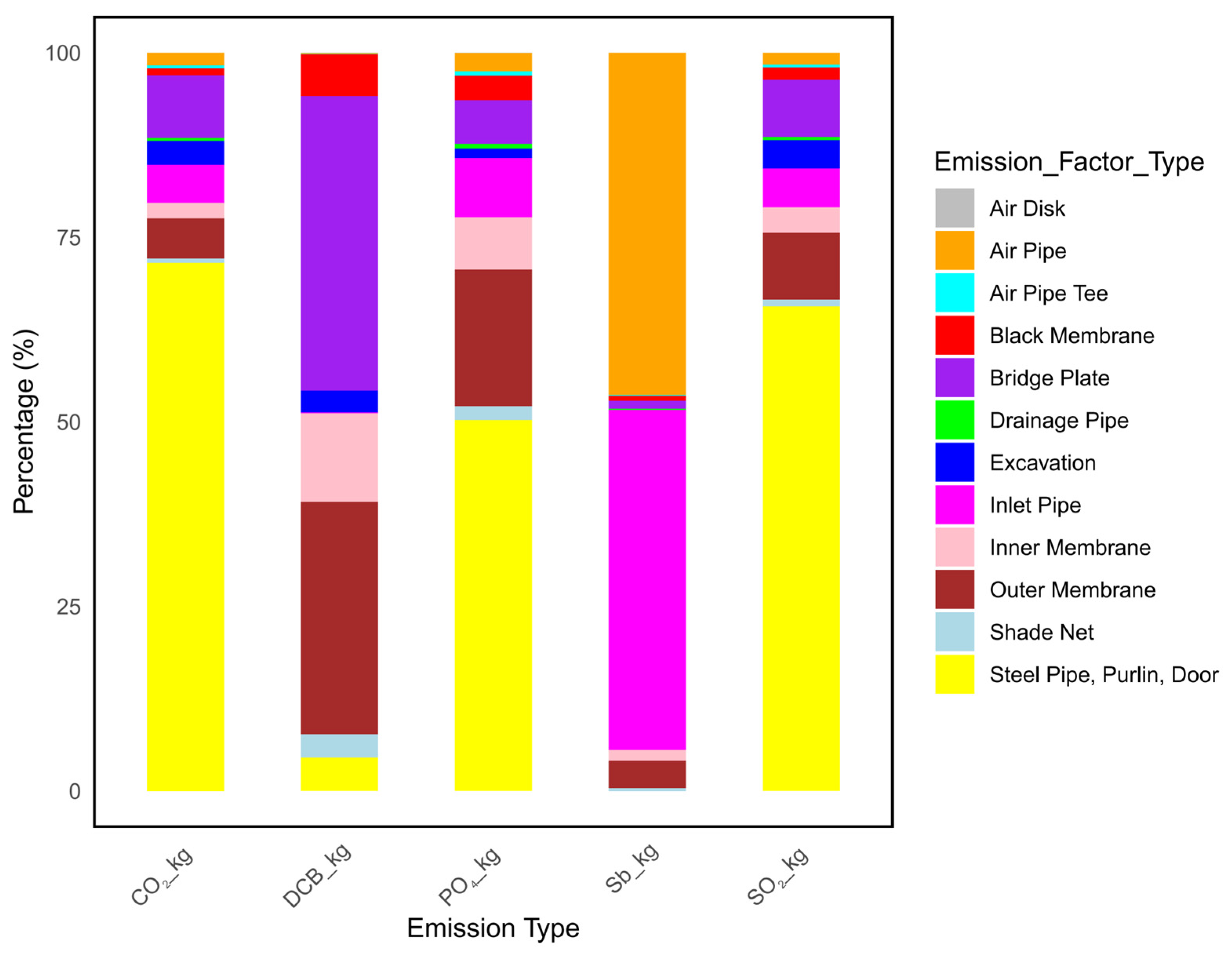
During the construction process, the total emissions per greenhouse are 1940 kg CO2 eq, 1.52 kg SO2 eq, 1.25 kg PO4 eq, 10.8 kg 1,4-DCB eq, and 0.0259 kg Sb equation Among these, CO2 emissions dominate. The emissions from excavation and steel pipes are relatively high, at 62.1 kg CO2 eq and 1390 kg CO2 eq per greenhouse, respectively, accounting for about 85.5% of the total emissions. Therefore, focusing on environmentally friendly equipment selection and material use can effectively reduce the environmental impact of greenhouse construction (Table 3 and Table 4; Figure 1).
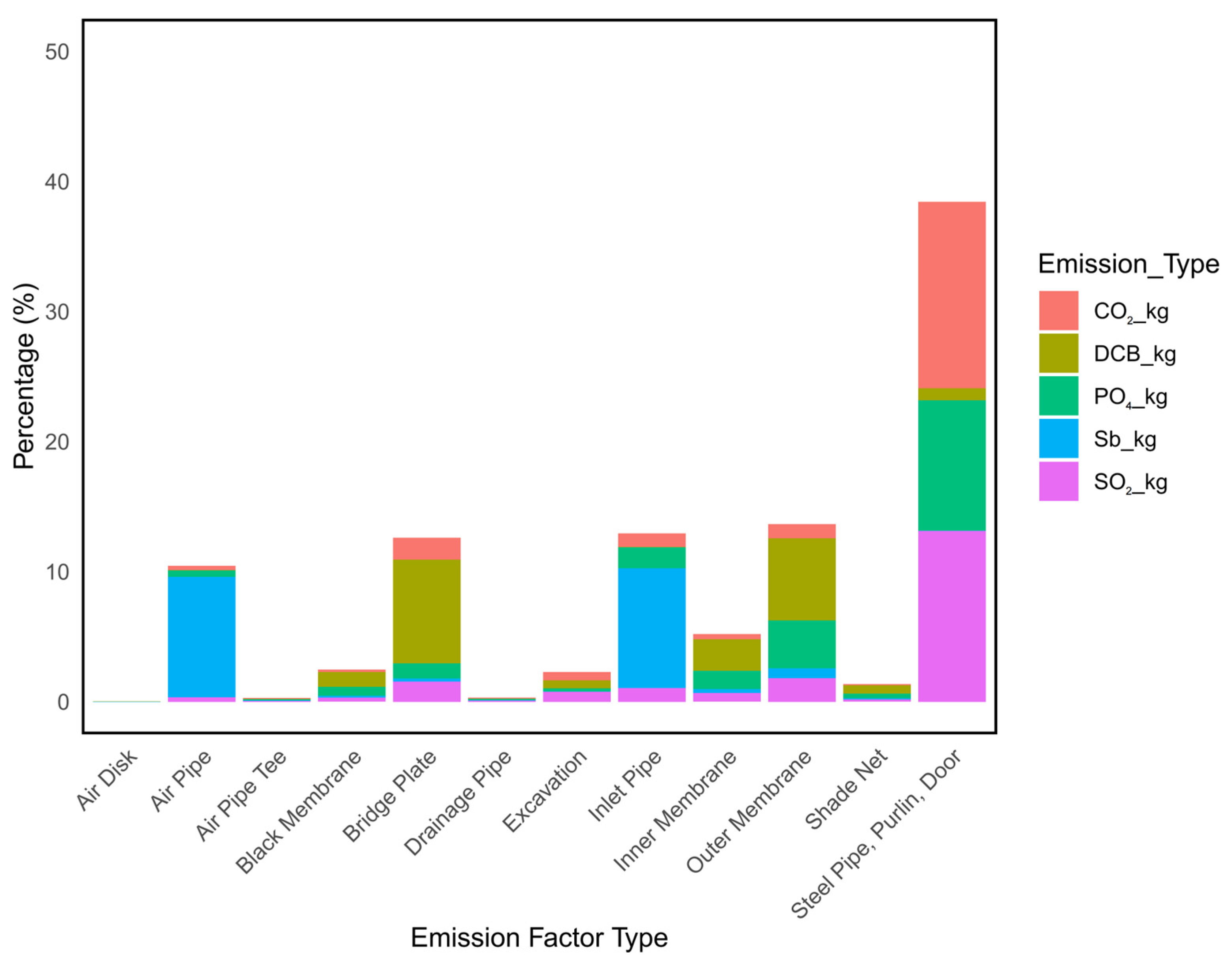
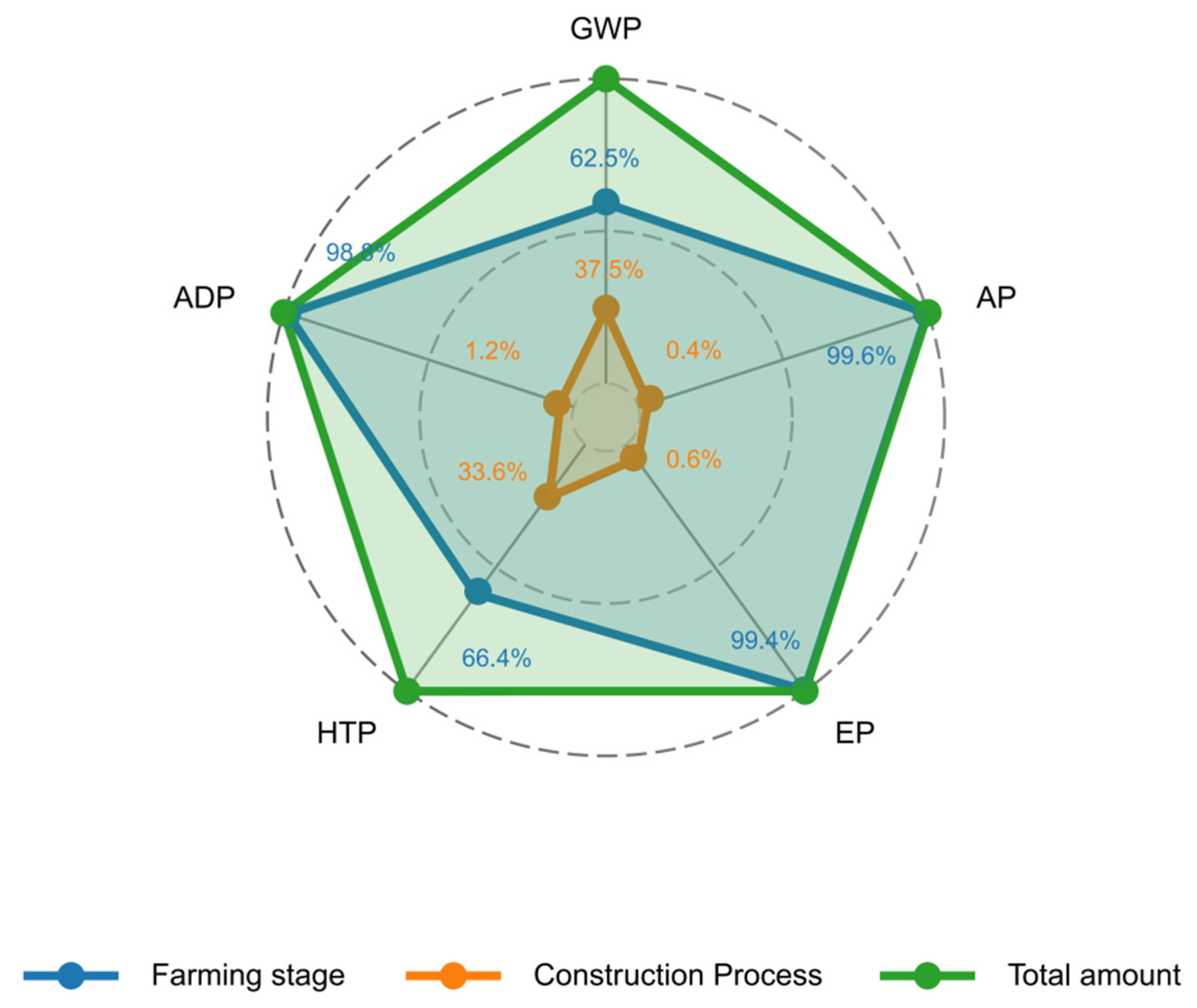
Further comparison between the construction and farming phases shows that the construction phase of greenhouse model significantly contributes to the GWP, with initial farming emissions accounting for 37.5% of total CO2 emissions. The contributions to AP, EP, and ADP are relatively low, with the environmental impact of the construction phase primarily concentrated on greenhouse gas emissions. Steel materials (such as steel pipes and bridge plates) dominate all types of emissions, with steel pipes contributing 71.6% of CO2 emissions, while bridge plates and outer films account for 39.87% and 31.48% of 1,4-DCB emissions, respectively (Figure 2 and Figure 3).
In contrast, the farming phase shows a higher contribution to GWP, accounting for 62.4% of total CO2 emissions from initial farming. Additionally, the contributions to AP, EP, and ADP are also significantly higher than those during the construction process. In the equipment emission analysis, the total emissions are 3230 kg CO2 eq, 369 kg SO2 eq, 212 kg PO4 eq, 93.2 kg 1,4-DCB eq, and 2.25 kg Sb eq per greenhouse. The emissions from high-speed blowers and root blowers are both 1320 kg CO2 eq, representing 40.9% of total emissions. The emissions from diesel generators are 602 kg CO2 eq per greenhouse, accounting for 18.6% of total emissions (Table 5; Figure 3).

3.5. Life Cycle Assessment Differences Among Different Culture Models

Comparative analysis of the environmental impacts across farming models reveals distinct patterns. Greenhouse farming (GF) demonstrates the lowest abiotic resource depletion potential (ADP) at 0.000076 kg Sb eq, outperforming both recirculating aquaculture systems (RAS, 0.0189 kg Sb eq) and high-place ponds (HHP, 0.0350 kg Sb eq), though still higher than biofloc technology (BFT, 0.00982 kg Sb eq). In terms of acidification potential (AP), GF (0.0124 kg SO2 eq) shows intermediate performance, falling between BFT (0.0334 kg SO2 eq) and HHP (0.0438 kg SO2 eq). For eutrophication potential (EP), GF achieves a notably low value of 0.0071 kg PO4 eq—significantly lower than traditional pond culture (PMC, 0.295 kg PO4 eq), though higher than RAS (0.0218 kg PO4 eq) and HHP (0.0362 kg PO4 eq). Global warming potential (GWP) of GF remains moderate at 0.173 kg CO2 eq, positioned between BFT (5.23 kg CO2 eq) and HHP (4.97 kg CO2 eq), and substantially lower than PMC (11.1 kg CO2 eq). Lastly, GF exhibits the lowest human toxicity potential (HTP) among compared systems (0.00467 kg 1,4-DCB eq), markedly below HHP (0.903 kg 1,4-DCB eq), and also lower than RAS (0.556 kg 1,4-DCB eq) and BFT (0.574 kg 1,4-DCB eq) (Table 6).

4. Discussion

4.1. Economic Benefits of Greenhouse Shrimp Culture

Shrimp farming is influenced by market supply, demand, and price fluctuations, rendering its investment costs and economic benefits a primary focus of research [6,7]. Previous studies indicate that the equipment construction cost for the Industrial Shrimp Culture model (ISIC) is USD 13,235.00, constituting only 3.1% of the total construction cost, with land development and infrastructure representing the highest proportions at 34.80% and 24.20%, respectively [44]. This study finds that the construction cost of the greenhouse model is lower than that of industrial farming, with a total cost of USD 1830.31 per greenhouse (400 m2). However, this infrastructure investment is higher than that of pond models, which involve fewer construction projects and typically employ diesel excavators [45]. In the greenhouse model, the costs for steel pipes, beams, and doors are the highest, reaching USD 597.75 per greenhouse and accounting for 11.22% of the initial total cost.
Further analysis of the cost structure reveals that greenhouse farming exhibits a distinct cost distribution compared to other models. The total farming cost reaches USD 3510.76 per greenhouse, with feed and land rent constituting the primary expenditures at 30.54% and 15.86%, respectively. This represents a significant increase in the land cost proportion compared to the ISIC model, where feed accounts for 37.75–42.27% of the cost and land rent only 2.01% [46,47]. In contrast, the Pond Integrated Multi-Trophic Aquaculture (PIMTA) model reduces feed costs to 22.28% through its ecological complementary mechanisms, but incurs a land rental cost as high as 47.56% [13,48,49]. The cost structure of the greenhouse model most closely resembles that of the Pond Monoculture (PMC) model, in which feed costs account for 48.82% and land rent for 15.42% [50,51,52].
From a revenue perspective, the greenhouse model presents a lower farming risk, evidenced by a cost-profit margin of 60.47%. This ratio is comparable to that of the Pond Monoculture (PMC) model and significantly higher than the 38.56% and 29.28% reported for the ISIC and High-Intensity Pond (HHP) models, respectively [47,53,54,55]. Owing to its higher stocking density, the total yield of greenhouse farming substantially exceeds that of PIMTA and PMC models (4005.00 kg ha−1) [13]. Consequently, the total revenue from greenhouse farming is more advantageous, with an income of USD 5633.80 per greenhouse. After deducting farming costs, the net profit from the first farming cycle reaches USD 2123.04 per greenhouse. In summary, the greenhouse shrimp farming model demonstrates a favorable cost–benefit balance, characterized by low initial investment and high resource utilization efficiency. This model reduces initial capital expenditure through the use of lightweight building materials and standardized construction. By incorporating feed substitution technologies to further control farming costs, leveraging renewable energy sources, and implementing regionally coordinated, large-scale operations, it holds strong potential for sustained enhancement of economic benefits.

4.2. Life Cycle Assessment of Greenhouse Construction and Shrimp Farming

Greenhouse farming demonstrates superior environmental performance, particularly in terms of resource efficiency and greenhouse gas emission reduction. Eissa et al. (2022) demonstrated that a greater degree of intensification in a farming system correlates with a lower environmental impact per unit of shrimp produced [40]. Furthermore, this study reveals that the environmental impact per kilogram of shrimp is influenced not only by the degree of intensification but also by energy consumption and the utilization of building materials. Compared to the Partially Modified Culture (PMC) and Intensive Semi-Industrial Culture (ISIC) models, greenhouse farming offers superior environmental benefits per kilogram of output (Table 6). For instance, Wang et al. (2025) attributed the poorer environmental performance of PMC relative to greenhouse models to its low stocking density and low yield per unit area (only 0.1125 kg m−2) [45]. Although the ISIC model achieves a higher yield (averaging 7.73 kg m−2), its extensive consumption of building materials and high energy demands result in greater pollutant emissions per kilogram of output compared to the greenhouse model [46,56,57]. Specifically, in terms of resource consumption, the ADP for the greenhouse model (0.002 kg Sb eq) is notably lower than that of Recirculating Aquaculture Systems (RAS) (0.0189 kg Sb eq) and Biofloc Technology (BFT) (0.00982 kg Sb eq) [41]. Regarding greenhouse gas emissions, the GWP of greenhouse farming (3.279 kg CO2 eq) is not only lower than that of ISIC (5.69 kg CO2 eq [28]), but also lower than that of the BFT model (5.23 kg CO2 eq [41,58]). Furthermore, previous studies on monoculture systems of Amazon river shrimp found that their carbon dioxide emissions per kilogram of production were 11.083 equivalents, with 0.295 PO4 equivalents, which are also higher than those of the greenhouse model, consistent with the findings of this study [43]. Additionally, the HTP of the greenhouse model (0.093 kg 1,4-DCB eq) is only 10.3% of that of the High-Stocking-Density Pond (HHP) model (0.903 kg 1,4-DCB eq), highlighting its significant advantage in reducing human toxicity potential; this difference may be associated with the types of building materials used [41].
Therefore, the environmental impacts of both the construction and farming processes in shrimp culture require careful consideration. Consistent with this, previous Life Cycle Assessments in the building sector have also indicated that the usage phase contributes the most to environmental impact and costs, primarily due to energy consumption [59]. Correspondingly, this study identifies the farming phase as the most environmentally impactful stage of greenhouse farming, contributing 3.23 kg CO2 eq to GWP (62.4% of the total). This phase also shows significant contributions to AP (0.369 kg SO2 eq), EP (0.212 kg PO4 eq), and ADP (0.00225 kg Sb eq) relative to the construction process. This finding is consistent with research on pond-based farming, which indicates that the farming phase accounts for 95.35% of the carbon emissions over the entire lifecycle; for instance, in monopond farming, emissions are 0.85 kg CO2 per kg of shrimp during the construction phase and 17.4 kg CO2 during the operational phase [60].
This study further reveals that the construction phase contributes significantly to GWP, accounting for 37.5% of total CO2 emissions, while its contributions to other indicators (AP, EP, ADP) are relatively low. This suggests that the environmental impact during the construction phase is predominantly associated with greenhouse gas emissions. Additionally, among building materials, steel (e.g., pipes and bridge slabs) is the dominant contributor across multiple emission categories, particularly to CO2 and SO2 emissions. For example, steel pipes alone account for 71.6% of CO2 emissions, while bridge slabs and outer membrane films contribute 39.87% and 31.48% to 1,4-DCB emissions, respectively. This indicates that the production and use of steel and polymer materials are the primary sources of environmental burden during the construction phase. A similar pattern is observed in the ISIC model, which also has a relatively high proportion of steel in its infrastructure, where steel comprises 31.55% of the material input in recirculating aquaculture systems [41]. Previous studies on building Life Cycle Assessments (LCAs) have found that alternative construction methods provide greater environmental benefits than traditional ones, particularly by reducing the consumption of concrete, rebar, and fuel [61,62]. Therefore, the use of alternative materials or improved production processes in the construction of shrimp culture systems could significantly reduce overall emissions.
Research has established that energy consumption substantially impacts the environment in shrimp farming [63]. For example, ISIC systems exhibit a high environmental impact, as reflected in their GWP, which is largely due to greenhouse gas emissions from electricity and fuel production [41]. This study further reveals that the environmental impact during the operational phase primarily stems from electrically driven equipment (high-speed and Roots blowers). At a power consumption of 55 kWh per functional unit, this equipment contributes 1.32 kg CO2 eq, 0.185 kg SO2 eq, 0.106 kg PO4 eq, 0.047 kg 1,4-DCB eq, and 0.001 kg Sb equation In contrast, emissions from diesel generators are significantly lower, contributing only 0.27 kg CO2 eq to GWP per kilogram of shrimp produced [45]. Therefore, optimizing the energy mix or improving energy efficiency represent key measures for emission reduction [61]. Specifically, clean energy adoption and energy substitution are promising initiatives for reducing the environmental impact of shrimp farming [64]. While the greenhouse model outperforms other farming models across multiple environmental impact indicators [41,58], the environmental burden during its construction and operational phases warrants further optimization. Therefore, by improving building materials, production processes, and energy efficiency, the overall environmental impact of greenhouse farming can be effectively reduced, thereby providing a research foundation for more scientifically based greenhouse shrimp farming.
Based on the current model parameters and data conditions, this study demonstrates that the described greenhouse aquaculture system exhibits favorable production performance and economic feasibility under specific conditions. However, the conclusions are limited by the representativeness of the database and the coverage of field data. Practical application requires adaptive adjustments based on local resource conditions and management capabilities. Future research could enhance the accuracy and practical guidance of the assessment by expanding the scope of field monitoring and optimizing localized model parameters.

5. Conclusions

Based on the research conditions of this study, the greenhouse aquaculture model demonstrates distinct advantages in terms of economic performance and environmental benefits. Its cost structure is similar to that of the PMC model, with feed and land lease costs representing the largest shares at 30.54% and 15.86%, respectively. Despite these costs, greenhouse farming achieves favorable economic returns through higher yields and lower risks, as reflected in a cost profit ratio of 60.47%, a value 1.57 times greater than that of ISIC models. Regarding environmental impact, this model exhibits lower values across all impact indicators compared to the ISIC and PMC models. However, steel consumption during the construction phase and electricity use during the operational phase remain significant sources of environmental burden. In the future, by optimizing material selection, selecting low-cost feed, and enhancing energy efficiency, it is expected to reduce costs and improve efficiency while further enhancing the sustainability of this system, making it an ideal aquaculture choice for suitable regions.

Supplementary Materials

The following supporting information can be downloaded at: https://www.mdpi.com/article/10.3390/fishes11030131/s1, Figure S1. Life Cycle Cost and Life Cycle Assessment Flowchart of Greenhouse Shrimp Farming; Table S1. Data Collection Completeness Checklist 1; Table S2. Data Collection Completeness Checklist 2.

Author Contributions

Y.W. wrote the main text of the manuscript, S.Z. helped collect the data, and Z.C. (Zhao Chen), J.W., Z.C. (Zhiqiang Chang) and J.L. reviewed the manuscript. All authors have read and agreed to the published version of the manuscript.

Funding

This study was financially supported by the National Key Research and Development Program of China (Grant number 2023YFD2401704); Independent research project of basal research fund of State Key Laboratory of Mariculture Biobreeding and Sustainable Goods (BRESG-JB202413); the China Agriculture Research System (Grant number CARS-48); the Central Public-interest Scientific Institution Basal Research Fund, CAFS (Grant number 2023TD50); Shandong Provincial Natural Science Foundation, China (Grant number ZR2023MC084).

Institutional Review Board Statement

Not applicable.

Data Availability Statement

The data supporting the findings of this study are available from the corresponding author upon reasonable request.

Conflicts of Interest

The authors have no conflict of interest to declare.

References

  1. Boyd, C.E.; McNevin, A.A.; Davis, R.P.; Godumala, R.; Mohan, A.B.C. Production methods and resource use at Litopenaeus vannamei and Penaeus monodon farms in India compared with previous findings from Thailand and Vietnam. J. World Aquac. 2018, 49, 551–569. [Google Scholar] [CrossRef]
  2. Chen, Z.; Li, J.; Zhai, Q.; Chang, Z.; Li, J. Nitrogen cycling process and application in different prawn culture modes. Rev. Aquac. 2024, 16, 1580–1602. [Google Scholar] [CrossRef]
  3. Chang, Z.; Neori, A.; He, Y.; Li, J.; Li, J. Development and current state of seawater shrimp farming, with an emphasis on integrated multi-trophic pond aquaculture farms, in China—A review. Rev. Aquac. 2020, 12, 2544–2558. [Google Scholar] [CrossRef]
  4. Domínguez-May, R.; Hernández, J.M.; Velazquez-Abunader, I. A review of dynamic optimization in aquaculture production economics. Rev. Aquac. 2024, 16, 1696–1717. [Google Scholar] [CrossRef]
  5. Cruz-Suarez, L.E.; Leon, A.; Pena-Rodríguez, G.; Rodríguez-Pena, A.; Moll, B.; Ricque-Maire, D. Shrimp/Ulva co-culture: A sustainable alternative to diminish the need for artificial feed and improve shrimp quality. Aquaculture 2010, 301, 64–68. [Google Scholar] [CrossRef]
  6. Krishnan, M.; Babu, S.C. COVID-19 opens up domestic market for Indian shrimp. Aquaculture 2022, 550, 737818. [Google Scholar] [CrossRef]
  7. Jescovitch, L.N.; Ullman, C.; Rhodes, M.; Davis, D. Effects of different feed management treatments on water quality for Pacific white shrimp Litopenaeus vannamei. Aquac. Res. 2017, 49, 526–531. [Google Scholar] [CrossRef]
  8. Diana, J.S. Aquaculture production and biodiversity conservation. Bioscience 2009, 59, 27–38. [Google Scholar] [CrossRef]
  9. Chen, Z.; Ge, H.; Chang, Z.; Song, X.; Zhao, F.; Li, J. Nitrogen budget in recirculating aquaculture and water exchange systems for culturing Litopenaeus vannamei. J. Ocean Univ. China 2018, 17, 905–912. [Google Scholar] [CrossRef]
  10. Zhang, J. Analysis of microbial diversity in engineered recirculating water culture ponds in Langfang ponds. Hebei Fish. 2019, 2019, 18–21. (In Chinese) [Google Scholar]
  11. Bai, Z.H.; Schmidt-Traub, G.; Xu, J.C.; Liu, L.; Jin, X.P.; Ma, L. A food system revolution for China in the post-pandemic world. Resourc. Environ. Sustain. 2020, 2, 2666–9161. [Google Scholar] [CrossRef]
  12. April, J.; Arbour, P.; Bhatt, H.; Halis, S.; Paul, B.B.; Huang, J. Life cycle assessment on environmental feasibility of microalgae-based wastewater treatment for shrimp recirculating aquaculture systems. Bioresour. Technol. 2024, 399, 130578. [Google Scholar] [CrossRef]
  13. Wang, Y.; Chen, Z.; Chang, Z.; Meng, G.; Li, J. Ecological and economic analysis for different shrimp farming models in China. Aquac. Int. 2023, 31, 1941–1958. [Google Scholar] [CrossRef]
  14. Bixler, H.; Porse, H. A decade of change in the seaweed hydrocolloids industry. J. Appl. Phycol. 2011, 23, 321–335. [Google Scholar] [CrossRef]
  15. Chen, X.; Bian, S. Double cropping technology of Litopenaeus vannamei in small ponds. Hebei Fish. 2016, 4, 30–31. [Google Scholar]
  16. Huang, Y.; Wang, B.J.; Liu, M.; Ren, Z.W.; Jiang, K.Y.; Zhong, C.; Xu, K.F.; Gao, Y.; Wang, L. Water quality, particle-associated and surrounding bacterial community structure and functional differences under small greenhouse of Litopenaeus vannamei at different yield levels. J. Fish. Sci. China 2024, 12, 1484–1496. (In Chinese) [Google Scholar]
  17. Wang, X.; Diao, J.; Fan, Y.; Ge, C.L.; Ye, H.B.; Liu, H.J.; Wang, S.S.; Fu, R.; Wang, Y.H. Research progress on tail water treatment in green and healthy farming models of shrimp. Anhui Agric. Sci. 2021, 49, 16–19. (In Chinese) [Google Scholar]
  18. Khanjani, M.H.; Sharifinia, M.; Emerenciano, M.G.C. Biofloc technology (BFT) in aquaculture: What goes right, what goes wrong? A scientific-based snapshot. Aquac. Nutr. 2024, 1, 1353–5773. [Google Scholar] [CrossRef]
  19. Li, Z.; Li, G.; Shen, X.; Chen, M.; Ren, C.; Zheng, W. New model for cultivating large-sized ecological seedlings of Litopenaeus vannamei in temperature-controlled greenhouses. Sci. Fish Farming 2023, 12, 24. [Google Scholar]
  20. Wang, X.; Chen, Y.; Li, Y.; Chen, Z.; Zhang, Y.; Li, J.; Yang, J.; Qin, J.; Zhou, S.; Wang, M. Low-carbon and energy-saving biological nitrogen removal technology for ammonia nitrogen wastewater treatment. Chin. Sci. Technol. Sci. 2025, 9, 1526–1539. (In Chinese) [Google Scholar]
  21. Wu, L.H.; Ge, W.; Hu, J.N. Current Status and Strategies of Scientific Fish Farming in Jiangsu Province. Sci. Fish Farming 2025, 5, 14–15. (In Chinese) [Google Scholar]
  22. Fang, Y.; Li, H.; Wang, L.; Wan, X.; Shi, W.; Yang, Z.; Jiang, Q.; Shen, H.; Hu, R.; Guan, X.; et al. Study on bacterial community structure in rearing water in small greenhouse of Litopenaeus vannamei. South China Fish. Sci. 2023, 19, 29–41. (In Chinese) [Google Scholar]
  23. Yi, N.; Wu, S.; Su, H.; Hu, X.; Xu, W.; Xu, Y.; Wen, G.; Cao, Y. Temporal and spatial changes, bioaccumulation, critical influencers, and environmental fate of antibiotics in small-scale greenhouse shrimp farming system. J. Environ. Chem. Eng. 2025, 13, 2213–3437. [Google Scholar] [CrossRef]
  24. Gao, X.Z. Improvement and Application of the Ru Dong Small Shelf Cultivation Model in Shanghai Area. Sci. Fish Farming 2025, 5, 35–37. (In Chinese) [Google Scholar]
  25. Li, Y.; Zheng, Z.; Zhai, H.; Huan, J.; Zhou, C.; Chen, H. Analysis of enzyme activity and microbial community structure in sediment of different culture modes of Litopenaeus vannamei ponds. Mar. Lakes 2012, 43, 1254–1260. [Google Scholar]
  26. Luo, G.; Ju, R.; Lu, J.; Wang, H.; Yu, L. Application and exploration of the small greenhouse culture mode for Litopenaeus vannamei in Rudong. Aquac. Res. 2021, 8, 95–102. [Google Scholar]
  27. Philis, G.; Ziegler, F.; Gansel, L.C.; Jansen, M.D.; Gracey, E.O.; Stene, A. Comparing Life Cycle Assessment (LCA) of Salmonid Aquaculture Production Systems: Status and Perspectives. Sustainability 2019, 11, 2517. [Google Scholar] [CrossRef]
  28. Almeida, M.S.; Carrijo, J.R.; Furtado, P.S.; Foes, G.K.; Wasielesky, W.; Braga, A.L.; Gimenes, R.M.T.; Poersch, L.H.; Ruviaro, C.F. Environmental performance of Penaeus vannamei shrimp production in intensive and super-intensive biofloc systems. Aquac. Eng. 2024, 107, 0144–0860. [Google Scholar] [CrossRef]
  29. Bohnes, F.A.; Hauschild, M.Z.; Schlundt, J.; Laurent, A. Life cycle assessments of aquaculture systems: A critical review of reported findings with recommendations for policy and system development. Rev. Aquac. 2019, 11, 1061–1079. [Google Scholar] [CrossRef]
  30. Bohnes, F.A.; Laurent, A. LCA of aquaculture systems: Methodological issues and potential improvements. Int. J. Life Cycle Assess. 2019, 24, 324–337. [Google Scholar] [CrossRef]
  31. Cao, L.; Diana, J.S.; Keoleian, G.A.; Lai, Q. Life Cycle Assessment of Chinese Shrimp Farming Systems Targeted for Export and Domestic Sales. Environ. Sci. Technol. 2011, 45, 6531–6538. [Google Scholar] [CrossRef]
  32. Abdou, K.; Lasram, F.B.; Romdhane, M.S.; Loc’H, F.L.; Aubin, J. Rearing performances and environmental assessment of sea cage farming in Tunisia using Life Cycle Assessment (LCA) combined with PCA and HCPC. Int. J. Life Cycle Assess. 2017, 23, 1049–1062. [Google Scholar] [CrossRef]
  33. Brom, A.E.; Belova, O.V.; Sissinio, A. Life-cycle costs for energy equipment: FMECA & life cycle costing models as “decision making” tools for cost reduction during the whole equipment life. Procedia Eng. 2016, 152, 173–176. [Google Scholar]
  34. Neugebauer, S.; Forin, S.; Finkbeiner, M. From Life Cycle Costing to Economic Life Cycle Assessment—Introducing an Economic Impact Pathway. Sustainability 2016, 8, 428. [Google Scholar] [CrossRef]
  35. Auer, J.; Bey, N.; Schafer, J.M. Combined Life Cycle Assessment and Life Cycle Costing in the Eco-Care-Matrix: A case study on the performance of a modernised manufacturing system for glass containers. J. Clean. Prod. 2017, 141, 99–109. [Google Scholar] [CrossRef]
  36. Jaume, G.; Claudia, F.; Marta, C.; Anna, L.; Agnese, M.; Maurizio, A.; Luisa, C. Life cycle assessment and life cycle costing of an innovative component for refrigeration units. J. Clean. Prod. 2021, 295, 126442. [Google Scholar] [CrossRef]
  37. Faraca, G.; Martinez-Sanchez, V.; Astrup, T.F. Environmental life cycle cost assessment: Recycling of hard plastic waste collected at Danish recycling centres. Resour. Conserv. Recycl. 2019, 143, 299–309. [Google Scholar] [CrossRef]
  38. ISO 14040:2006a; Environmental Management—Life Cycle Assessment—Principles and Framework. International Organization for Standardization (ISO): Geneva, Switzerland, 2006.
  39. ISO 14044:2006b; Environmental Management—Life Cycle Assessment—Requirements and Guidelines. International Organization for Standardization (ISO): Geneva, Switzerland, 2006.
  40. Eissa, A.A.; Chen, P.; Brown, P.B.; Huang, J.Y. Effects of feed formula and farming system on the environmental performance of shrimp production chain from a life cycle perspective. J. Ind. Ecol. 2022, 26, 2006–2019. [Google Scholar] [CrossRef]
  41. Sun, Y.; Hou, H.; Dong, D.; Zhang, J.; Yang, X.; Li, X.; Song, X. Comparative life cycle assessment of whiteleg shrimp (Penaeus vannamei) cultured in recirculating aquaculture systems (RAS), biofloc technology (BFT) and higher-place ponds (HPP) farming systems in China. Aquaculture 2023, 574, 739625. [Google Scholar] [CrossRef]
  42. Noguera-Muñoz, F.A.; García García, B.; Ponce-Palafox, J.T.; Wicab-Gutierrez, O.; Castillo-Vargasmachuca, S.G.; García García, J. Sustainability Assessment of White Shrimp (Penaeus vannamei) Production in Super-Intensive System in the Municipality of San Blas, Nayarit, Mexico. Water 2021, 13, 304. [Google Scholar] [CrossRef]
  43. Mateus, V.M.; Joël, A.; Antonio, F.M.C. Life cycle assessment of fish and prawn production: Comparison of monoculture and polyculture freshwater systems in Brazil. J. Clean. Prod. 2017, 156, 528–537. [Google Scholar]
  44. Ngoc, P.T.A.; Meuwissen, M.P.M.; Tru, L.C.; Bosma, R.H.; Verreth, J.; Lansink, A.O. Economic feasibility of recirculating aquaculture systems in pangasius farming. Aquac. Econ. Manag. 2016, 20, 185–200. [Google Scholar] [CrossRef]
  45. Wang, Y.; Wang, X.; Li, Y.; Yu, J.; Kong, J.; Zhang, J. Carbon footprint assessment in shrimp pond farming of Penaeus vannamei based on life cycle assessment methods. Prog. Fish. Sci. 2025, 46, 89–98. [Google Scholar]
  46. Shao, M.; Che, B.; Sun, C.; Jin, H.; Zhang, H.; Xu, S. Cost-benefit analysis of industrialized culture of Penaeus vannamei: Take Shandong Province as an example. Ocean Dev. Manag. 2021, 38, 15–23. (In Chinese) [Google Scholar]
  47. Almeida, M.S.; Carrijo-Mauad, J.R.; Gimenes, R.M.T.; Gaona, C.A.P.; Furtado, P.S.; Poersch, L.H.; Wasielesky, J.W.; Foes, G.K. Bioeconomic analysis of the production of marine shrimp in greenhouses using the biofloc technology system. Aquac. Int. 2021, 29, 723–741. [Google Scholar] [CrossRef]
  48. Cang, P. Cost-benefit analysis of cubic mariculture—Based on seawater pond culture in Donggang, Liaoning Province (above). Sci. Fish Farming 2015, 4, 2. (In Chinese) [Google Scholar]
  49. Dong, X.; Li, T.; Yu, J.; Sun, W. Pond engineered recirculating water culture trials. Hebei Fish. 2019, 5, 4. (In Chinese) [Google Scholar]
  50. Qiu, Q.; Xu, R.; Zhu, J.; Yang, F.; Yu, Q.; Zhang, D. Comparison of bacterial communities in the earthen pond and the recirculating aquaculture system for Litopenaeus vannamei cultivation. J. Biol. 2015, 32, 45–49. (In Chinese) [Google Scholar]
  51. Wang, J.; Che, B.; Sun, C.; Zhang, H.; Chen, T.; Jin, H. A study on the management efficiency of different culture modes of Penaeus vannamei in China. Chin. Fish. Econ. 2019, 37, 84–90. (In Chinese) [Google Scholar]
  52. Jian, Y.; Che, B. Comparison of costs and benefits of different culture models of Penaeus vannamei in China from the perspective of environmental economics. Chin. Fish. Econ. 2021, 39, 8. (In Chinese) [Google Scholar]
  53. Gao, Y.; Chen, W. Analysis of the cost-benefit on industrial culture of prawn and coping strategies in Guangdong Province. J. Zhongkai Univ. Agric. Eng. 2012, 25, 56–61. (In Chinese) [Google Scholar]
  54. Huang, Y. Economic Benefit Analysis of Litopenaeus vannamei Farming Model in Jiangmen City. Master’s Thesis, Zhongkai University of Agriculture and Engineering, Guangzhou, China, 2023. (In Chinese) [Google Scholar]
  55. Zhao, G.; Liu, L.; Li, Y.; Hu, Z. Comparison of water quality changes and output effects of integrated culture and monoculture ponds of Penaeus vannamei. Jiangsu Agric. Sci. 2012, 40, 147–152. (In Chinese) [Google Scholar]
  56. Cardona, E.; Lorgeoux, B.; Chim, L.; Goguenheim, J.; Le Delliou, H.; Cahu, C. Biofloc contribution to antioxidant defence status, lipid nutrition and reproductive performance of broodstock of the shrimp Litopenaeus stylirostris: Consequences for the quality of eggs and larvae. Aquaculture 2016, 452, 252–262. [Google Scholar] [CrossRef]
  57. Arantes, R.; Schveitzer, R.; Magnotti, C.; Lapa, K.R.; Vinatea, L. A comparison between water exchange and settling tank as a method for suspended solids management in intensive biofloc technology systems: Effects on shrimp (Litopenaeus vannamei) performance, water quality and water use. Aquac. Res. 2016, 48, 1478–1490. [Google Scholar] [CrossRef]
  58. Favio, A.N.; Garcia, B.; Ponce, P.J.; Omar, W.; Sergio, G.C.; Garcia, J.G. Sustainability assessment of white shrimp production in super-intensive system in the municipality of San Blas, Nayarit, Mexico. Water 2021, 13, 304. [Google Scholar]
  59. Bhochhibhoya, S.; Pizzol, M.; Achten, W.M.J.; Maskey, R.K.; Zanetti, M.; Cavalli, R. Comparative life cycle assessment and life cycle costing of lodging in the Himalaya. Int. J. Life Cycle Assess. 2017, 22, 1851–1863. [Google Scholar] [CrossRef]
  60. Wu, F.; Ji, J.; Xu, H. A Study on the Carbon Footprint of Shrimp Pond Aquaculture Based on the LCA Method. In Proceedings of the 13th Annual Conference of Chinese Management Science, Zhengzhou, China, 11–12 August 2011; Volume 19, pp. 668–672. (In Chinese) [Google Scholar]
  61. Djadouni, H.; Trouzine, H.; Correia, A.G.; Miranda, T. Life cycle assessment of retaining wall backfilled with shredded tires. Int. J. Life Cycle Assess. 2019, 24, 581–589. [Google Scholar] [CrossRef]
  62. Liu, F.; Shafique, M.; Luo, X. Literature review on life cycle assessment of transportation alternative fuels. Environ. Technol. Innov. 2023, 32, 103343. [Google Scholar] [CrossRef]
  63. Dong, S.L.; Dong, Y.W.; Cao, L.; Verreth, J.; Olsen, Y.; Liu, W.J.; Fang, Q.Z.; Zhou, Y.G.; Li, L.; Li, J.Y.; et al. Optimization of aquaculture sustainability through ecological intensification in China. Rev. Aquac. 2022, 4, 1249–1259. [Google Scholar] [CrossRef]
  64. Yang, K.; Jing, D.; Wang, X.; Zhou, S.; Zhang, B.; Qin, L.; Wang, Q.; Jing, G.; Li, W.; Li, S. Life cycle assessment perspective on waste resource utilization and sustainable development: A case of glyphosate production. J. Environ. Manag. 2024, 350, 119584. [Google Scholar] [CrossRef] [PubMed]
Figure 1. Construction process metric proportion analysis. CO2_kg = Global warming potential (GWP), 1,4-DCB_kg = Human toxicity potential (HTP), PO4_kg = Eutrophication potential (EP), Sb_kg = Abiotic depletion potential (ADP), SO2_kg = Acidification potential (AP).
Fishes 11 00131 g001
Figure 2. Construction process emission type proportion analysis. CO2_kg = Global warming potential (GWP), 1,4-DCB_kg = Human toxicity potential (HTP), PO4_kg = Eutrophication potential (EP), Sb_kg = Abiotic depletion potential (ADP), SO2_kg = Acidification potential (AP).
Fishes 11 00131 g002
Figure 3. Proportion of carbon footprint in the construction and farming phase of shrimp culture. The figure shows the ratio of first-time farming to construction. GWP (kg CO2 eq) = Global warming potential, HTP (kg 1,4-DCB eq) = Human toxicity potential, EP (kg PO4 eq) = Eutrophication potential, ADP (kg Sb eq) = Abiotic depletion potential, AP (kg SO2 eq) = Acidification potential.
Fishes 11 00131 g003
Table 1. Construction and farming cost analysis.
CategoryItemPrice (USD)Proportion (%)
Construction costExcavation183.13.44
Black film around shed53.521.00
Drainage pipe14.080.26
Bridge slab70.421.32
Air pipe34.240.64
Air Pipe Tee12.680.24
Inlet pipe1.270.02
Steel pipe, keel, and door597.7511.22
Outer shed film296.485.57
Inner shed film112.682.12
Air disk0.420.01
Air pipe21.130.40
Inlet and water pipe154.932.91
Blower248.034.66
Shade net29.580.56
Total construction process cost (USD Pond−1)1830.3134.36
Farming CostsSeedlings294.375.53
Animal protection253.524.76
Labor and maintenance169.013.17
Utilities338.036.35
Feed1626.7630.54
Rent allocation cost845.0715.86
Total farming costs3510.7666.20
TotalTotal cost (USD Pond−1)5327.07100.00
Note: The greenhouse area is calculated based on 400 square meters and the farming cycle is calculated over 20 years. Construction costs are the details for a single construction, and farming costs are the details for a single farming cycle.
Table 2. Cost–benefit analysis.
ItemAmount
Sales price (USD kg−1)5.63
Yield (kg pond−1)1000.00
Total revenue (USD Pond−1)5633.80
Life cycle cost (LCC) (USD kg−1)3.56
Cost profit margin (%)60.47
Table 3. Life Cycle Assessment comparison of greenhouse farming.
IndictorsGWP
(kg CO2 eq)
AP
(kg SO2 eq)
EP
(kg PO4 eq)
HTP
(kg 1,4-DCB eq)
ADP
(kg Sb eq)
Total amount (Initial Farming)5.183.71 × 10−12.13 × 10−11.40 × 10−12.28 × 10⁻³
Construction Process (Initial Farming)1.94 1.52 × 10−31.24 × 10−34.71 × 10−22.81 × 10−5
Farming stage3.23 3.69 × 10−12.12 × 10−19.32 × 10−22.25 × 10−3
Construction Process (20 years)4.85 × 10−23.97 × 10−42.28 × 10−41.00 × 10−42.00 × 10⁻⁶
Total amount (20 years)3.28 3.69 × 10−12.12 × 10−19.33 × 10−22.25 × 10−3
Note: GWP (kg CO2 eq) = Global warming potential, HTP (kg 1,4-DCB eq) = Human toxicity potential, EP (kg PO4 eq) = Eutrophication potential, ADP (kg Sb eq) = Abiotic depletion potential, AP (kg SO2 eq) = Acidification potential.
Table 4. Analysis of the construction process.
CategoryEmission Factor TypeGWP
(kg CO2 eq)
AP
(kg SO2 eq)
EP
(kg PO4 eq)
HTP
(kg 1,4-DCB eq)
ADP
(kg Sb eq)
ExcavationDiesel6.21 × 1015.85 × 10−21.64 × 10−23.23 × 10−11.20 × 10⁻⁵
Black membranePolyethylene material1.91 × 1012.49 × 10−24.20 × 10−26.18 × 10−11.77 × 10⁻⁴
Drainage pipePVC material8.40 6.26 × 10−37.95 × 10−39.76 × 10−43.35 × 10−5
Bridge plateSteel1.64 × 1021.18 × 10−17.37 × 10−24.322.79 × 10−4
Air pipePVC material2.04 × 1011.52 × 10−21.93 × 10−22.37 × 10−38.13 × 10⁻⁵
Air pipe teePVC material7.565.63 × 10−37.16 × 10−38.79 × 10−43.01 × 10⁻⁵
Inlet pipePVC material7.56 × 10−15.63 × 10−47.16 × 10−48.79 × 10−53.01 × 10−6
Steel pipeSteel1.39 × 1031.006.30 × 10−14.93 × 10⁻¹/
PurlinSteel
DoorSteel
Outer membranePolyethylene material1.06 × 1021.38 × 10−12.32 × 10−13.419.76 × 10−4
Inner membranePolyethylene material4.02 × 1015.25 × 10−28.84 × 10−21.303.72 × 10−4
Air diskPolyethylene material1.51 × 10−11.97 × 10−43.32 × 10−44.88 × 10−31.39 × 10−6
Air pipePVC material1.26 × 1019.39 × 10−31.19 × 10−21.19 × 10−21.19 × 10⁻²
Inlet pipePVC material1.01 × 1028.00 × 10−21.00 × 10−11.00 × 10−21.19 × 10⁻²
Shade netPolyethylene material1.06 × 1011.38 × 10−22.32 × 10−23.41 × 10−19.76 × 10⁻⁵
Total amount1.94 × 1031.521.251.08 × 1012.59 × 10−2
Note: GWP (kg CO2 eq) = Global warming potential, HTP (kg 1,4-DCB eq) = Human toxicity potential, EP (kg PO4 eq) = Eutrophication potential, ADP (kg Sb eq) = Abiotic depletion potential, AP (kg SO2 eq) = Acidification potential.
Table 5. Analysis of the farming stage.
CategoryEmission Factor TypeSpecificationsGWP
(kg CO2 eq)
AP
(kg SO2 eq)
EP
(kg PO4 eq)
HTP
(kg 1,4-DCB eq)
ADP
(kg Sb eq)
High-speed BlowerElectricity55 kwh1.32 × 1031.85 × 1021.06 × 1024.65 × 1011.12
Roots blowerElectricity55 kwh1.32 × 1031.85 × 1021.06 × 1024.65 × 1011.12
Diesel GeneratorDiesel120 kwh6.02 × 1022.36 × 10−26.64 × 10−31.30 × 10−14.83 × 10⁻⁶
Total amount//3.23 × 1033.69 × 1022.12 × 1029.32 × 1012.25
Note: GWP (kg CO2 eq) = Global warming potential, HTP (kg 1,4-DCB eq) = Human toxicity potential, EP (kg PO4 eq) = Eutrophication potential, ADP (kg Sb eq) = Abiotic depletion potential, AP (kg SO2 eq) = Acidification potential.
Table 6. Comparison of environmental impacts among different culture systems.
TypeADP
(kg Sb eq)
AP
(kg SO2 eq)
EP
(kg PO4 eq)
GWP
(kg CO2 eq)
HTP
(kg 1,4-DCB eq)
References
RAS (kg)1.89 × 10−23.87 × 10−22.18 × 10−24.425.56 × 10−1Sun et al., 2023 [41]
BFT (kg)9.82 × 10−33.34 × 10−21.83 × 10−25.235.74 × 10−1Noguera-Muñoz et al., 2021; Sun et al., 2023 [41,42]
HHP (kg)3.50 × 10−24.38 × 10−23.62 × 10−24.979.03 × 10−1Sun et al., 2023 [41]
GF (kg)7.60 × 10−51.24 × 10−27.10 × 10−31.73 × 10−14.67 × 10⁻³This study
PMC (kg)/3.81 × 10−22.95 × 10−11.11 × 101/Mateus et al., 2017 [43]
PIMTA (kg)/1.45 × 10−23.31 × 10−23.04/Mateus et al., 2017 [43]
Note: RAS and BFT refer to recirculating aquaculture system technology and biofloc technology, respectively, within the Indoor Super-Intensive Culture Model (ISIC). HHP refers to high-place ponds, PMC refers to traditional monoculture pond models, and PIMTA refers to Pond Integrated Multi-Trophic Aquaculture. GF represents greenhouse farming.
Disclaimer/Publisher’s Note: The statements, opinions and data contained in all publications are solely those of the individual author(s) and contributor(s) and not of MDPI and/or the editor(s). MDPI and/or the editor(s) disclaim responsibility for any injury to people or property resulting from any ideas, methods, instructions or products referred to in the content.