Article

Emergence of Atlantic Salmon Fry in Relation to Redd Sediment Infiltration and Dissolved Oxygen in Small Coastal Streams


by
Jordan D. Condon
1,
Scott D. Roloson
2 and
Michael R. van den Heuvel
1,*
1
Canadian Rivers Institute, Department of Biology, University of Prince Edward Island, Charlottetown, PE C1A 4P3, Canada
2
Fisheries and Oceans Canada, Salmon and Diadromous Fish Section, Gulf Region, Charlottetown, PE C1E 3J3, Canada
*
Author to whom correspondence should be addressed.
Fishes 2026, 11(2), 82; https://doi.org/10.3390/fishes11020082

Submission received: 10 December 2025 / Revised: 8 January 2026 / Accepted: 19 January 2026 / Published: 30 January 2026
(This article belongs to the Section Biology and Ecology)

Abstract

Fine sediment infiltration is widely discussed as a stressor to wild salmonids’ spawning success, but its mechanisms and severity in wild salmonid redds are difficult to measure. This study examined wild Atlantic salmon (Salmo salar) redd survival using emergence traps in two small coastal streams with differing agricultural land-use intensities on Prince Edward Island, Canada. Measured environmental parameters included stream and hyporheic dissolved oxygen, water velocity, water level, redd temperature, redd substrate composition, and stream suspended solids. Wild Atlantic salmon redds were equipped with emergence traps during May to June in two study years to evaluate survival. No single environmental factor was strongly associated with the success of individual redd emergence. However, the West River exhibited approximately two-fold-higher portions of silt and clay in redd substrates. Despite this, only modest reductions in hyporheic dissolved oxygen were observed and appeared to be related to high discharge events rather than sediment accumulation. Mortality rates were highly variable across all study sites on both rivers, which may be attributed to fertilization success rather than environmental conditions, as natural mortality was at least 50%. Entombment of alevin from accumulated fine sediments was noted in several redds on the West River, suggesting this mechanism may contribute to mortality even when oxygen levels are adequate. Overall, the study highlights the resilience of salmon embryos with moderate hypoxic episodes and the challenges of linking sediment metrics to mortality in wild Atlantic salmon redds.
Key Contribution: A watershed with higher agricultural land use had two-fold-higher redd silt and clay infiltration than a predominantly forested watershed. There was no statistical relationship between fry survival, oxygen, or other environmental variables measured in redds, as mortality levels were highly variable across redds, and egg mortality was 50% even under good conditions.

1. Introduction

Changes in freshwater vertebrate biodiversity are thought to have occurred in more than half of the world’s rivers due to human influences, particularly in temperate systems [1,2]. One diadromous species well known to have experienced declines is the Atlantic salmon (Salmo salar). Declines in Atlantic salmon have been observed across their range in the North Atlantic [3,4,5]. Despite a complete moratorium on Atlantic salmon commercial fisheries in Canada and the USA, there has been insufficient recovery of populations [6]. Atlantic salmon populations in the southern Gulf of St. Lawrence, eastern Cape Breton, and many areas in Quebec are designated as of special concern. Other populations in the Bay of Fundy and in southern Nova Scotia uplands are listed as endangered.
While marine mortality is a significant concern for Atlantic salmon populations [3], population declines cannot be attributed to one single cause. Region-specific freshwater impacts have been well documented, contributing to significant population declines [7]. Among the effects on Atlantic salmon are acidification [8], lack of fish passage [9], habitat overlap with invasive species [10], fine sediment impacts on egg survival [11], and predation [12]. Ocean pen salmon aquaculture poses significant threats to wild Atlantic salmon, primarily through genetic introgression and disease transmission [13,14].
While there has been considerable research on large iconic salmon rivers, there has been comparably little effort to study the hundreds of smaller western Atlantic watersheds that are important for genetic diversity [15,16]. Prince Edward Island (PEI), Canada, typifies smaller coastal rivers that are generally less than 50 km in length. On PEI, Atlantic salmon are only present in a fraction of their former range. A total of 71 rivers were thought to harbour Atlantic salmon populations before European colonization [17], and 23 rivers have recent occupancy, as confirmed by observations of redds or juveniles [15]. Freshwater populations of Atlantic salmon (Salmo salar) on PEI have been impacted by various stressors, many driven by high agricultural land use, which pose ongoing risks of population decline. Agriculture has significantly increased erosion and stream sedimentation [18,19]. PEI streams are also highly enriched with nitrogen [20] and periodically experience pesticide-related summer fish kills [21]. While fish kills directly affect salmon populations, they are not widespread, and sedimentation in spawning redds may present a greater threat due to its widespread distribution and long-term impacts on the early life stages of salmonids.
Despite significant sedimentation in PEI streams and the extirpation of more than two-thirds of historical Atlantic salmon populations, no study has clearly linked poor salmon survival to stream sediment. The perception that sediment is a key factor is supported by a correlation between Atlantic salmon relative abundance and the proportion of forested land in the remaining watersheds where they persist [22]. Studies in PEI have primarily relied on in situ egg incubation chambers. One such study with Atlantic salmon eggs found no clear relationship between sediment deposition and egg or embryo survival [23], while a more recent study with brook trout also reported no link between egg survival and accumulated sediment [24]. However, these studies used incubation chambers, which are subject to methodological limitations, including egg quality, incubator placement, and their unavoidable influence on water flow, which may affect their reliability in assessing natural egg survival and larval emergence.
This study aims to examine the relationship between environmental conditions during the incubation period and emergence survival in wild Atlantic salmon redds across differing levels of agricultural land use. The hypothesis posits that sediment is a key factor influencing Atlantic salmon survival and emergence, and sedimentation contributes to hypoxic periods within redds. The study was conducted in two river systems experiencing moderate and low levels of agricultural land-use stress. Unlike previous in situ incubation studies, this research directly monitored Atlantic salmon emergence from wild redds using emergence traps. Individual redds were assessed for hyporheic dissolved oxygen, flow velocity, temperature, sediment infiltration, and particle-size distribution. These factors were statistically analyzed on an individual redd basis in relation to emergence.

2. Materials and Methods

2.1. Study Design

The two watersheds for this study were selected based on varying degrees of agricultural land use and the presence of a sufficiently large Atlantic salmon population (number of redds) to compare environmental variables throughout the embryo incubation and fry emergence period. A suite of environmental variables, hyporheic dissolved oxygen, water temperature, flow velocities, discharge and water level fluctuations, and spawning substrate size composition, were monitored at individual wild Atlantic salmon redds and related to the success of fry emergence. Each study redd was equipped with an emergence trap in early May to determine emergence timing and the total number of emergent fry. Dead eggs/embryos were quantified by excavation of the redd after emergence. The suite of environmental variables was assessed in relation to fry emergence to determine whether they were associated with successful emergence.

2.2. Study Sites

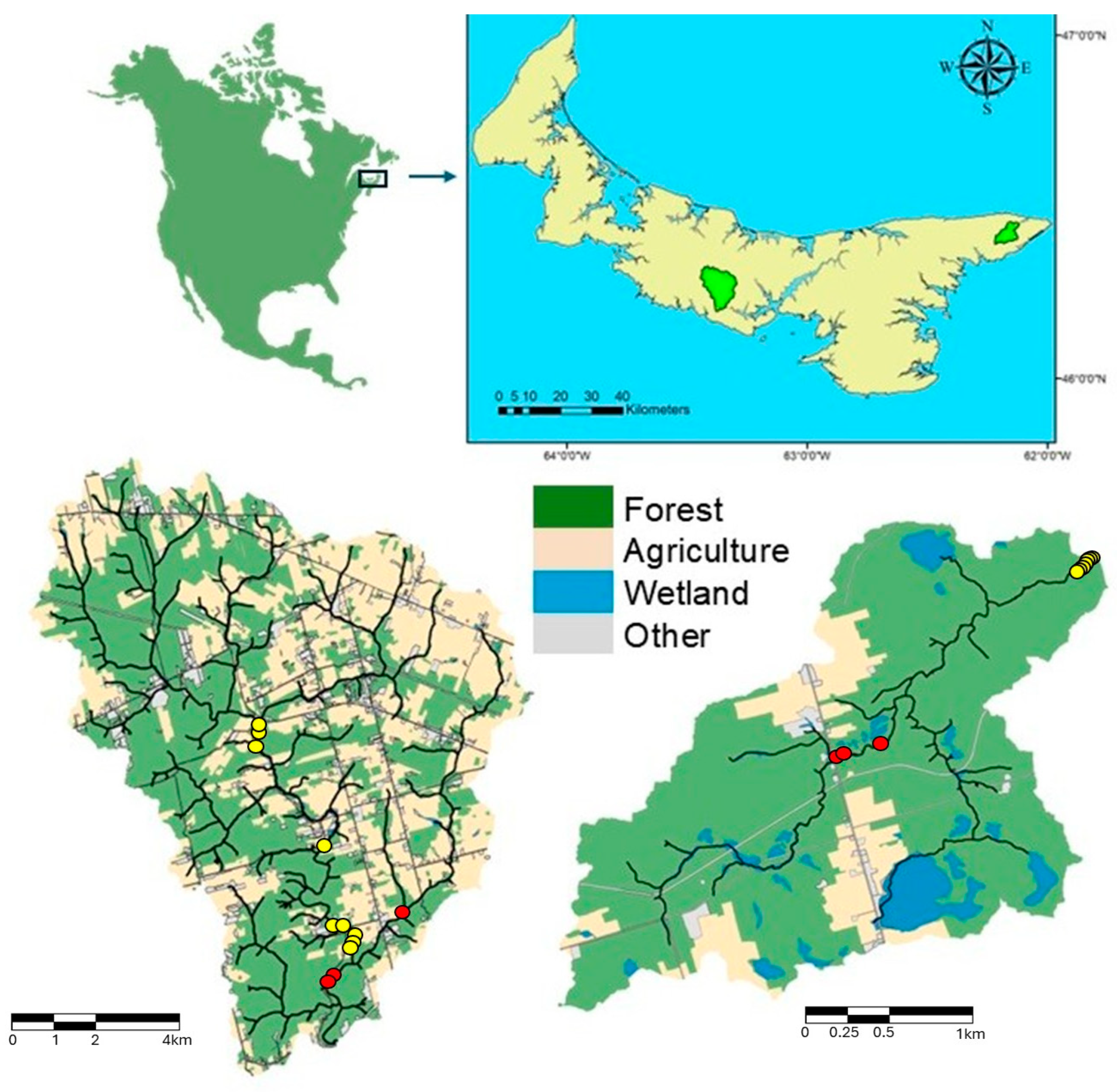
The present study was conducted at North Lake Creek (watershed area 48 km2) and the West River (113 km2), both located on Prince Edward Island, Canada (5560 km2; Figure 1). North Lake Creek is considered to have a relatively unimpacted habitat, with 12.1% agriculture and 76.2% forested land use (derived from PEI provincial land-use layers in ARCGIS 10.3). The West River has a moderately impacted habitat, with 37.7% agricultural land and 50.9% forested land. North Lake Creek has a lower road crossing density and a mean watershed landscape slope of 3.83°, as compared to 6.39° for the West River (determined from PEI digital elevation layers using ArcGIS 10.3).
North Lake Creek has a self-sustaining population of Atlantic salmon and was stocked only 5 times between 1887 and 1964 [15]. West River has received periodic stocking for at least 19 years, since records began in 1880, with most stocked years in the 1990s [15]. West River was stocked in four out of five years prior to the initiation of this present study to sustain and improve the Atlantic salmon population.
Fisheries and Oceans Canada (DFO) evaluates the status of populations on PEI by redd counts observed each fall and comparing the number of eggs to the number considered sufficient for self-sustaining populations; this is called the egg conservation requirement. North Lake Creek regularly exceeds its egg conservation requirement, as demonstrated by the most recent complete assessment in 2020 [25]. In 2022, the West River met 74% of its egg conservation requirement, and since 2013, it has averaged 59% [25]. Both watersheds rarely see summer water temperatures above 18 °C and are heavily influenced by groundwater.
The fish communities in West River and North Lake Creek are dominated by salmonids, with Atlantic salmon residing alongside both native and introduced species. Native species include brook trout (Salvelinus fontinalis) and Atlantic salmon, while non-native species include rainbow trout (Oncorhynchus mykiss) and, less frequently, migratory adult brown trout (Salmo trutta). The West River has a well-established non-native rainbow trout population, whereas North Lake Creek has historically supported only native salmonids; however, rainbow trout have previously been observed to be absent [10]. The recent regular presence of juveniles (authors’ unpublished data) suggests population establishment in the past 5 years.
Considering influences from higher-sloped landscape, forested land versus agricultural land use, and higher-density road crossings, the West River is regarded as the moderately impacted watershed for the study, and North Land Creek is the relatively unimpacted watershed. This observation is reflected in the population statuses: North Lake Creek regularly exceeds its conservation requirement, while the West River continues to fall short of conservation targets.

2.3. Redd Selection

Redd surveys were conducted during a pilot study from 29 October to 13 December 2019 and again during the full-scale survey from 1 November to 10 December 2020. To select redds for the study, egg pockets were identified by carefully examining the substrate within each. The substrate was replaced, and redds were marked with rebar immediately once any eggs were found (at least one egg). Rebar was pounded into the stream bottom at the downstream end of the redd to mark it, serving as an attachment point for monitoring instruments and a marker for trap placement in the spring. To confirm that the identified redds belonged to Atlantic salmon, several eggs were measured using a digital calliper from each redd in early December, and eggs > 5 mm were considered Atlantic salmon [26,27].
In 2019, three redds were monitored in North Lake Creek and three in the West River (Figure 1). In 2020, monitoring expanded to ten redds in North Lake Creek and nine in the West River. The ten redds in North Lake Creek were clustered in the lower reaches, just above the head-of-tide region, and shared similar habitat characteristics. In contrast, spawning was more widely distributed in the West River, with the nine redds monitored distributed across four reaches in the mid to upper regions. The number of monitored sites in the West River was limited to nine in 2020/21 due to the scarcity of accessible redds. Although additional redds were identified during preliminary surveys, some lacked eggs and were classified as ‘false’ redds.

2.4. Environmental Variables

2.4.1. Dissolved Oxygen

Dissolved oxygen was monitored using Onset HOBO® (Bourne, MA, USA) U26-001 dissolved oxygen loggers (±0.2 mg/L) at six redd locations in 2019/2020 (NLC n = 3 and West n = 3) and twelve in 2020/2021 (North Lake Creek n = 6 and West n = 6). The Onset Hobo® U26-001 dissolved oxygen logger uses an optical dissolved oxygen sensor with a range of 0–30 mg/L. Prior to deployment, loggers were placed in a calibration cup containing a small amount of water, with the sensor exposed to air but not submerged, for 15 min to establish a reference of 100% oxygen saturation.
Loggers were buried 10–15 cm deep into the gravel where salmon egg pockets were located. The dissolved oxygen loggers were programmed to log temperature every 30 min. To enable direct comparison between the water column and the redd dissolved oxygen, one logger was deployed in the water column on each river, programmed to record at the same interval as the redd loggers. Loggers were positioned and anchored using a cinder block in the stream column. Dissolved oxygen loggers were installed in mid-March 2020 (2019/20 incubation period) and were installed in early December the following year for the 2020/21 incubation period. Dissolved oxygen was recorded for 162 days over the 2020/2021 incubation period (9 December to 20 May). One logger from North Lake Creek (Redd 5) was excluded from the value analysis due to equipment failure, as the battery failed 32 days before the end of the observation period.

2.4.2. Water Temperature

All 19 monitored redds in this study were equipped with temperature loggers to establish hyporheic temperature regimes, along with loggers placed in the water column to measure stream temperature. For the redds with oxygen loggers, temperature was recorded on the aforementioned dissolved oxygen loggers. For the remaining redds, temperature sensors were implanted 10–15 cm beneath the stream substrate. Temperature sensors used in the study included Onset HOBO® MX2201 Pendants (±0.5 °C 0 °C to 50 °C), Onset HOBO® Tidbit v2 (±0.2 °C from 0 °C to 50 °C), and Onset HOBO® Pro v2 loggers (0.21 °C from 0 °C to 50 °C), all set to record at 1 h intervals. In the 2019/2020 season, loggers were not installed until March 2020, resulting in a lack of data for the early incubation period. In the 2020/2021 season, sensors were deployed in early December and remained in place until 20 May. A consistent temperature was monitored in all redds for 154 days during the 2020/2021 incubation period (18 December–20 May).

2.4.3. Water Level and Flow Velocity

Stream discharge was measured, and a rating curve was generated using the water level. Water levels were monitored throughout the study in North Lake Creek using an Onset HOBO U20-001 pressure logger in a stilling well. Discharge at each time point was calculated from a three-parameter rating curve constructed using manual flow measurements throughout the study period using a Marsh-McBirney Flo-Mate 2000 (Model 2000, Marsh-McBirney, Inc., Frederick, MD, USA). Environment and Climate Change Canada’s hydrometric station in Riverdale for the West River (Environment and Climate Canada, Station 01CC005) was used to obtain discharge for the West River. Manual flow measurement sites were established on both river systems, along with velocity measurements taken at each redd location on both river systems (see below) from base flow to full bank conditions.
In the second year of the study (2020–2021), water velocity was measured at individual redd locations. Measurements were taken directly in front of the logging instruments at two depths: at the streambed (0 cm) and 5 cm above. This was repeated at three points within each redd: the center and approximately 25 cm to the left and right of center. Monitoring was conducted at all redd locations (n = 19) every two to four weeks between December and March to capture the range of velocity experienced. Target water levels were defined using the West River hydrometric station to ensure representation of low-, medium-, and high-flow conditions. In total, eight measurement dates were paired for analysis between the two river systems, with an average interval of 3.25 weeks between recorded measurements.

2.4.4. Redd Substrate and Stream Suspended Solids Characterization

To characterize the substrate at each redd location, two methods were employed to describe both fine and large substrate components. Large substrate was assessed using a random walk Wolman pebble count at each redd location [28,29]. A total of 100 rocks were randomly selected within a 2 m radius of each redd, with the x, y, and z axes of each substrate piece measured to the nearest 0.1 cm. These values were averaged to determine a standardized mean substrate size. To assess finer sediments that infiltrated the redd, core samples were collected from the center of each redd after the emergence period using a McNeil core sampler (10 cm diameter, 20 cm depth) with a 30 cm diameter core and 40 cm height bowl. Upon extraction, the top of the core cylinder was sealed, and the contents were transferred to the bowl. The material was sieved through a 2 mm brass sieve, with finer suspended material stored in a 20 L plastic pail and coarser material stored in glass mason jars. The fine material in the pail was allowed to settle for two weeks before the surface water was siphoned off and then air-dried and combined with the coarse material. Sediment samples were dried to a constant weight at 60 °C and processed through a series of brass sieves corresponding to the Udden–Wentworth classification system: cobble (>63 mm), pebble (4–63 mm, ASTM #5 sieve), granules (2–4 mm, #10), coarse sand (500 µm–2 mm, #35), medium sand (250–500 µm, #60), fine sand (125–250 µm, #120), very fine sand (63–125 µm, #230), silt (38–63 µm, #400), and clay (<38 µm). A Gilson (Madison, WI, USA) tapping sieve shaker was used for 20 min, with 30 cm diameter sieves. The total mass of each size fraction was recorded to establish relative mass percent composition for each redd.
Stream optical turbidity was measured in nephelometric turbidity units (NTU) using a Manta (Solinst, ON, Canada) turbidity logger deployed in both West River and North Lake Creek, set to log at 1 h intervals. Loggers were mounted on cinder blocks anchored to a piece of rebar. See descriptions by Alberto et al. [18] for detailed experiments with methods of deriving TSS from turbidity locally. Briefly, turbidity measurements were converted to total suspended solids (TSS; mg/L) by constructing a site-specific calibration curve with dried and weighed sediment from each location that was sieved using a 63 µm #400 sieve and related to measured NTU values. Standard curves for the loggers were TSS (mg/L) = NTU ÷ 0.061 and TSS (mg/L) = NTU ÷ 0.35 for West River and North Lake Creek, respectively.

2.5. Emergence Trapping

The trap design was adapted from previous studies [30] to suit the conditions of this study. Each trap consisted of a 0.5 m steel ring attached to a conical 1000 µm Nitex (Sefar AG, Heiden, Switzerland) mesh funnel leading into a fry-holding bottle. To secure the trap to the streambed, three rebar anchors were placed—one at the front and one on each side—while the steel ring was embedded 5–10 cm into the streambed to prevent fry from escaping underneath. The Nitex mesh was reinforced with two strips of 22-gauge, half-inch galvanized steel strapping bolted to the ring to maintain structural integrity in the flowing water. The fry-holding bottle was constructed from a 950 mL polyethylene screw-cap bottle with the bottom cut out and a funnel inserted. Windows (1.25 cm) covered with 1000 µm Nitex mesh were drilled into both the funnel and the bottle to allow water flow. The bottle was attached to the trap using a fabric sock secured with a tourniquet, facilitating easy removal during monitoring. To check the trap, the tourniquet was loosened, the bottle was detached from the sock, and its contents were emptied into a container by unscrewing the cap.
Redds selected for monitoring were equipped with emergence traps from 15 May to 19 June 2020 and from 14 May (19 May on North Lake Creek) to 19 June 2021. The anticipated timing of emergence was based on a 1996–1997 study on the Morell River that examined the effects of sediment deposition on incubating Atlantic salmon and brook trout embryos [23]. In the West River and North Lake Creek, emergence traps were deployed mid-May and removed in mid- to late June each year once emergence had essentially ceased, defined as fewer than three individuals captured during consecutive checks. Throughout the monitoring period, traps were checked every 24 h to enumerate daily emergence.
Since the exact number of embryos per redd was unknown, embryo mortality was assessed after emergence commenced and the emergence traps were removed. The area encompassed by each emergence trap was excavated, and all deceased embryos and alevin were identified and enumerated.

2.6. Statistical Analysis

Dissolved oxygen (DO) values for individual redds will be presented as a mean value (DO mean), percentage of time above 6 mg/L (DO > 6 mg/L), percentage of time below 6 mg/L (DO < 6 mg/L), percentage of time below 4 mg/L (DO < 4 mg/L), and percentage of time below 2 mg/L (DO < 2 mg/L). These biological thresholds have been reported in previous studies [11,31] and as Lavery and Cunjak [32] noted, a conservative threshold of 6 mg/L was used as the minimum value.
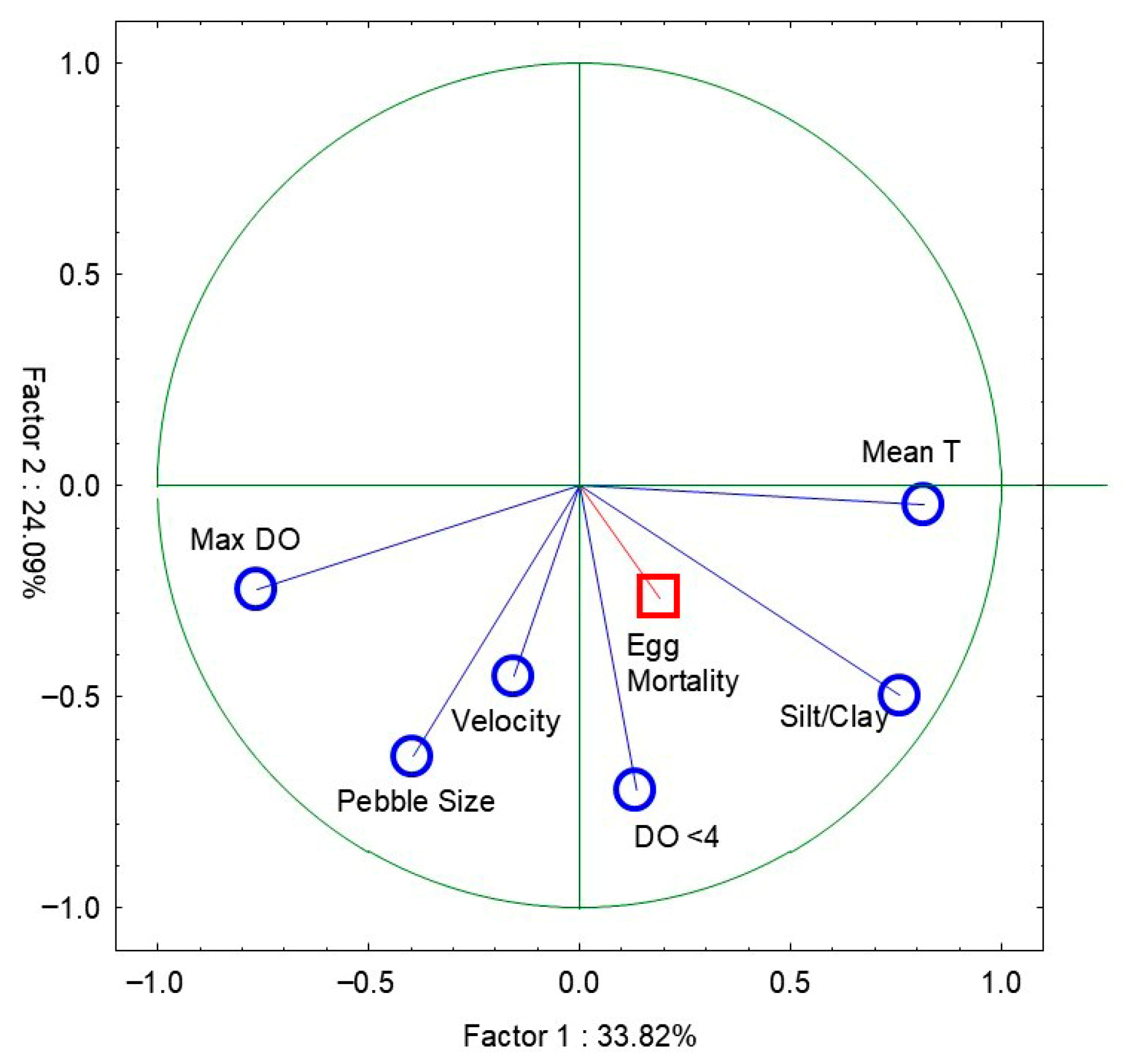
An exploratory analysis was conducted with a reduced dataset of redd environmental variables to avoid redundancy. The velocities at 0 and 5 cm were strongly correlated, and only the velocity at 0 cm was used. Substrate variables of pebbles (from pebble count) and the combined percent silt and clay percentage were used to reflect the large substrate size and the fine sediment infiltration, respectively. Temperature variables were highly correlated, and the mean temperature was chosen for further analysis. Most oxygen metrics were correlated, but maximum oxygen was orthogonal, so the proportion of time <4 mg/L as a measure of hypoxia and maximum oxygen were chosen as environmental variables. Because oxygen data were available for only 12 of the 19 redds, two analyses were conducted: with and without oxygen.
Between-river differences in environmental and Atlantic salmon variables were evaluated using a two-way ANOVA. The assumption of normality was tested using normal probability plots, and the assumption of homogeneity of variances was tested using the Brown–Forsythe test. Logarithmic transformations were applied when deviations from the assumptions occurred. Data visualization of the relationship between environmental variables and egg mortality (as a supplemental variable) was performed using principal components analysis (PCA). This analysis was followed up with a multivariate regression using egg mortality as the dependent variable and environmental/redd parameters as the independent variables. Both the best solution and stepwise removal techniques were applied to obtain the model that explained the highest proportion of variability (adjusted r2). The critical probability of significance (alpha) was set at 0.05. Statistica v 13.5 (Tibco Software Inc., Palo Alto, CA, USA) was used for all statistical analyses.

3. Results

3.1. Redd Environmental Variables

3.1.1. Dissolved Oxygen

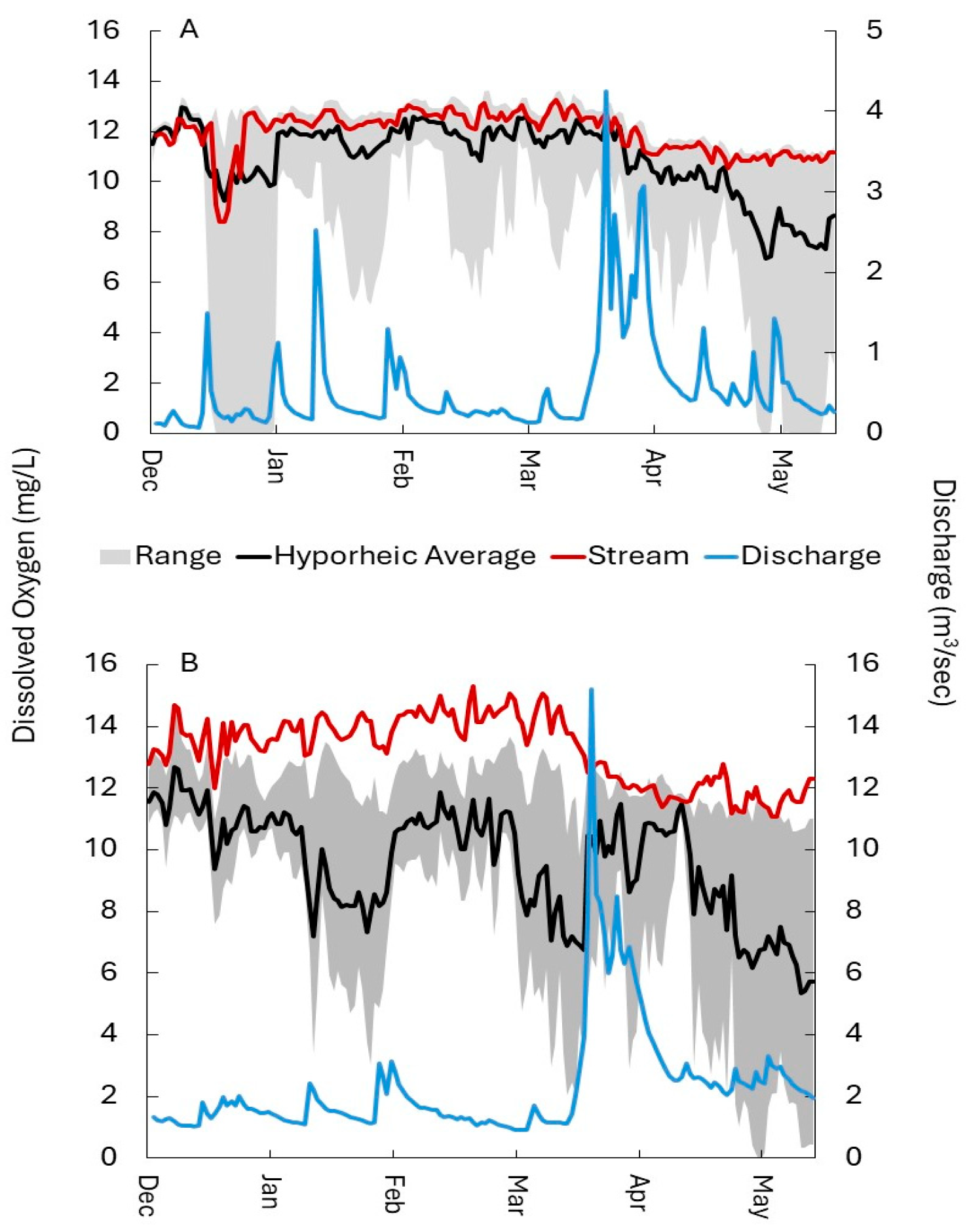
The mean (SEM) stream DO was 11.9 mg/L (0.01) in North Lake Creek and 13.2 mg/L (0.05) in the West River. The mean hyporheic DO concentration was 0.6 mg/L higher in North Lake Creek than in West River (Table 1). Across both rivers, hyporheic DO monitoring indicated that DO levels fell below 6 mg/L for 0% to 18.9% of the monitoring period, while exceeding 6 mg/L for 76.7% to 100% of the monitoring period. On both study rivers, DO levels exceeded 6 mg/L for the entire 161-day monitoring period. Variability in both hyporheic and stream DO levels was greater in the West River compared to North Lake Creek (Table 1; Figure 2). Oxygen drops were episodic, with particular redds reaching hypoxic levels and returning to normoxic levels. While such events occurred throughout the incubation period, they became more common and severe at or after the spring freshet.

3.1.2. Temperature

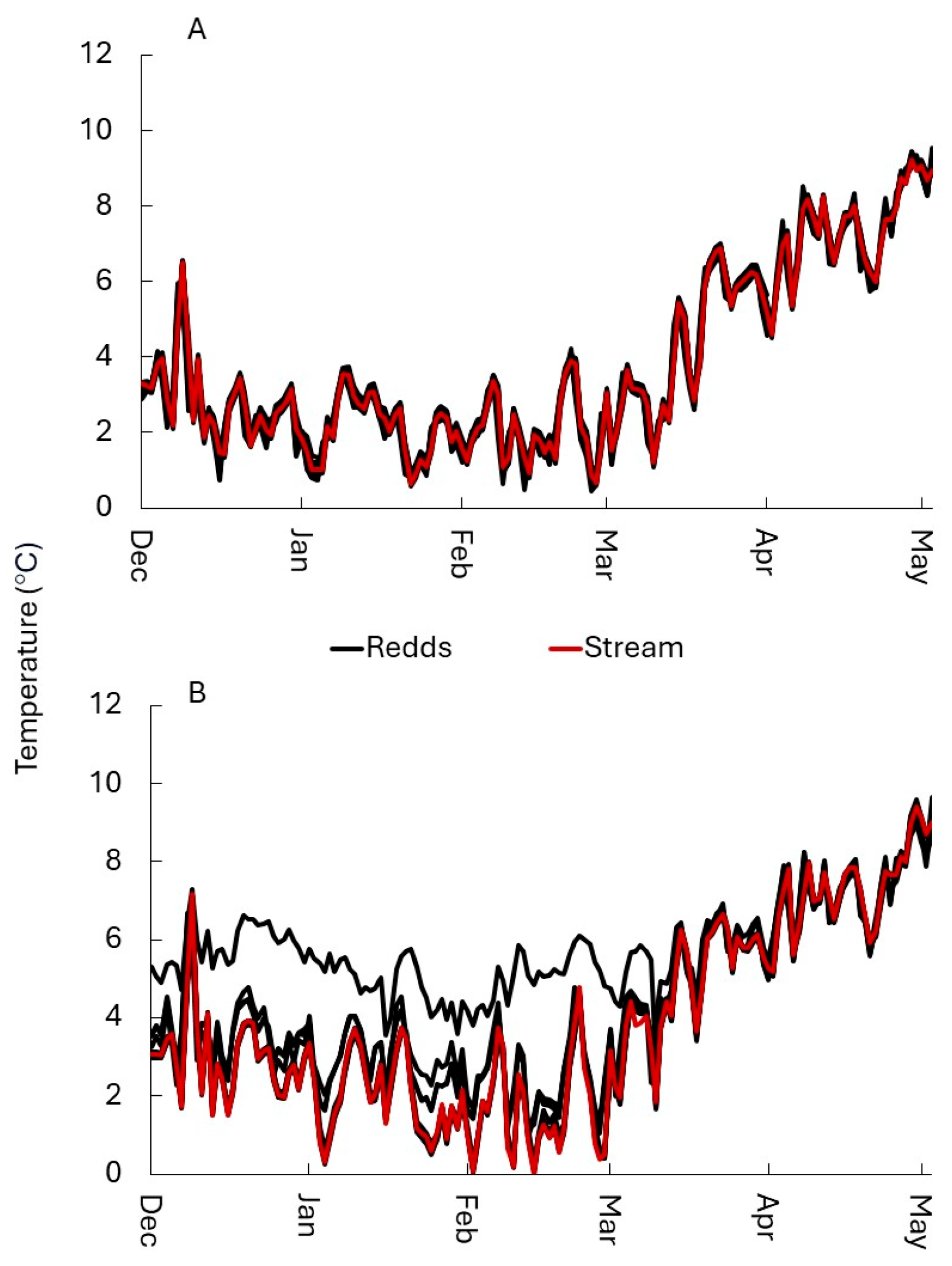
In 2020/21, mean (SEM, n) hyporheic temperatures in the West River had an average of 4.23 °C (0.04, 9), while in North Lake Creek, they averaged 3.82 °C (0.04, 10) over the 154-day deployment period. The average 0.5 °C warmer temperature in the West River compared to North Lake Creek was primarily due to temperature differences in the early part of the incubation, as one redd in the West River had consistently higher temperatures in the first half of the incubation but equalized in the later phases of the incubation period (Figure 3). Redd hyporheic temperatures closely followed stream temperatures, though they were often slightly higher in the West River than in North Lake Creek. Over the 154-day monitoring period, the stream temperature for West River was warmer for 109 days, with the greatest temperature difference of 2.0 °C occurring on 28 March. Conversely, North Lake Creek was warmer for 45 days, with the largest difference being 0.82 °C on 9 March. The mean (SD) degree days were 599.1 (12.8) for North Lake Creek and 655.0 (86.8) for West River. The difference in mean cumulative degree days (CDD) between the two rivers was 56 days; however, when Redd 6 was excluded from the West River dataset, this difference was reduced to 27 CDD.

3.1.3. Substrate, Sediment Infiltration, Velocity and Total Suspended Solids

No significant differences were found between North Lake Creek and the West River in the proportions of pebble (>4 mm), granule (2.1–4 mm), medium sand (251–500 µm), and fine sand (126–250 µm) fractions (Table 2). However, North Lake Creek had a significantly higher proportion of coarse sand, while the West River had significantly greater proportions of very fine sand, silt, and clay (Table 2). The silt and clay deposition in the West River redds was approximately double that in North Lake Creek, and that proportion was made up by sand in North Lake Creek. A Wolman pebble count indicated that the mean substrate size was approximately 27% larger in the West River compared to North Lake Creek (Table 2).
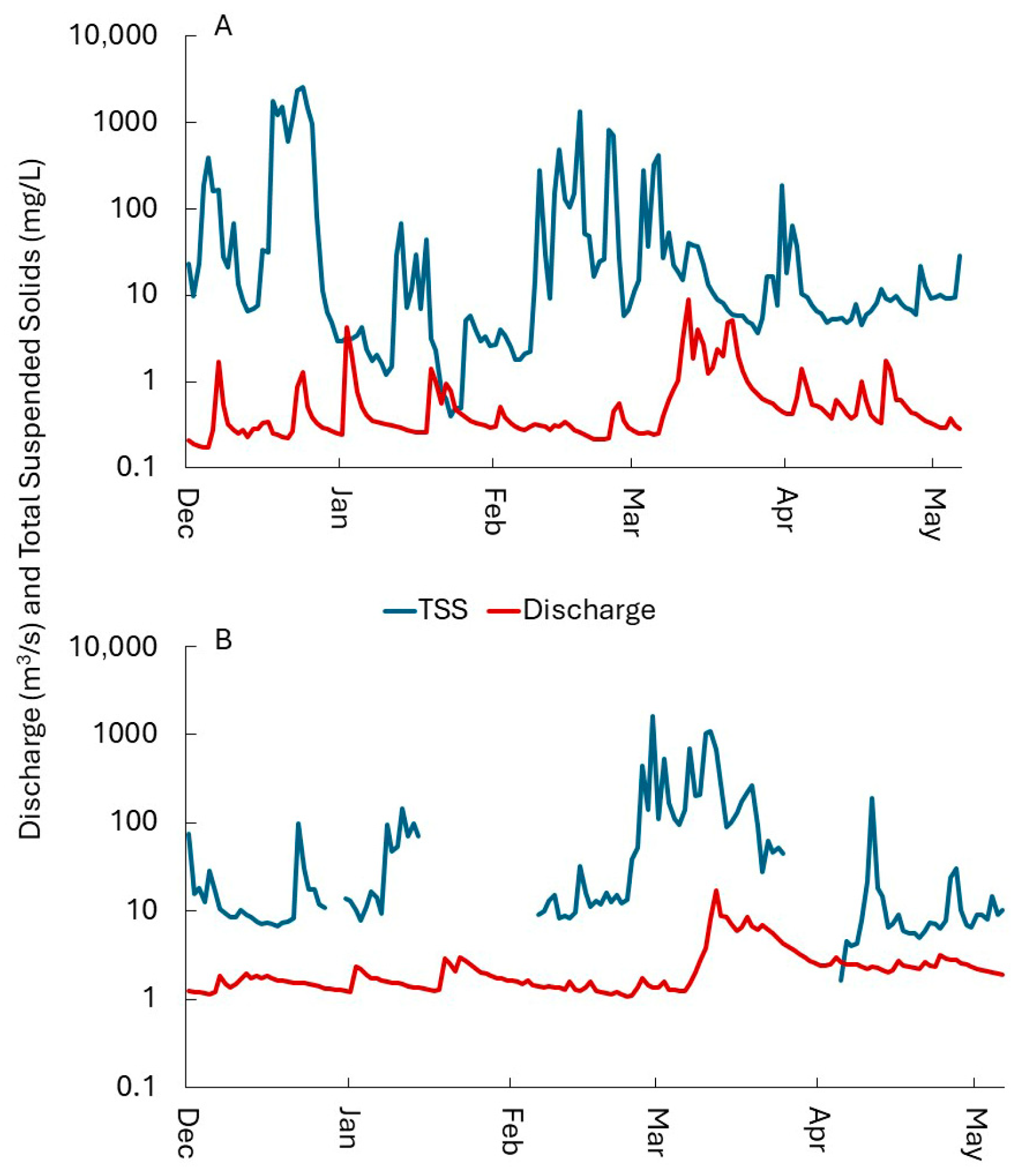
The average, minimum, and maximum flow velocities at both the 0 cm and 5 cm depth measurements did not differ significantly between the two study rivers. On average, the West River had slightly greater velocities at both 0 cm and 5 cm, but these differences were not statistically significant (Table 2). Discharge regimes between the two study rivers differed throughout the incubation period (Figure 4). As the streams are in relatively close proximity, they shared several peaks reflecting similar temperature or rainfall conditions throughout the incubation period, particularly the timing of the freshet between mid-March and mid-April. However, discharge spikes were less extreme in the larger West River watershed.
The overall TSS concentration could not be directly compared because data from one river were missing due to equipment malfunctions. However, among the remaining data, the magnitude of sediment events was similar for the two rivers, and the timing was also comparable (Figure 4). Total suspended solid (TSS) detection events were not well correlated with increased discharge periods. Soil type and weather conditions influence both the amount of TSS disturbance and discharge patterns. Local weather conditions can vary across PEI, resulting in differences in snow coverage, soil frost, and rainfall amounts, all of which ultimately influence spatial variation in discharge patterns and TSS disturbance.

3.2. Egg Size and Atlantic Salmon Fry Emergence

North Lake Creek had significantly larger eggs than West River, as evaluated using a two-way ANOVA across both years. The mean (SEM, n) egg size was 6.58 (0.04, 19) and 6.1 (0.06, 19) in North Lake Creek and West River in 2019, respectively. There was also a significant effect of year, with eggs from 2019 spawns being larger than those from 2020 spawns.
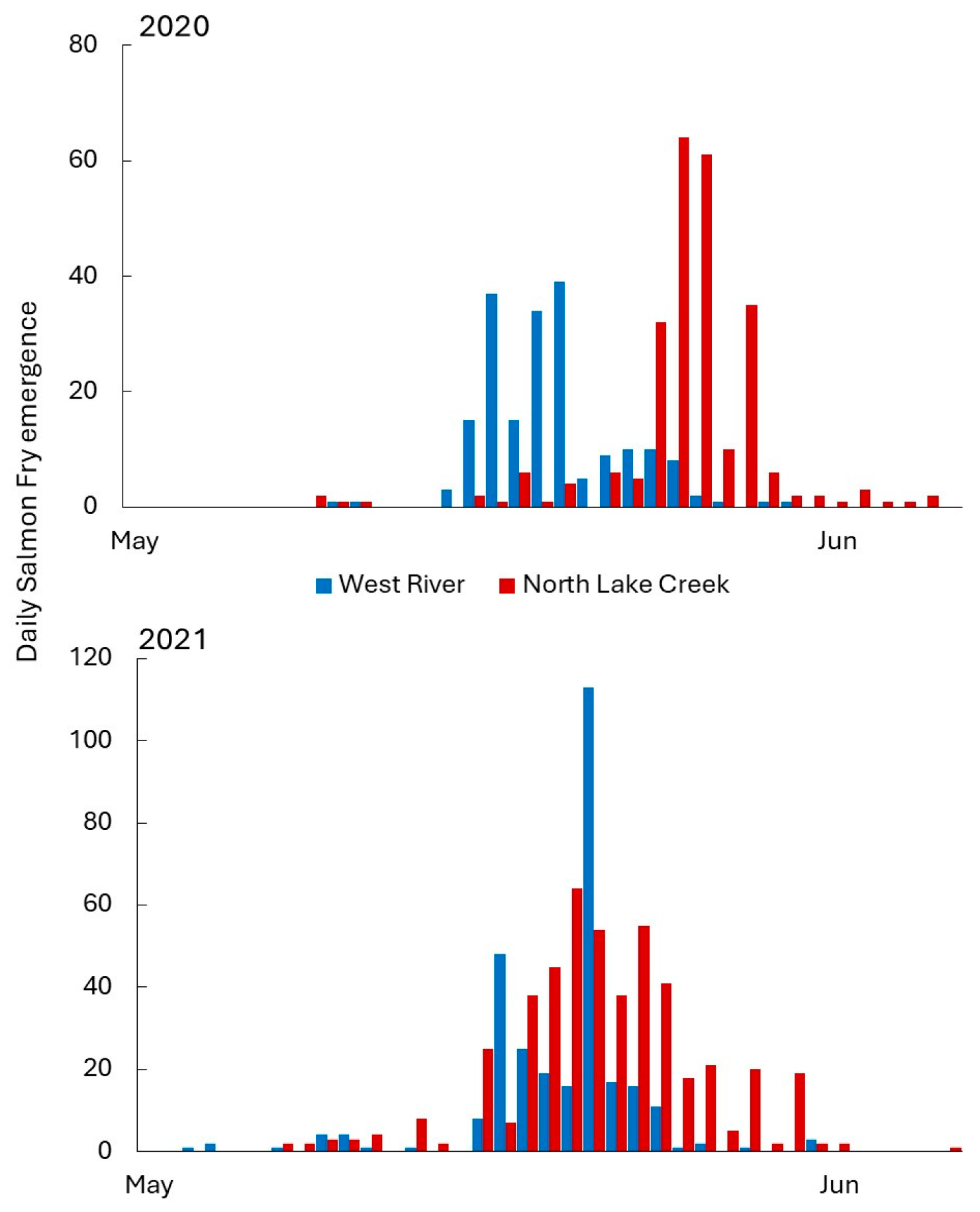
In 2020, the first emerging fry were captured on 23 May on the West River and on 22 May on North Lake Creek (Figure 5). Peak emergence in the West River occurred on June 2 (n = 39), while peak emergence in North Lake Creek was observed on 7 June (n = 64; Figure 2). In 2021, the first emergence was detected on 17 May in the West River and on 20 May in North Lake Creek (Figure 5). Peak emergence occurred on 2 June in North Lake Creek, with 64 fry captured, and on 3 June in the West River, with 113 fry captured. Between 13 May and 20 June, a total of 294 fry were captured in the West River, while 483 fry were captured in North Lake Creek between 20 May and 19 June. In the West River, 90.8% of the total fry were captured from two traps. In North Lake Creek, 70% of the total fry were captured from one trap (n = 338). In 2020, North Lake Creek emergence was approximately a week later than West River. However, in 2021, North Lake Creek was earlier than the previous year, and peak emergence timing had greater overlap with West River.
Only emergence was available for 2019/20 trials. Combining both years, the mean (SEM, n) emergence was 343 (174, 13) and 214 (81, 12) fry per m2 for North Lake Creek and West River, respectively, but was not significantly different. In 2020/21North Lake Creek redds had approximately double the number of deposited eggs and double the number of emerging fry per m2 than was measured in West River redds. However, neither result was significantly different (Table 3). There was high variability across all redd study sites in the total number of eggs laid per m2 and the number of fry emerging per m2.
Mortality was calculated as egg, alevin, and total mortality. Total and egg mortality were higher in West River than in North Lake Creek; however, both rivers exhibited relatively high values, ranging from 49 to 63 percent. There was no significant difference in total or egg mortality. Variability in mortality was high, and mortality ranged from 0 to 91% across the redds. There were two redds from West River with alevin mortality of 6% and 13%, respectively. Those alevins had fully resorbed yolk sacs, and it is presumed that they were unable to emerge due to entombment by accumulated fine sediment.

3.3. Emergence and Mortality Related to Environmental Variables

Data visualization with PCA showed that egg mortality did not contribute strongly as a supplemental variable to the environmental data with either the 12 or 19 redd data (Figure 6). The first three components of the PCA explained 76.3% of the variability for the analysis with oxygen data. Mortality loaded highest, albeit weakly, onto PC2, with a value of −0.26. This analysis was followed by a multivariate model using both best solution and stepwise removal techniques. No statistically significant multivariate regression could explain the variability in either mortality parameter with the redd environmental variables. While this was conducted with and without oxygen data (12 and 19 redds), only the analysis with oxygen metrics is shown.

4. Discussion

Two small coastal salmon streams showed differences in fine sediment infiltration into salmon redds, with the more agriculturally intensive watershed (West River) having two-fold-higher redd silt and clay infiltration. Redds in the river with higher fine sediment infiltration showed only modest reductions in hyporheic dissolved oxygen, as measured continuously in the redds. There was no evidence of a relationship between fry emergence and oxygen or other environmental variables measured in and around the redd. There was evidence that entombment occurred in two of the nine redds in the West River.
The effect of agriculture on sediment load is well established. Studies from the region have clearly documented local relationships between the high agricultural land use and sediment loading [20,24]. However, other modifying factors can also influence the infiltration of fine sediment into redds, such as soil type and the geological characteristics of the watershed, which can substantially influence stream particle size [19]. Landscape features such as watershed slope and riparian buffers can be related to the ability of a watershed to prevent sediment impacts, types of sediment entering the watercourses, and ultimately the total accumulation of finer-sized sediments embedding stream bottom substrate [33]. While extensive sediment studies or particle size evaluation have not been conducted for the streams studied herein, the level of loading can be considered low for North Lake Creek and moderate for West River based on land use. While total suspended solids monitoring suggested little difference between the streams, this can be misleading, as particle size would have a substantial influence. The West River remains turbid for many days after rain events, suggesting a finer particle size distribution. The surficial geology layer supports this observation, as it shows that the West River has 18.9% of the landscape as clay and clay–silt phase till, 13.1% clay–sand phase till, and 16.4% sand phase till, while North Lake Creek has 82.1% clay–sand phase till and 2.7% sand phase till.
Silt levels in the present study were on the threshold of what is considered impactful to embryos [11]. Silt concentrations are typically characterized as <63 µm, equivalent to the sum of clay and silt concentrations determined herein, or 0.96 and 1.8% for North Lake and West River, respectively. At the same time, no absolute level of silt can be established as detrimental to salmonid emergence due to the compensating effect of site-specific hydraulic gradients. Silt concentrations of 1.5% or greater are considered to be at a level where the hydraulic gradient cannot overcome the reduction in hyporheic water velocity [11,34,35]. Particle size and organic content can also substantially influence the impact of fine sediments on embryo mortality as much as mass [36]. Thus, the West River may be on the threshold of oxygen impacts based on substrate silt infiltration, and as a result, recorded hyporheic oxygen levels were on average lower than those in North Lake Creek. Indeed, salmon are extirpated in many watersheds on PEI that have much more severe fine sediment issues than the West River due to agricultural land use proportions approaching 70% [19,20].
Periods of hypoxia in some redds were driven by hydraulic conditions rather than sediment accumulation (Figure 2). Most hypoxic periods were associated with increased discharge, and the redd returned to normoxic conditions when base flows resumed, suggesting that sediment accumulation was not the primary cause. A sediment modelling study showed that accumulated sediment did not significantly contribute to hyporheic hypoxia, while oxygen decreased to near zero during periods of increased discharge [37]. It is suggested that this is a result of lower oxygen groundwater or advected water upwelling, but neither the data nor the model could account for a specific mechanism for these discharge-related oxygen sags. In contrast to the aforementioned study, Zimmermann et al. [38] showed that hyporheic redd velocity was reduced in conjunction with high discharge events that deposited sediments. While decreased oxygen with increased discharge appears to be a consistent phenomenon both herein and in the literature, it is currently poorly understood.
High mortality and high variability in percent mortality were likely linked to egg fertilization. Highly variable mortality rates averaging 50% or more were not statistically associated with hyporheic oxygen or other measured conditions. However, the fertility rate of the deposited gametes was not measured, and this is the expected source of the variability. Dead, white eggs were observed in at least one redd immediately after spawning in North Lake Creek while placing instruments (author’s unpublished data). A previous study using wild-caught Atlantic salmon sperm from different males to incubate a pooled egg source showed high variability in fertilization rate, ranging from 50 to 97% [39]. A Norwegian study examining the fertility of wild and hatchery crosses found that wild × wild crosses averaged approximately 50% [40]. A similar study, performed in artificial redds and wild Atlantic salmon in New Brunswick, Canada, found no significant relationship between hyporheic conditions, including oxygen levels, and mortality [32]. However, much of the mortality in that study was observed at the earliest time point during the first weeks of incubation and was highly variable between individuals, as observed herein, and was also likely due to fertility issues. Future studies investigating wild redds should measure fertility soon after spawning in a subset of eggs from the redd.
The emergence trapping methodology used in the present study has the advantage of being environmentally relevant. However, while studying wild Atlantic salmon redds, a major limiting factor is the undisclosed number of eggs unevenly laid in the redds. As they were based on observations of natural redds and wild fish, the results will most closely match what is occurring in those streams, which is important for refining the calculation of the egg conservation requirement, which was based on assumptions about eggs laid and mortality to emergence. Other techniques, while less relevant, as they typically fertilize eggs from hatchery brood stock, have also had mixed success. Ref. [35] found highly variable survival to hatch (emergence not measured) of hatchery-fertilized salmon eggs in artificial redds. Incubation chambers also previously failed to show relationships between sediment infiltration and survival in PEI streams [23]. However, this approach successfully demonstrated a relationship between silt infiltration and embryo survival [11]. Survival was negatively correlated with silt and very fine sand. These methods have the advantage of making it easier to compare dead eggs than the method used herein. A laboratory experiment with the addition of artificial fines has also been employed to test the sediment hypothesis, but failed to show increased mortality in Atlantic salmon [41]. Results of such techniques will vary considerably with the nature of the constructed incubators and added sediments, making this a challenging area of study.
Atlantic salmon embryos are resilient to moderate levels of hypoxia. Periods in which redds fell below 50% oxygen saturation were rare in the present study. Exposure of salmon eggs to 50% saturation of oxygen does not cause mortality, though it does cause physiological changes that increase as the embryos approach hatching [42]. Salmon eggs implanted in Nova Scotia streams did not show increases in mortality until the minimum hyporheic DO dropped below 5 mg/L [43]. In a stream study with hypoxic hyporheal water, no mortality was reported in concentrations above 50% saturation, though sublethal effects on embryo size were related to oxygen [44]. A study that exposed Atlantic salmon embryos to 63% saturation and cyclical hypoxia from 100 to 25% over 24 h reported no differential mortality and found no long-lasting physiological effects in fry post-emergence [42]. In the context of the sensitivity of Atlantic salmon fry from the literature, little or no effect would be expected from the levels of hypoxia experienced in West River and North Lake Creek redds.
Entombment rather than hypoxia may be a more critical mechanism causing embryo mortality. It was noted that embryos successfully hatched, but the alevin were entombed in sediment and unable to emerge, resulting in mortality at biologically significant levels in some redds. In sediment-addition experiments with brook trout, entombment was shown to be the main factor causing mortality even when dissolved oxygen levels were high [45]. Furthermore, higher mortality has been observed in years with larger spring freshets [46], which may reflect higher sediment loads associated with entombment. The substantive oxygen-saturated groundwater flow on PEI can mitigate or flush sediment accumulation; embryo entombment, however, has likely played a significant role in the Atlantic salmon decline in the region.
Sedimentation is a well-established factor affecting freshwater fishes, particularly more sensitive species such as salmonids [47]. In PEI watersheds, where impacts are the most severe, there are no longer salmon, precluding study. Moving forward, if this study were repeated, the main recommendation would be to obtain and estimate fertility for each redd and increase the total number of monitored redds. Increasing the emergent trap size would also reduce the likelihood of trap placement missing egg pockets, as the current study’s emergent traps did not cover the entire redd but only a portion, potentially leaving egg pockets on the periphery of the traps. Very few studies examine wild Atlantic salmon redds due to the reasons mentioned previously. However, with these difficulties come ecological insight into actual conditions experienced by wild Atlantic salmon redds rather than artificially placed egg incubators, which provides immense value inimproving our understanding of adverse land usage practices and implications to wild Atlantic salmon populations and conservation efforts.

5. Conclusions

Increases in fine sediment infiltration into salmon redds were observed in the more agriculturally intensive watershed, having two-fold-higher redd silt and clay infiltration. Redds with higher fine sediment infiltration showed only modest reductions in hyporheic dissolved oxygen measured continuously in the redds. There was no relationship between fry embryo survival and oxygen or other redd environmental variables. However, there was evidence of entombment of fry in redds in the more impacted river, suggesting that this may occur before hypoxia impacts are manifest. Survival in natural Atlantic salmon redds was highly variable even in ideal conditions, and mean survival is unlikely to exceed 50%.

Author Contributions

Conceptualization, J.D.C., S.D.R. and M.R.v.d.H.; methodology, J.D.C. and M.R.v.d.H.; investigation, J.D.C.; resources, M.R.v.d.H.; data curation, J.D.C.; writing—original draft preparation, J.D.C.; writing—review and editing, J.D.C., S.D.R. and M.R.v.d.H.; visualization, J.D.C. and M.R.v.d.H.; supervision, M.R.v.d.H.; project administration, M.R.v.d.H.; funding acquisition, M.R.v.d.H. All authors have read and agreed to the published version of the manuscript.

Funding

Research was funded by the PEI Wildlife Conservation Fund (Grant #S19-18), the University of Prince Edward Island, and the Regis and Joan Duffy Foundation.

Institutional Review Board Statement

All fish were handled in accordance with approved University of Prince Edward Island animal care protocol 16-044 (approval date: 2 September 2016).

Data Availability Statement

Data are available from the authors upon request.

Acknowledgments

The authors would like to thank Central Queens and the Souris Area Branch of the PEI Wildlife Federation, Christina Pater for assistance during fieldwork, and the late Daryl Guignion for guidance.

Conflicts of Interest

The authors declare no conflicts of interest.

Abbreviations

The following abbreviations are used in this manuscript:
PEIPrince Edward Island
DFOThe Department of Fisheries and Oceans
DODissolved Oxygen
PCAPrincipal Component Analysis
SEMStandard Error of the Mean
SDStandard Deviation
CDDCumulative Degree Days
TSSTotal Suspended Solids

References

  1. Moss, B.; Hering, D.; Green, A.J.; Aidoud, A.; Becares, E.; Beklioglu, M.; Bennion, H.; Boix, D.; Brucet, S.; Carvalho, L.; et al. Climate change and the future of freshwater biodiversity in Europe: A primer for policy-makers. Freshw. Rev. 2009, 2, 103–130. [Google Scholar] [CrossRef]
  2. Su, G.; Logez, M.; Xu, J.; Tao, S.; Villéger, S.; Brosse, S. Human impacts on global freshwater fish biodiversity. Science 2021, 371, 835–838. [Google Scholar] [CrossRef]
  3. Chaput, G. Overview of the status of Atlantic salmon (Salmo salar) in the North Atlantic and trends in marine mortality. ICES J. Mar. Sci. 2012, 69, 1538–1548. [Google Scholar] [CrossRef]
  4. OSPAR Commission. Case Reports for the OSPAR List of Threatened and/or Declining Species and Habitats; Ospar Commission: London, UK, 2008; Available online: https://oap.ospar.org/en/ospar-assessments/committee-assessments/biodiversity-committee/status-assesments/atlantic-salmon (accessed on 24 November 2025).
  5. Pardo, S.A.; Hutchings, J.A. Estimating marine survival of Atlantic salmon using an inverse matrix approach. PLoS ONE 2020, 15, e0232407. [Google Scholar] [CrossRef] [PubMed]
  6. ICES. Atlantic salmon from North America. In Report of the ICES Advisory Committee; ICES Advice; ICES: Copenhagen, Denmark, 2019. [Google Scholar] [CrossRef]
  7. Metcalfe, N.B.; Thorpe, J.E. Determinants of geographical variation in the age of seaward-migrating salmon, Salmo salar. J. Anim. Ecol. 1990, 59, 135–145. [Google Scholar] [CrossRef]
  8. Gibson, J.F.; Bowlby, H.D.; Sam, D.L.; Amiro, P.G. Review of DFO Science Information for Atlantic Salmon (Salmo salar) Populations in the Southern Upland Region of Nova Scotia; Res. Doc. 2009/081; DFO Canadian Science Advisory Secretariat (Secrétariat Canadien de Consultation Scientifique): Ottawa, Canada, 2010; Volume VI, 83p. [Google Scholar]
  9. Duda, J.J.; Beirne, M.M.; Larsen, K.; Barry, D.; Stenberg, K.; McHenry, M.L. Aquatic ecology of the Elwha River estuary prior to dam removal. In Coastal Habitats of the Elwha River, Washington—Biological and Physical Patterns and Processes Prior to Dam Removal; Scientific Investigations Report 2011-5120-7. Chapter 7; U.S. Geological Survey: Reston, VA, USA, 2011. [Google Scholar]
  10. Roloson, S.D.; Knysh, K.M.; Coffin, M.R.S.; Gormley, K.L.; Pater, C.C.; van den Heuvel, M.R. Rainbow trout (Oncorhynchus mykiss) habitat overlap with wild Atlantic salmon (Salmo salar) and brook trout (Salvelinus fontinalis) in natural streams: Do habitat and landscape factors override competitive interactions? Can. J. Fish. Aquat. Sci. 2018, 75, 1949–1959. [Google Scholar] [CrossRef]
  11. Julien, H.P.; Bergeron, N.E. Effect of fine sediment infiltration during the incubation period on Atlantic salmon (Salmo salar) embryo survival. Hydrobiologia 2006, 563, 61–71. [Google Scholar] [CrossRef]
  12. Wells, B.K.; Huff, D.D.; Quinn, T.P.; Santora, J.A.; Gomes, D.G.E.; Vasbinder, K.; Barnas, K.A.; Burke, B.J.; Courtney, M.B.; Crozier, L.G.; et al. When, where, and why salmon become vulnerable to predation. ICES J. Mar. Sci. 2025, 82, fsaf162. [Google Scholar] [CrossRef]
  13. Karlsson, S.; Diserud, O.H.; Fiske, P.; Hindar, K. Widespread genetic introgression of escaped farmed Atlantic salmon in wild salmon populations. ICES J. Mar. Sci. 2016, 73, 2488–2498. [Google Scholar] [CrossRef]
  14. Madhun, A.S.; Karlsbakk, E.; Skaala, Ø.; Solberg, M.F.; Wennevik, V.; Harvey, A.; Meier, S.; Fjeldheim, P.T.; Andersen, K.C.; Glover, K.A. Most of the escaped farmed salmon entering a river during a 5-year period were infected with one or more viruses. J. Fish Dis. 2024, 47, e13950. [Google Scholar] [CrossRef]
  15. Grove, C.M.; Roloson, S.D.; Knysh, K.M.; Pavey, S.A.; Cairns, D.K.; Gilmour, R.F.; van den Heuvel, M.R. Population Genetics of Atlantic Salmon (Salmo salar) in Prince Edward Island, Canada. Ecol. Evol. 2025, 15, e71285. [Google Scholar] [CrossRef]
  16. Moore, J.-S.; Bourret, V.; Dionne, M.; Bradbury, I.; O’Reilly, P.; Kent, M.; Chaput, G.; Bernatchez, L. Conservation genomics of anadromous Atlantic salmon across its North American range: Outlier loci identify the same patterns of population structure as neutral loci. Mol. Ecol. 2014, 23, 5680–5697. [Google Scholar] [CrossRef] [PubMed]
  17. Cairns, D.K.; MacFarlane, R.E. The Status of Atlantic Salmon (Salmo salar) on Prince Edward Island (SFA 17) in 2013; Res. Doc. 2015/019; DFO Canadian Science Advisory Secretariat (Secrétariat Canadien de Consultation Scientifique): Ottawa, Canada, 2015; Volume IV, 25p. [Google Scholar]
  18. Alberto, A.; St-Hilaire, A.; Courtenay, S.C.; van den Heuvel, M.R. Monitoring stream sediment loads in response to agriculture in Prince Edward Island, Canada. Environ. Monit. Assess. 2016, 188, 415. [Google Scholar] [CrossRef] [PubMed]
  19. Sirabahenda, Z.; St-Hilaire, A.; Courtenay, S.C.; Alberto, A.; van den Heuvel, M.R. A modelling approach for estimating suspended sediment concentrations for multiple rivers influenced by agriculture. Hydrol. Sci. J. 2017, 62, 2209–2221. [Google Scholar] [CrossRef]
  20. Bugden, G.; Jiang, Y.; van den Heuvel, M.R.; Vandermeulen, H.; MacQuarrie, K.T.B.; Crane, C.J.; Raymond, B.G. Nitrogen Loading Criteria for Estuaries in Prince Edward Island; Fisheries and Oceans Canada (Pêches et Océans Canada): Ottawa, ON, Canada, 2014; Volume VII, 43p. [Google Scholar]
  21. Roloson, S.D.; Knysh, K.M.; Landsman, S.J.; James, T.L.; Hicks, B.J.; van den Heuvel, M.R. The lifetime migratory history of anadromous brook trout (Salvelinus fontinalis): Insights and risks from pesticide-induced fish kills. Fishes 2022, 7, 109. [Google Scholar] [CrossRef]
  22. Van den Heuvel, M.R. Forest Contribution to Ecosystem Services Provided by PEI Streams; Report provided to the PEI Ministry of Environment, Water and Climate Change; Muskego Environmental: Charlottetown, Canada, 2021. [Google Scholar]
  23. Cunjak, R.A.; Cairns, D.K.; Guignion, D.L.; Angus, R.B.; MarFarlane, R.A. Survival of eggs and alevins of Atlantic salmon (Salmo salar) and brook trout (Salvelinus fontinalis) in relation to fine sediment deposition. Effects of land use practices on fish, shellfish, and their habitats on Prince Edward Island. Can. Tech. Rep. Fish. Aquat. Sci. 2002, 2408, 82–91. [Google Scholar]
  24. Alberto, A.; Courtenay, S.C.; St-Hilaire, A.; van den Heuvel, M.R. Factors Influencing Brook Trout (Salvelinus frontalis) Egg Survival and Development in Streams Influenced by Agriculture. J. FisheriesSciences.com 2017, 11, 9–20. [Google Scholar]
  25. DFO. Update of Stock Status Indicators of Atlantic Salmon (Salmo salar) in DFO Gulf Region Salmon Fishing Areas 15–18 for 2022; Sci. Resp. 2023/035; DFO Canadian Science Advisory Secretariat (Secrétariat Canadien de Consultation Scientifique): Ottawa, ON, Canada, 2023. [Google Scholar]
  26. MacMillan, J.; McNeill, A. Fecundity and Sexual Maturity in Select Nova Scotia Trout Populations; Unpublished Report; Inland Fisheries Division, Nova Scotia Department of Fisheries and Aquaculture: Pictou, NS, Canada, 2008. [Google Scholar]
  27. Reid, J.E.; Chaput, G. Spawning history influence on fecundity, egg size, and egg survival of Atlantic salmon (Salmo salar) from the Miramichi River, New Brunswick, Canada. ICES J. Mar. Sci. 2012, 69, 1678–1685. [Google Scholar] [CrossRef]
  28. Wolman, G.M. A method of sampling coarse river-bed material. Eos Trans. Am. Geophys. Union 1954, 35, 951–956. [Google Scholar]
  29. Newbury, R.W. Dynamics of flow. In Methods in Stream Ecology; Academic Press: San Diego, CA, USA, 1996; pp. 75–92. [Google Scholar]
  30. Fraley, J.J.; Shepard, B.B.; Graham, P.R. Emergence of salmonids from incubation boxes and natural redds: Techniques and observations. North Am. J. Fish. Manag. 1986, 6, 150–155. [Google Scholar]
  31. Greig, S.; Sear, D.; Carling, P. A field-based assessment of oxygen supply to incubating Atlantic salmon embryos. Hydrol. Process. 2007, 21, 3087–3100. [Google Scholar] [CrossRef]
  32. Lavery, J.M.; Cunjak, R.A. The influence of abiotic incubation conditions on the winter mortality of wild salmonid embryos. Freshw. Biol. 2019, 64, 1098–1113. [Google Scholar] [CrossRef]
  33. Sirabahenda, Z.; St-Hilaire, A.; Courtenay, S.C.; van den Heuvel, M.R. Assessment of the effective width of riparian buffer strips to reduce suspended sediment in an agricultural landscape using ANFIS and SWAT models. CATENA 2020, 195, 104762. [Google Scholar] [CrossRef]
  34. Lapointe, M.F.; Bergeron, N.E.; Bérubé, F.; Pouliot, M.-A.; Johnston, P. Interactive effects of substrate sand and silt contents, redd-scale hydraulic gradients, and interstitial velocities on egg-to-emergence survival of Atlantic salmon (Salmo salar). Can. J. Fish. Aquat. Sci. 2004, 61, 2271–2277. [Google Scholar] [CrossRef]
  35. Levasseur, M.; Bergeron, N.E.; Lapointe, M.F.; Bérubé, F. Effects of silt and very fine sand dynamics in Atlantic salmon (Salmo salar) redds on embryo hatching success. Can. J. Fish. Aquat. Sci. 2006, 63, 1450–1459. [Google Scholar] [CrossRef]
  36. Sear, D.A.; Jones, J.I.; Collins, A.L.; Hulin, A.; Burke, N.; Bateman, S.; Pattison, I.; Naden, P.S. Does fine sediment source as well as quantity affect salmonid embryo mortality and development? Sci. Total Environ. 2016, 541, 957–968. [Google Scholar] [CrossRef]
  37. Sear, D.A.; Pattison, I.; Collins, A.L.; Newson, M.D.; Jones, J.I.; Naden, P.S.; Carling, P.A. Factors controlling the temporal variability in dissolved oxygen regime of salmon spawning gravels. Hydrol. Process. 2014, 28, 86–103. [Google Scholar] [CrossRef]
  38. Zimmermann, A.E.; Lapointe, M. Intergranular flow velocity through salmonid redds: Sensitivity to fines infiltration from low intensity sediment transport events. River Res. Appl. 2005, 21, 865–881. [Google Scholar] [CrossRef]
  39. Aas, G.H.; Refstie, T.; Gjerde, B. Evaluation of milt quality of Atlantic salmon. Aquaculture 1991, 95, 125–132. [Google Scholar] [CrossRef]
  40. Yeates, S.E.; Einum, S.; Fleming, I.A.; Holt, W.V.; Gage, M.J.G. Assessing risks of invasion through gamete performance: Farm Atlantic salmon sperm and eggs show equivalence in function, fertility, compatibility and competitiveness to wild Atlantic salmon. Evol. Appl. 2014, 7, 493–505. [Google Scholar] [CrossRef]
  41. MacCrimmon, H.R.; Gots, B.L. Laboratory observations on emergent patterns of juvenile Atlantic salmon, Salmo salar, relative to sediment loadings of test substrate. Can. J. Zool. 1986, 64, 1331–1336. [Google Scholar] [CrossRef]
  42. Wood, A.T.; Clark, T.D.; Elliott, N.G.; Frappell, P.B.; Andrewartha, S.J. Physiological effects of dissolved oxygen are stage-specific in incubating Atlantic salmon (Salmo salar). J. Comp. Physiol. 2019, 189, 109–120. [Google Scholar] [CrossRef]
  43. Lacroix, G.L. Survival of eggs and alevins of Atlantic salmon (Salmo salar) in relation to the chemistry of interstitial water in redds in some acidic streams of Atlantic Canada. Can. J. Fish. Aquat. Sci. 1985, 42, 292–299. [Google Scholar] [CrossRef]
  44. Youngson, A.; Malcolm, I.; Thorley, J.; Bacon, P.; Soulsby, C. Long-residence groundwater effects on incubating salmonid eggs: Low hyporheic oxygen impairs embryo development. Can. J. Fish. Aquat. Sci. 2004, 61, 2278–2287. [Google Scholar] [CrossRef]
  45. Franssen, J.; Blais, C.; Lapointe, M.; Bérubé, F.; Bergeron, N.; Magnan, P. Asphyxiation and entombment mechanisms in fines rich spawning substrates: Experimental evidence with brook trout (Salvelinus fontinalis) embryos. Can. J. Fish. Aquat. Sci. 2012, 69, 587–599. [Google Scholar] [CrossRef]
  46. Jensen, A.J.; Johnsen, B.O. The functional relationship between peak spring floods and survival and growth of juvenile Atlantic Salmon (Salmo salar) and Brown Trout (Salmo trutta). Funct. Ecol. 1999, 13, 778–785. [Google Scholar] [CrossRef]
  47. Chapman, J.M.; Proulx, C.L.; Veilleux, M.A.N.; Levert, C.; Bliss, S.; André, M.-E.; Lapointe, N.W.R.; Cooke, S.J. Clear as mud: A meta-analysis on the effects of sedimentation on freshwater fish and the effectiveness of sediment-control measures. Water Res. 2014, 56, 190–202. [Google Scholar] [CrossRef] [PubMed]
Figure 1. Prince Edward Island, West River, and North Lake Creek watershed and redd locations. Redds from 2020 are red dots and from 2021 are yellow dots.
Fishes 11 00082 g001
Figure 2. Stream and hyporheic dissolved oxygen in relation to stream discharge over the egg incubation period from (A) North Lake Creek and (B) West River redds.
Fishes 11 00082 g002
Figure 3. Individual redd and stream temperature (n = 1 per stream) profile during the egg incubation period for (A) North Lake Creek (n = 10), and (B) West River (n = 9).
Fishes 11 00082 g003
Figure 4. Stream discharge and total suspended solids for (A) North Lake Creek and (B) West River.
Fishes 11 00082 g004
Figure 5. Daily count of emerging fry from wild Atlantic salmon redds on North Lake Creek and West River, PEI, during the 2020 and 2021 emergence period.
Fishes 11 00082 g005
Figure 6. Principal components analysis of redd environmental variables overlaid with egg mortality as a supplemental variable.
Fishes 11 00082 g006
Table 1. Hyporheic dissolved oxygen readings from Atlantic salmon redds on North Lake Creek (n = 6) and West River (n = 6) during the early incubation period from Dec 9th to April 18th and later incubation period 19 April to 20 May (North Lake Creek = 5 and West River = 6).
9 December to 18 April19 April to 20 May
North Lake CreekWest RiverNorth Lake CreekWest River
Range of Individual Means (mg/L)9.9 to 12.6 9.3 to 11.3 3.6 to 11.33.0 to 11.2
Mean (SD, n, mg/L)11.5 (1.7, 6)10.6 (2.0, 6)8.6 (1.6, 5)8.3 (1.9, 6)
Above 6 mg/L87 to 100%81 to 100%34 to 100%13 to 100%
Below 6 mg/L0 to 13%0 to 19%0 to 66%0 to 87%
Below 4 mg/L0 to 13%0 to 19%0 to 55%0 to 87%
Below 2 mg/L0 to 12%0 to 1%0 to 51%0 to 48%
Days1301303232
Table 2. Mean (SEM) substrate size characterization in core samples, Wobble random pebble count, and velocity measurements from redds in North Lake Creek and West River (n = 10 and n = 9). For all North Lake Creek and West River categories, asterisks indicate statistically significant differences in each category.
Substrate CategoryNorth Lake CreekWest River
Pebble (>4 mm)54.9 (1.69)57.7 (3.27)
Granule (2.1–4 mm)6.70 (0.49)6.45 (0.61)
Coarse sand (501 µm–2 mm)14.8 (1.45)9.73 (1.29) *
Medium sand (251–500 µm)13.1 (0.62)12.5 (1.82)
Fine sand (126–250 µm)7.36 (0.65)8.56 (1.20)
Very fine sand (64–125 µm)2.16 (0.22)3.22 (0.49) *
Silt (39–63 µm)0.46 (0.05)0.90 (0.15) *
Clay (<39 µm)0.52 (0.13)0.98 (0.18) *
Wobble Pebble Count35.3 (6.11)44.8 (2.29)
Velocity (f/s) at 0 cm1.45 (0.89)1.59 (1.05)
Velocity (f/s) at 5 cm2.01 (1.54)2.08 (1.61)
Table 3. Mean (range) egg deposition and mortality in wild Atlantic salmon redds during study year 2 (year 1 data not presented) based on total eggs laid per m2, total fry emergence per m2, detected percentage of egg mortality, and detected percentage of alevin mortality on North Lake Creek (n = 10) and West River (n = 9), Prince Edward Island.
North Lake CreekWest River
Total eggs laid (m2)501 (14–2189)353 (41–951)
Total fry emergence (m2)301 (7–2176)159 (0–795)
Detected egg mortality (%)50 (0.3–91)60 (9–100)
Detected alevin mortality (%)0 (0–0.3)2 (0–13)
Disclaimer/Publisher’s Note: The statements, opinions and data contained in all publications are solely those of the individual author(s) and contributor(s) and not of MDPI and/or the editor(s). MDPI and/or the editor(s) disclaim responsibility for any injury to people or property resulting from any ideas, methods, instructions or products referred to in the content.