Article

Revision of the Nemacheilidae (Cypriniformes) Genera of the Burmese Clade, with the Description of Pogonoschistura gen. nov. and Pogonoschistura pawaiensis sp. nov.


Laboratory of Fish Genetics, Institute of Animal Physiology and Genetics, Academy of Sciences of the Czech Republic, Rumburská 89, 277 21 Liběchov, Czech Republic
*
Author to whom correspondence should be addressed.
Fishes 2026, 11(2), 78; https://doi.org/10.3390/fishes11020078
Submission received: 31 December 2025 / Revised: 20 January 2026 / Accepted: 24 January 2026 / Published: 27 January 2026

Abstract

A recent phylogenetic reconstruction based on molecular genetic data revealed the presence of six well-supported clades within the freshwater fish family Nemacheilidae (Burmese, Eastern, Indochinese, Northern, Southern and Sundaic Clade). Species with the present generic name Schistura were found in three of the six major clades. Since the type species of Schistura belongs to the Southern Clade, species in other major clades can no longer be considered as members of the genus Schistura. We here review the generic status of ‘Schistura’ species in the Burmese Clade. ‘Schistura savona represents an isolated lineage, for which the genus Acoura is available, previously a synonym of Schistura. A second group comprises two species, ‘Schistura kohchangensis and the undescribed ‘Schistura’ cf. kohchangensis. We propose Pogonoschistura as a new generic name for these two species and name the undescribed species. Pogonoschistura differs from all other genera within the Burmese Clade by the combination of the following character states: caudal fin slightly emarginate to emarginate; adult males with a suborbital flap and a suborbital groove; dorsal fin with 7½ or 8½ branched rays; lips not covered by papillae; anus closer to anal-fin base than to pelvic-fin base; and lateral line incomplete, but exceeding vertical through pelvic-fin origin. Pogonoschistura pawaiensis, new species, is distinguished from its congener by having 9+8 branched rays in caudal fin, 7½ branched rays in dorsal fin and a distinct head pigmentation pattern.
Key Contribution: The need for a generic revision of the fish species ‘Schisturasavona, ‘Schisturakohchangensis and the undescribed ‘Schistura’ cf. kohchangensis is pointed out on the base of a phylogenetic reconstruction. ‘Schisturasavona is placed to the genus Acoura, the new genus Pogonoschistura is described for the remaining two species and the undescribed species is named Pogonoschistura pawaiensis.

1. Introduction

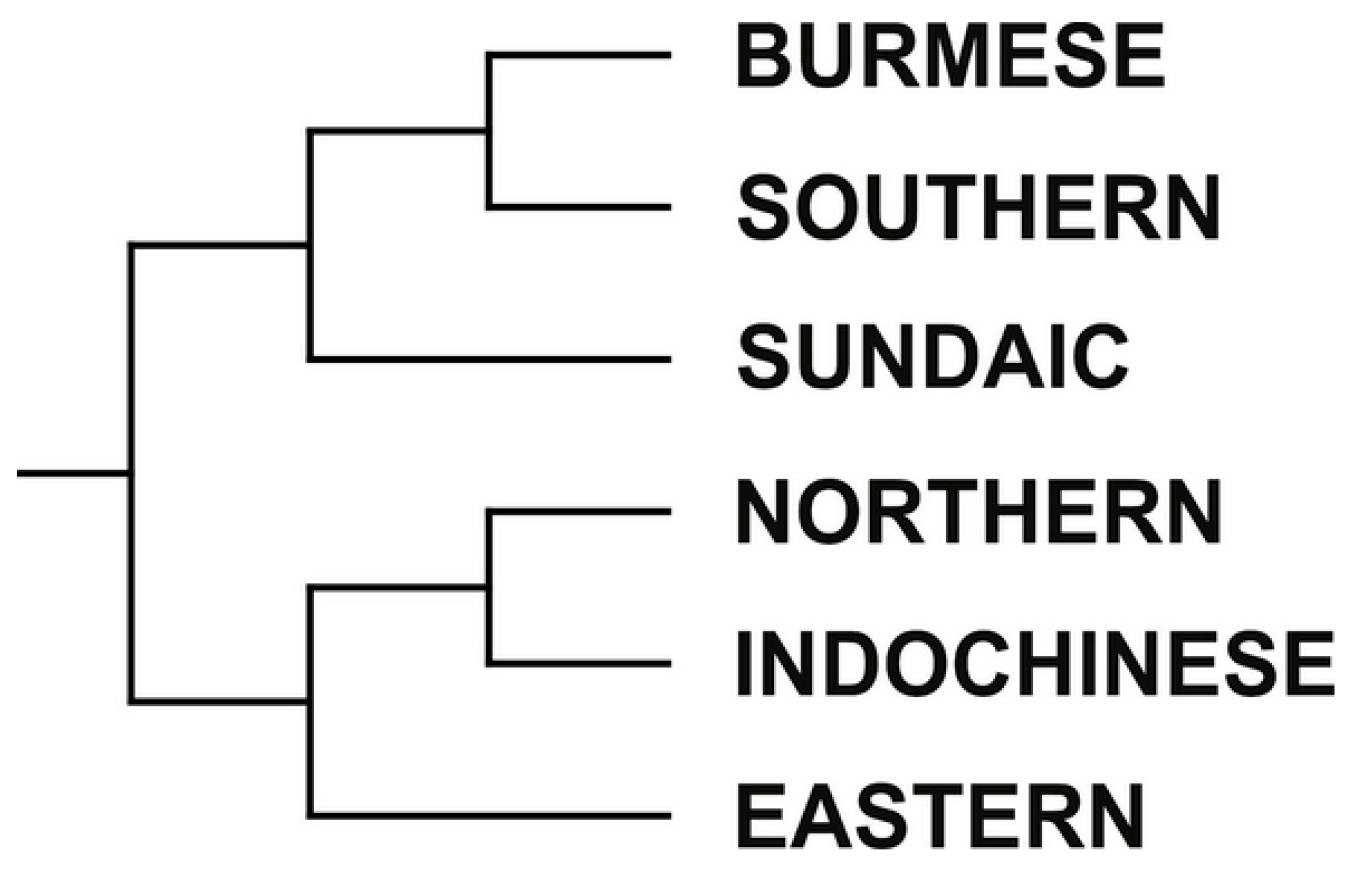
With about 840 valid species [1] in 59 genera [2], Nemacheilidae represents one of the biggest families of freshwater fishes on earth. Its large size and wide distribution across nearly all of Eurasia has made comprehensive studies on the whole family a challenge. As a result, the taxonomic understanding of Nemacheilidae was steadily in progress, with species and genera being described regularly. Moreover, several larger genera were known to represent artificial assemblages instead of monophyletic natural units. Recently, the first comprehensive molecular phylogeny of the whole family was published [1], revealing that Nemacheilidae separated into six major clades 39–28.5 mya. The major clades turned out to have distinct distribution, and consequently were named Northern, Eastern, Southern, Indochinese, Sundaic and Burmese Clade (Figure 1).
The vast size of the family Nemacheilidae and its extensive morphological diversity have long hampered biodiversity research on this group. Addressing the family as a whole, without a proper phylogenetic background, was often impractical due to its scale and complexity. Having now identified the major clades within Nemacheilidae therefore represents a major advance, as it provides a practical framework for following studies. Researchers can now focus on single clades rather than the entire family, saving time and effort and enabling studies that would otherwise be unfeasible due to the size of the family.
The study of Šlechtová et al. [1] also identified several para- or polyphyletic genera as well as a number of undescribed species and genera. In particular, the long-known polyphyly of the largest nemacheilid genus, Schistura, was confirmed again, showing that the name Schistura is scattered across three of the major clades: the Southern, Indochinese and Burmese. Since the type species of Schistura, S. rupecula, is a member of the Southern Clade, those species in the other two clades can no longer be considered as species of Schistura, and therefore are in need of a new generic placement. In the present study we reanalyse the Burmese Clade of Šlechtová et al. [1], which in their study included all representatives of the genera Aborichthys, Acanthocobitis, Paracanthocobitis, Schisturasavona and the sister species ‘Schistura’ kohchangensis and ‘Schistura‘ cf. kohchangensis. We expand the dataset by adding species of the genus Indoreonectes as well as additional specimens of the species pair ‘Schistura’ kohchangensis and ‘Schistura‘ cf. kohchangensis. The aim of the study is to establish new generic names to the species of ‘Schistura’ within the Burmese Clade and to formally describe the previously undescribed species ‘Schistura‘ cf. kohchangensis.

2. Materials and Methods

2.1. Sampling

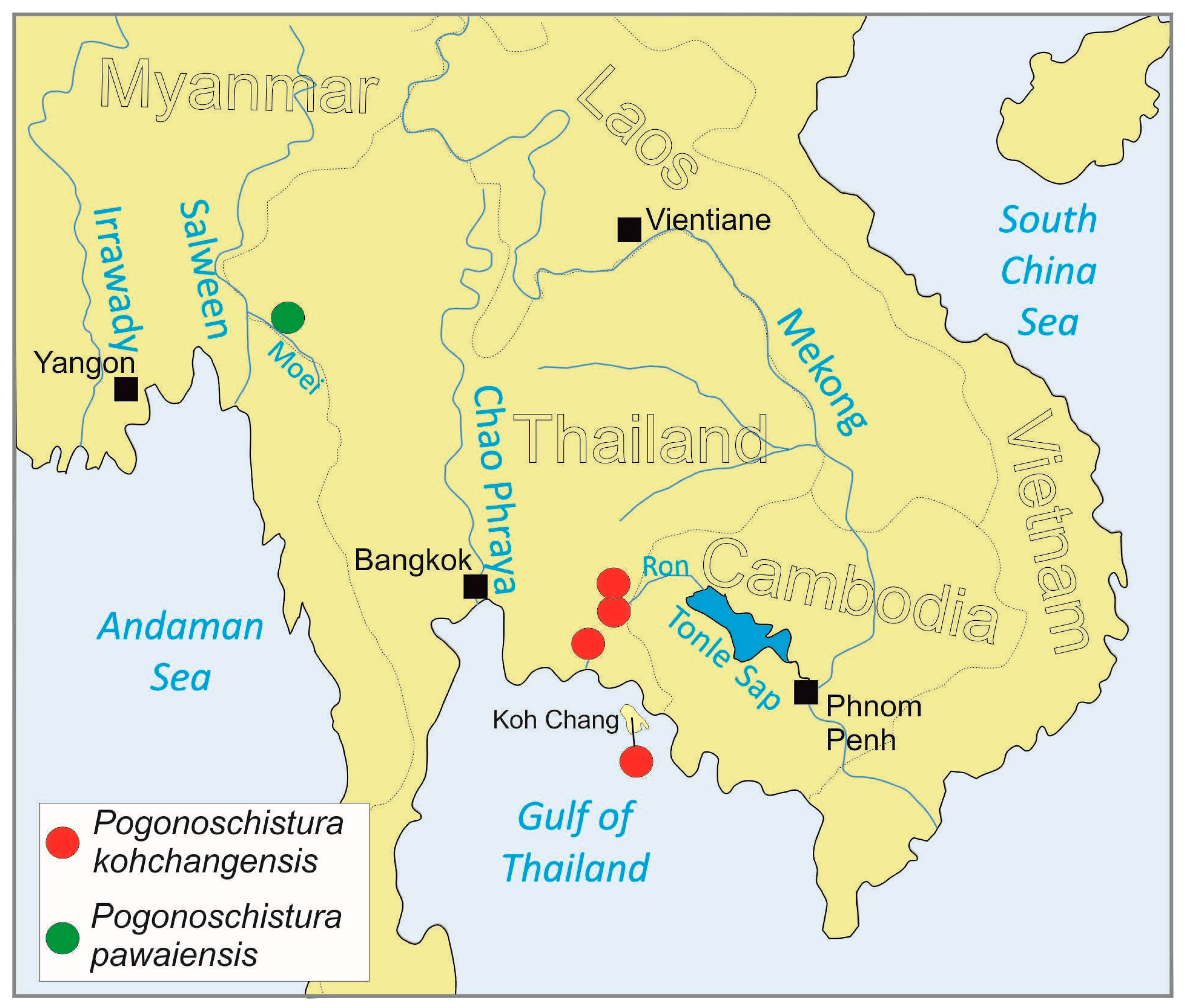
Specimens and tissue samples were obtained from existing collections listed in the material. Specimens were euthanised by overdose of an approved anaesthetic (MS222 or clove oil) and subsequently fixed either in 4% formaldehyde (later transferred into 70% ethanol for long-term storage) or directly in 96% ethanol. For every DNA sample of the newly analysed specimens a voucher specimen exists (usually under the same collection number) in the listed institutions. The geographical origin of the samples is visualised in Figure 2.
The holotype and nine paratypes of the new species were deposited in the Zoological Reference Collection (ZRC), Lee Kong Chian Natural History Museum, National University of Singapore; four paratypes were deposited in Collection of Maurice Kottelat (CMK), Cornol and two paratypes in the collection of the Laboratory of Fish Genetics, Institute of Animal Physiology and Genetics (IAPG), Liběchov, Czech Republic.

2.2. Morphology and Morphometry

All measurements and counts follow Kottelat [3]. Measurements of 26 morphometric characters were made point-to-point with digital callipers to the nearest 0.1 mm. Genus and species description follow mostly Kottelat [4,5,6,7,8].
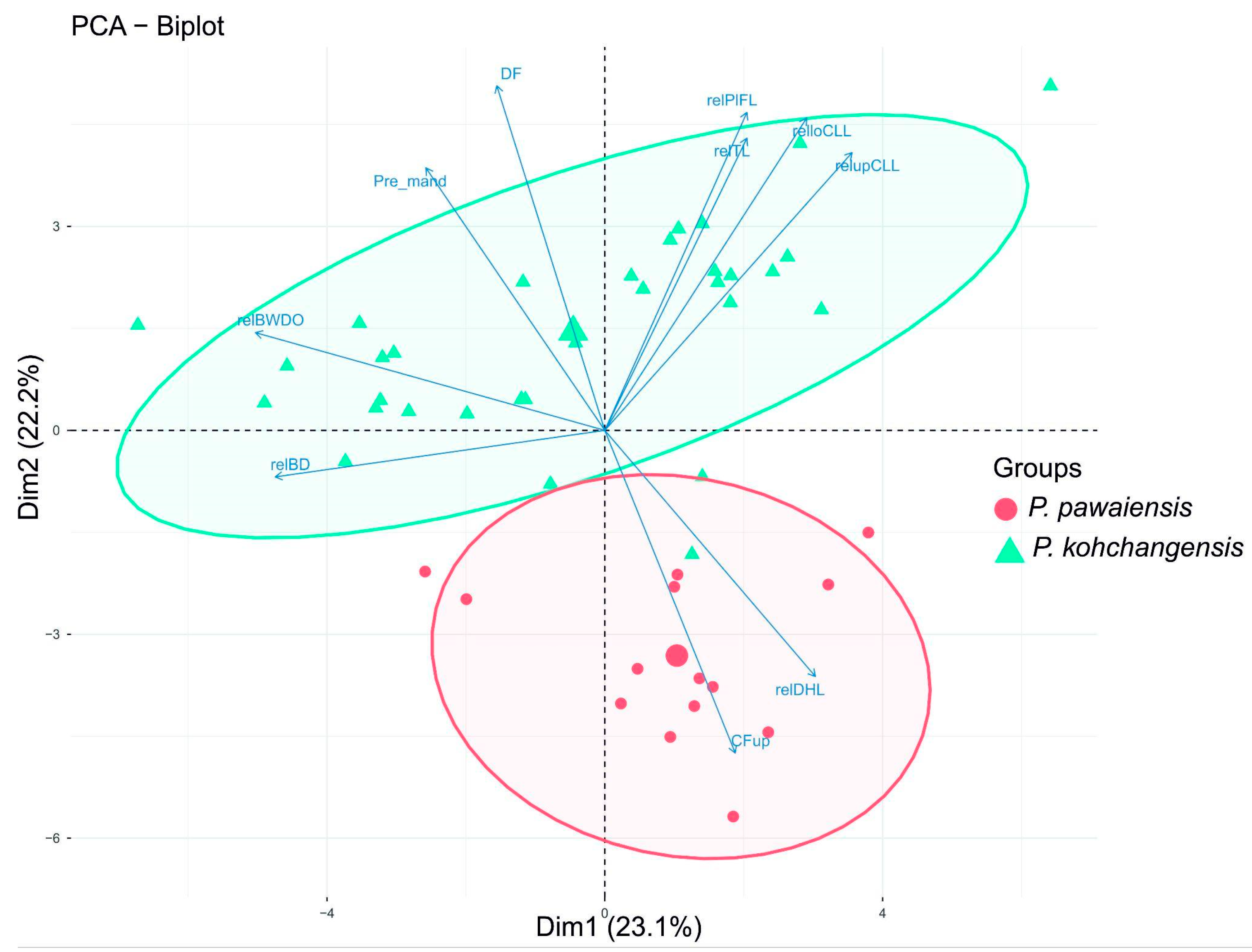
All morphometric variables were standardised as percentages of standard length (SL). Principal Component Analysis (PCA) was conducted in R 4.3.3 [9] on a combined dataset of size-corrected morphometric variables (expressed as percentages of SL) and meristic characters using the FactoMineR package 2.13 [10]. Visualisation of individual specimens in biplots was performed using the factoextra package 1.0.7 [11], which relies on ggplot2 [12] for graphical output. The PCA was used to explore overall phenotypic differentiation between the two species of Pogonoschistura.
In addition, we compared the morphological characters of the genera of the Burmese clade to identify diagnostic character states.
This publication has been registered at http://zoobank.org under the number 364361EE-B059-445E-8B48-B04B954B5C1E. The genus name Pogonoschistura and the species name Pogonoschistura pawaiensis have been registered at http://zoobank.org under the numbers 9FBA8E38-D804-4577-AA2B-E962F50449F0 and 6473AA3E-D69F-4626-9A67-76023294BC26, respectably.

2.3. Molecular Phylogeny

DNA was extracted from fin or muscle tissue using the Dneasy Blood & Tissue kit (QIAGEN N.V, Venlo, The Netherlands), NucleoSpin Tissue kit (MACHEREY-NAGEL GmbH & Co. KG., Düren, Germany) or Tissue/Blood DNA Mini Kit (Geneaid Ltd, Taipei, Taiwan). For the present study we used one mitochondrial (mtDNA) gene, cytochrome b gene (cyt b), and four nuclear (nDNA) genes: interphotoreceptor retinoid-binding protein gene 2 (IRBP2), recombination-activating gene 1 (RAG1), rhodopsin 1 gene (RH1) and myosin heavy chain 6 gene (MYH6). For details on primers, polymerase chain reaction (PCR), PCR product purification and sequencing, see Šlechtová et al. [1].
Phylogenetic analyses included 88 specimens: 65 representing the known diversity within the Burmese clade (genera Aborichthys, Acanthocobitis, Acoura, Indoreonectes, Paracanthocobitis) and 13 specimens of Pogonoschistura. An overview of all samples included in the phylogenetic analyses is provided in Table 1. A large portion of the Burmese clade samples was taken from the previous study by Šlechtová et al. [1]. Sequences newly obtained for the present study, mainly those of Pogonoschistura, are indicated in Table 1 with green font. Sequences of all Indoreonectes species and of Paracanthocobitis mooreh were obtained from GenBank. As outgroup, we used published sequences of various Nemacheilidae as well as Cobitis taenia from the closely related loach family Cobitidae [1,13,14,15].
The final concatenated five-gene dataset used for phylogenetic reconstruction comprised 4543 bp. Phylogenetic analyses were performed using both Bayesian inference (BI) and maximum likelihood (ML). BI analysis was conducted in MrBayes 3.2 [16] via the CIPRES Science Gateway [17]. The dataset was partitioned by gene and codon position, with model parameters assigned according to the best-fit models identified previously using PartitionFinder 2 [18]. The BI analysis consisted of two parallel runs of 10 million generations, with four Metropolis-Coupled Markov Chain Monte Carlo (MCMCMC) chains. The relative burnin of 25% was applied, and a 50% majority rule consensus tree was constructed from the post-burnin trees. Partitioned ML analysis was performed using IQ-TREE [19], as implemented in PhyloSuite 1.2.2 [20], with best-fit substitution models estimated automatically using ModelFinder 2 [21]. Node support values were assessed using 5000 ultrafast bootstrap replicates (UFBoot) [22].

3. Results and Discussion

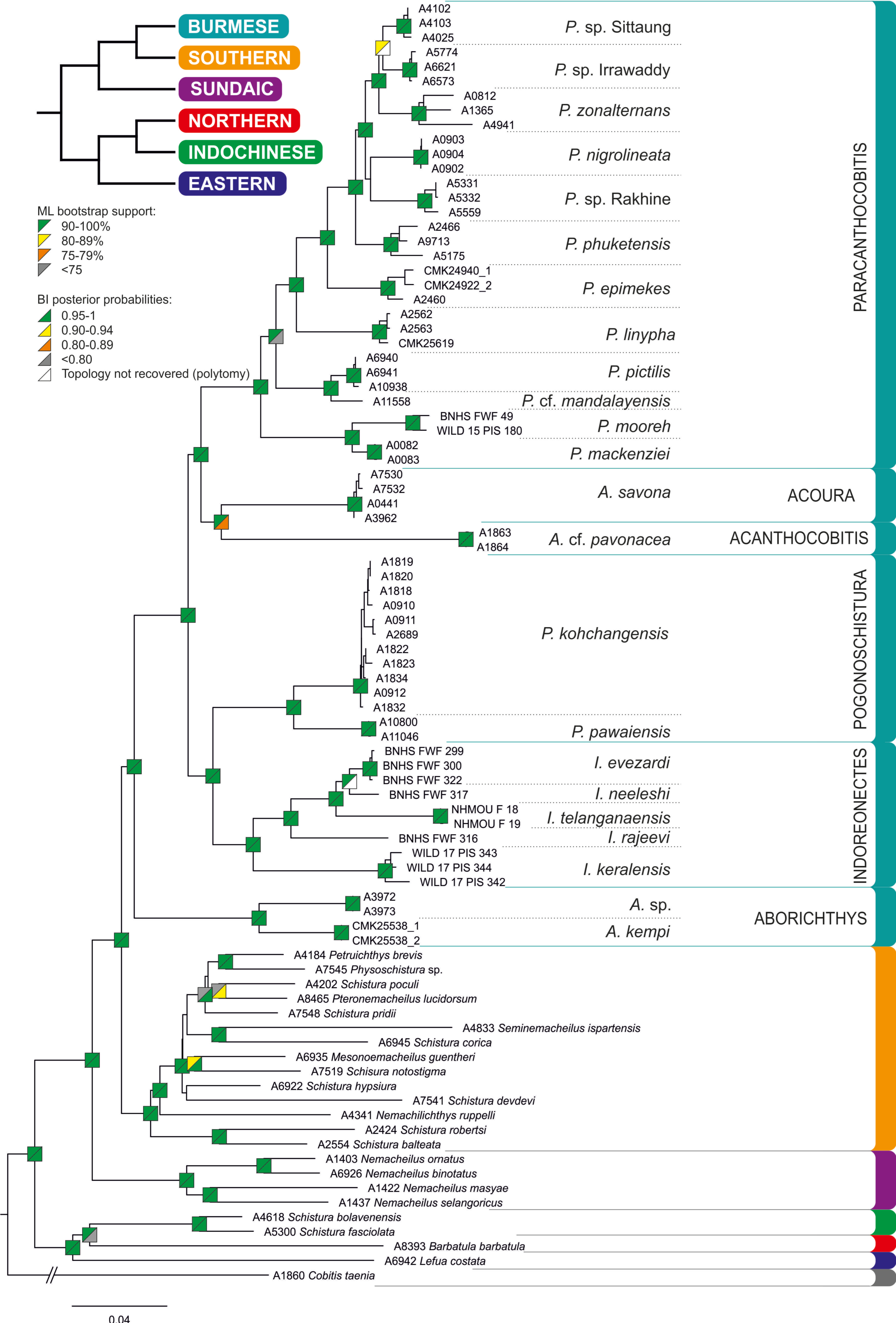
The BI and ML phylogenetic reconstructions revealed highly congruent topologies. The Burmese clade comprises the same lineages found by Šlechtová et al. [1] plus the newly included genus Indoreonectes, all supported by high statistical values (Figure 3).
The species ‘Schisturasavona represents an isolated lineage within the Burmese Clade. Moreover, as mentioned above, the type species of Schistura (S. rupecula) belongs to the Southern Clade, which justifies the recognition of a distinct genus for ‘Schisturasavona. Although this species has long been treated under the genus Schistura, it has also been designated—under its synonym Cobites (Acoura) obscura Swainson, 1839—as the type species of the genus Acoura, thereby making Acoura an available name for this lineage. Accordingly, we recognise Acoura here as a valid genus within Nemacheilidae.
The second group of species in the Burmese Clade that has formerly been referred to as Schistura includes the species ‘Schisturakohchangensis and ‘Schistura’ cf. kohchangensis. With the same argumentation as for Acoura savona, they are in need of a proper generic name. However, the only genera to which these species have been assigned historically are Nemacheilus [23] and Schistura [3], and the species do not belong to either one of these genera. They are therefore in need of a new generic name, and we provide for them the new genus Pogonoschistura below.
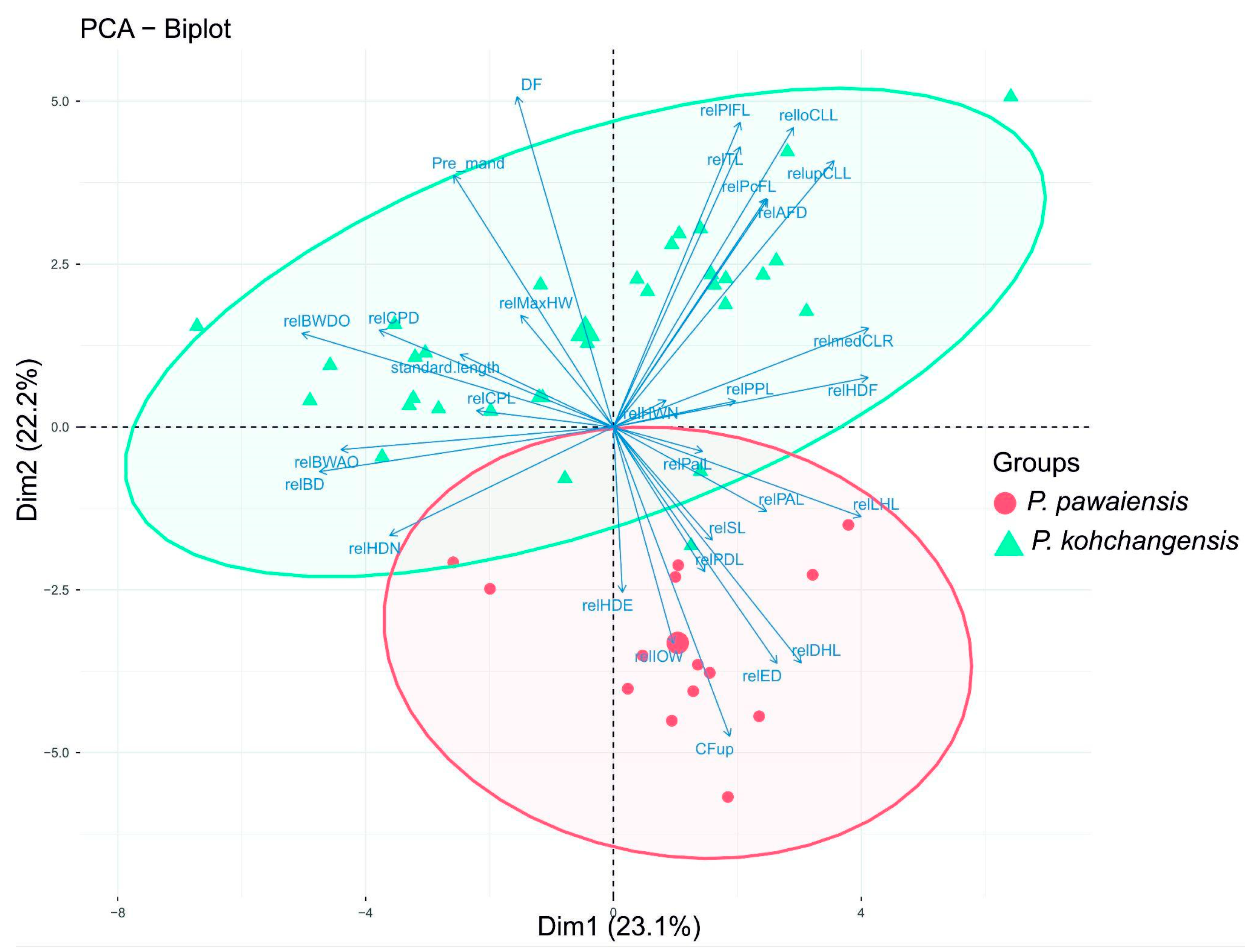
Morphometric and meristic data were used to describe the two species of Pogonoschistura. The PCA based on the complete set of morphometric and meristic characters revealed a structured pattern of phenotypic differentiation between the two taxa, with partial overlap observed along the first two principal components (PC1: 23.1%, PC2: 22.2%; Figure 4). Despite this overlap, the two groups showed distinct centroid positions, indicating non-random separation in multivariate space. A subset of characters showed the highest contributions to the main PCA axes. When the PCA was repeated using the ten most informative characters, the separation between the two taxa became more pronounced, with little to no overlap observed (Figure 5).
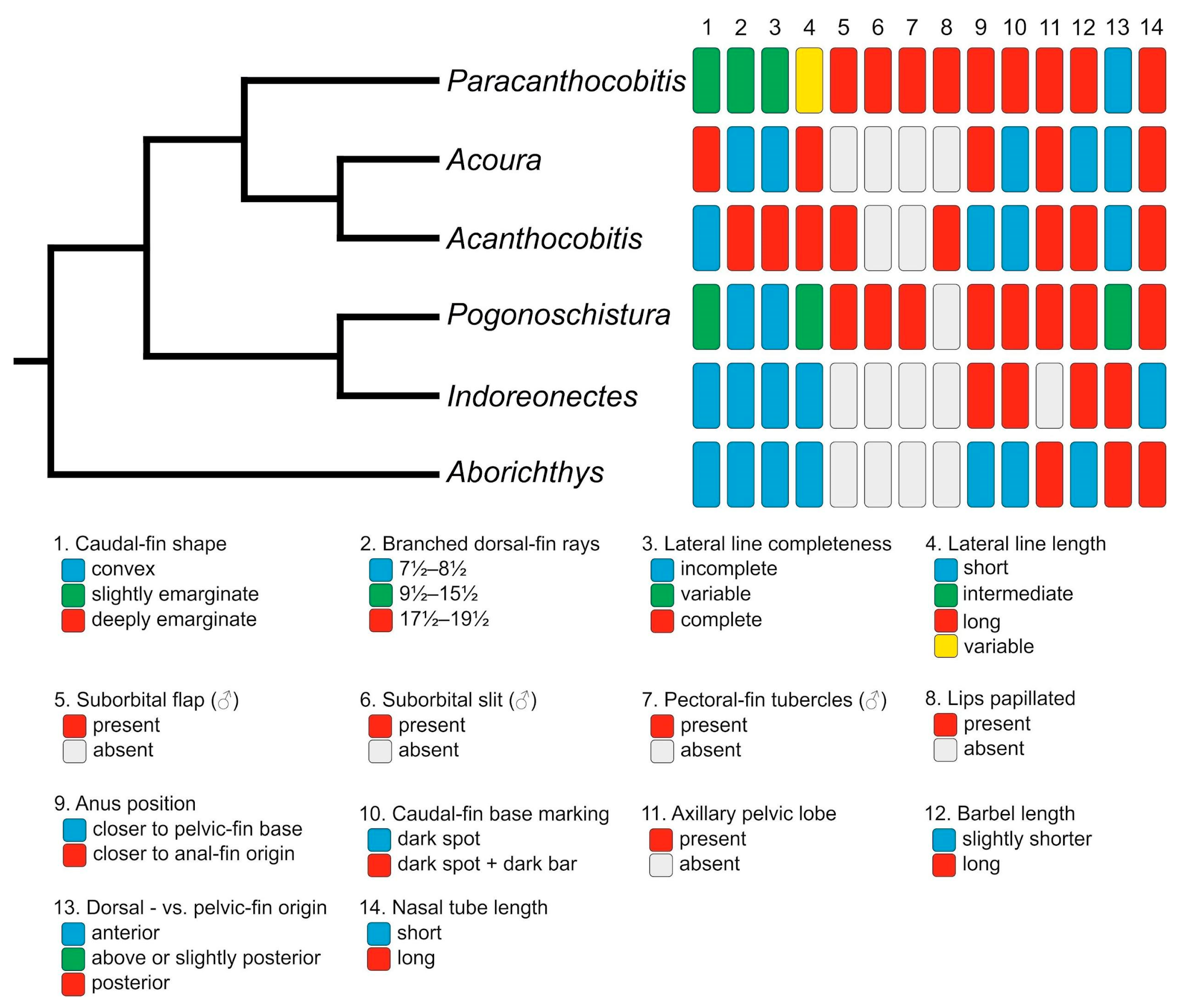
The distinctive character states among the genera of the Burmese clade are summarised in Table 2. Additionally, following the approach used for the Schistura cincticauda species group [14], we summarised the genus-specific morphological diagnoses as a morphocode.
Pogonoschistura,new genus
Type species. Nemacheilus kohchangensis Smith, 1933.
Etymology.
From ‘Pogon’ (Greek), meaning ‘beard’, referring to the very long barbels; and ‘Schistura’, the name of a nemacheilid genus. Gender: Feminine.
Diagnosis.
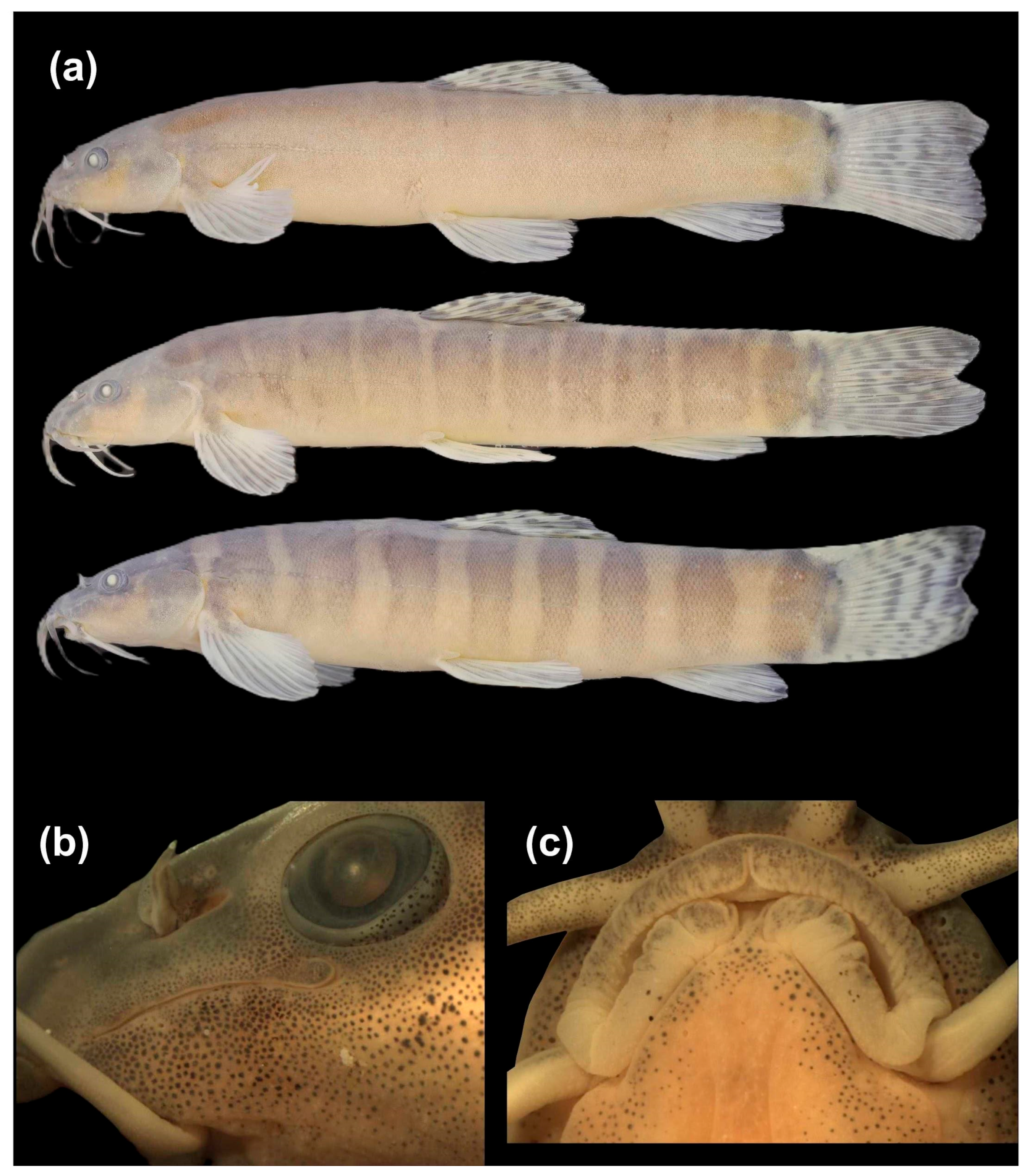
A genus of nemacheilid loach phylogenetically belonging to the Burmese Clade, distinguished from all other genera of this clade by the following combination of characters: caudal fin slightly emarginate; dorsal fin with 7½ or 8½ branched rays; lateral line reaching at least to the vertical through the pelvic-fin origin and at most to the vertical through the anal-fin base; sexual dimorphism present in the form of a suborbital flap plus a suborbital slit in males; anus positioned closer to anal-fin base than to the pelvic-fin base; and lips without papillae (Figure 6).
Pogonoschistura can be identified from all other genera of Nemacheilidae by the combination of the following character states: caudal fin slightly emarginated to emarginated; maxillary barbel reaching two thirds of the distance to the pectoral-fin origin; eyes fully developed; body with pigmentation; no dorsal and no ventral crest on the caudal peduncle; dorsal origin roughly in mid-distance between snout and caudal-fin base; dorsal-fin origin is located roughly at vertical through pectoral-fin origin; nasal tubes do not reach to margin of eye; whole body covered by scales; dorsal fin with 7 ½ or 8 ½ branched rays; males with suborbital flap; males and females have similarly long pectoral fins.
Remarks.
The genus presently includes the type species Pogonoschistura kohchangensis (Smith, 1933) and one species described in the present study, Pogonoschistura pawaiensis. Phylogenetic analyses revealed Pogonoschistura to be the sister lineage to Indoreonectes. Characters shared by both genera include a stout body shape, relatively long barbels, nostrils set close together and not close to the eye, a pigmentation pattern consisting of spotted head and surroundings of the eye and a highly variable pattern of bars on the body. An overview of the morphological characteristics of the genera within the Burmese Clade is provided in Table 2. In addition, diagnostic morphological character states distinguishing genera of the Burmese clade are summarised as a morphocode mapped onto the phylogenetic tree (Figure 7).
However, Pogonoschistura differs from Indoreonectes by having the posterior margin of the caudal fin slightly emarginated to emarginated (vs. convex or truncated); nasal tubes not reaching the anterior margin of eye (vs. reaching margin of eye); a longer lateral line, reaching at least to vertical through pelvic fin origin (vs. reaching at most to the vertical through the tip of the adpressed pectoral fin); a dorsal-fin origin situated slightly anterior to the vertical through pelvic-fin origin (vs. slightly posterior); 12–13 rays in the pectoral fin (vs. 10–11); and the presence of sexual dimorphism, with males having a suborbital flap, a suborbital slit and transformed pectoral-fin rays (vs. sexual dimorphism absent) [24,25,26,27,28,29].
Pogonoschistura differs from Acanthocobitis in having a slightly emarginate to emarginate (vs. pointed) caudal fin; 7½ or 8½ (vs. 17½–19½) branched dorsal-fin rays; anus positioned closer to the anal-fin origin than to the pelvic-fin base (vs. closer to pelvic-fin base); males possessing both a suborbital flap and a suborbital slit (vs. only a suborbital flap); and lips without papillae (vs. papillated lips) [3,30,31,32].
Pogonoschistura differs from Acoura in having an incomplete lateral line (vs. complete); a slightly emarginate to emarginate caudal fin (vs. deeply emarginate); the presence of sexual dimorphism (vs. sexual dimorphism absent); and dark lateral bars reaching the bases of the paired fins on the thorax and extending onto the ventral side of the caudal peduncle (vs. dark pigmentation sharply ending at a straight line extending from the base of the outer rostral barbel along the ventral margin of the eye to the caudal-fin base) [24,25,33].
Pogonoschistura differs from Paracanthocobitis in having 7½ or 8½ (vs. 9½–15½) branched dorsal-fin rays and lips without papillae (vs. papillated lips) [3,31,34,35].
Pogonoschistura differs from Aborichthys in having the anus positioned closer to the anal-fin origin than to the pelvic-fin base (vs. closer to pelvic-fin base); the presence of sexual dimorphism (vs. sexual dimorphism absent); a slightly emarginate to emarginate (vs. convex) caudal fin, and a longer lateral line reaching at least to the vertical through the pelvic-fin origin (vs. reaching at most to the vertical through the tip of the adpressed pectoral fin [33].
  • Pogonoschistura pawaiensis, new species
Holotype. ZRC 69209, male, 68.3 mm SL, Thailand: Tak Province: Amphoe Phop Phra; Pa Wai Waterfall (about 16°34′30″ N 98°50′02″ E) draining via Mae Lamao stream into Moei River (Salween basin).
Paratypes. ZRC 69210, 9, 31.3–62.8 mm SL; CMK 29206, 4, 32.7–55.5 mm SL; IAPG A11046; 1, 37.9 mm SL; IAPG A10801, 34.5 mm SL; same data as holotype.
Diagnoses.
Pogonoschistura pawaiensis is distinguished from its only described congener P. kohchangensis by having 9 + 8 (vs. 8 + 8) branched rays in caudal fin and 7½ (vs. 8½) branched rays in dorsal fin, by always having a broad median interruption in the caudal bar, resulting in two isolated blotches (vs. caudal bar usually complete, rarely with small interruption) and by having smaller dark blotches on the head (maximally half eye diameter (vs. same size or wider than eye diameter in P. kohchangensis)).
Description.
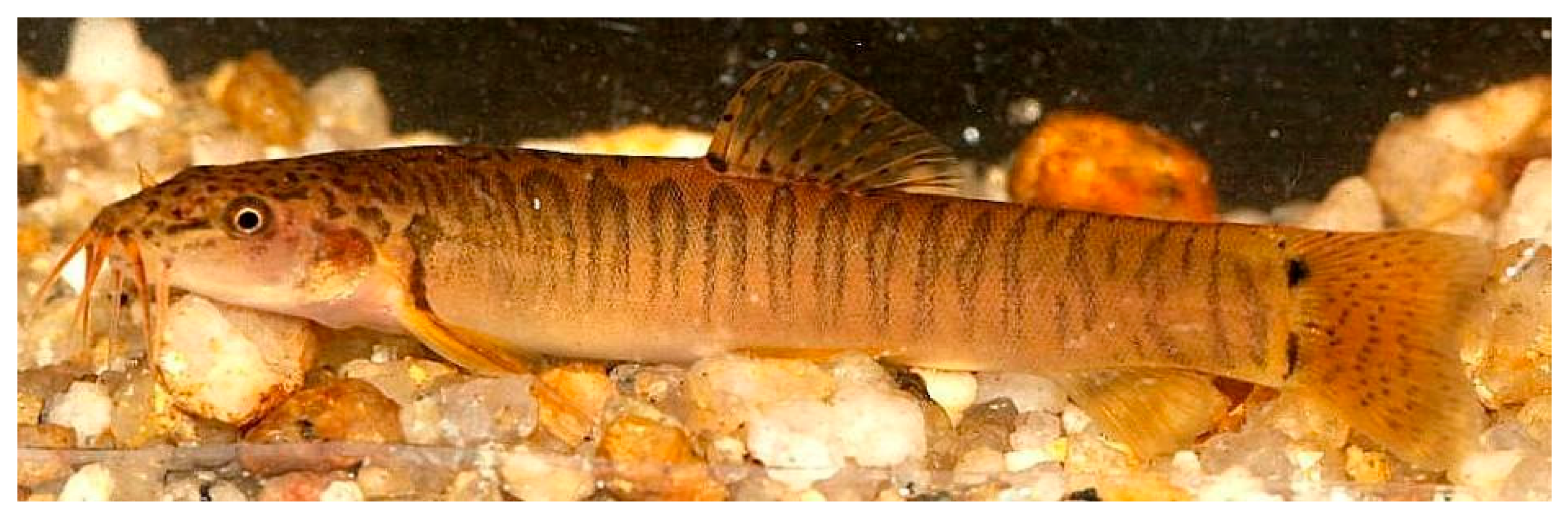
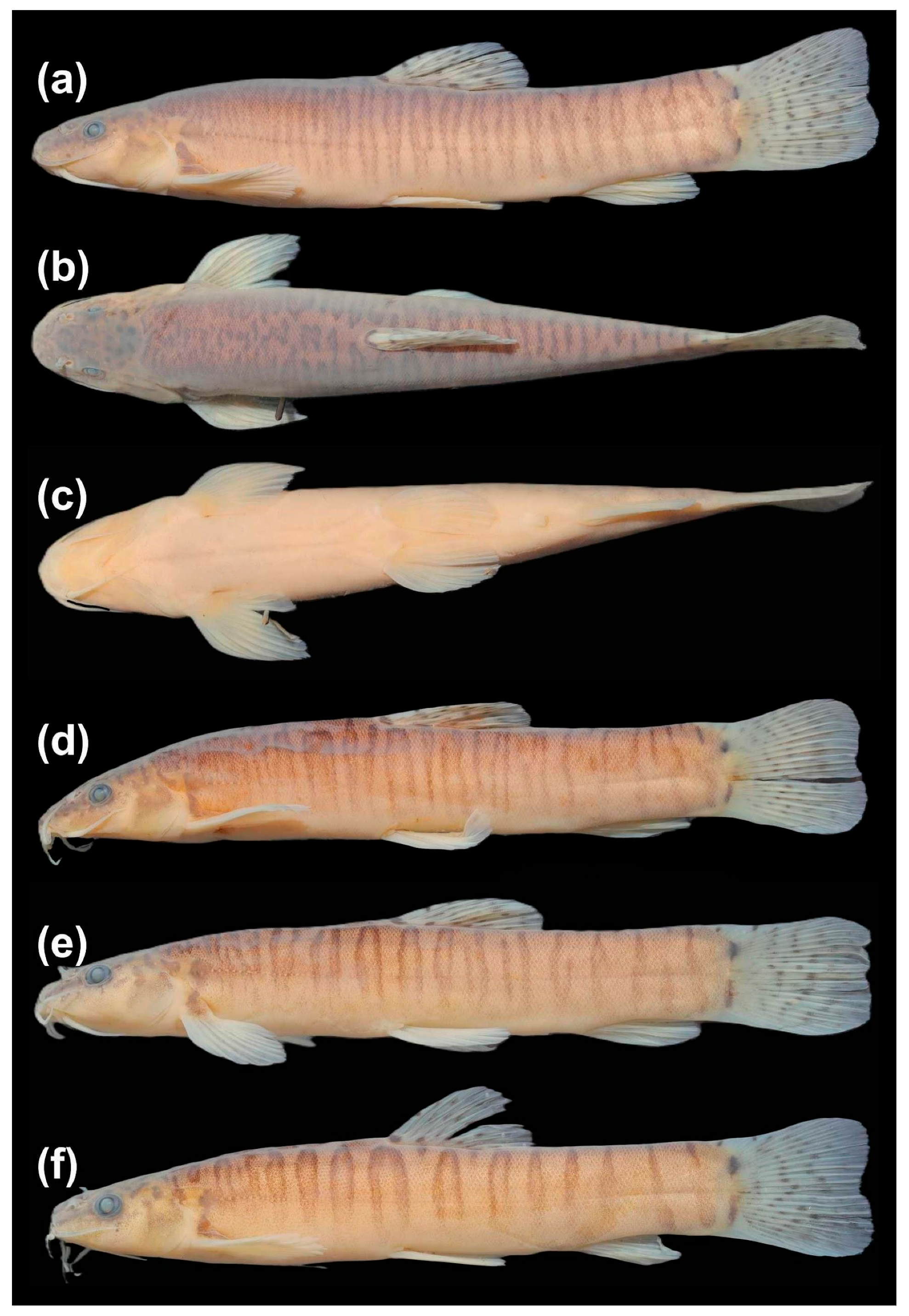
See Figure 8 and Figure 9 for general appearance of life and preserved specimens and Table 3 for morphometric data of holotype, and 13 paratypes of Pogonoschistura pawaiensis and 32 specimens of Pogonoschistura kohchangensis. A moderately elongated nemacheilid loach with body depth strongly increasing until the mid-distance between snout and dorsal fin origin, afterwards increasing just slightly until dorsal fin origin; from dorsal fin origin body depth nearly uniform until origin of anal fin; within anal fin base body depth strongly decreasing, than again slightly increasing until base of caudal fin. Head slightly depressed; anterior half of body slightly compressed; posterior half of body compressed strongly. Snout rounded; head width slightly and constantly increasing from level of mouth backwards. Depth of caudal peduncle about 0.75–0.85 in its length. Axillary pelvic lobe present, free, length usually smaller than diameter of pupil. Small adipose crests on dorsal and ventral midline from vertical through posterior end of anal-fin base to base of caudal-fin; its height increasing towards base of caudal-fin. Largest known size 68.3 mm SL (male, holotype).
Dorsal fin with 4 simple and 7½ branched rays; distal margin slightly convex. Anal fin with 3 simple and 5½ branched rays; length of adpressed fin exceeding half distance to caudal-fin base, but never reaching caudal-fin base. Caudal fin with 9+8 branched rays; slightly emarginated and lobes rounded. Pelvic fin with 8 rays; origin slightly before or directly under origin of dorsal fin; reaching slightly behind mid-distance between its origin and origin of anal fin; not reaching anus, which is located about 1–1.5 times the eye diameter in front of the anal-fin origin. Pectoral fin usually with 12 rays, rarely with 13 rays; reaching slightly behind mid-distance to origin of pelvic fin.
Body completely covered with scales, except for the area between the pelvic fins. Lateral line incomplete, reaching at least to the vertical through pelvic fin origin and at most to the vertical through the anus; with 31–82 pores. Cephalic lateral line system with 7 supraorbital pores, 4 + 10 infraorbital pores; 8 preoperculo-mandibular pores and 3 supratemporal pores. Lips and barbels covered with unculi.
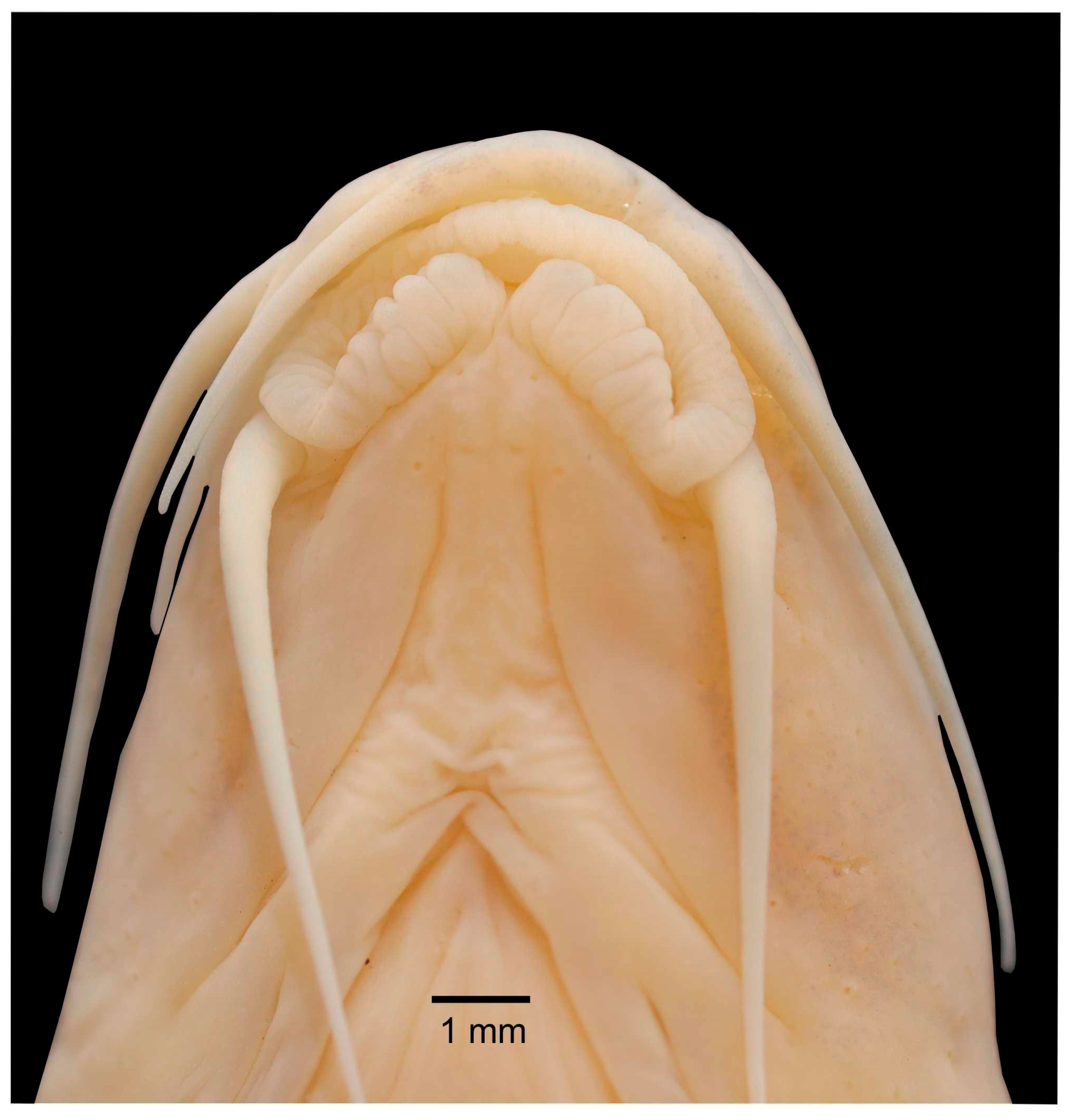
Anterior nostril opening on the anterior of a flap-like tube, with a low anterior rim. Mouth approximately twice as wide as long (Figure 10). Upper lip moderately thick, with a small median incision and more than 30 small furrows along its entire length. Lower lip thick, with a well-marked median interruption and 5–6 furrows on each side. Lips not papillated. Barbels long: inner rostral barbel reaching vertical through the anterior margin of the eye, outer rostral barbel exceeding the vertical through the posterior margin of the eye, maxillary barbel exceeding two-thirds of the distance to the pectoral-fin origin.
  • Sexual Dimorphism
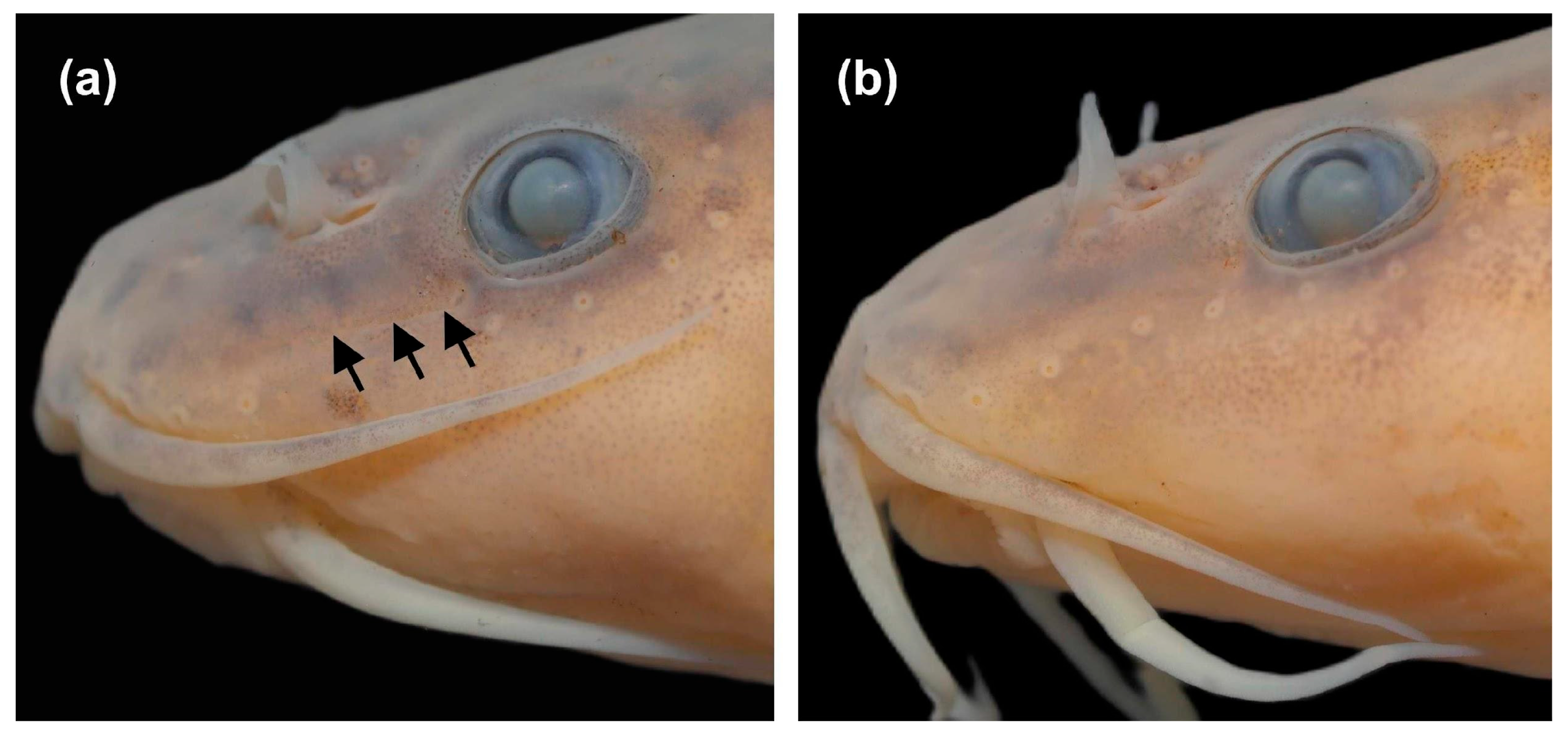
Only adult males possess a very small suborbital flap located anterior to the vertical through the anterior margin of the eye (Figure 11). From the base of the suborbital flap, a slit extends approximately halfway to the base of the outer rostral barbel. Males also have the last unbranched and the first two branched pectoral-fin rays slightly broader than females, with the first four branched rays and the intervening skin covered with small tubercles. The tubercles do not reach the fin margin but extend beyond the bifurcation point. On branched rays 5–7, single tubercles are present, not forming a dense covering.
Colouration.
Ground colour after fixation dark yellow to light brown, lighter in smaller specimens and darker in larger ones. Dorsal half of head with small, irregular, dark brown spots, their size ranging from approximately one-quarter to about one-half of the eye diameter. In smaller specimens, the body bears 10–15 dark brown bars, split medially but mostly still connected dorsally. With increasing size, the number of bars increases, although the pattern of split bars connected at their dorsal ends generally persists.
The dorsum anterior to the dorsal-fin origin bears blotches or short transverse bars; only occasionally are lateral bars connected with their counterparts on the opposite side by a narrow band. Posterior to the dorsal-fin base, lateral bars regularly connect with their counterparts on the opposite side; these transverse connections alternate with short transverse bars that usually do not reach the lateral midline.
A black bar is present at the caudal-fin base, with a broad median interruption; the dorsal portion forms a small round to triangular black blotch, whereas the ventral portion forms a short, thin bar at the base of the lower caudal-fin lobe. The dorsal fin has a black spot at the base of the last unbranched ray and another black spot at the base of the second to fourth branched rays. Dorsal and caudal fins bear irregular bands of dark blotches on the fin rays but not on the interradial membranes. An indistinct dark bar, sometimes irregular, originates in the midlateral area behind the opercle and extends ventrally to the base of the pectoral fin. The first 4–6 rays of the pectoral fin are covered with dark longitudinal marks. Anal and pelvic fins are hyaline.
Distribution.
Currently known only from the type locality, Pa Wai Waterfall, Tak Province, Thailand.
Etymology.
pawaiensis: for Pa Wai waterfall, the type locality.
Remarks.
The holotype is the largest known specimen and the only individual in which male characteristics are well developed. In two other specimens, a very short suborbital slit and few tubercles on the pectoral fin are visible, but to a much lesser extent than in the holotype. We consider these two smaller specimens to be males that have only just reached sexual maturity. However, even in the large holotype (68.3 mm SL), the suborbital flap and suborbital slit are much less developed than in considerably smaller males of P. kohchangensis. In combination with the low proportion of externally identifiable males (3 of 16 examined specimens), this observation raises the question whether males are fully mature within the size range analysed here, or whether sexual dimorphism develops at a larger body size than represented in the present material.

4. Conclusions

The first comprehensive molecular phylogenetic reconstruction of the freshwater fish family Nemacheilidae identified six major clades and highlighted several unresolved taxonomic issues. In this study, we focused on one of these clades, the Burmese Clade, and provide a revised taxonomic assessment. Our results indicate that the species ‘Schistura’ savona should be reclassified as Acoura savona. Additionally, we establish the new genus Pogonoschistura for ‘Schistura’ kohchangensis and describe the new species Pogonoschistura pawaiensis. These taxonomic revisions contribute to a more accurate understanding of species diversity within Nemacheilidae and provide a framework for future phylogenetic and biodiversity studies of the family.
  • Material Examined
  • Pogonoschistura
Pogonoschistura kohchangensis: IAPG A1818-1820, 3, 34.9–63.2 mm SL: Thailand: Trat: Koh Chang Island: waterfall Khiri Phet:; IAPG A916-919, 4, 29.4–33.6 mm SL, IAPG A1822-1826, 5, 44.3–50.1 mm SL, IAPG A1832,1, 39.8 mm SL, IAPG A1834-1838, 5, 39.1–49.5 mm SL, IAPG A7559-7565, 7, 37.3–52.8 mm SL; Thailand: Chanthaburi: Mekong drainage: Pong Nam Ron. IAPG A10783-10788, 11554–11555, 10, 42.1–65.8 mm SL; Thailand: Chanthaburi: Nakhon Nayok drainage: Ta Lang. IAPG A2689, 1, 38.4 mm SL; Thailand: Chanthaburi: Chanthaburi drainage: Phlio.
Pogonoschistura pawaiensis: ZRC 69209, ZRC 69210, CMK 29206, IAPG A11046, IAPG A10801, 16, 32.2–68.3 mm SL.; Thailand: Tak: Salween drainage: waterfall Pa Wei.
  • Burmese Clade
Aborichthys kempi: CMK25538_1, CMK25538_2, 2, Myanmar: Kachin: Irrawaddy drinage. Aborichthys sp.: IAPG A3972-3973, 2, India: West Bengal: Brahmaputra drainage. Acanthocobitis pavonacea: IAPG A1863-1865, 3, ornamental fish trade. Acoura savona: IAPG A2444, 2599, 3962–3971, 7523–7532, 22, ornamental fish trade. IAPG A3440, 1, Nepal: Koshi: Ganges drainage. Paracanthocobitis epimekes: IAPG A2460, Thailand: Phang Nga: Takua Pa drainage. CMK 24940, 1,, Myanmar: Tanintharyi: Tenasserim drainage. Paracanthocobitis linypha: IAPG A2562-2563, Myanmar: ornamental fish trade. Paracanthocobitis linypha: IAPG A82-83, A3437, 3: ornamental fish trade. Paracanthocobitis mandalayensis: IAPG A11558, 1: Thailand: Tak: Salween drainage. Paracanthocobitis phuketensis: CMK 28791, 1: Myanmar: Tanintharyi: Tenasserim drainage. IAPG A5190, 1: Thailand: Phatthalung: Phaniat drainage. IAPG A5175, 1: Thailand: Trag: Palian drainage. IAPG 9713, 1: Thailand: Phang Nga: Tam Nang drainage. IAPG A2466,1: Thailand: Phang Nga: Takua Pa drainage. Paracanthocobitis pictilis: IAPG A6940-6941, 10938, 3: ornamental fish trade. Paracanthocobitis pictilis: IAPG A5774, 6621, 2: Myanmar: Magway: Irrawaddy drainage. Paracanthocobitis sp. Rakhine: IAPG A5331-5332, 2: Myanmar: Rakhine: no details. Paracanthocobitis sp. Sittaung: IAPG A4102, 1: Myanmar: Mon: Sittaung drainage. Paracanthocobitis zonalternans: IAPG 4942, 1: Thailand: Tak: Salween.
Data for Indoreonectes were taken from: [26,27,28,29,36,37].
  • Other Genera of Nemacheilidae
See material list in Šlechtová et al. [1].

Author Contributions

Conceptualization, J.B., V.Š.; methodology, J.B., V.Š.; software, J.B., T.D., V.Š.; validation, J.B., T.D., V.Š.; formal analysis, V.Š., T.D.; investigation, J.B., T.D.; resources, J.B.; data curation, J.B., T.D., V.Š.; writing—original draft preparation, J.B., T.D.; writing—review and editing, J.B., V.Š.; visualisation, J.B., V.Š.; supervision, J.B.; project administration, J.B.; funding acquisition, J.B., V.Š. All authors have read and agreed to the published version of the manuscript.

Funding

The study was supported by grants 206/08/0637 and 19-18453S of the Czech Science Foundation.

Institutional Review Board Statement

This work was approved by the Ethical Committee for the Welfare of Experimental Animals (Approval Code: 403/2023. Approval Date: 3 February 2023).

Data Availability Statement

The original contributions presented in the study are included in the article; further inquiries can be directed to the corresponding author.

Acknowledgments

We wish to thank Z. Hang, R. Hoyer, M. Kottelat, J. Kuehne, H.H. Ng, F. Schäfer, I. Seidel, H.-H. Tan, T.K. Toe, K. Udomritthiruji and T. Win for help with the specimens.

Conflicts of Interest

The authors declare no conflicts of interest. The funders had no role in the design of the study; in the collection, analyses, or interpretation of data; in the writing of the manuscript or in the decision to publish the results.

References

  1. Šlechtová, V.; Dvořák, T.; Freyhof, J.; Kottelat, M.; Levin, B.; Golubtsov, A.; Šlechta, V.; Bohlen, J. Reconstructing the phylogeny and evolutionary history of freshwater fishes (Nemacheilidae) across Eurasia since early Eocene. eLife 2024, 13, RP101080. [Google Scholar] [CrossRef] [PubMed]
  2. Fricke, R.; Eschmeyer, W.N.; van der Laan, R. Eschmeyer’s Catalog of Fishes: Genera, Species, References. Electronic Version. 2026. Available online: http://researcharchive.calacademy.org/research/ichthyology/catalog/fishcatmain.asp (accessed on 14 January 2026).
  3. Kottelat, M. Indochinese Nemacheilines. A Revision of Nemacheiline Loaches (Pisces: Cypriniformes) of Thailand, Burma, Laos, Cambodia and Southern Viet Nam; Pfeil Verlag: Munich, Germany, 1990. [Google Scholar]
  4. Kottelat, M. Conspectus cobitidum: An inventory of the loaches of the world (Teleostei: Cypriniformes: Cobitoidei). Raffles Bull. Zool. 2012, 1–199. [Google Scholar]
  5. Kottelat, M. Rhyacoschistura larreci, a new genus and species of loach from Laos and redescription of R. suber (Teleostei: Nemacheilidae). Zootaxa 2019, 4612, 151–170. [Google Scholar] [CrossRef]
  6. Conway, K.; Kottelat, M. Physoschistura mango, a new miniature species of loach from Myanmar (Teleostei: Nemacheilidae). Raffles Bull. Zool. 2023, 71, 681–701. [Google Scholar] [CrossRef]
  7. Kottelat, M.; Tan, H.H. Kapuasia, a genus name for ‘Nemacheilus’ maculiceps (Teleostei: Nemacheilidae). Raffles Bull. Zool. 2024, 72, 105–109. [Google Scholar] [CrossRef]
  8. Kottelat, M.; Tan, H.H.; Hasan, V. Kapuasia falaris, a new species of nemacheilid loach from Borneo (Teleostei: Nemacheilidae). Raffles Bull. Zool. 2024, 72, 479–487. [Google Scholar] [CrossRef]
  9. R Core Team. R: A Language and Environment for Statistical Computing; R Foundation for Statistical Computing: Vienna, Austria, 2024; Available online: https://www.R-project.org/ (accessed on 5 December 2025).
  10. Lê, S.; Josse, J.; Husson, F. FactoMineR: An R Package for Multivariate Analysis. J. Stat. Soft. 2008, 25, 1–18. [Google Scholar] [CrossRef]
  11. Kassambara, A.; Mundt, F. Factoextra: Extract and Visualize the Results of Multivariate Data Analyses. R Package Version 1.0.7. 2020. Available online: https://CRAN.R-project.org/package=factoextra (accessed on 5 December 2025).
  12. Wickham, H. ggplot2: Elegant Graphics for Data Analysis; Springer: New York, NY, USA, 2016. [Google Scholar]
  13. Sember, A.; Bohlen, J.; Šlechtová, V.; Altmanová, M.; Symonová, R.; Ráb, P. Karyotype differentiation in 19 species of river loach fishes (Nemacheilidae, Teleostei): Extensive variability associated with rDNA and heterochromatin distribution and its phylogenetic and ecological interpretation. BMC Evol. Biol. 2015, 15, 251. [Google Scholar] [CrossRef]
  14. Bohlen, J.; Dvořák, T.; Šlechta, V.; Šlechtová, V. Resolving an unnoticed diversity within the Schistura robertsi species complex (Teleostei: Nemacheilidae) using molecules and morphology. Mol. Phylogenet. Evol. 2020, 151, 106894. [Google Scholar] [CrossRef]
  15. Bohlen, J.; Dvořák, T.; Šlechta, V.; Šlechtová, V. Sea water shaping the freshwater biota: Hidden diversity and biogeographic history in the Paracanthocobitis zonalternans species complex (Teleostei: Nemacheilidae) in western Southeast Asia. Mol. Phylogenet. Evol. 2020, 148, 106806. [Google Scholar] [CrossRef]
  16. Ronquist, F.; Huelsenbeck, J.P. MrBayes 3: Bayesian phylogenetic inference under mixed models. Bioinformatics 2003, 19, 1572–1574. [Google Scholar] [CrossRef]
  17. Miller, M.A.; Pfeiffer, W.; Schwartz, T. Creating the CIPRES science gateway for inference of large phylogenetic trees. In Proceedings of the 2010 Gateway Computing Environments Workshop (GCE), New Orleans, LA, USA, 14 November 2010; IEEE: New Orleans, LA, USA, 2010; pp. 1–8. [Google Scholar] [CrossRef]
  18. Lanfear, R.; Frandsen, P.B.; Wright, A.M.; Senfeld, T.; Calcott, B. Partition Finder 2: New methods for selecting partitioned models of evolution for molecular and morphological phylogenetic analyses. Mol. Biol. Evol. 2016, 34, 772–773. [Google Scholar] [CrossRef]
  19. Nguyen, L.T.; Schmidt, H.A.; von Haeseler, A.; Minh, B.Q. IQ-TREE: A fast and effective stochastic algorithm for estimating maximum likelihood phylogenies. Mol. Biol. Evol. 2015, 32, 268–274. [Google Scholar] [CrossRef]
  20. Zhang, D.; Gao, F.; Jakovlic, I.; Zou, H.; Zhang, J.; Li, W.X.; Wang, G.T. PhyloSuite: An integrated and scalable desktop platform for streamlined molecular sequence data management and evolutionary phylogenetics studies. Mol. Ecol. Resour. 2020, 20, 348–355. [Google Scholar] [CrossRef] [PubMed]
  21. Kalyaanamoorthy, S.; Minh, B.Q.; Wong, T.K.F.; von Haeseler, A.; Jermiin, L.S. ModelFinder: Fast model selection for accurate phylogenetic estimates. Nat. Methods 2017, 14, 587–589. [Google Scholar] [CrossRef]
  22. Hoang, D.T.; Chernomor, O.; von Haeseler, A.; Minh, B.Q.; Vinh, L.S. UFBoot2: Improving the ultrafast bootstrap approximation. Mol. Biol. Evol. 2018, 35, 518–522. [Google Scholar] [PubMed]
  23. Smith, H.M. Contributions to the ichthyology of Siam. II–VI. J. Siam Soc. Nat. Hist. Suppl. 1933, 9, 53–87. [Google Scholar]
  24. Menon, A.G.K. The Fauna of India and the Adjacent Countries. Pisces. Vol. IV. Teleostei—Cobitoidea. Part 1. Homalopteridae; Zoological Survey of India: Calcutta, India, 1987.
  25. Jayaram, K.C. The Freshwater Fishes of the Indian Region; Narendra Publishing House: Delhi, India, 2010. [Google Scholar] [CrossRef]
  26. Prasad, K.K.; Srinivasulu, C.; Srinivasulu, A.; Anoop, V.K.; Dahanukar, N. Indoreonectes telanganaensis, a new species of loach (Teleostei: Nemacheilidae) from the Godavari Basin of India. Zootaxa 2020, 4878, 335–348. [Google Scholar] [CrossRef]
  27. Kumkar, P.; Pise, M.; Gorule, P.A.; Verma, C.R.; Kalous, L. Two new species of the hillstream loach genus Indoreonectes from the northern Western Ghats of India (Teleostei: Nemacheilidae). Vertebr. Zool. 2021, 71, 517–533. [Google Scholar] [CrossRef]
  28. Jadhav, S.; Karuthapandi, M.; Jaiswal, D.; Shankar, C.S.; Dinesh, K.P.; Raghunathan, C.; Benerjee, D. Three new species of hill stream loach genus Indoreonectes (Teleostei: Nemacheilidae) from peninsular India. Rec. Zool. Surv. India 2024, 124, 11–24. [Google Scholar] [CrossRef]
  29. Ghosh, M.; Bhat, A.; Johnson, J.A. Indoreonectes mahadeoensis, a new species of river loach from headwaters of the Narmada River, India (Teleostei: Nemacheilidae). Zootaxa 2025, 5693, 537–550. [Google Scholar] [CrossRef]
  30. Grant, S. A new subgenus of Acanthocobitis Peters, 1861 (Teleostei: Nemacheilidae). Ichthyofile 2007, 2, 1–9. [Google Scholar]
  31. Singer, R.A.; Page, L.M. Revision of the zipper loaches, Acanthocobitis and Paracanthocobitis (Teleostei: Nemacheilidae), with descriptions of five new species. Copeia 2015, 103, 378–401. [Google Scholar] [CrossRef]
  32. Kottelat, M.; Vishwanath, W. Type locality and synonymy of Paracanthocobitis marmorata and notes on Acanthocobitis (Teleostei: Nemacheilidae). Raffles Bull. Zool. 2021, 69, 13–18. [Google Scholar] [CrossRef]
  33. Bănărescu, P.M.; Nalbant, T.T. A generical classification of Nemacheilinae with description of two new genera (Teleostei: Cypriniformes: Cobitidae). Trav. Mus. Hist. Nat. Grigore Antipa 1995, 35, 429–495. [Google Scholar]
  34. Singer, R.A.; Pfeiffer, J.M.; Page, L.M. A revision of the Paracanthocobitis zonalternans (Cypriniformes: Nemacheilidae) species complex with descriptions of three new species. Zootaxa 2017, 4324, 85–107. [Google Scholar] [CrossRef]
  35. Dvořák, T.; Bohlen, J.; Kottelat, M.; Šlechtová, V. Paracanthocobitis epimekes, a new loach species from Myanmar and Thailand (Teleostei: Nemacheilidae). Ichthyol. Expl. Freshw. 2022, 31, 143–153. [Google Scholar]
  36. Rita, S.D.; Bănărescu, P.M.; Nalbant, T.T. Oreonectes (Indoreonectes) keralensis a new subgenus and species of loach from Kerala, India (Pisces, Cobitidae). Trav. Mus. Hist. Nat. Grigore Antipa 1978, 19, 185–188. [Google Scholar]
  37. Anoop, V.K.; Dahanukar, N.; Raghavan, R. Koima, a new genus of nemacheilid loach from the Western Ghats, India (Cypriniformes: Nemacheilidae). Zootaxa 2024, 5538, 101–126. [Google Scholar] [CrossRef] [PubMed]
Figure 1. Cladogram showing the six major clades within the family Nemacheilidae and their phylogenetic relationships, as recovered by Šlechtová et al. (adapted from [1]).
Fishes 11 00078 g001
Figure 2. Map of a part of Indochina showing the geographical origin of the samples of Pogonoschistura. Major river systems and political boundaries are shown to provide geographic context; the locality on Koh Chang Island is shown by an offset symbol connected to the island.
Fishes 11 00078 g002
Figure 3. Maximum-likelihood (ML) tree showing the placement of the genus Pogonoschistura within the phylogeny of the family Nemacheilidae. The inset cladogram in the upper left corner illustrates relationships among the major clades; colours representing major clades are consistent between the inset and the phylogram. ML bootstrap support values and Bayesian inference (BI) posterior probabilities are indicated at the corresponding nodes. Support values are omitted for nodes that were not statistically supported by either analysis, as well as for intraspecific relationships.
Fishes 11 00078 g003
Figure 4. Result of PCA on all morphometric and meristic characters, showing partial overlap between the two species of Pogonoschistura: P. kohchangensis and P. pawaiensis. Abbreviations: relTL—total length, relDHL—dorsal head length, relLHL—lateral head length, relPDL—pre-dorsal length, relPPL—pre-pelvic length, relPAL—pre-anus length, relPalL—pre-anal length, relHDE—head depth at eye, relHDN—head depth at nape, relBD—body depth, relCPD—depth of caudal peduncle, relCPL—length of caudal peduncle, relSL—snout length, relHWN—head width at nares, relBWDO—body width at dorsal origin, relBWAO—body width at anal origin, relED—eye diameter, relIOW—interorbital width, relHDF—height of dorsal fin, relupCLL—length of upper caudal lobe, relloCLL—length of lower caudal lobe, relmedCLR—length of medium caudal rays, relAFD—depth of anal fin, relPlFL—length of pelvic fin, relPcFL—length of pectoral fin, DF—dorsal fin ray count, Cfup—caudal fin rays—upper lobe, Pre_mand—preoperculo-mandibular pore counts.
Fishes 11 00078 g004
Figure 5. Result of PCA based on the ten characters with the highest contributions to the main PCA axes, illustrating the characters most responsible for interspecific differentiation. Abbreviations: relDHL—dorsal head length, relBD—body depth, relBWDO—body width at dorsal origin, relupCLL—length of upper caudal lobe, relloCLL—length of lower caudal lobe, relPlFL—length of pelvic fin, DF—dorsal fin ray count, CFup—caudal fin rays—upper lobe, Pre_mand—preoperculo-mandibular pore counts.
Fishes 11 00078 g005
Figure 6. Pogonoschistura kohchangensis; (a): females, 48.7 mm SL (top), 48.5 mm SL (middle), 51.3 mm SL (bottom); (b): male, 46.1 mm SL, suborbital slit and suborbital flap present as characters of sexual dimorphism, slit and flap missing in females and juveniles; (c): male, 46.1 mm SL, mouth in ventral view.
Fishes 11 00078 g006
Figure 7. A cladogram of the genera of the Burmese Clade with an associated morphocode that visualises the distinctive character states of each genus within the clade. In Paracanthocobitis, both the extent and completeness of the lateral line vary among species. The number of branched dorsal-fin rays and lateral line length were coded as discrete character states based on predefined ranges (branched dorsal-fin rays) and on extent categories and completeness of the lateral line. For details on all character states, see Table 2.
Fishes 11 00078 g007
Figure 8. Pogonoschistura pawaiensis, life specimen, not preserved. (Photo by Jens Kühne.).
Fishes 11 00078 g008
Figure 9. Pogonoschistura pawaiensis, (ac) holotype, male 68.3 mm SL; (d) paratype 55.3 mm SL; (e) paratype 47.2 mm SL; (f) paratype 37.5 mm SL.
Fishes 11 00078 g009
Figure 10. Pogonoschistura pawaiensis, holotype, male 68.3 mm SL, mouth in ventral view.
Fishes 11 00078 g010
Figure 11. Pogonoschistura pawaiensis, sexual dimorphism. (a) Male, holotype, 68.3 mm SL, with suborbital flap and slit (indicated by arrows); (b) female, paratype, 62.7 mm SL, without suborbital flap and slit.
Fishes 11 00078 g011
Table 1. Overview of all samples included in the phylogenetic analyses. Collection abbreviations: BNHS, Bombay Natural History Society; Mumbay, India; CMK, Collection of Maurice Kottelat, Delémont, Switzerland; IAPG, Collection of the Institute of Animal Physiology and Genetics, Liběchov, Czech Republic; NHMOU, Natural History Museum, Osmania University, Hyderabad, India; WILD, Wildlife Information Liaison Development Society, Coimbatore, India; ZRC, Zoological Reference Collection, Lee Kong Chian Natural History Museum, National University of Singapore, Singapore. The sequences newly obtained in the present study are indicated by green font.
Species NameCountry; ProvinceRiver BasinVoucherGenBank Accession Numbers
Cyt bRAG 1IRBP2MYH6RH 1
BURMESE CLADE
Aborichthys kempiMyanmar; KachinIrrawaddyCMK25538_1
CMK25538_2
PP280061
PP280062
PP315697
PP315698
-
-
PP280275
PP280276
PP259732
PP259733
Aborichthys sp.India; West BengalBrahmaputraA3972
A3973
PP279977
PP279978
PP315814
PP315815
PP280177
PP280178
PP280407
PP280408
PP259857
-
Acanthocobitis cf. pavonaceaOrnamental fish tradeA1863
A1864
MK608119
MK608120
EF056379
MK608146
MK608242
MK608243
PP280338
PP280339
PP259794
PP259795
Acoura savonaIndia; West Bengal Brahmaputra
Ornamental fish trade
A3962
A0441
A7530
A7532
PX729489
PX729478
KP738598
KP738599
PX729477
PX729467
KP738558
KP738559
-
PX729456
KP738518
KP738519
-
-
PP280482
OL191354
-
-
PP259939
PP259940
Indoreonectes evezardiIndia; MaharashtraMuthaBNHS FWF 299
BNHS FWF 300
BNHS FWF 322
KY497108
KY497109
KY497107
KY497180
KY497181
KY497179
-
-
-
-
-
-
-
KY944751
KY944750
Indoreonectes keralensisIndia; Kerala

India; Tamil Nadu
Erattayar

Vaigai
WILD-17-PIS-342
WILD-17-PIS-343
WILD-17-PIS-344
MG208866
MG018981
MG208867
MG208869
MG208868
MG208870
-
-
-
-
-
-
-
-
-
Indoreonectes neeleshiIndia; MaharashtraGodavari BNHS FWF 317KY497100KY497173--KY944749
Indoreonectes rajeeviIndia; MaharashtraHiranyakeshi BNHS FWF 316KY497093KY497166--KY944746
Indoreonectes telanganaensisIndia; TelanganaGodavari NHMOU.F.18
NHMOU.F.19
MT569389
MT569390
-
-
-
-
-
-
-
-
Paracanthocobitis epimekesThailand; Phang Nga
Myanmar; Tanintharyi
Takua Pa
Tenasserim
A2460
CMK 24940_1
CMK 24922_2
MK608038
MK608104
MK608111
MK608151
MK608213
MK608220
MK608248
MK608307
MK608314
PP280357
PP280247
-
PP259811
PP259730
-
Paracanthocobitis linyphaMyanmar; no details

Myanmar; Kachin


Irrawaddy
A2562
A2563
CMK25619
MK608044
MK608045
MK608103
MK608157
MK608158
MK608212
MK608254
MK608255
MK608306
PP280365
PP280366
-
PP259821
-
-
Paracanthocobitis mackenzieiOrnamental fish trade A0082
A0083
EF508598
MK608121
EF056383
MK608127
MK608221
MK608222
PP280495
PP280496
PX729453
-
Paracanthocobitis cf. mandalayensisThailand; TakChao PhrayaA11558PP279890PP315726-PP280304PP259759
Paracanthocobitis moorehIndia; Maharashtra
India; Maharashtra
Mutha
Nira
BNHS-FWF-49
WILD-15-PIS-180
KT005607
KT005611
-
KY497220
-
-
-
-
-
-
Paracanthocobitis nigrolineataThailand; KanchanaburiSalweenA0902
A0903
A0904
MK608116
MK608027
MK608028
MK608135
MK608136
MK608137
MK608231
MK608232
MK608233
-
-
-
-
-
-
Paracanthocobitis phuketensisThailand; Trang
Thailand; Phang Nga
Thailand; Phang Nga
Palian
Tam Nang
Takua Pa
A5175
A9713
A2466
MK608071
MK608099
MK608042
MK608182
MK608208
MK608155
MK608277
MK608302
MK608252
PP280433
PP280526
PP280358
-
-
PP259812
Paracanthocobitis pictilisOrnamental fish trade A6940
A6941
A10938
KP738589
KP738590
PP279882
KP738549
KP738550
PP315715
KP738509
KP738510
-
OL191347
PP280471
PP280293
PP259929
-
PP259749
Paracanthocobitis sp. IrrawaddyMyanmar; Magway

Myanmar; Ayeyarwady
Irrawaddy

Irrawaddy
A5774
A6621
A6573
MK608078
MK608089
MK608086
MK608189
MK608198
MK608196
MK608284
MK608293
MK608291
PP280456
PP280459
PP280458
PP259905
-
PP259912
Paracanthocobitis sp. RakhineMyanmar; Rakhine

Myanmar; Rakhine
no details

Irrawaddy
A5331
A5332
A5559
KP738582
KP738583
MK608077
KP738542
KP738543
MK608188
KP738502
KP738503
MK608283
OL191324
PP280443
-
PP259891
PP259892
-
Paracanthocobitis sp. SittaungMyanmar; Mon

Myanmar; Bago
Sittaung

Sittaung
A4102
A4103
A4025
MK608051
MK608052
MK608050
MK608164
MK608165
MK608163
MK608261
MK608262
MK608260
PP280411
-
-
-
-
-
Paracanthocobitis zonalternansThailand; Tak
Thailand; Mae Hong Son
Thailand; Tak
Salween
Salween
Salween
A0812
A1365
A4941
MK608124
MK608029
MK608065
MK608132
MK608141
MK608176
MK608228
MK608237
MK608271
-
-
PX729455
-
-
-
Pogonoschistura kohchangensisThailand; Trat


Thailand; Chanthaburi


Thailand; Chanthaburi
Koh Chang isl.


Mekong


Chanthaburi
A1818
A1819
A1820
A0910
A0911
A0912
A1822
A1823
A1832
A1834
A2689
PX729483
PX729484
PX729485
PX729479
PX729480
PX729481
PP279912
PP279913
PX729486
PX729487
PX729488
PX729472
PX729473
PX729474
PX729468
PX729469
PX729470
PP315746
PP315747
PX729475
PX729476
-
PX729472
PX729473
PX729474
PX729457
PX729458
PX729459
PP280124
PP280125
PX729464
PX729465
PX729466
-
-
-
PX729454
-
-
PP280332
PP280333
-
-
-
-
-
-
-
-
-
PP259787
PP259788
-
-
-
Pogonoschistura pawaiensisThailand; TakSalweenA10800
A11046
PX729482
PP279884
PX729471
PP315719
PX729460
PP280095
-
PP280297
-
PP259753
OUTGROUP
EASTERN CLADE
Lefua costataKorea; GangwonCheon JinA6942KP738591KP738551KP738511OL191348-
NORTHERN CLADE
Barbatula barbatulaCzechia; StředočeskýElbeA8393KP738604KP738564KP738524PP280499PP259955
INDOCHINESE CLADE
Schistura bolavenensisLaos; ChampasakMekongA4618KP738575KP738535KP738495OL191315PP259869
Schistura fasciolataChina; GuangxiPearlA5300KP738579KP738539KP738499PP280441PP259888
SUNDAIC CLADE
Nemacheilus binotatusThailand; Chiang MaiChao PhrayaA6926KP738586KP738546KP738506OL191346PP259926
Nemacheilus masyaeThailand; Surat ThaniTapiA1422MW512998MW513121PP280110PP280317PP259772
Nemacheilus ornatusThailand; Surat ThaniTapiA1403MW513024MW513146PP280108PP280315PP259770
Nemacheilus selangoricusThailand; Nakhon Si ThammaratPak PayingA1437MW513062MW513186PP280111PP280318-
SOUTHERN CLADE
Mesonoemacheilus guentheriIndia; Ornamental fish tradeA6935KP738588KP738548KP738508PP280470PP259928
Nemachilichthys ruppelliIndia; Ornamental fish tradeA4341KP738573KP738533KP738493OL191311PP259864
Petruichthys brevisMyanmar; ShanSalweenA4184KP738571KP738531KP738491OL191307PP259859
Physoschistura sp.Myanmar; ShanSalweenA7545KP738600KP738560KP738520OL191355PP259943
Pteronemacheilus lucidorsumMyanmar; ShanIrrawaddyA8465KP738606KP738566KP738526OL191360PP259958
Schistura balteataMyanmar; Ornamental fish tradeA2554MK886971OL191502MK886880OL191384PP259819
Schistura coricaIndia; Ornamental fish tradeA6945KP738592KP738552KP738512PP280472PP259930
Schistura devdeviIndia; Ornamental fish tradeA7541KP738608KP738568KP738528PP280483PP259941
Schistura hypsiuraMyanmar; Ornamental fish tradeA6922KP738584KP738544KP738504PP280467PP259924
Schistura notostigmaSri Lanka; Ornamental fish tradeA7519KP738595KP738555KP738515PP280479PP259936
Schistura poculiThailand; TakMae KlongA4202OL191193OL191442OL345511OL191309-
Schistura pridiiThailand; Ornamental fish tradeA7548KP738602KP738562KP738522OL191357PP259945
Schistura robertsiThailand; Phang NgaTam NangA2424MK886959OL191501MK886869OL191383PP259810
Seminemacheilus ispartensisTurkey; IspartaEgirdirA4833KP738577KP738537KP738497PP280423PP259872
COBITIDAE
Cobitis taeniaGermany; Lower SaxoniaWeserA1860EF508508EF056334MK608315OL191279PP259793
Table 2. Overview about the diagnostic morphological characters of the genera included in the Burmese Clade of Nemacheilidae.
Genus
Character
AborichthysAcouraAcanthocobitisIndoreonectesParacanthocobitisPogonoschistura
1Caudal fin shapeConvex Deeply emarginatePointedConvex Slightly emarginateSlightly emarginate
2Branched dorsal-fin ray nos. *171/281/2171/2–191/271/291/2–151/271/2–81/2
3Lateral line completenessIncompleteIncompleteCompleteIncompleteVariableIncomplete
4Lateral line lengthEnds between pectoral and pelvic fin levelExceeding anal-fin originCompleteNot reaching tip of adpressed pectoral finVariable, from not reaching pelvic-fin level to completeEnds between pelvic and anal fin bases
5Suborbital flap (♂)NoNoYesNoYes *2Yes
6Suborbital slit (♂)NoNoNoNoYes Yes
7Tubercles on pectoral fins (♂)NoNoNoNoYesYes
8Lip papillationNoNoYesNoYesNo
9Anus positionCloser to pelvic finCloser to anal finCloser to pelvic finCloser to anal finCloser to anal finCloser to anal fin
10Caudal marksDark spotDark bar Dark spotDark spot + barDark spot + barDark spot + bar
11Axillary pelvic lobePresentPresentPresentAbsentPresentPresent
12Maxillary barbel
length
reaching anterior margin of eyereaching anterior margin of eyeexceeding posterior margin of eyeexceeding posterior margin of eyeexceeding posterior margin of eyeexceeding posterior margin of eye
13Dorsal- vs. pelvic-fin (V) originD origin behind V originD origin before V originD origin before V originD origin behind V originD origin before V originAbove or slightly behind
14Nasal tube lengthNot reaching anterior margin of eyeNot reaching anterior margin of eyeNot reaching anterior margin of eyeReaching anterior margin of eyeNot reaching anterior margin of eyeNot reaching anterior margin of eye
Notes: *1—The last, smallest branched fin ray is counted as ½ in fish taxonomy; *2—not in all species.
Table 3. Morphometric data of Pogonoschistura pawaiensis (holotype and 13 paratypes; range and mean include holotype) and Pogonoschistura kohchangensis (N = 32).
Pogonoschistura pawaiensisPogonoschistura kohchangensis
HolotypeRangeMeanRangeMean
In mm
Standard length (mm) 68.330.7–68.344.529.4–65.845.1
Total length (mm)82.737.4–82.754.436.8–82.556.3
In % of standard length
Dorsal head length19.318.9–22.720.617.5–22.319.3
Lateral head length23.622.5–25.223.620.6–25.422.9
Pre-dorsal length50.550.5–53.452.349.5–55.051.7
Pre-pelvic length50.749.7–52.451.149.4–54.051.3
Pre-anus length74.573.4–76.274.970.6–76.273.9
Pre-anal length78.375.6–80.578.474.6–81.178.2
Head depth at eye11.610.0–11.610.79.1–11.810.3
Head depth at nape15.712.7–15.713.811.5–16.113.7
Body depth18.415.2–18.416.614.3–19.216.9
Depth of caudal peduncle13.911.8–13.912.711.9–15.413.4
Length of caudal peduncle15.714.3–17.115.714.4–17.916.0
Snout length9.58.1–10.09.17.5–9.78.8
Head width at nares10.49.7–11.210.49.0–12.510.4
Maximum head width17.314.2–17.315.414.9–17.516.0
Body width at dorsal origin14.211.2–14.212.110.9–17.013.9
Body width at anal origin9.17.4–9.18.16.1–10.88.4
Eye diameter3.53.5–5.54.63.6–5.44.1
Interorbital width7.97.9–10.29.17.7–9.58.5
Height of dorsal fin14.314.0–15.814.812.9–16.314.9
Length upper caudal lobe21.820.2–23.421.620.2–26.822.8
Length lower caudal lobe21.419.9–23.621.219.8–26.122.9
Length medium caudal rays20.918.8–22.720.317.7–23.319.9
Depth of anal fin18.017.0–19.118.116.0–21.918.7
Length of pelvic fin17.717.3–18.917.917.2–22.319.7
Length of pectoral fin19.617.8–22.520.219.0–25.721.4
Disclaimer/Publisher’s Note: The statements, opinions and data contained in all publications are solely those of the individual author(s) and contributor(s) and not of MDPI and/or the editor(s). MDPI and/or the editor(s) disclaim responsibility for any injury to people or property resulting from any ideas, methods, instructions or products referred to in the content.