Article

The Copepod/Artemia Trade-Off in the Culture of Long Snouted Seahorse Hippocampus guttulatus

by
Jorge Palma
1,*,
Ismael Hachero-Cruzado
2,
Miguel Correia
3,4 and
José Pedro Andrade
1
1
Centro de Ciências do Mar do Algarve (CCMAR/CIMAR LA), Campus de Gambelas, Universidade do Algarve, 8005-139 Faro, Portugal
2
IFAPA Centro El Toruño, Junta de Andalucía, Camino Tiro Pichón s/n, 11500 El Pto de Sta María, Cádiz, Spain
3
Seahorse, Pipefish, and Seadragon Specialist Group, IUCN Species Survival Commission, 1196 Gland, Switzerland
4
Project Seahorse, Institute for the Oceans and Fisheries, The University of British Columbia, Vancouver, BC V6T 1Z4, Canada
*
Author to whom correspondence should be addressed.
Fishes 2026, 11(2), 72; https://doi.org/10.3390/fishes11020072 (registering DOI)
Submission received: 12 December 2025 / Revised: 19 January 2026 / Accepted: 20 January 2026 / Published: 23 January 2026
(This article belongs to the Special Issue Effects of Dietary Ingredients on Fish Nutrition and Health)

Abstract

This study evaluated the effects of copepod use and copepod conditioning strategies on the growth and survival of long-snouted seahorse (Hippocampus guttulatus) juveniles from 1 to 60 days post-parturition (DPP). Four dietary treatments were tested: Artemia enriched for 24 h with Isochrysis galbana (control), daily collected copepods, copepods unfed for 48 h, and copepods enriched for 24 h with I. galbana. Juveniles fed copepod-based diets exhibited significantly higher growth and survival (p < 0.05) than those fed enriched Artemia. Mean standard length increased from 1.3 ± 0.1 cm at release to 5.9 ± 0.2, 7.5 ± 1.4, 7.1 ± 1.2, and 7.3 ± 1.1 cm at 60 DPP for the enriched Artemia, daily collected copepods, unfed copepods, and enriched copepods treatments, respectively. Wet weight increased from 0.002 ± 0.001 g to 0.44 ± 0.07, 0.81 ± 0.40, 0.68 ± 0.30, and 0.76 ± 0.40 g, while final survival reached 20%, 60%, 33.3%, and 56%, respectively. Compared with enriched Artemia, copepod-based diets markedly enhanced juvenile performance, supporting faster growth and promoting favorable behavioral traits that contributed to improved survival. These results demonstrate that copepods constitute a superior live feed for early juvenile H. guttulatus; however, copepod conditioning strategies directly influence their nutritional quality and, consequently, seahorse growth and survival. The use of copepods throughout the first 60 DPP is therefore not only feasible but strongly recommended for optimizing juvenile H. guttulatus rearing performance.
Key Contribution: This study evaluates how copepod conditioning strategies affect early growth and survival in Hippocampus guttulatus juveniles. Copepods consistently outperformed enriched Artemia, enhancing growth and survival during the first 60 days post-parturition. Freshly collected and short-term enriched copepods produced the best results. These findings provide practical guidance for improving early feeding protocols and underscore the importance of live-feed nutritional quality in seahorse aquaculture.

1. Introduction

Seahorses (Hippocampus spp.) are marine fishes of considerable commercial value that are traded globally. Dried seahorses are used primarily in traditional Chinese medicine (TCM) and, to a lesser extent, as curios, while live individuals are sold for the ornamental aquarium trade [1]. Although dried seahorses account for approximately 98% of the global trade volume [2], the aquarium trade can exert substantial pressure on local populations [3]. It is estimated that around 37 million seahorses and related syngnathids are traded annually worldwide [4,5,6]. China, including Hong Kong, consumes approximately 250 tons per year for TCM [7], and nearly 80 countries participated in international trade between 1996 and 2001 [8,9]. While the volume of wild-caught seahorses traded remained relatively stable between 1997 and 2008, the trade in captive-bred individuals increased markedly between 2002 and 2004, reflecting a growing interest in aquaculture [10]. Nevertheless, wild capture continues to pose a significant threat to native populations and contributes to ongoing species declines [10].
Seahorses exhibit distinctive life-history traits, including low fecundity, predominantly monogamous mating systems, and prolonged parental care involving the brooding of small clutches [11]. These characteristics render them particularly vulnerable to overexploitation and environmental perturbations. According to the 2025 IUCN Red List of Threatened Species, one seahorse species is classified as Critically Endangered, two as Endangered, thirteen as Vulnerable, and two as Near Threatened, while the remaining species are listed as Least Concern or Data Deficient. Notably, 23 species show declining population trends, whereas the population status of the remaining species remains unknown [12].
In this context, seahorse aquaculture represents a promising alternative to satisfy the increasing demand for ornamental specimens while potentially alleviating pressure on wild populations [13]. The global market for aquaculture-produced seahorses is dominated by live individuals [10]. Of the 45 currently recognized Hippocampus species [12], 7, H. abdominalis, H. barbouri, H. breviceps, H. comes, H. ingens, H. kuda, and H. reidi, account for more than 99% of internationally traded captive-bred seahorses [13]. The long-snouted seahorse, Hippocampus guttulatus is among the wild-caught species traded in relatively high numbers [10] and represents a promising candidate for diversification within the aquaculture industry. Its optimal thermal range is lower than that of several widely traded species, such as H. kuda [14,15], H. comes [16], H. barbouri [17], and H. reidi [18,19], but comparable to that of H. ingens [20], H. whitei [21], H. erectus [22], and H. abdominalis [23,24], supporting its suitability for ornamental aquaculture. Despite this potential, seahorses remain challenging candidates for aquaculture due to persistent knowledge gaps regarding their nutritional requirements. Feed formulation and delivery constitute major bottlenecks, particularly during the early juvenile stages. Low survival during early development [25] continues to limit the commercial viability of seahorse culture. Although high survival rates have been reported for certain species (e.g., H. abdominalis [26], H. erectus [27], H. comes [16], and H. guttulatus [28]), a standardized husbandry protocol capable of preventing substantial mortalities during the first day’s post-parturition (DPP) has yet to be established. While environmental factors such as water quality, light intensity, and rearing density influence juvenile survival [21,29], inadequate nutrition remains the primary cause of mortality during the first DPP [30,31].
Juvenile seahorses feed exclusively on live prey, and most rearing efforts rely on Artemia nauplii [14,18,32,33,34,35,36,37,38,39,40,41,42,43,44]. However, Artemia nauplii and metanauplii are nutritionally inferior to natural zooplankton, particularly copepods, which have consistently been shown to enhance growth, survival, and overall health across seahorse species [6,18,29,33,45,46,47,48,49,50,51]. Copepods constitute the preferred prey of most marine fish larvae and frequently dominate natural diets [52]. They provide balanced nutritional profiles [53,54,55,56,57], contain digestive enzymes [58], and stimulate larval feeding activity [59,60]. Delbare et al. (1996) [61] highlighted several advantages of copepods, including their broad size range, characteristic swimming behavior, and high content of highly unsaturated fatty acids (HUFA). Copepods offer a wide range of prey sizes (60–1500 µm) owing to their high species diversity and 12 developmental stages (six nauplii, five copepodites, and the adult stage) [62]. In particular, the naupliar and copepodite stages are well suited to the limited mouth gape of early larvae and outperform rotifers as first-feed organisms [49,63]. Moreover, their intermittent, stop-and-go swimming behavior enhances prey detection and ingestion by fish larvae [64,65].
Fish growth, development, and physiological performance depend strongly on dietary lipid quality and composition, particularly during early life stages. Phospholipids play a fundamental role in membrane structure and cellular metabolism [66,67]. As most fish larvae have a limited capacity for de novo phospholipid synthesis [68], dietary phospholipid supplementation is required [69,70]. Adequate phospholipid intake promotes growth, digestive tract maturation, antioxidant capacity, and resistance to stress [71,72,73,74]. In addition, long-chain highly unsaturated fatty acids (HUFAs), including docosahexaenoic acid (DHA), eicosapentaenoic acid (EPA), and arachidonic acid (AA), are essential for normal growth, development, and reproduction. Deficiencies in these fatty acids impair larval health, reduce growth and feed efficiency, and increase mortality [75,76,77,78,79,80]. These HUFAs are key components of cell membranes and serve as precursors of eicosanoids, which regulate stress responses and other physiological processes [75,76]. As most marine fish species are unable to synthesize these fatty acids endogenously, they must be supplied through the diet [45]. Increasing evidence suggests that the dietary ratios among DHA, EPA, and AA are often more critical than their absolute concentrations, with many species benefiting from a high DHA-to-EPA ratio [75,76].
Copepods therefore represent an optimal live prey due to their superior nutritional quality, particularly with respect to lipid and fatty acid composition. However, their widespread use in aquaculture is constrained by production limitations, due to the long generation time and relatively low copepod densities in the cultures compared to rotifers and Artemia [81], considerable species-specific variability in reproductive biology, life cycle strategies, and environmental tolerance [82,83]. The use of wild-caught copepods can partially overcome these constraints, although natural populations are highly variable in abundance and nutritional quality. Consequently, pre-feeding conditioning strategies, such as short-term food deprivation or enrichment, are commonly applied to maintain or enhance their nutritional value prior to feeding. The present study aimed to evaluate the use of copepods as a live diet and to assess whether different pre-feeding conditioning strategies, limited food deprivation or enrichment, affect growth and survival in juvenile long-snouted seahorse, Hippocampus guttulatus.

2. Materials and Methods

2.1. Broodstock Maintenance and Feeding

A broodstock of twenty F3-generation adult Hippocampus guttulatus (10 females and 10 males) was stocked in two identical experimental units consisting of 250 L white plastic rectangular tanks with flat bottoms. Each tank housed 10 animals (5 males and 5 females). Tanks were integrated into a flow-through system with a constant water exchange rate of 100 L h−1 and moderate aeration. Water temperature and salinity were not artificially controlled and followed natural seasonal fluctuations. Illumination was provided from above by two 36 W fluorescent tubes per tank, yielding a light intensity of 600 ± 25 lux at the water surface, with photoperiod regulated by a timer. The photoperiod was adjusted every two weeks to match natural daylight conditions.
Water quality parameters, including ammonia, nitrate, and nitrite concentrations, were monitored twice weekly using commercially available test kits (Tetra Test Ammonia Kit (Tetra U.S.®, Blacksburg, VA, USA), API Nitrite Test Kit (API®, Chalfont, PA, USA), and LaMotte Nitrate Test Kit (LaMotte®, Newark, DE, USA), respectively) and remained stable throughout the experimental period. Ammonia concentrations were consistently below detectable levels, nitrate concentrations remained below 0.3 mg L−1, and nitrite concentrations were maintained below 1.25 mg L−1. Juvenile H. guttulatus were fed a mixed diet consisting of mysid shrimps (Mesopodopsis slabberi and Diamysis lagunaris) and frozen shrimp (Atlantic ditch shrimp, Palaemonetes varians).

2.2. Breeding Protocol

Adult H. guttulatus were allowed to mate and reproduce freely. To minimize variability associated with intrinsic growth potential and brood-specific effects, juveniles from a single brood were gently collected immediately after parturition, counted, and randomly allocated to 16 glass rectangular tanks (10 L) at a stocking density of 1.5 fish L−1 (15 juveniles per tank; n = 240). Stocking density was intentionally kept low to avoid negative effects on juvenile growth [40]. Husbandry conditions and the experimental design followed the protocol described by Palma et al. (2011) [41].
The rearing trial followed a completely randomized design, with four replicate tanks assigned to each dietary treatment. In each tank, the front wall remained uncovered to facilitate observation, whereas the lateral and rear walls were covered with black adhesive material to enhance prey visibility [26]. Seawater temperature, salinity, and dissolved oxygen were maintained at 20.5 ± 0.3 °C, 37.5 ± 0.1‰, and 7.4 ± 0.1 mg L−1, respectively. Tanks were illuminated from above with two 36 W fluorescent tubes, providing a light intensity of 900 ± 40 lux at the water surface. Photoperiod was controlled by a timer and adjusted as described above.
Water quality parameters (ammonia, nitrate, and nitrite) were monitored biweekly and remained stable throughout the experiment, with ammonia consistently below detectable levels, nitrate concentrations below 0.3 mg L−1, and nitrite concentrations below 1.25 mg L−1. The rearing trial lasted 60 days post-parturition (0–60 DPP), after which copepods were no longer size-appropriate for juvenile H. guttulatus, as previously reported [41].
Juvenile H. guttulatus were assigned to one of four dietary treatments: (1) 24 h enriched Artemia (control diet), (2) daily collected copepods, (3) 24 h enriched copepods, and (4) 48 h unfed copepods. For the control diet, AF Artemia cysts (Inve®, Dendermonde, Belgium) were hatched following the protocol described by Sorgeloos et al. (1986) [84]. Nauplii were enriched for 24 h in 20 L acrylic cylindrical–conical tanks at a maximum density of 50,000 individuals L−1, maintained at room temperature (20–22 °C) under continuous moderate aeration. The enrichment medium consisted of cultured Isochrysis galbana supplied at a concentration of 6 × 10⁶ cells mL−1.
Copepods (Oithona nana) were naturally produced in the outflow pond of the Ramalhete Research Station. The pond (4000 m2 surface area; 1 m depth) receives effluent water from the station, promoting phytoplankton growth and subsequent copepod production. Environmental parameters were not controlled and followed natural seasonal conditions during the summer, coinciding with the experimental period. Copepods were collected daily using a 60 μm mesh hand net, counted, and divided into three equal portions corresponding to the experimental dietary treatments. One portion was fed immediately after collection (daily collected copepods), the second was enriched for 24 h with I. galbana following the same protocol used for Artemia (enriched copepods), and the third was maintained unfed for 48 h prior to feeding (unfed copepods).
In all treatments, juveniles were fed once daily ad libitum at an approximate prey density of 5000 prey L−1, following Palma et al. (2017) [40]. Uneaten prey were removed each morning by siphoning two hours prior to feeding, and feces and debris were eliminated using the same procedure. Fish were visually inspected daily for signs of deformities or disease; however, no pathological analyses were conducted, and causes of mortality were not determined.
During the experimental period, juvenile H. guttulatus were sampled biweekly using a simplified protocol adapted from Lourie et al. (1999) [85] to minimize handling stress. Instead of the three standard measurements (head, trunk, and tail lengths), total length was estimated as the sum of head length and fish height. Length and wet weight measurements followed the protocol of Woods (2003) [35]. Juveniles were individually collected using a small container and transferred to a shallow tray, where length was measured with a digital Vernier caliper. Wet weight was recorded using a Kern microgram balance following gentle blot-drying. These data were used to calculate:
(1)
Weight Gain WG (g/fish) = (Wf − Wi)/Wi, where Wf is the final wet weight and Wi is the initial wet weight;
(2)
Length Gain LG (cm/fish) = (Lf − Li)/Li, where Lf is the final length and Li is the initial length;
(3)
Thermal-unit growth coefficient (TGC) = [(Wf1/3 − Wi1/3)/Σ(T × D)] × 100 (modified from [86] by Cho (1990) [87]), where Wf is the final wet weight and Wi is the initial wet weight; T = water temperature, °C; D = number of days;
(4)
Condition Factor (CF) = (wet weight (g)/length3 (cm)) × 100.

2.3. Proximate Analysis

Proximate composition analyses of Artemia and copepods were conducted on triplicate 50 g (wet weight) samples from each dietary treatment. Samples were freeze-dried, ground, and stored at −18 °C until analysis. Dry matter and ash contents were determined following AOAC (1995) methods [88]. Crude protein (N × 6.25) was quantified using the Dumas combustion method with a Leco nitrogen analyzer (Leco Corporation, St. Joseph, MO, USA), and total lipid content was measured by petroleum ether extraction using an XT20 ANKOM analyzer (Ankom Technology, Macedon, NY, USA).

2.4. Lipid Analysis

Triplicate samples from each dietary treatment were frozen at −80 °C and subsequently freeze-dried for 48 h. Dry weights were recorded prior to lipid extraction. Lipid classes were separated by one-dimensional double-development high-performance thin-layer chromatography (HPTLC) using methyl acetate/isopropanol/chloroform/methanol/0.25% (w/v) KCl (25:25:25:10:9, v/v) (Merck KGaA, Darmstadt, Germany) as the polar solvent system and hexane/diethyl ether/glacial acetic acid (80:20:2, v/v) (Merck KGaA, Darmstadt, Germany) as the neutral solvent system. Lipid classes were quantified by charring with copper acetate reagent followed by calibrated densitometric scanning using a SHIMADZU CS-9001PC dual-wavelength flying spot scanner (Kyoto, Japan) [89].
Total lipid extracts were transmethylated under acid-catalyzed conditions for 16 h at 50 °C using 1 mL toluene (Merck KGaA, Darmstadt, Germany) and 2 mL of 1% sulfuric acid (v/v) (Merck KGaA, Darmstadt, Germany) in methanol. Fatty acid methyl esters (FAME) were purified by thin-layer chromatography and visualized using iodine (Merck KGaA, Darmstadt, Germany) in chloroform/methanol (2:1, v/v) containing 0.01% BHT (Merck KGaA, Darmstadt, Germany) [90]. Heneicosanoic acid (21:0) was added prior to transmethylation as an internal standard. FAME were separated and quantified using a SHIMADZU GC-2010 (Nakagyo-ku, Kyoto, Japan) gas chromatograph equipped with a flame-ionization detector (250 °C) and an RTX-WAX™ fused silica capillary column (10 m × 0.1 mm I.D.) (Restek, Bellefonte, PA, USA). Helium was used as the carrier gas, with an oven temperature program starting at 150 °C and increasing at 90 °C min−1 to 250 °C, held for 3 min. Individual FAME were identified by comparison with authentic standards and a well-characterized fish oil. All reagents and solvents were of analytical grade and sourced as specified.

2.5. Statistical Analysis

Statistical analyses were performed using GraphPad Prism version 9.0 (GraphPad Software, San Diego, CA, USA). The effects of diet on growth performance were assessed using one-way nested ANOVA, with tanks nested within diet to account for the non-independence of fish within the same tank. Significant differences among treatments were identified using the Newman–Keuls multiple comparison test (p = 0.05). Fatty acid composition data were tested for normality and homogeneity of variances prior to analysis and compared among diets using one-way ANOVA followed by Tukey’s post hoc test (p < 0.05). Survival over time was analyzed using Kaplan–Meier product-limit estimators. Survival curves were constructed for each dietary treatment based on the number of fish alive at each sampling point, assuming mortality events occurred on observation days. No censoring was applied. Differences among survival curves were assessed using the log-rank (Mantel–Cox) test. Statistical significance was accepted at p < 0.05.

3. Results

The proximate composition of each dietary treatment is presented in Table 1. Moisture content differed significantly (p < 0.05) among diets. Enriched Artemia exhibited the lowest moisture level (70.3 ± 0.4%), whereas all copepod-based diets showed significantly higher values (84.6–86.6%), with no significant differences among them. Consequently, enriched Artemia displayed a significantly higher (p < 0.05) dry matter content (29.7 ± 1.0%) than copepods treatments (13.4–15.4%). Enriched Artemia also contained the highest gross protein (17.7 ± 0.8 g 100 g−1 DM) and total lipid contents (9.8 ± 0.7 g 100 g−1 DM), both of which were significantly higher (p < 0.05) than those measured in all copepod-based diets. Protein and lipid contents among copepod-based diets did not differ significantly from one another (p < 0.05). Gross energy content was significantly higher (p < 0.05) in daily collected copepods (504.28 ± 1.2 kcal 100 g−1 DM) and 24 h enriched copepods (502.53 ± 1.4 kcal 100 g−1 DM) compared with enriched Artemia and 48 h unfed copepods, which exhibited lower but comparable energy values.
Lipid class composition data are presented in Table 2. Overall, lipid class profiles differed markedly among dietary treatments, reflecting pronounced shifts between polar and neutral lipid fractions as well as significant changes in individual lipid classes. Daily collected copepods were characterized by a significantly higher proportion of polar lipids (PL; 53.6 ± 1.3%) than all other treatments (p < 0.05), largely driven by elevated phospholipid contents, particularly phosphatidylcholine (PC; 20.5 ± 0.3%) and phosphatidylethanolamine (PE; 13.0 ± 0.1%). In contrast, 48 h unfed and 24 h enriched copepods exhibited intermediate PL levels (43.5–43.9%), which did not differ significantly from each other (p > 0.05) but remained significantly lower than those of daily collected copepods and higher than those of enriched Artemia (29.8 ± 2.5%).
Among individual phospholipid classes, PC and PE followed similar patterns, reaching maximum values in daily collected copepods and declining significantly under both food deprivation and enrichment (p < 0.05). Lysophospholipids showed more treatment-specific responses: lysophosphatidylcholine (LPC) attained its highest proportion in 24 h enriched copepods (6.3 ± 0.1%), significantly exceeding all other treatments (p < 0.05), while lysophosphatidylethanolamine (LPE) was likewise maximized in enriched copepods and lowest in unfed copepods. Phosphatidylserine (PS) and phosphatidylinositol (PI) were significantly higher in daily collected copepods than in the remaining treatments (p < 0.05), whereas sphingomyelin contributed smaller proportions overall.
Neutral lipids (NL) dominated enriched Artemia (69.1 ± 2.0%) and increased significantly in unfed and enriched copepods (55.4–56.9%) compared with daily collected copepods (45.9 ± 1.8%; p < 0.05). These shifts were primarily associated with changes in free fatty acids (FFA), triglycerides (TG), cholesterol (CHO), and storage lipids. Enriched Artemia exhibited the highest FFA content (30.8 ± 0.2%), whereas daily collected copepods showed significantly lower values (13.3 ± 0.4%; p < 0.05). Food deprivation promoted a marked accumulation of TG (12.9 ± 0.3%), which was significantly higher than in all other treatments (p < 0.05), while 24 h enriched copepods displayed intermediate TG levels (9.9 ± 0.2%). Cholesterol content declined progressively from enriched Artemia and daily collected copepods (≈19%) to unfed copepods (13.9 ± 0.7%) and reached the lowest levels in 24 h enriched copepods (9.8 ± 0.2%).
Wax esters (WE) were significantly more abundant in enriched Artemia and 24 h enriched copepods (2.6–3.7%) than in daily collected and unfed copepods (1.4–1.5%; p < 0.05), whereas steryl esters (SE) peaked in unfed and enriched copepods (3.6–4.9%). Pigment content was significantly higher in enriched Artemia and unfed copepods than in daily collected and enriched copepods (p < 0.05). Despite these marked compositional shifts, total lipid recovery did not differ significantly among treatments (≈99–101%; p > 0.05), indicating that dietary treatments primarily influenced lipid class distribution rather than total lipid content.
Fatty acid profiles differed markedly among the four dietary treatments (Table 3). Saturated fatty acids (SFA) were significantly higher in all copepod-based diets compared with enriched Artemia (p < 0.05). The highest SFA levels were observed in daily collected and unfed copepods (47.77 ± 0.75% and 47.90 ± 1.01%, respectively), whereas enriched Artemia showed the lowest proportion (32.46 ± 1.43%). Palmitic acid (16:0) was the predominant SFA and was significantly more abundant in copepod diets (24.6–27.3%) than in Artemia (20.9%).
Monounsaturated fatty acids (MUFAs) were most abundant in enriched Artemia (45.15 ± 2.31%), significantly exceeding levels observed in copepod treatments (14.13–18.05%) (p < 0.05). This pattern was largely driven by higher proportions of 16:1n7 and 18:1n9 in Artemia (12.42% and 16.37%, respectively), compared with markedly lower values in copepods (2.06–6.93% and 2.22–5.99%).
Polyunsaturated fatty acids (PUFAs), particularly highly unsaturated fatty acids (HUFA; ≥C20), were substantially higher in copepod-based diets. ΣHUFA reached 27.14 ± 0.14% in daily collected copepods and 28.73 ± 2.17% in unfed copepods, both significantly higher than in enriched Artemia (8.37 ± 0.58%) (p < 0.05). Enriched copepods also showed elevated HUFA levels (22.35 ± 0.60%), although slightly lower than those of the other copepod treatments. This enrichment was primarily driven by docosahexaenoic acid (DHA; 22:6n3) and eicosapentaenoic acid (EPA; 20:5n3), which were particularly abundant in copepods (DHA: 16.28–18.66%; EPA: 5.31–9.67%) compared with Artemia (0.23% and 5.77%, respectively).
Regarding PUFA families, n-3 fatty acids were significantly higher in copepod diets (27.48–30.15%) than in enriched Artemia (10.61%) (p < 0.05). In contrast, n-6 fatty acids were more abundant in Artemia (7.49%) and enriched copepods (6.88%) than in daily collected and unfed copepods (2.86–3.52%). As a result, the n-3/n-6 ratio was significantly lower in copepod-based diets (0.33–0.52) than in Artemia (1.42). Ratios among key fatty acids further highlighted compositional differences, with copepods exhibiting significantly higher DHA/EPA (1.92–3.06), EPA/AA (9.14–9.39), and DHA/AA (17.9–28.07) ratios (p < 0.05) than enriched Artemia (0.04, 3.43, and 0.14, respectively), reflecting a stronger enrichment in long-chain n-3 HUFA.
Growth performance, including standard length, body weight, mean weight gain (WG), condition factor (CF), thermal-unit growth coefficient (TGC), and survival, are summarized in Table 4. After 60 days, juvenile H. guttulatus fed daily collected copepods and those fed 24 h enriched copepods exhibited similar growth performance (p > 0.05), whereas growth was significantly lower in fish fed enriched Artemia (p < 0.05). These differences were already evident at the first sampling point (Figure 1a,b) and persisted throughout the experimental period. Fish fed 48 h unfed copepods showed intermediate growth and survival values, falling between those of the copepod-fed groups and the Artemia-fed group.
Condition factor was the only parameter unaffected by diet, with no significant differences observed among treatments (p > 0.05; Table 4).
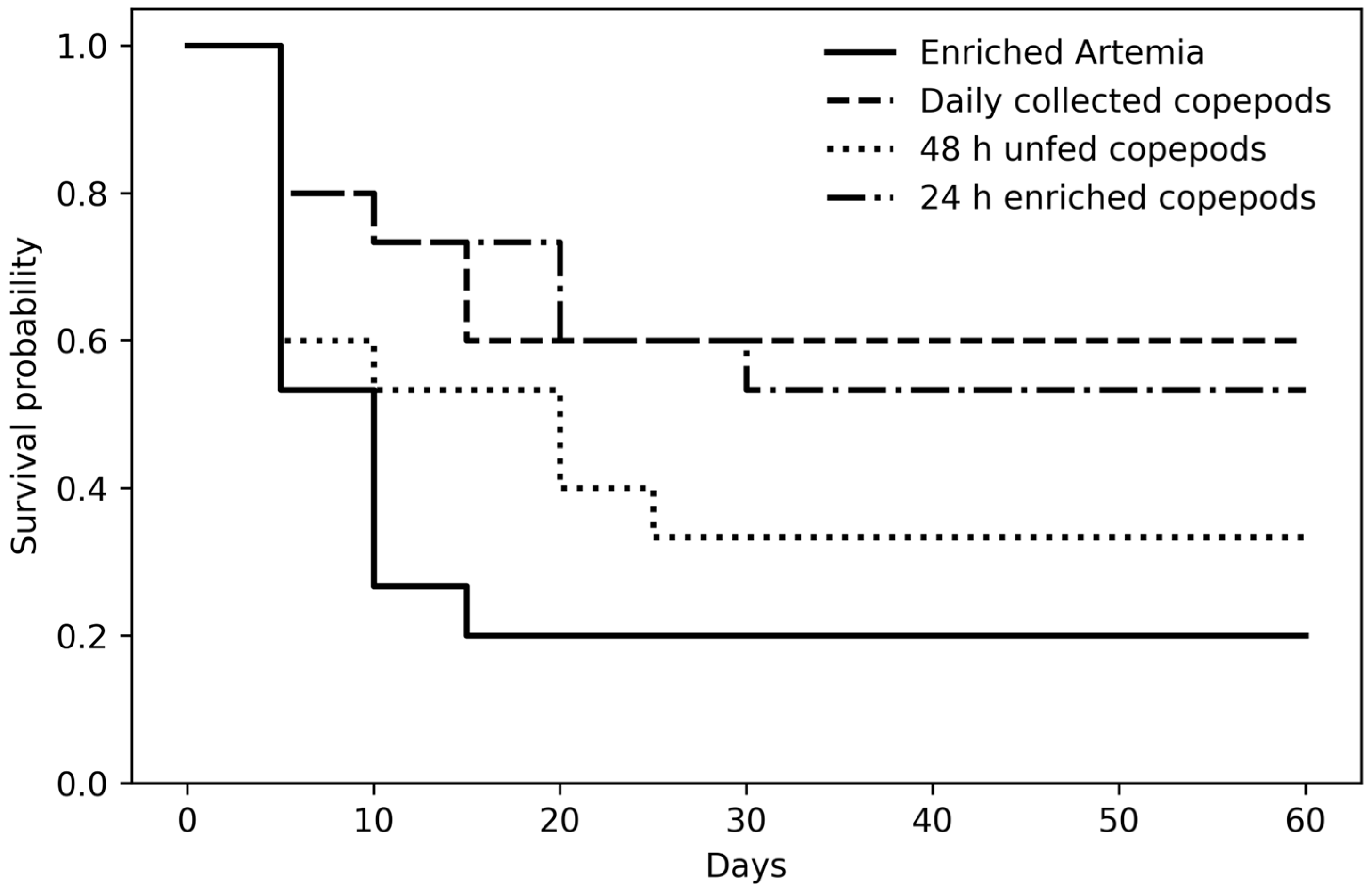
Survival differed markedly among dietary treatments (p < 0.05) over the 60-day rearing period (Figure 2). Fish fed daily collected copepods exhibited the highest survival, stabilizing at 60% from day 15 onwards. Survival in the 24 h enriched copepod treatment declined gradually during the first 30 days and subsequently stabilized at 53%. Juveniles fed 48 h unfed copepods experienced higher early mortality, with survival decreasing to 33% by day 25 and remaining constant thereafter. The lowest survival was observed in fish fed enriched Artemia, with most mortality occurring within the first 10 days and a final survival rate of 20%.

4. Discussion

During fish embryogenesis, the nutrients required for growth, cellular differentiation, organogenesis, and metabolism are derived exclusively from yolk reserves until the onset of exogenous feeding [91]. Seahorses, including Hippocampus guttulatus, are no exception. According to [91], this species exhibits an exceptionally high rate of total fatty acid (TFA) utilization during early development (67.8%), exceeding values reported for many other fish species and reflecting elevated lipid demands during this critical ontogenetic phase. As with other fish species currently bred in captivity, it was therefore expected that commercial enrichment products could adequately meet the TFA requirements of H. guttulatus. However, previous studies have demonstrated that enrichment strategies based on Artemia are often insufficient or may even be detrimental. For example, Palma et al. (2011) [41] reported 100% mortality in juveniles fed DHA Selco®-enriched Artemia metanauplii by 10 days post-parturition, largely due to gas bladder overinflation, a condition frequently associated with nutritionally imbalanced diets [30]. Consequently, despite the availability of commercial enrichment products designed to manipulate HUFA levels and ratios in Artemia, copepods continue to yield superior growth and survival outcomes in marine fish larvae and juveniles [33,61,92,93,94,95,96,97,98].
This recurring pattern suggests either that optimal HUFA levels and proportions are not fully achieved through Artemia enrichment or that additional nutritional attributes differentiate copepods from Artemia as live prey [45]. Support for the latter hypothesis was provided by Payne et al. (1998) [99], who demonstrated that pipefish (Stigmatopora argus) fed copepods with contrasting HUFA contents did not differ significantly in growth or survival. Similarly, Naess et al. (1995) [100] reported that copepod-dominated wild plankton used for first feeding of Atlantic halibut (Hippoglossus hippoglossus) exhibited substantially higher DHA/EPA ratios (1.4–1.7) than either unenriched or Super Selco™-enriched Artemia (0.1 and 0.5, respectively). Collectively, these findings indicate that the nutritional superiority of copepods extends beyond HUFA concentration alone.
In the present study, dietary effects on juvenile H. guttulatus performance were pronounced. Copepod-based diets consistently supported significantly greater standard length, body weight, growth indices (WG and TGC), and survival than enriched Artemia. Despite standardized rearing conditions, juveniles fed enriched Artemia exhibited markedly reduced growth (WG = 0.007 ± 0.001 g·d−1; TGC = 0.15) and the lowest survival (20%). In contrast, daily collected copepods produced the best overall performance, including the highest body weight (0.81 ± 0.40 g), WG (0.013 ± 0.002 g·d−1), TGC (0.27), and survival (60%). Kaplan–Meier survival curves revealed that differences among dietary treatments emerged early in the trial and persisted throughout the experimental period, highlighting a strong influence of prey type and nutritional condition on survival.
Condition factor (CF) did not differ significantly among treatments, indicating that all diets supported normal somatic development and allowed juveniles to maintain species-specific morphology. Even when growth rates differ, skeletal growth and muscle deposition may remain coordinated, resulting in comparable body proportions and similar CF values. This suggests that none of the diets induced abnormal fat accumulation, emaciation, or skeletal deformities. These findings are consistent with previous studies identifying copepods as the most suitable live prey for marine fish larvae and syngnathids due to their naturally balanced lipid composition [31,101,102,103,104,105,106,107,108,109,110,111]. In addition, copepod enrichment with Isochrysis galbana proved effective, corroborating earlier work by Marjuk et al. (2026) [112], who identified this microalga as superior to Chlorella marina and Nannochloropsis oculata for copepod nutritional conditioning.
Importantly, the present results demonstrate that diet quality, rather than nutrient quantity alone, was the primary determinant of juvenile H. guttulatus performance. Although enriched Artemia contained higher total protein and lipid levels on a dry matter basis, copepod-fed juveniles exhibited superior growth and survival. This discrepancy underscores the importance of lipid quality, encompassing both fatty acid composition and lipid class structure, during early seahorse development. Copepod diets provided a more favorable balance between polar and neutral lipids, a pattern consistently observed in previous studies (e.g., [113]), with elevated phospholipid content, particularly phosphatidylcholine (PC) and phosphatidylethanolamine (PE), relative to enriched Artemia, which was dominated by neutral lipids and free fatty acids.
Phospholipids, and PC in particular, play a central role in membrane biogenesis, lipoprotein assembly, and intestinal lipid absorption in marine fish larvae [66,113,114,115], physiological processes that remain immature during early ontogeny in syngnathids. The low PC and PE content of enriched Artemia, combined with elevated free fatty acid levels, likely constrained efficient lipid transport and membrane synthesis, thereby limiting growth and increasing mortality. In contrast, daily collected copepods provided high phospholipid levels together with moderate triglyceride availability, supporting both structural demands and energy requirements. These lipid class characteristics closely aligned with the superior growth and survival observed in this treatment. Similar relationships between lipid class composition and larval performance have been reported for largemouth bass (Micropterus salmoides) [116], Atlantic salmon (Salmo salar) [117], yellow catfish (Pelteobagrus fulvidraco) [118], Atlantic cod (Gadus morhua) [119], and Pacific bluefin tuna (Thunnus orientalis) [120].
Although copepod diets contained lower total lipid levels than enriched Artemia, they provided comparable or higher gross energy in some treatments (daily collected and 24 h enriched copepods), indicating more efficient energy utilization. This efficiency is likely linked to the preferential metabolic and structural roles of long-chain polyunsaturated fatty acids (LC-PUFA), enabling juveniles to achieve enhanced growth with lower lipid intake when essential fatty acids are supplied in appropriate proportions. In the present study, total HUFA levels reached 22–29% in copepods, compared with only 8% in enriched Artemia. DHA levels were particularly elevated in copepods (16–18%), whereas enriched Artemia contained only trace amounts (0.23%), resulting in substantially higher DHA/EPA and DHA/AA ratios. Such fatty acid profiles are essential for neural and visual development, membrane integrity, and metabolic regulation in fish larvae [63,121].
In contrast, enriched Artemia was characterized by high monounsaturated fatty acid levels (45.15%) and lower HUFA proportions, resulting in a comparatively unbalanced n-3/n-6 ratio (1.42) relative to copepod diets (0.33–0.52). Even when enrichment protocols are applied, achieving HUFA profiles comparable to those of natural copepods remains challenging [57,122]. These limitations likely contributed to the reduced growth and survival observed in Artemia-fed juveniles, consistent with previous reports for Solea senegalensis, Gadus morhua, and other Hippocampus species [41,50,123,124].
Interestingly, no significant differences in growth performance were detected among the three copepod-based treatments, despite measurable differences in fatty acid and lipid class composition. Although 24 h enriched copepods exhibited slightly lower total HUFA levels than daily collected or fasted copepods, DHA and EPA concentrations remained within ranges sufficient to support optimal growth. This suggests that once threshold requirements for essential fatty acids and phospholipids are met, further enrichment may not yield additional growth benefits. Survival, however, tended to be lower in juveniles fed fasted copepods, coinciding with the decreased free fatty acid levels and reduced phospholipid content, indicating that lipid class balance may be particularly important for stress resistance and overall robustness. Similar findings were reported by Izquierdo et al. (2001) [68], who demonstrated that n-3 HUFA-rich polar lipids enhanced EPA incorporation in gilthead seabream (Sparus aurata) larvae.
Overall, these results demonstrate that copepod conditioning can be optimized to enhance juvenile seahorse performance without substantially increasing production costs. Although copepods are often considered impractical for commercial hatcheries due to lower culture densities and higher operational demands, this study shows that simple approaches, such as daily collection or short-term enrichment, are sufficient to maximize their nutritional value. More intensive or prolonged conditioning did not result in proportional performance gains, indicating limited cost efficiency. From a commercial perspective, the superior performance of copepods, even when unfed, relative to enriched Artemia highlights their robustness as a first-feed organism during the most critical early developmental stages. Improved survival at this stage directly enhances production efficiency and reduces economic risk, making copepods a strategically valuable input despite higher unit costs.
The flexibility of copepod conditioning further enhances their applicability in hatchery settings. Low-input strategies can be readily integrated into existing production systems, either as a primary first feed or within mixed feeding regimes, reducing reliance on Artemia while avoiding the costs associated with continuous enrichment. Collectively, these findings support the use of minimally conditioned copepods as a cost-effective strategy to improve early juvenile survival and growth, thereby strengthening the feasibility and sustainability of commercial seahorse aquaculture.

5. Conclusions

This study provides the first integrated assessment of how different copepod feeding and conditioning strategies influence early growth and survival in juvenile Hippocampus guttulatus. The results demonstrate that juvenile performance is governed by a complex interaction between fatty acid composition and lipid class structure. Copepods offer a nutritionally superior profile, combining high availability of DHA and EPA with elevated phospholipid levels and a balanced proportion of neutral lipids, thereby supporting enhanced growth and survival.
These findings reinforce the nutritional advantages of copepods for rearing juvenile H. guttulatus and highlight the need to further refine Artemia enrichment protocols to more closely replicate the fatty acid and lipid class composition of natural zooplankton prey. Direct comparisons among daily collected, unfed, and enriched copepods and enriched Artemia demonstrate that copepods, regardless of conditioning strategy, consistently outperform Artemia as a first feed, promoting improved growth trajectories and higher survival during the first 60 days post-parturition.
Importantly, copepod conditioning modulated the magnitude of these benefits, with daily collected and short-term enriched copepods yielding the most favorable outcomes. Collectively, these results provide evidence-based guidance for optimizing early feeding strategies in seahorse aquaculture and offer novel insight into the role of live-feed nutritional quality and conditioning in shaping early seahorse performance.

Author Contributions

Conceptualization, J.P.; methodology, J.P. and M.C.; formal analysis, J.P. and I.H.-C.; writing—original draft preparation, J.P.; review and editing, M.C. and J.P.A.; supervision, J.P.; project administration, J.P.; funding acquisition, J.P. and J.P.A. All authors have read and agreed to the published version of the manuscript.

Funding

This study was funded by the project HIPPONUTRE “Cultivo do cavalo marinho de focinho comprido, Hippocampus guttulatus: Optimização zootécnica e avaliação de requisitos nutricionais” (Programa Operacional MAR2020-16-02-01-FMP-54), and received Portuguese national funds from FCT—Foundation for Science and Technology through projects UIDB/04326/2020 (DOI:10.54499/UIDB/04326/2020) and LA/P/0101/2020 (DOI:10.54499/LA/P/0101/2020).

Institutional Review Board Statement

CCMAR facilities and the research are certified to house and conduct experiments with live animals (Group-C licenses from the Direção Geral de Alimentação e Veterinária, Ministério da Agricultura, Florestas e Desenvolvimento Rural, Portugal). The experimental design of the present study was part of the Project HIPPONUTRE (reference 1602-01-FMP-54), which obtained approval from the ethics committee of the Veterinary Medicines Directorate, Ministry of Agriculture, Rural Development and Fisheries, Portugal (protocol code: 0421/000/000, approval date: 10 November 2015). The study adhered to the guidelines outlined by the European Union Council (86/609/EU) and the relevant Portuguese legislation (Decreto-Lei n.º 113/2013, of 7 August) concerning the use of laboratory animals.

Data Availability Statement

The data used during the current study are available from the corresponding author upon reasonable request.

Conflicts of Interest

The authors declare no conflicts of interest. The funders had no role in the design of the study; in the collection, analysis, or interpretation of data; in the writing of the manuscript; or in the decision to publish the results.

References

  1. Vincent, A.C.J. The International Trade in Seahorses; TRAFFIC International: Cambridge, UK, 1996; ISBN 1858500982. [Google Scholar]
  2. Foster, S.J.; Wiswedel, S.; Vincent, A.C.J. Opportunities and challenges for analysis of wildlife trade using CITES data—Seahorses as a case study. Aquat. Conserv. Mar. Freshw. Ecosyst. 2016, 26, 154–172. [Google Scholar] [CrossRef]
  3. Vincent, A.C.J.; Foster, S.J.; Koldewey, H.J. Conservation and management of seahorses and other Syngnathidae. J. Fish Biol. 2011, 78, 1681–1724. [Google Scholar] [CrossRef]
  4. Kuo, T.C.; Vincent, A.C.J. Assessing the changes in international trade of marine fishes under CITES regulations—A case study of seahorses. Mar. Policy 2018, 88, 48–57. [Google Scholar] [CrossRef]
  5. Lawson, J.M.; Foster, S.J.; Vincent, A.C.J. Low bycatch rates add up to big numbers for a genus of small fishes. Fisheries 2017, 42, 19–33. [Google Scholar] [CrossRef]
  6. Huang, J.X.; Qin, G.; Zhang, B.; Tan, S.W.; Sun, J.H.; Lin, Q. Effects of food, salinity, and ammonia-nitrogen on the physiology of juvenile seahorse (Hippocampus erectus) in two typical culture models in China. Aquaculture 2020, 520, 734965. [Google Scholar] [CrossRef]
  7. Law, S. Dried seahorse in traditional medicine: A narrative review. Infect. Dis. Herb. Med. 2021, 2, 158. [Google Scholar] [CrossRef]
  8. McPherson, J.M.; Vincent, A.C.J. Assessing East African trade in seahorse species as a basis for conservation under international controls. Aquat. Conserv. Mar. Freshw. Ecosyst. 2004, 14, 521–538. [Google Scholar] [CrossRef]
  9. Baum, J.K.; Vincent, A.C.J. Magnitude and inferred impacts of the seahorse trade in Latin America. Environ. Conserv. 2005, 32, 305–319. [Google Scholar] [CrossRef]
  10. Koldewey, H.J.; Martin-Smith, K.M. A global review of seahorse aquaculture. Aquaculture 2010, 302, 131–152. [Google Scholar] [CrossRef]
  11. Foster, S.J.; Vincent, A.C.J. Life history and ecology of seahorses: Implications for conservation and management. J. Fish Biol. 2004, 65, 1–61. [Google Scholar] [CrossRef]
  12. IUCN. The IUCN Red List of Threatened Species. Version 2021.1. Available online: http://www.iucnredlist.org (accessed on 26 November 2025).
  13. Martin-Smith, K.M.; Vincent, A.C.J. Exploitation and trade of Australian seahorses, pipehorses, sea dragons and pipefishes (Family syngnathidae). Oryx 2006, 40, 141–151. [Google Scholar] [CrossRef]
  14. Job, S.D.; Do, H.H.; Meeuwig, J.J.; Hall, H.J. Culturing the oceanic seahorse, Hippocampus kuda. Aquaculture 2002, 214, 333–341. [Google Scholar] [CrossRef]
  15. Lin, Q.; Gao, Y.L.; Sheng, J.Q.; Chen, Q.X.; Zhang, B.; Lu, J. The effects of food and the sum of effective temperature on the embryonic development of the seahorse, Hippocampus kuda Bleeker. Aquaculture 2007, 262, 481–492. [Google Scholar] [CrossRef]
  16. Job, S.D.; Buu, D.; Vincent, A.C.J. Growth and survival of the Tiger tail seahorse Hippocampus comes. J. World Aquac. Soc. 2006, 37, 322–327. [Google Scholar] [CrossRef]
  17. Garcia, L.M.B.; Hilomen-Garcia, G.V.; Celino, F.T.; Gonzales, T.T.; Maliao, R.J. Diet composition and feeding periodicity of the seahorse Hippocampus barbouri reared in illuminated sea cages. Aquaculture 2012, 358–359, 1–5. [Google Scholar] [CrossRef]
  18. Olivotto, I.; Avella, M.A.; Sampaolesi, G.; Piccinetti, C.C.; Navarro Ruiz, P.; Carnevali, O. Breeding and rearing the long snout seahorse Hippocampus reidi: Rearing and feeding studies. Aquaculture 2008, 283, 92–96. [Google Scholar] [CrossRef]
  19. Souza-Santos, L.P.; Regis, C.G.; Mélo, R.C.S.; Cavalli, R.O. Prey selection of juvenile seahorse Hippocampus reidi. Aquaculture 2013, 404–405, 35–40. [Google Scholar] [CrossRef]
  20. Ortega-Salas, A.A.; Reyes-Bustamante, H. Fecundity, survival, and growth of the seahorse Hippocampus ingens (Pisces: Syngnathidae) under semi-controlled conditions. Rev. Biol. Trop. 2006, 54, 1099–1102. [Google Scholar] [CrossRef]
  21. Wong, J.M.; Benzie, J.A.H. The effects of temperature, Artemia enrichment, stocking density and light on the growth of juvenile seahorses, Hippocampus whitei (Bleeker, 1855), from Australia. Aquaculture 2003, 228, 107–121. [Google Scholar] [CrossRef]
  22. Lin, Q.; Li, G.; Qin, G.; Lin, J.; Huang, L.; Sun, H.; Feng, P. The dynamics of reproductive rate, offspring survivorship and growth in the lined seahorse, Hippocampus erectus Perry, 1810. Biol. Open. 2012, 1, 391–396. [Google Scholar] [CrossRef]
  23. Woods, C.M.C. Growth of cultured seahorses (Hippocampus abdominalis) in relation to feed ration. Aquac. Int. 2005, 13, 305–314. [Google Scholar] [CrossRef]
  24. Woods, C.M.C.; Valentino, F. Frozen mysids as an alternative to live Artemia in culturing seahorses Hippocampus abdominalis. Aquac. Res. 2003, 34, 757–763. [Google Scholar] [CrossRef]
  25. Scarratt, A.M. Techniques for rising lined seahorses (Hippocampus erectus). Aquar. Front. 1996, 3, 24–29. [Google Scholar]
  26. Woods, C.M.C. Improving initial survival in cultured seahorses, Hippocampus abdominalis Leeson, 1827 (Teleostei: Syngnathidae). Aquaculture 2000, 190, 377–388. [Google Scholar] [CrossRef]
  27. Lin, Q.; Lin, J.; Zhang, D. Breeding and juvenile culture of the lined seahorse, Hippocampus erectus Perry, 1810. Aquaculture 2008, 277, 287–292. [Google Scholar] [CrossRef]
  28. Planas, M.; Blanco, A.; Chamorro, A.; Valladares, S.; Pintado, J. Temperature-induced changes of growth and survival in the early development of the seahorse Hippocampus guttulatus. J. Exp. Mar. Biol. Ecol. 2012, 438, 154–162. [Google Scholar] [CrossRef]
  29. Sheng, J.Q.; Lin, Q.; Chen, Q.X.; Gao, Y.L.; Shen, L.; Lu, J. Effects of food, temperature and light intensity on the feeding behavior of three-spot juvenile seahorses, Hippocampus trimaculatus Leach. Aquaculture 2006, 256, 596–607. [Google Scholar] [CrossRef]
  30. Palma, J.; Bureau, D.P.; Andrade, J.P. The effect of diet on ontogenic development of the digestive tract in juvenile reared long snout seahorse Hippocampus guttulatus. Fish Physiol. Biochem. 2014, 40, 739–750. [Google Scholar] [CrossRef]
  31. Palma, J.; Lima, R.; Andrade, J.P.; Lança, M.J. Optimization of live prey enrichment media for rearing juvenile short-snouted seahorse, Hippocampus hippocampus. Fishes 2023, 8, 494. [Google Scholar] [CrossRef]
  32. Lunn, K.E.; Hall, H.J. Breeding and management of seahorses in aquaria. In Briefing Documents for the First International Aquarium Workshop on Seahorse Husbandry, Management and Conservation; Project Seahorse: Chicago, IL, USA, 1998. [Google Scholar]
  33. Payne, M.F.; Rippingale, R.J. Rearing West Australian seahorse, Hippocampus subelongatus, juveniles on copepod nauplii and enriched Artemia. Aquaculture 2000, 188, 353–361. [Google Scholar] [CrossRef]
  34. Hilomen-Garcia, G.V.; Delos Reyes, R.; Garcia, C.M.H. Tolerance of seahorse Hippocampus kuda (Bleeker) juveniles to various salinities. J. Appl. Ichthyol. 2003, 19, 94–98. [Google Scholar] [CrossRef]
  35. Woods, C.M.C. Growth and survival of juvenile seahorse Hippocampus abdominalis reared on live, frozen and artificial foods. Aquaculture 2003, 220, 287–298. [Google Scholar] [CrossRef]
  36. Woods, C.M.C. Effects of varying Artemia enrichment on growth and survival of juvenile seahorses, Hippocampus abdominalis. Aquaculture 2003, 220, 537–548. [Google Scholar] [CrossRef]
  37. Martinez-Cardenas, L.; Purser, G.J. Effect of tank colour on Artemia ingestion, growth and survival in cultured early juvenile pot-bellied seahorses (Hippocampus abdominalis). Aquaculture 2007, 264, 92–100. [Google Scholar] [CrossRef]
  38. Lin, Q.; Lin, J.; Huang, L. Effects of substrate color, light intensity and temperature on survival and skin color change of juvenile seahorses, Hippocampus erectus Perry, 1810. Aquaculture 2009, 298, 157–161. [Google Scholar] [CrossRef]
  39. Lin, Q.; Lin, J.; Zhang, D.; Wang, Y. Weaning of juvenile seahorses Hippocampus erectus Perry, 1810 from live to frozen food. Aquaculture 2009, 291, 224–229. [Google Scholar] [CrossRef]
  40. Palma, J.; Andrade, J.P.; Bureau, D.P. The impact of dietary supplementation with astaxanthin on egg quality and growth of long snout seahorse (Hippocampus guttulatus) juveniles. Aquac. Nutr. 2017, 23, 304–312. [Google Scholar] [CrossRef]
  41. Palma, J.; Bureau, D.P.; Andrade, J.P. Effect of different Artemia enrichments and feeding protocol for rearing juvenile long snout seahorse, Hippocampus guttulatus. Aquaculture 2011, 318, 439–443. [Google Scholar] [CrossRef]
  42. Pham, N.; Lin, J. The effects of different feed enrichments on survivorship and growth of early juvenile long-snout seahorse, Hippocampus reidi. J. World Aquac. Soc. 2013, 44, 435–446. [Google Scholar] [CrossRef]
  43. Teh, J.C.; Kamarudin, M.S.; Romano, N.; Arshad, A.; Wong, J.M. Dietary effects of rotifers, brine shrimps and cultured copepods on survival and growth of newborn seahorse Hippocampus kuda (Bleeker 1852). J. Environ. Biol. 2018, 39, 923–930. [Google Scholar] [CrossRef]
  44. Wung, L.Y.; Christianus, A.; Zakaria, M.H.; Worachananant, S.; Min, C.C. Effect of Cultured Artemia on Growth and Survival of Juvenile Hippocampus barbouri. J. Fish. Environ. 2020, 44, 40–49. [Google Scholar]
  45. Gardner, T. The Copepod/Artemia Trade-Off in the Captive Culture of Hippocampus erectus, a Vulnerable Species in New York State. Master’s Thesis, Hofstra University, Long Island, NY, USA, 2004. [Google Scholar]
  46. Sheng, J.Q.; Lin, Q.; Chen, Q.X.; Shen, L.; Lu, J. Effect of starvation on the initiation of feeding, growth and survival rate of juvenile seahorses, Hippocampus trimaculatus Leach and Hippocampus kuda Bleeker. Aquaculture 2007, 271, 469–478. [Google Scholar] [CrossRef]
  47. Olivotto, I.; Buttino, I.; Borroni, M.; Piccinetti, C.C.; Malzone, M.G.; Carnevali, O. The use of the Mediterranean calanoid copepod Centropages typicus in Yellowtail clownfish (Amphiprion clarkii) larviculture. Aquaculture 2008, 284, 211–216. [Google Scholar] [CrossRef]
  48. Olivotto, I.; Avella, M.A.; Buttino, I.; Cutignano, A.; Carnevali, O. Calanoid copepod administration improves yellow tail clownfish (Amphiprion clarkii) larviculture: Biochemical and molecular implications. AACL Bioflux 2009, 2, 355–367. [Google Scholar]
  49. Zhang, D.; Lin, T.; Liu, X. A comparison of growth, survival, and fatty acid composition of the lined seahorse, Hippocampus erectus, juveniles fed enriched Artemia and a calanoid copepod, Schmackeria dubia. J. World Aquac. Soc. 2015, 46, 608–616. [Google Scholar] [CrossRef]
  50. Thuong, T.D.; Hoang, T. Rearing the spotted seahorse Hippocampus kuda by feeding live and frozen copepods collected from shrimp ponds. Aquac. Res. 2015, 46, 1356–1362. [Google Scholar] [CrossRef]
  51. Meng, Y.; Pan, Z.; He, J.; Zhong, S.; Liu, X.; Mi, S.; Wang, H.; Deng, G.; Cai, L.; Huang, G.; et al. Effects of live prey on growth performance, immune and digestive enzyme activities, and intestinal health in juvenile lined seahorse (Hippocampus erectus). Aquaculture 2026, 614, 743549. [Google Scholar] [CrossRef]
  52. Holt, G.J. Research on culturing the early life history stages of marine ornamental species. In Marine Ornamental Species: Collection, Culture and Conservation; Cato, J.C., Brown, C.L., Eds.; Iowa State Press: Ames, IA, USA, 2003; pp. 251–254. ISBN 978-0813829876. [Google Scholar]
  53. Aragão, C.; Conceição, L.E.; Dinis, M.T.; Fyhn, H.J. Amino acid pools of rotifers and Artemia under different conditions: Nutritional implications for fish larvae. Aquaculture 2004, 234, 429–445. [Google Scholar] [CrossRef]
  54. Hamre, K.; Srivastava, A.; Rønnestad, I.; Mangor-Jensen, A.; Stoss, J. Several micronutrients in the rotifer Brachionus sp. may not fulfil the nutritional requirements of marine fish larvae. Aquac. Nutr. 2008, 14, 51–60. [Google Scholar] [CrossRef]
  55. Rønnestad, I.; Thorsen, A.; Finn, R.N. Fish larval nutrition: A review of recent advances in the roles of amino acids. Aquaculture 1999, 177, 201–216. [Google Scholar] [CrossRef]
  56. Philip, T.R.; Duraivel, P.K.; Kareem, A.; Radha, V. Merits of the cyclopoid copepod Apocyclops dengizicus as a suitable and sustainable live feed for marine finfish seed production. 3 Biotech 2025, 15, 391. [Google Scholar] [CrossRef] [PubMed]
  57. Altaff, K.; Vijayaraj, R. Micro-algal diet for copepod culture with reference to their nutritive value—A review. Int. J. Curr. Res. Rev. 2021, 13, 86–96. [Google Scholar] [CrossRef]
  58. Conceição, L.E.; Yúfera, M.; Makridis, P.; Morais, S.; Dinis, M.T. Live feeds for early stages of fish rearing. Aquac. Res. 2010, 41, 613–640. [Google Scholar] [CrossRef]
  59. Olivotto, I.; Planas, M.; Simões, N.; Holt, G.J.; Avella, M.A.; Calado, R. Advances in breeding and rearing marine ornamentals. J. World Aquac. Soc. 2011, 42, 135–166. [Google Scholar] [CrossRef]
  60. Zaleha, K.; Ibrahim, B.; John, B.A.; Kamaruzzaman, B. Generation time of some marine harpacticoid species in laboratory condition. J. Biol. Sci. 2012, 12, 433. [Google Scholar] [CrossRef]
  61. Delbare, D.; Dhert, P.; Lavens, P. Zooplankton. In Manual on the Production and Use of Live Food for Aquaculture; Lavens, P., Sorgeloos, P., Eds.; FAO: Rome, Italy, 1996; pp. 252–282. ISBN 92-5-103934-8. [Google Scholar]
  62. Pan, Y.J.; Dahms, H.U.; Hwang, J.S.; Souissi, S. Recent trends in live feeds for marine larviculture: A mini review. Front. Mar. Sci. 2022, 9, 864165. [Google Scholar] [CrossRef]
  63. Zeng, C.; Shao, L.; Ricketts, A.; Moorhead, J. The importance of copepods as live feed for larval rearing of the green mandarin fish Synchiropus splendidus. Aquaculture 2018, 491, 65–71. [Google Scholar] [CrossRef]
  64. Brewer, M.C.; Coughlin, J.N. Virtual plankton: A novel approach to the investigation of aquatic predator–prey interactions. In Zooplankton: Sensory Ecology and Physiology; Lenz, P.H., Ed.; Routledge: London, UK, 2021; pp. 425–434. [Google Scholar] [CrossRef]
  65. Burbano, M.F.; Torres, G.A.; Prieto, M.J.; Gamboa, J.H.; Chapman, F.A. Increased survival of larval spotted rose snapper (Lutjanus guttatus (Steindachner, 1869)) when fed with the copepod Cyclopina sp. and Artemia nauplii. Aquaculture 2020, 519, 734912. [Google Scholar] [CrossRef]
  66. Tocher, D.R.; Bendiksen, E.Å.; Campbell, P.J.; Bell, J.G. The role of phospholipids in nutrition and metabolism of teleost fish. Aquaculture 2008, 280, 21–34. [Google Scholar] [CrossRef]
  67. Turchini, G.M.; Francis, D.S.; Du, Z.; Olsen, R.E.; Ringo, E.; Tocher, D.R. The lipids. In Fish Nutrition, 4th ed.; Hardy, R.W., Kaushik, S.J., Eds.; Academic Press: San Diego, CA, USA, 2022; pp. 303–467. [Google Scholar] [CrossRef]
  68. Izquierdo, M.S.; Tandler, A.; Salhi, M.; Kolkovski, S. Influence of dietary polar lipid quantity and quality on ingestion and assimilation of labelled fatty acids by larval gilthead seabream. Aquac. Nutr. 2001, 7, 153–160. [Google Scholar] [CrossRef]
  69. Cahu, C.L.; Gisbert, E.; Villeneuve, L.A.; Morais, S.; Hamza, N.; Wold, P.A.; Zambonino Infante, J.L. Influence of dietary phospholipids on early ontogenesis of fish. Aquac. Res. 2009, 40, 989–999. [Google Scholar] [CrossRef]
  70. Cahu, C.L.; Zambonino Infante, J.L.; Barbosa, V. Effect of dietary phospholipid level and phospholipid:neutral lipid value on the development of sea bass (Dicentrarchus labrax) larvae fed a compound diet. Br. J. Nutr. 2003, 90, 21–28. [Google Scholar] [CrossRef]
  71. Coutteau, P.; Geurden, I.; Camara, M.R.; Bergot, P.; Sorgeloos, P. Review on the dietary effects of phospholipids in fish and crustacean larviculture. Aquaculture 1997, 155, 149–164. [Google Scholar] [CrossRef]
  72. Hamza, N.; Mhetli, M.; Khemis, I.B.; Cahu, C.; Kestemont, P. Effect of dietary phospholipid levels on performance, enzyme activities and fatty acid composition of pikeperch (Sander lucioperca) larvae. Aquaculture 2008, 275, 274–282. [Google Scholar] [CrossRef]
  73. Zhao, J.; Ai, Q.; Mai, K.; Zuo, R.; Luo, Y. Effects of dietary phospholipids on survival, growth, digestive enzymes and stress resistance of large yellow croaker (Larimichthys crocea) larvae. Aquaculture 2013, 410, 122–128. [Google Scholar] [CrossRef]
  74. Huang, Y.; Xu, J.; Sheng, Z.; Chen, N. Integrated response of growth performance, fatty acid composition, antioxidant responses and lipid metabolism to dietary phospholipids in hybrid grouper (Epinephelus fuscoguttatus ♀ × E. lanceolatus ♂) larvae. Aquaculture 2021, 541, 736728. [Google Scholar] [CrossRef]
  75. Sargent, J.R.; Bell, G.; McEvoy, L.A.; Tocher, D.R.; Estevez, A. Recent developments in the essential fatty acid nutrition of fish. Aquaculture 1999, 177, 191–199. [Google Scholar] [CrossRef]
  76. Sargent, J.R.; McEvoy, L.A.; Estevez, A.; Bell, G.; Bell, M.; Henderson, J.; Tocher, D.R. Lipid nutrition of marine fish during early development: Current status and future directions. Aquaculture 1999, 179, 217–229. [Google Scholar] [CrossRef]
  77. Bell, J.G.; McEvoy, L.A.; Estevez, A.; Shields, R.J.; Sargent, J.R. Optimizing lipid nutrition in first-feeding flatfish larvae. Aquaculture 2003, 227, 211–220. [Google Scholar] [CrossRef]
  78. Faulk, C.K.; Holt, G.J. Advances in rearing cobia Rachycentron canadum larvae in recirculating aquaculture systems: Live prey enrichment and greenwater culture. Aquaculture 2005, 249, 231–243. [Google Scholar] [CrossRef]
  79. Olivotto, I.; Cardinali, M.; Barbaresi, L.; Maradonna, F.; Carnevali, O. Coral reef fish breeding: The secrets of each species. Aquaculture 2003, 224, 69–78. [Google Scholar] [CrossRef]
  80. Olivotto, I.; Rollo, A.; Sulpizio, R.; Avella, A.M.; Tosti, L.; Carnevali, O. Breeding and rearing the Sunrise Dottyback Pseudochromis flavivertex: The importance of live prey enrichment during larval development. Aquaculture 2006, 255, 480–487. [Google Scholar] [CrossRef]
  81. van der Meeren, T.; Karlsen, Ø.; Liebig, P.L.; Mangor-Jensen, A. Copepod production in a saltwater pond system: A reliable method for achievement of natural prey in start-feeding of marine fish larvae. Aquac. Eng. 2014, 62, 17–27. [Google Scholar] [CrossRef]
  82. Halsband, C.; Hirche, H.J. Reproductive cycles of dominant calanoid copepods in the North Sea. Mar. Ecol. Prog. Ser. 2001, 209, 219–229. [Google Scholar] [CrossRef]
  83. Kline, M.D.; Laidley, C.W. Development of intensive copepod culture technology for Parvocalanus crassirostris: Optimizing adult density. Aquaculture 2015, 435, 128–136. [Google Scholar] [CrossRef]
  84. Sorgeloos, P.; Lavens, P.; Léger, P.; Tackaert, W.; Versichele, D. Manual for the Culture of Brine Shrimp Artemia in Aquaculture; University of Ghent: Ghent, Belgium, 1986; ISBN 92-5-103934-8. [Google Scholar]
  85. Lourie, S.A.; Pritchard, J.C.; Casey, S.P.; Truong, S.K.; Hall, H.J.; Vincent, A.C.J. The taxonomy of Vietnam’s exploited seahorses (Family syngnathidae). Biol. J. Linn. Soc. 1999, 66, 231–256. [Google Scholar] [CrossRef]
  86. Iwama, G.K.; Tautz, A.F. A simple growth model for salmonids in hatcheries. Can. J. Fish. Aquat. Sci. 1981, 38, 649–656. [Google Scholar] [CrossRef]
  87. Cho, C.Y. Fish nutrition, feeds and feeding: With special emphasis on salmonid aquaculture. Food Rev. Int. 1990, 6, 333–357. [Google Scholar] [CrossRef]
  88. AOAC (Association of Official Analytical Chemists). Official Methods of Analysis of AOAC International. In Agricultural Chemicals; Contaminants Drugs, 16th ed.; Association of Official Analytical Chemists: Arlington, VA, USA, 1995; Volume 1, ISBN 9780935584547. [Google Scholar]
  89. Olsen, R.E.; Henderson, R.J. The rapid analysis of neutral and polar marine lipids using double-development HPTLC and scanning densitometry. J. Exp. Mar. Biol. Ecol. 1989, 129, 189–197. [Google Scholar] [CrossRef]
  90. Christie, W.W. Lipid Analysis, 2nd ed.; Pergamon Press: Oxford, UK, 1982; ISBN 978-0-08-023791-6. [Google Scholar]
  91. Faleiro, F.; Narciso, L. Lipid dynamics during early development of Hippocampus guttulatus seahorses: Searching for clues on fatty acid requirements. Aquaculture 2010, 307, 56–64. [Google Scholar] [CrossRef]
  92. Kraul, S.; Ako, H.; Brittain, K.; Ogasawara, A.; Cantrell, R.; Nagao, T. Comparison of copepods and enriched Artemia as feeds for larval Mahimahi (Coryphaena hippurus). In Larvi ’91; Special Publication No. 15; European Aquaculture Society: Ghent, Belgium, 1991. [Google Scholar]
  93. Kraul, S.; Brittain, K.; Cantrell, R.; Nagao, T.; Ako, H.; Ogasawara, A.; Kitagawa, H. Nutritional factors affecting stress resistance in the larval mahimahi, Coryphaena hippurus. J. World Aquac. Soc. 1993, 24, 186–193. [Google Scholar] [CrossRef]
  94. Shields, R.J.; Bell, J.G.; Luizi, F.S.; Gara, B.; Bromage, N.R.; Sargent, J.R. Natural copepods are superior to enriched Artemia nauplii as feed for halibut larvae (Hippoglossus hippoglossus) in terms of survival, pigmentation and retinal morphology: Relation to dietary essential fatty acids. J. Nutr. 1999, 129, 1186–1194. [Google Scholar] [CrossRef]
  95. Støttrup, J.G. The elusive copepods: Their production and suitability in marine aquaculture. Aquac. Res. 2000, 31, 703–711. [Google Scholar] [CrossRef]
  96. Shao, L.; Zeng, C. Survival, growth, ingestion rate and foraging behavior of larval green mandarin fish (Synchiropus splendidus) fed copepods only versus co-fed copepods with rotifers. Aquaculture 2020, 520, 734958. [Google Scholar] [CrossRef]
  97. Imsland, A.K.; Foss, A.; Koedijk, R.; Folkvord, A.; Stefansson, S.O.; Jonassen, T.M. Short- and long-term differences in growth, feed conversion efficiency and deformities in juvenile Atlantic cod (Gadus morhua) start-fed on rotifers or zooplankton. Aquac. Res. 2006, 37, 1015–1027. [Google Scholar] [CrossRef]
  98. Karlsen, Ø.; van der Meeren, T.; Rønnestad, I.; Mangor-Jensen, A.; Galloway, T.F.; Kjørsvik, E.; Hamre, K. Copepods enhance nutritional status, growth and development in Atlantic cod (Gadus morhua L.) larvae—Can we identify the underlying factors? PeerJ 2015, 3, e902. [Google Scholar] [CrossRef]
  99. Payne, M.F.; Rippingale, R.J.; Longmore, R.B. Growth and survival of juvenile pipefish (Stigmatopora argus) fed live copepods with high and low HUFA content. Aquaculture 1998, 167, 237–245. [Google Scholar] [CrossRef]
  100. Naess, T.; Germain-Henry, M.; Naas, K.E. First feeding of Atlantic halibut (Hippoglossus hippoglossus) using different combinations of Artemia and wild zooplankton. Aquaculture 1995, 130, 235–250. [Google Scholar] [CrossRef]
  101. McEvoy, L.A.; Næss, T.; Bell, J.G.; Lie, Ø. Lipid and fatty acid composition of normal and malpigmented Atlantic halibut (Hippoglossus hippoglossus) fed enriched Artemia: A comparison with fry fed wild copepods. Aquaculture 1998, 163, 237–250. [Google Scholar] [CrossRef]
  102. Olivotto, I.; Capriotti, F.; Buttino, I.; Avella, A.M.; Vitiello, V.; Maradonna, F.; Carnevali, O. The use of harpacticoid copepods as live prey for Amphiprion clarkii larviculture: Effects on larval survival and growth. Aquaculture 2008, 274, 347–352. [Google Scholar] [CrossRef]
  103. Rasdi, N.W.; Qin, J.G. Improvement of copepod nutritional quality as live food for aquaculture: A review. Aquac. Res. 2016, 47, 1–20. [Google Scholar] [CrossRef]
  104. Loufi, K.; Sfakianakis, D.G.; Karapanagiotis, S.; Tsele, N.; Makridis, P. The effect of copepod Acartia tonsa during the first days of larval rearing on skeleton ontogeny and skeletal deformities in greater amberjack (Seriola dumerili Risso, 1810). Aquaculture 2024, 579, 740169. [Google Scholar] [CrossRef]
  105. Vijayaraj, R.; Jayaprakashvel, M.; Altaff, K. Efficacy of Apocyclops royi (Cyclopoida, Copepoda) nauplii as live prey for the first-feeding larvae of silver pompano, Trachinotus blochii (Lacepède, 1801). Asian J. Fish. Aquat. Res. 2022, 20, 29–34. [Google Scholar] [CrossRef]
  106. Vijayaraj, R.; Jayaprakashvel, M.; Altaff, K. Asian seabass (Lates calcarifer) larval rearing using cyclopoid copepod (Apocyclops royi) live feed: A new approach. J. Basic Appl. Zool. 2025, 86, 5. [Google Scholar] [CrossRef]
  107. Sun, Y.H.; Lin, Y.R.; Hsieh, H.Y.; Meng, P.J. Early feeding strategies for the larviculture of the vermiculated angelfish Chaetodontoplus mesoleucus: The key role of copepods. Animals 2025, 15, 2437. [Google Scholar] [CrossRef]
  108. Ranjan, R.; Megarajan, S.; Xavier, B.; Bhaskaran Pillai, S.; Bathina, C.; Avadhanula, R.K.; Ghosh, S.; Ignatius, B.; Joseph, I.; Gopalakrishnan, A. Enhanced larval survival in orange-spotted grouper (Epinephelus coioides) using optimized feeding regime. Aquac. Res. 2022, 53, 3430–3440. [Google Scholar] [CrossRef]
  109. Ritu, J.R.; Khan, S.; Uddin, M.H.; Poly, J.A.; Hossain, M.S.; Haque, M.M. Exploring the nutritional potential of Monoraphidium littorale and enriched copepods as first feeds for rearing Nile tilapia (Oreochromis niloticus) larvae. Heliyon 2024, 10, e35877. [Google Scholar] [CrossRef] [PubMed]
  110. Martino, A.; Montero, D.; Roo, J.; Castro, P.; Lavorano, S.; Otero-Ferrer, F. Enriched calanoid copepods Acartia tonsa (Dana, 1849) enhance growth, survival, biochemical composition and morphological development during larval first feeding of the orchid dottyback Pseudochromis fridmani (Klausewitz, 1968). Aquac. Rep. 2024, 39, 102437. [Google Scholar] [CrossRef]
  111. Mutia, T.M.; Muyot, F.B.; Baral, J.L.; Garcia, L.C. Larval rearing of the giant trevally, Caranx ignobilis (Forsskål, 1775), fed live food combinations of rotifers, copepods and Artemia salina. J. Asian Fish. Soc. 2024, 37, 181–190. [Google Scholar] [CrossRef]
  112. Marjuk, M.S.; Sridhar, P.; Gowthami, A.; Santhanam, P.; Sarangi, R.K.; Perumal, P. Systematic optimization and neural network modelling of Acartia steueri copepod reproduction for enhanced live feed solutions in sustainable aquaculture. Aquaculture 2026, 614, 743482. [Google Scholar] [CrossRef]
  113. van der Meeren, T.; Olsen, R.E.; Hamre, K.; Fyhn, H.J. Biochemical composition of copepods for evaluation of feed quality in production of juvenile marine fish. Aquaculture 2008, 274, 375–397. [Google Scholar] [CrossRef]
  114. De Santis, C.; Taylor, J.F.; Martinez-Rubio, L.; Tocher, D.R. Influence of development and dietary phospholipid content and composition on intestinal transcriptome of Atlantic salmon (Salmo salar). PLoS ONE 2015, 10, e0140964. [Google Scholar] [CrossRef]
  115. Wold, P.A.; Hoehne-Reitan, K.; Cahu, C.; Zambonino Infante, J.L.; Rainuzzo, J.; Kjørsvik, E. Phospholipids vs. neutral lipids: Effects on digestive enzyme activity and lipid absorption in Atlantic cod larvae. Aquaculture 2007, 269, 374–384. [Google Scholar] [CrossRef]
  116. Wang, S.; Han, Z.; Turchini, G.M.; Wang, X.; Fang, Z.; Chen, N.; Xie, R.; Zhang, H.; Li, S. Effects of dietary phospholipids on growth performance, digestive enzyme activity and intestinal health of largemouth bass (Micropterus salmoides) larvae. Front. Immunol. 2021, 12, 827946. [Google Scholar] [CrossRef]
  117. Carmona-Antoñanzas, G.; Taylor, J.F.; Martinez-Rubio, L.; Tocher, D.R. Molecular mechanism of dietary phospholipid requirement of Atlantic salmon (Salmo salar) fry. Biochim. Biophys. Acta Mol. Cell Biol. Lipids 2015, 1851, 1428–1441. [Google Scholar] [CrossRef] [PubMed]
  118. Lu, S.; Zhao, N.; Zhao, A.; He, R. Effect of soybean phospholipid supplementation in formulated microdiets and live food on foregut and liver histological changes of yellow catfish (Pelteobagrus fulvidraco) larvae. Aquaculture 2008, 278, 119–127. [Google Scholar] [CrossRef]
  119. Marthinsen, J.L.; Reitan, K.I.; Olsen, R.E.; Li, K.; Nunes, B.; Bjørklund, R.H.; Kjørsvik, E. Influence of dietary phospholipid level and bile salt supplementation on larval performance of Atlantic cod (Gadus morhua L.). Aquac. Int. 2025, 33, 560. [Google Scholar] [CrossRef]
  120. Seoka, M.; Kurata, M.; Tamagawa, R.; Biswas, A.K.; Biswas, B.K.; Yong, A.S.K.; Kim, Y.S.; Ji, S.C.; Takii, K.; Kumai, H. Dietary supplementation of salmon roe phospholipid enhances the growth and survival of Pacific bluefin tuna (Thunnus orientalis) larvae and juveniles. Aquaculture 2008, 275, 225–234. [Google Scholar] [CrossRef]
  121. Tocher, D.R. Fatty acid requirements in ontogeny of marine and freshwater fish. Aquac. Res. 2010, 41, 717–732. [Google Scholar] [CrossRef]
  122. Dhont, J.; Van Stappen, G. Biology, tank production and nutritional value of Artemia. In Live Feeds in Marine Aquaculture; Støttrup, J.G., McEvoy, L.A., Eds.; Blackwell Science: Oxford, UK, 2003; pp. 65–121. ISBN 0-632-05495-6. [Google Scholar]
  123. Villalta, M.; Estévez, A.; Bransden, M.P.; Bell, J.G. The effect of graded concentrations of dietary DHA on growth, survival and tissue fatty acid profile of Senegal sole (Solea senegalensis) larvae during the Artemia feeding period. Aquaculture 2005, 249, 353–365. [Google Scholar] [CrossRef]
  124. Evjemo, J.O.; Reitan, K.I.; Olsen, Y. Copepods as live food organisms in the rearing of marine fish larvae: Nutritional value and requirements. Aquaculture 2008, 274, 183–197. [Google Scholar] [CrossRef]
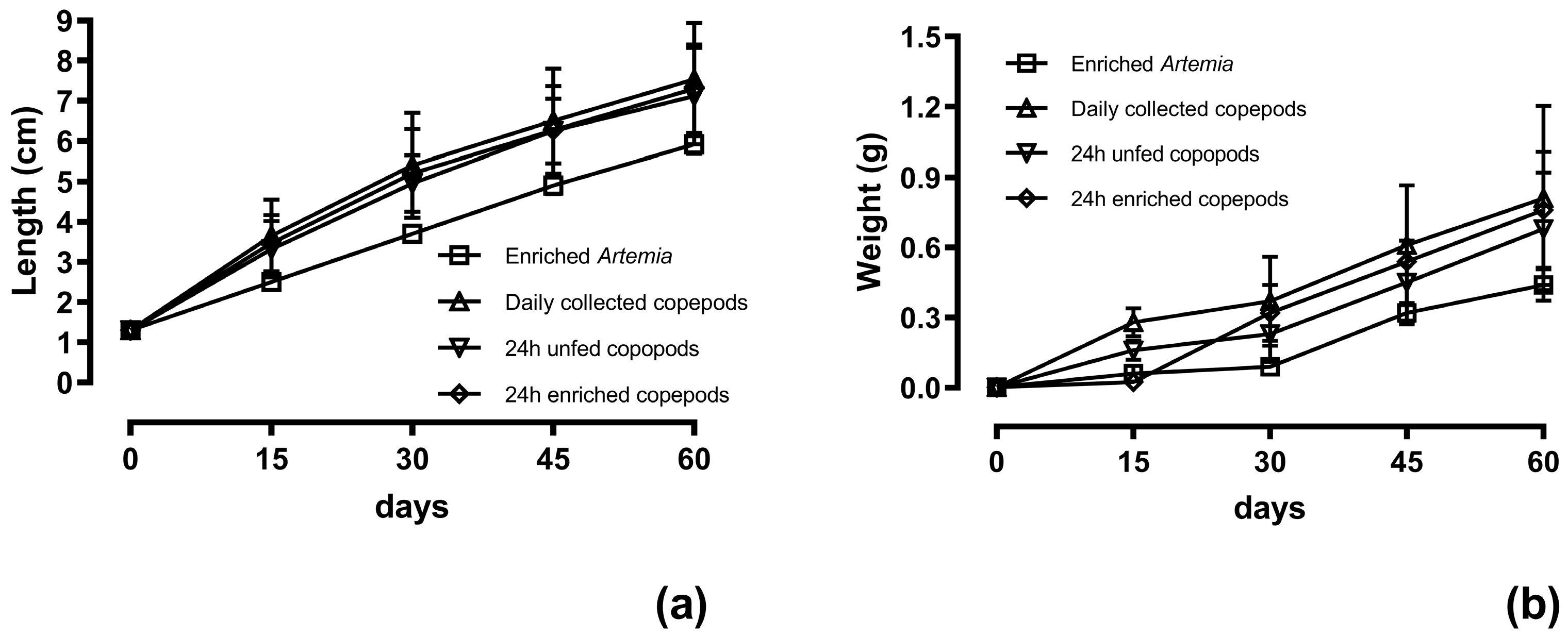
Figure 1. Average (mean ± s.d.) length increase (a), and weight increase (b) of juvenile H. guttulatus fed on each of the four tested diets (24 h I. galbana enriched Artemia, daily collected copepods, 48 h unfed copepods, and 24 h enriched copepods) during the 60-day trial.
Fishes 11 00072 g001
Figure 2. Kaplan–Meier survival curves of fish fed with different live prey treatments over a 60-day experimental period. Survival probability is shown as a step function for fish fed Enriched Artemia, daily collected copepods, 48 h unfed copepods, and 24 h enriched copepods. Each step represents a mortality event occurring on the sampling day.
Fishes 11 00072 g002
Table 1. Proximate composition of the four tested dietary treatments (24 h I. galbana enriched Artemia, daily collected copepods, 48 h unfed copepods, and 24 h I. galbana enriched copepods) in percentage (%), g per 100 g of Dry Matter (g/100 g DM) and kilocalories per 100 g dry matter (Kcal/100 DM). Rows with different superscripts letters are significantly different (p < 0.05).
Proximate CompositionEnriched ArtemiaDaily Copepods48 h Unfed Copepods24 h Enriched Copepods
Moisture (%)70.3 ± 0.4 b86.6 ± 1.1 a84.6 ± 1.0 a85.5 ± 1.0 a
Dry Matter (%)29.7 ± 1 a13.4 ± 1.1 b15.4 ± 1.3 b14.5 ± 1.3 b
Gross Protein (g/100 g DM)17.7 ± 0.8 a10.4 ± 0.6 b8.9 ± 1.1 a9.8 ± 1.1 b
Total Lipids (g/100 g DM)9.8 ± 0.7 a4.9 ± 0.8 b4.3 ± 0.7 b4.8 ± 0.9 b
Gross Energy (Kcal/100 DM)488.9 ± 0.7 b504.28 ± 1.2 a491.53 ± 1.4 b502.53 ± 1.4 a
Table 2. Lipid class composition (% of total lipids, mean ± SD) of the four dietary treatments tested (24 h I. galbana enriched Artemia, daily collected copepods, 48 h unfed copepods and 24 h I. galbana enriched copepods). Lipid classes are expressed as relative proportions of total lipids; PL and NL represent the summed fractions of polar and neutral lipids, respectively. Different superscript letters within a row indicate significant differences (Tukey HSD, p < 0.05).
Enriched ArtemiaDaily Collected Copepods48 h Unfed Copepods24 h Enriched Copepods
Lysophosphatidylcholines (LPC)3.5 ± 0.1 b4.1 ± 0.0 b3.2 ± 0.3 b6.3 ± 0.1 a
16:0 (SM)5.3 ± 0.4 a6.0 ± 0.2 a4.1 ± 0.2 b4.3 ± 0.2 b
Phosphatidylcholine (PC)9.4 ± 0.9 c20.5 ± 0.3 a18.4 ± 0.2 b16.0 ± 0.1 b
Lysophosphatidylethanolamine (LPE)2.3 ± 1.0 b1.8 ± 0.1 b1.0 ± 0.3 c4.1 ± 0.2 a
Phosphatidylserine (PS)2.7 ± 1.4 b4.7 ± 0.8 a2.8 ± 0.2 b2.2 ± 0.2 b
Phosphatidylinositol (PI)2.1 ± 0.8 b3.4 ± 0.2 a2.7 ± 0.3 b2.6 ± 0.1 b
Phosphatidylethanolamine (PE)4.4 ± 0.6 c13.0 ± 0.1 a11.3 ± 0.1 b8.4 ± 0.3 b
Pigments (PIG)10.4 ± 0.6 a6.9 ± 0.7 b12.2 ± 0.8 a6.9 ± 0.4 b
Diacyl-glycerol (DAG)0.0 ± 0.0 a0.0 ± 0.0 b0.5 ± 0.1 a1.0 ± 0.3 b
Cholesterol (CHO)19.9 ± 1.4 a19.1 ± 1.3 a13.9 ± 0.7 b9.8 ± 0.2 c
Free fatty acids (FFA)30.8 ± 0.2 a13.3 ± 0.4 c8.5 ± 0.4 d20.3 ± 0.4 b
Tryglycerides (TG)2.4 ± 0.7 c3.7 ± 0.8 c12.9 ± 0.3 a9.9 ± 0.2 b
Synvinolin (MK)0.0 ± 0.0 b0.0 ± 0.0 b2.1 ± 1.4 a0.0 ± 0.0 b
Wax esters (WE)2.6 ± 0.3 a1.5 ± 0.1 b1.4 ± 0.2 b3.7 ± 0.5 a
Steryl esters (SE)2.5 ± 0.7 b1.2 ± 0.6 c3.6 ± 0.2 a4.9 ± 0.6 a
Unknown (UK)0.4 ± 0.6 b0.0 ± 0.0 c0.2 ± 0.4 b0.5 ± 0.0 a
Total98.8 ± 2.5 a99.4 ± 1.8 a98.9 ± 0.7 a100.8 ± 1.4 a
Polar lipids (PL)29.8 ± 2.5 c53.6 ± 1.3 a43.5 ± 1.0 b43.9 ± 0.7 b
Neutral lipids (NL)69.1 ± 2.0 a45.9 ± 1.8 c55.4 ± 1.6 b56.9 ± 1.1 b
Table 3. Fatty acid composition of each dietary treatment, 24 h I. galbana enriched Artemia, daily collected copepods, 48 h unfed copepods and 24 h I. galbana enriched copepods (mean ± standard deviation, (n = 3)) expressed as a percentage (%) of total identified fatty acids. SMA (saturated fatty acids), MUFA (monounsaturated fatty acids), PUFA (polyunsaturated fatty acids), HUFA (highly unsaturated fatty acids). Different superscript letters within a row indicate significant differences (Tukey HSD, p < 0.05).
CategoryFatty Acid24 h Enriched ArtemiaDaily Copepods48 h Unfed Copepods24 h Enriched Copepods
SMA (saturated)14:04.32 ± 0.14 b10.02 ± 0.6 a3.67 ± 0.21 b8.48 ± 0.2 a
15:00.71 ± 0.12 a1.13 ± 0.11 a0.67 ± 0.08 a0.88 ± 0.08 a
16:020.92 ± 0.89 c27.31 ± 0.4 a26.58 ± 0.75 a24.6 ± 0.05 b
17:00.61 ± 0.09 c1.09 ± 0.05 b1.92 ± 0.11 a1.3 ± 0.1 a
18:05.24 ± 0.15 c6.91 ± 0.15 b13.24 ± 0.21 a7.57 ± 0.13 b
21:00.47 ± 0.07 a0.20 ± 0.03 b0.38 ± 0.09 b0.60 ± 0.03 a
24:00.19 ± 0.04 a0.30 ± 0.06 a0.17 ± 0.15 a0.20 ± 0.17 a
Σ Saturated 32.46 ± 1.43 b47.77 ± 0.75 a47.90 ± 1.01 a44.46 ± 0.35 a
MUFA (monoenes)16:1n712.42 ± 0.32 a6.93 ± 0.23 b2.06 ± 0.20 d4.14 ± 0.02 c
17:10.19 ± 0.20 b0.24 ± 0.02 a0.26 ± 0.24 a0.40 ± 0.01 a
18:1n916.37 ± 0.05 a2.22 ± 0.03 c2.71 ± 1.18 c5.99 ± 0.12 b
18:1n712.81 ± 0.04 a3.24 ± 0.11 b3.03 ± 1.20 b3.22 ± 0.06 b
22:1n91.94 ± 0.21 b1.61 ± 0.12 b4.51 ± 0.03 a2.35 ± 0.05 b
24:11.42 ± 0.59 a0.60 ± 0.07 b0.78 ± 0.68 b0.99 ± 0.03 a
Σ Monoenes 45.15 ± 2.31 a15.95 ± 0.60 b14.13 ± 1.39 b18.05 ± 0.14 b
PUFA (non-HUFA)16:2n40.42 ± 0.07 a0.29 ± 0.01 a0.04 ± 0.07 a0.21 ± 0.07 a
16:3n40.15 ± 0.21 a0.35 ± 0.01 a0.30 ± 0.30 a0.25 ± 0.07 a
16:4n10.18 ± 0.09 a0.20 ± 0.06 a0.07 ± 0.13 a0.14 ± 0.12 a
18:2n64.86 ± 0.06 a1.05 ± 0.05 b0.92 ± 0.05 b3.78 ± 0.09 a
18:3n60.63 ± 0.09 b0.75 ± 0.07 b0.66 ± 0.21 b1.39 ± 0.11 a
18:3n33.21 ± 0.05 a1.31 ± 0.00 b0.85 ± 0.06 b2.47 ± 0.05 a
18:4n31.02 ± 0.04 b0.97 ± 0.00 b0.57 ± 0.04 b2.66 ± 0.05 a
Σ PUFA (non-HUFA) 10.47 ± 2.45
HUFA (=C20)20:4n6 (AA)1.68 ± 0.03 a0.96 ± 0.02 a1.03 ± 0.08 a0.58 ± 0.05 b
20:5n3 (EPA)5.77 ± 0.32 b8.77 ± 0.01 a9.67 ± 0.50 a5.31 ± 0.17 b
22:5n30.37 ± 0.23 a0.74 ± 0.02 a0.40 ± 0.04 a0.45 ± 0.05 a
22:5n60.32 ± 0.16 b0.49 ± 0.04 a0.25 ± 0.21 b0.82 ± 0.19 a
22:6n3 (DHA)0.23 ± 0.07 b17.18 ± 0.12 a18.66 ± 1.72 a16.28 ± 0.56 a
Σ HUFA 8.37 ± 0.58 c27.14 ± 0.14 a28.73 ± 2.17 a22.35 ± 0.60 b
Σ PUFA (total) (non-HUFA + HUFA)18.84 ± 1.48b29.42 ± 0.14 a30.15 ± 2.19 a27.48 ± 0.62 a
Total Σ (SMA + MUFA + PUFA)96.45 ± 1.42a97.61 ± 0.36 a95.90 ± 3.53 a97.52 ± 0.42 a
Unknown 3.55 ± 1.42 a2.39 ± 0.36 a4.13 ± 3.53 a2.48 ± 0.42 a
Saturated 32.46 ± 1.09 b47.77 ± 0.75 a47.9 ± 1.01 a44.46 ± 0.35 a
Monoenes 45.15 ± 2.14 a15.95 ± 0.6 b14.13 ± 1.39 b18.05 ± 0.14 b
n-3 10.6 ± 1.45 b29.42 ± 0.14 a30.15 ± 2.19 a27.48 ± 0.62 a
n-6 7.49 ± 0.5 a3.52 ± 0.2 b2.86 ± 0.15 b6.88 ± 0.24 a
n-9 18.31 ± 0.53 a4.06 ± 0.12 c7.65 ± 1.09 b8.78 ± 0.14 b
n-3 HUFA 6.37 ± 0.61 c27.14 ± 0.14 a28.73 ± 2.17 a22.35 ± 0.6 b
n-3/n-6 1.42 ± 0.07 a0.51 ± 0.004 b0.52 ± 0.02 b0.33 ± 0.005 b
DHA/EPA 0.039 ± 0.02 a1.96 ± 0.002 b1.92 ± 0.01 b3.06 ± 0.008 b
EPA/AA 3.43 ± 0.2 a9.14 ± 0.15 b9.39 ± 0.21 b9.16 ± 0.22 b
DHA/AA 0.14 ± 0.02 a17.9 ± 0.1 b18.12 ± 0.1 b28.07 ± 0.12 b
Table 4. Standard length (cm), Body weight (g), Thermal-unit growth coefficient (TGC), and Condition Factor (CF) (mean ± SD) of juvenile H. guttulatus fed 24 h I. galbana enriched Artemia, daily collected copepods, 48 h unfed copepods or 24 h I. galbana enriched copepods at the end of the 60-day study. Different superscript letters within a row indicate significant differences (Tukey HSD, p < 0.05).
Enriched ArtemiaDaily Copepods48 h Unfed Copepods24 h Enriched Copepods
Standard length (cm)5.9 ± 0.2 b7.5 ± 1.4 a7.1 ± 1.2 a7.3 ± 1.1 a
Body weight (g)0.44 ± 0.07 c0.81 ± 0.4 a0.68 ± 0.24 b0.76 ± 0.25 a
WG (g·d−1)0.007 ± 0.001 b0.013 ± 0.002 a0.011 ± 0.002 a0.013 ± 0.002 a
TGC0.15 b0.27 a0.23 a0.25 a
CF0.21 ± 0.02 a0.19 ± 0.03 a0.19 ± 0.03 a0.2 ± 0.04 a
% survival20 c60 a33.3 b56 a
Initial weight = 0.002 ± 0.001 g, Initial length = 1.3 ± 0.1 cm, Initial Condition Factor = 0.09 ± 0.01.
Disclaimer/Publisher’s Note: The statements, opinions and data contained in all publications are solely those of the individual author(s) and contributor(s) and not of MDPI and/or the editor(s). MDPI and/or the editor(s) disclaim responsibility for any injury to people or property resulting from any ideas, methods, instructions or products referred to in the content.