
Article

Complete Mitochondrial Genome Reveals Little Variation in a Deep-Basin Collection of a Bathypelagic Fish: The Sharpchin Slickhead, Bajacalifornia burragei

1
Lab 1, The Evergreen State College, 2700 Evergreen Parkway NW, Olympia, WA 98505, USA
2
College of Marine Science, University of South Florida, 140 7th Avenue, St. Petersburg, FL 33701, USA
*
Author to whom correspondence should be addressed.
Fishes 2026, 11(2), 113; https://doi.org/10.3390/fishes11020113
Submission received: 5 January 2026 / Revised: 27 January 2026 / Accepted: 9 February 2026 / Published: 11 February 2026
(This article belongs to the Section Taxonomy, Evolution, and Biogeography)

Abstract

The Sharpchin Slickhead, Bajacalifornia burragei, is a rarely collected bathypelagic fish endemic to the eastern tropical Pacific Ocean, and its genetic diversity remains undocumented. This study characterizes mitochondrial diversity in a localized deep-basin collection from the Carmen Basin of the Gulf of California by sequencing complete mitochondrial genomes from four individuals collected simultaneously at 1300 m in a single Tucker trawl. A high-quality reference mitogenome was assembled using PacBio HiFi long reads, and three additional mitogenomes were generated from Illumina PE150 libraries mapped to this reference. The mitogenome of B. burragei exhibits the canonical 37 gene architecture and conserved gene order typical of teleost mitogenomes. Overall mitogenome divergence was low (Range: 0.21–0.29%), with most protein-coding and rRNA genes exceeding 99.5% identity. Slightly elevated variation occurred in atp8, nad6, and several tRNA genes. This study provides the first genetic characterization of B. burragei and establishes a baseline for evaluating mitochondrial diversity within a localized collection of individuals and provides a point of comparison for future studies assessing connectivity among deep basins.
Key Contribution: This study provides the first genetic insights into Bajacalifornia burragei, documenting low mitogenomic divergence within a localized collection from the Carmen Basin, Gulf of California. These data provide a baseline for future studies examining mitochondrial conservation, dispersal processes, and lineage coexistence in bathypelagic fishes of the Gulf of California.

1. Introduction

Bathypelagic fishes represent some of the most physiologically specialized vertebrates on Earth, inhabiting environments characterized by chronic darkness, low temperatures, high hydrostatic pressure and persistent energetic limitation. Among these taxa, the sharpchin slickhead, Bajacalifornia burragei, is a rarely collected deep-sea fish endemic to the eastern North Pacific Ocean. In an extensive study on the midwater fishes of the Gulf of California, Robison [1] collected only two individuals of B. burragei in 2 separate trawls. Both of those individuals were collected in nets fished below 1000 m depth [2]. Despite its apparent rarity in collections, B. burragei has been the subject of extensive physiological and biochemical investigation. Childress and colleagues have studied the metabolism [3], biochemistry [4], reproduction [5], and growth rates [5] of B. burragei from the San Clemente Basin off California. They collected more than 40 specimens over the multi-year period of their investigations. As a result, the biology of B. burragei is therefore remarkably well known for a bathypelagic fish with a minimum depth of occurrence of 1000 m.
In contrast to this rich physiological literature, the genetic diversity and population structure of B. burragei remain unexplored. Although the phylogenetic placement of its order, Alepocephaliformes, has been examined using whole mitochondrial genome data in several higher-level systematic studies [6,7], these reconstructions have sometimes differed from hypotheses derived from morphological characters, underscoring ongoing uncertainty in evolutionary relationships within the group. To date, however, no study has characterized intraspecific genetic variation in B. burragei or evaluated patterns of mitochondrial diversity within this species. This gap limits our ability to assess lineage persistence and evolutionary tempo in deep-basin environments, where opportunities for gene flow may be spatially constrained and episodic, as suggested by broader population-genetic studies of deep-sea taxa [8,9], and motivates the present mitogenomic characterization while acknowledging that broader phylogenetic or phylogeographic inference lies beyond the scope of this study.
Beyond their widespread use in phylogenetic reconstruction, mitochondrial genomes provide a powerful framework for investigating these questions, particularly in energetically extreme environments. Because mitochondrial genes encode core components of the oxidative phosphorylation (OXPHOS) pathway, mitochondrial variation integrates signals of demographic history, dispersal, and selective constraint [10]. In teleost fishes, complete mitochondrial genomes have been widely used to assess phylogenetic relationships, population connectivity, and evolutionary rates, especially where nuclear genomic resources are limited; although, mitochondrial markers do not resolve all evolutionary questions equally well [11]. In deep-sea systems, where organisms exhibit low metabolic rates, slow growth, delayed maturation, and extended generation times, mitochondrial diversity may be shaped by a combination of strong purifying selection and reduced effective population sizes [4,12]. Comparative analyses of teleosts have shown that sedentary or low-energy species, such as deep-sea fishes, often exhibit higher ratios of nonsynonymous to synonymous substitutions in mitochondrial protein-coding genes, suggestive of relaxed purifying selection [13]. Others have identified convergent amino acid changes and genomic rearrangements in deep-sea and polar fishes that may reflect adaptive responses to environmental pressures [14,15,16]. Similarly, studies of warm-bodied teleosts suggest positive selection has shaped mitochondrial OXPHOS genes in response to elevated energetic demands [17].
Whether mitochondrial genomes in extreme environments primarily reflect neutral demographic processes or adaptive evolution has been the focus of considerable investigation for the past twenty years [11,18]. In some systems characterized by acute or fluctuating hypoxia, such as coastal and estuarine habitats, mitochondrial genotypes have been hypothesized to contribute to hypoxia tolerance [19,20]. However, empirical support for this hypothesis is mixed. For example, studies on the Atlantic killifish, Fundulus heteroclitus, found little evidence that mitochondrial haplotypes directly influence survivorship under hypoxic stress, instead it was concluded that purifying selection has been the dominant force shaping mitochondrial genomes despite strong physiological dependence on oxygen availability [21]. These results highlight the difficulty of detecting adaptive mitochondrial divergence even in environments where oxygen limitation is ecologically significant.
In contrast, systems characterized by long-term directional environmental change, such as high-altitude freshwater habitats, have yielded clearer evidence for adaptive evolution in mitochondrial genomes. Mitogenomic analyses of schizothoracine fishes from the Qinghai–Tibetan Plateau revealed signatures of positive selection in multiple protein-coding mitochondrial genes, consistent with adaptation to chronic hypoxia and low temperatures [22]. Similar patterns have been reported in other high-altitude vertebrates [23], suggesting that mitochondrial adaptations may be detectable when selection pressures are both intense and directional over evolutionary timescales.
The deep sea presents a distinct selective regime that differs fundamentally from both coastal hypoxia and high-altitude environments. Rather than episodic or spatially heterogeneous oxygen limitation, bathypelagic habitats are characterized by chronic but relatively stable energetic constraints. Under such conditions, strong stabilizing or purifying selection on mitochondrial function may limit the accumulation of both neutral and adaptive variation, resulting in unusually conserved mitochondrial genomes. This pattern has been suggested for other deep-sea and mesopelagic fishes but remains poorly documented due to limited taxon sampling and the scarcity of population-level mitogenomic data.
Here, we investigate the broad hypothesis that bathypelagic fishes exhibit low intraspecific mitochondrial genetic diversity as a consequence of life-history traits, energetic optimization, and episodic dispersal processes. Although the present study cannot disentangle the relative contributions of demography, dispersal, and selection, and is based on a limited sample size from a single collection event, characterization of complete mitochondrial genomes from a localized collection provides a critical baseline for evaluating this hypothesis. Such baseline data are essential for future comparative analyses across deep basins, species, and depth strata, and for assessing whether mitochondrial conservation is a general feature of bathypelagic fishes or varies with ecology and evolutionary history.
During a research expedition to the Gulf of California to study the metabolic traits of vertically migrating mesopelagic fishes and zooplankton [24], four specimens of B. burragei were collected simultaneously in a single Tucker trawl in the Carmen Basin. In this study, we sequenced the complete mitochondrial genomes of all four individuals to (i) characterize the mitogenome architecture of B. burragei, (ii) quantify intraspecific mitochondrial variation across all 37 mitochondrial genes, and (iii) identify genomic regions exhibiting relatively elevated or reduced divergence. These data represent the first characterization of the mitochondrial genome of B. burragei and provide a foundation for future investigations into population connectivity, lineage coexistence, and the evolutionary dynamics of mitochondrial genomes in deep-sea fishes.

2. Materials and Methods

2.1. Study Area and Sample Collection

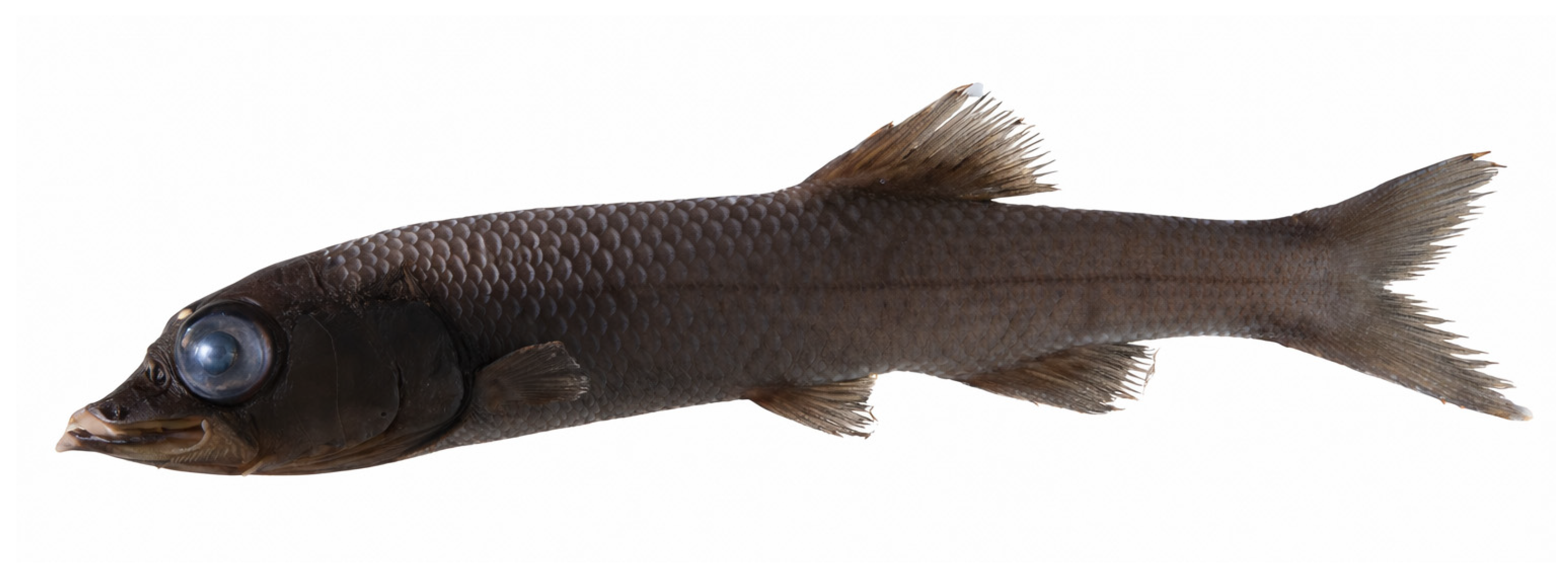
Specimens of B. burragei (Figure 1) were collected in May 2024 during a cruise aboard the R/V Sally Ride. A Tucker trawl with a 10-m2 mouth opening was towed horizontally at 1300 m depth in the Carmen Basin, Gulf of California, from 27°28.786′ N, 111°14.500′ W to 27°28.354′ N, 111°14.500′ W. The trawl was fitted with a MOCNESS piano-key system to open and close the trawl at depth [25], and the specimens were brought alive to the surface in a 30 L insulated cod end [26] that closed when the net was closed. Specimens were photographed and measured on the ship, and the tissue samples were excised from the caudal peduncle, flash-frozen in liquid nitrogen, transported on dry ice to the lab, and subsequently stored at −80 °C until sequenced.

2.2. DNA Extraction and Sequencing

For one specimen, high-quality mitochondrial reference genome sequencing was performed using PacBio HiFi technology [27]. DNA integrity was confirmed using a NanoDrop 2000, Qubit 3.0, and agarose gel electrophoresis prior to library preparation [28]. Libraries for PacBio HiFi sequencing were prepared using the SMRTbell Express Template Prep Kit 2.0 (Pacific Biosciences, Menlo Park, CA, USA) [29], following manufacturer-recommended protocols. The remaining three specimens were sequenced using Illumina PE150 technology [30], with libraries prepared using the NEBNext Ultra DNA Library Prep Kit (New England Biolabs, Ipswich, MA, USA) [31], also following manufacturer-recommended protocols. Quality control for these samples was performed using Qubit and Bioanalyzer 2100. DNA sequencing was carried out at CD Genomics (Shirley, New York, NY, USA). Sequencing reads were trimmed using fastp v0.23.1 [32], with default quality-filtering parameters and adapter trimming enabled, and quality-checked with FastQC v0.11.9 [33]. Reads were aligned to the reference genome using BWA [34] with default alignment parameters. Consensus sequences were generated using BCFtools v1.16 [35] following standard variant calling and consensus generation workflows with default settings. Annotations of mitochondrial genes were performed with MITOS2 v2.1.8 [36].

2.3. Sequence Data Analysis

Mitochondrial gene sequences of B. burragei were extracted from consensus mitochondrial assemblies using a custom Python pipeline (https://github.com/Jake-Church-13/sharpchin-slickhead-mtdna-pipeline, accessed on 2 February 2026) Gene coordinates were obtained from MITOS2 BED-formatted annotation files for four specimens. When multiple candidate annotations were present for a gene, the feature with the lowest e-value was retained. Sequences were extracted according to annotated strand orientation, reverse-complemented where necessary, and manually inspected to confirm correct gene boundaries and sequence integrity.
Homologous gene sequences were aligned using MAFFT v7 [37] with default settings. All alignments were manually checked to verify alignment quality and to exclude obvious annotation or alignment artifacts. Pairwise nucleotide sequence identity among specimens was calculated using global alignments implemented in Biopython v1.81 [38] and summarized for comparative analyses.

3. Results

3.1. Abundance

During a single Tucker trawl at 1300 m depth aboard the R/V Sally Ride, the volume of water sampled was ~8000 m3 of seawater. This trawl collected four B. burragei individuals, yielding an abundance of approximately one specimen per 2000 m3 (Table 1).

3.2. Mitochondrial Genome Assembly and Gene Count

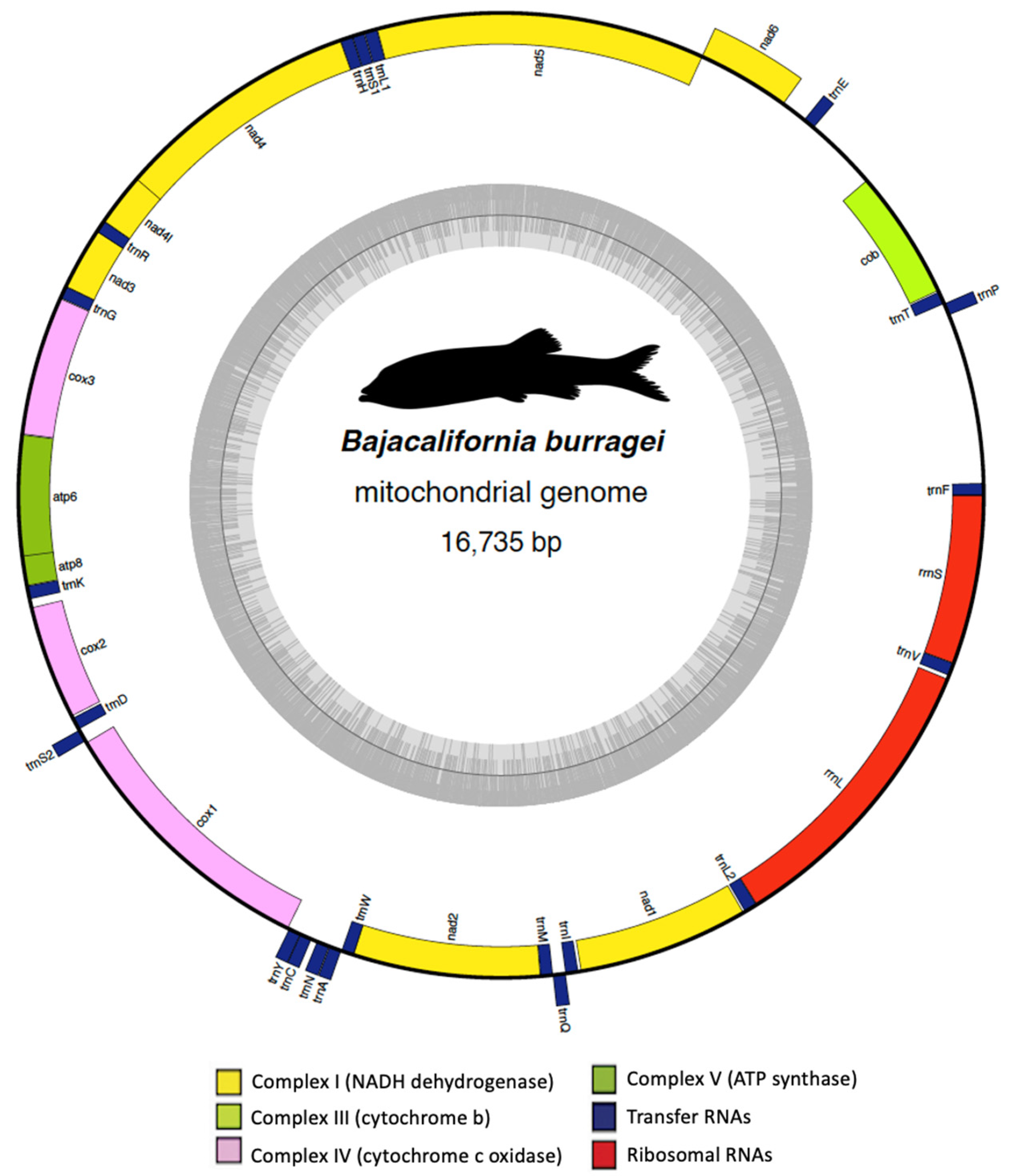
The complete mitochondrial genomes of all four Bajacalifornia burragei individuals were identical in length (16,735 bp) and exhibited nearly identical base compositions (Table 2). Nucleotide frequencies and AT and GC skew values varied only minimally among individuals, indicating very low mitochondrial variation within the Carmen Basin samples. Each genome contained the canonical 37 mitochondrial genes with identical order across specimens (Figure 2) [39]. No rearrangements or pseudogenes were observed. Coding regions were intact and exhibited the expected start and stop codons for teleost mitogenomes [39].

3.3. Mitogenomic Structure and Distribution of Sequence Variation

Throughout the Section 3, mitochondrial divergence is reported using three complementary metrics: (i) the proportion of variable sites across aligned sequences, which reflects the total number of polymorphic positions; (ii) uncorrected mean pairwise nucleotide divergence among individuals; and (iii) separate comparisons of the noncoding control region versus the combined coding and RNA genes.
Across the full alignment, approximately 140 variable sites were identified, representing ~0.84% of all positions. When summarized across all aligned sites, the average proportion of nucleotide differences among pairwise comparisons was lower, with values averaging 0.42% (range: 0.38–0.48%), corresponding to an overall pairwise sequence identity of 99.52–99.62% across all 37 mitochondrial genes (64–80 substitutions per comparison).
When partitioned by genomic region, mitochondrial variation was strongly concentrated in the putative control region located between trnF and trnP. This noncoding region spanned 951 bp and contained 22 variable sites (~2.31% of positions), yielding a nucleotide diversity (π) of 0.0117. In contrast, the remaining 15,784 bp of coding and RNA genes contained 118 variable sites (~0.75% of positions) and exhibited markedly lower nucleotide diversity (π ≈ 0.0038). These results indicate that the majority of mitochondrial variation within this Carmen Basin collection is localized to the control region, while the coding portion of the genome remains highly conserved.
Genome-wide mitochondrial divergence among individuals was low, with uncorrected pairwise distances ranging from approximately 0.21–0.29%. Two closely related mitochondrial haplotypes were recovered. One haplotype was shared by individuals GoC3 and GoC4, which were identical across all protein-coding genes. The second haplotype comprised GoC1 and GoC2 and differed from the first by a small number of synonymous substitutions. Overall, the observed patterns are consistent with strong mitogenomic conservation among B. burragei individuals.

3.4. Gene-by-Gene Sequence Identity

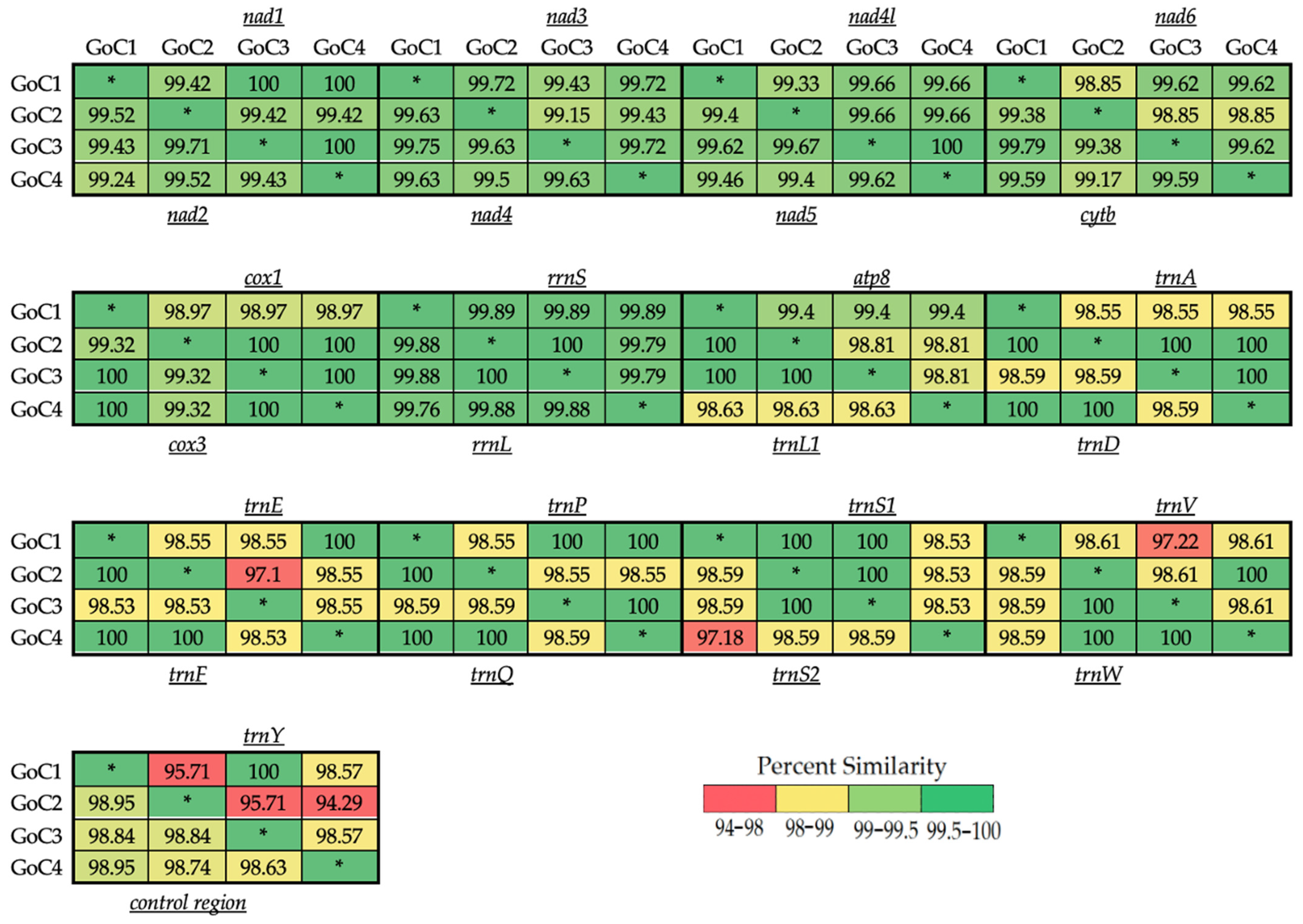
Pairwise comparisons revealed uniformly high mitochondrial identity among individuals (Mean ~99.76%). Across all 37 mitochondrial genes, most protein-coding genes exceeded 99.5% identity across all specimen pairs. Total variable sites across alignments were few, consistent with low nucleotide diversity within the specimens. Overall divergence was very low across most protein-coding, rRNA, and tRNA genes with modestly elevated variation observed in only a small subset of loci. These patterns are summarized in a heatmap of pairwise identity values for all genes (Figure 3).

4. Discussion

This study provides the first assessment of mitogenomic variation in Bajacalifornia burragei and reveals exceptionally low sequence divergence among four individuals collected simultaneously from the Carmen Basin of the Gulf of California. Mitogenomic identity exceeded 99.7% across all 37 genes, a level well within typical intraspecific values reported for marine teleosts [40] and substantially below the ~2% COI divergence often used for species delimitation in DNA barcoding studies [41]. These results establish a baseline for mitochondrial diversity in B. burragei and contribute to the limited genetic data available for bathypelagic fishes.
Patterns of mitochondrial gene conservation and variation were highly structured by gene class and consistent with expectations for teleost mitogenomes. Several protein-coding genes, including cox1, cox3, nad1, nad4l, and cytb, were exceptionally conserved (≥99.6–100% nucleotide pairwise identity), reflecting both a close relationship between specimens of the same species and strong functional constraints on OXPHOS pathways in deep-sea environments [42]. In contrast, modestly elevated variability in atp8 and nad6 mirrors their relatively higher evolutionary rates reported in other vertebrate mitogenomic studies [43] and was largely attributable to synonymous substitutions. Apparent divergence among several tRNA genes resulted from a small number of substitutions in short sequences rather than elevated absolute divergence, with many tRNAs, as well as atp6 and cox2, remaining completely invariant across all individuals. Consistent with previously published mitochondrial phylogenies of Alepocephaliformes [6], B. burragei groups with B. megalops, situating our results within established phylogenetic frameworks.
Two closely related mitochondrial haplotypes were detected among the four individuals, differing only by a small number of synonymous substitutions. Although the presence of more than one haplotype within a single trawl could, in principle, be viewed as relatively high diversity in low-density deep-sea systems, the extremely shallow divergence between haplotypes and the absence of nonsynonymous variation indicates limited maternal lineage differentiation within the sampled collection rather than elevated population-level genetic diversity. This pattern is consistent with low intraspecific mitogenomic divergence reported for other deep-sea and mesopelagic fishes [44,45]. Importantly, mitochondrial uniformity does not imply demographic panmixia or close kinship among individuals, as mitochondrial DNA reflects maternal lineage history only and population structure or pedigree relationships may be present at nuclear loci that are not detectable with mitochondrial data alone.
The demographic context of the sampled individuals provides important perspective on the observed mitogenomic uniformity; however, it does not support assignment to a single discrete cohort, nor does it imply that the sample represents population-level demographic structure. Although all specimens were collected in a single trawl at the same depth and locality, their size distribution corresponds to an inferred age range of approximately 0.5–2 years (Table 1), which is inconsistent with a narrowly defined recruitment event. Instead, this pattern aligns more closely with protracted or near-continuous spawning strategies that are increasingly recognized as common among deep-sea fishes, where reproductive seasonality is weak and cohorts overlap extensively [46]. Extended spawning periods lasting up to six months have been documented in the confamilial species Alepocephalus rostratus [47], supporting the interpretation that spatial groupings such as the one sampled here may represent temporally mixed cohorts rather than a single spawning event.
At broader spatial scales, low mitochondrial diversity in bathypelagic fishes may reflect intermittent connectivity among deep basins via larval dispersal or deep-water renewal events, as well as life-history traits such as slow growth, low metabolic rates, and long generation times that limit mutation accumulation [43]. Discriminating among these mechanisms will require expanded geographic sampling and incorporation of nuclear genomic markers.
Placing the magnitude of mitogenomic divergence observed in B. burragei in a broader comparative context indicates that overall divergence is low relative to many shallow-water teleosts, but consistent with values reported for deep-sea fishes. Mitogenome-wide divergence values in B. burragei (0.21–0.29%) and mean pairwise divergence across all sites (0.42%), which reflects inclusion of invariant and non-coding regions, fall below typical intraspecific mitochondrial divergence reported for coastal fishes, where values frequently exceed 0.5–1.0% even within single ocean basins [18,41].
Comparisons with gadiform fishes provide a useful contrast. The Atlantic cod, Gadus morhua, a highly dispersive coastal gadiform, exhibits substantially higher mitochondrial diversity than B. burragei, with reported nucleotide diversity values for mitochondrial coding regions commonly on the order of ~0.6–0.8% and pronounced haplotype diversity across the North Atlantic [48,49]. These values exceed those observed in B. burragei by more than twofold and are often accompanied by detectable population structure despite high dispersal potential. In contrast, similarly low mitochondrial divergence has been documented in bathypelagic and demersal deep-sea species [50,51], suggesting that reduced mitogenomic variation may be a common feature of fishes inhabiting energetically constrained deep environments rather than an anomaly unique to B. burragei.
Long-lived bathypelagic fishes such as orange roughy, Hoplostethus atlanticus, show mitochondrial divergence values more comparable to those observed here. Population-level studies of orange roughy have reported very shallow COI divergence, often <0.3–0.4% across large geographic ranges, despite clear evidence of demographic subdivision inferred from nuclear markers and life-history data [52,53]. These findings suggest that mitochondrial genomes in some deep-sea fishes may remain highly conserved even when population structure exists, potentially due to strong purifying selection on mitochondrial function combined with low effective population sizes. The genome-wide divergence observed in B. burragei (0.21–0.29%) falls squarely within this low-divergence envelope, reinforcing the interpretation that reduced mitochondrial variability may be characteristic of bathypelagic fishes with slow life histories.
Mesopelagic fishes further illustrate the range of possible outcomes. In myctophids, mitochondrial divergence spans a broad spectrum, from shallow divergence (<0.5%) indicative of high connectivity and panmixia to deep cryptic divergence exceeding 2–5%, reflecting species complexes rather than structured populations [44,45]. The divergence values observed in B. burragei lie at the low end of this spectrum and are more consistent with mesopelagic species exhibiting weak mitochondrial structure than with taxa characterized by cryptic diversification. This comparison underscores that low mitochondrial divergence alone does not imply ecological uniformity, but rather reflects the balance between dispersal, demography, and selective constraint.
At the level of individual mitochondrial genes, the distribution of variation in B. burragei further supports strong functional constraint on OXPHOS pathways. Genes encoding subunits of Complex I (nad genes) and Complex V (atp8) exhibit the lowest pairwise identity values in the dataset (minimum identities 98.81–98.85%), consistent with their relatively higher evolutionary rates across vertebrate mitogenomes [18,39]. In contrast, genes associated with Complex III (cytb) and Complex IV (cox genes) remain highly conserved overall, although detectable variation in cox1 and cox3 indicates that constraint does not fully eliminate intraspecific polymorphism. The absence of nonsynonymous substitutions across all protein-coding genes is consistent with strong purifying selection acting on mitochondrial function, although this inference is indirect and based on observed sequence conservation rather than formal dN/dS analyses, with amino acid–altering mutations apparently constrained while limited synonymous variation accumulates. Similar patterns have been reported in comparative mitogenomic studies of deep-sea fishes and are consistent with long-term stabilizing selection on aerobic metabolism under chronic energetic limitation [14,54].
Oceanographic processes within the Gulf of California offer a plausible, though speculative, framework for the maintenance of low mitochondrial divergence in bathypelagic fishes. The Gulf consists of a series of deep basins separated by submarine sills but linked by complex circulation patterns, including seasonal current reversals, mesoscale eddies, and periodic deep-water renewal events [55,56]. These processes may facilitate episodic basin-scale connectivity over evolutionary timescales, enabling mitochondrial lineages to remain homogenized even if dispersal events are rare. Under such a regime, mitochondrial uniformity could arise through a combination of demographic connectivity and strong selective constraint rather than continuous gene flow alone.

5. Conclusions

The mitogenomic uniformity documented here indicates that individuals within the Carmen Basin collection sampled share highly conserved mitochondrial genomes. Given the limited sample size and single-trawl capture, these findings should be interpreted as a localized snapshot rather than a comprehensive representation of mitochondrial diversity across the species. While population connectivity beyond this basin cannot be resolved from the present data, the low divergence observed across the mitochondrial genome is consistent with patterns reported for other bathypelagic fishes and may reflect a possible combination of demographic history, episodic dispersal processes, and strong purifying selection on genes central to aerobic metabolism. This study establishes a robust baseline for future comparative analyses and sets the stage for testing hypotheses regarding mitochondrial conservation and deep-sea adaptation using expanded sampling, nuclear genomic data, and functional approaches. Global syntheses of genetic diversity in marine fishes have quantified strong geographic and temperature/productivity associations for mitochondrial diversity [57]; however, comparable studies examining mitochondrial diversity as a function of depth remain to be performed.

Author Contributions

Conceptualization, J.W.C. and E.V.T.; methodology, J.W.C. and E.V.T.; software, J.W.C.; validation, J.W.C., B.A.S. and E.V.T.; formal analysis, J.W.C.; investigation, J.W.C. and E.V.T.; resources, B.A.S. and E.V.T.; writing—original draft preparation, J.W.C.; writing—review and editing, J.W.C., B.A.S. and E.V.T.; visualization, J.W.C.; supervision, B.A.S. and E.V.T.; project administration, J.W.C.; funding acquisition, J.W.C., B.A.S. and E.V.T. All authors have read and agreed to the published version of the manuscript.

Funding

This research was funded by NSF Grant OCE-2127538 to B.A.S. and a Summer Undergraduate Research Fellowship awarded to J.W.C. from The Evergreen State College Foundation.

Institutional Review Board Statement

The animal study protocol was approved by the Institutional Animal Care and Use Committee of the University of South Florida (protocol #IS00009681 and approval date: 11 August 2021).

Data Availability Statement

The mitochondrial genomes were deposited in the European Nucleotide Archive (ENA) under Study PRJEB107684, with assembly accessions GCA_978802825 (GoC1), GCA_978979735 (GoC2), GCA_978832235 (GoC3), and GCA_978812665 (GoC4). All code and pipelines used can be accessed at https://github.com/Jake-Church-13/sharpchin-slickhead-mtdna-pipeline (accessed on 2 February 2026).

Acknowledgments

We thank the captain, crew, and scientific party of the R/V Sally Ride for their invaluable assistance during sample collection. We are grateful to Steve Haddock for assistance with photography and for insightful comments that improved the manuscript. We also thank Bruce Robison for his efforts in reviewing archived laboratory notebooks to obtain historical capture-depth information. We further acknowledge Daniel Cygnar, Jenna Nelson, Joseph Stevick, and Shay Helligso for their assistance throughout the project, and the team at CD Genomics for their expertise and support with DNA sequencing. We thank the three anonymous reviewers for their thoughtful and constructive comments, which greatly improved the clarity and overall quality of this manuscript.

Conflicts of Interest

The authors declare no conflicts of interest.

Abbreviations

The following abbreviations are used in this manuscript:
bpBase Pair
GoCGulf of California
OXPHOSOxidative Phosphorylation

References

  1. Robison, B.H. Distribution of the midwater fishes of the Gulf of California. Copeia 1972, 1972, 448–461. [Google Scholar] [CrossRef]
  2. Robison, B.H. (Monterey Bay Aquarium Research Institute, Moss Landing, CA, USA). Email communication, 2025.
  3. Torres, J.J.; Belman, B.W.; Childress, J.J. Oxygen consumption rates of midwater fishes as a function of depth of occurrence. Deep Sea Res. Part A 1979, 26, 185–197. [Google Scholar] [CrossRef]
  4. Childress, J.J.; Somero, G.N. Depth-related enzymatic activities in muscle, brain and heart of deep-living pelagic marine teleost. Mar. Biol. 1979, 52, 273–283. [Google Scholar] [CrossRef]
  5. Childress, J.J.; Taylor, S.M.; Cailliet, G.M.; Price, M.H. Patterns of growth, energy utilization and reproduction in some meso- and bathypelagic fishes off Southern California. Mar. Biol. 1980, 61, 27–40. [Google Scholar] [CrossRef]
  6. Lavoué, S.; Miya, M.; Poulsen, J.Y.; Møller, P.R.; Nishida, M. Monophyly, phylogenetic position and inter-familial relationships of the Alepocephaliformes (Teleostei) based on whole mitogenome sequences. Mol. Phylogenetics Evol. 2008, 47, 1111–1121. [Google Scholar] [CrossRef]
  7. Poulsen, J.Y.; Møller, P.R.; Lavoué, S.; Knudsen, S.W.; Nishida, M.; Miya, M. Higher and lower-level relationships of the deep-sea fish order Alepocephaliformes (Teleostei: Otocephala) inferred from whole mitogenome sequences: Relationships of Alepocephaliformes. Biol. J. Linn. Soc. 2009, 98, 923–936. [Google Scholar] [CrossRef]
  8. Vrijenhoek, R.C. Genetic diversity and connectivity of deep-sea hydrothermal vent metapopulations: Hydrothermal vent metapopulations. Mol. Ecol. 2010, 19, 4391–4411. [Google Scholar] [CrossRef]
  9. Etter, R.J.; Rex, M.A.; Chase, M.R.; Quattro, J.M. Population differentiation decreases with depth in deep-sea bivalves. Evolution 2005, 59, 1479–1491. [Google Scholar] [CrossRef]
  10. Avise, J.C. Phylogeography: The History and Formation of Species; Harvard University Press: Cambridge, MA, USA, 2000. [Google Scholar]
  11. Ballard, J.W.; Whitlock, M.C. The incomplete natural history of mitochondria. Mol. Ecol. 2004, 13, 729–744. [Google Scholar] [CrossRef]
  12. Maduna, S.N.; Vivian-Smith, A.; Jónsdóttir, Ó.D.B.; Imsland, A.K.D.; Klütsch, C.F.C.; Nyman, T.; Eiken, H.G.; Hagen, S.B. Mitogenomics of the suborder Cottoidei (Teleostei: Perciformes): Improved assemblies, mitogenome features, phylogeny, and ecological implications. Genomics 2022, 114, 110297. [Google Scholar] [CrossRef]
  13. Strohm, J.H.T.; Gwiazdowski, R.A.; Hanner, R. Fast fish face fewer mitochondrial mutations: Patterns of dN/dS across fish mitogenomes. Gene 2015, 572, 27–34. [Google Scholar] [CrossRef] [PubMed]
  14. Shen, X.; Pu, Z.; Chen, X.; Murphy, R.W.; Shen, Y. Convergent evolution of mitochondrial genes in deep-sea fishes. Front. Genet. 2019, 10, 925. [Google Scholar] [CrossRef]
  15. Papetti, C.; Babbucci, M.; Dettai, A.; Basso, A.; Lucassen, M.; Harms, L.; Bonillo, C.; Heindler, F.M.; Patarnello, T.; Negrisolo, E. Not Frozen in the Ice: Large and dynamic rearrangements in the mitochondrial genomes of the Antarctic fish. Genome Biol. Evol. 2021, 13, evab017. [Google Scholar] [CrossRef]
  16. Minhas, B.F.; Beck, E.A.; Cheng, C.H.C.; Catchen, J. Novel mitochondrial genome rearrangements including duplications and extensive heteroplasmy could underlie temperature adaptations in Antarctic notothenioid fishes. Sci. Rep. 2023, 13, 6939. [Google Scholar] [CrossRef]
  17. Mukundan, L.P.; Sukumaran, S.; Raj, N.; Jose, A.; Gopalakrishnan, A. Positive selection in the mitochondrial protein coding genes of teleost regional endotherms: Evidence for adaptive evolution. J. Mar. Biol. Ass. India 2022, 64, 10–18. [Google Scholar] [CrossRef]
  18. Galtier, N.; Nabholz, B.; Glémin, S.; Hurst, G.D.D. Mitochondrial DNA as a marker of molecular diversity: A reappraisal. Mol. Ecol. 2009, 18, 4541–4550. [Google Scholar] [CrossRef]
  19. Whitehead, A. Comparative mitochondrial genomics within and among species of killifish. BMC Evol. Biol. 2009, 9, 11. [Google Scholar] [CrossRef]
  20. Abo-Raya, M.H.; Ke, J.; Wang, J.; Wang, C. Comparative analyses reveal potential genetic variations in hypoxia- and mitochondria-related genes among six strains of Common Carp Cyprinus carpio. Fishes 2025, 10, 509. [Google Scholar] [CrossRef]
  21. Flight, P.A.; Nacci, D.; Champlin, D.; Whitehead, A.; Rand, D.M. The effects of mitochondrial genotype on hypoxic survival and gene expression in a hybrid population of the killifish, Fundulus heteroclitus: Mitochondrial effects and hypoxia in killifish. Mol. Ecol. 2011, 20, 4503–4520. [Google Scholar] [CrossRef] [PubMed]
  22. Li, Y.; Ren, Z.; Shedlock, A.M.; Wu, J.; Sang, L.; Tersing, T.; Hasegawa, M.; Yonezawa, T.; Zhong, Y. High altitude adaptation of the schizothoracine fishes (Cyprinidae) revealed by the mitochondrial genome analyses. Gene 2013, 517, 169–178. [Google Scholar] [CrossRef] [PubMed]
  23. Xu, S.; Luosang, J.; Hua, S.; He, J.; Ciren, A.; Wang, W.; Tong, X.; Liang, Y.; Wang, J.; Zheng, X. High altitude adaptation and phylogenetic analysis of Tibetan horse based on the mitochondrial genome. J. Genet. Genom. 2007, 34, 720–729. [Google Scholar] [CrossRef] [PubMed]
  24. Seibel, B.A.; Birk, M.A. Unique thermal sensitivity imposes a cold-water energetic barrier for vertical migrators. Nat. Clim. Change 2022, 12, 1052–1058. [Google Scholar] [CrossRef]
  25. Hetherington, E.D.; Choy, C.A.; Thuesen, E.V.; Haddock, S.H.D. Three distinct views of deep pelagic community composition based on complementary sampling approaches. Front. Mar. Sci. 2022, 9, 864004. [Google Scholar] [CrossRef]
  26. Childress, J.J.; Barnes, A.T.; Quetin, L.B.; Robison, B.H. Thermally protecting cod ends for the recovery of living deep-sea animals. Deep Sea Res. 1978, 25, 419–422. [Google Scholar] [CrossRef]
  27. Karin, B.R.; Arellano, S.; Wang, L.; Walzer, K.; Pomerantz, A.; Vasquez, J.M.; Chatla, K.; Sudmant, P.H.; Bach, B.H.; Smith, L.L.; et al. Highly-multiplexed and efficient long-amplicon PacBio and Nanopore sequencing of hundreds of full mitochondrial genomes. BMC Genom. 2023, 24, 229. [Google Scholar] [CrossRef]
  28. Bruijns, B.; Hoekema, T.; Oomens, L.; Tiggelaar, R.; Gardeniers, H. Performance of spectrophotometric and fluorometric DNA quantification methods. Analytica 2022, 3, 371–384. [Google Scholar] [CrossRef]
  29. Hon, T.; Mars, K.; Young, G.; Tsai, Y.C.; Karalius, J.W.; Landolin, J.M.; Maurer, N.; Kudrna, D.; Hardigan, M.A.; Steiner, C.C.; et al. Highly accurate long-read HiFi sequencing data for five complex genomes. Sci. Data 2020, 7, 399. [Google Scholar] [CrossRef]
  30. Zhang, J.; Kobert, K.; Flouri, T.; Stamatakis, A. PEAR: A fast and accurate Illumina Paired-End reAd mergeR. Bioinformatics 2014, 30, 614–620. [Google Scholar] [CrossRef]
  31. Liu, N. Library Prep for CUT&RUN with NEBNext® UltraTM II DNA Library Prep Kit for Illumina® (E7645) v1. 2019 protocols.io. Available online: https://www.protocols.io/view/library-prep-for-cut-amp-run-with-nebnext-ultra-ii-kxygxm7pkl8j/v1 (accessed on 2 February 2026).
  32. Chen, S.; Zhou, Y.; Chen, Y.; Gu, J. fastp: An ultra-fast all-in-one FASTQ preprocessor. Bioinformatics 2018, 34, i884–i890. [Google Scholar] [CrossRef]
  33. Leggett, R.M.; Ramirez-Gonzalez, R.H.; Clavijo, B.J.; Waite, D.; Davey, R.P. Sequencing quality assessment tools to enable data-driven informatics for high throughput genomics. Front. Genet. 2013, 4, 288. [Google Scholar] [CrossRef]
  34. Li, H.; Durbin, R. Fast and accurate short read alignment with Burrows–Wheeler transform. Bioinformatics 2009, 25, 1754–1760. [Google Scholar] [CrossRef] [PubMed]
  35. Li, H. A statistical framework for SNP calling, mutation discovery, association mapping and population genetical parameter estimation from sequencing data. Bioinformatics 2011, 27, 2987–2993. [Google Scholar] [CrossRef]
  36. Bernt, M.; Donath, A.; Jühling, F.; Externbrink, F.; Florentz, C.; Fritzsch, G.; Pütz, J.; Middendorf, M.; Stadler, P.F. MITOS: Improved de novo metazoan mitochondrial genome annotation. Mol. Phylogenetics Evol. 2013, 69, 313–319. [Google Scholar] [CrossRef] [PubMed]
  37. Katoh, K.; Standley, D.M. MAFFT multiple sequence alignment software version 7: Improvements in performance and usability. Mol. Biol. Evol. 2013, 30, 772–780. [Google Scholar] [CrossRef]
  38. Cock, P.J.A.; Antao, T.; Chang, J.T.; Chapman, B.A.; Cox, C.J.; Dalke, A.; Friedberg, I.; Hamelryck, T.; Kauff, F.; Wilczynski, B.; et al. Biopython: Freely available Python tools for computational molecular biology and bioinformatics. Bioinformatics 2009, 25, 1422–1423. [Google Scholar] [CrossRef]
  39. Satoh, T.P.; Miya, M.; Mabuchi, K.; Nishida, M. Structure and variation of the mitochondrial genome of fishes. BMC Genom. 2016, 17, 719. [Google Scholar] [CrossRef] [PubMed]
  40. Panprommin, D.; Soontornprasit, K.; Tuncharoen, S.; Pithakpol, S.; Kannika, K.; Wongta, K. DNA barcoding for fish species identification and diversity assessment in the Mae Tam reservoir, Thailand. Fish. Aquat. Sci. 2023, 26, 548–557. [Google Scholar] [CrossRef]
  41. Hebert, P.D.N.; Ratnasingham, S.; De Waard, J.R. Barcoding animal life: Cytochrome c oxidase subunit 1 divergences among closely related species. Proc. R. Soc. Lond. B 2003, 270, S96–S99. [Google Scholar] [CrossRef]
  42. Guderley, H. Metabolic responses to low temperature in fish muscle. Biol. Rev. 2007, 79, 409–427. [Google Scholar] [CrossRef]
  43. Mthethwa, S.; Bester-van Der Merwe, A.; Roodt-Wilding, R. The complete mitochondrial genome of the South African snoek Thyrsites atun (Euphrasén, 1791) (Perciformes, Gempylidae). Mitochondrial DNA Part B 2023, 8, 288–291. [Google Scholar] [CrossRef]
  44. Sarropoulou, X.; Tsaparis, D.; Tsagarakis, K.; Badouvas, N.; Tsigenopoulos, C.S. Different patterns of population structure and genetic diversity of three mesopelagic fishes in the Greek Seas. Medit. Mar. Sci. 2022, 23, 536–545. [Google Scholar] [CrossRef]
  45. dos Santos, L.F.; Pontes, A.I.; Nunes, D.B.; Farias, M.C.; dos Santos, D.M.; Jacobina, U.P. Seven species in one? DNA barcoding reveals high cryptic diversity in Ceratoscopelus warmingii (Myctophiformes, Myctophidae) a circumglobal mesopelagic species. Thalass. Int. J. Mar. Sci. 2024, 40, 1031–1040. [Google Scholar] [CrossRef]
  46. Fernandez-Arcaya, U.; Rotllant, G.; Ramirez-Llodra, E.; Recasens, L.; Aguzzi, J.; Flexas, M.M.; Sanchez-Vidal, A.; López-Fernández, P.; García, J.; Company, J.B. Reproductive biology and recruitment of the deep-sea fish community from the NW Mediterranean continental margin. Prog. Oceanogr. 2013, 118, 222–234. [Google Scholar] [CrossRef]
  47. Follesa, M.C.; Porcu, C.; Cabiddu, S.; Davini, M.A.; Sabatini, A.; Cau, A. First observations on the reproduction of Alepocephalus rostratus Risso, 1820 (Osteichthyes, Alepocephalidae) from the Sardinian Channel (Central-Western Mediterranean). Mar. Ecol. 2007, 28, 75–81. [Google Scholar] [CrossRef]
  48. Árnason, E. Mitochondrial cytochrome b DNA variation in the high-fecundity Atlantic cod: Trans-Atlantic clines and shallow gene genealogy. Genetics 2004, 166, 1871–1885. [Google Scholar] [CrossRef] [PubMed]
  49. Martínez-García, L.; Sodeland, M.; McGinnity, P.; Coughlan, J.; Consuegra, S.; Rogan, E.; Cross, T.F.; Carlsson, J. Mitogenomic variation in ancient and modern Atlantic cod. Front. Ecol. Evol. 2022, 9, 671281. [Google Scholar]
  50. Smith, P.J.; Gaffney, P.M. Low genetic diversity in the Antarctic Toothfish (Dissostichus mawsoni) observed with mitochondrial and intron DNA markers. Ccamlr Sci. 2005, 12, 43–51. [Google Scholar]
  51. Von Der Heyden, S.; Lipinski, M.R.; Matthee, C.A. Remarkably low mtDNA control region diversity in an abundant demersal fish. Mol. Phylo. Evol. 2010, 55, 1183–1188. [Google Scholar] [CrossRef]
  52. Smith, P.J.; Benson, P.G.; McVeagh, S.M. A comparison of three genetic methods used for stock discrimination of orange roughy, Hoplostethus atlanticus: Allozymes, mitochondrial DNA, and random amplified polymorphic DNA. Fish. Bull. 1997, 95, 800–811. [Google Scholar]
  53. Elliott, N.G.; Smolenski, A.J.; Ward, R.D. Allozyme and mitochondrial DNA variation in orange roughy, Hoplostethus atlanticus (Teleostei: Trachichthyidae): Little differentiation between Australian and North Atlantic populations. Mar. Biol. 1994, 119, 621–627. [Google Scholar] [CrossRef]
  54. Xu, H.; Fang, C.; Xu, W.; Wang, C.; Song, Y.; Zhu, C.; Fang, W.; Fan, G.; Lv, W.; Bo, J.; et al. Evolution and genetic adaptation of fishes to the deep sea. Cell 2025, 188, 1393–1408. [Google Scholar] [CrossRef] [PubMed]
  55. Marinone, S.G. A three-dimensional model of the circulation in the Gulf of California. J. Geophys. Res. Oceans 2003, 108, 3325. [Google Scholar] [CrossRef]
  56. Ripa, P. Seasonal circulation in the Gulf of California. Ann. Geophys. 1990, 8, 559–563. [Google Scholar]
  57. Clark, R.D.; Pinsky, M.L. Global patterns of nuclear and mitochondrial genetic diversity in marine fishes. Ecol. Evol. 2024, 14, e11365. [Google Scholar] [CrossRef]
Figure 1. The sharpchin slickhead, Bajacalifornia burragei, from the Carmen Basin, Gulf of California, representing the individuals whose mitochondrial genomes were sequenced in this study (photograph by S.H.D. Haddock and J.W. Church).
Fishes 11 00113 g001
Figure 2. Circular map of Bajacalifornia burragei mitochondrial genome (16,735 bp). Protein-coding genes are shown and color-coded by oxidative phosphorylation complex (Complex I–IV and ATP synthase), with ribosomal RNA (rRNA) genes, transfer RNAs (tRNAs), and other annotated features indicated. The inner gray concentric rings represent nucleotide composition variation across the mitochondrial genome, illustrating relative base composition (AT/GC content) in sliding windows along the circular molecule.
Fishes 11 00113 g002
Figure 3. Identity comparisons for 25 genes in the mitochondrial genomes of four individuals of the Sharpchin Slickhead, Bajacalifornia burragei. For each bold rectangle, the upper-right triangle corresponds to the underlined gene listed above the rectangle, and the lower-left triangle corresponds to the underlined gene listed below the rectangle. A heatmap scale is shown where green represents higher sequence similarity (approaching 100%) and red denotes lower similarity (greater sequence divergence). Asterisks (*) indicate the main diagonal of each matrix, where identity values are 100%. Twelve genes (trnH, trnR, trnG, atp6, trnK, cox2, trnC, trnN, trnM, trnI, trnL2, and trnT) have 100% identity comparisons across every combination of specimens (not shown).
Fishes 11 00113 g003
Table 1. Specimen information for Bajacalifornia burragei individuals collected from the Gulf of California, including accession number, total length, and morphological characteristics. Approximate ages were inferred from total length using published growth parameters [5].
SpecimenAccession NumberTotal Length (cm)Age (Years)Gill Rakers
GoC1GCA_97880282516.21.5–234
GoC2GCA_97897973514.91–1.532
GoC3GCA_97883223513.10.8–133
GoC4GCA_97881266511.60.5–0.832
Table 2. Summary statistics for the mitochondrial genomes of four individuals of Bajacalifornia burragei.
SpecimenGenome Length (bp)Base Composition
%A, %T, %G, %C, AT%, GC%
AT SkewGC Skew
GoC116,73523.14, 26.79, 32.93, 17.14, 49.93, 50.07−0.07310.3154
GoC216,73523.14, 26.70, 32.96, 17.20, 49.84, 50.16−0.07170.3142
GoC316,73523.14, 26.79, 32.94, 17.13, 49.93, 50.07−0.07310.3157
GoC416,73523.13, 26.74, 32.94, 17.19, 49.87, 50.13−0.07230.3141
Disclaimer/Publisher’s Note: The statements, opinions and data contained in all publications are solely those of the individual author(s) and contributor(s) and not of MDPI and/or the editor(s). MDPI and/or the editor(s) disclaim responsibility for any injury to people or property resulting from any ideas, methods, instructions or products referred to in the content.