Next Article in Journal
Reply to Wang, L.; Fan, B. Golden Pompano in China Is Trachinotus anak, Not T. ovatus. Comment on “Li et al. DNA Barcode and Correct Scientific Name of Golden Pompano, an Important Marine Aquaculture Fish Species in China. Fishes 2025, 10, 129”
Previous Article in Journal
Phage-Based Approaches for Potential Integration into Bivalve Depuration Systems
 
 
Reply published on 9 February 2026, see Fishes 2026, 11(2), 105.
Comment

Golden Pompano in China Is Trachinotus anak, Not T. ovatus. Comment on Li et al. DNA Barcode and Correct Scientific Name of Golden Pompano, an Important Marine Aquaculture Fish Species in China. Fishes 2025, 10, 129


1
Molecular Population Genetics Group, Temasek Life Sciences Laboratory, Singapore 117604, Singapore
2
Department of Food and Environmental Engineering, Yangjiang Polytechnic, Yangjiang 529500, China
3
Yangjiang Haina Fisheries Co., Ltd., Yangjiang 529500, China
*
Authors to whom correspondence should be addressed.
Fishes 2026, 11(2), 104; https://doi.org/10.3390/fishes11020104
Submission received: 20 October 2025 / Revised: 16 December 2025 / Accepted: 2 February 2026 / Published: 9 February 2026

Abstract

The golden pompano is one of the most economically important marine fish species in Asia-Pacific aquaculture industry. Yet its taxonomic identity has long been obscured, with Trachinotus ovatus, T. blochii, T. mookalee, and T. anak used interchangeably in the literature and industry. This ambiguity hinders effective communication in science, management, and international trade. A recent study argued that the golden pompano should be named T. ovatus, a designation already firmly established for an eastern Atlantic–Mediterranean species. Here, we critically reassess nomenclatural history, geographical distribution, and available morphological and molecular evidence. Our review demonstrates that the fish cultured as golden pompano in China is not T. ovatus, but rather the Asia-Pacific species Trachinotus anak. We therefore propose that the use of T. ovatus for golden pompano is taxonomically incorrect, and recommend that T. anak be adopted consistently to ensure accuracy in research, breeding, and trade.

Golden pompano, a marine fish of the genus Trachinotus (family Carangidae), is widely farmed along China’s southern coast and represents a cornerstone of the country’s marine aquaculture industry [1]. Despite its commercial significance, the species’ taxonomic identity remains ambiguous [2,3,4]. Over time, four scientific names: Trachinotus ovatus (Linnaeus, 1758), T. blochii (Lacépède, 1801), T. mookalee (Cuvier, 1832), and T. anak (Ogilby, 1909), have been used in the literature, predominantly by Chinese researchers, to refer to what appears to be the same cultured species, as reviewed by Li et al. [2] and Shadrin et al. [4]. Notably, most published Chinese studies have identified golden pompano as T. ovatus, as reviewed by Shadrin et al. [4]. This nomenclatural confusion has hampered effective communication among researchers, resource managers, industry stakeholders, and policymakers. It also poses a growing challenge for taxonomic research, as genetic data for golden pompano continue to be deposited in public repositories such as GenBank under conflicting species names: T. ovatus, T. blochii, and T. anak [2,3,4,5,6,7].
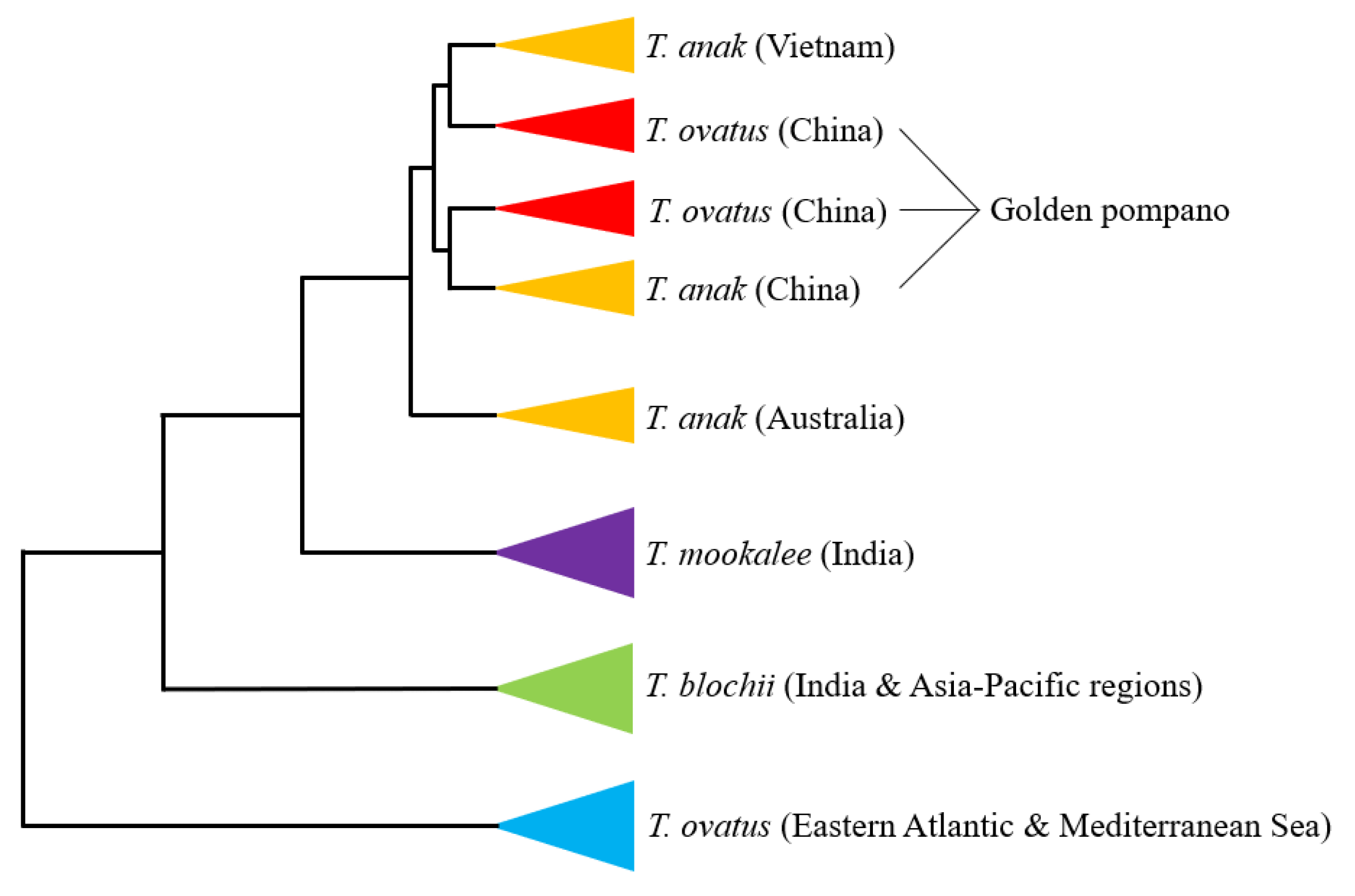
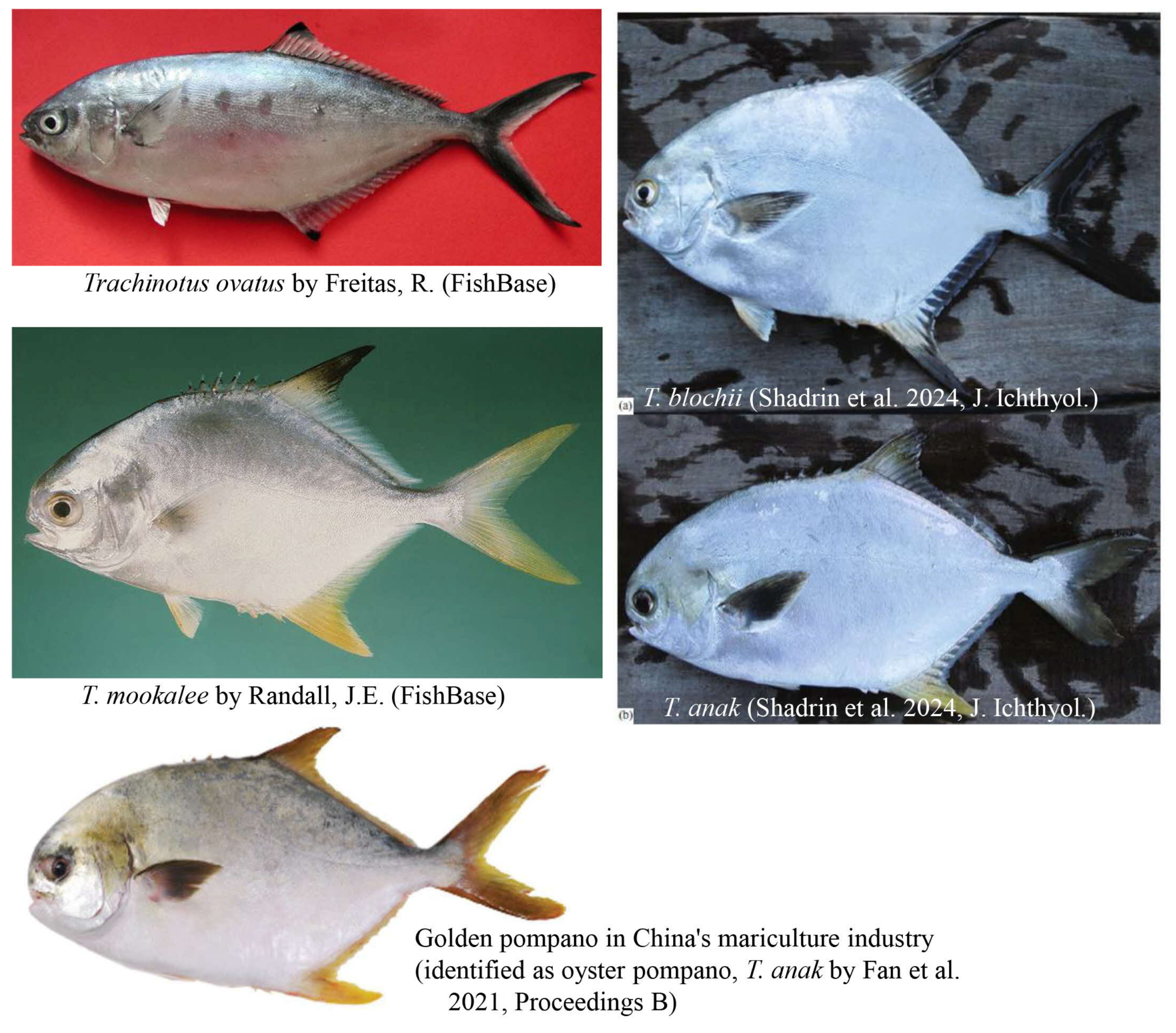
Recent taxonomic studies concur that the golden pompano farmed in China represents a single species, identified either as T. ovatus or T. anak (Figure 1) [2,4,5]. In contrast, T. blochii and T. mookalee are valid species that are both phylogenetically and morphologically distinct from golden pompano (Figure 2) [2,4]. Consequently, the current debate centers exclusively on whether the correct scientific name is T. ovatus or T. anak, which are recognized under the prevailing taxonomic framework as separate species differing markedly in morphology and geographic distribution.
However, a recent molecular study controversially proposed that golden pompano should be classified as T. ovatus, primarily based on historical usage and genetic clustering [2]. It is likely that their comparative dataset, which relied largely on COI barcoding, included misidentified Asia-Pacific sequences labelled as “T. ovatus”. Notably, T. ovatus is already well established by the global scientific community as the valid name for a species native to the eastern Atlantic and Mediterranean, and it exhibits a deep COI sequence divergence of ~12.8% from T. anak [4]. We argue that the conclusion by Li et al. [2] is taxonomically inconsistent and potentially misleading, as it conflates two species that differ markedly in both morphology and geographic distribution.
The central question is clear: which species truly bears the name T. ovatus, the eastern Atlantic–Mediterranean species, or the golden pompano cultivated in China? To resolve this, it is necessary to revisit the nomenclatural history of both T. ovatus and T. anak, and to examine the origins of name usage in Chinese literature. In this study, we critically review historical, morphological, and molecular evidence, and conclude that the species farmed as golden pompano in Chinese mariculture corresponds to the Asia–Pacific oyster pompano, Trachinotus anak (Ogilby, 1909), rather than the eastern Atlantic–Mediterranean T. ovatus (Linnaeus, 1758).

1. The Nomenclature History of Trachinotus ovatus

Trachinotus ovatus was originally described by Carl Linnaeus in 1758 as Gasterosteus ovatus in the 10th edition of Systema Naturae [10]. Linnaeus listed the habitat as “Habitat in Afia,” which modern taxonomists, including those referenced in Eschmeyer’s Catalog of Fishes, now consider probably an error for eastern Atlantic (not Asia) [11]. The species is now recognized as native to the eastern Atlantic Ocean and the Mediterranean Sea [11]. In 1801, Lacepède reassigned the species to the genus Trachinotus, establishing the valid name Trachinotus ovatus [12]. Throughout the 19th century, numerous additional names were applied to what is now recognized as the same species, as summarized in the World Register of Marine Species database (WoRMS) [13], Eschmeyer’s Catalog of Fishes [11], and FishBase [14]. Notably, approximately ten species names originally described by Cuvier and Valenciennes in Histoire Naturelle des Poissons [15] have since been suggested to refer to the single Atlantic–Mediterranean species, T. ovatus [16]. Type specimens for these names were collected throughout the Atlantic and Mediterranean, including Ascension Island, Cape Verde, Guinea, and the Mediterranean Sea. One exception is Centronotus ovalis [12], which was originally reported from Asian waters [11,12]. Subsequent taxonomic studies, however, corrected this error and synonymized C. ovalis with Trachinotus ovatus (Linnaeus, 1758) [17,18].
Significant contributions to clarifying Carangidae taxonomy, particularly within Trachinotus, were made by W. F. Smith-Vaniz and colleagues during the 1980s and 1990s. Their taxonomic revisions firmly established the identity and classification of T. ovatus [18,19,20]. More recently, Bariche and Fricke [21] and Kovačić, et al. [22] reviewed historical records and museum specimens, confirming that Trachinotus ovatus (Linnaeus, 1758) correctly refers to the species occurring in the eastern Mediterranean. These studies have further consolidated the nomenclature and refined understanding of the species’ geographic distribution.
Notably, as early as the mid-19th century, taxonomists suspected that two distinct species were being conflated under the name Trachinotus ovatus. Gill [23] noted that it remained unclear whether the American and Asiatic forms represented the same species. Similarly, Günther [16] and Day [24] described the Asiatic form, particularly from the Indian Ocean, as distinct from the Atlantic form. These Asiatic specimens likely correspond to what is now recognized as Trachinotus blochii [16,25]. At the time, taxonomists were beginning to realize that T. ovatus was not distributed across the Atlantic, Indian, and Pacific Oceans as previously assumed. This recognition prompted the reassignment of misidentified specimens to other valid species within the genus. It is important to note that 19th-century taxonomy of Trachinotus was still in its early stages, and the morphological similarity among species frequently led to misidentifications.
Today, there is broad consensus among modern taxonomists that Trachinotus ovatus (Linnaeus, 1758) is a valid species confined to the Atlantic Ocean and Mediterranean Sea. It is distinguished by a deep, oval body and characteristic black spots along the lateral line (Figure 2). This taxonomic designation has been reinforced by extensive morphological and systematic studies and is firmly established in the scientific literature. Leading international databases and organizations, including FishBase, FAO, WoRMS, Eschmeyer’s Catalog of Fishes, the Global Biodiversity Information Facility (GBIF), and the NCBI Taxonomy Browser, consistently recognize T. ovatus as the Atlantic–Mediterranean species. This consensus reflects over two centuries of taxonomic refinement and confirms T. ovatus as a well-defined member of the family Carangidae.

2. The Nomenclature History of Trachinotus anak

Trachinotus anak was first described by James Douglas Ogilby in 1909 [26], based on specimens collected from deep waters off Moreton Bay and the Great Sandy Strait in Queensland, Australia. Ogilby assigned the species to the genus Trachinotus, and the name T. anak has since been consistently recognized as valid by numerous ichthyological authorities. The species is distributed across the Western Pacific, including eastern and northern Australia, the South China Sea, and southern Japan. Morphologically, T. anak can be distinguished from its close relative T. blochii by its relatively shorter dorsal and caudal fins, key diagnostic features for species identification (Figure 2). The key diagnostic differences between T. ovatus and T. anak are even clearer: T. ovatus exhibits lateral-line black spots and a deeper body, whereas T. anak is characterized by shorter dorsal and caudal fins and the absence of such spots (Figure 2).

3. The Nomenclature History of Golden Pompano in China’s Mariculture

The earliest recorded application of the name Trachinotus ovatus (Linnaeus, 1758) to a fish species in the Asia-Pacific region dates back to the 1930s, when Henry W. Fowler referenced it in his work on the fishes of China and Japan [27]. Fowler described the fish as “oblong ovate, silvery white, with little yellow below”, a characterization that differs notably from the Atlantic–Mediterranean T. ovatus (Figure 2).
The first appearance of T. ovatus in the Chinese-language literature is found in the landmark volume Fishes of the South China Sea, published in 1962 [28]. Since then, most Chinese studies on golden pompano have continued to use the name T. ovatus, often tracing back to this 1962 work or to Systematic Synopsis of Chinese Fishes by Cheng and Zheng [29]. However, the morphological descriptions and illustrations in both books, while consistent with each other, differ markedly from the Atlantic–Mediterranean T. ovatus and instead closely resemble Trachinotus anak (Figure 2). Notably, the 1962 volume described the species’ distribution as spanning the Indian Ocean and Asia-Pacific, from Australia and the South China Sea northward to Japan, as well as parts of the Atlantic, including tropical America and West Africa [28]. For the golden pompano entry, four references related to T. ovatus were cited: [10,16,24], and Chu (1931). While Chu’s publication in Ind. Pis. Sin. Biol. Bull. (1931) is no longer accessible, the remaining literature indicates that the species described by Günther [16] and Day [24] was not T. ovatus, but rather T. blochii, distributed in the Indo-Pacific region.
These observations suggest that the authors of Fishes of the South China Sea may have misidentified golden pompano as T. ovatus due to its morphological similarities to T. blochii and reliance on earlier literature that conflated the two species [16,23,24,25]. Further given that T. blochii, which was misidentified as Trachinotus ovatus (Linnaeus, 1758), was described as occurring in the Indian Ocean, it is reasonable to infer that the authors mistakenly regarded golden pompano as conspecific with the eastern Atlantic–Mediterranean T. ovatus. Consequently, golden pompano appears to have been incorrectly assigned to T. ovatus, whereas it aligns more closely, both morphologically and geographically, with T. blochii. Regrettably, the taxonomic treatments in Fishes of the South China Sea and Systematic Synopsis of Chinese Fishes omitted T. blochii, despite its widespread regional presence. Inclusion of this key species might have enabled the correct identification of golden pompano.

4. Conclusions

Based on historical records, morphological traits, geographic distribution, and molecular evidence, we conclude that the species widely known as “golden pompano” in China’s mariculture is Trachinotus anak (Ogilby 1909). The use of T. ovatus for this species is taxonomically incorrect and should be discontinued to avoid further confusion. Historical misusage cannot substitute for correct taxonomic criteria, and molecular results must be interpreted in the context of confirmed species identifications. Accurate species identification is essential for regulatory compliance, breeding programs, and reliable reporting in both scientific research and commercial trade.

Author Contributions

The draft of this manuscript was written by L.W. with input from B.F.; it was reviewed and edited by L.W. and B.F. All authors have read and agreed to the published version of the manuscript.

Conflicts of Interest

Author Bin Fan was employed by the company Yangjiang Haina Fisheries Co., Ltd. The remaining author declare that the research was conducted in the absence of any commercial or financial relationships that could be construed as a potential conflict of interest.

References

  1. Huang, Y. The rise, characteristics and development trends of fish farming in China. J. Fish. Res. 2025, 47, 108–119. [Google Scholar] [CrossRef]
  2. Li, A.; An, C.; Wang, H.; Che, S.; Liu, S.; Zhuang, Z. DNA Barcode and Correct Scientific Name of Golden Pompano, an Important Marine Aquaculture Fish Species in China. Fishes 2025, 10, 129. [Google Scholar] [CrossRef]
  3. Fan, B.; Xie, D.; Li, Y.; Wang, X.; Qi, X.; Li, S.; Meng, Z.; Chen, X.; Peng, J.; Yang, Y. A single intronic single nucleotide polymorphism in splicing site of steroidogenic enzyme hsd17b1 is associated with phenotypic sex in oyster pompano, Trachinotus anak. Proc. R. Soc. B 2021, 288, 20212245. [Google Scholar] [CrossRef] [PubMed]
  4. Shadrin, A.; Semenova, A.; Thanh, N.T.H. Are there atlantic species of the genus Trachinotus (Carangidae), T. falcatus and T. ovatus, in Asian mariculture? J. Ichthyol. 2024, 64, 854–863. [Google Scholar] [CrossRef]
  5. Smith-Vaniz, W.F.; Walsh, S.J. Indo-West Pacific species of Trachinotus with spots on their sides as adults, with description of a new species endemic to the Marquesas Islands (Teleostei: Carangidae). Zootaxa 2019, 4651, 001–037. [Google Scholar] [CrossRef] [PubMed]
  6. Zhang, D.-C.; Guo, L.; Guo, H.-Y.; Zhu, K.-C.; Li, S.-Q.; Zhang, Y.; Zhang, N.; Liu, B.-S.; Jiang, S.-G.; Li, J.-T. Chromosome-level genome assembly of golden pompano (Trachinotus ovatus) in the family Carangidae. Sci. Data 2019, 6, 216. [Google Scholar] [CrossRef] [PubMed]
  7. Luo, H.; Zhang, Y.; Liu, F.; Zhao, Y.; Peng, J.; Xu, Y.; Chen, X.; Huang, Y.; Ji, C.; Liu, Q. The male and female genomes of golden pompano (Trachinotus ovatus) provide insights into the sex chromosome evolution and rapid growth. J. Adv. Res. 2024, 65, 1–17. [Google Scholar] [CrossRef] [PubMed]
  8. Freitas, R. FishBase. Available online: https://www.fishbase.se/photos/ThumbnailsSummary.php?ID=1773 (accessed on 12 September 2025).
  9. Randall, J.E. Available online: https://www.fishbase.se/photos/PicturesSummary.php?resultPage=3&ID=1964&what=species (accessed on 12 September 2025).
  10. Linnaeus, C. Systema Naturae, 10th ed.; Holmiae: Stockholm, Sweden, 1758; Volume 1. [Google Scholar]
  11. Fricke, R.; Eschmeyer, W.N.; van der Laan, R. Eschmeyer’s Catalog of Fishes. Available online: https://www.calacademy.org/scientists/projects/eschmeyers-catalog-of-fishes/ (accessed on 12 September 2025).
  12. Lacepède, B.G.E. Histoire Naturelle des Poissons; Plassan: Paris, France, 1801. [Google Scholar]
  13. WoRMS. World Register of Marine Species. Available online: https://www.marinespecies.org/ (accessed on 12 September 2025).
  14. Froese, R.; Pauly, D. FishBase. Available online: https://www.fishbase.se/search.php/ (accessed on 12 September 2025).
  15. Cuvier, G.; Valenciennes, A. Histoire Naturelle des Poissons; Pitois-Levrault: Paris, France, 1847. [Google Scholar]
  16. Günther, A. Catalogue of the Fishes in the British Museum; Trustees of the British Museum: London, UK, 1860. [Google Scholar]
  17. Hureau, J.C.; Monod, T. (Eds.) Carangidae. In Check-List of The Fishes of the North-Eastern Atlantic and of the Mediterranean (CLOFNAM); UNESCO: Paris, France, 1973; pp. 373–384. [Google Scholar]
  18. Daget, J.; Smith-Vaniz, W.F. Carangidae. 1986. pp. 308–322. Available online: https://www.fishbase.se/references/FBRefSummary.php?id=4225&speccode=1965&syncode=2107&ref=1 (accessed on 12 September 2025).
  19. Smith-Vaniz, W.F.; Quéro, J.C.; Desoutter, M. Carangidae; 1990. pp. 729–755. Available online: https://fishbase.se/References/FBRefSummary.php?ID=7097 (accessed on 12 September 2025).
  20. Smith-Vaniz, W.F.; Randall, J.E. Scomber dentex Bloch & Schneider, 1801 (currently Caranx or Pseudocaranx dentex) and Caranx lugubris Poey, [1860] (Osteichthyes, Perciformes): Proposed conservation of the specific names. Bull. Zool. Nomencl. 1994, 51, 323–329. [Google Scholar]
  21. Bariche, M.; Fricke, R. The marine ichthyofauna of Lebanon: An annotated checklist, history, biogeography, and conservation status. Zootaxa 2020, 4775, 1–157. [Google Scholar] [CrossRef] [PubMed]
  22. Kovačić, M.; Lipej, L.; Dulčić, J.; Iglesias, S.P.; Goren, M. Evidence-based checklist of the Mediterranean Sea fishes. Zootaxa 2021, 4998, 1–115. [Google Scholar] [CrossRef] [PubMed]
  23. Gill, T. Note on some genera of fishes of western North America. Proc. Acad. Nat. Sci. Phila. 1862, 14, 329–332. [Google Scholar]
  24. Day, F. The Fishes of India: Being a Natural History of the Fishes Known to Inhabit the Seas and Fresh Waters of India, Burma, and Ceylon; Bernard Quaritch: London, UK, 1888; pp. 1878–1888. [Google Scholar]
  25. Richardson, J. Report on the Ichthyology of the Seas of China and Japan; John Murray: London, UK, 1846. [Google Scholar]
  26. Ogilby, J.D. Report by J. Douglas Ogilby on a large fish destructive to oysters. Rep. Mar. Dep. Qld. (1908–1909) 1909, 19–21. [Google Scholar]
  27. Fowler, H.W. Notes on Japanese and Chinese fishes. Proc. Acad. Nat. Sci. Phila. 1929, 81, 589–616. [Google Scholar]
  28. Fishes of the South China Sea; Science Press: Beijing, China, 1962.
  29. Cheng, Q.; Zheng, B. Systematic Synopsis of Chinese Fishes; Science Press: Beijing, China, 1987. [Google Scholar]
Figure 1. Schematic diagram illustrating the consistent phylogenetic relationships among the relevant species, as revealed by three independent studies. Phylogenetic information is extracted from the studies by Li et al. [2]; Shadrin et al. [4]; and Smith-Vaniz et al. [5].
Fishes 11 00104 g001
Figure 2. Photographs and illustrations of the relevant species. Reprinted with permission from Ref. [3]. 2021, Fan et al.; Ref. [4]. 2024, Shadrin et al.; Ref. [8]. 2025, Freitas, R; and Ref. [9]. Randall, J.E.
Fishes 11 00104 g002
Disclaimer/Publisher’s Note: The statements, opinions and data contained in all publications are solely those of the individual author(s) and contributor(s) and not of MDPI and/or the editor(s). MDPI and/or the editor(s) disclaim responsibility for any injury to people or property resulting from any ideas, methods, instructions or products referred to in the content.