Reply

Reply to Wang, L.; Fan, B. Golden Pompano in China Is Trachinotus anak, Not T. ovatus. Comment on “Li et al. DNA Barcode and Correct Scientific Name of Golden Pompano, an Important Marine Aquaculture Fish Species in China. Fishes 2025, 10, 129”


1
State Key Laboratory of Mariculture Biobreeding and Sustainable Goods, Yellow Sea Fisheries Research Institute, Chinese Academy of Fishery Sciences, Qingdao 266071, China
2
Laboratory for Marine Fisheries Science and Food Production Processes, Qingdao Marine Science and Technology Center, Qingdao 266237, China
*
Author to whom correspondence should be addressed.
Fishes 2026, 11(2), 105; https://doi.org/10.3390/fishes11020105
Submission received: 8 December 2025 / Revised: 17 January 2026 / Accepted: 2 February 2026 / Published: 9 February 2026

1. Introduction

In a recent study [1], we employed DNA barcoding to determine which particular species the golden pompano (Jinchang)—one of the most commercially valuable marine cultured fish in China—represents, and to explore potential synonyms and homonymous species within Trachinotus ovatus and its closely related congeners. Our results demonstrate that the cultured golden pompano in China can be accurately identified as Trachinotus ovatus (Linnaeus, 1758) (Indo-west Pacific type), distinct from other closely related species such as T. blochii and T. mookalee, and the valid name of the so-called T. ovatus from the East Atlantic may need to be re-determined. Additionally, our results confirm that T. anak might be a junior synonym of T. ovatus. Wang and Fan [2] commented on this study and provided interesting and valuable insights into the nomenclature of the golden pompano and its relationship with closely related congeners such as T. anak. In their work [2], Trachinotus ovatus was regarded as a firmly established designation for the eastern Atlantic–Mediterranean species—what we call “the so-called Trachinotus ovatus from the East Atlantic”—whereas the fish cultured as the golden pompano in China is the Asia-Pacific species Trachinotus anak (Ogilby, 1909). Although these views are partially supported by some earlier publications [3,4], our study—based on historical literature, reliable DNA barcoding data, and the principles of nomenclature (including precedence, stability and universality) [5]—concludes that the golden pompano should be named Trachinotus ovatus, while the so-called “Trachinotus ovatus” from the East Atlantic needs to be renamed.

2. About the Universal Referent of the Species Name Trachinotus ovatus

The comment’s claim is that “T. ovatus is already well established by the global scientific community as the valid name for a species native to the eastern Atlantic and Mediterranean” and that “there is broad consensus among modern taxonomists that Trachinotus ovatus (Linnaeus, 1758) is a valid species confined to the Atlantic Ocean and Mediterranean Sea”. However, we contend that the long-standing European perspective alone does not establish universal validity. Even if the validity of a view were determined solely by the number of published references, identifying the golden pompano as Trachinotus ovatus remains the more widely supported position, with extensive documentation by Chinese and other international scholars [6,7,8,9]. Consequently, we contend that applying the name Trachinotus ovatus to the Trachinotus species native to the eastern Atlantic and Mediterranean has not been universally accepted worldwide.

3. The Early Distribution Records of Trachinotus ovatus

3.1. The Early Distribution Records in the World

Both our study [1] and the comment [2] are in agreement that Linnaeus, who originally described the species (Trachinotus ovatus, originally described as Gasterosteus ovatus) in 1758, listed its habitat as “in Aſia” (not “Afia”; “Aſia” is an old-English of “Asia”) [10]. Moreover, the comment [2] also mentioned that Centronotus ovalis, a synonym of T. ovatus, was originally reported from Asian waters by Lacépède in 1801 [11]. However, the comment [2] rejects Linnaeus’s original record solely on the basis of a speculative and unpublished note in Eschmeyer’s Catalog of Fishes—“Asia [probably in error for eastern Atlantic]”. We consider this conclusion to be unsupported by valid evidence, and we believe that the early literature lends much stronger support to referring to the Indo-West Pacific pompano species as Trachinotus ovatus.

3.2. The Early Distribution Records in the Asia-Pacific Region

The comment [2] mentions that “the earliest recorded application of the name Trachinotus ovatus (Linnaeus, 1758) to a fish species in the Asia-Pacific region dates back to the 1930s, when Henry W. Fowler referenced it in his work on the fishes of China and Japan”. In addition to this, we found that the use of the specific epithet “ovatus” to describe a pompano species from the Indo-Pacific region can be traced back to an earlier time. Apart from Linnaeus’s original description of the species in 1758 [10] and Lacepède’s recording of the distribution of Centronotus ovalis from Asian waters in 1801 [11], there are also examples such as the work of Kendall and Goldsborough which placed the species in the genus Trachinotus in 1911 and documented that its type locality is in Tonga (Oceania, South Pacific) [12]. The historical record information mentioned above should not be ignored.

4. The Record of Trachinotus ovatus in Fishes of the South China Sea

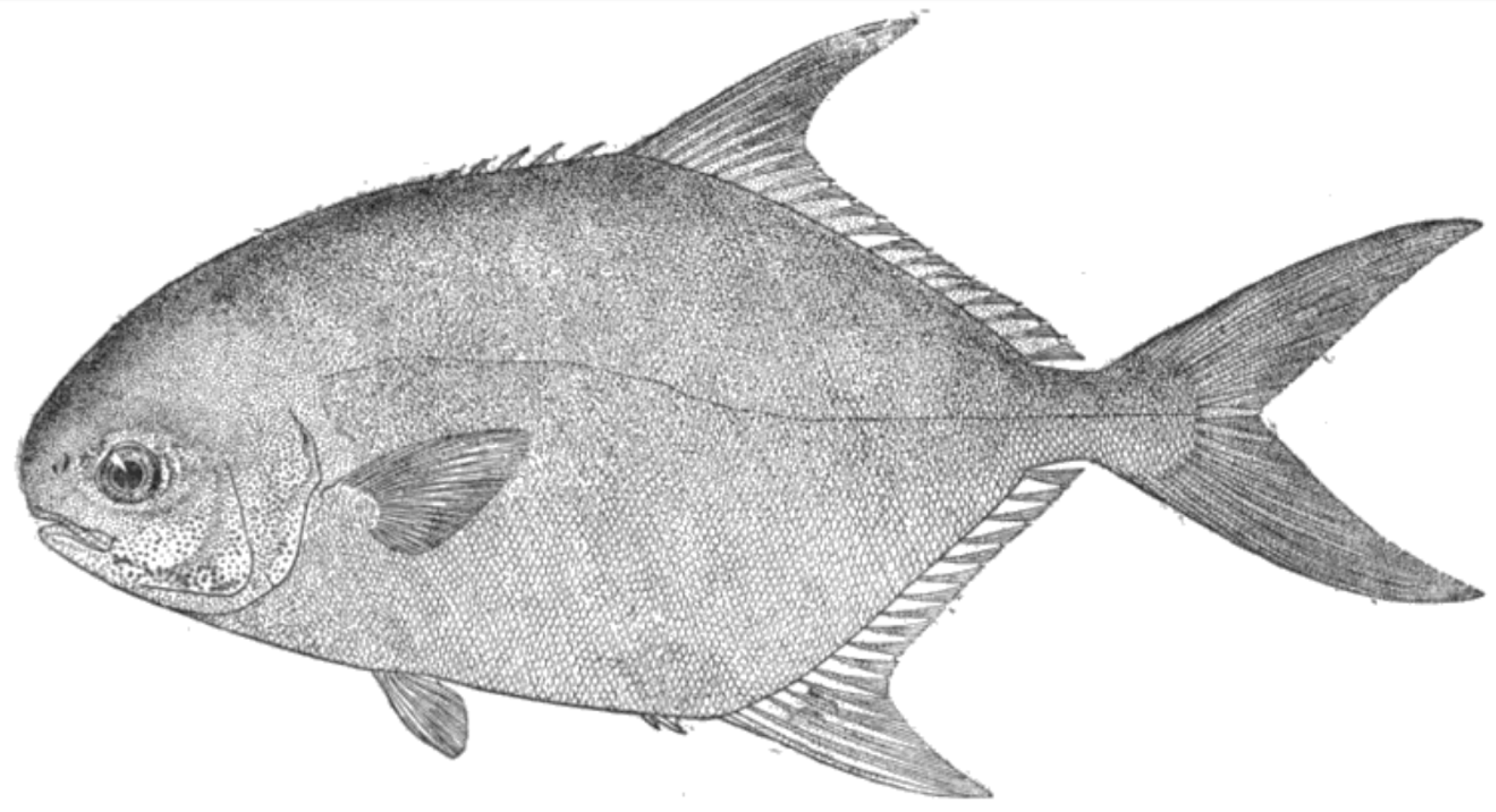
The comment [2] suggests that “the authors of Fishes of the South China Sea may have misidentified golden pompano as T. ovatus due to its morphological similarities to T. blochii and reliance on earlier literature that conflated the two species” and further claims that “golden pompano appears to have been incorrectly assigned to T. ovatus, whereas it aligns more closely, both morphologically and geographically, with T. blochii”. However, the morphological descriptions and illustration (Figure 1) presented in Fishes of the South China Sea correspond precisely to the characteristics of the golden pompano, not to those of T. blochii chiefly in the shape of the first predorsal interneural spine and the length of the second dorsal fin [13,14,15]. In addition, the two species also exhibit clear and consistent morphological differences in the shape of the anterior margin of the first and second combined interhaemal spines, the degree of enlargement of the central parts of the fourth pair of ventral ribs, the number of pyloric caeca, the curvature of the anterior and posterior margin of the preopercle, and the coloration of the dorsal, anal, and caudal fins [14,15]. Furthermore, the golden pompano is clearly the dominant Trachinotus species in the South China Sea, while T. blochii is present only in limited numbers [13,14]. The following evidence indirectly supports this perspective. The abundance of wild golden pompano (Trachinotus ovatus) provides broodstock for aquaculture, thereby supporting the large-scale farming of this species in China, whereas only a small amount of Trachinotus blochii is currently cultured [6,16]. Therefore, we contend that the Fishes of the South China Sea did not confuse golden pompano with T. blochii and its records indeed support the identification of the golden pompano as T. ovatus.

5. Conclusions

Based on the currently available historical, morphological, and molecular evidence, our previous study [1] rigorously demonstrates that the cultured golden pompano in China can be accurately identified as Trachinotus ovatus (Linnaeus, 1758) and the so-called T. ovatus from the East Atlantic should be renamed. Moreover, the potential synonymy between the golden pompano and T. anak was identified—a finding consistent with the comment [2]. Based on some historical literature, the comment [2] suggests that the golden pompano should be referred to as the species Trachinotus anak (Ogilby 1909), while we supported the validity of the species name T. ovatus for the golden pompano, in accordance with nomenclature principles such as precedence, stability, and universality. Future comprehensive research incorporating type specimens and broader sampling will be needed to evaluate the species delimitation of the golden pompano and establish a consistent understanding.

Author Contributions

A.L. and S.L. collected the data and wrote the manuscript. C.A., S.C., H.W. and Z.Z. reviewed the manuscript. S.L. and Z.Z. supervised the project. All authors have read and agreed to the published version of the manuscript.

Funding

This research was funded by the China Agriculture Research System of MOF and MARA (No. CARS-47) and the Central Public-Interest Scientific Institution Basal Research Fund, YSFRI, CAFS (No. 20603022024023).

Data Availability Statement

All data used in this study are available upon request from the corresponding author.

Acknowledgments

We appreciate the valuable advice provided by Li Yuanyou (College of Marine Sciences, South China Agricultural University), the researcher Zhang Dianchang (South China Sea Fisheries Research Institute, Chinese Academy of Fishery Sciences), and the researcher Guan Changtao (Yellow Sea Fisheries Research Institute, Chinese Academy of Fishery Sciences) during the fishery industry survey and paper planning.

Conflicts of Interest

The authors declare no conflicts of interest.

References

  1. Li, A.; An, C.; Wang, H.; Che, S.; Liu, S.; Zhuang, Z. DNA Barcode and Correct Scientific Name of Golden Pompano, an Important Marine Aquaculture Fish Species in China. Fishes 2025, 10, 129. [Google Scholar] [CrossRef]
  2. Wang, L.; Fan, B. Golden Pompano in China Is Trachinotus anak, Not T. ovatus Comment on DNA Barcode and Correct Scientific Name of Golden Pompano, an Important Marine Aquaculture Fish Species in China. Fishes 2025, 10, 129. [Google Scholar] [CrossRef]
  3. Cuvier, G.; Valenciennes, A. Histoire Naturelle des Poissons; Pitois-Levrault: Paris, France, 1847; 201p. [Google Scholar]
  4. Günther, A. Catalogue of the Fishes in the British Museum; Trustees of the British Museum: London, UK, 1860. [Google Scholar]
  5. ICZN. International Code of Zoological Nomenclature, 4th ed.; The International Trust for Zoological Nomenclature: London, UK, 1999. [Google Scholar]
  6. Zhang, D.C.; Guo, L.; Guo, H.Y.; Zhu, K.C.; Li, S.Q.; Zhang, Y.; Zhang, N.; Liu, B.S.; Jiang, S.G.; Li, J.T. Chromosome-level genome assembly of golden pompano (Trachinotus ovatus) in the family Carangidae. Sci. Data. 2019, 6, 216. [Google Scholar] [CrossRef] [PubMed]
  7. Liu, B.; Guo, H.Y.; Zhu, K.C.; Guo, L.; Liu, B.S.; Zhang, N.; Yang, J.W.; Jiang, S.G.; Zhang, D.C. Growth, physiological, and molecular responses of golden pompano Trachinotus ovatus (Linnaeus, 1758) reared at different salinities. Fish Physiol. Biochem. 2019, 45, 1879–1893. [Google Scholar] [CrossRef] [PubMed]
  8. Chen, S.; Xiao, Y.; Xiao, Z.; Li, J.; Herrera-Ulloa, A. Global climate change impacts on the potential distribution of typical Trachinotus fishes and early warning assessment of invasions. Environ. Res. 2024, 263, 120115. [Google Scholar] [CrossRef] [PubMed]
  9. San, L.Z.; Liu, B.S.; Liu, B.; Guo, H.Y.; Guo, L.; Zhang, N.; Zhu, K.C.; Jiang, S.G.; Zhang, D.C. Transcriptome analysis of gills provides insights into translation changes under hypoxic stress and reoxygenation in Golden Pompano, Trachinotus ovatus (Linnaeus 1758). Front. Mar. Sci. 2021, 8, 763622. [Google Scholar] [CrossRef]
  10. Linnaeus, C. Systema Naturae per Regna Tria Naturae, Secundum Classes, Ordines, Genera, Species, Cum Characteribus, Differentiis, Synonymis, Locis, 10th ed.; Laurentius Salvius: Stockholm, Sweden, 1758; pp. 295–297. (In Latin) [Google Scholar]
  11. Lacepède, B.G.E. Histoire Naturelle des Poissons; Plassan: Paris, France, 1801. (In French) [Google Scholar]
  12. Kendall, W.C.; Goldsborough, E.L. The shore fishes. Mem. Mus. Comp. Zool. Harvard Coll. 1911, 26, 269–271. [Google Scholar]
  13. Fishes of the South China Sea; Science Press: Beijing, China, 1962. (In Chinese)
  14. Zhang, Q.; Hong, W.S.; Shao, K.T. Studies on taxonomic characters of Trachinotus ovatus and Trachinotus blochii from net cage mariculture. J. Oceanogr. Taiwan Strait. 2000, 19, 499–506. (In Chinese) [Google Scholar] [CrossRef]
  15. Smith-Vaniz, W.F.; Walsh, S.J. Indo-West Pacific species of Trachinotus with spots on their sides as adults, with description of a new species endemic to the Marquesas Islands (Teleostei: Carangidae). Zootaxa 2019, 4651, 1–37. [Google Scholar] [CrossRef] [PubMed]
  16. Ministry of Agriculture and Rural Affairs of People’s Republic of China, National Fisheries Technology Extension Center, China Society of Fisheries. China Fishery Statistical Yearbook; China Agriculture Press: Beijing, China, 2024; p. 22. (In Chinese) [Google Scholar]
Figure 1. Illustrations of the species T. ovatus in Fishes of the South China Sea, 1962.
Fishes 11 00105 g001
Disclaimer/Publisher’s Note: The statements, opinions and data contained in all publications are solely those of the individual author(s) and contributor(s) and not of MDPI and/or the editor(s). MDPI and/or the editor(s) disclaim responsibility for any injury to people or property resulting from any ideas, methods, instructions or products referred to in the content.