Article

Effects of Four Light Colors on Physiology, Antioxidant Enzyme Activity, Shell Pigmentation, and Genes Associated with Body Color Formation in Procambarus clarkii


1
Key Laboratory of Freshwater Aquatic Genetic Resources, Ministry of Agriculture and Rural Affairs, Shanghai Ocean University, Shanghai 201306, China
2
College of Marine and Biology Engineering, Yancheng Institute of Technology, Yancheng 224051, China
3
Zhejiang Provincial Key Laboratory of Aquatic Resources Conservation and Development, College of Life Sciences, Huzhou University, Huzhou 313000, China
4
Key Laboratory of Aquatic Nutrition and Smart Farming, Ministry of Agriculture and Rural Affairs, Aquatic Health and Intelligent Aquaculture Key Laboratory of Sichuan Province, Tongwei Agricultural Development Co., Ltd., Chengdu 610041, China
5
Key Laboratory of Genetic Breeding and Cultivation for Freshwater Crustacean, Ministry of Agriculture and Rural Affairs, Freshwater Fisheries Research Institute of Jiangsu Province, Nanjing 210017, China
6
Key Laboratory of Aquatic Nutrition and Feed Science of Jiangsu Province, College of Animal Science and Technology, Nanjing Agricultural University, Nanjing 210095, China
*
Authors to whom correspondence should be addressed.
These authors contributed equally to this work.
Fishes 2026, 11(1), 54; https://doi.org/10.3390/fishes11010054
Submission received: 3 December 2025 / Revised: 3 January 2026 / Accepted: 9 January 2026 / Published: 15 January 2026
(This article belongs to the Section Aquatic Invertebrates)

Abstract

Light plays a critical role in the physiology and pigmentation of aquatic animals. Regulating the light environment of aquatic animals offers insights into healthy aquaculture practices. In this study, Procambarus clarkii were reared under four different light colors—white (WL), red (RL), blue (BL), and green (GL)—for 21 days, with four replicates per light color. Morphological characteristics did not differ among light treatments. However, significant differences were observed in hemolymph cortisol levels and tyrosinase activity across different tissues (hemolymph, muscle, hepatopancreas) among groups (RL > BL > GL > WL). Hepatopancreatic CAT activity in WL was significantly higher than that in GL and BL, whereas hepatopancreatic MDA content was highest in BL. Regarding chromatic parameters, the yellow color of the RL cephalothorax cuticle and the red color of the muscle were more pronounced than in WL, The chela cuticle of GL is darker than RL, while the red color of the chela cuticle was more pronounced than in WL.. For pigment content, cephalothorax cuticle astaxanthin content in BL was significantly higher than that in other light color groups, while abdominal cuticle astaxanthin content was lowest in BL. Chela cuticle astaxanthin content in RL was significantly higher than that in WL, and chela cuticle astaxanthin and lutein contents in WL were significantly lower than those in BL and GL. Compared with WL, hepatopancreatic glutathione S-transferase P1 (GSTP1) mRNA expression significantly decreased under colored light, whereas NinaB mRNA expression significantly increased under RL and BL. These results indicate that light color does not affect the morphological characteristics of P. clarkii but significantly modulates oxidative stress responses, physiological status and energy metabolism. Different light colors may mediate carotenoid transport and deposition by regulating the expression of GSTP1, NinaB, leading to specific chromatic differences in different body parts of P. clarkii. Comprehensive analysis revealed that the red light environment exerted a more positive effect on enhancing the body color of P. clarkii. This study provides a reference for revealing the mechanism of light color regulating crustacean physiological function and pigmentation and optimizing aquaculture model.
Key Contribution: The purpose of this study was to investigate the effects of four different colors of light (white, red, blue and green) on the morphological characteristics, physiological status, antioxidant function, shell color and body color formation related genes of Procambarus clarkii. In order to provide reference for the healthy culture of Procambarus clarkii.

1. Introduction

Light is an essential condition for the growth and development of most aquatic animals, and its importance is self-evident. Researchers have conducted numerous experiments to explore the effects and mechanisms of light on these animals. Typically, light experiments in aquatic animal studies focus on light color, intensity, and photoperiod [1,2,3]. Regardless of the specific light conditions tested, variations in animal growth and feeding often occur [4,5]. It is noted that the color of light depends on the absorption of different wavelengths of light by water [6]. The change of illumination in water is mainly due to the change of incident light ( absorption and reflection ) according to the characteristics of water [7]. Water bodies act as a color filter, significantly altering the spectral composition of incident light [8]. Visible light comprises long wavelengths (red, orange), medium wavelengths (yellow, green), and short wavelengths (blue, purple) [9]. The penetration ability of different wavelengths varies significantly in water. Consequently, waters 0–10 m deep usually contain all three wavelength ranges, while waters below 25 m are dominated by short-wavelength light [7]. Different organisms typically exhibit distinct responses to various light colors [10]. In addition, studies have found that short-term light stress can lead to changes in animal body color in specific light environments [11]. A 15-day period of short-term light stimulation causes a change in the coloration of Lysmata boggessi [12]. When aquatic animals are in a specific environment, body color can be changed by changing the expression of related genes in a short period of time [13]. These findings suggest that short-term light stimulation has the potential to regulate body color at low cost. However, there is not enough research conclusion on the effect of different light colors on Procambarus clarkii.
The red swamp crayfish, Procambarus clarkii, is native to northeastern Mexico and south-central United States [14]. As an invasive alien species, crayfish have spread widely around the world, significantly impacting local ecology and economies [15,16]. However, in some regions, crayfish are widely farmed as economically important species, and distinctive breeding models have been developed to enhance economic and ecological benefits [17,18]. When consumers face aquatic products of similar specifications and quality, they increasingly prefer brightly colored individuals, making color a key determinant of economic value for specific aquatic animal species [19]. For species like black tiger prawns (Penaeus monodon), color significantly influences consumer preference and market value, with better-colored products gaining greater market acceptance [20]. Consequently, effectively enhancing body coloration in both ornamental and farmed fish has become a major focus of selective breeding research. To meet market demands, researchers have developed numerous new color variants through artificial selection or technological interventions [21,22]. Growth performance serves as an important criterion for seedling selection during breeding, and individuals exhibiting different colors sometimes show distinct growth characteristics [23].
The effect of light on aquatic animals has a certain research foundation. With studies demonstrating its influence on color formation and change in numerous species. For instance, the chameleon prawn Hippolyte varians exhibits circadian color shifts, transitioning from green, red, or brown hues during the day to blue and transparent at night [24]. Similarly, extended light exposure alters the coloration of redclaw crayfish Cherax quadricarinatus larvae from light blue to yellowish brown [25]. Furthermore, irradiating white shrimp Litopenaeus vannamei with metal halide lamps increased astaxanthin levels, resulting in brighter coloration and accelerated growth [5]. Aquatic animals possess diverse pigment cells primarily responsible for forming and altering body color. These cells respond to ambient light levels by regulating the dispersion or aggregation of pigment granules within the cell, thereby darkening or lightening body coloration [26]. Colored lights can affect the body color performance of animals [27]. However, whether light color will have more effects on aquatic animals, and its effect and mechanism remain to be further studied.
The coloration of aquatic animals is typically associated with pigmentation and metabolism [28]. Glutathione S-transferase Pi (GSTP1) is a carotenoid-binding protein that plays a key role in carotenoid transport [29]. Gene expression related to carotenoid metabolism and transport plays a key role in body color formation, such as boc1 [30]. Various crustaceans alter their coloration by ingesting carotenoids like lutein and zeaxanthin, converting them into dominant carotenoid forms within their bodies [31]. Astaxanthin, the primary carotenoid in crustaceans, binds to proteins such as crustacyanin (CRCN), which plays a crucial role in body color changes [32]. Studies indicate that genes involved in carotenoid absorption, deposition, metabolism, and transformation significantly influence body color formation [33]. Three major types of lipoproteins—very low-density lipoprotein, low-density lipoprotein, and high-density lipoprotein—facilitate carotenoid transport [34]. Triglyceride (TAG) levels may change LDL and HDL levels and proportions [35]. Triacylglycerols (TAGs) are a class of neutral lipids, Acyl-CoA diacylglycerol acyltransferase (DGAT) is the last step in the catalytic synthesis of TAG. [36]. Acyl-CoA diacylglycerol acyltransferase-1 (DGAT1) and Acyl-CoA diacylglycerol acyltransferase-2 (DGAT2) are two enzymes responsible for TAG synthesis in organisms [37]. Artificially feeding astaxanthin can enhance both the coloration and immunity of aquatic animals [38]. Dietary astaxanthin can effectively improve the color and antioxidant function of aquatic animals. However, this usually means higher breeding costs, and changing the color of ambient light may have greater potential in crayfish farming models.
However, research on the effects of light color on crayfish (Procambarus clarkii) remains limited despite these foundational studies. In view of the importance of light to animals and the characteristics that body color can be changed after a short period of specific environmental conditions, the stimulation test of light color on Procambarus clarkii is helpful to explore the mechanism of light color regulating the body color formation of Procambarus clarkii. To investigate the potential impact of light color on crayfish and the potential to improve body color through light and color regulation, this study employed four different LED light sources (white, red, blue, and green) to analyze their effects on physiology, antioxidant enzyme activities, shell color, and body color-related gene expression.

2. Materials and Methods

2.1. Source and Acclimation of Animals

Experimental crayfish were purchased from Jinfeng Agricultural Technology Co., Ltd. (Yancheng, China). The crayfish were transferred to a recirculating aquarium system in the laboratory and fasted for 2 days prior to a 2-week acclimation period. During acclimation, they were temporarily reared in the recirculating water system and fed with a commercial diet containing 33% crude protein and 4% crude lipid (Tongwei Agricultural Development Co., Ltd. Chengdu, China).

2.2. Experimental Light Source and Culture Conditions

Sixteen identical closed glass tanks (56 cm × 28 cm × 47 cm, Water volume: 56 L) were used in this experiment. Each tank was equipped with one of four monochromatic light-emitting diode (LED) light sources (15 W, white, red, blue, or green). The aquariums were divided into four groups: White Light (WL), Red Light (RL), Blue Light (BL), and Green Light (GL). To exclude external light, all aquariums were wrapped in opaque black tarpaulin and an illuminance meter (Smart Sensor, SF813, Dongguan, China) confirmed 0 Lux inside each aquarium prior to the experiment and adjusted the number or height of light bulbs to set the illumination intensity to 105 lux.
Twenty-four hours before commencing the experiment, all aquariums were filled with freshwater to a depth of approximately 15 cm and connected to aerators (RUIJINGKEJI, HG200, Wuxi, China). The water environment was maintained to ensure optimal crayfish culture conditions: dissolved oxygen concentration ≥ 6.0 mg/L, water temperature = 24 ± 1 °C, pH range from 7.5 to 8.5.

2.3. Experimental Procedures and Sample Collection

Sixty-four healthy and lively crayfish (15.85 ± 0.33 g) of similar size were randomly selected. Each light color group (WL, RL, BL, GL) contained four replicates, with four crayfish per replicate. The experiment lasted 21 days. During this period, light exposure occurred from 08:00 to 20:00 daily, with darkness maintained for the remaining time. Specialized compound feed for crayfish (Tongwei Agricultural Development Co., Ltd. Chengdu, China) was provided twice daily at 07:00 and 19:00. Residual feed and feces were removed daily, and one-third of the water volume was replaced every three days. Culture facility integrity was checked daily, and strengthened the daily management. Throughout the experiment, water quality parameters were maintained as follows: dissolved oxygen ≥ 6.0 mg/L, water temperature = 24 ± 1 °C, pH range from 7.5 to 8.5, the content of nitrite in the water was not more than 0.1 mg/L, and the ammonia nitrogen concentration was not more than 0.02 mg/L.
At the end of the trial and after a 24-h fasting period, the number of surviving crayfish in each aquarium was recorded. Subsequently, crayfish were anesthetized using clove oil. Hemolymph was collected via sterile syringe, centrifuged at 3000 rpm for 10 min, and the resulting supernatant was immediately aspirated and stored at −80 °C. Finally, hepatopancreas, intestine, cephalothoracic cuticle, abdominal cuticle, cheliped cuticle, and abdominal muscle tissues were collected from sampled crayfish across different aquaria for subsequent analysis.

2.4. Morphological Characteristics

Hepatosomatic index (HSI), Intestine-Body Ratio (IBR), Meat Content (MC), Chela-Body Ratio (CBR), Condition Factor (CF) were calculated based on counting and weighing statistics according to the following formulae:
Hepatosomatic index (HSI) = Wh/Wt × 100%
Intestine-Body Ratio (IBR) = Wi/Wt × 100%
Meat Content (MC) = Wm/Wt × 100%
Chela-Body Ratio (CBR) = Wc/Wt × 100%
Condition Factor (CF) = Wt/Lt3 × 100%
where, Wh: hepatopancreas weight of crayfish at the end of the experiment, Wi: intestine weight of crayfish at the end of the experiment, Wm: muscle weight of crayfish at the end of the experiment, Wt: total weight of crayfish at the end of the experiment, Wc: chela weight of crayfish at the end of the experiment, and the length of crayfish at the end of the Lt experiment.

2.5. Hemolymph and Tissue Biochemical Parameters and Antioxidant Capacities

Hemolymph cortisol and tyrosinase levels were measured using commercial enzyme-linked immunosorbent assay kits (AIDISHENG Biotechnology Co., Ltd., Yancheng, China). Additional commercial kits (Jiancheng Bioengineering Institute, Nanjing, China) were employed to quantify glucose (Glu, glucose oxidase method), glycogen (Gly, anthraquinone colorimetric method), lactate dehydrogenase (LDH, microplate method), glutathione peroxidase (GPX, microplate method), superoxide dismutase (SOD, WST-1 method), catalase activity (CAT, visible light method), and malondialdehyde (MDA, TBA method) concentrations.

2.6. Measurement of Crustacean Chromaticity

The CIELAB colorimeter is widely used for color measurement and evaluation in aquatic products [39]. Its parameters Luminosity (L*), Redness index: (a*), and Yellowness index: (b*) are used to quantify and evaluate animal coloration [40]. The chromaticity parameters (L*, a*, b*) of collected tissue samples (cephalothorax cuticle, abdomen cuticle, chela cuticle, and muscle) were determined using a colorimeter (CR-410, Konica Minolta, Japan). Prior to measurements, the instrument was calibrated using black and white reference plates. If a* is positive, it means red; if a* is negative, it means green; if b* is positive, it means yellow; if b* is negative, it means blue.

2.7. Carotenoid Determination

Carotenoid content was determined according to a modified method based on [41] using High-Performance Liquid Chromatography (HPLC, Agilent 1260, Santa Clara, CA, USA). Briefly, an appropriate amount of sample was weighed (FA-1004 electronic balance, Shanghai Shunyu Hengping Instrument Co., Ltd. Shanghai, China) into a centrifuge tube. Five milliliters of acetone solution was added, followed by ultrasonic extraction for 20 min. The mixture was then centrifuged (TGL-16M, Hunan Xiangyi Laboratory Instrument Development Co., Ltd. Changsha, China) at 8000 r/min for 5 min. The supernatant was collected, and the residue was re-extracted with acetone repeatedly until the solution became colorless. All supernatants were combined and adjusted to a final volume of 10 mL. This combined extract was concentrated to dryness via rotary evaporation. The residue was re-dissolved in 1.0 mL acetone, filtered through a 0.45-μm microporous membrane, and subsequently analyzed by High Performance Liquid Chromatography. The 10 µL sample was loaded onto a reversed-phase chromatographic column (250 mm × 4.6 mm, 5 µm, SHISEIDO C30). The eluent composition was as follows: A: methanol: acetonitrile: water (73.5:24.5:2, v/v/v); B: methyl tert-butyl ether. The flow rate was 1.0 mL/min, the column temperature was 30 °C, and the detection wavelength was 450 nm. Finally, carotenoids were quantified by an external standard method.
The contents of astaxanthin, lutein, canthaxanthin, and β-carotene were calculated according to the formula:
W = (C − C0)/m × V × N
where W: Target content in the sample (mg/kg);
C: The concentration of the target in the sample solution (mg/L);
C0: The concentration of the target in the blank control (mg/L);
V: Constant volume (ml);
N: Dilution multiple;
m: Sample sampling amount (g).

2.8. Expression of Genes Related to Body Color Formation

Relative gene expression levels were quantified using Real-Time fluorescence quantitative PCR (qPCR) with SYBR GREEN dye, using β-actin as the internal reference gene. Total RNA was extracted from the hepatopancreas. RNA concentration was measured using an ND5000 ultramicro UV-visible spectrophotometer (BioTeke, Wuxi, China), and RNA integrity was confirmed by agarose gel electrophoresis. Complementary DNA (cDNA) was synthesized from RNA using the Hifair® Ⅲ 1st Strand cDNA Synthesis SuperMix ready-to-use premix (Yeasen, Shanghai, China). qPCR was performed to detect the expression levels of four target genes (GSTP1, DGAT2, NinaB, CRCN-C1) and the internal reference gene (β-actin). Primer sequences are listed in Primer sequences are listed in Table 1. The PCR amplification protocol consisted of an initial denaturation at 95 °C for 5 min, followed by 40 cycles of 95 °C for 10 s and 60 °C for 30 s. Gene expression differences were calculated using the 2−ΔΔCT method [42].

2.9. Statistical Analysis

IBM SPSS Statistics 27 and Excel 2010 were utilized for data analysis and graphing. Before analysis, the data were checked for normality and variance alignment using the Shapiro-Wilk test and Levene’s test, respectively. The treatments were then statistically compared using a one-way analysis of variance (ANOVA) followed by a least significant difference (LSD) test. All data have been expressed as mean ± standard error (SE). In all tests, a significance level of p < 0.05 was considered statistically significant.

3. Results

3.1. Morphological Characteristics

The results of morphological characteristics are summarized in Table 2. Neither control group nor experimental group had a significant effect on the Hepatosomatic Index (HSI), Intestine-Body Ratio (IBR), Meat Content (MC), Chela-Body Ratio (CBR), or Condition Factor (CF) (p > 0.05).

3.2. Hemolymph and Tissue Physiology

The results for hemolymph and tissue physiological indices are presented in Table 3. Compared to the WL group, cortisol levels were significantly elevated in the RL, BL, and GL groups, with the order of increase being RL > BL > GL > WL (p < 0.05). Tyrosinase activity in hemolymph, muscle, and hepatopancreas was significantly higher in the RL, BL, and GL groups than in the WL group, also following the order RL > BL > GL > WL (p < 0.05). Muscle glycogen content was significantly reduced in the RL group compared to WL, while it was significantly higher in the BL and GL groups (p < 0.05). Light color had no significant effect on hemolymph glucose content, hepatopancreas glycogen content, or LDH activity in hemolymph, muscle, and hepatopancreas compared to WL (p > 0.05). However, hepatopancreas LDH activity was significantly higher in the RL group than in the GL group (p < 0.05).

3.3. Antioxidant Capacity

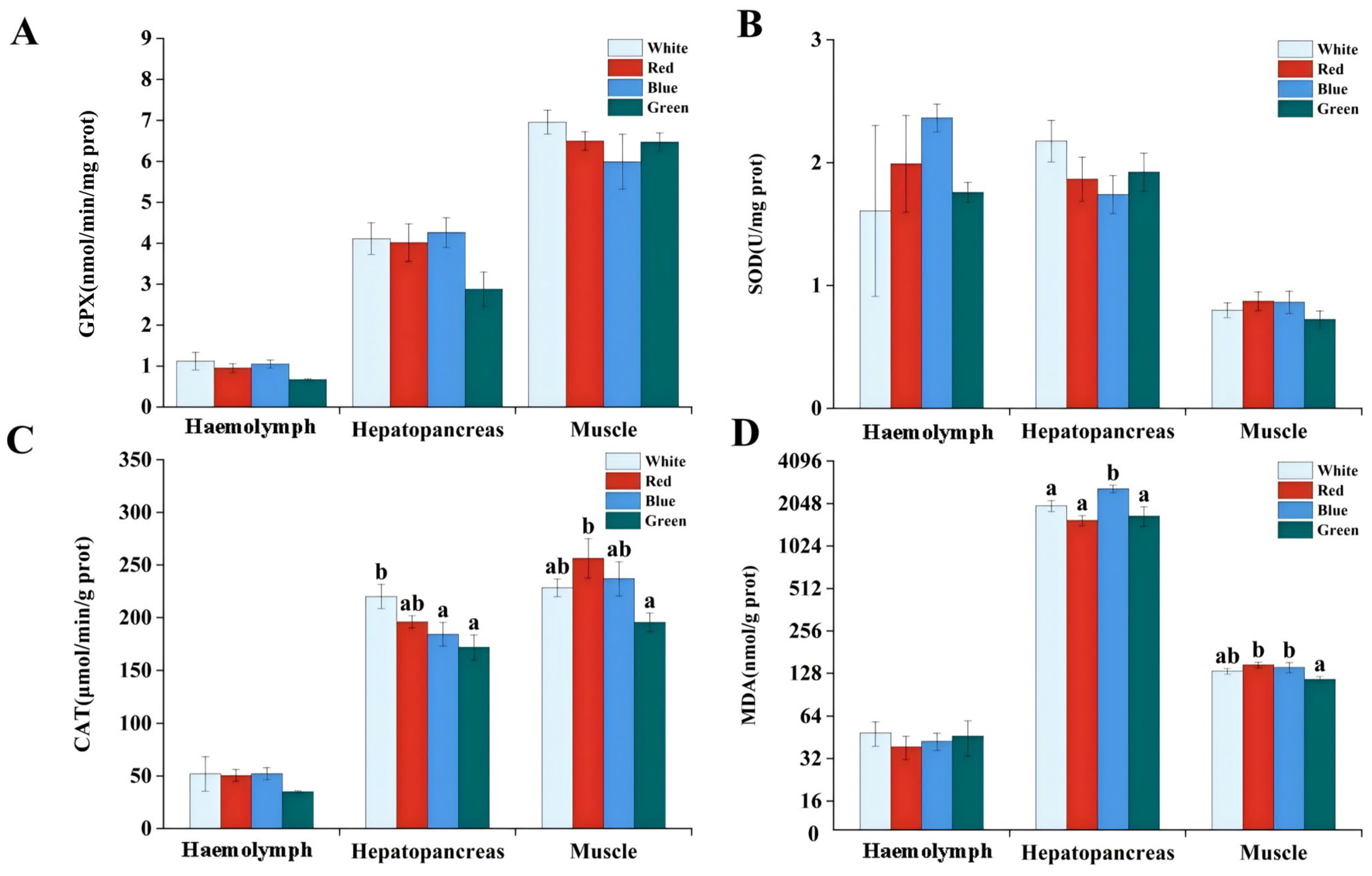
The results concerning the effect of different light colors on the antioxidant capacity of haemolymph, muscle, and hepatopancreas in crayfish are summarized in Figure 1. Compared to white light (WL), CAT activity in the Hepatopancreas was significantly decreased under blue light (BL) and green light (GL) (p < 0.05). CAT activity in haemolymph and muscle showed no significant changes across groups; however, CAT activity under red light (RL) was significantly higher than under GL (p < 0.05). Compared to WL, MDA content in the Hepatopancreas under BL significantly increased (p < 0.05), while MDA content in haemolymph and muscle did not change significantly across different light groups, MDA content in muscle under RL and BL was significantly higher than under GL (p < 0.05). Different light colors had no significant effect on GPX and SOD activities in the three tissues (Haemolymph, Muscle, and Hepatopancreas) (p > 0.05).

3.4. Crustacean Chromaticity

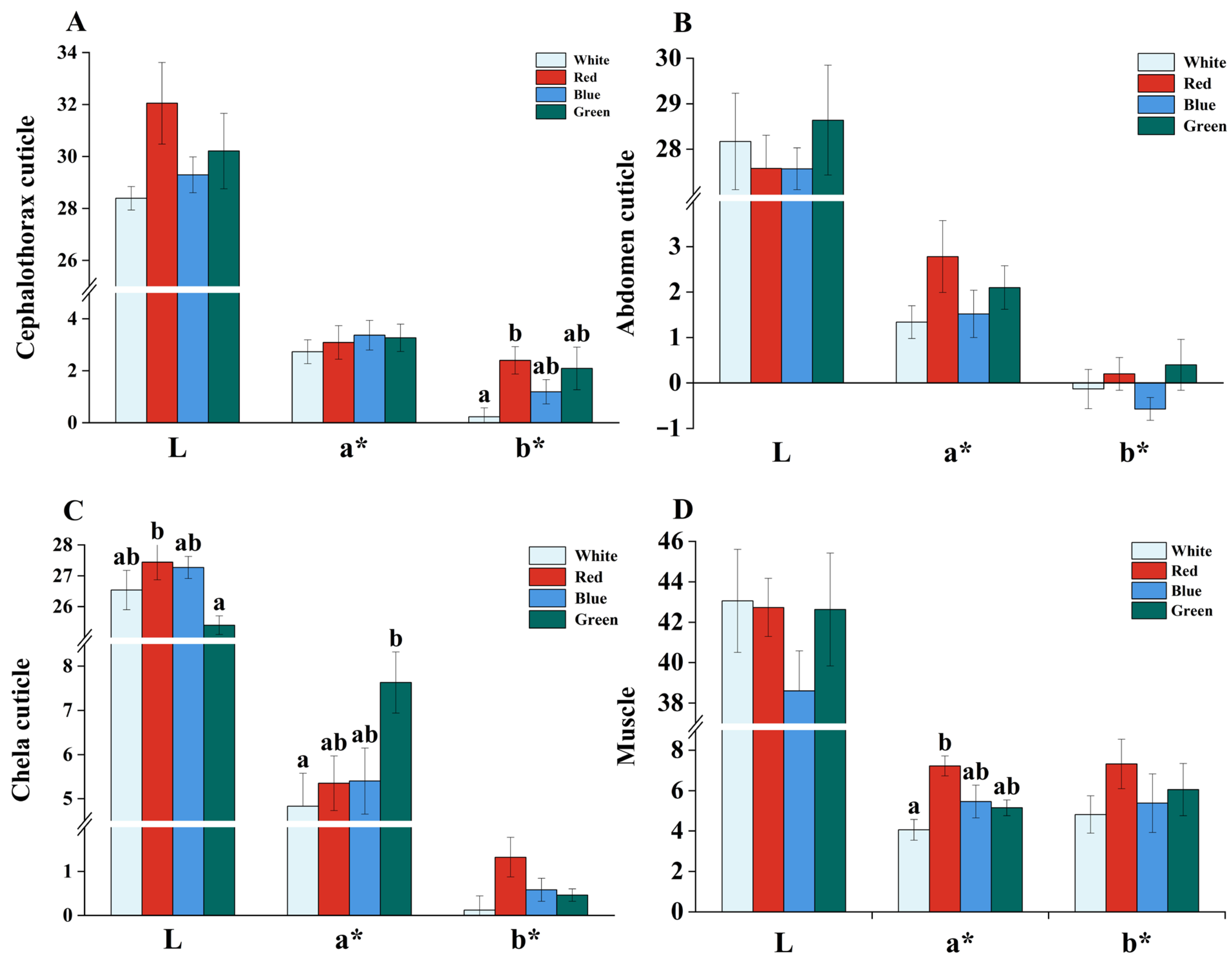
Figure 2 summarizes the chromaticity observed in the cuticle and muscle of the specimens. Red light significantly increased the Yellowness index (b*) value of the Cephalothorax cuticle and the Redness index (a*) value of muscle compared to WL, while green light significantly increased the a* value of muscle (p < 0.05). Different light colors had no significant effect on the Luminosity (L*) value of the four parts (Cephalothorax cuticle, Abdomen cuticle, Chela cuticle, Muscle) relative to WL. However, the L* value of the Chela cuticle under RL was significantly higher than under GL (p < 0.05). Different light colors also had no significant effect on the a* value of the Cephalothorax cuticle and abdomen cuticle. Furthermore, the b* value of the abdomen cuticle, chela cuticle, and muscle showed no significant change under different light colors (p > 0.05).

3.5. Carotenoid Content

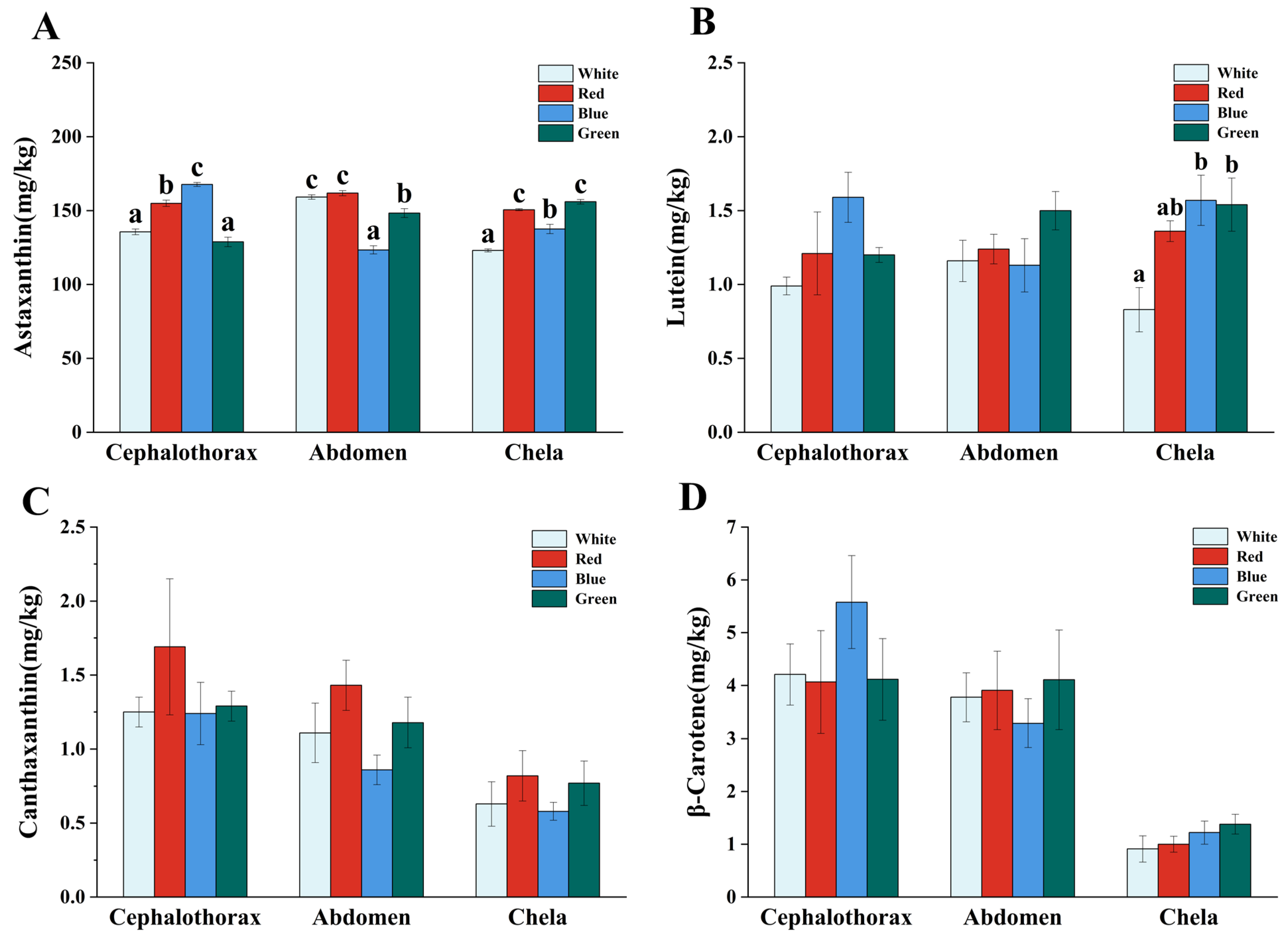
Figure 3 presents the carotenoid content across different light color groups. Compared to the WL group, astaxanthin content significantly increased in the cephalothorax cuticle under RL and BL, while it significantly decreased in the abdomen cuticle under BL and GL. Conversely, astaxanthin content significantly increased in the chela cuticle under RL, BL, and GL. Additionally, BL and GL significantly increased lutein content in the chela cuticle (p < 0.05). The contents of Canthaxanthin and β-Carotene in the three parts of different light color groups (Cephalothorax cuticle, Abdomen cuticle, Chela cuticle) did not change significantly, while the lutein contents of Cephalothorax cuticle and Abdomen cuticle were not significantly affected by light color (p > 0.05).

3.6. Expression of Genes Related to Body Color Formation

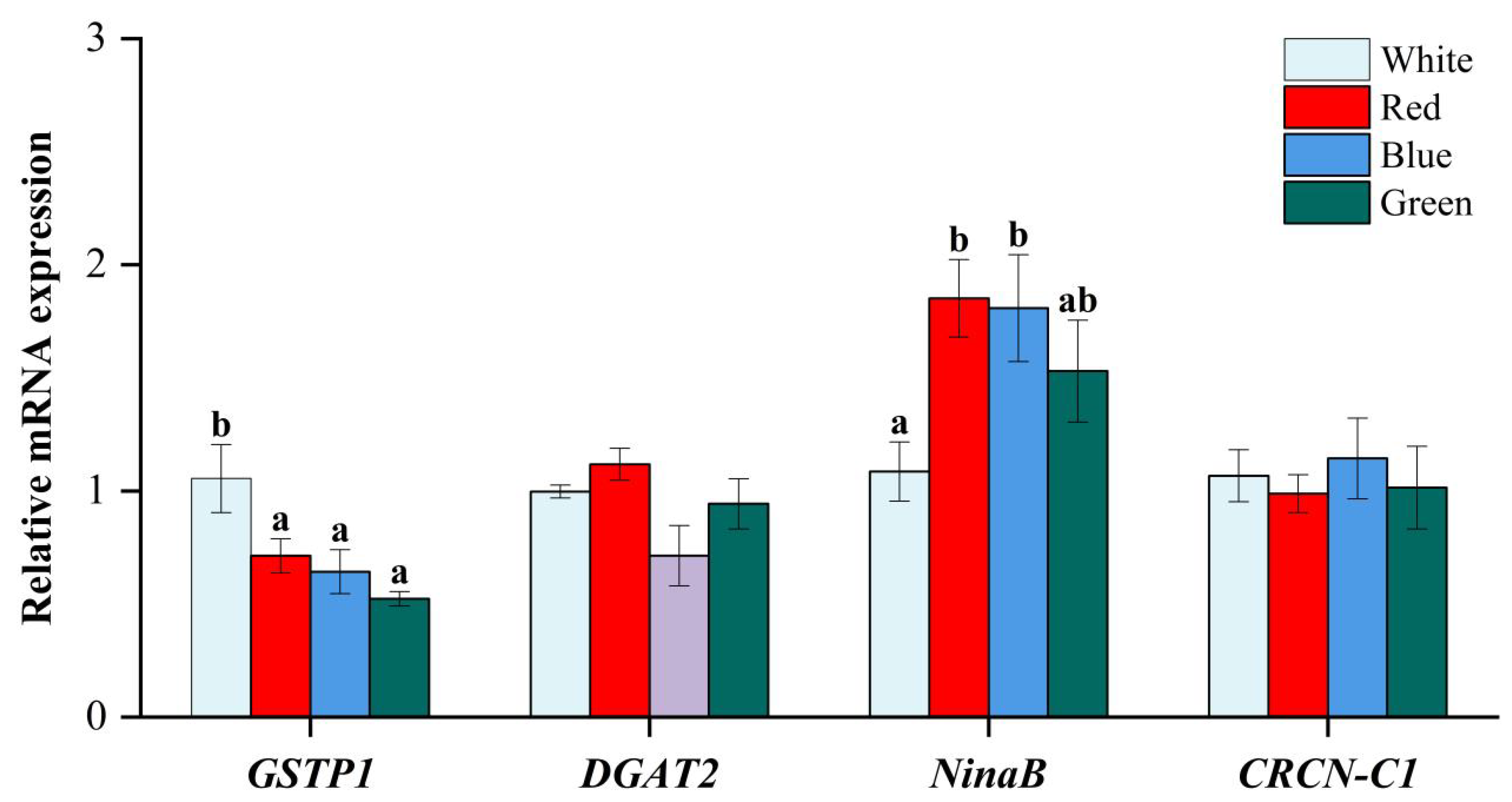
Figure 4 shows the relative expression of four genes related to body color. The expression of GSTP1 in white light group was significantly higher than that in other light color groups and the expression of NinaB in red light group and blue light group was significantly higher than that in white light group (p < 0.05). There was no significant difference in the expression levels of DGAT2 and CRCN-C1 between different light color groups (p > 0.05).

4. Discussion

In this study, different light colors exhibited no significant effects on the morphological characteristics of crayfish. Morphometric analysis serves as a reliable indicator of individual growth and nutritional status. The hepatosomatic index (HSI) functions as an evaluative benchmark for individual maturity [43], while changes in HSI reflect the distribution of energy and nutrients within the organism [44]. Although research on Epinephelus akaara demonstrated optimal HSI under white light conditions [45], white light showed no significant impact on crayfish HSI in the present study. This discrepancy may arise from species-specific variations in spectral sensitivity. Notably, the edible portion of crayfish is limited to abdominal and tail muscles, while the head and cuticle constitute the majority of body weight. Meat content (MC) represents a critical factor influencing processing efficiency and economic value [46]. Similarly, the condition factor (CF) serves as a core aquaculture index for evaluating fish growth status and health levels, frequently employed to quantify animal well-being [47]. The absence of significant differences in MC and CF across light treatments indicates that spectral variations do not substantially affect muscle development or feeding-related growth in crayfish. Additionally, we measured the intestine-body ratio (IBR) and chela-body ratio (CBR) to assess digestive system development, environmental stress responses, and nutritional status. In our study, there was no significant change in individual morphological characteristics under different light color treatments, light color regulation will not lead to abnormal tissue morphology. Similarly, the change of light color did not significantly affect the development of European perch, which could not lead to the generation of deformed individuals [8]. But another study found that different light colours significantly affected the tissue development of Solea senegalensis and caused deformities [48]. This may be because different species have different degrees of response to different color light stimuli, the different sensitivity of species to light color leads to different results in the effects of light color stimuli. Our results showed that the tissue development of Procambarus clarkii was less sensitive to short-term light color regulation, and change the color of light in a short time did not affect tissue development.
Cortisol, as a stress hormone, can reliably serve as a controllable indicator of an organism’s perceived environment, psychological stress, and feelings [49]. In our study, cortisol levels in crayfish hemolymph differed significantly among spectral groups, ranked as follows: red light (RL) > blue light (BL) > green light (GL) > white light (WL). This indicates that crayfish experienced stronger stress under green, blue, and red light, with red light exerting the strongest effect. In contrast, a study on Scylla paramamosa found that red, blue, and green light had no significant impact on individual cortisol levels [50], suggesting different species exhibit varying tolerances to stress induced by identical light stimuli. Visual sensitivity of aquatic animals may be a factor affecting this differentiation [51]. The results showed that Procambarus clarkii has a high sensitivity in the perception of stress caused by light stimulation. Physiological state reflects the direct effects of the external environment on an animal. To cope with environmental changes, animals mount corresponding physiological responses. Blood glucose concentration is a key indicator of glucose metabolism status, as glucose oxidation is vital for energy supply. In this study, there was no significant difference in hemolymph glucose content between different light color groups. This may be due to the fact that individuals gradually developed adaptability after experiencing light stimulation for a period of time, and the supply and consumption of glucose reached a balance to stabilize the glucose concentration. Previous studies have also shown that the effect of light color on the content of glucose in the hemolymph of Litopenaeus vannamei gradually disappears over time [52]. Glucose originates from ingested food or glycogen breakdown, with excess glucose converted to glycogen or polysaccharides like trehalose [53]. Glucose conversion to glycogen occurs via direct pathways or indirect gluconeogenic pathways, which are interrelated [54]. In our study, individual muscle glycogen content was lowest under RL, suggesting greater glycogen consumption under red light compared to WL, BL, and GL. Cortisol can promote the decomposition of glycogen to stimulate the production of glucose. Individuals may respond to stress by mobilizing glycogen reserves under specific light colors [55]. In this study, the muscle glycogen content of RL group was the lowest, which may indicate that individuals in RL group consumed more glycogen to supply energy to maintain normal physiological functions, while the glycogen content of BL and GL was not significantly consumed compared with WL, this suggests that blue and green light may inhibit glycogen metabolism in muscle. Hemocyanin and bicarbonate in hemolymph make it have certain buffering capacity [56]. There was no significant change in LDH activity in hemolymph under different light color stimulation, indicating that there was no significant change in the way of energy metabolism in hemolymph, we speculate that this may be caused by the buffering effect of hemolymph, and short-term light stimulation fails to destroy the homeostasis regulation ability of hemolymph. Studies have found that high-outbreak exercise is usually provided by anaerobic metabolism of muscles to provide energy [57]. In our study, there was no significant change in muscle LDH activity, which may be due to the fact that there was no difference in individual activity intensity under different light color stimuli, indicating that light color did not affect the occurrence of explosive movement of Procambarus clarkii. Furthermore, significantly higher LDH activity in the hepatopancreas of the RL group compared to the GL group may explain the decreased muscle glycogen in both RL and GL groups. Reduced LDH activity is associated with diminished tissue glycolysis [58]. Differences in LDH activity may stem from stress responses triggered by alterations in ambient light colour, with variations observed in the speed and effectiveness of individual adaptation to such environmental shifts [59]. Tyrosinase activity is considered the benchmark for melanin synthesis, light can influence animal body color via the tyrosinase-mediated melanin synthesis pathway [11]. Tyrosinase catalyzes the oxidation of tyrosine or tyramine, forming specific compounds that undergo further oxidation and oxygen-promoted polymerization to produce melanin [60]. Our results showed that tyrosinase activity in hemolymph, muscle, and hepatopancreas was significantly higher under RL, BL, and GL than under WL. Across all three tissues, enzyme activity followed the same order: RL > BL > GL > WL. This suggests light color may affects melanin synthesis in crayfish, with RL having the most significant impact, consistent with findings in Scophthalmus maximus where red light enhanced tyrosine metabolism and promoted melanin synthesis [61].
The activity of antioxidant enzymes and the content of antioxidant active substances reflect the antioxidant capacity of animals. Environmental stressors can disrupt oxidative homeostasis, leading to oxidative stress. Excessive reactive oxygen species (ROS) produced under such conditions can cause organismal damage [62]. Antioxidant enzymes (GPX, SOD, CAT) effectively scavenge free radicals to mitigate oxidative stress [63]. Specifically, SOD catalyzes the breakdown of superoxide radicals into hydrogen peroxide and oxygen [64]. CAT decomposes hydrogen peroxide into water and oxygen [65]. GPX can convert hydrogen peroxide and reduced glutathione (GSH) into water and oxidized glutathione (GSSG) [66]. Our study found that there was no significant difference in the activities of SOD and GPX in the hepatopancreas of RL, BL and GL compared with white light, but the CAT activity in the hepatopancreas of BL and GL was significantly reduced. Our study found that there was no significant difference in the activities of SOD and GPX in the hepatopancreas of RL, BL and GL compared with white light, but the activity of CAT in the hepatopancreas of BL and GL was significantly reduced, indicating that different light colors did not change the ability of SOD to remove superoxide anion radicals in the hepatopancreas, but blue and green light reduced the antioxidant capacity of the liver of Procambarus clarkii by inhibiting the decomposition of hydrogen peroxide by CAT. Malondialdehyde (MDA) serves as a biomarker for assessing oxidative stress levels and animal health [67]. Blue light increased MDA accumulation in the hepatopancreas, this indicates that blue light can damage the hepatopancreas by aggravating the degree of lipid peroxidation in the hepatopancreas. In muscle tissue, there was no significant change in MDA content in RL, BL and GL compared with WL, this indicated that the degree of lipid peroxidation in muscle did not change significantly under red, blue and green light stimulation. The RL and BL group exhibited significantly higher MDA content than the GL group, implying red and blue light may induce greater lipid peroxidation damage than green light in this tissue. However, contrasting findings exist; red light elevated MDA in Scylla paramamosa in hepatopancreas [50]. This discrepancy highlights that different species exhibit varying sensitivities and resistance capabilities to oxidative stress induced by specific light spectra. The difference in antioxidant capacity may be due to differences in species, developmental stages, light characteristics, and analyzed tissues [50]. Notably, in our study, red light conditions decreased hepatopancreas MDA content relative to white light, this reduction is potentially attributable to higher astaxanthin levels—a potent antioxidant—in the red light group crayfish tissues [68].
Studies on other species have shown that light color affects body coloration [27], with red light specifically facilitating color enhancement and pigmentation [69]. The optimal light color for enhancing color quality varies by species; for example, red light improved color quality in Cromileptes altivelis [70]. Our results demonstrate that red light significantly enhances the b* value of the cephalothorax cuticle, indicating a more pronounced yellow coloration. Conversely, the chela cuticle exhibited a higher L* value under red light (RL) compared to green light (GL), signifying a significant change in brightness between these light treatments. Additionally, the chela cuticle showed higher a* values under GL than white light (WL), while muscle tissue exhibited significantly higher a* values under RL than WL. This indicates that green light promotes a reddish hue in the chela cuticle, whereas red light enhances reddish coloration in the muscle tissue. This response may arise from individuals adjusting to varying light conditions, with aquatic animals’ camouflage mechanisms enabling them to mimic the colors of their surroundings [71]. Our results reflect that different body parts of Procambarus clarkii have different responses to light color, we speculate that this may be related to the way of feeling different colors of light. The biological response of the crayfish Procambarus clarkii to light stimulation is mediated by retinal and extraretinal photoreceptor cells [72]. Light-induced reflex activity is derived from the integration of light sensory information transmitted by the retina and tail photoreceptor cells (CPRs) [73]. However, the mechanism leading to this local difference effect has not yet been known.
Crustaceans possess diverse pigment cells within their bodies, specialized structures primarily responsible for forming and altering their body coloration. These pigment cells contain various pigments—including carotenoids and melanin—which absorb and reflect light to produce specific colors. In the present study, we detected four carotenoid pigments: Astaxanthin, Lutein, Canthaxanthin, and β-Carotene. Astaxanthin emerged as the dominant carotenoid species across different tissue types. Crustaceans influence their color changes by absorbing dietary carotenoids such as lutein and zeaxanthin, and converting them into dominant carotenoids within their bodies [31]. There is a correlation between the color parameters of organisms and the content of carotenoids in vivo and the effect of light color on the color parameters of aquatic animals may be achieved by regulating the content of carotenoids [74]. Our findings revealed that tissues exhibiting higher a* and b* values typically contained elevated levels of astaxanthin and β-carotene. This result aligns with observations in the Chinese mitten crab (Eriocheir sinensis) [75]. Research suggests that different colors of light stimulation lead to differences in carotenoid content in tissues, this demonstrates the feasibility of light-induced carotenoid deposition [74]. Our research findings likewise demonstrate that the significant relationship between pigment composition and color change. Carotenoids may alleviate oxidative stress to some extent. In this study, hepatopancreas CAT activity was inhibited in both BL and GL groups, yet the MDA content in the GL group was significantly lower than in the BL group. Similarly, in muscle tissue, although the RL group had higher MDA content than the GL group, its CAT activity was also higher. This effect may relate to astaxanthin deposition in tissues, suggesting that astaxanthin deposition can mitigate oxidative stress injury. Additionally, our study revealed significant differences in astaxanthin deposition across body parts under different light spectra: (1) Cephalothorax cuticle: BL group > other groups; (2) Abdomen cuticle: RL group > other groups; (3) Chela cuticle: RL and WL groups > other groups. Specifically, in chela cuticle, RL and GL spectra were most conducive to astaxanthin deposition, while BL and GL spectra favored lutein deposition. This reflects distinct optimal spectral categories for depositing different pigments. However, the underlying mechanisms require further investigation.
The body color of aquatic animals is influenced by pigmentation and regulated by specific genes. GSTP1 and BCO2 are genes associated with carotenoid deposition and decomposition, and certain pollutants affect fish body color by disrupting carotenoid metabolism [76]. Membrane-associated proteins, including GSTP1, Stard3, plin2, and apod, participate in carotenoid binding and deposition [77]. InHyriopsis cumingii, HcGSTP1 plays a crucial role in carotenoid transport and may influence shell and pearl coloration [29]. This study observed decreased GSTP1 expression in RL, BL, and GL groups, This suggests that different light colors may mediate the transport and deposition of carotenoids by affecting the expression of GSTP1 gene. Previous studies have shown that when the expression of genes regulating carotenoid transport is suppressed, the deposition capacity of carotenoids in the pancreas increases [74]. Carotenoid isomerooxygenase (NinaB) and Beta-carotene-15,15′-oxygenase (BCO1) are key oxygenases [78]. Carotenoid oxygenases are vital for carotenoid metabolism; Bco1 is essential for salmon flesh coloration [79], while Beta-carotene-9′,10′-oxygenase 2 (Bco2) facilitates carotenoid uptake [80]. Notably, red-shelled Chinese mitten crabs (Eriocheir sinensis) exhibit significantly higher NinaB expression than green- or white-shelled crabs [81]. In this study, NinaB expression was significantly higher in RL and BL groups compared to WL, indicating that red and blue light promote carotenoid oxidative decomposition, possibly through spectral effects on carotenoid transport. Astaxanthin can be directly decomposed or produced by the action of carotenoid oxygenase and retinol dehydrogenase to produce retinal [82]. The increase of retinol-related enzymes will reduce the utilization rate of astaxanthin and accelerate the metabolism of carotenoids into colorless derivatives, thus affecting body color [83]. Crustacean body color is determined by various pigments, primarily astaxanthin. Following excessive carotenoid accumulation in tissues, NinaB expression may be upregulated to promote oxidative decomposition, suggesting that carotenoid transport and decomposition operate as a negative feedback process. Diacylglycerol acyltransferase (DGAT), the key rate-limiting enzyme in triglyceride (TAG) synthesis, includes DGAT2, a novel carotenoid color gene [33]. DGAT2 expression correlates with carotenoid-based skin coloration [84]. In crustaceans, the carotenoid astaxanthin interacts with crustacyanin (CRCN) to form unique patterns and colors [85]. Two color-related crustacyanin family proteins have been identified in Procambarus clarkii [86]. Crustacyanin, considered unique to shrimp and crab, forms a multimeric complex with astaxanthin essential for shell color arrangement in clawed lobsters [87]. Lobster coloration depends on astaxanthin deposition characteristics (quantity, location, morphology), which can be altered to change color [88]. However, aquatic animals cannot synthesize these pigments directly, acquiring them solely through diet or metabolic transformation [33]. In addition, Phycocyanin (PC) enhances crustacean pigmentation through multiple pathways, including its function as a light-harvesting pigment, and supplementation has been shown to improve crayfish color [89]. Although this study found no significant difference in DGAT2 and CRCN-C1 expression across light color groups, these genes remain potential candidates associated with shell color changes.

5. Conclusions

This study found that different color light stimulation had effects on the physiological status, antioxidant capacity, color parameters, tissue carotenoid content and body color formation related gene expression of Procambarus clarkii. Specifically reflected in: different colors of light can significantly increase the cortisol level, affect the activity of lactate dehydrogenase and promote glycogen decomposition to supply glucose metabolism to meet energy needs. The antioxidant capacity of tissues has different sensitivity to different light colors. When light stimulation causes oxidative stress, changes will occur between the expression of antioxidant system and carotenoid deposition/decomposition to resist oxidative stress damage. Light color can lead to color change, which is attributed to the deposition performance of carotenoids in tissues and the effect of light color induction on the expression of genes regulating body color formation. Different light colors can regulate body color changes by affecting the transport deposition and oxidative decomposition of carotenoids. This study clarified the effect of light color on Procambarus clarkii, and provided important insights into the potential and mechanism of healthy aquaculture and improving body color through light color regulation. In summary, from the perspective of reducing oxidative stress damage and promoting pigment deposition, red light is more beneficial to Procambarus clarkii.

Author Contributions

Z.A.: Data curation, Visualization, Investigation, Writing—original draft. Z.Y.: Conceptualization, Formal analysis, Funding acquisition. J.M.: Resources, Methodology. L.Z.: Conceptualization, Supervision. X.C.: Supervision, Methodology. Z.X.: Conceptualization, Formal analysis. W.Z.: Conceptualization, Supervision. A.W.: Conceptualization, Supervision. H.T.: Resources, Formal analysis. S.X.: Conceptualization, Methodology, Resources, Writing—review and editing, Funding acquisition. A.C.: Supervision, Writing—review and editing. All authors have read and agreed to the published version of the manuscript.

Funding

This study was supported by the key research projects for seed industry revitalization with the principle of “the open competition mechanism to select the best candidates” (JBGS [2021] 032-3), the Yancheng Basic Research Program General Project (YCBK2024034), school-level research projects of the Yancheng Institute of Technology (xjr2024018), Jiangsu agricultural industry technology system (Procambarus clarkii) (JATS [2023]-471), National Natural Science Foundation of China (No. 32273154), the earmarked fund for CARS-48, Public Welfare Applied Research Project of Huzhou City in China (2024GZ30).

Institutional Review Board Statement

This study was reviewed and approved by the Animal Ethics Committee of Shanghai Ocean University, and approval was obtained for animal experiments (Approval No. SHOU-DW-2025-015; Approval Date: 27 February 2025).

Informed Consent Statement

Not applicable.

Data Availability Statement

The data presented in this study are available on request from the corresponding author.

Conflicts of Interest

Lu Zhang and Xiaoru Chen are employed by Tongwei Agricultural Development Co., Ltd. However, this work was conducted independently of any affiliation with Tongwei Agricultural Development Co., Ltd. All authors confirm that they have no conflicts of interest.

Abbreviations

The following abbreviations are used in this manuscript:
WLWhite light group
RLRed light group
BLBlue light group
GLGreen light group
HSIHepatosomatic index
IBRintestine-Body Ratio
MCMeat Content
CBRChela-Body Ratio
CFCondition Factor
LDHLactate Dehydrogenase
CATCatalase
MDAMalondialdehyde
GPXGlutathione peroxidase
SODSuperoxide dismutase
LLuminosity
a*Redness index
b*Yellowness index

References

  1. Cheng, S.; Zheng, J.-b.; Jia, Y.-y.; Chi, M.-l.; Jiang, W.-p.; Liu, S.-l.; Li, F.; Liu, Y.-n.; Gu, Z.-m.; Wang, D.-l. Effects of light color, photoperiod, and growth-related gene interference or overexpression on the survival, growth, or physiological and biochemical indices of red claw crayfish juveniles. Aquaculture 2023, 562, 738740. [Google Scholar] [CrossRef]
  2. Noureldin, S.M.; Diab, A.M.; Salah, A.S.; Mohamed, R.A. Effect of different monochromatic LED light colors on growth performance, behavior, immune-physiological responses of gold fish, Carassius auratus. Aquaculture 2021, 538, 736532. [Google Scholar] [CrossRef]
  3. Wang, F.; Dong, S.; Dong, S.; Huang, G.; Zhu, C.; Mu, Y. The effect of light intensity on the growth of Chinese shrimp Fenneropenaeus chinensis. Aquaculture 2004, 234, 475–483. [Google Scholar] [CrossRef]
  4. Giri, S.S.; Sahoo, S.K.; Sahu, B.B.; Sahu, A.K.; Mohanty, S.N.; Mukhopadhyay, P.K.; Ayyappan, S. Larval survival and growth in Wallago attu (Bloch and Schneider): Effects of light, photoperiod and feeding regimes. Aquaculture 2002, 213, 151–161. [Google Scholar] [CrossRef]
  5. You, K.; Yang, H.; Liu, Y.; Liu, S.; Zhou, Y.; Zhang, T. Effects of different light sources and illumination methods on growth and body color of shrimp Litopenaeus vannamei. Aquaculture 2006, 252, 557–565. [Google Scholar] [CrossRef]
  6. Heydarnejad, M.; Fattollahi, M.; Khoshkam, M. Influence of light colours on growth and stress response of pearl gourami Trichopodus leerii under laboratory conditions. J. Ichthyol. 2017, 57, 908–912. [Google Scholar] [CrossRef]
  7. Villamizar, N.; Blanco-Vives, B.; Migaud, H.; Davie, A.; Carboni, S.; Sanchez-Vazquez, F.J. Effects of light during early larval development of some aquacultured teleosts: A review. Aquaculture 2011, 315, 86–94. [Google Scholar] [CrossRef]
  8. Villamizar, N.; García-Alcazar, A.; Sánchez-Vázquez, F. Effect of light spectrum and photoperiod on the growth, development and survival of European sea bass (Dicentrarchus labrax) larvae. Aquaculture 2009, 292, 80–86. [Google Scholar] [CrossRef]
  9. Wu, L.; Wang, Y.; Li, J.; Song, Z.; Xu, S.; Song, C.; Han, M.; Zhao, H.; Zhou, L.; Wang, Y. Influence of light spectra on the performance of juvenile turbot (Scophthalmus maximus). Aquaculture 2021, 533, 736191. [Google Scholar] [CrossRef]
  10. Li, W.; Zhang, Z.; Liu, B.; Fang, Y.; Cao, S.; Li, W.; Sun, Y.; He, C.; Zhang, C.; Fei, F. Effects of Different Light Spectra on Oxidative Stress and Nutritional Quality of the Fish Plectropomus leopardus. Fishes 2024, 10, 10. [Google Scholar] [CrossRef]
  11. Yu, F.; Zhong, Z.; Zhang, J.; Liu, Y.; Chen, J.; Tang, B. Light stress affected body color by tyrosinase-mediated melanin synthesis pathway in hybrid grouper. Aquac. Rep. 2022, 23, 101027. [Google Scholar] [CrossRef]
  12. Calvo, N.S.; RoldÁn-Luna, M.; Argáez-Sosa, J.A.; Martínez-Moreno, G.L.; Mascaró, M.; Simões, N. Reflected-light influences the coloration of the peppermint shrimp, Lysmata boggessi (Decapoda: Caridea). J. World Aquacult. Soc. 2016, 47, 701–711. [Google Scholar] [CrossRef]
  13. Yang, T.; Kasagi, S.; Takahashi, A.; Mizusawa, K. Effects of background color and feeding status on the expression of genes associated with body color regulation in the goldfish Carassius auratus. Gen. Comp. Endocrinol. 2021, 312, 113860. [Google Scholar] [CrossRef]
  14. Gherardi, F. Crayfish invading Europe: The case study of Procambarus clarkii. Mar. Freshwat. Behav. Physiol. 2006, 39, 175–191. [Google Scholar] [CrossRef]
  15. Loureiro, T.G.; Anastácio, P.M.S.G.; Araujo, P.B.; Souty-Grosset, C.; Almerão, M.P. Red swamp crayfish: Biology, ecology and invasion-an overview. Nauplius 2015, 23, 1–19. [Google Scholar] [CrossRef]
  16. Oficialdegui, F.J.; Clavero, M.; Sánchez, M.I.; Green, A.J.; Boyero, L.; Michot, T.C.; Klose, K.; Kawai, T.; Lejeusne, C. Unravelling the global invasion routes of a worldwide invader, the red swamp crayfish (Procambarus clarkii). Freshwat. Biol. 2019, 64, 1382–1400. [Google Scholar] [CrossRef]
  17. Jiang, Y.; Cao, C. Crayfish–rice integrated system of production: An agriculture success story in China. A review. Agron. Sustain. Dev. 2021, 41, 68. [Google Scholar] [CrossRef]
  18. Xu, Q.; Peng, X.; Guo, H.; Che, Y.; Dou, Z.; Xing, Z.; Hou, J.; Styles, D.; Gao, H.; Zhang, H. Rice-crayfish coculture delivers more nutrition at a lower environmental cost. Sustain. Prod. Consum. 2022, 29, 14–24. [Google Scholar] [CrossRef]
  19. Suryati Panjaitan, A. Increased Color Brightness with the Addition of Astaxanthin in Koi Fish (Cyprinus Rubrofuscus) Feed. J. World Sci. 2023, 2, 765–769. [Google Scholar] [CrossRef]
  20. Tume, R.K.; Sikes, A.L.; Tabrett, S.; Smith, D.M. Effect of background colour on the distribution of astaxanthin in black tiger prawn (Penaeus monodon): Effective method for improvement of cooked colour. Aquaculture 2009, 296, 129–135. [Google Scholar] [CrossRef]
  21. He, X.; Wen, Y.; Li, Z.; Zhou, Y.; Hu, W.; Sun, J.; Liu, Q. Body color selection of domesticated carp (Cyprinus carpio) in traditional agricultural systems: Insight provided by growth performance, nutritional quality, and genetic diversity. Aquaculture 2023, 572, 739528. [Google Scholar] [CrossRef]
  22. Luo, M.; Lu, G.; Yin, H.; Wang, L.; Atuganile, M.; Dong, Z. Fish pigmentation and coloration: Molecular mechanisms and aquaculture perspectives. Rev. Aquac. 2021, 13, 2395–2412. [Google Scholar] [CrossRef]
  23. Wei, M.; Wang, A.; Gu, Z.; Liu, C.; Li, J.; Liao, X.; Pan, Z. Comparison of growth performance, carotenoid content, and temperature tolerance of two-colored strains of the red claw crayfish Cherax quadricarinatus. J. Shellfish Res. 2021, 40, 421–427. [Google Scholar] [CrossRef]
  24. Duarte, R.C.; Flores, A.A.V.; Stevens, M. Camouflage through colour change: Mechanisms, adaptive value and ecological significance. Philos. Trans. R. Soc. B Biol. Sci. 2017, 372, 20160342. [Google Scholar] [CrossRef]
  25. Nie, X.; Huang, C.; Wei, J.; Wang, Y.; Hong, K.; Mu, X.; Liu, C.; Chu, Z.; Zhu, X.; Yu, L. Effects of Photoperiod on Survival, Growth, Physiological, and Biochemical Indices of Redclaw Crayfish (Cherax quadricarinatus) Juveniles. Animals 2024, 14, 411. [Google Scholar] [CrossRef]
  26. Shiraki, T.; Kojima, D.; Fukada, Y. Light-induced body color change in developing zebrafish. Photochem. Photobiol. Sci. 2010, 9, 1498–1504. [Google Scholar] [CrossRef] [PubMed]
  27. Kasagi, S.; Mizusawa, K.; Takahashi, A. The effects of chromatic lights on body color and gene expressions of melanin-concentrating hormone and proopiomelanocortin in goldfish (Carassius auratus). Gen. Comp. Endocrinol. 2020, 285, 113266. [Google Scholar] [CrossRef]
  28. Fang, W.; Huang, J.; Li, S.; Lu, J. Identification of pigment genes (melanin, carotenoid and pteridine) associated with skin color variant in red tilapia using transcriptome analysis. Aquaculture 2022, 547, 737429. [Google Scholar] [CrossRef]
  29. Yan, L.; Zhong, J.; Yuan, Y.; Zhang, Y.; Hu, H.; Lu, T.; Bai, Z. Cloning and expression of glutathione S-transferase pi gene and analysis of carotenoid transport function in Hyriopsis cumingii. J. Fish China 2024, 48, 089607. [Google Scholar] [CrossRef]
  30. Wu, J.; Wang, M.; Gao, X.; Wang, M.; Jin, C.; Zheng, D.; Yan, J.; Bao, Z.; Wang, B.; Hu, J. Hepatic and intestinal insights into the molecular mechanisms of dietary Antarctic krill-induced body color differentiation in Plectropomus leopardus. Genomics 2025, 117, 110989. [Google Scholar] [CrossRef]
  31. Gao, H.; Ma, H.; Sun, J.; Xu, W.; Gao, W.; Lai, X.; Yan, B. Expression and function analysis of crustacyanin gene family involved in resistance to heavy metal stress and body color formation in Exopalaemon carinicauda. J. Exp. Zool. Part B Mol. Dev. Evol. 2021, 336, 352–363. [Google Scholar] [CrossRef] [PubMed]
  32. Ma, H.; Sun, J.; Xu, W.; Gao, W.; Hu, G.; Lai, X.; Yan, B.; Gao, H. Cloning and functional study of lipocalin: Retinol-binding protein-like gene family of the ridgetail white prawn, Exopalaemon carinicauda. Mol. Genet. Genom. 2020, 295, 453–464. [Google Scholar] [CrossRef]
  33. Micah, A.D.; Wen, B.; Wang, Q.; Zhang, Y.; Yusuf, A.; Thierry, N.N.B.; Tokpanou, O.S.; Onimisi, M.M.; Adeyemi, S.O.; Gao, J.-Z.; et al. Effect of dietary astaxanthin on growth, body color, biochemical parameters and transcriptome profiling of juvenile blood parrotfish (Vieja melanurus ♀ × Amphilophus citrinellus ♂). Aquac. Rep. 2022, 24, 101142. [Google Scholar] [CrossRef]
  34. Britton, G.; Liaaen-Jensen, S.; Pfander, H. Carotenoids Volume 5: Nutrition and Health; Springer Science & Business Media: Berlin/Heidelberg, Germany, 2009; Volume 5. [Google Scholar]
  35. Petersen, M.; Pedersen, H.; Major-Pedersen, A.; Jensen, T.; Marckmann, P. Effect of Fish Oil Versus Corn Oil Supplementation on LDL and HDL Subclasses in Type 2 Diabetic Patients. Diabetes Care 2002, 25, 1704–1708. [Google Scholar] [CrossRef] [PubMed]
  36. Liu, Q.; Siloto, R.M.; Lehner, R.; Stone, S.J.; Weselake, R.J. Acyl-CoA: Diacylglycerol acyltransferase: Molecular biology, biochemistry and biotechnology. Prog. Lipid Res. 2012, 51, 350–377. [Google Scholar] [CrossRef]
  37. Turchetto-Zolet, A.C.; Maraschin, F.S.; de Morais, G.L.; Cagliari, A.; Andrade, C.M.B.; Margis-Pinheiro, M.; Margis, R. Evolutionary view of acyl-CoA diacylglycerol acyltransferase (DGAT), a key enzyme in neutral lipid biosynthesis. BMC Evol. Biol. 2011, 11, 263. [Google Scholar] [CrossRef]
  38. Chen, Q.; Huang, S.; Dai, J.; Wang, C.; Chen, S.; Qian, Y.; Gong, Y.; Han, T. Effects of synthetic astaxanthin on the growth performance, pigmentation, antioxidant capacity, and immune response in black tiger prawn (Penaeus monodon). Aquacult. Nutr. 2023, 2023, 6632067. [Google Scholar] [CrossRef]
  39. Zhang, K.; Li, N.; Wang, Z.; Feng, D.; Liu, X.; Zhou, D.; Li, D. Recent advances in the color of aquatic products: Evaluation methods, discoloration mechanism, and protection technologies. Food Chem. 2024, 434, 137495. [Google Scholar] [CrossRef]
  40. Liu, X.; Chen, S.; Wang, S.; Yu, K.; Ye, Y.; Li, R.; Mu, C.; Wang, C.; Shi, C. Effects of tank color on the survival, growth performance and carapace color of juvenile mud crab (Scylla paramamosain). Aquaculture 2025, 608, 742720. [Google Scholar] [CrossRef]
  41. Lin, C.; Chen, B. Determination of carotenoids in tomato juice by liquid chromatography. J. Chromatogr. 2003, 1012, 103–109. [Google Scholar] [CrossRef] [PubMed]
  42. Livak, K.J.; Schmittgen, T.D. Analysis of Relative Gene Expression Data Using Real-Time Quantitative PCR and the 2−ΔΔCT Method. Methods 2001, 25, 402–408. [Google Scholar] [CrossRef]
  43. Han, M.M.; Zhan, W.; Liang, X.; Guo, D.D.; Xu, W.T.; Lou, B. Effects of light spectra on the ovarian maturation and maternal immunity in the little yellow croaker (Larimichthys polyactis). Aquaculture 2024, 581, 740405. [Google Scholar] [CrossRef]
  44. Li, S.; Liu, H.; Huang, W.; Yang, S.; Xie, M.; Zhou, M.; Lu, B.; Li, B.; Tan, B.; Yang, Y. Effects of three polychaete species on growth and reproductive performance, biochemical indices, and histological condition of differing tissues in male broodstock of Pacific white shrimp, Litopenaeus vannamei. Aquaculture 2025, 598, 742055. [Google Scholar] [CrossRef]
  45. Xu, W.; Zou, H.; Zeng, J.; Mei, W.; Choi, S. Effects of various LED light spectra on growth, gonadal development, and growth-/reproduction-related hormones in the juvenile red spotted grouper, Epinephelus akaara. Animals 2023, 13, 2047. [Google Scholar] [CrossRef]
  46. Yang, Y.; Zhu, C.; Huang, J.; Zhou, W.; Chen, J. Comparative studies of the effect of soaking with phosphate and salt on quality changes of white shrimp (Penaeus vannamei) and black tiger shrimp (Penaeus monodon). LWT 2025, 215, 117303. [Google Scholar] [CrossRef]
  47. Solanki, H.; Ujjania, N.; Gopal, C.; Pillai, S. Length-weight relationship, condition factor and length-frequency analysis of tiger shrimp (Penaeus monodon fabricius, 1798). Int. J. Fauna Biol. Stud. 2020, 7, 191–195. [Google Scholar]
  48. Blanco-Vives, B.; Villamizar, N.; Ramos, J.; Bayarri, M.J.; Chereguini, O.; Sánchez-Vázquez, F. Effect of daily thermo-and photo-cycles of different light spectrum on the development of Senegal sole (Solea senegalensis) larvae. Aquaculture 2010, 306, 137–145. [Google Scholar] [CrossRef]
  49. Ellis, T.; Yildiz, H.Y.; López-Olmeda, J.; Spedicato, M.T.; Tort, L.; Øverli, Ø.; Martins, C.I.M. Cortisol and finfish welfare. Fish Physiol. Biochem. 2012, 38, 163–188. [Google Scholar] [CrossRef]
  50. Chen, S.; Shi, C.; Migaud, H.; Song, C.; Mu, C.; Ye, Y.; Wang, C.; Ren, Z. Light spectrum impacts on growth, molting, and oxidative stress response of the mud crab Scylla paramamosain. Front. Mar. Sci. 2022, 9, 840353. [Google Scholar] [CrossRef]
  51. Pichon, C.; Kersante, P.; Le Reste, G.; Darmaillacq, A.-S.; Jozet-Alves, C. Effects of light colour and intensity on stress responses in the Pacific white shrimp (Penaeus vannamei). Appl. Anim. Behav. Sci. 2025, 289, 106694. [Google Scholar] [CrossRef]
  52. Zhang, D.; Guo, B.; Wang, F.; Jia, L. Effects of light color change on carbohydrate-related enzymes in Litopenaeus vannamei. Aquacult. Int. 2017, 25, 379–391. [Google Scholar] [CrossRef]
  53. Bao, J.; Wang, X.; Feng, C.; Li, X.; Jiang, H. Trehalose metabolism in the Chinese mitten crab Eriocheir sinensis: Molecular cloning of trehalase and its expression during temperature stress. Aquac. Rep. 2021, 20, 100770. [Google Scholar] [CrossRef]
  54. Radziuk, J.; Pye, S. Hepatic glucose uptake, gluconeogenesis and the regulation of glycogen synthesis. Diabetes/Metab. Res. Rev. 2001, 17, 250–272. [Google Scholar] [CrossRef]
  55. Hou, Z.-S.; Wen, H.-S.; Li, J.-F.; He, F.; Li, Y.; Qi, X.; Zhao, J.; Zhang, K.-Q.; Tao, Y.-X. Effects of photoperiod and light Spectrum on growth performance, digestive enzymes, hepatic biochemistry and peripheral hormones in spotted sea bass (Lateolabrax maculatus). Aquaculture 2019, 507, 419–427. [Google Scholar] [CrossRef]
  56. Taylor, E.W. Control and Co-Ordination of Ventilation and Circulation in Crustaceans: Responses to Hypoxia and Exercise. J. Exp. Biol. 1982, 100, 289–319. [Google Scholar] [CrossRef]
  57. Speed, S.R.; Baldwin, J.; Wong, R.J.; Wells, R.M. Metabolic characteristics of muscles in the spiny lobster, Jasus edwardsii, and responses to emersion during simulated live transport. Comp. Biochem. Physiol. Part B Biochem. Mol. Biol. 2001, 128, 435–444. [Google Scholar] [CrossRef]
  58. Venkateswara Rao, J. Sublethal effects of an organophosphorus insecticide (RPR-II) on biochemical parameters of tilapia, Oreochromis mossambicus. Comp. Biochem. Physiol. Part C Toxicol. Pharmacol. 2006, 143, 492–498. [Google Scholar] [CrossRef]
  59. Chen, X.; Zhou, Y.; Huang, J.; An, D.; Li, L.; Dong, Y.; Gao, Q.; Dong, S. The effects of blue and red light color combinations on the growth and immune performance of juvenile steelhead trout, Oncorhynchus mykiss. Aquac. Rep. 2022, 24, 101156. [Google Scholar] [CrossRef]
  60. Li, H.; Yu, H.; Li, Q. Striated myosin heavy chain gene is a crucial regulator of larval myogenesis in the pacific oyster Crassostrea gigas. Int. J. Biol. Macromol. 2021, 179, 388–397. [Google Scholar] [CrossRef] [PubMed]
  61. Wu, L.; Sun, W.; Zhou, J.; Li, Y.; Li, J.; Song, Z.; Song, C.; Xu, S.; Yue, X.; Li, X. Comparative transcriptome analysis reveals growth and molecular pathway of body color regulation in turbot (Scophthalmus maximus) exposed to different light spectrum. Comp. Biochem. Physiol. Part D Genom. Proteom. 2024, 49, 101165. [Google Scholar] [CrossRef]
  62. Franco, R.; Sánchez-Olea, R.; Reyes-Reyes, E.M.; Panayiotidis, M.I. Environmental toxicity, oxidative stress and apoptosis: Ménage à Trois. Mutat. Res./Genet. Toxicol. Environ. Mutagen. 2009, 674, 3–22. [Google Scholar] [CrossRef]
  63. Nofal, M.I.; Zaki, V.; Ahmed, N.; Abed-Aziz, A.; Rashad, M. Effects of heavy metal pollution on Nile tilapia in Manzala farm: Oxidative stress biomarkers and histopathological findings. Int. J. Fish Aquat. Stud. 2019, 7, 315–328. [Google Scholar]
  64. Fattman, C.L.; Schaefer, L.M.; Oury, T.D. Extracellular superoxide dismutase in biology and medicine. Free Radic. Biol. Med. 2003, 35, 236–256. [Google Scholar] [CrossRef] [PubMed]
  65. Tavares-Sánchez, O.L.; Gómez-Anduro, G.A.; Felipe-Ortega, X.; Islas-Osuna, M.A.; Sotelo-Mundo, R.R.; Barillas-Mury, C.; Yepiz-Plascencia, G. Catalase from the white shrimp Penaeus (Litopenaeus) vannamei: Molecular cloning and protein detection. Comp. Biochem. Physiol. Part B Biochem. Mol. Biol. 2004, 138, 331–337. [Google Scholar] [CrossRef]
  66. Nordberg, J.; Arnér, E.S.J. Reactive oxygen species, antioxidants, and the mammalian thioredoxin system. Free Radical Biol. Med. 2001, 31, 1287–1312. [Google Scholar] [CrossRef]
  67. Wei, K.; Yang, J. Oxidative damage of hepatopancreas induced by pollution depresses humoral immunity response in the freshwater crayfish Procambarus clarkii. Fish Shellfish Immunol. 2015, 43, 510–519. [Google Scholar] [CrossRef] [PubMed]
  68. Ekpe, L.; Inaku, K.; Ekpe, V. Antioxidant effects of astaxanthin in various diseases—A review. J. Mol. Pathophysiol. 2018, 7, 1–6. [Google Scholar] [CrossRef]
  69. Kenconojati, H.; Ulkhaq, M.F.; Fasya, A.H.; Lamadi, A.; Imlani, A.; Mariah, S.R. Color brightness and growth levels of goldfish (Carassius auratus) reared with different light spectrums. J. Med. Vet. 2023, 6, 250–255. [Google Scholar] [CrossRef]
  70. Nirmala, K.; Hastuti, Y.P.; Ghukos, T.P. Effectiveness of LED light spectrum exposure on growth performance and color quality of juvenile polka dot grouper (Cromileptes altivelis). IOP Conf. Ser. Earth Environ. Sci. 2022, 1033, 012007. [Google Scholar] [CrossRef]
  71. Díaz-Jiménez, L.; Hernández-Vergara, M.P.; Pérez-Rostro, C.I.; Olvera-Novoa, M.Á. The effect of two carotenoid sources, background colour and light spectrum on the body pigmentation of the clownfish Amphiprion ocellaris. Aquacult. Res. 2021, 52, 3052–3061. [Google Scholar] [CrossRef]
  72. Calderón-Rosete, G.; González-Barrios, J.A.; Piña-Leyva, C.; Moreno-Sandoval, H.N.; Lara-Lozano, M.; Rodríguez-Sosa, L. Transcriptional identification of genes light-interacting in the extraretinal photoreceptors of the crayfish Procambarusclarkii. Zookeys 2021, 1072, 107–127. [Google Scholar] [CrossRef]
  73. Rodríguez-Sosa, L.; Calderón-Rosete, G.; Flores, G. Circadian and ultradian rhythms in the crayfish caudal photoreceptor. Synapse 2008, 62, 643–652. [Google Scholar] [CrossRef] [PubMed]
  74. Hou, W.-W.; Chang, Y.-T.; Yang, W.-C.; Gong, H.-Y.; Pan, Y.-J.; Hsu, T.-H.; Huang, C.-W. Enhancing the color and stress tolerance of cherry shrimp (Neocaridina davidi var. red) using astaxanthin and Bidens Pilosa. PLoS ONE 2024, 19, e0315585. [Google Scholar] [CrossRef]
  75. Li, Q.; Zu, L.; Cheng, Y.; Wade, N.M.; Liu, J.; Wu, X. Carapace color affects carotenoid composition and nutritional quality of the Chinese mitten crab, Eriochier sinensis. LWT 2020, 126, 109286. [Google Scholar] [CrossRef]
  76. Zhang, Y.; Cai, X.; Hou, Y.; Chen, W.; Zhang, J. Triphenyltin Influenced Carotenoid-Based Coloration in Coral Reef Fish, Amphiprion ocellaris, by Disrupting Carotenoid Metabolism. Toxics 2023, 12, 13. [Google Scholar] [CrossRef]
  77. Liao, Y.; Shi, H.; Han, T.; Jiang, D.; Lu, B.; Shi, G.; Zhu, C.; Li, G. Pigment identification and gene expression analysis during erythrophore development in spotted Scat (Scatophagus argus) Larvae. Int. J. Mol. Sci. 2023, 24, 15356. [Google Scholar] [CrossRef]
  78. Zhang, M.; Xiong, J.; Yang, Z.; Zhu, B.; Wu, Y.; Chen, X.; Wu, X. NinaB and BCO Collaboratively Participate in the β-Carotene Catabolism in Crustaceans: A Case Study on Chinese Mitten Crab Eriocheir sinensis. Int. J. Mol. Sci. 2024, 25, 5592. [Google Scholar] [CrossRef] [PubMed]
  79. Helgeland, H.; Sodeland, M.; Zoric, N.; Torgersen, J.S.; Grammes, F.; von Lintig, J.; Moen, T.; Kjøglum, S.; Lien, S.; Våge, D.I. Genomic and functional gene studies suggest a key role of beta-carotene oxygenase 1 like (bco1l) gene in salmon flesh color. Sci. Rep. 2019, 9, 20061. [Google Scholar] [CrossRef]
  80. Tripathy, P.S.; Devi, N.C.; Parhi, J.; Priyadarshi, H.; Patel, A.B.; Pandey, P.K.; Mandal, S.C. Molecular Mechanisms of Natural Carotenoid-based Pigmentation of Queen Loach, Botia dario (Hamilton, 1822) Under Captive Condition. Sci. Rep. 2019, 9, 12585. [Google Scholar] [CrossRef]
  81. Zhu, Q.; Wei, M.; Chen, X.; Wu, X.; Chen, X. Comparative analysis of differential gene expression in hepatopancreas of Chinese mitten crabs (Eriocheir sinensis) with different carapace colors. Comp. Biochem. Physiol. Part A Mol. Integr. Physiol. 2025, 305, 111851. [Google Scholar] [CrossRef]
  82. Madaro, A.; Torrissen, O.; Whatmore, P.; Lall, S.P.; Schmeisser, J.; Verlhac Trichet, V.; Olsen, R.E. Red and White Chinook Salmon (Oncorhynchus tshawytscha): Differences in the transcriptome profile of muscle, liver, and pylorus. Mar. Biotechnol. 2020, 22, 581–593. [Google Scholar] [CrossRef] [PubMed]
  83. Lehnert, S.; Christensen, K.; Vandersteen, W.; Sakhrani, D.; Pitcher, T.; Heath, J.; Koop, B.; Heath, D.; Devlin, R. Carotenoid pigmentation in salmon: Variation in expression at BCO2-l locus controls a key fitness trait affecting red coloration. Proc. R. Soc. B 2019, 286, 20191588. [Google Scholar] [CrossRef]
  84. Ahi, E.P.; Lecaudey, L.A.; Ziegelbecker, A.; Steiner, O.; Glabonjat, R.; Goessler, W.; Hois, V.; Wagner, C.; Lass, A.; Sefc, K.M. Comparative transcriptomics reveals candidate carotenoid color genes in an East African cichlid fish. BMC Genom. 2020, 21, 54. [Google Scholar] [CrossRef]
  85. Budd, A.M.; Hinton, T.M.; Tonks, M.; Cheers, S.; Wade, N.M. Rapid expansion of pigmentation genes in penaeid shrimp with absolute preservation of function. J. Exp. Biol. 2017, 220, 4109–4118. [Google Scholar] [CrossRef] [PubMed]
  86. Chen, H.; Ji, H.; Pan, C.; Zhang, D.; Su, W.; Liu, S.; Deng, Y.; Huang, X. Purification and Characterisation of Two Novel Pigment Proteins from the Carapace of Red Swamp Crayfish (Procambarus clarkii). Foods 2022, 11, 35. [Google Scholar] [CrossRef]
  87. Wade, N.M.; Tollenaere, A.; Hall, M.R.; Degnan, B.M. Evolution of a Novel Carotenoid-Binding Protein Responsible for Crustacean Shell Color. Mol. Biol. Evol. 2009, 26, 1851–1864. [Google Scholar] [CrossRef]
  88. Tlusty, M.F.; Metzler, A.; Huckabone, S.; Suanda, S.; Guerrier, S. Morphological colour change in the American lobster (Homarus americanus) in response to background colour and UV light. N. Z. J. Mar. Freshwat. Res. 2009, 43, 247–255. [Google Scholar] [CrossRef]
  89. Yodngam, P.; Hiransuchalert, R. Coloration enhancement in Procambarus clarkii crayfish through dietary supplementation of phycocyanin extracted from Arthrospira platensis BUUC1503. Vet. World 2024, 17, 2899. [Google Scholar] [CrossRef] [PubMed]
Figure 1. Antioxidant capacities of Procambarus clarkii in different light color groups. (A) GPX; (B) SOD; (C) CAT; (D) MDA. Values with different superscripts in the same row are significantly different (p < 0.05).
Fishes 11 00054 g001
Figure 2. Effects of different light colors on the cuticle and muscle coloration of Procambarus clarkii. (A) Cephalothorax cuticle; (B) Abdomen cuticle; (C) Chela cuticle; (D) Muscle. Values with different superscripts in the same row are significantly different (p < 0.05).
Fishes 11 00054 g002
Figure 3. Effects of different light colors on carotenoid content in cuticle of Procambarus clarkii. (A) Astaxanthin; (B) Lutein; (C) Canthaxanthin; (D) β-Carotene. Values with different superscripts in the same row are significantly different (p < 0.05).
Fishes 11 00054 g003
Figure 4. Expression of body color related genes in different light color groups of P. clarkii. Diacylglycerol O-acyltransferase 2 (DGAT2), Glutathione S-transferase pi 1 (GSTP1), Carotenoid isomerooxygenase (NinaB), Crustacyanin-C1 (CRCN-C1). Values with different superscripts in the same row are significantly different (p < 0.05).
Fishes 11 00054 g004
Table 1. Primer name and sequence.
GeneForward (5′–3′)Reverse (3′–5′)
DGAT2TTGCGCCTCTCAACATCCCACTCAATCCTCCTGCCACCC
GSTP1GCCGCTCTGTGCTGCTAACTGGCTTTGGGGTCCTTTG
NinaBACAATCACACGGGCAGAGTTTGCATCCAAAAATCTTGAAAACAT
CRCN-C1CGTGTATAGTTGGGATGGGAGGGACAGGTGGAACATTGGGAGA
β-actinAGGTTGCTGCCCTGGTTGTGCTTGCTCTGTGCCTCGTCT
Note: Diacylglycerol O-acyltransferase 2 (DGAT2), Glutathione S-transferase pi 1 (GSTP1), Carotenoid isomerooxygenase (NinaB), Crustacyanin-C1 (CRCN-C1).
Table 2. Effects of different light colors on the morphological characteristics of Procambarus clarkii.
Item (%)WLRLBLGL
HSI5.48 ± 0.355.63 ± 0.286.94 ± 0.715.78 ± 0.43
IBR80.65 ± 1.1482.31 ± 0.6079.41 ± 1.0879.43 ± 1.11
MC9.53 ± 0.249.28 ± 0.5510.10 ± 0.249.91 ± 0.58
CBR19.51 ± 1.2718.53 ± 1.5419.33 ± 1.1118.95 ± 1.74
CF6.86 ± 0.246.80 ± 0.136.88 ± 0.106.79 ± 0.24
Note: Hepatosomatic index (HSI), intestine-Body Ratio (IBR), Meat Content (MC), Chela-Body Ratio (CBR) and Condition Factor (CF). All data have been expressed as mean ± standard error (SE). Values with different superscripts in the same row are significantly (p < 0.05) different.
Table 3. Effects of different light colors on hemolymph and tissue physiology of Procambarus clarkii.
ItemWLRLBLGL
HemolymphCortisol (pg/mg)0.2281 ± 0.0133 a0.4081 ± 0.0084 d0.3552 ± 0.0088 c0.2953 ± 0.0144 b
Glucose (μmol/g prot)20.79 ± 7.4924.94 ± 5.0041.80 ± 0.3731.43 ± 1.57
Tyrosinase(U/ml)0.2355 ± 0.0120 a0.4118 ± 0.0090 d0.3621 ± 0.0073 c0.3080 ± 0.0111 b
LDH (nmol/min/g prot)26.43 ± 7.1934.13 ± 23.648.74 ± 3.1825.75 ± 11.57
MuscleGlycogen (mg/g prot)177.09 ± 20.09 b107.24 ± 6.98 a248.91 ± 25.82 c288.33 ± 37.06 c
Tyrosinase (U/ml)0.2829 ± 0.0075 a0.4700 ± 0.0038 d0.4077 ± 0.0049 c0.3488 ± 0.0039 b
LDH (nmol/min/g prot)29.49 ± 5.4918.3 ± 0.4317.79 ± 2.7721.53 ± 2.13
HepatopancreasGlycogen (mg/g prot)127.1 ± 22.84121.66 ± 20.01158.47 ± 23.03112.14 ± 15.02
Tyrosinase (U/ml)0.2552 ± 0.0091 a0.4326 ± 0.0065 d0.3840 ± 0.0060 c0.3265 ± 0.0056 b
LDH (nmol/min/g prot)212.33 ± 9.71 ab249.28 ± 8.67 b206.98 ± 35.22 ab157.35 ± 18.95 a
Note: Lactate Dehydrogenase (LDH). All data have been expressed as mean ± standard error (SE). Values with different superscripts in the same row are significantly (p < 0.05) different.
Disclaimer/Publisher’s Note: The statements, opinions and data contained in all publications are solely those of the individual author(s) and contributor(s) and not of MDPI and/or the editor(s). MDPI and/or the editor(s) disclaim responsibility for any injury to people or property resulting from any ideas, methods, instructions or products referred to in the content.