Article

Nudges, Subsidies or Regulation? Estimating Effects of Policy Choices and Mixes on Digitalization: Evidence from China’s Aquaculture Industry


College of Economics Management, Shanghai Ocean University, Shanghai 201306, China
*
Author to whom correspondence should be addressed.
Fishes 2026, 11(1), 38; https://doi.org/10.3390/fishes11010038
Submission received: 9 December 2025 / Revised: 5 January 2026 / Accepted: 6 January 2026 / Published: 8 January 2026
(This article belongs to the Special Issue Advances in Fisheries Economics)

Abstract

Aquaculture digitalization is increasingly regarded as a crucial pathway to improving productivity, sustainability, and resilience in the fisheries sector. Policy instruments intended to foster this digital transformation—such as substantial subsidies and stringent regulatory mandates—often face constraints stemming from fiscal limitations, administrative burdens, and implementation inefficiencies. Behavioral interventions (nudges) represent a potentially effective and less resource-intensive alternative, yet their capacity—individually or in conjunction with moderate subsidies and regulatory measures—to foster aquaculture digitalization remains empirically underexplored. Drawing on survey data from 254 fish farmers in the lower Yangtze River region and employing a combination of principal component analysis (PCA), ordinary least squares (OLS) regression, Propensity Score Matching (PSM), and Gradient Boosted Trees (GBT) techniques, this study finds that: (1) Social nudging has a robust and consistent positive effect on digital transformation; (2) The effects of subsidies and regulations are heterogeneous and context-dependent; (3) The negative interactions between nudging and constraints, as well as between nudging and subsidies, are context-dependent and tend to inhibit digital transformation; (4) Policy effects display marked heterogeneity across different contexts, particularly with respect to sales channels, external pressures, producers’ transformation capabilities, and the scale of aquaculture operations. These findings deepen the understanding of how behavioral and structural policies interact in agricultural digitalization, emphasizing that effective policy should combine financial and regulatory measures with efforts to strengthen farmers’ digital awareness and behavioral adaptability.
Key Contribution: This study provides empirical evidence that social nudging significantly promotes aquaculture digital transformation, while highlighting that combining behavioral interventions with moderate structural policies is more effective than relying on subsidies or regulations alone.

1. Introduction

Global aquaculture has become a cornerstone of food security and rural livelihoods, marking a historic milestone as farmed aquatic production surpassed wild capture fisheries for the first time [1]. In countries like China—where population density is high and arable and pasture land are limited—aquaculture plays a particularly vital role, supplying roughly one-third of the nation’s animal-based protein consumption and serving as a key source of affordable nutrition [2,3]. However, despite its growing importance, the sustainability of aquaculture has become a pressing concern. The sector is increasingly shaped by green and blue development agendas, carbon-reduction targets, an aging rural labor force, and rising consumer demands for safe and high-quality aquatic products. These challenges underscore the urgency of digital and intelligent transformation [4]. The emerging Aquaculture 4.0 paradigm offers a comprehensive vision for this transition: automated temperature, oxygen, and feeding control systems can reduce labor intensity and improve work dignity [5,6]; recirculating water systems can minimize wastewater discharge [7,8]; and IoTs and blockchain-based traceability solutions can meet the growing demand for sustainable and transparent seafood consumption [9].
Approaches to promoting digital and intelligent transformation can generally be categorized into two types: incentive mechanisms and constraint mechanisms. On the incentive side, both academia and practice highlight measures such as financial subsidies and tax incentives to encourage investment in digital infrastructure, targeted funding for pilot projects and technological innovation, capacity-building initiatives to improve digital literacy and technical skills, public–private partnerships for developing shared digital platforms, and market-based incentives such as certification schemes and premium pricing for digitally enabled, sustainable products [10,11,12]. Constraint mechanisms rely on regulatory and institutional instruments to steer behavior, including mandatory data reporting systems, environmental and safety standards, digital compliance requirements, and penalties for non-adoption or non-compliance [13,14]. However, achieving digital and intelligent transformation through strong incentives or strict regulations remains particularly challenging in the aquaculture sector, especially in the Global South. Beyond the limitations of fiscal capacity, administrative enforcement, and technological infrastructure, several underlying factors further constrain policy effectiveness: (a) Agricultural subsidies linked to specific products or prices, or tied to technology-based entry restrictions, risk inducing market distortions, contravening WTO disciplines, and exacerbating equity concerns [15,16,17]. (b) New technologies may lead to unforeseen consequences and moral hazards such as false procurement, duplicate claims, and substandard substitution, potentially crowding out subsistence farmers [18,19,20]. (c) Persistent reliance on subsidies or high technological thresholds may crowd out private investment, distort innovation incentives, and create path dependency, thereby undermining the long-term sustainability of agricultural modernization—prompting governments to act with caution [21,22].
In this context, it becomes necessary to consider social behavioral mechanisms—namely, nudge approaches—in combination with weak incentives and soft regulations to advance digital transformation in aquaculture. A nudge is commonly defined as a choice-architecture intervention that steers behavior predictably without forbidding options or materially changing economic incentives (e.g., via subsidies or penalties), thereby distinguishing it from coercive regulation and fiscal inducements [23]. Its intellectual roots trace back to bounded rationality and behavioral decision research, which shows that decision-makers rely on heuristics under cognitive and informational constraints, generating systematic biases and regularities in risky choice [24,25,26]. Since the 2010s, nudging has become institutionalized in government toolkits (e.g., BIT-style “nudge units”) and synthesized in cross-national policy reviews. Meanwhile, recent evidence syntheses suggest small-to-moderate average effects with substantial heterogeneity across contexts and designs, implying that nudges are highly design- and setting-dependent rather than universally transferable [27,28].
In research on digital transformation and technology adoption, uptake by individuals and small operators is shaped less by subsidy intensity alone and more by perceived usefulness/ease of use, facilitating conditions (knowledge, services, and resource access), social influence, and perceived risk and uncertainty [29,30]. Evidence from agriculture and aquaculture similarly shows that adoption frictions—skills and labor constraints, comprehension costs for complex systems, uncertain returns on upfront investment, and data/privacy concerns—can be decisive barriers to real-world digital uptake [31,32]. In this context, the extension of “nudging” in our domain can be specified as digital nudging, i.e., micro-design of choice architecture embedded in interfaces, service workflows, and extension arrangements that make adoption pathways more default, simple, salient, and comparable—thereby reducing friction without changing hard monetary incentives or relying on coercive mandates [33]. For aquaculture digital transformation, this translates into actionable policy and program designs: localized simplification and peer demonstrations; default e-logbooks/online reporting and one-click templates; timely step-by-step prompts at key production moments; and benchmarking dashboards and social-norm feedback that render benefits (energy savings, emission reductions, feeding efficiency, and medicine compliance) more visible. Related evidence shows that informative and social-influence nudges can substantially increase adoption of online public services, and that social-norm feedback can generate meaningful behavioral change in environmental domains [34,35].
Despite growing attention to aquaculture digitalization, the behavioral dimension of policy design remains largely overlooked. Few studies have examined how nudges—as low-cost behavioral interventions—can promote digital and intelligent transformation in aquaculture, particularly their concrete effects on specific technology adoption. Moreover, existing research typically investigates subsidies and regulations in isolation, lacking a unified framework that systematically compares the direct and interactive effects of nudges, subsidies, and regulations. These limitations hinder systematic understanding of how different policy tools may interact, substitute, or complement one another in shaping digital transformation processes. Moreover, the relationships between policy mixes and digitalization outcomes remain insufficiently examined, leaving the mechanisms and boundary conditions of policy effectiveness poorly understood. To fill these gaps, this study makes three key contributions. First, it introduces behavioral policy instruments into the study of agricultural digital transformation, expanding the policy toolkit for sustainable digitalization. Second, it develops a unified empirical framework to jointly assess the direct and moderating effects of nudges, subsidies, and regulations, revealing behavioral–structural interaction mechanisms. Third, by integrating econometric and machine learning methods, it identifies nonlinear patterns in policy effects and heterogeneous impacts across contexts. Overall, the study deepens theoretical understanding of policy interactions in digital transformation and offers practical insights for designing adaptive, inclusive, and cost-effective aquaculture digitalization policies.

2. Study Area, Theoretical Framework and Methods

2.1. Study Area and Materials

This study focuses on four provincial-level regions in the lower Yangtze River Basin—Anhui, Jiangsu, Zhejiang, and Shanghai. The selection of this area is based on three main considerations: (1) High potential for digital transformation. The lower Yangtze region is among the most economically developed and densely populated areas in China, with strong consumer demand for freshwater fish. As a national center of aquaculture production and consumption, it represents one of the most promising regions globally for the emergence and diffusion of Aquaculture 4.0 practices. (2) Policy and institutional stability. China’s national development strategies and regional policy frameworks remain relatively stable and consistent across political cycles. The region has long been a focal area for multiple governmental initiatives promoting digital agriculture, green transformation, and rural revitalization, ensuring a favorable and predictable institutional environment for this study. (3) Industrial and sample diversity. The area features a wide range of aquaculture species and production systems, from small-scale household farms to large commercial enterprises, and from traditional pond-based farming to modern recirculating aquaculture systems. This diversity provides a rich empirical foundation and enhances the representativeness and generalizability of the survey data.
This study draws on primary data collected from freshwater aquaculture producers registered with local Aquatic Technology Extension Stations across four provincial-level regions in the lower Yangtze River Basin—Anhui, Jiangsu, Zhejiang, and Shanghai. To ensure representativeness across production scales and farming systems, a stratified random sampling approach was employed. The surveyed producers were primarily engaged in freshwater aquaculture, encompassing four dominant production systems: pond-based farming, lake and reservoir aquaculture, large waterbody culture, and rice–fish co-cultivation. Additionally, several producers in northern Jiangsu operated marine cage aquaculture. The sample distribution by production scale closely aligns with the regional structure of the aquaculture sector, comprising 6.94% small-scale farms (<10 mu), 29.86% medium-scale farms (10–50 mu), 38.89% large-scale farms (50–200 mu), and 24.31% extra-large farms (>200 mu). Major cultured species include the “four major Chinese carps” (black carp, grass carp, silver carp, and bighead carp), various bass species, and crustaceans such as shrimp and crabs—among which Litopenaeus vannamei, Macrobrachium rosenbergii, Procambarus clarkii, and Eriocheir sinensis are predominant. The sampled entities consist of diverse organizational forms, including aquaculture enterprises, individual farmers, and producer cooperatives. All interviews and questionnaires were conducted with the primary decision-makers of these operations, namely corporate representatives, household farmers, and cooperative heads.
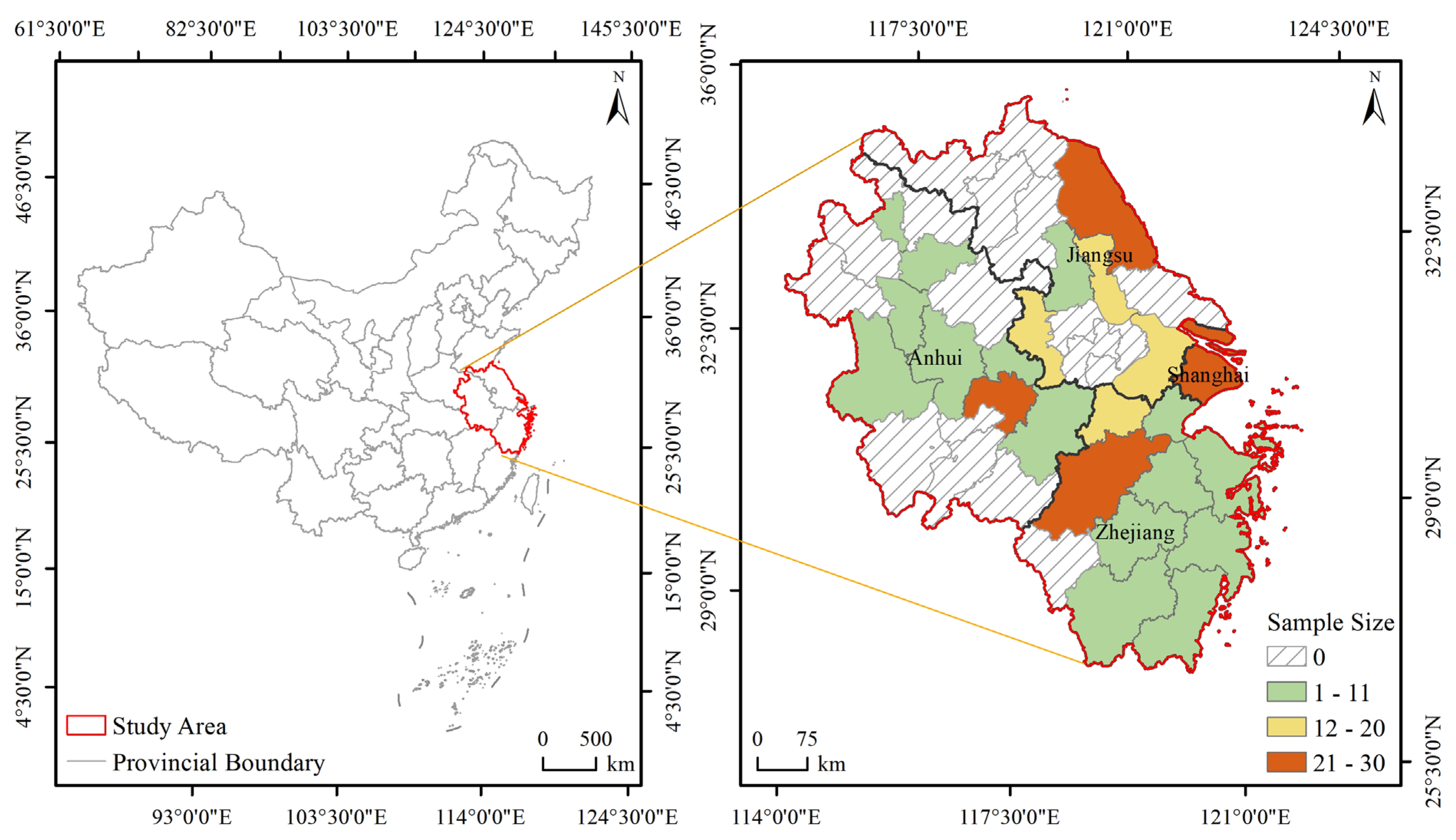
Structured questionnaires were administered to the selected respondents, yielding 254 valid responses. The survey instrument was designed to capture a comprehensive set of variables reflecting farmers’ individual characteristics, digitalization levels, exposure to nudge interventions, regulatory constraints, economic incentives, perceived risks, and transformation capabilities. Each construct was measured using one or more indicators in either dichotomous (yes/no) or five-point Likert-scale formats. The collected items were subsequently aggregated and validated through Principal Component Analysis (PCA) to reduce dimensionality and extract latent factors. Detailed descriptions of questionnaire items are provided in Appendix A Table A1, Table A2, Table A3, Table A4, Table A5, Table A6, Table A7 and Table A8, while Appendix B Table A9 reports PCA diagnostics—including Bartlett’s test of sphericity, Kaiser–Meyer–Olkin (KMO) measures, eigenvalues, and chi-square statistics—confirming the adequacy of the data for factor extraction and subsequent regression analysis. Figure 1 illustrates the geographical scope of the study area and the spatial distribution of sampled aquaculture producers across the four provinces.

2.2. Theoretical Framework and Research Hypotheses

Digital transformation benefits aquaculture operators primarily through three channels: (1) Enhancing total factor productivity. For instance, IoT-enabled underwater probes can monitor dissolved oxygen and nutrient concentrations, allowing farmers to predict disease outbreaks more accurately, and to apply antibiotics or interferons in a timely and precise manner, thereby minimizing losses [36,37]. (2) Gaining price advantages. Digital transformation enables aquaculture operators to obtain modest price premiums through improved product quality and greater flexibility in production scheduling. Specifically, digitalized and factory-based aquaculture allows for more stable product quality and the capacity for off-season production (i.e., maintaining stock in ponds), which grants producers increased bargaining power and price-setting ability in the market [38,39,40]. (3) Enhancing the ability to obtain subsidies or comply with constraints. Based on this, a Minimal Identifiable Model is constructed to analyze the impact of digital technology adoption on the profitability of aquaculture operators. However, subsidies and compliance regimes may also induce a “wait-for-subsidy” (holdout) response and additional procedural burdens, potentially weakening adoption incentives.
Π r e v a = p ¯ + γ 1 a + γ 2 a 2 P a A e β a TFP   Improvement f ¯
Let a 0,1 denote the digitalization level of the aquaculture operator, reflecting the extent to which digital technologies are integrated into its production and management processes. P a represents the impact of the digitalization level a on product pricing, while p ¯ denotes the baseline price, that is, the product price or revenue level in the absence of digital technology adoption. The parameters γ 1 > 0 captures the “quality premium” effect, implying that higher digitalization improves product quality and stability, thereby allowing aquaculture operators to obtain modest price premiums. The parameters γ 2 0 reflects the “bargaining power” or “inventory flexibility” effect, meaning that with more advanced digital and factory-based systems, farmers can maintain stock in ponds and adjust production schedules during off-seasons, which enhances their bargaining position and price-setting ability in the market. The conventional input x assumed to be at an interior optimum, that is, the aquaculture operator has already made the optimal decision with respect to x , so that x does not affect the subsequent comparative statics analysis concerning a . represents the Total Factor Productivity (TFP) enhancement effect, indicating that as the digitalization level a increases, productivity rises exponentially. A higher a reflects greater digital technology adoption, leading to improved efficiency and resilience in aquaculture operations ( β > 0 ). f ¯ represents other fixed factors, such as production inputs or market size, which are held constant throughout the analysis.
In terms of the cost function C ( a ) for digital technology adoption, it includes: (1) Fixed costs, such as infrastructure investment and equipment installation; (2) Linear costs, which increase proportionally with the level of adoption a ; (3) Nonlinear costs, reflecting that as the intensity of adoption rises, the difficulty of learning, coordination, and adaptation increases at an accelerating rate; (4) Learning-related benefits, as learning reduces the linear marginal cost of adoption and mitigates the curvature of the cost function—thereby easing the “increasing difficulty with deeper adoption” effect [41,42,43,44]. To characterize the cost structure of digital technology adoption, this paper constructs a cost function that incorporates fixed costs, linear costs, nonlinear costs, and learning effects:
C a , i ; S Cost = F + p d s 1 S + s 2 S a Linear   cost + ϕ 2 a 2 Nonlinear   cost θ i a χ 2 i a 2 ,     Learning   effect s 2 > 0
The term F represents the fixed cost of adopting digital technologies, including infrastructure investment, equipment installation, and system setup. It does not vary with the adoption intensity a or learning effort i , reflecting the minimum entry cost for digital transformation. Linear cost captures the direct expenditure associated with the adoption level a . The standard unit cost of digital technology is p d . While subsidy intensity S can reduce the out-of-pocket unit cost through a price-reduction mechanism ( s 1 > 0 ), it may also generate an offsetting “wait-for-subsidy” (holdout) response: producers postpone adoption in anticipation of future subsidy rounds, which lowers their reference/acceptable price and raises the effective current cost (or equivalently reduces the perceived current net benefit) of adopting. We capture this adverse incentive by adding an offset term s 2 S ( s 2 > 0 ) into the effective unit cost. Accordingly, the linear cost component is ( p d ( s 1 s 2 ) S ) a , and the net marginal subsidy effect is s 1 s 2 ; when s 2 > s 1 , subsidies can be overall suppressive to adoption incentives. As the intensity of adoption increases, firms must invest more resources to address coordination, adaptation, and system-integration challenges, leading to rising marginal costs. The parameter ϕ > 0 captures this “increasing difficulty of adoption,” reflected in the curvature of the cost function. Learning effect term captures the cost-reducing impact of learning effort i . The first component, θ i a , indicates that learning decreases the linear marginal cost, making each unit of adoption more efficient. The second component, χ 2 i a 2 , suggests that learning mitigates cost curvature—experience accumulation flattens the cost function, alleviating the “increasing difficulty” of deeper adoption.
Naturally, the learning effort i itself also incurs additional costs. To capture the resources invested by aquaculture producers in the process of learning and adaptation, this paper specifies a learning cost function as follows:
H i ; N , S , R = 1 2 κ N + η S S + η R R i 2 , N > 0 ,   η S > 0 ,   η R > 0 .
H(i;N,S,R) captures the learning and adaptation costs incurred by aquaculture producers when accumulating digital knowledge, training personnel, and upgrading management processes. The parameter κ > 0 reflects the intrinsic intensity of learning costs, and the quadratic term i 2 implies an accelerating marginal cost of learning: initial learning (e.g., basic equipment operation) is relatively easy, whereas deeper learning (e.g., data analytics, system integration, and digital management) becomes increasingly time- and resource-intensive. Nudging intensity N reduces the unit cost of learning by improving information accessibility, demonstration effects, and peer cooperation, thereby encouraging more active learning and more efficient digital adoption. By contrast, higher subsidy intensity S and stronger regulatory/contractual constraints R are often accompanied by additional administrative and compliance burdens (e.g., application and verification procedures, documentation, reporting, audits, and inspections), which raise the unit cost of learning and system integration and may crowd out learning investments or distort incentives toward procedural compliance rather than capability building.
Regulation and contractual constraints ( R ) also affect the costs and benefits of aquaculture producers. On the one hand, regulation generates shadow benefits—such as enhanced reputation, improved market access, and risk avoidance—that arise from greater transparency and compliance. However, this effect is not linear. When regulatory or contractual enforcement is weak, even a high level of digital adoption ( a ) does not yield substantial benefits, as there is neither inspection nor market pressure. As regulatory intensity increases—such as when governments or downstream enterprises require regular submission of water-quality data, set compliance standards, or provide positive feedback to compliant farms—the benefits of digital adoption, including the avoidance of penalties and enhanced brand credibility, rise significantly. Yet, when regulation or contractual obligations become excessively stringent, they may impose additional compliance burdens, excessive inspections, and administrative pressure, causing the incentive effect to plateau or even decline. On the other hand, regulation and contractual constraints also impose costs on aquaculture producers. Stronger regulation increases the marginal cost of compliance and execution, including the administrative, record-keeping, and reporting burdens. Importantly, stringent compliance requirements may also raise the learning and system-integration burden (e.g., documentation routines, standardized reporting, audit readiness), thereby reducing perceived ease-of-use/usefulness and potentially crowding out capability-building learning efforts. However, higher digitalization ( a ) enhances automation and information-processing capacity, thereby reducing the compliance costs associated with regulation. Accordingly, the net regulatory term can be expressed as:
G a ; R Regulatory   constraint   benefit = μ R δ a κ 0 2 R 1 a 2 ,                 μ R > 0 ,   κ 0 > 0 .
The first term, μ ( R ) δ a , captures the enhancement of digitalization benefits under stronger regulation. The second term, κ 0 2 R ( 1 a ) 2 , represents compliance costs that increase with regulatory intensity R but decrease with higher digitalization a , reflecting that digital adoption alleviates the compliance burden through improved efficiency and transparency.
max a , i   Π a , i ; S , N , R = G a ; R Regulatory   benefit + Π rev a Revenue   from   adoption C a , i ; S Adoption   cost H i ; N , S , R Learning   cost
In the first stage, given the level of digital adoption a , the aquaculture producer chooses the optimal learning effort i . According to the first-order condition Π / i = 0 , the optimal solution is obtained as:
θ a + χ 2 a 2 κ N + η S S + η R R i = 0 ,
i * a , N , S , R = θ a + χ 2 a 2 κ N + η S S + η R R ,
with
i a * > 0 , · · i N * > 0 , · · i S * < 0 , · · i R * < 0 .
Intuitively, stronger nudging ( N ) lowers the unit learning cost and thus raises learning effort, whereas higher subsidy intensity ( S ) and stronger regulatory/contractual constraints ( R ) increase the administrative/compliance burden and the unit learning cost, thereby reducing learning effort.
In the second stage, substituting the optimal learning effort i * ( a , N , S , R ) into the objective function and differentiating with respect to a yields the marginal utility of digital adoption:
U a = W a p d s 1 S ϕ + θ + χ a i * a , N , S , R + μ R δ + κ 0 R 1 a .
Here, W ( a ) represents the benefits from digitalization; p d s 1 S and ϕ a denote adoption costs; θ + χ a ) i * ( a , N , S , R captures the learning-related improvement effect; and μ ( R ) δ + κ 0 R ( 1 a ) reflects the regulatory incentives and compliance-cost relief brought by digitalization. The second derivative is given by:
U a a = W a κ 0 R + χ i * a , N , S , R + θ + χ a i a * a , N , S , R .
To ensure the existence and uniqueness of an interior optimum, the regular concavity condition is imposed:
U a a a * ; N , S , R < 0 .
Further differentiation with respect to the policy variables gives:
U a N = θ + χ a i N * a , N , S , R > 0 ,
U a S = s 1 + θ + χ a i S * a , N , S , R ,
U a R = μ R δ + κ 0 1 a + θ + χ a i R * a , N , S , R .
Because i S * < 0 and i R * < 0 , the learning channel can weaken—and potentially overturn—the direct cost-reduction (subsidy) and incentive (regulation) effects. Based on the above comparative statics, the following hypotheses (H1–H3) are proposed.
H1 (Subsidy effect): 
The net effect of subsidy intensity S on digital adoption is ambiguous: although subsidies can lower acquisition costs, holdout incentives and procedural burdens may attenuate or even reverse the adoption effect.
H2 (Nudge effect): 
Nudging intensity (N) promotes learning effort and thereby increases digital adoption.
H3 (Regulatory effect): 
Regulation and contractual constraints can enhance the benefits of digital adoption when effective, but stronger compliance requirements may raise learning and integration burdens; therefore, the net marginal effect of regulation on digital adoption may diminish and can become negative when compliance burdens dominate.
According to the Implicit Function Theorem, the optimal adoption level a * satisfies U a ( a * ; N , S , R ) = 0 . For any policy variable Z { S , R } , the comparative static can be written as:
a Z * = U a Z U a a .
To characterize the interaction between nudging N and subsidy S (or regulation R), we differentiate a Z * with respect to N:
2 a * N Z = N U a Z U a a = U a Z , N U a a U a Z U a a , N U a a 2 , Z { S , R } .
Unlike the standard case where U a S = s 1 is constant, in our setting U a S and U a R depend on N through the learning channel i * ( a , N , S , R ) . Specifically, since higher S and R raise the unit learning/integration burden embedded in H ( i ; N , S , R ) , we have i N S * < 0 and i N R * < 0 , implying:
U a S N = θ + χ a i N S * < 0 ,
U a R N = θ + χ a i N R * < 0 .
Therefore, the interaction terms 2 a * / ( N   S ) and 2 a * / ( N   R ) are not necessarily positive; when the “procedural/compliance burden” effect dominates (i.e., U a Z , N < 0 is sufficiently large in magnitude), nudging may attenuate the marginal effects of subsidies or regulation, generating negative interactions.
Economically, nudging lowers learning costs and facilitates capability building, but when subsidies and regulation are implemented with intensive administrative procedures (application, verification, reporting, audits, inspections), they may shift producers’ attention and resources toward procedural compliance rather than capability accumulation, thereby increasing the effective learning/integration burden and crowding out learning effort. Hence, nudging and subsidies/regulation may exhibit substitutability rather than complementarity. Based on this mechanism, the following hypotheses (H4–H5) are proposed.
H4 (Nudge–Subsidy Substitution): 
Nudging and subsidy policies exhibit a negative interaction in promoting digital adoption, such that higher nudging weakens the marginal effect of subsidies (i.e., N × S < 0).
H5 (Nudge–Regulation Substitution): 
Nudging and regulation exhibit a negative interaction in promoting digital adoption, such that higher nudging weakens the marginal effect of regulation (i.e., N × R < 0).
Let perceived usefulness ( m ) be proxied by the optimal learning effort i * . In Stage 2, when i is treated as exogenous, the first-order condition implies:
U a i = θ + χ a > 0 .
Hence,
a * i = U a i U a a = θ + χ a * U a a > 0 .
From Stage 1, under H ( i ; N , S , R ) = 1 2 ( κ N + η S S + η R R ) i 2 , we have:
i * a , N , S , R = θ a + χ 2 a 2 κ N + η S S + η R R .
which implies:
i * N > 0 ,                 i * S < 0 ,                 i * R < 0 .
Combining these results yields:
a * N = a * i × i * N > 0 .
indicating that nudging promotes digital adoption indirectly through learning or perceived usefulness as an indirect mechanism. The following hypothesis (H6) is proposed:
H6 (Mediating Effect Hypothesis): 
Nudging promotes digital adoption indirectly by enhancing learning effort or perceived usefulness (PU). Moreover, subsidy and regulatory/compliance burdens may weaken perceived usefulness by crowding out learning effort.
Consider the optimal condition F ( a , S ) = U a ( a ; S , N , R ) = 0 . By the Implicit Function Theorem, the optimal adoption response to subsidy S is
a S * = U a S U a a ,               a S S * = U a a a a S * 2 U a a .
Since U a a < 0 , if the regularity condition A 1 :   U a a a ( a * ; N , S , R ) 0 holds, then a S S * < 0 , implying a diminishing marginal effect of subsidies.
Importantly, once the subsidy mechanism includes both a direct cost-reduction component and a potential “holdout/wait-for-subsidy” distortion (captured by the net term s 1 s 2 in the effective marginal cost), the sign of U a S is no longer necessarily positive. Specifically, when the holdout distortion dominates ( s 2 > s 1 ), we have U a S < 0 , so that
a S * = U a S U a a < 0 ,
meaning that subsidies can be overall suppressive to digital adoption. In economic terms, while subsidies may reduce the out-of-pocket adoption cost, they can simultaneously lower producers’ reference price and induce postponement (waiting for the next subsidy round), thereby weakening perceived usefulness/ease-of-use and delaying capability-building adoption. A parallel argument applies to regulation R , where excessive compliance and inspection burdens may reduce the net adoption incentive through higher procedural and integration costs.
The above comparative statics also provides a compact rationale for heterogeneity. Let q denote a contextual parameter (e.g., marketing-channel quality, external pressure, transformation capability, or production scale) that shifts either the benefit side W ( a ) or the adoption/learning cost curvature embedded in U a a . Then
a S * q = q U a S U a a = U a S q U a a + U a S U a a q U a a 2 ,
and analogously for N and R . Therefore, even if the functional form is unchanged, the marginal and interaction effects of subsidy, nudging, and regulation will vary across contexts whenever U a S q and/or U a a q differs by q . Accordingly, the following hypothesis is proposed:
H7 (Heterogeneity of effects): 
The effects of subsidy, nudging, and regulation on digital technology adoption vary across heterogeneous contexts. Specifically, their marginal and interaction effects change with: (i) the improvement of marketing channels, (ii) the intensity of external pressure, (iii) producers’ transformative capability, and (iv) the operational scale of production.
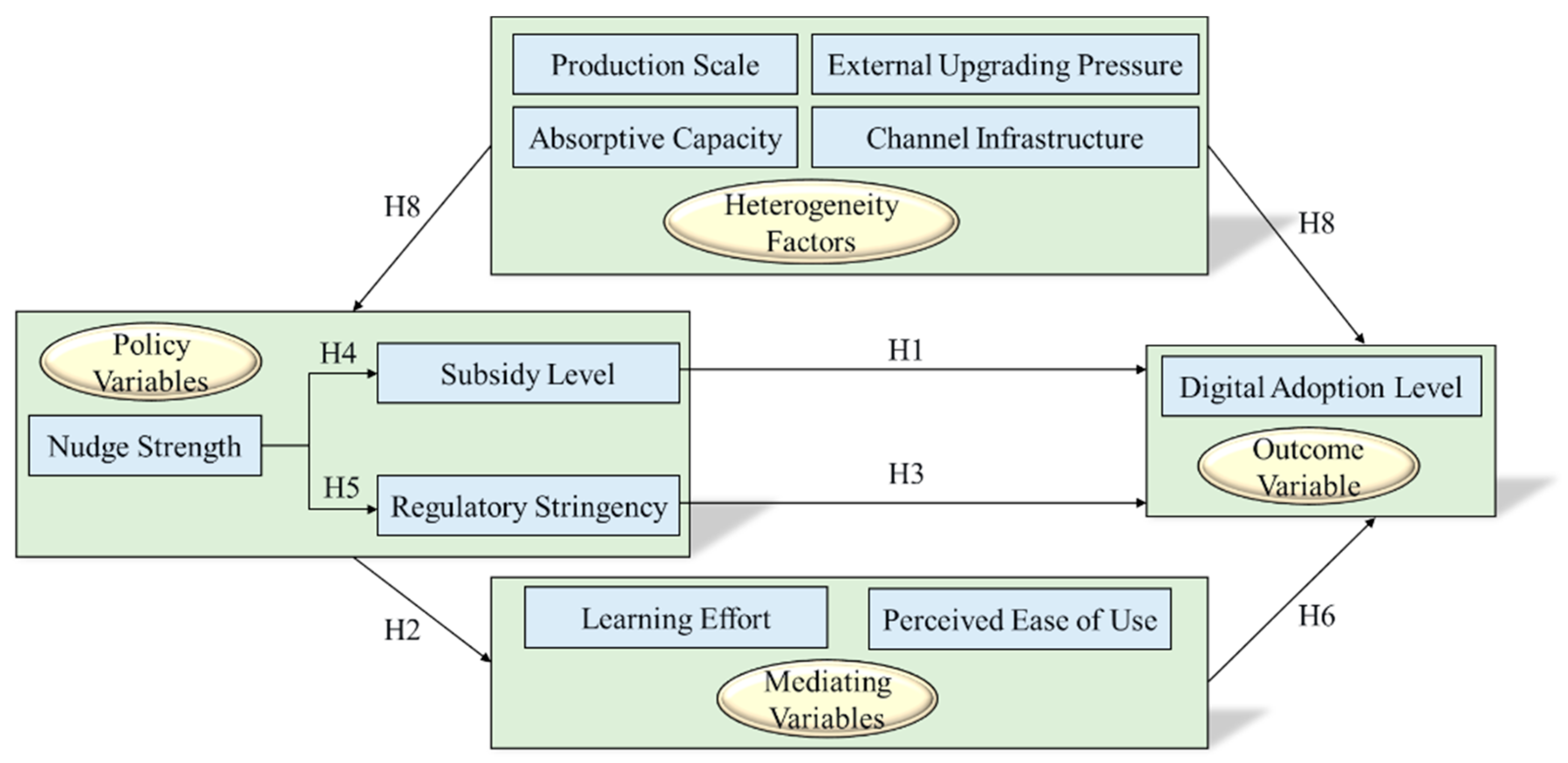
Figure 2 illustrates the hypotheses proposed in this study.

2.3. Methods

2.3.1. An OLS-Based Analysis of the Direct and Interaction Effects of Policy Instruments on Digitalization

This study employs an Ordinary Least Squares (OLS) regression model as the baseline specification to examine the direct and interaction effects of three policy instruments on the level of digitalization among aquaculture operators. The OLS framework is appropriate for quantifying linear associations and interaction effects among multiple explanatory variables. The purpose of this baseline analysis is not to uncover complex nonlinear mechanisms, but to provide a clear assessment of the relative contributions of different policy instruments to the digitalization level.
Based on the theoretical framework, the optimal level of digital adoption a * can be expressed as an unknown smooth function g ( ) of policy instruments—subsidy ( S ), nudging ( N ), and regulation ( R )—as well as a set of control variables X :
a * =   g ( S , N , R , X )
To characterize the local relationships among the policy instruments S , N , and R and the outcome variable a i , the model adopts a local linear approximation around the sample means. Specifically, the specification includes the direct effects of each instrument and their pairwise interaction terms to capture potential complementarities or substitution effects, while controlling for other covariates X i . The empirical model is expressed as:
a i = β 0 + β 1 S i + β 2 N i + β 3 R i + β 4 S i N i + β 5 S i R i + β 6 N i R i + X i γ + ε i
Here, β 1 ,   β 2 , β 3 represent the marginal effects of each policy instrument, and β 4 , β 5 , β 6 capture the interaction effects among them. To conserve degrees of freedom and mitigate multicollinearity, higher-order nonlinear terms are excluded from the baseline estimation.

2.3.2. A Propensity Score Matching (PSM)-Based Estimation of the Causal Effects of Policy Instruments on the Adoption of Specific Digital Technologies

The baseline OLS model provides preliminary evidence of a positive association between social nudging and the digital transformation of aquaculture operators; however, potential self-selection bias remains a concern. Specifically, operators exposed to higher levels of social nudging (the High-Nudge group) may systematically differ from those with lower exposure (the Low-Nudge group) in observable characteristics such as education level, management scale, access to information, or regional development conditions. These inherent differences may simultaneously influence both the likelihood of receiving social encouragement and the probability of adopting digital technologies, thereby biasing the estimated effects in the baseline model. To improve sample quality and enhance the credibility of the estimation results, this study employs the Propensity Score Matching (PSM), pairing observations based on their estimated propensity scores.
Following Rosenbaum and Rubin [45], PSM constructs a counterfactual framework that balances the distribution of observable characteristics between operators with high and low levels of social nudging exposure. The probability of receiving a high level of social nudging conditional on observable characteristics is estimated as:
P Z i = 1 X i = Pr HighNudge i = 1 X i
where Z i is a binary indicator taking the value of 1 if operator i experienced a high degree of social nudging (above the sample median), and 0 otherwise. X i denotes a vector of control variables, including individual, operational, and contextual characteristics.
Under the Conditional Independence Assumption (CIA) and Common Support Condition, the Average Treatment Effect on the Treated (ATT) can be expressed as:
A T T = E Y 1 Y 0 Z = 1 = E E Y Z = 1 , p X E Y Z = 0 , p X Z = 1
where Y 1 and Y 0 represent the potential adoption outcomes with and without social nudging, respectively, and p ( X ) is the estimated propensity score.
In the previous section, the overall digitalization level of aquaculture operators was measured using a composite index constructed from structured survey data through PCA. This section shifts the analytical focus to the adoption of specific digital technologies, denoted as Digitalization1–8, including intelligent water-quality monitoring, automatic feeding, oxygen regulation, fish disease early-warning systems, remote monitoring, market intelligence systems, AI-assisted aquaculture, and blockchain/QR-based product traceability. The key explanatory variable in this section is social nudging, which reflects the degree of social encouragement, support, and guidance received by aquaculture operators during their digital transformation. In the empirical analysis, Propensity scores are estimated using a logit model, and a 1:1 nearest-neighbor matching algorithm with a caliper width of 0.01 is employed as the main matching method to pair treated and control observations within the common support region. After matching, the mean differences in the adoption rates of each digital technology ( a 1 a 8 ) between the treated and matched control groups are interpreted as the ATT of social nudging. This approach effectively mitigates biases arising from non-random exposure to social interactions, thereby providing quasi-causal evidence on how socially driven behavioral encouragement influences the adoption of digital technologies in aquaculture operations.
In order to further strengthen causal inference, this study adopts a PSM–OLS combined analytical strategy. Specifically, PSM is conducted separately for each policy dimension, treating one policy instrument (social nudging N, subsidy S, or regulation R) as the treatment variable, while including the remaining two instruments and other covariates as controls in the propensity score model. After matching, the post-PSM OLS regression is applied to the matched samples to examine both direct and interaction effects among the three policy instruments. Interaction terms between N, S, and R are retained to capture potential complementarities or substitution effects that may persist beyond the direct treatment effect. This integrated two-step procedure leverages the bias-correction capability of PSM and the interaction-analysis flexibility of OLS, providing a more robust and comprehensive understanding of how different policy tools jointly influence the digital transformation of aquaculture operations.

2.3.3. A Gradient Boosting Machine (GBM)-Based Analysis of Robust Effects

Building on the OLS and single-policy PSM analyses, this study further conducts a robustness check using a joint-policy overlap-weighting (OW) framework. This approach is motivated by the fact that nudging, subsidies, and regulation are frequently implemented concurrently in practice, and their impacts may reinforce, offset, or depend on each other. A one-policy-at-a-time matching design may fail to represent such coexistence and conditionality, thereby weakening internal consistency and robustness. Importantly, taking nudging as an example, the ATT from single-policy PSM is not equivalent to a “pure nudging effect” with subsidy and regulation held constant. In reality, treated units under nudging are typically exposed to different concurrent combinations of subsidy and regulation, so the estimate is closer to a weighted average of nudging effects across heterogeneous joint-policy environments. Therefore, when subsidies and regulation co-move with nudging, or when interaction patterns exist, single-policy PSM estimates may be “mixed” and “disturbed” by concurrent policies, leading to residual imbalance after matching, greater sensitivity to model choices, and less stable marginal effects. To address these concerns, this study incorporates all three policy tools jointly by defining a joint-policy regime variable formed by the combination of the three binary instruments, and then reweights the sample under a multi-treatment setting. This strategy follows the balancing-weight logic for multiple treatments and is consistent with the generalized overlap weights framework.
In implementation, the three binary policy tools jointly generate eight regimes, covering all possible policy configurations. For interpretability, regimes are discussed in terms of whether nudging is present and how it coexists with subsidy and/or regulation, thereby highlighting the potential moderation of nudging by the other two tools. To mitigate sparsity in some regime cells, education is collapsed from five categories into two. Because regional differences are structural, Region is treated as a design variable for stratification rather than forcing full comparability in a pooled sample. Let the joint policy regime be denoted by T i , formed by the eight combinations of N i S i R i . For each unit i , the generalized propensity score is defined as:
e k X i = Pr T i = k X i ,   k = 1 , , 8 .
The study estimates e k ( X i ) using a gradient boosting tree model (GBM) to flexibly capture nonlinear and higher-order relationships between covariates and joint policy configurations. Notably, GBM is used here to obtain generalized propensity scores required for OW, rather than to deliver outcome effects directly. Given e k ( X i ) , this study constructs generalized overlap weights. Define
h X i = j = 1 8 1 e j X i 1 ,
and for a unit in regime T i = k , the overlap weight is
w i = h X i e k X i .
These weights downweight observations with extreme regime probabilities and concentrate comparisons on regions with stronger covariate overlap, improving comparability across the eight regimes. Because within-region comparisons are more credible, we estimate regime probabilities and compute overlap weights within regional strata, and then aggregate the reweighted samples.
In the OW-reweighted pseudo-population, we estimate an outcome model via weighted least squares (WLS) with controls and area fixed effects, using robust standard errors (e.g., HC3):
Y i = α + β N N i + β S S i + β R R i + β N S N i S i + β N R N i R i + γ X i + δ a i + ε i .
Under this specification, the marginal effect of nudging is explicitly conditional on the concurrent policy environment:
Δ N S i , R i = β N + β N S S i + β N R R i .
This joint framework therefore estimates both the main effect of nudging and how it changes when subsidy and/or regulation are present, within the same balanced pseudo-population. Finally, the estimand under joint OW is closer to the average effect for the overlap population (ATO), rather than the average effect among those who actually received a given single policy (ATT) as in single-policy PSM. By concentrating weight on the most comparable regions of the sample, OW-based estimates are typically more conservative and stable, making them well suited for robustness assessment.

3. Result Analysis

3.1. OLS-Based Results: Direct and Interaction Effects of Policy Instruments on Digitalization

Based on field investigations and structured questionnaire surveys, this study constructs a multidimensional dataset in which several question items are reduced into key latent dimensions using PCA. Specifically, the core dependent variable, Digitalization Level (Digitalization), is derived from the dimensionality reduction in items Q1–Q4, which measure the overall level of digitalization through two main dimensions—digital asset investment and digital talent input. The sub-dimensions of digitalization, representing eight specific Aquaculture 4.0 technologies (Digitalization1–8), are obtained from Q5–Q12, which inquire about farmers’ actual adoption and utilization levels of digital technologies. The core explanatory variable, Nudge Intensity (N), is generated from the PCA results of Q13–Q18, where values above the mean are coded as 1 and those below as 0. The variable Constraints and Regulation (R) is constructed from Q19–Q21 following the same dichotomization rule, while Subsidy Incentive (S) is measured directly from Q22. The mediating variable, Perceived Usefulness (PU), is derived from Q23–Q30 via PCA. Several control variables are included, originating from Q31–Q36. To conduct heterogeneity analyses, this study further computes External Pressures Faced by Respondents (based on Q39–Q42, reduced via PCA), which are then divided by the sample mean into two groups: strong external pressures (group = 1) and weak external pressures (group = 0). Similarly, Sales Channel (derived from Q37), Digital Equipment Capacity and Readiness (from Q43–Q46), and Farm Scale (based on whether the production area exceeds 60 mu, from Q48) are dichotomized into high-level (group = 1) and low-level (group = 0) groups accordingly.
This study employs a stepwise regression approach to model specification. The regression results of several baseline models are reported in Table 1. Model 1 serves as the null model, incorporating only the core explanatory variable—nudging intensity (1 = high intensity; 0 = low intensity)—and the primary dependent variable, digitalization level. Building on Model 1, Model 2 incorporates regional fixed effects. Model 3 further refines the specification by adding the previously discussed control variables. Model 4 extends Model 3 through the inclusion of Subsidy Incentive (S)—coded as 1 for strong incentives and 0 for weak incentives—while Model 5 additionally introduces Constraints and Regulation (R), coded as 1 for strong constraints and 0 for weak constraints. The findings indicate that as successive model specifications incorporate additional factors, the model’s goodness-of-fit improves steadily. The path coefficient and direction of the core explanatory variable N remain generally consistent across models, exhibiting a significant positive effect on the Digitalization Level at the 1% significance level. The variable R likewise demonstrates a weak but statistically significant positive effect at the 1% level. In contrast, R is weakly negative and only marginally significant in Model (4), but becomes statistically insignificant once S is included. S shows a significantly negative association with digitalization.
Table 2 reports the examination of the mediating and moderating effects based on Model 5. Models 5 and 6 correspond to the two stages of Jiang’s two-step method [46]. The estimates show that N is positively and significantly associated with PU (1% level), whereas R (5% level) and S (1% level) are negatively associated with PU. This indicates that, conditional on the included covariates and area fixed effects, higher nudging intensity tends to co-occur with higher perceived usefulness, while stronger regulation and stronger subsidy incentives are linked to lower perceived usefulness in the sample. Building on Model (5), Model (7) adds the interaction term N × R. The interaction is negative and statistically significant (t = −3.000), suggesting that the positive association between N and digitalization becomes weaker under strong regulation: the marginal association of N is 1.356 when R = 0 and 1.262 when R = 1. Model (8) adds N × S, and the interaction is also significantly negative (−0.906, 1% level), implying that under strong subsidy incentives (S = 1), the positive association between N and digitalization is more substantially attenuated: the marginal association of N is 1.865 when S = 0 and 0.959 when S = 1. Model (9) reports the full specification including both interaction terms. Importantly, the negative subsidy moderation remains robust (N × S = −0.957, 1% level), whereas N × R becomes statistically insignificant, suggesting that subsidy-related moderation is more stable while regulatory moderation is more sensitive to model specification. Model fit further improves as interactions are included (R-squared rises from 0.404 to 0.425), supporting the overall robustness of the patterns across specifications.
Table 3 reports additional robustness checks, using the full specification in Table 2 (Model (9)) as the benchmark. Models (10) and (11) apply two-sided winsorization at the 1% and 5% levels, respectively. The core patterns remain stable across winsorization rules: N stays significantly and positively associated with digitalization (always significant at the 1% level), and the subsidy interaction N × S remains significantly negative (1% level), whereas R, S, and N × R are generally insignificant. Model fit changes only slightly (R-squared ≈ 0.422–0.425). Model (12) excludes the Shanghai subsample (NSample Size = 220) and yields qualitatively similar results: the positive association of N and the negative moderation by subsidies (N × S < 0) remain statistically significant with comparable magnitudes. Model (13) further excludes outliers (e.g., farming area > 1000 mu; Sample Size = 245), and the estimates again remain consistent (R-squared returns to 0.425). Overall, Table 3 indicates that the main findings—(i) a robust positive association between nudging intensity and digitalization and (ii) a robust negative subsidy moderation of this association—are not driven by tail values or specific subsamples.
Table 4 assesses the sensitivity of the results to alternative constructions and cutoff rules for the core explanatory variable. The benchmark is the full model (9). Model (14) replaces the mean-split binary N with a continuous PCA score (e.g., standardized z-score). Models (15)–(17) re-code N using a median split (2-quantile), terciles (3-quantile), and quartiles (4-quantile), and re-estimate the same full specification with controls and area fixed effects. Across the continuous and quantile-based alternatives, N remains significantly and positively associated with digitalization (Models (14)–(17), all at the 1% level), indicating that the main effect is stable to different variable constructions. Regarding moderation, N × S stays significantly negative in the benchmark and quantile-based specifications (e.g., −0.932 ***, −0.419 **, and −0.348 ** in Models (15)–(17)), implying that the positive N–digitalization association is weaker when subsidies are stronger; however, under the continuous specification (14), N × S remains negative but becomes statistically insignificant (−1.115). By contrast, R, S, and N × R are generally insignificant across the alternative codings, consistent with the main results. Because coefficients are not directly comparable across different scalings or codings, the interpretation focuses on the consistency in signs and statistical significance.
Table 5 reports the results of the heterogeneity analysis. The sample is split by (i) sales-channel diversity (Channel = Low: single channel; Channel = High: multi-channel such as online + offline) and (ii) external pressure intensity (Pressure = Low vs. Pressure = High). All subgroup regressions keep the same set of controls and area fixed effects as the benchmark Model (9). For the channel split, both Model (18) (Channel = Low, Sample Size = 179) and Model (19) (Channel = High, Sample Size = 75) show that N remains significantly and positively associated with digitalization (1% level in both groups), with a larger coefficient in the high-channel group (2.018 vs. 1.799). Regarding moderation, N × S is negative and statistically significant in both groups (Channel = Low: t = −3.427; Channel = High: −1.786 **), indicating a weaker N–digitalization association under stronger subsidies. In contrast, N × R is significantly negative only in the low-channel group (−0.853 **) but insignificant in the high-channel group, suggesting that regulatory moderation is not uniform across channel structures. The main effects of R and S are generally insignificant in these subgroup regressions; heterogeneity mainly arises from N and its interactions (especially with S). For the pressure split, Model (20) (Pressure = Low, Sample Size = 102) and Model (21) (Pressure = High, Sample Size = 152) again show a significantly positive association between N and digitalization (1% level in both groups), with a slightly larger coefficient under high pressure (1.721 vs. 1.593). The subsidy interaction N × S is significantly negative in the high-pressure group (−1.084 **) but insignificant in the low-pressure group (−0.452), implying that subsidy-related attenuation of the N–digitalization association is concentrated in high-pressure settings. The interaction N × R is insignificant in both pressure groups. Overall, N exhibits stable positive associations across subsamples, while the negative moderation by subsidies (N × S) is more context-dependent (channel structure and external pressure).
Table 6 reports another set of heterogeneity analyses. Model (22) and Model (23) correspond to the low-capacity (Capacity = Low) and high-capacity (Capacity = High) subsamples, respectively, while Model (24) and Model (25) correspond to the low-size (Size = Low) and high-size (Size = High) subsamples. Across these groups, nudging intensity (N) remains significantly and positively associated with digitalization (all significant at the 1% level), with relatively larger coefficients in the high-capacity and low-size subsamples. The association of subsidy incentives (S) is context-dependent: S is significantly negative in the low-capacity and high-size groups (Model 22: −0.705 **; Model 25: −0.751 **), but significantly positive in the high-capacity group (Model 23: 0.981 **). Regarding moderation, N × S is significantly negative in the high-capacity and low-size groups (Model 23: −1.335 **; Model 24: −1.093 **) but insignificant in the low-capacity and high-size groups, indicating that subsidy-related attenuation of the N–digitalization association is concentrated among higher-capacity or smaller units. By contrast, R and N × R are generally insignificant across subsamples (with R only weakly negative in Model 23: −0.740 *), overall aligning with the benchmark results.

3.2. PSM-Based Results: Causal Effects of Social Nudging on the Adoption of Specific Digital Technologies

Potential self-selection bias may compromise the validity of the baseline OLS relationship between policy tools and digital transformation. To mitigate this concern, this study employs propensity score matching (PSM) to construct a more comparable control group and explicitly targets the average treatment effect on the treated (ATT), defined as A T T = E [ Y ( 1 ) Y ( 0 ) T = 1 ] —that is, the expected change in outcomes for units that are already in the high-intensity policy state had they counterfactually been in the low-intensity state. In the multi-policy setting (where N, R, and S may coexist), the ATT is interpreted as the marginal effect of one specific policy tool while holding the other two constant—for example, the ATT of N represents the effect of N conditional on fixed levels of S and R, and analogously for R and S. Accordingly, this study adopts a “one-at-a-time, other-tools-held-constant” design: N, R, and S are treated as binary treatment variables in turn. When estimating propensity scores and performing matching for a given treatment, the model conditions on the other two policy tools (as covariates) and the full set of controls, thereby identifying the ATT of a single tool under a given policy environment. For each treatment (Treat N/Treat R/Treat S), 1:1 nearest-neighbor matching with a caliper of 0.01 is implemented to ensure that each treated observation is matched to the most similar control observation within the allowable distance and common support. Using separate propensity score models for each policy is appropriate because the estimand is the marginal ATT of each individual tool, conditional on the policy environment defined by the other tools. Finally, interaction terms (N × R, N × S) are included in the post-matching regressions to explore whether the association between one policy tool and digitalization differs across the state/intensity of another policy tool. Given that interaction estimates can be sensitive to model specification and common support in multi-policy settings, these terms are interpreted conservatively as moderation patterns within the matched sample rather than as definitive causal interaction effects. Robustness is further assessed using additional checks (e.g., joint propensity-score weighting).
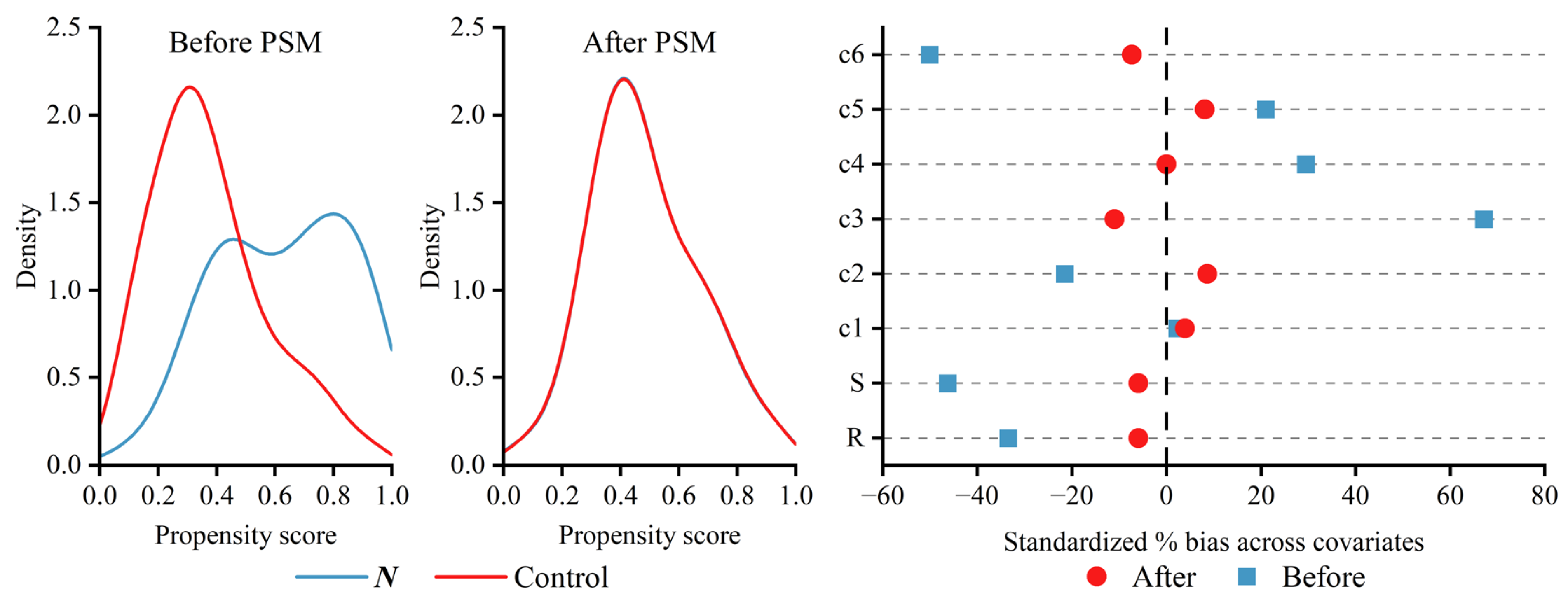
As shown in the kernel density comparison plots (see Figure 3), which present the case where policy tool N is treated as the treatment variable with S and R held constant, there was a clear difference in the distribution of propensity scores between the treated and control groups before matching, indicating strong heterogeneity in observable characteristics. After matching, the two curves largely overlap, suggesting that the distribution of observable characteristics becomes more balanced between groups. The covariate balance plot further shows that the standardized bias of most covariates decreases substantially after matching, with the majority of bias values falling below the 10% threshold, indicating that the matching improves sample comparability to a large extent. Evidence from the standardized mean difference plot and the covariate balance tables (see Appendix C Table A10) also supports this pattern. However, some variables in Appendix C Table A11 and Table A12 still exhibit standardized bias values slightly above the 10% threshold, suggesting that the balance for these covariates is less satisfactory; therefore, the matching results for these specifications should be interpreted with caution and are provided for reference only. Overall, the matching quality is acceptable for the main specification focusing on policy tool N (conditional on S and R), while the results for R and S serve primarily as supplementary evidence. After obtaining the matched sample, the regression analysis was re-estimated to test the robustness of the main findings.
Table 7, Table 8 and Table 9 presents the PSM-adjusted effects of N, S, and R on digitalization and its eight component technologies.
Table 7 reports PSM-adjusted estimates of the association between social nudging intensity and overall digitalization as well as eight specific digital technologies, based on a 1:1 nearest-neighbor matched sample (caliper = 0.01; Sample Size = 134) with closely similar propensity scores. Consistent with the baseline OLS results, the coefficient on N remains positive and statistically significant for overall digitalization (p < 0.01) after matching, suggesting that the positive relationship between nudging and digitalization is not solely driven by observable compositional differences. As expected, tight-caliper matching discards non-overlapping observations and reduces statistical power, but the post-matching diagnostics indicate substantially improved balance (most SMDs < 10%; see Figure 3 and Appendix B Table A9), supporting the credibility of the reweighted comparison among comparable units. Across component technologies, the positive net association of N remains statistically significant for most outcomes (D1, D2, D4–D8), while it becomes insignificant for D3, implying that nudges are more strongly aligned with adoption of certain operational/monitoring technologies (e.g., water-quality monitoring tools) and comparatively less aligned with market-analysis tools. Overall, Table 7 indicates that within the comparable and policy-relevant matched sample, nudging is still positively related to digital transformation, with heterogeneous strength across technologies.
Table 8 reports PSM-adjusted results for the subsidy treatment (Treat S), illustrating the net effects/associations of subsidy support with firms’ overall digitalization and eight component technologies. In the matched sample, the estimated effect of S on overall digitalization is statistically insignificant, while S is significantly and negatively associated with the adoption of most specific technologies (D2–D8 are largely negative and significant). Importantly, matching quality differs across policy tools: the post-matching balance diagnostics in the Appendix C Table A10 indicate that Treat N achieves generally better covariate balance, whereas Treat S (and Treat R) still exhibits residual imbalance (some covariates’ standardized bias and variance ratios do not fully converge to commonly used thresholds). Accordingly, this study treats the PSM results for Treat N as more credible “like-with-like” evidence, while taking a more conservative stance for Treat S and Treat R—interpreting them as robust within-matched-sample associations and complementary evidence rather than making strong causal claims.
Against this backdrop, the observed negative patterns for specific technologies are consistent with several plausible mechanisms: (1) Subsidies may crowd out intrinsic behavioral motivation. Once subsidies are introduced as a strong external incentive, the utility calculus of aquaculture producers and operators shifts—their primary objective becomes maximizing economic returns from securing the subsidy (in addition to the functional gains from digital facilities). Under the rational actor hypothesis, producers thus tend to adopt digital technologies only at the minimum level necessary to obtain the subsidy, minimizing the cost–subsidy trade-off while maximizing profits. Such behavior, however, may inadvertently suppress the overall improvement of digitalization levels. (2) Subsidies may be subject to a “one-size-fits-all” or “multi-target” implementation bias. In some cases, certain producers or operators receive subsidies not because of their technological capacity, but due to favorable relationships with the government or their status as socially vulnerable groups—for instance, enterprises that provide employment opportunities in poverty-stricken areas. As a result, subsidies may be allocated to actors with limited absorptive capacity and weak digital competencies. This misallocation of resources reduces the efficiency of policy incentives and ultimately constrains the overall improvement of digital technology adoption. (3) Subsidies may induce a “waiting-for-policy” mentality among some producers or operators. When producers anticipate future rounds of subsidies or policy adjustments, they may strategically postpone their investment and adoption decisions in order to capture potential future benefits. In the short term, this results in a noticeable decline in their willingness to adopt digital technologies. (4) Subsidies may also generate a signaling effect that reinforces such behavioral mechanisms. Producers or operators may interpret the provision of subsidies as a signal that the government perceives the relevant technologies to be high-risk or low-return, thereby reducing their confidence and willingness to adopt them. On this basis, the more subsidies are offered, the less likely producers are to engage in proactive technology adoption. Instead, their behavioral motivation may shift toward obtaining or waiting for subsidies, eventually leading to a “no subsidy, no adoption” pattern.
Among these, the inhibitory impact of subsidies on the adoption of intelligent feeding equipment and water quality monitoring technologies is relatively stronger than that observed for other technologies. This pattern may be partly explained by the characteristics of these two types of technologies. Both intelligent feeding equipment and water quality monitoring devices tend to have relatively short life cycles, leading producers or operators to form a “reference price” after one round of use. This perceived acceptable price often falls below the actual market price, prompting producers to expect matching government subsidies to bridge the gap. Without such subsidies, their perceived cost exceeds the acceptable threshold, discouraging further adoption. Moreover, these types of equipment are moderately priced and relatively easy to subsidize, making them more likely to become targets of policy intervention.
Table 9 reports PSM-adjusted results (Treat R; 1:1 nearest-neighbor matching with a 0.01 caliper) based on the matched sample (Sample Size = 148), describing the net associations between R and overall digitalization as well as eight component technologies. In the matched sample, the coefficient on R is negative but statistically insignificant for overall digitalization and for all component outcomes (D1–D8), suggesting limited evidence that regulatory pressure is independently associated with higher (or lower) digitalization once comparable units are contrasted. By contrast, nudging intensity (N) remains positively and significantly associated with overall digitalization and most component technologies, while subsidy support (S) is negatively associated with overall digitalization and several components (notably for D7). The interaction terms (R × N and R × S) are generally insignificant, with only weak evidence of heterogeneity in a few specifications. Importantly, Appendix C Table A11 and Table A12 balance diagnostics indicate that post-matching balance for Treat R is not as strong as for Treat N, with some covariates’ standardized bias and variance ratios not fully converging to commonly used thresholds. Accordingly, this study interprets the Treat R PSM results conservatively as within-matched-sample robust associations and complementary evidence.

3.3. GBT-Based Results: Nonlinear and Robust Effects of Social Nudging on Digital Technology Adoption

The robustness of policy effect estimates is further examined using an overlap-weighted (OW) joint model that incorporates multiple policy tools simultaneously [47]. The adoption of a joint modeling strategy is motivated by the potential mutual influence and interaction among the three policy instruments (N, R, and S). In practice, these policies are often implemented concurrently, and their effects may not be independent. The impact of one policy tool can be amplified, offset, or conditioned by the presence and intensity of others. When each policy is analyzed separately using PSM, such interdependencies are not fully captured, which may result in omitted interaction effects, imbalanced covariate distributions, and unstable estimates of marginal treatment effects. The joint model, by contrast, explicitly considers the coexistence and interplay of policies, providing a more comprehensive and internally consistent framework for identifying the combined and conditional effects of policy interventions on digital transformation.
In the OW joint model, the three binary policy variables (N, R, and S) are combined to form eight possible policy regimes—000, 001, 010, 011, 100, 101, 110, and 111—capturing all configurations of the three policy tools. For analytical clarity, these regimes are grouped into four conceptual categories: (a) Absence of N (000, 001, 010, 011): baseline scenarios where the status of S and R is less relevant; (b) Presence of N only (100): representing a pure nudging environment; (c) Presence of N combined with either S or R (101, 110): representing potential moderating effects of subsidies or regulation on nudging; (d) Presence of all three (111): reflecting full policy interaction environments. This specification emphasizes the moderating roles of S and R on the effect of N on digitalization. To address sample sparsity issues and ensure sufficient overlap across strata, the education variable is recoded from five to two categories (levels 1–2 as low, 3–5 as high), thereby avoiding empty or underpopulated cells. The region variable, due to its structural diversity, is retained as a background design variable and used for stratification rather than aggregation. The OW framework then performs stratified reweighting across policy regimes to generate balanced, comparable groups for estimation.
The estimation of generalized propensity scores required by the OW procedure is conducted using a Gradient Boosting Tree (GBT) model instead of a simple logistic regression. The GBT method flexibly captures nonlinear and high-order interactions between covariates and policy regimes, enabling more accurate estimation of propensity distributions in the multi-treatment setting. This machine-learning–based estimation improves covariate balance and enhances the credibility of weighted comparisons. Overall, the OW-based joint model provides a rigorous robustness check that (1) mitigates the instability and potential bias arising from separate PSM estimates of single policies; (2) integrates the interdependence of multiple policy tools within a unified inferential framework; and (3) leverages flexible machine learning methods to ensure better balance, overlap, and internal validity in the estimation of policy effects on digital transformation.
It is important to note that, under the OW specification, the estimand identified in this setting is the Average Treatment Effect for the Overlap Population (ATO), rather than the ATT estimated in the PSM models. Conceptually, the ATT focuses on the average impact for units that actually received a given treatment (e.g., high-intensity N), while the ATO represents the average treatment effect among units with substantial overlap in covariate distributions between treatment and control groups. In other words, ATO emphasizes the subpopulation for which policy assignment is most comparable and least driven by extreme selection—thereby providing more stable and policy-relevant estimates. When region-specific overlap weighting is introduced, the ATO can be interpreted as a region-adjusted average treatment effect over the common support within each regional stratum. This design mitigates regional heterogeneity in policy exposure and implementation intensity, ensuring that the estimated effect reflects realistic, comparable contrasts across regions. In this context, the ATO provides a balanced, interpretable measure of the average policy impact for units with similar probabilities of receiving each policy combination, offering a more conservative and internally valid assessment of digitalization outcomes under overlapping policy environments.
Table 10 presents the regression results estimated using the joint propensity score–overlap-weighted Weighted Least Squares (OW-WLS) model, which integrates three policy instruments (N, R, and S) and their interaction terms. The results show that nudging intensity remains positively and significantly associated with overall digitalization (β = 1.660, p < 0.01), confirming the robustness of its positive effect under the unified overlap-weighted framework. Across component technologies, the effect of N is positive for most outcomes and statistically significant for D1 and D7, suggesting that nudging particularly promotes the adoption of operational and monitoring-oriented digital tools. In contrast, subsidy support shows significant negative associations for several technologies—especially D2, D6, D7, and D8—indicating that subsidies may crowd out firms’ intrinsic innovation incentives. Regulatory pressure exhibits negative but insignificant coefficients across all models, while the interaction terms (N × R and N × S) remain small and statistically insignificant, implying that the moderating roles of S and R on N are limited in this specification.
The Gradient Boosting Tree model was used to estimate the generalized propensity scores underlying the OW weights applied in the WLS regressions. The model was tuned with the following hyperparameters: learning_rate = 0.05, max_depth = 3 (reduced to 1 in subsamples to avoid overfitting), max_iter = 1000, min_samples_leaf = 20 (set to 10 in robustness checks), max_leaf_nodes = 31, and l2_regularization = 0.0 (compared with 5.0 for sensitivity analysis). A 3–5-fold region-stratified cross-fitting procedure was adopted to enhance generalization. The model achieved ideal calibration through the R-sigmoid method (within-fold calibration ratio = 1), with adequate overlap across regions (effective sample size [ESS] = 24–63) and stable weight distributions (w99 ≈ 0.50–0.67; wₘₐₓ = 0.56–0.67).
A cross-comparison of all estimation results (Table 1, Table 2, Table 3, Table 4, Table 5, Table 6, Table 7, Table 8, Table 9 and Table 10) provides consistent evidence that the empirical findings are robust in direction but heterogeneous in magnitude across policy tools. Nudging intensity emerges as the most stable and policy-relevant driver of digital transformation. It shows a strong positive and statistically significant association with overall digitalization in the baseline OLS regressions (Table 1, Table 2, Table 3, Table 4, Table 5 and Table 6), remains significant in the PSM-treated sample (Table 7), and continues to display positive and significant effects in the joint OW–WLS regression (Table 10). Across the eight component technologies (D1–D8), the coefficients on N are predominantly positive—especially for operational and monitoring technologies (D1, D7)—even though significance levels vary across specifications. This convergence across estimation strategies confirms that the nudging–digitalization link is highly robust within both unweighted and reweighted pseudo-populations. In contrast, subsidy support exhibits a less stable aggregate relationship but a consistent technology-level suppression effect. The Treat-S PSM estimates (Table 8) and the joint OW–WLS results (Table 10) both indicate that S is largely insignificant for overall digitalization but significantly negative for multiple technology components (notably D2–D8). This pattern suggests that subsidies may crowd out intrinsic motivation or induce short-term compliance behaviors, thereby reducing the depth of technology adoption. Hence, S is interpreted conservatively as being associated with lower adoption intensity of specific technologies, while its net impact on overall digitalization remains model-dependent. Regulatory pressure, by contrast, shows no stable or significant effect across any specification. In both the Treat-R PSM (Table 9) and the OW–WLS joint model (Table 10), the coefficients on R are negative but statistically insignificant for both aggregate and component outcomes, indicating that regulation does not exert an independent or systematic influence on digitalization levels.
Finally, interaction terms (e.g., N × S, N × R) are sensitive to model specification and should therefore be interpreted cautiously. In some specifications, the coefficient on R × N is significantly negative for overall digitalization, while in others it remains negative but statistically insignificant; no positive or opposite-signed interactions are observed across any model. These results suggest that the potential moderating effect of regulatory pressure on nudging, if present, is directionally consistent but not robust across specifications. Overall, the multi-method evidence supports a robust positive impact of social nudging, a conditional negative association of subsidy support, and a weak or null direct role of regulatory pressure. The joint OW–WLS results validate these conclusions within the most comparable, overlap-weighted pseudo-population, reinforcing the overall robustness of the empirical findings.

4. Discussion

This study investigates how different policy instruments—specifically social nudging, subsidies, and regulations—influence the digital transformation of aquaculture operators. The research aims to disentangle the relative effectiveness and interaction mechanisms of these behavioral, financial, and coercive interventions in promoting technology adoption. To ensure the robustness and credibility of the findings, a multi-method empirical strategy was adopted. First, Ordinary Least Squares regression served as the baseline model to estimate the overall linear association between the three policy instruments and digitalization outcomes. This approach provides an intuitive benchmark and a clear interpretation of direction and magnitude. Second, to address potential self-selection bias, the study applied Propensity Score Matching to extract a subsample of comparable observations with similar propensity scores between treatment and control groups. This method enhances causal interpretability but inevitably reduces sample size, which may limit statistical power. Third, to complement the limitations of both OLS and PSM, the study further employed Overlap Weighting combined with Gradient Boosted Trees. This integrated approach retains the full sample, achieves superior covariate balance, and allows for the estimation of nonlinear and heterogeneous treatment effects.
In essence, the three empirical approaches employed in this study represent distinct but complementary identification strategies—no adjustment (OLS), sample refinement (PSM), and reweighting (OW)—to test hypotheses H1 through H7. Despite their methodological differences, the results derived from these models exhibit a high degree of consistency, underscoring the robustness of the core findings: (1) The positive effect of social nudging on digital transformation remains strong and statistically significant across all estimation methods, from the baseline OLS to the matched and reweighted analyses. (2) Subsidy support shows unstable aggregate effects but a consistent and significant negative association at the technology level (particularly D2–D8), suggesting that subsidies may inhibit the depth of digital adoption. (3) Regulatory pressure has negative but statistically insignificant coefficients across all models, indicating the absence of a stable independent effect. (4) Interaction terms (e.g., N × R, N × S) are sensitive to model specification: in some models, N × R is significantly negative for overall digitalization, while in others it remains negative but insignificant; no positive or opposite-signed effects are observed. This implies that regulation may, in certain contexts, partially offset the behavioral effectiveness of nudging, though such moderation is not robust. (5) Heterogeneity analyses reveal that the positive influence of nudging is more pronounced under conditions of higher external pressure, while the moderating effect of regulation appears somewhat stronger among large-scale operators. Overall, the three empirical methods—from unadjusted to matched to reweighted designs—yield mutually corroborative evidence. The observed variations across models reflect differential sensitivity among subgroups to behavioral, financial, and regulatory policy instruments, with certain high-sensitivity groups contributing disproportionately to overall model significance. Collectively, these results reinforce the conclusion that social nudging exerts a robust and broad positive impact on digital transformation, whereas subsidy and regulatory instruments exert weaker, conditional, or context-dependent effects.
The positive impact of social nudging on digitalization remains consistently robust across all estimation methods and model specifications. This finding supports Hypothesis H1 and aligns with prior empirical evidence highlighting the effectiveness of social and behavioral interventions in promoting digital transformation [48]. Within the theoretical framework of this study, social nudging primarily functions through information provision and behavioral activation. By enhancing operators’ willingness to learn and improving their cognitive accessibility to digital tools, social nudging increases the perceived ease of use of digital technologies. A higher level of perceived ease of use reduces users’ psychological and operational barriers, thereby strengthening their intention to adopt digital tools and promoting the overall digitalization process. The empirical results confirm this mechanism: higher levels of social nudging significantly enhance operators’ perceived ease of use, and perceived ease of use, in turn, exerts a positive and statistically significant effect on technology adoption and digitalization outcomes. This finding is consistent with the Technology Acceptance Model [29] and the Unified Theory of Acceptance and Use of Technology [30], both of which emphasize perceived ease of use as a key determinant of behavioral intention. Recent studies in the agricultural sector have reached similar conclusions, showing that interventions improving information accessibility and user familiarity effectively foster digital adoption [49,50,51]. Accordingly, the robust positive effect of social nudging found in this study can be attributed to its role in reducing cognitive and operational friction, enhancing users’ confidence and competence in engaging with digital technologies, and facilitating a smoother transition toward digitalized operations.
In contrast, the estimated effects of regulation and subsidy incentives are not consistently robust across the three estimation models. This does not imply that they have no impact on digital technology adoption; rather, their effects vary substantially in both magnitude and direction across different subgroups. Consistent with prior empirical evidence, strong external incentives such as regulation and subsidies—which reshape the structure of rewards and constraints—may produce ambiguous or non-directional effects. For some producers, they lower financial barriers and promote digital adoption; for others, they cause incentive distortions, crowding out intrinsic motivation and leading to patterns like “no subsidy, no adoption” or withdrawal once incentives end. Beyond the uncertainty of policy effectiveness, in practice, strong incentive mechanisms such as regulation and reward-based schemes are also difficult to implement. In Shanghai, the municipal government places great emphasis on the quality and safety of aquatic product supply chains and expects neighboring provinces—Jiangsu, Zhejiang, and Anhui—to adopt digital technologies for traceability and quality monitoring. In theory, establishing market entry barriers—for instance, requiring blockchain-based traceability systems for products entering the Shanghai market—could ensure high quality and justify premium pricing, with consumers recognizing such products as government-endorsed. However, this approach faces political and institutional resistance: the central government and the surrounding provinces oppose such localized regulations because they contradict the national strategy of building a unified domestic market and avoiding market over-fragmentation. Alternatively, market-based mechanisms, such as certification or labeling systems issued by industry associations, could partially achieve quality differentiation without violating the principle of market unity. Yet, these mechanisms are limited in effectiveness, as private labels are easily imitated and lack governmental endorsement, which would otherwise compromise market fairness. As a result, the current policy compromise is the “commitment-to-compliance” certification system—a form of light-touch government endorsement under full market competition, where producers merely pledge conformity without rigorous verification. As shown in Figure 4, a structural “impossible trinity” exists between maintaining a unified national market, achieving premium prices for high-quality aquatic products, and securing government endorsement—any policy design that strengthens two dimensions inevitably weakens the third. This underscores the practical importance of social and behavioral interventions, which, unlike strong incentive mechanisms, can influence digital adoption by shaping perceptions and norms without disrupting market unity or creating policy conflicts.
The results further reveal that the interaction between social nudging and subsidy incentives (N × S) is significantly and robustly negative in several model specifications, while other interaction terms—including N × R—remain negative but statistically insignificant. This pattern suggests a partial policy incompatibility between behavioral and financial instruments. While subsidies operate through external economic incentives that reshape producers’ reward structures, nudging relies on voluntary behavioral activation grounded in social learning and intrinsic motivation. When implemented simultaneously, the strong financial orientation of subsidies may distort the behavioral mechanism of nudging by crowding out the intrinsic motivation it seeks to stimulate, thereby weakening its positive effect on digital technology adoption. This interpretation is consistent with prior evidence on the crowding-out effect of monetary rewards on intrinsic motivation [52,53]. From a behavioral perspective, social nudging promotes digital adoption primarily through informational diffusion and norm-based peer learning, helping producers better understand the functionality and practical value of digital technologies. For example, experienced operators often share how IoT-based water-quality sensors detect key thresholds of dissolved oxygen, pH, and ammonia nitrogen—combined with weather indicators—to determine the optimal timing for interventions such as feeding adjustments or preventive treatments. These peer exchanges enhance other producers’ perceived usefulness and confidence in adopting digital tools. However, when subsidy incentives are introduced, producers’ cognitive focus shifts from functional understanding to strategic cost–benefit calculations, reducing the efficiency of social learning and weakening the informational diffusion channel on which nudging depends. In other words, the presence of strong financial incentives replaces voluntary learning with externally driven compliance, crowding out the social and informational dynamics essential for sustained digital adoption. By contrast, the interaction between regulation and nudging (N × R) remains negative but statistically insignificant across models, suggesting that coercive measures do not systematically interfere with nudging under current policy intensity levels. Overall, the results highlight that behavioral and financial incentives may not always be complementary, and their combination requires careful calibration to avoid motivational distortions.
The heterogeneity analysis demonstrates that the positive influence of nudging remains robust across all model specifications, with stronger effects observed under high external pressure, higher production capacity, and among smaller-scale producers. This indicates that when farmers face greater operational constraints, they are more receptive to informational interventions that reduce uncertainty or provide practical guidance for digital transformation. In contrast, the effect of regulation is more pronounced among large-scale producers, who generally possess stronger financial and managerial capacities, enabling them to transform compliance pressure into opportunities for technological upgrading. Meanwhile, the effect of subsidies varies across groups—positive under high-capacity but negative under high-pressure or large-scale conditions—suggesting possible crowding-out or diminishing marginal effects. The negative coefficients of N × S in several models further imply that overlapping motivational mechanisms between nudges and subsidies may weaken their combined effectiveness. Overall, these results highlight the contextual dependence of policy interactions and underscore the need for differentiated digitalization strategies tailored to farmers’ capacity, scale, and external environment.
These findings provide several important policy implications: (1) Nudging must remain central, but the key lies in how it is implemented. Empirical evidence consistently shows that nudging exerts a strong and stable positive influence on digital adoption, making it an indispensable policy tool. The focus should shift from “whether to use” to “how to use” it effectively. Nudges should be embedded in existing governance and social systems—leveraging aquatic technology extension stations, industry associations, grassroots self-governance organizations, and state-owned or leading enterprises to promote peer learning, social recognition, and cooperative digital transformation. (2) Regulation is tightening inevitably, but its interaction with nudging is not structurally negative. With the revised Fisheries Law and stricter environmental standards, regulatory pressure will continue to rise. Although N × R sometimes appears negative, the effect is unstable, suggesting policy tension rather than contradiction. Therefore, regulation and nudging should be sequenced and coordinated—regulation ensuring baseline compliance and safety, while nudging stimulates voluntary engagement and continuous improvement. (3) Subsidies require caution and redesign. The results show that subsidies are significantly negatively associated with digitalization outcomes and exert a suppressive effect on nudging, indicating that traditional compensatory subsidies may distort incentives and weaken behavioral motivation. Policymakers should therefore change how subsidies are used—from unconditional payments to incentive-compatible mechanisms that reinforce nudging, such as matching funds for cooperative digital platforms, performance-based rewards, and participation-linked training support. (4) The heterogeneity results indicate that digital adoption policies require layered, context-sensitive targeting rather than uniform bundling. While nudging consistently yields positive effects and should remain the baseline instrument, its interactions with subsidies and regulation vary by context. In high-pressure, high-capacity, or small-scale settings, N × S is significantly negative, implying that simultaneous subsidy–nudge implementation may weaken nudging through signal overload or incentive substitution; thus, subsidies should be conditional, investment-oriented, and sequenced apart from nudges. Subsidy effects are also heterogeneous—negative for low-capacity producers, positive for high-capacity ones, and negative for large firms—suggesting that broad subsidies are inefficient and should be replaced by capacity-building services and targeted, absorptive-capacity–aligned incentives. Moreover, N × R becomes negative when market channels are weak, meaning that overly tight regulation can crowd out voluntary adoption, so information and market channel development with nudges should precede regulation. In sum, small or low-capacity producers benefit from nudges plus capacity-building, high-capacity producers from conditional investment subsidies and standardized governance, and large firms from standards, certification, and compliance auditing for accountability and risk control.
In some contexts, implementing nudges and subsidies in parallel does not generate additive gains; instead, the two instruments may interfere with each other. Accordingly, subsidies should not be treated simply as cash payments to stimulate purchases, but redesigned to lower the practical barriers to use. In practice, public support can be shifted toward service-oriented packages—such as equipment leasing, maintenance and calibration, training and on-site technical assistance, and data integration with digital platforms—so that subsidies help farmers not only acquire tools but also use them effectively and consistently. Moreover, subsidy disbursement can be sequenced and made conditional: nudging interventions can first build basic awareness and skills through demonstration sites, peer learning, and technical coaching, after which financial support is linked to sustained use, routine record-keeping and data submission, and timely responses to early-warning signals. To curb short-term rent seeking, co-financing arrangements can be adopted, and subsidies can be prioritized for cooperatives or associations to support shared equipment and collective training, thereby strengthening stable collective use and mutual monitoring. Where the combined effect of nudging and regulation is weak or even mutually offsetting, a more workable approach is to assign distinct roles and implement them in sequence. Regulation should focus on minimum compliance requirements, such as emissions control, medication records, and basic traceability, while nudges should be used to promote deeper and more routine digital management beyond the compliance baseline. In implementation, authorities should first provide clear and operational compliance pathways, and then gradually strengthen inspection and accountability, so as to avoid an early reliance on high-pressure enforcement that shifts attention from learning to avoidance. Overall, smaller or lower-capacity producers should be supported primarily through nudges and capability building before stricter requirements are progressively introduced. By contrast, resource-rich and larger enterprises should be governed more intensively through higher standards, certification, and auditing to strengthen accountability and risk control; in other words, limited enforcement capacity should be prioritized toward large firms where the expected risk and impact are greater.
While this study employs multiple empirical strategies to ensure robustness, several limitations remain. Specifically, (1) the use of cross-sectional data constrains the analysis of dynamic and long-term policy effects, suggesting that future research should adopt longitudinal or panel approaches; (2) key constructs such as social nudging and perceived usefulness are self-reported, which may introduce measurement bias despite the use of matching and instrumental variable methods to address endogeneity; (3) the behavioral and cognitive mechanisms underlying the negative interaction between nudging and regulation require deeper examination, particularly regarding information overload and motivation crowding-out effects; and (4) real-world policy interventions are often more complex than the three instruments examined here, indicating the need to explore more diverse policy mixes and alternative behavioral designs to enhance the effectiveness and contextual adaptability of digital transformation policies. Despite these limitations, this study makes several important contributions: (a) it develops a unified analytical framework that integrates behavioral, financial, and coercive policy instruments to examine their relative and interactive effects on digital transformation in aquaculture; (b) by combining econometric and machine learning methods, the research improves both causal interpretability and predictive accuracy, offering methodological advancement beyond conventional policy evaluation; (c) empirically, the findings confirm the robust effectiveness of social nudging compared with subsidies and regulations, underscoring the policy value of low-cost, information-based behavioral interventions; and (d) theoretically, the study deepens the understanding of how soft and hard policy tools interact in digital governance contexts, providing practical implications for designing context-sensitive and behaviorally informed digital transformation strategies.

5. Conclusions

This study examined how different policy instruments—specifically social nudging, subsidies, and regulations—affect the digital transformation of aquaculture operators. Using a multi-method empirical design that combined Ordinary Least Squares, Propensity Score Matching, and Overlap Weighting with Gradient Boosted Trees, the research provided robust evidence on the relative effectiveness and interaction mechanisms of behavioral, financial, and coercive interventions. The results consistently demonstrate that social nudging exerts a strong and stable positive influence on digital technology adoption, whereas the effects of subsidies and regulations are more heterogeneous and context-dependent. Moreover, the significant negative interaction between nudging and regulation indicates an inherent policy incompatibility, suggesting that coercive mechanisms may crowd out the voluntary motivation on which behavioral interventions rely. Heterogeneity analysis further shows that nudging works more effectively under high external pressure, while regulation exerts stronger effects among large-scale producers.
These findings have both theoretical and practical implications. They highlight the superior robustness of behavioral interventions in promoting digital transformation, emphasize the need for strategic coordination between soft and hard policy tools, and call for context-sensitive policy targeting across different types of producers. By integrating econometric and machine learning approaches, this study also contributes methodological innovation to the evaluation of complex policy effects. Overall, the research enriches the theoretical understanding of policy interactions in digital governance and provides actionable insights for designing behaviorally informed, inclusive, and sustainable digital transformation strategies in agriculture and aquaculture.

Author Contributions

Conceptualization, Y.Q.; methodology, Y.Q.; software, Y.Q.; validation, J.Z. and Y.Q.; formal analysis, Y.Z.; investigation, Z.Y.; resources, J.Z.; data curation, Y.Q.; writing—original draft preparation, Y.Q.; writing—review and editing, Y.Q.; visualization, Z.Y. and Y.Q.; supervision, J.Z.; project administration, J.Z.; funding acquisition, J.Z. All authors have read and agreed to the published version of the manuscript.

Funding

Shanghai Municipal Philosophy and Social Sciences Planning Project (2025BJB011).

Institutional Review Board Statement

Not applicable.

Informed Consent Statement

This study involved a survey of 254 aquaculture farmers. All participants provided informed consent, and all responses were anonymized.

Data Availability Statement

Further inquiries can be directed to the corresponding author.

Conflicts of Interest

The authors declare no conflicts of interest.

Appendix A. Questionnaire Information

Table A1. Items on Digitalization.
Questionnaire ItemsDescriptionMeasurement
Q1. Digital Tech Emp ShareShare of employees with a background in digital technology1 = None; 2 ≥ 0–7%; 3 ≥ 7–13%; 4 ≥ 13%
Q2. Aqua Tech Emp ShareShare of employees with a background in aquaculture-related technology1 = None; 2 ≥ 0–8%; 3 ≥ 8–25%; 4 ≥ 25%
Q3. New Tech Invest ShareProportion of total investment in the past five years allocated to new technology and seed/breeding technology1 = None; 2 ≥ 0–2%; 3 ≥ 2–5%; 4 ≥ 5%
Q4. Digital Tech Invest ShareProportion of total investment in the past five years allocated to digital technology1 = 0%; 2 ≥ 0–3%; 3 ≥ 3–5%; 4 ≥ 5%
Table A2. Items on Digital Technology Adoption.
Questionnaire ItemsDescriptionMeasurement
Q5. Smart Water Quality AppExtent of application of intelligent water quality monitoring systems in your organization1 = Not applied at all; 2 = Applied to a small extent; 3 = Moderately applied; 4 = Applied to a large extent; 5 = Extensively applied
Q6. Smart Feeding AppExtent of application of intelligent feeding systems in your organization1 = Not applied at all; 2 = Applied to a small extent; 3 = Moderately applied; 4 = Applied to a large extent; 5 = Extensively applied
Q7. Smart Oxygen Control AppExtent of application of intelligent oxygen regulation systems in your organization1 = Not applied at all; 2 = Applied to a small extent; 3 = Moderately applied; 4 = Applied to a large extent; 5 = Extensively applied
Q8. Smart Disease Warning AppExtent of application of intelligent fish disease early-warning systems in your organization1 = Not applied at all; 2 = Applied to a small extent; 3 = Moderately applied; 4 = Applied to a large extent; 5 = Extensively applied
Q9. Remote Monitoring AppExtent of application of remote monitoring systems in your organization1 = Not applied at all; 2 = Applied to a small extent; 3 = Moderately applied; 4 = Applied to a large extent; 5 = Extensively applied
Q10. Smart Market Analysis AppExtent of application of intelligent market analysis technologies in your organization1 = Not applied at all; 2 = Applied to a small extent; 3 = Moderately applied; 4 = Applied to a large extent; 5 = Extensively applied
Q11. AI Assisted Farming IntentionWillingness to adopt generative artificial intelligence–assisted aquaculture1 = Not applied at all; 2 = Applied to a small extent; 3 = Moderately applied; 4 = Applied to a large extent; 5 = Extensively applied
Q12. Digital Traceability AppExtent of application of digital traceability technologies for aquatic products (e.g., blockchain, QR code)1 = Not applied at all; 2 = Applied to a small extent; 3 = Moderately applied; 4 = Applied to a large extent; 5 = Extensively applied
Table A3. Items on Nudge for Digital Technology Adoption or Digitalization.
Questionnaire ItemsDescriptionMeasurement
Q13. Social Local SupportSupport, encouragement, or guidance from family members, friends, or village cadres/local officials during your organization’s digital technology adoption process1 = None; 2 = Low; 3 = Moderate; 4 = High; 5 = Very high
Q14. Peer SupportSupport, encouragement, or guidance from peers in the same industry during the digital technology adoption process1 = None; 2 = Low; 3 = Moderate; 4 = High; 5 = Very high
Q15. Research Institute SupportSupport, encouragement, or guidance from research institutions during the digital technology adoption process1 = None; 2 = Low; 3 = Moderate; 4 = High; 5 = Very high
Q16. Ecommerce Platform SupportSupport, encouragement, or guidance from e-commerce platforms during the digital technology adoption process1 = None; 2 = Low; 3 = Moderate; 4 = High; 5 = Very high
Q17. Processing Enterprise SupportSupport, encouragement, or guidance from processing enterprises during the digital technology adoption process1 = None; 2 = Low; 3 = Moderate; 4 = High; 5 = Very high
Q18. Industry Association SupportSupport, encouragement, or guidance from industry associations during the digital technology adoption process1 = None; 2 = Low; 3 = Moderate; 4 = High; 5 = Very high
Table A4. Items on Constraints and Incentive in Aquaculture.
Questionnaire ItemsDescriptionMeasurement
Q19. Water Quality RequirementWhether cooperative enterprises, government agencies, purchasers, or suppliers impose requirements on the water quality of aquaculture1 = Yes; 0 = No
Q20. Drug Use RequirementWhether cooperative enterprises, government agencies, purchasers, or suppliers impose requirements on the use of fish drugs such as interferons and antibiotics1 = Yes; 0 = No
Q21. Waste water Treatment RequirementWhether cooperative enterprises, government agencies, purchasers, or suppliers impose requirements on the treatment and discharge of aquaculture tailwater1 = Yes; 0 = No
Q22. Digital IncentiveWhether your organization has received any rewards or subsidies from cooperative enterprises, government agencies, purchasers, or suppliers for adopting digital technologies1 = Yes; 0 = No
Table A5. Items on Perceived Usefulness of Digital Aquaculture Technologies.
Questionnaire ItemsDescriptionMeasurement
Q23. Tailwater Treatment UsefulPerceived usefulness of tailwater treatment technology1 = Not useful at all; 2 = Slightly useful; 3 = Moderately useful; 4 = Useful; 5 = Very useful
Q24. Water Quality Monitoring UsefulPerceived usefulness of water quality monitoring technology1 = Not useful at all; 2 = Slightly useful; 3 = Moderately useful; 4 = Useful; 5 = Very useful
Q25. Smart Feeding UsefulPerceived usefulness of intelligent feeding technology1 = Not useful at all; 2 = Slightly useful; 3 = Moderately useful; 4 = Useful; 5 = Very useful
Q26. Smart Disease Warning UsefulPerceived usefulness of intelligent fish disease early-warning technology1 = Not useful at all; 2 = Slightly useful; 3 = Moderately useful; 4 = Useful; 5 = Very useful
Q27. Smart Oxygen Regulation UsefulPerceived usefulness of intelligent water oxygen regulation technology1 = Not useful at all; 2 = Slightly useful; 3 = Moderately useful; 4 = Useful; 5 = Very useful
Q28. Remote Monitoring UsefulPerceived usefulness of remote monitoring technology1 = Not useful at all; 2 = Slightly useful; 3 = Moderately useful; 4 = Useful; 5 = Very useful
Q29. Market Analysis UsefulPerceived usefulness of intelligent market analysis technology1 = Not useful at all; 2 = Slightly useful; 3 = Moderately useful; 4 = Useful; 5 = Very useful
Q30. Aqua AI Generative Model UsefulPerceived usefulness of large aquaculture technology models (generative artificial intelligence)1 = Not useful at all; 2 = Slightly useful; 3 = Moderately useful; 4 = Useful; 5 = Very useful
Table A6. Items on Respondent Information.
Questionnaire ItemsDescriptionMeasurement
Q31. GenderRespondent’s gender1 = Male; 0 = Female
Q32. Age GroupRespondent’s age group1 = 28–35 years; 2 = 36–45 years; 3 = 46–55 years; 4 = 56–65 years; 5 = 66 years and above
Q33. Education LevelRespondent’s highest level of education1 = Primary school or below; 2 = Junior high school; 3 = Senior high school; 4 = College or university (including undergraduate); 5 = Postgraduate or above
Q34. Training ParticipationWhether the respondent has participated in relevant training programs1 = Yes; 0 = No
Q35. Farming ExperienceNumber of years the respondent has been engaged in the aquaculture industry1 = 8 years or less; 2 = 9–14 years; 3 = 15–20 years; 4 = 21 years or more
Q36. ProvinceProvince where the respondent or their organization is located1 = Zhejiang; 2 = Shanghai; 3 = Anhui; 4 = Jiangsu
Q37. Ecommerce ParticipationWhether your organization has joined or accessed any e-commerce platforms1 = Yes; 0 = No
Q38. Large Scale FarmWhether the aquaculture area exceeds 60 mu (≈4 hectares)1 = Yes; 0 = No
Table A7. Items on External Pressures Faced by Respondents.
Questionnaire ItemsDescriptionMeasurement
Q39. Eco Regulation PressureDegree of ecological and environmental policy pressure faced by you or your organization1 = Very low; 2 = Low; 3 = Moderate; 4 = High; 5 = Very high
Q40. Fish Disease PressureDegree of fish disease pressure faced by you or your organization1 = Very low; 2 = Low; 3 = Moderate; 4 = High; 5 = Very high
Q41. Financial PressureDegree of financial shortage pressure faced by you or your organization1 = Very low; 2 = Low; 3 = Moderate; 4 = High; 5 = Very high
Q42. Pond Access PressureDegree of difficulty in obtaining access to pond or water surface areas faced by you or your organization1 = Very low; 2 = Low; 3 = Moderate; 4 = High; 5 = Very high
Table A8. Items on Digital Equipment Capacity and Readiness.
Questionnaire ItemsDescriptionMeasurement
Q43. Digital Equipment Cost AdequacyWhether the cost for purchasing digital equipment is sufficient1 = Yes; 0 = No
Q44. Digital Maintenance Cost AdequacyWhether the cost for maintaining digital equipment is sufficient1 = Yes; 0 = No
Q45. Facility Space AdequacyWhether the existing facility space for upgrading digital equipment is sufficient1 = Yes; 0 = No
Q46. Technical Reserve AdequacyWhether the existing technical reserves for upgrading digital equipment are sufficient1 = Yes; 0 = No

Appendix B. PCA Information

Table A9. KMO and Bartlett’s Test and PCA Summary Table.
VariableKaiser–Meyer–Olkin Measure of Sampling Adequacy (Overall)Bartlett’s Test of SphericityFirst Principal Component Eigenvalue (PC1 Eigenvalue)PC1 Variance Explained
χ2dfp
Digitalization0.636210.56760.0002.1350.534
Nudge0.797469.636150.0003.0260.504
Constraints0.639171.87630.0001.9390.647
Perceived Usefulness0.9331652.380280.0005.7330.717
External Pressures0.734215.07760.0002.2450.561
Transition Capacity0.700644.42960.0002.8220.706

Appendix C. PSM Information

Table A10. Covariate Balance Statistics for Social Nudging Before and After Matching.
VariableMatchedTreatedControl%Bias|Bias|tp > |t|V(C)
RU0.449 0.614 −33.46933.469 −2.6670.008 1.044
M0.522 0.552 −5.9455.945 −0.3440.731 1.009
SU0.504 0.724 −46.31646.316 −3.6910.000 1.252
M0.552 0.582 −5.9825.982 −0.3460.730 1.016
c1U0.858 0.850 2.223 2.223 0.177 0.860 0.956
M0.836 0.821 3.929 3.9290.227 0.820 0.933
c2U2.724 2.929 −21.53621.536 −1.7160.087 1.182
M2.970 2.896 8.565 8.5650.496 0.621 0.781
c3U3.346 2.772 67.062 67.062 5.344 0.000 1.362
M2.896 2.985 −11.01511.015−0.6380.525 1.030
c4U0.929 0.835 29.479 29.479 2.349 0.020 0.477
M0.896 0.896 0.000 0.0000.000 1.000 1.000
c5U2.110 1.882 21.010 21.010 1.674 0.095 1.078
M2.104 2.015 8.102 8.1020.469 0.640 0.991
c6U2.197 2.811 −50.17750.177 −3.9980.000 1.036
M2.328 2.418 −7.3677.367−0.4260.671 1.026
Table A11. Covariate Balance Statistics for Subsidy Before and After Matching.
VariableMatchedTreatedControl%Bias|Bias|tp > |t|V(C)
NU0.410 0.643 −47.705 47.705 −3.711 0.000 1.050
M0.561 0.561 0.000 0.000 0.000 1.000 1.000
RU0.647 0.347 62.751 62.751 4.869 0.000 1.004
M0.485 0.500 −3.008 3.008 −0.173 0.863 0.999
c1U0.878 0.816 17.191 17.191 1.309 0.192 0.711
M0.924 0.879 15.183 15.1830.872 0.385 0.657
c2U2.872 2.755 12.229 12.229 0.949 0.344 1.004
M2.879 2.773 12.055 12.0550.693 0.490 1.029
c3U3.000 3.153 −16.786 16.786 −1.288 0.199 0.818
M3.121 3.136 −1.656 1.656−0.095 0.924 0.951
c4U0.840 0.949 −35.979 35.979 −2.954 0.003 2.769
M0.985 0.939 23.798 23.7981.367 0.175 0.262
c5U2.006 1.980 2.478 2.478 0.194 0.846 1.186
M2.121 2.045 6.874 6.8740.395 0.694 1.054
c6U2.513 2.490 1.807 1.807 0.139 0.890 0.848
M2.333 2.348 −1.229 1.229−0.071 0.944 0.919
Table A12. Covariate Balance Statistics for Regulation Before and After Matching.
VariableMatchedTreatedControl%bias|Bias|tp > |t|V(C)
NU0.422 0.588 −33.538 33.538 −2.668 0.008 1.006
M0.595 0.568 5.443 5.443 0.331 0.741 0.982
SU0.748 0.462 60.933 60.933 4.825 0.000 0.757
M0.622 0.649 −5.578 5.578 −0.339 0.735 1.032
c1U0.896 0.807 25.290 25.290 1.995 0.047 0.596
M0.865 0.811 14.605 14.6050.888 0.376 0.762
c2U2.822 2.832 −1.016 1.016 −0.081 0.936 1.022
M2.797 2.676 13.083 13.0830.796 0.427 1.028
c3U3.022 3.101 −8.727 8.727 −0.696 0.487 1.207
M3.135 3.122 1.567 1.5670.095 0.924 1.014
c4U0.852 0.916 −20.037 20.037 −1.606 0.110 1.638
M0.905 0.878 8.653 8.6530.526 0.599 0.802
c5U1.993 2.000 −0.677 0.677 −0.054 0.957 0.935
M2.054 2.014 3.705 3.7050.225 0.822 1.056
c6U2.452 2.563 −8.794 8.794 −0.698 0.486 0.855
M2.270 2.419 −11.777 11.777−0.716 0.475 1.040

References

  1. Food and Agriculture Organization of the United Nations. The State of World Fisheries and Aquaculture 2024: Blue Transformation in Action; FAO: Rome, Italy, 2024. [Google Scholar] [CrossRef]
  2. Chen, G.; Huang, J.; Jia, J.; Lou, Q.; Shi, C.; Yasheng, M.; Zhao, Y.; Yuan, Q.; Tang, K.; Liu, X.; et al. The food safety assessment of all-female common carp (Cyprinus carpio) (cyp17a1+/−; XX genotype) generated using genome editing technology. Food Chem. Toxicol. 2023, 181, 114103. [Google Scholar] [CrossRef]
  3. Han, D.; Shan, X.; Zhang, W.; Chen, Y.; Wang, Q.; Li, Z.; Zhang, G.; Xu, P.; Li, J.; Xie, S.; et al. A revisit to fishmeal usage and associated consequences in Chinese aquaculture. Rev. Aquac. 2018, 10, 208–226. [Google Scholar] [CrossRef]
  4. Qian, Y.; Liu, L.; Wang, X.; Zheng, J. Why do smallholder fish farmers go smart? Insights from a UTAUT framework combined with interpretable machine learning of freshwater aquaculture in China. Aquac. Int. 2025, 33, 677. [Google Scholar] [CrossRef]
  5. Chandran, P.J.I.; Khalil, S.H.A.; Hashir, P.K.; Veerasingam, S. Smart technologies in aquaculture: An integrated IoT, AI, and blockchain framework for sustainable growth. Aquac. Eng. 2025, 111, 102584. [Google Scholar] [CrossRef]
  6. Thornburg, J. Feed the fish: A review of aquaculture feeders and their strategic implementation. J. World Aquac. Soc. 2025, 56, e70016. [Google Scholar] [CrossRef]
  7. Verma, A.K.; Rajput, D.S.; Prakash, C.; Singh, S.P. Recirculating aquaculture systems (RAS): A review on system design, biosecurity, and nutrient management. Rev. Aquac. 2020, 12, 1195–1217. [Google Scholar] [CrossRef]
  8. Gupta, S.; Makridis, P.; Henry, I.; Velle-George, M.; Ribicic, D.; Bhatnagar, A.; Skalska-Tuomi, K.; Daneshvar, E.; Ciani, E.; Persson, D.; et al. Recent developments in recirculating aquaculture systems: A review. Aquac. Res. 2024, 2024, 6096671. [Google Scholar] [CrossRef]
  9. Ismail, S.; Reza, H.; Salameh, K.; Kashani Zadeh, H.; Vasefi, F. Toward an intelligent blockchain IoT-enabled fish supply chain: A review and conceptual framework. Sensors 2023, 23, 5136. [Google Scholar] [CrossRef]
  10. Khanna, M.; Louhichi, K.; Thomas, A. Digital technologies for sustainable agriculture: Adoption, impacts and policies. Agric. Econ. 2022, 53, 5–27. [Google Scholar] [CrossRef]
  11. Charlebois, S.; Latif, N.; Ilahi, I.; Sarker, B.; Music, J.; Vezeau, J. Digital traceability in agri-food supply chains: A comparative analysis of OECD member countries. Foods 2024, 13, 1075. [Google Scholar] [CrossRef]
  12. Dibbern, T.; Romani, L.A.S.; Massruhá, S.M.F.S. Main drivers and barriers to the adoption of Digital Agriculture technologies. Smart Agric. Technol. 2024, 8, 100459. [Google Scholar] [CrossRef]
  13. Food and Agriculture Organization of the United Nations. Aquaculture development. 4. Ecosystem approach to aquaculture. In FAO Technical Guidelines for Responsible Fisheries; FAO: Rome, Italy, 2009; Available online: https://www.fao.org/3/i0966e/i0966e00.htm (accessed on 5 November 2025).
  14. European Parliament & Council. Regulation (EU) No 1380/2013 on the Common Fisheries Policy; EUR-Lex: Luxembourg, 2013; Available online: https://eur-lex.europa.eu/legal-content/EN/TXT/?uri=CELEX:32013R1380 (accessed on 6 November 2025).
  15. Meléndez-Ortiz, R.; Bellmann, C.; Hepburn, J. (Eds.) Agricultural Subsidies in the WTO Green Box: Ensuring Coherence with Sustainable Development Goals; Cambridge University Press: Cambridge, UK, 2009. [Google Scholar] [CrossRef]
  16. Orden, D.; Blandford, D.; Josling, T. (Eds.) WTO Disciplines on Agricultural Support: Seeking a Fair Basis for Trade; Cambridge University Press: Cambridge, UK, 2011. [Google Scholar] [CrossRef]
  17. Cervantes-Godoy, D. Strategies for Addressing Smallholder Agriculture and Facilitating Structural Transformation; OECD Food, Agriculture and Fisheries Papers, No. 90; OECD Publishing: Paris, France, 2015. [Google Scholar] [CrossRef]
  18. Mahul, O.; Stutley, C.J. Government Support to Agricultural Insurance: Challenges and Options for Developing Countries; World Bank: Washington, DC, USA, 2010. [Google Scholar] [CrossRef]
  19. Banful, A.B. Old problems in the new solutions? Politically motivated allocation of program benefits and the “new” fertilizer subsidies. World Dev. 2011, 39, 1166–1176. [Google Scholar] [CrossRef]
  20. Jayne, T.S.; Mason, N.M.; Burke, W.J.; Ariga, J. Taking stock of Africa’s second-generation agricultural input subsidy programs. Food Policy 2018, 75, 1–14. [Google Scholar] [CrossRef]
  21. López, R.; Galinato, G.I. Should governments stop subsidies to private goods? Evidence from rural Latin America. J. Public Econ. 2007, 91, 1071–1094. [Google Scholar] [CrossRef]
  22. Mason, N.M.; Ricker-Gilbert, J. Disrupting demand for commercial seed: Input subsidies in Malawi and Zambia. World Dev. 2013, 45, 75–91. [Google Scholar] [CrossRef]
  23. Thaler, R.H.; Sunstein, C.R. Libertarian paternalism. Am. Econ. Rev. 2003, 93, 175–179. [Google Scholar] [CrossRef]
  24. Simon, H.A. A behavioral model of rational choice. Q. J. Econ. 1955, 69, 99–118. [Google Scholar] [CrossRef]
  25. Tversky, A.; Kahneman, D. Judgment under uncertainty: Heuristics and biases. Science 1974, 185, 1124–1131. [Google Scholar] [CrossRef]
  26. Kahneman, D.; Tversky, A. Prospect theory: An analysis of decision under risk. Econometrica 1979, 47, 263–291. [Google Scholar] [CrossRef]
  27. Mertens, S.; Herberz, M.; Hahnel, U.J.J.; Brosch, T. The effectiveness of nudging: A meta-analysis of choice architecture interventions across behavioral domains. Proc. Natl. Acad. Sci. USA 2022, 119, e2107346118. [Google Scholar] [CrossRef]
  28. Szaszi, B.; Palinkas, A.; Palfi, B.; Szollosi, A.; Aczel, B. No reason to expect large and consistent effects of nudge interventions. Proc. Natl. Acad. Sci. USA 2022, 119, e2200732119. [Google Scholar] [CrossRef] [PubMed]
  29. Davis, F.D. Perceived usefulness, perceived ease of use, and user acceptance of information technology. MIS Q. 1989, 13, 319–340. [Google Scholar] [CrossRef]
  30. Venkatesh, V.; Morris, M.G.; Davis, G.B.; Davis, F.D. User acceptance of information technology: Toward a unified view. MIS Q. 2003, 27, 425–478. [Google Scholar] [CrossRef]
  31. Li, W.; Clark, B.; Taylor, J.A.; Kendall, H.; Jones, G.; Li, Z.; Jin, S.; Zhao, C.; Yang, G.; Shuai, C.; et al. A hybrid modelling approach to understanding adoption of precision agriculture technologies in Chinese cropping systems. Comput. Electron. Agric. 2020, 172, 105305. [Google Scholar] [CrossRef]
  32. Chowdhury, A.; Kabir, K.H.; McQuire, M.; Bureau, D.P. The dynamics of digital technology adoption in rainbow trout aquaculture: Exploring multi-stakeholder perceptions in Ontario using Q methodology and the theory of planned behaviour. Aquaculture 2025, 594, 741460. [Google Scholar] [CrossRef]
  33. Weinmann, M.; Schneider, C.; vom Brocke, J. Digital nudging. Bus. Inf. Syst. Eng. 2016, 58, 433–436. [Google Scholar] [CrossRef]
  34. Hyytinen, A.; Tuimala, J.; Hammar, M. Enhancing the adoption of digital public services: Evidence from a large-scale field experiment. Gov. Inf. Q. 2022, 39, 101687. [Google Scholar] [CrossRef]
  35. Allcott, H. Social norms and energy conservation. J. Public Econ. 2011, 95, 1082–1095. [Google Scholar] [CrossRef]
  36. Narsale, S.; Patekar, P.; Mohale, H.P.; Baraiya, R.; Sheikh, S.; Parmar, B.K.; Chovatia, R.M.; Kadam, R.; Tekam, I. Precision aquaculture: A way forward for sustainable agriculture. J. Exp. Agric. Int. 2024, 46, 83–97. [Google Scholar] [CrossRef]
  37. Abdikadir, N.M.; Abdullah, A.S.; Abdullahi, H.; Hassan, A.A. Smart aquaculture: IoT-enabled monitoring and management of water quality for Mahseer fish farming. Int. J. Electr. Electron. Eng. 2024, 11, 84–92. [Google Scholar] [CrossRef]
  38. Reig, L.; Escobar, C.; Carrassón, M.; Constenla, M.; Gil, J.; Padrós, F.; Piferrer, F.; Flos, R. Aquaculture perceptions in the Barcelona metropolitan area from fish and seafood wholesalers, fishmongers, and consumers. Aquaculture 2019, 511, 734234. [Google Scholar] [CrossRef]
  39. Liu, Q.; Dong, X. The impact of digital transformation on the quality and safety level of agricultural exports: Evidence from Chinese listed companies. Humanit. Soc. Sci. Commun. 2024, 11, 817. [Google Scholar] [CrossRef]
  40. Liu, X.; Hong, S.; Su, Z.; Zhou, Y. The impact of digital transformation on high-quality development of manufacturing enterprises: An integrated perspective on efficiency and social responsibility. Mathematics 2025, 13, 815. [Google Scholar] [CrossRef]
  41. Thompson, P. Learning by doing. In Handbook of the Economics of Innovation; Hall, B.H., Rosenberg, N., Eds.; Elsevier: Amsterdam, The Netherlands, 2010; Volume 1, pp. 429–476. [Google Scholar] [CrossRef]
  42. Kumar, G.; Engle, C.R.; Tucker, C.S. Factors driving aquaculture technology adoption. J. World Aquac. Soc. 2018, 49, 447–476. [Google Scholar] [CrossRef]
  43. Amankwah, A.; Quagrainie, K.K. Aquaculture feed technology adoption and smallholder household welfare in Ghana. J. World Aquac. Soc. 2019, 50, 827–841. [Google Scholar] [CrossRef]
  44. Ragasa, C.; Amewu, S.; Agyakwah, S.K.; Mensah, E.T.-D.; Asmah, R. Impact of aquaculture training on farmers’ income: Cluster randomized controlled trial evidence in Ghana. Agric. Econ. 2022, 53, 5–20. [Google Scholar] [CrossRef]
  45. Rosenbaum, P.R.; Rubin, D.B. The central role of the propensity score in observational studies for causal effects. Biometrika 1983, 70, 41–55. [Google Scholar] [CrossRef]
  46. Jiang, T. Mediating effects and moderating effects in causal inference applications. China Ind. Econ. 2022, 40, 100–120. [Google Scholar] [CrossRef]
  47. Li, F.; Thomas, L.E.; Li, F. Addressing extreme propensity scores via the overlap weights. Am. J. Epidemiol. 2019, 188, 250–257. [Google Scholar] [CrossRef]
  48. Makowska-Tłomak, E.; Bedyńska, S.; Skorupska, K.; Paluch, J. Blended online intervention to reduce digital transformation stress by enhancing employees’ resources in COVID-19. Front. Psychol. 2022, 13, 732301. [Google Scholar] [CrossRef]
  49. Mishra, N.; Bhandari, N.; Maraseni, T.; Devkota, N.; Khanal, G.; Bhusal, B.; Danuwar, R.K. Technology in farming: Unleashing farmers’ behavioral intention for the adoption of Agriculture 5.0. PLoS ONE 2024, 19, e0308883. [Google Scholar] [CrossRef]
  50. Dai, Q.; Cheng, K. What drives the adoption of agricultural green production technologies? An extension of TAM in agriculture. Sustainability 2022, 14, 14457. [Google Scholar] [CrossRef]
  51. Xie, K.; Zhu, Y.; Ma, Y.; Chen, Y.; Chen, S.; Chen, Z. Willingness of tea farmers to adopt ecological agriculture techniques based on the UTAUT extended model. Int. J. Environ. Res. Public Health 2022, 19, 15351. [Google Scholar] [CrossRef] [PubMed]
  52. Frey, B.S.; Jegen, R. Motivation crowding theory. J. Econ. Surv. 2001, 15, 589–611. [Google Scholar] [CrossRef]
  53. Bowles, S.; Polania-Reyes, S. Economic incentives and social preferences: Substitutes or complements? J. Econ. Lit. 2012, 50, 368–425. [Google Scholar] [CrossRef]
Figure 1. Study Area.
Fishes 11 00038 g001
Figure 2. Conceptual Framework of the Study.
Fishes 11 00038 g002
Figure 3. Kernel Density Comparison of Propensity Scores and Standardized bias across covriates.
Fishes 11 00038 g003
Figure 4. The Policy “Impossible Trinity” in China’s Aquatic Product Market.
Fishes 11 00038 g004
Table 1. Baseline Regression Results.
VariablesNull Model
Digitalization
(1)
Fixed Effects
Digitalization
(2)
Fixed Effects
Digitalization
(3)
With Regulation
Digitalization
(4)
With Subsidy
Digitalization
(5)
N1.644 ***
(10.804)
1.634 ***
(10.352)
1.465 ***
(8.942)
1.408 ***
(8.477)
1.307 ***
(7.974)
R −0.238 *
(−1.781)
−0.138
(−0.865)
S −0.620 ***
(−3.828)
1.307 *
(7.974)
Control VariablesNONOYESYESYES
Constant−0.822 ***
(−7.640)
−0.805 ***
(−4.831)
−2.258 ***
(−4.421)
−2.065 ***
(−3.970)
−1.685 ***
(−3.267)
Observations254254254254254
R-squared0.3170.3180.3600.3680.404
Area FixedNOYESYESYESYES
t-statistics in parentheses *** p < 0.01, * p < 0.1.
Table 2. Results of Moderating Effects and Mediating Effect.
VariablesWith S and R
Digitalization
(5)
Mediation Effect
PU
(6)
ADD N × R
Digitalization
(7)
ADD N × S
Digitalization
(8)
Full Model
Digitalization
(9)
N1.307 ***
(7.974)
1.279 ***
(4.177)
1.356 ***
(5.948)
1.865 ***
(7.456)
1.807 ***
(6.657)
R−0.138
(−0.865)
−0.708 **
(−2.265)
−0.088
(0.388)
−0.190
(−1.203)
−0.283
(−1.222)
S−0.620 *
(−3.828)
−1.007 ***
(−3.327)
−0.623 ***
(−3.832)
−0.108
(−0.454)
−0.073
(−0.294)
N × R −0.094 ***
(−3.000)
0.170
(0.551)
N × S −0.906 ***
(−2.923)
−0.957 ***
(−2.953)
Control VariablesYESYESYESYESYES
Constant−1.685 ***
(−3.267)
−0.450
(−0.467)
−1.732 ***
(−3.216)
−2.051 ***
(−3.921)
−1.985 ***
(−3.696)
Observations254254254254254
R-squared0.4040.2250.4040.4240.425
Area FixedYESYESYESYESYES
t-statistics in parentheses *** p < 0.01, ** p < 0.05, * p < 0.1.
Table 3. Results of Robust Test (a).
VariablesFull Model
Digitalization
(9)
1% Winsorized Digitalization
(10)
5% Winsorized Digitalization
(11)
Without Shanghai
Digitalization
(12)
Exclude Outliers
Digitalization
(13)
N1.807 ***
(6.657)
1.807 ***
(6.657)
1.700 ***
(6.525)
1.720 ***
(5.846)
1.827 ***
(6.679)
R−0.283
(−1.222)
−0.283
(−1.222)
−0.285
(−1.279)
−0.343
(−1.3356)
−0.300
(−1.290)
S−0.073
(−0.2937)
−0.073
(−0.309)
−0.073
(−0.309)
0.098
(0.372)
−0.094
(−0.382)
N × R0.170
(0.551)
0.166
(0.562)
0.166
(0.562)
0.223
(0.656)
0.137
(0.440)
N × S−0.957 ***
(−2.953)
−0.846 ***
(−2.722)
−0.846 ***
(−2.949)
−1.041 ***
(−2.949)
−0.960 ***
(−2.934)
Control VariablesYESYESYESYESYES
Constant−1.985 ***
(−3.696)
−1.985 ***
(−3.800)
−1.985 ***
(−3.800)
−2.043 ***
(−3.560)
−1.947 ***
(−3.585)
Observations254254254220245
R-squared0.4250.42250.4220.4120.425
Area FixedYESYESYESYESYES
t-statistics in parentheses *** p < 0.01.
Table 4. Results of Robust Test (b).
VariablesFull Model
Digitalization
(9)
Continuous Digitalization
(14)
2-Quantile Digitalization
(15)
3-Quantilei
Digitalization
(16)
4-Quantile
Digitalization
(17)
N1.807 ***
(6.657)
4.021 ***
(7.325)
1.815 ***
(6.766)
1.205 ***
(4.882)
0.777 ***
(4.680)
R−0.283
(−1.222)
−0.670
(−1.572)
−0.252
(−1.101)
−0.082
(−0.314)
−0.184
(−1.034)
S−0.073
(−0.2937)
0.108
(0.293)
−0.091
(−0.373)
0.451
(0.987)
0.524
(1.232)
N × R0.170
(0.551)
1.747
(1.513)
0.126
(0.408)
0.013
(0.110)
0.051
(0.791)
N × S−0.957 ***
(−2.953)
−1.115
(−1.227)
−0.932 ***
(−2.879)
−0.419 **
(−2.089)
−0.348 **
(−2.348)
Control VariablesYESYESYESYESYES
Constant−1.985 ***
(−3.696)
−2.213 ***
(−3.972)
−2.001 ***
(−3.723)
−3.265 ***
(−4.096)
−2.888 ***
(−3.941)
Observations254254254254245
R-squared0.4250.4810.4250.4120.425
Area FixedYESYESYESYESYES
t-statistics in parentheses *** p < 0.01, ** p < 0.05.
Table 5. Results of Heterogeneity Analysis (a).
VariablesFull Model
Digitalization
(9)
Channel = Low Digitalization
(18)
Channel = High Digitalization
(19)
Pressure = Low
Digitalization
(20)
Pressure = High
Digitalization
(21)
N1.807 ***
(6.657)
1.799 ***
(4.835)
2.018 ***
(4.188)
1.593 ***
(4.074)
1.721 ***
(4.406)
R−0.283
(−1.222)
−0.311
(−1.283)
0.194
(0.220)
−0.548
(−1.489)
−0.304
(−1.037)
S−0.073
(−0.2937)
−0.294
(−1.096)
0.584
(0.875)
−0.235
(−0.631)
−0.184
(−0.550)
N × R0.170
(0.551)
−0.853 **
(−2.183)
−0.308
(−0.328)
0.581
(1.171)
−0.184
(−0.550)
N × S−0.957 ***
(−2.953)
−2.071
(−3.427)
−1.786 **
(−2.362)
−0.452
(−0.884)
−1.084 **
(−2.548)
Control VariablesYESYESYESYESYES
Constant−1.985 ***
(−3.696)
−2.071 ***
(−3.427)
−1.932
(−1.614)
−2.123
(−2.535)
−1.460 **
(−2.068)
Observations25417975102152
R-squared0.4250.4100.4590.5250.440
Area FixedYESYESYESYESYES
t-statistics in parentheses *** p < 0.01, ** p < 0.05.
Table 6. Results of Heterogeneity Analysis (b).
VariablesFull Model
Digitalization
(9)
Capacity = Low Digitalization
(22)
Capacity = High Digitalization
(23)
Size = Low
Digitalization
(24)
Size = High
Digitalization
(25)
N1.807 ***
(6.657)
1.757 ***
(4.094)
1.895 ***
(5.065)
2.038 ***
(5.007)
1.317 ***
(3.583)
R−0.283
(−1.222)
−0.028
(−0.107)
−0.740 *
(−1.681)
−0.396
(−1.168)
0.027
(0.082)
S−0.073
(−0.2937)
−0.705 **
(−2.166)
0.981 **
(2.431)
0.354
(1.024)
−0.751 **
(−2.121)
N × R0.170
(0.551)
−0.274
(−0.741)
0.507
(0.982)
−0.131
(−0.255)
0.031
(0.077)
N × S−0.957 ***
(−2.953)
−0.598
(−1.304)
−1.335 **
(−2.448)
−1.093 **
(−2.033)
−0.293
(−0.671)
Control VariablesYESYESYESYESYES
Constant−1.985 ***
(−3.696)
−2.275 ***
(−2.833)
2.289 ***
(3.963)
−2.275 ***
(−2.833)
−1.183
(−1.598)
Observations254153101106148
R-squared0.4250.4060.4880.3760.437
Area FixedYESYESYESYESYES
t-statistics in parentheses *** p < 0.01, ** p < 0.05, * p < 0.1.
Table 7. PSM-Adjusted Effects of Social Nudging (N) on Digitalization and Its Component Technologies.
VariablesDigitalization (26)D1
(27)
D2
(28)
D3
(29)
D4
(30)
D5
(31)
D6
(32)
D7
(33)
D8
(34)
N2.260 ***
(6.45)
0.831 ***
(2.61)
0.770 **
(2.38)
0.449
(1.40)
0.698 ***
(2.25)
0.667 *
(1.93)
0.870 ***
(2.77)
0.649 *
(1.93)
0.790 **
(2.19)
R−0.061
(−0.19)
−0.256
(−0.77)
0.027
(0.07)
−0.221
(−0.61)
−0.438
(−1.37)
−0.646 **
(−1.98)
−0.223
(−0.69)
−0.324
(−1.04)
−0.220
(−0.68)
S−0.439
(6.45)
−0.120
(−0.35)
−0.812 ***
(−2.07)
−0.758 ***
(−2.01)
−0.598 *
(−1.72)
−0.420
(−1.19)
−0.482
(−1.44)
−0.263
(−0.85)
−0.424
(−1.20)
N × R−1.031 **
(−2.45)
−0.602
(−1.40)
−0.206
(−0.42)
0.024
(0.05)
−0.269
(−0.62)
−0.510
(−1.13)
−0.397
(−0.90)
−0.335
(−0.80)
−0.328
(−0.70)
N × S−0.582
(−1.31)
−0.047
(−0.11)
−0.319
(−0.66)
−0.398
(−0.89)
−0.182
(−0.45)
0.336
(0.80)
−0.440
(−1.06)
−0.267
(−0.66)
−0.288
(−0.72)
Control VariablesYESYESYESYESYESYESYESYESYES
Constant−2.300 *
(−1.72)
2.086 **
(2.03)
1.601
(1.64)
1.326
(1.29)
1.698
(1.34)
2.564 *
(1.68)
1.519
(1.46)
1.739
(1.40)
2.661 *
(1.81)
Observations134134134134134134134134134
R-squared0.4670.2620.3480.3760.4460.3660.4240.3800.320
t-statistics in parentheses *** p < 0.01, ** p < 0.05, * p < 0.1.
Table 8. PSM-Adjusted Effects of Subsidy Support (S) on Digitalization and Its Component Technologies.
VariablesDigitalization (35)D1
(36)
D2
(37)
D3
(38)
D4
(39)
D5
(40)
D6
(41)
D7
(43)
D8
(44)
S0.010
(0.03)
−0.166
(−0.45)
−0.734 *
(−1.95)
−0.810 ** (−2.18)−0.862 *** (−2.69)−0.711 ** (−2.25)−0.931 *** (−3.04)−0.667 ** (−2.17)−0.770 ** (−2.12)
N1.991 *** (6.09)1.022 *** (3.31)0.732 **
(1.98)
0.547
(1.62)
0.782 **
(2.51)
0.803 *** (2.92)0.854 *** (2.92)0.454
(1.48)
0.257
(0.72)
R−0.381
(−1.07)
−0.738 ** (−2.30)−0.487
(−1.40)
−0.809 **
(−2.52)
−0.812 ***
(−2.69)
−0.748 *** (−2.79)−0.965 *** (−3.32)−0.790 **
(−2.57)
−0.596 *
(−1.67)
N × S−1.032 **
(−2.36)
−0.537
(−1.38)
−0.093
(−0.22)
0.082
(0.19)
−0.193
(−0.50)
−0.085
(−0.22)
−0.343
(−0.93)
−0.402
(−0.98)
0.357
(0.77)
R × S−0.020
(−0.05)
0.280
(0.71)
0.115
(0.27)
0.272
(0.66)
0.499
(1.35)
0.365 (0.95)0.481
(1.34)
0.696 *
(1.80)
0.155
(0.34)
Control VariablesYESYESYESYESYESYESYESYESYES
Constant−2.300 *
(−1.72)
2.086 **
(2.03)
1.601
(1.64)
1.326
(1.29)
1.698
(1.34)
2.564 *
(1.68)
1.519
(1.46)
1.739
(1.40)
2.661 *
(1.81)
Observations132132132132132132132132132
R-squared0.4640.250.2910.2920.430.3460.4360.3630.245
t-statistics in parentheses *** p < 0.01, ** p < 0.05, * p < 0.1.
Table 9. PSM-Adjusted Effects of Regulatory Constraints (R) on Digitalization and Its Component Technologies.
VariablesDigitalization (45)D1
(46)
D2
(47)
D3
(48)
D4
(49)
D5
(50)
D6
(51)
D7
(52)
D8
(53)
R−0.388
(−0.92)
−0.433
(−1.04)
−0.029
(−0.06)
−0.275
(−0.65)
−0.404
(−1.03)
−0.519
(−1.27)
−0.286
(−0.77)
−0.518
(−1.32)
−0.434
(−1.10)
N1.160 ***
(3.91)
0.547 **
(1.97)
0.718 **
(2.52)
0.669 ** (2.19)0.595 ** (2.14)0.505 *
(1.78)
0.613 **
(2.30)
0.625 ***
(2.63)
0.959 ***
(3.33)
S−0.823 ***
(−2.58)
−0.190
(−0.63)
−0.558 *
(−1.79)
−0.235
(−0.76)
−0.309
(−1.14)
−0.356
(−1.26)
−0.459 *
(−1.74)
−0.741 ***
(−3.22)
−0.55 *
(−1.92)
R × N0.406
(0.99)
0.330
(0.89)
0.074
(0.18)
0.118 (0.30)0.204
(0.56)
0.542
(1.40)
0.112
(0.31)
−0.056
(−0.15)
−0.211
(−0.56)
R × S−0.234
(−0.51)
0.077
(0.20)
−0.089
(−0.21)
−0.006
(−0.02)
−0.076
(−0.21)
−0.143
(−0.40)
−0.194
(−0.53)
0.650 *
(1.85)
0.176
(0.47)
Control VariablesYESYESYESYESYESYESYESYESYES
Constant−2.389 *** (−3.84)1.945 *
(1.83)
1.474 **
(2.51)
0.735
(1.19)
0.946
(0.86)
2.351
(1.06)
1.316
(1.06)
2.073
(1.41)
1.788 ***
(2.59)
Observations148148148148148148148148148
R-squared0.5160.2240.2620.2020.2690.2510.2850.3360.400
t-statistics in parentheses *** p < 0.01, ** p < 0.05, * p < 0.1.
Table 10. Joint Propensity Score–OW Weighted Regression Results (D and D1–D8).
VariablesDigitalization (54)D1
(55)
D2
(56)
D3
(57)
D4
(58)
D5
(59)
D6
(60)
D7
(61)
D8
(62)
N1.660 ***
(3.18)
0.859 *
(1.88)
0.528
(1.06)
0.713
(1.49)
0.542
(1.08)
0.522
(1.56)
0.424
(1.05)
0.585 **
(2.02)
0.205
(0.51)
S−0.562
(−1.35)
−0.031
(−0.08)
−0.869 *
(−1.82)
−0.574
(−1.24)
−0.710
(−1.56)
−0.535
(−1.50)
−0.881 **
(−2.23)
−0.624 **
(−2.08)
−0.730 **
(−1.97)
R−0.261
(−0.80)
−0.362
(−1.02)
−0.216
(−0.57)
−0.187
(−0.47)
−0.482
(−1.36)
−0.521
(−1.59)
−0.455
(−1.38)
0.016
(0.06)
−0.360
(−1.04)
N × R0.096
(0.24)
0.220
(0.54)
0.136
(0.32)
−0.172
(−0.38)
0.013
(0.03)
0.522
(1.43)
−0.084
(−0.22)
−0.387
(−1.14)
0.010
(0.03)
N × S−0.571
(−1.20)
−0.561
(−1.26)
0.020
(0.04)
0.060
(0.12)
−0.091
(−0.19)
−0.185
(−0.47)
−0.026
(−0.06)
0.107
(0.31)
0.248
(0.60)
Control VariablesYESYESYESYESYESYESYESYESYES
Constant−1.442 **
(−1.99)
2.063 ***
(3.24)
2.308 ***
(3.30)
2.048 **
(2.43)
2.318 ***
(2.75)
2.911 ***
(4.25)
2.966 ***
(4.20)
3.472 ***
(4.76)
3.553 ***
(4.11)
Observations254254254254254254254254254
R-squared0.4210.1960.2740.2430.3590.2710.3840.2660.178
t-statistics in parentheses *** p < 0.01, ** p < 0.05, * p < 0.1.
Disclaimer/Publisher’s Note: The statements, opinions and data contained in all publications are solely those of the individual author(s) and contributor(s) and not of MDPI and/or the editor(s). MDPI and/or the editor(s) disclaim responsibility for any injury to people or property resulting from any ideas, methods, instructions or products referred to in the content.