

Next Article in Journal
Investigation of SNPs at NKCC Gene of Scylla paramamosain to Unveil the Low-Salinity Tolerance Phenotype
Previous Article in Journal
Life-History Traits and Fisheries of Coral Groupers Plectropomus areolatus (Rüppell, 1830) and Plectropomus marisrubri (Randall & Hoese, 1986) in the Eastern Red Sea
Previous Article in Special Issue
Nutrition During Gestation in 2 Species of Viviparous Fishes (Poeciliidae): Poecilia latipinna (Lecithotrophic) and Heterandria formosa (Matrotrophic)
error_outline You can access the new MDPI.com website here. Explore and share your feedback with us.
 
 
Article

Ovarian Developmental Characteristics and Hypothalamic Transcriptomic Analysis of P. leopardus Under Different Aquaculture Modes

Hainan Aquaculture Breeding Engineering Research Center, Key Laboratory of Tropical Hydrobiology and Biotechnology of Hainan Province, Hainan Academician Team Innovation Center, Hainan University, Haikou 570228, China
*
Author to whom correspondence should be addressed.
Fishes 2026, 11(1), 30; https://doi.org/10.3390/fishes11010030
Submission received: 28 November 2025 / Revised: 28 December 2025 / Accepted: 3 January 2026 / Published: 5 January 2026
(This article belongs to the Special Issue Advances in Fish Reproductive Physiology)

Abstract

Two rearing systems are used for Plectropomus leopardus: sea-cage culture and the land-based flow-through aquaculture system. Cages approximate natural conditions and yield many high-quality eggs but offer limited control over ovarian development; the land-based system is highly controllable yet ovaries develop slowly and seldom reach full maturity. We compared these systems by analyzing growth–gonad relationships, monthly hormone profiles (GnRH, E2, GnIH), and hypothalamic transcriptomes in 14- and 18-month-old females. Within each system, body weight did not predict gonadal stage and energy allocation was size-independent. In cages, ovaries reached full maturity with normal histology; in tanks, gonads of all sizes remained at stage III, indicating arrested development. Serum GnRH and E2 displayed parallel increases from 12 to 14 months, declined at 16 months and surged at 18 months in both systems, while GnIH fluctuated inversely, suggesting antagonistic control. Transcriptome analysis identified fshr, cyp11a1 and sox17 as key down-regulated genes in tank-reared fish. KEGG (Kyoto Encyclopedia of Genes and Genomes) pathway enrichment implicated GnRH, oxidative phosphorylation, ribosome and Wnt pathways in ovarian progression. These findings elucidate reproductive constraints under artificial conditions and provide molecular targets for controllable breeding of P. leopardus.
Key Contribution: This study indicates that, in Plectropomus leopardus, ovarian maturation is largely independent of body size but is strongly constrained by culture mode, with land-based flow-through rearing causing persistent stage-III ovaries despite normal growth. By integrating hormone profiling with hypothalamic transcriptomics, we identify fshr, cyp11a1, sox17 and GnRH/GnIH-related pathways as key molecular targets for improving reproductive control under intensive aquaculture.

1. Introduction

Plectropomus leopardus (hereafter P. leopardus), commonly known as the “leopard coral grouper”, belongs to the order Perciformes, family Serranidae, and genus Plectropomus. It is widely distributed but remains sparsely populated, with its primary range in the South China Sea. As a tropical coral-reef carnivore, P. leopardus is carnivorous reef fish and feeds mainly on marine fish and crustaceans. Renowned for its tender flesh, high nutritional value, economic importance, and ornamental appeal, it is one of the most sought-after grouper species. Notably, P. leopardus follows a protogynous hermaphroditic reproductive strategy [1]. In recent years, the aquaculture of P. leopardus has grown substantially, driven by escalating market demand [2]. Currently, the primary models for breeding P. leopardus parents encompass industrialized concrete pond culture and sea-cage culture. Cage culture, which closely mimics natural temperature and photoperiod regimes, better meets the physiological needs of P. leopardus, allowing fish to enter the spawning season spontaneously and produce abundant high-quality eggs. However, cage culture offers poor control over ovarian development and is vulnerable to wave action, disease outbreaks, and pollution, resulting in unpredictable spawning and reduced reproductive efficiency. Moreover, farmers often select smaller individuals from the same cohort because they are assumed to mature earlier, leading to preferential use as broodstock. This practice drives “reverse” selection, reducing genetic diversity, accumulating deleterious traits, and degrading germplasm quality. In contrast, concrete-pond culture provides greater control, simpler management and monitoring, and a more controlled environment. Nevertheless, broodstock from industrialized concrete ponds exhibit delayed ovarian maturation, low egg quality, and poor fecundity. Therefore, elucidating the mechanisms governing ovarian development is an urgent priority.
Reproductive hormones are central regulators of vertebrate gonadal development, mediating morphological changes in reproductive tissues and physiological functions through the hypothalamic–pituitary–gonadal (HPG) axis. The hypothalamus, as the regulatory center, secretes gonadotropin-releasing hormone (GnRH) to stimulate pituitary synthesis and release of gonadotropins (GtHs), thereby regulating gonadal steroidogenesis. Dopamine indirectly modulates GtH secretion by inhibiting hypothalamic GnRH release, whereas gonadotropin-inhibitory hormone (GnIH) directly suppresses pituitary GtH synthesis and release [3]. Key reproductive hormones in fish include 17β-estradiol (E2), 11-ketotestosterone (11-KT), and luteinizing hormone (LH) [4,5,6,7]. Although 11-KT was first identified as a unique, potent androgen in male bony fish [8], recent studies have shown it also plays a key role in female development [9]. Melatonin (MT) is secreted nocturnally by the pineal gland under photoperiodic control and functions as an endocrine signal of day length. While this regulatory framework has not been directly validated in P. leopardus, evidence from other teleosts indicates that MT can act upstream of the hypothalamic–pituitary–gonadal (HPG) axis by modulating hypothalamic and pituitary components (e.g., GnRH/GnIH and gonadotropins), thereby influencing steroidogenesis and sexual maturation [10].
Despite extensive work on grouper reproductive physiology, the mechanisms underlying ovarian arrest under industrialized land-based concrete-pond culture remain unresolved. To date, no study has integrated longitudinal hormone profiling with hypothalamic gene-expression analyses to compare ovarian status across culture systems. Here, we compare broodstock of P. leopardus reared in sea cages versus industrial concrete ponds, quantifying growth–gonad relationships, temporal endocrine dynamics, and hypothalamic regulation. Our goal is to define the endocrine drivers that permit normal ovarian progression in cage-reared fish and to explain why maturation stalls in concrete-pond broodstock. These insights identify mechanistic targets for achieving fully controllable artificial propagation of P. leopardus.

2. Materials and Methods

2.1. Ethics Approval and Consent to Participate

All experiments were performed in accordance with the Guidelines for the Care and Use of Laboratory Animals in China. All experimental procedures and sample collection were approved by the Institutional Animal Care and Use Committee (IACUC) of the College of Ocean, Hainan University (Approval No. HNUAUCC-2022-00038; Date of approval: 1 March 2022; Haikou, China). Before sampling, fish were humanely euthanized by immersion in an overdose of eugenol (100 mg/L).

2.2. Experimental Design and Sampling

The experimental fish were supplied by Hainan Lanliang Technology Co., Ltd. (Sanya, China) and originated from fertilized eggs collected from one pair of broodstock at Xi Island (Sanya) in May 2022. Before the trial, fish were reared at the Lanliang Test Base (Huangliu Town, Ledong Li Autonomous County, China) and size-graded at one year of age. Thereafter, broodstock were maintained under sea-cage culture or industrialized concrete pond culture. In the experiment, healthy, injury-free, and vigorous individuals of different sizes of P. leopardus were selected (divided into three sizes according to body length and weight: large size (body length: 27.64 ± 1.21 cm, body weight: 0.24 ± 0.01 kg), medium size (body length: 23.97 ± 1.13 cm, body weight: 0.17 ± 0.01 kg), small size (body length: 20.59 ± 1.01 cm, body weight: 0.11 ± 0.03 kg). A total of 600 fish were used in the experiment, with 300 in each of the aquaculture cage breeding mode and the industrialized breeding mode; under the same mode, the large, medium, and small size groups were raised independently in separate pools. The cage-culture size classes were labeled LN (large), MN (medium), and SN (small), and the concrete-pond size classes were labeled LC (large), MC (medium), and SC (small). For each size class, the stocking density was 100 fish per tank/cage (concrete tank: 4.7 m × 4.7 m × 1.2 m; net cage: 6 m × 6 m × 3 m). Fish were fed thawed fresh fish at 2–3% of total body weight per feeding, twice every three days. Water temperature and dissolved-oxygen regimes are provided in Supplementary Tables S1 and S2. Fish were checked daily for behavior, appetite, and external lesions, and any dead fish were promptly removed and recorded.
The experiment ran from May to November 2023 (6 months). Sampling was conducted in July, September, and November 2023 at 2-month intervals, corresponding to 14, 16, and 18 months of age. Eugenol was used to anesthetize P. leopardus before experimental sampling. In each breeding mode, 12 individuals of different sizes of P. leopardus were randomly selected. After removing the ovaries, they were first fixed in freshly prepared 4% paraformaldehyde (PFA) in phosphate-buffered saline (PBS; pH 7.4) for 24 h, then transferred to a new 4% paraformaldehyde solution for long-term storage at room temperature (25 ± 2 °C). Blood samples were collected using 10 mL disposable syringes. After collection, they were stored at 4 °C for 24 h, then centrifuged in 4 °C to extract the supernatant. The centrifugation conditions were 12,000 rpm for 10 min, and the supernatant was stored in −80 °C. All fish were sampled at a consistent time of day (15:00–16:00 local time) across all sampling months and both rearing systems to minimize circadian effects on hormones.
Hypothalamus sampling was carried out in July 2023 (14 months old) and November 2023 (18 months old). The fish were fasted for 24 h before sampling. In each breeding mode, according to different sizes (large, medium, and small sizes), 9 individuals per size were taken at both 14 months old and 18 months old, with a total of 54 individuals per breeding mode (2 ages × 3 sizes × 3 individuals). The hypothalamus from each of three individuals was pooled to generate one sample. During sampling, the samples were placed on dry ice and then transferred to a −80 °C refrigerator for later use.

2.3. Growth Trait Analysis

From May 2023, approximately 50 fish from each culture system were sampled every two months. Total length and body weight were measured with a vernier caliper and an electronic balance, respectively. Growth indices were calculated as follows:
Weight gain rate (WGR, %) = (Final weight − Initial weight)/Initial weight × 100%
Body length growth rate (LRGR, %) = (Final body length − Initial body length)/Initial body length × 100%
gonadosomatic index (GSI, %) = Gonad weight/Weight × 100%
Specific growth rate (SGR, %/day) = (ln Final weight − ln Initial weight)/Breeding days × 100%

2.4. Histological Analysis

Fixed ovaries were trimmed under a fume hood and placed in labeled embedding cassettes. Cassettes were dehydrated through a graded ethanol series using a Donatello tissue processor (DIAPATH, Martinengo, Italy), then embedded in paraffin with a JB-P5 station (Junjie Electronics, Wuhan, China). Blocks were cooled on a JB-L5 freezing table at −20 °C, trimmed, and sectioned at 4 μm on an RM2016 rotary microtome (Leica, Shanghai, China). Sections were stained with Mayer’s haematoxylin and eosin (H&E) and examined on a Nikon Eclipse E100 microscope equipped with a DS-U3 imaging system (Nikon, Tokyo, Japan). Ovarian developmental stages were classified according to previous reports [1].

2.5. Reproductive Hormone Analysis

Serum concentrations of GnRH, GnIH, LH, E2, MT, and 11-KT in P. leopardus from the two rearing systems were quantified by competitive ELISA (Boshen Biological Technology Co., Ltd., Yancheng, China) following the manufacturer’s protocols. Absorbance was read at 450 nm on a microplate reader. The assay working ranges (manufacturer-reported standard curve ranges) and the lowest standards were as follows: GnRH 0.6–32 ng/L (LOD: 0.6 pg/mL), GnIH 3–200 pg/mL (LOD: 3 pg/mL), LH 0.1–12 mIU/mL (LOD: 0.1 mIU/mL), E2 0.27–17.43 pg/mL (LOD: 0.27 pg/mL), 11-KT 5–800 pg/mL (LOD: 5.0 pg/mL), and MT 2–64 pg/mL (LOD: 0.1 pg/mL). Assays were performed in triplicate. According to the manufacturers’ kit inserts, the E2 and 11-KT ELISA kits show no cross-reactivity with other soluble structurally similar analogs.

2.6. RNA Quantification and Quality Analysis

Total RNA was isolated from hypothalami of 14- and 18-month-old fish. RNA integrity and purity were assessed on 1% agarose gels. The Qubit RNA Assay Kit combined with the Qubit 2.0 Fluorometer (Thermo Fisher Scientific/Life Technologies, Carlsbad, CA, USA) was used to measure the RNA concentration, and the RNA Nano 6000 Assay Kit was used on the Bioanalyzer 2100 system (Agilent Technologies, Santa Clara, CA, USA) to evaluate the RNA integrity.

2.7. Construction of Transcriptome Sequencing Library

Following quality control, mRNA was enriched with oligo(dT) magnetic beads. mRNA was fragmented and used for first-strand cDNA synthesis with random hexamers. Second-strand synthesis was performed with DNA polymerase I, RNase H and dNTPs, and ds-cDNA was purified with AMPure XP beads. After end-repair, A-tailing and adapter ligation, libraries were size-selected with AMPure XP beads. Libraries were PCR-amplified and purified with AMPure XP beads. Library yield was initially quantified with a Qubit 2.0 fluorometer (Life Technologies, USA). Insert size was verified on an Agilent 2100 Bioanalyzer (Agilent Technologies, USA). Absolute library concentration was determined by qPCR prior to sequencing.

2.8. Identification of DEGs and Functional Enrichment Analysis

Temporal changes in hypothalamic gene expression during development were examined through pairwise time-series comparisons. StringTie was used to reconstruct transcripts, and RSEM was used to calculate the expression levels of all genes in each sample. Differentially expressed genes (DEGs) were identified with DESeq2, and significance was set at FDR < 0.05 and |log2 fold change| > 1. The DAVID bioinformatics database (https://davidbioinformatics.nih.gov/ (accessed on 18 January 2025)) was used to perform KEGG (Kyoto Encyclopedia of Genes and Genomes) pathway enrichment analysis on the DEGs that met the significance thresholds.

2.9. qRT-PCR

Nine DEGs were randomly selected for validation by qRT-PCR (Applied Biosystems StepOnePlus, software version 2.0). Gene-specific primers were designed with Primer Premier 5.0 (Supplementary Table S3). PCR amplification comprised 35 cycles of 94 °C for 20 s, 55 °C for 10 s, and 72 °C for 20 s, followed by a final extension at 72 °C for 5 min. Real-time PCR was performed on a Roche LightCycler 480 using the SYBR Green I kit (Roche, Basel, Switzerland). The experiments were performed in triplicate.

2.10. Statistical Analysis

Experimental data were processed in Excel and expressed as mean ± standard deviation (Mean ± SD). Statistical analyses were performed using DPS 9.01 (Data Processing System). Differences among groups were evaluated by one-way analysis of variance (one-way ANOVA), and when the results were significant (p < 0.05), Duncan’s multiple range test was used for further comparisons. Significant differences were indicated by lowercase letters (within the same size group, the same letter denotes p > 0.05, while different letters denote p < 0.05). All graphs were generated using GraphPad Prism 8. All analyses were conducted with the analysts blinded to rearing mode and size class.

3. Results

3.1. Correlation Analysis Between Growth and Ovarian Development of Broodstock in Cage Culture

We analyzed growth traits of P. leopardus broodstock under sea-cage culture. Size ranks were stable across months (LN > MN > SN for both body length and body weight). For body length, the numerically largest difference between LN and MN occurred at 12 months (26.61 ± 1.22 vs. 23.74 ± 1.50 cm; Table 1). At 16 months, the numerically largest difference between MN and SN was observed (28.50 ± 1.44 vs. 27.48 ± 2.06 cm; Table 2). For body weight, the numerically largest difference between LN and MN occurred at 18 months (0.62 ± 0.05 vs. 0.58 ± 0.08 kg; Table 2), whereas at 16 months the numerically largest difference between MN and SN was 0.38 ± 0.09 vs. 0.27 ± 0.08 kg (Table 2). WGR and LRGR showed a numerical maximum at 14 months (WGR: LN 0.67 ± 0.07%, MN 0.89 ± 0.12%, SN 1.00 ± 0.23%; LRGR: LN 0.14 ± 0.06%, MN 0.18 ± 0.11%, SN 0.19 ± 0.10%; Table 2). However, differences in growth indices (WGR, LRGR and SGR) among size classes within the same sampling month were not statistically significant (p > 0.05; Table 2).

3.2. Correlation Analysis Between Growth and Ovarian Development of Broodstock in Industrialized Concrete Pond Culture

Under industrialized concrete pond culture, size ranks were consistent across ages for both length and weight. For body length, the numerically largest difference between MC and SC was observed at 12 months (23.97 ± 1.13 vs. 20.59 ± 1.01 cm; Table 3). The numerically largest difference between MC and SC was also observed for body weight (0.20 ± 0.01 vs. 0.14 ± 0.01 kg; Table 3). The numerically largest difference between LC and MC occurred at 14 months (32.10 ± 1.80 vs. 26.90 ± 2.20 cm; Table 4). For body weight, the numerically largest difference between LC and MC was also at 14 months (0.49 ± 0.05 vs. 0.33 ± 0.03 kg; Table 4). WGR and LRGR showed a numerical maximum at 14 months across the three size classes (WGR: LC 0.66 ± 0.02%, MC 0.63 ± 0.02%, SC 0.89 ± 0.03%; LRGR: LC 0.16 ± 0.08%, MC 0.12 ± 0.10%, SC 0.22 ± 0.11%; Table 4). However, growth indices and GSI did not differ significantly among LC, MC and SC within the same sampling age (p > 0.05; Table 4). From 12 months onwards, ovaries remained at stage III across LC, MC, and SC (Table 4).

3.3. Histological Observation of Ovary Development in Broodstock Under Cage Culture

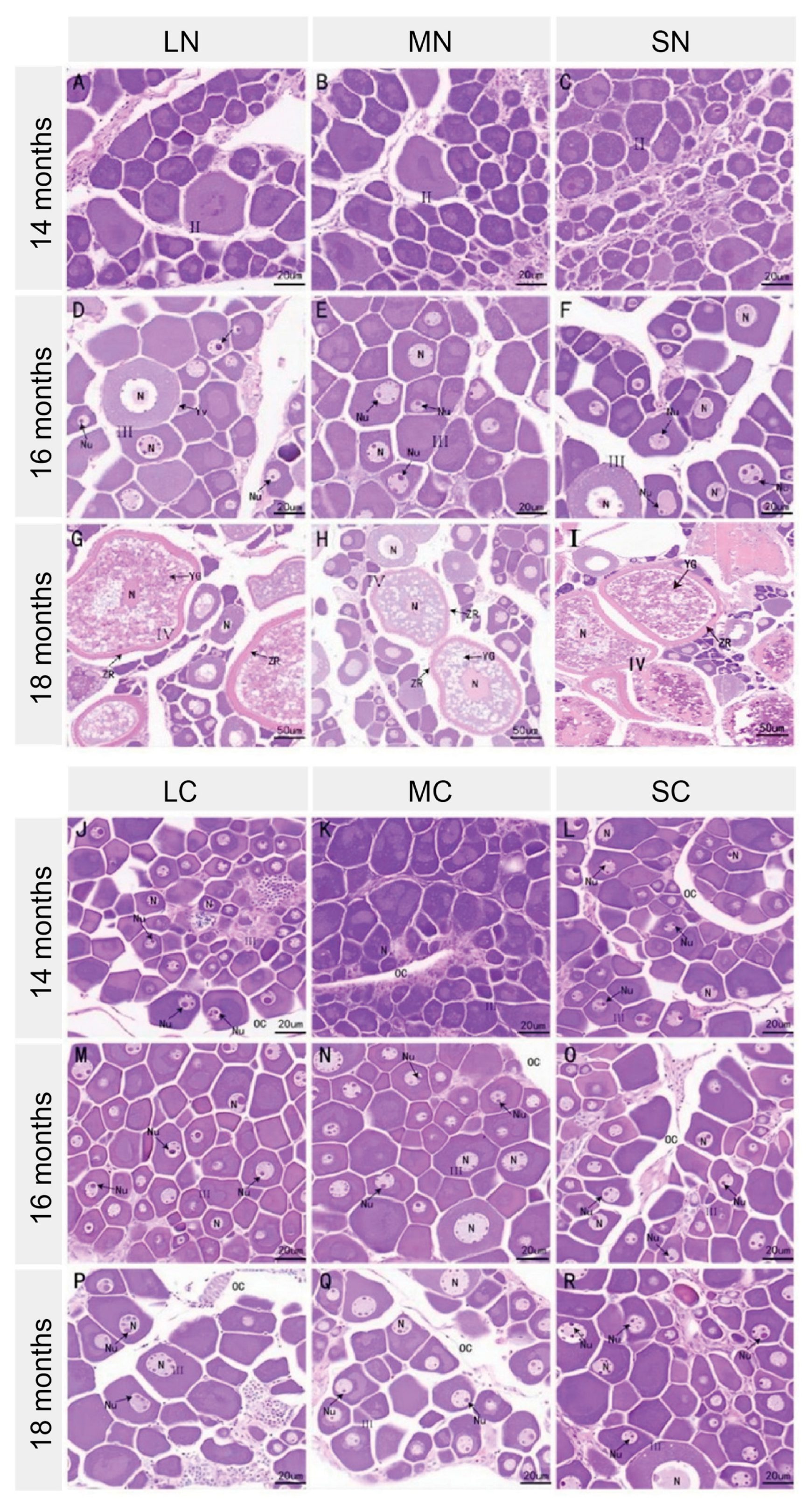
Ovaries were at stage II at 14 months across LN, MN, and SN. Oocytes were in stage II with active mitoses; cells were round or irregular (predominantly early-stage oocytes), and the cytoplasm showed enhanced basophilia (Figure 1A–C). By 16 months, all ovaries examined had advanced to stage III (pre-vitellogenic): oocytes were surrounded by a follicular membrane, small lipid droplets appeared in the cytoplasm, nucleoli aligned along the nuclear membrane, and cytoplasmic eosinophilia increased (Figure 1D–F). At 18 months, all ovaries reached stage IV with mature oocytes; oocyte volume increased markedly, the zona radiata formed, the cytoplasm became filled with yolk granules and abundant lipid droplets, and nucleoli were shrunken and peripheral (Figure 1G–I).

3.4. Histological Observation of Ovarian Development in Broodstock Under Industrialized Concrete Pond Culture

Under industrialized concrete pond culture, ovarian development had reached stage III by 14 months and remained at that stage until 18 months, indicating stagnation. Histologically, the following features were observed: follicular membranes formed around oocytes, small oil droplets appeared in the cytoplasm, and nucleoli were closely attached to the nuclear membrane. The cytoplasm exhibited increased eosinophilia and stained pink with eosin, indicating that oocytes had entered the rapid growth stage but had not matured further (Figure 1J–R).

3.5. Analysis of Serum Hormone Levels in Broodstock Under Cage Culture

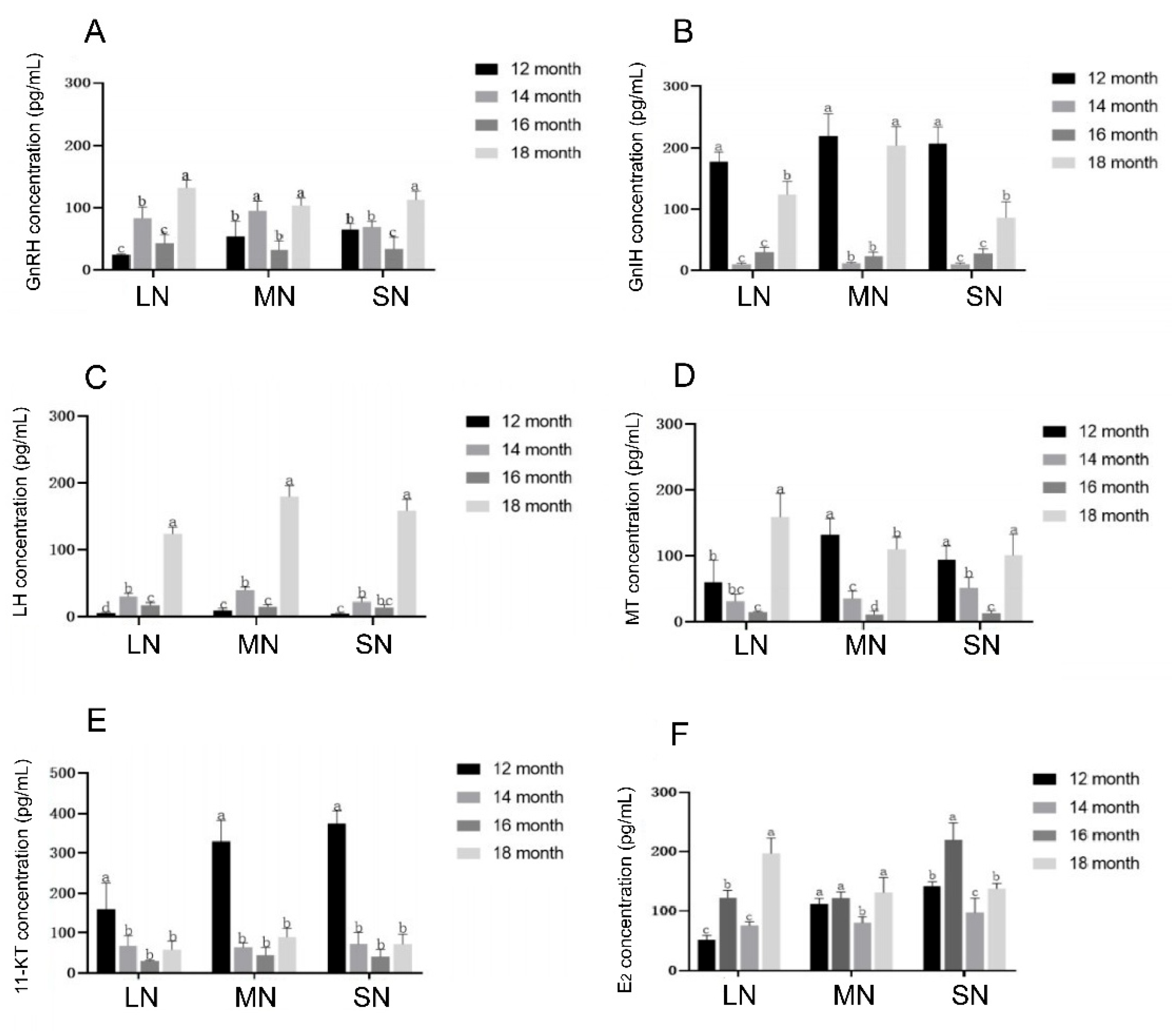
Under sea-cage culture, serum GnRH followed a similar temporal pattern with periodic fluctuations: it increased from 12 to 14 months, declined from 14 to 16 months, and rose again from 16 to 18 months. At 18 months, GnRH peaked at 131.57 ± 12.39, 103.71 ± 11.86, and 112.72 ± 11.98 pg mL−1 for LN, MN, and SN, respectively. In LN and SN, 18-month GnRH exceeded all other ages (p < 0.05), whereas in MN no difference was detected between 18 and 14 months (p > 0.05; Figure 2A). GnIH decreased initially and then increased, with maxima at 12 months of 177.40 ± 15.99, 219.31 ± 35.73, and 207.23 ± 26.94 pg mL−1 for LN, MN, and SN, respectively. In LN and SN, 12-month GnIH was higher than at other ages (p < 0.05), whereas in MN no difference was detected between 12 and 18 months (p > 0.05). At 14 and 16 months, no among-class differences were detected (p > 0.05; Figure 2B).
LH increased, then decreased, followed by an increased markedly from 16 to 18 months, peaking at 18 months at 123.97 ± 10.56, 179.83 ± 15.94, and 159.13 ± 16.41 pg mL−1 for LN, MN, and SN, respectively; 18-month values were higher than at other ages (p < 0.05; Figure 2C).
MT and 11-KT both decreased initially and then increased. For MT, LN was highest at 18 months (159.53 ± 35.00 pg mL−1), whereas MN peaked at 12 months (131.56 ± 25.31 pg mL−1) (p < 0.05). In SN, no difference was detected between 12 and 18 months (p > 0.05), although the highest value occurred at 18 months (100.89 ± 31.57 pg mL−1; Figure 2D). For 11-KT, concentrations were highest at 12 months, with no differences among 14, 16, and 18 months (p > 0.05); at 12 months, values were 160.33 ± 65.26, 329.44 ± 53.28, and 375.36 ± 31.02 pg mL−1 for LN, MN, and SN, respectively (Figure 2E).
E2 fluctuated without a consistent pattern. In LN and MN, E2 peaked at 18 months (196.53 ± 25.78 and 131.58 ± 24.84 pg mL−1, respectively). In SN, E2 peaked at 14 months (219.26 ± 29.87 pg mL−1), and no difference was observed between 12 and 18 months (p > 0.05; Figure 2F).
Taken together, LH, MT and 11-KT displayed temporal fluctuations, but these changes did not show a consistent ovarian stage-dependent pattern; therefore, interpretations are restricted to correlative associations rather than causal regulation.

3.6. Analysis of Serum Hormone Levels in Broodstock Under Industrialized Concrete Pond Culture

Because ovaries remained arrested at stage III from 12 months onwards under this culture mode, hormone profiles are interpreted as temporal changes within the same ovarian stage rather than stage transitions.
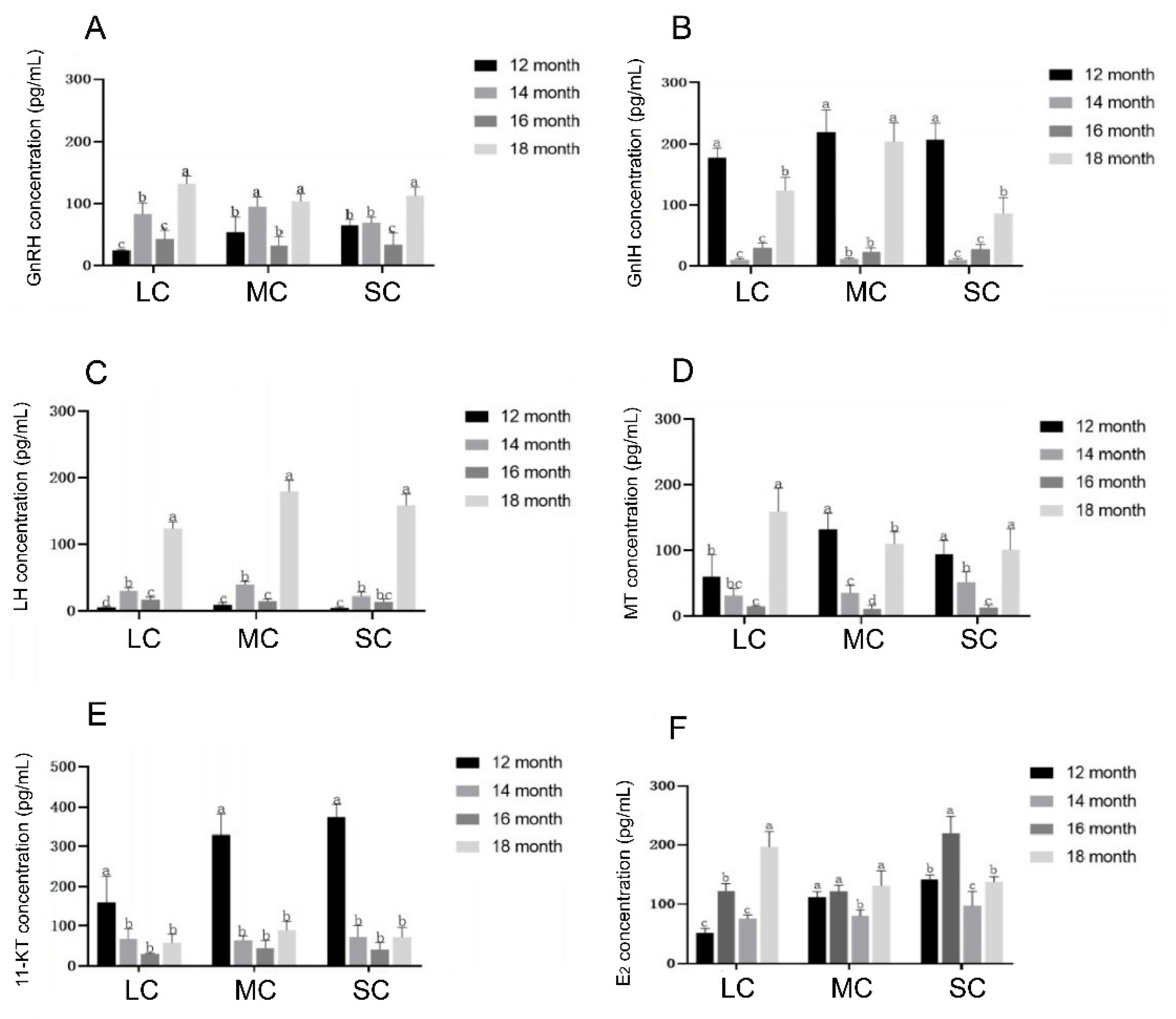
Under industrialized concrete pond culture, GnRH trajectories differed among classes. Values increased monotonically in LC, peaking at 18 months (158.37 ± 7.93 pg mL−1); in MC they rose and then fell, peaking at 14 months (119.02 ± 16.50 pg mL−1); and in SC they followed a rise–fall–rise pattern, with a maximum at 18 months (146.44 ± 11.19 pg mL−1). In LC and SC, 18-month GnRH differed from all other ages (p < 0.05), whereas in MC no difference was detected between 14 and 16 months (p > 0.05; Figure 3A).
GnIH, MT, and 11-KT each decreased initially and then increased. For GnIH, no difference was detected between 14 and 16 months (p > 0.05; Figure 3B). MT was lowest at 14 months across LC, MC, and SC (Figure 3D). For 11-KT, maxima occurred at 12 months (LC 151.42 ± 15.70; MC 135.81 ± 10.98; SC 198.36 ± 20.50 pg mL−1); values did not differ between 14 and 16 months (p > 0.05) but increased from 16 to 18 months (Figure 3E). LH rose progressively from near-undetectable levels at 12 months and continued to increase thereafter (Figure 3C).
E2 varied by class. In LC, E2 increased and peaked at 18 months (187.59 ± 34.38 pg mL−1), with no difference between 16 and 18 months (p > 0.05). MC and SC showed rise-then-fall patterns, peaking at 14 months (MC 239.54 ± 18.22; SC 200.89 ± 19.51 pg mL−1). In MC, E2 was relatively stable at other ages, whereas in SC no difference was detected between 16 and 18 months (p > 0.05; Figure 3E).

3.7. Data Quality Control of Transcriptome

A total of 36 samples of P. leopardus hypothalamic tissue from 14- and 18-month-old individuals under cage and industrialized concrete pond culture were sequenced. For the cage culture group, samples were designated as LN14-1-3, MN14-1-3, SN14-1-3, LN18-1-3, MN18-1-3, and SN18-1-3, according to size and age (e.g., LN14-1-3 versus LN18-1-3). For the concrete pond group, samples were designated as LC14-1-3, MC14-1-3, SC14-1-3, LC18-1-3, MC18-1-3, and SC18-1-3, with grouping performed in the same manner. Sequencing reads were 150 bp in length, yielding a total of 263.88 GB of data. After quality filtering, Q20 and Q30 scores exceeded 95% and 90%, respectively.

3.8. Differential Gene Analysis of Hypothalamic Tissue in Cage-Cultured Broodstock

Differential gene expression was analyzed between 14- and 18-month-old individuals. For LN, 8935 DEGs were identified, with 4606 downregulated and 4329 upregulated (Figure S1A). For MN, 11,419 DEGs were identified, with 5418 downregulated and 6001 upregulated (Figure S1B). For SN, 9322 DEGs were identified, with 4632 downregulated and 4690 upregulated (Figure S1C).
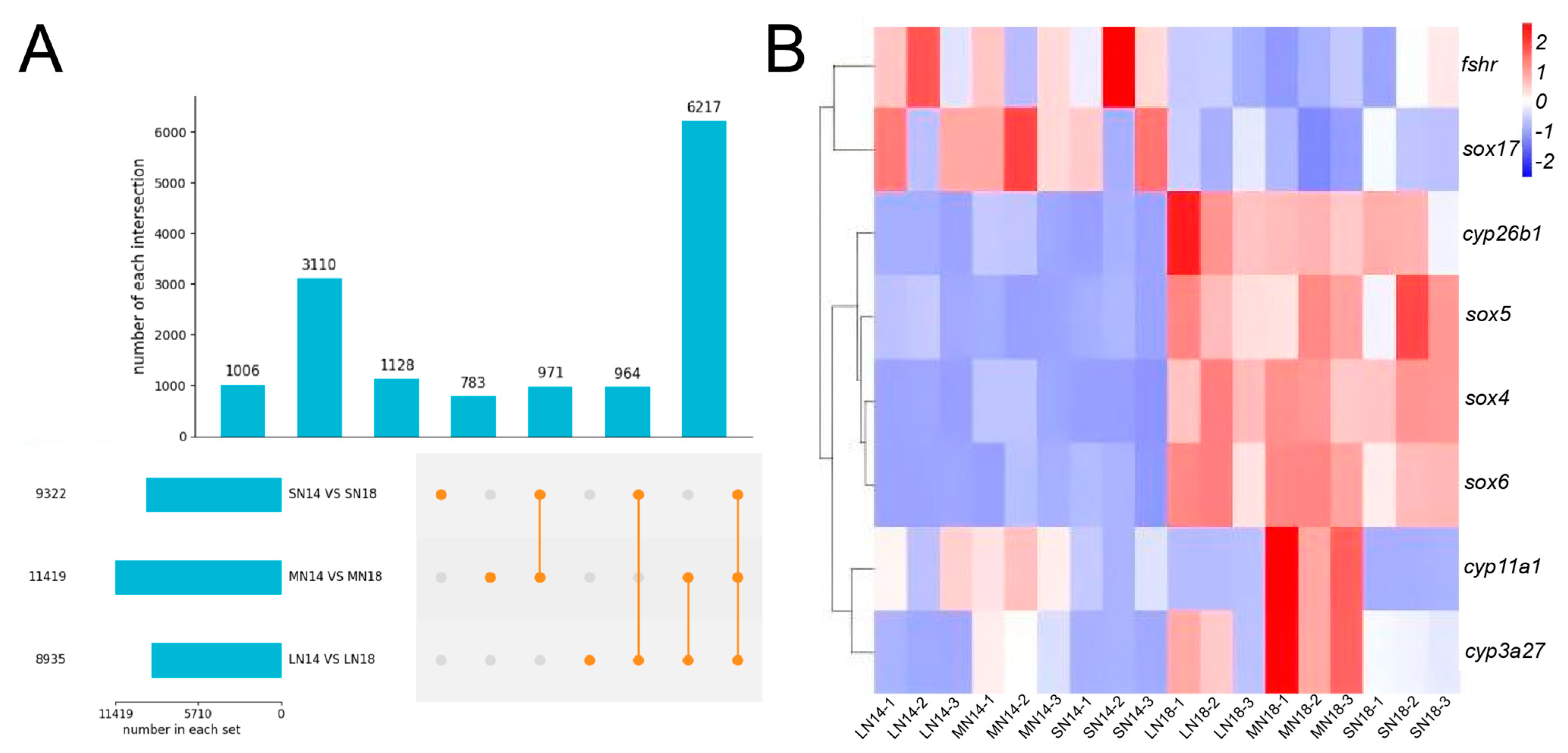
Using UpSet analysis, 6217 core DEGs shared across all three size classes were identified (Figure 4A). KEGG pathway enrichment analysis revealed eight genes related to ovarian development: fshr, sox17, sox5, cyp3a27, cyp11a1, among others (Figure 4B).
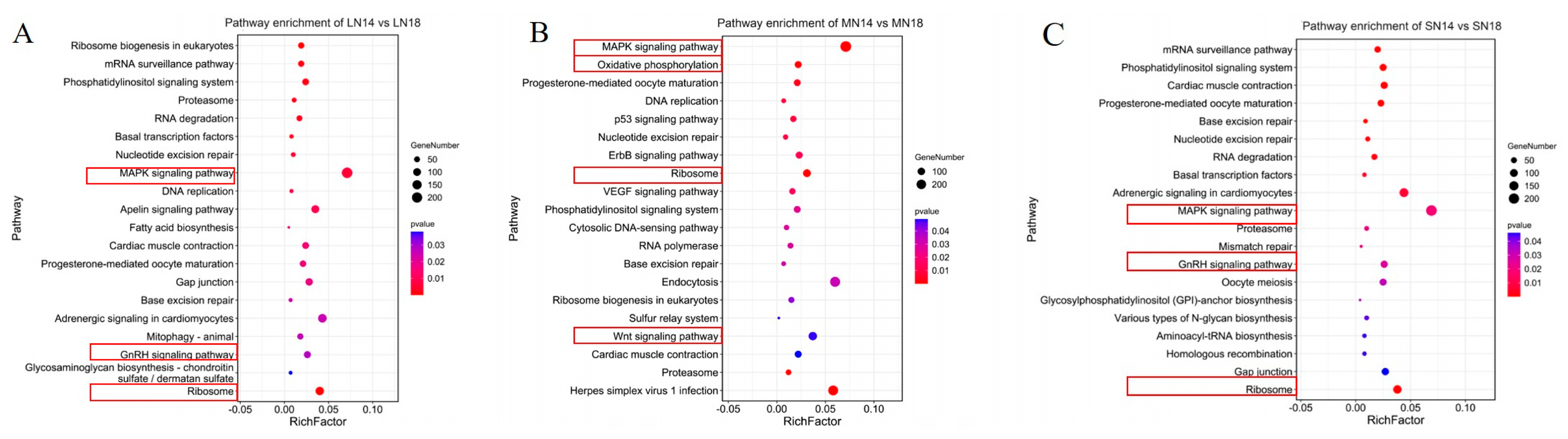
KEGG enrichment results for LN showed that ovarian-development-related genes were enriched in the MAPK signaling pathway, GnRH signaling pathway, and ribosomal pathway (Figure 5A). For MN, genes were enriched in the MAPK signaling pathway, Wnt signaling pathway, oxidative phosphorylation, and ribosomal pathway (Figure 5B). For SN, genes were primarily enriched in the ribosomal pathway, MAPK signaling pathway, and GnRH signaling pathway (Figure 5C).

3.9. Differential Gene Analysis of Hypothalamus Under Industrialized Concrete Pond Culture

In the industrialized concrete pond culture group, a total of 2393 DEGs (DEGs) were identified between the 14- and 18-month-old groups in the LC population, with 1118 downregulated and 1275 upregulated (Figure S2A). For the MC population, 761 DEGs were identified, with 185 downregulated and 576 upregulated (Figure S2B). In the SC population, 140 DEGs were identified, with 78 downregulated and 62 upregulated (Figure S2C).
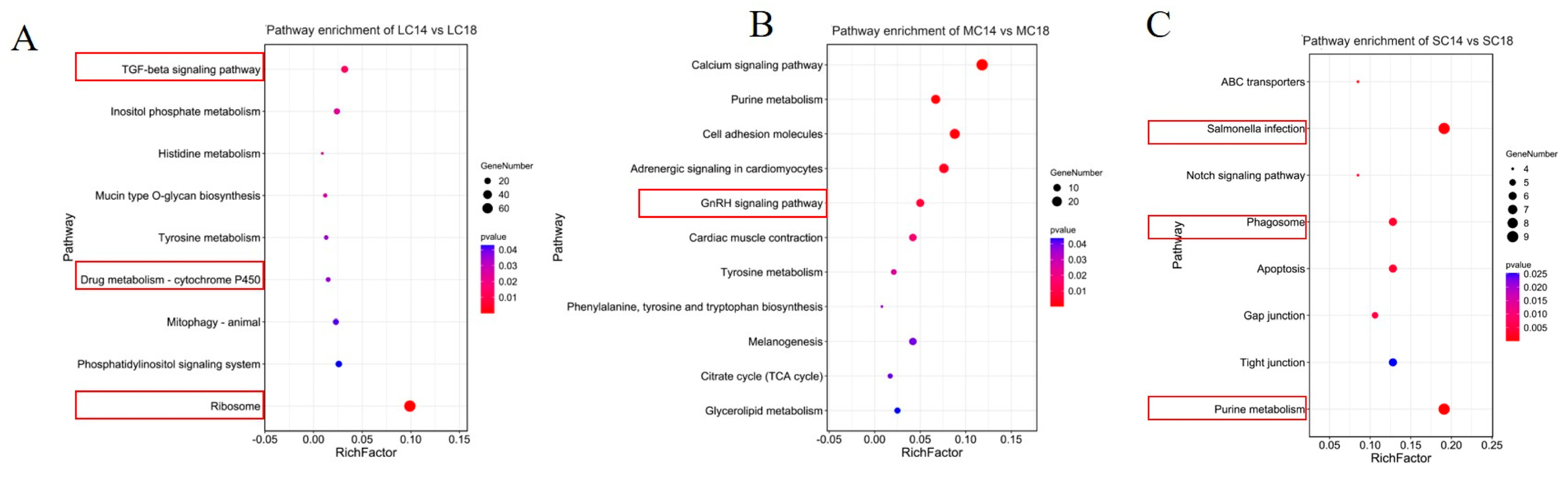
KEGG enrichment analysis revealed that the LC, MC, and SC groups were enriched in 9, 11 and 8 signaling pathways, respectively. In the LC group, the TGF-beta signaling pathway, ribosomal pathway and drug metabolism-cytochrome P450 pathway were associated with ovarian development (Figure 6A). In the MC group, only the GnRH signaling pathway was related to ovarian development (Figure 6B). In the SC group, no significantly enriched pathways were associated with ovarian development. Instead, genes were primarily enriched in the purine metabolism, Salmonella infection and phagosome pathways (Figure 6C).

3.10. qRT-PCR Validation

Nine DEGs were randomly selected for qPCR validation to confirm the reliability of the RNA-seq data. The results showed that the qPCR data were consistent with the RNA-seq results, indicating the reliability of the data obtained in this study (Figure S3).

4. Discussion

In aquaculture, there is often a correlation between fish growth status and gonadal development. For example, in species such as Cynoglossus semilaevis and Scatophagus argus, males mature earlier than females, presumably because of their smaller body size [11,12,13,14]. In this study, we analyzed the growth and ovarian development of P. leopardus under different farming conditions. Interestingly, no significant differences were observed in growth rate or ovarian development among individuals of different sizes within the same farming mode. This aligns with findings in other fish species, such as Oreochromis mossambicus, Megalobrama amblycephala, Micropterus salmoides and Culter alburnus, where growth rate does not necessarily affect gonadal development [15,16,17,18]. It is hypothesized that energy allocation proportions remain consistent across sizes in P. leopardus, with size differences primarily attributable to energy intake rather than ovarian development. This contradicts the industry notion that “smaller individuals exhibit faster gonadal development”.
However, energy allocation varies significantly between farming modes. For example, in wild populations of four major Chinese carps, abundant energy is allocated to gonadal development, enabling natural reproduction. In contrast, under artificial farming conditions, gonadal development is arrested at stage IV, preventing spontaneous spawning [19]. Similarly, in this study, P. leopardus reared in cages exhibited normal ovarian development, with 18-month-old individuals reaching stage IV ovaries, characterized by soft texture, abundant oocytes, and successful spawning. Conversely, those reared in industrialized concrete ponds showed arrested ovarian development at stage III from 14 months onward, consistent with observations in other marine fish species like Trachinotus blochii and Acanthopagrus schlegelii [20]. These findings highlight the critical impact of farming conditions on gonadal development, particularly sensitivity to water quality and management practices. Notably, water temperature and dissolved oxygen differed between culture systems (Supplementary Tables S1 and S2), suggesting temperature may be a key factor affecting ovarian development in land-based systems, but this mechanistic interpretation remains speculative because these factors were not experimentally manipulated. Many grouper species exhibit reproductive dysfunction under captivity, especially in land-based systems, where females may show delayed maturation or ovarian arrest around late vitellogenesis and fail to undergo final oocyte maturation, ovulation, or spontaneous spawning. This pattern is consistent with field-derived seasonality in Epinephelus marginatus [21] and with captive broodstock studies showing that GnRHa sustained-release implants can induce ovulation but do not necessarily restore spontaneous spawning in E. marginatus and Epinephelus aeneus [22,23]. Notably, environmental cue programming can improve maturation outcomes in land-based settings; for example, photoperiod and temperature manipulation promoted ovarian development and pituitary gonadotropin activation in Epinephelus akaara [24].
Reproductive hormones regulate gonadal development via the (HPG) axis. In marine teleosts, GnRH stimulates pituitary synthesis of gonadotropins, which regulate gametogenesis and reproductive behavior [25,26]. GnRH directly induces sex hormone synthesis and oocyte meiosis in goldfish (Carassius auratus) [27,28] and regulates sex reversal in golden seabream (Sparus aurata) [29], underscoring its role in early sex differentiation and follicle formation. E2, a key steroid hormone, modulates GnRH expression. In many fish species, E2 inhibits GnRH transcription in Oncorhynchus mykiss, Epinephelus coioides and Oryzias latipes [30,31], whereas in others it provides positive feedback that triggers GnRH surges [32,33]. E2 also regulates GnRH via hypothalamic estrogen receptors [34]. Additionally, high E2 during primary oocyte growth may promote oocyte proliferation [35,36], as seen in E. coioides, where E2 peaks coincide with elevated GSI and yolk protein synthesis [37,38]. In this study, serum GnRH and E2 levels in P. leopardus exhibited consistent trends under the same farming mode, suggesting a potential bidirectional regulatory relationship.
GnIH is the key known reproductive inhibitory factor. In goldfish, GnIH-3 suppresses LH secretion during late reproduction but inhibits Lhβ expression during early stages and promotes it during mid-stages [39,40,41,42]. Our results show that GnIH levels were associated with LH variation across stages, indicating GnIH may influence LH secretion, although functional experiments are needed to establish causality. However, in cage farming, GnIH and GnRH exhibit trends of antagonistic effects, suggesting GnIH influences ovarian development. Additionally, 11-KT was detected in female P. leopardus serum. Although 11-KT is classically regarded as a dominant androgen in male teleosts, appreciable circulating (and potentially gonadal) 11-KT has also been reported in maturing females of some taxa, notably sturgeons, particularly during late oogenesis and around ovulation [43,44]. Nevertheless, the functional significance of 11-KT in female reproduction appears species- and stage-dependent and remains insufficiently resolved in groupers. In teleosts, 11-KT has been proposed to participate in peri-ovulatory processes such as follicle rupture/oocyte release and spawning behavior, and it may also contribute to oocyte growth in some species. In Anguilla japonica, 11-KT regulates early oocyte growth and late oogenesis [45], and in Atlantic salmon, it correlates with vitellogenin (VTG) production [46]. VTG was not quantified in the present study due to insufficient remaining serum volume; future work should measure VTG together with E2 and GnRH to better resolve vitellogenic dynamics in P. leopardus. However, in this study, 11-KT, LH, and MT levels did not change significantly with ovarian development within the available sampling schedule, although these hormones are well known to play important roles in fish reproduction. These results are likely attributable to limitations in sampling frequency and design. In addition, RNA-seq relied on three pooled biological replicates per group, with each library comprising hypothalami pooled from three individuals. Although three biological replicates per group is acceptable, it is a borderline level for transcriptomic inference and may limit power to detect differentially expressed genes, particularly those with modest effect sizes (increasing the risk of false negatives). While pooling can mitigate stochastic inter-individual noise, it limits individual-level resolution, may reduce statistical power for DEG detection, and can weaken the robustness of downstream pathway enrichment results. Future work with higher-frequency, peri-ovulatory sampling and experimental manipulations will be required to delineate their contributions in P. leopardus.
By comparing gene expression across developmental stages, we identified several genes closely associated with ovarian development, including fshr, sox5, cyp3a27, and sox17. Among these, fshr functions as the receptor on specific target cells activated by FSH, playing an important role in follicular development and estradiol production in females [47]. Consistent with this known role, our data suggest that elevated fshr expression may be associated with early ovarian developmental stages in P. leopardus and may reflect increased FSH responsiveness during oogenesis. Members of the Sox gene family are involved in biological processes such as cell differentiation and organ development, and several Sox genes have been shown to participate in gonadal development and sex differentiation [48]. sox4 participates in early embryogenesis, neurogenesis, and gonadal development and differentiation in loach (Misgurnus anguillicaudatus) [49,50]. In Nile tilapia, sox5 is expressed in the gonads and may be involved in gonadal development and sex determination [51]. Studies in mice show that embryos lacking sox17 fail to undergo normal gastrulation [52]; its elevated expression in our dataset may be indicative of a role in later-stage ovarian differentiation in P. leopardus, although functional validation is needed. In cyp11a1 knockout experiments of mouse, loss of cyp11a1 leads to an early block in sex steroid biosynthesis and directly impairs gonadal development [53]. Consistent with these studies, our results suggest that genes such as fshr influence the early stage of gonadal development in P. leopardus, sox17 mainly regulates the process of gonadal differentiation, and members of the cytochrome P450 family, such as cyp11a1, modulate ovarian development by affecting steroid hormone biosynthesis.
The HPG axis centers on hypothalamic GnRH that stimulates pituitary gonadotropin secretion. Transcriptomic analysis of the P. leopardus hypothalamus revealed DEGs enriched in oxidative phosphorylation, GnRH signaling, ribosomal biogenesis and Wnt pathways. Importantly, because the hypothalamus affects the ovary indirectly via the HPG axis, these hypothalamic DEGs and pathways should be interpreted as regulatory associations with ovarian developmental stage rather than direct causal drivers of ovarian development. Oxidative phosphorylation, producing ATP, is vital for cellular functions, including oocyte maturation and embryonic development [47,54,55]. The enrichment of this pathway aligns with the high energy demands of P. leopardus reproduction. GnRH signaling regulates sex differentiation and gonadal development, as supported by the observed serum variations in GnRH and GnIH.

5. Conclusions

This study demonstrates that ovarian development in P. leopardus is not significantly linked to individual size under the same farming conditions. Integrating endocrine profiling with hypothalamic transcriptomics suggests that multiple hypothalamic genes and pathways associated with GnRH/GnIH signaling are linked to E2 dynamics and ovarian developmental state via the HPG axis. From an aquaculture perspective, these results provide candidate biomarkers and targets for broodstock conditioning in land-based systems (e.g., optimizing temperature/oxygen and related husbandry cues) and for endocrine manipulation (e.g., GnRHa- or gonadotropin-based induction) to improve maturation control and support reliable artificial propagation of P. leopardus.

Supplementary Materials

The following supporting information can be downloaded at: https://www.mdpi.com/article/10.3390/fishes11010030/s1, Table S1: Statistics of Water Temperature and Dissolved Oxygen in Offshore Cage Culture; Table S2: Statistics of Water Temperature and Dissolved Oxygen in Land-based Flow-through Aquaculture System; Table S3: Primer sequence; Figures S1 and S2: Volcano Plot of Differentially Expressed Genes; Figure S3: Validation of the RNA-Seq data by qRT-PCR verification.

Author Contributions

Writing—original draft preparation, J.D. and X.Z.; formal analysis, software, data curation and visualization, T.J.; investigation and validation, F.T., L.Z., Y.T. and M.Z.; conceptualization, methodology, resources, supervision, project administration and writing—review and editing, X.W.; funding acquisition, resources, technical support and assistance with research scheme development, J.L. All authors have read and agreed to the published version of the manuscript.

Funding

This work was supported by the Key R&D Project in Hainan (ZDYF2023XDNY046) and The Innovation Center of Hainan University (XTCX2022NYC16).

Institutional Review Board Statement

The animal study protocol was approved by the Institutional Animal Care and Use Committee of the College of Ocean, Hainan University (protocol code HNUAUCC-2022-00038, approved on 1 March 2022). All procedures were conducted in accordance with the Guidelines for the Care and Use of Laboratory Animals in China.

Informed Consent Statement

Not applicable.

Data Availability Statement

The original contributions presented in this study are included in the article/Supplementary Materials. Further inquiries can be directed to the corresponding author.

Conflicts of Interest

The authors declare no conflicts of interest.

References

  1. Khasanah, M.; Kadir, N.N.; Jompa, J. Reproductive biology of three important threatened/near-threatened groupers (Plectropomus leopardus, Epinephelus polyphekadion and Plectropomus areolatus) in Eastern Indonesia and implications for management. Animals 2019, 9, 643. [Google Scholar] [CrossRef] [PubMed]
  2. Astari, B.; Budi, D.S.; Ismi, S.; Effendi, I.; Budiardi, T.; Diatin, I.; Vinasyiam, A.; Sugama, K. Culture performance and financial business of leopard coral (Plectropomus leopardus), humpback (Cromileptes altivelis), and brown-marbled (Epinephelus fuscoguttatus) grouper nursery. Aquac. Rep. 2025, 43. [Google Scholar] [CrossRef]
  3. Fontaine, R.; Ciani, E.; Haug, T.M.; Hodne, K.; Ager-Wick, E.; Baker, D.M.; Weltzien, F.-A. Gonadotrope plasticity at cellular, population and structural levels: A comparison between fishes and mammals. Gen. Comp. Endocrinol. 2020, 287, 113344. [Google Scholar] [CrossRef] [PubMed]
  4. Fenske, M.; Maack, G.; Schäfers, C.; Segner, H. An environmentally relevant concentration of estrogen induces arrest of male gonad development in zebrafish, Danio rerio. Environ. Toxicol. Chem. 2005, 24, 1088–1098. [Google Scholar] [CrossRef]
  5. Schäfers, C.; Teigeler, M.; Wenzel, A.; Maack, G.; Fenske, M.; Segner, H. Concentration-and time-dependent effects of the synthetic estrogen, 17α-ethinylestradiol, on reproductive capabilities of the zebrafish, Danio rerio. J. Toxicol. Environ. Health Part A 2007, 70, 768–779. [Google Scholar] [CrossRef]
  6. Scholz, S.; Klüver, N. Effects of endocrine disrupters on sexual, gonadal development in fish. Sex. Dev. 2009, 3, 136–151. [Google Scholar] [CrossRef]
  7. Hess, R.A. Estrogen in the adult male reproductive tract: A review. Reprod. Biol. Endocrinol. 2003, 1, 52. [Google Scholar] [CrossRef]
  8. Idler, D.R.; Bitners, I.I.; Schmidt, P.J. 11-Ketotestosterone: An androgen for sockeye salmon. Can. J. Biochem. Physiol. 1961, 39, 1737–1742. [Google Scholar] [CrossRef]
  9. Miura, T.; Yamauchi, K.; Takahashi, H.; Nagahama, Y. Hormonal induction of all stages of spermatogenesis in vitro in the male Japanese eel (Anguilla japonica). Proc. Natl. Acad. Sci. USA 1991, 88, 5774–5778. [Google Scholar] [CrossRef]
  10. Acharyya, A.; Das, J.; Hasan, K.N. Rhythmicity in testicular melatonin and its correlation with the dynamics of spermatogenic cells in an annual reproductive cycle of Clarias batrachus under natural photo-thermal conditions. Theriogenology 2023, 208, 15–27. [Google Scholar] [CrossRef]
  11. Lokman, P.M.; Harris, B.; Kusakabe, M.; E Kime, D.; Schulz, R.W.; Adachi, S.; Young, G. 11-Oxygenated androgens in female teleosts: Prevalence, abundance, and life history implications. Gen. Comp. Endocrinol. 2002, 129, 1–12. [Google Scholar] [CrossRef] [PubMed]
  12. Pool, K.; Rickard, J.; de Graaf, S. Overcoming neuroendocrine and metabolic barriers to puberty: The role of melatonin in advancing puberty in ewe lambs. Domest. Anim. Endocrinol. 2020, 72, 106457. [Google Scholar] [CrossRef] [PubMed]
  13. Lin, G.; Gao, D.; Lu, J.; Sun, X. Transcriptome profiling reveals the sexual dimorphism of gene expression patterns during gonad differentiation in the half-smooth tongue sole (Cynoglossus semilaevis). Mar. Biotechnol. 2021, 23, 18–30. [Google Scholar] [CrossRef] [PubMed]
  14. Chen, H.; Li, Z.; Wang, Y.; Yang, W.; Shi, H.; Li, S.; Zhu, C.; Li, G. Relationship between body weight and morphological traits in female and male spotted scat (Scatophagus argus). Pak. J. Zool. 2021, 54, 1–9. [Google Scholar] [CrossRef]
  15. Li, Y.; Liu, Y.; Fan, C.; Wang, T.; Chen, C.; Li, Z.; Li, Q.; Chen, S. Study on the method of quick cultivation of female parental half-smooth tongue sole (Cynoglossus semilaevis) with nereid. J. Shanghai Ocean. Univ. 2013, 22, 552–558. [Google Scholar]
  16. Zohar, Y.; Muñoz-Cueto, J.A.; Elizur, A.; Kah, O. Neuroendocrinology of reproduction in teleost fish. Gen. Comp. Endocrinol. 2010, 165, 438–455. [Google Scholar] [CrossRef]
  17. Mandal, B.; Kailasam, M.; Bera, A.; Sukumaran, K.; Hussain, T.; Makesh, M.; Thiagarajan, G.; Vijayan, K. Gonadal recrudescence and annual reproductive hormone pattern of captive female spotted scats (Scatophagus argus). Anim. Reprod. Sci. 2020, 213, 106273. [Google Scholar] [CrossRef]
  18. Sisneros, J.A.; Forlano, P.M.; Knapp, R.; Bass, A.H. Seasonal variation of steroid hormone levels in an intertidal-nesting fish, the vocal plainfin midshipman. Gen. Comp. Endocrinol. 2004, 136, 101–116. [Google Scholar] [CrossRef]
  19. Zamri, A.S.; Zulperi, Z.; Esa, Y.; Syukri, F. Hormone Application for Artificial Breeding Towards Sustainable Aquaculture–A Review. Pertanika J. Trop. Agric. Sci. 2022, 45, 1035–1051. [Google Scholar] [CrossRef]
  20. Zhou, Q.-B.; Wu, H.-D.; Zhu, C.-S.; Yan, X.-H. Effects of dietary lipids on tissue fatty acids profile, growth and reproductive performance of female rice field eel (Monopterus albus). Fish Physiol. Biochem. 2011, 37, 433–445. [Google Scholar] [CrossRef]
  21. Marino, G.; Azzurro, E.; Massari, A.; Finoia, M.G.; Mandich, A. Reproduction in the dusky grouper from the southern Mediterranean. J. Fish Biol. 2001, 58, 909–927. [Google Scholar] [CrossRef]
  22. Marino, G.; Panini, E.; Longobardi, A.; Mandich, A.; Finoia, M.; Zohar, Y.; Mylonas, C. Induction of ovulation in captive-reared dusky grouper, Epinephelus marginatus (Lowe, 1834), with a sustained-release GnRHa implant. Aquaculture 2003, 219, 841–858. [Google Scholar] [CrossRef]
  23. Hassin, S.; de Monbrison, D.; Hanin, Y.; Elizur, A.; Zohar, Y.; Popper, D. Domestication of the white grouper, Epinephelus aeneus 1. Growth and reproduction. Aquaculture 1997, 156, 305–316. [Google Scholar] [CrossRef]
  24. Lee, C.; Hur, S.; Kim, B.; Soyano, K.; Lee, Y. Induced maturation and fertilized egg production of the red-spotted grouper, Epinephelus akaara, using adaptive physiology of photoperiod and water temperature. Aquac. Res. 2020, 51, 2084–2090. [Google Scholar] [CrossRef]
  25. Peter, R.E. 3 The Brain and Neurohormones in Teleost Reproduction. Fish Physiol. 1983, 9, 97–135. [Google Scholar]
  26. Conn, P.M.; Crowley, W.F., Jr. Gonadotropin-releasing hormone and its analogs. Annu. Rev. Med. 1994, 45, 391–405. [Google Scholar] [CrossRef]
  27. Habibi, H.R.; Van der Kraak, G.; Bulanski, E.; Peter, R.E. Effect of teleost GnRH on reinitiation of oocyte meiosis in goldfish, in vitro. Am. J. Physiol.-Regul. Integr. Comp. Physiol. 1988, 255, R268–R273. [Google Scholar] [CrossRef]
  28. Habibi, H.R.; Van Der Kraak, G.; Fraser, R.; Peter, R.E. Effect of a teleost GnRH analog on steroidogenesis by the follicle-enclosed goldfish oocytes, in vitro. Gen. Comp. Endocrinol. 1989, 76, 95–105. [Google Scholar] [CrossRef]
  29. Aroua, S.; Weltzien, F.-A.; Le Belle, N.; Dufour, S. Development of real-time RT-PCR assays for eel gonadotropins and their application to the comparison of in vivo and in vitro effects of sex steroids. Gen. Comp. Endocrinol. 2007, 153, 333–343. [Google Scholar] [CrossRef]
  30. Cui, M.; Li, W.; Liu, W.; Yang, K.; Pang, Y.; Haoran, L. Production of recombinant orange-spotted grouper (Epinephelus coioides) luteinizing hormone in insect cells by the baculovirus expression system and its biological effect. Biol. Reprod. 2007, 76, 74–84. [Google Scholar] [CrossRef]
  31. Lee, W.; Kang, C.-W.; Su, C.-K.; Okubo, K.; Nagahama, Y. Screening estrogenic activity of environmental contaminants and water samples using a transgenic medaka embryo bioassay. Chemosphere 2012, 88, 945–952. [Google Scholar] [CrossRef]
  32. Breton, B.; Sambroni, E. Steroid Activation of the Brain–Pituitary Complex Gonadotropic Function in the Triploid Rainbow Trout Oncorhynchus mykiss. Gen. Comp. Endocrinol. 1996, 101, 155–164. [Google Scholar] [CrossRef] [PubMed]
  33. Inserra, P.I.F.; Charif, S.E.; Di Giorgio, N.P.; Saucedo, L.; Schmidt, A.R.; Fraunhoffer, N.; Halperin, J.; Gariboldi, M.C.; Leopardo, N.P.; Lux-Lantos, V.; et al. ERα and GnRH co-localize in the hypothalamic neurons of the South American plains vizcacha, Lagostomus maximus (Rodentia, Caviomorpha). J. Mol. Histol. 2017, 48, 259–273. [Google Scholar] [CrossRef] [PubMed]
  34. Chimento, A.; Sirianni, R.; Casaburi, I.; Pezzi, V. Role of estrogen receptors and G protein-coupled estrogen receptor in regulation of hypothalamus–pituitary–testis axis and spermatogenesis. Front. Endocrinol. 2014, 5, 1. [Google Scholar] [CrossRef]
  35. Gao, Y.; Jing, Q.; Huang, B.; Jia, Y. Molecular cloning, characterization, and mRNA expression of gonadotropins during larval development in turbot (Scophthalmus maximus). Fish Physiol. Biochem. 2019, 45, 1697–1707. [Google Scholar] [CrossRef] [PubMed]
  36. Yang, G.; Qin, Z.; Lu, Z.; Liang, R.; Zhao, L.; Pan, G.; Lin, L.; Zhang, K. Comparative transcriptomics of gonads reveals the molecular mechanisms underlying gonadal development in giant freshwater prawns (Macrobrachium rosenbergii). J. Mar. Sci. Eng. 2022, 10, 737. [Google Scholar] [CrossRef]
  37. Heidari, B.; Roozati, S.; Yavari, L. Changes in plasma levels of steroid hormones during oocyte development of Caspian Kutum (Rutilus frisii kutum, Kamensky, 1901). Anim. Reprod. (AR) 2018, 7, 373–381. [Google Scholar]
  38. Tsutsui, K.; Ubuka, T.; Son, Y.L.; Bentley, G.E.; Kriegsfeld, L.J. Contribution of GnIH research to the progress of reproductive neuroendocrinology. Front. Endocrinol. 2015, 6, 179. [Google Scholar] [CrossRef]
  39. Shahjahan, M.; Doi, H.; Ando, H. LPXRFamide peptide stimulates growth hormone and prolactin gene expression during the spawning period in the grass puffer, a semi-lunar synchronized spawner. Gen. Comp. Endocrinol. 2016, 227, 77–83. [Google Scholar] [CrossRef]
  40. Moussavi, M.; Wlasichuk, M.; Chang, J.P.; Habibi, H.R. Seasonal effect of GnIH on gonadotrope functions in the pituitary of goldfish. Mol. Cell. Endocrinol. 2012, 350, 53–60. [Google Scholar] [CrossRef]
  41. Wang, Q.; Qi, X.; Guo, Y.; Li, S.; Zhang, Y.; Liu, X.; Lin, H. Molecular identification of GnIH/GnIHR signal and its reproductive function in protogynous hermaphroditic orange-spotted grouper (Epinephelus coioides). Gen. Comp. Endocrinol. 2015, 216, 9–23. [Google Scholar] [CrossRef] [PubMed]
  42. Moussavi, M.; Wlasichuk, M.; Chang, J.P.; Habibi, H.R. Seasonal effect of gonadotrophin inhibitory hormone on gonadotrophin-releasing hormone-induced gonadotroph functions in the goldfish pituitary. J. Neuroendocrinol. 2013, 25, 506–516. [Google Scholar] [CrossRef] [PubMed]
  43. Cuisset, B.; Fostier, A.; Williot, P.; Bennetau-Pelissero, C.; Le Menn, F. Occurrence and in vitro biosynthesis of 11-ketotestosterone in Siberian sturgeon, Acipenser baeri Brandt maturing females. Fish Physiol. Biochem. 1995, 14, 313–322. [Google Scholar] [CrossRef] [PubMed]
  44. Davail-Cuisset, B.; Rouault, T.; Williot, P. Estradiol, testosterone, 11-ketotestosterone, 17, 20β-dihydroxy-4-pregnen-3-one and vitellogenin plasma levels in females of captive European sturgeon, Acipenser sturio. J. Appl. Ichthyol. 2011, 27, 666–672. [Google Scholar] [CrossRef]
  45. Matsubara, M.; Lokman, P.; Senaha, A.; Kazeto, Y.; Ijiri, S.; Kambegawa, A.; Hirai, T.; Young, G.; Todo, T.; Adachi, S.; et al. Synthesis and possible function of 11-ketotestosterone during oogenesis in eel (Anguilla spp.). Fish Physiol. Biochem. 2003, 28, 353–354. [Google Scholar] [CrossRef]
  46. Idler, D.R.; Hwang, S.J.; Crim, L.W.; Reddin, D. Determination of sexual maturation stages of Atlantic salmon (Salmo salar) captured at sea. Can. J. Fish. Aquat. Sci. 1981, 38, 405–413. [Google Scholar] [CrossRef]
  47. Martyniuk, C.J.; Prucha, M.S.; Doperalski, N.J.; Antczak, P.; Kroll, K.J.; Falciani, F.; Barber, D.S.; Denslow, N.D. Gene expression networks underlying ovarian development in wild largemouth bass (Micropterus salmoides). PLoS ONE 2013, 8, e59093. [Google Scholar] [CrossRef]
  48. Heenan, P.; Zondag, L.; Wilson, M.J. Evolution of the Sox gene family within the chordate phylum. Gene 2016, 575, 385–392. [Google Scholar] [CrossRef]
  49. Huo, W.; Wan, R.; Wang, P.; Zhang, L.; Xia, X. Molecular cloning, characterization of dax1 gene and its response to progesterone in Misgurnus anguillicaudatus. Drug Chem. Toxicol. 2019, 42, 624–633. [Google Scholar] [CrossRef]
  50. Xia, X.; Wan, R.; Huo, W.; Zhang, L.; Xia, X.; Chang, Z. Molecular cloning and mRNA expression pattern of Sox 4 in Misgurnus anguillicaudatus. J. Genet. 2018, 97, 869–877. [Google Scholar] [CrossRef]
  51. Hu, Y.; Wang, B.; Du, H. A review on sox genes in fish. Rev. Aquac. 2021, 13, 1986–2003. [Google Scholar] [CrossRef]
  52. Kanai-Azuma, M.; Kanai, Y.; Gad, J.M.; Tajima, Y.; Taya, C.; Kurohmaru, M.; Sanai, Y.; Yonekawa, H.; Yazaki, K.; Tam, P.P.L.; et al. Depletion of definitive gut endoderm in Sox17-null mutant mice. Development 2002, 129, 2367–2379. [Google Scholar] [CrossRef]
  53. Hu, M.-C.; Hsu, N.-C.; Ben El Hadj, N.; Pai, C.-I.; Chu, H.-P.; Wang, C.-K.L.; Chung, B.-C. Steroid deficiency syndromes in mice with targeted disruption of Cyp11a1. Mol. Endocrinol. 2002, 16, 1943–1950. [Google Scholar] [CrossRef]
  54. Kusakabe, M.; Nakamura, I.; Evans, J.; Swanson, P.; Young, G. Changes in mRNAs encoding steroidogenic acute regulatory protein, steroidogenic enzymes and receptors for gonadotropins during spermatogenesis in rainbow trout testes. J. Endocrinol. 2006, 189, 541–554. [Google Scholar] [CrossRef]
  55. Zarein, M.; Zarban, A.; Shoorei, H.; Gharekhani, M.; Hassanzadeh-Taheri, M. The amelioration of ovarian dysfunction by hesperidin in malathion-treated mice through the overexpression of PCNA and FSHR proteins. Heliyon 2023, 9, e22484. [Google Scholar] [CrossRef]
Figure 1. Histological Observation of Ovary Development in P. leopardus. Note: (AC): Ovary sections at 14 months of age under cage culture; (DF): Ovary sections at 16 months of age under cage culture; (GI): Ovary sections at 18 months of age under cage culture; (JL): Ovary sections at 14 months under concrete pond culture; (MO): Ovary sections at 16 months under concrete pond culture; (PR): Ovary sections at 18 months under concrete pond culture. N: Nucleus; Nu: Nucleolus; ZR: Zona radiata; YG: Yolk granules; Yv: Yolk vesicles; II: Stage II oocytes; III: Stage III oocytes; IV: Stage IV oocytes.
Fishes 11 00030 g001
Figure 2. Serum Hormone Levels in P. leopardus under Cage Culture. Note: (A): GnRH levels; (B): GnIH levels; (C): LH levels; (D): MT levels; (E): 11-KT levels; (F): E2 levels. LN, MN, SN: Large, medium, and small sizes, respectively. Different lowercase letters above the bars indicate significant differences among groups (p < 0.05), whereas the same letter indicates no significant difference.
Fishes 11 00030 g002
Figure 3. Serum Hormone Levels in P. leopardus under Concrete Pond Culture. Note: (A): GnRH levels; (B): GnIH levels; (C): LH levels; (D): MT levels; (E): 11-KT levels; (F): E2 levels; LC, MC, SC: Large, medium, and small sizes, respectively. Different lowercase letters above the bars indicate significant differences among groups (p < 0.05), whereas the same letter indicates no significant difference.
Fishes 11 00030 g003
Figure 4. Common DEGs Identified from P. leopardus of Different Sizes. Note: (A): Upset plot illustrating shared DEGs across three experimental groups. (B): Heatmap analysis of expression patterns for gonad development-associated genes.
Fishes 11 00030 g004
Figure 5. KEGG Enrichment of DEGs of LN, MN and SN. Note: (A): LN (14 months vs. 18 months); (B): MN (14 months vs. 18 months); (C): SN (14 months vs. 18 months). Pathways highlighted with red boxes indicate gonadal development-related pathways.
Fishes 11 00030 g005
Figure 6. KEGG Enrichment of DEGs of LC, MC and SC. Note: (A): LC (14 months vs. 18 months); (B): MC (14 months vs. 18 months); (C): SC (14 months vs. 18 months). Pathways highlighted with red boxes indicate gonadal development-related pathways.
Fishes 11 00030 g006
Table 1. Correlation between Growth Characteristics of 12-month-old P. leopardus in sea-cage culture. Values are presented as mean ± SD. The lowercase letter indicates significant differences within the same column (p < 0.05).
Final Body Weight (kg)Final Body Length (cm)
LN0.27 ± 0.14 a26.61 ± 1.22 a
MN0.19 ± 0.16 a23.74 ± 1.50 a
SN0.12 ± 0.18 a21.43 ± 1.59 a
Table 2. Correlation between Growth Characteristics and Gonadal Development of 14–18 months old P. leopardus in sea-cage culture. Values are presented as mean ± SD. The lowercase letter indicates significant differences within the same column (p < 0.05).
Final Body Weight (kg)Final Body Length (cm)Weight Gain Rate (%) WGRBody Length Growth Rate (%) LRGRGonadosomatic Index (%) GSISpecific Growth Rate (%/d) SGRDevelopmental Stage
14
Month age
LN0.45 ± 0.08 a30.21 ± 1.05 a0.67 ± 0.07 a0.14 ± 0.06 a0.26 ± 0.07 a3.00 ± 0.26II
MN0.36 ± 0.07 a28.08 ± 2.02 a0.89 ± 0.12 a0.18 ± 0.11 a0.26 ± 0.02 a2.83 ± 0.30II
SN0.24 ± 0.09 a25.43 ± 1.35 a1.00 ± 0.23 a0.19 ± 0.10 a0.25 ± 0.08 a2.00 ± 0.34II
16
Month age
LN0.50 ± 0.10 a31.53 ± 1.79 a0.11 ± 0.03 a0.04 ± 0.07 a0.36 ± 0.02 a0.83 ± 0.22III
MN0.38 ± 0.09 a28.50 ± 1.44 a0.06 ± 0.03 a0.02 ± 0.09 a0.37 ± 0.04 a0.33 ± 0.19III
SN0.27 ± 0.07 a27.48 ± 2.06 a0.13 ± 0.05 a0.08 ± 0.10 a0.36 ± 0.05 a0.53 ± 0.19III
18
Month age
LN0.62 ± 0.05 a34.60 ± 1.11 a0.24 ± 0.10 a0.10 ± 0.07 a0.76 ± 0.02 a2.00 ± 0.19IV
MN0.58 ± 0.08 a32.78 ± 1.53 a0.53 ± 0.07 a0.15 ± 0.08 a0.71 ± 0.03 a3.33 ± 0.22IV
SN0.42 ± 0.06 a29.22 ± 0.92 a0.56 ± 0.08 a0.16 ± 0.08 a0.82 ± 0.04 a2.53 ± 0.16IV
Table 3. Correlation between Growth Characteristics of 12-month-old P. leopardus in land-based flow-through aquaculture system. Values are presented as mean ± SD. The lowercase letter indicates significant differences within the same column (p < 0.05).
TtemFinal Body Weight (kg)Final Body Length (cm)
LC0.29 ± 0.03 a27.66 ± 1.21 a
MC0.20 ± 0.01 a23.97 ± 1.13 a
SC0.14 ± 0.01 a20.59 ± 1.01 a
Table 4. Correlation between Growth Characteristics and Gonadal Development of 14–18 months old P. leopardus in land-based flow-through aquaculture system. Values are presented as mean ± SD. The lowercase letter indicates significant differences within the same column (p < 0.05).
Final Body Weight (kg)Final Body Length (cm)Weight Gain Rate (%) WGRBody Length Growth Rate (%) LRGRGonadosomatic Index (%) GSISpecific Growth Rate (%/d) SGRDevelopmental Stage
14
Month age
LC0.49 ± 0.05 a32.10 ± 1.80 a0.66 ± 0.02 a0.16 ± 0.08 a0.24 ± 0.01 a3.25 ± 0.10III
MC0.33 ± 0.03 a26.90 ± 2.20 a0.63 ± 0.02 a0.12 ± 0.10 a0.18 ± 0.04 a2.08 ± 0.06III
SC0.27 ± 0.04 a25.10 ± 1.90 a0.89 ± 0.03 a0.22 ± 0.11 a0.21 ± 0.05 a2.08 ± 0.08III
16
Month age
LC0.64 ± 0.12 a34.96 ± 0.74 a0.30 ± 0.03 a0.09 ± 0.06 a0.16 ± 0.03 a2.42 ± 0.21III
MC0.48 ± 0.09 a30.85 ± 1.31 a0.46 ± 0.03 a0.15 ± 0.10 a0.18 ± 0.01 a2.50 ± 0.15III
SC0.45 ± 0.05 a29.85 ± 2.17 a0.68 ± 0.03 a0.19 ± 0.12 a0.18 ± 0.02 a3.00 ± 0.11III
18
Month age
LC0.81 ± 0.11 a35.63 ± 0.59 a0.28 ± 0.03 a0.02 ± 0.03 a0.13 ± 0.01 a2.92 ± 0.27III
MC0.67 ± 0.07 a32.62 ± 0.78 a0.41 ± 0.02 a0.06 ± 0.05 a0.13 ± 0.03 a3.25 ± 0.18III
SC0.59 ± 0.11 a30.47 ± 1.06 a0.33 ± 0.03 a0.02 ± 0.08 a0.14 ± 0.01 a2.42 ± 0.20III
Disclaimer/Publisher’s Note: The statements, opinions and data contained in all publications are solely those of the individual author(s) and contributor(s) and not of MDPI and/or the editor(s). MDPI and/or the editor(s) disclaim responsibility for any injury to people or property resulting from any ideas, methods, instructions or products referred to in the content.