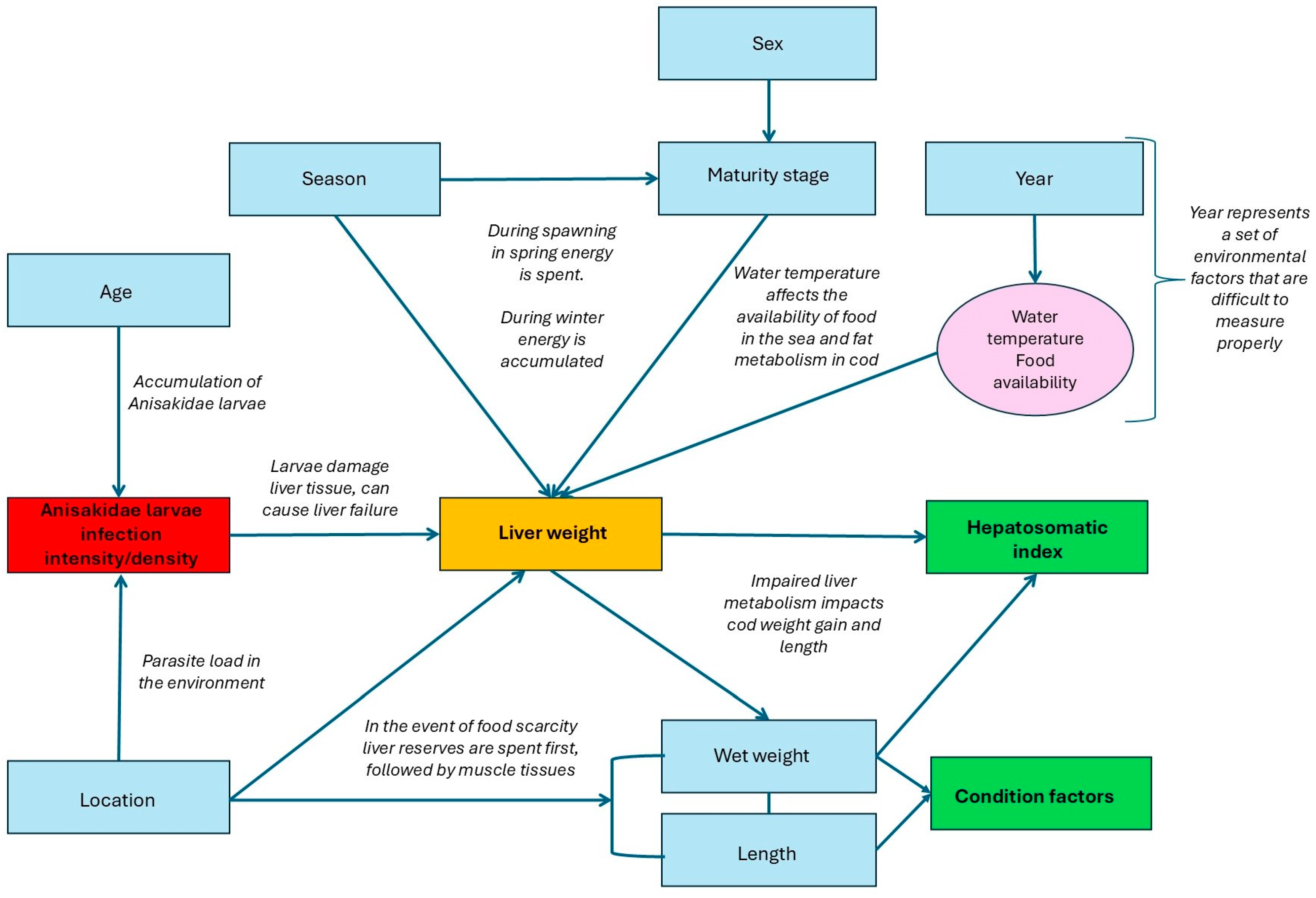

Prevalence and Intensity Effects of Anisakidae Nematode on Eastern Baltic Cod (Gadus morhua Linnaeus, 1758) Condition Factors and Energy Reserves

 ,
,  , , ,
, , ,
Abstract
1. Introduction
2. Materials and Methods
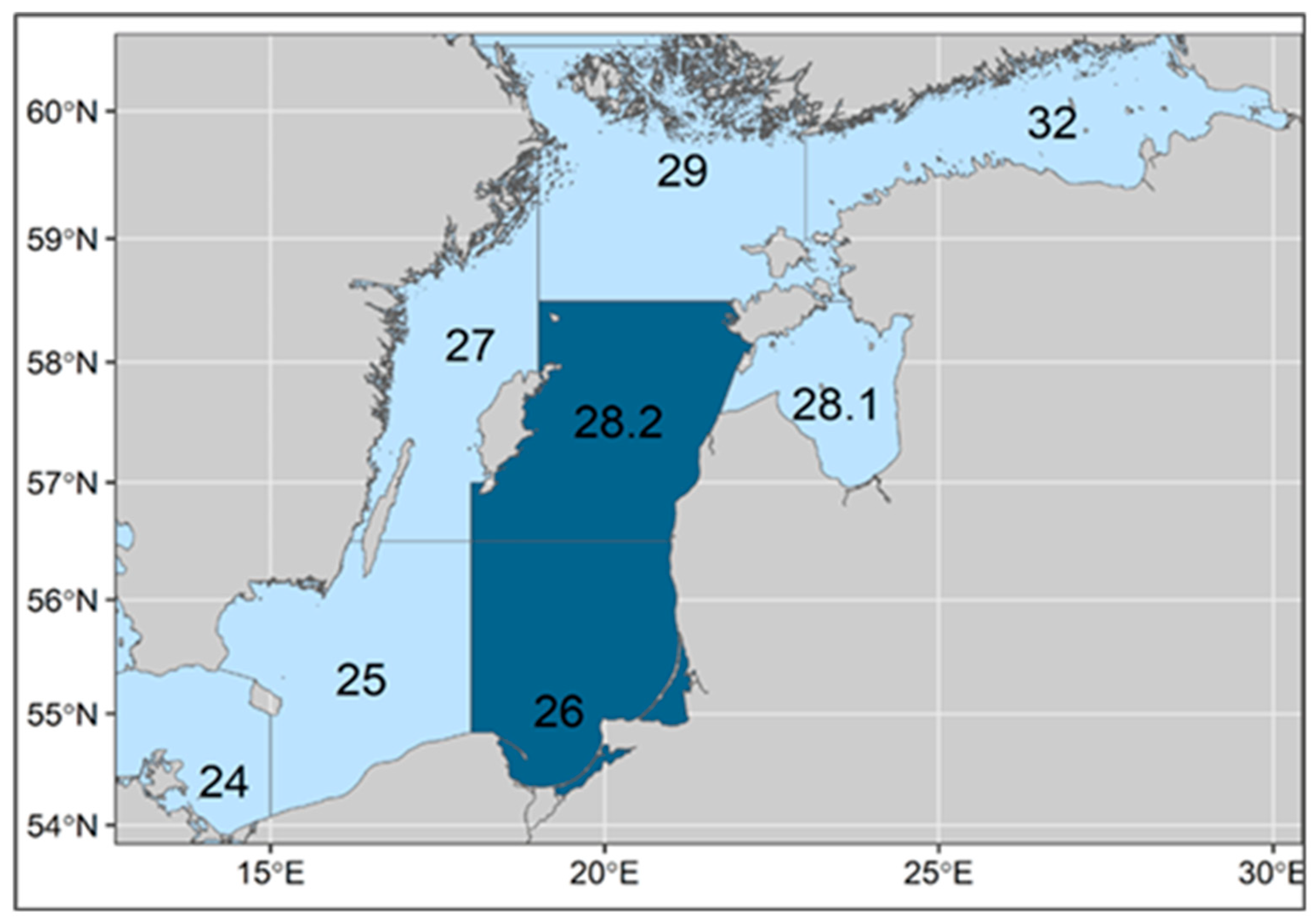
2.1. Sample Collection and Biological Data
2.2. Body Condition and Energy Reserves
2.3. Parasitological Analyses
2.4. Data Analysis
3. Results
3.1. Eastern Baltic Cod Population
3.2. Anisakidae Nematode Prevalence in Eastern Baltic Cod
3.3. Anisakidae Nematode Infection Intensity and Density in Eastern Baltic Cod
3.4. Multivariate Analysis by Fitting Generalized Linear Models (GLMs)
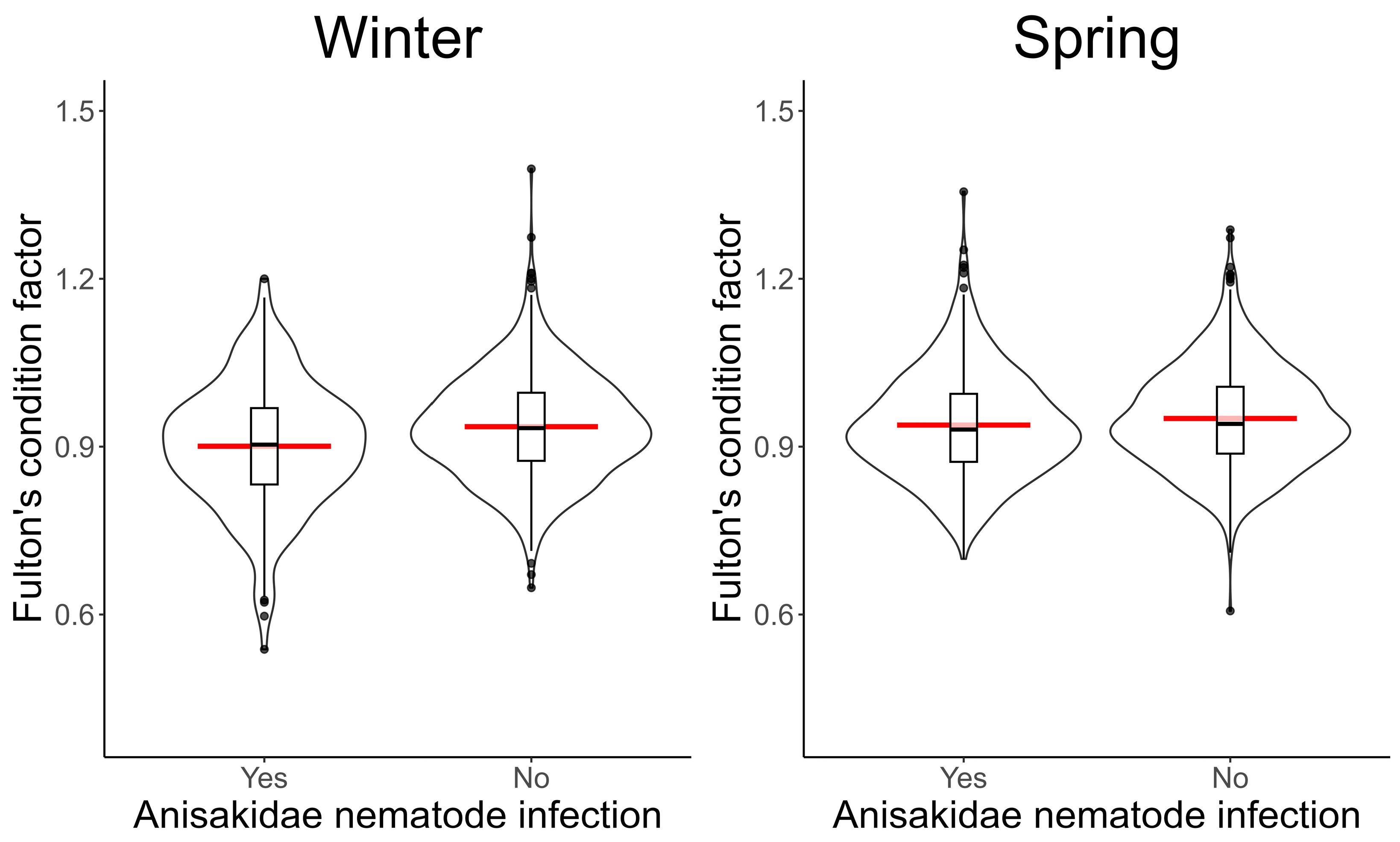
3.4.1. Fulton’s Condition Factor in Winter and Spring
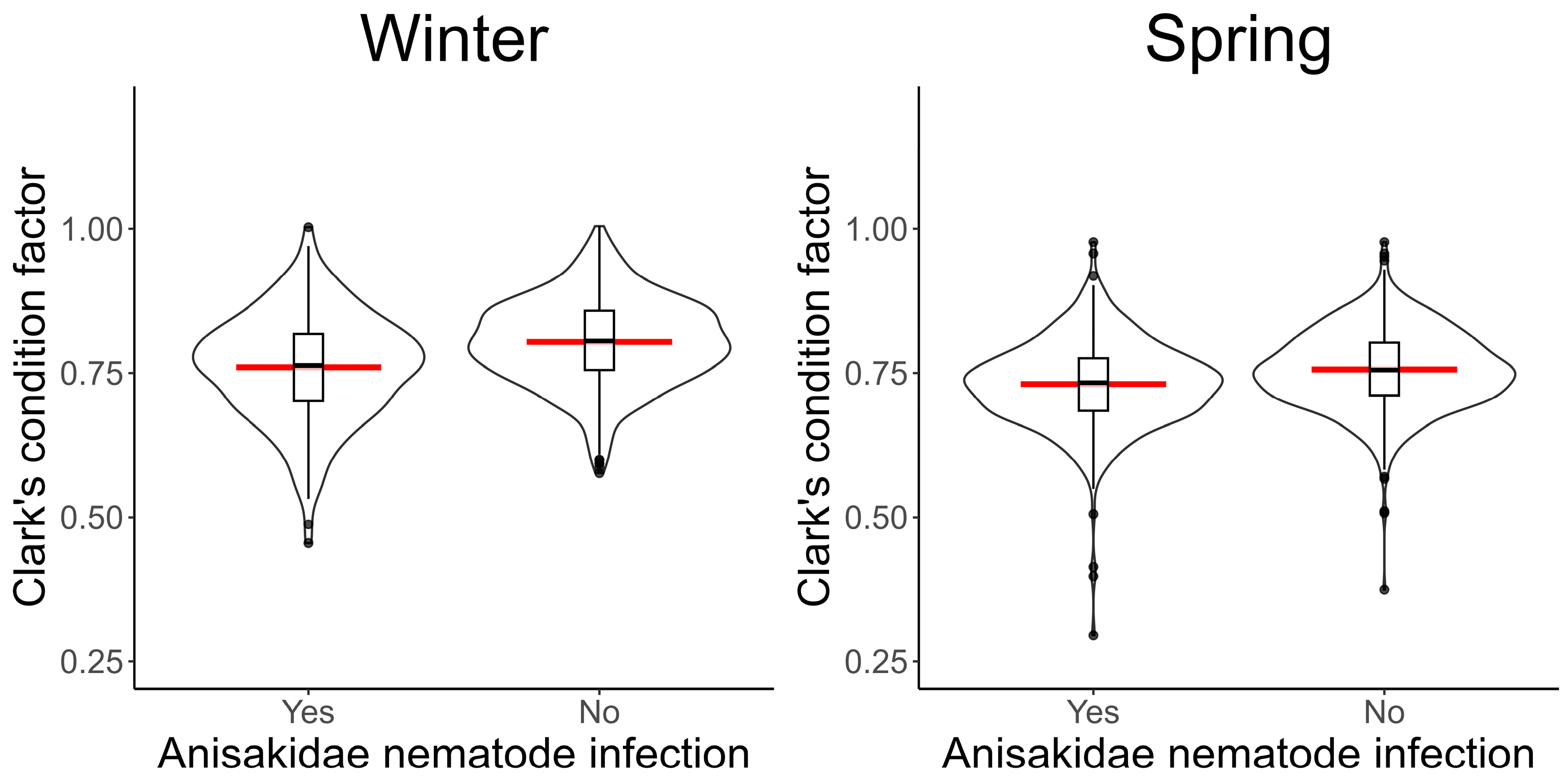
3.4.2. Clark’s Condition Factor in Winter and Spring
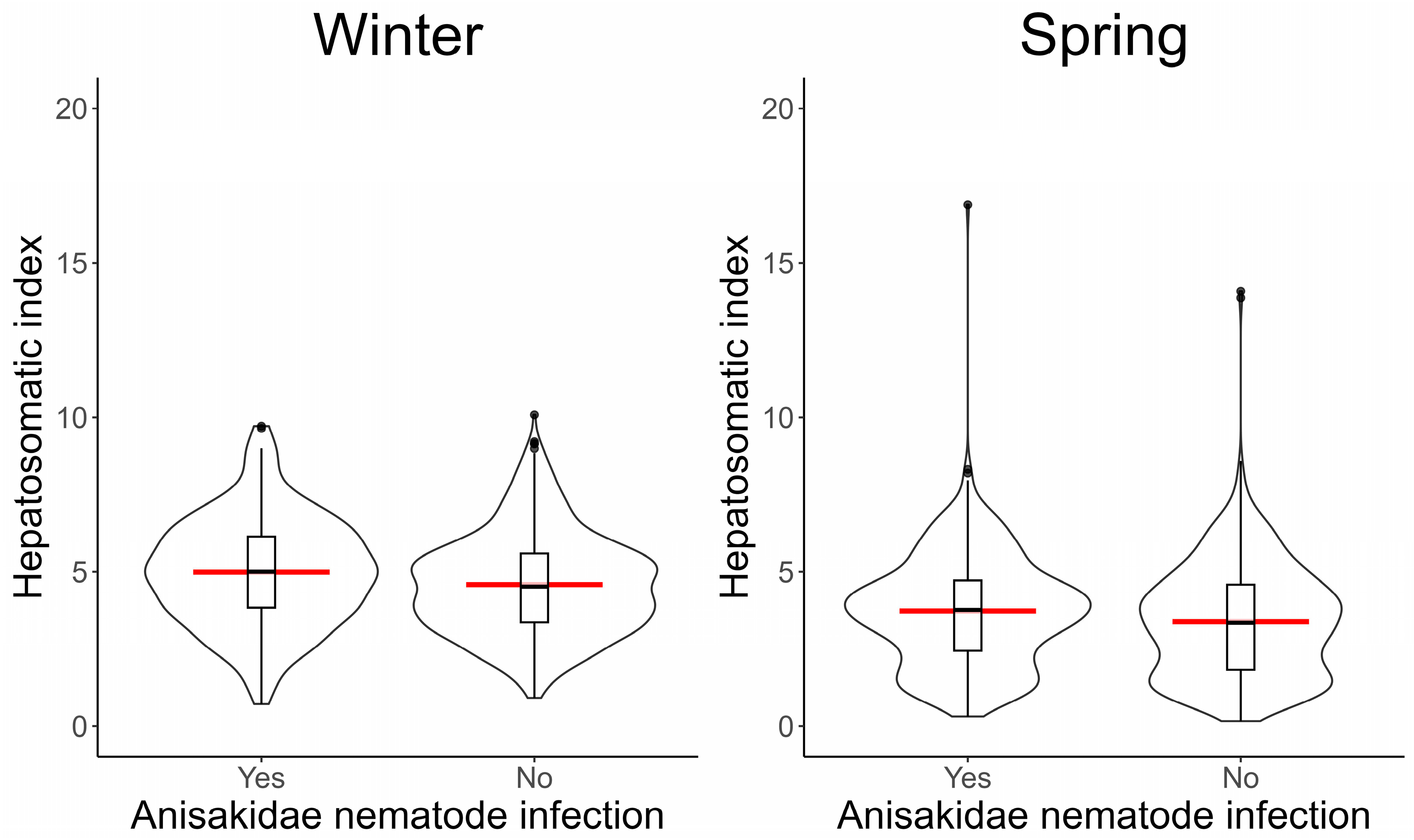
3.4.3. HSI in Winter and Spring
4. Discussion
5. Conclusions
Author Contributions
Funding
Institutional Review Board Statement
Data Availability Statement
Acknowledgments
Conflicts of Interest
Abbreviations
| HSI | Hepatosomatic index |
| ICES | International Council for the Exploration of the Sea |
| SD | Subdivisions |
| BITS | Baltic International Trawl Survey |
| BIAS | Baltic International Acoustic Survey |
| TL | Total lenght |
| AIC | Akaike information criterion |
| AICc | Corrected Akaike information criterion |
| GLM | Generalized linear model |
| OR | Odds ratio |
| IQR | Interquartile range |
| LR Chisq | Likelihood Ratio Chi-Squared Test |
| Df | Degrees of Freedom |
Appendix A

| Season | Maturity Index (n) | Mean Age, Years (SD) | Mean Length, cm (SD) | Mean Wet Weight, g (SD) | Mean Gutted Weight, g (SD) | Mean Liver Weight, g (SD) | Mean HSI (SD) | Mean Fulton’s Coefficient (SD) | Mean Clark’s Coefficient (SD) |
|---|---|---|---|---|---|---|---|---|---|
| Spring | 1 (23) | 1 (0) | 9.7 (1.9) | 8.4 (4.5) | N/A | N/A | N/A | 0.8 (0.1) | N/A |
| 2 (90) | 2.7 (1.1) | 27 (7.7) | 218.6 (212.8) | 183.3 (176.3) | 9.7(10.5) | 4.1 (1.2) | 0.9 (0.1) | 0.7 (0.1) | |
| 3 (287) | 3.3 (1) | 30.3 (6.6) | 288.9 (195.1) | 235.2 (159.6) | 13.5 (11.1) | 4.4 (1.5) | 0.9 (0.1) | 0.7 (0.1) | |
| 4 (479) | 3.3 (1) | 30.9 (6.5) | 318.8 (216.5) | 249.2 (165.5) | 12.9 (12.4) | 3.8 (1.7) | 0.9 (0.1) | 0.7 (0.1) | |
| 5 (8) | 3.8 (1) | 33.6 (9.3) | 469.3 (548.1) | 318.3 (338.9) | 14.8 (17) | 3.2 (0.9) | 1 (0.1) | 0.7 (0.1) | |
| 6 (195) | 2.5 (0.7) | 23.5 (4.5) | 143.6 (131.3) | 109.3 (114.3) | 2.2 (3.8) | 1.5 (1.9) | 1 (0.1) | 0.7 (0.1) | |
| Winter | 1 (28) | 0 | 7.1 (1.5) | 3.7 (1.9) | N/A | N/A | N/A | 0.9 (0.2) | N/A |
| 2 (448) | 2 (1) | 25.3 (6.2) | 173.6 (145.4) | 149.4 (124.4) | 8.8 (10.4) | 4.4 (1.7) | 0.9 (0.1) | 0.8 (0.1) | |
| 3 (372) | 2.6 (0.9) | 28.9 (5.5) | 248.9 (165.5) | 211.2 (137.6) | 13.3 (11.3) | 5 (1.6) | 0.9 (0.1) | 0.8 (0.1) | |
| 4 (6) | 2.5 (0.8) | 29 (3.7) | 248.9 (94.8) | 200 (74.4) | 13.6 (5.1) | 5.5 (0.3) | 0.9 (0.1) | 0.8 (0.04) | |
| 6 (8) | 4 (1.1) | 36.6 (6.5) | 414.4 (237.3) | 353.1 (199.4) | 20.4 (20.3) | 4.4 (1.6) | 0.8 (0.2) | 0.7 (0.1) |
Appendix B

References
- Bagge, O.; Thurow, F.; Steffensen, E.; Bay, J. The Baltic cod. Dana 1994, 10, 1–28. [Google Scholar]
- HELCOM Red List Species Information Sheets (SIS) Fish. Available online: https://helcom.fi/wp-content/uploads/2019/08/HELCOM-RedList-All-SIS_Fish.pdf (accessed on 24 September 2024).
- Andersson, L.; André, C.; Johannesson, K.; Pettersson, M. Ecological adaptation in cod and herring and possible consequences of future climate change in the Baltic Sea. Front. Mar. Sci. 2023, 10, 1101855. [Google Scholar] [CrossRef]
- Eero, M.; Brander, K.; Baranova, T.; Krumme, U.; Radtke, K.; Behrens, J.W. New insights into the recent collapse of Eastern Baltic cod from historical data on stock health. PLoS ONE 2023, 18, e0286247. [Google Scholar] [CrossRef]
- Birgersson, L.; Soderstrom, S.; Belhaj, M. The Decline of Cod in the Baltic Sea—A Review of Biology, Fisheries and Management, Including Recommendations for Cod Recovery; The Fisheries Secretariat: Stockholm, Sweden, 2022; pp. 17–41. [Google Scholar]
- Carstensen, J.; Conley, D.J. Baltic Sea Hypoxia Takes Many Shapes and Sizes. Limnol. Oceanogr. Bull. 2019, 28, 125–129. [Google Scholar] [CrossRef]
- Steinkopf, M.; Krumme, U.; Schulz-Bull, D.; Wodarg, D.; Loick-Wilde, N. Trophic lengthening triggered by filamentous, N2-fixing cyanobacteria disrupts pelagic but not benthic food webs in a large estuarine ecosystem. Ecol. Evol. 2024, 14, e11048. [Google Scholar] [CrossRef]
- Köster, F.W.; Möllmann, C.; Hinrichsen, H.H.; Wieland, K.; Tomkiewicz, J.; Kraus, G.; Voss, R.; Makarchouk, A.; MacKenzie, B.R.; St. John, M.A.; et al. Baltic cod recruitment—The impact of climate variability on key processes. ICES J. Mari. Sci. 2005, 62, 1408–1425. [Google Scholar] [CrossRef]
- Council of the European Union. Council Regulation (EU) 2024/2903 of 18 November 2024, Fixing the Fishing Opportunities for Certain Fish Stocks and Groups of Fish Stocks Applicable in the Baltic Sea for 2025 and Amending Regulation (EU) 2024/257 as Regards Certain Fishing Opportunities in Other Waters. Official Journal of the European Union L 2024/2093, 19 November 2024. Available online: https://eur-lex.europa.eu/eli/reg/2024/2903/oj/eng (accessed on 3 January 2025).
- Ryberg, M.P.; Huwer, B.; Nielsen, A.; Dierking, J.; Buchmann, K.; Sokolova, M.; Krumme, U.; Behrens, J.W. Parasite load of Atlantic cod Gadus morhua in the Baltic Sea assessed by the liver category method, and associations with infection density and critical condition. Fish. Manag. Ecol. 2022, 29, 88–99. [Google Scholar] [CrossRef]
- Ryberg, M.P.; Skov, P.V.; Vendramin, N.; Buchmann, K.; Nielsen, A.; Behrens, J.W. Physiological condition of Eastern Baltic cod, Gadus morhua, infected with the parasitic nematode Contracaecum osculatum. Conserv. Physiol. 2020, 8, coaa093. [Google Scholar] [CrossRef] [PubMed]
- Timi, J.T.; Poulin, R. Why ignoring parasites in fish ecology is a mistake. Int. J. Parasitol. 2020, 50, 755–761. [Google Scholar] [CrossRef] [PubMed]
- Suuronen, P.; Lunneryd, S.; Königson, S.; Coelho, N.F.; Waldo, Å.; Eriksson, V.; Svels, K.; Lehtonen, E.; Psuty, I.; Vetemaa, M. Reassessing the Management Criteria of Growing Seal Populations: The Case of Baltic Grey Seal and Coastal Fishery. Marine Policy 2023, 155, 105684. [Google Scholar] [CrossRef]
- Myjak, P.; Szostakowska, B.; Wojciechowski, J.; Pietkiewicz, H.; Rokicki, J. Anisakid larvae in cod from the southern Baltic Sea. Arch. Fish. Mar. Res. 1994, 42, 146–161. [Google Scholar]
- Behrens, J.W.; Ryberg, M.P.; Chondromatidou, V.; Iburg, T.M. Comparative histopathology of livers from Baltic cod infected with the parasitic nematode Contracaecum osculatum. J. Fish Dis. 2023, 46, 653–662. [Google Scholar] [CrossRef]
- Mohamed, A.; Zuo, S.; Karami, A.M.; Marnis, H.; Setyawan, A.; Mehrdana, F.; Kirkeby, C.; Kania, P.; Buchmann, K. Contracaecum osculatum (sensu lato) infection of Gadus morhua in the Baltic Sea: Inter- and intraspecific interactions. Int. J. Parasitol. 2020, 50, 891–898. [Google Scholar] [CrossRef] [PubMed]
- Ovegård, M.; Ljungberg, P.; Orio, A.; Öhman, K.; Norrman, E.B.; Lunneryd, S.G. The effects of Contracaecum osculatum larvae on the growth of Atlantic cod (Gadus morhua). Int. J. Parasitol. Parasites Wildl. 2022, 19, 161–168. [Google Scholar] [CrossRef]
- Powles, P.M. Studies of reproduction and feeding of Atlantic cod (Gadus callarias L.) in the south-western Gulf of St. Lawrence. J. Fish. Res. Board. Can. 1958, 15, 1383–1402. [Google Scholar] [CrossRef]
- Panfili, J.; de Pontual, H.; Troadec, H.; Wright, P.J. Manual of Fish Sclerochronology; Ifremer-LRD Coedition: Brest, France, 2002; pp. 31–56. [Google Scholar]
- Fulton, T.W. The rate of growth of fishes. Fish. Board Scotl. 1902, 22, 141–241. [Google Scholar]
- Clark, N.F. The weight-length relationship of the California sardine (Sardina coerulea) at San Pedro. Fish. Bull. 1928, 12, 1–59. [Google Scholar]
- Villasante, A.; Figueroa, E.; Godoy, K.; Dantagnan, P.; López-Polo, J.; Opazo, R.; Romero, J. Impact of Plant-Based Diets on Hepatosomatic Index, Circulating Globulins and Growth in Rainbow Trout (Oncorhynchus mykiss). Fishes 2025, 10, 110. [Google Scholar] [CrossRef]
- European Union Reference Laboratory for Parasites Department of Infectious, Diseases Unit of Foodborne and Neglected Parasitic Diseases Istituto Superiore di Sanità Detection of Parasites in Fish Fillet by Artificial Digestion Standard Operating Procedure (SOP). Available online: https://www.iss.it/documents/20126/0/POP-04+%28rev+3%29+Artificial+digestion+of+fish+fillet.pdf/cfa9a06a-dae9-e7b8-252f-434cc1c45d32?t=1712663409737 (accessed on 3 October 2024).
- Nonković, D.; Tešić, V.; Šimat, V.; Karabuva, S.; Medić, A.; Hrabar, J. Anisakidae and Anisakidosis: A Public Health Perspective. Pathogens 2025, 14, 217. [Google Scholar] [CrossRef]
- Anderson, R.C. Nematode Parasites of Vertebrates: Their Development and Transmission, 2nd ed.; CABI Publishing: Oxfordshire, UK, 2000; pp. 269–288. [Google Scholar]
- Bush, A.O.; Lafferty, K.D.; Lotz, J.M.; Shostak, A.W. Parasitology meets ecology on its own terms: Margolis et al. revisited. J. Parasitol. 1997, 83, 575–583. [Google Scholar] [CrossRef]
- Sullivan, K.M.; Dean, A.; Soe, M.M. On Academics: OpenEpi: A Web-Based Epidemiologic and Statistical Calculator for Public Health. Public Health Rep. 2009, 124, 471–474. [Google Scholar] [CrossRef] [PubMed]
- Sakamoto, Y.; Ishiguro, M.; Kitagawa, G. Akaike Information Criterion Statistics; Springer: Dordrecht, The Netherlands, 1986; p. 26853. [Google Scholar]
- Fox, J.; Weisberg, S. An R Companion to Applied Regression, 2nd ed.; SAGE Publications, Inc.: Thousand Oaks, CA, USA, 2019; pp. 149–328. [Google Scholar]
- Dutil, J.D.; Lambert, Y.; Chouinard, G.A.; Frechet, A. Fish condition: What should we measure in cod (Gadus morhua)? In DFO Atlantic Fisheries Research Document; Fisheries and Oceans: Ottawa, ON, Canada, 1995; Volume 95/11, pp. 1–26. [Google Scholar]
- R Core Team. R: A Language and Environment for Statistical Computing, Version 4.3.2; R Foundation for Statistical Computing: Vienna, Austria, 2023; Available online: https://www.R-project.org/ (accessed on 23 September 2024).
- Podolska, M.; Nadolna-Ałtyn, K.; Pawlak, J.; Horbowy, J. The presence of nematodes in the liver of Baltic cod, Gadus morhua, is associated with a decline in condition factors and hepatosomatic index of the host. Fish. Res. 2024, 273, 106958. [Google Scholar] [CrossRef]
- Zuo, S.; Huwer, B.; Bahlool, Q.; Al-Jubury, A.; Daugbjerg Christensen, N.; Korbut, R.; Kania, P.; Buchmann, K. Host size-dependent anisakid infection in Baltic cod Gadus morhua associated with differential food preferences. Dis. Aquat. Organ. 2016, 120, 69–75. [Google Scholar] [CrossRef]
- Horbowy, J.; Podolska, M.; Nadolna—Ałtyn, K. Increasing occurrence of anisakid nematodes in the liver of cod (Gadus morhua) from the Baltic Sea: Does infection affect the condition and mortality of fish? Fish. Res. 2016, 179, 98–103. [Google Scholar] [CrossRef]
- Sokolova, M.; Buchmann, K.; Huwer, B.; Kania, P.; Krumme, U.; Galatius, A.; Hemmer-Hansen, J.; Behrens, J. Spatial patterns in infection of cod Gadus morhua with the seal-associated liver worm Contracaecum osculatum from the Skagerrak to the central Baltic Sea. Mar. Ecol. Prog. Ser. 2018, 606, 105–118. [Google Scholar] [CrossRef]
- Nadolna, K.; Podolska, M. Anisakid larvae in the liver of cod (Gadus morhua) L. from the southern Baltic Sea. J. Helminthol. 2014, 88, 237–246. [Google Scholar] [CrossRef] [PubMed]
- Measures, L.N. Effect of temperature and salinity development and survival of eggs and free-living larvae of sealworm (Pseudoterranova decipiens). Can. J. Fish. Aquat. Sci. 1996, 53, 2804–2807. [Google Scholar] [CrossRef]
- Højgaard, D.P. Impact of temperature, salinity and light on hatching of eggs of Anisakis simplex (Nematoda, Anisakidae), isolated by a new method, and some remarks on survival of larvae. Sarsia 1998, 83, 21–28. [Google Scholar] [CrossRef]
- Lunneryd, S.G.; Boström, M.K.; Aspholm, P.E. Sealworm (Pseudoterranova decipiens) infection in grey seals (Halichoerus grypus), cod (Gadus morhua) and shorthorn sculpin (Myoxocephalus scorpius) in the Baltic Sea. Parasitol. Res. 2015, 114, 257–264. [Google Scholar] [CrossRef]
- Skrzypczak, M.; Rokicki, J.; Pawliczka, I.; Najda, K.; Dzido, J. Anisakids of seals found on the southern coast of Baltic Sea. Acta Parasitol. 2014, 59, 165–172. [Google Scholar] [CrossRef] [PubMed]
- Valtonen, E.T.; Fagerholm, H.P.; Helle, E. Contracaecum osculatum (Nematoda:Anisakidae) in fish and seals in Bothnian Bay (northeastern Baltic Sea). Int. J. Parasitol. 1988, 18, 365–370. [Google Scholar] [CrossRef]
- Selezņova, M.; Cīrulis, A.; Mateusa, M.; Krūze, Ē.; Rozenfelde, L.; Pigiņka-Vjačeslalova, I.; Geine-Romanova, L.; Ustups, D.; Deksne, G. Endoparasites in Grey Seals (Halichoerus grypus) By-Caught in Latvian Commercial Coastal Fishery. Animals 2025, 15, 45. [Google Scholar] [CrossRef]
- Hemmingsen, W.; Lysne, D.A.; Eidnes, T.; Skorping, A. The occurrence of larval ascaridoid nematodes in wild-caught and in caged and artificially fed Atlantic cod, Gadus morhua L., in Norwegian waters. Fish. Res. 1993, 15, 379–386. [Google Scholar] [CrossRef]
- Kulatska, N.; Neuenfeldt, S.; Beier, U.; Elvarsson, B.; Wennhage, H.; Stefansson, G.; Bartolino, V. Understanding ontogenetic and temporal variability of Eastern Baltic cod diet using a multispecies model and stomach data. Fish. Res. 2018, 211, 338–349. [Google Scholar] [CrossRef]
- Nadolna—Ałtyn, K.; Szostakowska, B.; Podolska, M. Sprat (Sprattus sprattus) as a Possible Source of Invasion of Marine Predators with Contracaecum osculatum in the Southern Baltic Sea. Russ. J. Mar. Biol. 2018, 44, 471–476. [Google Scholar] [CrossRef]
- Zuo, S.; Kania, P.W.; Mehrdana, F.; Marana, M.H.; Buchmann, K. Contracaecum osculatum and other anisakid nematodes in grey seals and cod in the Baltic Sea: Molecular and ecological links. J. Helminthol. 2018, 92, 81–89. [Google Scholar] [CrossRef] [PubMed]
- Køie, M.; Fagerholm, H.P. The life cycle of Contracaecum osculatum (Rudolphi, 1802) sensu stricto (Nematoda, Ascaridoidea, Anisakidae) in view of experimental infections. Parasitol. Res. 1995, 81, 481–489. [Google Scholar] [CrossRef] [PubMed]
- Hordoir, R.; Axell, L.; Höglund, A.; Dieterich, C.; Fransner, F.; Gröger, M.; Liu, Y.; Pemberton, P.; Schimanke, S.; Andersson, H.; et al. Nemo-Nordic 1.0: A NEMO-based ocean model for the Baltic and North seas—Research and operational applications. Geosci. Model Dev. 2019, 12, 363–386. [Google Scholar] [CrossRef]
- Teilmann, J.; Galatius, A.; Sveegaard, S. Marine mammals in the Baltic Sea in relation to the Nord Stream 2 project.—Baseline report. Sci. Rep. DCE—Dan. Cent. Environ. Energy 2017, 236, 33–36. [Google Scholar]
- Oksanen, S.M.; Ahola, M.P.; Lehtonen, E.; Kunnasranta, M. Using movement data of Baltic grey seals to examine foraging-site fidelity: Implications for seal-fishery conflict mitigation. Mar. Ecol. Prog. Ser. 2014, 507, 297–308. [Google Scholar] [CrossRef]
- Zuk, M.; McKean, K.A. Sex differences in parasite infections: Patterns and processes. Int. J. Parasitol. 1996, 26, 1009–1023. [Google Scholar] [CrossRef] [PubMed]
- Fevolden, S.E.; Westgaard, J.I.; Pedersen, T. Extreme male-skewed sex ratios on spawning grounds for Atlantic cod Gadus morhua with typical coastal cod signatures of the Pan I (pantophysin) locus. Sex. Early Dev. Aquat. Org. 2015, 1, 133–142. [Google Scholar] [CrossRef]
- Morgan, M.J.; Trippel, E.A. Skewed sex ratios in spawning shoals of Atlantic cod (Gadus morhua). ICES J. Mar. Sci. 1996, 53, 820−826. [Google Scholar] [CrossRef]
- Robichaud, D.; Rose, G. Sex differences in cod residency on a spawning ground. Fish. Res. 2003, 60, 33–43. [Google Scholar] [CrossRef]
- Baranova, T.; Muller-Karulis, B.; Šics, I.; Plikshs, M. Changes in the annual life cycle of eastern Baltic cod during 1950–2010. In Proceedings of the ICES Annual Science Conference, Gdansk, Poland, 12–23 September 2011. ICES CM 2011/R:10. [Google Scholar]
- Uzars, D.; Baranova, T.; Yula, E. Interannual Variation in Gonadal Maturation of Cod in the Gotland Basin of the Baltic Sea: Influence of Environment and Fish Condition. In Proceedings of the ICES Annual Science Conference, Oslo, Norway, 26 September 2001. CM 2001/V: 29. [Google Scholar]
- Limburg, K.E.; Casini, M. Otolith chemistry indicates recent worsened Baltic cod condition is linked to hypoxia exposure. Biol. Lett. 2019, 15, 20190352. [Google Scholar] [CrossRef]
- Fordham, B.S.E.; Trippel, E.A. Feeding behaviour of cod (Gadus morhua) in relation to spawning. J. Appl. Ichthyol. 1999, 15, 1–9. [Google Scholar] [CrossRef]


| Variables | Spring | Winter | ||||
|---|---|---|---|---|---|---|
| N | Mean (SD *) | Range | N | Mean (SD *) | Range | |
| Age, years | 1082 | 3.1 (1) | 1–7 | 862 | 2.2 (1.1) | 0–6 |
| Wet weight, g | 1082 | 265.5 (213.4) | 1–1800 | 864 | 203.8 (162.5) | 1–1904 |
| Gutted weight, g | 1057 | 214.5 (167.1) | 26–1510 | 834 | 179.3 (135.4) | 30–1531 |
| Length, cm | 1082 | 28.7 (7.4) | 6–60 | 864 | 26.4 (7.1) | 4–58 |
| Liver weight, g | 1059 | 10.9 (11.6) | 0.1–92.4 | 832 | 10.9 (11.2) | 0.5–133.6 |
| Mean HSI | 1058 | 3.5 (1.9) | 0.2–23.4 | 832 | 4.7 (1.7) | 0.7–10.1 |
| Fulton’s coefficient | 1082 | 0.9 (0.1) | 0.6–1.4 | 864 | 0.9 (0.1) | 0.5–1.6 |
| Clark’s coefficient | 1057 | 0.7 (0.1) | 0.3–0.9 | 834 | 0.8 (0.1) | 0.5–1.2 |
| Variable (n) | Prevalence % (n) | 95% CI | p-Value | |
|---|---|---|---|---|
| Sex (1893) | Male (1208) | 34.3 (414) | 31.6–37 | <0.05 |
| Female (685) | 27.4 (188) | 33.6–42.3 | ||
| Age (1944) | 1 (229) | 3.5 (8) | 1.5–6.8 | <0.05 |
| 2 (627) | 18.5 (116) | 15.5–21.2 | ||
| 3 (644) | 31.5 (203) | 27.9–35.3 | ||
| 4 (292) | 60.9 (178) | 55.1–66.6 | ||
| 5 (112) | 77.6 (87) | 68.8–85 | ||
| 6 (18) | 88.9 (16) | 65.3–98.6 | N/A | |
| 7 (2) | 100.0 (2) | N/A | ||
| Length (1946) | ≤30 cm (1301) | 17.9 (233) | 15.9–20.1 | <0.05 |
| <30 cm (645) | 57.2 (369) | 53.3–61.1 | ||
| Season (1944) | Spring (1082) | 37.7 (404) | 34.8–40.6 | <0.05 |
| Winter (864) | 23.4 (198) | 20.6–26.4 | ||
| Year (1944) | 2018 (100) | 30.0 (30) | 21.2–39.9 | |
| 2019 (438) | 32.6 (143) | 28.3–37.3 | ||
| 2020 (346) | 28.9 (100) | 24.2–34 | 0.7 | |
| 2021 (436) | 29.6 (129) | 25.3–34.1 | ||
| 2022 (626) | 32 (200) | 29.5–37.1 | ||
| ICES subdivision (1946) | 26 (439) | 37.4 (164) | 32.8–42.1 | 0.001 |
| 28 (1507) | 29.1 (438) | 26.8–31.4 | ||
| Variable (n) | Median Infection Intensity (Nematodes per Liver) | IQR 2 | p-Value | Median Infection Density (Nematodes/g Liver Tissue) | IQR | p-Value | |
|---|---|---|---|---|---|---|---|
| Sex (1893) | Male (1208) | 3 | 1–8.3 | 0.8 | 0.4 | 0.17–1.1 | <0.05 |
| Female (685) | 3 | 1–10 | 0.2 | 0.1–0.5 | |||
| Age (1944) | 1 (229) | 1 | 1–1 | <0.05 | 0.3 | 0.2–0.5 | |
| 2 (627) | 1 | 1–2 | 0.5 | 0.2–1 | |||
| 3 (644) | 2 | 1–5 | 0.2 | 0.1–0.6 | |||
| 4 (292) | 5 | 2–11 | 0.4 | 0.1–0.9 | 0.001 | ||
| 5 (112) | 13 | 5–28 | 0.7 | 0.2–1.5 | |||
| 6 (18) | 24 | 11.7–47 | 0.5 | 0.3–1.1 | |||
| 7 (2) | 59 | 10,108 1 | 0.6 | 0.3–0.8 | |||
| Season (1944) | Spring (1086) | 3 | 1–10 | 0.08 | 0.4 | 0.2–1.1 | <0.05 |
| Winter (868) | 2 | 1–70 | 0.3 | 0.1–0.5 | |||
| Year (1944) | 2018 (100) | 1 | 1–2.5 | 0.03 | 0.2 | 0.1–0.5 | |
| 2019 (438) | 2 | 1–8 | 0.2 | 0.1–0.5 | |||
| 2020 (346) | 3 | 1–8.5 | 0.2 | 0.1–0.5 | <0.05 | ||
| 2021 (436) | 5 | 2–15.5 | 0.4 | 0.1–0.8 | |||
| 2022 (626) | 3 | 1–6 | 0.7 | 0.3–1.4 | |||
| ICES subdivision (1946) | 26 (439) | 5 | 1–113 | 0.001 | 0.6 | 0.03–29 | <0.05 |
| 28 (1507) | 2 | 1–108 | 0.3 | 0.01–6 | |||
| Cod Health Indicator | Season | Factor | LR Chisq | Df | p-Value |
|---|---|---|---|---|---|
| Fulton’s condition factor (good or bad) | Spring | Maturity | 21.1 | 3 | <0.001 |
| Year | 19.7 | 3 | <0.001 | ||
| Infection density | 3.8 | 1 | 0.05 | ||
| ICES subdivision | 10.4 | 1 | 0.001 | ||
| Sex | 6.1 | 1 | 0.01 | ||
| Age | 4.1 | 1 | 0.04 | ||
| Winter | Year | 71.2 | 4 | <0.001 | |
| ICES subdivision | 19.5 | 1 | <0.001 | ||
| Maturity | 6.1 | 2 | <0.05 | ||
| Infection density | 11.6 | 1 | <0.001 | ||
| Age | 4.4 | 1 | 0.04 | ||
| Clark’s condition factor (above or below average) | Spring | Year | 28.2 | 3 | <0.001 |
| Sex | 24 | 1 | <0.001 | ||
| ICES subdivision | 18.8 | 1 | <0.001 | ||
| Infection density | 16.3 | 1 | <0.001 | ||
| Age | 12.3 | 1 | <0.001 | ||
| Winter | ICES subdivision | 41.7 | 1 | <0.001 | |
| Infection density | 17.2 | 1 | <0.001 | ||
| Age | 17.1 | 1 | <0.001 | ||
| Year | 14.4 | 4 | 0.006 | ||
| HSI (above or below average) | Spring | Maturity | 76.9 | 3 | <0.001 |
| Year | 51.8 | 3 | <0.001 | ||
| Sex | 49.4 | 1 | <0.001 | ||
| Age | 35.7 | 1 | <0.001 | ||
| ICES subdivision | 14.3 | 1 | <0.001 | ||
| Infection density | 11.8 | 1 | <0.001 | ||
| Winter | Year | 162.1 | 4 | <0.001 | |
| Age | 17.8 | 1 | <0.001 | ||
| ICES subdivision | 14.1 | 1 | <0.001 | ||
| Maturity | 8.1 | 3 | 0.04 | ||
| Infection density | 2.4 | 1 | 0.1 |
Disclaimer/Publisher’s Note: The statements, opinions and data contained in all publications are solely those of the individual author(s) and contributor(s) and not of MDPI and/or the editor(s). MDPI and/or the editor(s) disclaim responsibility for any injury to people or property resulting from any ideas, methods, instructions or products referred to in the content. |
© 2025 by the authors. Licensee MDPI, Basel, Switzerland. This article is an open access article distributed under the terms and conditions of the Creative Commons Attribution (CC BY) license.
Share and Cite
Selezņova, M.; Krūze, Ē.; Cīrulis, A.; Baranova, T.; Mateusa, M.; Šics, I.; Heimrāts, K.; Gruduls, J.; Briekmane, L.; Deksne, G. Prevalence and Intensity Effects of Anisakidae Nematode on Eastern Baltic Cod (Gadus morhua Linnaeus, 1758) Condition Factors and Energy Reserves. Fishes 2026, 11, 20. https://doi.org/10.3390/fishes11010020
Selezņova M, Krūze Ē, Cīrulis A, Baranova T, Mateusa M, Šics I, Heimrāts K, Gruduls J, Briekmane L, Deksne G. Prevalence and Intensity Effects of Anisakidae Nematode on Eastern Baltic Cod (Gadus morhua Linnaeus, 1758) Condition Factors and Energy Reserves. Fishes. 2026; 11(1):20. https://doi.org/10.3390/fishes11010020
Chicago/Turabian StyleSelezņova, Maija, Ēriks Krūze, Aivars Cīrulis, Tatjana Baranova, Maira Mateusa, Ivo Šics, Kārlis Heimrāts, Jānis Gruduls, Laura Briekmane, and Gunita Deksne. 2026. "Prevalence and Intensity Effects of Anisakidae Nematode on Eastern Baltic Cod (Gadus morhua Linnaeus, 1758) Condition Factors and Energy Reserves" Fishes 11, no. 1: 20. https://doi.org/10.3390/fishes11010020
APA StyleSelezņova, M., Krūze, Ē., Cīrulis, A., Baranova, T., Mateusa, M., Šics, I., Heimrāts, K., Gruduls, J., Briekmane, L., & Deksne, G. (2026). Prevalence and Intensity Effects of Anisakidae Nematode on Eastern Baltic Cod (Gadus morhua Linnaeus, 1758) Condition Factors and Energy Reserves. Fishes, 11(1), 20. https://doi.org/10.3390/fishes11010020