
You are currently viewing a new version of our website. To view the old version click .
Fishes
  • Article
  • Open Access

4 December 2025

Age and Growth of Greater Amberjack (Seriola dumerili) in the Gulf of America

,
,
,
,
,
,
,
,
and
1
School of Forest, Fisheries and Geomatics Sciences, University of Florida, 7922 Northwest 71st Street, Gainesville, FL 32653, USA
2
Center for Fisheries Research and Development, Gulf Coast Research Laboratory, University of Southern Mississippi, 703 East Beach Drive, Ocean Springs, MS 39564, USA
3
Department of Natural Resources, Northwest Florida State College, 100 College Blvd E, Niceville, FL 32578, USA
4
Coastal Resources Division, Georgia Department of Natural Resources, One Conservation Way, Brunswick, GA 31520, USA
Fishes2025, 10(12), 620;https://doi.org/10.3390/fishes10120620 
(registering DOI)
This article belongs to the Special Issue Ecology of Fish: Age, Growth, Reproduction and Feeding Habits

Abstract

Greater amberjack (Seriola dumerili) are large reef fish important in fisheries in the southeastern USA, with the Gulf of America stock unsustainably harvested over most of the past two decades. Its age-based stock assessment and recovery plan depend on age and growth information. In this study, 7658 greater amberjack were sampled from the west coast of Florida and off Alabama, Mississippi, and Louisiana in the Gulf from 1991 to 2018. Fish were aged using cross-sectioned sagittal otoliths, with accompanying data on their length, sex, location (state), and type of fishery. Overall, the greater amberjack that were landed in the recreational and commercial fisheries were between 2 and 19 years of age, with the majority between 3 and 5 years old (>80%), and were primarily caught using hook-and-line gear (95%). Sex- and state-specific growth differences were evident based on von Bertalanffy growth models, with females significantly larger at age than males in both Florida and Louisiana (which included Mississippi and Alabama due to low sample size), and females in Louisiana larger at age than females in Florida. Sex ratios in the recreational catches of Florida and Louisiana were skewed towards females (>1.5 female per male), especially for fish ≥1000 mm fork length (>2.3 female per male). Accounting for sex-specific and region-specific growth differences may, in part, help to explain the notably high variability in the overall growth model for greater amberjack in the Gulf.
Key Contribution:
This study provides the first comprehensive assessment of sex- and region-specific age and growth of greater amberjack in the Gulf of America. It provides age and growth estimates that are essential for its stock assessments and rebuilding plans.

1. Introduction

The greater amberjack (Seriola dumerili) is a large jack (family Carangidae) that has a circumglobal distribution throughout warm temperate and tropical waters, excluding the eastern Pacific Ocean. In the United States, it is important in the recreational and commercial fisheries in both the U.S. South Atlantic and the Gulf of America (also known as the Gulf of Mexico, hereafter Gulf) [1,2], where it is managed as two different stocks [2]. The South Atlantic stock is not considered to be overfished (i.e., spawning stock is not too low) nor is overfishing occurring (i.e., current fishing rate is not too high). However, the Gulf stock of greater amberjack has been declared overfished and overfishing has been occurring since 1988 and up to and including 2018, which was the last year of data used in the most recent stock assessment for greater amberjack in the Gulf [2]. Its range in the Gulf spans the coastal regions of west Florida, Alabama, Mississippi, Louisiana, and Texas. Recreational landings for greater amberjack have historically exceeded commercial landings on a Gulf-wide basis [2], spiking in 1987 at 6005 metric tonnes (MT), but then rapidly declining, and from 2020 to 2024 ranging between 20 and 290 MT [3]. Commercial greater amberjack landings peaked in 1992 at 785 MT in the Gulf and in 2020–2024 ranged between 72 and 201 MT [3]. Concomitantly with its overfished status, recreational fishing regulations for Gulf greater amberjack have increased and currently include a daily bag and possession limit of one fish/person/day, a minimum size limit of 864 mm fork length (FL, 34 inches), and seasonal and spatial closures, as well as an annual quota [1]. Commercial fisheries have also been heavily regulated, including a minimum size limit of 915 mm FL (36 inches FL), an annual quota, trip limits, and seasonal and spatial closures [1]. Despite these stringent fishing regulations, the greater amberjack stock in the Gulf has not been rebuilt [2].
The preferred stock assessment model used for greater amberjack in the Gulf is a statistical catch-at-age model that relies on accurate age and growth estimates to assess the status of the stock and to plan rebuilding scenarios [2]. To date, research on the age and growth of greater amberjack in the Gulf has largely consisted of collections from various recreational fisheries. This includes a study by Manooch and Potts [4] that focused on fish caught only from head boats, with fish sampled primarily from Texas (53%) and Florida/Alabama (46%). Head boats are generally large vessels that carry 20–50+ anglers at a time with a per person fee. Another study using recreational samples was Thompson et al. [5], which was based on Beasley [6], in which greater amberjack were sampled from Louisiana, with 44% and 42% of the samples coming from fishing tournaments and charter boats (i.e., smaller recreational vessels that carry ≤ six anglers), respectively. In collaboration with the National Marine Fisheries Service (NMFS) lab in Panama City, Florida, and the Gulf States Marine Fisheries Commission (GSMFC) in Ocean Springs, Mississippi, Murie and Parkyn [7] then developed specific ageing criteria for greater amberjack based on sectioned otoliths (i.e., “ear stones”), specifically the sagittae, and aged archived otoliths from fish that had been collected between 1990 and 2008 from primarily Florida, Alabama, and Louisiana. Targeted research sampling was also undertaken by Murie and Parkyn [7] to obtain sublegal-sized fish (i.e., small and young) needed for growth modeling. A subset of these fish were analyzed by Leonard [8], where he continued to develop ageing criteria and focused on head boat and charter boat catches from Florida and Alabama. The culmination of these projects resulted in a working document (i.e., internal use only) for the most recent greater amberjack stock assessment in 2020, where age data from Murie and Parkyn [7] was combined with age data contributed by the GSFMC, NMFS, and the Florida Fish and Wildlife Research Institute (FWRI) in St. Petersburg, Florida, to estimate input parameters for an overall growth model to be used in the stock assessment, with data current to 2018 [9].
Growth of greater amberjack over their size range has also been studied off the eastern seaboard of the US Atlantic by Burch [10], Manooch and Potts [11], and Harris et al. [12]. Burch [10] aged greater amberjack from southeastern Florida and the Florida Keys using scales because he found whole otoliths to be too opaque and without any visible annuli, and cross-sectioning of otoliths was not a common method at the time and so was not attempted. Scales may be appropriate for younger fish but it is now well known that scales usually underage older fish in a variety of species [13], and therefore scale ages need to be compared to otolith ages to ensure accuracy. Manooch and Potts [11] specifically compared greater amberjack age and growth from head boat and commercial handline catches from North Carolina to southern Florida using otoliths. However, the most extensive growth study for greater amberjack in the US South Atlantic was that of Harris et al. [12], which was based on ageing fish sampled from North Carolina to southern Florida, primarily by fishery-dependent sampling (99%) of which most came from the commercial fishery (78%). The only other age and growth study in U.S. waters was reported by Humphreys [14] for greater amberjack sampled in the Northwestern Hawaiian Islands.
Limited age and growth studies of wild greater amberjack exist for areas outside of the United States, as most other studies are focused on growth and feeding of greater amberjack while aquacultured (e.g., [15,16]). Two studies of age and growth based on wild greater amberjack in fisheries have been reported from the Mediterranean and Adriatic Seas. Andaloro et al. [17] focused their study on greater amberjack from the Sicilian Channel off the southern coast of Italy, whereas Kožul et al. [18] studied greater amberjack in the southern extreme of Croatia in the southeastern Adriatic Sea. Both of these studies used scales to age the fish. All of these previous studies applied only the most commonly used growth model, the von Bertalanffy, and did not consider other growth models as suggested by Smart et al. [19] and Flinn and Midway [20]. In addition, some of these studies have noted that greater amberjack have highly variable growth, with differences in growth between males and females noted by Murie and Parkyn [7] for fish in the Gulf, as well as Burch [10] and Harris et al. [12] for fish in the US South Atlantic. Leonard [8] also noted some regional differences in growth of greater amberjack in the Gulf. This may be important to consider as fisheries management in the Gulf potentially changes from management plans that are Gulf-wide (i.e., federal) to more regional plans (i.e., state level), as seen recently with red snapper (Lutjanus campechanus) fisheries [21]. These two potential avenues for variability in growth, between sexes and regions, could in part explain the highly variable growth observed in greater amberjack on a Gulf-wide basis and should be explored further.
Greater amberjack otoliths are also notably difficult to process and age. Their otoliths are very small for such a large fish (e.g., ~12 mm in length for a 800–1000 mm fish, pers. obs.) and fragile (e.g., narrow with a deep sulcus and an elongated rostrum), which requires the otoliths to be embedded prior to cross-sectioning, similar to otoliths of tunas (e.g., [22]). Prior to Murie and Parkyn [7] and Leonard [8], Thompson et al. [5] provided the most detailed ageing criteria for greater amberjack otoliths that was focused on the microstructure evident in sectioned otoliths and the location and appearance of annuli. They recommended that the otoliths be sectioned through the core prior to ageing, as did Manooch and Potts [11]. In addition, with the exception of Thompson et al. [5], all of these studies indirectly validated the deposition of one opaque and one translucent zone per year for greater amberjack in the US Atlantic and Gulf based on marginal-increment or edge analyses. Both of these methods analyze the amount of translucent growth at the edge of the otolith beyond the most recently formed opaque zone, either by measuring or semi-quantitatively coding it on a monthly basis over a 12-month period of time. Thompson et al. [5] confirmed the deposition of one annulus per year based on fish that were marked with oxytetracycline, tagged and released, and later recovered. The otoliths of these fish were then checked for the appearance and timing of the visible chemical mark, relative to the release and recapture time period. Despite these studies all validating that only one opaque zone is deposited each year in greater amberjack otoliths, the identification of the first annulus (i.e., where to start counting the opaque zones) has been difficult and the otoliths, in general, also have diffuse annuli with many split or false annuli (“checks”). These two difficulties in the ageing criteria were the focus of Murie and Parkyn [7] and Leonard [8] and have continued to be developed in other fisheries-independent studies [23]. Recently, ageing of greater amberjack otoliths in the Gulf using this methodology has been validated for accuracy (i.e., true ages) using bomb radiocarbon analysis (pers. obs., D. Murie).
Our overall goal was to describe the age and growth of greater amberjack in the Gulf using validated ageing criteria, specifically on a sex-specific and region-specific basis. To facilitate these comparisons, we combined age and growth data in Murie et al. [9], used in the most recent stock assessment, with data available from additional fishery-independent studies [23]. We also used a multi-model approach to growth analysis to expand on the potential growth models to consider when modeling greater amberjack age and growth in the Gulf.

2. Materials and Methods

2.1. Samples

Greater amberjack samples were collected from 1991 to 2018 through established state and federal programs for marine fisheries-dependent sampling of the landed catch from the Gulf, including Florida, Alabama, Mississippi, Louisiana, and Texas. These sampling programs are based on a sampling framework for collecting representative data and samples from all regions, time periods, and fisheries necessary for the stock assessment. Fish sampled from Alabama and Mississippi were combined with Louisiana due to the small number of greater amberjack sampled during the study years (347 and 56 fish, respectively). These two states also have a narrow coastline that is in close proximity to Louisiana’s extensive coastline and its ports in the northern Gulf (hereafter referred to collectively as “Louisiana”). Although Texas also has an extensive coastline, it was not included in this study because it had a low number of sampled greater amberjack (n = 206) and had inconsistent sampling over the years of the study.
These agencies included the NMFS (coordinated through the Panama City Laboratory, FL), FWRI in St. Petersburg, FL, Louisiana Department of Wildlife and Fisheries (LDWF) in Baton Rouge, LA, and GSMFC in Ocean Springs, MS. Either records of aged fish, otolith samples, or prepared otolith slides were provided by these agencies with accompanying collection data. This included capture location, capture date, and type of fishery, which included commercial fisheries (fish sold for food or other products), recreational fisheries (vessels carrying private individuals fishing for food or sport), or fishery-independent sampling (i.e., research sampling, sampling not dependent on fisheries). Fishing mode was also provided, which included recreational private vessels (PR), recreational charter boats (CB) that carry up to six fishers, recreational head boats (HB) that carry usually 10–50 fishers, commercial vessels (COM), or scientific surveys (SS), as well as fishing gear, which included hook-and-line (HL), longline (LL), spear (SP), and trawl (TRL). In addition, metrics were also provided with each fish, including total length (TL, mm), fork length (FL, mm), and whole-body weight (W, g) whenever possible. Fish that only had maximum total length (MTL) or natural total length (NTL) reported had their lengths converted to FL using length conversions given in the most recent stock assessment document (Ref. [24] their Table 3) because greater amberjack regulations are based on fork length. Sex was also provided for fish sampled from recreational fisheries and from fishery-independent sampling programs, whenever possible, which was based on gross examination of the gonads. Sex of fish samples was not determined for the majority of fish sampled from commercial fisheries because the fish are landed eviscerated (i.e., “gutted”, so without gonads). Fishery-independent samples of greater amberjack were also collected through a number of scientific research studies, primarily through the University of Florida (UF) [7,8,23], and in collaboration with LDWF [23].
Length distributions of greater amberjack were summarized by fishery, state, and sex. The allometric relationship between whole body weight (W in g) as a function of FL (mm) was examined using the following power function:
W = a F L b
where a is the intercept and b is the allometric exponent. Weight and length data were log10-transformed to meet assumptions of normality and homogeneity of variance before using an Analysis of Covariance (ANCOVA) to test for differences between sexes and regions. Data were pooled when the interaction of the main effects was not significantly different between sexes or regions. An overall pooled weight–length regression was also estimated across regions for all fish, including those of unknown sex, to provide a generalized relationship for greater amberjack from the eastern Gulf because greater amberjack are not externally sexually dimorphic and therefore are not typically sexed in the landed catch (with the exception of biological sampling). All analyses were computed using the R Statistical Software (version 4.5.1, R Foundation for Statistical Computing, Vienna, Austria) [25].
Sex ratios of females to males were determined for greater amberjack caught in recreational fisheries by region, as well as for length categories of <1000 mm FL and ≥1000 mm FL because previous studies have indicated that fish > 1 m were mostly females [5,12]. A chi-square goodness-of-fit test was used to determine if the sex ratio varied significantly from the expected 1:1 ratio.

2.2. Processing Otoliths for Ageing

Since greater amberjack otoliths are small and fragile, all agencies/labs embed the otoliths in an epoxy resin (e.g., araldite) in bullet molds (usually silicon molds) prior to sectioning. Usually the left otolith (sagitta) of each pair was embedded (but the right if the left was broken) because some federal port-sampling programs only collect the left otolith from each fish. Methods beyond this embedding varied slightly among the different agencies and labs but, in general, followed the same overall process outlined in VanderKooy et al. [26]. Otoliths sent by the various agencies, and others collected as part of scientific research studies, were processed directly at UF and the following methods outline this overall process. In summary, epoxy blocks were annealed to fully frosted slides with a thermo-adhesive (e.g., Crystalbond 509®, Aremco Products, Valley Cottage, NY, USA), and cross-sectioned through the core using an Isomet 1000 digital sectioning saw (Buehler, Lake Bluff, IL, USA). Three 76-mm (3″) sectioning blades fitted with 0.5 mm spacers were used simultaneously in sectioning to ensure consistent section widths. This resulted in two sections per otolith that were permanently mounted on labeled slides. For greater amberjack, some agencies/labs prefer to mount the sections parallel on the slide, rather than the more usual horizontal positioning, to facilitate the ability to tilt the sections when necessary for ageing (see Section 2.3 below). Sections were then covered with a liquid cover slip (e.g., Flotexx®, Thermo Scientific, Kalamazoo, MI, USA, or Cytoseal60™, Electron Microscopy Sciences, Hatfield, PA, USA) to fill in any saw markings and increase optical clarity.

2.3. Ageing Otoliths

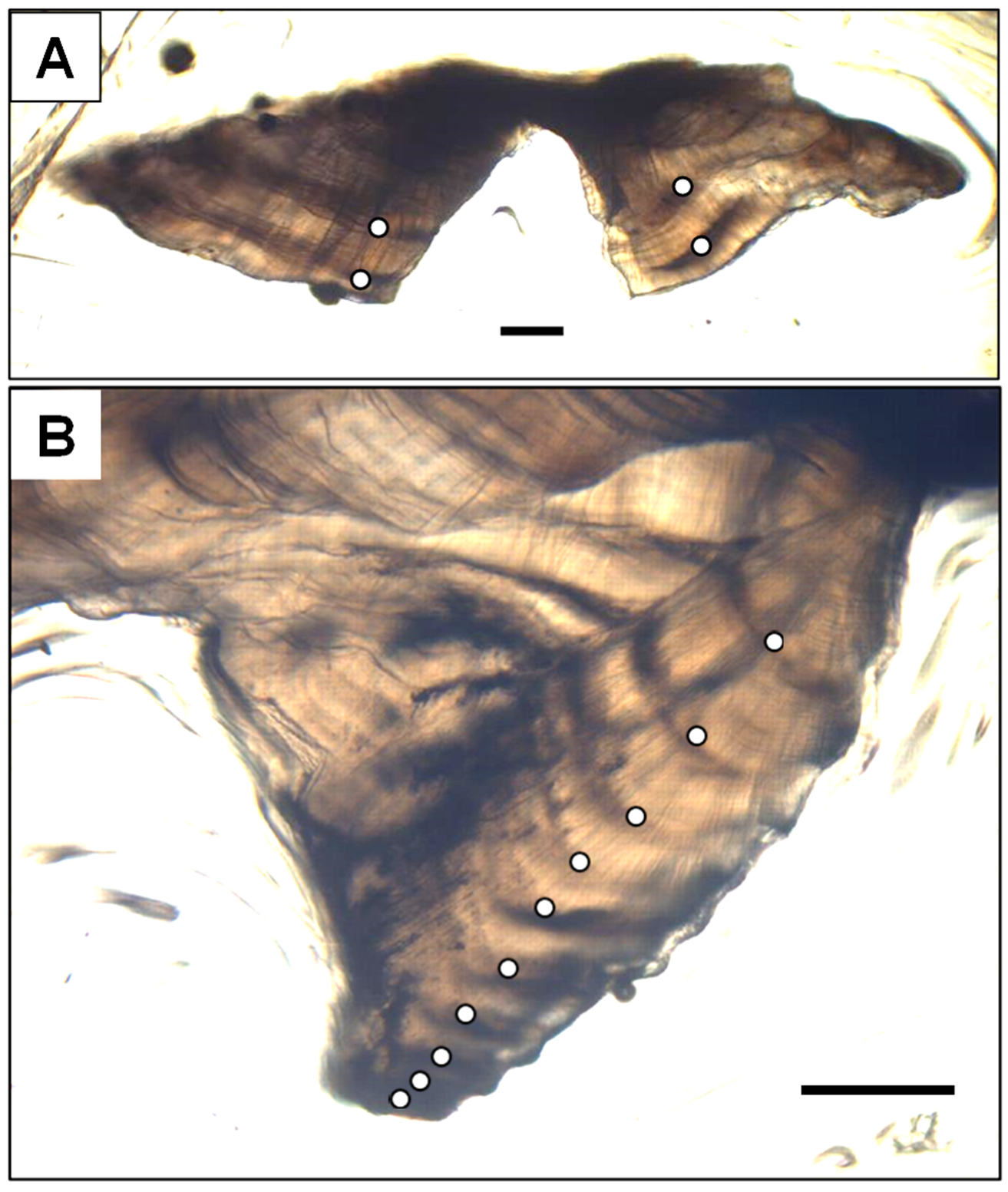
Otolith sections were viewed using a combination of either a compound microscope or zoom stereomicroscope (e.g., Leitz Laborlux S or Leica MZ12, Leica Microsystems, Boston, MA, USA) (20–100×) with transmitted light. Under transmitted light, amberjack annuli appear as alternating dense brown opaque zones and translucent zones (Figure 1). The primary area used for enumerating opaque zones of sectioned otoliths of greater amberjack was along the sulcal groove on the dorsal lobe, with opaque zones matched across to the ventral sulcal groove when possible. Identification of the core, as well as the first and subsequent annuli followed the key features provided by Murie and Parkyn [7] and Leonard [8] (Figures S1 and S2). The ventral portion of the otolith was not used as the primary ageing axis alone because of the propensity for it to contain false annuli (i.e., “checks”) (Figure S2). Convergence zones noted by Thompson et al. [5] were also apparent in many cross-sections (Figure S3). Due to the small size of greater amberjack otoliths and the difficulty in placing them exactly parallel to the floor of the embedding mold, it was sometimes also necessary to tilt the otolith section when viewed under the microscope to align the appearance of the annuli as seen through the depth of the section on the slide. For an otolith that was sectioned off plane, this procedure could greatly improve the clarity of the annuli, and subsequently the readability of the otolith. In addition, reading otolith sections with many small checks could be improved by purposedly blurring the focus of the microscope ever so slightly, which reduced the visibility of the checks while allowing the true annuli (opaque zones) to stand out on the translucent background.
Figure 1. Cross-sectioned otoliths of greater amberjack showing (A) young fish with a dark core area followed by two opaque (white dots) and two translucent zones (edge code = 3). Fish was captured on 17 October 2015, and was therefore assigned to age class two; and (B) otolith from an old fish showing the blackened area along the sulcus with ten annuli (white dots) and an edge code = 1. Fish was captured on 24 January 2004, and was therefore assigned to age class ten. Scale bar = 0.2 mm. Photographs were taken under a Leitz Laborlux S compound microscope (Leica Microsystems, Boston, MA, USA) using a MicroPublisher 5.0 RTV digital camera (QImaging, Surrey, BC, Canada).
Otolith ages in data sets sent by state and federal fisheries agencies had been aged by a primary reader at LDWF, FWRI, or NMFS that had received training in ageing greater amberjack specifically. Most of these agencies also had a secondary reader that either aged all or a subset of the otoliths, depending on the total number to be aged. Otoliths sampled from fisheries in Alabama and Mississippi were sent to expert readers in either Louisiana or Florida state agencies for ageing because of the low number of samples collected. At state and federal agencies, differences in ages of individual fish assigned by the primary and secondary readers were resolved through consensus readings of the otolith when necessary, whereby both readers viewed the sectioned otolith together and agreed on the best estimate of the fish age. For otoliths that were sent to UF for ageing, and for research studies at UF, otoliths were aged by one of three primary readers, with all otoliths aged by at least two of the readers. If the two ages agreed then that age was considered to be the resolved age for the fish, otherwise the third reader aged the otolith and if two of the three ages agreed then that age was considered to be the resolved age for the fish. If all three ages were in disagreement, but were within one year of each other, then the median age was considered the resolved age for the fish; otherwise, the otolith was deemed unresolvable and not used in the age and growth analysis. The exception to this rule were otoliths from older fish (e.g., >10 years), which were relatively rare. Most of these older otoliths were extremely difficult to age due to the presence of dense opaque material, appearing black under transmitted light, along the sulcal grooves and elsewhere in the oldest annuli of the otolith (Figure 1B). These older fish were aged independently up to five times by one or more of the primary readers and the median age taken as the resolved age for the fish. Otoliths were aged without readers having knowledge of previous fish ages, fish size, or sampling date and with at least 2 weeks between reads. Florida FWRI readers assign age classes while reading and so their readers require knowledge of the capture date while they are ageing fish.
Along with the number of opaque zones, the amount of translucent growth on the edge of the otolith was reported using GSMFC edge codes [26], which were: 1—opaque zone at edge with no translucent margin; 2—translucent growth < 1/3 of the previously completed increment; 3—translucent growth > 1/3 and <2/3 of the previously complete increment; and 4—translucent growth > 2/3 of the completed increment. Readers at the federal NMFS laboratories used slightly different edge codes, which were re-coded to match the GSMFC edge codes, and included NMFS code 2 (equivalent to GSMFC code 1) and NMFS code 4 (equivalent to GSMFC code 2). The only NMFS edge code that was not directly comparable to the GSMFC edge codes was code 6, which encompassed both GSMFC codes 3 and 4, and was therefore re-coded as 3.5. It was also then necessary for all GSMFC edge codes of 3 or 4 to be re-coded as 3.5 to allow for comparative analyses using all of the data. This was deemed acceptable because edge codes of 3, 4, 3.5, and 6 all indicate that there was substantial translucent growth past the opaque zone of the last annulus.
Each fish was then assigned into an age class relative to 1 January based on the number of opaque zones, the amount of translucent growth on the edge of the otolith, the collection date, and the time of opaque zone deposition for greater amberjack in the Gulf. This ensured that fish collected at various times of the year would be assigned into an appropriate age class that kept cohorts together. Since greater amberjack deposit the opaque zone in their otoliths during the spring to early summer months (completed by 30 June, see Section 2.4 below), their annual ages were advanced by 1 year if a large translucent zone (i.e., edge code = 3.5) was on the margin and their capture date was between 1 January and 30 June. Fish age was not advanced if captured between 1 January and 30 June if the opaque zone was on the edge (code = 1) or if there was only a narrow translucent zone (code = 2) after the opaque zone, as this was interpreted as the fish having already deposited its opaque zone of its annulus for that year. After 30 June, the age was equal to the number of opaque zones, regardless of the edge code.
Fish were also assigned a biological age (e.g., based on a decimal part of a year) for use in the growth analysis (Section 2.5), which was based on their presumed birthday (peak spawning of 1 April [7,23]), their date of collection, and their assigned age class. Fish collected between 1 January and 31 March of each year had the fraction of the year between their collection date and their birthdate subtracted from their age class, whereas fish collected between 1 April and 31 December of each year had that fraction of the year added to their age class.
Precision (i.e., repeatability) of greater amberjack ageing among agencies/labs was determined using annual or biannual reads of the 100-slide reference set circulated by the GSMFC Otolith Working Group. These inter-lab precision estimates were based on calculating the average percent error (APE) [27] among the four agencies/labs responsible for ageing Gulf greater amberjack for stock assessment purposes and included NMFS, FWRI, LDWF, and UF. In addition, for UF research ageing studies the between-reader precision was also estimated using APE and the coefficient of variation (CV).
In general, greater amberjack otoliths are difficult to age compared to other fish species in the Gulf due to identification of the core relative to the first annulus, the diffuse annuli, the degree and number of false annuli or “checks”, in addition to the difficulties in processing and sectioning otoliths that are small with a deep sulcus that leads to sections being cut off the core, tilted, or too thin or thick ([7,26] GSMFC Otolith Working Group, pers. comm.). Readers were therefore trained using a variety of resources, including annotated otolith images, a reference collection, and an annual ageing workshop. The annual workshops were organized by the GSMFC and included greater amberjack as a focal species, with its ageing reviewed and practiced during the workshop. In addition, all readers contributing greater amberjack ages to the federal stock assessment database were required to age a reference collection of greater amberjack otolith sections (n = 100) that was an age-stratified sample based on the proportional age distribution of fish encountered in the fisheries (i.e., 99% of the fish were 2–8 years old). The accepted ages for the reference box that other readers were compared to were based on ages assigned by UF based on the developed ageing criteria.

2.4. Indirect Validation of Otolith Ageing Method

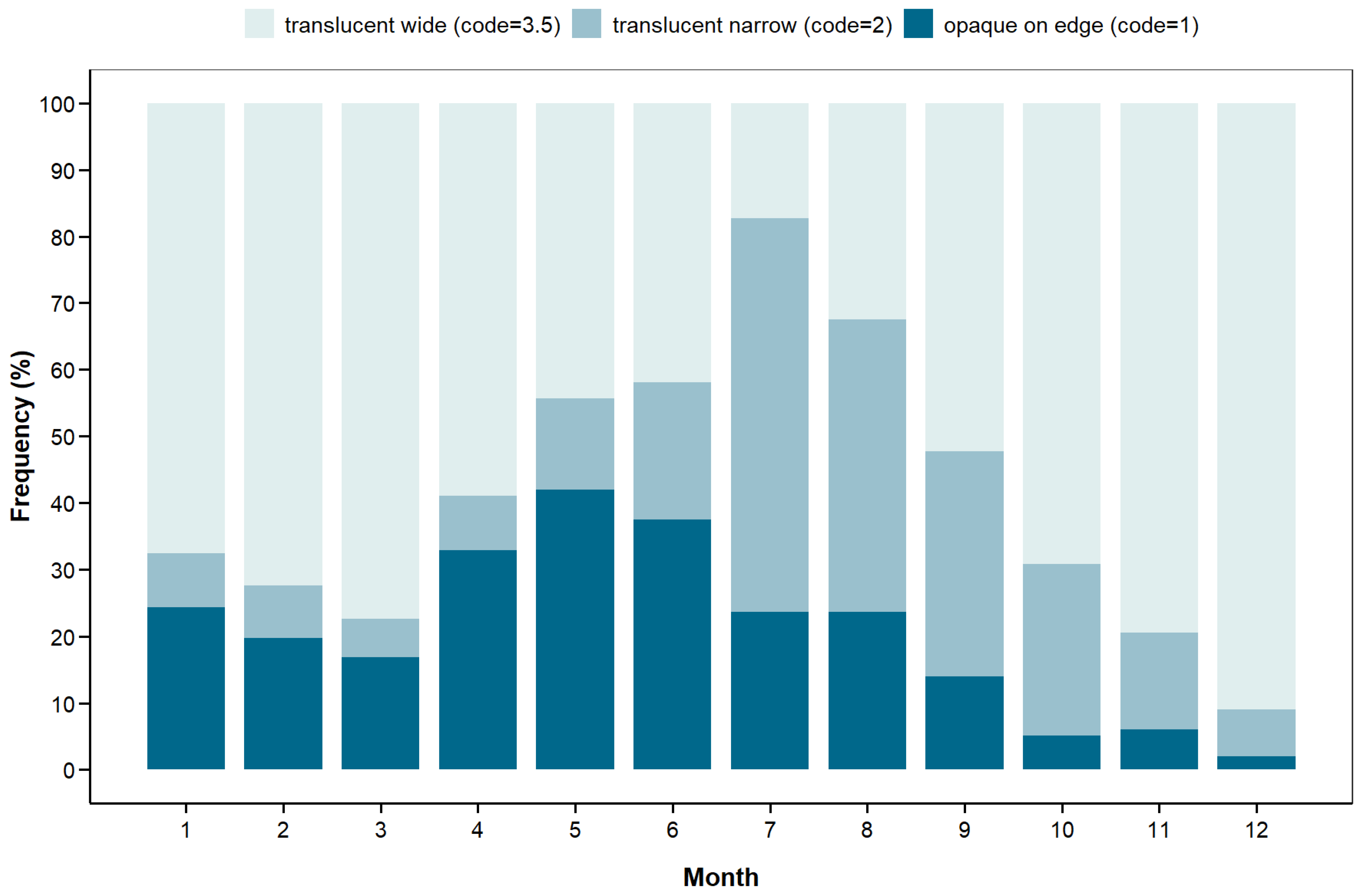
Edge analysis was used to indirectly validate the periodicity of the growth increments that are used in the age determination of greater amberjack. This was performed by plotting the proportion of monthly edge codes over a 12-month period to examine the timing and periodicity in the annulus formation in otoliths. Based on the occurrence of the opaque zone on the edge of the structure (i.e., code = 1), modality in the plot indicates whether greater amberjack deposit two annuli each year (i.e., bimodal plot) versus one annulus per year (unimodal plot). Months with minimal edge codes (i.e., codes 1 and 2) indicate the period of deposition of the opaque zone in amberjack otoliths. Only months with edge codes for ≥10 fish were used in the analyses.

2.5. Growth Models

Age and growth of greater amberjack was modeled by fitting three common growth models (von Bertalanffy, Gompertz, and Logistic) to observed FL of individual fish as a function of their fractional ages using the ‘Estimate_Growth’ function of the Aquatic Life History package implemented in R [28]. This multi-model approach uses versions of the growth functions that incorporate L 0 , length-at-birth, rather than the more common t 0 (theoretical age when length = 0), to allow a more direct comparison of multiple growth functions simultaneously. This was necessary because L 0 is equivalent to length-at-birth in all three candidate models, whereas t 0 is only common to the von Bertalanffy growth function (VBGF) [19]. For comparative purposes, however, both the more common parameterization and the re-parameterization of these three models [19] are given below because most age and growth studies of teleosts report parameters relating to the original version of the models. Therefore, the three-parameter von Bertalanffy growth function (VBGF-3)
L t = L 1 e k t t 0
was re-parameterized [19,28] as follows:
L t = L L L 0 e k t  
where L t = predicted FL (mm) at time t (age, in years), L 0 = length-at-birth (mm), L asymptotic length (mm, i.e., average maximum length), k = growth coefficient (year−1, i.e., the rate of approach to L ), t 0 = theoretical age when length = 0, and t = age (years). When L 0 is set to 0 because length-at-birth (i.e., hatching) for many pelagic spawning teleosts (including greater amberjack) is ~0 mm, then Equation (3) becomes the two-parameter von Bertalanffy growth function (VBGF-2).
The Gompertz growth function
L t = L e e g 1 ( t α )
was re-parameterized [19,28] as follows:
L t = L 0 e G ( 1 e g 1 t )  
where G   a n d   g 1 are growth coefficients with G = l n ( L / L 0 ) , and α = the inflection point of the curve.
The logistic growth function
L t = L 1 + e g 2 ( t α )
was re-parameterized [19,28] as follows:
L t =   L L 0 ( e g 2 t ) L + L 0 ( e g 2 t 1 )
where g 2 is the growth coefficient (note that this growth coefficient is not equivalent to the coefficient g 1   given in Equations (4) and (5) for the Gompertz functions).
All growth models were fitted using the non-linear function nls(s) in R, with 95% confidence intervals determined through bootstrapping with 1000 iterations. Akaike’s Information Criteria (AICc) [29] was estimated using ‘AICcmodavg’ package in R [30] to assess the fit of each model [31]. The ΔAIC value was then calculated for each model by subtracting the AICc score for the model with the minimum score from the AICc scores for other candidate models. The model with the lowest ΔAIC value (i.e., ΔAIC = 0) was deemed the best fitting model, with candidate models with ΔAIC values < 2 equally supported [31]. Relative model weights (AICc Weight) were also determined by dividing the relative likelihood of the individual models over the sum of the relative likelihoods for all of the candidate models. This indicated the relative probability that a model was the best, given the set of models and data being considered, with the model with the highest AICc weight the most likely best model.
Once the most appropriate overall growth model was chosen for greater amberjack, then growth models were also compared between sexes to examine the potential for sexually dimorphic growth. This was performed by summing the individual AICc values for each of the sex-specific growth models and subtracting their sum from the AICc of the pooled growth model, with differences indicating that the sex-specific models were providing better fits compared to a pooled model and therefore indicating that retention of sex-specific growth models was appropriate [32,33]. Growth was then also compared between regions to determine region-specific growth differences, with amberjack of all sexes (including unknown sex) pooled. Growth models were pooled when not significantly different from one another based on AIC criteria.
An overall pooled growth model for greater amberjack in the Gulf was also estimated because greater amberjack are generally not able to be distinguished as male or female externally (other than by gonopores; see Smith et al. [34]) and to allow comparison with previous growth models. This model pooled all fish with known ages and lengths, including males, females, and fish of unknown sex. This overall growth model was then compared qualitatively with previous growth models for greater amberjack stocks in the Gulf [4,5,7,9], the US South Atlantic [10,11,12], and the Mediterranean [17,18] by overlaying plots of the von Bertalanffy growth models over the age range of the sampled fish. The growth model for greater amberjack from Hawaii [14] could not be compared with the other growth models because the method of ageing the fish was undocumented, as was the age range of the fish sampled.

3. Results

3.1. Fish Samples

In total, 7658 fish were collected during 1991–2018 that had sufficient information on their date and location of capture, fishery, fishing mode, gear, fork length (FL, mm), whole body weight (g), and age to be included in the analyses (Table 1). Sex was reported for the majority of these fish (n = 5015).
Table 1. Distribution of greater amberjack samples among fisheries, fishing modes, gear, and states. Sample size is given by n, with % based on the grand total.
A total of 3316 fish were collected from Florida, with the majority (73.2%) captured by recreational fishers (Table 1), including 48.0% from charter boats, 21.6% from head boats, and 3.7% from private recreational vessels. The majority (98.8%) of these fish were caught using hook-and-line gear, with only 1.1% speared and 0.2% with unknown gear. An additional 679 fish (20.5%) were sampled as part of fisheries-independent sampling programs, with the majority caught on hook-and-line (95.6%), with 4.4% caught using other gears, such as spears, longlines, and trawls. A total of 209 fish (6.3%) were sampled from the commercial fishery, with fish mostly caught on hook-and-line (67.9%, including electric reels and hydraulic bandit gear), longlines (27.8%), or spear (4.3%).
In Louisiana, a total of 4342 fish were sampled with the majority coming from recreational (38.3%) and commercial (37.7%) fisheries, with 24.1% sampled through fisheries-independent programs. The majority of fish sampled from recreational fisheries were caught from charter boats (73.7%) or private vessels (22.3%), and to a minor extent head boats (4.0%). The vast majority of fish caught in recreational fisheries of Louisiana were harvested using hook-and-line gear (99.9%). Similarly, greater amberjack in the commercial fishery of Louisiana were primarily harvested using hook-and-line gear (87.8%), with 2.4% from longlines and trawls; gear was unknown for 9.8%. The vast majority (98.5%) of fish sampled in fisheries-independent research programs in Louisiana were caught using hook-and-line gear; only 1.5% were caught either with longlines or trawls.

3.2. Length Distributions of Greater Amberjack

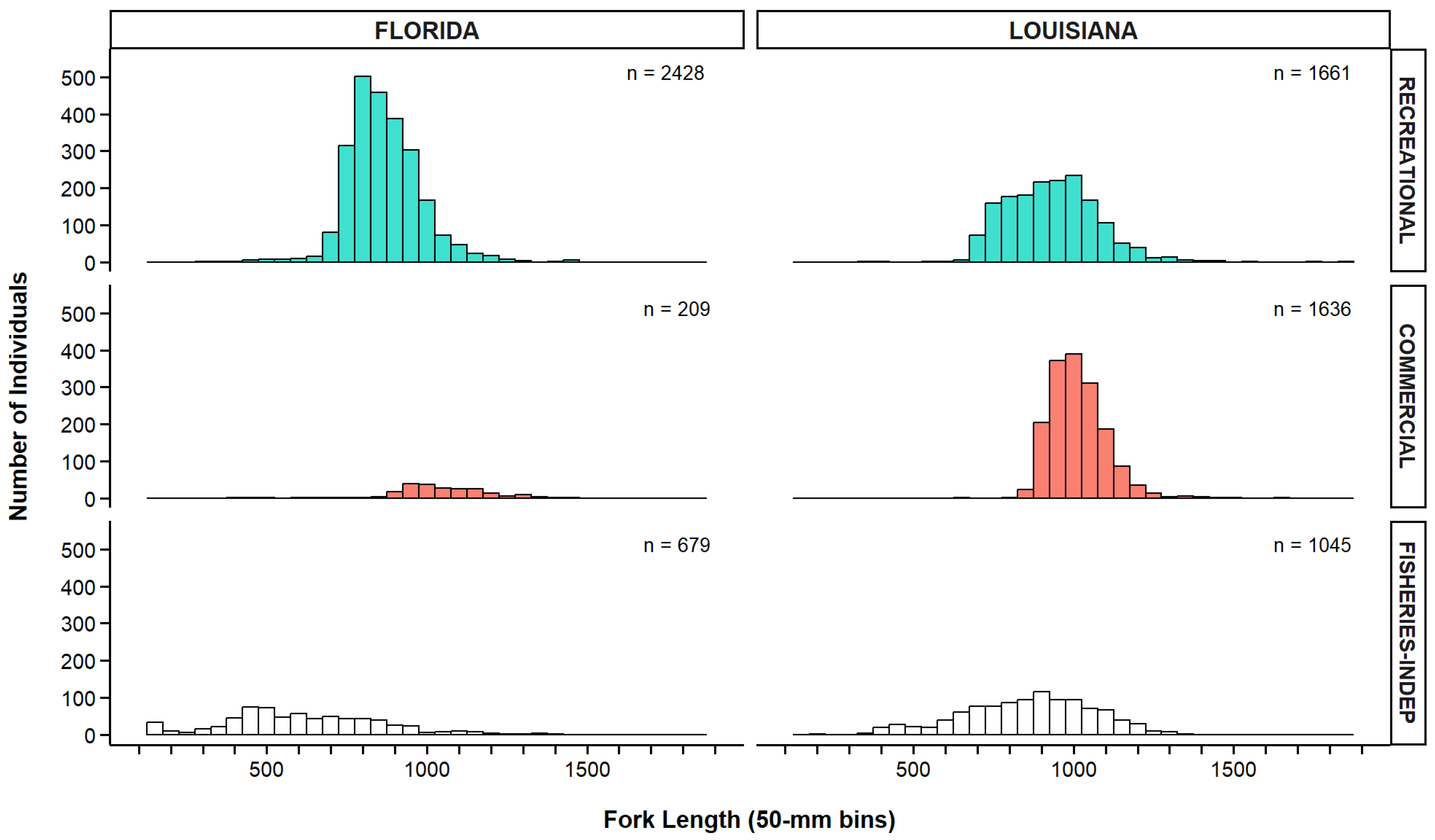
Over all years, greater amberjack from Florida caught in recreational fisheries were significantly smaller (866 ± 2 mm FL, range of 287–1474 mm FL, n = 2428) than fish caught in the commercial fishery in Florida (1036 ± 11 mm FL, range 381–1472, n = 209) (t-test: t = 20.02, df = 2637, p < 0.0001) (Figure 2). Fisheries-independent programs in Florida caught fish that averaged 612 mm FL (range of 141–1420 mm FL), which included fish below any minimum size limit (Figure 2). In Louisiana, fish sampled from recreational fisheries (932 ± 3 mm FL, range of 362–1829, n = 1661) were also significantly smaller than fish from commercial fisheries (1014 ± 2 mm FL, range 660 to 1659 mm FL, n = 1636) (t-test: t = 19.94, df = 3296, p < 0.0001) (Figure 2). Fish sampled in Louisiana from fisheries-independent programs averaged 860 mm FL (range of 186 to 1373 mm FL) and also included fish below any size limit.
Figure 2. Length frequencies of greater amberjack sampled from recreational and commercial fisheries and fisheries-independent programs in Florida and Louisiana from 1991 to 2018.
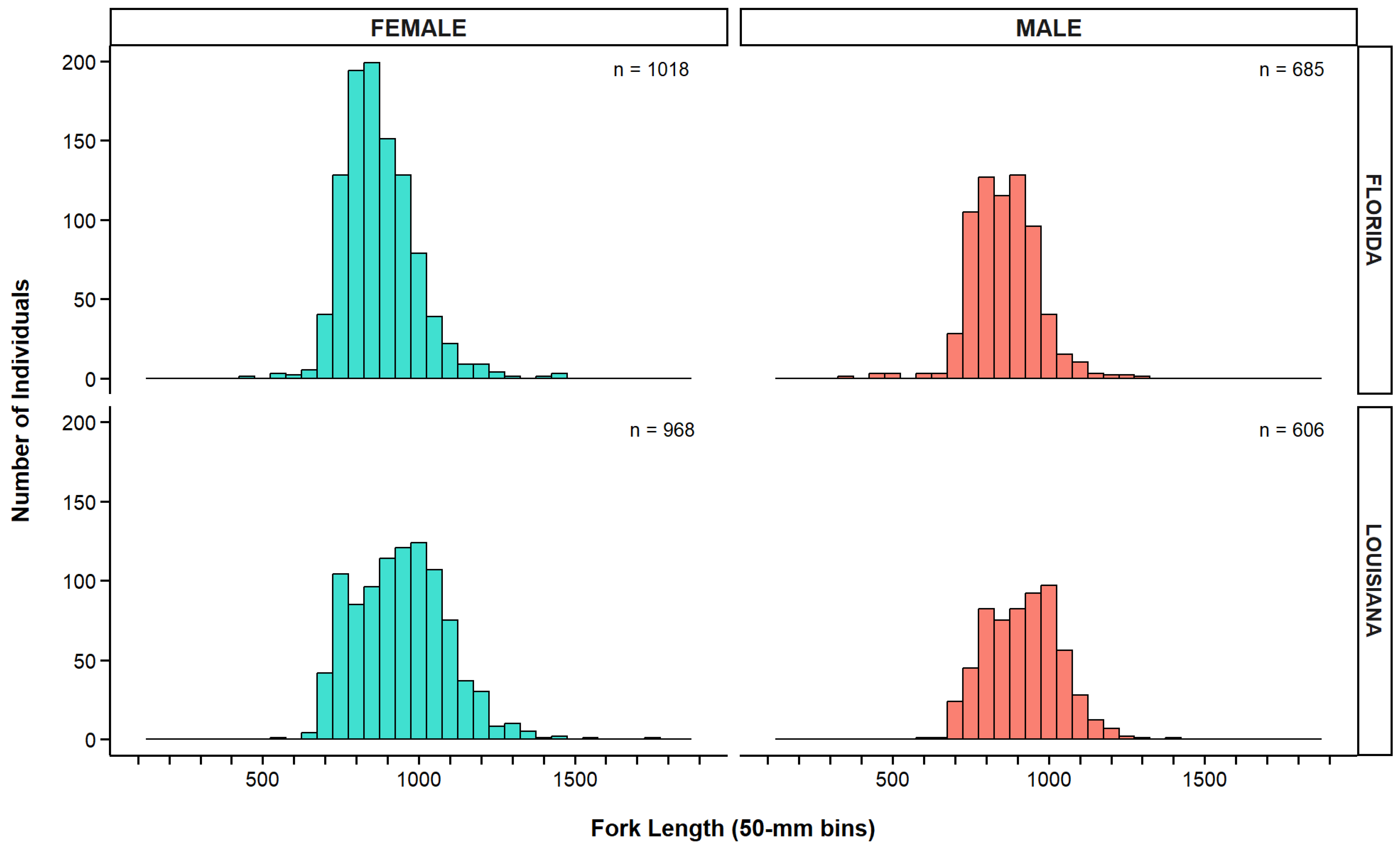
Average FL of female and male greater amberjack in the Florida recreational fisheries were significantly different, with females (874 ± 4 mm FL, n = 1018) larger than males (858 ± 4 mm FL, n = 685) (t-test: t = 2.83, df = 1701, p = 0.005) (Figure 3). Similarly, on average, females in Louisiana (944 ± 5 mm FL, n = 968) were larger than males in Louisiana (918 ± 5 mm FL, n = 606) (t-test: t = 3.52, df = 1572, p = 0.0004). In addition, female greater amberjack caught in recreational fisheries in Louisiana were, on average, larger than females caught in recreational fisheries in Florida (t-test: t = 11.77, df = 1967, p < 0.0001), as were males (t-test: t = 9.712, df = 1, 289, p < 0.0001) (Figure 3). Sex-specific lengths could not be examined in the commercial fisheries because the fish are landed eviscerated, so sex was unknown for the vast majority (91%) of these fish.
Figure 3. Length frequencies of female and male greater amberjack sampled from recreational fisheries in Florida and Louisiana from 1991 to 2018.
The sex ratio of greater amberjack in recreational fisheries in Florida was 1.49:1 (1018 females to 685 males), which was significantly different from an expected 1:1 ratio ( x 2 = 65.11 , p < 0.0001). The sex ratio of fish < 1000 mm FL from recreational fisheries in Florida was 1.39:1 (887 females to 639 males), which was significantly greater than a 1:1 ratio ( x 2 = 40.30 ,  p < 0.0001), as was the ratio of 2.85:1 (131 females to 46 males) for fish ≥ 1000 mm FL ( x 2 = 40.82 ,  p < 0.0001). In Louisiana, the sex ratio of greater amberjack caught in recreational fisheries was 1.60:1 (968 females to 606 males), which was significantly different from a 1:1 ratio ( x 2 = 83.26 ,  p < 0.0001). Similar to Florida, the sex ratio of fish < 1000 mm FL was 1.36:1 (619 females to 456 males) and different from 1:1 ( x 2 = 24.72 , p < 0.0001). Greater amberjack ≥ 1000 mm FL in Louisiana recreational fisheries had a sex ratio of 2.33:1 (349 females to 150 males), which was significantly different from 1:1 ( x 2 = 79.36 ,  p < 0.0001).

3.3. Length–Weight Relationships

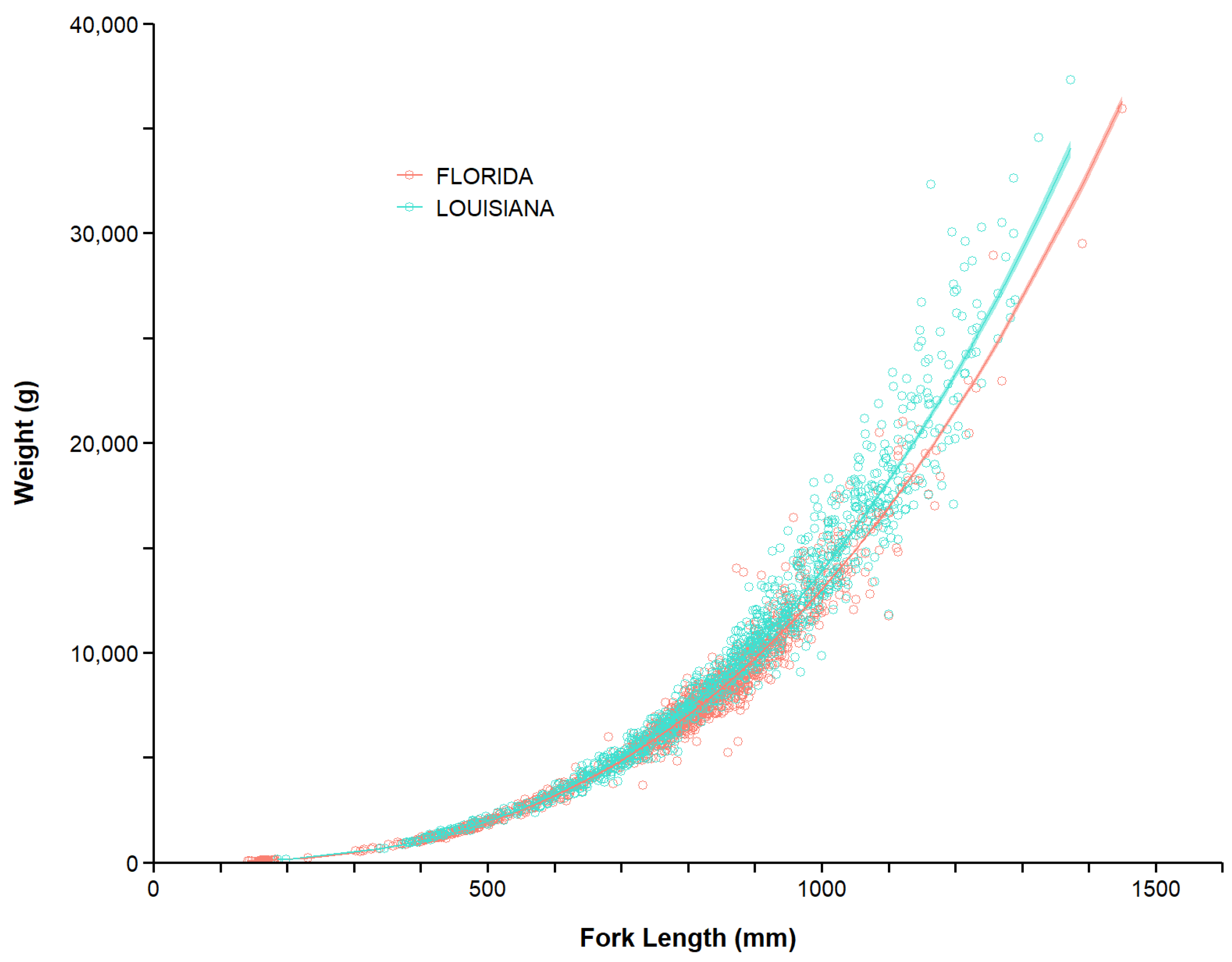
The relationship between weight as a function of fish length was not significantly different between males and females in Florida (ANCOVA: slopes F = 3.100, p = 0.078; sexes F = 1.646 p = 0.20, n = 1264) and therefore all fish were pooled, including unsexed fish, for a total of 1547 fish (Table 2). Similarly, the length–weight regression for males and females in Louisiana were also not different from one another (ANCOVA: Slopes F = 0.0014, p = 0.97; Sexes F = 0.0677, p = 0.79, n = 1048), and all fish were therefore pooled (n = 1067) (Table 2). However, the interaction term of the ANCOVA for weight as a function of FL between Florida and Louisiana was significant (ANCOVA: p < 0.0001) and therefore separate length–weight regressions were retained for fish from Florida versus Louisiana (Table 2). Overall, fish from Florida weighed less than fish from Louisiana at comparable lengths (Figure 4). A generalized length–weight regression for greater amberjack from the eastern Gulf with all fish pooled (including fish of unknown sex) (n = 2614) across Florida and Louisiana was also estimated since amberjack are externally monomorphic and not sexed in the landed catch except when biological samples are also collected (i.e., otoliths and gonads sampled in addition to lengths and weights) (Table 2).
Table 2. Regression parameters for weight as a function of FL for greater amberjack from Florida and Louisiana.
Figure 4. Weight as a function of fork length for greater amberjack from Florida (n = 1547) and Louisiana (n = 1067) (females, males, and unsexed fish pooled), collected from 1991 to 2018. Open circles are individual fish, solid lines are the fitted models, and colored ribbons are the 95% bootstrapped confidence intervals (almost indistinguishable from the model lines). Regression parameters are given in Table 2.

3.4. Indirect Validation of Otolith Ageing Method

Edge codes of greater amberjack otoliths plotted over a 12-month period indicated only one mode of opaque zone deposition (Figure 5). By July, the majority of otoliths had a very narrow translucent zone (code = 2) or an opaque zone on the edge (code = 1), indicating that most fish had completed the deposition of the opaque zone by the end of June.
Figure 5. Edge codes assigned to otoliths of greater amberjack in the Gulf from 1991 to 2018, based on the amount of opaque zone or translucent zone at the edge of the otolith.

3.5. Age Distribution of Greater Amberjack

Interagency readings of the 100-slide reference box of greater amberjack otoliths had an APE that averaged 3.7% (range of 2.9–5.6%, n = 5 years), indicating that greater amberjack > 1 year old were aged with high precision among agencies/labs that regularly age greater amberjack for stock assessments. Between-reader APE for primary readers at UF based over the same age range averaged 3.6%, with a range of 1.9% to 5.0% between readers; the CV averaged 5.2% (range of 2.7–7.1%).
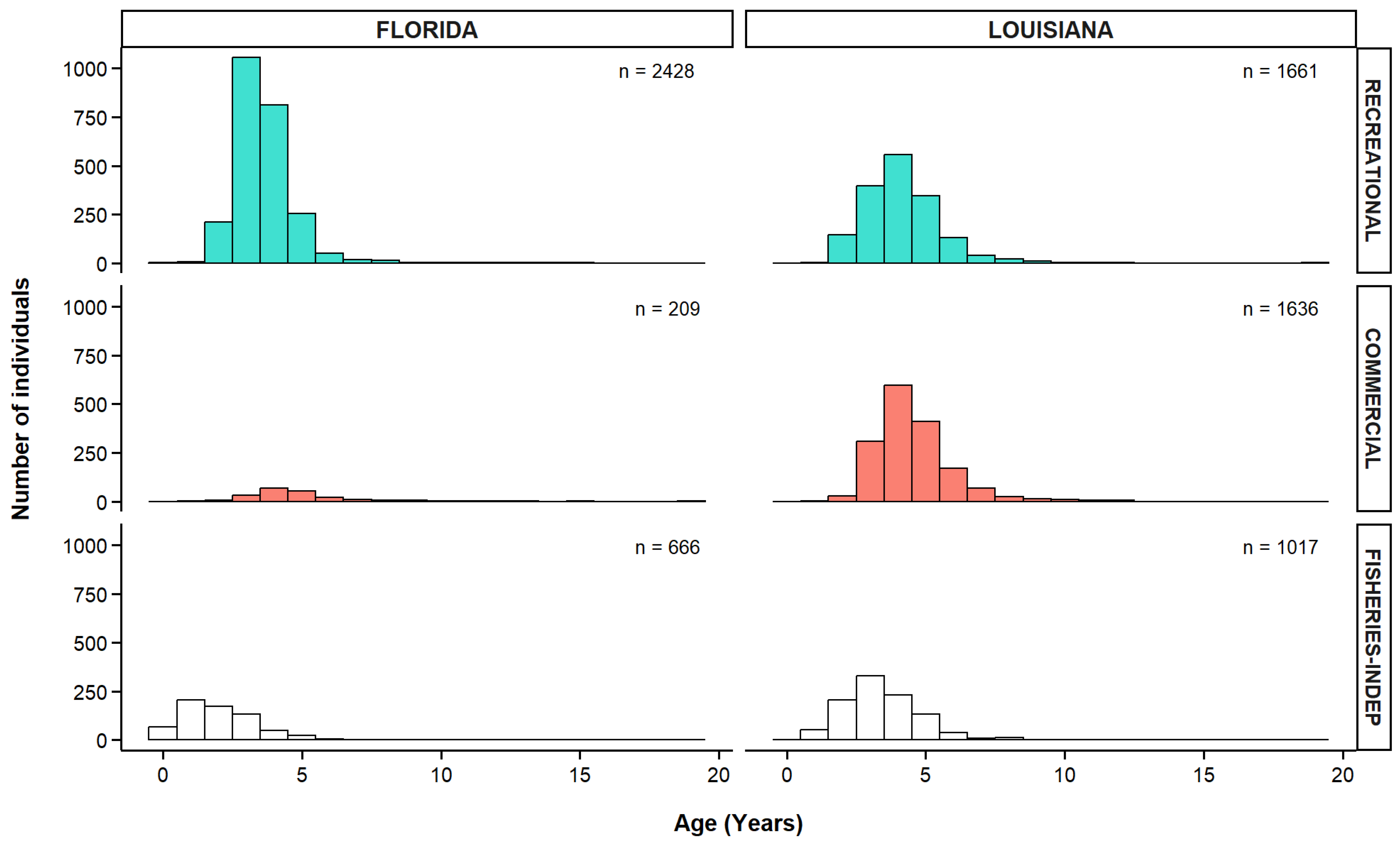
Overall, ages of greater amberjack ranged from 0 to 19 years (n = 7617), with the majority 3–5 years old (Figure 6). In Florida, most fish sampled from the recreational fishery were 3–4 years of age whereas in the commercial fishery they were 3–5 years old. In Louisiana, greater amberjack were mostly 3–5 years old in both the recreational and commercial fisheries. As expected, based on no minimum-size limit, fish sampled from fishery-independent research studies were younger compared to recreational and commercial fishery samples (Figure 6).
Figure 6. Age distribution of greater amberjack caught in recreational, commercial, and fisheries-independent fisheries in Florida and Louisiana from 1991 to 2018.
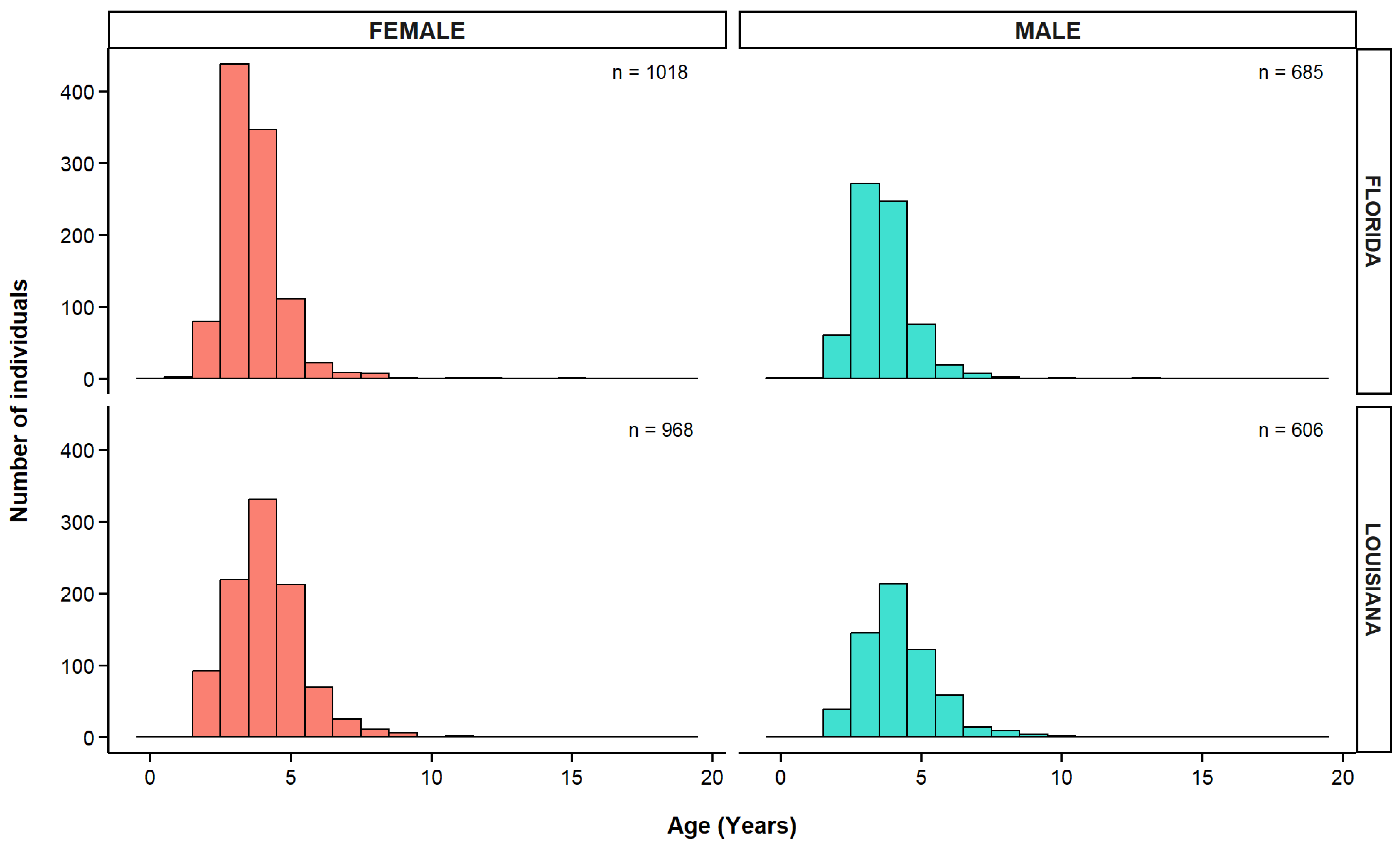
On a sex-specific basis, ages of both male and female greater amberjack in the recreational fisheries of Florida were primarily between 3–4 years of age and, to a much lesser extent, 5-year-olds (Figure 7). However, in Louisiana, most of the fish caught in recreational fisheries were 3–5 years old and, to a lesser extent, 6 years old (Figure 7). The two oldest fish were a 19-year-old male caught by a charter boat off of Louisiana and a 19-year-old fish that was caught by commercial longline that was not sexed. Sex-specific catch in the commercial fisheries could not be assessed because most fish are landed gutted.
Figure 7. Age distribution of male and female greater amberjack in recreational fisheries of Florida and Louisiana in the Gulf from 1991 to 2018.

3.6. Growth Models

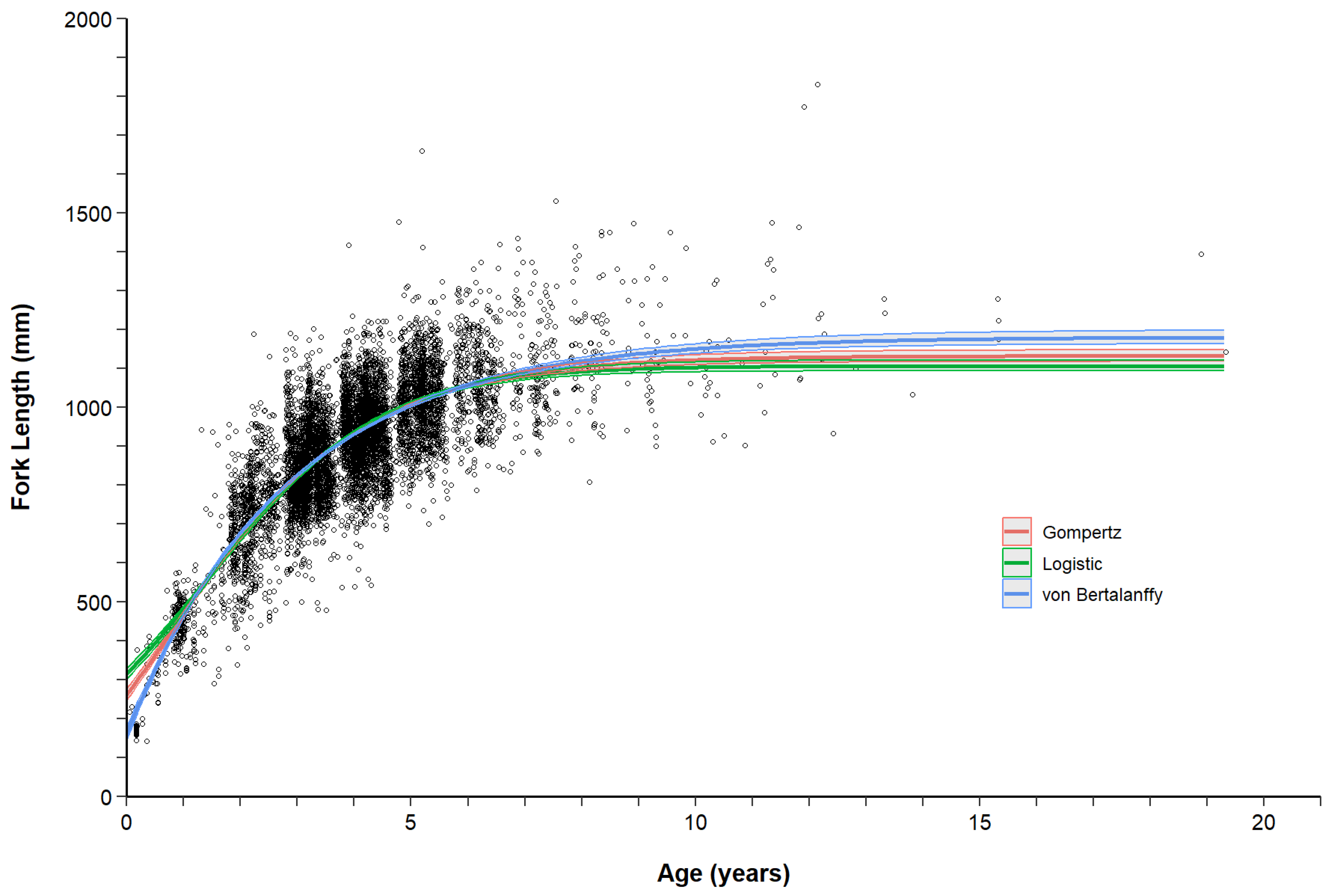
Comparison of the three candidate growth models for greater amberjack (all fish combined) indicated that the VBGF had the most support (ΔAICc = 0 and AICc Weight = 1; Table 3, Figure 8), with both the Gompertz and logistic growth models not supported (ΔAICc ≥ 104) compared to the VBGF. In addition, the two-parameter VBGF (i.e., L 0 = 0 ) did not provide a better fit for the data (AICc = 92,244.49), with a ΔAICc difference between the VBGF-3 and the VBGF-2 of 216.20. The three-parameter von Bertalanffy growth model was therefore used in all further growth model comparisons.
Figure 8. Candidate models for the growth of greater amberjack in the Gulf. Solid lines represent the average model fits and the colored ribbons represent 95% bootstrapped confidence intervals; dots represent individual lengths at biological age (n = 7617).
Table 3. Akaike’s Information Criteria (AIC) for three candidate growth models for greater amberjack inclusive of females, males, and fish of unknown sex pooled. K is the number of parameters in the model (includes error term), AICc is AIC corrected for small sample size, ΔAICc is the difference between the AIC for each individual model and the model with the minimum AIC, and AICc Weight is the relative weight of each model.
ModelKAICcΔAICcAICc Weight
Von Bertalanffy492,028.2901
Gompertz492,133.10104.810
Logistic492,262.23233.940
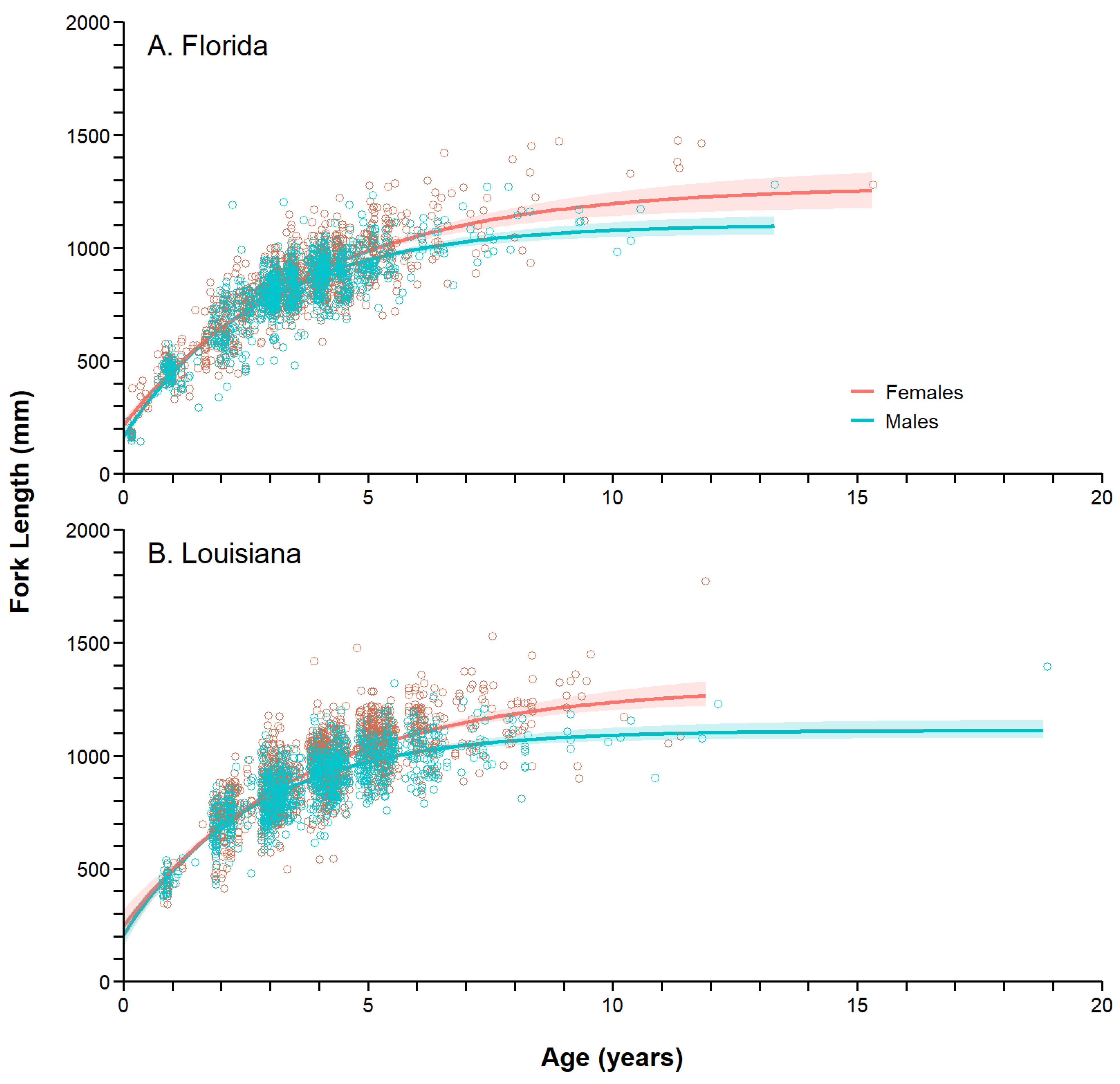
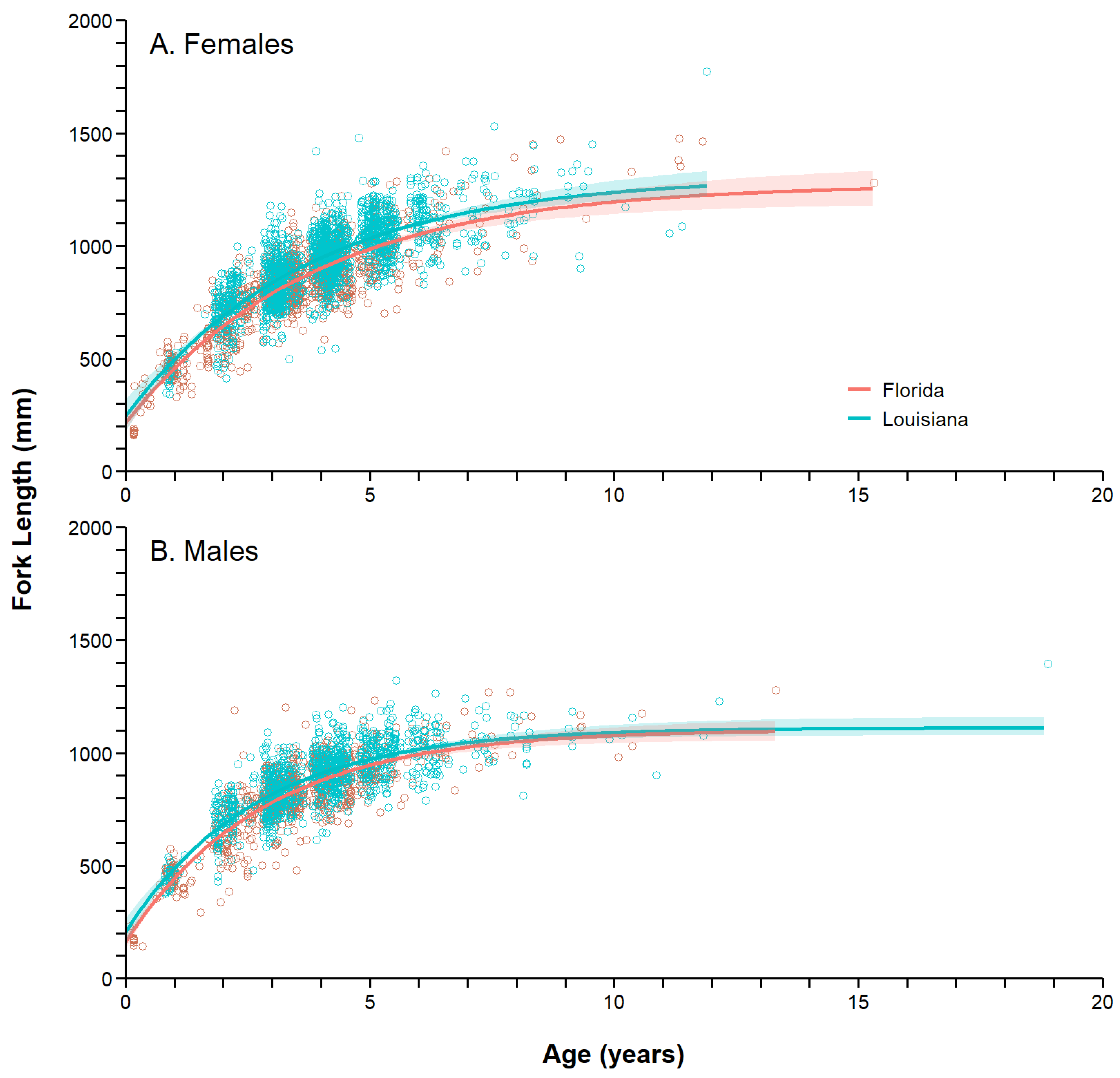
Separate growth models for males and females were strongly supported for fish sampled from both Florida and Louisiana with differences of 42.39 and 171.47 between the AICc scores of individual models compared to a pooled-sex model for Florida and Louisiana, respectively (Table 4, Figure 9), and therefore sex-specific growth models were retained (Table 5). In general, female greater amberjack were larger than male greater amberjack of similar age after 4–5 years (Figure 9). In addition, there was strong support for individual growth models for females from Florida versus Louisiana, with a ΔAICc of 193.48, and to a lesser extent for males from Florida versus Louisiana (ΔAICc = 61.12) (Table 4, Figure 10). Separate growth models were therefore specified (Table 5), due to the statistical significance, although these differences were probably not of biological significance. Since greater amberjack are externally monomorphic and the sex of the landed catch is currently not monitored, pooled growth models were also parameterized for all fish from Florida, all fish from Louisiana, and for pooled females, males, and all fish throughout the study area of the eastern Gulf (Table 5).
Table 4. Sex-specific comparisons of von Bertalanffy growth models for female and male greater amberjack from Florida and Louisiana. ∑AICc represents the sum of the AICc scores for individual models for females and males, and ΔAICc is the difference between AICc for the pooled model (sexes combined) and ∑AICc.
Figure 9. Sex-specific von Bertalanffy growth models for female and male greater amberjack from (A) Florida and (B) Louisiana in the Gulf. Open symbols represent length at biological age for individual fish. Solid lines are the fitted models and colored ribbons are the 95% bootstrapped confidence intervals. Parameter estimates are given in Table 5.
Table 5. Parameter estimates (±standard error) for von Bertalanffy growth models for greater amberjack from Florida and Louisiana in the Gulf. Pooled models include females, males, and unsexed fish.
Figure 10. Sex-specific von Bertalanffy growth models for (A) females and (B) males from Florida and Louisiana in the Gulf. Open symbols represent length at biological age for individual fish. Solid lines are the fitted models and colored ribbons are the 95% bootstrapped confidence intervals. Parameter estimates are given in Table 5.
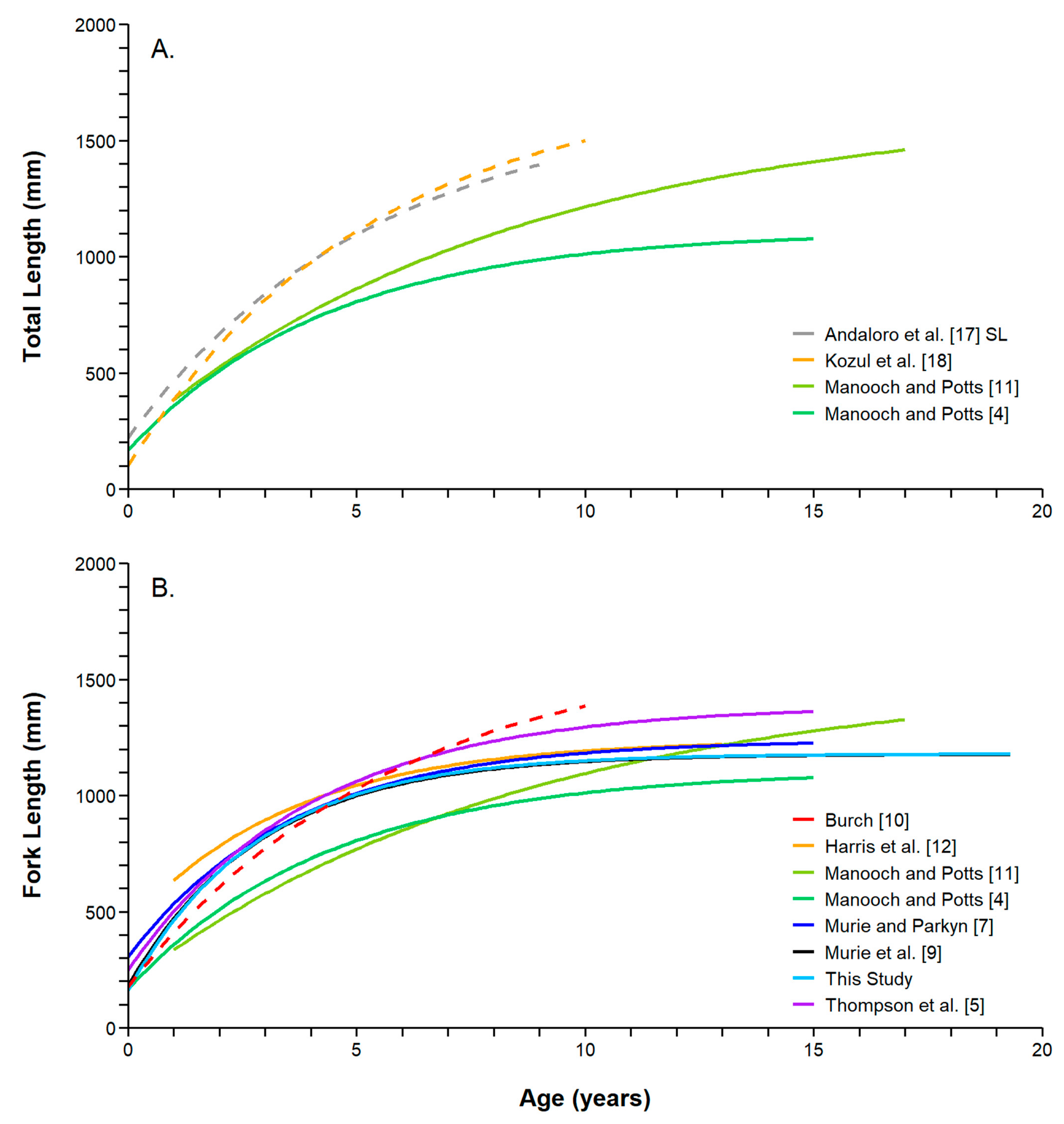
Overall, the von Bertalanffy growth model for greater amberjack from the Mediterranean Sea based on the study by Andaloro et al. [17] indicated that greater amberjack were larger at age than fish from the Adriatic Sea based on the study by Kožul et al. [18] because, although the modeled curves were almost identical, the fish in the former study were measured in standard length instead of total length used in the latter study (Figure 11A, Table 6). Both of these growth models did not appear to asymptote within the range of observed ages in the study. Both, however, showed larger size at age than studies by Manooch and Potts [4,11] using total length of greater amberjack from the southeastern United States and from head boats in the Gulf. Similar to the Mediterranean growth curves, the trajectory of the growth curve for greater amberjack from the southeastern U.S. by Manooch and Potts [11] did not appear to asymptote within the observed age range of the study.
Figure 11. All known reported von Bertalanffy growth curves for greater amberjack throughout its range based on (A) age as a function of total length, or (B) based on fork length. All lines represent the predicted fork length or total length at age for von Bertalanffy models up to the maximum age of the fish sampled in the study; the exception was Andaloro et al. [17] that used standard length. Andaloro et al. [17] and Kožul et al. [18] sampled greater amberjack from the Mediterranean, Burch [10], Harris et al. [12] and Manooch and Potts [11] sampled fish from the U.S. South Atlantic, and Manooch and Potts [4], Thompson et al. [5], Murie and Parkyn [7], and Murie et al. [9] sampled fish from the Gulf. Parameter estimates for all models are given in Table 6. Growth models based on using scales to age the fish are noted by dashed lines.
Table 6. Summary table for estimated von Bertalanffy growth parameters for greater amberjack from previous studies in comparison to this study. Growth models are for all sexes combined.
The pooled von Bertalanffy growth model for greater amberjack in the Gulf from the present study that combined all fish (males, females, and fish of unknown sex from all fisheries) with known ages sampled between 1991 and 2018 from Florida and Louisiana (Figure 11B), was similar to previous growth models that were based on a more limited subset of the data [7,9]. The growth model of Thompson et al. [5] for greater amberjack in the Gulf had a similar asymptotic shape but indicated that fish were overall larger at age after ~4 years. Similarly, the growth model of Harris et al. [12] from the southeastern U.S. had an asymptotic shape and was similar to the growth model in the present study after age 3. Greater amberjack sampled from head boats in the Gulf by Manooch and Potts [4] similarly showed an asymptotic growth curve but fish size was much smaller at age. The growth curve for greater amberjack from the southeastern U.S. Atlantic by Manooch and Potts [11] appeared not to asymptote within the range of ages observed and indicated smaller sizes at ages <10 years. Burch’s [10] growth model based on scale ages also appeared not to asymptote within the range of observed ages but had similar size at age for fish < 5 years of age.
In addition, the maximum age of greater amberjack from the Mediterranean Sea (9 years), the Adriatic Sea (10 years), and the U.S. Atlantic (10 years), which were based on using scales to age fish, were similar and younger than all other maximum ages observed for greater amberjack based on otoliths (13–19 years) (Table 6).

4. Discussion

Previous growth studies for greater amberjack stocks, in both the Gulf, US South Atlantic, Hawaii, the Mediterranean Sea, and the Adriatic Sea have applied only the von Bertalanffy growth model. Based on the multi-model comparisons in the present study, however, it appears that this model is appropriate and the best supported growth model for greater amberjack compared to the logistic and Gompertz growth models. Flinn and Midway [20] state that stock assessments may choose to use only the von Bertalanffy model because they have different priorities in choosing the best growth model, despite cases where there is a better fit from different or more complex models. These reasons include continuity in the model used over the years or greater sources of variation in the assessment other than the growth model. These must all factor into the choice of the model used to characterize the growth of the species for assessment purposes.
For simplicity, growth of both sexes and all regions may also be pooled in assessments, especially if the data to support sex-specific or region-specific growth differences are not available. However, the variability in the age and growth of greater amberjack that was evident in this study in the sex-specific growth models, and to a lesser extent the region-specific models, can explain, in part, the high degree of variability in individual size at age apparent in the pooled growth model (i.e., Figure 8), similar to the Gulf-wide growth model used in the most recent stock assessment [9]. Although the region-specific growth was statistically significant, it most probably was not biologically significant, given the small difference between Florida and Louisiana compared to the overall variability in individual size at age. This would allow a Gulf-wide analysis with only sex as a major factor in differences in growth, since the sexual dimorphism observed between males and females in both Florida and Louisiana was substantial. A larger size at age for females compared to males has been noted previously by Burch [10] and Harris et al. [12] for greater amberjack from the southeastern US Atlantic and in a preliminary study by Murie and Parkyn [7] for greater amberjack in the Gulf. Notably, Thompson et al. [5] did not observe sexually dimorphic growth in greater amberjack sampled from Louisiana. However, the vast majority of fish ≥ 5 years old in their sample were females (Figure 5 in [5]), and they noted that all fish >9 years of age were females. Since most of the difference in growth between males and females in the present study was observed after the age of five (Figure 9), it is possible that the growth model of Thompson et al. [5] was primarily representative of female greater amberjack. This also could explain why they did not observe sexually dimorphic growth for fish sampled in their study. In the Mediterranean, Andaloro et al. [17] did not observe sex-specific growth differences. All other growth studies for greater amberjack did not specifically test for sexually dimorphic growth.
Although informative, accounting for sex-specific growth in the landed catch of greater amberjack could be problematic because the sexes are, for the most part, indistinguishable externally. With training, however, non-lethal sexing of greater amberjack based on urogenital pores was 99.6% reliable for fish over 534 mm FL (21 inches) [34]. This is 330 mm (i.e., 13 inches) smaller than any current minimum size limits for greater amberjack in the Gulf (i.e., recreational minimum size limit is 864 mm FL, or 34 inches, in the Gulf) and could therefore be used to sex the landed fisheries catch. This method of sexing the landed catch without having to open the body cavity of the fish would therefore be viable since the method was initially developed to sex live fish that were tagged and released and therefore is very quick but accurate. In the commercial fishery, however, greater amberjack are typically gutted at sea or before offloaded at the dock (i.e., gutted prior to any possible port or dock sampling). Gutting is typically done by inserting a knife into the anus and cutting along the belly of the fish up between its pectoral fins, which is a process that could tear the genital and urinary pores that are needed to sex the fish. However, commercial fishers could be instructed instead to start the cut immediately in front of the anus to ensure the urogenital pores remain intact, which would allow the commercial catch to be sexed when offloaded and sampled. Determination of the sex of the landed catch may be even more important in the commercial fishery for greater amberjack because, in general, larger and older fish are landed and the sex ratio may therefore be skewed towards females, but this has to date not been confirmed.
Sex ratios of greater amberjack in the present study were skewed towards females overall in the recreational fisheries of both Florida and Louisiana, and more so for fish > 1000 mm FL where the ratio was 2.3–2.8 females for every one male. Smith et al. [34] previously noted that sex ratios in greater amberjack in the Gulf can be heavily skewed both by season and region. Thompson et al. [5] also noticed that females were caught two to three times more than males during April to June, which corresponds with the spawning season of greater amberjack off of Louisiana [23]. The overall sex ratio in Harris et al. (Ref. [12] their Table 2) was only slightly significantly skewed towards females (1:1.11) but, similar to our study and Thompson et al. [5], the sex ratio of fish > 1100 mm FL was heavily skewed towards females (5.4–24 females to one male). Skewed sex ratios imply differential mortality, whether through natural mortality or fishing-induced mortality [35]. Male amberjack have lower asymptotic lengths and concomitantly higher growth coefficients than females (Table 4), which results in them being overall smaller in size over a longer duration of their lives and hence prone to increased natural predation. Despite its relatively large size, there are many predators in the Gulf capable of consuming greater amberjack, including goliath grouper (Epinephelus itajara), barracuda (Sphyraena barracuda), and various large shark species (pers. obs.). Differential mortality may also occur due to differences in the spatial location of males and females outside of the spawning season, or when immature versus mature, but little is currently known of the differential spatial extent of the sexes. To date, the effects of skewed sex ratios in different fisheries and regions has not been explored in the stock assessment for greater amberjack, which currently assumes a 1:1 ratio in the landed catch [2].
The pooled growth model for greater amberjack in the Gulf that combined all aged fish sampled between 1991 and 2018 from all fisheries in this study was, as expected, similar to the previous growth model used in the latest stock assessment [9], as well as Murie and Parkyn [7] that was based on a limited subset of the data (Figure 11, Table 6). The present study, however, incorporated an additional ~850 fish, both males and females, which allowed increased resolution in both the overall and sex-specific growth analyses. Thompson et al.’s [5] growth model for greater amberjack from Louisiana indicated a larger size-at-age compared to the present study, with the former potentially biased towards female growth and therefore more similar to the female-specific growth model for Louisiana (Table 5). This is in contrast to an earlier study on greater amberjack sampled only from head boats in the Gulf that showed a smaller size at age [4]. These differences, in part, could be due both to the type of fishery and region sampled. Thompson et al. [5] sampled fish primarily from recreational charter boats and fishing tournaments (41.9% and 44.5%, respectively) in Louisiana. Tournament fish are usually identified in databases as “non-random sampling” because there is a propensity for these fish to be larger at age than on average, and the large number of tournament fish used in Thompson et al. [5] may have therefore biased their growth curve upwards towards faster growing fish that are large and, concomitantly, primarily females. Head boats, on the other hand, typically land greater amberjack that are smaller than those landed by charter boats, primarily because of the gear used and the shorter distance from shore that is fished. Although greater amberjack are managed as two separate stocks between the Gulf and the US South Atlantic, the most extensive study of their age and growth in the southeastern US was by Harris et al. [12] that showed that fish were a larger size at age initially but had a similar growth pattern to greater amberjack in the Gulf after age five (Figure 11).
Growth analyses using scales to age greater amberjack may provide biased estimates of model parameters if the larger fish are underaged; but this cannot be resolved without studies comparing ages between scales versus sectioned otoliths. Regardless, the asymptotic length in the von Bertalanffy growth model represents the average maximum size, not the maximum size. Therefore, there was evidence that the ages of larger greater amberjack were underestimated in the studies by Burch [10], Andaloro et al. [17], and Kožul et al. [18] because the estimated asymptotic length was greater than the largest fish observed in their studies. For example, L was 1643 mm FL, 1670 mm SL, and 1746 mm TL for each of these studies but the maximum size of fish caught was 1555 mm FL, 1670 mm SL, and 1600 mm TL, respectively. Similarly, earlier studies using cross-sectioned otoliths to age greater amberjack encountered difficulties aging older fish and may have underestimated their age. For example, Manooch and Potts [4,11] stated in both of their studies that they found greater amberjack very difficult to age and interpret. Similar to the evidence presented for ageing using scales, the L in Manooch and Potts [11] was 1648 mm TL while the maximum size of fish in their study was only 1552 mm TL, which indicated that the growth model had not achieved a biologically reasonable L.
Overall, greater amberjack in the Gulf were primarily young fish ranging mostly from 2–5 years in recreational fisheries (private vessels, charter boats, and head boats) and 3–6 years in the commercial fishery. Very few fish sampled were over 10 years of age, with the oldest two fish aged in the Gulf both 19 years old. Despite being relatively young fish, however, greater amberjack are very large compared to other reef fishes, such as most groupers and snappers. Their fast growth is reflected in their otoliths, which usually have many false annuli or checks that reflect sporadic stops and starts to their growth, most probably linked to changing environmental conditions or prey resources throughout their life. This growth pattern contributes to making the ageing of greater amberjack difficult. Besides multiple strong checks, two other primary problems that arise when ageing the species is recognizing the first annulus and enumerating annuli of fish over ~10 years of age. Identifying the position of the first annulus in greater amberjack otoliths, however, can be problematic even for experienced readers because they encounter 0- and 1-year-old fish infrequently in both the landed catch and fisheries-independent research sampling. In addition, without the first annulus present to provide a relative comparison, the age of young-of-the-year fish may be overestimated because the core ring and the false annuli (“checks”) can be misinterpreted as an annulus, especially at higher magnification (see Figure S2 pers. obs., D. Murie).
Ageing precision estimates based on the 15-slide reference box for greater amberjack that was aged during the GSMFC Otolith Working Group workshop every 1 to 2 years between 2011 and 2024 resulted in an average APE of 10.5% (range of 5.0–16.4%) (pers. obs., D. Murie). The majority (87%) of samples in this small reference box were from fish ≤ 6 years of age. For comparison, a relatively easier fish to age, such as spotted seatrout (Cynoscion nebulosus), was aged by the same group with an average APE of 1.6% (range of 0–5%) (pers. obs., D. Murie), which demonstrates the overall difficulty of ageing amberjack even for personnel experienced in ageing other species. However, laboratories that contribute ages to the greater amberjack stock assessment receive more specific training with an experienced reader, and also have their ageing precision monitored via a 100-slide reference box that is circulated among the ageing labs each year. The samples chosen for this larger reference box were based on the proportion of ages that were represented in the landed catch, so the majority of fish aged were also between 2 and 6 years of age. The APE for this group of experienced readers for greater amberjack has varied between 2.9% and 5.6%, with an average of 3.7%. Similarly, the APE and CV for greater amberjack aged in UF research studies was also within this range (CV = 5.2% and APE = 3.6%). Campana [36], in his metanalysis of ageing precision in fishes, indicated that the median coefficient of variation (CV) across all 117 ageing studies he examined was 7.6%, which corresponded to an APE of 5.5%. However, the modal CV was 5% (=APE of 3.65%), which is generally considered to be adequate ageing precision for stock assessment purposes for fish species of moderate longevity with complex ageing [36]. Overall, therefore, the sex-specific and region-specific age and growth analysis provided in this study is based on precise and validated ages for greater amberjack.

5. Conclusions

Greater amberjack sampled in the Gulf from 1991 to 2018 ranged in age from 0 to 19 years, with the majority of fish caught in recreational and commercial fisheries between 3 to 6 years of age. The three-parameter von Bertalanffy growth model provided the best fit compared to either a Gompertz, logistic, or two-parameter von Bertalanffy growth function based on Akaike Information Criteria (AIC). Regional differences in growth were not biologically significant between the west coast of Florida and Louisiana, the latter of which also included a small number of greater amberjack from Mississippi and Alabama. In contrast, greater amberjack did have significant sex-specific growth differences in the Gulf, with females larger at age than males after approximately 5 years. Consideration of sex-specific growth, in particular, may reduce the high degree of variation observed in the overall growth model used in the stock assessment of greater amberjack in the Gulf.
Additional information on the growth of greater amberjack targeted in wild fisheries throughout its range is necessary to fully understand the driving factors for differential growth, which may be affected by a variety of environmental factors, such as prey resources, water temperature, and available habitat.

Supplementary Materials

The following supporting information can be downloaded at: https://www.mdpi.com/article/10.3390/fishes10120620/s1, Figure S1: Cross-sectioned otoliths of greater amberjack, including: (A) young-of-the-year fish showing the dark core area followed by translucent zone; (B) 1-year old fish with a large translucent zone (code = 4) after the opaque zone; and (C) 2-year old fish with an edge code = 3; Figure S2: Cross-section of an otolith from a 1 year old greater amberjack with an edge code of 2; Figure S3: Cross-sections of greater amberjack otoliths from a: (A) 1 year old greater amberjack with an edge code of 4. Fish was caught on 30 November, so its age class = 1; and (B) 2-year-old fish caught on 10 March, with an edge code of 4, so fish would be advanced to age class = 3.

Author Contributions

Conceptualization, D.J.M., D.C.P., G.H.S.J. and E.L.; methodology, D.J.M., D.C.P., G.H.S.J., E.L. and A.C.; formal analysis, D.J.M.; resources, all authors; data curation, D.J.M., A.C., A.P., R.A., J.L.C., B.J.F. and N.S.; writing—original draft preparation, D.J.M.; writing—review and editing, all authors; visualization, D.J.M.; project administration, D.J.M.; funding acquisition, D.J.M. and D.C.P. All authors have read and agreed to the published version of the manuscript.

Funding

This research was funded in part by NOAA NMFS Marine Fisheries Initiative #NA05NMF4331071 and #NA15NMF4330154. The APC was funded by the journal Fishes.

Institutional Review Board Statement

Fish contributing to the present study were collected for a complementary research project at the University of Florida under approval of the Institutional Animal Care and Use Committee (IACUC) Review Board (approval code: #201709923 and approval date: 18 July 2017). State and federal fisheries sampling programs that contributed samples to the study and earlier data sources were not subject to IACUC review.

Data Availability Statement

The datasets presented in this article are not readily available because the data are part of an ongoing study. Requests to access the datasets should be directed to D. Murie.

Acknowledgments

We especially thank the dozens of state, federal, and university fisheries biologists and technicians that have been involved with the field collections, port sampling, otolith extraction and processing, and ageing of otoliths of greater amberjack through the decades represented by the samples used in this growth analysis. In particular, we are grateful to the following for their expertise in sampling fish or processing and ageing otoliths: Doug Colle and Alicia Breton (University of Florida) and Chloe Dean, Isis Longo, Keycha Johnson, Phil Kent, Kym Walsh, and Jenny Lang (Louisiana Department of Wildlife and Fisheries).

Conflicts of Interest

The authors declare no conflict of interest. Collection of fish, otoliths, and data used in this study were part of established and funded state and federal sampling programs. However, these agencies had no direct role in the analyses or interpretation of data, in the writing of the manuscript, or in the decision to publish the results.

References

  1. SEDAR. SEDAR 70 Stock Assessement Report, Gulf of Mexico Greater Amberjack, Section I: Introduction; SEDAR (Southeast Data, Assessment, and Review): North Charleston, SC, USA, 2020; 33p.
  2. SEDAR. SEDAR 70 Stock Assessment Report, Gulf of Mexico Greater Amberjack, Section II: Assessment Report; SEDAR (Southeast Data, Assessment, and Review): North Charleston, SC, USA, 2020; 152p.
  3. NOAA. Recreational Fisheries Statistics Queries, U.S. Department of Commerce. Available online: https://www.fisheries.noaa.gov/data-tools/recreational-fisheries-statistics-queries (accessed on 10 September 2025).
  4. Manooch, C.S.; Potts, J.C. Age, growth, and mortality of greater amberjack, Seriola dumerili, from the U.S. Gulf of Mexico headboat fishery. Bull. Mar. Sci. 1997, 61, 671–683. [Google Scholar]
  5. Thompson, B.A.; Beasley, M.; Wilson, C.A. Age distribution and growth of greater amberjack, Seriola dumerili, from the north-central Gulf of Mexico. Fish. Bull. 1999, 97, 362–371. [Google Scholar]
  6. Beasley, M. Age and Growth of Greater Amberjack, Seriola dumerili, from the Northern Gulf of Mexico. Master’s Thesis, Louisiana State University, Baton Rouge, LA, USA, 1993. [Google Scholar]
  7. Murie, D.J.; Parkyn, D.C. Age, Growth and Sexual Maturity of Greater Amberjack (Seriola dumerili) in the Gulf of Mexico; MARFIN Final Report (NA05NMF4331071); University of Florida: Gainesville, FL, USA, 2008; 39p. [Google Scholar]
  8. Leonard, E. Comparative Age and Growth of Greater Amberjack (Seriola dumerili) from Charterboat and Headboast Fisheries of West Florida and Alabama, Gulf of Mexico. Master’s Thesis, University of Florida, Gainesville, FL, USA, 2009. [Google Scholar]
  9. Murie, D.J.; Parkyn, D.C.; Smith, G.H.; Allman, R.; Pacicco, A.; Carroll, J.; Smith, N. Gulf of Mexico Greater Amberjack (Seriola dumerili) Growth Model for SEDAR 70 Operational Assessment; Southeast Data Assessment and Review (SEDAR): North Charleston, SC, USA, 2020; p. 18.
  10. Burch, R.K. The Greater Amberjack, Seriola dumerili: Its Biology and Fishery off Southeastern Florida. Master’s Thesis, University of Miami, Miami, FL, USA, 1979. [Google Scholar]
  11. Manooch, C.S.; Potts, J.C. Age, growth and mortality of greater amberjack from the southeastern United States. Fish. Res. 1997, 30, 229–240. [Google Scholar] [CrossRef]
  12. Harris, P.J.; Wyanski, D.M.; White, D.B.; Mikell, P.P.; Eyo, P.B. Age, growth, and reproduction of greater amberjack off the southeastern U.S. Atlantic coast. Trans. Am. Fish. Soc. 2007, 136, 1534–1545. [Google Scholar] [CrossRef]
  13. Beamish, R.J.; McFarlane, G. Current trends in age determination methodology. In Age and Growth of Fish; Summerfelt, R.C., Hall, G.E., Eds.; Iowa State University Press: Ames, IA, USA, 1987; pp. 15–42. [Google Scholar]
  14. Humphreys, R.L. Carangidae: Greater amberjack. In Fishery Atlas of the Northwestern Hawaiian Islands; Uchida, R.N., Uchiyama, J.H., Eds.; NOAA Technical Report NMFS 38; U. S. Department of Commerce: Honolulu, HI, USA, 1986; pp. 100–101. [Google Scholar]
  15. Jover, M.; García-Gómez, A.; Tomás, A.; De la Gándara, F.; Pérez, L. Growth of Mediterranean yellowtail (Seriola dumerilii) fed extruded diets containing different levels of protein and lipid. Aquaculture 1999, 179, 25–33. [Google Scholar] [CrossRef]
  16. Sicuro, B.; Luzzana, U. The state of Seriola spp. other than yellowtail (S. quinqueradiata) farming in the world. Rev. Fish. Sci. Aquac. 2016, 24, 314–325. [Google Scholar] [CrossRef]
  17. Andaloro, F.; Potoschi, A.; Porrello, S. Contribution to the knowledge or growth of greater amberjack, Seriola dumerili (Civ., 1817) in the Sicilian Channel (Mediterranean Sea). In Proceedings of the CIESM Congress, Trieste, Italy, 12–16 October 1992. [Google Scholar]
  18. Kožul; Skaramuca; Kraljević; Dulčić; Glamuzina. Age, growth and mortality of the Mediterranean amberjack Seriola dumerili (Risso 1810) from the south-eastern Adriatic Sea. J. Appl. Ichthyol. 2001, 17, 134–141. [Google Scholar] [CrossRef]
  19. Smart, J.J.; Chin, A.; Tobin, A.J.; Simpfendorfer, C.A. Multimodel approaches in shark and ray growth studies: Strengths, weaknesses and the future. Fish Fish. 2016, 17, 955–971. [Google Scholar] [CrossRef]
  20. Flinn, S.A.; Midway, S.R. Trends in growth modeling in fisheries science. Fishes 2021, 6, 1. [Google Scholar] [CrossRef]
  21. NOAA Fisheries Southeast Regional Office. History of Management of Gulf of America Red Snapper. Available online: https://www.fisheries.noaa.gov/southeast/sustainable-fisheries/history-management-gulf-america-red-snapper (accessed on 12 November 2025).
  22. Pacicco, A.E.; Allman, R.J.; Lang, E.T.; Murie, D.J.; Falterman, B.J.; Ahrens, R.; Walter, J.F. Age and growth of yellowfin tuna in the U.S. Gulf of Mexico and western Atlantic. Mar. Coast. Fish. 2021, 13, 345–361. [Google Scholar] [CrossRef]
  23. Murie, D.J.; Parkyn, D.C.; Fischer, A. Is the BOFFF (Big Old Fat Fecund Females) Hypothesis Applicable to Gulf of Mexico Greater Amberjack? MARFIN Final Report (NA15NMF4330154); University of Florida: Gainesville, FL, USA; 44p.
  24. SEDAR. SEDAR 33 Gulf of Mexico Greater Amberjack Stock Assessment Report; SEDAR: North Charleston, SC, USA, 2014; 409p.
  25. R Core Team. R: A Language and Environment for Statistical Computing; R Foundation for Statistical Computing: Vienna, Austria, 2025. [Google Scholar]
  26. VanderKooy, S.; Carroll, J.; Elzey, S.; Gilmore, J.; Kipp, J. (Eds.) A Practical Handbook for Determining the Ages of Gulf of Mexico and Atlantic Coast Fishes, 3rd ed.; Gulf States Marine Fisheries Commission; the Atlantic States Marine Fisheries Commission: Ocean Springs, MS, USA, 2020.
  27. Beamish, R.J.; Fournier, D.A. A method for comparing the precision of a set of age determinations. Can. J. Fish. Aquat. Sci. 1981, 38, 982–983. [Google Scholar] [CrossRef]
  28. Smart, J.J. AquaticLifeHistory: Fisheries Life History Analysis Using Contemporary Methods. 2023. Available online: https://github.com/jonathansmart/AquaticLifeHistory (accessed on 1 June 2025).
  29. Akaike, H. Information theory and an extension of the maximum likelihood principle. In International Symposium on Information Theory; Petrov, B.N., Csaki, F., Eds.; Akademiai Kiado: Budapest, Hungary, 1973; pp. 267–281. [Google Scholar]
  30. Mazerolle, M.J. AICcmodavg: Model Selection and Multimodel Inference Based on (Q)AIC(c), R Package Version 2.3.2. 2023. Available online: https://cran.r-project.org/package=AICcmodavg (accessed on 3 February 2023).
  31. Burnham, K.P.; Anderson, D.R. Model Selection and Multimodel Inference: A Practical Information-Theoretic Approach, 2nd ed.; Springer: New York, NY, USA, 2002. [Google Scholar]
  32. Williams, A.J.; Farley, J.H.; Hoyle, S.D.; Davies, C.R.; Nicol, S.J. Spatial and sex-specific variation in growth of albacore tuna (Thunnus alalunga) across the South Pacific Ocean. PLoS ONE 2012, 7, e39318. [Google Scholar] [CrossRef] [PubMed]
  33. Gutierrez, E.M.; Lang, E.T.; Lovell, M.S.; Lang, J.; Falterman, B.J.; Midway, S.R.; Dance, M.A. Age, growth, and mortality of Blackfin Tuna in the Gulf of Mexico. Mar. Coast. Fish. 2024, 16, 1–15. [Google Scholar] [CrossRef]
  34. Smith, G.H.; Murie, D.J.; Parkyn, D.C. Nonlethal sex determination of the greater amberjack, with direct application to sex ratio analysis of the Gulf of Mexico stock. Mar. Coast. Fish. Dyn. Manag. Ecosyst. Sci. 2014, 6, 200–210. [Google Scholar] [CrossRef]
  35. Smith, G.H.; Murie, D.J.; Parkyn, D.C. Effects of sex-specific fishing mortality on sex ratio and population dynamics of Gulf of Mexico greater amberjack. Fish. Res. 2018, 208, 219–228. [Google Scholar] [CrossRef]
  36. Campana, S.E. Accuracy, precision and quality control in age determination, including a review of the use and abuse of age validation methods. J. Fish Biol. 2001, 59, 197–242. [Google Scholar] [CrossRef]
Disclaimer/Publisher’s Note: The statements, opinions and data contained in all publications are solely those of the individual author(s) and contributor(s) and not of MDPI and/or the editor(s). MDPI and/or the editor(s) disclaim responsibility for any injury to people or property resulting from any ideas, methods, instructions or products referred to in the content.

Article Metrics

Citations

Article Access Statistics

Multiple requests from the same IP address are counted as one view.