Review

Purse Seine Capture of Small Pelagic Species: A Critical Review of Welfare Hazards and Mitigation Strategies Through the fair-fish Database


by
Caroline Marques Maia
1,2,3,*,
Vighnesh Samel
1 and
Jenny Volstorf
1
1
fair-fish, CH-8610 Uster, Switzerland
2
FishEthoGroup Association, 8005-226 Faro, Portugal
3
Alianima, Sao Paulo 01311-915, Brazil
*
Author to whom correspondence should be addressed.
Fishes 2025, 10(12), 614; https://doi.org/10.3390/fishes10120614 (registering DOI)
Submission received: 15 October 2025 / Revised: 21 November 2025 / Accepted: 26 November 2025 / Published: 29 November 2025
(This article belongs to the Special Issue Fisheries Monitoring and Management)

Abstract

This review examines the animal welfare implications associated with the purse seine fishing method as applied to the following small pelagic species: Atlantic herring (Clupea harengus), Peruvian anchoveta (Engraulis ringens), Atlantic chub mackerel (Scomber colias), and Atlantic mackerel (Scomber scombrus). The analysis is based on synthesized data from the purse seine Method Profile, recently introduced in the catch branch of the fair-fish database—an open-access platform dedicated to compiling, evaluating, and systematically categorizing technical and/or scientific literature on aquatic animal behaviour and welfare. The Method Profile is a novel tool that outlines the commercial relevance of the respective fishing method, its target species, and general operational setup. It provides a structured overview of welfare hazards encountered across the main phases of the fishing process, including prospection, setting, capture, hauling, emersion, gear release, sorting, storage, and stunning and slaughter. In addition, this profile also addresses bycatch and discarding issues as well as environmental hazards associated with the fishing method. Identified welfare concerns in purse seining for the four small pelagic species include high stress levels resulting from intense crowding—primarily leading to hypoxia, mechanical injuries, and mortality—as well as issues related to scooping or pumping fish on board, (live) storage, and the lack of effective stunning and slaughter protocols. Furthermore, the bycatch rate of (undersized) target and diverse non-target species, as well as ghost fishing from abandoned, lost, or discarded gear, pose significant risks requiring effective mitigation. In this review, we critically evaluate factors influencing the welfare outcomes of the four pelagic species caught by purse seine and discuss potential mitigation strategies, such as operational improvements, gear modifications, and management measures.
Key Contribution: This review provides the first comprehensive assessment of animal welfare implications in purse seine fisheries targeting some of the most commercially important small pelagic species, identifying major welfare hazards and discussing potential mitigation strategies.

1. Introduction

Over the last two decades, research has increasingly demonstrated that fishes are sentient animals capable of experiencing pain, stress, and other negative affective states [1,2,3,4,5,6]. For instance, behavioural and physiological indicators have revealed that fishes experience emotion-like states, expressing anxiety-like behaviour [7,8] and fear [6], for example, or stress responses to adverse events such as handling, lack of oxygen, transport, and confinement [9,10,11]. Experimental studies have shown that fishes can learn to avoid aversive stimuli [6] and even demonstrate responses compatible with empathy towards frightened conspecifics [12]. Therefore, we can no longer deny welfare considerations for these aquatic animals.

1.1. Neglect of Animal Welfare in Capture Fisheries: An Urgent and Overlooked Ethical Frontier

Satiating the global demand for fishes and other aquatic animals exerts significant pressure on wild fish populations [13,14,15]. In 2022 alone, capture fisheries contributed to an estimated 91 million tonnes of aquatic animals to global production—representing 49% of fishes destined for human consumption [15]. Based on this, it is estimated that about 1.1–2.2 trillion fishes are caught annually, most with no welfare protections in place [16]. Of these, billions of fishes are caught using industrial fishing methods every year, yet there is a marked absence of welfare standards or regulations addressing the treatment of fishes during capture, handling, and stunning and slaughter [17,18].
Although fish welfare is increasingly gaining attention in different scenarios, such as research, industry, policy, and public awareness [19,20], the expansion of fisheries has traditionally overlooked the welfare of fishes, prioritizing economic efficiency and, more recently, stock sustainability. Therefore, while farmed and terrestrial animal welfare frameworks have seen considerable development and policy implementation related to animal welfare over more recent decades, wild-capture fisheries largely remain outside such considerations [21,22]. Although welfare hazards during fishing, such as crowding-induced lack of oxygen, contact with the gear, prolonged exposure to stressors, and death without stunning, have been identified and studied [23,24,25,26], improving fish welfare during capture is rarely a priority, and very few welfare-oriented innovations are implemented in fisheries [27,28,29]. This neglect reflects a significant ethical gap in fisheries management that must be urgently addressed to align fishing practices with contemporary animal welfare science and evolving public expectations [20,21].

1.2. Four Small Pelagic Species and the Prevalence of Purse Seining to Catch Them

Fish size and morphology influence susceptibility to injury and mortality during catching, with pelagic species being especially vulnerable [30]. Moreover, fish species caught in large volumes, particularly small pelagic species, such as Atlantic herring (Clupea harengus), Peruvian anchoveta (Engraulis ringens), and Atlantic mackerels (Scomber colias and S. scombrus), are more vulnerable to welfare compromises due to the bulk nature of capture and handling [31,32]. Such fishes are among the most commercially significant fishes worldwide, accounting for substantial portions of global catches [15]. These small pelagic species form dense surface schools that are effectively targeted by purse seine nets, which encircle and trap large aggregations of fish [33,34].
Although purse seine fishing is a method favoured due to its high catch efficiency, relatively low seabed impact, and operational viability [31,35], welfare hazards are inherent to its design [21,32]. For example, crowding, the process of hauling the net close to the vessel, can lead to oxygen depletion, elevated stress levels, and mechanical injuries during hauling and transfer on board [18,36]. Furthermore, some welfare hazards are exacerbated by operational procedures during purse seining, like intensive crowding densities and pumping, which can cause significant trauma [37,38]. Damage is intensified during pumping, especially when velocities are high or durations are extended [39]. Despite their massive scale, these operations often lack protocols for humane stunning and slaughter practices, which compounds welfare concerns [40,41], resulting in fishes being left to asphyxiate or die from injuries—an ethically problematic outcome that remains largely invisible in current fisheries regulation [22,42]. Given the scale and frequency of purse seine fishing, these welfare challenges hold major ethical and ecological implications [42].

1.3. The fair-fish Database: An Open-Access Scientific Platform for Aquatic Animal Welfare

The fair-fish database (https://fair-fish-database.net/) is a pioneering, open-access digital platform dedicated to compiling, synthesizing, categorizing, and disseminating scientific knowledge on the welfare of aquatic animals used for human consumption [43,44,45]. Recognizing that aquatic animal welfare has historically been overlooked, the database aims to give a holistic overview of past and current knowledge on aquatic animal welfare by providing comprehensive, transparent, and scientifically grounded information accessible to diverse stakeholders—including researchers, regulators, farmers, fishers, and consumers.
Initially focused on aquaculture, the database was expanded in 2023 through the Carefish/catch project (https://carefish.net/catch/), a collaborative European consortium aiming to assess and improve fish welfare in global capture fisheries [44]. Therefore, it is now structured into two main branches: farm and catch. The catch branch focuses on wild-capture fisheries and systematically evaluates welfare challenges associated with different fishing methods and species [44]. This structure allows users to explore welfare hazards not only by species but also through the lens of fishing techniques, reflecting the operational realities that determine fish experiences during capture. Importantly, the database evolves dynamically, integrating new research findings, species assessments, and methodological advancements. It facilitates evidence-based decision making aimed at improving fish welfare that will also influence the rest of the supply chain. The fair-fish database thus represents a critical resource in the ongoing effort to recognize fish sentience and promote humane fisheries management.

1.4. The Method Profile: A Novel Approach to Fisheries Welfare Assessment

The Method Profile is a recently developed, innovative component of the catch branch of the fair-fish database, which was designed to systematically assess the overall welfare implications of specific fishing techniques, rather than focusing solely on individual species. This approach reflects the practical reality that the welfare of aquatic animals is heavily influenced by the catching method and associated operational processes. In this line, this profile serves as a comprehensive dossier aggregating scientific data, expert evaluations, and welfare assessments to guide fishers, managers, and policy makers in identifying and mitigating welfare hazards throughout the purse seine fishing process. It has been propounded that since an individual fish experiences an array of welfare hazards throughout the fishing process, the study of fish welfare in capture fisheries includes identifying individual hazards right from capture, through retrieval, on-board handling, until the individual either dies, is released, or escapes [21,29,46]. Following and refining this principle, the Method Profile is organized around criteria mirroring the sequential stages of fishing operations—from prospection and net setting through capture, hauling, removing fishes from the water (emersion), releasing them from the gear, sorting, (live) storage, and stunning and slaughter. For each of these stages, the profile details potential welfare hazards, such as crowding density, pumping time, and on-board handling, drawing on data from multiple species-specific profiles (WelfareChecks|catch) already published within the database [44].
Beyond operational hazards, the Method Profile also provides a general view of the method’s setup, main target species, and commercial relevance as well as insights into bycatch, discarding issues, and environmental impacts (including ghost fishing), creating a holistic approach to addressing fish welfare in fisheries. The profile’s landing page features an accessible overview structured similarly to species profiles (WelfareChecks), including illustrating images, a global distribution map indicating where the respective catching method is commonly used, and succinct information snippets about the method’s functioning, target species, commercial concerns, and welfare challenges. This design facilitates quick orientation for interested stakeholders seeking practical guidance on welfare hazards and mitigation options.
One key practical application of the Method Profile is to help fishers recognize which welfare hazards are most relevant to their specific operational context and understand how to alleviate suffering for target and non-target species. As additional profiles (WelfareChecks) for other species or new scientific data become available, the Method Profile is continuously updated and expanded, enhancing its scope and utility. By focusing on the method itself, this profile type enables a systematic assessment of welfare that can be transferred to inform training, operational improvements, policy development, and certification schemes—ultimately fostering more humane and sustainable fishing practices at scale. To date, one Method Profile has been published in the fair-fish database, focusing on purse seine fishing—a globally prevalent method for capturing pelagic species [14], including small pelagics, which is the focus of this review.

1.5. Objectives

This review aims to critically assess the animal welfare challenges associated with purse seine fishing of the four small pelagic species already published in the Method Profile of the fair-fish database, which are among the most frequently caught species worldwide [15]: Clupea harengus, Engraulis ringens, Scomber colias, and Scomber scombrus. Specifically, the review
  • Describes the operational phases of the purse seine fishing method and identifies welfare hazards at each stage for these small pelagic species;
  • Discusses bycatch and discarding issues in addition to environmental impacts, such as ghost fishing, which are related to purse seine fishing of these small pelagic species;
  • Explores practical and theoretical strategies to mitigate welfare hazards, including operational improvements, gear modifications, and management measures;
  • Proposes research priorities, integrative approaches, policy and management frameworks, and compliance mechanisms to address the welfare of these small pelagic species during purse seining.

2. Literature Review

2.1. Methods

This review mainly draws from the purse seine Method Profile of the fair-fish database, which contains the information from the four WelfareChecks of Clupea harengus, Engraulis ringens, Scomber colias, and Scomber scombrus. These WelfareChecks were created by different members of the fair-fish database team at different points in time (Engraulis ringens and Clupea harengus in 2023, Scomber colias in 2024, Scomber scombrus in 2025) and using different approaches, combining databases with search engines, snowballing, grey literature, websites, and YouTube videos. The databases used included Google Scholar and Web of Science. We searched for the focus species (taxonomic name) and terms like “welfare”, “stress”, “injuries” in conjunction with the method, in this case “purse seine”. Since the topic of welfare in fisheries is still young and hence not many papers are directly focusing on it, we did not need to make a selection among papers as long as they fulfilled the criteria of covering the focus species, the method, and one or more welfare hazard(s) during one or more step(s) of the catching process. On the contrary, we broadened the search scope to include papers that cannot be regarded as representing a commercial fisheries context but are rather of a more experimental nature. When an article was deemed suitable, we then searched for and read relevant articles cited within that article. Also, we resorted to citing YouTube videos, as they came closest to displaying the realistic situation on board commercial vessels. And we included grey literature like conference papers or university theses, governmental or agency reports (NOAA, FAO), and websites. Lastly, since we could not find proof for a number of welfare hazards indeed imposing welfare consequences on the focus species (e.g., injuries following crowding), we drew our own conclusions based on empirical findings on similar species or rational inferences (e.g., YouTube videos). These knowledge gaps especially deserve attention from the scientific community.
We commonly view book chapters and reviews as serving as an introduction to a topic and a starting point to look for original papers. However, we try not to refer to the papers cited within books and reviews secondarily. The only reasons to fall back to this option are if the original source is digitally unavailable or in a language no team member understands. Also, if chapters or reviews develop new ideas or results that go beyond the cited sources, we cite them directly.
From the selected papers, we extracted information on the criteria outlined in Section 1.4. The reader is kindly invited to visit https://fair-fish-database.net/db/methods/catch/purse-seines/ (accessed on 4 August 2025) to find the brief information in the Overview and then navigate to the Dossier to discover the information extracted from the sources (complete with the references supporting the statements), assigned to the criterion structure, and specified for the target species that it belongs to.

2.2. Welfare Hazards During Purse Seine Fishing Operations

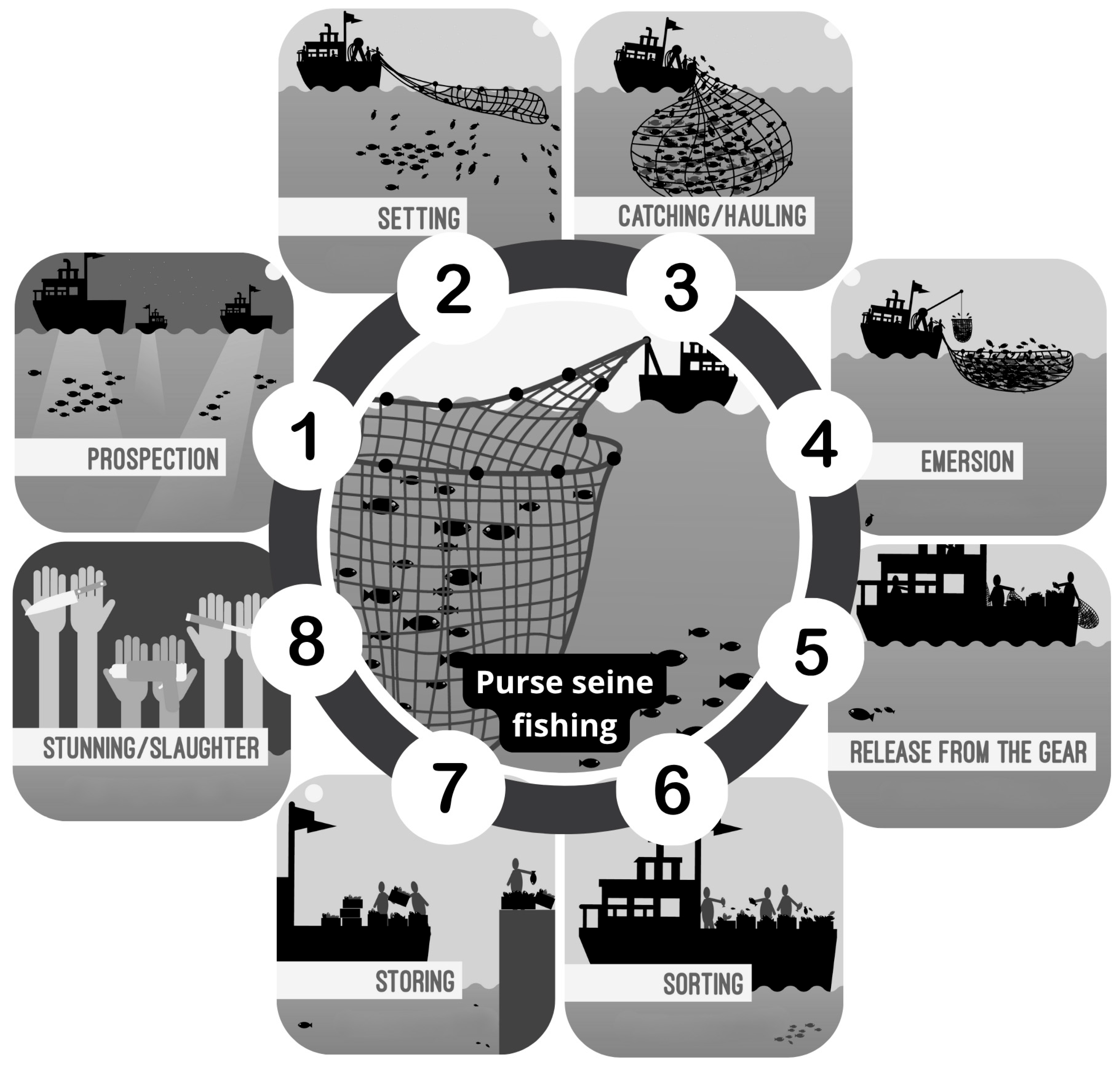
The capture of small pelagic species using purse seine nets involves a complex, multi-step process (Figure 1), with each stage presenting specific welfare hazards, which are summarized in Table 1. These hazards include physiological, mechanical, and behavioural stressors that can cause significant stress, injury, and mortality even before fishes are landed on board (e.g., [18,32]). A detailed understanding of these hazards is crucial to developing effective mitigation strategies that can be integrated into fishery management and operational procedures. The mitigators can include keeping hauling speed, crowding duration, and catch volumes low, minimizing handling, and stunning immediately when they are taken on board, followed by slaughtering. We will take a closer look at both the hazards and the mitigators in the following sections.

2.2.1. Prospection and Setting

During prospection—the searching for and locating of fish schools—and the setting of purse seine nets, fishes are exposed to welfare hazards related to vessel presence, such as engine noise and echosounder/sonar used to find fish schools. Although some studies found no welfare impact of prospection on the small pelagic species C. harengus and E. ringens [47,48], in fact, certain sound emission patterns may result in behavioural changes, such as avoidance behaviour and a change in schooling pattern [33,49,50]. Furthermore, when submerged light is used in the prospection phase, especially after dusk, a long and continuous exposure to light may result in fatigue for C. harengus [51].
If a school has been located, the netn is deployed around it—usually with the help of a small motor boat [52]. Although no specific study investigating the impact of setting purse seine nets on the welfare of the four investigated small pelagic species has been found so far, caution should be taken, as setting around fish schools may potentially stress fishes. For instance, it is plausible that factors such as forced swimming during enclosure in attempts to escape, increased contact with the net and conspecifics, rising fish density, and additional noise and vibration may act as hazards for small pelagic species. Monitoring the net and controlling fish density could alleviate some of these hazards. For instance, incorporating innovative techniques like high-resolution sonar or camera technology in amalgamation with advanced artificial intelligence techniques enable individual fish recognition and tracking, as well as behavioural assessment to record ethological responses of fish to the hazards of encircling. Further research might shine light on this.

2.2.2. Hauling and Crowding

After the net enclosing the school has been closed at the bottom to form the “purse” [53], hauling to the vessel starts. Regarding hauling, there is probably no welfare hazard associated with the usual hauling speed or catching depths, as purse seining for small pelagics takes place near the water surface, thus preventing the risk of barotrauma for C. harengus [54], E. ringens, S. colias, and S. scombrus [55,56]. However, if the school is present below the thermocline [57,58,59] or the halocline [59], the individuals might be subjected to abrupt temperature and salinity changes during hauling. These changes may cause temperature shock and osmoregulatory distress, but further research is needed to confirm for which species this applies. Nevertheless, hauling is still the most critical catching step regarding welfare impacts on the four investigated small pelagic species. As the net is hauled close to the ship, crowding starts, which means compressing fish into a shrinking volume [53,60,61]. This crowding drastically reduces water flow and dissolved oxygen levels, producing hypoxic conditions that can cause suffocation [37,62,63].
Under crowding at this stage, scale loss and skin injuries like bruises and lacerations may happen [37,62], which potentially cause mortality [36]. Physiological disturbances like reduced plasma glucose levels [62] or increased cortisol, lactate, chloride, sodium, and potassium ions [37] are also important consequences here for C. harengus. The longer the crowding, the worse the consequences for fish welfare [18].

2.2.3. Scooping or Pumping on Board

To achieve crowding the individuals in the net close to the vessel, the net is partly hauled on board. During this catching phase, which is the transition from hauling to emersion, juveniles of C. harengus may become inadvertently stuck in the net of very small mesh sizes [52,64]. The same was observed for E. ringens [65,66]. The further fate of these entangled individuals is unknown, probably left to die from asphyxia. For those still in the crowded net in the water, too high crowding levels may cause panic behaviour, such as dissolving schooling, rushing to the surface, and dashing in the case of S. scombrus, for instance [53,67]. For them, the emersion process starts when they are being transferred on board either by scooping nets or pumping systems. Gear contact during these operations may also reduce welfare.
Fish can be pumped directly on board, most likely without a sorting step [17,39,40,50]. Fin injuries, pressure injuries, and discolouration of fins, eyes, and skin are possible consequences, which worsen when pumping velocity, pumping time, and catch volume increase [39]. On the other hand, when individuals are lifted out of the purse seine into the storage space of the ship with a scoop net or a brailer [61,68,69,70], taking into account the force with which the net is dipped into the purse seine, exposure to air, and the crowding density [71], hazard consequences are also probable.
Predation pressure is also a possible welfare hazard during emersion from the water. There are records of the presence of possible predators, such as birds, sea lions, dolphins, turtles, sharks, or whales, near the purse seine nets that target C. harengus, E. ringens, and S. colias [72,73,74]. In this scenario, taking into account that purse seining catches fish at the water surface with a slow haul and that there is no way that fished individuals are able to flee from predators, there is the risk of great stress due to predation pressure. Facing abrupt temperature changes, exposure to air causing hypoxia and desiccation, and difficulties experiencing own weight outside the water are also possible welfare hazards during this catching phase [21]. Furthermore, specifically for E. ringens, which are mostly processed into fish meal [72,75], discards due to injuries are unlikely, which may increase the risk of lack of care during the catching process, then leading to injuries.

2.2.4. Handling and Sorting Procedures

When released from scoop nets, individuals face dropping from a certain height [76]. Both after pumping and release from scoop nets, they may land hard or be kicked or stood on [76,77]. Once on board, the individuals face further hazards. For instance, fishes are often exposed to air for extended periods, probably causing desiccation and respiratory distress [21].
Furthermore, although a sorting process is not common for many small pelagic species, manual sorting is a possibility for S. colias [69] and, allegedly, for S. scombrus [78]. In this process, fishes are manually sorted by species and size into boxes [69,76], which possibly exposes them to being thrown, landing hard in plastic containers, catapulting away from the containers, being kicked or stepped on, pressure from other individuals inside containers, and exposure to air.

2.2.5. Storage

For storage, the caught pelagic species are either kept alive until landing or deposited on board the fishing vessel. The former includes keeping the fish alive in floating cages at sea to maintain freshness prior to processing or sale—even for several weeks [79]. When stored on board in ice or ice water, injuries and stress caused by collisions and pressure inside the tanks are possible. In C. harengus kept in storage tanks, for example, such collisions may cause physical damage resulting in bloodstains and dull skin [80]. Moreover, individuals can suffer from ice exposure, probably facing temperature shock. For instance, S. scombrus are commonly pumped directly into refrigerated sea water tanks [17,39,40,81]. Air exposure is a possible stressor when there is no or little ice. For E. ringens, for example, just a few small- and medium-scale vessels provide ice, and the industrial fleet rarely has any refrigerating system installed [72].

2.2.6. Stunning and Slaughter

Humane stunning and slaughter methods for the four investigated small pelagic species caught by purse seine remain largely unstandardized and poorly implemented [40]. Commonly used methods—such as asphyxiation through air exposure or immersion in ice slurry, causing hypothermia—probably often cause prolonged suffering and delayed unconsciousness. For C. harengus and E. ringens, for example, considering that there are hints indicating that fish are directly pumped into the storage space of the ship [65,75,82], individuals probably die from asphyxia. The same happens when C. harengus, for example, is stored on ice [18,83]. On the other hand, if stored in ice [80] or in ice water [18,80,83], C. harengus may die from hypothermia. A study on S. colias kept on ice reported activity even after 20 min or more of asphyxia and hypothermia, which was also evident by an elevation of physiological stress parameters like plasma cortisol and lactate [84]. The absence of species-specific and scientifically validated stunning techniques represents a significant welfare gap in pelagic fisheries.

2.3. Mitigation Strategies to Improve Welfare During Purse Seine Fishing Operations

Addressing welfare hazards in purse seine fisheries requires a holistic approach that integrates scientific knowledge, operational improvements, technological innovation, and enhanced regulatory oversight. The current Method Profile about purse seining provided by the fair-fish database offers a comprehensive synthesis of possible mitigation strategies tailored to the four investigated small pelagic species, considering each fishing stage, aimed at reducing stress, injuries, and mortality in captured fish, which are summarized in Table 1.

2.3.1. Prospection and Setting

To mitigate prospection-related hazards, fishers should prioritize sound emissions of lower frequency ranges or, when possible, rely on passive acoustic techniques, although further research is required to validate their efficacy. In C. harengus, for example, shoaling and swimming behaviours were not affected by low-frequency or mid-frequency active sonar [48]. Moreover, because C. harengus schools were shown to release gas from their swim bladders, generating bubble clouds that may become visible at the surface and that are associated with sound emissions, this could potentially be utilized by fishers through passive acoustic detection [85].
To prevent the fatigue that may sometimes come with luring schools to the surface and into the purse seine [51], it seems that prolonged exposure to artificial light can be reduced by applying submerged illumination only shortly after dusk, for limited durations, and preferably in colder waters. In fact, a study with C. harengus demonstrated that the response of a few individuals to light can be enough to influence the movement of the entire shoal, with submerged lights more effective than lights positioned above the surface—a fishing technique showing higher efficiency shortly after dusk [51]. This same study indicated that elevated water temperatures reduced the effectiveness of light attraction. Nonetheless, additional studies are necessary to assess the effectiveness and welfare implications of this strategy in practice.
Regarding the setting of the net, as already mentioned, no information is currently available on the potential stress responses of the four investigated small pelagic species. Furthermore, no information was found on possible feasible mitigation approaches, highlighting an important gap for future research.

2.3.2. Hauling and Crowding

Within the context of hauling and crowding, certain measures can be considered to reduce welfare hazards. Regarding catching depth, since purse seine fishing generally occurs at the surface, no major hazards (i.e., barotrauma) are expected for the four investigated small pelagic species, provided that hauling speed is kept low. Maintaining a hauling speed below approximately 0.2–0.3 m/s when catching S. scombrus [61] at the surface seems to minimize adverse effects, although further research is required to validate safe limits across different species and operational contexts. Conducting captures at night may reduce injuries, as individuals appear to be more cautious and less prone to direct contact with the gear under these conditions. In fact, for C. harengus, individuals captured at night seemed to experience reduced physical contact with the net and, consequently, lower incidences of lethal scale loss [79].
A critical factor is the duration of crowding. To mitigate stress responses, this period should be kept as short as possible, ideally not exceeding around 10–20 min under controlled conditions. For C. harengus, for example, after only 10 min of crowding, scale loss and skin injuries were already detected [37], in addition to reduced plasma glucose [62] and increased cortisol, lactate, chloride, sodium, and potassium ions [37]. Furthermore, higher stress levels and lower muscle pH with increased crowding duration (0–30 min) were shown in the same species [18]. In some laboratory studies, cortisol, lactate, and osmolality increased with increasing density following 15 min of crowding in S. scombrus [27]. After crowding and pumping on board, the longer the exposure to crowding, the more vitality decreased for S. scombrus [17], and the skin of crowded individuals turned blue in a worse condition when crowded at higher density and for a longer time [53,63]. In practice, reducing crowding density can be facilitated by focusing on smaller catches [38,61], which will also reduce crowding duration, handling time, and the physiological burden associated with confinement. Special care should be taken in the last 20% of hauling when fish density peaks. For instance, in medium-sized catches (~270 t) of S. scombrus, fish densities remained below critical thresholds until approximately 80% of the seine was hauled, whereas in large catches (650–985 t), critical crowding levels were reached earlier in the process [38].

2.3.3. Scooping or Pumping on Board

During emersion from water, several measures can be considered to mitigate welfare hazards associated with gear contact and handling for the four investigated small pelagic species. The use of appropriate mesh sizes is essential to prevent juveniles from becoming entangled in the net, and mesh selection should therefore be adapted to the body diameter of the target species according to seasonal and regional variation. For instance, the minimum mesh size in Portuguese fisheries for purse seine is 16 mm [69]. Collaboration between gear technologists and fishers is essential to balance welfare improvements with fishing efficiency and economic viability.
When pumping is applied, evidence from S. scombrus suggests that welfare outcomes improve with lower pumping velocities (1.2–1.8 t/min compared to 7.4–8.6 t/min), shorter pumping durations (27–85 min versus 56–165 min), and reduced catch volumes (55–80 tons versus 132–250 tons) [39]. These findings indicate that operational adjustments can minimize physical injuries and stress, although further research is needed to validate these measures for other species. Because exposure to air and the gravity effect outside the water constitute a significant risk factor [21], pumping fishes on board is generally preferable to scooping, as it reduces handling time and air exposure, although further evidence is required to confirm the benefits of this approach across different contexts.

2.3.4. Handling and Sorting Procedures

Potential hazards associated with release from gear include hard landings on board, being stepped on, and prolonged exposure to air, as already mentioned, but empirical evidence remains limited regarding possible mitigation measures for this catching phase, thus highlighting a clear need for further research. However, it is possible to speculate that using soft or cushioned surfaces during handling, minimizing personnel contact with fishes, and reducing air exposure may be useful as mitigation measures. An immediate stunning and slaughter after arriving on board could not just avoid a decrease in welfare but also ease further handling by the fishers.
In case the catch needs to be sorted, handling and air exposure when performed on deck are the primary concerns. Performing size-grading while fish are still in the water [78,86] is a recommended approach to circumvent these welfare hazards. Some individuals of S. scombrus became stuck in the metal grid, though, and not all approached the grid [78]. In another attempt, some dashed vigorously, leading to substantial long-term mortality [86]. Additional studies are required to evaluate the effectiveness of in-water sorting under commercial conditions and for different small pelagic species than S. scombrus.

2.3.5. Storage

Welfare hazards related to storage are best avoided by stunning individuals immediately when they arrive on deck, followed by slaughter while they are still unconscious. Since reliable protocols and associated effective technology are currently still lacking for the four investigated small pelagic species, we are looking at the next best options. Live storage in net pens adjacent to the vessel should preferably be performed in large pens (≥4000 m3) situated in calm, cold waters and away from hibernation areas in autumn. In fact, C. harengus mortality rates decreased (70–98% to 0–20%) with increasing net pen volume (from 30 to 4000–7000 m3), with a higher mortality rate when stored in autumn and at hibernating areas than in winter and at spawning grounds. Furthermore, towing pens slowly inshore at speeds not exceeding 0.5–0.6 m/s helps to minimize stress and physical injuries [79].
Storage in tanks on board benefits from the use of ice, which buffers collisions with conspecifics and the tank walls in rough weather conditions, and thus prevents injuries and negative effects on the product quality [80]. Contact with ice (water), however, can also cause a temperature shock and eventual hypothermia, which might still be preferable to exposure to air and asphyxia.

2.3.6. Stunning and Slaughter

Current evidence suggests that effective stunning methods are largely absent in the commercial practice of purse seining the four investigated small pelagic species, with asphyxia and hypothermia being the primary means of slaughter. In fact, whether fishes are directly pumped into the storage space of the vessel [17,39,40,50,63,75] or lifted with scoop nets and brailers out of the purse seine [61,68,70] into ice slurries or refrigerated seawater [17,18,39,40,80,81,83], stunning and slaughter are unlikely to occur, with asphyxia or hypothermia being the probable causes of death. Therefore, implementing rapid and efficient stunning followed by immediate slaughter is recommended to prevent prolonged suffering and avoid the negative impacts associated with asphyxia or hypothermia on the final product.
Based on research with C. harengus, percussive stunning (blow to the head) followed by immediate brain destruction is a promising approach [87], as it can rapidly induce unconsciousness and minimize suffering. Nevertheless, this method is not yet widely implemented, and the high throughput of individuals in purse seine fisheries makes this method unfeasible on board. An attempt with electrical stunning in C. harengus did not yield satisfying results [41]. A study with electrical stunning in S. scombrus seems more promising [40] but needs further validation through non-behavioural indicators like visually evoked responses. Further empirical studies are necessary to assess the effectiveness, practicality, and species-specific outcomes of other humane stunning and slaughter techniques in both onboard and onshore settings. Therefore, implementing adequate stunning and slaughter protocols still represents a critical frontier in ethical pelagic fisheries management. Further research and industry collaboration are needed to develop scalable and practical solutions suitable for high-volume purse seine catches of small pelagic species to improve welfare during slaughter, in addition to the quality of the meat. For instance, a proper stunning and slaughter method followed by adequate pre-processing storage may reduce the natural pro-oxidant process that deteriorates C. harengus’ meat [83].

2.4. Bycatch, Discarding, and Environmental Hazards

So far, we have been dealing with the welfare of four small pelagic species caught with purse seine that are destined to be retained and landed. Now we direct our attention to species that are unintentionally affected by these purse seine fisheries and also decrease in welfare. Although bycatch and discards have several definitions [88], the unintentional catch of non-target species or the need to release individuals of the target species for various reasons can very generally be termed bycatch and discards. Although purse seine fisheries of small pelagic species generally exhibit lower bycatch rates compared to other industrial fishing gears [14,89], it remains a significant concern for welfare and conservation. Another concern, this time directed at the environment, is related to indirect effects from purse seining through dumped waste and fuel leaks by purse seine vessels, as well as abandoned, lost, or discarded purse seine nets. These nets continue to entrap aquatic species—referred to as “ghost fishing”—which poses a persistent threat to marine ecosystems and animal welfare [90,91]. Bycatch, discarding, and environmental hazards associated with purse seining of the four investigated small pelagic species are summarized in Figure 2. In the following sections, we will dive into the details of Figure 2 more closely.

2.4.1. Bycatch and Discards

In the fair-fish database, we differentiate bycatch of the target species—which may include accidental catch of undersized or damaged individuals, individuals of the wrong sex, wrong age, or exceeding the quota—and bycatch of non-target species. Non-target species will either still be sold by the fishers or returned to sea (“usable” versus “non-usable”). As long as unwanted target or non-target species are released while still in the water, we refer to them as bycatch. As soon as fishers lift them on board and return them after contact with air (e.g., after a sorting step), this constitutes discards in our book. Another difference between bycatch and discards, according to this differentiation, is that release while still in the water could increase the survival chances compared to discarding from board, during which the individuals will have potentially encountered more welfare hazards resulting in higher mortality rates.
Undersized individuals of the target species of the four investigated small pelagic species will most likely be juveniles which recruit to the school of the adults. For example, C. harengus schools can be a mix of juvenile and adult herrings [62,92]. S. colias amounted to an estimated 18.2% of unreported bycatch in 1938–2009 that were discarded for being undersized or misidentified as the originally targeted species [93]. At times, a targeted school can be so big that it exceeds the quota for the vessel, so that part of the school will be slipped [94]. Commercial value is another factor that fishers might go by to decide to slip. In 1927–2012, S. colias were consistently observed to be slipped in favour of the more financially rewarding Sardina pilchardus [95]. In 2016–2017, being undersized or of low commercial value led to 21% S. colias being slipped (15%) or used at sea (6%), and another 28% discarded dead [69].
Welfare hazards that individuals of the target species face, which end up being slipped, refer to the phases of catching when individuals are still in the water. Before slipping commences, the accidentally caught individuals would have experienced the welfare hazards from prospection to crowding (Table 1). Those S. colias dying after slipping had sustained injuries and fin erosion and were generally in a bad condition [96]. Crowding is an especially critical step in terms of decreasing welfare. In S. scombrus, crowding before slipping caused stress [97] and mortality [63]. Increasing crowding density [27,67] or crowding duration increased long-term mortality [53].
Nevertheless, slipping is a complex and challenging process. In 73% of the cases, C. harengus did not leave the purse seine net when it was opened in the bunt [98]—maybe due to stress [99], maybe also because individuals do not want to leave the safety of the school. Individuals leaving on their own or in small groups were rare [98]. Of those 27% actually leaving, around one quarter did so in a chaotic fashion, potentially leading to collisions with conspecifics and the net [98].
So, releasing bycatch still in the water can already be a challenge and does not guarantee survival of the slipped individuals; discarding individuals after they are hauled on board will potentially aggravate the situation. With each additional welfare hazard, the chances of survival after release will most likely drop. Welfare hazards include those specified in Section 2.2, from scooping or pumping to handling and sorting. For example, when fishers discarded undersized S. colias after manual sorting on board, the individuals were already dead [69]. Individuals that managed to survive slipping or discarding—presumably stressed and exhausted—might face displacement or predation pressure [21].
Non-target species will most likely end up in the purse seine because they co-exist with, prey on, or are preyed on by the target species. E. ringens are caught in the areas where blooms of Scyphomedusa Chrysaora plocamia can occur. Fishers will keep them together with E. ringens in storage and sell the whole catch to the processing plants, as long as the ratio of target to non-target species does not tilt and decrease the quality of the resulting fish meal [75]. Other accidentally caught co-existing species include pelagic and semi-pelagic species, such as, but not restricted to, Trachurus trachurus, T. picturatus, S. scombrus, Engraulis encrasicolus, Boops boops, Diplodus spp., Pagellus acarne, and Mugil spp., which can amount to circa 12% of the catch in the S. colias fishery [100]. In the E. ringens purse seine fishery, Scomber japonicus, Trachurus murphyi, Odontesthes Regia regia, and Anchoa nasus can represent 20% or more [72]. Even though these species were not originally targeted by the fishers, there is a market demand for them, and the fishers will not let them go to waste but will sell them.
This is out of question for species of the category “endangered, threatened, or protected” like cetaceans in the case of the S. colias purse seine fisheries that were accidentally caught (D. delphi, Tursiops truncatus, Phocoena phocoena) [101]. Releasing endangered, threatened, or protected species unharmed and as early as possible in the catching process is of utmost priority to ensure their survival. However, this is not always possible. In the E. ringens purse seine fishery, accidental catch of the Common dolphin (Delphinus delphi) [73] can add to 640 individuals per year for one company alone [72]. In one study, 19% of accidentally caught dolphins sustained injuries, and another 5.2% died before they could be released [73]. Sooty shearwaters (Ardenna grisea) and Magellanic penguins (Spheniscus magellanicus) were found beached, which is speculated to be linked to the E. ringens fishing activity [74].

2.4.2. Ghost Fishing and Other Environmental Impacts

Besides effects during active fishing as outlined above, indirect effects of purse seine fishing can touch on the welfare of aquatic species, too. Compared to other fisheries in Peru, for example, the E. ringens purse seine fishery was listed as the most impactful on local fauna [102]. This is not related to the capture process, which usually does not involve touching the bottom—or if the bottom is touched, then the net is not dragged along the seafloor [31]. Instead, it is related to the number of abandoned, lost, or discarded purse seine nets, which adds to an estimated 75,048.65 km2/year on average worldwide [91]. Until they decay, these nets bear the risk of ghost fishing.
Another indirect effect from purse seine fisheries can come from oil spillages or fuel leaks from the vessels. Artisanal and industrial vessels in the Peruvian E. ringens purse seine fishery consume 10.1–29 kg of fuel per tonne of fishes or 11,000–84,000 tonnes of fuel each year [72]. If part or all of this fuel spills into the ocean, it will cause an ecological disaster. There might be one environmental hazard that surpasses ghost fishing and fuel leaks in terms of frequency of occurrence—the dumping of plastic waste. In the purse seine fishery of the western and central Pacific, this amounted to 71% of >10,000 observed pollution events [90]. Considering a dearth of findings pertaining to this issue, we report the best available findings from purse seine fisheries. We acknowledge, though, that further research is needed to evaluate the environmental burden of the four investigated small pelagic species captured with purse seines.

2.5. Current Mitigation Efforts for Bycatch, Discard, and Environmental Hazards

Current mitigation efforts for bycatch and discards include management measures, gear modifications, and operational strategies (Figure 2). The best way to reduce bycatch and discards is to avoid catching these individuals in the first place. To achieve this, several countries have devised legislation that fishers need to comply with. To keep accidental bycatch of the target species low, Peru legally set the bycatch limit at 5% of the total catch [103]. For the E. ringens purse seine fishery, there is also a landing obligation in place for bycatch [104]. Protecting the whole species—not just the juveniles—is the idea behind annual caps for the allowed catch. Canada reduced the quota for C. harengus to allow the population to recover [105]; Morocco reduced the total allowable catch for S. colias [106]. These two countries also designated closure zones for fishing—Canada for C. harengus [105], Morocco for S. colias [106]—which is another way to lift pressure off overexploited populations. Peru’s closing of its fishing grounds during E. ringens spawning season protected female spawners, boosted recruitment of juveniles into schools in the following season, and prevented overexploitation [107]. Another approach is to conduct aquatic species population surveys—ideally across countries—to monitor the species’ development [106]. This can also help gauge the age at maturity and set size limitations for the fisheries. For example, in Norway, catching C. harengus <25 cm in the spawning season is not allowed [108].
For non-target species of endangered, threatened, or protected status, conservation plans may help reduce the unintentional catch [101]. For example, the United States placed catch caps on river herring (including Alosa pseudoharengus and Alosa aestivalis) and shad (including Alosa sapidissima and Alosa mediocris), which are occasionally caught with C. harengus [109].
Besides management measures like the ones listed above, gear modifications and operational strategies can mitigate bycatch and discards during the fisheries process. Adhering to the first principle of preventing unwanted individuals from entering the net at all, one way is to make sure to identify a school correctly. Hydroacoustic electronic scanning may give a hint at the species and also the size distribution of the individuals [104]. Whilst catching S. colias, if the sonar or echo-sounder indicated low school size or a school of mixed species, fishers aborted setting the purse seine [69,100]. Even if the net is already set, fishers can sample the catch to verify the species, for example, with a rod and reel [64]. If the result is negative, the fishers can abort the process before exposing the individuals to crowding [55].
Releasing unwanted catch is preferably performed in the water compared to on board the vessel since bringing the individuals on board additionally exposes them to the steps of scooping or pumping to handling and sorting (Table 1). We mentioned slipping already—in Section 2.4.1 on welfare hazards for bycatch species—and the challenges associated with it. The best time for slipping is before crowding, which imposes several welfare hazards (see Section 2.2.2). We reported in Section 2.3.2 why it is advisable to keep crowding density low and crowding duration short. In C. harengus, slipping, as long as the densities in the net are low, will probably be tolerated, whereas slipping during higher densities may cause mortalities [62]. We reported that slipping might fail or happen chaotically (see Section 2.4.1). To encourage slipping in general, and orderly slipping in particular, visual stimuli might help [98]. Further research is needed to flesh out solutions. If the aim is not to release the whole catch but only individuals of a certain size, size sorting inside the purse seine could help. In a study on S. scombrus, using a metal sorting grid was more successful than using a stiff netting, which gilled individuals [78]. Not all individuals passed the grid, though, and in the metal grid, individuals were stuck [78]. Moreover, a decrease of oxygen and panic behaviour during size sorting with a metal grid resulted in considerable mortality rates, questioning the effectiveness of this kind of sorting procedure [78,86]. For sorting in the water (as for slipping), improved solutions are warranted.
In case bycatch could not be prevented from being transferred to the vessel, appropriate mesh sizes will impede individuals from needing to be manually disentangled (see Section 2.3.3). To forego discarding dead individuals and essentially wasting a resource, the use of these individuals could be encouraged. In E. ringens, which is mostly used for fish meal [72,75], there probably is no noteworthy bycatch, because even undersized or injured individuals can be processed into fish meal. Of course, making use of bycatch should strictly apply to the legally permitted bycatch contingent and must not inspire lifting of bycatch limits. Otherwise, in the case of undersized individuals of the target species, it might endanger the survival of the population, and in the case of non-target species, it might collide with conservation plans. Also, encouraging the use of bycatch species will probably require a shift in consumer demand and, consequently, market value. Until then, even if fishers will occasionally sell the more lucrative of the accidentally caught individuals, at other times, if the rate of undersized individuals or low-value species is too high, they will rather slip the whole catch [69,75,100].
To address ghost fishing impacts, gear marking programmes improve traceability and facilitate retrieval of lost nets [110] (Figure 2). Temporal and spatial fishing closures in sensitive habitats may also help reduce incidental captures and minimize gear loss [106] (Figure 2). Organized gear recovery and recycling initiatives are gaining traction but face challenges, including enforcement difficulties, economic costs, and limited fisher participation [91]. Innovative solutions, such as biodegradable nets, could also help to minimize the impacts of ghost fishing and water pollution.

3. Recommendations for Welfare and Environmental Improvements

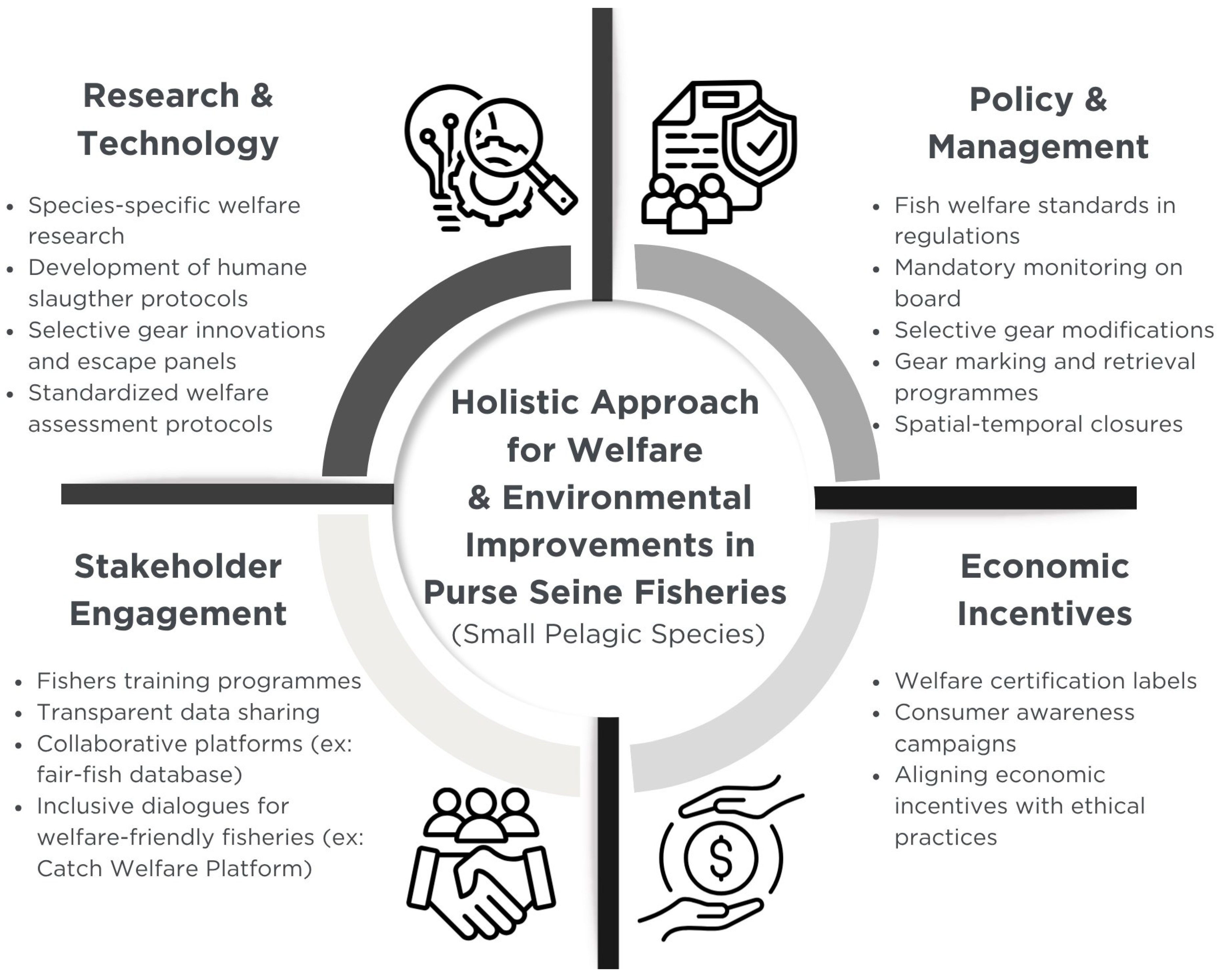
Improving welfare outcomes in purse seine fisheries of the four investigated species demands a holistic and coordinated approach that synergizes research, technological innovation, policy reform, and socio-economic engagement (Figure 3). Such a strategy must address both the immediate welfare impacts on captured fishes and the broader environmental challenges intrinsic to this fishing method.
Effective welfare improvements in fisheries require comprehensive management frameworks that consider the cumulative effects of stress and injury from the earliest phase of prospection through to the final stunning and slaughter process [22,30]. These frameworks must also integrate considerations for bycatch—often vulnerable and prone to high mortality—and mitigate environmental hazards, such as abandoned, lost, or discarded gear continuing to catch and kill marine organisms by ghost fishing [90,91,111]. Currently, this is exactly what the Method Profile of purse seining on the four investigated small pelagic species in the fair-fish database offers.
Balancing ecological sustainability, economic viability, and ethical responsibility is essential for fostering resilient fisheries. For example, adopting welfare criteria within ecosystem-based fisheries management can potentially reduce unintended harm to both target and non-target species while maintaining or even enhancing fishery productivity [112]. Integrated approaches might also involve spatial-temporal closures during vulnerable biological periods (e.g., spawning seasons) to reduce cumulative stress and improve survival rates [106].

3.1. Policy and Management Frameworks, Economic Incentives

Embedding explicit welfare standards in fishery regulations of purse seining, as pursued by the Carefish/catch project with the partner Friend of the Sea®, represents a crucial step forward. This includes recommending welfare monitoring on board vessels, enforcement of humane stunning and slaughter protocols adapted to small pelagic species, and standardizing handling procedures to minimize their suffering. Market-based mechanisms and certification schemes incorporating welfare standards can also encourage compliance by aligning economic incentives with ethical fishing practices. Given the transboundary nature of many purse seine fisheries, international cooperation is fundamental in this scenario. Regarding bycatch, regulations encouraging the adoption of selective gear modifications can help reduce crowding and improve the survival chances of non-target species.

3.2. Research Priorities and Technological Innovations

Targeted research focused on species-specific welfare impacts of purse seining is urgently needed to refine mitigation strategies for the four investigated small pelagic species. For instance, the absence of literature findings about welfare hazards and, consequently, about possible mitigation measures regarding the setting of the purse seine net was already pointed out in this review. The development of welfare-enhancing technologies tailored to industrial-scale purse seine operations, especially including adequate scalable stunning and slaughter methods, could significantly reduce prolonged suffering during dying—a major welfare gap identified in current practices, as already discussed above.
Furthermore, innovations in selective gear design also offer promising pathways to minimize mechanical injury and crowding stress. For instance, applying advanced slipping techniques like rigging of the bunt end has the potential to not only decrease physical trauma but also reduce mortality and discard rates, contributing to both welfare and conservation goals [113]. Standardized welfare impact assessment protocols should become integral to fishery evaluations and certification processes to establish clear benchmarks and monitor progress [21].

3.3. Stakeholder Engagement and Compliance Mechanisms

Meaningful welfare improvements in fisheries rely heavily on the engagement and cooperation of fishers and other stakeholders in the industry. Comprehensive training programmes that emphasize humane handling, sorting, and stunning and slaughter techniques are essential to translate welfare science into daily fishing practices. Showing socio-economic benefits based on solid data and information in such kind of training should also be a fundamental step to reach better engagement. Such education can be reinforced through transparent data sharing, fostering trust and accountability among fishers, scientists, and managers.
Economic incentives, such as welfare certification labels and consumer awareness campaigns, may provide powerful drivers for voluntary compliance and elevate standards across the supply chain. Inclusive dialogues among fishers, researchers, regulators, and consumers should help to build a shared commitment to ethical fisheries and support the adoption of best practices. Collaborative resources and platforms, like the Method Profile in the catch branch of the fair-fish database or the Catch Welfare Platform, facilitate this engagement by providing accessible, evidence-based information tailored to stakeholders’ needs.
In summary, despite the inherent challenges of scale, rapid operations, and enforcement in industrial pelagic fisheries, the mitigation strategies detailed in the Method Profile about purse seining establish a robust foundation for welfare improvements for four small pelagic species. Achieving meaningful progress requires coordinated action across science, policy, industry, and civil society (Figure 3).

4. Conclusions and Future Directions

The review draws extensively from the fair-fish database’s pioneering Method Profile, which offers an innovative and systematic framework integrating welfare science into fishery method assessments. By detailing the commercial relevance, operational phases, target species specifics, and associated environmental impacts, the Method Profile about purse seine fishing functions as an essential tool for identifying welfare hazards and potential mitigation pathways in fisheries for four small pelagic species. This structured approach fills a critical gap in traditional fisheries management, which has historically neglected fish welfare considerations despite growing scientific consensus on fish sentience and suffering. Through the dynamic nature of the fair-fish database, the purse seine Method Profile will grow with new research being published, and with each new species caught with purse seine that we investigate.
The complex and multifaceted welfare hazards inherent in purse seine fisheries targeting the four small pelagic species, C. harengus, E. ringens, S. colias, and S. scombrus, have been elucidated here, highlighting the physiological, behavioural, and mechanical challenges that fishes are subjected to throughout the capture process. Prospection, scooping/pumping fish on board, handling, and sorting present grave welfare concerns. Probably the most critical catching step is hauling and crowding, though. Severe densities, lack of oxygen, and contact with the gear are the main hazards in this catching phase, potentially leading to elevated cortisol levels, abnormal plasma electrolyte levels, asphyxia, panic behaviour, and injuries up to mortality. Additionally, current practices for live storage and stunning and slaughter frequently fail to meet more humane standards due to impediments like high catch quantities and a lack of standardized protocols for live storage, in addition to a lack of species-specific, automated, and scalable stunning and slaughter methods that are capable of handling such high catch throughput, resulting in prolonged suffering. Stunning and slaughtering immediately after lifting individuals on board will not just reduce the welfare hazards related to the final step of the catching process but also help in ameliorating cumulative stressors of the adjoining steps like sorting, handling, and storing. This illustrates the importance of further research on stunning and slaughter protocols. Beyond target species, bycatch and corresponding discarding practices of non-target species impose injuries, stress, and mortality, with ghost fishing from lost gear additionally causing persistent ecological and welfare harm.
Moving forward, this review also shows that mitigation strategies for each phase of purse seining the four investigated small pelagic species are on the table. Therefore, the comprehensive adoption of operational strategies, gear improvements, species-specific handling during the whole fishing process, and stunning and slaughter protocols are fundamental. It will contribute to decreasing welfare impacts during the capture of wild-caught aquatic species, which have been shown to be sentient and therefore deserving of more consideration. Continuous research on these matters, adaptive management, active stakeholder participation, and the provisioning of economic incentives are indispensable to advancing ethical and sustainable purse seine fisheries on a global scale.

Author Contributions

Conceptualization, C.M.M. and J.V.; methodology, C.M.M.; validation, J.V. and V.S.; formal analysis, C.M.M.; investigation, J.V. and V.S.; writing—original draft preparation, C.M.M.; writing—review and editing, J.V. and V.S.; visualization, C.M.M.; supervision, J.V.; project administration, J.V.; funding acquisition, J.V. All authors have read and agreed to the published version of the manuscript.

Funding

This research was funded by Coefficient Giving (https://coefficientgiving.org/).

Institutional Review Board Statement

Not applicable.

Informed Consent Statement

Not applicable.

Data Availability Statement

Not applicable. No new data were created or analyzed in this study.

Acknowledgments

During the preparation of this manuscript/study, the authors used OpenAI-ChatGPT, ver. 5.0 information for the purposes of assistance in writing some sections of the manuscript. The authors have reviewed and edited the output and take full responsibility for the content of this publication.

Conflicts of Interest

The authors declare no conflicts of interest.

References

  1. Braithwaite, V.; Boulcott, P. Pain Perception, Aversion and Fear in Fish. Dis. Aquat. Organ. 2007, 75, 131–138. [Google Scholar] [CrossRef]
  2. Brown, C. Fish Intelligence, Sentience and Ethics. Anim. Cogn. 2015, 18, 1–17. [Google Scholar] [CrossRef]
  3. Sneddon, L.U. Do Painful Sensations and Fear Exist in Fish. In Animal Suffering, from Science to Law: International Symposium/Under the Direction of Thierry Auffret van der Kemp and Martine Lachance; Auffret van der Kemp, T., Lachance, M., Eds.; Carswell: Toronto, Ontario, 2013; pp. 93–112. ISBN 978-2-89635-919-6. [Google Scholar]
  4. Sneddon, L.U. Evolution of Nociception and Pain: Evidence from Fish Models. Philos. Trans. R. Soc. B Biol. Sci. 2019, 374, 20190290. [Google Scholar] [CrossRef] [PubMed]
  5. Sneddon, L.U.; Braithwaite, V.A.; Gentle, M.J. Do Fishes Have Nociceptors? Evidence for the Evolution of a Vertebrate Sensory System. Proc. Biol. Sci. 2003, 270, 1115–1121. [Google Scholar] [CrossRef]
  6. Yue, S.; Moccia, R.D.; Duncan, I.J.H. Investigating Fear in Domestic Rainbow Trout, Oncorhynchus mykiss, Using an Avoidance Learning Task. Appl. Anim. Behav. Sci. 2004, 87, 343–354. [Google Scholar] [CrossRef]
  7. Lucon-Xiccato, T.; Loosli, F.; Conti, F.; Foulkes, N.S.; Bertolucci, C. Comparison of Anxiety-like and Social Behaviour in Medaka and Zebrafish. Sci. Rep. 2022, 12, 10926. [Google Scholar] [CrossRef]
  8. Maximino, C.; Marques De Brito, T.; Dias, C.A.G.D.M.; Gouveia, A.; Morato, S. Scototaxis as Anxiety-like Behavior in Fish. Nat. Protoc. 2010, 5, 209–216. [Google Scholar] [CrossRef] [PubMed]
  9. Mazeaud, M.M.; Mazeaud, F.; Donaldson, E.M. Primary and Secondary Effects of Stress in Fish: Some New Data with a General Review. Trans. Am. Fish. Soc. 1977, 106, 201–212. [Google Scholar] [CrossRef]
  10. Samaras, A. A Systematic Review and Meta-Analysis of Basal and Post-Stress Circulating Cortisol Concentration in an Important Marine Aquaculture Fish Species, European Sea Bass, Dicentrarchus labrax. Animals 2023, 13, 1340. [Google Scholar] [CrossRef]
  11. Wendelaar Bonga, S.E. The Stress Response in Fish. Physiol. Rev. 1997, 77, 591–625. [Google Scholar] [CrossRef]
  12. Akinrinade, I.; Kareklas, K.; Teles, M.C.; Reis, T.K.; Gliksberg, M.; Petri, G.; Levkowitz, G.; Oliveira, R.F. Evolutionarily Conserved Role of Oxytocin in Social Fear Contagion in Zebrafish. Science 2023, 379, 1232–1237. [Google Scholar] [CrossRef]
  13. Pauly, D.; Zeller, D. Catch Reconstructions Reveal That Global Marine Fisheries Catches Are Higher than Reported and Declining. Nat. Commun. 2016, 7, 10244. [Google Scholar] [CrossRef]
  14. Cashion, T.; Al-Abdulrazzak, D.; Belhabib, D.; Derrick, B.; Divovich, E.; Moutopoulos, D.K.; Noël, S.-L.; Palomares, M.L.D.; Teh, L.C.L.; Zeller, D.; et al. Reconstructing Global Marine Fishing Gear Use: Catches and Landed Values by Gear Type and Sector. Fish. Res. 2018, 206, 57–64. [Google Scholar] [CrossRef]
  15. FAO. The State of World Fisheries and Aquaculture 2024; FAO: Rome, Italy, 2024; ISBN 978-92-5-138763-4. [Google Scholar]
  16. Mood, A.; Brooke, P. Estimating Global Numbers of Fishes Caught from the Wild Annually from 2000 to 2019. Anim. Welf. 2024, 33, e6. [Google Scholar] [CrossRef]
  17. Anders, N.; Hannaas, S.; Saltskår, J.; Schuster, E.; Tenningen, M.; Totland, B.; Vold, A.; Øvredal, J.T.; Breen, M. Vitality as a Measure of Animal Welfare during Purse Seine Pumping Related Crowding of Atlantic Mackerel (Scomber scrombrus). Sci. Rep. 2022, 12, 21949. [Google Scholar] [CrossRef]
  18. Roth, B.; Skåra, T. Pre Mortem Capturing Stress of Atlantic Herring (Clupea harengus) in Purse Seine and Subsequent Effect on Welfare and Flesh Quality. Fish. Res. 2021, 244, 106124. [Google Scholar] [CrossRef]
  19. Linares-Cordova, J.F.; Roque, A.; Ruiz-Gómez, M.D.L.; Rey-Planellas, S.; Boglino, A.; Rodríguez-Montes De Oca, G.A.; Ibarra-Zatarain, Z. Farmed Fish Welfare Research Status in Latin America: A Review. J. Fish Biol. 2025, 106, 125–137. [Google Scholar] [CrossRef]
  20. Saraiva, J.L.; Arechavala-Lopez, P. Welfare of Fish—No Longer the Elephant in the Room. Fishes 2019, 4, 39. [Google Scholar] [CrossRef]
  21. Breen, M.; Anders, N.; Humborstad, O.-B.; Nilsson, J.; Tenningen, M.; Vold, A. Catch Welfare in Commercial Fisheries. In The Welfare of Fish; Kristiansen, T.S., Fernö, A., Pavlidis, M.A., van de Vis, H., Eds.; Animal Welfare; Springer International Publishing: Cham, Switzerland, 2020; pp. 401–437. ISBN 978-3-030-41675-1. [Google Scholar]
  22. Waley, D.; Harris, M.; Goulding, I.; Correira, M.; Carpenter, G. Catching Up: Fish Welfare in Wild Capture Fisheries; Catching Up; Eurogroup for Animals: Brussels, Belgium, 2021; pp. 1–52. [Google Scholar]
  23. Cabrera-Álvarez, M.J. Clupea harengus (WelfareCheck|catch: Purse Seines); In fair-fish Database; fair-fish, Ed.; World Wide Web Electronic Publication. Version A | 0.2 (Pre-Release). 2024. Available online: https://fair-fish-database.net (accessed on 4 August 2025).
  24. Maia, C.M. Scomber colias (WelfareCheck|catch: Purse Seines); In fair-fish Database; fair-fish, Ed.; World Wide Web Electronic Publication. Version A | 0.2 (Pre-Release). 2024. Available online: https://fair-fish-database.net (accessed on 4 August 2025).
  25. Volstorf, J. Engraulis ringens (WelfareCheck|catch: Purse Seines); In fair-fish Database; fair-fish, Ed.; World Wide Web Electronic Publication. Version A | 0.2 (Pre-Release). 2024. Available online: https://fair-fish-database.net (accessed on 4 August 2025).
  26. Volstorf, J.; Maia, C.M. Scomber scombrus (WelfareCheck|catch: Purse Seines); In fair-fish Database; fair-fish, Ed.; World Wide Web Electronic Publication. Version A | 0.1 (Pre-Release). 2025. Available online: https://fair-fish-database.net (accessed on 4 August 2025).
  27. Anders, N.; Roth, B.; Breen, M. Physiological Response and Survival of Atlantic Mackerel Exposed to Simulated Purse Seine Crowding and Release. Conserv. Physiol. 2021, 9, coab076. [Google Scholar] [CrossRef]
  28. James, K.L.; Aparicio, S.P.; Jayasuriya, N.S.; Herath, T.K.; Lines, J.; Sneddon, L.U.; Amarasinghe, U.S.; Randall, N.P. Humane Stunning or Stun/Killing in the Slaughter of Wild-Caught Finfish: The Scientific Evidence Base. Anim. Welf. 2025, 34, e33. [Google Scholar] [CrossRef] [PubMed]
  29. Metcalfe, J.D. Welfare in Wild-Capture Marine Fisheries. J. Fish Biol. 2009, 75, 2855–2861. [Google Scholar] [CrossRef]
  30. Veldhuizen, L.J.L.; Berentsen, P.B.M.; De Boer, I.J.M.; Van De Vis, J.W.; Bokkers, E.A.M. Fish Welfare in Capture Fisheries: A Review of Injuries and Mortality. Fish. Res. 2018, 204, 41–48. [Google Scholar] [CrossRef]
  31. He, P.; Chopin, F.; Suuronen, P.; Ferro, R.S.T.; Lansley, J. Classification and Illustrated Definition of Fishing Gears; FAO Fisheries and Aquaculture Technical Papers; Food and Agriculture Organization of the United Nations (FAO): Rome, Italy, 2021; ISBN 978-92-5-134514-6. [Google Scholar]
  32. Marçalo, A.; Breen, M.; Tenningen, M.; Onandia, I.; Arregi, L.; Gonçalves, J.M.S. Mitigating Slipping-Related Mortality from Purse Seine Fisheries for Small Pelagic Fish: Case Studies from European Atlantic Waters. In The European Landing Obligation: Reducing Discards in Complex, Multi-Species and Multi-Jurisdictional Fisheries; Uhlmann, S.S., Ulrich, C., Kennelly, S.J., Eds.; Springer International Publishing: Cham, Switzerland, 2019; pp. 297–318. ISBN 978-3-030-03308-8. [Google Scholar]
  33. Misund, O.A. Avoidance Behaviour of Herring (Clupea harengus) and Mackerel (Scomber scombrus) in Purse Seine Capture Situations. Fish. Res. 1993, 16, 179–194. [Google Scholar] [CrossRef]
  34. Pauly, D.; Watson, R., IV. 10 Spatial Dynamics of Marine Fisheries. In The Princeton Guide to Ecology; Levin, S.A., Carpenter, S.R., Godfray, H.C.J., Kinzig, A.P., Loreau, M., Losos, J.B., Walker, B., Wilcove, D.S., Eds.; Princeton University Press: Princeton, NJ, USA, 2009; pp. 501–510. ISBN 978-1-4008-3302-3. [Google Scholar]
  35. Driscoll, J.; Tyedmers, P. Fuel Use and Greenhouse Gas Emission Implications of Fisheries Management: The Case of the New England Atlantic Herring Fishery. Mar. Policy 2010, 34, 353–359. [Google Scholar] [CrossRef]
  36. Olsen, R.E.; Oppedal, F.; Tenningen, M.; Vold, A. Physiological Response and Mortality Caused by Scale Loss in Atlantic Herring. Fish. Res. 2012, 129–130, 21–27. [Google Scholar] [CrossRef]
  37. Tenningen, M.; Vold, A.; Olsen, R.E. The Response of Herring to High Crowding Densities in Purse-Seines: Survival and Stress Reaction. ICES J. Mar. Sci. 2012, 69, 1523–1531. [Google Scholar] [CrossRef]
  38. Tenningen, M.; Pobitzer, A.; Handegard, N.O.; de Jong, K. Estimating Purse Seine Volume during Capture: Implications for Fish Densities and Survival of Released Unwanted Catches. ICES J. Mar. Sci. 2019, 76, 2481–2488. [Google Scholar] [CrossRef]
  39. Digre, H.; Tveit, G.M.; Solvang-Garten, T.; Eilertsen, A.; Aursand, I.G. Pumping of Mackerel (Scomber scombrus) Onboard Purse Seiners, the Effect on Mortality, Catch Damage and Fillet Quality. Fish. Res. 2016, 176, 65–75. [Google Scholar] [CrossRef]
  40. Anders, N.; Roth, B.; Grimsbø, E.; Breen, M. Assessing the Effectiveness of an Electrical Stunning and Chilling Protocol for the Slaughter of Atlantic Mackerel (Scomber scombrus). PLoS ONE 2019, 14, e0222122. [Google Scholar] [CrossRef]
  41. Nordgreen, A.H.; Slinde, E.; Møller, D.; Roth, B. Effect of Various Electric Field Strengths and Current Durations on Stunning and Spinal Injuries of Atlantic Herring. J. Aquat. Anim. Health 2008, 20, 110–115. [Google Scholar] [CrossRef]
  42. Mood, A. Worse Things Happen at Sea: The Welfare of Wild-Caught Fish; Fishcount.org.uk. 2010. Available online: https://www.fishcount.org.uk/published/standard/fishcountfullrptSR.pdf (accessed on 4 August 2025).
  43. Maia, C.M.; Saraiva, J.L.; Volstorf, J.; Gonçalves-de-Freitas, E. Surveying the Welfare of Farmed Fish Species on a Global Scale through the fair-fish Database. J. Fish Biol. 2024, 105, 960–974. [Google Scholar] [CrossRef] [PubMed]
  44. Maia, C.M.; Cabrera-Álvarez, M.J.; Volstorf, J. fair-fish Database|catch: A Platform for Global Assessment of Welfare Hazards Affecting Aquatic Animals in Fisheries. Appl. Anim. Behav. Sci. 2025, 291, 106732. [Google Scholar] [CrossRef]
  45. Saraiva, J.L.; Arechavala-Lopez, P.; Castanheira, M.F.; Volstorf, J.; Heinzpeter Studer, B. A Global Assessment of Welfare in Farmed Fishes: The FishEthoBase. Fishes 2019, 4, 30. [Google Scholar] [CrossRef]
  46. Davis, M.W. Key Principles for Understanding Fish Bycatch Discard Mortality. Can. J. Fish. Aquat. Sci. 2002, 59, 1834–1843. [Google Scholar] [CrossRef]
  47. Gerlotto, F.; Castillo, J.; Saavedra, A.; Barbieri, M.A.; Espejo, M.; Cotel, P. Three-Dimensional Structure and Avoidance Behaviour of Anchovy and Common Sardine Schools in Central Southern Chile. ICES J. Mar. Sci. 2004, 61, 1120–1126. [Google Scholar] [CrossRef]
  48. Sivle, L.D.; Kvadsheim, P.H.; Ainslie, M.A.; Solow, A.; Handegard, N.O.; Nordlund, N.; Lam, F.-P.A. Impact of Naval Sonar Signals on Atlantic Herring (Clupea harengus) during Summer Feeding. ICES J. Mar. Sci. 2012, 69, 1078–1085. [Google Scholar] [CrossRef]
  49. Hawkins, A.D.; Roberts, L.; Cheesman, S. Responses of Free-Living Coastal Pelagic Fish to Impulsive Sounds. J. Acoust. Soc. Am. 2014, 135, 3101–3116. [Google Scholar] [CrossRef]
  50. Peña, H.; Macaulay, G.J.; Ona, E.; Vatnehol, S.; Holmin, A.J. Estimating Individual Fish School Biomass Using Digital Omnidirectional Sonars, Applied to Mackerel and Herring. ICES J. Mar. Sci. 2021, 78, 940–951. [Google Scholar] [CrossRef]
  51. Stickney, A.P. Factors Influencing the Attraction of Atlantic Herring, Clupea harengus, to Artificial Lights. Fish. Bull. Natl. Ocean. Atmos. Adm. 1969, 68, 73–85. [Google Scholar]
  52. Wyman, B. F/V Ruth & Pat Herring Seining 2013 Season (YouTube). 2013. Available online: https://www.youtube.com/watch?v=1SFCuSJ1ypY (accessed on 15 October 2023).
  53. Lockwood, S.J.; Pawson, M.G.; Eaton, D.R. The Effects of Crowding on Mackerel (Scomber scombrus L.)—Physical Condition and Mortality. Fish. Res. 1983, 2, 129–147. [Google Scholar] [CrossRef]
  54. Brawn, V.M. Physical Properties and Hydrostatic Function of the Swimbladder of Herring (Clupea harengus L.). J. Fish. Res. Board Can. 1962, 19, 635–656. [Google Scholar] [CrossRef]
  55. Marçalo, A.; (Algarve Centre of Marine Sciences (CCMAR), Faro, Portugal). Personal communication, 2023.
  56. Pica, A.; (Friend of the Sea®, Milan, Italy). Personal communication, 2023.
  57. Domenici, P.; Silvana Ferrari, R.; Steffensen, J.F.; Batty, R.S. The Effect of Progressive Hypoxia on School Structure and Dynamics in Atlantic Herring Clupea harengus. Proc. R. Soc. Lond. B Biol. Sci. 2002, 269, 2103–2111. [Google Scholar] [CrossRef] [PubMed]
  58. Peltonen, H.; Vinni, M.; Lappalainen, A.; Pönni, J. Spatial Feeding Patterns of Herring (Clupea harengus L.), Sprat (Sprattus sprattus L.), and the Three-Spined Stickleback (Gasterosteus aculeatus L.) in the Gulf of Finland, Baltic Sea. ICES J. Mar. Sci. 2004, 61, 966–971. [Google Scholar] [CrossRef]
  59. Rasmus Nielsen, J.; Lundgren, B.; Jensen, T.F.; Stæhr, K.-J. Distribution, Density and Abundance of the Western Baltic Herring (Clupea harengus) in the Sound (ICES Subdivision 23) in Relation to Hydrographical Features. Fish. Res. 2001, 50, 235–258. [Google Scholar] [CrossRef]
  60. Handegard, N.O.; Tenningen, M.; Howarth, K.; Anders, N.; Rieucau, G.; Breen, M. Effects on Schooling Function in Mackerel of Sub-Lethal Capture Related Stressors: Crowding and Hypoxia. PLoS ONE 2017, 12, e0190259. [Google Scholar] [CrossRef] [PubMed]
  61. Tenningen, M.; Peña, H.; Macaulay, G.J. Estimates of Net Volume Available for Fish Shoals during Commercial Mackerel (Scomber scombrus) Purse Seining. Fish. Res. 2015, 161, 244–251. [Google Scholar] [CrossRef]
  62. Tenningen, M.; Vold, A.; Isaksen, B.; Svalheim, R.; Olsen, R.E.; Breen, M. Magnitude and Causes of Mortality of Atlantic Herring (Clupea harengus) Induced by Crowding in Purse Seines. In Proceedings of the 2012 Annual Science Conference, Bergen, Norway, 17–21 September 2012. [Google Scholar] [CrossRef]
  63. Tveit, G.M.; Anders, N.; Bondø, M.S.; Mathiassen, J.R.; Breen, M. Atlantic Mackerel (Scomber scombrus) Change Skin Colour in Response to Crowding Stress. J. Fish Biol. 2022, 100, 738–747. [Google Scholar] [CrossRef]
  64. Kobuk, M. 2021 Bait Herring Season: Commercial Fishing Alaska (YouTube). 2022. Available online: https://www.youtube.com/watch?v=h9K2JLduw_Q (accessed on 15 October 2023).
  65. Saldaña, M. Faena de Pesca (YouTube). 2020. Available online: https://www.youtube.com/watch?v=0Mb-7Fm7ySU (accessed on 13 October 2023).
  66. TASA. Conoce Nuestro Proceso de Cala 2018 (YouTube). 2018. Available online: https://www.youtube.com/watch?v=NF12_pzniHk (accessed on 13 October 2023).
  67. Huse, I.; Vold, A. Mortality of Mackerel (Scomber scombrus L.) after Pursing and Slipping from a Purse Seine. Fish. Res. 2010, 106, 54–59. [Google Scholar] [CrossRef]
  68. Anders, N.; Howarth, K.; Totland, B.; Handegard, N.O.; Tenningen, M.; Breen, M. Effects on Individual Level Behaviour in Mackerel (Scomber scombrus) of Sub-Lethal Capture Related Stressors: Crowding and Hypoxia. PLoS ONE 2019, 14, e0213709. [Google Scholar] [CrossRef]
  69. Tejerina, R.; Hermida, M.; Faria, G.; Delgado, J. The Purse-Seine Fishery for Small Pelagic Fishes off the Madeira Archipelago. Afr. J. Mar. Sci. 2019, 41, 373–383. [Google Scholar] [CrossRef]
  70. Tenningen, M.; Macaulay, G.J.; Rieucau, G.; Peña, H.; Korneliussen, R.J. Behaviours of Atlantic Herring and Mackerel in a Purse-Seine Net, Observed Using Multibeam Sonar. ICES J. Mar. Sci. 2017, 74, 359–368. [Google Scholar] [CrossRef]
  71. Gallias, S.L. La Pêche Aux Maquereaux En Corse—PECHE CORSE—Décembre 2018 (YouTube). 2018. Available online: https://www.youtube.com/watch?v=II67cyPSefM (accessed on 29 October 2024).
  72. Fréon, P.; Avadí, A.; Soto, W.M.; Negrón, R. Environmentally Extended Comparison Table of Large- versus Small- and Medium-Scale Fisheries: The Case of the Peruvian Anchoveta Fleet. Can. J. Fish. Aquat. Sci. 2014, 71, 1459–1474. [Google Scholar] [CrossRef]
  73. González-But, J.C.; Sepúlveda, M. Incidental Capture of the Short-Beaked Common Dolphin (Delphinus delphis) in the Industrial Purse Seine Fishery in Northern Chile. Rev. Biol. Mar. Oceanogr. 2016, 51, 429–433. [Google Scholar] [CrossRef]
  74. Simeone, A.; Anguita, C.; Daigre, M.; Arce, P.; Vega, R.; Luna-Jorquera, G.; Portflitt-Toro, M.; Suazo, C.G.; Miranda-Urbina, D.; Ulloa, M. Spatial and Temporal Patterns of Beached Seabirds along the Chilean Coast: Linking Mortalities with Commercial Fisheries. Biol. Conserv. 2021, 256, 109026. [Google Scholar] [CrossRef]
  75. Quiñones, J.; Monroy, A.; Acha, E.M.; Mianzan, H. Jellyfish Bycatch Diminishes Profit in an Anchovy Fishery off Peru. Fish. Res. 2013, 139, 47–50. [Google Scholar] [CrossRef]
  76. Pardo, I. Pesca de Cerco—Playa Astilleru (YouTube). 2023. Available online: https://www.youtube.com/watch?v=f-lPfRAct3w (accessed on 22 January 2024).
  77. Valla, R. Asi Se Pesca La Anchoveta En El Perú (YouTube). 2014. Available online: https://www.youtube.com/watch?v=UXXDsw340NE (accessed on 13 October 2023).
  78. Misund, A.; Beltestad, K. Size-Selection of Mackerel and Saithe in Purse Seine; ICES CM: Copenhagen, Denmark, 1994; pp. 1–12. [Google Scholar]
  79. Misund, O.A.; Beltestad, A.K. Survival of Herring after Simulated Net Bursts and Conventional Storage in Net Pens. Fish. Res. 1995, 22, 293–297. [Google Scholar] [CrossRef]
  80. Nielsen, D.; Hyldig, G. Influence of Handling Procedures and Biological Factors on the QIM Evaluation of Whole Herring (Clupea harengus L.). Food Res. Int. 2004, 37, 975–983. [Google Scholar] [CrossRef]
  81. Anders, N.; Eide, I.; Lerfall, J.; Roth, B.; Breen, M. Physiological and Flesh Quality Consequences of Pre-Mortem Crowding Stress in Atlantic Mackerel (Scomber scombrus). PLoS ONE 2020, 15, e0228454. [Google Scholar] [CrossRef]
  82. Yangua, D.C. Pesca de Anchoveta En Peru (YouTube). 2020. Available online: https://www.youtube.com/watch?v=lpP4shi6QYw (accessed on 13 October 2023).
  83. Tolstorebrov, I.; Eikevik, T.M.; Indergård, E. The Influence of Long-Term Storage, Temperature and Type of Packaging Materials on the Lipid Oxidation and Flesh Color of Frozen Atlantic Herring Fillets (Clupea harengus). Int. J. Refrig. 2014, 40, 122–130. [Google Scholar] [CrossRef]
  84. Carefish/Catch Consortium. Carefish Report—Welfare Assessment in Purse Seine Fisheries. 7p. 2023. Available online: https://carefish.net/catch/ (accessed on 4 August 2025).
  85. Wahlberg, M. Sounds Produced by Herring (Clupea harengus) Bubble Release. Aquat. Living Resour. 2003, 16, 271–275. [Google Scholar] [CrossRef]
  86. Misund, O.A.; Beltestad, A.K. Survival of Mackerel and Saithe That Escape through Sorting Grids in Purse Seines. Fish. Res. 2000, 48, 31–41. [Google Scholar] [CrossRef]
  87. Kestin, S.C.; Robb, D.H.; van de Vis, J.W. Protocol for Assessing Brain Function in Fish and the Effectiveness of Methods Used to Stun and Kill Them. Vet. Rec. 2002, 150, 302–307. [Google Scholar] [CrossRef]
  88. FAO. International Guidelines on Bycatch Management and Reduction of Discards|Responsible Fishing Practices for Sustainable Fisheries; Food and Agriculture Organization of the United Nations: Rome, Italy, 2011; p. 73. [Google Scholar]
  89. Bellido, J.M.; Santos, M.B.; Pennino, M.G.; Valeiras, X.; Pierce, G.J. Fishery Discards and Bycatch: Solutions for an Ecosystem Approach to Fisheries Management? Hydrobiologia 2011, 670, 317–333. [Google Scholar] [CrossRef]
  90. Richardson, K.; Haynes, D.; Talouli, A.; Donoghue, M. Marine Pollution Originating from Purse Seine and Longline Fishing Vessel Operations in the Western and Central Pacific Ocean, 2003–2015. Ambio 2017, 46, 190–200. [Google Scholar] [CrossRef] [PubMed]
  91. Richardson, K.; Hardesty, B.D.; Vince, J.; Wilcox, C. Global Estimates of Fishing Gear Lost to the Ocean Each Year. Sci. Adv. 2022, 8, eabq0135. [Google Scholar] [CrossRef]
  92. Stephenson, R.L.; Lane, D.E.; Aldous, D.G.; Nowak, R. Management of the 4WX Atlantic Herring (Clupea harengus) Fishery: An Evaluation of Recent Events. Can. J. Fish. Aquat. Sci. 1993, 50, 2742–2757. [Google Scholar] [CrossRef]
  93. Leitão, F.; Baptista, V.; Erzini, K. Reconstructing Discards Profiles of Unreported Catches. Sci. Mar. 2018, 82, 39–49. [Google Scholar] [CrossRef]
  94. FishChoice Atlantic Herring. Available online: https://fishchoice.com/buying-guide/atlantic-herring (accessed on 17 January 2023).
  95. Gamito, R.; Teixeira, C.M.; Costa, M.J.; Cabral, H.N. Are Regional Fisheries’ Catches Changing with Climate? Fish. Res. 2015, 161, 207–216. [Google Scholar] [CrossRef]
  96. Dias, I.; Feijó, D.; Marçalo, A.; Guerreiro, P.M.; Silva, A. Pilot Experiment to Evaluate the Survival of Chub Mackerel (Scomber colias) after Slipping in the Purse Seine Fishery. In Proceedings of the Iberian Symposium on Modeling and Assessment of Fishery Resources (SIMERPE), Vigo, Spain, 19–22 October 2021. [Google Scholar]
  97. Swift, D.J. Blood Component Value Changes in the Atlantic Mackerel (Scomber scombrus L.) Subjected to Capture, Handling and Confinement. Comp. Biochem. Physiol. A Physiol. 1983, 76, 795–802. [Google Scholar] [CrossRef]
  98. Anders, N.; Breen, M.; Saltskår, J.; Totland, B.; Øvredal, J.T.; Vold, A. Behavioural and Welfare Implications of a New Slipping Methodology for Purse Seine Fisheries in Norwegian Waters. PLoS ONE 2019, 14, e0213031. [Google Scholar] [CrossRef]
  99. Morgan, R.L. Using Behaviour of Herring (Clupea harengus L.) to Assess Post-Crowding Stress in Purse-Seine Fisheries. Master’s Thesis, University of Bergen, Bergen, Norway, 2014. [Google Scholar]
  100. Feijó, D.; Marçalo, A.; Bento, T.; Barra, J.; Marujo, D.; Correia, M.; Silva, A. Trends in the Activity Pattern, Fishing Yields, Catch and Landing Composition between 2009 and 2013 from Onboard Observations in the Portuguese Purse Seine Fleet. Reg. Stud. Mar. Sci. 2018, 23, 97–106. [Google Scholar] [CrossRef]
  101. Dias, I.C.; Marçalo, A.; Feijó, D.; Domingos, I.; Silva, A.A. Interactions between the Common Dolphin, Delphinus delphis, and the Portuguese Purse Seine Fishery over a Period of 15 Years (2003–2018). Aquat. Conserv. Mar. Freshw. Ecosyst. 2022, 32, 1351–1364. [Google Scholar] [CrossRef]
  102. Céspedes, C.M.S.; Velez, J.A.; Nieto, G.C. Workshop of the Classification of the Fishing Gears of the Peruvian Artisanal Fishery; Instituto Del Mar Del Peru: Paita, Peru, 2015; p. 16. [Google Scholar]
  103. Young, J.; Lankaster, K. Catch Shares in Action: Peruvian Anchoveta Northern-Central Stock Individual Vessel Quota Program; Environmental Defense Fund: New York, NY, USA, 2013; p. 9. [Google Scholar]
  104. Ramírez, D.A.; Barrera-Guevara, J.C. Alternativas Tecnológicas Para el Control de Descartes y Reducción de Captura de Juveniles en la Pesquería de Anchoveta; Síntesis Ejecutiva–Versión en Español para Oceana Perú; OCEANA—Protegiendo los Océanos del Mundo: Washington, DC, USA, 2018; p. 20. [Google Scholar]
  105. SeaChoice Atlantic Herring. SeaChoice. 2023. Available online: https://www.seachoice.org/our-work/species/atlantic-herring/ (accessed on 11 January 2023).
  106. FAO. Report of the FAO Working Group on the Assessment of Small Pelagic Fish off Northwest Africa; FAO Fisheries and Aquaculture Report; FAO: Rome, Italy, 2018; Volume 1247, p. 336. [Google Scholar]
  107. Perea, Á.; Peña, C.; Oliveros-Ramos, R.; Buitrón, B.; Mori, J. Potential Egg Production, Recruitment, and Closed Fishing Season of the Peruvian Anchovy (Engraulis ringens): Implications for Fisheries Management. Cienc. Mar. 2011, 37, 585–601. [Google Scholar] [CrossRef]
  108. FromNorway.com Herring. Available online: https://fromnorway.com/seafood-from-norway/herring/ (accessed on 17 January 2023).
  109. NOAA Fisheries Atlantic Herring Catch Cap|NOAA Fisheries. Available online: https://www.fisheries.noaa.gov/new-england-mid-atlantic/sustainable-fisheries/atlantic-herring-catch-cap (accessed on 11 January 2023).
  110. Drinkwin, J.; Antonelis, K.; Calloway, M. Methods to Locate and Remove Lost Fishing Gear from Marine Waters; Department of Fisheries and Oceans, Canada Sustainable Fisheries Solutions and Retrieval Support Program: Glace Bay, NS, Canada, 2022. [Google Scholar]
  111. Suazo, C.G.; Cabezas, L.A.; Moreno, C.A.; Arata, J.A.; Luna Jorquera, G.; Simeone, A.; Adasme, L.; Azócar, J.; García, M.; Yates, O.; et al. Seabird Bycatch in Chile: A Synthesis of Its Impacts, and a Review of Strategies to Contribute to the Reduction of a Global Phenomen. Pac. Seab. 2014, 41, 1–12. [Google Scholar]
  112. Brown, C.; Dorey, C. Pain and Emotion in Fishes—Fish Welfare Implications for Fisheries and Aquaculture. Anim. Stud. J. 2019, 8, 175–201. [Google Scholar] [CrossRef]
  113. Breen, M.; Isaksen, B.; Ona, E.; Pedersen, A.O.; Pedersen, G.; Saltskår, J.; Svardal, B.; Tenningen, M.; Thomas, P.J.; Totland, B.; et al. A Review of Possible Mitigation Measures for Reducing Mortality Caused by Slipping from Purse-Seine Fisheries. In Proceedings of the 2012 Annual Science Conference, Bergen, Norway, 17–21 September 2012. [Google Scholar] [CrossRef]
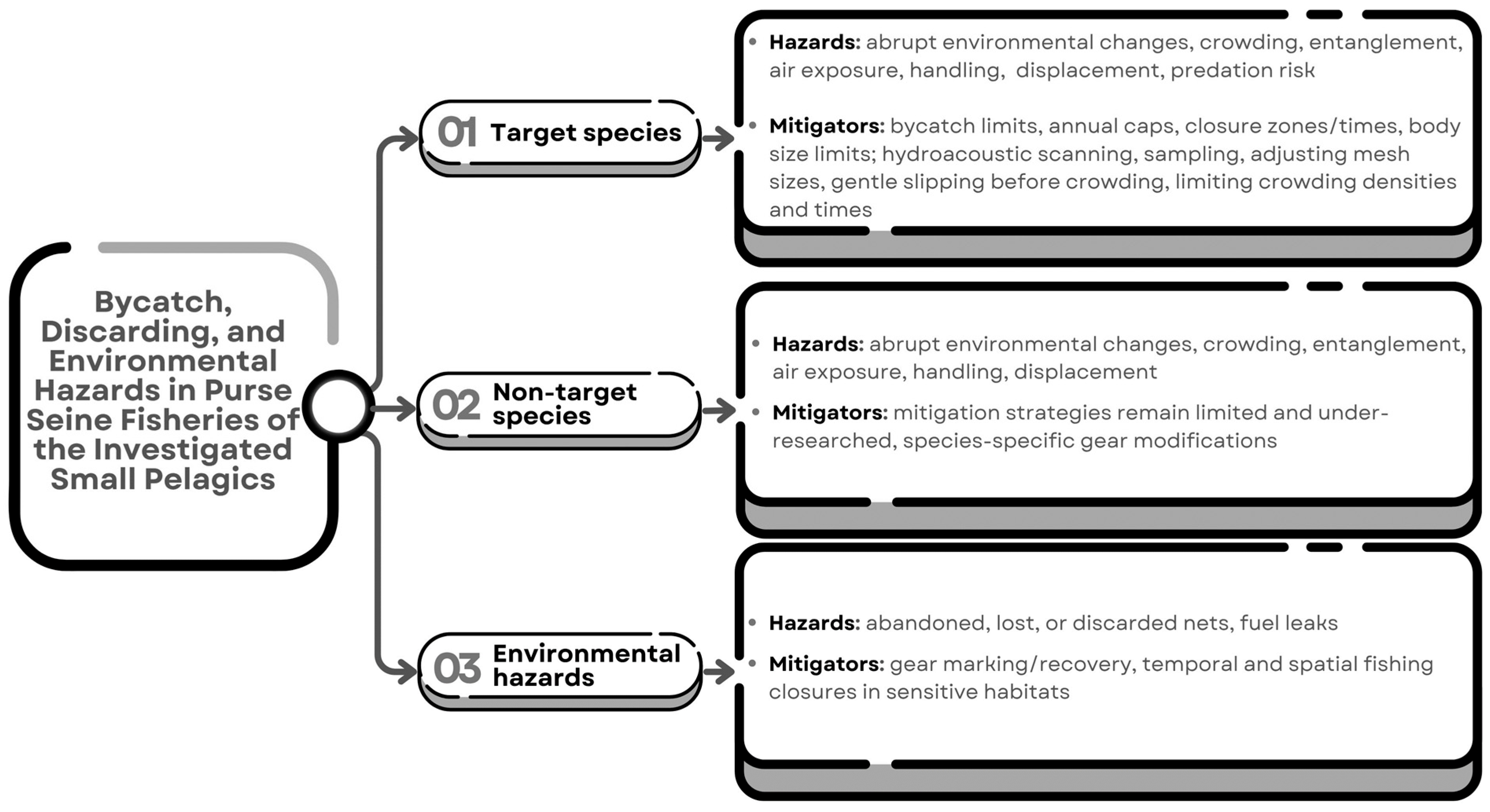
Figure 1. Sequential overview of all operational steps involved in the purse seine fishing method. This figure was created based on modified illustrations originally developed by Sciaena (https://www.sciaena.org/) for the Carefish/catch project, CC BY-NC-ND 4.0.
Fishes 10 00614 g001
Figure 2. Welfare hazards for target and non-target species through bycatch and discarding practices, as well as hazards for the environment through purse seine fisheries of the four investigated small pelagic species: C. harengus, E. ringens, S. colias, and S. scombrus.
Fishes 10 00614 g002
Figure 3. Integrative approach addressing ways to improve the welfare of target and non-target species as well as reduce the environmental impacts of purse seine fisheries of the four investigated small pelagic species: C. harengus, E. ringens, S. colias, and S. scombrus.
Fishes 10 00614 g003
Table 1. Main welfare hazards and corresponding potential mitigation measures during purse seine fishing operations targeting the small pelagic species: C. harengus, E. ringens, S. colias, and S. scombrus.
Fishing StageMain HazardsPotential Mitigation Measures
Prospection and settingNoise (sound emission patterns); artificial light; density increase during net setting; contact with net/conspecifics.Use lower-frequency or passive acoustic devices; limited submerged artificial light exposure; monitor/control fish density in the net.
Hauling and crowdingAbrupt temperature and salinity changes; crowding (duration and density); lack of oxygen; contact with net/conspecifics.Keep hauling speed (<0.2 m/s), crowding duration (<0.3 h), catch volumes low; night captures to reduce gear contact; avoid excessive crowding in last 20% of hauling low.
Scooping or pumping onboard (emersion)Abrupt temperature changes; crowding; entrapment of juveniles in small mesh; contact with net, gear (scoop net, pump), conspecifics; high pumping velocity/duration/catch volume; air exposure; predators (birds, marine mammals, turtles, sharks).Avoid fishing days with sharp difference between air and water temperature; avoid excessive crowding in last 20% of hauling; adapt mesh size to species/season; prefer pumping over scooping to reduce air exposure; reduce pumping speed, duration, and volume (e.g., 1.2–1.8 t/min, ≤85 min, ≤80 t).
Handling (i.e., release from the gear) and sortingAir exposure; handling (dropping, hard landing, trampling); manual sorting (throwing, pressure in boxes, crowding, etc.)Minimize handling/air exposure; use soft/cushioned landing surfaces; perform in-water sorting when possible.
StorageHigh stocking densities, pressure, and collisions in tanks/cages; air and ice exposure.Prefer immediate stunning + slaughter; for in-water storage, use large pens (≥4000 m3) in calm/cold waters and tow pens slowly (≤0.5–0.6 m/s); for in-tank storage, immerse in ice or ice water.
Stunning and slaughterLack of humane stunning protocols: air and ice slurry exposure.Implement rapid, efficient stunning followed by immediate slaughter; develop/validate scalable humane slaughter methods for purse seine catches.
Disclaimer/Publisher’s Note: The statements, opinions and data contained in all publications are solely those of the individual author(s) and contributor(s) and not of MDPI and/or the editor(s). MDPI and/or the editor(s) disclaim responsibility for any injury to people or property resulting from any ideas, methods, instructions or products referred to in the content.