
Backward-Compatible Hybrid Post-Quantum Qualified Electronic Signatures: Embedding ML-DSA-65 in PAdES for eIDAS



Abstract
1. Introduction
1.1. Motivation
1.2. The Compatibility Dilemma
- Legal validity today. The signature must remain a valid AdES/QES under the current rules, verifiable by the current validation ecosystem, namely the European Commission’s DSS library, national validation gateways, and desktop readers, none of which recognizes ML-DSA. A construction that these validators reject, or even flag as structurally altered, is not a QES.
- Quantum resilience tomorrow. The post-quantum evidence must be cryptographically bound to the same document and independently verifiable, so that its assurance survives even the total collapse of the classical algorithm.
1.3. Contributions
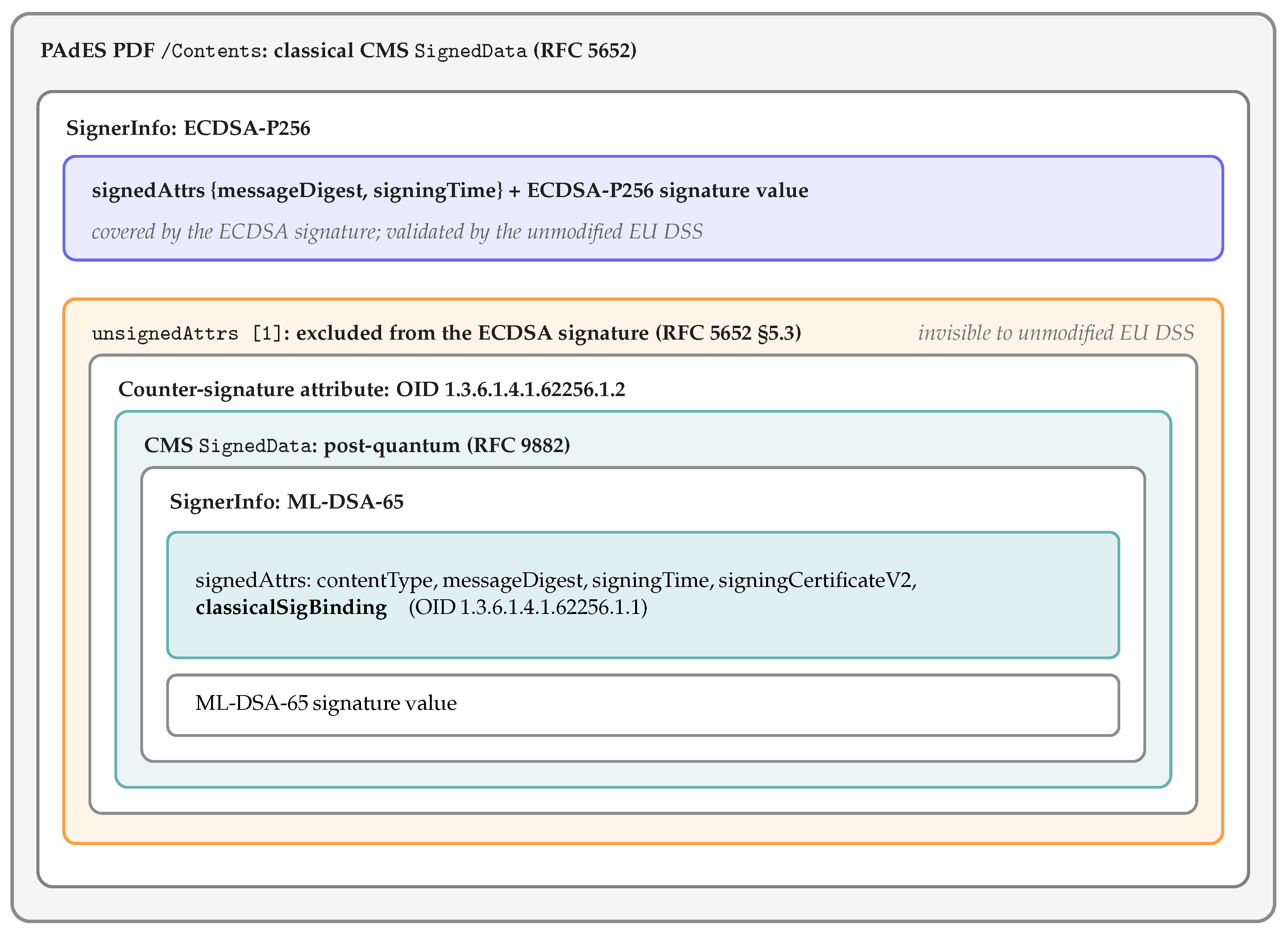
- A backward-compatible hybrid PAdES construction in which an ML-DSA-65 post-quantum signature is embedded as a post-quantum counter-signature (a self-contained CMS SignedData per RFC 9882) within the unsignedAttrs of the classical ECDSA SignerInfo. Because RFC 5652 §5.3 [10] excludes unsignedAttrs from the classical signature, an unmodified EU DSS 6.3 validator continues to validate the classical PAdES as TOTAL-PASSED (against a validator provisioned with the issuing CA), with an unchanged /ByteRange, while the post-quantum layer remains independently verifiable (Section 2.3, Section 3.1 and Section 3.2).
- A three-component cryptographic binding (classicalSigBinding) that ties the post-quantum layer to a specific (classical signature, signed attributes, signer certificate) triple, resisting the mix-and-match and cross-identity transplantation attacks that a naïve co-location of two signatures would admit (Section 2.4).
- An independent, fail-closed post-quantum validator that verifies the ML-DSA-65 signature natively (via liboqs), recomputes the binding from the raw PDF without trusting the container, and returns INDETERMINATE rather than a pass whenever document integrity or the binding cannot be established (Section 2.6 and Section 3.4).
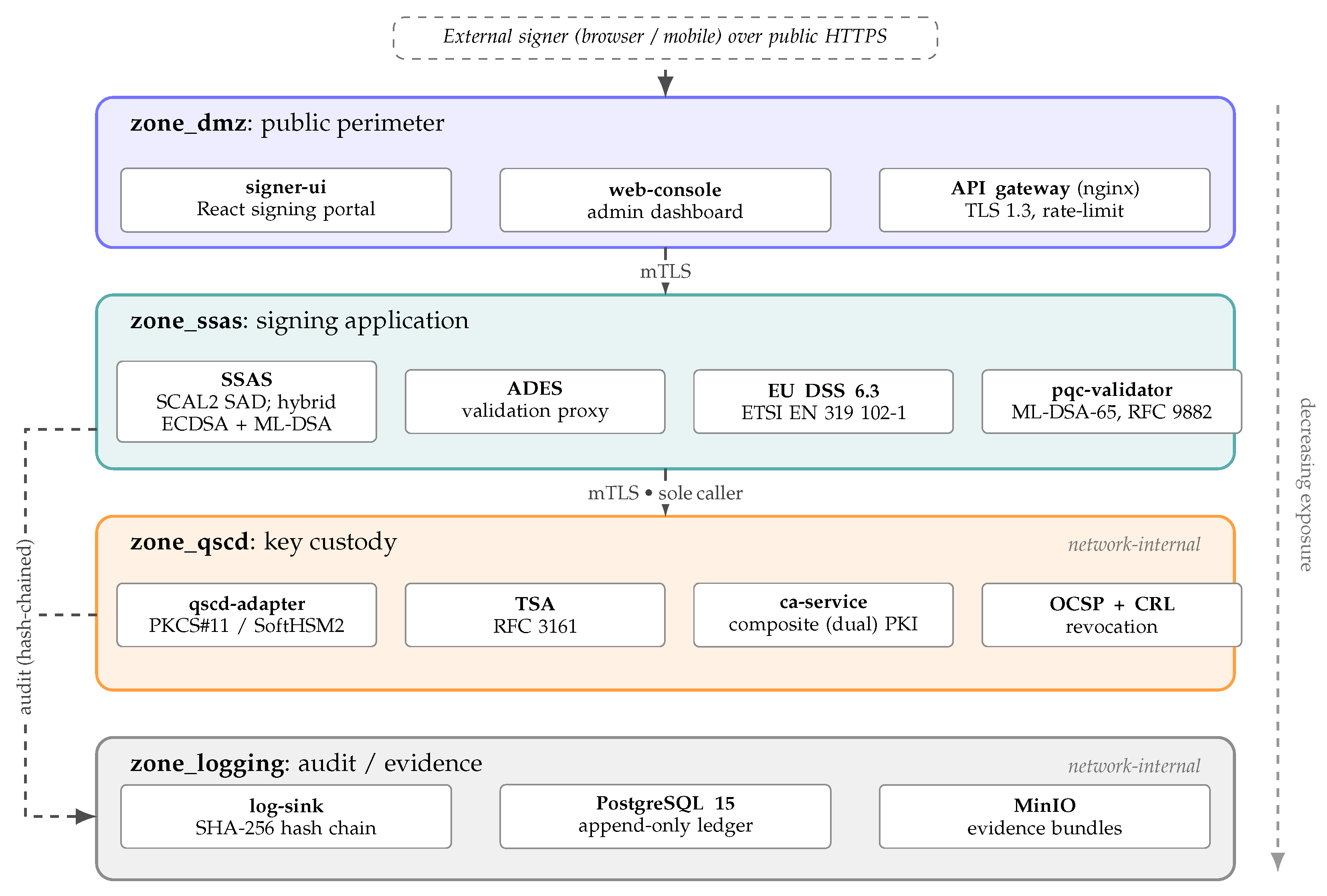
- A QTSP reference architecture situating the construction within a zoned, mutually-authenticated microservice mesh with sole-control signing, hash-chained audit, and a dual (classical + post-quantum) public-key infrastructure, mapped to eIDAS 2.0, ETSI, and CEN requirements (Section 2.8 and Section 3.9).
- A reproducible empirical evaluation on a running deployment, quantifying backward-compatible validation, tamper detection, long-term-validation support, and size/time overhead, accompanied by an evidence pack (Section 3).
1.4. Related Work
2. Materials and Methods
2.1. Cryptographic Primitives and Standards
2.2. Design Goal and Threat Model
- O1: Legacy acceptance. An unmodified, non-PQC-aware validator must accept the classical layer and must not reject the document as structurally altered.
- O2: Independent quantum-safe integrity. The document’s integrity and origin must remain provable from the ML-DSA-65 layer alone, even if ECDSA is fully broken.
- O3: Anti-transplant. The post-quantum layer of document A must not be reusable on document B, nor across signer identities, without detection.
- O4: Fail-closed validation. A validator that cannot establish document integrity or the inter-layer binding must not return a positive verdict.
2.3. Non-Disruptive Hybridization: CMS Counter-Signature Embedding
- The document is signed classically with ECDSA-P256 using the pyHanko library, producing a single PDF revision with a single /Contents holding the ECDSA SignedData. Crucially, the /Contents hexadecimal capacity is pre-reserved at this step to a size large enough to later accommodate the post-quantum layer (Section 2.5).
- The ECDSA SignedData is parsed with a BER/DER-safe ASN.1 reader.
- The signing service independently hashes the /ByteRange content with SHA-256 to obtain the message digest that the post-quantum signature will attest; this digest is computed directly from the document, not copied from the classical signature, giving Objective O2. One conformance boundary belongs here rather than in a footnote: RFC 9882 §3 lists SHA-384, SHA-512, SHA3-384, SHA3-512 and SHAKE256 as the digests to be used with ML-DSA-65, and not SHA-256. The artifacts measured in this article therefore pair a permitted signature algorithm with a digest the profile does not list, which bounds the strength of the pairing to that of the digest rather than to that of the parameter set. The builder has since moved to SHA-384.
- The classicalSigBinding is computed (Section 2.4).
- A complete, standalone ML-DSA-65 CMS SignedData is built (Section 2.5), carrying its own SignerInfo, signed attributes, and signature.
- That post-quantum SignedData is inserted, whole, as the value of a single CMS Attribute under the private OID 1.3.6.1.4.1.62256.1.2 (the post-quantum counter-signature attribute), placed in the unsignedAttrs [1] set of the existing ECDSA SignerInfo.
- The modified CMS is re-serialized by a surgical byte-level splice: appending the new unsignedAttrs element to the SignerInfo’s tag-length-value encoding without re-encoding any pre-existing field, and the enlarged SignedData is written back into the same /Contents, zero-padded to the reserved capacity so that its length, and therefore the /ByteRange, is invariant.
- An unmodified EU DSS validator sees an ECDSA PAdES whose signed bytes are byte-identical to step 1 and returns TOTAL-PASSED; a post-quantum-aware validator extracts and verifies the embedded ML-DSA-65 layer.
2.4. The Classical-Signature Binding
2.5. Custom RFC 9882 CMS Builder
2.6. Independent, Fail-Closed Post-Quantum Validator
2.7. The Discarded Alternative (Approach A) as a Negative Baseline
2.8. QTSP Reference Architecture
- Sole-control signing. SSAS enforces a CEN EN 419 241-1/-2 [27,28] SCAL2-style state machine (request → consent → execute), in which a Signature Activation Data (SAD) token binds a signing operation to the intersection of signer, device, key, and session, is consumed exactly once under an atomic database update before the key is invoked and is gated by a prior identity-verification (KYC) check aligned with eIDAS Article 24. A knowledge factor alone is explicitly rejected for high-assurance signatures. Figure 2 traces this activation through the full signing ceremony.
- Mutually-authenticated mesh. Internal calls use mutual TLS with per-service peer-identity allow-listing: a caller must present a CA-signed client certificate whose identity appears in the callee’s allow-list, so that a valid-but-unauthorized service certificate is rejected rather than merely “chaining to the CA”. The key-signing oracle accepts calls only from SSAS.
- Tamper-evident audit. Every security-relevant event is appended to a SHA-256 hash-chained ledger in an append-only PostgreSQL store, protected by row-level immutability triggers and a transaction-scoped advisory lock, with optional WORM export.
- Dual public-key infrastructure. The system maintains a classical PKI and a separate ML-DSA-65 PKI; the post-quantum value of the platform is concentrated at the document-signature layer described above, while the internal transport mesh is authenticated with the classical PKI (Section 4.5).
2.9. Reference Implementation, Evidence, and Scope
3. Results
3.1. Backward-Compatible Validation by Unmodified EU DSS 6.3
3.2. Cross-Implementation Validation and Byte Identity
3.3. Independent Verification of the Post-Quantum Layer
3.4. Tamper Detection and Fail-Closed Behavior
3.5. Size Overhead
3.6. Time Overhead
3.7. Behavior Under Concurrency
3.8. Deployment Resource Footprint
3.9. PAdES Levels and Standards-Conformance Mapping
4. Discussion
4.1. Why Embedding Rather than Appending
4.2. Comparison with Alternative Hybridization Strategies
4.3. Security Analysis
4.4. Position Within the European Standardization Programme
4.5. Limitations
4.6. Future Work
5. Conclusions
Author Contributions
Funding
Data Availability Statement
Acknowledgments
Conflicts of Interest
Abbreviations
| AdES | Advanced Electronic Signature |
| CAB | Conformity Assessment Body |
| CMS | Cryptographic Message Syntax |
| CRL | Certificate Revocation List |
| CRQC | Cryptographically Relevant Quantum Computer |
| DSS | Digital Signature Services |
| ECDSA | Elliptic Curve Digital Signature Algorithm |
| ML-DSA | Module-Lattice-Based Digital Signature Algorithm |
| OID | Object Identifier |
| PAdES | PDF Advanced Electronic Signatures |
| PKI | Public-Key Infrastructure |
| PQC | Post-Quantum Cryptography |
| QES | Qualified Electronic Signature |
| QSCD | Qualified Signature Creation Device |
| QTSP | Qualified Trust Service Provider |
| SAD | Signature Activation Data |
| SCAL2 | Sole-Control Assurance Level 2 |
| TSA | Time-Stamping Authority |
| TSL | Trusted Status List |
Appendix A
References
- European Parliament and Council. Regulation (EU) No 910/2014 on Electronic Identification and Trust Services for Electronic Transactions in the Internal Market (eIDAS). Off. J. Eur. Union 2014, L 257, 73–114. [Google Scholar]
- European Parliament and Council. Regulation (EU) 2024/1183 Amending Regulation (EU) No 910/2014 as Regards Establishing the European Digital Identity Framework (eIDAS 2.0). Off. J. Eur. Union 2024, 2024/1183, 30.4.2024. [Google Scholar]
- Shor, P.W. Polynomial-Time Algorithms for Prime Factorization and Discrete Logarithms on a Quantum Computer. SIAM J. Comput. 1997, 26, 1484–1509. [Google Scholar] [CrossRef] [Scilit]
- European Commission; Member States NIS Cooperation Group. A Coordinated Implementation Roadmap for the Transition to Post-Quantum Cryptography; European Commission: Brussels, Belgium, 2025. [Google Scholar]
- European Union Agency for Cybersecurity (ENISA). Post-Quantum Cryptography: Current State and Quantum Mitigation; ENISA: Athens, Greece, 2021.
- FIPS 203; Module-Lattice-Based Key-Encapsulation Mechanism Standard. NIST: Gaithersburg, MD, USA, 2024.
- FIPS 204; Module-Lattice-Based Digital Signature Standard. NIST: Gaithersburg, MD, USA, 2024.
- Internet Engineering Task Force. RFC 9882: Use of the ML-DSA Signature Algorithm in the Cryptographic Message Syntax (CMS); IETF: Fremont, CA, USA, 2025. [Google Scholar]
- Ounsworth, M.; Gray, J.; Klaußner, J.; Van Geest, D. Composite Module-Lattice-Based Digital Signature Algorithm (ML-DSA) for Use in Cryptographic Message Syntax (CMS); Internet-Draft draft-ietf-lamps-cms-composite-sigs-05; Internet Engineering Task Force (IETF): Fremont, CA, USA, 2026. [Google Scholar]
- Housley, R. RFC 5652: Cryptographic Message Syntax (CMS); IETF: Fremont, CA, USA, 2009. [Google Scholar]
- Thabet, M.; Tsili, A.; Krilakis, K.; Syvridis, D. Post-Quantum PKI: A Survey of Applications and Benchmarking Practices. Cryptography 2026, 10, 11. [Google Scholar] [CrossRef] [Scilit]
- Thomas, M.; Mathews, M.M.; V., P.; Sebastian, A.; Eswaran, S. Securing the Future: A Comprehensive Review of Post-Quantum Digital Signatures. Comput. Sci. Rev. 2026, 61, 100935. [Google Scholar] [CrossRef] [Scilit]
- Stebila, D.; Fluhrer, S.; Gueron, S. Hybrid Key Exchange in TLS 1.3; IETF: Fremont, CA, USA, 2025; work in progress. [Google Scholar]
- Schwabe, P.; Stebila, D.; Wiggers, T. Post-Quantum TLS Without Handshake Signatures (KEMTLS). In Proceedings of the ACM SIGSAC Conference on Computer and Communications Security (CCS); ACM: New York, NY, USA, 2020; pp. 1461–1480. [Google Scholar]
- Bindel, N.; Herath, U.; McKague, M.; Stebila, D. Transitioning to a Quantum-Resistant Public Key Infrastructure. In Post-Quantum Cryptography (PQCrypto 2017); LNCS 10346; Springer: Cham, Switzerland, 2017; pp. 384–405. [Google Scholar]
- Internet Engineering Task Force. RFC 9814: Use of the SLH-DSA Signature Algorithm in the Cryptographic Message Syntax (CMS); IETF: Fremont, CA, USA, 2025. [Google Scholar]
- Algar-Fernández, J.; Villacís-Vanegas, A.; Amaro-Aular, Y.; Cano, M.-D. Benchmarking Post-Quantum Signatures and KEMs on General-Purpose CPUs Using a TCP Client–Server Testbed. Computers 2026, 15, 116. [Google Scholar] [CrossRef] [Scilit]
- TS 119 312 V2.1.1; Electronic Signatures and Trust Infrastructures (ESI); Cryptographic Suites. ETSI: Sophia Antipolis, France, 2026.
- EN 319 102-1; Electronic Signatures and Infrastructures (ESI); Procedures for Creation and Validation of AdES Digital Signatures; Part 1. ETSI: Sophia Antipolis, France, 2021.
- EN 319 142-1 V1.2.1; Electronic Signatures and Infrastructures (ESI); PAdES Digital Signatures; Part 1: Building Blocks and PAdES Baseline Signatures. ETSI: Sophia Antipolis, France, 2024.
- EN 319 421; Electronic Signatures and Infrastructures (ESI); Policy and Security Requirements for Trust Service Providers Issuing Electronic Time-Stamps. ETSI: Sophia Antipolis, France, 2023.
- Adams, C.; Cain, P.; Pinkas, D.; Zuccherato, R. RFC 3161: Internet X.509 Public Key Infrastructure Time-Stamp Protocol (TSP); Internet Engineering Task Force (IETF): Fremont, CA, USA, 2001. [Google Scholar]
- National Institute of Standards and Technology. FIPS 206: FN-DSA Digital Signature Standard; NIST: Gaithersburg, MD, USA, 2025; in preparation.
- Recommendation X.690; ASN.1 Encoding Rules: Specification of Basic Encoding Rules (BER), Canonical Encoding Rules (CER) and Distinguished Encoding Rules (DER). ITU-T: Geneva, Switzerland, 2021.
- European Commission. Commission Implementing Regulation (EU) 2025/1945 of 29 September 2025 Laying Down Rules for the Application of Regulation (EU) No 910/2014 as Regards the Validation of Qualified Electronic Signatures and Qualified Electronic Seals and the Validation of Advanced Electronic Signatures and Seals Based on Qualified Certificates. Off. J. Eur. Union 2025, 2025/1945, 30.9.2025. [Google Scholar]
- TR 119 330-2-1 V0.0.1; Electronic Signatures and Trust Infrastructures (ESI); Post Quantum Cryptography (PQC); Impact of Post Quantum Cryptography on Electronic Signatures and Trust Infrastructures Standards; Part 2: PQC Impact on TSPs Supporting Digital Signatures and Related Service, Including Signature Preservation; Sub-Part 1: Impact on Policy and Security Requirements. ETSI: Sophia Antipolis, France, 2026; initial working draft.
- EN 419 241-1; Trustworthy Systems Supporting Server Signing; Part 1: General System Security Requirements. CEN: Brussels, Belgium, 2018.
- EN 419 241-2; Trustworthy Systems Supporting Server Signing; Part 2: Protection Profile for QSCD for Server Signing. CEN: Brussels, Belgium, 2019.
- EN 419 221-5; Protection Profiles for TSP Cryptographic Modules; Part 5: Cryptographic Module for Trust Services. CEN: Brussels, Belgium, 2018.
- European Commission. Commission Implementing Decision (EU) 2016/650 of 25 April 2016 Laying Down Standards for the Security Assessment of Qualified Signature and Seal Creation Devices. Off. J. Eur. Union 2016, L 109, 40–42. [Google Scholar]
- TS 119 431-1; Electronic Signatures and Infrastructures (ESI); Policy and Security Requirements for Trust Service Providers; Part 1: TSP Service Components Operating a Remote QSCD/SCDev. ETSI: Sophia Antipolis, France, 2023.
- EN 319 401; Electronic Signatures and Infrastructures (ESI); General Policy Requirements for Trust Service Providers. ETSI: Sophia Antipolis, France, 2021.
- European Cybersecurity Certification Group. Agreed Cryptographic Mechanisms, Version 2; ENISA: Athens, Greece, 2025.
- Bindel, N.; Hale, B.; Connolly, D.; Driscoll, F. RFC 9955: Hybrid Signature Spectrums; Internet Engineering Task Force (IETF): Fremont, CA, USA, 2026. [Google Scholar]
- Ounsworth, M.; Gray, J.; Pala, M.; Klaußner, J.; Fluhrer, S. Composite Module-Lattice-Based Digital Signature Algorithm (ML-DSA) for Use in X.509 Public Key Infrastructure; Internet-Draft draft-ietf-lamps-pq-composite-sigs-19; Internet Engineering Task Force (IETF): Fremont, CA, USA, 2026. [Google Scholar]
- NIST IR 8547; Transition to Post-Quantum Cryptography Standards. NIST: Gaithersburg, MD, USA, 2024; Initial Public Draft.



| Role | Algorithm | Parameters | Standard |
|---|---|---|---|
| Classical document signature | ECDSA | secp256r1 (P-256), SHA-256 | FIPS 186-5; ETSI TS 119 312 [18] |
| Issuing CA key | RSA | 4096-bit | – |
| Post-quantum document signature | ML-DSA-65 | pub 1952 B, sig 3309 B, priv 4032 B; OID 2.16.840.1.101.3.4.3.18 | FIPS 204 [7] |
| Signature container | CMS SignedData | ML-DSA in CMS per RFC 9882 [8] | RFC 5652 [10] |
| Document signature format | PAdES-BASELINE (B/T/LT/LTA) | procedures per EN 319 102-1 [19] | ETSI EN 319 142-1 [20] |
| Private-key protection at rest | AES-256-GCM envelope | 96-bit nonce, 128-bit tag | – |
| Timestamping | RFC 3161 TSP | ≤1 s accuracy | ETSI EN 319 421 [21]; RFC 3161 [22] |
| DSS Building Block | Result |
|---|---|
| Format checking (/ByteRange consistent, one SignerInfo) | PASSED |
| Identification of signing certificate | PASSED |
| Cryptographic verification (message digest intact, signature intact) | PASSED |
| Signature acceptance validation (signed attributes present) | PASSED |
| Signature format | PAdES-BASELINE-LTA |
| Embedded revocation data (DSS/VRI dictionary) | PRESENT |
| Archival document timestamp (DocTimeStamp) | PRESENT |
| Cryptographic-failure sub-indications | NONE (all absent) |
| Overall AdES indication (issuing CA trusted) | TOTAL-PASSED |
| Overall AdES indication (public EU LOTL) | INDETERMINATE/NO_CERT_CHAIN |
| Qualification: trusted list reached | ERROR (reference CA not on TSL, expected) |
| Implementation | Stack | Classical | Hybrid | Hybrid + LT/LTA |
|---|---|---|---|---|
| EU DSS 6.3 | OpenJDK 21.0.12/BouncyCastle | all building blocks PASSED | identical report (5 of 744 leaves differ, none substantive) | TOTAL-PASSED; PAdES-BASELINE-LTA |
| pyHanko 0.36.2 | Python 3.11/asn1crypto | intact, valid; modification NONE | intact, valid; modification NONE | intact, valid; FORM_FILLING (Signature1) |
| OpenSSL 3.5.6 | C | CMS verification successful (97 ASN.1 elements) | CMS verification successful (446 elements) | CMS verification successful (816 elements) |
| endesive 2.19.3 | Python/asn1crypto | intact, valid; no PQC attribute | intact, valid; PQC attribute present | AssertionError, no verdict returned |
| Validation Check | Result | Time (ms) |
|---|---|---|
| CMS structure parsing | PASS | 0.099 |
| PQC algorithm identification | PASS | 0.001 |
| Certificate/public-key extraction | PASS | 0.130 |
| Message-digest verification (/ByteRange) | PASS | 0.135 |
| classicalSigBinding verification | PASS | 0.001 |
| Cryptographic ML-DSA-65 signature check | PASS | 0.176 |
| Certificate validity period | PASS | 0.008 |
| PQC chain validation | PASS | 0.157 |
| Signing-time verification | PASS | 0.001 |
| Quantity | Value |
|---|---|
| Input PDF | 1465 B |
| ML-DSA-65 signature | 3309 B (FIPS 204) |
| ML-DSA-65 public key | 1952 B (FIPS 204) |
| ECDSA-signed PDF | 26,665 B |
| Hybrid-signed PDF | 64,977 B |
| Observed size overhead (hybrid − ECDSA) | +38,312 B |
| Mode | Latency (ms) |
|---|---|
| Classical (ECDSA-P256) | 288 ± 6 |
| Hybrid (ECDSA-P256 + ML-DSA-65) | 517 ± 12 |
| Post-quantum overhead | +229 (≈+79%) |
| Classical | Hybrid | |||||
|---|---|---|---|---|---|---|
| Document | p50 | p99 | p50 | p99 | Overhead | % |
| 1061 B | 11.3 | 12.4 | 16.2 | 19.0 | 4.9 | 43 |
| 102,443 B | 11.7 | 12.6 | 17.0 | 19.1 | 5.3 | 45 |
| 1,048,621 B | 14.4 | 19.6 | 22.9 | 31.0 | 8.5 | 59 |
| 10,485,807 B | 37.4 | 43.8 | 77.2 | 84.4 | 39.8 | 107 |
| Phase | p50 | p95 | Min | Max |
|---|---|---|---|---|
| request (session, identity gate) | 77.0 | 106.9 | 65.5 | 129.2 |
| consent (device assertion, SAD) | 63.8 | 91.8 | 59.1 | 98.6 |
| execute (key custody, signature) | 128.9 | 173.9 | 122.4 | 185.5 |
| Total | 269.7 | 364.2 | 253.7 | 395.1 |
| Concurrency | Ceremonies/s | p50 | p95 | Request | Consent | Execute |
|---|---|---|---|---|---|---|
| 1 | 4.03 | 237.4 | 350.8 | 63.7 | 56.3 | 116.6 |
| 2 | 5.84 | 328.5 | 420.2 | 89.5 | 77.9 | 157.6 |
| 4 | 6.63 | 585.0 | 730.8 | 155.9 | 137.9 | 289.1 |
| 8 | 7.34 | 1075.3 | 1165.9 | 279.3 | 263.0 | 526.2 |
| 16 | 7.37 | 2082.6 | 2427.4 | 518.1 | 523.1 | 1037.1 |
| Component | CPU-s | ms/Ceremony | Share |
|---|---|---|---|
| ssas (signing application) | 8.74 | 87.4 | 27.0% |
| postgres | 7.67 | 76.7 | 23.7% |
| log-sink (audit ledger) | 7.43 | 74.3 | 23.0% |
| qscd-adapter | 2.70 | 27.0 | 8.4% |
| user-service | 1.59 | 15.9 | 4.9% |
| keycloak | 1.01 | 10.1 | 3.1% |
| api-gw | 0.92 | 9.2 | 2.8% |
| softhsm | 0.20 | 2.0 | 0.6% |
| Cryptography (qscd-adapter + softhsm + tsa) | 3.05 | 30.5 | 9.4% |
| Orchestration, persistence, audit (ssas + postgres + log-sink) | 23.85 | 238.5 | 73.7% |
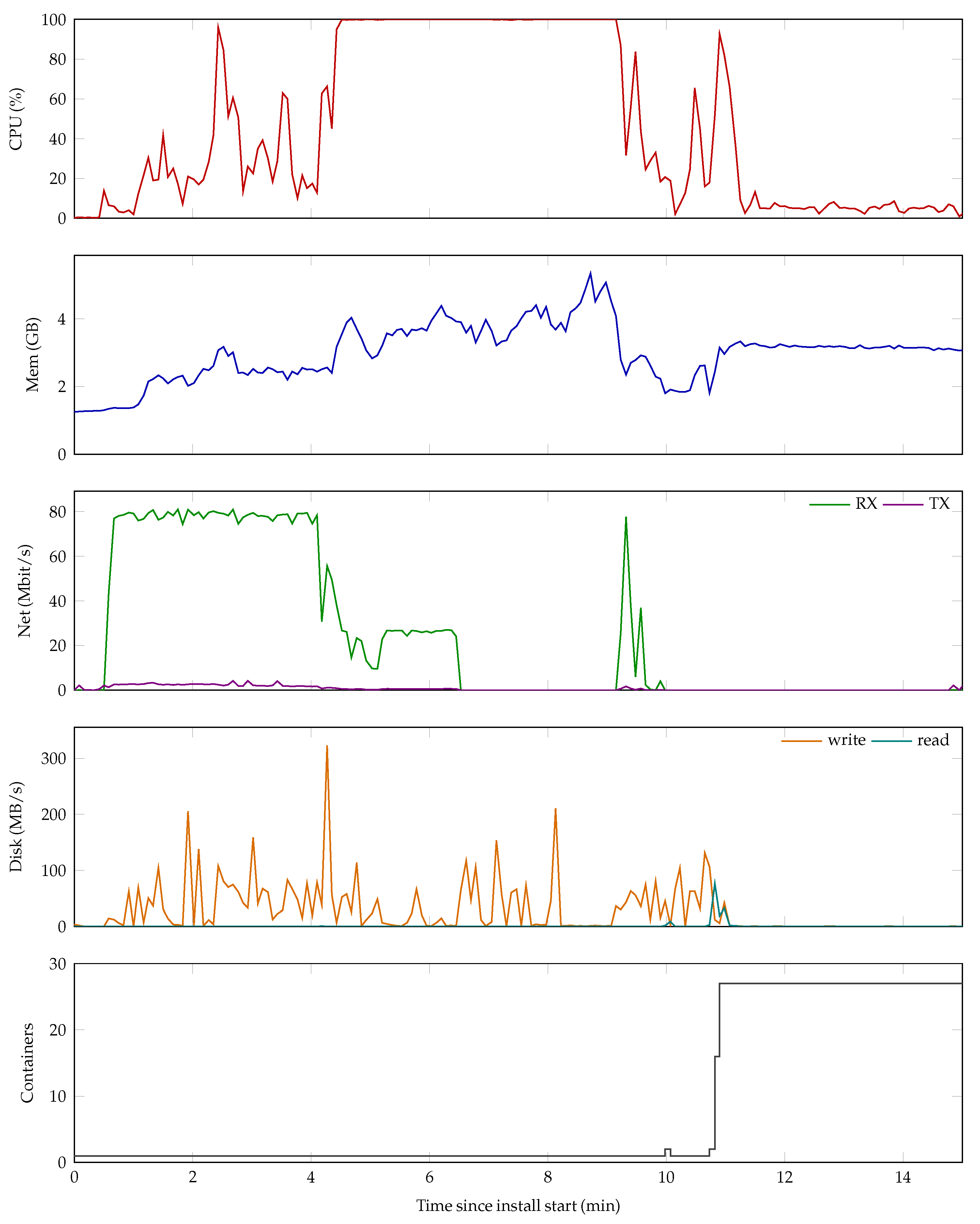
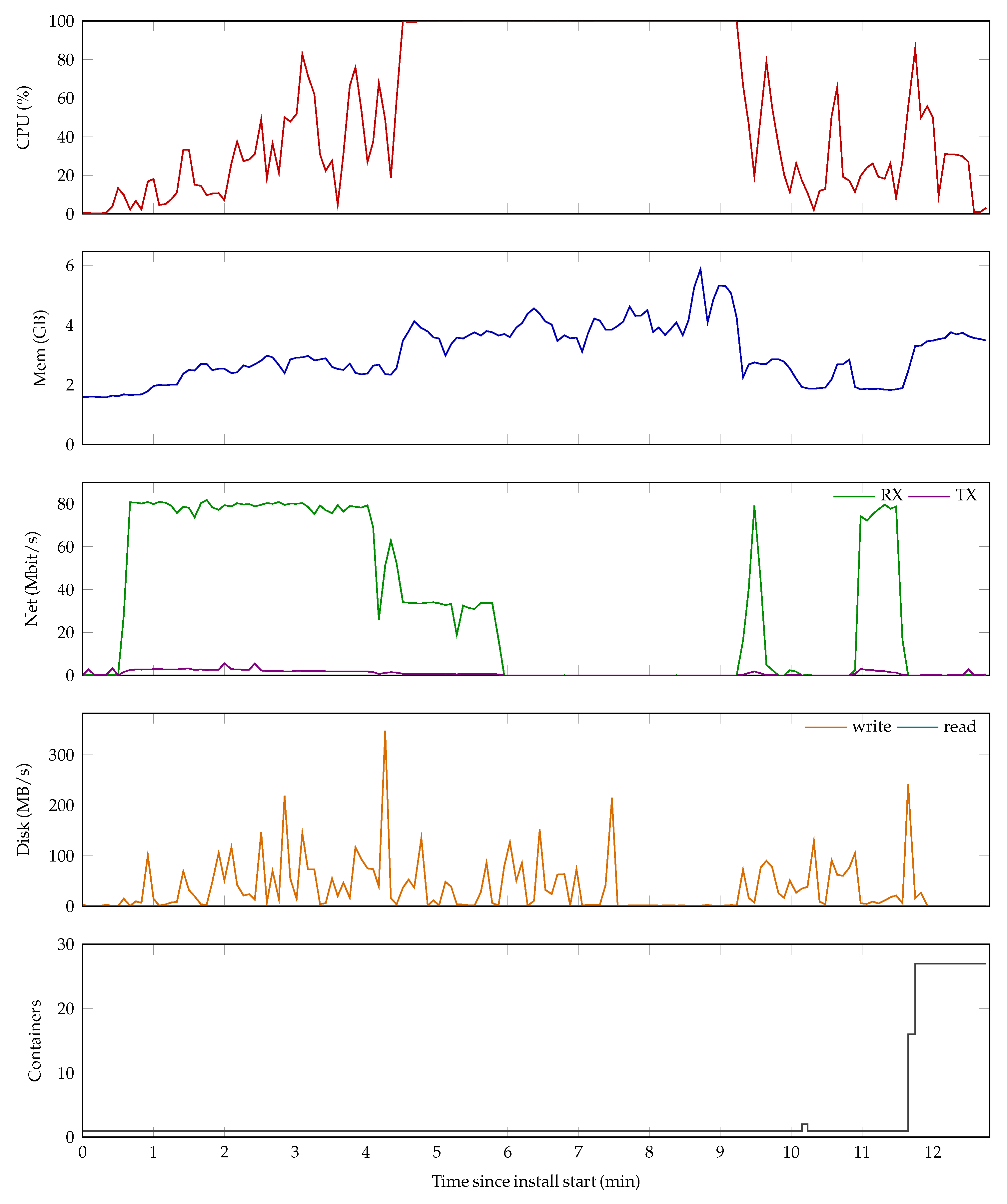
| Metric | Cold Build | Full Pull |
|---|---|---|
| Total wall-clock (min) | 14.6 | 12.3 |
| CPU peak/mean (%) | 100/46 | 100/55 |
| Peak resident memory (GB) | 5.3 | 5.9 |
| Network received, total (GB) | 2.7 | 3.0 |
| Network receive, peak (Mbit/s) | 81 | 82 |
| Disk written, total (GB) | 25.6 | 27.1 |
| Disk write, peak (MB/s) | 323 | 348 |
| On-disk footprint added (GB) | 17.9 | 19.2 |
| Containers started | 27 | 27 |
| Standard | Requirement Area | Realization in the Platform |
|---|---|---|
| Reg. (EU) 910/2014 + 2024/1183 [1,2] | QTSP/QES framework | Reference QTSP architecture; QES-shaped PAdES |
| FIPS 204 [7] | Post-quantum signature | ML-DSA-65 (category 3) |
| RFC 9882 [8] | ML-DSA in CMS | Hand-built CMS with ML-DSA-65 OID, absent params |
| RFC 5652 [10] | CMS SignedData; unsignedAttrs | Counter-signature carrier; §5.3 non-coverage exploited |
| ETSI EN 319 142-1 [20] | PAdES formats | B/T/LT/LTA |
| ETSI EN 319 102-1 [19] | AdES creation/validation | Validator indications; fail-closed verdicts |
| ETSI TS 119 431-1 [31] | Remote QSCD signing (SSAS) | request → consent → execute |
| CEN EN 419 241-2 [28] | SCAL2 sole control | SAD state machine, enforced; relaxed attestation |
| ETSI EN 319 401 [32] | TSP policy/security | Hash-chained audit; peer-identity mesh |
| ETSI EN 319 421 [21] | Timestamping | RFC 3161 TSA (classical layer); serial allocation serialized for §6.2.1 uniqueness |
Disclaimer/Publisher’s Note: The statements, opinions and data contained in all publications are solely those of the individual author(s) and contributor(s) and not of MDPI and/or the editor(s). MDPI and/or the editor(s) disclaim responsibility for any injury to people or property resulting from any ideas, methods, instructions or products referred to in the content. |
© 2026 by the authors. Licensee MDPI, Basel, Switzerland. This article is an open access article distributed under the terms and conditions of the Creative Commons Attribution (CC BY) license.
Share and Cite
Doynov, R.; Nenova, M.; Todovichin, G.; Shestakov, A. Backward-Compatible Hybrid Post-Quantum Qualified Electronic Signatures: Embedding ML-DSA-65 in PAdES for eIDAS. Cryptography 2026, 10, 70. https://doi.org/10.3390/cryptography10050070
Doynov R, Nenova M, Todovichin G, Shestakov A. Backward-Compatible Hybrid Post-Quantum Qualified Electronic Signatures: Embedding ML-DSA-65 in PAdES for eIDAS. Cryptography. 2026; 10(5):70. https://doi.org/10.3390/cryptography10050070
Chicago/Turabian StyleDoynov, Rumen, Maria Nenova, Georgi Todovichin, and Alexander Shestakov. 2026. "Backward-Compatible Hybrid Post-Quantum Qualified Electronic Signatures: Embedding ML-DSA-65 in PAdES for eIDAS" Cryptography 10, no. 5: 70. https://doi.org/10.3390/cryptography10050070
APA StyleDoynov, R., Nenova, M., Todovichin, G., & Shestakov, A. (2026). Backward-Compatible Hybrid Post-Quantum Qualified Electronic Signatures: Embedding ML-DSA-65 in PAdES for eIDAS. Cryptography, 10(5), 70. https://doi.org/10.3390/cryptography10050070