
Article

DPS: A Post-Quantum Proxy Signature Scheme from Dilithium for IoT Applications
1
College of Cyber Security, Jinan University, Guangzhou 510630, China
2
School of Computer Science and Cyber Engineering, Guangzhou University, Guangzhou 510006, China
*
Author to whom correspondence should be addressed.
Cryptography 2026, 10(3), 33; https://doi.org/10.3390/cryptography10030033

Submission received: 17 March 2026 / Revised: 30 April 2026 / Accepted: 11 May 2026 / Published: 15 May 2026
(This article belongs to the Special Issue Advances in Post-Quantum Cryptography)

Abstract

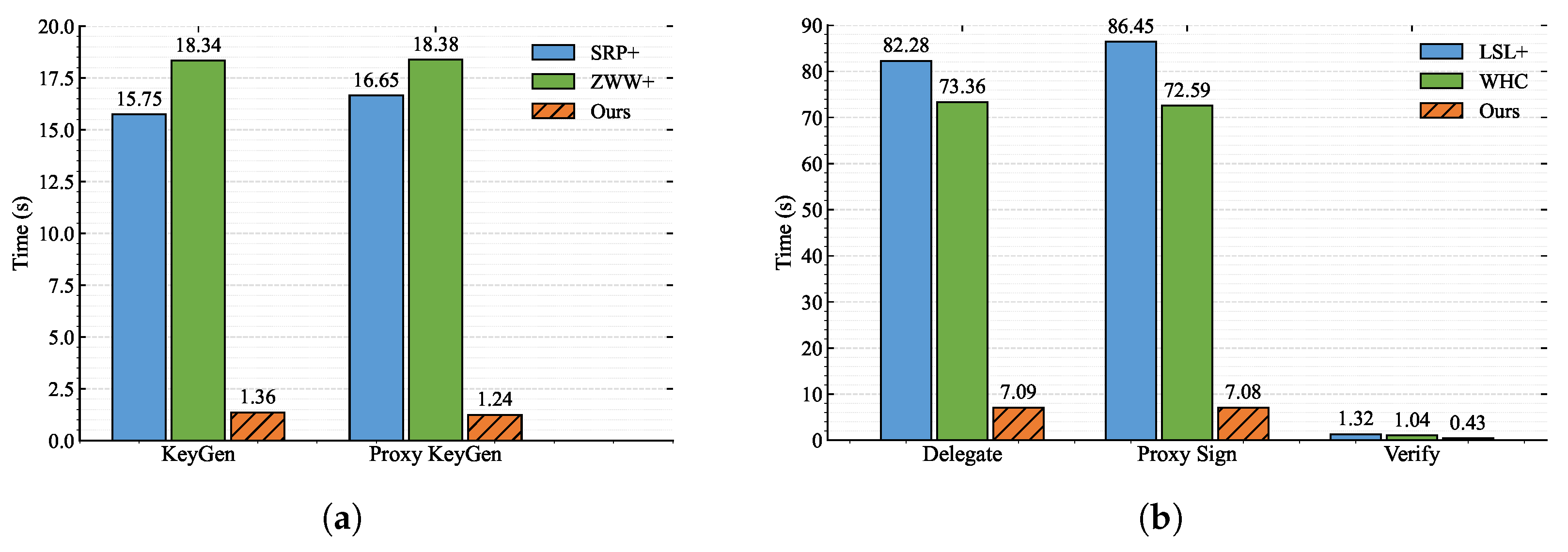
Proxy signatures enable the secure delegation of signing authority, which is particularly useful in resource-constrained Internet of Things (IoT) environments. However, most existing schemes rely on classical hardness assumptions and therefore cannot resist quantum attacks. To address the challenge, we propose a post-quantum proxy signature scheme based on Dilithium for IoT scenarios. We first propose an asynchronous remote key generation (ARKG) scheme based on CRYSTALS-Kyber, enabling the delegator and proxy signer to generate proxy keys of Dilithium without real-time interaction. We further integrate ARKG with the Dilithium signature scheme to construct a proxy signature scheme called DPS while ensuring the unlinkability of proxy signatures. Additionally, our proposed DPS achieves post-quantum security and provides unforgeability, distinguishability, verifiability, and undeniability with formal proofs. Experimental performance evaluation shows that our scheme yields significant efficiency gains over existing quantum-safe proxy signature solutions, with 10× speedup for both the delegation and proxy signing phases, as well as a 2.4× improvement in the verification phase.
Keywords: proxy signature; post-quantum cryptography; Dilithium-QROM; lattice-based cryptography; CRYSTALS-Kyber; Internet of Things proxy signature; post-quantum cryptography; Dilithium-QROM; lattice-based cryptography; CRYSTALS-Kyber; Internet of Things