1. Introduction
Recent advances in artificial intelligence (AI) algorithms, especially deep learning (DL), and their applications significantly contributed to solving problems, facilitating services across various domains, and creating new technologies. One of the most important AI-based technologies is the deepfake, which relies on the use of DL algorithms to process multimedia content such as videos and images, generating fake but highly realistic media that closely resemble the original content. This makes deepfakes very difficult to distinguish from original content [
1,
2]. Although this technology has brought many benefits in various fields, its misuse has caused numerous risks and severe consequences for individuals and societies. Deepfake techniques have been exploited in various cyberattacks, including impersonating organizations and individuals for fraud and blackmail. This technology has also been used by cybercriminals to spread fake content, leading to privacy violation, and misleading. For instance, deepfake technology was used to facilitate the creation of misleading political information by manipulating videos or audios of specific individuals or organizations and disseminating these fake contents on social media platforms [
3,
4,
5,
6,
7,
8].
Researchers realized the importance of developing countermeasures to avoid the distribution of deepfakes and mitigate its threats. These countermeasures can be categorized into technical and non-technical. Non-technical countermeasures include policies, laws and regulations, ethical standards, and awareness that aim to avoid the dissemination of deepfake content and impose deterrent penalties on perpetrators of cybercrimes related to deepfakes. While non-technical countermeasures are essential, they are insufficient on their own to counter the constantly evolving deepfake technology and its widespread use [
9,
10,
11,
12,
13,
14,
15,
16,
17,
18].
Additionally, researchers explored various technical methods to develop effective systems to counter the threats of deepfake. The technical methods explored in previous studies include using AI-based technologies such as DL to develop effective deepfake detection tools that facilitate distinguishing deepfakes from authentic content [
19,
20,
21,
22,
23,
24,
25]. However, these tools can be costly, time-consuming, and resource-intensive, and they may be unable to keep pace with the continuously rapid evolution of deepfake technology. Also, the emergence of open-source tools to generate deepfakes has made the deepfake prevention harder.
Researchers also investigated the use of watermarking and blockchain technologies to counter deepfakes. These technologies can provide significant features such as authentication and integrity that are crucial to avoid deepfakes. However, blockchain and related technologies face significant challenges related to scalability, performance, and interoperability [
26,
27,
28,
29,
30].
Another promising approach relies on the use of symmetric and asymmetric ciphers to counter the distribution of deepfakes. In particular, researchers investigated the use of digital signature algorithms (DSAs) provided by various asymmetric ciphers to offer essential security services to counter deepfake, including integrity, authentication, and non-repudiation [
31,
32,
33,
34]. Nonetheless, classical public-key cryptosystems, such as RSA and ECC, are vulnerable to attacks from quantum computing; an attacker could potentially exploit superior quantum computers to compromise the underlying mathematical problems of the classical cryptosystems, enabling them to sign deepfake content as if it were authentic and original [
35]. In order to address the risks posed by quantum computing attacks, researchers and standardization organizations like NIST have developed post-quantum cryptographic algorithms (PQCAs) to provide digital signature services. Digital signature schemes based on PQCAs can offer long-term security and strong resistance against quantum computing threats [
35,
36,
37]. However, the application of digital signature schemes based on PQCAs to avoid the distribution of deepfakes has not been thoroughly investigated. Furthermore, the performance and resource consumption of the emerging quantum-resilient symmetric and asymmetric ciphers have not been evaluated sufficiently. This is important to identify the most efficient cipher to perform cryptographic operations necessary to counter the media manipulation.
This research aims to develop an effective deepfake prevention approach utilizing both symmetric and asymmetric ciphers. The digital signature operations are provided using asymmetric PQCAs, while encryption and decryption operations are performed using symmetric PQCAs. The study explores the implementation of the main PQCAs recently standardized by NIST, which are Dilithium-5, Falcon-512, SLH-DSA, and Ascon-80pq. Moreover, the study implements classical asymmetric ciphers and provides detailed analyses and comparisons between various encryption and digital signature schemes, in terms of performance and resource consumption, to offer a deeper understanding of the variations between different ciphers. The analysis and comparison between different ciphers under both symmetric and asymmetric categories seek to identify the most efficient cipher to integrate into the deepfake prevention approach, maximizing performance while minimizing resource usage.
The next section provides an overview of the recent research studies on countermeasures to mitigate the threats posed by deepfakes.
2. Literature Review
Researchers investigated several techniques to counter deepfakes. Some of these techniques rely on the frequency domain analysis (FDA), which enables them to capture subtle artifacts introduced during the image generation process by converting data into the frequency domain [
38]. Studies showed that the FDA technique can enhance deepfake detection by revealing anomalies in media content manipulated by DL technology [
7].
Studies also investigated the integration of Explainable AI (XAI) techniques to improve the transparency and interpretability of deepfake detection systems [
39,
40,
41,
42]. Researchers demonstrated that the use of XAI techniques has the potential to enhance deepfake detection accuracy.
Another technique employed in fighting the spread of deepfake content are the adversarial detection methods. These methods aim to counter the adversarial attacks and prevent them from deceiving deepfake detection systems [
43,
44,
45].
Furthermore, researchers investigated the use of AI-based models, particularly DL models, to enhance deepfake detection systems. Convolutional Neural Networks (CNNs) were utilized due to their ability to automatically extract complex features from media content without the need for manual feature building [
46]. Experimental research studies demonstrated the CNN models can improve the accuracy of deepfake detection systems and enable those systems to generalize and function better on unseen data [
47]. Other research has explored the use of unsupervised learning models for deepfake detection. These models are promising since they can identify anomalies in images and videos without the need for labeled datasets. In [
19], researchers developed a model to reconstruct input images and highlight discrepancies between the original and reconstructed or manipulated images. Then, the model was used to detect content manipulated by deepfake technology. Research studies also explored the applications of clustering algorithms [
20], and generative adversarial networks (GANs) [
21]. In both research attempts, AI models were trained to distinguish between fake and original content. Experimental results show that these AI-based techniques can enhance the accuracy of deepfake detection systems. Researchers also investigated the use of hybrid AI-based methods to enhance the capabilities of deepfake detection systems. In [
48], CNNs and Long Short-Term Memory (LSTM) algorithms were combined to enhance the system’s ability to detect inconsistencies across multiple video frames.
Additionally, previous research has utilized traditional methods to develop deepfake detection systems. These methods were mainly based on Image Forensics-Based [
49,
50,
51,
52], and signal processing-based techniques [
53,
54]. Although these techniques demonstrated the ability to enhance deepfake detection, they are not sufficient to counter recent advances and sophisticated technologies used to generate deepfake content.
Recent research directions have focused on investigating the use of content authentication and data integrity technologies to develop more efficient deepfake prevention systems. Within this effort, three main technologies were involved: blockchain, watermarking, and cryptographic digital signature algorithms. In [
55], researchers developed a system to avoid the spread of deepfake content by integrating blockchain and watermarking technologies. They used Digimarc audio and image watermarking to generate the watermark required to verify the integrity of the media content, and the Ethereum blockchain to store the metadata of the content. Due to the storage capacity of blockchain, the researchers employed the InterPlanetary File System (IPFS) technology to store the original media content and its metadata. The proposed approach demonstrates significant potential to prevent the dissemination of deepfake content and facilitate forensic analysis efforts. However, the proposed system requires high costs for design and implementation because it involves using IPFS and blockchain. Moreover, the performance of the system may suffer from low throughput and scalability challenges due to its reliance on Ethereum blockchain. In [
56], authors developed a blockchain-based system to authenticate images and proactively mitigate the spread of deepfakes. They utilized security features of blockchain to authenticate images and trace back their sources. A prototype implementation for a deepfake prevention system using the Hyperledger Fabric blockchain was introduced in [
57]. Various studies in the literature [
58,
59,
60,
61,
62,
63,
64,
65] employed blockchain technology to develop an effective system that can mitigate the threats of deepfakes in different domains and businesses. Moreover, blockchain was utilized to enhance the privacy in identity management systems [
66] and provide robust security services in the field of education [
67]. Overall, blockchain-based solutions offer reliable content authentication mechanisms; however, they are considered costly and suffer from scalability and interoperability issues.
Recent studies have explored the use of cryptographic DSAs to combat deepfakes. DSAs can provide significant security services, including authentication, integrity, and non-repudiation. These services are vital to secure digital communication systems and are essential for mitigating the risks associated with the proliferation of deepfakes in various domains. RSA is one of the widely used cryptosystems to provide digital signatures [
31]. However, ECC has gained increasing popularity recently, as it provides a comparable level of security while consuming fewer resources and less time [
33]. In [
68], researchers presented a framework based on ECC DSA to prevent deepfakes. The proposed framework uses an ECC digital signature to authenticate and ensure the integrity of images and videos. Authors suggest increasing the societal awareness of the importance of using DSAs to avoid the proliferation of deepfake content.
Experimental research showed that traditional public key cryptosystems are vulnerable to quantum computer attacks. Therefore, the research is now shifting towards using algorithms that are quantum-resilient to provide digital signatures. NIST recently announced three main PQCAs, which are CRYSTALS-Dilithium, Falcon, and SPHINCS+ algorithms [
69]. The integration of PQCAs in deepfake prevention systems is not adequately investigated.
It is worth mentioning that recent advancements in deepfake technologies have significantly increased the sophistication, realism, and scalability of fabricated media files, thereby posing substantial challenges to existing detection systems. Latest research studies showed that two notable research directions—advanced GAN architectures and federated learning-based detection frameworks—have emerged.
Modern generative adversarial network (GAN) variants, such as StyleGAN, StyleGAN2, and StyleGAN3, have dramatically improved the photorealism and consistency of synthetic images and videos. These models have improved the ability to generate highly realistic facial features with minimal visual artifacts [
70,
71,
72]. As a result, deepfakes generated using StyleGAN-based pipelines are increasingly difficult to detect using traditional methods, such as artifact-based or frequency-domain analysis. Recent experimental research studies demonstrate that many state-of-the-art deepfake detection systems experience notable performance degradation when evaluated against StyleGAN-generated media content [
23,
38].
Another emerging research direction focuses on employing federated learning (FL) for deepfake detection and content moderation. FL enables multiple platforms to collaboratively train detection models without sharing raw data, thereby preserving user privacy and complying with data protection regulations [
73]. While FL-based solutions improve scalability and privacy, they introduce additional challenges related to communication overhead, model convergence, and vulnerability to poisoned updates [
25].
Despite their promise, both advanced GAN-based generation and FL-based detection approaches have considerable limitations: they remain inherently reactive and depend on continuously evolving machine learning models, which require significant computational and operational costs.
In summary, previous studies have explored various methods and technologies to counter the threats posed by deepfakes. AI-based technologies, in particular DL algorithms, have been employed to develop effective systems for deepfake detection. While AI-based techniques can enhance detection accuracy, they struggle against the continuously evolving technologies used to create deepfakes. Additionally, AI-based methods need significant resources and rely on large datasets. Many of these methods also face challenges related to performance and reliability.
Traditional methods that use Image Forensics and signal processing for detecting deepfakes have their limitations in terms of accuracy as well.
Other notable studies have focused on utilizing content authentication technologies such as blockchain and watermarking. Although these technologies can effectively validate the authenticity and integrity of digital content, blockchain-based systems come with high costs and encounter issues related to scalability and interoperability.
Another important direction in research has involved the use of cryptographic digital signature algorithms (DSA) to verify both the authenticity and integrity of digital data. This approach can provide essential security services that help mitigate the spread of deepfakes. These services include integrity, authentication, and non-repudiation. However, traditional DSAs like RSA and ECC are vulnerable to attacks from emerging quantum computing technology.
Modern digital signature schemes that rely on PQCAs are designed to withstand such attacks and offer long-term security. However, the role of digital signature schemes using PQCAs in the context of deepfake prevention has not been thoroughly explored, highlighting a gap in research in this area.
The current research investigates the utilization of PQCAs, which were recently standardized by NIST, to develop an effective and quantum-resistant deepfake prevention system. This effort aims to avoid the spread of deepfakes and mitigate its consequences. Various PQCAs are examined in this research to identify the most efficient option. Specifically, this research implements three PQCAs to provide digital signatures: CRYSTALS-Dilithium, Falcon, and SPHINCS+.
The next section of this research will introduce the proposed deepfake prevention system utilizing post-quantum algorithms.
3. Proposed Deepfake Prevention Based on Asymmetric and Symmetric Ciphers
This section introduced the deepfake prevention system based on symmetric and asymmetric ciphers. In particular, the proposed system utilizes PQCAs to perform signing and verification operations, thus providing long-term security and resilience against post-quantum computing attacks. The digital signature provides essential security services such as integrity, authentication, and non-repudiation. Moreover, the system employs symmetric ciphers to preserve the confidentiality of the media files and enable an authentication service.
The proposed system enables various organizations and representatives, including news channels, governmental organizations, ministries, and companies in both the public and private sectors, to generate and store digital signatures for the media content they produce. It also allows other parties—such as governmental and non-governmental agencies and regular users—to verify and authenticate this media content. This ensures that the content originates from authorized sources, helping to prevent the distribution of media that might be manipulated by deepfake technology. Media files are also encrypted using standardized symmetric ciphers to adhere to privacy and confidentiality requirements. The system is designed to be managed by a governmental authority that owns the website and is responsible for registering and approving other organizations on the platform.
The next subsection demonstrates the conceptual model of the proposed deepfake prevention approach.
3.1. Conceptual Model
The conceptual model provides a better understanding of the core components and how they relate to each other. The proposed approach is implemented via a system that has four key elements, as follows:
▪ Governmental Authority (GA): A root governmental authority that owns the system’s platform. The GA is responsible for registering and approving the identities of other entities.
▪ Registered Entities (ROs): Entities can be any governmental or nongovernmental organizations, such as news channels, ministries, and any other organization that needs security services to counter deepfakes and protect their media assets. Once the organization creates and verifies its account and gets approval from the GA, it can create an asymmetric key pair (i.e., a private key to produce the digital signature, and a public key for verification).
▪ Guests: These are users who upload media to the system’s platform for verification purposes.
▪ Keys Management Module: A software module that issues and manages keys, certificates, and revocation lists.
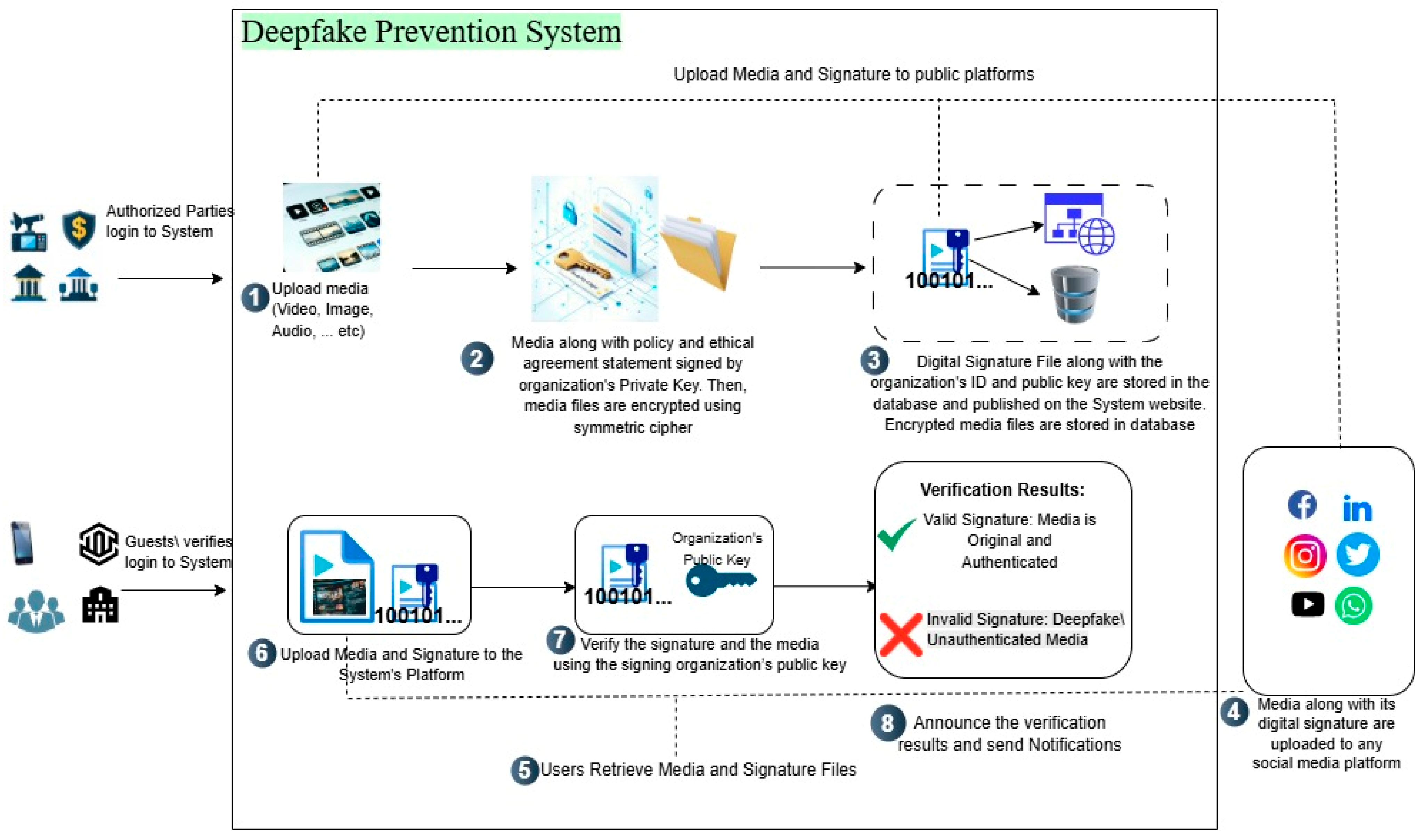
Figure 1 demonstrates the conceptual model for the proposed deepfake prevention approach. The model shows the key elements and how they interact with the system to perform digital signature and encryption operations. The goal of this approach is to provide an effective way to counter the distribution of deepfakes. In particular, the use of asymmetric ciphers enables various organizations (i.e., ministries, companies, news channels) to create a cryptographic digital signature for the media content they produce. This allows guest users to verify the authenticity and integrity of the media, ensuring it originates from authorized or official sources. The proposed model assumes that there is a root Governmental Authority (GA) responsible for registering and authenticating ROs. Moreover, ROs can use symmetric encryption schemes to ensure the confidentiality of the media files uploaded to the system or transmitted over the communication network.
The conceptual model outlines how major parties (i.e., ROs and Guest users) can engage with the system to sign, verify, and encrypt the media content, thereby helping to prevent the spread of deepfakes. The following steps, numbered 1 to 8 and labeled within
Figure 1, explain how different parties can interact with the system and use symmetric and asymmetric ciphers:
When an organization is registered and authenticated by the GA, it can log in to the system and generate a public and a private key. The public key will be published alongside the organization ID on the system’s portal, while the private key is kept secret and known only to the RO. The RO can then upload media, including video, images, audio, … etc., to the system’s portal.
At the next step, the RO performs a digital signature operation using PQCAs to generate the signature. In this step, the media, along with the policies and ethical agreements, are input into a cryptographic hash function to produce a unique message digest or hash code. Then, the RO signs the hash code using its private key to generate the digital signature. Additionally, the media file is encrypted using a secure symmetric cipher (e.g., AES/Ascom) to provide confidentiality and avoid unauthorized access.
The digital signature is stored in the system’s database, where the ID of the RO serves as an index to access its signatures. The original media files are stored in the database in an encrypted format.
With the media now considered authenticated, the RO can upload the signed media along with the corresponding signature to any social media or other platforms.
Users who want to verify the authenticity of any media content can retrieve the media and the associated signature from the media platforms.
Users can log in to the system as guests and upload the media and signature files for verification.
Then, users can verify the signature by using the public key of the RO who created the media and issued the signature. The verification process includes applying the cryptographic hash function that takes the media and the policy and ethical agreement and produces the hash code. The signature is decrypted using the public key of the selected RO. If the result of the decryption matches the hash code, this indicates that the signature is valid and hence the media file is authenticated. Moreover, the RO cannot deny responsibility for the media content. Conversely, if the signature is NOT valid, it indicates that the media is neither original nor authenticated and is therefore considered a potential deepfake.
Finally, the result of the verification process is publicly announced on the system’s portal, allowing the public to be aware of the verification results and to identify deepfake content.
The proposed approach relies on both symmetric and asymmetric ciphers to guard against threats like deepfake distribution, unauthorized manipulation of media content, identity theft, unauthorized exposure, and denial of responsibility from the media creators.
ROs can sign media files before publishing them on other platforms such as social media or public websites. The use of DSAs offers important security services, which are integrity, authentication, and non-repudiation. Therefore, for any signed media, all relevant parties can ensure that the signed media is authentic and has not been manipulated by deepfake technology. Moreover, the original media files are encrypted to prevent unauthorized access.
To improve public awareness, the verification results are announced and notifications about fabricated or deepfake media are sent to the social media platform from which the media was retrieved.
Since the proposed approach heavily relies on cryptographic algorithms to offer security services, various DSAs and encryption schemes were implemented and benchmarked. This research focuses on crypto algorithms recently standardized by NIST as PQCAs to offer robust and long-term security. Additionally, traditional ciphers were implemented to provide a better understanding of latency and resource consumption variations between the different cryptographic algorithms.
The following subsection presents the operating model for symmetric and asymmetric ciphers that perform signing, verification, and encryption operations.
3.2. The Operating Model for the Post-Quantum DSA
In this research, PQCAs are utilized to provide digital signature services. In particular, three asymmetric ciphers standardized by NIST were explored, which are Dilithium-5, Falcon-512, and SLH-DSA. Moreover, cryptographic hash functions are used to offer data integrity and save time and computational resources for digital signature operations. This approach utilizes quantum-resilient symmetric ciphers to provide confidentiality. Various symmetric ciphers were implemented, including AES-GCM, Ascon-80pq, and Ascon-128 algorithms.
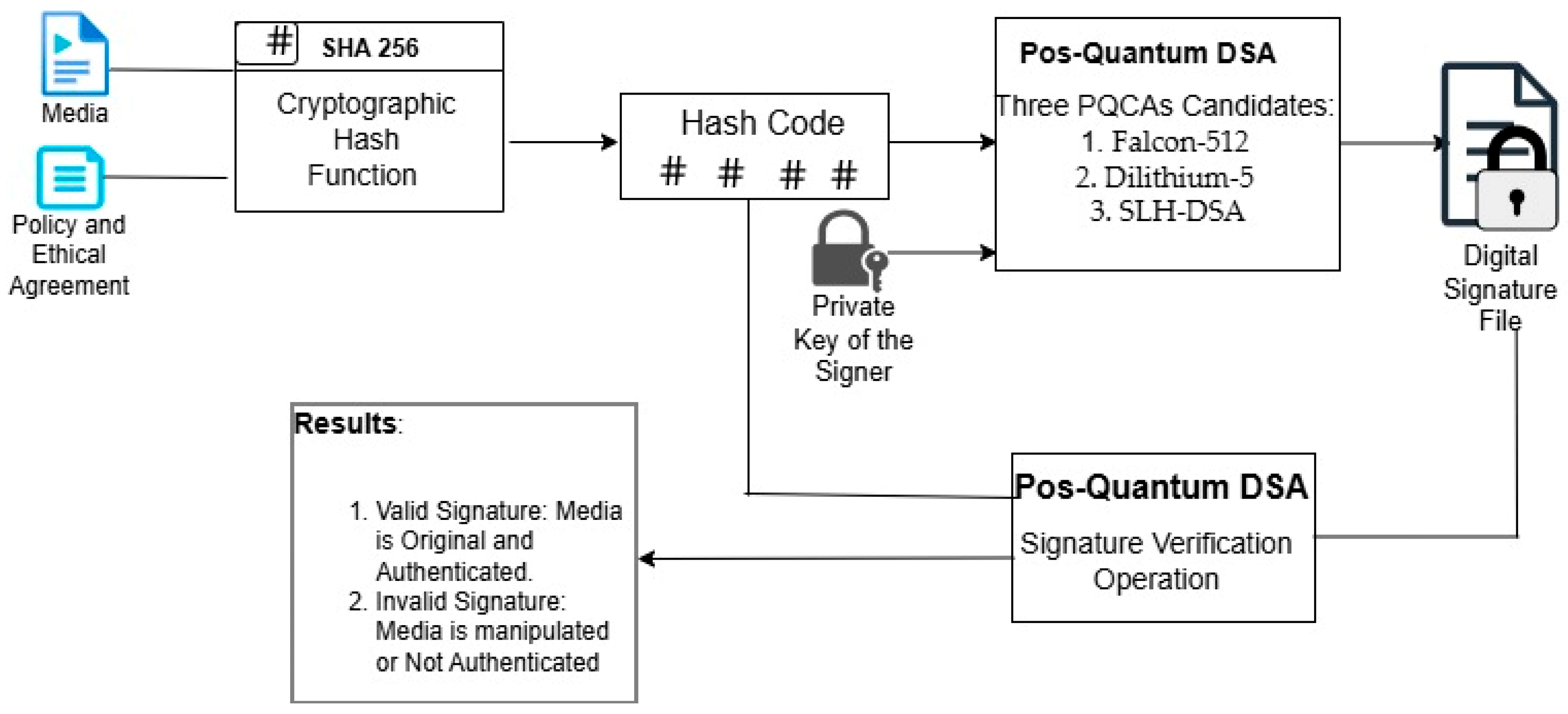
As shown in
Figure 2, the media along with policies and ethical agreements, are input into the hash function SHA-256 to generate the hash code that serves as a fingerprint of the inputs. The hash code and the private key of the media creator are then fed to the post-quantum digital signature function to produce the signature.
During the verification operation, the hashing step is carried out to generate the hash code in the same manner as before. This hash code, along with the public key of the RO, is then used as an input to the verification function. If the output of the verification matches the hash code, the signature is considered valid; otherwise, it is deemed invalid.
Figure 2 depicts the operating model for the post-quantum digital signature scheme utilized within deepfake prevention.
As can be noticed from
Figure 2, there are three options for PQCAs: CRYSTALS-Dilithium, Falcon, and SLH-DSA. This research explores the implementation of the three algorithms as well as classical DSAs, and conducts comprehensive benchmarking to identify the most efficient candidates to perform digital signature operations.
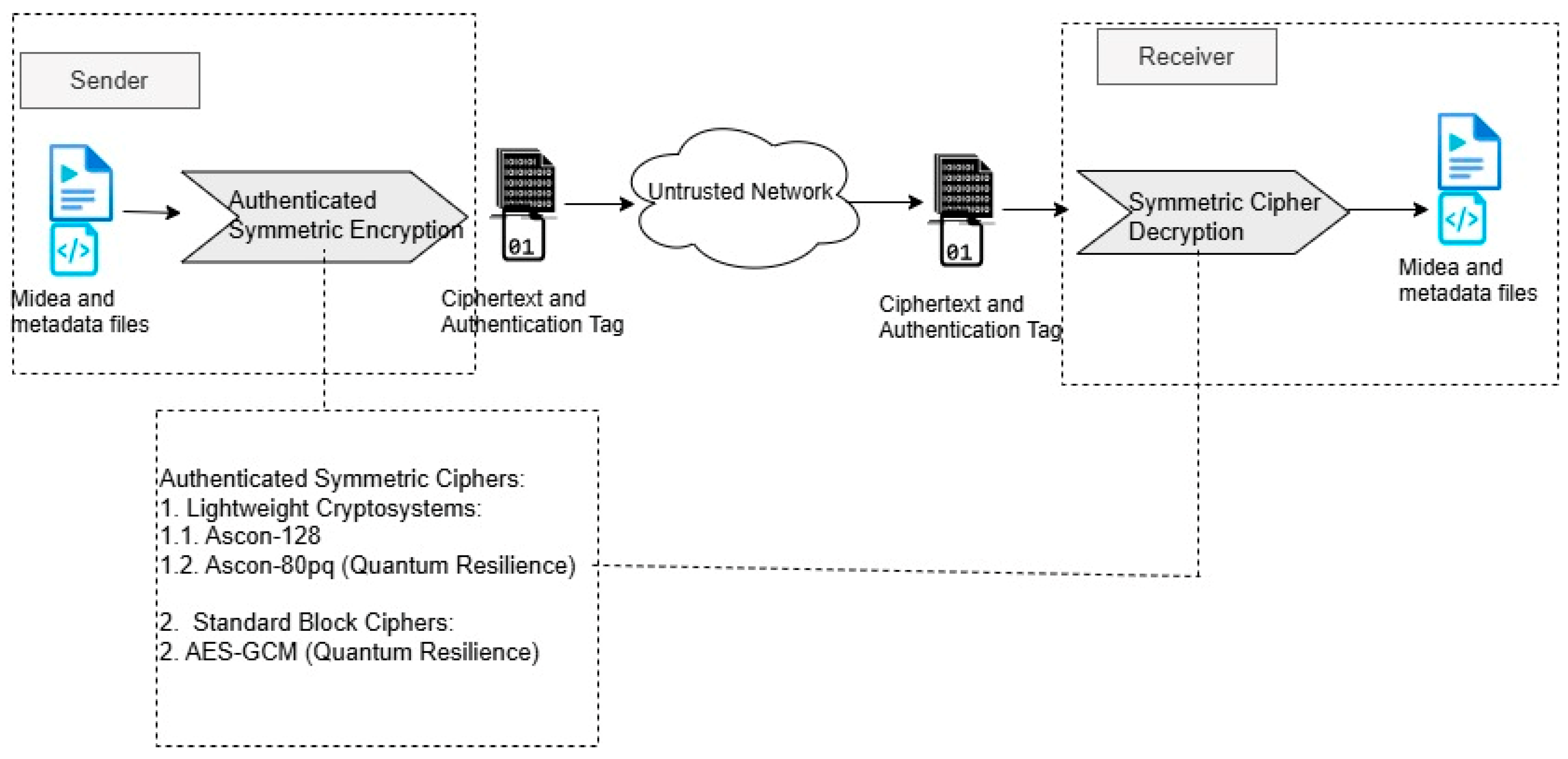
Figure 3 shows the operating model for symmetric cipher encryption in the proposed approach. The sender could be the RO who wants to send media files to the system’s platform to be verified and stored in the database. The proposed approach utilizes authenticated encryption to provide both confidentiality and authentication security services. Various symmetric ciphers were implemented in this research, including AES, Ascon-80pq, and Ascon-128. Both AES and Ascon-80pq offer post-quantum resilience and hence provide long-term security. The Ascon algorithm is preferable for environments with limited resources.
It can be noticed from
Figure 3 that the output of the encryption operation is the ciphertext along with an authentication tag. The decryption operation on the receiver side retrieves the plain media file and performs authentication. Encryption is employed for media files in transit and for those files stored in the database to ensure confidentiality.
The next section presents the experimental results and discusses the key findings of this study.
4. Experimental Results and Discussion
4.1. Overview
This research explores the implementation of various cryptographic algorithms to provide essential security services, including confidentiality, authentication, integrity, and non-repudiation. All these services are essential to avoid the threats posed by deepfakes and media manipulation. In particular, the study examines the post-quantum crypto algorithms standardized by NIST, which are CRYSTALS-Dilithium, Falcon, and SPHINCS+. Unlike traditional digital signature schemes, the post-quantum digital schemes offer long-term security and can withstand quantum computing attacks. Furthermore, the study implements symmetric algorithms, which are AES and Ascon-80pq. Both algorithms are standardized by NIST as post-quantum algorithms. Additionally, traditional DSAs, such as RSA and ECC, are implemented in this research to facilitate the comparison between the various cryptographic algorithms in terms of performance and resource consumption.
The following subsection provides a brief description of the implementation environment, where the proposed digital signature schemes were executed and tested.
4.2. Implementation Environment
The implementation of both types of cryptographic algorithms—classical and post-quantum digital signature schemes—was carried out using a software-based approach. To achieve this, a custom Java application was developed to implement and evaluate the various symmetric and asymmetric ciphers, leveraging the Java Cryptography Architecture (JCA) together with the BouncyCastle cryptographic library. The BouncyCastle library was selected due to its extensive support for both classical (RSA, ECDSA) and post-quantum cryptographic algorithms, enabling flexibility in experimentation and benchmarking. The code structure for the Java application followed a modular design, allowing for the seamless integration of multiple crypto algorithms (e.g., RSA, ECC, Dilithium, Falcon, SLH-DSA).
The implementation environment was set up on a Windows 10 operating system. The hardware device consisted of a personal computer manufactured by Dell Inc., Round Rock, TX, USA, powered by an 11th Gen Intel® CoreTM i7-1165G7 CPU running at 2.80 GHz, equipped with 16 GB of RAM. This software and hardware configuration ensured sufficient computational resources to handle cryptographic operations and timing measurements across multiple test loops used in the experiments.
In the current research, the experiments were executed in a standalone setup, where digital signature generation and verification processes were implemented and benchmarked on the local machine. To measure the performance of each cryptographic algorithm, the execution times for signing and verification were measured using millisecond-resolution timers enabled by the Java programming language. Moreover, all experiments were repeated across configurable loop iterations to obtain reliable averages for performance comparisons. This enhances the reliability of the performance results.
The software-based implementation utilized in this study provided a controlled and reproducible environment for evaluating the relative efficiency, throughput, and computational cost of various DSAs, ensuring the robustness of research results.
Table 1 shows a summary of the different components involved in the implementation environment.
The following subsection presents the experimental results and the discussion of the various digital signature schemes examined in this study.
4.3. Results and Interpretations
This research explored the performance of five digital signature schemes and three encryption schemes. RSA, ECC, and Ascon-128 algorithms fall under the classical algorithms category, while the other cryptographic algorithms are classified as post-quantum algorithms. The goal is to provide a deeper understanding of the differences in performance levels and to offer informative benchmarking. The following subsection presents the implementation results for classical DSAs.
4.3.1. Classical Digital Signature Schemes
Two well-known classical DSAs were implemented in this research: RSA and ECDSA. Both algorithms are widely used nowadays to provide essential security services like authentication, integrity, and non-repudiation. Experimental results focused on measuring the performance in terms of time consumption, recorded in milliseconds (ms), required to perform signing and verification operations. The DSAs were used to sign an image of 200 KB. First, the image was input into a hash function to produce the hash code. Then, the DSA was used to sign the hash code. The verification operation will utilize the hash code as well. Using the hash code instead of the actual content plays a crucial role in reducing the time and computational power needed to sign the digital media, including videos, images, and audio.
Table 2 presents the performance or time consumption results of performing RSA and ECDSA operations. The performance is measured by taking the average of 30 rounds of computation to obtain more robust results.
Experimental results indicate that the performance of the ECDSA significantly surpasses that of the RSA algorithm. This can be justified by the fact that ECC offers a comparable level of security to RSA while using a much smaller key size. Specifically, ECC operates with a key size of 256 bits, whereas RSA requires a key size of 2048 bits. The larger key size causes more computations and hence a longer time to perform the signing operation.
The total time needed to perform signing and verification operations using the ECC scheme is 1.97 milliseconds, which is less than the time reported for the RSA DSA. It can be noticed from the table that RSA achieves shorter verification times due to its reliance on a public key that can be a small exponent value, thereby requiring fewer computations to perform signature verification.
The next subsection presents the implementation results for the digital signature schemes using post-quantum crypto algorithms.
4.3.2. Post-Quantum Digital Signature Schemes
To ensure long-term security and strong resistance against quantum computing attacks, this study investigates the implementation of PQCAs.
Table 3 presents the implementation results for three known PQCAs standardized by NIST: Dilithium-5; Falcon-512; and SLH-DSA, which was previously named SPHINCS+. The experimental results of this research indicate that the Dilithium-5 and Falcon-512 algorithms performed exceptionally well, with total time delays for digital signature operations of 2.50 ms and 2.51 ms, respectively. Notably, the two algorithms demonstrate comparable performance levels, with a slight advantage for Dilithium-5.
In contrast, SLH-DSA requires significantly more time and computational resources to perform digital signature operations, totaling 868.91 ms. This outcome is expected, as SLH-DSA requires tens of thousands of hash computations to produce the digital signature. Additionally, it produces very large signatures, which contribute to increased overhead in memory usage and transmission time. Consequently, SLH-DSA consumes more resources and is much slower than the lattice-based algorithms, such as Dilithium and Falcon.
The next subsection presents the implementation results for the symmetric encryption schemes.
4.3.3. Symmetric Encryption Schemes
To offer a comprehensive overview about the performance of various encryption schemes, this section presents experimental results for both quantum-resilient and classical encryption schemes. Also, the research shows the implementation results for the standard block cipher, which is AES, and the lightweight ciphers, which are Ascon-128 and Ascon-80pq.
Table 4 presents the time delay results for the three symmetric ciphers, which are AES-GCM, Ascon-128, and Ascon-80pq. The time delay results, presented in the table, represent the time consumed by encryption, decryption, and authentication operations.
It can be noticed that lightweight ciphers, such as Ascon-128 and Ascon-80pq achieved the best performance with time delay results of 0.02 and 0.15 ms. The AES algorithm, on the other hand, takes 0.17 ms for encryption and decryption operations. This performance gap is understandable, since Ascon is designed as a lightweight cryptosystem for constrained devices. Moreover, Ascon-80pq has an added advantage because it provides resistance against quantum attacks.
The next subsection presents the comparison between all implemented digital signature and encryption schemes under the two categories: symmetric and asymmetric ciphers. The comparisons aim to highlight the variations between traditional and post-quantum cryptographic algorithms. Ciphers are evaluated in terms of time consumption (performance) and resources or area-consumption.
4.3.4. Comparison Between Traditional and Post-Quantum Cryptography
This section offers a detailed comparison of both classical and post-quantum algorithms for digital signature and encryption operations. Such a comparison provides a comprehensive overview and enhances the understanding of the differences between various crypto algorithms in terms of performance and resource consumption. The goal is to identify the most efficient algorithms that provide the security services required for combating deepfakes. Moreover, this study seeks to highlight the variations in performance and resource consumption between traditional and emerging post-quantum cryptosystems.
Table 5 presents the time consumption results for all the DSAs and encryption schemes implemented in this study.
For asymmetric ciphers, experimental results indicate that the least time-delay achieved is 1.97 ms, obtained through ECDSA. However, this classical algorithm is vulnerable to post-quantum attacks. To ensure long-term security and resistance against such attacks, it is highly recommended to utilize PQCAs that have recently been standardized by NIST. Results show that the Dilithium-5 and Falcon-512 algorithms achieved commendable performance results of 2.50 ms and 2.51 ms, respectively. Additionally, it is noted that SLH-DSA (SP+ 128 s) takes significantly longer time-delay compared to other DSAs.
Another significant observation is that both Dilithium-5 and Falcon-512 outperform the classical RSA algorithm in terms of performance. They also demonstrate performance levels close to those of ECDSA. Therefore, both algorithms are viable choices for developing a deepfake prevention system capable of resisting post-quantum attacks while maintaining high performance. The efficiency of Dilithium-5 and Falcon-512 PQCAs can be attributed to their reliance on efficient lattice-based computations. In contrast, RSA depends on heavy modular arithmetic computations and larger key sizes, leading to longer execution times for digital signature operations, particularly during the process of signing digital data.
It is worth mentioning that the symmetric cipher times presented in the table refer to the time consumed by encryption, decryption, and authentication operations, since those algorithms do not provide digital signatures.
Although it is unfair to compare symmetric and asymmetric ciphers, this might be useful to illustrate the variation between encryption and digital signature operations in terms of time delay. The experimental results shown in
Table 5 indicate a significant difference in time delay between symmetric and asymmetric ciphers. The lightweight Ascon algorithm, with a total time consumption of just 0.015 ms, outperforms even the fastest asymmetric ciphers, such as ECDSA, by a considerable margin. This result is expected due to the large difference in the key sizes for the two ciphers. Additionally, the lightweight symmetric ciphers, Ascon-128 and Ascon-80pq, also surpass the standard symmetric block cipher, AES, in performance.
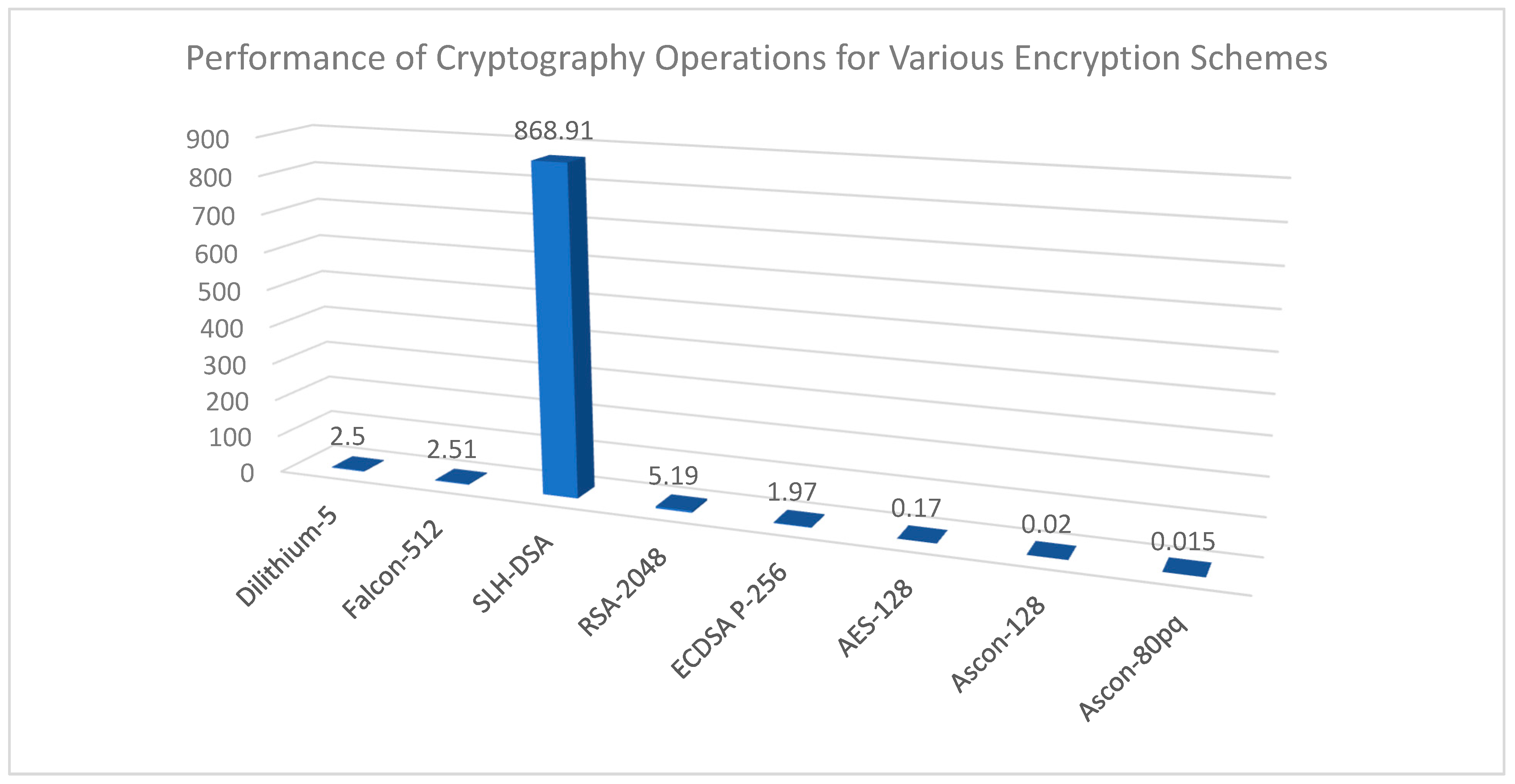
A comparison between the time delay of cryptography operations for various ciphers implemented in this research is depicted in
Figure 4. It can be noticed that the Ascon algorithm achieved the best performance results, while the SLH-DSA obtained the worst results. The performance of the SLH algorithm is affected by its large key size and complex hashing operations, which necessitate implementing more computations than other algorithms.
For a more comprehensive comparison,
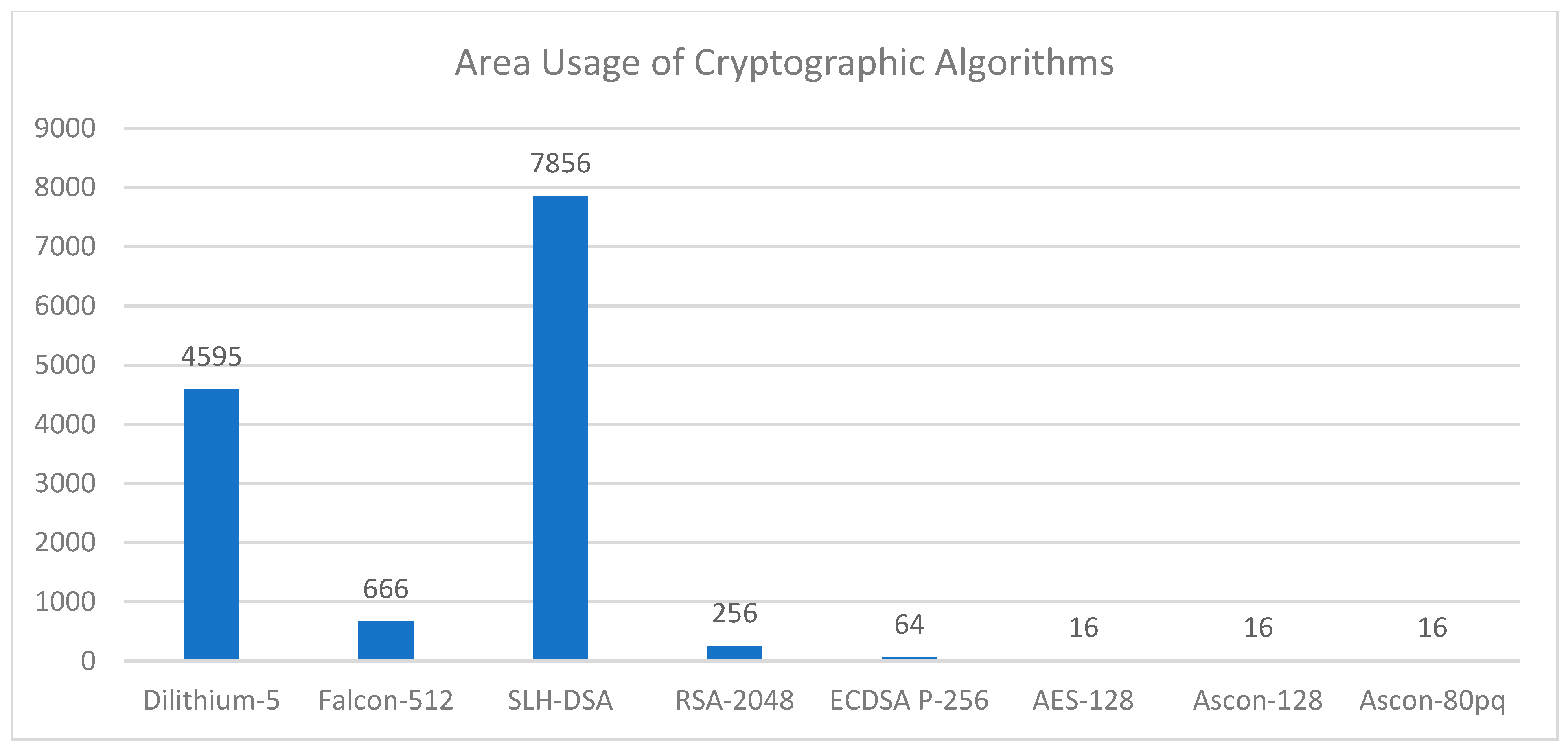
Figure 5 illustrates the memory resources consumed by each cryptographic algorithms in relation to the memory space required to store the cryptographic keys. It is obvious that symmetric ciphers consume significantly less memory and fewer resources, with only 16 bytes required to store the encryption key. For asymmetric ciphers, the Falcon-512 algorithm uses less memory compared to other asymmetric ciphers due to its shorter signature size. This gives the Falcon-512 algorithm an important advantage, as it achieves high performance while consuming notably fewer resources compared to other PQCAs. Furthermore, the comparison shown in the figure highlights the differences in resource consumption between symmetric and asymmetric cryptographic algorithms. For instance, the Falcon-512 algorithm requires an additional 48 bits compared to lightweight cryptographic algorithms such as Ascon-128. This provides insight into the additional resources needed to implement the Falcon algorithm on constrained devices or embedded systems.
4.3.5. Throughput and Scalability Evaluation
This section presents the results of the scalability and throughput evaluation for both post-quantum and traditional asymmetric ciphers implemented in this study. Scalability and throughput comparison of different cryptographic algorithms are useful to identify the most efficient algorithm.
Table 6 shows execution times (ms) across different input data sizes, reflecting the scalability of the implemented algorithms.
It can be noted from the scalability results presented in
Table 6 that among the PQCAs implemented in this research, both Dilithium-5 and Falcon-512 show nearly linear scalability, sustaining high throughput for data sizes as large as 10 MB. On the other hand, the implementation results of SLH-DSA revealed inadequate scalability because of its heavy reliance on hash-based computations. For traditional cryptographic algorithms, ECDSA P-256 showed high performance and scalability levels but does not offer protection against quantum computing threats.
Table 7 presents the throughput results for the different cryptographic algorithms implemented in this research. The throughput refers to the number of cryptographic operations performed per second (ops/s).
The Falcon-512 algorithm achieves the highest throughput (410 ops/s) among post-quantum algorithms. ECDSA achieved the best throughput results (507 ops/s) for traditional asymmetric ciphers. SLH-DSA exhibits very low throughput due to its computational overhead and low performance.
4.3.6. Security-Per-Performance Ratio Evaluation
The Security-Per-Performance Ratio (SPR) quantifies the efficiency of a cryptographic algorithm by relating its bit-level security strength to its average execution time [
72]. It is defined as:
A higher SPR indicates a more efficient balance between cryptographic strength and computational cost.
Table 8 shows the SPR results for both post-quantum and traditional ciphers implemented in this study.
It can be noticed that both Falcon-512 and Dilithium-5 achieve the highest SPR, demonstrating an optimal balance between security and performance. Additionally, ECDSA achieves good efficiency but lacks quantum resistance. As expected, SLH-DSA exhibits extremely low efficiency due to the computationally expensive hash operation performed by this algorithm.
The evaluated PQC algorithms exhibit distinct performance and resource consumption features. Lattice-based schemes such as Dilithium and Falcon provide a favorable balance between security and efficiency, which explains their selection by NIST for standardization. On the other hand, the hash-based signature scheme, which is SLH-DSA (SPHINCS+), offers a strong and long-term security level, but at a substantial cost in terms of performance and resource consumption.
The following section introduces the main recommendations based on experimental results and findings of this study.
4.4. Recommendations
This study aims to develop an effective deepfake prevention approach based on symmetric and asymmetric ciphers. The study utilizes post-quantum cryptographic algorithms to provide long-term security against future quantum computing attacks. The key findings and recommendations of this research can be summarized as follows:
- -
With the emergence of quantum computing technology and relevant cyberattacks, it becomes crucial to replace current classical DSAs, like RSA and ECC, with PQCAs.
- -
Asymmetric ciphers using post-quantum algorithms are efficient for performing digital signature operations and provide essential security services to counter the threats of deepfakes, specifically integrity, authentication, and non-repudiation.
- -
Dilithium-5 and Falcon-512 DSAs outperform other PQCAs in terms of throughput, scalability, and SPR results. This indicates that both algorithms are efficient for performing cryptography operations, especially with large data sizes.
- -
Falcon-512 has an advantage over other PQCAs since it consumes fewer resources such as memory space and computational power.
- -
Digital signature schemes based on Dilithium-5 and Falcon-512 algorithms are efficient candidates to replace classical asymmetric ciphers because they offer the ability to withstand quantum computing attacks while also providing performance comparable to one of the fastest classical asymmetric cryptosystems, namely ECC.
- -
The SPHINCS+ DSA can provide strong resistance against quantum computing attacks. However, it consumes more time and resources compared to other digital signature schemes.
- -
The classical RSA algorithm is not recommended for providing digital signature services to avoid deepfakes because it has lower performance and throughput compared to other DSAs, such as Dilithium-5, Falcon-512, and ECC.
- -
For symmetric ciphers, Ascon-80pq outperformed the standard AES cryptosystem with a time delay for encryption and decryption equivalent to 0.015 ms.
- -
The Ascon algorithm can be a considerable choice for implementation in small and embedded devices due to its low resource requirements in comparison with other symmetric ciphers such as AES.
- -
Authenticated symmetric ciphers, including AES-GCM, Ascon-128, and Ascon-80pq are recommended to encrypt media files since they can provide both confidentiality and authentication security services.
- -
Ascon-80pq has one more added value because it provides quantum resilience and consumes less computational time and fewer resources compared to the standard AES cipher.
The next section provides the conclusion and future research trends related to the current area of research.
5. Conclusions and Future Research
This research presented a deepfake prevention approach based on symmetric and asymmetric ciphers. The cryptographic digital signature algorithms (DSAs) were employed to provide integrity, authentication, and source non-repudiation, which are essential security services to avoid the manipulation of media files and counter the distribution of deepfake content. The study explored the application of post-quantum cryptographic algorithms (PQCAs) to ensure robust long-term security against advanced attacks that may leverage quantum computing technology. In particular, three post-quantum asymmetric ciphers recently standardized by NIST were implemented, which are Dilithium-5, Falcon-512, and SPHINCS+. Additionally, the study conducted a comprehensive comparison between classical and PQCAs to illustrate variations in terms of performance and resource consumption, and to identify the most efficient post-quantum DSA to be employed for deepfake prevention. Experimental results indicate that the Falcon-512 algorithm is a cost-effective choice since it consumes fewer resources and provides superior performance for digital signature operations.
Furthermore, the study explored various symmetric ciphers, including Ascon-80pq, Ascon-128, and AES-GCM. Symmetric ciphers are used to encrypt media files transmitted over communication channels or stored in the database. The use of symmetric ciphers offers an additional security layer and avoids unauthorized disclosure of media content. The proposed algorithms employ authenticated encryption, which can provide both confidentiality and authentication. A comprehensive comparison between various symmetric ciphers was conducted. Experimental results indicate that Ascon-80pq achieved the best performance, with time delay of 0.015 ms for encryption and decryption operations. Ascon-80pq is also preferable for implementation in constrained environments because it consumes fewer resources in comparison with the standard AES algorithm. Additionally, both the Ascon-80pq and AES ciphers are quantum-resilient.
The proposed deepfake prevention approach allows any organization to register on a platform owned by a central authority and then perform digital signature and encryption operations on the media they create. This process ensures that the media is authenticated and protected from unauthorized manipulation. After signing the media, the organization can publish it along with the signature on various platforms. Additionally, the approach allows users to upload and authenticate media content and digital signatures to ensure they are not manipulated and are created by authorized parties.
Future research should focus on integrating various technologies that complement the strengths of each other like digital signature, watermarking, and blockchain technologies. This could lead to a more effective solution for deepfake prevention. Additionally, the development of a deep learning-based detection system that leverages recently emerged structured models is an attractive area of research. Structured models can provide accurate and high-performance deepfake detection. Moreover, future studies may extend experiments to consider a distributed execution environment, blockchain network integration and simulation, and heterogeneous hardware evaluation. One more significant future research is to compare the efficiency of the current approach with other solutions for specific scenarios such as detecting content manipulated by the DeepSeek technology.