Systematic Review

The Heuristics of Fear in Hans Jonas: Connecting the Status of Nature and the Nature of the Digital Artefact in the Context of Artificial Intelligence as an Extension of Modern Technology—A Systematic Review †

by
Rafael Alejandro Betancourt Durango
1,*,
Diego Alejandro Correa Correa
2,
Eduar Antonio Rodríguez Flores
3 and
Conrado Giraldo Zuluaga
1,*
1
Facultad de Filosofía, Universidad Pontificia Bolivariana, Medellín 050031, Antioquia, Colombia
2
Facultad de Ciencias Jurídicas y Políticas, Institución Universitaria de Envigado, Envigado 055420, Antioquia, Colombia
3
Dirección de Investigación e Innovación, Universidad Autónoma del Perú, Lima 15842, Peru
*
Authors to whom correspondence should be addressed.
Systematic review article derived from the doctoral dissertation “Towards a Citizen Ethics of Technological Responsibility: The Jonasian Principle in the Face of the Normative Challenges of Artificial Intelligence”, submitted by Rafael Alejandro Betancourt Durango in fulfilment of the requirements for the degree of Doctor in Philosophy at Universidad Pontificia Bolivariana.
Philosophies 2026, 11(4), 133; https://doi.org/10.3390/philosophies11040133
Submission received: 6 May 2026 / Revised: 15 June 2026 / Accepted: 21 June 2026 / Published: 27 July 2026
(This article belongs to the Special Issue Phenomenological Philosophy of Science and Technology)

Abstract

Can Hans Jonas’s heuristics of fear still ground a philosophy of artificial intelligence (AI), or does the digital artefact require its reformulation? Building on the empirical turn in the philosophy of technology and on a postphenomenological reading of human–technology relations, this article combines conceptual reconstruction with a PRISMA 2020-compliant bibliometric review (Scopus + Web of Science, 2010–2026; n = 2372 articles and reviews). The bibliometric map reveals an extreme productivity concentration, a stable journal core, and six thematic clusters that organise the field. Rather than treating these patterns as proof of a normative thesis, the article uses them to locate a lexical re-weighting of the field after 2021, in which applied AI-ethics and governance vocabularies expand faster than explicitly philosophical vocabularies. A targeted Jonasian sub-corpus (n = 124) indicates that Jonas remains conceptually relevant but circulates mainly in a smaller, database-visible niche of continental and environmental ethics. We argue that the heuristics of fear remains philosophically fertile provided that it is reconstructed as a threshold question of moral admissibility and expanded through phenomenological resources—lifeworld, embodiment, technological mediation—and through the cosmotechnical plurality emphasised by Yuk Hui. The convergence of bibliometric mapping and philosophical analysis suggests that robust AI governance requires not only procedural principles but also renewed attention to digital mediation, distributed agency, and the protection of the lifeworld under algorithmic uncertainty.

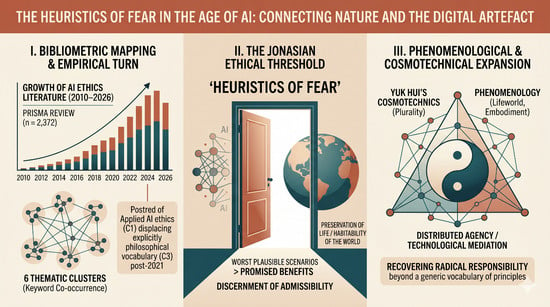
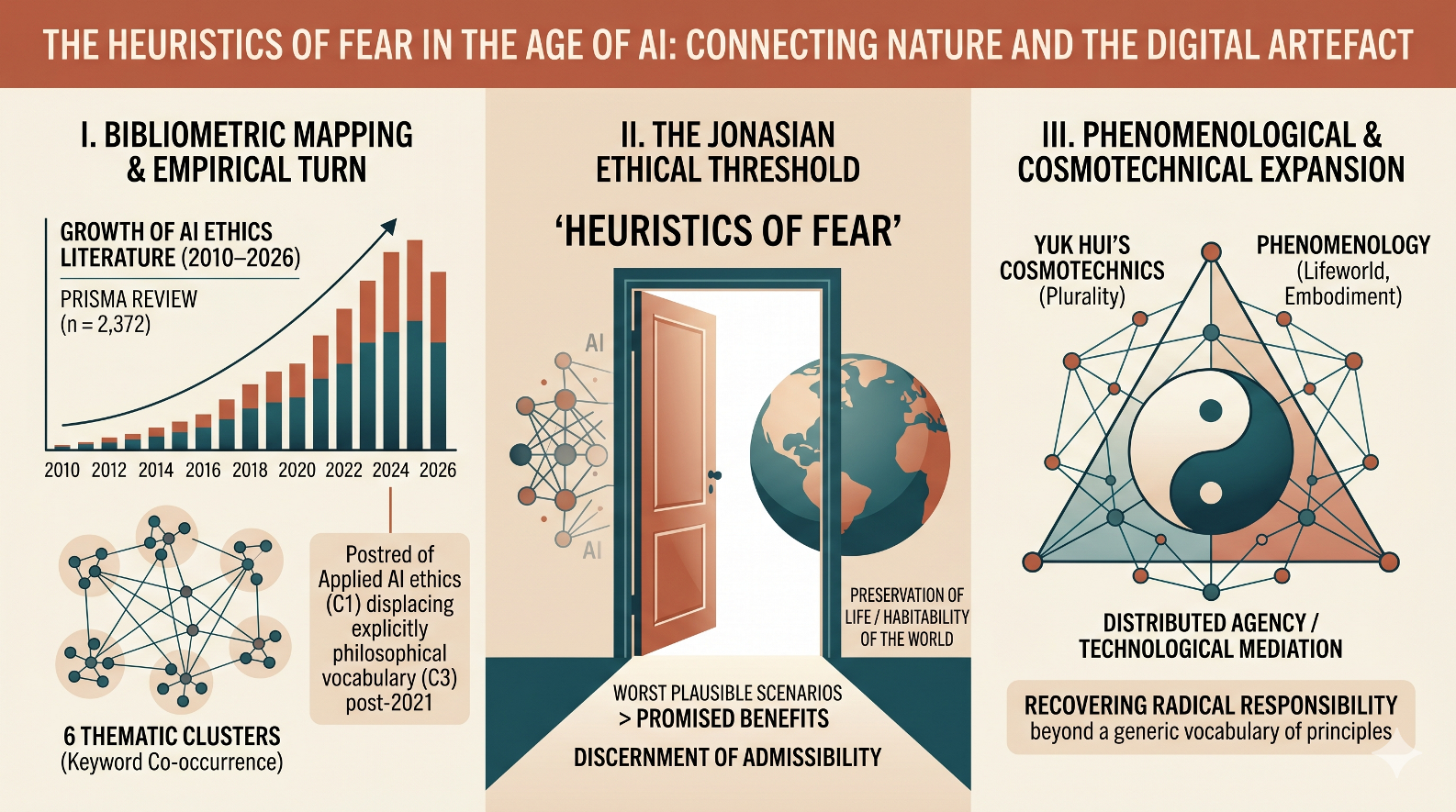
Graphical Abstract

1. Introduction

The accelerated diffusion of artificial intelligence (AI) is not merely a large-scale technical innovation, but a historical mutation in the relation between human action, technological mediation, and the normative horizon of responsibility [1,2,3,4,5,6,7]. Its specificity does not lie only in the automation of tasks previously performed by human agents; it lies above all in the growing capacity of algorithmic systems to intervene in processes of classification, prediction, recommendation, deliberation, and social coordination, thereby reconfiguring epistemic, administrative, educational, economic, and cultural practices [8,9,10,11,12,13,14,15]. AI is therefore best understood not as an isolated tool but as a mediating infrastructure that simultaneously transforms how the world appears, how subjects act within it, and how responsibility can be attributed or displaced [5,8,9,16,17,18,19,20,21].
This article starts from that philosophical problem and then situates it within a PRISMA 2020-compliant bibliometric review of recent literature on AI, responsibility, governance, sustainability, and philosophy of technology. The purpose of the bibliometric component is descriptive and contextual: it maps publication growth, editorial concentration, and keyword communities in order to identify the discursive field within which a reconstructed Jonasian argument must operate. It does not, by itself, establish the truth or validity of Jonas’s ethics; that normative claim requires the conceptual argument developed below.
Several prior reviews have surveyed adjacent territories. Hagendorff’s semi-systematic evaluation of twenty-two AI ethics guidelines documented the convergence of the field around principles of transparency, accountability, fairness, and privacy, while critiquing the gap between principles and practice [22]. Jobin, Ienca and Vayena mapped the global landscape of AI ethics documents, identifying eleven principles recurrently invoked across institutional, governmental, and corporate guidelines [23]. Floridi and Cowls proposed a unified framework of five overarching principles—beneficence, non-maleficence, autonomy, justice, and explicability—as a synthetic response to principle proliferation [24]. The present review differs from these contributions in three respects: it adopts a PRISMA 2020-compliant systematic protocol with two databases rather than a curated guideline corpus; it extends the temporal window to 2010–2026 to capture the LLM-era expansion; and it examines the philosophical-vocabulary structure of the field through Louvain community detection over keyword co-occurrence. Our contribution is therefore complementary to, rather than redundant with, the existing review literature.
Yet the quantitative consolidation of the field does not entail conceptual clarity. Within contemporary AI ethics, notions such as transparency, fairness, accountability, explainability, safety, governance, and responsible AI have become dominant categories [10,11,12,25,26,27,28,29,30,31,32]. These frameworks are essential to make algorithmic bias, power asymmetries, institutional opacity, and large-scale harms publicly visible [14,33,34,35,36,37]. A considerable portion of this literature, however, remains embedded in a logic of procedural correction or regulatory risk management: it seeks to make AI safer, fairer, or more auditable, but does not always interrogate with sufficient radicality the underlying ontological problem—namely, that contemporary technical power has reached a level at which it can affect not only particular behaviours but also the conditions of continuity of life, of human judgment, and of the habitability of the world [1,7,38,39,40,41,42,43].
It is precisely at this point that the philosophy of Hans Jonas acquires renewed relevance. In The Imperative of Responsibility Jonas argues that modern technology has shattered the framework within which traditional ethics were conceived, because it has expanded human power beyond the scale of foresight and reversibility presupposed by those ethics [1,40]. Wherever technical action can affect the biosphere, compromise the future of generations not yet born, and irreversibly alter the material supports of life, ethics can no longer be limited to regulating immediate intentions or reciprocal relations between contemporaries [1,38,39,44]. Two Jonasian notions are decisive for this shift. The principle of responsibility demands that present action be accountable for its remote, cumulative, and transgenerational consequences [1,40,45,46]. The heuristics of fear, in turn, operates as a form of anticipatory discernment that grants cognitive and normative priority to the worst plausible scenarios when irreplaceable goods are at stake [1,46,47,48]. This heuristic is the corrective against excessive confidence in innovation, cost–benefit calculation, or technoscientific self-regulation, and forces us to ask not only how much risk can be managed, but which developments ought to be considered morally inadmissible [1,7,41,42,43].
Applying Jonas’s framework to AI requires more than a conceptual transfer. Jonas reflected primarily on technoscientific power in relation to ecological crisis, nuclear weapons, and biological manipulation [1,38,39]. AI introduces a specific problem: it not only amplifies the human capacity to intervene in the world, but also mediates processes of perception, interpretation, selection, and decision through digital artefacts that learn, recombine information, and operate within distributed sociotechnical networks [8,9,11,16,17,18,19,49,50,51]. This shifts the problem from the sole question of technical “impact” to the more complex question of the nature of the digital artefact—its mediations, its cosmotechnical plurality, and the new configuration of agency it introduces [3,4,5,20,21,50,51,52,53].
At this juncture, phenomenology and postphenomenology of technology become indispensable, but not because they simply merge with Jonas’s metaphysics. The empirical turn in the philosophy of technology, programmatically articulated by Achterhuis, Brey, and Kroes & Meijers [6,54,55], redirected the analytical focus from abstract speculation about the essence of technology to empirical investigations of concrete sociotechnical artefacts. This turn also includes the Dutch-school thesis concerning the dual nature of technical artefacts: artefacts are both physical objects and function-bearing objects embedded in intentional, social, and normative contexts [54,55]. Don Ihde’s postphenomenology supplies a vocabulary of embodiment, hermeneutic, alterity, and background relations through which to describe how technologies actively shape perception and action [8,9,16,17,18,19,49,56,57,58]. The relation between Jonas and postphenomenology is therefore best understood as a critical articulation: Jonas supplies the normative reach of responsibility, while postphenomenology supplies a fine-grained account of technological mediation.
The guiding question of this article can therefore be formulated as follows: Can Hans Jonas’s heuristics of fear still function as an adequate philosophical resource for thinking AI as a radicalised extension of modern technology, or does it require ontological and normative reformulation in light of the specific status of the digital artefact [1,2,3,4,5]? The general aim of the study is to critically reconstruct Jonas’s heuristics of fear for the context of AI conceived as a heterogeneous family of digital artefacts and as a qualitative intensification of modern technology, in dialogue with phenomenology and postphenomenology of technology. From this aim follow three specific objectives. First, to reconstruct Jonas’s conceptual core—principle of responsibility, heuristics of fear, ontological status of nature—in dialogue with phenomenology, postphenomenology, Yuk Hui’s cosmotechnics, and selected alternatives in contemporary philosophy of technology [1,2,5,6,17,20,21,38,39,50,51,52,53,54,55,59]. Second, to map, through a PRISMA-compliant bibliometric review, recent literature on AI, responsibility, technological autonomy, responsible innovation, and philosophy of technology between 2010 and 2026 [60,61,62,63]. Third, to identify the main thematic clusters of the field and examine how they translate, re-weight, or partially marginalise the strong demands of responsibility, precaution, and preservation of life formulated by Jonas, without assuming that bibliometric prominence equals normative validity [1,29,30,31,32,40,64,65].
The article is structured as follows. Section 2 develops the theoretical framework, reconstructing Jonas’s thought and placing it in dialogue with phenomenology, postphenomenology, and the cosmotechnical perspective [1,2,5,9,17,59]. Section 3 presents the systematic-review and bibliometric methodology, detailing the search strategy, deduplication, eligibility criteria, and analytical procedures [61,62,63,66,67,68,69]. Section 4 reports the results, focusing on the temporal evolution of the field, its main editorial and authorship spaces, and the thematic structure of the field identified through keyword analysis [63,66,67,68]. Section 5 discusses these findings from a Jonasian and postphenomenological perspective. Finally, Section 6 synthesises the main contributions and proposes future directions for an ethics of AI oriented not only to risk management but to the preservation of the lifeworld and the conditions of human responsibility [1,2,5,17,59,64].

2. Theoretical Background

2.1. Hans Jonas: Principle of Responsibility and Heuristics of Fear

Hans Jonas formulates his ethics against the background of a technological power that has broken the assumptions of classical moral theories [1,38,40]. Unlike frameworks centred on punctual actions and reciprocal relations among contemporaries, Jonas starts from the diagnosis that modern technology can affect the biosphere, irreversibly alter the material conditions of life, and compromise the future of generations that do not yet exist [1,39,42]. In this context, the principle of responsibility demands that present action be accountable not only for its immediate effects but also for its remote, cumulative, and transgenerational consequences; moral obligation must expand in parallel with the expansion of technical power [1,40,45,46].
The heuristics of fear constitutes the epistemological and normative core of this proposal. For Jonas, fear is not a paralysing affect nor an invitation to technophobic conservatism, but a mode of anticipatory knowledge: where irreplaceable goods are at stake, the worst plausible scenarios must be granted cognitive and normative priority over optimistic expectations or promised benefits [1,45,46,47]. Against confidence in technoscientific self-regulation and cost–benefit calculation, the heuristics of fear introduces a decisive asymmetry: the possibility of catastrophic and irreversible harm weighs more heavily than the prospect of incremental gains [1,42,43]. This criterion is articulated with the duty to preserve the continuity of human and non-human life, which for Jonas has an ontological and axiological status irreducible to the logic of technical performance [38,39,46,48,70,71,72].

2.2. Phenomenology, Postphenomenology, and the Empirical Turn

Jonas’s thought is inscribed within a broader field of reflection on technology in which phenomenology and philosophy of technology converge. Husserl’s late diagnosis in The Crisis of European Sciences identifies the historical root of the problem: with Galileo, the lifeworld (Lebenswelt) is progressively replaced by a mathematised universe in which the qualitative, perceptually given world is reduced to an appearance of an underlying quantitative reality [73,74]. For Husserl, this substitution is not a neutral methodological gain but an existential loss: the originary stratum of meaning that grounds every scientific or technical operation is occluded by the very framework that science erects to describe it [75,76]. The relevance of this diagnosis for AI is direct: when algorithmic systems treat human action as a computable substrate—patterns to be classified, predicted, optimised—they enact, at unprecedented scale, the very forgetting of the lifeworld that Husserl identified as the modern crisis.
Heidegger’s analysis in Die Frage nach der Technik extends this diagnosis ontologically. Modern technology is, for Heidegger, not a collection of devices but a mode of revealing (Entbergen): it is Gestell—the enframing—that discloses the world as standing-reserve (Bestand), available for ordering and exploitation [2,77]. The decisive distinction Heidegger draws is between poiēsis—a bringing-forth that lets beings come into presence as they are—and Herausfordern, a challenging-forth that extorts from beings what they yield. AI extends this challenging-forth to a new domain: human attention, language, and judgement themselves become standing-reserve, mined for predictive value. The problem, in Heideggerian terms, does not reside in particular algorithms but in the ontological horizon that frames them and within which they appear as natural extensions of technical mastery.
Merleau-Ponty completes the phenomenological triad by showing that perception and embodiment are not contingent supports of technological mediation but its constitutive condition [59]. The lived body (corps propre) is not a sub-personal substrate; it is the original site at which world and self are co-disclosed through motor intentionality and the corporeal schema [78]. Digital interfaces—touch screens, gesture-recognition systems, brain–computer interfaces, generative speech models—are not neutral conduits across an inert body: they enlist sensorimotor habits, retrain attention, and progressively rework the gestural repertoire through which the lived body engages the world. The Merleau-Pontian frame raises, in this way, questions that no purely procedural ethics can pose: what becomes of perceptual habituation when interfaces pre-empt the gestural exploration of the world? What of the corporeal schema when generative systems take over the labour of articulation? These are not questions about user satisfaction or system bias; they are phenomenological questions about the conditions of embodied subjectivity, and they articulate—from the side of the body—the broader Jonasian concern with the integrity of the lifeworld under algorithmic mediation.
The empirical turn in the philosophy of technology consolidated this phenomenological background into a research programme oriented to concrete artefacts and practices [6,54,55]. Don Ihde’s postphenomenology has been the most influential expression of this turn, articulating four fundamental human–technology–world relations—embodiment, hermeneutic, alterity, and background relations—through which it becomes possible to describe how technologies reshape perception, agency, and meaning [16,17,18,56]. Verbeek extends this framework into an ethics of technological mediation: artefacts not only mediate moral perception; they actively configure moral subjects [8,9]. This claim provides a bridge to Jonas without erasing the difference between them. Jonas’s ethics is grounded in ontological commitments concerning life, vulnerability, and the future of humanity; postphenomenology is largely anti-essentialist and begins from situated mediations. The argument of this article therefore does not treat them as identical frameworks, but uses postphenomenology to specify the mediations that Jonas’s principle of responsibility must now confront.
Within the same horizon, Simondon proposes an ontology of technical objects as realities undergoing individuation, whose understanding requires attention to their genesis, regimes of functioning, and insertion into wider technical ensembles [3]. Stiegler radicalises this perspective by characterising technics as tertiary retention, that is, as material supports of memory and temporality that condition the formation of experience and subjectivity—a framework with direct implications for digital archives, recommender systems, and large language models [4,52,53,79]. Ellul analyses modern technics as an autonomous system that tends to self-expand, imposing criteria of efficiency on all spheres of social life [80,81]. Arendt highlights the political dimension of this process by warning that the substitution of action and deliberation by technical processes threatens plurality and natality as constitutive traits of the human condition [44]. Latour, finally, supplies a complementary account in which artefacts are full participants of agency networks, an insight that has proved central to STS-informed philosophy of AI [82,83].

2.3. Lifeworld and Embodiment Under Algorithmic Conditions

Reading the contemporary AI debate through the lens of the lifeworld foregrounds questions that risk being silenced by procedural ethics frameworks. Husserl’s Lebenswelt is the always-already given horizon of meaning from which scientific abstractions and technological systems are first projected [59,73,74]. When recommender systems, generative models, and decision-support algorithms become woven into educational, clinical, juridical, and economic practices, what is at stake is not only output accuracy or fairness, but the gradual reshaping of the lifeworld in which subjects experience themselves and others [8,9,13,17,36,37,84].
From this perspective, AI cannot be treated as a transparent channel for the transmission of information; it operates as a mediating infrastructure that selects salience, configures attention, and structures the field of available choices [8,9,11,12,13,36,50]. This is where the articulation between Jonas and postphenomenology becomes useful: postphenomenology describes how digital artefacts mediate perception, deliberation, and judgement at the micrological level, while Jonasian responsibility asks when such mediations cross thresholds of moral inadmissibility [1,2,8,9,16,17,45,46].

2.4. The Digital Artefact and AI as Intensification of Modern Technology

Against this background, AI can be interpreted as a qualitative intensification of modern technology. AI systems no longer merely automate delimited tasks; they intervene in processes of classification, prediction, recommendation, and decision-making in complex environments, operating on large-scale data and learning patterns that are not fully transparent even to their designers [7,10,11,13,15,33,41,85]. As digital artefacts, these systems are embedded in distributed sociotechnical networks in which agency is spread across learning models, data infrastructures, organisations, users, and regulatory frameworks [8,13,36,50,83].
From a Jonasian perspective, AI shifts the focus from the sole question of technological “impact” towards the problem of the status of the digital artefact itself [1,3,4,50]. If modern technology has already extended the temporal and spatial reach of human action, AI additionally introduces a form of mediation that affects the conditions of perception, evaluation, and judgement [2,8,9,17,50]. The question of responsibility in relation to AI cannot therefore be reduced to causal control over outcomes; it must also account for how agency is reconfigured when socially significant decisions are modulated by opaque and adaptive algorithmic systems—the so-called responsibility gaps thematised by Matthias, Sparrow, Santoni de Sio and Mecacci, and Sætra [86,87,88,89,90,91].

2.5. AI Is Not One: Heterogeneity Within the Digital Artefact

Treating “AI” as a unified phenomenon obscures internally heterogeneous systems with distinct Jonasian profiles. For this article, the digital artefact denotes a computationally mediated sociotechnical system whose operation depends on data infrastructures, software architectures, institutional contexts, and user practices. Within that broad category, at least five families should be distinguished: symbolic or rule-based expert systems; supervised machine-learning systems; recommender and ranking systems; generative or foundation models, including LLMs; and autonomous physical agents such as autonomous vehicles, surgical robots, or lethal autonomous weapons. The Jonasian heuristic applies differently across these cases. It applies more weakly to narrowly delimited systems whose harms can be audited and reversed, and more acutely to systems that mediate language, public knowledge, bodily safety, democratic classification, or irreversible forms of coercive action. The post-2021 lexical re-weighting reported in Section 4.5 is therefore not evidence that all AI raises the same ethical problem; it indicates that the public emergence of generative and large-scale autonomous systems has intensified the need to distinguish procedural risk management from the prior question of moral admissibility.

2.6. The Cosmotechnical Bridge: Plural Genealogies of Technology

A persistent limitation of European philosophy of technology has been its tendency to treat “technology” as a singular, planetary phenomenon whose meaning is exhausted by its Greek-modern genealogy [2,5]. Yuk Hui has challenged this assumption with the concept of cosmotechnics, arguing that different cultural traditions sustain different unifications of cosmic and moral order through technical activity, and that the genuine pluralisation of philosophy of technology is the condition for any future-oriented ethics of digital artefacts [5,20,21,50]. The cosmotechnical hypothesis is congenial to a Jonasian programme: where Jonas demands a strong duty toward the future and toward non-human life, cosmotechnics demands that this duty be articulated against the plurality of historically situated technical traditions, rather than imposed as a universalising abstraction [1,5,20,21,50]. This dimension is particularly salient in the present Special Issue, since the dialogue between Western phenomenology and East-Asian philosophical traditions has emerged as one of the most fertile programmes for a critically pluralistic philosophy of technology [5,18,20,21].

2.7. AI Ethics, Governance, and Responsibility Gaps

Recent literature on AI ethics has developed a variety of normative frameworks centred on principles such as transparency, explainability, fairness, non-discrimination, accountability, robustness, and responsible AI [10,11,12,27,29,30,31,32]. Initiatives such as the European Union’s trustworthy-AI guidelines, OECD and UNESCO recommendations, and the proposed EU AI Act have contributed to stabilising a common vocabulary for describing risks and obligations in the design and deployment of intelligent systems [29,30,31,32]. These frameworks have been crucial in documenting algorithmic discrimination, structural bias, large-scale harms, and power asymmetries associated with the use of AI in domains such as criminal justice, credit, healthcare, education, surveillance, and platform governance [14,33,34,35,36,37,84,92,93].
However, much of this literature remains framed within a grammar of risk management and procedural compliance. This does not make the procedural vocabulary philosophically empty: it has enabled concrete work on auditing, institutional accountability, risk classification, and human oversight. The Jonasian concern is narrower and more radical. It asks whether some forms of AI development or deployment ought to be considered inadmissible even if they can be made more transparent, fair, or auditable [7,13,41,42,43,94,95]. The notion of responsibility gaps has become central to this debate [86,87,88], yet many proposed solutions focus on allocating responsibility after systems exist, rather than on the threshold question of whether particular systems should be brought into being in their present form [1,42,64,88,89,90].

2.8. Synthesis: Philosophical Axes of the Manuscript

Table 1 synthesises the main philosophical axes that structure the theoretical framework of this article, indicating key authors, central concepts, and their function within the argument. The function of each axis is twofold: it equips the analytical reading of the bibliometric corpus (Section 4) and grounds the discussion of the Jonasian heuristics of fear in relation to AI as a digital artefact (Section 5) [1,2,3,4,5,6,9,17,59].
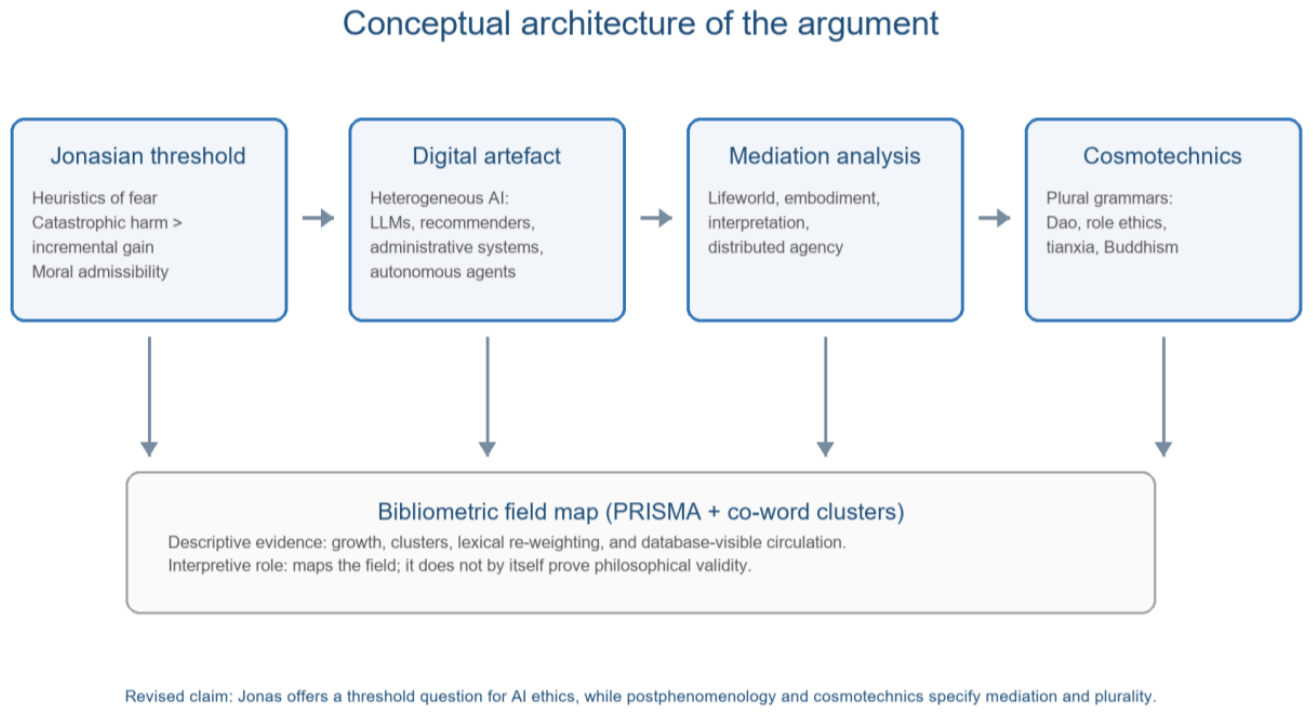
The conceptual architecture summarised in Table 1 informs the research journey of this paper: it moves from the philosophical framework, through the PRISMA systematic protocol and bibliometric clustering of 2372 records, towards the final philosophical synthesis (Figure 1) [1,2,5,17,61].

3. Materials and Methods

3.1. Review Design and Reporting Framework

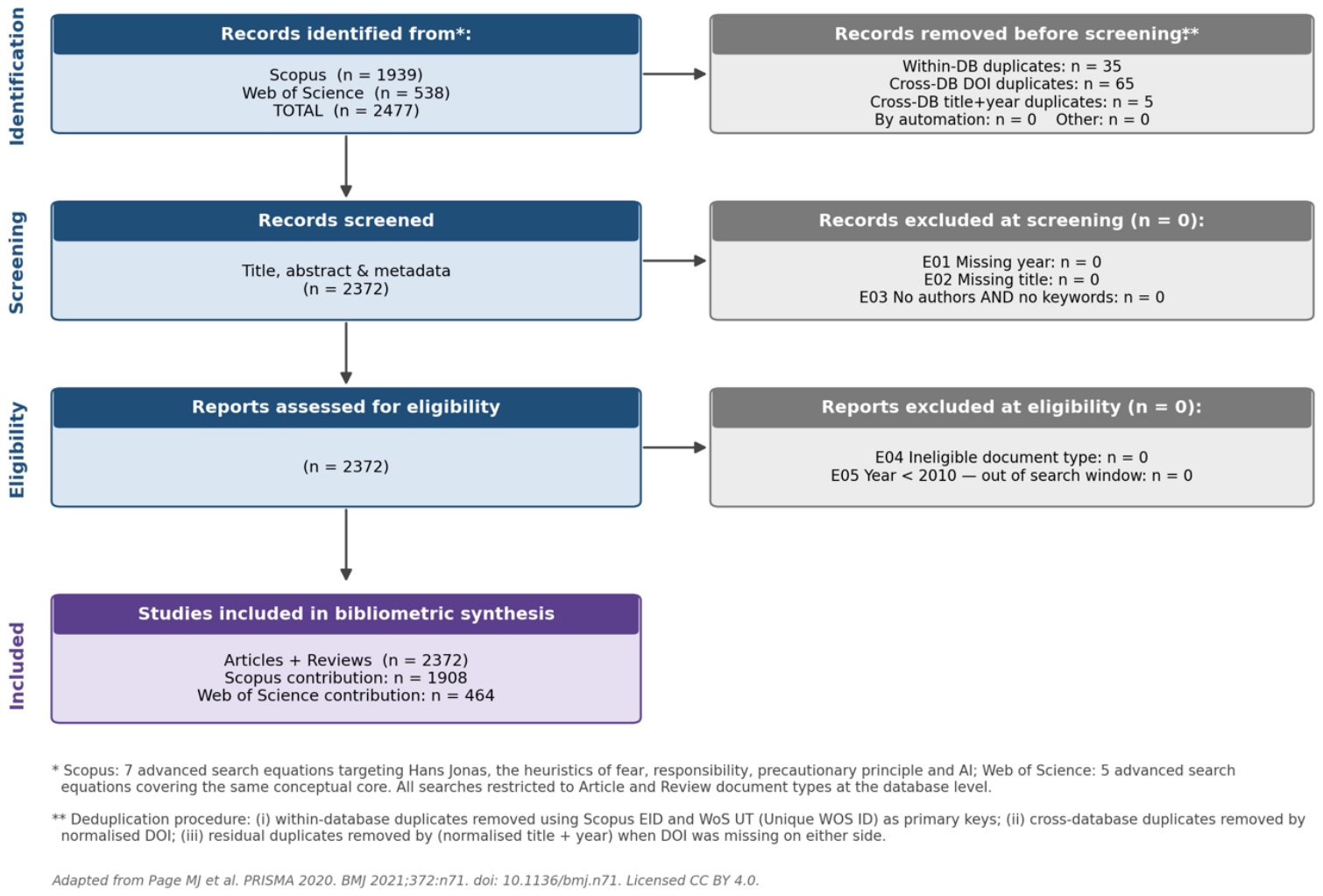
This study was designed as a PRISMA-compliant systematic and bibliometric review focusing on the intersection between Hans Jonas’s philosophy of responsibility, the heuristics of fear, and contemporary debates on AI and modern technology. The review follows the PRISMA 2020 guidance for identification, screening, eligibility and inclusion, adapted to a descriptive bibliometric synthesis rather than to an effectiveness review [61,62]. The complete PRISMA 2020 checklist is reported in the Supplementary Materials (Table S2), and the flow of records through each phase is summarised in Figure 2 and detailed numerically in Supplementary File S2 and in machine-readable form in Supplementary File S3 [61,62,63]. The protocol for this systematic review was registered in the Open Science Framework (OSF) and is openly available at https://doi.org/10.17605/OSF.IO/XG6WN.

3.2. Data Sources and Search Strategy

Two multidisciplinary citation databases were used as primary information sources: Scopus (Elsevier) and Web of Science Core Collection (Clarivate). Their differential coverage and partial overlap have been documented in the bibliometric literature and motivated the dual-source design [96]. The search strategy was conceptually structured around three groups of terms combined with Boolean AND operators: (i) Hans Jonas and philosophy-of-responsibility vocabulary; (ii) heuristics of fear, precautionary principle, and future-generations vocabulary; and (iii) artificial intelligence and autonomous-technology vocabulary. Database-specific syntax was used in each platform (TITLE-ABS-KEY for Scopus; TS Topic for Web of Science), and search equations were tailored to the indexing conventions of each database [63,69,96].
In Scopus, seven advanced search equations were executed, each corresponding to a specific conceptual axis: Jonas and responsibility (Eq. S1), Stiegler and digital technologies (Eq. S2), Heidegger and modern technology (Eq. S3), responsible innovation and precaution (Eq. S4), philosophy of nature and posthumanism (Eq. S5), philosophy of AI and artificial agency (Eq. S6), and automation and autonomous technology (Eq. S7). In Web of Science, five complementary equations targeted Jonas and responsibility, heuristics of fear and precaution, philosophy of technology and Heidegger, responsible innovation and future generations, and AI ethics with autonomous technology and responsibility gaps (Eqs. S8–S12). As reported in Table S1 of the Supplementary Materials, the seven Scopus and five Web-of-Science equations were designed to be conceptually complementary rather than redundant; this is corroborated by the relatively low cross-database duplicate rate of 4.24% [61,69,96]. All available coverage years were queried in both databases, with searches executed on the same calendar day to ensure temporal comparability. The combined search retrieved 2477 records: 1939 from Scopus and 538 from Web of Science (Figure 2) [61].

3.3. Eligibility Criteria, Screening, and Deduplication

Eligibility criteria were defined a priori in line with PRISMA 2020 [61,62]. Records were included if they met the following conditions: (i) document type Article or Review; (ii) published between 2010 and 2026 inclusive; (iii) indexed in Scopus or Web of Science under any subject category; and (iv) containing sufficient metadata for bibliometric analysis (year, title, authors, and at least one keyword). No language restrictions were imposed at the search stage; nevertheless, bibliometric synthesis remains constrained by the coverage profiles of Scopus and Web of Science [96].
The screening process followed four PRISMA phases. Identification and deduplication. Within-database duplicates were first removed using database-specific identifiers (Scopus EID, Web of Science UT), yielding 35 duplicates. Cross-database duplicates were then identified by DOI (65 records) and, when DOI was missing, by normalised title–year pairs (5 records), totalling 105 duplicates removed across databases (4.24% duplicate rate). After full deduplication, 2372 unique records remained. Automated metadata-based screening. The 2372 unique records were screened on the basis of title, abstract, and key metadata to detect incomplete records, and were excluded if they lacked publication year (E01), title (E02), or both authors and keywords (E03); no records met these exclusion criteria, so all 2372 records passed this phase. Eligibility assessment. All 2372 records were assessed for document type and publication year, with exclusion criteria E04 (not Article or Review) and E05 (year < 2010); no records were excluded at this stage, since these criteria had already been enforced at search-equation level. Inclusion. The final corpus for bibliometric synthesis comprised 2372 unique studies, of which 1908 originated from Scopus and 464 from Web of Science. The coverage span extends from 2010 to 2026, with 1296 unique journals, 4898 unique authors, and 9989 deduplicated author keywords (Figure 2).

3.4. Data Harmonisation and Variables

Following deduplication and eligibility checks, metadata from Scopus and Web of Science were harmonised into a common schema with 15 core fields, including publication year, journal title, document type, language, author names, author affiliations, country, DOI, citation counts (where available), and Author Index Keywords (Scopus) or Keywords Plus (Web of Science), which were combined into a unified keyword field [63,69,96]. Author names and journal titles were normalised through standard procedures (case harmonisation, removal of punctuation variants, and consolidation of known journal-name variants) to reduce fragmentation in counts by author and source. Keywords were cleaned and deduplicated through lower-casing, singularisation where appropriate, and the merging of obvious spelling and hyphenation variants (for example, “artificial intelligence”, “AI”, “A.I.”; “responsible AI” and “responsible artificial intelligence”). The resulting keyword index contains 9989 unique author keywords, which serve as the basis for the co-occurrence and clustering analyses reported in Section 4 [63,69].

3.5. Bibliometric Indicators and Network Analysis

The bibliometric analysis was descriptive and exploratory in nature. Annual publication counts were computed for the 2010–2026 period and disaggregated by database of origin (see Section 4.1). To characterise the productivity profile of authors, the empirical exponent of Lotka’s law was estimated by linear regression over the log-log distribution of publications per author [67]. Journal concentration was assessed through the Bradford zoning procedure, which divides the corpus into three zones of approximately equal cumulative output and computes Bradford’s multiplier as the geometric mean of the zone-to-zone size ratios [68]. Author-level impact was profiled through the local Hirsch index [69]. For thematic mapping, a keyword co-occurrence network was constructed using the cleaned keyword field as input. Edges represent co-occurrences of two keywords within the same article, weighted by frequency across the corpus, and the resulting network was analysed using the Louvain community-detection algorithm with a fixed random seed (random_state = 42) to identify clusters of densely connected terms [97,98,99]. All data transformations and analyses were performed using Python 3.11 (pandas, networkx, python-louvain, matplotlib, seaborn) with fully deterministic scripts; the cluster legend, the clean corpus, and the analytical scripts are made available as Supplementary Materials to support replication [63,66,99].

4. Results

4.1. Temporal Evolution of the Field

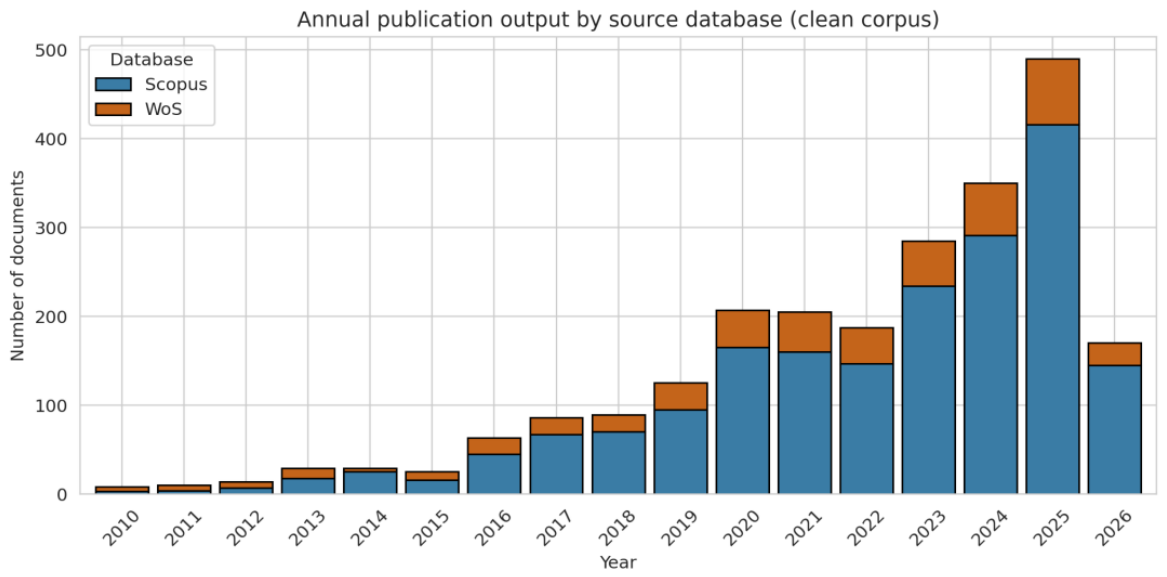
The final clean corpus comprises 2372 unique Articles and Reviews published between 2010 and 2026, with an overwhelming predominance of Articles (2234 documents; 94.2%) over Reviews (138 documents; 5.8%) [61,63]. Annual output remains modest and relatively flat during the first half of the period (2010–2015), with fewer than 30 documents per year. A first quantitative inflection occurs between 2016 and 2019 (63 documents in 2016; 86 in 2017; 89 in 2018; 125 in 2019), indicating the emergence of a consolidated but still specialised research niche (Figure 3).
From 2020 onwards, the field enters a phase of accelerated growth: 207 publications in 2020, 205 in 2021, 187 in 2022, 285 in 2023, and 350 in 2024. The curve peaks in 2025 with 490 documents and remains high in the partial count for 2026 (170 records at the time of data extraction), confirming that debates on AI, responsibility, sustainability, philosophy of technology, and governance have moved to the centre of multiple disciplinary agendas [29,30,54,55,64]. The compound annual growth rate computed for 2010–2025 reaches 31.6%, and 71% of the corpus has been published since 2021. This temporal pattern, captured in Figure 3, supports treating AI-related responsibility discourse as a rapidly expanding, cross-cutting research front rather than a marginal subtopic [15,31,32,85].

4.2. Productivity Distribution and Editorial Concentration

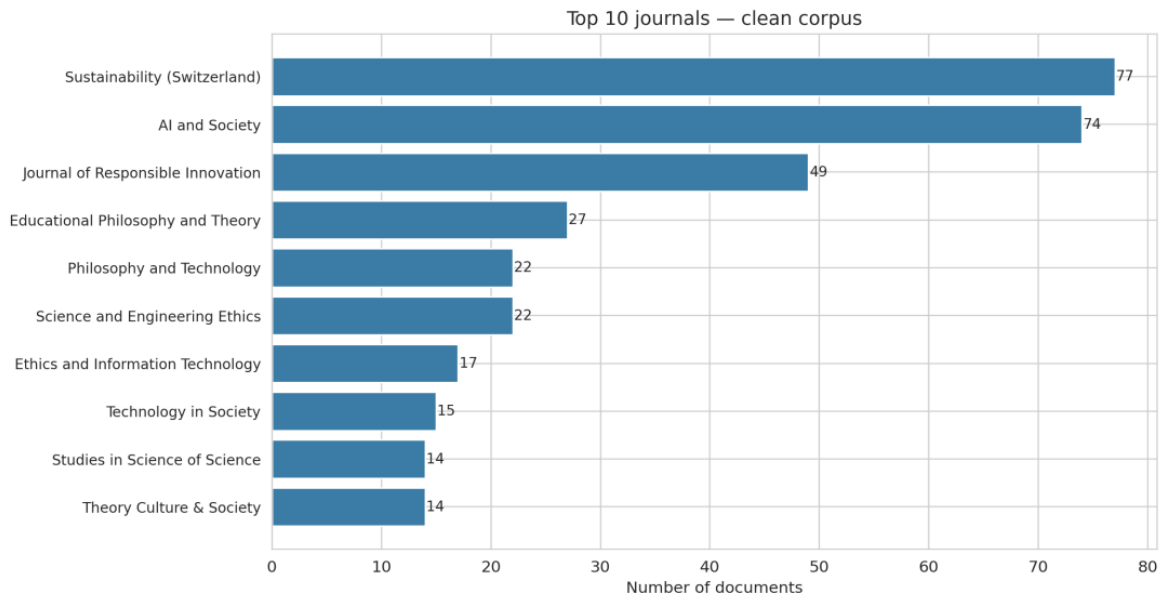
The 4898 unique authors of the corpus exhibit an extreme productivity asymmetry. Single-paper authors account for 94.7% of contributors and only 8 authors have published five or more papers in the field. The empirical exponent of Lotka’s law fitted to the productivity distribution is α = 3.66, considerably steeper than Lotka’s canonical value of 2.0 [67]. In plain terms: the field is more concentrated than typical bibliometric distributions—a small group of authors carries a disproportionate share of the output, while the overwhelming majority contribute only a single paper. It should be noted, however, that Lotka’s law was developed for the natural sciences, where journal articles are the dominant publication mode; in philosophy and the humanities, where monographs and edited volumes carry substantial weight, Scopus and Web of Science systematically under-represent author productivity, and Lotka exponents tend to inflate as a result. The α = 3.66 reported here should therefore be read as an indicator of database-visible concentration rather than as a measure of total scholarly contribution to the field [96]. This indicates that the field, while quantitatively expanding, lacks a stable layer of recurrent contributors and is therefore highly exposed to interpretive volatility—a pattern compatible with that of an emergent, ethically charged research front rather than a mature specialty [61,63,66,67]. A complementary diagnosis emerges from the application of Bradford’s zoning to the 1296 journals of the corpus (Table 2). The core (Zone 1) gathers only 90 journals (6.94%) yet concentrates 33.4% of the documents, with Sustainability (77 documents), AI and Society (74), Journal of Responsible Innovation (49), Educational Philosophy and Theory (27), Philosophy and Technology (22), and Science and Engineering Ethics (22) acting as principal venues [68,100,101,102,103]. The Bradford multiplier (b = 2.96) is consistent with a modest but recognisable journal concentration around philosophy-of-technology, AI-ethics, RRI, and sustainability outlets. Several of the core journals also exhibit high citation impact, suggesting that the field is editorially anchored in a recognised network of ethics, philosophy, and STS venues (Figure 4).
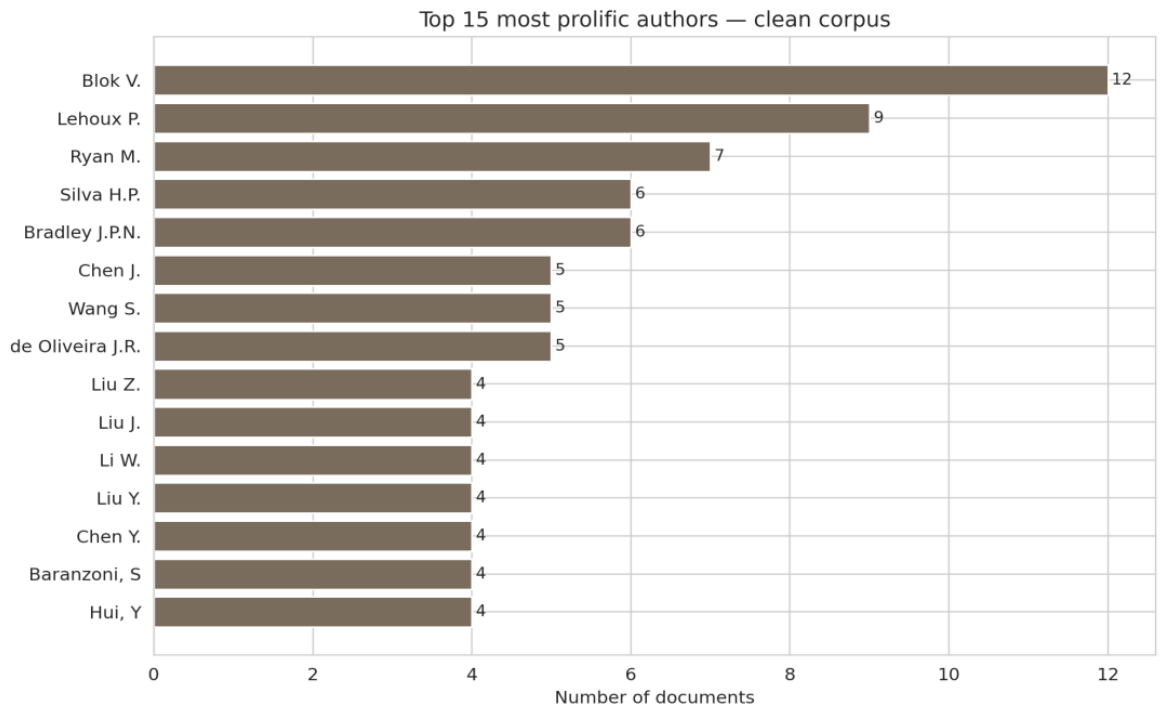
At the level of authorship, the most productive contributors are Vincent Blok (12 documents, h-index in corpus = 9, primary cluster: Responsible Innovation & Sustainability), Pascale Lehoux (9 documents, h = 7), Mark Ryan (7 documents, 658 citations, h = 6, primary cluster: AI Ethics), Hudson P. Silva (6 documents), and Joff P. N. Bradley (6 documents, primary cluster: Philosophy of Technology/Stiegler) [102,103,104,105,106]. A second sub-group of recurrent authors comes from Chinese institutions and is concentrated in the AI-ethics cluster (Chen J., Wang S., Li W., Liu Y., Liu Z., among others), while Yuk Hui appears as a recurrent author (4 documents) in the philosophy-of-technology cluster [5,20,21,50]. The geographical distribution of the corpus shows the United States (221 documents), the United Kingdom (152), China (149), Germany (138), and the Netherlands (97 documents, mean citations 30.99—the highest of the top contributors) as the principal producers, with international-collaboration rates above 40% in the United Kingdom, the Netherlands, and France (Figure 5) [96,102].

4.3. Highly Cited Contributions and Thematic Focus

The most-cited papers of the corpus reveal how the Jonasian vocabulary of responsibility and risk intersects with broader debates on autonomous vehicles, agriculture 4.0, generative AI, and responsible innovation (Table 3) [97,98,99,100,107,108]. Empirical and conceptual studies on autonomous vehicles, AI-related governance, and AI ethics in education are among the most cited works, but explicitly philosophical contributions—such as Santoni de Sio and Mecacci on responsibility gaps [88] and Stahl and Eke on the ethics of ChatGPT [100]—also occupy prominent positions, evidencing that conceptual and applied debates are deeply intertwined.

4.4. Keyword Structure and Thematic Clusters

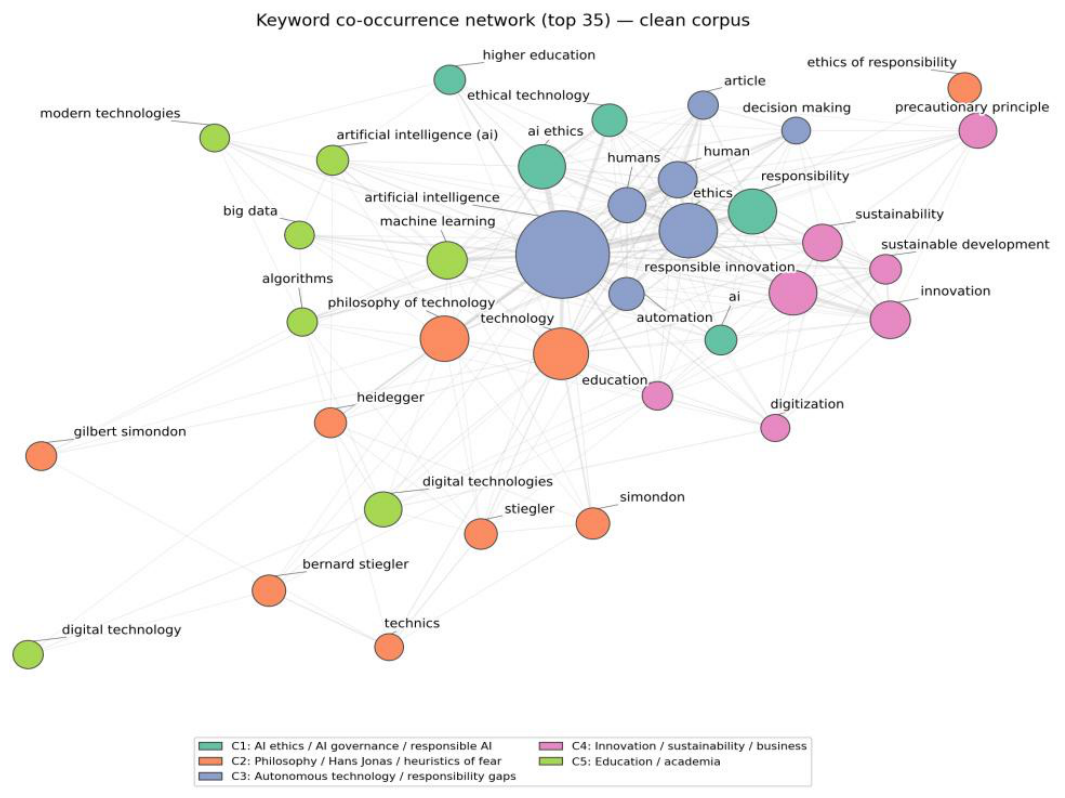
The cleaned keyword index of 9989 unique terms is dominated by “artificial intelligence” (488 occurrences), followed by “ethics” (185), “technology” (158), “philosophy of technology” (120), “responsibility” (119), and “responsible innovation” (116). Other recurrent terms include “AI ethics” (112), “sustainability” (76), “precautionary principle” (67), “digital technologies” (65), “automation” (58), and explicitly philosophical names such as Bernard Stiegler (49), Simondon (49), and Heidegger (43). This vocabulary confirms the centrality of AI ethics, responsibility, precaution, and philosophy of technology to the field’s identity (Figure 6) [3,4,5,11,13,52].
The Louvain community-detection algorithm yields six major communities, summarised in Table 4. Cluster C1 (AI ethics and governance) is the largest by total frequency and aggregates the operational vocabulary of contemporary AI ethics—responsible AI, transparency, accountability, generative AI—largely consolidated after 2021 [10,11,13,15,27,31]. Cluster C3 (philosophy of technology and Hans Jonas) is the conceptual core of the field, gathering Stiegler, Simondon, the ethics of responsibility, and Jonas himself; it carries the philosophical inheritance on which AI ethics rests. Cluster C2 (autonomy and decision-making) anchors the moral analysis of agency, while clusters C4 (machine learning and digital transformation) and C5 (responsible innovation and sustainability) connect the field to applied infrastructures and policy frameworks. Cluster C6 (risk, precaution and uncertainty), although small in absolute terms, is the lexical bridge to environmental ethics and public-health vocabularies of caution [29,30,64,65,104].

4.5. Diachronic Reorganisation of the Field: Period × Cluster

The crosstabulation of period and dominant document cluster (Table 5) reveals a significant diachronic re-weighting of the field. Between 2010 and 2015, the largest single cluster was C3 (Stiegler/Simondon/Jonas) with 33.9% of dominant assignments, while applied AI ethics (C1) accounted for 14.8%. The 2016–2020 period is transitional: C3 remains the largest cluster in relative terms (28.9%), while C1 grows to 18.2%. After 2021, C1 rises to 38.7% of dominant cluster assignments, while C3 falls in relative share to 15.1%. This should not be read as disappearance or replacement of philosophical work: the absolute number of C3 documents grows from 39 to 165 to 254. The empirical point is more precise: explicitly philosophical vocabulary grows, but it grows more slowly than the applied AI-ethics and governance vocabulary that comes to dominate the database-visible corpus during the LLM era [7,11,13,15,27,100].

4.6. The Jonas-Specific Sub-Corpus

A targeted query of the clean corpus for documents whose title or keywords explicitly mention Jonas, the heuristics of fear, the imperative or principle of responsibility, or the ethics of responsibility yields 124 documents (5.23% of the full corpus) [1,40,45,46,47,48]. The mean citation count of the Jonas sub-corpus is 2.89 (median = 1), well below the corpus average, suggesting that explicitly philosophical engagements with Jonas circulate within a smaller and less-cited niche than the broader AI-ethics literature [45,46,47,102]. Half of the sub-corpus has been published since 2021 (recency comparable to the full corpus), and its top journals are Iberoamerican philosophy outlets—Revista de Filosofia: Aurora (11 documents), Religions (4), Pensamiento (4), Filosofia Unisinos (3), and HTS Teologiese Studies (3) [45,46,48]. The leading co-occurring keywords in this sub-corpus—responsibility (34), ethics (28), technology (7), bioethics (6), morality (6), environmental ethics (5), nihilism (5), and Levinas (4)—confirm that the explicitly Jonasian vocabulary remains anchored in environmental ethics, bioethics, and continental moral philosophy, rather than in mainstream AI-governance literature [45,46,48,109,110].

5. Discussion

5.1. The Empirical Turn Confirmed by Bibliometric Evidence

The bibliometric configuration described in Section 4 supplies descriptive evidence for the consolidation of the empirical-turn programme defended by Achterhuis, Brey, Kroes and Meijers, and the postphenomenological school [6,16,17,18,54,55]. The combination of accelerated growth from 2019 onwards, journal dispersion paired with a recognisable Bradford core, and a six-cluster thematic structure in which philosophy-of-technology vocabulary co-exists with applied AI ethics, responsible innovation, and machine-learning literatures shows that the field has become strongly oriented toward concrete artefacts and practices. This evidence does not validate any ethical theory by consensus. Two inferential constraints must be made explicit here. First, the quantitative prominence of a discourse is no warrant for its validity: to read frequency of citation as a marker of truth would amount to a tacit consensus theory of truth, which we reject. Second, and more fundamentally, no normative conclusion follows from these descriptive data alone. To move directly from facts about the structure of a scholarly literature to the endorsement of a particular ethical framework would commit a version of the naturalistic fallacy and violate the is–ought distinction. The bibliometric premise of this article is therefore strictly descriptive; the normative force of the argument is supplied separately, by the conceptual reconstruction of Jonasian responsibility developed in Section 2, Section 5.3 and Section 5.4. The bibliometric map informs that argument by delimiting the discursive terrain in which it intervenes, but it does not ground it. Rather, it identifies the scholarly infrastructure within which Jonas, Heidegger, Simondon, Stiegler, Ihde, Kroes, Meijers, Mitcham, and others are mobilised alongside case studies on autonomous vehicles, large language models, agriculture 4.0, and digital education [6,7,8,9,15,50,54,55,97,98,99,107,111].

5.2. Postphenomenological Reading of the Bibliometric Map

A postphenomenological reading of the bibliometric map allows us to articulate three interrelated but defeasible diagnoses. First, the high proportion of documents in C1 (AI ethics and governance) and C5 (responsible innovation and sustainability), accelerating after 2021 (Table 5), indicates that the language of responsibility has become increasingly procedural and policy-oriented [10,27,29,30,31,32,64,65,112]. Second, cluster C3, which carries explicitly Jonasian and Stieglerian vocabularies, retains conceptual density and grows in absolute terms, but loses relative weight as the corpus expands. This pattern can be read as functional differentiation rather than simple impoverishment: deep philosophical work continues in C3, while C1 translates some of its concerns into governance, audit, and compliance vocabularies. Third, cluster C6 (risk, precaution, uncertainty), although small in absolute terms, occupies a strategic boundary position because it imports vocabularies from environmental ethics, public health, and international law into AI ethics [16,17,18,42]. The keyword-bridge analysis shows that concepts such as responsibility, ethics, technology, human, and responsible innovation connect procedural and philosophical poles of the field, even when Jonas is not cited explicitly [1,9,42,64,65].
This descriptive diagnosis can be philosophically deepened, but only with caution, through the conceptual resources of Bernard Stiegler [4,52,53,79]. The lexical reorganisation reported in Section 4.5 may be interpreted as a form of grammatisation of ethical reflection on AI: the translation of continuous moral reasoning into standardised signs such as transparency, accountability, fairness, robustness, and explicability. The advantage of this grammatisation is evident: it makes ethical evaluation auditable, transferable across institutions, and operationalisable in regulatory frameworks such as the EU AI Act [29,30,31,32]. Its possible cost, in Stieglerian terms, is the externalisation of critical know-how into pre-packaged ethical frameworks, leaving practitioners able to apply principles without necessarily engaging the philosophical labour from which those principles emerged [4,52,53,79].
For this reason, the relative retreat of cluster C3 should not be described as a direct empirical signature of proletarianisation. The data show relative re-weighting, not intellectual decline. A stronger Stieglerian claim requires an interpretive premise: that when moral reasoning is compressed into checklist-compatible categories, the capacity to ask whether some technologies should be refused rather than merely governed may be weakened. Under that premise, the procedural vocabulary that dominates after 2021 functions as a pharmakon: remedy, because it makes AI ethics governable; poison, when it substitutes compliance for the threshold question of admissibility. The Jonasian heuristics of fear is therefore proposed not as a replacement for governance frameworks, but as a counterweight that keeps open the question those frameworks may bracket [1,4,42,52,53,79].

5.3. Heuristics of Fear, Lifeworld, and Responsibility Gaps

The discussion of responsibility gaps in the AI-ethics literature can be enriched by reading it through the heuristics of fear and through the postphenomenological notion of the lifeworld [1,9,17,59,86,87,88,89]. Matthias’s original formulation focuses on the difficulty of attributing causal responsibility for the actions of learning machines [86]. From a Jonasian perspective, however, the gap is not exhausted by attribution: it also concerns the prior question of whether a development is admissible at all, given its potential to alter irreversibly the conditions of life and judgement [1,42,43,88,89]. Ihde’s mediation theory clarifies why this question becomes acute in AI: when algorithmic systems mediate reading, diagnosis, ranking, classification, or decision support, responsibility distributes itself along the mediation and cannot be restricted to terminal decisions [8,9,16,17,88,89].
This expansion of the responsibility-gap framework should not, however, be uncritical. By 2026 a robust counter-literature has emerged. Tigard has argued that there is no genuine techno-responsibility gap: moral responsibility is a flexible, dynamic process that can effectively encompass emerging technologies once we abandon a narrow attributability model [113]. Königs has questioned whether the “gap” is a real philosophical problem at all or a confusion between distinct senses of responsibility—causal, moral, and role—that can be productively disentangled [114]. Danaher has even defended the existence of certain responsibility gaps as morally desirable in tragic-choice contexts, where the absence of a clear locus of blame may protect human agents from impossible moral burdens [115]. From a Jonasian standpoint, however, even these critiques converge with our argument at a deeper level: whether or not a “gap” exists in the technical attribution sense, the prior question of which technologies should be developed at all—Jonas’s question of moral admissibility—remains untouched by attribution-focused debates [1,42]. The heuristics of fear thus operates one level above the responsibility-gap discussion, asking not how responsibility is to be distributed across an existing technology but whether the technology should have been brought into being in its present form.
A different kind of critical engagement is required with the framework that has come to dominate procedural AI ethics: the unified five-principle architecture proposed by Floridi and Cowls, comprising beneficence, non-maleficence, autonomy, justice, and explicability [24]. This framework—synthesised from the proliferation of guidelines mapped by Hagendorff and by Jobin, Ienca and Vayena [22,23]—has the considerable virtue of imposing analytical convergence on a fragmented field, and its claim that explicability functions as the enabling principle for the other four (one cannot evaluate beneficence or justice without first being able to interpret the system’s operation) is methodologically powerful within the regulatory frame it presupposes. Floridi’s broader programme, articulated in The Ethics of Information and The Logic of Information, locates AI within an information-theoretic ontology in which informational entities have a degree of moral significance proportional to their role in the infosphere [25,26]. From this perspective, the heuristics of fear may appear as a residual continental gesture—affectively powerful but procedurally underspecified.
Read jonasianly, however, the Floridian framework and the heuristics of fear operate at different logical levels. The five principles guide how an AI system, once developed and deployed, should behave: be beneficent, do no harm, respect autonomy, distribute justly, and remain explicable. Jonas’s heuristics asks a prior question: whether a system whose deployment threatens irreversible alteration of the lifeworld should be developed at all. This is not a refutation of Floridi’s information ethics, nor a denial that the infosphere has intrinsic moral relevance in his broader work. It is a claim about moral architecture: principles of responsible deployment require a threshold criterion capable of asking whether particular systems or economic arrangements should be considered inadmissible before procedural compliance begins.
The revised claim is therefore not that Jonas replaces Floridi, but that Jonas supplements procedural principles with an admissibility test. Once the question of admissibility is settled, the Floridian principles supply a regulatory grammar that phenomenological and cosmotechnical resources cannot generate on their own. Conversely, without a threshold question, procedural principles risk becoming sophisticated forms of ethics-washing for technologies that should not have been developed in the first place. The bibliometric evidence of Section 4 suggests that the vocabulary of compliance has expanded rapidly after 2021, but it does not prove that the threshold question has disappeared; it shows why the question must be explicitly reintroduced [1,22,23,24,42,88].
The Jonasian critique of AI must, however, be situated against the political-economic horizon within which contemporary AI systems are actually developed and deployed. Shoshana Zuboff’s analysis of surveillance capitalism identifies a structural transformation in which behavioural data—the “exhaust” of digital activity—is captured, processed by machine-learning systems, and converted into predictive products traded on what she terms behavioural futures markets [37]. The relevance for the heuristics of fear is direct: what is at stake is not only the procedural fairness of individual algorithmic decisions—the Floridian register critically engaged with above—but a systemic logic in which the lifeworld itself becomes the raw material of value extraction. Zuboff’s analysis specifies, in concrete economic terms, the threat to the Husserlian Lebenswelt that postphenomenology articulates ontologically: when generative systems, recommender architectures, and predictive infrastructures are embedded in markets that profit from the modification of human behaviour, the integrity of the lifeworld is not merely contingently endangered but is the systemically targeted resource. From a Jonasian standpoint, the heuristics of fear thus acquires a renewed addressee: the structural admissibility question must include the question of whether economic arrangements that depend on the extraction and prediction of behavioural surplus should themselves be considered admissible in their present form [1,37,42].
Kate Crawford’s Atlas of AI extends this diagnosis along a second axis that is decisive for any cosmotechnical reformulation of Jonas’s programme [14]. AI, Crawford argues, is neither artificial nor reducible to software: it is a planetary system that consumes lithium, cobalt, water, electrical power, and underpaid labour at a scale that constitutes its real, material genealogy. This extractive infrastructure is precisely what the procedural vocabulary of cluster C1 (Section 4.5) tends to obscure—algorithmic systems are presented as ethereal computations rather than as concrete sociotechnical assemblages with measurable ecological and human costs. Read alongside Zuboff, Crawford supplies the materialist correlate of the Jonasian concern with the conditions of continuity of life: the heuristics of fear must address not only the speculative risks of advanced AI but the already-existing damage of its current production—rare-earth mining, energy consumption that competes with vital uses, and the global division of labour that locates data-labelling work in the most precarious sectors of the world economy. Together, Zuboff and Crawford lend the Jonasian heuristics a political-economic specificity that purely ontological readings cannot supply, and they connect the argument of this section to the cosmotechnical pluralism developed in Section 5.4: the planetary crisis Hui locates as the central tension of the Anthropocene is, materially considered, an effect of an extractive AI economy whose responsibility cannot be exhausted at the level of regulation alone [5,14,20,21,37,50].
The bibliometric finding reported in Section 4.6 deepens this argument in a limited and database-sensitive sense. The mean citation count of the Jonasian sub-corpus (2.89; median = 1) sits well below the corpus average, and its principal venues are continental philosophy outlets rather than mainstream AI ethics journals. Because Scopus and Web of Science under-represent monographs, edited volumes, and book chapters central to continental philosophy, this pattern should not be interpreted as proof that Jonas is philosophically marginal. It shows, more modestly, that explicitly Jonasian work has limited database-visible circulation within the indexed AI-ethics mainstream. The empirical-turn evidence therefore indicates lexical translation and partial under-indexing, not definitive rhetorical quarantine [42,88,96].

5.4. Jonas and the Cosmotechnical Plurality of AI

The cosmotechnical hypothesis advanced by Yuk Hui adds a further—and, for the present Special Issue, decisive—layer to this argument [5,20,21,50]. Hui’s claim is that there is no single “Technology” with a capital T whose history can be told as a unilinear movement from Greek téchnē to algorithmic computation. If technology is plural in this radical sense, then the procedural-philosophical mainstream documented in Section 4 cannot be received as a neutral, universal vocabulary; it must be situated as one—dominant but partial—genealogy among others [5]. A cosmotechnical reading of the bibliometric map developed in Section 4 supports this diagnosis: the apparent universality of AI-ethics discourse hides a strong Western-Continental genealogy (Heidegger, Simondon, Stiegler, Ihde, Verbeek) supplemented by Anglophone analytical traditions (Floridi, Dignum, Russell, Bostrom, Coeckelbergh, Vallor) [2,4,9,10,11,17,27,41,94,116].
Hui’s argument in The Question Concerning Technology in China, particularly in Part 1 (“In Search of Technological Thought”), proceeds from a diagnostic claim with significant consequences for any Jonasian programme. Heidegger’s critique of Gestell, however penetrating, remains historically located within a Greek–European genealogy in which téchnē and physis stand in originary tension—a tension that drives the entire trajectory from poiēsis to enframing [5]. For Hui, this genealogy is not anthropologically universal: the conception that there is only one—originally Greek—type of technics has itself been the obstacle to original critical thinking about technology in modern Chinese thought. What European philosophers translate as “technology” was, in the Chinese classical tradition, organised through the relation of qi 器 (vessel, instrument, concrete artefact) and dao 道 (cosmic-moral way, the unfolding order of beings), where the two terms do not separate as means and end but stand in a relation of mutual constitution: a properly crafted qi discloses dao, and dao is what gives qi its rectitude as a technical operation [5]. The transformation of this relation under the impact of Western technological modernity—what Hui terms the transformation of qi in its relation to dao—is, for him, the philosophical event that defines China’s encounter with modernity, and not merely a sociological process [5,20,21,50].
Two implications follow for the present article. First, the very category “philosophy of technology” under which the bibliometric corpus has been constructed (Section 4) is itself a culturally situated framework whose universality has to be earned, not presumed. The corpus inherits, in its lexical surface, the Greek–European cosmotechnical genealogy, even when it includes Chinese-affiliated authors—a point that explains why a Chinese-speaking author cohort can be present in cluster C1 (Section 4.4) without thereby destabilising the dominant procedural vocabulary. Second—and this is decisive for Jonas—the temporality presupposed by the heuristics of fear (a linear, projective relation between present action and unborn future generations) is itself a historical formation. Hui notes, drawing on Feng Youlan and Keiji Nishitani, that classical Chinese philosophy did not thematise time as a separate question precisely because cosmic order was not conceived as something projected forward in linear temporality but as something always already at work in the qidao relation [5,20]. Jonasian responsibility, when read cosmotechnically, must therefore acknowledge that its temporal grammar—future generations as the privileged addressee of present obligation—is one cosmotechnical option among others. This is not a relativising move but a precondition for the planetary scope Jonas himself demanded: a duty toward the unborn that cannot be articulated in only one inherited grammar of futurity.
This tension requires a more explicit pluralisation mechanism. The heuristics of fear cannot simply be exported into every cosmotechnical tradition unchanged, because Jonas’s linear-prospective grammar of future generations is itself culturally and historically situated. What can travel is not the whole Jonasian ontology, but the asymmetry at the heart of the heuristic: when catastrophic or irreversible harm threatens the conditions of life, judgement, or world-disclosure, the burden of justification must fall on the proposed technical intervention rather than on those who counsel restraint. Different cosmotechnics can articulate this asymmetry differently. A Jonasian grammar names future generations; a Daoist grammar may name disruption of ziran and coercive violation of the dao–qi relation; Confucian role ethics may name damage to relational personhood; tianxia may name injury to an order without outside; Buddhist analysis may name intensification of harmful dependent conditions. Pluralisation therefore means translation of the threshold, not homogenisation of traditions.
The dialogue between Heideggerian phenomenology and East-Asian thought—particularly Daoism—offers a productive pathway here. Where Heidegger interprets modern technology as Gestell, a mode of revealing that frames the world as standing-reserve [2,77], Daoist thought articulates an alternative cosmology of ziran (self-so, spontaneity) and wuwei (non-coercive action) in which the relation between human practice and the cosmic order does not reduce nature to a calculable resource. The Daoist injunction wuwei wu bu wei (“do nothing, and nothing is left undone”) names not passivity but a refusal of forced intervention into the self-organising order of beings. Where Jonas grounds responsibility in the irreversibility of harm, Daoist cosmotechnics grounds it in the spontaneity (ziran) that technical mastery threatens to displace. Both traditions converge in their critique of operativity-as-virtue—the modern technical assumption that what can be calculated and optimised should be calculated and optimised.
It would be intellectually careless, however, to absorb this Daoist cosmotechnics into a generic alliance with Jonasian responsibility. The two frameworks diverge at three structurally significant points that the present article must acknowledge rather than smooth over. First, the structure of temporality: the linear-projective grammar of Jonasian responsibility, already identified above as one cosmotechnical option among others, takes a particular form in the Daoist counter-articulation. Ziran’s recurrent self-unfolding does not merely provide a different temporality from Jonas’s; it dissolves the very category of “future generations” as a discrete moral addressee [1,40]. Where Jonas asks the present subject to bear responsibility toward unborn others projected forward in time, Daoist cosmotechnics thinks in terms of the integrity of the cosmic-moral order across continuing transformation, in which the distinction present-actual versus future-not-yet is not the structuring axis of moral concern [5,20]. Second, the structure of agency: Jonasian responsibility presupposes a deliberative agent capable of anticipatory discernment and wilful self-restraint—a phenomenological subject who chooses against irreversible harm. Wuwei, by contrast, is not a refusal exercised by a subject; it is the displacement of the figure of the willing subject altogether, the stilling of a particular mode of agency rather than its responsible deployment. Third, the ontology of action: Heidegger’s poiēsis, however much it resists Gestell, remains a “bringing-forth” in which something is produced from a possibility; Daoist ziran is closer to a “self-so-ing” in which beings emerge without a productive agent—a distinction Heidegger himself, in the Bremen lectures and the dialogue with the Japanese inquirer, recognised as significant but did not finally resolve [2,5,20,21,50,77].
These divergences do not invalidate the dialogue; they specify its register. The present article does not claim that Jonas and the Daoist tradition articulate the same insight in different vocabularies. The claim is more modest and more interesting: each tradition diagnoses, from within its own cosmotechnical genealogy, the same structural failure of late-modern technical mastery—the substitution of a calculable resource for a self-disclosing order. Where they differ is in what they prescribe in response, and these differences are not erasable. Jonas remains within an ethics of the willing subject, demanding more reflective restraint and more anticipatory imagination from the agents of technical power. The Daoist tradition, mediated through Hui’s cosmotechnics, suggests that the very figure of the willing subject who decides what to deploy may itself be part of what late-modern technology has produced and naturalised. A genuinely cosmotechnical reading of AI ethics should therefore neither homogenise the two traditions into a comfortable convergence nor treat them as incompatible alternatives, but should hold their difference open as the productive terrain on which a non-monocultural philosophy of technology might be elaborated—a programme the present Special Issue makes possible and to which this article aims to contribute [1,5,20,21,50,117].
This cosmotechnical reorientation is increasingly operative in contemporary East-Asian AI ethics scholarship. Pak-Hang Wong, for instance, has argued against the deployment of cultural difference as an excuse to weaken the universal claims of human rights in AI governance, while at the same time defending the philosophical specificity of non-Western ethical traditions—a position that resonates with Hui’s call for cosmotechnical plurality without slipping into relativism [117].
Three lines of recent scholarship illustrate the substantive—rather than merely supplementary—contribution of East-Asian traditions to the philosophy of AI. Roger Ames has argued, in Confucian Role Ethics: A Vocabulary, that Confucian moral philosophy cannot be assimilated to Western virtue ethics: the moral subject of the Analects is not an autonomous individual selecting traits from a catalogue of virtues but a relational being constituted by the roles—filial, ritual, communal—through which it becomes a person at all [118]. The implication for AI ethics is direct: if the five-principle architecture critically engaged with in Section 5.3 presupposes the autonomous individual as the addressee of moral evaluation, a Confucian role-ethical reading repositions the locus of responsibility within the dense web of relations—designer, user, institution, polity, ancestral practice—across which technical artefacts circulate. The Jonasian heuristics of fear, when articulated in role-ethical terms, ceases to be a demand placed on a sovereign decider and becomes a normative pressure exerted within and across the relational positions that AI systems redistribute.
Zhao Tingyang’s reconstruction of the tianxia (天下, “all-under-heaven”) tradition pushes the cosmotechnical implications further. In All Under Heaven: The Tianxia System for a Possible World Order, Zhao defends an ontology of coexistence in which the central political category is not the sovereign state but a world without “outside” (wuwai 无外) [119]. The relevance for the present argument lies in a structural homology with Jonasian transgenerational responsibility: where the modern political grammar treats unborn future generations as moral “externalities” to be incorporated by an act of imaginative inclusion, the tianxia logic begins from the impossibility of any “outside” to the cosmic-political order. Future generations, non-human life, and the planetary infrastructures of AI are not external addressees toward whom obligation must be extended; they are interior moments of an order whose integrity is the proper object of responsibility. This does not make Zhao’s framework innocent of political concerns—legitimate critiques have been raised about the universalist ambitions of tianxia discourse—but it does make it a serious resource for rethinking the temporal and spatial reach of the Jonasian imperative beyond the Westphalian grammar that Jonas himself inherited.
Soraj Hongladarom’s The Ethics of AI and Robotics: A Buddhist Viewpoint approaches the same problem from a third direction. Drawing on the Buddhist doctrine of anātman (non-self) and the analysis of mind in the Yogācāra tradition, Hongladarom challenges the substantialist presupposition that grounds standard AI-ethics debates over machine consciousness, agency, and moral status [120]. If the human self is itself conventional rather than substantial—a process rather than a thing—the question “can a machine be a moral agent?” is no longer answered by determining whether the machine possesses the substantive properties of a self; it is reformulated as a question about the conditions under which patterns of dependent arising acquire moral salience. This shift, far from dissolving the heuristics of fear, renders it more demanding: it locates Jonasian responsibility within a continuum of conditioned phenomena rather than at the boundary between substantial selves and instruments. Together with Ames and Zhao, Hongladarom shows that East-Asian traditions are not merely supplementary illustrations of Jonasian responsibility but offer alternative architectonics for thinking about the obligations between humans, non-humans, and technical systems [5,20,21,50,117,118,119,120].
The presence of a Chinese-speaking author cohort in cluster C1 and the recurrence of Yuk Hui in the corpus suggest that an East-Asian cosmotechnical voice is already operative in the field, but it remains under-indexed at the level of explicit theoretical commitments. A Jonasian programme aligned with the present Special Issue should therefore foreground cosmotechnical plurality not as a peripheral concession but as a constitutive condition for an ethics of digital artefacts that does not absolutise a single tradition, and that takes seriously the dialogue between phenomenology and East-Asian philosophical traditions as a generative resource for thinking AI [1,5,20,21,50].
A reflexive note on situatedness is in order. The present article is written from a Latin American philosophical position—three of its authors are based in Colombian institutions and one in Peru. The bibliometric finding (Section 4.6) that explicitly Jonasian work concentrates in Iberoamerican philosophy outlets is therefore not a neutral observation: it is, in part, the trace of our own intellectual lineage. Spanish-speaking continental philosophy has retained engagement with Jonasian, Stieglerian, and continental moral philosophy in ways that have remained partly decoupled from the Anglo-analytical mainstream of AI ethics. We do not present this as bias, but as a contribution to the cosmotechnical plurality the article defends: a Latin American voice on the philosophy of technology—informed by Latin American bioethics, by liberation thought, and by a continental ethical tradition mediated through Spanish—is itself one of the plural genealogies whose retrieval Hui’s programme demands. The risk we acknowledge is that a single such genealogy cannot stand for all non-Anglophone perspectives; the present article should be read as an invitation to dialogue, not as a closed synthesis [5,20,21,50].

5.5. Limitations

The study has several limitations. First, the bibliometric synthesis depends on the coverage profiles of Scopus and Web of Science, which under-represent monographs, edited volumes, and book chapters that are central to philosophy of technology [96]. Second, despite normalisation efforts, author-name disambiguation in non-Anglophone authors and short surname-initial combinations remains imperfect. Third, keyword co-occurrence analysis captures lexical proximity rather than semantic intent, so cluster boundaries may absorb contributions whose theoretical commitments differ substantially [97,98,99]. Fourth, the conceptual reading of the bibliometric findings, however bibliometrically grounded, ultimately depends on philosophical interpretation, and alternative readings of the same corpus are possible [1,5,9,88].

6. Conclusions

This article has examined whether Hans Jonas’s heuristics of fear can still ground a philosophy of AI as a radicalised extension of modern technology. Combining a PRISMA-compliant bibliometric synthesis of 2372 articles and reviews with a phenomenological and postphenomenological reading of the resulting field map, the analysis shows that Jonas remains a significant philosophical resource, but one whose explicit vocabulary circulates unevenly across database-indexed AI-ethics literature. The bibliometric component maps this field structure; it does not by itself prove the validity of a Jonasian position [1,15,40,42,61,64,65].
The core philosophical claim of the article is therefore more modest and, we think, stronger. The heuristics of fear remains fertile for thinking AI because the asymmetry between catastrophic, irreversible harm and incremental gain cannot be replaced by procedural compliance. At the same time, the heuristic can no longer be formulated solely in the original Jonasian terms of ecological and nuclear threat. The digital artefact forces an expansion of Jonasian grammar toward technological mediation, distributed responsibility, embodied lifeworld, and cosmotechnical plurality—the agenda foregrounded by the present Special Issue [2,5,9,16,17,18,20,21,59].
Three avenues for future research follow. First, in-depth qualitative case studies should connect the heuristics of fear to concrete AI governance decisions—moratoria, deployment thresholds, meaningful human-control models—assessing when the Jonasian precautionary logic should prevail over acceptable-risk approaches [29,30,31,32,42,64,88,89]. Second, future work should explore how Jonasian categories of life, organicity, and vulnerability can enter into dialogue with emerging debates on AI sustainability, algorithmic carbon footprints, and “green AI”, where a convergence between environmental ethics and AI ethics is already visible [36,38,39,42,64,65]. Third, the cosmotechnical opening sketched in Section 5.4 invites a research programme that articulates the heuristics of fear with East-Asian philosophical traditions—particularly the Heideggerian–Daoist dialogue—and other non-Western genealogies of technical practice [5,20,21,50]. By converging phenomenological, postphenomenological, and cosmotechnical resources, this article contributes to the programme of dialogue between phenomenology and the philosophy of science and technology that animates the present Special Issue, and suggests that robust AI governance in the twenty-first century will have to recover the radical force of Jonas’s call to protect, under conditions of structural uncertainty, the open continuity of the human and non-human lifeworld [1,5,9,59,64].

Supplementary Materials

The following supporting information can be downloaded at: https://www.mdpi.com/article/10.3390/philosophies11040133/s1. Supplementary Materials S1 document (Word): Section S1, Table S1 (database search strategies for Scopus and Web of Science); Section S2 (data cleaning and deduplication); Table S2 (PRISMA 2020 checklist). Supplementary File S2 (Excel workbook): full PRISMA flow summary, search-equation table, record-by-record audit trail of all 2477 identified records, and the final clean corpus (n = 2372). Supplementary File S3 (CSV): PRISMA flow summary in machine-readable form.

Author Contributions

Conceptualization, R.A.B.D. and C.G.Z.; methodology, R.A.B.D., D.A.C.C. and E.A.R.F.; software, R.A.B.D.; validation, R.A.B.D.; formal analysis, R.A.B.D.; investigation, R.A.B.D.; resources, R.A.B.D.; data curation, C.G.Z.; writing—original draft preparation, D.A.C.C.; writing—review and editing, D.A.C.C. and E.A.R.F.; visualization, C.G.Z.; supervision, D.A.C.C. and E.A.R.F.; project administration, E.A.R.F.; funding acquisition, E.A.R.F. All authors have read and agreed to the published version of the manuscript.

Funding

This research was funded by the Universidad Autónoma del Perú through institutional support; no external grant or project number was assigned.

Institutional Review Board Statement

Not applicable.

Informed Consent Statement

Not applicable.

Data Availability Statement

The clean corpus, cluster legend, and the full record-by-record audit trail that support the findings of this study are made available as Supplementary Materials.

Conflicts of Interest

The authors declare no conflict of interest. The funder had no role in the design of the study; in the collection, analyses, or interpretation of data; in the writing of the manuscript; or in the decision to publish the results.

Abbreviations

The following abbreviations are used in this manuscript:
AIArtificial Intelligence
BCIBrain–Computer Interface
CAGRCompound Annual Growth Rate
CSRCorporate Social Responsibility
DOIDigital Object Identifier
EUEuropean Union
LLMLarge Language Model
OECDOrganisation for Economic Co-operation and Development
PRISMAPreferred Reporting Items for Systematic Reviews and Meta-Analyses
RRIResponsible Research and Innovation
STSScience and Technology Studies
UNESCOUnited Nations Educational, Scientific and Cultural Organization
VRVirtual Reality

References

  1. Jonas, H. The Imperative of Responsibility: In Search of an Ethics for the Technological Age; University of Chicago Press: Chicago, IL, USA, 1984. [Google Scholar]
  2. Heidegger, M. The Question Concerning Technology and Other Essays; Lovitt, W., Translator; Harper & Row: New York, NY, USA, 1977; pp. 3–35. [Google Scholar]
  3. Simondon, G. On the Mode of Existence of Technical Objects; Malaspina, C.; Rogove, J., Translators; Univocal Publishing: Minneapolis, MN, USA, 2017. [Google Scholar]
  4. Stiegler, B. Technics and Time, 1: The Fault of Epimetheus; Beardsworth, R.; Collins, G., Translators; Stanford University Press: Stanford, CA, USA, 1998. [Google Scholar]
  5. Hui, Y. The Question Concerning Technology in China: An Essay in Cosmotechnics; Urbanomic: Falmouth, UK, 2016. [Google Scholar]
  6. Achterhuis, H. (Ed.) American Philosophy of Technology: The Empirical Turn; Crease, R.P., Translator; Indiana University Press: Bloomington, IN, USA, 2001. [Google Scholar]
  7. Bostrom, N. Superintelligence: Paths, Dangers, Strategies; Oxford University Press: Oxford, UK, 2014. [Google Scholar]
  8. Verbeek, P.-P. What Things Do: Philosophical Reflections on Technology, Agency, and Design; Crease, R.P., Translator; Pennsylvania State University Press: University Park, PA, USA, 2005. [Google Scholar]
  9. Verbeek, P.-P. Moralizing Technology: Understanding and Designing the Morality of Things; University of Chicago Press: Chicago, IL, USA, 2011. [Google Scholar]
  10. Floridi, L.; Cowls, J.; Beltrametti, M.; Chatila, R.; Chazerand, P.; Dignum, V.; Luetge, C.; Madelin, R.; Pagallo, U.; Rossi, F.; et al. AI4People—An Ethical Framework for a Good AI Society: Opportunities, Risks, Principles, and Recommendations. Minds Mach. 2018, 28, 689–707. [Google Scholar] [CrossRef]
  11. Blok, V.; Lemmens, P. The Emerging Concept of Responsible Innovation: Three Reasons Why It Is Questionable and Calls for a Radical Transformation of the Concept of Innovation. In Responsible Innovation 2; Springer: Cham, Switzerland, 2015; pp. 19–35. [Google Scholar] [CrossRef]
  12. Mittelstadt, B.D.; Allo, P.; Taddeo, M.; Wachter, S.; Floridi, L. The Ethics of Algorithms: Mapping the Debate. Big Data Soc. 2016, 3, 1–21. [Google Scholar] [CrossRef]
  13. Burrell, J. How the Machine ‘Thinks’: Understanding Opacity in Machine Learning Algorithms. Big Data Soc. 2016, 3, 1–12. [Google Scholar] [CrossRef]
  14. Crawford, K. Atlas of AI: Power, Politics, and the Planetary Costs of Artificial Intelligence; Yale University Press: New Haven, CT, USA, 2021. [Google Scholar]
  15. Gunkel, D.J. Robot Rights; MIT Press: Cambridge, MA, USA, 2018. [Google Scholar]
  16. Ihde, D. Technics and Praxis: A Philosophy of Technology; D. Reidel: Dordrecht, The Netherlands, 1979. [Google Scholar] [CrossRef]
  17. Ihde, D. Technology and the Lifeworld: From Garden to Earth; Indiana University Press: Bloomington, IN, USA, 1990. [Google Scholar]
  18. Ihde, D. Postphenomenology and Technoscience: The Peking University Lectures; SUNY Press: Albany, NY, USA, 2009. [Google Scholar]
  19. Rosenberger, R.; Verbeek, P.-P. (Eds.) Postphenomenological Investigations: Essays on Human-Technology Relations; Lexington Books: Lanham, MD, USA, 2015. [Google Scholar]
  20. Hui, Y. Recursivity and Contingency; Rowman & Littlefield: London, UK, 2019. [Google Scholar]
  21. Hui, Y. Art and Cosmotechnics; University of Minnesota Press: Minneapolis, MN, USA, 2021. [Google Scholar]
  22. Hagendorff, T. The Ethics of AI Ethics: An Evaluation of Guidelines. Minds Mach. 2020, 30, 99–120. [Google Scholar] [CrossRef]
  23. Jobin, A.; Ienca, M.; Vayena, E. The global landscape of AI ethics guidelines. Nat. Mach. Intell. 2019, 1, 389–399. [Google Scholar] [CrossRef]
  24. Floridi, L.; Cowls, J. A Unified Framework of Five Principles for AI in Society. Harv. Data Sci. Rev. 2019, 1, 2–15. [Google Scholar] [CrossRef]
  25. Floridi, L. The Ethics of Information; Oxford University Press: Oxford, UK, 2013. [Google Scholar]
  26. Floridi, L. The Logic of Information: A Theory of Philosophy as Conceptual Design; Oxford University Press: Oxford, UK, 2019. [Google Scholar]
  27. Dignum, V. Responsible Artificial Intelligence: How to Develop and Use AI in a Responsible Way; Springer: Cham, Switzerland, 2019. [Google Scholar] [CrossRef]
  28. Selbst, A.D.; Barocas, S. The Intuitive Appeal of Explainable Machines. Fordham Law Rev. 2018, 87, 1085–1139. [Google Scholar]
  29. Bommasani, R.; Hudson, D.A.; Adeli, E.; Altman, R.; Arora, S.; von Arx, S.; Bernstein, M.S.; Bohg, J.; Bosselut, A.; Brunskill, E.; et al. On the Opportunities and Risks of Foundation Models. arXiv 2021, arXiv:2108.07258. [Google Scholar] [CrossRef]
  30. European Commission. Proposal for a Regulation Laying Down Harmonised Rules on Artificial Intelligence (Artificial Intelligence Act); COM(2021) 206 Final; European Commission: Brussels, Belgium, 2021. [Google Scholar]
  31. European Commission High-Level Expert Group on AI. Ethics Guidelines for Trustworthy AI; Publications Office of the European Union: Luxembourg, 2019. [Google Scholar]
  32. OECD. Recommendation of the Council on Artificial Intelligence; OECD/LEGAL/0449; OECD: Paris, France, 2019. [Google Scholar]
  33. O’Neil, C. Weapons of Math Destruction: How Big Data Increases Inequality and Threatens Democracy; Crown: New York, NY, USA, 2016. [Google Scholar]
  34. Eubanks, V. Automating Inequality: How High-Tech Tools Profile, Police, and Punish the Poor; St. Martin’s Press: New York, NY, USA, 2018. [Google Scholar]
  35. Noble, S.U. Algorithms of Oppression: How Search Engines Reinforce Racism; NYU Press: New York, NY, USA, 2018. [Google Scholar]
  36. Pasquale, F. The Black Box Society: The Secret Algorithms That Control Money and Information; Harvard University Press: Cambridge, MA, USA, 2015. [Google Scholar]
  37. Zuboff, S. The Age of Surveillance Capitalism: The Fight for a Human Future at the New Frontier of Power; PublicAffairs: New York, NY, USA, 2019. [Google Scholar]
  38. Jonas, H. The Phenomenon of Life: Toward a Philosophical Biology; Northwestern University Press: Evanston, IL, USA, 2001. [Google Scholar]
  39. Jonas, H. Mortality and Morality: A Search for the Good After Auschwitz; Northwestern University Press: Evanston, IL, USA, 1996. [Google Scholar]
  40. Jonas, H. Technology and Responsibility: Reflections on the New Tasks of Ethics. Soc. Res. 1973, 40, 31–54. [Google Scholar]
  41. Russell, S. Human Compatible: Artificial Intelligence and the Problem of Control; Viking: New York, NY, USA, 2019. [Google Scholar]
  42. Tegmark, M. Life 3.0: Being Human in the Age of Artificial Intelligence; Knopf: New York, NY, USA, 2017. [Google Scholar]
  43. Ord, T. The Precipice: Existential Risk and the Future of Humanity; Hachette Books: New York, NY, USA, 2020. [Google Scholar]
  44. Arendt, H. The Human Condition; University of Chicago Press: Chicago, IL, USA, 1958. [Google Scholar]
  45. Vilaça, M.M.; Lavazza, A. Not Too Risky. How to Take a Reasonable Stance on Human Enhancement. Filos. Unisinos 2022, 23, e23305. [Google Scholar] [CrossRef]
  46. Ryan, M. In AI We Trust: Ethics, Artificial Intelligence, and Reliability. Sci. Eng. Ethics 2020, 26, 2749–2767. [Google Scholar] [CrossRef] [PubMed]
  47. Wiener, N. The Human Use of Human Beings: Cybernetics and Society; Houghton Mifflin: Boston, MA, USA, 1950. [Google Scholar]
  48. Hunyadi, M. The Time of Responsibility: Essay on the Source of Moral Obligations; Springer: Cham, Switzerland, 2020. [Google Scholar]
  49. Wellner, G. A Postphenomenological Inquiry of Cell Phones: Genealogies, Meanings, and Becoming; Lexington Books: Lanham, MD, USA, 2016. [Google Scholar]
  50. Hui, Y. On the Existence of Digital Objects; University of Minnesota Press: Minneapolis, MN, USA, 2016. [Google Scholar]
  51. Nyholm, S. Humans and Robots: Ethics, Agency, and Anthropomorphism; Rowman & Littlefield: London, UK, 2020. [Google Scholar]
  52. Stiegler, B. Technics and Time, 2: Disorientation; Barker, S., Translator; Stanford University Press: Stanford, CA, USA, 2009. [Google Scholar]
  53. Stiegler, B. The Neganthropocene; Ross, D., Translator; Open Humanities Press: London, UK, 2018. [Google Scholar]
  54. Brey, P. Philosophy of Technology after the Empirical Turn. Techné Res. Philos. Technol. 2010, 14, 36–48. [Google Scholar] [CrossRef]
  55. Kroes, P.; Meijers, A. (Eds.) The Empirical Turn in the Philosophy of Technology; JAI Press: Amsterdam, The Netherlands, 2000. [Google Scholar]
  56. Ihde, D. Bodies in Technology; University of Minnesota Press: Minneapolis, MN, USA, 2002. [Google Scholar]
  57. Selinger, E. (Ed.) Postphenomenology: A Critical Companion to Ihde; SUNY Press: Albany, NY, USA, 2006. [Google Scholar]
  58. Aagaard, J.; Friis, J.K.B.O.; Sorenson, J.; Tafdrup, O.; Hasse, C. (Eds.) Postphenomenological Methodologies: New Ways in Mediating Techno-Human Relationships; Lexington Books: Lanham, MD, USA, 2018. [Google Scholar]
  59. Merleau-Ponty, M. Phenomenology of Perception; Landes, D.A., Translator; Routledge: London, UK, 2012. [Google Scholar]
  60. UNESCO. Recommendation on the Ethics of Artificial Intelligence; UNESCO: Paris, France, 2021. [Google Scholar]
  61. Page, M.J.; McKenzie, J.E.; Bossuyt, P.M.; Boutron, I.; Hoffmann, T.C.; Mulrow, C.D.; Shamseer, L.; Tetzlaff, J.M.; Akl, E.A.; Brennan, S.E.; et al. The PRISMA 2020 Statement: An Updated Guideline for Reporting Systematic Reviews. BMJ 2021, 372, n71. [Google Scholar] [CrossRef] [PubMed]
  62. Page, M.J.; Moher, D.; Bossuyt, P.M.; Boutron, I.; Hoffmann, T.C.; Mulrow, C.D.; Shamseer, L.; Tetzlaff, J.M.; Akl, E.A.; Brennan, S.E.; et al. PRISMA 2020 Explanation and Elaboration: Updated Guidance and Exemplars for Reporting Systematic Reviews. BMJ 2021, 372, n160. [Google Scholar] [CrossRef] [PubMed]
  63. Donthu, N.; Kumar, S.; Mukherjee, D.; Pandey, N.; Lim, W.M. How to Conduct a Bibliometric Analysis: An Overview and Guidelines. J. Bus. Res. 2021, 133, 285–296. [Google Scholar] [CrossRef]
  64. Stilgoe, J.; Owen, R.; Macnaghten, P. Developing a Framework for Responsible Innovation. Res. Policy 2013, 42, 1568–1580. [Google Scholar] [CrossRef]
  65. Owen, R.; Macnaghten, P.; Stilgoe, J. Responsible Research and Innovation: From Science in Society to Science for Society, with Society. Sci. Public Policy 2012, 39, 751–760. [Google Scholar] [CrossRef]
  66. Aria, M.; Cuccurullo, C. bibliometrix: An R-Tool for Comprehensive Science Mapping Analysis. J. Informetr. 2017, 11, 959–975. [Google Scholar] [CrossRef]
  67. Lotka, A.J. The Frequency Distribution of Scientific Productivity. J. Wash. Acad. Sci. 1926, 16, 317–323. [Google Scholar]
  68. Bradford, S.C. Sources of Information on Specific Subjects. Engineering 1934, 137, 85–86. [Google Scholar]
  69. Hirsch, J.E. An Index to Quantify an Individual’s Scientific Research Output. Proc. Natl. Acad. Sci. USA 2005, 102, 16569–16572. [Google Scholar] [CrossRef] [PubMed]
  70. Tibaldeo, R.F. Hans Jonas and Vasily Grossman: Reflections on the Human Condition after Auschwitz. Ethics Prog. 2014, 5, 215–245. [Google Scholar] [CrossRef]
  71. Garcia, J.L.; Jerónimo, H.M.; Carvalho, T.M. Methodological Luddism: A Concept for Tying Degrowth to the Assessment and Regulation of Technologies. J. Clean. Prod. 2018, 197, 1647–1653. [Google Scholar] [CrossRef]
  72. García-Granero, M. Hans Jonas y la Heurística del Temor en el Marco de la Cuestión por la Naturaleza. Pensamiento 2017, 73, 519–538. [Google Scholar] [CrossRef]
  73. Husserl, E. The Crisis of European Sciences and Transcendental Phenomenology: An Introduction to Phenomenological Philosophy; Carr, D., Translator; Northwestern University Press: Evanston, IL, USA, 1970. [Google Scholar]
  74. Husserl, E. Ideas Pertaining to a Pure Phenomenology and to a Phenomenological Philosophy. First Book; Kersten, F., Translator; Martinus Nijhoff: The Hague, The Netherlands, 1983. [Google Scholar]
  75. Crowell, S.G. Husserl, Heidegger, and the Space of Meaning: Paths toward Transcendental Phenomenology; Northwestern University Press: Evanston, IL, USA, 2001. [Google Scholar]
  76. Zahavi, D. Husserl’s Phenomenology; Stanford University Press: Stanford, CA, USA, 2003. [Google Scholar]
  77. Heidegger, M. Being and Time; Macquarrie, J.; Robinson, E., Translators; Harper & Row: New York, NY, USA, 1962. [Google Scholar]
  78. Carel, H. Phenomenology of Illness; Oxford University Press: Oxford, UK, 2016. [Google Scholar]
  79. Berberich, N.; Diepold, K. The Virtuous Machine—Old Ethics for New Technology? arXiv 2018, arXiv:1806.10322. [Google Scholar] [CrossRef]
  80. Ellul, J. The Technological System; Wilkinson, J., Translator; Continuum: New York, NY, USA, 1980. [Google Scholar]
  81. Ellul, J. The Technological Society; Wilkinson, J., Translator; Vintage Books: New York, NY, USA, 1964. [Google Scholar]
  82. Latour, B. Where Are the Missing Masses? The Sociology of a Few Mundane Artifacts. In Shaping Technology/Building Society; Bijker, W.E., Law, J., Eds.; MIT Press: Cambridge, MA, USA, 1992; pp. 225–258. [Google Scholar]
  83. Latour, B. We Have Never Been Modern; Porter, C., Translator; Harvard University Press: Cambridge, MA, USA, 1993. [Google Scholar]
  84. Coeckelbergh, M. AI Ethics; MIT Press: Cambridge, MA, USA, 2020. [Google Scholar]
  85. Bender, E.M.; Gebru, T.; McMillan-Major, A.; Shmitchell, S. On the Dangers of Stochastic Parrots: Can Language Models Be Too Big? In Proceedings of the 2021 ACM Conference on Fairness, Accountability, and Transparency, Virtual Event, 3–10 March 2021; ACM: New York, NY, USA, 2021; pp. 610–623. [Google Scholar] [CrossRef]
  86. Matthias, A. The Responsibility Gap: Ascribing Responsibility for the Actions of Learning Automata. Ethics Inf. Technol. 2004, 6, 175–183. [Google Scholar] [CrossRef]
  87. Sparrow, R. Killer Robots. J. Appl. Philos. 2007, 24, 62–77. [Google Scholar] [CrossRef]
  88. Santoni de Sio, F.; Mecacci, G. Four Responsibility Gaps with Artificial Intelligence: Why They Matter and How to Address Them. Philos. Technol. 2021, 34, 1057–1084. [Google Scholar] [CrossRef]
  89. Santoni de Sio, F.; van den Hoven, J. Meaningful Human Control over Autonomous Systems: A Philosophical Account. Front. Robot. AI 2018, 5, 15. [Google Scholar] [CrossRef] [PubMed]
  90. Sætra, H.S. AI in Context and the Sustainable Development Goals: Factoring in the Unsustainability of the Sociotechnical System. Sustainability 2021, 13, 1738. [Google Scholar] [CrossRef]
  91. Müller, V.C. Ethics of Artificial Intelligence and Robotics. In The Stanford Encyclopedia of Philosophy; Zalta, E.N., Ed.; Metaphysics Research Lab, Stanford University: Stanford, CA, USA, 2020. [Google Scholar]
  92. Lockey, S.; Gillespie, N.; Holm, D.; Someh, I.A. A Review of Trust in Artificial Intelligence: Challenges, Vulnerabilities and Future Directions. In Proceedings of the Hawaii International Conference on System Sciences (HICSS), Maui, HI, USA, 4–7 January 2021. [Google Scholar] [CrossRef]
  93. Owen, R.; Stilgoe, J.; Macnaghten, P.; Gorman, M.; Fisher, E.; Guston, D. A Framework for Responsible Innovation. In Responsible Innovation; Owen, R., Bessant, J., Heintz, M., Eds.; Wiley: Chichester, UK, 2013; pp. 27–50. [Google Scholar] [CrossRef]
  94. Coeckelbergh, M. The Political Philosophy of AI: An Introduction; Polity Press: Cambridge, UK, 2022. [Google Scholar]
  95. Vallor, S. Technology and the Virtues: A Philosophical Guide to a Future Worth Wanting; Oxford University Press: Oxford, UK, 2016. [Google Scholar]
  96. Newman, M.E.J. Modularity and Community Structure in Networks. Proc. Natl. Acad. Sci. USA 2006, 103, 8577–8582. [Google Scholar] [CrossRef] [PubMed]
  97. van Eck, N.J.; Waltman, L. Software Survey: VOSviewer, a Computer Program for Bibliometric Mapping. Scientometrics 2010, 84, 523–538. [Google Scholar] [CrossRef] [PubMed]
  98. Mongeon, P.; Paul-Hus, A. The Journal Coverage of Web of Science and Scopus: A Comparative Analysis. Scientometrics 2016, 106, 213–228. [Google Scholar] [CrossRef]
  99. Penmetsa, P.; Adanu, E.K.; Wood, D.; Wang, T.; Jones, S.L. Perceptions and Expectations of Autonomous Vehicles—A Snapshot of Vulnerable Road User Opinion. Technol. Forecast. Soc. Change 2019, 143, 9–13. [Google Scholar] [CrossRef]
  100. Bigman, Y.E.; Gray, K. People Are Averse to Machines Making Moral Decisions. Cognition 2018, 181, 21–34. [Google Scholar] [CrossRef] [PubMed]
  101. Stahl, B.C.; Eke, D. The Ethics of ChatGPT—Exploring the Ethical Issues of an Emerging Technology. Int. J. Inf. Manag. 2024, 74, 102700. [Google Scholar] [CrossRef]
  102. Lubberink, R.; Blok, V.; van Ophem, J.; Omta, O. Lessons for Responsible Innovation in the Business Context: A Systematic Literature Review of Responsible, Social and Sustainable Innovation Practices. Sustainability 2017, 9, 721. [Google Scholar] [CrossRef]
  103. Kraus, S.; Schiavone, F.; Pluzhnikova, A.; Invernizzi, A.C. Digital Transformation in Healthcare: Analyzing the Current State-of-Research. J. Bus. Res. 2021, 123, 557–567. [Google Scholar] [CrossRef]
  104. von Schomberg, R. Towards Responsible Research and Innovation in the Information and Communication Technologies and Security Technologies Fields; Publications Office of the European Union: Luxembourg, 2011. [Google Scholar]
  105. Kovacs, O. The Dark Corners of Industry 4.0—Grounding Economic Governance 2.0. Technol. Soc. 2018, 55, 140–145. [Google Scholar] [CrossRef]
  106. Holmes, W.; Porayska-Pomsta, K.; Holstein, K.; Sutherland, E.; Baker, T.; Shum, S.B.; Santos, O.C.; Rodrigo, M.T.; Cukurova, M.; Bittencourt, I.I.; et al. Ethics of AI in Education: Towards a Community-Wide Framework. Int. J. Artif. Intell. Educ. 2022, 32, 504–526. [Google Scholar] [CrossRef]
  107. Blondel, V.D.; Guillaume, J.-L.; Lambiotte, R.; Lefebvre, E. Fast Unfolding of Communities in Large Networks. J. Stat. Mech. Theory Exp. 2008, 2008, P10008. [Google Scholar] [CrossRef]
  108. Rolandi, S.; Brunori, G.; Bacco, M.; Scotti, I. The Digitalization of Agriculture and Rural Areas: Towards a Taxonomy of the Impacts. Sustainability 2021, 13, 5172. [Google Scholar] [CrossRef]
  109. Tibaldeo, R.F. The Heuristics of Fear: Can the Ambivalence of Fear Teach Us Anything in the Technological Age? Ethics Prog. 2015, 6, 225–238. [Google Scholar] [CrossRef]
  110. Bradley, J.P.N. On the Philosophy of Bernard Stiegler: Politics, Technology and Individuation; Routledge: London, UK, 2021. [Google Scholar]
  111. Bryson, J.J. Robots Should Be Slaves. In Close Engagements with Artificial Companions; Wilks, Y., Ed.; John Benjamins: Amsterdam, The Netherlands, 2010; pp. 63–74. [Google Scholar]
  112. Lehoux, P.; Pacifico Silva, H.; Pozelli Sabio, R.; Roncarolo, F. The Unexplored Contribution of Responsible Innovation in Health to Sustainable Development Goals. Sustainability 2018, 10, 4015. [Google Scholar] [CrossRef]
  113. Tigard, D.W. There Is No Techno-Responsibility Gap. Philos. Technol. 2021, 34, 589–607. [Google Scholar] [CrossRef]
  114. Königs, P. Artificial intelligence and responsibility gaps: What is the problem? Ethics Inf. Technol. 2022, 24, 36. [Google Scholar] [CrossRef]
  115. Danaher, J. Tragic Choices and the Virtue of Techno-Responsibility Gaps. Philos. Technol. 2022, 35, 26. [Google Scholar] [CrossRef] [PubMed]
  116. Vallor, S. The AI Mirror: How to Reclaim Our Humanity in an Age of Machine Thinking; Oxford University Press: Oxford, UK, 2024. [Google Scholar]
  117. Wong, P.-H. Cultural Differences as Excuses? Human Rights and Cultural Values in Global Ethics and Governance of AI. Philos. Technol. 2020, 33, 705–715. [Google Scholar] [CrossRef]
  118. Ames, R.T. Confucian Role Ethics: A Vocabulary; University of Hawai‘i Press: Honolulu, HI, USA; The Chinese University Press: Hong Kong, China, 2011; ISBN 978-0824835767. [Google Scholar]
  119. Zhao, T. All Under Heaven: The Tianxia System for a Possible World Order; Harroff, J.E., Translator; University of California Press: Berkeley, CA, USA, 2021; ISBN 978-0-520-32500-5. [Google Scholar]
  120. Hongladarom, S. The Ethics of AI and Robotics: A Buddhist Viewpoint; Lexington Books: Lanham, MD, USA, 2020; ISBN 978-1-7936-2417-8. [Google Scholar]
Figure 1. Conceptual architecture of the argument: the Jonasian threshold of moral admissibility is articulated with the heterogeneity of digital artefacts, postphenomenological mediation, bibliometric field mapping, and cosmotechnical pluralisation.
Philosophies 11 00133 g001
Figure 2. PRISMA 2020 flow diagram detailing the systematic identification, screening, and inclusion of literature on Hans Jonas, the heuristics of fear, and Artificial Intelligence across Scopus and Web of Science [61,62].
Philosophies 11 00133 g002
Figure 3. Annual publication output of the final clean corpus (2010–2026), disaggregated by source database (Scopus and Web of Science). The graph illustrates the sharp acceleration of scholarly production from 2019 onward.
Philosophies 11 00133 g003
Figure 4. Top 10 most prolific journals publishing research at the intersection of AI, responsibility, and the philosophy of technology.
Philosophies 11 00133 g004
Figure 5. Top 15 most prolific authors in the clean corpus (after harmonisation of author parsing), reflecting a distributed network of scholarship across philosophical, RRI, and AI-ethics traditions.
Philosophies 11 00133 g005
Figure 6. Keyword co-occurrence network (Louvain community detection, random_state = 42) of the clean corpus, revealing six major thematic communities organised around AI ethics and governance, philosophy of technology and Hans Jonas, autonomous technologies and responsibility gaps, responsible innovation and sustainability, education and digital mediation, and machine learning and digital transformation.
Philosophies 11 00133 g006
Table 1. Central philosophical axes and their function in the manuscript.
Philosophical AxisKey Author(s)Central ConceptFunction Within the Manuscript
Responsibility and fearH. Jonas [1,38,39,40]Principle of responsibility; heuristics of fearNormative core; criterion to evaluate structural risks of AI.
Lifeworld and embodimentE. Husserl [73,74]; M. Merleau-Ponty [59]Lebenswelt; pre-reflective horizon; embodimentPhenomenological frame for analysing how AI reshapes the experiential world.
Ontology of technologyM. Heidegger [2,77]Gestell; standing-reserve; revealingOntological frame for understanding modern technology and its algorithmic intensification.
Postphenomenology and mediationD. Ihde [17,18]; P.-P. Verbeek [8,9]Embodiment, hermeneutic, alterity & background relations; mediationVocabulary to describe how AI mediates perception, action, and moral subjects.
Individuation of the technical objectG. Simondon [3]Mode of existence of technical objectsUnderstanding AI as a technical object evolving within sociotechnical networks.
Technics as tertiary retentionB. Stiegler [4,52,53]Exteriorisation of memory and temporalityAnalysis of AI as a device of shared memory, experience, and temporality.
Technical system and autonomyJ. Ellul [80,81]Autonomy of the technical systemProblematisation of the relative autonomy of algorithmic systems.
Human condition and technologyH. Arendt [44]Action; natality; pluralityPolitical evaluation of algorithmic mediation over public space.
Cosmotechnical pluralityYuk Hui [5,20,21]Cosmotechnics; recursive contingencyComparative China–West frame for a pluralised philosophy of digital artefacts.
Table 2. Bradford zoning of the 1296 journals contributing to the corpus.
ZoneJournals% of JournalsArticles% of ArticlesTop Journal in Zone
Zone 1 (core)906.9479133.35Sustainability (Switzerland)
Zone 2 (intermediate)41632.1079133.35Human Affairs
Zone 3 (dispersion)79060.9679033.31Support for Learning
Bradford’s multipliers: b1 = 4.62; b2 = 1.90; geometric mean b = 2.96.
Table 3. Top 10 most-cited contributions in the clean corpus and their thematic cluster.
#Title (Abridged)YearSourceCitesThematic Cluster
1Perceptions of autonomous vehicles: relationships with road users, risk and reward2018Safety Science619Autonomy/decision-making
2Dealing with the game-changing technologies of Agriculture 4.02020Journal of Responsible Innovation544Responsible innovation & sustainability
3People are averse to machines making moral decisions2018Cognition507Autonomy/decision-making
4In AI we trust: ethics, AI, and reliability2020Science and Engineering Ethics456AI ethics
5The ethics of ChatGPT—emerging technology2024Int. J. Information Management400AI ethics & philosophy of AI
6Responsible innovation and the innovation of responsibility2017Journal of Responsible Innovation352Responsible innovation & sustainability
7Predicting the intention to use chatbots for travel and tourism2021Sustainability332Autonomy/decision-making
8Trust and acceptance of in-vehicle technology for autonomous vehicles2018Computers in Human Behavior310Autonomy/decision-making
9Four responsibility gaps with AI2021Philosophy & Technology307AI ethics & responsibility gaps
10Digital innovation: review and novel perspective2021Journal of Strategic Information Systems278ML & digital transformation
Note: The presence of highly cited applied studies, including the chatbot adoption paper in travel and tourism, reflects the breadth of the search equations and the database-visible overlap between AI, trust, adoption, autonomy, and responsibility. Such entries are treated as indicators of the corpus’ thematic environment rather than as core philosophical contributions.
Table 4. Six thematic clusters identified by Louvain community detection on the keyword co-occurrence network of the clean corpus.
ClusterLabel# KeywordsFrequencyCentral Concepts
C1AI ethics & governance1442218AI ethics, responsible AI, transparency, accountability, generative AI
C2Autonomy & decision-making961298autonomous technology, decision-making, morality, privacy, social responsibility
C3Philosophy of technology & Hans Jonas871374Hans Jonas, Bernard Stiegler, Simondon, ethics of responsibility, technology
C4Machine learning & digital transformation70919machine learning, deep learning, big data, digital technologies, digitalisation
C5Responsible innovation & sustainability63962responsible innovation, sustainability, sustainable development, education, CSR
C6Risk, precaution & uncertainty18253precautionary principle, risk assessment, uncertainty, human rights
Table 5. Period × dominant document cluster (counts and row percentages in parentheses).
PeriodC1—AI EthicsC2—Autonomy/DecisionC3—Phil. Tech/JonasC4—ML & DigitalC5—Resp. Innov.C6—Risk & Precaution
2010–201517 (14.8%)12 (10.4%)39 (33.9%)19 (16.5%)2 (1.7%)1 (0.9%)
2016–2020104 (18.2%)79 (13.9%)165 (28.9%)41 (7.2%)49 (8.6%)20 (3.5%)
2021–2026653 (38.7%)129 (7.6%)254 (15.1%)182 (10.8%)174 (10.3%)44 (2.6%)
Total77422045824222565
Documents not assignable to a dominant cluster (n = 388, ~16% of corpus) are omitted from the row percentages.
Disclaimer/Publisher’s Note: The statements, opinions and data contained in all publications are solely those of the individual author(s) and contributor(s) and not of MDPI and/or the editor(s). MDPI and/or the editor(s) disclaim responsibility for any injury to people or property resulting from any ideas, methods, instructions or products referred to in the content.