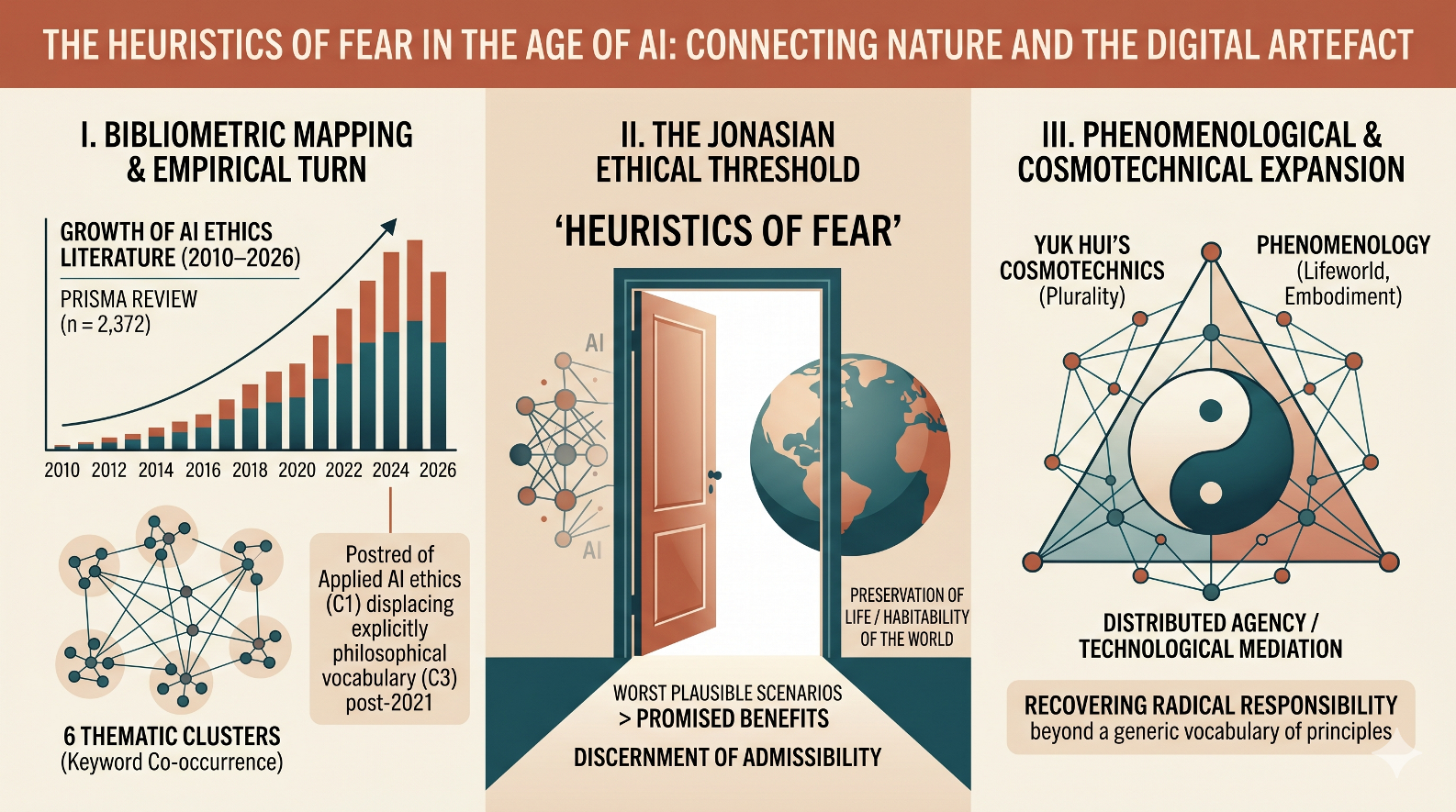

The Heuristics of Fear in Hans Jonas: Connecting the Status of Nature and the Nature of the Digital Artefact in the Context of Artificial Intelligence as an Extension of Modern Technology—A Systematic Review †

Abstract
1. Introduction
2. Theoretical Background
2.1. Hans Jonas: Principle of Responsibility and Heuristics of Fear
2.2. Phenomenology, Postphenomenology, and the Empirical Turn
2.3. Lifeworld and Embodiment Under Algorithmic Conditions
2.4. The Digital Artefact and AI as Intensification of Modern Technology
2.5. AI Is Not One: Heterogeneity Within the Digital Artefact
2.6. The Cosmotechnical Bridge: Plural Genealogies of Technology
2.7. AI Ethics, Governance, and Responsibility Gaps
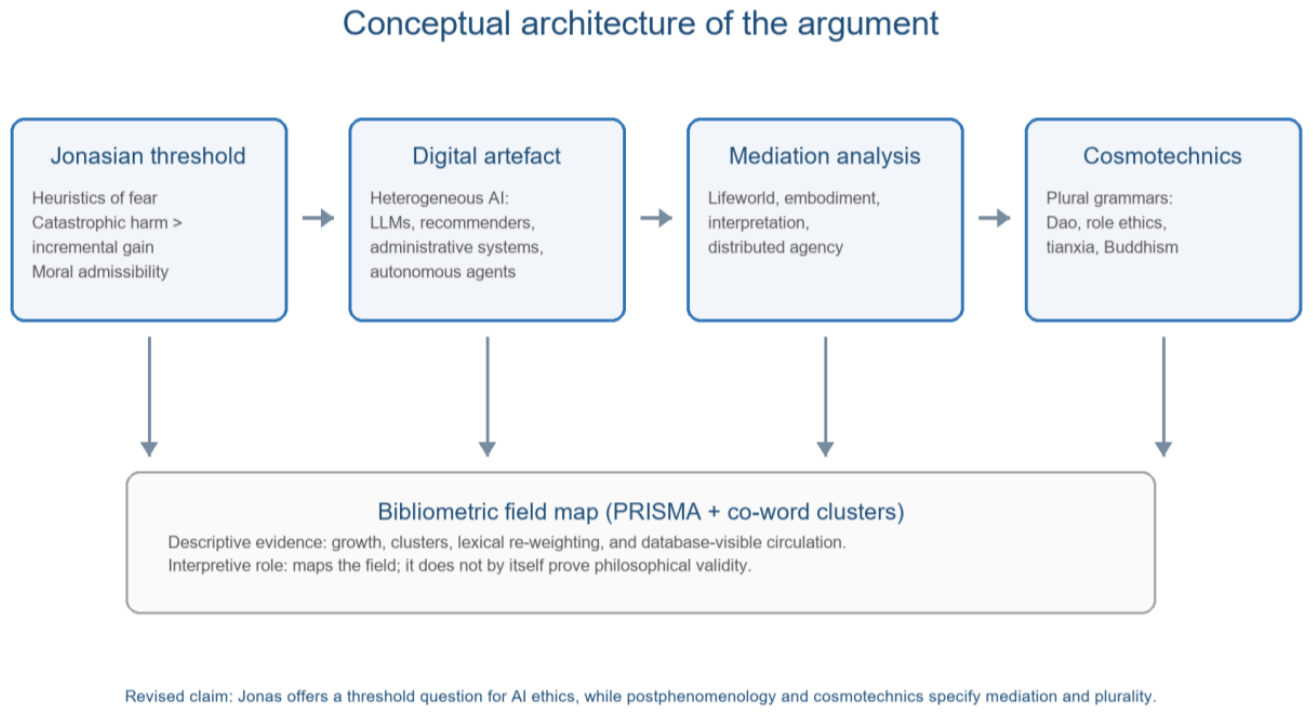
2.8. Synthesis: Philosophical Axes of the Manuscript
3. Materials and Methods
3.1. Review Design and Reporting Framework
3.2. Data Sources and Search Strategy
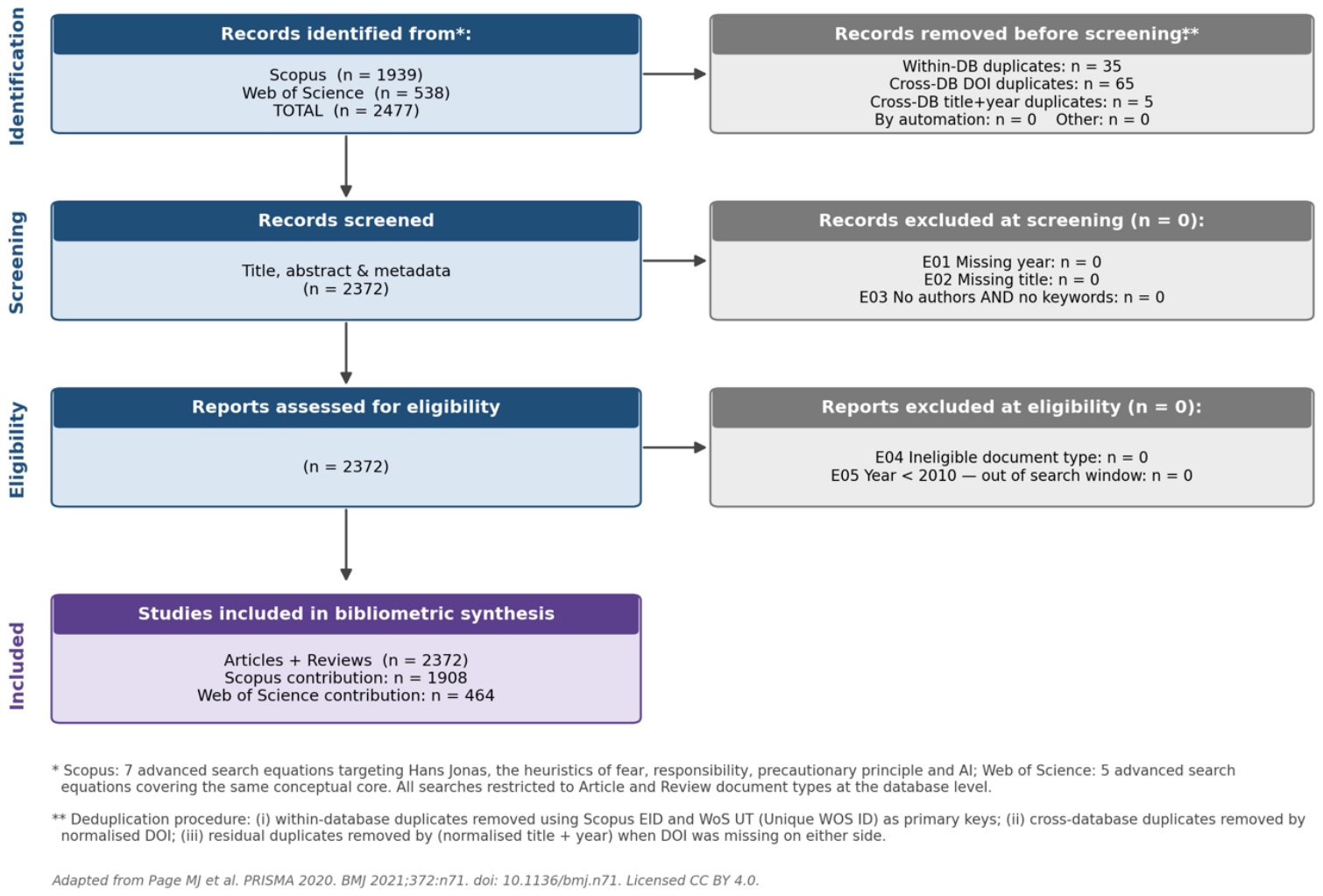
3.3. Eligibility Criteria, Screening, and Deduplication
3.4. Data Harmonisation and Variables
3.5. Bibliometric Indicators and Network Analysis
4. Results
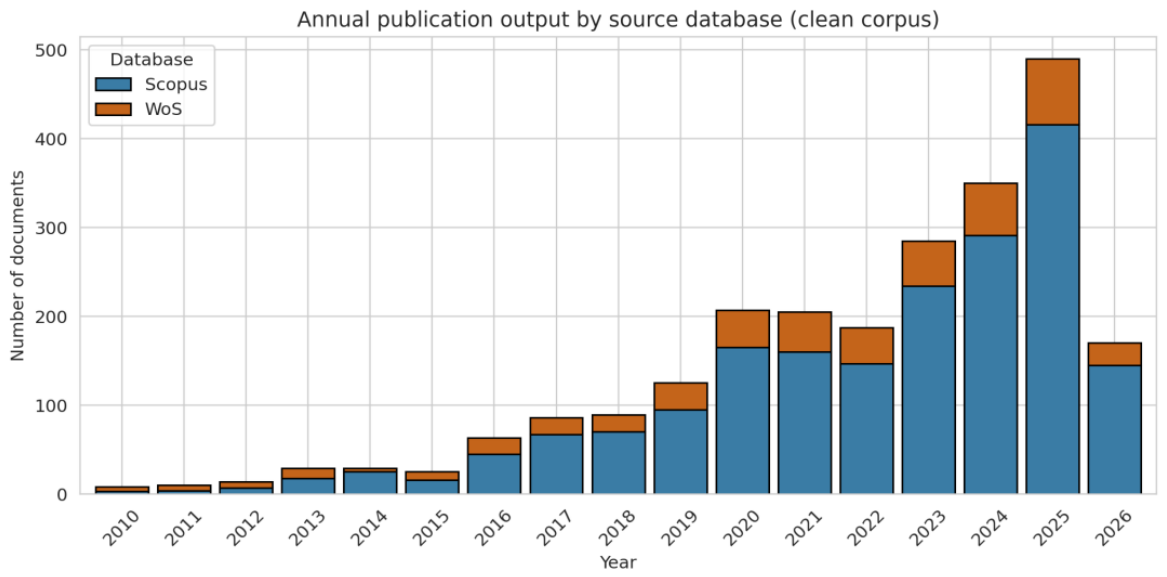
4.1. Temporal Evolution of the Field
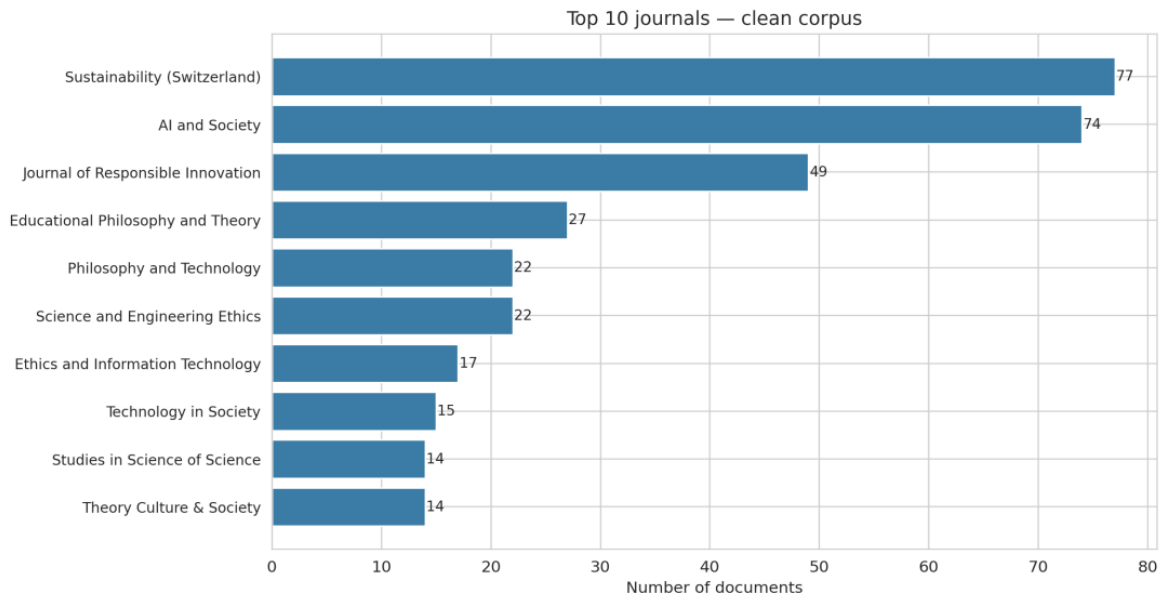
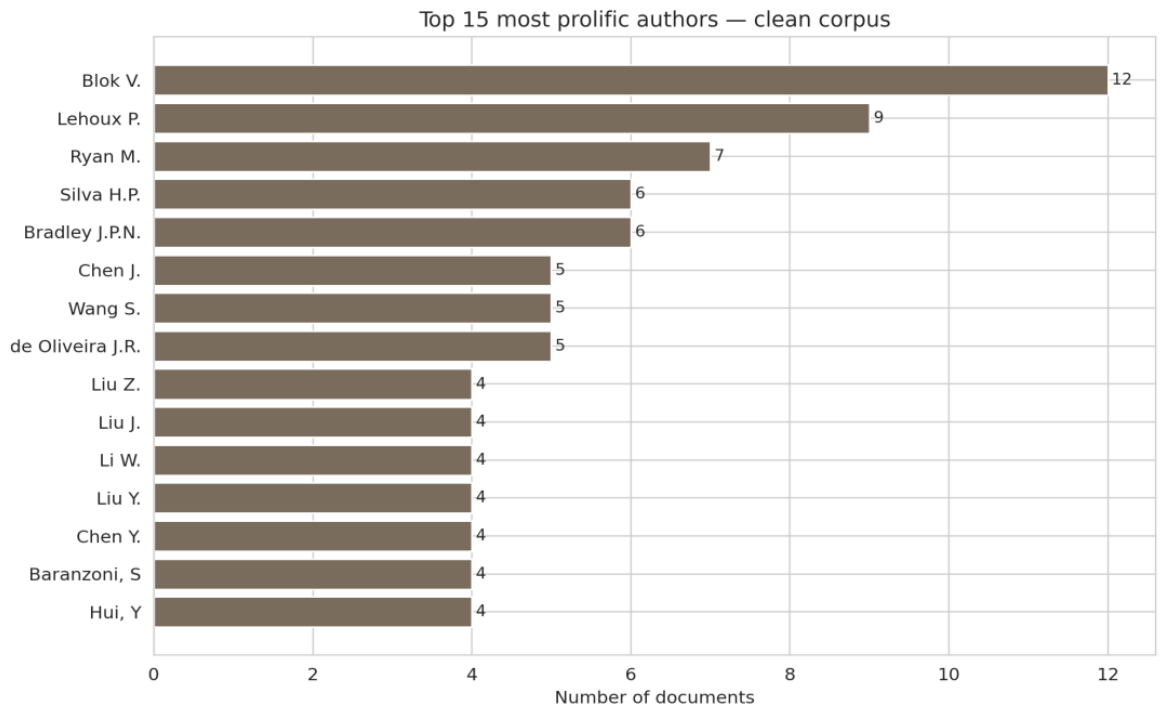
4.2. Productivity Distribution and Editorial Concentration
4.3. Highly Cited Contributions and Thematic Focus
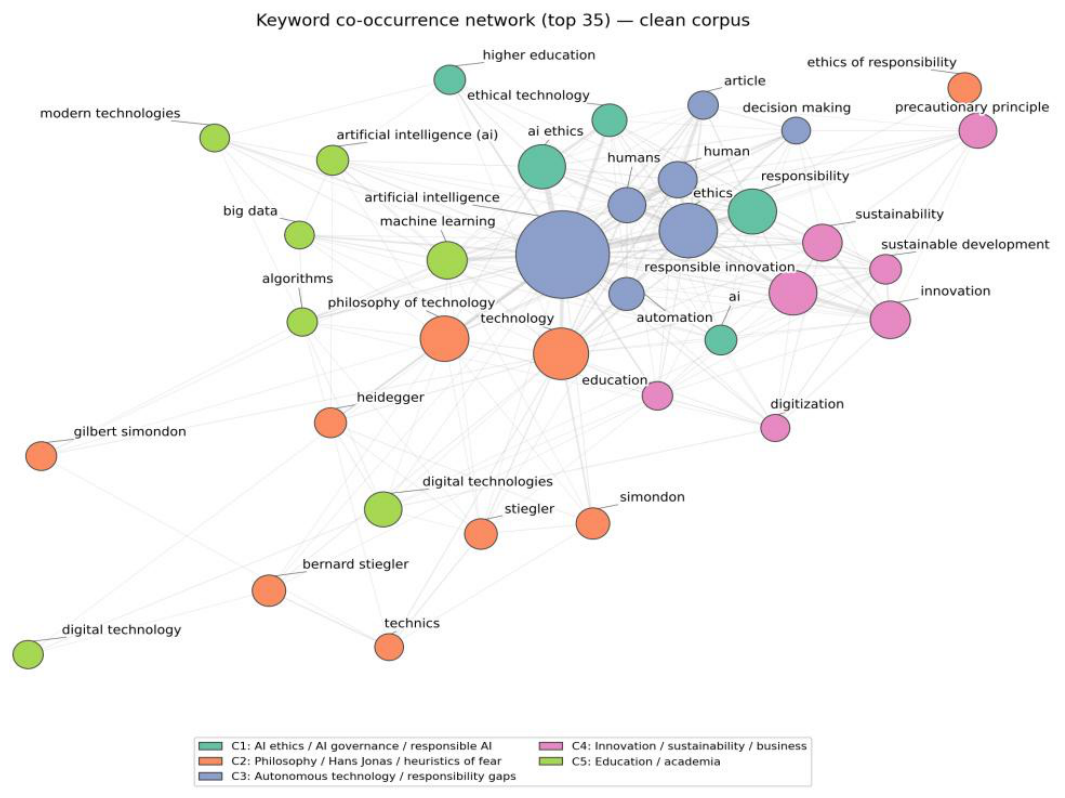
4.4. Keyword Structure and Thematic Clusters
4.5. Diachronic Reorganisation of the Field: Period × Cluster
4.6. The Jonas-Specific Sub-Corpus
5. Discussion
5.1. The Empirical Turn Confirmed by Bibliometric Evidence
5.2. Postphenomenological Reading of the Bibliometric Map
5.3. Heuristics of Fear, Lifeworld, and Responsibility Gaps
5.4. Jonas and the Cosmotechnical Plurality of AI
5.5. Limitations
6. Conclusions
Supplementary Materials
Author Contributions
Funding
Institutional Review Board Statement
Informed Consent Statement
Data Availability Statement
Conflicts of Interest
Abbreviations
| AI | Artificial Intelligence |
| BCI | Brain–Computer Interface |
| CAGR | Compound Annual Growth Rate |
| CSR | Corporate Social Responsibility |
| DOI | Digital Object Identifier |
| EU | European Union |
| LLM | Large Language Model |
| OECD | Organisation for Economic Co-operation and Development |
| PRISMA | Preferred Reporting Items for Systematic Reviews and Meta-Analyses |
| RRI | Responsible Research and Innovation |
| STS | Science and Technology Studies |
| UNESCO | United Nations Educational, Scientific and Cultural Organization |
| VR | Virtual Reality |
References
- Jonas, H. The Imperative of Responsibility: In Search of an Ethics for the Technological Age; University of Chicago Press: Chicago, IL, USA, 1984. [Google Scholar]
- Heidegger, M. The Question Concerning Technology and Other Essays; Lovitt, W., Translator; Harper & Row: New York, NY, USA, 1977; pp. 3–35. [Google Scholar]
- Simondon, G. On the Mode of Existence of Technical Objects; Malaspina, C.; Rogove, J., Translators; Univocal Publishing: Minneapolis, MN, USA, 2017. [Google Scholar]
- Stiegler, B. Technics and Time, 1: The Fault of Epimetheus; Beardsworth, R.; Collins, G., Translators; Stanford University Press: Stanford, CA, USA, 1998. [Google Scholar]
- Hui, Y. The Question Concerning Technology in China: An Essay in Cosmotechnics; Urbanomic: Falmouth, UK, 2016. [Google Scholar]
- Achterhuis, H. (Ed.) American Philosophy of Technology: The Empirical Turn; Crease, R.P., Translator; Indiana University Press: Bloomington, IN, USA, 2001. [Google Scholar]
- Bostrom, N. Superintelligence: Paths, Dangers, Strategies; Oxford University Press: Oxford, UK, 2014. [Google Scholar]
- Verbeek, P.-P. What Things Do: Philosophical Reflections on Technology, Agency, and Design; Crease, R.P., Translator; Pennsylvania State University Press: University Park, PA, USA, 2005. [Google Scholar]
- Verbeek, P.-P. Moralizing Technology: Understanding and Designing the Morality of Things; University of Chicago Press: Chicago, IL, USA, 2011. [Google Scholar]
- Floridi, L.; Cowls, J.; Beltrametti, M.; Chatila, R.; Chazerand, P.; Dignum, V.; Luetge, C.; Madelin, R.; Pagallo, U.; Rossi, F.; et al. AI4People—An Ethical Framework for a Good AI Society: Opportunities, Risks, Principles, and Recommendations. Minds Mach. 2018, 28, 689–707. [Google Scholar] [CrossRef]
- Blok, V.; Lemmens, P. The Emerging Concept of Responsible Innovation: Three Reasons Why It Is Questionable and Calls for a Radical Transformation of the Concept of Innovation. In Responsible Innovation 2; Springer: Cham, Switzerland, 2015; pp. 19–35. [Google Scholar] [CrossRef]
- Mittelstadt, B.D.; Allo, P.; Taddeo, M.; Wachter, S.; Floridi, L. The Ethics of Algorithms: Mapping the Debate. Big Data Soc. 2016, 3, 1–21. [Google Scholar] [CrossRef]
- Burrell, J. How the Machine ‘Thinks’: Understanding Opacity in Machine Learning Algorithms. Big Data Soc. 2016, 3, 1–12. [Google Scholar] [CrossRef]
- Crawford, K. Atlas of AI: Power, Politics, and the Planetary Costs of Artificial Intelligence; Yale University Press: New Haven, CT, USA, 2021. [Google Scholar]
- Gunkel, D.J. Robot Rights; MIT Press: Cambridge, MA, USA, 2018. [Google Scholar]
- Ihde, D. Technics and Praxis: A Philosophy of Technology; D. Reidel: Dordrecht, The Netherlands, 1979. [Google Scholar] [CrossRef]
- Ihde, D. Technology and the Lifeworld: From Garden to Earth; Indiana University Press: Bloomington, IN, USA, 1990. [Google Scholar]
- Ihde, D. Postphenomenology and Technoscience: The Peking University Lectures; SUNY Press: Albany, NY, USA, 2009. [Google Scholar]
- Rosenberger, R.; Verbeek, P.-P. (Eds.) Postphenomenological Investigations: Essays on Human-Technology Relations; Lexington Books: Lanham, MD, USA, 2015. [Google Scholar]
- Hui, Y. Recursivity and Contingency; Rowman & Littlefield: London, UK, 2019. [Google Scholar]
- Hui, Y. Art and Cosmotechnics; University of Minnesota Press: Minneapolis, MN, USA, 2021. [Google Scholar]
- Hagendorff, T. The Ethics of AI Ethics: An Evaluation of Guidelines. Minds Mach. 2020, 30, 99–120. [Google Scholar] [CrossRef]
- Jobin, A.; Ienca, M.; Vayena, E. The global landscape of AI ethics guidelines. Nat. Mach. Intell. 2019, 1, 389–399. [Google Scholar] [CrossRef]
- Floridi, L.; Cowls, J. A Unified Framework of Five Principles for AI in Society. Harv. Data Sci. Rev. 2019, 1, 2–15. [Google Scholar] [CrossRef]
- Floridi, L. The Ethics of Information; Oxford University Press: Oxford, UK, 2013. [Google Scholar]
- Floridi, L. The Logic of Information: A Theory of Philosophy as Conceptual Design; Oxford University Press: Oxford, UK, 2019. [Google Scholar]
- Dignum, V. Responsible Artificial Intelligence: How to Develop and Use AI in a Responsible Way; Springer: Cham, Switzerland, 2019. [Google Scholar] [CrossRef]
- Selbst, A.D.; Barocas, S. The Intuitive Appeal of Explainable Machines. Fordham Law Rev. 2018, 87, 1085–1139. [Google Scholar]
- Bommasani, R.; Hudson, D.A.; Adeli, E.; Altman, R.; Arora, S.; von Arx, S.; Bernstein, M.S.; Bohg, J.; Bosselut, A.; Brunskill, E.; et al. On the Opportunities and Risks of Foundation Models. arXiv 2021, arXiv:2108.07258. [Google Scholar] [CrossRef]
- European Commission. Proposal for a Regulation Laying Down Harmonised Rules on Artificial Intelligence (Artificial Intelligence Act); COM(2021) 206 Final; European Commission: Brussels, Belgium, 2021. [Google Scholar]
- European Commission High-Level Expert Group on AI. Ethics Guidelines for Trustworthy AI; Publications Office of the European Union: Luxembourg, 2019. [Google Scholar]
- OECD. Recommendation of the Council on Artificial Intelligence; OECD/LEGAL/0449; OECD: Paris, France, 2019. [Google Scholar]
- O’Neil, C. Weapons of Math Destruction: How Big Data Increases Inequality and Threatens Democracy; Crown: New York, NY, USA, 2016. [Google Scholar]
- Eubanks, V. Automating Inequality: How High-Tech Tools Profile, Police, and Punish the Poor; St. Martin’s Press: New York, NY, USA, 2018. [Google Scholar]
- Noble, S.U. Algorithms of Oppression: How Search Engines Reinforce Racism; NYU Press: New York, NY, USA, 2018. [Google Scholar]
- Pasquale, F. The Black Box Society: The Secret Algorithms That Control Money and Information; Harvard University Press: Cambridge, MA, USA, 2015. [Google Scholar]
- Zuboff, S. The Age of Surveillance Capitalism: The Fight for a Human Future at the New Frontier of Power; PublicAffairs: New York, NY, USA, 2019. [Google Scholar]
- Jonas, H. The Phenomenon of Life: Toward a Philosophical Biology; Northwestern University Press: Evanston, IL, USA, 2001. [Google Scholar]
- Jonas, H. Mortality and Morality: A Search for the Good After Auschwitz; Northwestern University Press: Evanston, IL, USA, 1996. [Google Scholar]
- Jonas, H. Technology and Responsibility: Reflections on the New Tasks of Ethics. Soc. Res. 1973, 40, 31–54. [Google Scholar]
- Russell, S. Human Compatible: Artificial Intelligence and the Problem of Control; Viking: New York, NY, USA, 2019. [Google Scholar]
- Tegmark, M. Life 3.0: Being Human in the Age of Artificial Intelligence; Knopf: New York, NY, USA, 2017. [Google Scholar]
- Ord, T. The Precipice: Existential Risk and the Future of Humanity; Hachette Books: New York, NY, USA, 2020. [Google Scholar]
- Arendt, H. The Human Condition; University of Chicago Press: Chicago, IL, USA, 1958. [Google Scholar]
- Vilaça, M.M.; Lavazza, A. Not Too Risky. How to Take a Reasonable Stance on Human Enhancement. Filos. Unisinos 2022, 23, e23305. [Google Scholar] [CrossRef]
- Ryan, M. In AI We Trust: Ethics, Artificial Intelligence, and Reliability. Sci. Eng. Ethics 2020, 26, 2749–2767. [Google Scholar] [CrossRef] [PubMed]
- Wiener, N. The Human Use of Human Beings: Cybernetics and Society; Houghton Mifflin: Boston, MA, USA, 1950. [Google Scholar]
- Hunyadi, M. The Time of Responsibility: Essay on the Source of Moral Obligations; Springer: Cham, Switzerland, 2020. [Google Scholar]
- Wellner, G. A Postphenomenological Inquiry of Cell Phones: Genealogies, Meanings, and Becoming; Lexington Books: Lanham, MD, USA, 2016. [Google Scholar]
- Hui, Y. On the Existence of Digital Objects; University of Minnesota Press: Minneapolis, MN, USA, 2016. [Google Scholar]
- Nyholm, S. Humans and Robots: Ethics, Agency, and Anthropomorphism; Rowman & Littlefield: London, UK, 2020. [Google Scholar]
- Stiegler, B. Technics and Time, 2: Disorientation; Barker, S., Translator; Stanford University Press: Stanford, CA, USA, 2009. [Google Scholar]
- Stiegler, B. The Neganthropocene; Ross, D., Translator; Open Humanities Press: London, UK, 2018. [Google Scholar]
- Brey, P. Philosophy of Technology after the Empirical Turn. Techné Res. Philos. Technol. 2010, 14, 36–48. [Google Scholar] [CrossRef]
- Kroes, P.; Meijers, A. (Eds.) The Empirical Turn in the Philosophy of Technology; JAI Press: Amsterdam, The Netherlands, 2000. [Google Scholar]
- Ihde, D. Bodies in Technology; University of Minnesota Press: Minneapolis, MN, USA, 2002. [Google Scholar]
- Selinger, E. (Ed.) Postphenomenology: A Critical Companion to Ihde; SUNY Press: Albany, NY, USA, 2006. [Google Scholar]
- Aagaard, J.; Friis, J.K.B.O.; Sorenson, J.; Tafdrup, O.; Hasse, C. (Eds.) Postphenomenological Methodologies: New Ways in Mediating Techno-Human Relationships; Lexington Books: Lanham, MD, USA, 2018. [Google Scholar]
- Merleau-Ponty, M. Phenomenology of Perception; Landes, D.A., Translator; Routledge: London, UK, 2012. [Google Scholar]
- UNESCO. Recommendation on the Ethics of Artificial Intelligence; UNESCO: Paris, France, 2021. [Google Scholar]
- Page, M.J.; McKenzie, J.E.; Bossuyt, P.M.; Boutron, I.; Hoffmann, T.C.; Mulrow, C.D.; Shamseer, L.; Tetzlaff, J.M.; Akl, E.A.; Brennan, S.E.; et al. The PRISMA 2020 Statement: An Updated Guideline for Reporting Systematic Reviews. BMJ 2021, 372, n71. [Google Scholar] [CrossRef] [PubMed]
- Page, M.J.; Moher, D.; Bossuyt, P.M.; Boutron, I.; Hoffmann, T.C.; Mulrow, C.D.; Shamseer, L.; Tetzlaff, J.M.; Akl, E.A.; Brennan, S.E.; et al. PRISMA 2020 Explanation and Elaboration: Updated Guidance and Exemplars for Reporting Systematic Reviews. BMJ 2021, 372, n160. [Google Scholar] [CrossRef] [PubMed]
- Donthu, N.; Kumar, S.; Mukherjee, D.; Pandey, N.; Lim, W.M. How to Conduct a Bibliometric Analysis: An Overview and Guidelines. J. Bus. Res. 2021, 133, 285–296. [Google Scholar] [CrossRef]
- Stilgoe, J.; Owen, R.; Macnaghten, P. Developing a Framework for Responsible Innovation. Res. Policy 2013, 42, 1568–1580. [Google Scholar] [CrossRef]
- Owen, R.; Macnaghten, P.; Stilgoe, J. Responsible Research and Innovation: From Science in Society to Science for Society, with Society. Sci. Public Policy 2012, 39, 751–760. [Google Scholar] [CrossRef]
- Aria, M.; Cuccurullo, C. bibliometrix: An R-Tool for Comprehensive Science Mapping Analysis. J. Informetr. 2017, 11, 959–975. [Google Scholar] [CrossRef]
- Lotka, A.J. The Frequency Distribution of Scientific Productivity. J. Wash. Acad. Sci. 1926, 16, 317–323. [Google Scholar]
- Bradford, S.C. Sources of Information on Specific Subjects. Engineering 1934, 137, 85–86. [Google Scholar]
- Hirsch, J.E. An Index to Quantify an Individual’s Scientific Research Output. Proc. Natl. Acad. Sci. USA 2005, 102, 16569–16572. [Google Scholar] [CrossRef] [PubMed]
- Tibaldeo, R.F. Hans Jonas and Vasily Grossman: Reflections on the Human Condition after Auschwitz. Ethics Prog. 2014, 5, 215–245. [Google Scholar] [CrossRef]
- Garcia, J.L.; Jerónimo, H.M.; Carvalho, T.M. Methodological Luddism: A Concept for Tying Degrowth to the Assessment and Regulation of Technologies. J. Clean. Prod. 2018, 197, 1647–1653. [Google Scholar] [CrossRef]
- García-Granero, M. Hans Jonas y la Heurística del Temor en el Marco de la Cuestión por la Naturaleza. Pensamiento 2017, 73, 519–538. [Google Scholar] [CrossRef]
- Husserl, E. The Crisis of European Sciences and Transcendental Phenomenology: An Introduction to Phenomenological Philosophy; Carr, D., Translator; Northwestern University Press: Evanston, IL, USA, 1970. [Google Scholar]
- Husserl, E. Ideas Pertaining to a Pure Phenomenology and to a Phenomenological Philosophy. First Book; Kersten, F., Translator; Martinus Nijhoff: The Hague, The Netherlands, 1983. [Google Scholar]
- Crowell, S.G. Husserl, Heidegger, and the Space of Meaning: Paths toward Transcendental Phenomenology; Northwestern University Press: Evanston, IL, USA, 2001. [Google Scholar]
- Zahavi, D. Husserl’s Phenomenology; Stanford University Press: Stanford, CA, USA, 2003. [Google Scholar]
- Heidegger, M. Being and Time; Macquarrie, J.; Robinson, E., Translators; Harper & Row: New York, NY, USA, 1962. [Google Scholar]
- Carel, H. Phenomenology of Illness; Oxford University Press: Oxford, UK, 2016. [Google Scholar]
- Berberich, N.; Diepold, K. The Virtuous Machine—Old Ethics for New Technology? arXiv 2018, arXiv:1806.10322. [Google Scholar] [CrossRef]
- Ellul, J. The Technological System; Wilkinson, J., Translator; Continuum: New York, NY, USA, 1980. [Google Scholar]
- Ellul, J. The Technological Society; Wilkinson, J., Translator; Vintage Books: New York, NY, USA, 1964. [Google Scholar]
- Latour, B. Where Are the Missing Masses? The Sociology of a Few Mundane Artifacts. In Shaping Technology/Building Society; Bijker, W.E., Law, J., Eds.; MIT Press: Cambridge, MA, USA, 1992; pp. 225–258. [Google Scholar]
- Latour, B. We Have Never Been Modern; Porter, C., Translator; Harvard University Press: Cambridge, MA, USA, 1993. [Google Scholar]
- Coeckelbergh, M. AI Ethics; MIT Press: Cambridge, MA, USA, 2020. [Google Scholar]
- Bender, E.M.; Gebru, T.; McMillan-Major, A.; Shmitchell, S. On the Dangers of Stochastic Parrots: Can Language Models Be Too Big? In Proceedings of the 2021 ACM Conference on Fairness, Accountability, and Transparency, Virtual Event, 3–10 March 2021; ACM: New York, NY, USA, 2021; pp. 610–623. [Google Scholar] [CrossRef]
- Matthias, A. The Responsibility Gap: Ascribing Responsibility for the Actions of Learning Automata. Ethics Inf. Technol. 2004, 6, 175–183. [Google Scholar] [CrossRef]
- Sparrow, R. Killer Robots. J. Appl. Philos. 2007, 24, 62–77. [Google Scholar] [CrossRef]
- Santoni de Sio, F.; Mecacci, G. Four Responsibility Gaps with Artificial Intelligence: Why They Matter and How to Address Them. Philos. Technol. 2021, 34, 1057–1084. [Google Scholar] [CrossRef]
- Santoni de Sio, F.; van den Hoven, J. Meaningful Human Control over Autonomous Systems: A Philosophical Account. Front. Robot. AI 2018, 5, 15. [Google Scholar] [CrossRef] [PubMed]
- Sætra, H.S. AI in Context and the Sustainable Development Goals: Factoring in the Unsustainability of the Sociotechnical System. Sustainability 2021, 13, 1738. [Google Scholar] [CrossRef]
- Müller, V.C. Ethics of Artificial Intelligence and Robotics. In The Stanford Encyclopedia of Philosophy; Zalta, E.N., Ed.; Metaphysics Research Lab, Stanford University: Stanford, CA, USA, 2020. [Google Scholar]
- Lockey, S.; Gillespie, N.; Holm, D.; Someh, I.A. A Review of Trust in Artificial Intelligence: Challenges, Vulnerabilities and Future Directions. In Proceedings of the Hawaii International Conference on System Sciences (HICSS), Maui, HI, USA, 4–7 January 2021. [Google Scholar] [CrossRef]
- Owen, R.; Stilgoe, J.; Macnaghten, P.; Gorman, M.; Fisher, E.; Guston, D. A Framework for Responsible Innovation. In Responsible Innovation; Owen, R., Bessant, J., Heintz, M., Eds.; Wiley: Chichester, UK, 2013; pp. 27–50. [Google Scholar] [CrossRef]
- Coeckelbergh, M. The Political Philosophy of AI: An Introduction; Polity Press: Cambridge, UK, 2022. [Google Scholar]
- Vallor, S. Technology and the Virtues: A Philosophical Guide to a Future Worth Wanting; Oxford University Press: Oxford, UK, 2016. [Google Scholar]
- Newman, M.E.J. Modularity and Community Structure in Networks. Proc. Natl. Acad. Sci. USA 2006, 103, 8577–8582. [Google Scholar] [CrossRef] [PubMed]
- van Eck, N.J.; Waltman, L. Software Survey: VOSviewer, a Computer Program for Bibliometric Mapping. Scientometrics 2010, 84, 523–538. [Google Scholar] [CrossRef] [PubMed]
- Mongeon, P.; Paul-Hus, A. The Journal Coverage of Web of Science and Scopus: A Comparative Analysis. Scientometrics 2016, 106, 213–228. [Google Scholar] [CrossRef]
- Penmetsa, P.; Adanu, E.K.; Wood, D.; Wang, T.; Jones, S.L. Perceptions and Expectations of Autonomous Vehicles—A Snapshot of Vulnerable Road User Opinion. Technol. Forecast. Soc. Change 2019, 143, 9–13. [Google Scholar] [CrossRef]
- Bigman, Y.E.; Gray, K. People Are Averse to Machines Making Moral Decisions. Cognition 2018, 181, 21–34. [Google Scholar] [CrossRef] [PubMed]
- Stahl, B.C.; Eke, D. The Ethics of ChatGPT—Exploring the Ethical Issues of an Emerging Technology. Int. J. Inf. Manag. 2024, 74, 102700. [Google Scholar] [CrossRef]
- Lubberink, R.; Blok, V.; van Ophem, J.; Omta, O. Lessons for Responsible Innovation in the Business Context: A Systematic Literature Review of Responsible, Social and Sustainable Innovation Practices. Sustainability 2017, 9, 721. [Google Scholar] [CrossRef]
- Kraus, S.; Schiavone, F.; Pluzhnikova, A.; Invernizzi, A.C. Digital Transformation in Healthcare: Analyzing the Current State-of-Research. J. Bus. Res. 2021, 123, 557–567. [Google Scholar] [CrossRef]
- von Schomberg, R. Towards Responsible Research and Innovation in the Information and Communication Technologies and Security Technologies Fields; Publications Office of the European Union: Luxembourg, 2011. [Google Scholar]
- Kovacs, O. The Dark Corners of Industry 4.0—Grounding Economic Governance 2.0. Technol. Soc. 2018, 55, 140–145. [Google Scholar] [CrossRef]
- Holmes, W.; Porayska-Pomsta, K.; Holstein, K.; Sutherland, E.; Baker, T.; Shum, S.B.; Santos, O.C.; Rodrigo, M.T.; Cukurova, M.; Bittencourt, I.I.; et al. Ethics of AI in Education: Towards a Community-Wide Framework. Int. J. Artif. Intell. Educ. 2022, 32, 504–526. [Google Scholar] [CrossRef]
- Blondel, V.D.; Guillaume, J.-L.; Lambiotte, R.; Lefebvre, E. Fast Unfolding of Communities in Large Networks. J. Stat. Mech. Theory Exp. 2008, 2008, P10008. [Google Scholar] [CrossRef]
- Rolandi, S.; Brunori, G.; Bacco, M.; Scotti, I. The Digitalization of Agriculture and Rural Areas: Towards a Taxonomy of the Impacts. Sustainability 2021, 13, 5172. [Google Scholar] [CrossRef]
- Tibaldeo, R.F. The Heuristics of Fear: Can the Ambivalence of Fear Teach Us Anything in the Technological Age? Ethics Prog. 2015, 6, 225–238. [Google Scholar] [CrossRef]
- Bradley, J.P.N. On the Philosophy of Bernard Stiegler: Politics, Technology and Individuation; Routledge: London, UK, 2021. [Google Scholar]
- Bryson, J.J. Robots Should Be Slaves. In Close Engagements with Artificial Companions; Wilks, Y., Ed.; John Benjamins: Amsterdam, The Netherlands, 2010; pp. 63–74. [Google Scholar]
- Lehoux, P.; Pacifico Silva, H.; Pozelli Sabio, R.; Roncarolo, F. The Unexplored Contribution of Responsible Innovation in Health to Sustainable Development Goals. Sustainability 2018, 10, 4015. [Google Scholar] [CrossRef]
- Tigard, D.W. There Is No Techno-Responsibility Gap. Philos. Technol. 2021, 34, 589–607. [Google Scholar] [CrossRef]
- Königs, P. Artificial intelligence and responsibility gaps: What is the problem? Ethics Inf. Technol. 2022, 24, 36. [Google Scholar] [CrossRef]
- Danaher, J. Tragic Choices and the Virtue of Techno-Responsibility Gaps. Philos. Technol. 2022, 35, 26. [Google Scholar] [CrossRef] [PubMed]
- Vallor, S. The AI Mirror: How to Reclaim Our Humanity in an Age of Machine Thinking; Oxford University Press: Oxford, UK, 2024. [Google Scholar]
- Wong, P.-H. Cultural Differences as Excuses? Human Rights and Cultural Values in Global Ethics and Governance of AI. Philos. Technol. 2020, 33, 705–715. [Google Scholar] [CrossRef]
- Ames, R.T. Confucian Role Ethics: A Vocabulary; University of Hawai‘i Press: Honolulu, HI, USA; The Chinese University Press: Hong Kong, China, 2011; ISBN 978-0824835767. [Google Scholar]
- Zhao, T. All Under Heaven: The Tianxia System for a Possible World Order; Harroff, J.E., Translator; University of California Press: Berkeley, CA, USA, 2021; ISBN 978-0-520-32500-5. [Google Scholar]
- Hongladarom, S. The Ethics of AI and Robotics: A Buddhist Viewpoint; Lexington Books: Lanham, MD, USA, 2020; ISBN 978-1-7936-2417-8. [Google Scholar]



| Philosophical Axis | Key Author(s) | Central Concept | Function Within the Manuscript |
|---|---|---|---|
| Responsibility and fear | H. Jonas [1,38,39,40] | Principle of responsibility; heuristics of fear | Normative core; criterion to evaluate structural risks of AI. |
| Lifeworld and embodiment | E. Husserl [73,74]; M. Merleau-Ponty [59] | Lebenswelt; pre-reflective horizon; embodiment | Phenomenological frame for analysing how AI reshapes the experiential world. |
| Ontology of technology | M. Heidegger [2,77] | Gestell; standing-reserve; revealing | Ontological frame for understanding modern technology and its algorithmic intensification. |
| Postphenomenology and mediation | D. Ihde [17,18]; P.-P. Verbeek [8,9] | Embodiment, hermeneutic, alterity & background relations; mediation | Vocabulary to describe how AI mediates perception, action, and moral subjects. |
| Individuation of the technical object | G. Simondon [3] | Mode of existence of technical objects | Understanding AI as a technical object evolving within sociotechnical networks. |
| Technics as tertiary retention | B. Stiegler [4,52,53] | Exteriorisation of memory and temporality | Analysis of AI as a device of shared memory, experience, and temporality. |
| Technical system and autonomy | J. Ellul [80,81] | Autonomy of the technical system | Problematisation of the relative autonomy of algorithmic systems. |
| Human condition and technology | H. Arendt [44] | Action; natality; plurality | Political evaluation of algorithmic mediation over public space. |
| Cosmotechnical plurality | Yuk Hui [5,20,21] | Cosmotechnics; recursive contingency | Comparative China–West frame for a pluralised philosophy of digital artefacts. |
| Zone | Journals | % of Journals | Articles | % of Articles | Top Journal in Zone |
|---|---|---|---|---|---|
| Zone 1 (core) | 90 | 6.94 | 791 | 33.35 | Sustainability (Switzerland) |
| Zone 2 (intermediate) | 416 | 32.10 | 791 | 33.35 | Human Affairs |
| Zone 3 (dispersion) | 790 | 60.96 | 790 | 33.31 | Support for Learning |
| # | Title (Abridged) | Year | Source | Cites | Thematic Cluster |
|---|---|---|---|---|---|
| 1 | Perceptions of autonomous vehicles: relationships with road users, risk and reward | 2018 | Safety Science | 619 | Autonomy/decision-making |
| 2 | Dealing with the game-changing technologies of Agriculture 4.0 | 2020 | Journal of Responsible Innovation | 544 | Responsible innovation & sustainability |
| 3 | People are averse to machines making moral decisions | 2018 | Cognition | 507 | Autonomy/decision-making |
| 4 | In AI we trust: ethics, AI, and reliability | 2020 | Science and Engineering Ethics | 456 | AI ethics |
| 5 | The ethics of ChatGPT—emerging technology | 2024 | Int. J. Information Management | 400 | AI ethics & philosophy of AI |
| 6 | Responsible innovation and the innovation of responsibility | 2017 | Journal of Responsible Innovation | 352 | Responsible innovation & sustainability |
| 7 | Predicting the intention to use chatbots for travel and tourism | 2021 | Sustainability | 332 | Autonomy/decision-making |
| 8 | Trust and acceptance of in-vehicle technology for autonomous vehicles | 2018 | Computers in Human Behavior | 310 | Autonomy/decision-making |
| 9 | Four responsibility gaps with AI | 2021 | Philosophy & Technology | 307 | AI ethics & responsibility gaps |
| 10 | Digital innovation: review and novel perspective | 2021 | Journal of Strategic Information Systems | 278 | ML & digital transformation |
| Cluster | Label | # Keywords | Frequency | Central Concepts |
|---|---|---|---|---|
| C1 | AI ethics & governance | 144 | 2218 | AI ethics, responsible AI, transparency, accountability, generative AI |
| C2 | Autonomy & decision-making | 96 | 1298 | autonomous technology, decision-making, morality, privacy, social responsibility |
| C3 | Philosophy of technology & Hans Jonas | 87 | 1374 | Hans Jonas, Bernard Stiegler, Simondon, ethics of responsibility, technology |
| C4 | Machine learning & digital transformation | 70 | 919 | machine learning, deep learning, big data, digital technologies, digitalisation |
| C5 | Responsible innovation & sustainability | 63 | 962 | responsible innovation, sustainability, sustainable development, education, CSR |
| C6 | Risk, precaution & uncertainty | 18 | 253 | precautionary principle, risk assessment, uncertainty, human rights |
| Period | C1—AI Ethics | C2—Autonomy/Decision | C3—Phil. Tech/Jonas | C4—ML & Digital | C5—Resp. Innov. | C6—Risk & Precaution |
|---|---|---|---|---|---|---|
| 2010–2015 | 17 (14.8%) | 12 (10.4%) | 39 (33.9%) | 19 (16.5%) | 2 (1.7%) | 1 (0.9%) |
| 2016–2020 | 104 (18.2%) | 79 (13.9%) | 165 (28.9%) | 41 (7.2%) | 49 (8.6%) | 20 (3.5%) |
| 2021–2026 | 653 (38.7%) | 129 (7.6%) | 254 (15.1%) | 182 (10.8%) | 174 (10.3%) | 44 (2.6%) |
| Total | 774 | 220 | 458 | 242 | 225 | 65 |
Disclaimer/Publisher’s Note: The statements, opinions and data contained in all publications are solely those of the individual author(s) and contributor(s) and not of MDPI and/or the editor(s). MDPI and/or the editor(s) disclaim responsibility for any injury to people or property resulting from any ideas, methods, instructions or products referred to in the content. |
© 2026 by the authors. Licensee MDPI, Basel, Switzerland. This article is an open access article distributed under the terms and conditions of the Creative Commons Attribution (CC BY) license.
Share and Cite
Betancourt Durango, R.A.; Correa Correa, D.A.; Rodríguez Flores, E.A.; Giraldo Zuluaga, C. The Heuristics of Fear in Hans Jonas: Connecting the Status of Nature and the Nature of the Digital Artefact in the Context of Artificial Intelligence as an Extension of Modern Technology—A Systematic Review. Philosophies 2026, 11, 133. https://doi.org/10.3390/philosophies11040133
Betancourt Durango RA, Correa Correa DA, Rodríguez Flores EA, Giraldo Zuluaga C. The Heuristics of Fear in Hans Jonas: Connecting the Status of Nature and the Nature of the Digital Artefact in the Context of Artificial Intelligence as an Extension of Modern Technology—A Systematic Review. Philosophies. 2026; 11(4):133. https://doi.org/10.3390/philosophies11040133
Chicago/Turabian StyleBetancourt Durango, Rafael Alejandro, Diego Alejandro Correa Correa, Eduar Antonio Rodríguez Flores, and Conrado Giraldo Zuluaga. 2026. "The Heuristics of Fear in Hans Jonas: Connecting the Status of Nature and the Nature of the Digital Artefact in the Context of Artificial Intelligence as an Extension of Modern Technology—A Systematic Review" Philosophies 11, no. 4: 133. https://doi.org/10.3390/philosophies11040133
APA StyleBetancourt Durango, R. A., Correa Correa, D. A., Rodríguez Flores, E. A., & Giraldo Zuluaga, C. (2026). The Heuristics of Fear in Hans Jonas: Connecting the Status of Nature and the Nature of the Digital Artefact in the Context of Artificial Intelligence as an Extension of Modern Technology—A Systematic Review. Philosophies, 11(4), 133. https://doi.org/10.3390/philosophies11040133