Article

On the Structural Distinction Between Entropy and Time in Dynamical Theories

Research Department, Silicon Minds Inc., 12186 Flowing Water Trail, Clarksville, MD 21029, USA
Philosophies 2026, 11(3), 87; https://doi.org/10.3390/philosophies11030087
Submission received: 27 March 2026 / Revised: 21 May 2026 / Accepted: 23 May 2026 / Published: 27 May 2026

Abstract

The relation between entropy and time is central to debates on thermodynamic irreversibility and the arrow of time. This paper clarifies that relation by distinguishing several roles often associated with entropy in such debates: temporal ordering, temporal orientation, temporal flow and measurement, and thermodynamic asymmetry. The paper does not deny that entropy increase, together with a low-entropy past and suitable coarse-graining, may explain the thermodynamic arrow or help orient an already ordered sequence of states. It also does not deny that thermodynamic or statistical structure may contribute to the selection or measurement of physically meaningful temporal flow in special frameworks. It addresses a narrower question: whether standard entropy notions can themselves supply temporal ordering or serve as general temporal parameters. Using thermodynamic, Boltzmann, Gibbs, and coarse-grained entropy within a minimal dynamical-systems framework, we show that they do not satisfy this role in general. Entropy functionals may be non-injective along trajectories; fine-grained Gibbs entropy is invariant under Hamiltonian flow; coarse-grained entropy depends on descriptive partitions; and entropy monotonicity depends on boundary conditions rather than an intrinsic temporal orientation. An open-system example is included only to illustrate that subsystem entropy may decrease while the dynamical time parameter continues to order the evolution. The novelty is therefore not in the bare claim that entropy and time are non-identical, nor in the attribution of a crude entropy-equals-time thesis to the literature, but in the explicit role-separation argument showing why entropy can characterize asymmetry, help orient an already ordered history, or contribute to temporal-flow selection only after suitable dynamical, statistical, or ordering structure is already given. Entropy remains central to statistical-mechanical accounts of irreversibility, but under standard definitions, it cannot itself supply temporal ordering.

1. Introduction

The relationship between entropy and time has long occupied a central place in the foundations of physics and philosophy of science. Macroscopic phenomena exhibit a pronounced temporal asymmetry: isolated systems relax toward equilibrium, dissipative processes occur spontaneously in one temporal orientation but not the other, and entropy—defined within thermodynamics and statistical mechanics—typically increases toward what is conventionally called the future [1,2,3,4,5]. These observations motivate what is commonly referred to as the thermodynamic arrow of time [6,7,8,9,10].
At the same time, the conceptual relation between entropy and time has been examined for over a century in discussions of reversibility, recurrence, statistical typicality, and the Past Hypothesis. The Loschmidt reversibility objection, Poincaré recurrence, Liouville invariance, and modern statistical-mechanical accounts of the Past Hypothesis have clarified that microscopic laws are, to a high degree, time-reversal invariant, and that entropy increase depends essentially on boundary conditions, typicality assumptions, and coarse-graining rather than on a fundamental asymmetry in the dynamical equations themselves [3,4,6,8,9,11,12,13,14,15]. Within this tradition, it is widely recognized that entropy is not identical to the time parameter appearing in physical theories. Entropy is instead typically used to explain the observed temporal asymmetry of macroscopic processes, given suitable boundary conditions and statistical assumptions [6,8,10,11,13].
The present paper does not claim novelty for the bare statement that entropy is not time. That point is already widely accepted in the philosophy of statistical mechanics and in foundational discussions of the arrow of time [5,6,8,9,16]. The aim is rather to make explicit a structural distinction that is often left implicit: entropy, temporal ordering, temporal orientation, temporal measurement or flow selection, and thermodynamic asymmetry play different roles within dynamical theories. Clarifying these roles is important because statements about the “entropy–time relation” can otherwise conflate several distinct questions.
The motivation for this clarification is not that the literature typically defends the crude thesis that entropy is literally identical to time, nor that standard statistical mechanics explicitly derives a before–after ordering from entropy alone. Few careful accounts defend such a thesis in that form. The issue is broader. Entropy is often assigned a central role in discussions of time’s arrow, temporal orientation, thermal time, emergent or relational time, cosmological asymmetry, and the measurement or selection of temporal flow. These roles are legitimate when understood as claims about irreversibility, orientation, or state-dependent flow within an already ordered framework. Without an explicit role distinction, however, such discussions can invite the stronger interpretation that entropy itself supplies, grounds, or constitutes temporal ordering. The present paper is intended to identify the boundary between these claims.
This issue is not merely rhetorical. In the thermal time hypothesis, for example, thermodynamic or statistical structure is proposed to determine a preferred physical flow in generally covariant settings [17]. Rovelli later describes thermal time as the time associated with the statistical state of the world, relative to the macroscopic parameters by which the system is described [18]. Such proposals are considerably more subtle than the simple claim that entropy is identical to time. Nevertheless, they illustrate why it is important to distinguish several roles that can otherwise be conflated: generating an ordering relation, selecting a preferred flow, orienting an already ordered history, measuring temporal change, and explaining thermodynamic asymmetry. Similar caution is needed in entropy-based cosmological accounts of the arrow of time, where low-entropy boundary conditions and entropy gradients are often used to explain why one temporal orientation is thermodynamically distinguished [6,8,9,10,19].
For clarity, we distinguish the following problems:
(A)
Irreversibility problem: Why do macroscopic processes exhibit irreversible behavior?
(B)
Thermodynamic arrow problem: Why does entropy typically increase toward what we call the future rather than the past?
(C)
Temporal-orientation problem: What selects one direction of an already ordered history as future-directed?
(D)
Temporal-flow or measurement problem: Can thermodynamic, statistical, or relational structure help define, select, or measure a physically relevant temporal flow?
(E)
Temporal-ordering problem: What supplies the ordering relation among states or events along a dynamical history?
Standard statistical mechanics provides powerful answers to (A) and (B). Irreversibility can be explained statistically in terms of typical behavior under coarse-grained descriptions, and entropy increase can be explained by combining time-reversal-invariant dynamics with special boundary conditions, most notably a low-entropy past [3,8,10,11,12,13]. Entropy gradients may also contribute to (C) by helping to identify one orientation of an already ordered history as thermodynamically future-directed. More sophisticated proposals, including thermal-time and relational-time approaches, may address aspects of (D) by using statistical states, modular structure, correlations, or records to define physically meaningful flows or clock-like relations [17,18]. The present paper does not challenge these projects. Rather, it addresses the more limited question in (E): whether standard entropy functionals themselves can supply the ordering relation among states or function as general temporal parameters within a dynamical theory.
It is useful to make this distinction explicit. By temporal ordering, we mean the before–after ordering relation among states along a dynamical history. By temporal orientation or temporal direction, we mean the assignment of one of the two possible directions along such an ordered history as future-directed. By temporal flow or measurement, we mean a physically selected or operationally meaningful way of parametrizing change, such as a clock, modular flow, or relational ordering variable. By the thermodynamic arrow, we mean the empirical and statistical tendency, under suitable boundary conditions and coarse-graining, for entropy to increase toward the future-directed orientation. These notions are related, but they are not equivalent. In particular, many entropy-based accounts of the arrow of time do not attempt to derive temporal ordering itself from entropy. Rather, they assume an ordered dynamical framework and use entropy gradients, together with boundary conditions such as a low-entropy past, to explain why one orientation of that order is thermodynamically distinguished [6,8,10,11,12,13,15].
The argument of this paper is compatible with the weaker, standard position. We do not deny that entropy increase may help orient an already ordered sequence of states, nor do we deny that entropy plays a central role in explaining thermodynamic irreversibility. We also do not deny that thermodynamic or statistical structure may contribute to the selection or measurement of physically meaningful temporal flow in special frameworks. The narrower claim is that entropy cannot itself supply the underlying temporal ordering relation, nor can standard entropy functionals serve as general temporal parameters. Entropy may characterize the asymmetry of an evolution once an ordered history is given, but the notions of increase, decrease, gradient, or monotonicity already presuppose an ordered sequence of states.
The argument proceeds in two steps. First, we formulate a minimal structural condition for a quantity to function as a temporal parameter along a dynamical trajectory. At a minimum, such a quantity must distinguish distinct stages of the evolution; mathematically, it must be injective along the relevant trajectory. Second, we show that standard entropy notions—thermodynamic, Boltzmann, Gibbs, and coarse-grained entropy—do not satisfy this condition in general. Entropy functionals may remain constant, repeat values, depend on coarse-graining, or vary non-monotonically along dynamically ordered histories.
The purpose of these structural results is not to prove the surprising claim that entropy and time are non-identical. Rather, the purpose is to make explicit why that non-identity follows from the different mathematical roles played by temporal parameters and entropy functionals. Time, in dynamical theories, orders the evolution of states. Entropy assigns scalar values to states, macrostates, or probability distributions. These roles are not interchangeable. The mathematical arguments below therefore provide a systematic role-separation analysis: they clarify why entropy cannot function as a general temporal parameter, even though it remains indispensable in accounts of thermodynamic asymmetry.
The main contributions of the paper are as follows:
(C1)
We provide an explicit role taxonomy distinguishing temporal ordering, temporal orientation, temporal measurement or flow selection, and thermodynamic asymmetry, thereby identifying which questions entropy-based arguments can address, and which they cannot.
(C2)
We formulate a minimal time-parametrization criterion within a dynamical-systems framework: a candidate temporal parameter must at least be injective along the trajectories it is supposed to order.
(C3)
We show that standard entropy functionals fail this criterion in general, due to non-injectivity, invariance of fine-grained Gibbs entropy under Hamiltonian flow, and the dependence of coarse-grained entropy on descriptive partitions.
(C4)
We clarify why time-reversal invariance and boundary conditions limit any attempt to extract an intrinsic temporal orientation from entropy monotonicity alone.
(C5)
We identify the precise circularity involved in attempts to use entropy increase as a ground of temporal ordering: increase, decrease, monotonicity, and entropy gradients are already order-relative notions. This does not exclude the weaker claim that entropy gradients may help orient such a sequence once the ordering relation is independently supplied.
(C6)
We propose a modest constraint-volume interpretation of entropy as a structural schema, exact in some cases, and asymptotic or heuristic in others, for understanding why entropy is so closely associated with thermodynamic asymmetry while remaining conceptually distinct from temporal ordering.
Taken together, these results isolate a structural boundary. Entropy increase may correlate with macroscopic irreversibility and may participate in statistical explanations of the thermodynamic arrow. Under Past Hypothesis-type assumptions, entropy gradients may also help identify a future-directed orientation of an already ordered dynamical history [8,10,11,12,13]. In thermal-time or relational-time settings, thermodynamic or statistical structure may also contribute to the selection of a physically meaningful flow [17,18]. What standard entropy functionals cannot do, under their usual definitions, is supply the ordering relation itself or replace the temporal parameter within a general dynamical theory.
The scope of the paper is, therefore, intentionally limited. We do not propose an alternative theory of time, nor do we dispute the explanatory success of entropy-based accounts of irreversible behavior. The aim is clarificatory and diagnostic: to identify the distinct structural roles played by temporal parameters and entropy functionals, and to show why these roles should not be conflated. In this sense, the paper is not a revision of statistical mechanics, but a conceptual and mathematical clarification of its temporal presuppositions. Its value is to provide a criterion for evaluating entropy-based, thermal-time, relational-time, and arrow-of-time claims by asking whether entropy is being used to explain irreversibility, orient an already ordered history, select or measure a state-dependent flow, or supply temporal ordering itself.
Finally, after establishing what entropy cannot provide, we turn in Section 4 to a positive structural clarification of what entropy may be understood to measure. We suggest that many standard entropy notions admit an interpretation, exact in some settings and asymptotic or heuristic in others, in terms of the logarithmic volume of constraint-defined possibility space. This interpretive schema helps explain why entropy correlates so strongly with temporal asymmetry while remaining conceptually distinct from temporal ordering itself.

2. Preliminaries and Standard Definitions

This section fixes notation and recalls the standard notions of time and entropy employed throughout the paper. No new entropy definition is introduced. The aim is to make explicit the minimal structural assumptions involved when entropy is invoked in discussions of time, temporal direction, or thermodynamic asymmetry. In particular, we distinguish the ordering role played by time in dynamical theories from the scalar role played by entropy functionals on states, macrostates, or probability distributions [6,9,16].

2.1. Temporal Ordering, Temporal Orientation, and Thermodynamic Asymmetry

Before introducing the formal framework, it is useful to distinguish three notions that are often discussed together but should not be treated as equivalent: temporal ordering, temporal orientation, and thermodynamic asymmetry. This distinction is consistent with standard discussions of the arrow of time, in which entropy increase is typically used to explain or orient macroscopic temporal asymmetry rather than to supply temporal ordering itself [6,8,10,11,13].
Definition 1
(Temporal ordering). A temporal ordering is an ordering relation among states or events along a dynamical history. In a parameterized trajectory x ( t ) , this ordering is represented by the order of parameter values: if t 1 < t 2 , then x ( t 1 ) and x ( t 2 ) occupy distinct ordered positions along the history.
Temporal ordering, in this sense, does not by itself specify which direction of the ordered history should be called future-directed. It supplies a before–after structure, or more minimally an ordering of stages, but not yet a thermodynamic arrow [9,16].
Definition 2
(Temporal orientation). A temporal orientation or temporal direction is an assignment of one of the two possible directions along an already ordered history as future-directed.
Many entropy-based accounts of the arrow of time concern temporal orientation rather than temporal ordering itself. On such accounts, a dynamical history is already ordered, and entropy gradients, together with boundary conditions, such as a low-entropy past, help identify which orientation of that history is the thermodynamic future [8,10,11,12,13,15].
Definition 3
(Thermodynamic asymmetry). A thermodynamic asymmetry is the empirical or statistical tendency, under suitable boundary conditions and coarse-graining, for entropy to increase in one temporal orientation rather than the other.
The present paper is compatible with the standard view that entropy increase may help explain thermodynamic asymmetry and may help orient an already ordered sequence of states [3,8,10,11,13]. The claim examined here is narrower: whether entropy can supply temporal ordering itself, or function as a general temporal parameter within a dynamical theory.

2.2. Time as an Ordering Parameter in Dynamical Systems

In physical theories, time appears as a parameter that orders the evolution of a system. To express this in a formulation applicable across classical, statistical, and quantum contexts, we adopt the standard dynamical systems framework [20,21].
Definition 4
(Dynamical evolution). Let ( X , B ) be a measurable state space. A (semi)flow on X is a family of maps { Φ t } t R 0 (or { Φ t } t R ) satisfying
Φ 0 = id , Φ t + s = Φ t Φ s
for all admissible t , s . For an initial state x 0 X , the associated trajectory is
x ( t ) : = Φ t ( x 0 ) .
The parameter t labels stages of evolution and induces an ordering along each nontrivial trajectory. Crucially, this ordering role exists independently of any particular observable defined on the state space: observables may be constant, oscillatory, or non-monotonic along a trajectory without compromising the ordering role of the time parameter itself [16,20]. Thus, in the dynamical-systems setting, time is not merely another scalar observable of the state; it is the parameter with respect to which observables vary.
When discussions suggest that entropy might define, replace, or ground time, it is therefore necessary to specify which role is at issue. Entropy might be used to orient an already ordered history, but that is different from supplying the ordering parameter itself. To evaluate the stronger claim that entropy can function as a temporal parameter, we need a minimal structural condition that any such quantity must satisfy.
Definition 5
(Minimal time-parametrization property). Let x ( t ) = Φ t ( x 0 ) be a trajectory. A scalar functional T : X R is said to parametrize time along the trajectory if the map
t T ( x ( t ) )
is injective on the time interval of interest. If the map is continuous, injectivity is equivalent to strict monotonicity on that interval.
Injectivity is a deliberately weak requirement. If two distinct parameter values t 1 t 2 correspond to the same value of T, then T fails to distinguish those two stages of the trajectory, and therefore cannot serve as a time parameter along that trajectory. This condition captures only the most basic sense in which a temporal parameter orders stages of evolution. It does not presuppose a metric structure, an additive duration measure, or a global order-isomorphism.
Remark 1.
Stronger requirements could be imposed on a candidate temporal parameter, such as additivity under composition of evolutions, invariance under reparametrization, or global order-isomorphism with the original parameter [9,16]. The present analysis does not require these stronger conditions. Failure of injectivity alone is sufficient to show that a scalar state functional cannot generally replace the temporal parameter along a trajectory.

2.3. Conceptual Priority and the Limited Circularity Claim

Beyond the structural requirement above, there is also a conceptual constraint on any proposal that entropy grounds temporal ordering. Entropy increase is defined only relative to an ordered sequence of states. Statements such as
S ( t 2 ) > S ( t 1 )
already presuppose that the states labeled by t 1 and t 2 occupy ordered positions along a trajectory. Without some prior ordering of states, the concepts of increase, decrease, and monotonicity are not defined.
This establishes a limited conceptual asymmetry between time and entropy. Time, in a dynamical theory, supplies the ordering parameter with respect to which state-dependent quantities vary. Entropy, by contrast, assigns scalar values to states, macrostates, or probability distributions. A scalar state function may increase, decrease, remain constant, or oscillate along a trajectory, but all of these possibilities presuppose that the trajectory is already ordered [6,9,16].
The point should not be overstated. This argument does not show that entropy is irrelevant to temporal orientation. If an ordering relation is independently given, then entropy gradients, together with suitable boundary conditions, may help identify one orientation of that ordered history as future-directed. This is the standard role of entropy in many accounts of the thermodynamic arrow [8,10,11,12,13,15]. The circularity concern applies only to the stronger claim that entropy itself supplies the temporal ordering relation, because the very notion of entropy increase already depends on such ordering.
Remark 2.
The claim here is logical rather than dynamical. It does not depend on the detailed behavior of entropy under a particular physical evolution. It concerns the role played by entropy as a function defined on states or distributions. Entropy may help characterize the asymmetry of an already ordered evolution, but it cannot by itself generate the ordering relative to which its own increase or decrease is defined.
This conceptual point will be combined with the structural results of Section 3. Those results show that standard entropy functionals also fail, in general, to satisfy the minimal time-parametrization condition of Definition 5. Together, the conceptual and structural arguments support the limited conclusion that entropy cannot serve as a general temporal parameter or as the ground of temporal ordering itself.

2.4. Standard Entropy Notions

We now recall the standard notions of entropy employed in thermodynamics and statistical mechanics. Throughout the paper, “entropy” refers to the standard definitions below. No alternative or generalized entropy concept is introduced. This restriction is important: the subsequent arguments concern the roles played by familiar entropy notions in established physical frameworks, not a new entropy-like quantity constructed for temporal parametrization.
Definition 6
(Thermodynamic entropy (equilibrium)). For an equilibrium thermodynamic system, entropy is a state function S defined by the Clausius relation
d S = δ Q rev T ,
where δ Q rev denotes reversible heat exchange and T the absolute temperature [22].
Thermodynamic entropy is defined for equilibrium or quasi-equilibrium states and is not a function of the full microscopic state space. Its domain of applicability is therefore restricted by macroscopic conditions.
Definition 7
(Boltzmann entropy). Let Γ be a classical phase space equipped with a reference measure μ, such as the Liouville measure, and let { Γ α } be a measurable partition of Γ into macrostates. For a microstate x Γ α , the Boltzmann entropy is
S B ( x ) : = k ln μ ( Γ α ) ,
where k is Boltzmann’s constant [1].
Boltzmann entropy depends explicitly on the choice of macro-partition and is constant on each macrostate Γ α . Its value reflects the measure of the macrostate compatible with the given microstate.
Definition 8
(Gibbs entropy). Let ρ be a probability density on phase space Γ with respect to the measure μ, or a probability distribution on a discrete state space. The Gibbs entropy is defined by
S G [ ρ ] : = k Γ ρ ( x ) ln ρ ( x ) d μ ( x ) ,
with the discrete analogue
S G [ p ] : = k i p i ln p i ,
Ref. [2].
Gibbs entropy is a functional of probability distributions rather than of individual microstates. It is well defined for both equilibrium and nonequilibrium ensembles. Its invariance properties under measure-preserving dynamics will play a central role below.
Definition 9
(Coarse-grained entropy). Let P = { P i } be a measurable partition of Γ, and let ρ be a probability density on Γ. Define coarse-grained probabilities by
p i : = P i ρ ( x ) d μ ( x ) .
The associated coarse-grained entropy is
S cg [ ρ ; P ] : = k i p i ln p i ,
Ref. [23].
Coarse-grained entropy depends both on the underlying distribution ρ and on the choice of partition P . Distinct coarse-grainings of the same microscopic dynamics may yield different entropy values and different monotonicity behavior [3]. This dependence highlights the structural role of macroscopic description in entropy assignment.
Remark 3.
All entropy notions considered here are scalar quantities defined on states, macrostates, or probability distributions. None of them is, by definition, an ordering parameter. The subsequent sections examine whether any of these standard entropy functionals can nevertheless fulfill the minimal time-parametrization condition of Definition 5. The claim is not that entropy lacks relevance to temporal orientation or irreversibility, but that it cannot generally play the ordering role of time itself.

3. Main Results: Entropy Does Not Function as a Temporal Parameter

This section establishes the structural part of the role-separation argument. The aim is not to prove the bare non-identity of entropy and time, which is already widely recognized. Rather, the aim is to make explicit why standard entropy functionals cannot play the specific role of a temporal parameter in a dynamical theory.
The results below show that standard entropy notions do not generally satisfy the minimal time-parametrization condition introduced in Definition 5. Entropy functionals may fail to distinguish different stages of a trajectory, remain invariant under measure-preserving dynamics, depend on coarse-graining, or exhibit monotonicity only relative to boundary conditions and descriptive choices. These observations do not undermine the role of entropy in explaining thermodynamic irreversibility or in orienting an already ordered history. They show only that entropy cannot itself supply temporal ordering or replace the temporal parameter in general.

3.1. Non-Injectivity: Entropy Fails to Parametrize Time Generically

Theorem 1
(Non-injectivity of entropy along dynamical evolution). For each of the standard entropy notions considered here—thermodynamic, Boltzmann, Gibbs, and coarse-grained entropy—there exist physically admissible dynamical evolutions such that either
(a) 
for a state trajectory x ( t ) one has t 1 t 2 but S ( x ( t 1 ) ) = S ( x ( t 2 ) ) , or
(b) 
for an ensemble evolution ρ t one has t 1 t 2 but S [ ρ t 1 ] = S [ ρ t 2 ] .
Consequently, no standard entropy functional can generically parametrize time along dynamical evolution in the sense of Definition 5.
Proof. 
We consider representative cases.
(i) Thermodynamic entropy. Thermodynamic entropy is defined only for equilibrium or quasi-equilibrium states [22]. Along an equilibrium process in which the macroscopic state is stationary, entropy remains constant while the dynamical time parameter continues to label the evolution. Injectivity, therefore, fails.
(ii) Boltzmann entropy. Let Γ be a phase space and let { Γ α } be a macro-partition. Consider a Hamiltonian system with a periodic orbit, such as a harmonic oscillator [20]. Along any trajectory segment confined to a single macrostate Γ α , the Boltzmann entropy
S B ( x ) = k ln μ ( Γ α )
is constant, while x ( t ) passes through distinct microstates at different times. Hence S B ( x ( t 1 ) ) = S B ( x ( t 2 ) ) for t 1 t 2 .
(iii) Gibbs entropy. As shown in Theorem 2, under Hamiltonian evolution of an ensemble ρ t , the fine-grained Gibbs entropy S G [ ρ t ] is invariant in time [2,24]. Distinct times, therefore, correspond to identical entropy values.
(iv) Coarse-grained entropy. For a fixed coarse-graining P , the entropy S cg [ ρ t ; P ] may remain constant, oscillate, or vary non-monotonically depending on the dynamics and partition. Periodic dynamics again provide explicit examples of non-injectivity [23].
In all four cases, entropy can fail to distinguish distinct stages of a dynamically ordered evolution. Thus, no standard entropy functional satisfies the minimal time-parametrization property in general. □
Remark 4
(Injectivity as a minimal requirement). The injectivity requirement used here is deliberately weak. To function as a temporal parameter along a dynamical trajectory, a quantity must at least distinguish different stages of that trajectory. Injectivity is weaker than strict monotonicity with respect to a chosen orientation and does not require global order-isomorphism with the original time parameter.
Failure of injectivity is therefore sufficient to show that entropy cannot generally replace the temporal parameter. This conclusion is compatible with the weaker claim that entropy may increase typically, on average, or under special boundary conditions along a temporally ordered history.

3.2. Fine-Grained Gibbs Entropy Is Invariant Under Hamiltonian Evolution

Theorem 2
(Gibbs entropy invariance under Hamiltonian flow). Let ( Γ , μ ) be a phase space with the Liouville measure and let Φ t be a Hamiltonian flow preserving μ. Assume ρ 0 0 ,
Γ ρ 0 d μ = 1 ,
and ρ 0 ln ρ 0 L 1 ( Γ , μ ) . If the ensemble evolves according to
ρ t = ρ 0 Φ t ,
then the Gibbs entropy S G [ ρ t ] is constant in time:
S G [ ρ t ] = S G [ ρ 0 ] for all t .
Proof. 
Hamiltonian flow preserves phase-space measure by Liouville’s theorem [20]. Using the change of variables y = Φ t ( x ) and ρ t ( x ) = ρ 0 ( y ) , we obtain
S G [ ρ t ] = k Γ ρ 0 ( Φ t ( x ) ) ln ρ 0 ( Φ t ( x ) ) d μ ( x ) = k Γ ρ 0 ( y ) ln ρ 0 ( y ) d μ ( y ) = S G [ ρ 0 ] .
Remark 5.
The invariance of fine-grained Gibbs entropy follows directly from Liouville’s theorem and does not depend on equilibrium assumptions [3]. Since the dynamical parameter continues to order the Hamiltonian evolution, while S G remains constant, fine-grained Gibbs entropy cannot track temporal progression in the sense required by Definition 5. This does not conflict with the use of coarse-grained or Boltzmann entropy in statistical explanations of irreversibility.

3.3. Time-Reversal Symmetry and Entropy Monotonicity

Assumption 1
(Time-reversal invariance). A dynamical system ( X , Φ t ) is time-reversal invariant if there exists a measurable involution T : X X such that
T Φ t T = Φ t for all t .
We further assume that the entropy functional is T -invariant, i.e., S ( T x ) = S ( x ) , or, for ensembles, S [ ρ ] = S [ ρ T 1 ] .
Theorem 3
(Entropy monotonicity is not intrinsically directional). Suppose a time-reversal invariant dynamical system admits a trajectory x ( t ) along which a standard entropy functional S is strictly increasing on an interval [ 0 , T ] . Then there exists another admissible trajectory x ( t ) along which S is strictly decreasing on [ 0 , T ] .
Proof. 
Define the reversed trajectory
x ( t ) : = T x ( T t ) .
By time-reversal invariance, x ( t ) is also a valid solution on [ 0 , T ] . Using T -invariance of S, we have
S ( x ( t ) ) = S ( T x ( T t ) ) = S ( x ( T t ) ) .
Thus, if S ( x ( t ) ) is strictly increasing as t runs from 0 to T, then S ( x ( t ) ) is strictly decreasing on the same interval. This construction is the standard content of the Loschmidt reversibility argument [3,6]. □
Remark 6.
This result does not deny empirical entropy increase. It shows only that entropy monotonicity does not by itself supply an intrinsic temporal orientation independently of boundary conditions. In Past Hypothesis-type accounts, the relevant orientation is fixed by combining the dynamical framework with a special low-entropy boundary condition. The present result is fully compatible with such accounts.

3.4. Coarse-Graining Dependence

Theorem 4
(Coarse-graining obstructs identification with a temporal parameter). There exist dynamical systems, ensemble evolutions ρ t , and two mathematically admissible coarse-grainings P 1 and P 2 such that the corresponding coarse-grained entropies S cg [ ρ t ; P 1 ] and S cg [ ρ t ; P 2 ] exhibit different, and in suitable cases opposite, monotonic behavior along the same microscopic dynamics.
Proof. 
Let Φ t be an invertible, measure-preserving flow on Γ , and assume ρ t = ρ 0 Φ t . Fix a partition P 1 and define
P 2 : = Φ T ( P 1 )
for some T > 0 [23,24]. Then
S cg [ ρ t ; P 2 ] = S cg [ ρ t T ; P 1 ] .
Thus, the coarse-grained entropy associated with P 2 is a shifted description of the entropy associated with P 1 . In particular, if S cg [ ρ t ; P 1 ] increases over an interval in one description, an appropriately shifted or time-adapted partition can yield a different monotonic profile, including a decreasing one over the corresponding interval. Both partitions are mathematically admissible, yet they assign different entropy behavior to the same microscopic dynamics. □
Remark 7.
The construction above is intended as a formal non-uniqueness result. It shows that coarse-grained entropy behavior is not determined by microscopic dynamics alone, but depends on additional descriptive structure. The point is not that all mathematically admissible partitions are physically natural. Rather, the point is that a quantity whose behavior depends on coarse-graining cannot, by itself, function as a universal temporal parameter. In physical applications, coarse-grainings are constrained by macroscopic observables, environmental couplings, measurement limitations, and stability considerations.

3.5. Local Entropy Decrease in Open Subsystems

Theorem 5
(Local entropy decrease does not imply reversal of temporal ordering). There exist standard open-system dynamics in which the entropy of a subsystem decreases over a finite time interval while the dynamical time parameter continues to order the evolution.
Proof. 
In nonequilibrium thermodynamics, the entropy balance for an open subsystem is
d S sys d t = S ˙ in + S ˙ prod ,
where S ˙ prod 0 is entropy production, and S ˙ in is entropy flux exchanged with the environment [25]. Choosing
S ˙ in < 0 , | S ˙ in | > S ˙ prod ,
yields
d S sys d t < 0
while the time parameter continues to increase monotonically. □
Remark 8.
This example is not intended as a novel thermodynamic result. Local entropy decrease in open systems is standard, and entropy-decreasing fluctuations may also occur in closed systems with sufficiently small probability. The example is included only to illustrate the role distinction: subsystem entropy behavior does not supply the temporal ordering parameter, even though entropy remains central to thermodynamic descriptions of irreversible processes. An explicit two-state Markov example is given in Appendix A.

3.6. Summary of Structural Results

The results established in this section support a limited structural conclusion: standard entropy functionals do not possess the general properties required of a temporal parameter.
First, entropy functionals are not injective along dynamical trajectories in general and therefore cannot distinguish distinct stages of evolution. Second, fine-grained Gibbs entropy is invariant under Hamiltonian evolution and thus cannot track temporal progression. Third, time-reversal invariance shows that entropy monotonicity alone cannot provide an intrinsic temporal orientation without boundary conditions. Fourth, coarse-grained entropy depends on the choice of descriptive partition, so its monotonic behavior cannot define a unique temporal ordering. Finally, subsystem entropy may decrease while the dynamical time parameter continues to order the evolution, illustrating that entropy behavior and temporal parametrization are distinct roles.
These results should not be read as denying the thermodynamic arrow or the statistical-mechanical explanation of irreversibility. Rather, they clarify the logical structure of such explanations. Entropy may increase typically under appropriate coarse-graining and special boundary conditions; it may also help orient an already ordered history. What it cannot do, under its standard definitions, is supply the underlying temporal ordering relation or replace the time parameter in a general dynamical theory.
When combined with the conceptual analysis of Section 2.3, the structural results support the following conclusion: entropy increase cannot non-circularly ground temporal ordering itself, because increase and decrease are defined only relative to an already ordered sequence of states. This conclusion is compatible with the weaker and standard claim that entropy gradients, together with boundary conditions, such as a low-entropy past, may help identify the thermodynamic future along a history whose ordering is already given.
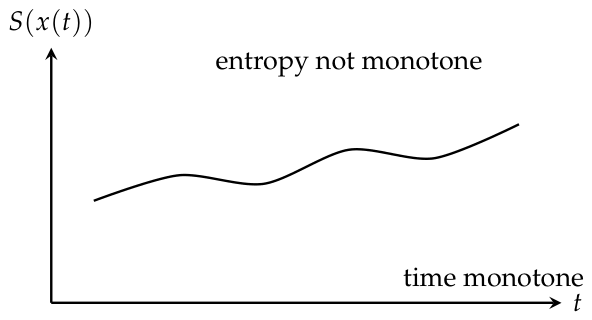
Figure 1 schematically illustrates a trajectory with monotone time parametrization and entropy behavior that is not strictly monotone, consistent with the structural results of this section.

4. Entropy as Constraint Volume: A Structural Interpretation

4.1. From Role Separation to Positive Clarification

The preceding sections established a limited role-separation result: standard entropy functionals cannot serve as general temporal parameters or supply temporal ordering itself. This conclusion does not diminish the importance of entropy in thermodynamics or statistical mechanics. Rather, it invites a constructive question: if entropy does not play the ordering role of time, what structural feature of physical descriptions does it measure?
This section offers a modest interpretive answer. Many standard entropy notions—including Boltzmann entropy, equilibrium thermodynamic entropy, coarse-grained entropy, and, in a more restricted or asymptotic sense, Gibbs entropy—can be understood as involving the logarithmic size, spread, or effective volume of microscopic possibilities compatible with specified macroscopic, statistical, or descriptive constraints. The formal definitions differ, and the correspondence is exact in some cases, asymptotic in others, and heuristic in still others. The claim is therefore not that all entropy notions reduce to a single universal formula, but that they share a useful structural motif.
This observation motivates an interpretive proposal: entropy may often be understood, at a structural level, as quantifying the effective size of a possibility space permitted by constraints. On this view, the conceptual core of entropy lies not in temporal ordering itself, but in the degree to which a physical description restricts or permits microscopic possibility.
This section does not introduce a new entropy definition, nor does it attempt to derive all existing entropy formulas from a single principle. Rather, it proposes a restricted structural interpretation that helps clarify why entropy is so closely associated with thermodynamic asymmetry while remaining distinct from the temporal parameter. The proposal should therefore be understood as an interpretive schema rather than as a replacement for, or derivation of, standard entropy notions.

4.2. Constraint-Defined State Spaces

Let C denote a set of constraints or descriptive conditions associated with a physical system at a given stage of its evolution. Such conditions may include conservation laws, boundary conditions, macroscopic variables, gradients, correlation structures, coherence relations, symmetry restrictions, or externally imposed controls. Let Γ denote an underlying microscopic state space, such as a classical phase space, and let
Γ ( C ) Γ
denote the set of microstates compatible with the constraint set C.
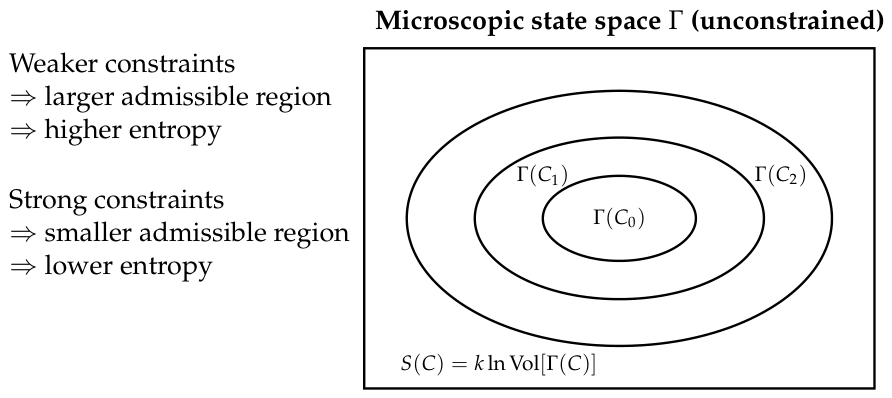
In cases where entropy has a direct state-counting or phase-volume interpretation, the entropy associated with C may be represented schematically as
S ( C ) k ln Vol Γ ( C ) ,
where Vol [ Γ ( C ) ] denotes the measure of the admissible region with respect to an appropriate reference measure, such as the Liouville measure in classical mechanics. The symbol “∼” is important: it indicates structural correspondence rather than strict definitional identity.
Equation (10) is therefore not proposed as a new definition of entropy. It is a schematic representation of a common structural idea that appears in several entropy notions:
  • In Boltzmann entropy, Γ ( C ) corresponds directly to the phase-space region compatible with a macrostate.
  • In equilibrium thermodynamic entropy, macroscopic state variables constrain the compatible microscopic configurations, and the entropy reflects the size of that compatible set in the statistical-mechanical interpretation.
  • In coarse-grained entropy, the partition P determines which regions of state space are treated as observationally distinguishable, and entropy depends on the distribution of probability mass across those regions.
  • In Gibbs entropy, the relation to volume is more indirect. The fine-grained Gibbs entropy measures the spread of a probability density and, in large-system or asymptotic typical-set settings, can be related to effective support volume. This correspondence should not be read as a general identity between Gibbs entropy and the volume of a sharply defined subset of phase space.
Thus, in several important settings, entropy can be interpreted as measuring, exactly or approximately, how broadly microscopic possibilities are distributed under a specified description. Low-entropy descriptions correspond to more restrictive conditions, sharper localization, or more specific macroscopic structure. High-entropy descriptions correspond to more permissive conditions, broader spread, or larger effective possibility space.

4.3. Irreversibility as Constraint Relaxation

Under generic many-body dynamics, physically relevant constraint structures often relax. Correlations disperse, macroscopic gradients flatten, phase coherence may decohere, and finely tuned relations are typically disrupted by interaction with uncontrolled degrees of freedom. When such constraints relax, the effective region of microscopic possibility compatible with the macroscopic description often expands, and the associated entropy typically increases.
On this interpretation, entropy increase reflects the typical relaxation or weakening of special constraint structure under dynamical evolution. Temporal ordering is supplied by the dynamical flow Φ t ; entropy measures, at each ordered stage, how restrictive the relevant physical description is. The thermodynamic arrow then tracks the asymmetric behavior of constraint structure under special boundary conditions, not the generation of temporal ordering itself.
This perspective helps explain why entropy is so closely correlated with temporal asymmetry while remaining conceptually distinct from time. The thermodynamic arrow characterizes how states tend to evolve within an already ordered dynamical history. It does not supply the ordering relation that makes notions such as increase, decrease, or relaxation well-defined.
It is also important to emphasize that physically meaningful constraints and coarse-grainings are not arbitrary partitions imposed at will. In practice, they arise from macroscopic observables, measurement limitations, dynamical stability, environmental interactions, and the physical accessibility of information. Entropy is therefore defined relative to descriptive structures that are physically motivated. This reinforces the role-separation point: because entropy is assigned relative to such constraints or descriptions, it cannot by itself serve as a universal temporal ordering parameter independent of them.

4.4. Compatibility with the Structural Results

The constraint-volume interpretation is compatible with the structural results established earlier in this paper.
  • The non-injectivity of entropy along trajectories reflects the fact that constraint strength or effective possibility volume need not vary monotonically under dynamical evolution; it may remain constant, repeat values, oscillate, or temporarily decrease.
  • The invariance of fine-grained Gibbs entropy under Hamiltonian flow corresponds to the preservation of fine-grained phase-space volume under measure-preserving dynamics.
  • The time-reversal argument remains intact, since constraint relaxation depends on boundary conditions and statistical typicality, not on an intrinsic temporal asymmetry in the dynamical laws.
  • The dependence of coarse-grained entropy on partition choice corresponds to the dependence of effective constraint structure on descriptive resolution and physically chosen macroscopic variables.
Within this interpretive framework, entropy is not treated as a temporal parameter. Rather, it is treated as a measure, in several standard settings and with appropriate qualifications, of the breadth of microscopic possibility compatible with a physical description. The earlier sections established why entropy cannot play the ordering role of time; the present section clarifies why entropy nevertheless remains closely tied to the thermodynamic arrow.
Entropy and time are therefore deeply connected in physical practice but structurally distinct in conceptual role. Time, or the relevant dynamical parameter, orders the evolution. Entropy characterizes the constraint structure of the states or distributions appearing within that ordered evolution.
To emphasize that this interpretation does not introduce a competing entropy definition, Appendix B provides consistency checks showing how the constraint-volume perspective corresponds structurally to several standard entropy notions. These checks should be read as interpretive correspondences, exact in some cases and restricted or asymptotic in others, rather than as a derivation of all entropy formulas from a single principle.
This interpretation is illustrated schematically in Figure 2, where entropy is represented as the logarithmic measure of a constraint-defined region within the full microscopic state space.

5. Historical and Philosophical Context: Recurrence, Reversibility, and the Entropy–Time Debate

The relationship between entropy and time has been debated for more than a century within both physics and philosophy. Any structural claim about the role of entropy in temporal explanation must therefore be situated within this long-standing discussion. The purpose of this section is not to replace standard accounts of the thermodynamic arrow, but to clarify how the present role-separation argument relates to them.
A recurring lesson of the historical debate is that entropy increase can play an explanatory role only when combined with further assumptions: a dynamical framework, a choice of coarse-graining or macro-description, statistical typicality assumptions, and appropriate boundary conditions [3,4,5,8,10,11,13,14]. The present paper accepts this lesson. Its contribution is to make explicit a narrower structural point: entropy may help explain thermodynamic asymmetry or orient an already ordered history, but standard entropy functionals cannot themselves supply the temporal ordering relation.

5.1. Reversibility, Recurrence, and Statistical Symmetry

Shortly after Boltzmann’s statistical interpretation of entropy, objections were raised that exposed deep tensions between irreversible thermodynamic behavior and time-reversal-invariant microscopic dynamics [1,3,5]. The reversibility objection, often attributed to Loschmidt, observes that if the fundamental equations of motion are invariant under time reversal, then for every entropy-increasing trajectory, there exists a corresponding entropy-decreasing trajectory obtained by reversing all momenta or velocities. This argument challenges the idea that entropy increase can be a fundamental dynamical law rather than a statistical regularity [3,6,8].
A related challenge was formulated by Zermelo based on the Poincaré recurrence theorem [26,27]. For finite Hamiltonian systems with bounded phase space, trajectories return arbitrarily close to their initial states after sufficiently long times. If entropy is associated with phase-space volume or macrostate size, recurrence implies that entropy cannot increase strictly and without exception for all times. This undermines any simple identification of entropy monotonicity with temporal progression [3,5,14].
Closely related is what is sometimes called the Schmidt paradox. Whereas Loschmidt emphasizes dynamical reversibility and Zermelo invokes long-time recurrence, the Schmidt paradox highlights the statistical symmetry of entropy fluctuations. Given time-reversal-invariant microscopic laws, entropy-decreasing histories are not forbidden; they are merely statistically atypical relative to suitable boundary conditions. Entropy increase, on this view, is not dynamically necessary but probabilistically typical [3,4,6,14].
Modern statistical mechanics does not regard these considerations as refutations of the second law. Rather, entropy increase is understood as typical behavior given appropriate coarse-graining and special boundary conditions [3,4,14,24]. In contemporary philosophy of physics, this position is often articulated through appeal to a low-entropy past, or Past Hypothesis, together with probabilistic typicality arguments [6,8,9,10,11,12,13,15]. Within this framework, entropy provides a statistical explanation of the thermodynamic arrow without being treated as identical to the time parameter itself.
The present paper is fully compatible with this standard picture. It does not deny that entropy gradients, together with the Past Hypothesis, may help identify one orientation of an already ordered history as future-directed. The question addressed here is different: whether entropy itself can supply the ordering relation or function as the temporal parameter with respect to which entropy increase is defined.

5.2. From Recurrence Arguments to Structural Roles

The historical arguments just reviewed show that entropy monotonicity cannot be an unconditional dynamical law. Loschmidt’s objection shows that entropy-increasing and entropy-decreasing trajectories are paired by time-reversal symmetry. Zermelo’s recurrence argument shows that monotonicity cannot hold globally for all finite Hamiltonian systems. The Schmidt paradox emphasizes that entropy increase is a matter of statistical typicality rather than dynamical necessity [3,6,14].
These points are familiar. The present work does not claim novelty for the bare statement that entropy is not time, nor for the observation that entropy increase depends on boundary conditions. Instead, it complements the historical debate by isolating a more elementary structural distinction. Rather than asking whether entropy usually increases, or whether entropy increase is statistically typical, we ask whether a standard entropy functional can play the role of a temporal parameter in a dynamical theory.
The answer is negative for structural reasons. Time, in the dynamical-systems framework, functions as a parameter that orders stages of evolution [9,16,20]. Entropy, by contrast, is a scalar functional defined on states, macrostates, or probability distributions. A scalar state function can increase, decrease, remain constant, repeat values, or depend on a chosen coarse-graining. The results of Section 3 make this role distinction explicit by showing that standard entropy functionals fail the minimal time-parametrization criterion in general.
This structural result does not replace recurrence, reversibility, or typicality arguments. It clarifies a different point. Recurrence and reversibility show that entropy monotonicity cannot be absolute or dynamically necessary. Past Hypothesis and typicality approaches show how entropy increase can nevertheless be expected toward one direction of an ordered history [8,10,11,12,13]. The present argument shows that entropy cannot, under standard definitions, supply the ordering parameter itself. Thus, entropy may be used to characterize asymmetry along an ordered history, but it cannot be the structure that first orders that history.

5.3. Relation to Modern Arrow-of-Time Theories

It is especially important to distinguish the present argument from a rejection of modern entropy-based accounts of the thermodynamic arrow. Contemporary approaches generally do not claim that entropy literally is time. Nor do they usually claim that entropy alone supplies temporal ordering from nothing. More commonly, they assume a dynamical framework in which histories are already ordered, and then explain why one orientation of that ordered history is thermodynamically distinguished [6,8,9,10,11,12,13].
First, Past Hypothesis approaches explain the thermodynamic arrow by postulating a special low-entropy boundary condition in the past, together with statistical typicality assumptions [6,8,10,11,12,13,15]. On this view, entropy increase is expected toward one direction of the ordered history because the history begins, or is conditioned, at a special low-entropy boundary. The present argument is compatible with this framework. Its point is only that the Past Hypothesis itself presupposes a framework in which histories can be ordered and boundary conditions can be specified. Entropy helps explain the thermodynamic orientation of that history; it does not supply the ordering relation as such.
Second, the thermal time hypothesis, associated with Rovelli and collaborators, proposes that a notion of time flow may be constructed from the statistical state of a system [28]. Such approaches are more subtle than the simple claim that entropy is identical to time. They attempt to derive a state-dependent modular or thermal flow from algebraic and statistical structure. The present paper does not attempt to refute these approaches. It only emphasizes a general constraint: any candidate temporal parameter, whether entropy-like or state-dependent, must be able to play the ordering role required of a temporal parameter. Standard entropy functionals, considered as scalar quantities, do not generally satisfy this requirement.
Third, emergent or relational time proposals attempt to define time in terms of correlations among physical variables rather than as a fundamental background parameter [9,16]. Such approaches may extract an ordering relation from dynamical correlations among subsystems. The present argument is compatible with relational approaches in this broad sense. What it denies is only that a standard entropy functional, by itself, can serve as the ordering variable. A relational account may use correlations, records, clocks, or conditional states to define ordering; entropy may then characterize asymmetry within that ordered structure.
Across these approaches, entropy plays an important explanatory role in accounting for macroscopic irreversibility and temporal asymmetry [3,8,10,11,13]. The structural results of this paper do not diminish that role. They clarify its scope: entropy can explain asymmetry within an ordered sequence of states and, under suitable boundary conditions, may help orient that sequence. But entropy cannot, under its standard definitions as a scalar state or distribution functional, generate the ordering of the sequence itself.

5.4. Entropy-Based Time Claims and the Risk of Role Conflation

The preceding discussion suggests a further reason why the present clarification is useful. The target of the paper is not the crude thesis that entropy is literally identical to time, nor the claim that standard statistical mechanics explicitly derives a before–after ordering from entropy alone. Few careful accounts defend such a thesis in that form. The issue is instead that entropy is often assigned several closely related but structurally distinct roles in discussions of time: it may be used to explain irreversibility, to identify a thermodynamic arrow, to orient an already ordered history, to define or select a preferred flow, or to contribute to the measurement of temporal change. These roles are not equivalent.
This point becomes especially important in approaches where thermal or statistical structure is proposed to play a time-defining role. In the thermal time hypothesis, for example, the physical time flow associated with a state is identified with the modular flow determined by that state [17]. Rovelli later describes the hypothesis as the idea that what we call time is the thermal time of the statistical state of the world, relative to the macroscopic parameters by which the system is described [18]. Such proposals are considerably more subtle than the simple identification of entropy with time. Nevertheless, they show that the thermodynamic or statistical structure has been seriously considered as contributing to the definition or selection of time flow, not merely as describing ordinary entropy increase within a pre-given Newtonian time parameter.
Similarly, in cosmological and statistical-mechanical accounts of the arrow of time, entropy and low-entropy boundary conditions are often presented as explaining why time has a direction, or why the future differs from the past [6,19]. Properly understood, these accounts usually concern temporal orientation and thermodynamic asymmetry rather than temporal ordering itself. However, the language of “the direction of time,” “time’s arrow,” or “the emergence of time” can obscure this distinction unless the relevant roles are made explicit. An entropy gradient can help identify a future-directed orientation only within a framework in which histories, boundary conditions, and dynamical relations are already ordered.
The present paper is therefore not directed against a simple published claim that entropy literally generates temporal order from nothing. Rather, it addresses a broader and more persistent risk of role conflation. Entropy-based arguments may be correct when interpreted as claims about irreversibility, thermodynamic orientation, or the selection of a state-dependent flow, while becoming too strong if read as claims about the ground of temporal ordering itself. The structural results of Section 3 provide a diagnostic boundary: standard entropy functionals may characterize or help orient an already ordered history, but they cannot themselves supply the ordering relation on which notions such as increase, decrease, and monotonicity, as well as the specification of boundary conditions, already depend.

5.5. Philosophical Significance

The philosophical significance of this clarification lies in the distinction between correlation, explanation, orientation, and constitution. Entropy increase may correlate with temporal asymmetry. It may also contribute to the statistical explanation of why macroscopic processes appear irreversible. In Past Hypothesis-type frameworks, it may help identify which orientation of an already ordered history is future-directed [8,10,11,12,13]. But none of these roles entails that entropy constitutes temporal ordering itself.
By isolating minimal structural requirements for temporal parametrization, the present analysis provides a role-separation boundary that supplements the recurrence-based and Past Hypothesis traditions. It shifts attention from the question of whether entropy usually increases to the question of what kind of mathematical object entropy is. A temporal parameter orders stages of evolution. An entropy functional assigns values to states, macrostates, or probability distributions. These are different structural roles.
This boundary does not undermine thermodynamics or the statistical understanding of irreversibility. Rather, it sharpens the conceptual landscape within which those accounts operate. Entropy remains indispensable for describing irreversible phenomena within an ordered dynamical framework. The results established here clarify why it should not be promoted to the ordering parameter itself under standard formulations.
Placed in historical perspective, the contribution of this paper is therefore not to reassert that entropy and time are non-identical, nor to deny the standard entropy-based explanation of the thermodynamic arrow. The contribution is to articulate explicitly the structural distinction that such accounts presuppose: temporal ordering is supplied by the dynamical framework or by some independently specified ordering relation, whereas entropy measures features of states or distributions within that ordered framework. Recognizing this distinction helps avoid conflating statistical asymmetry with temporal ordering itself.

6. Scope and Limitations

The results established in Section 3 are structural in character. They concern the formal and conceptual roles played by entropy functionals and temporal parameters within dynamical theories. This section clarifies the intended scope of those results and distinguishes them from stronger claims that are not defended here.

6.1. Correlation, Explanation, Orientation, and Grounding

Nothing in the preceding analysis challenges the empirical validity or explanatory success of the thermodynamic arrow of time. Macroscopic systems exhibit irreversible behavior, and entropy—within thermodynamics and statistical mechanics—provides a quantitatively powerful framework for describing and explaining such behavior [3,4,5,14,22]. Those achievements remain unaffected.
The present argument concerns the conceptual relation between entropy and the ordering role played by time in dynamical theories. In philosophical discussions, it is important to distinguish between correlation, explanation, orientation, and ontological grounding [6,8,9,16].
  • Entropy increase is strongly correlated with macroscopic temporal asymmetry.
  • Entropy plays a central role in explaining irreversible behavior given suitable boundary conditions, coarse-graining, and statistical assumptions.
  • Entropy gradients may help orient an already ordered history by identifying one direction as thermodynamically future-directed.
  • The narrower question addressed in this paper is whether entropy grounds, constitutes, or supplies temporal ordering itself.
The structural results of Section 3 and the conceptual analysis of Section 2 show that this last, stronger role is not supported by standard entropy notions. Entropy is defined on states, macrostates, or probability distributions whose evolution is already described within an ordered dynamical framework. Statements of the form “entropy increases with time” therefore presuppose an ordering of states relative to which increase is evaluated [6,9,16]. The ordering role of the temporal parameter is logically prior to the assignment of entropy trends along a trajectory.
This conclusion does not diminish the central explanatory role of entropy in accounts of irreversibility. It clarifies only that entropy describes structural features of systems within temporally ordered evolution rather than supplying that ordering itself. It is therefore compatible with the view that entropy gradients help orient an already ordered sequence under appropriate physical assumptions [8,10,11,12,13].

6.2. Boundary Conditions, Typicality, and Descriptive Choices

Modern statistical accounts of irreversibility typically combine time-reversal-invariant microscopic dynamics with special boundary conditions, most notably a low-entropy past, together with typicality assumptions [3,4,8,10,11,12,13,15,29]. Given these assumptions, entropy increase toward what is conventionally called the future is expected for large systems under appropriate coarse-graining.
The structural results presented here are fully compatible with these frameworks. At the same time, they clarify their logical reach. Boundary conditions and typicality arguments explain why entropy increase is expected given a temporally ordered dynamical framework; they do not by themselves supply the ordering relation among states [8,10,11,13]. Temporal orientation enters such accounts through the combination of a dynamical history, a special boundary condition, and a statistical measure over compatible microstates.
Coarse-graining plays a central role in producing monotonic entropy behavior. Yet coarse-graining schemes are not uniquely fixed by microscopic laws alone [14,23,24]. As shown in Section 3, distinct mathematically admissible coarse-grainings may induce different entropy trends along the same microscopic dynamics. This does not undermine physically motivated coarse-graining in statistical mechanics. It shows only that a quantity whose temporal behavior depends on auxiliary descriptive structures cannot, by itself, serve as a universal temporal parameter.

6.3. Limits of the Present Claim

The claim defended in this paper is limited and clarificatory in scope. It does not deny the thermodynamic arrow, challenge the statistical-mechanical explanation of irreversibility, or propose a revision of established entropy definitions. It also does not deny that entropy increase may help orient an already ordered history under Past Hypothesis-type assumptions [8,10,11,12,13]. The claim is narrower: under standard formulations, entropy functionals do not satisfy the minimal structural requirements for serving as temporal parameters and therefore cannot supply temporal ordering itself.
More specifically, the argument of this paper supports the following limited conclusions:
  • Standard entropy functionals cannot generally serve as temporal parameters in a dynamical theory, because they need not distinguish distinct stages of evolution.
  • Entropy monotonicity cannot by itself define an intrinsic temporal orientation independently of boundary conditions, coarse-graining, and statistical assumptions.
  • Entropy increase presupposes an ordered sequence of states and therefore cannot non-circularly ground temporal ordering itself.
  • These conclusions are compatible with the weaker and standard claim that entropy gradients may help orient an already ordered history and explain the thermodynamic arrow under suitable physical assumptions.
These claims concern the conceptual architecture of dynamical theories rather than their empirical predictions. Entropy remains indispensable for describing irreversible processes and quantifying constraint structure within evolving systems. The present analysis isolates the narrower claim that entropy cannot replace the temporal parameter or serve as the ontological basis of temporal ordering.
In this sense, the scope of the paper is clarificatory rather than revisionary. It delineates the conceptual boundary between a dynamical ordering parameter and a scalar state or distribution function, thereby sharpening distinctions that are often left implicit in discussions of the arrow of time [6,8,9,10].

7. Conclusions

This paper has examined the relationship between entropy and time at the level of formal and conceptual structure. Using only standard entropy definitions and a minimal account of time as an ordering parameter in dynamical evolution, the paper has argued that entropy functionals and temporal parameters play distinct roles within physical theory. The central claim is not that entropy and time are simply non-identical. That point is already widely recognized in foundational discussions of statistical mechanics and the arrow of time [5,6,8,9,16]. The paper is also not directed against the crude thesis that the literature generally identifies entropy literally with time. Rather, the contribution of the paper is to make explicit why several time-related roles often associated with entropy are structurally different. A temporal parameter orders the stages of a dynamical trajectory, whereas entropy assigns scalar values to states, macrostates, or probability distributions within such a trajectory. Entropy gradients may help orient an already ordered history, and thermodynamic or statistical structure may, in special frameworks, contribute to the selection or measurement of physically meaningful temporal flow [17,18]. Under standard formulations of thermodynamics and statistical mechanics, however, these roles are not interchangeable.
The structural results established above show that standard entropy functionals do not generally satisfy the minimal requirements for temporal parametrization. Entropy may be non-injective along trajectories; fine-grained Gibbs entropy is invariant under Hamiltonian evolution; coarse-grained entropy depends on descriptive partitions, and entropy monotonicity depends on boundary conditions, coarse-graining, and statistical assumptions [3,4,14,24]. These results do not challenge the thermodynamic arrow or the statistical-mechanical explanation of irreversibility. They clarify only that entropy cannot, under its standard definitions, replace the temporal parameter or supply temporal ordering itself.
The conceptual analysis further shows that entropy increase presupposes an ordered sequence of states. Notions such as increase, decrease, monotonicity, and entropy gradients are defined only relative to an already ordered history. Therefore, entropy cannot non-circularly ground temporal ordering itself. This conclusion is compatible with the weaker and standard claim that entropy gradients, together with suitable boundary conditions, such as a low-entropy past, may help orient an already ordered history and identify one direction as thermodynamically future-directed [8,10,11,12,13,15]. It is also compatible with more subtle approaches in which statistical states, modular structure, correlations, records, or clocks contribute to the selection or measurement of temporal flow, provided that this role is distinguished from supplying temporal ordering itself.
The constraint-volume interpretation developed above provides a positive clarification of entropy’s role. Many standard entropy notions can be understood, exactly in some settings and asymptotically or heuristically in others, as measuring the logarithmic size, spread, or effective volume of microscopic possibilities compatible with specified constraints or descriptive conditions. On this interpretation, the persistent association between entropy increase and the arrow of time reflects the typical relaxation of constraint structure under dynamical evolution, rather than an identification of entropy with temporal ordering.
The contribution of this paper is therefore clarificatory rather than revisionary. It does not challenge thermodynamics, statistical mechanics, thermal-time proposals, relational-time approaches, or Past Hypothesis-type accounts of the thermodynamic arrow [6,8,10,11,13,17,18]. Instead, it isolates a structural boundary within dynamical theory: temporal parameters order states, whereas entropy functionals characterize states or distributions within an already ordered framework. Recognizing this boundary helps separate several questions that are often discussed together: why macroscopic processes are irreversible, why entropy typically increases toward the future, what selects or measures a physically meaningful temporal flow, and what supplies the temporal ordering relation among states in the first place.
The resulting role taxonomy provides a diagnostic criterion for evaluating entropy-based, thermal-time, relational-time, and arrow-of-time claims: one must ask whether entropy is being used to explain irreversibility, orient an already ordered history, select or measure a physically meaningful flow, or supply temporal ordering itself. By making these distinctions explicit, the present analysis aims to sharpen the conceptual foundations of the entropy–time debate while remaining fully compatible with established physical theory. It shows that entropy remains indispensable for understanding thermodynamic asymmetry, but that its explanatory role presupposes, rather than constitutes, the temporal ordering of dynamical evolution.


Funding

This research received no external funding.

Institutional Review Board Statement

Not applicable.

Informed Consent Statement

Not applicable.

Data Availability Statement

No new data were created in this work.

Acknowledgments

During the preparation of this manuscript, the author used ChatGPT-5 for the purposes of English language polishing and latex formatting. The author have reviewed and edited the output and take full responsibility for the content of this publication.

Conflicts of Interest

Author Bin Li was employed by the company Silicon Minds, Inc. The company had no role in the design of the study; in the collection, analyses, or interpretation of data; in the writing of the manuscript; or in the decision to publish the results.

Appendix A. Illustrative Open-System Example with Local Entropy Decrease

This appendix provides a simple and standard example of an open dynamical system in which the entropy of a subsystem decreases over a finite time interval while the dynamical time parameter continues to order the evolution. The example is not intended as a novel thermodynamic result. Local entropy decrease in open systems is familiar in nonequilibrium thermodynamics, and entropy-decreasing fluctuations may also occur in closed systems with sufficiently small probability. The purpose of the example is only to illustrate the role distinction emphasized in the main text: entropy is a functional of a state or distribution, whereas time is the parameter with respect to which the evolution of that state or distribution is ordered.
The construction uses standard continuous-time Markov dynamics and Shannon (or discrete Gibbs) entropy.

Appendix A.1. Driven Two-State Markov System

Consider a subsystem with two states { 0 , 1 } whose probability vector p ( t ) = ( p 0 ( t ) , p 1 ( t ) ) evolves according to a continuous-time Markov process with transition rates controlled by an external environment [30,31]. The master equation is
d d t p 0 p 1 = k 01 ( t ) k 10 ( t ) k 01 ( t ) k 10 ( t ) p 0 p 1 .
Here, k 01 ( t ) , k 10 ( t ) > 0 are externally controlled transition rates representing coupling to an environment or reservoir. The parameter t orders the Markov evolution independently of the entropy assigned to the instantaneous probability distribution.
Assume that the system is initially in the maximally mixed state
p 0 ( 0 ) = p 1 ( 0 ) = 1 2 .
For t [ 0 , T ] , impose a strong external bias favoring state 0 by choosing constant rates
k 01 ( t ) = ε , k 10 ( t ) = K , K ε > 0 .
The stationary distribution associated with these rates is
p 0 * = K K + ε , p 1 * = ε K + ε .
As K / ε , the stationary distribution becomes increasingly concentrated in state 0.

Appendix A.2. Entropy Decrease of the Subsystem

The Shannon entropy of the subsystem is
S sys ( t ) = k p 0 ( t ) ln p 0 ( t ) + p 1 ( t ) ln p 1 ( t ) .
This entropy is maximized at the uniform distribution and decreases as the probability distribution becomes more concentrated. Under the biased dynamics in (A3), the system evolves from the initially uniform distribution toward p * , and the subsystem entropy decreases over a finite time interval.
Initially,
S sys ( 0 ) = k ln 2 .
For sufficiently large T relative to the relaxation time ( K + ε ) 1 , the distribution is close to p * , so that
S sys ( T ) k K K + ε ln K K + ε + ε K + ε ln ε K + ε .
This quantity approaches 0 as K / ε . Thus, for a sufficiently strong bias and sufficiently long but finite interval, the entropy of the subsystem decreases while the time parameter t continues to increase monotonically.
This is the only point needed for the argument: the entropy value assigned to the subsystem need not increase in order for the dynamical evolution to remain temporally ordered.

Appendix A.3. Consistency with the Second Law

For an open system, the entropy balance equation can be written in the following form:
d S sys d t = S ˙ in + S ˙ prod ,
where S ˙ prod 0 is internal entropy production and S ˙ in is entropy flow exchanged with the environment [25,32]. A decrease in subsystem entropy is possible when entropy outflow dominates internal entropy production:
S ˙ in < 0 , | S ˙ in | > S ˙ prod ,
so that
d S sys d t < 0 .
This does not violate the second law. The entropy decrease of the subsystem is compensated by entropy production or entropy transfer in the environment, so the appropriate total entropy balance remains consistent with standard nonequilibrium thermodynamics.

Appendix A.4. Conceptual Implication

The example illustrates the role distinction used in the main text:
  • The parameter t orders the dynamical evolution of the probability distribution.
  • The entropy S sys ( t ) assigns a scalar value to the distribution at each ordered stage.
  • The entropy of the subsystem may increase, decrease, or remain constant depending on boundary conditions and environmental coupling.
The example, therefore, does not challenge entropy-based descriptions of irreversibility. It simply illustrates that entropy behavior is not identical to temporal parametrization. Entropy is defined on states or distributions whose evolution is already ordered; it does not itself supply that ordering.

Appendix B. Structural Correspondence Between Constraint Volume and Standard Entropy Notions

This appendix supports Section 4 by showing how the constraint-volume interpretation can be formulated as a restricted representational schema that corresponds structurally to several standard entropy notions used in thermodynamics, statistical mechanics, and information theory. The purpose is neither to introduce a competing entropy functional nor to derive all entropy formulas from a single principle. Rather, the aim is to show that the constraint-volume perspective is consistent with established definitions by exhibiting explicit correspondences in cases in which such correspondences are exact, asymptotic, or heuristic [1,2,22,33].
The results below should therefore be understood as interpretive correspondences rather than derivations of new entropy formulas. In the Boltzmann and microcanonical cases, the connection to phase-space volume is direct. In the coarse-grained Shannon case, it arises asymptotically through multinomial counting. In the Gibbs case, the relation is best understood through large-system or typical-set reasoning. In the quantum case, the discussion is only heuristic and structural.

Appendix B.1. General Schema: Constraint-Defined Admissible Sets

Let Γ be an underlying microscopic state space equipped with a reference measure μ , such as the Liouville measure on phase space [20]. Let C denote a set of constraints restricting admissible microstates. Define
Γ ( C ) : = { x Γ : x satisfies C } .
Whenever Γ ( C ) is measurable and μ ( Γ ( C ) ) is finite and nonzero, one may associate with the constraint set C a logarithmic constraint volume
S CV ( C ) : = k ln μ Γ ( C ) .
This quantity measures how restrictive the constraints C are: smaller admissible regions correspond to stronger constraints, while larger admissible regions correspond to weaker or more permissive constraints.
Section 4 uses (A12) only as a schematic guide to the structural role of entropy in selected settings. The correspondence is not asserted to be a strict identity for every entropy notion. Rather, it provides a common language for understanding why many entropy expressions are associated with the size, spread, or effective volume of microscopic possibilities compatible with a given description.

Appendix B.2. Boltzmann Entropy as Macro-Constraint Volume

Let { Γ α } be a measurable partition of Γ into macrostates. Each macrostate Γ α may be viewed as the admissible set defined by a macro-constraint C α :
Γ ( C α ) = Γ α .
Then (A12) reproduces the Boltzmann entropy [1]:
S CV ( C α ) = k ln μ ( Γ α ) = S B ( x ) , x Γ α .
In this case, the constraint-volume interpretation is direct: Boltzmann entropy is the logarithmic measure of the macroregion compatible with the specified macrostate.

Appendix B.3. Equilibrium Thermodynamic Entropy as Microcanonical Constraint Volume

For an equilibrium system with fixed conserved quantities, such as energy E, volume V, and particle number N, the microcanonical constraint defines an energy shell [22]:
Γ ( C E , V , N ) = { x Γ : H ( x ) [ E , E + δ ] , V ( x ) = V , N ( x ) = N } .
The associated logarithmic phase volume is
S CV ( C E , V , N ) = k ln Ω ( E , V , N ) ,
where Ω ( E , V , N ) denotes the microcanonical phase volume. In the thermodynamic limit, this expression corresponds to equilibrium thermodynamic entropy up to conventional additive constants and choices of normalization [22].
Thus, in the equilibrium microcanonical setting, the constraint-volume interpretation again has a direct statistical-mechanical meaning: entropy measures the logarithmic size of the microscopic region compatible with the macroscopic constraints.

Appendix B.4. Coarse-Grained Shannon Entropy from Multinomial Constraint Counting

Let P = { P i } i = 1 m be a measurable partition of Γ , and let p i denote the induced coarse-grained probabilities. Consider an n-sample representation in which occupation numbers n i are fixed with n i n p i . The macro-constraint C { n i } restricts admissible micro-configurations to those realizing these occupations.
The number of compatible micro-configurations is proportional to the multinomial count
W ( { n i } ) = n ! i n i ! ,
as in standard combinatorial derivations of entropy [1]. Using Stirling’s approximation [34],
ln n ! = n ln n n + o ( n ) ,
one obtains
ln W ( { n i } ) = n i = 1 m p i ln p i + o ( n ) .
Therefore,
k n ln W ( { n i } ) k i p i ln p i ( n ) .
In this sense, the Shannon form arises as the leading asymptotic logarithmic count of micro-configurations compatible with specified coarse-grained occupation constraints [33]. The correspondence is therefore asymptotic rather than an exact finite-n identity.

Appendix B.5. Gibbs Entropy via Typical-Set Volume Scaling

The Gibbs entropy is
S G [ ρ ] : = k Γ ρ ( x ) ln ρ ( x ) d μ ( x ) .
Unlike Boltzmann entropy, this is a functional of a probability density rather than the logarithmic measure of a single sharply defined macroregion. The constraint-volume interpretation must therefore be stated more carefully in the Gibbs case.
One standard way to connect Gibbs entropy to effective volume is through large-system or typical-set reasoning. For product systems, the asymptotic equipartition property implies that, for large n, most probability mass is concentrated on an ϵ -typical set A ϵ ( n ) whose measure scales as
μ ( A ϵ ( n ) ) exp n H ( ρ ) ,
where
H ( ρ ) = Γ ρ ( x ) ln ρ ( x ) d μ ( x )
up to the usual measure conventions [33,35]. Hence,
k n ln μ ( A ϵ ( n ) ) k H ( ρ ) .
Thus, in large-system or asymptotic typical-set settings, Gibbs entropy can be interpreted as characterizing the logarithmic effective volume of micro-configurations compatible with the ensemble distribution. This statement should not be read as a general identity between Gibbs entropy and the Liouville volume of a sharply bounded subset of phase space. It is a restricted structural correspondence.

Appendix B.6. Heuristic Remark on von Neumann Entropy

In the quantum setting, the von Neumann entropy is
S ( ρ ) = k Tr ( ρ ln ρ ) .
It depends only on the eigenvalue spectrum of the density operator ρ . This spectral dependence suggests a structural analogy with constraint-based descriptions: fixing the spectrum constrains the class of density operators unitarily equivalent to ρ ,
O ρ = { U ρ U U U ( H ) } .
This orbit carries natural geometric measures induced by the Haar measure on the unitary group [36]. However, the von Neumann entropy should not be identified in general with the logarithmic volume of this orbit. The orbit-volume picture is included only as a heuristic indication that quantum entropy, like classical entropy, is sensitive to the amount of microscopic freedom compatible with specified spectral constraints.
A more standard connection between von Neumann entropy and effective volume arises through typical-subspace reasoning in quantum information theory: for many copies of a state, the dimension of the typical subspace scales asymptotically as
exp n S ( ρ ) / k ,
up to conventional units. In this asymptotic sense, von Neumann entropy characterizes the logarithmic dimension of the effective subspace compatible with the state. This is again a structural correspondence, not a derivation of the von Neumann formula from a primitive volume postulate.

Appendix B.7. Summary

The correspondences above support the restricted interpretation used in Section 4. In some cases, such as Boltzmann entropy and microcanonical equilibrium entropy, entropy is directly related to the logarithmic volume of a constraint-defined region. In other cases, such as coarse-grained Shannon entropy, Gibbs entropy, and von Neumann entropy, the connection is asymptotic, effective, or heuristic.
The constraint-volume schema should therefore be understood as a unifying interpretive motif rather than a new entropy definition or a universal derivation of all entropy formulas. Its role in the present paper is to clarify what entropy measures once temporal ordering is already given: not time itself, but the size, spread, or effective breadth of microscopic possibilities compatible with a specified physical or descriptive structure.

References

  1. Boltzmann, L. Lectures on Gas Theory; Original work published 1896–1898; University of California Press: Berkeley, CA, USA, 1964. [Google Scholar]
  2. Gibbs, J.W. Elementary Principles in Statistical Mechanics; Charles Scribner’s Sons: New York, NY, USA, 1902. [Google Scholar]
  3. Lebowitz, J.L. Boltzmann’s entropy and time’s arrow. Phys. Today 1993, 46, 32–38. [Google Scholar] [CrossRef]
  4. Lebowitz, J.L. Microscopic origins of irreversible macroscopic behavior. Phys. A 1999, 263, 516–527. [Google Scholar] [CrossRef]
  5. Sklar, L. Physics and Chance: Philosophical Issues in the Foundations of Statistical Mechanics; Cambridge University Press: Cambridge, UK, 1993. [Google Scholar]
  6. Price, H. Time’s Arrow and Archimedes’ Point; Oxford University Press: Oxford, UK, 1996. [Google Scholar]
  7. Zeh, H.D. The Physical Basis of the Direction of Time, 5th ed.; Springer: Berlin/Heidelberg, Germany, 2007. [Google Scholar]
  8. Albert, D.Z. Time and Chance; Harvard University Press: Cambridge, MA, USA, 2000. [Google Scholar]
  9. Callender, C. What Makes Time Special? Oxford University Press: Oxford, UK, 2017. [Google Scholar]
  10. Wallace, D. The arrow of time in physics. In A Companion to the Philosophy of Time; Bardon, A., Dyke, H., Eds.; Wiley-Blackwell: Chichester, UK, 2013; pp. 262–281. [Google Scholar]
  11. Loewer, B. Counterfactuals and the second law. In Causation, Physics, and the Constitution of Reality: Russell’s Republic Revisited; Price, H., Corry, R., Eds.; Oxford University Press: Oxford, UK, 2007; pp. 293–326. [Google Scholar]
  12. Loewer, B. The Mentaculus vision. In Statistical Mechanics and Scientific Explanation: Determinism, Indeterminism and Laws of Nature; Allori, V., Ed.; World Scientific: Singapore, 2020; pp. 3–29. [Google Scholar]
  13. Callender, C. The past hypothesis meets gravity. In Time, Chance, and Reduction: Philosophical Aspects of Statistical Mechanics; Ernst, G., Hüttemann, A., Eds.; Cambridge University Press: Cambridge, UK, 2010; pp. 34–58. [Google Scholar]
  14. Frigg, R. A field guide to recent work on the foundations of statistical mechanics. In The Ashgate Companion to Contemporary Philosophy of Physics; Rickles, D., Ed.; Ashgate: Aldershot, UK, 2008; pp. 99–196. [Google Scholar]
  15. Winsberg, E. Can conditioning on the “past hypothesis” militate against the reversibility objections? Philos. Sci. 2004, 71, 489–504. [Google Scholar] [CrossRef] [PubMed]
  16. Earman, J. An attempt to add a little direction to “The problem of the direction of time”. Philos. Sci. 1974, 41, 15–47. [Google Scholar] [CrossRef]
  17. Connes, A.; Rovelli, C. Von Neumann Algebra Automorphisms and Time-Thermodynamics Relation in Generally Covariant Quantum Theories. Class. Quantum Gravity 1994, 11, 2899–2917. [Google Scholar] [CrossRef]
  18. Rovelli, C. Thermal Time and Tolman–Ehrenfest Effect: Temperature as the Speed of Time. Class. Quantum Gravity 2011, 28, 075007. [Google Scholar] [CrossRef]
  19. Carroll, S.M. From Eternity to Here: The Quest for the Ultimate Theory of Time; Dutton: New York, NY, USA, 2010. [Google Scholar]
  20. Arnold, V.I. Mathematical Methods of Classical Mechanics, 2nd ed.; Springer: New York, NY, USA, 1989. [Google Scholar]
  21. Bratteli, O.; Robinson, D.W. Operator Algebras and Quantum Statistical Mechanics I, 2nd ed.; Springer: Berlin/Heidelberg, Germany, 1997. [Google Scholar]
  22. Callen, H.B. Thermodynamics and an Introduction to Thermostatistics, 2nd ed.; Wiley: New York, NY, USA, 1985. [Google Scholar]
  23. Zwanzig, R. Memory effects in irreversible thermodynamics. Phys. Rev. 1961, 124, 983–992. [Google Scholar] [CrossRef]
  24. Goldstein, S. Boltzmann’s approach to statistical mechanics. In Chance in Physics: Foundations and Perspectives; Bricmont, J., Dürr, D., Galavotti, M.C., Ghirardi, G., Petruccione, F., Zanghì, N., Eds.; Springer: Berlin/Heidelberg, Germany, 2001; pp. 39–54. [Google Scholar]
  25. de Groot, S.R.; Mazur, P. Non-Equilibrium Thermodynamics; Dover: New York, NY, USA, 1984. [Google Scholar]
  26. Poincaré, H. Sur le problème des trois corps et les équations de la dynamique. Acta Math. 1890, 13, 1–270. [Google Scholar]
  27. Zermelo, E. Über einen Satz der Dynamik und die mechanische Wärmetheorie. Ann. Phys. 1896, 293, 485–494. [Google Scholar]
  28. Rovelli, C. Statistical mechanics of gravity and the thermodynamical origin of time. Class. Quantum Gravity 1993, 10, 1549–1566. [Google Scholar] [CrossRef]
  29. Penrose, R. The Emperor’s New Mind; Oxford University Press: Oxford, UK, 1989. [Google Scholar]
  30. Norris, J.R. Markov Chains; Cambridge University Press: Cambridge, UK, 1997. [Google Scholar]
  31. van Kampen, N.G. Stochastic Processes in Physics and Chemistry, 3rd ed.; Elsevier: Amsterdam, The Netherlands, 2007. [Google Scholar]
  32. Seifert, U. Stochastic thermodynamics, fluctuation theorems and molecular machines. Rep. Prog. Phys. 2012, 75, 126001. [Google Scholar] [CrossRef] [PubMed]
  33. Shannon, C.E. A mathematical theory of communication. Bell Syst. Tech. J. 1948, 27, 379–423. [Google Scholar] [CrossRef]
  34. Feller, W. An Introduction to Probability Theory and Its Applications; Wiley: New York, NY, USA, 1968; Volume 1. [Google Scholar]
  35. Cover, T.M.; Thomas, J.A. Elements of Information Theory, 2nd ed.; Wiley: Hoboken, NJ, USA, 2006. [Google Scholar]
  36. Simon, B. Representations of Finite and Compact Groups; American Mathematical Society: Providence, RI, USA, 1996. [Google Scholar]
Figure 1. Schemati trajectory illustrating monotone time parametrization by t together with entropy behavior S(x(t)) that is not strictly monotone and need not be injective. Such behavior illustrates why entropy cannot generally serve as a temporal parameter, even though it may characterize thermodynamic asymmetry along an already ordered history.
Philosophies 11 00087 g001
Figure 2. Entropy as constraint-defined possibility volume. The outer square represents the full microscopic state space Γ , i.e., the unconstrained configuration space. Each ellipse represents a subset Γ ( C ) of microstates compatible with a specified set of constraints or descriptive conditions C. Smaller ellipses correspond to stronger, more restrictive constraints, which limit admissible microstructure more sharply. As such constraints weaken—e.g. through dispersion of correlations, decoherence, or relaxation of finely tuned relations—the admissible region may expand from Γ ( C 0 ) to Γ ( C 1 ) to Γ ( C 2 ) . Under the structural interpretation proposed in Section 4, entropy is represented schematically, in cases where the correspondence is direct or approximate, as the logarithmic measure of a constraint-defined possibility volume, S ( C ) k ln Vol [ Γ ( C ) ] . Entropy thus characterizes the degree of restriction imposed on microscopic possibility space, rather than supplying temporal ordering itself.
Philosophies 11 00087 g002
Disclaimer/Publisher’s Note: The statements, opinions and data contained in all publications are solely those of the individual author(s) and contributor(s) and not of MDPI and/or the editor(s). MDPI and/or the editor(s) disclaim responsibility for any injury to people or property resulting from any ideas, methods, instructions or products referred to in the content.