1. Introduction
Democracy is commonly understood as a political achievement grounded in rational deliberation, civic participation, and institutional design. Classical accounts, particularly those attributed to Aristotle, frame democracy as a form of governance established from normative principles of justice and collective decision-making [
1]. Subsequent traditions—from the theory of consent (John Locke) to the general will (Jean-Jacques Rousseau)—have reinforced the view of democracy as a political and institutional construct [
2,
3]. However, such interpretations risk overlooking the deeper structural forces that have shaped the historical emergence and transformation of democratic systems based on the modern parliamentary framework. While the existing literature has conceptualized democracy in institutional, economic, and governance terms [
4,
5], these approaches largely remain descriptive. They explain how democracy functions, but not how it emerges through its evolutionary trajectories and transforms under changing systemic stress conditions.
This paper advances a different claim: democracy is not merely a political system, but it is an emergent evolutionary equilibrium within complex adaptive systems, inherently subject to instability forces under conditions of entropic technological and economic change. More specifically, it arises from evolving evolutionary interactions among economic systems, security institutions, and social organization under conditions of increasing complexity [
6,
7,
8]. These interactions generate forms of governance that distribute authority more broadly as complex symbiotic systems become more interdependent [
9,
10]. To articulate this claim, this paper draws on an analogy with balanced biological and computational systems. Living organisms maintain stability—homeostasis—through the coordinated interaction of interdependent subsystems [
11,
12]. Similarly, societies sustain political stability through the dynamic interaction among economic production, security institutions, and systems of legitimacy, mediated by informational and communicative processes [
11,
12]. In this framework, democracy can be understood as one expression of a broader systemic equilibrium, maintained through the continuous balancing of these interdependent domains.
The central contribution of this paper is to introduce entropy as a key explanatory concept that challenges the fragile balance of the ecosystem of modern democracy. It argues that democratic systems are not naturally stable but are continuously moving toward entropy (disorder), like biological and computational systems, and thus require adaptive mechanisms to maintain the balance and equilibrium of the ecosystem. The Industrial Revolution provides a historical case of this fragile dynamic, while the Artificial Intelligence (AI) revolution represents a qualitatively different phase in which these destabilizing entropic forces are significantly accelerated.
This paper proceeds in four stages. First, it develops a systems theoretical framework for understanding democracy as an adaptive equilibrium. Second, it analyzes the Industrial Revolution as a historical case in which entropic pressure shaped democratic development. Third, it advances the paper’s central argument by conceptualizing the AI revolution as an accelerated entropic force that amplifies systemic instability to a degree beyond historical precedent. Fourth, it evaluates how democratic systems respond through integration and adaptive strategies. The central focus of this manuscript is therefore to develop a philosophical fabric that understands democracy as a dynamic, fragile equilibrium within a system subject to entropy—the tendency toward disorder—and to examine how technological acceleration, especially through AI, challenges the maintenance of this equilibrium, increasing the risk of systemic instability and potential democratic backsliding of this fragile equilibrium [
4,
5].
The existing literature has already conceptualized democracy as a system shaped by institutions, governance dynamics, and economic structures [
4,
5]. For example, institutional analyses emphasize how governance emerges from formal and informal constraints, while development research highlights the symbiotic relationship between democracy and economic processes [
9,
10]. However, these approaches largely treat democracy as either an institutional structure, a governance system, or a political outcome. This paper advances a different claim: democracy is not merely a system, but it is an emergent, entropic equilibrium shaped by accelerating technological and economic transformational forces.
2. Philosophical Foundations of Democracy
Classical political philosophy has long sought to explain democracy through normative and institutional frameworks. In Aristotle’s account, democracy is defined as the rule of the many and evaluated in terms of justice and the common good [
1]. Aristotle’s conception situates democracy within a broader ethical and teleological framework, where political organization is inseparable from the pursuit of collective flourishing and the cultivation of civic virtue [
1]. Later, John Locke grounds political authority in consent and property rights [
2], while Jean-Jacques Rousseau emphasizes general will as the basis of legitimacy and collective sovereignty [
3].
Locke’s formulation emphasizes individual rights, rational agency, and the conditional nature of political authority, establishing a framework in which governance is legitimate only insofar as it reflects the consent of free individuals [
2]. While early sovereign authority was often justified by natural law and divine right, grounded in religious legitimacy, it gradually transformed amid long-term socio-economic and political developments. In particular, the expansion of international trade, the rise of monetary economies, and the growing influence of commercial classes contributed to the shift toward representative governance, in which legitimacy increasingly derived from the will of the people as expressed through positive law and parliamentary institutions (e.g., the House of Lords and later the House of Commons) [
2,
13,
14,
15,
16,
17]. In effect, the trial, conviction and later execution of King Charles I, the sovereign, in 1649 by parliament based on treason conviction for breaking the oath to his people (e.g., the sacred oath of coronation for maintaining justice, law, peace, and religion) showcases the evolutionary supremacy of positive law over the natural law or divine rights of authority and legitimacy in the aftermath of the civil war in the British Isles [
18,
19,
20,
21].
Thus, Rousseau shifts the focus toward collective sovereignty, arguing that legitimacy arises from the general will of the people (e.g., positive law), thereby introducing a fundamental tension between individual autonomy and collective political identity that remains central to democratic theory [
3]. Adam Smith provides an important bridge between normative political philosophy and economic systems [
22,
23]. In
The Wealth of Nations, Smith argues that decentralized economic interactions, guided by self-interest and coordinated through market mechanisms, can generate order without central direction—often described as the “invisible hand” [
22,
23]. At the same time, in The Theory of Moral Sentiments, Smith emphasizes the role of moral sympathy and social norms in sustaining cooperation in the system [
22,
23].
Together, these works suggest that economic and democratic systems are not purely mechanical but are embedded within moral and social frameworks, reinforcing the idea that democratic order has emerged through a slow evolutionary process from the interaction of economic behaviour, institutional structures, the rule of law, and social coordination [
15,
22,
23,
24,
25]. These traditions are further extended by later philosophical developments. For instance, Immanuel Kant’s reflections on republican governance and perpetual peace connect political legitimacy to universal principles of reason and moral law, suggesting that stable political orders require alignment between institutional structures and ethical norms [
26]. Together, these perspectives frame democracy as a normative project grounded in legitimacy, rights, and collective rationality.
In contrast, Karl Marx argues that political systems reflect underlying unequal economic relations, suggesting that democracy is shaped by modes of production rather than abstract ideals [
4]. Max Weber further highlights the role of institutional rationalization, bureaucratic organization, and legal authority in structuring modern governance [
5]. These perspectives shift the analysis from normative justification to material and organizational conditions.
Contemporary theorists extend and complicate these traditions. Jürgen Habermas emphasizes communicative rationality and the role of the public sphere in legitimizing democratic strategic judgment, arguing that discourse itself becomes a site of governance [
27]. Meanwhile, Michel Foucault analyzes how diffuse power relations, embedded in knowledge systems and institutional practices, shape both governance and subjectivity, moving beyond formal political structures to examine the microphysics of power [
28].
Taken together, these approaches demonstrate that democracy has been conceptualized across multiple dimensions—normative, institutional, economic, and epistemic. However, they also reveal a broader challenge: the fragmentation of knowledge across disciplinary and theoretical boundaries [
29]. As emphasized in the editorial vision of Philosophies by Schroeder [
29], contemporary philosophical inquiry must move beyond isolated frameworks toward synthesizing knowledge across domains, integrating insights from philosophy, science, and technology into coherent analytical frameworks.
While these traditions illuminate key dimensions of democracy, they tend to treat it either as a normative ideal, an institutional arrangement, or an economic structural framework. Less attention is given to the possibility that democracy may arise not solely from intentional design, but from dynamic evolutionary interactions across multiple systems. This paper builds on these insights but proposes a different emphasis: democracy as a fragile entropic system-level emergent phenomenon, arising from the interaction of economic efficiency, technological change, and adaptive social and informational pressures [
11]. In this sense, democracy is not treated as a fixed institutional outcome, but as an evolving, fragile equilibrium shaped by feedback loops across interdependent domains. This perspective aligns with systems-theoretical and complexity-based approaches, which emphasize that stability in complex systems emerges through continuous, evolutionary interaction and adaptation rather than static design [
8,
11,
30].
In this framework, democracy is understood as an evolving equilibrium shaped by feedback loops among economic systems, institutional structures, informational networks, and mechanisms of social coordination. To avoid conceptual ambiguity, it is essential to distinguish between three related but distinct terms. A democratic system refers to formal institutional arrangements, such as elections, legal frameworks, and governance structures. Democratic forms denote observable expressions of political life, including participation, representation, and public engagement. By contrast, democracy, as conceptualized in this paper, refers to a system-level equilibrium that emerges from interactions across economic, informational, and institutional/security domains. This distinction is necessary to differentiate between descriptive analyses of institutions and a systems theoretical account of democratic emergence.
3. Democracy as a Complex Adaptive System
Building on the preceding philosophical traditions, this section argues that democracy is best understood as an emergent symbiotic system, rather than a discrete institutional arrangement or normative endpoint. While classical and modern theorists have emphasized legitimacy, economic structure, or communicative processes, they have generally treated democracy as constructed, justified, or historically determined by stable factors. By contrast, this section proposes that democracy arises from the interaction of multiple interdependent systems, particularly economic, security, and informational structures.
This perspective draws directly on Ludwig von Bertalanffy’s general systems theory, which conceptualizes complex systems as open, adaptive, and relational structures [
11]. This systems-oriented perspective is further developed in the work of Niklas Luhmann [
31], who conceptualizes modern society as a set of functionally differentiated systems—such as law, politics, and the economy—each operating according to its own internal logic. From this view, democracy cannot be reduced to a single institutional structure, but must be understood as an emergent coordination mechanism across multiple autonomous yet interdependent systems. In such systems, higher-order properties emerge not from centralized design, but from the interaction of components operating under shared constraints. Democracy, in this sense, is not “designed” in the way a constitution is drafted; rather, it emerges when systems reach a level of complexity and interdependence that requires distributed coordination and legitimacy. While general systems theory provides the conceptual foundation for understanding emergence, its application to democracy has largely remained descriptive [
31,
32]. This paper extends systems theory by introducing entropy as a dynamic constraint on democratic equilibrium. This shift can also be understood in terms of Thomas Kuhn’s notion of paradigm change, in which established frameworks become insufficient to explain emerging phenomena, necessitating new conceptual models [
33]. In this context, the introduction of entropy as a central explanatory concept represents a shift from static models of democracy toward dynamic, systems-based interpretations. Unlike previous accounts that emphasize stability or institutional performance, this framework conceptualizes democracy as a system constantly moving toward disorder due to its fragile system, reflecting a biological ecosystem, unless counterbalanced by integration mechanisms also seen in nature.
This emergent, fragile-ecosystem perspective is further supported by Friedrich Hayek’s theory of spontaneous order, which argues that complex social systems—particularly markets—organize themselves without centralized control, through the dispersed knowledge of individual actors [
34]. For Hayek [
34], order arises not from design but from interaction, a view that aligns closely with the present argument that democratic systems emerge from decentralized coordination rather than intentional construction. This perspective can also be traced back to Adam Smith, whose concept of the “invisible hand” illustrates how complex systems can generate order through decentralized interactions [
23,
24]. Smith’s insight anticipates later systems theoretical accounts by demonstrating that coordination and stability can arise without centralized control, provided that institutional and social conditions enable cooperative behaviour [
23,
24].
Similarly, John Dewey’s pragmatist account of democracy emphasizes process over structure, framing democracy as an ongoing experimental practice rooted in communication, adaptation, and collective problem-solving [
35]. Dewey’s perspective reinforces the idea that democracy is not a fixed organizational structure but a continuously evolving system shaped by changing conditions and interactions [
35].
Historically, this process can be observed in the gradual transformation of political authority through economic expansion. As trade networks developed and financial systems matured, power shifted away from centralized sovereign control toward more distributed actors—merchants, landowners (the House of Lords), and eventually labourers (the House of Commons) [
25,
36,
37]. These actors required institutional protection, predictable rules, and mechanisms of representation and lobbying [
25,
36,
37]. From a normative perspective, John Rawls’s theory of justice highlights the importance of fairness and legitimacy in sustaining stable political systems [
38]. Rawls argues that institutions must be structured to maintain public trust and reciprocal acceptance, suggesting that systemic stability is shaped not solely by functional efficiency but also by perceived legitimacy [
38]. What began as an economic necessity gradually produced a political transformation of interchanging and feedback loops. This aligns with Karl Marx’s insight that political systems reflect underlying economic relations [
4], but extends it by emphasizing non-linear emergence rather than deterministic causation proposed by Marx through class structures.
At the same time, security systems—courts, bailiffs, police, spy agencies, and military structures—evolved to protect property (e.g., intellectual property), enforce contracts, safeguard government, scientific, and industrial secrets, and stabilize economic activity [
25,
39]. These systems require legitimacy to function effectively, creating a feedback loop between governance and social acceptance. Max Weber’s concept of legal–rational authority captures part of this process [
5], but within the present framework, legitimacy is understood as a systemic requirement for stability rather than solely a normative principle.
A third dimension—information systems—further reinforces this evolutionary symbiosis. The development of communication networks (e.g., mass media and cheaper printing methods) enables coordination, accountability, promotion of social cohesion, national identity, national interest, and participation, all of which are essential to democratic functioning [
40]. Jürgen Habermas’s emphasis on the public sphere highlights the role of discourse in legitimizing legal and political authority [
41], but within an emergent systems framework, communication is not merely deliberative: it is structural, shaping how systems adapt and maintain equilibrium. From a Foucauldian [
28] perspective, these dynamics can also be understood as transformations in the operation of power, which increasingly functions through dispersed networks rather than centralized authority. Power, in this sense, operates through systems of knowledge, communication, and institutional practice, reinforcing the view that democratic order emerges through complex interactions rather than hierarchical control [
28]. Thus, democracy can be conceptualized as a dynamic evolutionary equilibrium among three interdependent domains:
Economic efficiency and production (e.g., a free market economy and independent of national banks to control national interest rates).
Security and institutional enforcement (governments, courts, police, border/coast guard services, spy agencies, and militaries).
Informational and communicative systems (mass and now algorithmic-driven social media).
When these domains are balanced, democratic forms tend to stabilize. When they are disrupted, instability emerges. This reframing shifts the focus from democracy as a fixed system to democracy as a continuous, evolutionary, adaptive ecosystem, sustained by feedback loops and systemic interactions, thereby forming system stability. This understanding resonates with Karl Popper’s conception of democracy as a system designed not to achieve perfect outcomes, but to allow for the correction of errors through institutional feedback [
42]. For Popper, the strength of democratic systems lies in their capacity for self-correction, reinforcing the idea that stability emerges through continuous adjustment rather than fixed equilibrium [
42].
Thus, in complex systems such as democracy, stability depends on maintaining key conditions. These include a balance between system components, the capacity for adaptation, informational coherence, and resilience to external shocks. Herbert Simon’s concept of bounded rationality further reinforces this perspective, suggesting that decision-making in complex systems is inherently limited and adaptive rather than fully rational [
43]. Democratic systems, therefore, must operate through iterative processes that accommodate uncertainty and incomplete information. Democratic systems depend on these same conditions. When economic inequality increases, informational systems fragment (e.g., polarization linked to misinformation, disinformation, and conspiracy theories) or institutional trust declines, thereby moving the system away from equilibrium [
44,
45,
46].
Within complex systems, stability cannot be achieved by eliminating disorder, but only through adaptive processes that manage uncertainty. This insight provides the foundation for understanding democratic governance not as control, but as continuous adjustment under changing conditions. From this perspective, harm reduction can be understood as a systemic strategy rather than a policy tool. Rather than eliminating instability—which is impossible in complex systems—harm reduction focuses on minimizing destabilizing effects and preserving system functionality [
47,
48]. This aligns with Dewey’s conception of democracy as an experimental process [
35] and with Hayek’s emphasis on decentralized adaptation [
34]. Democracy, in this framework, is not a stable endpoint but a process of ongoing adjustment within a system subject to entropy.
4. The Industrial Revolution, Democratization, and Disorder
The Industrial Revolution provides a critical historical case for understanding the dynamics of emergent democratic systems mentioned above, while also considering the forces of disorder. It represents a period in which rapid technological innovation fundamentally altered economic production, social organization, scientific discoveries, and communication structures [
39,
40,
48,
49,
50]. From a systems perspective, the Industrial Revolution dramatically increased economic efficiency, enabling mass production, expanding trade networks, and lowering the cost of goods [
17,
18]. From a classical economic perspective, these developments reflect Adam Smith’s argument that the division of labour and market expansion increase productivity and economic growth [
23,
24]. However, Smith also recognized that such processes could generate social imbalances if not supported by moral, regulatory, and institutional frameworks [
23,
24]. This tension reinforces the view that economic expansion both enables and destabilizes the conditions under which democratic systems develop [
15,
23,
24].
These developments contributed to rising living standards and, over time, to the expansion of political rights (the extension of voting to women and non-Caucasians) [
15,
51,
52]. As broader segments of society became economically integrated, demands for representation intensified, contributing to the gradual expansion of social programs (e.g., the elimination of slavery and child labour, the introduction of old-age pensions, and the expansion of health care) and democratic participation (women’s suffrage, the right of lower economic classes to vote and non-Caucasian voting rights) [
36,
51,
52].
However, this process was deeply uneven. Industrialization also produced significant inequality, labour exploitation, increased homelessness, migrations, crime, and social dislocation [
50,
51,
52,
53]. This condition can also be interpreted through Émile Durkheim’s theory of anomie, which refers to the erosion of shared social norms and collective regulation, resulting in a state of normlessness that accompanies rapid economic and social change [
54]. Industrialization disrupts traditional forms of social cohesion, weakening collective norms and producing instability within the social order [
54,
55]. This dynamic was anticipated by Karl Marx, who argued that industrial capitalism inherently generates structural contradictions between capital and labour, producing inequality, alienation, and class conflict [
4]. From this perspective, the expansion of productive capacity does not lead to stable equilibrium but to intensifying systemic tensions, as the concentration of capital undermines the social conditions necessary for political legitimacy [
4,
44]. Marx’s analysis suggests that democratic development under industrial capitalism is inherently unstable, shaped by competing pressures between economic accumulation and social cohesion [
4,
44].
Karl Polanyi describes this as the “double movement”, in which market expansion generates both economic progress and social instability [
20]. Polanyi’s [
15] framework suggests that industrial capitalism generates a continuous tension between market forces and social protection, reinforcing the view that democratic stability emerges through ongoing adjustment rather than equilibrium. The link between economic efficiency development and democracy has been described as symbiotic rather than oppositional, particularly when combined with market expansion and institutional adaptation [
9,
10,
56]. This supports the present argument that democracy emerges not independently but through ecosystem interactions with economic growth—though such interactions also generate instability [
56]. The concentration of wealth and the displacement of traditional livelihoods created structural tensions that destabilized social equilibrium (e.g., increased immigration from rural areas to industrial hubs, homelessness, and lack of social support) [
15,
55,
57]. Crucially, the Industrial Revolution also marked the expansion of mass media systems [
39,
40]. Technologies such as cheap printing, telegraphy, radio, telephones, and later films enabled the rapid dissemination of information across large populations and across continents [
39,
40]. These developments transformed the informational dimension of democratic systems, enabling the mobilization of public opinion at the macro level across continents [
39,
40].
Max Weber’s analysis of rationalization further illuminates this transformation [
5]. The expansion of bureaucratic structures and calculative rationality during industrialization increased efficiency and coordination, but also contributed to what Weber described as the “iron cage” of modernity, in which social life becomes increasingly structured, depersonalized, and constrained by formal systems of control [
5]. This process highlights the tension between efficiency and human agency within emerging democratic systems. Yet this expansion of communication did not simply enhance democratic deliberation; it also amplified polarization and forces of disorder [
39,
40,
48]. The same media systems that enabled participation also facilitated the spread of ideology, propaganda, and misinformation [
39,
40,
48]. From a Foucauldian [
28] perspective, these developments can be understood as transformations in the operation of power, which increasingly functions through the production and circulation of knowledge. Media systems do not merely transmit information but actively shape the conditions under which truth, legitimacy, and authority are constructed [
39,
40,
45,
46,
48]. The rise of large-scale political movements during the late nineteenth and early twentieth centuries—including nationalism, Bolshevism, and Fascism—demonstrates how communication technologies can intensify divisions within society by amplifying fringe voices and ideologies through posters, pamphlets, mass-produced books, prints, radio, film, photography, and fringe newspapers [
39,
40,
48]. Hannah Arendt’s analysis of mass society provides further insight into this development [
58]. Arendt [
58] argues that the emergence of mass political movements is closely tied to conditions of social dislocation, atomization, and loss of traditional structures, which make populations more susceptible to ideological mobilization and totalitarian forms of organization. In this sense, the same conditions that enable mass participation can also produce new forms of political instability [
45,
46,
58].
Thus, the Industrial Revolution illustrates a central dynamic of emergent systems: technological progress simultaneously strengthens and destabilizes democratic equilibrium. Economic efficiency (the transfer of energy from manpower to steam and combustion machines) and communication expansion create conditions for democracy but also produce inequality, disorder, and polarization that threaten the equilibrium stability of the complex system [
4,
15,
55,
59].
5. The AI Revolution and the Acceleration of Entropy
If the Industrial Revolution introduced systemic instability through the gradual transformation of manpower into machines, the AI revolution represents an acceleration of these dynamics at an unprecedented scale and speed, as human intelligence is being transformed into machine learning and general-purpose robotics [
39,
40,
49,
50]. Contemporary complexity theory emphasizes that modern societies operate under conditions of “hypercomplexity,” characterized by unpredictability, non-linearity, and emergent instability [
8,
60]. From this perspective, the AI revolution does not simply transform democratic systems but intensifies their underlying instability by increasing the speed and scale of systemic interactions [
39,
40]. This paper conceptualizes this acceleration through the philosophical lens of entropy or disorder.
In thermodynamics, entropy describes a system’s tendency toward disorder over time, reflecting the irreversible dispersion of energy and the movement from ordered to less ordered states [
61,
62,
63]. The fundamental importance of this principle has long been recognized in physics. Albert Einstein famously remarked that “[classical thermodynamics …] is the only physical theory of universal content, which I am convinced, that within the framework of applicability of its basic concepts will never be overthrown”, emphasizing its universal and foundational nature [
64] (p. 1). In this sense, entropy is not merely a physical concept but a general principle governing the behaviour of complex systems across domains.
In information theory, as developed by Claude Shannon, entropy quantifies uncertainty in a system, measuring the degree of unpredictability in information structures [
62,
63]. These formulations extend beyond their original domains, providing a conceptual framework for understanding instability, complexity, and limits of control across different types of systems [
61,
62,
63,
64]. In biological systems, entropy manifests as the continual pressure toward disorder that must be managed through regulatory mechanisms at both micro (e.g., ATP and hormones) and macro (e.g., glucose and fat concentrations) levels [
56,
65]. Organisms maintain functional stability not by eliminating entropy but by regulating it through adaptive feedback mechanisms that preserve internal coherence within viable limits [
12]. This principle reflects a broader system-level insight: stability is not the absence of disorder, but the capacity to manage and contain it over time.
A similar dynamic can be observed in computational, machine learning/AI, and informational systems [
63,
64]. In computing, entropy is closely related to uncertainty, noise, and information degradation [
63,
64]. Digital systems require continuous correction—through redundancy, error detection, and algorithmic filtering—to maintain coherence and prevent breakdown and hallucinations [
63,
64]. Without such mechanisms, information systems tend toward fragmentation, inconsistency, and loss of reliability [
63,
64,
66,
67]. In this sense, computational systems, like biological ones, do not eliminate entropy but counteract it through continuous regulation and adaptation [
66,
67].
From a broader philosophical perspective, these patterns align with systems theory and complexity theory. As articulated by Bertalanffy, complex systems are open, adaptive, and sustained through ongoing interaction with their environment [
11]. Similarly, Prigogine’s work on non-equilibrium systems suggests that order can emerge from disorder, but only under conditions of continuous energy exchange and dynamic instability [
30]. Stability, therefore, is not a static condition but an emergent property of systems operating far from equilibrium.
Taken together, these perspectives suggest that entropy is not merely a physical concept, but a general principle applicable across biological, informational, and computational domains [
30,
66,
67]. Systems persist not by overcoming entropy, but by developing mechanisms to regulate and adapt to it [
11,
30]. This insight provides a conceptual foundation for understanding social and political systems, which likewise depend on continuous processes of adjustment to maintain coherence amid increasing complexity. These concepts can be extended to social systems, where entropy manifests as increasing fragmentation, inequality, polarization, and instability. The AI revolution intensifies these processes through an accelerated process for two interrelated mechanisms:
- (1)
Structural Inequality
Automation and AI-driven production systems increase efficiency while simultaneously concentrating wealth and restructuring labour markets across sectors, affecting both low- and high-paying positions [
15,
39,
50,
52,
53]. As economic inequality increases, the balance between productive capacity and political legitimacy becomes strained, with wealth disparities undermining social cohesion, trust, and the perceived fairness of institutional arrangements [
4,
38,
44]. This reinforces Karl Marx’s insight into the relationship between economic structure and political systems [
4], but in an accelerated, globalized context that affects every sector of the economy.
- (2)
Algorithmic Amplification
Unlike the mass media of the Industrial era, AI-driven platforms operate through algorithmic optimization aimed at generating profit by amplifying fringe voices and ideas [
39,
40,
45,
46,
68]. These systems prioritize engagement (comments, likes, following), often amplifying emotionally charged, divisive, radical, or extreme content [
39,
40,
45,
46,
68]. Zeynep Tufekci and Shoshana Zuboff have shown how digital platforms reshape public discourse and political behaviour, while a recent study demonstrated that the expanding role of alternative media driven by algorithmic recommendations is framing national interest and foreign policy outside the realm of traditional media gatekeepers [
45,
46,
68].
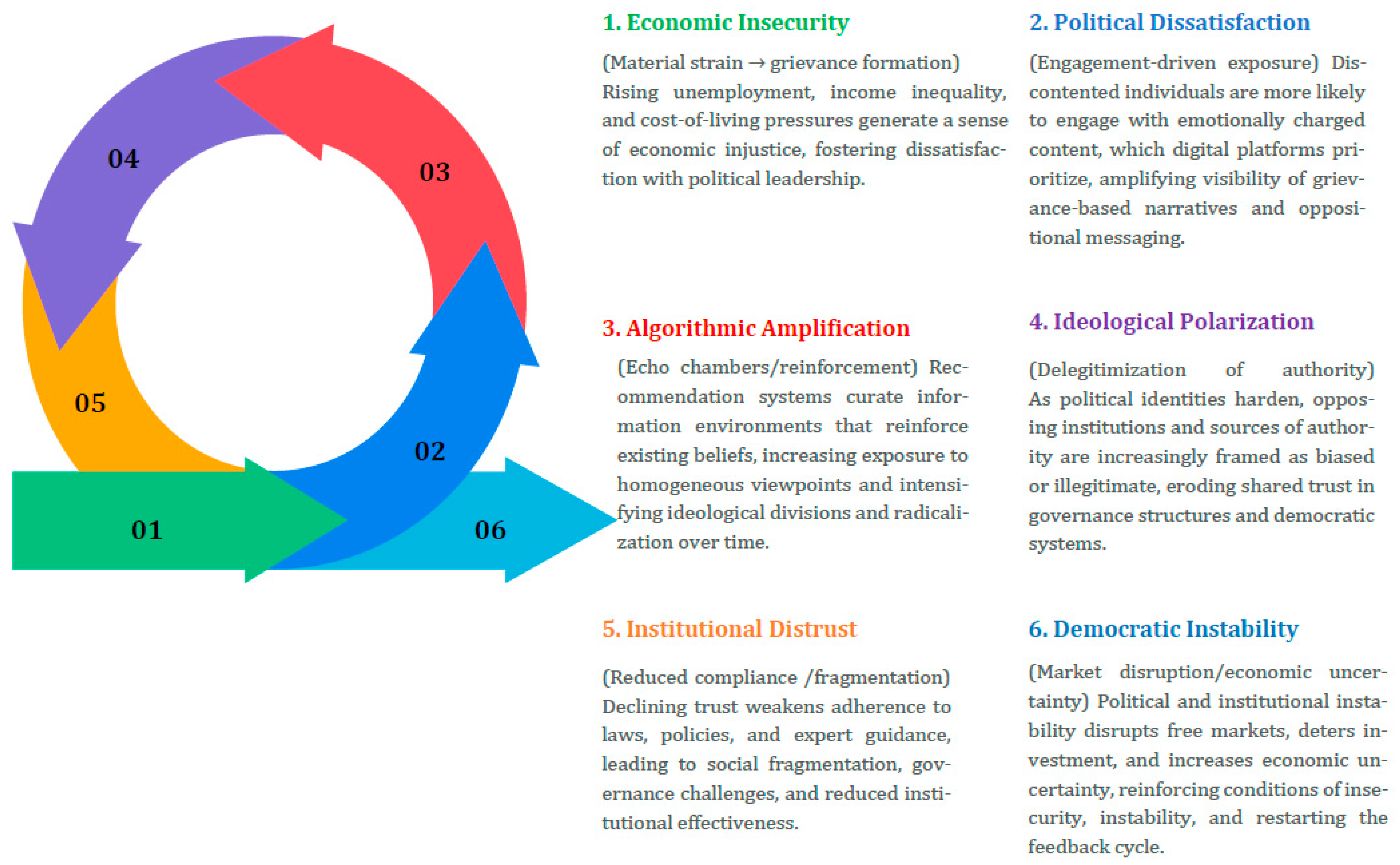
The interaction between these mechanisms creates a feedback loop of entropy, as seen in
Figure 1:
This loop represents a non-linear escalation of disorder, in which small disturbances can produce large-scale effects at stage 6. Unlike the slower transformations of the Industrial era, the AI revolution compresses time, reducing systems’ ability to adapt at every stage shown above. Thus, the AI revolution does not merely continue historical trends; it accelerates the entropic forces inherent in complex systems, challenging the sustainability of democratic equilibrium ecosystems and increasing pressures that may challenge democratic stability at an accelerated pace, as during the closing years of the prewar period preceding World War I (e.g., the end of the Industrial Revolution in 1914).
6. Integration as a Counterforce to Entropy
If entropy represents the tendency of complex systems toward disorder, then the central philosophical challenge becomes identifying the conditions under which coherence and stability can be sustained. Within the framework developed in this paper, integration emerges as a fundamental counterforce to entropy, not merely as a policy mechanism but as a structural property of adaptive systems at economic and governance levels [
30,
69].
Integration can be understood as the process through which otherwise fragmented components become interconnected, coordinated, and mutually reinforcing. In complex networked environments, effective governance often emerges through symbiotic regulatory interactions rather than through centralized control previously exercised by sovereigns before the Industrial Revolution [
9,
10,
25]. Similarly, institutional theory demonstrates that governance outcomes arise from co-evolving relationships between institutions and social processes rather than fixed designs [
25,
69,
70]. In biological systems, integration occurs through regulatory networks that synchronize cellular processes and maintain homeostasis [
47,
56]. In social systems, integration operates across multiple domains—economic, institutional, informational, and security—producing interdependence that stabilizes interactions and reduces systemic volatility [
69,
70,
71].
Historically, integration has played a decisive role in sustaining democratic systems [
26,
69,
70,
71,
72,
73]. Economic interdependence, particularly through trade networks, reduces incentives for conflict and aligns the interests of otherwise competing actors [
26,
72,
73]. This dynamic can be traced back to Adam Smith’s insight that decentralized free-market interactions can generate coordination without centralized control [
22,
23,
24,
25]. In
the Wealth of Nations, Smith describes how individual self-interest, mediated through market exchange, produces broader patterns of order and interdependence—often conceptualized as the “invisible hand” [
22,
23,
24,
25]. Importantly, Smith also recognized that such economic coordination depends on underlying moral and institutional conditions, as elaborated in The Theory of Moral Sentiments [
22,
23,
24,
25]. In this sense, economic integration is not merely a functional process but a socio-moral one, reinforcing the argument that system coherence emerges from the interaction of economic behaviour, institutional frameworks, and social norms [
22,
23,
24,
25]. Institutional integration—through shared legal frameworks and governance structures—enhances predictability and coordination [
70,
74]. Similarly, security integration, through alliances (e.g., NATO, or Five Eyes Security Framework) and cooperative arrangements, reduces uncertainty and mitigates the risk of large-scale conflict [
39,
49].
From a systems theoretical perspective, integration increases system coherence, enabling more effective feedback loops and adaptive responses. This understanding of integration can be further deepened through contemporary legal and political philosophy. As Neil Walker argues, complex governance systems—such as the European Union (EU)—do not operate as fully unified or hierarchical structures but as overlapping and interacting legal and institutional orders in which coherence is emergent rather than imposed [
32]. From this perspective, stability arises not from centralized authority, but from the continuous interaction and mutual adjustment of multiple systems operating at different levels [
32]. This reinforces the present argument that integration should be understood not as uniformity, but as a relational process through which coherence is constructed across diverse and interdependent domains [
32]. This aligns with Bertalanffy’s account of open systems, in which stability emerges through continuous exchange and regulation rather than isolation [
11]. In contrast, fragmentation—whether economic (e.g., tariffs, closing the Strait of Hormuz), informational (e.g., algorithmic echo chambers), legal (e.g., not accepting WTO arbitration), or political (e.g., Brexit or separatism)—reduces the system’s capacity to coordinate and respond to disturbances, thereby accelerating entropic processes.
However, integration introduces its own tensions. Highly integrated systems can become vulnerable to cascading failures, where localized disruptions propagate across interconnected networks [
75,
76,
77]. This suggests that the goal is not maximal integration, but balanced integration—a condition in which interdependence enhances resilience without eliminating flexibility. From the perspective of complexity theory, integration can be understood as a mechanism that enhances system resilience by enabling adaptive coordination across interconnected components [
8,
30,
77]. Drawing on the work of Ilya Prigogine, complex systems are characterized by non-linear dynamics in which order can emerge from disorder through self-organization [
30]. This insight suggests that integration does not eliminate entropy but rather reorganizes it, allowing systems to transition toward new forms of equilibrium rather than catastrophic collapse (e.g., autocracy and the collapse of a free-market economy) [
8,
11,
30].
This aligns with Walker’s broader claim that coherence in complex legal systems is not achieved through complete integration into a single system, but through negotiated and evolving relationships between partially autonomous systems [
32]. Such arrangements allow for stability without requiring full uniformity, suggesting that resilience emerges from structured diversity rather than total convergence [
8,
32,
70]. A useful analogy for understanding this counteracting dynamic can be drawn from physics, particularly the Meissner effect in superconductivity [
61,
78]. When certain materials are cooled below a critical temperature, they transition from a normal conductive state—characterized by resistance and energy dissipation—into a superconducting state in which electrical resistance disappears, and magnetic fields are expelled [
61,
78]. This transition is often interpreted as a movement from a higher-entropy state toward a more ordered configuration, thereby counteracting the entropy-increasing effects of energy dissipation, such as Joule heating [
61,
78].
While this phenomenon does not violate the laws of thermodynamics, it demonstrates that under specific conditions, systems can reorganize into highly ordered states through collective interactions [
61,
78]. In a broader systems theoretical sense, the Meissner effect illustrates how coherence can emerge when system components become sufficiently integrated and aligned [
61,
78]. By analogy, democratic systems may similarly counteract entropic pressures not by eliminating disorder, but by achieving higher levels of coordination and integration that restore systemic coherence and relative stability.
In the context of the AI revolution, integration takes on new significance. Digital networks, global supply chains, and transnational institutions create unprecedented levels of interconnection. While these structures can stabilize systems, they also increase the speed at which disturbances spread. In this sense, integration functions not as a static condition but as a dynamic process through which democratic systems continuously reorganize themselves in response to internal and external pressures. Thus, integration must be understood as a dynamic, adaptive process continuously recalibrated in response to changing conditions. Philosophically, this reframing shifts the understanding of democracy away from static institutional arrangements toward a relational ecosystem of equilibrium. Democratic stability depends not only on the internal coherence of political systems but also on their embeddedness within broader networks of economic, security, and informational integration.
7. Adaptive Democratic Systems
Given that entropy cannot be eliminated, the question of democratic stability becomes one of management rather than control. Traditional political theory often assumes that stability can be achieved through institutional design, normative consensus, or rational deliberation [
39,
40,
41]. However, in complex, continuously changing systems, such assumptions are insufficient. Within complex systems, stability cannot be achieved by eliminating risk or disorder, but only through adaptive processes that manage uncertainty [
8,
30,
43]. This adaptive perspective resonates with Dewey’s conception of democracy as an experimental process, in which institutions evolve through iterative responses to social problems rather than adherence to fixed principles [
35]. It also reflects Hayek’s emphasis on the limits of centralized knowledge, suggesting that effective governance must operate through decentralized, flexible mechanisms capable of responding to complexity through innovation [
34].
This perspective is further supported by post-war political philosophy, particularly the idea that stability in modern societies emerges not from static equilibrium, but from institutional arrangements that manage conflict and interdependence [
38,
41,
69]. Immanuel Kant’s concept of “perpetual peace” anticipated this dynamic by arguing that republican governance, economic interdependence, and supranational cooperation reduce the likelihood of conflict between states [
26]. In the post-World War II context, these principles were partially realized through the creation of European institutions designed to embed cooperation and constrain unilateral action [
69,
79,
80].
From a complexity theoretical standpoint, adaptive governance can be understood as a process of navigating non-linear systems in which outcomes are uncertain, fluid, and emergent [
8,
30,
43]. In this context, adaptive governance also reflects the kind of multi-level, interaction-based system described by Walker, in which authority and legitimacy are distributed rather than centralized [
32]. Rather than relying on a unified framework, governance operates through intersecting structures that continually adapt to changing conditions, reinforcing the idea that stability in democratic systems depends on flexibility and interaction rather than rigid institutional design [
32,
70,
71].
The EU provides a concrete example of such an adaptive system [
32]. Emerging from the devastation of World War II, European integration was explicitly designed to prevent future conflict by embedding economic and political interdependence among historically rival states [
32,
69,
72,
79,
80,
81,
82]. As argued in theories of the “democratic peace” and “commercial peace,” economic integration and shared institutions reduce incentives for conflict by aligning interests and increasing the costs of confrontation [
32,
69,
72,
79,
80,
81,
82]. The EU’s development—from the European Coal and Steel Community to a broader system of economic, legal, and political integration—illustrates how stability can emerge through structured interdependence rather than isolated centralized authority [
32,
69,
72,
79,
80,
81,
82].
Rather than seeking equilibrium through control of isolated mechanisms, systems maintain stability through continuous adjustment, feedback, and learning. In the context of democratic adaptation, several interconnected strategies are involved. First, it requires acknowledging the structural sources of instability, including economic inequality (trillions vs. the working poor) and informational fragmentation (e.g., misinformation, disinformation, and conspiracy theories through algorithmic echo chambers). Second, it emphasizes resilience over optimization, prioritizing systems that can absorb shocks and adapt to change through innovations and integrations.
Third, it recognizes the limits of centralized, isolated control and instead focuses on distributed and adaptive forms of governance. From a philosophical perspective, this aligns with a broader shift from teleological models of politics—in which systems are oriented toward fixed ends—to process-oriented models, in which stability emerges through ongoing adaptation, integrations, and innovations [
31,
35,
42]. This shift resonates with systems theory and complexity science, where equilibrium is understood as dynamic rather than static [
11].
This transformation also reflects broader philosophical debates about legitimacy in multi-level governance systems. As Walker argues, legitimacy in complex systems is not derived solely from centralized, isolated authority, but from the interaction and mutual adjustment of overlapping institutional orders [
32]. Similarly, Habermas emphasizes that legitimacy in supranational systems depends on the development of shared communicative spaces and reciprocal justification among participants [
27]. These perspectives reinforce the idea that stability in democratic systems emerges through processes of interaction, negotiation, integration, and adaptation rather than fixed institutional design [
31,
32].
In the AI era, the relevance of adaptation, integration, and innovation becomes particularly pronounced. Algorithmic systems, automation (Generative AI, all-purpose AI, Large Language Models, convolutional neural networks, and robotic AIs), and greater global networks introduce new forms of uncertainty and risk [
39,
49]. Attempts to eliminate these risks entirely through isolation are both impractical and counterproductive. Instead, the focus must shift to managing their effects—reducing polarization, mitigating inequality (e.g., at national and international levels), countering radicalization of echo-chambers, and maintaining institutional legitimacy through innovation, integration, and rapid transformations in both the economy, security, informational and communicative systems (pillars of the symbiotic ecosystem) [
39,
40,
48,
49]. Importantly, adaptations and integration also address the epistemic dimension of democracy. As informational environments become increasingly fragmented, maintaining shared understanding becomes more difficult. Rather than attempting to restore a unified, centralized epistemic framework, emphasize limiting the most destabilizing forms of misinformation and manipulation, thereby preserving the minimal conditions necessary for democratic functioning and the rule of law [
48].
In this broader context, the EU can be interpreted as an evolving example of adaptive governance in practice [
32]. Its institutional design reflects an ongoing effort to balance national sovereignty with supranational coordination, enabling cooperation while accommodating diversity [
32]. The establishment and expansion of the EU has contributed to an unprecedented period of peace, economic growth, and relative stability among its member states, not by eliminating conflict entirely, but by transforming it into managed political and legal processes rather than violent confrontation or centralized isolated control [
32,
69,
79,
80]. Ultimately, reframing and transforming democratic governance as an adaptive practice is necessary to ensure the balance in the ecosystem, as already being implemented through the establishment and expansion of the EU [
32]. Establishment of EU-like structures recognizes that stability is not achieved by eliminating disorder, but by continuously managing competing forces, reducing risks, introducing change (at micro and macro levels), and preparing for innovation within a system that is inherently dynamic, fluid, uncertain, unstable, and entropic [
82].
8. Conclusions
Democracy, as argued throughout this paper, is not a fixed institutional achievement but an emergent, fragile equilibrium within complex, interdependent, symbiotic, entropic systems (e.g., economic, security, and informational systems). Its development reflects the evolutionary interplay among economic efficiency, technological transformation, and adaptive pressures, rather than deliberate design alone, as originally proclaimed by Greek philosophers. By reframing democracy in systems theoretical terms, this paper has shown that stability is not inherently guaranteed in democratic systems but must be continuously maintained under conditions of change, adaptations, integrations, and innovations.
The Industrial Revolution provides a historical illustration of this dynamic, demonstrating how technological and economic transformation can simultaneously expand democratic participation while generating entropic forces in the forms of inequality, social dislocation, and political instability. The central contribution of this paper is to extend this analysis by conceptualizing the AI revolution as an accelerated entropic force that promotes instability through the interaction among structural inequality, algorithmic amplification, and informational fragmentation. Unlike previous periods of transformation (e.g., the first and second Industrial Revolutions), the speed and scale of AI-driven change compress the time available for institutional adaptation, placing unprecedented pressure on the democratic equilibrium ecosystem.
In response to these entropic pressures, this paper has argued that democratic stability depends on adaptive mechanisms and innovations rather than static institutional design. Integration—across economic, institutional, security, and informational domains—emerges as a key structural counterforce, enhancing coherence and enabling coordinated responses to systemic disturbances. At the same time, harm reduction provides a complementary framework for managing instability, recognizing that disorder cannot be eliminated but must be mitigated through continuous adjustment. Together, these mechanisms reflect a shift from models of centralized control to models of adaptation.
The experience of European integration offers an important empirical illustration of these dynamics. Since the end of the Second World War, the EU has contributed to an unprecedented period of peace, economic growth, unprecedented scientific achievements, and relative stability among its member states by embedding economic interdependence, monetary integration, legal coordination, and multi-level governance. Rather than eliminating conflict, it has transformed it into institutionalized forms of negotiation and regulation, demonstrating how stability can emerge from structured interdependence within complex systems.
Ultimately, this paper recommends that democracy be conceptualized not as a stable form of governance but as an ongoing process of maintaining an evolutionary complex equilibrium within systems subject to entropic forces (economic, informational, and security). Its future depends not on preserving existing institutions unchanged but on society’s capacity to adapt to accelerating technological transformations while maintaining coherence across interconnected domains. In an era defined by AI-driven complexity, the challenge is not to eliminate entropic forces but to develop forms of governance capable of managing their shocks.