1. Introduction
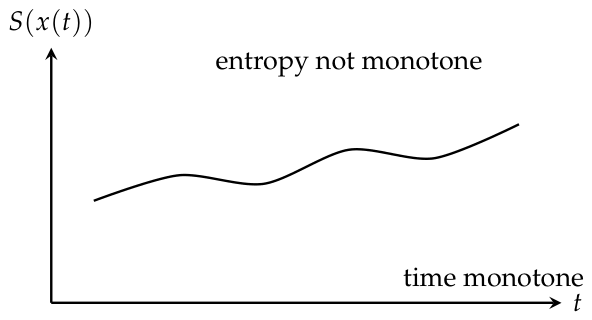
The relationship between entropy and time has long occupied a central place in the foundations of physics and philosophy of science. Macroscopic phenomena exhibit a pronounced temporal asymmetry: isolated systems relax toward equilibrium, dissipative processes occur spontaneously in one temporal orientation but not the other, and entropy—defined within thermodynamics and statistical mechanics—typically increases toward what is conventionally called the future [
1,
2,
3,
4,
5]. These observations motivate what is commonly referred to as the
thermodynamic arrow of time [
6,
7,
8,
9,
10].
At the same time, the conceptual relation between entropy and time has been examined for over a century in discussions of reversibility, recurrence, statistical typicality, and the Past Hypothesis. The Loschmidt reversibility objection, Poincaré recurrence, Liouville invariance, and modern statistical-mechanical accounts of the Past Hypothesis have clarified that microscopic laws are, to a high degree, time-reversal invariant, and that entropy increase depends essentially on boundary conditions, typicality assumptions, and coarse-graining rather than on a fundamental asymmetry in the dynamical equations themselves [
3,
4,
6,
8,
9,
11,
12,
13,
14,
15]. Within this tradition, it is widely recognized that entropy is not identical to the time parameter appearing in physical theories. Entropy is instead typically used to explain the observed temporal asymmetry of macroscopic processes, given suitable boundary conditions and statistical assumptions [
6,
8,
10,
11,
13].
The present paper does not claim novelty for the bare statement that entropy is not time. That point is already widely accepted in the philosophy of statistical mechanics and in foundational discussions of the arrow of time [
5,
6,
8,
9,
16]. The aim is rather to make explicit a structural distinction that is often left implicit: entropy, temporal ordering, temporal orientation, temporal measurement or flow selection, and thermodynamic asymmetry play different roles within dynamical theories. Clarifying these roles is important because statements about the “entropy–time relation” can otherwise conflate several distinct questions.
The motivation for this clarification is not that the literature typically defends the crude thesis that entropy is literally identical to time, nor that standard statistical mechanics explicitly derives a before–after ordering from entropy alone. Few careful accounts defend such a thesis in that form. The issue is broader. Entropy is often assigned a central role in discussions of time’s arrow, temporal orientation, thermal time, emergent or relational time, cosmological asymmetry, and the measurement or selection of temporal flow. These roles are legitimate when understood as claims about irreversibility, orientation, or state-dependent flow within an already ordered framework. Without an explicit role distinction, however, such discussions can invite the stronger interpretation that entropy itself supplies, grounds, or constitutes temporal ordering. The present paper is intended to identify the boundary between these claims.
This issue is not merely rhetorical. In the thermal time hypothesis, for example, thermodynamic or statistical structure is proposed to determine a preferred physical flow in generally covariant settings [
17]. Rovelli later describes thermal time as the time associated with the statistical state of the world, relative to the macroscopic parameters by which the system is described [
18]. Such proposals are considerably more subtle than the simple claim that entropy is identical to time. Nevertheless, they illustrate why it is important to distinguish several roles that can otherwise be conflated: generating an ordering relation, selecting a preferred flow, orienting an already ordered history, measuring temporal change, and explaining thermodynamic asymmetry. Similar caution is needed in entropy-based cosmological accounts of the arrow of time, where low-entropy boundary conditions and entropy gradients are often used to explain why one temporal orientation is thermodynamically distinguished [
6,
8,
9,
10,
19].
For clarity, we distinguish the following problems:
- (A)
Irreversibility problem: Why do macroscopic processes exhibit irreversible behavior?
- (B)
Thermodynamic arrow problem: Why does entropy typically increase toward what we call the future rather than the past?
- (C)
Temporal-orientation problem: What selects one direction of an already ordered history as future-directed?
- (D)
Temporal-flow or measurement problem: Can thermodynamic, statistical, or relational structure help define, select, or measure a physically relevant temporal flow?
- (E)
Temporal-ordering problem: What supplies the ordering relation among states or events along a dynamical history?
Standard statistical mechanics provides powerful answers to (A) and (B). Irreversibility can be explained statistically in terms of typical behavior under coarse-grained descriptions, and entropy increase can be explained by combining time-reversal-invariant dynamics with special boundary conditions, most notably a low-entropy past [
3,
8,
10,
11,
12,
13]. Entropy gradients may also contribute to (C) by helping to identify one orientation of an already ordered history as thermodynamically future-directed. More sophisticated proposals, including thermal-time and relational-time approaches, may address aspects of (D) by using statistical states, modular structure, correlations, or records to define physically meaningful flows or clock-like relations [
17,
18]. The present paper does not challenge these projects. Rather, it addresses the more limited question in (E): whether standard entropy functionals themselves can supply the ordering relation among states or function as general temporal parameters within a dynamical theory.
It is useful to make this distinction explicit. By
temporal ordering, we mean the before–after ordering relation among states along a dynamical history. By
temporal orientation or
temporal direction, we mean the assignment of one of the two possible directions along such an ordered history as future-directed. By
temporal flow or measurement, we mean a physically selected or operationally meaningful way of parametrizing change, such as a clock, modular flow, or relational ordering variable. By the
thermodynamic arrow, we mean the empirical and statistical tendency, under suitable boundary conditions and coarse-graining, for entropy to increase toward the future-directed orientation. These notions are related, but they are not equivalent. In particular, many entropy-based accounts of the arrow of time do not attempt to derive temporal ordering itself from entropy. Rather, they assume an ordered dynamical framework and use entropy gradients, together with boundary conditions such as a low-entropy past, to explain why one orientation of that order is thermodynamically distinguished [
6,
8,
10,
11,
12,
13,
15].
The argument of this paper is compatible with the weaker, standard position. We do not deny that entropy increase may help orient an already ordered sequence of states, nor do we deny that entropy plays a central role in explaining thermodynamic irreversibility. We also do not deny that thermodynamic or statistical structure may contribute to the selection or measurement of physically meaningful temporal flow in special frameworks. The narrower claim is that entropy cannot itself supply the underlying temporal ordering relation, nor can standard entropy functionals serve as general temporal parameters. Entropy may characterize the asymmetry of an evolution once an ordered history is given, but the notions of increase, decrease, gradient, or monotonicity already presuppose an ordered sequence of states.
The argument proceeds in two steps. First, we formulate a minimal structural condition for a quantity to function as a temporal parameter along a dynamical trajectory. At a minimum, such a quantity must distinguish distinct stages of the evolution; mathematically, it must be injective along the relevant trajectory. Second, we show that standard entropy notions—thermodynamic, Boltzmann, Gibbs, and coarse-grained entropy—do not satisfy this condition in general. Entropy functionals may remain constant, repeat values, depend on coarse-graining, or vary non-monotonically along dynamically ordered histories.
The purpose of these structural results is not to prove the surprising claim that entropy and time are non-identical. Rather, the purpose is to make explicit why that non-identity follows from the different mathematical roles played by temporal parameters and entropy functionals. Time, in dynamical theories, orders the evolution of states. Entropy assigns scalar values to states, macrostates, or probability distributions. These roles are not interchangeable. The mathematical arguments below therefore provide a systematic role-separation analysis: they clarify why entropy cannot function as a general temporal parameter, even though it remains indispensable in accounts of thermodynamic asymmetry.
The main contributions of the paper are as follows:
- (C1)
We provide an explicit role taxonomy distinguishing temporal ordering, temporal orientation, temporal measurement or flow selection, and thermodynamic asymmetry, thereby identifying which questions entropy-based arguments can address, and which they cannot.
- (C2)
We formulate a minimal time-parametrization criterion within a dynamical-systems framework: a candidate temporal parameter must at least be injective along the trajectories it is supposed to order.
- (C3)
We show that standard entropy functionals fail this criterion in general, due to non-injectivity, invariance of fine-grained Gibbs entropy under Hamiltonian flow, and the dependence of coarse-grained entropy on descriptive partitions.
- (C4)
We clarify why time-reversal invariance and boundary conditions limit any attempt to extract an intrinsic temporal orientation from entropy monotonicity alone.
- (C5)
We identify the precise circularity involved in attempts to use entropy increase as a ground of temporal ordering: increase, decrease, monotonicity, and entropy gradients are already order-relative notions. This does not exclude the weaker claim that entropy gradients may help orient such a sequence once the ordering relation is independently supplied.
- (C6)
We propose a modest constraint-volume interpretation of entropy as a structural schema, exact in some cases, and asymptotic or heuristic in others, for understanding why entropy is so closely associated with thermodynamic asymmetry while remaining conceptually distinct from temporal ordering.
Taken together, these results isolate a structural boundary. Entropy increase may correlate with macroscopic irreversibility and may participate in statistical explanations of the thermodynamic arrow. Under Past Hypothesis-type assumptions, entropy gradients may also help identify a future-directed orientation of an already ordered dynamical history [
8,
10,
11,
12,
13]. In thermal-time or relational-time settings, thermodynamic or statistical structure may also contribute to the selection of a physically meaningful flow [
17,
18]. What standard entropy functionals cannot do, under their usual definitions, is supply the ordering relation itself or replace the temporal parameter within a general dynamical theory.
The scope of the paper is, therefore, intentionally limited. We do not propose an alternative theory of time, nor do we dispute the explanatory success of entropy-based accounts of irreversible behavior. The aim is clarificatory and diagnostic: to identify the distinct structural roles played by temporal parameters and entropy functionals, and to show why these roles should not be conflated. In this sense, the paper is not a revision of statistical mechanics, but a conceptual and mathematical clarification of its temporal presuppositions. Its value is to provide a criterion for evaluating entropy-based, thermal-time, relational-time, and arrow-of-time claims by asking whether entropy is being used to explain irreversibility, orient an already ordered history, select or measure a state-dependent flow, or supply temporal ordering itself.
Finally, after establishing what entropy cannot provide, we turn in
Section 4 to a positive structural clarification of what entropy may be understood to measure. We suggest that many standard entropy notions admit an interpretation, exact in some settings and asymptotic or heuristic in others, in terms of the logarithmic volume of constraint-defined possibility space. This interpretive schema helps explain why entropy correlates so strongly with temporal asymmetry while remaining conceptually distinct from temporal ordering itself.
4. Entropy as Constraint Volume: A Structural Interpretation
4.1. From Role Separation to Positive Clarification
The preceding sections established a limited role-separation result: standard entropy functionals cannot serve as general temporal parameters or supply temporal ordering itself. This conclusion does not diminish the importance of entropy in thermodynamics or statistical mechanics. Rather, it invites a constructive question: if entropy does not play the ordering role of time, what structural feature of physical descriptions does it measure?
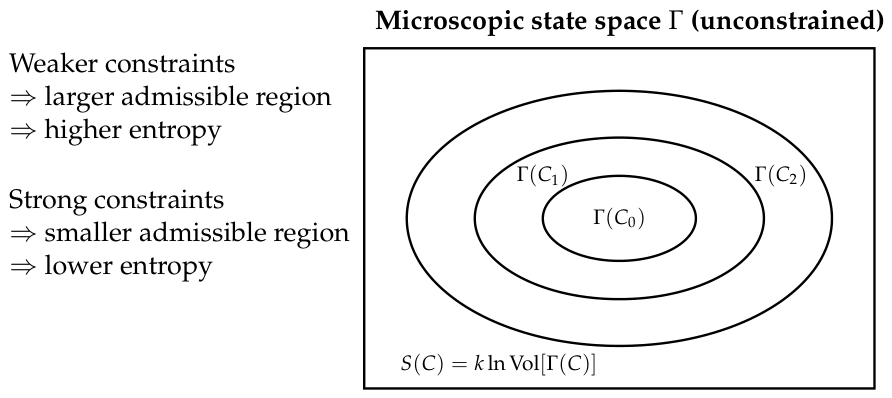
This section offers a modest interpretive answer. Many standard entropy notions—including Boltzmann entropy, equilibrium thermodynamic entropy, coarse-grained entropy, and, in a more restricted or asymptotic sense, Gibbs entropy—can be understood as involving the logarithmic size, spread, or effective volume of microscopic possibilities compatible with specified macroscopic, statistical, or descriptive constraints. The formal definitions differ, and the correspondence is exact in some cases, asymptotic in others, and heuristic in still others. The claim is therefore not that all entropy notions reduce to a single universal formula, but that they share a useful structural motif.
This observation motivates an interpretive proposal: entropy may often be understood, at a structural level, as quantifying the effective size of a possibility space permitted by constraints. On this view, the conceptual core of entropy lies not in temporal ordering itself, but in the degree to which a physical description restricts or permits microscopic possibility.
This section does not introduce a new entropy definition, nor does it attempt to derive all existing entropy formulas from a single principle. Rather, it proposes a restricted structural interpretation that helps clarify why entropy is so closely associated with thermodynamic asymmetry while remaining distinct from the temporal parameter. The proposal should therefore be understood as an interpretive schema rather than as a replacement for, or derivation of, standard entropy notions.
4.2. Constraint-Defined State Spaces
Let
C denote a set of constraints or descriptive conditions associated with a physical system at a given stage of its evolution. Such conditions may include conservation laws, boundary conditions, macroscopic variables, gradients, correlation structures, coherence relations, symmetry restrictions, or externally imposed controls. Let
denote an underlying microscopic state space, such as a classical phase space, and let
denote the set of microstates compatible with the constraint set
C.
In cases where entropy has a direct state-counting or phase-volume interpretation, the entropy associated with
C may be represented schematically as
where
denotes the measure of the admissible region with respect to an appropriate reference measure, such as the Liouville measure in classical mechanics. The symbol “∼” is important: it indicates structural correspondence rather than strict definitional identity.
Equation (
10) is therefore not proposed as a new definition of entropy. It is a schematic representation of a common structural idea that appears in several entropy notions:
In Boltzmann entropy, corresponds directly to the phase-space region compatible with a macrostate.
In equilibrium thermodynamic entropy, macroscopic state variables constrain the compatible microscopic configurations, and the entropy reflects the size of that compatible set in the statistical-mechanical interpretation.
In coarse-grained entropy, the partition determines which regions of state space are treated as observationally distinguishable, and entropy depends on the distribution of probability mass across those regions.
In Gibbs entropy, the relation to volume is more indirect. The fine-grained Gibbs entropy measures the spread of a probability density and, in large-system or asymptotic typical-set settings, can be related to effective support volume. This correspondence should not be read as a general identity between Gibbs entropy and the volume of a sharply defined subset of phase space.
Thus, in several important settings, entropy can be interpreted as measuring, exactly or approximately, how broadly microscopic possibilities are distributed under a specified description. Low-entropy descriptions correspond to more restrictive conditions, sharper localization, or more specific macroscopic structure. High-entropy descriptions correspond to more permissive conditions, broader spread, or larger effective possibility space.
4.3. Irreversibility as Constraint Relaxation
Under generic many-body dynamics, physically relevant constraint structures often relax. Correlations disperse, macroscopic gradients flatten, phase coherence may decohere, and finely tuned relations are typically disrupted by interaction with uncontrolled degrees of freedom. When such constraints relax, the effective region of microscopic possibility compatible with the macroscopic description often expands, and the associated entropy typically increases.
On this interpretation, entropy increase reflects the typical relaxation or weakening of special constraint structure under dynamical evolution. Temporal ordering is supplied by the dynamical flow ; entropy measures, at each ordered stage, how restrictive the relevant physical description is. The thermodynamic arrow then tracks the asymmetric behavior of constraint structure under special boundary conditions, not the generation of temporal ordering itself.
This perspective helps explain why entropy is so closely correlated with temporal asymmetry while remaining conceptually distinct from time. The thermodynamic arrow characterizes how states tend to evolve within an already ordered dynamical history. It does not supply the ordering relation that makes notions such as increase, decrease, or relaxation well-defined.
It is also important to emphasize that physically meaningful constraints and coarse-grainings are not arbitrary partitions imposed at will. In practice, they arise from macroscopic observables, measurement limitations, dynamical stability, environmental interactions, and the physical accessibility of information. Entropy is therefore defined relative to descriptive structures that are physically motivated. This reinforces the role-separation point: because entropy is assigned relative to such constraints or descriptions, it cannot by itself serve as a universal temporal ordering parameter independent of them.
4.4. Compatibility with the Structural Results
The constraint-volume interpretation is compatible with the structural results established earlier in this paper.
The non-injectivity of entropy along trajectories reflects the fact that constraint strength or effective possibility volume need not vary monotonically under dynamical evolution; it may remain constant, repeat values, oscillate, or temporarily decrease.
The invariance of fine-grained Gibbs entropy under Hamiltonian flow corresponds to the preservation of fine-grained phase-space volume under measure-preserving dynamics.
The time-reversal argument remains intact, since constraint relaxation depends on boundary conditions and statistical typicality, not on an intrinsic temporal asymmetry in the dynamical laws.
The dependence of coarse-grained entropy on partition choice corresponds to the dependence of effective constraint structure on descriptive resolution and physically chosen macroscopic variables.
Within this interpretive framework, entropy is not treated as a temporal parameter. Rather, it is treated as a measure, in several standard settings and with appropriate qualifications, of the breadth of microscopic possibility compatible with a physical description. The earlier sections established why entropy cannot play the ordering role of time; the present section clarifies why entropy nevertheless remains closely tied to the thermodynamic arrow.
Entropy and time are therefore deeply connected in physical practice but structurally distinct in conceptual role. Time, or the relevant dynamical parameter, orders the evolution. Entropy characterizes the constraint structure of the states or distributions appearing within that ordered evolution.
To emphasize that this interpretation does not introduce a competing entropy definition,
Appendix B provides consistency checks showing how the constraint-volume perspective corresponds structurally to several standard entropy notions. These checks should be read as interpretive correspondences, exact in some cases and restricted or asymptotic in others, rather than as a derivation of all entropy formulas from a single principle.
This interpretation is illustrated schematically in
Figure 2, where entropy is represented as the logarithmic measure of a constraint-defined region within the full microscopic state space.
5. Historical and Philosophical Context: Recurrence, Reversibility, and the Entropy–Time Debate
The relationship between entropy and time has been debated for more than a century within both physics and philosophy. Any structural claim about the role of entropy in temporal explanation must therefore be situated within this long-standing discussion. The purpose of this section is not to replace standard accounts of the thermodynamic arrow, but to clarify how the present role-separation argument relates to them.
A recurring lesson of the historical debate is that entropy increase can play an explanatory role only when combined with further assumptions: a dynamical framework, a choice of coarse-graining or macro-description, statistical typicality assumptions, and appropriate boundary conditions [
3,
4,
5,
8,
10,
11,
13,
14]. The present paper accepts this lesson. Its contribution is to make explicit a narrower structural point: entropy may help explain thermodynamic asymmetry or orient an already ordered history, but standard entropy functionals cannot themselves supply the temporal ordering relation.
5.1. Reversibility, Recurrence, and Statistical Symmetry
Shortly after Boltzmann’s statistical interpretation of entropy, objections were raised that exposed deep tensions between irreversible thermodynamic behavior and time-reversal-invariant microscopic dynamics [
1,
3,
5]. The reversibility objection, often attributed to Loschmidt, observes that if the fundamental equations of motion are invariant under time reversal, then for every entropy-increasing trajectory, there exists a corresponding entropy-decreasing trajectory obtained by reversing all momenta or velocities. This argument challenges the idea that entropy increase can be a fundamental dynamical law rather than a statistical regularity [
3,
6,
8].
A related challenge was formulated by Zermelo based on the Poincaré recurrence theorem [
26,
27]. For finite Hamiltonian systems with bounded phase space, trajectories return arbitrarily close to their initial states after sufficiently long times. If entropy is associated with phase-space volume or macrostate size, recurrence implies that entropy cannot increase strictly and without exception for all times. This undermines any simple identification of entropy monotonicity with temporal progression [
3,
5,
14].
Closely related is what is sometimes called the Schmidt paradox. Whereas Loschmidt emphasizes dynamical reversibility and Zermelo invokes long-time recurrence, the Schmidt paradox highlights the statistical symmetry of entropy fluctuations. Given time-reversal-invariant microscopic laws, entropy-decreasing histories are not forbidden; they are merely statistically atypical relative to suitable boundary conditions. Entropy increase, on this view, is not dynamically necessary but probabilistically typical [
3,
4,
6,
14].
Modern statistical mechanics does not regard these considerations as refutations of the second law. Rather, entropy increase is understood as typical behavior given appropriate coarse-graining and special boundary conditions [
3,
4,
14,
24]. In contemporary philosophy of physics, this position is often articulated through appeal to a low-entropy past, or
Past Hypothesis, together with probabilistic typicality arguments [
6,
8,
9,
10,
11,
12,
13,
15]. Within this framework, entropy provides a statistical explanation of the thermodynamic arrow without being treated as identical to the time parameter itself.
The present paper is fully compatible with this standard picture. It does not deny that entropy gradients, together with the Past Hypothesis, may help identify one orientation of an already ordered history as future-directed. The question addressed here is different: whether entropy itself can supply the ordering relation or function as the temporal parameter with respect to which entropy increase is defined.
5.2. From Recurrence Arguments to Structural Roles
The historical arguments just reviewed show that entropy monotonicity cannot be an unconditional dynamical law. Loschmidt’s objection shows that entropy-increasing and entropy-decreasing trajectories are paired by time-reversal symmetry. Zermelo’s recurrence argument shows that monotonicity cannot hold globally for all finite Hamiltonian systems. The Schmidt paradox emphasizes that entropy increase is a matter of statistical typicality rather than dynamical necessity [
3,
6,
14].
These points are familiar. The present work does not claim novelty for the bare statement that entropy is not time, nor for the observation that entropy increase depends on boundary conditions. Instead, it complements the historical debate by isolating a more elementary structural distinction. Rather than asking whether entropy usually increases, or whether entropy increase is statistically typical, we ask whether a standard entropy functional can play the role of a temporal parameter in a dynamical theory.
The answer is negative for structural reasons. Time, in the dynamical-systems framework, functions as a parameter that orders stages of evolution [
9,
16,
20]. Entropy, by contrast, is a scalar functional defined on states, macrostates, or probability distributions. A scalar state function can increase, decrease, remain constant, repeat values, or depend on a chosen coarse-graining. The results of
Section 3 make this role distinction explicit by showing that standard entropy functionals fail the minimal time-parametrization criterion in general.
This structural result does not replace recurrence, reversibility, or typicality arguments. It clarifies a different point. Recurrence and reversibility show that entropy monotonicity cannot be absolute or dynamically necessary. Past Hypothesis and typicality approaches show how entropy increase can nevertheless be expected toward one direction of an ordered history [
8,
10,
11,
12,
13]. The present argument shows that entropy cannot, under standard definitions, supply the ordering parameter itself. Thus, entropy may be used to characterize asymmetry along an ordered history, but it cannot be the structure that first orders that history.
5.3. Relation to Modern Arrow-of-Time Theories
It is especially important to distinguish the present argument from a rejection of modern entropy-based accounts of the thermodynamic arrow. Contemporary approaches generally do not claim that entropy literally is time. Nor do they usually claim that entropy alone supplies temporal ordering from nothing. More commonly, they assume a dynamical framework in which histories are already ordered, and then explain why one orientation of that ordered history is thermodynamically distinguished [
6,
8,
9,
10,
11,
12,
13].
First, Past Hypothesis approaches explain the thermodynamic arrow by postulating a special low-entropy boundary condition in the past, together with statistical typicality assumptions [
6,
8,
10,
11,
12,
13,
15]. On this view, entropy increase is expected toward one direction of the ordered history because the history begins, or is conditioned, at a special low-entropy boundary. The present argument is compatible with this framework. Its point is only that the Past Hypothesis itself presupposes a framework in which histories can be ordered and boundary conditions can be specified. Entropy helps explain the thermodynamic orientation of that history; it does not supply the ordering relation as such.
Second, the thermal time hypothesis, associated with Rovelli and collaborators, proposes that a notion of time flow may be constructed from the statistical state of a system [
28]. Such approaches are more subtle than the simple claim that entropy is identical to time. They attempt to derive a state-dependent modular or thermal flow from algebraic and statistical structure. The present paper does not attempt to refute these approaches. It only emphasizes a general constraint: any candidate temporal parameter, whether entropy-like or state-dependent, must be able to play the ordering role required of a temporal parameter. Standard entropy functionals, considered as scalar quantities, do not generally satisfy this requirement.
Third, emergent or relational time proposals attempt to define time in terms of correlations among physical variables rather than as a fundamental background parameter [
9,
16]. Such approaches may extract an ordering relation from dynamical correlations among subsystems. The present argument is compatible with relational approaches in this broad sense. What it denies is only that a standard entropy functional, by itself, can serve as the ordering variable. A relational account may use correlations, records, clocks, or conditional states to define ordering; entropy may then characterize asymmetry within that ordered structure.
Across these approaches, entropy plays an important explanatory role in accounting for macroscopic irreversibility and temporal asymmetry [
3,
8,
10,
11,
13]. The structural results of this paper do not diminish that role. They clarify its scope: entropy can explain asymmetry within an ordered sequence of states and, under suitable boundary conditions, may help orient that sequence. But entropy cannot, under its standard definitions as a scalar state or distribution functional, generate the ordering of the sequence itself.
5.4. Entropy-Based Time Claims and the Risk of Role Conflation
The preceding discussion suggests a further reason why the present clarification is useful. The target of the paper is not the crude thesis that entropy is literally identical to time, nor the claim that standard statistical mechanics explicitly derives a before–after ordering from entropy alone. Few careful accounts defend such a thesis in that form. The issue is instead that entropy is often assigned several closely related but structurally distinct roles in discussions of time: it may be used to explain irreversibility, to identify a thermodynamic arrow, to orient an already ordered history, to define or select a preferred flow, or to contribute to the measurement of temporal change. These roles are not equivalent.
This point becomes especially important in approaches where thermal or statistical structure is proposed to play a time-defining role. In the thermal time hypothesis, for example, the physical time flow associated with a state is identified with the modular flow determined by that state [
17]. Rovelli later describes the hypothesis as the idea that what we call time is the thermal time of the statistical state of the world, relative to the macroscopic parameters by which the system is described [
18]. Such proposals are considerably more subtle than the simple identification of entropy with time. Nevertheless, they show that the thermodynamic or statistical structure has been seriously considered as contributing to the definition or selection of time flow, not merely as describing ordinary entropy increase within a pre-given Newtonian time parameter.
Similarly, in cosmological and statistical-mechanical accounts of the arrow of time, entropy and low-entropy boundary conditions are often presented as explaining why time has a direction, or why the future differs from the past [
6,
19]. Properly understood, these accounts usually concern temporal orientation and thermodynamic asymmetry rather than temporal ordering itself. However, the language of “the direction of time,” “time’s arrow,” or “the emergence of time” can obscure this distinction unless the relevant roles are made explicit. An entropy gradient can help identify a future-directed orientation only within a framework in which histories, boundary conditions, and dynamical relations are already ordered.
The present paper is therefore not directed against a simple published claim that entropy literally generates temporal order from nothing. Rather, it addresses a broader and more persistent risk of role conflation. Entropy-based arguments may be correct when interpreted as claims about irreversibility, thermodynamic orientation, or the selection of a state-dependent flow, while becoming too strong if read as claims about the ground of temporal ordering itself. The structural results of
Section 3 provide a diagnostic boundary: standard entropy functionals may characterize or help orient an already ordered history, but they cannot themselves supply the ordering relation on which notions such as increase, decrease, and monotonicity, as well as the specification of boundary conditions, already depend.
5.5. Philosophical Significance
The philosophical significance of this clarification lies in the distinction between correlation, explanation, orientation, and constitution. Entropy increase may correlate with temporal asymmetry. It may also contribute to the statistical explanation of why macroscopic processes appear irreversible. In Past Hypothesis-type frameworks, it may help identify which orientation of an already ordered history is future-directed [
8,
10,
11,
12,
13]. But none of these roles entails that entropy constitutes temporal ordering itself.
By isolating minimal structural requirements for temporal parametrization, the present analysis provides a role-separation boundary that supplements the recurrence-based and Past Hypothesis traditions. It shifts attention from the question of whether entropy usually increases to the question of what kind of mathematical object entropy is. A temporal parameter orders stages of evolution. An entropy functional assigns values to states, macrostates, or probability distributions. These are different structural roles.
This boundary does not undermine thermodynamics or the statistical understanding of irreversibility. Rather, it sharpens the conceptual landscape within which those accounts operate. Entropy remains indispensable for describing irreversible phenomena within an ordered dynamical framework. The results established here clarify why it should not be promoted to the ordering parameter itself under standard formulations.
Placed in historical perspective, the contribution of this paper is therefore not to reassert that entropy and time are non-identical, nor to deny the standard entropy-based explanation of the thermodynamic arrow. The contribution is to articulate explicitly the structural distinction that such accounts presuppose: temporal ordering is supplied by the dynamical framework or by some independently specified ordering relation, whereas entropy measures features of states or distributions within that ordered framework. Recognizing this distinction helps avoid conflating statistical asymmetry with temporal ordering itself.
7. Conclusions
This paper has examined the relationship between entropy and time at the level of formal and conceptual structure. Using only standard entropy definitions and a minimal account of time as an ordering parameter in dynamical evolution, the paper has argued that entropy functionals and temporal parameters play distinct roles within physical theory. The central claim is not that entropy and time are simply non-identical. That point is already widely recognized in foundational discussions of statistical mechanics and the arrow of time [
5,
6,
8,
9,
16]. The paper is also not directed against the crude thesis that the literature generally identifies entropy literally with time. Rather, the contribution of the paper is to make explicit why several time-related roles often associated with entropy are structurally different. A temporal parameter orders the stages of a dynamical trajectory, whereas entropy assigns scalar values to states, macrostates, or probability distributions within such a trajectory. Entropy gradients may help orient an already ordered history, and thermodynamic or statistical structure may, in special frameworks, contribute to the selection or measurement of physically meaningful temporal flow [
17,
18]. Under standard formulations of thermodynamics and statistical mechanics, however, these roles are not interchangeable.
The structural results established above show that standard entropy functionals do not generally satisfy the minimal requirements for temporal parametrization. Entropy may be non-injective along trajectories; fine-grained Gibbs entropy is invariant under Hamiltonian evolution; coarse-grained entropy depends on descriptive partitions, and entropy monotonicity depends on boundary conditions, coarse-graining, and statistical assumptions [
3,
4,
14,
24]. These results do not challenge the thermodynamic arrow or the statistical-mechanical explanation of irreversibility. They clarify only that entropy cannot, under its standard definitions, replace the temporal parameter or supply temporal ordering itself.
The conceptual analysis further shows that entropy increase presupposes an ordered sequence of states. Notions such as increase, decrease, monotonicity, and entropy gradients are defined only relative to an already ordered history. Therefore, entropy cannot non-circularly ground temporal ordering itself. This conclusion is compatible with the weaker and standard claim that entropy gradients, together with suitable boundary conditions, such as a low-entropy past, may help orient an already ordered history and identify one direction as thermodynamically future-directed [
8,
10,
11,
12,
13,
15]. It is also compatible with more subtle approaches in which statistical states, modular structure, correlations, records, or clocks contribute to the selection or measurement of temporal flow, provided that this role is distinguished from supplying temporal ordering itself.
The constraint-volume interpretation developed above provides a positive clarification of entropy’s role. Many standard entropy notions can be understood, exactly in some settings and asymptotically or heuristically in others, as measuring the logarithmic size, spread, or effective volume of microscopic possibilities compatible with specified constraints or descriptive conditions. On this interpretation, the persistent association between entropy increase and the arrow of time reflects the typical relaxation of constraint structure under dynamical evolution, rather than an identification of entropy with temporal ordering.
The contribution of this paper is therefore clarificatory rather than revisionary. It does not challenge thermodynamics, statistical mechanics, thermal-time proposals, relational-time approaches, or Past Hypothesis-type accounts of the thermodynamic arrow [
6,
8,
10,
11,
13,
17,
18]. Instead, it isolates a structural boundary within dynamical theory: temporal parameters order states, whereas entropy functionals characterize states or distributions within an already ordered framework. Recognizing this boundary helps separate several questions that are often discussed together: why macroscopic processes are irreversible, why entropy typically increases toward the future, what selects or measures a physically meaningful temporal flow, and what supplies the temporal ordering relation among states in the first place.
The resulting role taxonomy provides a diagnostic criterion for evaluating entropy-based, thermal-time, relational-time, and arrow-of-time claims: one must ask whether entropy is being used to explain irreversibility, orient an already ordered history, select or measure a physically meaningful flow, or supply temporal ordering itself. By making these distinctions explicit, the present analysis aims to sharpen the conceptual foundations of the entropy–time debate while remaining fully compatible with established physical theory. It shows that entropy remains indispensable for understanding thermodynamic asymmetry, but that its explanatory role presupposes, rather than constitutes, the temporal ordering of dynamical evolution.