
Towards a Theory of Dynamicity: Foundations for a Non-Vacuous Process Metaphysics

Abstract
1. Introduction
2. Process Metaphysics: The Fundamentality of Dynamicity
3. Desiderata for a Theory of Dynamicity
3.1. Difference-Making
3.2. Explanatory Power
3.3. Other Desiderata
4. Theories of Dynamicity
4.1. Mereological Theories of Dynamicity
This difference in completedness is explicated by means of differences in the inferential role of sentences expressing ‘cases’ of energeia and kinesis. […] [S]tatements about kineseis abide by the pattern
[8.] (subject, Greek verb in present tense) implies the falsity of (subject, Greek verb in the Perfect)
while statements about energeia do not govern such implications—the present tense statement is compatible with the associated statement in the perfect. […] [S]o for statements about energeiai it holds:
[9.] (subject, Greek verb in present tense) implies (subject, Greek verb in the Perfect) [23] [p. 8].
I want to suggest […] a standard, implicit definition of ongoingness of “dynamicity.” […] I suggest that we take the feature of strict automerity as an inferential constraint that, in combination with additional restrictions within a formal system, all and only ongoing or “dynamic” entities fulfill. The general strategy of my proposal can be summarized into the following four claims: (i) dynamicity or dynamic being is ongoingness by expressing itself—to be is to go on; (ii) self-expression is reflected in a characteristic structure in the description of an entity; (iii) for example, if we describe an entity E in terms of a partition that specifies what is “part of being that entity” (i.e., we specify its spatial, function, material etc, parts within one partition using a generic part relation), the fact that E is dynamic will be reflected in the partition in the form of certain distinctive patterns representing self-expression; and (iv) self-expression is mereologically reflected in strict automerity, which generates self-similar patterns within a partition [23] [pp. 18–19].
4.2. Modal Theories of Dynamicity
[…], if a powers metaphysic gives a central place to activity (or activities) and/or treats activity as fundamental, it is dynamic; if the status of activities is somehow diminished, then the metaphysic is not dynamic. ‘Activists’ (as I shall call them) are those powers theorists for whom activity plays a central or fundamental role in their metaphysics. ‘Passivists’, on the other hand, treat activities as ontologically derivative [34] [pp. 2462–63].
The best way that I know of to get at what I mean by activity is to picture a child’s flipbook, or otherwise a reel of film. When the still frames of either are viewed in rapid succession, it looks as if the entities represented in them are moving around, doing things. By ‘activity,’ I mean that aspect of the world in virtue of which real animation differs, if it does, from flip-book or cartoon animation, or from moving pictures. [43] [p. 9883]
Powers are posited as engines of change in the world: dynamic entities that literally ’power-up’ everything that happens. But what is it for a power to be dynamic? My point is that claiming that it is a power’s dynamism that powers-up change in the world gives a name to what we are looking for, but does not explain it at all. It looks as if it is a bit of magic that somehow makes the world an eventful place of changes. This is the black box problem of powers [46] [p. 4].
Powers are entities that are in a state of “readiness for action.” […] U.T. Place proposed […] that we think of intentionality as the mark, not of the mental, but of the dispositional (1996: 92). At the present time, his influence is widening in the circle of power-ontologists who define a power in terms of its directionality toward its manifestation. George Molnar for example writes, “having a direction to a particular manifestation is constitutive of the power property” (2003: 60). In the case of pure powers, in John Heil’s words, “all there is to [such] a property is its contribution to the dispositionalities of its possessors” (2003: 97).
Directedness captures the point of the comparison between intentionality and powers. Just as an intentional state is directed toward something beyond itself, so a power is directed toward its manifestation. Just as in the case of an intentional state, what it points to need not exist; similarly in the case of a power, what it points to need not come about, since a power may never be manifested. A vase has the power of fragility that is directed toward breaking even when the vase never breaks, or an electric charge has the power to attract or repel even if no charged particle ever comes close enough to be attracted or repelled. On the hypothesis that powers are pure, there is nothing more to fragility than the vase’s disposition to breaking under certain circumstances, and nothing more to charge than the particle’s disposition to attract or repel [42] [p. 29].
5. Dynamicity as Temporal Forward Directedness
5.1. Dynamicity and Temporality
The reality of the A series, then, leads to a contradiction, and must be rejected. Additionally, since we have seen that change and time require the A series, the reality of change and time must be rejected. Therefore, so must the reality of the B series, since that requires time. Nothing is really present, past, or future. Nothing is really earlier or later than anything else or temporally simultaneous with it. Nothing really changes. Additionally, nothing is really in time. Whenever we perceive anything in time which is the only way in which, in our present experience, we do perceive things we are perceiving it more or less as it really is not. The problems connected with this illusory perception will be considered in Book VI [57] [p. 333] (my italics).
5.2. On the Direction of Time
Adirectionalists of time, like Farr, believe the exact opposite. To them
the description of our universe in the opposite sense of time […] is not describing another universe, or how [our universe] might be but is not, but it is describing the very same thing [59] [p. 327]
5.3. Dynamicity as Temporal Forward Directedness (TFD) Stated
5.4. Dynamicity as Temporal Forward Directedness (TFD) Defended
6. Conclusions
Funding
Institutional Review Board Statement
Informed Consent Statement
Data Availability Statement
Acknowledgments
Conflicts of Interest
Abbreviations
| FP | Fundamentality of Processes |
| TFD | Temporal Forward-Directedness |
| 1 | ‘Process philosophy is based on the premise that being is dynamic and that the dynamic nature of being should be the primary focus of any comprehensive philosophical account of reality and our place within it.’ [1] |
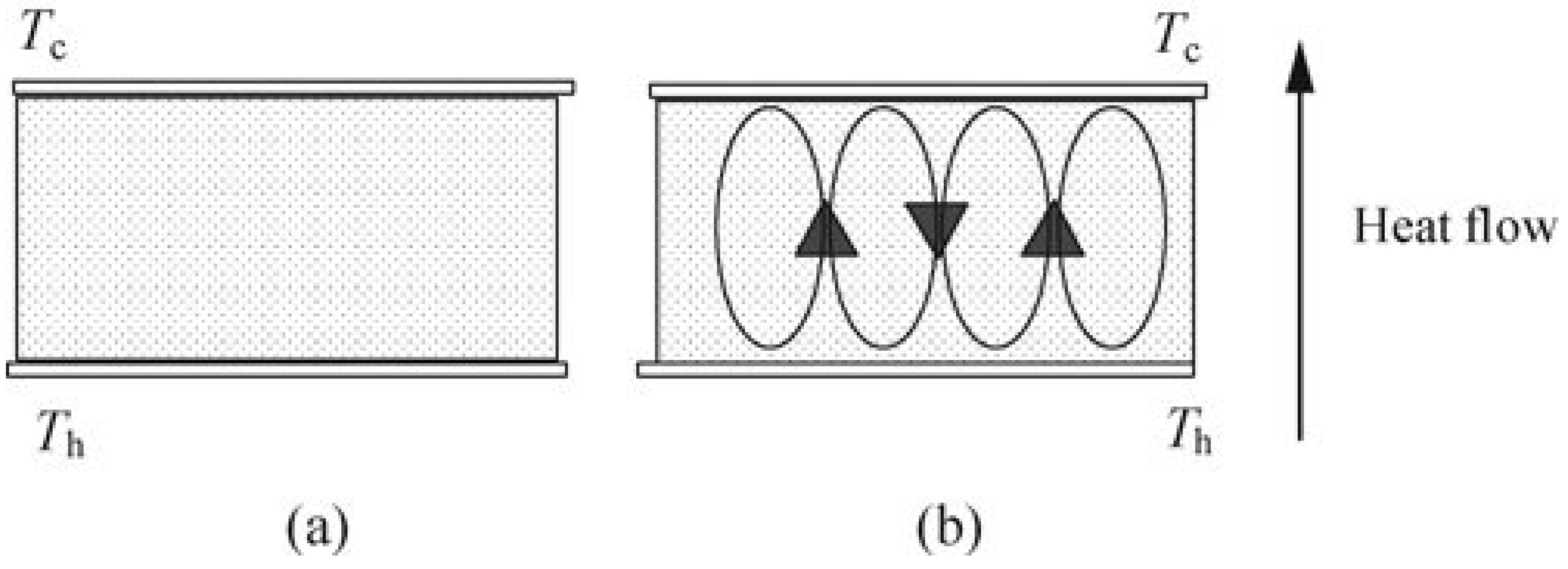
| 2 | Standard textbooks on hydrodynamic stability will typically even motivate the field from that example, cf. e.g., [14] [pp. 32–35]. |
| 3 | One may wonder why the process metaphysician has to invoke as complicated an example as the convection cell. Before the temperature differential is high enough, is the liquid not equally as much a macroscopically static entity, which is made up of water molecules in constant movement? While that is true, it seems intuitively less convincing that the constituting water molecules of the liquid at rest are essentially dynamic in the way they are. One could imagine that water at rest could be constituted equally by water molecules which are not moving (at least not in a specific way). In contrast, the macroscopic structure the convection cell displays, is one that is only stable because of the precise dynamicity of its underlying water molecules. Thus, the example drives home the point that the stability is truly constituted by the dynamic activity—whereas in the resting liquid, it seems that merely accidentally the underlying molecules are in activity. |
| 4 | DiFrisco discusses such ‘dissipative structures’ explicitly and explains how macroscopic relative stability can be constituted by microscopic dynamicity, cf. “Stability’ in this context refers to the recurrence of a cohesion regime, or to the specific interaction structure among parts that constitutes them as a unit. As an example, a Bénard convection cell is a cohesive entity because the macroscopic coordinated interaction among its microscopic parts is stronger than the interactions of these same parts with their environment. The cohesion profile of a convection cell includes its stability against a certain range of temperature changes, but not against perturbations like vigorous stirring. And we say that a Bénard cell is stable due to the recurrence of physical convection […].’ [16] |
| 5 | For an (incomplete) overview cf. “For example, there is a processual turn in the philosophy of biology, process physics, process-relational frameworks, interactivism, enaction in cognitive science, general process theory, pure process metaphysics, dynamic mereotopology, the philosophy of organism, and process metaphysics [18] [p. 15].” |
| 6 | The broader family of process philosophy encompasses also theories mainly concerned with the correct fit of linguistic expressions. Therefore, one can find in the literature on dynamicity a particularly strong trend constituted by non-metaphysical linguistic ideas on the distinction between processes and events. There, the ‘process’ concept has been used to delineate a specific type of dynamicity in contrast to another. The locus classicus is [19,20,21], later adapted by [22] making explicit how this leads to delineating states, events, and processes. The debate was originally centred around the philosophical understanding of the linguistic characteristics of a particular group of words and later of inferences between aspects (cf. [23]). In focusing on process metaphysics, I will deliberately leave behind those views which merely discuss the linguistic structure. Arguably though, one could build on the linguistic findings and develop a metaphysical account inspired by them, one example of which I will discuss in the section on the mereological account. |
| 7 | Ellis is an example of someone who is a process metaphysician in that minimal sense: ‘For a dynamic ontology of the sort required for the kind of world that science is revealing to us, one has to assume that there are fundamental processes of various kinds that are not just sequences of instantaneous point events whose identities are independent of the processes in which they are involved. There is a holism about these processes that makes it impossible to analyse them in this way. So one has to think of them as processes essentially described by the laws of their development’ [24] [p. 52]. Yet the most fundamental entities in Ellis’s system comprise both substantive and dynamic natural kinds: ‘It is important to distinguish between natural kinds that have their extensions in different categories of existents, something which is rarely done in the literature. Those I call substantive natural kinds have objects or substances as their instances, and the extension of any such natural kind must consist of objects or substances. Those I call dynamic natural kinds have events or processes as their instances, and the extension of any such natural kind must consist of events or processes’ [24] [p. 23]. |
| 8 | One example of such a process foundationalist approach can be found in [25]. According to Bickhard, the most basic physical entities are fields. Particles are nothing but excitations of fields. Moreover, ‘fields are processes’ [25] [p. 229]. If all that is true, then fundamentally there are some processes, namely the fields, and on higher levels, derivative to those fields, one can find particles, which may still be understood to be substances. |
| 9 | An example of a process monist view is Seibt’s General Process theory. According to her, everything is processual; there are only different degrees and types of dynamicity. For something ‘thing-like’, there is a specific process-type: ‘general processes denoted by statements about things (e.g., the process denoted by ‘this cup’ and ‘is a cup’) are type-5 processes, i.e., they are spatially minimally homo- and automerous but temporally maximally automerous [26] [p. 488].’ |
| 10 | In my thesis on process metaphysics, I have made that argument before, yet with a slightly less rigour. There, I illustrated the point by considering a sceptic of process metaphysics: ‘Suppose someone was doubtful of the prospects of process philosophy. Our sceptic worries, more specifically, that process metaphysics merely attaches new labels to old bottles. After all, claiming that processes are fundamental without saying anything more about them could just come down to a fight about words; whatever is fundamental is labelled by some ‘substance’ and by others ‘process.’ We, thus, must answer the question: what is materially different between the two? This thesis understands the difference between processes and other types of entities to lie in dynamicity; the category of processes is unique in that it comprises dynamic entities. Will the sceptic be fully satisfied with this supplementation? Arguably, she may still worry that dynamicity, while having a nice ring to it, does not sufficiently substantiate the process philosophical view. The process philosopher could just as much have characterised processes as processual. In short: for dynamicity to do its work, it needs metaphysical backing [18] [p. 63].’ |
| 11 | Prominent process philosophers are aware of that problem. Seibt in her overview article on the Stanford Encyclopedia explicitly mentions the definition of dynamicity to be among the top challenges of process philosophy [1]. |
| 12 | |
| 13 | The desideratum of Difference-Making is akin to Sider’s often cited demand of ”carving reality at its joints” [29] [p. 1]. On Siders terms, one would have to argue that reality exhibits the relevant structure fundamentally, that is, the differentiation into dynamic and static entities, which is precisely what the process metaphysician claims with (FP). |
| 14 | Dynamicity as employed by process metaphysics is a central concept to the theory, it features essentially in the core thesis of process metaphysics, i.e., that (some) dynamic entities are fundamental. To claim such fundamentality implies to deny that there is a way to reduce these dynamic entities further, to analyse them totally in terms of non-dynamic entities. If so, does that not clearly suggest that the concept of dynamicity itself must be taken as fundamental? Does that not imply that we cannot give an account of dynamicity, other than stating the role it plays in the theory, lest we run the risk of reducing it to other concepts? Arguments along these lines may defend a view according to which dynamicity must be taken to be a primitive or brute concept: The Brute View. Dynamicity is a primitive concept. It cannot be further analysed, and no positive characterisation of its content can be provided. In the upcoming evaluation of different proposals for understanding dynamicity, the brute view will be bracketed. I believe that process metaphysics, with its claim to the fundamentality of dynamic entities (processes), is required to flesh out the notion and cannot (should not) simply claim the bruteness of said dynamicity. Moreover, with regards to theory comparison, the brute view will typically be less difference making, for it does not substantiate the difference, less explanatorily powerful, for a brute concept yields no explanatory value, and less parsimonious than any other feasible account of dynamicity. For that reason, I will not discuss the view further here. |
| 15 | On the theory that I shall defend later, for example, dispositions and powers, often grouped as ‘dynamic’, turn out not to be dynamic per se; cf. Section 5.2. |
| 16 | Such examples abound in the process literature, for it is the deliberate aim of the theory to draw attention to the often-overlooked dynamic nature of things. Consider, for instance, the apparent stability of a solar system, a table, a waterfall, or the Benárd cell which, upon closer inspection, all reveal an underlying processual activity. |
| 17 | A sceptical voice, whether this can in fact be done can be found in Huemer. After discussing four different contemporary accounts of the value of parsimony the article concludes ‘that many philosophers ‘taste for desert landscapes’ is indeed an aesthetic rather than an epistemic preference.’ [32] [p. 235] |
| 18 | Interestingly enough, one can also find discussions of such a mereological account of dynamicity in the powers literature, which will feature more prominently in the modal accounts of dynamicity. For example, Williams also discusses the possibility of understanding dynamism in terms of homomereity (cf. [34] [Section 5: Dynamism as activity II: homoeomerous activities]). |
| 19 | In her works Seibt has explicitly stated that she is in the business of ontology and the construction and application of ontological categories. Following Carnap, she distinguishes such a project from a metaphysical endeavour (cf. [23] [pp. 4–5]). While I acknowledge that one can pursue questions about dynamicity solely within an “ontological ‘domain theory’ ” [23] [p. 4], one can extrapolate the developed account, especially given its mereological basis, and put it to broader metaphysical use. It is in this way that one can understand Seibt’s heuristic for a theory of dynamicity as a metaphysical project. |
| 20 | If one were to stop here, without any supplementation of how that linguistic finding relates to metaphysics, the account would not differ from the linguistic accounts mentioned in endnote 6. These are in fact the accounts that Seibt is heuristically using and expanding on when explicating an understanding of dynamicity in light of Aristotle’s completeness test (cf. [23] [pp. 9–11]). |
| 21 | After all, ‘spin’ is not really meant as angular momentum but only loosely analogous to it, for ‘[i]t doesn’t pay to press the analogy too far: The electron (as far as we know) is a structureless point particle, and its spin angular momentum cannot be decomposed into orbital angular momenta of constituent parts.’ [38] [p. 154] |
| 22 | Cf., “Backing up slightly, it is not uncommon for powers theorists of all stripes to assert that their neo-Aristotelian systems are ‘dynamic’, and that this gives them an advantage over their neo-Humean rivals. Unfortunately, attempts to say much about what this dynamism boils down to are less common, and not all powers theorists are on the same page.” [34] [p. 2462] |
| 23 | Other people in the powers debate use similar examples, cf. [34] [p. 2476]. Donati and Gozzano even explicitly link it to the opposition to the at-at theory of change: “Another way for making sense of dynamism in dispositionalism would be to devise a view on the track of the so-called ‘at-at’ theory of motion. According to it, motion, and change in general, is to be reduced to the different properties possessed by the same object at different times. Such a view, though, simply accepts that at each instant there is no real change, for change is the result of the object having different properties at different times. Clearly, one is left with the problem of how any change can occur, and how having one property at some time determines the property had at a later time. […] We aim at developing an account of change that does not reduce to the mere appearance of a new property substituting a previous one, rather to a transformation (a change) of an object or entity having a property into that very object or entity having a new property at a later time. Roughly, it is analogous to the difference between a movement occurring in real life and one occurring in a movie by using a stop-motion technique. In the latter case, the movement is the result of changes occurring independently from internal changes in the entity and made up via photographic techniques.” [44] [p. 16–17]. |
| 24 | For someone who very explicitly interlinks the two families of views and argues that they mutually require one another, cf. Meincke in [45]. |
| 25 | Cf. Marmodoro, who seems to hint at a similar problem: “Many philosophers implicitly assume that to cause is to produce, and that if powers are causes, they are productive ones. This is, from one perspective, progress, in the sense that this approach focuses more than any other on the dynamism of powers: producing is doing something. However, this is the crux of the problem: what is it that a power does (to become active) in order to do what it does (i.e., bringing about a change in the world)? How does this ‘doing’ happen?” [46] [p. 9]. |
| 26 | I am far from claiming that such an understanding of dynamicity is my original idea. To the contrary, I believe that a number of influential process philosophers have had this understanding or something akin to it in mind (cf. e.g., “All processes have a developmental, forward-looking aspect” [17] [p. 22], “I see a process as a continuant with an internal order and a direction of change.” [54] [pp. 3–6] or [55] [p. 250].). Yet, the precise understanding of dynamicity is rarely properly spelled out and often lacks discussion of the (metaphysical) consequences such an understanding entails. In that regard, I hope to clarify broadly shared intuitions and to draw attention to potentially fruitful interconnections—especially with regard to process philosophy and the (analytic) philosophy of time. |
| 27 | Note that flux is deliberately understood as one part of the phenomena which occur over time. There may be other, non-dynamic entities that occur over time in the same way. Consider, for example, a supposedly static phenomenon, such as Aristotle sitting on a rock. A photo of his body positioned touching the rock might really be an action shot of his bouncing up and down; to represent his sitting there one would equally require a span of time or a video. |
| 28 | The argument presented here condenses the more extended treatment in [18] [chapter 2], to which the reader is referred for further detail. |
| 29 | It is not always entirely clear what it means for time to be real. Following McTaggart, the question is whether the temporal ordering of events is objective or, instead, merely a subjective projection onto a fundamentally atemporal ordering—what McTaggart calls the C-series [56] [pp. 457–474]. A C-series orders events, but such a C-order is not temporal—McTaggart compares it to the order of the alphabet, where “B” is in between “A” and “C”, but objectively there is no temporal sense in which “A” is before “B” etc. Time is then merely ‘an erroneous perception’ [57] [p. 316] of that (objectively) non-temporal order. By contraposition, to affirm the reality of time is to hold that there is an objective temporal order—be it an A-series (with an ontologically privileged present) or a B-series (with tenseless but real earlier-than and later-than relations). On this understanding, both A-theorists and B-theorists count as realists about time; what they share, and what the anti-realist denies, is that the ordering of events as temporally prior and posterior is a mind-independent feature of reality. |
| 30 | The argument presented here condenses the more extended treatment in [18] [chapter 3], to which the reader is referred for further detail. |
| 31 | While that is true, there are good reasons to believe that the A-theory would hold that such directedness is something fundamental, whereas the B-theory would claim that, while real, temporal direction is derivative of the temporal order. |
| 32 | This section draws on [18] [Section 4.2, pp. 104–113]. |
| 33 | I use ‘directed entities’ here as a genus encompassing both modally directed entities (powers) and temporally directed entities (processes). This is not to say that powers are dynamic—precisely the opposite is argued below. |
| 34 | Eternalists may cry out here—how can the moving be later if it never is actually brought about? On an eternalist conception, the later things exist on a par with the earlier things. The later moving does exist, albeit not at the same time as the pulling. Yet, I argue that this is precisely the reason why eternalism is a static conception of time, ultimately unable to accommodate fundamental dynamic entities. The reasons for which are too intricate to briefly spell out here; the interested reader is referred to [18] [section 5]. |
| 35 | A related question, concerns the internal structure of processual directedness: some processes may be directed primarily in the sense of being directed away from where they originate, while others are directed primarily towards their telos, and some may exhibit both orientations simultaneously. This opens up interesting typological possibilities. For present purposes, however, I maintain that the forward—i.e., the ‘to’—direction is privileged: it is in virtue of being directed towards its telos that a process is dynamic, for it is the forward direction that specifies what the process is bringing about, what the future will be like in consequence of the ongoing process. The ‘from’-direction, while real, does not suffice to give content to the process’s dynamicity, since it characterises only what the process departs from, not what it is actively doing. |
| 36 | The point here is not that activation makes a power dynamic (as proponents of the powers account claim), but that activated fragility just is breaking—a temporally forward-directed process. The disposition, on the other hand (fragility when latent), is merely modally directed, not temporally forward-directed. The disposition and the process are distinct entities; TFD classifies the latter, not the former, as dynamic. |
References
- Seibt, J. Process Philosophy. In The Stanford Encyclopedia of Philosophy; Zalta, E.N., Ed.; Metaphysics Research Lab, Stanford University: Stanford, CA, USA, 2018. [Google Scholar]
- Bickhard, M.H. Some Consequences (and Enablings) of Process Metaphysics. Axiomathes 2011, 21, 3–32. [Google Scholar] [CrossRef]
- Crowther, T. Processes as Continuants and Process as Stuff. In Process, Action, and Experience; Stout, R., Ed.; Oxford University Press: Oxford, UK, 2018; pp. 120–149. [Google Scholar]
- Galton, A. The Dynamic Present. In Logic and Philosophy of Time—Themes from Prior; Blackburn, P., Hasle, P., Ohrstrom, P., Eds.; Aalborg University Press: Aalborg Øst, Denmark, 2017; pp. 167–187. [Google Scholar]
- Rescher, N. Process Metaphysics: An Introduction to Process Philosophy; State University of New York Press: New York, NY, USA, 1996; Volume 32, pp. 689–697. [Google Scholar]
- Seibt, J. What is a Process? Modes of Occurrence and Forms of Dynamicity in General Process Theory. In Process, Action, and Experience; Stout, R., Ed.; Oxford University Press: Oxford, UK, 2018; pp. 120–149. [Google Scholar]
- Steward, H. Occurent States. In Process, Action, and Experience; Stout, R., Ed.; Oxford University Press: Oxford, UK, 2018. [Google Scholar]
- Stout, R. The Category of Occurrent Continuants. Mind 2016, 125, 41–62. [Google Scholar] [CrossRef]
- Sölch, D. Prozesse. In Handbuch Metaphysik; Springer: Berlin/Heidelberg, Germany, 2017; pp. 158–163. [Google Scholar]
- Sellars, W. Foundations for a metaphysics of pure process: The Carus lectures of Wilfrid Sellars. Monist 1981, 64, 3–90. [Google Scholar] [CrossRef]
- Fisher, A.R.J.C.D. Broad on Things and Processes. Hist. Philos. Q. 2022, 39, 385–406. [Google Scholar] [CrossRef]
- Dupre, J.A.; Nicholson, D. A Manifesto for a Processual Philosophy of Biology. In Everything Flows: Towards a Processual Philosophy of Biology; Dupré, J., Nicholson, D., Eds.; Oxford University Press: Oxford, UK, 2018; pp. 3–45. [Google Scholar]
- Lowe, E.J. The Four-Category Ontology: A Metaphysical Foundation for Natural Science; Oxford University Press: Oxford, UK, 2006. [Google Scholar]
- Drazin, P.G.; Reid, W.H. Hydrodynamic Stability, 2nd ed.; Cambridge University Press: Cambridge, UK, 2004. [Google Scholar]
- Kondepudi, D.; Prigogine, I. Modern Thermodynamics: From Heat Engines to Dissipative Structures, 2nd ed.; John Wiley & Sons, Ltd.: Hoboken, NJ, USA, 2015. [Google Scholar] [CrossRef]
- DiFrisco, J. Biological Processes Criteria of Identity and Persistence. In Everything Flows: Towards a Processual Philosophy of Biology; Dupré, J., Nicholson, D., Eds.; Oxford University Press: Oxford, UK, 2018; pp. 76–95. [Google Scholar]
- Rescher, N. Process Philosophy: A Survey of Basic Issues; University of Pittsburgh Press: Pittsburgh, PA, USA, 2000. [Google Scholar]
- Zachrau, M. Fundamental Dynamicity: A Metaphysics of Time and Process. Doctoral Thesis, University of Gothenburg, Göteborg, Sweden, 2024. Available online: https://hdl.handle.net/2077/79971 (accessed on 28 February 2026).
- Vendler, Z. Verbs and times. Philos. Rev. 1957, 66, 143–160. [Google Scholar] [CrossRef]
- Vendler, Z. Linguistics in Philosophy; Cornell University: Ithaca, NY, USA, 1967. [Google Scholar]
- Kenny, A. Action, Emotion And Will; Routledge and Kegan Paul: London, UK, 1963; Volume 15, p. 186. [Google Scholar]
- Mourelatos, A.P.D. Events, processes, and states. In Linguistics and Philosophy; Springer: Berlin/Heidelberg, Germany, 1978; pp. 415–434. [Google Scholar]
- Seibt, J. Aristotle’s “Completeness Test” as Heuristics for an Account of Dynamicity. In Dynamic Being: Essays in Process-Relational Ontology; Petrov, V., Scarfe, A.C., Eds.; Cambridge Scholars Publishing: Newcastle upon Tyne, UK, 2015; pp. 2–28. [Google Scholar]
- Ellis, B. Scientific Essentialism; Cambridge University Press: Cambridge, UK, 2001. [Google Scholar]
- Bickhard, M.H. Dynamics is not enough: An interactivist perspective. Hum. Dev. 2019, 63, 227–244. [Google Scholar] [CrossRef]
- Seibt, J. Forms of Emergent Interaction in General Process Theory. Synthese 2009, 166, 479–512. [Google Scholar] [CrossRef]
- Seibt, J. ‘Quanta,’ Tropes, or Processes: Ontologies for QFT Beyond the Myth of Substance. In Ontological Aspects of Quantum Field Theory; Kuhlmann, M., Lyre, H., Wayne, A., Eds.; World Scientific Publishing Co Pte Ltd.: Singapore, 2002; pp. 53–97. [Google Scholar]
- Whitehead, A.N.; Ray Griffin, D.; Sherburne, D.W. Process and Reality, corrected ed.; original edition from 1929; The Free Press: New York, NY, USA, 1978. [Google Scholar]
- Sider, T. Writing the Book of the World; Oxford University Press: Oxford, UK, 2011. [Google Scholar]
- Carnap, R. Logical Foundations of Probability; University of Chicago Press: Chicago, IL, USA, 1950; Volume 48, pp. 524–535. [Google Scholar]
- Cowling, S. Ideological parsimony. Synthese 2013, 190, 3889–3908. [Google Scholar] [CrossRef]
- Huemer, M. When is Parsimony a Virtue? Philos. Q. 2008, 59, 216–236. [Google Scholar] [CrossRef]
- Schaffer, J. What not to multiply without necessity. Australas. J. Philos. 2015, 93, 644–664. [Google Scholar] [CrossRef]
- Williams, N.E. Power and Activity: A Dynamic Do-Over*. Philos. Stud. 2025, 182, 2461–2479. [Google Scholar] [CrossRef]
- Crowther, T. The Matter of Events. Rev. Metaphys. 2011, 65, 3–39. [Google Scholar]
- Seibt, J. How to Naturalize Sensory Consciousness and Intentionality within a Process Monism with Normativity Gradient. In Sellars and His Legacy; Oxford University Press: Oxford, UK, 2016; pp. 187–223. [Google Scholar]
- Seibt, J. Ontological Tools for the Process Turn in Biology: Some Basic Notions of General Process Theory. In Everything Flows: Towards a Processual Philosophy of Biology; Nicholson, D.J., Dupré, J., Eds.; Oxford University Press: Oxford, UK, 2018; pp. 113–136. [Google Scholar] [CrossRef]
- Griffiths, D.J. Introduction to Quantum Mechanics; Prentice Hall Inc.: Hoboken, NJ, USA, 1995. [Google Scholar]
- Williams, N.E. The Powers Metaphysic; Oxford University Press: Oxford, UK, 2019. [Google Scholar] [CrossRef]
- Lewis, D. Philosophical Papers: Volume 2; Oxford University Press: Oxford, UK, 1986. [Google Scholar]
- Austin, C.J.; Marmodoro, A. Structural Powers and the Homeodynamic Unity of Organisms. In Neo-Aristotelian Perspectives on Contemporary Science; Simpson, W.M.R., Koons, R.C., Teh, N.J., Eds.; Routledge: Oxford, UK, 2017; pp. 169–184. [Google Scholar]
- Marmodoro, A. Do Powers Need Powers to Make Thern Powerful? From Pandispositionalism to Aristotle. In The Metaphysics of Powers Their Grounding and their Manifestations; Marmodoro, A., Ed.; Routledge: Oxford, UK, 2010; pp. 27–40. [Google Scholar]
- Groff, R.P. Conceptualizing Causal Powers: Activity, capacity, essence, necessitation. Synthese 2021, 199, 9881–9896. [Google Scholar] [CrossRef]
- Donati, D.; Gozzano, S. Dynamic All the Way Down. Ratio 2024, 37, 14–25. [Google Scholar] [CrossRef]
- Meincke, A.S. Powers, Persistence and Process. In Dispositionalism: Perspectives from Metaphysics and the Philosophy of Science; Meincke, A.S., Ed.; Springer International Publishing: Berlin/Heidelberg, Germany; pp. 89–113. [CrossRef]
- Marmodoro, A. What’s Dynamic About Causal Powers? A Black Box! In Powers, Time and Free Will; Austin, C.J., Marmodoro, A., Roselli, A., Eds.; Springer International Publishing: Berlin/Heidelberg, Germany, 2022; pp. 1–15. [Google Scholar] [CrossRef]
- Vetter, B. Dispositions without Conditionals. Mind 2014, 123, 129–156. [Google Scholar] [CrossRef]
- Giannini, G. Powers, processes, and time. Erkenntnis 2021, 87, 2801–2825. [Google Scholar] [CrossRef]
- Backmann, M. No Time for Powers. Inq. Interdiscip. J. Philos. 2019, 62, 979–1007. [Google Scholar] [CrossRef]
- Friebe, C. Metaphysics of Laws and Ontology of Time. Theor. Rev. De TeorÍA Hist. Y Fundam. De La Cienc. 2018, 33, 77–89. [Google Scholar] [CrossRef]
- Fischer, F. Natural Laws as Dispositions; Philosophische Analyse/Philosophical Analysis; De Gruyter: Berlin, Germany; Boston, MA, USA, 2018. [Google Scholar] [CrossRef]
- Vetter, B. Potentiality: From Dispositions to Modality; Oxford University Press: Oxford, UK, 2015. [Google Scholar]
- Lowe, E.J. The Possibility of Metaphysics: Substance, Identity, and Time; Clarendon Press: Oxford, UK, 1998. [Google Scholar]
- Emmet, D. The Passage of Nature; Springer: Berlin/Heidelberg, Germany, 1992. [Google Scholar]
- Whitehead, A.N. Adventures of Ideas; The Macmillan Company: New York, NY, USA, 1933. [Google Scholar]
- McTaggart, J.M.E. The unreality of time. Mind 1908, 17, 457–474. [Google Scholar] [CrossRef]
- McTaggart, J.M.E. The Nature of Existence; Cambridge University Press: London, 1921. [Google Scholar]
- Farr, M. C-theories of time: On the adirectionality of time. Philos. Compass 2020, 15, 1–17. [Google Scholar] [CrossRef]
- Gold, T. Cosmic processes and the nature of time. In Mind and Cosmos: Essays in Contemporary Science and Philosophy; Colodny, R., Ed.; University of Pittsburgh Press: Pittsburgh, PA, USA, 1966; pp. 311–329. [Google Scholar]

Disclaimer/Publisher’s Note: The statements, opinions and data contained in all publications are solely those of the individual author(s) and contributor(s) and not of MDPI and/or the editor(s). MDPI and/or the editor(s) disclaim responsibility for any injury to people or property resulting from any ideas, methods, instructions or products referred to in the content. |
© 2026 by the author. Licensee MDPI, Basel, Switzerland. This article is an open access article distributed under the terms and conditions of the Creative Commons Attribution (CC BY) license.
Share and Cite
Zachrau, M. Towards a Theory of Dynamicity: Foundations for a Non-Vacuous Process Metaphysics. Philosophies 2026, 11, 32. https://doi.org/10.3390/philosophies11020032
Zachrau M. Towards a Theory of Dynamicity: Foundations for a Non-Vacuous Process Metaphysics. Philosophies. 2026; 11(2):32. https://doi.org/10.3390/philosophies11020032
Chicago/Turabian StyleZachrau, Maximilian. 2026. "Towards a Theory of Dynamicity: Foundations for a Non-Vacuous Process Metaphysics" Philosophies 11, no. 2: 32. https://doi.org/10.3390/philosophies11020032
APA StyleZachrau, M. (2026). Towards a Theory of Dynamicity: Foundations for a Non-Vacuous Process Metaphysics. Philosophies, 11(2), 32. https://doi.org/10.3390/philosophies11020032