2. Results
This paper aims to investigate the poetic corpus of author Mihail Aslan, seen as a field in which the dynamics of drives and trauma, and the processes of reworking them, are staged. In the following sections, we will follow the way in which the theoretical structures of psychoanalysis, from the Freudian model of drive dualism to Winnicott’s concepts of potential space, are applied. Thus, psychoanalytic visions will constitute the essential hermeneutic framework for deciphering Mihail Aslan’s universe, a universe in which “birth is traumatic” and “life itself does not exist without destruction.” The article contains an analysis of the entire volume of poetry
Late Geometries, Rejected, tracing the recurring metaphors at the forefront of the poetic imagination, those that structure the vision of the book and give it thematic and expressive coherence (
Supplementary Material).
I will first make a literary critique applied to ten major metaphors that play a central role in the economy of the volume.
“The death of words”—“He postpones the death of words”—This inaugural metaphor sets the ontological stakes of the book: poetry as the last bastion against the disappearance of meaning. “The death of words” is not only the exhaustion of poetic language, but the failure of communication in a post-historical world. The poet does not definitively save words, but “postpones” their death—a lucid, tragic gesture that rejects the messianic illusions of salvific poetry.
“Descending the harsh steps”—“Every day I descend the harsh steps”—The descent becomes a metaphor for the daily entry into reality, a hostile, degraded, hallucinatory reality. The steps do not ascend towards revelation, but descend towards the street, that is, towards aggressive, biological, anonymous history. The poet is a reverse Orpheus, who no longer seeks salvation but seeks a lucid confrontation with everyday hell.
“The city as a sick organism”—“Bucharest groans in sweat”—The city is not an urban space, but a feverish, sweaty body in metabolic crisis. The metaphor supports an expressionist vision: society becomes pathology, and its inhabitants become symptoms. The capital is the place where metaphors “come to an end,” a sign that poetry itself is suffocated by the mechanisms of profit and meaningless reproduction. Mihail Aslan appeals to Bollas’ concept of the non-surviving object, who spoke of the transitional object as an object chosen to help improve the well-being of a subject [
1]. Kohut complemented this view with his theory of the self, emphasizing that “breaking the emotional connection with the narcissistic self-object is the psychological equivalent of annihilation.” Thus, the narcissist lives by dissipating affections in others, similar to the city seen as a sick organism [
2].
“The universe as a street”—“walking on Calea (Road) Victoriei/you walk right through the universe”—Here appears one of the most powerful metaphors of the volume: the identification of the cosmos with everyday space. The poet rejects abstract transcendence and proposes a pedestrian cosmology, in which each step becomes a metaphysical act. The universe is no longer above, but beneath the feet of the living man. We notice in the verses what Jan Abram calls the perception of omnipresent danger, and Giddens calls “risk society,” a place where “risk has become a central force that organizes social experience” [
3]. Awareness of this new reality inevitably causes intense anxiety. We then ask ourselves: Which reality is responsible for declaring the universe as a street? The one introjected by the author or the one reflected in the atrocities of traumatic accumulations, from the soul and from the street?
This book by Mihail Aslan is living proof that writing and inner work, as well as the ability to be and to create, are essential in difficult times, when survival is expressed in its real and concrete sense, confirming Frankl’s idea that “between stimulus and response there is a space, and in that space lies our power to choose our response” [
4].
“The star as a melancholic witness”—“even the star Canopus could look at you melancholically”—The star is no longer a symbol of order or hope, but a weary witness to human history. The cosmos does not save, but assists. The metaphor reverses classical romanticism: it is not man who looks at the stars, but the stars who look at man, with an almost ethical sadness. There are scales and balances, and “stealing from the scales” becomes a triumph of the masochism that guards life, as a symbol of the eternal, against which not even Niagara would oppose, although the whirlpools of emotionality drown the poet in his search for meaning. This image of inner justice resonates with what Winnicott called transitional space: that psychic place where internal and external reality meet and judge each other [
5].
“Modern demons”—“postmodern modern demons”—Demons are no longer mythical entities, but ideological, media-driven, relativizing structures. The metaphor functions critically, denouncing a world in which evil is banal, administrative, ironic. The demonic becomes systemic, not spectacular. Primary psychic creativity is associated with the immutable feminine element, which will be sought, sought again, lost, thrown away, found, restored, here and beyond Zenith, in life and death, in an unshakeable subjective intrapsychic unity. The fact is concentrated in the discourse of love, which seems rather like a non-separation. Life itself does not exist without destruction. We find the paradox of the human condition described by Becker, according to which “the very idea of heroism is fundamentally tragic, precisely because the individual retains the illusion of self-justification in the face of annihilation” [
6].
“The sea suspended by stars”—“Seas suspended by stars”—This image encapsulates the purely visionary poetry of the volume. The sea, symbol of origins and the unconscious, is torn from gravity, suspended in an impossible space. The metaphor suggests the total uprooting of the elements, the loss of the natural laws of the world. The vanity of dreams cut short and broken—which can no longer be reparative or premonitory—remains cruel and steeped in rust, which becomes a symbol of an experience in which a processuality operates. The confinement in patterns refers to the Inquisition. An inquisition of the passionate, under keys and bars that are not described, but in which the person in question scratches with his blind claw and bites into the flesh with thirst.
“The flesh of memory”—“the flesh of all the dead lost to memory”—Memory is not abstract; it is organic and carnal. Forgetting becomes a form of metaphysical murder. The metaphor expresses the ethics of the volume: to forget is to kill again. The poet positions himself as a witness to the human remains abandoned by history. The mixture of vitality and dissolution can be understood through the lens of the theory of libidinal energies in the late Freudian model [
7], where Eros and Thanatos coexist in the creative process as antagonistic but inseparable forces. The poems dramatize the Freudian dualism of the life instinct (Eros) and the death instinct (Thanatos): desire is intertwined with images of extinction, cold, ashes, mechanical time, and mental exhaustion. Movement is less catharsis than repetition, it is a return to the same nuclei of fear (birth as a rupture; life as a conflict).
“Language as damnation”—“the vice of poetry/a long damnation of a lifetime”—Poetry is not salvation, but condemnation. The metaphor decisively breaks the link with any idealization of the poetic act. To write is to remain captive between words, to endure excessive lucidity. The poet is a damned soul who can no longer escape language, even though he contests it. The core of the poet’s existence seems to be essence and smoke. The dimension of blasphemy also emerges from the poems, viewed with both innocence and esoteric wisdom. This ambivalence of the text between the sacred and the profane is reminiscent of Bataille’s reading [
8], for whom transgression becomes a form of sacredness, a space of excess that recovers the divine through profanation.
“The final circle”—“the closed circle of the final vowel”—This metaphor of closure is remarkable for its meta-poetic refinement. Language itself closes in a vowel, in a final sound. History, poetry, life—all revolve in a phonetic circle, with no way out. The ending is not silence, but the sterile echo of one’s own voice. Adam and Eve, Tristan and Isolde, liquefied in desire, until they merge with the fluid. The transformation of oneself and the passage into another through osmotic diffusion is, in itself, a new universe, reflecting Merleau-Ponty’s theory of “the flesh of the world” as “the fundamental ontological texture that unites us with the environment” [
9]. The lyrics give the impression of visible condescension in the face of a large, omnipotent, and infinite universe that nullifies the territoriality and spatiality of newly known realities. A universe that provokes fear, because in the face of birth and death, we are all equal. Dance and writing remain: Writing voraciously, writing passionately, writing as a means of survival, like Anne Frank’s diary, like an attempt to anchor oneself in materiality and time.
As a conclusion expressed through the prism of these ten concepts, the volume Late Geometries, Rejected is built on a metaphor of crisis: the crisis of language, of history, of the city, of transcendence. Metaphors do not embellish reality, but dissect it. They do not offer solutions, but keep the wound of lucidity open. The poet does not propose salvation, but an ethic of vigilance: to remain conscious in a world that is losing its bearings.
The volume
Late Geometries, Rejected is articulated in the structural connection between certain verses and the “broken mirror stage” formulated by Paul-Claude Racamier Olivenstein (in critical dialog with Lacan), not as a decorative detail, but as an organizing principle of poetic vision [
10]. The “broken mirror stage” describes the pathological or post-traumatic moment in which the unity of the self is no longer reflected coherently, but appears fragmented, distorted, and impossible to reassemble into a stable image of the self. If, for Lacan, the mirror produces the illusion of unity [
11], for Olivenstein, the mirror is already broken: the subject can no longer even access the illusion of identity. In this sense, we bring the following concepts–arguments from the verses.
“I see through eyes turned away” symbolizes the impossibility of reflection. In the broken mirror stage, the subject can no longer see itself as a stable object. The gaze no longer reflects, but returns into emptiness. The verse expresses exactly this mechanism: the eye is no longer an instrument of knowledge, but a symptom of narcissistic fracture. The subject sees, but does not recognize itself.
“I turn my face towards myself and laugh” presents laughter as a defensive mechanism, which here is not playful irony, but dissociative laughter. In Olivenstein’s terms, the subject confronted with his own fragmented image can no longer bear the gravity of the cleft and masks it with a derisive reflex. It is the laughter of one who can no longer constitute himself as a coherent “I.”
“I am nothing but this being lost in oblivion” is an expression of a painful experience, in which we find the self as a remnant. In the broken mirror, the self is no longer the center, but a residue. Identity does not disappear spectacularly, but fades away, retreats. The verse perfectly expresses the narrative disintegration of the self: there is no longer a “who I am,” but only a “what remains.”
“Your brother’s ground in the apocalyptic mill” reveals the fractured collective self. The broken mirror is not only individual, but trans-subjective. The poet searches for himself and sees himself in others, but the others are also fragmented. Identity is reflected in destroyed identities, producing a chain of division. There is no longer a stable “other” to confirm the self.
“I see bodies and strange masked faces” refers to a substitute identity, in which the mask is the typical symptom of the broken mirror: in the absence of an authentic image, the subject adopts prefabricated forms. The mask does not hide a solid self, but hides the void. The lyrics suggest a world populated by individuals who play identities without inhabiting them.
“I am like an infernal machine” reveals the dehumanization of the self. In Olivenstein, the breaking of the mirror often leads to a mechanical, deactivated self-perception. The subject no longer experiences himself as a person, but as a dangerous or defective device. The mechanical metaphor indicates the loss of affective continuity.
“I can’t hear you anymore, you can’t hear me anymore” is the end of a relational collapse. The broken mirror cancels not only self-reflection, but also mutual recognition. Communication becomes impossible because there are no longer stable subjects to meet. The lyrics express the relational autism described by Olivenstein in serious identity pathologies.
“They move naturally carrying their shadow/their familiar demon” suggests identification with the fracture. Here, an essential mechanism appears: the fracture is no longer perceived as a pathology, but as normality. The demon becomes “familiar.” The subject internalizes the rupture and transforms it into a way of being.
“Language broken into words would be a mortal sin” suggests that even the linguistic mirror is destroyed. Language is the symbolic mirror of the self. When language fragments, identity collapses. The poet intuits here what Olivenstein clinically affirms: the disintegration of language reflects the disintegration of the self.
The volume as a whole has a tragic note: the impossibility of reconstruction. In Late Geometries, Rejected, the mirror is never repaired. There is no catharsis, no synthesis, no final enlightenment. The book functions exactly like a broken mirror: each poem reflects another fragment, another angle, another shard of the self, without the promise of unity.
As a conclusion regarding the connection between the verses of the volume and Olivenstein’s broken mirror stage, this is structural, not illustrative. The poet does not “apply” the theory, but poetically experiences that very psychological condition: a fragmented self, an identity without a center, a world that can no longer confirm the subject, a language that no longer heals, but exposes the rupture. Everything happens as if there were simultaneously this face-to-face with the mirror, this “flash” of discovering the self-image, and, at that very moment, the mirror shatters, reflecting a distorted image, an incompleteness in which the gaps left by the absence of the mirror can only reflect what was before: fusion and undifferentiation [
5]. The role of poetic creation is to place itself in the cracks, to cancel them out at that moment. This is similar to what Olievenstein called “the fear of lack of lack”: that impossibility of enduring fullness, of living without a constitutive void [
10]. The poet transforms this absence into a work of art, and libidinal tension becomes a form of aesthetic survival.
The concept of “environmental interventions” formulated by Donald Winnicott is extremely fertile for reading this volume, especially in relation to the recurring metaphor of the protective, amniotic fluid and warm liquid that appears in cosmic, aquatic, luminous, or linguistic forms. The connection between the two is not only analogical, but structural and affective. The poetry poetically translates a Winnicottian trauma, found at the following levels.
“Environmental interference”—according to Winnicott, the healthy development of the self depends on a sufficiently good environment, characterized by continuity, predictability, protection, and non-invasiveness. Environmental interference occurs when the environment is too brutal, too intrusive, or too absent. When the child is forced to adapt prematurely, what Winnicott calls the false self appears—a defensive, survival self. The major consequence is that the true self cannot form in a safe space, but remains latent, fragile, and hidden.
Mihail Aslan’s work involves “taming” “borderline” manifestations, which involve a lack of defense mechanisms against anxiety, a cruelty of fantasies, leading to a tension that is difficult to calm, sometimes even intolerable. This psychological “limit” refers to what Winnicott described as the fear of falling—the fear of a collapse already experienced unconsciously, which the subject repeats in the act of creation [
12]. In Winnicottian terms, the poem becomes a supporting function and a potential space (transitional zone), where inner and outer reality can meet without collapse. Uterine/amniotic images signal an effort to restore the continuity of being, a balancing mechanism that is explained by Laplanche and Pontalis as a form of “translation of the drive” from within to an object of creation, which gives poetry the function of a therapeutic staging [
13].
The metaphor of amniotic fluid in poetry: the space that should have protected. The volume obsessively features imagery of warm liquid, luminous paste, the sea, cosmic milk, primordial fluid, and suspended, protective space. Relevant examples: “a warm paste of whitish honey,” “seas suspended by stars,” “the liquid body,” “light like honey,” “to sink,” and “to submerge.” This imagery corresponds exactly to the function of the primary maternal environment in Winnicott: a space that holds, contains, and cushions reality. The metaphor of amniotic fluid represents a lost, sufficiently good environment.
The volume
Late Geometries, Rejected reveals the paradoxical dimension of the survivor, based on intrapsychic–interpsychic dialectical communication, when something passes through the minds and souls of two people [
14]. Amniotic fluid and the womb, frequently invoked in texts, represent the potential space of the transitional phenomenon and the dialectic between the found object and the created object, between the Self and the non-Self, between the Self and another Self, the false self, and the true self, all of which are essential for the integration of the living and the non-living in the process of ego maturation [
12].
Why does it appear obsessively? Because the real environment was intrusive—in poems, the world is constantly described as aggressive, noisy, ideological, bureaucratic, and symbolically violent. The city, history, the press, politics, and systems are intrusive environments—exactly the type of environment that, in Winnicott’s terms, produces early trauma. In this context, the metaphor of protective fluid becomes regressive, but not infantile; a fantasy of repair, an imaginary space where the true self could have existed.
Poetry as a substitute for amniotic fluid—an essential point is that in the volume, poetry itself becomes amniotic fluid. Words envelop, suspend violence, and create a transition zone. Here, the direct connection with Winnicott appears: poetry functions as a potential space, precisely that intermediate space between the self and the world, where play, symbol, and creation are possible. The poet writes to recreate the environment that was not good enough.
Environmental interference versus the desire to sink—it is very important to note that in poetry, the desire to “sink,” “submerge,” or “dissolve” is not a desire for death, but rather a desire for re-envelopment, for the suspension of intrusion, for a return to a space without identity demands. In Winnicottian language, it is not about the death drive, but about the drive for continuity of being.
The poetic false self and nostalgia for the liquid—the poetic subject is extremely adaptable, lucid, critical, ironic, and hyper-aware of history and systems. This is the voice of the false self. But underneath, there is a constant nostalgia for the warm, protective, pre-verbal liquid. This is the voice of the true self, which did not have a good-enough environment to manifest itself directly.
Why is the fluid cosmic and not explicitly maternal? Here, we refer to a subtle and important detail: the fluid is not directly described as uterine, biologically maternal, but cosmic, stellar, and universal. This indicates the impossibility of real regression, the sublimation of trauma, and the transformation of infantile need into a universal poetic myth. The poet does not ask for a mother; he asks for a universe that does not invade.
In relation to the above, the connection between environmental interference in Winnicott’s view and the metaphor of protective amniotic fluid is profound: the real environment is experienced as intrusive, traumatic, and destructive; poetry creates an alternative symbolic environment; amniotic fluid becomes a metaphor for an original space of safety that did not exist sufficiently, and writing is a continuous attempt to reconstruct the minimum conditions for being. In short, this volume does not seek meaning, but shelter.
Integrating the proposed directions into a unified, coherent, and in-depth reading of the volume, with Donald Winnicott’s thinking as its central axis, we explain what is directly articulated in the texture of the poetry, where the verses become visible as mechanisms of psychological and poetic survival.
The interplay between false self and true self is the dual voice of the poetic subject. In this volume, the poetic voice is split, but not schizoid, because the split is functional and defensive, exactly in the Winnicottian sense. The false self represents the adapted, lucid, hyperconscious voice that appears as the critical voice of history, social commentator, witness to the degradation of the city, ironic, tired, hyperlucid subject. Relevant verses: “I consciously read the press,” “I join parties,” “I don’t make money,” and “I am a subject dragged to the stock exchange of profit.” This voice functions, adapts, and survives. But it is emotionally dry, exhausted, and devoid of authentic joy. It is exactly the false self: a self built to cope with environmental interference, not to live. The true self is the fluid, warm, and pre-verbal voice that does not speak argumentatively. It floats, dissolves, sinks, dreams, and appears through images of fluid, light, honey, sea, cosmic milk, and gravitational suspension. This voice does not want to understand the world, but to be allowed to exist. It does not demand meaning, but continuity of being. Importantly, the true self is never exposed head-on. It remains protected in metaphor, just as Winnicott says: the true self hides when the environment is unsafe. Poetry appears as a tense negotiation between the two: throughout the volume, the false self writes, and the true self breathes through images. This results in the specific tone of the book, which is a mixture of harsh lucidity, liquid nostalgia, social criticism, symbolic regression, discourse, and dream.
Potential space is the place where poetry becomes possible. For Winnicott, it is the intermediate zone between invasive external reality and fragile internal reality. In the volume, this space is entirely occupied by poetry, seen as a transition zone. Poetry is neither a diary, nor a manifesto, nor pure prayer; it is an intermediate space where the subject can experiment without being attacked, where the world is suspended but not denied. Cosmic, aquatic, and luminous images create a cushioning distance from reality, a world far enough away not to hurt. This is the exact function of the potential space: it determines not escape, but symbolic protection. We might wonder why there is no playful element in Mihail Aslan’s poetry. The answer can be found in a subtle detail: for Winnicott, the potential space is the place of play. Here, however, play is almost absent because the environment was intrusive too early, and play did not have time to take hold. Instead of play, we find gravity, solemnity, and visionary attitude. Poetry is not play, but a form of late survival.
When we talk about poetry as “holding,” in the sense of psychological support, we get to the deepest core. “Holding” in Winnicott is the way the environment supports the child without invading it, without abandoning it. When holding is absent, anxiety about disintegration, fear of falling, and the need for symbolic regression appear. In the case of Mihail Aslan, we find poetry as a self-created holding environment. In the volume of poetry Late Geometries, Rejected, no one holds the subject anymore: neither the city, nor history, nor religion, nor ideology. Then, the subject constructs its own holding through rhythm, repetition, circular images, and fluid metaphors. Poetry holds it together, prevents its dispersion, and allows it not to collapse psychologically. Writing is not an aesthetic expression, but a function of stabilizing the being. The volume is long, dense, and almost suffocating because the holding must be constant, repetitive, insistent. An airy volume would leave gaps, whereas here, the text fills the space, just as amniotic fluid fills the womb: without pauses, without breaks, without healing silences. Silence would be dangerous.
As a conclusion to the three aspects discussed above, the false self/true self game explains the poetic double voice (lucid versus liquid), the potential space explains why poetry is neither real nor escape, and holding explains why writing is vital, obsessive, and continuous. This volume is not about the world, it is not about history, not even about poetry as art, but it is about remaining whole in a fracturing environment. Poetry functions here as a symbolic womb, psychic skin, and as a good-enough environment created a posteriori.
Reading the volume through the lens of James Grotstein is fruitful, as poetry constantly activates the dialectic between the “subject-soul” and the “object-soul,” exactly as Grotstein describes it in his extension of Bionian thought. Building the commentary in stages, moving from theory to text, then returning to a poetic synthesis, we highlight the following.
In order to protect the “isolated core” and the “incommunicable self of the subject,” primitive defenses are brought into play, akin to Grotstein’s concept of the “Subject-Soul” that remains hidden and protected behind an “Object-Soul” that confronts the world [
15]. Mihail Aslan’s poems prepare you for anything: for the transition from living to not living, for a death that has inhabited us since birth, for liberation through suffering, for love experienced in the most painful and guilty way. The healthy corollary of the splitting of the Self (implicitly of the lyrical one) is the involvement of the human being in the struggle of interrelating with the surrounding affects, without remaining isolated by barriers. The violation of the Self is stopped in order to protect the authentic human being from infinite exploitation by invasive and traumatic objects.
For Grotstein, the subject-soul is the living core of the being, the instance that lives, feels, and dreams, and the inner witness of raw experience, what “is” before it is explained. The object-soul is the part of the self that looks at itself from the outside, analyzes, evaluates, judges, adapts to reality and its demands, and translates experience into discourse, morality, and ideology. Trauma occurs when the object-soul colonizes the subject-soul, silences it, or turns it into an object of observation. It is precisely this conflict that drives the volume.
The soul-object is the voice that sees, explains, and judges itself. In many verses, the poetic subject treats itself as an object: “I am a subject dragged to the stock exchange of profit,” “I don’t make money,” “I am like an infernal machine,” “I join parties,” and “I consciously read the press.” Here, the soul-object speaks: the self describes itself from the outside, evaluates itself according to social criteria, and reduces itself to function, utility, and performance. Grotstein would say that this is a hyper-mentalized, overstructured self that has lost touch with the living source of experience. Importantly, this soul-object is not false, but excessive. It has taken control to avoid disintegration. In contrast, the soul-subject is the voice that does not explain, but is in counterpoint. There are passages where language ceases to explain and begins to float: “a warm paste of whitish honey,” “seas suspended by stars,” “the liquid body,” “to sink,” “light like honey,” and “warm hands gather all that exists.” Here, we no longer have analysis, judgment, or social positioning. We have pure presence, affect, and continuity. This is the soul-subject, which cannot be seen, described, or judged, but exists in a sensory, fluid, and pre-verbal field. Just as Grotstein says, the soul-subject expresses itself through images rather than concepts.
The rupture occurs when the soul-object betrays the soul-subject. A key verse for this tension is: “I turn my face toward myself and laugh.” This is a moment of radical self-objectification: the soul-object turns to the soul-subject, looks at it, and laughs. For Grotstein, this gesture is devastating: the living subject is invalidated by ironic reflection. From this arises the feeling of emptiness, the need for dissolution, and the desire to regress into liquid, light, and sea.
Poetry is an attempt at reconciliation between the two souls, but the essential fact remains that it does not belong exclusively to either of them. The soul-object writes, organizes, constructs discourse, and puts words in order. The soul-subject breathes through images, infiltrates affect, diverts logical meaning, and brings fluid metaphor. The volume is a continuous negotiation between the two instances. But the reconciliation is not complete.
When the soul-subject is reduced to an object, there is a risk of psychological death. Lines such as “I am nothing but this being lost in oblivion,” “metaphors all come to an end,” and “language broken into words,” indicate the moments when the subject-soul can no longer speak, and only commentary on emptiness remains, while experience becomes impossible. For Grotstein, this is the critical point: the death of the soul is not biological, but symbolic, occurring when there is no one left to experience it, only those who can describe it.
The volume reveals an obsession with protection (fluid, womb, and cosmos) because the soul-subject is wounded, exposed, and no longer has a container. Amniotic fluid is the space where the soul-subject is not seen, not analyzed, not evaluated. It represents the desire to be, without being seen. The exact opposite of the domination of the soul-object. In Grotstein’s terms, we can say this: the soul-object dominates lucid, social, and critical discourse, while the soul-subject survives in fluid and cosmic, sensory images. Poetry is the battlefield between the two, and the trauma of the volume lies in the fact that the subject-soul can no longer speak directly, but only metaphorically. Writing becomes a desperate attempt to save it from total objectification. This poetry does not want to be understood, but wants the subject-soul not to be permanently confiscated by the object-soul.
Continuing the analysis and developing all three proposed directions—the comparison between Grotstein, Winnicott, and Bion, the reading of the “nameless catastrophe,” and the image of God as the ultimate container—in a unified framework applied to the volume of poetry Late Geometries, Rejected, we will see how poetry functions as a space for the survival of the subject-soul, under the pressure of profound psychological disorganization.
Between James Grotstein, Donald Winnicott, and Wilfred Bion, we can construct a common map in which the common point is that of the original trauma, even though the authors come from different directions. They describe the same fundamental phenomenon from different angles: a living core of being (true self/soul-subject/raw emotional experience), which needs a container (holding, alpha function, healthy soul-object) in order not to disintegrate under the impact of reality (
Table 1). The volume of poetry reveals that in the past, the container was insufficient or invasive, and poetry appears as a belated repair for this fact.
From a reparative perspective, the volume Late Geometries, Rejected can also be viewed through a Bionian lens, as the poetic message functions as an extended psychological process, not merely as an aesthetic expression.
“The nameless catastrophe”—in Bion, it is a pre-symbolic emotional experience, which is impossible to think about and impossible to put into words, experienced as diffuse, disintegrating anxiety. If it is not contained, it fragments the self, producing withdrawal, emptiness, and regression. The nameless catastrophe appears in verses such as “I am afraid, I am very afraid of myself,” “I am nothing but this being lost in oblivion,” “metaphors all come to an end,” and “language broken into words.” These do not describe a specific trauma, but a permanent, underlying state with no precise cause. The model is exactly that of the nameless catastrophe: it is not an event that is identified, but a psychological atmosphere.
Poetry as alpha function—according to Bion [
16], the alpha function transforms raw (beta) experience into thought, which makes the experience bearable. In the volume, the city, history, and violence are beta elements, which poetry transforms into cosmic, fluid images, rhythms, and circular metaphors. Writing is an act of psychological metabolism. Without poetry, the subject would collapse into mutism or disintegration. Reverie becomes the maternal function of thought: a space for transforming raw, “beta” elements into symbolizable forms, which in Aslan’s poetry takes on the value of a transition from the carnal to the metaphysical. The structure feels dense and under pressure: the poem is a container for a non-mentalized experience. Raw terror (beta elements)—emptiness, fragmentation, fear of being born, and fear of not being—is processed into a symbolizable form (alpha elements) through poetic reverie. Bodily states transposed into cosmic images (plasma, galaxies, and cold light) operate as an aesthetic alpha function: affect becomes image, and image becomes accessible to cognition.
God as the ultimate container of the soul-subject—the deepest level of analysis. In the volume, God does not appear as dogma, but as the ultimate witness, the ultimate receiver, the ultimate “someone” who can contain the experience. Verses such as “where God exists with me,” “God laughs or curses me,” and “I would then perhaps be real” show an ambiguous, tense, but vital relationship. God is seen as an “absolute container” in both Bion and Winnicott: when the social environment is invasive, and language is fragmented, the soul-object becomes tyrannical, and the subject seeks a container beyond the world. On a psychological level, God functions as an absolute holding, as an instance that does not analyze, does not ironize, does not objectify. It is the only place where the subject-soul could exist without being watched. The God of the volume is not omnipotent; he is often tired, fragile, and ambiguous. He is silent, un, sometimes absent, which shows that even this container is not completely secure. In other words, even transcendence can no longer guarantee total protection. Hence, the profound tragedy of the book.
As a final synthesis resulting from the integration of the three directions, we discover what this poetry actually does: it refers to Winnicott, who explains the need for a protective environment, resonates with Grotstein, who believes in the internal splitting of the soul, and with Bion, who speaks of nameless anxiety and the need for transformation. The volume is an emergency psychological operation. The poem holds together everything that risks disintegrating, gives shape to a catastrophe that would otherwise be mute, and protects the soul-subject from total colonization by the world and by its own soul-object. It is not a poem of beauty. It is not a poem of message. It is a poetry of the continuity of being. By constructing a complete integrative reading that includes multiple dimensions, without artificially juxtaposing them, but rather showing how poetry metabolizes them into a single tragic ontological vision, we actually have a unified model of trauma, expressed poetically through several converging theoretical languages.
The volume explores a structurally traumatized self that survives through writing, reflecting on the betrayal of the environment, the splitting of the self, and the search for a safe space in poetry. In all perspectives, we find the same basic structure of a traumatic self, not a lyrical self. This volume is not the expression of a stable lyrical self, but of a structurally traumatized self that tries to stay alive through writing. Trauma is not a specific event, but a fundamental condition.
This is where some authors meet: Winnicott with the failure of the good-enough environment, Grotstein with the colonization of the subject-soul by the object-soul, Bion with the nameless catastrophe, and Sandor Ferenzi with trauma as a betrayal of the protective environment. The poet does not remember the trauma, but experiences it continuously. For Sandor Ferenzi, trauma is seen as betrayal and denial [
17]. Authentic trauma occurs when the child is exposed to emotional, symbolic, and existential violence, and the environment that should protect him denies the reality of the trauma. This instead causes a split in the self, identification with the aggressor, and a loss of trust in reality and in oneself. As an application to the lyrics, we find: “I’m afraid, I’m very afraid of myself,” “I’m like a hellish machine,” and “I turn my face toward myself and laugh.” These are just examples that show exactly this Ferenczian mechanism, in which the subject treats himself as an aggressor because the environment has not confirmed his suffering. This is traumatic self-denial.
In a traumatic context, Grotstein’s distinction becomes central. The subject-soul is the living, sensory, pre-verbal core, while the object-soul is the instance that observes, judges, and controls. Trauma causes the object-soul to take total control in order to prevent collapse. That is why the following appear obsessively in the volume: self-observation, self-irony, excessive critical discourse, and the transformation of the self into “subject,” “machine,” and “function.” The subject-soul survives only in encrypted form, in images such as liquid, light, sea, honey, and cosmos.
For Winnicott, the false self is a form of survival. It is not pathological in itself, but is a savior when the environment is intrusive. In the volume, the false self writes, walks through the city, analyzes history, endures reality, but does not live. The true self appears only when the subject of the “sinks,” dissolves, and dreams of a fluid, protective space. Poetry is the place where the true self breathes, but cannot completely surface.
Bion’s “nameless catastrophe” is perfectly visible in the volume. Fear has no cause, dread is diffuse, and the world is threatening without any explicit reason. We identify the following lines as symptomatic: “I am nothing but this being lost in oblivion,” “metaphors all come to an end,” and “language broken into words.” Here, it is no longer a question of narrative suffering, but of ontological anguish, in relation to which poetry functions as an alpha function, transforming raw anguish into images, allowing thought without collapse, and creating a bearable form of pain.
The fairy tale
Youth Without Old Age and Life Without Death (written by the 19th-century folklorist Petre Ispirescu) [
18] brings to mind the myth of the original trauma. In such a reading, the mythological key to the volume of poetry
Late Geometries, Rejected can be seen as follows: in the fairy tale, the child refuses to be born into a mortal world, he demands a safe space, and when he loses it, he dies instantly. This is exactly the logic of the volume. The subject seeks a space without aggression, without destructive time, without violent history, and without intrusion. The poetic amniotic fluid, the protective cosmos, and the honey-like light are symbolic variants of the realm without death. However, the poet knows that he cannot remain there. That is why poetry is nostalgia, not a permanent refuge.
The God of the volume is the last witness, not the savior. He does not heal, guarantee, or redeem, but he sees, contains, and does not deny. In Ferenczi’s terms, he is the instance that does not deny trauma. Even if he is tired, silent, and ambiguous, he is preferable to a world that laughs, minimizes, and relativizes.
This poem is Ferenczi-esque because trauma comes from the betrayal of the environment, Winnicottian because the true self hides in metaphor, Grotsteinian because the soul-subject is colonized by the object-subject, Bionian because poetry functions as an alpha function, and mythologically Romanian because it repeats the drama of the impossibility of living in a mortal world. It is the poetry of someone who does not ask for happiness, does not ask for meaning, does not ask for explanations, but asks for one thing: that his suffering not be denied.
The affinity with Paul Celan lies in treating language as a fractured, wounded medium. Like Celan, the poet operates on the premise that language is no longer transparent or salvific; it bears the scars of historical and existential traumas [
19]. Words are condensed, often laden with silence, and meaning is approached obliquely rather than explicitly. The poem becomes more an act of survival than one of expression, a struggle to articulate truth after symbolic devastation. Both poets construct a poetics of post-catastrophic consciousness, in which speech is constantly threatened with collapse. The recurrence of images related to ashes, silence, emptiness, and fragmentation suggests an ethical commitment to truthfulness, beyond ornamentation.
2.1. Comparison with Paul Celan: Poetry After Catastrophe
The fundamental common point—in both Celan and this volume, poetry appears after an irreversible catastrophe. It is not a poetry of suffering, a confessional poetry, or a poetry of healing, but a poetry after the destruction of the conditions of possibility of meaning. In Celan, the historical trauma is absolute (the Shoah) [
20]. Here, the trauma is ontological, social, symbolic, and diffuse, but permanent. In both cases, poetry does not reconstruct the world, but proves that something has been irretrievably destroyed.
Language as remnant, not as instrument—in Celan, the word is a fragment, and syntax breaks down, and language is opaque. In the volume analyzed, we find “language broken into words”, “metaphors (which) all come to an end”, and the obsession with the end, with the last vowel. Language no longer mediates reality, but exposes the rupture. This is the essence of post-catastrophic poetry: it does not tell the truth, but shows that the truth can no longer be told in its entirety.
The crucial difference is that Celan reduces language to its bare bones. The poet at hand floods it, makes it dense, obsessive, and fluid. But the function is the same: Celan provokes cutting, and Mihail Aslan provokes oversaturation. Both are reactions to the same impossibility.
2.2. The Traumatic Child Is the Living, Unseen Core of the Volume
The child does not appear as an explicit figure, but he is everywhere. The way in which the child is not thematized sentimentally is very important. It appears as a psychological structure. Clues include the desire for dissolution, the need for protective fluid, nameless fear, withdrawal from the world, fascination with the beginning, purity, and the “first day.” This is the child described by Ferenczi: hyper-adapted, too lucid, too responsible, and forced to understand too early.
The poetic adult is the child who survived. The poetic subject is hyper-reflective, critical, and intellectualized. This is not a mature adult, but a child who had to become an adult in order to survive. Hence, the massive false self, the dominant object-soul, harsh irony, and premature existential fatigue.
The connection with the fairy tale Youth Without Old Age and Life Without Death—The child in the fairy tale refuses to be born into a mortal world. The child in this volume accepts birth, but does not accept the world. The result is permanent nostalgia, the impossibility of being “at home,” and the search for a space without aggression. Poetry is childhood that was not protected.
2.3. Through Poetry as Truth Against Denial (Ferenczi), We Arrive at the Central Ethical Point
Ferenczi states that denial is more traumatic than violence—for Sándor Ferenczi, trauma does not permanently destroy the self, except when the environment says: “it was nothing,” “you’re exaggerating,” and “it’s not really like that.” This is denial.
The world in the volume is a world of denial—Newspapers, ideologies, and speeches relativize, ironize, nullify gravity, and reduce suffering to noise. Key verses: “metaphors all come to an end,” “everyone laughs,” and “a temporary myth.” Suffering is publicly invalidated.
Poetry as an act of ethical resistance—In this context, poetry is not aesthetic, but ethical, in that it refuses denial, refuses minimization, and refuses false reconciliation. The writing says: “it was real,” “it hurt,” and “it cannot be erased.” In other words, exactly the Ferenczian therapeutic function: the witness who believes.
To close the previously open circle, Mihail Aslan’s volume of poetry Late Geometries, Refused resembles Celan in its poetry as remnant after catastrophe, brings the traumatic child, the real subject of the volume, to the fore, and refers to Ferenczi through poetry as truth against denial. Through all this, the volume is a witness poem. It does not heal, it does not comfort, and it does not offer solutions. But it does one essential thing: it does not allow trauma to be erased by forgetfulness, irony, or relativization.
These influences do not produce imitation, but rather a unique synthesis. The poet stands at the intersection of Celan’s ethical density, nocturnal symbolism, Blaga’s metaphysical questioning, and Rilke’s ontological sensitivity [
21,
22]. However, the voice remains singular: more corporeal, more anguished, and more insistently introspective. It is a poetry of limits—of language, of being, and of resistance—where meaning is not given but wrested from the depths of experience.
The dynamic between the corporeal and the symbolic inevitably refers to Didier Anzieu’s [
23] vision of the “skin ego,” in which the surface of the body becomes a boundary between life and death, between the interior and the world, and poetic writing functions as a form of symbolic skin of the unconscious. The surface of the body is seen as a psychic covering that protects against intrusion and disintegration. When the self feels invaded or unreal, the poem offers an auxiliary “skin,” a symbolic membrane that holds the fragments together and marks the boundary between inside and outside.
The concept of “I-skin” (Moi-peau) appears not as an explicit theme, but as a way of feeling and perceiving existence. The poet’s endo-psychic (inner, experienced from within) perception is organized precisely on the axis of the skin as a boundary, as protection, as a vulnerable surface, and as a place of trauma inscription. We will continue with a concise explanation of the concept, identifying relevant textual references and interpreting them in relation to the structure of the poetic self.
For Anzieu, the skin-ego is the first form of the ego, built on the experience of the skin as a boundary between the interior and the exterior, as a protective surface, a medium of contact, and a place of inscription of affects. A healthy skin ego contains, protects, delimits, and makes contact with the world bearable. A fragile or damaged skin ego produces anxiety of invasion, fear of dissolution, hypersensitivity, and an obsessive need for alternative “coverings” (liquid, light, and words). It is precisely this type of ego that is expressed poetically in the present volume.
Anxiety of invasion—Verses such as “the glassy winter air cuts off all feelings,” “the air is pale and dying,” “the world melts away dirty,” and “the underground air” show an environment perceived as sensorially aggressive, which penetrates the subject. In Anzieu’s terms, this indicates a skin-ego that no longer filters stimuli, but is pierced by them.
The desire for envelopment represents substitutions for the skin—Obsessive images appear of liquid, sea, honey, dense light, paste, submersion, and dissolution. Examples include “a warm paste of whitish honey,” “to sink,” “seas suspended by stars,” “the liquid body,” and “light like honey.” These are substitutes for the ego-skin: in the absence of a protective psychic skin, the subject seeks an imaginary covering. Anzieu describes this mechanism precisely: regression to primary tactile states, when the psychic skin is cracked.
Fragmentation of the skin: “broken tongue,” and “liquid body”—Key lyrics: “tongue broken into words,” “liquid body,” and “the flesh of all the dead.” Here, the body is no longer whole: the skin no longer holds, the boundary breaks, the interior leaks out. It is a typical image of the perforated skin ego: boundaries are no longer stable, and identity becomes fluid, uncertain.
The city as an aggressor of the skin—The city is described as hot, sweaty, glassy, sharp, and suffocating. Examples: “Bucharest groans in sweat,” “asphalt.” and “The heat of summer sets fire to asphalt.” The city is not a backdrop, but an aggressive sensory agent. For the skin ego, this is a traumatic environment: a world that does not respect the subject’s boundaries.
The poet perceives the world through the skin, not through concept. The endo-psychic perception in the volume is sensory, tactile, thermal, and visceral. The world burns, cuts, presses, and invades. This indicates a self that does not feel protected by its own limits. Thought comes after sensation, not before.
Poetry as a “second skin”—In this context, poetry becomes a symbolic skin, a protective membrane, an intermediate layer between the self and the world. Words envelop, delimit, and create a bearable distance. Anzieu believes that if the skin-self is damaged, the subject seeks substitute skins, cultural coverings, and symbolic creation, in a manner similar to the function in this volume.
Why the obsession with “melting” is not a death wish? It is very important to note that dissolution, melting, and sinking do not express a death drive, but rather the desire to be contained without being hurt. It is the desire of a self that wants thicker skin, a gentler environment, and a boundary that does not hurt.
2.4. The Connection with the Other Theoretical Frameworks
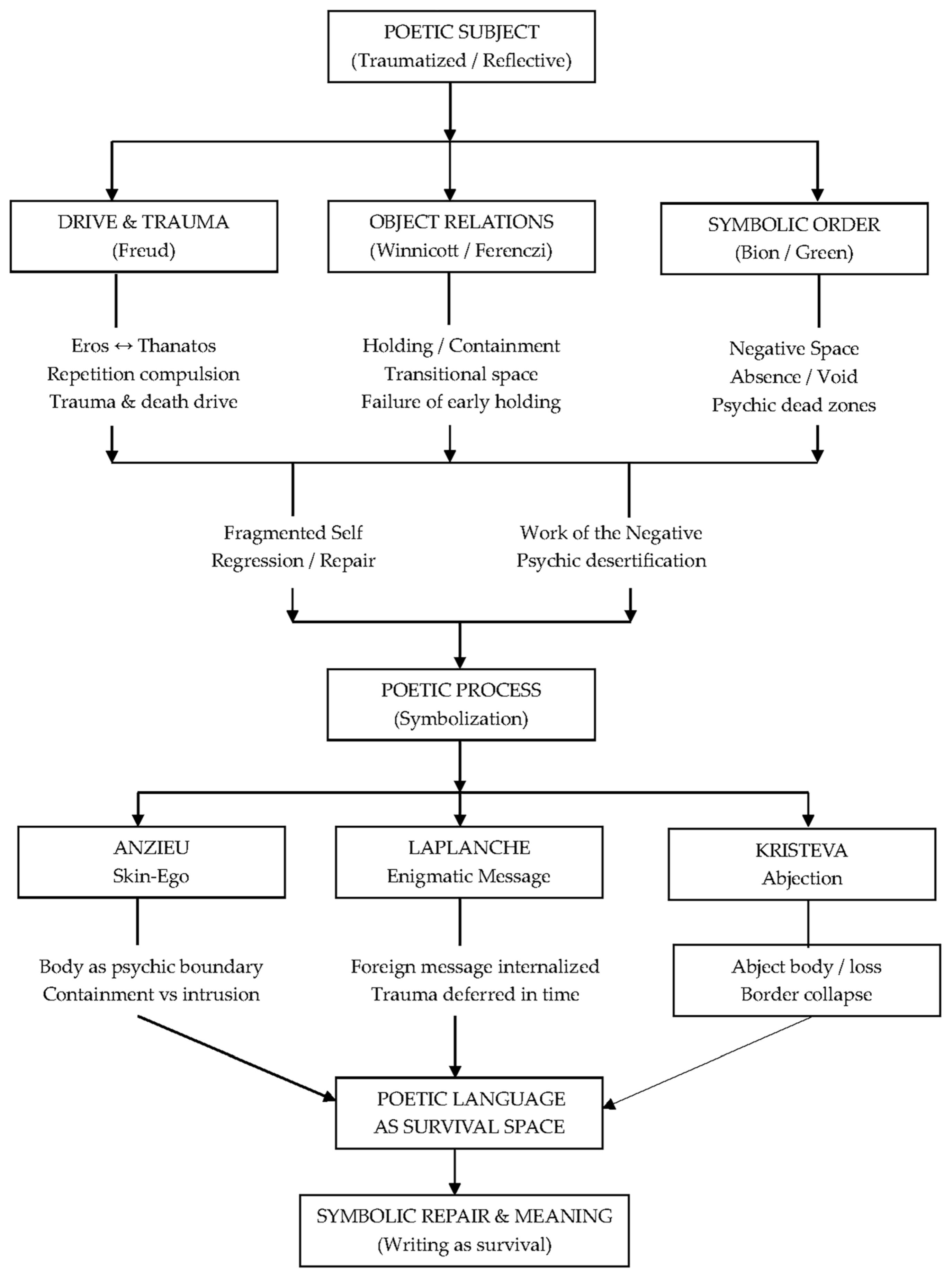
The concept of the skin ego organically links all previous theories: Winnicott (in whom the lack of holding leads to a fragile skin ego); Ferenczi (in whom trauma through invasion produces a violated skin); Bion (in whom the nameless catastrophe creates a sensation without a container); and Grotstein (in whom the exposed soul-subject needs a covering). The skin-ego is the point of contact between body, affect, and language (
Figure 1).
As a conclusion, in this volume, the poet’s endo-psychic perception is that of a self with wounded skin: too exposed, too sensitive, and insufficiently protected from the world. Poetry appears as a secondary skin, a symbolic membrane, the last layer of defense against the invasion of reality. It is not a poetry of intellectual introspection, but a poetry of the psychic epidermis (see
Table 2 and
Table 3).
3. Discussion
This reading shows that the volume functions as a map of a traumatic self in which language no longer heals, but attests to the rupture (Celan, Bion), the environment is intrusive and denying (Ferenczi, van der Kolk), the self defends itself through false self and self-objectification (Winnicott, Grotstein), poetry becomes symbolic skin, holding, and container (Anzieu, Winnicott, Bion), and cosmic and liquid images are forms of survival, not aestheticism.
Analysis reveals Mihail Aslan’s work as a veritable psychological laboratory. His text not only illustrates psychoanalytic theories, but also recharges and reinterprets them, giving them concrete literary expression. The verses are not only a symptom of a traumatized psychological structure, but also an instrument of symbolization and repair. The fusion between the corporeal and the symbolic, visible in the striking metaphors of skin, amniotic fluid, and viscera, suggests a regression in the service of the Ego, a journey back to the points of fixation in order to repair them through the power of words.
Mihai Aslan’s poems prepare you for anything, for the transition from living to not living, for a death that dwells within us from birth, for liberation through suffering, and for love experienced in the most painful and guilty way. This all started from the violation of the self, as a result of the fact that the being, at the beginning of its existence, did not survive the aggressive brute needs on which the environment of a particle accelerator determined a hyper-analyzability motivated by an unconscious search for something that will survive [
24].
Bick [
25] expanded on the idea with the concept of “psychic skin” as the main structure, the vessel of experience. Universes are concentric, secret, lonely, and always waiting. Dreams, fantasies, catastrophes, and fears make the reader want to be curled up in their own narcissistic reparative cocoon, returned to the primordial matrix of good, at the beginning of the novel, “Once upon a time…”.
Primary psychic creativity is associated with the immutable feminine element, which will be sought, sought again, lost, thrown away, found, and restored, here and beyond Zenith, in life and death, in an unshakeable subjective intrapsychic unity. Poetry is not limited to narrating trauma; it reconstructs its atmosphere and seeks a reparative witness through language [
5].
The periphery of consciousness is the West, and the echo shatters as if the scream were useless; if the mirrors did not sink their eyes, which are not two, which do not imply a simple third eye of Wisdom, they are not pairs of curious eyes, but thousands of planetary eyes, leading to the castle of a new realm, the one in which Nadir is the nucleus. The past is cut out, detached, becomes flesh itself and a deadly beast. An innocent ROGVAIV purifies the crossroads of the poet’s existence, so that the light kisses his scars. The areas where he has nothing to reflect are those where nothing ever existed. In other words, “Ex nihilo nihil” (“Nothing comes from nothing”). This perspective on poetic nothingness is reminiscent of Sartre’s reflections [
26] on emptiness and consciousness, where absence becomes an active form of existence. Two vulnerability factors seem to be involved: the vicissitudes of forming an insecure attachment in childhood (particularly through the assessment of separation anxiety) and depressive vulnerability, which allows the traces of past painful experiences to be highlighted. There is an acute need for “vivisection” of a consciousness that has been tested too harshly and too early. This poetic analysis of vulnerability resonates with Bowlby’s studies [
27] on insecure attachment and the early reactivation of pain, but also with Bergeret’s conception of the depressive structure as a place where creativity germinates [
28]. The leitmotif becomes a search for anxious–painful excitement, modeled on narcissism, with reference to Kohut’s concept of the self-object [
29]. This dynamic of creative and self-devouring narcissism, which we find in Aslan’s texts, evokes what Green called the “narcissistic mortification complex,” in which the subject feeds on his own wound in order to confirm his existence [
30]. According to Kohut’s object-self theory, the self seeks empathic recognition to maintain cohesion. From this perspective, the fear of collapse suggests a fragile self that continually repairs itself through symbolic production.
There are factors that constitute partial economic arrangements, independent of the underlying structures: the importance of the action register, which quantitatively and qualitatively exceeds the mental register and the bodily register as an energy investment; the attempt to regress to the primary instinctual charge, with a rush towards massive investments that are as undifferentiated and non-conflictual as possible; and difficulties in identification, simple movements of “lateral” identification, imitation, submission, and influence, but also the impossibility or permanent difficulty of internalizing the Law of the Father. This impossibility of internalization can be correlated with what Freud described in
Totem and Taboo: the tension between the original transgression and the establishment of the law of paternity, a tension that continues to structure the modern subject and, in the case of the poet, his creative act [
31].
The poet’s transgression is not in relation to the paternal law, but rather in relation to life and death, or as a true test whose outcome depends on God. Guillaumin talks about particular points around which the profound problem of age is organized: the experience of mourning that constitutes the process of maturation itself, the search for external stimuli that bring pleasure, with the aim of suppressing pain as such [
32]; psychological trauma and the anxiety associated with it, which involves a traumatic–chronic repetition that impoverishes and fragments the self and involves a blockage through anticipation. In this context, poetry becomes a “giving meaning” to unspoken mourning, a way of reconstructing the self in the space of language, as Kristeva suggests in “Soleil noir” [
33].
We are talking about the narcissistic deficit, in relation to which Fenichel recalled the need for immediate satisfaction [
34], which Diatkine attributes to the impossibility of spontaneously finding pleasure in fantasies [
35]. The insistence on absence, inner freezing, and disinvestment resonates with Green’s work on the negative. Meaning collapses into mute mechanisms (inhuman mechanism; exhaustion), evoking the constellation of the dead mother: an object that has withdrawn emotionally, leaving an internal desert. Soulé speaks of reconstruction as an infinite search for this space (area of reverie, area of transition) where, as in sleep, illusion remains possible [
36].
The title of the volume of poetry suggests an interpretation in après-coupe, after a long period of personal considerations and reconsiderations, of smoldering affects that demand their own permission to organize themselves into geometric correctness in order to acquire meaning, even if it is delayed, because our mind has this attribute of needing meaning, as Bruner said that “the process of constructing meaning is fundamental to human psychology” [
37].
In the author’s metaphorical interpretation, birth is traumatic; there is no place, date, description, or meaning, and it is a hazard with a traumatic imprint, in which adverbs of time and manner dominate a state of non-existence. Death, cold, ashes, and the stranger are primary, unelaborated emotions that imprint a destiny, reflecting Kristeva’s theory of the abject as “that which disrupts an identity, a system, an order” [
38]. Kristeva’s abjection clarifies the oscillation between fascination and repulsion in the imagery of corporeality/death: the abject disrupts identity and order, but cannot be completely expelled. The melancholic tone (ash, cold, mourning, and silence) also aligns with the logic of the “black sun,” where loss saturates the world and language becomes a residual ritual of meaning.
The late, rejected geometries are dominated by the biblical image of Adam, as if the entire book were written in the Law of the Father, in the predominance of the masculine, reflecting Lacanian theory of the Name-of-the-Father as “the symbolic law that structures social order” [
11]. Although love is atrocious, like a crown of thorns that will never bear laurels, the feminine is encrusted in a shell, isolated forever, introjected as the surest measure of defense against loss. An Adam who carries within himself a new filigree of ribs in woman, the only woman, created from him and transformed into himself. The price is ashes, minerals, floods, prison, a crouched mind, and—above all—the loss of one’s own anchor in time.
The book, read as a whole, reveals the fragmentation of time to the point of a feeling of paramnesia of reduplication, when the narrator himself forgets in which of the concentric circles and parallel universes he is slipping into the moment. This dissolution of linear time is a characteristic of severe traumatic states, in which the past event cannot be integrated and continues to repeat itself in the present [
39], and Van der Kolk [
40] has shown that trauma disrupts the normal processing of time. The womb, the bell tower, and the funnel universe bring us back to the amniotic Eden, where anything is possible and restraint is elevated to the status of law. Labor is the prototype of primary trauma. It is the child who signals the start of its arrival into the world, while the mother remains a silent vessel in excruciating pain, doing nothing but following ancestral instincts. What happens when such a signal is jammed and disrupted, and inconsistencies arise, silent pains appear, the symbiosis breaks prematurely, Eden dissolves, and the living find themselves on the edge of the non-living? The anguish of death is based on the anguish of birth, the funnel that ensures intergalactic transhumance and the transitivity of the love relationship.
Toma’s cocoon is a perpetually velvety amniotic fluid that protects a fragile being through sun and moon, days and nights, smiles and flowers, cats and sharks, illustrating Stern’s theory of “intersubjective universes” as “the sphere of fundamental human experience” [
41]. The belly of the alarm clock is perhaps the most prominent metaphor, similar to Jonah’s efforts, in which other territories have other customs, and time spares no one, no matter how ingenious the solution to hide the clocks may be. The sun and moon will continue to tread their steps, and the universe will not stop expanding, although our traumas, small or large, temporary or apocalyptic, hurt us and hurt us and hurt us, until they finally strengthen us in the well-known straitjacket, as a symbol of generic madness.
From Georg Trakl, the poet inherits a vision of the world as twilight: a realm of decay, twilight states, and spiritual erosion [
42]. The atmosphere is saturated with twilight images, nocturnal symbolism, and an acute sense of ontological decay. Like Trakl, the poetic subject dwells in landscapes of ruin where time feels suspended, and the self dissolves into elemental forces. However, unlike Trakl’s often dreamlike musicality, this poetry tends toward a more visceral and corporeal intensity. The images are not only melancholic, but also tactile—organic, wounded, and existentially charged. The influence is one of metaphysical desolation rather than stylistic imitation.
The kinship with Lucian Blaga is evident in the metaphysical dimension of the work. Both poets are deeply involved in the mystery of existence, the limits of knowledge, and the tension between revelation and concealment. However, where Blaga cultivates a metaphysics of light, mystery, and transcendence, this poetry gravitates toward opacity, fracture, and the tragic awareness of finitude. Blaga’s “Great Anonymous” becomes, in this case, more of an absence than a generative presence. The sacred is no longer luminous, but fractured, internalized, and often painful. Nevertheless, the structural ambition—to articulate a total vision of existence—clearly places this work in the same line of metaphysical inquiry.
In Rainer Maria Rilke, the kinship lies in the ontological intensity of perception. Both poets conceive of poetry as an existential discipline, a way of inhabiting the world more fully. There is a common attention to transformation, becoming, and the porous boundary between self and world. However, where Rilke ultimately affirms transformation through beauty and acceptance, the current poetic voice remains more conflictual, marked by tension and unresolved desire. The movement is not toward reconciliation, but toward resistance, toward maintaining awareness within the fracture.
In
Figure 1, we present a conceptual map of theoretical relationships that highlights Freud/Ferenczi → the origin of trauma and psychological fracture, Winnicott/Bion → how the psyche survives through isolation and symbolization, Green/Anzieu → the failure of psychic coverings and the work of the negative, Laplanche/Kristeva → the intrusion of the Other, abjection, and delayed meaning, and Poetry = a reparative structure that retains what the psyche alone cannot retain.
Through the verses in Late, Rejected Geometries, Mihail Aslan constructs a complex topography of the human psyche marked by primal trauma. This work psychoanalytically explains how writing can provide a framework for isolating irresistible experiences of this kind, transforming the cracks in the broken mirror into gateways to an inner geometry, albeit painful and imperfect. Poetry thus becomes an act of metapsychological resistance, a means by which the subject claims the right to a form, even if “late” and “rejected.”
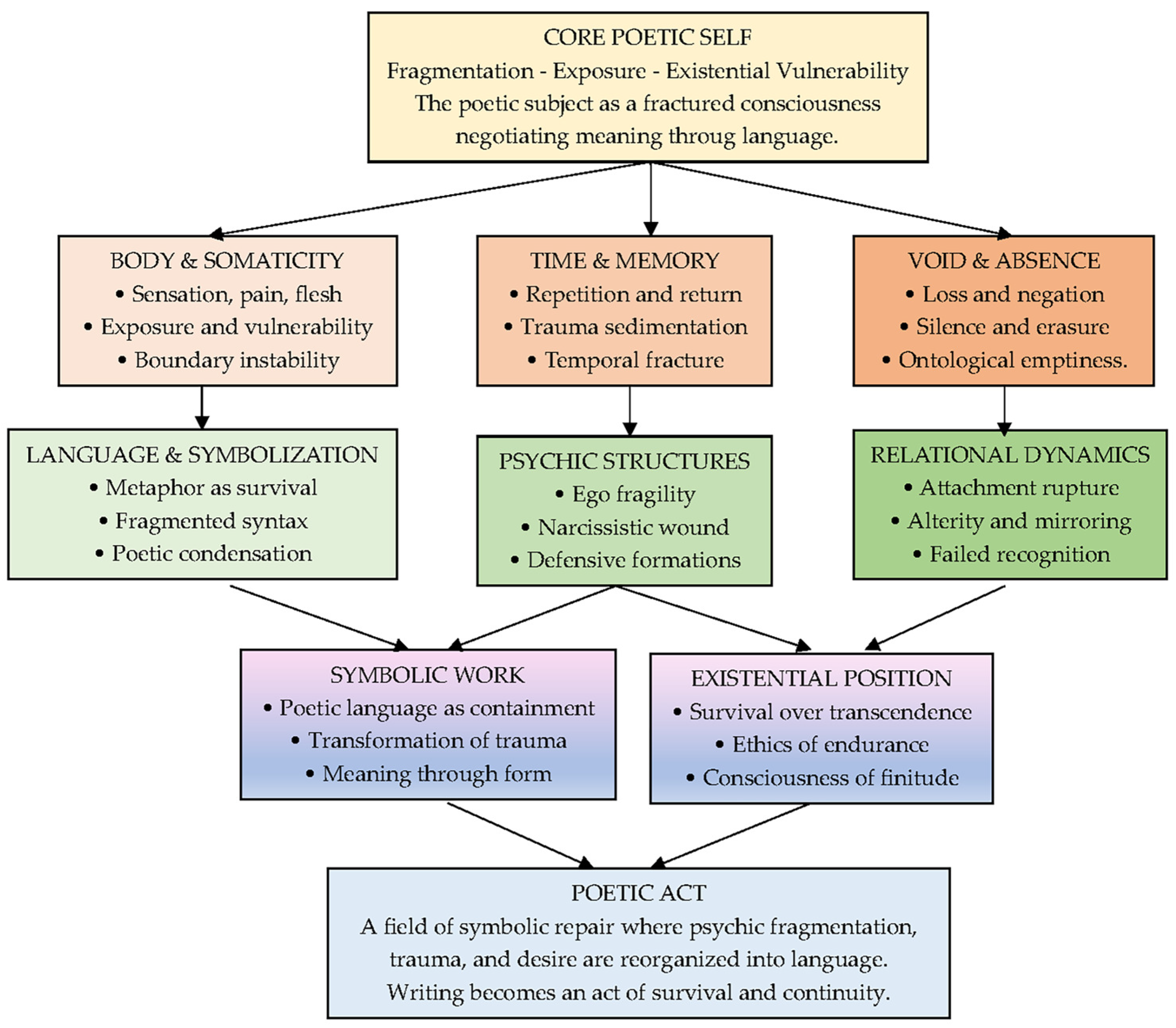
The lyrical subject is not only expressive, but deeply analytical, engaged in a continuous internal interrogation. The self is not stable or unified, but rather fractured, oscillating between moments of revelation and disintegration. The body is not only represented, but inhabited as a cognitive and existential space. It is the place of pain, desire, memory, and transformation. Speech becomes a form of resistance, a way of holding together a fragmented consciousness and affirming presence in the face of annihilation.
The poetic persona that emerges is that of a consciousness in constant self-questioning. This is a poetry of thresholds—between life and death, meaning and emptiness, and coherence and disintegration. It is a poetics of resistance, where writing becomes an act of survival and testimony in the face of existential uncertainty.
In
Figure 2, I have brought together the structure and logic of the work
Late Geometries, Rejected.
The text is not only lyrical, but also diagnostic: it maps the psychological cost of existence in a reality where meaning, body, time, and language no longer coexist naturally.