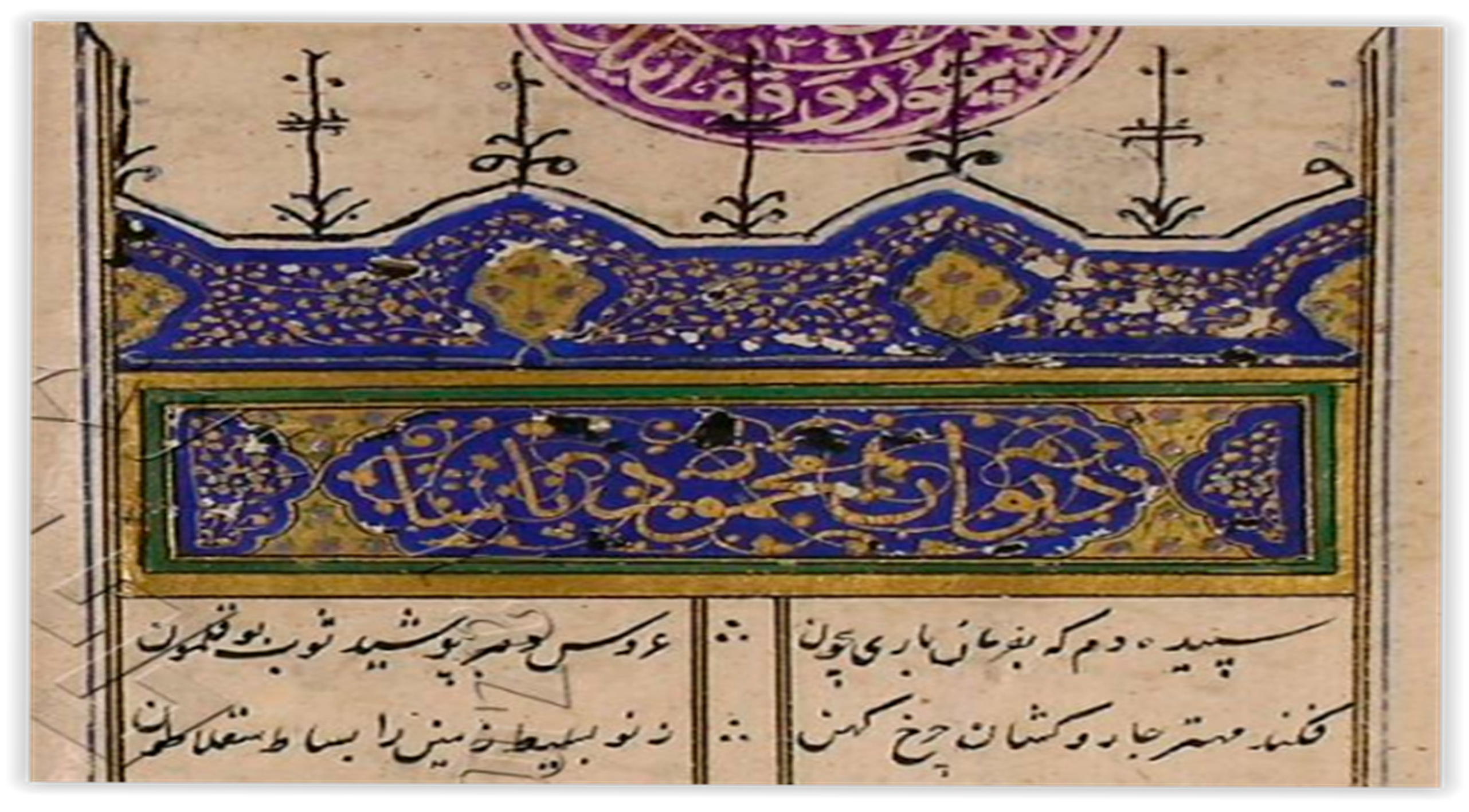
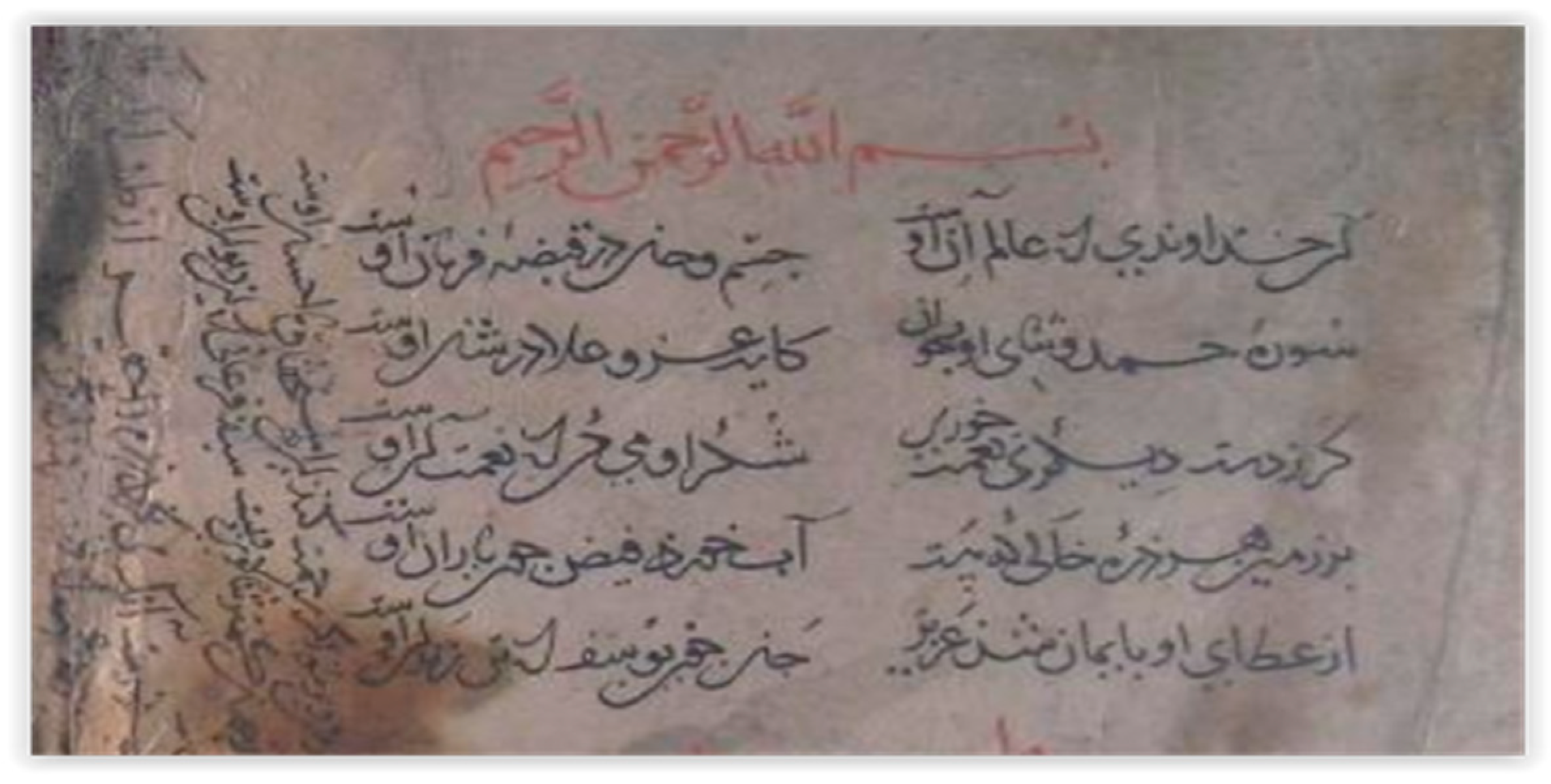
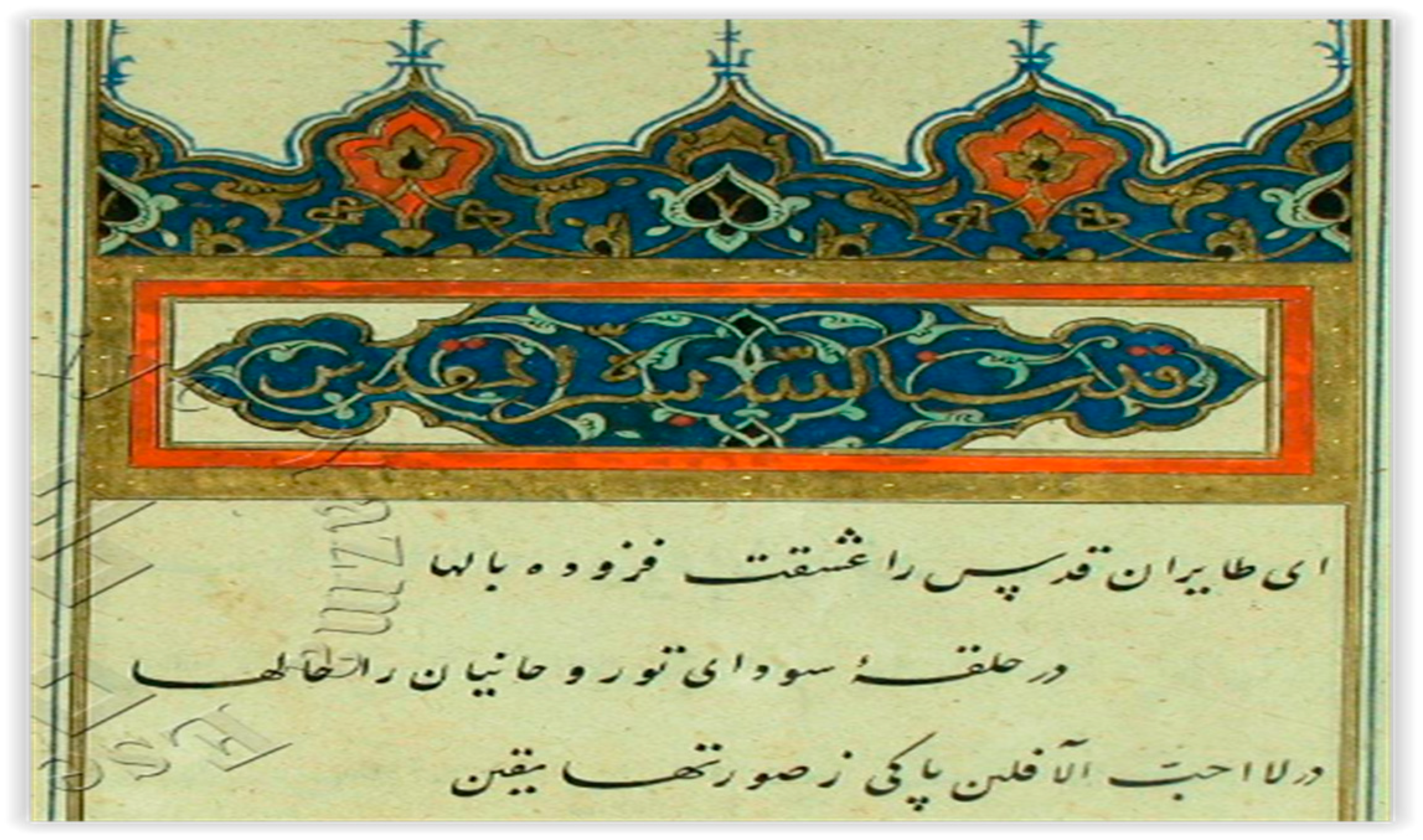
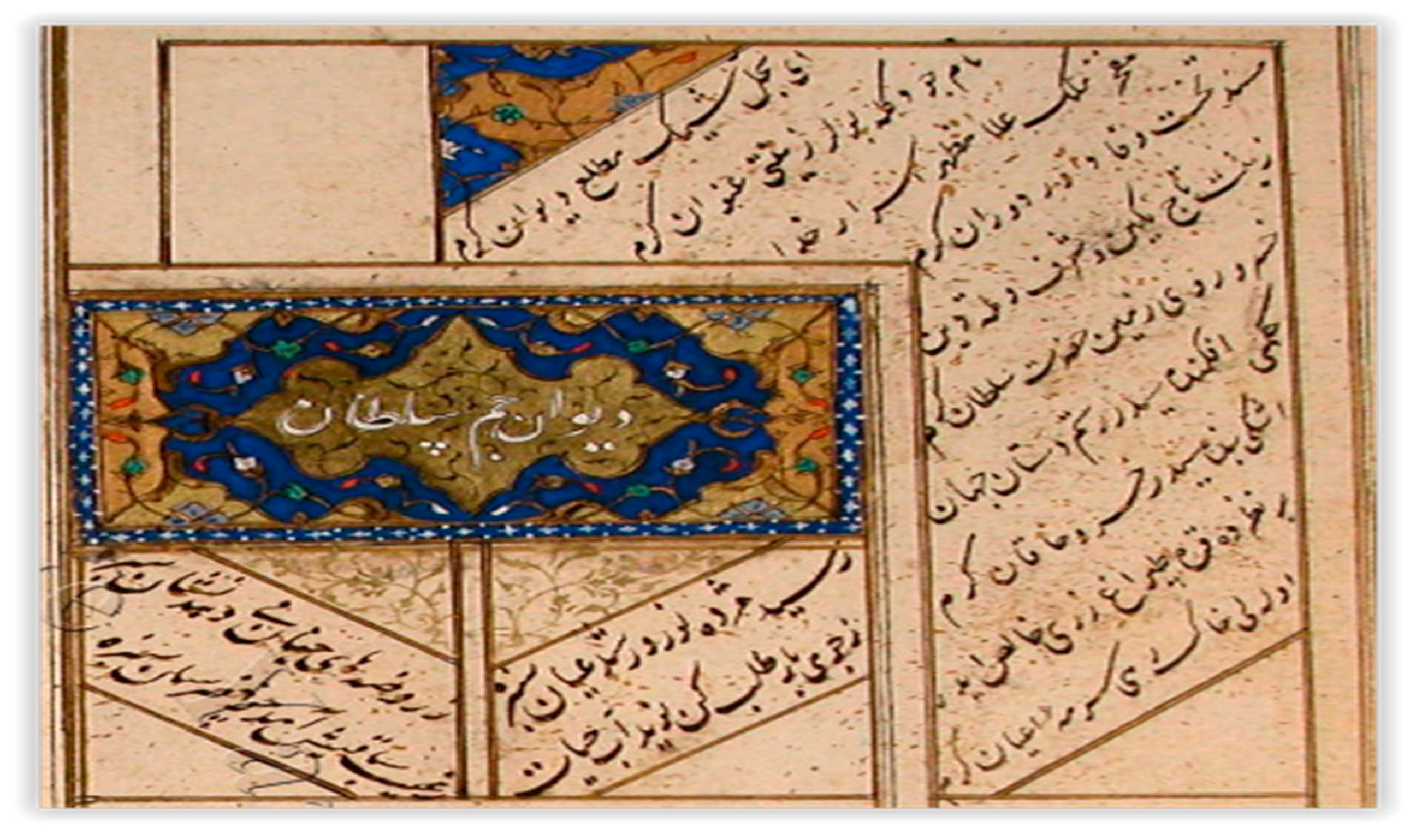
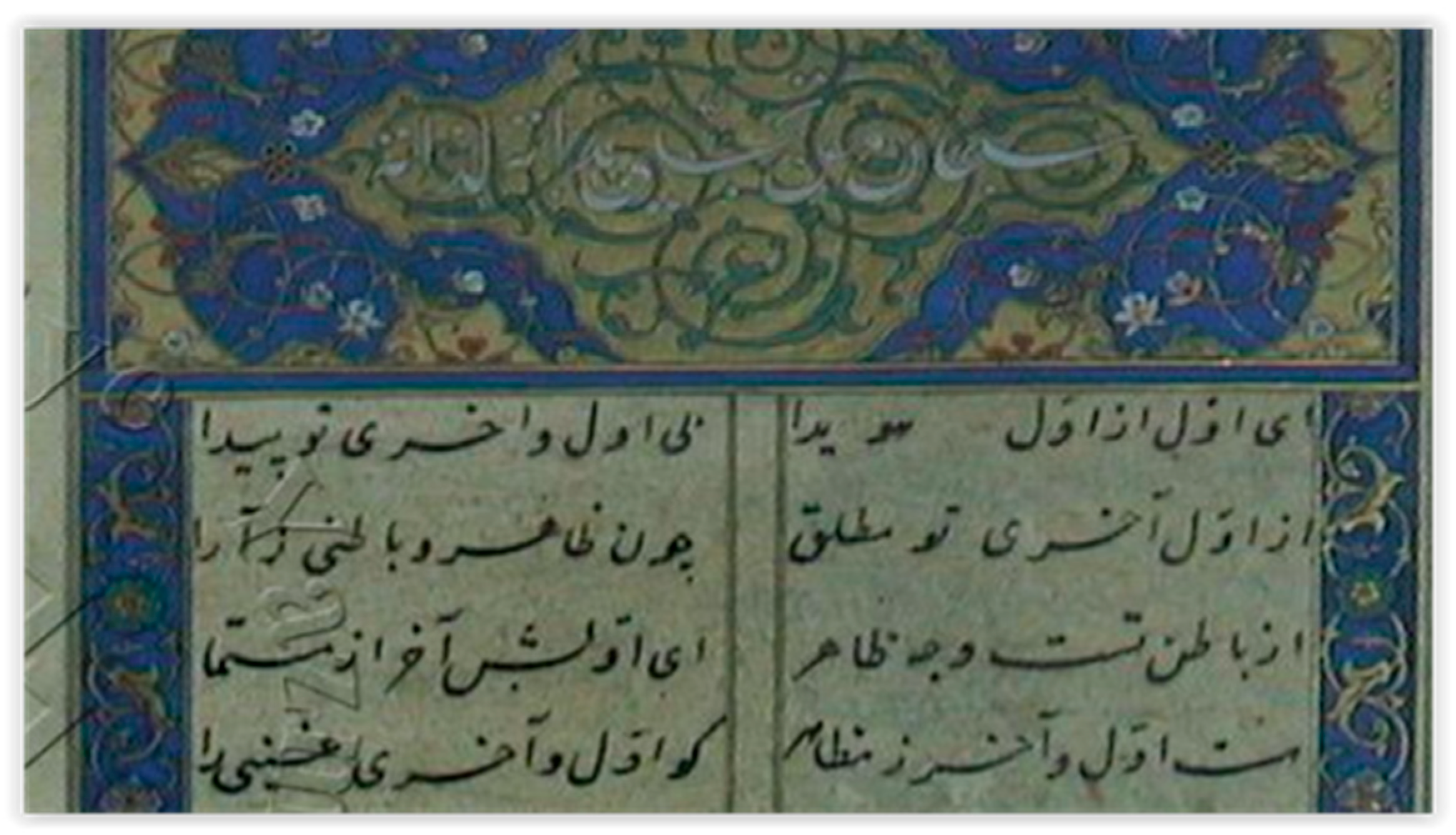
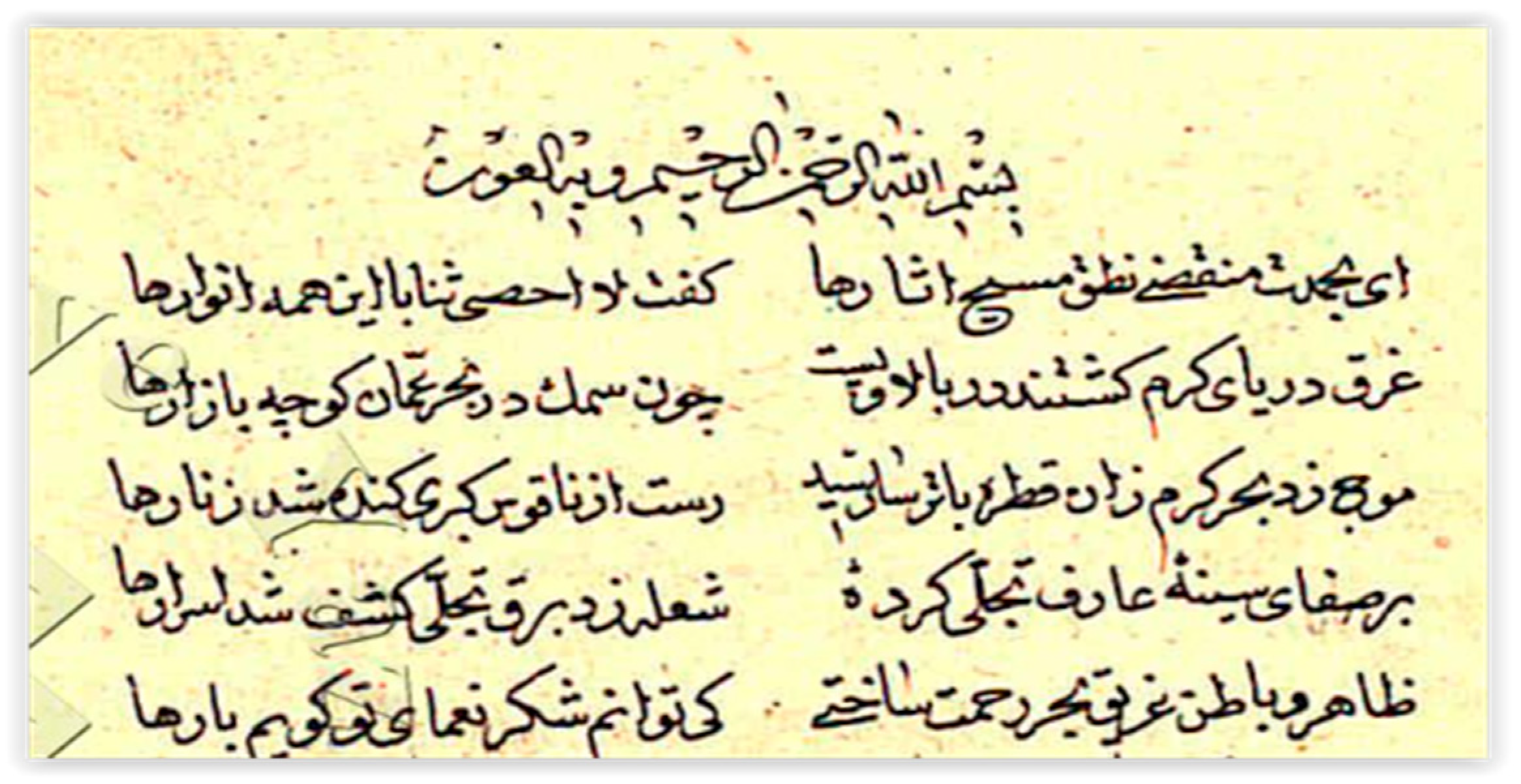
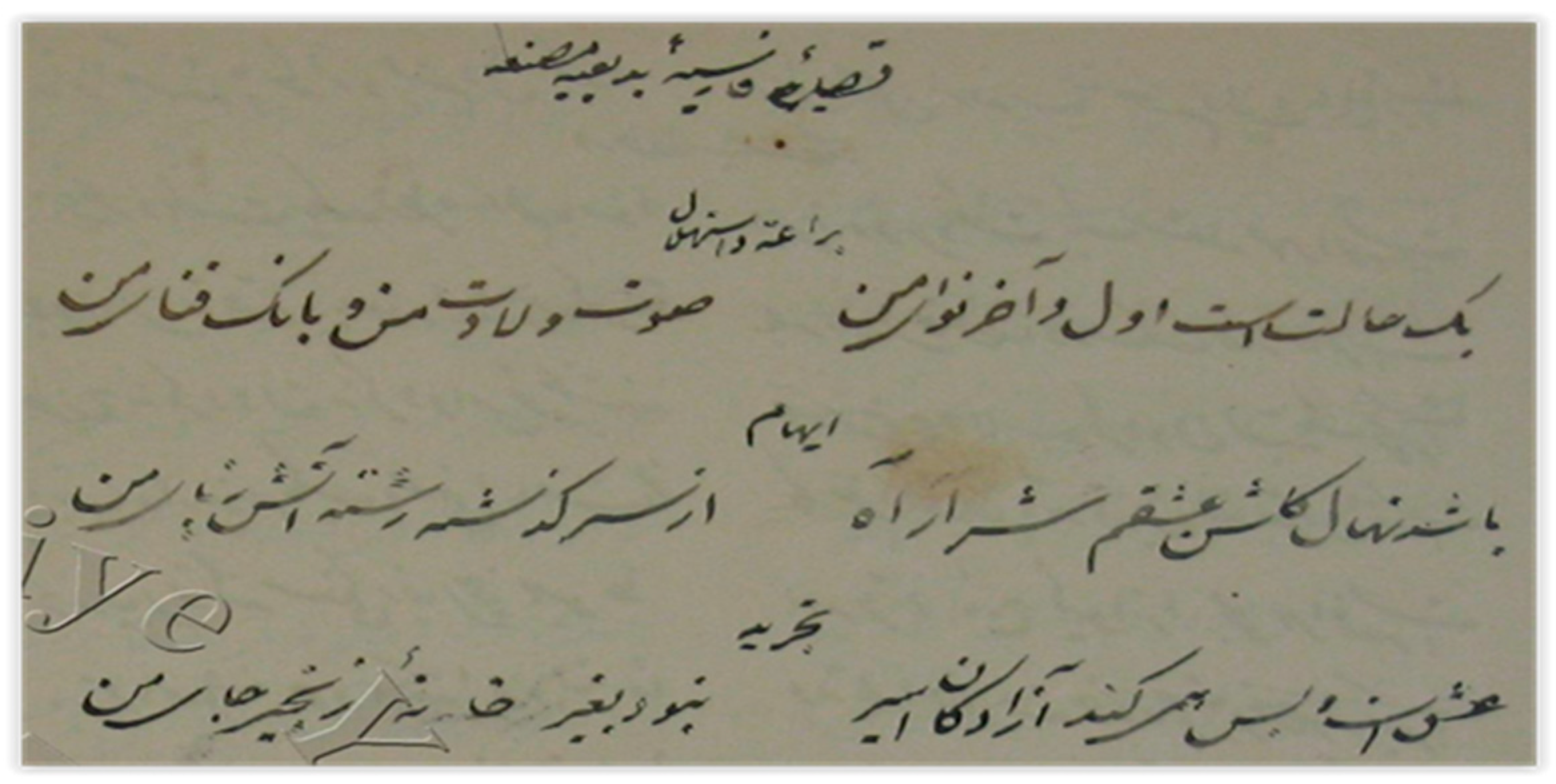
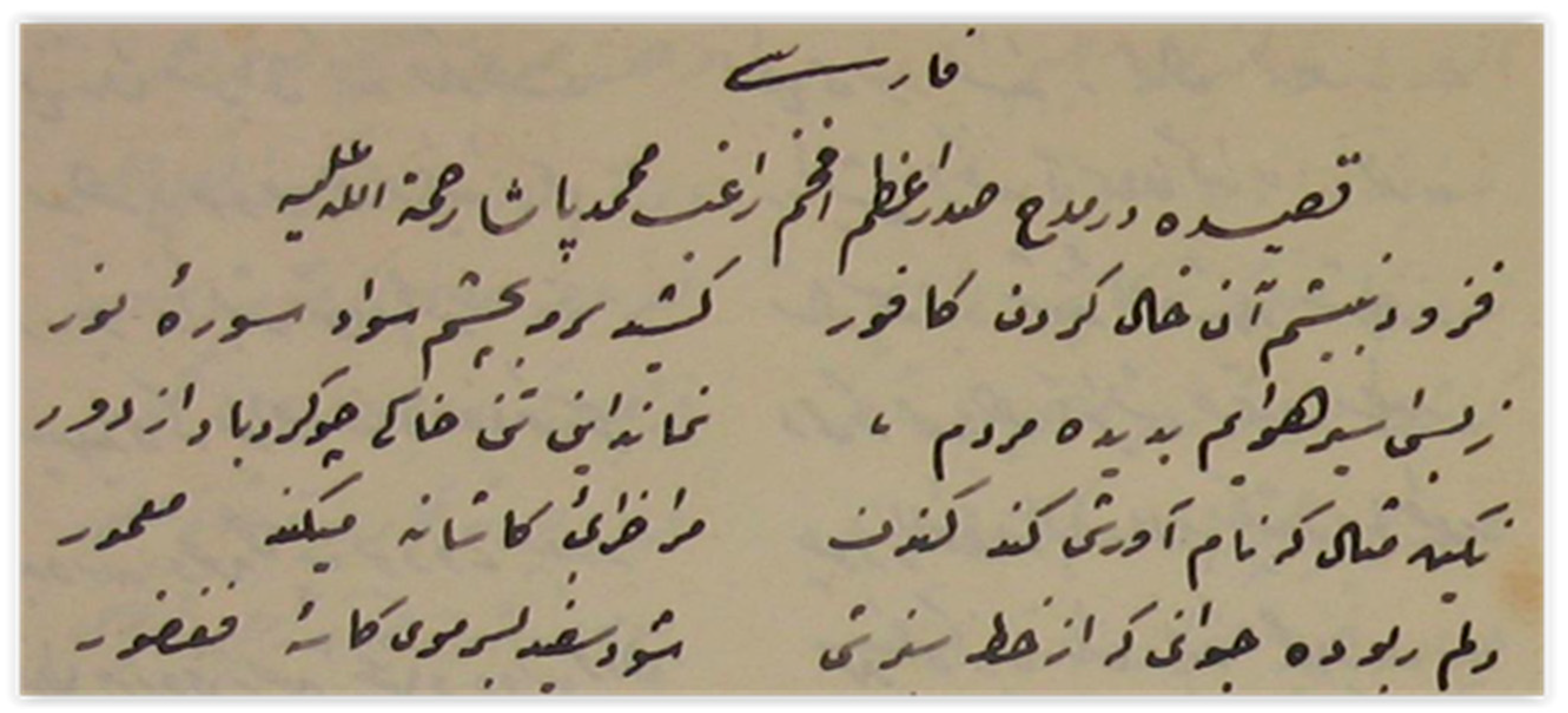
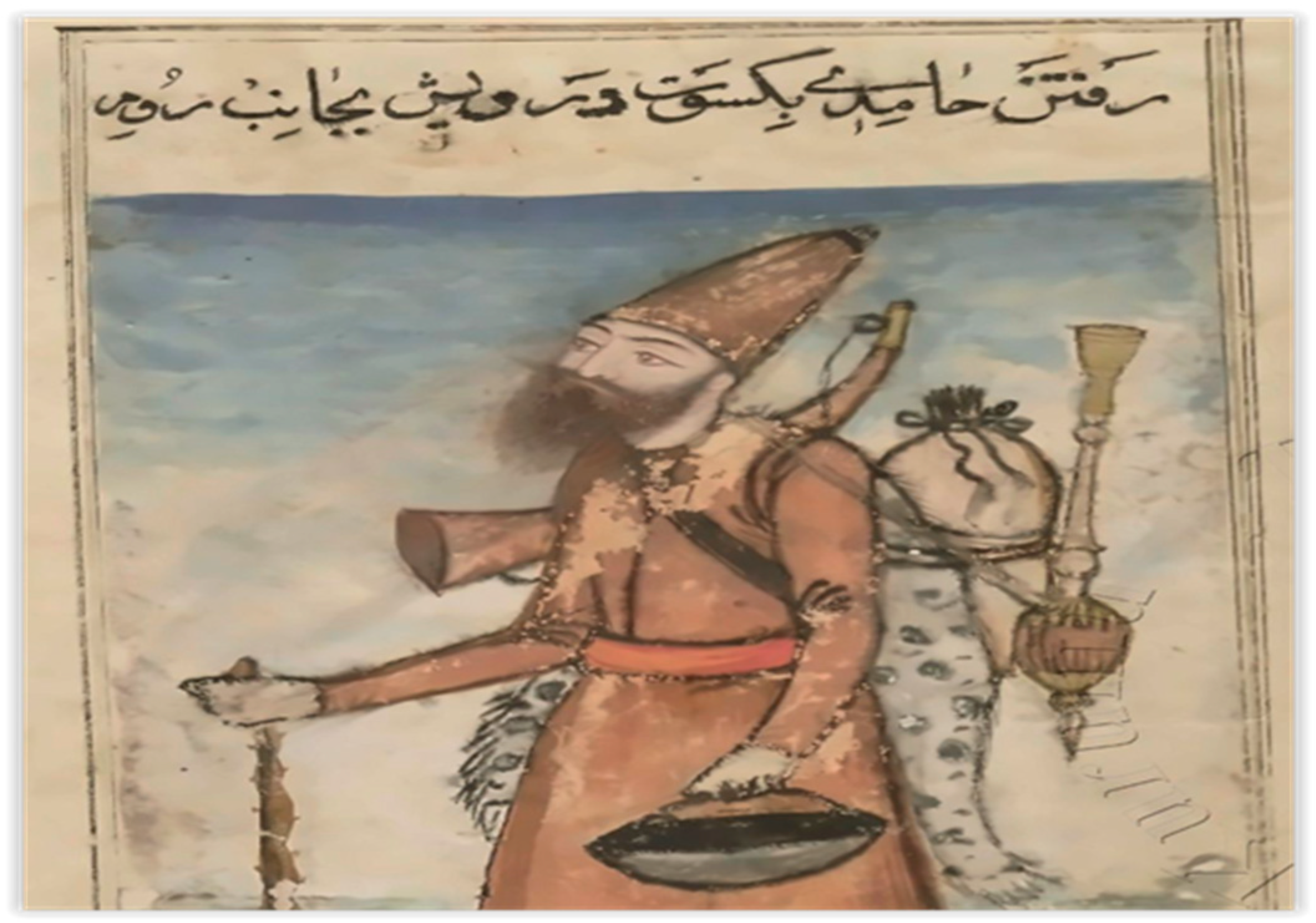
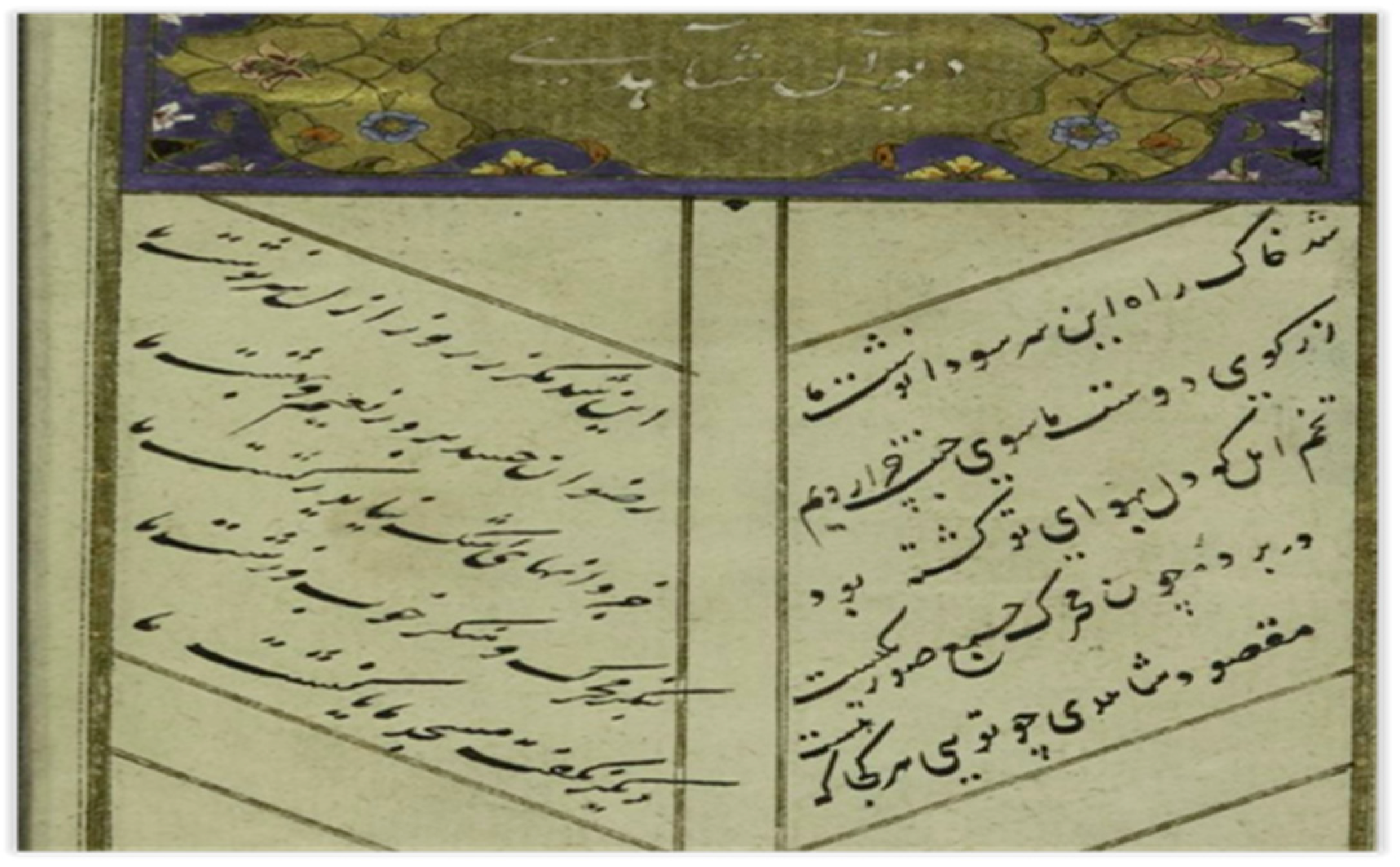
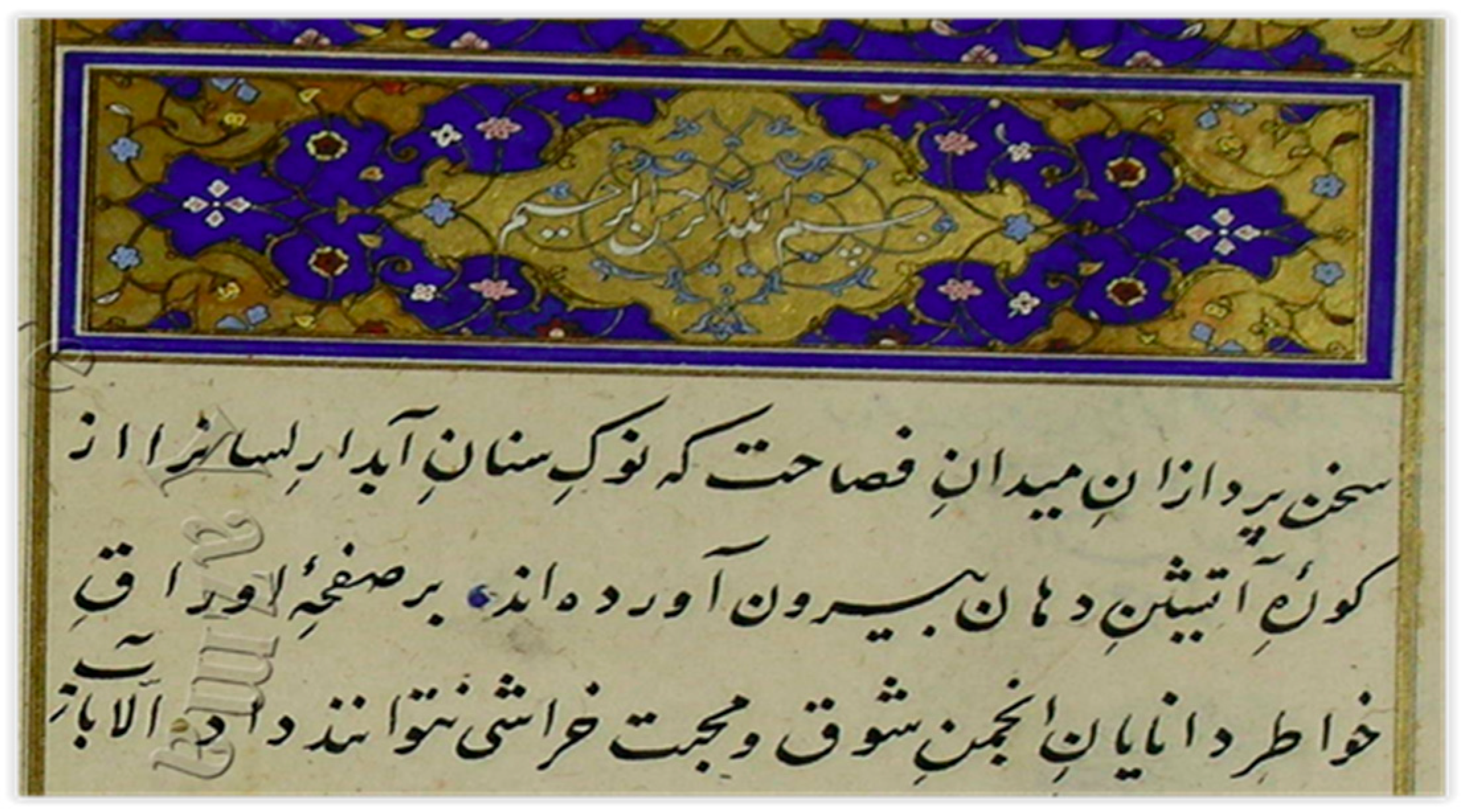
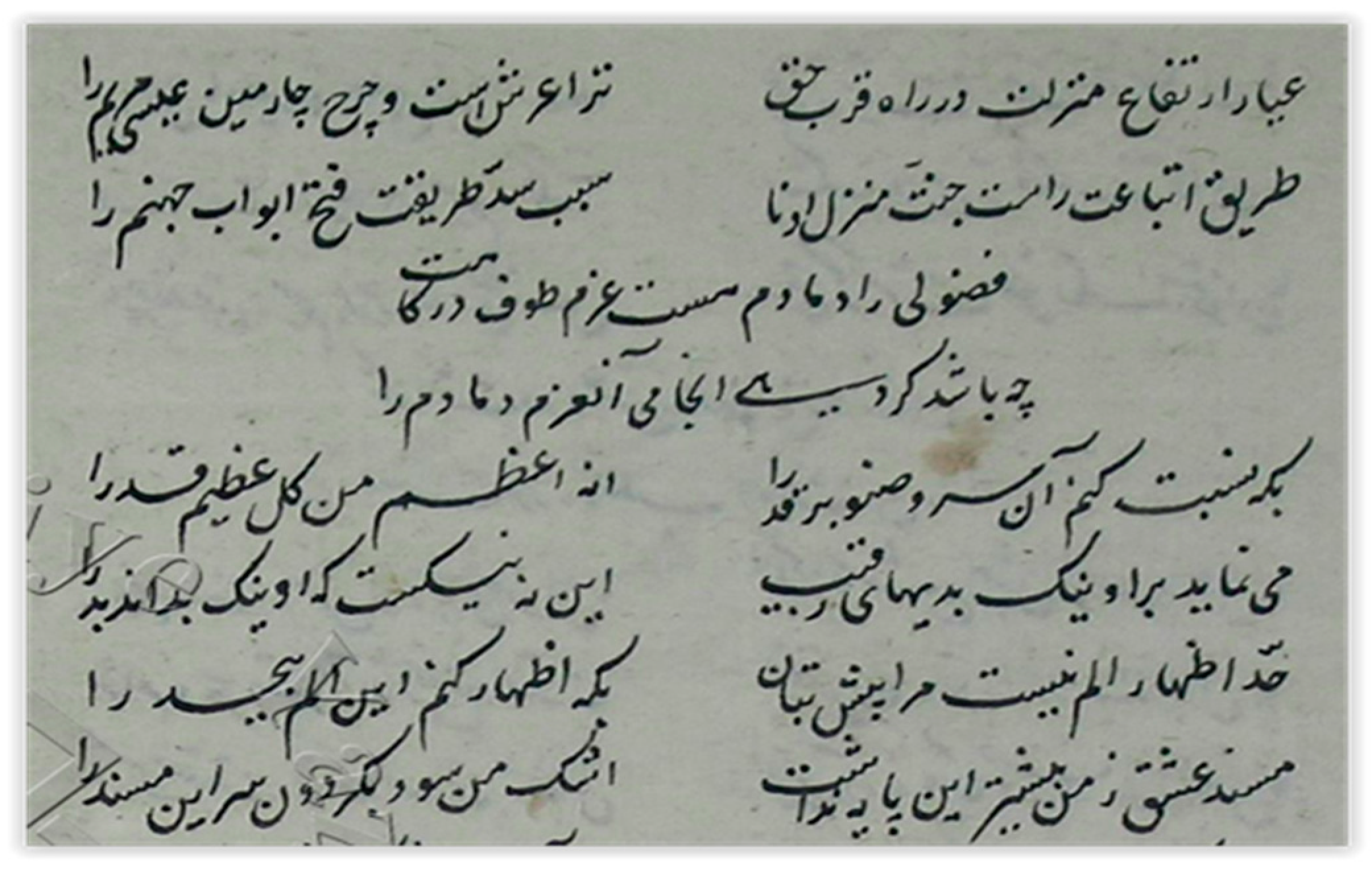
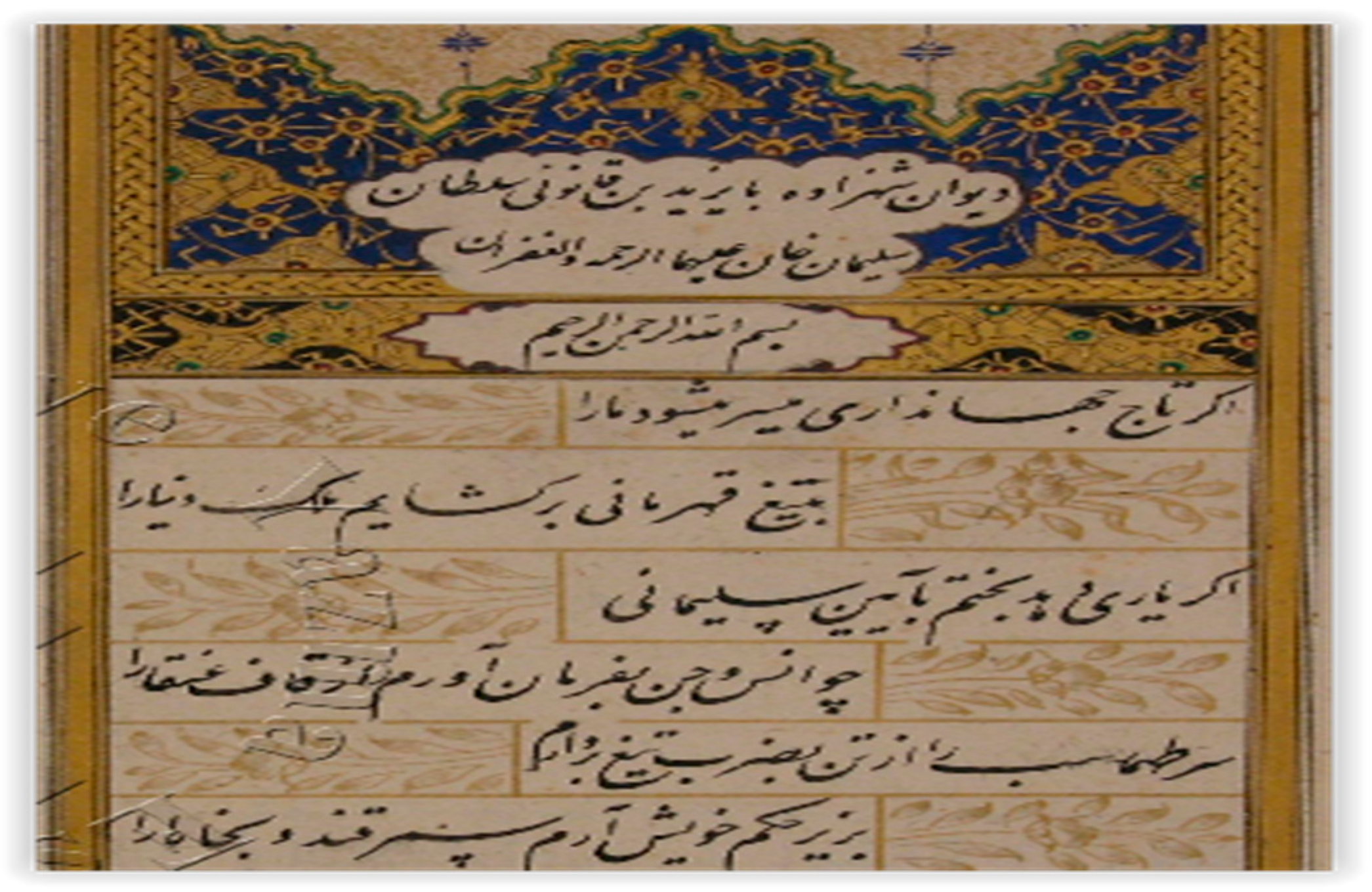
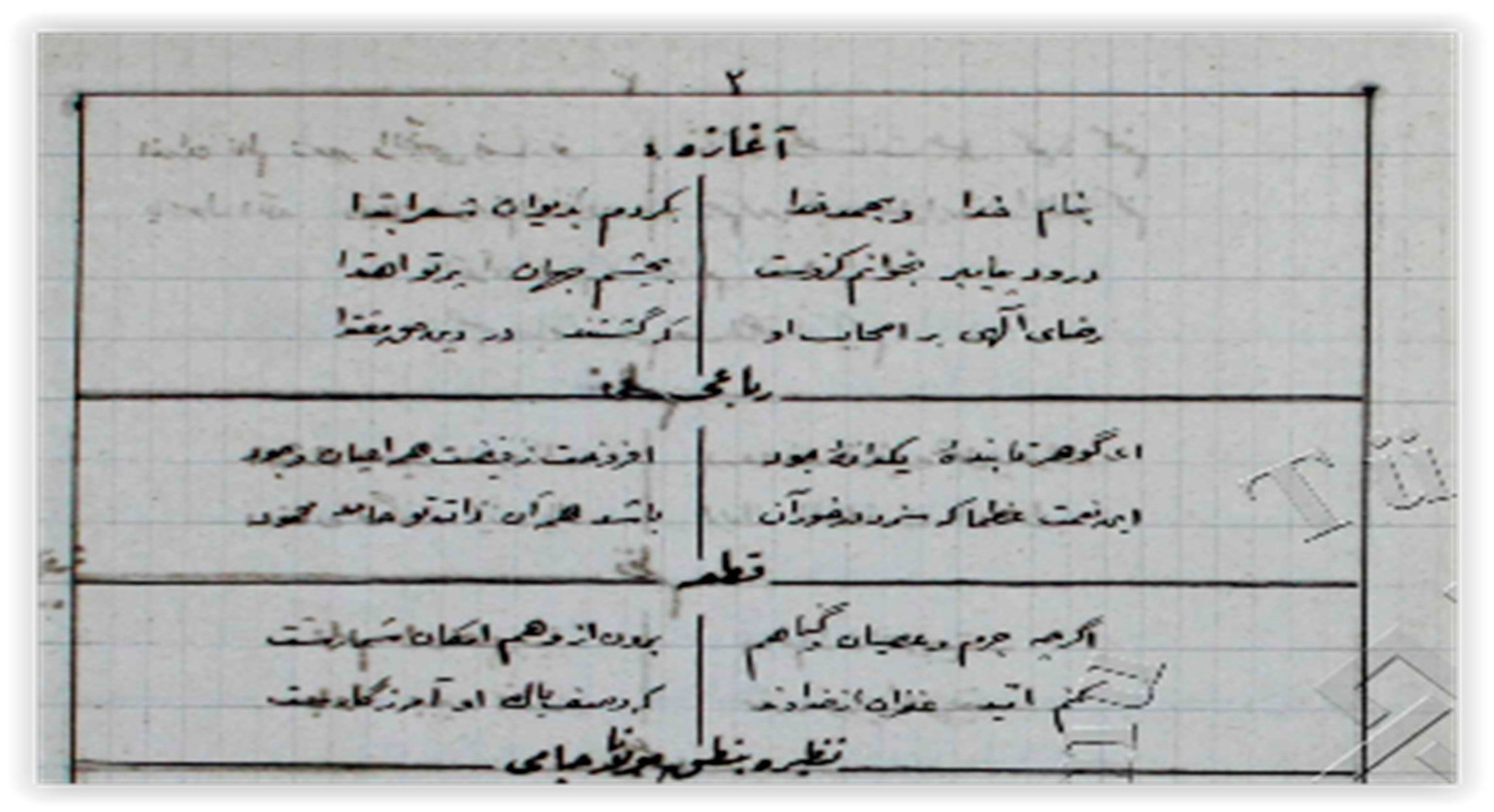
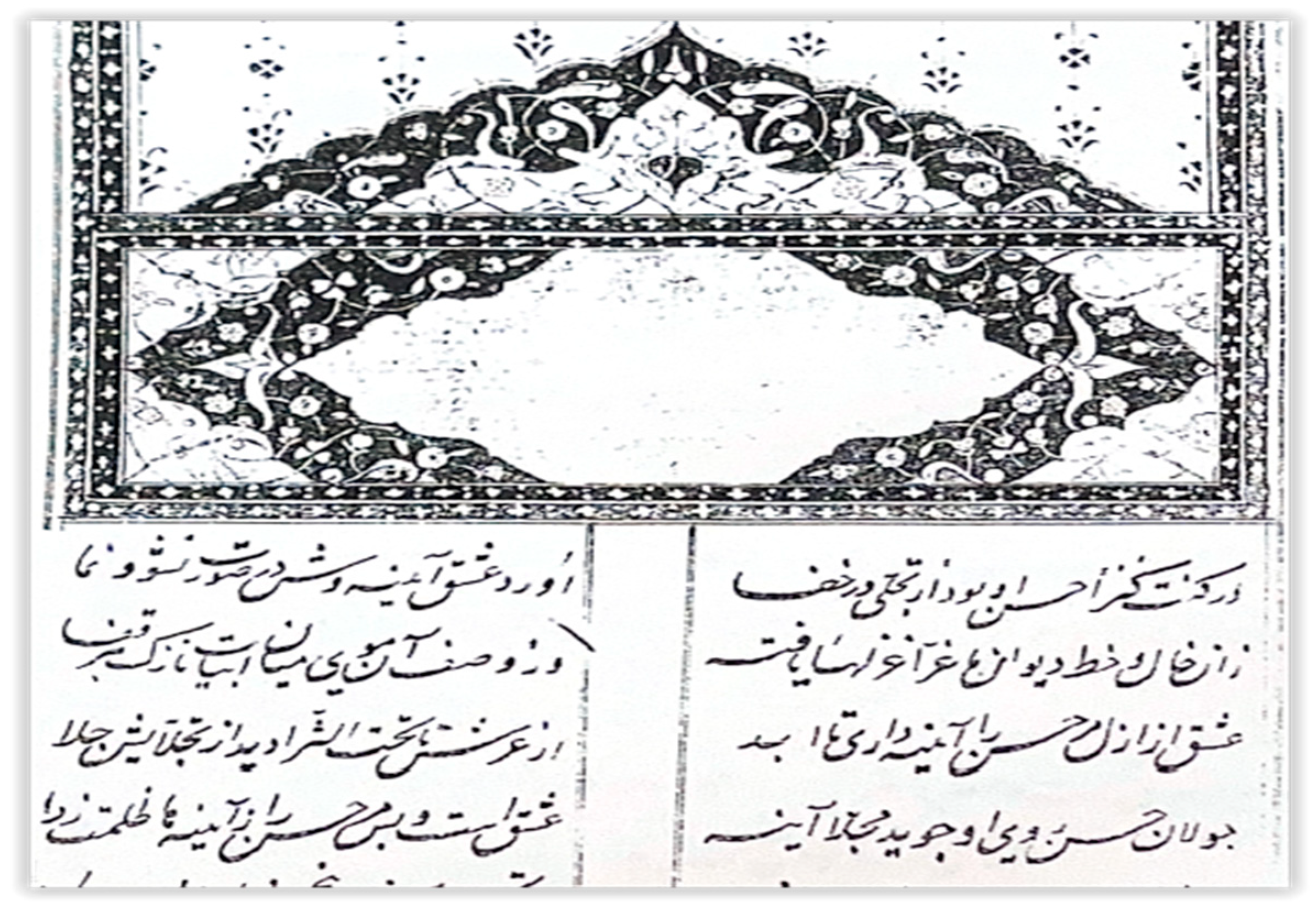
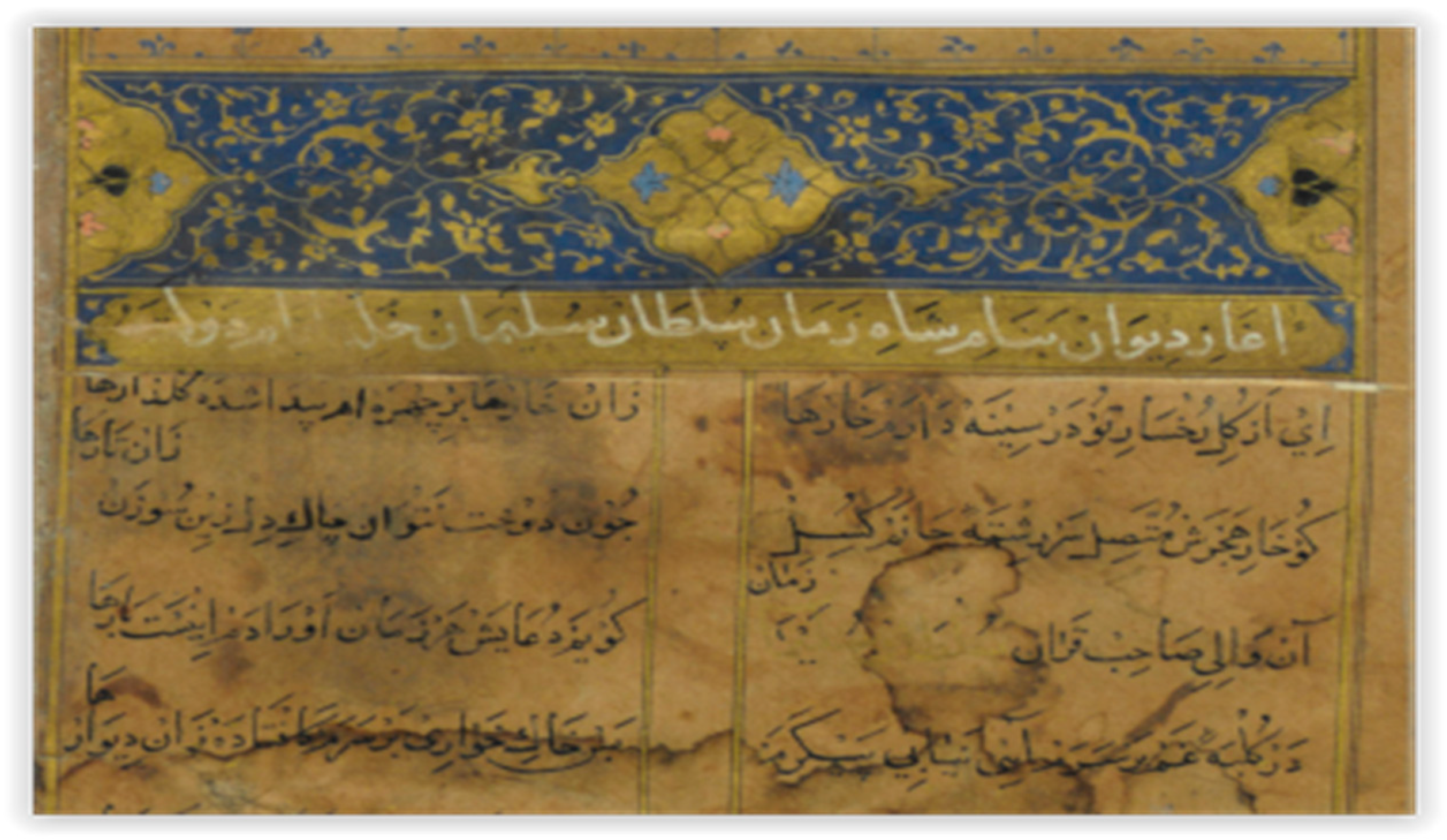
2. Persian Divans of Anatolia
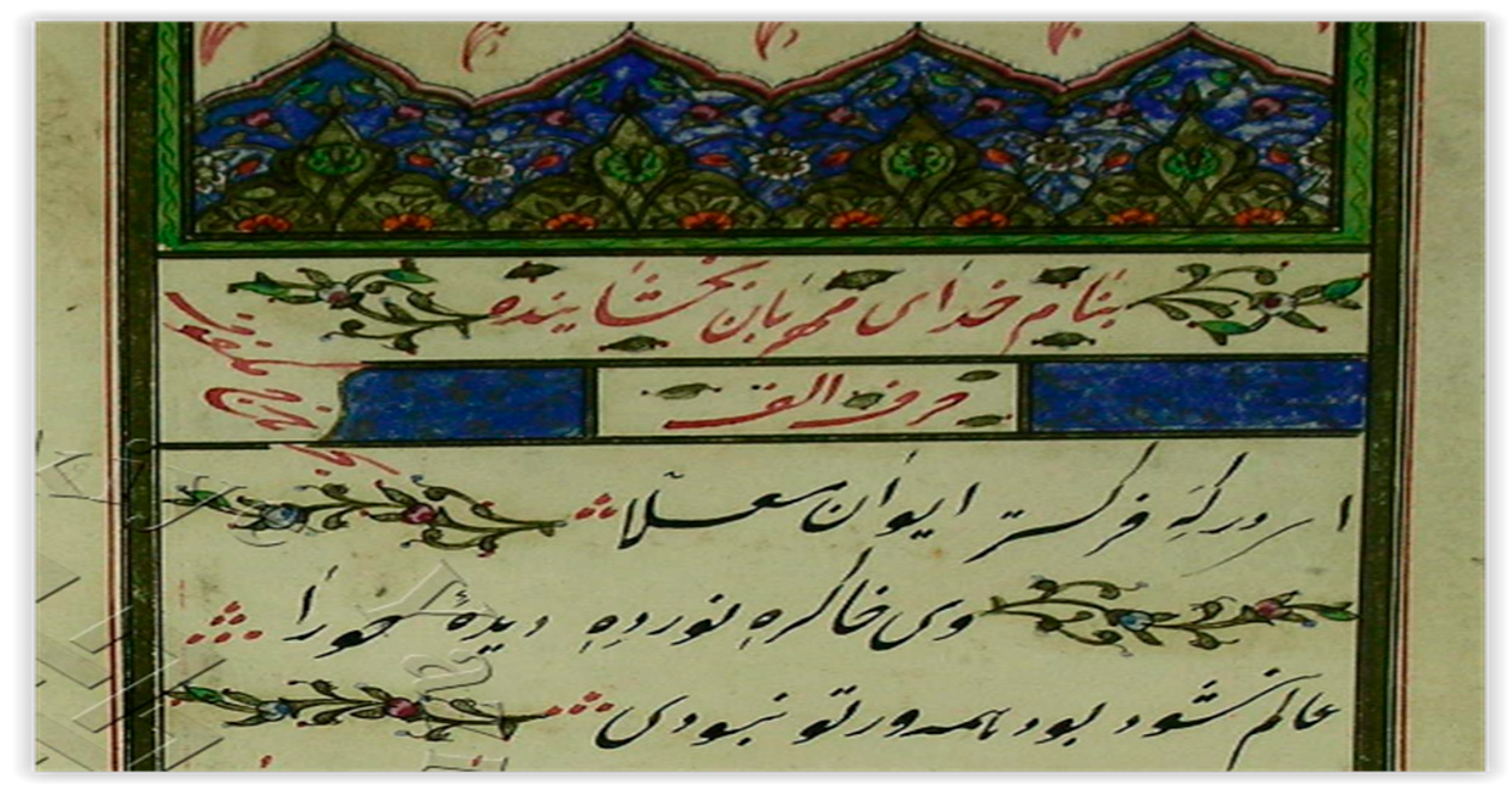
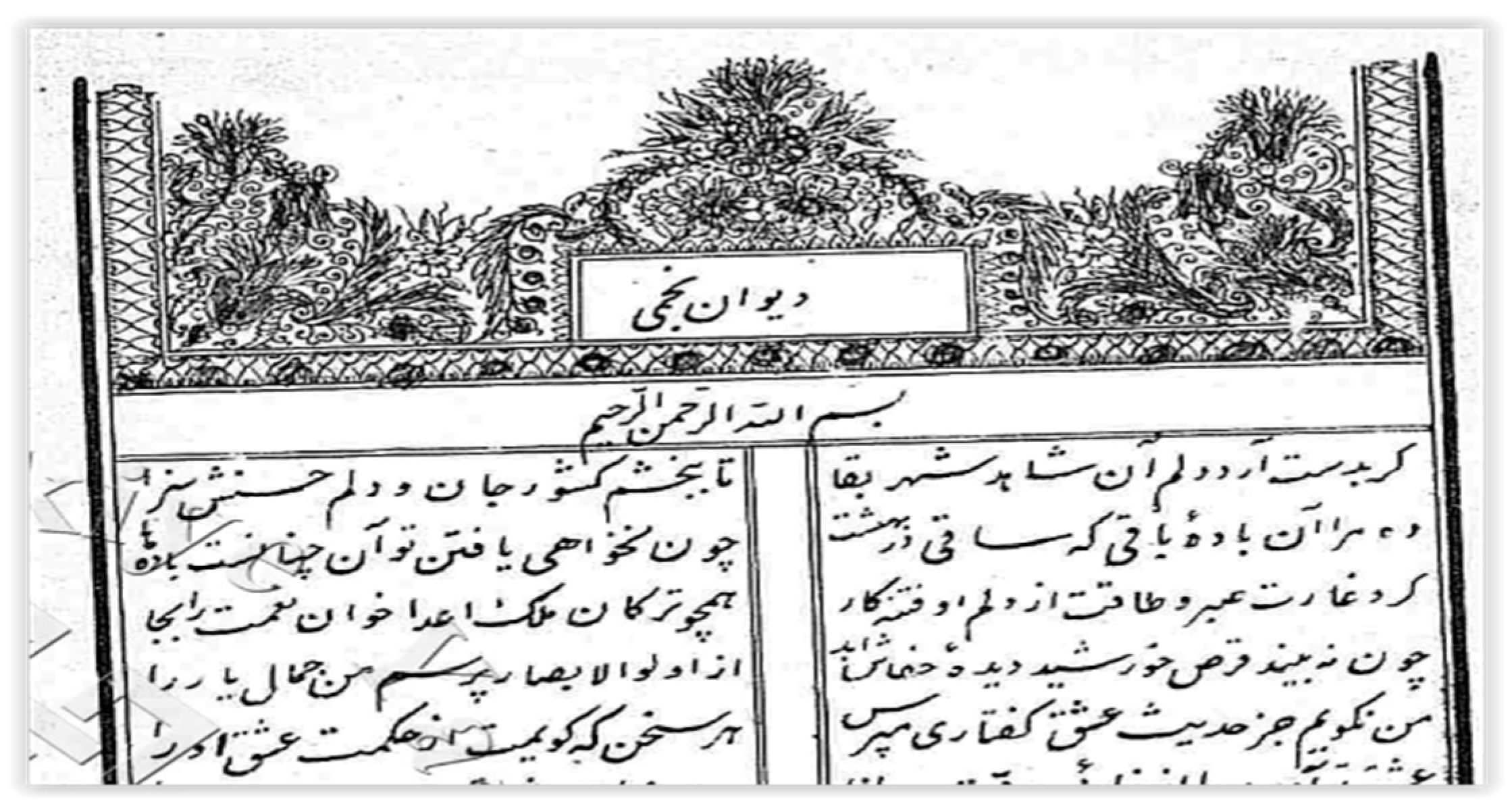
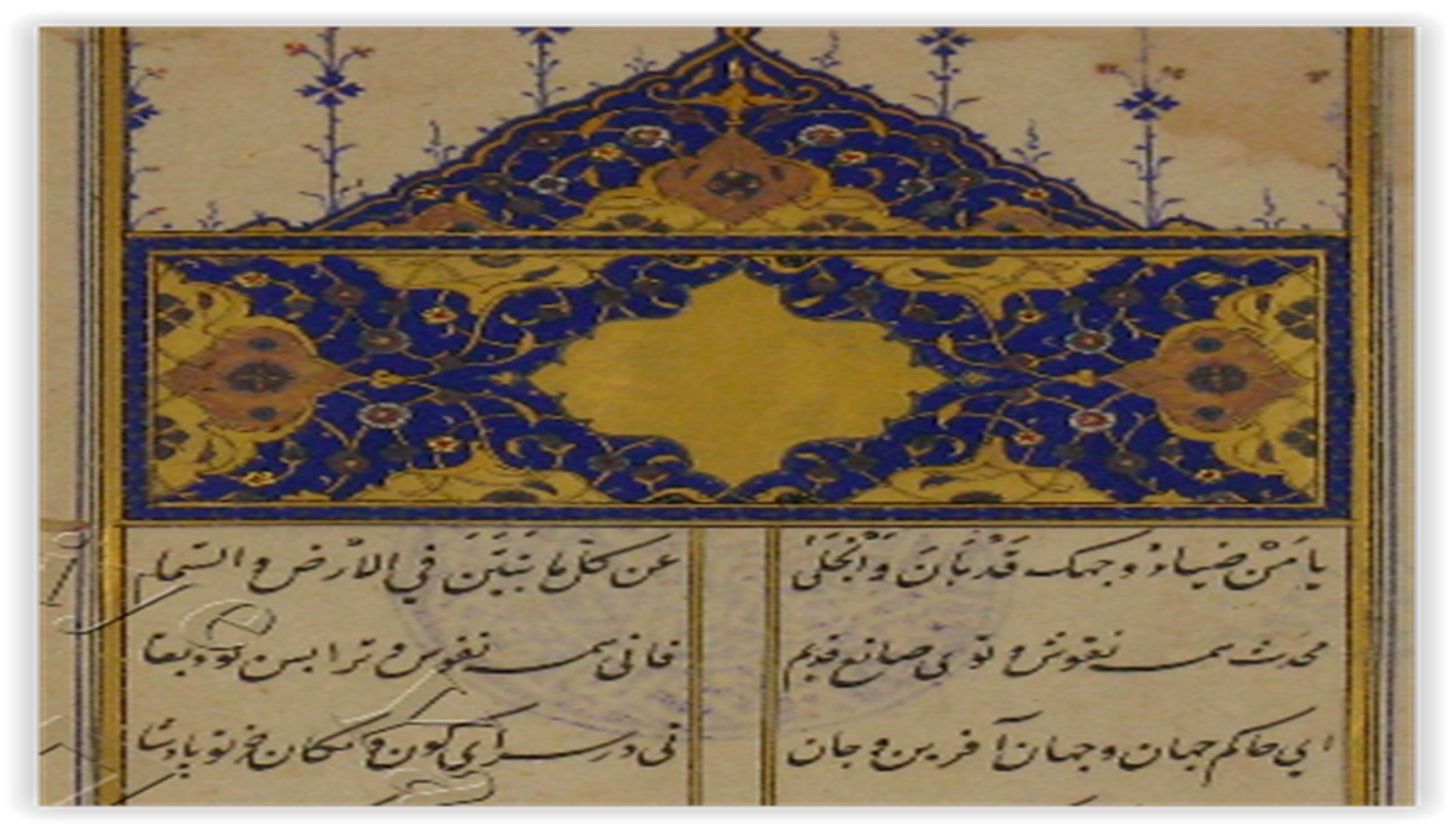
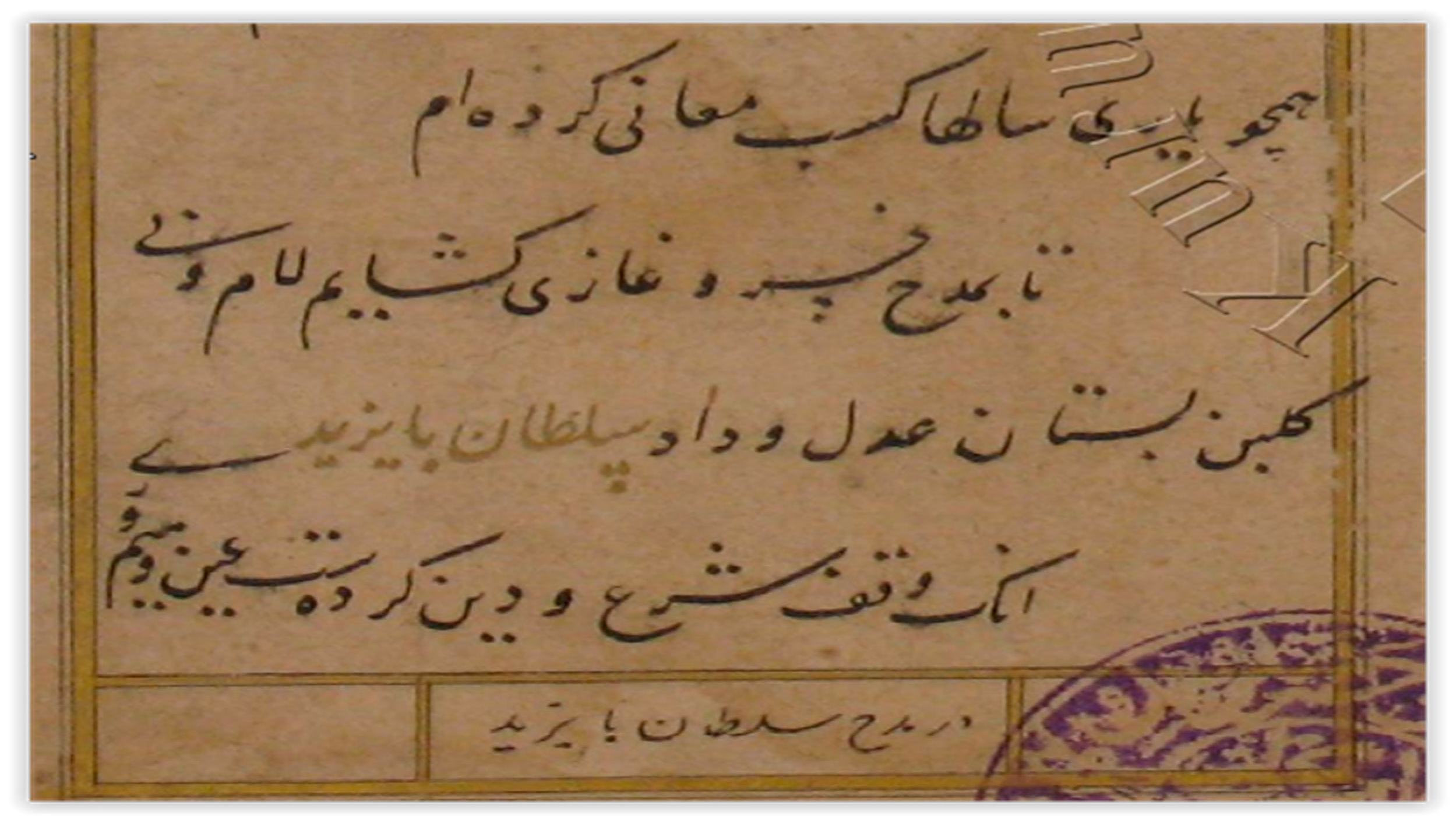
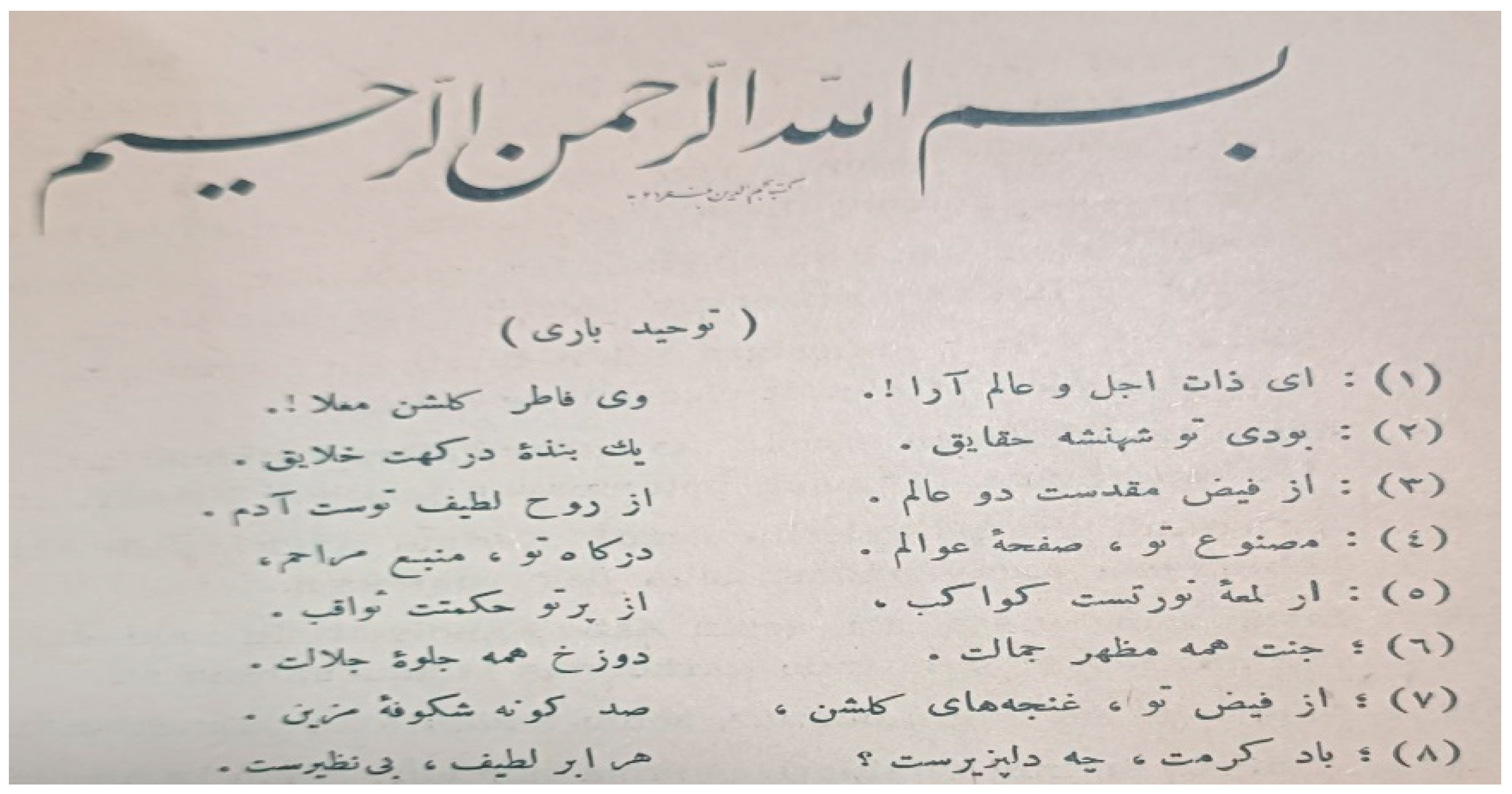
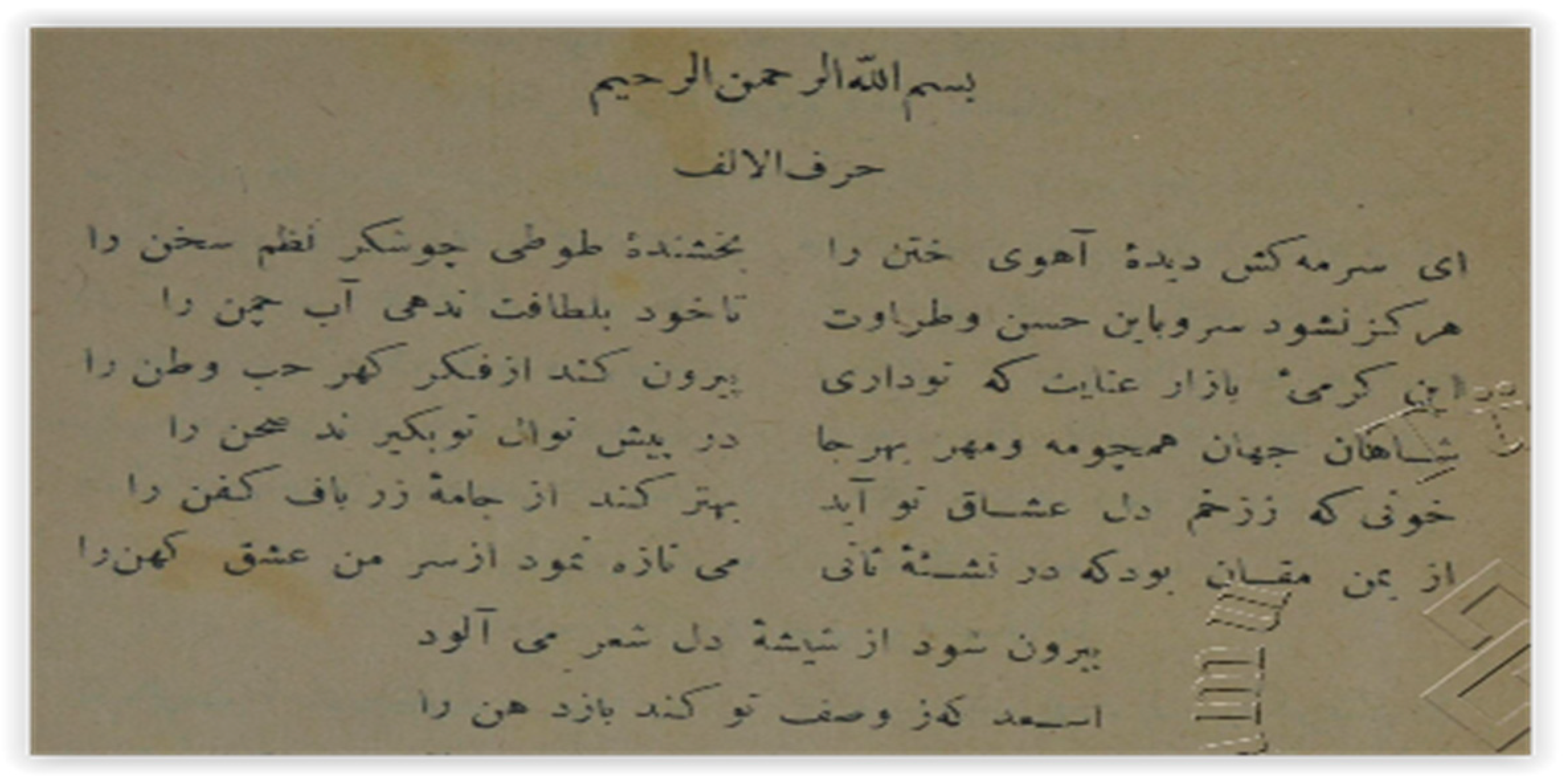
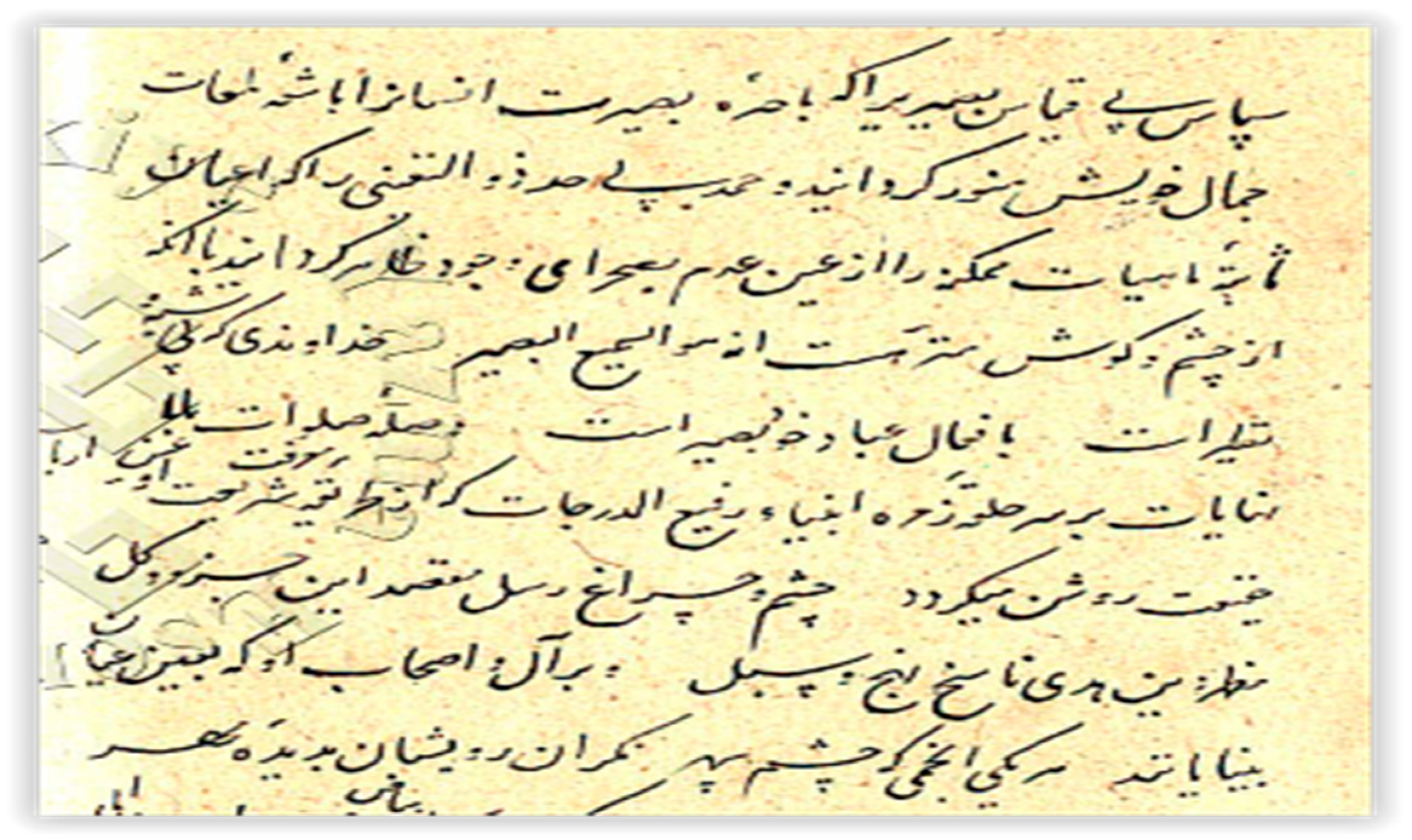
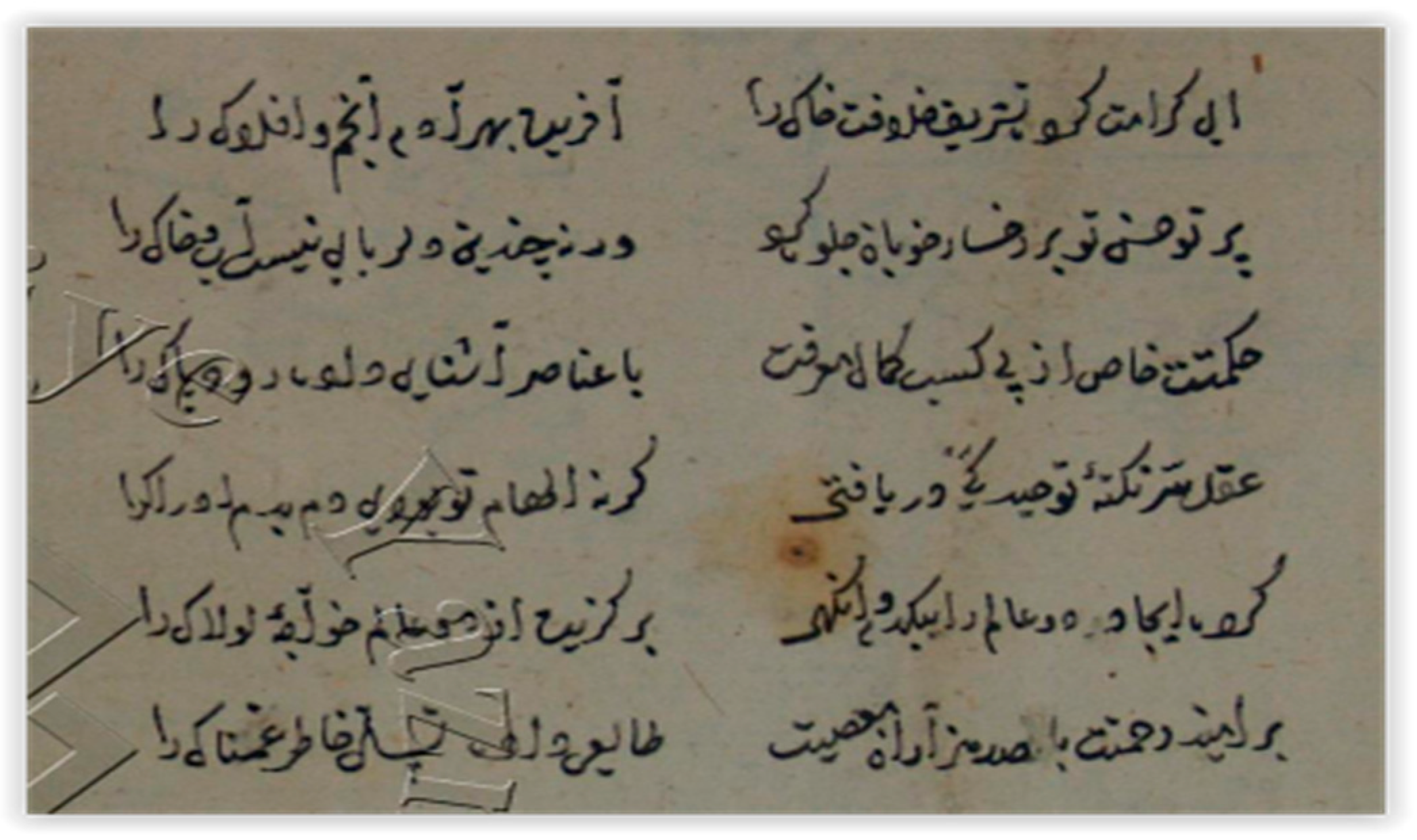
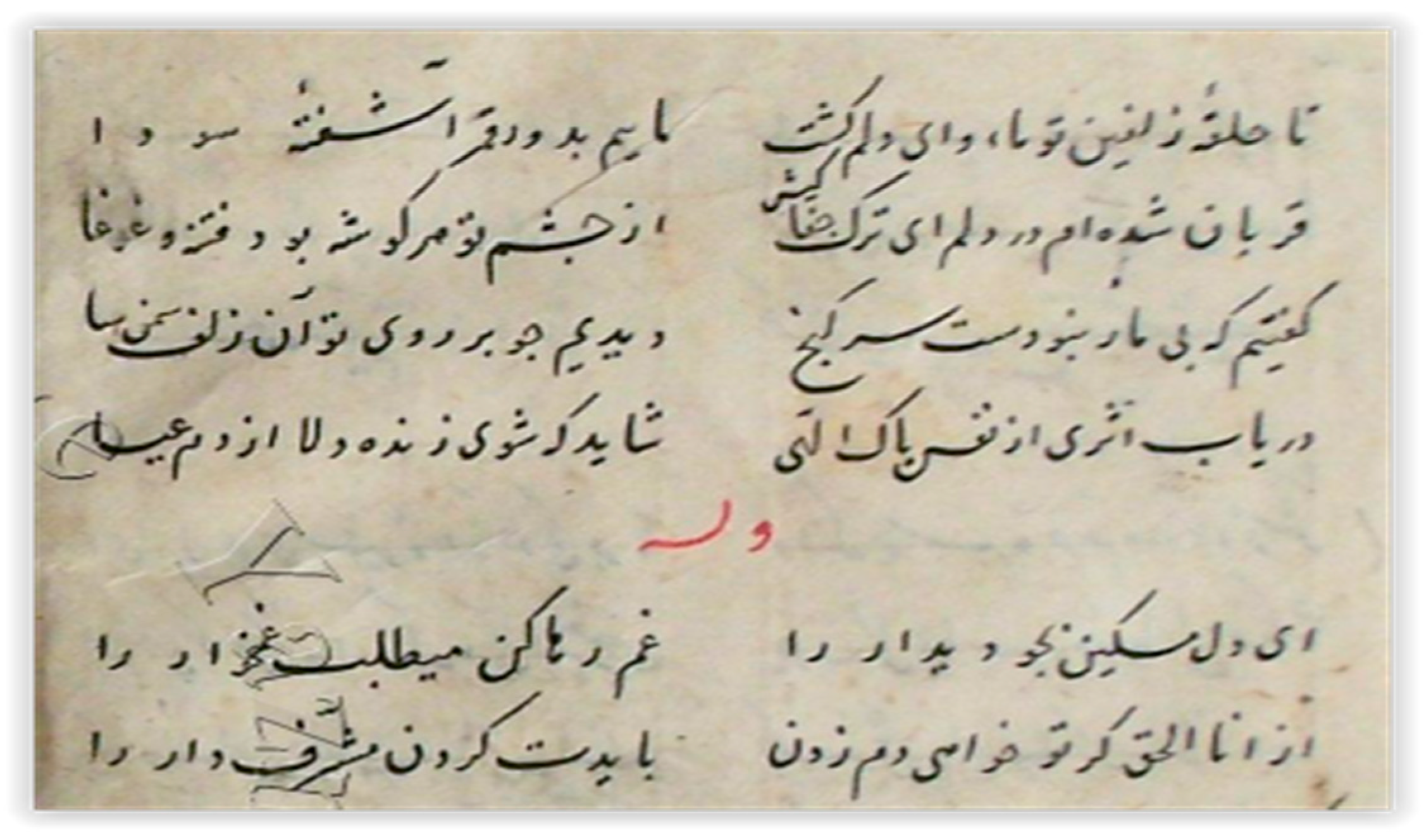
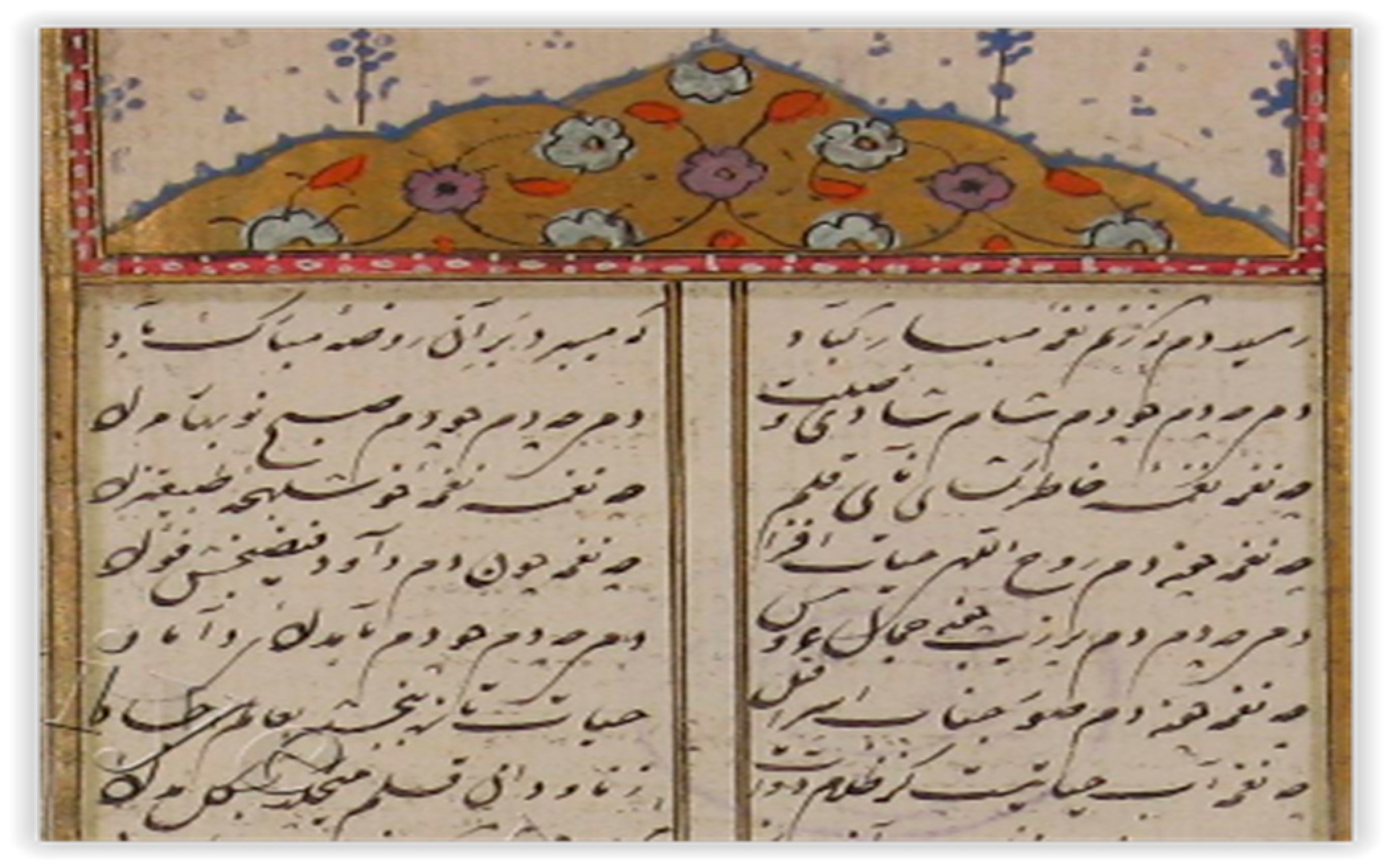
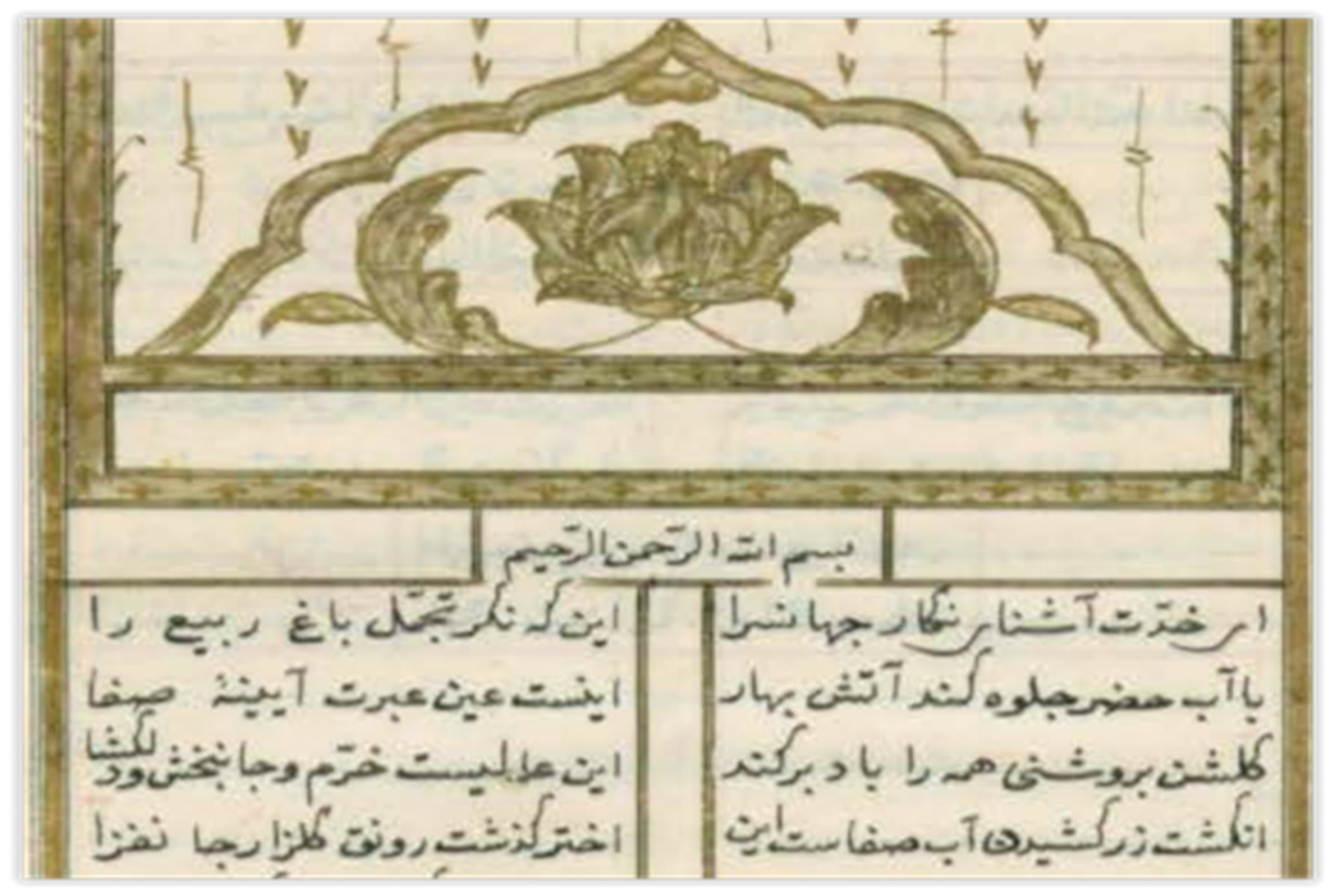
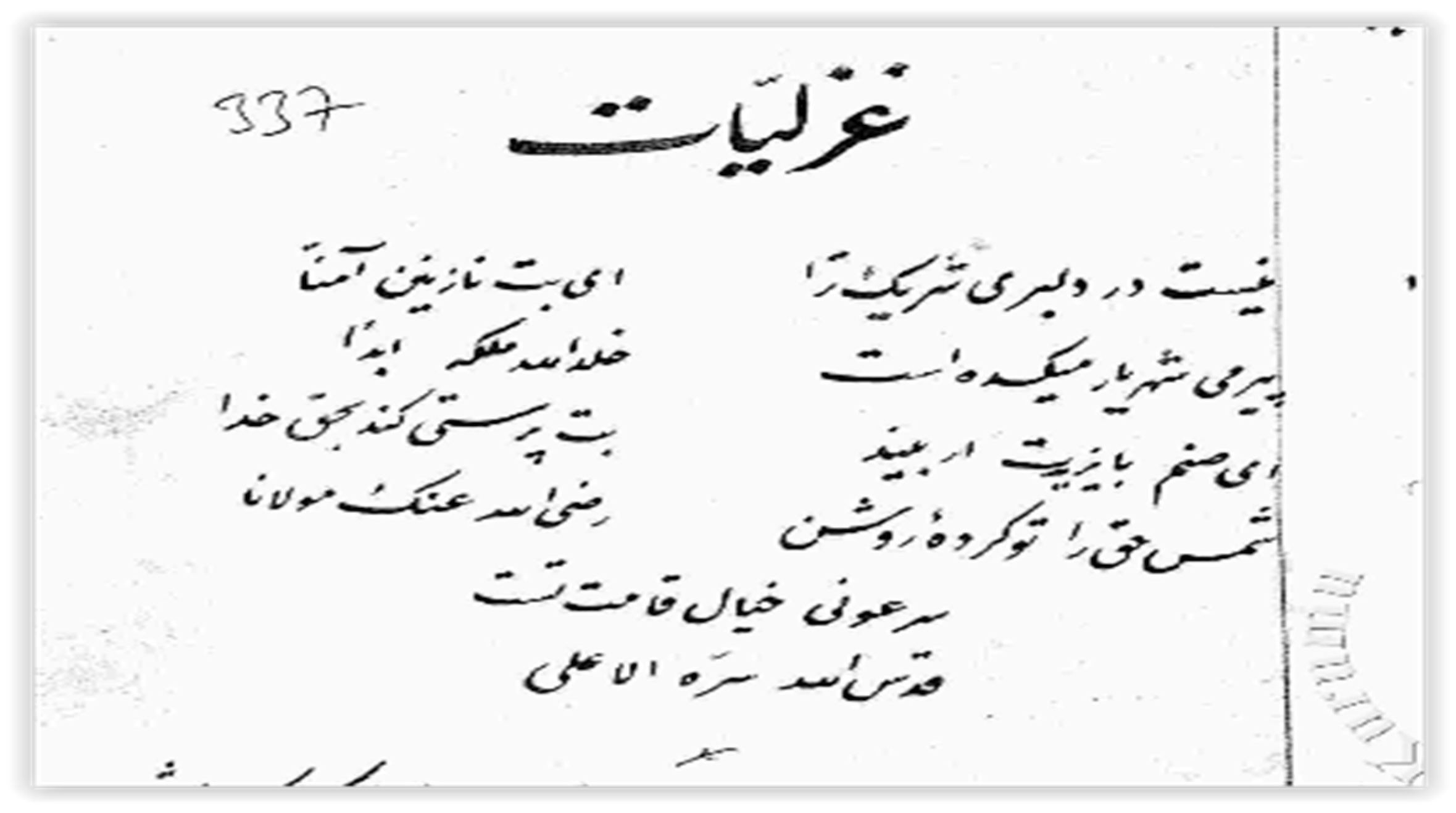
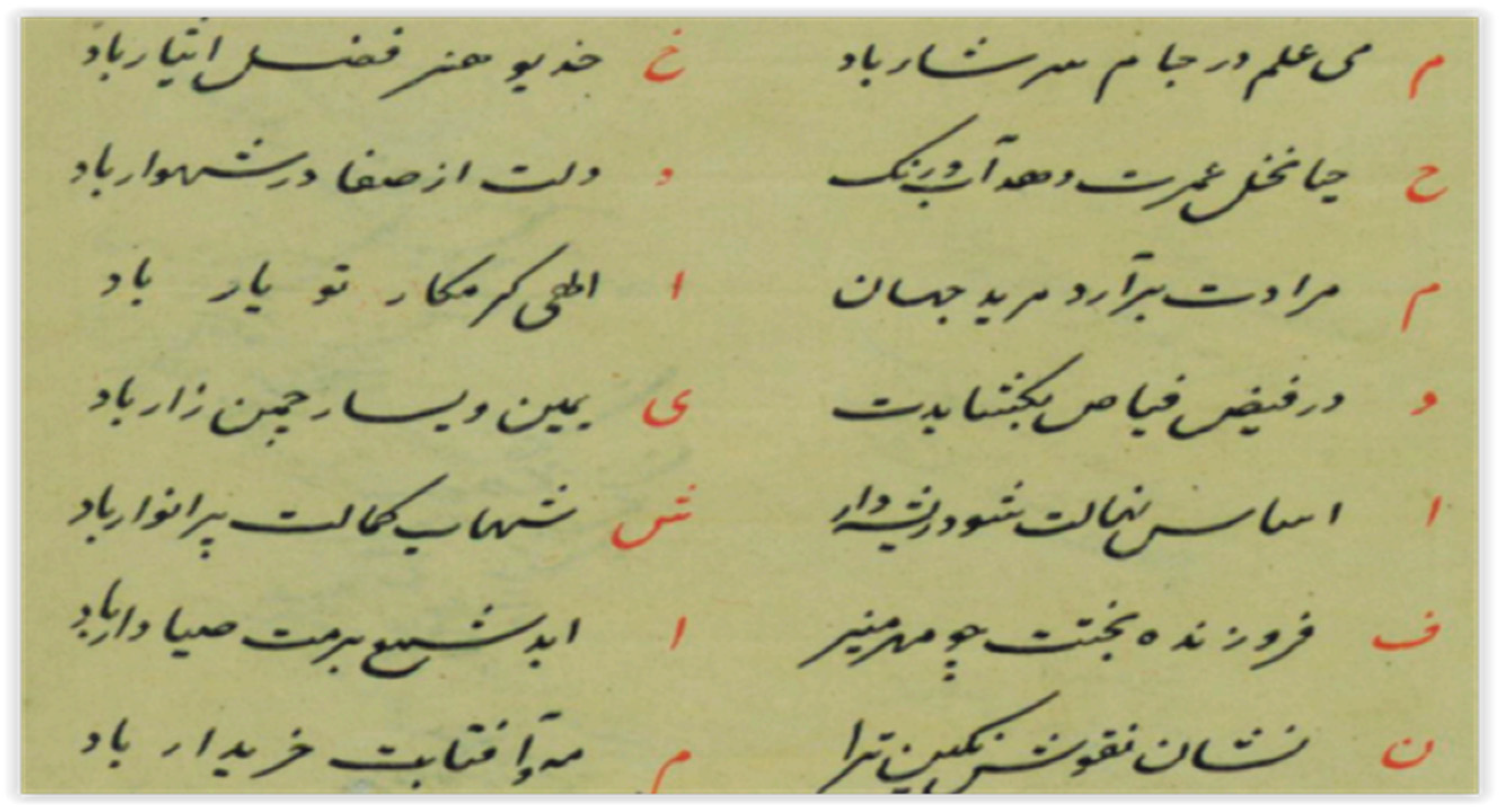
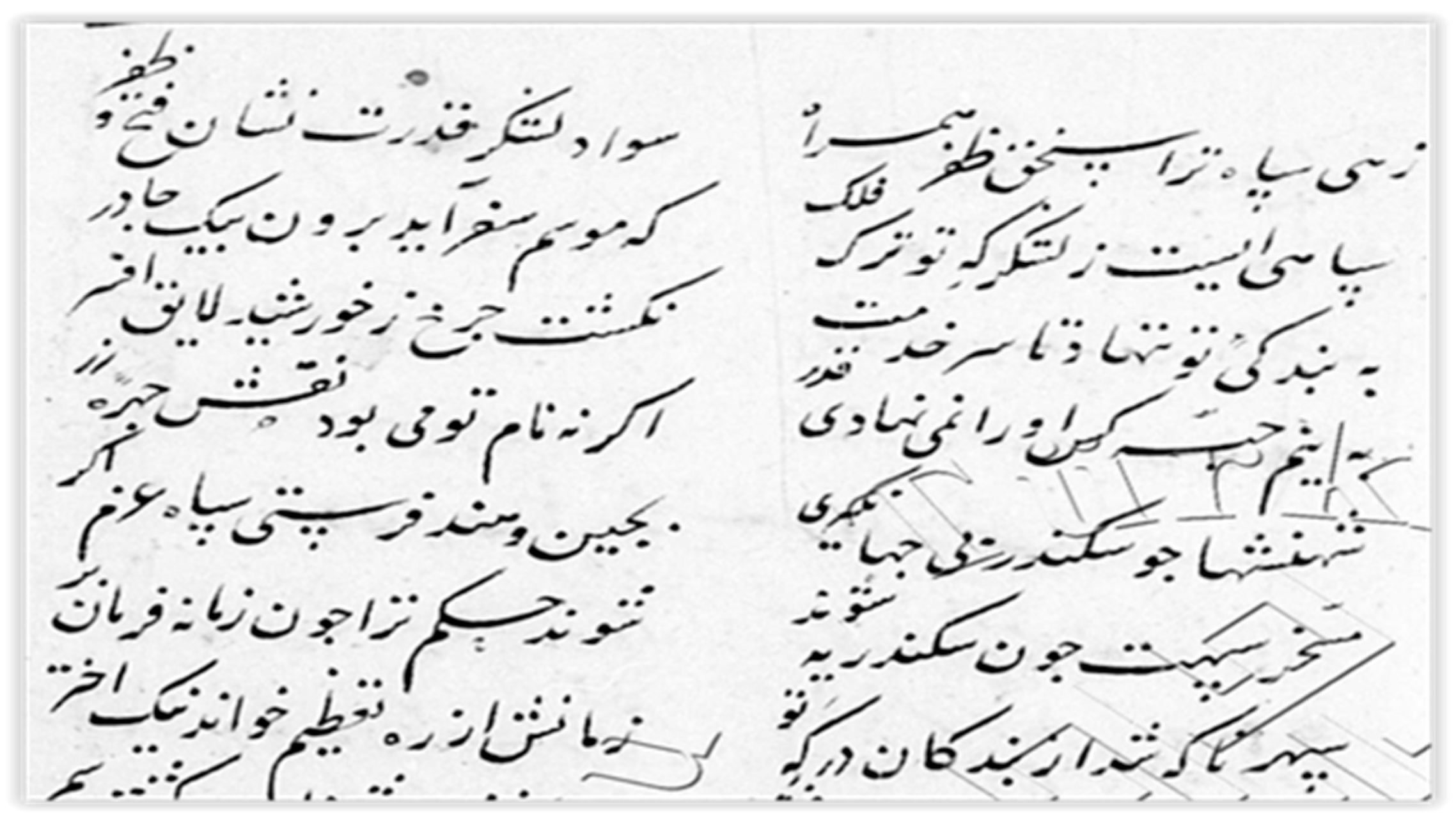
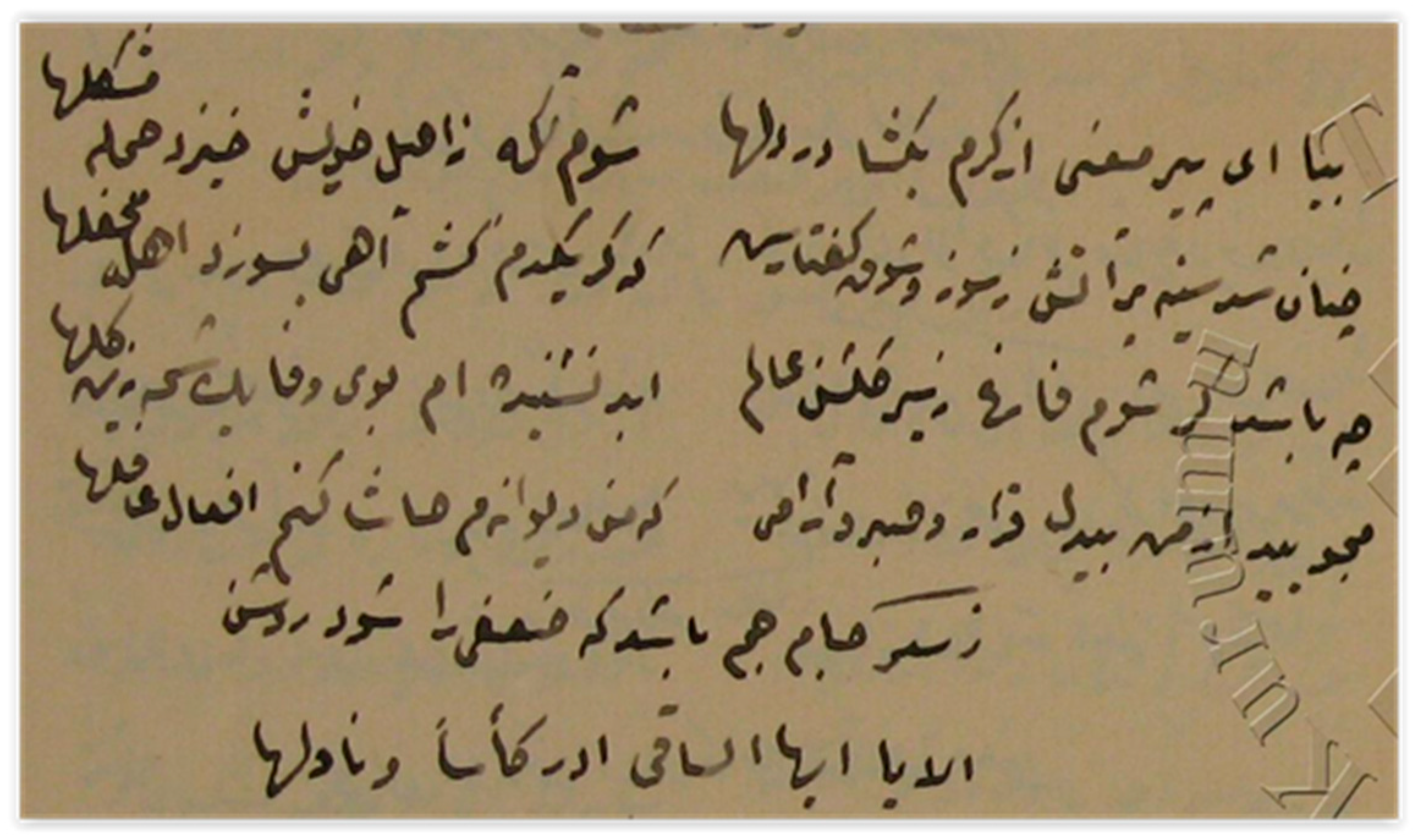
An examination of the Persian divans composed in Anatolia reveals that 58 were written during the Ottoman period and 5 during the Anatolian Seljuk period, resulting in a total of 63 Persian divans produced in the Anatolian sphere. Below are concise summaries of these divans, along with images of their manuscript copies.
1. Dīvān-i Kabīr: This monumental poetic work, authored by Mawlānā Jalāl al-Dīn Rūmī, employs the pen-names
Khamūsh (“the silent”) and
Shams. The poems are composed in twenty-one different
baḥrs (meters) of the
ʿarūż prosodic system. Though primarily written in Persian, the
divan also contains verses in Arabic and Greek. In these poems, the theme introduced in the opening
bayt (couplet) is typically sustained until the closing lines. The total number of
bayts is uncertain; some
ghazals consist of as few as three or four
bayts, while others extend to ninety-nine. The work includes proverbs, Qurʾānic verses,
ḥadīths, and popular beliefs, as well as passages reminiscent of the poetry of Rūdakī of Samarqand, Manūchihrī of Dāmghān, Nāṣir-i Khusraw, ʿUmar Khayyām, Sanāʾī of Ghazna, and Farīd al-Dīn ʿAṭṭār. Due to its vast scale, it is known as
Dīvān-i Kabīr (“the Great Divan”), though the titles
Dīvān-i Shams and
Dīvān-i Shams-i Tabrīzī are also used. Manuscript copies vary between 30,000 and 50,000
bayts. Certain copies additionally include
ghazals by Sulṭān Walad, Jamāl al-Dīn Iṣfahānī, Anwarī of Abivard, Shams-i Tābasī, and Shams-i Mashriqī. The oldest dated manuscript (770/1368) is preserved at the Mawlānā Museum in Konya (
Yazıcı 1994, pp. 432–33). To date, ninety manuscript copies of the
Dīvān-i Kabīr have been identified. Most of the
ghazals within the work incorporate themes such as death, life, the resurrection, pre-eternity, post-eternity, and love. Some of these
ghazals exceed standard lengths in terms of couplet count, with the work even including a
ghazal consisting of ninety-two
bayts. According to the Mawlānā Museum manuscript, the work comprises a total of 40,285 couplets, specifically including 3260
ghazals, 43
tarjīʿ-bands, and 1866
rubāʿīs (
Sübhânî 2019, pp. 225–35). One of the most significant manuscripts of the
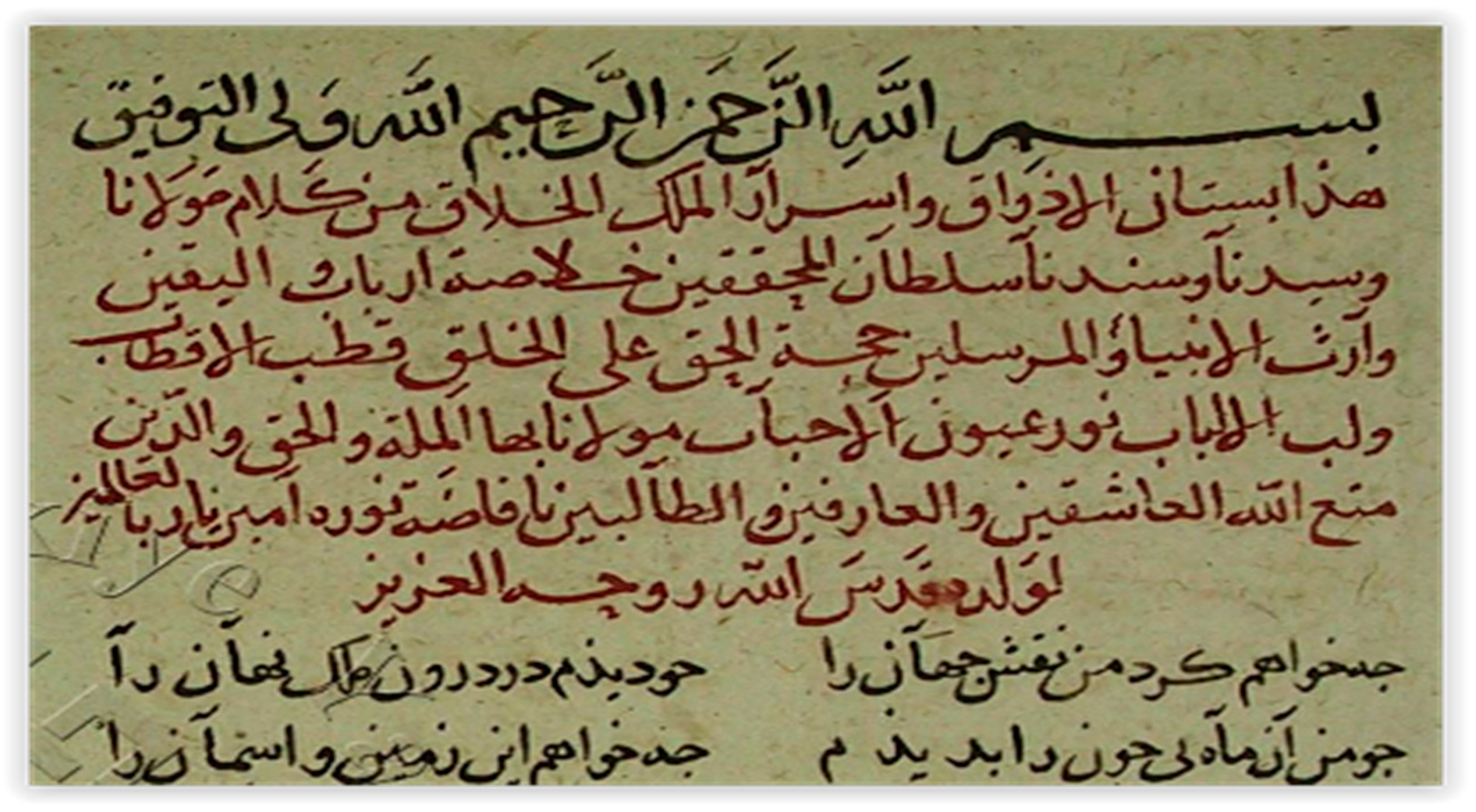
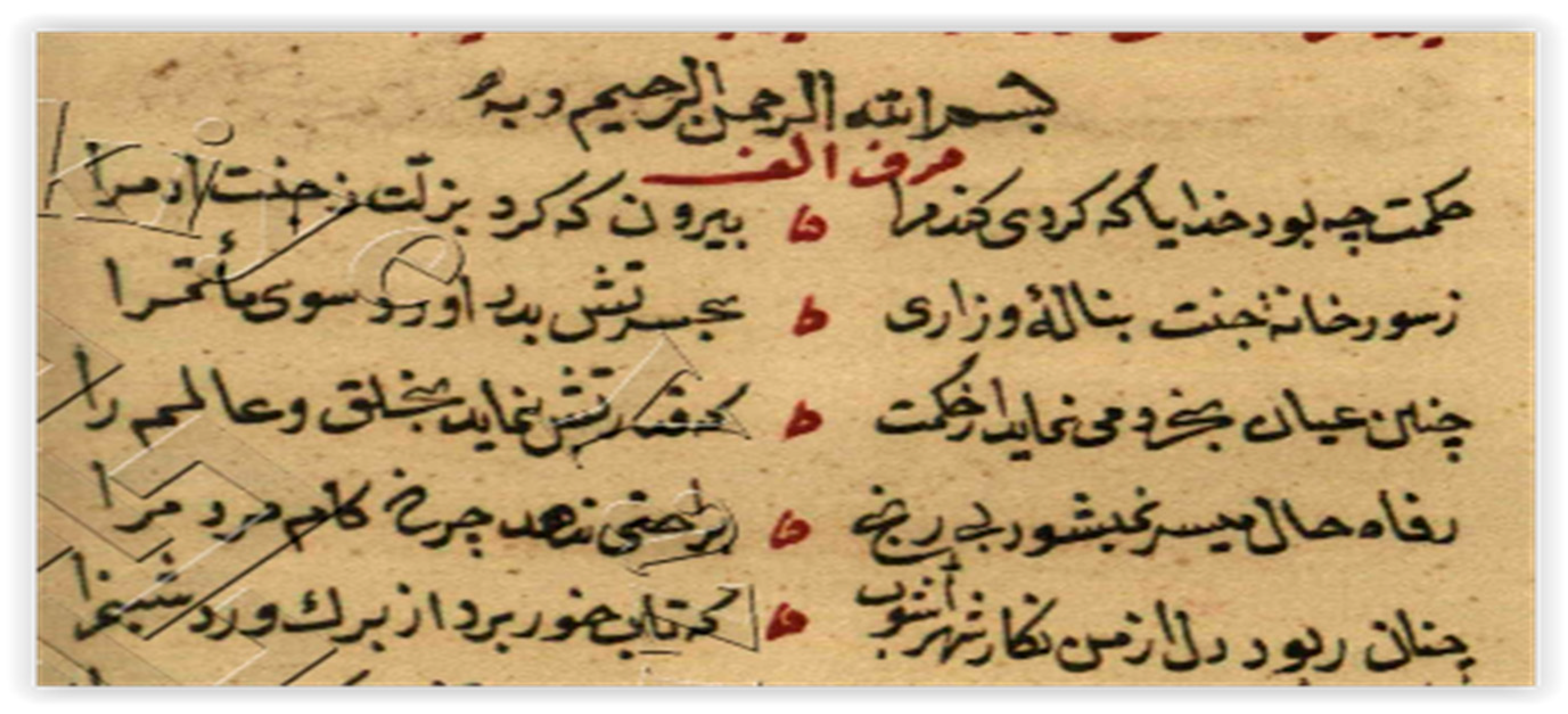
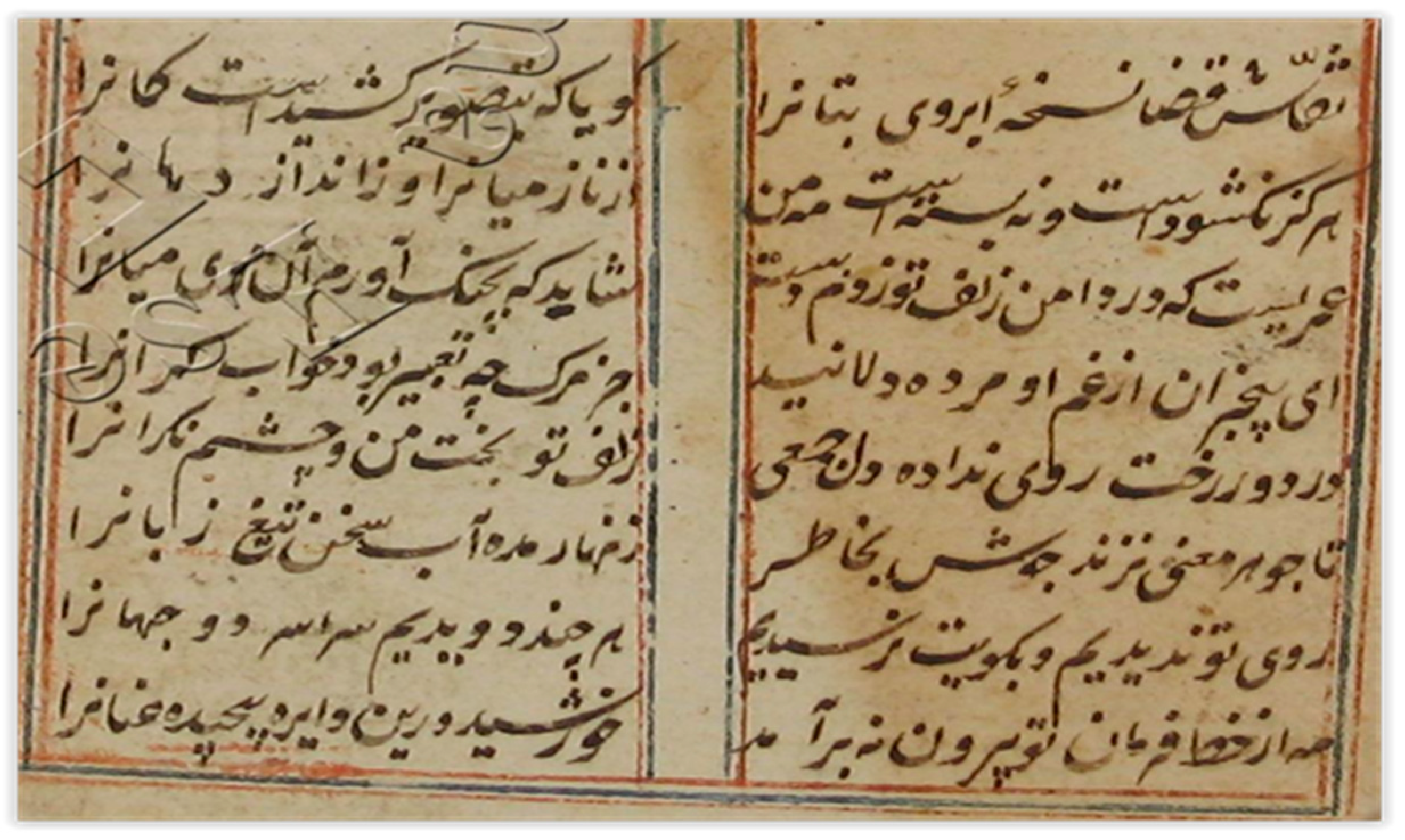
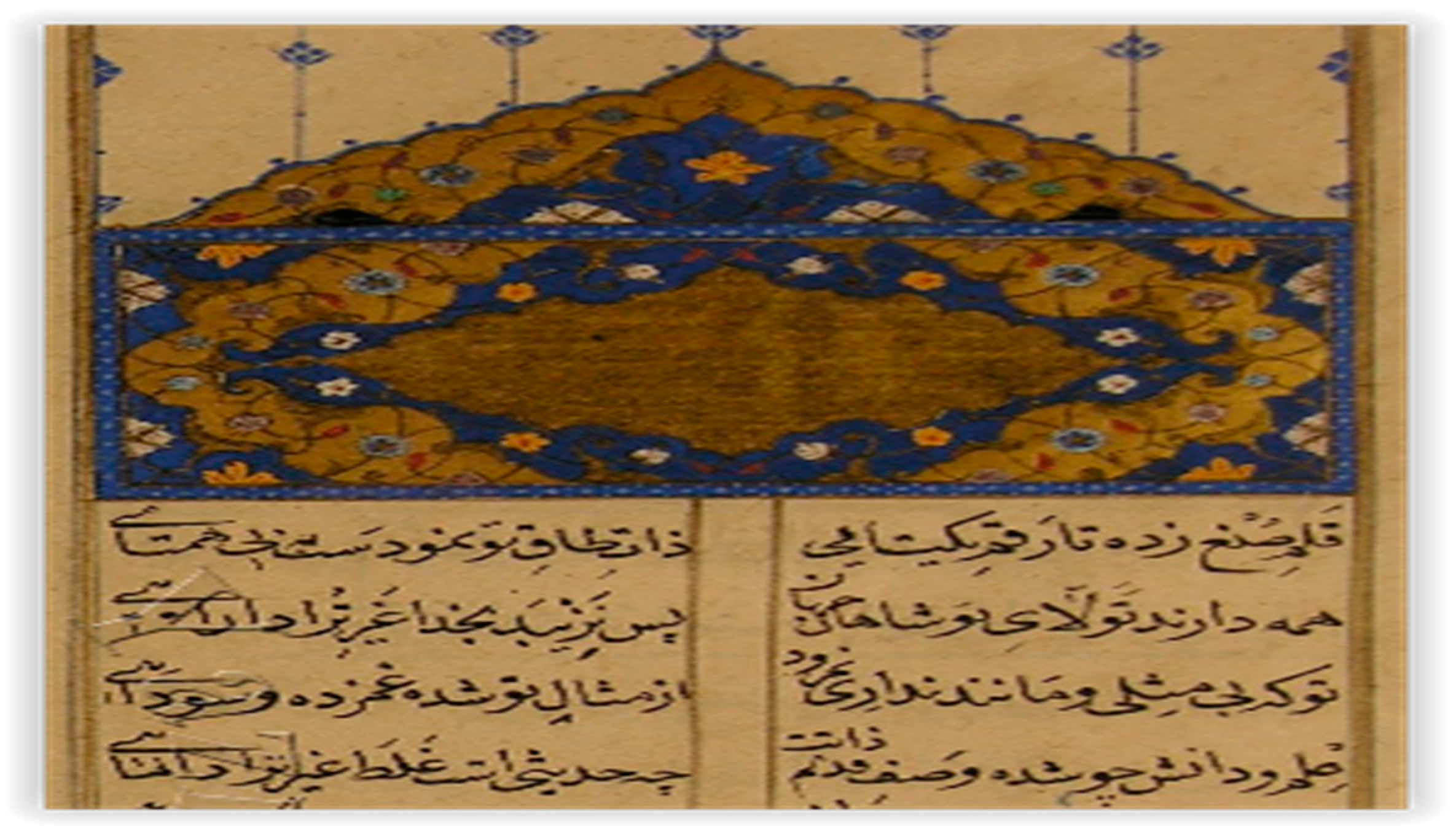
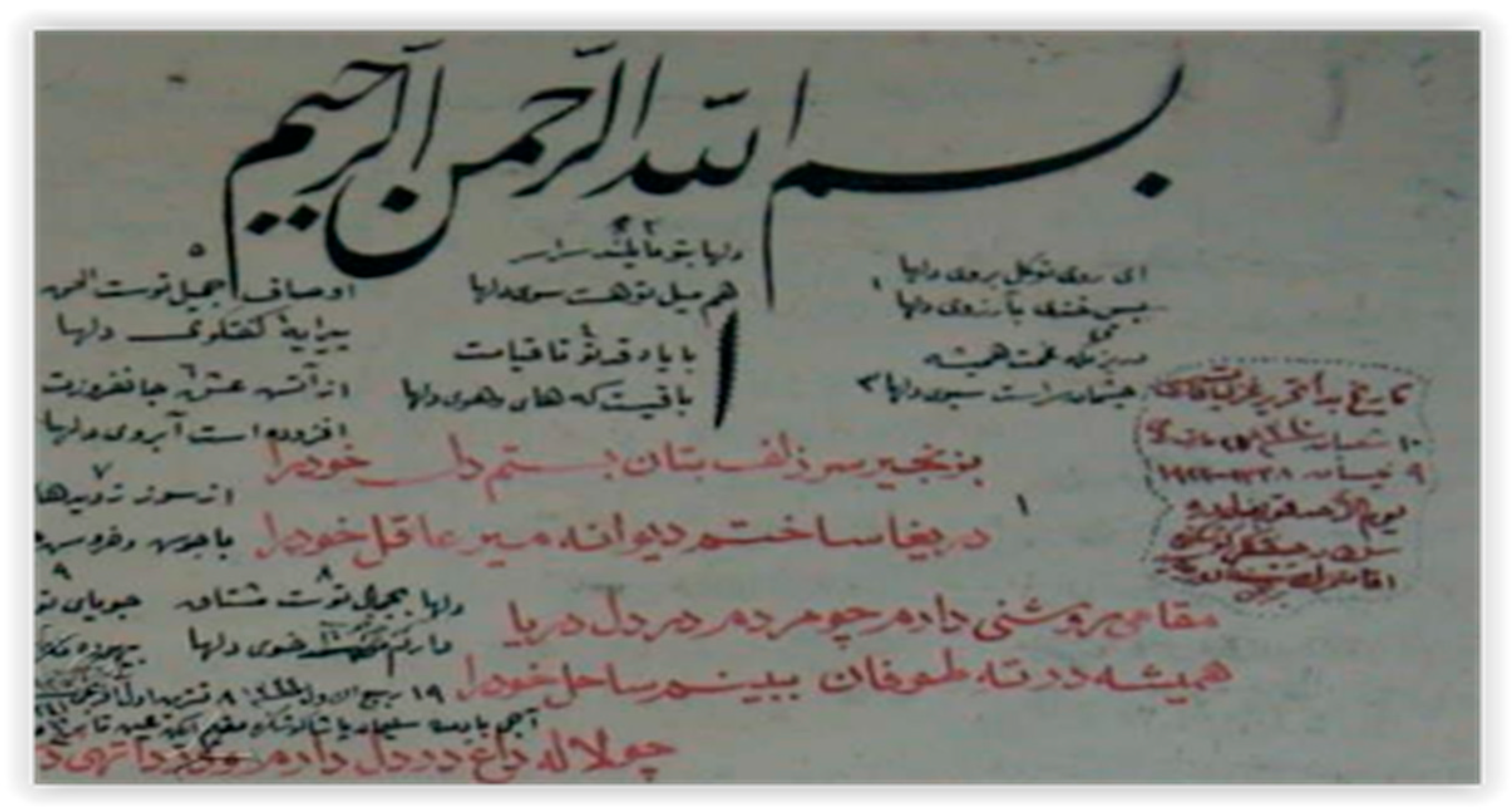
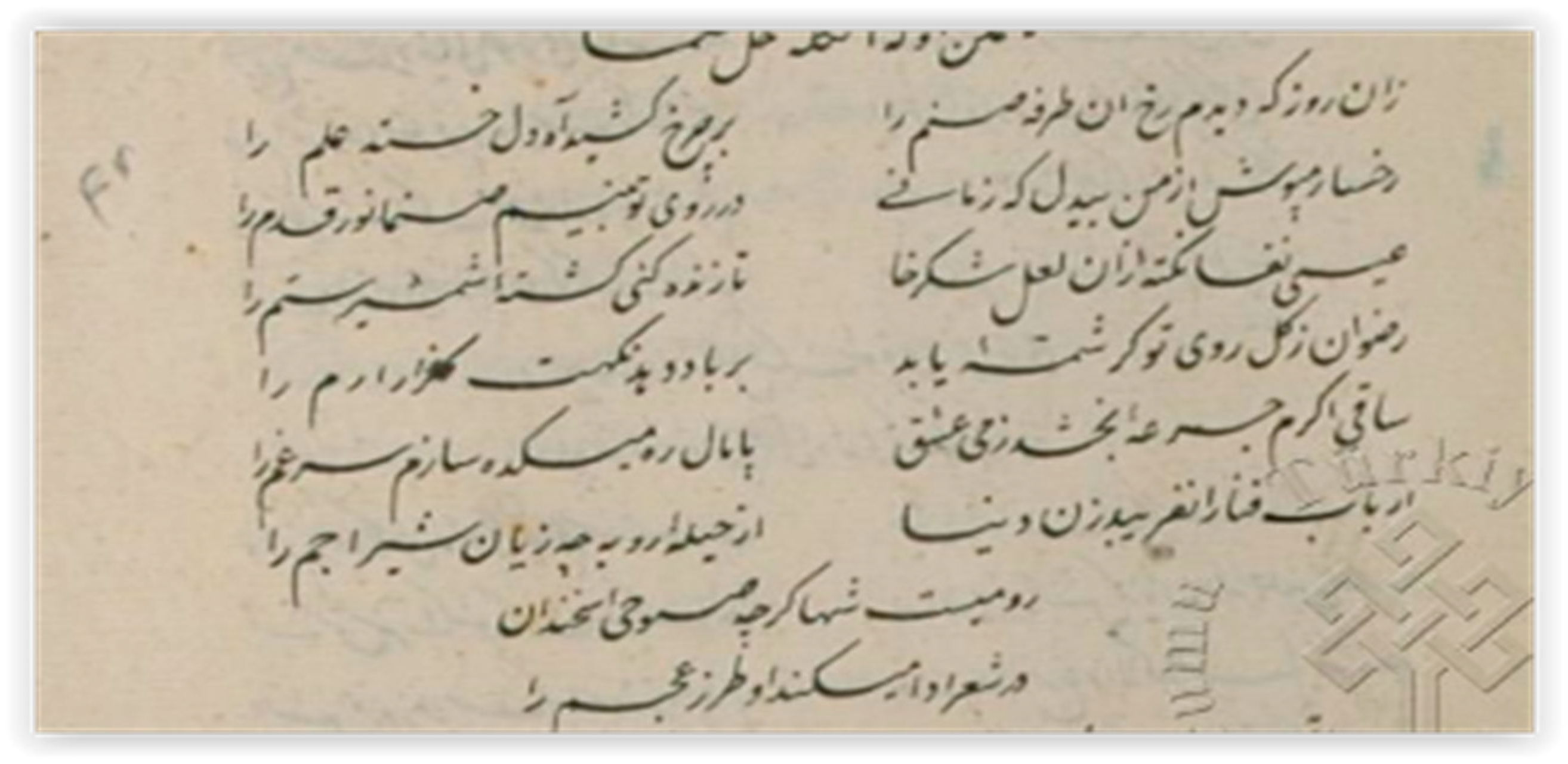
Dīvān-i Kabīr is held in the Ayasofya collection of the Süleymaniye Manuscript Library (no. 1653) (
Figure 1).
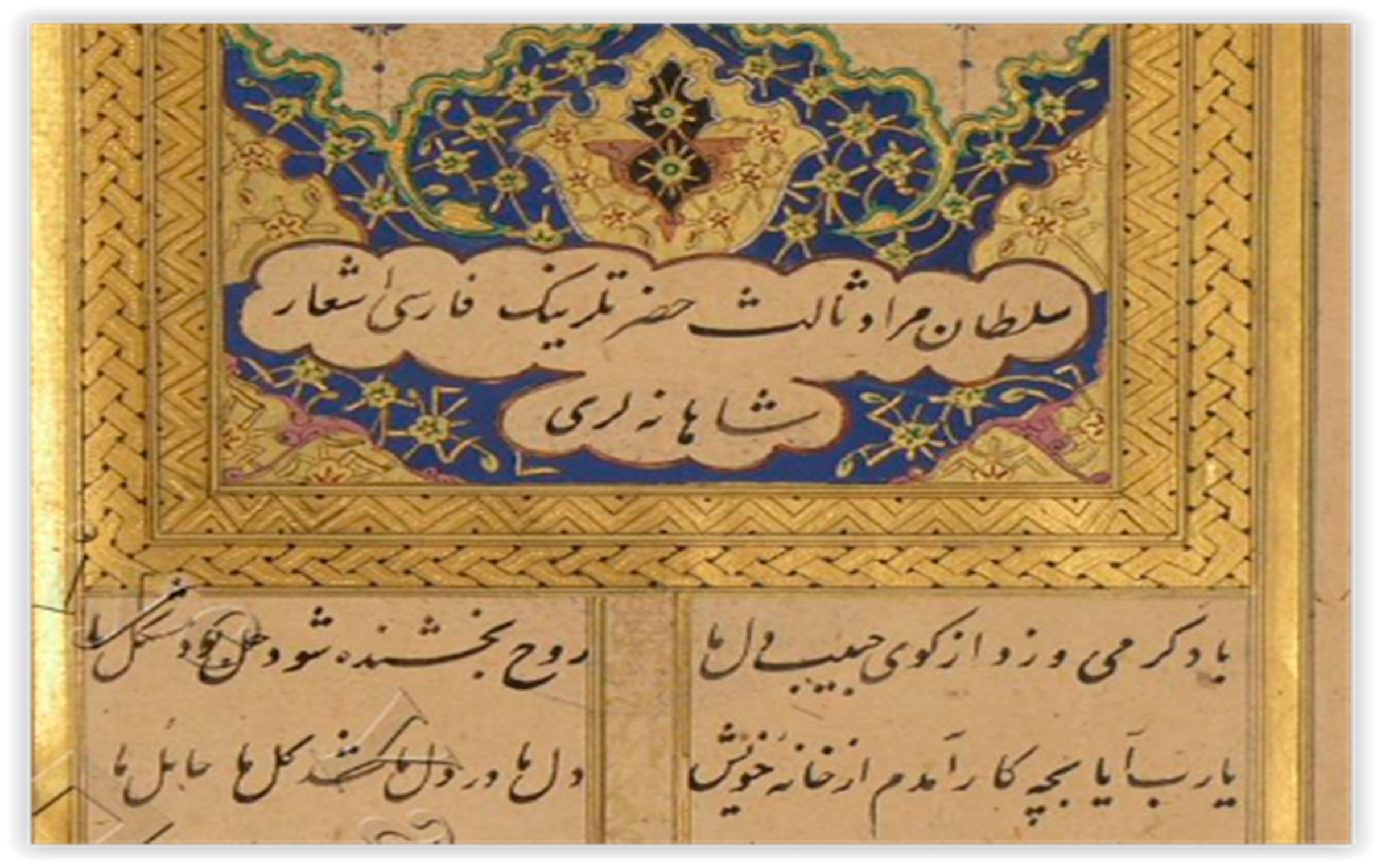
2. Dīvān-i Cem: Authored by Prince Cem Sultan, the third son of Sultan Mehmed the Conqueror, this
divan comprises 262
ghazals, 91
qiṭʿas, 3
qaṣīdas, and 6
mufrads. The poems address themes such as love, the feeling of defeat, loss of sovereignty, homesickness, anger at misfortune, justice, captivity, despair, and separation. The
divan contains 2415
bayts and bears the influence of Ḥāfiẓ of Shiraz, Khāqānī of Shirvān, Sanāʾī of Ghazna, Saʿdī of Shiraz, Khusraw of Delhi, Salman of Sāva, and Niẓāmī of Ganja. Most
ghazals revolve around earthly love (
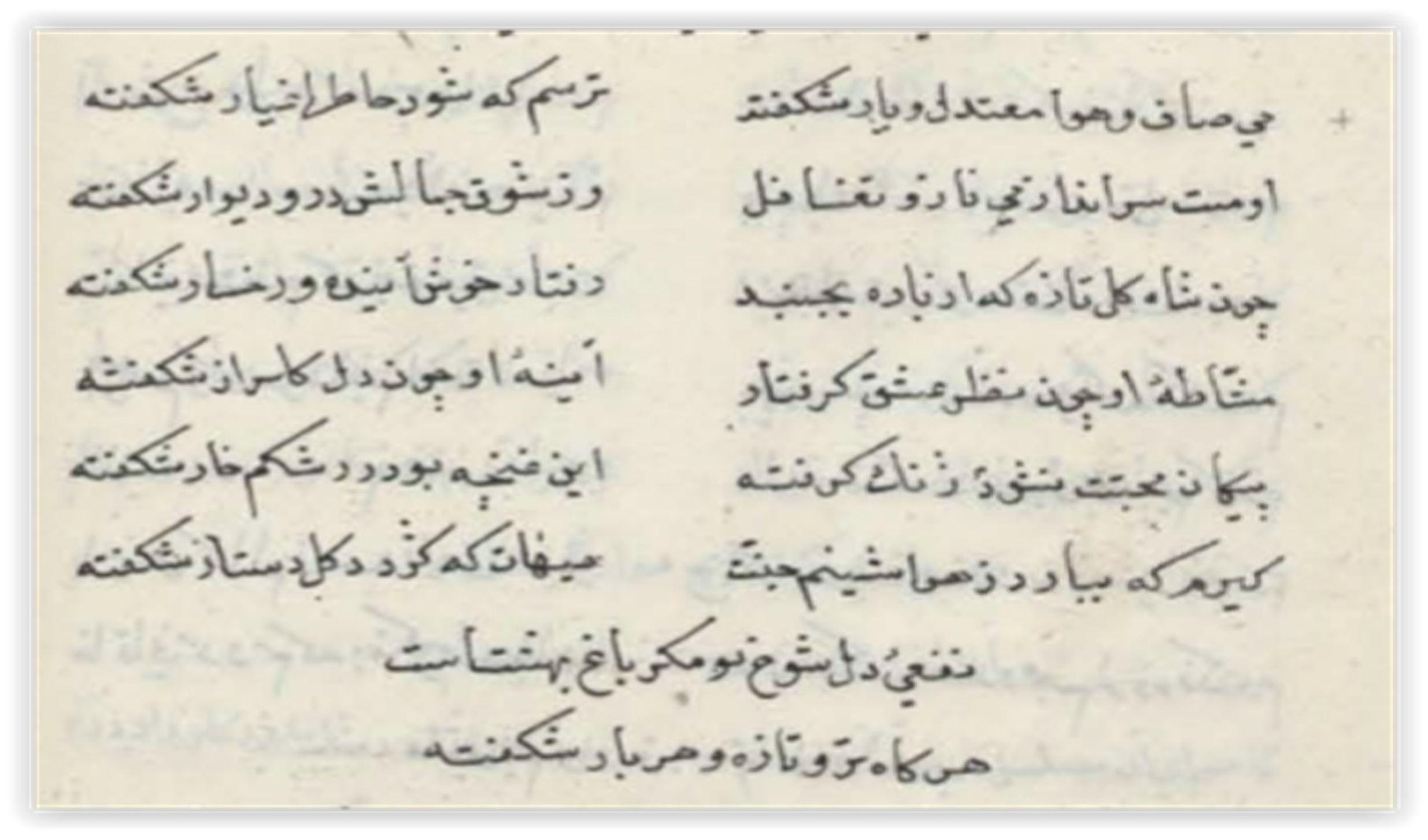
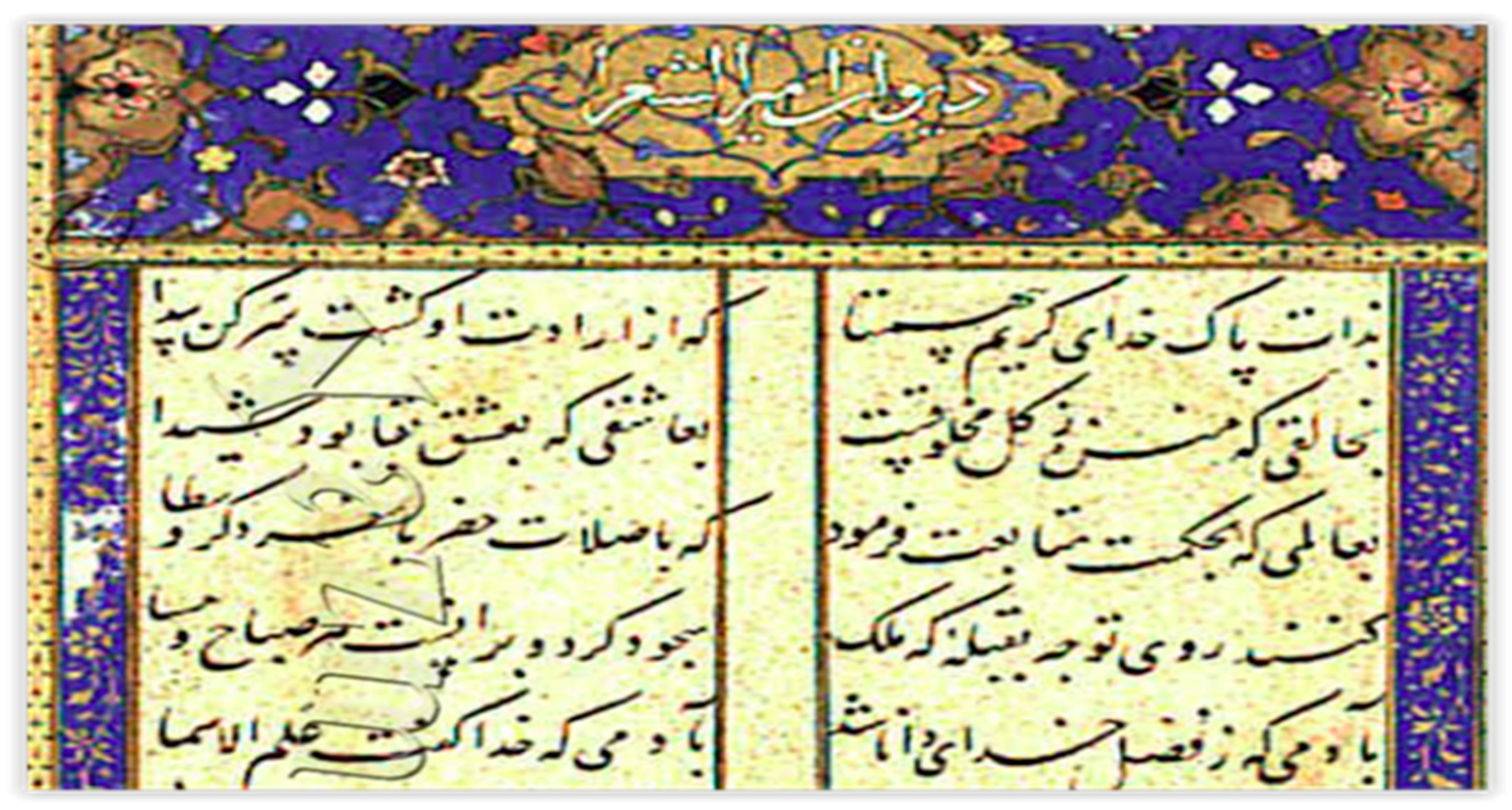
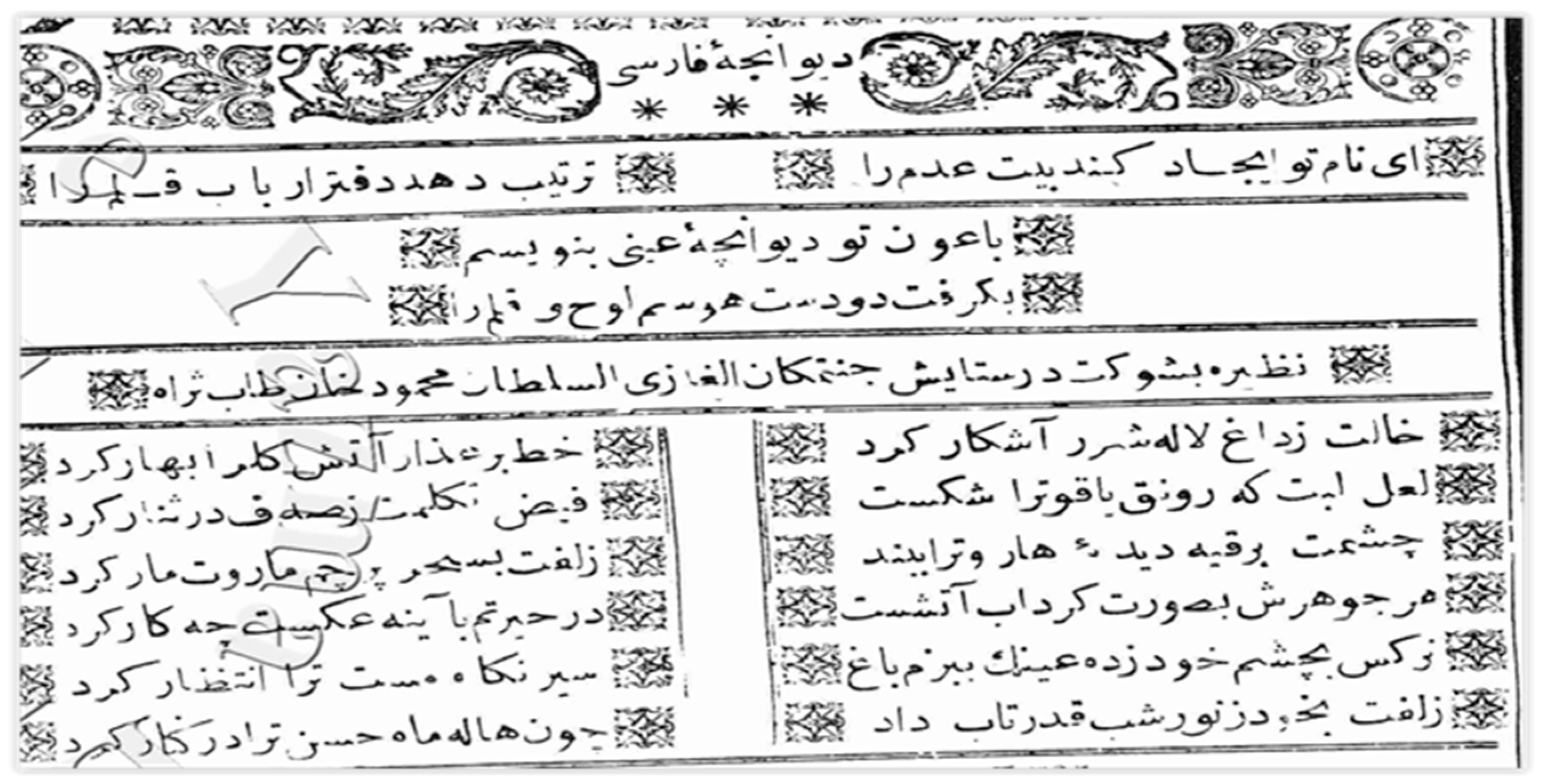
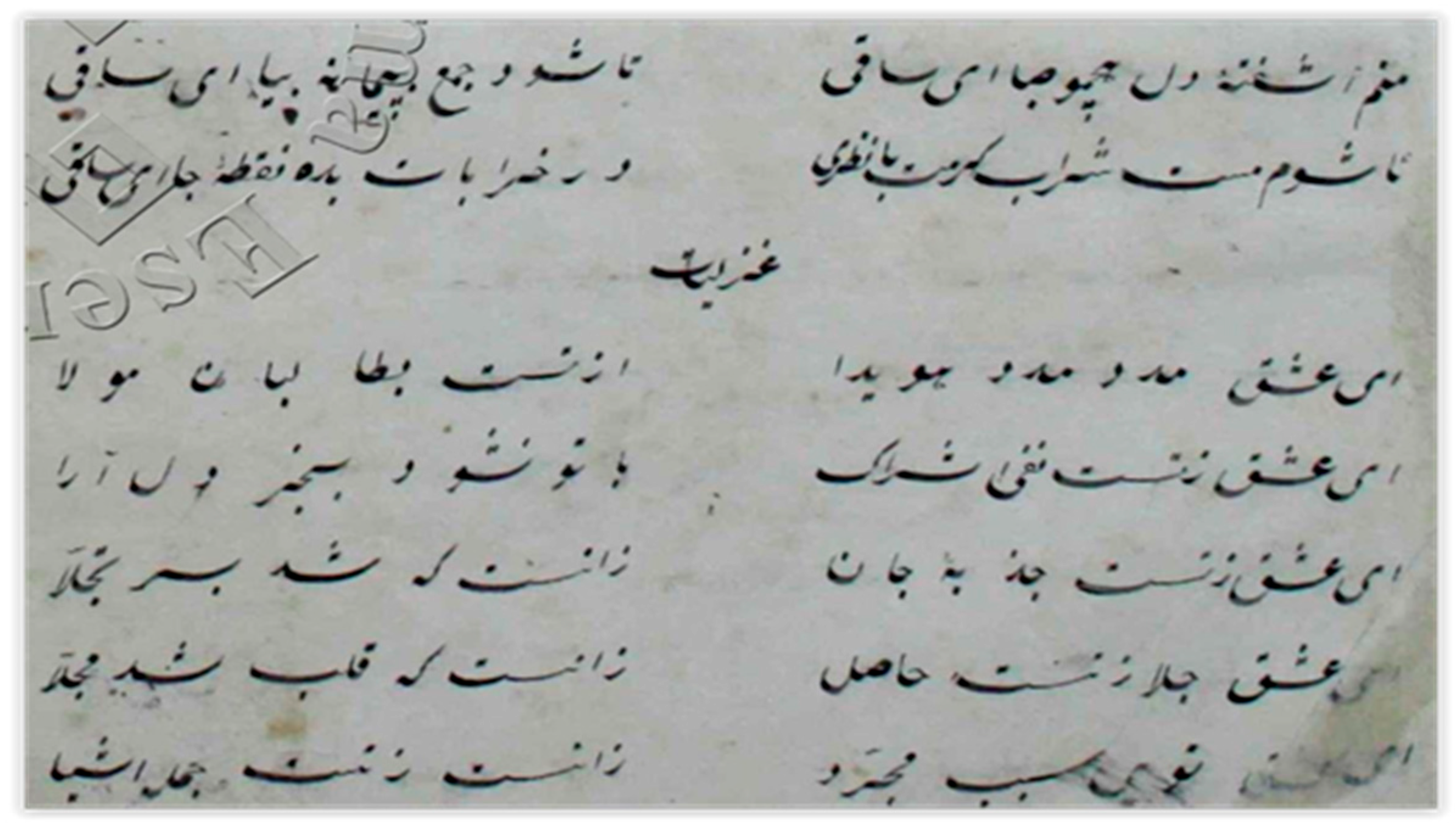
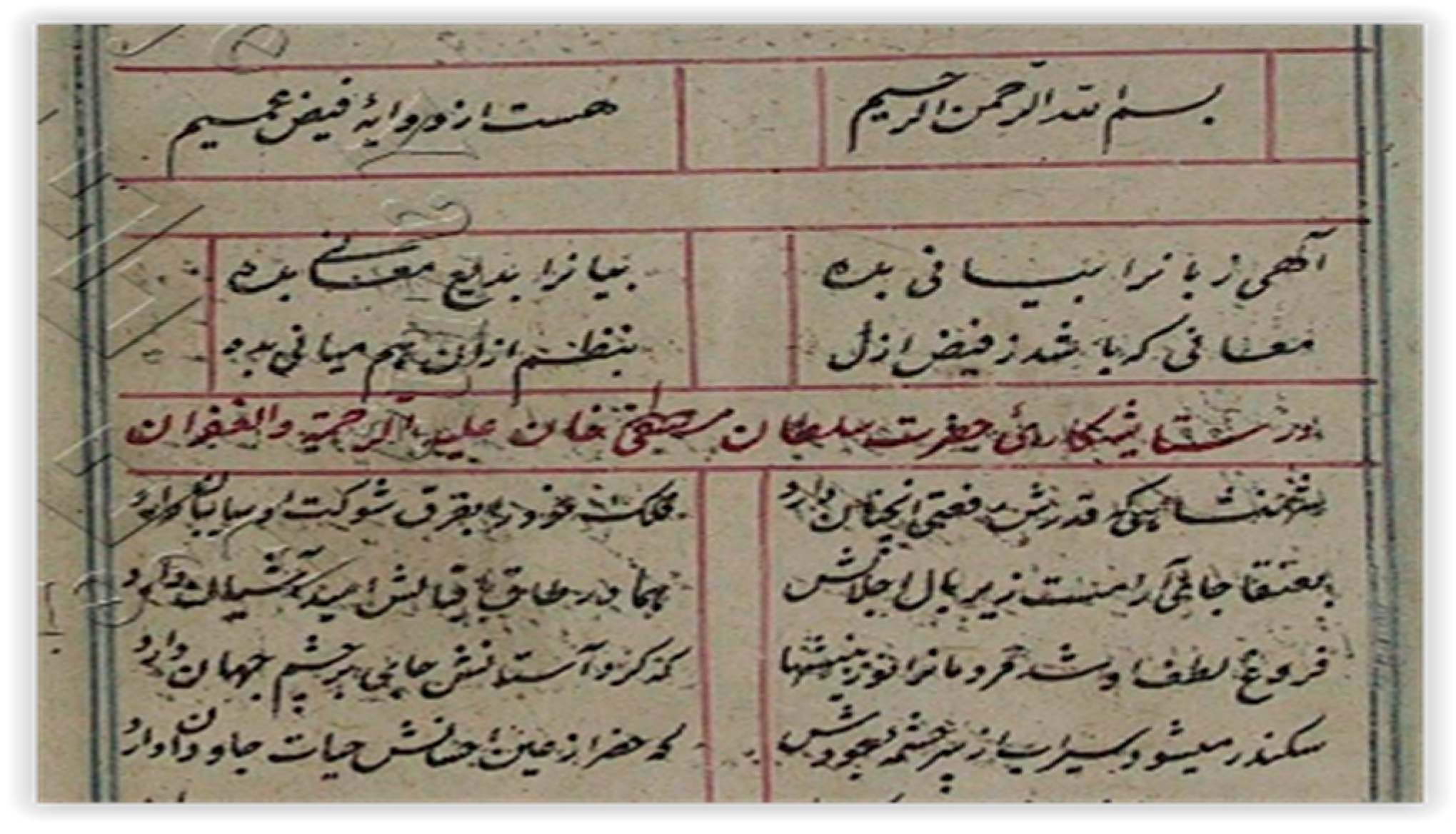
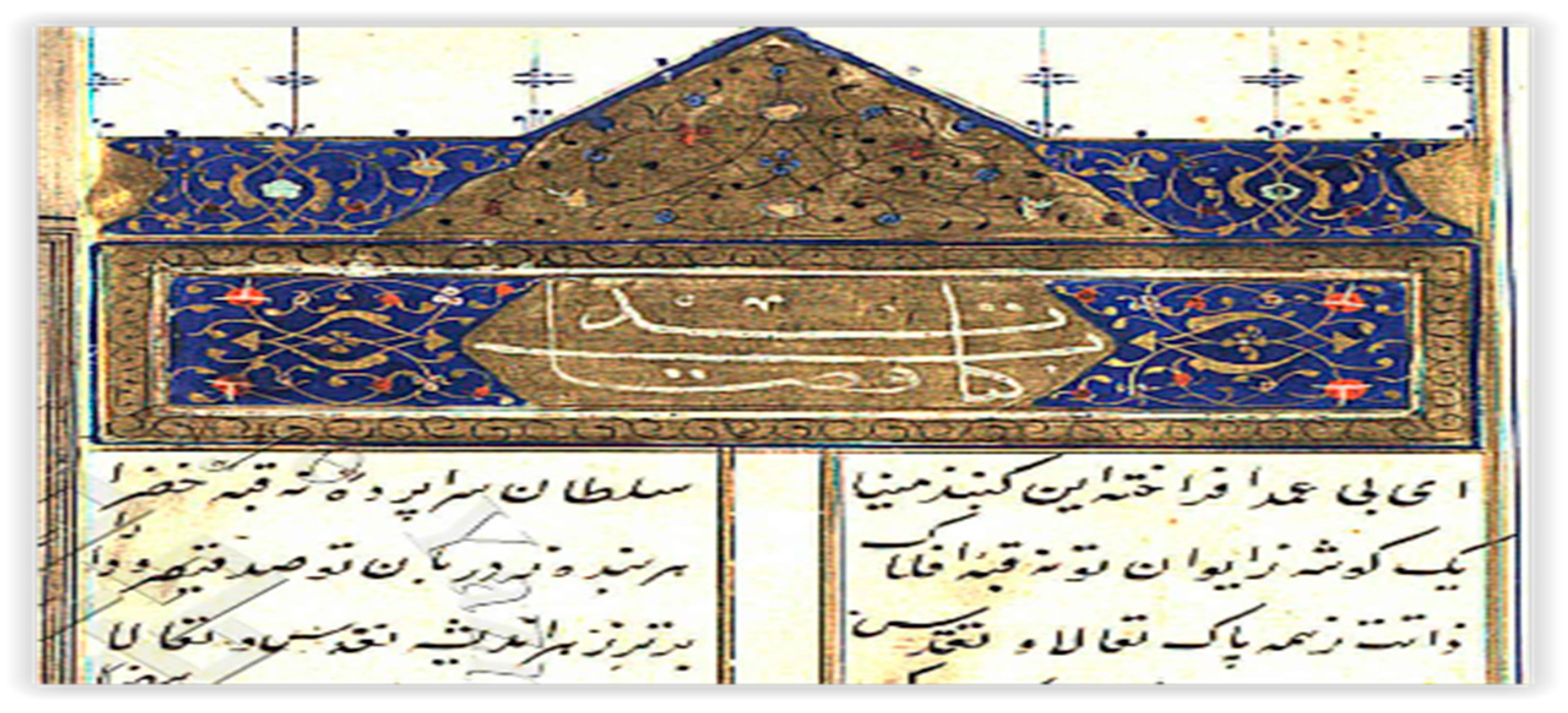
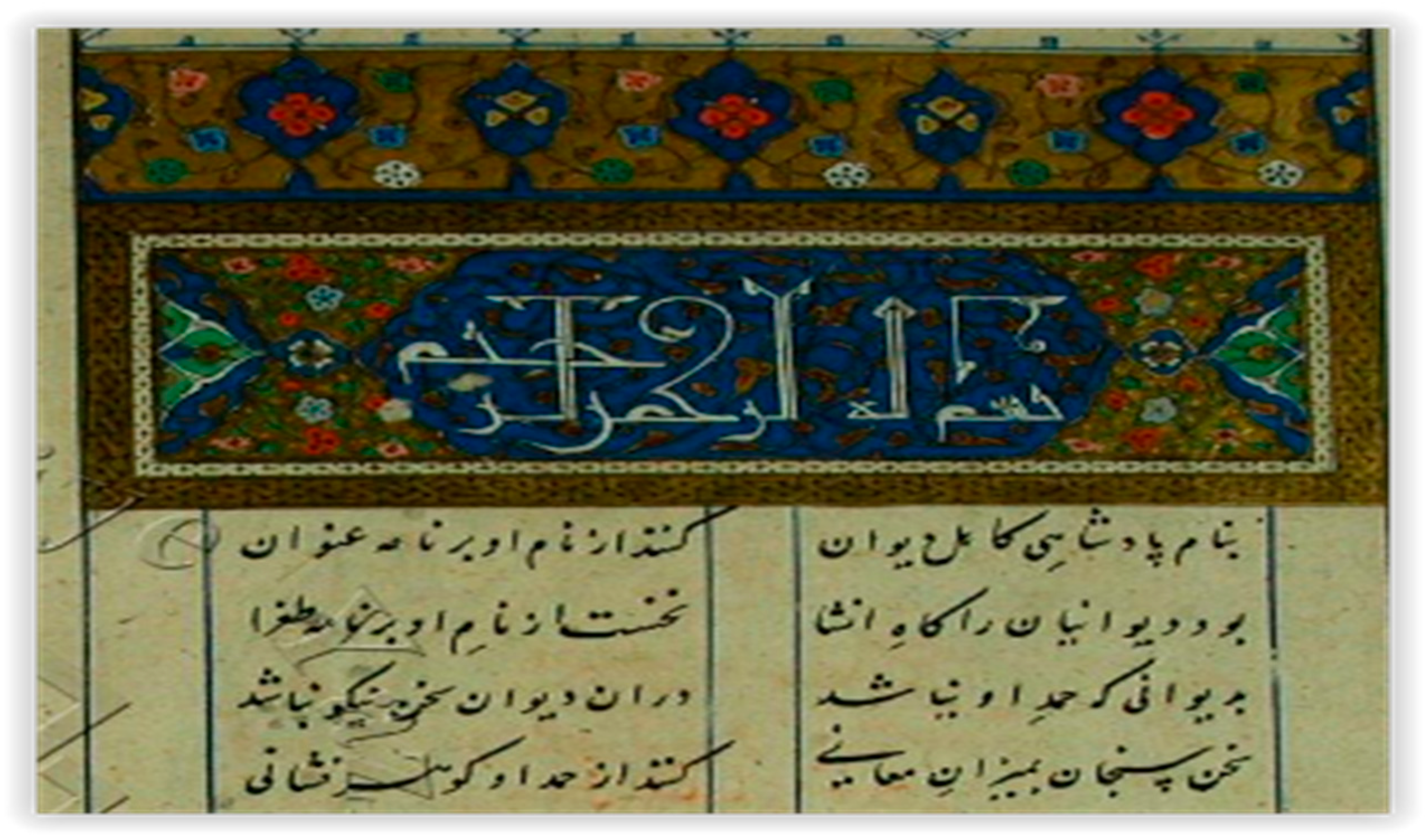
Tokmak 1380, pp. 1–99). The work has a total of four manuscript copies, which are preserved in the following libraries: Bursa Orhan-Haraccı (no. E. 6), Topkapı Palace Museum (Revan, no. 739), Süleymaniye (Fatih, no. 3794) (
Figure 2), and Istanbul Millet (Ali Emiri, no. 328) (
Kut 1993, pp. 284–86).
3. Dīvān-i Shādī: This
divan, by Süleyman Shādī, consists entirely of
ghazals. It includes 28
ghazals, each five
bayts long, amounting to a total of 140
bayts. The opening poem praises God, while the one at the center of the collection extols the Prophet Muḥammad. Themes include love, the beloved, wine, nature, the lover, God, and the Prophet. The
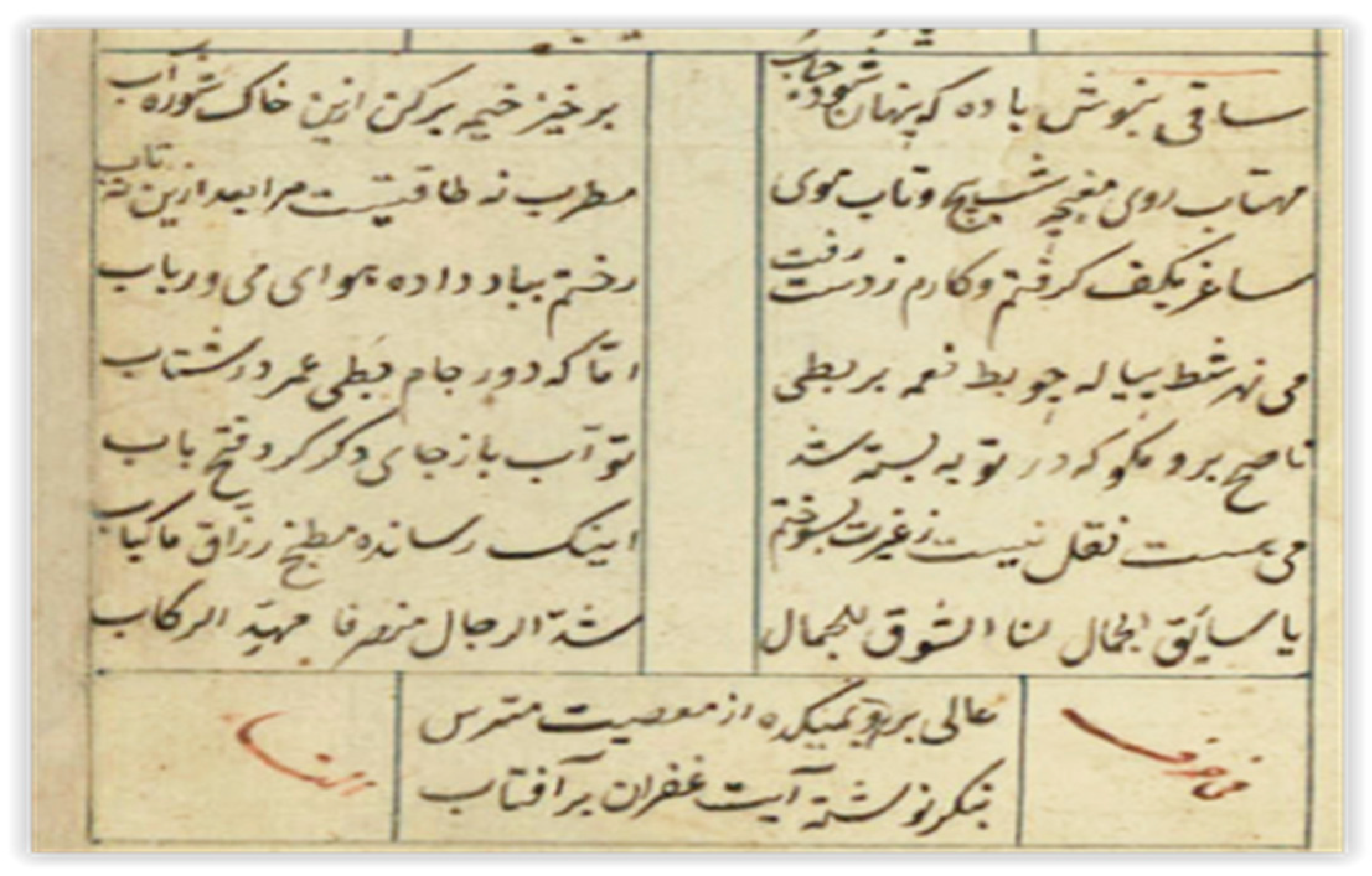
ghazals are composed in a plain and straightforward style (no. 2932, fol. 10b):
| صبا بر کوی جانانم گذاری * بکن اگه ز جانم غمگساری |
| به پایش سر بنه از من ثناگو * بگو لیکن مگو گستاخ واری |
O morning breeze! If your path happens to pass through the quarter of my beloved, inform her of my sorrowful state.
On my behalf, bow at her feet and offer my praises; yet, while conveying these words, be careful never to adopt a disrespectful manner.
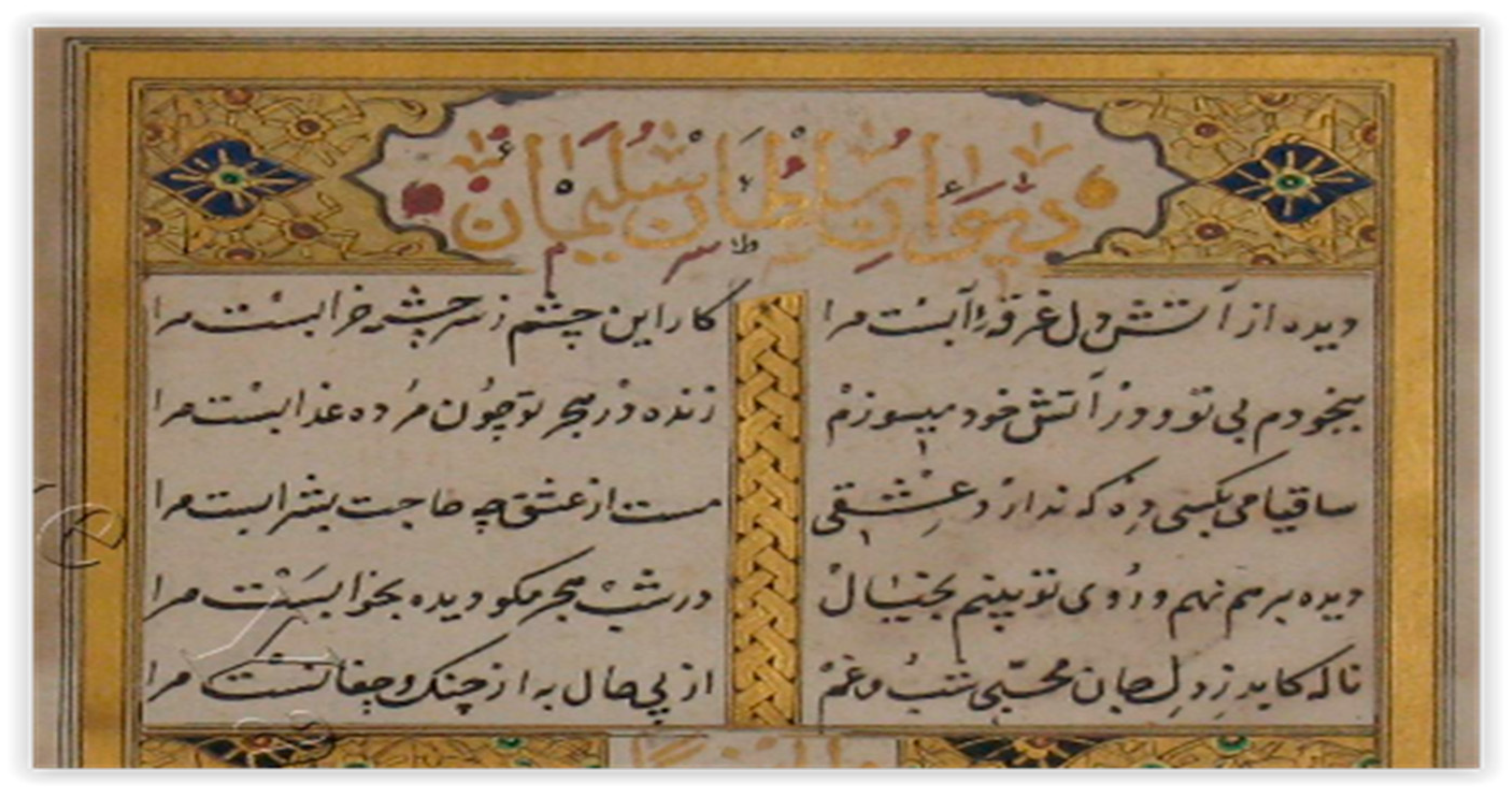
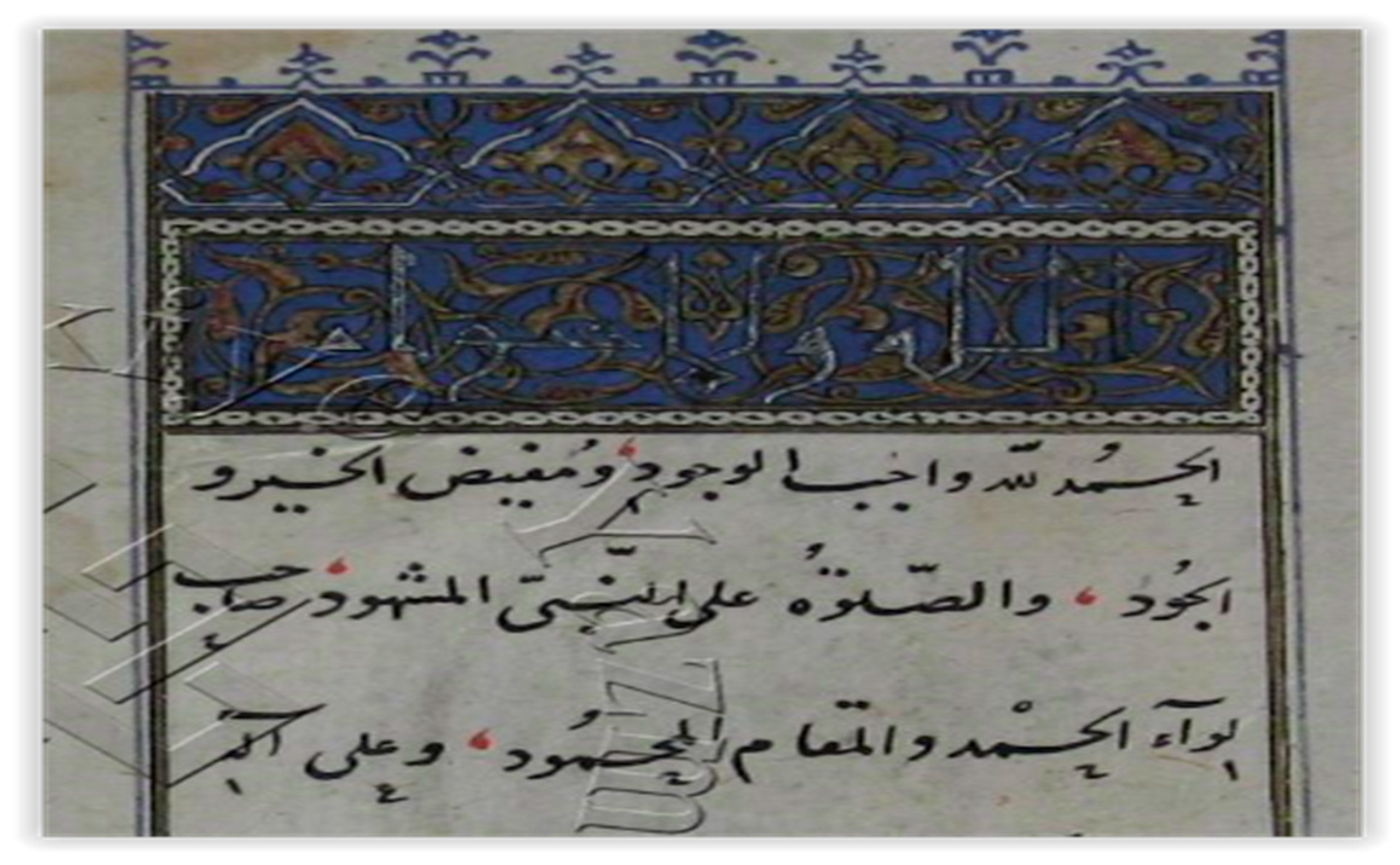
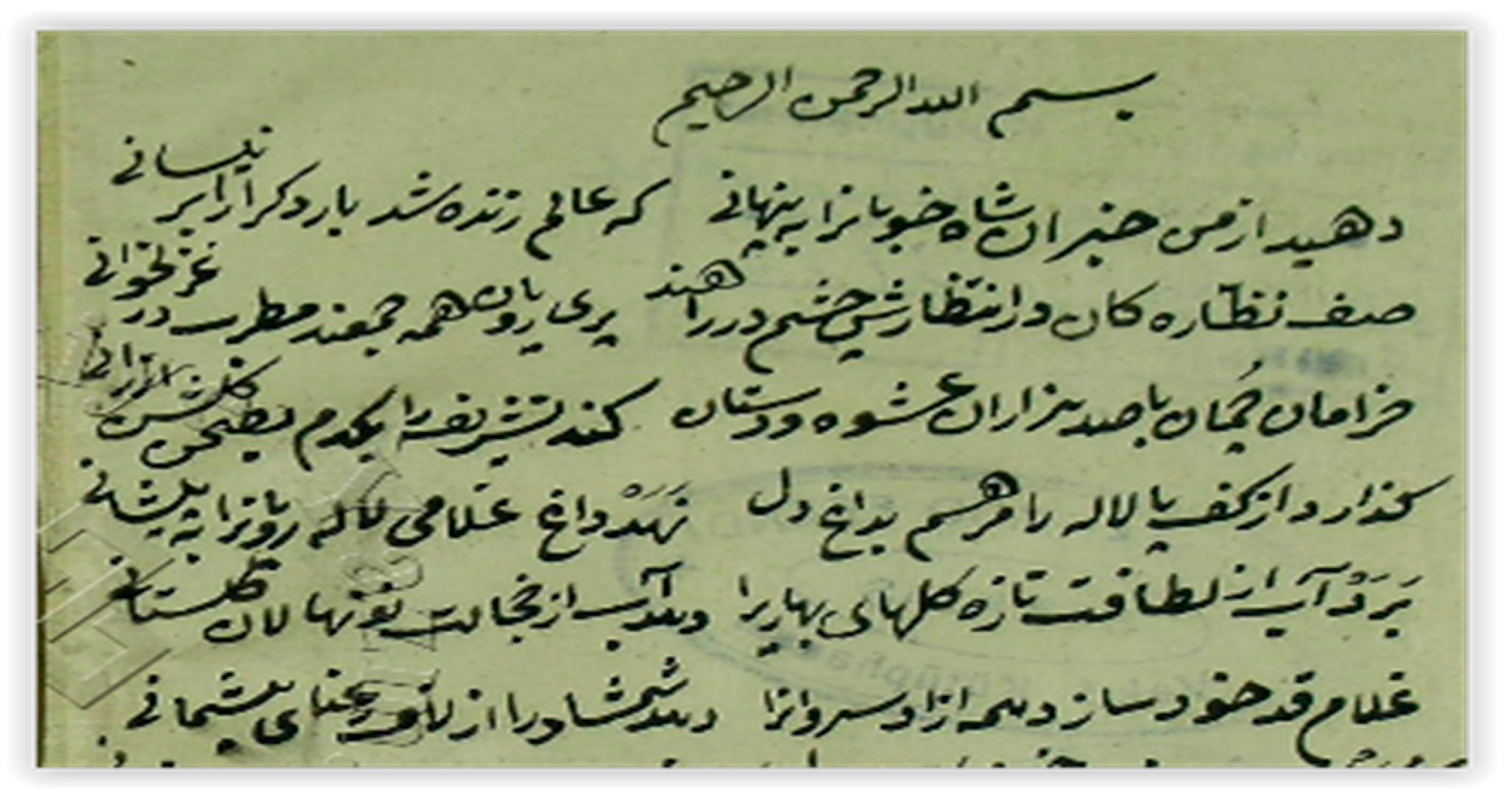
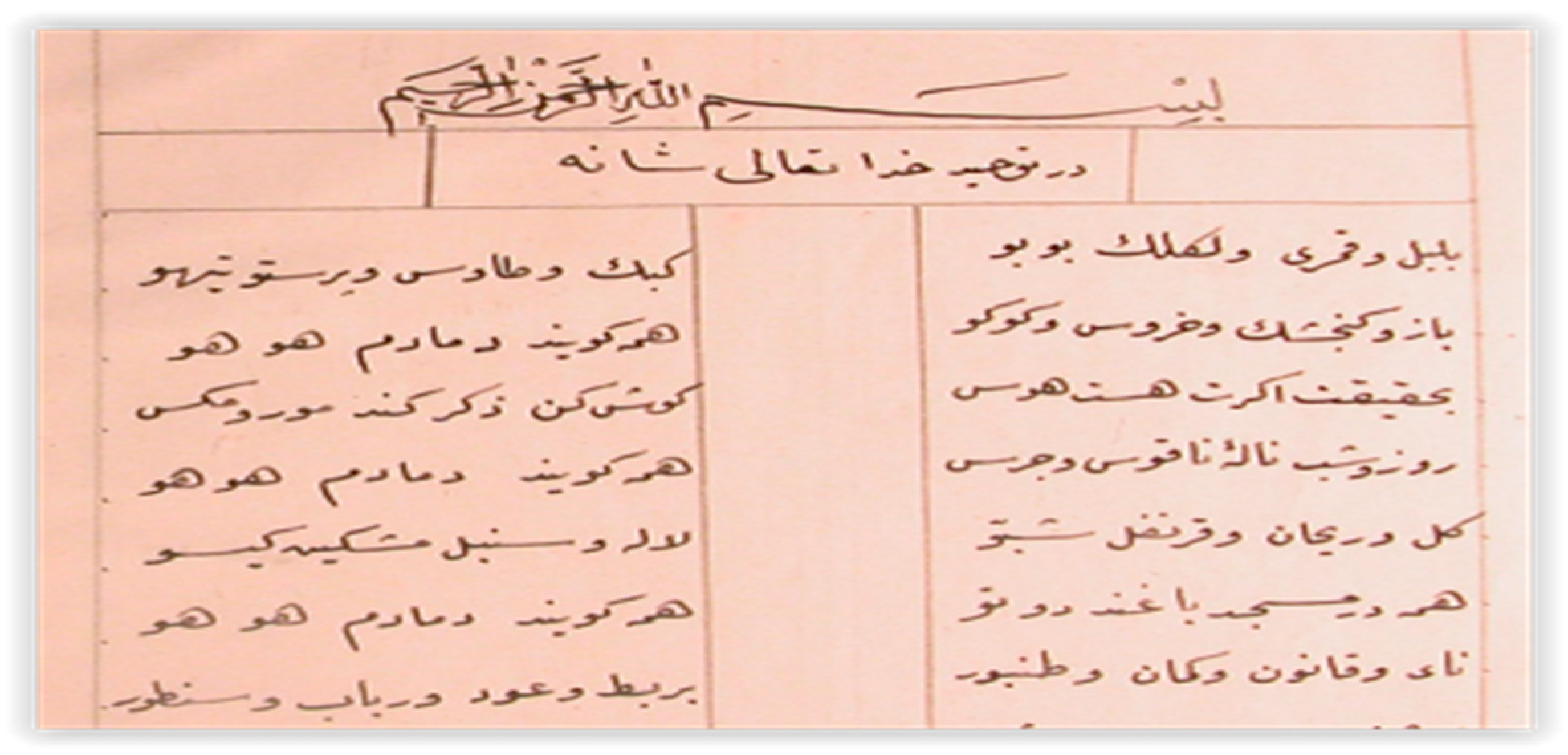
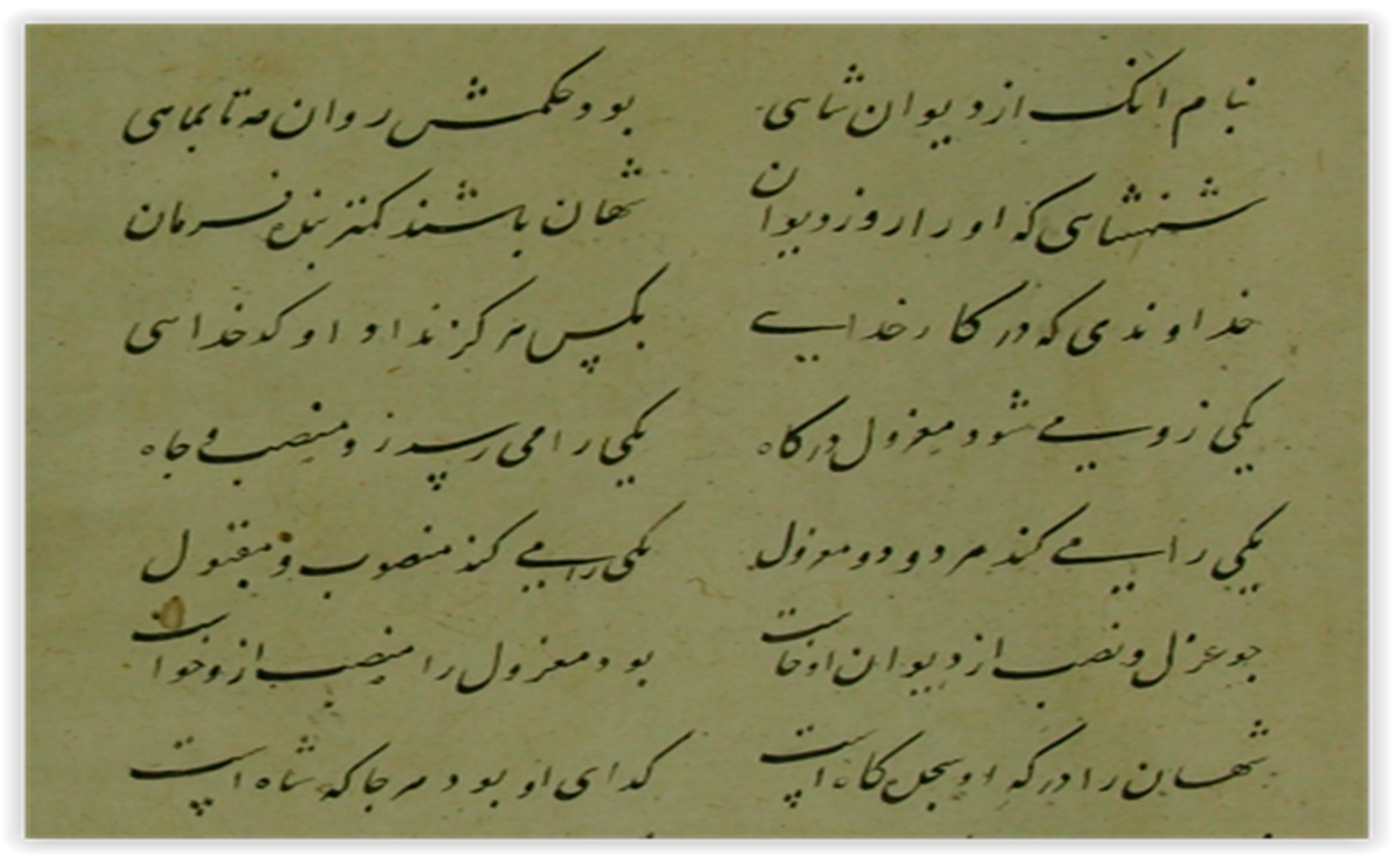
The only known manuscript is held in the Süleymaniye Library, Yazma Bağışlar Collection (no. 2932) (
Figure 3), copied in 1270/1853 (
Kaska 2022, pp. 10–12). In the work, the
ghazals are written according to the twenty-eight letters of the Persian alphabet.
4. Dīvān-i Najmī: Attributed to Ömer Najmī Efendi, this
divan contains 54
ghazals (each ranging from 5 to 15
bayts) and one
mustazād of 5
bayts. The central theme is divine love and Sufism, though military terms and musical elements are also significant. The
ghazals are arranged alphabetically by rhyme, 29 in the
ramal and 8 in the
hazaj baḥrs. Preachers and ascetics are satirized, and the poet signs with the
takhalluṣ “Najmī.” The work comprises 405
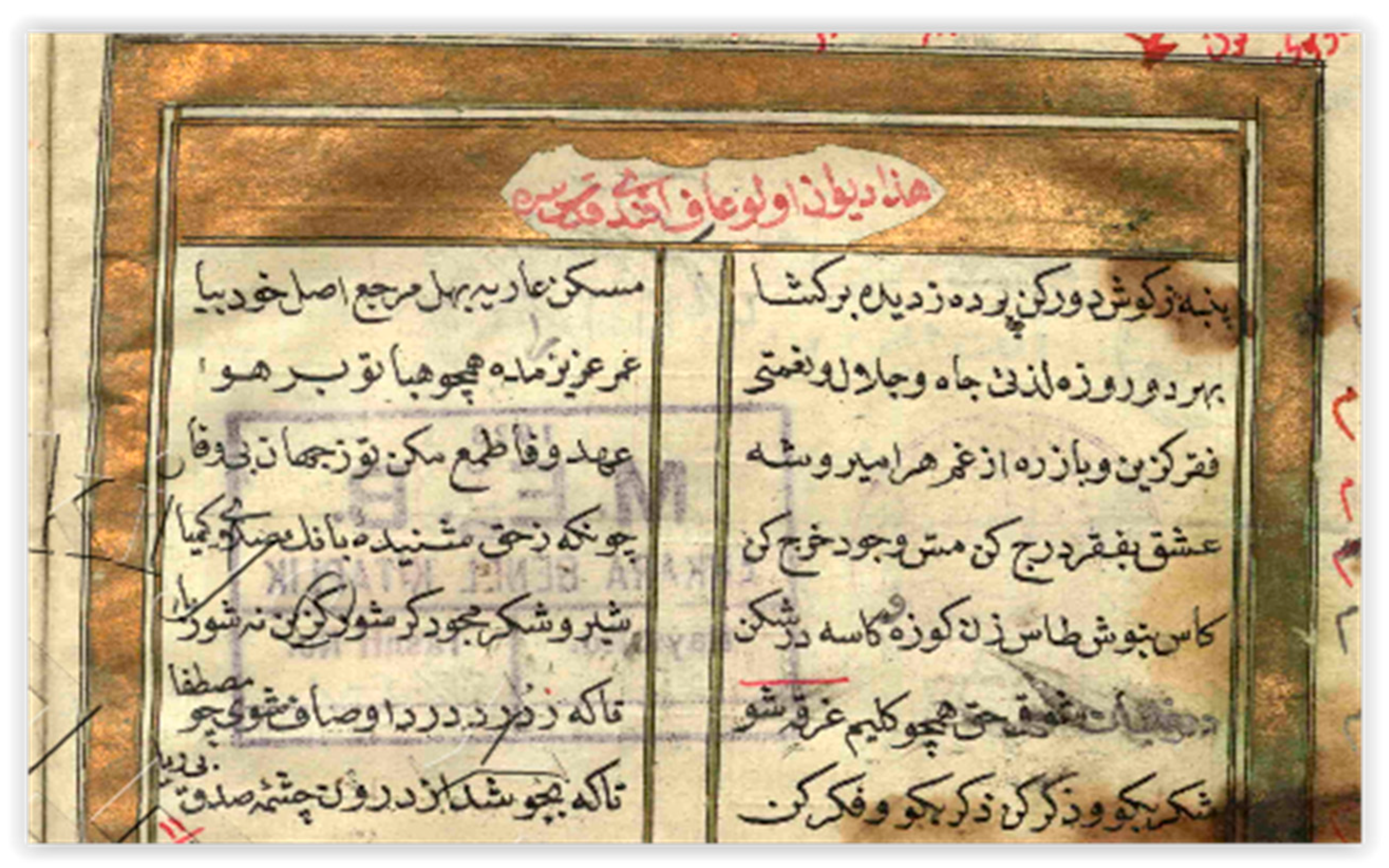
bayts and is written in a clear, simple style. The most frequently preferred ʿarūż meters in the work are the patterns of “failatun failatun failatun failun” and “mufailun mufailun mufailun mufailun”. There are no known manuscript copies of the work available in libraries (
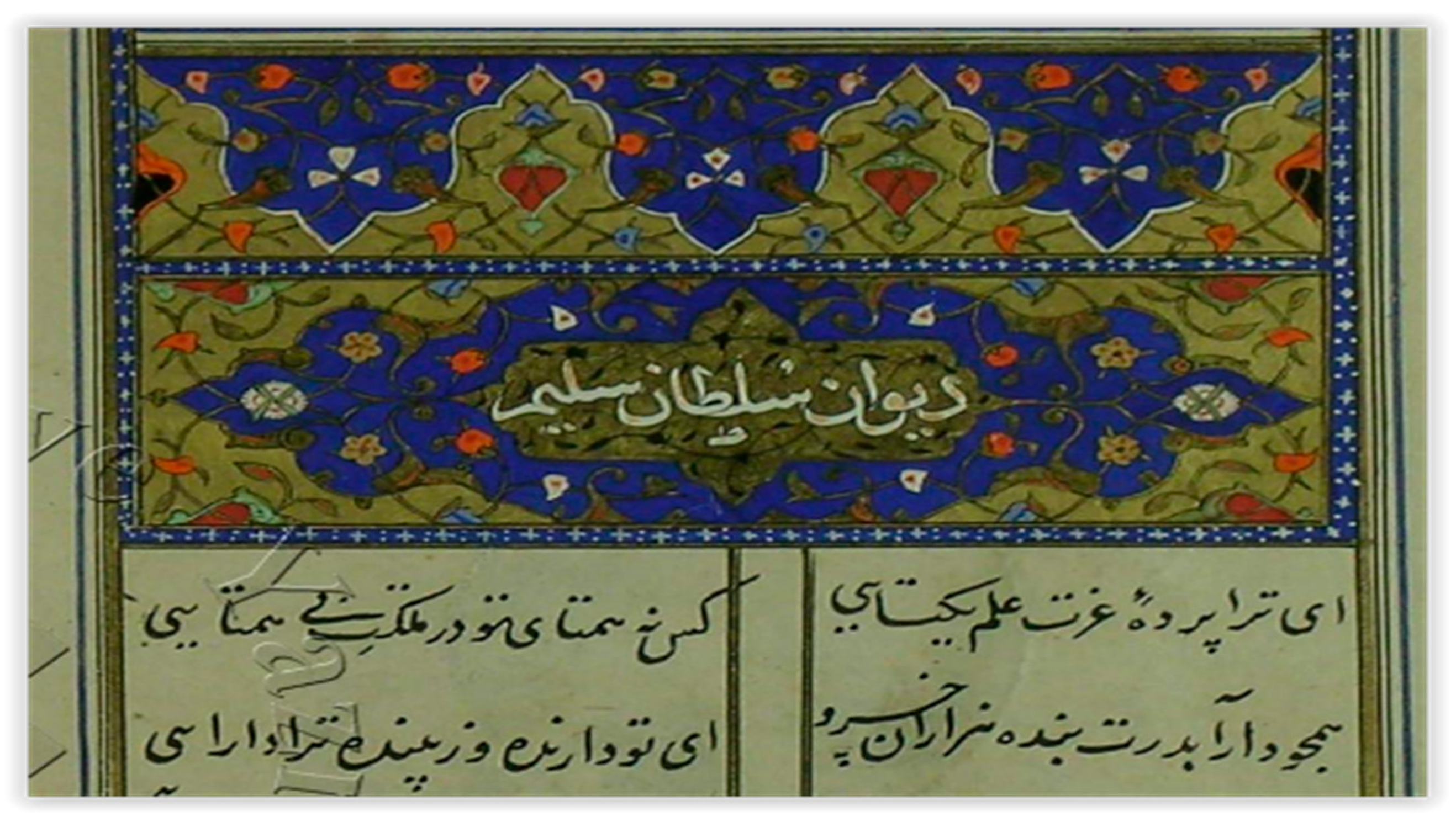
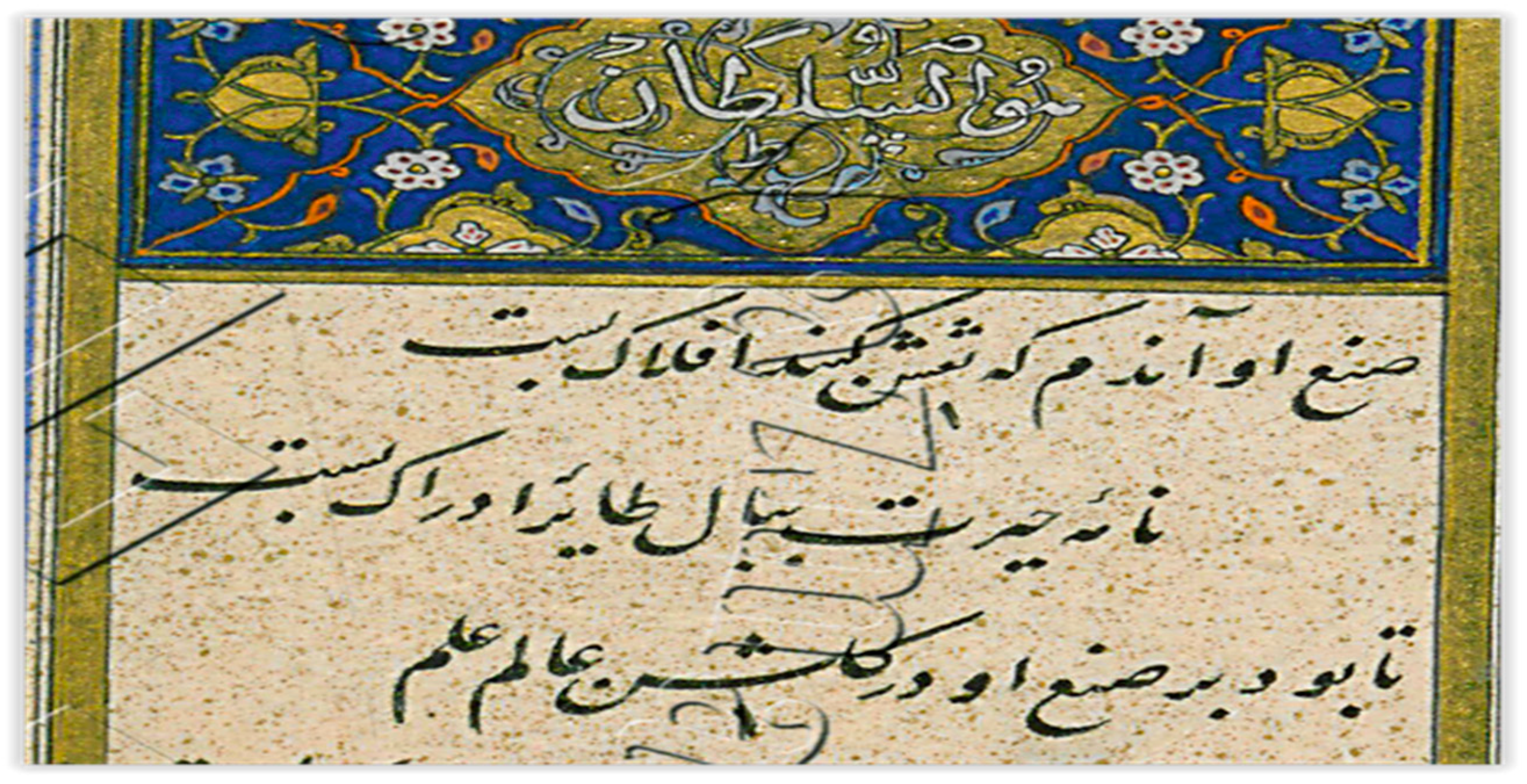
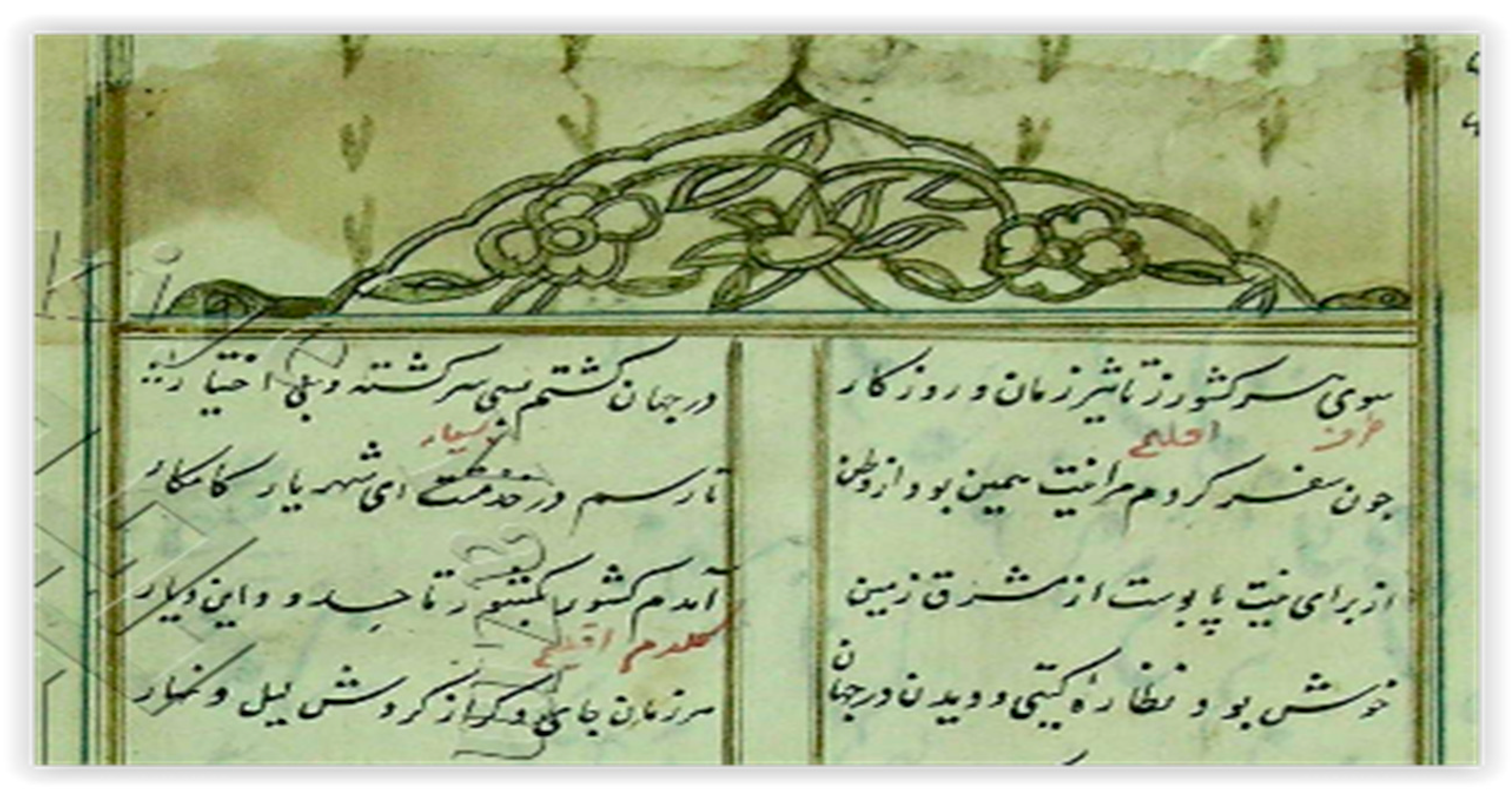
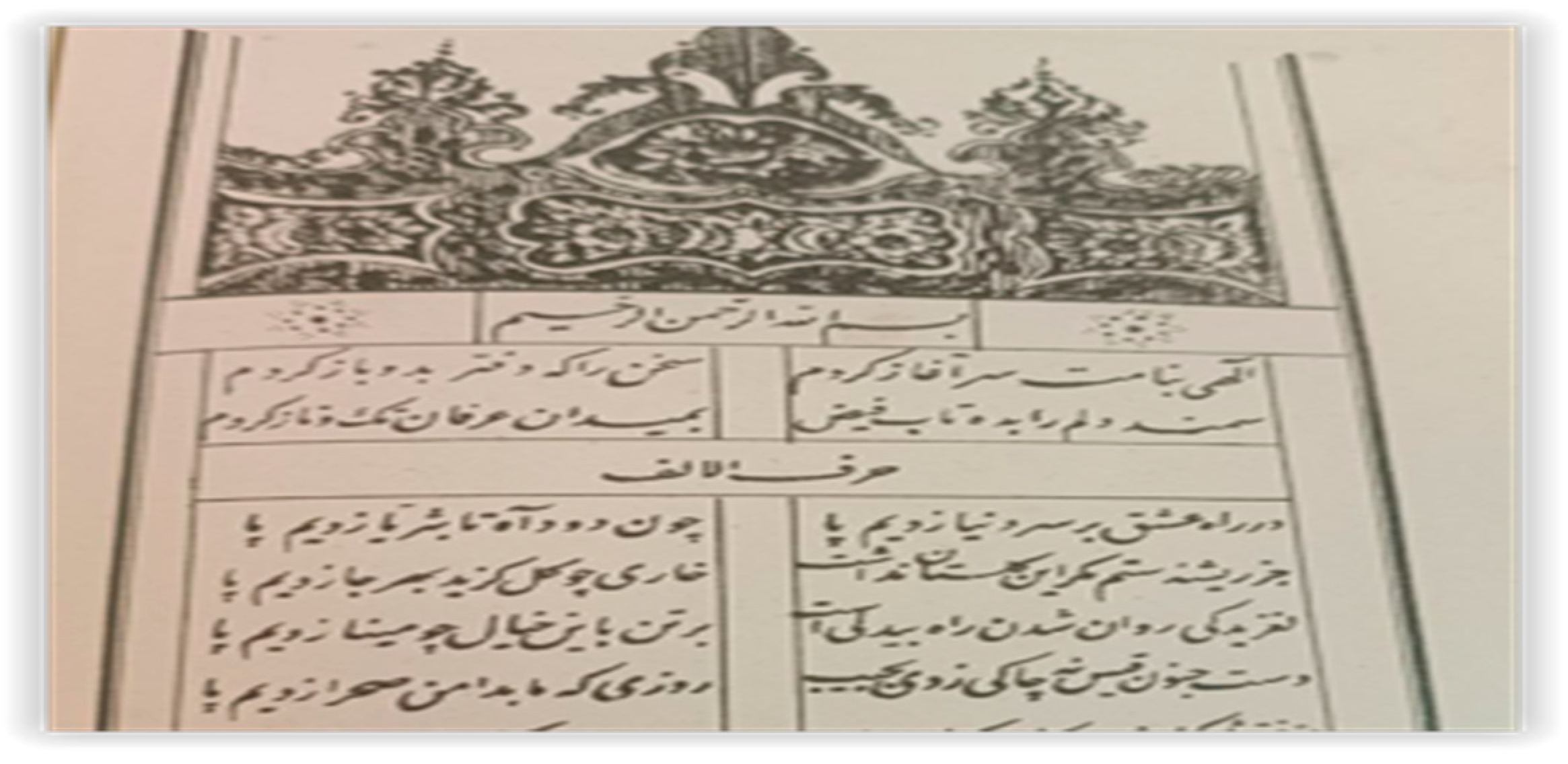
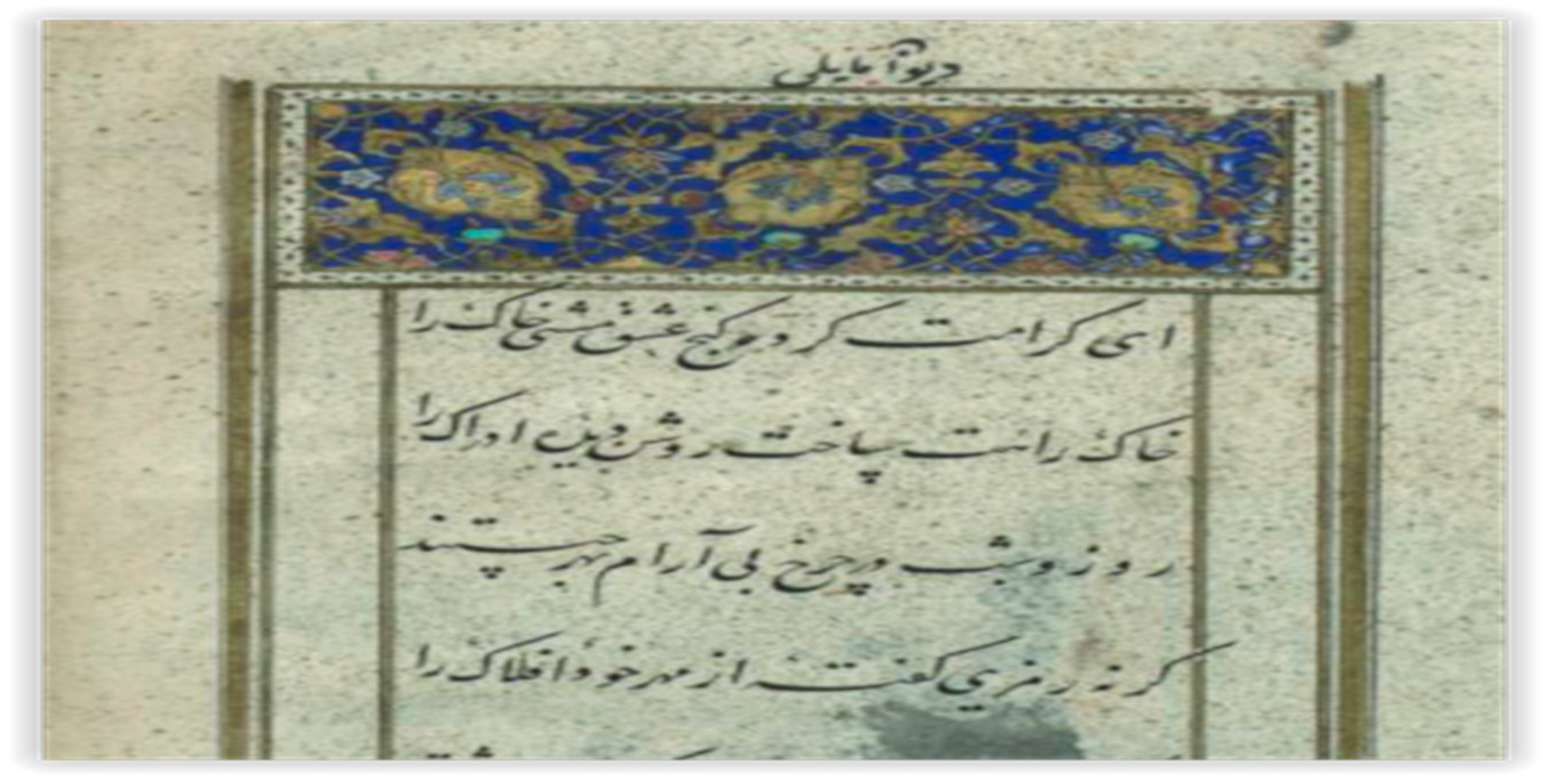
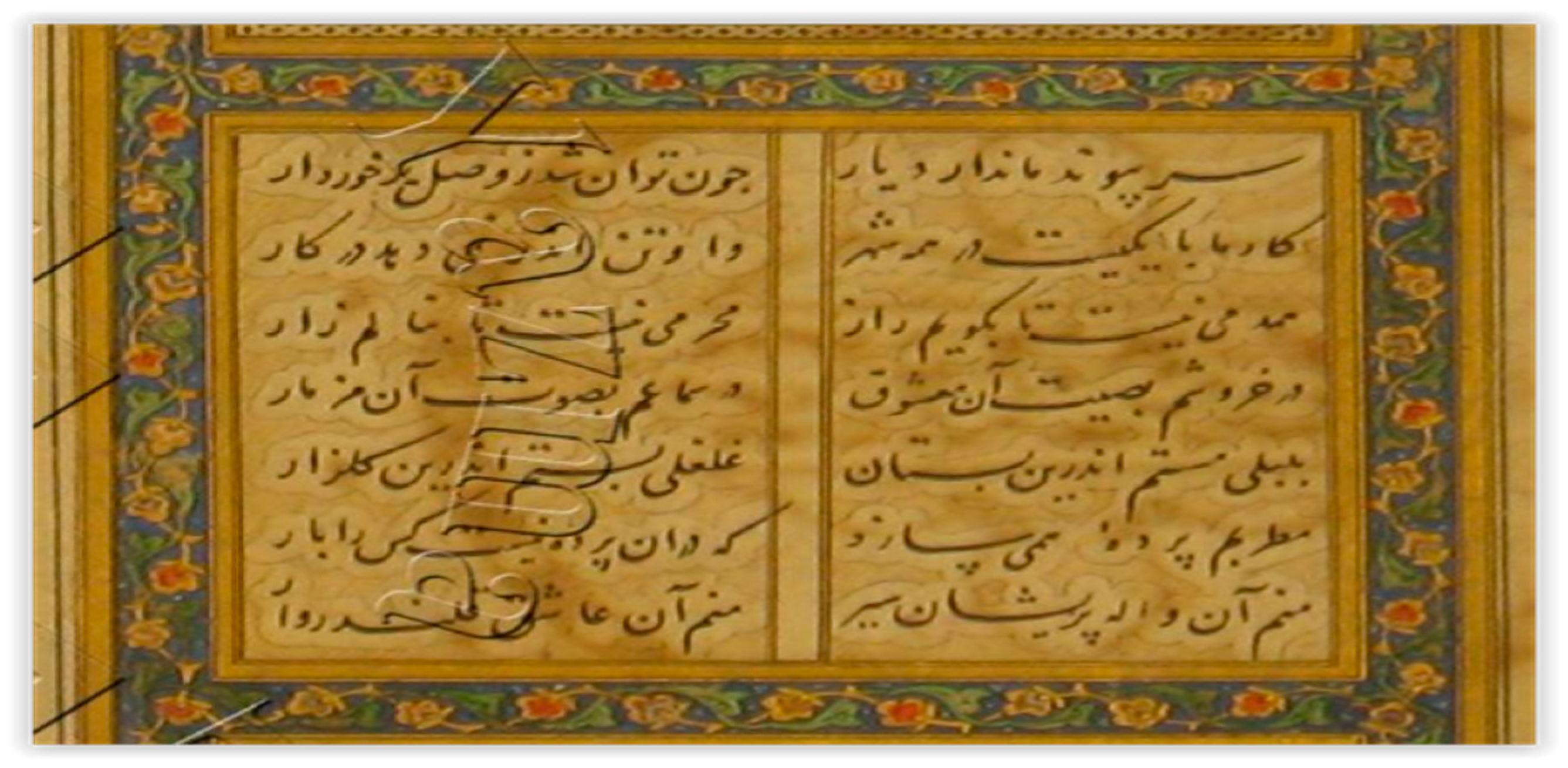
Karga Göllü 2020, pp. 318–25). A printed copy of the work is held in the Süleymaniye Manuscript Library, Sami Benli collection (no. 226) (
Figure 4).
5. Dīvān-i Adnī: Written by the Ottoman Grand Vizier Adnī Mahmud Pasha, this
divan includes 47
ghazals (337
bayts), 3
qaṣīdas (140
bayts), 32
mufrads, and 1
qiṭʿa (4
bayts), totaling 509
bayts. The
ghazals, influenced by Ḥāfiẓ of Shiraz and Ẓahīr-i Fāryābī, range between 7 and 10
bayts each, all bearing the
takhalluṣ “Adnī.” The
qaṣīdas praise Ottoman Sultan Mehmed the Conqueror. The
ghazals primarily explore love and its nuances. Their language and tone are simple, while the
qaṣīdas employ a more elevated diction. The
ghazals are arranged under ten letters of the Persian alphabet (
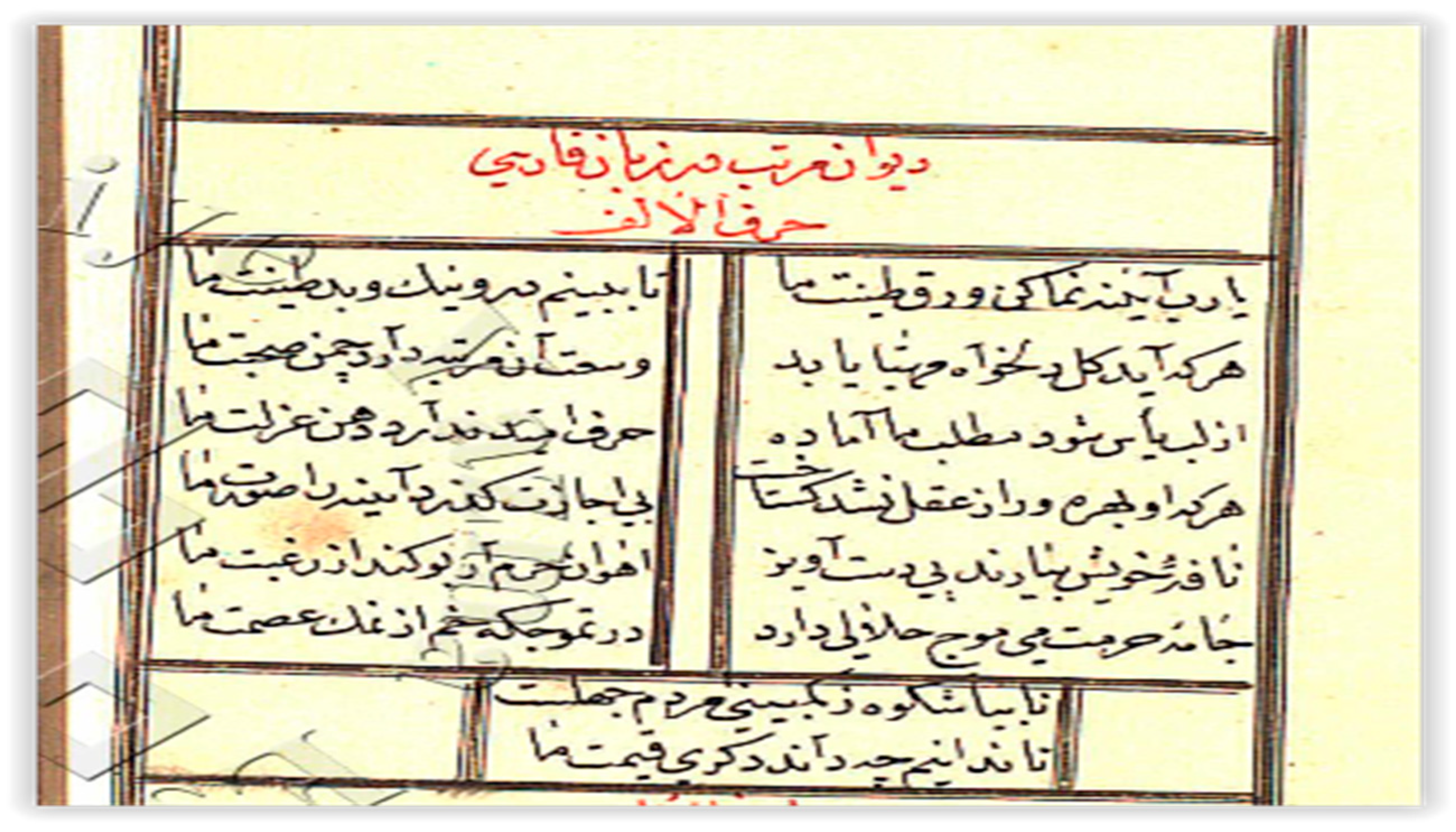
Kaska 2022, pp. 19–21). The work has three extant manuscript copies, which are held in the following libraries: Istanbul University Rare Books (no. TY 1962), Istanbul Millet (Ali Emiri, no. 278) (
Figure 5), and Atatürk University (no. 10c-83).
6. Dīvān-i Nevālī: Composed by Nasūḥ Nevālī Efendi, this
divan contains a total of 1826
bayts. The
takhalluṣ “Nevālī” is absent from only two
ghazals and two
qaṣīdas. The collection comprises 5
qaṣīdas (129
bayts), 294
ghazals (1657
bayts), 8
rubāʿīs (16
bayts), and 13
qiṭʿas (25
bayts). The
ghazals are arranged according to 25 letters of the Persian alphabet. The influence of Ḥāfiẓ and Lisānī of Shiraz is evident. The
ghazals range from 5 to 10
bayts and center on love, longing, cruelty, separation, the tavern, and wine. The
qaṣīdas include devotional subgenres such as
munājāt (supplicatory prayer),
naʿt (praise of the Prophet),
tawḥīd (hymn to divine unity), and
madhiyya (panegyric). In the
ghazals, mystical terms such as maykhāna, sāqī, sharāb, paymāna, sarmast, pīr-i mughān, may-i nāb, khumkhāna, piyāla, maykada, and may were employed. Due to the extensive use of Arabic vocabulary, technical terms, and idiomatic expressions, the poems lack a fluid and simple stylistic structure. The only known manuscript is preserved in the Istanbul Millet Library, Ali Emiri Collection (no. 828) (
Figure 6) (
Kaska 2022, pp. 38–41).
7. Dīvān-i Yārī: Attributed to ʿAcemzāde Yārī, this
divan consists of 98
ghazals, totaling 510
bayts. The
ghazals, arranged under 15 letters of the Persian alphabet, range from 5 to 10
bayts. All but three bear the
takhalluṣ “Yārī.” The poems reference figures such as Sultan Bayezid, Saʿdī of Shiraz, Ḥāfiẓ of Shiraz, Ayāz, and Sultan Maḥmūd of Ghazna. Dominant themes include love, wine, the beloved, separation, longing, suffering, moral reflection, and Sufi thought. The work praises Sultan Bayezid II and shows marked influence from Ḥāfiẓ, Saʿdī, and Mawlānā. The work utilizes mystical elements such as sāqī, sharāb, muḥtasib, but-khāna, ʿishq, maygūn, sāghar, angūr, sharāb-khāna, jāma, tīr, kamān, and majlis, as well as cosmic elements such as kawkab, sipihr, burj, qamar, shams, Zuhra, and bazm-i falak. There are a total of two manuscript copies of the work, preserved in the Süleymaniye (Esad Efendi, no. 3422) and Istanbul Millet (Ali Emiri, no. 443) (
Figure 7) libraries (
Kaska 2022, pp. 91–109).
8. Dīvān-i Nefʾī: Written by Ömer Efendi, known by the
takhalluṣ “Nefʾī,” this
divan comprises 21
ghazals, 171
rubāʿīs, 16
qaṣīdas, 1
tarjīʿ-band, and 1
qiṭʿa. The
qaṣīdas praise figures such as Mawlānā, Khan Ḥusām Giray, Sultan Murad IV, Shaykh al-Islām Mehmed Efendi, and Sultan Selim I. The
qaṣīdas comprise 902
bayts, the
tarjīʿ-band 72, the
qiṭʿa 20, the
ghazals 121, and the
rubāʿīs 342, yielding a total of 1457
bayts. The
qaṣīdas vary between 35 and 97
bayts, with those dedicated to Rūmī amounting to 262
bayts. The first eight
qaṣīdas are
naʿts, and the third, consisting of 97
bayts, is known as
Tuhfat al-ʿUshshāq (“The Gift of Lovers”). The
ghazals address love, wine, beauty, and the pain of passion, showing clear influence from Ḥāfiẓ. The majority of the
ghazals in the work are of an
ʿāshiqāna and
rindāna nature, with their couplet counts varying between five and nine. The
tarjīʿ-band, a
sāqī-nāma (wine ode), contains nine stanzas of eight
bayts each. The work has a total of four manuscript copies, which are preserved in the following libraries: Istanbul University Rare Books (no. TY 2790 (
Figure 8); no. TY 3064) and Istanbul Millet (Ali Emiri, no. 455/3; Reşit Efendi, no. 777) (
Tarlan 1944, pp. 1–154;
Alptekin 1944, pp. 2–3).
9. Dīvān-i Murādī: This
divan, authored by Sultan Murad III under the
takhalluṣ “Murādī,” includes 40
ghazals and 2
mathnawīs. Both
mathnawīs are also included in the poet’s
Futūḥāt-i Ramaḍān. The language is somewhat ornate and contains many Arabic expressions. The poems are Sufi in nature and composed in various meters, employing diverse rhetorical figures. The
ghazals range from 5 to 9
bayts; the first
mathnawī has 9
bayts and the second 14. The total number of
bayts is 231, of which 208 belong to
ghazals. Among the
ghazals, 35 are five
bayts long, 4 are six
bayts, and 1 has nine
bayts. The influence of Ḥāfiẓ is clearly visible. In the work, the poet heralds that those who purify their nafs (ego/soul) from evil and adorn themselves with good morals shall attain salvation on the Day of Judgment. The work has two extant manuscript copies, which are held in the Istanbul Millet (Ali Emiri, no. 329) (
Figure 9) and the Museum of Turkish and Islamic Arts (no. 1901) libraries (
Uyar 1995, pp. 44–69).
10. Dīvān-i Nābī: Authored by Yūsuf Nābī Efendi, this
divan contains 33
ghazals, 20
takhmīses, and 1
qiṭʿa. The
ghazals vary between 7 and 10
bayts and are arranged alphabetically according to their rhyme index. They amount to 222
bayts in total. Rather than love or wine, the poems focus on moral and didactic themes. The poet occasionally expresses personal suffering or nostalgia for great Sufi figures. The
takhmīses are written as quintain elaborations on
ghazals by Rūmī, Mullā Jāmī, Ḥāfiẓ of Shiraz, Kalīm of Kāshān, Shawkat of Bukhara, Sāʾib of Tabriz, Fayżī of India, Sultan Selim I (Yavuz), Shifāʾī of Isfahan, ʿUrfī of Shiraz, Gharībī, Maylī, Nazīrī of Nishapur, and Ṭālib of Āmul. These
takhmīses total 540
bayts. The single
qiṭʿa discusses the verbal mastery of Niẓāmī of Ganja and bears a chronogram dating to 1122 AH, comprising 19
bayts. Figures mentioned include Governor Silahdar İbrahim Pasha of Aleppo, Bāyazīd-i Bisṭāmī, Abū al-Ḥasan al-Kharqānī, and Alexander. The stylistic influence of Sāʾib of Tabriz is particularly strong. Written in the Indian style, the
divan contains 781
bayts in total (
Şahinkaya 2022, p. 1). The work has numerous manuscript copies, which are preserved in the following libraries: Süleymaniye (Hamidiye, no. 1118; Ragıp Pasha, no. 1113; Mihrişah Sultan, no. 382; Yazma Bağışlar, no. 5507) (
Figure 10), Istanbul University Rare Books (no. TY 1257), and Topkapi Palace Museum (Hazine, no. 954).
11. Dīvān-i ʿĀrif: This divan, belonging to Ulu ʿĀrif Çelebi, contains 125 ghazals, 3 qaṣīdas, 79 rubāʿīs, 1 qiṭʿa, and 2 mufrads. The poems are of medium level in terms of meaning and euphony (no. 06 HK53, fol. 4b).
| عشق سلطان عالم جانست * عقل در کوی عقل نادانست |
| تا جمالش ز پرده روی نمود * بنده او هزار سلطانست |
Love is the sovereign of the realm of the soul, whereas reason remains ignorant in the quarters of love.
The moment his beauty is unveiled, a thousand monarchs become his subjects.
The themes treated include love, divine love, the wine of love, the exalted nature of love, the snare of love, steadfastness in devotion to the beloved, longing for the beloved, the superiority of the beloved, awakening from the sleep of heedlessness, the transience of the world, humility like the soil, restraint in speech, and love of the hereafter. Mawlānā and Sulṭān Walad are praised in the work. The influence of Sulṭān Walad, Mawlānā, Saʿdī of Shiraz, and ʿUmar Khayyām is visible throughout. In 10
ghazals the
takhalluṣ “Khamūsh,” used by Mawlānā, appears; in 4
ghazals the
takhalluṣ “Walad,” used by Sulṭān Walad, is employed. The
qaṣīda section comprises 162
bayts, the
ghazals 1384
bayts, the
rubāʿīs 158
bayts, the
qiṭʿa 2
bayts, and the
mufrads 2
bayts, resulting in a total of 1708
bayts. Some of the
rubāʿīs in the work are identical to those of Mawlānā, Saʿdī of Shiraz, and ʿUmar Khayyām, with the exception of minor variations. The work has three manuscript copies, which are held in the following libraries: Konya Mawlānā Museum (no. 2600), Süleymaniye (Pertev Pasha, no. 509), and the Ankara National Library (no. 06 HK 53) (
Figure 11) (
Değirmençay 2017, pp. 23–30).
12. Dīvān-i Walad: This
divan, authored by Sulṭān Walad, the son of Mawlānā, contains a total of 13,345
bayts. It comprises 32
qaṣīdas, 827
ghazals, 9
qiṭʿas, 10
tarkīb-bands, 23
musammats, and 451
rubāʿīs in Persian. The work is written in 29 different patterns of the
ʿarūż system. It also includes 117 Turkish, 72 Arabic, and 18 Greek
bayts. Some of the
ghazals were composed as
naẓīras (imitative responses) to Mawlānā’s
ghazals. The poems are Sufi and didactic in character and are written in a simple, clear, and direct style. Arranged in alphabetical order, the work contains praise of Seljuk sultans, amirs, and statesmen, as well as the Mongol governor-general of Anatolia and members of his family. It also includes explanations about the Mevlevīs and provides information on certain Sufis and on cities such as Konya, Aksaray, Kütahya, and Kayseri. Of the total, 13,137
bayts are in Persian, and Mawlānā’s style is clearly discernible. The work was compiled by taking Mawlānā’s
Dīvān-i Kabīr as a model (
Değirmençay 2016, pp. 6–15). There are seven manuscript copies of the work preserved in the following libraries: Süleymaniye (Halet Efendi, no. 139; no. 135-2 (
Figure 12); no. 328), Konya Mawlānā Museum (no. 2136; 1728; 4696), and Topkapi Palace Museum (Medine, no. 540) (
Aydın 2010, pp. 28–30).
13. Dīvān-i Nasīmī: This
divan belongs to Imādu’d-Dīn Sayyid Nasīmī and contains 295
ghazals, 5
mathnawīs, 7
qaṣīdas, 1
tarjīʿ-band, 1
muḥammas, 1
tarkīb-band, 85
rubāʿīs, 20
qiṭʿas, 1
mustazād, 1
musammat, along with incomplete
ghazals and
bayts, three Arabic poems, and two Persian–Arabic
mulammaʿ compositions. The work, which consists of 4179
bayts in total, addresses themes related to Ḥurūfīsm; Qurʾānic verses and
ḥadīths are interpreted within a Ḥurūfī framework; the two Imams, the Prophet Muḥammad, and ʿAlī are praised. In the
rubāʿīs, ʿAlī is extolled—even divinized. The
ghazals include many poems written as
naẓīras to Ḥāfiẓ of Shiraz. Farīd al-Dīn ʿAṭṭār’s
Manṭiq al-Ṭayr is praised in the work with the expression “the book full of secrets,” and the
qaṣīda titled
Baḥr al-Asrār was written as a response to Amīr Khusraw of Delhi’s
Baḥr al-Abrār. Nasīmī also took as models such poets as Farīd al-Dīn ʿAṭṭār, Mawlānā Jalāl al-Dīn, Saʿdī of Shiraz, Amīr Khusraw of Delhi, and Khusraw of Shiraz, and he composed replies to some of their poems. Sufi love is expressed in a sincere, ardent, and vivid style, and in the
mathnawīs the Ḥurūfīs are praised. Numerous manuscript copies of the work have survived to the present day, held in the libraries of Süleymaniye (Ayasofya, no. 3977-1 (
Figure 13); Yazma Bağışlar, no. 4309; Kadızade Mehmed, no. 395) and the Konya Mawlānā Museum (no. 2416) (
Kalkandelen 2022, p. 1;
Değirmençay 2013b, pp. 33–52;
Aydın 2010, p. 54).
14. Dīvān-i Muḥibbī: This
divan belongs to the twelfth Ottoman Sultan, Süleyman the Magnificent, known by the
takhalluṣ “Muḥibbī.” It contains 96
ghazals, 22
rubāʿīs, 43
mufrads, and 1
mathnawī. The
ghazals, in which the influence of Ḥāfiẓ of Shiraz is clearly visible, predominantly treat the theme of love. The lover, separated from the beloved, is in profound anguish, yearning for reciprocity, even pleading with the beloved. In the work, which consists of a total of 658
bayts, themes such as the infidelity of the beloved, contentment, humility, the anguish of love, complaints against fate, and the tribulations of the lover are generally expressed. The distribution of
bayts is as follows:
rubāʿīs 44
bayts,
mufrads 43
bayts, the
mathnawī 2
bayts, and the
ghazals 569
bayts. Four manuscript copies of the work are known. The poems in the work also reflect the influence of Saʿdī of Shiraz, ʿAbd al-Raḥmān Jāmī, Salmān of Sāva, Niẓāmī of Ganja, and ʿAṭṭār of Nishapur. The work has four manuscript copies, which are held in the following libraries: Topkapı Palace Museum (Revan, no. 738), Istanbul Millet (Ali Emiri, no. 323 (
Figure 14); no. 322), and Istanbul University Rare Books (no. TY 5477) (
Gelen 1989, pp. 20–30;
Aydın 2010, pp. 96–97).
15. Dīvān-i Selīmī: This
divan belongs to Sultan Selim I (Yavuz), the ninth Ottoman sultan, writing under the
takhalluṣ “Selīmī.” It comprises 1
munājāt, 1
naʿt, 11
qaṣīdas, 555
ghazals, 3
takhmīses, 12
qiṭʿas, 9
rubāʿīs, 6
mufrads, and 10 additional poems—599 poems in total. The dominant themes are love for the beloved and the sorrow and grief occasioned by this love. Other topics include the transience of the world, the exalted nature of love and of being a lover, the beloved’s cruelty, separation, complaint about ill fortune, samāʿ, affection, the beauty of friendship, preference for seclusion, adoption of dervish ethics, longing for union (wuṣla), and the worthlessness of worldly sovereignty. The
ghazals are written in a fluent and simple style, whereas the
qaṣīdas employ a heavier and more ornate diction. The work is extant in approximately forty manuscript copies (
Terzi Sarı and Kurt 2021, p. 1). Sufi symbols such as wine, the tavern, the sāqī, the cup, the eye, eyebrow, tress, and beauty spot are used frequently. The influence of Ḥāfiẓ of Shiraz, Mawlānā, Khusraw of Delhi, Kamāl al-Dīn Iṣfahānī, Mullā Jāmī, Saʿdī of Shiraz, and Anwarī of Abivard is evident. The work has manuscript copies preserved in the libraries of Süleymaniye (Fatih, no. 3830; Lala İsmail, no. 449; Esad Efendi, no. 3422-1; Nuruosmaniye 3827 (
Figure 15) and the Topkapi Palace Museum (Revan, no. 737; 738) (
Aydın 2010, pp. 76–79).
16. Dīvān-i Gülshenī: Attributed to Ibrāhīm Gülshenī, founder of the Gülsheniyya Sufi order, this
divan is reported to contain 17,000
bayts. The influence of Mawlānā, Ḥāfiẓ of Shiraz, and Yunus Emre is clearly discernible. Consisting of
qaṣīda,
ghazal, and
mathnawī forms, the
divan is written in 16 different
ʿarūż meters. It includes 2
qaṣīdas (193
bayts), 1
mathnawī (320
bayts), and 1348
ghazals. The two
qaṣīdas, both of a
taḥmīdiyya (praise-of-God) character, deal with themes such as knowledge of God, unity and multiplicity, the attributes of God, existence and non-existence, and divine wisdom. The
ghazals treat such themes as renouncing the world, wonder at creation, complaints about the unworthy, censure of ascetics, the hardships of true love, and the turn toward God. Each
ghazal ends with the
takhalluṣ “Gülshenī.” The poems also draw on Qurʾānic verses and
ḥadīths, as well as on the stories of prophets such as Moses, Job, Solomon, David, and Joseph. The work praises the Qara Qoyunlu ruler Yaʿqub Khan and the city of Tabriz, and it makes use of mystical, musical, theological, and scholarly mazmūns (motifs) (
Azad and Yalameha 2018, pp. 1–18). The work has six manuscript copies held in the following libraries: Süleymaniye (Fatih, no. 3866) (
Figure 16), Beyazit State (no. 5820), Istanbul Millet (no. 418), and Ankara University Faculty of Languages, History, and Geography (no. 1235; no. 1317; no. 4436) (
Aydın 2010, pp. 71–72).
17. Dīvān-i Nidāʾī: This
divan, belonging to ʿAbdullāh Nidāʾī of Kāshghar, contains 85
ghazals, several
muḥammases,
takhmīses written on the
ghazals of such poets as Ḥāfiẓ of Shiraz, Mullā Jāmī, Qāsim-i Anvār, and Ismet of Bukhara, and a 27-
bayt mathnawī entitled
Ḥayrat-nāme. In
Ḥayrat-nāme, the poet sincerely expresses his admiration for Istanbul after traveling through cities such as Bukhara, Samarqand, Jerusalem, Baghdad, and Damascus. The
divan also includes
muḥammases written for Shāh Sebüktegin and Sāʾib of Tabriz, a
qaṣīda dedicated to Shāh-i Naqshband, and poems dealing with the themes of
ḥaqīqat,
ṭarīqat, and
sharīʿat. Thus, Sufi teachings as well as travel and wonder motifs are prominent (
Bilgin 2012, p. 66). The work has manuscript copies held in the libraries of Süleymaniye (Aşir Efendi, no. 411; Şazeli, no. 158-2 (
Figure 17); Hacı Mahmud, no. 3719) and Topkapi Palace Museum (Hazine, no. 984) (
Aydın 2010, pp. 17–20).
18. Dīvān-i Āsım: This
divan, by ʿAbdü’l-ʿAzīz Āsım Efendi, contains 230
ghazals, 40
qaṣīdas, 22
qiṭʿas, 27 miscellaneous poems (
naẓms), 5
mathnawīs, 2
mufrads, 45
rubāʿīs, and 5
takhmīses. The work comprises 3446
bayts in total, with the
ghazals forming the largest section. The
ghazals, written in a
ʿāshiqāna,
rindāna, and
ʿārifāna tone, show clear influence from Ḥāfiẓ of Shiraz. The
takhmīses are written on poems by Ḥāfiẓ of Shiraz, Bīdil of Delhi, Kalīm of Kashan, and Mawlānā. The
rubāʿīs, like the
ghazals, are
rindāna,
ʿāshiqāna, and
ʿārifāna. In the
mathnawīs the poet laments his adverse circumstances and the hardships of life. The work also records in verse the accession of Sultan Murad V and the first year of Sultan ʿAbdülhamid II’s reign. In the
qaṣīdas, such figures as Nāṣir al-Dīn Shāh, Mehmed ʿĀkif Pasha, Midhat Pasha, Aḥmed Kemal Pasha, Mīrzā Ḥusayn Khan, ʿAlī, the
Ahl al-Bayt, ʿAbd al-Qādir al-Gīlānī, Khālid al-Baghdādī, ʿUbaydullāh al-Ḥaqqārī, the Naqshbandī order, the Prophet of Islam, and Mūsā al-Kāẓim are praised. In the work, certain Sufi leaders, Ali (the fourth Caliph), and the Ahl al-Bayt (Prophet Muhammad’s family) are praised; furthermore, the teachings of the Naqshbandi order and historical events of that period are discussed. The only known manuscript is preserved in the Istanbul Millet Library (no. 575) (
Figure 18) (
Özbeyli 2014, pp. 1–48).
19. Dīvān-i Nevres: This
divan, by ʿAbdü’r-Razzāq Nevres-i Kadīm, contains 65
ghazals, 8
rubāʿīs and
qiṭʿas, 1
sāqī-nāma, 13
mufrads, 39
muʿammās and
lug̱azs (riddle poems), 5
qaṣīdas, 3
taʾrīkhs, and 2
takhmīses written on the
qaṣīdas of Saʿdī of Shiraz and ʿUrfī of Shiraz. The work comprises 1210
bayts in total. The distribution of
bayts by genre is as follows:
qaṣīdas 312
bayts,
muʿammās and
lug̱azs 48
bayts,
ghazals 434
bayts, the
sāqī-nāma 63
bayts,
rubāʿīs and
qiṭʿas 16
bayts,
mufrads 13
bayts,
taʾrīkhs 33
bayts, and the
takhmīses 97
bayts. In the
qaṣīdas, figures such as Shaykh al-Islām Esʿad Efendi, Grand Vizier Rāgıb Pasha, the Governor of Baghdad Aḥmed Pasha, and Shaykh al-Islām Neylī Efendi are praised. The work also records the accession (culūs) of Sultan Osman III and the appointment of Esʿad Efendi as grand vizier. Poets such as Salman of Sāva, Khāqānī of Shirvan, Firdawsī of Ṭūs, Anwarī of Abivard, Sāʾib of Tabriz, ʿUrfī of Shiraz, Saʿdī of Shiraz, Sultan Süleyman, and Shawkat of Bukhara are named in the poems. Themes include the sorrow of exile, suffering, heartache, complaints about the world, love, the pain of separation, and unfulfilled union (
Karadere 1999, pp. 13–21). The work has manuscript copies held in the libraries of Süleymaniye (Esad Efendi, no. 2700), Istanbul University Rare Books (no. TY 2798), Istanbul Millet (Ali Emiri, no. 467-2) (
Figure 19), and Topkapı Palace Museum (Hazine, no. 880) (
Aydın 2010, pp. 123–27).
20. Dīvān-i Ḥāmidī: This
divan, by Ḥāmidī of Isfahan, consists of
ghazals,
qaṣīdas,
rubāʿīs,
qiṭʿas,
mufrads,
murabbaʿs,
tarjīʿ-bands,
tarkīb-bands, and a
mathnawī entitled
Hasbihālnāme. It contains 8719
bayts in Persian, 6
bayts in Arabic, and 757
bayts in Turkish. Ottoman sultans and statesmen such as Sultan Mehmed the Conqueror, Prince Cem, Bayezid II, Murad II, Mesīh Pasha, Mahmud Pasha, Prince Mustafa, and Mehmed Pasha are praised in the work. The poet also composed replies to poems by Saʿdī of Shiraz, Khāqānī of Shirvan, Mullā Jāmī, Salman of Sāva, Niẓāmī of Ganja, Kātibī of Nishapur, Ẓahīr-i Fāryābī, and Masʿūd-i Saʿd-i Salmān, and he incorporated (tazmīn) lines from Ḥāfiẓ of Shiraz and Niẓāmī of Ganja. The
Hasbihālnāme mathnawī, written in the Indian style, recounts the poet’s own life, how he entered the court of Mehmed the Conqueror, and how he was later exiled to Bursa. The
divan also contains satirical and obscene invectives in both Persian and Turkish, in which poets such as Kabūlī, Sābirī, Sāhilī, Vāhidī, and Maḥmūdī are criticized. The work, presented to Sultan Mehmed the Conqueror, has two manuscript copies held in the libraries of the Turkish Historical Society (no. 68) and the Istanbul Archaeology Museum (no. 1184) (
Figure 20). The copy in the Istanbul Archaeology Museum Library contains four miniatures (
Kaska 2023, p. 83).
21. Dīvān-i Shāhidī: This
divan, by İbrāhīm Shāhidī of Muğla, contains 122
ghazals and 1
mufrad. It was composed in 932/1525. Most of the
ghazals consist of 5 or 6
bayts. The work has a total of 680
bayts. The poems predominantly treat themes of love and Sufism. Sufi-coded images such as love, the beloved, wine, the tavern, the tavern-keeper, the lip, the tress, musicians, the cup, and the jug are employed. The poet constantly laments the beloved’s separation and indifference and longs for union. The beloved fails to keep promises and does not act faithfully toward the lover. The influence of Ḥāfiẓ of Shiraz, Sāʾib of Tabriz, Shāhī-yi Sabzvārī, and Fużūlī is visible. The only known manuscript is preserved at Princeton University Library in the USA (no. 1500Y) (
Figure 21) (
Şimşekler 2025, pp. 410–19).
22. Dīvān-i Sāʾilī: This
divan by Sāʾilī is also known under the title
Nawbāwa-i Rūm (“The Firstfruit of Rūm”). It comprises 56
qaṣīdas, 400
ghazals, 2
mustazāds, 3
muḥammases, 2
tarjīʿ-bands, 28
qiṭʿas, 42
fiqras, 82
rubāʿīs, 16
maṭlas, 27
muʿammās, and 6
tarkīb-bands. The work praises Sultan Bayezid II, Sultan Selim I (Yavuz), Hersekzāde Aḥmed Pasha, Koca Mustafa Pasha, Küçük Davud Pasha, Atik ʿAlī Pasha, Mesīh Pasha, Yaḥyā Pasha, Müʾeyyedzāde ʿAbdurraḥmān Çelebi, Tācīzāde Caʿfer Çelebi, Meḥmed Aḥī Çelebi, Chief Judge Ḥacı Hasanzāde Efendi, Prince Alemşah, ʿAlī Shīr Navāʾī, and Mawlānā Necātī Bey. The work was completed in 908/1502 and presented to Sultan Bayezid II. Following the death of Sultan Bayezid II in 918/1512, Sāʾilī added four
qaṣīdas dedicated to his successor, Sultan Selim I, and most likely presented his
divan to him. In the
ghazals, most of which are 8- or 6-
bayt poems, themes such as love, the beloved, the wine of love, the snare of love, longing for the beloved, the beloved’s cruelty, the beloved’s superiority, and divine love are treated. The work survives in four manuscript copies and contains 5850
bayts in Persian and 139
bayts in Turkish. The manuscript copies of the work are held in the libraries of Süleymaniye (Yazma Bağışlar, no. 6441; Fatih, no. 3826) (
Figure 22), Istanbul University Rare Books (no. FY 1523), and the Ankara National Library (no. 6799) (
Kaska 2021d, pp. 133–55).
23. Dīvān-i Fużūlī: This
divan belongs to Fużūlī of Baghdad and contains 614 poems in total: 49
qaṣīdas, 3
musammats, 46
qiṭʿas, 105
rubāʿīs, 1
mathnawī, and 410
ghazals. The work opens with a prose
muqaddima in which the influence of Ḥāfiẓ of Shiraz and Mullā Jāmī is clearly visible. In this prose preface, the poet explains why he chose the
takhalluṣ “Fużūlī,” how he began writing poetry in Persian, and his views on poetry. The
qaṣīda titled
Anīs al-Qalb, consisting of 134
bayts, was presented to Sultan Süleyman the Magnificent and was written as a
naẓīra to Khāqānī of Shirvan’s
Baḥr al-Abrār. In the other
qaṣīdas, the Prophet Muḥammad, the Twelve Imams, the
Ahl al-Bayt, Elvend Bey of the Aq Qoyunlu, as well as Safavid and Ottoman rulers, and Shâh Ismāʿīl are praised. The
ghazals predominantly treat the theme of love, though there are also
ghazals of a moral and didactic (ḥikamī) nature. The language of the
qaṣīdas is elevated and highly wrought, while the
ghazals are comparatively simpler and more ardent. In the
qiṭʿas, a moral-didactic tone is foregrounded, whereas the
rubāʿīs do not display a single, uniform style. Numerous manuscript copies of the work are found in different libraries (
Yıldız 2022, p. 1). The work has manuscript copies held in the libraries of Süleymaniye (Carullah, no. 1670 (
Figure 23); Laleli, no. 1912; Yazma Bağışlar, no. 2452), Manisa (no. 2668), and the Ankara National Library (no. 8524).
24. Dīvān-i Shevkī: This
divan, by Ömer Shevkī, consists solely of
ghazals. It contains 253 poems in total, and the rules of meter and rhyme are largely observed. Some
ghazals are composed in a simple, fluent, and straightforward language, while others are written in a more ornate, allusive, and difficult style (no. 7928, fol. 111b):
| هوای عشق تو برد از دلم ثبات و قرار * حیات من به سر زلف تست کرده مدار |
| دوای درد دل من نشد ز قند لبت * اگر قرین مسیحا شوم شوم بیمار |
The longing for your love has taken steadfastness and resolve from my heart. The center of my life lies at the tip of your tress.
Your sugar-like lips have not been a remedy for the affliction of my heart. Even if I were to keep company with Jesus, I would become ill.
The themes treated include love, wine, moral counsel, the beloved, nature, the transience of worldly life, and exhortation; numerous rhetorical figures are employed. The work contains 1832
bayts in total, with 7-
bayt and 6-
bayt ghazals being the most common. Of the
ghazals, 245 are in Persian, 7 are
mulammaʿ (mixed-language), and 1 is in Arabic. Figures such as ʿAbd al-Qādir al-Jīlānī, Zuleykhā, Ayāz, Plato, Farhād, Farīdūn, Khusraw, Jam, Alexander, and Laylā are mentioned. In the work, which reflects the influence of Ḥāfiẓ of Shiraz and Saʿdī of Shiraz, the poet asserts that he is on par with Ḥāfiẓ and composed nazires to his poems. The work does not mention the historical events of the period (
Bektaş 2016, pp. 25–85). The work has two manuscript copies, one held at the Istanbul Millet Library (Ali Emiri, no. 235/2) and the other at the Ankara National Library (no. 7928) (
Figure 24).
25. Dīvān-i Aynī: This
divan, by Ayntab-born Aynī, contains 32
ghazals, 2
takhmīses, 2
qiṭʿas, 4
qaṣīdas, and 1
maṭlaʿ. The work comprises 444
bayts in total. The first
qaṣīda concerns the praise of Sultan Mahmud and is a naẓīra to Shawkat of Bukhara. The second
qaṣīda was composed in 1252 AH on the occasion of Said Pasha’s marriage. The third
qaṣīda was written for the 1249 AH circumcision festivities of the son of the Governor of Baghdad, Davud Pasha; the fourth concerns again the praise of Sultan Mahmud and is a naẓīra to the
qaṣīda of the Iranian envoy Khudādat Khan. Of the 32
ghazals, 15 are naẓīras written in response to
ghazals by Shawkat of Bukhara, Bīdil of Delhi, Sāʾib of Tabriz, Ismet of Bukhara, Hoca Neşet, Selām, and Pertev. The
takhmīses were written on single
ghazals by Shaykh Khālid of Baghdad and Sultan Selim I (Yavuz). Most of the poems in the work are in the manner of Shawkat of Bukhara. The number of
bayts in the
ghazals within the work ranges from 5 to 19. The
divan was completed in 1258/1842 (
Aksoyak 2022, p. 1). The work has numerous printed copies available in various libraries. One of the printed copies of the
Dīvān-i Aynī is held in the Süleymaniye Manuscript Library, Hüsrev Pasha collection (no. 549) (
Figure 25).
26. Dīvān-i Dāʾī: This
divan, by Aḥmed-i Dāʾī, contains 1
qaṣīda, 10
qiṭʿas, 74
ghazals, and 34
mufrads. It was written on the occasion of the accession of Sultan Çelebi Mehmed and presented to Grand Vizier Ḥayreddīn Ḥalil Pasha. At the end of the work, the poet states that he completed it in 816/1413. The
muqaddima of the work is in prose and is written in a fluent style. In this preface, the poet criticizes the statesmen of the time for failing to appreciate poets and artists. The 25-
bayt qaṣīda praises Ḥalil Pasha. The influence of Saʿdī of Shiraz, Ẓahīr-i Fāryābī, Mawlānā, ʿAṭṭār of Nishapur, and Ḥāfiẓ of Shiraz is evident. Written in the Iraqi style, the
divan bears traces of
Manṭiq al-Ṭayr,
Gulistān, and the
Mathnawī. Written in a simple and fluent style, the unique manuscript copy of the work is held in the Bursa İnebey Library (no. 1196) (
Figure 26) (
Aytaç 2021, p. 1). The poems in the work are amatory
ʿāshiqāne,
ʿārifāne, and
akhlāqī in nature.
27. Dīvān-i Riyāzī: This
divan belongs to Mawlānā Riyāzī of Samarqand, who came from Iran to Istanbul during the reign of Sultan Mehmed the Conqueror. It comprises 134 poems: 113
ghazals, 2
qaṣīdas, 3
rubāʿīs, 13
mufrads, and 3 other poems. The
divan has 779
bayts in total, with
ghazals making up the largest portion. The
ghazals treat themes such as the beloved, love, praise, wine, nature, complaint about fate, longing for the beloved, and suffering. Such figures as Mawlawī Maḥmūd, Prince Yadigār Muḥammad, Karabas, Ibn Sina, Mawlānā Ṣāfāyī, and Sultan Aḥmed are praised. Written in the Iraqi style, the work shows the influence of Ḥāfiẓ of Shiraz. In the
rubāʿīs, the themes of the pain of love and complaint about fate come to the fore (
Demiriz 2019, pp. 17–28). The work has seven manuscript copies held in the Süleymaniye Library (Hacı Mahmud, no. 3568; Bağdatlı Vehbi, no. 1677; Tırnovalı, no. 1476; Ayasofya, no. 3919 (
Figure 27); Kadızade Mehmed, no. 431; Esad Efendi, no. 3422; and Fatih, no. 3825).
28. Dīvān-i Saʿīdā: This
divan, by Saʿīdā of Bukhara, is written in the Indian style (sabk-i hindī). It praises the Shīʿī Imams, the Prophet, the four Rightly Guided Caliphs, Sultan Mehmed IV, Abdi Pasha, Süleyman Pasha, Naʿīmā, Mustafa Pasha, and Prince Mustafa. It contains a 46-
bayt mathnawī on the principles of the Naqshbandī order. The work also quotes Qurʾānic verses and
ḥadīths and draws on the poems of Ḥāfiẓ of Shiraz, Awḥad al-Dīn of Maragha, Sāʾib of Tabriz, and Mawlānā; naẓīras were likewise written to their poems. The work contains a total of 7191
bayts, distributed by genre as follows: 20
qaṣīdas (617
bayts), 14
mathnawīs (416
bayts), 1
muḥammas (18
bayts), 757
ghazals (5726
bayts), 4
qiṭʿas (18
bayts), 1
naẓm (2
bayts), 180
rubāʿīs (360
bayts), 12
maṭlas (12
bayts), and 10
mufrads (10
bayts). The work, whose
muqaddima is written in a mixed prose and verse style, has manuscript copies held in the libraries of Süleymaniye (Lala İsmail, no. 448; Beşir Ağa, no. 135; Nuruosmaniye, no. 3823) and Istanbul Millet (Ali Emiri, no. 362) (
Figure 28) (
Arkan 2020, pp. 21–45).
29. Dīvān-i Nigārī: This
divan by Mīr Ḥamza Nigārī contains 697
ghazals, 2
tarjīʿ-bands, 1
muḥammas, 8
takhmīses, 1
mathnawī, 183
rubāʿīs, and 22
qiṭʿas. The single
mathnawī in the work is titled
Hesht-behesht-nāme. Most of the
takhmīses were written on the
ghazals of Ḥāfiẓ of Shiraz and Mullā Jāmī. The distribution of
bayts is as follows:
ghazals 7000
bayts;
rubāʿīs 366
bayts;
tarjīʿ-bands 90
bayts;
takhmīses 141
bayts;
muḥammas 24
bayts;
mathnawī 911
bayts;
qiṭʿas 121
bayts. The work, consisting of approximately 8655
bayts, contains
ghazals written under all the letters of the Persian alphabet. After each change in rhyme, two
rubāʿīs are inserted. It is stated at the end of the
ghazals that the work was completed in 1300/1884. The work, printed in Istanbul in 1329/1911, is quite voluminous (
Y. Küçük 2017, p. 45). The work mentions the names of poets such as Ḥāfiẓ of Shiraz, Saʿdī of Shiraz, Mawlānā, Mollā Jāmī, Fakhr al-Dīn-i ʿIrāqī, Khājū of Kirmān, Sanāʾī of Ghazna, Niẓāmī of Ganja, and ʿAlī Shīr Navāʾī. The most frequently discussed themes in the work are love, monotheism, and melamat. The influence of Farīd al-Dīn ʿAṭṭār, Ḥāfiẓ of Shiraz, and Fakhr al-Dīn-i ʿIrāqī is evident in the poems. The work has manuscript copies held in the libraries of Süleymaniye (Ali Nihat Tarlan, no. 188-1) (
Figure 29), the Ankara National Library (no. 5195; no. 5066; no. 5178), and Amasya Beyazit (no. 1887).
30. Dīvān-i Khālid: This
divan, by Khālid of Baghdad (Khālid-i Baghdādī), contains 86
ghazals (655
bayts), 4
qaṣīdas (240
bayts), 2
munājāts (74
bayts), 2
qiṭʿas (12
bayts), 9
mathnawīs (110
bayts), 1
tarkīb-band (57
bayts), 31
mufrads, 10
muḥammases (30
bayts), 9
musaddases (27
bayts), and 12
rubāʿīs (24
bayts). The
divan has 1260
bayts in total, of which 135 are in Arabic, 37 in Kurdish, and 1088 in Persian. In the
qaṣīda sections, figures such as Imām ʿAlī Riżā, ʿAbdullāh-i Dihlavī, Imām Mūsā Kāẓim, Ḥasan, Ḥusayn, and Imām Zayn al-ʿĀbidīn are praised. In the munājāts, the names of the great masters of the Naqshbandī order are mentioned and eulogized. The
tarkīb-band treats the Prophet of Islam, the merits of the pilgrimage, the four caliphs, and the cities of Mecca and Medina. In the Sufi
ghazals, themes such as divine love, love of God and the Prophet, separation, and union are handled. The influence of Bīdil of Delhi and Mīr Dard is apparent. Overall, the artistic value of the poems is of a moderate level. The
rubāʿīs in the work are
ʿāshiqāne,
ʿārifāne, and
ḥakīmāne in character. The
ghazals, on the other hand, are written using all the letters of the Persian alphabet. The manuscript copies of the work are held in the Süleymaniye Library (Hacı Mahmud Efendi, no. 3758 (
Figure 30); Yazma Bağışlar, no. 9329), the Ankara National Library (no. 4280), and the Diyarbakır Library (no. 543) (
Kaska 2021a, p. 1).
31. Dīvān-i Askerī: This
divan, belonging to Askerī, contains 95
ghazals, 1
qaṣīda, 2
rubāʿīs, 1
sāqī-nāma, and 8 poems written in Chaghatay Turkish. It is composed in a clear, simple, and accessible language. The work includes praise of the Ottoman sultan Süleyman the Magnificent, and it reflects the influence of Ḥāfiẓ of Shiraz, Mullā Jāmī, Kamāl al-Dīn Isfahānī, Khusraw of Delhi, Mawlānā Lutfī, ʿAlī Shīr Navāʾī, Salman of Sāva, Niẓāmī of Ganja, and Farīd al-Dīn ʿAṭṭār. Numerous figures of speech and tropes are employed, and both the Indian (sabk-i hindī) and Iraqi styles are drawn upon. The work comprises 802
bayts in total. Only one manuscript copy is known, held in the Süleymaniye Library (Carullah Efendi, no. 1668) (
Figure 31). This short-form work consists of 36 folios. In the work, where mystical terms such as sharāb, maykhāna, sāqī, and dilbar are frequently employed, the ghazals are
ʿāshiqāne and
ʿārifāne in character (
Bal 2019, pp. 20–63).
32. Dīvān-i Naṣūhī: This
divan, by Ömer Naṣūhī Bilmen, contains 2
mathnawīs, 41
ghazals, 3
muḥammases, and 3
mufrads. The
muḥammases were written on poems by Mullā Jāmī, Ḥāfiẓ of Shiraz, and ʿAbd al-Razzāq ʿIlmī Efendi. Also known as
Nüzhetü’l-Ervāḥ, the work comprises 307
bayts in total. Themes such as true love, springtime, nature, union (wuṣla), God, love of the Prophet, separation, and the transience of the world are treated. The influence of Ḥāfiẓ of Shiraz and Shawkat of Bukhara is clearly visible. One
ghazal is in Arabic, and two are
mulammaʿ in Persian–Arabic. The work was arranged in 1319/1902, and words such as ʿāshiq, wuṣlat, mey, parvāna, gul, bulbul, hijrān, and cānān are used frequently. The work employs the
takhalluṣ Nasûhî, and the ghazals are arranged alphabetically according to the Persian alphabet (
Bilmen 1989, pp. 1–45). There are numerous copies of the work available in libraries. A copy of this work, published in 1989, is held in the the ISAM Library (Center for Islamic Studies) (
Figure 32).
33. Dīvān-i Esʿād: This
divan, by Esʿād-i Erbilī, contains 1
mathnawī (73
bayts), 50
ghazals (388
bayts), 10
takhmīses (24
bayts), 1
tarjīʿ-band (21
bayts), and 1
qaṣīda (13
bayts). One of the
ghazals is written in Kurdish. The
qaṣīda was composed in honor of Shaykh Rıza and Shaykh Emin. The
takhmīses were written on poems by Ḥāfiẓ of Shiraz, Ḥālis, Kalīm of Kāshān, Mawlānā, Mawlānā Khālid, Nūr ʿAlī Maghribī, and Mullā Jāmī. The work comprises 519
bayts in total and shows the influence of Ḥāfiẓ of Shiraz, Kalīm of Kāshān, and Mullā Jāmī. Carrying a Sufi character, the work treats themes such as wine, the beloved, love, the lover, separation, the pain of parting, the transience of the world, non-attainment of the beloved, and yearning for union. There are numerous printed copies of the work available in libraries (
Erbilî 1991, pp. 5–121). One of the printed copies of the
Dīvān-i Esʿād is held in the Süleymaniye Manuscript Library, Gönenli Mehmed Efendi collection (no. 592) (
Figure 33).
34. Dīvān-i Baṣīrī: This
divan, by Alaca Baṣīrī, opens with a prose
muqaddima and contains 1
tawḥīd, 1
naʿt, 23
qaṣīdas, 121
ghazals, and 32
qiṭʿas. The work comprises 1406
bayts in total. Ottoman sultans Bayezid II, Selim I, and Süleyman the Magnificent are praised. Of the 23
qaṣīdas, 11 are dedicated to Bayezid II and 3 to Selim I. The other
qaṣīdas were written for Uğurlu Mehmed, Sultan Yaʿqūb, Göde Ahmed Bey, Khan Ahmed, Sultan Ḥusayn, Süleyman the Magnificent, Aḥmed Khan, Caʿfer Bey, and Süleyman Çelebi. The influence of Mullā Jāmī and Kamāl-i Khujandī is evident. The
qiṭʿas treat such events as the construction of the Bayezid Mosque, the accessions of Selim I and Süleyman I, the battles of Ridaniyya and Chaldiran, the conquest of Rhodes, and the deaths of Mullā Jāmī and Prince Cem. The
ghazals, most of which are five-
bayt poems, deal with love and Sufism. Also called
Heştbehişt, the work survives in a single manuscript in the Süleymaniye Library (Aşir Efendi, no. 292) (
Figure 34) (
Bulukgiray 2019, pp. 14–30). This manuscript copy was written by the poet himself in 923/1517.
35. Dīvān-i Tāliʿī: This
divan, by Tāliʿī, contains 427
ghazals, 22
qaṣīdas, 19
qiṭʿas, and 4
rubāʿīs. In one
qiṭʿa, a poet named Ṭūsī is mentioned in terms verging on invective; in another, traces of Shaykhī’s
Ḥarnāme can be seen. The
ghazals deal with themes of love and wine; Sufi terminology is employed, and complaints are voiced about the prohibition of wine. In the
qaṣīdas, astrological terminology is used; Sultan Mehmed the Conqueror is praised; the love of the
Ahl al-Bayt, the tragedy of Karbalāʾ, the Prophet of Islam, and devotion to his family are treated. The
qaṣīdas show the influence of Salman of Sāva, and the
ghazals that of Kamāl al-Dīn Isfahānī. Figures such as Prince Cem, Rustam, Khusraw, Alexander, Laylā and Majnūn, Shirvān, and Shiraz are mentioned, and poets such as Salman Sawaji, Kamal al-Din Isfahani, Niẓāmī Ganjavi, and Shaykhī are praised. Most of the
ghazals consist of five
bayts. The work has three manuscript copies held in the libraries of Bursa İnebey (Haraççıoğlu, no. 975) (
Figure 35), İzmir Tire Necip Pasha (no. 399/3), and Ankara University Manuscripts (no. 529) (
Kardaş 2012, pp. 7–14).
36. Dīvān-i Shāhī: This
divan belongs to Prince Bayezid, the son of Sultan Süleyman the Magnificent. It contains 17
ghazals, 3
naẓms, and 7
mufrads. Themes treated include divine and earthly love, complaint against fate, the beloved, grievances about hardships and the passage of time, the unfaithfulness of beauties, the transience of the world, the transformative effects of love, desire for sovereignty, rivalry, and supplication for the forgiveness of sins. With the exception of the first
ghazal, all
ghazals consist of five
bayts. The work has 99
bayts in total. The influence of Ḥāfiẓ of Shiraz is clearly visible. The work has only two manuscript copies, both of which are held in the Istanbul Millet Library (Ali Emiri Efendi, no. 330 (
Figure 36); no. 225) (
Çiçekler 1998, pp. 211–28).
37. Dīvān-i Ṭāhir: This
divan, by Ṭāhirü’l-Mevlevī, contains 38 poems in total. It consists of a prose
muqaddima, 1
şarkı (song), 2
rubāʿīs, 1
qiṭʿa, 30
ghazals, 2
naẓms, 1
mathnawī, and 1
takhmīs. The
mathnawī was written as a response to the poet ʿAlī ʿIffet Bey; one
ghazal was composed as a naẓīra to a
ghazal by Mullā Jāmī; and the
takhmīs was written on a
ghazal by Prince Cem. One
ghazal is a
munājāt, three are
naʿts, and one is a
tawḥīd. Written in a plain and intelligible style, the work mentions Mawlānā, Saʿdī of Shiraz, and Mullā Jāmī. The
ghazals treat themes such as the transience of the world, divine love, the wine of love, springtime, natural phenomena, God’s oneness, the Prophet of Islam, the beauty of the beloved, separation, longing, union, the cruelty of time, and love. The work contains 261
bayts in total, and most
ghazals are seven
bayts long. The work has a total of five copies held in the libraries of Süleymaniye (Fethi Sezai Türkmen, no. 77 (
Figure 37); no. 72; no. 82), Istanbul University Rare Books (no. TY 9387), and Selçuk University (Uzluk, no. 31) (
Öz and Şafak 2003, pp. 9–22).
38. Dīvān-i Ḥazīnī: This
divan, by Aḥmed Ḥazīnī, contains 1102
ghazals, 3
qaṣīdas, 3
takhmīses, 10
qiṭʿas, 81
rubāʿīs, and 1
mathnawī. Written in 999/1591, it comprises 8799
bayts in total. All Ottoman sultans are mentioned in the
qaṣīdas, but Sultan Selim II and Sultan Murad III are especially praised. Two of the
takhmīses were written on poems by Sultan Murad III. Themes such as Sufism, description, complaint, religious fervor, homesickness, lament over life, and depiction are prominent. Alongside religious, mystical, and amorous poems, there are also poems on nature, patrons, and the beloved, as well as panegyrics and poems of complaint. In this work the poet was influenced by Awḥadī of Maragha, Mullā Jāmī, Shaqīq of Balkh, Saʿdī of Shiraz, Khāqānī of Shirvan, Firdawsī of Ṭūs, Anwarī of Abivard, Farīd al-Dīn ʿAṭṭār, Muḥtasham of Kashan, Mawlānā, and Ḥāfiẓ of Shiraz. Written in the Iraqi style, the work mentions Aḥmad Yesevī, Sultan Walad, and Shams-i Tabrīzī, and it also contains
naẓīras to Ḥāfiẓ of Shiraz. The unique manuscript copy of the work is held in the Konya Mawlânâ Museum Library (no. 146) (
Figure 38) (
Kunt 2004, pp. 55–70).
39. Dīvān-i Amīrī: This
divan, by Amīrī, a poet of the reign of Sultan Süleyman the Magnificent, contains 170
ghazals, 8
rubāʿīs, and 8
qiṭʿas. Comprising about 890
bayts, the work was composed in honor of Sultan Süleyman. Classical
mazmūns such as wine, the tavern, the sāqī, love, and the beloved are treated; the influence of Ḥāfiẓ of Shiraz, Amīr Khusraw of Delhi, and Mullā Jāmī is clearly visible. The poems include
rindāna,
ʿāshiqāne, and
ʿārifāne tones, and Sultan Süleyman is praised. Most of the
ghazals consist of five
bayts. Written in the Iraqi style, in a plain and fluent language, the work mentions Mullā Jāmī, Ḥāfiẓ of Shiraz, Khwāja Mīrzā, Sultan Süleyman, Khusraw of Delhi, Shīrīn, Farhād, and Majnūn. This copy is held in the Istanbul University Rare Books Library (no. FY 1222) (
Figure 39). In the work, the poet has skillfully employed literary arts (
Konuksever 2012, pp. 18–38).
40. Dīvān-i Ilāhī: This
divan, said to belong to ʿAbdullāh-i Ilāhī, a poet of the reign of Sultan Mehmed the Conqueror, contains 203
ghazals, 1
qaṣīda, 2
qiṭʿas, and 23
rubāʿīs. The work comprises 1436
bayts in total. Of the
ghazals, 2 are in Arabic and 24 in Turkish. Figures such as Seyyid Gazi, Edremid, and Sultan Bayezid II are mentioned, and the
takhalluṣ “Ilāhī” is used in all
ghazals. Written in a plain, fluent, and not overly ornate style, the
ghazals are composed under almost all the letters of the Persian alphabet. In his
ghazals and in one
qaṣīda, the poet refers to his relationship with Sultan Bayezid II and Sultan Mehmed the Conqueror. The
ghazals, Sufi in tone, are
ʿāshiqāna, rindāna, and
ḥakīmāna in character. The
ghazals range from 5 to 10
bayts. The only known manuscript copy is held in the Bursa İnebey Library, Orhan Gazi Mosque Collection (no. 1223) (
Figure 40), though the copy is defective at the beginning and end (
Ertaylan 1960, pp. 1–18). The work is predominantly characterized by religious and Sufi themes.
41. Dīvān-i Fasīḥ: This
divan, by Faṣīḥ Aḥmed Dede, contains 5
qaṣīdas, 33
ghazals, 2
mathnawīs, 40
rubāʿīs, 3
taʾrīkhs, 1
muʿammā, 11
maṭlas, and 12
mufrads. The work comprises 363
bayts in total and includes 107 poems, though the contents show minor variation across the extant copies. Three of the
qaṣīdas are
naʿts (praise of the Prophet), and one concerns the tragedy of Karbalāʾ. In the first three
qaṣīdas, the poet expresses his deep love for the Prophet of Islam. Of the
taʾrīkh poems, one records the accession (culūs) of Sultan Mustafa, another the copying of the Dīwān of İshakzāde, and the third the completion of the Dīwān of ʿUrfī of Shiraz. The work contains naẓīras to the poems of ʿUrfī of Shiraz, Sāʾib of Tabriz, and Shifāʾī of Isfahan, and a
mathnawī addressed to Niẓāmī of Ganja. The language is plain, fluent, and readily intelligible. The
ghazals revolve around love, the beloved, and the beloved’s cruelty and faithlessness. Most
ghazals consist of five
bayts. Motifs such as wine (mey), love, the lover, the friend/beloved (yār), the sāqī, the cup, and sorrow (gam) occur frequently. The work, which embodies the linguistic and stylistic characteristics of the period, successfully employs both traditional mazmuns and literary arts (Faṣīḥ, no. 326, fol.1b-10b). The work has three autograph (authorial) manuscript copies held in the libraries of Istanbul Millet (Ali Emiri Efendi, no. 326) (
Figure 41) and Istanbul University Rare Books (no. TY 492; no. TY 1776) (
Çıpan 2003, p. 32).
42. Dīvān-i Ḥātem: This
divan, by Aḥmed Ḥātem, contains 2
qaṣīdas, 29
ghazals, 4
mufrads, and 4
qiṭʿas. The first
qaṣīda is in praise of the Prophet, and the second is addressed to the Ottoman sultan Maḥmūd Khan. The
qaṣīdas comprise 86
bayts, the
ghazals 236, the
mufrads 4, and the
qiṭʿas 31, resulting in a total of 357
bayts. The
mufrads were written for individuals named Ṭālib, Shihāb, and Dāniş. The
qiṭʿas commemorate such events as the construction of the fountain commissioned by ʿAlī Pasha in 1164/1751, the death of the poet Yümnī Molla in 1154/1741, the birth of Sayyid Khalīl in 1148/1735, and the death of Aḥmed Shâh in 1159/1746. The work is brief in terms of volume. The language of the
ghazals is simple and clear, and most consist of six or seven
bayts. The
ghazals are arranged alphabetically, and love is their predominant theme. The poems in the work, which are written predominantly in an
ʿāshiqāna and partially in a
rindāna style, original or highly imaginative imagery is comparatively rare. The work has two manuscript copies held in the Istanbul University Rare Books Library (no. TY 2823 (
Figure 42); no. 10516) (
Varışoğlu 2022, p. 1).
43. Dīvān-i ʿAvnī: This
divan, by Yenişehirli ʿAvnī, contains 65
ghazals, 12
qaṣīdas, 26
rubāʿīs, 18
maṭlas, 18
naẓms, 13
qiṭʿas, 2
tarkīb-bands, 1
muḥammas, 2
takhmīses, and 12
mathnawīs—169 poems in total, comprising about 1570
bayts. In the
qaṣīdas, the Prophet, ʿAlī, Ḥusayn, Shams-i Tabrīzī, and Sultan ʿAbdülaziz are praised; one
qaṣīda is satirical. The
ghazals address love, the beloved, Sufism, non-being, humanity, existence, religion, the world, and nature. These
ghazals exhibit
ʿāshiqāna,
ḥakīmāna, and
ṣūfiyāna tones. Most
ghazals consist of five or seven
bayts. The
takhmīses were written on poems by the poets Shams-i Maghribī and Nevres. While the
qaṣīdas and
mathnawīs employ a relatively heavy diction, the
ghazals are written in a simpler, more accessible style. The most important manuscript copy is in the Süleymaniye Library, Yazma Bağışlar Collection (no. 4356-3) (
Figure 43) (ʿ
Avnī n.d., no. 4356-3, fols. 296b–375a). In the work, where religious and Sufi themes predominate, poems have been composed using nearly every letter of the Persian alphabet.
44. Dīvān-i Fażlī: This
divan, by Ebu’l-Fażl Meḥmed Efendi, known by the
takhalluṣ “Fażlī,” was presented to Sultan Selim II. The poet’s stated purpose in dedicating it to the sultan was to declare his loyalty and revive his fading remembrance. The
muqaddima is in prose and includes 35 short poems in the forms of
miṣrāʿ,
mufrad,
qiṭʿa,
rubāʿī, and
mathnawī. The work contains 4
qaṣīdas (169
bayts), 1
tarkīb-band (35
bayts), and 190
ghazals. The
ghazals range from 4 to 9
bayts. The work was composed as a naẓīra to the
Persian Dīvān of Sultan Selim I. In the
muqaddima, the poet recalls the favors and patronage he received in Yavuz Sultan Selim’s time and states that he wrote this book to keep that memory alive. The work is thought to have been composed between 966 and 974/1559–1566. Sultan Selim I, Sultan Bayezid II, Sultan Murad III, and Sultan Selim II are all praised in the work. The
ghazals treat themes such as love, the pain of separation, rivalry, the cruel beloved, and the desire for retreat (khalwat). In the prose
muqaddima, the poet draws on the poetry of Niẓāmī of Ganja, Ḥāfiẓ of Shiraz, Mullā Jāmī, Mawlānā, and Kamāl-i Khujandī. The
muqaddima is written in an elevated style, whereas the poems themselves are in a plainer, more fluent idiom. The only known manuscript is in the Kayseri Raşid Efendi Library (no. 1289) (
Figure 44) (
Özlem 2023, pp. 56–64).
45. Dīvān-i Vehbī: This
divan, by Sünbülzāde Vehbī, contains 54
ghazals (428
bayts), 3
takhmīses (46
bayts), 2
mathnawīs (163
bayts), 3
qaṣīdas (47
bayts), 23
qiṭʿas (46
bayts), 2
mufrads (2
bayts), 28
rubāʿīs (56
bayts), and 1
taʾrīkh (15
bayts). Figures such as Sultan Mustafa III, Rāgıb Pasha, Esʿad Efendi, Saʿdī of Shiraz, Ḥāfiẓ of Shiraz, and Sāʾib of Tabriz are mentioned. The work was compiled in 1024/1615 and printed in 1253/1837. In it, Vehbī compares himself to Iranian poets, claiming superiority over them and describing them as inexperienced. Themes related to the poet’s daily life, his inner state, the beauty of his poems, and the hardships he encountered are noteworthy. The work consists of 803
bayts in total, with the
ghazal form being employed most. The style is fluent, and the language is simple and intelligible. The work has three manuscript copies held in the libraries of Istanbul University Rare Books (no. TY 1256; no. TY 2925/1) and Süleymaniye (Esad Efendi, no. 2713) (
Figure 45) (
R. Küçük 2010, pp. 1–34).
46. Dīvān-i Remzī: This
divan, by Aḥmed Remzī Akyürek, contains 1
tawḥīd (10
bayts), 1
naʿt (15
bayts), 21
ghazals (172
bayts), 1
takhmīs (10
bayts), 1
taṣṭīr (22
bayts), 1
qiṭʿa (10
bayts), 1
rubāʿī (2
bayts), 5
taʾrīkh poems (30
bayts), and 2
mathnawīs (233
bayts). The work consists of 504
bayts in total. The influence of Sāʾib of Tabriz and Ḥāfiẓ of Shiraz is evident. The only
takhmīs was written on a poem by Sāʾib of Tabriz, and two of the
ghazals were composed as naẓīras to two
ghazals by Ḥāfiẓ of Shiraz. The poems are written in a simple, fluent, and clear language. The only known manuscript copy, in the author’s own hand, is preserved in the Konya Mawlānā Museum Library (no. 5436) (
Figure 46) (
Remzī n.d., no. 5436, fols. 1b–42a). Considering its volume, the work is regarded as rich in terms of poetic genres. In the work, which consists of religious and mystical poems, extensive coverage is given to Mawlavī thought.
47. Dīvān-i Ḥikmet: This
divan, by ʿĀrif Ḥikmet, contains 1
muʿammā (1
bayt), 46
mufrads (46
bayts), 2
miṣrāʿs, 21
rubāʿīs (43
bayts), 1
musaddas (3
bayts), 10
taʾrīkh poems (14
bayts), 5
mathnawīs (53
bayts), 1
qiṭʿa (16
bayts), and 55
ghazals (445
bayts). The work opens with a
rubāʿī. Two of the
mathnawīs are
sāqī-nāmas, while the other three are
taqrīẓ poems (commendatory pieces). In the
qiṭʿa, Shāh-i Naqshband is praised. The
taʾrīkh poems were written for figures such as Vālid Mācid, Fażıl Dīvān, Ḥacı Mūsā, Ḥusayn, Ḥacı Besim, Ḥacı ʿImād, Muḥammad Shamsī, Sayyid Necib, Ḥacı Ḥasan, Sayyid Celāl, Ḥacı ʿAlī, Sayyid Ḥamīd. The work was printed in Istanbul in 1283/1866 (
Figure 47), and no manuscript copy has been identified (
Ḥikmet 1283, pp. 78–118). The work is generally written in a plain and fluent language. In the
ghazals, themes such as longing for the beloved, the unfaithfulness of people, the cruelty of the beloved, the suffering of separation, and complaints about the rival are expressed in a sincere and heartfelt tone.
48. Dīvān-i Burhān: This
divan, by Muhammed Burhān al-Dīn of Balkh (Burhāneddīn-i Belhī), contains 157
ghazals. The work consists of 1285
bayts in total. The
ghazals address themes such as exile, longing to see and attain the beloved, natural phenomena, separation, love of the
Ahl al-Bayt, Sufi topics, Mawlānā and the Mawlavī order, samāʿ, the social conditions of the era, unqualified shaykhs, madrasas, and contemporary social events. Of the
ghazals, 149 are complete and 10 are fragmentary. Under each
ghazal, the poet’s son, Muḥammad Mūsā, noted where and when the poem was composed. In one
ghazal, the poet also mentions his wife, Sadberg Hanım. The work has three manuscript copies held in the Süleymaniye Library, Yazma Bağışlar Collection (no. 1368 (
Figure 48); no. 1379; no. 1378) (
Evli 2014, pp. 42–82). In addition to poems with religious and Sufi content, the work also includes verses in
ʿāshiqāna and
rindāna styles.
49. Dīvān-i Ḥalīmī: This substantial work, by Ḥalīmī of Shirvan, consists of:
qaṣīdas (1331
bayts),
ghazals (250
bayts),
rubāʿīs (186
bayts),
qiṭʿas (140
bayts), various
muʿammās (178
bayts),
nuqṭasız muʿammās (riddles without dotted letters) (38
bayts), assorted
taʾrīkhs (346
bayts), a poem on the poet’s own life (482
bayts), replies to
rubāʿīs (420
bayts), a treatise titled
Ghālib u Maghlūb (250
bayts), rules on chronology and
taʾrīkh poems (742
bayts), a treatise titled
Iẓhār-i Muzmar (43
bayts), and the
mathnawī Mihr u Māh (2492
bayts). The work totals 6898
bayts. The only manuscript is in the Süleymaniye Library, Lala İsmail Collection (no. 713) (
Figure 49). In the work, Sultan Shāhrukh, Sultan Süleyman, Osman Gazi, Sultan Murad, Sultan Bayezid, and Sultan Mehmed the Conqueror are praised. The
mathnawī Mihr u Māh was dedicated to Sultan Süleyman the Magnificent (
Kaska 2021b, pp. 90–135). Written in a plain language and a fluent style, most of the
ghazals in the work are
ʿāshiqāna and
ṣūfiyāna in nature. The poems explore themes of love, panegyrics, as well as religious and Sufi subjects.
50. Dīvān-i Alī: This
divan by Muṣṭafā ʿAlī of Gallipoli contains 424
ghazals, 39
rubāʿīs, and several
qiṭʿas. The
ghazals show the influence of Ḥāfiẓ of Shiraz, while the
rubāʿīs reflect that of ʿUmar Khayyām. Numerous naẓīra
ghazals written in response to the
ghazals of Ḥāfiẓ are included. The work also mentions poets such as Salman of Sāva, Ḥājū of Kirmān, Niẓāmī of Ganja, Ibn Yamīn, ʿUmar Khayyām, Anwarī of Abivard, Firdawsī of Ṭūs, Mullā Jāmī, Amīr Khusraw of Delhi, and Khāqānī of Shirvan, and it praises the Ottoman sultan Murad III. Saʿdī of Shiraz’s
Būstān and
Gulistān are also alluded to. Two
ghazals and one
rubāʿī were written in honor of Sultan Murad III. The only known manuscript is preserved in the Library of the Iranian Parliament (Majlis) (no. 78793) (
Figure 50) (
Şafak 2019, pp. 580–602). In the
ghazals of the work, both religious and Sufi thoughts are incorporated, and the beauty of the beloved is expressed in an
ʿāshiqāna style. The poems are written in a plain and fluent language.
51. Dīvān-i Māyilī: This
divan belongs to Māyilī-yi Isferāynī, a poet of the reign of Sultan Bayezid II, and contains 43
ghazals in total. The work has 215
bayts. The poet constantly laments the beloved’s faithlessness, cruelty, and indifference, and he speaks of how love throws a person into distress. The
ghazals are written in a plain and fluent language, and almost all of them consist of five
bayts. The
ghazals begin with the first letter of the Persian alphabet,
alif, and end with its ninth letter,
dāl; for this reason, the work is incomplete. The only known manuscript is preserved in the Istanbul University Rare Books Library (no. FY 803) (
Figure 51) (
Kaska 2021c, pp. 67–90). Although not very voluminous, the work contains numerous religious and Sufi terminologies. Reflecting the influence of Ḥāfiẓ of Shiraz, the work successfully employs poetic images and traditional mazmuns.
52. Dīvān-i Nāmī: This
divan, by Aḥmed Nāmī, contains 2
qaṣīdas (43
bayts), 37
ghazals (280
bayts), 6
qiṭʿas (21
bayts), and 6
rubāʿīs (12
bayts). The work, comprising 356
bayts in total, was composed in 1641. The
ghazals were written in response to poems by such poets as Ṭālib-i Āmulī, Shīrīn-i Maghribī, Khusraw, Manṭiqī, Shāhī, ʿUrfī of Shiraz, Fayżī of India, Faṣīhī, Bābā Figānī, Anwarī of Abivard, Ikhtirāʿī, Ḥāfiẓ of Shiraz, Aḥkarī, Khushkī of Bukhara, and Ibn Yamīn. Among the
ghazals written as responses, those focusing on
ʿāshiqāna and
rindāna themes are particularly noteworthy. The
qaṣīdas praise God’s existence and omnipotence. The work consists of religious and Sufi poems expressed in a
ʿāshiqāna tone. The influence of Ḥāfiẓ of Shiraz and ʿUrfī of Shiraz is especially visible in the
ghazals. Numerous manuscript copies are held in libraries (
Nāmī n.d., no. TY 770, fols. 160b–170a). The manuscript copies of the work are held in the Süleymaniye Library (Hacı Mahmud, no. 3686; no. 3519/3), the Istanbul University Rare Books Library (no. TY 770) (
Figure 52), and the Ankara National Library (no. 538). In general, the work employs a plain, fluent, and lucid language and style.
53. Dīvān-i Leʾālī: This work, by Leʾālī of Tokat, contains 2
qaṣīdas (46
bayts) and 101
ghazals (560
bayts), for a total of 606
bayts. Sultan Bayezid II is praised in one of the
qaṣīdas. The work is written in a very simple and unadorned language. In the
ghazals, which show the influence of Ḥāfiẓ of Shiraz, the lover, the beloved, and the states of love are described. The only known manuscript is in the Süleymaniye Library, Esad Efendi Collection (no. 3422) (
Figure 53) (Leʾ
ālī n.d., no. 3422, fols. 234b–246a). In the poems, which are technically proficient, the language and style do not diverge from those of other poets of the period. A significant portion of the verses in the work possesses Sufi content.
54. Dīvān-i Zuhūrī: This
divan, by Mawlānā Zuhūrī-yi Kīshī, a poet of the reign of Sultan Murad III, contains 335
ghazals, 9
qiṭʿas, 28
rubāʿīs, and 1
muḥammas. In the work, the poetic form most favored by Zuhūrī is the ghazal. The sole manuscript, in the author’s hand, is in the Library of the Istanbul Archaeological Museums (no. 1012) (
Figure 54) and was written in 999/1590. The poems, composed in a
rindāna and
ʿāshiqāna style, show the influence of Ḥāfiẓ of Shiraz. The themes treated include the pain of love, the beloved’s beauties, joy, sorrow, grief, and suffering (
Zuhūrī n.d., no. 1012, fols. 1b–73b). Zuhūrī preferred to employ a plain and intelligible language throughout the work.
55. Dīvān-i Ḥabīb: This work, by Mīrzā Ḥabīb of Isfahan, consists of
qaṣīdas,
ghazals,
mathnawīs,
qiṭʿas,
tarjīʿ-bands,
musammats, and
mufrads. It contains panegyrics on Constantinople, Vizier Kemal Pasha, the Feast of Ghadīr Khumm, Nāṣir al-Dīn Shāh, Mawlā-yi’l-Mulk, Muḥsin Muʿīn al-Mulk, Mīrzā Asadullāh Khan, Mubayyin al-Mulk, the festival of Nowruz, the conquest of Yemen, and Ḥanīf Pasha. The
ghazals are written in
ḥakīmāna,
ṣūfiyāna, and
ʿāshiqāna tones. Some of the
mathnawīs—such as
Rāz-i Bistar,
Chahārgāh,
Navā-yi Būsa,
Qaṣīda-yi Māstī—are of an obscene character. There are 50
ghazals in the work, and they include quotations from Ḥāfiẓ’s
bayts. Also known as
Mecmūa-i Eshʿār wa Fawāʾid, the work survives in a single manuscript copy in the Istanbul University Rare Books Library (no. FY 712) (
Figure 55) (
Ḥabīb n.d., no. FY 712, fols. 36a–102a). In some of the poems, satire and wit are at the forefront. Generally, the work addresses a diverse range of subjects such as complaints about the times, social life, social inequalities, the traits of opportunistic individuals, injustices, economic hardship, the transience of the world, ethics, and moral counsel.
56. Dīvān-i Sabūḥī: This
divan, by Aḥmed Dede, known by the
takhalluṣ “Sabūḥī,” contains 1
qaṣīda of 20
bayts, 5
ghazals of 5
bayts, 3
ghazals of 7
bayts, 1
ghazal of 6
bayts, 9
rubāʿīs, 1
qiṭʿa of 2
bayts, and 1
mufrad. The work has 93
bayts in total. The poet aimed to compose
ghazals under all the letters of the Persian alphabet, but he died before completing the work. The poems are interspersed within the poet’s
Turkish divan. The
qaṣīda is written under the first letter of the Persian alphabet, and the
ghazals are written under the first four letters. Successful in
ghazal-writing, the poet was influenced by Mawlānā, Ḥāfiẓ of Shiraz, and Zuhūrī-yi Turshīzī. In one
ghazal, he states that he is from Rūm but draws on the style of Persian poets (
Sarı 1992, pp. 171, 323–40). In addition to Sufism, the work addresses themes such as love, pain, suffering, separation, and exile. A copy of Sabūḥī’s
Turkish Dīvān, which contains his Persian poems, is held in the National Library of Ankara (no. 321-3) (
Figure 56).
57. Dīvān-i Kabūlī (1): This work, by Mawlānā Kabūlī, was completed in 880/1475 and presented to the Ottoman sultan Mehmed the Conqueror. In it, replies are given to the
qaṣīdas of Khāqānī of Shirvan, Anwarī of Abivard, Asīr of Akhsikat, Ẓahīr-i Fāryābī, Sūzenī, Amīr Muʿizzī, Sayf of Isferāghān, Amīr Khusraw, Kātibī, Mujīr of Baylaqān, Ḥasan of Delhi, Ḥājū, Salman of Sāva, Ismet of Bukhara, and Kamāl-i Khujandī; while such poets as Ḥāmidī of Isfahan, Vāhidī, Kātibī, Kāshifī, Āṣafī, and Qawsī are satirized. The
ghazals constitute the core weight of the
divan. The work contains 339
ghazals, which show the influence of Ḥāfiẓ of Shiraz, Saʿdī of Shiraz, ʿUmar Khayyām, Sanāʾī of Ghazna, and ʿAṭṭār of Nishapur. The work consists of
mathnawīs,
qiṭʿas,
ghazals,
rubāʿīs,
mufrads,
qaṣīdas, and invectives. Ottoman sultans and statesmen are praised; there are also 2
qaṣīdas and 11
ghazals in Turkish. The only manuscript is in the Süleymaniye Library, Ayasofya Collection (no. 3958) (
Figure 57) (
Ertaylan 1948, pp. 1–27). The language in the work is characterized by its simplicity and intelligibility.
58. Dīvān-i Kabūlī (2): This second
divan by Mawlānā Kabūlī was likewise completed in 880/1475, after the successful Moldavia campaign, and presented to Mehmed the Conqueror. It contains 1
mathnawī (593
bayts), 22
qaṣīdas (1043
bayts), 198
ghazals (1123
bayts), 9
qiṭʿas (26
bayts), and 8
rubāʿīs (16
bayts). The
ghazals range between 5 and 10
bayts, with five-
bayt ghazals being the most frequent. There are also 3
qaṣīdas and 6
ghazals in Turkish. The
ghazals mainly treat themes of separation, longing, helplessness, suffering, non-attainment, and distress. The
qaṣīdas praise Prince Bayezid and Mehmed the Conqueror; one
qaṣīda was written as a naẓīra to a
qaṣīda by Amīr Khusraw of Delhi. The
rubāʿīs deal with love, wine, and separation, while the
qiṭʿas treat wisdom, counsel, union, and separation. The work comprises 2081
bayts in total; the only manuscript is in the Topkapı Palace Museum Library, Hazine Collection (no. 884) (
Figure 58) (
Namoğlu 2018, pp. 61–93). In his poems, the poet occasionally criticized his predecessors and expressed his thoughts in a fluent, plain language and an original style.
59. Dīvān-i Sayf: This
divan belongs to Sayf of Fergana (Seyf-i Fergānī). It contains 582
ghazals, 125
qaṣīdas, 5
qiṭʿas, and 23
rubāʿīs. The work comprises 10,277
bayts in total. In it, replies are given to the
ghazals of Saʿdī of Shiraz, Niẓāmī of Ganja, and Humām of Tabriz and to the
qaṣīdas of Amʿaq of Bukhara, Anwarī of Abivard, Khāqānī of Shirvan, Rūdakī of Samarqand, Farīd al-Dīn ʿAṭṭār, Kamāl al-Dīn Isfahānī, and Saʿdī of Shiraz. In its 730 poems, the work satirizes Anatolian amirs, hypocrites, those who exploit religion for worldly ends, governors, and fiscal officials; it voices the poet’s distress and social criticism. At the same time, figures such as Ghāzān Khan and the Juvaynīs are praised. The work reflects the characteristics of the Khorasan style. The people criticized or admonished are not named; even rulers are reproved and advised. The work has a total of three manuscript copies located in the libraries of Kütahya Vahid Pasha (no. 1575) (
Figure 59), Istanbul University Rare Books (no. FY 171), and Topkapi Palace Museum (Revan, no. 984) (
Söylemez 2018, pp. 67–84). While the language in the
qaṣīdas is heavy, the author employed an extremely plain and intelligible language in the
ghazals.
60. Dīvān-i ʿIrāqī: This
divan belongs to Fakhr al-Dīn ʿIrāqī, who became acquainted with Ṣadr al-Dīn Qūnawī and Mawlānā in Konya. It contains 23
qaṣīdas, 204
rubāʿīs, 3
qiṭʿas, 4
tarjīʿ-bands, 3
tarkīb-bands, and 317
ghazals. The work comprises 4515
bayts in total. It shows the influence of Sanāʾī of Ghazna, ʿAṭṭār of Nishapur, Mawlānā, Ḥāfiẓ of Shiraz, and Saʿdī of Shiraz. The
ghazals, written in a simple and fluent style, are
ʿāshiqāna and
ʿārifāna. The triad of lover–beloved–rival is frequently treated, and the work is written in the Iraqi style. Figures such as Shaykh Aḥmed Wāʿiẓ, Bahāʾ al-Dīn Zakariyyā, ʿAzīz al-Dīn Muḥammad, and Ṣadr al-Dīn Qūnawī are praised. Themes such as waḥdat al-wujūd, divine love, absolute beauty, the ecstasy of union, and
fanāʾ fī’Llāh are handled. The work has three manuscript copies held in the Süleymaniye Library (Nafiz Efendi, no. 915; Halet Efendi, no. 159; Nuruosmaniye, no. 4195) (
Figure 60) (
Orkin 2020, pp. 136–44).
61. Dīvān-i Mustaqīm: This
divan, by Süleymān Mustaqīm, includes 2
qaṣīdas (43
bayts), 1
mathnawī (32
bayts), 2
qiṭʿas (24
bayts), 116
ghazals (967
bayts), and 12
mufrads. In the first
qaṣīda, the Prophet of Islam is praised; the second is in honor of Meḥmed Efendi. The
qiṭʿas commemorate the appointment of ʿĀrif Ḥikmet Bey as governor of Jerusalem in 1231/1815 and of Yaḥyā Efendi as
Kazasker of Rumelia in 1238/1822. The work contains a poem responding to one by Salmān of Sāva and shows the influence of Ḥāfiẓ of Shiraz and Niẓāmī of Ganja. The
ghazals, mostly consisting of seven
bayts, focus on love. Comprising a total of 1078
bayts, the work survives in a single manuscript copy at the Istanbul University Rare Books Library (no. FY 735) (
Figure 61) (
Kaska 2022, pp. 110–11). In the
ghazals, the themes generally addressed include the beloved, the rival, the attributes of the beloved’s beauty, and the lover’s inability to reunite with the beloved.
62. Dīvān-i Gülsenī: This
divan, by Gülsenī-i Saruhānī, includes 25
qaṣīdas, 1
tarkīb-band, 177
ghazals, 3
manẓūmas, 17
qiṭʿas, and 6
rubāʿīs. The
qaṣīdas were mostly penned to praise Sultan Mehmed the Conqueror and Sultan Bayezid II. The work mentions the names of poets such as Rūdakī of Samarkand, Khāqānī of Shirvān, Awḥad al-Dīn Anwarī, Saʿdī of Shiraz, Ḥāfiẓ of Shiraz, Muʿizzī of Nishapur, Salmān of Sāva, Khājū of Kirmān, Firdawsī of Tūs, Kātibī of Nishapur, Rashīdī-i Waṭwāṭ, Amīr Khusraw of Delhi, Amīr Ḥasan of Delhi, and Ẓahīr al-Dīn-i Fāryābī. The influence of Ḥāfiẓ is evident in the
ghazals, most of which consist of five bayts. Gülsenī’s language in both
qaṣīdas and
ghazals is powerful. The
qaṣīdas were written in the Khurasani style (sabk-i Khurāsānī), while the
ghazals follow the Iraqi style (sabk-i ʿIrāqī). The work survives in a single manuscript copy at the Beyazit State Library (no. 5820) (
Figure 62) (
Turan 2022, p. 1).
63. Dīvān-i Zaʿfī: This work, by Zaʿfī-i Gülsenī, includes a total of 51 poems, comprising 3
tarkīb-bands (114
bayts), 3
takhmīs (28
bayts), 43
ghazals (244
bayts), and 2
taʾrīkh (6
bayts). The
ghazals mostly consist of five
bayts. The work contains a total of 392
bayts. It shows the influence of Ḥāfiẓ of Shiraz, Mawlānā, and Mollā Jāmī. The introduction of the work is written in prose. Of the two manuscript copies of the work, one is held at the Istanbul Millet Library (Ali Emiri, no. 254) (
Figure 63) and the other at the Istanbul Metropolitan Municipality Atatürk Library (no. 947/2). The work is located at the end of the poet’s
Turkish Dīvān (
Adak 2007, pp. 189–99).