Article

On the Birth of Modern Chemistry: II—The Difficult Path of Avogadro’s Hypothesis Until Cannizzaro’s Full Acceptance Within the Atomic–Molecular Theory

by
Pier Remigio Salvi
Department of Chemistry “Ugo Schiff”, University of Florence, Via della Lastruccia 3, 50019 Sesto Fiorentino, Italy
Histories 2026, 6(2), 35; https://doi.org/10.3390/histories6020035
Submission received: 21 February 2026 / Revised: 3 May 2026 / Accepted: 26 May 2026 / Published: 29 May 2026
(This article belongs to the Section History of Knowledge)

Abstract

This paper reviews the significant steps of the atomic–molecular theory, after Avogadro’s intimation of the equal volume/equal number of particles hypothesis until the final assertion embodied in Cannizzaro’s Sunto. Berzelius’s atomism, authoritatively present among chemists in the first decades of nineteenth century, is outlined. Applying volume theory, atomic weights were determined and later revised considering heat capacity experiments on solid elements and the law of isomorphism. The peculiar traits of Berzelius’s atomism are (a) the restricted validity of Avogadro’s hypothesis to only elementary gases, and (b) the opposition to the existence of elementary polyatomic molecules. Next, Dumas’ experiments on vapors are described, aimed at supporting Avogadro’s hypothesis, whose perplexing results were ingeniously resolved by Gaudin assuming that the elementary molecules may contain unequal numbers of component atoms. In the fifth decade of the century, Gerhardt and Laurent established molecular formulae with reference to standard volumes. Finally, at the end of the sixth decade, Cannizzaro published Sunto di un Corso di Filosofia Chimica, in which he fully acknowledges Avogadro’s hypothesis, together with all its implications, and describes how to arrive at molecular and atomic weights from gaseous densities. A brief account of the Karlsruhe congress is included, emphasizing the scientific personality of Cannizzaro.

1. Introduction

A most intriguing issue in the history of chemistry is the large time delay between Avogadro’s hypothesis of an equal number of particles in equal volumes of different gaseous bodies (at constant pressure and temperature) proposed in 1811 (Avogadro 1811, 1890), and its final acceptance as the cornerstone of the atomic–molecular theory almost fifty years later (Cannizzaro 1858, 1910). The highly ingenious assumption of Amedeo Avogadro (1776–1856) may be stated with the following words. Considering Dalton’s view of compound atoms [molecules] as combinations of simple elementary atoms according to small integer numbers (Dalton 1810) and the Gay-Lussac law of simple integer ratios between reacting gaseous volumes (Gay-Lussac 1809), ‘the first hypothesis to present itself in this connection, and apparently even the only admissible one, is the supposition that the number of integral molecules1 in any gases is always the same for equal volumes’ (Avogadro 1890). Hence, (a) the relative molecular weight is given by the ratio of the gaseous density of a substance with respect to that of a convenient gaseous reference, and (b) knowing the volume ratios of the reactants, for instance, 1:2 O/H and 1:3 N/H to form water and ammonia, respectively, the particles must be formulated as H2O and NH3 (or their multiples). Moreover, whenever the volume of a compound gas is greater than that of one of its constituents, Avogadro’s hypothesis still holds if the division of the constituent particle is admitted. The divisibility of an atom (molécule élémentaire, see footnote 1) is incompatible with Dalton’s theory, which states, ’a means of explaining facts of this type in conformity with our hypothesis presents itself naturally enough; we suppose, namely, that the constituent molecules of any simple gas [molecule of an elementary gas] whatever […] are not formed of a solitary elementary molecule [a single atom], but are made up of a certain number of these molecules [atoms] united by attraction to form a single one’ (Avogadro 1890). It comes directly from this that gaseous samples of hydrogen, oxygen and nitrogen are thought to be composed of diatomic molecules (or their multiples).
Despite the correctness of the arguments, the hypothesis made little impression on contemporary scientists. The only exception was André Marie Ampère (1775–1836), who contended (Ampère 1814) that, due to expansive thermal effects, the particles of an elastic fluid are at distances each with respect to any other so great that (a) the cohesion forces are completely negligible and (b) their positions depend only on temperature and pressure. Thus, the particles are equidistant at equal T and p, irrespective of the nature of the species, simple or compound, and their number is proportional to the gaseous volume2. Other methods were employed to establish molecular parameters (Freund 1904; Nash 1957). Jöns Jacob Berzelius (1779–1848), the outstanding Swedish chemist interested in almost all fields of chemistry, undertook the gigantic work of acquiring analytical data on a very large number of solid samples and calculating the atomic weights of elements (Berzelius 1819). Further, he argued in favor of the adoption of the ’equal volumes/equal number of particles’ hypothesis in a severely restricted form, i.e., only for elementary gases such as hydrogen, oxygen and nitrogen that were assumed to be monoatomic, thus confirming the above-mentioned formulae for water and ammonia, but he was unwilling to extend the concept to the molecules of compounds. The next advance came from linking the atomic theory to the theory of heat. It was in 1819 that the empirical generalization about the constancy of atomic heat, i.e., the specific heat times the atomic weight of the element, was reported by Alexis Thérèse Petit (1791–1820) and Pierre Louis Dulong (1785–1836), leading to the conclusion that ’the atoms of all simple bodies [elementary substances] have exactly the same capacity for heat’ (Petit and Dulong 1819a, Petit and Dulong 1819b). Jean-Baptiste André Dumas (1800–1884), at the beginning of his brilliant career as one of the most influential figures in French chemistry, developed in 1826 a procedure to measure the vapor densities of substances that were ordinarily liquids or solids at room temperature, and he suggested using ’the theoretical views of Ampère and Avogadro’ to determine atomic weights (Dumas 1826). The perplexing results increased the resurgence of skepticism about the ’reality’ of the structure of matter postulated by the atomic theory. Dumas’ results were rationalized in 1833 by Marc Antoine Augustin Gaudin (1804–1880), making recourse to Avogadro’s ideas (Gaudin 1833). However, in the following years, several contradictory results were published, and a system was devised for establishing compound formulae from equivalents (Gmelin 1860). Thus, water and ammonia particles were represented by the formulas OH and NH, respectively. However, Charles Frédéric Gerhardt (1816–1856) and Auguste Laurent (1808–1853), who closely collaborated on a new chemical classification of organic compounds, advanced new proposals about the formulation of gaseous organic compounds with reference to standard volumes, thus reviving Avogadro’s point of view (Gerhardt 1848; Laurent 1854, 1855). Finally, in 1858, Stanislao Cannizzaro (1826–1910) presented a procedure for atomic weight determination, going back to Avogadro’s hypothesis, that rapidly won widespread acceptance (Cannizzaro 1858). It may be worth mentioning the opening words of his contribution: ’I believe that the progress of science made in the last years has confirmed the hypothesis of Avogadro, of Ampère, and of Dumas on the similar constitution of substances in the gaseous state; that is, that equal volumes of these substances, whether simple or compound, contain an equal number of molecules: not however an equal number of atoms, since the molecules of the different substances, or those of the same substance in its different states, may contain a different number of atoms, whether of the same or of diverse nature’ (Cannizzaro 1910).

2. Historical Studies

The question, ‘how was it that Avogadro’s penetrating insight into the particulate structure of matter, which stands as the very foundation of modern chemistry, could be given full recognition after so long by chemists?’ has been debated at length throughout the years (Freund 1904; Meldrum 1906; Nash 1957; Partington 1972; Ihde 1984; Brooke 1981; Fisher 1982a, 1982b, Rocke 1984; Ciardi 1995; Califano 2010; Salvi 2025). Overall, several reasons have been indicated for his neglect. Among others, the limited applicability only to the relatively small group of gaseous substances known at that time, the assumed existence of polyatomic elementary molecules, which might have appeared as an ad hoc speculation to validate the ’equal volumes/equal number of particles’ hypothesis, and the recourse to simpler generalizations, such as that of Berzelius, together with the aversion of his electrochemical theory to elementary molecules and finally the academic isolation and the absence of scientific correspondence of Avogadro —all these factors contributed to reduce the initial impact of his work. Recently, a more balanced answer to the question has been advanced (Brooke 1981; Fisher 1982a, 1982b; Rocke 1984), where the blame attributed to Avogadro’s contemporaries for having missed the significance of a hypothesis so logical for the actual state of scientific knowledge has largely disappeared and emphasis has been given to the fact that in the first half of nineteenth century, the hypothesis was simply one among others concerning atomic theory. It may be reasonably affirmed that all these studies offer an exhaustive account of the disputed fate of Avogadro’s hypothesis. Following Part I (Salvi 2025), the more limited purpose of this paper is to review some of the remarkable steps of chemical science during this time interval, making an appeal to original historical documentation until the Cannizzaro proposal, which assigned paramount importance to this hypothesis.

3. Berzelius’s Corpuscular and Volume Theories

Berzelius was an early and convinced adherent to Dalton’s atomic theory (Berzelius 1813a; Meldrum 1906; Nash 1957). He modifies it with the so-called corpuscular theory, where elementary atoms [atoms of elementary substances] are supposed to be mechanically indivisible, spherical and of equal size, whichever the element, the latter qualification being justified by the conditions of structural stability and definite proportions even in the most complicated cases of chemical combination (Berzelius 1813a). First-order compound atoms [molecules] of two elementary atoms, A and B, are formed by placing side by side, or ‘juxtaposing’, one atom of A touching one of B, and are mechanically indivisible but by no means spherically shaped or of equal size. Second-order atoms result from the combination of two first-order atoms, ‘as for example, the salts’, and organic atoms from more than two elementary atoms. There are two first-order atoms related to oxygen: (a) oxides of combustible bodies, for example, carbonic and sulfuric acids, C + 2O and S + 3O, in our terms acid oxides or anhydrides; (b) oxides of metals (bases), for example potash, soda, lime and silver oxide first formulated as K + 2O, Na + 2O, Ca + 2O and Ag + 2O and later KO, NaO, CaO and AgO (in both cases only CaO correct). Salts such as calcium sulfate and sodium carbonate are (acid + base) second-order compound atoms, expressed as (Ca + 2O)∙2(S + 3O) and (Na + 2O)∙3(C + 2O).
A second method of viewing chemical proportions is provided by the Gay-Lussac law according to which one volume of one gas combines with one, two, three, etc. volumes of another (Gay-Lussac 1809). Berzelius introduces his volume theory simply observing that (Berzelius 1813a)
‘There is no difference between the theory of atoms and that of volumes, than that the one represents bodies in a solid form, the other in a gaseous form. It is clear that what in one theory is called an atom, is in the other theory a volume. […] In the theory of volumes, we can figure to ourselves a demi-volume, while in the theory of atoms a demi-atom is an absurdity’.
Then, he intends to determine the weights of all elementary volumes, relative to the weight = 100 of the same volume of oxygen (Berzelius 1813a). The oxygen choice is chosen for convenience; hydrogen was ruled out due to its particularly small specific gravity (making those of metals, referred to hydrogen, inconveniently high) and to the limited abundance in first-order compound atoms compared to oxygen, which is ‘the center round which chemistry turns’. The advantage of the volume theory, Berzelius makes it clear, is that these weights are based on a well-established experimental fact, the Gay-Lussac law, and not on a hypothesis, Dalton’s rules of the greatest simplicity (Dalton 1810). Once these weights are acquired, there is nothing to do other than to determine the numbers of component volumes whose weights match the analytical data of a body. However, among the known elements at that time, only oxygen and hydrogen were gases (nitrogen and chlorine, or oxymuriatic acid, were compounds for Berzelius3). Then, ‘what is the specific gravity [weight] of all other elementary bodies in the form of gas, compared with that of oxygen?’ considering that they are converted to gas at such high temperatures ‘that it is not in our power to ascertain the weight’.
Some examples answering the question are here reported (Berzelius 1814a, pp. 93–106, 244–57, 353–64). ‘In the first place’, Berzelius thinks that two elements may combine with equal volumes to form the gaseous product. This is the case of carbon oxide from charcoal and oxygen; in this reaction, the carbon oxide volume is doubled with respect to that of oxygen. Since it has been generally found, Berzelius observes (Berzelius 1814a), that the total volume of the reacting gaseous substances is either preserved or contracted on combination and no case is reported of volume dilatation, it may be reasonably assumed that the additional volume-for-volume conservation is from carbon, arriving at the 1:1 ratio and at the C + O formula. Thus, starting from the known atomic weight percents, (%)C = 42.99% and (%)O = 57.01% (Gay-Lussac 1809), the specific weight of carbon is 42.99 57.01 · 100 = 75.4 . As to sulfur, since 100 parts [weights] of lead react with 7.7 of oxygen and 15.42 of sulfur, the specific weight of gaseous sulfur is 15.42 7.7 · 100 = 200.2 , under the hypothesis that the reacting quantities of sulfur and oxygen are contained in the same volume (Berzelius 1814a). As to metal oxides, when there are several degrees of oxidation and the oxygen weight ratio for a given weight of the metal is 1:2, the two oxides are R + O and R + 2O; when the ratio is 2:3, they are R + 2O and R + 3O (Partington 1989). Thus, sodium (100 parts or weights) combines with oxygen (34.52 parts) to give soda while ‘the peroxide contains 1½ times as much’ (Berzelius 1814a, pp. 353–64). The soda formula is therefore Na + 2O and the sodium elementary volume weight is 100 34.52 / 2 · 100 = 579.3 . The R + 2O formula holds for alkali, earth and metal oxides.
Provided that the number of atoms of any element and oxygen within the common volume is equal, all these values are obviously the weights of the elementary atoms. The equal volume/equal number of elementary atoms condition is explicitly stated in the book Essay sur la Théorie des Proportions Chimiques et sur l’Influence Chimique de l’Électricité in the following terms (Berzelius 1819):
‘The phenomena of chemical proportions seem to show that each gas of a simple body contains in the same volume, measured at the same temperature and pressure, an equal number of atoms; for, in the opposite case the corpuscular and volume theories could not agree each with the other, and would lead on the contrary to different results.’4
Atomic weights were published in 1814 (Berzelius 1814a, pp. 353–64), 1819 (Berzelius 1819), and 1826, and these latter were reported in (Berzelius 1828)5. In Table 1, some selected values, opportunely recalculated with pO = 16, are presented. The data under the 1826 heading will be discussed later. As a general comment, Berzelius, though recognizing the insufficiency and arbitrariness of Dalton’s rules of the greatest simplicity, was forced to adopt a group of empirical rules, specifically for the atomic weights of non-gaseous elements, reminiscent of Dalton’s method (Freund 1904; Nash 1957). The atomic weights were often in error and, as a matter of fact, the set under the 1819 heading (see Table 1) largely diverges from modern data. Berzelius was aware of the difficulties to the point that ‘our results will be, doubtless, very uncertain; but not altogether unsuccessful, as I hope to be able to show in the sequel’ (Berzelius 1813a). He was right. Berzelius’s atomic weights differ from Dalton’s in one fundamental aspect: they are related to the modern values by some small integer or rational factor, as shown in Table 1, while Dalton’s are not. This is due to the acquisition of combining weights with unprecedented accuracy and ultimately to Berzelius’s chemical talent and devotion to the most laborious experimentation such that he repeated some analyses thirty times before being satisfied with the results (Partington 1972). The reason for the improvement of the data is clear. Berzelius substantially eliminated the source of error due to the determination of combining weights and the factor by which the assumed formula, if incorrect, should be multiplied to adjust the atomic weight to the modern value, is necessarily an integer or a small rational number.

3.1. The Equal Volume/Equal Number of Particles Hypothesis

In ref. (Berzelius 1819), particular attention is directed to the hydrogen atom and to the reaction of water formation. From the reported specific weights of hydrogen and oxygen (with respect to the atmospheric air) (Berzelius 1819; Gay-Lussac 1809), it is straightforward to find the weight of one volume of hydrogen with respect to that of oxygen, 0.0689 · 100 1.10359 = 6.243 (value with Berzelius pO = 100; 0.998, pO = 16) (Berzelius 1814a, pp. 353–64). This is the atomic weight of hydrogen (with respect to oxygen) and implies that the number of hydrogen and oxygen atoms are equal within the unit volume. In addition, for Berzelius, the compound atom of water must be expressed as 2H + O rather than H + O, because he considered the Gay-Lussac law reliable as explicitly stated in a letter to Dalton (Roscoe and Harden 1896). Due to the postulated correspondence between corpuscular and volume theories and the observed 1:2 O/H volume ratio to form water, the compound atom cannot be composed by one atom of oxygen and one of hydrogen. In this case, though the correspondence is retained for oxygen, it would be destroyed for hydrogen, for one volume of this gas would correspond to half an atom. It is concluded, ‘considering water as composed of two atoms of radical [hydrogen] and one atom of oxygen, corpuscular and volume theories give identical results’ (Berzelius 1819). Not only is water 2H + O, but also ammonia 3H + N and hydrochloric acid H + Cl (assuming N and Cl to be elements, a questionable piece of information for Berzelius in 1818 [see footnote 3]). Knowing that 100 parts [weights] of oxygen give 112.435 parts of water (Berzelius 1819), it is easily found that the atomic weight of hydrogen (with respect to oxygen) is p H p O = 12.435 / 2 100 = 6.217 (0.994; pO = 16.00).
As to the gaseous products, Berzelius agrees with Dalton (Dalton 1810) that equal volumes of elementary and compound atoms cannot contain an equal number of particles, adding that the number of compound atoms in the same volume as that of elementary atoms varies with the effective size of the compound atom (Berzelius 1819):
’as far as elementary atoms combine and therefore compound atoms increase their volume, these latter repel each other to large distances and their number in a given volume decreases [with respect to that of elementary atoms]. However, the distance does not increase by small variations but rather by jumping from one to another ratio of the primitive volume.’
Berzelius would have written the reaction of water formation as follows:
1 volume oxygen + 2 volumes hydrogen → 2 volumes water
n particles (atoms) + 2n particles (atoms) → n particles (compound atoms)
O + 2H → (2H + O)
and taken as the effective volume of the water particle that was necessary to fill, when multiplied by n, the experimentally determined volume of the product (Nash 1957).
Quite independently, Avogadro also agrees with the Gay-Lussac law, but his reaction scheme coincides with what we write today:
1 volume oxygen + 2 volumes hydrogen → 2 volumes water
n particles (molecules) + 2n particles (molecules) → 2n particles (molecules)
O2 + 2H2 → [H4O2] → 2H2O
the bracketed species [H4O2] being the ’integral molecule’ first formed and then split into two water molecules (Avogadro 1890), i.e., ’exactly what is necessary to satisfy the volume of the resulting gas’. For the sake of comparison, these views on the formation of water from elements are summarized in the synoptic Table 2, together with other alternative hypotheses, which, explicitly or implicitly, have been suggested (Nash 1957; Rocke 1984).

3.2. Do Elementary Polyatomic Particles Exist?

The occurrence of attractive forces between atoms of the same kind, though they supposedly exist between heterogeneous atoms, was not seriously considered, notably by Dalton (Nash 1957). It was difficult to reconcile the repulsion between gaseous particles responsible for elasticity in fluids (and Boyle’s law), which is a concept strongly promoted by Dalton (Dalton 1810; Roscoe and Harden 1896) under Newton’s authority, with the attraction necessary to form groups of atoms of the same kind. As a tenacious opponent of this view, he says in his book A New System of Chemical Philosophy (Dalton 1810) with reference to some works of Berthollet, perhaps with words touching dogmatism:
‘The author [i.e., Berthollet] means to say, that the parts of elastic fluids are endued with the force of cohesion; but this he applies only to heterogeneous particles. He certainly does not mean that particles of homogeneous elastic fluids possess the force of cohesion. Newton has demonstrated [….] that elastic fluids are constituted by particles, which repel one another […]. This deduction will stand as long as the Laws of elastic fluids continue to be what they are.’
After the discovery of the voltaic pile (Volta 1800a, 1800b), great activity was stimulated in the field of electrochemical research and, shortly after, the decomposition of water by means of an electric current was reported (Ihde 1984). Berzelius and Wilhelm Hisinger (1776–1852) reported similar effects on other compounds in their initial experiments (Hisinger and Berzelius 1804). The decomposition of fused soda and potash by Humphry Davy (1778–1829) brought the discovery of elementary sodium and potassium, the most remarkable result of the early electrochemical experiments (Davy 1840; Partington 1989). Furthermore, bases always migrate to the negative pole and acids to the positive pole (Hisinger and Berzelius 1804). These points promoted the idea that the stability of compounds is due to the electrical forces acting between the oppositely charged parts of which compound particles are composed, leading to Berzelius’s electrochemical theory and the concept of electrical polarity of compounds, topics debated in detail in ref. (Berzelius 1819). For the sake of the present paper, it is not necessary to deal at length with these notions. Extended information may be found elsewhere (Freund 1904; Partington 1972; Ihde 1984; Califano 2010). We limit our mention to Berzelius’s fundamental and most difficult question, ‘How is electricity found in the bodies?’ and his exemplary modesty in answering that ‘we are entering a research field where […] if even our hypotheses are correct, they will always remain doubtful; nevertheless, we attempt at representing the reason of these phenomena’ (Berzelius 1819).
Since he thinks that electricity consists of two fluids, positive and negative, and that both must be generated in an electric body, the two electricities are concentrated in two opposite points, this state resembling that of a magnet (Berzelius 1819). Each atom has an electrical polarity; however, the general polarity of the smallest particles of the bodies is not sufficient to explain the specific positive (of some) and negative (of others) electricity. He suggests that this property depends perhaps on ‘electrical partiality’, or unipolarity as it was called by contemporary physicists (Trémery 1802; Erman 1806). If the atom has a specific unipolarity, the electricity concentrated in a certain point may predominate over the other, this state being, roughly speaking, comparable to that of a magnet with one pole stronger than the other (Berzelius 1819). Let us apply these ideas to copper sulfate (Ihde 1984). The electronegative oxygen atom, O, combines (a) with the electropositive copper atom, Cu+, and the resulting oxide is positive, (Cu + O)+, and (b) with sulfur, electronegative toward metals and electropositive toward oxygen, and the resulting oxide is negative, (S + 3O). On combining, the two oxides do not reach electroneutrality and give (Cu + O)∙(S + 3O)+, a (slightly) positive salt which may further combine with the (slightly) electronegative water, (2H + O), and form the hydrated salt, (Cu + O)∙(S + 3O)∙(2H + O). Although the theoretical effort is admirable, it has been observed that all these speculations, which Berzelius retained until the end of his life, are incorrect (Partington 1972). It is impossible to have a magnet with unequal poles, and if a charge predominates in each particle of a body, this body must have an electric charge.
How does electrochemical theory affect the issue of elementary polyatomic particles? Berzelius distinguishes (Berzelius 1813b) between homogeneous first-order particles (aggregates) which are ’separable by mechanical means’, and heterogeneous particles, ‘which produce a new particle, very seldom decomposable by means purely mechanical’. Berzelius says (Berzelius 1813a) that the difference between an aggregate atom A + A and a compound atom A + B consists in the fact that in the second case, electricity is discharged because of opposed atomic polarities, and this cannot occur between homogeneous atoms. Then, the origin of the A + B compound stability lies in the attractive forces supposed to exist between the poles of opposite polarity (Nash 1957). Having this concept in mind, it is difficult to imagine the stable existence of diatomic hydrogen and oxygen particles hypothesized by Avogadro. Apparently, there is no basis for the assumption of elementary polyatomic molecules.

4. Linking the Atomic Theory to the Theory of Heat

The next step in the story of the atomic–molecular theory deals with thermal phenomena and leads to the law of Dulong and Petit (Petit and Dulong 1819a, 1819b). Petit and Dulong operated ‘upon solid bodies only in a state of very fine powder’ and found that the product atomic weight times the specific heat (later called atomic heat) is almost constant for the 13 solid elements under test (Petit and Dulong 1819a, 1819b). The conclusion is that ‘the atoms of all simple bodies have exactly the same capacity for heat’, perhaps an excessively optimistic statement, whose validity was doubted in successive years (Freund 1904; Nash 1957); this statement, however, was useful for the unequivocal determination of atomic weights (Partington 1972; Ihde 1984). Based on the law of cooling, the specific heats of the 13 elements were measured (with respect to water). The specific heats of the single particles may, in principle, be determined by division with respect to the number of particles contained in the same weight. This number is inversely proportional to the atomic weight of the element and it was reported in (Petit and Dulong 1819b) that ‘we shall obtain the result wanted [the specific heat of the single particle] by multiplying each of the [thermal] capacities deduced from experiment by the weight of the corresponding atoms. These different products are contained in the last column of the table.’ The original values are presented in a slightly adapted version (our Table 3), intended to make apparent the relation with Berzelius’s atomic weights. No well-established method to ascertain the atomic weight was known, but ‘the care taken for some years in the determination of the proportions of most chemical compounds can only leave slight uncertainties with respect to the data which we have employed’. Searching for a generalization, i.e., the constancy of atomic heats, the uncertainty is only ‘in the choice of two or three numbers which have the most simple relation to each other’. For instance, it is known from Berzelius’s accurate analyses that 13.516 parts [weights] of silver combine with 1 part of oxygen (Nash 1957). The possible formulas6 for silver oxide are AgO2, AgO and Ag2O, thus the possible atomic weights of silver are 432.5 (AgO2, 1819 Berzelius’s choice, see Table 1), 216.2 and 108.1. It is seen from Table 3 (third column) that only the last value gives an atomic heat of silver almost equal to all the other heats.
The law provides a clue for determining/checking unknown compound formulae (Petit and Dulong 1819b). As an example, Table 4 displays the combining of the weights of two copper and two iron oxides, according to Berzelius’s analyses (Freund 1904). It is evident from these entries that, for a given metal weight, the oxygen weights are in the ratios 1:2 and 2:3 in copper and iron oxides, respectively. Berzelius assumes Cu + O; Cu + 2O formulae in the first case and Fe + 2O; Fe + 3O in the second. Are these choices correct? The assignments are compared with those deduced from the Dulong and Petit relation. Let us define copper oxides as CumOn with n m = p C u · ( % ) O p O · ( % ) C u from refs. (Freund 1904) and (Salvi 2025), and for a moment ignore the value of p C u . This weight may be obtained, at least as a good approximate value, from the relation 6.0 0.0949 = 63.22 , taking 6.0 as the average atomic heat (see Table 3). The remaining three quantities ( p O , ( % ) O and ( % ) C u ) being known, two n m values are calculated as close to 0.5 and 1 (see Table 4). The two oxides, I and II, are expressed by the formulae Cu2O and CuO, respectively. Applying the same procedure to the I and II iron oxides, the formulae FeO and Fe2O3 are obtained.

Berzelius’s Final Atomic Weights

It was evident to Berzelius that with the atomic weights of Table 1, 1819 heading, the atomic heats of the elementary solids were [quoted in (Partington 1972)] ‘sometimes double, sometimes fractional. It seems that one should unify these values’. In (Berzelius 1828), Berzelius published a revised version of his table by taking into account the constancy of atomic heats, the law of isomorphism7, and wisely managing chemical analogies (Meldrum 1906). The revised values are under the 1826 heading of Table 1. Berzelius had already reported (Berzelius 1819) on the 1:2 oxygen ratio for the two chromium oxides at a given chromium weight, leading to Cr + 3O (chromium oxide) and Cr + 6O (chromic acid), and to 112.6 as chromium’s atomic weight (see Table 1). However, in neutral chromates, chromic acid neutralizes an amount of base, the oxygen of which is 1 3 that in the acid (according to Berzelius, this is a common behavior of acids with three oxygens). Then, [quoted in (Freund 1904)] ‘it is most probable that the acid contains three atoms of oxygen to one of chromium [Cr + 3O] and the oxide three atoms of oxygen to two of chromium [2Cr + 3O], thus halving the chromium atomic weight to 56.3. Since chromium oxide is isomorphous with those of iron and manganese and with alumina, these oxides must also be reformulated as 2R + 3O and the atomic weights of the corresponding metals halved. Furthermore, if ferric oxide is expressed as 2Fe + 3O, ferrous oxide is Fe + O. The whole series of oxides isomorphous with Fe + O, i.e., Pb + O, Sn + O, and Zn + O, have ‘one atom of the radicle and one atom of oxygen’, such that their atomic weights must also be halved. A third revision comes from Berzelius’s idea that all strong bases (alkali, earth and silver oxides) must be expressed as R + O rather than R + 2O. This approach is correct for Mg + O and Ca + O oxides but not for silver. The entries under the 1826 heading of Table 1 are practically the same as those in the modern table (apart from experimental inaccuracies), except for alkali, silver and silicon (Partington 1989).

5. Atomic Weights by Means of Vapor Density

Although Avogadro and Berzelius arrived from volumetric ratios to the same formulae for compound gases, the two approached the problem differently, as we have already seen, and Berzelius did not consider Avogadro’s point of view (Partington 1972). Further, there was little evidence of any approval of Avogadro’s hypothesis in the scientific community, largely due to the speculative and ad hoc character of the hypothesis (Rocke 1984). Unexpectedly, in 1826, Dumas, after criticizing past experimental methods of atomic weight determination, notably those proposed by Berzelius and Petit and Dulong, affirmed his intention to arrive at the particle weight of several (simple or compounds) bodies in the gaseous state, citing the theoretical views of Ampère and (secondarily) Avogadro (Dumas 1826). He was referring to [the theory] consisting in the assumption that, in all elastic fluids under the same conditions, the molecules […] are in equal number’, though he was aware of a permanent problem, the ignorance of the number of atoms constituting the molecule. In actual terms, while under Avogadro’s hypothesis, it is possible to know the ratio of the molecular weights of the elements A and B as a ratio of the respective vapor densities, but it is not guaranteed that this ratio coincides with that between the A and B atomic weights. Nevertheless, Dumas thought that the molecules of all the elementary gases contain two atoms (Partington 1972) and therefore argued that the vapor densities of the elements are proportional to their atomic weights.
The experiment may be described as follows. First, a glass bulb is filled with dry air, and its weight is p1. Second, in the same bulb, a sample of one element is inserted, heated to a sufficiently high temperature (below that of glass softening) to be completely vaporized at atmospheric pressure, and the narrow neck of the bulb is sealed. Cooling to room temperature, the vapor condenses and the weight of the sealed bulb results to be p2. Third, the tip of the neck is cut, the bulb is filled with water and the bulb and tip are weighed (p3). The air and water densities being known, it is possible, starting from the three weights, to determine the sample density at 0 °C, 1 atm. In short, (a) from (p3-p1) and considering the water buoyancy, the bulb volume V is found; (b) from (p2-p1) the weight p of the condensed vapor is obtained; (c) V at 0 °C, 1 atm is calculated from V at the temperature and pressure of the experiment; (d) the absolute and relative densities of the gaseous element at 0 °C, 1 atm are ρ e l e m = p V and ρ = ρ e l e m ρ a i r , respectively; (e) the atomic weight is calculated as ρ ρ h y d r = ρ e l e m ρ a i r · ρ a i r ρ h y d r with ρ a i r = 1.299 g/L and ρ h y d r ρ a i r = 0.0694 at 0 °C, 1 atm (Berzelius 1819; Gay-Lussac 1809). The samples are volatile liquid and solid elements such as iodine, mercury, sulfur, and phosphorus (Dumas 1826, 1832a, 1832b)8.
Surprisingly, the data of Table 5 do not show the awaited concordance with those from other sources (Berzelius 1819; Petit and Dulong 1819a) and fail to corroborate the atomic theory, fulfilling at the same time Avogadro’s hypothesis. The results are anomalous: the atomic weight of sulfur is approximately triple, those of phosphorus and arsenic double and that of mercury half of the past reported values. The impasse was solved rather arbitrarily by Berzelius admitting Avogadro’s hypothesis only for the so-called permanent gases (hydrogen, oxygen and nitrogen), a point of view not convincing to Berzelius’ contemporaries, and probably not to Berzelius himself (Freund 1904; Nash 1957). While for Berzelius the particles of a gaseous element were atoms, Dumas was open to the possible occurrence of polyatomic elements but equally unable to solve the problem, given his idea of diatomic molecules of elementary substances.

Solving Perplexities: Gaudin Assumption

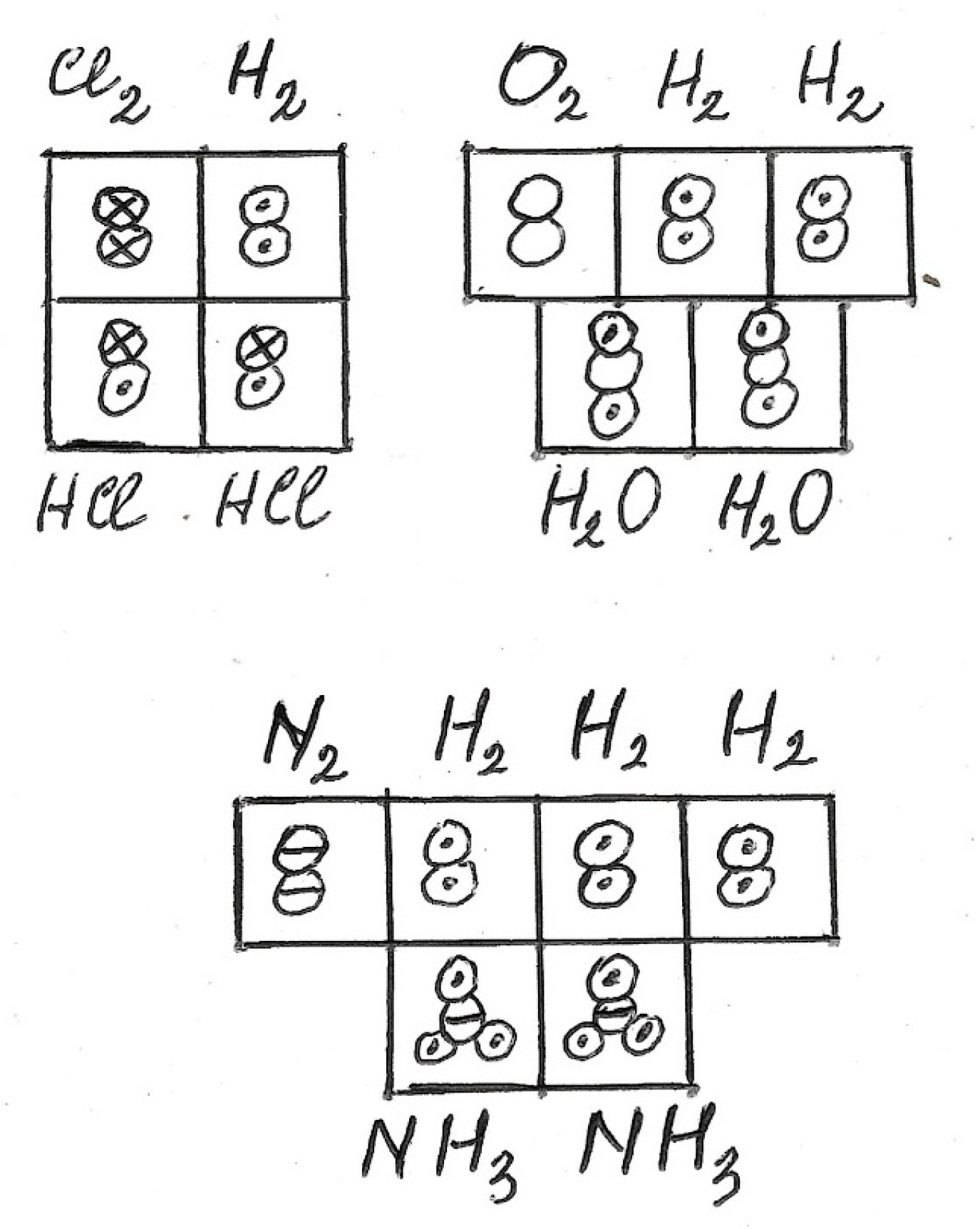
Gaudin came up with the solution to these difficulties by suggesting that the molecules of different elements may be composed of a different number of atoms. In the important memoir based on Avogadro’s hypothesis (but attributed to Ampère) (Gaudin 1833), Gaudin makes the following observation for the gaseous reaction between hydrogen and chlorine, both occupying volume V, to hydrogen chloride in volume 2V. If the reactants are atoms combining in a 1:1 ratio, n atoms of each of them will give no more than n product molecules in the volume 2V so that their number in the half volume V is n / 2 and the distance between adjacent hydrogen chloride molecules increases to 2 3 , the distance between adjacent hydrogen or chlorine atoms in the same volume. The conclusion is as follows: ‘in order that the hypothesis be valid, it is necessary that reactant particles can evenly divide; then, they are not atoms’ (Gaudin 1833). For the same reason, this conclusion holds for several other elements, such as oxygen, nitrogen, bromine and iodine, present in the formation of water vapor, ammonia, nitrogen oxides, and bromidric and iodidric acids. Gaudin gives a clear account of the formation not only of hydrogen chloride but also of water and ammonia by means of the volume diagrams shown in Figure 1.
Then, the weight of the elementary molecule is for all of them twice that of the atom and the ratio of the elementary gaseous density to that of hydrogen is directly the atomic weight, as advocated by Dumas. Going to mercury, Gaudin observes (Gaudin 1833) that its density relative to oxygen is 6.321 (the value was obtained since the density of oxygen relative to air was known). Since oxygen is a diatomic molecule, twice that number (12.642) is the density with respect to atomic oxygen. More clearly, in actual terms, the atomic weight of mercury is 12.642 × 16 = 202.3, almost equal to the reported value (Berzelius 1819); ’then, mercury vapour is composed by monoatomic particles’. The second interesting case is sulfur. Gaudin thinks that, if sulfur and oxygen are indivisibles particles, sulfuric acid would be represented, following Table 5, by the formula SO9, instead of SO3, which is an ’absurd result without discussion’. Therefore, he retains as the atomic weight of sulfur the past value, 32.2, with absolute certainty. This amounts to saying that the sulfur molecule is not monoatomic. A little additional reflection based on Avogadro’s hypothesis (Nash 1957) easily shows that the atomic weight obtained by Dumas, 94.3, agrees with the hexatomic structure of molecular sulfur. Proceeding in a similar way for phosphorus and arsenic, both the elements are constituted by tetratomic molecules in the gaseous state.
Although all of Gaudin’s predictions were correct, the influence of his ideas on the Parisian academic milieu was scarce, if not null (Partington 1972). He worked for many years as a mathematician at the Bureau of Longitudes in Paris, was mainly interested in crystallography and photography and did not develop further his chemical ideas (Ihde 1984). Uncertainty about the whole structure of atomic theory was the second factor opposing his views (Nash 1957). Not only would it be necessary to maintain the existence of elementary diatomic molecules but also to recognize that different elementary molecules have different numbers of atoms. According to Berzelius, there is no reason to suppose elementary substances consist of diatomic molecules, but now the additional difficulty is to explain why the number of atoms in the molecule should change from one element to another. Since Avogadro’s hypothesis is unable to suggest any method to estimate this number, how could the atomic weights be determined without the assistance of other sources? In other words, the vapor density method did not seem to be an independent method of atomic weight determination.
The vapor density results (Dumas 1826, 1832a, 1832b; Mitscherlich 1833) increased the skepticism about the atomic theory and emphasized the conjectural character of Avogadro’s hypothesis. Dissatisfaction about Dalton’s arbitrary rules for the assignment of particle formulas was already expressed as early as 1814 by Wollaston (Wollaston 1814), who established a synoptic scale of equivalents by analyzing the physical data of compounds and the chemical data considering an enormous number of reactions and giving oxygen the reference weight 10. A few examples are H = 1.32 (from water analysis), C = 7.54 (from oxygen and carbonic acid densities), and N = 17.54 (from hydrogen and nitrogen densities). Between 1830 and 1840, the common belief was that no general method could be found for a non-debatable table of atomic weights, although Berzelius’ atomic weights, based on a combination of results and chemical analogies, were correct overall. Atomic theory was losing its usefulness in favor of the equivalents directly obtainable from experiments (Partington 1989). Equivalent weights (H = 1, O = 8, C = 6, S = 16, Ca = 20, Mg = 12, etc.) had widespread use thanks to Gmelin’s Handbuch der Chemie (Gmelin 1860). Particles composed of different elements were combined in the simplest possible numerical proportions: water as HO, sulfureted hydrogen as HS, and potash as KO.

6. Atomic and Molecular Weights: The Role of Organic Chemistry

It was organic chemistry that accumulated the information adequate to serve as an empirical basis for Avogadro’s hypothesis. As the interest in organic compounds grew vigorously, many volatile substances were discovered (Partington 1972). The remarkable outcome of this research was that formulae established on purely chemical grounds could be associated with quantities that, in the gaseous state, occupy equal volumes. To enlighten this point, it is convenient to shortly review a few examples of early organic chemistry, borrowing from exhaustive reports (Partington 1972; Ihde 1984; Califano 2010; Freund 1904).

6.1. Early Organic Chemistry (Outline)

In his atomic theory (Berzelius 1813a), Berzelius defines ‘organic atoms’ as particles composed of more than two elements (carbon, hydrogen, oxygen). The first successful method of organic analysis was conceived and tested by Gay-Lussac and Thénard (Gay-Lussac and Thénard 1811). Their apparatus was improved by Berzelius (Berzelius 1814b), who analyzed seven organic acids as lead salts and reported the data in terms of anhydrides (Berzelius 1814c). Acetic and succinic acids were expressed as the anhydrides 4C + 6H + 3O and 4C + 4H + 3O; lead acetate and succinate were viewed as second-order atoms, (Pb + 2O)∙2(4C + 6H + 3O) and (Pb + 2O)∙2(4C + 4H + 3O), and every salt resulted from two parts with opposite electrical charges (Berzelius 1819). Citric acid was a more difficult case. Berzelius assigned to citric acid, i.e., its anhydride, the formula CHO (correct, C6H6O6) (Berzelius 1815b). Later, Liebig represented silver citrate as C12H10O11 + 3AgO and (hydrated) crystalline acid as C12H10O11 + 3H2O (Dumas and Liebig 1837a). As to the atomic coefficients, they were double with respect to our formulae; for instance, (hydrated) acetic acid was C4H6O3 + H2O = 2∙C2H4O2. It should be recalled that Berzelius defines the equivalent weights of monobasic organic acids as the weight of the acid combining with one compound atom of silver oxide (incorrectly) formulated as AgO (pAg = 2∙108, see Table 1) (Partington 1972). Experimentally, one atom of acetic acid (120 parts or weights) reacts with one atom (232 parts) of silver oxide to give silver acetate, C4H6O3 + AgO. With 120 as the equivalent weight of (hydrated) acetic acid, the formula is C4H6O3 + H2O = C4H8O4, twice the actual value (C2H4O2). Liebig extended this formulation to many other organic acids, doubling their formulae (Partington 1972); for instance, citric acid was determined to be C12H16O14 = 2∙C6H8O7.
In their historic study on the oil of bitter almonds (Wöhler and Liebig 1832), Liebig and Wöhler shed light on ‘the dark forest of organic chemistry’ and learned that the oil, i.e., benzaldehyde, can be oxidized to benzoic acid and converted to benzoyl amide and halides. All these compounds indicate the presence of the benzoyl radical, C14H10O2 (our C6H5CO), which conserves its identity from one compound to another and thus behaves as if it were a single element. Crystalline benzoic acid (C6H5COOH) was formulated as C14H12O4 = 2∙C7H6O2, benzaldehyde (C6H5COH) as C14H12O2 = 2∙C7H6O and benzoic acid anhydride (correctly) as C14H10O3. Many other radicals were characterized in the following years (Partington 1989). Some of the others were ethyl (C4H10, double formula), methyl (C2H6, double formula), and cacodyl (C4H12As2, correct formula). These results were the stimulus for an early classification of organic compounds by Dumas and Liebig, emphasizing that radicals play the same role as elements in inorganic chemistry (Dumas and Liebig 1837b).

6.2. Two and Four Volume Formulae

Liebig’s analysis of organic acids from silver salts leads to formula doubling. This in turn implies that the ethyl group contained in the esters of the previous acids is C4H10O, which leads to the doubling of the alcohol formula, C4H10O + H2O = 2∙C2H6O (Partington 1972). It was customary to call these formulae as four volume formulae, meaning the number of volumes (four) occupied by the gaseous substance in the formation from gaseous elementary volumes (Partington 1989). Alternatively, Gerhardt introduced the reduced two-volume formulae (Gerhardt 1843a, 1843b, 1848). The two-volume formulae include H2O, NH3, HCl, and NO2, since two volumes of all these gases are formed from gaseous volumes of elements (for instance, 2 V h y d r . + 1 V o x y g . 2 V w a t . v a p . ). However, Gerhardt admits a difficulty when one reagent is not in the gaseous form,d saying that (Gerhardt 1848, p. 39) ‘for non-volatile solids such as charcoal it is not possible […] to find the true density [of carbon as a vapor]. It is necessary to make recourse to hypotheses […] chemical formulae are obviously affected.’ He considers the following case. When carbon, a solid element, undergoes combustion to carbonic acid [carbon dioxide], it is experimentally found that carbonic acid and oxygen occupy the same volume, i.e., the volume is conserved (Gerhardt 1848). Which is the density of carbon gas in hypothetical gaseous combustion if we want to establish the formula of carbonic acid? Some chemists assume 1:1 as the volume ratio between the oxygen and the carbon vapor; then, the contraction of two volumes to one is ( 1 V c a r b . v a p . + 1 V o x y g . 1 V c a r b . a c . ) and the carbon density is d c a r b . v a p . = d c a r b . a c . d o x y g . . Some others prefer the 1:2 ratio; then, the contraction of three volumes to two is ( 1 V c a r b . v a p . + 2 V o x y g . 2 V c a r b . a c . ) and the carbon density is d c a r b . v a p . = 2 d c a r b . a c . 2 d o x y g . , twice the previous value. The former chemists write C2O and CO, the latter CO and CO2, for carbon oxide and carbonic acid, respectively (Gerhardt 1848). Which should be the choice if, according to Gerhardt, the chemical formulae do not have an absolute value? He suggests focusing on the volumes and of volatile compounds, especially those of organic origin, for the formulae referring to the same volume. With CO2 as the two-volume formula of carbonic acid and the densities d c a r b . a c . = 1.592 ;   d o x y g . = 1.106 (Gerhardt 1848), the density of the (hypothetical) carbon vapor is determined to be d c a r b . v a p . = 0.846 (all density values referred to d a i r = 1 ). Gerhardt acknowledges that this number is conjectural but adds that it may be used for other calculations, provided that the value is conserved for all the reactions under study.
On the other hand, many chemists, Liebig being the leading proponent (but also Gerhardt before 1843), were using four-volume formulae for organic molecules. Taking, for example, benzoic acid, C14H12O4, the total weight of the gaseous reactant elements is 14 d c a r b . v a p . + 12 d h y d r . + 4 d o x y g . , and with d c a r b . v a p . and d o x y g . values of 0.846 and 1.106, respectively, and d h y d r . = 0.0692 (Freund 1904; Gerhardt 1848), this amounts to 17.1. Since the (relative) density of benzoic acid vapor, known at that time, is 4.2, the total weight fills a volume 4V. What is the effect of choosing this formula on the discussion of the chemical reactivity of benzoic acid? For instance, heating benzoic acid in presence of slaked lime (CaO∙H2O), the product, discovered by Mitscherlich (Partington 1972), is benzene9. Starting with one equivalent of C14H12O4, 244 parts (or weights), the reaction gives benzene, 156 parts, and carbonic acid, 88 parts, and is described with the following scheme (Gerhardt 1848):
C14H12O4 →  C12H12 + C2O4
benzoic acid  benzene   carbonic acid
This is only one example in the long list of reactions where carbonic acid participates with 88 parts or its multiples, but Gerhardt adds that the parts corresponding to CO2, C3O6, and C5O10 in the reactions of organic compounds are never observed (Gerhardt 1843a). The same conclusion holds considering the equally long series of reactions where water is present: the combination parts are 36, corresponding to H4O2, or its multiples. Both C2O4 and H4O2 are four-volume formulae that stand for double the molecules of carbonic acid and water, usually represented in inorganic chemistry as CO2 and H2O. Then, a question is left open (Gerhardt 1843a):
‘This is experimentally observed [i.e., the formation of C2O4 and H4O2]; but it is known that chemists regard C2O4 et H4O2 as two equivalents of each gas. Is this correct or rather it is necessary to double the atomic coefficients of water and carbonic acid to have their true equivalent?’
Gerhardt answers the question in the subsequent paper (Gerhardt 1843b). There are two possible choices: either C2O4 and H4O2 represent one equivalent10 of carbonic acid and water, or they express two equivalents of the same substances. In the first case, the formulae of the compounds of mineral chemistry must be doubled; in the second, most organic formulae must be halved. Briefly, the two alternatives are, in actual terms:
(a)
C14H12O4 → C12H12 + C2O4;
(b)
2C7H6O2 → 2C6H6 + 2CO2.
In order not to have different equivalents in mineral and organic chemistry, he recommends referring to the two-volume formulae for organic compounds, i.e., halving the value of Avogadro’s idea (organic formulae11). Thus, it has been noted (Rocke 1984) that this proposal is not based on Avogadro’s hypothesis but rather on the elimination of the anomalies between organic and inorganic formulae, reducing both to a uniform standard. Gerhardt never emphasized the value of Avogadro’s idea (Partington 1972; Rocke 1984).
It was Laurent in his Méthode de Chimie (Laurent 1854; Laurent 1855) that recognized the significance of Avogadro’s hypothesis, although he always calls it Ampère’s hypothesis. Talking about the possible formulae of hydrochloric acid, HCl, H2Cl2, H3Cl3, etc., he adopts the usual (HCl) but disagrees with the idea that the reaction is due to the combination of atomic hydrogen and chlorine, ‘being desirous of proving that the molecule of free chlorine is binary, but this molecule can divide itself into two when enters in combination’ (Laurent 1855), i.e., following Gaudin, he introduces the concept of the divisibility of elementary molecules. The formation of hydrochloric acid from elements occurs ‘when H2 is put in the presence of Cl2, it loses H which is replaced by Cl’, seeing the reaction as a double decomposition rather than a combination. As support, he refers to Avogadro’s hypothesis stating that ‘we may generalize the idea of Ampère [more correctly, Avogadro]. All bodies, simple and compound, contain the same number of molecules in the same volume’ (Laurent 1855).

7. Cannizzaro’s Approach to the Atomic–Molecular Theory

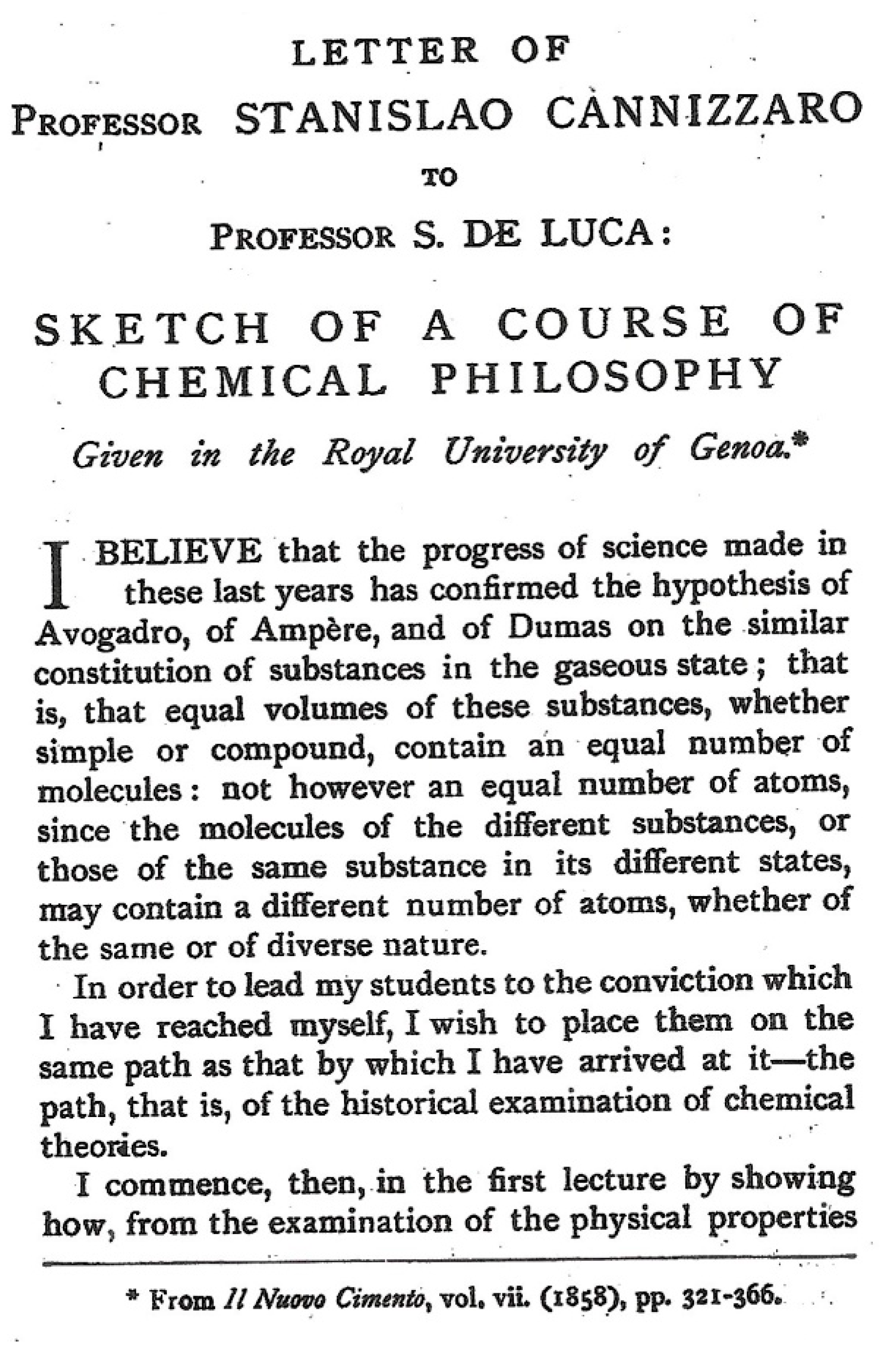
The Sunto di un Corso di Filosofia Chimica was first published in Il Nuovo Cimento (Cannizzaro 1858) as a letter to De Luca12 and then reprinted as Sketch of a Course of Chemical Philosophy (Cannizzaro 1910) (first page in Figure 2). Being the secretary of the journal, De Luca was the addressee of the letter in which Cannizzaro, fully appreciating Avogadro’s hypothesis (see the opening lines of the paper in our Introduction), critically reviews the previous atomic theories and outlines in eight lectures for his students the principles by means of which he proposes a unique system of atomic weights.
In the first lecture, he states that Avogadro’s hypothesis does not contradict the known experimental results provided (Cannizzaro 1910):
‘we distinguish molecules from atoms; [……] we do not confuse the criteria by which the number and the weight of the former [molecules] are compared, with the criteria which serve to deduce the weight of the latter [atoms]; [……] we have not fixed in our minds the prejudice that […] the molecules of the various simple substances must all contain either one atom, or at least an equal number of atoms.’
In subsequent lectures, Cannizzaro writes about the non-immediate acceptance of the equal volume/equal number of particles hypothesis (second), the confirmation of the hypothesis by all researchers, from Gay-Lussac to Clausius (third), and the (wrong) determination of inorganic/organic formulae based on the different rules for inorganic and organic chemistry (fourth lecture).
Cannizzaro’s historical contribution to the atomic–molecular theory comes from the fifth lecture. Considering gaseous substances, he at once observes that, based on Avogadro’s hypothesis, their molecular weights are proportional to their densities. This is equivalent to establishing the following equation to find the molecular weight of A making use of a convenient gaseous standard:
M A M s t a n d a r d = ρ ( A ) ρ ( s t a n d a r d )
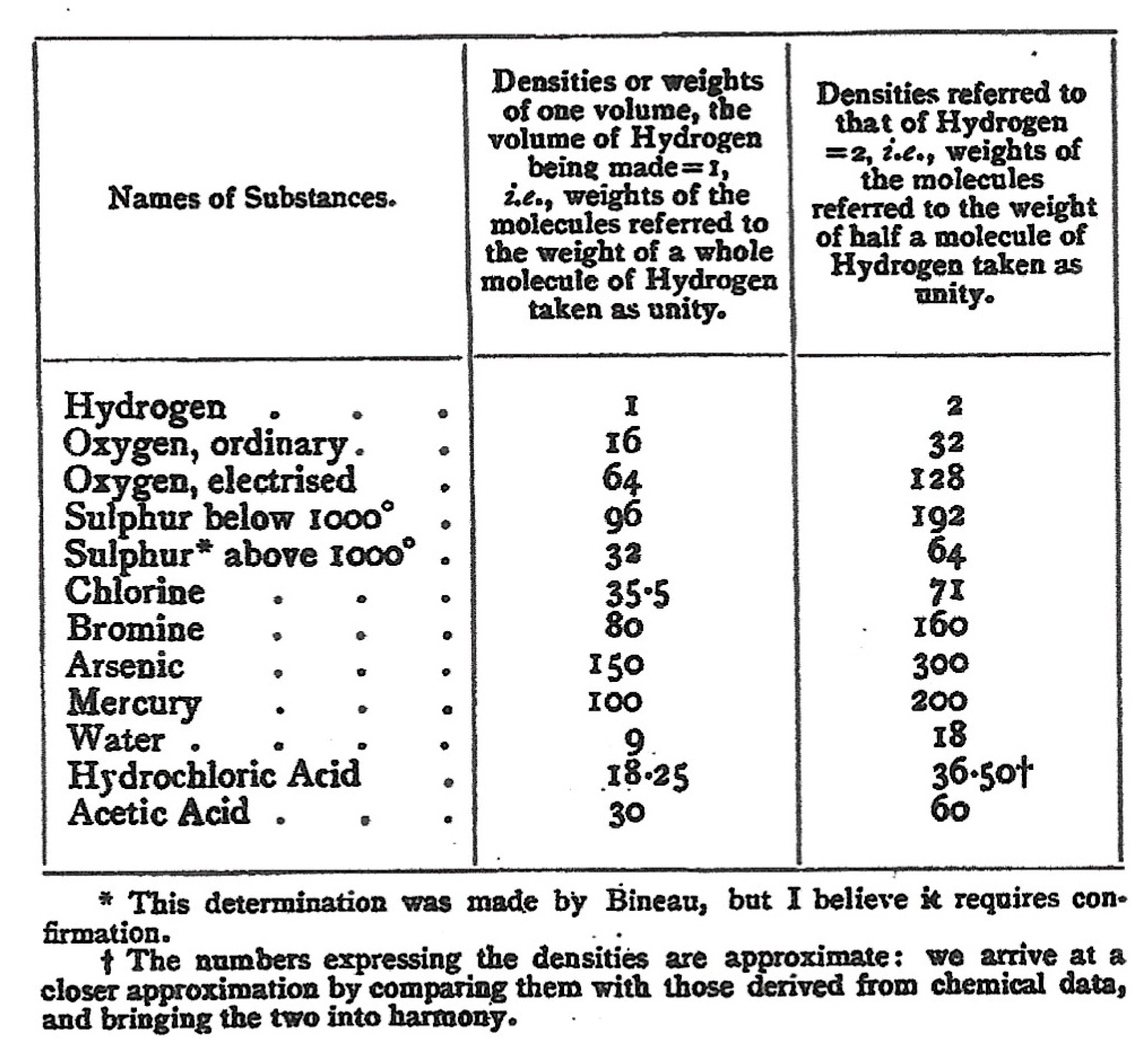
where M A , M s t a n d a r d are molecular weights and ρ ( A ) , ρ ( s t a n d a r d ) are densities. Taking as the standard the lightest gas, molecular hydrogen, the two options to express the standard are (a) the whole molecule ( M s t a n d a r d = 1 ) and (b) atomic hydrogen ( M s t a n d a r d = 2 ). Cannizzaro knows the densities in terms of the specific gravities at 0 °C, 1 atm, and with ρ ( H 2 ) ρ ( a i r ) = 0.0692 (Freund 1904; Gerhardt 1848), it results in the following:
M A = M s t a n d a r d ρ ( A ) ρ ( H 2 ) = M s t a n d a r d ρ ( A ) ρ ( a i r ) · ρ a i r ρ H 2 = M s t a n d a r d · s p e c . g r a v . ( A ) 0.0692
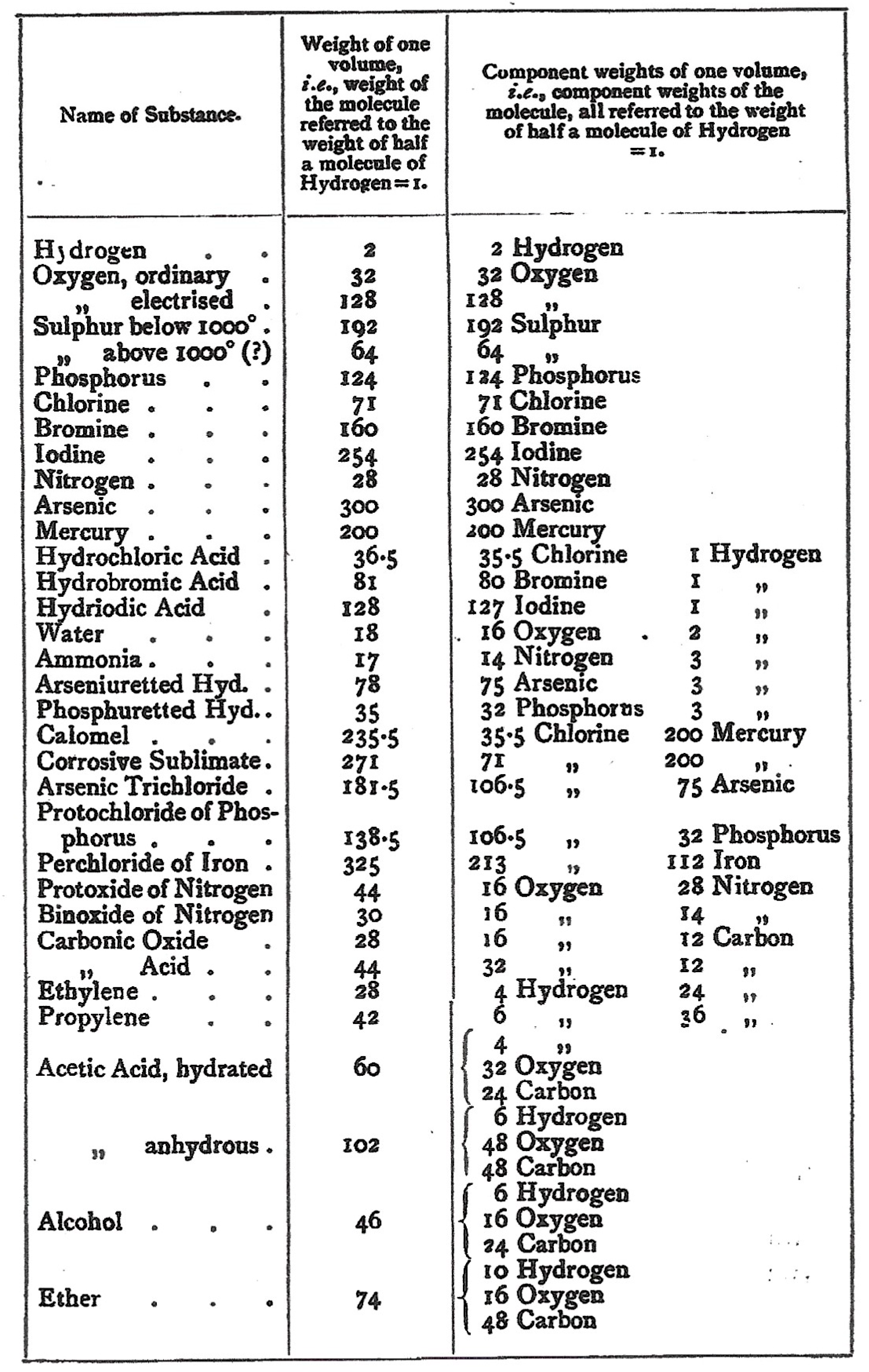
The two cases are related; the second (b) is twice the first (a), as is evident from the original Figure 3. Then, if the elementary analysis and the weight atomic percents, (%), of a gaseous substance are known, the molecular weight may be resolved into atomic contributions proportional to their (%); a very simple example of this procedure is water, whose molecular weight (18, see Figure 3, second column) is divided into hydrogen (2) and oxygen (16) contributions from the weight (%) composition, which is hydrogen (11%) and oxygen (89%). With the help of this criterion, he assembles the table reported in Figure 4, which includes the molecular weights of several simple and compound substances (first numerical column) and their divisions into atomic contributions (second column). Looking at Figure 4, the striking result ‘you will not be able to escape’ are the atomic quantities making up the molecular weights of the compounds: they are integer multiples of the characteristic values. Atomic hydrogen is contained in its compounds as a multiple of 1, oxygen of 16, nitrogen of 14, carbon of 12 and chlorine of 35.5.
Thus, Cannizzaro is entitled to enunciate his law of atoms (Cannizzaro 1910), which is indeed a definition of the atom with reference to the molecule and not vice versa (Meldrum 1906):
‘The different quantities of the same element contained in different molecules are all whole multiples of one and the same quantity, which, always being entire, has the right to be called an atom.’
The surprisingly simple procedure to find the atomic weight of an element is stated by saying that ‘it is necessary first of all to know the weights of all or of the greater part of the molecules in which it is contained and their composition’. It is not necessary, however, to know the molecular weight of the element to find the atomic weight. This is the case of carbon, whose weight, 12, is derived from the molecular weights of several volatile carbon compounds and their analytical compositions. As shown in Figure 4, carbon is entered either with the value 12 or integer multiples of 12. The addition of the carbon molecular weight, Cannizzaro warns, would have contributed to the determination of the atomic weight as any other carbon compound.13
As to the next three lectures, for the purpose of the present story, we limit our review to say that in the sixth lecture, the molecular formulae and weights of several metal chlorides, bromides and iodides are discussed and the atomic weights of the alkaline metals and silver are determined, finally completing Berzelius’s table of atomic weights. At the end of this exposition, it is apparent that the claim of the unknown author of the Sketch preface (J.W.) that ‘one has impelled to the conclusion that Cannizzaro’s students of 1858 [of Genoa University] must have had clearer conceptions of chemical theory than most of his scientific colleagues of a much later date’ has solid reasons to be true.

The Congress of Karlsruhe

On 3 September 1860, about 140 European chemists gathered at Karlsruhe to discuss the problems responsible for the chaotic state of chemistry in the mid-nineteenth century (Ihde 1961). Accounts of the three-day conference were reported in the Appendix VIII of ref. (Anschütz 1929) and in refs. (deMilt 1951; Wisniak 2004). It was August Kekulé (1829–1896), then at the University of Ghent, who was the first proponent of the call for an international meeting of chemists, being much discomforted by the occurrence of different atomic weight determinations and of different formulae to specify the same compound. The first positive answer came from Charles-Adolphe Wurtz (1817–1884), University of Paris, and Karl Weltzien (1813–1870), Technische Hochschule of Karlsruhe. Invitation letters quickly followed, signed by 45 prominent chemists. Renowned figures of the European chemical milieu attended, including Baeyer, Landolt, Kopp, Beilstein, Bunsen, Carius, Erlenmeyer, Hoffmann, Fehling, Fresenius, Guthrie, Odling, Roscoe, Dumas, Friedel, Thénard, Cannizzaro, Borodin, Mendeleev, Schiff, Wislicenus, and Stas (Anschütz 1929; deMilt 1951). The congress debate is extensively reported in the Appendix VIII of ref. (Anschütz 1929), written by Wurtz. After the inaugural speech, a commission was appointed and charged to submit a list of questions to the assembly for deliberation. In our story, we focus the attention on the questions more closely related to Cannizzaro’s ideas. The discussion about the concepts of molecules and atoms was set by the two main speakers, Kekulé and Cannizzaro, in the first session of the commission. Their points of view were opposite: Kekulé emphasized not only that the concepts of molecules and atoms must be distinguished but also that a distinction between chemical and physical molecules would be useful; Cannizzaro, on the contrary, asserted his inability to conceive of a chemical molecule. Kopp, as the commission chairman, proposed in the first session of the commission to debate these issues. In the second session of the congress, the president Boussingault wisely warned that ‘it is not chemistry that grows old, but chemists’, perhaps perceiving a risky division between the young and old participants. Kekulé and Cannizzaro reinforce their opinions; Wurtz thinks that they argue about a secondary point and, in conclusion, hopes that the assembly will express an opinion, though ‘this opinion would not bind anyone, and there would be nothing obligatory about it’. In the second session of the commission, ideas about the chemical notations were discussed. According to Kekulé, the two notations in use, one atomic–molecular and the second by equivalents, are both legitimate, provided they do not mix one with the other. For instance, he says, both sets of notations
molecular equivalent HCl HCl H 2 O HO H 3 Az Haz
for hydrochloric acid, water (with O = 8 and barred symbol meaning double atomic weight) and ammonia (with az = Az/3) are valid, but the HO and H3Az formulae must not be mixed. Cannizzaro replies, stressing that it is important to consider the relation between notation and volumes, a basic consideration he will elaborate more fully in the third session of the congress. The question proposed by Kopp in this session is slightly modified by Kekulé in the third session of the commission and is finally presented a third time to the assembly in the following terms (Anschütz 1929):
’Is it desirable to harmonize chemical notation with advances in the science?’
‘Is it appropriate to adopt the principles of Berzelius again, where notation is concerned, in bringing about some modifications to these principles?’
’Is it desirable to distinguish new chemical symbols from those which were generally in use fifteen years ago with the help of particular signs?’
Cannizzaro’s answer in opposition to the second question is the outstanding speech reported in full in the Wurtz account. It is not recommended, he begins, to go back to Berzelius’s time, which is equivalent to walking along a known path. Gerhardt’s great service to science consists in establishing molecular formulae based on Avogadro’s and Ampère’s theory of ’uniform constitution of substances in the gaseous state’. Historically, he continues, Gerhardt’s contribution to molecular theory is the result of Dumas’s work on the vapor density determination of molecular weights and Gaudin’s interpretation of his data. Gerhardt accepts from Avogadro the concept of the divisibility of simple bodies, and (Anschütz 1929)
’he then subjected all of the formulae of organic chemistry to a general investigation and he realized that all of these formulae corresponding to equal volumes of hydrochloric acid and ammonia were confirmed by all reactions and by all chemical analogies.’
Cannizzaro concludes with these significant words (Anschütz 1929):
’In summary, gentlemen, I propose that Gerhardt’s system be accepted, taking into consideration the modifications of the atomic weights of certain metals and the formulae for their salts which I suggest be brought about. And if you are unable to reach a complete agreement upon which to accept the basis for the new system, let us at least avoid issuing a contrary opinion that would serve no purpose, you can be sure. In effect, we can only obstruct Gerhardt’s system from gaining advocates every day. It is already accepted by the majority of young chemists today who take the most active part in advances in science.’
Many of the participants (including Kekulé) agreed with this proposal. Erdmann took a more conservative position, (a) to drop the discussion on the first two points, being questions of principle, and (b) to ask the assembly only about the third question. This request being positively received, the question of the use of barred symbols for doubled atomic weights was put to a vote and approved. Thus, the congress came to an end with a deliberation far, in the opinion of the present author, from even the most moderate purposes of the organizers. Cannizzaro, a leading personality among the participants as well as the most active during the three-day debate, did not obtain the awaited recognition for his proposal. However, a singular incident happened at the close of the meeting (deMilt 1951; Ihde 1961, 1984; Wisniak 2004), which was not reported by Wurtz. The only other Italian chemist attending the congress, Angelo Pavesi (1830–1896) from the University of Pavia, Cannizzaro’s longtime friend, distributed the Sunto paper as a pamphlet among the participants. Reading it deeply impressed Lothar Meyer (1830–1895) to the point that (Ihde 1984; Wisniak 2004) ‘once arrived [home] I read again repeatedly and was astonished at the clearness with which the little book illuminated the most important points of controversy. The scales seemed to fall from my eyes. Doubts disappeared and a feeling of quiet certainty took their place’. Cannizzaro’s ideas were afterwards fully developed in Meyer’s textbook, Modern Theories of Chemistry (Meyer 1888). A second great chemical personality, 26-year-old Dmitry I. Mendeleev (1834–1907), attended the congress and describes well its climate with these words (Partington 1972):
’I well remember how great the difference of opinion was, and how a compromise was advocated with great acumen by many scientific men, and with what warmth the followers of Gerhardt, at whose head stood the Italian professor Cannizzaro, followed the consequences of the law of Avogadro. [….] The truth, in the form of the law of Avogadro-Gerhardt, received [….] a wider development, and soon afterwards convinced all minds.’

8. Conclusions

In this paper, we have reported on the delayed acceptance of Avogadro’s equal volume/equal number of particles hypothesis and reviewed the significant segments of chemical science in the first half of nineteenth century. While the atomic hypothesis was, according to Berzelius, ‘an idea so simple and so probable that the doctrine would have certainly been started by others if Dalton had missed it’ (Berzelius 1813a), the formation and divisibility of polyatomic elementary molecules were more complex chemical concepts, taking almost fifty years for affirmation. The acquisition of these concepts was not an easy and rapid task for the chemical community. Strong opposing reasons were the persisting belief that compound atoms cannot occupy the same volume as elementary atoms (at common temperature and pressure) and the lack of any adequate explanation for the stability of elementary polyatomic molecules postulated by Avogadro, this assumption being contrasted by the influential dualistic theory of Berzelius.
An attempt to reconcile Avogadro’s hypothesis with atomic theory occurred with Dumas’s vapor density experiments on volatile liquid and solid elementary substances. The perplexing results were explained at the high price of adding a new conjecture, this time proposed by Gaudin, i.e., the occurrence of elements containing different numbers of component atoms. A decisive resurgence of interest in Avogadro’s point of view came from organic chemistry, which made available many volatile compounds, and from the studies of Gerhardt and Laurent, who advanced the idea that the molecular formulae of gaseous organic substances should be proposed so as to occupy the same volume (Meldrum 1906). Cannizzaro realized that this proposal was a reaffirmation of Avogadro’s hypothesis and willingly adhered to it. In his approach, Avogadro’s hypothesis stands as a fundamental tenet of chemistry and molecules as the qualifying entities of a substance, with the atom concept coming second, i.e., when the molecular weight is resolved into atomic contributions.
Finally, at the end of this long chapter about chemical science, it is tempting to trace some remarks on Dalton’s place in this story which are not about stubborn resistance to the equal volume/equal number of particles hypothesis but rather about Dalton’s oscillations between an initial full rejection and a silent/late acceptance of the hypothesis (Rocke 1984). Dalton’s atomic theory accounted well for the laws of definite, multiple and reciprocal proportions while it did not give unambiguous criteria for atomic weights, which were related to the ‘rules of the greatest simplicity’, and to gravimetric combining weights rather than to volumetric ratios (Meldrum 1906). Yet, Dalton considered relative gas densities as the best criterion for the assignment of binary formulas to the lowest oxides of carbon and nitrogen (Dalton 1810). An equality of particle numbers within the common unit volume was here assumed. Later, he gave up his second theory of mixed gases and the associated postulate of the inequality of atomic sizes, returning to the first theory of mixed gases (Dalton 1826). Following the change of opinion, it is not surprising to read in Dalton’s statement of 1841 (quoted in Rocke 1984) that ‘it is my opinion that the simple atoms are alike, globular, and all of the same magnitude or bulk, whether of hydrogen 1, or lead, 90’.

Funding

This research received no external funding.

Institutional Review Board Statement

Not applicable.

Informed Consent Statement

Not applicable.

Data Availability Statement

Data are contained within the article and can be found in the relevant references.

Acknowledgments

I gratefully thank Vincenzo Schettino, Fabrizio Mani and Antonella Capperucci, of the University of Florence, for their careful reading of the manuscript and their helpful suggestions.

Conflicts of Interest

The author declares no conflicts of interest.

Notes

1
The types of molecules considered by Avogadro are: a molécule intégrante (or composée) as a molecule in general, most often of compounds; a molécule constituante as a molecule of an elementary gas; and a molécule élémentaire as an atom of an element (Ihde 1984).
2
This conclusion is equivalent to and consistent with Avogadro’s hypothesis, which was advanced three years earlier, as Ampère acknowledges (Ampère 1814, footnote p.46): ‘Dépuis la rédaction de mon Mémoire, j’ai appris que M. Avogadro avait fait de cette dernière idée la base d’un travail sur les proportions des élémens dans les combinaisons chimiques.’).
3
Nitrogen (azote, Az) was regarded (Berzelius 1819; Partington 1972) as the oxide of the hypothetical radical ammonium or nitricum, Nt, i.e., Az = Nt + O. Muriatic acid was viewed, following Lavoisier’s ideas about acids (Partington 1962), as the M + 2O oxide of the unknown radical murium, and oxymuriatic acid as M + 3O, i.e., the oxide of the same radical with more oxygen. It was Davy with his experiments on chlorine compounds to show that oxymuriatic acid is elementary chlorine (Partington 1972). Later, Berzelius’s opinion about the compound nature of oxymuriatic acid was more open to doubt (Berzelius 1819).
4
Here, the original sentence is as follows: ‘Les phénomènes des proportions chimiques paraissent prouver que chaque gaz d’un corps simple contient dans le même volume, mesuré à la même température et à la même pression, un nombre égal d’atomes; puisque dans le cas opposé, la théorie corpuscolaire et celle des volumes ne pourraient pas marcher de front, et conduiraient au contraire à des résultats différents.’
5
In ref. (Berzelius 1814a, pp. 353–64), the atomic weights are listed as specific weights.
6
Here, Berzelius’s nomenclature is used, i.e., the atomic symbols with the numbers of atoms above the level of the symbols (Partington 1972).
7
Isomorphism, first observed by Eilhardt Mitscherlich (1794–1863), refers to the similarity of chemical composition of compounds having the same crystalline form (Mitscherlich 1821). The first cases of isomorphism were the pairs of phosphate and arsenate salts, the actual formulae being Na2HPO4∙12H2O/Na2HAsO4∙12H2O and NaH2PO4∙H2O/NaH2AsO4∙H2O. In these compounds, Mitscherlich writes (Mitscherlich 1821, p. 357), ‘each arsenate has a corresponding phosphate, composed according to the same proportions [……] these two series of salts have no difference except the radical of the acid, arsenic in one case, phosphate in the other.’
8
It should be noted that all the investigated elements are liquid or solid at 0 °C, 1 atm. The densities ρ e l e m and ρ refer to the element treated as a gas for comparative purposes. From ref. (Dumas 1826), it is easy to obtain ρ e l e m = 3.45 g/L for gaseous mercury under the experimental conditions of vaporization (t = 446 °C, p = 765 mmHg). For the (hypothetical) gaseous mercury at 0 °C, 1 atm, the densities ρ e l e m = 9.06 g/L and ρ = 6.976 were calculated (Dumas 1826). The latter data were used for atomic weight determination. The stable phase of mercury at 0 °C, 1 atm is liquid with density ρ l i q 13,600 g/L.
9
Benzene was first isolated by Faraday and its composition was determined to be ‘bicarburet of hydrogen’ C2H with pC = 6 (Faraday 1825). Using the vapor density method, Mitscherlich proposed the formula C3H3 (with pC = 12), corresponding to the quantity of gaseous benzene occupying the volume of 1 ‘atom’ of hydrogen (Partington 1972).
10
It has been noted that equivalent meant for a long time what now is called molecular weight (Partington 1989).
11
Halving the formulae of organic compounds also had a fundamental consequence on the chemical interpretation of acids and salts. Acetic acid was formulated C2H4O2, not as the combination of acetic anhydride with water, C4H6O3 + H2O, and silver acetate C2(H3Ag)O2, not as the combination of the anhydride with the basic oxide, C4H6O3 + AgO. Gerhardt arrived at the important statement about acids and salts, opposing Berzelius’s dualistic theory, (Gerhardt 1843b, p. 244), ’there is no water in acids and no oxides in the metallic salts’.
12
Sebastiano De Luca (1820–1880) and Stanislao Cannizzaro were close friends working under the direction of Raffaele Piria (1815–1865), the leading Italian chemist at the University of Pisa. In 1855, Cannizzaro was appointed as a professor at the University of Genoa, as well as De Luca in 1857 at the University of Pisa. Successively, Cannizzaro moved in 1861 to Palermo and then in 1871 to Rome, becoming the first professor of chemistry of this University, while De Luca moved in 1862 to Naples (with the same academic honor).
13
Incidentally, it is of interest to note that in recent times, an equally fundamental notion about atoms, i.e., their nature as chemical elements, has been studied (Paneth 2003; Scerri 2012; Scerri and Ghibaudi 2020).

References

  1. Ampère, André M. 1814. LETTRE De M. AMPÈRE à M. le comte BERTHOLLET, sur la détermination des proportions dans lesquelles le corps se combine d’après le nombre et la disposition respective des molécules dont leur particules intégrantes sont composes. Annales de Chimie 90: 45–86. [Google Scholar]
  2. Anschütz, Richard. 1929. August Kekulé. Berlin: Verlag Chemie. [Google Scholar]
  3. Avogadro, Amedeo. 1811. Essai d’une manière de déterminer les masses relatives des molecules élémentaires des corps, et les proportions selon lesquelles elles entrent dans ces combinaisons. Journal de Physique 73: 58–76. [Google Scholar]
  4. Avogadro, Amedeo. 1890. Essay on a Manner of Determining the Relative Masses of the Elementary Molecules of Bodies, and the Proportions in Which They Enter into these Compounds. Alembic Club Reprints 4: 28–51. [Google Scholar]
  5. Berzelius, Jöns J. 1813a. Essay on the Cause of Chemical Proportions, and on some Circumstances relating to them: Together with a short and easy Method of expressing them. Annals of Philosophy 2: 443–54. [Google Scholar]
  6. Berzelius, Jöns J. 1813b. An explanatory Statement of the Notions or Principles upon which the systematic Arrangement is founded, which was adopted as the Basis of an Essay on Chemical Nomenclature. Nicholson’s Journal 34: 153–66. [Google Scholar]
  7. Berzelius, Jöns J. 1814a. Essay on the Cause of Chemical Proportions, and on some Circumstances relating to them: Together with a short and easy Method of expressing them. Annals of Philosophy 3: 51–62. [Google Scholar]
  8. Berzelius, Jöns J. 1814b. Experiments to determine the Definite Proportions in which the Elements of Organic Nature are combined. Annals of Philosophy 4: 401–9. [Google Scholar]
  9. Berzelius, Jöns J. 1814c. Composition of Vegetable Acids. Annals of Philosophy 4: 232–33. [Google Scholar]
  10. Berzelius, Jöns J. 1815b. Experiments to determine the Definite Proportions in which the Elements of Organic Nature are combined. III. Analysis of the Ternary Oxides. Annals of Philosophy 5: 93–101. [Google Scholar]
  11. Berzelius, Jöns J. 1819. Essai sur la Théorie des Proportions Chimiques et sur l’Influence Chimique de l’Électricité. Paris: Méquignon-Marvisù. [Google Scholar]
  12. Berzelius, Jöns J. 1828. Jarhes-Bericht über die Fortschritte der Physischen Wissenschaften. Tübingen: Laupp. [Google Scholar]
  13. Brooke, John H. 1981. Avogadro’s hypothesis and its fate: A case-study in the failure of case-studies. History of Science 19: 235–73. [Google Scholar] [CrossRef]
  14. Califano, Salvatore. 2010. Storia della Chimica. Torino: Bollati Boringhieri. [Google Scholar]
  15. Cannizzaro, Stanislao. 1858. Sunto di un Corso di Filosofia Chimica. Il Nuovo Cimento 7: 321–66. [Google Scholar] [CrossRef]
  16. Cannizzaro, Stanislao. 1910. Sketch of a Course of Chemical Philosophy. Alembic Club Reprints 18: 1–55. [Google Scholar]
  17. Ciardi, Mario. 1995. L’atomo Fantasma. Genesi Storica Dell’ipotesi di Avogadro. Olschki: Firenze. [Google Scholar]
  18. Dalton, John. 1810. A New System of Chemical Philosophy. London: Bickerstaff, vol. 1, parts 1 and 2. [Google Scholar]
  19. Dalton, John. 1826. On the constitution of the atmosphere. Philosophical Transactions 116: 174–87. [Google Scholar] [CrossRef]
  20. Davy, Humphry. 1840. The Collected Works of Sir Humphry Davy. 9 vols, London: Davy. [Google Scholar]
  21. deMilt, Clara. 1951. The Congress at Karlsruhe. Journal of Chemical Education 28: 421–25. [Google Scholar] [CrossRef]
  22. Dumas, Jean-Baptiste A. 1826. Mémoire sur quelques Points de la Théorie atomistique. Annales de Chimie et de Physique 33: 337–91. [Google Scholar]
  23. Dumas, Jean-Baptiste A. 1832a. Sur la Densité de la Vapeur du Phosphore. Annales de Chimie et de Physique 49: 210–14. [Google Scholar]
  24. Dumas, Jean-Baptiste A. 1832b. Dissertation sur la Densité de la Vapeur de quelques corps simples. Annales de Chimie et de Physique 50: 170–81. [Google Scholar]
  25. Dumas, Jean-Baptiste A., and Justus von Liebig. 1837a. Note sur la constitution de quelque acides. Comptes Rendus 5: 863–66. [Google Scholar]
  26. Dumas, Jean-Baptiste A., and Justus von Liebig. 1837b. Note sur l’ètat actuel de la Chimie organique. Comptes Rendus 5: 567–72. [Google Scholar]
  27. Erman, Paul. 1806. Ueber die fünffache Verschiedenheit der Körpor in Rücksicht auf galvani’sches Leitungsvermögen. Annalen der Physik 22: 14–50. [Google Scholar] [CrossRef]
  28. Faraday, Michael. 1825. On new compounds of carbon and hydrogen, and on certain other products obtained during the decomposition of oil by heat. Philosophical Transactions of the Royal Society of London 115: 440–66. [Google Scholar] [CrossRef]
  29. Fisher, Nicholas. 1982a. Avogadro, the Chemists, and Historians of Chemistry: Part 1. History of Science 20: 77–102. [Google Scholar] [CrossRef]
  30. Fisher, Nicholas. 1982b. Avogadro, the Chemists, and Historians of Chemistry: Part 2. History of Science 20: 212–31. [Google Scholar] [CrossRef]
  31. Freund, Ida. 1904. The Study of Chemical Composition. An Account of its Method and Historical Development with Illustrative Quotations. Cambridge: Cambridge Univ. Press. [Google Scholar]
  32. Gaudin, Marc-Antoine A. 1833. Recherches sur la Structure intime des Corps inorganiques définis. Annales de Chimie et de Physique 52: 113–32. [Google Scholar]
  33. Gay-Lussac, Joseph L. 1809. Mémoire sur la combinaison des substances gazeuses, les unes avec les autres. Mémoire de la Societé d’Arcueil 2: 207–34. [Google Scholar] [CrossRef]
  34. Gay-Lussac, Joseph L., and Louis J. Thénard. 1811. Méthode pour determiner la proportion des principes qui constituent les substances végétales et animals, et application de cette méthode à l’analyse d’un grand nombre de ces substances. Recherches Physico-Chimiques 2: 268–350. [Google Scholar]
  35. Gerhardt, Charles F. 1843a. Considérations sur les équivalents de quelques corps simples et composés. Annales de Chimie et de Physique 7: 129–43. [Google Scholar]
  36. Gerhardt, Charles F. 1843b. Considérations sur les équivalents de quelques corps simples et composés. Annales de Chimie et de Physique 8: 238–45. [Google Scholar]
  37. Gerhardt, Charles F. 1848. Introduction à l’étude de la chimie par le système unitaire. Paris: Chamerot. [Google Scholar]
  38. Gmelin, Leopold. 1860. Handbook of Chemistry. London: Harrison. [Google Scholar]
  39. Hisinger, Wilhelm, and Jöns J. Berzelius. 1804. Expériences galvaniques. Annales de Chimie 51: 167–74. [Google Scholar]
  40. Ihde, Aaron J. 1961. The Karlsruhe Congress: A Centennial Retrospect. Journal of Chemical Education 38: 83–86. [Google Scholar] [CrossRef]
  41. Ihde, Aaron J. 1984. The Development of Modern Chemistry. New York: Dover. [Google Scholar]
  42. Laurent, Auguste. 1854. Méthode de Chimie. Paris: Mallet-Bachelier. [Google Scholar]
  43. Laurent, Auguste. 1855. Chemical Methods—Notation, Classification & Nomenclature. London: Harrison. [Google Scholar]
  44. Meldrum, Andrew N. 1906. Avogadro and Dalton. The Standing in Chemistry of Their Hypotheses. Edinburgh: J.Thin. [Google Scholar]
  45. Meyer, Lothar. 1888. Modern Theories of Chemistry. London: Longmans and Green. [Google Scholar]
  46. Mitscherlich, Eilhard. 1821. Sur la Relation qui existe entre la forme crystalline et les proportions chimiques—IIme Mémoire sur les Arséniates et les Phosphates. Annales de Chimie et de Physique 19: 350–419. [Google Scholar]
  47. Mitscherlich, Eilhard. 1833. Ueber das Verhältnifs des specifischen Gewichts der Gasartenz zu dem chemischen Proportionen. Annalen der Physik und Chemie 105: 193–230. [Google Scholar]
  48. Nash, Leonard K. 1957. The Atomic-Molecular Theory. Harvard Case Histories in Experimental Science 1: 215–321. [Google Scholar]
  49. Paneth, Friedrich A. 2003. The epistemological status of the chemical concept of element. Foundations of Chemistry 5: 113–45. [Google Scholar] [CrossRef]
  50. Partington, James R. 1962. A History of Chemistry. London: Macmillan, vol. 3. [Google Scholar]
  51. Partington, James R. 1972. A History of Chemistry. London: Macmillan, vol. 4. [Google Scholar]
  52. Partington, James R. 1989. A Short History of Chemistry. New York: Dover. [Google Scholar]
  53. Petit, Alexis T., and Pierre L. Dulong. 1819a. Recherches sur quelques points importants de la Théorie de la Chaleur. Annales de Chimie et de Physique 10: 395–413. [Google Scholar]
  54. Petit, Alexis T., and Pierre L. Dulong. 1819b. Researches on some important Points of the Theory of Heat. Annals of Philosophy 14: 189–98. [Google Scholar]
  55. Rocke, Alan J. 1984. Chemical Atomism in the Nineteenth Century. From Dalton to Cannizzaro. Columbus: Ohio State Univ. Press. [Google Scholar]
  56. Roscoe, Henry E., and Arthur Harden. 1896. A New View of the Origin of Dalton’s Atomic Theory—A Contribution to Chemical History. London: Macmillan. [Google Scholar]
  57. Salvi, Pier R. 2025. On the Birth of Modern Chemistry: I—The Atomic-Molecular Theory from Dalton to Avogadro. Histories 5: 8. [Google Scholar] [CrossRef]
  58. Scerri, Eric R. 2012. What is element? What is the periodic table? And what does quantum mechanics contribute to the question? Foundations of Chemistry 14: 69–81. [Google Scholar] [CrossRef]
  59. Scerri, Eric R, and Elena Ghibaudi. 2020. What is a Chemical Element? A Collection of Essays by Chemists, Philosophers, Historians, and Educators. Oxford: Oxford University Press. [Google Scholar]
  60. Trémery, Jean L. 1802. Examen des phénomènes électriques qui ne paraissent pas s’accorder avec la thèorie des deux fluids. Journal de Physique 54: 357–66. [Google Scholar]
  61. Volta, Alessandro. 1800a. On the Electricity excited by the mere Contact of conducting Substances of different knds (in French). Philosophical Transactions of the Royal Society 90: 403–31. [Google Scholar]
  62. Volta, Alessandro. 1800b. On the Electricity excited by the mere Contact of conducting Substances of different knds. Philosophical Magazine 7: 289–311. [Google Scholar]
  63. Wisniak, Jaime. 2004. Stanislao Cannizzaro. Educación Química 16: 456–68. [Google Scholar]
  64. Wollaston, William H. 1814. A Synoptic Scale of Chemical Equivalents. Philosophical Transactions of the Royal Society of London 104: 1–22. [Google Scholar] [CrossRef]
  65. Wöhler, Friedrich, and Justus von Liebig. 1832. Untersuchungen über das Radikal der Benzoesäure. Annalen 3: 249–82. [Google Scholar]
Figure 1. Volume diagrams with Daltonian symbols for the three reactions: H2 + Cl2 → 2HCl; 2H2 + O2 → 2H2O (upper); N2 + 3H2 → 2NH3 (lower). The original figure is in ref. (Gaudin 1833).
Histories 06 00035 g001
Figure 2. First page of Cannizzaro’s Sketch of a Course of Chemical Philosophy.
Histories 06 00035 g002
Figure 3. Molecular weights of substances, simple and compound, in Cannizzaro’s Sketch of a Course of Chemical Philosophy.
Histories 06 00035 g003
Figure 4. Molecular weights and atomic contributions to the molecular weights in Cannizzaro’s Sketch of a Course of Chemical Philosophy.
Histories 06 00035 g004
Table 1. A selection of Berzelius’s atomic weights. Columns 2 and 4: formulae and nomenclature considered appropriate for oxides by Berzelius in 1819 and 1828. In column 4, the numbers of atoms are above the level of atomic symbols (Partington 1972). Column 6: actual formulae. Columns 3 and 5: atomic weights recalculated to pO = 16 from Berzelius’s original values relative to pO = 100. Column 7: modern values. Data under column 3, ref. (Berzelius 1819); under column 5, ref. (Berzelius 1828).
1819 1826 Modern
O 16 16 16
S(S + 2O;3O)32.2SO2; SO332.2SO332.1
P(P + 3O;5O)31.4 × 2P2O3; P2O531.4P2O3; P2O531.0
C(C + O;2O)12.0CO;CO212.2CO;CO212.0
N(N + O;2O;3O)12.4N2O;NO,…14.2N2O;NO,…14.0
H(2H + O) 0.99H2O0.99H2O1.008
As(As + 3O;6O)75.2 × 2As2O3; As2O575.2As2O3; As2O574.9
Cr(Cr + 3O;6O) 56.3 × 2Cr2O3; Cr2O556.3Cr2O3; Cr2O552.0
Si(Si + 3O) 31.6 × 3 2 SiO329.6 × 3 2 SiO228.1
Hg(Hg + O;2O) 202.5 × 2Hg2O; HgO202.5Hg2O; HgO200.6
Ag(Ag + 2O) 108.1 × 4AgO108.1 × 2Ag2O107.9
Cu(Cu + O;2O)63.3 × 2Cu2O; CuO66.3Cu2O; CuO63.5
Bi(Bi + 2O)189.2 × 3 2 Bi2O3213.2Bi2O3209.0
Pb(Pb + 2O;3O)207.1 × 2PbO; Pb2O3207.5PbO; Pb2O3207.2
Sn(Sn + 2O;4O)117.6 × 2SnO; SnO2117.8SnO; SnO2118.7
Fe(Fe + 2O;3O)54.2 × 2FeO; Fe2O354.4FeO; Fe2O355.8
Zn(Zn + 2O)64.5 × 2ZnO64.6ZnO65.4
Mn(Mn + 3O)56.9 × 2Mn2O356.9Mn2O354.9
Al(Al + 3O)27.4 × 2Al2O327.4Al2O327.0
Mg(Mg + 2O)25.3 × 2MgO25.4MgO24.3
Ca(Ca + 2O)40.9 × 2CaO41.0CaO40.0
Na(Na + 2O)23.2 × 4NaO23.2 × 2Na2O23.0
K(K + 2O)39.2 × 4KO39.2 × 2K2O39.1
Table 2. Main alternative interpretations for the reaction of water formation from elements. First column: a few remarks on the adopted model of elastic fluid. Second column: upper level, reacting particles with specification; middle level, particle ratio as indicated; lower level, volume ratio as indicated. Third column: schemes of reactions. Fourth column: same as second column, the reference being the product (water).
elastic fluid:reactants;reactionproduct;
the modelparticle, hydr.: oxyg.;schemeparticle, wat.: oxyg.;
volume, Vhydr.: Voxyg. volume, Vwat.: Voxyg.
Dalton (a)solidly-packedH, O atoms,H + O → HOHO compound atom;
particles ’as a piledifferent sizes
of shots’,1:1 1:1
repulsive caloric2.58:1 1.81:1
Berzelius H, O atoms,2H + O → (2H + O)2H + O compound atom
equal sizes
2:1 1:1
2:1 2:1
Avogadroparticles at veryH2; O2 biatomic2H2 + O2 → [H4O2]H2O molecules
large distances,molecules→ 2H2O
no caloric influence2:1 2:1
2:1 2:1
Ampère (b)particles at veryH4; O4 tetrahedral2H4 + O4 → 2H4O2H4O2 molecules
large distances,molecules
differences in2:1 2:1
particle size ignored2:1 2:1
(a) Following the treatment reported for the formation of nitric oxide from elements (Nash 1957), it may be replicated about ratios of combining volumes in the reaction of water formation from elements according to Dalton. In short, if n O , n H are oxygen and hydrogen atoms in the unit volume (with n O n H for Dalton (Roscoe and Harden 1896)) and d O , d H the respective specific gravities (with respect to air), the following equation holds: n O p O n H p H = d O d H . With values of atomic weights and specific gravities known to Dalton (Roscoe and Harden 1896), n O n H = 2.58 , and therefore, in order to have the 1:1 ratio between reacting oxygen and hydrogen atoms, it is necessary that V H V O = 2.58 . The same procedure applied to the product (water) gives n w a t n O = 1.81 and then V w a t V O = 1.81 . (b) From refs. (Ampère 1814) and (Rocke 1984).
Table 3. Original Petit and Dulong table of specific heats (relative to water), atomic weights and products of the two numbers. Columns 3 and 4: entries calculated with reference to pO = 16. Column 5 (not appearing in the original table): Petit and Dulong atomic weights as fractions of those of Berzelius, giving, when multiplied by column 2, results almost identical to those of column 4.
12345
rel. spec.Pet.–Dul.productPet.–Dul. at. weights
heat at. weights2 × 3 from (Berzelius 1819)
Bi0.0288212.86.128283.8∙(3/4)
Pb0.0293207.26.070414.2∙(1/2)
Au0.0298198.95.926397.8∙(1/2)
Pt0.0314190.55.984194.1
Sn0.0514117.66.046235.3∙(1/2)
Ag0.0557108.06.014432.5∙(1/4)
Zn0.092764.55.978129.0∙(1/2)
Te0.091264.55.880129.0∙(1/2)
Cu0.094963.316.008126.6∙(1/2)
Ni0.103559.06.110118.3∙(1/2)
Fe0.110054.275.970108.5∙(1/2)
Co0.149839.365.896118.1∙(1/3)
S0.188032.196.04832.19
Table 4. Combining weights of copper and iron oxides (Freund 1904), ratios n m of oxygen atoms ( n ) relative to metal atoms ( m ) in the I and II compounds, and correct oxide formulae. The atomic weights of copper and iron are taken from Table 3 (see text).
Copper Oxides
CuOpCu/pO n/mformula
I10012.33.95120.48CuO0.5 Cu2O
II100253.95120.98CuO
Iron Oxides
FeOpFe/pOn/mformula
I10029.63.40911.009FeO
II10044.253.40911.508FeO1.5 Fe2O3
Table 5. Atomic weights, deduced from vapor densities (Dumas 1826, 1832a, 1832b; Mitscherlich 1833) and comparison with the reported data (Berzelius 1819; Petit and Dulong 1819a). First four lines: values from ref. (Dumas 1826, 1832a, 1832b). Fifth line: values from ref. (Mitscherlich 1833). Third column: atomic weights calculated from the expression p e l e m p h y d r o g = ρ e l e m / ρ a i r ρ h y d r o g / ρ a i r , all density values being determined at 0 °C, 1 atm. The values of ρ a i r and ρ h y d r o g / ρ a i r are 1.299 g/L and 0.0694, respectively.
VaporizationRelative AtomicReported
Temp. (°C) Density WeightData (a)
iodine1858.716125.5126.5
mercury4466.976100.5202.5
sulfur≈5006.551 (b)94.332.2
phosphorus3134.4263.631.4
arsenic 10.6152.675.3
(a) From refs. (Berzelius 1819; Petit and Dulong 1819a). (b) Average value of four experiments with vaporization temperature around 500 °C.
Disclaimer/Publisher’s Note: The statements, opinions and data contained in all publications are solely those of the individual author(s) and contributor(s) and not of MDPI and/or the editor(s). MDPI and/or the editor(s) disclaim responsibility for any injury to people or property resulting from any ideas, methods, instructions or products referred to in the content.