This article serves as the editorial introduction to the Histories Special Issue titled “Naval Warfare and Diplomacy in Southwestern Europe in the Middle Ages.”
The study of naval warfare and diplomacy during the Middle Ages has experienced a significant revival in recent decades, reflecting historians’ growing acknowledgment of the maritime domain as a vital arena shaping the political, economic, and cultural trajectories of medieval Europe (
Rose 2001;
Calderón Ortega 2003;
Rodger 2009;
Lambert 2011;
Sicking 2015;
Favreau-Lilie 2013;
Pryor 2020;
Unger 2017). Contrary to earlier academic assumptions that relegated the medieval sea to a marginal or secondary status, maritime power was, in fact, central to the ambitions and strategies of medieval cities, states, commercial communities, and ruling elites. The sea was not merely a physical space for travel and trade; it was simultaneously a dynamic stage for conflict, commercial rivalry, alliances and strategies, and complex negotiations (
Viúla de Faria 2020). While trade, exploration, and conquest flourished through the opportunities offered by the sea, it also presented considerable challenges, including threats from pirates and rival states. Diplomacy, inseparably tied to naval strength, emerged as an essential tool for forging alliances, negotiating treaties, and resolving conflicts (
Solórzano Telechea et al. 2015;
Aznar Vallejo and González Zalacaín 2020).
The present article was curated by Guest Editor Jesús Ángel Solórzano Telechea, Full Professor of Medieval History. It was conceived with the aim of advancing new perspectives in the study of maritime conflict and negotiation. This dossier offers a coherent and interdisciplinary exploration of the networks, actors, and mechanisms that shaped naval power and diplomatic practice across the late medieval western Mediterranean and Atlantic façade. The five contributions illuminate this complex world from complementary angles: Josep Maria Gironella Granés examines the pivotal role of the inhabitants of Castelló d’Empúries in the Catalan naval operations of James II of Aragon during the Sicilian campaigns of the late thirteenth century; José Damián González Arce and Inazio Conde Mendoza trace the trajectory of Íñigo de Arteita from merchant marine to captain in the fleet of the Catholic Monarchs; Raúl González Arévalo and Daniel Ríos Toledano analyze the interplay of Genoese consuls, vessels, and merchants in the maritime conflicts and diplomatic exchanges of fourteenth- and fifteenth century Castile; Adam Hall investigates the focalization of safe-conducts and the regulation of market access for Castilian and Catalan traders in fifteenth century Flanders; and Victòria A. Burguera i Puigserver explores municipal systems for gathering and managing maritime intelligence in fifteenth century Catalonia. Together, these studies offer a rich, multifaceted contribution to the historiography of medieval naval warfare and diplomacy, underscoring the dynamism, diversity, and strategic significance of maritime spaces in the political and economic life of Southwestern Europe.
This Special Issue has been released across two consecutive years, 2025 and 2026, in order to accommodate the editorial workflow and ensure the timely dissemination of the contributions while maintaining the coherence of the overall thematic project. Four of the studies—those by González Arce and Conde Mendoza, González Arévalo and Ríos Toledano, Hall, and Burguera i Puigserver—were completed and accepted early and appear in the 2025 volume, allowing readers immediate access to a substantial portion of the dossier. The article by Granés, which required additional time for revision and production, is scheduled for publication in 2026, completing the collection without compromising scholarly quality or editorial standards. Presenting this Special Issue across two issues reflects both practical considerations and a commitment to offering a unified, methodologically robust exploration of naval warfare and diplomacy in late medieval Southwestern Europe.
This Special Issue’s objective is to contribute novel perspectives to the scholarly exploration of these compelling subjects. It explores not only the strategies and consequences of maritime conflicts but also delves deep into the intricate networks, actors, and instruments of maritime diplomacy in the late Middle Ages (
Solórzano Telechea and González Arce 2024). The discussions address a diverse array of themes, including the organization and functionality of medieval fleets, the role of economic resources in sustaining maritime endeavors, and the often-overlooked participation of women in naval warfare and diplomacy (
Dartmann 2024).
Contemporary historiography typically associates the concept of “naval warfare” with organized fleet operations or strategic blockades, wherein a clear distinction exists between merchant vessels and warships. Nonetheless, during the period spanning 1100 to 1520, such a structural differentiation was largely absent. Vessels employed for commercial purposes were frequently repurposed for military engagements, and vice versa, rendering the identification of exclusive design features for each category inherently problematic. Furthermore, the individuals commanding these ships, along with their crews, seldom self-identify as members of a formalized naval institution. Logistical and administrative support—whether from shipyards or governing authorities—was often sporadic and lacked systematic coordination. It is also important to note that maritime activities of a belligerent or confrontational nature were not necessarily conducted under the explicit sanction of sovereign powers. The boundary between piracy and sanctioned maritime aggression remained fluid, frequently contingent upon contextual and political variables (
Solórzano Telechea 2023a). It is noteworthy that, during the medieval period, a single individual could occupy the role of a distinguished naval commander at one juncture of his career and later engage in acts of piracy. This fluidity underscores the ambiguous nature of maritime activity, which was primarily oriented toward advancing the interests of a sovereign or political entity. Such endeavors frequently entailed confrontations between vessels, although not all participating ships were formally affiliated with, or operated under, direct orders from the ruling authority. Nonetheless, these actions often bore a discernible element of public or state interest.
The aforementioned actions were universally denounced, yet their legal status ultimately depended on the discretionary authority of sovereign powers, whose determinations were often conditioned by shifting economic, political, and strategic imperatives. Before the fourteenth century, the documentary record does not allow for clear-cut distinctions between state-directed naval warfare, licensed privateering, and unregulated piracy. In practice, these categories overlapped to a considerable degree, each pursuing the infliction of maximum damage upon rival powers. It was only with the gradual consolidation of legal norms and the extension of monarchical jurisdiction over coastal regions—together with the emergence of new maritime courts and regulatory mechanisms—that more stable definitions and enforceable boundaries between these activities began to crystallize.
A salient challenge faced by medieval polities was the logistical and financial complexity of sustaining naval forces. Unlike land armies—which could be assembled with minimal resources and even rely on agrarian populations equipped with rudimentary tools—maritime warfare necessitated specialized personnel, extensive provisioning, and technically demanding infrastructure. Ships required skilled crews, navigational competence, and a continuous supply of materials to remain operational. The maintenance of wooden hulls, the replacement of sails and rigging, and the overall upkeep of maritime assets imposed considerable fiscal burdens, often necessitating the establishment of permanent administrative structures. Moreover, warfare at sea posed heightened risks due to environmental unpredictability and the inherent vulnerability of naval engagements. Casualty rates were disproportionately high, and extant evidence suggests that commanders occasionally refrained from initiating combat when strategic conditions were unfavorable. This cautious approach reflects the perilous nature of maritime conflict and the pragmatic considerations that shaped naval decision-making in the medieval era.
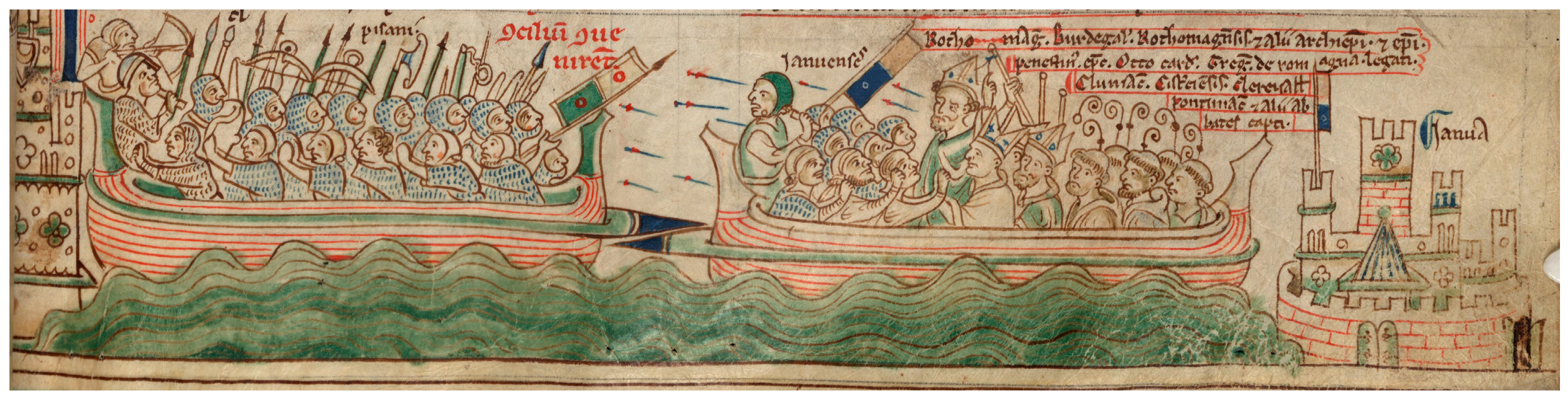
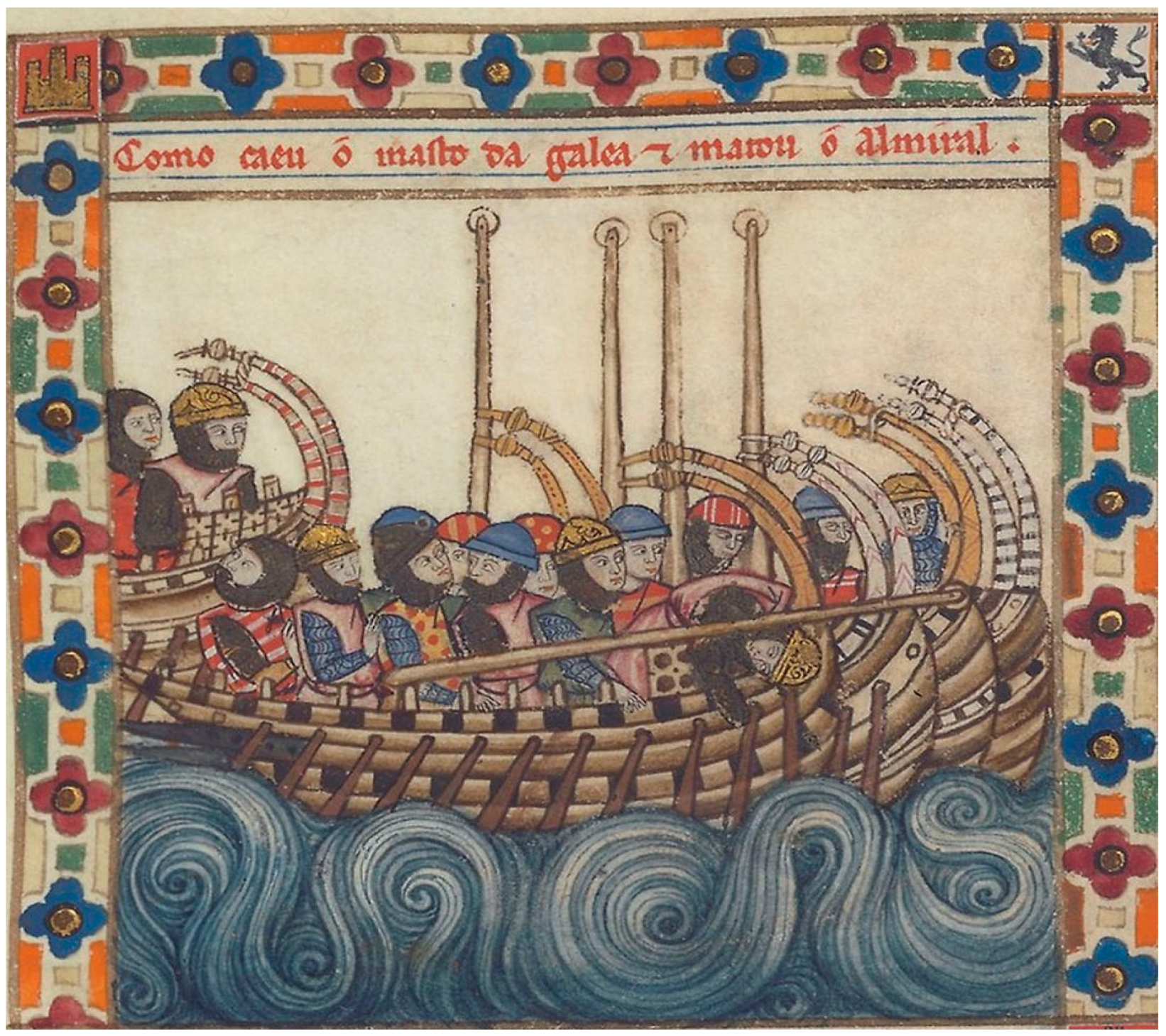
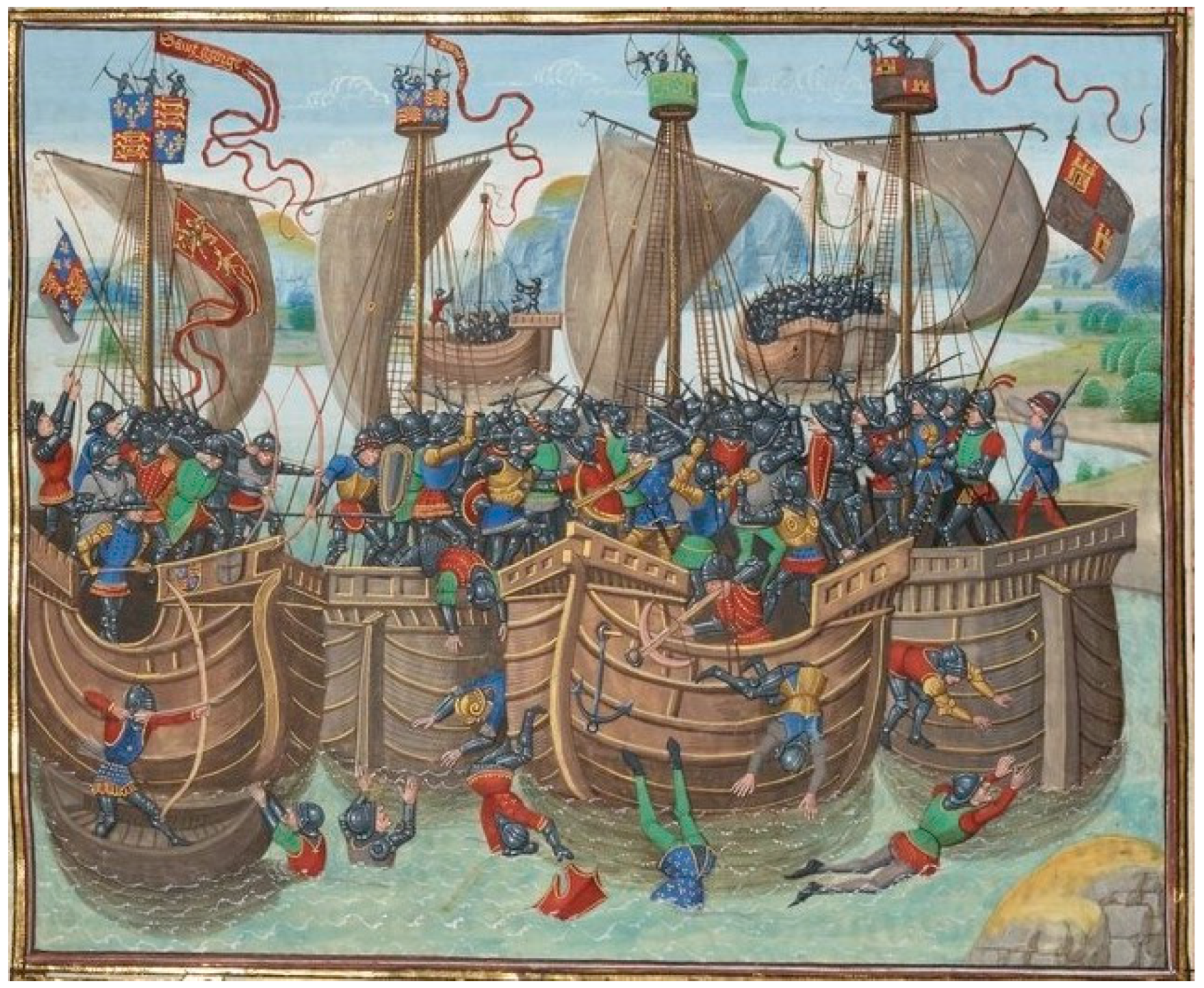
Evidence of tactics in medieval naval battles is difficult to assess, as it comes mainly from chronicles written by people with little nautical experience. There are often suspicious similarities in reports of different incidents. Royal and state archives offer details on shipbuilding and repair, costs, and the formation of fleets and crews, especially from the mid-fourteenth to the early sixteenth century. The records of the archives of Barcelona, Valencia, Simancas, Sevilla, Lisbon, London, Paris, Bruges, Rome, Genoa, Savona, and Venice, among numerous others, contain a great deal of material on maritime affairs, but in neither city are “naval” matters separated from those concerning the commercial ships and voyages of this period. None of these records have much or anything to say directly about the course of an action, although commanders’ concerns are often there by implication. The evidence from the images and illustrations is equally difficult to interpret. Shipbuilding specialists have long struggled to make sense of the features they discern in depictions of illuminations, paintings, carvings, and sculptures, and in coins and stamps. Those that show battles in progress can be of great beauty, such as those, for example, in the illustrated versions of the
Chronica maiora by Matthew of Paris in the Corpus Christi College Cambridge (
Figure 1), the
Cantigas by Alfonso X in El Escorial Library (
Figure 2), or the
Chronicle of Froissart in the Bibliothèque Nationale de Paris (
Figure 3).
Archeological evidence, mostly from underwater sites, is now much more copious than in the recent past, but while it can provide very useful details about shipbuilding, it is less illuminating about the use of ships.
From approximately the 12th to the 15th century, naval warfare underwent profound transformations, illustrating the intricate interplay between technological innovation, tactical experimentation, and the broader geopolitical pressures of the time. In the early Middle Ages, fleets predominantly consisted of oar-powered galleys. These vessels depended heavily on close-quarters combat tactics, emphasizing boarding actions and the use of ranged weaponry such as arrows and crossbows. The design of these ships reflected the tactical doctrines prevalent in the period, with features like prow spikes specifically intended to assist in boarding enemy vessels. Regional distinctions in naval technology and combat methods were pronounced. For example, Greek fire—a highly effective incendiary weapon—was widely employed in southern maritime theaters but remained unknown in northern waters. This regional differentiation extended beyond weaponry to ship design and naval organization, underscoring the diversity of maritime practice across Europe and the Mediterranean.
Unlike the Mediterranean, where galleys and light vessels (galiot and saetia) adapted to coastal navigation predominated, the Atlantic demanded more robust ships, capable of withstanding the unpredictable conditions of the open sea. This necessity led to a distinctive evolution in the design and use of warships. From the agile Viking drakkar, designed for swift raids and surprise landings, to the imposing 15th century cog warships, naos or carracks, galleasses built to transport troops, goods, and heavy weaponry, Atlantic vessels reflect a continuous process of technical and strategic adaptation. Their development responded not only to military needs but also to territorial expansion, maritime trade, and exploration, making them key players in a naval transformation that anticipated the modern era.
By the fifteenth century, significant advancements in shipbuilding and armament brought revolutionary changes to naval warfare. The increasing adoption of large sailing vessels equipped with cannon marked a departure from reliance on oared galleys, enabling fleets to conduct longer voyages and implement more sophisticated strategies, including coastal blockades and pitched battles on the open sea (
Russon 2004). These technological advances also corresponded to an evolving distinction between warships and merchant vessels. This differentiation is reflected linguistically in the emergence of the term ‘navy’ by the mid-16th century to describe an organized, state-supported naval force distinct from commercial shipping.
Yet, naval encounters in the Middle Ages cannot be understood merely through the lens of technological change or fleet engagements. The nature of maritime conflict was deeply embedded in complex social, political, and economic contexts. Unlike the professionalized navies of later periods, medieval fleets were largely ad hoc assemblages composed of commercial ships pressed into military service. Crews were frequently drawn from mercantile or local populations whose allegiances were fluid, often navigating the ambiguous border between legitimate privateering and outright piracy. This blurring of legal and social categories complicates straightforward understandings of medieval naval violence (
Rose 2018;
Heebøll-Holm et al. 2019).
The logistical challenges of outfitting, supplying, and maintaining fleets were substantial, requiring extensive bureaucratic support, access to resources, and specialized nautical expertise—resources which varied markedly across different polities and regions (
Lambert 2011). Local and urban authorities played key roles in maritime security. A notable example is the Crown of Aragon, which institutionalized coastal surveillance systems and facilitated intermunicipal maritime alert networks. These efforts underscored the multipolar nature of security provision in the Late Middle Ages, where cities like Barcelona assumed significant responsibilities in monitoring enemy activities and coordinating defensive responses, especially during periods of royal absence.
Maritime diplomacy formed another crucial dimension of naval power. Diplomatic figures—ranging from merchants’ consuls to reigning monarchs—engaged in treaty-making, negotiation of trading privileges, and alliance formation to navigate the volatile landscape marked by piracy, warfare, and shifting political alliances (
Heebøll-Holm 2013). Italian mercantile powers such as Genoa and Venice were instrumental in establishing and sustaining commercial networks throughout the Mediterranean, extending their influence to ports across Castile and Andalusia (
Hernández Sande 2023;
Dartmann 2024). Consular records reveal sophisticated legal and diplomatic mechanisms aimed at protecting the interests of these merchant communities and resolving conflicts within highly competitive maritime environments.
Despite its longstanding marginalization in maritime historiography, the role of women in medieval naval affairs has begun to attract rigorous scholarly scrutiny. Women occupied multifaceted positions: they acted as sovereigns and patrons who financed and organized seafaring campaigns, yet they also took on more immediate functions—as combatants, intelligence agents, merchants, and even privateers. Although they sometimes endured the violence and coercion endemic to naval conflict, their active participation undermines entrenched gender binaries and reveals the nuanced social dynamics at the heart of medieval maritime history (
Jaspert and Kolditz 2013;
Solórzano Telechea 2023b).
This Special Issue assembles a series of innovative studies that explore the multifaceted nature of naval warfare and diplomacy in the Late Middle Ages. The contributions emphasize the interconnectedness of technology, social structures, economic imperatives, and political strategies across maritime contexts in both the Mediterranean and Atlantic worlds. By engaging with fresh analytical perspectives, the dossier aims to deepen both scholarly knowledge and broader appreciation of the enduring significance of naval power and diplomacy throughout medieval history. These five articles explore how Mediterranean communities in the Catalan-Aragonese and Castilian spheres managed defense, diplomacy, and commercial networks between the 13th and 15th centuries, highlighting both municipal organization and private and consular strategies.
Victòria A. Burguera-Puigserver interrogates the defensive infrastructure of the early fifteenth century Catalan littoral, meticulously charting the network of lookout stations, beacon systems, and expedited shore-to-shore messaging. Through a close reading of Barcelona’s article, she demonstrates how urban councils orchestrated timely alerts of corsair raids and hostile fleets, thereby safeguarding coastal populations and sustaining mercantile traffic. In a complementary study, Josep María Gironella examines Empordà archival records (1287–1327) to reconstruct patterns of ship ownership, charter agreements, and crew composition for barques, llaguts, and carregadors. By tracing the voyages of grain, wine, and textiles, he uncovers the practice of fractional vessel investment that underwrote Catalonia’s deepening integration into Western Mediterranean trade networks. Adam Hall deploys signaling theory to unravel fifteenth century tax disputes in Bruges, illuminating how Castilian and Catalan merchant communities, the Burgundian administration, and city authorities engaged in boycotts, tariff negotiations, and retaliatory measures. His analysis reveals the delicate balance these actors struck between maximizing fiscal revenue and preserving the continuity of international commerce. Finally, Raúl González Arévalo and Daniel Ríos Toledano turn to Seville’s strategic port in the fourteenth and fifteenth centuries, detailing the diplomatic and legal strategies employed by Genoese consuls. By documenting formal protests lodged with the Castilian crown and the formation of inter-state alliances, they show how foreign merchants defended their interests against privateers and the broader rivalries that characterized late medieval Mediterranean shipping. Finally, in their article, Inazio Conde and José Damián González argue that the Hispanic Monarchy—through figures such as Íñigo de Arteita—was a pioneer in shaping a more structured and efficient form of state naval power, effectively integrating available maritime expertise to advance its geopolitical ambitions of controlling the Strait of Gibraltar, safeguarding routes and expeditions, and projecting power across both the Mediterranean and the Atlantic.
Medieval Catalan and Castilian port cities developed intricate systems for both defending against and managing the threats that emerged on the Mediterranean and Atlantic approaches. Along the Catalan coast in the 15th century, urban authorities established a network of lookouts, beacons, and rapid shoreline communications that transformed scattered warnings into city-wide alerts. Surviving correspondence from Barcelona reveals how municipal leaders became the fulcrum of coastal defense, coordinating intelligence on corsairs, rival fleets, and other seaborne dangers to shield local populations and safeguard trade routes.
At the same time, diplomatic and consular networks in Castile’s southern ports—especially Seville—grappled with privateers and inter-state rivalries that jeopardized navigation between the Mediterranean and Atlantic. Genoese consuls in Seville adopted tailored negotiation tactics and legal-diplomatic maneuvers to defend their merchants’ interests, forging alliances, lodging protests, and leveraging the crown’s influence to counteract hostile vessels and competing merchant enclaves.
Beyond military and diplomatic measures, economic actors in both realms refined the mechanisms of maritime commerce and market access. In Catalonia’s Empordà region (1287–1327), fractional ship ownership and documented leases of barques, llaguts, and carregadors underpinned a vibrant grain, wine, and textile trade whose port-to-port itineraries stitched Catalan markets to Marseille, Aigues-Mortes, and island entrepôts. Concurrently, Catalan and Castilian merchants in Bruges confronted “fiscalisation” controversies when ducal and municipal authorities imposed taxes, reprisals, or market boycotts. By applying signaling theory to these 15th century tax disputes, historians trace how merchant communities and the Burgundian administration negotiated access, wielded economic leverage, and managed collective reputational stakes when stakes and tariffs threatened their livelihoods.
All of the studies focus on the late medieval Western Mediterranean and Atlantic worlds, with particular emphasis on the Crowns of Castile, Aragon, Britanny and Flanders between the late thirteenth and fifteenth centuries. Taken collectively, they illuminate interconnected questions about naval organization, maritime conflict, commercial mobility, and the administrative and diplomatic mechanisms that underpinned long-distance navigation in Iberia’s maritime spheres. Their shared use of prosopographical, institutional, and documentary approaches—from naval service in Sicily, to captains in royal fleets, to diplomatic conflicts involving Genoese consuls, to market access in northern Europe, and municipal responses to maritime threats—reveals patterns that are far more evident in concert than in isolation. Therefore, this Special Issue clarifies the common analytical concerns that link these case studies and helps orient the reader to their collective contribution as an integrated exploration of late medieval maritime governance within Histories, without altering the scholarly substance of the individual articles.
These studies collectively illuminate a dynamic Southwestern Europe where municipal authorities, consular agents, ship investors, and royal or ducal governments calibrated defense, diplomacy, and economic policy to navigate the complex perils and opportunities of late medieval maritime life.