
Article

Who Stays Single? A Longitudinal and Global Investigation Using WVS Data

Department of Accounting, Business Information Systems, and Statistics, Faculty of Economics and Business Administration, Alexandru Ioan Cuza University, 700505 Iasi, Romania
Histories 2025, 5(4), 64; https://doi.org/10.3390/histories5040064
Submission received: 12 September 2025 / Revised: 15 November 2025 / Accepted: 9 December 2025 / Published: 18 December 2025
(This article belongs to the Section Gendered History)

Abstract

Historically, singlehood is a growing demographic trend shaped by economic, social, and personal factors. This study examines the key influences associated with this phenomenon across diverse global contexts based on empirical evidence provided by WVS (World Values Survey), which covers over 100 countries and spans four decades. A multi-technique analytical approach is applied to identify the most robust predictors of singlehood. This approach involves feature selection, cross-validation, robustness checks, and statistical modeling (parsimonious models with near-excellent or excellent classification accuracy as AUCROC > 0.9). The results indicate that age and parental status are negatively associated with singlehood, while precarious employment status is positively linked. Co-residence with parents also appears closely related to singlehood. Other factors, including education level, social class, and settlement size, also correlate with singlehood patterns, as resulting from supplemental analyses. Moreover, gender and regional analyses reveal some variations in these associations, highlighting the interplay between personal, cultural, and economic contexts. These findings also align with social and economic theories of marriage, emphasizing the impact of life course factors, financial stability, and cultural norms. They contribute to a deeper understanding of demographic shifts. They also provide meaningful and well-founded insights as well as strategic guidance for policy in areas such as youth employment, social welfare, urban planning, and demographic adaptation.

1. Introduction

Singlehood is a growing demographic trend that reflects broader societal changes in marriage patterns, family structures, and economic conditions (Mortelmans et al. 2023). We can address it by referring specifically to individuals who have never been married (often seen as single by life stage or choice) and excluding divorced, separated, or widowed (who have past marriage experience). The latter is a widely recognized operational definition in demographic and social research (Timonen and Doyle 2013; Shahrak et al. 2021; Bear and Offer 2024), particularly when distinguishing between these two categories above.
While marriage remains a key institution in many cultures, an increasing proportion of the global population delays/foregoes it altogether. This shift raises critical questions about the underlying factors influencing singlehood (Spreitzer and Riley 1974; Yu and Hara 2022; Kislev 2023) and its implications for individuals and societies. Recent studies have highlighted the global rise in singlehood, with factors such as economic instability and changing cultural norms playing significant roles (Jackson 2018; Johansen et al. 2019; Rauer and Jager 2024). Understanding these predictors is essential for addressing demographic transitions (Lesthaeghe 2014), labor market dynamics (Carr et al. 2024), and evolving cultural norms (Ochnik and Slonim 2020). Moreover, by uncovering the key influences associated with singlehood, this study offers valuable insights for data-driven strategic planning in public management. The findings can support the development and refinement of youth employment and labor market policies, the design of family support and social welfare programs, the alignment of urban planning and housing strategies, and the adaptation of public services to address emerging demographic trends. Moreover, in terms of international policy, institutions such as UNESCO and the United Nations have emphasized the importance of strengthening family structures, social cohesion, and mental well-being, particularly in response to growing trends of individualization and demographic aging. The UN 2030 Agenda for Sustainable Development, notably through the 3rd goal (Good Health and Well-being) and Goal 5 (Gender Equality), indirectly addresses the socio-demographic conditions that shape partnership and family dynamics (Perez-Alvaro and Boswell 2024; Wonde 2024). At the supranational level, the European Union has acknowledged the demographic shifts impacting family structures through initiatives like the European Pillar of Social Rights, which supports equal opportunities, work–life balance, and social protection. The EU Strategy on Demographic Change (2020) also recognizes the increase in the number of single-person households. It also promotes policies fostering social inclusion and intergenerational solidarity (De Becker 2024; Dura 2024; Meira et al. 2024). In terms of national policy responses, Nordic countries such as Sweden, Finland, and Denmark (among the global leaders in singleness rates) have adopted progressive approaches. These include universal parental leave, state-supported childcare, and strong individual social safety nets, which reduce economic dependency on traditional family units. While these policies support personal autonomy and gender equality, they may also inadvertently contribute to lower partnership formation rates, a trend increasingly noted in demographic literature (Reine et al. 2024; Engdahl et al. 2022).
The primary goal of this research is to identify the most robust predictors of singlehood across diverse global and longitudinal contexts using World Values Survey (WVS) data, while testing key hypotheses related to economic, social, and cultural factors. By employing a multi-technique analytical approach, this study aims to fill gaps in understanding demographic shifts and offer data-driven insights for policymakers in areas such as youth employment, family support, and urban planning.
Among the techniques used in this study, it is worth mentioning feature selection (Adaptive Boosting (Wibowo and Abdul-Rahman 2018), Spearman Pairwise Correlation—based selections (Homocianu and Airinei 2022), and Bayesian Model Averaging (Li et al. 2025)), cross-validation procedures (both CVLASSO (Ahrens et al. 2025) and mixed-effects modeling (Hellingman et al. 2025)), different regressions together with overfitting removal (RLASSO) (Maruejols et al. 2022), collinearity (overall based on VIF (Vatcheva et al. 2016) and pairwise (Forzani et al. 2025) based on R-squared) and mutual causation checks (Snippe et al. 2014; Homocianu 2024a).

2. Literature Review

2.1. Economic Factors and Singlehood

Prior studies consistently demonstrate that economic conditions affect marital decisions. Employment status has a consistent influence on personal capacity to form and sustain such a relationship. Research has shown that job instability and financial insecurity can delay or discourage marriage (Killewald 2016; Smock and Schwartz 2020; Harsono et al. 2024). The latter aligns with the current study’s finding that employment is positively associated with singlehood, indicating that certain job conditions may inhibit partnership formation (Modena et al. 2013; Bastianelli and Vignoli 2021; Van Wijk et al. 2021).
Moreover, co-residence with parents, often driven by economic necessity, is also positively linked to singlehood (Britton 2013; Wang 2023; Yoon and Lian 2024). Living with parents may reflect delayed economic independence and thus correlate with the postponement of marriage.
Consequently, the first two main hypotheses emerged:
H1. 
Employment status is associated with singlehood, suggesting that certain job conditions or career-related factors contribute to remaining unmarried.
H2. 
Co-residence with parents is positively associated with singlehood, indicating that individuals who remain single are more likely to live with their parents.

2.2. Cultural and Social Factors

Other research has emphasized sociodemographic influences such as age, gender, race, class, and living arrangements in shaping singlehood (Roschelle 2013; Dommaraju and Tan 2023; Zhong and Wilkinson 2025; Staff and Vuolo 2024). Age is particularly pivotal, with evidence indicating that older individuals are more likely to marry. Similarly, having children (parental status) increases the likelihood of marriage, potentially due to social expectations and economic co-dependence structures.
Consequently, the other two main hypotheses resulted:
H3. 
There is a negative correlation between age and singlehood, with older individuals being less likely to be single than younger individuals.
H4. 
There is a negative correlation between parental status and singlehood, with individuals who have children being less likely to be single than those without children.

2.2.1. Age Range and Interpretive Considerations

This study uses the full available age range from the World Values Survey, including respondents aged 13 to 103. While acknowledging that singlehood carries different social and psychological meanings at various life stages (for example, between adolescence and late adulthood), the inclusion of the full age range (Tchoukou 2024) allows for a comprehensive, population-wide understanding of singleness patterns (Avilés et al. 2024; Adamczyk et al. 2022; Ratcliffe et al. 2024). To address age heterogeneity, age is usually treated as a continuous predictor in most statistical models (Yagi et al. 2024; Chu et al. 2024). Therefore, the resulting models reveal both general and age-specific trends. Nevertheless, caution is needed when interpreting results at the extremes of the age distribution (e.g., early teens or advanced old age), as expectations and societal norms may vary substantially in these groups.

2.2.2. Additional Social, Demographic, and Contextual Factors

In addition to these four core hypotheses above, several complementary expectations arise from the literature (Mortelmans et al. 2023; Spreitzer and Riley 1974; Yu and Hara 2022; Kislev 2023; Jackson 2018; Johansen et al. 2019; Rauer and Jager 2024; Lesthaeghe 2014; Carr et al. 2024; Ochnik and Slonim 2020; Avilés et al. 2024; Adamczyk et al. 2022; Ratcliffe et al. 2024) and from the cross-validation and subgroup analyses performed in this study. They concern education, social class, settlement size, gender differences, regional variations, and temporal dynamics, as follows:
H5. 
Education level is positively associated with singlehood, suggesting that individuals with higher education are more likely to remain single, possibly due to delayed marriage or prioritization of career development.
H6. 
Urban residence is positively associated with singlehood, indicating that people living in larger settlements are more likely to remain single than those in rural areas, possibly due to lifestyle and opportunity structures.
H7. 
Social class is associated with singlehood, with individuals from upper classes being more likely to remain single than those from lower classes, reflecting socioeconomic independence and changing family norms.
H8. 
Gender moderates the relationship between employment status and singlehood, such that employment exerts a larger influence among men than among women.
H9. 
The strength and direction of predictors of singlehood (e.g., age, parental status, and employment status) vary significantly across continents, reflecting regional cultural and economic contexts.
H10. 
The prevalence of singlehood has changed over time, reflecting societal and economic transformations influencing marriage decisions globally.

2.3. Psychological Theories: Maslow’s Hierarchy of Needs

The psychological dimension of singleness can be examined through Maslow’s Hierarchy of Needs (Poduska 1992; Finkel et al. 2014; Hoffman 2017). According to this framework, individuals prioritize basic needs (e.g., economic stability) before pursuing higher-level needs such as love and belonging, which include romantic partnerships (Dougall et al. 2022). When basic needs remain unmet—due to unstable employment or insufficient income (H1)—individuals may delay marriage, reinforcing the findings above regarding employment and co-residence with parents.
Additionally, living with parents (H2) may reflect an effort to meet safety needs when financial independence is absent, further postponing progression to love/belonging needs (Johnson and Ridgeway 2023; Wellsch et al. 2023).
This framework explains why economic instability (e.g., precarious employment) may delay marriage: unmet basic needs (safety, financial security) hinder progression to belonging needs. Similarly, co-residence with parents may signal stalled independence, psychologically reinforcing singlehood (Dougall et al. 2022; Johnson and Ridgeway 2023; Wellsch et al. 2023; Al-Habies et al. 2024; Blbas et al. 2025).

2.4. Integration and Gaps

Despite the breadth of existing literature (Ahmad et al. 2024; Costello et al. 2023; Hadi et al. 2024; Sihag 2024), the simultaneous consideration of these factors (economic, cultural, and psychological) and their varying impact across different cultural and economic contexts remains underexplored. This study aims to bridge this gap by applying a causal modeling approach to identify direct and indirect influences on loneliness. It also provides a broader framework for understanding the societal and personal factors influencing singlehood while standing on a statistically robust framework. Moreover, this study addresses challenges arising from demographic shifts, youth employment difficulties, and changing family dynamics, offering valuable insights for policymakers, researchers, and social planners. As societies continue to evolve, understanding the predictors of singlehood will be crucial for developing policies that support diverse life choices and respond to emerging social trends.

3. Materials and Methods

The data used belongs to the World Values Survey (WVS). The latter constitutes one of the most extensive empirical surveys of human beliefs and values, conducted across multiple countries over time and not for commercial purposes. Its most recent version (5.0-WVS_Time_Series_1981-2022_stata_v5_0.dta) has 1063 variables/fields, 443,488 raw observations, responses from more than one hundred countries, and seven waves (once every five years between 1981 and 2022). The latter is accessible online at https://www.worldvaluessurvey.org [accessed on 3 January 2025].
First, this dataset was loaded and cleaned in Stata using the REMDKNA command (Homocianu 2024b). Next, a basic binary encoding (X007bin) of the target variable (X007, Marital Status) occurred considering the coding of the original variable (top of Table A2(1), Appendix A). Immediately after these two steps, a .csv export file resulted. The purpose was to use the same cleaned dataset, including the binary derivation of the target for feature selection tasks in R.
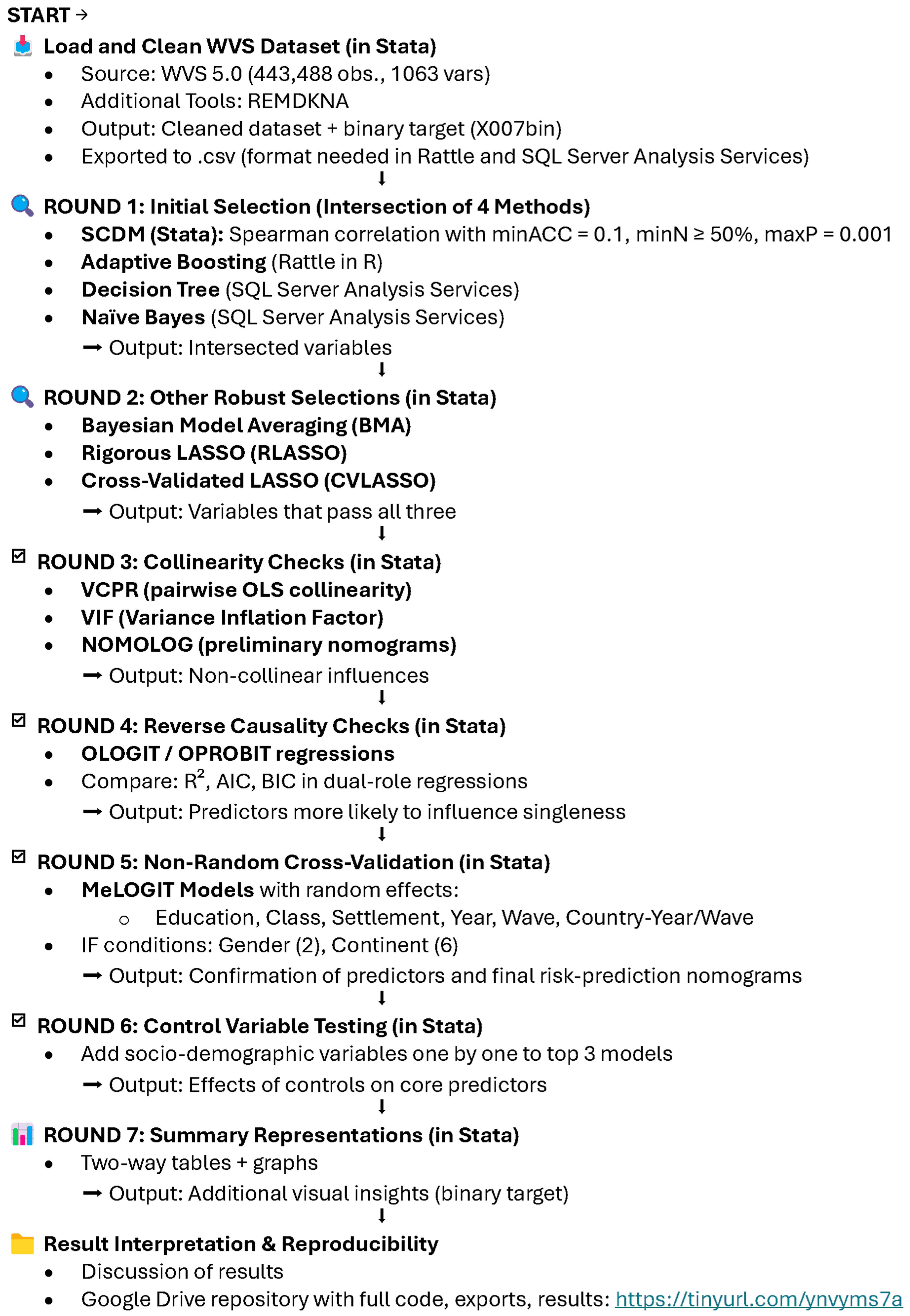
The multi-technique approach has a strong basis, namely a selection of steps grouped in rounds (Table A1 and Figure A1, Appendix A). All corresponding technical terms are available and fully explained in the List of Technical Abbreviations at the end of the manuscript. Therefore, four different techniques were simultaneously served in the first selection round (ROUND 1). Moreover, only the intersecting results remained. The first technique used in ROUND 1 was a command focused on selections based on Spearman pairwise correlations (SCDM) (Homocianu 2025) in Stata 17 × 64 for multiprocessing. The second relied on using the Adaptive Boosting technique based on decision tree classifiers in Rattle (version 5.5.1) and the same binary form of the target variable. The third and the fourth involved using two classification algorithms based on decision trees (Wu et al. 2025) and Naïve Bayes (Antas et al. 2022). Both methods are implemented in the Microsoft Data Mining add-in for Excel (Microsoft Office 2013), which operates alongside SSAS 2016 on a Windows 10 Professional ×64 VM.
Only the intersecting results in ROUND 1 entered the second one (ROUND 2), which consisted of consecutively using the BMA command (reporting PIP (Bather et al. 2024)) and two additional ones from the Least Absolute Shrinkage and Selection Operator (LASSO) (Hastie et al. 2015) pack, namely RLASSO and CVLASSO.
The collinearity checks in the next round (ROUND 3) applied only to the variables remaining from the previous one (ROUND 2). Thus, VCPR (Tirnauca and Homocianu 2024) served to identify collinear variable pairs, VIF or the Variance Inflation Factor for checking the multi-collinearity in multi-input models, and NOMOLOG (Zlotnik and Abraira 2015) for creating nomograms with redundancy removal purposes.
Mutual causation checks were used in ROUND 4 and only for the variables remaining from ROUND 3. Thus, ordinal LOGIT (OLOGIT) and PROBIT (OPROBIT) regressions in Stata 17 considered the initial scale of the variable to analyze and all other input variables that remain in this setup. The roles of these variables and the original target were alternated in paired regression models. A higher R-squared value—indicating a stronger alignment between observed data and the theoretical model—or lower AIC and BIC values—reflecting improved model fit (Mousazadeh et al. 2025) and reduced information loss (Adámková et al. 2025)—in the reversed configuration suggest a noteworthy insight into the directionality of the relationship. Specifically, when an input variable yields a better model fit (i.e., higher R-squared (Tamagusko and Ferreira 2025) or lower AIC/BIC) in predicting the original target, it may be interpreted as a more plausible explanatory factor, rather than a consequence of the target variable.
Non-random cross-validations (ROUND 5) have as a basis on consecrated socio-demographic variables (education level, social class, and settlement size). They also use some other variables related to wave chronology, survey year, combination of country and wave, and country and year. These seven act as random effects in mixed-effects models (MeLOGIT regressions implemented in Stata 17, with the remaining predictors incorporated as fixed effects to control for their influence (Vermunt 2005; Dey et al. 2025)). Moreover, two values for gender and six for continents represent IF conditions and values for additional cross-validation criteria when testing based on LOGIT and generating risk-prediction nomograms (based on the same NOMOLOG command) for these specific conditions (Homocianu et al. 2020) and the overall data. Beyond the core predictors’ validation, the nomograms augment the original visual constructs. This results when using annotations as scores/values representing the effect sizes of predictors within continental or gender-specific models. Thus, they serve as a reference used for supplementary comparative computations. Moreover, they indicate how the three main predictors act according to gender or regional contexts. They also show possible deviations from the overall model.
These three core predictors were also confirmed when using Histogram Gradient Boosting in Python (Python 3.12.12 64-bit via the Spyder IDE, version 5.5.1) as a parallel validation approach.
Moreover (ROUND 6), most of the variables previously used for cross-validation (all except continent and those two combinations of country-wave and country-year with values not tied to a specific intensity scale) were used for control purposes (Biancalana and Mancosu 2025) (in new models). This procedure consisted of sequentially incorporating each variable into the existing most robust models (those three most resilient predictors) or testing them individually.
In ROUND 7, two-way tables and visual representations (Watson and Callingham 2014; Suha and Renjith 2023) of the relations between every single relevant input variable (the most robust ones, including those in the core model together with critical socio-demographic and chronological items) and the target (on average, based on its binary form) resulted in additional insights.
The model interpretation (including risk-prediction nomograms) stands on two sections meant for introducing the corresponding results and a discussion. For replicability (Drill et al. 2024), a permanent online Google Drive repository (https://tinyurl.com/ynvyms7a, accessed on 28 November 2025) keeps all derivation, export, selection, and analysis script sequences. This container also hosts all intermediary results necessary for this study. Each original URL for a relevant component was converted into a TinyURL.

4. Results

The findings presented here correspond to the sequence of procedures described in the previous section.
For reasons related to supporting reproducibility or replication of scientific results (Homocianu 2015), version 5.0 of the dataset downloaded from the WVS site and analyzed in this paper was also shared in the online container mentioned above (both the original .dta format for Stata and the .csv, after cleaning the data and performing a binary derivation for the target variable).
The outcomes of all selection rounds, as well as the corresponding checks and tests, are available in full within the same online folder, for purposes of reproducibility. Thus, the results of the four techniques applied in R, Stata, and SQL Server Analysis Services (version 2016 × 64) (ROUND 1) are available in four dedicated online folders at https://tinyurl.com/28bsefn3 (accessed on 28 November 2025).
For each of those four, configuration captures (for Rattle in R and Analysis Services), exploration scripts (.do files for Stata), and snapshots of the results (.png, .pdf, .avi, and .txt files) are available to follow the progress of the analysis in each particular approach.
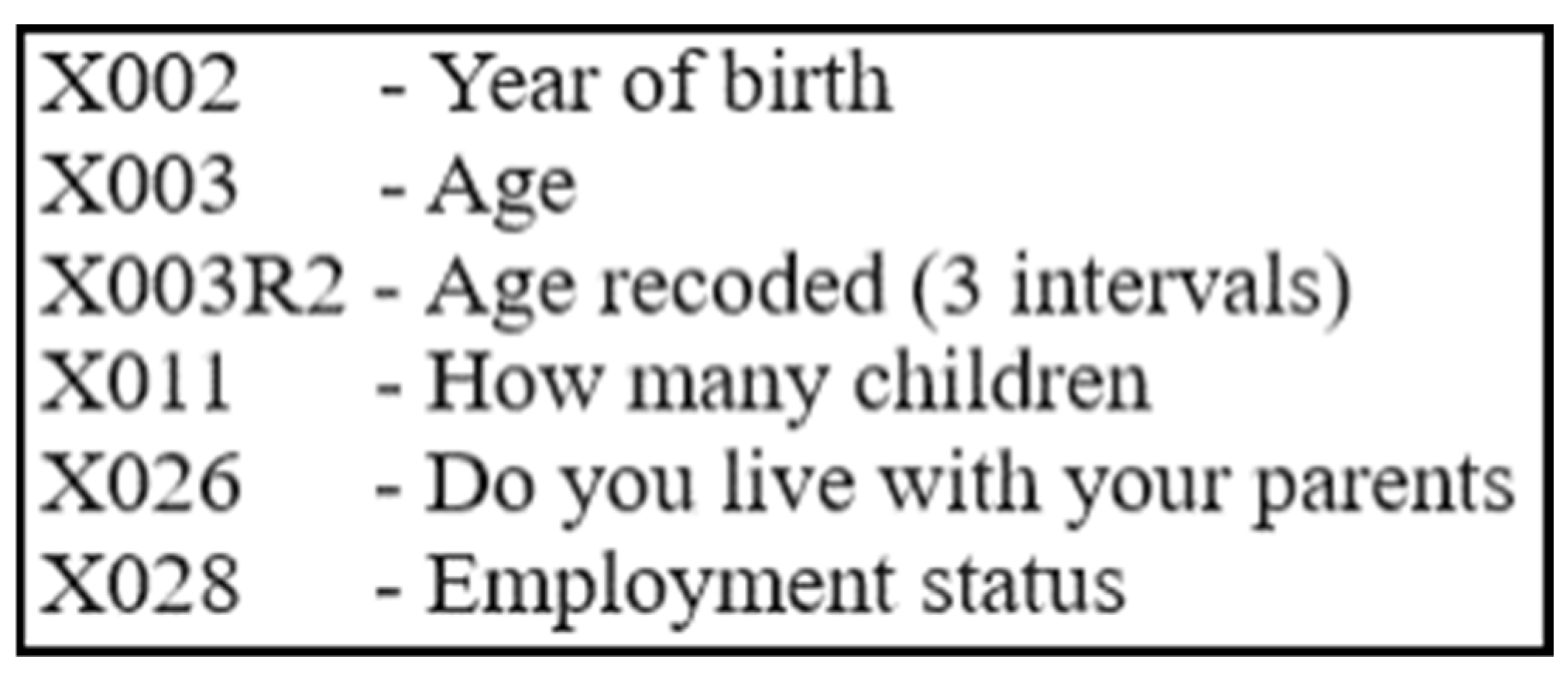
The intersecting results of the first selection round (ROUND 1) are available in Figure 1. They show that only six variables persisted across all four methods and three software applications used in ROUND 1. These are: X002—Year of birth, X003—Age, X003R2—Age recoded (3 intervals), X011—How many children do you have, X026—Do you live with your parents, and X028—Employment status. The first three are interdependent, and collinearity or redundancy naturally occurs among them. Moreover, only 382,766 non-null intersection observations remain when considering these six input variables, which result after ROUND 1 and the target one.
For the variables resulting from this first selection round, the corresponding coding (Table A2(1), Appendix A—the original coding for all variables except the binary derivation of the target-X007bin) and their descriptive statistics (Table A2(2), Appendix A—also emphasizing their high support given the large number of observations, N) are available bellow (source script at https://tinyurl.com/kbz32nj5—accessed on 28 November 2025 and primary results at https://tinyurl.com/3n7sbacx—accessed on 28 November 2025).
The second selection round (ROUND 2-results available online at https://tinyurl.com/yckz62tb—accessed on 28 November 2025) involved consecutively using BMA along with RLASSO and CVLASSO in Stata until selections stabilized with no loss. The BMA did not eliminate anything. All PIP values indicated a maximum probability of inclusion for each of those six variables. RSLASSO and CVLASSO dropped the variable indicating the year of birth (coded as X002). The latter was not a real loss because X002 was suspected of being redundant (when considered together with X003 and X003R2 as age in years and on intervals-most probably serving as the primary source for these two) at the end of the previous round.
At this point, there are more non-null observations than after ROUND 1, namely 388,736, at the intersection of the remaining five input variables resulting after ROUND 2 and the target one.
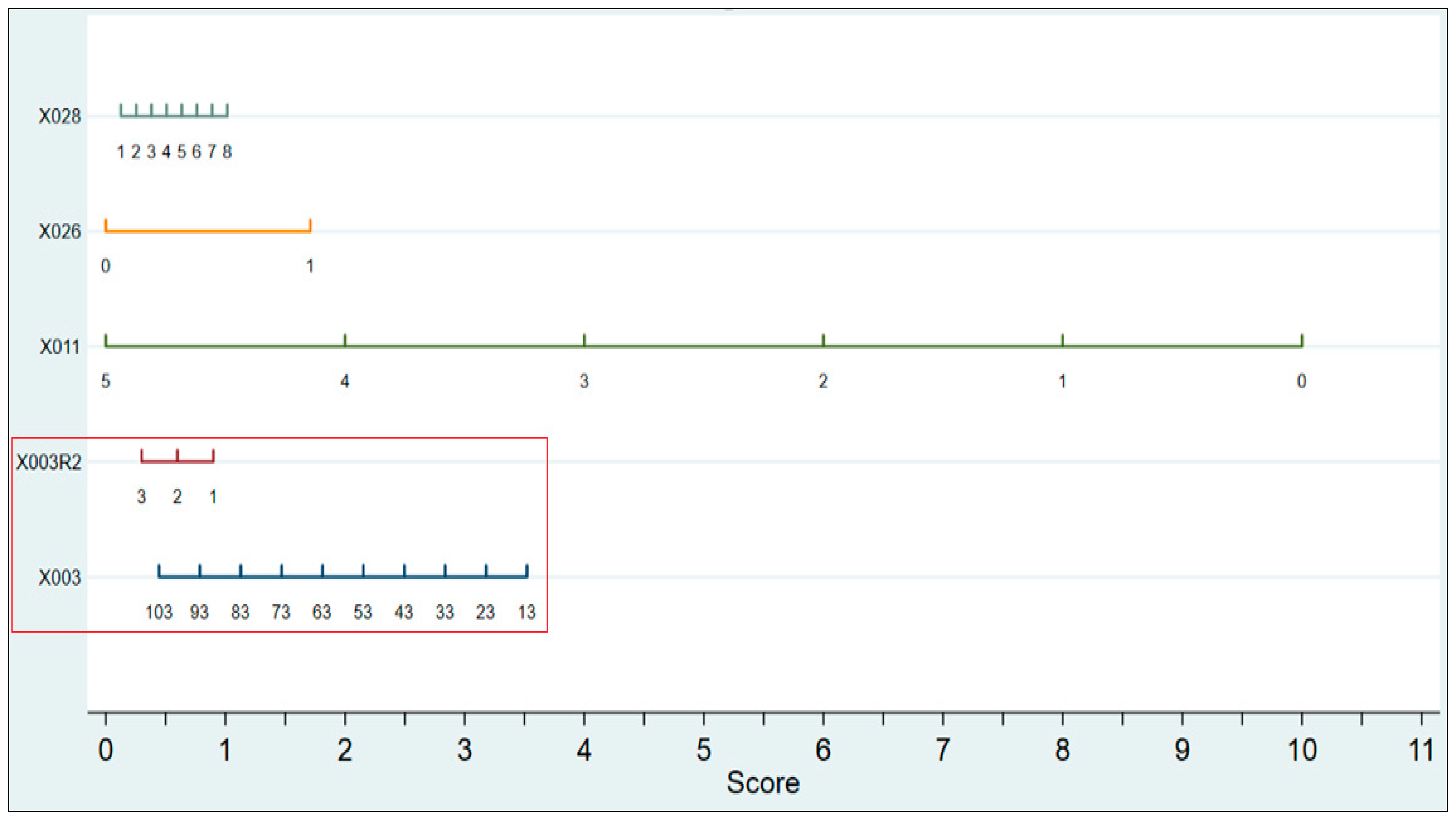
The collinearity tests in the third selection phase (ROUND 3) started from the set of five remaining variables (the first test). First, VCPR identified a collinear pair, as already suspected, namely X003 and X003R2.
Moreover, a simple OLS regression keeping all five remaining variables indicated a problematic computed VIF. The latter is more than the maximum acceptable threshold (using the formula: 1/(1 − the R-squared corresponding to a model)), namely 6.2745 (much larger than 1.8902—results available online at https://tinyurl.com/48u5vrvk—accessed on 28 November 2025).
A preliminary nomogram (Figure 2) generated (using NOMOLOG) for a logit model with these five remaining variables suggested the elimination of X003R2 from this redundant pair (X003 vs. X003R2) because of a lower magnitude of effects (a smaller red segment compared to the blue one—as seen on the bottom of Figure 2).
In the second collinearity test in ROUND 3, the remaining set of four variables (X003, X011, X026, and X028) indicated no collinearity issue, both by VCPR (no collinear pairs identified) and VIF measurements (a computed VIF of 1.4527, lower than the maximum accepted threshold of 1.8742, depending on the R-squared). These results are available online at https://tinyurl.com/4yk7jxjn (accessed on 28 November 2025).
An equal amount of non-null observations (388,736—Table A8, Appendix B) stands at the intersection of the remaining four input variables resulting after ROUND 3 and the target one.
This amount later supported the derivation of continental models based on 104 countries (Table A4, Appendix A, and Table A7 and Table A8, Appendix B) from the total of 108 existing in WVS (no intersecting data for France-FRN, Israel-ISR, Northern Ireland-NIRL, and Great Britain-UKG—results available online at https://tinyurl.com/37ycfam3—accessed on 28 November 2025).
The mutual causation checks (with OLOGIT and OPROBIT on the initial format (1–6 scale) of the variable to analyze in the fourth round of selections (ROUND 4 results available online at https://tinyurl.com/yc6sn2ap—accessed on 28 November 2025) indicated X026 (Do you live with your parents) as less likely to persist in the list of remaining four variables. They show a larger R-squared and lower AIC and BIC (Table A9 and Table A10, Appendix C) when setting X026 as the target and X007 (Marital status or the original target) as the only input than the opposite (X007 as the target and X0026 as the only input). Therefore, only the three variables (X003—Age, X011—Number of children, and X028-Employment status) survived ROUND 4.
In ROUND 5, the first non-random cross-validation used MeLOGIT regressions (results available online at https://tinyurl.com/bdh43w28—accessed on 28 November 2025) and seven validation criteria (random effects). It is about the education level, social class, settlement size, wave chronology, and survey year, together with two combinations between country and wave or year, which strongly validated all three most robust core predictors (Table A11, Appendix C), showing their robustness for different data clusters defined for each distinct value of the seven additional variables above, acting as validation criteria.
The results of the Histogram Gradient Boosting, used as a parallel validation approach in Python, indicate that those three core predictors are among the top five of the top 25 resulting features (more details at https://tinyurl.com/mvam4u6h—accessed on 28 November 2025).
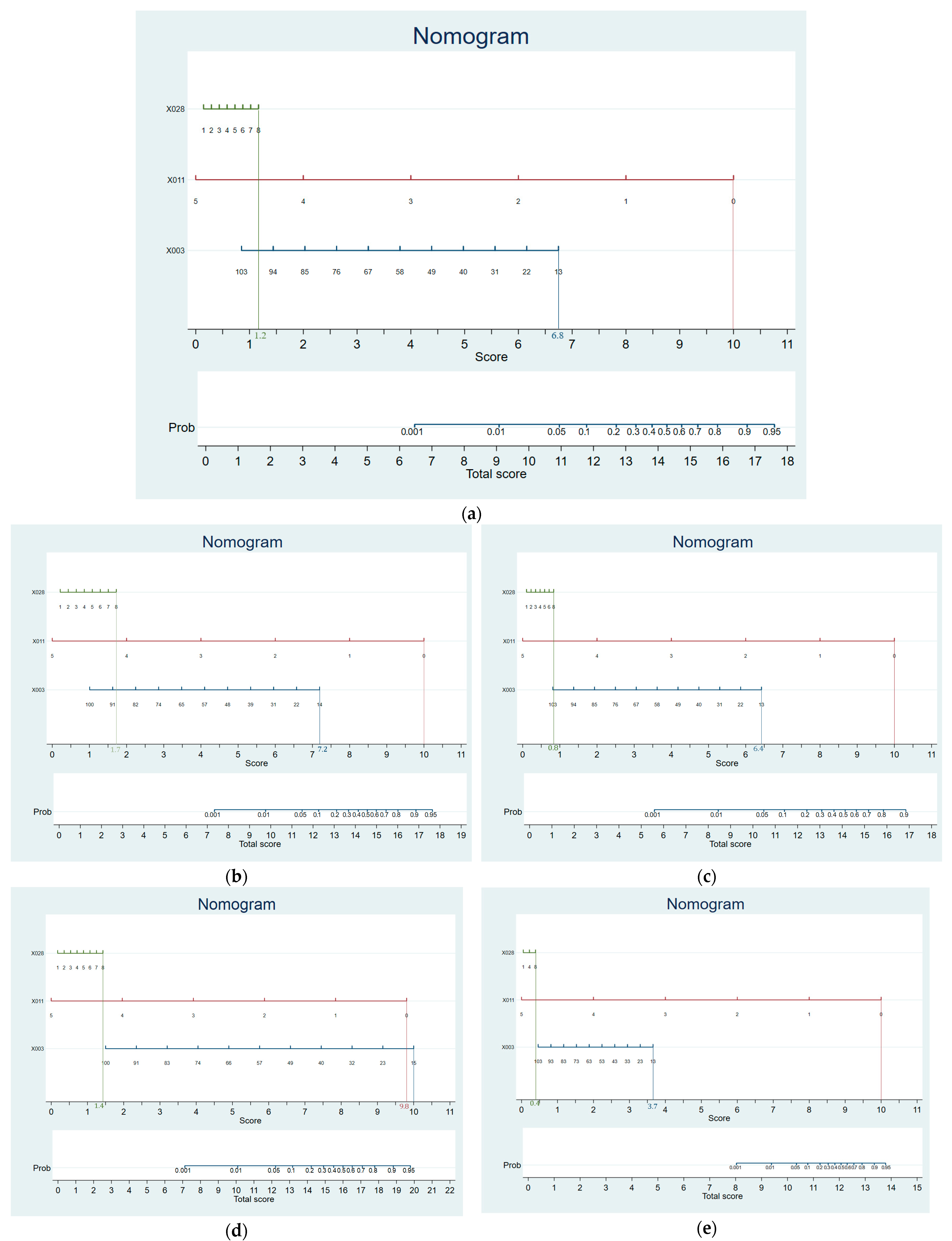
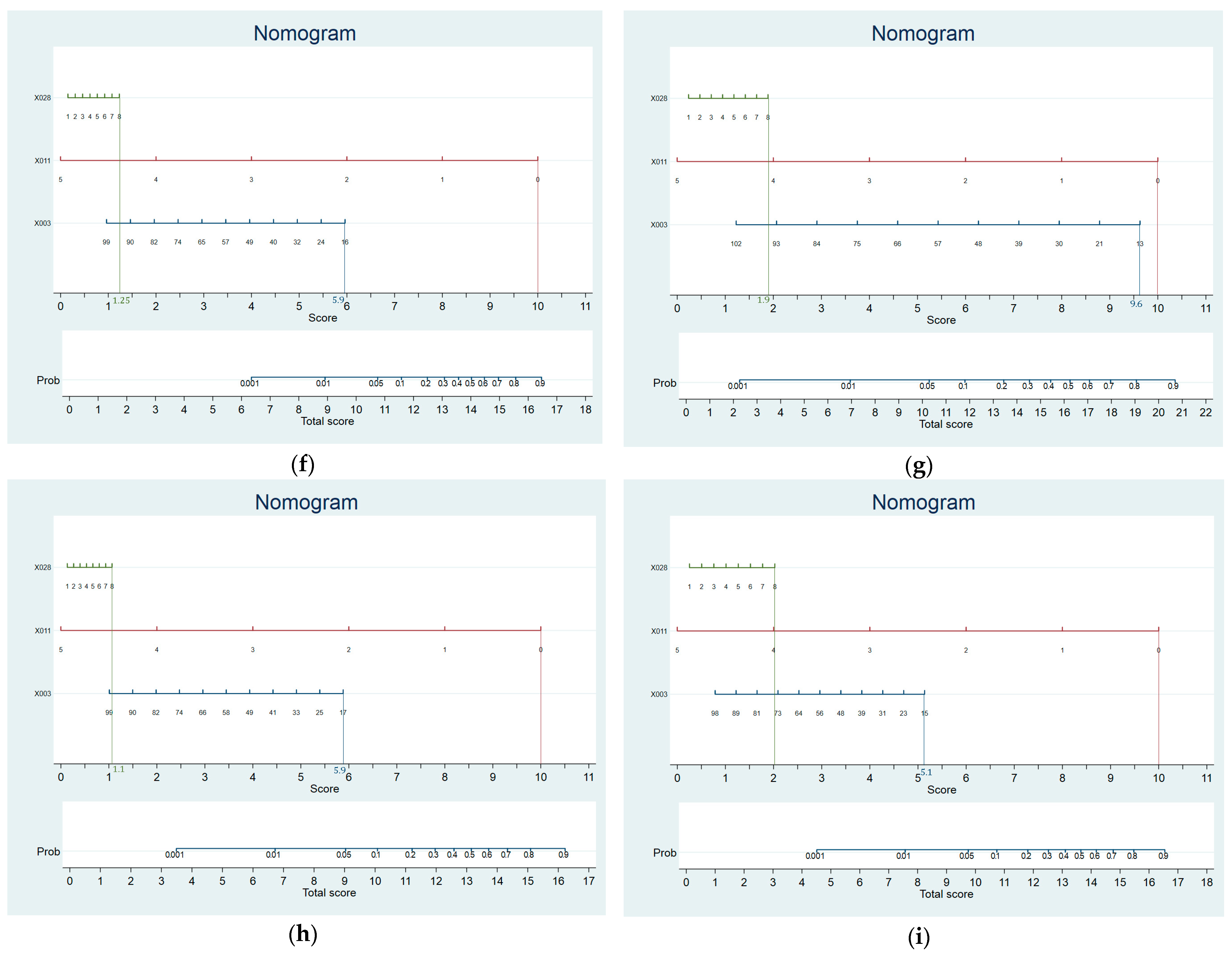
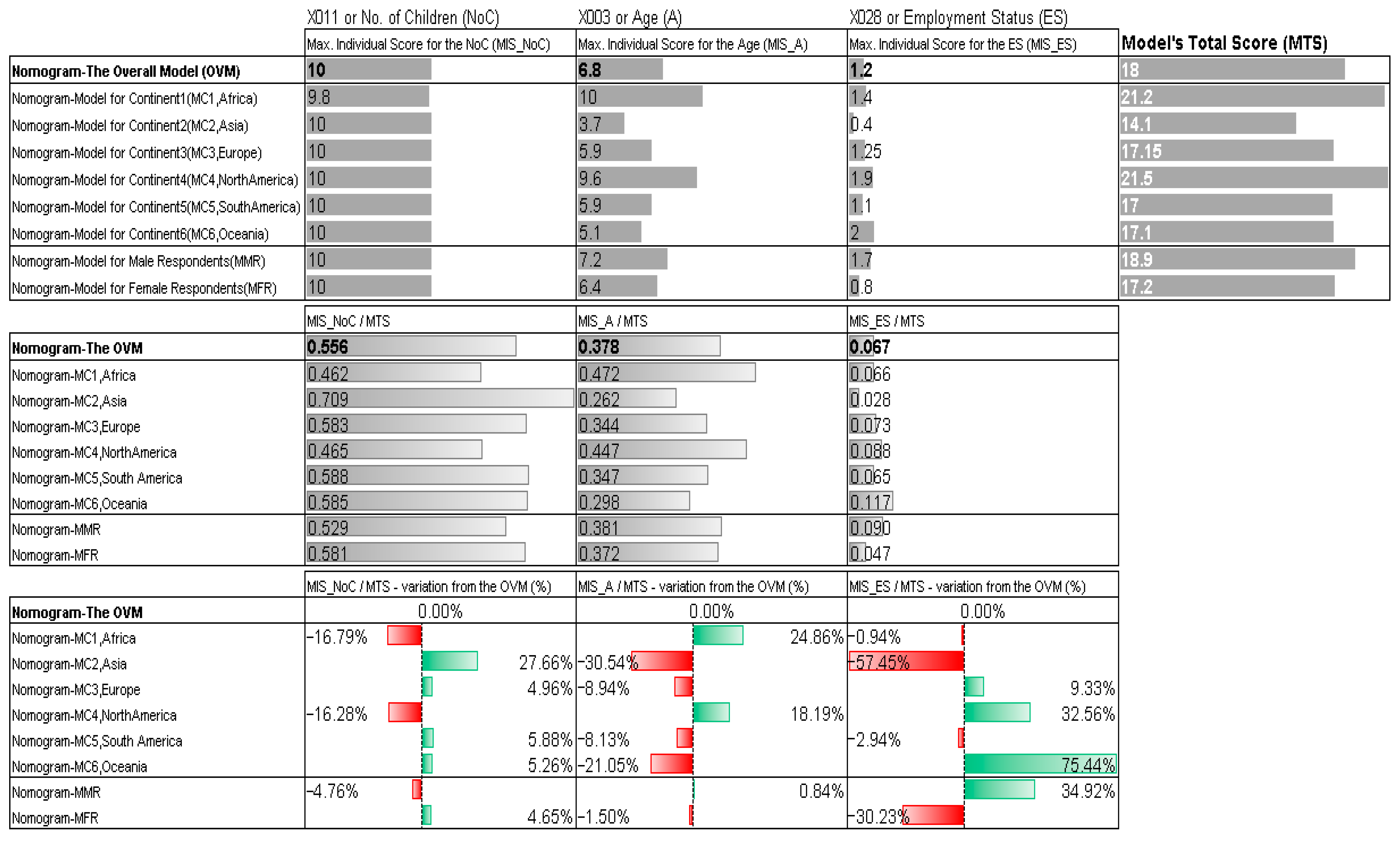
In the same phase (ROUND 5), other simple cross-validations used LOGIT (results available online at https://tinyurl.com/554tw3va—accessed on 28 November 2025) together with two values for the gender criterion (Table A3, Appendix A) and six for the continent (Table A4, Appendix A and supporting countries in Appendix B, Table A7) set as conditions. Moreover, a risk-prediction nomogram emerged for each condition (the overall model at the top of Figure 3). These models (overall and continental or gender-focused) additionally validated those three core predictors. Moreover, the augmented nomograms further supported comparative computations of magnitude (maximum and effective individual and summed-up scores, the weight of the firsts in the lasts, as well as the correspondence of the latter with maximum and effective probability/risk values at the model level) emphasizing peculiarities corresponding to gender and regional contexts (through deviations from the overall model—Figure 4).
While fully acknowledging the importance of interaction effects—particularly between age, gender, employment, and parental status—in understanding singleness, their explicit modeling in this study was constrained by both statistical and practical considerations. Specifically, the three core predictors refer to two multi-level categorical variables (parental status with six categories and employment status with eight) and a continuous variable. The latter is the age, which ranges from 13 to 103 and has 90 unique values emphasized by “tabulate X003”). Modeling all possible pairwise and higher-order interactions would exponentially increase the number of parameters and severely inflate model complexity (Deen et al. 2025). The latter would not only hinder interpretability and parsimony, but they would also raise issues of overfitting, multicollinearity, unstable estimates (especially in subgroup combinations with limited support), and generalizability (Loureiro et al. 2025).
That said, some theoretically motivated interactions (such as age × gender or employment × parental status) are meaningful and worthy of attention. Still, to maintain clarity, generalizability, and statistical power, the focus was on the most robust main effects in this population-wide analysis. However, interaction modeling is a significant next step. The same applies to encouraging future research (especially those employing hierarchical models or interaction-aware machine learning algorithms with large, balanced samples) and systematically testing these dynamics (Höfler 2024). A similar plan involves pursuing this direction in follow-up studies, leveraging stratified analysis or regularized interaction models to capture more nuanced behavioral patterns.
As support (number of valid responses) for the variable to analyze and those three predictors from this tri-core model/triad (X007bin together with X011, X003 and X028) and their distribution on the survey year, all indicate observations between 1981 and 2023 and a total amount between 423.902 and 438.749 valid records (Table A2(2), Appendix A) and 407.720 at the intersection of those four variables above (Table A3, Appendix A, model 1-OVERALL) or 91.93% of the total amount of 443.488 observations of the WVS dataset (version 5.0). Because X026 (Do you live with your parents) also emerged as a robust influence, the actual amount reduced to 388,736 valid observations (Table A4, Appendix A, model 1-Overall, and Table A6, Appendix A, model 8, with the largest AUCROC of 0.9431) or 87.65% of the total amount. This amount also supports the derivation of continental models. The results of using the tabstat command (tabstat X007bin, stat(count) by(S020); tabstat X011, stat(count) by(S020); tabstat X003, stat(count) by(S020); tabstat X028, stat(count) by(S020)) in Stata (script online at https://tinyurl.com/yck4hyxe—accessed on 28 November 2025 and results at https://tinyurl.com/4w2454d4—accessed on 28 November 2025) confirmed this above and, consequently, the fact that this study relies on all 34 years of observations (1981, 1982, 1984, 1989–1991, 1995–2014, and 2016–2023), namely all those that the underlying dataset provides.
Starting from the augmented prediction nomograms in Figure 3, the results in Figure 4 synthesize the entire computation behind the gender and continent-specific patterns (H9) in terms of deviations from the Overall Model (OVM) with three core predictors.
Figure 4 provides a comprehensive view of how the importance of key predictors in the overall statistical model varies across different subgroups. This information can be valuable for understanding the nuances of the data and potentially tailoring interventions or policies to specific populations.
Thus, those two gender-specific models and six continent-particular ones indicate the following deviations grouped by the three main predictors:
→For the Number of Children (NoC) Predictor (Leftmost column in the bottom section of Figure 4):
  • -The Africa (−16.79%) and North America (−16.28%) models show a significant decrease in the predictor’s importance compared to the overall model (OVM).
  • -The Asian model (+27.66%) has the most substantial increase, meaning the number of children plays a more consistent role in this geographical context than in the overall model.
  • -Europe (+4.96%), South America (+5.88%), and Oceania (+5.26%) show moderate increases in importance.
  • -Gender-based models: The male respondents (MMR) model (−4.76%) exhibits a slight decrease in predictor importance, whereas the female respondents (MFR) model (+4.65%) shows a tiny increase.
→For the Age (A) Predictor (Middle column in the bottom section of Figure 4):
  • -Asia (−30.54%), Oceania (−21.05%), Europe (−8.94%), and South America (−8.13%) models all indicate decreases in the predictor impact, with the most critical drop in Asia.
  • -Africa (+24.86%) and North America (+18.19%) models show consistent increases, meaning age has an increased effect on singleness in these regions than in the overall model.
  • -The gender-specific models show only some tiny variations: MMR (+0.84%) suggests a slight increase in importance for male respondents, while MFR (−1.50%) indicates a minor decrease for female respondents.
→For the Employment Status (ES) Predictor (Rightmost column in the bottom section of Figure 4):
  • -The Asian (−57.45%), South American (−2.94%), and African (−0.94%) models exhibit a reduced impact associated with the employment status, with Asia showing an extreme drop.
  • -Oceania (+75.44%), North America (+32.56%), and Europe (+9.33%) models indicate a more impactful role of employment status in explaining singleness. Oceania has the highest increase.
  • -The gender-based models show MMR (+34.92%), meaning employment status has a much stronger influence in the male-only model. However, MFR (−30.23%) shows a sharp decline. The latter indicates that employment status is far less relevant in the female-only model (H8).
The Discussion section provides further insights into and observations on the differences related to the three core predictors (Figure 4). These differences appear when comparing the overall model (OVM) with the gender- and continent-specific models.
Additional controls (Table A5 and Table A6, Appendix A—ROUND 6) revealed the secondary importance of certain well-established socio-demographic variables (most of them already used for cross-validations and another one already confirmed as an influence, namely X026) and successfully demonstrated again the robustness of the core model with only three predictors (results available online at https://tinyurl.com/2ucyucx3—accessed on 28 November 2025). The only exception is the variable corresponding to social class (X045), originally coded with lower values for upper social classes. The letter appears to behave oppositely when considered in conjunction with the tri-core model and when analyzed independently. In the first scenario (Table A6, Appendix A), the corresponding coefficient (Model 5) indicates a positive correlation. In the second (Table A5, Appendix A), the afferent coefficient (Model 7) shows a negative correlation.
Other explanations (the original coding) and descriptive statistics (number of supporting observations, mean value, standard deviation, minimum, maximum, and quartiles) regarding these additional variables are available in Table A2(3,4) (Appendix A).
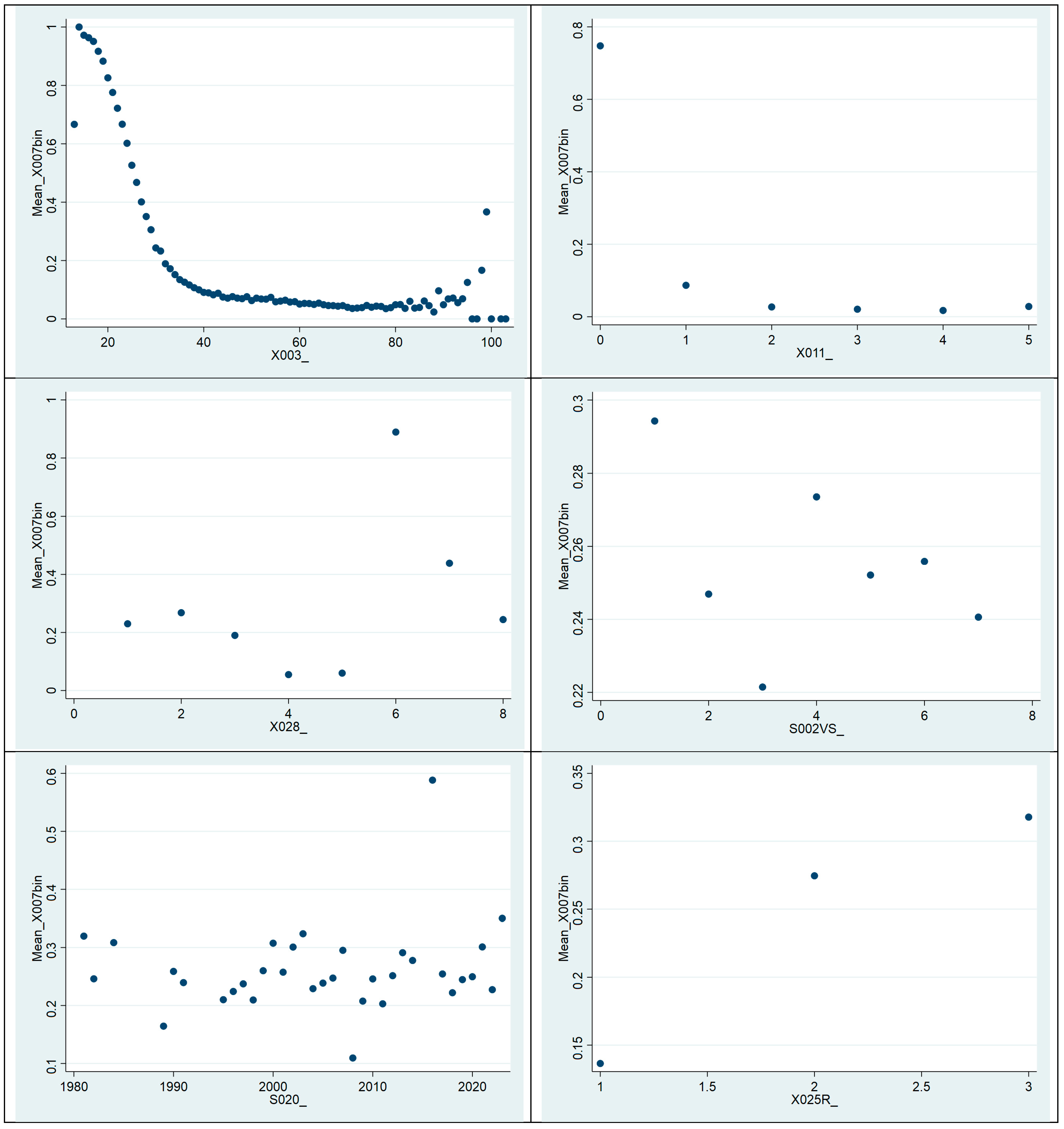
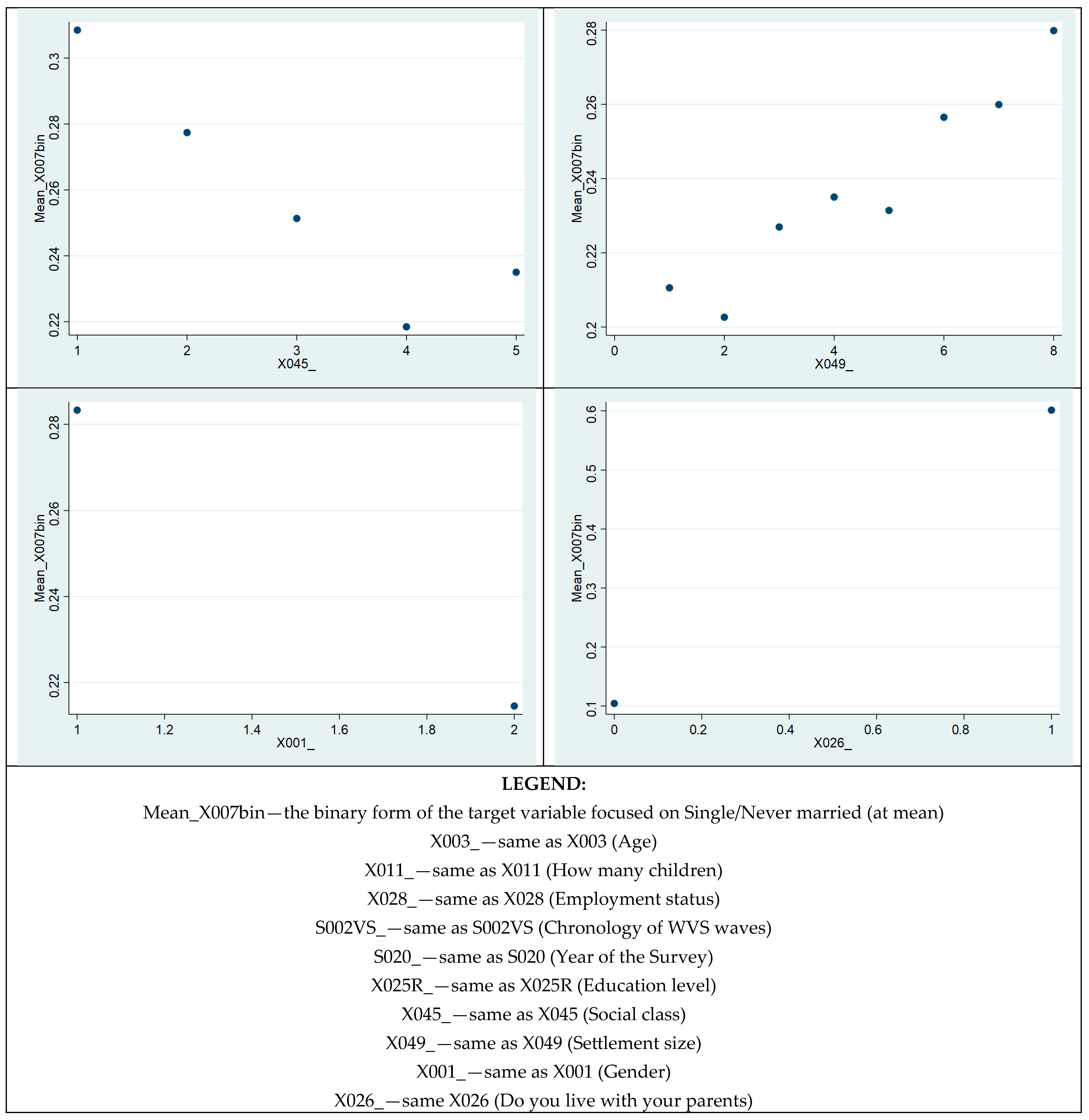
Two-way graphical representations (Figure A2, Appendix A—ROUND 7) included in this study display the relationship between the target variable (average values between 0 and 1 on the Y axis) and each of the most robust variables, along with those in the socio-demographic category or those indicating the chronology (distinct values on the X axis), all based on tabulations by mean.
Thus, the results of the relationship between the target variable, as the mean proportion of respondents who are single/never married, and those four most robust influences indicate the following:
  • Mean_X007_bin vs. X003 (Age)—there is a strong negative correlation. Young individuals (teenagers and those in their 20s) have the highest probability of singleness. As age increases, the likelihood of being single decreases sharply (stabilization at low levels around 30–50) (H3). In older ages (70+), there is a slight new increase, possibly due to widowhood.
  • Mean_X007_bin vs. X011 (Number of Children)—a clear negative relationship. Those with no children have the highest probability of being single. The probability drops to near zero as the number of children increases (H4).
  • Mean_X007_bin vs. X028 (Employment Status)—the variation is visible across different employment categories. Students (coded as 6) have the highest probability of being single. Full-time (1), part-time (2), and self-employed (3) have lower probabilities. Retired (4), housewives (5), unemployed (7), and other categories (8) are also less likely to be single (H1).
  • Mean_X007_bin vs. X026 (Living with Parents)—there is a strong positive correlation. Those who live with their parents (value 1) have a much higher probability of being single when compared to those who do not (value 0) (H2).
The results of the relationship between the target variable, as the mean proportion of respondents who are single/never married, and two variables corresponding to the chronology of waves (S002VS_) and the survey year (S020_) appear below:
  • For Mean_X007_bin vs. S002VS_, the proportion of single individuals fluctuates across waves. Still, it shows a slight increase as a general trend (H10). The lowest value appears in the earlier waves (1994–1998 and 1989–1993), suggesting fewer single individuals in those years. The highest proportion is observed in Wave 1 (1981–1984), followed by some increase in later waves. The latter suggests that the percentage of never-married individuals varies across survey waves but does not follow a strict linear trend.
  • For Mean_X007_bin vs. S020_, the trend shows fluctuations rather than a clear increasing or decreasing pattern. However, in recent years (2010s–2020s), the proportion of single individuals appears slightly higher on average. Some years (e.g., post-2010) show spikes, possibly due to economic crises, shifting social values, or declining marriage rates.
The results of the relationship between the target variable, as the mean proportion of respondents who are single/never married, and those four socio-demographic variables corresponding to the education level (X025R_), social class (X045_), settlement size (X049), and gender (X001) indicate the following:
  • For Mean_X007_bin vs. X025R_, the relationship suggests that as the education level increases from Lower (1) to Upper (3), the mean value of SINGLE/NEVER MARRIED (Mean_X007_bin) increases. The latter means that people with higher education levels are more likely to be single (H5).
  • For Mean_X007_bin vs. X045_, there is an apparent negative association, which means that as the social category moves from the Upper (1) to the Lower (5), the single proportion decreases. The latter signifies that upper-class individuals are more likely to remain single when compared to those in lower social classes (H7). Still, the minimum value of singleness corresponds to the value of 4 (working class) and not 5 (lower class) of this variable, partially confirming its inconsistent behavior (coefficient sign) in regressions (Table A6, Appendix A, Model 5, and Table A5, Appendix A, Model 7).
  • For Mean_X007_bin vs. X049_, a positive association is observable. As settlement size increases from small villages (1) to large cities (8), the likelihood of being single increases. The latter means that urban residents are more likely to be single than those from rural areas (H6).
  • For Mean_X007_bin vs. X001_, the male respondents (1) have a higher singleness probability than females (2), which indicates that men are more likely to remain unmarried than women.
The findings align with global policy objectives (UNESCO, UN, Agenda 2020) that promote family stability, cohesion, and well-being in the context of increasing individualization and aging (Perez-Alvaro and Boswell 2024; Wonde 2024). Moreover, the EU responds to demographic shifts through the Pillar of Social Rights and the 2020 Demographic Change Strategy, promoting equality, inclusion, and solidarity (De Becker 2024; Dura 2024; Meira et al. 2024). In addition, Nordic countries address demographic change through generous welfare policies that foster autonomy and equality, but may also reduce partnership formation (Reine et al. 2024; Engdahl et al. 2022).

5. Discussion

5.1. Main Findings

This study employs recent data from WVS (World Values Survey) to identify the most significant predictors of singlehood. WVS also defines singlehood as the condition of being single or never married. This definition emerges from the marital status variable X007. Through a rigorous selection process involving multiple tests and analyses, the research reveals a core set of three key predictors that consistently influence singlehood: the number of children (X011), age (X003), and employment status (X028). These predictors demonstrate strong resilience, passing numerous robustness checks. However, these relationships are also objects of cautious interpretations. The latter applies because they do not always imply a unidirectional causal effect.
Parental status and age exhibit a negative relationship with singlehood. Specifically, individuals with fewer or no children are more likely to be single, while those with more children are less likely to remain unmarried. While this study identifies a significant negative association between the number of children and singlehood, researchers acknowledge that the causal direction is complex. It is reasonable to argue that being single reduces the likelihood of having children, especially in societies where childbearing strongly relates to marriage. However, the modeling approach adopted here allows exploratory insight into how parenthood correlates with marital status across populations. Although including the number of children as a predictor in nomograms based on preliminary mutual causation checks using the initial scale format of the variable (Table A9 and Table A10, Appendix C) serving as a source for the binary target, the interpretation of this relationship should remain tentative, as the evidence does not justify a clear-cut causal direction (first selections also due to correlations in ROUND 1, when using four techniques, including SCDM—Figure 1). The possibility of mutual influence between parenthood and marital status remains well-supported. Further longitudinal investigation may help clarify the nature of this relationship.
Similarly, older individuals are less likely to be single than younger ones. Although the analysis includes individuals as young as 13, the findings are interpreted primarily in terms of adult behavior.
In contrast, employment status shows a positive relationship with singlehood. Individuals in precarious employment situations (such as students or the unemployed, the latter coded with higher values) face a higher risk of being single. In contrast, those in stable employment (e.g., full-time or part-time jobs, coded with lower values) are less likely to remain unmarried.
The persistent significance of these three predictors across continental and gender-specific models underscores their robustness. This robustness is further supported by mixed-effects models and cross-validations using additional criteria, such as education level, social class, settlement size, survey wave, survey year, and combined country-wave and country-year indicators.
From a theoretical perspective, these findings align with established socioeconomic theories of marriage (e.g., Maslow’s Hierarchy of Needs (Poduska 1992; Finkel et al. 2014; Hoffman 2017)). Economic stability, employment, and living arrangements are fundamental factors shaping the ability to pursue marriage and family life (Staff and Vuolo 2024; Tchoukou 2024; Avilés et al. 2024; Chandler et al. 2004; Bartošová and Fučík 2017; Kaplan and Herbst-Debby 2017; Bergström and Brée 2023; Sharma 2024; Park et al. 2025). As such, the results fully confirm three hypotheses (H1, H3, and H4), further reinforcing their consistency and reliability. These insights are valuable for policymakers addressing demographic shifts, labor market challenges, and evolving family structures, ensuring that social policies align with modern relationship dynamics.
Another significant variable, co-residence with parents (X026), acts as a strong associated influence. It passed most robustness checks, and it contributed the utmost accuracy in classification (as measured by the highest AUCROC value of 0.9431—Table A6, Appendix A, Model 8) when added to the tri-core model. Co-residence with parents positively correlates with singlehood, meaning that individuals living with their parents are more likely to be single (Homocianu 2024a; Killewald 2016; Smock and Schwartz 2020; Park et al. 2025; Simpson 2006; Chitranshi and Dhar 2023), validating hypothesis H2.
Moreover, all these findings stand on the two-dimensional plots of the relationship between the target variable and the corresponding four most robust influences (number of children, age, employment status, and co-residence with parents). They align with common life patterns: younger people, students, and those without children are more inclined to remain single, while employment, having children, and independent living (not with parents) are significantly associated with being in a relationship or married.
Beyond socioeconomic and psychological interpretations, these results can also integrate with contemporary demographic and sociological perspectives. Theories of the second demographic transition (England and Xu 2025; Oehrlein and Wolf 2025; Kamińska and Mularczyk 2025) emphasize increasing individualization of the life course coupled with growing inequalities (Han and Brinton 2022), delayed family formation (Tran 2025), and the decoupling of marriage from cohabitation and childbearing (Raymo 2022), trends consistent with the rising prevalence of singlehood (Raz-Yurovich 2025). From a life-course perspective (Elder 1994; Ermer and Keenoy 2023), singlehood reflects a flexible sequence of transitions in adulthood rather than a fixed status (Fomby and Bosick 2013; Jager et al. 2024). These theories provide a robust interpretive lens for understanding the big why behind the rising prevalence of singlehood, particularly among younger, childless individuals in urban settings. From a Maslowian point of view (Poduska 1992; Finkel et al. 2014; Hoffman 2017), precarious employment and economic instability hinder progression beyond basic physiological and safety needs, thereby delaying or obstructing the pursuit of intimacy, belonging, and family formation. This helps explain why students, the unemployed, and those in unstable jobs exhibit significantly higher singlehood rates. Simultaneously, the second demographic transition (England and Xu 2025; Oehrlein and Wolf 2025; Kamińska and Mularczyk 2025) sheds light on how evolving social norms increasingly decouple marriage from traditional milestones such as parenthood, homeownership, and financial security. In this context, urban residence and higher education function not merely as correlates but as enablers of individualized life trajectories, where personal fulfillment, career advancement, and self-actualization take precedence over institutionalized partnership. These normative shifts are further reinforced by structural changes (e.g., rising housing costs, delayed economic independence, and the weakening of intergenerational support systems) that consolidate singlehood as a rational and adaptive life strategy rather than a residual demographic condition. Taken together, these psychological and sociological dynamics reveal why the observed patterns persist, namely that singlehood is less a failure of partnership formation (Reine et al. 2024; Engdahl et al. 2022) than a reflection of evolving priorities and constraints in late-modern societies. Moreover, changing gender norms and the reorganization of work and care roles (England 2010; Esping-Andersen and Billari 2015; Hook and Paek 2020) help explain the gender-specific patterns identified in this study. Integrating these perspectives situates the findings within broader demographic transformations observed worldwide.
In terms of strict relevance for data-driven strategic approaches to public management, understanding the key influences of singlehood as resulting from this paper can help strategic approaches to define the following:
  • -Youth employment policies and labor market interventions.
  • -Family support programs and social welfare initiatives.
  • -Urban planning and housing policies.
  • -Addressing demographic shifts and their consequences for public services.

5.2. Additional Findings

The first set of additional findings highlights socio-demographic influences of singlehood, including gender (X001), education level (X025R), social class (X045), and settlement size (X049). The chronology of responses does not indicate a relevant role (lack of significance when considered individually in regressions—Table A5, Appendix A, Models 4 and 5), as evidenced by the influences of the survey wave (S002VS) and survey year (S020). Among these influences, gender (X001) brought the highest classification accuracy (as measured by the AUCROC value of 0.9375—Table A6, Appendix A, Model 7) when added to the tri-core model.
Education level and settlement size demonstrate positive correlations with the likelihood of being single. Specifically, individuals with higher education levels (coded with larger values) and those from larger urban areas (coded with higher values) are more likely to be single. In contrast, gender shows a negative relationship with singlehood, with women (coded as 2) being less likely to be single compared to men (coded as 1). Social class behaves the opposite way when considered in conjunction with the tri-core model and individually. This statement stands on the opposite coefficient sign in the corresponding regressions. It shows a non-linear but generally negative relation with the target variable, with a minimum value of singleness for the working class or a value of 4 from the maximum of 5 on its corresponding scale (Mean_X007bin vs. X045, bottom-left of Figure A2, Appendix A, and Table A5, Appendix A, Model 7).
All the additional findings in this section also rely on two-way graphical representations of the relationship between the target variable and others corresponding to the chronology of waves, survey year and the four from the socio-demographic category. They suggest that marriage patterns have changed over time, but there is a non-linear and fluctuating relationship with singlehood. The latter has the lowest values for waves 3 (1994–1998) and 7 (2017–2022). It suggests changing cultural and economic factors affecting marriage rates. Moreover, the relationship between the target variable and the survey year reinforces this fluctuating pattern. It highlights year-to-year fluctuations. These fluctuations may result from economic cycles, global events, or some policy shifts. The highest value of the target variable at the mean (almost 0.6) corresponds to the year 2016. Other higher values (between 0.3 and 0.35) corresponded to the following years: 1981, 1984, 2000, 2002, 2003, 2021, and 2023. In addition, individuals with higher education, higher social class, urban residence, and male gender are more likely to be single. Part of these additional findings align with previous results in the literature, reinforcing the consistency of the observed patterns. For example, some studies have shown that education level and social class significantly influence singlehood, with higher education often delaying marriage (Perelli-Harris and Lyons-Amos 2015; Van Den Berg and Verbakel 2021; Chaloupkova 2023).
A second set of findings reveals gender- and continent-specific deviations from the overall model, as visualized through augmented prediction nomograms (Figure 4). For instance, the importance of the number of children as a predictor significantly decreases in Africa and North America but increases markedly in Asia. Europe, South America, and Oceania show only slight increases. Similarly, the importance of the age predictor declines consistently in Asia and Oceania while rising significantly in Africa and North America. Europe and South America exhibit minor decreases.
Employment status demonstrates the most notable variation across continents. Its importance increases sharply in Oceania and North America but drops significantly in Asia. Europe shows a moderate increase, while Africa and South America indicate slight decreases. Gender-specific analyses further reveal that employment status has a much more profound impact on singlehood for men than for women. In contrast, the number of children and age show only minor gender-related variations, with the former being slightly more influential for women and the latter for men.
These findings underscore the importance of considering cultural, economic, and regional contexts when analyzing predictors of singlehood.

5.3. Contextual Applicability of Findings Across Continents

While this study identifies robust predictors of singlehood that are generally consistent across global models, the observed continental deviations (Figure 4) suggest that interventions or policy responses should be context-sensitive rather than universally applied. The tri-core model (comprising children count, age, and employment status) offers a valuable baseline, but its operationalization must reflect the regional sociocultural and economic specificities.
For instance, the significantly greater importance of employment status in Oceania (+75.44%) and North America (+32.56%), compared to its markedly diminished relevance in Asia (−57.45%), implies that employment-focused policies or economic incentives to encourage marriage may be effective in the former but largely inadmissible in the latter. In Asia, where employment status is weakly associated with singlehood, interventions must account for broader structural or cultural dynamics beyond the labor market.
Similarly, the number of children carries heightened importance in Asia (+27.66%), a region where traditional family values and intergenerational expectations remain influential. The latter makes childcare policies, family tax incentives, or other pronatalist interventions potentially more effective. However, in Africa (−16.79%) and North America (−16.28%), where the explanatory power of this predictor declines, such strategies may not yield the intended outcomes—reflecting the inadmissibility of direct policy transfers.
Moreover, the predictive importance of age varies across continents. Africa (+24.86%) and North America (+18.19%) show a strengthened relationship between age and singlehood, while Asia (−30.54%) and Oceania (−21.05%) exhibit significantly weaker associations. The latter suggests that age-targeted interventions (such as programs supporting young adults entering the workforce or initiatives for delaying or encouraging earlier marriage) may be more effective in Africa and North America. In contrast, such strategies may prove less relevant or even counterproductive in Asia or Oceania, where familial pressure, socioeconomic constraints, or entrenched cultural norms may overshadow age as a key influence (e.g., in some Asian contexts, extended family expectations and housing affordability may influence singlehood more than chronological age).
The results indicate a solid policy transfer point: the regions must handle it with attention to detail. The EU experience, often rooted in social welfare frameworks, gender equality initiatives, and labor market interventions, may not align with other economic structures and cultural traditions (e.g., those of Asia or Africa). Therefore, while global models can guide high-level understanding, effective interventions require local calibration.
In sum, the tri-core framework proves to be regionally adaptive rather than prescriptive. Its utility depends on local validation, paying attention to regional variances in predictor strength, cultural norms, labor market dynamics, and demographic patterns. It is only at that point that strategies grounded in data and aligned with cultural contexts emerge.

5.4. Further Research Directions

Future research should investigate additional cultural and psychological predictors of this phenomenon of singlehood. Recent studies suggest that cultural attitudes play a crucial role in marriage-related decisions. Moreover, psychological traits, such as attachment styles, play a significant role in these decisions (Sassler and Lichter 2020; Shahi et al. 2023; Apostolou et al. 2023), and incorporating them alongside the quantitative approach used in this study would be beneficial. Furthermore, adopting longitudinal frameworks (Tessler 2023) could enhance our understanding of the dynamic interplay between individual and societal changes in shaping the phenomenon of singlehood. Specifically, inquiry into the influence of cultural attitudes, personal values, and psychological traits, such as attachment styles and personality characteristics, on singlehood may provide a more nuanced perspective. Qualitative methods, including interviews and focus groups, could augment the present quantitative findings by elucidating personal motivations, social pressures, and emotional factors relevant to singlehood. Longitudinal studies would also offer valuable insights into the temporal evolution of these predictors across diverse life stages, thereby facilitating a more robust differentiation between correlation and causation.
Moreover, subsequent research endeavors should examine the broader economic landscape (Marco-Gracia 2018; English 2019) influencing singlehood. Factors such as labor market regulations (Wojnicka et al. 2024), housing affordability (Balatonyi 2025), and parental leave policies may significantly influence the status of being single. The role of technology (particularly the impact of social media platforms, online dating applications, and digital communication modalities) warrants exploration. This exploration is necessary to elucidate the evolving dynamics of contemporary relationships (Diesen et al. 2025). Moreover, further investigation of gender and regional disparities is justified. The focus should be on understanding the differential impact of employment status on male singlehood and the influence of distinct cultural settings on singlehood trends. Examining life course transitions, including divorce, separation, widowhood, career shifts, health alterations, and migration events, would also provide valuable insights into how significant life milestones modulate the likelihood of remaining single.
Future research could also explore the integration aspect of national-level statistics (such as marriage and divorce rates from official statistical agencies). While this study focused exclusively on individual-level data from WVS, using country-level data in a multilevel modeling framework may offer important contextual insights. Such approaches would help bridge micro-level attitudes and macro-level trends, provided that appropriate variance and modeling structures are in place.
To address the underlying reasons why individuals remain single (beyond the statistical associations already identified) future research should incorporate a mixed-methods design that complements quantitative patterns with interpretive depth. Qualitative approaches such as in-depth interviews, focus groups, or narrative inquiries with never-married adults across diverse life stages and cultural contexts could reveal the subjective meanings and social dynamics that shape singlehood. These methods would help uncover personal motivations (e.g., intentional autonomy versus constrained opportunity), perceived social pressures (e.g., familial expectations, gender norms, stigma), and psychological factors (e.g., attachment styles, fear of relational failure, or prioritization of self-development) (Shahrak et al. 2021; Band-Winterstein and Manchik-Rimon 2014; Koren and Atamneh 2025; Van Gasse et al. 2025; Xu et al. 2025; Heta and Phillips 2025; Dennett et al. 2025; Rowlingson and McKay 2005). Such insights are essential for understanding why precarious employment may disproportionately affect men’s partnership formation (e.g., Oceania); why the number of children correlates more strongly with singlehood (e.g., Asia); or why urban, highly educated individuals delay or opt out of marriage despite economic independence. Longitudinal qualitative panels or diary studies could further illuminate how these motivations shift over time, helping to disentangle correlation from causation and identify key inflection points in the life course. When integrated with multilevel modeling of macro-level indicators (such as housing affordability, gender equality, or digital dating cultures), this approach is expected to support a more comprehensive theoretical framework for explaining the global rise in singlehood and guiding culturally responsive policy interventions.
Addressing these avenues of inquiry will enable future studies to develop a more comprehensive framework for understanding singlehood across diverse populations and social contexts.

6. Conclusions

This study presents a comprehensive analysis of the influences closely related to singlehood, drawing on recent data from WVS (World Values Survey) and employing a multi-method approach to ensure robust findings. Through rigorous feature selection, cross-validation, robustness checks, and statistical modeling (compact models with near-excellent or excellent classification accuracy, with AUCROC > 0.9), the analysis identifies robust and consistent statistical relationships between singlehood and several socio-demographic variables, notably age, parental status, and employment conditions. While these variables have strong correlations with singlehood in the models applied and remain stable across demographic, regional, and gender-based analyses, confirming their broad relevance, the results do not establish causal relationships. The analyses rely on observational data. They allow the detection of significant associations and temporal sequences, but not definitive causal inference. These results are best interpreted as correlational, emphasizing observed relationships without implying deterministic causality. Co-residence with parents also emerged following a simple logic: the individuals who remain single are more likely to live with their parents.
Other relevant correlations with education level, social class, settlement size, and gender emerged from additional analyses and contribute to a deeper understanding of the singlehood patterns. They also highlight the effects of economic and social security on marriage decisions. Therefore, they align with established theoretical frameworks such as Maslow’s Hierarchy of Needs.
The study reveals notable variations in the strength of these influences across gender and geographical contexts. Employment status has a more pronounced correlation with singlehood for men, and also in Oceania and North America. The number of children is more significant in these terms in Asia. These variations underscore the importance of considering personal characteristics, cultural and economic contexts to gain a deep understanding of singlehood.
The findings directly address the hypotheses of this study, confirming economic, social, and cultural influences on singlehood with supporting evidence. Employment status (H1) and co-residence with parents (H2) have positive associations. In these terms, some precarious jobs (e.g., students and unemployed) correlated with higher singlehood and two-way tables indicated a notable difference in co-residence between non-singles and those more likely to be singles. Age (H3) and parental status (H4) exhibit negative correlations, with older age and having children reducing the likelihood of being single. By contrast, higher education (H5) and urban residence (H6) positively correlate with singlehood. The social class (H7) correlates in the sense that the minimum likelihood of singleness corresponds to the working class (a higher value in the related original scale). In addition, the gender moderates effects (H8), with employment being more influential for men. Predictors vary by continent (H9). In fact, the employment counts more in Oceania and North America (increases of 75.44% and 32.56%, respectively), while the parental status in Asia (increase of 27.66% from the overall model). Moreover, the prevalence of singlehood has increased over time (H10), reflecting societal shifts.
By uncovering universal and context-specific influences, this study advances the understanding of the role of demographic shifts, evolving family structures, and social and economic conditions in shaping singleness. It also equips researchers, policymakers, and stakeholders with clear and valuable insights to address the multifaceted challenges of singlehood in contemporary societies.
Beyond advancing academic understanding, the findings from this study provide practical guidance for strategic public planning, ensuring better support for employment, welfare, housing, and service policies in response to changing family dynamics and demographic trends.

Funding

This research received no external funding. The APC was funded by review vouchers.

Institutional Review Board Statement

The survey behind this study belongs to the World Values Survey (WVS), which adhered to the Declaration of Helsinki. Ethical principles and respect for the rights and welfare of all participants were upheld by the World Values Survey. As a secondary data analysis with no direct human subject interaction, this study relies on the WVS’s established ethical protocols and does not require additional Institutional Review Board approval.

Informed Consent Statement

Informed consent was obtained (by the World Values Survey) from all subjects involved in the study. As a secondary data analysis with no direct human subject interaction, this study relies on the WVS’s established ethical protocols and does not require additional informed consent documentation.

Data Availability Statement

The dataset used in this study and belonging to the WVS is inside the “WVS_Time_Series_1981-2022_stata_v5_0.zip” archive (https://www.worldvaluessurvey.org/WVSDocumentationWVL.jsp, accessed on 3 January 2025, (Data and Documentation/Data Download/Timeseries 1981–2022). For replicability, a permanent online Google Drive repository (https://tinyurl.com/ynvyms7a—accessed on 28 November 2025) keeps all derivation, export, selection, and analysis script sequences. This container also hosts all intermediary results necessary for this study.

Acknowledgments

The author expresses sincere appreciation to the World Values Survey, the participants of this survey, and all associated projects for authorizing the use of data and the dissemination of research results. The author also acknowledges the valuable work and efforts of the reviewers and the editorial team.

Conflicts of Interest

The author declares no conflict of interest.

Appendix A

Figure A1. Workflow for feature selection and validation outlining the full methodology used to explore singleness based on WVS Data (1981–2022).
Histories 05 00064 g0a1
Table A1. Overview of Multi-Technique Rounds for Identifying Singlehood Predictors Using WVS Data.
RoundPurposeKey Methods and ToolsOutput
StartLoad and prepare
the WVS dataset
for analysis
REMDKNA (remove DK/NA values); Binary derivation of marital status (X007bin)Cleaned .csv to use with Rattle(R) and SQL Server Analysis Services
1: Initial SelectionIdentify initial robust predictors via
the intersection of
multiple techniques
SCDM or Spearman pairwise correlation-based selection (Stata); Adaptive Boosting (Rattle in R); Decision Tree and Naïve Bayes (SQL Server Analysis Services)Intersected variables (common across all four methods)
2: Other Robust SelectionsFurther refine robust predictors using advanced modelingBayesian Model Averaging (BMA); Rigorous LASSO (RLASSO); Cross-Validated LASSO (CVLASSO), all in StataVariables passing all three techniques
3: Collinearity ChecksDetect and remove non-collinear influencesVCPR (pairwise OLS collinearity); VIF (Variance Inflation Factor); NOMOLOG (preliminary nomograms), all in StataNon-collinear influencers (refined variable set)
4: Mutual Causation ChecksVerify directionality and rule out reverse influencesOLOGIT/OPROBIT regressions in Stata; Compare R2, AIC, BIC in dual-role regressionsPredictors more likely to influence singlehood (confirmed causality direction)
5: Non-Random Cross-ValidationValidate models with random effects for stabilityMeLOGIT models (in Stata) with random effects (Education, Class, Settlement, Year, Wave, Country-Year/Wave)Confirmed predictors and final risk-prediction nomograms
6: Control Variable TestingAssess effects of socio-demographic controls on core predictorsAdd each socio-demographic variable individually to the top 3 models (in Stata)Effects of controls on core predictors (e.g., robustness checks)
7: Summary RepresentationsVisualize and summarize findingsTwo-way tables + graphs (in Stata); Additional visual insights (binary target)Additional insights for interpretation (e.g., tables, graphs)
ResultsInterpret results and ensure reproducibilitySynthesis of all roundsDiscussion of findings; Google Drive repository with code, exports, and results
Figure A2. Bivariate graphical representations depicting the associations between each variable (whether from the core model or socio-demographic group) and the target variable, computed on average from its binary format-Stata script at https://tinyurl.com/48m7khje—accessed on 28 November 2025).
Histories 05 00064 g0a2aHistories 05 00064 g0a2b
Table A2. (1). The most important items (version 5.0 of WVS) after ROUND 1. (2). General statistics for the most important items (version 5.0 of WVS). (3). Important WVS (v5.0) socio-demographic variables included in the cross-validation procedures of this study. (4). General statistics of important WVS (v5.0) socio-demographic items employed for cross-validation in this study.
(1)
Item/
Variable
DescriptionCoding
X007Marital status
(target variable—scale/original form)
1—Married; 2—Living as being married; 3—Divorced;
4—Separated; 5—Widow; 6—Single/Never married
X007binMarital status
(target variable—binary/derived form)
1 if X007 = 6(Single/Never married);
0 if X007 is between 1 and 5
X002Year of birthYears with values between 1890 and 2007
X003AgeNumber of years (between 13 and 103)
X003R2Age recoded (3 intervals)1—15–29 years; 2—30–49 years; 3—50 and more years
X011How many children do you have0—No child; 1—1 child; 2—2 children; 3—3 children;
4—4 children; 5—5 children or more
X026Do you live with your parents0—No; 1—Yes
X028Employment status1—Full time; 2—Part time; 3—Self-employed; 4—Retired; 5—Housewife; 6—Students; 7—Unemployed; 8—Other
(2)
VariableNMeanSt.Dev.Min.0.25Median0.75Max.
X007
(Marital status—scale form)
438,0732.672.1811156
X007bin
(Marital status—binary form)
438,0730.250.4300001
X002
(Year of birth)
432,6521965.0518.1618901953196719792007
X003
(Age)
438,74941.2716.2513283953103
X003R2
(Age recoded—3 intervals)
438,7492.010.7711233
X011
(How many children)
423,9021.791.5700235
X026
(You live with parents)
416,2830.30.4600011
X028
(Employment status)
430,4563.312.1611358
(3)
VariableShort DescriptionCoding Details
ContinentAfrica, Asia, Europe,
North America, South America
or Oceania
1—Africa; 2—Asia; 3—Europe; 4—North America; 5—South America; 6—Oceania
S002VSChronology of WVS waves1—1981–1984; 2—1989–1993; 3—1994–1998; 4—1999–2004; 5—2005–2009; 6—2010–2014; 7—2017–2022
S020Year of the SurveyYears between 1981 and 2023
S024Country & Wave (concatenation)Values between 83 for Albania (8)+Wave 3 and 9097 for Northern Ireland (909)+Wave 7
S025Country & Year (concatenation)Values between 81998 for Albania (8)+1998 and 9092022 for Northern Ireland (909)+2022
X001Sex1—Male; 2—Female
X025REducation level1—Lower; 2—Middle; 3—Upper
X045Social class (subjective)1—Upper class; 2—Upper middle class; 3—Lower middle class; 4—Working class; 5—Lower class
X049Settlement size1—under 2000; 2—2000–5000; 3—5000–10,000; 4—10,000–20,000; 5—20,000–50,000;
6—50,000–100,000; 7—100,000–500,000; 8—500,000 and more
(4)
VariableNMeanSt.Dev.Min.0.25Median0.75Max.
continent388,7362.721.3212236
S002VS443,4884.891.6713567
S020443,4882006.339.7119811998200620132023
S024443,4884586.972574.38832333440370449097
S025443,4884.60 × 1062.60 × 10681,9982.30 × 1064.40 × 1067.00 × 1069.10 × 106
X001438,6691.520.511222
X025R414,3492.010.7511233
X045380,5243.310.9913345
X049325,75052.5113578
Source: (1) Own processing using the label list and tabulate commands in Stata 17. Note: The intersecting results (the six most robust variables) stand out using the Bold aspect. (2) Prepared by the author using a specific command (Univar—Stata 17, namely univar X007 X007bin X002 X003 X003R2 X011 X026 X028 (full Stata script at https://tinyurl.com/2m4h273y—accessed on 28 November 2025 and full results at https://tinyurl.com/bdw39tf9—accessed on 28 November 2025). Note: The intersecting results (the six most robust variables) stand out using the Bold aspect. (3) Prepared by the author using the ‘label list’ and ‘tabulate’ commands in Stata 17. (4) Prepared by the author using a specific command (Univar-Stata 17), namely univar continent S002VS S020 S024 S025 X001 X025R X045 X049 (full Stata script at https://tinyurl.com/ydmvrdxe—accessed on 28 November 2025 and full results at https://tinyurl.com/4ehr7wbh—accessed on 28 November 2025).
Table A3. The results of additional cross-validations using the gender criterion (and its values) in LOGIT regressions.
MODEL(1)
OVERALL
(2)
Male
(3)
Female
X003−0.0583 ***−0.0687 ***−0.0504 ***
(0.0005)(0.0008)(0.0006)
X011−1.7698 ***−1.9115 ***−1.6168 ***
(0.0122)(0.0211)(0.0149)
X0280.1314 ***0.2059 ***0.0843 ***
(0.0022)(0.0035)(0.0031)
_cons2.1717 ***2.5109 ***1.8533 ***
(0.0177)(0.0261)(0.0250)
N407,720194,075210,196
chi-squared52,402.439727,246.144324,746.5071
p0.00000.00000.0000
R-squared0.51130.56940.4543
AIC221,256.928598,753.0667117,948.1540
BIC221,300.601898,793.7707117,989.1772
AUCROC0.93740.95070.9218
chi-squared GOF7.3 × 1055.8 × 1052.9 × 105
p GOF0.00000.00000.0000
maxProbNlog
 PenultThrsh
0.90000.90000.8000
maxProbNlog
 LastThrsh
0.95000.95000.9000
Source: Prepared by the author in Stata (https://tinyurl.com/hs7k4fa6—accessed on 28 November 2025). Notes: Robust standard errors appear in parentheses. Coefficients denoted by *** indicate significance at the 1‰ level.
Table A4. Additional cross-validations using the continent criterion (and its values) in LOGIT regressions.
MODEL(1)
OVERALL
(2)
Continent1
(Africa)
(3)
Continent2
(Asia)
(4)
Continent3
(Europe)
(5)
Continent4
(North America)
(6)
Continent5
(South America)
(7)
Continent6
(Oceania)
X003−0.0579 ***−0.0778 ***−0.0608 ***−0.0542 ***−0.0466 ***−0.0425 ***−0.0397 ***
(0.0005)(0.0017)(0.0011)(0.0009)(0.0011)(0.0012)(0.0022)
X011−1.7691 ***−1.5259 ***−3.4237 ***−1.7988 ***−0.9877 ***−1.4297 ***−1.5130 ***
(0.0125)(0.0230)(0.0605)(0.0276)(0.0204)(0.0255)(0.0593)
X0280.1291 ***0.1388 ***0.0833 ***0.1385 ***0.1167 ***0.0953 ***0.1916 ***
(0.0023)(0.0056)(0.0046)(0.0046)(0.0064)(0.0061)(0.0165)
_cons2.1855 ***2.9628 ***2.7223 ***1.7423 ***1.6689 ***1.9515 ***1.1305 ***
(0.0182)(0.0562)(0.0397)(0.0346)(0.0443)(0.0466)(0.0864)
N388,73664,061138,54695,34835,22744,39611,158
chi-squared50,264.26649412.83368494.8913,455.42145597.88706025.25291339.6273
p0.00000.00000.00000.00000.00000.00000.0000
R-squared0.51260.54800.67580.45560.34550.43890.4171
AIC211,648.881237,378.300747,270.1550,245.656828,101.384329,933.36746114.0808
BIC211,692.363837,414.571147,309.550,283.518028,135.262629,968.17116143.3604
AUCROC0.93770.94580.97250.92220.87900.91580.9126
chi-squared GOF7.1 × 10555,188.095.20 × 1083.8 × 10514,354.3146,639.9820,068.99
p GOF0.00000.00000.00000.00000.00000.00000.0000
maxProbNlog
 PenultThrsh
0.90000.90000.90000.80000.80000.80000.8000
maxProbNlog
 LastThrsh
0.95000.95000.95000.90000.90000.90000.9000
Source: Prepared by the author in Stata (https://tinyurl.com/574k3fpd—accessed on 28 November 2025). Notes: Robust standard errors appear in parentheses. Coefficients denoted by *** indicate significance at the 1‰ level.
Table A5. Checking (LOGIT models) all three principal and empirically supported influences (the triad/tri-core), together with the recognized socio-demographic factors included in the study (ROUND 6).
MODEL(1)(2)(3)(4)(5)(6)(7)(8)(9)(10)
X003−0.1204 ***
(0.0006)
X011 −2.0967 ***
(0.0118)
X028 0.1565 ***
(0.0018)
S002VS 0.0004
(0.0021)
S020 0.0004
(0.0004)
X025R 0.4948 ***
(0.0048)
X045 −0.1053 ***
(0.0039)
X049 0.0571 ***
(0.0017)
X001 −0.3695 ***
(0.0071)
X026 2.5601 ***
(0.0084)
_cons3.0983 ***0.8073 ***−1.6547 ***−1.1077 ***−1.9536 **−2.1358 ***−0.7733 ***−1.4249 ***−0.5586 ***−2.1499 ***
(0.0183)(0.0065)(0.0075)(0.0109)(0.7296)(0.0108)(0.0132)(0.0095)(0.0110)(0.0061)
N434,411422,102426,316438,073438,073410,342376,706324,834433,301411,971
chi-squared39,035.616631,780.76317884.12690.03551.350610,808.1756730.37371179.17572730.177492,209.5520
P0.00000.00000.00000.85050.24520.00000.00000.00000.00000.0000
R-squared0.27760.45370.01930.00000.00000.02240.00180.00330.00570.2293
AIC352,228.7039256,312.3252468,342.3469491,394.9171491,393.5927449,934.0741419,770.9719359,328.2871482,266.0435358,143.3239
BIC352,250.6674256,334.2312468,364.2728491,416.8973491,415.5730449,955.9236419,792.6503359,349.6692482,288.0018358,165.1813
AUCROC0.85710.91130.58730.50030.50400.59810.52960.54060.54610.7751
chi-squared GOF80,188.114.8 × 10577,082.51662.193737.641966.44259.8578.940.000.00
p GOF0.00000.00000.00000.00000.00000.00000.00000.0000         .         .
maxProbNlog
 PenultThrsh
0.90000.50000.3000         .         .0.2000         .         .         .0.5000
maxProbNlog
 LastThrsh
0.95000.60000.40000.00000.20000.30000.30000.20000.30000.6000
Source: Prepared by the author in Stata (https://tinyurl.com/5x5b56b6—accessed on 28 November 2025). Notes: Robust standard errors are reported in parentheses. Coefficients marked with ** and *** are significant at 1% and 1‰.
Table A6. Checking (LOGIT models) employing the triad of principal, evidence-backed influences together with the standard socio-demographic factors traditionally considered in this study (ROUND 6).
MODEL(1)(2)(3)(4)(5)(6)(7)(8)
X003−0.0583 ***−0.0586 ***−0.0586 ***−0.0574 ***−0.0586 ***−0.0555 ***−0.0582 ***−0.0403 ***
(0.0005)(0.0005)(0.0005)(0.0005)(0.0005)(0.0005)(0.0005)(0.0005)
X011−1.7698 ***−1.7681 ***−1.7682 ***−1.7349 ***−1.7637 ***−1.7379 ***−1.7526 ***−1.6615 ***
(0.0122)(0.0122)(0.0122)(0.0124)(0.0130)(0.0139)(0.0123)(0.0125)
X0280.1314 ***0.1316 ***0.1315 ***0.1353 ***0.1232 ***0.1346 ***0.1413 ***0.1066 ***
(0.0022)(0.0022)(0.0022)(0.0023)(0.0023)(0.0025)(0.0023)(0.0024)
S002VS 0.0239 ***
(0.0031)
S020 0.0041 ***
(0.0005)
X025R 0.0981 ***
(0.0075)
X045 0.0623 ***
(0.0056)
X049 0.0376 ***
(0.0023)
X001 −0.2950 ***
(0.0104)
X026 1.4139 ***
(0.0111)
_cons2.1717 ***2.0606 ***−6.1271 ***1.8995 ***2.0042 ***1.8505 ***2.5682 ***0.9946 ***
(0.0177)(0.0228)(1.0650)(0.0260)(0.0250)(0.0236)(0.0232)(0.0206)
N407,720407,720407,720385,482360,492311,083404,271388,736
chi-squared52,402.439752,496.397252,498.773450,097.396546,164.615940,290.738452,549.854362,136.2502
p0.00000.00000.00000.00000.00000.00000.00000.0000
R-squared0.51130.51140.51140.50680.50850.49890.51270.5445
AIC221,256.9285221,206.5122221,205.9374210,680.5337196,155.8265171,085.0211218,301.0639197,830.8615
BIC221,300.6018221,261.1038221,260.5290210,734.8450196,209.8026171,138.2602218,355.6132197,885.2148
AUCROC0.93740.93740.93740.93610.93670.93390.93750.9431
chi-squared GOF7.3 × 1051.4 × 1062.8 × 1069.3 × 1051.1 × 1061.2 × 1068.7 × 1054.3 × 105
p GOF0.00000.00000.00000.00000.00000.00000.00000.0000
maxProbNlog
 PenultThrsh
0.90000.90000.90000.90000.90000.90000.90000.9000
maxProbNlog
 LastThrsh
0.95000.95000.95000.95000.95000.95000.95000.9500
Source: Prepared by the author in Stata (https://tinyurl.com/2xcsesf8—accessed on 28 November 2025). Notes: Robust standard errors appear in parentheses, while coefficients accompanied by *** indicate significance at 1‰.

Appendix B

Table A7. Details on the continents and corresponding countries.
ContinentContinent Code
(In This Paper)
Country Code
(COW_ALPHA in WVS)
CountryN
(No. of Obs.)
Africa 1ALGAlgeria2257
Africa 1BFOBurkina Faso1265
Africa 1EGYEgypt8769
Africa 1ETHEthiopia2726
Africa 1GHAGhana3086
Africa 1KENKenya1230
Africa 1LIBLibya2989
Africa 1MLIMali1181
Africa 1MORMorocco4619
Africa 1NIGNigeria7929
Africa 1RWARwanda2639
Africa 1SAFSouth Africa15,831
Africa 1TAZTanzania1100
Africa 1TUNTunisia2251
Africa 1UGAUganda996
Africa 1ZAMZambia1500
Africa 1ZIMZimbabwe3693
Asia2ARMArmenia4255
Asia2AZEAzerbaijan3003
Asia2BNGBangladesh3948
Asia2CHNChina9298
Asia2GRGGeorgia2698
Asia2HKGHong Kong SAR3198
Asia2INDIndia12,255
Asia2INSIndonesia6137
Asia2IRNIran6230
Asia2IRQIraq7288
Asia2JPNJapan8173
Asia2JORJordan3618
Asia2KZKKazakhstan2518
Asia2KUWKuwait1172
Asia2KYRKyrgyzstan3548
Asia2LEBLebanon2375
Asia2MAUMacau SAR803
Asia2MALMalaysia3808
Asia2MONMongolia1638
Asia2MYAMyanmar1200
Asia2PAKPakistan5872
Asia2PSEPalestine990
Asia2PHIPhilippines4792
Asia2QATQatar1052
Asia2SAUSaudi Arabia1502
Asia2SINSingapore5431
Asia2ROKSouth Korea3605
Asia2TAWTaiwan ROC4448
Asia2TAJTajikistan1200
Asia2THIThailand3931
Asia2TURTurkey11,189
Asia2UZBUzbekistan2691
Asia2DRVVietnam3688
Asia2YEMYemen992
Europe3ALBAlbania1849
Europe3ANDAndorra1999
Europe3BLRBelarus3579
Europe3BOSBosnia and Herzegovina2364
Europe3BULBulgaria2050
Europe3CROCroatia1152
Europe3CYPCyprus3004
Europe3CZRCzechia3243
Europe3ESTEstonia2532
Europe3FINFinland1971
Europe3GMYGermany7503
Europe3GRCGreece1180
Europe3HUNHungary1638
Europe3ITAItaly976
Europe3LATLatvia1165
Europe3LITLithuania978
Europe3MACMacao2027
Europe3MLDMoldova3030
Europe3MNGMontenegro1273
Europe3NTHNetherlands3708
Europe3NORNorway2145
Europe3POLPoland1949
Europe3ROMRomania5542
Europe3RUSRussia7549
Europe3SRBSerbia4603
Europe3SLOSlovakia2726
Europe3SLVSlovenia3060
Europe3SPNSpain6225
Europe3SWDSweden4088
Europe3SWZSwitzerland3758
Europe3UKRUkraine6482
North America4CANCanada5940
North America4DOMDominican Republic378
North America4SALEl Salvador1246
North America4GUAGuatemala2087
North America4HAIHaiti1927
North America4MEXMexico10,222
North America4NICNicaragua1200
North America4PRIPuerto Rico2872
North America4TRITrinidad and Tobago1996
North America4USAUnited States of America7359
South America 5ARGArgentina5510
South America 5BOLBolivia2031
South America 5BRABrazil7592
South America 5CHLChile6576
South America 5COLColombia6021
South America 5ECUEcuador2402
South America 5PERPeru6766
South America 5URUUruguay3925
South America 5VENVenezuela3573
Oceania6AULAustralia6419
Oceania6MADMaldives1010
Oceania6NEWNew Zealand3729
TOTAL 388,736
Source: Prepared by the author in Stata (https://tinyurl.com/34cyxnt8—accessed on 28 November 2025). Notes: For all continents, the non-NULL condition involved the target variable, the tri-core predictors, and the variable X026 (Do you live with your parents-discovered as a robust influence but not passing mutual causation checks or not a predictor).
This explains why the total number of observations above is less than the one in Model 1, Table A6, Appendix A (without the non-NULL condition for X026).
Table A8. Descriptive statistics for the remaining set of four most relevant WVS items used in the overall model as well as in the continental ones.
VariableNMeanSt.Dev.Min.0.25Median0.75Max.
X007388,7362.652.1811156
X007bin388,7360.250.4300001
X003388,73641.2216.1413283953103
X011388,7361.81.5700235
X026388,7360.290.4600011
X028388,7363.322.1611358
Source: Prepared by the author using a dedicated command (Univar-Stata 17, namely univar X007 X007bin X003 X011 X026 X028 if X007!=. & X003!=. & X011!=. & X026!=. & X028!=.).

Appendix C

Table A9. Mutual causation tests based on OLOGIT regression with comparisons for each column pair (ROUND 4).
MODEL(1)(2)(3)(4)(5)(6)(7)(8)
Input
(Below)\
Target Var. (Right)
X007X003X007X011X007X026X007X028
X003−0.0450 ***
(Age) (0.0002)
X011 −0.8730 ***
(How many children) (0.0037)
X026 2.0017 ***
(You live with parents) (0.0077)
X028 0.1401 ***
(Employment status) (0.0015)
X007 −0.3749 *** −0.6121 *** 0.4521 *** 0.1347 ***
(Marital status) (0.0015) (0.0017) (0.0017) (0.0014)
N434,411434,411422,102422,102411,971411,971426,316426,316
chi-squared33,034.143262,330.662855,747.7595122,516.827867,214.964473,173.96508858.82838921.1370
P0.00000.00000.00000.00000.00000.00000.00000.0000
R-squared0.05000.02220.13080.11810.08490.16290.00980.0069
AIC986,851.82763,469,984.6546872,458.24131,244,777.3004900,265.1491419,142.41881,010,206.50591,559,130.6996
BIC986,917.71813,470,973.0118872,523.95931,244,843.0184900,330.7213419,164.27621,010,272.28351,559,218.4031
Source: Prepared by the author in Stata (https://tinyurl.com/9m75jvr9—accessed on 28 November 2025). Notes: Robust standard errors appear in parentheses. Raw coefficients denoted by *** indicate significance at 1‰ (one per mile). Colors coding highlights relative model performance variable selection: green indicates better-performing models and selected variables, while red denotes poorer-performing models and variables not selected, across model pairs (1, 2) to (7, 8).
Table A10. Mutual causation tests based on OPROBIT regressions with comparisons for each column pair (ROUND 4).
MODEL(1)(2)(3)(4)(5)(6)(7)(8)
Input
(Below)\
Target Var. (Right)
X007X003X007X011X007X026X007X028
X003−0.0267 ***
(Age) (0.0001)
X011 −0.4718 ***
(How many children) (0.0018)
X026 1.2180 ***
(You live with parents) (0.0044)
X028 0.0842 ***
(Employment status) (0.0009)
X007 −0.1994 *** −0.3392 *** 0.2706 *** 0.0769 ***
(Marital status) (0.0008) (0.0010) (0.0010) (0.0008)
N434,411434,411422,102422,102411,971411,971426,316426,316
chi-squared43,661.163258,213.757272,661.9039111,964.891976,158.464377,234.91658979.39919449.9554
P0.00000.00000.00000.00000.00000.00000.00000.0000
R-squared0.05380.02010.12950.11040.08770.16170.00970.0067
AIC982,892.13093,477,355.9347873,738.19381,255,708.2678897,490.5835419,719.35401,010,280.74011,559,445.6220
BIC982,958.02143,478,344.2919873,803.91181,255,773.9858897,556.1558419,741.21141,010,346.51771,559,533.3255
Source: Prepared by the author in Stata (https://tinyurl.com/2n5acawf—accessed on 28 November 2025). Notes: Robust standard errors appear in parentheses. Raw coefficients denoted by *** indicate significance at 1‰ (one per mile). Colors coding highlights relative model performance variable selection: green indicates better-performing models and selected variables, while red denotes poorer-performing models and variables not selected, across model pairs (1, 2) to (7, 8).
Table A11. The cross-validation results based on seven criteria in Mixed-Effects LOGIT (MeLOGIT) regressions.
MODEL(1)(2)(3)(4)(5)(6)(7)
X003−0.0582 ***−0.0585 ***−0.0587 ***−0.0587 ***−0.0573 ***−0.0586 ***−0.0557 ***
(Age)(0.0044)(0.0034)(0.0023)(0.0023)(0.0046)(0.0019)(0.0011)
X011−1.7676 ***−1.7674 ***−1.7891 ***−1.7891 ***−1.7354 ***−1.7644 ***−1.7384 ***
(How many
children)
(0.0959)(0.1025)(0.1050)(0.1050)(0.1042)(0.1465)(0.0653)
X0280.1302 ***0.1289 ***0.1284 ***0.1284 ***0.1351 ***0.1202 ***0.1346 ***
(Employment
status)
(0.0055)(0.0073)(0.0053)(0.0053)(0.0210)(0.0151)(0.0061)
_cons2.1709 ***2.1379 ***2.1682 ***2.1682 ***2.0903 ***2.2473 ***2.0196 ***
(0.1181)(0.1596)(0.0777)(0.0777)(0.1968)(0.0482)(0.0387)
var(_cons[S002VS])0.0108 **
(S002VS = Wave
Chronology)
(0.0040)
var(_cons[S020]) 0.4255
(S020=Survey Year) (0.5022)
var(_cons[S024]) 0.3296 ***
(S024=Country & Wave) (0.0681)
var(_cons[S025]) 0.3296 ***
(S025 = Country & Year) (0.0681)
var(_cons[X025R]) 0.0069
(X025R = Education level) (0.0048)
var(_cons[X045]) 0.0116
(X045 = Social Class) (0.0063)
var(_cons[X049]) 0.0124 *
(X049 = Settlement size) (0.0057)
N407,720407,720407,720407,720385,482360,492311,083
AIC221,023.6526219,893.7355212,383.8847212,383.8847210,687.7992196,050.4390171,021.6988
BIC221,078.2443219,948.3272212,438.4764212,438.4764210,720.3860196,093.6199171,074.9379
Source: Prepared by the author in Stata (https://tinyurl.com/yrt8s6np—accessed on 28 November 2025). Notes: [var_name] shows the cross-validation criterion. Robust standard errors appear in parentheses. The raw coefficients marked using *, **, and *** are significant at 5%, 1%, and 1‰.

Appendix D

List of Technical Abbreviations
The following abbreviations appear in this manuscript:
AICAkaike Information Criterion—A statistical criterion used to compare competing models by jointly considering model fit and parsimony; smaller AIC values denote a more appropriate model.
AUCROCArea Under the Receiver Operating Characteristic Curve—A performance metric for classification models, reflecting their ability to distinguish between classes; values closer to 1 (or 100%) indicate excellent predictive power.
BICBayesian Information Criterion—Similar to the AIC, but penalizes model complexity more heavily; often preferred for selecting among nested statistical models.
BMABayesian Model Averaging—A statistical technique that accounts for model uncertainty by averaging over several models weighted by their posterior inclusion probabilities (PIP).
CVLASSOCross-Validated Least Absolute Shrinkage and Selection Operator—A regularized regression method that selects important predictors while minimizing prediction error through random cross-validation.
DK/NADo Not Know/No Answer—Survey response categories indicating respondent indecision or refusal to answer a specific item.
ESEmployment Status—A respondent’s self-reported position in the labor market (e.g., employed, unemployed, student).
GOFGoodness of Fit—A general measure assessing how well a statistical model fits the observed data.
LASSOLeast Absolute Shrinkage and Selection Operator—A regression technique that penalizes the absolute size of regression coefficients, useful for variable selection and avoiding overfitting.
maxProbNlog
PenultThrsh
Maximum Probability in Nomograms (Penultimate Threshold on the X-axis)—Refers to the second-highest probability threshold used in Zlotnik and Abraira nomograms as visual probability-based classification tools.
maxProbNlog
LastThrsh
Maximum Probability in Nomograms (Last Threshold on the X-axis)—Refers to the highest probability threshold used in Zlotnik and Abraira nomograms, marking the final probability cutoff in the output scale.
MeLOGITMixed-Effects Logistic Regression—A logistic regression model that includes both fixed and random effects, accommodating grouped or hierarchical data structures.
MFRModel for Female Respondents—A tailored statistical model specifically estimated on the subsample of female respondents.
MMRModel for Male Respondents—A tailored statistical model specifically estimated on the subsample of male respondents.
NoCNumber of Children—The number of biological or adopted children reported by the respondent.
NOMOLOGNomogram Generator (based on Binary Logistic Regressions)—A tool developed by Zlotnik and Abraira to create nomograms from binary logistic regression models, allowing for graphical representation of predicted probabilities.
OLOGITOrdinal Logistic Regression—A regression method used when the dependent variable has a natural order but no consistent interval between categories.
OPROBITOrdinal Probit Regression—A variant of ordinal regression based on the cumulative normal distribution, suitable for ordered categorical outcomes.
OVMOverall Model—The main statistical model estimated on the full sample, combining all types of respondents (e.g., both male and female, all continents, etc.).
PIPPosterior Inclusion Probabilities—In Bayesian variable selection, this reflects the likelihood that a given predictor belongs in the best model, based on the data (preferably, as close to the value of 1 as possible).
RattleA visual data mining pack in R launched using specific commands, namely “library (rattle)” and “rattle ()”.
REMDKNARemoving D K/NA values (Stata command for cleaning datasets)—A Stata approach (user-written command available and explained at https://dx.doi.org/10.2139/ssrn.4759469—accessed on 28 November 2025) used to clean survey datasets by excluding (assimilating to NULLs) “Do Not Know” or “No Answer” responses sometimes coded as negative values and artificially increasing the scales if not treated accordingly
RLASSORigorous Least Absolute Shrinkage and Selection Operator—A LASSO variant that includes data-driven penalty selection procedures to remove overfitting and enhance model robustness and inference validity.
SCDMSpearman Pairwise-Correlations—A nonparametric method (user-written command available and explained at https://dx.doi.org/10.2139/ssrn.5084186—accessed on 28 November 2025) for measuring the strength and direction of monotonic relationships between two variables. The results of SCDM considered three filters: magnitude—minAcc (a minimum cutoff value of 0.1as the absolute value of the Spearman coefficients of correlation), support—minN (no fewer than half of the total valid observations for the variable to analyze in its binary format for acceptable correlations), and significance—maxP (below 0.001, equivalent to one in a thousand).
SQLStructured Query Language—A standard language used for managing and querying relational databases.
SSASSQL Server Analysis Services—A Microsoft analytics platform for building data mining and online analytical processing (OLAP)/multi-dimensional models. It also serves as a model persistence layer.
VCPRVariables in Collinear Pairs—A diagnostic tool based on OLS regressions (user-written command available and explained at https://dx.doi.org/10.2139/ssrn.4742523—accessed on 28 November 2025) that flags pairs of highly collinear predictors which might distort model estimates.
VIFVariance Inflation Factor—A metric that quantifies the extent of multicollinearity in a regression model; values above 10 typically indicate problematic collinearity. It should be assessed against a maximum acceptable threshold depending on the R-squared of the regression model.
VMVirtual Machine—A software emulation of a physical computer, often used to run isolated data analysis environments or legacy systems. Here, the VM runs in Oracle VirtualBox. The VM is allocated 16 GB of RAM from the 32 GB available on the host system (Windows 8.1 Professional x64, used for Adaptive Boosting in Rattle, as well as SCDM and other analysis steps in Stata) and two of the four physical cores of the Intel Core i7−4710HQ processor.
WVSWorld Values Survey—An international research project that collects data on people’s values, beliefs, and behaviors across over 100 countries since 1981.

References

  1. Adamczyk, Katarzyna, Kamil Janowicz, and Marta Mrozowicz-Wrońska. 2022. Never-married Single Adults’ Experiences with Online Dating Websites and Mobile Applications: A Qualitative Content Analysis. New Media & Society 26: 3614–37. [Google Scholar] [CrossRef]
  2. Adámková, Jana, Karolína Lazárková, Jan Cukor, Hana Brinkeová, Jitka Bartošová, Luděk Bartoš, and Kateřina Benediktová. 2025. Wild Boar Attacks on Hunting Dogs in Czechia: The Length of the Hunting Season Matters. Animals 15: 130. [Google Scholar] [CrossRef]
  3. Ahmad, Kalateh Sadati, Sarah Sadeghieh, Jafari Naeimi Fatemeh, and Sadeghian Moghadam Zahra. 2024. The Intersection of Culture and Celibacy: Exploring Individual and Socio-Cultural Aspects of Prolonged Single Life among Unmarried Women in Yazd. Journal of the Iranian Association of Population Studies 18: 51–91. [Google Scholar] [CrossRef]
  4. Ahrens, Achim, Christian B. Hansen, Mark E. Schaffer, and Thomas Wiemann. 2025. Model Averaging and Double Machine Learning. Journal of Applied Econometrics 40: 249–69. [Google Scholar] [CrossRef]
  5. Al-Habies, Feras Ali, Suzie Yaseen Rababa’h, and Mahmoud Ali Rababah. 2024. Obstacles to marriage for Jordanian persons with visual or hearing disabilities from their perspectives. FWU Journal of Social Sciences 18: 91–104. [Google Scholar] [CrossRef]
  6. Antas, João, Rodrigo Rocha Silva, and Jorge Bernardino. 2022. Assessment of SQL and NoSQL Systems to Store and Mine COVID−19 Data. Computers 11: 29. [Google Scholar] [CrossRef]
  7. Apostolou, Menelaos, Spyros Alexopoulos, and Christoforos Christoforou. 2023. The Price of Being Single: An Explorative Study of the Disadvantages of Singlehood. Personality and Individual Differences 208: 112208. [Google Scholar] [CrossRef]
  8. Avilés, Tita Gonzalez, Janina Larissa Bühler, Naemi D. Brandt, and Franz J. Neyer. 2024. Today’s Adolescents Are More Satisfied with Being Single: Findings from a German Cohort-Sequential Study Among 14- to 40-Year-Olds. Personality and Social Psychology Bulletin 51: 2461–75. [Google Scholar] [CrossRef]
  9. Balatonyi, Judit. 2025. Resilience and Ritual: Marriage and Divorce During the Pandemic. Acta Ethnographica Hungarica. [Google Scholar] [CrossRef]
  10. Band-Winterstein, Tova, and Carmit Manchik-Rimon. 2014. The Experience of Being an Old Never-Married Single: A Life Course Perspective. The International Journal of Aging and Human Development 78: 379–401. [Google Scholar] [CrossRef] [PubMed]
  11. Bartošová, Michaela, and Petr Fučík. 2017. Emerging adulthood, solo living and changes in gender subjectivity. Sociológia—Slovak Sociological Review 49: 265–284. [Google Scholar]
  12. Bastianelli, Elena, and Daniele Vignoli. 2021. The Gendered Relationship Between (Old and New Forms of) Employment Instability and Union Dissolution. Population Research and Policy Review 41: 1021–48. [Google Scholar] [CrossRef]
  13. Bather, Jemar R., Taylor J. Robinson, and Melody S. Goodman. 2024. Bayesian Kernel Machine Regression for Social Epidemiologic Research. Epidemiology 35: 735–47. [Google Scholar] [CrossRef] [PubMed]
  14. Bear, Libby, and Shira Offer. 2024. Single by Chance or by Choice? The Social Meanings of Singlehood and Narratives of Choice Among Unpartnered Adults in Israel. Journal of Family Studies 30: 1–21. [Google Scholar] [CrossRef]
  15. Bergström, Marie, and Sandra Brée. 2023. Not a Single Meaning: Definition and Evolution of Singlehood in France and the United States. Journal of Family Theory & Review 15: 465–84. [Google Scholar] [CrossRef]
  16. Biancalana, Cecilia, and Moreno Mancosu. 2025. Is The Public Legitimacy of Protests Rooted in the Political Context? An Experimental Study Comparing Protests by Environmentalists and Farmers. Italian Political Science Review/Rivista Italiana Di Scienza Politica 55: 238–50. [Google Scholar] [CrossRef]
  17. Blbas, Hazhar Talaat Abubaker, Ahmed Naif Ali, and Abdulmalik Fareeq Saber. 2025. Key Factors Influencing Delayed Marriage: Insights from the Kurdistan Region of Iraq—A Middle Easterner’s Perspective. SN Social Sciences 5: 29. [Google Scholar] [CrossRef]
  18. Britton, Marcus L. 2013. Race/Ethnicity, Attitudes, and Living with Parents During Young Adulthood. Journal of Marriage and the Family 75: 995–1013. [Google Scholar] [CrossRef]
  19. Carr, Deborah, Leping Wang, and Pamela J. Smock. 2024. Gender Differences in the Economic Consequences of Life-long Singlehood Among Older White U.S. Adults. Journal of Marriage and the Family 86: 1053–74. [Google Scholar] [CrossRef]
  20. Chaloupkova, Jana Klimova. 2023. Solo Living in the Process of Transitioning to Adulthood in Europe: The Role of Socioeconomic Background. Demographic Research 48: 43–88. [Google Scholar] [CrossRef]
  21. Chandler, Joan, Malcolm Williams, Moira Maconachie, Tracey Collett, and Brian Dodgeon. 2004. Living Alone: Its Place in Household Formation and Change. Sociological Research Online 9: 42–54. [Google Scholar] [CrossRef]
  22. Chitranshi, Bhavya, and Anup Dhar. 2023. What If, the ‘Rural’ is the Future; and Not the Past? In Remembering India’s Villages. London: Routledge, pp. 46–73. [Google Scholar] [CrossRef]
  23. Chu, Victoria T., Alexandra Tsitsiklis, Eran Mick, Lilliam Ambroggio, Katrina L. Kalantar, Abigail Glascock, Christina M. Osborne, Brandie D. Wagner, Michael A. Matthay, Joseph L. DeRisi, and et al. 2024. The Antibiotic Resistance Reservoir of the Lung Microbiome Expands with Age in a Population of Critically Ill Patients. Nature Communications 15: 92. [Google Scholar] [CrossRef]
  24. Costello, William, Vania Rolon, Andrew G. Thomas, and David P. Schmitt. 2023. The Mating Psychology of Incels (Involuntary Celibates): Misfortunes, Misperceptions, and Misrepresentations. The Journal of Sex Research 61: 989–1000. [Google Scholar] [CrossRef] [PubMed]
  25. De Becker, Eleni. 2024. The Principle of Adequate Social Protection in the European Pillar of Social Rights: Assessing the Instruments Used to Realise Its Potential. European Journal of Social Security 26: 284–304. [Google Scholar] [CrossRef]
  26. Deen, Samar, Verena Jauss, and Patrick J. Sullivan. 2025. Estimating Effects of Ocean Environmental Conditions on Summer Flounder (Paralichthys Dentatus) Distribution. Environmental and Ecological Statistics 32: 283–310. [Google Scholar] [CrossRef]
  27. Dennett, Brittany E., Yuthika U. Girme, and Sheri Fabian. 2025. The Good, the Bad, and the Complex: Qualitative Accounts of How People Navigate Singlehood Benefits and Challenges. Journal of Social and Personal Relationships 42: 2879–2901. [Google Scholar] [CrossRef]
  28. Dey, Devjit, Samio Haque, Mojahedul Islam, Umme Iffat Aishi, Sajida Sultana Shammy, Sabbir Ahmed Mayen, Syed Toukir Ahmed Noor, and Jamal Uddin. 2025. The Proper Application of Logistic Regression Model in Complex Survey Data: A Systematic Review. BMC Medical Research Methodology 25: 15. [Google Scholar] [CrossRef] [PubMed]
  29. Diesen, Plata S., Lene Pettersen, and Faltin Karlsen. 2025. The Overlooked and the Overstudied: A Scoping Review of Qualitative Research on Pursuing Sexual, Romantic, and Loving Relationships Through Online Dating. Behavioral Sciences 15: 247. [Google Scholar] [CrossRef] [PubMed]
  30. Dommaraju, Premchand, and JooEan Tan. 2023. Going Against Global Marriage Trends: The Declining Age at First Marriage in Indonesia. Asian Population Studies 20: 144–64. [Google Scholar] [CrossRef]
  31. Dougall, Mansi, Rajani M. Konantambigi, and Richa Khanna. 2022. Nature of Romantic Relationship in Committed Emerging Adults: Exploring Challenges and Resilience. Psychological Studies 67: 537–48. [Google Scholar] [CrossRef]
  32. Drill, Esther, Jessica A. Lavery, Stephanie Lobaugh, Jessica Flynn, Samantha Brown, Hannah Kalvin, Joanne F. Chou, David Nemirovsky, Zoe Guan, Sujata Patil, and et al. 2024. Virtual Biostats Day: An Interactive Online Biostatistics Outreach Program Directed at High School Students in Groups Historically Underrepresented in STEM Careers. Journal of Statistics and Data Science Education 33: 52–61. [Google Scholar] [CrossRef] [PubMed]
  33. Dura, Sophie. 2024. The European Pillar of Social Rights: How Strategic Agency Shaped the European Union’s Flagship Social Initiative. Social Policy and Administration 58: 554–67. [Google Scholar] [CrossRef]
  34. Elder, Glen H., Jr. 1994. Time, Human Agency, and Social Change: Perspectives on the Life Course. Social Psychology Quarterly 57: 4. [Google Scholar] [CrossRef]
  35. Engdahl, Mattias, Mathilde Godard, and Oskar Nordström Skans. 2022. Early Labor Market Prospects and Family Formation. The Journal of Human Resources 59: 1564–98. [Google Scholar] [CrossRef]
  36. England, Paula. 2010. The Gender Revolution. Gender & Society 24: 149–66. [Google Scholar] [CrossRef]
  37. England, Paula, and Man Xu. 2025. U.S. Women’s First Family-Forming Transitions to Cohabitation or Birth: Differences by Racial and Socioeconomic Disadvantage Challenge the Theory of The Second Demographic Transition. Population Research and Policy Review 44: 40. [Google Scholar] [CrossRef]
  38. English, Ashley. 2019. Where Are All the Single Ladies? Marital Status and Women’s Organizations’ Rule-making Campaigns. Politics & Gender 16: 581–607. [Google Scholar] [CrossRef]
  39. Ermer, Ashley E., and Jaclyn Elisa Keenoy. 2023. Singlehood During Later Life: Theoretical Considerations for Health and Social Relationships. Journal of Family Theory & Review 15: 595–613. [Google Scholar] [CrossRef]
  40. Esping-Andersen, Gøsta, and Francesco C. Billari. 2015. Re-theorizing Family Demographics. Population and Development Review 41: 1–31. [Google Scholar] [CrossRef]
  41. Finkel, Eli J., Chin Ming Hui, Kathleen L. Carswell, and Grace M. Larson. 2014. The Suffocation of Marriage: Climbing Mount Maslow Without Enough Oxygen. Psychological Inquiry 25: 1–41. [Google Scholar] [CrossRef]
  42. Fomby, Paula, and Stacey J. Bosick. 2013. Family Instability and the Transition to Adulthood. Journal of Marriage and the Family 75: 1266–87. [Google Scholar] [CrossRef]
  43. Forzani, Liliana, Daniela Rodriguez, and Mariela Sued. 2025. A Penalization Method to Estimate the Intrinsic Dimensionality of Data. Statistical Papers 66: 46. [Google Scholar] [CrossRef]
  44. Hadi, Bagus Kusumo, Robi’atin A’dawiyah, Abdul Qodir Zaelani, Arroyan Na’im, and Asyifa Nur Azizah. 2024. The Phenomenon of Lifelong Singles in Indonesia: An Islamic Law and Psychological Health Study. USRATY Journal of Islamic Family Law 2: 153–61. [Google Scholar] [CrossRef]
  45. Han, Sinn Won, and Mary C. Brinton. 2022. Theories of Postindustrial Fertility Decline: An Empirical Examination. Population and Development Review 48: 303–30. [Google Scholar] [CrossRef]
  46. Harsono, Iwan, Himawan Sutanto, Siti Zuhroh, Ivon Arisanti, and Yossy Dwi Erliana. 2024. The Influence of Socio-Economic Factors on Marriage Patterns in Indonesia: A Quantitative Analysis of the Relationship Between Social Status and Marriage Decisions. Sciences Du Nord Humanities and Social Sciences 1: 33–39. [Google Scholar] [CrossRef]
  47. Hastie, Trevor, Robert Tibshirani, and Martin Wainwright. 2015. Statistical Learning with Sparsity. New York: Chapman and Hall and CRC. [Google Scholar] [CrossRef]
  48. Hellingman, Sean, Zilin Wang, and Mary Thompson. 2025. Success in the MLS SuperDraft: Evaluating Player Characteristics and Performance Using Mixed Effects Models. Computational Statistics 40: 5135–61. [Google Scholar] [CrossRef]
  49. Heta, Kaylah, and Matthew J. Phillips. 2025. Flying Solo: A Qualitative Exploration Into the Complexities of Singlehood for Young Women in Australian Contemporary Society. Current Psychology 44: 17056–73. [Google Scholar] [CrossRef]
  50. Hoffman, Edward. 2017. The Social World of Self-Actualizing People: Reflections by Maslow’s Biographer. Journal of Humanistic Psychology 60: 908–33. [Google Scholar] [CrossRef]
  51. Homocianu, Daniel. 2015. The LIVES4IT Approach on Access to Documentation Resources, Education, Training and Research. In Education, Training and Research: Proceedings of the 6th International Conference on Information Science and Information Literacy. Sibiu: Lucian Blaga University of Sibiu, vol. 4, pp. 2247–55. [Google Scholar]
  52. Homocianu, Daniel. 2024a. Life Satisfaction: Insights from the World Values Survey. Societies 14: 119. [Google Scholar] [CrossRef]
  53. Homocianu, Daniel. 2024b. An approach to automatically remove negatively coded Do Not Know/No Answer values in some Stata datasets. Data Science, Data Analytics & Informatics eJournal. [Google Scholar] [CrossRef]
  54. Homocianu, Daniel. 2025. SCDM: A Spearman Correlation-based Data Mining tool for large tabular datasets in Stata. Econometrics: Mathematical Methods & Programming eJournal. [Google Scholar] [CrossRef]
  55. Homocianu, Daniel, and Dinu Airinei. 2022. PCDM and PCDM4MP: New Pairwise Correlation-Based Data Mining Tools for Parallel Processing of Large Tabular Datasets. Mathematics 10: 2671. [Google Scholar] [CrossRef]
  56. Homocianu, Daniel, Aurelian-Petruș Plopeanu, Nelu Florea, and Alin Marius Andrieș. 2020. Exploring the Patterns of Job Satisfaction for Individuals Aged 50 and Over from Three Historical Regions of Romania. An Inductive Approach with Respect to Triangulation, Cross-Validation and Support for Replication of Results. Applied Sciences 10: 2573. [Google Scholar] [CrossRef]
  57. Hook, Jennifer L., and Eunjeong Paek. 2020. A Stalled Revolution? Change in Women’s Labor Force Participation During Child-Rearing Years, Europe and the United States 1996–2016. Population and Development Review 46: 677–708. [Google Scholar] [CrossRef]
  58. Höfler, Lajos. 2024. Good Results from Sensor Data: Performance of Machine Learning Algorithms for Regression Problems in Chemical Sensors. Sensors and Actuators B Chemical 421: 136528. [Google Scholar] [CrossRef]
  59. Jackson, Jeffrey B. 2018. The Ambiguous Loss of Singlehood: Conceptualizing and Treating Singlehood Ambiguous Loss Among Never-Married Adults. Contemporary Family Therapy 40: 210–22. [Google Scholar] [CrossRef]
  60. Jager, Justin, Amy Rauer, and Gregory S. Pettit. 2024. A Lifecourse Perspective on Singlehood. Research in Human Development 21: 1–5. [Google Scholar] [CrossRef]
  61. Johansen, Eva R., Helena S. Nielsen, and Mette Verner. 2019. Long-Term Consequences of Early Parenthood. Journal of Marriage and the Family 82: 1286–1303. [Google Scholar] [CrossRef]
  62. Johnson, Monica Kirkpatrick, and Sadie Ridgeway. 2023. Becoming Independent and Responsible Adults: Does Parental Financial Help Interfere? Journal of Family Issues 45: 571–91. [Google Scholar] [CrossRef]
  63. Kamińska, Wioletta, and Mirosław Mularczyk. 2025. Single, Married and Cohabiting?—Attitudes of Generation Z Students in Kielce, Poland, in Light of the Second Demographic Transition Theory. Environmental & Socio-Economic Studies 13: 1–10. [Google Scholar] [CrossRef]
  64. Kaplan, Amit, and Anat Herbst-Debby. 2017. Fragile Employment, Liquid Love: Employment Instability and Divorce in Israel. Population Research and Policy Review 37: 1–31. [Google Scholar] [CrossRef]
  65. Killewald, Alexandra. 2016. Money, Work, and Marital Stability. American Sociological Review 81: 696–719. [Google Scholar] [CrossRef]
  66. Kislev, Elyakim. 2023. Singlehood as an Identity. European Review of Social Psychology 35: 258–92. [Google Scholar] [CrossRef]
  67. Koren, Chaya, and Doaa Atamneh. 2025. ‘Married Is Better Than Single’: Never-married, Single, Middle-aged Arab-Muslim Women Marrying an Older Widower. Family Relations 74: 1789–807. [Google Scholar] [CrossRef]
  68. Lesthaeghe, Ron. 2014. The Second Demographic Transition: A Concise Overview of Its Development. Proceedings of the National Academy of Sciences 111: 18112–15. [Google Scholar] [CrossRef]
  69. Li, Tong, Zhong Wang, and Peibei Shi. 2025. Within-project and Cross-project Defect Prediction Based on Model Averaging. Scientific Reports 15: 6390. [Google Scholar] [CrossRef]
  70. Loureiro, Nathalia A., Camilo R. Neto, Jack Sutton, Matjaž Perc, and Haroldo V. Ribeiro. 2025. Impact of Inter-city Interactions on Disease Scaling. Scientific Reports 15: 498. [Google Scholar] [CrossRef]
  71. Marco-Gracia, Francisco J. 2018. Why Did They Not Get Married? Biological, Economic and Family Determinants of Celibacy in Rural Spain (1785–2010). Investigaciones De Historia Económica 14: 140–53. [Google Scholar] [CrossRef]
  72. Maruejols, Lucie, Hanjie Wang, Qiran Zhao, Yunli Bai, and Linxiu Zhang. 2022. Comparison of Machine Learning Predictions of Subjective Poverty in Rural China. China Agricultural Economic Review 15: 379–99. [Google Scholar] [CrossRef]
  73. Meira, Deolinda, Conceição Castro, and Sofia Antunes. 2024. The Right to Work-life Balance in Portuguese Cooperatives. A Legal and Empirical Analysis. CIRIEC-España Revista De Economía Pública Social Y Cooperativa 60: 329–60. [Google Scholar] [CrossRef]
  74. Modena, Francesca, Concetta Rondinelli, and Fabio Sabatini. 2013. Economic Insecurity and Fertility Intentions: The Case of Italy. Review of Income and Wealth 60: S233–S255. [Google Scholar] [CrossRef]
  75. Mortelmans, Dimitri, Elke Claessens, and Gert Thielemans. 2023. Defining and Measuring Singlehood in Family Studies. Journal of Family Theory & Review 15: 485–505. [Google Scholar] [CrossRef]
  76. Mousazadeh, Noushin, Faezeh Babaieasl, Maysam Rezapour, and Hamideh Hakimi. 2025. Exploring Compassionate Care Patterns Among Nurses and Its Associations with Resilience: Multilevel Contextual Effects Modeling. Journal of Nursing Management 2025: 9518080. [Google Scholar] [CrossRef] [PubMed]
  77. Ochnik, Dominika, and Gal Slonim. 2020. Satisfaction with Singlehood in Never-Married Singles: The Role of Gender and Culture. The Open Psychology Journal 13: 17–26. [Google Scholar] [CrossRef]
  78. Oehrlein, Anne-Sophie, and Christof Wolf. 2025. The Surge in Living Alone Among Young and Middle-aged Adults: A Decomposition Analysis of the Rise in One-person Households in Germany, 1991 to 2021. Demographic Research 52: 1037–50. [Google Scholar] [CrossRef]
  79. Park, Hyunjoon, Matthew Sheen, and Paula Clark. 2025. Living Alone for Black and White Men and Women Over Four Decades, 1980–2019. RSF the Russell Sage Foundation Journal of the Social Sciences 11: 26–45. [Google Scholar] [CrossRef]
  80. Perelli-Harris, Brienna, and Mark Lyons-Amos. 2015. Changes in Partnership Patterns Across the Life Course. Demographic Research 33: 145–78. [Google Scholar] [CrossRef]
  81. Perez-Alvaro, Elena, and Rose Boswell. 2024. Integral Oceans Heritage of Indigenous Communities: Its Value for Good Health and Well-being. Social Sciences & Humanities Open 11: 101245. [Google Scholar] [CrossRef]
  82. Poduska, Bernard. 1992. Money, Marriage, and Maslow’s Hierarchy of Needs. American Behavioral Scientist 35: 756–70. [Google Scholar] [CrossRef]
  83. Ratcliffe, John, Paul Galdas, and Mona Kanaan. 2024. Older Men and Loneliness: A Cross-sectional Study of Sex Differences in the English Longitudinal Study of Ageing. BMC Public Health 24: 354. [Google Scholar] [CrossRef]
  84. Rauer, Amy, and Justin Jager. 2024. A Historical-developmental Model of Transitions in Singlehood. Research in Human Development 21: 6–25. [Google Scholar] [CrossRef]
  85. Raymo, James M. 2022. The Second Demographic Transition in Japan: A Review of the Evidence. China Population and Development Studies 6: 267–87. [Google Scholar] [CrossRef]
  86. Raz-Yurovich, Liat. 2025. Cohort Change in Loneliness Through the Lens of the Second Demographic Transition. Genus 81: 13. [Google Scholar] [CrossRef]
  87. Reine, Ieva, Madara Miķelsone, Signe Tomsone, Helgi Guðmundsson, Andrejs Ivanovs, Halldór Sigurður Guðmundsson, and Ilze Koroļeva. 2024. Loneliness in Baltic-Nordic Older Adults Amid COVID-19. European Journal of Public Health 34: ckae144.2299. [Google Scholar] [CrossRef]
  88. Roschelle, Anne R. 2013. Why Do You Think We Don’t Get Married? Homeless Mothers in San Francisco Speak Out About Having Children Outside of Marriage. In Advances in Gender Research. Bingley: Emerald, pp. 89–111. [Google Scholar] [CrossRef]
  89. Rowlingson, Karen, and Stephen McKay. 2005. Lone Motherhood and Socio-Economic Disadvantage: Insights From Quantitative and Qualitative Evidence. The Sociological Review 53: 30–49. [Google Scholar] [CrossRef]
  90. Sassler, Sharon, and Daniel T. Lichter. 2020. Cohabitation and Marriage: Complexity and Diversity in Union-Formation Patterns. Journal of Marriage and the Family 82: 35–61. [Google Scholar] [CrossRef]
  91. Shahi, Hassan, Scott S. Hall, Kourosh Amraei, Azin Ghasemi, Jahangir Karami, Shokooh Sadeghi, and Klaus Boehnke. 2023. Do Personality and Attachment Predict Marital Beliefs? Investigating Young Adults in Iran. Journal of Social and Personal Relationships 40: 4219–43. [Google Scholar] [CrossRef]
  92. Shahrak, Shakiba Pourasad, Serge Brand, and Ziba Taghizadeh. 2021. Living With Singleness: Needs and Concerns of Never-married Women Over 35. BMC Psychology 9: 129. [Google Scholar] [CrossRef] [PubMed]
  93. Sharma, Pankaj. 2024. Exploring the economic and social implications of celibacy syndrome: Societal trends and their impact in Japan. VIDYA—A Journal of Gujarat University 3: 1–8. [Google Scholar] [CrossRef]
  94. Sihag, Anjali. 2024. Status and Well-Being of Single Mothers: Challenges and Psychological Distress. In Empowering Indian Women Through Resilience. Edited by Abha Singh, Rahul Bhadouria, Sachchidanand Tripathi, Ritu Modi and Shashidhar Gupta. Singapore: Springer, pp. 237–57. [Google Scholar] [CrossRef]
  95. Simpson, Roona. 2006. The Intimate Relationships of Contemporary Spinsters. Sociological Research Online 11: 125–36. [Google Scholar] [CrossRef]
  96. Smock, Pamela J., and Christine R. Schwartz. 2020. The Demography of Families: A Review of Patterns and Change. Journal of Marriage and the Family 82: 9–34. [Google Scholar] [CrossRef]
  97. Snippe, Evelien, Elisabeth H. Bos, Karen M. Van Der Ploeg, Robbert Sanderman, Joke Fleer, and Maya J. Schroevers. 2014. Time-Series Analysis of Daily Changes in Mindfulness, Repetitive Thinking, and Depressive Symptoms During Mindfulness-Based Treatment. Mindfulness 6: 1053–62. [Google Scholar] [CrossRef]
  98. Spreitzer, Elmer, and Lawrence E. Riley. 1974. Factors Associated with Singlehood. Journal of Marriage and the Family 36: 533. [Google Scholar] [CrossRef]
  99. Staff, Jeremy, and Mike Vuolo. 2024. Time-varying Correlates of Adult Singlehood: Education, Work, Living Arrangements, and Mental Health. Research in Human Development 21: 88–104. [Google Scholar] [CrossRef] [PubMed]
  100. Suha, A. M., and P. S. Renjith. 2023. Federal Transfers and Sub-national Spending in India: An Analysis of the Stimulatory Effect. Journal of the Asia Pacific Economy 30: 243–64. [Google Scholar] [CrossRef]
  101. Tamagusko, Tiago, and Adelino Ferreira. 2025. Pavement Performance Prediction Using Machine Learning: Supervised Learning With Tree-Based Algorithms. Transportation Research Procedia 82: 2521–31. [Google Scholar] [CrossRef]
  102. Tchoukou, Julie Ada. 2024. The Social Construction of Childhood: Is a Minimum Age of Marriage Attainable in Plural Societies? International Journal of Law in Context 20: 549–67. [Google Scholar] [CrossRef]
  103. Tessler, Hannah. 2023. The Stability of Singlehood: Limitations of the Relationship Status Paradigm and a New Theoretical Framework for Reimagining Singlehood. Journal of Family Theory & Review 15: 444–64. [Google Scholar] [CrossRef]
  104. Timonen, Virpi, and Martha Doyle. 2013. Life-long Singlehood: Intersections of the Past and the Present. Ageing and Society 34: 1749–70. [Google Scholar] [CrossRef]
  105. Tirnauca, Cristina, and Daniel Homocianu. 2024. Pairwise Collinearity Detection using Parallel Algorithms: Preliminary details. Computation Theory eJournal. [Google Scholar] [CrossRef]
  106. Tran, Thi Minh Thi. 2025. Contradictory Persistence and Changes of Marriage in Vietnam and East Asia. Marriage & Family Review, 1–29. [Google Scholar] [CrossRef]
  107. UNESCO, UN, Agenda. 2020. Available online: https://www.un.org/development/desa/family/2020/05/04/family-oriented-priorities-policies-and-programmes-in-the-implementation-of-the-2030-agenda-for-sustainable-development (accessed on 1 December 2025).
  108. Van Den Berg, Lonneke, and Ellen Verbakel. 2021. Trends in Singlehood in Young Adulthood in Europe. Advances in Life Course Research 51: 100449. [Google Scholar] [CrossRef]
  109. Van Gasse, Dries, Elke Claessens, and Dimitri Mortelmans. 2025. Navigating Personal Choice, Socio-cultural Background and Societal Norms in Forming a Singlehood Identity in Belgium. Tijdschrift Voor Genderstudies 28: 171–91. [Google Scholar] [CrossRef]
  110. Van Wijk, Daniël C., Helga a G. De Valk, and Aart C. Liefbroer. 2021. Temporary Employment and Family Formation: An Income or Insecurity Effect? European Sociological Review 37: 641–58. [Google Scholar] [CrossRef]
  111. Vatcheva, Kristina P., MinJae Lee, Joseph B. McCormick, and Mohammad H. Rahbar. 2016. Multicollinearity in Regression Analyses Conducted in Epidemiologic Studies. Epidemiology 6: 227. Available online: https://pmc.ncbi.nlm.nih.gov/articles/PMC4888898/. [CrossRef]
  112. Vermunt, Jeroen K. 2005. Mixed-Effects Logistic Regression Models for Indirectly Observed Discrete Outcome Variables. Multivariate Behavioral Research 40: 281–301. [Google Scholar] [CrossRef]
  113. Wang, Ying-Ting. 2023. Coresidence and Its Effect on the Life Satisfaction of Unmarried Adults and Their Parents: Evidence from Taiwan. Applied Research in Quality of Life 19: 581–602. [Google Scholar] [CrossRef]
  114. Watson, Jane, and Rosemary Callingham. 2014. Two-Way Tables: Issues at the Heart of Statistics and Probability for Students and Teachers. Mathematical Thinking and Learning 16: 254–84. [Google Scholar] [CrossRef]
  115. Wellsch, Jordan, Jan Gelech, and Kathrina Mazurik. 2023. Sign Here: Coresidence Contracts for Parents and Young Adults Who Live Together. Family Relations 73: 1625–45. [Google Scholar] [CrossRef]
  116. Wibowo, Wahyu, and Shuzlina Abdul-Rahman. 2018. An Empirical Study of Classifier Behavior in Rattle Tool. In Communications in Computer and Information Science. Cham: Springer, pp. 322–34. [Google Scholar] [CrossRef]
  117. Wojnicka, Katarzyna, Andrea Priori, Ulf Mellström, and Andreas Henriksson. 2024. He Leads a Lonely Life: Single Men’s Narratives of Dating and Relationships in the Context of Transnational Migration. Journal of Ethnic and Migration Studies 51: 141–58. [Google Scholar] [CrossRef]
  118. Wonde, Tewodros Eshete. 2024. Editorial: Towards 2030: A Women Empowerment Perspective on Achieving Sustainable Development Goal 5: Gender Equality. Frontiers in Global Women S Health 5: 1440832. [Google Scholar] [CrossRef]
  119. Wu, Liangzheng, Kaiman Li, Yan Huang, Zhengdong Wan, and Jieren Tan. 2025. Optimization of Carbon Footprint Management Model of Electric Power Enterprises Based on Artificial Intelligence. PLoS ONE 20: e0316537. [Google Scholar] [CrossRef] [PubMed]
  120. Xu, Wenqian, Chunyan Kong, and Fang Zhao. 2025. ‘A Rope Always Snaps at Its Thinnest Point’: Structural Factors Contributing to Childlessness Among Older Men in a Resource-constrained Area. Ageing and Society, 1–22. [Google Scholar] [CrossRef]
  121. Yagi, Ryuichiro, Shinichi Goto, Yukihiro Himeno, Yoshinori Katsumata, Masahiro Hashimoto, Calum A. MacRae, and Rahul C. Deo. 2024. Artificial Intelligence-enabled Prediction of Chemotherapy-induced Cardiotoxicity from Baseline Electrocardiograms. Nature Communications 15: 2536. [Google Scholar] [CrossRef]
  122. Yoon, Soo-Yeon, and Bin Lian. 2024. Living with Parents or Attaining Residential Independence? A Comparative Study of Young Adults’ Living Arrangements in China and South Korea. Chinese Sociological Review 57: 424–51. [Google Scholar] [CrossRef]
  123. Yu, Wei-Hsin, and Yuko Hara. 2022. Stability and Relevance of Marriage Desires: Importance of Age Norms and Partnering Opportunities. Journal of Marriage and the Family 85: 391–412. [Google Scholar] [CrossRef]
  124. Zhong, Chensi, and Jennifer Wilkinson. 2025. The Paradox of Women’s Marital Freedom: Nonlinear Individualization in Post-reform China. Theory and Society 54: 119–38. [Google Scholar] [CrossRef]
  125. Zlotnik, Alexander, and Víctor Abraira. 2015. A General-purpose Nomogram Generator for Predictive Logistic Regression Models. The Stata Journal Promoting Communications on Statistics and Stata 15: 537–46. [Google Scholar] [CrossRef]
Figure 1. Synthetic set of six resulting variables at the intersection of all four techniques (SCDM, Adaptive Boosting, Decision Trees, and Naïve Bayes) used in ROUND 1. Source: Own processing available at https://tinyurl.com/mvb9nkhd (accessed on 28 November 2025).
Histories 05 00064 g001
Figure 2. Fragment of a preliminary nomogram supporting comparisons in terms of the magnitude of effects (X003 vs. X003R2) and meant to suggest the variable to drop (X003R2) in the first collinearity test on pairs from the 3rd selection round (Stata script at https://tinyurl.com/4z6twhxn—accessed on 28 November 2025).
Histories 05 00064 g002
Figure 3. Comparisons of the intensity of the three predictors in augmented prediction nomograms focused on deriving the loneliness risk in gender and continent-specific models (Table A3 and Table A4, Appendix A, and Table A7Appendix B): The OVERALL Model-OVM (a), The Model for Male Respondents-MMR (b), The Model for Female Respondents—MFR (c), The Model for Continent 1-MC1 or Africa (d), The Model for Continent 2-MC2 or Asia (e), The Model for Continent 3-MC3 or Europe (f), The Model for Continent 4-MC4 or North America (g), The Model for Continent 5-MC5 or South America (h), and The Model for Continent 6-MC6 or Oceania (i).
Histories 05 00064 g003aHistories 05 00064 g003b
Figure 4. Variations in the relative importance of the main predictors (triad) in gender and continent-specific models compared to the overall reference model. Source: Prepared by the author and shared at https://tinyurl.com/29rudkuy (accessed on 28 November 2025) based on the augmented nomograms in Figure 3.
Histories 05 00064 g004
Disclaimer/Publisher’s Note: The statements, opinions and data contained in all publications are solely those of the individual author(s) and contributor(s) and not of MDPI and/or the editor(s). MDPI and/or the editor(s) disclaim responsibility for any injury to people or property resulting from any ideas, methods, instructions or products referred to in the content.