
The Correlation of Computed Tomography (CT)-Based Body Composition and Survival in Pancreatic Cancer Patients: A Systematic Review


Simple Summary
Abstract
1. Introduction
2. Materials and Methods
2.1. Search Strategy
2.2. Selection Criteria
2.3. Data Extraction
2.4. Quality Assessment
3. Results
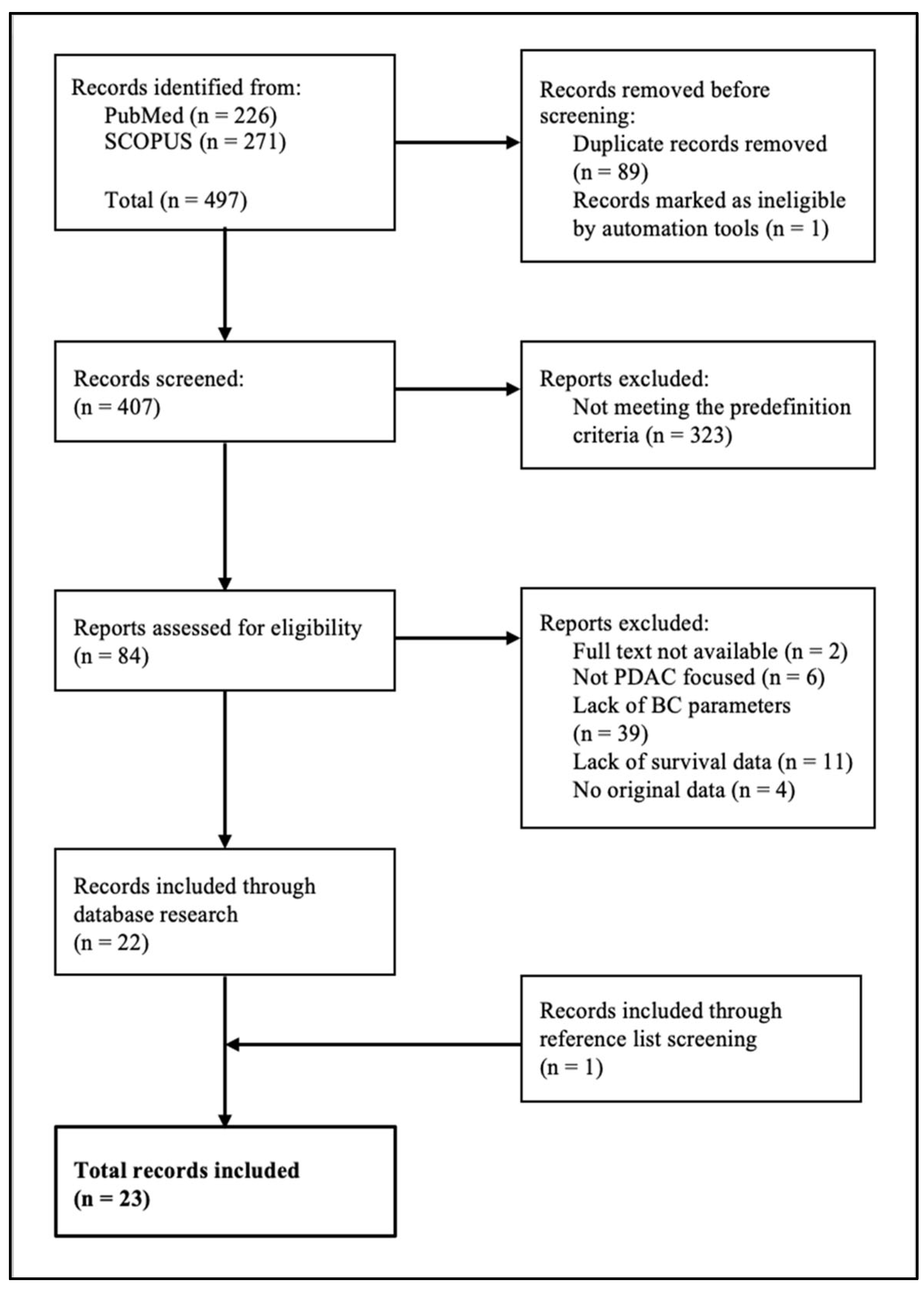
3.1. Study Selection Process
3.2. Characteristics of Included Studies
3.3. Technical Aspects and Features Evaluated
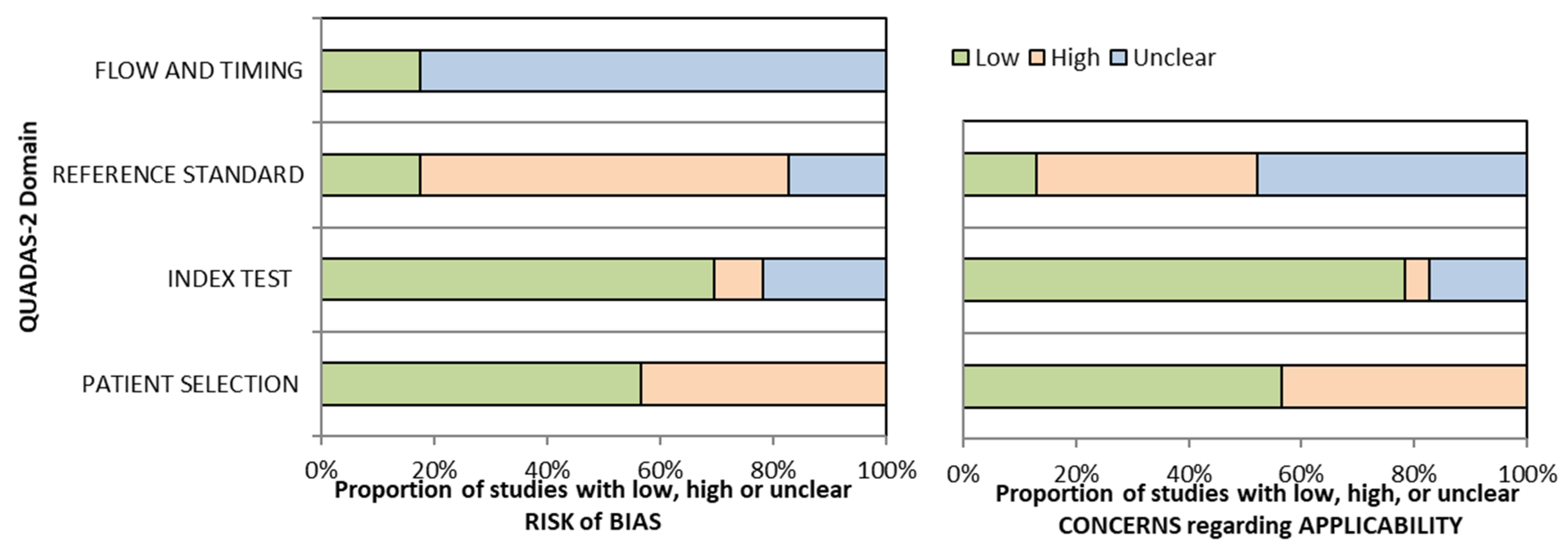
3.4. Quality Assessment Results
4. Discussion
5. Conclusions
Supplementary Materials
Author Contributions
Funding
Institutional Review Board Statement
Informed Consent Statement
Data Availability Statement
Acknowledgments
Conflicts of Interest
Abbreviations
| BC | Body Composition |
| BIA | Bioelectrical impedance analysis |
| BMI | Body Mass Index |
| CT | Computed Tomography |
| DXA | Dual-energy X-Ray Absorbiometry |
| FMF | Fatty Muscle Fraction |
| IMAT | Intramuscular Adipose Tissue |
| IMFF | Intramuscular Fat Fraction |
| L3 | Third lumbar vertebra |
| MA | Muscle Attenuation |
| MM | Muscle Mass |
| MMA | Mean Muscle Attenuation |
| MRI | Magnetic Resonance Imaging |
| OS | Overall Survival |
| PC | Pancreatic Cancer |
| PDAC | Pancreatic Ductal Adenocarcinoma |
| PFS | Progression Free Survival |
| SAT | Subcutaneous Adipose Tissue |
| SATI | Subcutaneous Adipose Tissue Index |
| SKM | Skeletal Muscle |
| SMA | Skeletal Muscle Area |
| SMD | Skeletal Muscle Density |
| SMI | Skeletal Muscle Index |
| SMRD | Skeletal Muscle Radiodensity |
| TA | Total Adiposity |
| TAI | Total Adipose Index |
| TAMA | Total Abdominal Muscle Area |
| TAT | Total Adipose Tissue |
| TFA | Total Fat Area |
| TFM | Total Fat Mass |
| VAT | Visceral Adipose Tissue |
| VATI | Visceral Adipose Tissue Index |
| VMR | Visceral to Muscle Ratio |
| VSR | Visceral to Subcutaneous Adipose Tissue Area |
Appendix A
Screening Details
References
- Ilic, M.; Ilic, I. Epidemiology of pancreatic cancer. World J. Gastroenterol. 2016, 22, 9694–9705. [Google Scholar] [CrossRef]
- Park, W.; Chawla, A.; O’Reilly, E.M. Pancreatic Cancer: A Review. JAMA 2021, 326, 851–862. [Google Scholar] [CrossRef]
- Kan, C.; Liu, N.; Zhang, K.; Wu, D.; Liang, Y.; Cai, W.; Jing, Q.; Han, F.; Xing, S.; Sun, X. Global, Regional, and National Burden of Pancreatic Cancer, 1990–2019: Results From the Global Burden of Disease Study 2019. Ann. Glob. Health 2023, 89, 33. [Google Scholar] [CrossRef]
- Zottl, J.; Sebesta, C.G.; Tomosel, E.; Sebesta, M.C.; Sebesta, C. Unraveling the Burden of Pancreatic Cancer in the 21st Century: Trends in Incidence, Mortality, Survival, and Key Contributing Factors. Cancers 2025, 17, 1607. [Google Scholar] [CrossRef] [PubMed]
- Conroy, T.; Pfeiffer, P.; Vilgrain, V.; Lamarca, A.; Seufferlein, T.; O’reilly, E.; Hackert, T.; Golan, T.; Prager, G.; Haustermans, K.; et al. Pancreatic cancer: ESMO Clinical Practice Guideline for diagnosis, treatment and follow-up. Ann. Oncol. 2023, 34, 987–1002. [Google Scholar] [CrossRef]
- Rizzo, S.; Summers, P.; Raimondi, S.; Belmonte, M.; Maniglio, M.; Landoni, F.; Colombo, N.; Bellomi, M. Diffusion-weighted MR imaging in assessing cervical tumour response to nonsurgical therapy. Radiol. Med. 2011, 116, 766–780. [Google Scholar] [CrossRef] [PubMed]
- Rizzo, S.M.R.; Kalra, M.K.; Schmidt, B.; Raupach, R.; Maher, M.M.; Blake, M.A.; Saini, S. CT images of abdomen and pelvis: Effect of nonlinear three-dimensional optimized reconstruction algorithm on image quality and lesion characteristics. Radiology 2005, 237, 309–315. [Google Scholar] [CrossRef] [PubMed]
- Genovese, E.; Canì, A.; Rizzo, S.; Angeretti, M.G.; Leonardi, A.; Fugazzola, C. Comparison between MRI with spin-echo echo-planar diffusion-weighted sequence (DWI) and histology in the diagnosis of soft-tissue tumours. Radiol. Med. 2011, 116, 644–656. [Google Scholar] [CrossRef]
- Vogel, A.; Ducreux, M. ESMO Guidelines Committee. Electronic address: Clinicalguidelines@esmo.org. ESMO Clinical Practice Guideline interim update on the management of biliary tract cancer. ESMO Open 2025, 10, 104003. [Google Scholar] [CrossRef]
- Mourtzakis, M.; Prado, C.M.; Lieffers, J.R.; Reiman, T.; McCargar, L.J.; Baracos, V.E. A practical and precise approach to quantification of body composition in cancer patients using comput-ed tomography images acquired during routine care. Appl. Physiol. Nutr. Metab. 2008, 33, 997–1006. [Google Scholar] [CrossRef]
- Pickhardt, P.J. Value-added Opportunistic CT Screening: State of the Art. Radiology 2022, 303, 241–254. [Google Scholar] [CrossRef]
- Pickhardt, P.J.; Graffy, P.M.; Perez, A.A.; Lubner, M.G.; Elton, D.C.; Summers, R.M. Opportunistic Screening at Abdominal CT: Use of Automated Body Composition Biomarkers for Added Cardiometabolic Value. Radiographics 2021, 41, 524–542. [Google Scholar] [CrossRef]
- Chianca, V.; Albano, D.; Messina, C.; Vincenzo, G.; Rizzo, S.; Del Grande, F.; Sconfienza, L.M. An update in musculoskeletal tumors: From quantitative imaging to radiomics. Radiol. Med. 2021, 126, 1095–1105. [Google Scholar] [PubMed]
- Khristenko, E.; Sinitsyn, V.; Rieden, T.; Girod, P.; Kauczor, H.U.; Mayer, P.; Klauss, M.; Lyadov, V. CT-based screening of sarcopenia and its role in cachexia syndrome in pancreatic cancer. PLoS ONE 2024, 19, e0291185. [Google Scholar] [CrossRef]
- Del Grande, M.; Rizzo, S.; Nicolino, G.M.; Colombo, I.; Rossi, L.; Manganaro, L.; Del Grande, F. Computed Tomography-Based Body Composition in Patients With Ovarian Cancer: Association With Chemotoxicity and Prognosis. Front. Oncol. 2021, 11, 718815. [Google Scholar]
- Rizzo, S.; Petrella, F.; Bardoni, C.; Bramati, L.; Cara, A.; Mohamed, S.; Radice, D.; Raia, G.; Del Grande, F.; Spaggiari, L. CT-Derived Body Composition Values and Complications After Pneumonectomy in Lung Cancer Patients: Time for a Sex-Related Analysis? Front. Oncol. 2022, 12, 826058. [Google Scholar] [CrossRef]
- Sanchez, A.; Kissel, S.; Coletta, A.; Scott, J.; Furberg, H. Impact of body size and body composition on bladder cancer outcomes: Risk stratification and opportunity for novel interventions. Urol. Oncol. 2020, 38, 713–718. [Google Scholar] [CrossRef] [PubMed]
- Kiss, N.; Prado, C.M.; Daly, R.M.; Denehy, L.; Edbrooke, L.; Baguley, B.J.; Fraser, S.F.; Khosravi, A.; Abbott, G. Low muscle mass, malnutrition, sarcopenia, and associations with survival in adults with cancer in the UK Biobank cohort. J. Cachexia Sarcopenia Muscle 2023, 14, 1775–1788. [Google Scholar]
- Láinez Ramos-Bossini, A.J.; Gámez Martínez, A.; Luengo Gómez, D.; Valverde-López, F.; Mel-guizo, C.; Prados, J. Prevalence of Sarcopenia Determined by Computed Tomography in Pancreatic Cancer: A Systematic Review and Meta-Analysis of Observational Studies. Cancers 2024, 16, 3356. [Google Scholar] [CrossRef]
- Cabasag, C.J.; Arnold, M.; Rutherford, M.; Bardot, A.; Ferlay, J.; Morgan, E.; Little, A.; De, P.; Dixon, E.; Woods, R.R.; et al. Pancreatic cancer survival by stage and age in seven high-income countries (ICBP SURVMARK-2): A population-based study. Br. J. Cancer 2022, 126, 1774–1782. [Google Scholar] [CrossRef]
- Pecchi, A.; Valoriani, F.; Costantini, R.C.; Squecco, D.; Spallanzani, A.; D’amico, R.; Dominici, M.; Di Benedetto, F.; Torricelli, P.; Menozzi, R. Role of Body Composition in Patients with Resectable Pancreatic Cancer. Nutrients 2024, 16, 1834. [Google Scholar] [CrossRef] [PubMed]
- Thormann, M.; Hinnerichs, M.; Barajas Ordonez, F.; Saalfeld, S.; Perrakis, A.; Croner, R.; Omari, J.; Pech, M.; Zamsheva, M.; Meyer, H.J.; et al. Sarcopenia is an Independent Prog-nostic Factor in Patients With Pancreatic Cancer—A Meta-analysis. Acad. Radiol. 2023, 30, 1552–1561. [Google Scholar] [CrossRef]
- Salinas-Miranda, E.; Deniffel, D.; Dong, X.; Healy, G.M.; Khalvati, F.; O’Kane, G.M.; Knox, J.; Bathe, O.F.; Baracos, V.E.; Gallinger, S.; et al. Prognostic value of early changes in CT-measured body composition in patients receiving chemotherapy for unresectable pan-creatic cancer. Eur. Radiol. 2021, 31, 8662–8670. [Google Scholar] [CrossRef]
- Wu, L.; Nie, T.; Zhi, X.; Ouyang, D.; Zhang, L.; Wu, H.; Li, X.; Wu, H.; Han, P.; Chen, L.; et al. Prognostic value of body composition on early recurrence and long-term survival of re-sectable pancreatic ductal adenocarcinoma. Eur. Radiol. 2025, 1–20. [Google Scholar] [CrossRef]
- Whiting, P.F.; Rutjes, A.W.S.; Westwood, M.E.; Mallett, S.; Deeks, J.J.; Reitsma, J.B.; Leeflang, M.M.G.; Sterne, J.A.C.; Bossuyt, P.M.M.; QUADAS-2 Group. QUADAS-2: A revised tool for the quality assessment of diagnostic accuracy studies. Ann. Intern. Med. 2011, 155, 529–536. [Google Scholar] [CrossRef]
- Cloyd, J.M.; Nogueras-González, G.M.; Prakash, L.R.; Petzel, M.Q.B.; Parker, N.H.; Ngo-Huang, A.T.; Fogelman, D.; Denbo, J.W.; Garg, N.; Kim, M.P.; et al. Anthropometric Changes in Patients with Pancreatic Cancer Undergoing Preoperative Therapy and Pancreatoduodenectomy. J. Gastrointest. Surg. 2018, 22, 703–712. [Google Scholar] [CrossRef]
- Damm, M.; Efremov, L.; Jalal, M.; Nadeem, N.; Dober, J.; Michl, P.; Wohlgemuth, W.A.; Wadsley, J.; Hopper, A.D.; Krug, S.; et al. Body composition parameters predict survival in pancreatic cancer-A retrospective multicenter analysis. United Eur. Gastroenterol. J. 2023, 11, 998–1009. [Google Scholar]
- Naumann, P.; Eberlein, J.; Farnia, B.; Liermann, J.; Hackert, T.; Debus, J.; Combs, S.E. Cachectic body composition and inflammatory markers portend a poor prognosis in patients with locally advanced pancreatic cancer treated with chemoradiation. Cancers 2019, 11, 1655. [Google Scholar] [CrossRef]
- Ninomiya, G.; Fujii, T.; Yamada, S.; Yabusaki, N.; Suzuki, K.; Iwata, N.; Kanda, M.; Hayashi, M.; Tanaka, C.; Nakayama, G.; et al. Clinical impact of sarcopenia on prognosis in pancreatic ductal adenocarcinoma: A retrospective cohort study. Int. J. Surg. 2017, 39, 45–51. [Google Scholar] [CrossRef] [PubMed]
- Kim, I.H.; Choi, M.H.; Lee, I.S.; Hong, T.H.; Lee, M.A. Clinical significance of skeletal muscle density and sarcopenia in patients with pancreatic cancer undergoing first-line chemotherapy: A retrospective observational study. BMC Cancer 2021, 21, 77. [Google Scholar] [CrossRef]
- Sugimoto, M.; Farnell, M.B.; Nagorney, D.M.; Kendrick, M.L.; Truty, M.J.; Smoot, R.L.; Chari, S.T.; Moynagh, M.R.; Petersen, G.M.; Carter, R.E.; et al. Decreased Skeletal Muscle Volume Is a Predictive Factor for Poorer Survival in Patients Undergoing Surgical Resection for Pancreatic Ductal Adenocarcinoma. J. Gastrointest. Surg. 2018, 22, 831–839. [Google Scholar] [CrossRef]
- Nowak, S.; Kloth, C.; Theis, M.; Marinova, M.; Attenberger, U.I.; Sprinkart, A.M.; Luetkens, J.A. Deep learning–based assessment of CT markers of sarcopenia and myosteatosis for outcome assessment in patients with advanced pancreatic cancer after high-intensity focused ultrasound treatment. Eur. Radiol. 2024, 34, 279–286. [Google Scholar] [CrossRef]
- Suzuki, Y.; Saito, K.; Nakai, Y.; Oyama, H.; Kanai, S.; Suzuki, T.; Sato, T.; Hakuta, R.; Ishigaki, K.; Saito, T.; et al. Early skeletal muscle mass decline is a prognostic factor in patients receiving gemcitabine plus nab-paclitaxel for unresectable pancreatic cancer: A retrospective observational study. Support. Care Cancer 2023, 31, 197. [Google Scholar] [CrossRef] [PubMed]
- Wochner, R.; Clauss, D.; Nattenmüller, J.; Tjaden, C.; Bruckner, T.; Kauczor, H.-U.; Hackert, T.; Wiskemann, J.; Steindorf, K. Impact of progressive resistance training on CT quantified muscle and adipose tissue compartments in pancreatic cancer patients. PLoS ONE 2020, 15, e0242785. [Google Scholar] [CrossRef]
- Balcer, K.; Garnier, J.; Richa, Y.; Bruneel-Zupanc, C.; Piessen, G.; Turrini, O.; Truant, S.; El Amrani, M. Impact on survival of sarcopenia, systemic inflammatory response and anthropometric factors after pancreatectomy for resectable pancreatic adenocarcinoma. World J. Surg. Oncol. 2024, 22, 232. [Google Scholar] [CrossRef]
- Beetz, N.L.; Geisel, D.; Maier, C.; Auer, T.A.; Shnayien, S.; Malinka, T.; Neumann, C.C.M.; Pelzer, U.; Fehrenbach, U. Influence of Baseline CT Body Composition Parameters on Survival in Patients with Pancreatic Adenocarcinoma. J. Clin. Med. 2022, 11, 2356. [Google Scholar] [CrossRef]
- Miki, M.; Lee, L.; Hisano, T.; Sugimoto, R.; Furukawa, M. Loss of adipose tissue or skeletal muscle during first-line gemcitabine/nab-paclitaxel therapy is associated with worse survival after second-line therapy of advanced pancreatic cancer. Asia-Pac. J. Clin. Oncol. 2022, 18, 297–305. [Google Scholar] [CrossRef]
- van Dijk, D.P.J.; Bakens, M.J.A.M.; Coolsen, M.M.E.; Rensen, S.S.; van Dam, R.M.; Bours, M.J.L.; Weijenberg, M.P.; Dejong, C.H.C.; Damink, S.W.M.O. Low skeletal muscle radiation attenuation and visceral adiposity are associated with overall survival and surgical site infections in patients with pancreatic cancer. J. Cachexia Sarcopenia Muscle 2017, 8, 317–326. [Google Scholar] [CrossRef] [PubMed]
- Gunchick, V.; Brown, E.; Liu, J.; Locasale, J.W.; Philip, P.A.; Wang, S.C.; Su, G.L.; Sahai, V. Morphomics, Survival, and Metabolites in Patients With Metastatic Pancreatic Cancer. JAMA Netw. Open 2024, 7, e2440047. [Google Scholar] [CrossRef] [PubMed]
- Babic, A.; Rosenthal, M.H.; Bamlet, W.R.; Takahashi, N.; Sugimoto, M.; Danai, L.V.; Morales-Oyarvide, V.; Khalaf, N.; Dunne, R.F.; Brais, L.K.; et al. Postdiagnosis Loss of Skeletal Muscle, but Not Adipose Tissue, Is Associated with Shorter Survival of Patients with Advanced Pancreatic Cancer. Cancer Epidemiol. Biomark. Prev. 2019, 28, 2062–2069. [Google Scholar] [CrossRef]
- Choi, M.H.; Yoon, S.B.; Lee, K.; Song, M.; Lee, I.S.; Lee, M.A.; Hong, T.H.; Choi, M. Preoperative sarcopenia and post-operative accelerated muscle loss negatively impact survival after resection of pancreatic cancer. J. Cachexia Sarcopenia Muscle 2018, 9, 326–334. [Google Scholar] [CrossRef]
- Bareiß, S.; Merkel, S.; Krautz, C.; Weber, G.F.; Grützmann, R.; Brunner, M. Prognostic role of nutrition parameters on short- and long-term outcome in patients with primary resectable pancreatic ductal adenocarcinoma. Clin. Nutr. ESPEN 2024, 62, 296–302. [Google Scholar] [CrossRef] [PubMed]
- Lee, M.W.; Jeon, S.K.; Paik, W.H.; Yoon, J.H.; Joo, I.; Lee, J.M.; Lee, S.H. Prognostic value of initial and longitudinal changes in body composition in metastatic pancreatic cancer. J. Cachexia Sarcopenia Muscle 2024, 15, 735–745. [Google Scholar] [CrossRef]
- Bian, X.; Dai, H.; Feng, J.; Ji, H.; Fang, Y.; Jiang, N.; Li, W. Prognostic values of abdominal body compositions on survival in advanced pancreatic cancer. Medicine 2018, 97, e10988. [Google Scholar] [CrossRef] [PubMed]
- Nakano, O.; Kawai, H.; Kobayashi, T.; Kohisa, J.; Ikarashi, S.; Hayashi, K.; Yokoyama, J.; Terai, S. Rapid decline in visceral adipose tissue over 1 month is associated with poor prognosis in patients with unresectable pancreatic cancer. Cancer Med. 2021, 10, 4291–4301. [Google Scholar] [CrossRef]
- Kays, J.K.; Shahda, S.; Stanley, M.; Bell, T.M.; O’Neill, B.H.; Kohli, M.D.; Couch, M.E.; Koniaris, L.G.; Zimmers, T.A. Three cachexia phenotypes and the impact of fat-only loss on survival in FOLFIRINOX therapy for pancreatic cancer. J. Cachexia Sarcopenia Muscle 2018, 9, 673–684. [Google Scholar] [CrossRef]
- Pecorelli, N.; Carrara, G.; De Cobelli, F.; Cristel, G.; Damascelli, A.; Balzano, G.; Beretta, L.; Braga, M. Effect of sarcopenia and visceral obesity on mortality and pancreatic fistula following pancreatic cancer surgery. Br. J. Surg. 2016, 103, 434–442. [Google Scholar] [CrossRef] [PubMed]
- Tewari, N.; Awad, S.; Macdonald, I.A.; Lobo, D.N. A comparison of three methods to assess body composition. Nutrition 2018, 47, 1–5. [Google Scholar] [CrossRef]
- Caan, B.J.; Cespedes Feliciano, E.M.; Prado, C.M.; Alexeeff, S.; Kroenke, C.H.; Bradshaw, P.; Quesenberry, C.P.; Weltzien, E.K.; Castillo, A.L.; Olobatuyi, T.A.; et al. Association of Muscle and Adiposity Measured by Computed Tomography With Survival in Patients With Nonmetastatic Breast Cancer. JAMA Oncol. 2018, 4, 798–804. [Google Scholar] [CrossRef]
- Mintziras, I.; Miligkos, M.; Wächter, S.; Manoharan, J.; Maurer, E.; Bartsch, D.K. Sarcopenia and sarcopenic obesity are significantly associated with poorer overall survival in patients with pancreatic cancer: Systematic review and meta-analysis. Int. J. Surg. 2018, 59, 19–26. [Google Scholar] [CrossRef]
- Stretch, C.; Aubin, J.M.; Mickiewicz, B.; Leugner, D.; Al-Manasra, T.; Tobola, E.; Salazar, S.; Suther-land, F.R.; Ball, C.G.; Dixon, E.; et al. Sarcopenia and myosteatosis are accompanied by distinct biological profiles in patients with pancreatic and periampullary adenocarcinomas. PLoS ONE 2018, 13, e0196235. [Google Scholar] [CrossRef]
- Liu, C.; An, L.; Zhang, S.; Deng, S.; Wang, N.; Tang, H. Association between preoperative sarcopenia and prognosis of pancreatic cancer after curative-intent surgery: A updated systematic review and meta-analysis. World J. Surg. Oncol. 2024, 22, 38. [Google Scholar] [CrossRef] [PubMed]
- Láinez Ramos-Bossini, A.J.; Gámez Martínez, A.; Luengo Gómez, D.; Valverde-López, F.; Mo-rillo Gil, A.J.; González Flores, E.; Salmerón Ruiz, Á.; Jiménez Gutiérrez, P.M.; Melguizo, C.; Pra-dos, J. Computed Tomography-Based Sarcopenia and Pancreatic Cancer Survival-A Com-prehensive Meta-Analysis Exploring the Influence of Definition Criteria, Prevalence, and Treatment Intention. Cancers 2025, 17, 607. [Google Scholar] [CrossRef]
- Sohal, D.P.S.; Boutin, R.D.; Lenchik, L.; Kim, J.; Beg, M.S.; Wang-Gillam, A.; Wade, J.L., 3rd; Guthrie, K.A.; Chiorean, E.G.; Ahmad, S.A.; et al. Body composition meas-urements and clinical outcomes in patients with resectable pancreatic adenocarcinoma-analysis from SWOG S1505. J. Gastrointest. Surg. 2024, 28, 232–235. [Google Scholar] [CrossRef]
- Theis, M.; Hong, W.; Lee, B.; Nowak, S.; Luetkens, J.; Stuckey, S.; Gibbs, P.; Thomson, B.; Michael, M.; Sprinkart, A.M.; et al. Skeletal muscle and visceral fat density are predictive imaging bi-omarkers for overall survival in patients with pancreatic adenocarcinoma: A retrospective multicenter analysis. Surg. Oncol. 2025, 61, 102251. [Google Scholar] [CrossRef]
- Gruber, E.S.; Jomrich, G.; Tamandl, D.; Gnant, M.; Schindl, M.; Sahora, K. Sarcopenia and sar-copenic obesity are independent adverse prognostic factors in resectable pancreatic ductal adenocarcinoma. PLoS ONE 2019, 14, e0215915. [Google Scholar] [CrossRef]
- Donini, L.M.; Busetto, L.; Bischoff, S.C.; Cederholm, T.; Ballesteros-Pomar, M.D.; Batsis, J.A.; Bauer, J.M.; Boirie, Y.; Cruz-Jentoft, A.J.; Dicker, D.; et al. Definition and Diagnostic Criteria for Sarcopenic Obesity: ESPEN and EASO Consensus Statement. Obes. Facts 2022, 15, 321–335. [Google Scholar] [CrossRef] [PubMed]
- Stenholm, S.; Harris, T.B.; Rantanen, T.; Visser, M.; Kritchevsky, S.B.; Ferrucci, L. Sarcopenic obesity-defnition, etiology and consequences. Curr. Opin. Clin. Nutr. Metab. Care 2008, 11, 693–700. [Google Scholar]
- Prado, C.M.; Lieffers, J.R.; McCargar, L.J.; Reiman, T.; Sawyer, M.B.; Martin, L.; Baracos, V.E. Prevalence and clinical implications of sarcopenic obesity in patients with solid tumours of the respiratory and gastrointestinal tracts: A population-based study. Lancet Oncol. 2008, 9, 629–635. [Google Scholar] [CrossRef]
- Surov, A.; Thormann, M.; Wienke, A.; Ricke, J.; Seidensticker, M. Different cutoff values of the skeletal muscle mass and myosteatosis result in different clinical impact on overall sur-vival in oncology. A subanalysis of a clinical trial. J. Cancer Res. Clin. Oncol. 2025, 151, 141. [Google Scholar] [CrossRef]
- Leão Mendes, J.; Ferreira, R.Q.; Mata, I.; Vasco Barreira, J.; Rodrigues, Y.C.; Silva Dias, D.; Capelas, M.L.; Mäkitie, A.; Guerreiro, I.; Pimenta, N.M.; et al. Body Composition Analysis in Meta-static Non-Small-Cell Lung Cancer: Depicting Sarcopenia in Portuguese Tertiary Care. Cancers 2025, 17, 539. [Google Scholar] [CrossRef] [PubMed]
- Page, M.J.; McKenzie, J.E.; Bossuyt, P.M.; Boutron, I.; Hoffmann, T.C.; Mulrow, C.D.; Shamseer, L.; Tetzlaff, J.M.; Akl, E.A.; Brennan, S.E.; et al. The PRISMA 2020 statement: An updated guideline for reporting systematic reviews. BMJ 2021, 372, n71. [Google Scholar] [CrossRef] [PubMed]


| Authors | Sarcopenia in % | Body Composition Features Evaluated | Correlation Found | Main Association(s) of CT-Based Body Composition and Survival |
|---|---|---|---|---|
| [26] | 63% | MM, VAT, SAT | Yes | Increase in SKM during postoperative period was associated with higher OS. |
| [27] | 32.2% | MM, SMI, MA TA, SAT, VAT, FMF, VMR, VSR | No | Myosteatosis as an independent prognostic factor |
| [28] | 63.1% | SAT, VAT, SMI | Yes | Muscle loss during treatment was a strong independent predictor of poor survival. |
| [29] | 64.2% | SMI, SAT, VAT, TA | Yes | Sarcopenia was an independent prognostic factor for OS with a BMI > 22 |
| [30] | 41% | TA, SMA, SMI, MA | Yes | Low SMI and low MA were poor prognostic factors for OS |
| [31] | 62% | SAT, VAT, SMI, MM | Yes | A sex-standardised SMI was a predictive factor for shorter OS and RFS. |
| [32] | NA | SMI, MA, FMF | Yes | Sarcopenia and myosteatosis showed a prognostic value for OS. |
| [33] | 44.2% | SMI, VATI, SATI, VSR | Yes | SMI change rates presented a trend to poor prognosis |
| [34] | NA | TA, SAT, VAT, VATI, MA, SMI, FMF | Yes | High VATI at baseline and loss of SMI during treatment were predictors of poor OS. |
| [35] | 49% | SMI, SAT, VAT | Yes | Sarcopenic obesity associated with poor prognosis. |
| [36] | 63% | SMI, SAT, VAT | Yes | Sarcopenia and high VAT were associated with poor survival, |
| [37] | NA | SMI, SAT, VAT | Yes | Loss of SAT, VAT and SMI during therapy indicated poor OS. |
| [38] | NA | SMI, SAT, VAT, FMF | Yes | Low FMF was associated with reduced survival. |
| [39] | NA | SKM, SAT, VAT, SMI, SATI, VATI | Yes | High SAT was associated with longer OS; high VAT was associated with shorter PFS. |
| [40] | 52% | SMI, SMA, SAT, VAT | Yes | Muscle loss after diagnosis was associated with low OS |
| [41] | 33.3% | SMI, MA, SAT, VAT | Yes | Preoperative sarcopenia and accelerated muscle loss after surgery negatively impacted OS. |
| [42] | 28% | MA, SMI, SAT, VAT, MM, VSR, VMR | No | The nutritional risk score was associated with OS. |
| [43] | 33.8% | MA, SMI, VATI, SATI | Yes | Initial MA was a significant prognostic factor for both sexes. Initial SMI and changes in SATI were associated with OS in males; in females initial SATI was significant. |
| [44] | NA | SMI, VSR, SAT, VAT, MA | Yes | Low SMI and high VAT were associated with poor OS. |
| [45] | 49.1% | SMI, SATI, VATI, VSR | Yes | High loss in VATI was an independent risk factor for mortality. |
| [21] | 56.8% | TAMA, SMI, FMF, SATI, VATI | Yes | High VATI and SATI correlated with greater OS. High VATI loss correlated with worse OS. |
| [46] | 49.1% | SMI, FMF, VAT, VATI, SAT, SATI, TA, TAI | Yes | Sarcopenic obesity at diagnosis was associated with decreased OS. Adipose tissue and muscle loss during treatment was associated with decreased OS. |
| [47] | 65.1% | TAMA, SAT, VAT | Yes | Sarcopenic obesity was associated with decreased OS. |
Disclaimer/Publisher’s Note: The statements, opinions and data contained in all publications are solely those of the individual author(s) and contributor(s) and not of MDPI and/or the editor(s). MDPI and/or the editor(s) disclaim responsibility for any injury to people or property resulting from any ideas, methods, instructions or products referred to in the content. |
© 2026 by the authors. Licensee MDPI, Basel, Switzerland. This article is an open access article distributed under the terms and conditions of the Creative Commons Attribution (CC BY) license.
Share and Cite
Supe, L.; Rizzo, S. The Correlation of Computed Tomography (CT)-Based Body Composition and Survival in Pancreatic Cancer Patients: A Systematic Review. Tomography 2026, 12, 8. https://doi.org/10.3390/tomography12010008
Supe L, Rizzo S. The Correlation of Computed Tomography (CT)-Based Body Composition and Survival in Pancreatic Cancer Patients: A Systematic Review. Tomography. 2026; 12(1):8. https://doi.org/10.3390/tomography12010008
Chicago/Turabian StyleSupe, Lena, and Stefania Rizzo. 2026. "The Correlation of Computed Tomography (CT)-Based Body Composition and Survival in Pancreatic Cancer Patients: A Systematic Review" Tomography 12, no. 1: 8. https://doi.org/10.3390/tomography12010008
APA StyleSupe, L., & Rizzo, S. (2026). The Correlation of Computed Tomography (CT)-Based Body Composition and Survival in Pancreatic Cancer Patients: A Systematic Review. Tomography, 12(1), 8. https://doi.org/10.3390/tomography12010008